
22 Gaelic Tattoo Ideas: Best Heritage Celtic Tattoos 2026
These 22 gaelic tattoo ideas are ranked by how well they actually work on skin rather than how they look in a saved folder. Interlaced knots, the Claddagh, the thistle, Ogham lettering and a few modern designs that borrow honestly from Insular art, each with a real placement, a realistic size, an honest pain note and one way to make it your own.
Most people searching this term want the same three things: a design that is recognisably Gaelic, a symbol that has a real history behind it, and an idea that will still look sharp in ten years. That last point is where most saved collections let you down, because they ignore line weight and skin placement entirely. The ideas below cover what each design looks like, where it sits well, and how it ages.
If you are booking this autumn, work backwards from the date. A fine-line piece needs a clear, unfussy area of skin, no sun exposure for a couple of weeks, and no gym session on the shoulder for a few days after. Winter and early spring are the easiest months for a forearm or calf piece because you can cover it easily while it settles.
22 Gaelic Tattoo Ideas: Quick Guide
| Idea | Style | Best placement | Size | Pain |
|---|---|---|---|---|
| 1. Interlaced endless knot | Fine line, blackwork | Inner forearm, upper arm | 2-4 inch (5-10 cm) | Low to medium |
| 2. Triple spiral triskele | Fine line, blackwork, dotwork | Inner forearm, calf, behind ear | 2-4 inch (5-10 cm) | Low to medium |
| 3. Highland thistle linework | Botanical fine line, realism | Outer forearm, calf, shoulder | 3-5 inch (7.5-13 cm) | Medium |
| 4. Celtic tree of life | Blackwork, fine line | Upper back, chest, thigh | 4-8 inch (10-20 cm) | Medium to high |
| 5. Scottish lion rampant | Traditional, blackwork | Upper arm, thigh, calf | 3-6 inch (7.5-15 cm) | Medium |
| 6. Irish harp | Fine line, traditional realism | Inner forearm, calf, ribs | 2.5-5 inch (6-13 cm) | Low to medium |
| 7. Knotwork compass rose | Blackwork, geometric fine line | Forearm, shoulder, upper back | 3-5 inch (7.5-13 cm) | Medium |
| 8. Rowan branch and berries | Botanical, watercolor | Outer forearm, calf, ribs | 3-6 inch (7.5-15 cm) | Low to medium |
| 9. Ogham stroke study | Fine line, blackwork | Inner forearm, calf, ribs | 3-7 inch (7.5-18 cm) | Low to medium |
| 10. Claddagh | Minimal fine line, blackwork | Inner forearm, ring finger | 1.5-2.5 inch (4-6 cm) | Medium to high |
| 11. Single spiral with border | Bold blackwork, fine line | Shoulder blade, thigh, calf | 3-6 inch (7.5-15 cm) | Medium |
| 12. Highland cow portrait | Micro-realism, illustrative | Outer forearm, rib, thigh | 3-6 inch (7.5-15 cm) | Medium |
| 13. Irish wolfhound silhouette | Minimal blackwork | Outer calf, forearm, thigh | 3-7 inch (7.5-18 cm) | Low to medium |
| 14. Interwoven shoulder band | Geometric blackwork | Upper arm, shoulder cap | 6-10 inch (15-25 cm) | Medium to high |
| 15. Celtic cross | Traditional, neo-traditional, fine line | Forearm, upper back, chest | 3-6 inch (7.5-15 cm) | Medium |
| 16. Four-character Ogham name panel | Minimalist fine line, script | Inner wrist, forearm, calf | 2-4 inch (5-10 cm) | Low to medium |
| 17. Chevron with knotwork end caps | Bold blackwork, geometric | Inner forearm, lower leg | 4-7 inch (10-18 cm) | Medium |
| 18. Stylised Celtic dragon | Illustrative, neo-traditional | Forearm, calf, shoulder | 3-6 inch (7.5-15 cm) | Medium to high |
| 19. Manuscript-inspired panel | Neo-traditional, illustrative | Outer calf, forearm, upper back | 3-5 inch (7.5-13 cm) | Medium |
| 20. Fáilte handwritten script | Script, calligraphic | Inner forearm, collarbone, wrist | 2-4 inch (5-10 cm) | Low to medium |
| 21. Heritage tartan band | Geometric, fine line, blackwork | Forearm, calf, ankle | 2-6 inch (5-15 cm) wide | Medium |
| 22. Highland hills and loch scene | Fine line, illustrative, watercolor | Outer forearm, upper back, calf | 3-7 inch (7.5-18 cm) | Medium to high |
How to Read These 22 Gaelic Tattoo Ideas
Some of these designs are documented, recognisable symbols with a real place in Irish or Scottish art. The endless knot, the triskele, the Claddagh and the Celtic cross sit in that group. Others, like the knotwork compass rose or the manuscript panel, are contemporary decorative designs built from Celtic visual language, and pretending otherwise is how tattoo shops end up selling invented meanings to people who wanted a history.
Two more things to hold onto. Irish Gaeilge and Scottish Gàidhlig are separate languages with different spelling rules, so a phrase has to come from the right one, and it should be checked by a fluent speaker before it goes on skin permanently. And factor in how the design ages: hairline detail on hands and fingers softens within years, and any tiny interior ornament on a bigger piece is the first thing to blur.
1. Interlaced Celtic Endless Knot
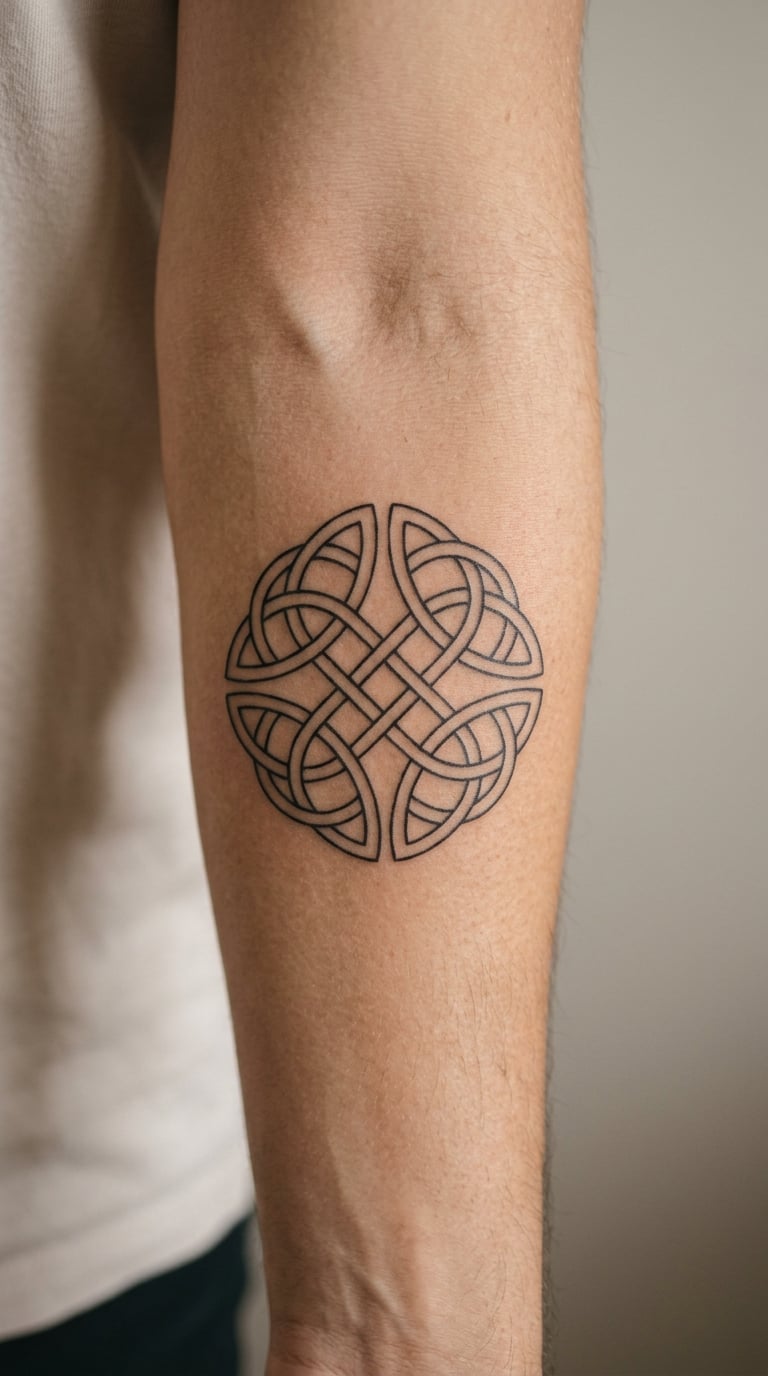
This gaelic tattoo idea is the most forgiving first heritage piece because the design is pure line, evenly weighted, and reads clearly even at small scale. The endless knot is a continuous interlace with no visible start or end, chosen today mostly as a decorative expression of continuity and connection rather than for a single fixed meaning. Clean over-and-under crossings matter more here than shading: if the artist fudges the weaving, the whole thing collapses into visual noise.
Placement: inner forearm, upper arm, or the back of the shoulder. Size: 2-4 inches (5-10 cm) across. Style: fine line or solid blackwork. Pain: low to medium on the forearm, higher over the ribs. Fine line on the hands fades fastest of any placement, so keep it away from knuckles and fingers. Make it yours: set the knot inside a thin circular frame with a birth year added at the base in small caps.
2. Triple Spiral Triskele
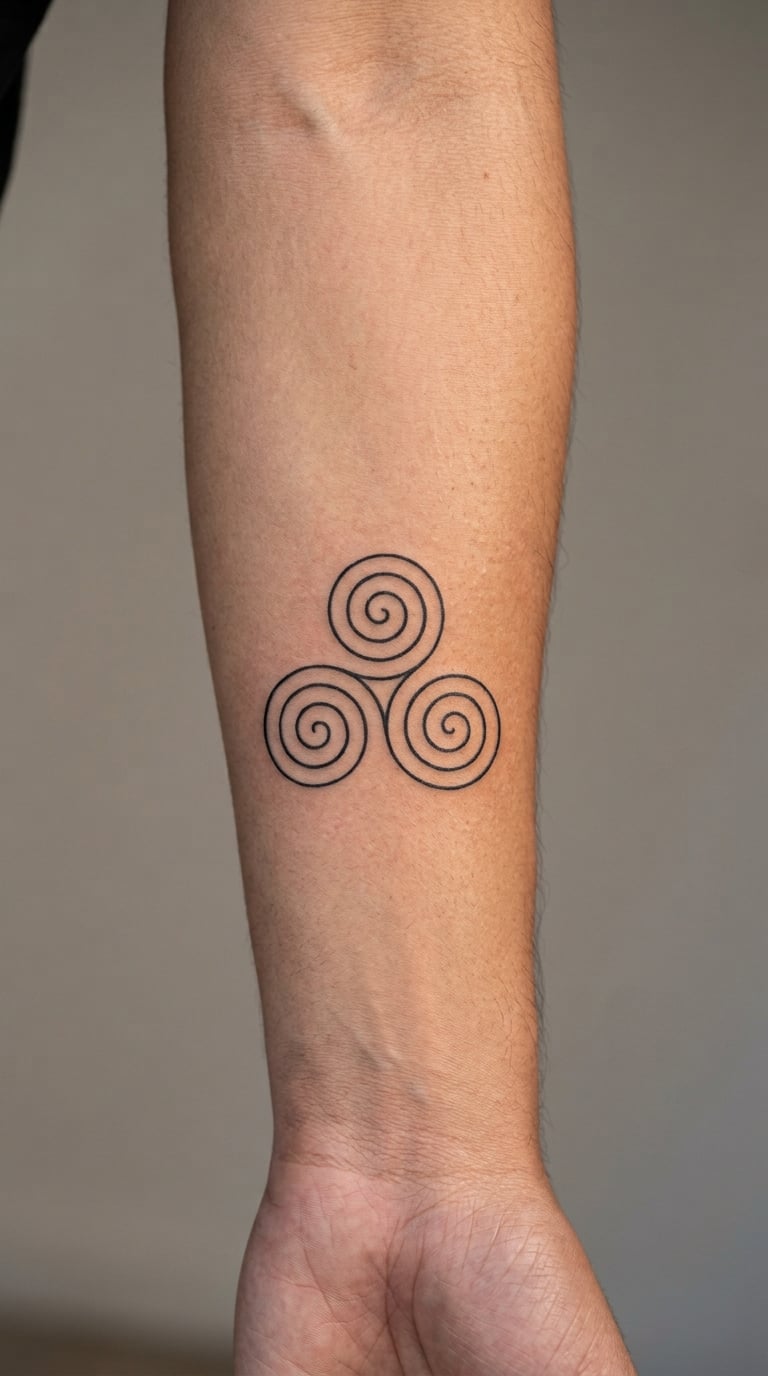
The triskele is three spiral arms rotating from a centre point, a shape with a long use in Celtic and Insular art. People pick it for balance and movement as much as for heritage, and it holds its shape at sizes where finer interlaced knots start to clog up. A dotwork version reads very differently from a solid one, so look at healed examples in the artist’s portfolio rather than a single flash photo.
Placement: inner forearm, upper arm, calf, or behind the ear. Size: 2-4 inches (5-10 cm) across. Style: blackwork, fine line, or dotwork. Pain: low to medium. The gaps between the arms are the weak point, and a very small triskele can blur shut over a decade or more. Make it yours: engrave a date you care about inside the hollow centre of the spiral rather than adding lettering around it.
3. Highland Thistle Linework
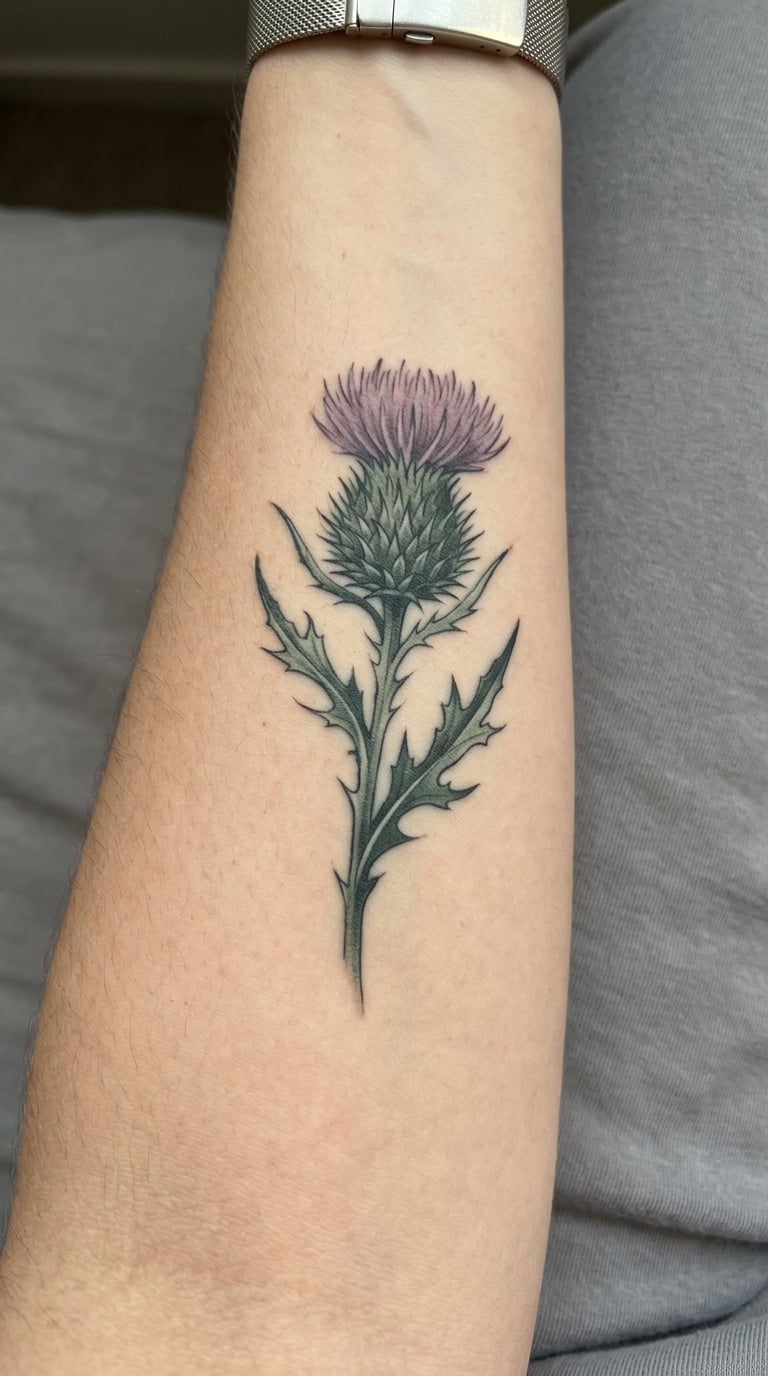
A thistle tattoo is a botanical study with a tapered stem, serrated spiky leaves, and a purple or green bloom, and its association with Scotland is real and long-standing. It suits people who want an Irish or Scottish heritage piece that reads as a plant first and a symbol second. The leaves are where the difficulty sits; serrated edges drawn too lightly disappear within a few years.
Placement: forearm, calf, arm, or shoulder. Size: 3-5 inches (7.5-13 cm) tall. Style: fine-line botanical or illustrative realism. Pain: medium, and noticeably more over bone or the ribs. Hairline colour detail does soften, so a solid black stem with a single colour bloom outlasts a fully shaded one. Make it yours: run a hand-lettered date along the underside of the stem, following its curve.
4. Celtic Tree of Life
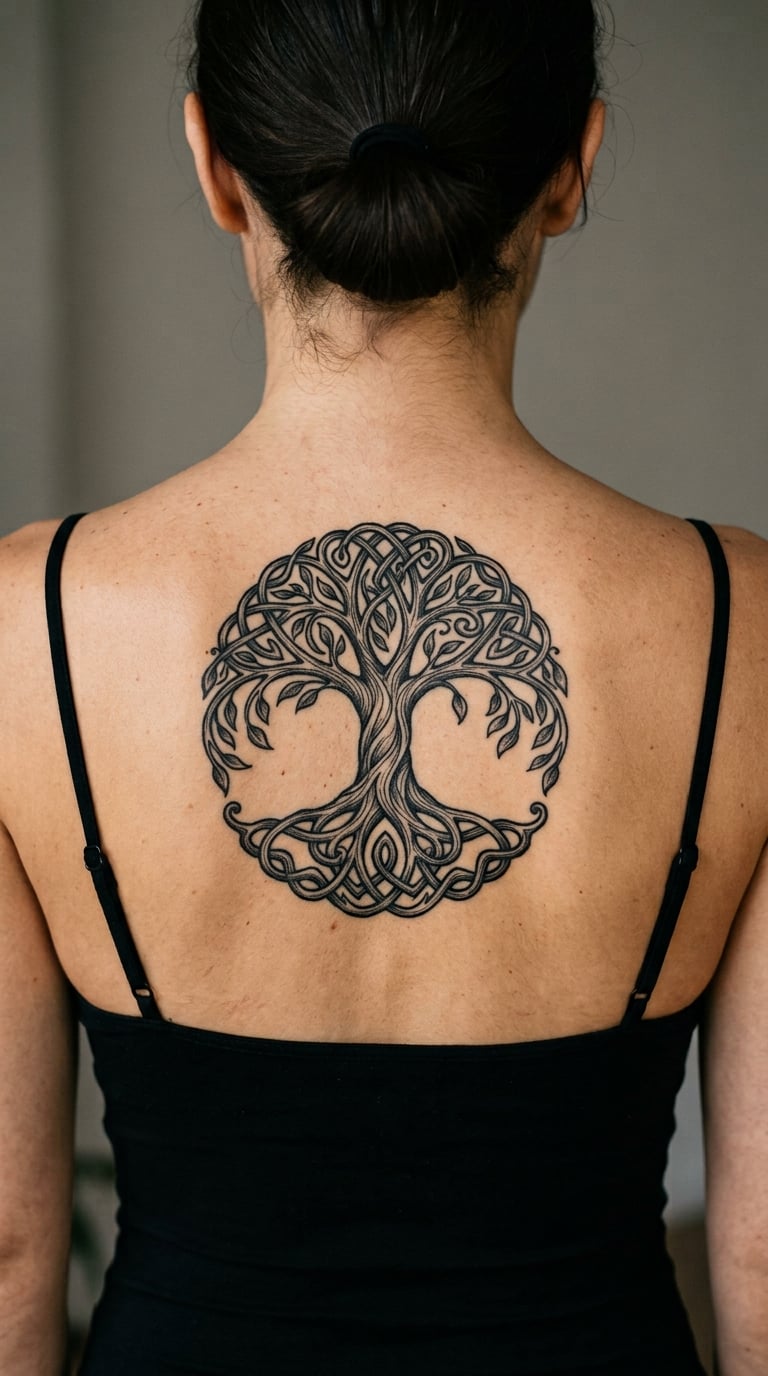
The Celtic tree of life is an ornamental tree with mirrored branches, interwoven roots and a canopy of small leaves, and modern versions are usually about ancestry, growth or family connections. It is a big statement piece rather than a quiet one, and the scale is what makes it work. Anything under about 4 inches turns the leaf detail into a smudge, so this is a design to commit to properly.
Placement: back, chest, thigh, forearm, or calf. Size: 4-8 inches (10-20 cm) tall. Style: blackwork, fine line, or illustrative. Pain: medium to high, driven almost entirely by the location, and the spine and ribs are the worst of it. Leaf interiors age first, so favour bolder leaves over hairline shading. Make it yours: work a family initial into the root structure on one side only, so the symmetry stays intact.
5. Scottish Lion Rampant
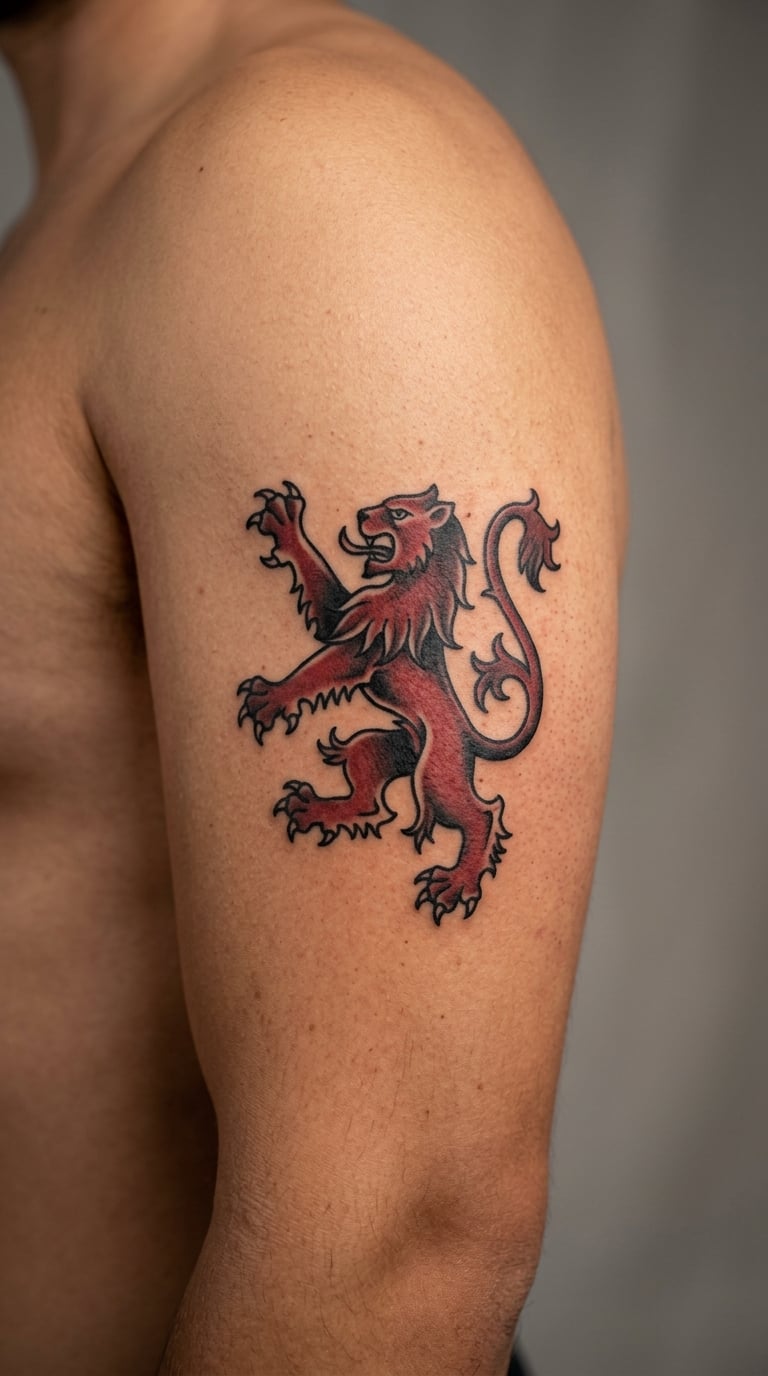
A lion rampant tattoo shows a lion rising on its hind legs with all four paws in the air, drawn with a double outline and restrained shading, and the form is strongly associated with Scottish heraldry. It suits anyone who wants a bold traditional piece with a Scottish reference that needs no explanation. Just know that the exact silhouette changes from one coat of arms to the next.
Placement: upper arm, thigh, chest, or calf. Size: 3-6 inches (7.5-15 cm) tall. Style: traditional, neo-traditional, or blackwork. Pain: medium. The repeated outlines around the mane and tail are where inkers lose definition, so ask to see how much the artist relies on thin strokes. Make it yours: bring a reference from a coat of arms connected to your family rather than letting the studio invent a lion and calling it a clan crest.
6. Irish Harp with Celtic Frame
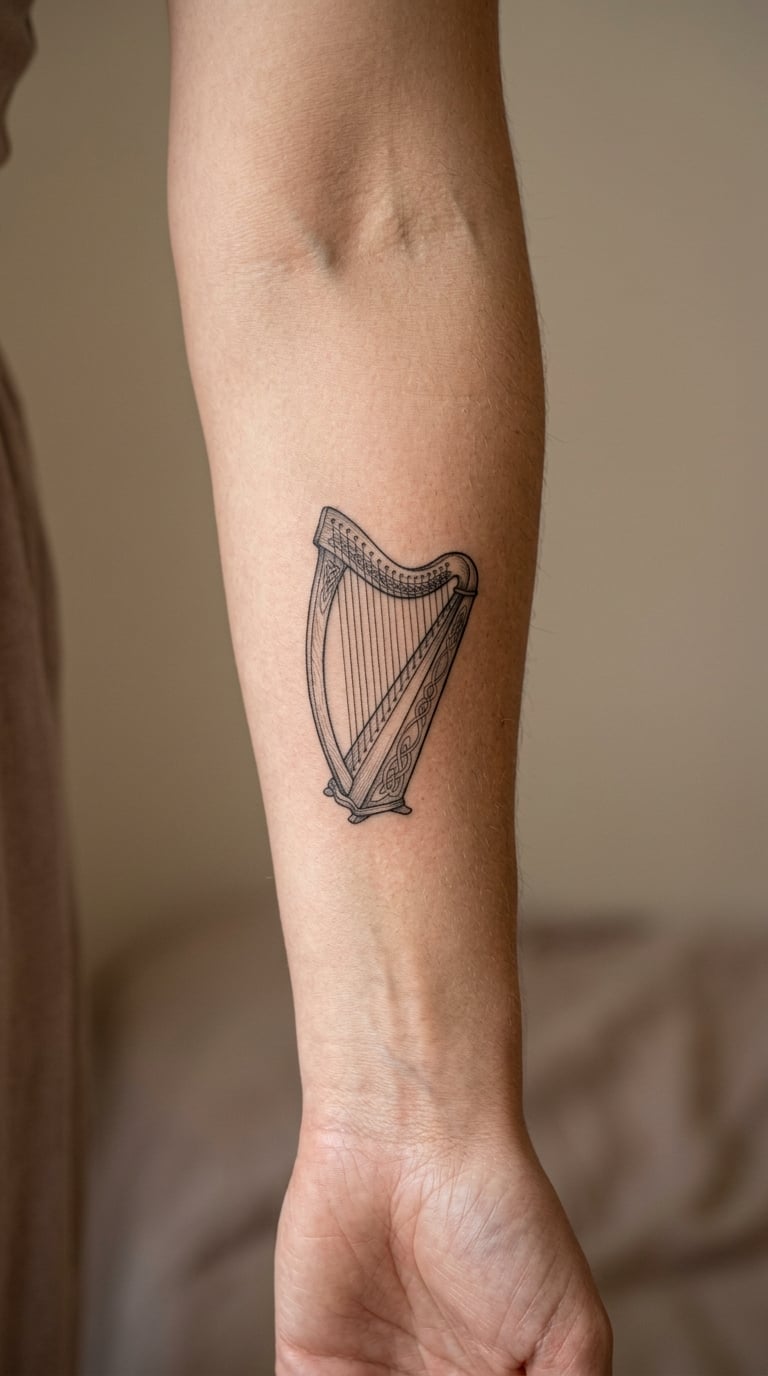
An Irish harp tattoo is a framed instrument with a graceful curved neck, a visible string bed, and often a small knot or vine detail worked into the soundboard. The connection to Irish musical and national heritage is direct and uncontroversial, which makes it a good pick when you want recognition without a slogan. Drawn well, the strings give the whole piece its rhythm.
Placement: forearm, upper arm, calf, or ribs. Size: 2.5-5 inches (6-13 cm) long. Style: fine line, blackwork, or traditional realism. Pain: low to medium, rising over the ribs. The smallest strings are the first casualty of sun and age, so ask for a minimum line weight before the stencil goes down. Make it yours: put a meaningful date on the soundboard where it reads like a maker’s mark.
7. Knotwork Compass Rose
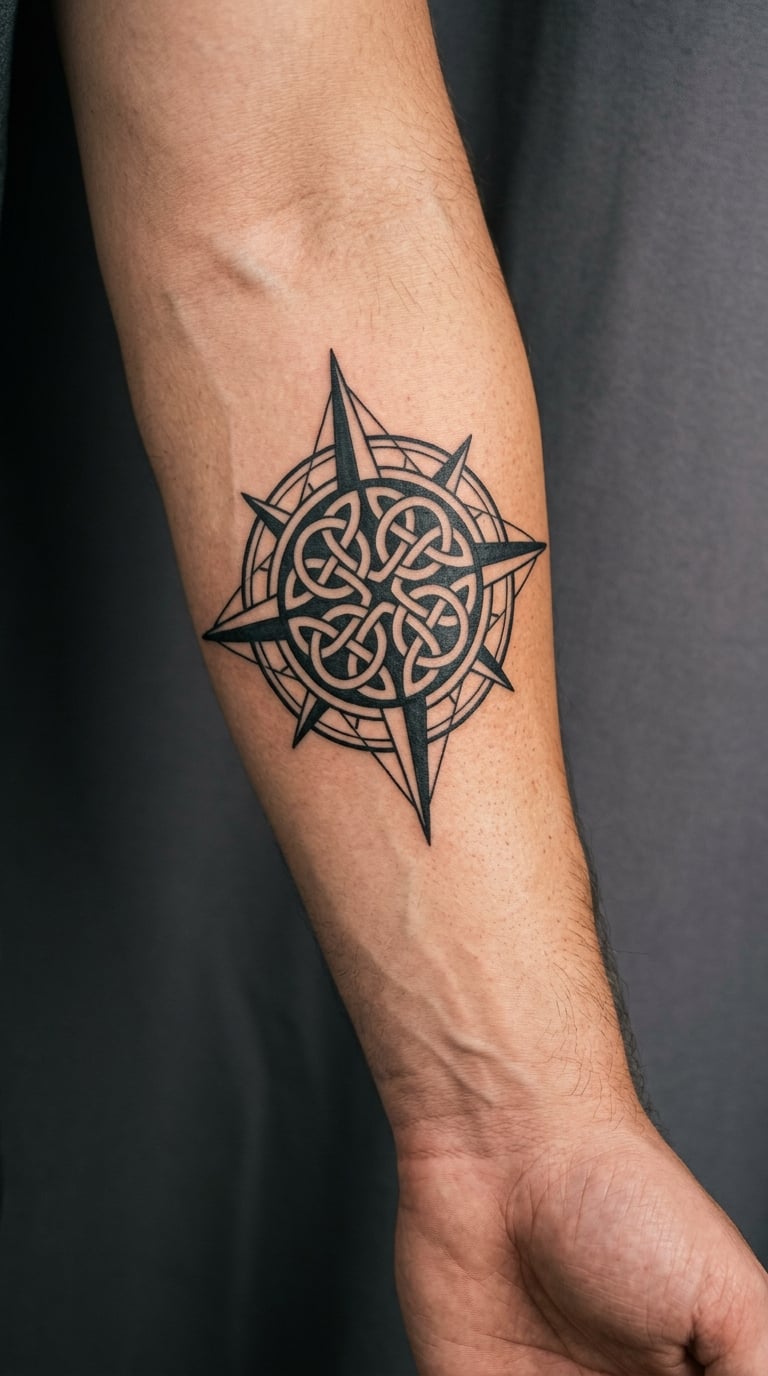
A knotwork compass rose tattoo combines four directional points with a circular centre filled in with a small interlace pattern, and it is a contemporary design rather than a documented historical Gaelic emblem. That is not a flaw; plenty of good tattoo work borrows old visual grammar for new purposes. It just needs enough breathing room around the points, or the spokes blur into a dark smudge. If you would rather build a whole arm around the idea of direction, our north star tattoo ideas gallery works from the same starting point.
Placement: forearm, upper arm, shoulder, or upper back. Size: 3-5 inches (7.5-13 cm) across. Style: blackwork or geometric fine line. Pain: medium. Ask your artist how the point tips will be finished, because thin triangles are the first thing to disappear. Make it yours: add the latitude or longitude of a place that matters to you inside the knotwork centre.
8. Rowan Branch and Red Berry Cluster
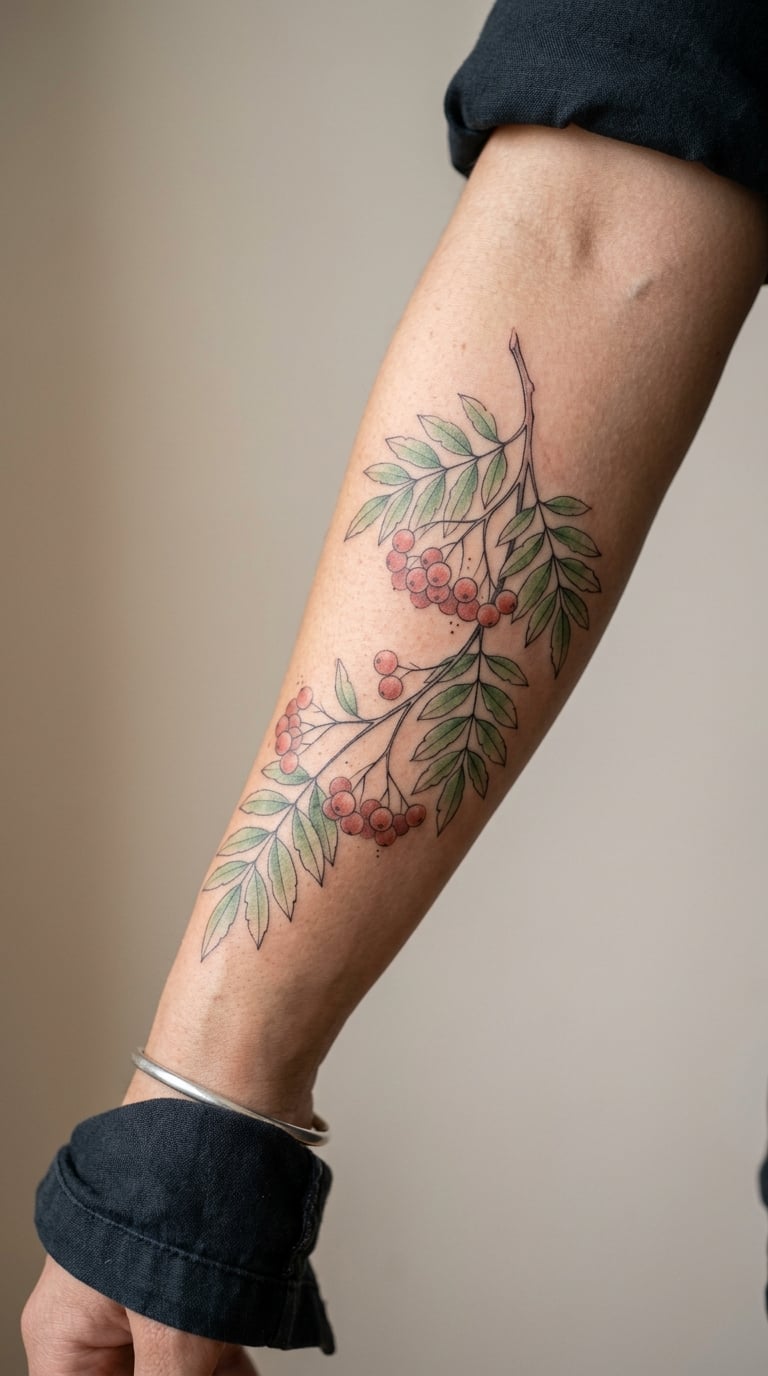
A rowan branch tattoo curves gently, carrying paired serrated leaves and clusters of small berries, and rowan holds a documented place in Irish and Scottish folklore and protection traditions. It is one of the more quietly distinctive options on this list, and it reads as a botanical study rather than a badge, which helps if you want heritage without symbolism doing the talking. Watercolour versions age better than they have any right to if the colour is kept soft, and our gardening tattoo ideas with placements covers more of the plant-led side if this is the direction you like.
Placement: forearm, calf, thigh, or ribs. Size: 3-6 inches (7.5-15 cm) long. Style: botanical fine line, illustrative, or watercolor. Pain: low to medium. Tiny berries are the detail that softens first, so treat them as shading rather than outlining every one. Make it yours: set a coordinate of a meaningful location in small type running beneath the branch.
9. Ogham-Inspired Vertical Stroke Study
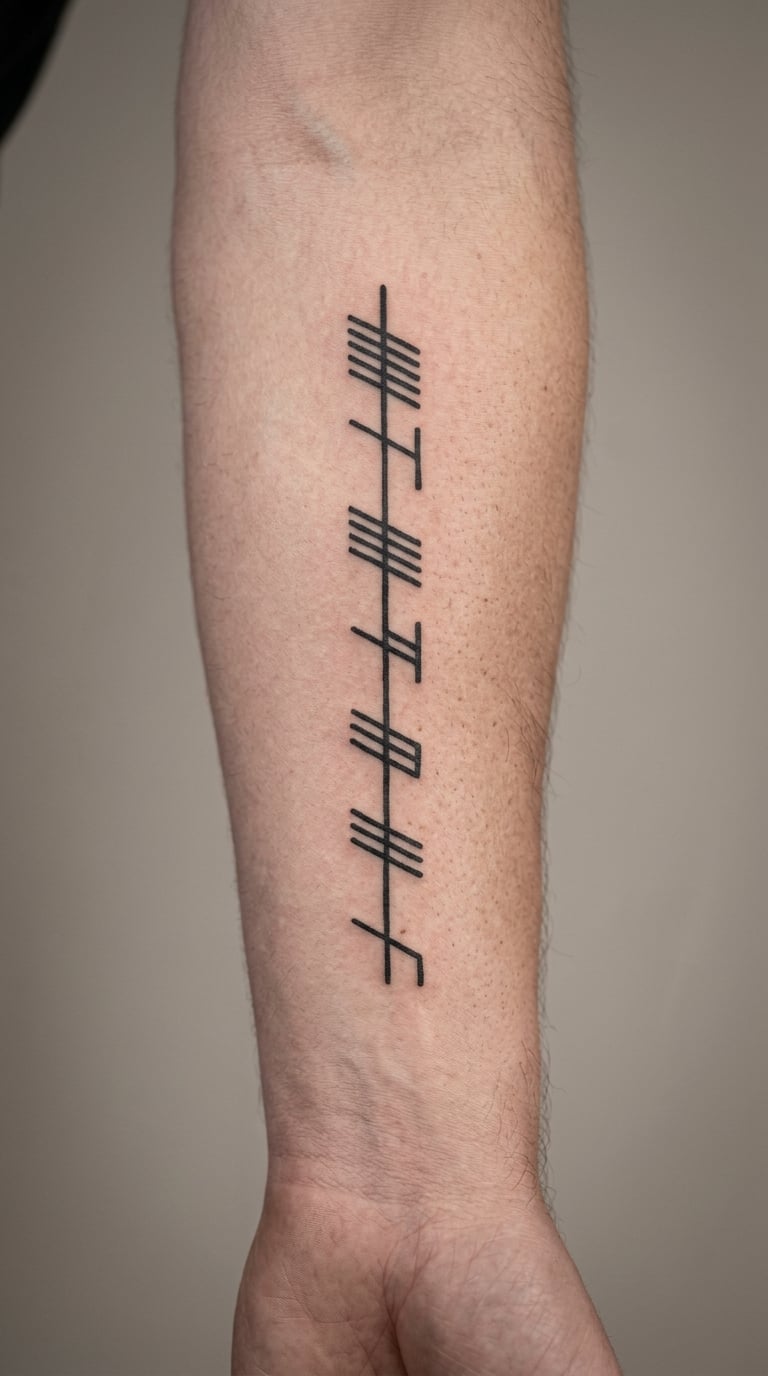
Ogham is a script with a documented history in early Irish inscriptions, and a vertical stroke study sets its characters in a clean column along a central axis. The appeal is rhythm: a stack of straight strokes crossed by a small number of diagonal marks, sparse and architectural. This is the idea where accuracy matters more than in any other entry here, so treat the lettering as language, not decoration.
Placement: forearm, upper arm, calf, or the side of the body. Size: 3-7 inches (7.5-18 cm) tall. Style: fine line, blackwork, or minimal script. Pain: low to medium. Short strokes and narrow gaps need careful line weight or the column turns into a barcode. Make it yours: bring the wording already checked, and ask the artist to confirm each character back to you before the stencil is placed.
10. Claddagh Ring Linework
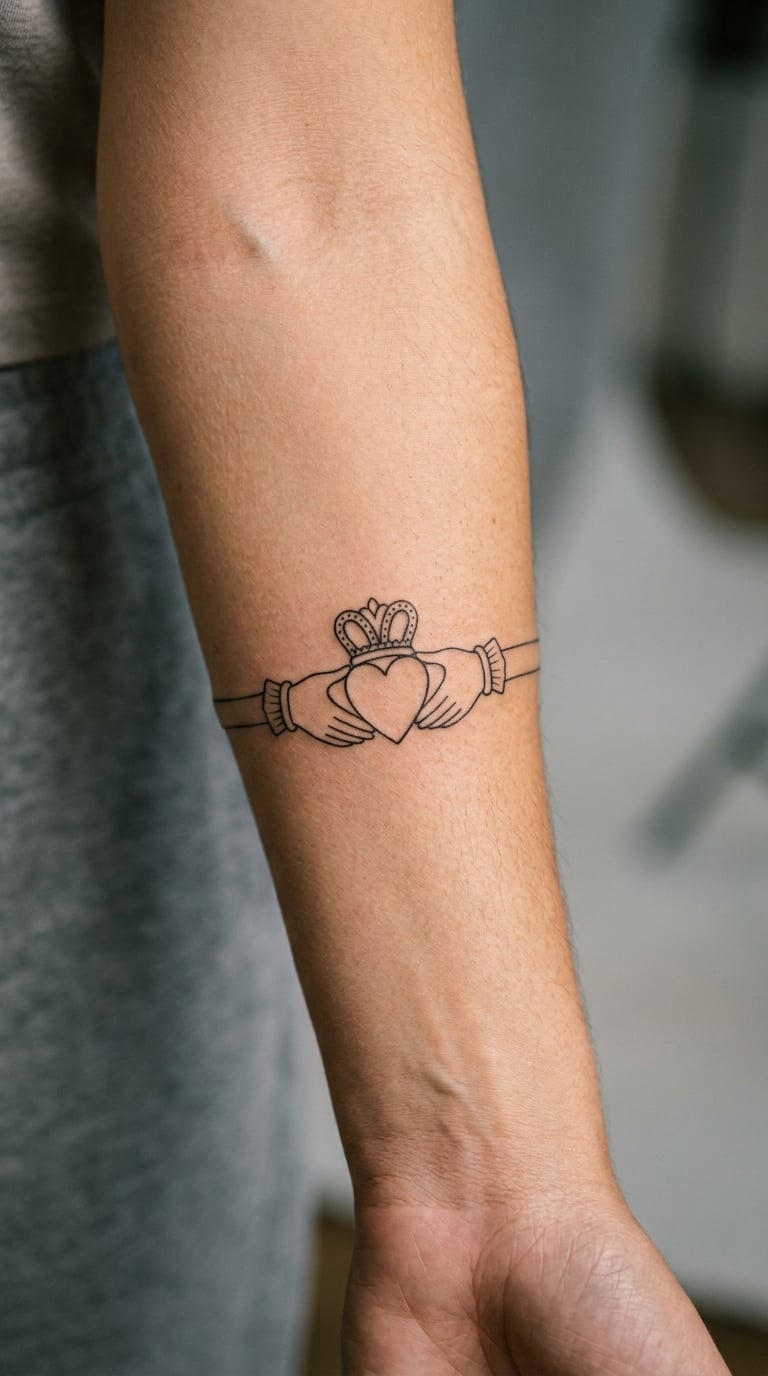
A Claddagh tattoo shows a heart held by two hands beneath a crown, and the three parts are commonly taught as love, friendship and loyalty, with the crown carrying honour. Personal readings vary a lot, and plenty of wearers use the design for a relationship that has already happened rather than one ahead. It is the single most recognisable Irish symbol, so expect to explain it to non-Irish people for the rest of your life.
Placement: inner forearm, ring finger, or wrist. Size: 1.5-2.5 inches (4-6 cm). Style: fine line, minimalist, or blackwork. Pain: medium to high, and fingers sting more per square centimetre than almost anywhere else. Details on the fingers wear and blur within a few years, so the forearm is the placement that survives. Make it yours: add a small date or place mark beside it, or wear the hands-and-heart as one piece and the crown as a matching one.
11. Single Spiral with Celtic Border
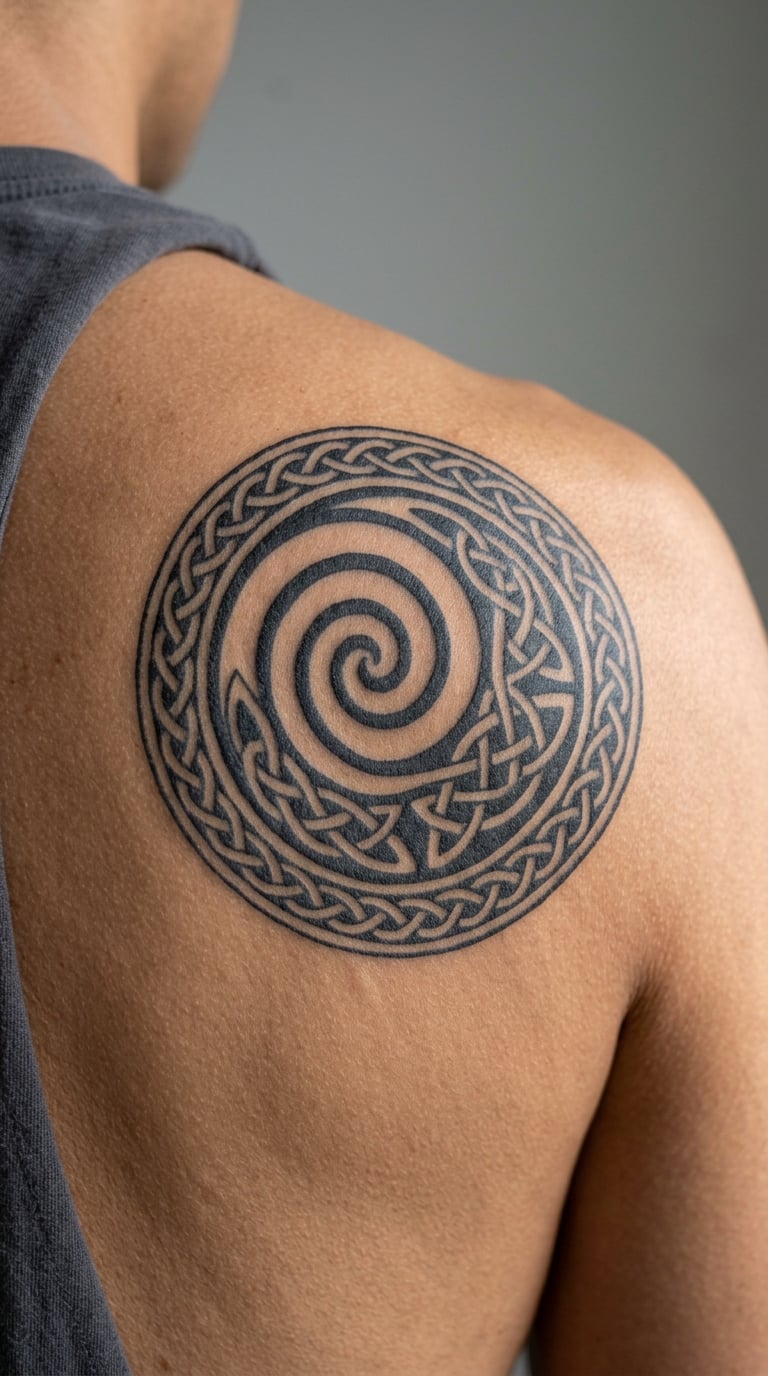
This design is one bold spiral framed by a restrained repeated border, and it reads as a study of movement and craft rather than a fixed sacred symbol. It differs from the triskele in that there is a single direction of travel and a frame around it, which gives the piece more structure and makes it work at larger sizes. A good version has a spiral that tightens smoothly rather than jumping between arm widths.
Placement: shoulder, forearm, thigh, calf, or back. Size: 3-6 inches (7.5-15 cm) across. Style: blackwork, fine line, or bold illustrative. Pain: medium, and the shoulder blade is a bony surface to sit through. Close parallel border lines need real spacing or they fill in as a grey band. Make it yours: let your birth month set the number of border repeats.
12. Highland Cow Portrait
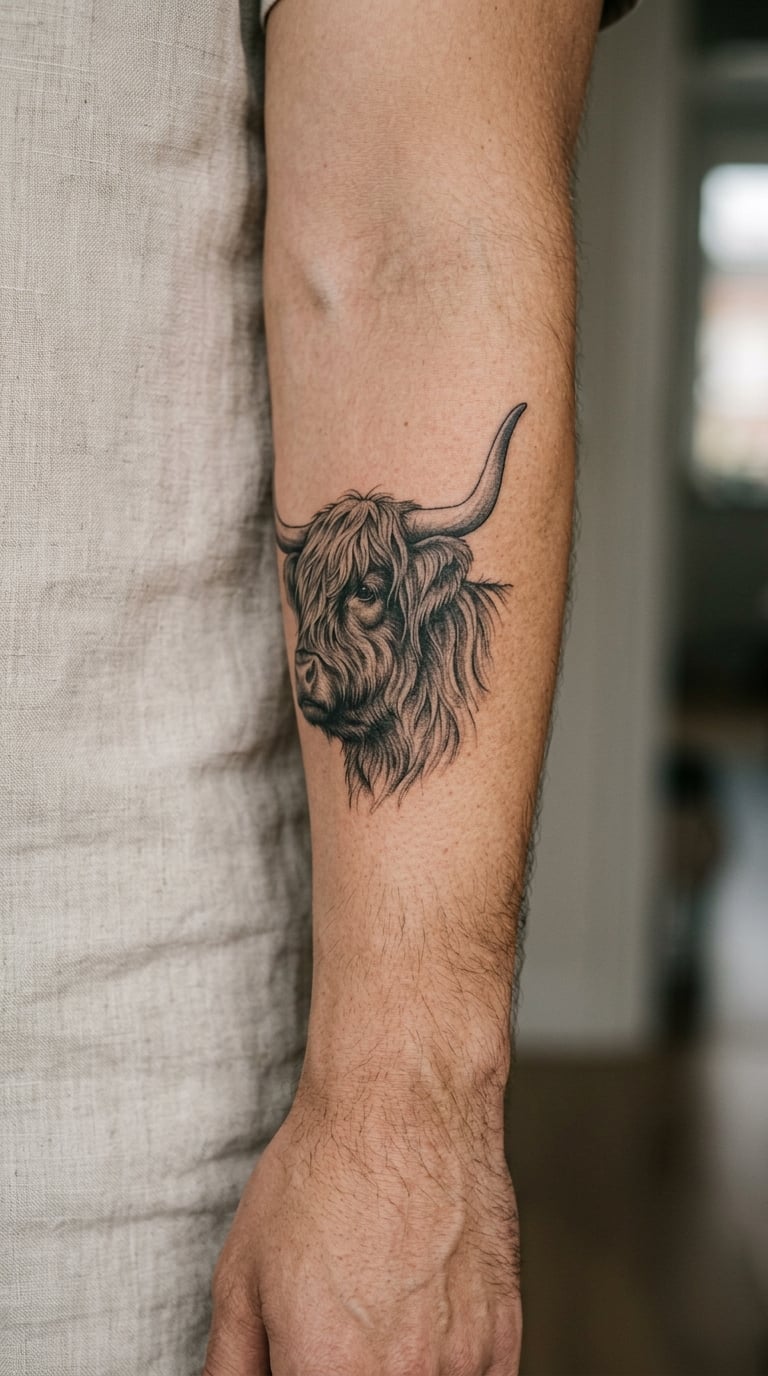
A Highland cow portrait is a long-haired animal with sweeping horns and a broad shaggy outline, drawn either in realistic texture or in simplified linework, and it belongs to contemporary Scottish rural imagery rather than ancient symbolism. That makes it a warm, slightly humorous heritage piece, and the outline does a lot of the work in a small format. It also wears far better than it photographs.
Placement: forearm, arm, thigh, calf, or ribs. Size: 3-6 inches (7.5-15 cm) tall. Style: micro-realism, illustrative, or fine-line realism. Pain: medium. Dense hair detail merges into grey over time, so ask for grouped strands rather than hundreds of single lines. Make it yours: add the name of a farm, estate, or county you are connected to beneath the portrait.
13. Irish Wolfhound Minimal Silhouette
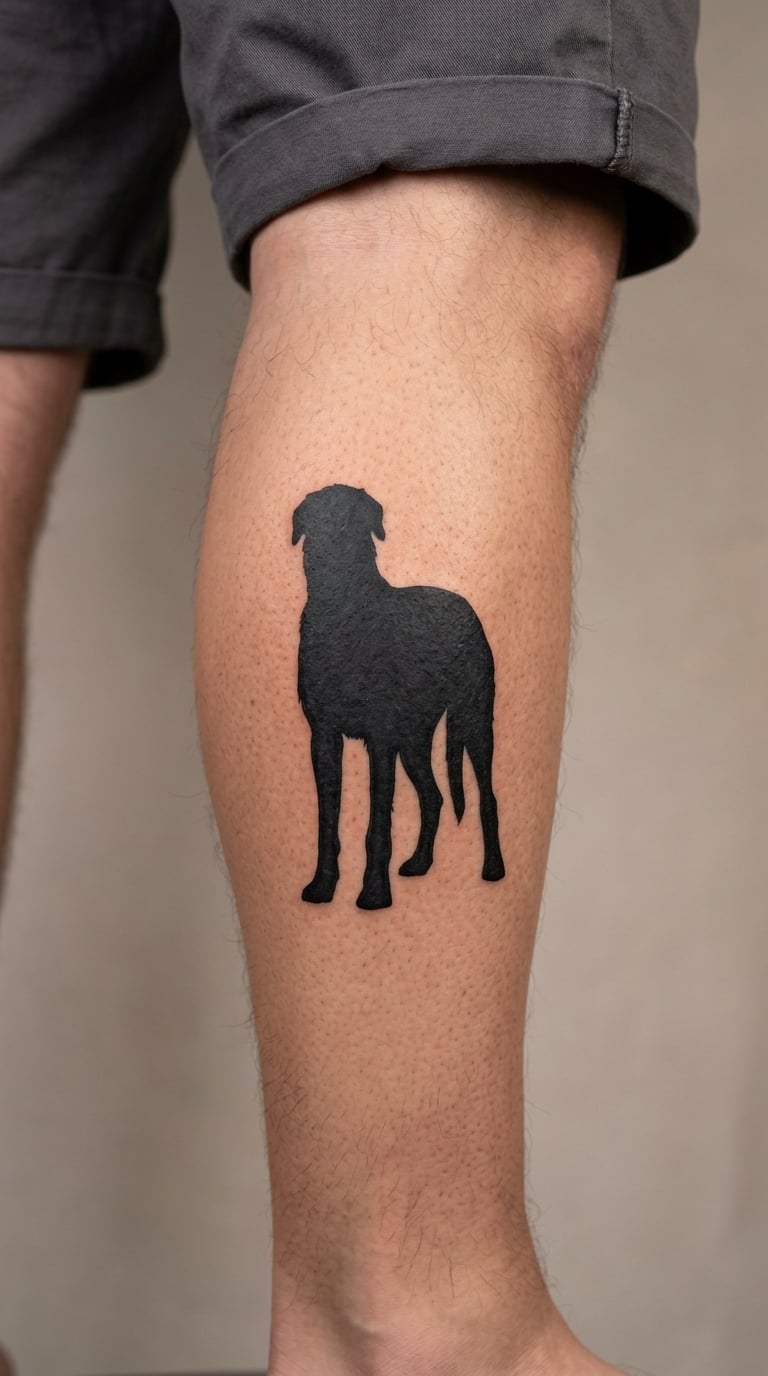
An Irish wolfhound silhouette is defined by long straight legs, a narrow body, a deep chest, and a gently curved tail, and it works as a modern tribute to a historic Irish breed rather than a symbol with a fixed meaning. The silhouette style means one flat black shape, which is the most durable treatment a small design can get. It also works as a memorial piece for a specific dog, which is how a lot of people end up here.
Placement: calf, forearm, upper arm, or thigh. Size: 3-7 inches (7.5-18 cm) long. Style: minimalist blackwork, fine-line silhouette, or illustrative realism. Pain: low to medium. Leg and tail definition needs deliberate spacing, since those thin tips are what a viewer notices. Make it yours: pair it with a micro-portrait of your own wolfhound in a matching black silhouette.
14. Interwoven Shoulder Band
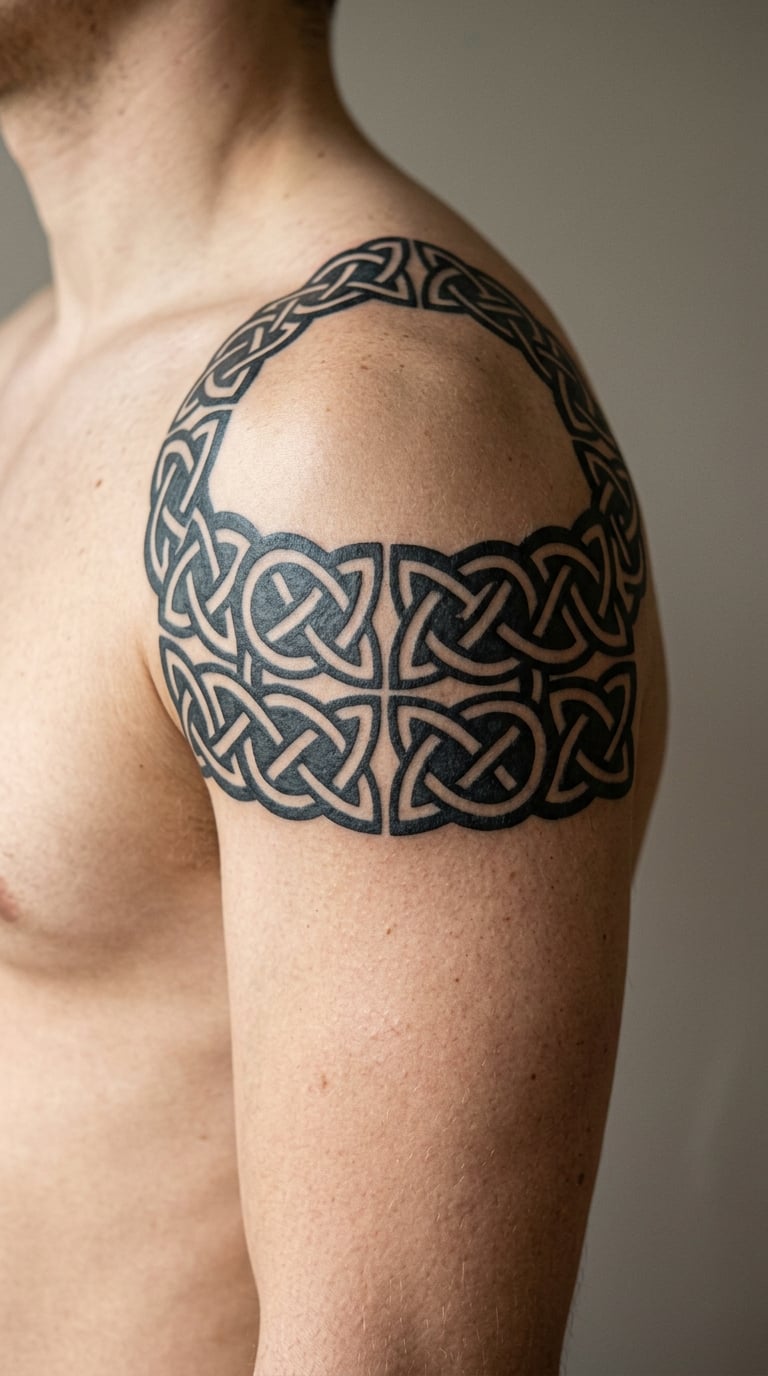
An interwoven shoulder band is a broad ornamental strip that links repeated Celtic knot sections around the upper arm or shoulder, and the appeal is rhythm, coverage and a woven-textile quality rather than a single message. It is the closest thing on this list to a small sleeve, so it works well as a bridge between a bare arm and a fuller piece. Repetition also gives the artist a rhythm that keeps detail even across the whole band.
Placement: upper arm, shoulder cap, forearm, or calf. Size: 6-10 inches (15-25 cm) across. Style: geometric blackwork, fine-line knotwork, or bold illustrative. Pain: medium to high, and the shoulder and ribs are the difficult edges. Small crossings sometimes need a second pass, so ask about touch-up timing. Make it yours: introduce one meaningful colour into a single repeating section rather than across the whole band.
15. Celtic Cross with Openwork Detail
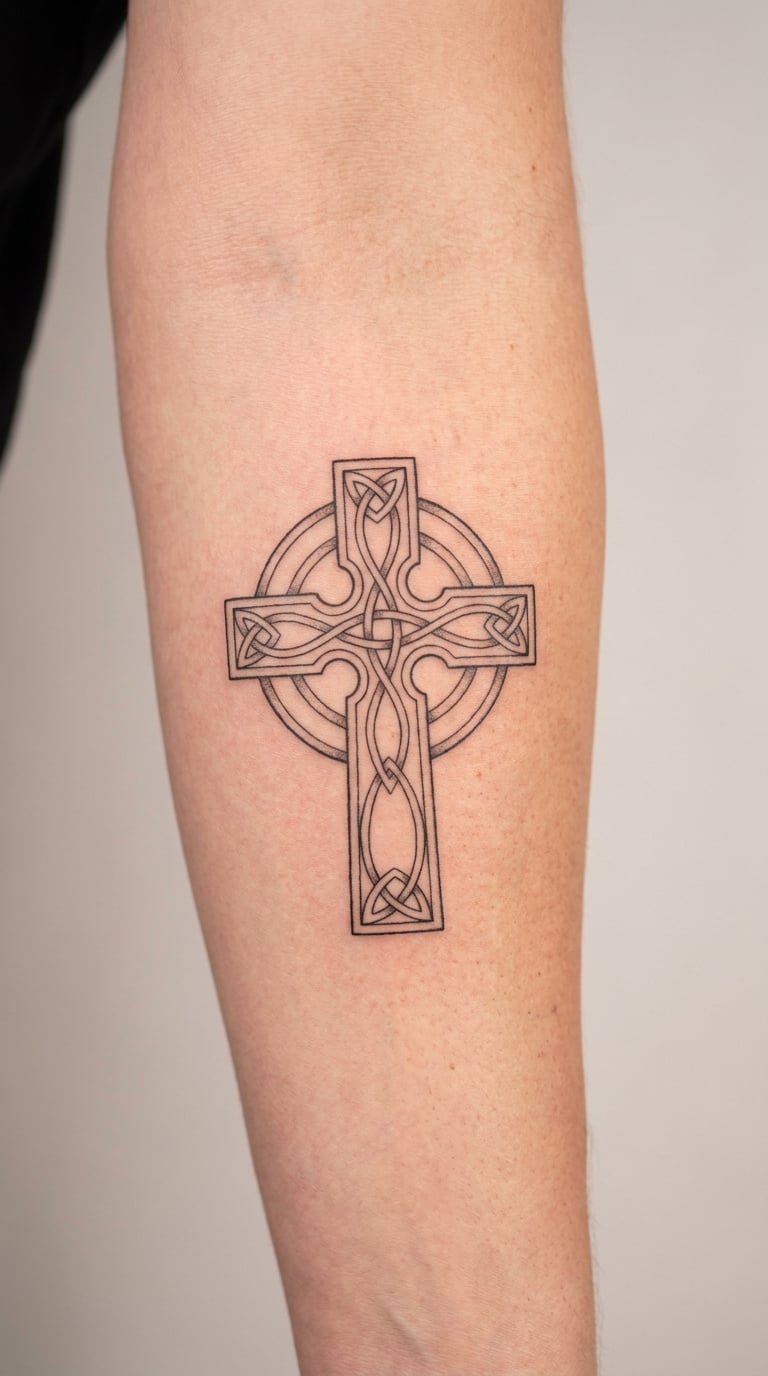
A Celtic cross is a balanced cross form with a circular ring around the intersection and tapered arms, sometimes carrying restrained knot or vine detail inside. The ringed cross form is distinct from other Christian or secular cross designs, and knowing that distinction is worth doing before you book. In fine line it is a quiet piece; in traditional style with heavy fill it becomes loud fast.
Placement: forearm, upper arm, back, chest, or thigh. Size: 3-6 inches (7.5-15 cm) tall. Style: traditional, neo-traditional, blackwork, or fine line. Pain: medium. Hairline ornament inside the ring is the part that softens first, so keep interior detail simple at smaller sizes. Make it yours: put a short verse fragment or a single initial inside the ring, placed there deliberately rather than as an afterthought.
16. Four-Character Ogham Name Panel
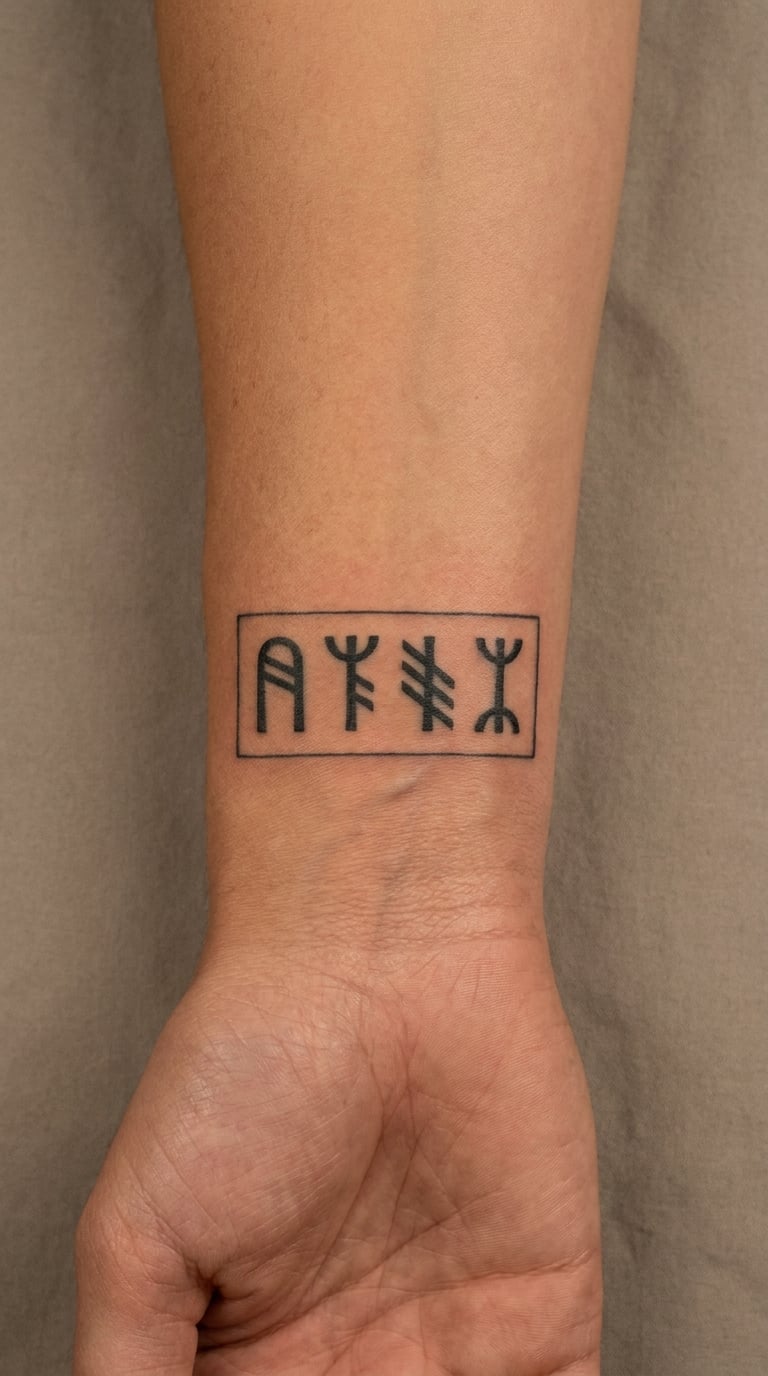
A four-character Ogham panel puts one verified name in four Ogham characters inside a thin rectangular border, and the rectangle is what makes it a panel rather than a bare column of strokes. Four characters is a tight constraint, which is exactly why it works on a wrist: there is no room for a design to sprawl or for an error to hide. The artist and the wearer should confirm every single character before the tattooing starts.
Placement: wrist, forearm, calf, upper arm, or upper back. Size: 2-4 inches (5-10 cm) long. Style: minimalist fine line, blackwork, or script. Pain: low to medium, though the wrist sits over visible veins and tends to sting. Closely spaced strokes on the inner wrist lose definition as the forearm moves and flexes. Make it yours: add the Gaelic written form of the name beneath the panel only after the Ogham has been verified.
17. Celtic Chevron with Knotwork End Caps
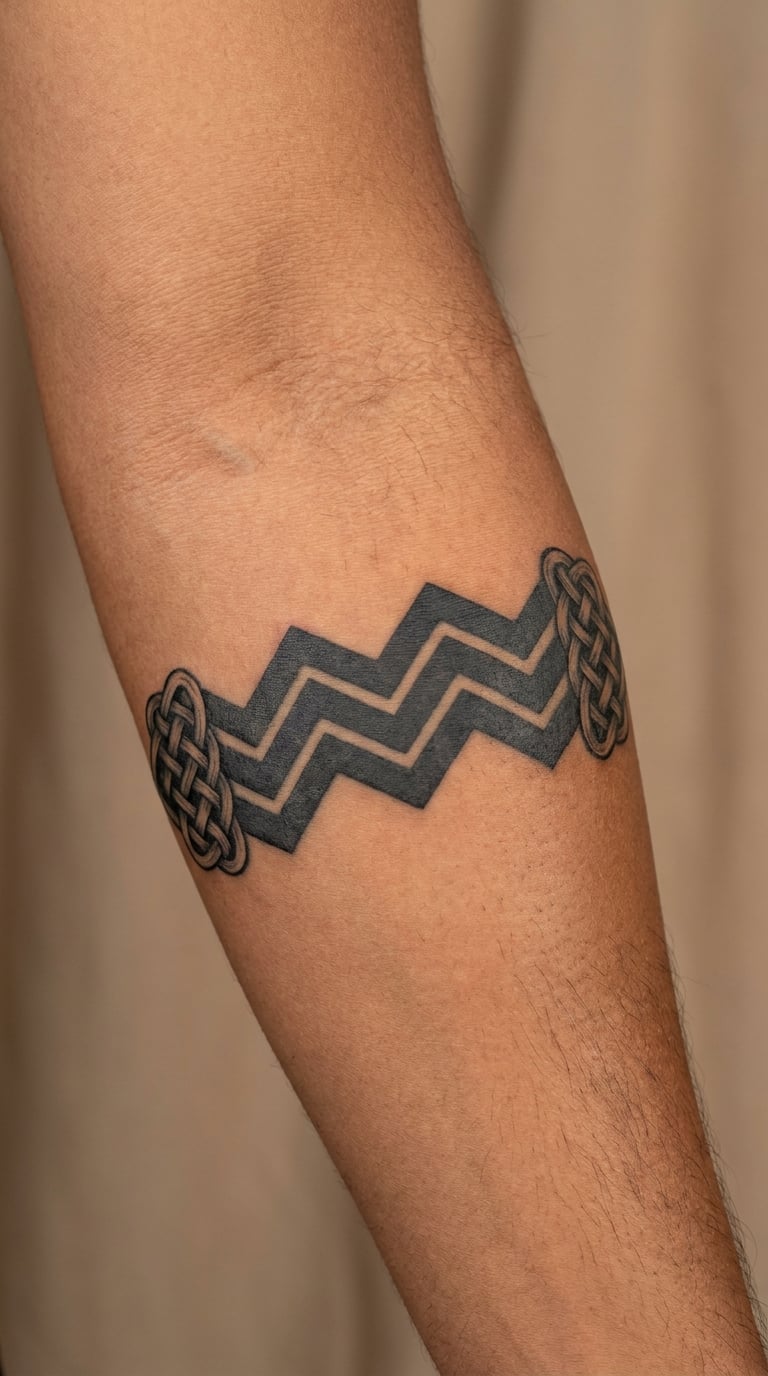
A Celtic chevron is a broad V shape running across the forearm with a solid central chevron and a small compact knotwork cap at each end, and it takes geometric patterns found in Celtic and Insular art and turns them into something contemporary and graphic. It is a strong candidate for someone’s second piece because it fills negative space around an existing tattoo without touching it. Bold shape also survives a smaller size than most interlace work.
Placement: forearm, upper arm, calf, or lower leg. Size: 4-7 inches (10-18 cm) across. Style: bold blackwork, geometric, or fine line. Pain: medium. Repeated fine detail near the wrist softens faster than the same detail further up the arm, so keep the end caps clear of that area. Make it yours: use a family or clan colour in one end cap only.
18. Stylised Celtic Dragon
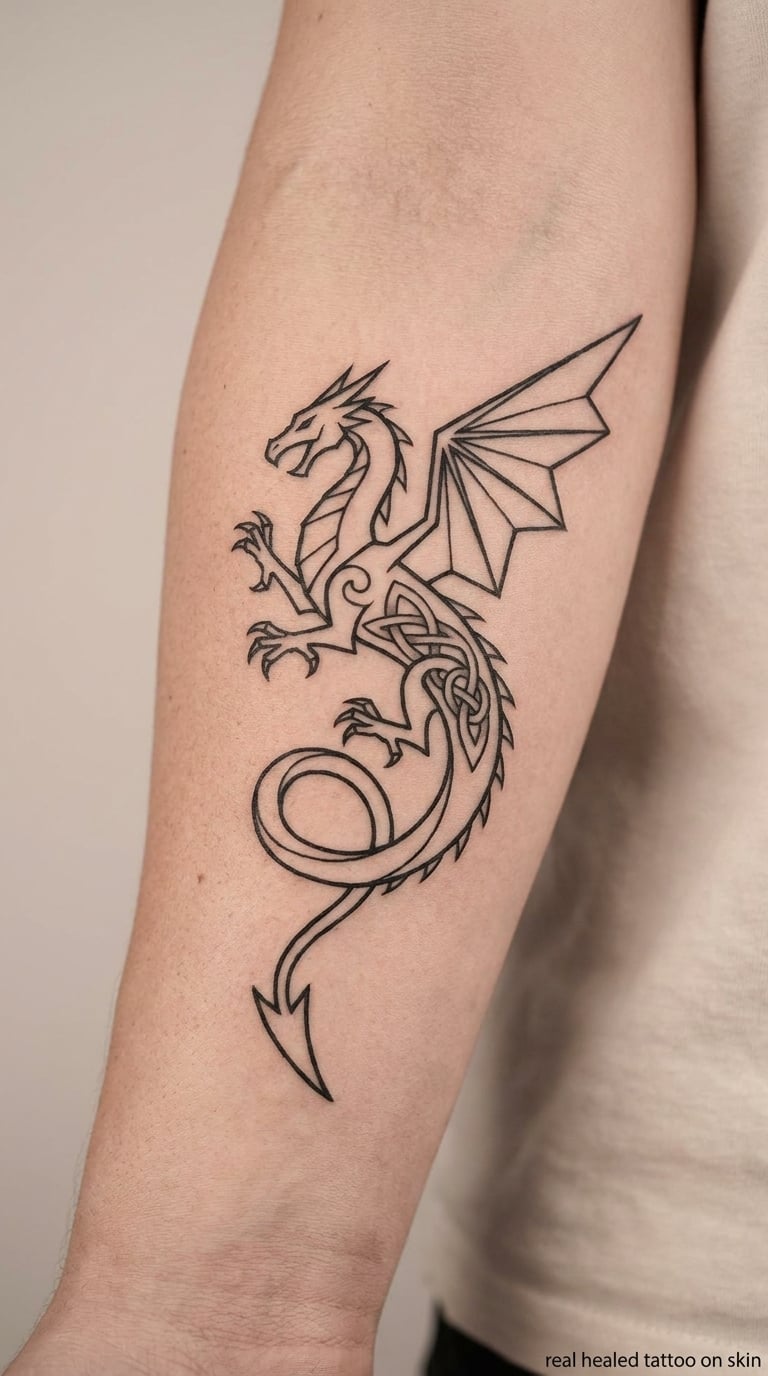
A stylised Celtic dragon is a modern fantasy interpretation of medieval Celtic-style art, with a curved body, angular wings, clawed feet and a restrained interlaced pattern along the flank, and it is not a creature from historical Gaelic tradition. Knowing that keeps you from being sold an invented story. As a tattoo it is confident and readable, and it suits people who want something with attitude rather than a quiet knot.
Placement: forearm, calf, thigh, arm, or shoulder. Size: 3-6 inches (7.5-15 cm) long. Style: illustrative, neo-traditional, blackwork, or fine line. Pain: medium to high, since wings and scale detail mean longer sittings. Teeth, claws and wing ribs blur when the whole design drops under 3 inches. Make it yours: place a small knot at the base of the tail that echoes one of the interlace shapes in the body.
19. Illuminated Manuscript-Inspired Panel
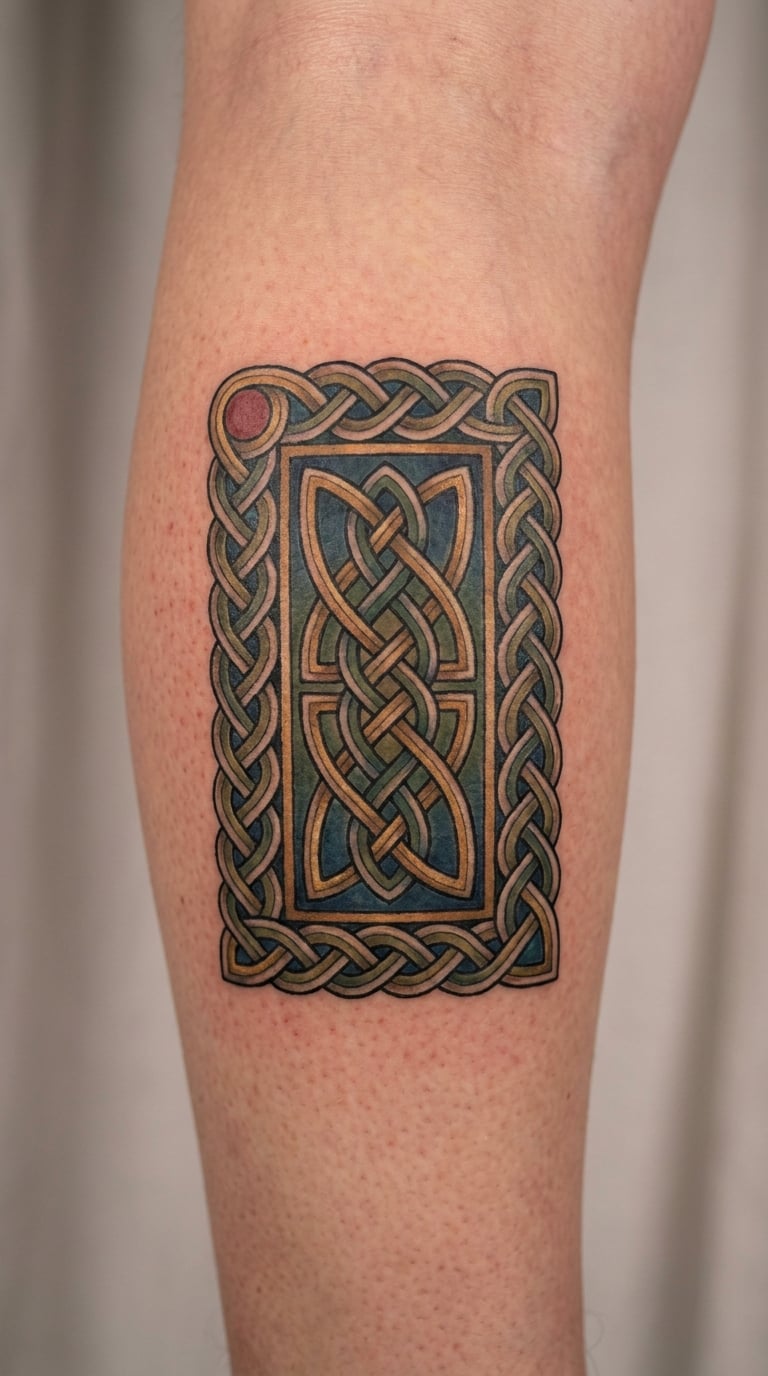
An illuminated manuscript-inspired panel draws on the interlace of Insular manuscripts without copying a specific page: a central knot, a braided border, and one restrained colour accent worked into the design. The history behind the visual language is genuinely old, even though this arrangement is contemporary. It is the most rewarding option here for someone who already collects tattoos, because the detail rewards a second and third look.
Placement: forearm, calf, upper arm, or upper back. Size: 3-5 inches (7.5-13 cm) tall. Style: neo-traditional, illustrative, or blackwork with colour. Pain: medium. Very fine border work is the first to soften, and coloured infill changes with sun exposure faster than black. Make it yours: pick the accent colour by birth month and use it in one place only, not throughout the braid.
20. Gaelic Fáilte Handwritten Script
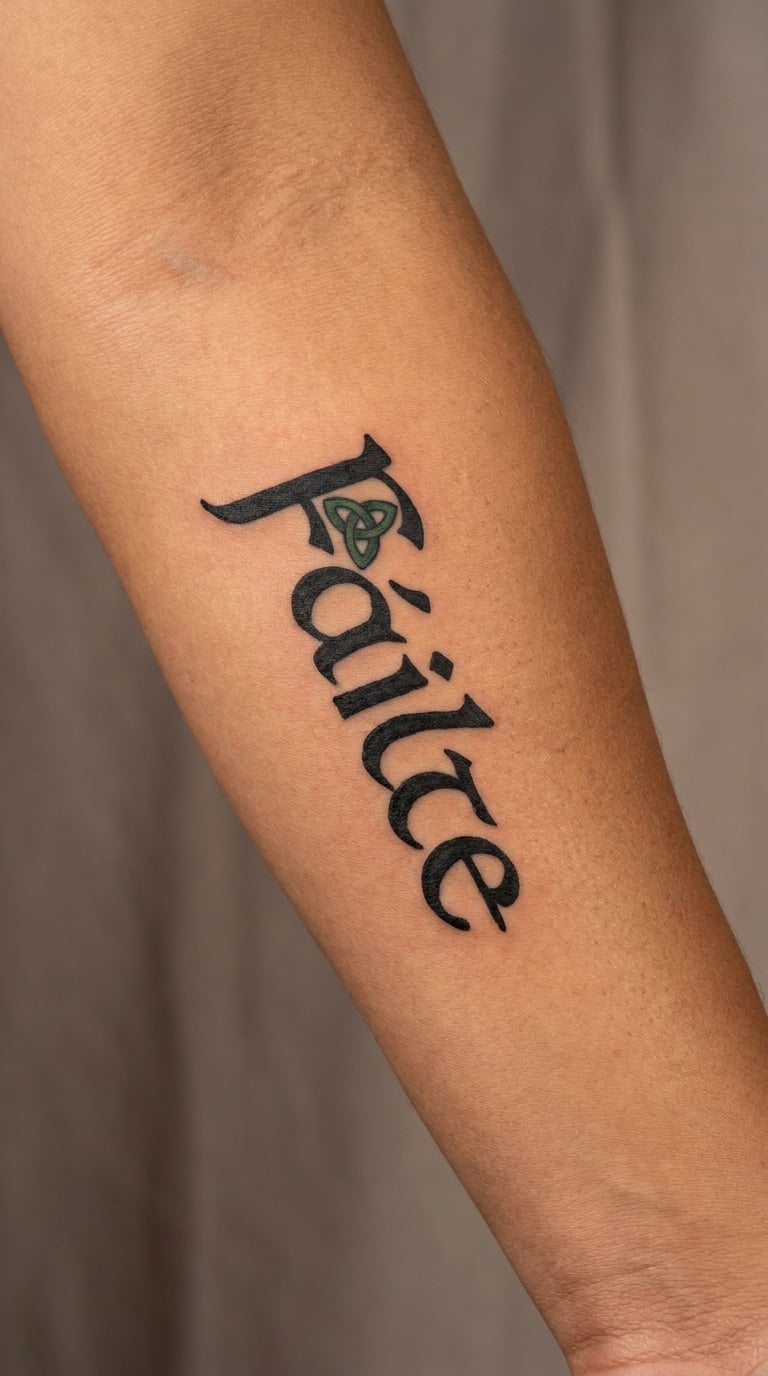
Fáilte means welcome in both Irish and Scottish Gaelic, and setting the word in confident hand-lettered script with a small knot or thistle beside it gives you a language tattoo with a genuine shared meaning rather than a borrowed phrase. Because the word is short, the whole design lives or dies on letterform quality: loops, joins, and the accent mark all need to be right. Confirm the spelling with the artist before the session starts.
Placement: forearm, collarbone, upper arm, calf, or wrist. Size: 2-4 inches (5-10 cm) long. Style: script, calligraphic, or fine line. Pain: low to medium. Loops and letter joins thin out over time unless the line weight is kept heavy from the start. Make it yours: set a surname or a date underneath in a much quieter script so the word stays the main event.
21. Heritage Tartan Band
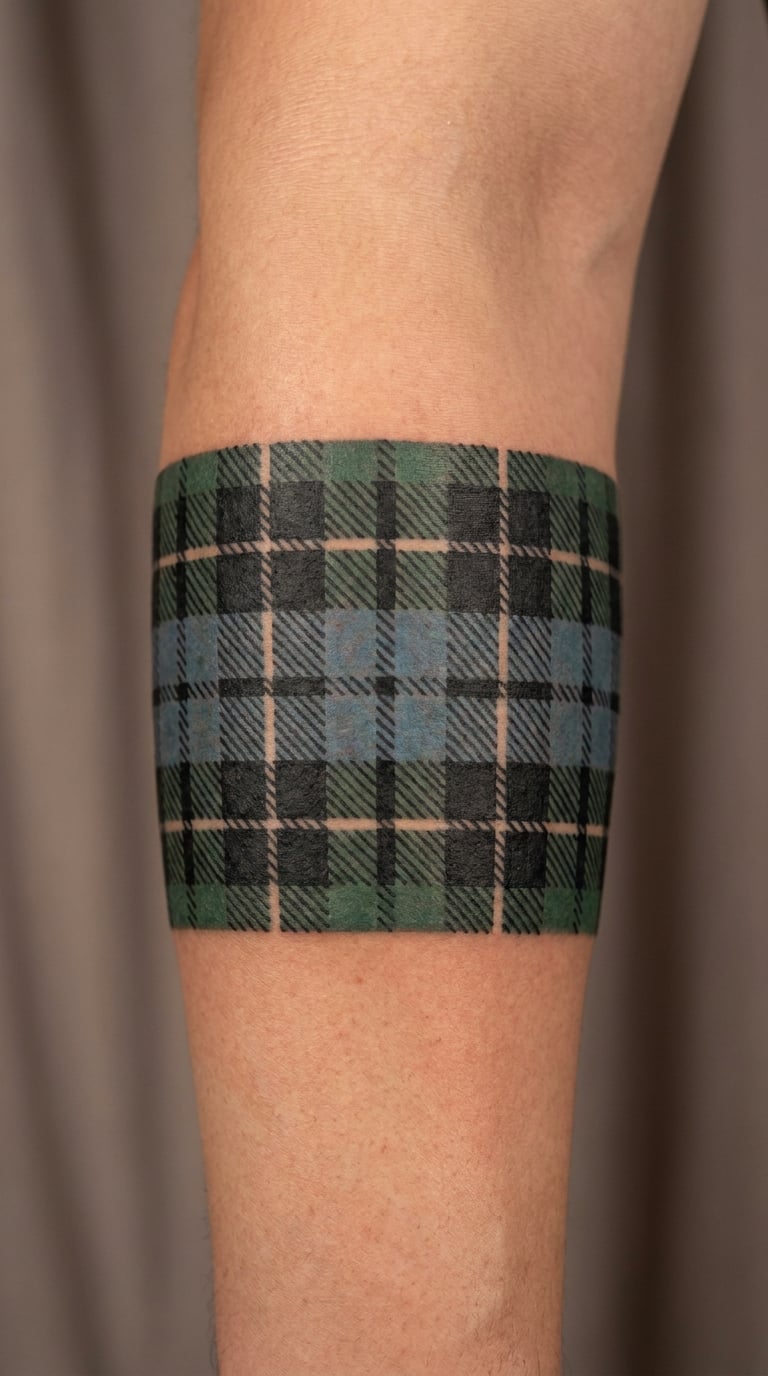
A heritage tartan band tattoo is built from intersecting horizontal and vertical lines in black, green, blue or a muted red, and it is decorative: a tartan drawn from memory is not automatically a specific clan tartan, so say so plainly rather than claiming a lineage. The appeal is rhythm and coverage, and it reads as a broad band of colour-blocked geometry. It also sits neatly beside a wrist or forearm piece without competing with it.
Placement: wrist, forearm, upper arm, calf, or ankle. Size: 2-6 inches (5-15 cm) wide. Style: geometric, fine line, or blackwork. Pain: medium, and it varies a lot between the wrist and the upper arm. Very fine crossings blur or merge into flat grey at small scale, so the line spacing decides whether it holds. Make it yours: use a real tartan from a textile that matters to you rather than a generic grid.
22. Highland Hills and Loch Line Scene
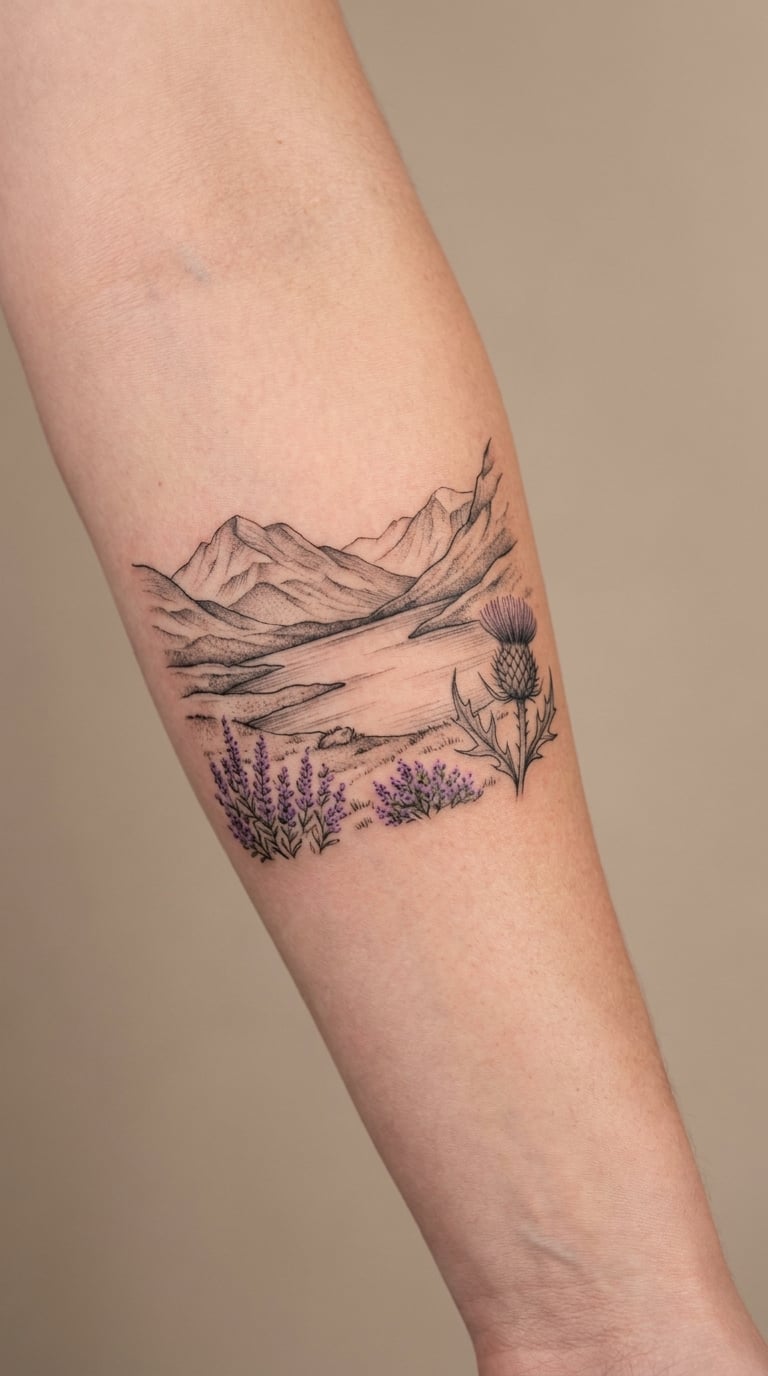
A highland hills and loch scene stacks layered mountains, still water, heather and a distant thistle into one compact composition, and it draws on immediately recognisable Scottish scenery without claiming a fixed spiritual meaning. It is the most personal-looking idea on the list, because it is a place rather than a symbol. It also needs the most planning: the layering has to be drawn in the right order or the distance reads as clutter.
Placement: forearm, calf, arm, shoulder, or upper back. Size: 3-7 inches (7.5-18 cm) wide. Style: landscape fine line, illustrative, blackwork, or restrained watercolor. Careful: “landscape” here is the artistic genre, so if you are searching for more botanical work, our wisteria tattoo designs collection uses a different approach to layered depth. Pain: medium to high. Tiny distant details blur first, so simplify the far ridge. Make it yours: add the coordinates of a real loch you have stood beside.
How to Choose the Right Design
Start with meaning, then work outward. If a symbol has documented history, choose one you understand rather than one that looked good in a photo. If it is a modern decorative design like the knotwork compass rose or the chevron, treat it as craft and aesthetics, which is a perfectly valid reason.
Check what is already on your body. A geometric band like the chevron pairs well with an existing forearm piece, while a detailed panel competes with it. Artwork photographers can show you healed results in the same placement, which tells you more in ten seconds than a flash photo ever will.
Be realistic about scale. Fine line and dotwork reward space; a 6-inch tree of life on a wrist will not work, and neither will a 1-inch knotwork panel on a back. Match the line density to the body area, not to the reference photo.
Verify anything written. Irish Gaeilge and Scottish Gàidhlig are different languages, and a phrase should be confirmed by a fluent speaker before it is tattooed. Forum communities consistently advise getting agreement from more than one native speaker, and starting the check at least a couple of weeks before the appointment.
Use correct terminology, and it costs nothing. If you have no Gaelic ancestry, that is not a problem in itself; claiming a clan crest, a coat of arms or a tribal affiliation you do not have is the part that lands badly.
Cost and Session Time
Tattoo pricing in the US runs roughly from 80 to 150 dollars an hour in most cities, with hourly rates closer to 200 dollars or higher in expensive areas, and many studios set a minimum shop charge of 100 to 200 dollars that a small piece has to meet anyway. A tiny single-symbol fine-line piece often lands in that minimum bracket, while a large detailed panel is priced by the hour or quoted as a flat project fee.
Sizes and timings: a small design under 2 inches (5 cm) is usually a single short session of roughly 30 to 60 minutes. Medium work of 3-5 inches (7.5-13 cm) takes 1 to 2 hours. Larger pieces of 6 inches (15 cm) and up, particularly anything with colour, weaving or fine border work, are often split across two or more sessions, which also gives the artist a chance to reassess how the lines healed before continuing.
Quotes depend on detail, colour, placement and artist experience, so two identical drawings can price out very differently between studios. A consultation before booking is worth it, and it is the right moment to raise any concerns about line weight or placement.
Aftercare Basics
Whatever your artist tells you takes priority over anything general you read online, including this list.
- Wash the area gently with clean lukewarm water and a fragrance-free soap as instructed, then pat it dry rather than rubbing.
- Protect the design from direct sun, and skip tanning on the area until it has fully healed.
- Avoid friction, soaking, swimming pools and hot baths while the skin is healing, and keep heavy gym sessions off a fresh arm or shoulder piece for a few days.
- Follow the aftercare your artist or studio has given you, including any ointment or film they recommend and the timing they suggest for washing.
- Contact the artist, and a qualified clinician if needed, if you develop spreading redness, swelling, heat, discharge, or pain that gets worse rather than settling.
Frequently Asked Questions
What is the difference between Gaelic and Celtic tattoo designs?
Celtic tattoo designs draw on the wider visual world of the Celtic cultures, covering Ireland, Scotland, Wales, Brittany and Cornwall, and they are mostly interlaced knots, spirals, crosses and heraldic animals. Gaelic tattoo designs are the narrower subset that uses language, either Irish Gaeilge or Scottish Gàidhlig, whether that is a single word like Fáilte, an Ogham character column, or a proverb. A Claddagh is Celtic in origin and widely worn as a Gaelic symbol. A knotwork band is Celtic and not language-based at all. Choosing which one you want is really a question of whether you are after a visual tradition or a spoken one.
Are Gaelic tattoos suitable for small and delicate placements?
Yes, provided you pick a design with enough boldness to survive. Single symbols like the endless knot, the triskele or a Fáilte script work well at 2-3 inches (5-7.5 cm). Dense interlace, tiny lettering and multi-row Ogham panels need more room than a wrist or rib usually allows, and hairline detail on hands and fingers softens noticeably within a few years. Ask your artist for a heavier line weight if the placement is small or the design is fine line.
Should I choose a Gaelic symbol for a specific meaning?
Only if you know what the symbol actually documents. Some are well established, such as the Claddagh with its heart, hands and crown for love, friendship and loyalty, or the thistle as a long-standing Scottish emblem. Plenty of others are modern decorative designs with no fixed meaning at all, and plenty of assigned meanings floating around online were never traditional. If the meaning matters to you, check the history before the design goes on skin, and do not let anyone at the studio supply it for you.
How do I know that Gaelic lettering or Ogham characters are accurate?
Get the wording checked by a fluent speaker before your appointment, ideally more than one, and community advice is consistently to wait until at least three native speakers agree on the wording. Avoid machine translation, which produces grammatical nonsense for a language with this much case and lenition. Check accented characters such as the fada and the urú carefully, since missing them changes or destroys the word. Irish Gaeilge and Scottish Gàidhlig are separate languages, so confirm the phrase comes from the right one.
Which Gaelic tattoo is easiest to combine with an existing tattoo?
A bold geometric design such as the Celtic chevron with knotwork end caps, or an interwoven shoulder band, fills the space around an existing piece without touching it. A single-symbol design like the endless knot or triskele also sits well beside existing forearm work, because both are one bounded shape with a clear edge. The harder choices are the highland scene and the manuscript panel, which read as a complete composition and want an empty area. Give your artist a photo of what is already there before the consultation.
Conclusion
For a first heritage tattoo, the interlaced endless knot and the highland thistle are the two most approachable: both are simple shapes, both sit well on a forearm or calf, and neither punishes a beginner’s budget. If you already have a collection, the highland hills and loch scene or the illuminated manuscript panel are the stronger picks, since they reward the detail that comes with experience and a longer sitting.
Whatever you choose, verify any text, Ogham characters or clan references with the artist and a fluent speaker before the session, and pick a design you can explain yourself rather than one you inherited from a pin board.