
20 111 Tattoo Ideas: Matching Tattoos (October 2026)
These 20 111 tattoo ideas are built around one idea: two people, one shared concept, two separate tattoos. A 1:1 doesn’t have to mean the same picture stamped twice on two bodies. It can be a moon on one wrist and a sun on the other, two halves of one circle, or the same skyline drawn at two different scales.
Couples usually come to this after a few years of matching everything else. The tricky part is balance, so I’ve written up each design with what it actually looks like on skin, where it sits, how big it needs to be to still read clearly in ten years, and how much it will hurt. Sizes are the detail most people skip and later regret.
20 111 Tattoo Ideas: Quick Guide
| Idea | Style | Best placement | Size | Pain |
|---|---|---|---|---|
| Fine-line arrows | Fine line | Inner wrists | 2-3 in | Medium-high |
| Moon and sun | Micro fine line | Ankle and inner wrist | 0.5-1 in | Low-medium |
| Coordinate numbers | Sans-serif numerals | Inner forearms | 1.5-2.5 in | Medium |
| Botanical sprigs | Fine line botanical | Collarbones | 2-3 in | Medium |
| Musical notes | Fine line with accent | Wrists | 1-2 in | Medium-high |
| Puzzle pieces | Micro blackwork | Inner arm and ankle | Under 1 in | Low-medium |
| Constellations | Fine line star map | Outer upper arms | 3-5 in | Medium |
| Rose and laurel | Traditional accent and fine line | Forearms | 3-4 in | Medium-high |
| Outline hearts | Minimal line | Fingers | 0.3-0.5 in | High |
| Koi | Illustrative with colour | Calves | 4-7 in | Medium |
| City skyline | Black silhouette | Forearms | 4-6 in | Medium |
| Snake and vine | Fine line | Forearms | 3-5 in | Medium |
| Mountain ranges | Fine line landscape | Shoulders | 4-7 in | Low-medium |
| Semicolons | Fine line lettering | Wrists | 0.5-1 in | Medium-high |
| Compass roses | Traditional linework | Outer ankles | 1.5-2.5 in | Medium |
| Butterfly and leaf | Micro illustrative | Shoulder and wrist | 1-2 in | Low-medium |
| Broken circles | Geometric blackwork | Inner arms | 2-3 in | Medium |
| Lightning bolts | Bold black with accent | Calves | 2-4 in | Medium |
| Portrait silhouettes | Black silhouette | Outer upper arms | 2-3 in | Medium |
| Wave lines | Bold fine line | Ribs | 4-8 in | High |
1. Matching Fine-Line Arrows on the Inner Wrists
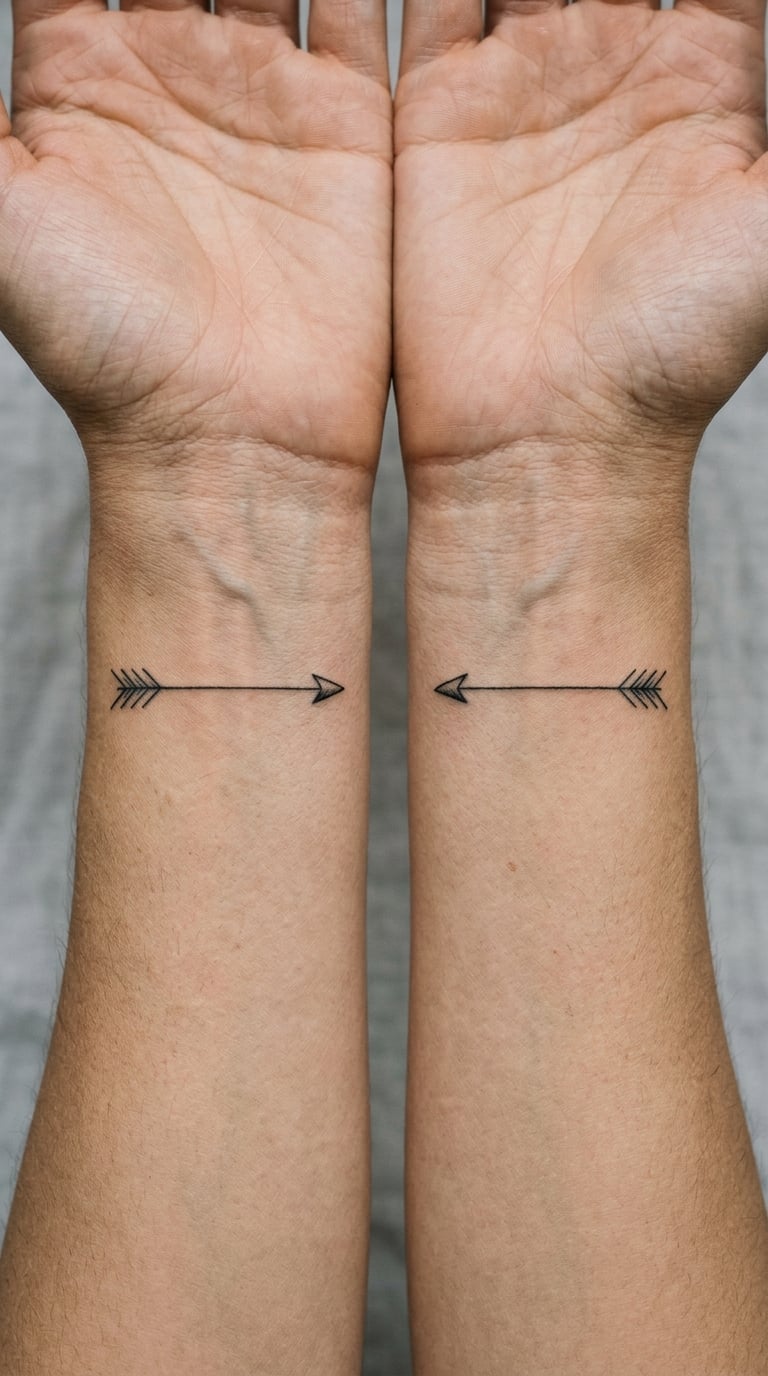
The whole design is one line per arm: a shaft, two short barbs, an arrowhead. No banner, no scrollwork, no names. Because both arrows point inward, the tattoos only read as a pair when the two people stand together.
Couples pick this because it says “same direction” without spelling anything out. Some read it as a promise to keep moving toward the same thing; others just like that it’s nearly invisible in a long-sleeve shirt.
Placement: Inner wrist, a few centimetres above the wrist crease, or the forearm just above it. Size: 2-3 in (5-7.5 cm) long, single-needle line. Style: Fine line, solid black.
Pain: Medium-high. The inner wrist is one of the more sensitive spots on the body, and thin lines mean more passes over the same skin. Ageing: Hairline arrows on the inner wrist lose definition first because that area bends, rubs and gets sun.
Make it yours: Add a tiny date beneath one arrow, or have one arrow inked in a single colour while the other stays black.
2. Complementary Moon and Sun Micro-Tattoos
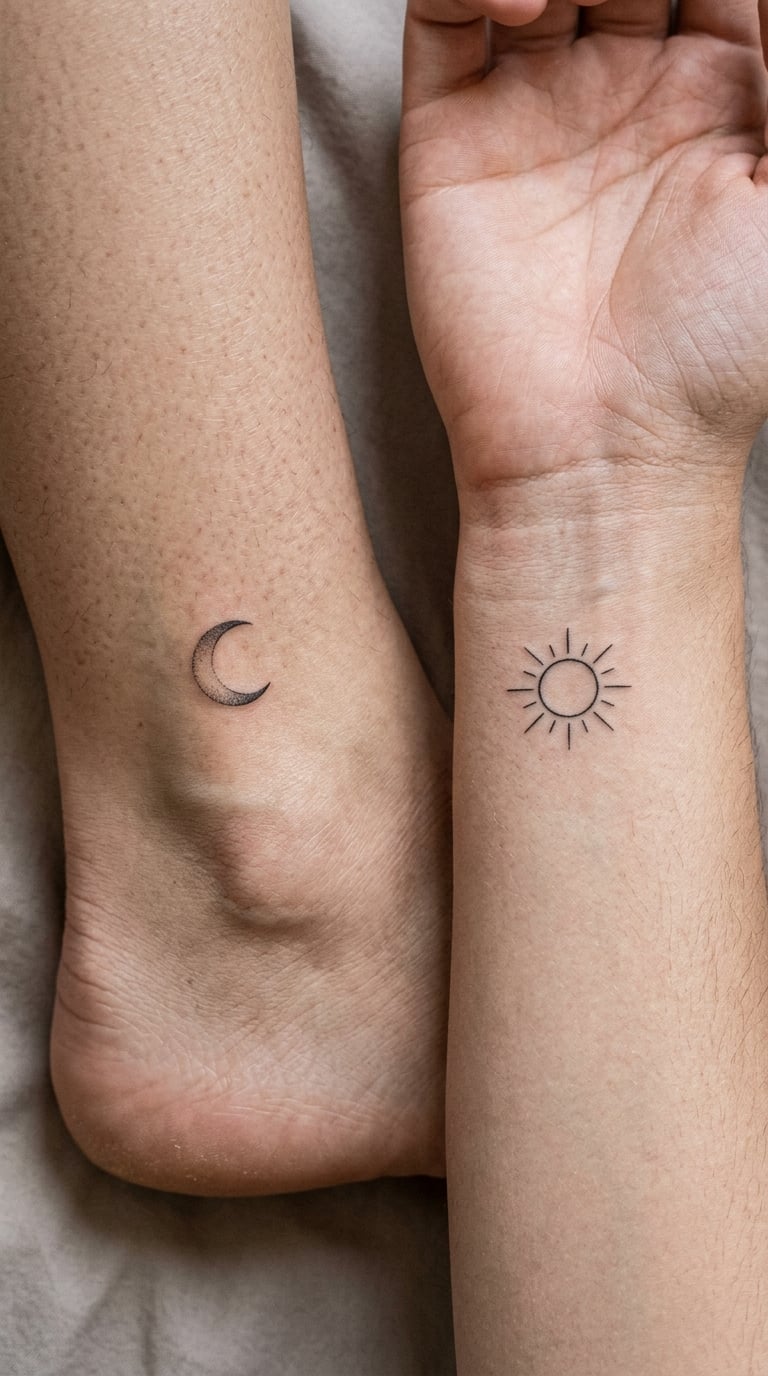
A crescent moon on one body, a simple sun on the other. Same line weight, same hand if you can get the same artist, completely different shapes. This is the easiest 1:1 to describe to a tattooer and one of the easiest to place discreetly.
Plenty of couples use it as a balance pairing, which is honest enough. Others connect it to a wedding in December or a birthday in July, which is the better reason.
Placement: Moon on the outer ankle or behind the ear; sun on the inner wrist or opposite ankle. Size: half an inch to 1 in (1.5-2.5 cm). Style: Micro fine line, black with light grey shading on the moon.
Pain: Low to medium. The ankle stings more than the wrist and the bone is close to the surface. Ageing: Micro work behind the ear blurs fastest, because hair and skin movement work over the lines constantly.
Make it yours: Put the sun on the same arm as your partner’s moon, or add a single shared star between them.
3. Matching Coordinate Numbers on the Forearms
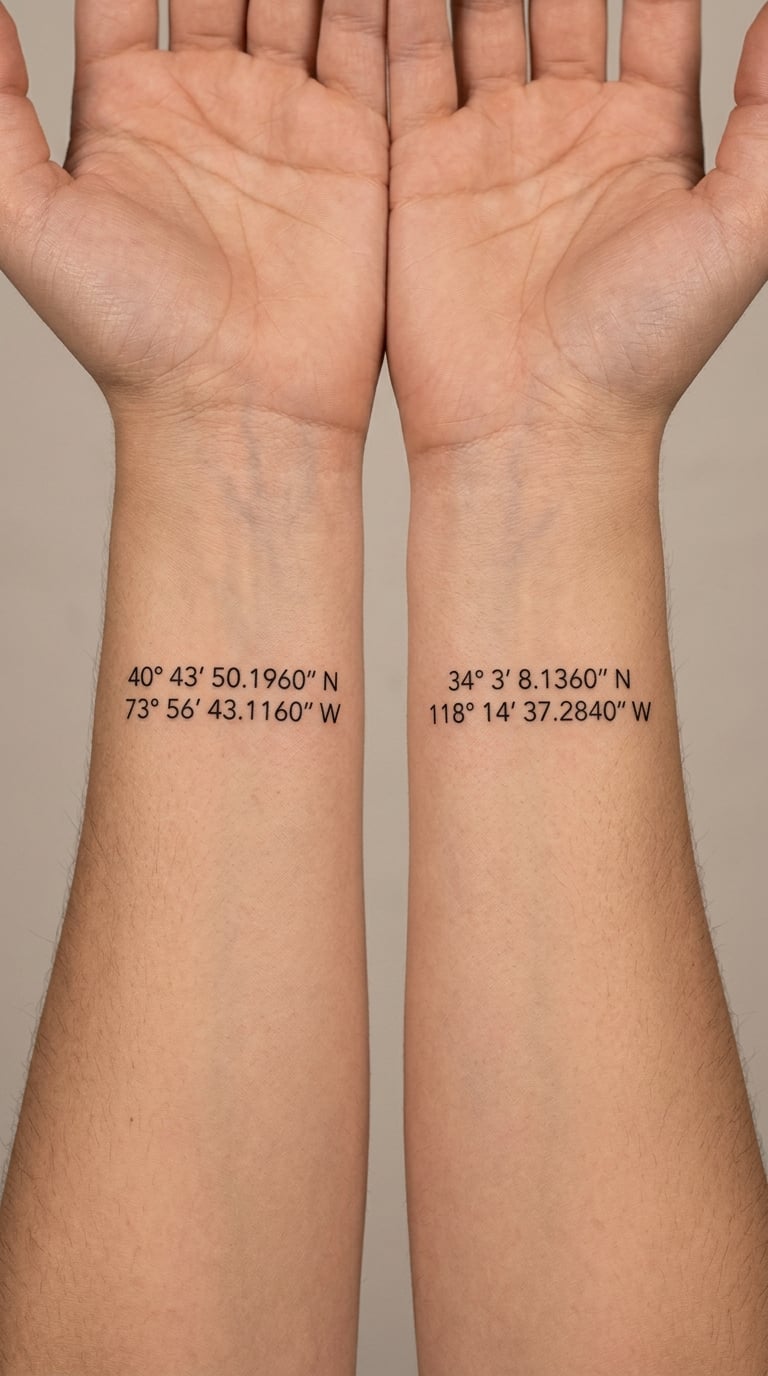
Latitude and longitude, a street address, a set of map coordinates from the place you met. It’s a location tattoo that only the two of you can read.
Numbers and letters are the hardest thing to keep legible, so this design lives or dies on a clean typeface and enough size. If you like coordinates, our guide to 20 DNA tattoo ideas covers the same problem in a completely different shape.
Placement: Inner forearm or the flat of the inner bicep. Size: 1.5-2.5 in (4-6 cm) wide. Style: Clean sans-serif numerals in solid black, no shading.
Pain: Medium. Inner forearms are bony but the nerve density is lower than the wrist. Ageing: Keep the line weight thick. A thin 1 or 7 disappears into a smudge within a few summers of sun exposure.
Make it yours: Write one set in the north-hemisphere format and the other in the south, or give each partner their own birth coordinates in the same place.
4. Complementary Botanical Sprigs on the Collarbones
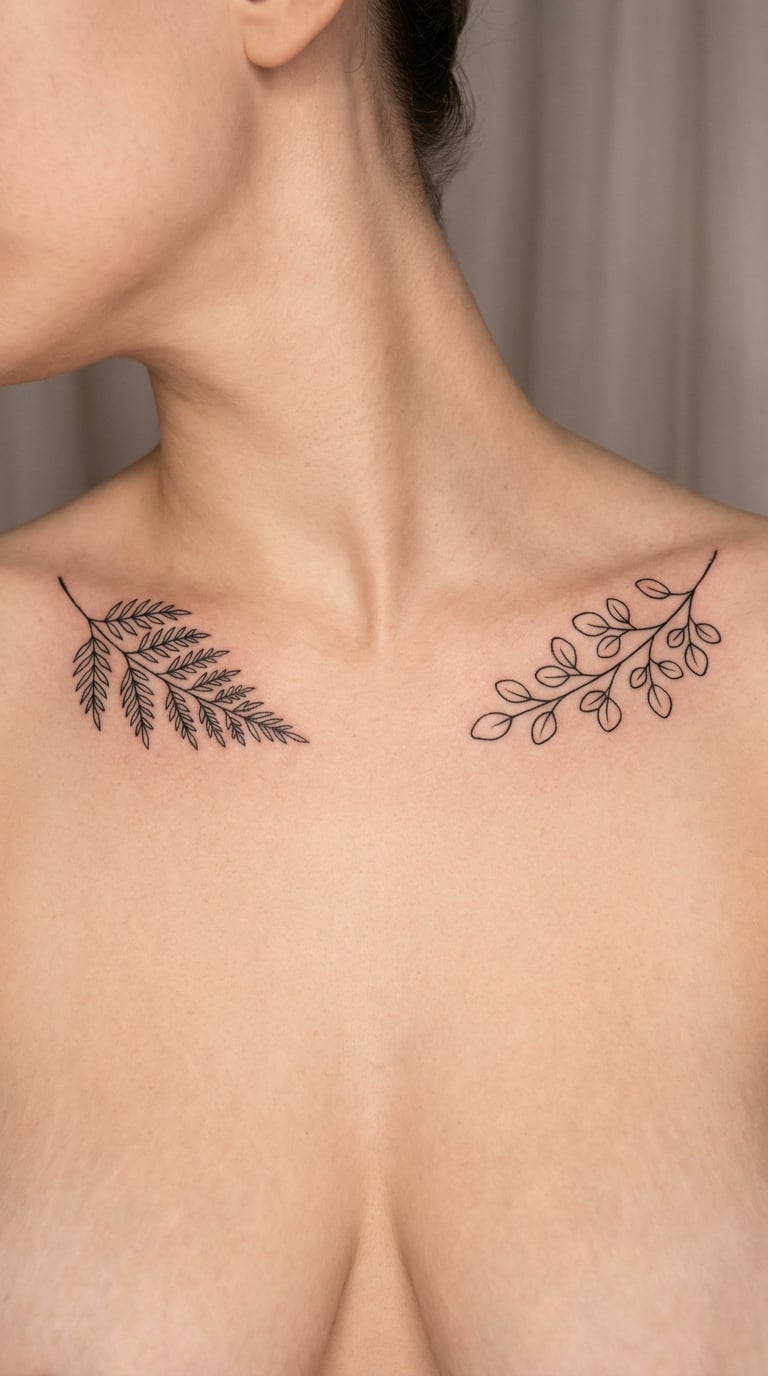
Two sprigs from the same plant family, drawn slightly differently. One could be olive, the other eucalyptus. The connection is botanical, so it reads as a pair without ever being a copy.
This is the one I send people to when they want matching tattoos that still look like two individual bodies. Nobody looks at your collarbone and thinks “those are the same tattoo.”
Placement: Along each collarbone, angled slightly toward the shoulder, or stacked vertically near the sternum. Size: 2-3 in (5-7.5 cm). Style: Fine line botanical, one colour of green added if you want.
Pain: Medium. Collarbone skin is thin and the bone is right under it, so expect a scratchy, insistent feeling. Ageing: Single-needle leaves and fine stems soften first, so a heavier outline survives better if you want it readable in a decade.
Make it yours: Use two species that bloom in the same month, or add a single shared bloom where both stems meet.
5. Matching Musical Notes on the Wrists
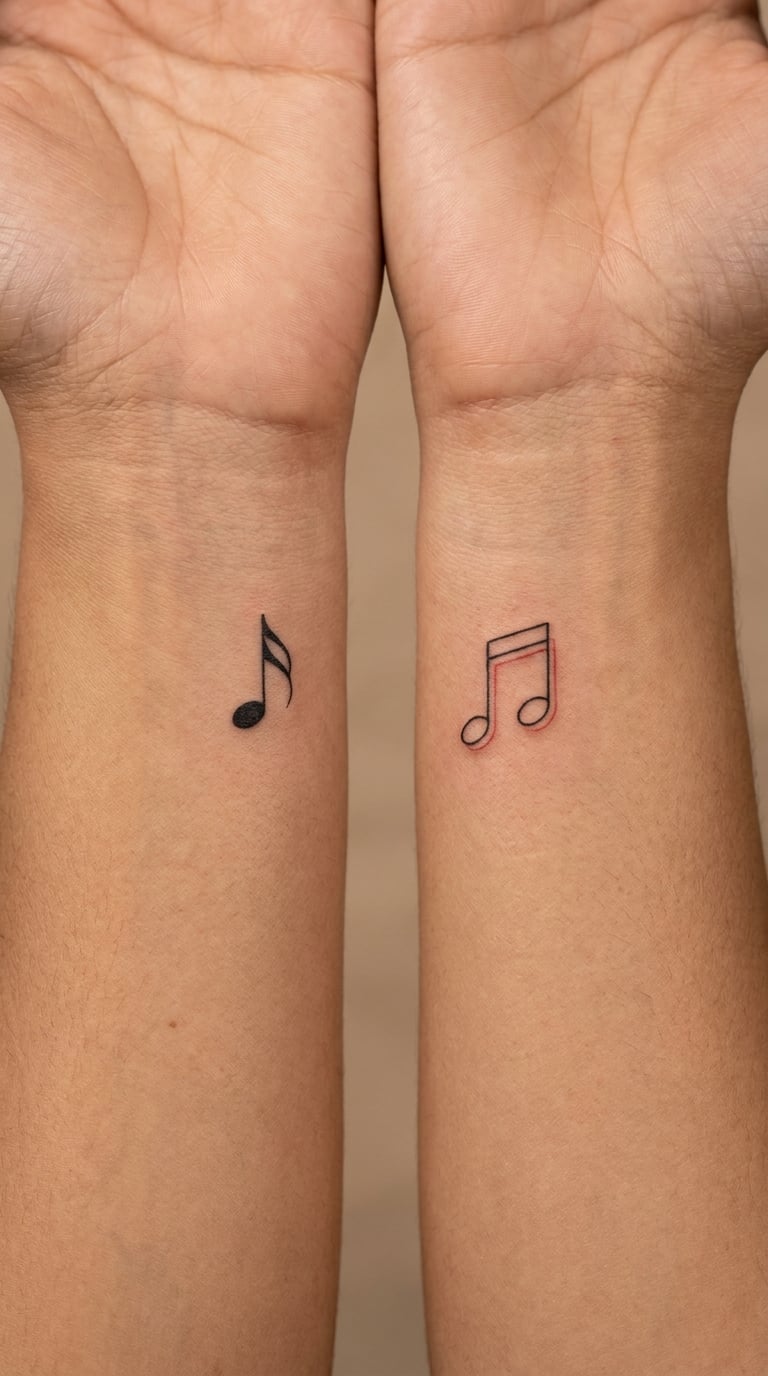
Pick a song, then give each person a different bar. His is the chorus, hers is the verse, or one gets the treble notes and the other the bass. Four or five notes, nothing more.
A lyric with a real history works better than a random melody. Wedding songs, the track you danced to at the reception, the song one of you was playing when the other walked in.
Placement: Inner or outer wrist, following the wrist line. Size: 1-2 in (2.5-5 cm). Style: Fine line with one small colour accent, or pure black.
Pain: Medium-high on the inner wrist, medium on the outer. Ageing: Round noteheads hold up better than thin beams, so ask for solid shapes instead of delicate eighth notes.
Make it yours: One colour only, dropped in the same spot on both tattoos, so the accent is a visible handshake.
6. Complementary Puzzle-Piece Micro-Tattoos
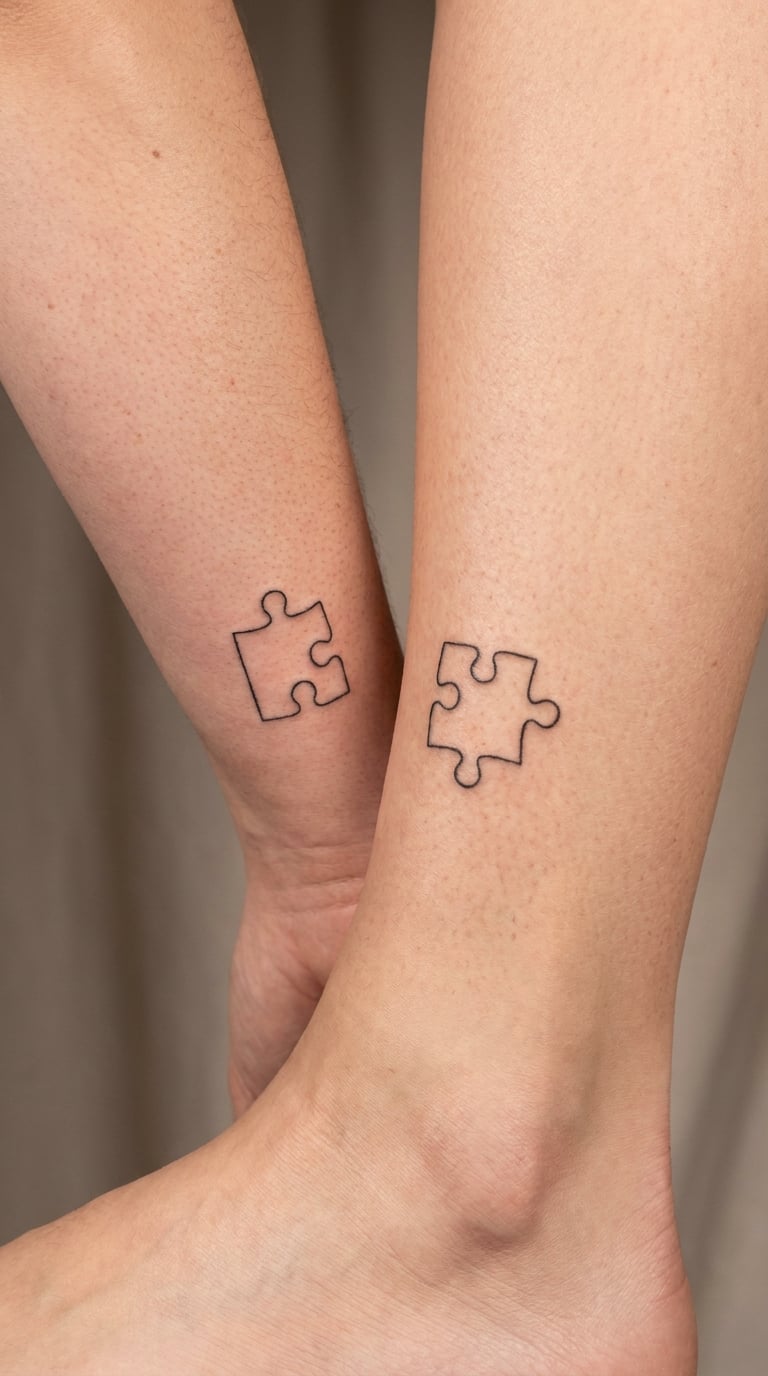
Two puzzle pieces, one on each person, with matching curved edges so the two designs can interlock visually on paper even though they sit on different bodies. It’s a relationship metaphor, and that’s about as far as the symbolism goes.
Keep the piece abstract. A jigsaw outline is cleaner than one with a picture printed inside it, and the small sizes are what make this pair work.
Placement: Inner arm, ankle, or behind the ear. Size: under 1 in (2.5 cm) across. Style: Micro blackwork with a solid outline and a soft grey shade inside.
Pain: Low to medium. Ageing: Micro blackwork holds colour better than fine line, but the tiny gaps between the tabs can fill in over time, so avoid anything with three or more details cut into it.
Make it yours: Put a date or one initial inside one piece, and leave the other blank so the meaning stays between you.
7. Matching Constellations on the Upper Arms
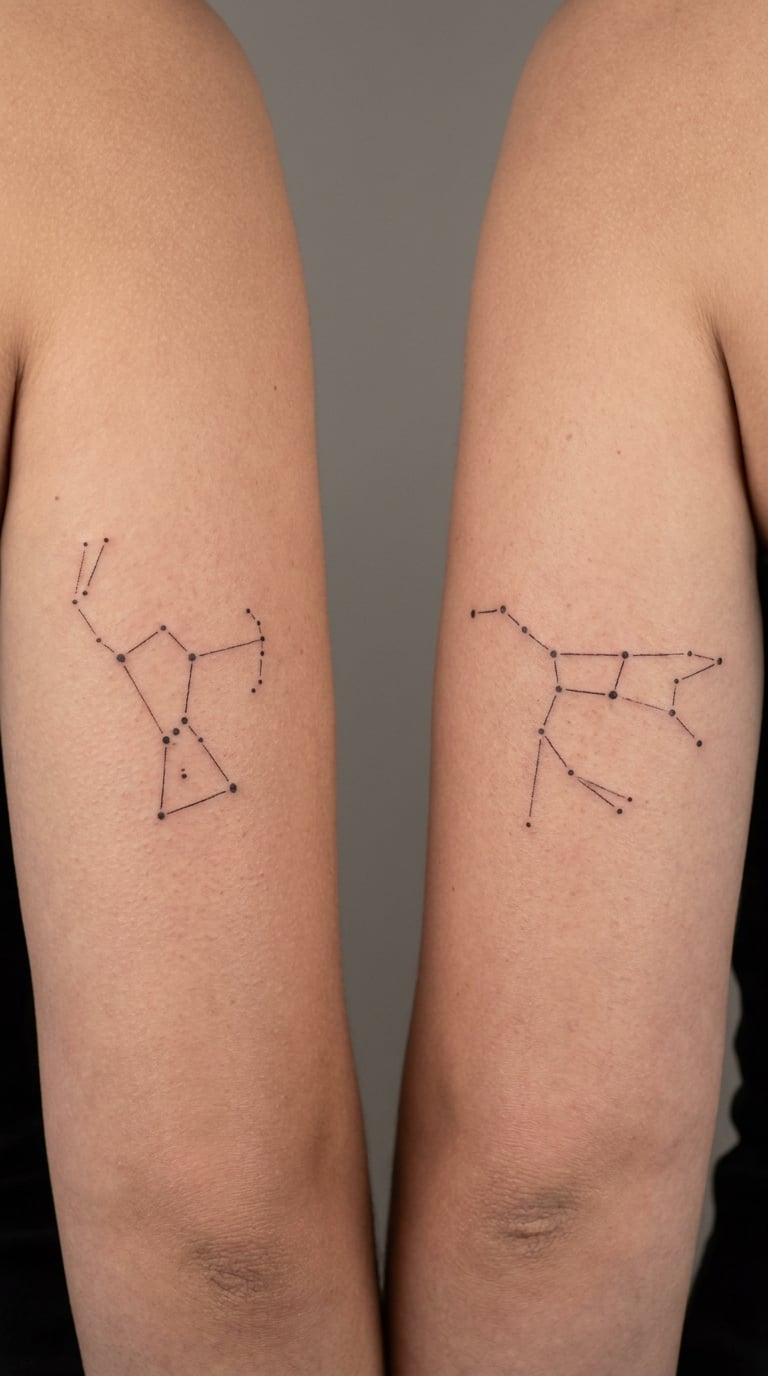
The same constellation, or two constellations from the same sky on the same night. Stars as small dots, thin lines between them, a name underneath in a small clean script. It looks like a quiet map of something you both saw.
Plenty of couples get the sky above the town where they met, dated the night. That’s a better story than a generic star map.
Placement: Outer upper arm, or across the shoulder blade. Size: 3-5 in (7.5-12.5 cm). Style: Fine line star map, solid black, one-word name in small caps below.
Pain: Medium, and easy to sit through on the upper arm. Ageing: The connecting lines are the weak point. Ask for dots that are visibly round, not hairlines, or the map turns into scattered specks.
Make it yours: Use real star names rather than the Latin designations, or add the date of the night underneath in matching type.
8. Complementary Rose and Laurel Branch Tattoos
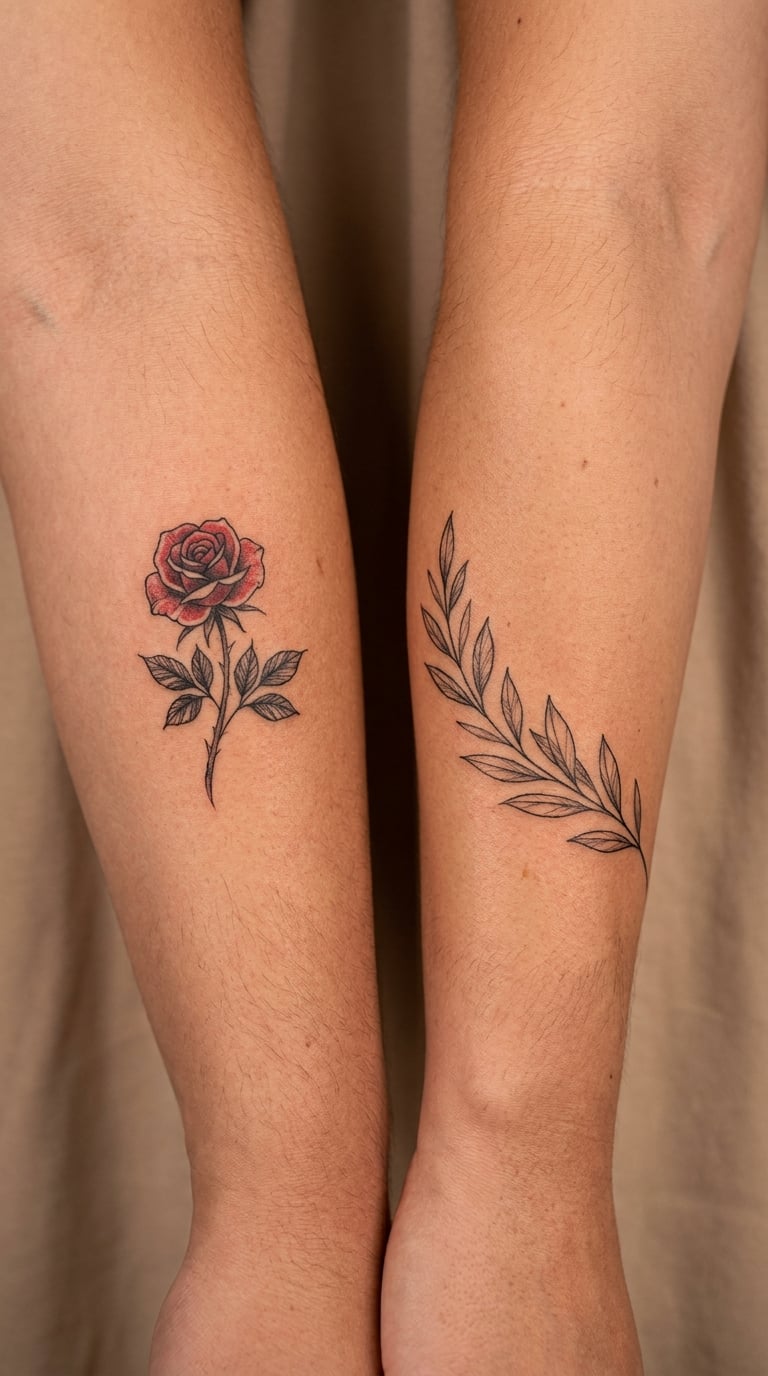
One gets a single rose, red and black with a stem and two leaves. The other gets a laurel branch in fine black line. Two very different densities of ink that share a botanical logic and a curved direction.
There’s no fixed meaning here beyond “these two things grow”. People often attach a wedding date underneath the stem, or a first initial hidden in the laurel leaves.
Placement: Forearms, running along the inner line from wrist toward elbow. Size: 3-4 in (7.5-10 cm). Style: Traditional rose with colour, fine line laurel in black.
Pain: Medium-high on the inner forearm, especially where the wrist meets the arm. Ageing: Red fills can look tired in about ten years if they’re not refreshed. A refreshed colour tattoo is normal maintenance, not a failure.
Make it yours: Give the rose the only red in both tattoos, and leave the laurel entirely black so the colour points at one person.
9. Matching Outline Hearts on the Fingers
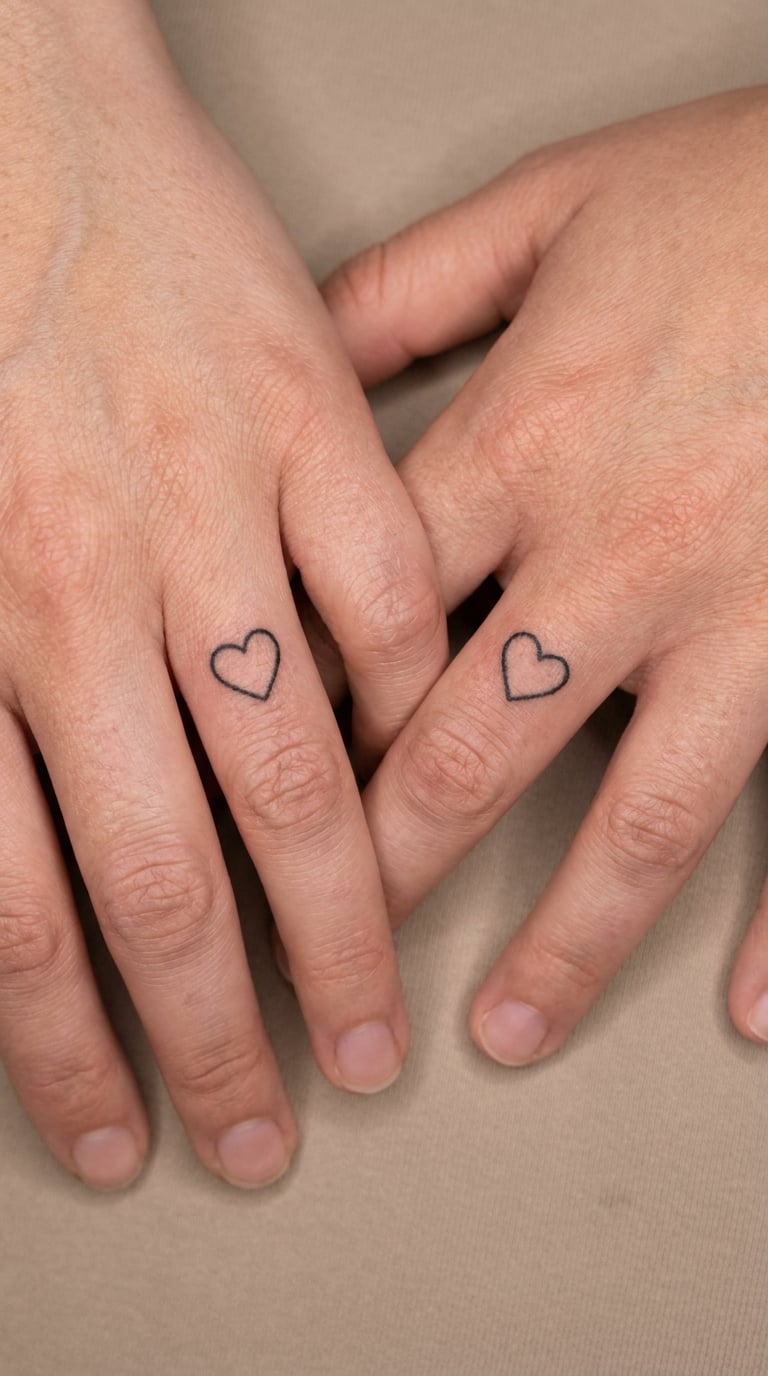
A single-line heart outline, half an inch or smaller, on the side of a finger. One ring finger each, or the same finger mirrored on the same hand. That’s the entire design and that’s plenty.
Couples who want something nearly invisible pick this one. It reads as a tiny mark to strangers and as a whole conversation to the two people wearing it.
Placement: Side of the finger, never across the knuckle where it will stretch. Size: 0.3-0.5 in (8-13 mm) tall. Style: Single-line minimal outline in solid black.
Pain: High. Finger skin is thin over bone and there is nowhere to shift your hand away from the needle. Ageing: Hands take sun all year and wash constantly. Fine outlines on fingers soften noticeably within five to seven years, so a slightly heavier line is worth asking for.
Make it yours: One heart upright, one upside down, or both on the same hand so they’re only visible when you look.
10. Complementary Koi Tattoos on the Calves
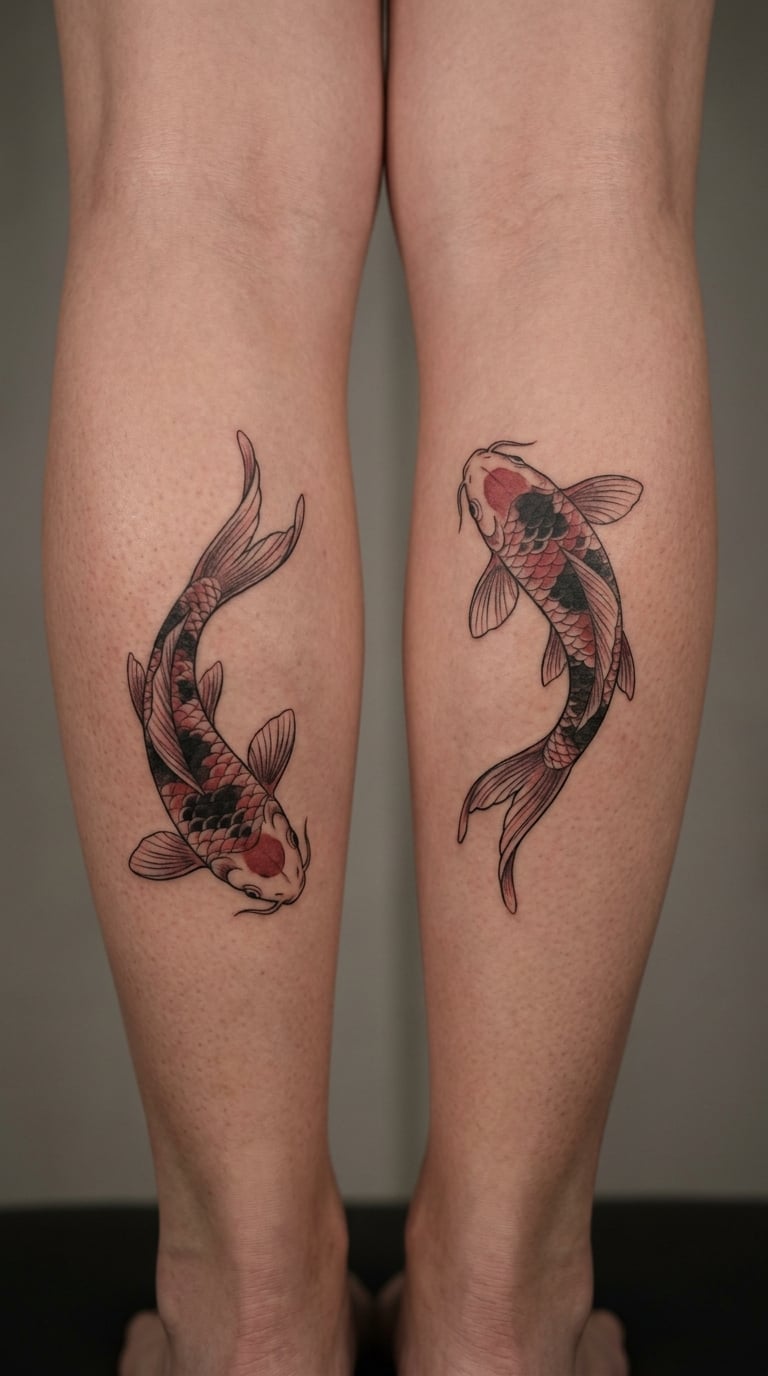
Two koi, different fish, swimming the same direction. One might be red and white, the other black with gold, but both curl the same way through the water so the pair works from across a room.
Koi are popular well outside Japanese tradition, and a two-koi design usually lands somewhere between illustrative and Japanese-style composition. Worth telling your artist which direction you want so it does not drift.
Placement: Outer or inner calf, running upward from the ankle. Size: 4-7 in (10-18 cm). Style: Illustrative with restrained colour and clean scale work.
Pain: Medium. The calf is fleshy and takes a longer sitting, but the sensation stays moderate. Ageing: Blue and light yellow on a fish fade fastest, so a red and black palette holds together longer.
Make it yours: Put the meeting date in the water line under one koi, or add one bubble rising from each fish so both have the same detail.
11. Matching City Skyline Silhouettes on the Forearms
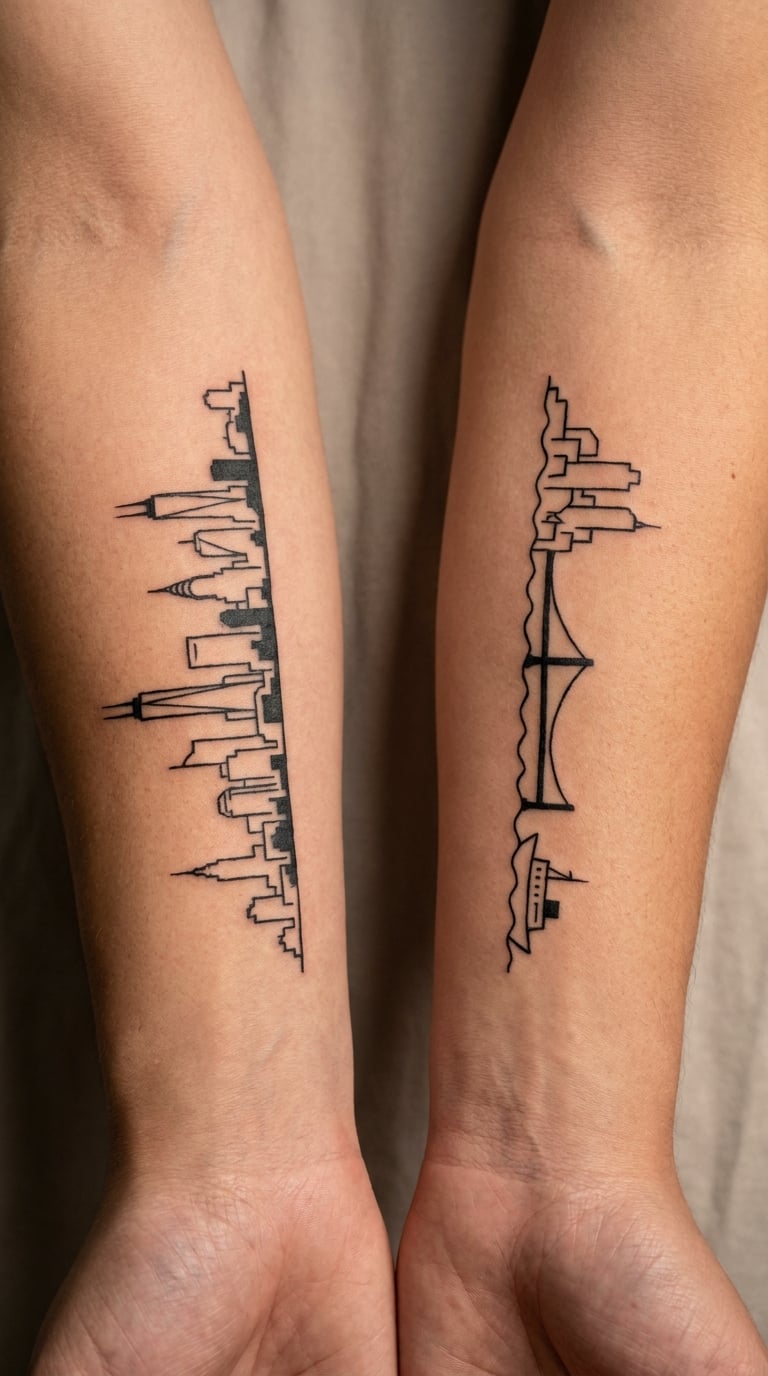
One person gets the downtown you both live in, detailed. The other gets the same city from the water, simplified to three or four shapes. Recognisable to you, anonymous to everyone else.
Two identical skylines on two forearms often look like one design copied. Splitting it into two viewpoints solves that instantly, and it also lets one person carry more detail than the other without the pair looking uneven. It is one of the more forgiving options in this list of 20 111 tattoo ideas because the work is solid black and shows almost no fine detail.
Placement: Outer forearm, wrist to elbow, or wrapped along the inner forearm. Size: 4-6 in (10-15 cm) long. Style: Solid black silhouette, no shading.
Pain: Medium. Ageing: Solid black blocks are the most durable thing an artist can put in your skin. Keep gaps between buildings wide enough that they don’t fill in over time.
Make it yours: Include one building in each tattoo that neither of you has explained to anyone.
12. Complementary Snake and Vine Fine-Line Tattoos
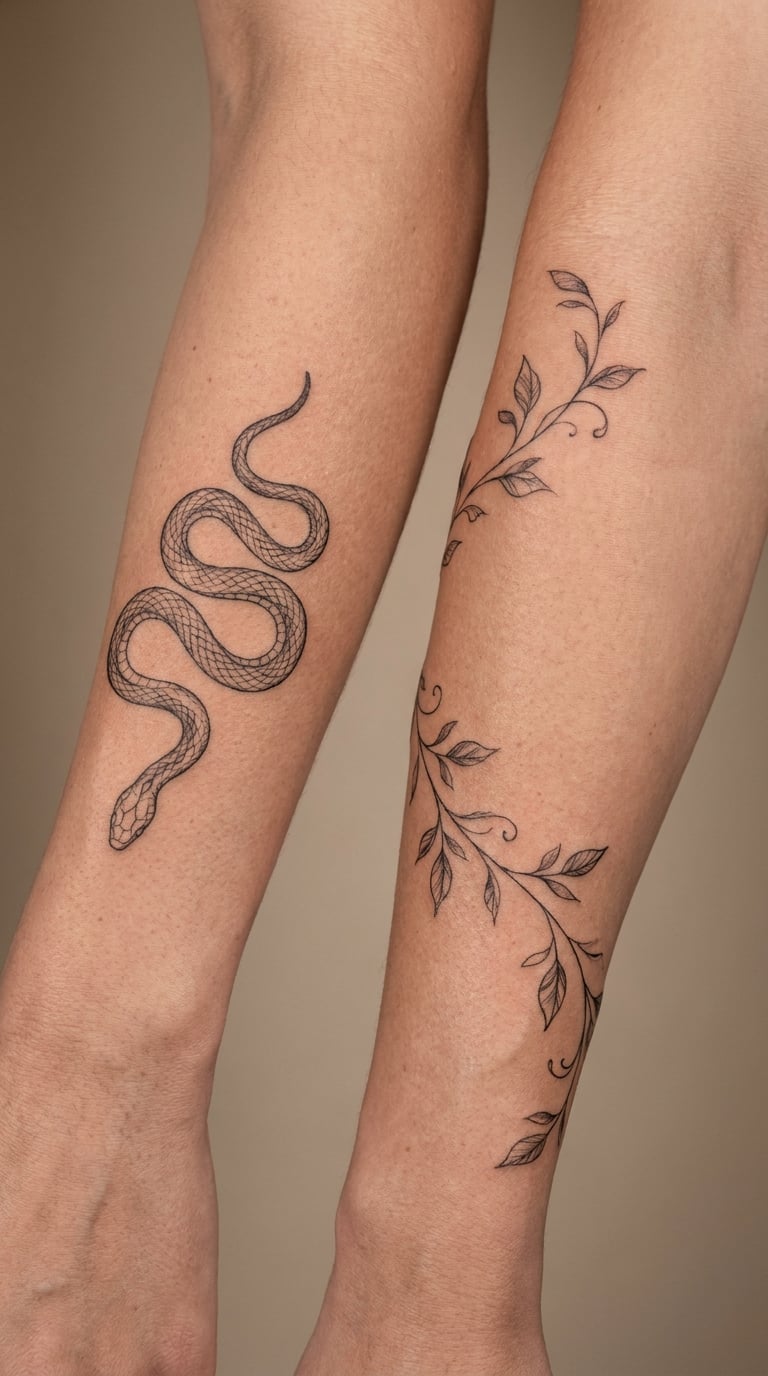
A snake that curves one way, a vine that curls the other. Both follow the line of the forearm so they sit in the body rather than on it. The pair works because the movement is mirrored, not because the pictures match.
This one suits people who want a matching tattoo that other people will read as two unrelated pieces of body art.
Placement: Inner or outer forearm, wrapped to follow the limb’s curve. Size: 3-5 in (7.5-12.5 cm). Style: Fine line, black, minimal shading.
Pain: Medium. A wrapped design means the needle works around a cylinder, which takes a little longer. Ageing: Long single-needle curves are the first thing to fade on a forearm that gets regular sun. A modest line weight goes a long way.
Make it yours: Give the vine a single leaf in colour while the snake stays solid black.
13. Matching Mountain Ranges Across the Shoulders
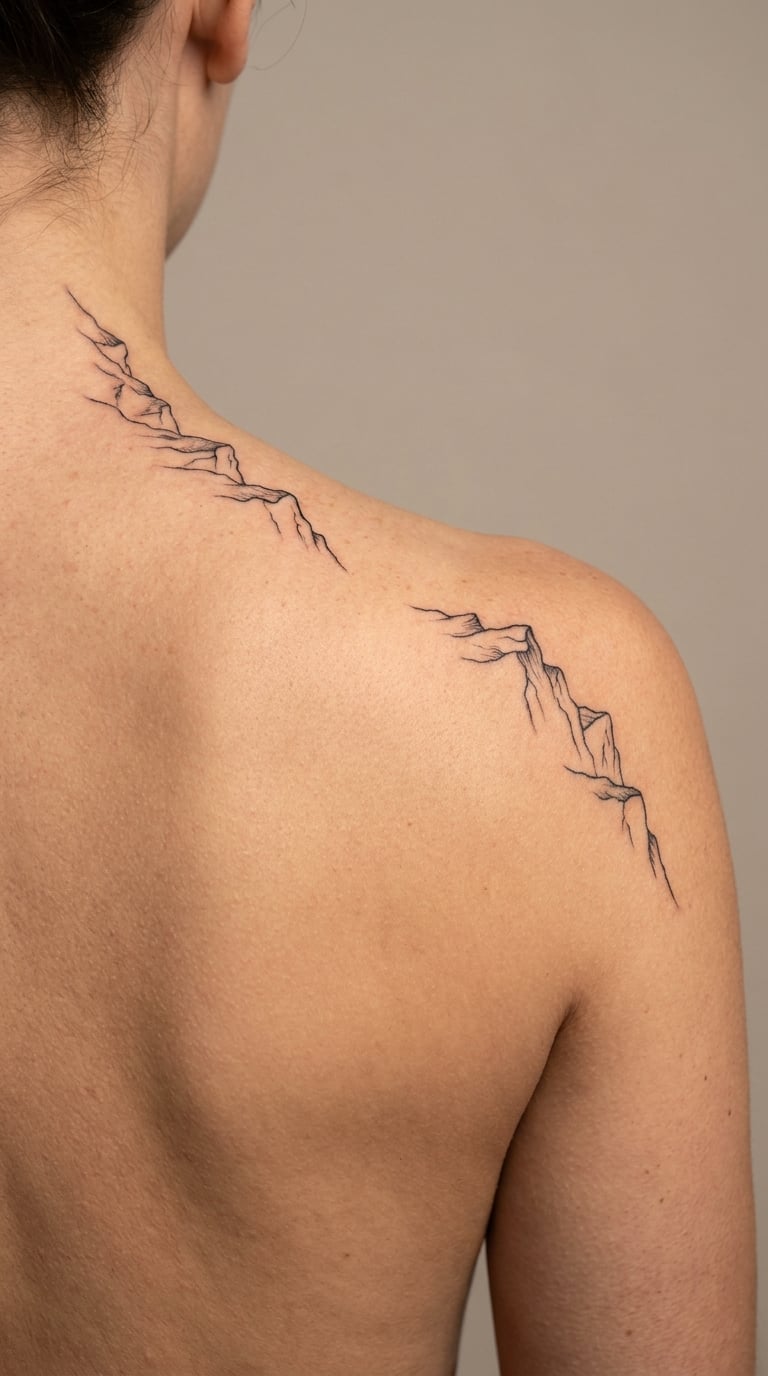
Two ranges drawn from the same profile, running across opposite shoulders. One peaks toward the neck, the other falls toward the arm, so the two designs face each other when the people stand side by side.
Shared horizon lines are what sell this. Even from across a room the two shoulders read as one wide image split in two.
Placement: Across the shoulder, following the trapezius line, or running down the upper arm. Size: 4-7 in (10-18 cm) across. Style: Fine line landscape with simple hatched shading on one face of each peak.
Pain: Low to medium. Upper arms and shoulders are among the more forgiving places to sit. Ageing: Fine hatching on distant peaks fills in first, so keep the shading to one direction per peak and no more.
Make it yours: Hide a small initial inside one ridge, or use the elevation profile of a trail you hiked together.
14. Complementary Semi-Colon Tattoos on the Wrists
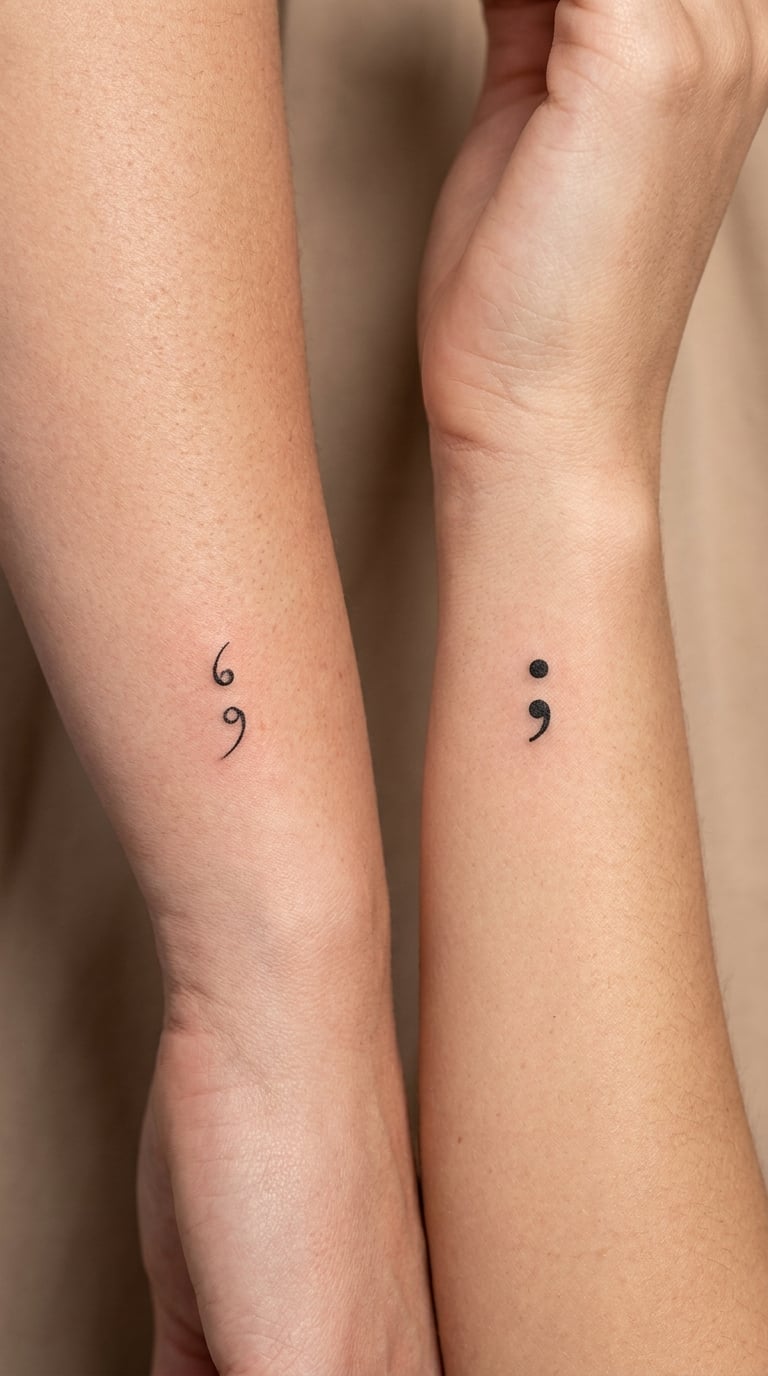
One semicolon each, in two different fine-line letterforms. One straight and geometric, one with a small cursive tail. A punctuation mark is a quiet way to mark a hard year without writing a sentence about it.
There’s no fixed interpretation to argue about here, which is part of the appeal. If you like our write-up on lettering choices, the 20 paramedic tattoo ideas guide gets into how people choose symbols tied to one period of their life.
Placement: Inner or outer wrist, angled with the wrist line so it reads from the side. Size: 0.5-1 in (1.5-2.5 cm). Style: Fine line lettering, solid black.
Pain: Medium-high on the inner wrist. Ageing: Letterforms and numerals are the two things artists most often see fade into unrecognisable smudges. Ask for a slightly heavier stroke than feels necessary.
Make it yours: Put a date under one semicolon only, so one tattoo carries the explanation and the other doesn’t.
15. Matching Compass Roses on the Ankles
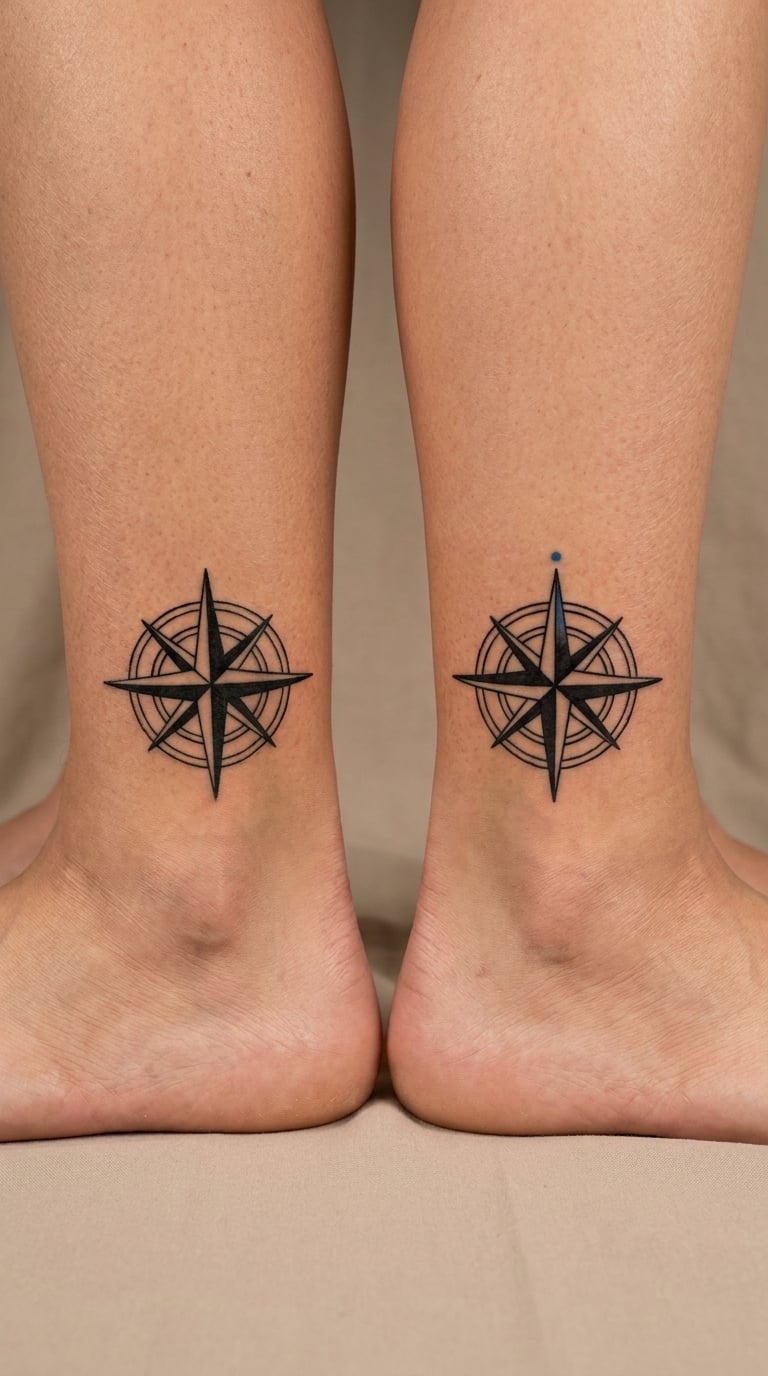
A compass rose each, ideally built from the same four points but with different letters or a different accent. One points true north on paper, the other rotates it. Travel is the usual reason people choose it.
If direction is the theme, our guide to 20 north star tattoo ideas has a few more variations worth looking at first.
Placement: Outer ankle above the bone, or the top of the foot. Size: 1.5-2.5 in (4-6 cm) across. Style: Traditional linework in black with one small colour accent.
Pain: Medium. Ankles are bony and the nerve endings there are close to the surface. Ageing: Ankle tattoos rub against shoes all day. Solid black linework survives; thin outline work on the outer ankle wears down noticeably faster.
Make it yours: Put your home latitude on one and the other person’s on the other, under the same rose design.
16. Complementary Butterfly and Leaf Micro-Tattoos
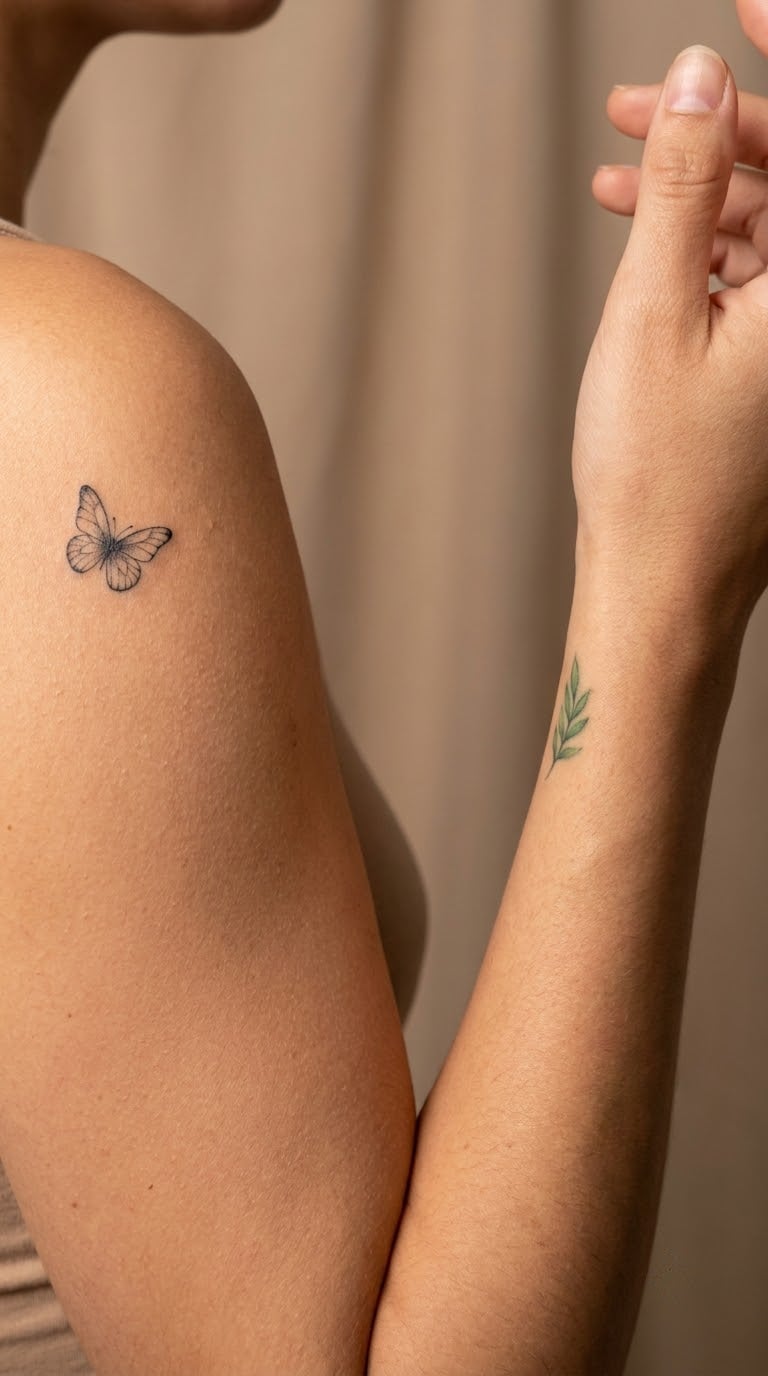
A small butterfly on one shoulder blade, a single leaf on the opposite wrist. One has wings and movement, the other has a stem and stillness. The connection is that both are close-up studies of something tiny, drawn with the same care.
This is the right pick if you want a pair that looks delicate rather than bold. It is also the one most often tattooed without any planning at all, which is how a lot of people get their first piece.
Placement: Shoulder blade, upper arm, or wrist. Size: 1-2 in (2.5-5 cm). Style: Micro illustrative, black with one restrained colour.
Pain: Low to medium. Ageing: Butterfly wing patterns are detail-dense, and detail is what goes first. Fewer, larger shapes hold their shape for longer.
Make it yours: Use a leaf from a plant that actually grew somewhere you’ve both been, then press a real one in a book for a year.
17. Matching Broken Circle Geometric Tattoos
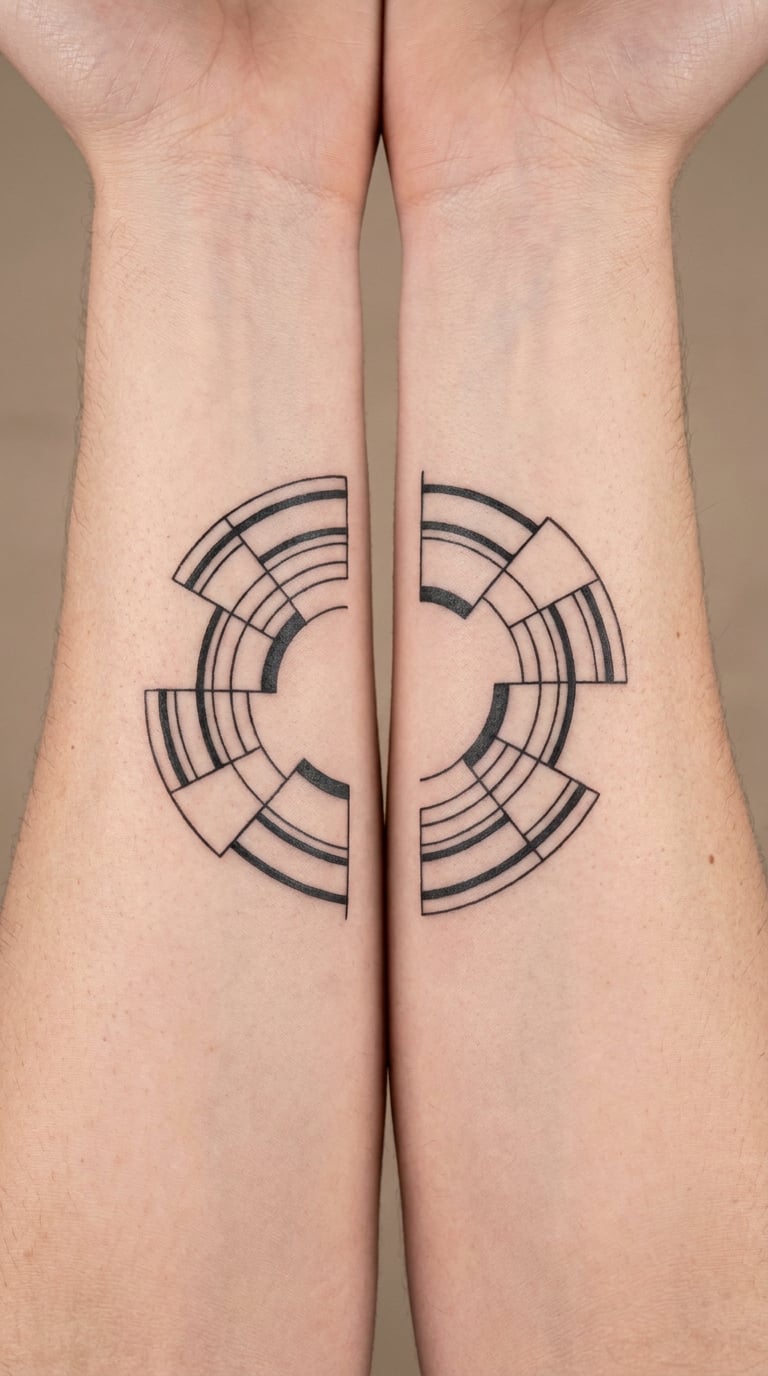
Two circles, each one missing a segment. Set the gaps so that when you put your arms together the two circles close into a single ring. Alone, each tattoo looks unfinished, which is the point.
Geometric line work is unforgiving. A circle that isn’t round on day one is a circle that looks lopsided forever, so this is a good one to book with an artist whose healed geometric work you have actually seen.
Placement: Inner arms so the two can meet, or one on each forearm. Size: 2-3 in (5-7.5 cm) across. Style: Geometric blackwork, solid fills with no gradients.
Pain: Medium. Ageing: Straight segments and solid arcs hold better than curves made of hairlines, which is the standard way to make this design last.
Make it yours: Make both gaps the same width, or put your birth months in the two open segments.
18. Complementary Lightning Bolts on the Legs
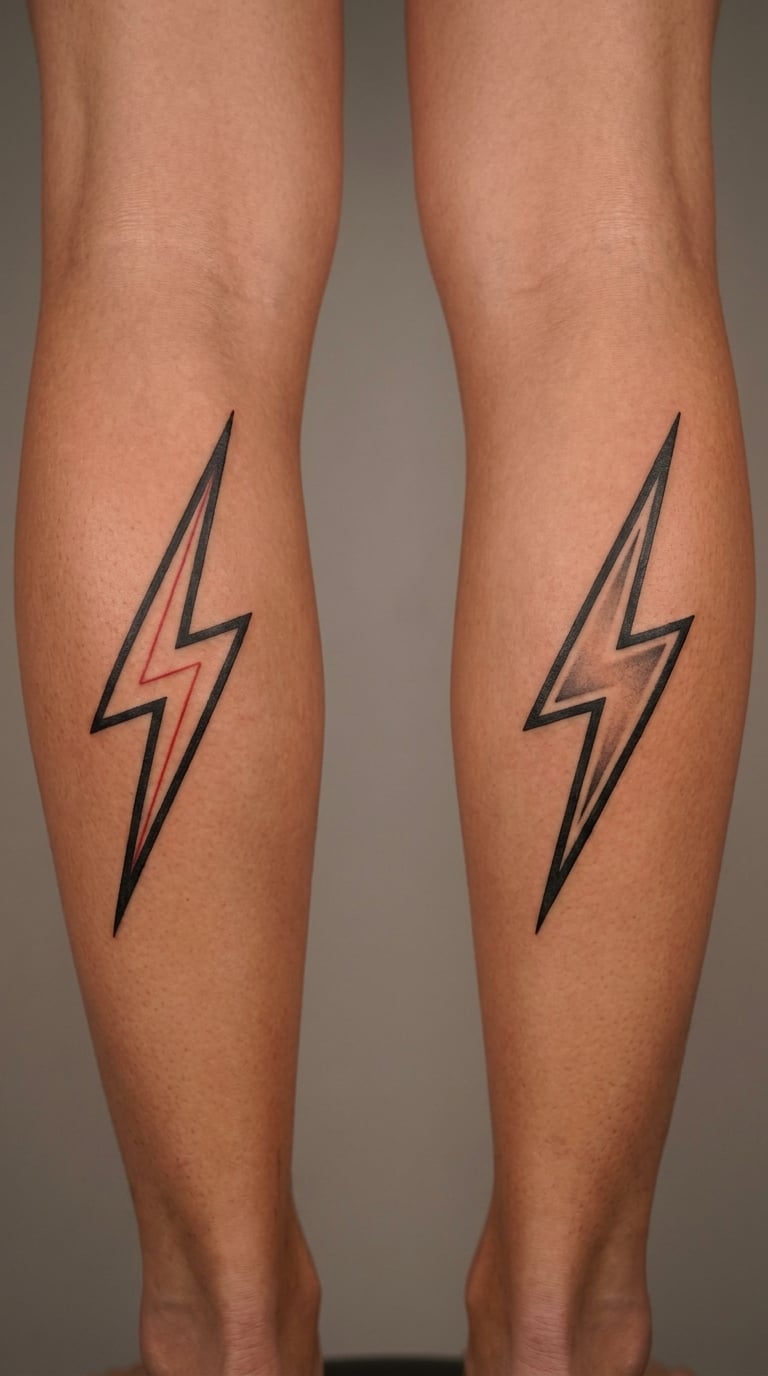
One bolt, one arrow-shaped zigzag, or two of the same bolt facing opposite directions. Thick black fill with a single accent. On a leg there’s room to make it bigger and simpler than the same idea on a wrist.
Legs are the easiest place to carry a bold pair, and a bolt on a calf reads well from a distance in a way an ankle heart never will.
Placement: Outer calf, inner calf, or the outer thigh. Size: 2-4 in (5-10 cm) tall. Style: Bold black fill with one accent colour, no gradient shading.
Pain: Medium on the calf, medium-high on the inner thigh. Ageing: Solid black is durable. Grey shading inside a bolt is the first thing to look dusty, so keep any shading to one flat tone.
Make it yours: Give each bolt a different accent, or add a small storm cloud above one of them only.
19. Matching Portrait Silhouettes on the Upper Arms
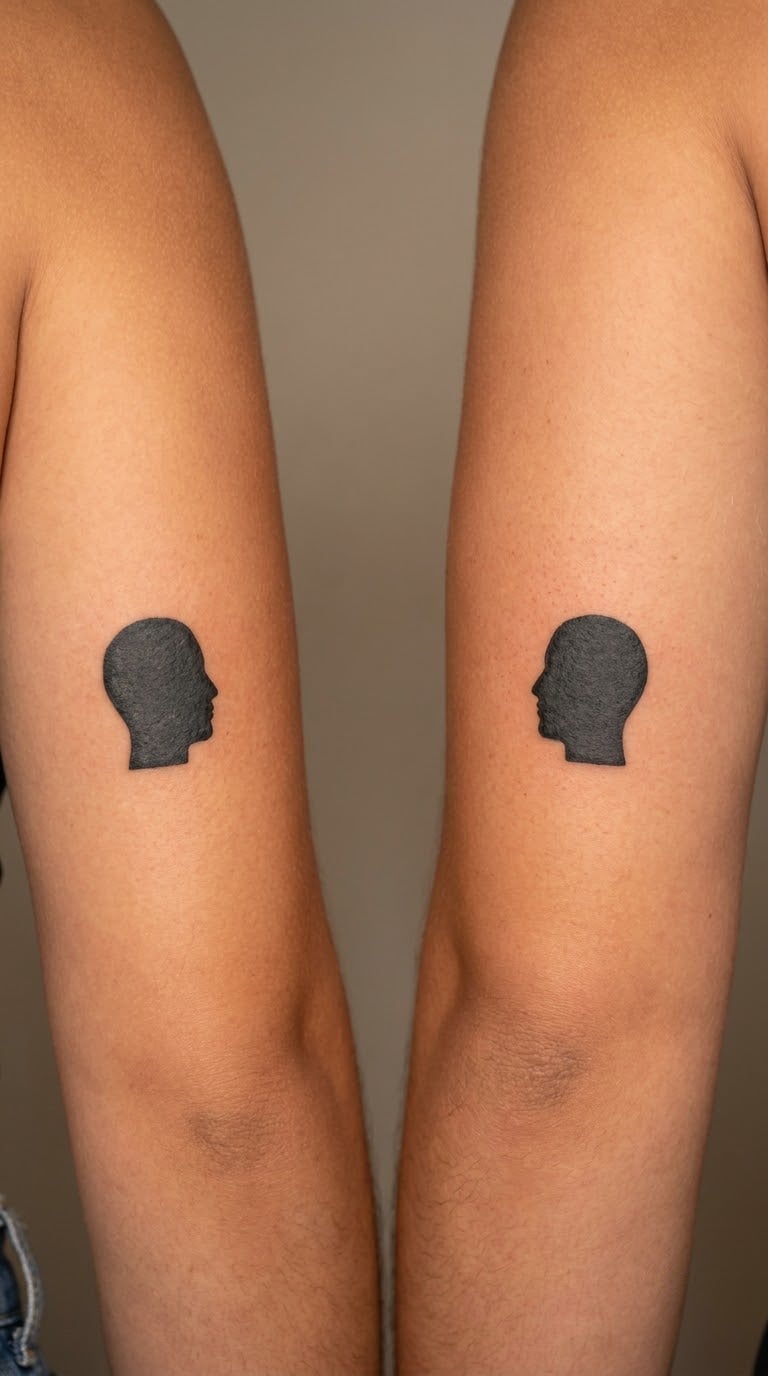
Each person gets the other’s profile, reduced to a solid black shape. No eyes, no mouth detail, no hair strands. It’s the most personal design on this list and the least forgiving, because likeness work is judged by people who know your face.
Bring reference photos from the side, in daylight, and expect two or three rounds of stencilling. A silhouette hides a lot, which is why it works where a portrait would not.
Placement: Outer upper arm, or the inner forearm. Size: 2-3 in (5-7.5 cm) tall. Style: Solid black silhouette, one shape, no interior detail.
Pain: Medium. Ageing: A solid black shape barely changes, but a profile with a small gap in it, like between nose and chin, can fill in over time. Keep the outline closed.
Make it yours: Match the angles so the two profiles face each other, or add a tiny detail only the wearer will recognise.
20. Matching Minimal Wave Lines on the Ribs
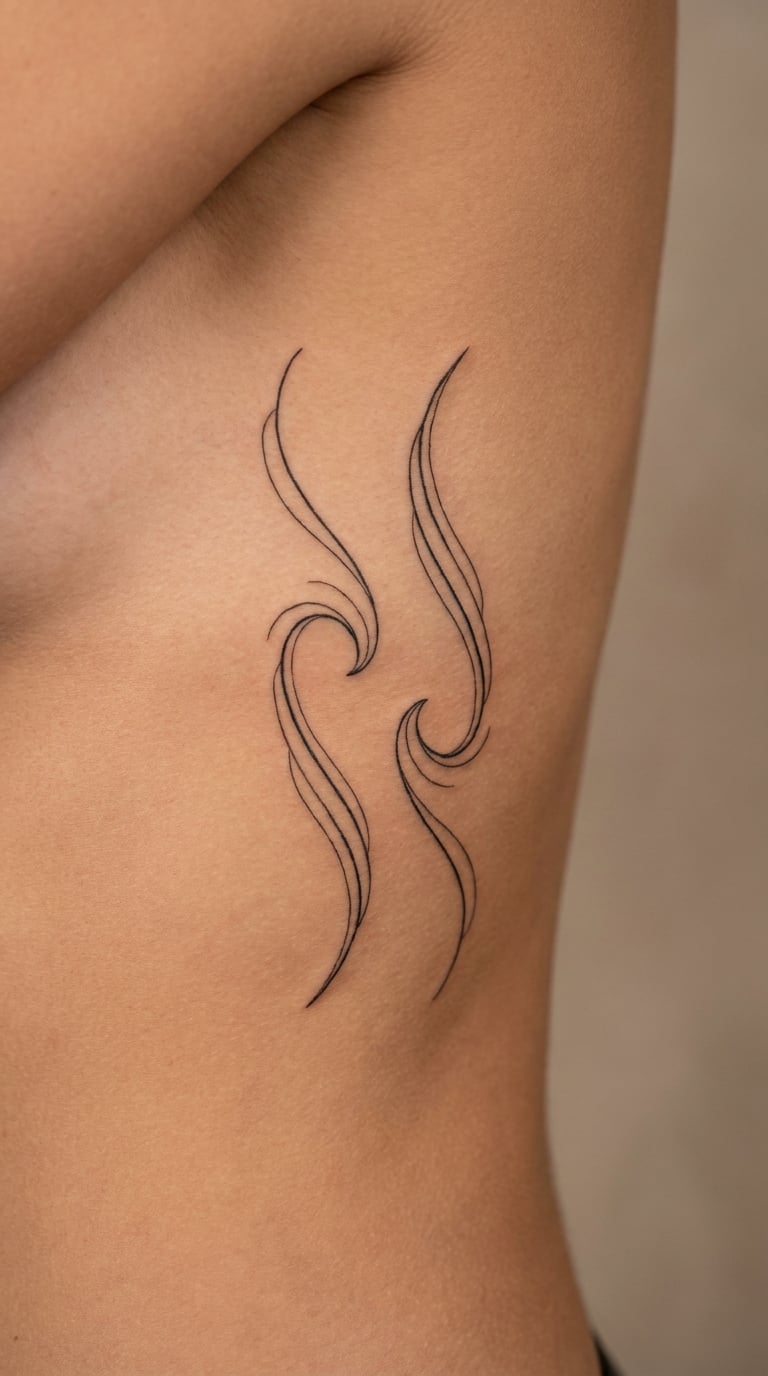
One set of long parallel wave lines on each side of the ribs, mirrored so the curves echo each other. Part seigaiha, part single stroke, and it follows the shape of the body better than almost any other design in this list.
This is the boldest placement here. Ribs hurt, the skin moves constantly, and you cannot see it yourself without a mirror, so it works best for people who already have a few pieces and know what a long sitting feels like.
Placement: Side ribs, running front to back. Size: 4-8 in (10-20 cm) long. Style: Bold fine line, solid black, three to five parallel lines.
Pain: High. Ribs are thin-skinned, close to bone, and the skin there moves with every breath. Ageing: Bony areas and areas that stretch need a heavier line than you think you need. Ask the artist to plan for stretch, not for how thin it looks fresh.
Make it yours: Vary the number of lines, three on one side and four on the other, and let the mismatch be the point.
How to Choose the Right Design
Identical or complementary within the 20 111 tattoo ideas
Identical designs suit people with similar body shapes who want an obvious match. Complementary designs suit everyone else, and they age better because one person ending up with a heavier piece doesn’t look like a mismatch.
- Start from the story, not the picture. If you don’t have a reason, wait. The number of matching tattoos that get covered up is mostly the number that got picked from a trend feed.
- Decide the size band together. If one of you is getting a 4 in design and the other a half-inch micro, you will notice it every single day. Land within about an inch of each other.
- Match the line weight, not the subject. Two different motifs in the same weight and colour read as a pair. Two identical motifs in different weights do not.
- Test placement on paper first. A design that looks good on a flat forearm photo often falls apart on a curved calf. Draw it at the real size on the real body before you commit.
- Book the same artist where you can. One artist can hold the line weight and scale consistent across both tattoos in a way two artists rarely will.
- Know the healed result. Ask to see healed photos of that artist’s work, ideally eighteen months old or more, not fresh Instagram posts from last month.
Cost and Session Time
What 20 111 tattoo ideas cost in the US
Most shops price by the hour, and the honest ranges for a matching pair are these. A small design under one inch runs about $60 to $150 per tattoo. Something in the two to four inch band, which covers the arrows, the compass roses and most of the fine line botanical work, runs about $150 to $350. A large piece over four inches, like the koi, the mountain ranges or the rib waves, runs about $350 to $800 and usually needs more than one sitting.
| Size band | Typical US price per tattoo | Sitting time |
|---|---|---|
| Micro, under 1 in | $60-$150 | Under an hour |
| Small to medium, 1-4 in | $150-$350 | 1-3 hours |
| Large, over 4 in | $350-$800 | 3-6 hours, often split |
Session time by design size
Session length is driven by size and detail, and the time-based part of what you pay is what you’ll feel most in the chair. A micro piece like the puzzle pieces or the outline hearts is often well under an hour. The mountain ranges, the koi and the rib waves are multi-hour sittings, and a design that is too big to finish in one go usually needs a second appointment and a touch-up pass later.
Most studios set a minimum booking that a very small design may not reach, and hourly rates vary a lot by city, by shop, and by how well the artist books out. Custom work like coordinate numbers or portrait silhouettes costs more than a straight flash design, because nobody has drawn your version before.
Two practical things that keep the cost predictable. Get a rough total before the session starts rather than after, and if you want a large design, ask whether it can be done in one sitting at all. An unfinished half-piece is the most expensive outcome there is.
Aftercare Basics
- Follow your artist’s aftercare instructions first. Every tattooer has their own protocol for what they tattooed and how they tattooed it, and that guidance outranks anything general you read online.
- Wash gently, twice a day, for the first few days. Lukewarm water, a fragrance-free wash, clean hands. Pat dry with a paper towel or a clean cloth.
- Keep it moisturised while it’s healing. A thin layer of a plain healing ointment or unscented lotion, reapplied whenever it stops feeling tight. Heavy products trap heat and slow things down.
- Protect it from sun and friction. No tanning, no hot tubs or pools while the skin is still healing, and keep loose clothing away from it for a couple of weeks.
- Never pick or scratch. Flakes come off on their own. Pulling them takes ink with them, and that is where most touch-up appointments come from.
Frequently Asked Questions
Do matching tattoos have to be identical?
No. A matching 1:1 only needs a shared idea, not the same drawing. Two different motifs in the same line weight and ink colour read as a pair, and they suit bodies and tastes that differ. Identical designs suit people with similar builds who want the match to be obvious. Plenty of couples end up preferring the complementary version years later because nobody can tell who copied who.
How do you coordinate two different tattoo artists?
Send both artists the same reference images, the same size targets and the same line weight notes before either of you books. Send each artist a healed photo of the other’s work if you can find one, so they are matching a real healed result rather than a fresh reference. Decide who is the lead artist, because that person sets the scale, and tell the second artist what the lead chose. If one artist is available for both, take that option.
What size is the best size for a first matching tattoo?
Roughly two to three inches (5-7.5 cm) is the sweet spot for a first pair, big enough to hold detail and small enough to finish in one sitting. Under half an inch, fine line and numerals start to struggle to stay legible within a few years. Work with your artist on a real-size drawing on your body, and if a design needs to be micro to fit, pick a motif with fewer internal details rather than shrinking a detailed one.
How painful are matching tattoos on the wrists and ribs?
The inner wrist is medium to high on most people, because the skin is thin and the nerve endings are dense. The ribs are also high, and the skin there moves with every breath, which makes a long sitting genuinely uncomfortable. The forearm, upper arm and shoulder are the forgiving placements. If you have never been tattooed, start on a forearm or upper arm and save the wrist and ribs for a piece you are sure about.
How do you stop two matching tattoos from looking unbalanced?
Keep the line weight, ink colour and size band consistent, and let the subject matter differ. Two different motifs in a single black and at similar sizes read as a deliberate pair. A half-inch micro next to a four-inch design reads as one person being left out, however much you like each design on its own. If the sizes genuinely cannot be matched, put one in a hidden spot and both in a visible one.
Should both matching tattoos be done in the same session?
Usually not, unless both are small. Tattooing two designs back to back doubles the tiredness and the sensitivity, and a lot of people get the second one placed slightly differently from the first because they were less steady. Booking them on separate days, or even a week apart, usually gives a better result and gives each person time to see how the first one settles before the second is placed.
Conclusion
If this is a first tattoo on either of you, the moon and sun micro, the puzzle pieces or the outline hearts are the safest bets. Small, quick to heal and easy to place somewhere a new job or a family occasion won’t make awkward.
If you’re both collecting already, the koi, the mountain ranges and the rib waves reward the bigger canvases. Pick one concept from these 20 111 tattoo ideas, take it to an artist who has healed work you can actually see, and let the placement follow the shape of the body rather than a photo you liked.