
20 North Star Tattoo Ideas: Best Designs (October 2026)
A north star tattoo shows one bright, fixed point in the sky, and it means guidance, hope, direction and a way back home. Sailors used Polaris to cross open water before compasses were common, and that reading still carries today: a fixed point when everything else moves. Most people choose it for a new chapter, a recovery, a move to a new city, or a person they lost.
The 20 north star tattoo ideas below run from a single-needle star behind the ear to a full celestial back piece, so there is something here whether you are planning your first tattoo or your fifth. If you also like star work, our star tattoo ideas for women’s shoulders roundup picks up a few more placements. The tricky part is rarely the meaning, it is choosing a design that still looks crisp in ten years.
20 North Star Tattoo Ideas: Quick Guide
| Idea | Style | Best placement | Size | Pain |
|---|---|---|---|---|
| 1. Fine-line behind the ear | Fine line, single needle | Behind the ear | 0.5-1 inch | Low |
| 2. Eight-point compass star | Geometric linework | Inner forearm | 2-3 inches | Medium |
| 3. Mountain range | Minimal scenic | Outer forearm | 3-4 inches | Medium |
| 4. Watercolor star | Watercolor | Upper shoulder | 2-3 inches | Low |
| 5. Celestial swirls | Traditional | Upper arm | 3-4 inches | Medium |
| 6. Micro finger star | Micro, fine line | Side of finger | 0.3-0.5 inch | High |
| 7. Star in a crescent moon | Fine line | Inner wrist | 1-1.5 inches | Medium |
| 8. Star and arrow | Fine line or illustrative | Wrist | 2-3 inches | Medium |
| 9. Blackwork sternum star | Blackwork | Sternum | 2-3 inches | High |
| 10. Orbit lines | Fine line or illustrative | Upper back | 4-6 inches | Medium |
| 11. Rose compass star | Neo-traditional | Outer bicep | 3-4 inches | Medium |
| 12. Circular serpent design | Blackwork | Upper arm | 3 inches | Medium |
| 13. Minimal collarbone star | Minimalist | Collarbone | 0.8-1.2 inches | Medium |
| 14. Constellation dots | Fine line, single needle | Outer arm or ribs | 2-3 inches | Medium |
| 15. Red ink star | Single color | Outer ankle | 1-1.5 inches | High |
| 16. Star and feather | Illustrative fine line | Inner wrist | 2-3 inches | Medium |
| 17. Geometric calf star | Geometric | Outer calf | 3-4 inches | Medium |
| 18. Star and lighthouse | Illustrative, nautical | Rib area | 3-4 inches | High |
| 19. Dotwork shoulder star | Dotwork | Upper shoulder | 2-3 inches | Low |
| 20. Large celestial piece | Blackwork or illustrative | Upper arm, back, thigh | 5 inches and up | Medium |
1. Fine-Line North Star Behind the Ear
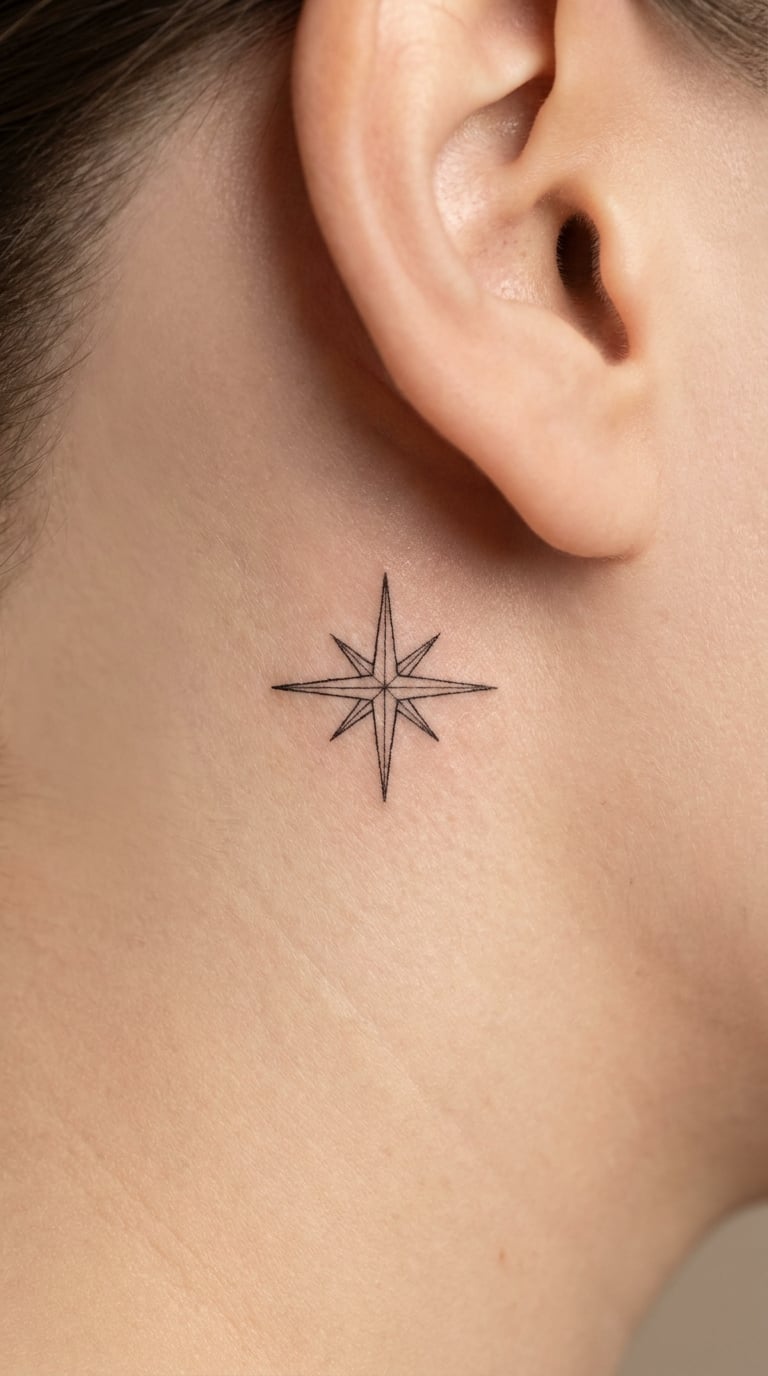
A fine-line north star behind the ear is the quietest way to wear this symbol. The artist draws one five-point star with a single needle, a few hairlines, and nothing else, so the piece is read as texture rather than as an image from across a room.
People pick it for the same reason the star means guidance: something constant that stays with you without asking for attention. It suits anyone who wants a first tattoo with real meaning and no explanation required.
Placement: Behind the ear, or tucked in the hairline above the ear where hair can partly hide it.
Size: 0.5 to 1 inch across (1.3 to 2.5 cm).
Style: Fine line, single needle, black ink.
Pain: Low to medium. The skin is thin but the area is small, so it is over quickly.
Make it yours: Add the latitude and longitude of somewhere that matters, or a small initial under the star.
One honest note: fine line on the neck fades faster than on the arm because of sun, shaving and skin movement. Most people touch it up after a few years, and the blur still reads as a star.
2. Eight-Point Compass Star on the Forearm
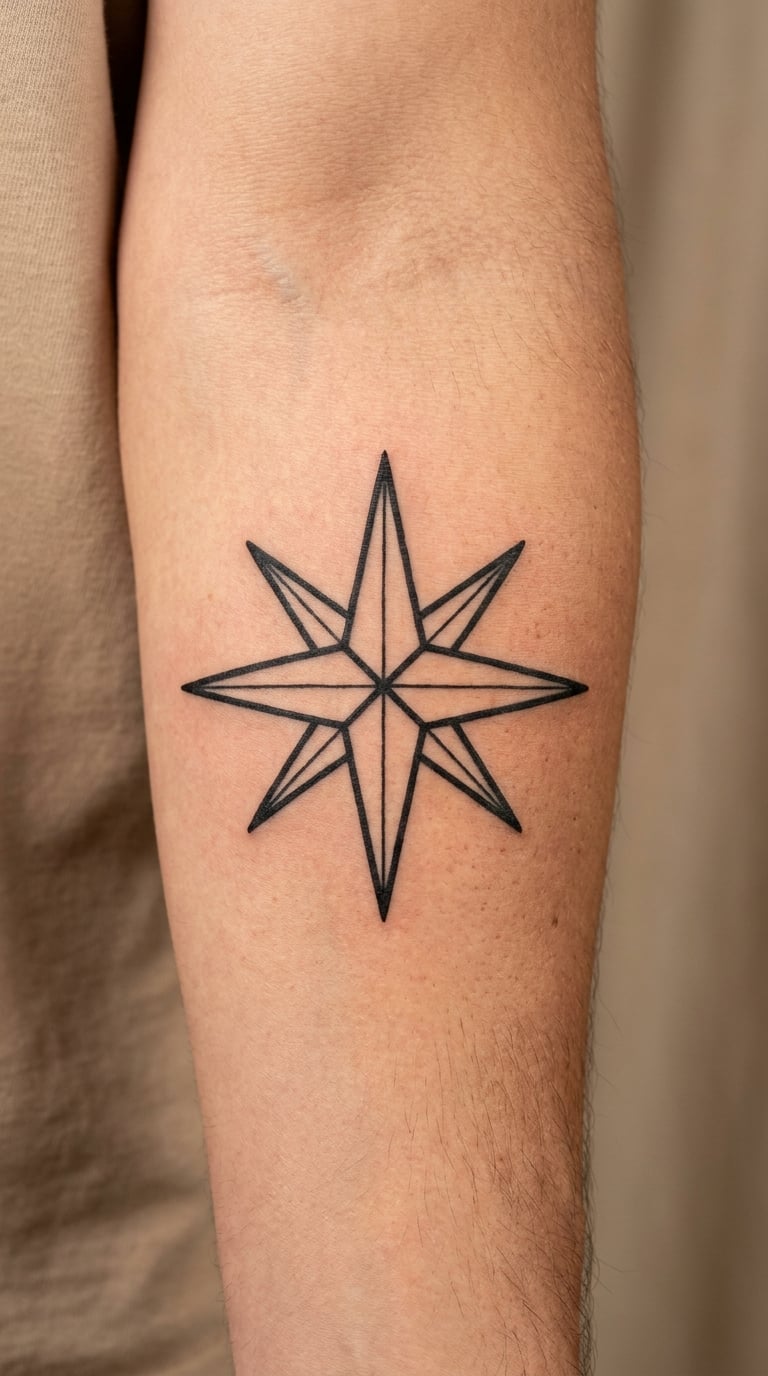
An eight-point compass star on the forearm uses straight, repeating linework: four long points for the cardinal directions and four shorter ones between them. Done in black with even line weight, it reads as a drafting symbol rather than a soft decorative motif.
Eight points is the nautical star shape sailors used, and artists link it to navigation, steady heading and being the reference point for everyone else. It works well for anyone who likes geometry more than ornament.
Placement: Inner forearm near the elbow crease, or the outer forearm where it reads better in a photo.
Size: 2 to 3 inches across (5 to 7.5 cm).
Style: Geometric linework, black only.
Pain: Medium. The inner forearm is sensitive, the outer forearm is easier going.
Make it yours: Change the number of points, or sit the star inside a thin ring with a date beneath it.
Linework this regular needs a steady hand. If you are new, bring a reference image and let the artist redraw it properly rather than copying a flash straight onto skin.
3. North Star with Mountain Range
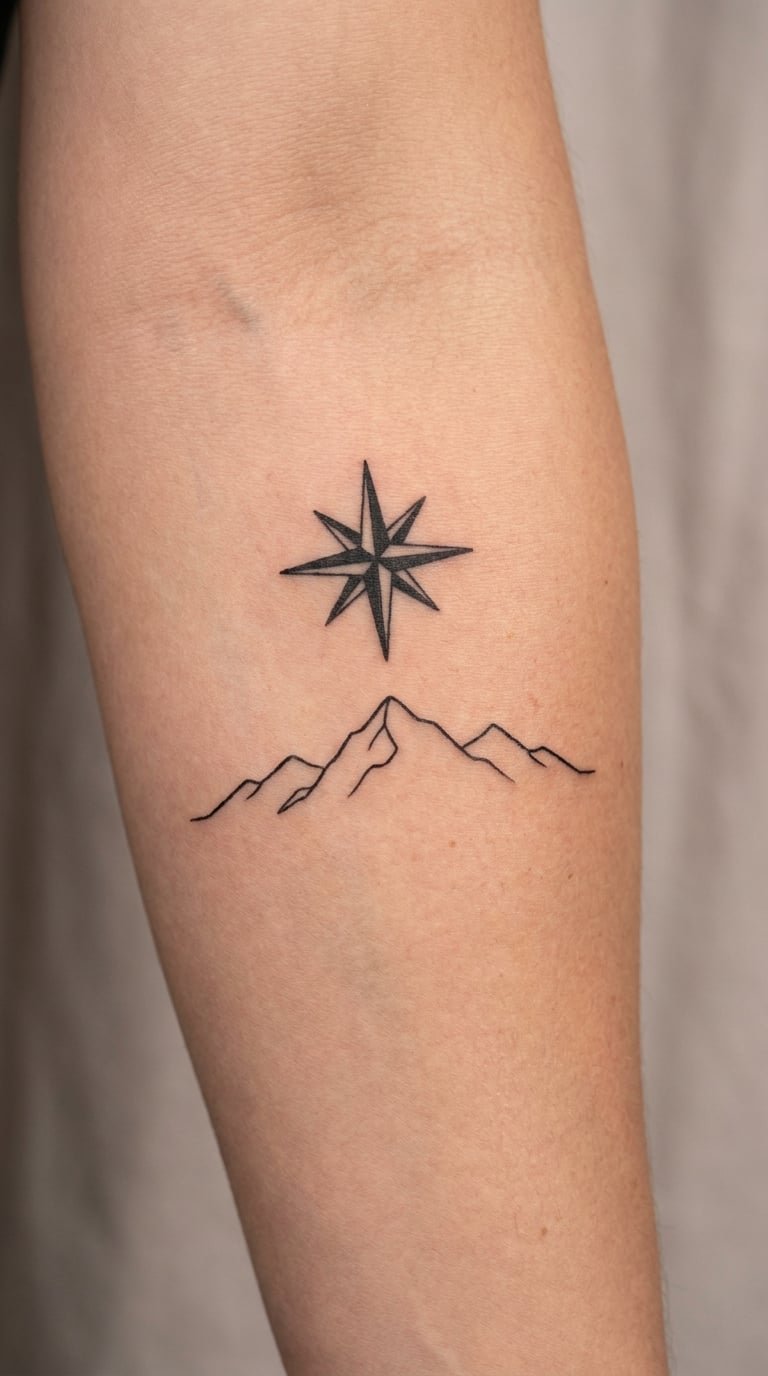
A north star above a mountain range pairs a fixed point with the landscape below it. The star sits a little above the ridgeline, small and solid, while the peaks are drawn as two or three clean overlapping triangles in a single weight.
It usually means having a goal in view while you are still in the hard part of getting there. A lot of people choose it after finishing something difficult, or while in the middle of something difficult.
Placement: Outer forearm, or across the shoulder where a horizontal scene sits well.
Size: 3 to 4 inches wide (7.5 to 10 cm).
Style: Minimal scenic, black linework, no shading.
Pain: Medium, and steady. The outer arm barely moves once you settle in.
Make it yours: Sketch the ridgeline from a real place, or use the peaks of a route you walked.
Ridgeline triangles are forgiving over time, but a very small star above them can lose its points. Ask your artist to run the star one size larger than looks right in the drawing.
4. Watercolor North Star on the Shoulder
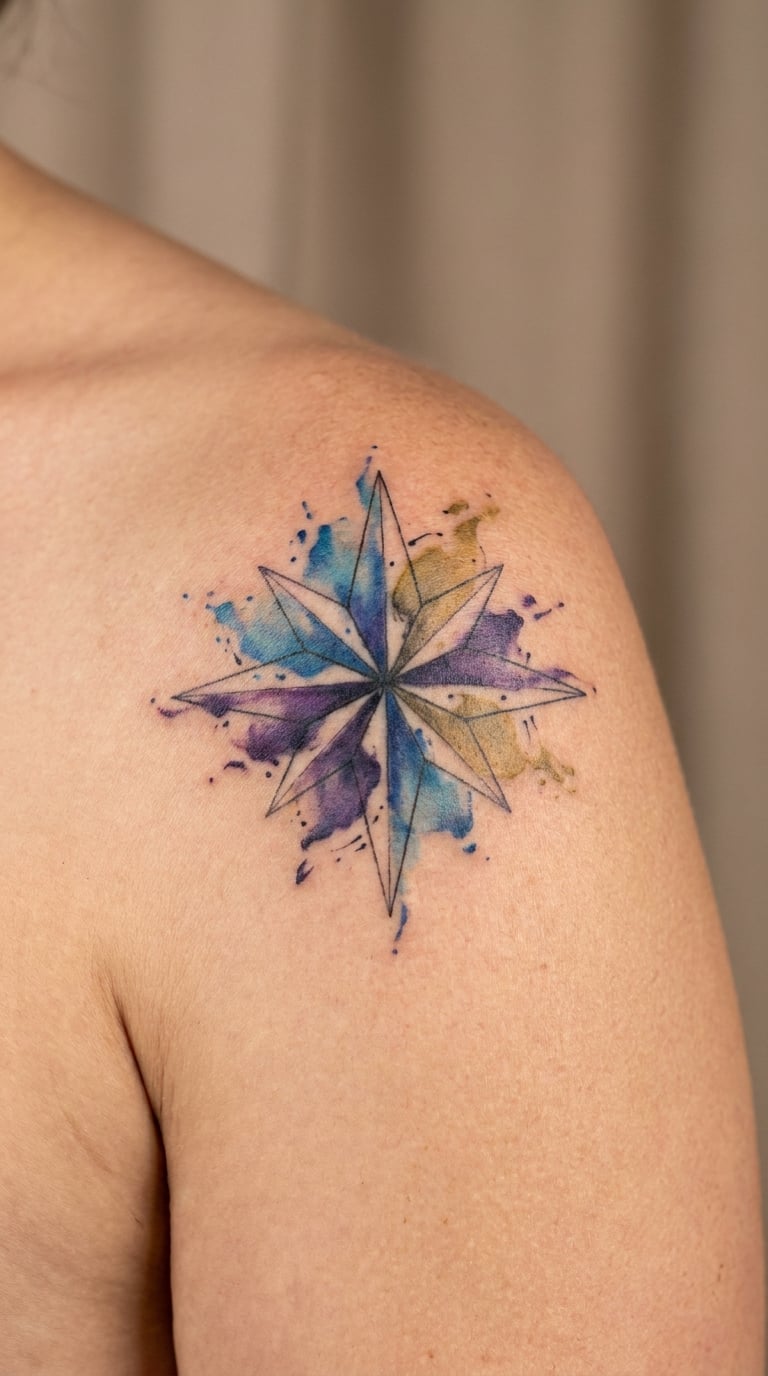
A watercolor north star keeps a solid star shape in the middle and lets the ink bleed outward in soft blue, violet or muted gold. There is no hard outline around the color, so the piece looks like it is fading into the skin rather than sitting on top of it.
It carries the same guidance meaning as a black version. The softer treatment suits people who want the symbol present but not loud, and it sits especially well on a rounded shoulder.
Placement: Upper shoulder or the top of the arm, following the curve.
Size: 2 to 3 inches (5 to 7.5 cm).
Style: Watercolor wash with a fine-line or solid star core.
Pain: Low to medium. Shoulders are soft and easy work.
Make it yours: Use a color tied to a place or a person, or a two-tone gradient that runs from deep blue at the base to pale at the tip.
Color is the part that changes fastest. Expect the wash to soften and the outline to matter more over time, so a defined star center is worth the extra needle pass.
5. Traditional North Star with Celestial Swirls
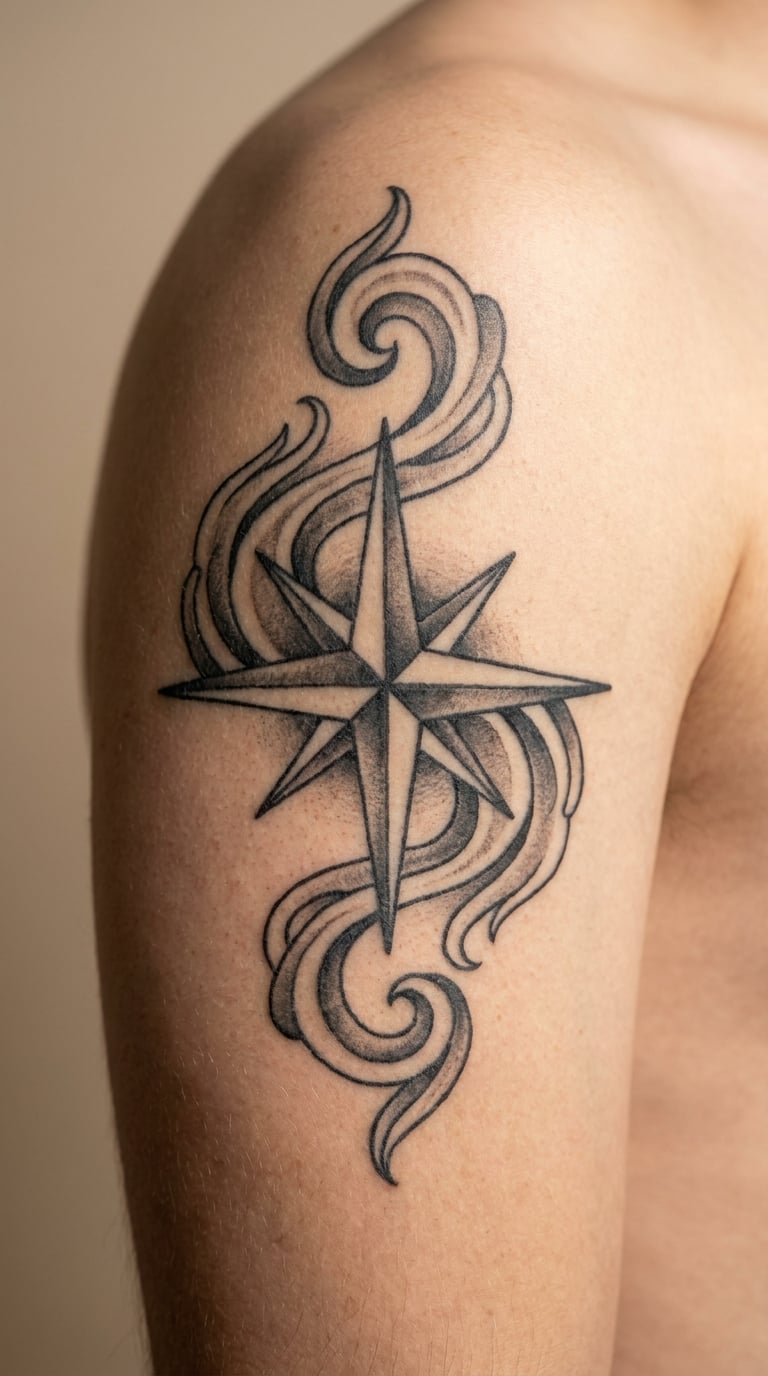
A traditional north star with celestial swirls is an old-school design: a fat five-point star with black outline, grey shading inside the lower points, and two or three curved swirls sweeping around it at controlled spacing.
Traditional work has carried navigation symbols for a long time, and this version reads as a heritage piece: permanence, direction and a nod to a working compass. It suits people who like bold shapes and solid black.
Placement: Upper arm, outer biceps, or a forearm panel with room around the swirls.
Size: 3 to 4 inches tall (7.5 to 10 cm).
Style: American traditional, black and grey with optional red accent.
Pain: Medium. Broad shading takes time, and the arm gets heavy near the end.
Make it yours: Add a banner ribbon with a year, or two small stars tucked into the negative space.
Black and grey traditional work holds its shape well, so this is one of the safer options if you want something that still looks the same in a decade.
6. Micro North Star on the Finger
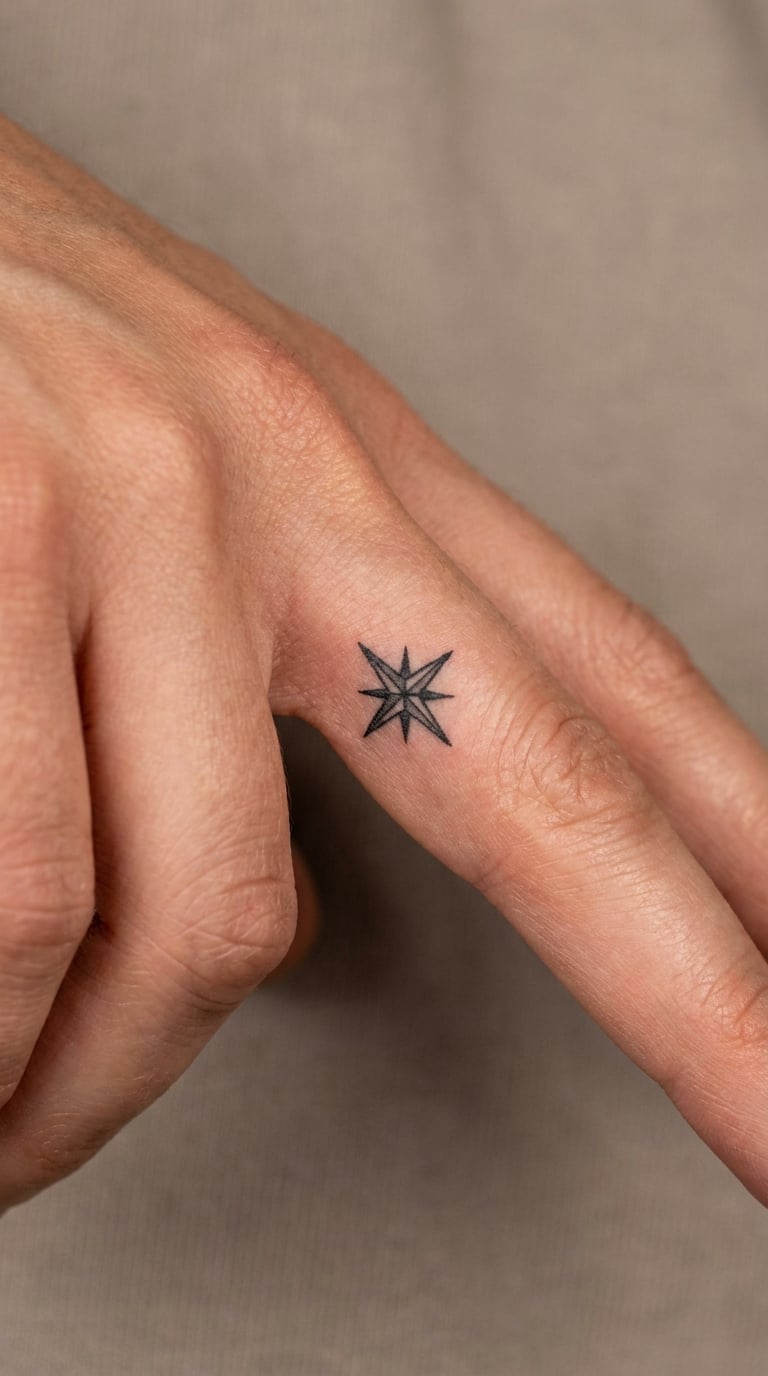
A micro north star on the finger is one of the smallest versions of this design: a single star a few millimeters wide, done with a fine needle and no extra detail. The whole thing takes minutes.
Meaning is the same as every other design on this list, and the small scale makes it feel private. Most people who choose it are adding to an existing hand or finger set.
Placement: Side of the index or ring finger, near the knuckle, or on the thumb where the skin is less creased.
Size: 0.3 to 0.5 inch (8 to 13 mm).
Style: Micro fine line, black.
Pain: High. Fingers are bony and there is almost no flesh to absorb it.
Make it yours: Match it to a partner’s finger star at a smaller size, or place matching stars on the outside edges of both hands.
Honest note: micro linework on fingers blurs. Hand washing, sun and knuckle movement all wear the points down, and a lot of people plan a touch-up a few years in. If you want sharp detail to last, size up to half an inch.
7. North Star Inside a Crescent Moon
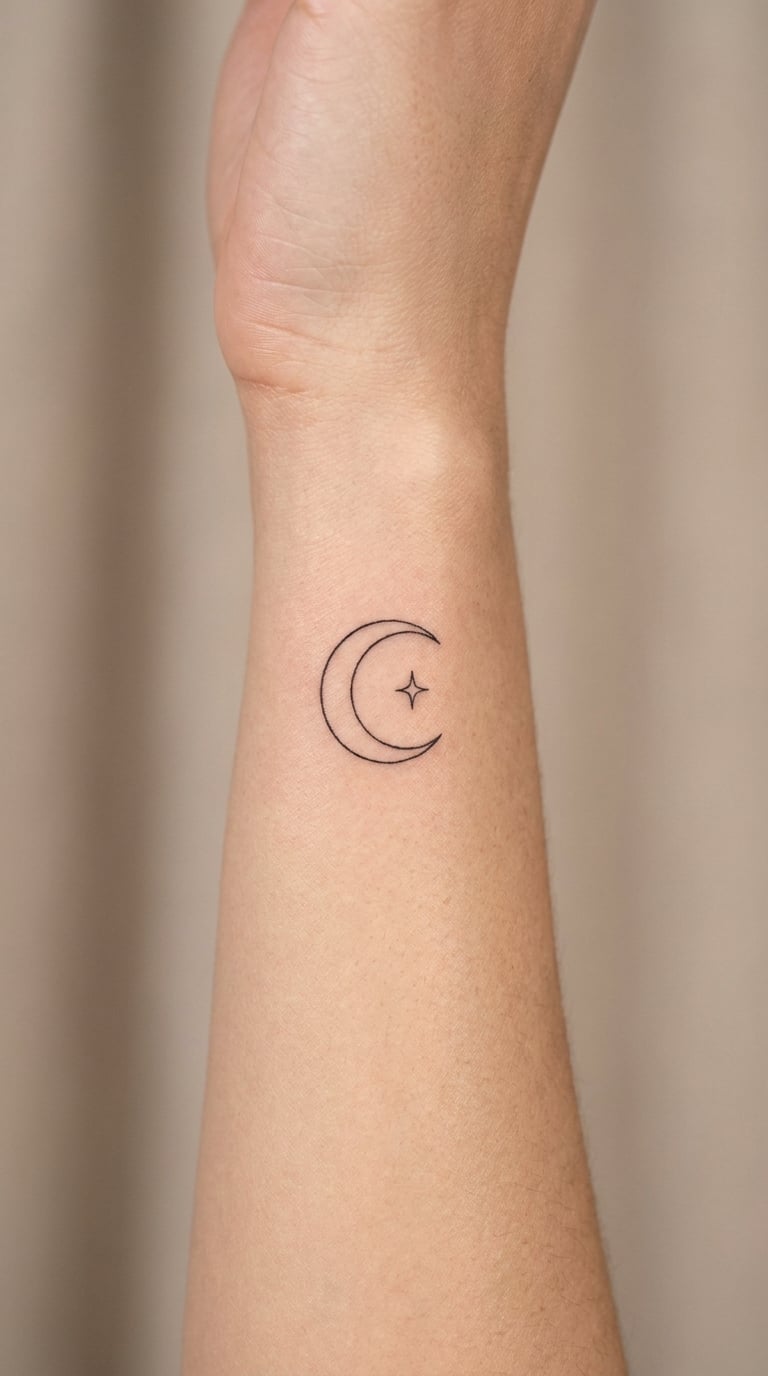
A north star inside a crescent moon uses the curve of the moon as a frame. The crescent is drawn as a single clean line with the inner edge open, and the star sits in the hollow so the negative space does most of the work.
Moon and star together read as a night sky you can hold, and that usually means a period of someone’s life spent looking for something. The pairing also balances a curved shape against a pointed one, which is why so many people like it.
Placement: Inner wrist, collarbone, behind the ear, or the belly of the forearm.
Size: 1 to 1.5 inches tall (2.5 to 4 cm).
Style: Fine line, black, single needle.
Pain: Medium on the wrist, low behind the ear.
Make it yours: Put a tiny date inside the crescent, or add two or three dot stars outside it in a loose scatter.
Thin crescent lines are the part that softens first. A slightly heavier line weight on the moon edge keeps the shape readable once the star has faded a little.
8. North Star and Arrow Wrist Tattoo
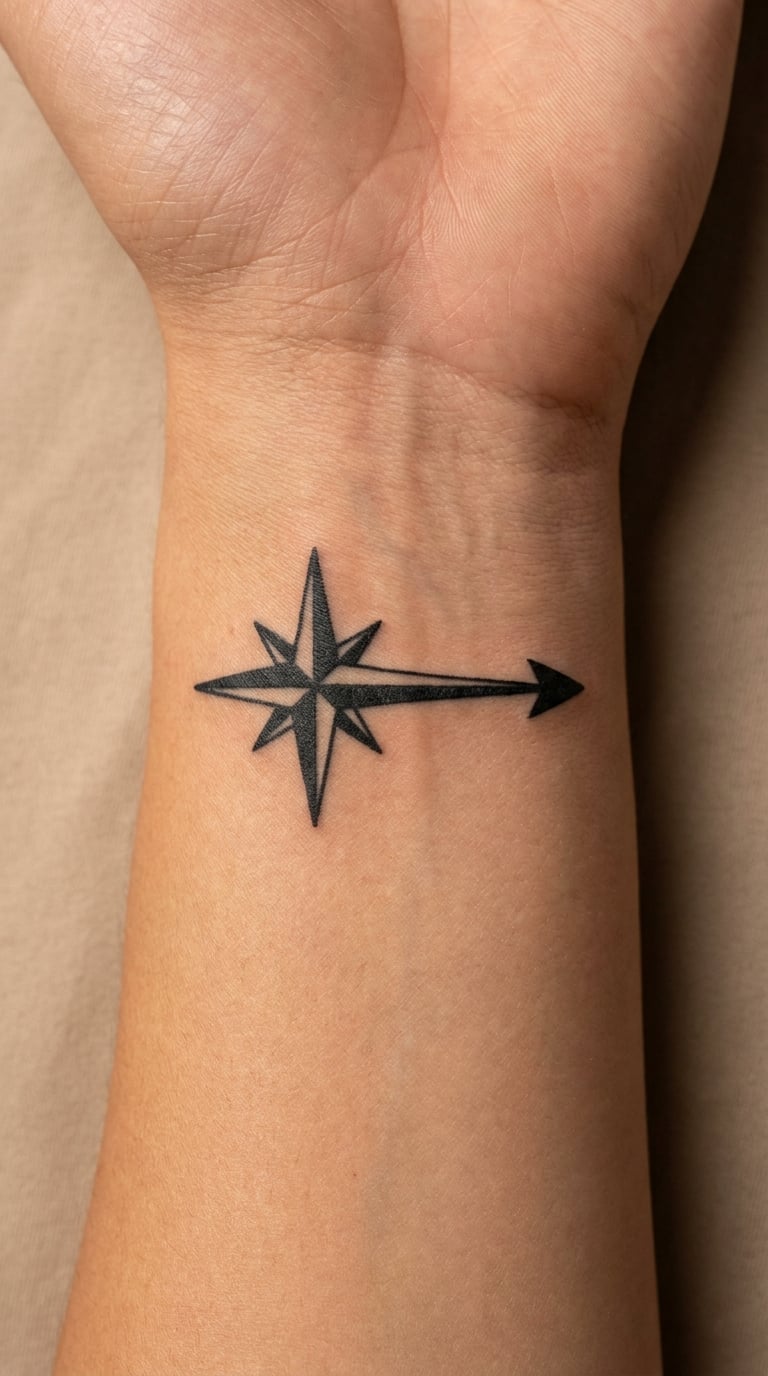
A north star and arrow design sets the star at one end of a straight line and lets a simple arrow shaft run from it, arrowhead pointing away. Horizontal placement along the wrist reads like a small compass bearing.
It is the most direct version of the guidance idea: a direction and the reference point that gives it. People also pair it with a matching arrow on a partner’s wrist, which is a nice reason to keep it small.
Placement: Across the top of the wrist, or running along the inner forearm.
Size: 2 to 3 inches long (5 to 7.5 cm).
Style: Fine line, or bold illustrative with a filled arrowhead.
Pain: Medium. The inner wrist is thin and sensitive.
Make it yours: Add the degree mark or a cardinal letter, or match the arrow with a partner’s in a different place on the body.
Long straight lines are harder to keep straight than they look in a drawing, so give the arrow a little flexibility in the design rather than asking for a rigid geometric line.
9. Blackwork North Star on the Sternum
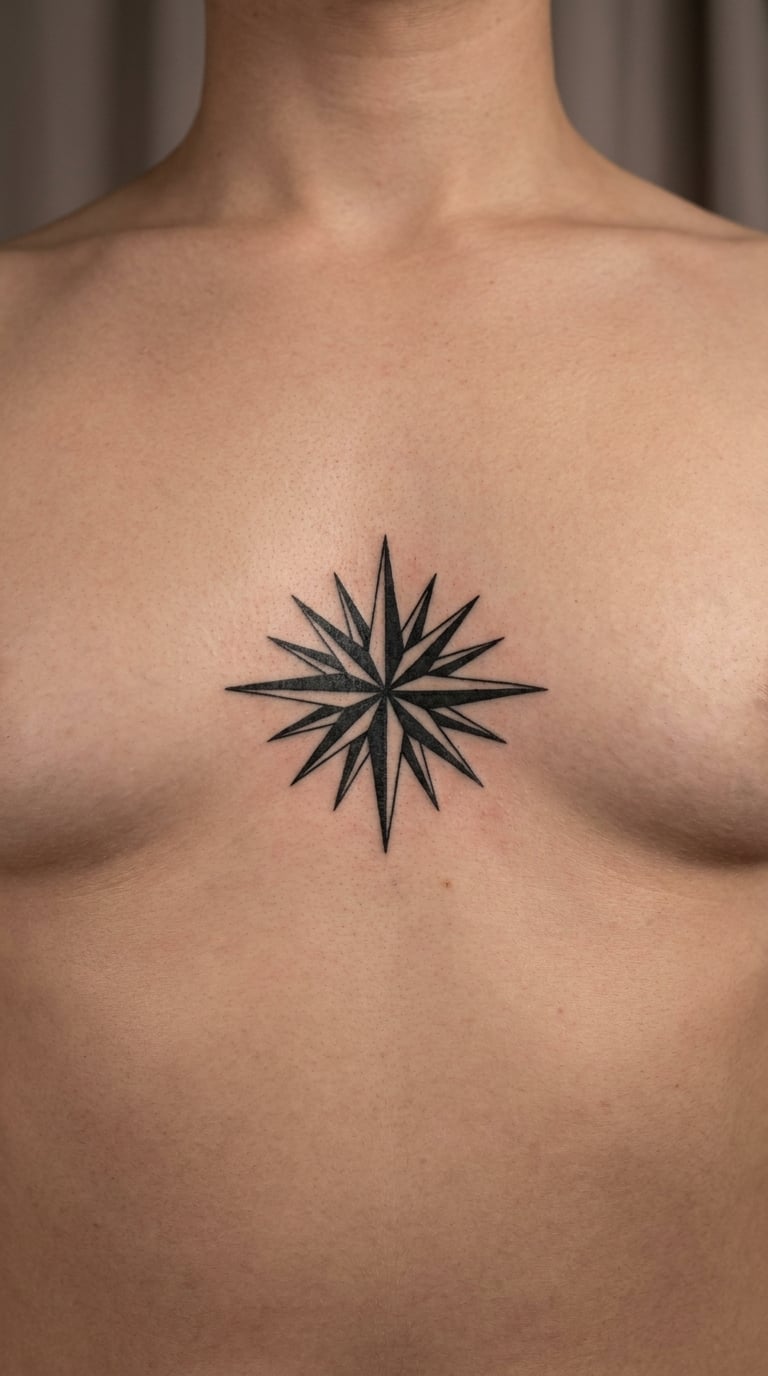
A blackwork sternum star is built from solid black fills and negative space. The points alternate between filled wedges and open gaps, so the star reads as sharp geometry rather than a drawn shape.
Because the sternum is a central, high-visibility spot, this version of the north star idea is usually chosen by someone who wants the symbol to be the first thing seen. The meaning is the same; the delivery is louder.
Placement: Center of the upper sternum between the collarbones, or lower on the chest plate.
Size: 2 to 3 inches across (5 to 7.5 cm).
Style: Blackwork, solid fills, hard edges.
Pain: High. Bone-heavy skin, and movement makes it hard to hold still.
Make it yours: Set two small stars above it at different heights, or use a ring of solid black behind the main star.
Sternum pieces shift as the body moves, so ask your artist to build in a little stretch. A design drawn too tight will distort as you breathe and lean.
10. North Star with Orbit Lines on the Back
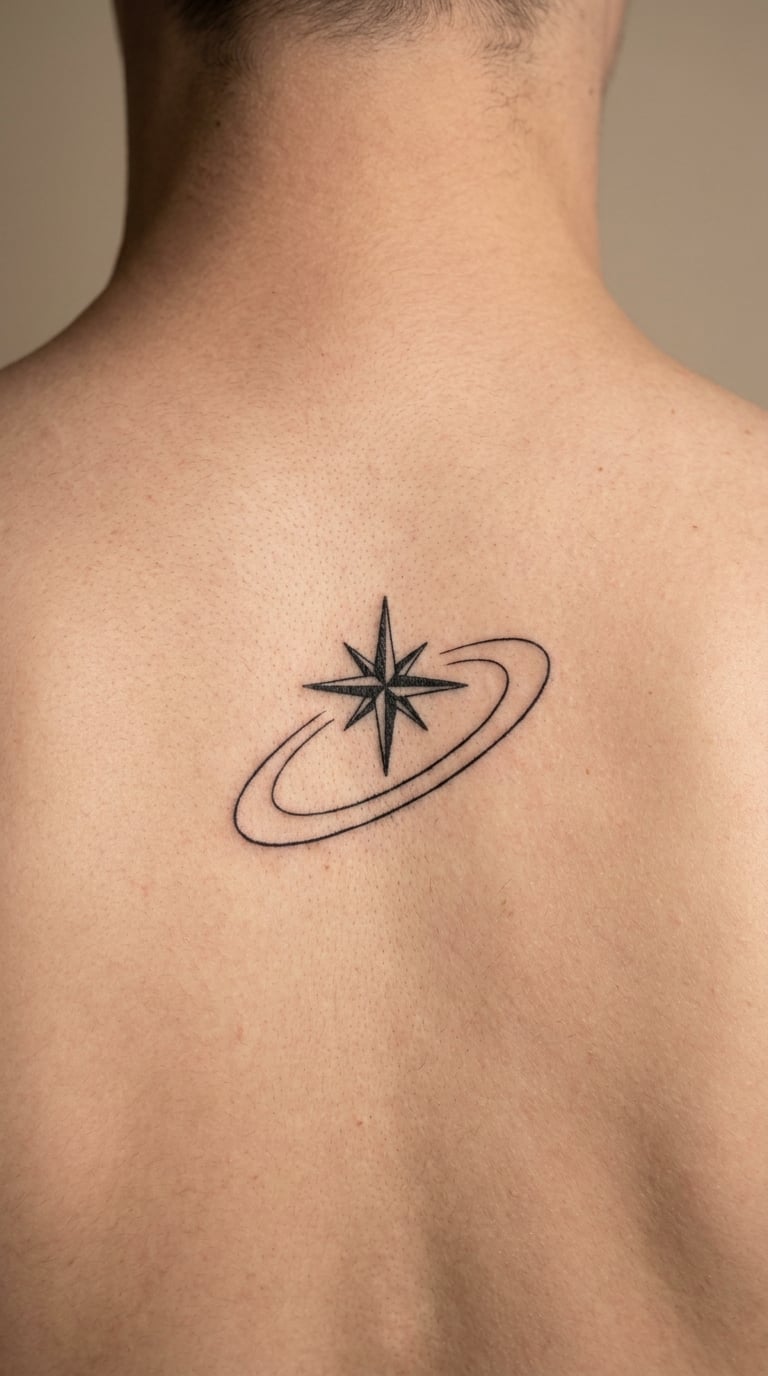
A north star with orbit lines draws two or three long elliptical curves sweeping around a central star, suggesting a body moving through space. The lines stay thin and open so the piece feels light even at a large scale.
Orbits add movement to a symbol that is usually static. It suits someone who reads the star as a fixed point in a life that travels, and the back placement gives the composition room to breathe.
Placement: Between the shoulder blades, across the upper back, or over one shoulder blade.
Size: 4 to 6 inches wide (10 to 15 cm).
Style: Fine line with solid star center, or illustrative with light shading.
Pain: Medium. The back is sensitive at first, then the area gets numb and sessions go quickly.
Make it yours: Turn the orbits into a real trajectory, or dot the lines with a handful of tiny stars.
Back work is a two-session job more often than not, because the artist will not run a six-hour sitting on that area. Plan for a second appointment rather than assuming one long session.
11. Rose Compass North Star on the Bicep
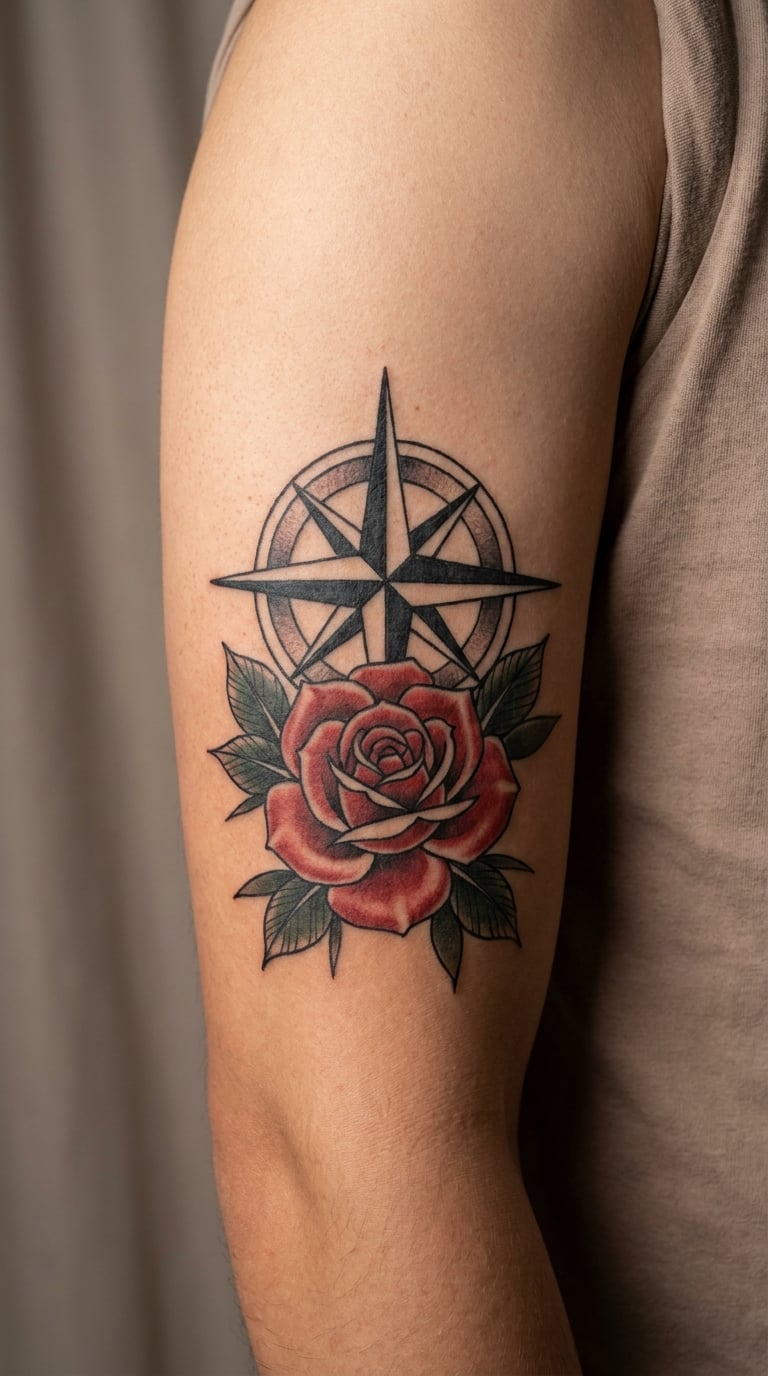
A rose compass north star stacks a shaded five-point star above one blooming rose, both drawn in neo-traditional style with bold outline, even shading and a small amount of red and green. The composition works because both elements are roughly the same visual weight.
The star means direction and the rose is a traditional stand-in for love, so together they usually mark a relationship or a decision made about one. It is a common first or anniversary piece.
Placement: Outer bicep, or the upper arm where the vertical stack has room.
Size: 3 to 4 inches tall (7.5 to 10 cm).
Style: Neo-traditional, black with red and green accents.
Pain: Medium. The outer arm is one of the more forgiving spots.
Make it yours: Use a rose in a specific color, add the year under the stem, or repeat the star on the opposite arm.
Green fades faster than red and black, so if the rose is central to the meaning, ask for a deeper green rather than a light one. It holds noticeably better.
12. North Star and Serpent Circular Design
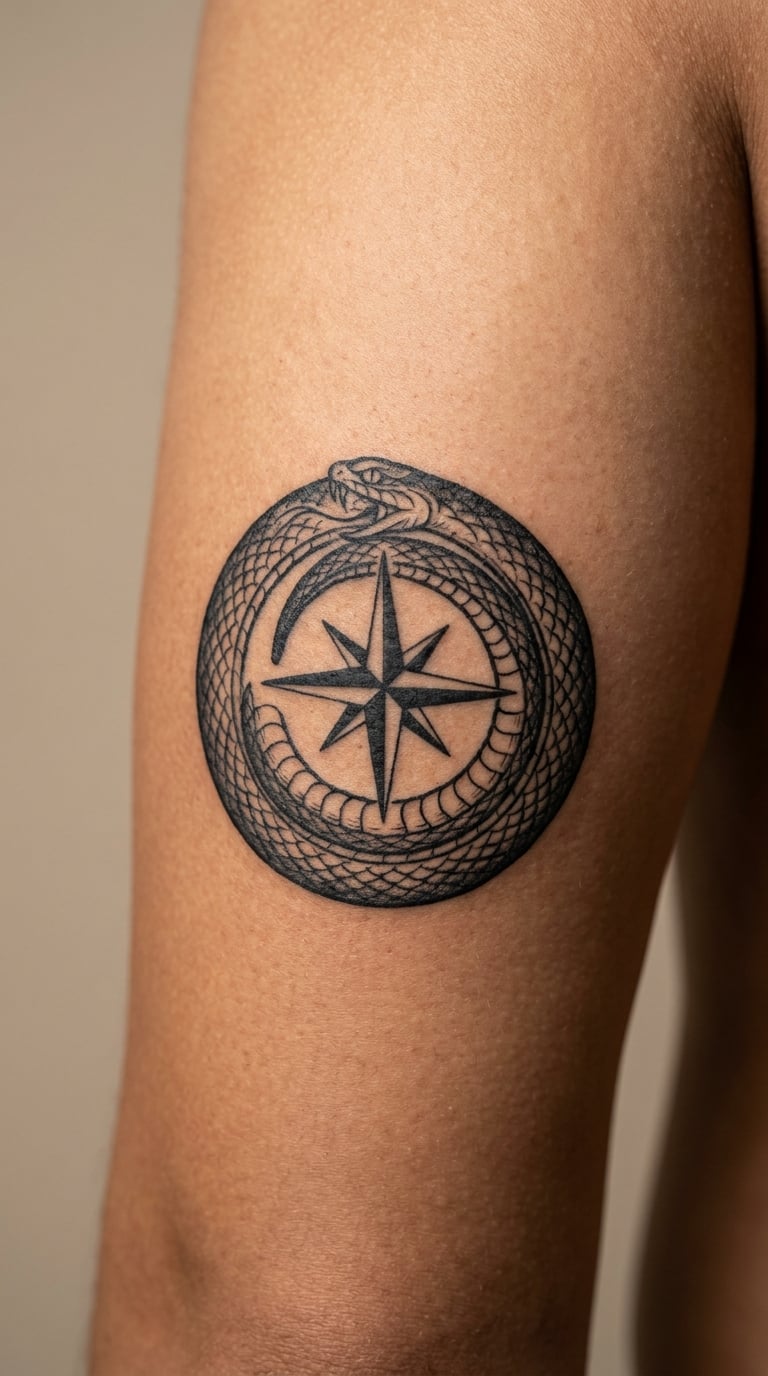
A circular north star and serpent design puts the star in the middle of a ring formed by one winding snake, with the serpent’s head and tail meeting at the edge. The circle keeps it contained and symmetrical.
Snakes carry their own long history of meanings, from transformation to protection to renewal, and the ring they form around the star turns the whole piece into a cycle. There is no single fixed reading here, so the reason tends to be personal.
Placement: Upper arm, forearm panel, or a circular spot on the shoulder blade.
Size: 3 inches in diameter (7.5 cm).
Style: Blackwork with solid fills and clean negative space.
Pain: Medium. The detail is what takes time, not the location.
Make it yours: Add scale texture to the serpent, or break the ring at one point so the circle reads as movement.
Small dotwork scales inside a serpent are the first thing to blur. If the texture matters to you, ask for solid black fills between the outline and the body.
13. Minimal North Star on the Collarbone
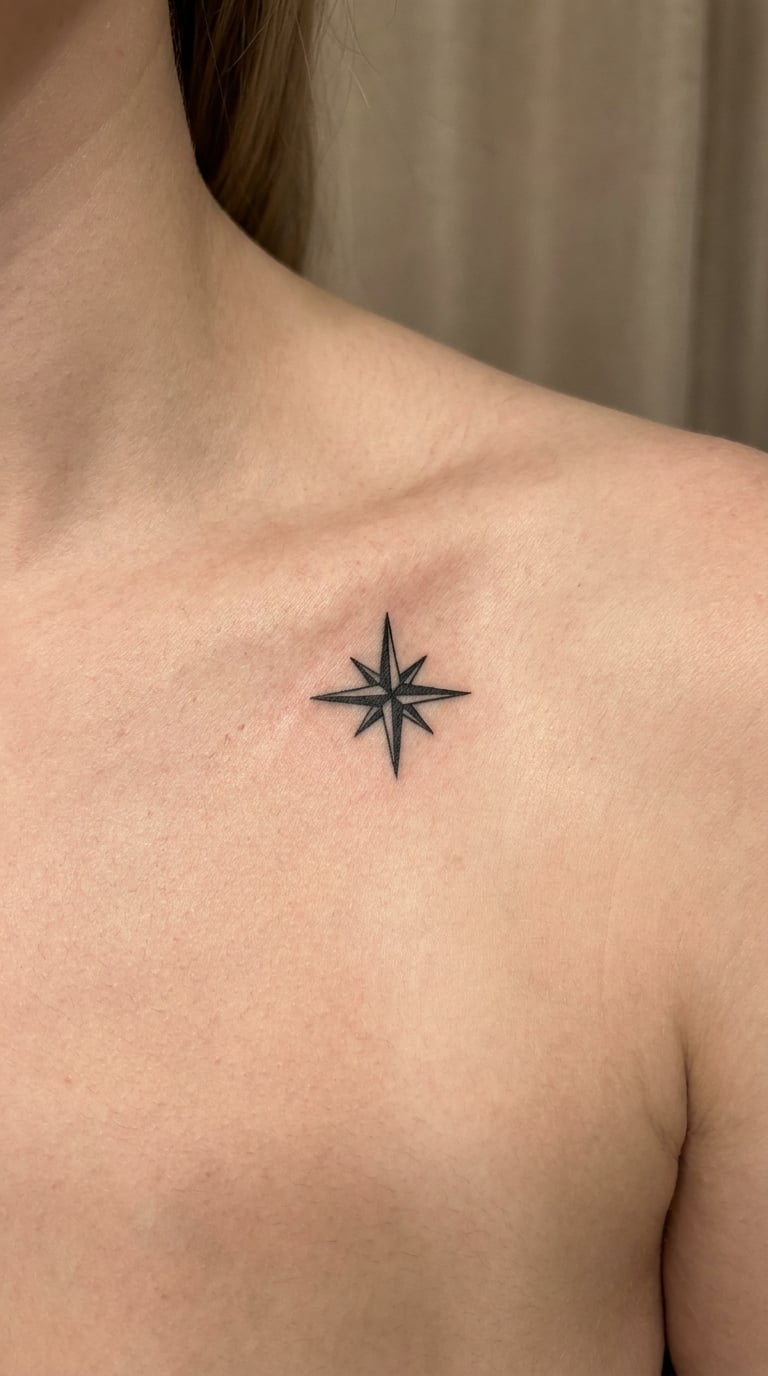
A minimal collarbone north star is one solid black star, no outline, no shading, placed in the hollow just above the bone. Solid black holds its edge better than a thin outline, which is why this version survives.
It reads as guidance kept private, and the collarbone hollow is a spot people tend to choose when they want meaning without a large piece. The visibility is moderate, which suits a lot of people better than the sternum.
Placement: Just above the collarbone, centered, or offset toward the shoulder.
Size: 0.8 to 1.2 inches (2 to 3 cm).
Style: Minimalist, solid black fill.
Pain: Medium. The collarbone edge is thin, but it is a quick sitting.
Make it yours: Put a matching star on the other collarbone, or add a single line of tiny stars trailing behind it.
Clothing and sun exposure hit this spot more than most, so a solid fill is a better bet than a hairline outline if you want it looking sharp later.
14. North Star with Constellation Dots
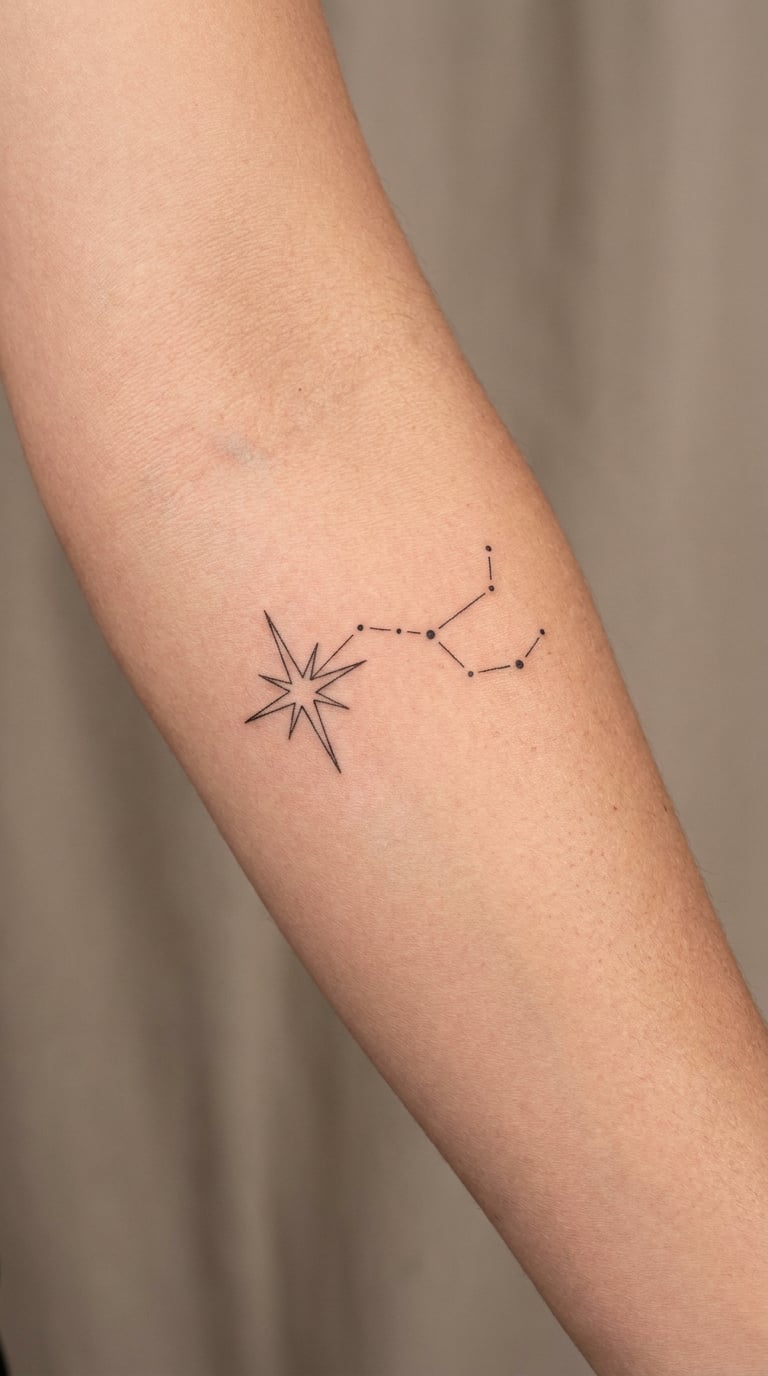
A north star with constellation dots sets the main star to one side and scatters five to eight small dots around it, joined by faint single-needle lines. The dots vary in size so the cluster has depth instead of looking mechanical.
Constellations on tattoos are usually personal, marking a birth sign, a family member’s sign, or a specific set of coordinates. The north star at the center gives the cluster a fixed reference point.
Placement: Outer arm, ribs, or along the shoulder blade where there is flat space.
Size: 2 to 3 inches across (5 to 7.5 cm).
Style: Fine line, single needle, black only.
Pain: Medium on the arm, high on the ribs.
Make it yours: Map the dots to a real constellation, or use dots as coordinates for the place you grew up.
Tiny connecting lines are the first casualty of time. Ask for the lines to be run slightly heavier than feels necessary in the drawing, and the whole cluster will hold together longer.
15. Red Ink North Star on the Ankle
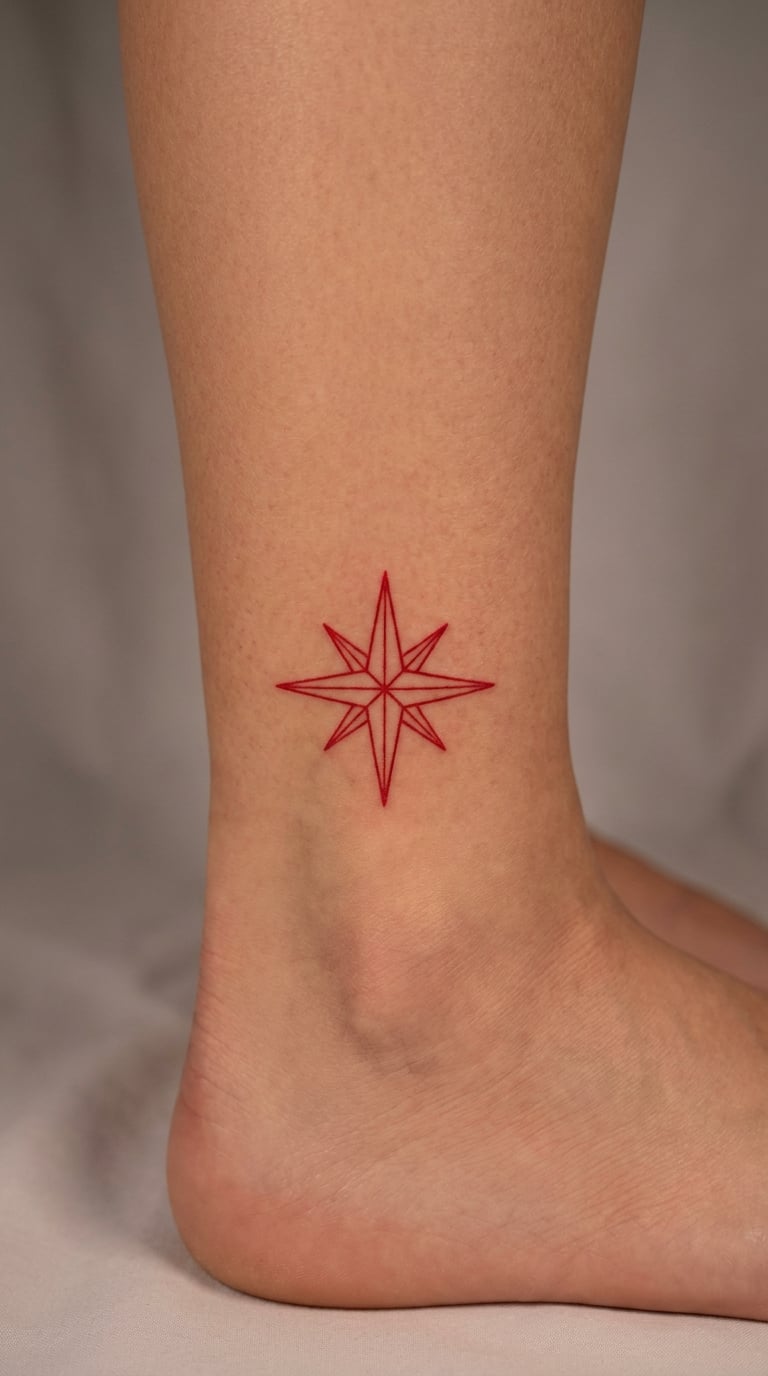
A red ink north star on the ankle is a single-color design with no shading, drawn in a warm red that reads clearly against skin. The ankle is an underrated spot for star work because it has a clean, uninterrupted surface.
The meaning matches every other design here. People choose a single-color piece when a full black design would be too heavy for what they want the symbol to feel like day to day.
Placement: Outer ankle, above the bone, or on the inner ankle near the Achilles.
Size: 1 to 1.5 inches (2.5 to 4 cm).
Style: Single color, fine line or solid fill.
Pain: High. The ankle is bony and the nerve endings are close to the surface.
Make it yours: Match a partner’s star in a different color, or repeat it in black alongside the red one.
Red tattoos fade and shift hue faster than black, particularly on the ankle where boots and sun both play a part. Solid fill ages better than outline work in a single color.
16. North Star with Feather on the Wrist
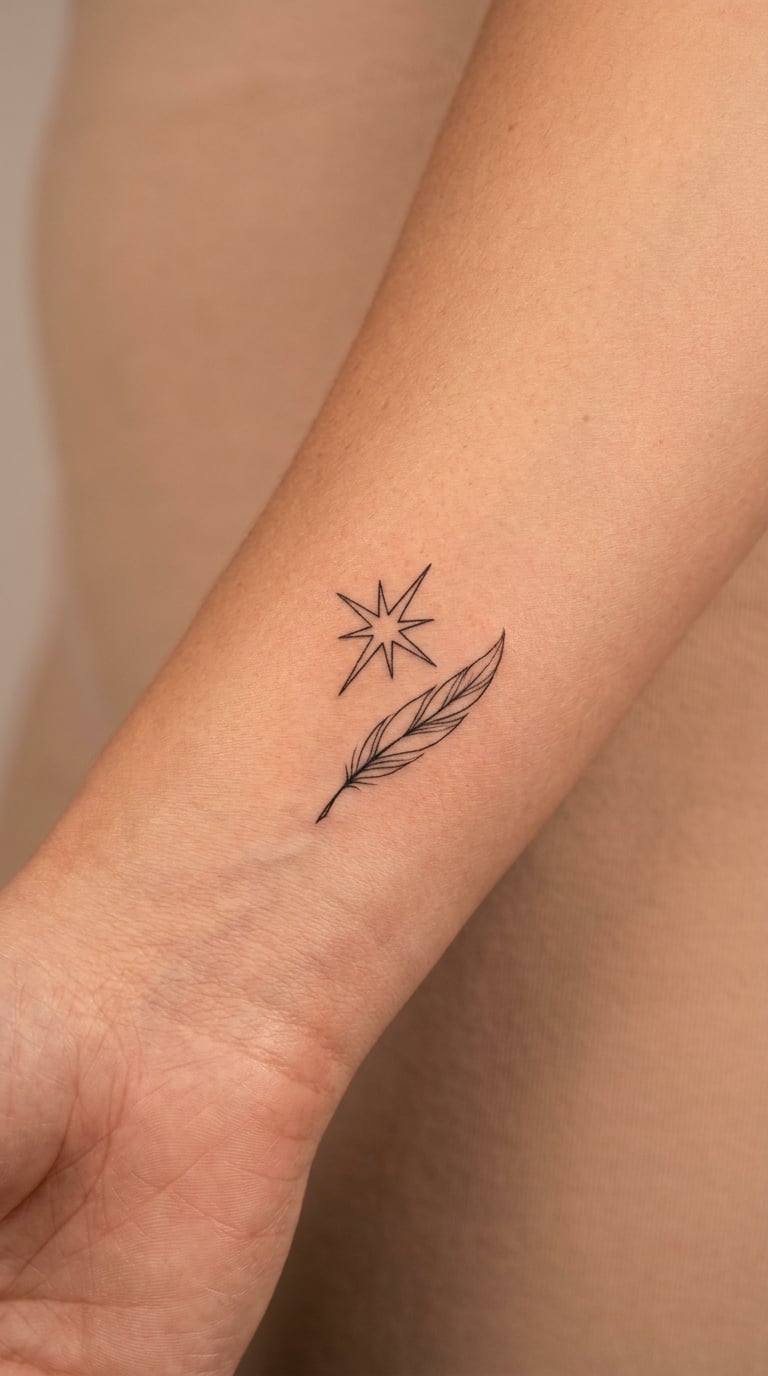
A north star and feather design sets one fine-line feather at a diagonal angle with the star just above its tip, so the two shapes point in the same direction. The feather is drawn with a central shaft and short barbs, nothing more.
Feathers usually mean travel, lightness or a person, and putting the star with it turns the piece into movement with a reference point. The combination is often chosen by people who travel for work or for pleasure.
Placement: Inner wrist, forearm, or behind the ear where the diagonal sits well against the curve.
Size: 2 to 3 inches long (5 to 7.5 cm).
Style: Illustrative fine line, black.
Pain: Medium. The inner wrist is sensitive but the piece is quick.
Make it yours: Add a small gap in the barb lines to suggest movement, or have the feather drawn from a real one you keep.
Feather barbs are delicate, so the shafts of the star should be the heaviest part of the design. That keeps the composition readable even after the barbs soften.
17. Geometric North Star on the Calf
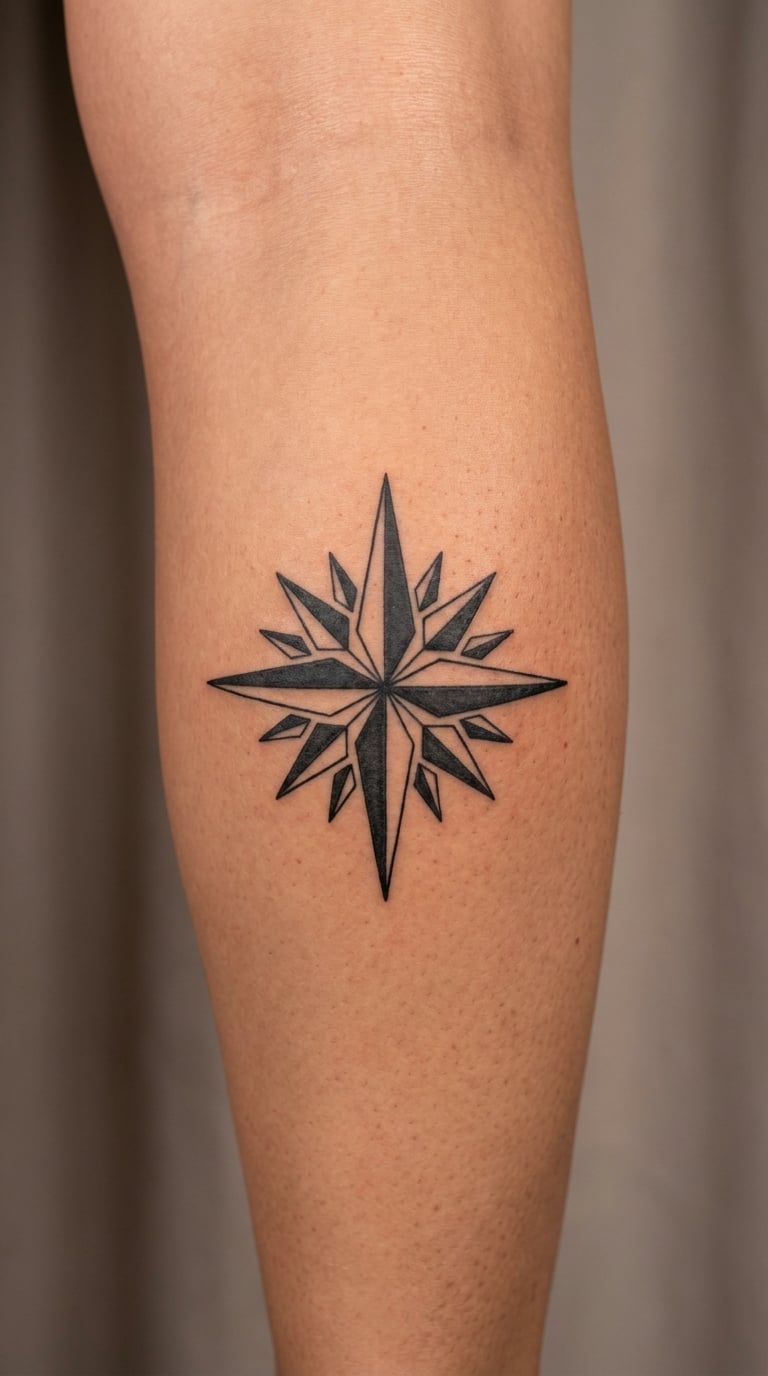
A geometric calf north star breaks the star into repeated facets: each point split into two or three flat planes filled with solid black or left open. The result is symmetrical, high contrast and closer to graphic design than to a drawn star.
Symmetry suits a larger, more architectural placement, and the calf is one of the few spots with enough flat area to hold a symmetrical shape cleanly. The meaning stays guidance, usually chosen by someone who likes bold graphic work.
Placement: Outer calf, or the inner calf above the ankle.
Size: 3 to 4 inches tall (7.5 to 10 cm).
Style: Geometric, black fills, hard edges.
Pain: Medium. The calf is fleshy and easier than people expect.
Make it yours: Mirror it on the other leg, or reduce the facet count to three per point for a simpler look.
Geometric work only reads as geometric if the lines are straight, so it is worth spending time on the stencil rather than freehand on skin. This is a design where preparation shows.
18. North Star and Lighthouse on the Rib
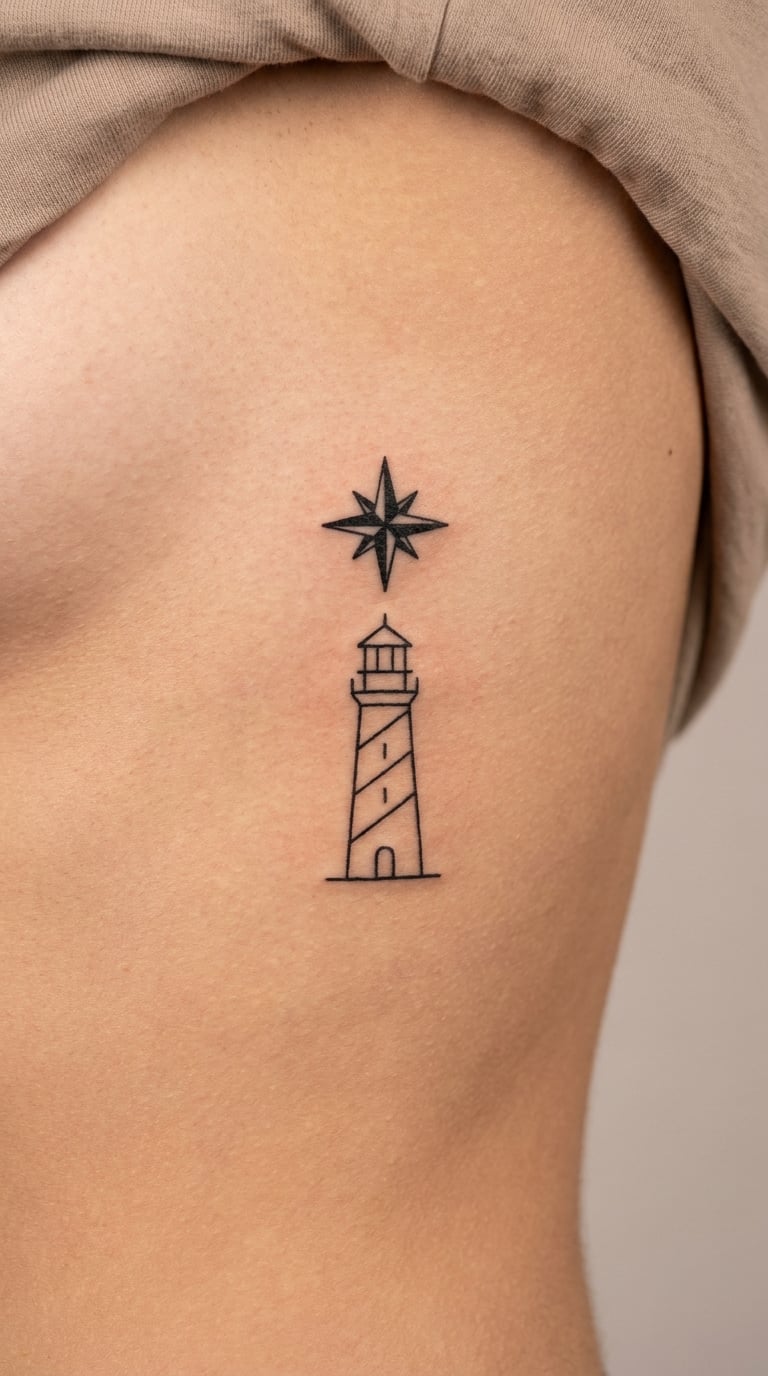
A north star and lighthouse design stacks a small solid star above a simple lighthouse drawn in linework, with a short beam line angling out toward the star. The two elements are small and separated by clean space, which keeps the scene readable.
Guidance and shelter in one image, usually marked by a person who grew up near the coast or whose family does. It tells a longer story than a bare star, which is why people commit to the extra detail here.
Placement: Along the side of the ribs, or on the lower back where there is more flat surface.
Size: 3 to 4 inches tall (7.5 to 10 cm).
Style: Illustrative, fine line with a solid star.
Pain: High. Ribs are thin, sensitive and move with breathing.
Make it yours: Use the lighthouse from a real coast, or add two short wave lines beneath it.
Rib placements stretch and compress as the body moves, so fine detail gets distorted over time. A design with fewer, bolder lines ages better in this spot than a detailed one.
19. Dotwork North Star on the Shoulder
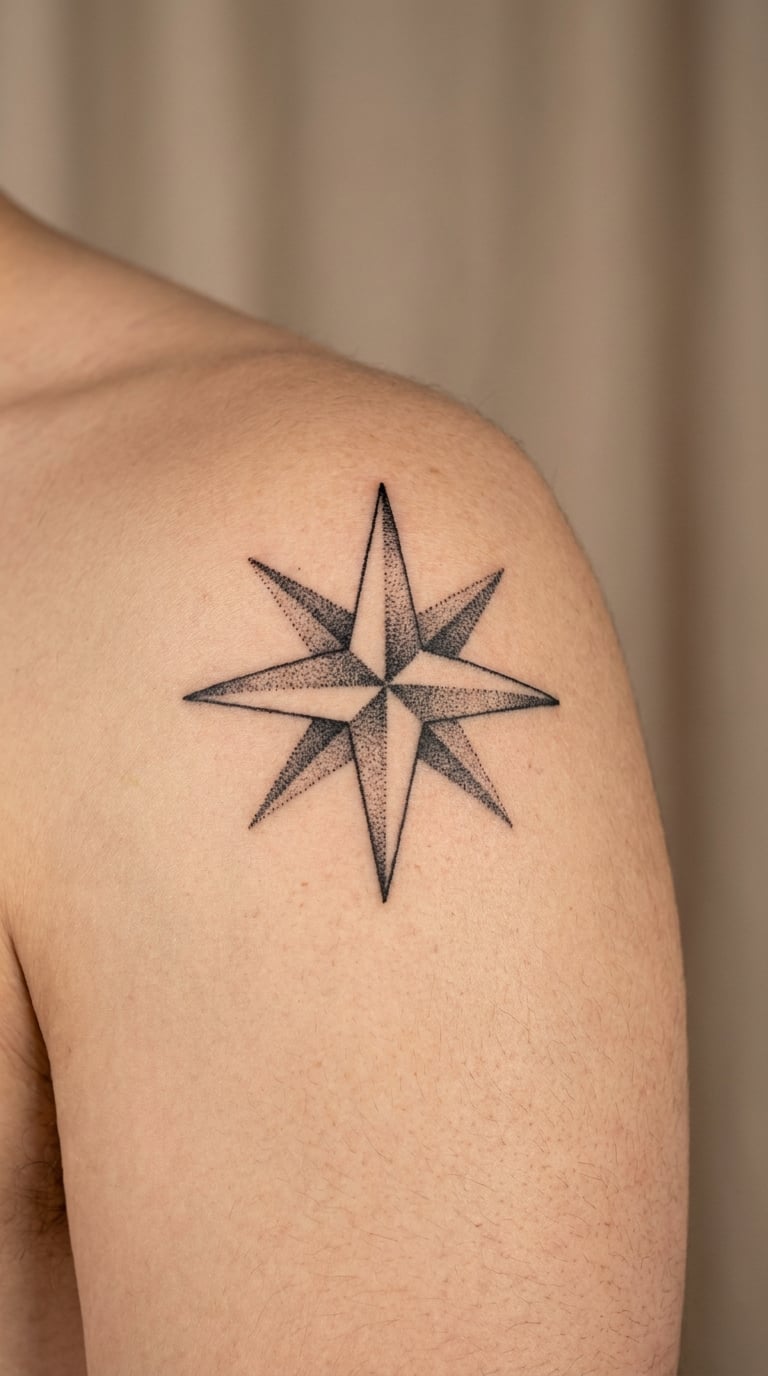
A dotwork north star builds the shape entirely from dots. Density does the shading: tight clusters at the star’s center, wider spacing towards the points, so the form appears to come in and out of focus without a single outline.
Dotwork reads as deliberate and hand-made, and it is popular with people who want the star to feel like a private symbol rather than a graphic. The shoulder curves nicely under the shading.
Placement: Upper shoulder, the back of the arm, or the upper back.
Size: 2 to 3 inches across (5 to 7.5 cm).
Style: Dotwork, single needle, black.
Pain: Low. Shallow passes and soft skin, and the shoulder is a relaxed place to sit.
Make it yours: Fade the outer dots out entirely so the star is only half there, or scatter a few loose dots away from the center.
Dotwork is slow going, so a 2.5 inch piece can take a full sitting. The individual dots blur with sun exposure over time, and the density gradient is what keeps the shape visible.
20. Large Celestial North Star Sleeve Element
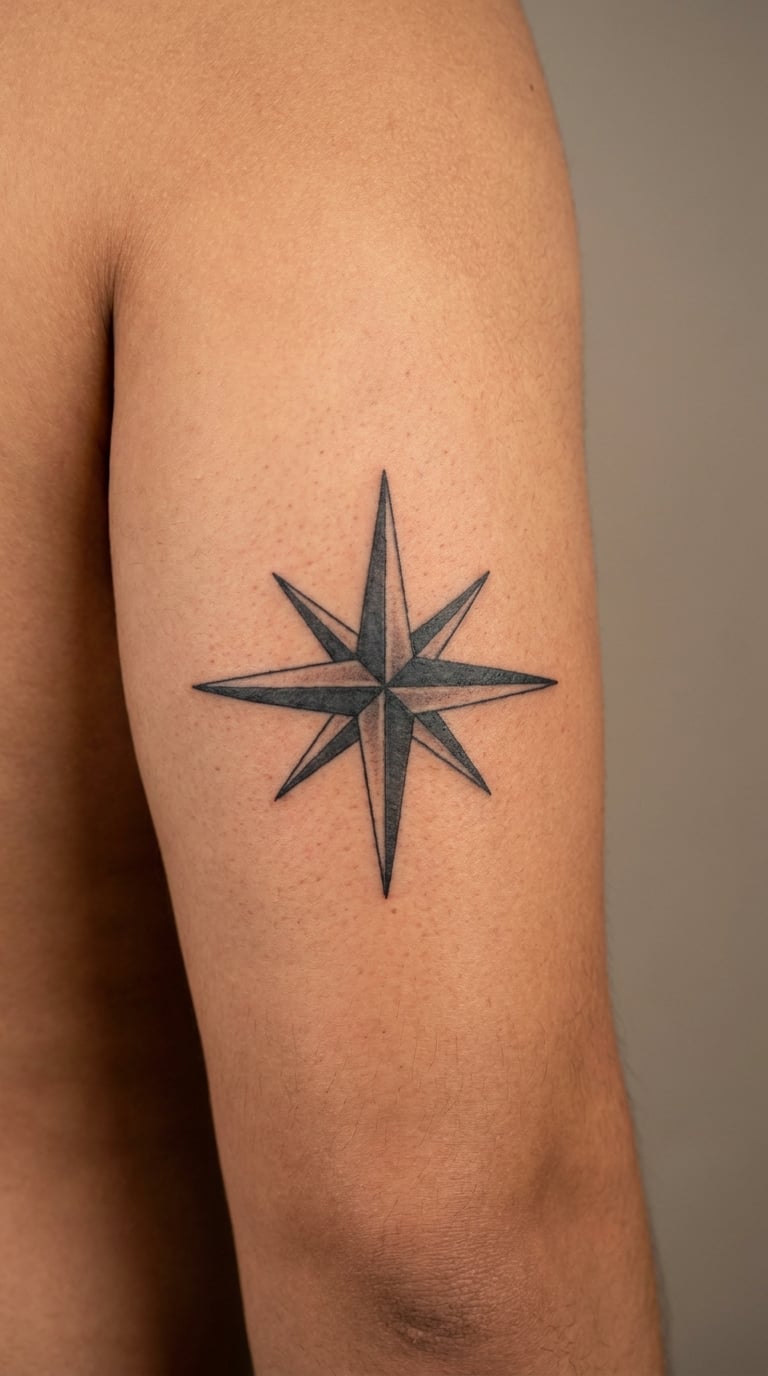
A large celestial north star is the centerpiece version: a big detailed star, 5 inches or more, with soft grey clouds, a scattering of smaller stars and open space around it. That breathing room is what stops a big piece from looking crowded.
This is usually the anchor of a sleeve or a standalone back or thigh piece, and the guidance meaning is the same one the small designs carry. It just takes up the room a big design needs.
Placement: Upper arm, center back, outer thigh, or the sternum for a large single piece.
Size: 5 inches and up (12.5 cm and up).
Style: Blackwork, black and grey realism, or illustrative with soft shading.
Pain: Medium over several short sessions rather than one long one.
Make it yours: Add your birth sign constellation nearby, or work a meaningful date into the surrounding stars.
At this size, decide whether it is a standalone or part of a larger plan before you sit down. A big piece that later needs to connect to a sleeve is harder to fit than one designed for it from the start.
How to Choose the Right Design
Most people pick from a mood before they pick from a style. Narrowing the choice usually takes one honest conversation with yourself about visibility and size, then a look at what will still be legible in fifteen years.
How to narrow 20 north star tattoo ideas down to one
Start with the placement, not the picture. A design that looks right in a photo rarely survives being shrunk to a collarbone or stretched across a shoulder blade, and a 20 north star tattoo ideas shortlist works better once you have ruled out the two or three spots you would actually sit for.
- If you want it private: behind the ear, the inner wrist, or the collarbone. Small sizes work, and most of these 20 designs hold up at 1 inch or less.
- If you want it to be read from across a room: sternum, outer forearm, or upper back. A solid black star at 2 to 3 inches is the version people notice.
- If you have existing pieces: match the line weight and style of what you already have rather than mixing a fine-line star into a blackwork arm.
- If detail matters to you: dotwork, watercolor and geometric designs hold more information. Bring references, and accept that fine detail softens faster than solid fill.
- If it is your first tattoo: pick something between 1 and 2 inches with a simple shape. A single star, an arrow or a star in a moon is hard to get wrong and quick to heal.
- If you are planning a sleeve: start with a piece that has open space around it, like idea 20, so the rest of the sleeve has room to grow into.
Size works in three broad tiers. Micro is under 1 inch and reads as texture, small is 1 to 2 inches and reads as a clear symbol, and statement is 3 inches and up and reads as artwork.
Cost and Session Time
Most US studios charge an hourly rate with a shop minimum, so the total is driven by how many hours the design takes, not by which symbol you pick. A north star itself is not a complicated image, but detail level is what moves the number.
Broad US ranges, so you have something to budget against before you walk in:
- Small designs, under 2 inches: one to two hours, roughly $150 to $350 for a simple solid or fine-line star.
- Medium designs, 2 to 4 inches: two to four hours, roughly $250 to $600 depending on the artist and the city.
- Large pieces, 5 inches and up: split across several sessions, commonly $800 to $2,000 and up for a detailed or full-sleeve element.
Hourly rates across the US commonly run from about $80 to $250 depending on the city and the artist, and most shops set a minimum of $50 to $150 that covers the first part of a session. Shop minimums, artist rates and travel costs vary, so treat these as a starting range, not a quote.
Simple, solid-fill designs usually come in on the short side. Geometric, dotwork, watercolor and large multi-session pieces all take longer, and a back or rib piece is often split across appointments because nobody should be sitting in one spot for six hours.
Before you book, ask the artist for a time estimate rather than a quote, then check the shop minimum covers that estimate. Any studio should give you both numbers in writing beforehand.
Aftercare Basics
- Follow your artist’s aftercare instructions first. They know exactly what they did, and their advice overrides anything general you read online.
- Wash gently with lukewarm water and a fragrance-free cleanser, then pat dry with a clean paper towel or a clean cloth. Do not scrub.
- Keep the area clean and dry for the first few days, and change out anything that touches it if it gets damp.
- Wear loose clothing over the tattoo for the first few nights, especially on ribs, ankles and inner arms where fabric rubs.
- Leave the fresh tattoo alone. No soaking, no swimming pools or hot tubs until it has healed, and no picking at flaking skin.
- Once healed, use sunscreen on exposed placements. UV exposure is the main reason fine line and single-color work softens early.
Frequently Asked Questions
What does a north star tattoo usually mean?
A north star tattoo usually means guidance, hope and direction. Sailors relied on Polaris to cross open water, so the symbol carries steady navigation and a fixed reference point. People also choose it for a new chapter, a recovery, a move, or a person they lost, which makes the meaning as personal as the design.
What is the best placement for a north star tattoo?
The best placement depends on visibility and size. Behind the ear, the inner wrist and the collarbone suit small, private designs, while the sternum, outer forearm and upper back suit bolder pieces of 2 inches and up. Ribs and ankles look good but hurt more, since both sit over bone with little soft tissue.
How small can a north star tattoo be?
A north star tattoo can be as small as a few millimeters across and still read clearly. Most people choose between 0.5 and 1 inch for a behind-the-ear or finger placement, and 1 to 2 inches for a wrist or collarbone. Below half an inch, simple five-point shapes hold up better than detailed or multi-star designs.
Do north star tattoos fade quickly?
It depends more on placement and technique than on the symbol. Fine line behind the ear, on fingers and on inner wrists softens fastest, while solid black fills on the upper arm or back hold their edge for years. Sun exposure, shaving and clothing friction are the main causes, and a touch-up after two or three years is normal.
Is a north star tattoo suitable for a first tattoo?
Yes, it suits a first tattoo well. A single star between 1 and 2 inches is small, heals in a few weeks and carries a clear meaning you can explain if anyone asks. Plenty of first-tattoo clients start with a fine-line star and add to it later. The main thing to avoid is going too big or too detailed on a first sitting.
How much does a north star tattoo cost in the US?
Cost follows time rather than symbol. Most US studios work on an hourly rate with a shop minimum, so a simple solid-fill star is usually a short appointment, while geometric, dotwork, watercolor and large multi-session pieces cost more. Ask the artist for a time estimate and check the shop minimum covers it before booking.
Conclusion
For a first tattoo, idea 13, a minimal solid star on the collarbone, or idea 1 behind the ear, gives you clear meaning in a small, forgiving package that heals quickly.
If you are adding to a collection, match the style you already have. Blackwork clients usually do better with idea 9 or 12, fine-line clients with idea 8 or 14, and if you are planning a sleeve, start with idea 20 and leave room around it. Either way, take references to the artist and let them redraw the piece for your skin, your placement and your long-term legibility. Still weighing up 20 north star tattoo ideas? Bring two or three of your favorites to the consultation rather than picking on the day. For a different symbol entirely, our tattoos that symbolize freedom roundup has ideas in a similar vein.