
24 Binary Code Tattoo Ideas (October 2026) Clever Small Designs
Binary code is a way of writing letters, numbers and symbols using only two digits, 0 and 1, which is why a binary code tattoo can carry a whole private message while still looking like abstract marks to everyone else. These 24 binary code tattoo ideas cover everything from a single line of ones and zeros on the inner wrist to a full forearm panel, and each one comes with real copyable digits, a placement, a realistic size and an honest note about how it ages.
They suit programmers, engineers, IT and security folks, game developers, students, and honestly anyone who wants a tattoo that means something to a handful of people and nothing to the rest of the room. What makes a binary design work on skin is spacing, a limit on how many characters you cram in, and enough line weight that small digits survive healing. Those three things decide whether the piece still reads in ten years.
One warning before the ideas. A wrong string is a permanent typo, so verify every translation with your artist before the stencil goes on. Check it twice, in writing, and if a byte block looks identical to another one in your message, ask the artist to differentiate it visually rather than hoping a stranger will never notice. Sizes below are inked dimensions on an average adult body, measured as length by width or height.
24 Binary Code Tattoo Ideas: Quick Guide
| Idea | Style | Best placement | Size | Pain |
|---|---|---|---|---|
| 1. 8-bit wrist line | Minimalist linework | Inner forearm | 2-4 inch (5-10 cm) | Low to medium |
| 2. HELLO fine line | Fine line | Inner wrist | 2-3 inch (5-8 cm) | Medium |
| 3. Vertical name column | Fine line, minimalist | Inner forearm | 3-6 inch (8-15 cm) | Low to medium |
| 4. Birth date grid | Minimalist linework | Inner upper arm | 2-4 inch (5-10 cm) | Medium |
| 5. Cascading code panel | Blackwork, fine line | Outer forearm | 6-10 inch (15-25 cm) | Medium |
| 6. Square ankle block | Minimalist, geometric | Above ankle bone | 2-3 inch (5-8 cm) | Medium to high |
| 7. Collarbone ribbon | Fine line, minimalist | Collarbone | 4-7 inch (10-18 cm) | Medium |
| 8. Pixelated knuckles | Blackwork, pixel art | Knuckles | 1-2 inch (2.5-5 cm) across hand | High |
| 9. Signal wave | Fine line, abstract | Outer forearm | 4-7 inch (10-18 cm) | Low to medium |
| 10. Binary DNA helix | Dotwork, micro-realism | Inner upper arm | 4-8 inch (10-20 cm) | Medium |
| 11. Circuit-tree | Fine line, illustrative | Calf, shoulder blade | 5-8 inch (13-20 cm) | Medium |
| 12. 8-bit pixel heart | Pixel art, blackwork | Outer wrist | 2-4 inch (5-10 cm) | Low to medium |
| 13. Binary rain columns | Blackwork, abstract | Forearm, calf | 5-9 inch (13-23 cm) | Medium |
| 14. Terminal prompt | Minimalist, fine line | Inner forearm | 3-6 inch (8-15 cm) | Low to medium |
| 15. Hex to binary | Minimalist, technical | Inner forearm | 2.5-5 inch (6-13 cm) | Low to medium |
| 16. Infinity loop | Fine line, minimalist | Outer wrist, ankle | 2-3 inch (5-8 cm) | Medium |
| 17. Matching split pairs | Fine line, blackwork | Both inner forearms | 2-4 inch (5-10 cm) each | Low to medium |
| 18. Finger character groups | Micro text, fine line | Index and middle finger | 0.5-1.5 inch (1-4 cm) per group | High |
| 19. Pixel staircase | Pixel art, geometric | Outer forearm | 4-7 inch (10-18 cm) | Medium |
| 20. Dotwork constellation | Dotwork, fine line | Upper arm, calf | 5-8 inch (13-20 cm) | Medium |
| 21. Red digit highlight | Minimalist, blackwork | Forearm, wrist | 2-5 inch (5-13 cm) | Low to medium |
| 22. Watercolour lettering | Watercolour, illustrative | Outer forearm | 4-8 inch (10-20 cm) | Medium |
| 23. Hidden initial puzzle | Geometric, blackwork | Forearm, thigh | 3-6 inch (8-15 cm) | Medium |
| 24. Encrypted sleeve panel | Blackwork, geometric | Outer forearm | 7-12 inch (18-30 cm) | Medium to high |
If you only read one row, read row one. A short 8-bit run on the inner forearm is the version most people finish and the version that still reads a decade later.
1. Minimalist 8-Bit Zero-and-One Wrist Tattoo
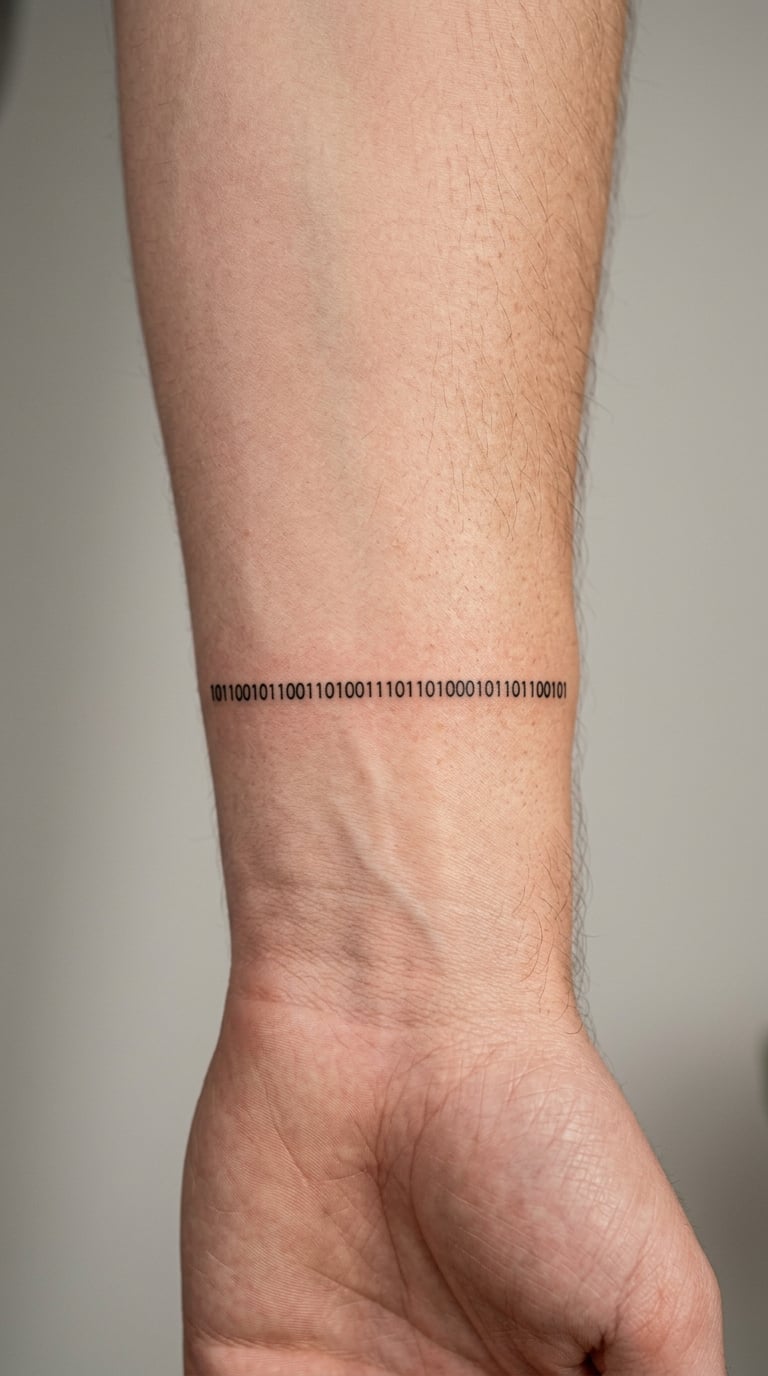
A single horizontal run of ones and zeros in solid black, evenly spaced, no shading and no border. One 8-bit block per character, groups separated by a slightly wider gap than the gaps between digits inside a group. The whole thing sits in one clean line.
It connects to digital logic without needing an explanation, which is the appeal. Nobody outside your circle can read it, so the meaning stays yours even when you pick the sequence for how it looks rather than for a literal message.
Placement: inner forearm or outer wrist. Size: 2-4 inch (5-10 cm) long, characters around a quarter inch tall. Style: minimalist linework. Pain: low to medium on the inner forearm.
Wrist and hand placements stay popular because they are easy to read, but they are a poor home for very fine detail. Expect a softer edge over time. Make it yours: add a verified date, or ask the artist to set the characters a shade larger than feels necessary.
2. Fine-Line HELLO Message on the Inner Wrist
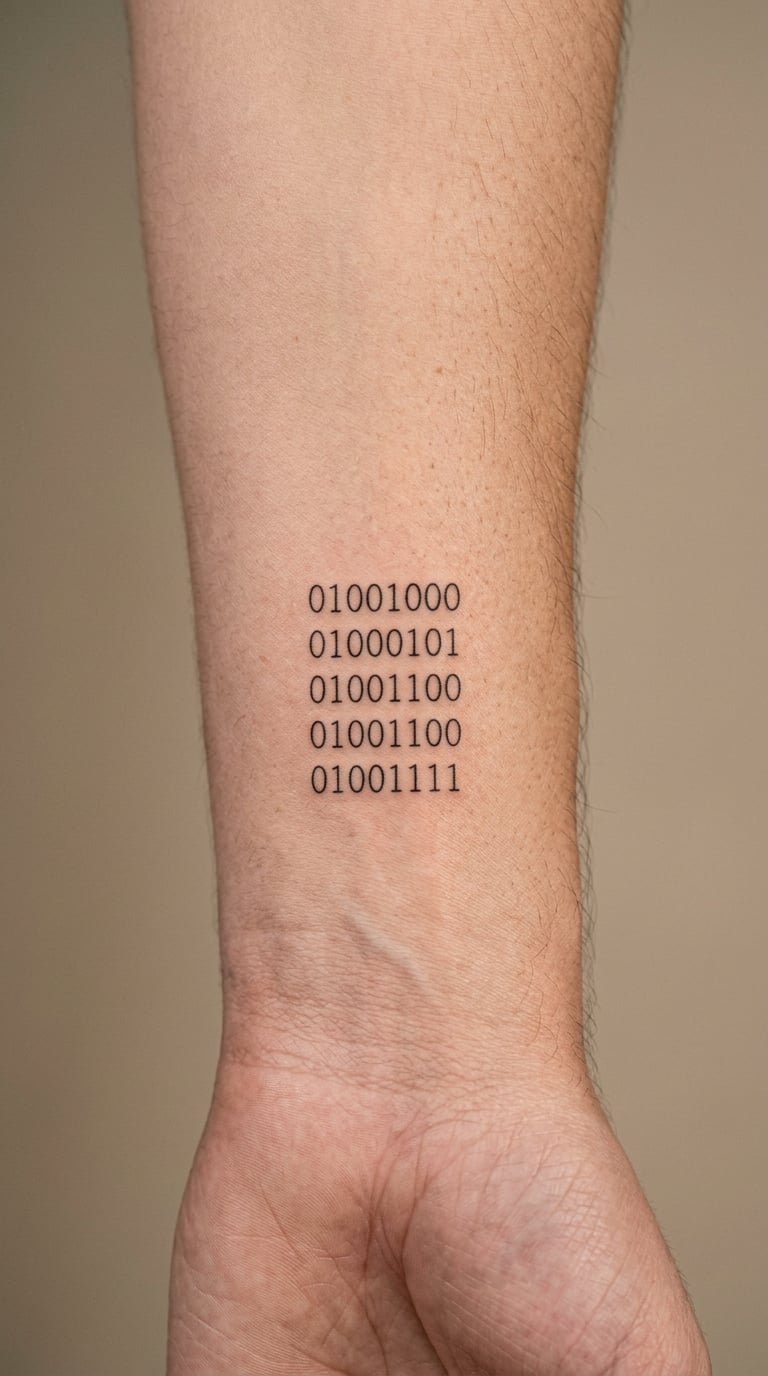
HELLO in 8-bit ASCII is 01001000 01100101 01101100 01101100 01101111, which makes a neat 40-character line with five equal blocks. Tattooed thin, it reads like a line of handwritten text rather than a slab of digits.
HELLO WORLD is the first thing most people learn to print, so it carries the right first-programming feeling without anyone having to explain it. That is the whole point of this style.
Placement: inner wrist or lower inner forearm. Size: 2-3 inch (5-8 cm). Style: fine line. Pain: medium, mostly the wrist bone area.
Thin inner-wrist lines can soften and change shape as skin flexes and years pass, so a slightly heavier needle depth matters here. Make it yours: swap the greeting for a short word that means something, then have the artist proof each character before cutting the stencil.
3. Encoded Name in a Vertical Forearm Column
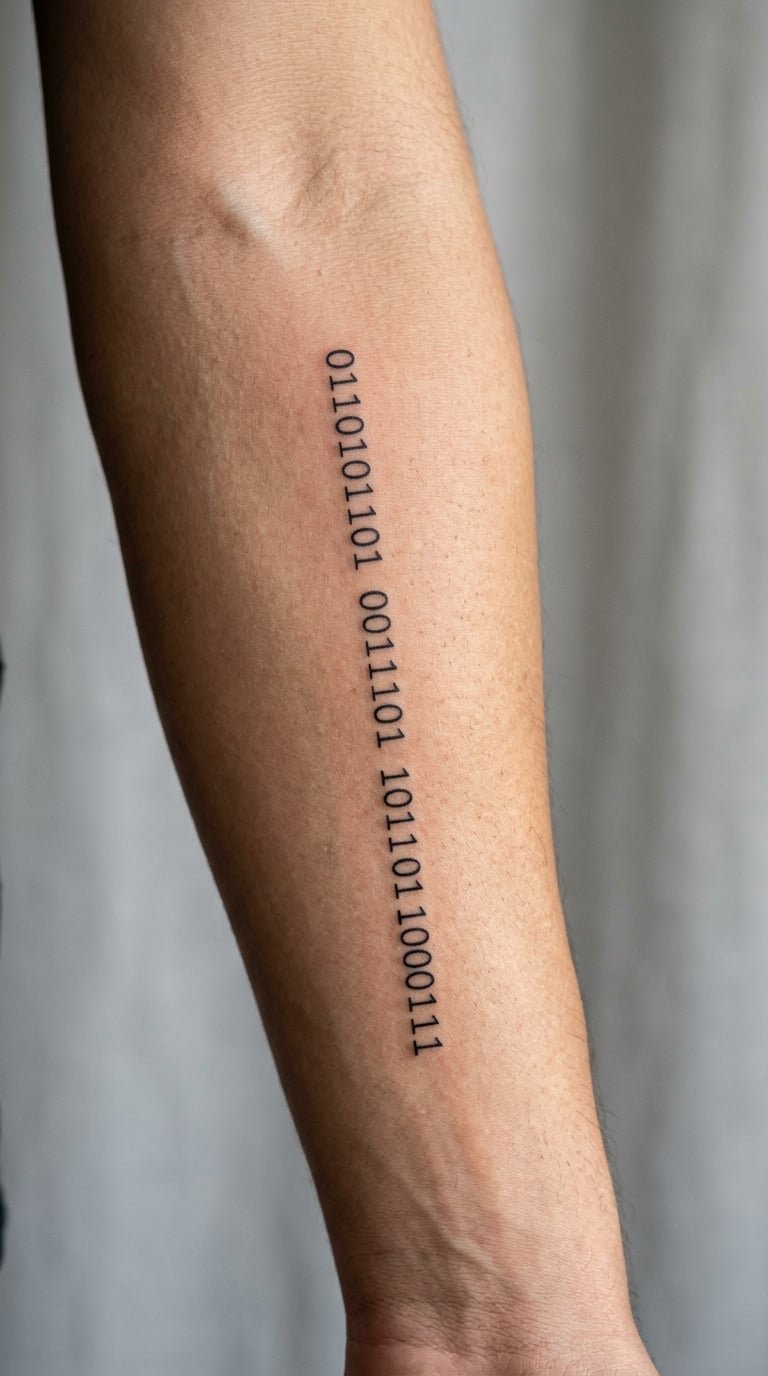
A name converted to 8-bit binary, stacked so each character is its own short row, running down the arm in a tall narrow column. Rows are aligned to a shared baseline, and every third row gets a hair more space to make the column breathe.
People choose this over a letter tattoo because it stays recognisably personal to the wearer and completely anonymous to a stranger. A birth-name spelling is common, since it often differs from the everyday version.
Placement: inner forearm, wrist to mid-forearm. Size: 3-6 inch (8-15 cm) tall. Style: fine line or minimalist. Pain: low to medium.
Even, repeated digits age more cleanly than hairline character details, so ask for a consistent weight across all rows. Make it yours: append a small verified date, or mark one row in a second ink tone so you can find your own block fast.
4. Binary Birth Date in a Minimal Grid
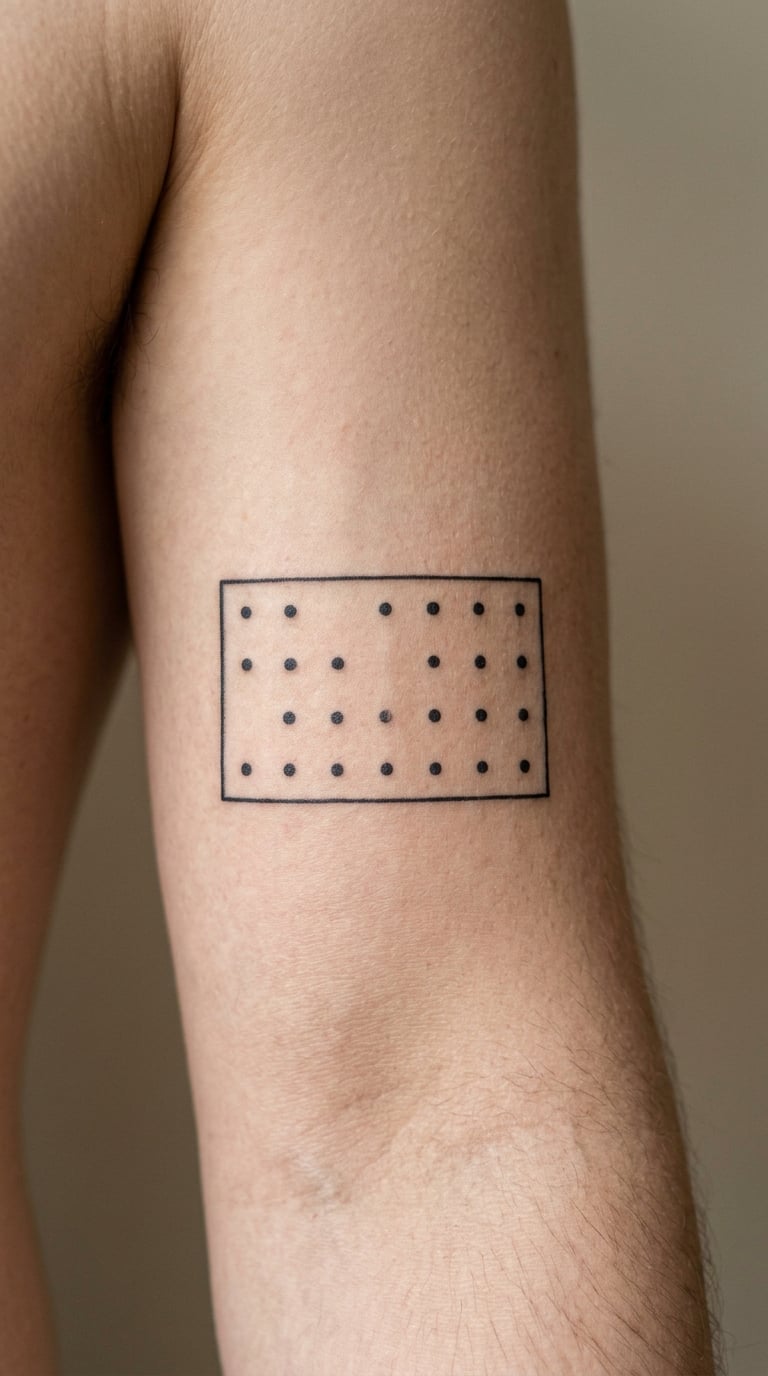
A short run of digits set inside a thin rectangular grid, one row per element of the date and a fine rule separating the frame from the digits. Restrained, symmetrical, and easy to read at arm’s length.
Dates are the most common reason people get binary inked, and the grid keeps a long string from turning into a shapeless smudge. There is no single universal date system, so the conversion method has to be stated.
Placement: inner arm, rib or outer forearm. Size: 2-4 inch (5-10 cm). Style: minimalist linework. Pain: medium.
Small uneven details tend to blur as the design ages, so keep the grid and the digits the same weight. Make it yours: add a coordinate or a set of initials in the same grid as a second row group.
5. Cascading Code Sleeve Panel
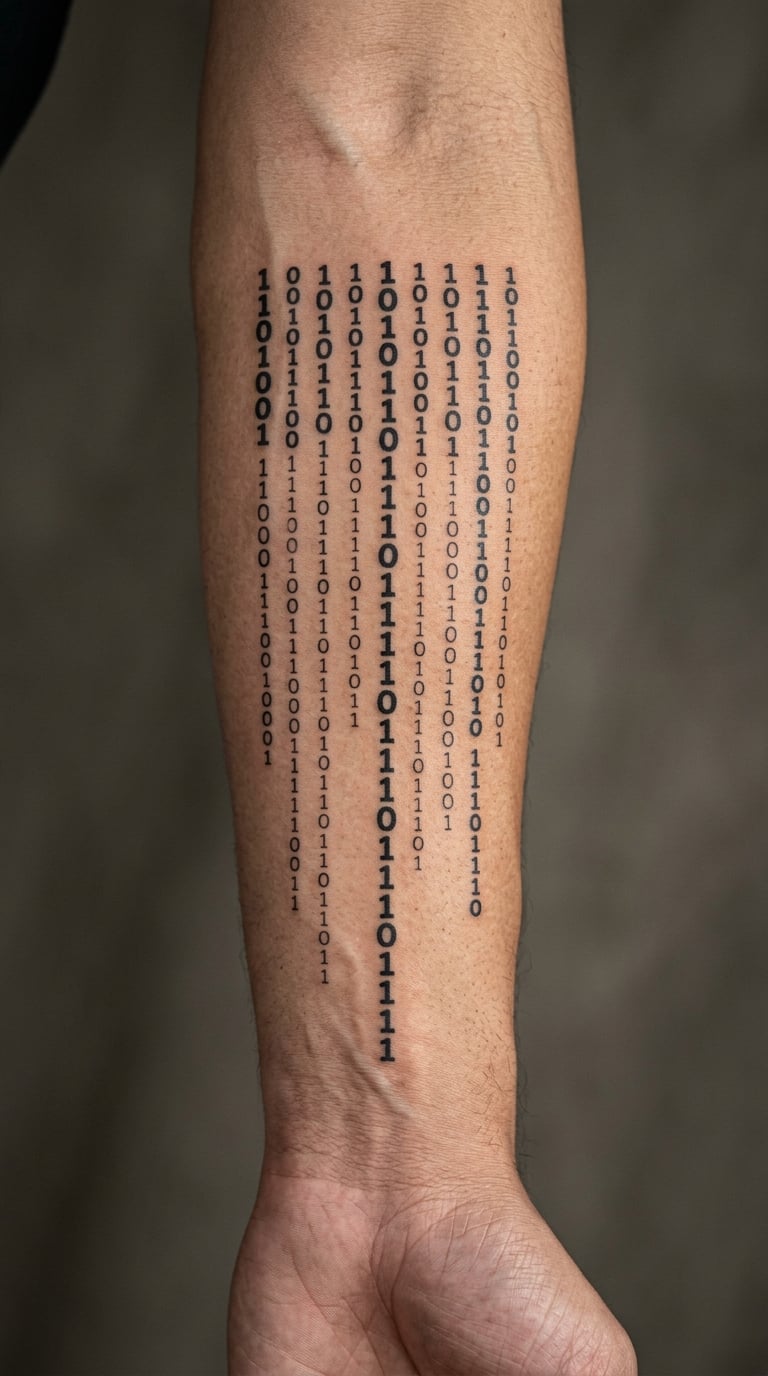
Several vertical streams of binary running downward, mixing meaningful phrases with padded runs of zeros so the composition has quiet areas. Line weight changes between streams, with the main message column heavier than the filler.
This can hold a private message, a technical interest, or simply the visual idea of stored information. The meaning is whatever you decided it was, and that’s fine.
Placement: outer forearm or upper arm. Size: 6-10 inch (15-25 cm). Style: blackwork or fine line. Pain: medium.
A clear hierarchy of sizes keeps the panel readable rather than turning into grey texture. Slightly heavier lines are the practical choice at this scale. Make it yours: run your birth digits as the leading column and let the rest be structure.
6. Square Binary Block on the Ankle
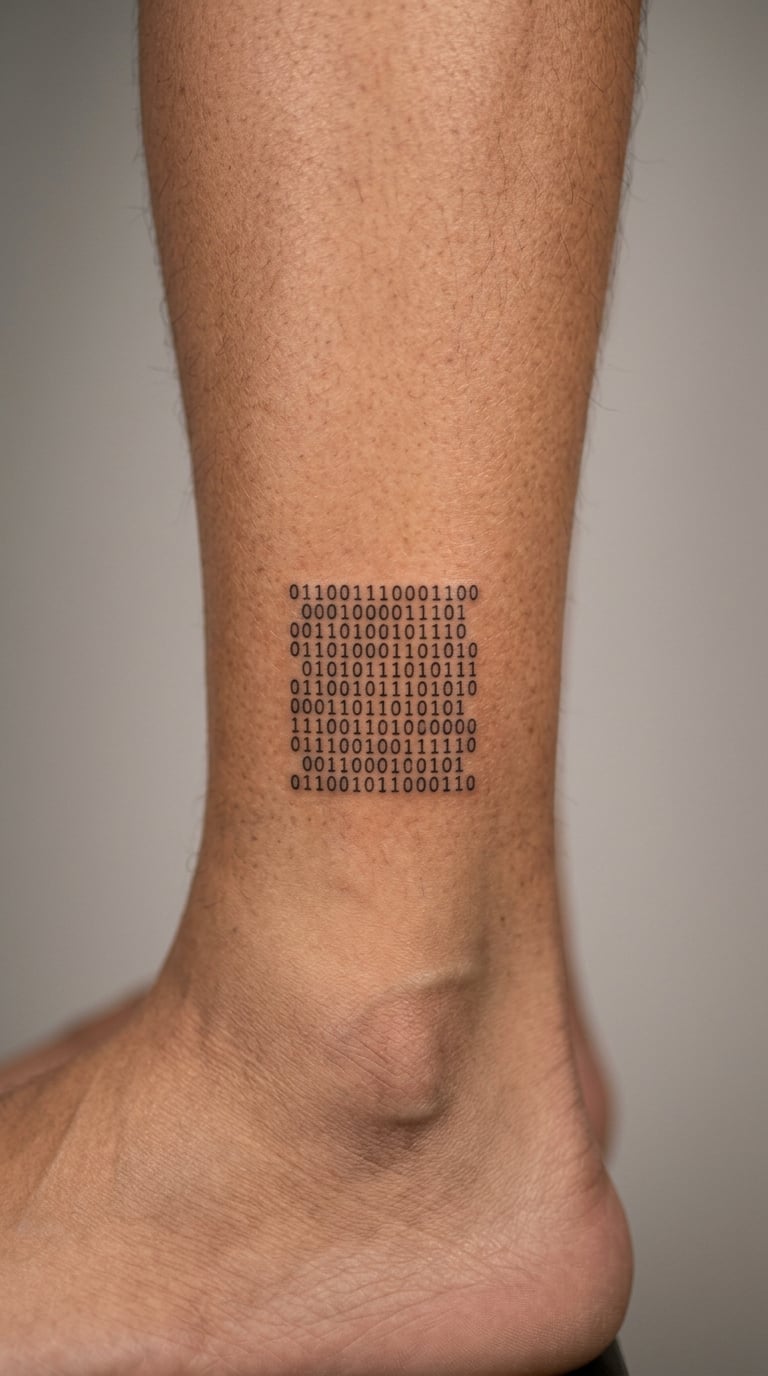
A tight square outline holding staggered rows of digits, spaced like a small grid but deliberately uneven so the block feels alive. A single solid character in one corner breaks the rhythm.
The ankle is a small canvas, so a geometric block works better there than a long run of text. It balances a technical motif against a placement most people would not predict.
Placement: just above or just below the ankle bone. Size: 2-3 inch (5-8 cm) square. Style: minimalist or geometric linework. Pain: medium to high near bone.
Small uneven details blur more noticeably here because the ankle bone sits right under thin skin. Make it yours: end the sequence with a meaningful final character, or tint a single digit a muted red.
7. Binary Code Ribbon at the Collarbone
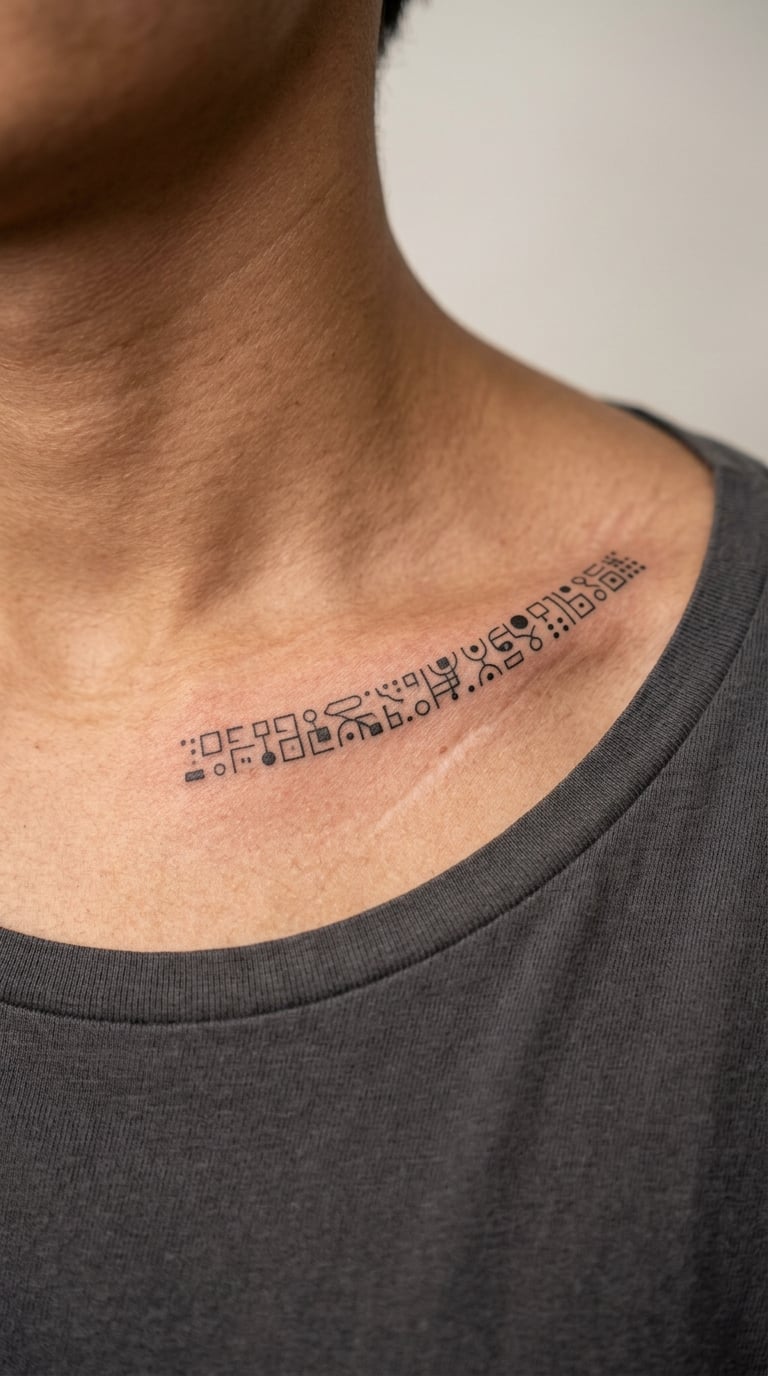
One horizontal stream of binary curving along the collarbone, following the bone’s natural line with generous open spacing between characters. Nothing else, no second line, no border.
People pick this for a message that means something to them, or simply because they like how code-like texture sits there. Either reason holds up.
Placement: collarbone, upper chest or shoulder. Size: 4-7 inch (10-18 cm). Style: fine line or minimalist. Pain: medium.
Torso movement and daily sun exposure both work against long-term clarity on the chest, so plan for touch-ups. Make it yours: set the length to match the width of your collarbone so it reads as deliberate rather than placed.
8. Pixelated Binary on the Knuckles
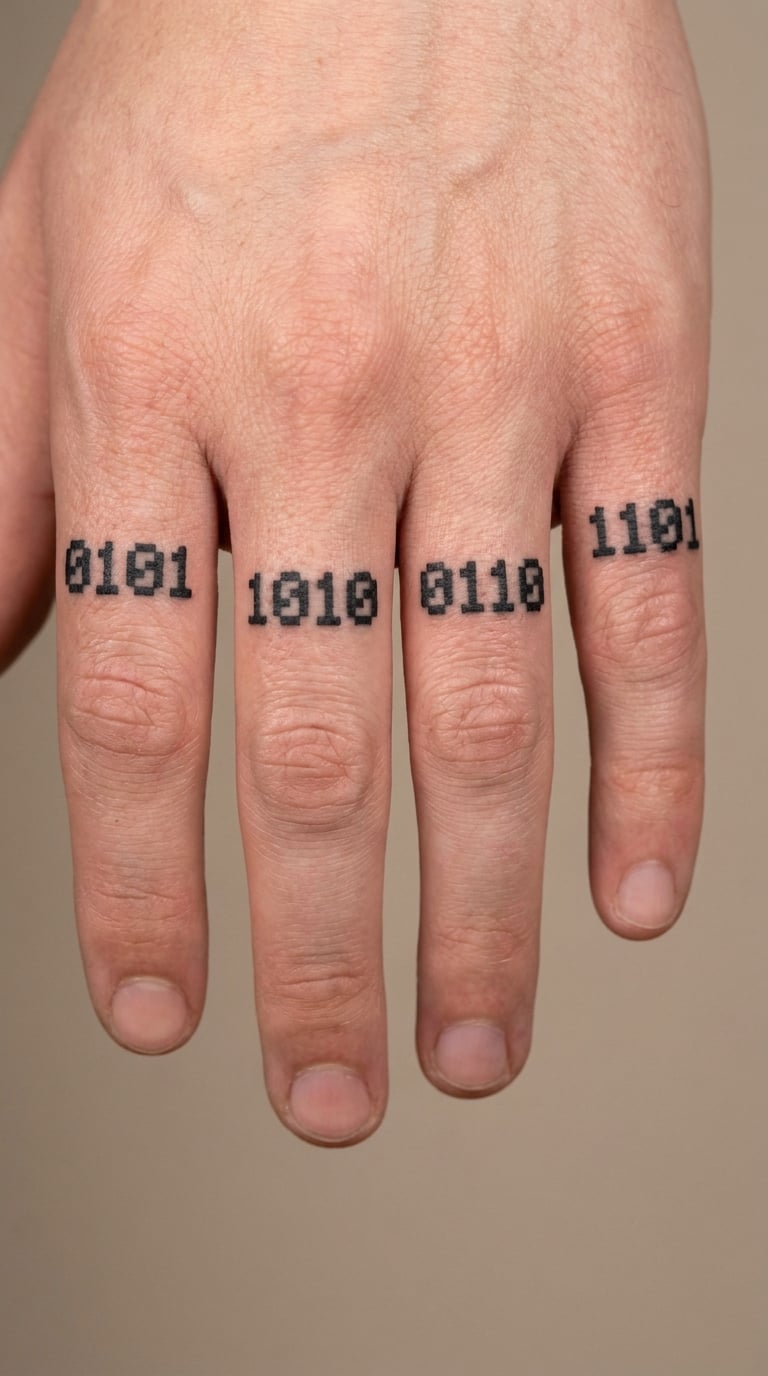
A short, artist-verified code string rebuilt from square blocks, so each zero and one becomes a chunky pixelated character rather than a typed digit. One character group per finger, aligned to the knuckle line.
It looks bold and tech-inspired from across a room, which is the point if you want a design people notice daily. It is also the least discreet option in this list.
Placement: knuckles, usually four fingers. Size: 1-2 inch (2.5-5 cm) across the hand. Style: blackwork or pixel art. Pain: high on fingers.
Knuckle lines stretch and soften with movement and age, so a pixel build with square edges holds up better than tiny characters here. Make it yours: use a short checksum or byte value rather than a full message so the hand stays readable.
9. Binary Signal Wave Along the Forearm
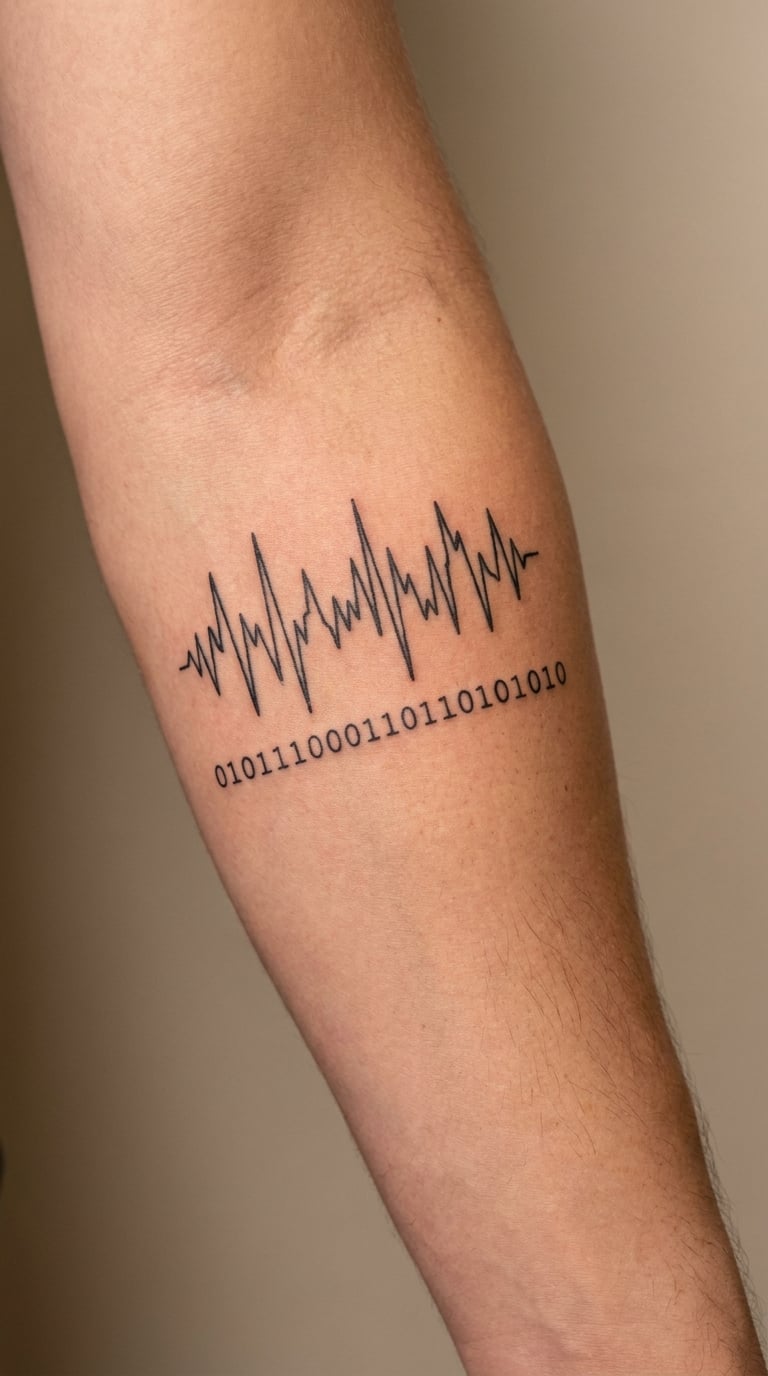
A smooth signal waveform drawn as one continuous line, with a tidy row of binary bits running underneath it like a caption. The contrast between the smooth curve and the rigid digit row is the whole effect.
It lands well for anyone drawn to communication, sound, engineering or data. It suggests those fields without claiming one fixed interpretation.
Placement: outer forearm. Size: 4-7 inch (10-18 cm). Style: fine line or abstract linework. Pain: low to medium.
Keep the digit row the same weight as the wave so neither element looks like an afterthought. Make it yours: set the number under the wave to a meaningful bit length, or add a single colour accent at the wave’s peak.
10. Binary DNA Double Helix
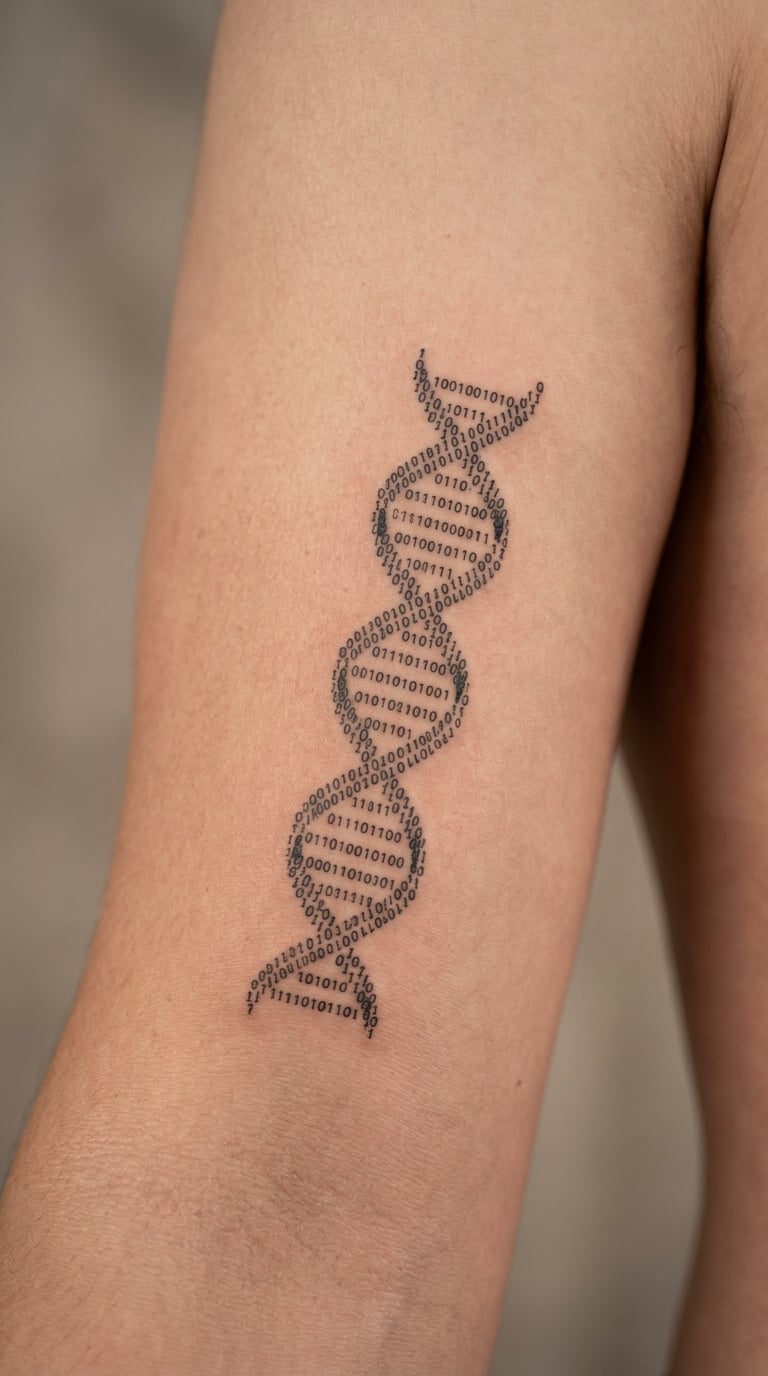
Two strands twisting around each other, built from alternating binary digits, with short line segments or dots standing in for the ladder rungs between them. The digits follow the helix’s curve rather than sitting in a flat block.
It merges code with biological imagery, so the reading stays personal instead of arriving pre-loaded with symbolism. Plenty of people pair it with a genetic theme elsewhere.
Placement: inner arm, calf or upper arm. Size: 4-8 inch (10-20 cm). Style: dotwork, micro-realism or fine line. Pain: medium.
A bolder spine is the safer call, because tiny crosses fade into a blur within a few years. Make it yours: use one helix strand for a date and the other for a name, both verified before the session. If genetics interest you beyond code, our 20 DNA tattoo ideas cover the same ground in other ways.
11. Circuit-Tree Binary Pattern
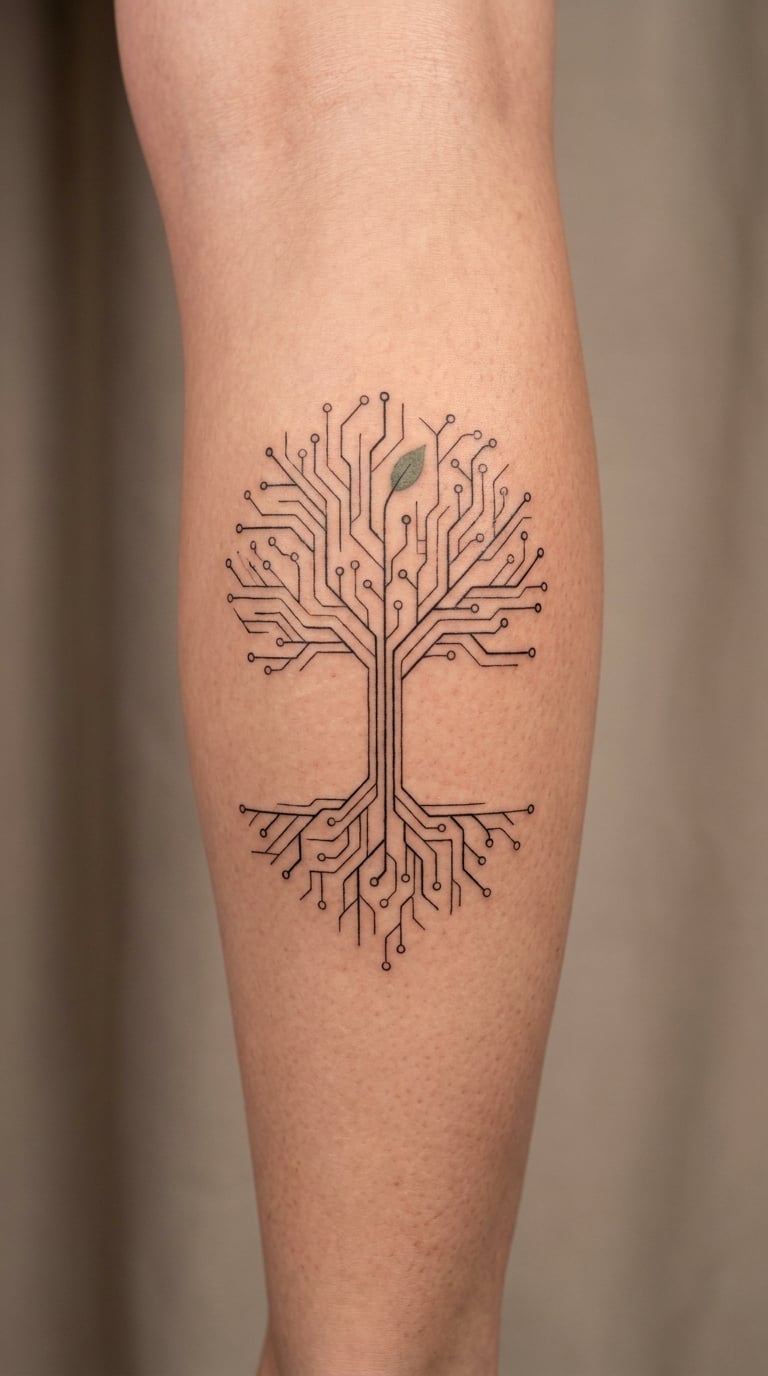
A tree drawn in fine line where the branches behave like circuit traces, with verified binary filling the limbs and node-like dots marking the junctions. The trunk stays organic so the two forms read as one drawing.
It suits people who genuinely like both trees and circuit boards, which is a narrower audience than the other ideas here. If you are in that group, this is the design you’ll keep noticing on your own arm.
Placement: outer arm, calf, shoulder blade or thigh. Size: 5-8 inch (13-20 cm). Style: fine line, dotwork or illustrative linework. Pain: medium.
Branch joins need clean, deliberate line endings or the tree reads as noise once healed. Make it yours: put birth digits in the roots and leave one leaf in a second ink. Our science tattoo ideas cover more designs for people who like this kind of diagram.
12. 8-Bit Binary Heart
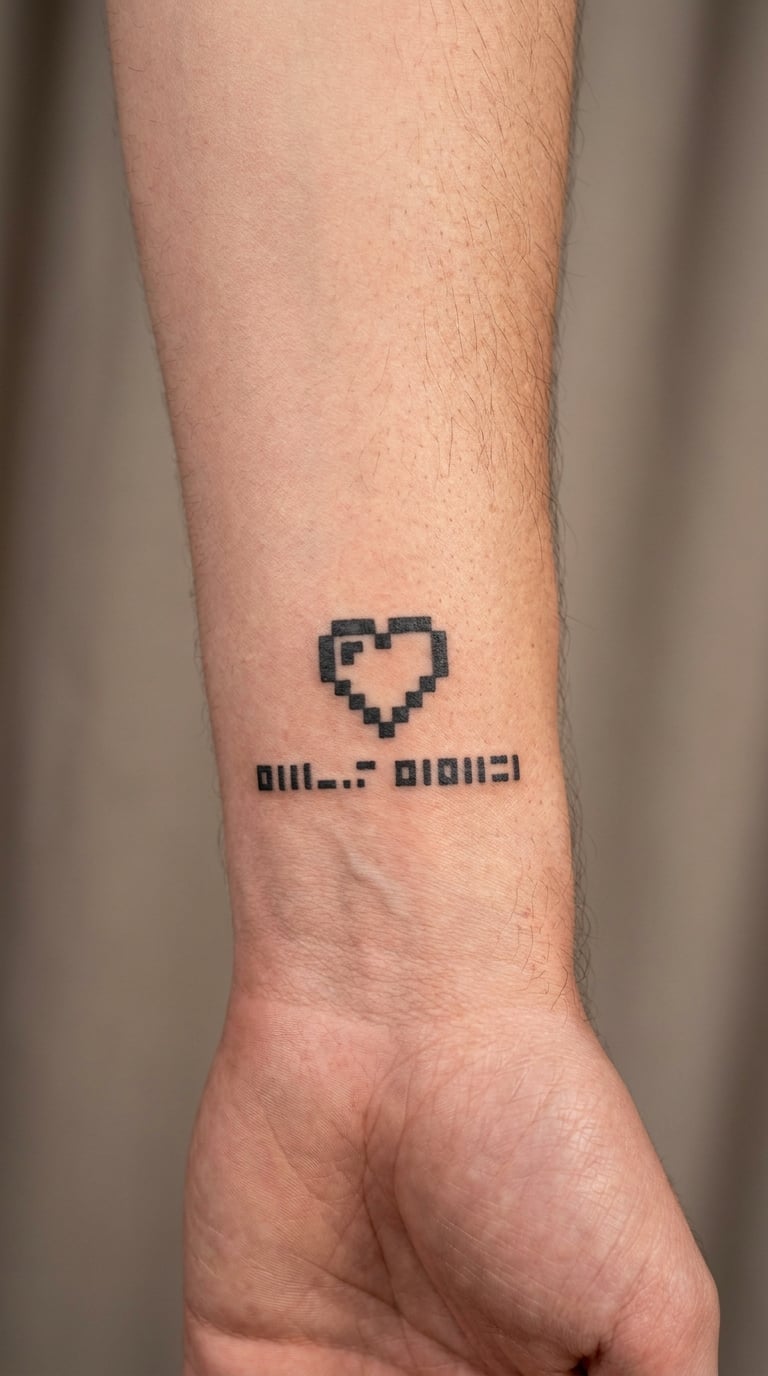
A pixel heart built from square blocks, with a short correctly translated binary line set underneath in a smaller weight. Pixel edges are all the same thickness so the shape stays crisp.
It marks affection, a friendship, or one specific person whose initials or date are encoded. A pixel heart with no message underneath is a fine option too.
Placement: wrist, ankle, upper arm or chest. Size: 2-4 inch (5-10 cm). Style: pixel art or blackwork. Pain: low to medium.
Consistent weight is what keeps pixel edges sharp; a mixed-weight grid looks broken once healed. Make it yours: use a birth-date sequence under the heart, or coordinate the colour with another small piece you already have.
13. Matrix-Inspired Binary Rain
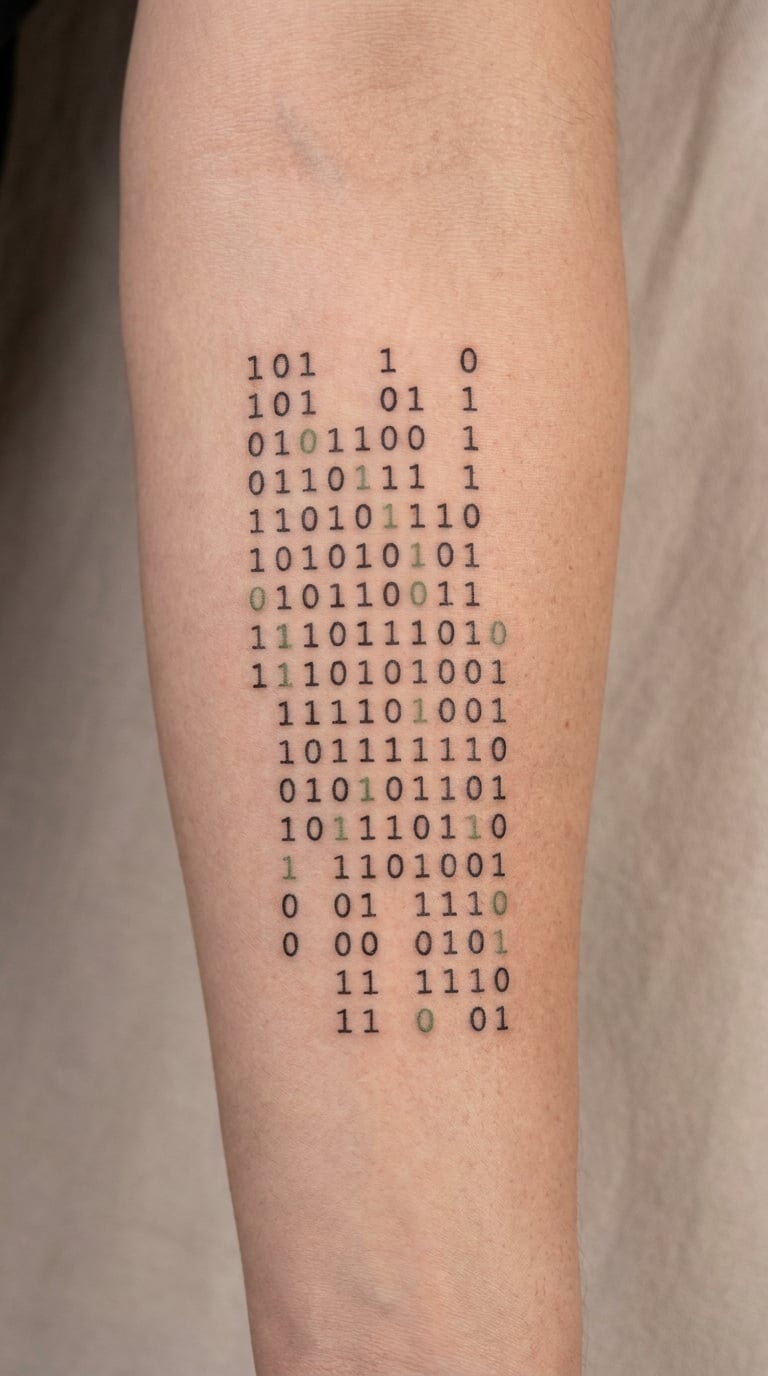
Staggered columns of black characters falling in uneven lengths, with the column starts and ends at different heights. A few digits picked out in a restrained green. It should read as falling code without copying any frame from any film.
Gaming, computing and technology people gravitate here, and the meaning still comes from the characters you chose rather than the look.
Placement: forearm, calf or upper arm. Size: 5-9 inch (13-23 cm). Style: blackwork, abstract or neo-traditional composition. Pain: medium.
Very dense columns turn grey as they heal, so leave visible skin between streams. Make it yours: hide one full message inside the pattern and colour only its first digit, or keep the whole piece black and skip the green.
14. Minimal Terminal Prompt Code
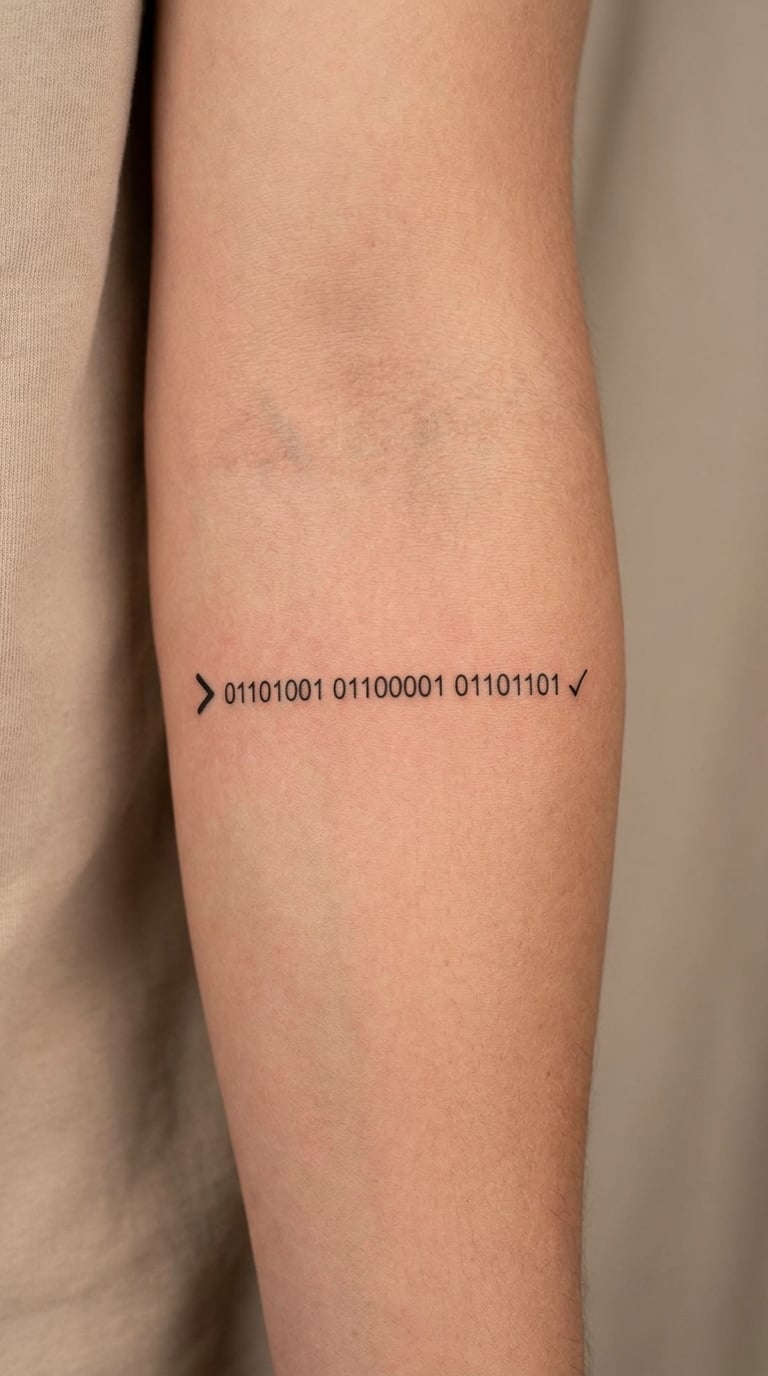
A clean command-line style layout: a restrained prompt symbol, then a short personal phrase converted to binary, set flush in one line with generous margins. Nothing decorative, nothing boxed.
The terminal framing is a design device rather than a claim about the phrase. What people like is that the whole thing looks like a real command without explaining itself.
Placement: forearm, calf or upper arm. Size: 3-6 inch (8-15 cm). Style: minimalist or fine line. Pain: low to medium.
Ask for the prompt symbol as one clean mark, not a hand-drawn angle bracket that wobbles. Make it yours: use a concise motto, your initials, or a checksum value you can verify yourself.
15. Hex-to-Binary Conversion Design
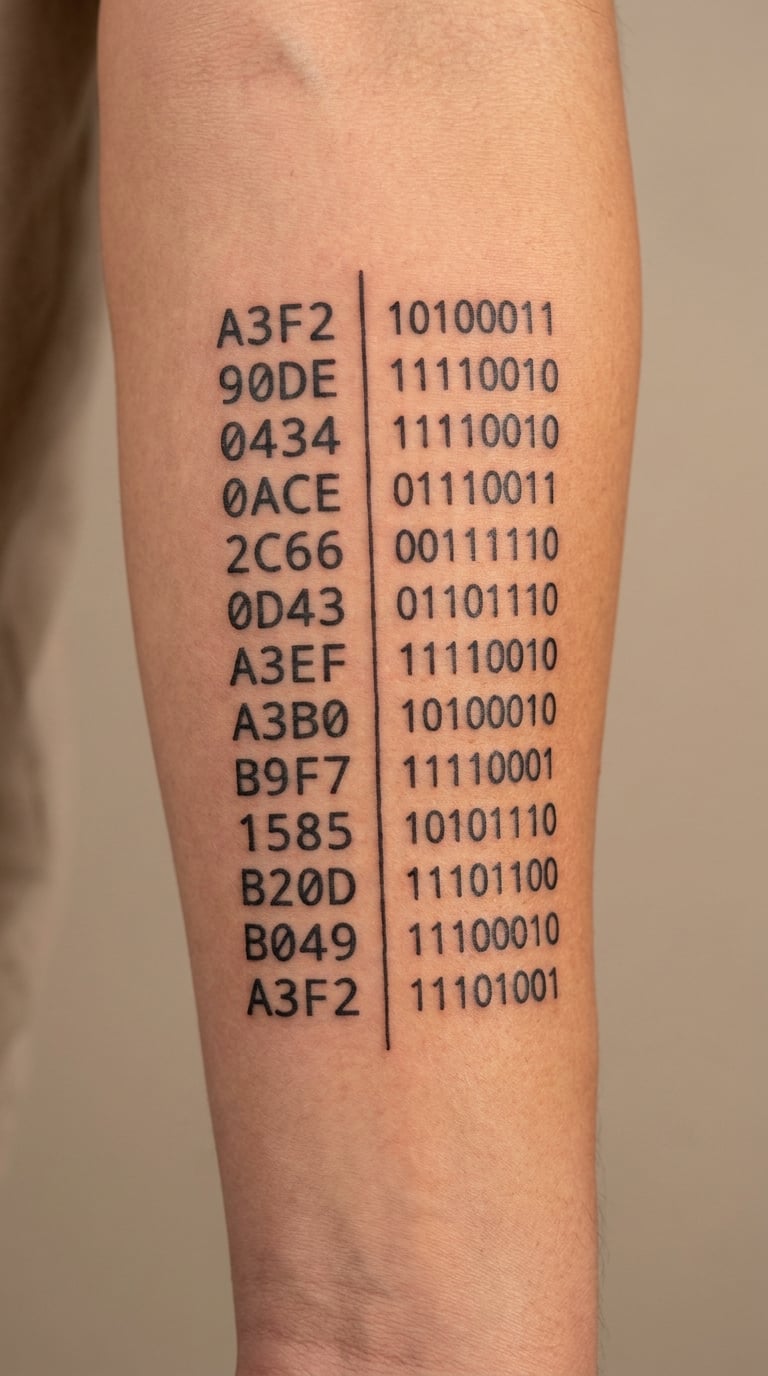
A short hexadecimal value on one side, its exact binary equivalent on the other, split by a simple equals sign or a thin dividing rule. Both halves set in the same weight so the pairing reads as one statement.
This is the most accurate option in the list, and it suits programmers and hardware people who want technical correctness rather than decoration. A hex dump excerpt makes a natural source.
Placement: forearm, upper arm or calf. Size: 2.5-5 inch (6-13 cm). Style: minimalist or technical linework. Pain: low to medium.
Letterforms need checking carefully, since hex digits and decimal digits can blur into each other at small sizes. Make it yours: take the bytes from a meaningful file, a coordinate, or a device serial number, and keep both halves identical in spacing.
16. Binary Infinity Symbol
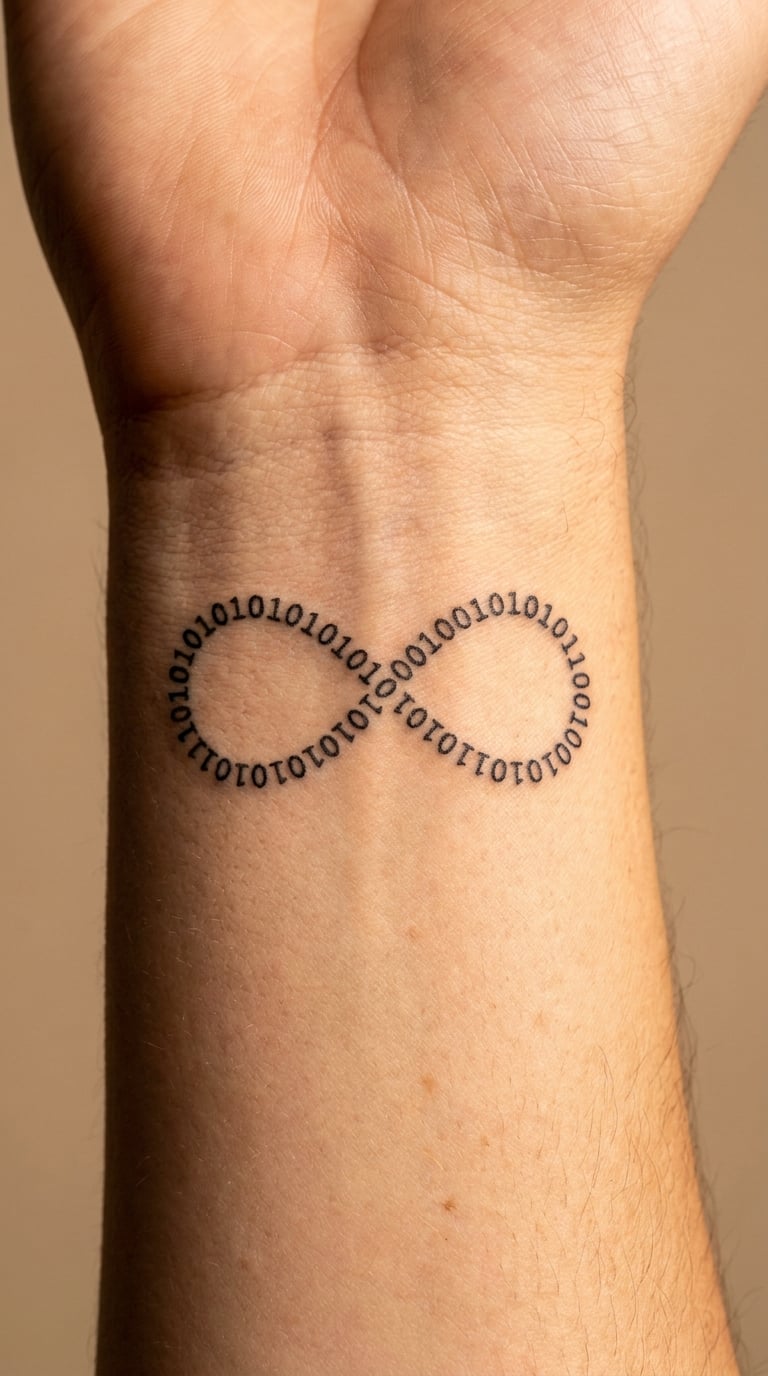
A continuous figure-eight loop with verified binary characters threaded along the curve, following its bend rather than sitting inside it. The digits shrink slightly as they round the crossover.
People choose it for a lasting message, or for the visual idea of continuity. Either way it stays personal rather than universal.
Placement: wrist, ankle, forearm or behind the ear. Size: 2-3 inch (5-8 cm). Style: fine line or minimalist. Pain: medium, depending on the spot.
Tight curves and tiny digits blur more than straight runs do, and on fingers they blur fast. Make it yours: keep the phrase to three or four characters so the loop stays open and readable.
17. Matching Split-Binary Tattoos
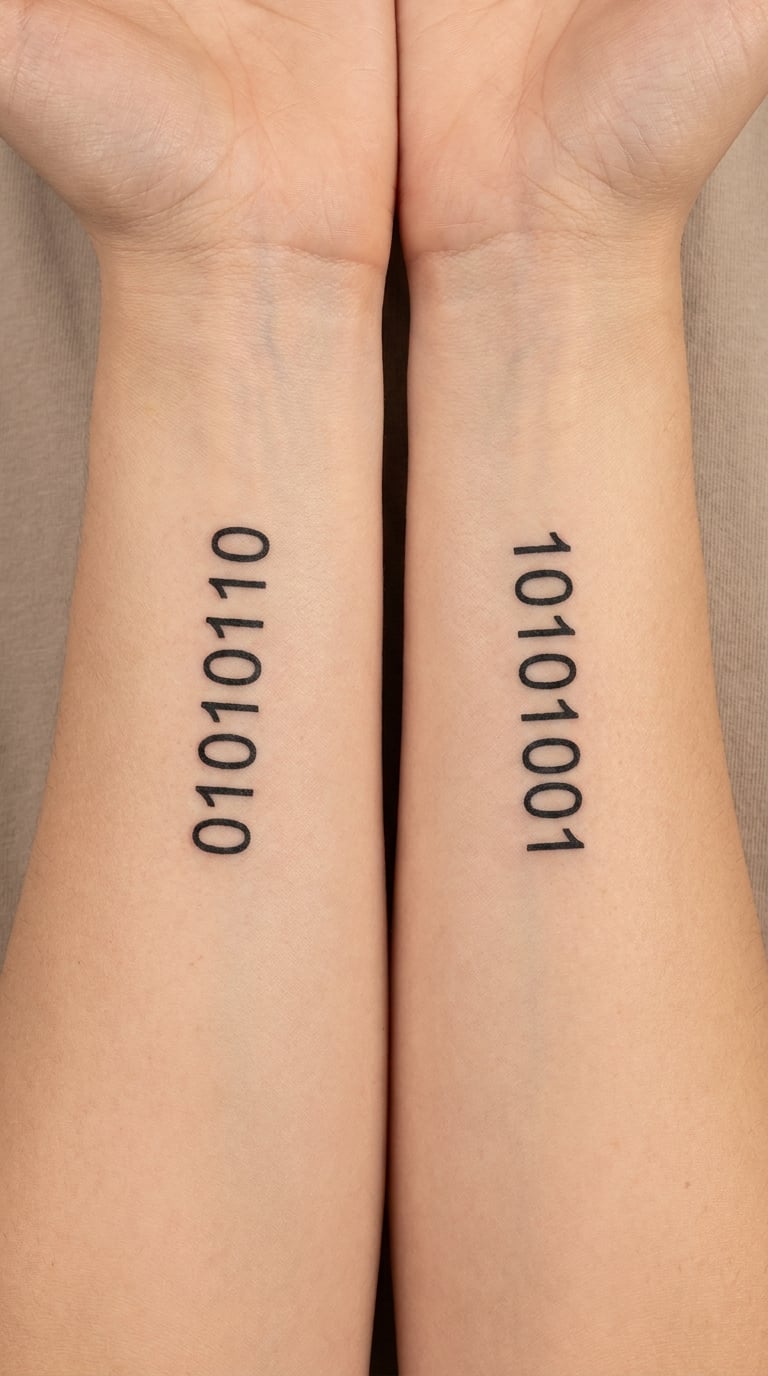
One meaningful sequence divided into two halves, each person taking a piece, with the halves positioned so they read as a pair rather than as two unrelated fragments.
Couples, friends and siblings use this, and it works best when the split point falls on a character boundary so neither half carries a broken block. Verify the complete sequence before either appointment, and give both artists the same character reference so the weights match.
Placement: wrists, forearms, ankles or upper arms. Size: 2-4 inch (5-10 cm) each. Style: fine line, minimalist or blackwork. Pain: low to medium.
Healed halves must use the same character size or the pairing will not line up visually. Make it yours: mark the cut point with a small shared symbol, or give each person the same closing character mirrored.
18. Binary Initials on Separate Fingers
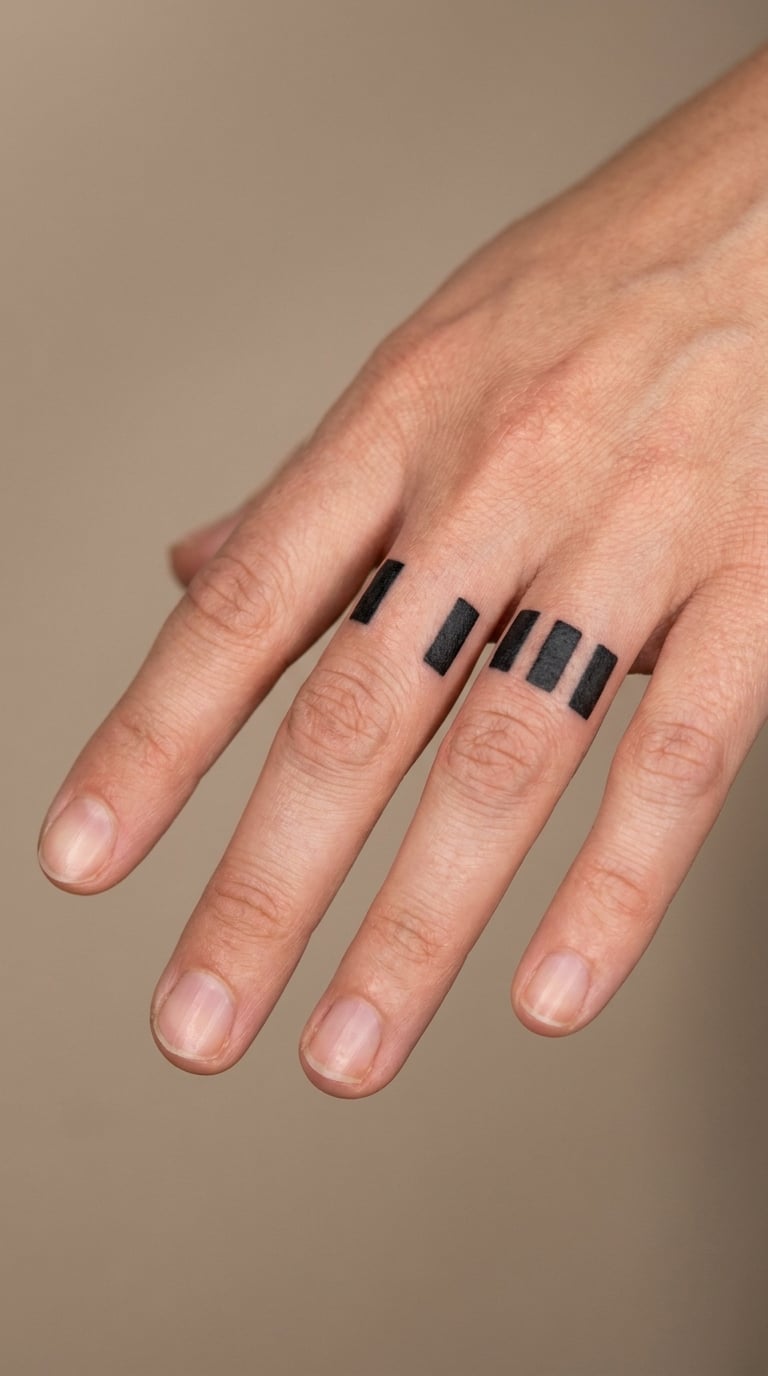
A multi-finger layout where each finger carries one verified character group for an initial, a date or a short word, with the groups running along the sides of the fingers.
It suits someone who wants a discreet set that rewards close inspection. The design is only as good as the character size, so scale is the deciding factor.
Placement: index and middle fingers, sometimes four fingers. Size: 0.5-1.5 inch (1-4 cm) per character group. Style: fine line, micro text or minimalist. Pain: high.
Finger skin movement, sun exposure and frequent washing all speed up fading here. Make it yours: ask for a wider character scale than you think you need, and agree a touch-up plan with the artist before you start.
19. Binary Pixel Staircase
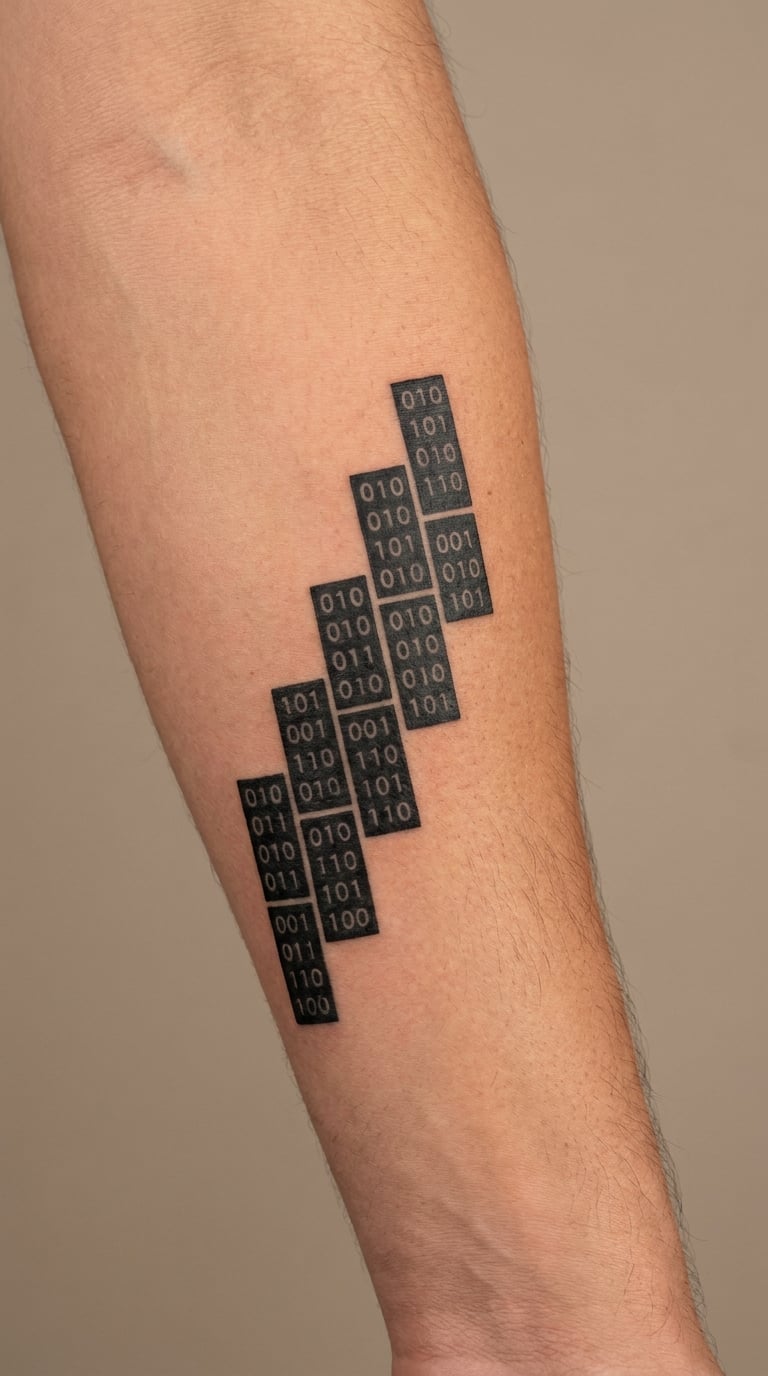
Meaningful binary groups turned into ascending pixel blocks, each step one block higher than the last, with the characters set inside the blocks rather than beside them. Square corners, no curves.
The format can hold personal progress, a run of important years, or simply mathematical structure, depending entirely on the values you pick.
Placement: forearm, calf, shoulder blade or thigh. Size: 4-7 inch (10-18 cm). Style: pixel art, geometric or blackwork. Pain: medium.
Even block sizes matter, since uneven steps read as a mistake rather than a design. Make it yours: assign one step per date or milestone, from a graduation to a child’s first year.
20. Dotwork Binary Constellation
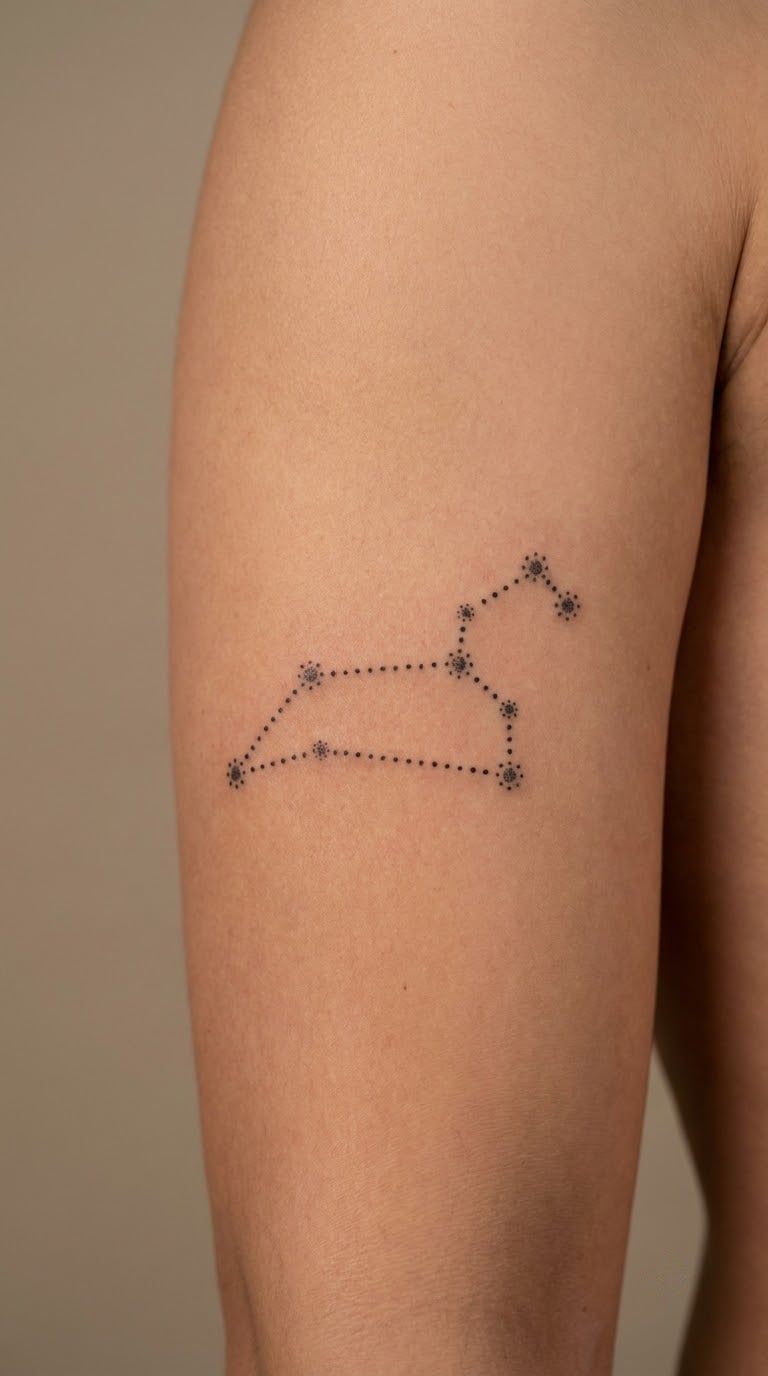
A field of binary characters linked by fine lines, arranged like a star map, with larger solid dots standing in as the brightest points. The character field fades out at the edges so the shape has no hard border.
It suits readers who want code and night-sky imagery in one restrained piece, and it scales well on a larger flat area.
Placement: upper arm, back of shoulder, calf or thigh. Size: 5-8 inch (13-20 cm). Style: dotwork or fine line. Pain: medium.
The smallest stars and the gaps between characters soften noticeably over time, so keep the character scale consistent. Make it yours: plot one meaningful coordinate or date as the single highlighted point.
21. Red Ink Binary Highlight Tattoo
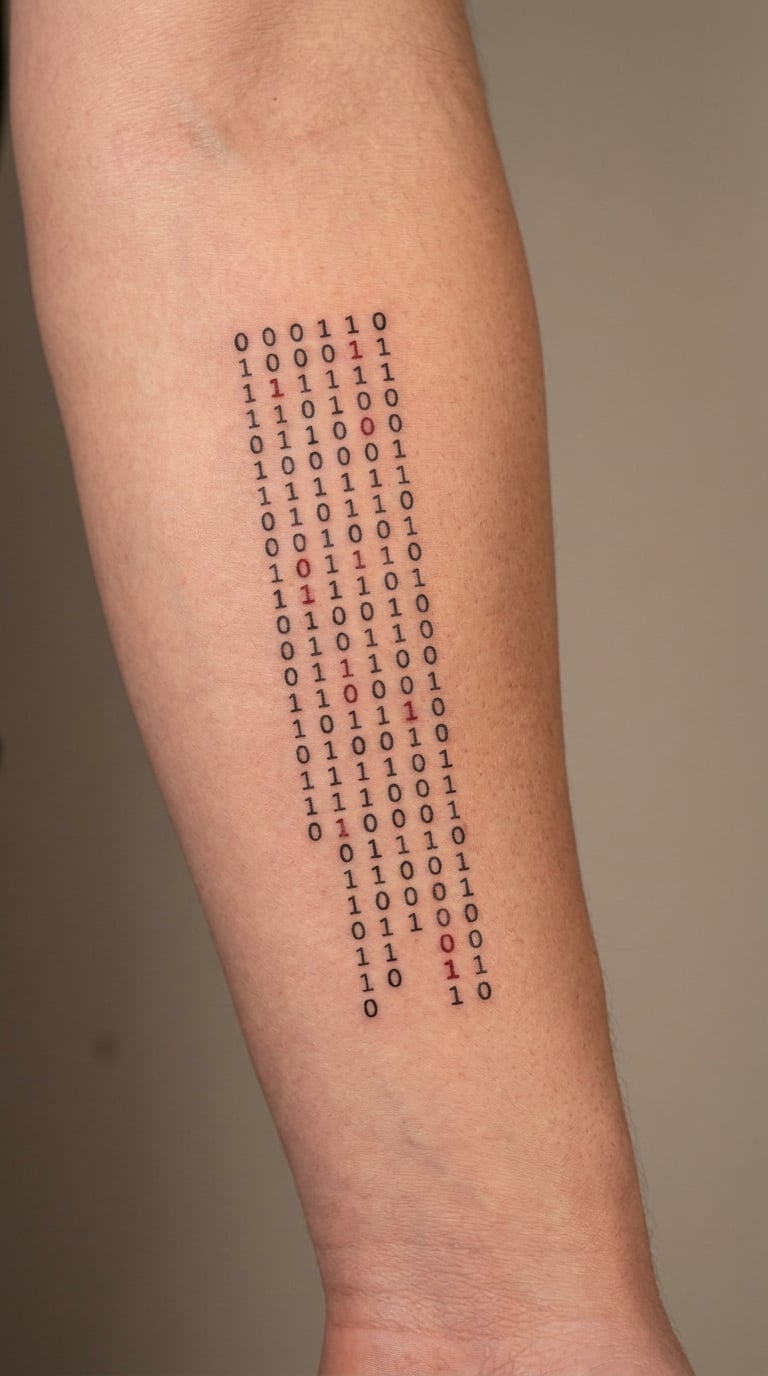
Most characters in black with a handful picked out in deep red, spaced through the sequence rather than clustered. The rest of the design stays plain single-weight linework.
The colour can add visual hierarchy or mark something personal. There is no standard binary meaning attached to red, so decide what it stands for and keep that meaning consistent across your pieces.
Placement: wrist, forearm, calf or upper arm. Size: 2-5 inch (5-13 cm). Style: minimalist, blackwork or illustrative. Pain: low to medium.
Colour contrast and sun exposure both affect how long the piece looks right, so expect the red to need attention sooner. Make it yours: highlight a year, an initial group, or a checksum value that you can still verify years later.
22. Watercolour Binary Lettering
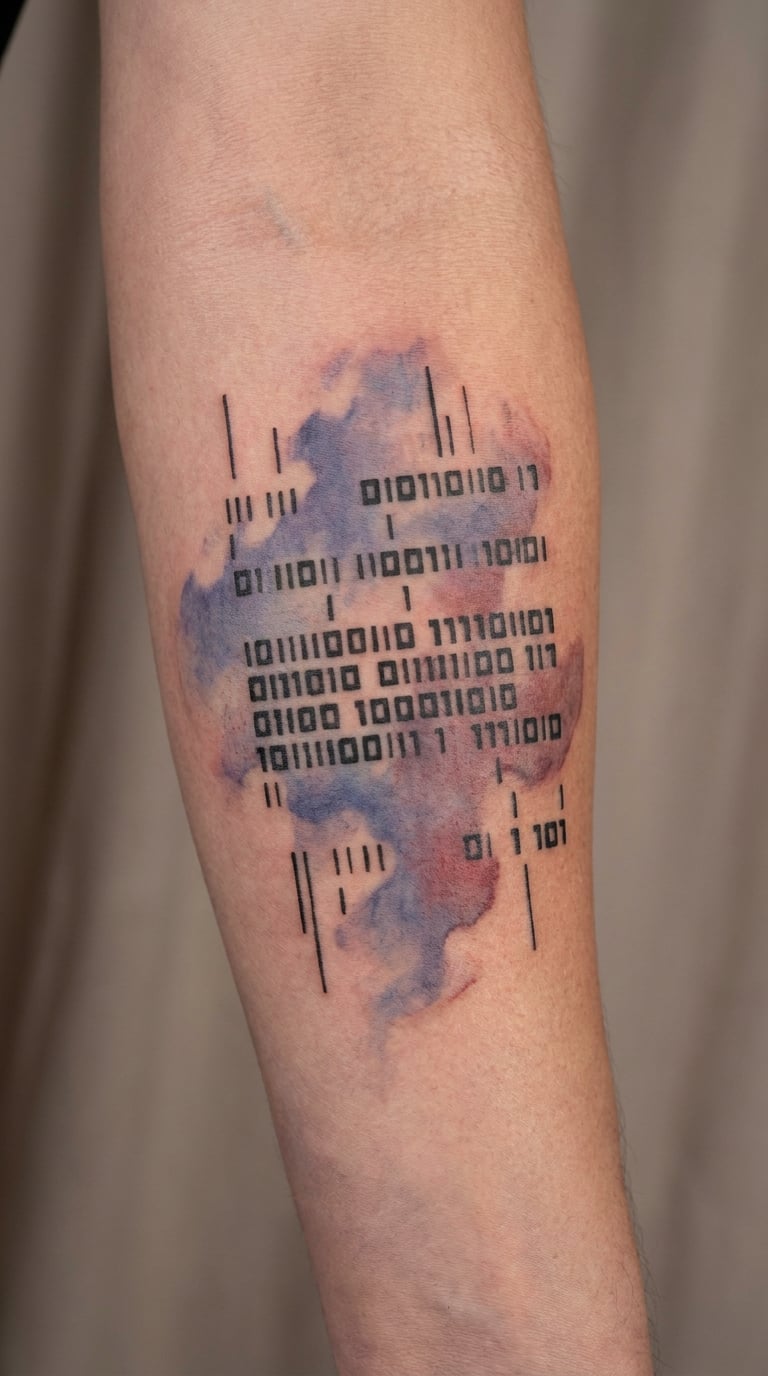
A personal binary phrase set in loose black lettering with a soft wash behind it, in muted red, blue or violet, edges bleeding slightly into the skin tone. The lettering stays darker and more solid than the wash.
This is the art-leaning option here, for someone who likes colour and texture more than technical precision. It reads as a painting with code in it.
Placement: forearm, shoulder, calf or thigh. Size: 4-8 inch (10-20 cm). Style: watercolour, abstract or illustrative. Pain: medium.
Very pale hairline letters and washed edges lose definition faster than solid black linework does. Make it yours: use one wash colour to mark a birth month, or pair it with a plain solid-line companion piece so the two read as related.
23. Binary Puzzle with Hidden Initial
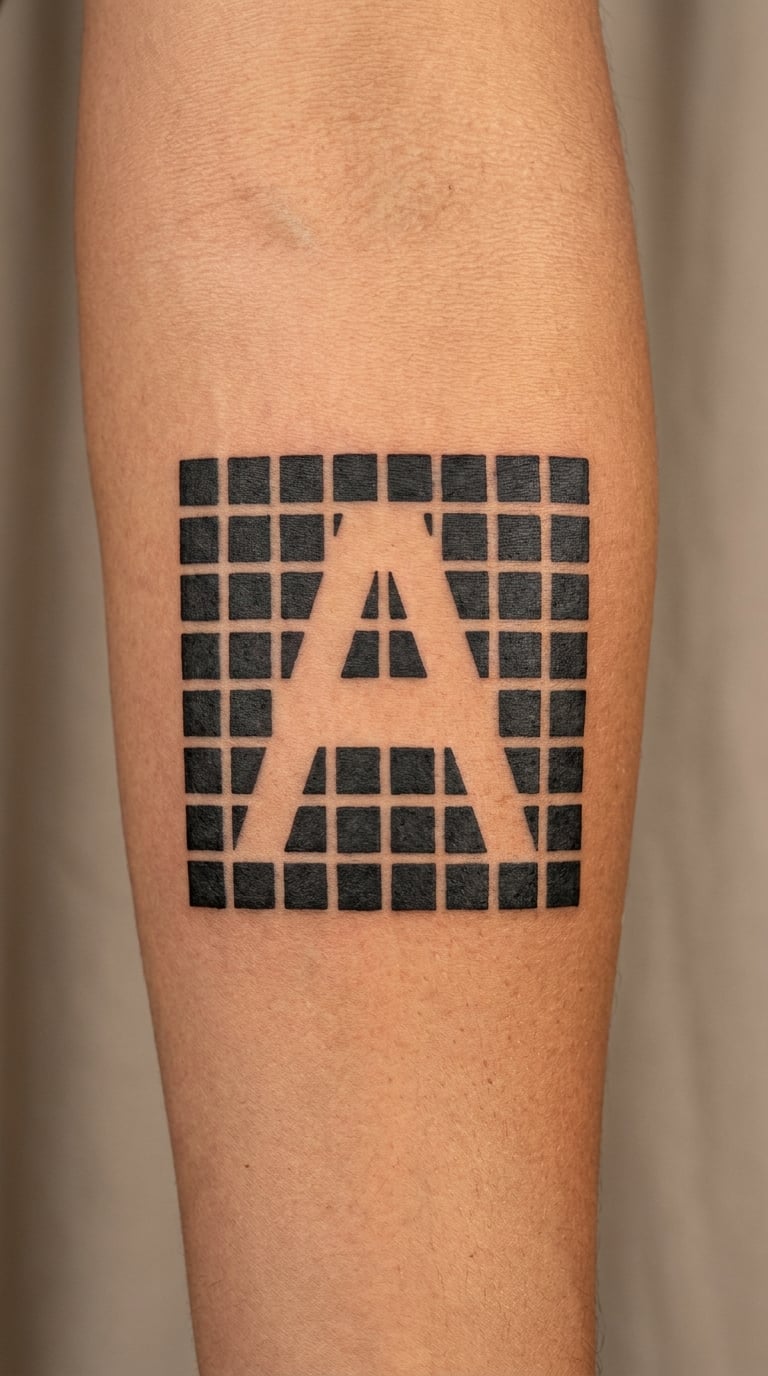
A small grid of 0s and 1s in which one initial or date is formed by negative space, or by a single character in a contrasting weight, tucked inside the pattern. Most viewers read the grid and miss the detail.
It is built for puzzle lovers and for people who enjoy concealed details, and it rewards anyone who looks twice. The concealed element should read as deliberate rather than accidental.
Placement: forearm, upper arm, thigh or calf. Size: 3-6 inch (8-15 cm). Style: geometric, fine line or blackwork. Pain: medium.
Check the hidden detail from a normal viewing distance during the session, or it turns into visual noise. Make it yours: make the initial the length of a name you would recognise instantly, and tell the artist exactly which cell group it occupies.
24. Encrypted Word Binary Sleeve Panel
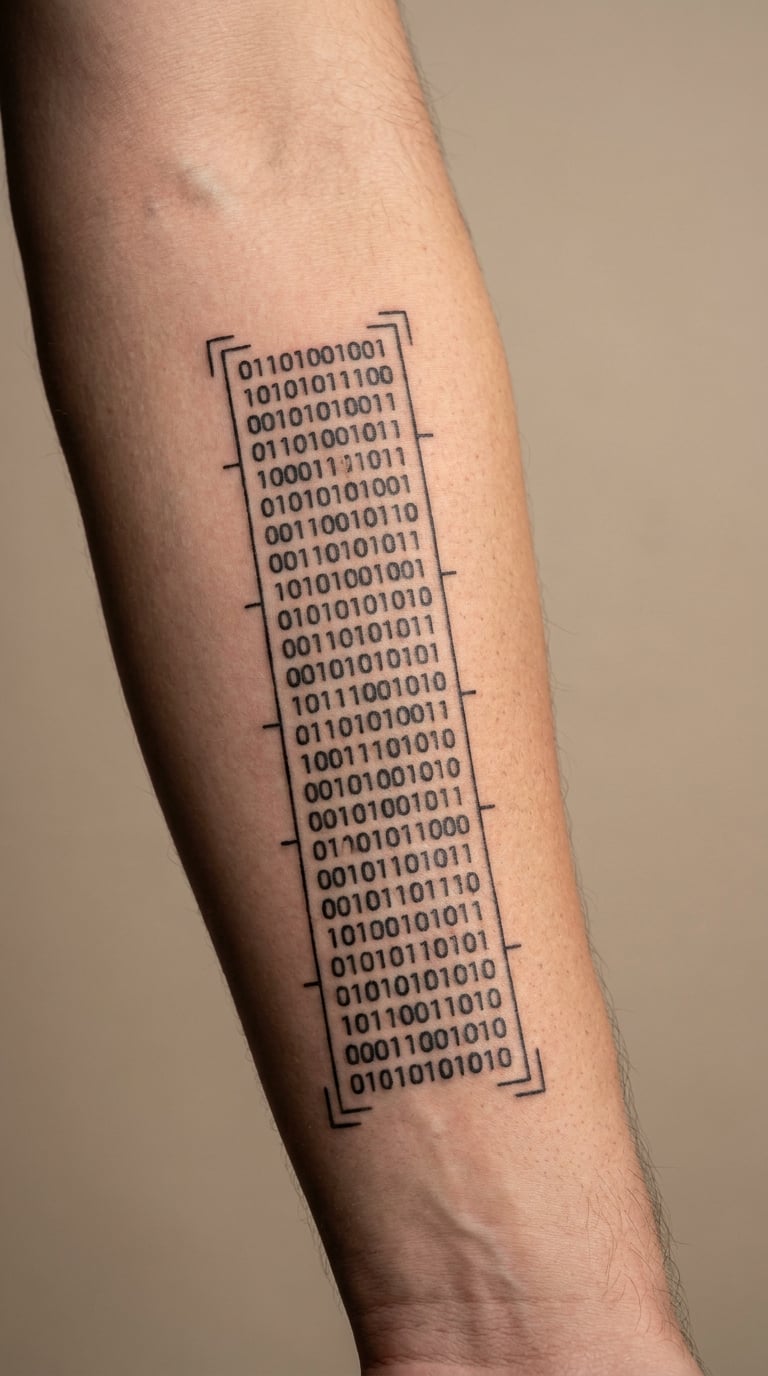
A larger forearm panel holding several verified words, connected by subtle grid lines, brackets, or padded zero runs between blocks. Dense, but with a structure that keeps it from becoming a wall of ink.
The format can carry many private details at once while still reading as one technical composition. It suits someone adding to an existing collection rather than a first tattoo.
Placement: outer forearm, upper arm, calf or a dedicated sleeve panel. Size: 7-12 inch (18-30 cm). Style: blackwork, geometric or fine line. Pain: medium to high over a long session.
Slightly heavier characters and a clear hierarchy help, because tiny uniform rows blur together fast at this size. Make it yours: pick three to five verified words rather than a wall of text, and plan for a second session if the panel runs long.
How to Choose the Right Design
Pick the message length before anything else, because it sets the physical size and the style. A short greeting fits a wrist line in one session. A name, a date or several words needs a panel and probably more than one sitting.
Then match the style to the placement. Straight runs of characters suit flatter skin, so forearms, upper arms and calves take them cleanly. Wrists, knuckles, fingers and ankles flex, and fine detail there is where fading shows up first.
Detail scale is the third filter, and it is the one people skip. Count your characters, divide by the length you want, and check the resulting digit height with the artist. A digit under about a quarter inch is a lot of work with very little payoff.
Where binary code tattoo ideas fit best on the body
| Placement | Typical size | Legibility after healing | Suits |
|---|---|---|---|
| Inner forearm | 2-6 inch (5-15 cm) | Good | Messages, names, first tattoos |
| Outer wrist | 2-3 inch (5-8 cm) | Fair | Short sequences, symbols |
| Knuckles and fingers | 1-2 inch (2.5-5 cm) | Poor over time | Bold pixel work only |
| Upper arm and calf | 5-12 inch (13-30 cm) | Good | Panels, dotwork fields, illustrations |
| Collarbone | 4-7 inch (10-18 cm) | Fair | Single ribbons and lines |
| Ankle | 2-3 inch (5-8 cm) | Fair | Compact square blocks |
Proofing matters more here than in most tattoo work. Give the artist your exact string in writing, ask them to write it back to you, and check the character count. If two byte blocks in your message look identical, decide together how the artist will separate them before the stencil goes on.
Anyone extending an existing binary piece has a different problem. Owners of binary armbands usually want a companion design that shares line weight rather than competes with it, so bring a photo of the healed piece to the consult.
Cost and Session Time
US shops mostly charge either a flat price per piece or an hourly rate, and binary work sits somewhere in between because the character count drives the time. A micro or single-digit design usually lands somewhere around $80 to $150, and a small standalone piece with a short word run often sits between $150 and $300. Medium linework across a full forearm runs into the few-hundred range, while detailed pieces and large panels commonly start near $800 and climb once you add a second sitting.
Complexity, artist rate, city, shop minimums, and whether the design is custom all shift the final number, so treat any range you find as a starting point rather than a quote. Custom work costs more than picking a design from a flash sheet, and a flash sheet with a binary layout still needs proofing.
Ask about the session split before booking. A panel planned as two sittings is a better outcome than a single long session that ends with unfinished characters and a rushed outline. Most artists will also tell you the honest session length once they see the exact string, because forty characters take far longer than the same design drawn as blocks.
Aftercare Basics
- Follow your artist’s aftercare instructions first. They know what they did to your skin, and generic advice can conflict with it.
- Wash gently with clean water and a mild unscented soap, then pat dry rather than rubbing.
- Use only the product your artist recommends, in thin layers, for as long as they tell you to.
- Do not pick, scratch or peel flakes, and keep fresh tattoos away from swimming pools, hot tubs and long soaks.
- Wear loose clothing over the area and use sun protection on exposed placements once healed.
- Contact the artist directly about redness that spreads, swelling that worsens, or a character that looks wrong, and follow their guidance rather than searching online.
Frequently Asked Questions
What does binary code mean in a tattoo?
It means the design carries a message written in base 2, the two-digit system computers use. Every letter becomes a fixed string of zeros and ones, usually eight digits per character in 8-bit ASCII, so a name or date can sit on your skin as code that almost nobody can read. The meaning is whatever message you chose to encode.
What is the smallest size for a binary code tattoo?
Around 2 inches (5 cm) long is realistic for a single short 8-bit line, with characters roughly a quarter inch tall. Going smaller usually means fewer characters and a very long session per word, and digits under about an eighth inch tend to heal into a smudge. Ask your artist to lay out the full string at your target size before you commit.
Where is the least painful place for a small binary code tattoo?
The outer upper arm, the outer thigh and the calf are usually the calmest spots, mostly because there is little bone right under the skin. Inner forearm and wrist sit at medium, and knuckles, fingers and the ankle bone run higher. Wherever you go, a short piece finishes faster, and shorter usually means easier.
Do fine-line binary tattoos fade quickly?
They fade faster than solid blackwork, especially on the hands, fingers, wrists and any sun-exposed placement. Tiny characters, narrow gaps and hairline detail blur first, while even repeated digits hold up well. Ask for a slightly heavier line weight than looks necessary, and plan a free or discounted touch-up with the artist for around six months out.
How do I make sure my binary tattoo says the right thing?
Write the exact string down and hand it to the artist in writing, then have them read it back before the stencil goes on. Check the character count, and confirm the encoding method you used, since date and number conversions differ between people. If two character blocks look identical, agree on a visual difference now rather than hoping nobody notices later.
Where to Start With Your First Binary Tattoo
If this is your first tattoo, start with idea 1, idea 12 or idea 16. All three sit in the 2-4 inch (5-10 cm) range on a wrist, forearm or ankle, and all three read cleanly without a long session. Bring a written string, let the artist set the character size, and skip anything under a quarter inch tall.
Adding to a collection you already have? The larger panel options, idea 5, idea 13 and idea 24, extend an existing arm or leg without arguing with what’s there. Bring a photo of the healed work so line weights match, and plan for more than one sitting.