
22 Coordinates Tattoo Ideas: Best Map Designs (October 2026)
These 22 coordinates tattoo ideas are 22 designs, not one location at latitude 22. Each one puts a real point on the planet into ink, usually a birth hospital, a hometown, a wedding field, a trailhead or the spot where you met someone. A coordinates tattoo is small, quiet and readable only by you, which is exactly why it keeps working years later.
What makes a coordinates tattoo hold up on skin is restraint. Numbers get blurry fast when the artist goes too thin, and a full detailed map turns to mud at three inches across. The designs below stay inside a line weight that survives healing, and each one lists a realistic size so you can walk into a consultation with something in mind.
Most people book a first appointment two to six weeks ahead. If you are planning around a wedding, a birthday or a season of travel, add three months to be safe, since healed photos of your own placement are the only honest test of how the design reads.
22 Coordinates Tattoo Ideas: Quick Guide
All 22 designs in order, with the style that suits each one, the placement that frames it best, a realistic size in inches, and how the placement usually feels.
| Idea | Style | Best placement | Size | Pain |
|---|---|---|---|---|
| 1. Fine-line latitude and longitude map | Fine line | Inner forearm | 3 x 2 inch | Low to medium |
| 2. Minimalist home coordinates | Fine line | Inner wrist | 2 x 1 inch | Low |
| 3. World map with location pin | Illustrative black and grey | Upper arm | 4 x 3 inch | Medium |
| 4. Globe with coordinates | Blackwork with soft shading | Shoulder | 4 inch diameter | Medium |
| 5. Topographic contour map | Fine line | Forearm | 5 x 3 inch | Medium |
| 6. Vintage atlas map | Vintage illustrative | Upper arm | 5 x 4 inch | Medium to high |
| 7. Compass rose coordinates | Traditional linework | Chest | 4 x 4 inch | Medium to high |
| 8. City grid map | Geometric minimal | Calf | 4 x 5 inch | Low to medium |
| 9. Mountain peak and coordinates | Fine line | Upper arm | 3 x 3 inch | Medium |
| 10. Island map with latitude lines | Fine line | Forearm | 3 x 2 inch | Low |
| 11. Coordinates in a blackwork circle | Blackwork | Upper arm | 2.5 inch diameter | Medium |
| 12. Watercolor world map | Watercolor | Rib area | 6 x 4 inch | High |
| 13. Map pin and compass | Minimal line | Inner arm | 3 x 2 inch | Low |
| 14. Country outline with coordinates | Illustrative | Calf | 4 x 4 inch | Medium |
| 15. Grid and compass navigation design | Geometric technical | Shoulder | 5 x 5 inch | Medium |
| 16. Map of a favorite route | Minimal line | Forearm | 5 x 2 inch | Medium |
| 17. Coordinates with a rose | Neo-traditional | Forearm | 3 x 4 inch | Medium |
| 18. Antique map of the southern sky | Vintage illustrative | Upper arm | 5 x 4 inch | Medium |
| 19. Map of a birthplace | Fine line | Inner wrist | 2.5 x 1.5 inch | Low |
| 20. Coordinate grid sleeve panel | Technical illustrative | Outer upper arm | 6 x 4 inch | Medium to high |
| 21. Red ink location coordinates | Black and red line | Forearm | 3 x 1.5 inch | Medium |
| 22. Coordinates wrapped around a globe | Black and grey realism | Upper arm | 5 inch diameter | Medium to high |
1. Fine-Line Latitude and Longitude Map
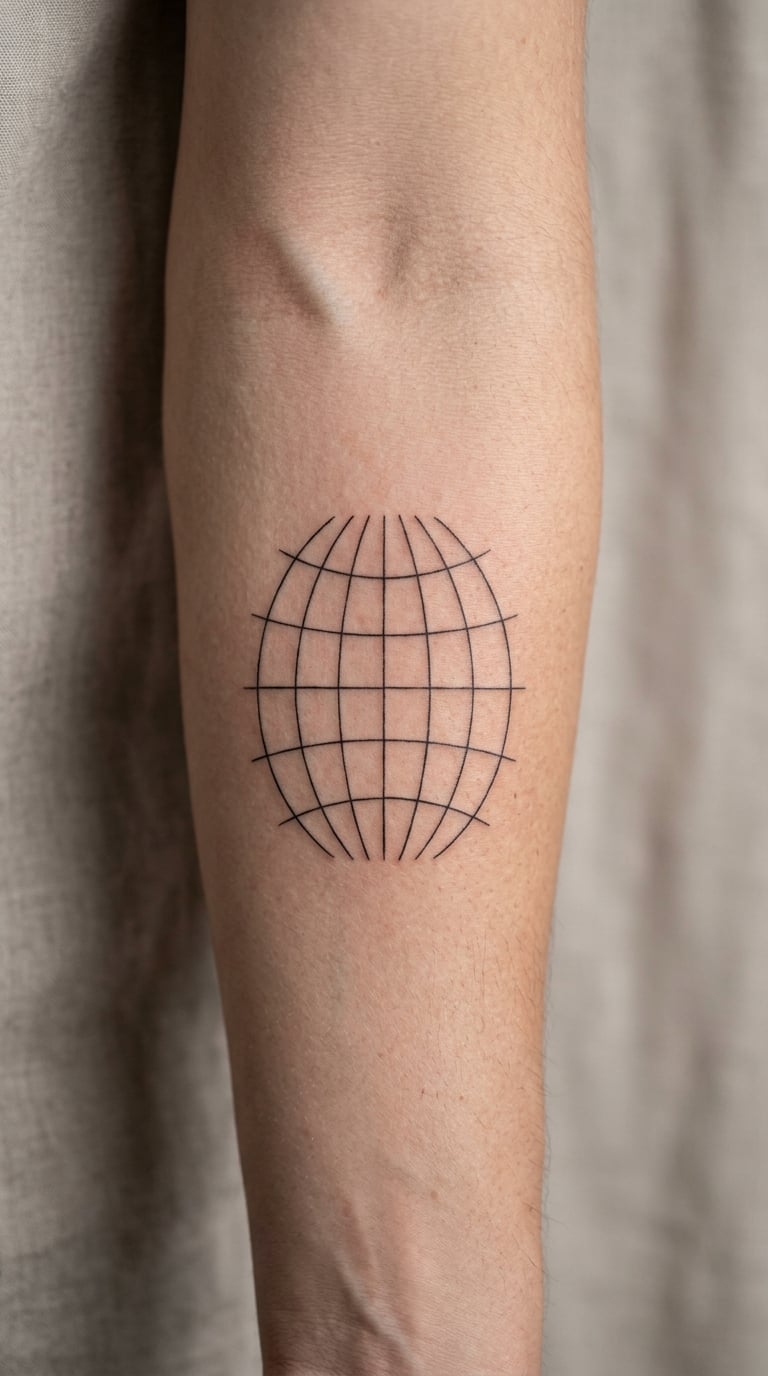
This coordinates tattoo is built from intersecting latitude and longitude lines with your exact numbers set into one open square of the grid. Nothing is filled solid, so the design reads like a fragment of chart paper rather than a badge.
People choose it when they want the location to be legible to themselves but invisible to everyone else. The map language does the hiding for you, since a grid of numbers looks like a design choice rather than a street address.
Placement: Inner forearm or the soft inner bicep. Size: 2.5 to 3.5 inch across (6 to 9 cm). Style: Fine line, single needle, no shading. Pain: Low to medium on the inner arm, and it heals predictably since the skin there barely moves. Expect the smallest hairlines to soften over five or six years, so ask for numbers that sit around half a millimetre or thicker.
Make it yours: Add one tiny dot at the exact grid intersection so the mark is findable by eye, not just by reading.
2. Minimalist Home Coordinates
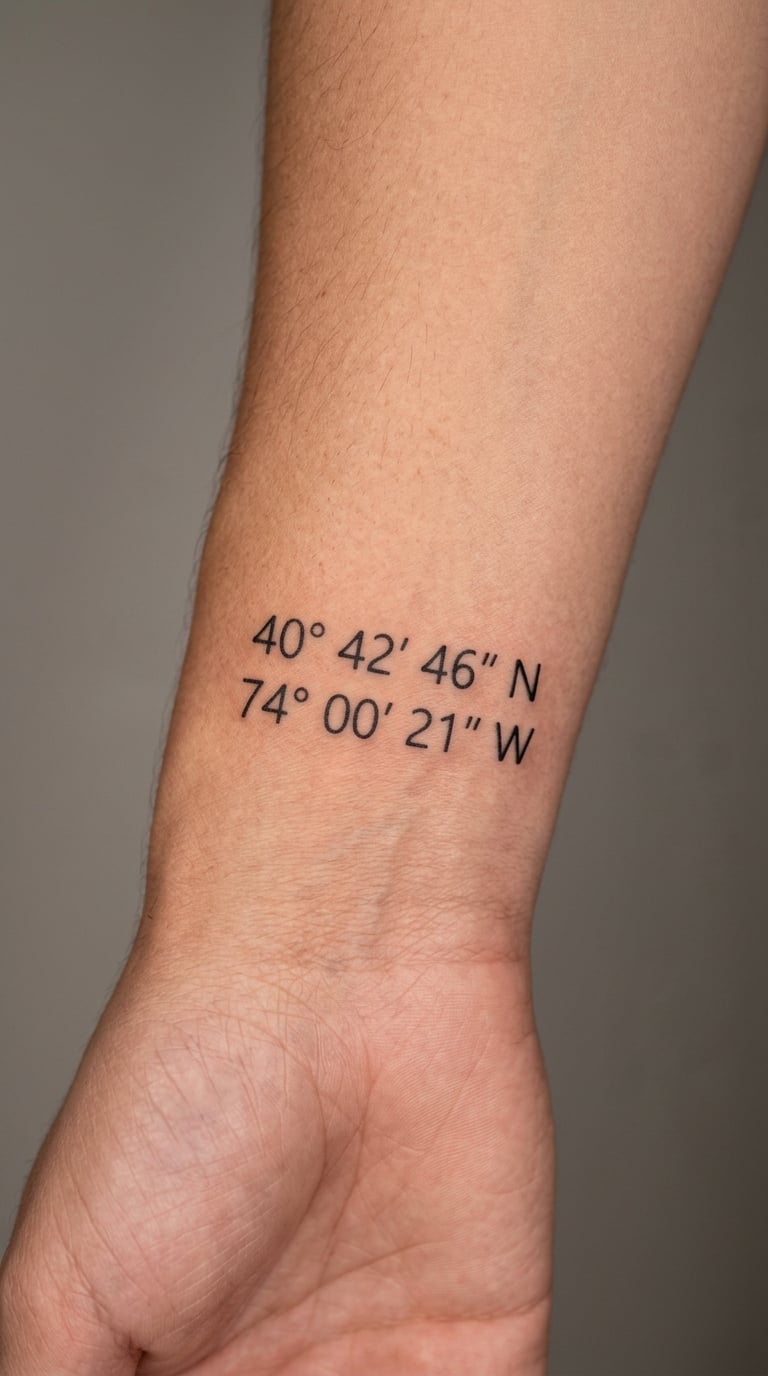
A two-line stack of numerals with no map at all, just latitude on top and longitude beneath, separated by a small gap. This is the least busy design in the set and the one that ages most gracefully, because there is almost nothing to lose when the ink softens.
It is usually the birthplace, the house you grew up in, or the town you left and still think about. The appeal is that it takes under ten minutes to tattoo once the stencil is placed.
Placement: Inner wrist, just above the crease, or the inner forearm near the elbow. Size: 1.5 to 2.5 inch wide (4 to 6 cm). Style: Fine line numerals, simple sans serif lettering with even spacing. Pain: Low, though wrists sting more than forearms because the skin is thin and the veins sit close. Avoid it if you flinch at needles over veins, and ask for a bolder line than the reference photo if the numbers are small.
Make it yours: Run the two lines along the natural curve of the wrist rather than straight across it, which hides the piece better and stops the numerals from stretching when the wrist bends.
3. World Map With Location Pin
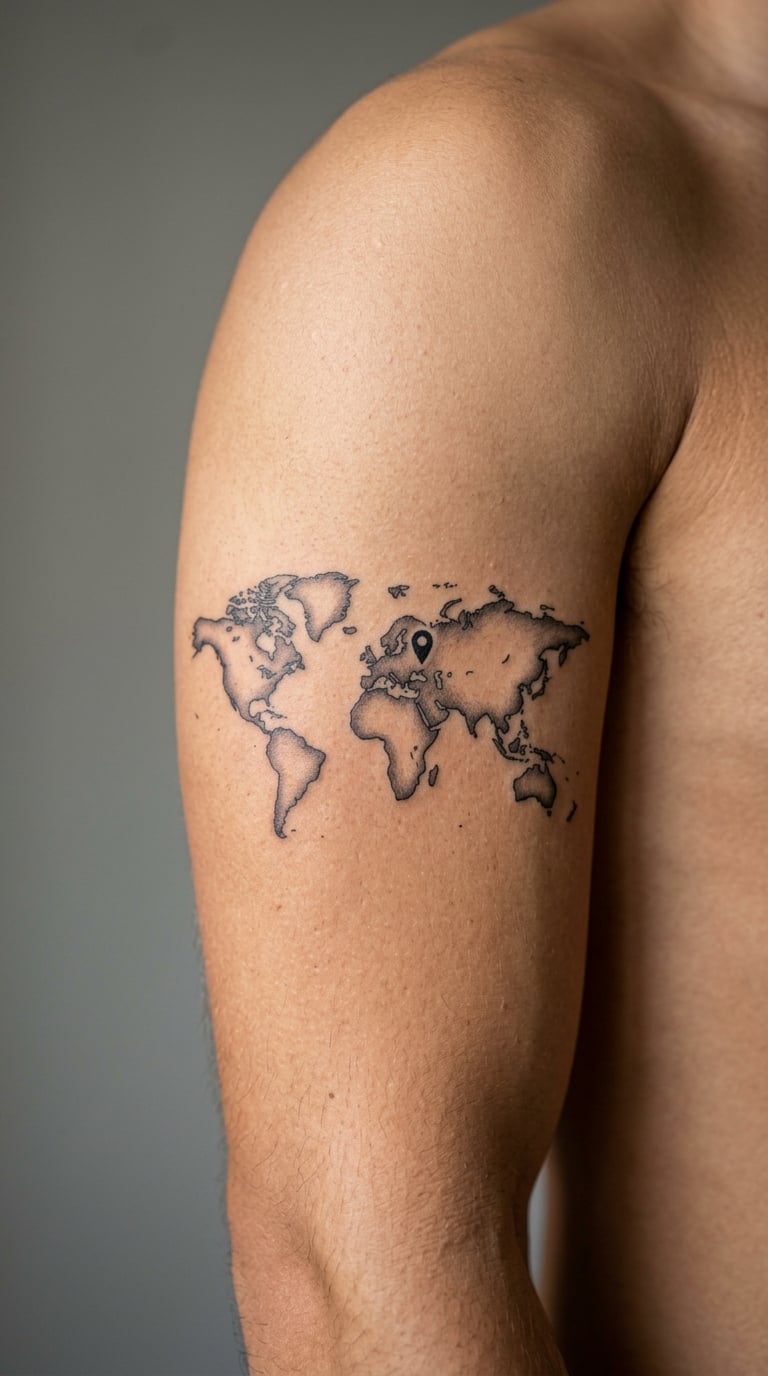
A compact world map with the continents drawn in thin black outline, one ocean left as open skin, and a single filled pin dropped onto the spot that matters. Under it, the coordinates in a small clean line of numerals.
It reads as a home or origin piece. Parents use it for the country a child was born in, and people who moved a lot use it for the one place that still feels like theirs.
Placement: Outer or upper arm, where a four-inch block has flat enough skin to sit square. Size: 3.5 to 4.5 inch wide (9 to 11 cm). Style: Illustrative black and grey, light stippled shading in the oceans. Pain: Medium, mostly from the upper arm’s muscle movement while shading. The continents need to stay open and simplified or the coastlines blur into each other at this scale, so ask the artist to drop detail rather than thicken lines.
Make it yours: Leave one continent blank, the one you have no connection to, and let the negative space do the storytelling.
4. Globe With Coordinates
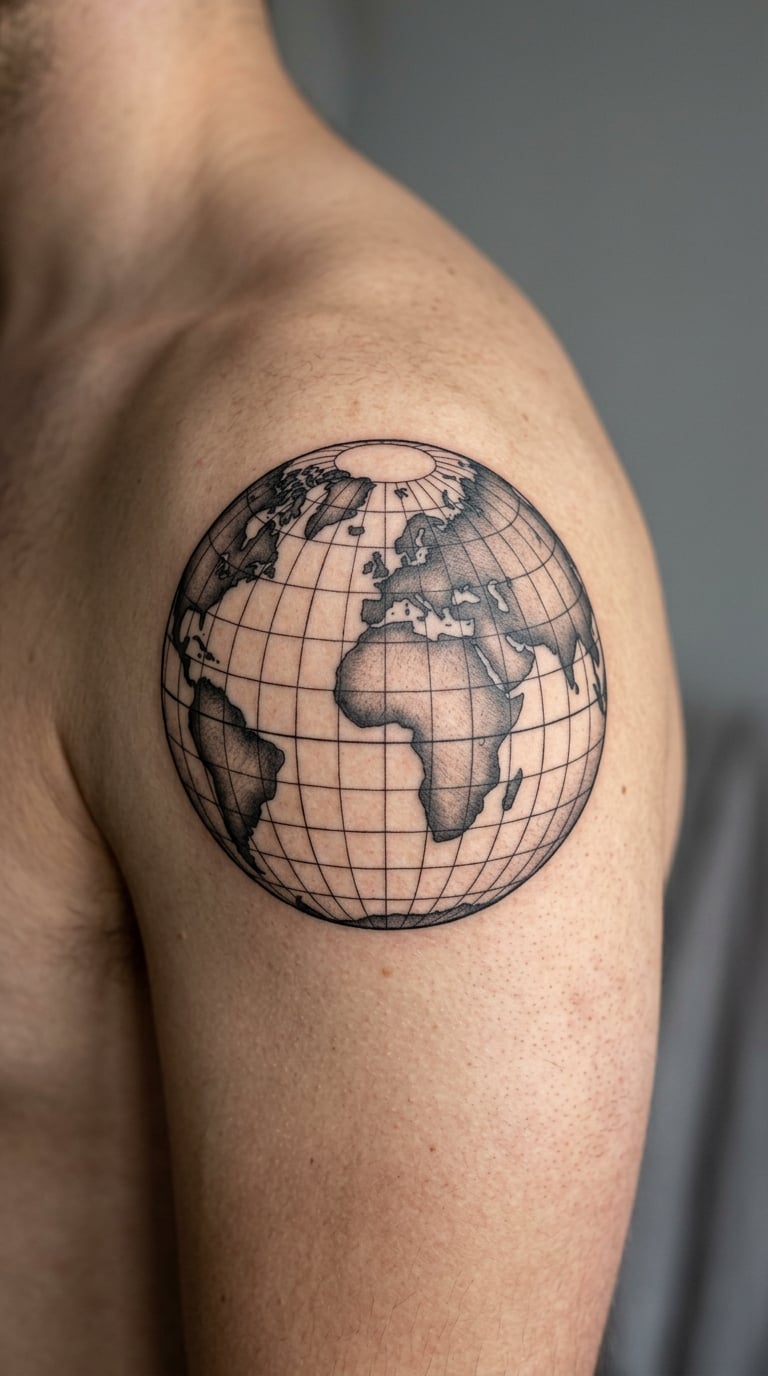
A shaded sphere wrapped in a lat and long grid, with a soft gradient on one side suggesting a light source and the coordinate figures tucked under the equator. It has more depth than a flat map without needing colour.
The globe shape says the world, and the single point on it narrows that down to one place. It suits travellers and anyone marking where a chapter of their life actually happened.
Placement: Shoulder cap or upper chest, high enough that the curve of the sphere follows the body. Size: 3.5 to 4.5 inch diameter (9 to 11 cm). Style: Blackwork with soft grey shading. Pain: Medium, and the deltoid area tends to ache during long shading passes. Shading is what makes or breaks this design, so a layered grey wash beats a single flat tone, and a healed photo from the same placement is worth asking for before you commit.
Make it yours: Rotate the grid so the equator sits at a slight diagonal, which makes the piece look designed rather than printed.
5. Topographic Contour Map
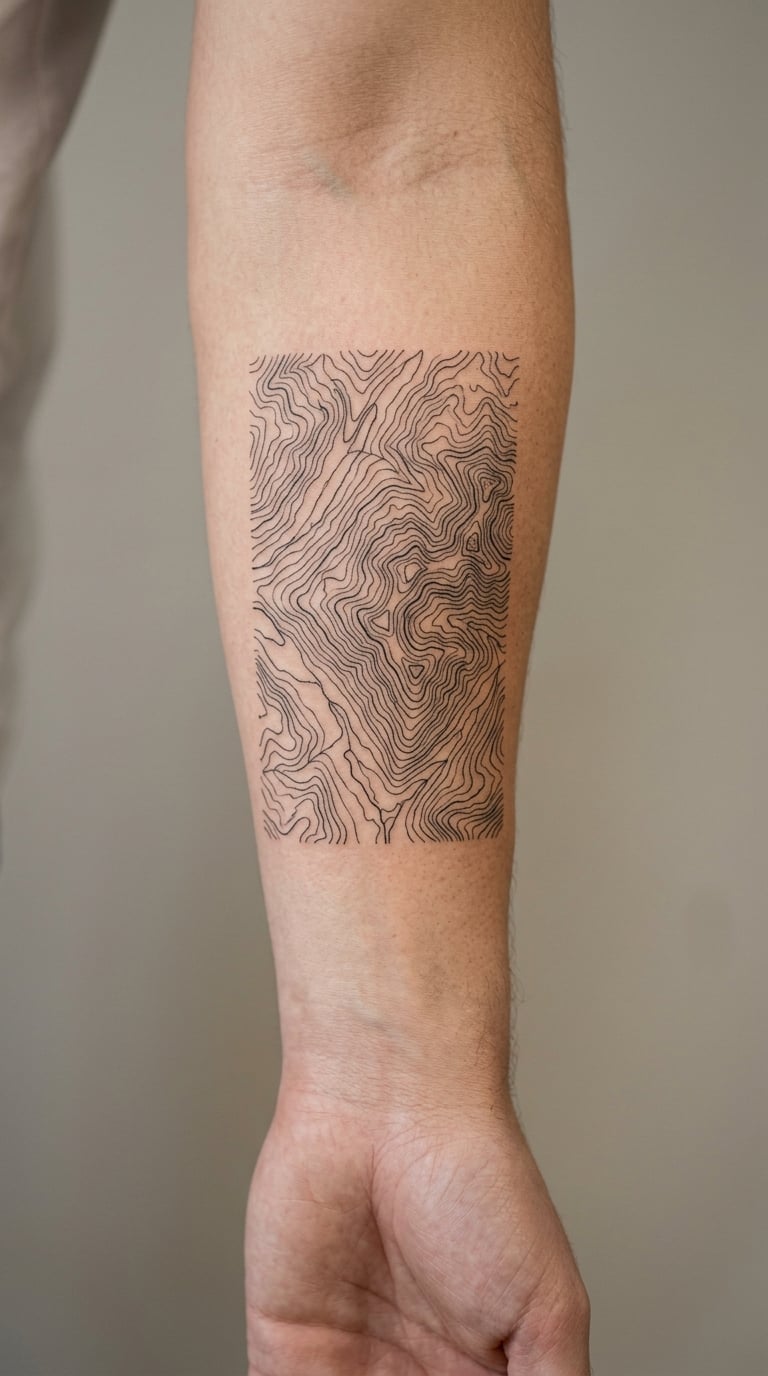
Layered elevation lines tracing the shape of a ridge, valley or coastline, with the contours spaced far enough apart that each one stays a separate line. The coordinates sit small and low, almost an afterthought.
This is the idea people pick for a hike or a stretch of coast that changed how they see things. It carries the terrain itself rather than a landmark, which makes it hard for anyone else to read.
Placement: Outer forearm, calf or the flat of the upper arm. Size: 4 to 5 inch across (10 to 13 cm). Style: Fine line, single-needle contours. Pain: Medium on the forearm, mild on the calf. Line spacing matters more than line weight here, so agree on a gap of a few millimetres between contours, and if the artist wants to pack in more lines, ask for a bigger piece rather than finer ones.
Make it yours: Use the actual elevation data for your spot rather than a decorative contour pattern, then let the highest peak fall where your elbow bends.
6. Vintage Atlas Map
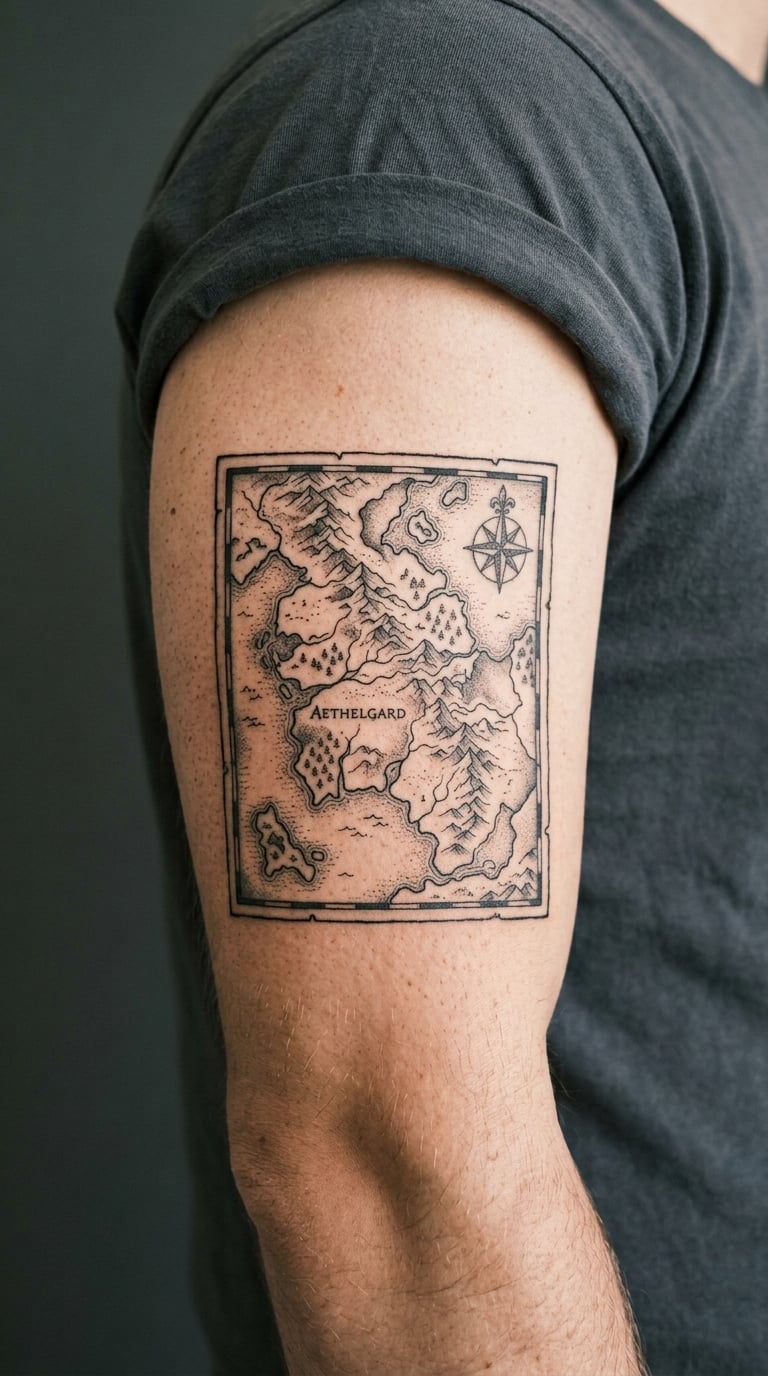
A retro map composition with a hand-inked rectangular border, hatched water, small serif lettering and graticule lines crossing the sheet. It looks like a page from an old atlas that someone tore out.
Older maps are popular for ancestral or heritage places, and for anyone who likes the idea of carrying a piece of history. The style suits a larger placement because the detail has somewhere to go.
Placement: Upper arm, thigh or shoulder blade. Size: 4.5 to 6 inch wide (11 to 15 cm). Style: Vintage illustrative, black and grey with fine hatching. Pain: Medium to high, since a piece this detailed takes two to four hours and long sessions get uncomfortable on the arm. Lettering at this size holds up well, but any coastline thinner than the frame will fade, so keep hatching at arm’s length from the map lines.
Make it yours: Pull the frame from the border of the map you actually used, including its scale bar, so the piece carries a real cartographic fingerprint.
7. Compass Rose Coordinates
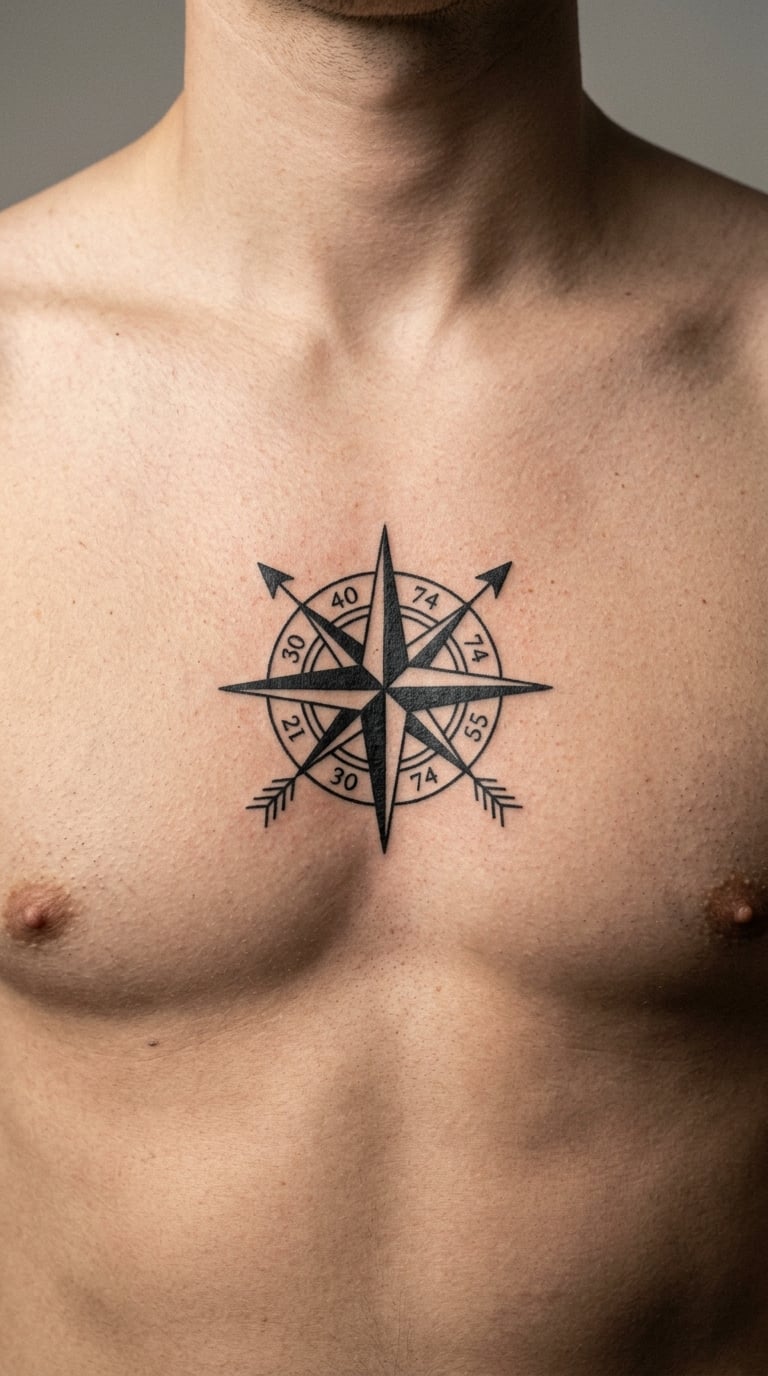
A symmetrical compass rose built from clean black lines, with the coordinate pair set along the bottom point or worked into the north arm. Balanced, symmetrical and readable from a few feet away.
It carries the idea of direction, which is why it often turns up next to north star tattoo ideas and other guidance-themed pieces. People pair it with a wedding location or a new city they moved to.
Placement: Upper chest, sternum or the front of the shoulder. Size: 3.5 to 4.5 inch across (9 to 11 cm). Style: Traditional linework, solid black with even weight. Pain: Medium to high, as chest and sternum work are among the more sensitive areas, and the breastbone feels every pass. Radial linework can sit unevenly on a curved chest, so the artist will likely stretch the skin, which adds to the discomfort.
Make it yours: Rotate the rose so the point marked N aligns with the actual bearing of your coordinates, which is a detail only you would catch.
8. City Grid Map
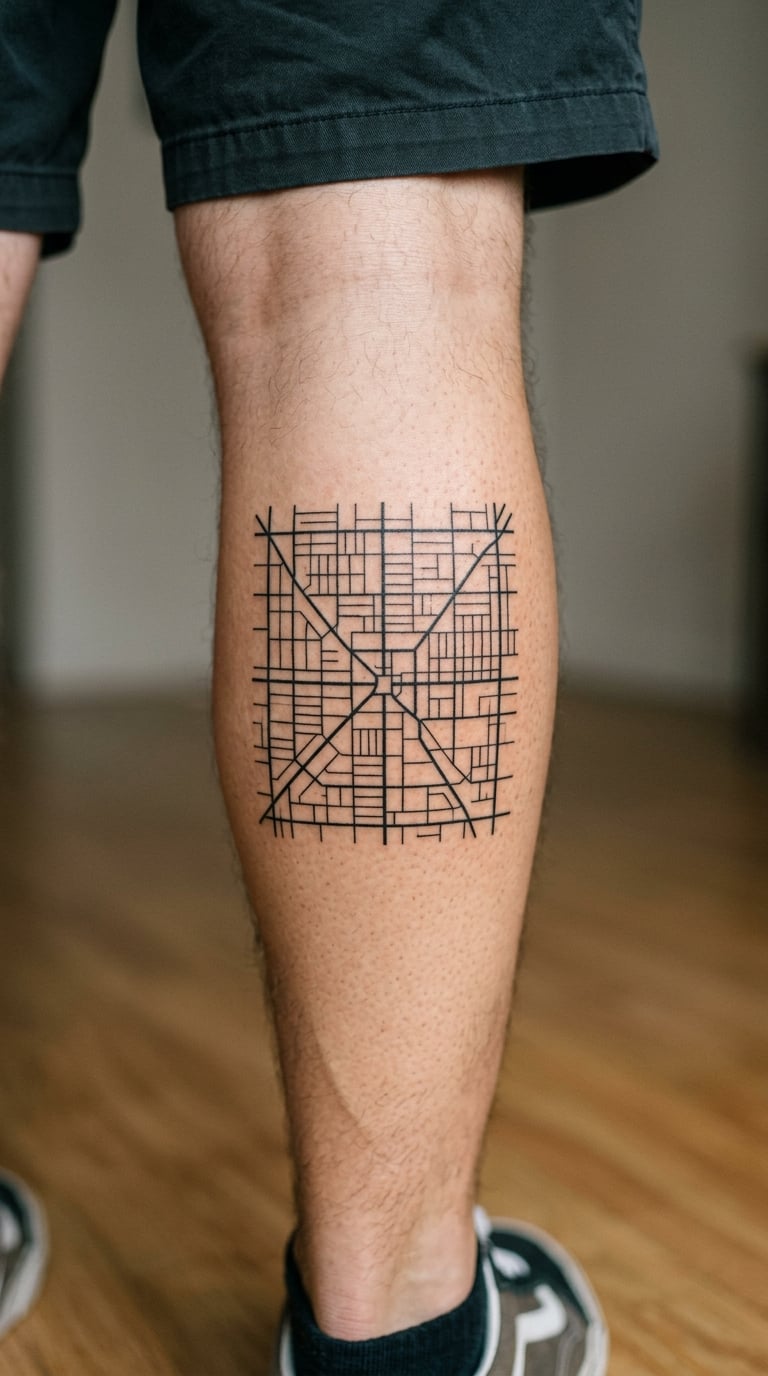
A simplified street grid with roads as straight black lines, blocks left as open skin, one thicker line for the main road and a small dot where your building or favourite corner was.
It is a city tattoo in the most literal sense, and the geometry means it works without any of the usual map ornament. People use it for the first city they lived in alone or the neighbourhood they still know by heart.
Placement: Outer calf, upper thigh or the flat of the upper arm. Size: 4 x 5 inch (10 x 13 cm). Style: Geometric minimal, single-needle linework. Pain: Low to medium, and the calf is one of the calmer spots on this list. The trick is a road width of a millimetre or more, because anything thinner fills in as the tattoo heals and the grid turns into a grey block. Keep gaps between roads at a similar width.
Make it yours: Simplify to twelve streets instead of the real grid, keeping only the ones you could walk home by. The result is recognisable to you and unrecognisable to anyone else.
9. Mountain Peak and Coordinates
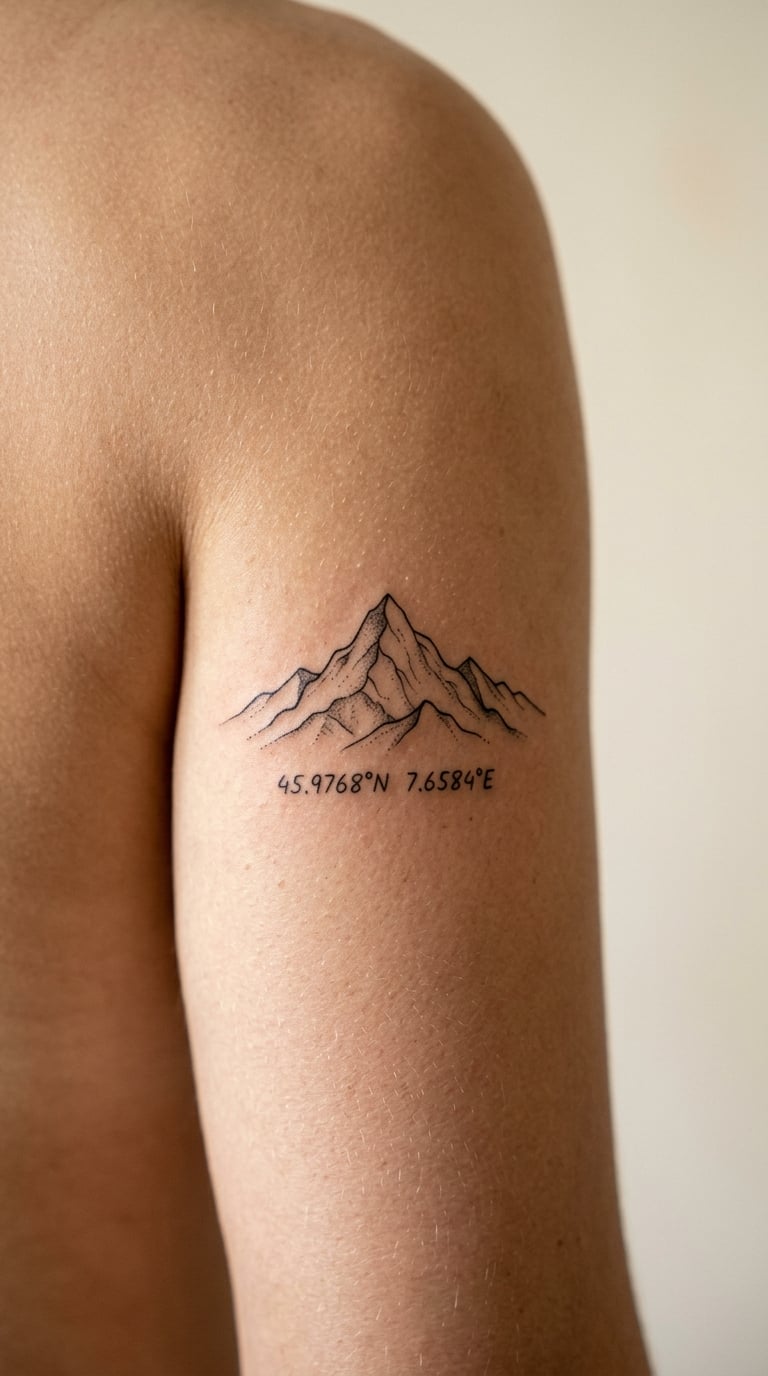
A single sharp mountain silhouette above two short lines of numerals, drawn in fine black line with one hatched snow line for contrast. Restrained detail, plenty of open skin around it.
It is the version for a summit, a trailhead or a trip that mattered more than the destination. Fits naturally beside hiking tattoos with meaning without turning into a full outdoor scene.
Placement: Upper arm, outer forearm or the back of the shoulder. Size: 2.5 to 3.5 inch (6 to 9 cm). Style: Fine line with light hatching. Pain: Medium, mostly the constant movement under the upper arm. The numerals must be the same weight as the ridgeline, not lighter, or the text disappears while the peak stays sharp. If the peak has snow detail, keep the hatching wider than a millimetre.
Make it yours: Match the ridgeline profile to the actual skyline you remember, with the highest point on the side that faces you when you look at the arm.
10. Island Map With Latitude Lines
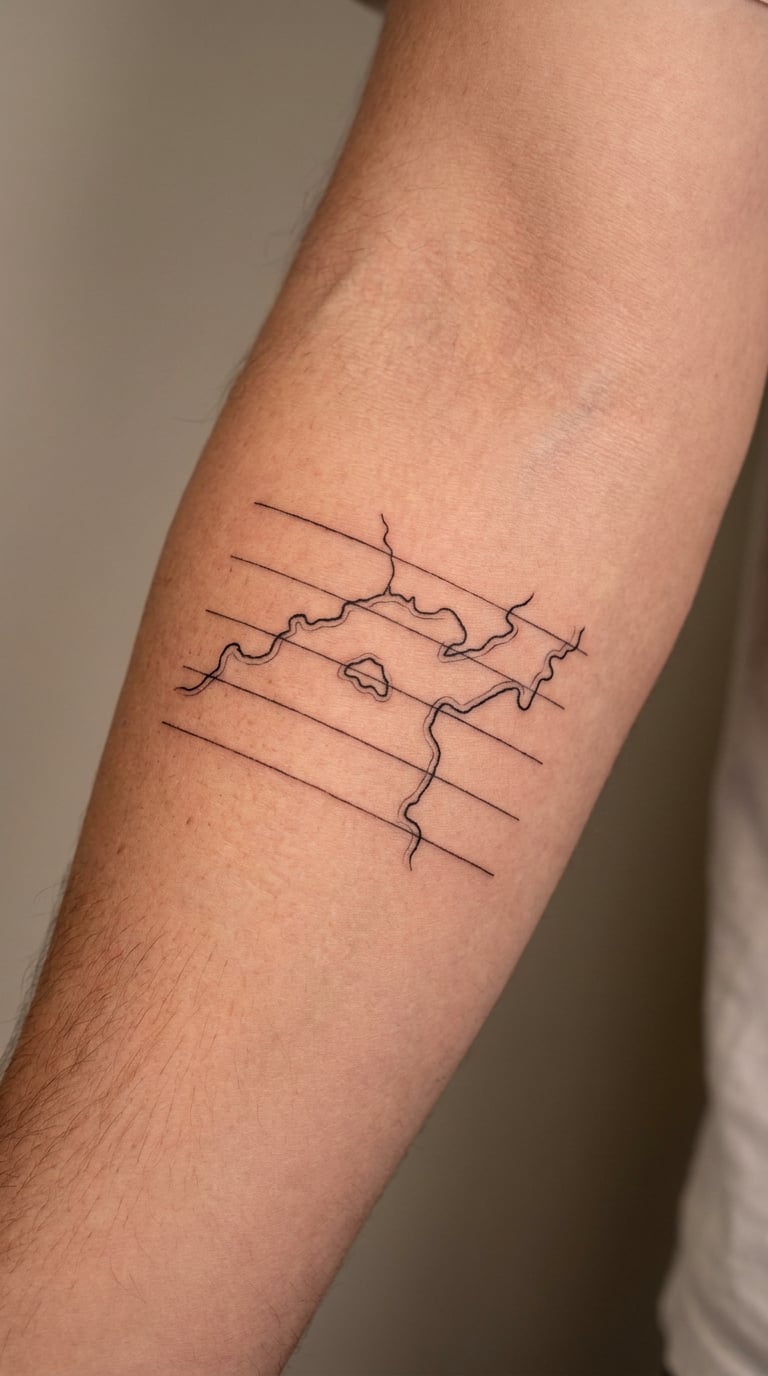
A small coastline or island framed by two or three horizontal latitude lines, the land sitting between them like it’s suspended in a chart. Balanced, quiet and easy to read at arm’s length.
It works for a holiday spot, an island home or a coastal town. The horizontal lines give it structure without adding any of the noise of a full map.
Placement: Inner or outer forearm, the flat area below the elbow. Size: 2.5 to 3.5 inch (6 to 9 cm). Style: Fine line, black only. Pain: Low, one of the easier placements in this list, and the forearm recovers quickly. Coastlines are fiddly, so insist on simplified shapes with fewer inlets, and keep a gap between the coastline and the nearest latitude line so neither merges as the skin relaxes.
Make it yours: Draw the latitude line that actually runs through your location and let the island sit on it, so the composition is factually framed rather than arbitrary.
11. Coordinates in a Blackwork Circle
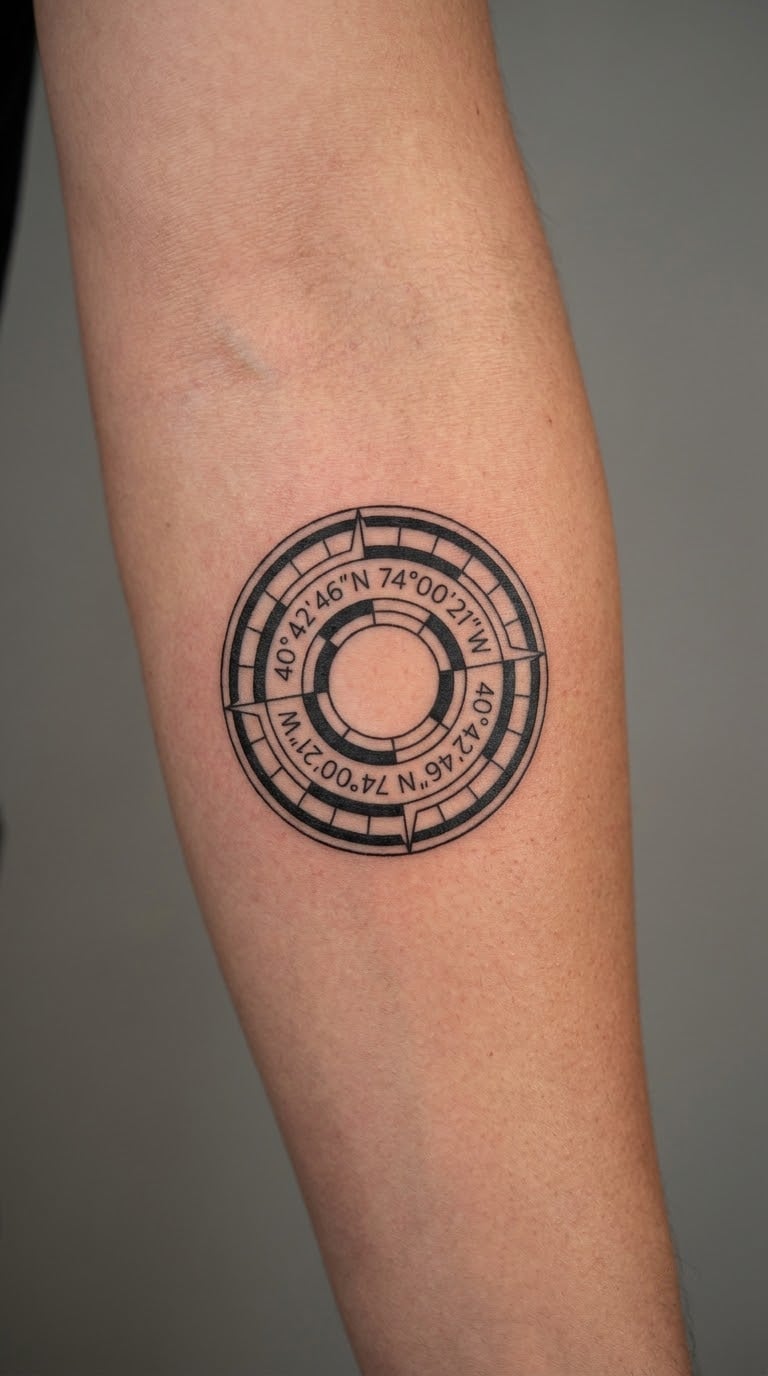
A hard-edged black circle with the coordinate pair set across the middle in negative space, so the numerals read as skin showing through solid ink. Very graphic, very little shading.
It is the most tattoo-like of the small designs, closer to a stamped seal than a fine-line piece. People choose it when the coordinates are as much about the object as the place.
Placement: Upper arm, shoulder or the outer thigh. Size: 2 to 3 inch diameter (5 to 7.5 cm). Style: Blackwork, solid fill with clean negative-space lettering. Pain: Medium, and the solid black fill needs more passes, so the arm will feel worked for a while. Since the letters are skin rather than ink, they stay sharp as the piece ages, which makes this a good choice if you are worried about numerals blurring.
Make it yours: Break the circle with a thin coordinate line running out of the top, so the badge looks like it is pointing at something.
12. Watercolor World Map
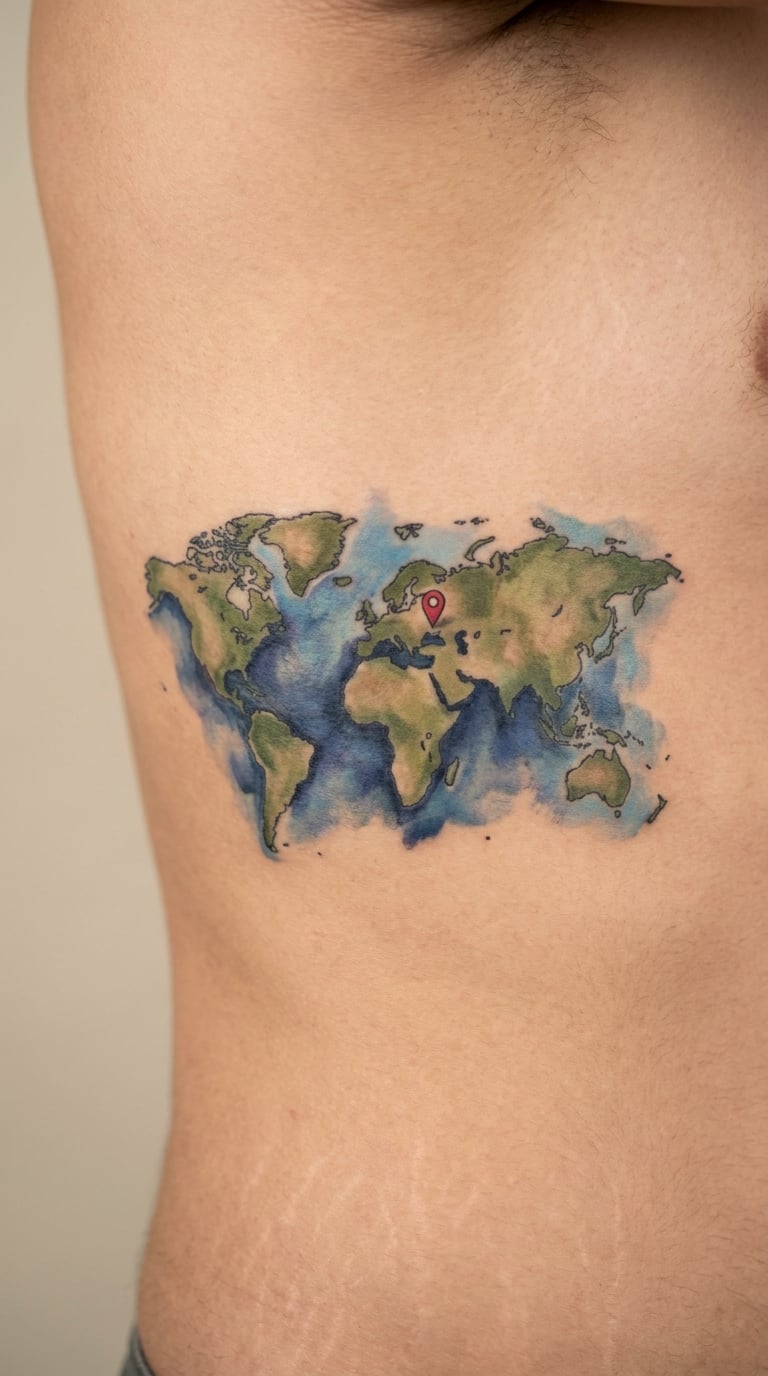
Soft colour washes with a blue ocean, muted green land and a red marker on the point you care about, the numerals tucked underneath in fine black script. Loose edges where the pigment bleeds past the line work.
It is the expressive option, chosen by people who want colour but not a traditional floral piece. It reads as wanderlust and unfinished travel rather than a fixed address.
Placement: Rib area, side thigh or across the shoulder blades. Size: 5 to 7 inch wide (13 to 18 cm). Style: Watercolor with fine black line accents. Pain: High on the ribs, since the skin there is thin, the bone is close and breathing moves it constantly. Colour also means a longer session, often three hours, and pale green washes often need a second visit. The letters must be tattooed in black at normal weight or they disappear into the wash.
Make it yours: Use the water colour of the actual sea or lake near your location instead of a generic blue, then keep the marker the one saturated colour in the piece.
13. Map Pin and Compass
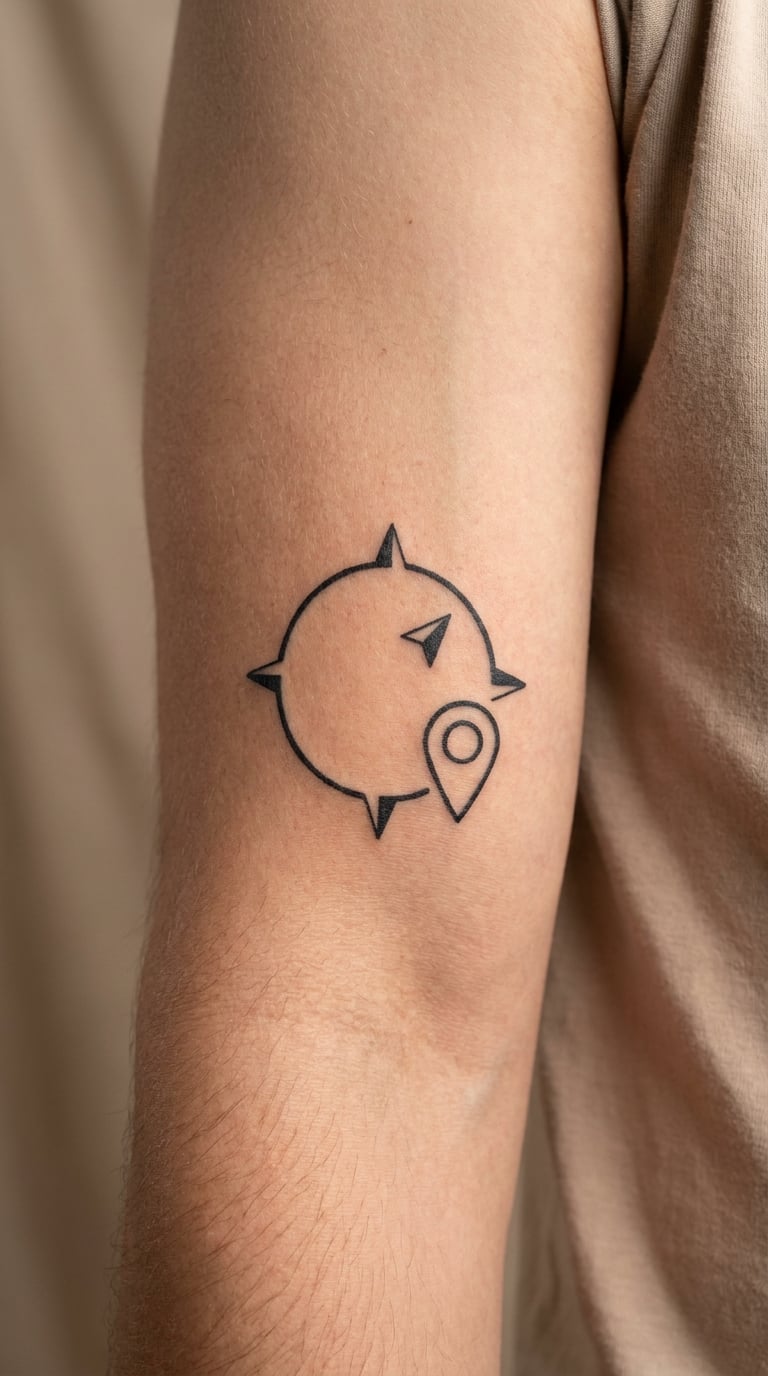
A modern teardrop location pin next to a small compass detail with just one directional point, drawn in thin black line. Two symbols, no map, coordinates set underneath in one short line.
It is more symbolic than cartographic, so it works when the place is emotional rather than literal. Common picks are a first apartment, a hospital or the spot of a first meeting.
Placement: Inner forearm, inner arm above the elbow or the inside of the upper arm. Size: 2.5 to 3.5 inch (6 to 9 cm). Style: Minimal line, black only. Pain: Low, comfortable and quick, usually under an hour. The pin outline is a closed curve, which tends to hold better than an open line, and the compass point is a filled shape that stays sharp. Keep the coordinates on a single line so there is only one baseline to keep straight.
Make it yours: Have the pin drawn with a tiny drop shadow on one side, which gives depth without needing grey shading or a second colour.
14. Country Outline With Coordinates
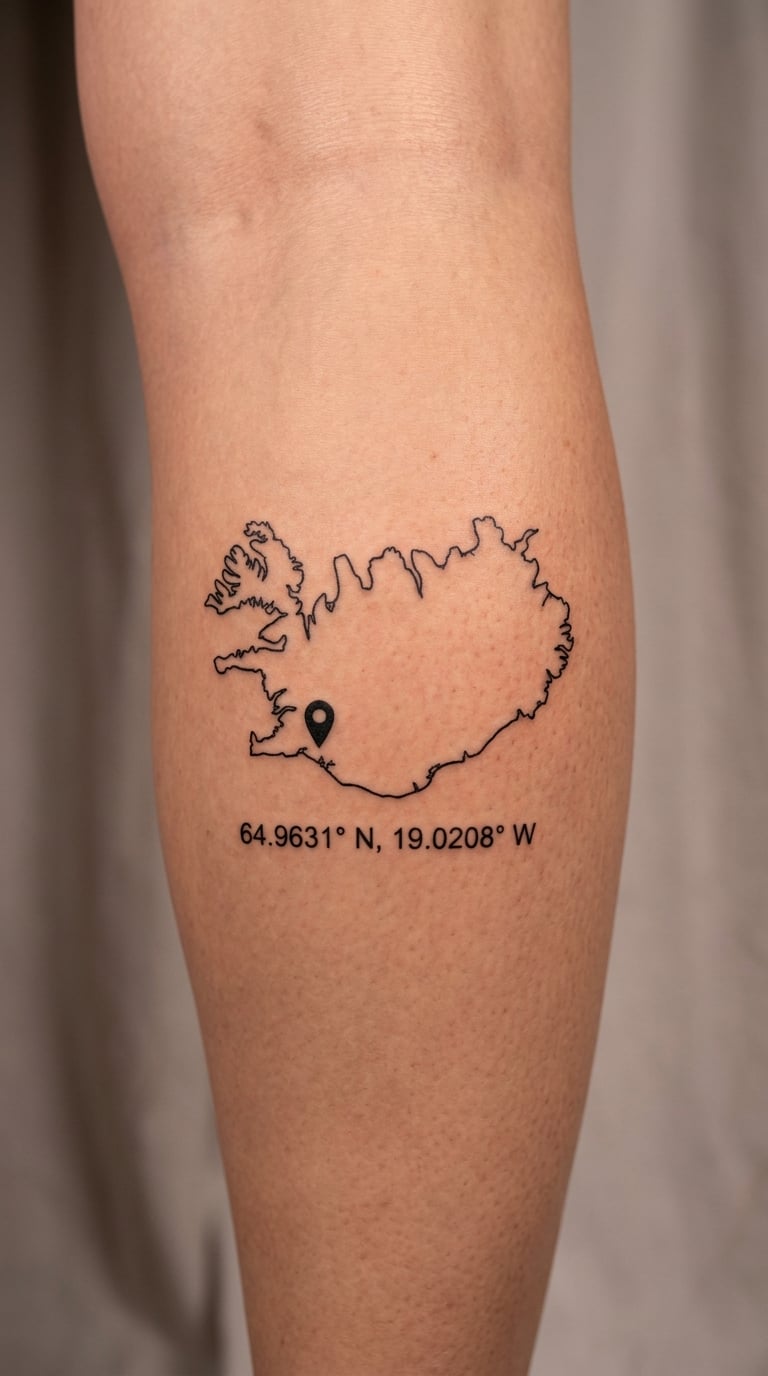
One country drawn as a clean filled or outlined silhouette, a small pin placed on the exact spot inside the border, and the coordinate pair set beneath. The focus is the border rather than any map detail.
It works for heritage, migration or ancestry, and for a first trip somewhere that mattered. Filled black shapes survive aging better than outlines, which is why this one holds its shape well.
Placement: Calf, upper arm or the side of the thigh. Size: 3.5 to 4.5 inch (9 to 11 cm). Style: Illustrative, black fill or heavy outline. Pain: Medium on the calf, more noticeable on the inner thigh. The border is a long continuous line, so any wobble shows, and a country with a very complex coastline is a lot of line for a small space, so a simple outline beats an accurate one.
Make it yours: Fill the country in solid black and leave the pin as an outline, so the two elements read as clearly different pieces of information.
15. Grid and Compass Navigation Design
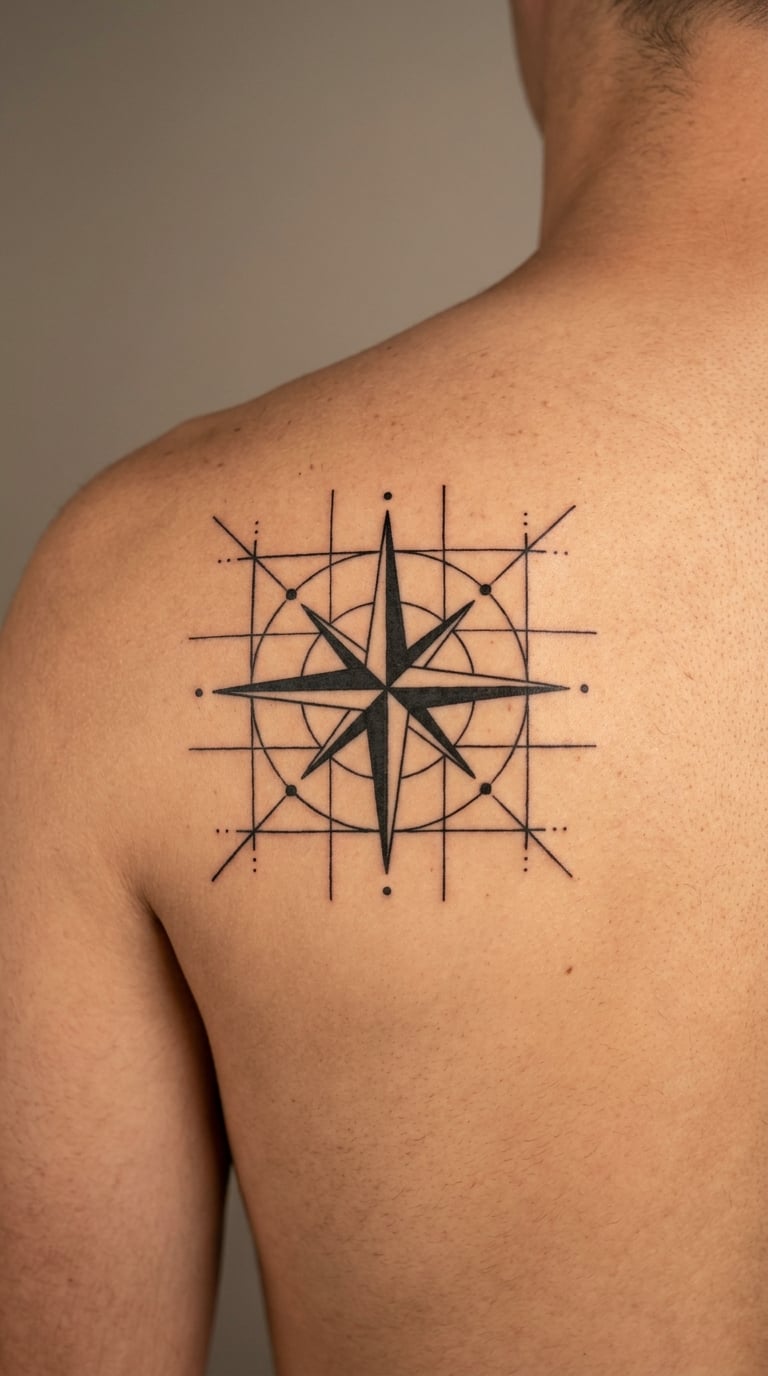
A structured navigation panel: a square grid of evenly spaced lines, a compass point in one corner, a coordinate line running along the base, and generous open space so the geometry can breathe.
It reads technical, like a chart or an instrument panel, which makes it a good fit for someone who likes geometry more than sentiment. It also hides a location well, since the grid is decorative on its own.
Placement: Shoulder cap, upper back or the outer upper arm. Size: 4.5 to 5.5 inch square (11 to 14 cm). Style: Geometric technical linework. Pain: Medium, and the shoulder is a busy area, so the artist will need to stretch the skin to keep the grid straight. Every line needs the same weight or the piece looks accidental, and the grid squares should be at least three times wider than the line so they do not fill in.
Make it yours: Turn the grid so one line runs along your collarbone, which makes the geometry sit with the body rather than fight it.
16. Map of a Favorite Route
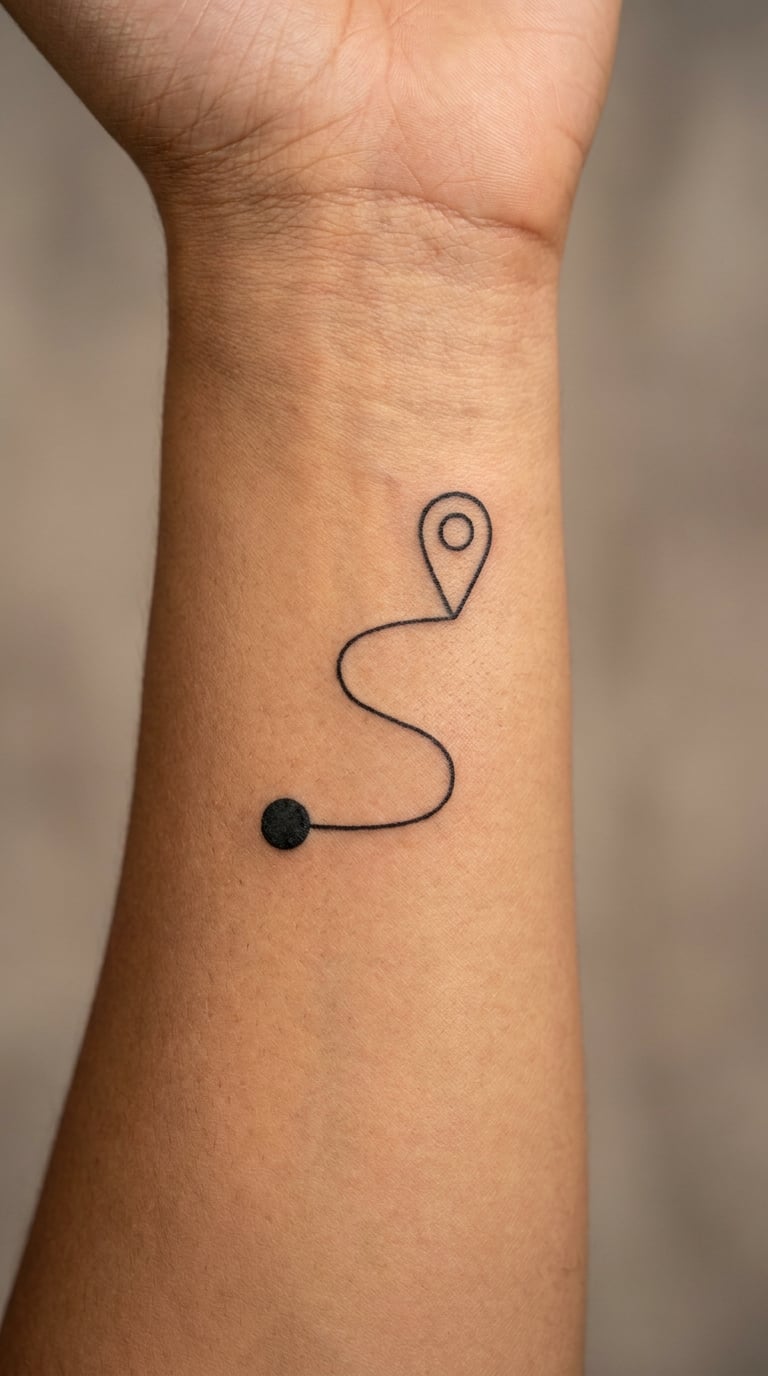
A single winding route line with a small solid dot at one end and a location pin at the other, the coordinate pair set along the line or just below it. A narrow, horizontal composition.
It is for a road trip, a commute you loved, a migration journey or a walk you take every week. A route is a story with a beginning and an end, which is why it works as a memorial too.
Placement: Outer forearm, running lengthwise along the muscle. Size: 4.5 to 5.5 inch long, 2 inch tall (11 x 5 cm). Style: Minimal line, black. Pain: Medium, and the forearm bulges when you grip, so a very fine route line will stretch and thin out over time. Keep the line a millimetre or thicker and let the route have corners and a few switchbacks rather than smooth arcs, which helps the eye read it as a road.
Make it yours: Put the origin dot on the inside of your wrist and let the line travel toward the elbow, so the piece follows the direction of your arm.
17. Coordinates With a Rose
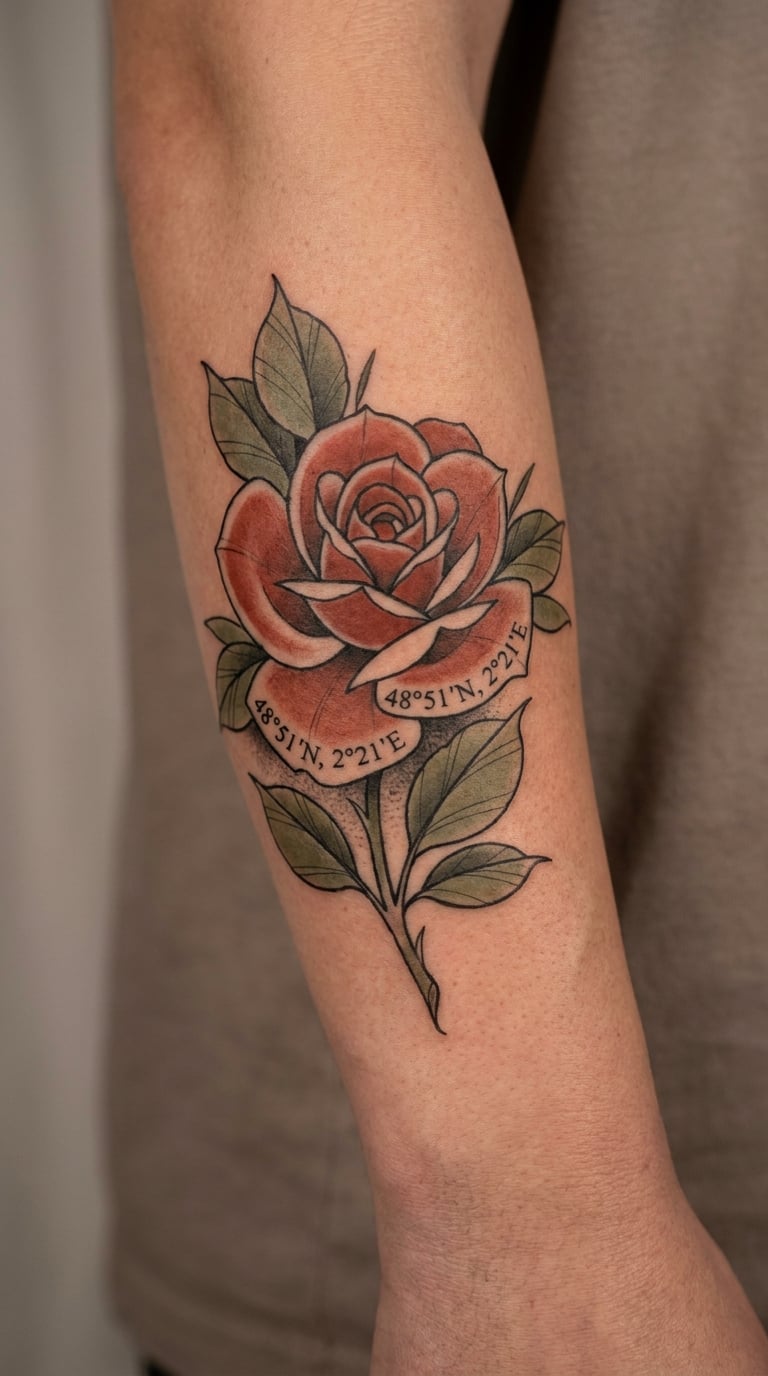
A single rose in neo-traditional line and wash, red petals with a black outline, and the coordinate pair tucked into the negative space beside the stem. One colour, done properly.
It softens the clinical feel of a coordinate tattoo, and it is often chosen for a wedding, an anniversary or a parent. The numerals stay black so they never compete with the colour.
Placement: Outer forearm, upper arm or the side of the thigh. Size: 3 x 4 inch (7.5 x 10 cm). Style: Neo-traditional with a single red wash. Pain: Medium, and the wash needs several passes over the same skin, which leaves the forearm pink for a while afterwards. The stem and leaf lines are thin by tradition, so they will soften first; ask for them to be slightly heavier than the reference, or skip the fine outline and let the wash carry the shape.
Make it yours: Set the numerals inside a small blank banner shape so the type looks intentional and never drifts into the petal edges.
18. Antique Map of the Southern Sky
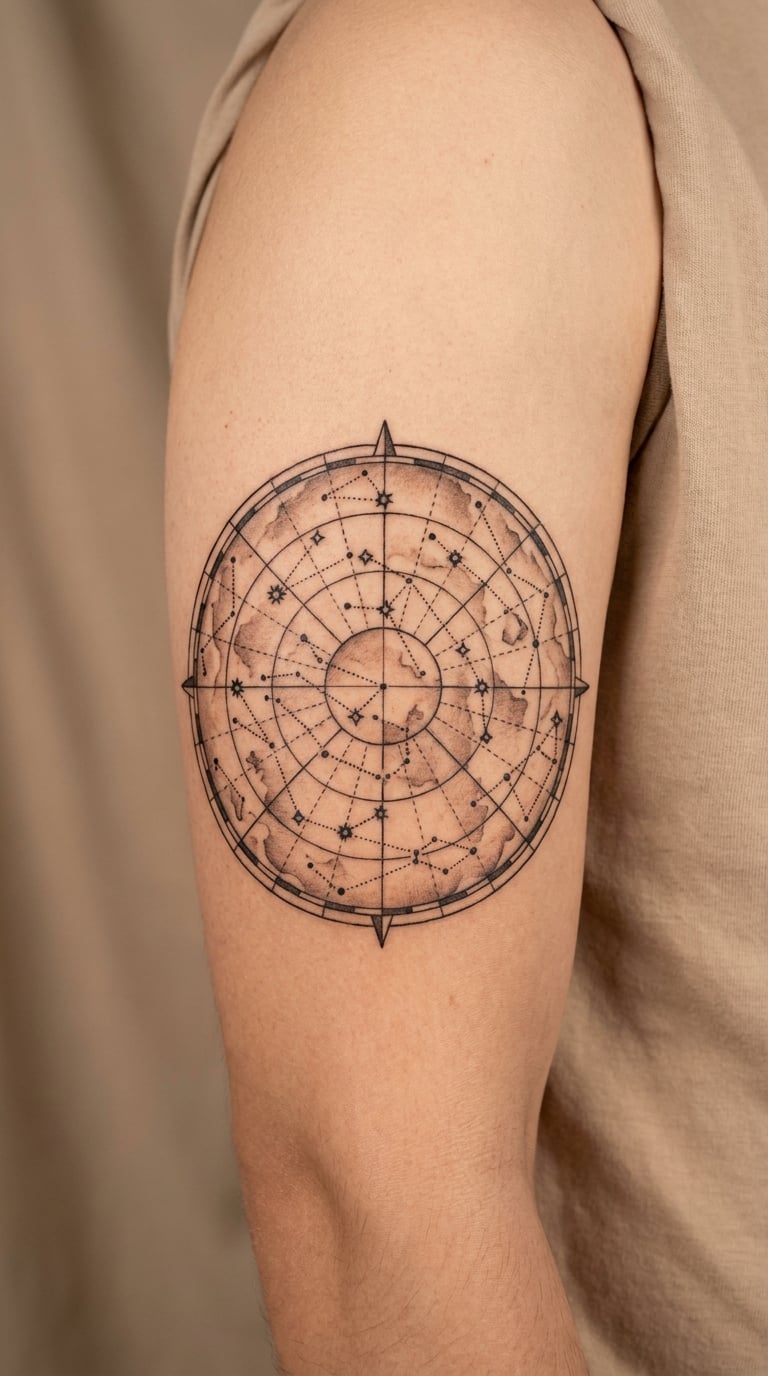
A celestial chart rather than a terrestrial one: constellation points joined by fine lines, a horizon or ecliptic band across the lower third, and celestial coordinates such as right ascension and declination marked at the edge.
It suits people who care about the night sky more than the ground under it, and it pairs naturally with constellation tattoo ideas while reading as a distinct design.
Placement: Upper arm, back of the shoulder or the shoulder blade. Size: 4.5 to 5.5 inch (11 to 14 cm). Style: Vintage illustrative with sepia-toned shading. Pain: Medium, on the arm or upper back rather than the ribs. Star points are small solid dots, which age better than fine connector lines, so favour more points and fewer lines. The coordinate figures are the exception and need normal body weight lettering with even spacing.
Make it yours: Chart the sky over your location on the night of a date that matters, and let one star sit slightly brighter than the rest.
19. Map of a Birthplace
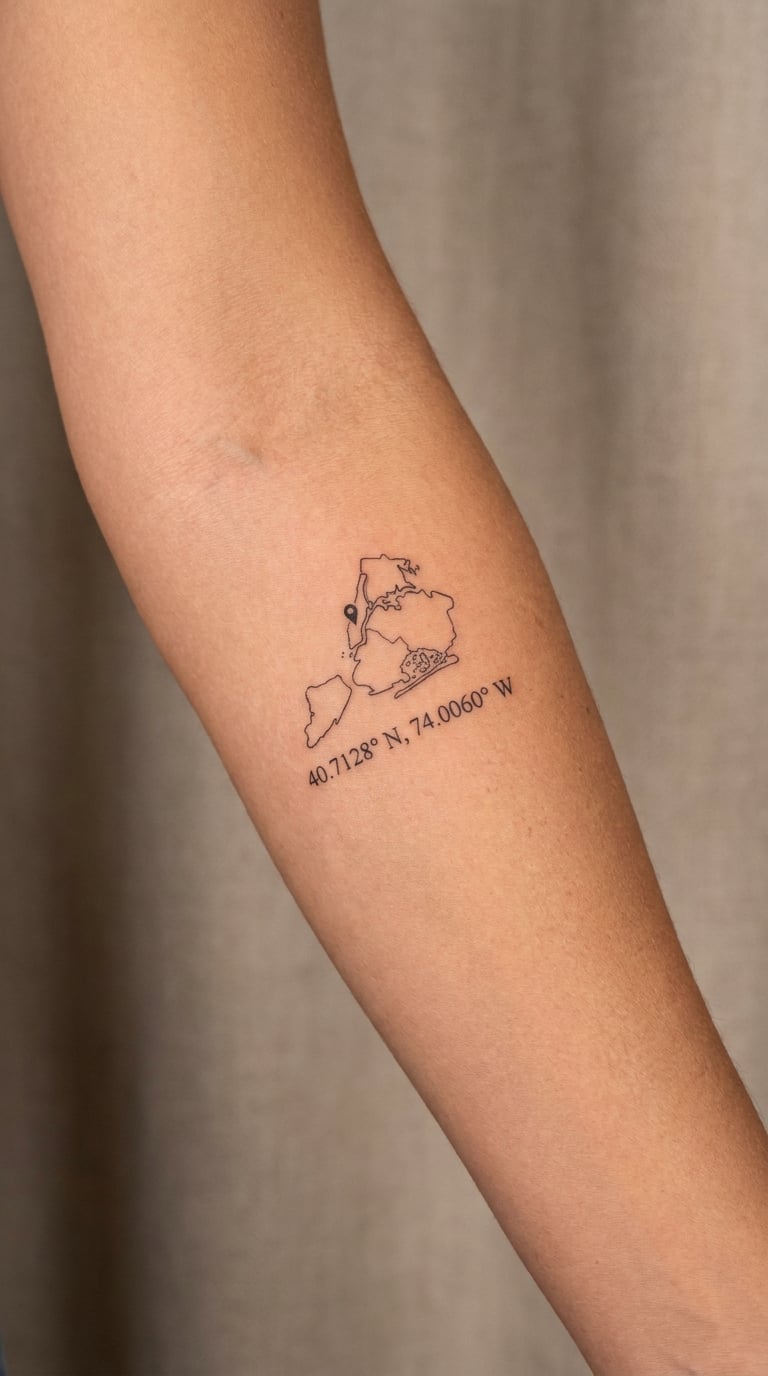
A small regional outline, not a whole country, with a pinpoint on the exact town and the coordinates beneath in a single short line. Under two inches and it reads as a delicate wrist piece.
It is the most common first tattoo in this set, often done for a newborn or worn by someone marking where they started. Small enough to be almost invisible in an office, meaningful enough to explain once.
Placement: Inner wrist or the inner forearm. Size: 2 to 2.5 inch (5 to 6.5 cm). Style: Fine line, black only. Pain: Low, quick and a decent first sitting, though wrist work stings more than expected. At this size the numerals are the whole design, so ask the artist to make them the heaviest element rather than the lightest, and consider two lines instead of a long single line that would wrap the wrist awkwardly.
Make it yours: Pair it with a matching outline on a parent’s wrist, the same town on both, at the same size and the same line weight.
20. Coordinate Grid Sleeve Panel
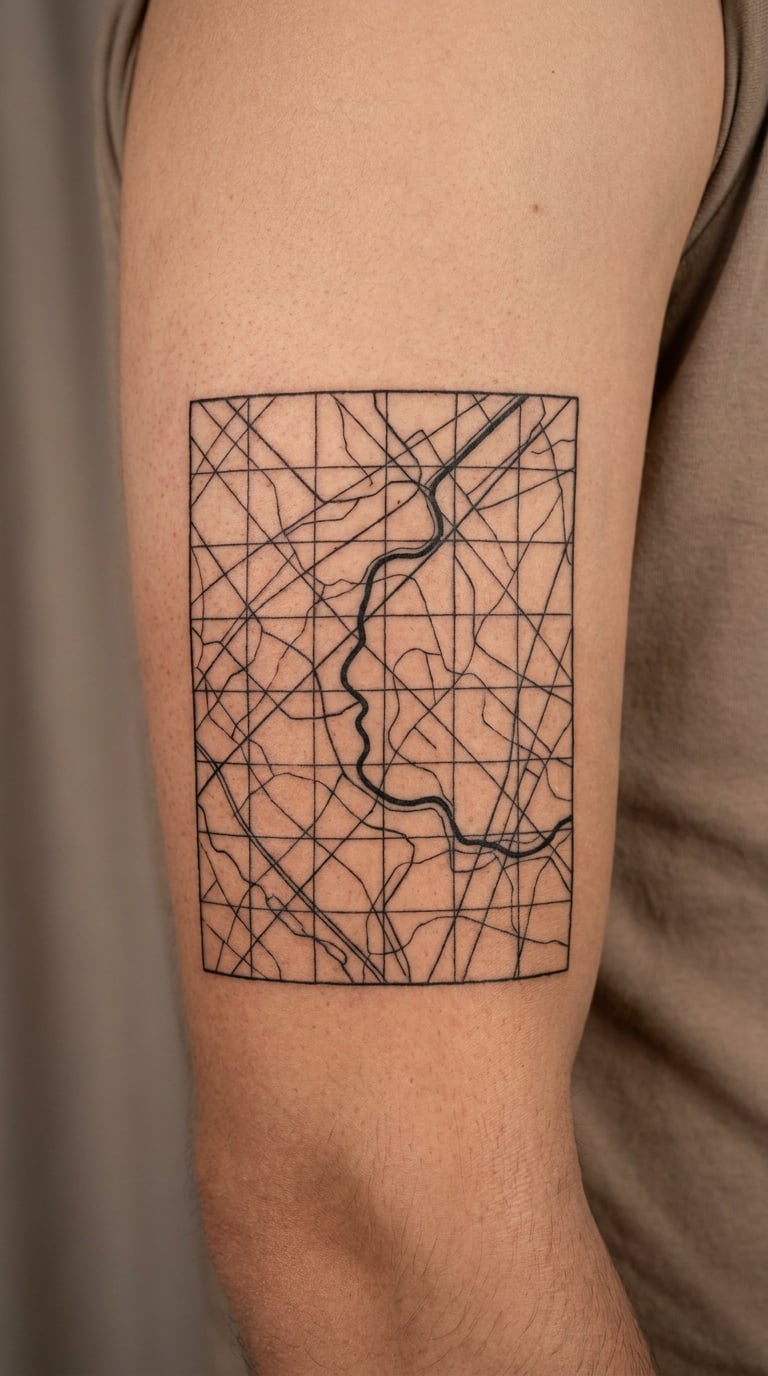
A larger panel: a full technical grid of latitude and longitude lines, one route picked out in a heavier line, a compass element in a corner and coordinate figures along the edge. Built to sit inside a bigger project rather than alone.
It is for people already collecting geography or navigation pieces who want the map itself to be the subject. The scale gives room for detail that a four-inch piece cannot carry.
Placement: Outer upper arm, shoulder or upper back, positioned as one panel of a travel or navigation themed sleeve. Size: 5.5 to 6.5 inch wide (14 to 16 cm). Style: Technical illustrative linework. Pain: Medium to high, since a panel this size runs two to four hours, and outer arm skin is tight by hour three. Grid spacing of a few millimetres is the thing that makes this design succeed, and a technical drawing is worth paying for because a stencil keeps the grid straight over that area.
Make it yours: Overlay the panel with an existing piece in the same line weight so the grid appears to run behind your earlier work.
21. Red Ink Location Coordinates
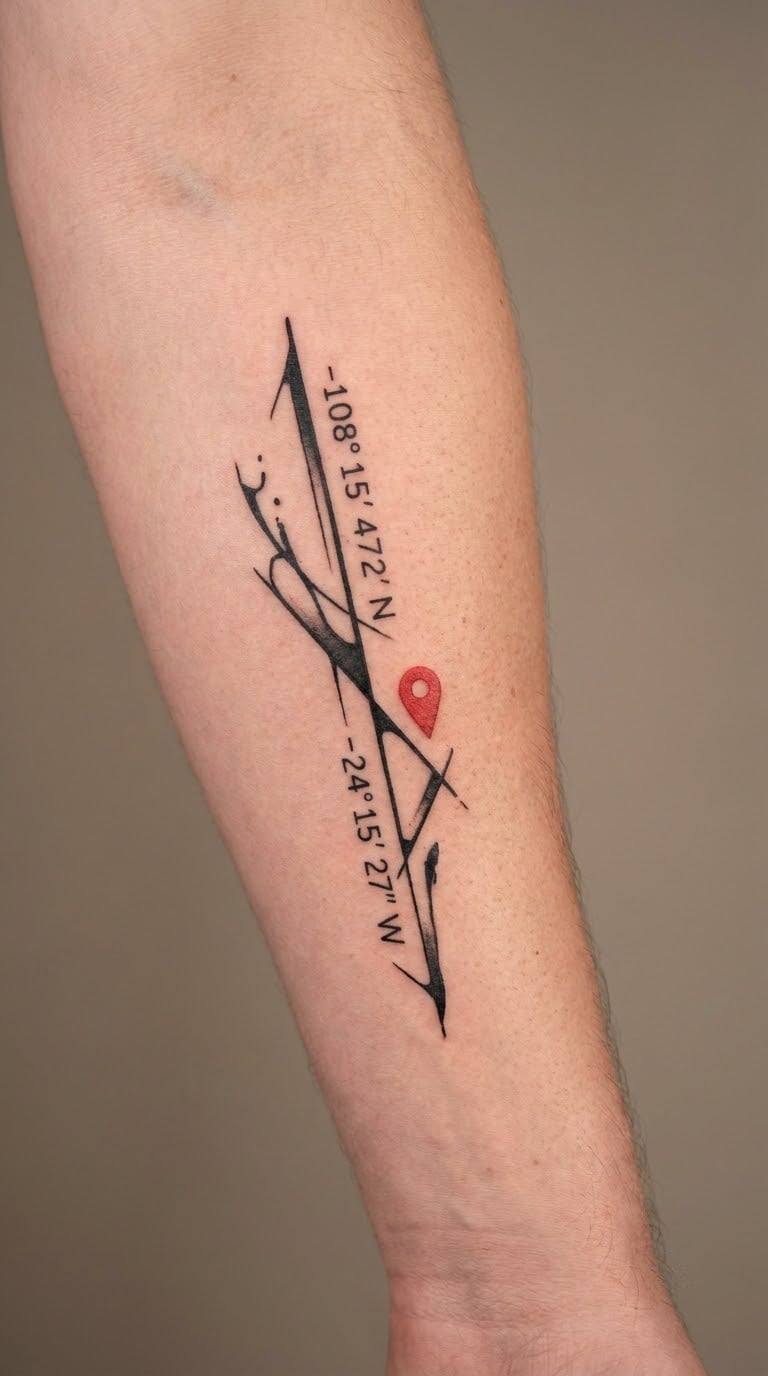
Black coordinate lettering with a single red element, usually the pin or a dot, and nothing else in colour. The one red mark is what the eye goes to first.
It suits people who want colour but not a full wash, and it works for a wedding or a first meeting where one detail, not the whole map, is the point. Red ages to a warmer tone over the years, so pick a shade with some depth in it.
Placement: Forearm, inner arm or the side of the wrist. Size: 2.5 to 3.5 inch (6 to 9 cm). Style: Black and red linework. Pain: Medium on the forearm, a little more on the inner arm near the elbow. Two colours means two passes over the same area, and the second pass is the stingy one. Keep the red element to something the size of a fingernail or smaller, since larger flat colour areas in red shift the most as they fade.
Make it yours: Use the red only for a dot at the exact grid point and leave the pin in black, so the colour marks the location rather than the symbol.
22. Coordinates Wrapped Around a Globe
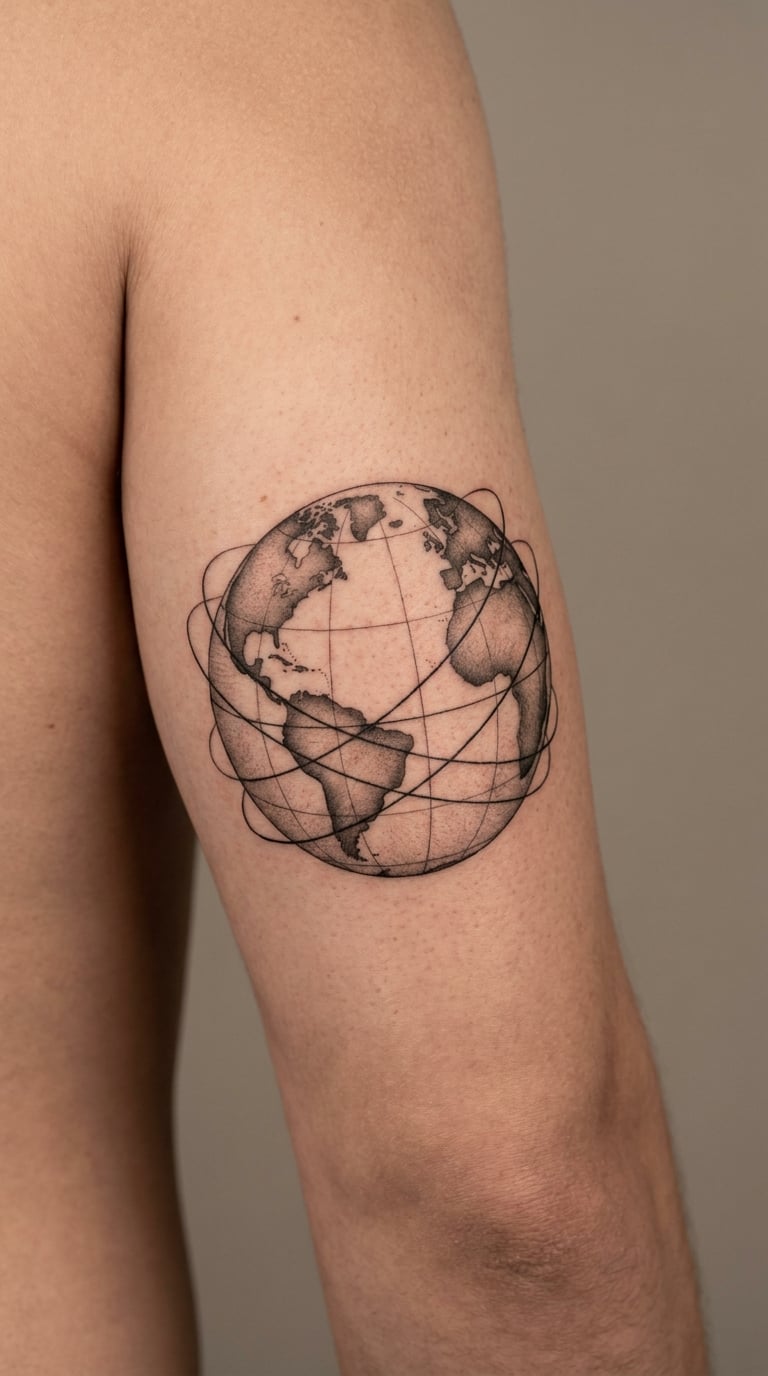
A shaded globe where the grid curves around the sphere, with the coordinate figures set along the visible face. The most dimensional design here, and the boldest way to end the set.
It says the world and a specific point on it at the same time, which makes it the statement pick for someone whose coordinates mark a life-defining trip, migration or homecoming.
Placement: Upper arm, shoulder or the upper back. Size: 4.5 to 5.5 inch diameter (11 to 14 cm). Style: Black and grey realism with soft spherical shading. Pain: Medium to high, three hours is realistic, and the upper arm is warm, which slows the ink down. Curved grid lines are the difficult part: each one is a different length and angle, and getting them to follow the sphere evenly takes an experienced hand. Grey shading gives depth without colour, which is what keeps it readable at this size.
Make it yours: Turn the grid so your coordinates sit on the front of the sphere facing outward, rather than curving around the far side.
How to Choose the Right Design
Which of the 22 coordinates tattoo ideas fits you comes down to three things: how visible you want it, how much detail you will actually sit still for, and what the numbers are doing. People who are marking one place tend to go small. People building a travel or geography collection go big.
Do you want it seen or kept private?
If you want it read only by you, choose the inner forearm, the inner wrist, the back of the shoulder or behind the ear. A single line of numerals on the inner wrist is the most discreet option in the set. If you want it legible to other people, the outer forearm, upper arm, calf and shoulder all present well, and the larger designs need that flat space anyway.
How heavy should the line be?
Ask your artist to work at 0.3mm or thicker for anything with numerals in it. Below that, fine lines fill in as the skin heals and the numbers turn into a grey smudge within a couple of years. Fingers and ankles are the first places to blur, so if that is where you want it, go bolder than feels right, and expect a touch-up in the first year. The inner forearm, upper arm and thigh are the durable spots.
How do you find and format your exact coordinates?
Look the location up in a mapping app, a satellite service or a national mapping website and copy the latitude and longitude as decimal degrees. Latitude comes first, then longitude, always. Include the direction letters or a plus and minus sign so there is no ambiguity: 40.7128° N, 74.0060° W is the format most artists prefer. Hand your artist the numbers, the decimal places you want kept, and a reference image of a map of the area. If you would rather the place stay unreadable, ask about Roman numerals, Morse code or a barcode treatment instead, all of which still need the real numbers underneath so the artist can place them accurately.
Cost and Session Time
US prices for a coordinates tattoo run from roughly 80 to 150 dollars for a small single-line piece at a walk-in shop, and 150 to 300 dollars for a fine-line map or a mid-sized illustrative design. A watercolor piece, a grid sleeve panel or a shaded globe usually falls between 250 and 600 dollars, and a highly detailed custom map can go higher.
Session time scales with size. A two-line wrist piece takes 20 to 40 minutes. A four-inch map takes an hour to an hour and a half. Anything six inches or wider, or anything with colour, is a three-to-four-hour sitting, and colour work often needs a second visit to fill in after the first layer settles.
Shop minimums and artist rates vary more than the design does. High-traffic cities and popular specialists book two to four months out, and many studios charge a flat minimum that a small piece will not clear. Get the total, not the hourly rate, in writing before the first pass.
Aftercare Basics
Start with your artist’s aftercare instructions, because they know how deep they went in. Beyond that, the standard routine applies to every piece on this list.
- Follow your artist’s aftercare instructions first. They know the depth and the ink, and their guidance overrides anything generic.
- Wash gently, twice a day. Lukewarm water and a mild unscented soap, then pat dry with a clean towel. Never scrub or soak the piece.
- Moisturise a thin layer. A plain ointment or unscented lotion, applied sparingly, keeps the skin from drying out and flaking over the new line work.
- Protect it from the sun. Keep new work covered or under clothing for the first two weeks, and use a broad-spectrum SPF 50 on any exposed placement afterwards, since UV light is what fades small black numerals fastest.
- Skip friction and heat. No tight waistbands over a hip piece, no laptop resting on a forearm piece, no swimming pools or hot tubs for about two weeks, and no saunas while the skin is still healing.
- Plan on a touch-up. Small numeric work often needs a free or low-cost top-up around six months in. Book it rather than letting soft lines settle for good.
Frequently Asked Questions
What does a coordinate tattoo mean?
A coordinates tattoo puts the latitude and longitude of one meaningful place on your body. It is usually a birthplace, a hometown, a wedding location, a first meeting point, a travel memory or a memorial site. The meaning is private: most people who see the numbers have no idea what the point refers to, which is exactly what makes the piece worth keeping.
What are some good latitude and longitude tattoos?
Good options start with a single line of numerals on the inner wrist, or a small fine-line map of the area on the inner forearm. For more presence, a world map with one pin, a shaded globe with a wrapping grid, or a city street grid all work. Pair the numbers with something from the place, such as a mountain peak, a rose or a compass, so the design reads as a picture rather than a code.
How do I find the coordinates of a place for a tattoo?
Open a mapping app, a satellite service or a national mapping website, search the place, and read the latitude and longitude in decimal degrees. Latitude comes first, then longitude, always. Write it with direction letters or signs, for example 40.7128° N, 74.0060° W, and give your artist the exact number of decimal places you want kept in the tattoo.
Do coordinates tattoos fade?
They can, and the digits are usually the first thing to go. Fine numerals under about 0.3mm fill in as the skin heals and soften further over a few years. Fingers, ankles and other high-friction or high-mobility spots blur quickest and often need a touch-up inside the first year. Forearm, upper arm and thigh placements hold far better, especially at a heavier line weight and with regular sun protection.
How bad is the pain on a wrist tattoo?
Wrist work is on the sharper end of a first tattoo, because the skin is thin and the veins sit close to the surface. Most people describe it as a constant scratchy sting rather than sharp pain, and a small piece is over quickly. The inner forearm is calmer, the calf is calmer still, and the ribs and sternum are the most sensitive placements in this whole guide.
What are the most painful places to get a tattoo?
For this style, the roughest placements are the ribs, the sternum and breastbone, the inside of the upper arm, the back of the knee and the armpit area. The bones sit close under thin skin and move with breathing or joint use. The calmest are the outer forearm, calf, upper arm and shoulder, which are also the placements where numerals stay sharp longest.
Conclusion
If this is your first tattoo, the two-line home coordinates on the inner wrist or the fine-line map on the inner forearm is the version I would book. It is small, it heals predictably, and it looks like a design rather than a statement.
Already have a travel or geography collection going? The globe with wrapping coordinates or the grid sleeve panel gives you a panel that belongs in a bigger piece. Either way, bring the artist a real coordinate string and a map reference, and let them set the line weight around numbers rather than around an image. The location is the part worth keeping. Updated for October 2026.