
24 Snail Tattoo Ideas: Best Small Nature-Inspired (October 2026)
A snail tattoo symbolizes patience, persistence, self-protection and slow, steady progress. The shell carries most of that weight, and the spiral inside it does a lot of the quiet talking.
Snails are also an easy motif to get wrong. Drawn carelessly they read as a bug doodle, and the realistic snail crawling on a leaf has aged into a specific kind of dated. These 24 snail tattoo ideas are built to avoid both traps, with a line style, a size and a placement for each one you can actually book. If you are planning a first small tattoo, start with number one or number three and let the shell stay simple. If you are adding to a collection, the blackwork, colour and sleeve entries give you room to go bigger.
Spring and early summer are the busiest booking window, so if you want a piece done in a particular month, talk to an artist about a month and a half ahead.
24 Snail Tattoo Ideas: Quick Guide
Here is the whole list at a glance, in order, with the style, placement, size and expected pain for each design.
| Idea | Style | Best placement | Size | Pain |
|---|---|---|---|---|
| 1. Fine-line snail | Fine line | Inner wrist | 2-2.5 inch | Low |
| 2. Realistic garden snail | Micro-realism, black and grey | Outer forearm | 3-3.5 inch | Medium |
| 3. Minimalist spiral shell | Minimal line art | Above the ankle | 1.5-2 inch | Low |
| 4. Two matching snails | Fine line | Opposite inner arms | 2 inch each | Low |
| 5. Tiny snail behind the ear | Micro fine line | Behind the ear | 0.75-1 inch | Medium |
| 6. Blackwork snail | Blackwork | Upper arm | 2.5-3 inch | Medium |
| 7. Watercolour snail | Watercolour | Outer shoulder | 2.5-3 inch | Medium |
| 8. Snail with a leaf | Black and grey | Inner forearm | 2.5 inch | Low |
| 9. Traditional snail with a rose | American traditional | Calf | 3-3.5 inch | Medium |
| 10. Dotwork shell | Dotwork and stippling | Inner upper arm | 2-2.5 inch | Medium |
| 11. Neon-colour snail | Bright illustrative colour | Outer calf | 3 inch | Medium |
| 12. Snail and shell trail | Fine line | Inner forearm | 4-5 inch | Low |
| 13. Micro-realism finger snail | Micro-realism | Side of a finger | 0.75-1 inch | High |
| 14. Shell in a geometric frame | Line art, geometric | Wrist | 2 inch | Low |
| 15. Snail on a mushroom | Black and grey, illustrative | Upper arm | 2.5-3 inch | Medium |
| 16. Pastel floral shell | Pastel illustrative | Outer thigh | 2.5-3 inch | Low |
| 17. Minimal rib snail | Minimal black line | Side of the ribs | 2-2.5 inch | Medium |
| 18. Snail and dandelion seeds | Fine line | Inner arm | 3 inch | Low |
| 19. Two-spiral collarbone piece | Fine line, minimal | Below the collarbone | 3 inch | Low |
| 20. Gothic snail with thorns | Blackwork gothic | Forearm | 3-3.5 inch | Medium |
| 21. Snail in a tea cup | Whimsical fine line | Wrist | 2 inch | Low |
| 22. Snail and crescent moon | Fine line | Outer shoulder | 2.5-3 inch | Low |
| 23. Colour-blocked snail | Graphic colour block | Upper back | 3-3.5 inch | Low |
| 24. Large spiral sleeve element | Black and grey, illustrative | Outer upper arm | 5-7 inch | Medium |
1. Fine-Line Snail on the Wrist
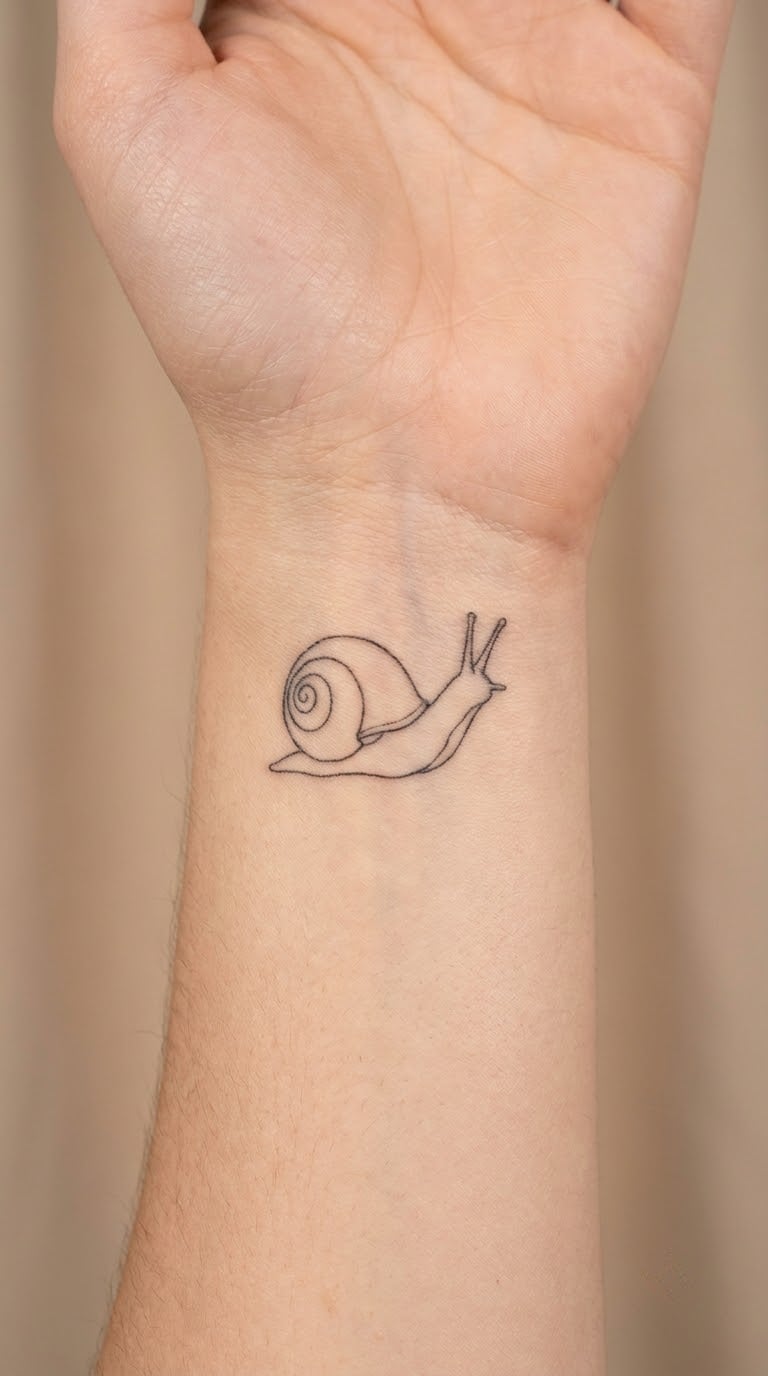
A fine-line snail on the wrist is the most straightforward of these 24 snail tattoo ideas: a single black outline, one continuous line where it can be, a shell divided into a few soft segments, and two short eyestalks that give it a face without a full cartoon head.
People choose it because it does something on the skin that almost nothing else does. A small line drawing reads as considered rather than decorative, and the shell still carries the patience and slow-growth meaning if you want it to.
Placement: inner wrist, just above the bone, or the outer wrist near the thumb joint · Size: 2-2.5 inch (5-6 cm) long · Style: fine line, single-needle, no shading or a whisper of grey under the shell spiral.
Pain: low. The inner wrist is thin-skinned and mostly bone, so you feel the needle more than you feel pain, and it comes and goes in waves. Make it yours: have the artist work a small initial into the shell spiral, or add a single hairline that leaves the shell and disappears at the wrist crease.
2. Realistic Garden Snail on the Forearm
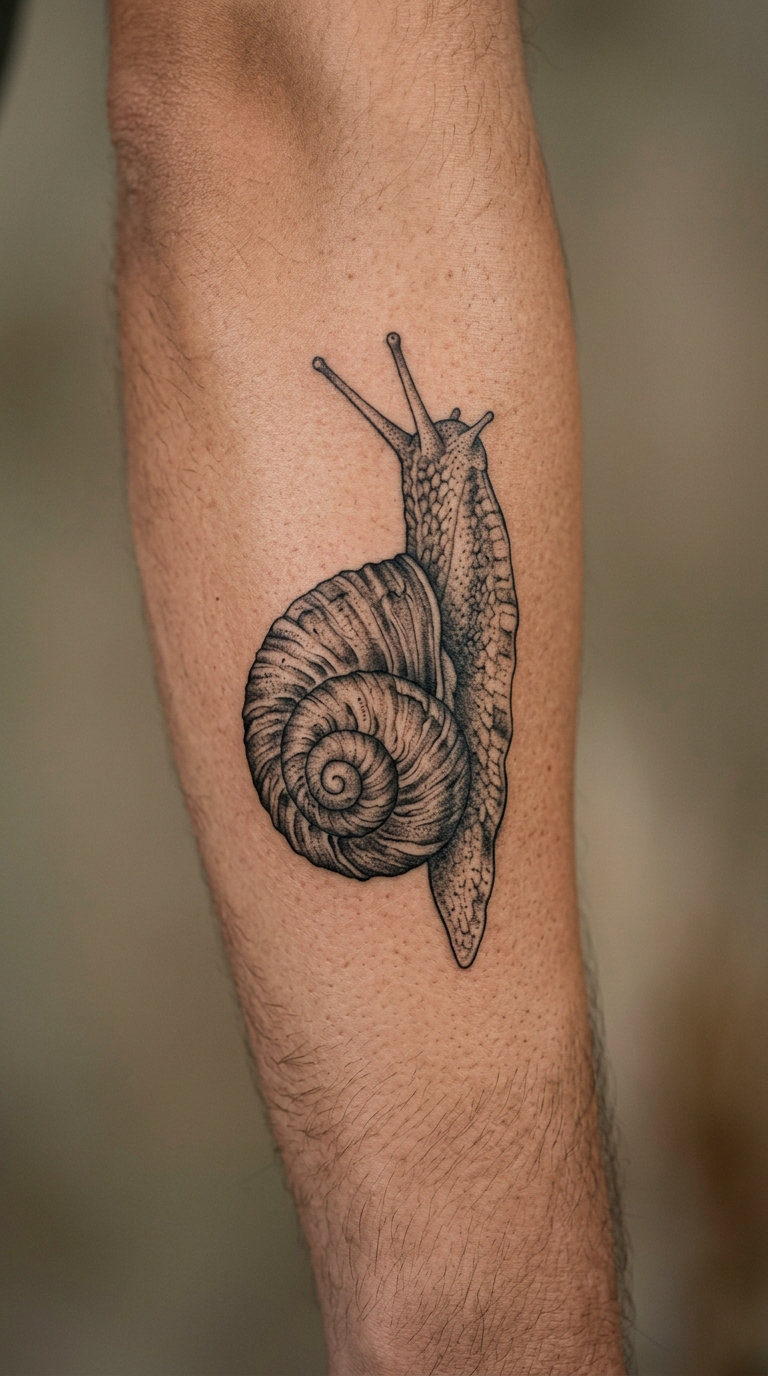
A realistic garden snail is a small naturalistic study rather than an illustration: mottled grey-brown shading, a rough shell with growth lines and a chipped edge, a soft translucent body, and no leaf underneath. Leaving out the leaf is what separates this from the dated realism style.
The reason people get it is usually the animal itself. A garden snail is the least glamorous creature you could choose, which is exactly the appeal for anyone tired of a tattoo that tries too hard.
Placement: outer forearm, running along the muscle, or the inner forearm · Size: 3-3.5 inch (7-9 cm) · Style: micro-realism in black and grey, with a small muted colour wash if you want the shell to read warm.
Pain: medium on the forearm, and it comes in waves as the skin moves under the needle. A shell with real texture holds more tiny detail than it should at this size, so expect a second session. Make it yours: ask for the shell to match a colour you actually know, like the amber of a snail you watched as a kid.
3. Minimalist Spiral Shell on the Ankle
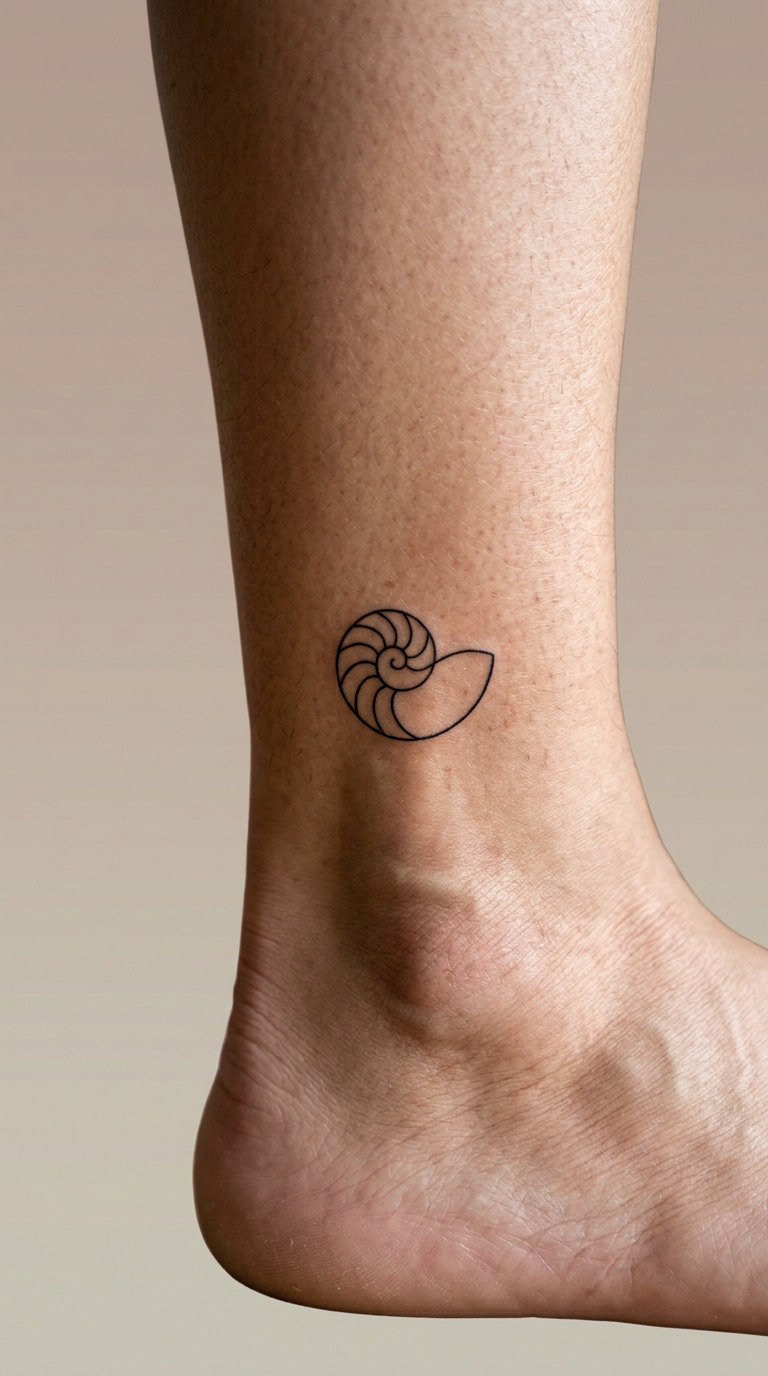
A minimalist spiral shell drops the snail and keeps only the shell: one clean line spiralling inward, a small opening where the shell would meet the body, and nothing else. It is the quietest design here and the easiest to make genuinely elegant.
Shell-only designs are the way to wear a snail motif without announcing that you are a snail person. The spiral itself works as a small graphic shape, and it sits well next to ankle jewellery.
Placement: just above the ankle bone, on the inner ankle, or at the top of the foot · Size: 1.5-2 inch (4-5 cm) wide · Style: minimal line art, one weight of line throughout.
Pain: low, though the ankle bone is a spot people feel. Ankles swell over the day, so tell your artist if that matters to you. Make it yours: orient the spiral so it turns the same way as another small spiral you already have, or leave it unclosed so the line trails off.
4. Two Snails as a Matching Pair
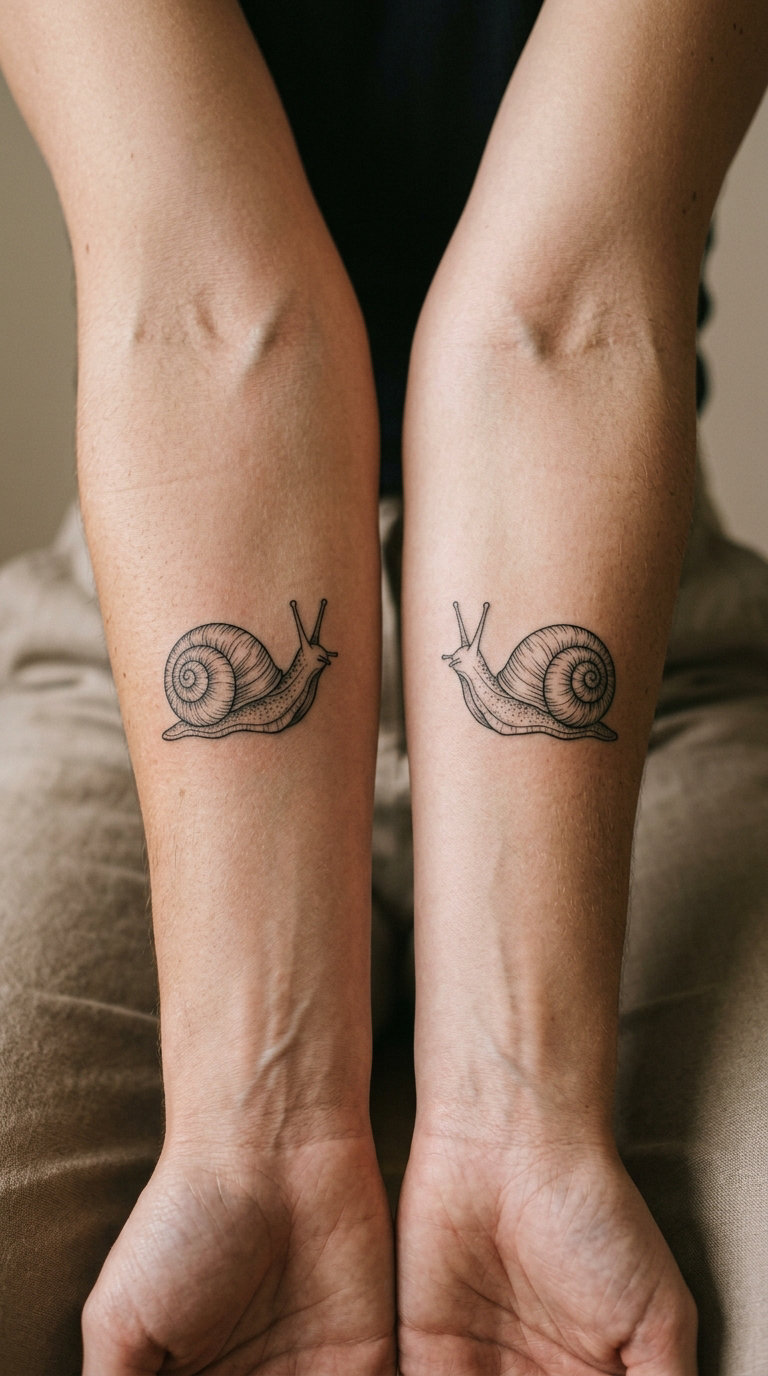
Two matching snails can sit in two places, or face each other across the same body. The classic version is a pair of fine-line snails on opposite inner arms, both heading in the same direction, which reads well whether you have your arms down or folded.
This one is usually chosen for a person rather than a design. Siblings, partners and close friends adopt the same sketch, and matching pieces that are small and identical tend to age better than matching pieces that were meant to be loud.
Placement: opposite inner forearms, or one each above the wrist · Size: about 2 inch (5 cm) each · Style: fine line, drawn from the same stencil on both arms.
Pain: low, and the second one is easier once you know what you are getting into. Line weight matters more than size on arms, since elbows and cuffs catch fine line. Make it yours: give each snail one small difference, a flower on one, a leaf on the other, and let the pair stay recognisably siblings rather than photocopies.
5. Tiny Snail Behind the Ear
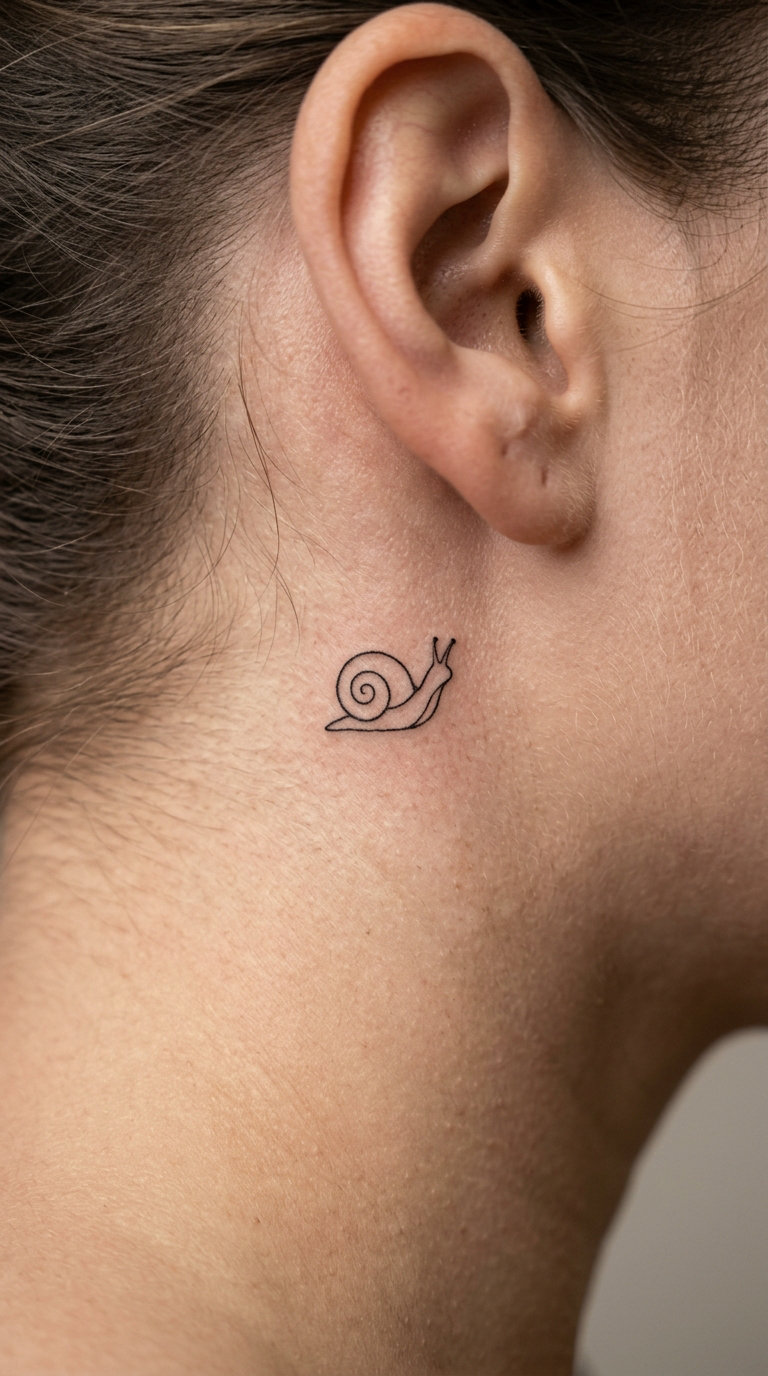
A tiny snail behind the ear needs a readable silhouette and almost no shading: a clear shell curve, a low body line and two antennae doing the work that detail would otherwise do. If the shell is too busy at this size, it turns into a smudge in a year.
Behind the ear is where discreet personal tattoos go, and the snail works there because it stays hidden in daily life. It also photographs well, which is a side benefit nobody plans for.
Placement: just behind the ear on the curve where the neck starts, or slightly lower behind the earlobe · Size: 0.75-1 inch (2-2.5 cm) · Style: micro fine line, single-needle, minimal internal shell detail.
Pain: medium. Behind the ear is thin skin over cartilage, so it stings more sharply and goes fast. Make it yours: add a single tiny spiral trailing down the neck from the shell, which fills the curve without crowding it.
6. Blackwork Snail with a Bold Shell
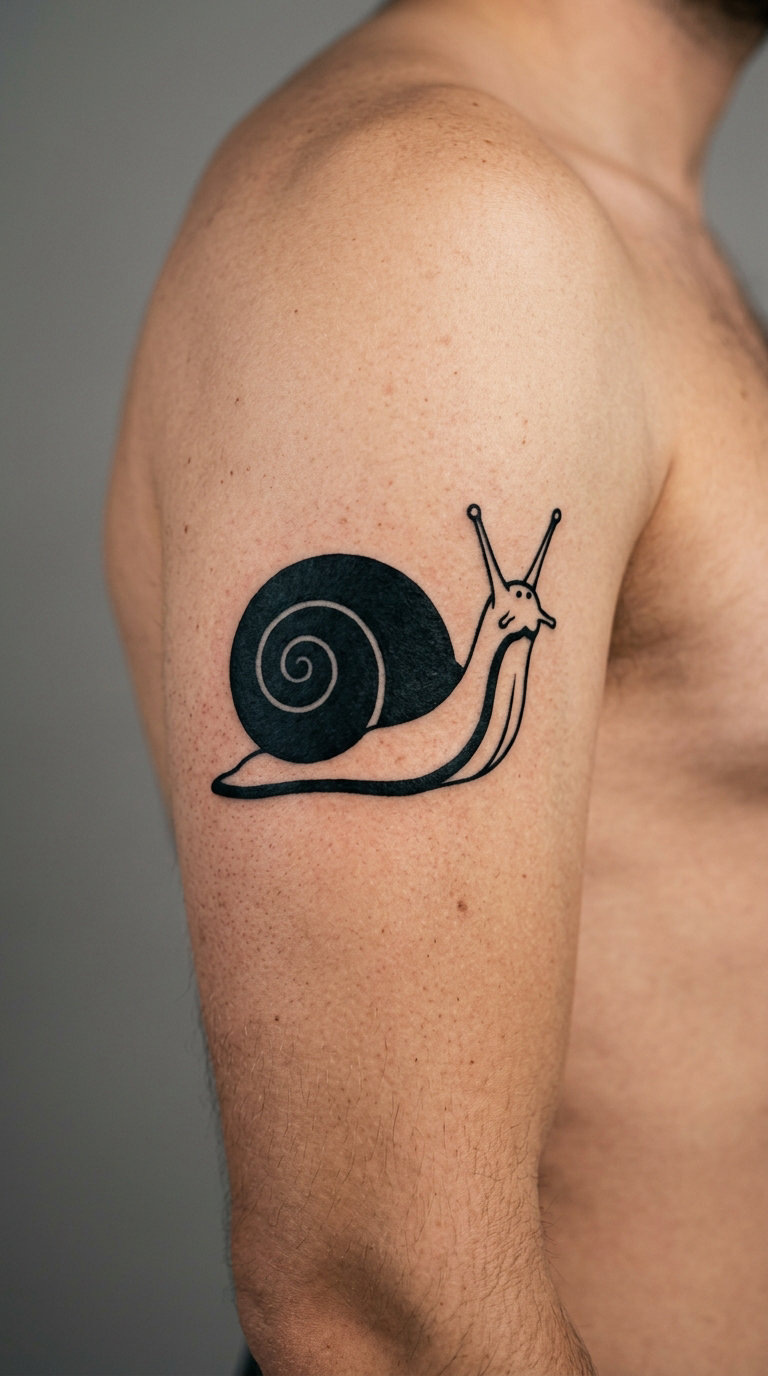
Blackwork gives the shell a solid fill and lets the body come out as clean negative space, so the snail reads as a graphic shape first and an animal second. That is what keeps it from looking like a doodle, and it holds up at a distance in a way hairline work does not.
It suits people who want a small tattoo that still has visual weight, and it pairs well with existing solid work without needing to be a full sleeve.
Placement: outer upper arm, or the side of the forearm · Size: 2.5-3 inch (6-7.5 cm) · Style: blackwork, solid fills, hard edges, minimal grey.
Pain: medium, and the solid passes are heavier than line work feels. Blackwork over a bump like the elbow or knee ages faster than it does on a flat surface. Make it yours: let the artist cut a thin white channel through the shell, a hairline gap that keeps the solid from reading as a heavy blob.
7. Watercolour Snail on the Shoulder
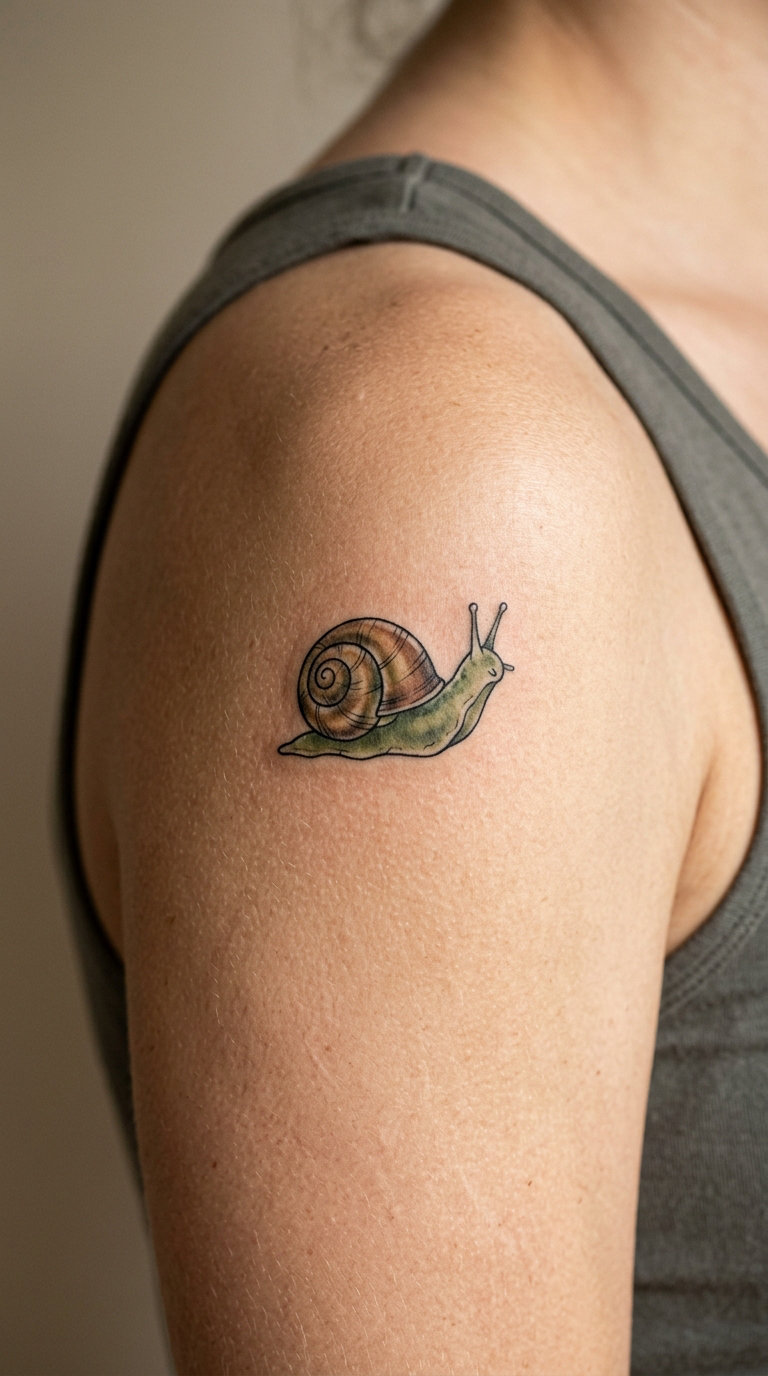
A watercolour snail is built from translucent washes that bleed slightly into each other, with a few confident line details for the shell spiral and the eyestalks. Muted greens, soft browns and a wash of rust read best here, since bright colour turns the same design cartoony.
Colour is the choice here, not the symbolism. People who like painting tend to like watercolour work, and a shoulder placement means the piece can be slightly larger without feeling crowded.
Placement: outer shoulder or the top of the upper arm · Size: 2.5-3 inch (6-7.5 cm) · Style: watercolour, one or two soft washes, minimal hard line.
Pain: medium, and watercolour takes longer to tattoo because the artist layers rather than fills. Fades read as a softer version of the same design rather than a failure. Make it yours: pick two colours only and let the rest stay unpainted, which keeps the piece light and the cost down.
8. Snail Carrying a Tiny Leaf
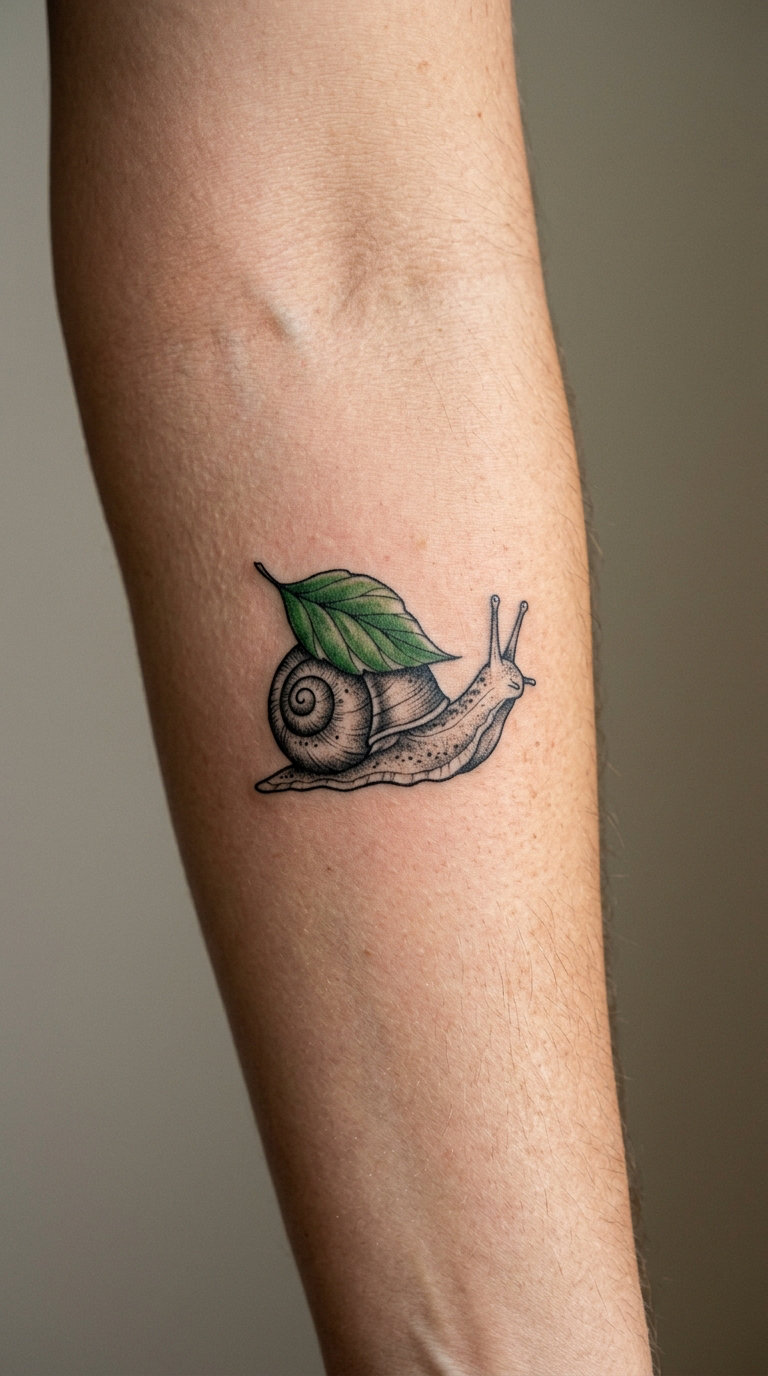
A snail with a leaf is a simple silhouette plus one botanical detail, and the leaf is doing all the work. Shaped as a small lance leaf with a central vein, it lifts the piece from bug-doodle into a quiet nature scene without adding clutter.
It usually means something about plants, growth or a slow season of your own, though plenty of people just like it. The design stays honest either way, because it never claims a fixed meaning.
Placement: inner forearm, or along the calf · Size: 2.5 inch (6 cm) wide · Style: black and grey line with a single muted green leaf, or full black and grey if you prefer.
Pain: low on the inner arm, low on the calf. Make it yours: use a leaf from a plant that actually matters to you, sketched from a photo you bring, and let the snail carry it wherever the composition leads.
9. Traditional Snail with a Rose
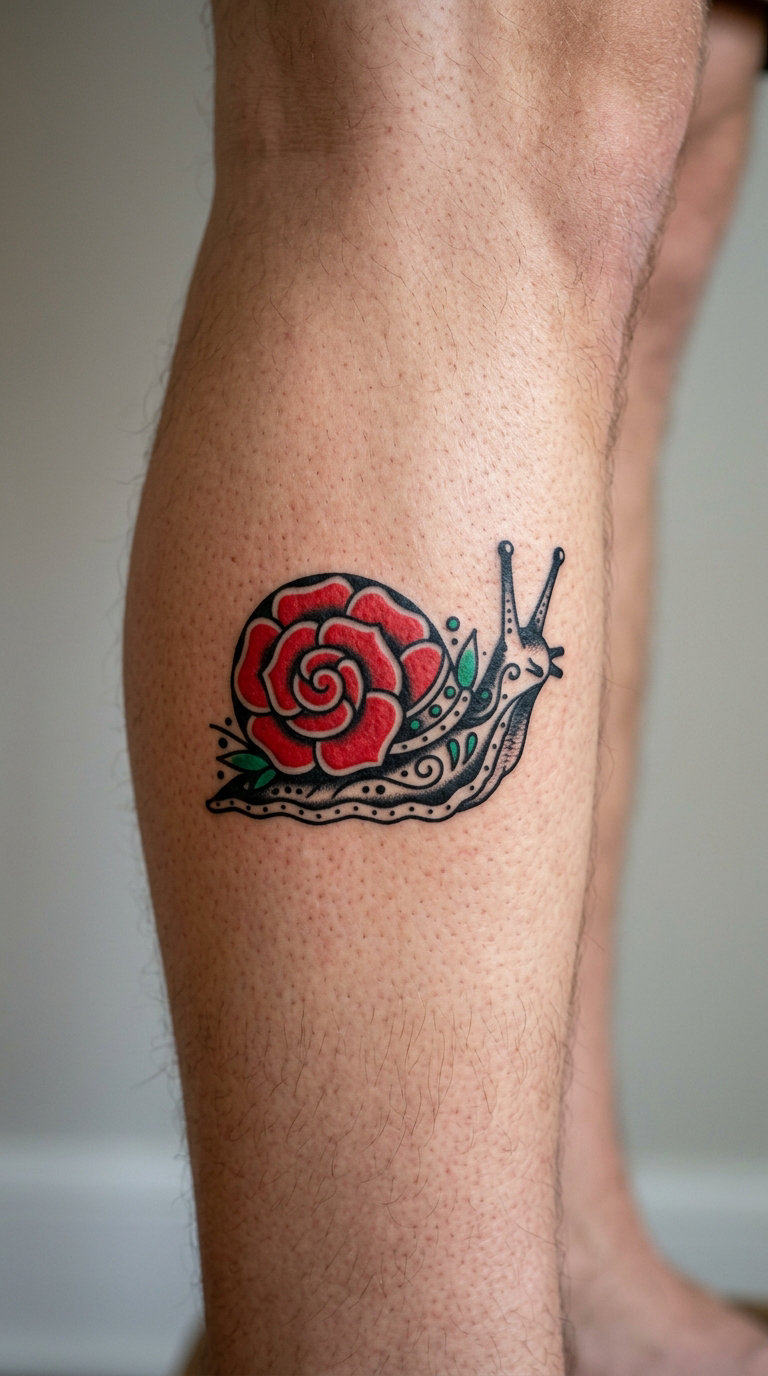
A traditional snail with a rose uses heavy black outlines, a small colour palette, a red rose curling over the shell and a couple of green leaves for balance. Traditional style holds up well at small sizes because the lines are thick on purpose.
This is the version for someone who wants a snail tattoo with real colour and no irony. It reads as a classic piece of flash art rather than a nature study.
Placement: outer calf, forearm, or the side of the upper arm · Size: 3-3.5 inch (7.5-9 cm) · Style: American traditional, black outlines with a limited colour palette.
Pain: medium, and heavy lines on the calf can be a real workout over a large fleshy area. Bold lines fade slower than fine line, which is a practical advantage. Make it yours: swap the rose for a thistle, a clover or something tied to where you live, and keep the traditional shading exactly as it is.
10. Dotwork Snail Shell
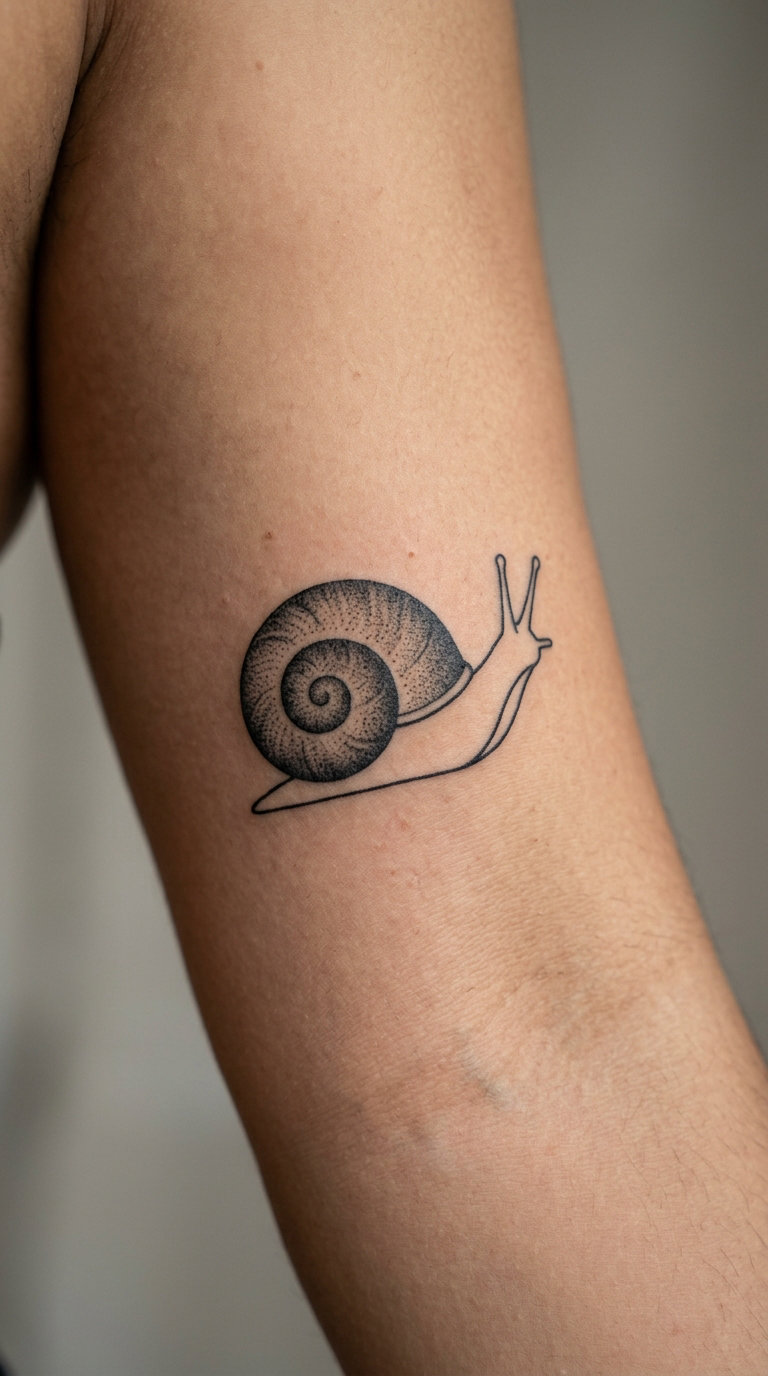
Dotwork builds the shell from tightly and loosely spaced dots, so the spiral appears as a shift in density rather than a drawn line. The body stays a plain outline, which is what keeps the piece from turning into a texture sample.
It rewards close looking and it hides small imperfections better than you would expect, since there is no single line to drift. That makes it a good choice if you are nervous about a needle wobble.
Placement: inner upper arm, forearm, or shoulder · Size: 2-2.5 inch (5-6 cm) · Style: dotwork and stippling.
Pain: medium, because stippling is thousands of single taps rather than a few long passes. The sensation is repetitive rather than sharp. Make it yours: ask for the dots to be slightly irregular, hand-tapped, so the shading softens over the years instead of showing every healed line.
11. Neon-Colour Snail on the Calf
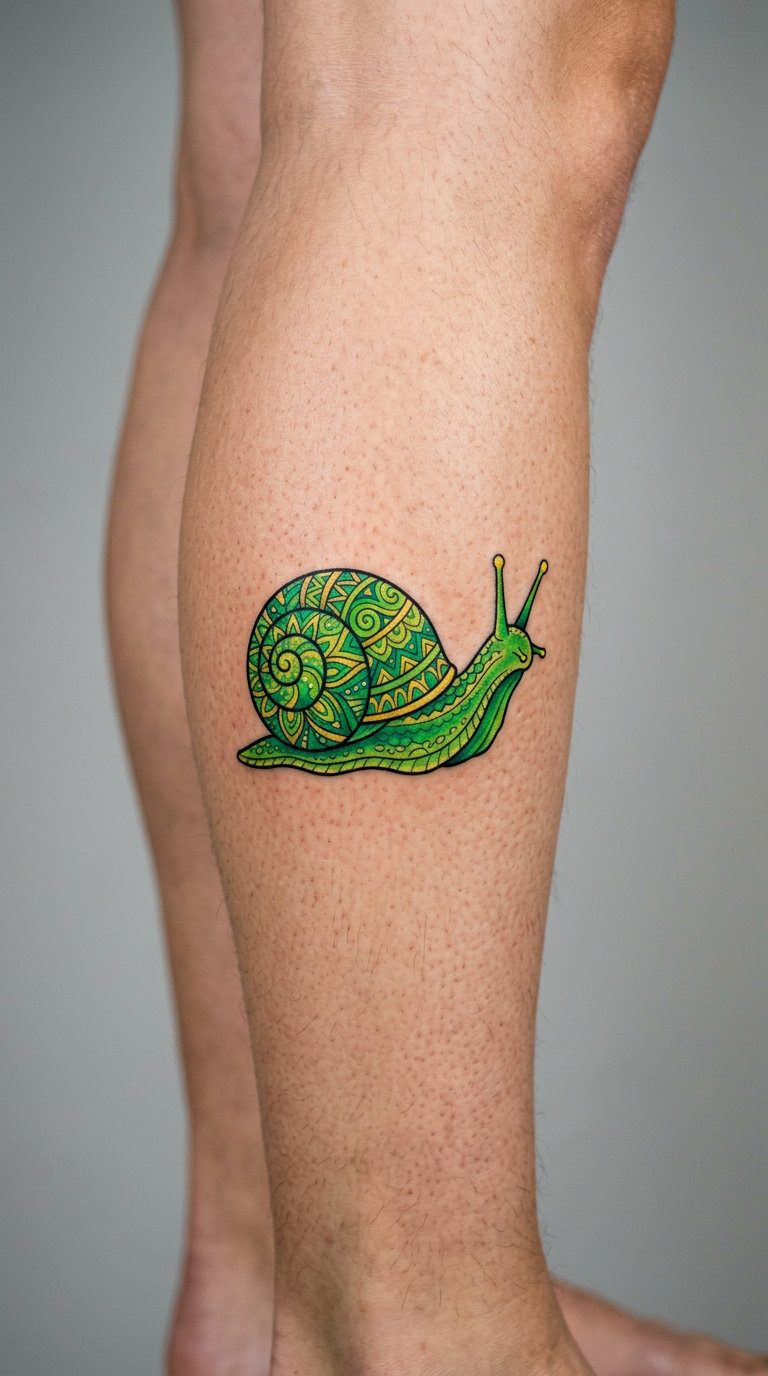
A neon-colour snail goes the opposite way from realism: a bright green or yellow body, a shell filled with a simple repeating pattern, and confident outlines in a darker tone to hold it together. Think cheerful and graphic, not garden mud.
It suits someone who is comfortable with a tattoo that gets looked at. The calf gives you a flat, generous surface, so the pattern in the shell has room to breathe.
Placement: outer calf, or the outer upper arm · Size: 3 inch (7.5 cm) · Style: bright illustrative colour with a graphic pattern.
Pain: medium, and saturated colour needs more passes than pastel work. Bright yellows and greens sit closer to the surface and can look bruised while they heal, which is normal and settles. Make it yours: pattern the shell with something only you would clock, a set of initials, a date, a repeating shape from your work.
12. Snail Trail Line on the Arm
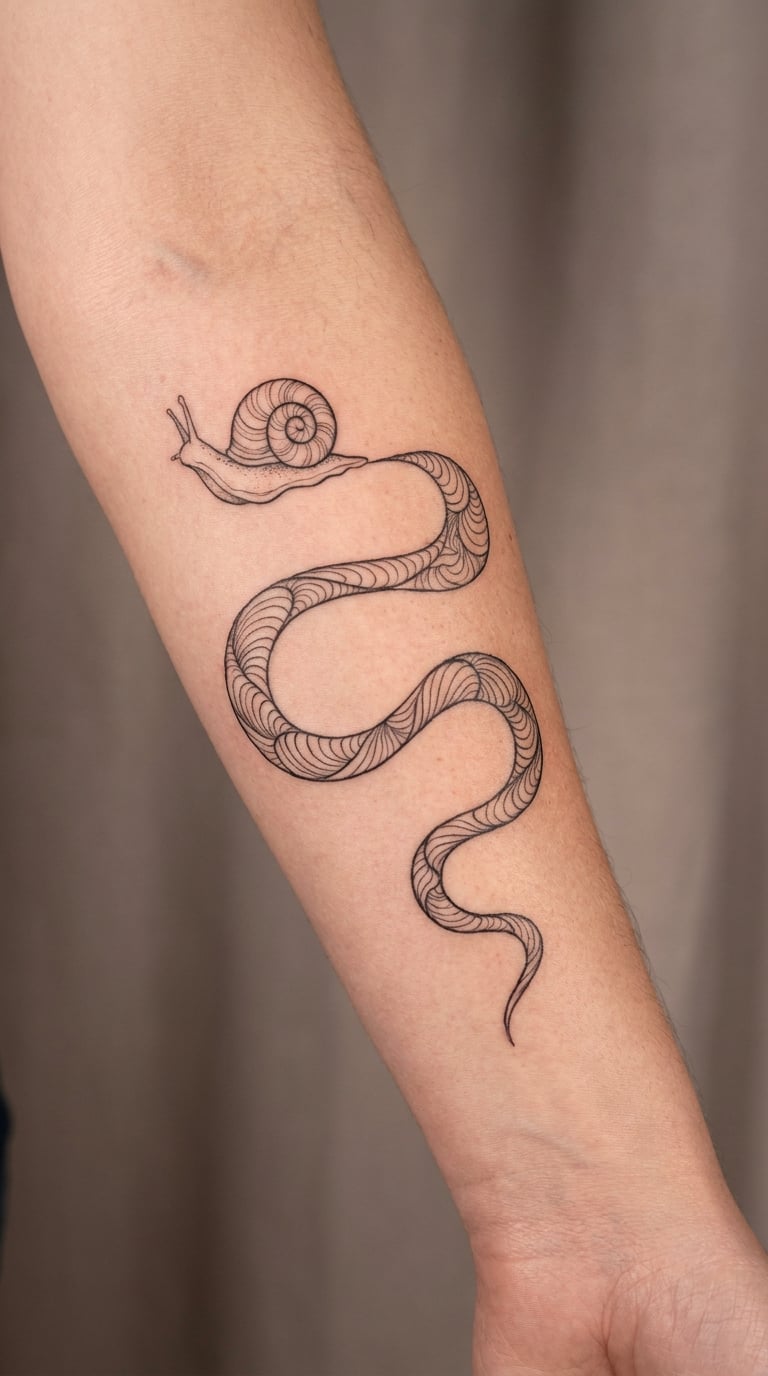
A snail and its trail turns the design into a line that follows the body. The snail sits at one end, and a single winding line leaves the shell, loops once or twice and then thins out until it stops.
It is a quietly clever piece because the trail does the compositional work a background would normally do, and it works well with a body that already has flowing line tattoos.
Placement: inner forearm from wrist to elbow, or along the calf · Size: 4-5 inch (10-12 cm) long, 1-1.5 inch tall · Style: fine line, single continuous stroke, optional light dotwork inside the shell.
Pain: low, since it is all line and no shading. The elbow end of the forearm is the sensitive stretch, so expect the trail to sting more where it finishes. Make it yours: have the trail curve around an existing tattoo rather than ending in empty skin, which is the most common way this piece gets drawn.
13. Micro-Realism Snail on a Finger
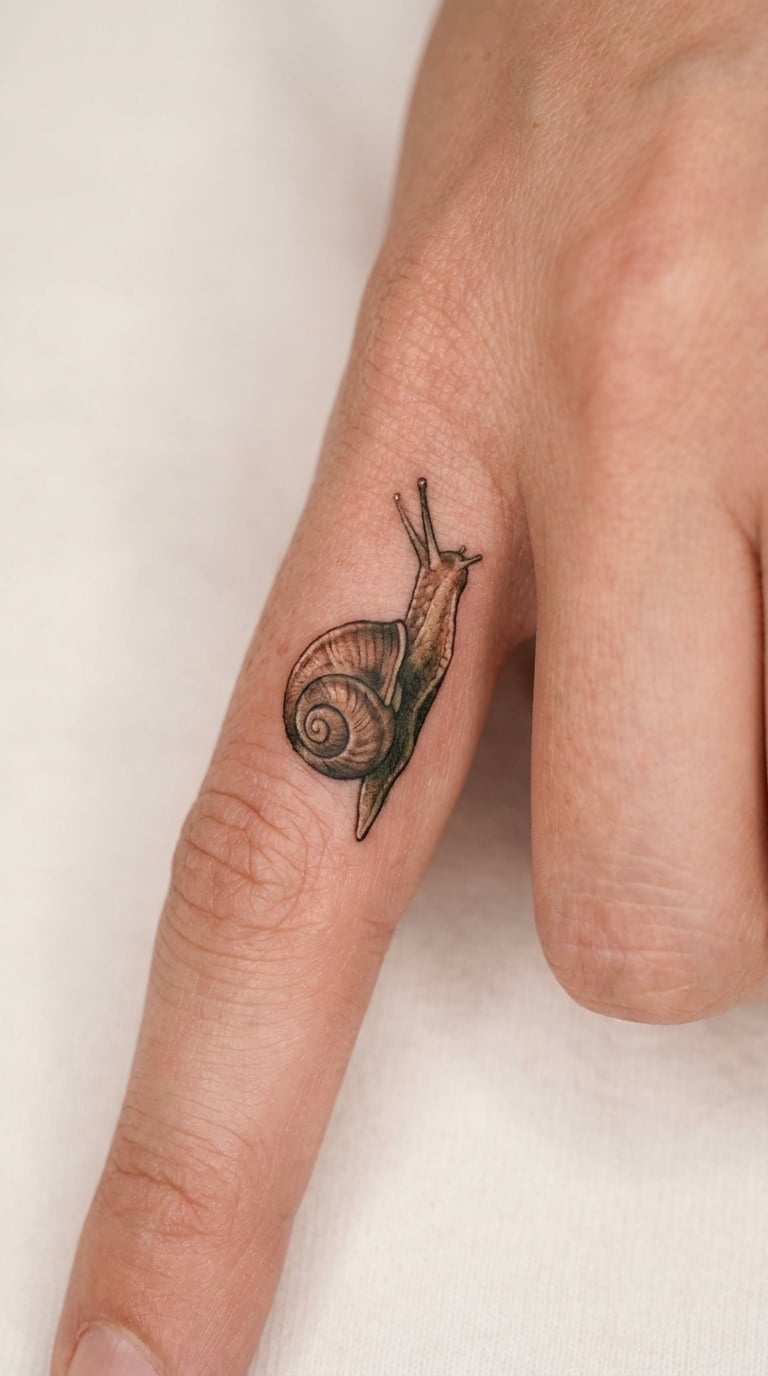
A micro-realism finger snail is a true tiny study, roughly an inch long, with a warm brown shell, a soft highlight and a hint of body texture. It is the hardest placement on this list for a simple reason: fingers are in constant use.
People get it anyway, and they usually love it. But be honest with yourself about the trade, because this is the one design here that most needs a touch-up.
Placement: side of the index finger, or the outer hand near the thumb · Size: 0.75-1 inch (2-2.5 cm) · Style: micro-realism, black and grey with a warm tint.
Pain: high. Finger skin is thin, densely nerve-filled and stretched over bone, and knuckles and fingertips are the sharpest points of the whole list. Make it yours: commit to it as a piece you will refresh. Budget a touch-up after a year or two, and keep the design simple enough that a redraw does not change what it means.
14. Snail Shell in a Geometric Frame
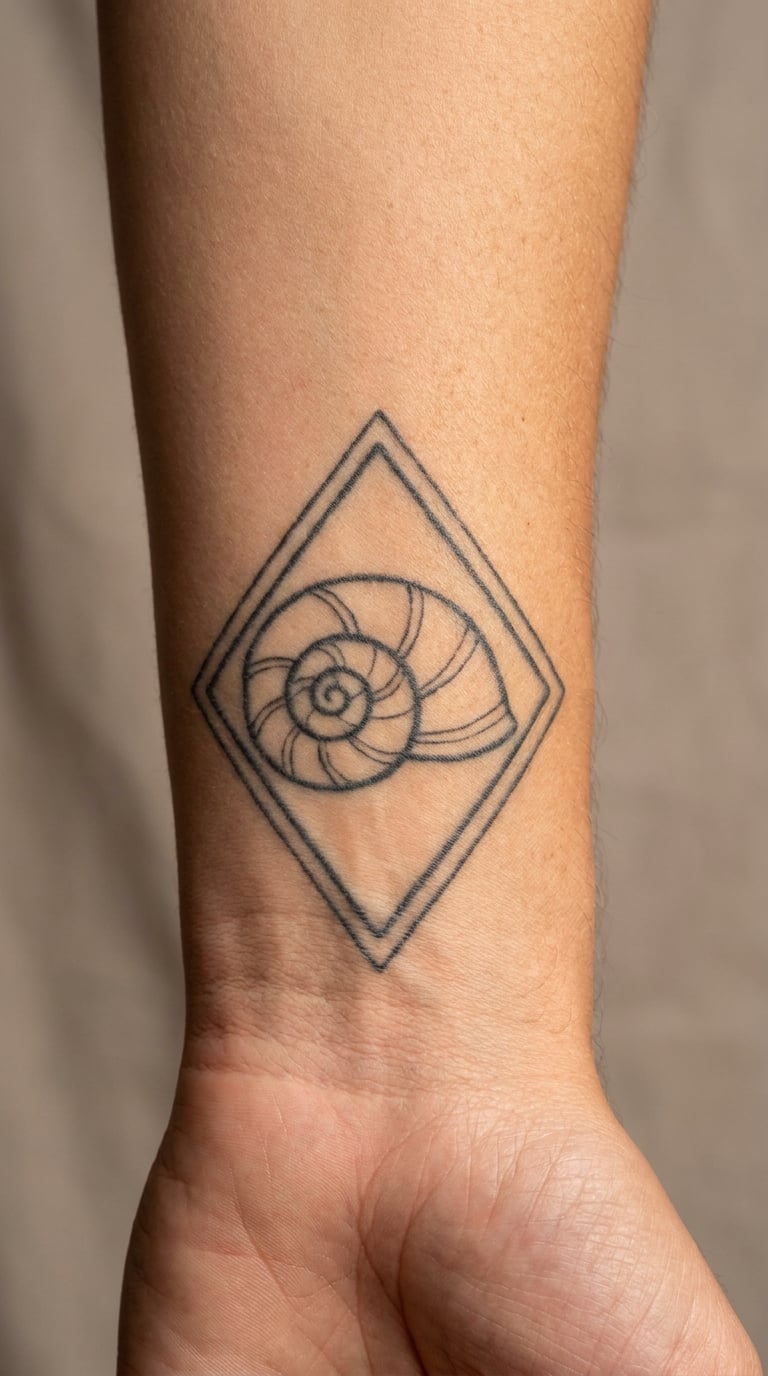
A shell in a geometric frame sets organic curves inside a hard structure: a diamond, a hexagon or a thin square, drawn with the same line weight as the spiral inside it. The contrast is the whole design.
It works well for people whose other tattoos lean architectural, and it reads as a considered graphic piece rather than a nature reference.
Placement: wrist, inner forearm, or the flat of the upper arm · Size: 2 inch (5 cm) tall including the frame · Style: line art with geometric structure, no shading.
Pain: low, and a frame hides the edges of a slightly uneven hand-stabbed spiral. Make it yours: keep the frame the same shape as another geometric tattoo you have, so the two read as a set without looking like a matching pair.
15. Snail on a Mushroom
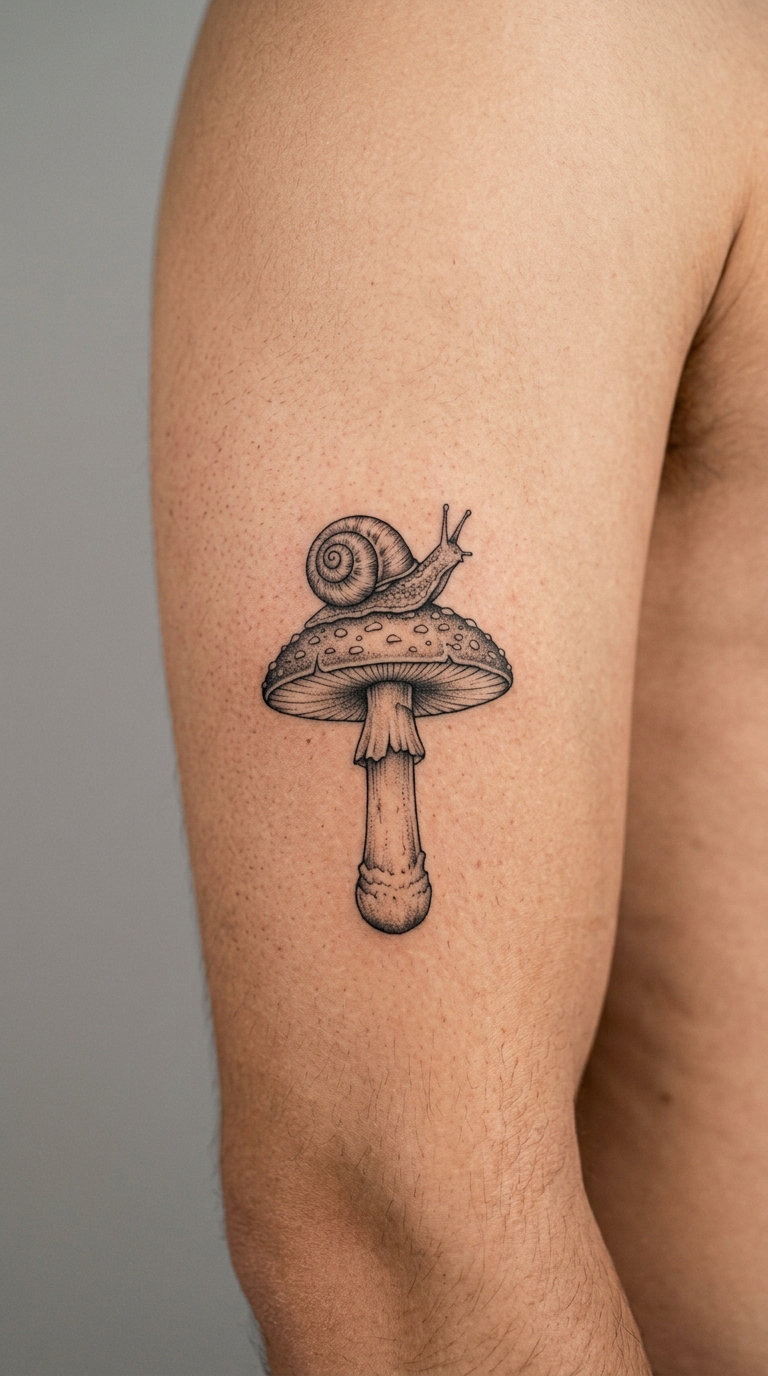
A snail on a mushroom gives the animal an environment instead of floating on skin. A simple cap with a few gill lines underneath, a short stem, and the snail resting on top of the cap is enough, and any more detail than that turns it busy.
This is cottagecore without the frills. It reads as forest floor rather than storybook, and it has a gentle, slightly mischievous tone that suits a small upper arm placement.
Placement: upper arm, calf, or the outer thigh · Size: 2.5-3 inch (6-7.5 cm) wide · Style: black and grey illustrative line, or fine line with light dot shading in the gills.
Pain: medium over the upper arm, lower on the calf and thigh. Make it yours: pick a mushroom that actually grows near you, or one your grandmother grew, and let the artist work the cap spots from a real photograph.
16. Pastel Snail with Floral Shell
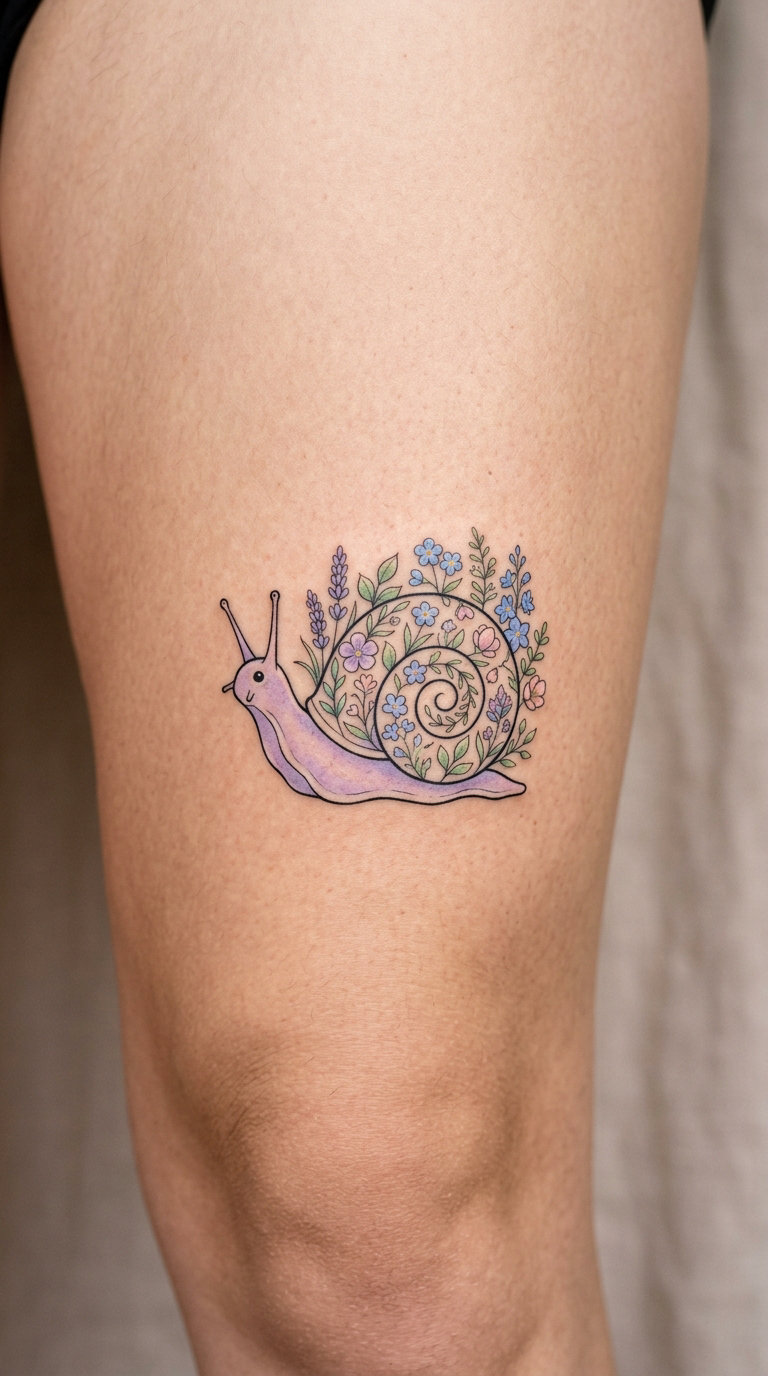
A pastel floral shell divides the spiral into segments and fills each with a small flower, a leaf or a soft gradient, all in lavender, pale blue, blush and mint. The body stays light so the shell carries the colour.
It is a decorative design, and that is the point. People choose it when they want something soft and colourful that still holds a real compositional structure underneath the sweetness.
Placement: outer thigh, upper arm, or the calf · Size: 2.5-3 inch (6-7.5 cm) · Style: pastel illustrative with fine black outlines.
Pain: low to medium. Pastel work means more passes in lighter ink, so the session runs longer than the size suggests. Make it yours: name a flower per shell segment, so the spiral becomes a small index of plants you actually like.
17. Minimal Snail Footprint on the Rib
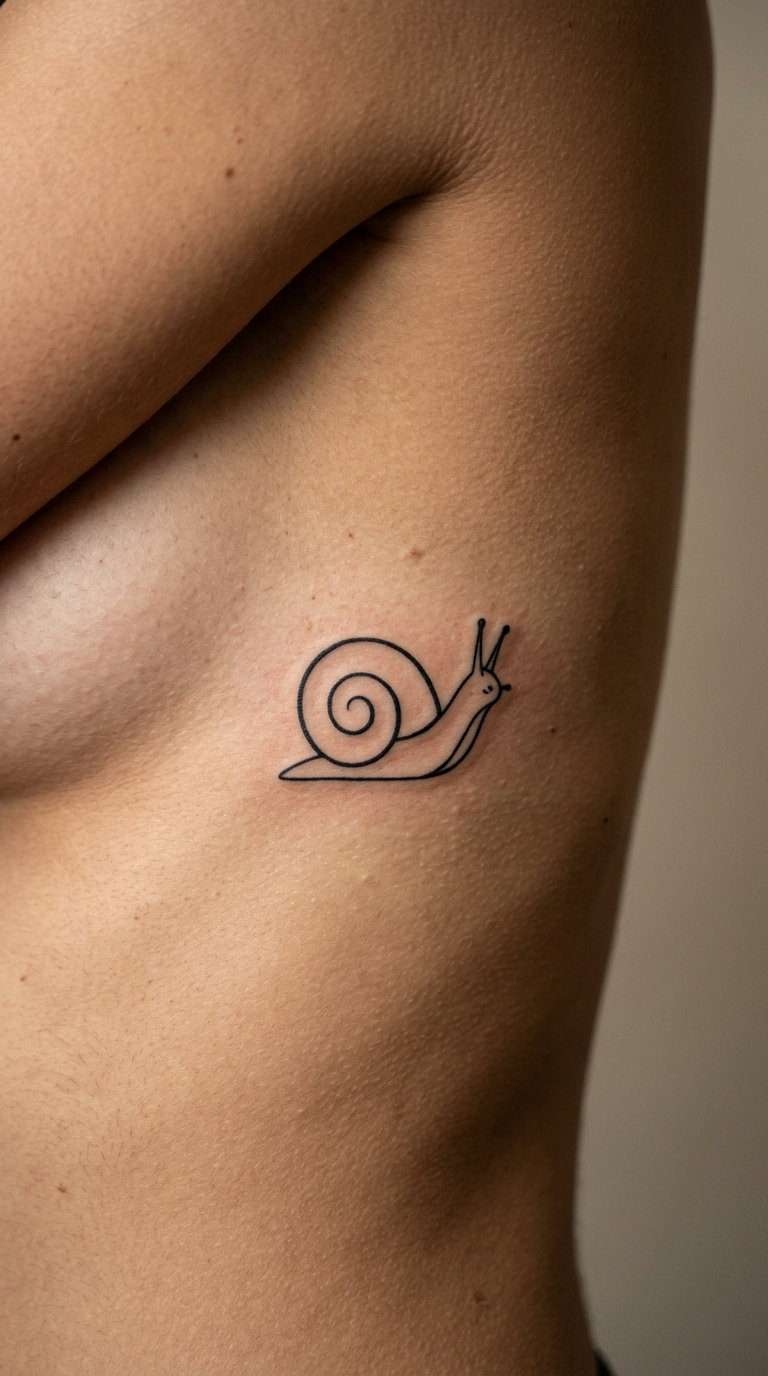
A rib snail is a minimal outline with the shell spiral left open, so the line never closes and the eye keeps travelling. The design should be narrow and vertical, with air on both sides, because ribs punish anything crowded.
The rib area is a placement people tend to choose for something personal and slow, and the snail suits that impulse. It reads as a mark on the body rather than a decoration on it.
Placement: side of the ribs, running vertically between two ribs · Size: 2-2.5 inch (5-6 cm) · Style: minimal black line, one weight, no shading.
Pain: medium, and the ribs are bony with thin skin between them, so expect a scratchy sensation. Breathing moves the skin constantly, which your artist already accounts for. Make it yours: place the snail level with the rib it sits between, and avoid anything that mirrors a scar nearby unless you want the two to interact.
18. Snail and Dandelion Seeds
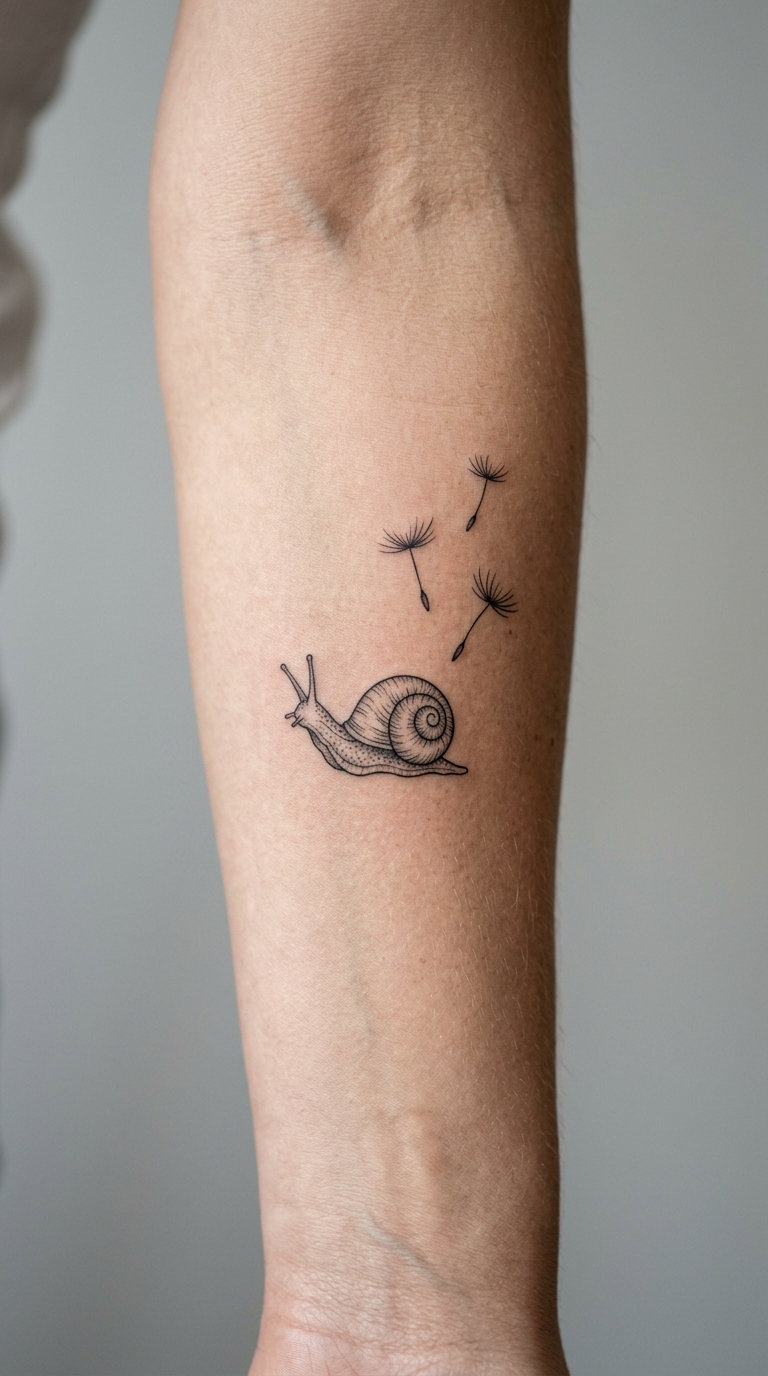
A snail with dandelion seeds is a small scene with a lot of air in it. The snail sits low in the composition, two or three seeds drift above and behind it, and the negative space between them is doing most of the work.
Dandelions carry their own associations around letting go and things travelling away from you, so people land here when something has finished. It stays a gentle image either way.
Placement: inner arm, inner forearm, or the calf · Size: 3 inch (7.5 cm) wide · Style: fine line, with the seeds in a slightly lighter stroke than the snail.
Pain: low, though the seeds mean more small marks across a wider area. The light stroke on the seeds will soften faster than the main outline. Make it yours: use four seeds instead of three and add a date beneath, which reads as a memorial without spelling anything out.
19. Two-Spiral Shell on the Collarbone
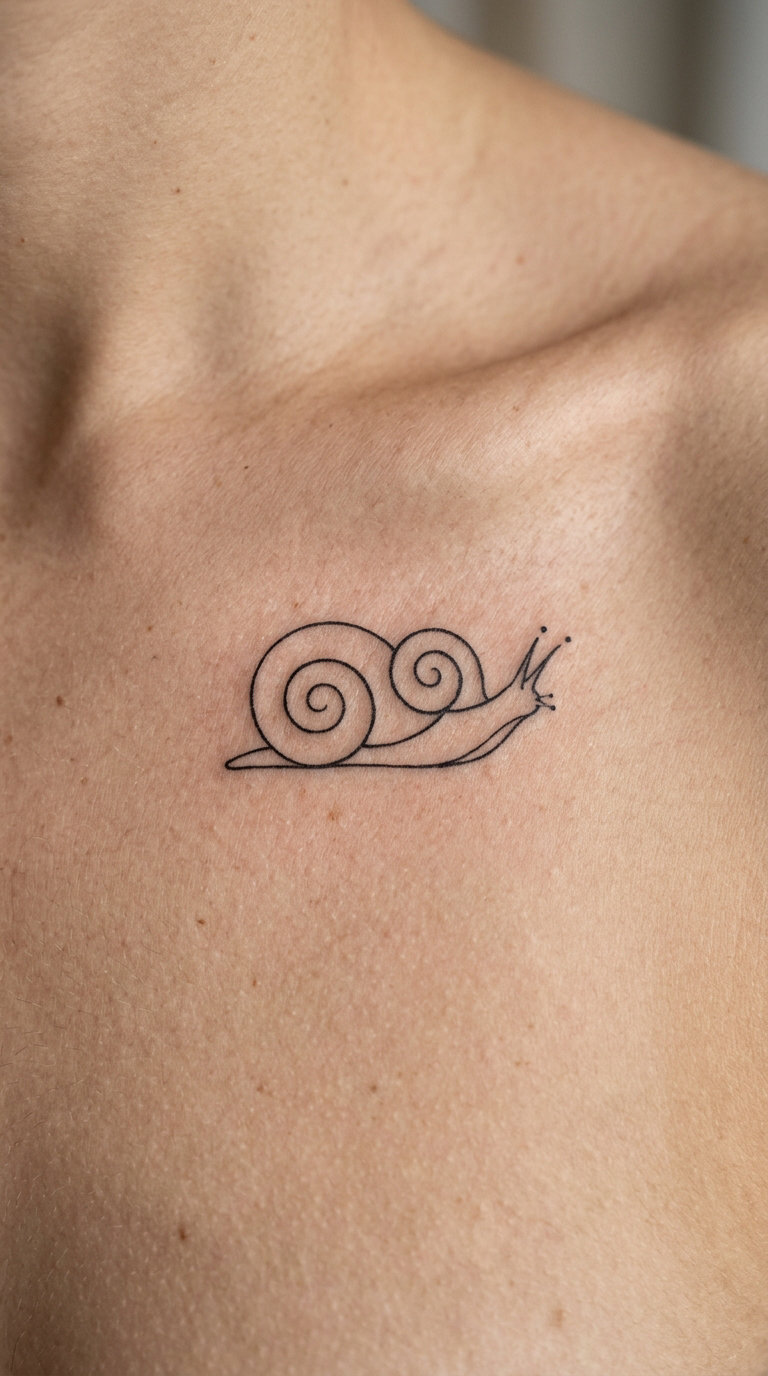
A two-spiral design runs horizontally along the collarbone, with the shell opening into two spirals and a small body line trailing to one side. Horizontal movement suits that flat strip of skin better than any vertical arrangement.
Collarbone pieces are usually chosen for how they sit under a shirt collar, and this one keeps a low profile, with fine lines that stay under clothing easily.
Placement: just below the collarbone, following the bone line, or centred on the upper chest · Size: 3 inch (7.5 cm) wide · Style: fine line, minimal, optional pale grey inside one spiral.
Pain: low to medium, since bone is close to the surface here. Collarbone skin moves with your shoulder, so fine line can creep over the years. Make it yours: mirror the piece on the other collarbone, offset by a day or a few months, so it reads as a pair without being symmetrical twins.
20. Gothic Snail with Thorns
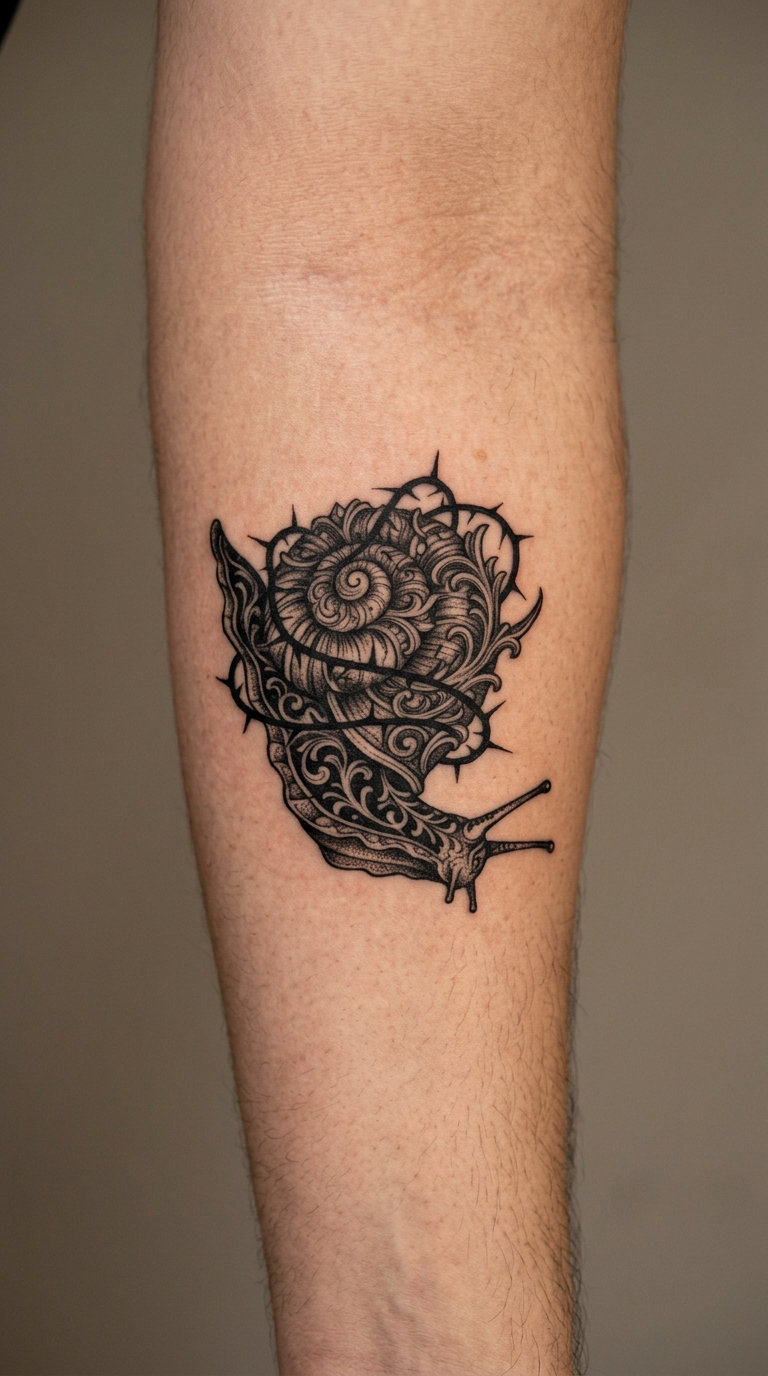
A gothic snail is black ink only: a heavily textured shell, thorny lines that wind around it, and dark shading that pools in the spiral’s grooves. It borrows the vocabulary of botanical dark art without importing any symbols from it.
It is the one genuinely moody design in this set, and it works because the shell is already an object that looks like it has survived something. People tend to arrive here after a hard stretch.
Placement: forearm, upper arm, or the back of the calf · Size: 3-3.5 inch (7.5-9 cm) · Style: blackwork gothic, stippled shading, no colour.
Pain: medium to high over a large forearm, because the shading is done in many small passes. Make it yours: ask for the thorns to follow a real plant, bramble or thorn stem, so the dark work is still observational and not generic clip art.
21. Tiny Snail in a Tea Cup
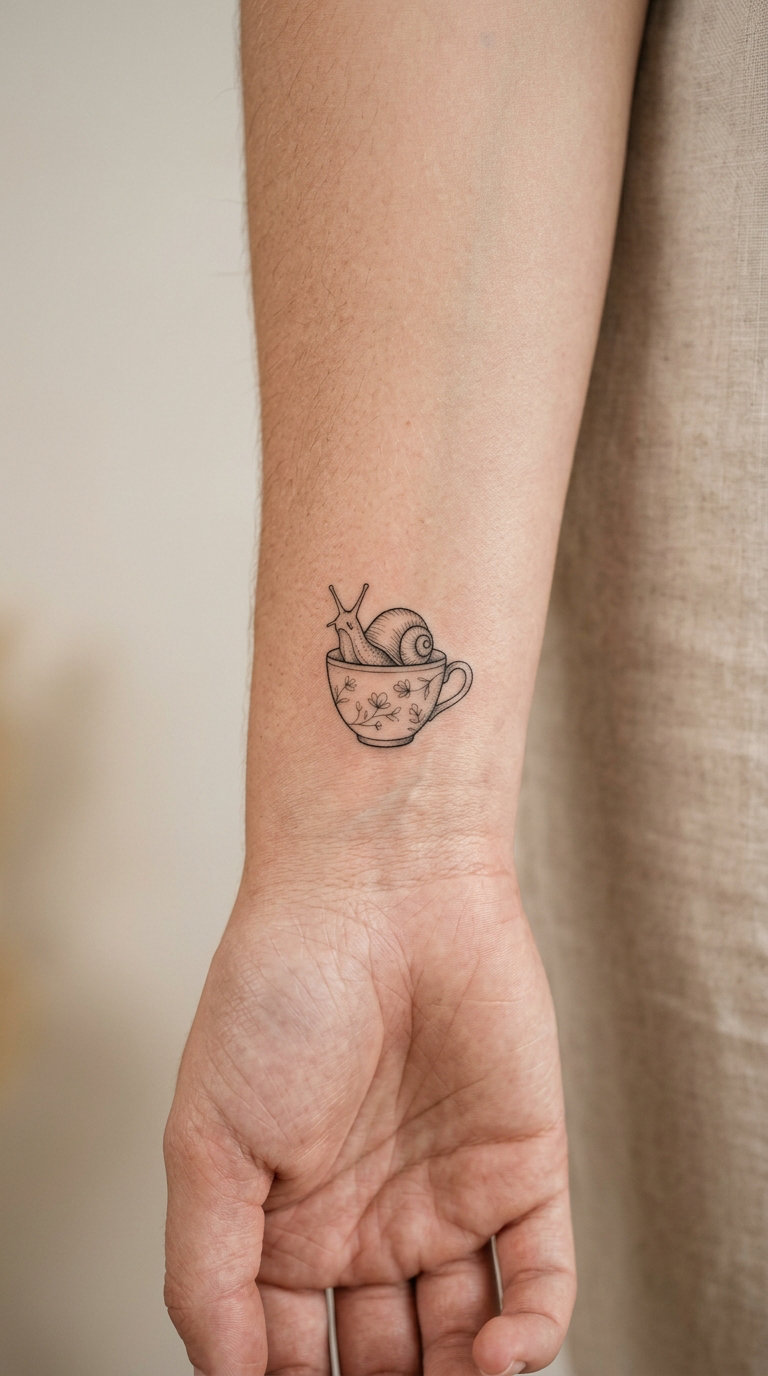
A snail in a tea cup is a two-object composition kept deliberately dumb: a plain cup on a simple saucer, and a snail with its head above the rim. No steam, no pattern, no second saucer, and it works because the joke is legible in a second.
This is personality rather than symbolism, and people usually laugh at it later rather than sooner. It suits a wrist where you can see it yourself during the day.
Placement: inner wrist, or the forearm · Size: 2 inch (5 cm) wide · Style: whimsical fine line, single weight, no shading.
Pain: low. The cup rim is two clean curves, which is a quick tattoo. Make it yours: draw the actual cup you drink from, or put your own initial on the saucer in place of a maker’s mark.
22. Snail and Crescent Moon
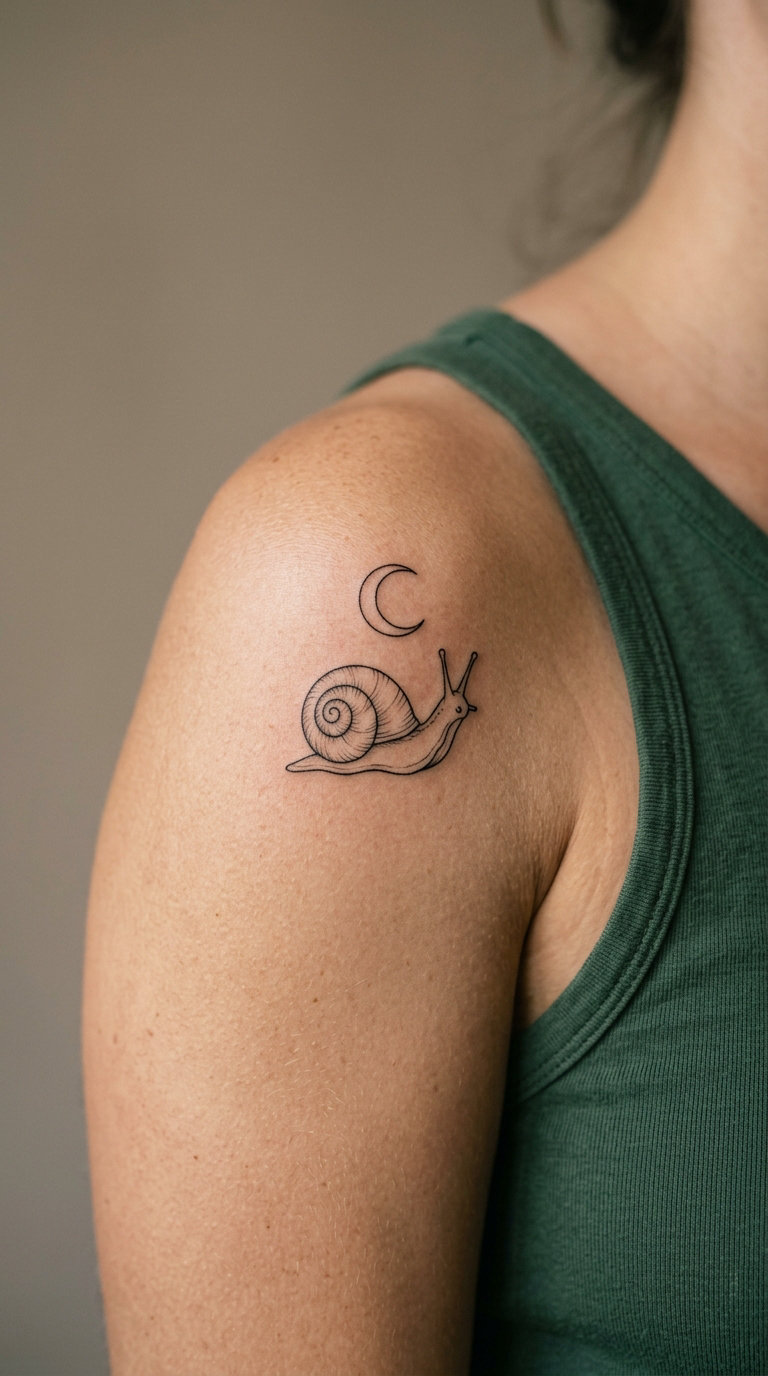
A snail under a crescent moon sets one soft organic shape below another: the snail low and grounded, the moon above and slightly to one side, with a short line of night sky between them. Both elements stay simple so neither one turns fussy.
It is a night scene without stars, which keeps it quieter than a typical celestial piece and easier to live with long term.
Placement: outer shoulder, upper arm, or the outer calf · Size: 2.5-3 inch (6-7.5 cm) · Style: fine line, with a single crescent drawn as a line, not a filled shape.
Pain: low, and the shoulder gives a flat surface for a horizontal composition. Make it yours: curve the moon to match the shell’s spiral direction, so the two shapes point the same way and the design reads as one thought.
23. Colour-Blocked Snail on the Back
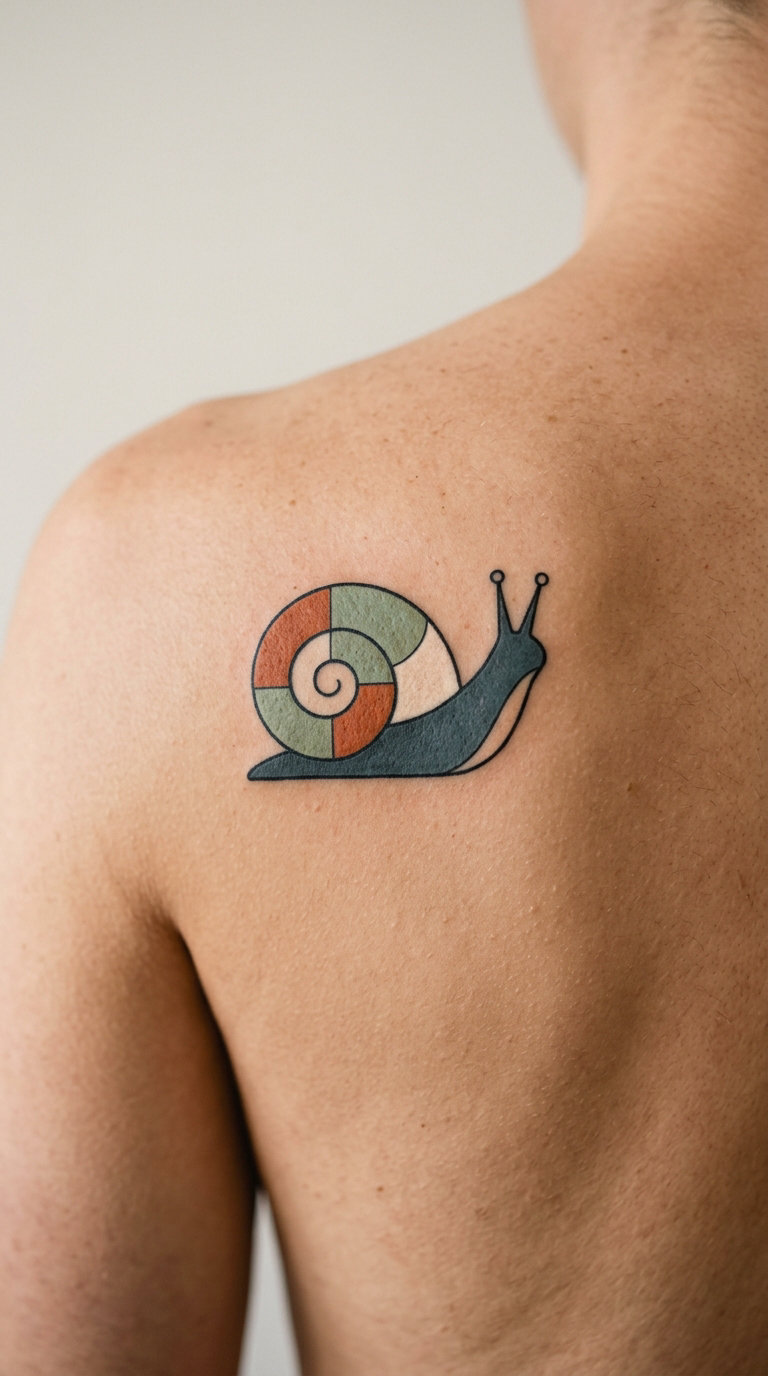
A colour-blocked snail is a modern graphic take: broad flat sections of rust, sage, cream and charcoal, clean edges between them, and a silhouette that stays strong because the internal detail is minimal. Muted tones hold it together where bright ones would fight.
The upper back is an underrated spot for this, because there is flat skin, decent spacing and no daily visibility. It is a strong first piece for someone who wants colour without a small tattoo.
Placement: upper back between the shoulder blades, or the flat of the upper arm · Size: 3-3.5 inch (7.5-9 cm) · Style: graphic colour block, flat fills, hard edges.
Pain: low to medium. The back is uncomfortable to lie on afterwards, but the sensation itself is mild. Make it yours: build the palette from four colours you already wear, which keeps the piece looking deliberate years later.
24. Large Spiral Snail Sleeve Element
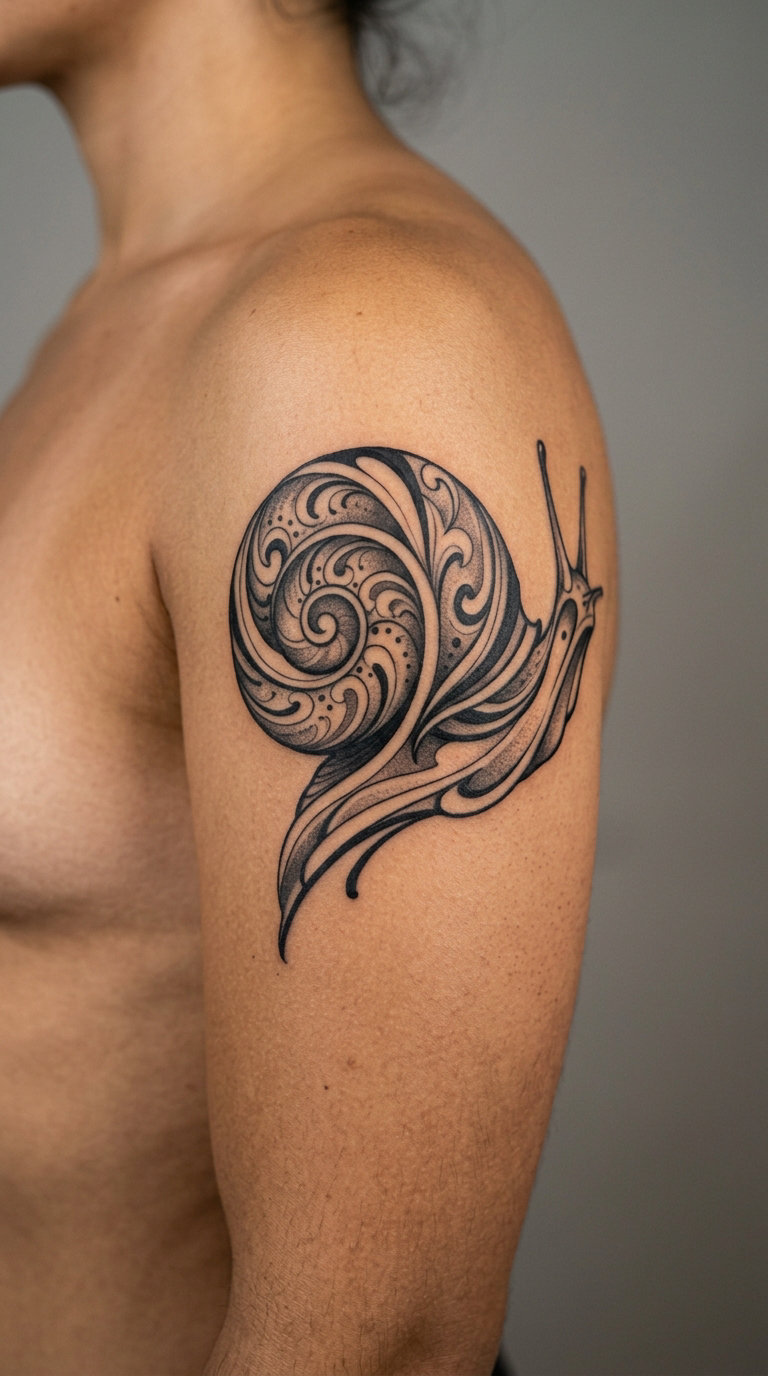
A large spiral snail is a scaled-up shell with a body that sweeps into open space, drawn in black and grey with a textured shell and long clean lines for the body. At 5-7 inch (13-18 cm) the artist can work real detail into the shell, which is what a small version has to fake.
This is where the motif stops being an insect and becomes a composition. It works as a standalone upper arm piece or as one element in a larger sleeve, and it is the right scale if you have space and the patience for a longer session.
Placement: outer upper arm, or as the central panel of a half sleeve · Size: 5-7 inch (13-18 cm) across · Style: black and grey illustrative, or a hybrid sleeve with colour added elsewhere.
Pain: medium over a long stretch, and this is a multiple-session piece by design. Your artist will outline first and shade in a later sitting. Make it yours: work the shell spiral into the flow of the arm so the design wraps instead of sitting flat, and sketch it directly on the body before committing.
How to Choose the Right Design
Almost every disappointing small snail tattoo comes down to one mismatch: too much detail, or too little, for the placement it landed on. Work through these three questions in order and the choice usually makes itself.
Can the placement hold the detail?
A 3-inch detailed shell works on a forearm and fails on a finger. Roughly, an inch of design needs about an inch of flat skin plus room around it, and a hand or finger has neither. If you want realism, give it a forearm, a calf or a thigh. If you are set on a small placement, pull the design toward a simple outline and fewer internal lines.
Does the style match what you already have?
Mixed styles are not automatically bad, but a single thin fine-line tattoo sitting next to a heavy blackwork piece will always look like the odd one out. If your collection is already one style, pick a snail design in that style. If you are starting fresh, fine line and blackwork are the two that fit into the most collections later.
Is the meaning yours, or borrowed?
Most people pick a snail for patience, steady progress or protection, and that is enough. Ask yourself whether the design still works if it means nothing at all. A shell with a clean spiral is a good shape on its own, and you will not be stuck defending a meaning you borrowed from a list.
Two other checks are worth doing before you commit. Have the artist draw the shell on paper at the size you intend, because a spiral that looks right at thumbnail scale can look muddy at full size. And read the comments under snail tattoo posts on Reddit, Pinterest or Instagram for the thing you are actually getting, not the version of it the reference photo shows.
For the wider picture, our picks for 20 best coral reef tattoo ideas for ocean lovers and 20 best starfish tattoo ideas for simple, coastal looks cover the same decisions from the marine side, and both apply the same size-versus-detail rule.
Style glossary for snail work
- Fine line — one thin continuous line, minimal shading. Small, discreet, but softens fastest over time.
- Blackwork — solid black fills and negative space. Reads boldly at any size and holds its shape longer.
- Micro-realism — a small study with real shading and texture. Needs a flat, generous placement.
- Watercolour — translucent washes with little hard line. Softens over years without looking like a mistake.
- Dotwork — the image built from dots. Forgiving of small wobbles, slow to tattoo.
- American traditional — thick outlines and a limited colour palette. The most durable option for a colourful snail.
Cost and Session Time
Snail tattoos sit at the easier end of a shop’s workload most of the time. A fine-line shell takes minutes. A realistic forearm snail with textured shading takes an hour or more, and a large spiral element takes several sessions. The price follows the hours, and the hours follow the detail, not the motif.
What actually drives the price
- Artist hourly rate — the single biggest factor. Studios in high-rent cities and artists booked months out charge considerably more for identical work.
- Shop minimum — nearly every studio charges a floor amount per appointment, so a tiny design can cost close to a small one. Ask before booking.
- Detail and colour — stippling, watercolour layers and textured shells all add time. A pattern filling a shell is not the same job as an outline.
- Placement — ribs, collarbones, fingers, the back of the hand and the spine are charged as difficult areas because of the angle and the skin.
- Custom work — drawing something from scratch costs more than choosing from a flash sheet, where the design is already proven.
Session length by size
| Design size | Typical session | What to expect |
|---|---|---|
| Under 1 inch | 15-30 minutes | One sitting, minimal detail, a micro fine line or a simple shell |
| 1-2.5 inch | 30-60 minutes | One sitting for most styles; a dotwork shell may need a break |
| 2.5-4 inch | 60-120 minutes | One long sitting, or outline plus shading in two appointments |
| 5 inch and up | Several sessions | Outline first, shade in later sittings, heal between them |
Plan a meal and a normal day around the middle of that range, not the optimistic end. Eating beforehand helps more than people expect, and a session that runs over is normal for a detailed piece.
Aftercare Basics
Follow your artist’s aftercare instructions first, every time. The list below is general guidance, and the sheet your artist gives you beats it.
- Wash gently, twice a day — lukewarm water and a mild unscented soap, then pat dry with something clean. Never scrub the piece.
- Keep it covered early on — a clean, non-stick dressing for the first few hours protects the ink while it settles. Change it if it lifts or gets wet.
- Keep it out of the sun — no sunbathing, no sunny windowsills, no unprotected swimming or hot tubs for a couple of weeks. A healed fine-line snail fades noticeably faster than blackwork.
- Avoid friction and soaking — loose clothing over the area, no baths, pools or steam while the surface is still healing.
- Watch the healing, not the scab — flaking, itching and a faint pink flush are ordinary. If you see spreading redness, swelling or discharge, contact your artist, and get medical advice rather than trying to fix it yourself.
Frequently Asked Questions
What does a snail tattoo symbolize?
A snail tattoo usually symbolizes patience, persistence, self-protection and slow, steady progress. The shell stands for home, safety and boundaries, since a snail retreats into it when threatened. The spiral is read as an inward path and personal growth. People add their own layer on top, including fertility, luck and a memorial to a real snail they kept.
Are snails good luck or bad luck?
It depends on the context you start from. In several folk traditions the snail is associated with prosperity, steady income and a protected home, because it carries its house with it. In modern garden terms it is a pest that eats your plants. Neither reading cancels the other, and most wearers pick the meaning rather than inherit it.
What size should a small snail tattoo be?
For a wrist or ankle, 1.5 to 2.5 inch (4-6 cm) is the realistic range for a detailed snail. Under an inch, the shell spiral turns to mush within a year unless the design is a simple outline. Give a realistic forearm snail 3 to 3.5 inch (7-9 cm). Fingers can hold about an inch, and anything more detailed there will need a touch-up.
Is a snail tattoo painful?
Most placements sit at low to medium discomfort. Wrists, forearms, calves and thighs are mostly low, and the inner wrist feels more vibration than pain. Ribs, collarbones and fingers are medium to high, because the skin is thin over bone. Nobody should tell you snail shells specifically hurt more, though a heavily textured realistic shell takes longer and feels like more.
How long does a fine-line snail tattoo last before fading?
Fine line softens noticeably in the first few years, especially on the inner wrist, fingers and anywhere exposed to sun. Blackwork and traditional line work hold their edges far longer, and watercolour and dotwork fade more gently than hairline work. A rough rule is that you should expect a refresh on micro fine-line snail work after three to five years, sooner with frequent sun exposure.
What should I ask my tattoo artist before booking?
Ask them to draw the shell at your intended size before you commit, and ask what they would change for your exact placement. Check whether the design is theirs or borrowed, and ask about a touch-up on the healed result. Tell them about existing tattoos nearby so the spacing works, and mention if you have a covering sleeve planned.
If this is your first tattoo, the fine-line wrist snail or the minimalist spiral shell is the safest version: small, simple and readable. If you are adding to a collection and want the motif to carry some weight, the blackwork shell or the large spiral element is where the design actually opens up. Bring the design you like to an artist, ask them what your placement can hold, and let them tell you if it needs simplifying.