
20 Best Coral Reef Tattoo Ideas for Ocean Lovers (September 2026)
A coral reef tattoo is body art that shows coral formations and the marine life living among them: branching corals, brain and boulder corals, sea fans, sponges, tube anemones and zoanthid polyps, usually with tropical fish, seahorses or sea turtles layered through the water above. It works as a composition rather than a single icon, which is why it holds up better than a lone nautical symbol.
These twenty coral reef tattoo ideas cover everything from a 1.5 inch single-line branch to a full-colour arm scene, so there is something here whether this is your first tattoo or the fourth piece in a growing ocean collection. Each one lists placement, realistic size, style and an honest read on pain and ageing, because a reef design that looked perfect in a reference photo can turn to grey mush at two inches.
If you are planning ahead, book your artist at least four to six weeks out, especially for anything on the ribs, spine or calf. Warm weather arrivals tend to fill calendars first, and reef work is not something you want rushed into a short appointment.
Coral Reef Tattoo Ideas: Quick Guide
| Idea | Style | Best placement | Size | Pain |
|---|---|---|---|---|
| 1. Fine-line clownfish | Fine line | Inner forearm | 3 in / 7.5 cm | Medium-low |
| 2. Branching coral colony | Micro-realism | Outer wrist | 2.5 in / 6 cm | Medium |
| 3. Blue-and-yellow reef fish | Traditional | Outer upper arm | 5 in / 12.5 cm | Medium-low |
| 4. Turtle over a coral arch | Watercolor | Shoulder | 6 in / 15 cm | Medium |
| 5. Octopus and negative space | Blackwork | Side rib | 7 in / 17.5 cm | Medium-high |
| 6. Mermaid-made coral branch | Fine line | Index finger | 1.5 in / 4 cm | High |
| 7. Dotwork school of fish | Dotwork | Elbow | 4 in / 10 cm | Medium |
| 8. Wave and coral garden | Illustrative Japanese | Calf | 7 in / 17.5 cm | Medium-high |
| 9. Neon coral and fish pair | Neon minimalist | Collarbone | 3 in / 7.5 cm | Low |
| 10. Angelfish and coral stem | Realism | Thigh | 5 in / 12.5 cm | Medium-high |
| 11. Geometric coral triangle | Geometric | Forearm | 2.5 in / 6 cm | Medium |
| 12. Bubble coral panel | Illustrative realism | Outer upper arm | 5 in / 12.5 cm | High |
| 13. Ocean floor cross | Fine line | Upper back | 4 in / 10 cm | Medium-high |
| 14. Lionfish portrait | Blackwork | Calf | 6 in / 15 cm | Medium-high |
| 15. Pastel coral garden | Illustrative pastel | Forearm | 7 in / 17.5 cm | Medium |
| 16. Moray eel linework | Blue linework | Calf | 7 in / 17.5 cm | Medium |
| 17. Seahorse and coral pair | Micro fine line | Finger and wrist | 1.5 in / 4 cm each | High |
| 18. Manta ray and coral flight | Illustrative realism | Upper back | 9 in / 22.5 cm | Medium-high |
| 19. Coral spawn and anemone | Illustrative dotwork | Inner forearm | 4 in / 10 cm | Medium |
| 20. Full-color reef scene | Illustrative | Outer arm | 8 in / 20 cm | High |
1. Fine-Line Clownfish Among Soft Corals
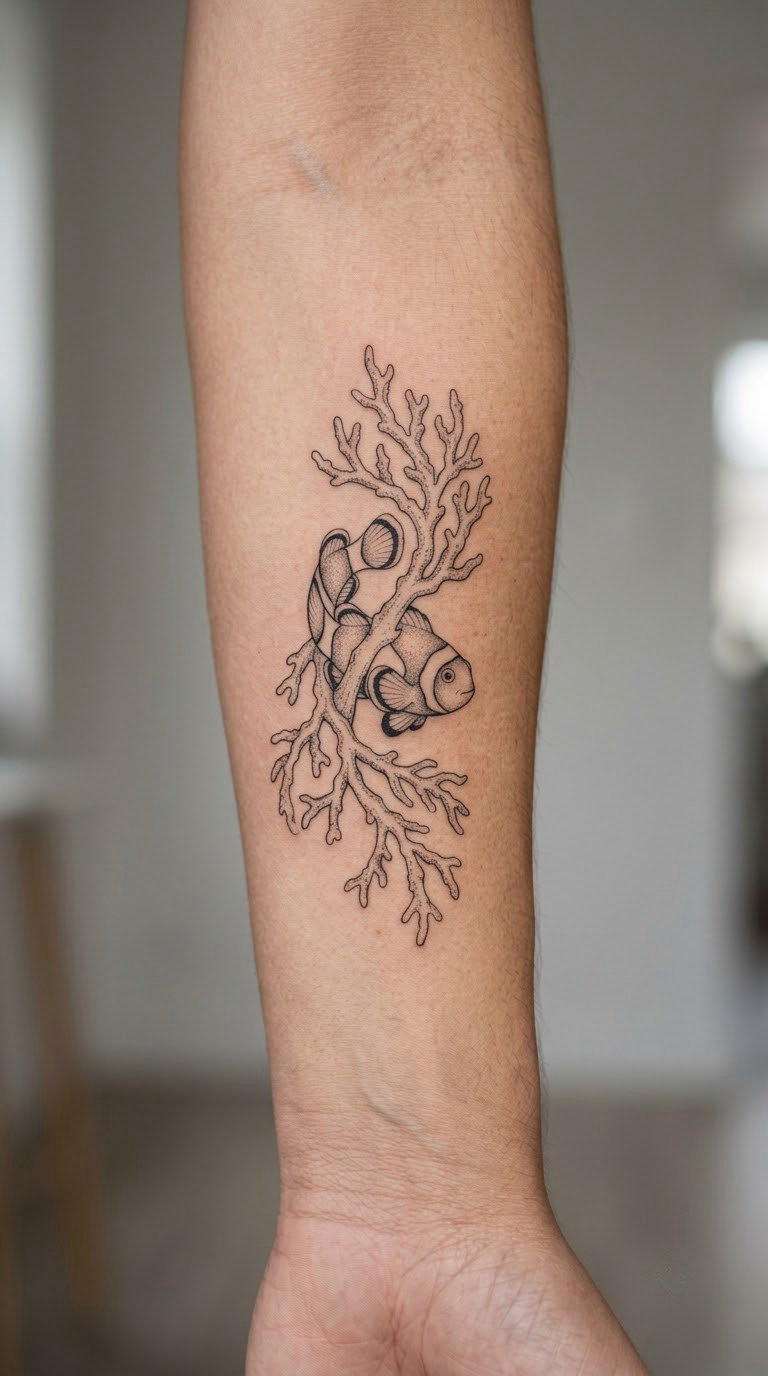
One continuous black line draws the fish, its body arcing in a loose S-curve with three clean stripe marks and a single filled eye. Two soft coral branches trail off behind it, no background, no bubbles, no shading at all.
Minimal reef work like this suits people who want the ocean without a mural, and it sits comfortably next to other thin-line pieces. The clownfish is the most forgiving reef subject there is because its outline stays readable even at small sizes.
Placement: inner forearm, above the wrist, or the outer arm. Size: 2.5 to 3.5 in (6 to 9 cm). Style: fine line. Pain: medium-low on the forearm. Hands and fingers are a poor long-term home for linework this thin, so keep it on the arm if you want it crisp in ten years.
Make it yours: tuck a small dive date into the curve of the tail, or set two tiny fish instead of one to mark a pair.
2. Micro-Realism Branching Coral Colony
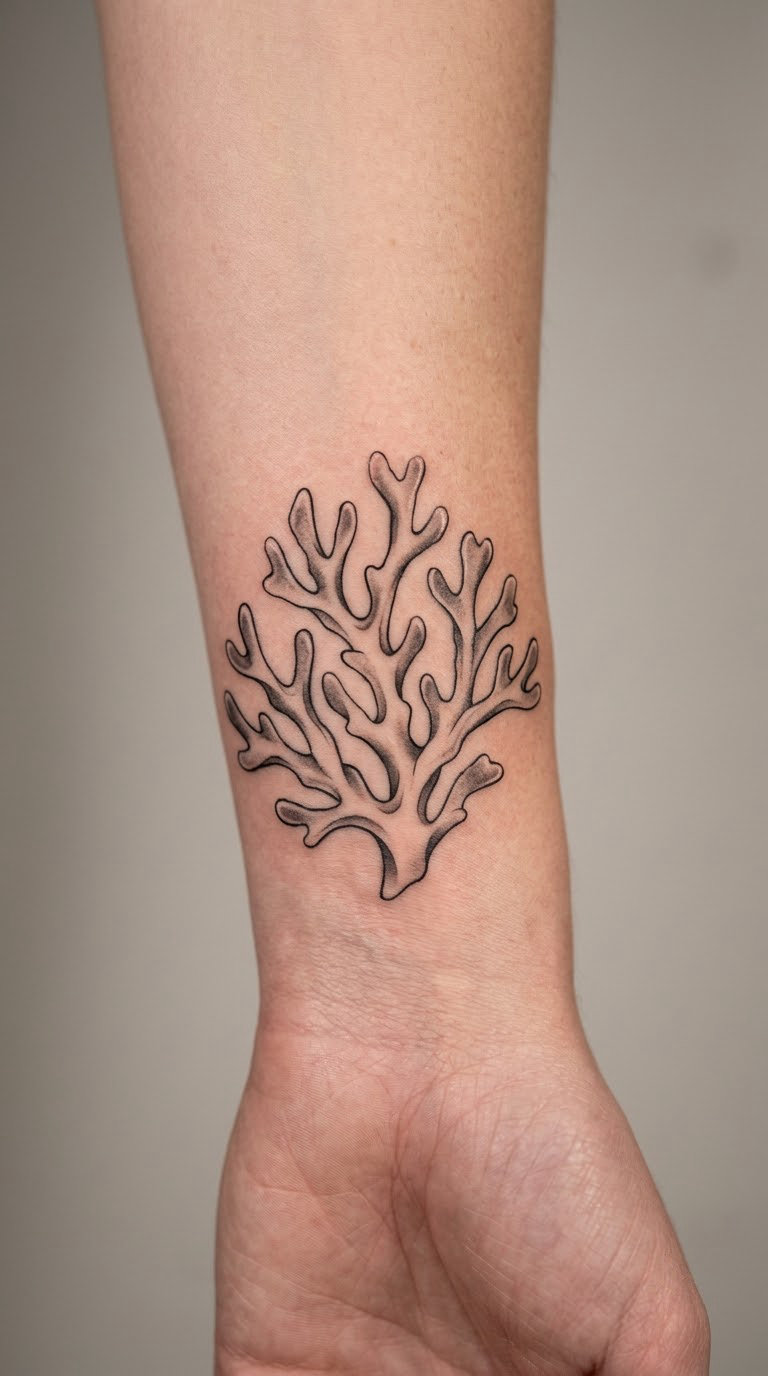
A single staghorn-style colony rendered in black and grey, each fork tapered and slightly different from the last, with soft grey shading gathered at the tips and along the lower trunk. The edges stay crisp so the branches read as coral and not as bare twigs.
This is the quiet option, and it works well for a first reef tattoo because there is no colour to fade and no scene to crowd. Reef keepers on the reef2reef forum single out staghorn and brain coral for exactly this reason: the silhouette is distinctive, so it stays legible at small sizes.
Placement: outer wrist, inner arm, or behind the ear. Size: 2 to 3 in (5 to 7.5 cm). Style: micro-realism. Pain: medium, wrist bone included. Below about 1.5 in (4 cm) the fine forks start to blur into a grey smudge within a few years, so ask for fewer, thicker branches.
Make it yours: bring a photo of the actual colony you saw on a dive or in your own tank and have the artist copy its exact proportions.
3. Traditional Blue-and-Yellow Reef Fish
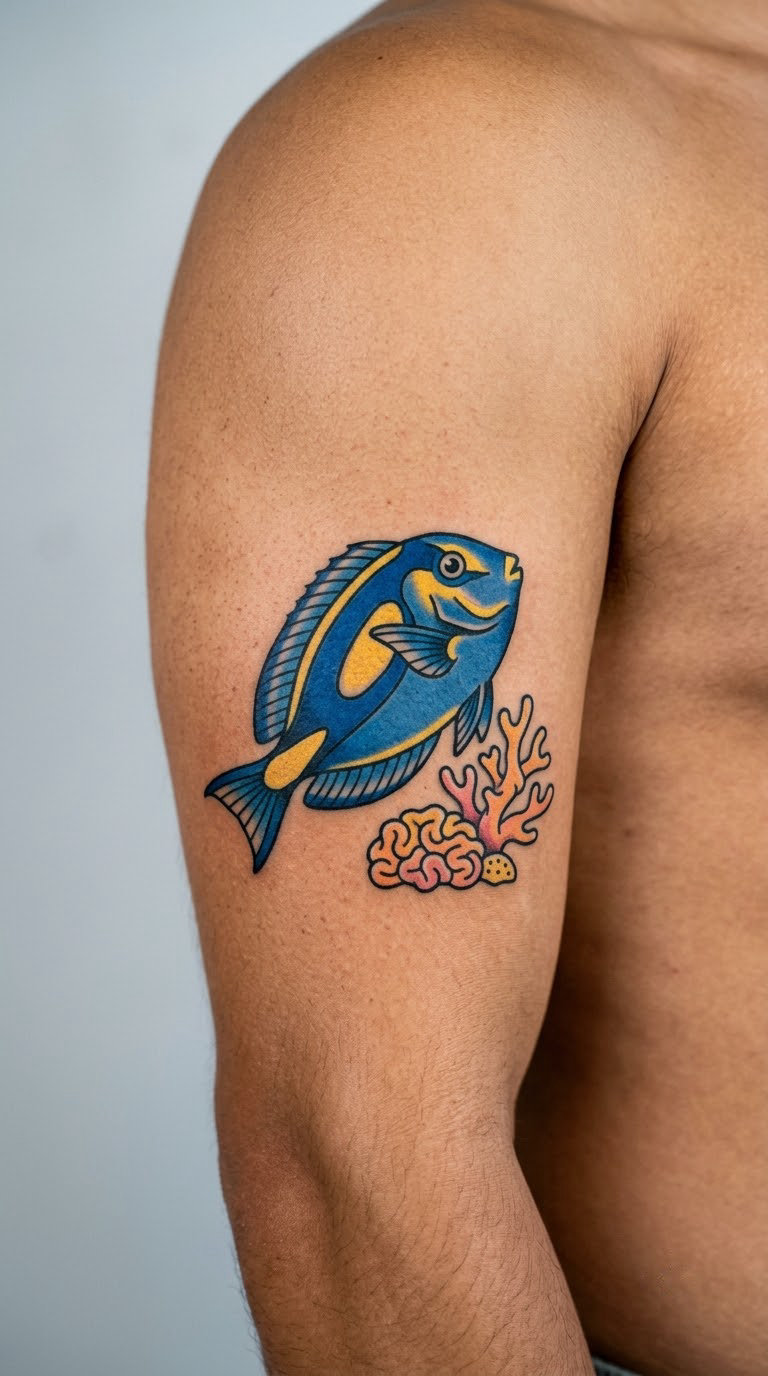
Bold black contour lines wrap a saturated blue body and a yellow belly and tail, with a few hard black scale marks and a single small coral accent tucked under the fish. Flat color, no gradient, the old tattoo style done properly.
Traditional reef fish are bold enough to read from across a room, which is exactly what people who grew up watching reef documentaries tend to want. The palette is the whole point: that blue-and-yellow pairing is doing most of the work here.
Placement: outer upper arm, calf, or thigh. Size: 4.5 to 5.5 in (11 to 14 cm). Style: traditional. Pain: medium-low on the upper arm. Bright tropical blues and yellows are the first pigments to look tired, so plan on sun protection or a color refresh every few years.
Make it yours: swap the blue for a two-tone palette pulled from your own birth month, or add a tiny waterline beneath the fish.
4. Watercolor Turtle Over a Coral Arch
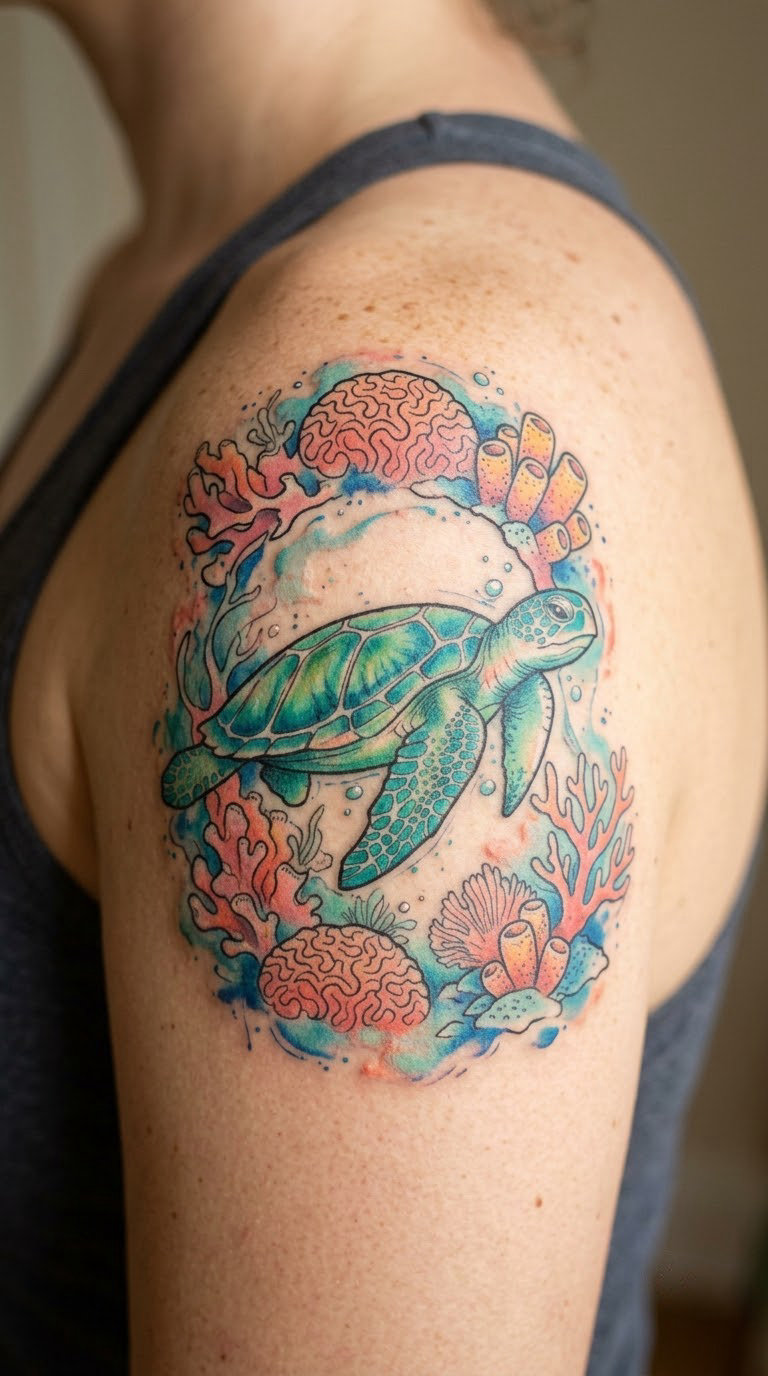
A sea turtle mid-stroke with a loose arch of coral beneath it, painted in translucent turquoise, soft green and warm coral washes that bleed past the outlines. The pigment sits lighter in places on purpose, so the piece looks like it is underwater rather than printed.
Turtles carry the longevity reading in a reef scene, and the watercolor finish keeps it from feeling heavy. It is a softer, more forgiving style than realism, which helps when you are placing a large piece near a joint.
Placement: shoulder, hip, or upper thigh. Size: 5 to 7 in (12.5 to 17.5 cm). Style: watercolor. Pain: medium, more on the shoulder blade than the deltoid. Light washes lighten over time, so the color that looks faint fresh usually settles a touch deeper as it heals.
Make it yours: name the reef where you want the arch modeled on and let the artist pull the coral species from real reference photos of it.
5. Blackwork Octopus and Coral Negative Space
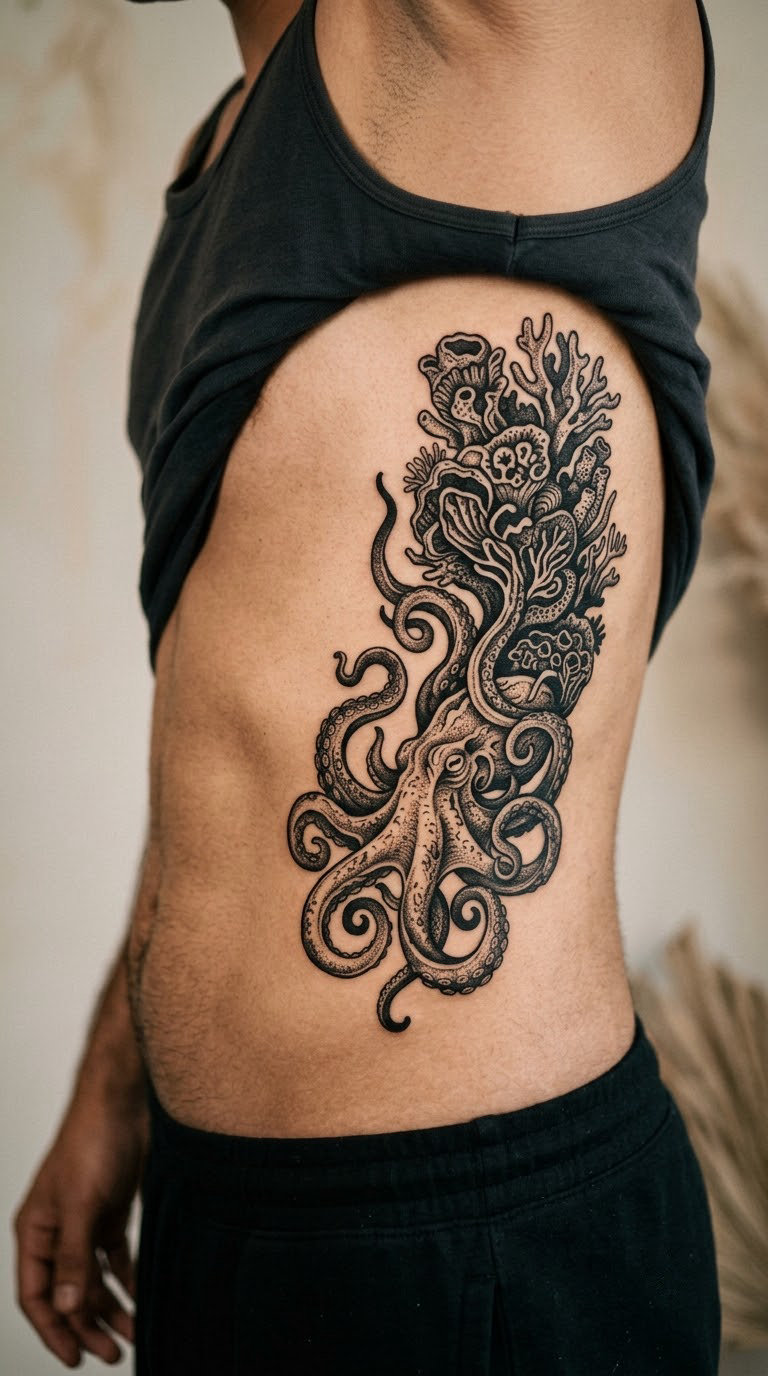
A dense black octopus whose eight curling tentacles dissolve into solid black coral forms, with the water left as clean white negative space. The whole thing reads as one shape, half ink and half absence.
This is the most dramatic reef design in the list and the one most likely to become a sleeve anchor later. It suits people who want something with weight to it rather than a small nod to diving.
Placement: side rib, outer thigh, or half sleeve. Size: 6 to 8 in (15 to 20 cm). Style: blackwork. Pain: medium-high; ribs and the bony outer thigh are the two spots that make people squirm. Solid black areas stay strong for years, so the piece ages better than its thin-line cousins.
Make it yours: let one tentacle tip break into a single bright accent color, teal or coral orange, as the only color in the piece.
6. Minimal Mermaid-Made Coral Branch
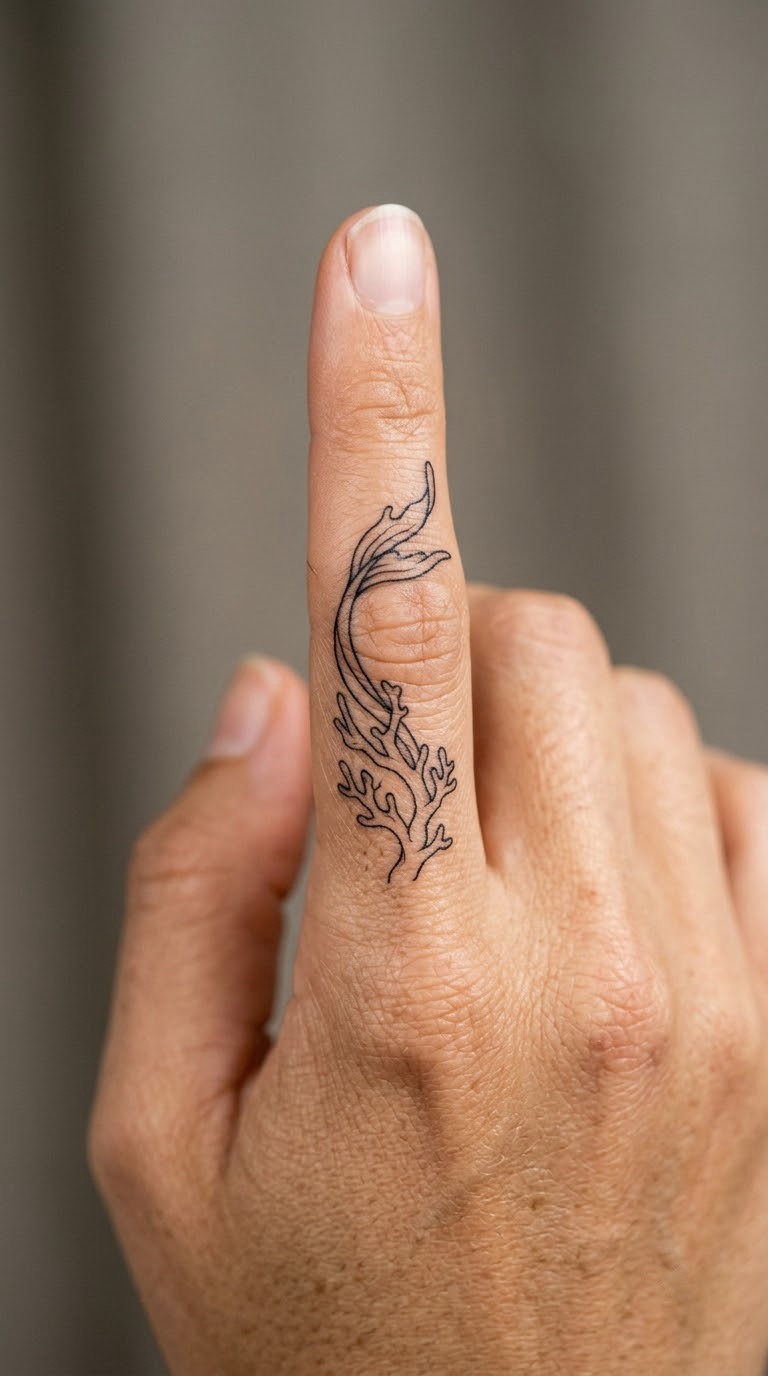
One unbroken line that starts as a stem, splits twice, and curves at the top into the suggestion of a tail fin. No figure, no face, no scale work. Just the shape doing the double duty quietly.
The dual reading is the appeal. It reads as coral to anyone who looks twice, and as something more personal to the person wearing it.
Placement: side of an index finger, ring finger, or the wrist. Size: 1.5 to 2 in (4 to 5 cm). Style: fine line. Pain: high on fingers, and fingers swell for a day or two afterward. Fine line on the hand fades noticeably faster than the same work on the arm, so expect a touch-up if you want it sharp past year five.
Make it yours: shape the stem into an initial so the letter grows out of the branch rather than sitting next to it.
7. Dotwork School of Tropical Fish
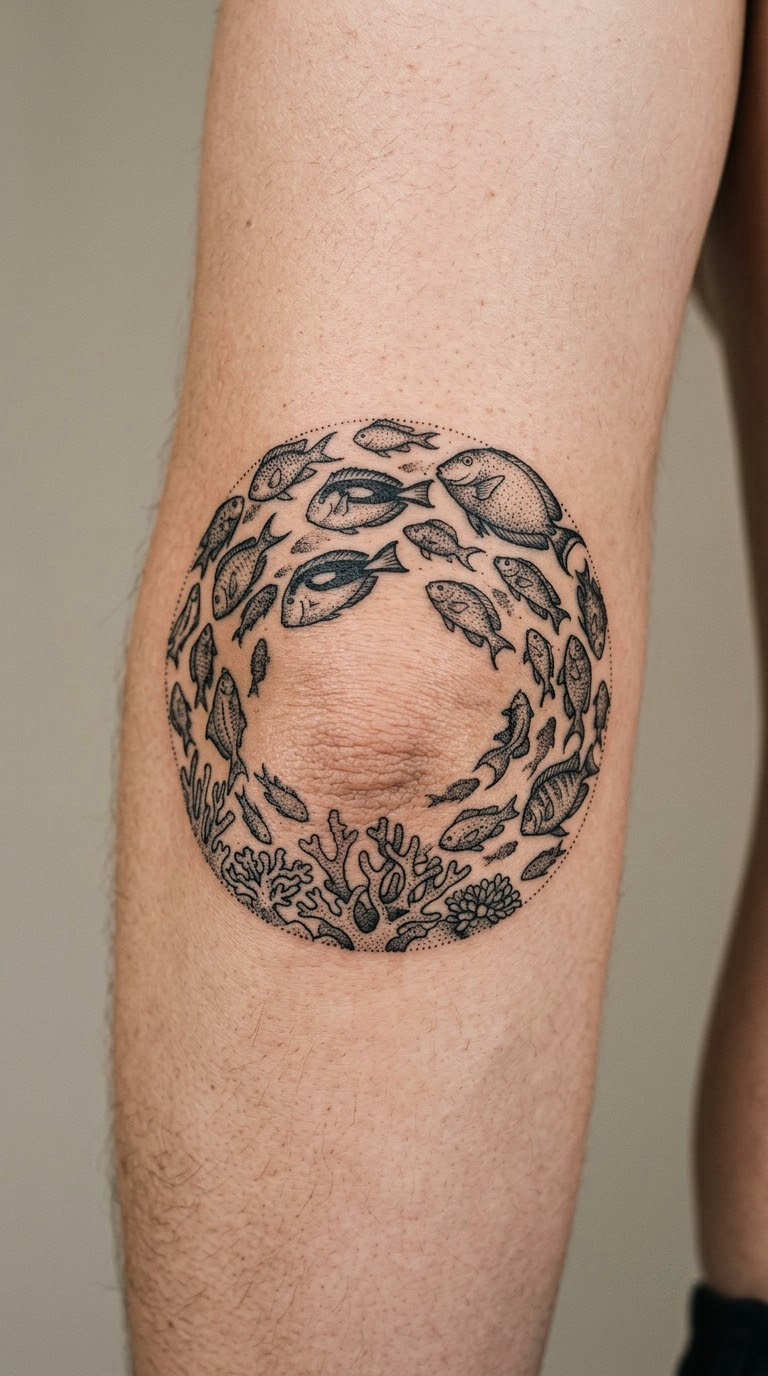
A round cluster of small fish, each built only from dots at varying density, drifting above a low coral base. The fish read as solid at the center and dissolve into scattered dots at the edges of the circle.
Dotwork hides detail beautifully because there is no line to fade, and a school of fish carries the reef theme without needing one hero subject. It is a good design for anyone who wants a piece that looks intricate in a photograph but sits quietly in real life.
Placement: elbow, forearm, or the back of the shoulder. Size: 3.5 to 4.5 in (9 to 11.5 cm). Style: dotwork. Pain: medium, and the elbow itself is more tender than most people expect. Dots soften and merge over the years, so a 4 inch circle ages better than a 2 inch one.
Make it yours: set the number of fish to match a group you dive with, or count them out to a date that matters.
8. Japanese-Style Wave and Coral Garden
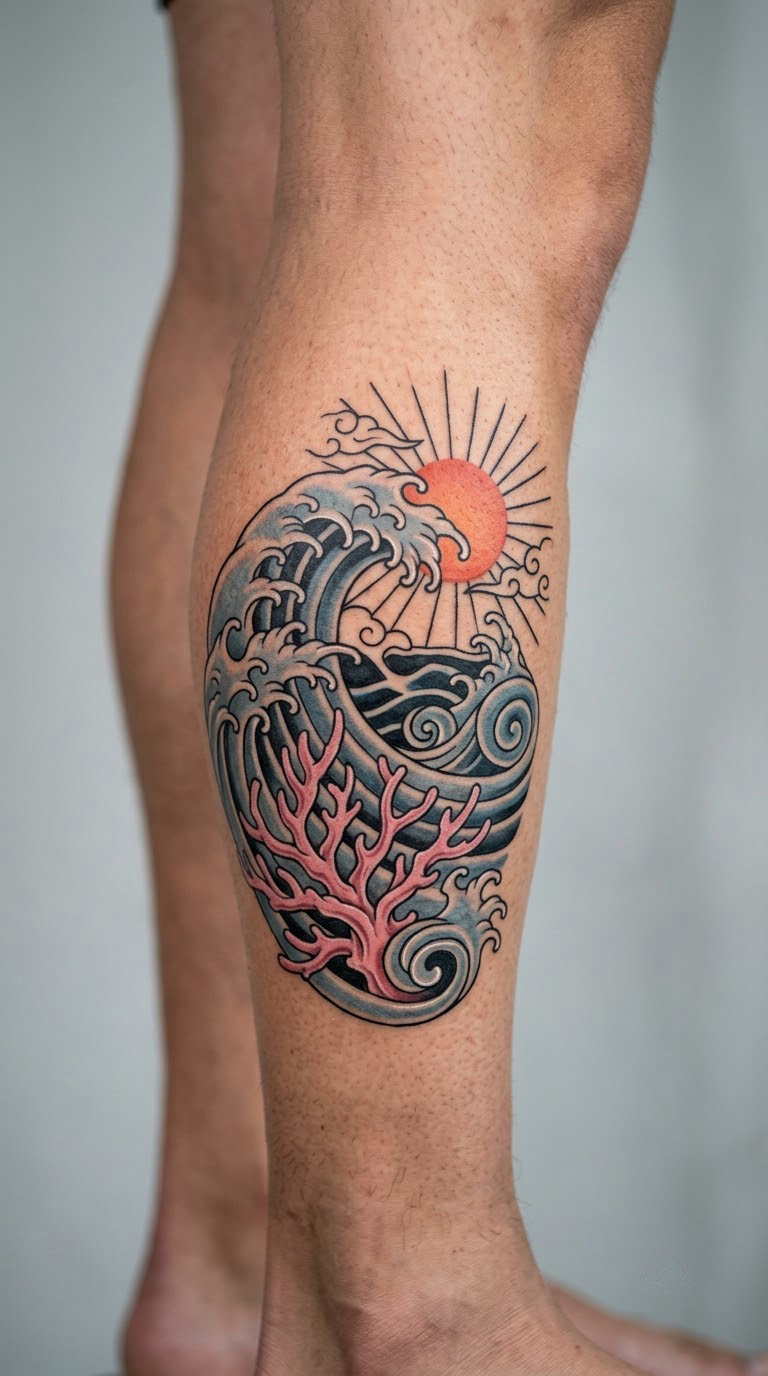
Flowing blue-grey wave lines curling into a claw of foam, wrapped around a stand of pink branching coral with a rising sun disc behind. Illustrative linework, gradient fills in the water, flat color in the coral.
The composition borrows its rhythm from classic wave illustration without borrowing its iconography, so it reads as a marine scene first and a genre reference second. Coral and wave are natural partners: one static, one moving.
Placement: calf, outer arm, or the back of the lower leg. Size: 6 to 8 in (15 to 20 cm). Style: illustrative Japanese. Pain: medium-high, the calf muscle shifting under the needle is the main complaint. Keep it out of direct sun, since the pink and the pale water blue both fade early.
Make it yours: add a small coordinate under the foam in a plain font, or place the sun disc as a birthstone color instead of red.
9. Neon Minimalist Coral and Fish Pair
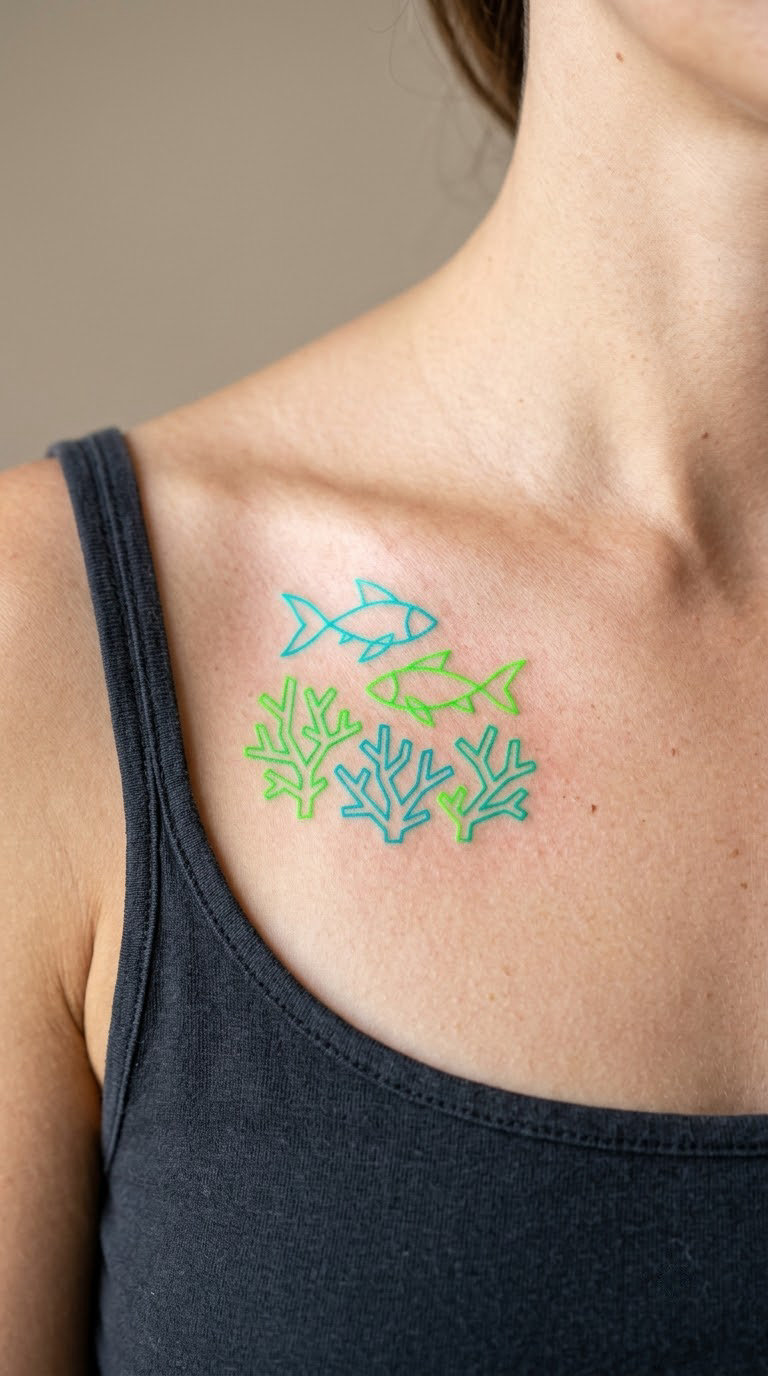
Two small fish drawn as single clean outlines, filled with neon green and cyan, hovering over three geometric coral branches made of straight segments and hard angles. Almost no shading anywhere.
Neon is the current favourite for people who want color without a traditional look. Three branches and two fish is all it takes; the design gets its interest from color contrast rather than from detail.
Placement: collarbone, sternum, or the inner bicep. Size: 2.5 to 3.5 in (6 to 9 cm). Style: neon minimalist. Pain: low, the collarbone is bone over a thin layer of tissue. Collarbones and shoulders see a lot of sun, and neon inks lighten fast, so this one is a candidate for a color refresh sooner than the others.
Make it yours: pick the two accent colors from something that matters to you, then keep everything else black.
10. Realistic Angelfish with a Single Coral Stem
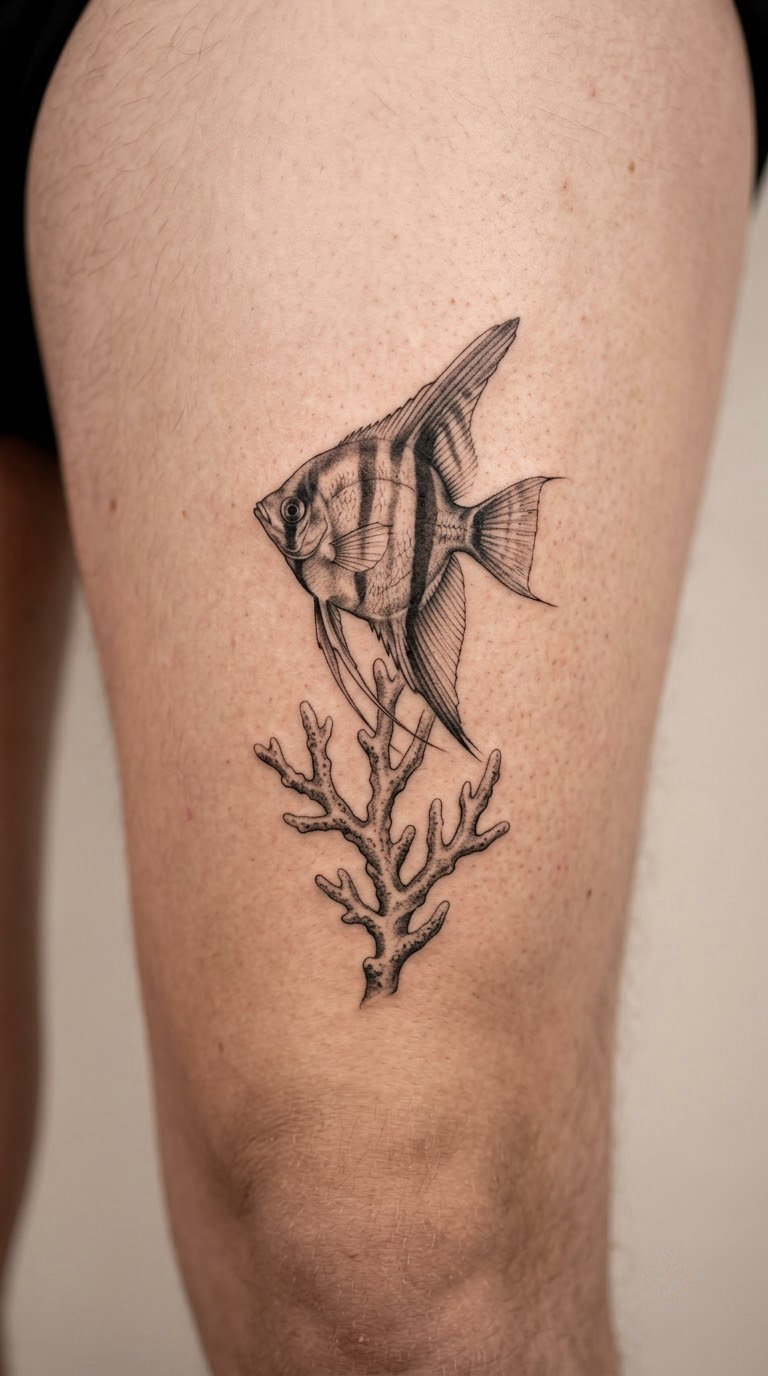
A detailed angelfish in black and grey, its vertical body stripes built from fine shading and its long dorsal and anal fins edged with hairlines, hovering above one branching coral stem for balance.
Realistic reef fish attract the most compliments and the most patience from the artist, since that shading takes hours rather than minutes. The single coral stem is doing real compositional work here: it gives the fish a base to sit on and stops the piece floating.
Placement: thigh, upper arm, or the calf. Size: 4.5 to 5.5 in (11 to 14 cm). Style: realism. Pain: medium-high on the thigh, which is a large bony area. The tiny stripe edges and fin hairlines soften noticeably with sun exposure, so treat this as a detail piece that will need refreshing over time.
Make it yours: add a thin color accent along one fin edge, no more, to keep the black and grey body intact.
11. Geometric Coral Triangle
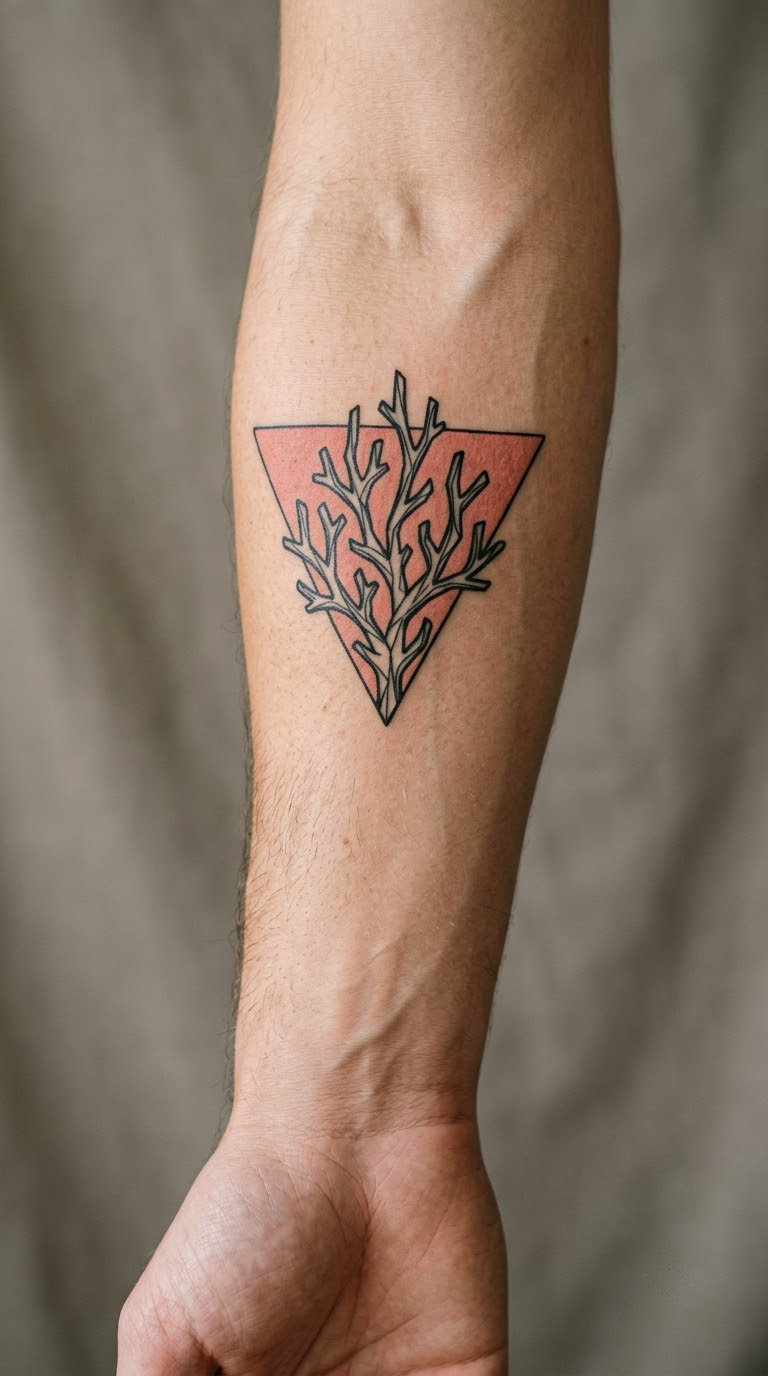
Angular coral branches reduced to straight black lines with clean joints, contained inside a triangle filled with one muted coral-pink tone. Abstract, graphic, and much closer to a logo than to a nature drawing.
Geometric versions work when a realistic coral would just look like a weed. Reef keepers point out that bad coral rendering reads to strangers as a bad plant, so abstraction is a legitimate way around that problem.
Placement: inner forearm, calf, or behind the ear. Size: 2 to 3 in (5 to 7.5 cm). Style: geometric. Pain: medium on the forearm. Fine joints and the small gaps between branches fill in with ink as they heal, so anything thinner than a pencil line will close up.
Make it yours: set your dive coordinates or initials in a small line of type beneath the triangle.
12. Macro Bubble Coral Sleeve Panel
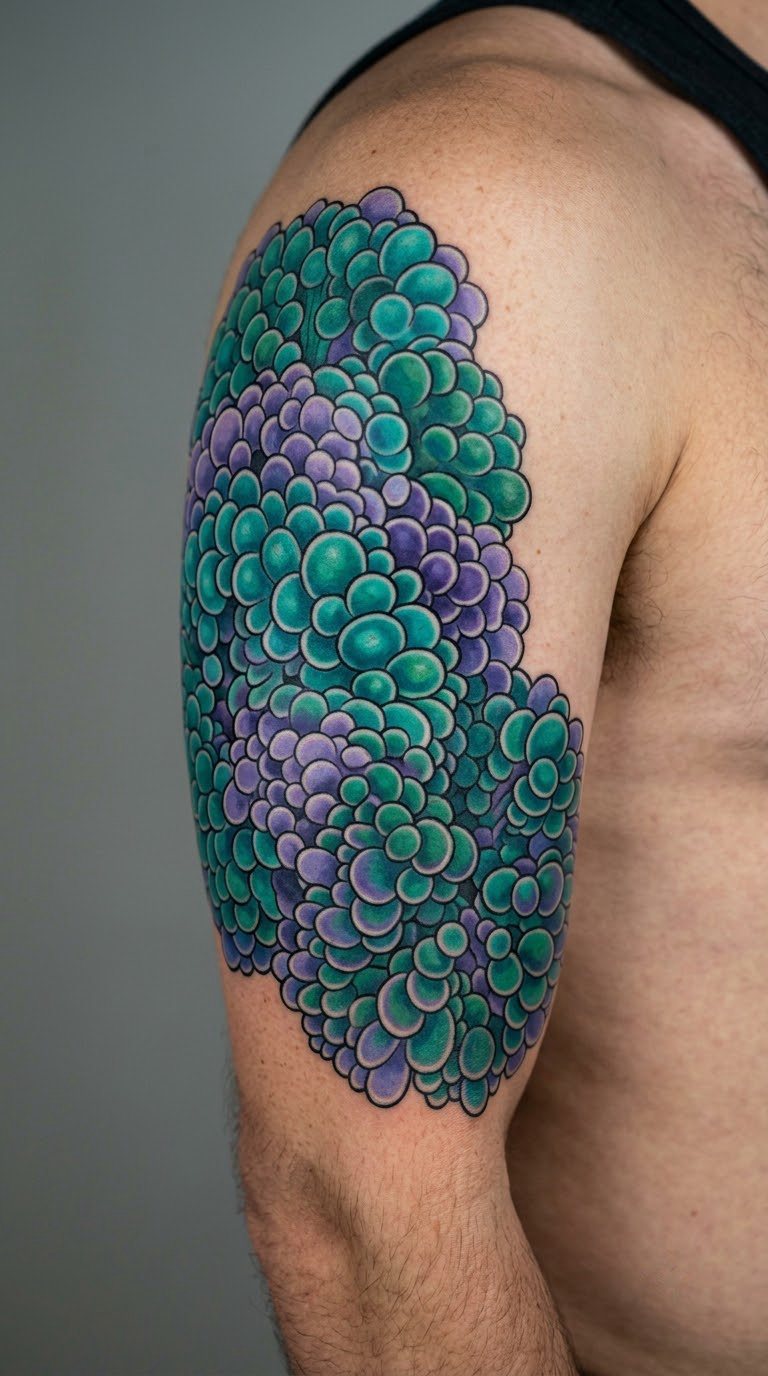
Overlapping bubble coral forms rendered as rounded translucent bulbs, layered teal, green and violet with white highlights where the light catches. It reads as a macro study rather than a scene, and it slots into an existing sleeve or stands alone.
Bubble coral is one of the few reef subjects that still looks like a reef when rendered very large, which is why it works well as filler between other pieces. It is also the most expensive idea here in effort terms, so book a longer session.
Placement: outer upper arm, typically between the elbow and shoulder. Size: 4.5 to 5.5 in (11 to 14 cm) per panel. Style: illustrative realism. Pain: high over the upper arm, and this is a two-hour-plus job. Broad violet and teal areas lose saturation faster than black shading, so expect a refresh on the color portions.
Make it yours: match the palette to colors already in your sleeve so the panel blends into existing work instead of sitting on top of it.
13. Fine-Line Ocean Floor Cross
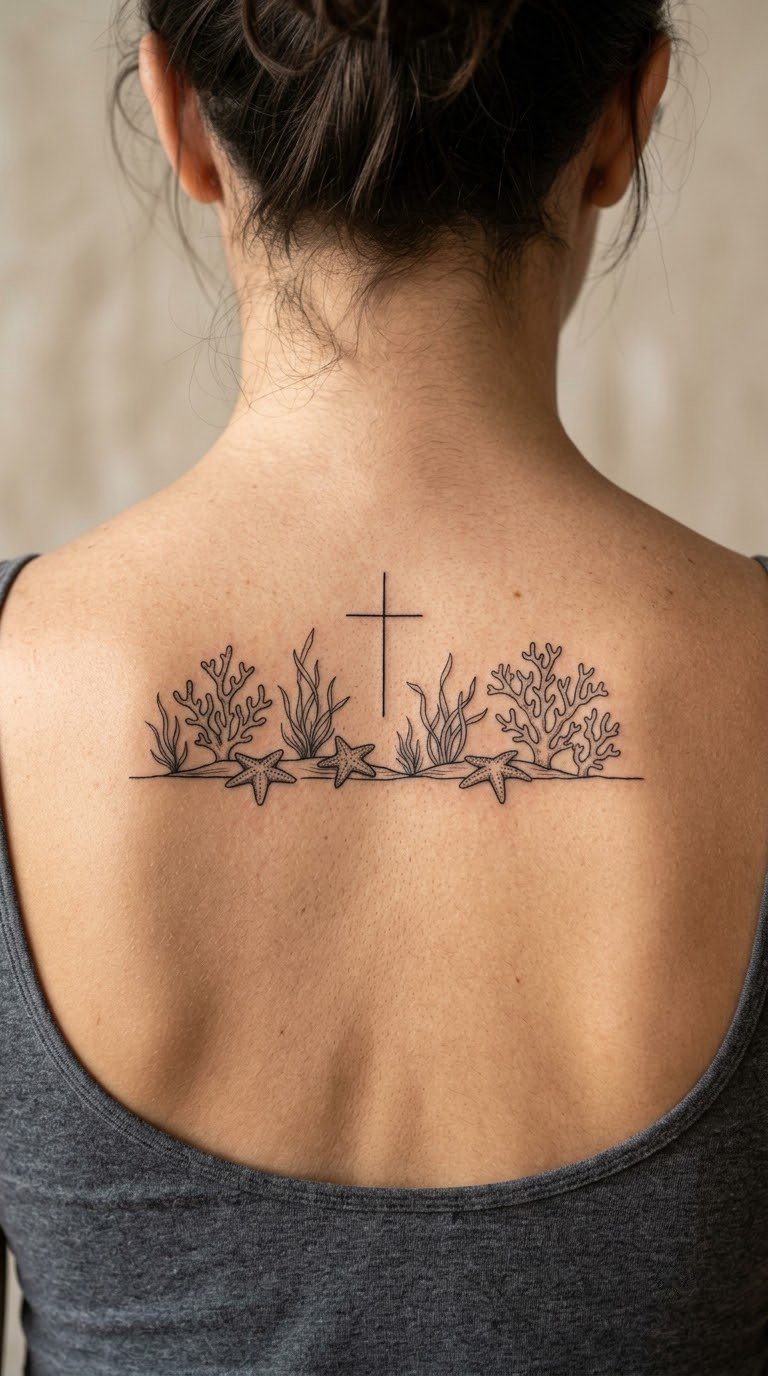
A small cross resting on a single ocean-floor line, with a starfish, two blades of seagrass and a short branching coral arranged along that same baseline. Thin linework throughout, no fill anywhere except the cross itself.
This is the version for a faith reason, a memorial, or a first piece that needs to stay modest. Keeping every element on one ground line is what stops it turning into a cluttered collection of sea shapes.
Placement: upper back, spine, or the inside of the forearm. Size: 3.5 to 4.5 in (9 to 11.5 cm). Style: fine line. Pain: medium-high along the spine, which is a bony strip of skin. Thin grass blades and coral forks blur over time, so ask for slightly heavier lines than the reference photo shows.
Make it yours: add a date in small script along the ocean-floor line, as though it were written on the sand.
14. Blackwork Lionfish Portrait
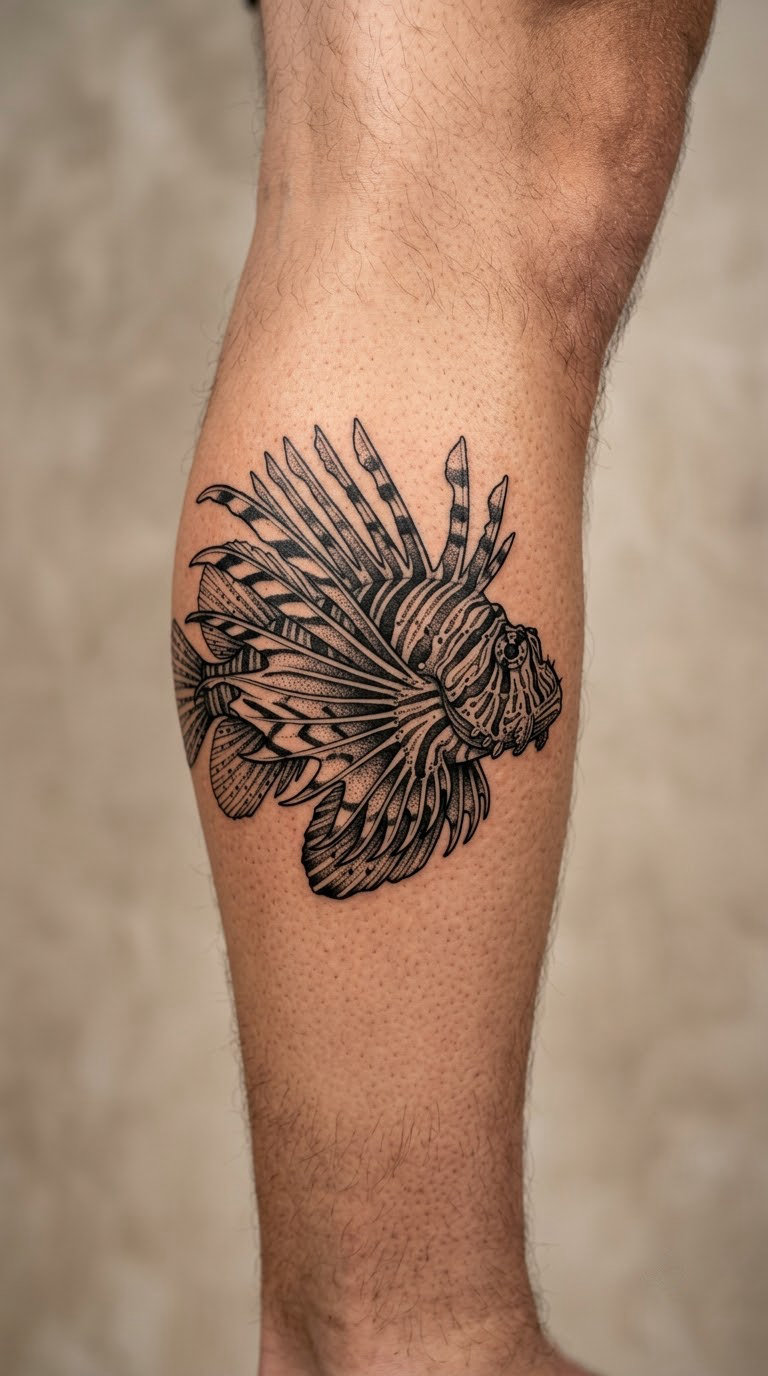
A lionfish in full blackwork: long separated fin rays striped like venetian blinds, stippled shadows building through the body, and almost no background beyond a suggestion of coral at the base.
It is the most technically demanding portrait in this list, because a lionfish is mostly fin and the fins are all thin line. If an artist takes this on, they are showing you a portfolio of similar work, not just general shading skills.
Placement: calf, thigh, or the outer arm. Size: 5.5 to 6.5 in (14 to 16.5 cm). Style: blackwork. Pain: medium-high, the calf is sensitive and a long session tests patience. Fine fin rays soften with sun exposure, so the long rays will need touching up sooner than the body shading will.
Make it yours: ask the artist to copy the fin ray pattern from a real animal you have seen rather than a generic reference.
15. Pastel Coral Garden on the Forearm
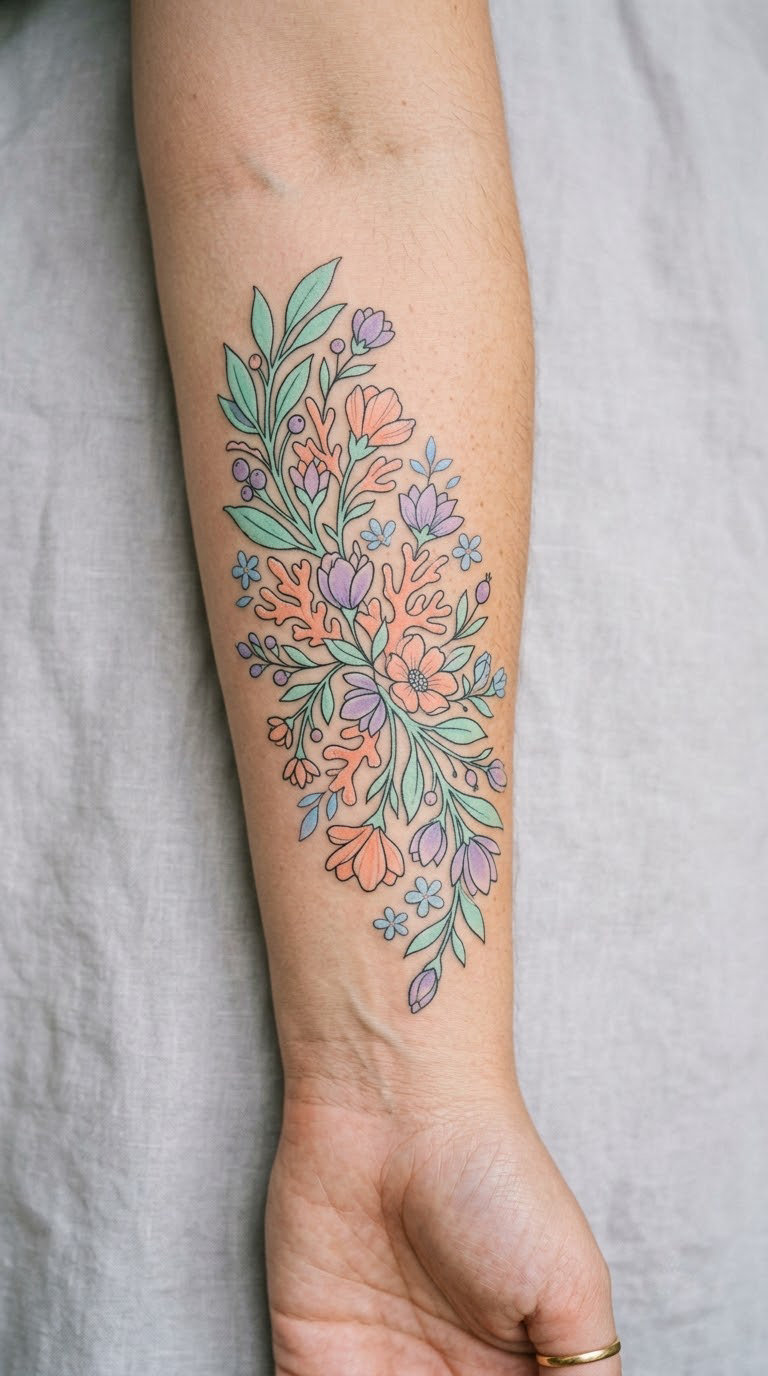
A flowing arrangement of soft coral branches in mint, peach, lavender and powder blue, loosely spaced so plenty of bare skin shows between them. Illustrative shapes, flat pale color, no outlines in places.
Pastel coral gardens are for people who find saturated tropical ink too loud. The soft palette reads as calm and a little abstract at a distance, which makes it a strong choice for a visible arm that also has to work at work.
Placement: forearm, from wrist toward elbow. Size: 6 to 7.5 in (15 to 19 cm). Style: illustrative pastel. Pain: medium on the forearm. Pale pigments sit close to skin tone and drift toward it over the years, so choose shades that start a couple of steps darker than you want the finished result to be.
Make it yours: build the palette from your birth month colors and keep to four shades maximum.
16. Blue Linework Moray Eel in a Coral Crevice
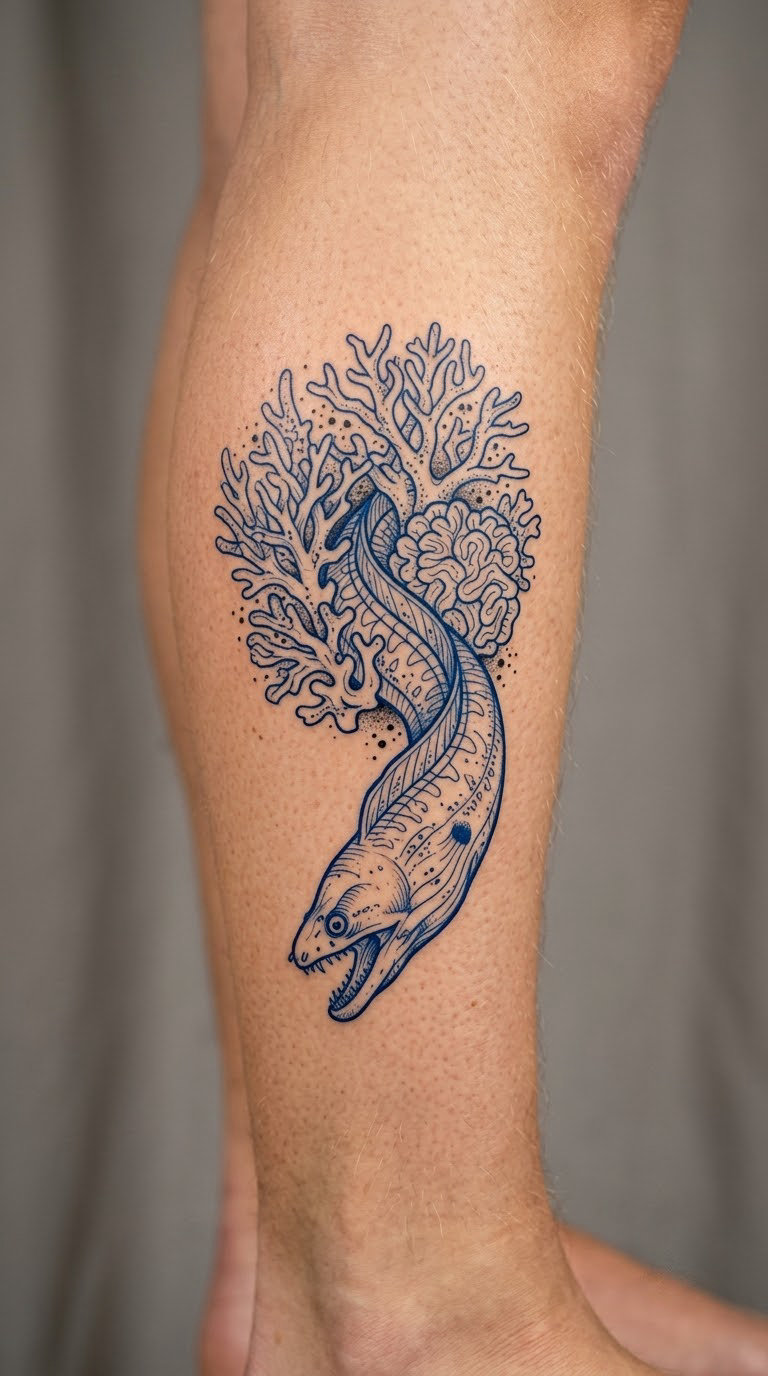
A long moray eel in blue linework emerging from a compact coral opening, its body looping once before the head lifts out, with restrained black dot accents scattered through the surrounding water.
The eel gives the piece movement that a static coral cannot, and keeping the coral compressed into one small opening leaves the rest of the design as clean line. It is a more unusual reef subject than a turtle or a clownfish, which is part of the appeal.
Placement: inner calf, forearm, or the side of the thigh. Size: 6 to 7.5 in (15 to 19 cm). Style: illustrative linework. Pain: medium on the calf, more on the inner edge. Thin blue lines and the dot accents both thin out with sun exposure, so a color touch-up in a few years is normal rather than a sign of poor work.
Make it yours: hide a small reef coordinate in the negative space beside the coral opening.
17. Matching Micro Seahorse and Coral Pair
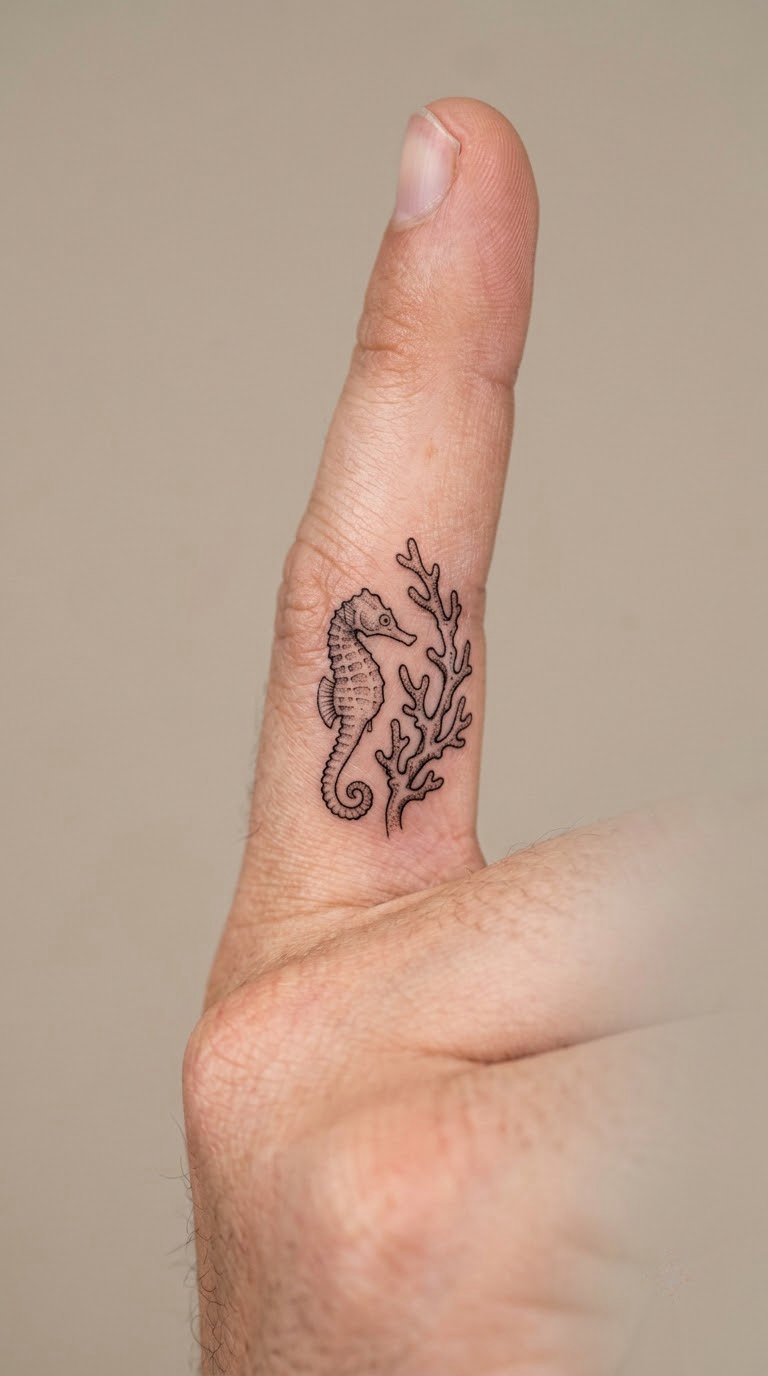
Two small matching pieces rather than one: a seahorse curled beside a curved coral branch, and a separate branching coral sprig in the same weight of line. Both in fine black linework, both under two inches.
Matching micro pieces are the right answer for someone who wants a set of small reef tattoos but does not want a single large subject. The seahorse carries the quiet, slow, small-seahorse kind of symbolism, and the coral sprig balances it visually.
Placement: one on the side of a finger, the other on the inner wrist or the ankle. Size: 1.5 to 2 in (4 to 5 cm) each. Style: micro fine line. Pain: high on the fingers and moderate on the wrist. This is the combination most likely to lose detail: fingers fade fast and knuckles shift the work over time, so treat both pieces as a few years of good ink rather than permanent line.
Make it yours: have both pieces inked in the same ink batch so the black tone matches instead of one looking greyer than the other.
18. Emerald Manta Ray and Coral Flight
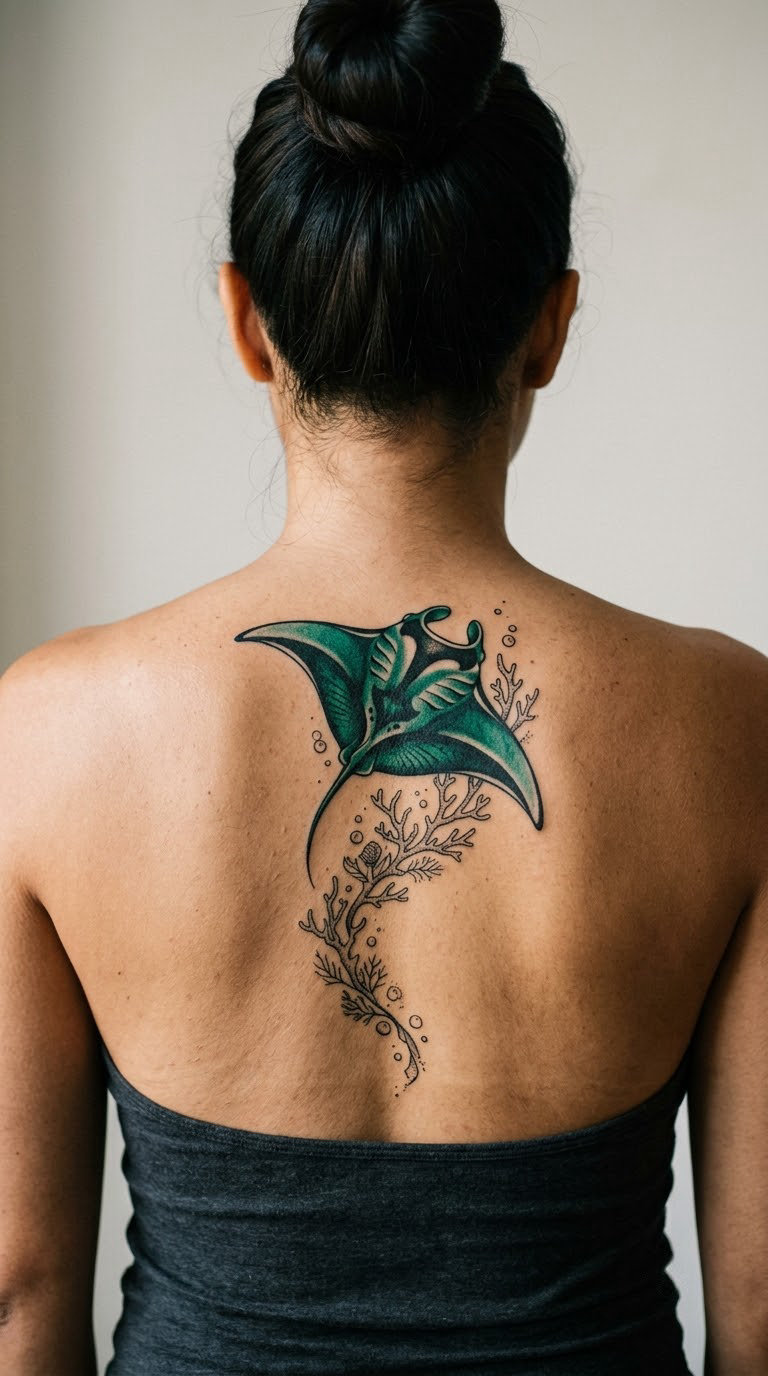
A wide manta ray rendered in emerald green and deep black, wings stretched flat and gills marked, gliding above a low trail of small coral branches that follows its path across the design.
Manta rays give a reef scene its sense of scale, and this one is built to be seen from a distance or from behind. The coral trail gives the eye a path to follow so the wide composition does not sprawl.
Placement: upper back, across the shoulder blades, or the outer thigh. Size: 8 to 10 in (20 to 25 cm). Style: illustrative realism. Pain: medium-high, and a piece this wide is a two-session job for most people. Emerald greens fade toward olive before they fade toward nothing, so the color will shift within a few years even with careful sun care.
Make it yours: place a small birthstone color in the coral trail below the ray, so the personalization sits in the supporting detail rather than the hero shape.
19. Stippled Coral Spawn and Anemone Pair
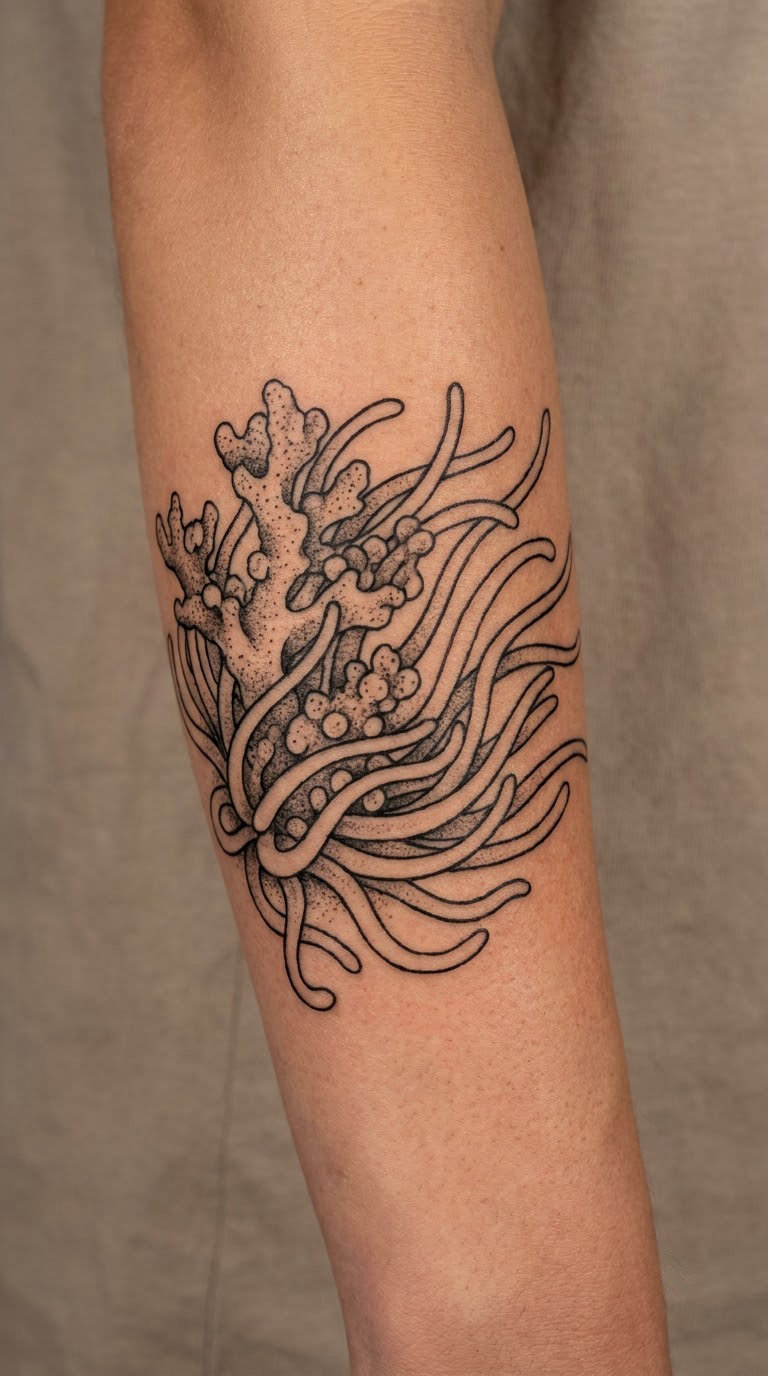
An organic black stippling study: rounded clusters of coral spawn on one side, flowing anemone tentacles on the other, with the density of the dots shifting across the piece so one half feels soft and the other textured.
This is an abstract reef rather than a picture of one, and it suits people who like the organic side of the hobby more than the wildlife photography side. Dot texture is forgiving, because slight merging reads as shading instead of as a mistake.
Placement: inner forearm, calf, or the back of the shoulder. Size: 3.5 to 4.5 in (9 to 11.5 cm). Style: illustrative dotwork. Pain: medium on the forearm. Dots spread as the skin heals, so stipple should be laid down lighter than you want the final result. Expect the two halves to look slightly different in density within a month.
Make it yours: combine two colors that mean something to you, one for the spawn clusters and one for the anemone, to give each half its own weight.
20. Full-Colour Tropical Reef Arm Scene
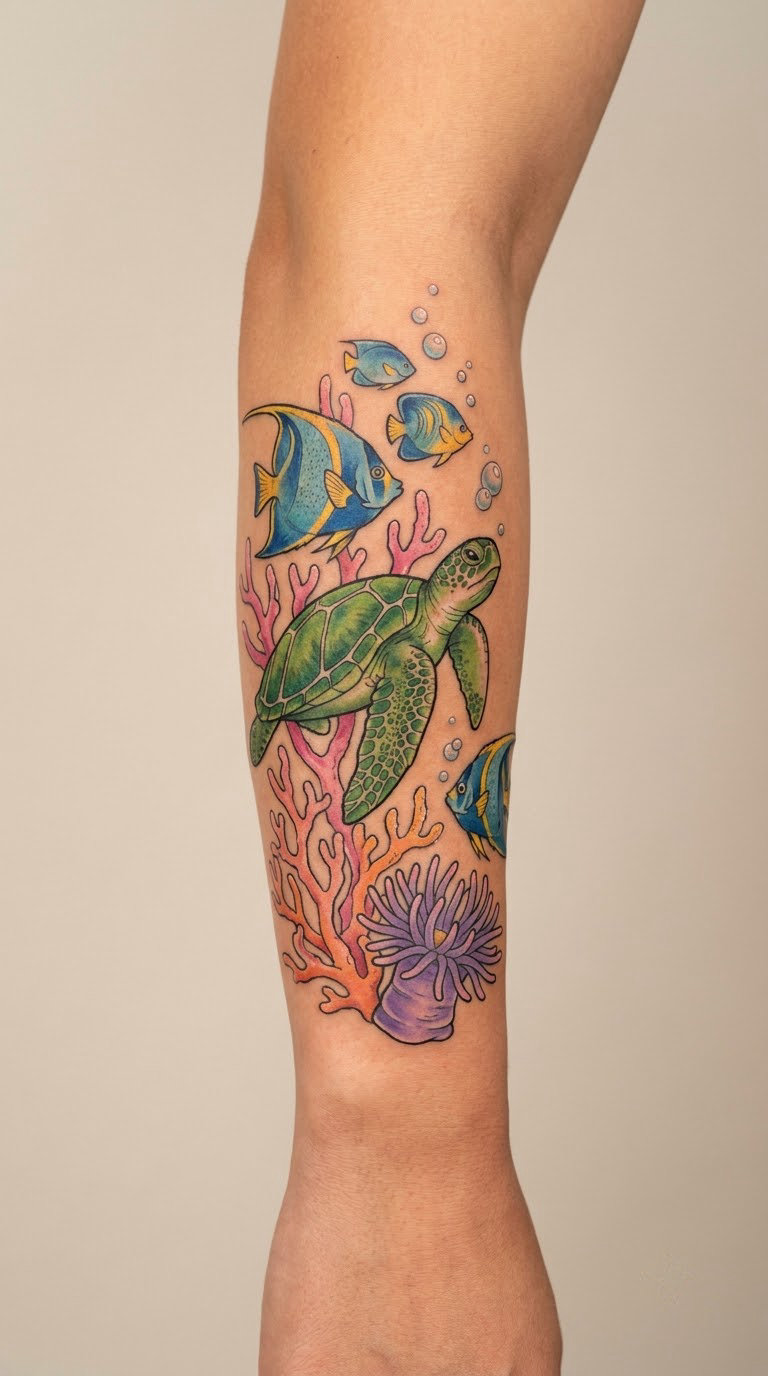
The boldest option on the list: a compact reef scene with a sea turtle, an angelfish, a branching coral, a tube anemone and a trail of bubbles, arranged with real negative space between the elements so nothing is packed edge to edge.
This is the one to book when the tattoo is the point rather than the symbol. It also carries the most meaning of the twenty, because a reef scene reads as biodiversity and as a place worth protecting, which is why the conservation angle gets people in the chair.
Placement: outer arm, from elbow toward shoulder, or the outer thigh. Size: 7 to 9 in (17.5 to 22.5 cm). Style: illustrative. Pain: high, and expect two sessions. Large areas of bright blue, orange and yellow fade first, so sunscreen on the arm matters more with this piece than with any black and grey design.
Make it yours: give the artist a palette named after a specific reef, or have a dive date worked into the bubble trail.
How to Choose the Right Design
Pick the coral for its silhouette, not its name. Reef keepers on the reef2reef forum recommend sea fans, tree sponges, brain coral, scroll corals, barnacles and tube anemones because each has an outline you can read at a glance. Fine textured coral is what turns to indistinct grey mush once it is small.
Size the subject to the canvas honestly. Decide the body part first, measure what fits there, and only then choose the species. Zoanthids and palythoas work well in reef scenes because their round, dot-patterned forms translate into simple shapes that stay clean.
- Linework: fine line suits small, discreet pieces and young skin, but ask for lines no thinner than a pencil and expect faster fading on hands and fingers.
- Realism: detailed fish and coral shading need four inches or more and a long session, and the smallest highlights soften within a few years.
- Color: tropical blues, yellows and oranges give the reef look its punch and fade faster than black and grey, so agree on touch-up expectations before you book.
- Placement: ribs, spine, calf and the inner thigh are all readable and all more sensitive. Collarbones and the inner forearm are the easiest reef placements for a first piece.
- Composition: leave open water between elements. Packing barnacles, fans, polyps and fish edge to edge is the most common reason a reef scene looks muddy rather than detailed.
How to brief a tattoo artist on coral reef tattoo ideas
Send reference photographs of the real coral rather than a drawing of it, and say which species matters to you. Reef hobbyists on that forum point out that it genuinely does not matter whether a stranger recognises the exact coral, so the piece is allowed to be personal rather than educational.
Ask the artist to show you a healed piece, not just a fresh photo. Fresh work looks sharp on everyone, and healed ink is the only honest preview of how much fine detail survived healing and a few years of sun.
Cost and Session Time
Rates vary a lot by city, shop and artist, so treat these as a planning range rather than a quote. Shop minimums also mean a small piece does not cost proportionally less than a large one.
- Tiny pieces under 2 inches: roughly 80 to 180 dollars, usually 20 to 40 minutes.
- Small pieces 2 to 3 inches: roughly 180 to 350 dollars, 45 to 90 minutes.
- Medium pieces 4 to 6 inches: roughly 350 to 700 dollars, 1.5 to 3 hours.
- Large scenes and sleeve panels 7 inches and up: roughly 700 to 2000 dollars or more, usually split across two or more sessions.
Artists commonly charge by the hour, often in the range of 120 to 250 dollars depending on where you are, so a piece that takes twice as long costs roughly twice as much. Ask for the estimated total and the hourly rate up front, and ask whether the quoted price includes the touch-up session, which most artists do within a window of several months.
Full-color reef scenes and detailed blackwork like the lionfish or the manta ray realistically need more than one sitting. Budget for a second session rather than trying to push a large design into a single appointment.
Aftercare Basics
- Follow your artist’s aftercare instructions first. They know exactly how deep they went and what your specific piece needs, and their advice overrides anything general you have read.
- Wash the area gently with clean water and a mild, fragrance-free soap, then pat it dry with a clean towel or paper rather than rubbing it.
- Avoid swimming, soaking, hot tubs and direct sun while the tattoo is healing, and hold off on tight or synthetic clothing over the fresh work.
- Choose loose, breathable clothing over the tattoo for the first couple of weeks.
- Watch the piece and contact your artist if anything looks unusual to you, rather than treating advice from the internet as a diagnosis.
Frequently Asked Questions
What does a coral reef tattoo usually represent?
A coral reef tattoo usually represents a connection to the ocean and a respect for marine life, and it often carries readings of resilience, protection and biodiversity. Divers, snorkelers, reef keepers and marine biologists all choose it for the same underlying reason: the reef is a living ecosystem, not a nautical symbol. Some people also connect it to coral bleaching and reef conservation, which gives the design a layer of meaning that a wave or anchor cannot.
Where is the best placement for a small coral reef tattoo?
The inner forearm, the outer wrist and the collarbone are the best placements for a small coral reef tattoo, because all three give the artist a clean flat surface and stay visible without dominating the frame. The inner forearm is the easiest first placement, the collarbone is the least painful, and the wrist works well for a single coral branch. Avoid hands and fingers unless you accept faster fading and more frequent touch-ups.
Should a coral reef tattoo be black and grey or colourful?
It depends on how much detail you want to keep over time. Black and grey coral and reef fish hold their line work far longer and need almost no maintenance, which makes them the safer choice for a detailed design. Colour gives a reef scene its real character, but bright tropical blues, yellows and oranges are the first pigments to fade, so plan on sun protection and possibly a colour refresh in a few years.
Which coral reef tattoo details are most likely to fade?
The most fragile details are fine linework, tiny shading highlights, the thin fin rays on realistic fish, and pale colours. Fine lines on hands and fingers fade fastest of all, and bright tropical blues and yellows lose saturation before darker ink does. Small gaps between coral branches can also fill in as the skin heals, so it is worth asking the artist to design slightly bolder than your reference photo shows.
What is a good coral reef tattoo for a first tattoo?
A single branching coral colony or one fine-line clownfish is a good coral reef tattoo for a first piece, because both stay readable at a small size and need only one sitting. Keep it under three inches on the inner forearm or the outer wrist, and ask for linework no thinner than a pencil. That gives you a reef piece you will still be happy with in ten years instead of one that needs constant touch-ups.
Wrapping Up
For a first tattoo, go with number 2, the branching coral colony, or number 1, the fine-line clownfish. Both are small, both hold their detail, and neither takes more than one sitting. If you already have ocean pieces and want something with real presence, number 5, the blackwork octopus, gives you a sleeve-friendly design that will still look strong in fifteen years.
Whichever one you pick from these coral reef tattoo ideas, take a reference photo of the real coral to your consultation and book the artist with time to spare.