
20 Sloth Tattoo Ideas for the Arm: Best Designs (October 2026)
These 20 sloth tattoo ideas for the arm run from a 1.5 inch fine-line sloth above the wrist to a 9 inch forest piece that reads like a partial sleeve. Every one comes with a real size, a placement that suits its shape, and an honest note on how it ages.
Sloths went from a mildly interesting zoo fact to a genuine spirit animal somewhere around the animated films and then the endless clips of them moving at roughly a third of normal speed. People get them for the calm, not the laziness. That matters on an arm, where a design has to hold up to movement, sun and sleeve friction for the rest of your life.
If you already know sloths are your thing and want a wider gallery first, our 48 cute sloth tattoo ideas covers styles from all over the body. This page sticks to the arm, with sizing and placement detail.
20 Sloth Tattoo Ideas for the Arm: Quick Guide
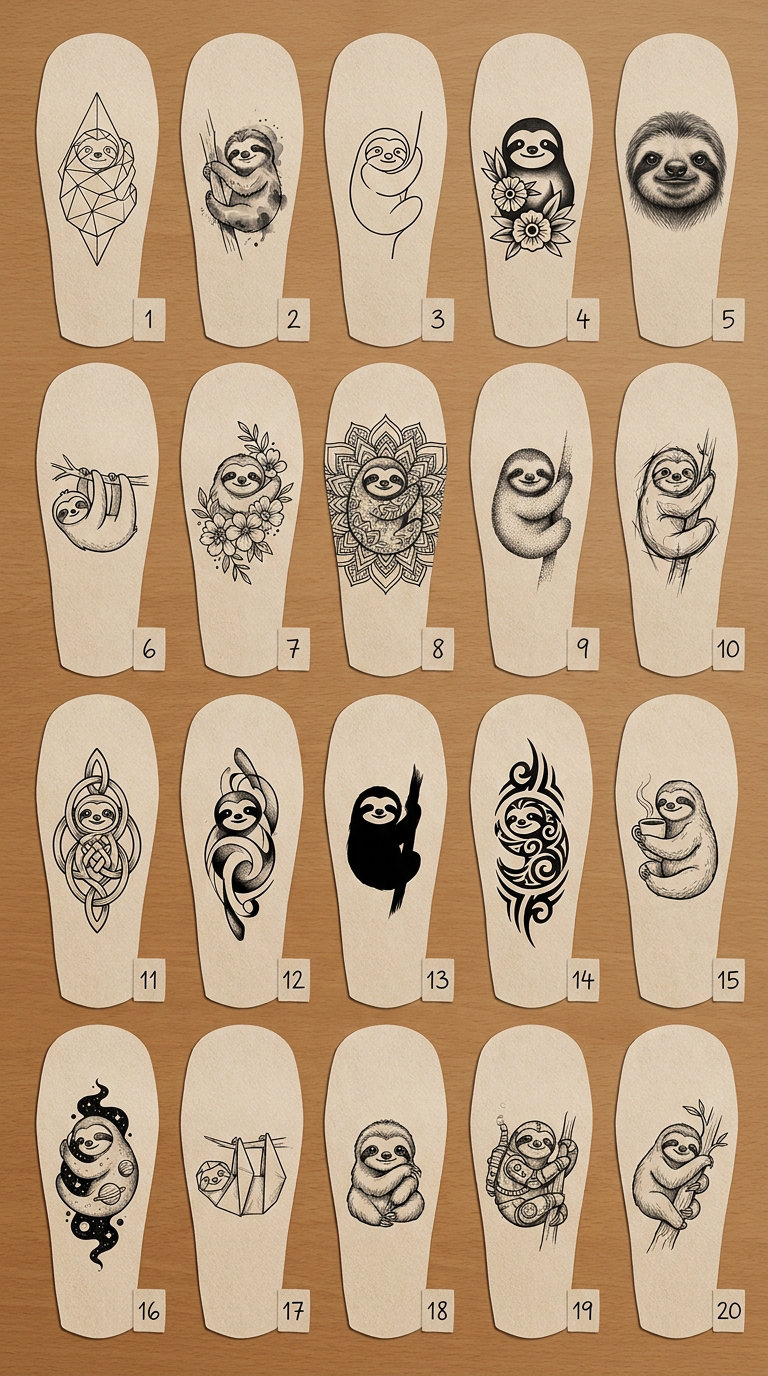
Every design below gets the same five details so you can compare them honestly. Sizes are what the artist will actually stencil, not decorative round numbers.
| Idea | Style | Best placement | Size | Pain |
|---|---|---|---|---|
| 1. Fine-line curled-up sloth | Fine line | Inner forearm | 3-4 in (7.5-10 cm) | Low |
| 2. Minimal sleeping sloth | Minimalist line | Inner forearm | 2.5-3 in (6-7.5 cm) | Low |
| 3. Sloth hanging from a vine | Fine line with light colour | Inner forearm, vertical | 4-5 in (10-12.5 cm) | Medium |
| 4. Micro sloth on the wrist | Micro fine line | Inner wrist | 1.5-2 in (4-5 cm) | Medium |
| 5. Sloth in a hammock | Illustrative black | Outer forearm | 4 in (10 cm) | Medium |
| 6. Flower-crowned sloth | Colour realism | Upper forearm | 5-6 in (12.5-15 cm) | Medium |
| 7. Sloth and coffee mug | Fine line with colour spot | Outer forearm | 4.5 in (11 cm) | Medium |
| 8. Geometric sloth | Geometric blackwork | Outer forearm | 5 in (12.5 cm) | Medium |
| 9. Blackwork sleeper sloth | Blackwork | Outer upper arm | 6-7 in (15-18 cm) | High |
| 10. Sloth portrait, soft shading | Semi-realism | Outer forearm | 5-6 in (12.5-15 cm) | Medium |
| 11. Sloth peeking from a leaf | Fine line with colour | Inner elbow | 2.5-3 in (6-7.5 cm) | Medium |
| 12. Sloth with tropical leaves | Illustrative realism | Outer forearm | 6 in (15 cm) | Medium |
| 13. Watercolour sloth | Watercolour | Inner arm | 5 in (12.5 cm) | Medium |
| 14. Sloth on a moon | Fine line with soft colour | Inner forearm | 4 in (10 cm) | Low |
| 15. Tiny paw-print trail | Micro line | Forearm, any direction | 3 in trail (7.5 cm) | Low |
| 16. Sloth climbing a floral branch | Realism with colour | Forearm, vertical | 7 in (18 cm) | High |
| 17. Traditional sloth with rose | Traditional | Outer upper arm | 6 in (15 cm) | Medium |
| 18. Sloth in a reading pose | Fine line with colour spot | Inner forearm | 4.5 in (11 cm) | Medium |
| 19. Sloth and sun | Illustrative colour | Outer forearm | 5 in (12.5 cm) | Medium |
| 20. Large sloth and forest piece | Realism with colour | Outer arm | 9 in (23 cm) | High |
1. Fine-Line Curled-Up Sloth
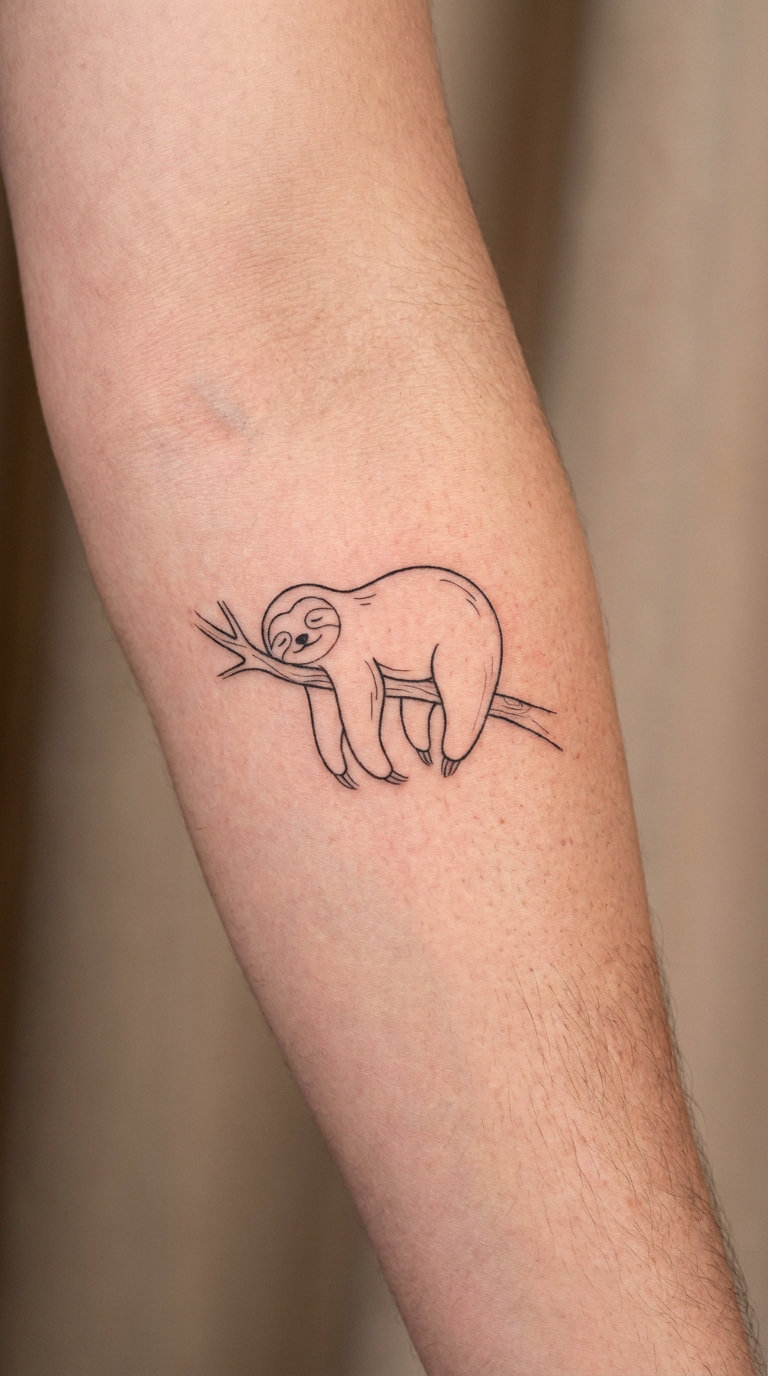
This fine-line sloth tattoo for the arm draws one continuous line around a body folded over a short branch. Fur gets a few short directional strokes, the claws grip the bark, and the rest stays open. No background, no shading, nothing to lose in a decade.
People choose the curled pose because it reads as rest rather than laziness. It is the most tattoo-friendly version of a calm animal.
- Placement: inner forearm, 3-4 inches below the elbow crease.
- Size: 3-4 in (7.5-10 cm) wide.
- Style: fine line, single-needle style line weight.
- Pain: low to medium. Single needle on the inner forearm still stings, and the elbow end of the placement is more sensitive.
- Make it yours: add a small initial or a date in the empty space above the branch.
2. Minimal Sleeping Sloth
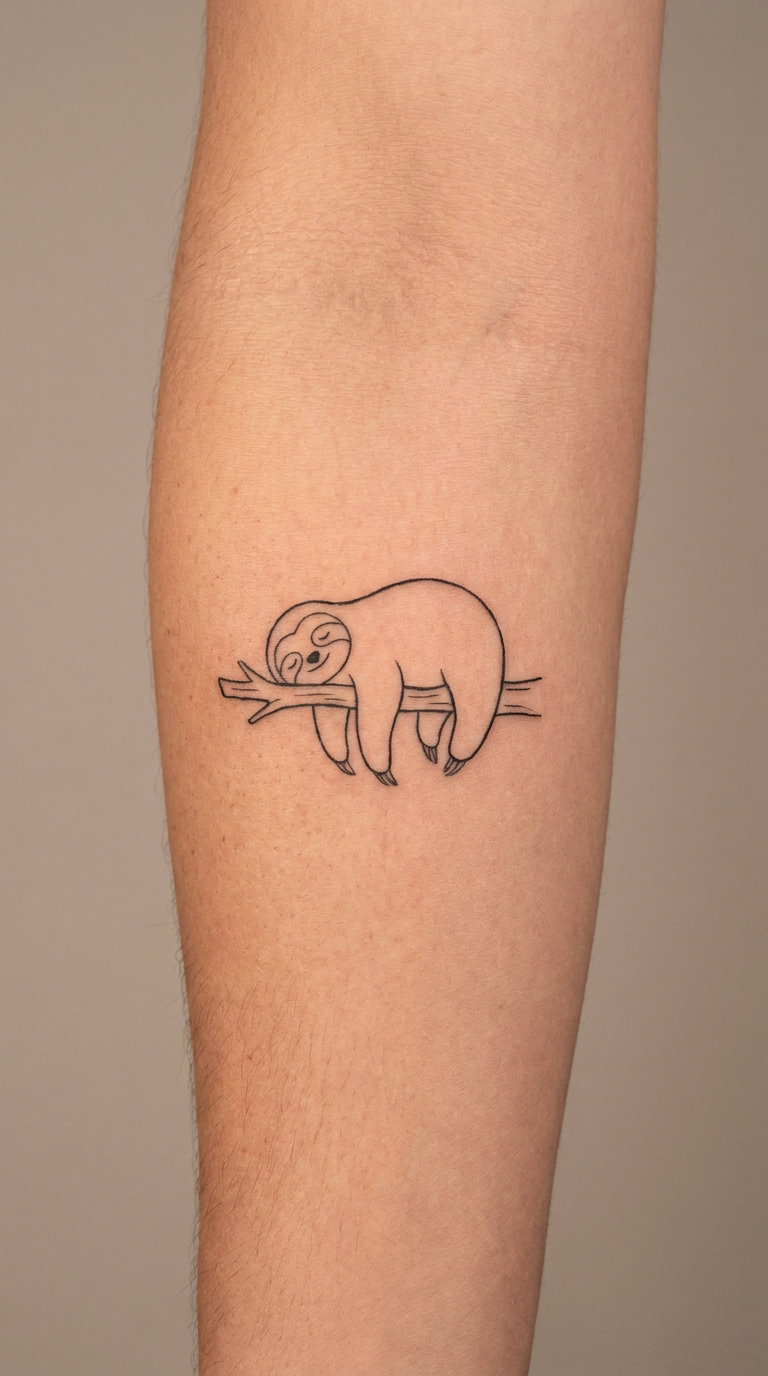
A sleeping sloth tattoo idea for the arm is just a soft curve, a tucked head and one long arm draped over a branch. The design keeps roughly a third of the forearm skin untouched, which is what makes it feel calm rather than crowded.
It suits first-tattoo clients who want something small that still looks deliberate. Minimalism forgives a lot of aging, because there is very little to blur.
- Placement: inner forearm or the soft area just above the wrist.
- Size: 2.5-3 in (6-7.5 cm) wide.
- Style: minimalist single-weight line work.
- Pain: low. Short session, usually under an hour.
- Ageing note: single-weight lines thicken slightly as they heal, so ask your artist for a slightly thinner line than looks right in the drawing.
- Make it yours: put two small crossed leaves under the branch.
3. Sloth Hanging from a Vine
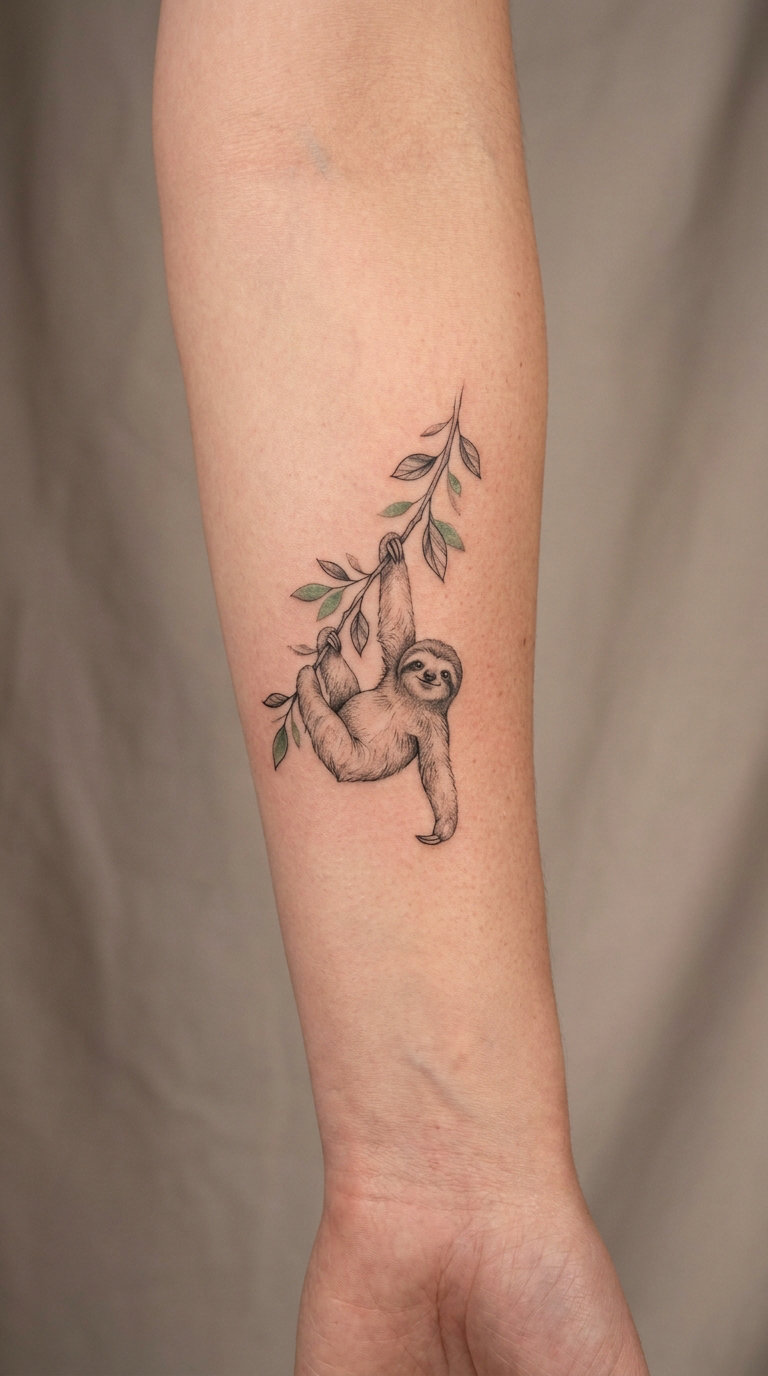
This vertical design uses one long arm hooked over a vine, body dangling, legs loose. The vine runs up the forearm and the leaves taper off, so the design has direction instead of sitting in one blob. Motion comes free from the shape.
It’s the version people pick when they want the sloth to look like it is doing something rather than posing.
- Placement: inner forearm, running vertically between wrist and elbow.
- Size: 4-5 in (10-12.5 cm) tall.
- Style: fine line with sparse colour on the leaves.
- Pain: medium. A longer session along a sensitive strip of skin.
- Ageing note: leaves in thin colour wash fade first. Ask for olive or deep green rather than a bright mint.
- Make it yours: have the vine wrap once around the forearm and disappear underneath, so the design reads as continuing.
4. Micro Sloth on the Wrist
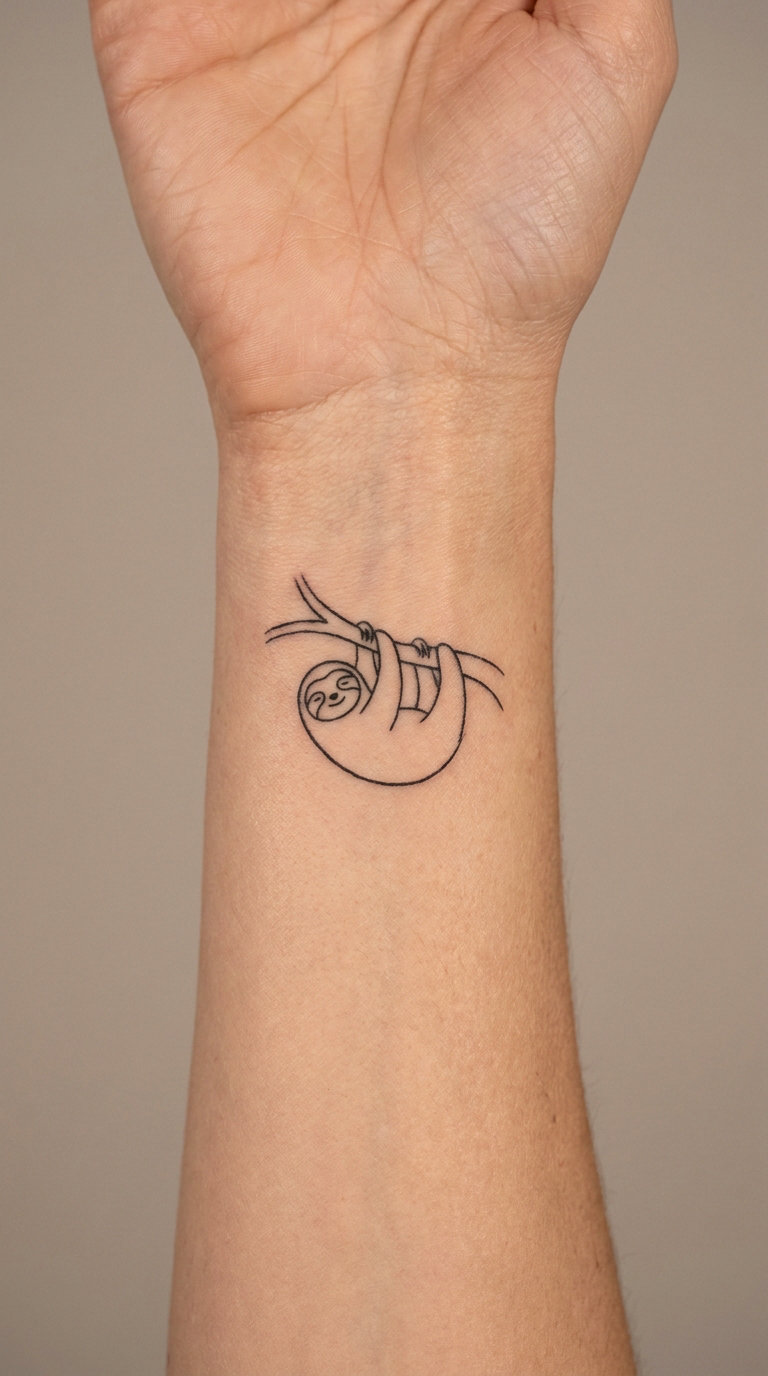
A micro sloth tattoo idea for the arm lives in the 1.5 to 2 inch range, sitting on a curved twig just above the wrist bone. Facial features get simplified to a closed eye line and a small dark nose. Anything more detailed than that at this scale heals into a smudge.
It is visible, quiet and easy to hide under a watch band or a sleeve. Ask to see it healed at that size before committing to more detail.
- Placement: inner wrist, thumb side.
- Size: 1.5-2 in (4-5 cm) wide.
- Style: micro fine line, stick-and-poke friendly.
- Pain: medium. Wrist skin is thin and close to bone, so it feels sharper than the arm suggests.
- Ageing note: wrist and hand tattoos lose fine detail fastest. Expect the face to soften within several years.
- Make it yours: add a matching sloth on the other wrist at a smaller size.
5. Sloth in a Hammock
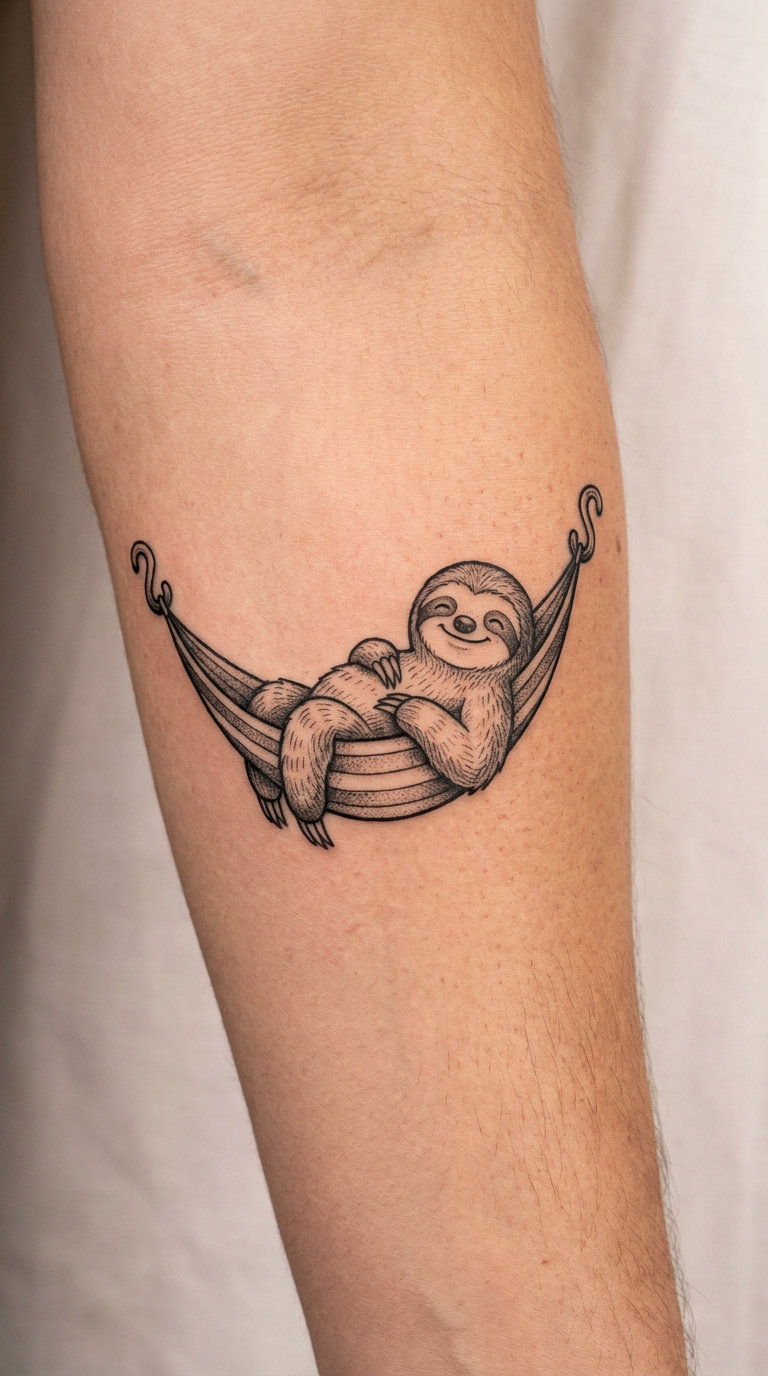
A sloth in a hammock tattoo for the arm is a funny one. The hammock is strung between two short lines, the sloth lies back with one arm behind its head, and the whole thing stays in a horizontal band that fits the forearm’s width. Stripes on the fabric give the artist somewhere to put controlled detail.
Most people take it as a joke about doing absolutely nothing on a Saturday. Some keep it as a reminder to rest.
- Placement: outer forearm, horizontal.
- Size: 4 in (10 cm) wide, 2.5 in tall.
- Style: illustrative black with light shading.
- Pain: medium. The outer forearm is meatier and usually easier than the inner.
- Make it yours: change the hammock stripes to a team colour or a birth month.
6. Flower-Crowned Sloth
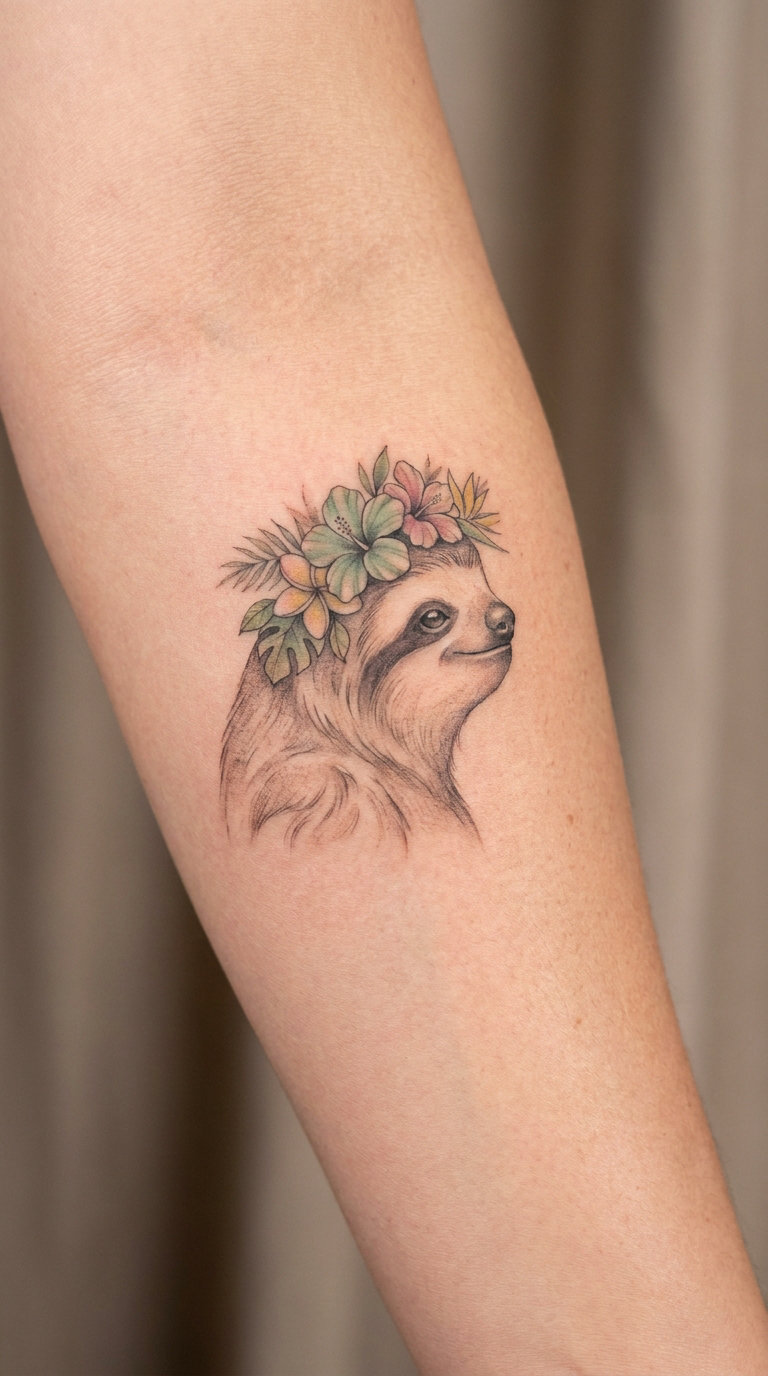
The flower-crowned version puts the sloth in side profile with a small crown of plumeria, hibiscus or frangipani resting between the ears. Muted pinks and greens sit better than saturated colour, and they age more gracefully if you ever decide to lighten the piece later.
Nature lovers usually land here. It reads warm and personal rather than cartoonish.
- Placement: upper inner forearm or the flat area below the bicep.
- Size: 5-6 in (12.5-15 cm) wide.
- Style: colour realism, soft shading.
- Pain: medium. Colour work spreads the time over a longer session.
- Make it yours: swap the crown for a specific flower from a place that matters to you.
7. Sloth and Coffee Mug
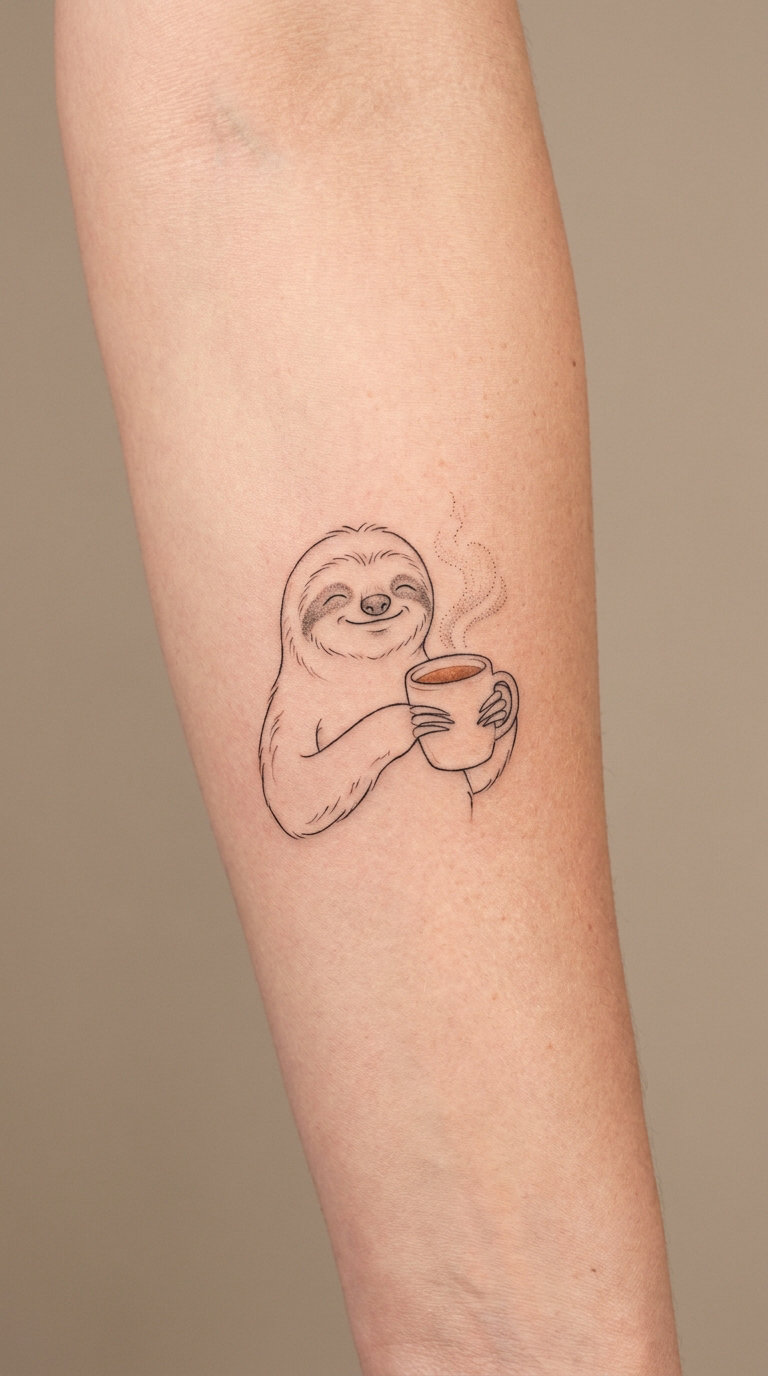
A sloth arm tattoo idea with a coffee mug shows the animal sitting upright, both claws around a large mug, with two curls of dotwork steam rising above it. The mug is deliberately oversized so the piece still has a shape if the animal’s face softens.
It is a daily-use joke rather than a deep statement. That is exactly why it works.
- Placement: outer forearm.
- Size: 4.5 in (11 cm) wide.
- Style: fine line with one warm colour spot in the mug.
- Pain: medium.
- Ageing note: steam drawn as hairline dots fades first. A solid line reads better long term.
- Make it yours: put your go-to order in tiny script underneath, only if you want readable text near a small piece.
8. Geometric Sloth
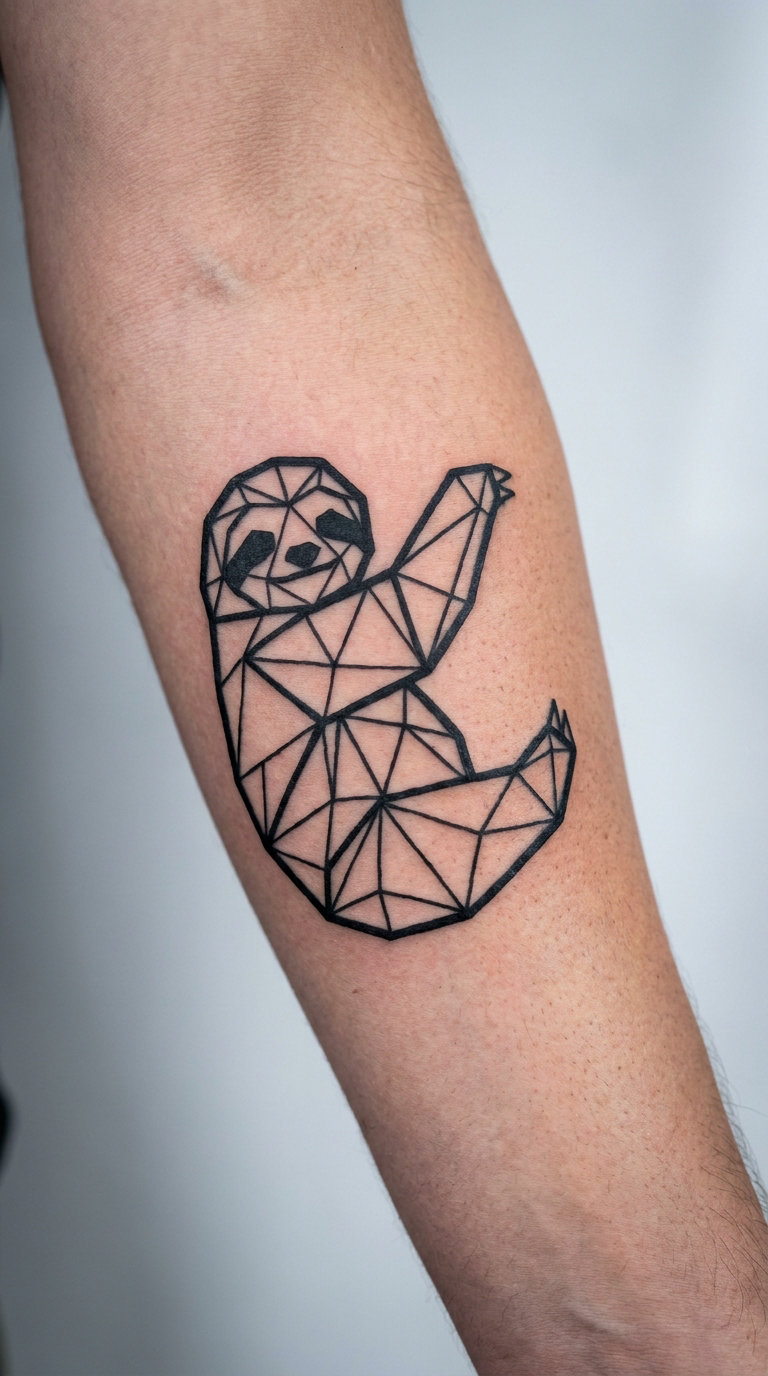
Geometric sloth tattoos for the arm break the animal into triangles and facets, then keep a few curved lines for the face so it stays a sloth rather than becoming a pattern. Solid black areas next to open skin give it real contrast at arm’s length.
It suits people who like geometry but don’t want an abstract piece nobody can read.
- Placement: outer forearm or outer bicep.
- Size: 5 in (12.5 cm) tall.
- Style: geometric blackwork.
- Pain: medium to high. Solid black fills mean repeated passes over the same skin.
- Ageing note: bold fills hold shape well, which is one reason people upgrade older fine-line pieces to this style.
- Make it yours: carry the facet pattern into a thin band around the forearm.
9. Blackwork Sleeper Sloth
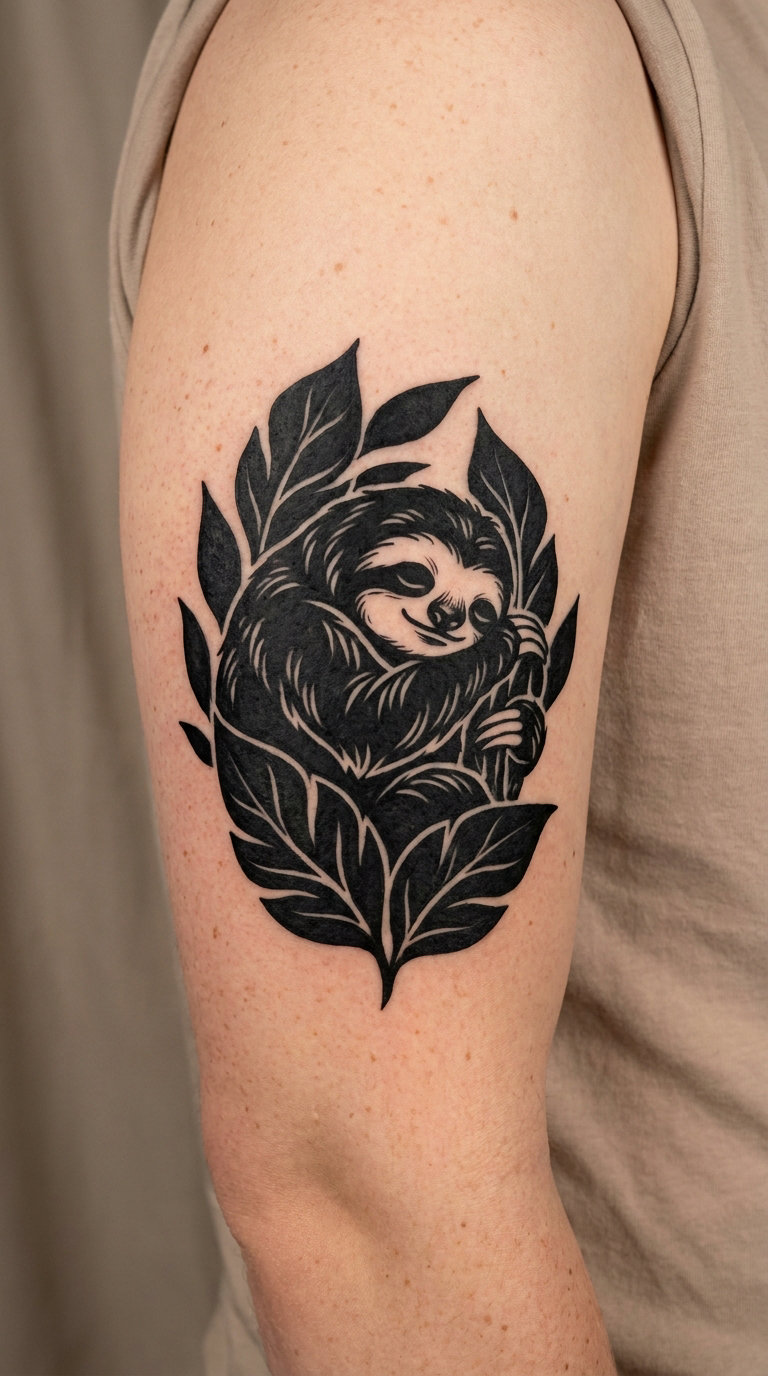
Blackwork is the loudest option on this list. The sloth sleeps against a dark field of leaves, with the fur built from solid black and the highlights carved out with negative space. No grey wash at all, which is what gives it that heavy poster look.
Choose this when the sloth is a statement, not a whisper. It hides older faded work reasonably well too.
- Placement: outer upper arm, over the tricep.
- Size: 6-7 in (15-18 cm) tall.
- Style: blackwork with carved highlights.
- Pain: high. Large solid areas in one sitting are a long session, often three to five hours.
- Make it yours: tuck a hidden date or a set of coordinates into the dark leaf area.
10. Sloth Portrait with Soft Shading
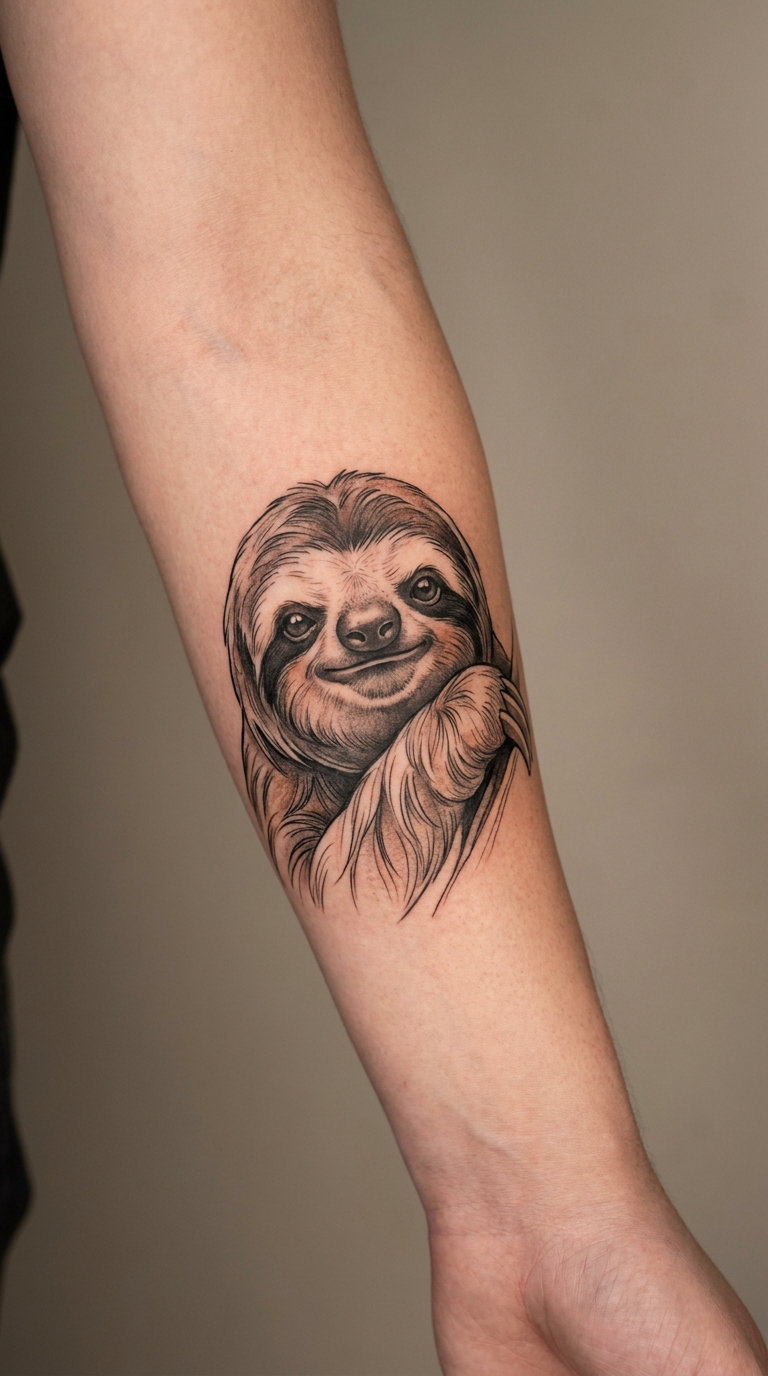
A sloth forearm tattoo in portrait form gives the artist room to work on the face, which is the part everyone recognises. The round head, the pale mask through the eyes and the wide dark eye patches get the most attention, with soft grey shading through the fur.
Realistic animal tattoos can flatten out once healed, so ask to see healed work from this artist before booking. That single check saves a lot of disappointment.
- Placement: outer forearm or outer upper arm, where skin is flatter.
- Size: 5-6 in (12.5-15 cm) tall.
- Style: semi-realism, black and grey with warm accents.
- Pain: medium to high.
- Make it yours: have the eyes look toward a specific direction, like across the room or down at a spot on the body.
11. Tiny Sloth Peeking from a Leaf
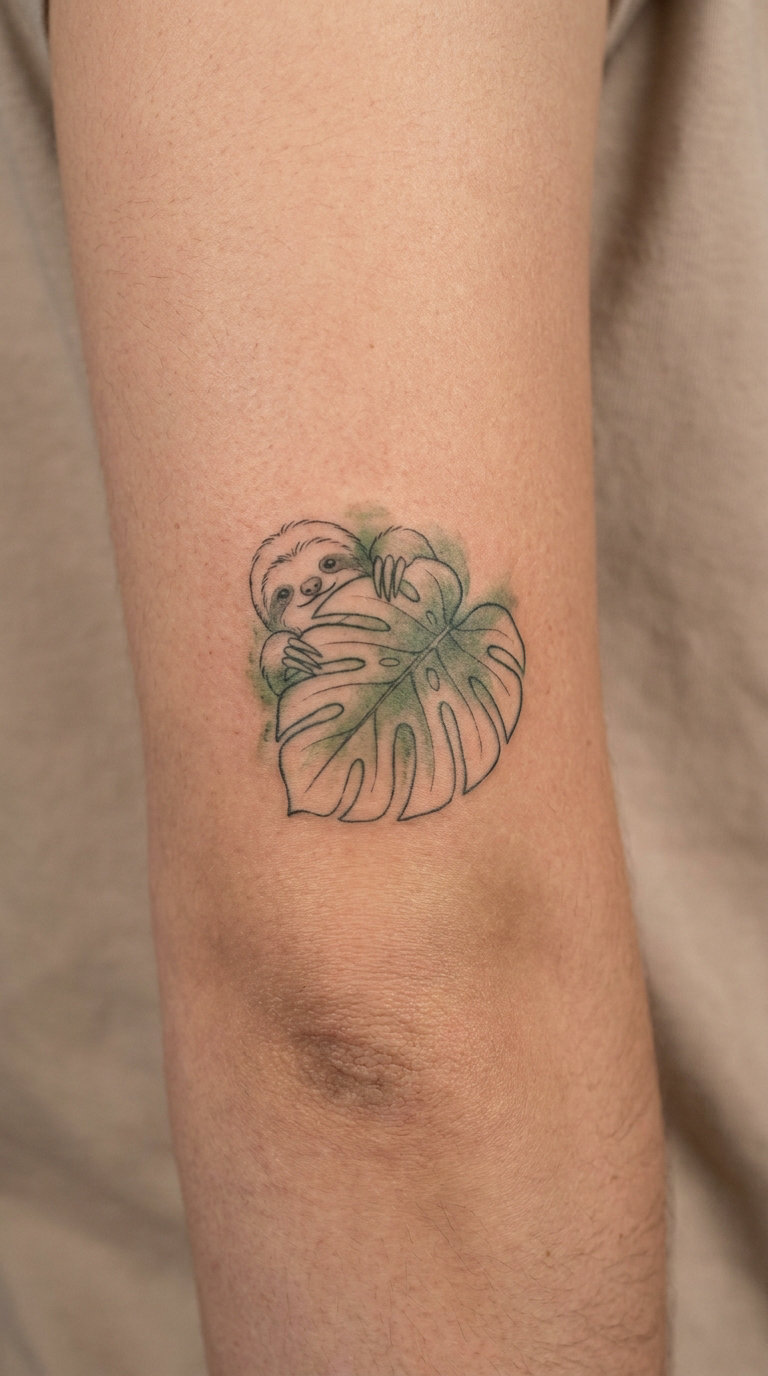
One oversized monstera leaf, one sloth head and two little claws over the edge. That is the whole design, and it is one of the easiest sloth tattoo ideas for the arm to keep readable because the leaf carries the visual weight.
It reads cheeky rather than cute, which works if oversized friendliness is not your thing.
- Placement: inner elbow or inner forearm near the elbow.
- Size: 2.5-3 in (6-7.5 cm) wide.
- Style: fine line with light green in the leaf.
- Pain: medium. The inner elbow is sensitive and moves with every flex.
- Make it yours: use a leaf shape from a plant that actually grows where you live.
12. Sloth with Tropical Leaves
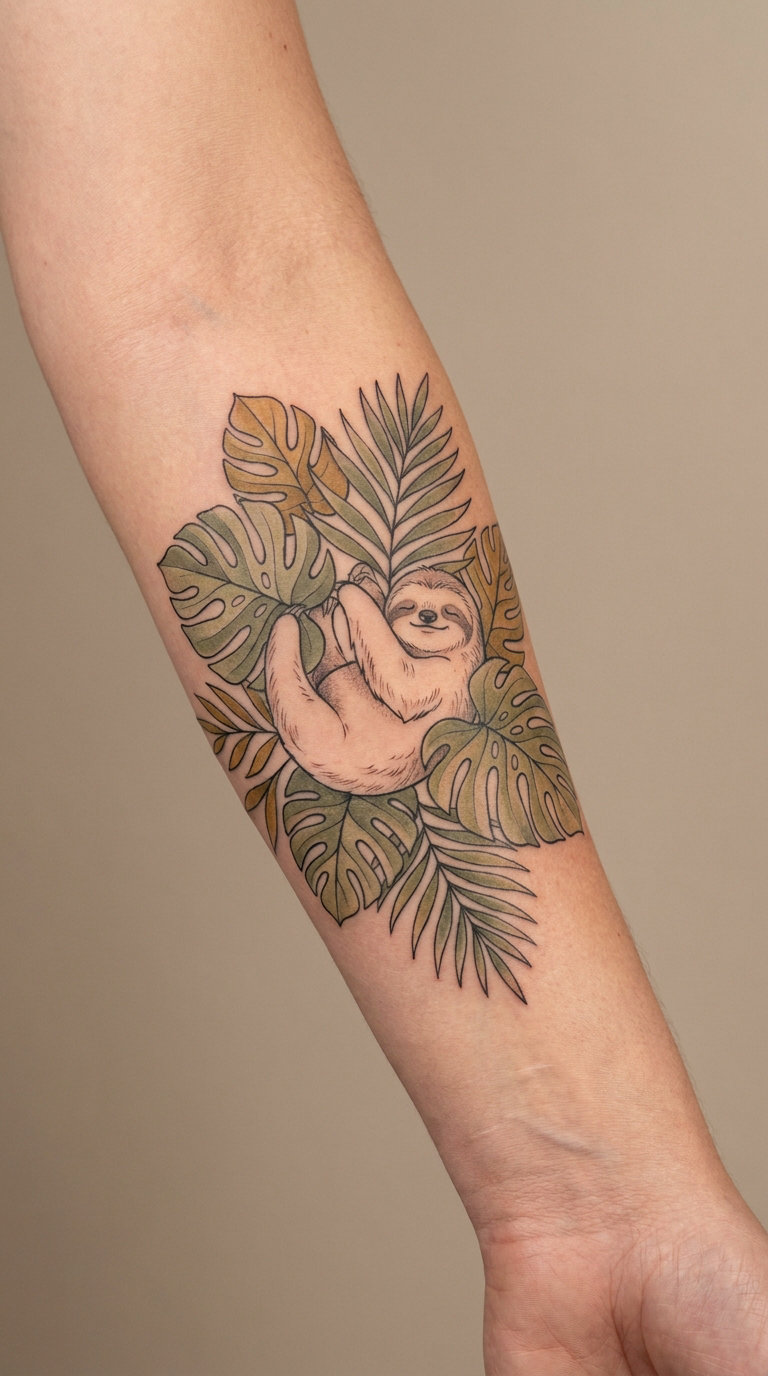
Layered foliage wraps around the sloth in an arc, with the animal at the centre and leaves fanning out above and below. Detailed line work on the leaves gives the design its texture, and muted greens with a bit of ochre in the bark keep it from looking flat.
This is a good candidate for a first larger piece, because the leaves disguise small errors in the animal and fill the arm nicely.
- Placement: outer forearm or the elbow-to-bicep stretch.
- Size: 6 in (15 cm) wide.
- Style: illustrative realism.
- Pain: medium to high. Fine leaf lines take a while.
- Make it yours: add a small band of coordinate text or a mountain silhouette at the base of the leaves.
13. Watercolour Sloth
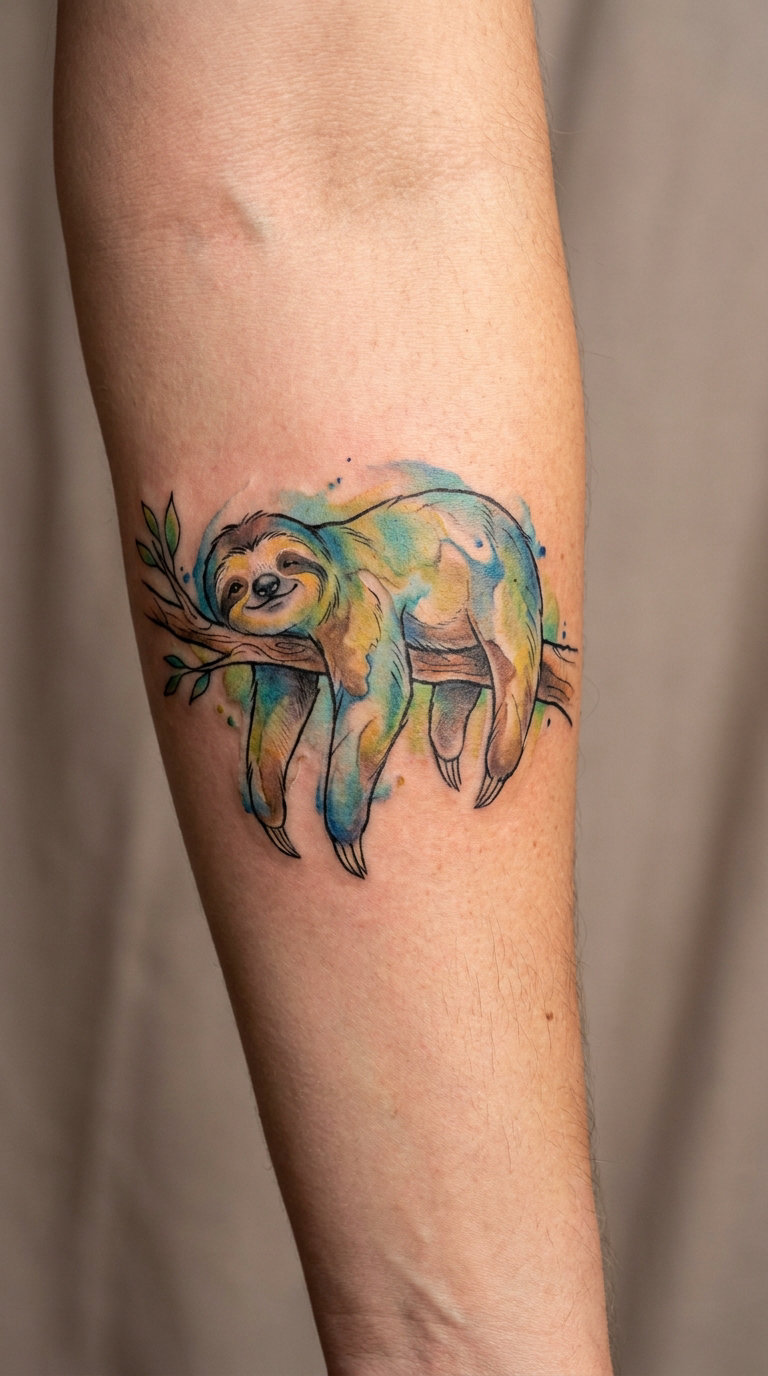
Watercolour is the softest style here. The sloth is defined by a loose dark outline, then washes of blue, yellow, green and brown bleed past the edges with no hard boundary. The result looks like a painting that wandered off the page.
It sits well against skin tone because nothing in it is fully opaque. Plenty of people who dislike bold black on an arm choose this instead.
- Placement: inner arm or inner forearm.
- Size: 5 in (12.5 cm) wide.
- Style: watercolour with loose linework.
- Pain: medium.
- Ageing note: pale washes are the first thing to lighten. Deepen the base colours from the start if you want them to last.
- Make it yours: pick colours from a flag, a football team or a place you grew up.
14. Sloth on a Moon
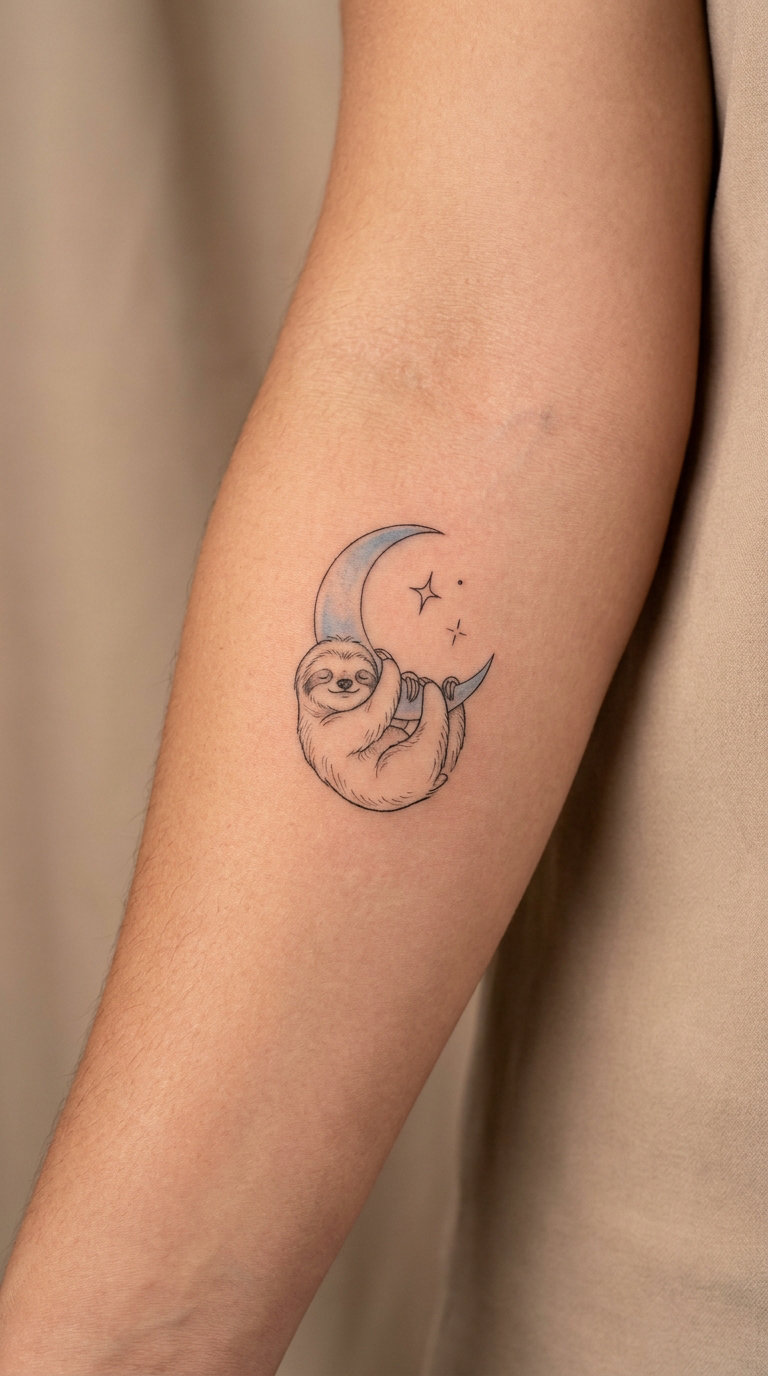
A crescent moon curves over a curled sloth, with two or three small stars filling the gap between them. Pale blue shading inside the moon keeps it from competing with the animal, and the whole composition fits a circle roughly the size of a coaster.
Sleep and restfulness are the usual reasons people pick it. It is quiet enough to sit under a long sleeve without feeling hidden.
- Placement: inner forearm.
- Size: 4 in (10 cm) wide.
- Style: fine line with soft colour accent.
- Pain: low to medium.
- Make it yours: have the stars arranged as a real date, using dots for the tens and a filled star for the rest.
15. Tiny Paw-Print Trail
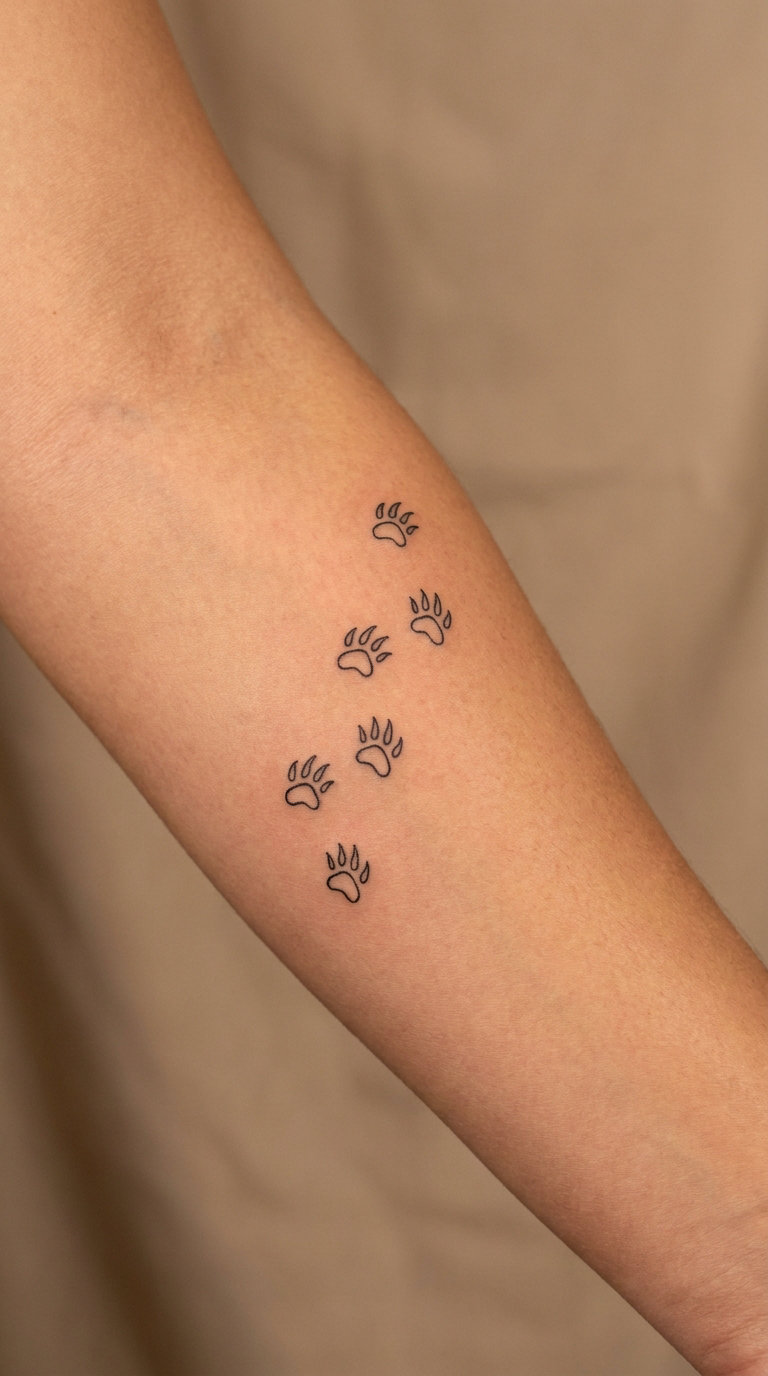
No animal, no face. Five small paw shapes trail along the forearm in a loose S-curve, angled as if walking. Each paw is three long curved claws with no pad, which is what stops it reading as a generic paw print.
It is the quietest option for someone who likes the idea of a sloth without the cartoon.
- Placement: anywhere along the forearm, in any direction.
- Size: 3 in (7.5 cm) trail, individual prints about 0.4 in.
- Style: micro fine line.
- Pain: low. Fast session, minimal ink.
- Ageing note: the smallest shapes here, so expect some softening over the years.
- Make it yours: make the trail follow the line of a vein or match a dog’s walking pattern.
16. Sloth Climbing a Floral Branch
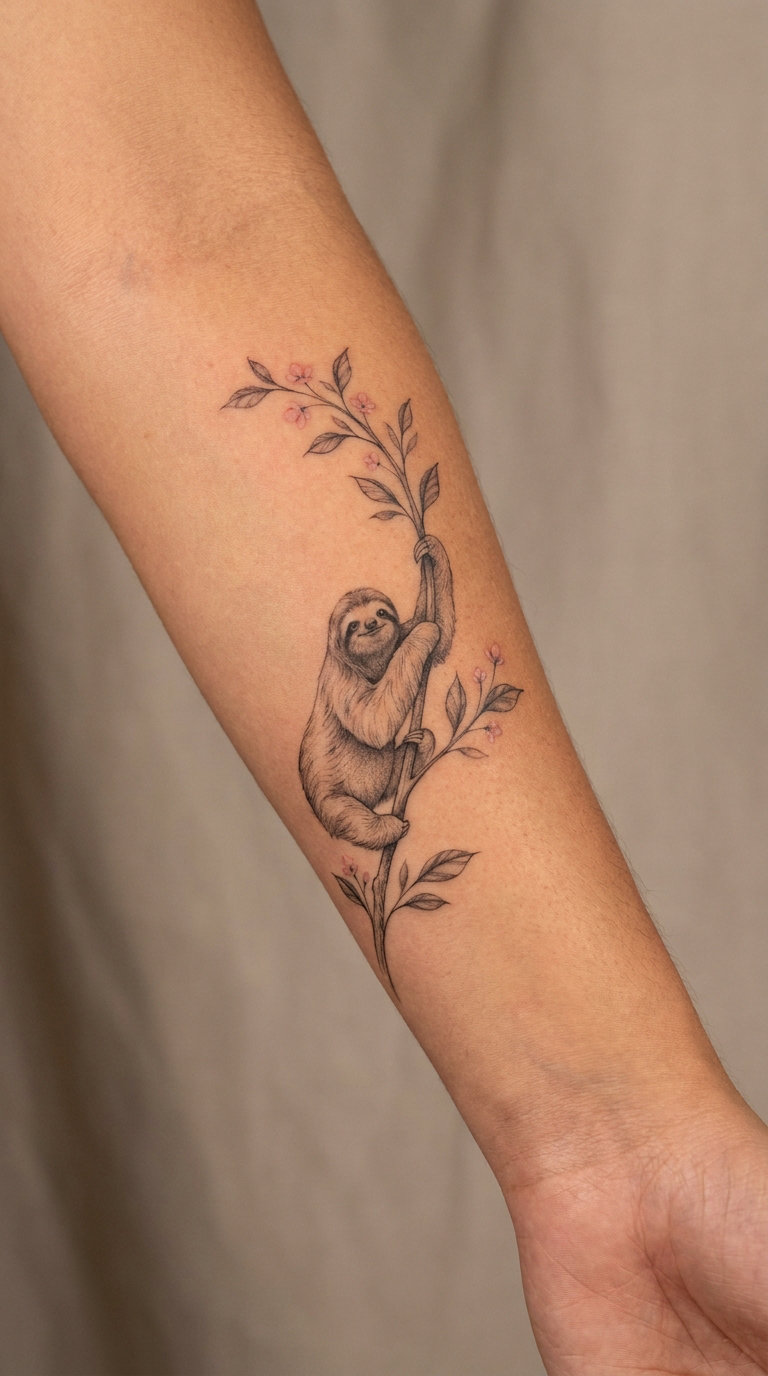
A branch runs the length of the forearm with a sloth climbing it head-up, one long arm extended to a higher grip, blossoms spaced along the way. The vertical flow suits the arm better than almost any other body part, since the forearm already reads as a climbing surface.
This is a genuine project piece. Two sessions and a proper healing break are normal.
- Placement: forearm, vertical, wrist to mid-bicep stretch.
- Size: 7 in (18 cm) long.
- Style: realism with small colour blossoms.
- Pain: high, mostly because of the length of the session rather than any single spot.
- Make it yours: use blossoms from a species connected to someone important.
17. Traditional Sloth with Rose
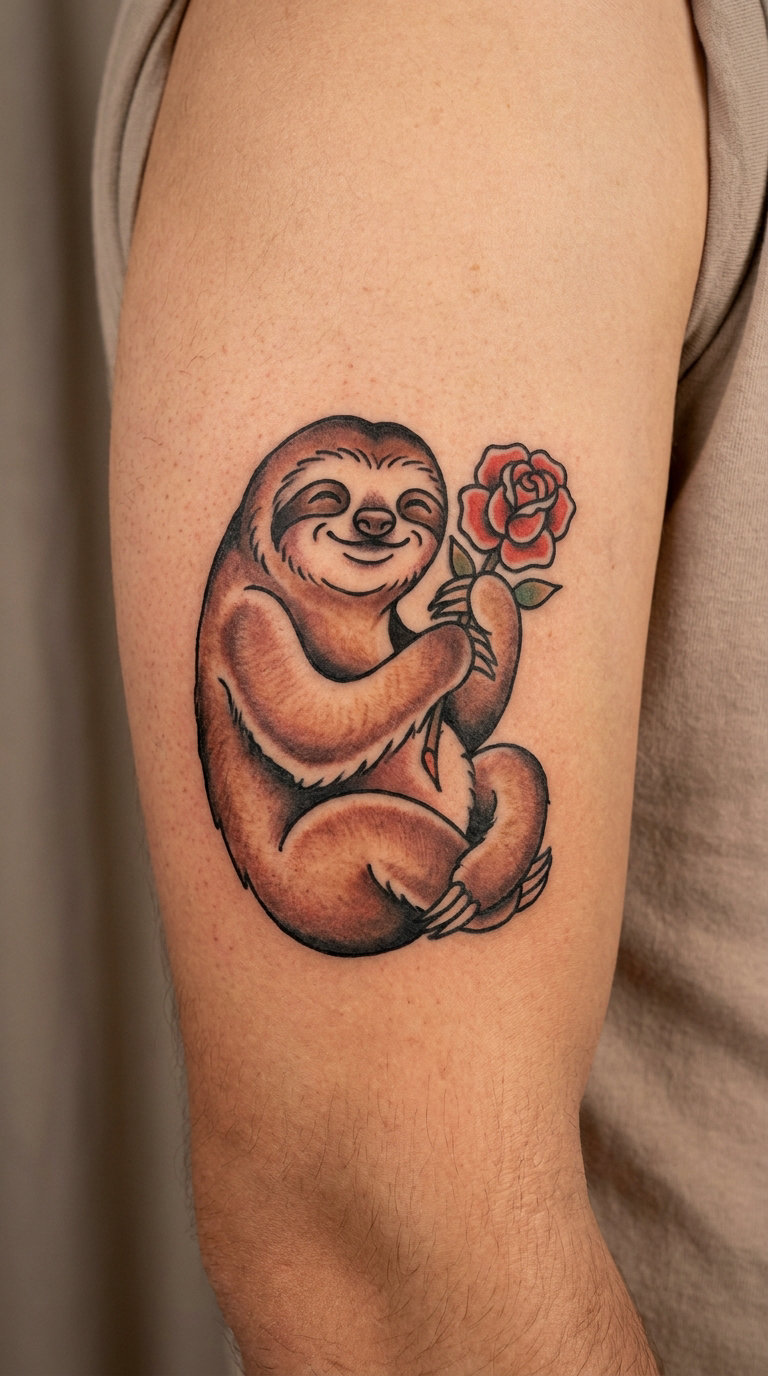
Traditional sloth tattoos for the arm come from tattoo flash logic rather than wildlife illustration. Bold black outlines, warm brown fur shading, a strong red rose and one green leaf. Heavy lines survive decades of sun better than hairlines, which is why this style keeps getting picked for the upper arm.
It suits people who like classic American tattooing and want something that ages on its own terms.
- Placement: outer upper arm.
- Size: 6 in (15 cm) tall.
- Style: traditional.
- Pain: medium to high. Outlines first, then shaded colour passes.
- Make it yours: replace the rose with a colour that means something, or add a banner for a year that mattered.
18. Sloth in a Reading Pose
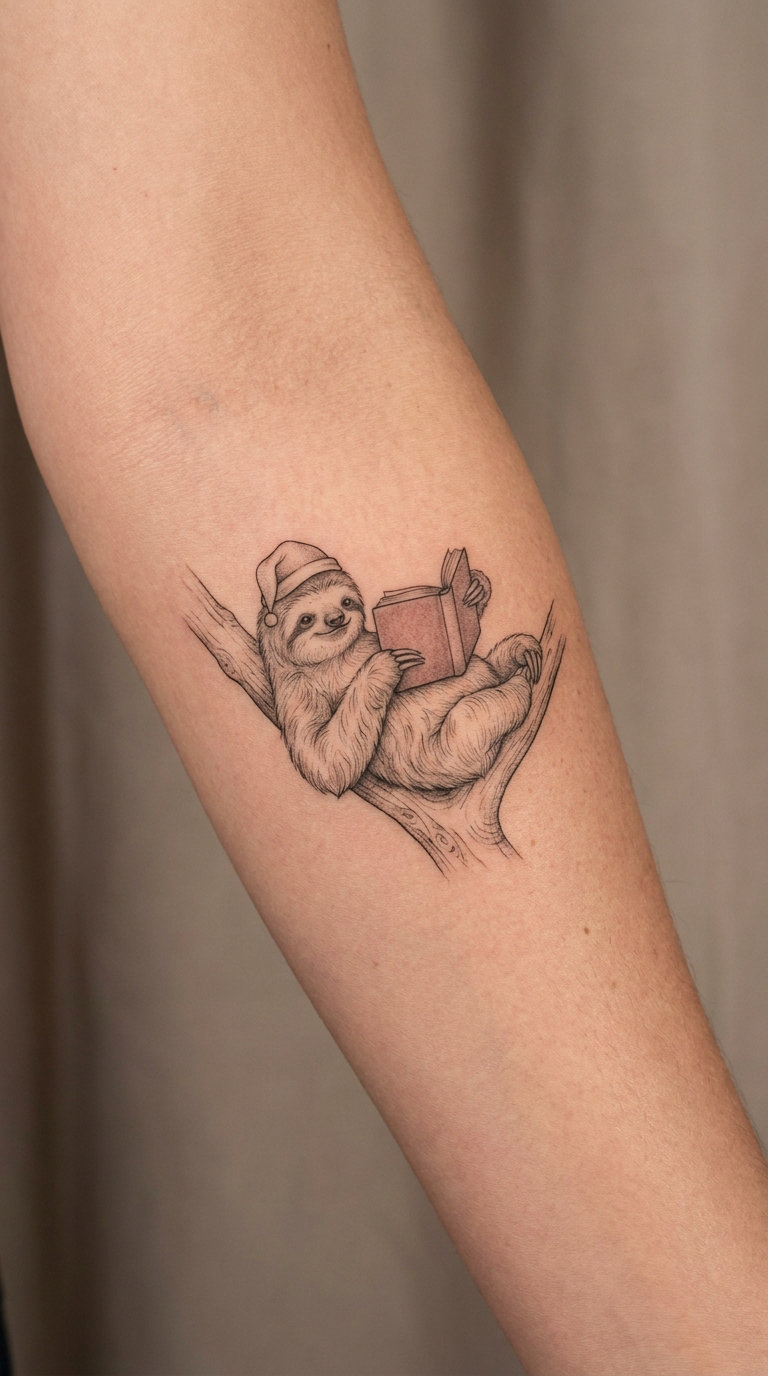
The sloth lies along a branch with an open book propped in front of it, one claw holding a page. The book is drawn straight and simple so it reads instantly, and a muted red cover gives the only colour in the piece.
It is the idea book lovers ask for most. Pair it with a first tattoo or wear it with a matching one on someone who reads more than you do.
- Placement: inner forearm.
- Size: 4.5 in (11 cm) wide.
- Style: fine line with one colour accent.
- Pain: medium.
- Make it yours: put an actual line of text on the open page. Keep it one line and make sure it is at least 0.4 in tall.
19. Sloth and Sun
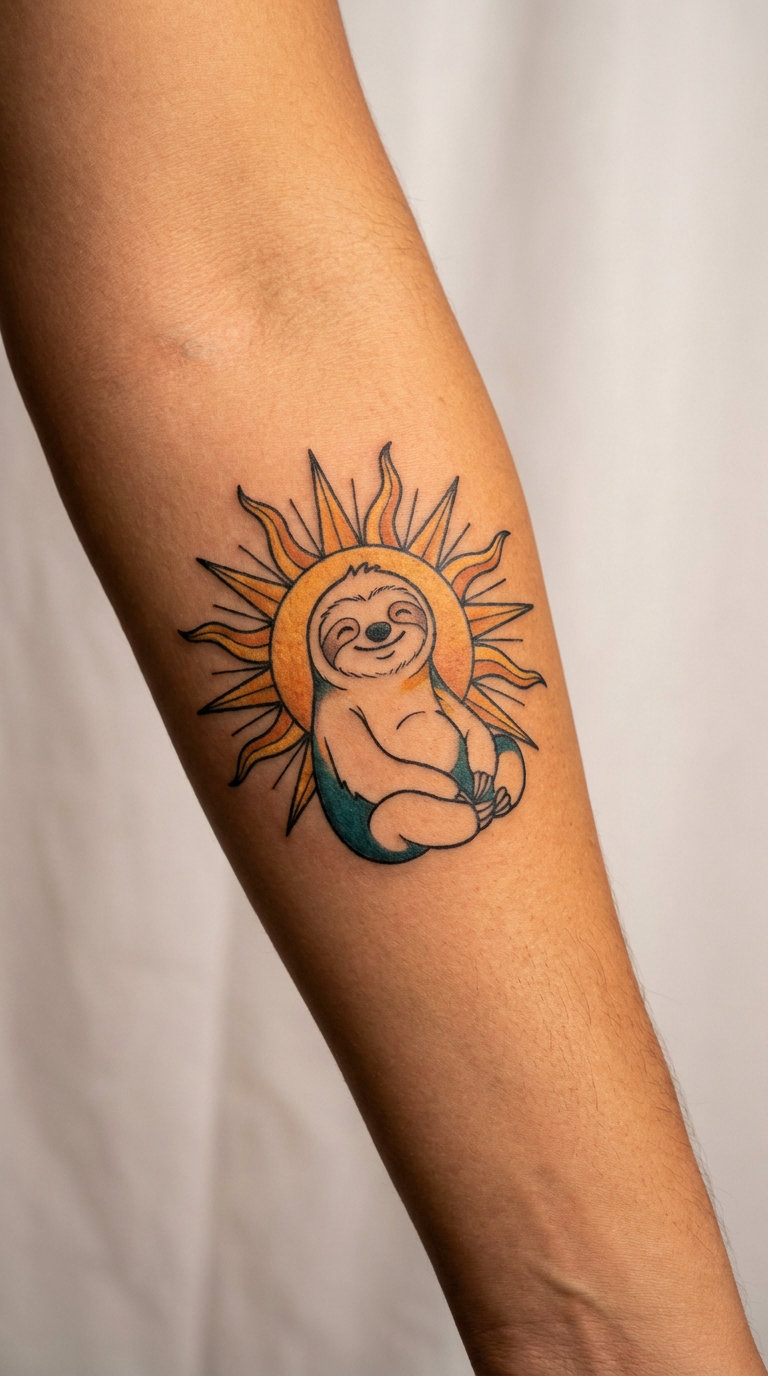
A sloth sits at the centre of a simple sunburst with straight rays around it. Warm yellow and orange do the work, and one teal accent in the eyes or the branch keeps the palette from going flat. Rays stay straight and even, which is what makes the design look deliberate rather than scribbly.
It is a bright, friendly piece for the upper arm, and the circular shape hides a lot of skin well.
- Placement: outer forearm or upper forearm.
- Size: 5 in (12.5 cm) wide.
- Style: illustrative colour.
- Pain: medium.
- Make it yours: change the rays to a ring of small marks that count something, like years running or miles run.
20. Large Sloth-and-Forest Arm Tattoo
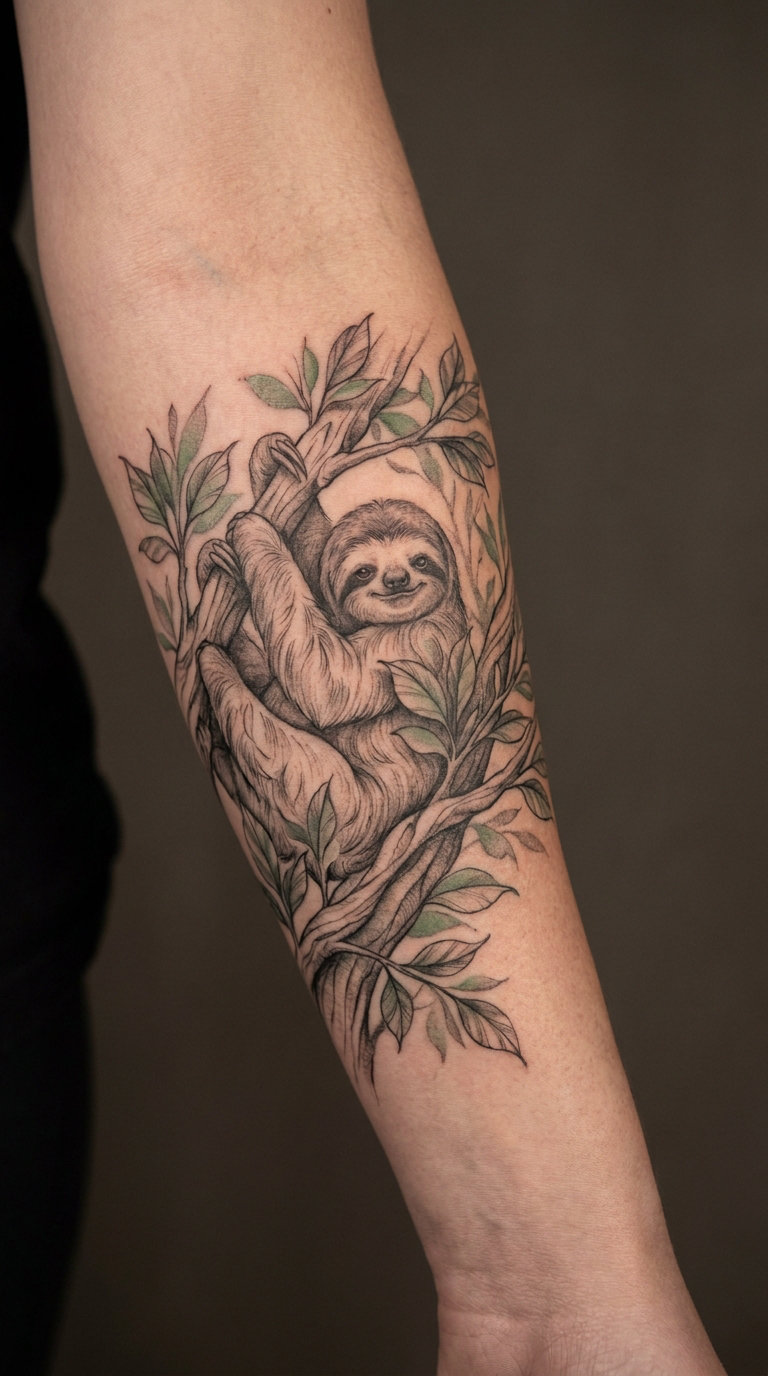
This is the statement piece in the list. A sloth rests among layered forest branches filling most of the outer arm, with black-and-grey realism for the fur and restrained green in the foliage. At 9 inches it has room for real texture, and the branches give you somewhere to add pieces later.
If you already have tattoos on the arm, this is the one to plan a sleeve around. Budget two to three sessions and expect a few months between them.
- Placement: outer arm, elbow to mid-bicep.
- Size: 9 in (23 cm) long or larger.
- Style: realism with colour accents, built toward a half sleeve.
- Pain: high, spread over several sessions.
- Ageing note: sleeve-scale work needs sun protection for the rest of your life. A forearm sleeve in short sleeves is no different.
- Make it yours: add a background layer of forest later, which is the easiest way to build a full sleeve from this starting point.
Adding background work later is also how our pine forest forearm tattoos guide picks up, if you want the sloth sitting inside a fuller landscape.
How to Choose the Right Design
Six checks, in the order they matter. Work down the list and most of the decision is already made.
How big should a sloth tattoo be before it stops reading?
Three inches wide is the practical floor for a recognisable sloth with a face. Below two inches you are choosing a symbol, not a portrait, so simplify to a head, a paw or a single line pose. Bigger is not automatically better either, because a sloth at eight inches needs enough detail to fill the space or it looks thin.
Match the design to the arm zone
- Inner forearm: flat, visible, and the most common spot. Great for fine line and watercolour. Bends hard with movement, so avoid long thin horizontal designs here.
- Outer forearm: rounder and more forgiving. Handles bold outlines, traditional colour and pieces that need to read from a distance.
- Inner elbow: narrow and highly mobile. Only small pieces here, and expect fading from sleeve cuffs.
- Outer elbow: creases and wears against fabric. Skip fine line and skip anything you want to stay crisp.
- Upper arm and bicep: the largest canvas. Best home for blackwork, realism and traditional pieces.
- Wrist: small, visible, and the first place fine detail disappears. Good for a micro piece, risky for a portrait.
Think about what already covers the skin
If you have old work on the arm, take photos of it healed and bring them to the consultation. Artists can work around faded pieces, but only if they see them. Dark armbands and tree branches tend to blend into a realistic sloth; solid black panels are better covered with a dense background like idea 9.
Decide how loud you want it to be
Blackwork and traditional read across a room. Fine line, micro and watercolour are personal. Think about dress codes and handshakes before you commit to a bold piece on the forearm rather than the upper arm.
Check anatomy if the design is realistic
Three-toed sloths have three claws, two-toed sloths have two, and the pale mask around the eyes differs between them. Get the reference right before the stencil goes on, because tattoos are permanent and the claw count is what people notice first.
Plan the ageing, not just the fresh photo
Fine line on the inner forearm and wrist will soften. Heavy outlines and black fills hold shape longest. If you want fine line, build in slightly heavier lines and avoid anything thinner than a standard fine-line needle.
Cost and Session Time
Tattoo prices in the US are set by hourly rate, minimum charge and complexity rather than by subject. Most shops have a shop minimum that applies even to a tiny piece, and many refuse anything under an hour because setup and aftercare take real time.
- Small (1.5-3 in): roughly 80 to 200 dollars for a simple line design, or the shop minimum if the rate is higher. Under an hour.
- Medium (3-6 in): roughly 250 to 700 dollars depending on detail and colour. One to three hours.
- Large (6-9 in): roughly 700 to 1,800 dollars for realism, blackwork or a small sleeve section. Split across two or three sessions.
Colour and fine shading push the total up, because the artist covers the same skin repeatedly. Blackwork fills do the same. The cheapest version of any idea on this page is always the simplified line treatment, and the most expensive is the realistic portrait in idea 10.
Get the full estimate before the first session, including what each follow-up visit costs, and ask whether the artist charges per hour or per piece.
Aftercare Basics
Follow your artist’s aftercare instructions first. They know exactly what they did to your skin, and this is general guidance only.
- Wash the area gently with unscented soap and lukewarm water, then pat it dry. Most artists say twice a day for the first few days.
- Keep it covered loosely while you sleep for the first three to five nights. Sheets rub harder than you expect.
- Wash your bedsheets and change your towel while the tattoo is healing. Fabric holds the most bacteria.
- Wear loose clothing over the arm for around two weeks. Cuffs rubbing at the inner elbow are the fastest route to a patchy heal.
- Do not soak, swim, sauna or cover the tattoo tightly for two to four weeks, or until the skin has fully returned to normal.
- Skip the sunscreen while the skin is still pink and tender. Once healed, put SPF on the forearm daily and the black and grey lines will hold their shade for years longer.
Full colour tattoos want a touch-up once the surface layer settles, usually a few months after the last session. Ask your artist to do it rather than going elsewhere.
Frequently Asked Questions
What does a sloth tattoo symbolize?
A sloth tattoo usually symbolizes patience, calm and living at an easy pace. People who get one rarely want the lazy reading; they want the animal that moves deliberately and takes its time. It also shows up as a spirit animal for patient, easygoing people, and as a joke between friends who move at the same unhurried pace. In every case the meaning comes from the wearer, not the design itself.
Is a sloth tattoo a good choice for a first tattoo?
Yes, as long as the size and detail are matched to your first-tattoo experience. A fine-line sloth at 3 inches on the inner forearm is a short session, heals predictably and reads clearly once healed. A 6 inch realistic portrait is a very different commitment, with two or three sessions before it is finished. Choose idea 1, 2 or 4 if you want one sitting and low risk.
What size should a sloth forearm tattoo be?
Three to four inches wide is the sweet spot for a recognisable sloth with a face and claws. Below about two inches you need to simplify to a head or a single-line pose, because finer details heal into a blur. Six inches and up is where realism and blackwork work properly. Ask your artist to stencil the size on your arm before committing, and view healed examples at the same scale.
Does a fine-line sloth tattoo fade on the forearm?
Fine line softens over time, and the inner forearm is where it shows first because the skin moves constantly and sleeves rub across it. Wrist and hand detail fades fastest of all. Expect to add weight to the lines if you want it to stay crisp for decades, and protect it from sun once healed. Heavy black outlines and blackwork hold their shape much longer than single-needle line work.
What does sloth mean in slang, and is that a problem?
In everyday English, calling someone a sloth is an insult about being lazy or slow, and that is not what the tattoo means to almost everyone who gets one. In tattoo culture the word reads as patience, restfulness and unhurried living. If you like the idea but worry about the slang reading, a detailed sloth rather than a plain outline usually settles the question. Choose the version you would defend out loud.
Can I build a sloth tattoo into a sleeve later?
Yes, and idea 20 is drawn with that in mind. A large sloth on layered branches leaves room for a background of leaves, trees or other animals to be filled in around it over several years. Start with a composition rather than a floating animal, keep the branches running to the edges, and talk to the artist about the full plan before the first session so the pieces fit together.
Conclusion
If this is your first tattoo, the fine-line curled-up sloth or the minimal sleeping one on the inner forearm is the safest place to start: small, quiet, one session, and still clearly a sloth once it heals. If you already have arm ink and want something that grows, start from the large forest composition and build a background around it over time.
Save the two or three concepts above that feel like you, then bring them to a consultation with healed portfolio work in the same style. The artist can tell you in ten minutes which ones will hold up on your arm and which will blur, and that answer is worth more than any gallery.
Curious about a lighter, more summery option instead? Our beach tattoo ideas for women cover the same placement logic with completely different subjects.