
20 Moose Tattoo Ideas: Best Designs and Placements 2026
These 20 moose tattoo ideas cover everything from a realistic forearm portrait to a single-line antler on your inner arm, and each one comes with a placement, a realistic size and an honest note on how it ages. A moose is a good subject for a first piece or a tenth piece, because the antlers carry the design on their own.
What separates a moose tattoo that still looks good in ten years from one that turns into a brown smudge is planning, not talent. Most people underestimate the antlers, which are the hardest part to render and the first thing to blur when a piece is tattooed too small. If you book a session knowing how much detail your chosen size can hold, you will not end up regretting it. Autumn and early winter are the busiest booking windows for wildlife work, so plan a few months ahead if you want a specific artist.
Start with the quick guide below, then jump to the designs that match your style.
20 Moose Tattoo Ideas: Quick Guide
Every design is matched to a style, a body placement, a realistic size range and an expected pain level. The pain ratings assume the placement listed, since a chest piece and a finger piece are not the same experience.
| Idea | Style | Best placement | Size | Pain |
|---|---|---|---|---|
| 1. Realistic forearm portrait | Realism, black and grey | Inner forearm | 4-7 in (10-18 cm) | Medium |
| 2. Minimalist wrist moose head | Fine line | Inner wrist | 1.5-3 in (4-8 cm) | Low |
| 3. Antlers as a matching symbol | Fine line | Upper chest | 2-3 in (5-8 cm) | Low |
| 4. Geometric moose | Geometric, blackwork | Outer upper arm | 3-6 in (8-15 cm) | Medium |
| 5. Traditional moose in black and gold | Traditional American | Shoulder | 5-8 in (13-20 cm) | Medium |
| 6. Watercolor forest glimpse | Watercolor | Rib area | 4-7 in (10-18 cm) | Medium |
| 7. Blackwork silhouette | Blackwork | Outer thigh | 4-8 in (10-20 cm) | Medium |
| 8. Moose among pine trees | Illustrative, black and grey | Upper back | 6-10 in (15-25 cm) | Medium |
| 9. Small moose head behind the ear | Fine line, micro | Behind the ear | 1.5-2.5 in (4-6 cm) | Low to medium |
| 10. Moose skull with botanicals | Illustrative, dark | Forearm | 4-7 in (10-18 cm) | Medium |
| 11. Running moose in motion | Realism with motion | Calf | 4-6 in (10-15 cm) | Medium |
| 12. Full antler bloom | Blackwork, ornamental | Sternum | 5-8 in (13-20 cm) | Medium to high |
| 13. Tiny finger silhouette | Blackwork, micro | Side finger | 0.75-1.5 in (2-4 cm) | High |
| 14. Circular wilderness badge | Badge, traditional | Upper arm | 3-6 in (8-15 cm) | Medium |
| 15. Neo-traditional with maple leaves | Neo-traditional | Shoulder | 5-8 in (13-20 cm) | Medium |
| 16. Dotwork forest moose | Dotwork | Shoulder blade | 4-7 in (10-18 cm) | Medium to high |
| 17. Moose against a sunset | Realism with colour | Back of calf | 4-7 in (10-18 cm) | Medium |
| 18. Single antler line art | Fine line, minimal | Inner arm | 2-4 in (5-10 cm) | Low |
| 19. Moose head with mountain range | Realism, scenic | Back of shoulder | 5-9 in (13-23 cm) | Medium |
| 20. Playful moose with flowers | Contemporary illustrative | Calf | 2-4 in (5-10 cm) | Medium |
1. Realistic Moose Portrait on the Forearm
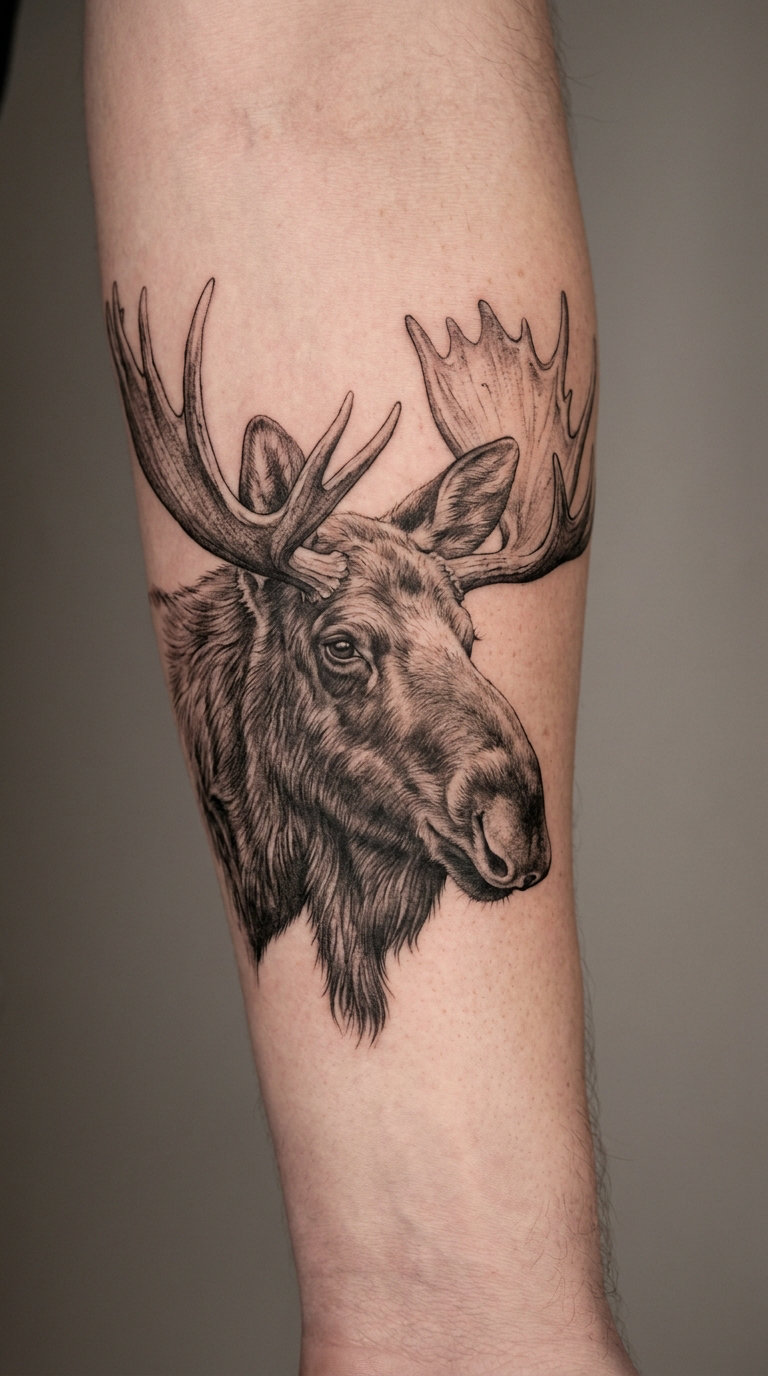
This is the moose tattoo most people picture first, and it is the one that rewards patience. The artist works in black and grey, building the antler tines with fine shading, then lets the fur texture stay loose so the animal does not look painted on.
A forward-facing head reads as powerful and symmetrical, while a three-quarter profile shows more of the muzzle and gives you room to add soft shadow under the jaw. Most people choose it because the moose already says strength without words.
Placement: inner forearm, outer forearm or calf. Size: 4-7 in (10-18 cm). Style: realism, black and grey. Pain: medium, with the forearm more sensitive near the wrist than near the elbow. Make it yours: add a date or a set of coordinates beneath the jaw line, or place it beside a forearm pine forest tattoo to build a themed arm.
2. Minimalist Moose Head on the Wrist
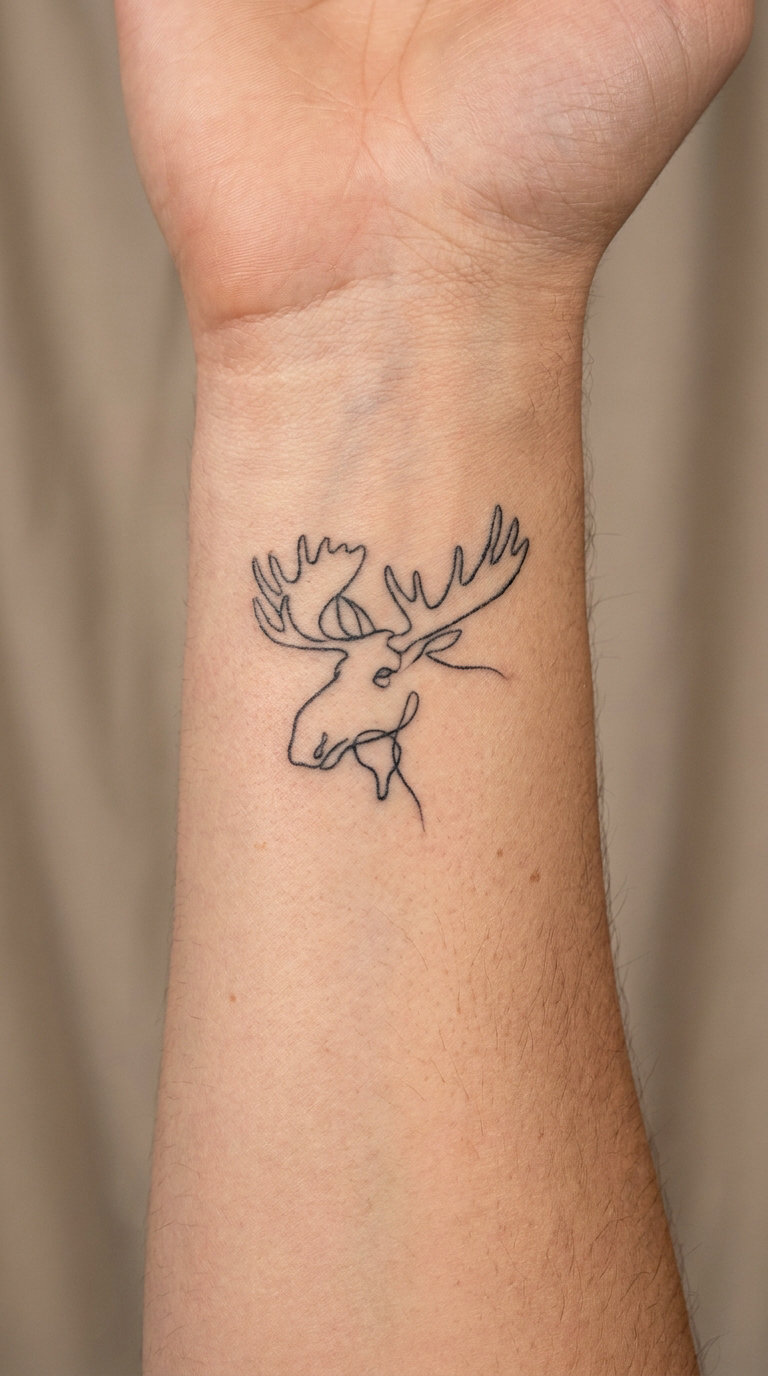
A single continuous line that traces the muzzle, sweeps up into both antlers and stops is the cleanest way to get a moose on your wrist. There is no shading and no fill, which is exactly why it works at that size.
This is a common first tattoo because it is quick, it sits under a sleeve and it is hard to regret. The long antler lines are the part to check in your reference, since uneven antlers are the first thing people notice.
Placement: inner wrist or inner forearm. Size: 1.5-3 in (4-8 cm). Style: fine line. Pain: low, though wrist skin is thin and you will feel the wrist bones. Make it yours: add a small heart or a dot at the base of the antlers so the design is unmistakably yours. Fine line wrist work softens over the years, so expect a touch-up sooner than most.
3. Moose Antlers as a Matching Symbol
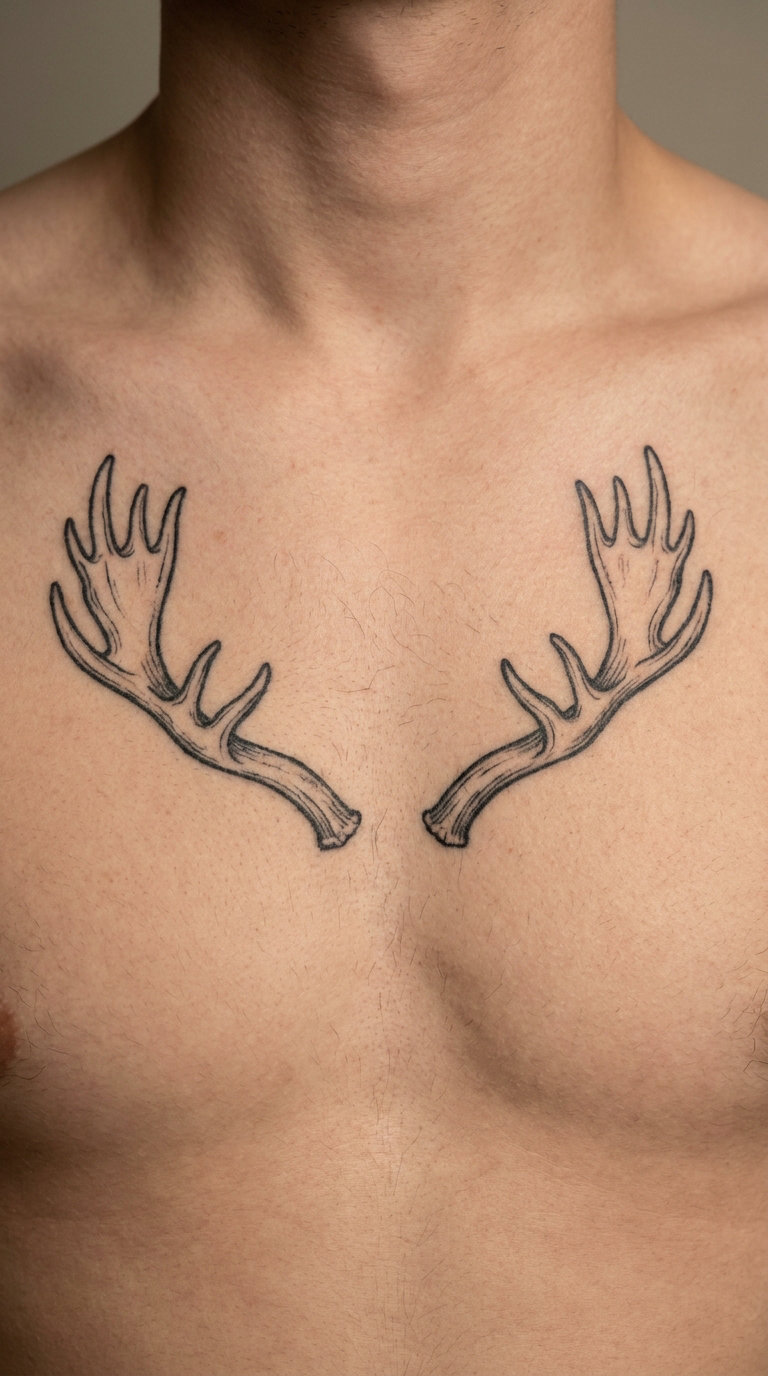
Antlers on their own are the most versatile moose idea here, because they read as a symbol rather than a picture. Drawn as a mirrored pair with even branching, they sit comfortably on the chest and pair naturally with other nature or wildlife pieces.
People pick this one when they want moose without the animal, or when they are matching with someone and want one element rather than a full design on each of you.
Placement: upper chest, sternum, inner arm or collarbone. Size: 2-3 in (5-8 cm) per pair. Style: fine line or minimal blackwork. Pain: low, because there is no shading work. Make it yours: have one antler shaded and one kept as outline, or add a small birth year on the inner curve. Keep the branch count identical on both sides or the symmetry will read as a mistake.
4. Geometric Moose with Intricate Antlers
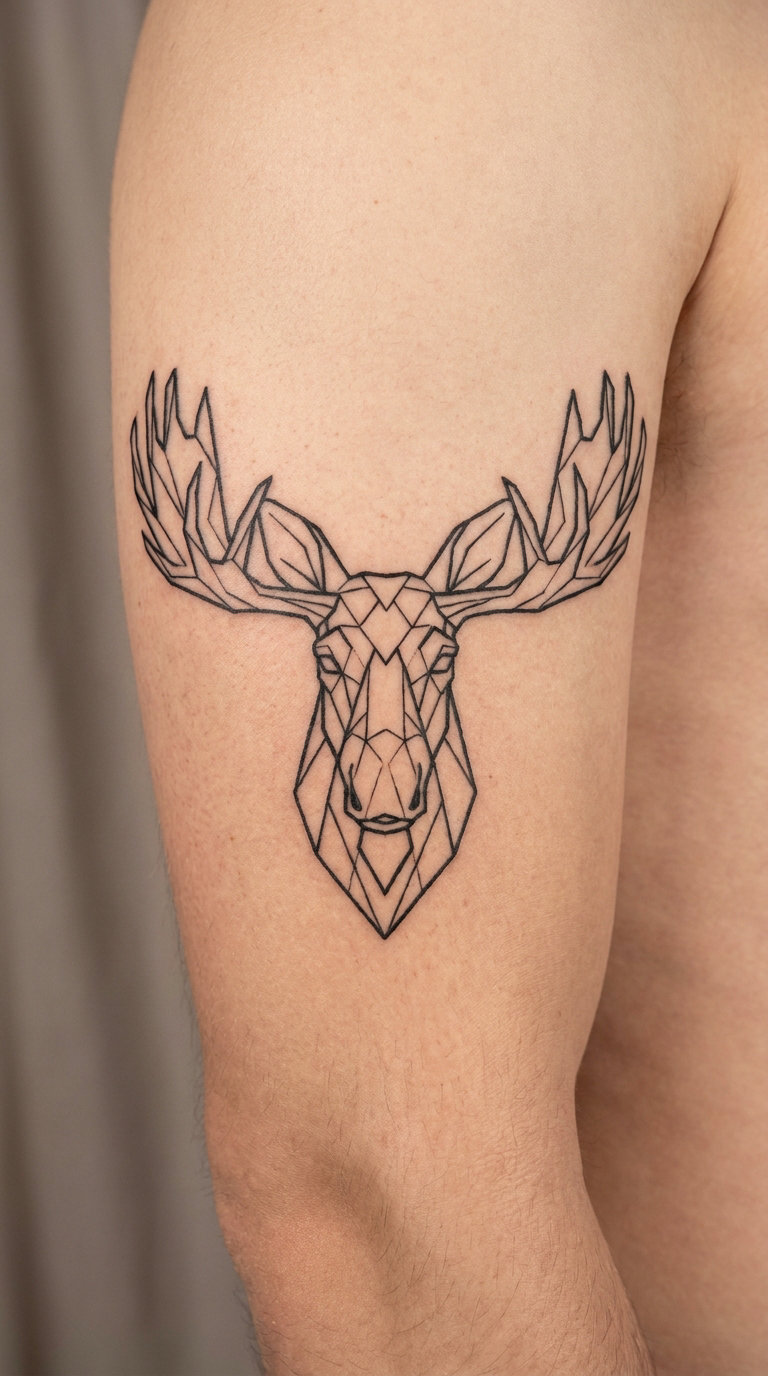
Geometric work turns the moose into a set of straight lines, triangles and mirrored antler shapes. The head becomes a simple polygon and the body is built from overlapping facets, so the piece reads as graphic design rather than wildlife art.
It suits people who like bold, contemporary body art and want something that still looks sharp from across a room. The trick is restraint: too many facets and the animal disappears.
Placement: outer upper arm, shoulder blade or calf. Size: 3-6 in (8-15 cm). Style: geometric, blackwork. Pain: medium on the arm, and line-heavy geometric work takes longer than it looks because every edge is packed. Make it yours: split the design down the middle, ink one half solid and leave the other as outline, or repeat the facet pattern inside the antlers.
5. Traditional Moose in Black and Gold
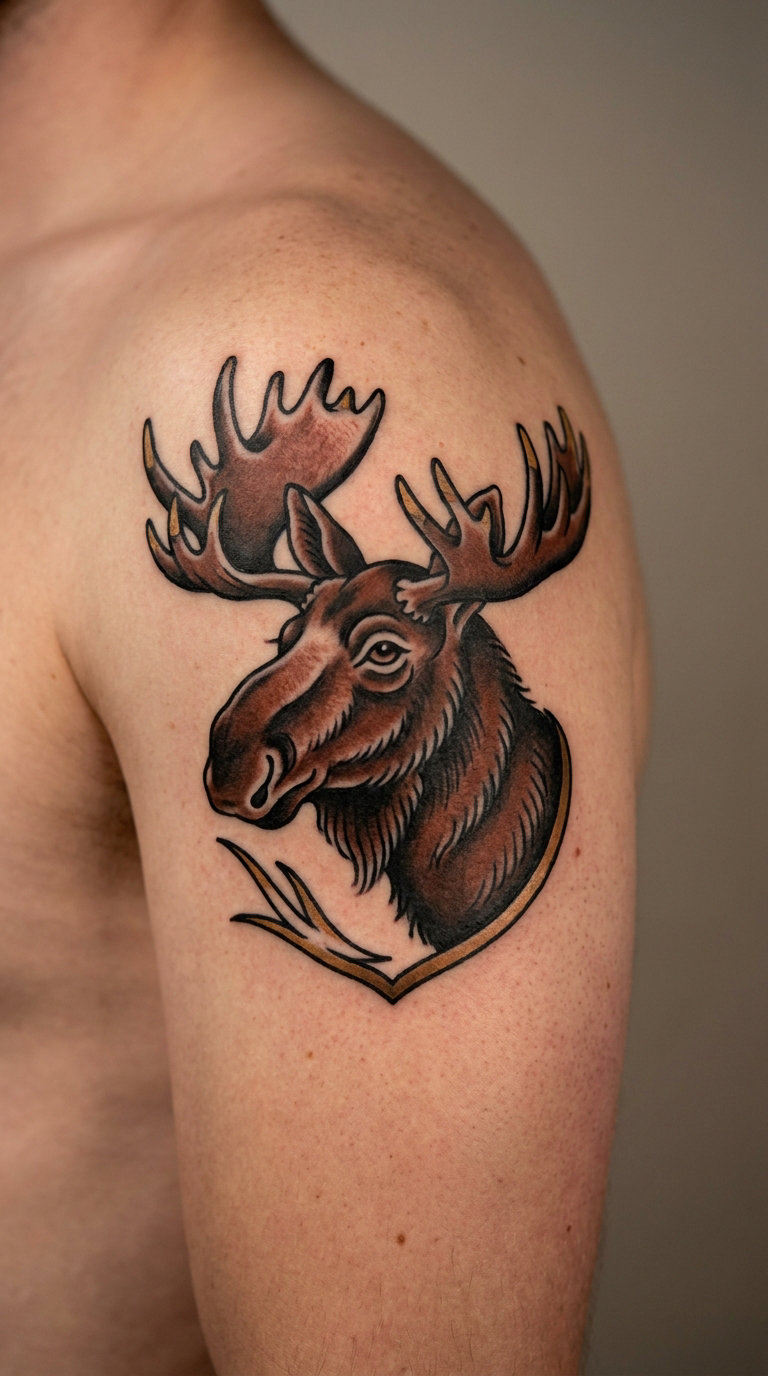
Traditional American style means a bold black outline, a limited palette and confident shading rather than fine detail. Here the moose is usually shown broadside with the head raised, so the antler mass reads instantly.
Brown fills the body, black defines the line work, and a restrained gold or yellow accent picks out the eye and a few highlight areas. It is a loud, classic design that suits a shoulder and a sleeve layout.
Placement: shoulder, upper arm or upper back. Size: 5-8 in (13-20 cm). Style: traditional. Pain: medium, and the shoulder is a fleshy area that takes ink well. Make it yours: add a banner with a year or a hunting season date, which is a traditional element anyway. Traditional colour is bold on day one and softens noticeably as the years pass.
6. Watercolor Moose in a Forest Glimpse
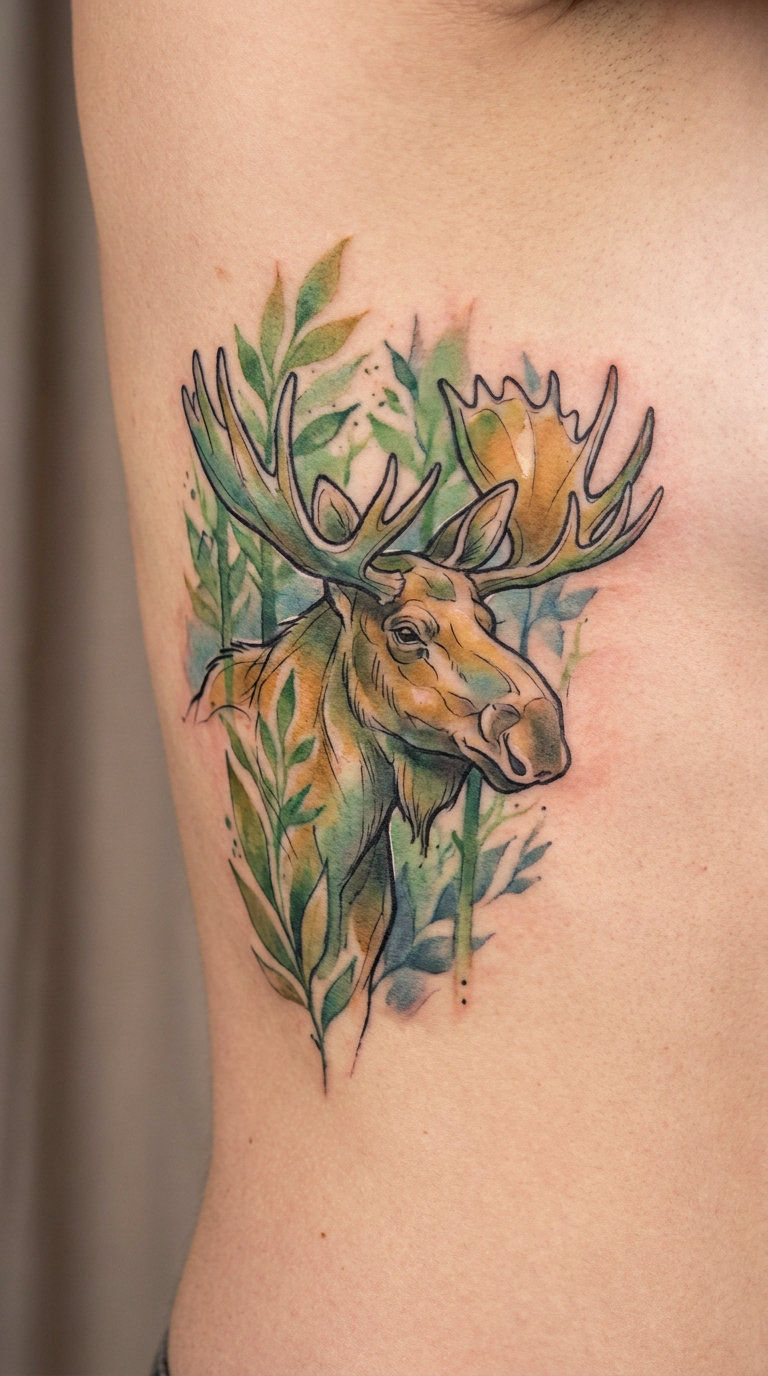
Watercolor tattoos use translucent washes with soft, uneven edges, so the moose appears to be standing inside a shifting wash of colour rather than in a painted scene. Green, amber and a little deep blue usually do the work.
People choose it because it feels alive on skin and because the loose edges make a large piece look lighter than a fully rendered realism piece. The animal is usually drawn in soft greys and browns so the colour stays in the background.
Placement: rib area, shoulder or thigh. Size: 4-7 in (10-18 cm). Style: watercolor. Pain: medium, and rib skin is sensitive. Make it yours: use the colours of a place you have been rather than generic greens, or ask for the colour to fade out entirely on one side so the moose looks half-hidden.
7. Blackwork Moose Silhouette
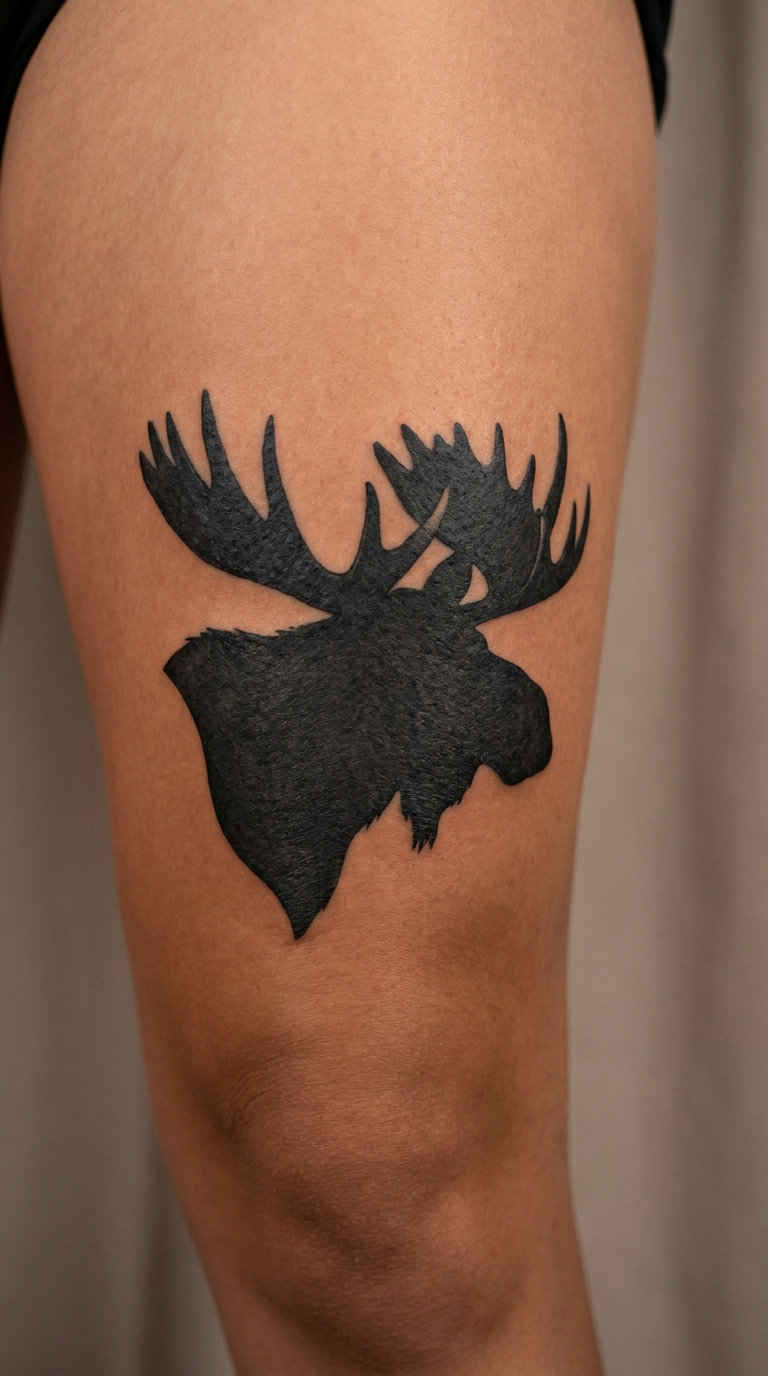
A solid black silhouette strips the moose down to an outline and a filled shape. All the visual interest comes from the antler branching, the leg stance and the curve of the back, which means the design holds up with no interior detail at all.
Blackwork ages better than colour realism because it does not depend on brown and grey staying distinct, and it is a good anchor for a larger piece. If you are building a leg, it can sit alongside our black sleeve tattoo ideas for reference on how negative space behaves across a limb.
Placement: outer thigh, calf, upper arm. Size: 4-8 in (10-20 cm). Style: blackwork. Pain: medium, and a solid fill takes repeated passes so expect a longer sitting. Make it yours: cut a narrow white gap through the antlers so they read as separate shapes, or set the silhouette against a few pine shapes without shading them.
8. Moose and Pine Trees Composition
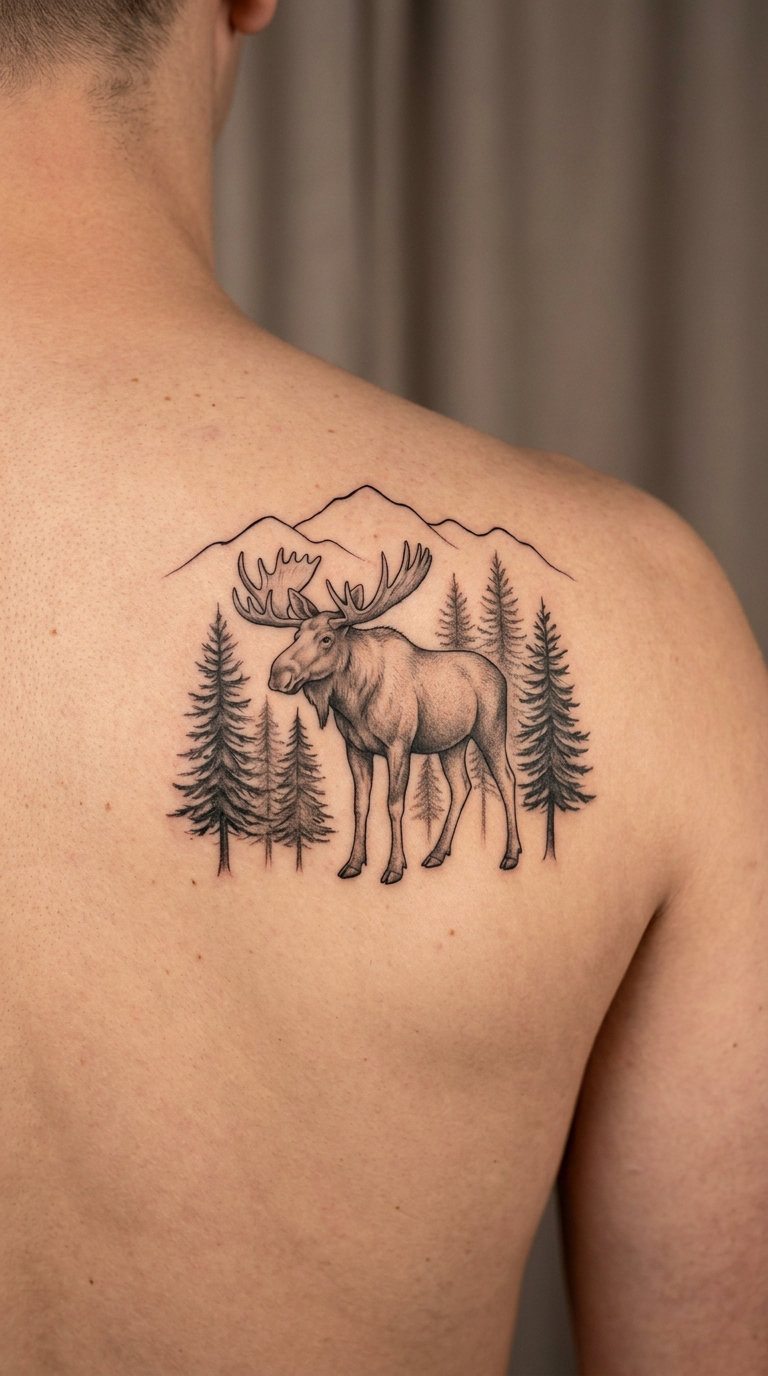
Adding pines changes what the design is about. Instead of an animal portrait, you get a place, and the moose becomes part of a northern scene. Three to five trees are usually enough to set the scene without crowding the animal.
This is the version to choose if you grew up somewhere cold, hunt, or spend time in the woods. It is a bigger piece and it wants a flat-ish surface, which is why the back works better than a forearm.
Placement: upper back, shoulder blade or thigh. Size: 6-10 in (15-25 cm). Style: illustrative, black and grey. Pain: medium over a long session, and back work lets you take breaks. Make it yours: add a mountain horizon behind the trees, or name the specific lake or ridge you are drawing from so the piece is unmistakably yours.
9. Small Moose Head Behind the Ear
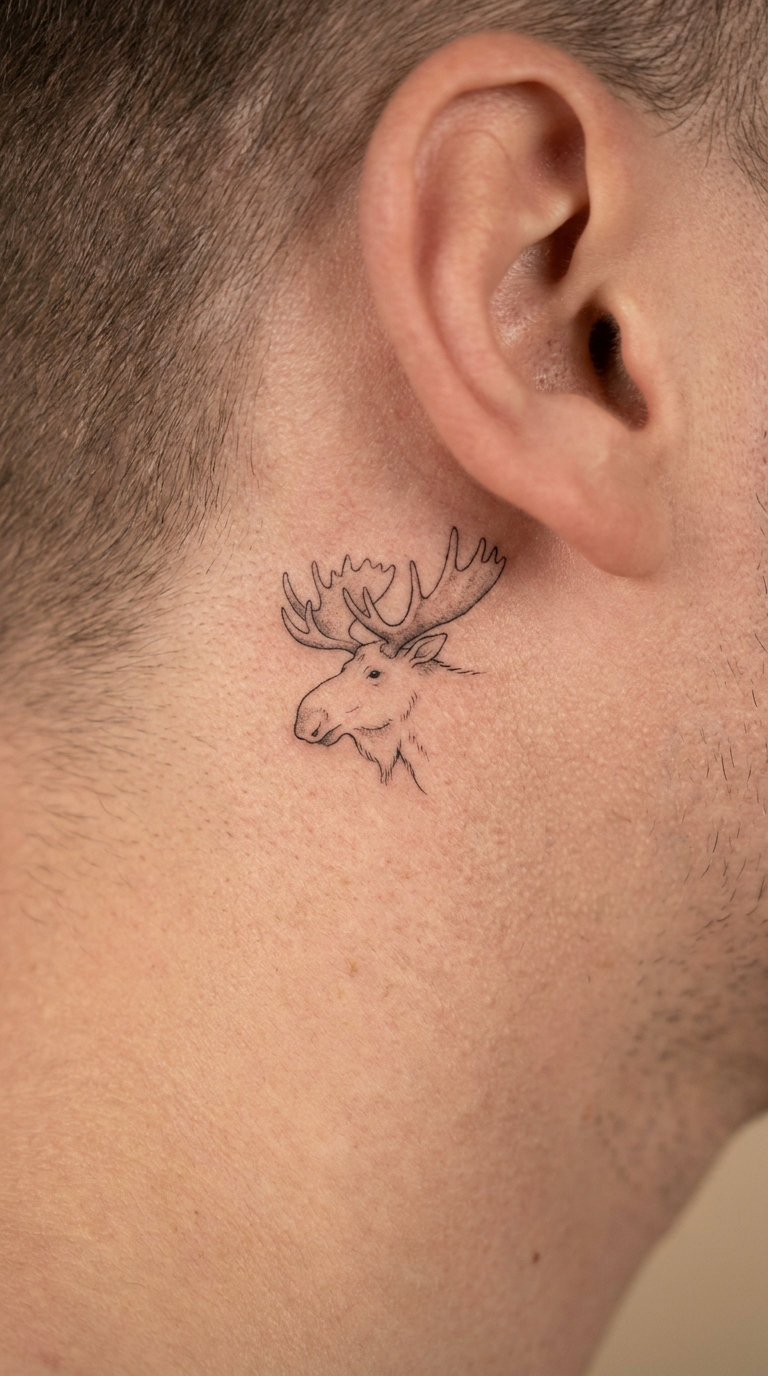
Side profile works well here because the skin behind the ear is flat and the antlers have room to spread upward toward the hairline. Fine line shading on the antler tines is enough to give it dimension.
It is a discreet spot that is easy to hide at work and easy to show on a beach. Most people choose it as a companion to something else rather than as a statement piece.
Placement: behind the ear or the small dip in the skin above the collarbone. Size: 1.5-2.5 in (4-6 cm). Style: fine line, micro. Pain: low to medium, with the neck often feeling more than expected. Make it yours: add a single pine needle or star above the antler tips, and leave clear space so hair growth does not bury the design.
10. Moose Skull with Botanical Accents
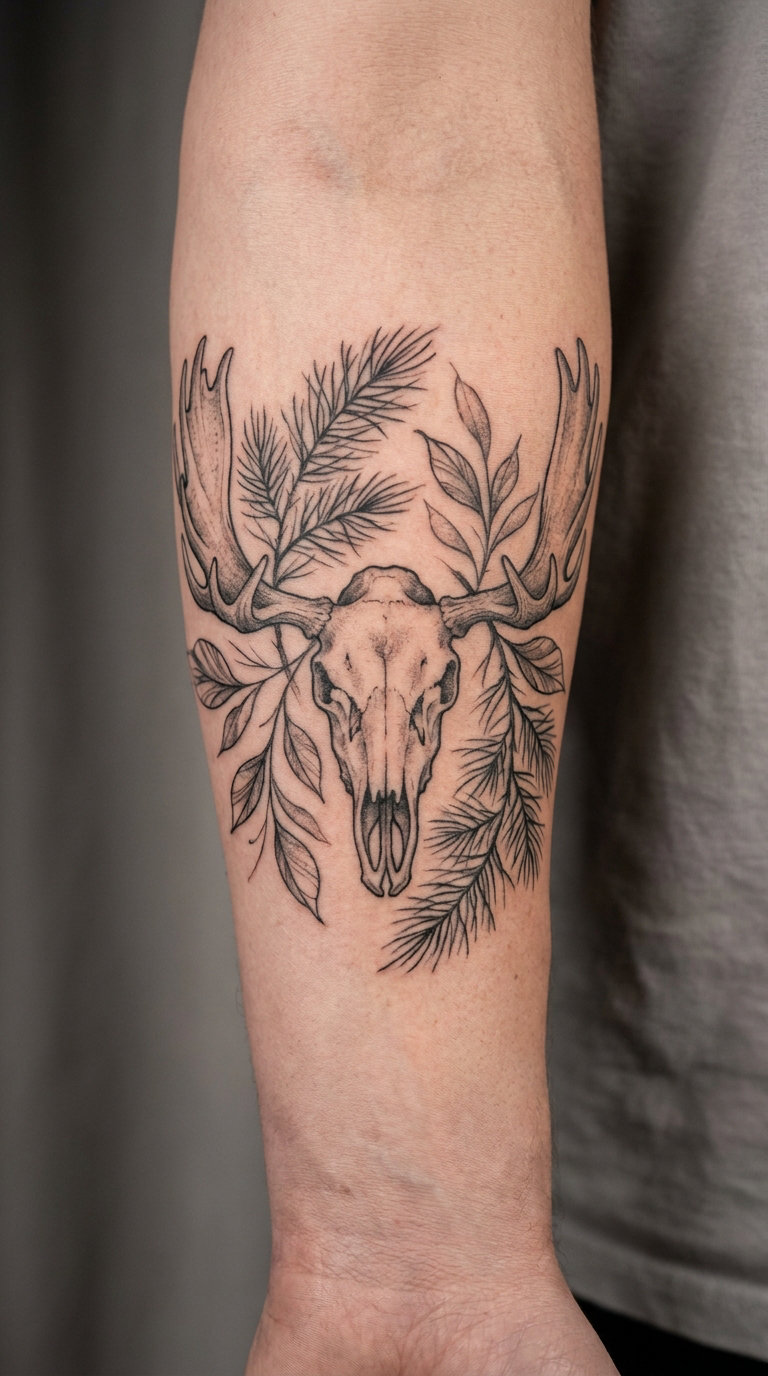
The skull is the darker, moodier option. The artist renders the bone texture, the eye sockets and the antler beams, then frames the whole thing with a restrained number of pine needles or thin leaves. Restraint matters, because a full wreath of foliage turns a strong image into a busy one.
People tend to choose a moose skull for a memorial piece, for a hunting connection, or simply because it looks striking in black and grey.
Placement: forearm, upper arm or thigh. Size: 4-7 in (10-18 cm). Style: illustrative, dark realism. Pain: medium. Make it yours: have the botanicals match a plant from a meaningful place, or add a small date below the skull as a memorial marker. Check healed photos before booking a heavily shaded forearm piece.
11. Running Moose in Motion
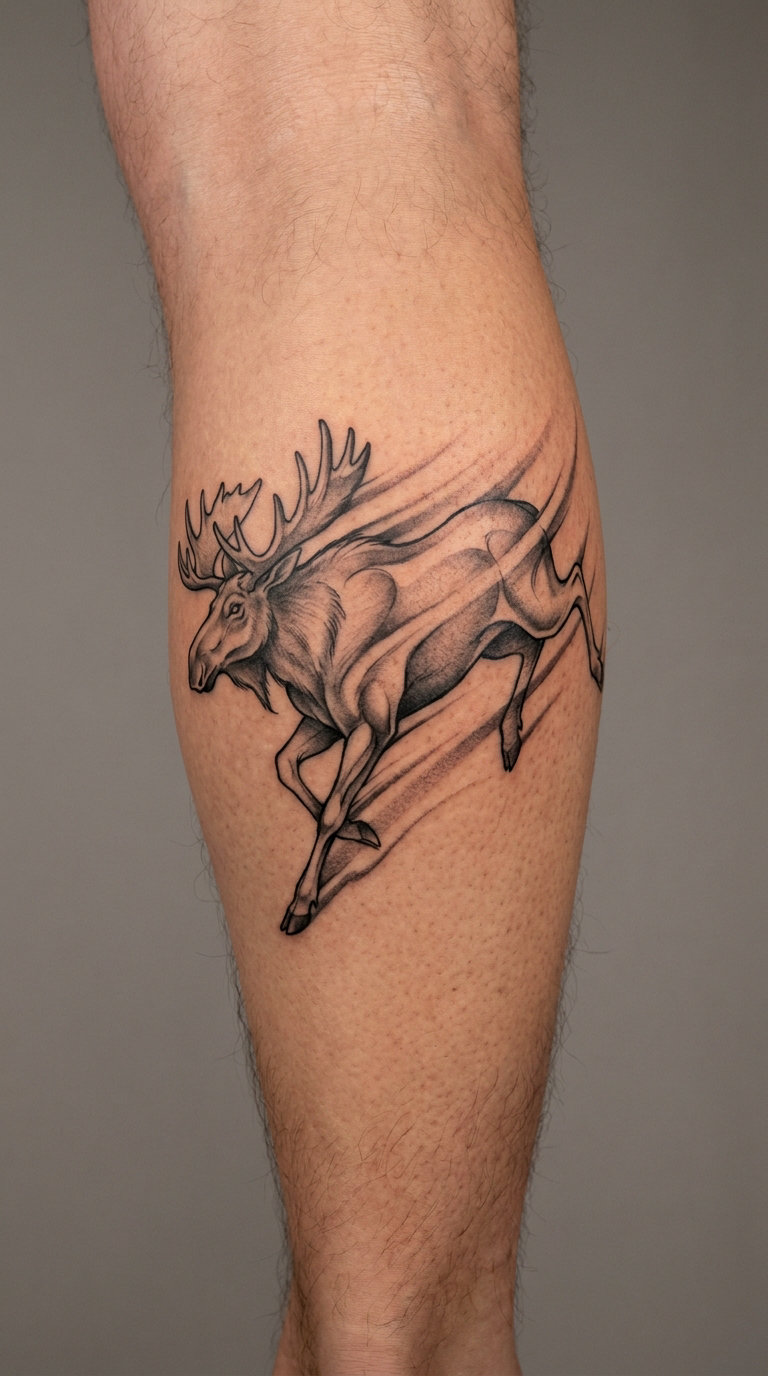
A running moose has legs off the ground, a stretched body and windblown detail behind the shoulders. The composition is what sells it: the animal leans forward, the antlers rake back and the shading trails in the direction of movement.
It is a design with energy, and it fits a leg beautifully because the shape of the calf follows the running line. Leave the background empty so the motion is the only story.
Placement: calf, outer forearm or thigh. Size: 4-6 in (10-15 cm). Style: realism with motion shading. Pain: medium, and the calf is one of the more sensitive spots on the leg. Make it yours: add a few wind lines or a faint snow spray behind the hooves, or mirror a walking moose on the other calf.
12. Moose with a Full Antler Bloom
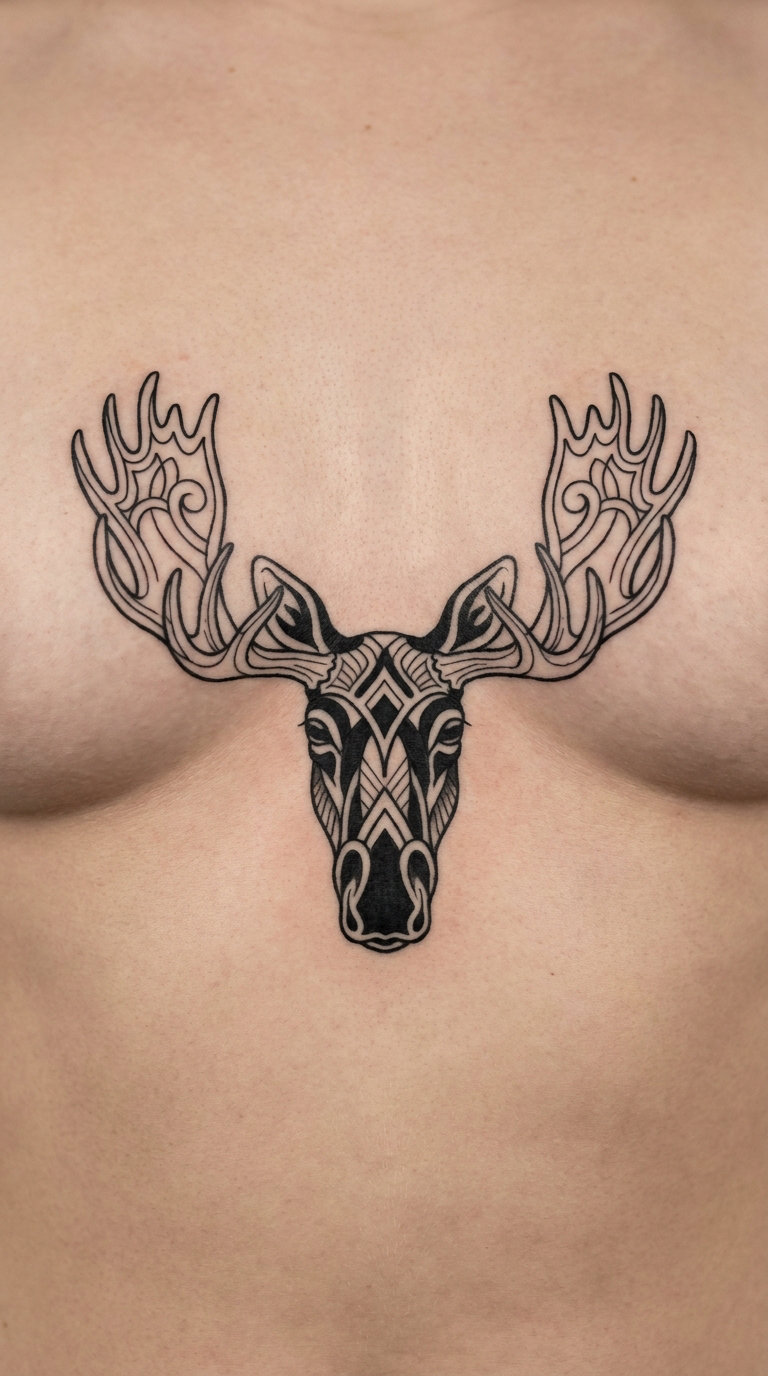
A front-facing head with a wide, evenly branching antler rack turns the animal into something close to a botanical study. The layout is symmetrical, the lines are controlled, and the ornamental detail fills the gaps between the antler tines without crowding the face.
Sternum placement means the piece reads as a symmetrical mark on the body, which is why this is a favourite for anyone who wants one central piece instead of a scattered collection.
Placement: sternum or centre chest. Size: 5-8 in (13-20 cm). Style: blackwork, ornamental. Pain: medium to high, since the sternum is bony and near the sternal notch. Make it yours: have the antler tines end in tiny leaf shapes, or add a small ornament between the antlers. Get it mirrored accurately so both sides match.
13. Tiny Moose Silhouette on the Finger
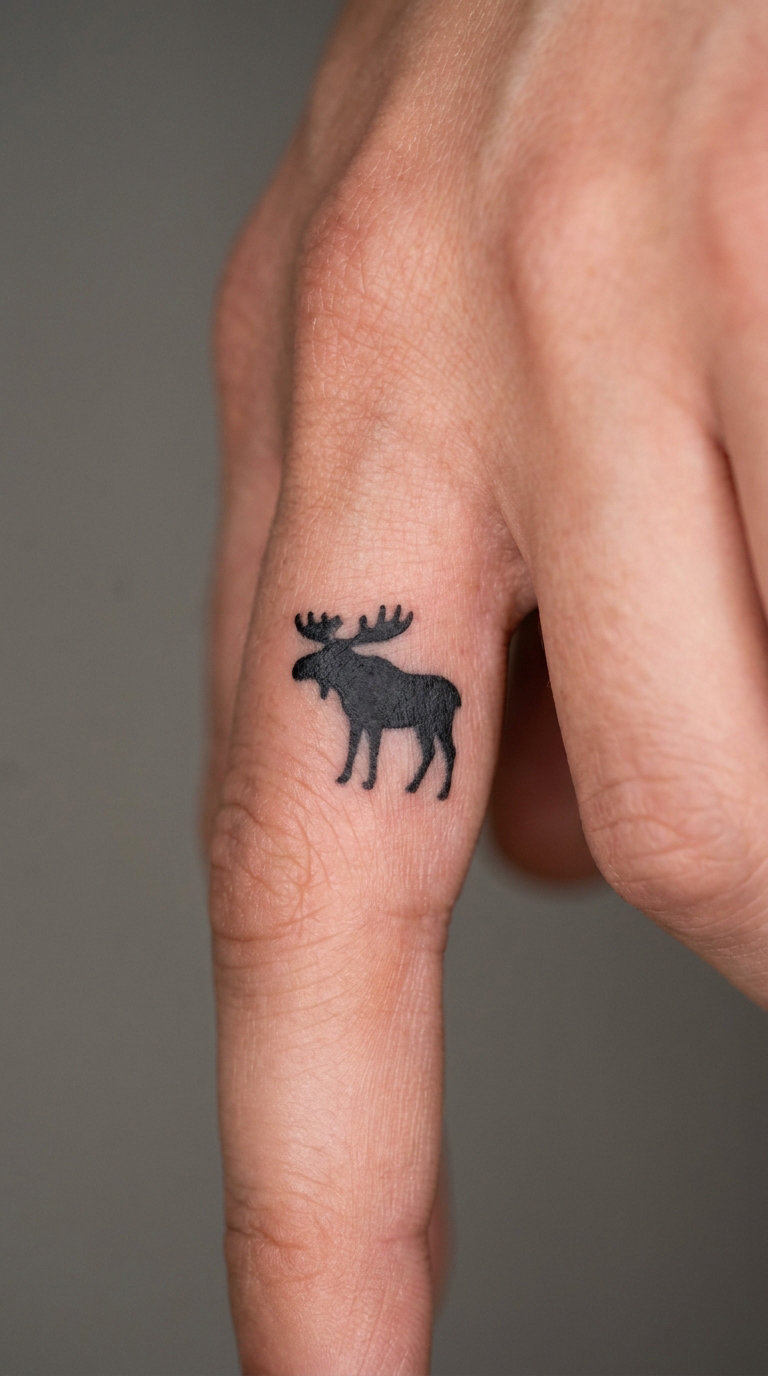
A finger-sized moose is a commitment to simplification. The silhouette gets about three to five tines per side, the legs become short shapes, and there is no room for fur texture, so the design relies on the antler outline and the long muzzle to make it identifiable.
I will be straight about the tradeoff: micro work on hands and fingers fades faster than almost anywhere else on the body, and the simplification that works today can soften into an ambiguous shape in a few years. Many people accept that and get it anyway because the size is the point.
Placement: side of the finger or the hand. Size: 0.75-1.5 in (2-4 cm). Style: blackwork, micro. Pain: high for such a small area, because the fingers are bony and nerve-rich. Make it yours: add a tiny filled circle or heart as a counterweight, and book a touch-up mindset into your plan from day one.
14. Moose in a Circular Wilderness Badge
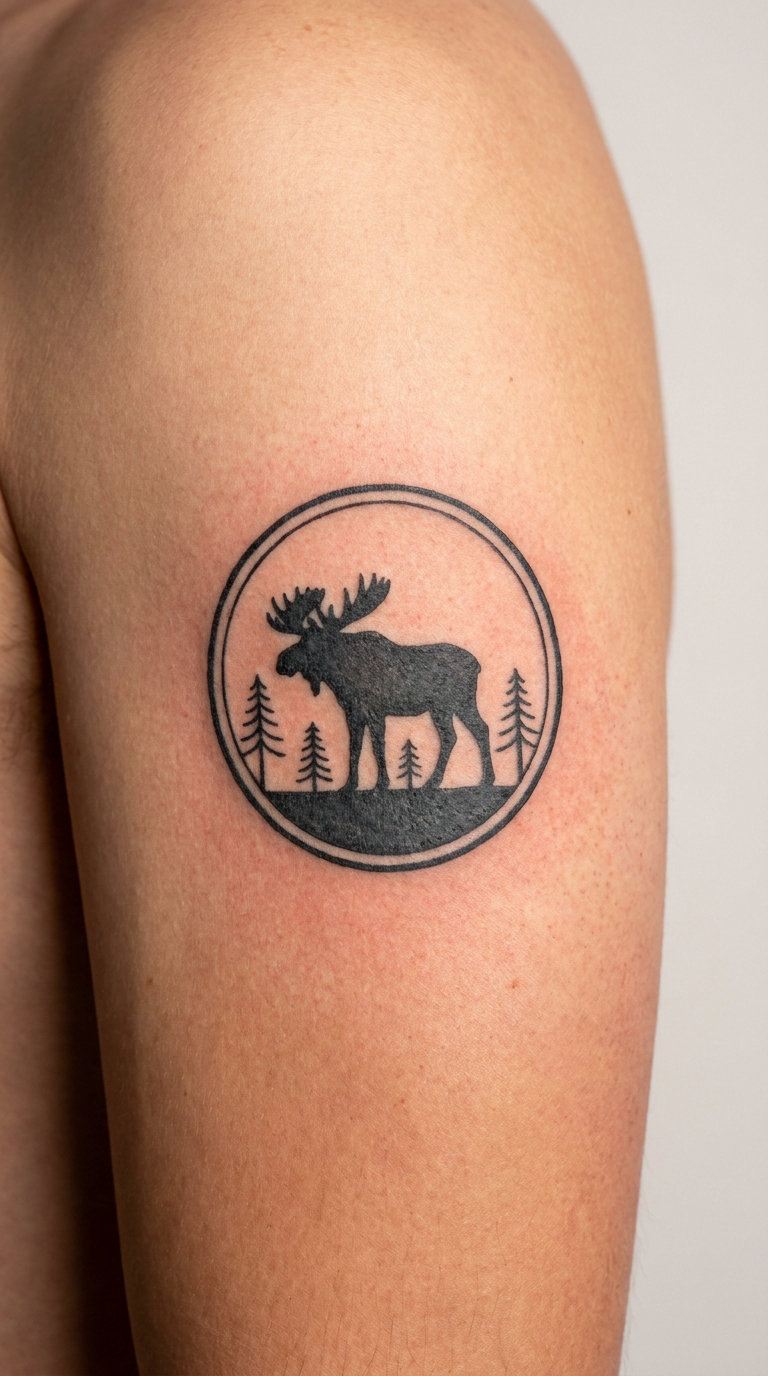
A badge composition puts a moose inside a clean outer ring, usually with two or three small pines and a little open space around the animal. The circle is what makes it look deliberate rather than like a floating doodle.
Badges also scale well, because the ring gives the design a border at any size, and they sit nicely in a row if you are collecting patches of different animals.
Placement: upper arm, shoulder or chest. Size: 3-6 in (8-15 cm). Style: badge, traditional. Pain: medium. Make it yours: add a small year at the bottom of the ring, or repeat the same circle format with a bear, a wolf and a trout so the set reads as a collection. Skip lettering inside the ring unless you want the letters to be part of the design.
15. Neo-Traditional Moose with Maple Leaves
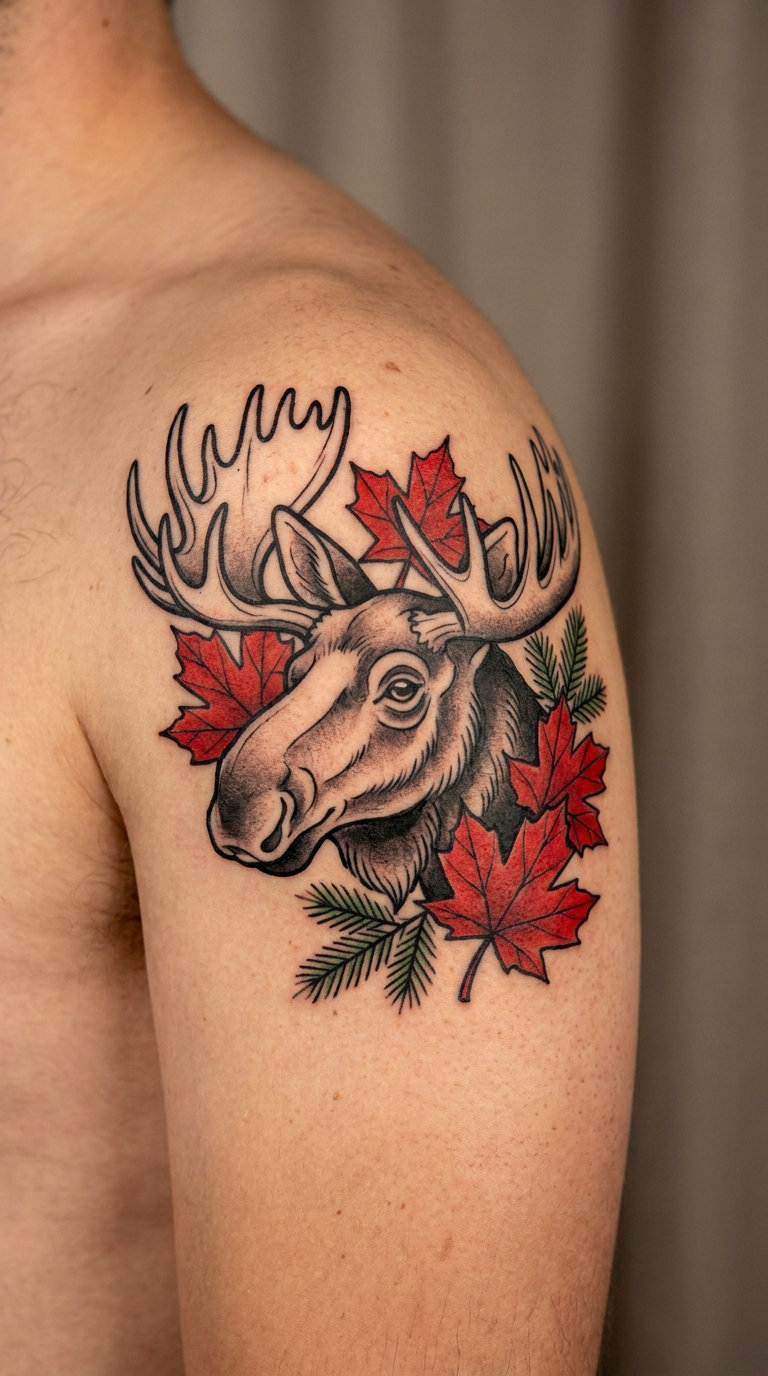
Neo-traditional keeps the bold outline of traditional work but allows finer detail, deeper colour and more illustrative handling. The moose here is usually drawn with a defined face, a heavy neck and a rich shaded body, surrounded by red maple leaves.
The maple leaves anchor it in a specific place and season, which makes it a strong choice for anyone with Canadian roots or a birthday in the autumn.
Placement: shoulder, upper arm or back. Size: 5-8 in (13-20 cm). Style: neo-traditional. Pain: medium, and colour packing takes longer than a black and grey piece. Make it yours: use your province or state colours in the accent shading, or work in a single deep green behind the leaves instead of red.
16. Dotwork Moose Made of Forest Dots
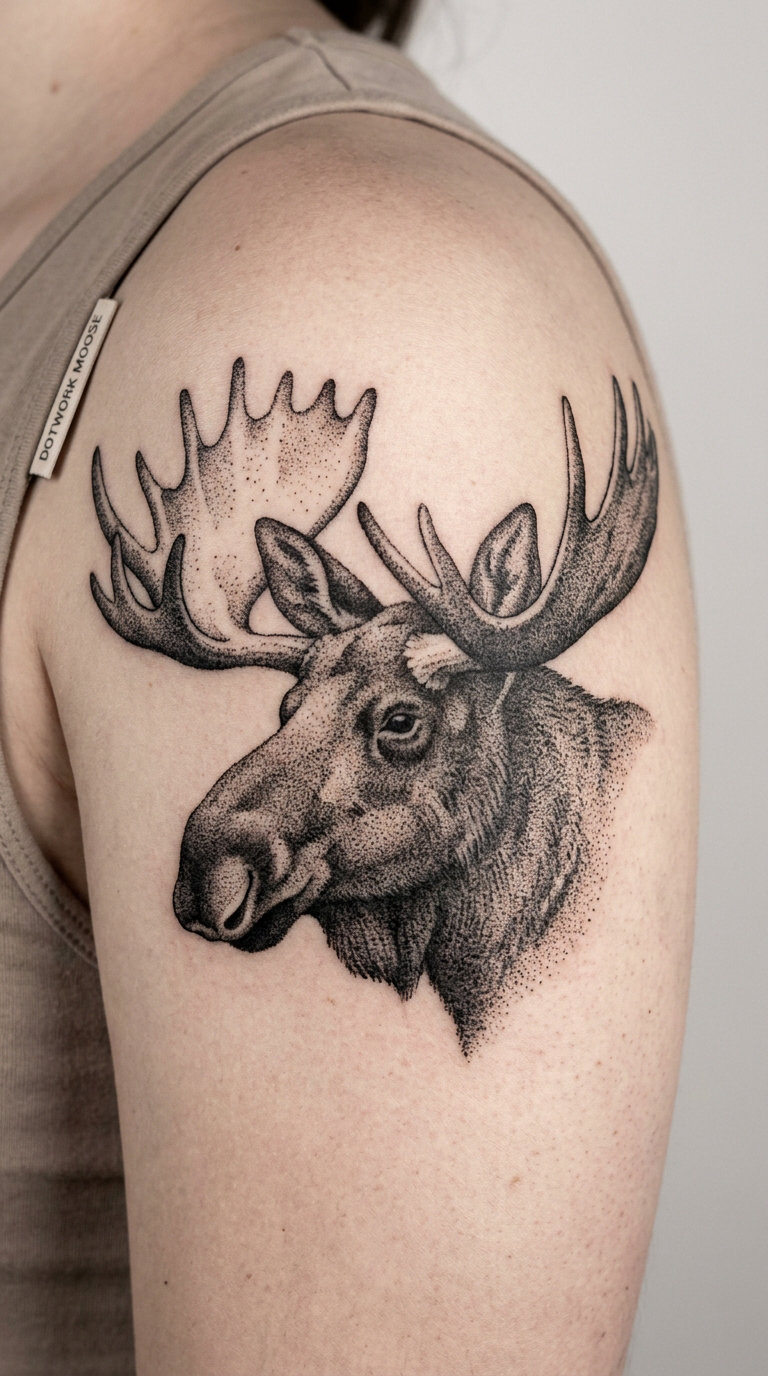
Dotwork builds the image from spaced dots, with density doing the work that shading does in a conventional piece. The body fades from dark to light across the shoulder of the animal, and small gaps of bare skin define the antlers and the face.
It is a slow, technical style, so plan for a longer sitting, and it rewards patience with something that has a texture no solid black or grey shading can match. It also hides small imperfections well as it heals.
Placement: shoulder blade, upper arm or thigh. Size: 4-7 in (10-18 cm). Style: dotwork. Pain: medium to high, since single-needle dotting is repetitive and the shoulder blade is sensitive. Make it yours: ask the artist to hide a small constellation in the dot pattern, or let some dots trail off the back of the shoulder as an unfinished edge.
17. Moose with a Sunset-Coloured Backdrop
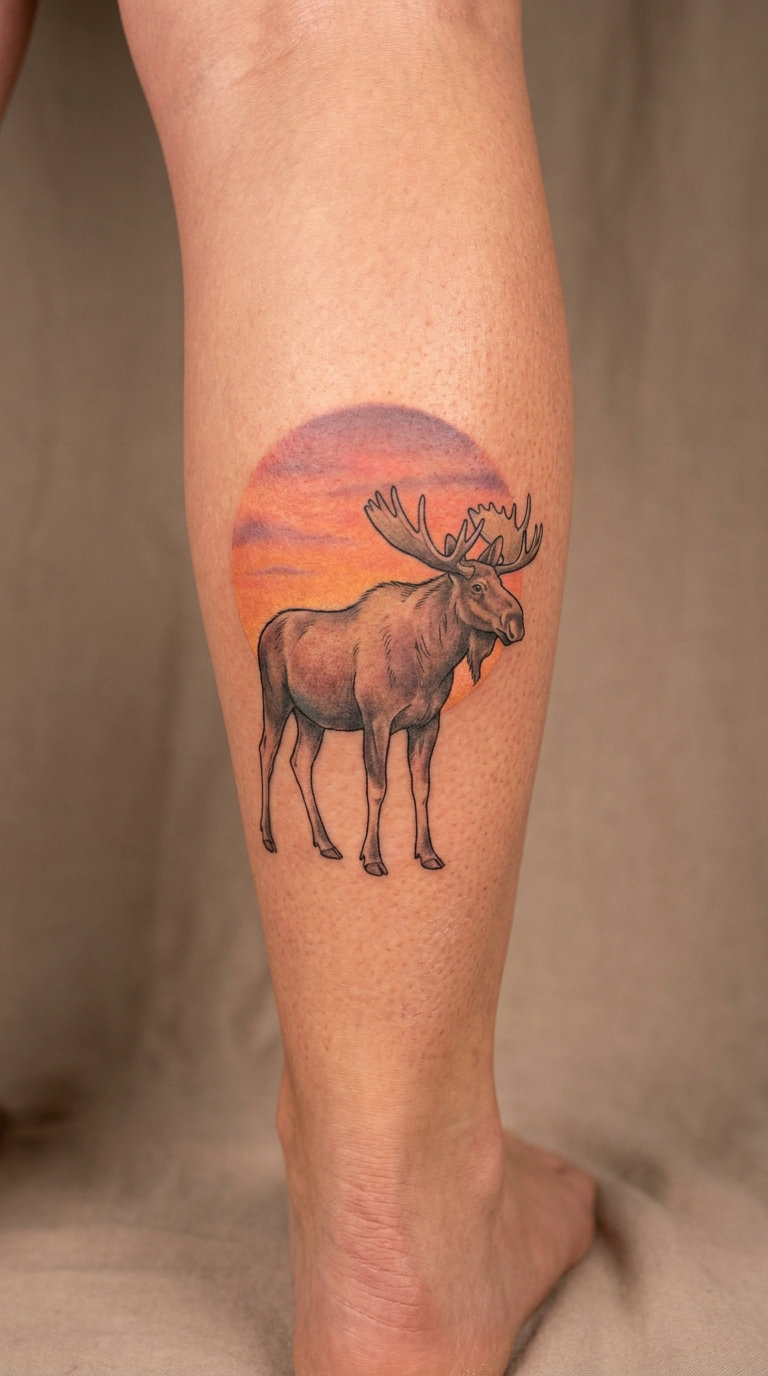
A tight sunset gradient behind a semi-realistic moose gives the piece depth without turning it into a full scenery piece. The sky is a compact block of orange, pink and purple, the ground line is a single dark band, and the animal is rendered in black and grey in front of it.
Keeping the animal monochrome against colour is what stops the whole thing from getting muddy. It is also a design that photographs well, which matters if you got the tattoo partly for that reason.
Placement: back of the calf, outer arm or upper back. Size: 4-7 in (10-18 cm). Style: realism with colour. Pain: medium, and colour gradients mean a lot of passes over the same area. Make it yours: match the gradient to the colours of a specific sunset you have seen, or have the fade start mid-antler so the animal looks like it is stepping out of the sky.
18. Minimal Moose Antler Line Art
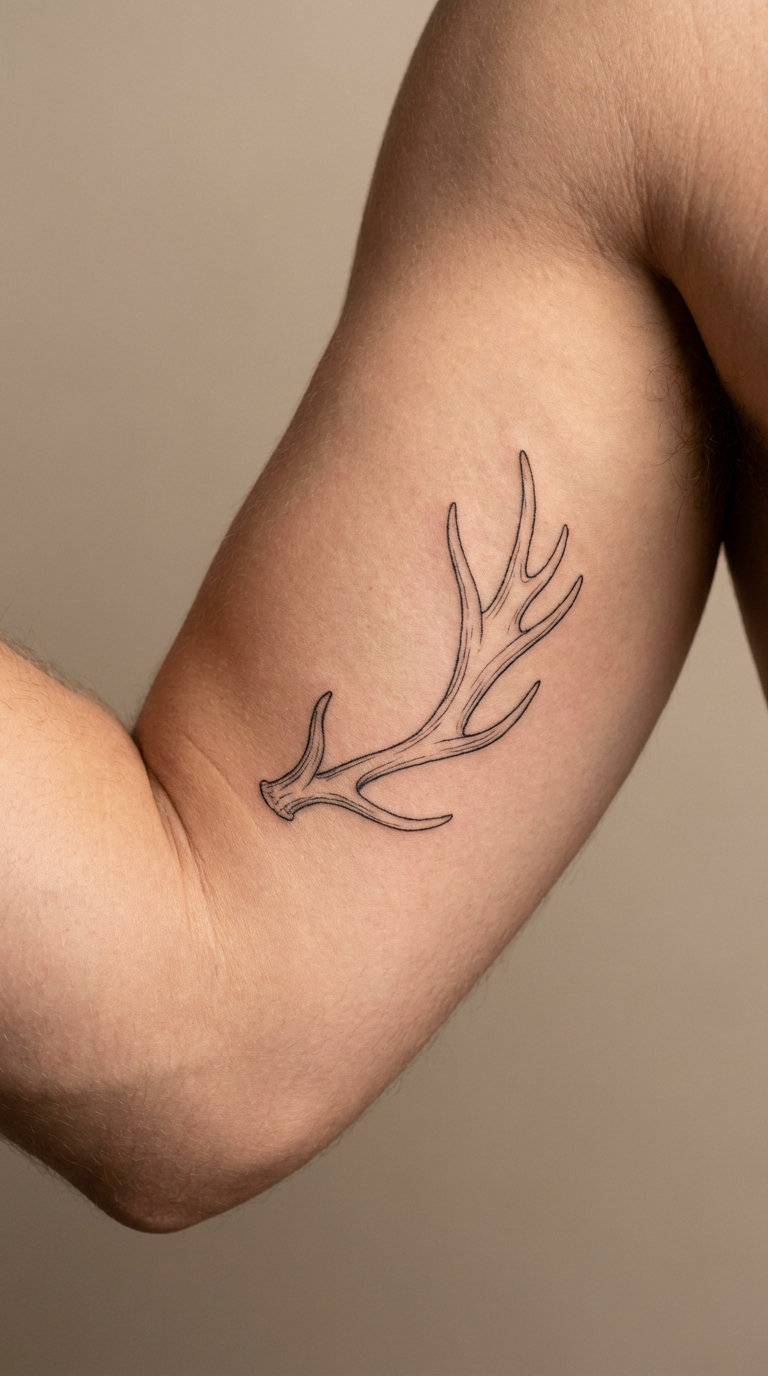
One antler branch, drawn with a single weight line, is about as minimal as moose ink gets. The branch curves upward with a few clean tines, and there is no head, no body and no background to explain.
It is a good piece to own next to other small line work because it stays quiet. A person who does not know what it is may just read it as an elegant botanical mark, which is part of the appeal.
Placement: inner arm, inner thigh or behind the ear. Size: 2-4 in (5-10 cm). Style: fine line, minimal. Pain: low. Make it yours: place one antler on each inner arm as a pair, or add a single coordinating dot on the opposite wrist. Fine line softens with sun exposure and age, so cover it or expect a refresh in time.
19. Moose Head with a Mountain Range
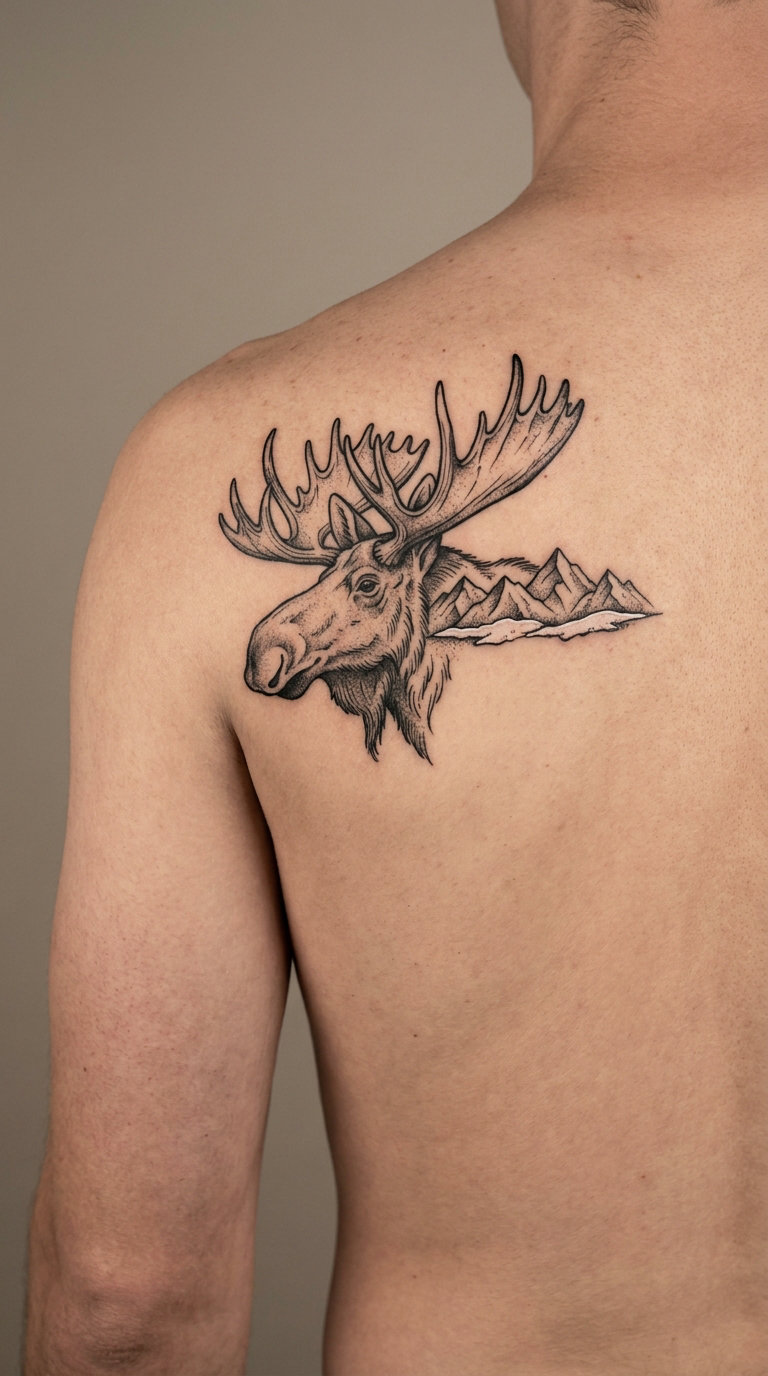
Combining a rendered moose portrait with a small mountain range underneath gives the piece a sense of place. The peaks and one clean snow line sit below the antlers, small enough that they do not compete with the head.
This is a personal design more than a decorative one. People use it for a place they have hiked, a trip that mattered, or simply home, and our mountain and ocean tattoo ideas cover the same instinct of pairing an animal with terrain.
Placement: back of the shoulder, upper back or chest. Size: 5-9 in (13-23 cm). Style: realism, scenic. Pain: medium, and the shoulder blade area gets uncomfortable once you are past a couple of hours. Make it yours: have the artist draw the actual ridgeline you are picturing from a photograph, or name the elevation in small numerals under the snow line.
20. Playful Moose with a Flower Crown
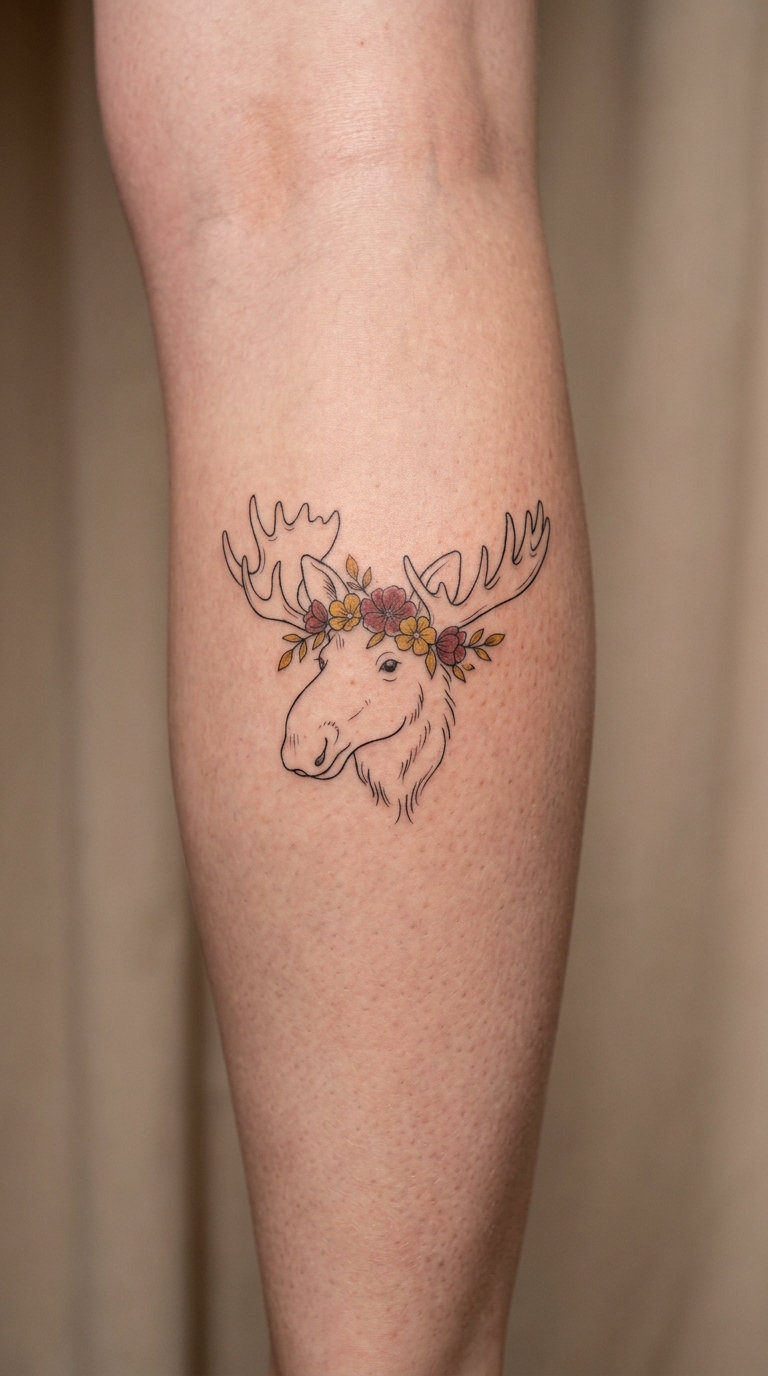
This one strips the solemnity out. The anatomy is simplified, the antlers are drawn with slightly oversized tines, and a small crown of muted red and yellow flowers sits between the ears. It reads friendly rather than fierce.
It is a good choice when you love moose but do not want a heavy piece, and it works at a small size because the flowers do most of the identifying work. It also takes colour without looking busy, because the palette stays to two or three shades.
Placement: calf, inner arm or rib area. Size: 2-4 in (5-10 cm). Style: contemporary illustrative. Pain: medium, and the ribs are the sensitive part. Make it yours: use flowers from a birthday bouquet or your birth month, or leave the crown empty and let the antlers carry the whole design.
How to Choose the Right Design
Choose by matching the design’s detail level to the area, not by picking the coolest picture and hoping it fits. A forearm and a shoulder blade hold very different amounts of information, and most disappointments come from that mismatch rather than from the artwork itself.
- Linework and detail: if the piece relies on fur texture, eye detail or thin antler tines, it needs 4 inches (10 cm) or more. Under 2 inches (5 cm), everything reduces to outline and a solid shape.
- Placement shape: a forearm is a long narrow canvas and suits a portrait or a single vertical form. The upper back takes a scene. The sternum takes symmetry. The finger takes almost nothing.
- Colour or blackwork: colour realism gives you depth and warmth, and it softens to browns and greys over the years. Blackwork and dotwork hold their shape longer because they do not rely on hue.
- Personal meaning: hunting, a childhood landscape, a memorial, Canadian or Alaskan roots, or simply the animal. Meaning matters more than trend when you are looking at a piece in ten years.
- Healed reference photos: ask the artist for work healed two months or more, not fresh-session photos. Fresh ink always looks sharper than healed ink.
- Room to grow: if more than one small idea appeals, pick the one that scales up. A 2-inch moose head reads perfectly as a 6-inch piece later.
How big should a moose tattoo be so the antlers stay readable?
At least 3 inches (8 cm) tall for a head with shading, and 4 inches (10 cm) if you want fur texture and a readable eye. Below 2 inches (5 cm) the artist has to drop the tine count to three or four per side, and that is the point where most small moose tattoos lose their identity.
Cost and Session Time
Moose tattoo cost is driven by size, detail, colour and the hourly rate of the artist you choose, and shops set a minimum charge that covers a short appointment. Rates vary a lot by city and by experience, so treat any figure you read online as a starting point rather than a quote.
A small piece under 2 inches (5 cm) is usually a single short session of about 30 to 60 minutes. Medium work in the 3 to 5 inch (8 to 13 cm) range commonly takes one session of 2 to 3 hours, or two if the shading is dense. A large scenic piece from 6 inches (15 cm) upward is usually split across several sessions of 2 to 3 hours, which is normal for back and thigh work rather than a sign of a problem.
Two things change the bill more than most people expect. Colour and dotwork both add hours compared with plain black line work, and a piece on a bony or sensitive area runs slower than the same design on a fleshy one.
Aftercare Basics
Always follow your artist’s aftercare instructions first, since they know exactly what went into your skin. Beyond that, the basics are straightforward.
- Wash the area gently with lukewarm water and unscented soap, then pat it dry rather than rubbing.
- Keep it clean and dry for the first few days, and change any bandage or wrap your artist applied.
- Use a thin layer of whatever ointment or lotion your artist recommends, and do not over-apply.
- Skip the gym, swimming pools, hot tubs and saunas while the skin is still sensitive and healing.
- Do not pick, scratch or peel flaking skin, and do not soak the tattoo until your artist says it is healed.
- Once healed, keep sun exposure low on fine line and colour work, and moisturise the area when it is dry.
Frequently Asked Questions
What does a moose tattoo symbolize?
A moose tattoo usually stands for strength, resilience and independence, because a moose is one of the largest and strongest wild animals in North America. People also use it for wilderness identity, hunting culture, or a specific place such as a home state or province. The meaning comes from what the moose means to you, not from any fixed rule, so the same design can read very differently on two people.
Is a 2 inch moose tattoo too small to read?
Under 2 inches (5 cm) the antlers are the problem, not the head. The artist has to cut the tine count to three or four per side and drop most shading, so the piece can read as a small deer-like shape over time. If you want detail, aim for 3 inches (8 cm) minimum, and 4 inches (10 cm) if you want fur texture and a defined eye.
Does a realistic moose tattoo fade to brown?
Usually partly, yes. Colour realism moose tend to soften toward brown and grey over five to ten years, because warm browns in skin fade and the contrast between them drops. Blackwork and dotwork hold their edges longer since they depend on line and density rather than hue. Whichever style you pick, sun protection on the healed area makes a real difference.
How long does a large realistic moose tattoo take?
A large scenic piece from 6 inches (15 cm) upward is usually split across several sessions of about 2 to 3 hours each, sometimes spread over months. Medium work in the 3 to 5 inch (8 to 13 cm) range often fits one longer sitting, and small pieces are usually done in 30 to 60 minutes. Shop minimums and artist hourly rates vary widely, so ask for an estimate before booking.
Does a fine line moose tattoo need touch ups?
Fine line work softens with time, and the fastest fade happens on the hands, fingers and anywhere with frequent sun exposure. A wrist or inner arm piece in a single thin line will usually need refreshing sooner than a bold blackwork piece, which is why it is worth booking a small touch-up a year or two in rather than waiting. Ask your artist what line weight they used and how they expect it to settle.
What is the most painful placement for a moose tattoo?
The sternum, the inner arm near the elbow, the ribs and the fingers are the placements people brace for most. Bony and nerve-rich areas hurt more than fleshy ones like the upper arm, calf or thigh. A small finger piece is intense for its size, while a large thigh piece may simply be uncomfortable rather than painful, mostly because of the length of time.
Conclusion
If this is your first tattoo, the minimalist moose head on the inner wrist is the practical pick: small, quick, and honest about what a first piece can look like without over-promising. Save the realism for later if you are not ready for a long sitting.
If you are already building a wildlife collection, the realistic forearm portrait is the stronger choice, and the moose among pines or the mountain range version gives you room to add more terrain work around it. Book the artist whose healed work you actually like, bring two or three references, and ask what the antlers will look like at the exact size you want.