
20 Best Starfish Tattoo Ideas for Simple, Coastal Looks 2026
Starfish tattoo ideas are everywhere right now, and most of them fall into one of two camps: a five-point outline so plain it disappears, or a full illustrative scene that swallows half your forearm. The interesting middle is where these 20 designs live. Each one has its own line weight, its own body placement, and its own reason for existing.
Whether you grew up near the water, spent every summer somewhere warm, or just like a shape that reads well in black, a starfish gives you a lot of room to work with. A starfish can regrow a lost arm, which is why so many people read it as resilience. The coastline connection runs deeper than decoration too. If you are planning a piece now, sea season in the northern hemisphere is usually a good time to book, since small coastal tattoos heal best when nothing is rubbing against them for a few weeks.
Starfish Tattoo Ideas: Quick Guide
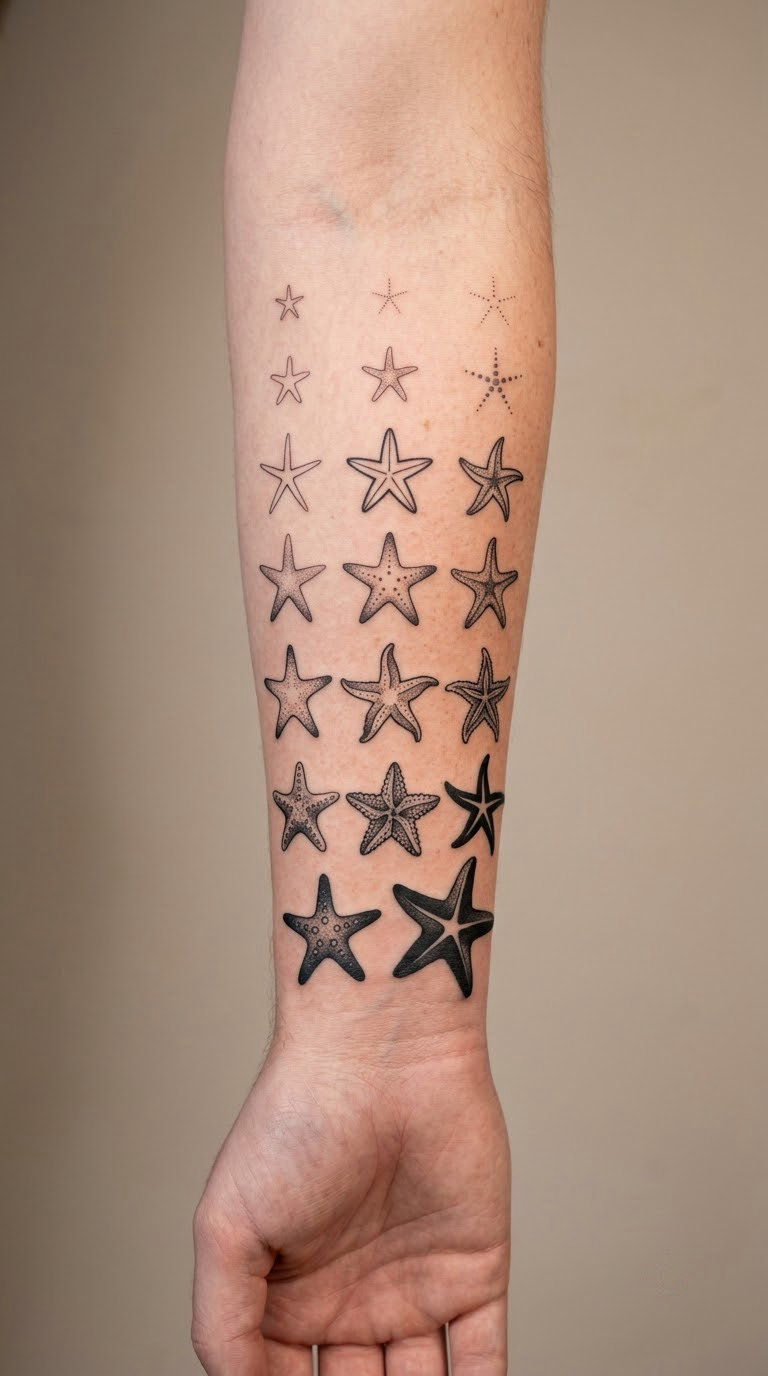
Here is the whole list at a glance. The same twenty designs run in order below, with more detail on what each one looks like and how it ages.
| Idea | Style | Best placement | Realistic size | Pain |
|---|---|---|---|---|
| 1. Fine-line behind the ear | Fine line | Behind the ear | 1 to 1.5 in (2.5 to 4 cm) | Low to medium |
| 2. Line-art wrist | Minimalist | Inner wrist | 1.5 to 2 in (4 to 5 cm) | Medium |
| 3. Matching finger pair | Fine line | Ring and index finger | 0.5 to 0.75 in (1.2 to 2 cm) | High |
| 4. Dotwork ankle | Dotwork | Outer ankle | 2 to 2.5 in (5 to 6 cm) | Medium |
| 5. Blackwork shoulder | Blackwork | Shoulder cap | 4 to 6 in (10 to 15 cm) | Medium |
| 6. Watercolor forearm | Watercolor | Inner forearm | 3 to 4 in (7.5 to 10 cm) | Medium |
| 7. Traditional orange | Traditional | Upper arm | 3 to 4 in (7.5 to 10 cm) | Medium |
| 8. Wave flow calf | Illustrative | Outer calf | 4 to 6 in tall (10 to 15 cm) | Medium |
| 9. Micro-realism rib | Micro-realism | Side of the ribs | 1.5 to 2 in (4 to 5 cm) | High |
| 10. Geometric starfish | Geometric | Upper arm | 3 in (7.5 cm) | Low |
| 11. Constellation starfish | Fine line | Outer upper arm | 2.5 in span (6 cm) | Medium |
| 12. Shell-textured back | Illustrative | Upper back | 4 to 5 in (10 to 13 cm) | Medium |
| 13. Blue thigh | Neo-traditional | Outer thigh | 3 to 4 in (7.5 to 10 cm) | Medium |
| 14. Black-and-grey collarbone | Black and grey | Below the collarbone | 2.5 to 3 in (6 to 7.5 cm) | High |
| 15. Starfish and shell pair | Fine line | Inner ankle | 1.5 in each (4 cm) | Medium |
| 16. Half-sleeve centrepiece | Blackwork | Upper arm | 6 to 8 in (15 to 20 cm) | High |
| 17. Wave accent hand | Fine line | Back of the hand | 1.5 to 2 in (4 to 5 cm) | High |
| 18. Dots and waves | Dotwork | Forearm | 3 in (7.5 cm) | Medium |
| 19. Five-point sleeve element | Bold black line | Forearm | 1.5 to 2 in (4 to 5 cm) | Medium |
| 20. Coordinates and starfish | Fine line with lettering | Inner forearm | 3 in wide (7.5 cm) | Medium |
1. Fine-Line Starfish Behind the Ear
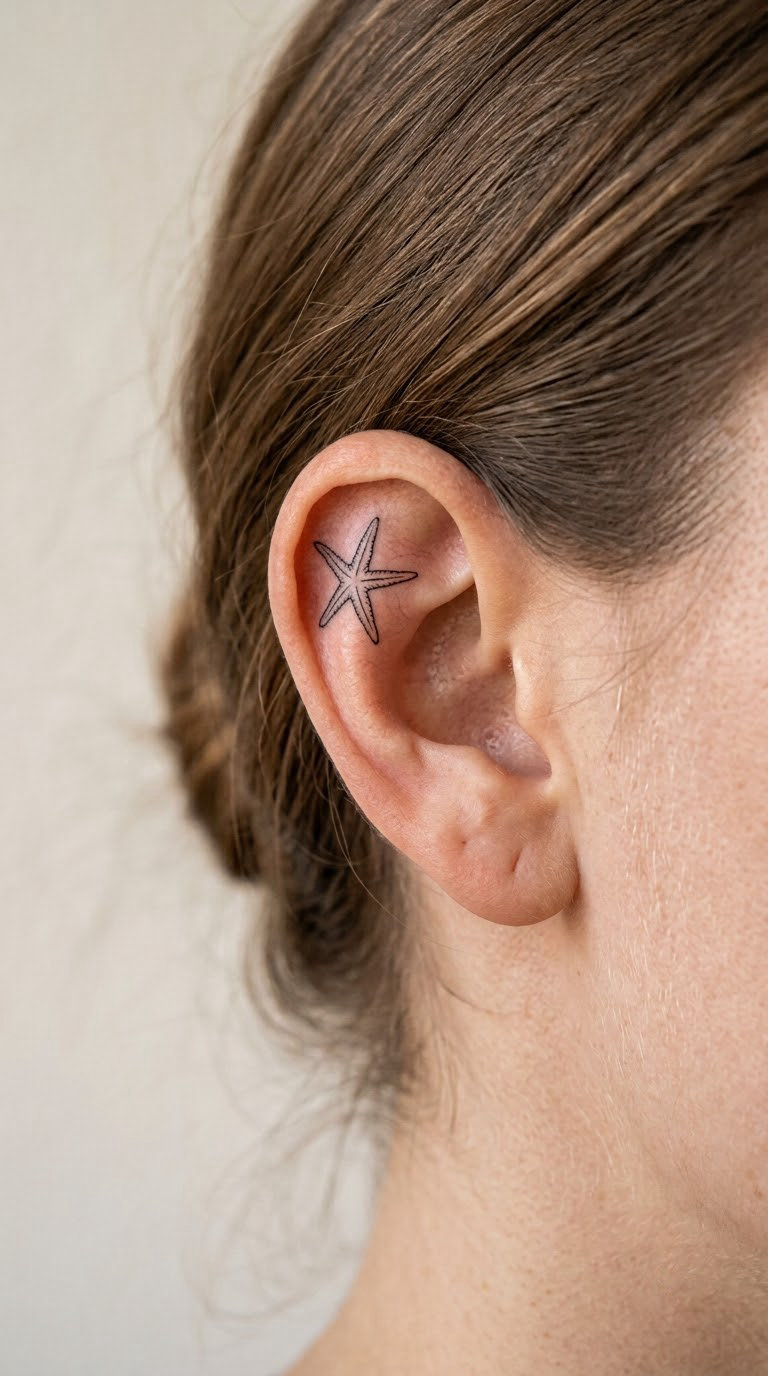
A single starfish drawn with one thin outline and five tapered points, with no shading at all, sits in the small hollow behind the ear. The thinness is the whole point. The design reads as a whisper of coastal rather than a badge, and the empty space around the arms does most of the visual work.
People usually pick this one because they want an ocean piece that nobody spots in conversation, or because it is a first tattoo with a shape simple enough to heal cleanly.
Placement: Behind the ear, or slightly forward on the neck below the earlobe. Size: 1 to 1.5 inches (2.5 to 4 cm). Style: Fine line. Pain: Low to medium, though skin here is thin and the needle buzzes close to bone. Ageing note: Hair grows straight through the design, so a few years of regrowth can soften the outline. Make it yours: Angle it to follow the curve of your ear rather than sitting flat, which makes the five points look intentional.
2. Minimal Line-Art Starfish on the Wrist
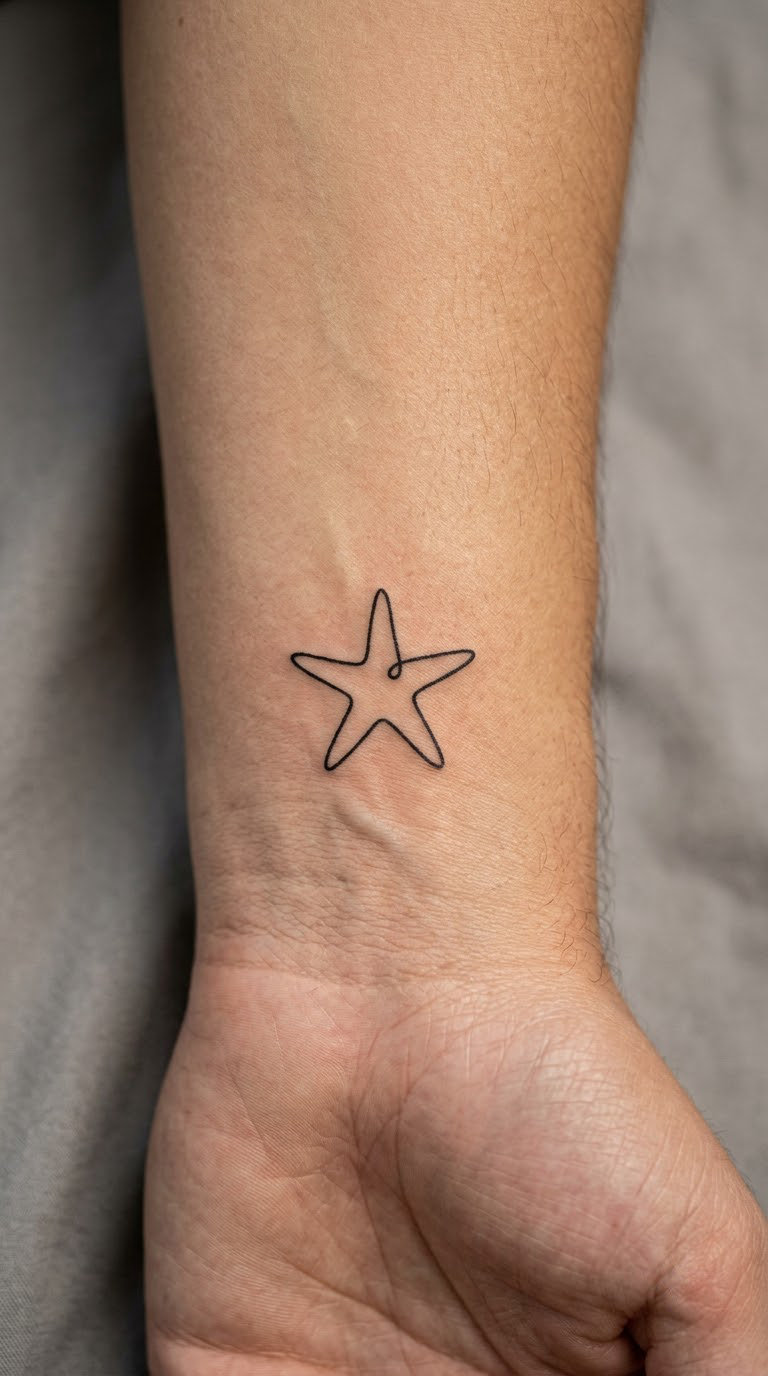
One unbroken line traces from a single arm tip, around the curve of the star, and back to where it started. Nothing is filled in. The result is an outline so sparse it looks almost like a symbol printed on a page, which is exactly what draws people to minimal starfish tattoo ideas in the first place.
It suits a first tattoo because there is almost nothing to ruin, and it suits a wrist that already carries a watch or a bracelet.
Placement: Inner wrist, a finger width above the crease. Size: 1.5 to 2 inches (4 to 5 cm). Style: Minimalist, single line. Pain: Medium, mostly wrist bone and inner forearm tenderness. Ageing note: Inner wrist skin is soft and takes sun readily, so a thin single line can fade noticeably over a decade. Make it yours: Ask for a faint dot trail to trail off one arm, a nod to sand shifting in the tide.
3. Two Small Starfish Matching Finger Tattoos
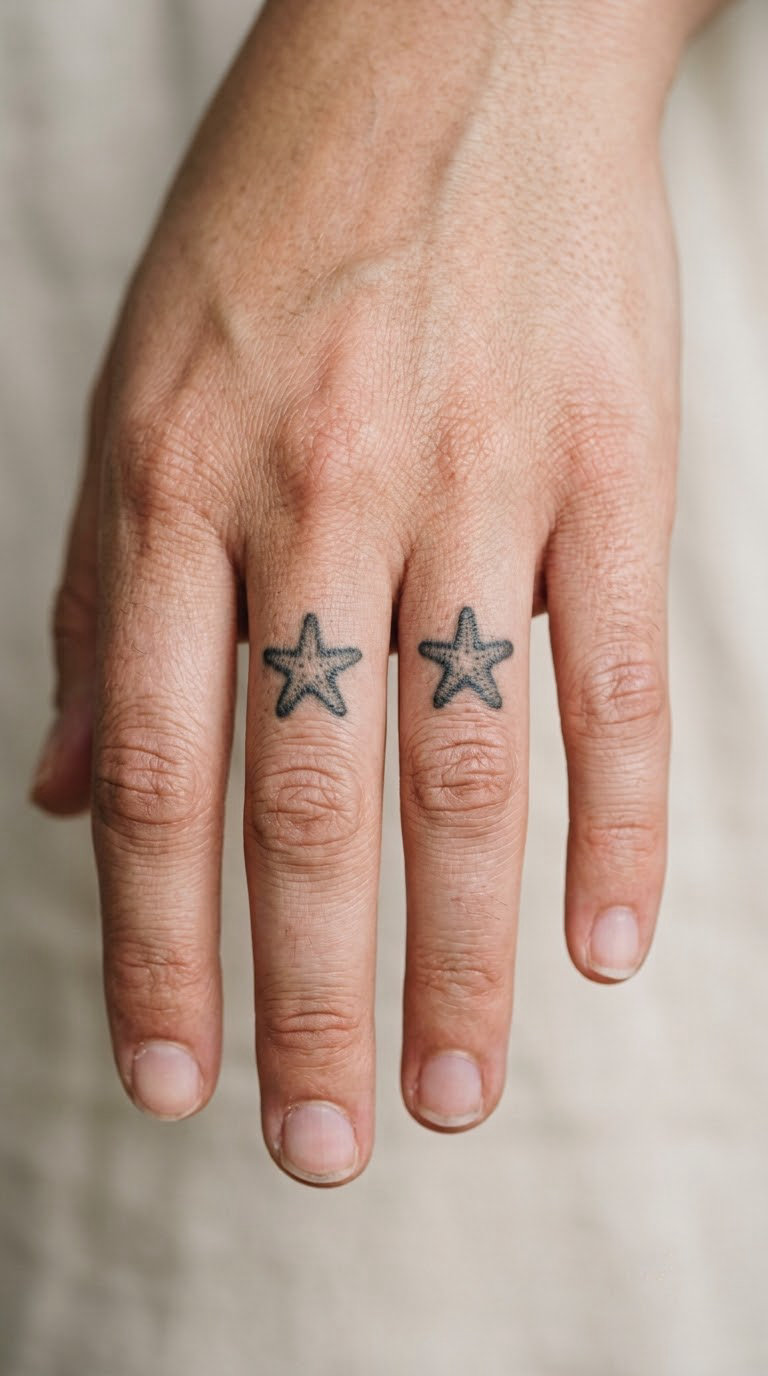
Two starfish at half an inch across, one on the ring finger and one on the index, each drawn with slightly heavier line weight than you would use elsewhere so they survive being small. The spacing matters more than the detail here. Roughly a centimetre of clean skin between each arm keeps the pair from reading as one smudge.
Matching pairs usually mean a family connection, a shared trip, or simply that you liked the design and did not want to stop at one.
Placement: Side or back of the fingers, ideally the same hand or mirrored across both. Size: 0.5 to 0.75 inches (1.2 to 2 cm). Style: Fine line with reinforced contour. Pain: High, and slow, because finger skin is thin over bone and the position is hard to hold still. Ageing note: Hands swell, flex and get washed constantly, so tiny finger detail blurs faster than anywhere else on the body. Make it yours: Add one minute hand in the middle, or have both starfish wrapped with a thin wave band so the pair is unmistakably linked.
4. Dotwork Starfish on the Ankle
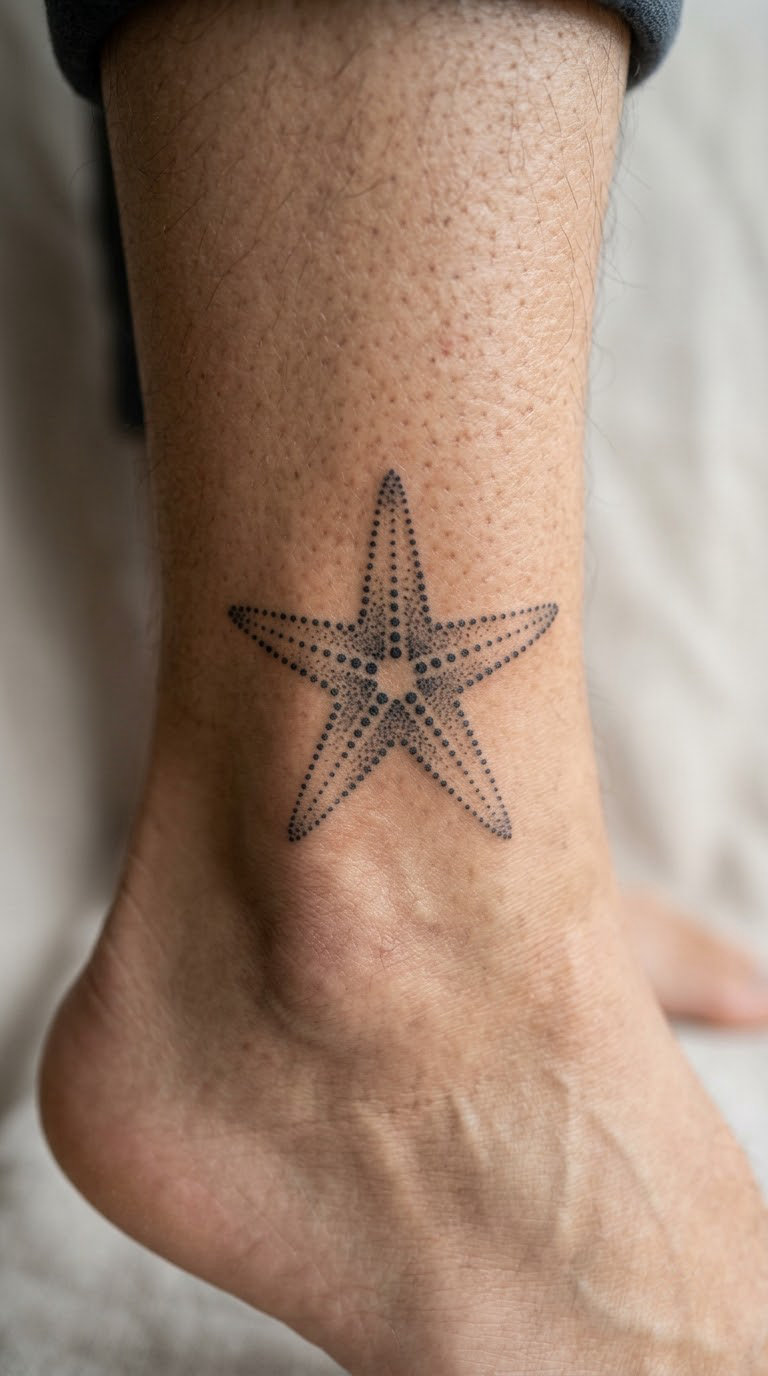
Rows of graduated dots build the arms from thick to thin, with the widest dots packed near the central disc and the smallest trailing off at each tip. The stippled texture gives this piece its depth. The centre of the star stays denser than the edges, which creates a soft three-dimensional feel without a single line of outline.
Dotwork is a good match for people who like texture more than outline, and it hides small imperfections in skin tone beautifully.
Placement: Outer ankle, above the bone. Size: 2 to 2.5 inches (5 to 6 cm). Style: Dotwork. Pain: Medium, with the ankle bone and shin taking the sting. Ageing note: Foot and ankle tattoos face shoe friction, so expect to keep them covered and loose for the first couple of weeks. Make it yours: Fade the last arm tip into scattered dots that trail toward the toes, as though the star is drifting out of frame.
5. Blackwork Starfish on the Shoulder
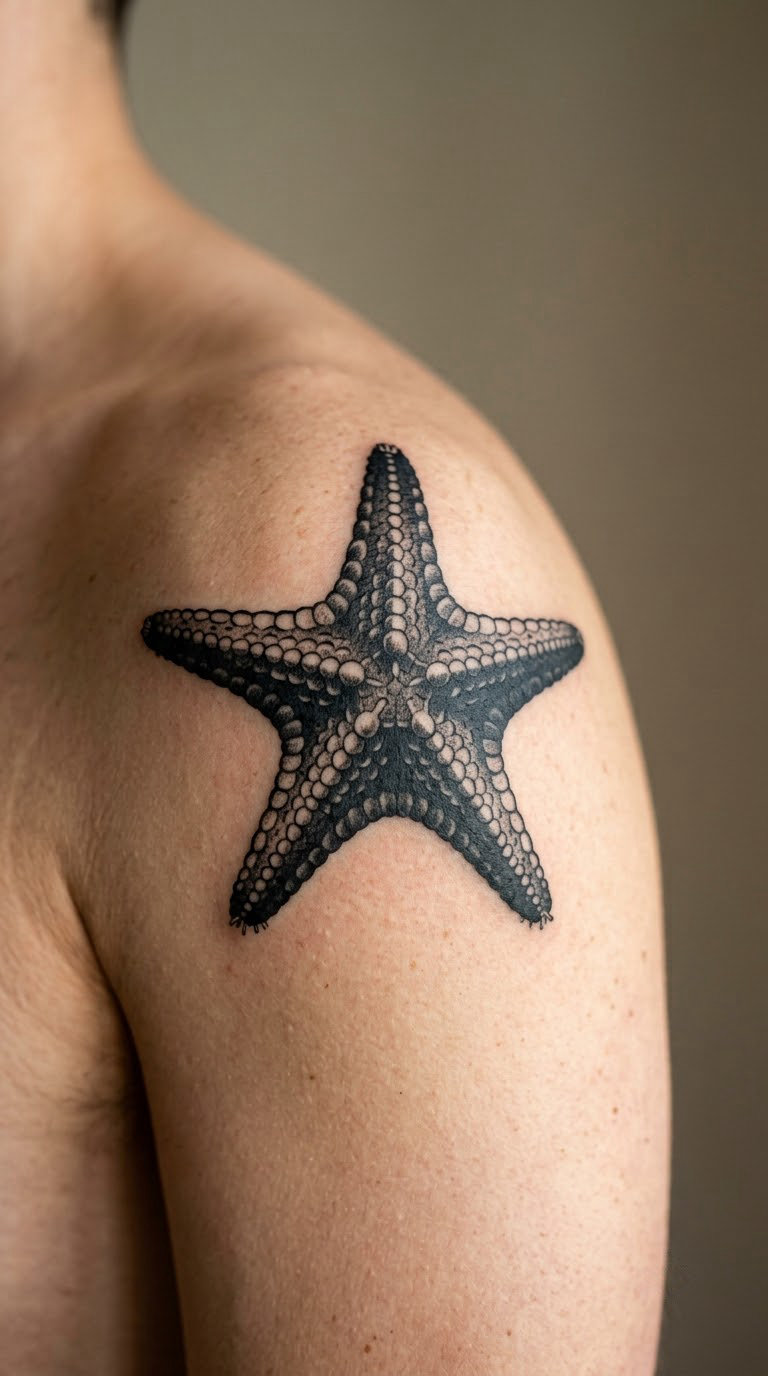
A single solid-black starfish with hard graphic edges, no gradient and no shading, sitting centred on the shoulder cap. Blackwork is the most confident style on this list, and the starfish shape handles it well because five straight-ish arms create strong negative space between the points.
This one gets chosen when someone wants a marine subject that reads as a statement, not a detail. It works on anyone, though the solid mass sits differently on different shoulders.
Placement: Shoulder cap, or the top of the upper arm where the deltoid rounds out. Size: 4 to 6 inches (10 to 15 cm). Style: Blackwork. Pain: Medium. Curved surfaces and a fleshy shoulder keep it steadier than bone-heavy spots. Ageing note: Sun exposure fades solid black fastest on the shoulder, so this is a placement worth keeping covered. Make it yours: Break the solid fill with a thin slice of negative space along one arm, or a scatter of dots bleeding off the edge.
6. Watercolor Starfish on the Forearm
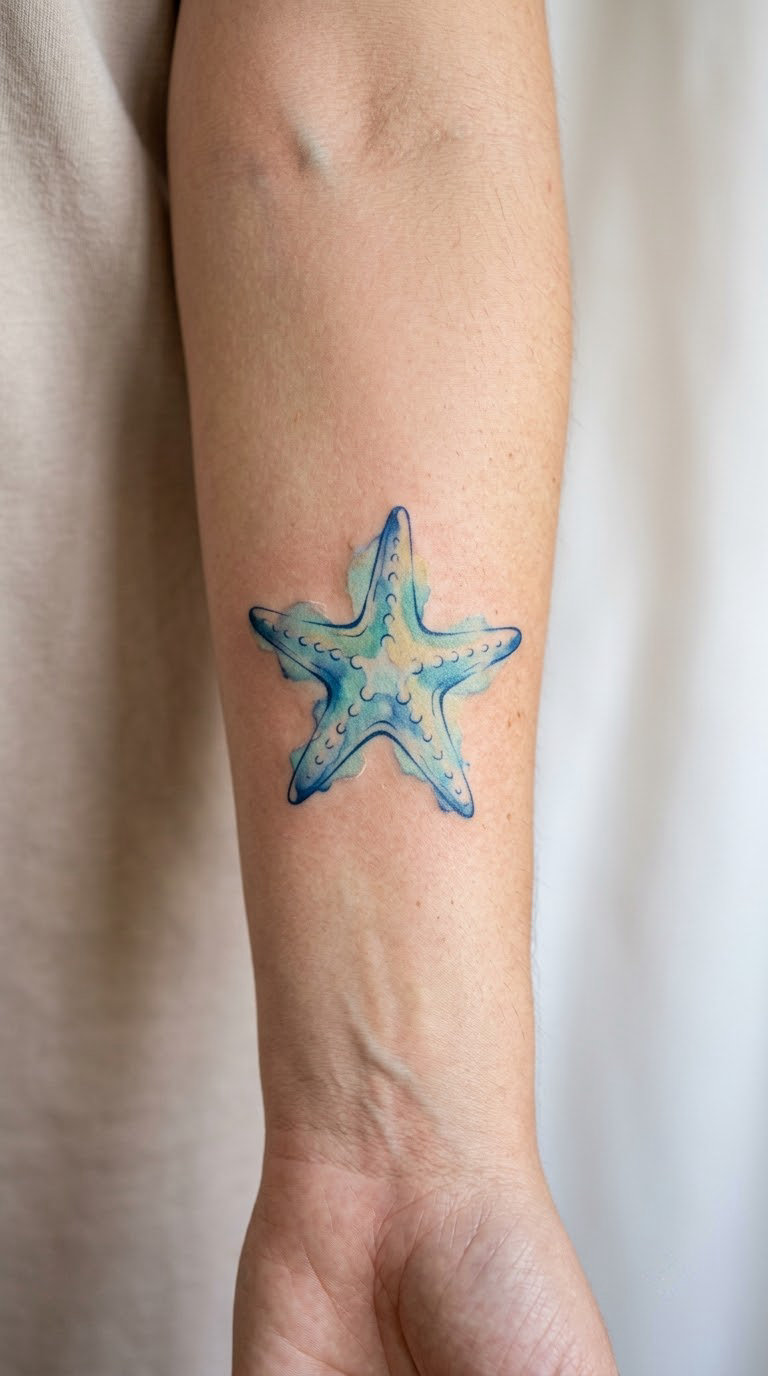
Loose washes of blue, teal and pale yellow overlap to suggest a starfish without ever committing to a hard outline. Some arms dissolve into nothing at the tip. It is the least literal option on this list and the one that photographs most like a painting.
People tend to choose watercolor pieces when the memory behind the tattoo is a feeling rather than a place, and when they want colour without committing to a saturated block of ink.
Placement: Inner forearm, where a flat surface lets the washes spread without the colour breaking over a curve. Size: 3 to 4 inches (7.5 to 10 cm). Style: Watercolor. Pain: Medium, and colourful passes mean more needle dips than an outline. Ageing note: Lighter washes fade first, and blue in particular softens visibly within a few summers. Make it yours: Bring a photo of the water you actually swam in and let the artist pull colour from it, sand and all.
7. Traditional Starfish with Ocean Shading
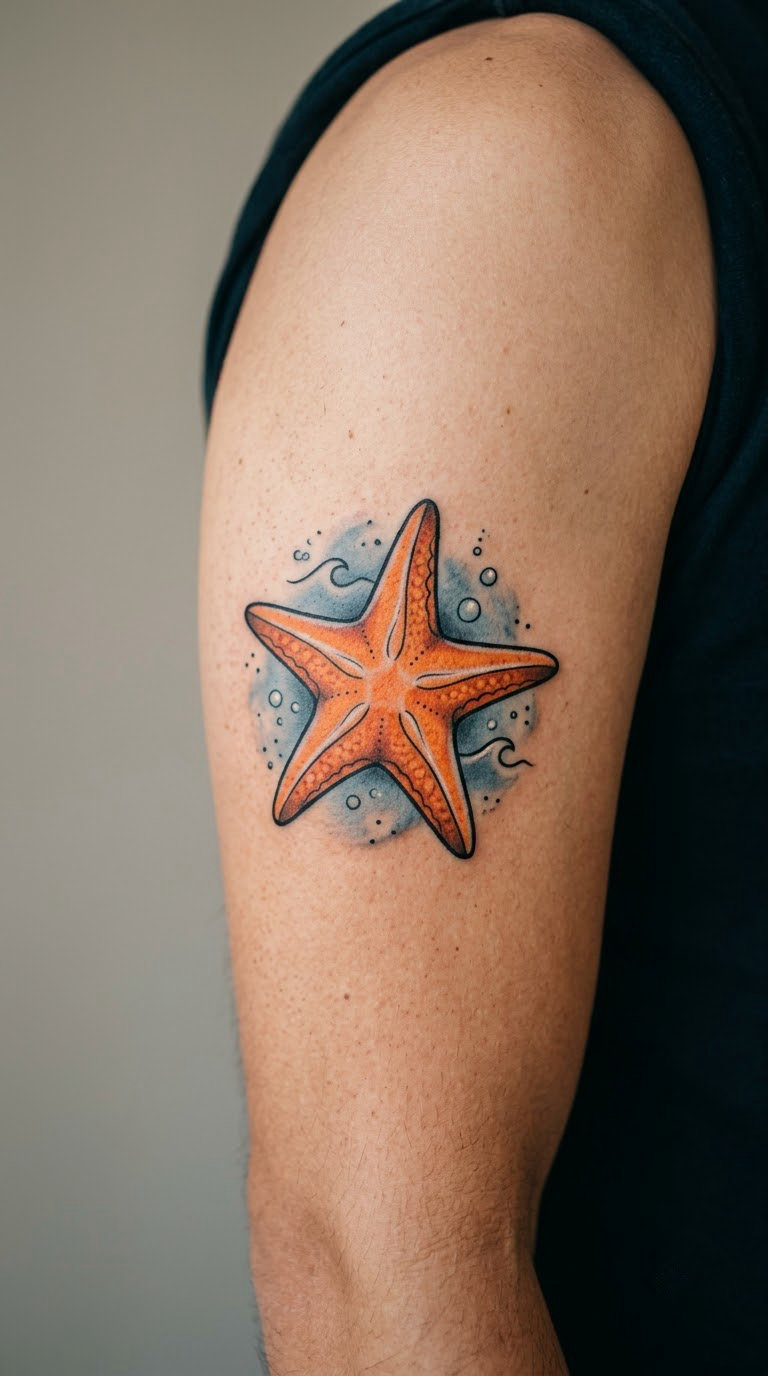
Bold black outlines, a warm orange fill, and restrained blue-grey shading beneath each arm give this the look of a classic flash design from an old tattoo binder. Traditional style treats the starfish the way it treats any marine subject: saturated colour, confident contour, minimal fuss.
It is a warm, slightly retro option, and it suits people who like their tattoos to look like ink rather than like a sketch.
Placement: Upper arm or outer forearm, anywhere the design can sit flat. Size: 3 to 4 inches (7.5 to 10 cm). Style: Traditional. Pain: Medium, evenly spread across the arm. Ageing note: Warm reds and oranges hold up better than blues, though the whole piece dulls a little without attention. Make it yours: Add a small traditional banner underneath with a single word, a dive site name, or a coordinate.
8. Starfish and Wave Flow on the Calf
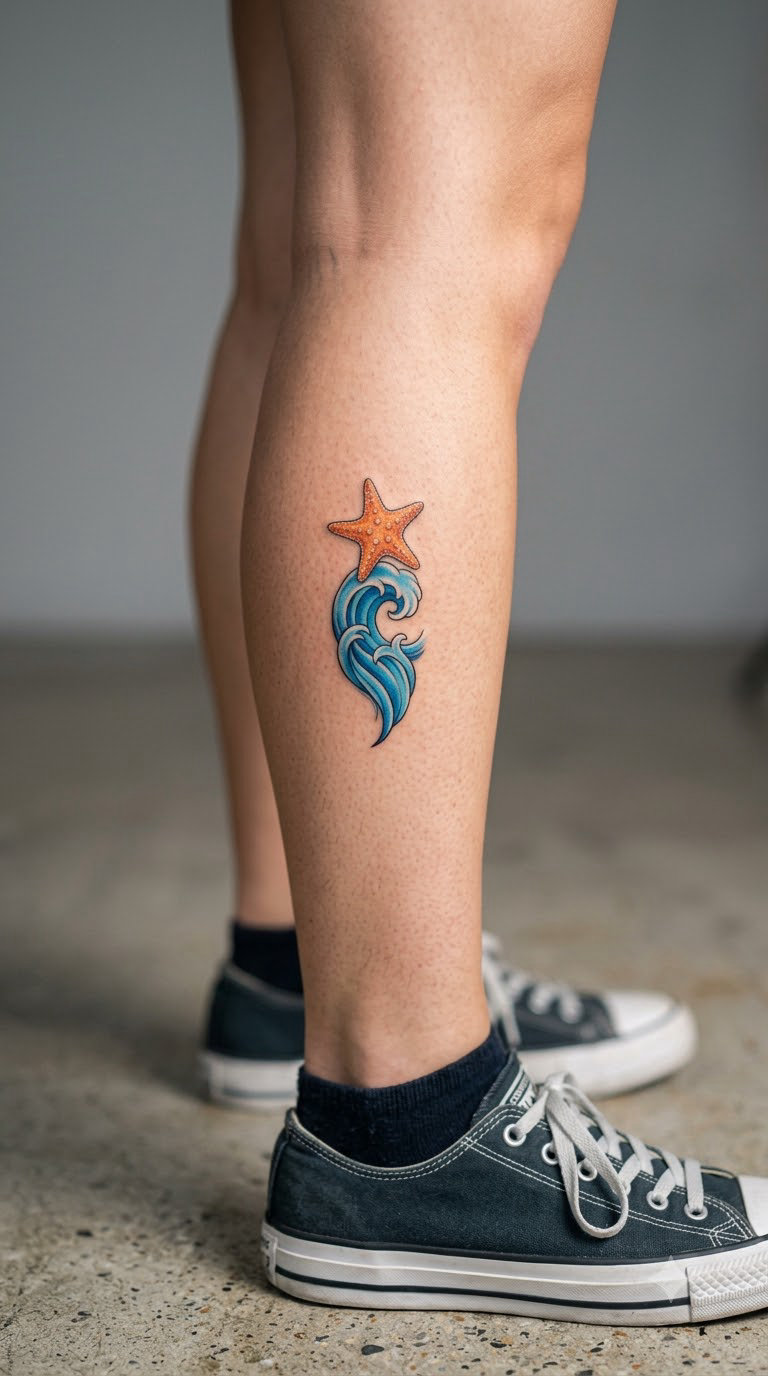
A starfish sits above a single simplified curling wave, stacked vertically so the composition follows the line of the calf. The wave is drawn in two or three confident strokes rather than a full seascape, which keeps the piece readable at a distance and stops it turning into a mural.
The vertical stack suits people who want a scene, not just a symbol, but do not want the maintenance that a full landscape brings.
Placement: Outer calf, aligned with the muscle below the knee. Size: 4 to 6 inches tall (10 to 15 cm). Style: Illustrative with restrained colour. Pain: Medium, more uncomfortable near the shin than the muscle. Ageing note: Calves are usually covered, which helps the colour last. Make it yours: Reverse the stack, wave above starfish, so the piece reads upward and sits well on the outer leg.
9. Micro-Realism Starfish on the Rib
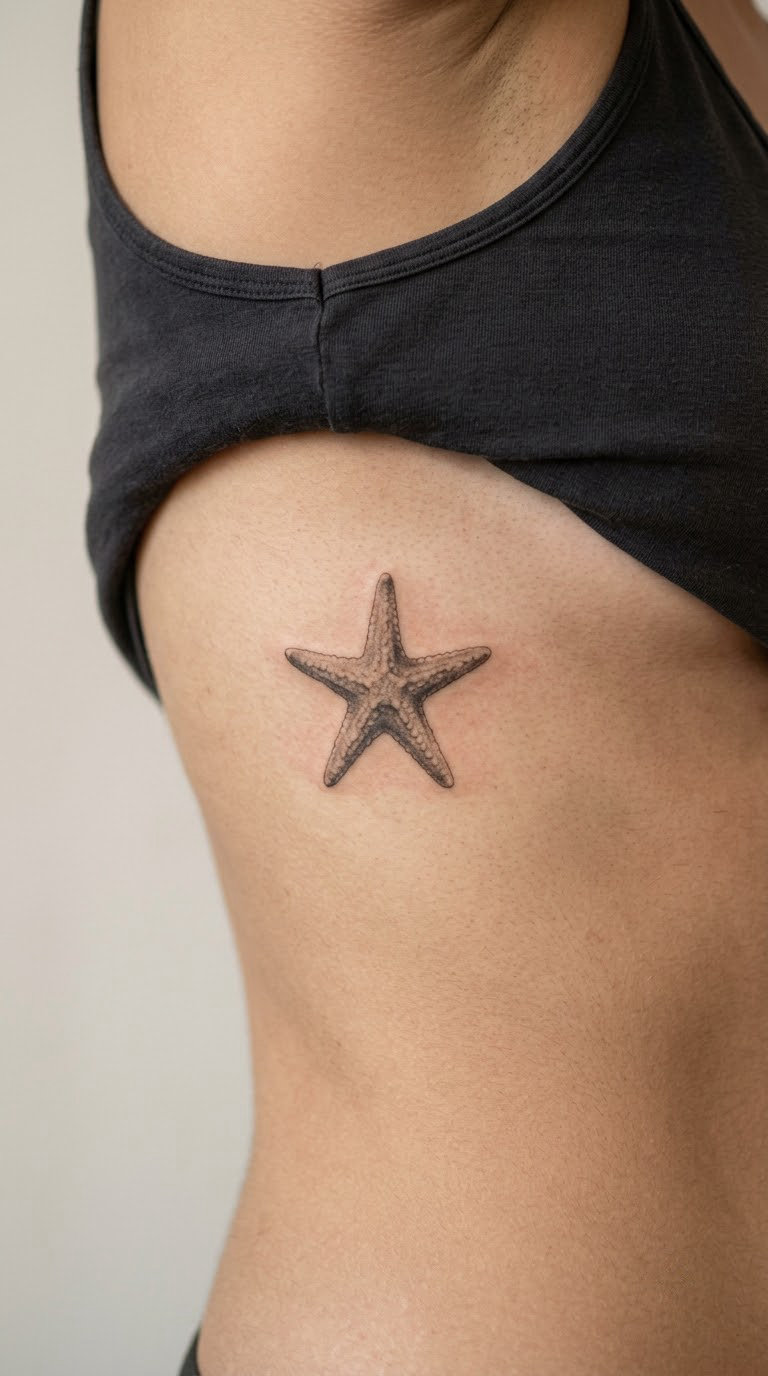
A small realistic starfish with textured arms, tiny pale dots along the ridges and a soft natural shadow under the central disc. The whole thing is barely bigger than the palm of your hand, which is the point: micro-realism works because it is rendered small enough that the texture reads as texture rather than pattern.
Usually it is a place-specific piece, tied to a particular stretch of coast rather than to the idea of the sea in general.
Placement: Side of the ribs, in the gap between two ribs rather than over them. Size: 1.5 to 2 inches (4 to 5 cm). Style: Micro-realism. Pain: High. Ribs are bone over muscle and the skin moves constantly as you breathe. Ageing note: Small shading gradients lose definition first, so realistic work this size needs touch-ups sooner than an outline. Make it yours: Get the pigment colours matched to the actual animal you saw, which is a pale pink on one coast and a deep rust on another.
10. Starfish Made from Geometric Shapes
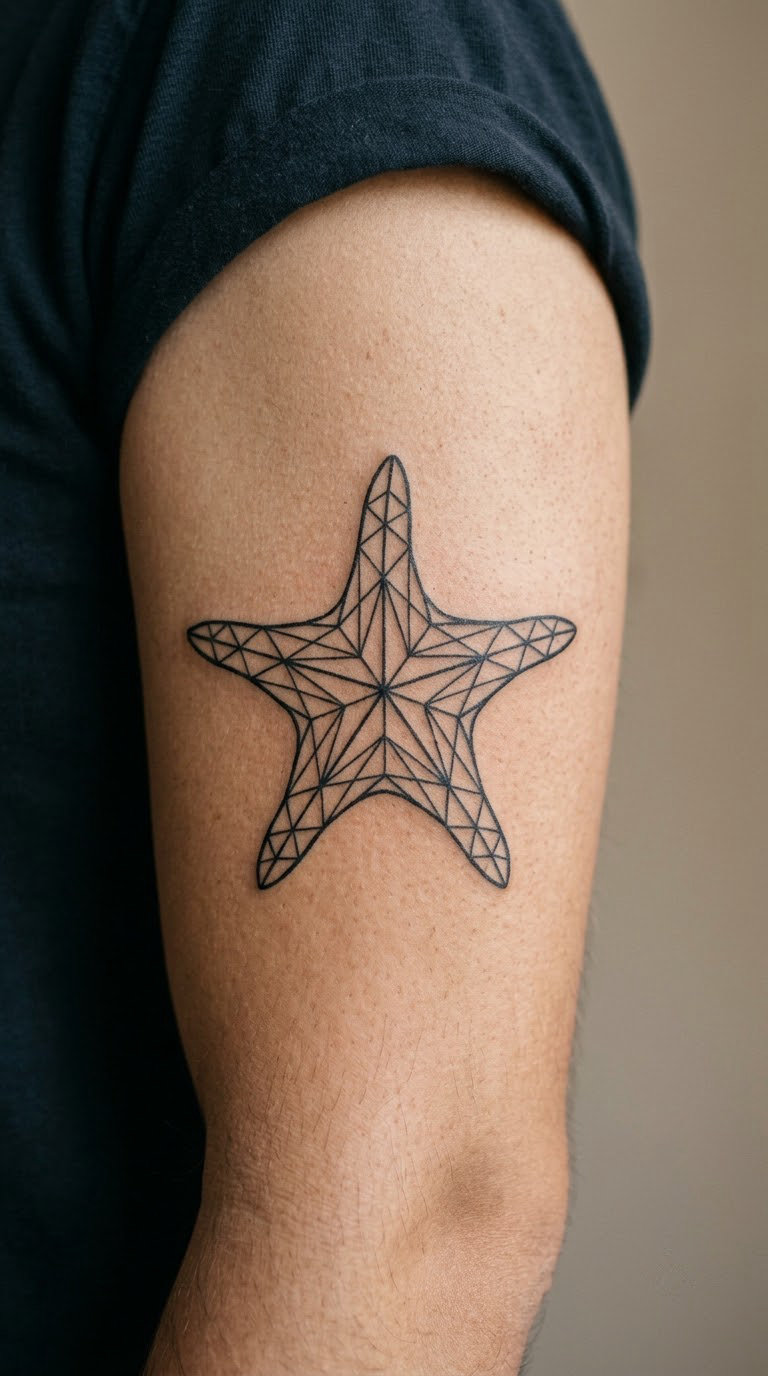
Five faceted points built from thin internal lines, with the arms divided into flat planes that catch light differently depending on where you stand. Nothing is shaded and nothing is curved. The result is a starfish that looks engineered, which is a useful contrast to the soft, organic feel most people expect from the subject.
It suits people who like their marine pieces to feel designed rather than drawn, and it pairs easily with other geometric work.
Placement: Upper arm or flat section of the calf. Size: Around 3 inches (7.5 cm). Style: Geometric linework. Pain: Low, which makes it a good first piece for someone nervous about long sittings. Ageing note: Thin internal lines can lose contrast over time, so avoid planning it too small. Make it yours: Turn the internal facets into a shape that matters, a numeral, an initial, a set of dots forming a date.
11. Small Starfish Constellation on the Upper Arm
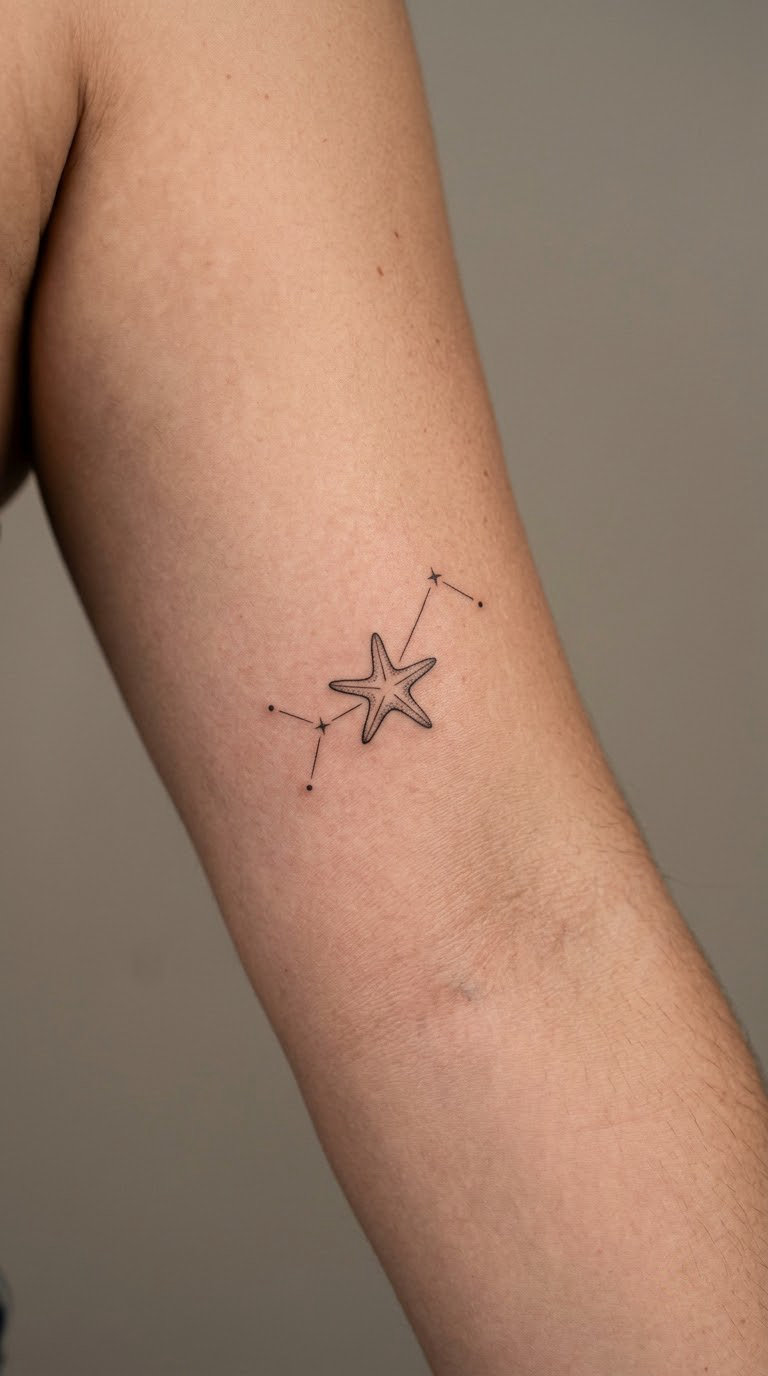
A small starfish at the centre, with four fine lines running out to scattered star-shaped dots of varying size. It reads as a constellation without adding a second marine subject, so the design stays clean while still carrying a sense of mapping something.
Usually it represents a group. Four points might be a family of four, a set of friends, or four places that mattered, drawn in roughly the shape they made in the sky.
Placement: Outer upper arm. Size: About 2.5 inches across (6 cm). Style: Fine line constellation. Pain: Medium, and the arm gives a flat surface for the connecting lines. Ageing note: The smallest star dots are the first to fade, so a slightly larger dot size pays off here. Make it yours: Place the dots to match the actual layout of a sky you watched, rather than using an even spread.
12. Starfish with Shell-Like Details on the Back
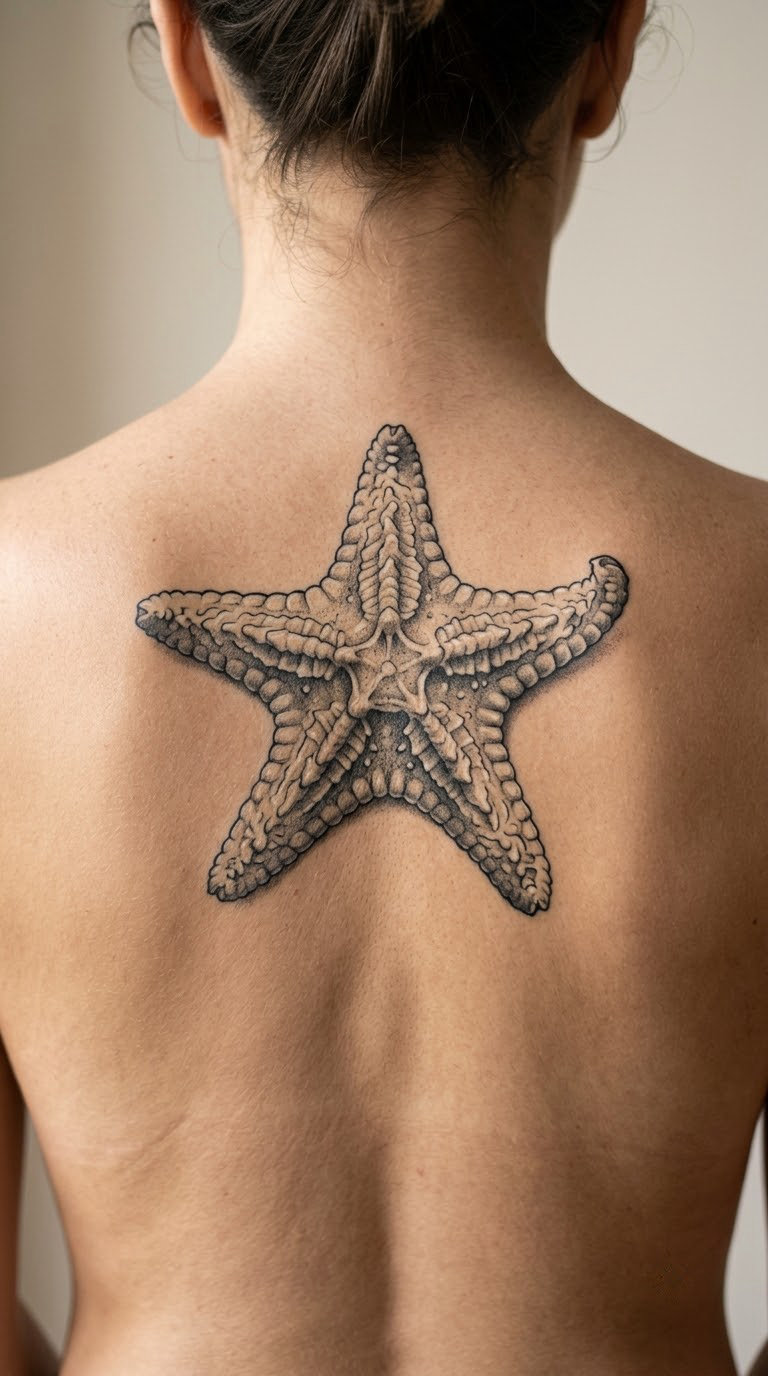
A medium starfish with raised-looking ridges running the length of each arm and a shell-inspired texture across the central disc, in muted beige and grey. The surface looks tactile, as though you could run a thumb over it, which is what separates this from a plain realistic rendering.
People choose a design with this much surface texture when they want something between an animal and a pattern, a starfish that behaves more like jewellery.
Placement: Upper back, between the shoulder blades, where a wide flat surface suits the detail. Size: 4 to 5 inches (10 to 13 cm). Style: Illustrative realism. Pain: Medium, though the back is hard to watch being done. Ageing note: Fine ridge lines on the back are rarely covered, so ask for bolder grooves than feel necessary. Make it yours: Pick one accent hue for the ridge highlights only, a deep rust or a pale gold, and keep everything else neutral.
13. Blue Starfish on the Thigh
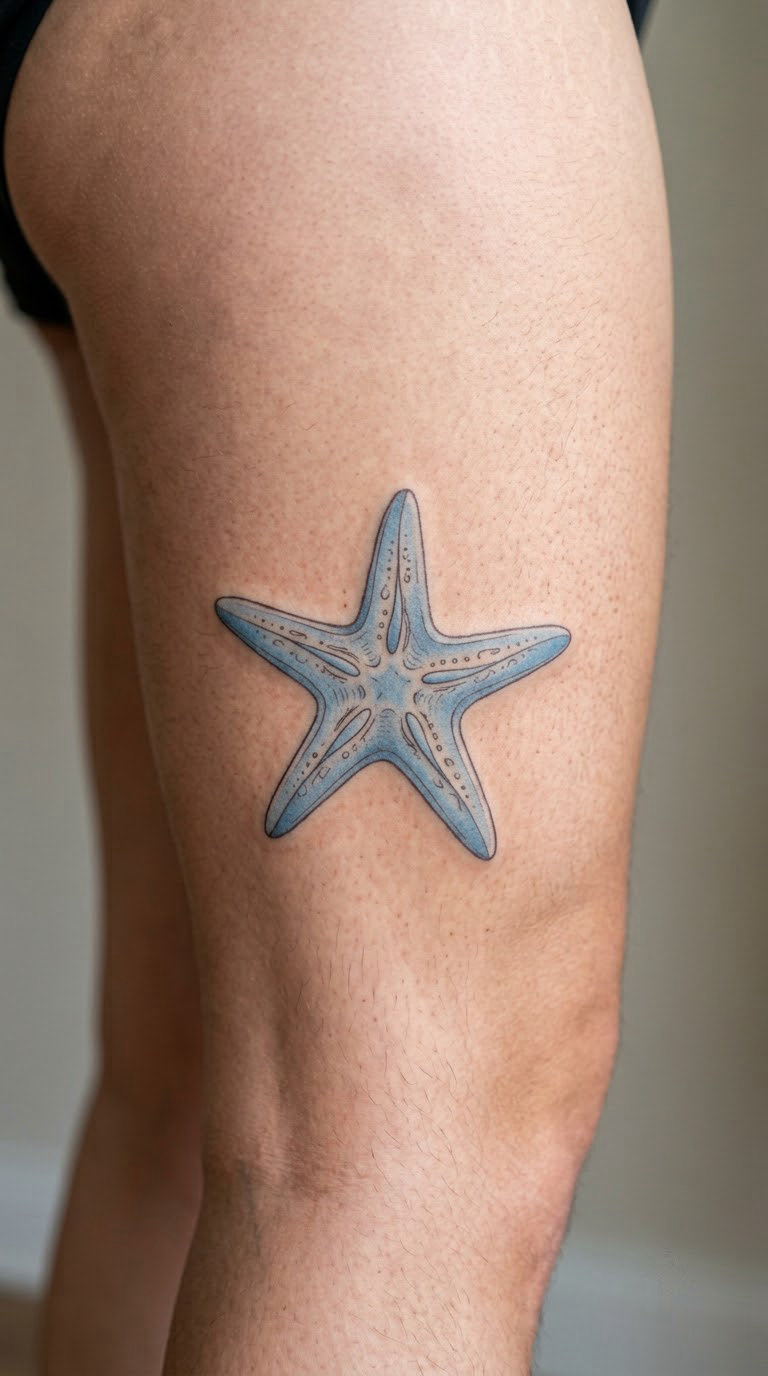
A soft blue starfish with gentle tonal variation across the arms, from a deeper tone near the centre to a lighter wash at the tips. Neo-traditional linework keeps the outline confident while the colour stays relaxed, so the piece feels like a vintage marine print rather than a cartoon.
Blue reads cool and calm on skin, which is why plenty of people pick it for a piece they will see every day rather than hide.
Placement: Outer thigh, or the flat area above the knee. Size: 3 to 4 inches (7.5 to 10 cm). Style: Neo-traditional. Pain: Medium, and the thigh is one of the more forgiving spots for a long sitting. Ageing note: Blue is among the first pigments to fade, so plan a colour refresh rather than expecting it to hold indefinitely. Make it yours: Add a single warm note, a small red shell or an orange dot, to stop the piece feeling cold.
14. Black-and-Grey Starfish on the Collarbone
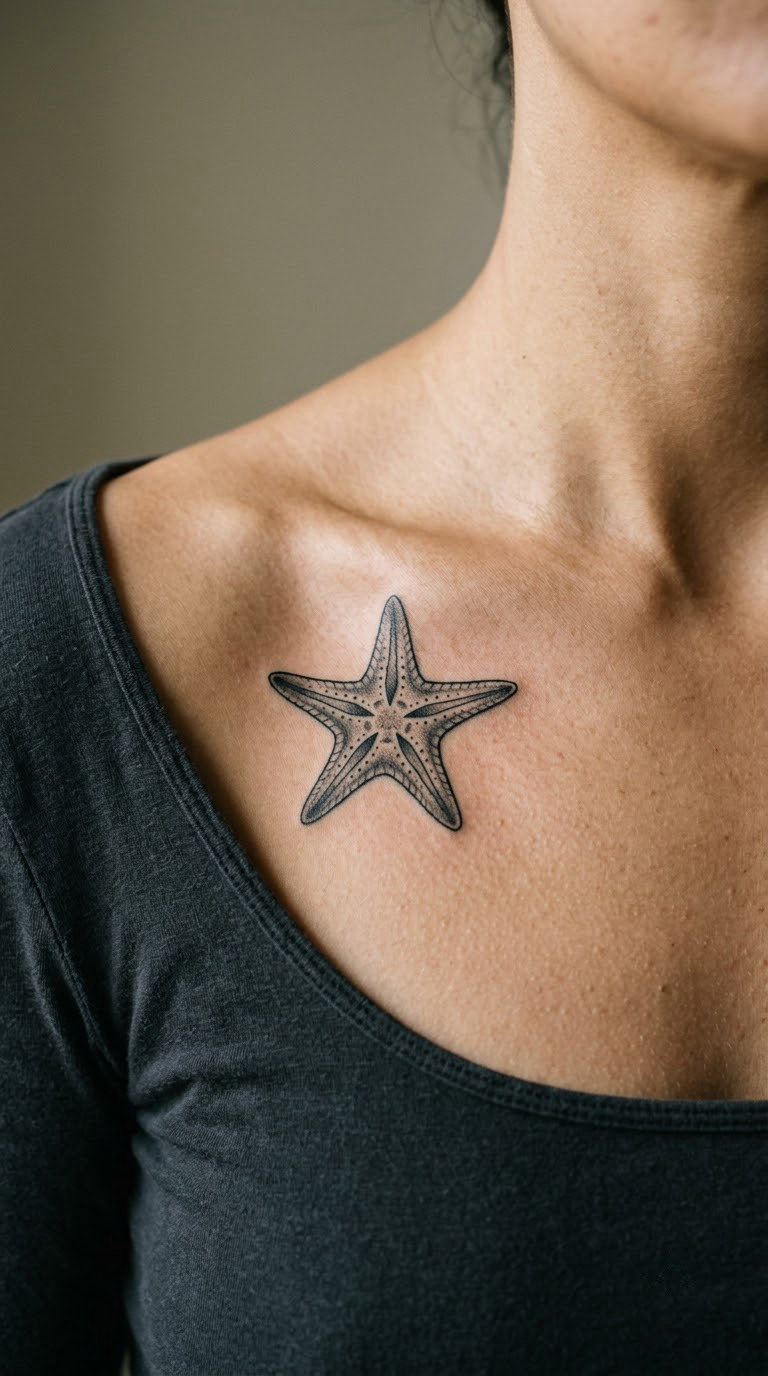
A black-and-grey starfish sitting just below or above the collarbone, shaded in soft charcoal with clean edges and no colour. The monochrome treatment keeps it elegant, and the collarbone gives it a horizontal line to sit along so it does not tip or sit awkwardly on a curve.
It is a quieter alternative to a coloured version, chosen by people who want the coastal theme without announcing it loudly.
Placement: Just below the collarbone, on either side, with the arm slightly away from the body at rest. Size: 2.5 to 3 inches (6 to 7.5 cm). Style: Black and grey. Pain: High. The collarbone is bone, and the skin there is thin and reactive. Ageing note: Collarbone skin stretches and softens over time, so a piece placed too close to the bone can eventually bow a little. Make it yours: Match the grey to a birthstone shade so the piece carries a date as well as a place.
15. Starfish and Seashell Pair on the Ankle
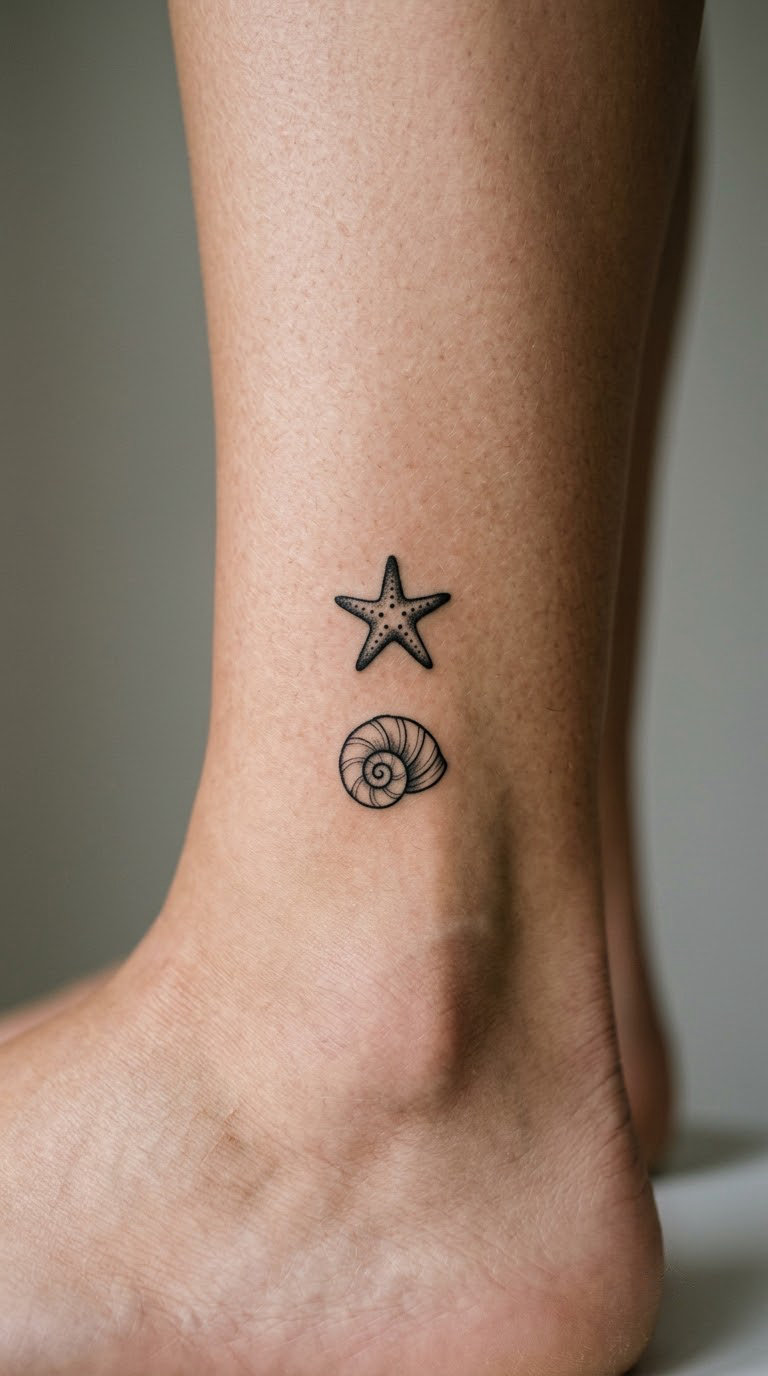
Two small motifs, a simple starfish and a clean-line seashell, set a finger width apart on the inner ankle. Neither one is detailed enough to compete with the other, which is the discipline that makes a paired design work rather than turning into a cluttered beach scene.
Shell plus starfish is the most common combination in coastal tattooing, usually because it reads as a place rather than an object.
Placement: Inner ankle, or trailing up the lower calf. Size: About 1.5 inches each (4 cm). Style: Fine line, no colour. Pain: Medium, sharper near the ankle bone. Ageing note: Two small pieces means two sets of edges to maintain, and inner ankle skin is thin. Make it yours: Use a shell from a specific beach, sketched from a photo you took yourself, and leave the starfish generic.
16. Large Starfish Half-Sleeve Detail
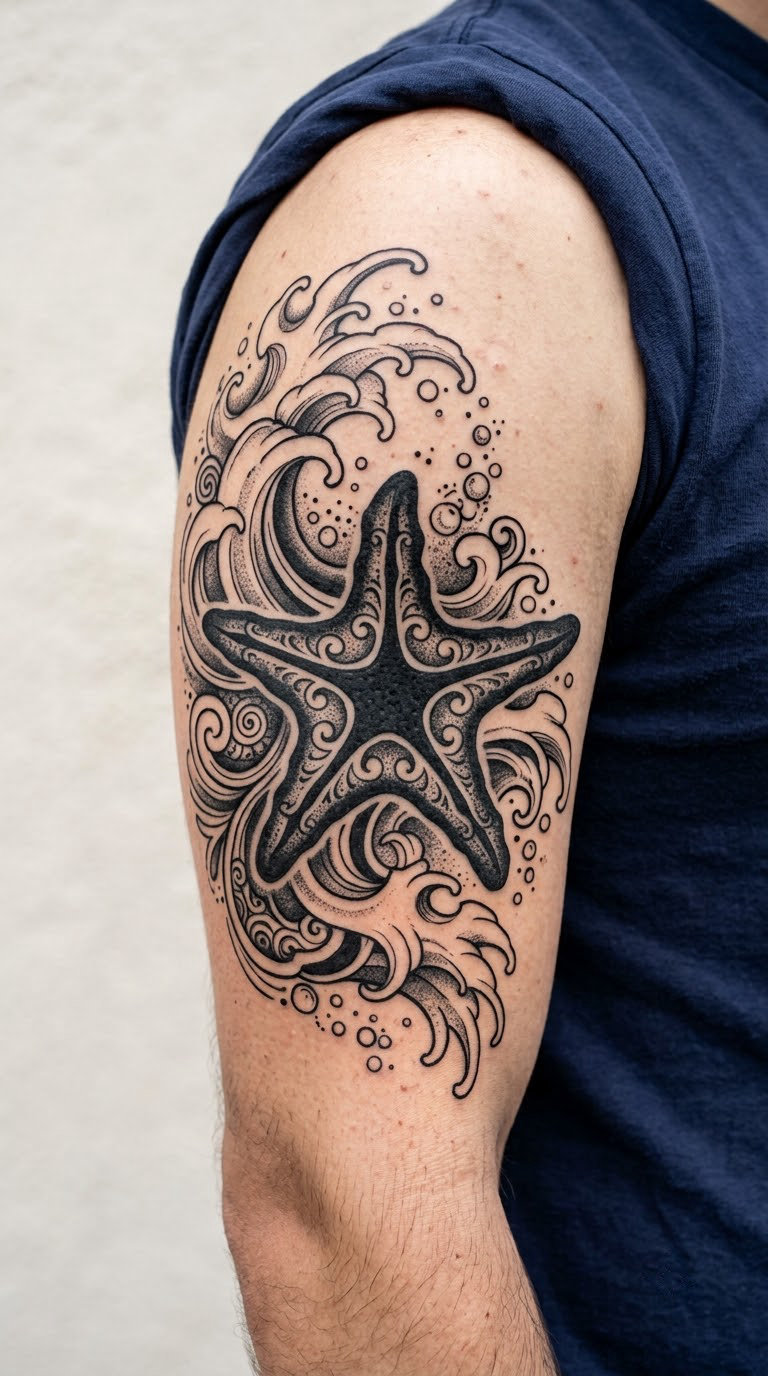
A bold starfish at the centre of a larger ocean composition, with a few simplified wave lines and a scatter of bubble dots around it. The restraint is the trick. Sleeve work goes wrong when every element competes, and a solid blackwork starfish with breathing space around it holds the composition together better than a dense scene would.
This suits people already building a marine arm or leg, who want a centrepiece that can anchor a second sitting. If you are starting from scratch, look at our forearm band tattoo ideas for structure ideas that pair well with a starfish anchor point.
Placement: Upper arm, positioned so the starfish reads as the focal point from a distance. Size: 6 to 8 inches (15 to 20 cm). Style: Blackwork composition. Pain: High, and this is a multi-hour sitting. Ageing note: Large solid areas hold up better than fine detail, which is a genuine argument for blackwork at this scale. Make it yours: Design the wave and bubble elements first, then let your artist fit the starfish into whatever space is left, rather than fixing the starfish and forcing the rest around it.
17. Starfish with a Small Wave Accent on the Hand
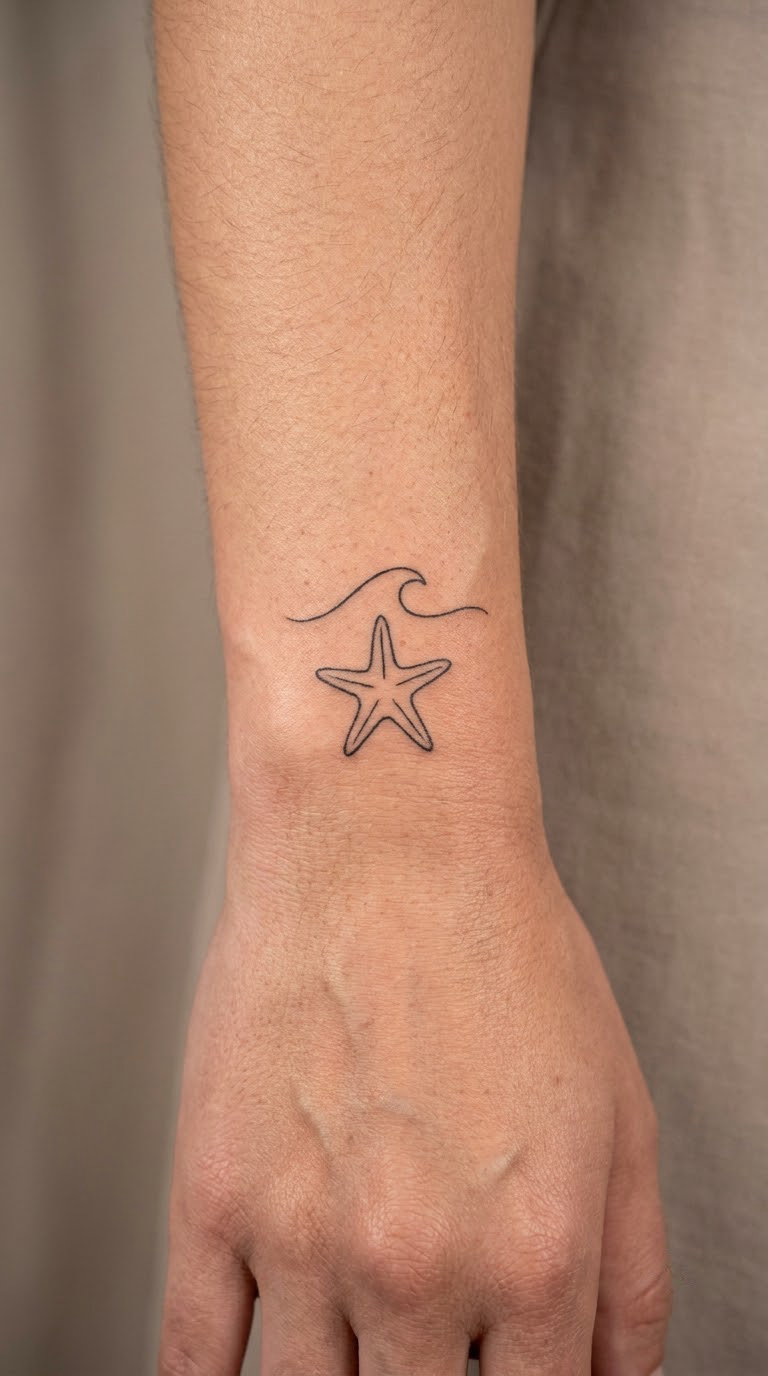
A small starfish with one curved wave stroke sweeping under it, done in simple fine line so the hand does not become crowded. The single wave line gives the piece a horizon and stops the starfish looking like a sticker. Two elements is the maximum most people should attempt here.
Hand tattoos are chosen when you want something you see constantly, since you look at your hands all day.
Placement: Back of the hand, between the knuckles and the wrist crease. Size: 1.5 to 2 inches (4 to 5 cm). Style: Fine line with a minimal accent. Pain: High, from knuckles to wrist, and knuckle areas bruise visibly for days. Ageing note: Hand skin creases repeatedly, so fine line here fades and softens faster than anywhere except the fingers. Make it yours: Curve the wave to follow the line of your own tendons, which makes the accent look built into the hand rather than stuck on it.
18. Starfish Made from Dots and Waves
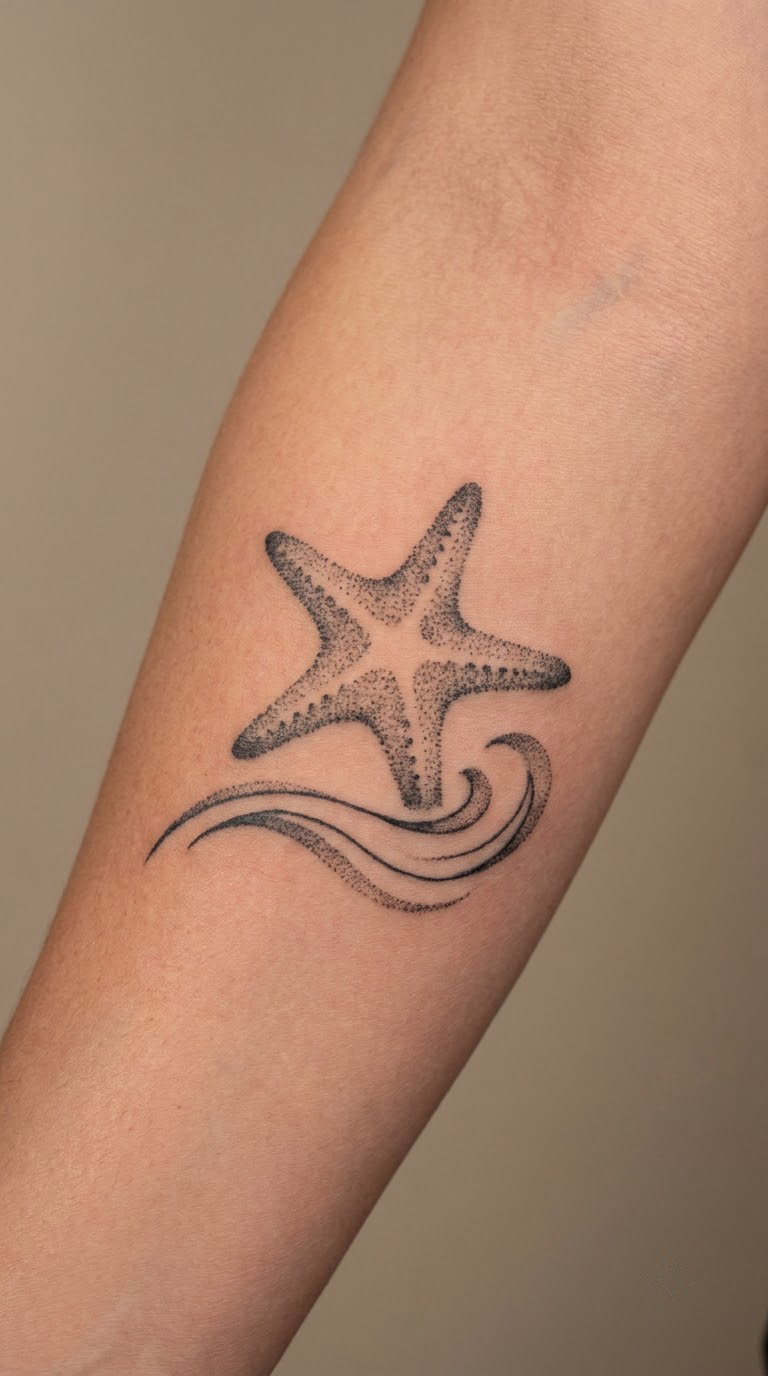
Graduated dots suggest the starfish without drawing its outline, and two curved wave lines beneath it do the rest of the work. The motif is implied rather than illustrated, which makes this an abstract design that still reads as marine to anyone who knows what they are looking at.
It suits people who prefer suggestion to description, and who want something that looks like it belongs next to other dotwork rather than beside a realistic piece.
Placement: Forearm, flat inner or outer surface. Size: About 3 inches (7.5 cm). Style: Dotwork with graphic line accents. Pain: Medium. Ageing note: Small dots fade unevenly, so the lightest areas are the first to wash out. Make it yours: Grade the dots by density rather than by colour, making the centre of the star the darkest and the wave lines the sparsest.
19. Five-Point Starfish Sleeve Element
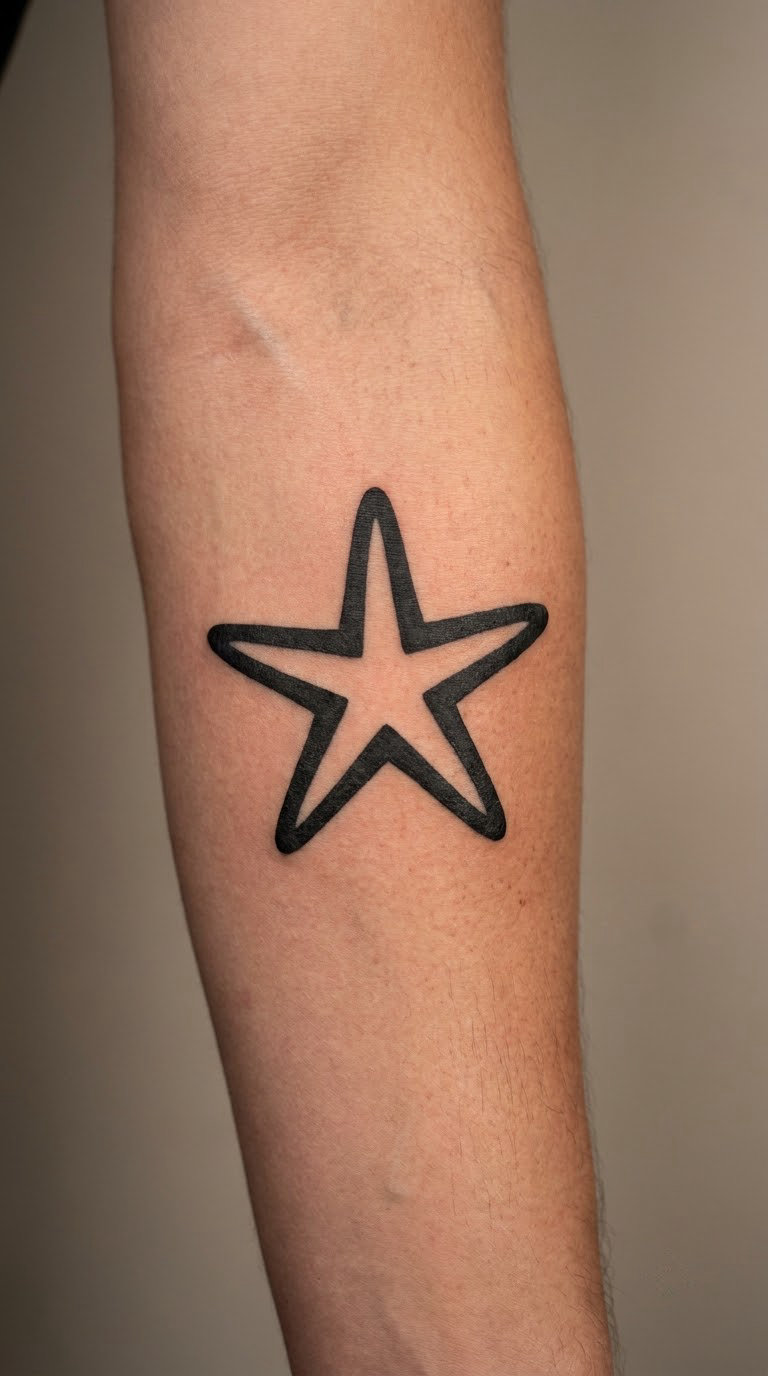
A simplified five-point starfish with bold contours and nothing else attached, drawn heavy enough to hold its own beside busier elements. This is the building-block version of a starfish, the one you place in a sleeve or a collection rather than wear as a standalone statement.
Collective tattoos work best when each piece shares a line weight. A bold contour piece sitting next to a wispy fine-line one always looks like two different people got tattooed.
Placement: Forearm, or anywhere in a sleeve that has space between existing elements. Size: 1.5 to 2 inches (4 to 5 cm). Style: Bold black line. Pain: Medium, and quick because the design has so little in it. Ageing note: Bold contour holds contrast far better than thin work, so this style ages well. Make it yours: Match the line weight to the pieces you already have and photograph them together before you book, so your artist can see the target.
20. Starfish with Handwritten Coordinates
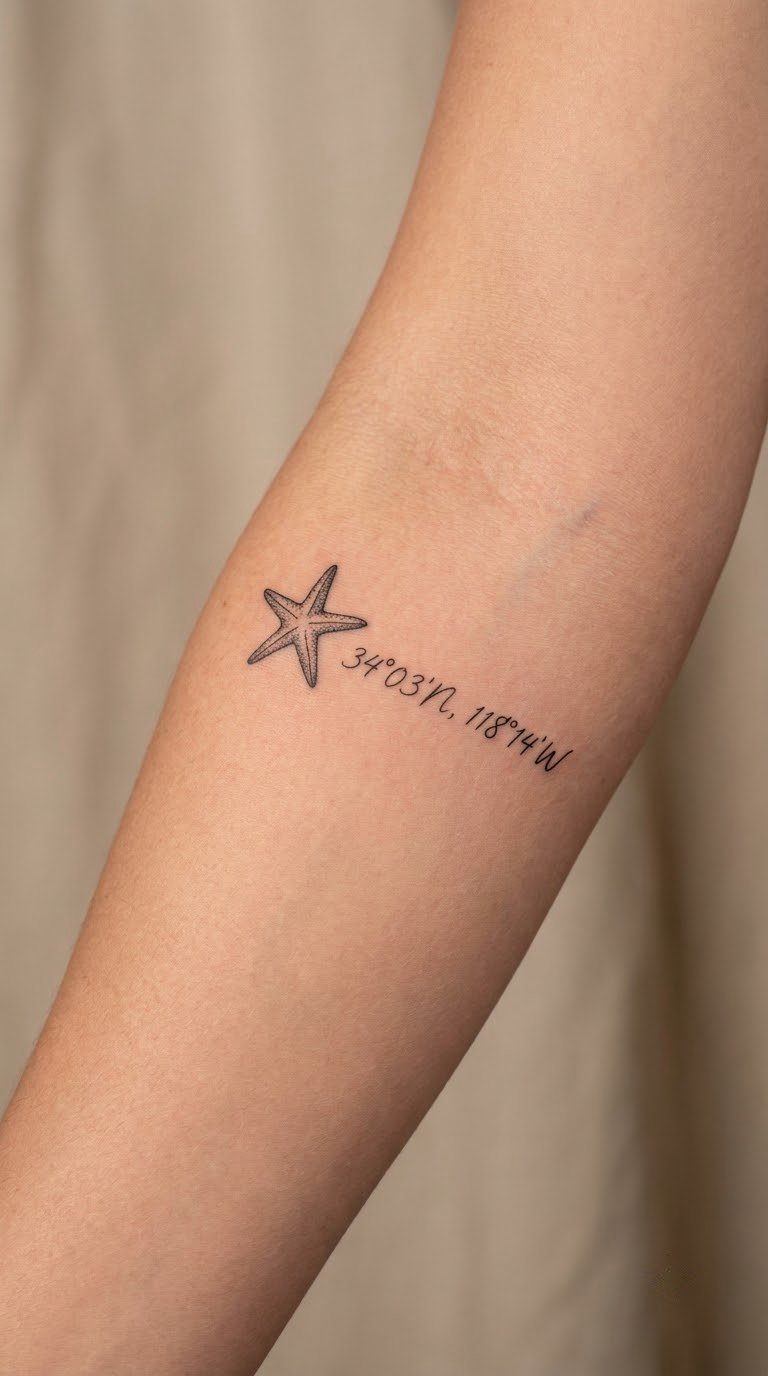
A small starfish beside a line of handwritten coordinates, or a date, in fine lettering. The starfish gives the piece an image, and the lettering carries the meaning, so the two halves pull in different directions on purpose. This is the most personal option on the list and the least flexible, because it is tied to one place.
It works as a memorial piece, a travel record, or a marker for a stretch of coast that mattered to you.
Placement: Inner forearm, laid out flat. Size: About 3 inches wide (7.5 cm). Style: Fine line with hand-drawn lettering. Pain: Medium, though lettering needs patience and a steady hand. Ageing note: Lettering is the first thing to blur and the first thing people regret. Have a hand-painted stencil of the text prepared, and go larger than you think you need. Make it yours: Use the actual coordinates of the spot, checked twice before you sit down, and let the starfish sit slightly above the text rather than directly beside it.
How to Choose the Right Design
Work backwards from the body area, not from the picture. Most disappointing starfish tattoos are good designs placed somewhere the skin cannot carry them, usually because someone liked an image on a screen and did not ask how it would sit over a bone or stretch with movement.
Match the level of detail to the size
Under about 1.5 inches, outlines and single-line work hold up best, and anything textured or shaded starts turning into a grey smudge within a few years. Between 2 and 4 inches, you can safely add dotwork, ridges or light shading. Above 4 inches, you have room for illustrative detail and a second supporting element without the piece feeling crowded.
Matching starfish tattoo ideas to the placement matters as much as matching them to a style. A design that reads clearly on a flat upper back can look cramped on the inside of a wrist.
Use these starfish tattoo ideas as a starting point, not a finish
| What you want | Style that fits | Placement to consider |
|---|---|---|
| Something discreet | Fine line or minimalist | Behind the ear, inner wrist, inner ankle |
| A first tattoo | Minimalist or bold contour | Forearm, upper arm, calf |
| A statement piece | Blackwork or traditional | Shoulder, upper arm, thigh, upper back |
| Detail and texture | Illustrative, micro-realism, dotwork | Flat surfaces such as forearm, thigh, back |
| Colour | Watercolor or neo-traditional | Arms and legs, kept covered where possible |
| Meaning on the skin | Fine line with lettering or constellation | Inner forearm, inner arm, ribs |
If your instinct leans floral, birth month flower tattoo ideas follow the same placement logic, and the sizing rules translate directly.
One last practical point: bring references, but bring more than one, and bring the same ones. Tattooists read consistency as clarity of intent. Three sketches, all in black line, all at roughly the size you want, tell an artist far more than one photograph of a coloured piece you liked on someone else.
Cost and Session Time
Nobody can give you a figure before you tell an artist the size, the style and the placement, and we are not going to guess at one here. What we can do is give you the realistic US ballpark and explain what actually drives the number on the quote.
Rough US price bands. A small starfish, 1 to 2 inches, usually lands somewhere around $80 to $150 once a shop minimum is applied. A medium piece at 3 to 5 inches, with colour, dotwork or realistic shading, tends to fall between $200 and $400. A large starfish used as a sleeve centrepiece runs from roughly $500 into the four figures, because it is measured in hours rather than in size.
Size is the biggest lever. A small starfish on the inner wrist is a short appointment. A large starfish as the centrepiece of a half sleeve is a multi-hour sitting, often split across two sessions. Most shops have a minimum charge that a tiny piece still has to meet, so the smallest tattoos and the simplest ones do not scale down proportionally.
Style drives the time. An outline runs fast. Dotwork, stippling, realistic shading, watercolour and colour fills mean more needle passes over the same area, and a piece with lettering needs extra time for legibility.
Placement affects the rate and the session length. Ribs, collarbone, the inner elbow and the hands are slower because you cannot stay still and the artist has less stable surface to work on. A flat forearm is faster and usually easier on you.
Revisions and touch-ups are extra. Anything with shading or colour usually needs at least one return visit, and that is normal rather than a sign of poor work. Shop minimums, hourly rates and travel all feed into the final figure, so two artists in different cities can quote very differently for the same drawing.
Aftercare Basics
Start with your artist’s aftercare instructions, because they know exactly what they did and how that specific piece should be handled.
- Follow your artist’s aftercare instructions first. Every artist has a method they trust, and generic advice online cannot account for the style you chose.
- Wash gently, twice a day at most. Lukewarm water, a mild unscented soap, and clean hands. Pat dry with something disposable rather than a towel.
- Protect it and dress it carefully. Loose clothing over a fresh piece is ideal. A tight waistband, a boot or a collar rubbing the same spot all day is the fastest route to an irritated tattoo.
- Skip the unproven treatments. Petroleum jelly, butter, aloe and strong antibiotic creams are not tattoo care. Your artist will tell you what to use on the day.
- Soften new skin with plain moisturiser once healed. Daily moisturising on a dry area helps a tattoo hold its lines, and it matters more for fine line work than for solid black.
- Keep colour out of the sun. Bright pigments fade faster than black, and a healed starfish on an exposed arm or calf will dull quicker than the same design on a covered torso.
Frequently Asked Questions
What does a starfish tattoo mean?
A starfish tattoo usually symbolizes resilience and renewal, because a real sea star can regrow a lost limb. It is also read as guidance and safe passage, from the old sailor association with Stella Maris, the Star of the Sea. Most people wear it for a specific coastline or a season that mattered, more than for the symbolism alone.
Does a starfish tattoo hurt?
Most starfish tattoos are mild to moderate, and the discomfort tracks the placement rather than the design. Forearms, upper arms and calves are straightforward. Ribs, collarbones, fingers, ankles and the back of the hand hurt more because the skin is thin over bone. Expect a scratchy, sustained feeling rather than sharp pain, and a real pinch at the end of long sittings.
How small can a starfish tattoo be?
Around half an inch across is realistic, but at that size the design has to be simplified to a bold five-point outline. Fine dotwork, ridged texture and realistic shading all disappear below about 1.5 inches and turn grey within a few years. If you want detail, scale the design up rather than crowding more into a small space.
What color starfish tattoo lasts the longest?
Black and grey last the longest because the pigment is dense and dark, so it holds its contrast even when the colour has softened. Blue and bright shades such as orange and red fade noticeably faster, particularly on exposed areas like arms and calves, and usually need a refresh every few years. Placement matters as much as colour, since covered areas fade more slowly.
Where should I get a small starfish tattoo?
The inner wrist, behind the ear, the inner ankle and the back of the hand are the most popular spots for small starfish tattoos, and each has its own trade-off. Wrist and ankle bones are more sensitive and take sun exposure. Fingers and hands are visible all day but fade fastest. Behind the ear is discreet, though hair grows back through the design.
How long does a starfish tattoo take to heal?
Most small starfish tattoos are surface work and settle within two to three weeks, with the surrounding redness and flaking gone well before then. A large piece with heavy dotwork or colour can take four to six weeks to look final, because the pigment sits deeper. The last visible change is usually a slight fade as the skin returns to normal over the following couple of months.
Conclusion
For a first tattoo, the bold contour starfish on the forearm is the safest bet. It is quick, it is not painful, and it holds its shape as it ages, so you are not staring at a blurred design in ten years.
If you are building a coastal collection, the shell-textured piece on the back or the starfish constellation gives you a centrepiece with somewhere to grow. Whichever one you pick, choose it for the place it points at and the detail level you can actually live with. That is the part no gallery can decide for you.