
20 Goat Tattoo Ideas (October 2026): Small and Bold Designs
A goat tattoo is a body-art design showing a goat, usually the head with its curved horns, done in a style like blackwork, American traditional, black and grey, fine line or simple line art. These 20 goat tattoo ideas cover everything from a one inch wrist piece to a full thigh composition, with placement, size and pain notes for each one.
A goat carries more character than most animals people tattoo. It climbs where nothing else can, holds its ground when the rest of the flock moves on, and looks entirely unbothered about both. That is why a goat portrait says something about the person wearing it, whether the design is a tiny outline or a shaded six inch piece. Goats are also the shape zodiac Capricorn comes from, which is one more reason the design keeps showing up in collections.
What matters most for a goat tattoo is the horns. Curved horns are the hardest part of the animal to render legibly, and if the curve turns to mud the whole design goes with it. Every idea below is judged on whether the silhouette still reads at real-life size, not just in a drawing. Placement notes matter more here than the pretty pictures, so read the size and pain lines before you fall for a design that will not fit the spot you had in mind.
One thing worth saying up front: a horned goat head can read as occult to people who have seen one too many internet threads about it. r/traditionaltattoos users get asked about it constantly. If that is not what you want, a mountain goat on a peak, a baby goat, or a full-body goat standing on open ground gives you the same symbolism without the look.
20 Goat Tattoo Ideas: Quick Guide
The table below puts all twenty designs side by side, in the same order as the numbered sections, so you can scan for the one that fits your spot and your patience.
| Idea | Style | Best placement | Size | Pain |
|---|---|---|---|---|
| Fine-line side profile | Fine line | Inner forearm | 2-3 in | Low |
| Mini goat head | Micro fine line | Inner wrist | 1.5-2 in | Medium |
| Blackwork sweeping horns | Blackwork | Upper arm | 4-5 in | Medium |
| Realistic mountain goat | Black and grey realism | Outer upper arm | 5-7 in | High |
| Traditional goat head | American traditional | Shoulder | 3.5-5 in | Medium |
| Geometric mountain goat | Geometric | Forearm | 2.5-3.5 in | Low |
| Watercolor floral | Watercolor | Upper thigh | 3.5-4.5 in | Medium |
| Charging ram | Black and grey illustrative | Outer forearm | 6-8 in | High |
| Dotwork goat and moon | Dotwork | Calf | 3-4 in | Medium |
| Micro collarbone goat | Micro fine line | Collarbone | 0.75-1.25 in | Medium |
| Goat skull | Black and grey realism | Chest | 4-6 in | High |
| Folk-art goat | Folk art | Back of upper arm | 4-5 in | Low |
| Baby goat and clover | Fine line with colour accent | Ankle | 2-3 in | Medium |
| Silhouette mountain scene | Silhouette | Forearm | 3.5-4.5 in | Low |
| Neo-traditional floral | Neo-traditional | Upper arm | 4.5-5.5 in | Medium |
| Horn line art | Minimalist line art | Behind the ear | 1.5-2.5 in | Low |
| Goat and laurel wreath | Ornamental | Upper back | 4-5 in | Low |
| Western goat illustration | Western illustrative | Calf | 5-7 in | High |
| Goat head with starburst | Graphic with colour | Shoulder blade | 3.5-4.5 in | Medium |
| Full goat in a minimal scene | Illustrative | Outer thigh | 6-8 in | High |
1. Fine-Line Side-Profile Goat
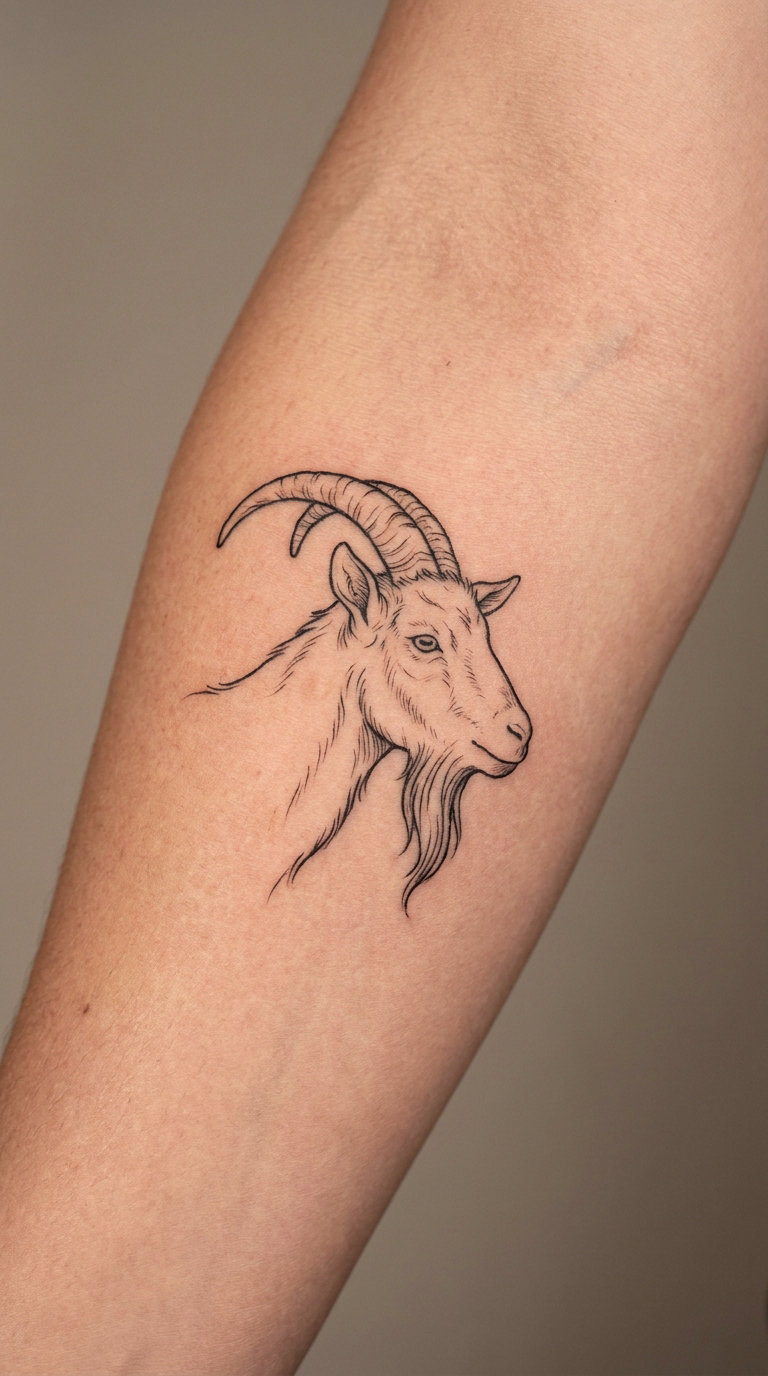
A single unbroken line traces the brow, drops down the muzzle, curls back into the beard, and lifts into a pair of horns that sweep away from the head in one clean arc. Nothing else in the design. The whole goat is legible from across a room and still looks considered up close.
People pick this one when they want the goat without the weight of a portrait. It reads as someone who does not need a label, which is arguably what a goat means in the first place.
Placement: inner forearm, wrist crease side, or the rib area where the skin is flat enough for a straight line. Size: 2-3 inches (5-7.5 cm) long. Style: fine line, single weight.
Pain: low to medium; the forearm is a forgiving canvas, and a single pass of line is over sooner than you expect. One honest note: fine line on the inner arm fades faster than on the outer arm because you wash that skin more often, so expect a touch-up visit within a couple of years.
Make it yours: add a date in the same single-line hand along the underside of the horn curve, or tint the line a single colour once so it reads as a deliberate choice rather than a plain outline.
2. Mini Goat Head on the Wrist
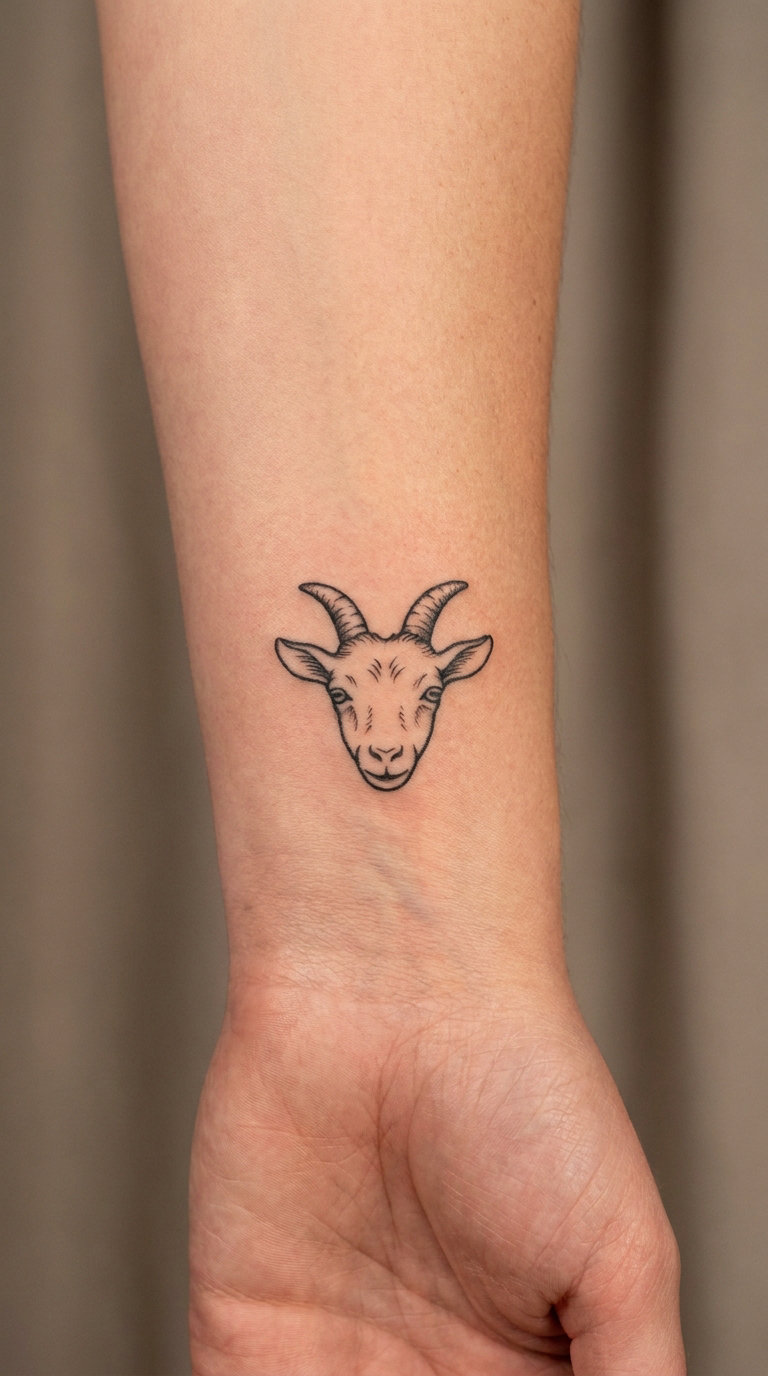
Front-facing, symmetrical, and compressed into a shape that fits between the two wrist bones. The artist keeps the horns short and slightly thickened so they survive at small scale, adds one eye and a straight brow line, and stops there. Fewer lines, more weight, no grey wash.
This is the version that works as a first tattoo, and it also works as a matching piece. Goat symbolism reads the same at 1.5 inches as it does at 5.
Placement: inner wrist, just above the pulse point. Size: 1.5-2 inches (4-5 cm). Style: micro fine line with boldened outer contour.
Pain: medium. The inner wrist is thin skin over bone and you will feel every pass of the needle, though the session is short. Ageing note: wrist ink gets scrubbed daily and fine detail there softens faster than anywhere else, so thicker lines matter more than usual.
Make it yours: have the artist mirror the design in ink on a sister or friend, with one small difference between the two so nobody can tell which is which at a glance.
3. Blackwork Goat with Sweeping Horns
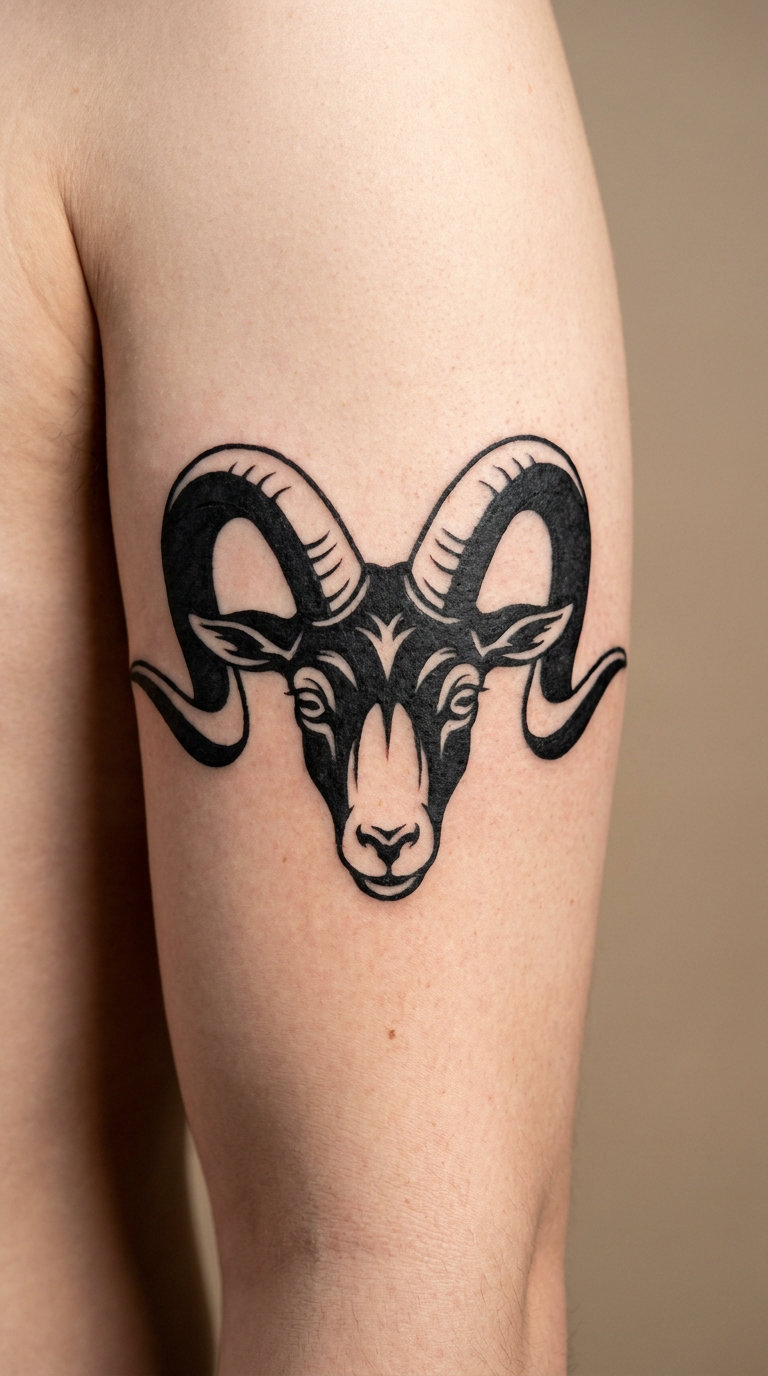
Solid black fills define the horns, and the face is carved out of the space between them with clean negative space. Nothing grey, nothing soft. The horns are pushed past anatomical accuracy, curling wider than a real goat’s, and that exaggeration is the whole point of the design.
Blackwork on a goat reads as confidence rather than menace because the horn curve stays open and upward. It suits people who like a design with weight to it and do not mind it being the first thing anyone notices.
Placement: outer upper arm, deltoid area, or the outer thigh where there is room to let the horns spread. Size: 4-5 inches (10-12.5 cm) across. Style: bold blackwork.
Pain: medium. Filling solid black is repetitive rather than sharp, so it stings less than a shaded realism piece but takes longer. Blackwork holds its shape well for decades, which makes it a safe pick for a large canvas.
Make it yours: let the negative space between the horns form a second shape, like a crescent or a simple mountain ridge, so the black does double duty.
4. Realistic Mountain Goat Portrait
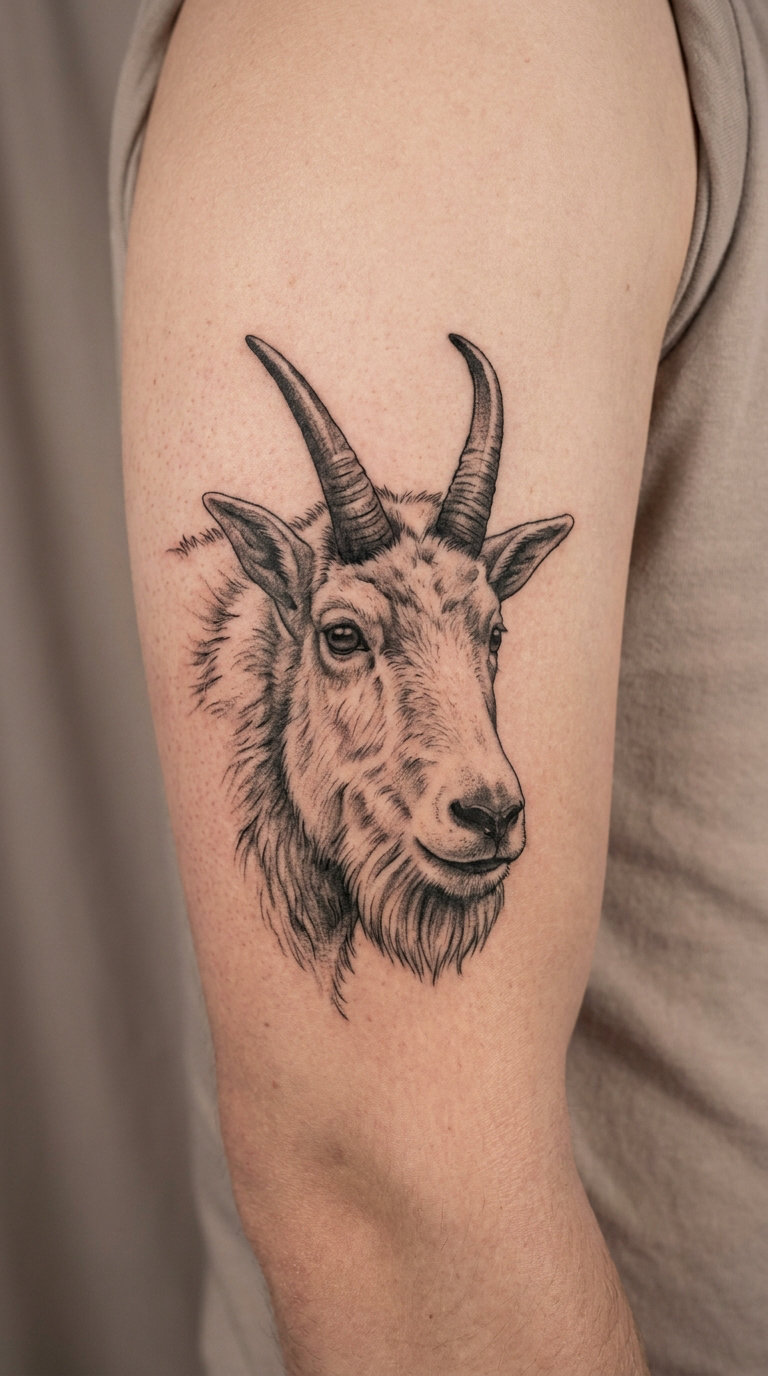
Full tonal work, black and grey. The short fur along the cheek and neck is built from hundreds of small marks, the horns carry a soft gradient from base to tip, and the eye is the sharpest point in the whole piece. This is the design that looks best in a photograph and rewards a closer look in person.
A mountain goat on a peak reads as somebody who works best alone and at altitude, and the realism makes the message quieter than a cartoonish version would.
Placement: outer upper arm or the flat of the outer thigh, anywhere with 6 inches of usable width. Size: 5-7 inches (13-18 cm) tall. Style: black and grey realism.
Pain: high, mostly from duration. Realistic fur work is hundreds of small passes and a real sitting runs two to four hours, so bring food and something to watch. The tonal shading holds up far better than hairline detail, so this style ages well if the artist keeps the lines weighted.
Make it yours: have the background left as loose grey rock and mist rather than a hard outline, so the goat reads as a portrait instead of a sticker.
5. Traditional American Goat Head
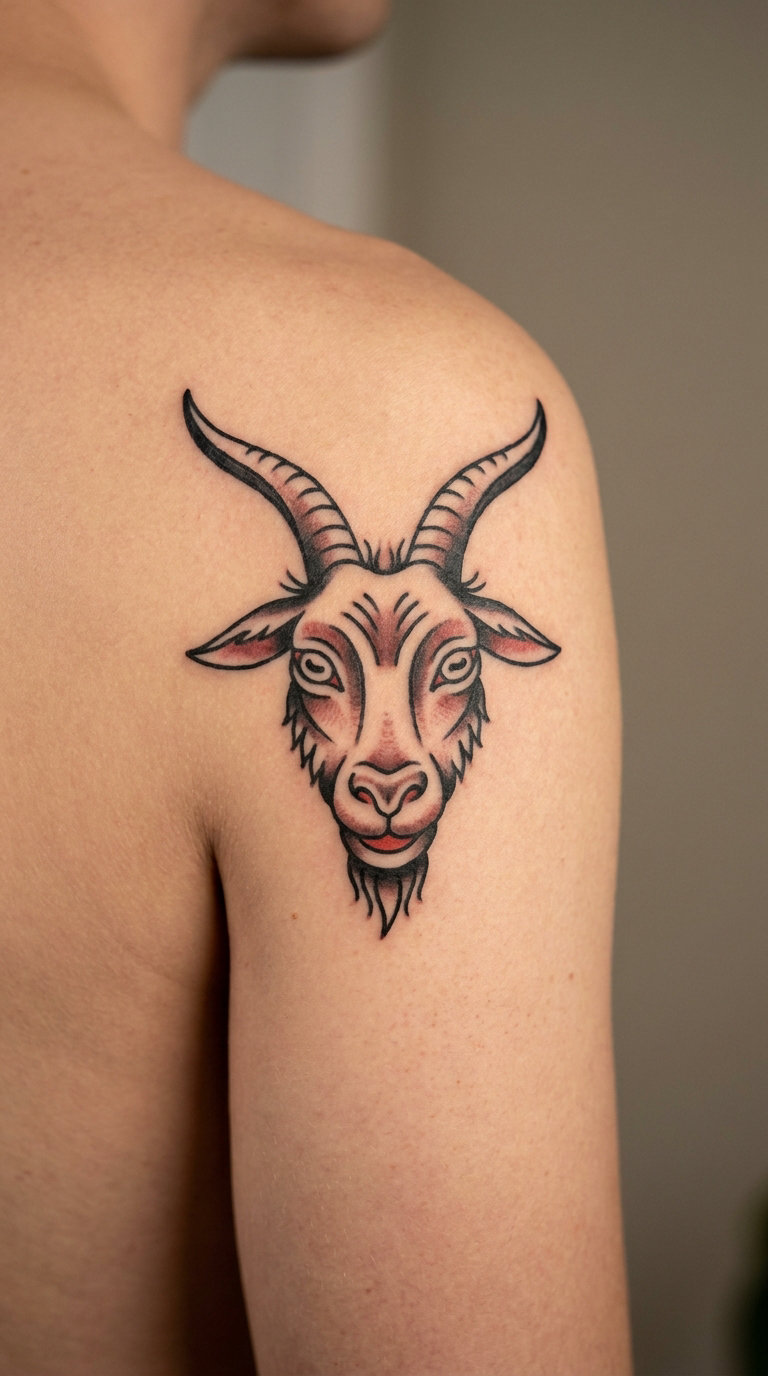
Heavy black outlines, flat colour, and a symmetrical front-facing head built on the classic three-part composition: the goat as the main subject, a small accent behind it, and a simple background element such as clouds, a sun or a banner. Colour stays in a tight palette, usually red with black and one more tone.
Old-school goat heads have been tattooed for a century, and collectors on r/traditionaltattoos still treat a well-drawn one as a proper piece of flash. Bold outlines are the most forgiving style on skin over time.
Placement: shoulder, upper chest, or the outer bicep. Size: 3.5-5 inches (9-12.5 cm) wide. Style: American traditional, bold line, limited palette.
Pain: medium. The line work is firm and fast, the colour passes are broad and shallow. Best of all, traditional linework is the goat style that stays crisp longest on an arm or shoulder.
Make it yours: skip the generic background and put a small date in a banner under the chin, drawn in the same weight as the outlines.
6. Geometric Mountain Goat
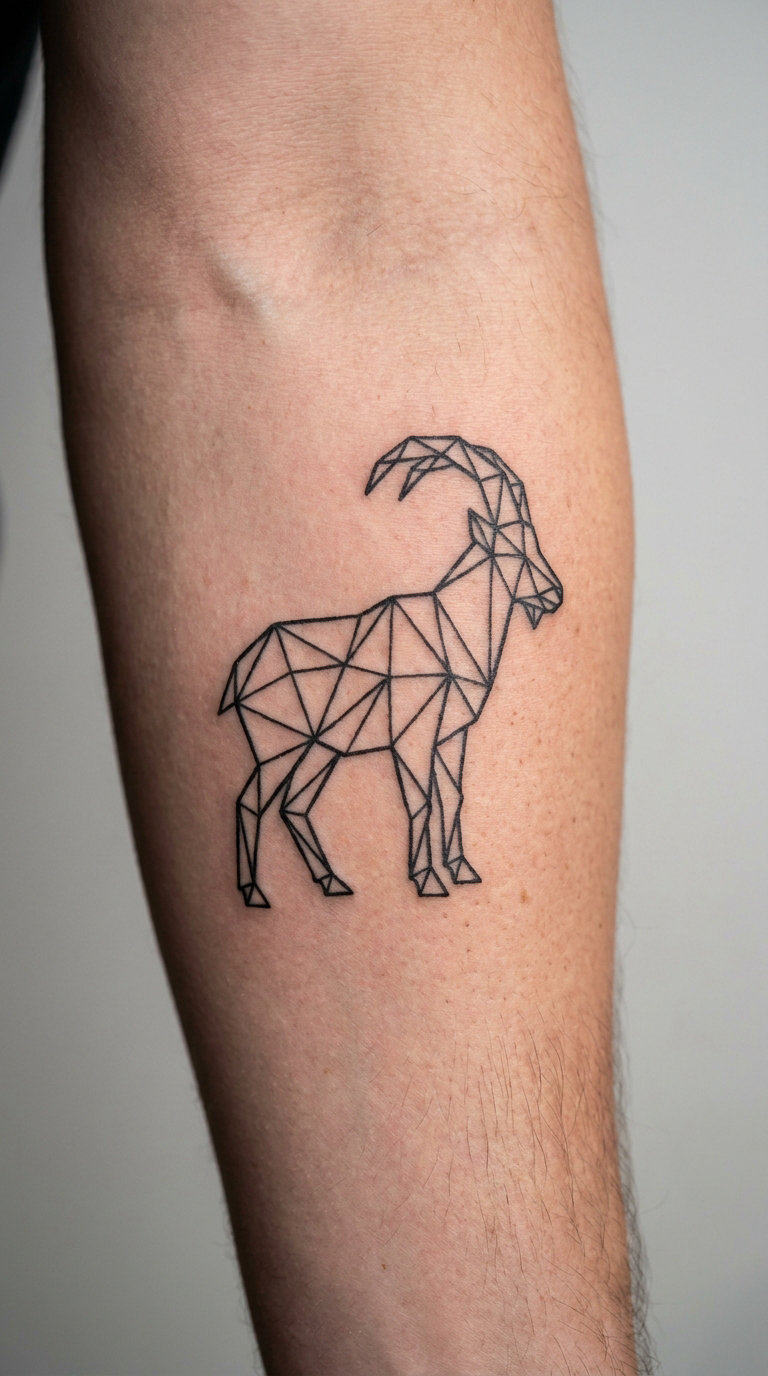
The goat is reduced to straight segments. A triangle makes the muzzle, a stack of angled lines builds the horns, and the body reads as a set of connected facets with no curves at all. Sight lines meet at deliberate points so the eye follows the horn shape even though nothing is drawn as an actual curve.
Geometric versions tend to get chosen for the design rather than the animal. It is a clean, architectural look and it sits well next to other line-heavy work.
Placement: inner or outer forearm, ribs, or the front of the shoulder. Size: 2.5-3.5 inches (6-9 cm). Style: geometric, black line. Pain: low. Straight-line work needs fewer passes than shading or grey, and the session is short. Ageing note: keep facets at least an eighth of an inch thick, because hairline geometric lines fill in and blur faster than heavier black contours.
Make it yours: have one small facet left solid black while the rest stay open line, so the pattern reads as your own rather than a stock geometric sheet.
7. Watercolor Goat in a Small Floral Frame
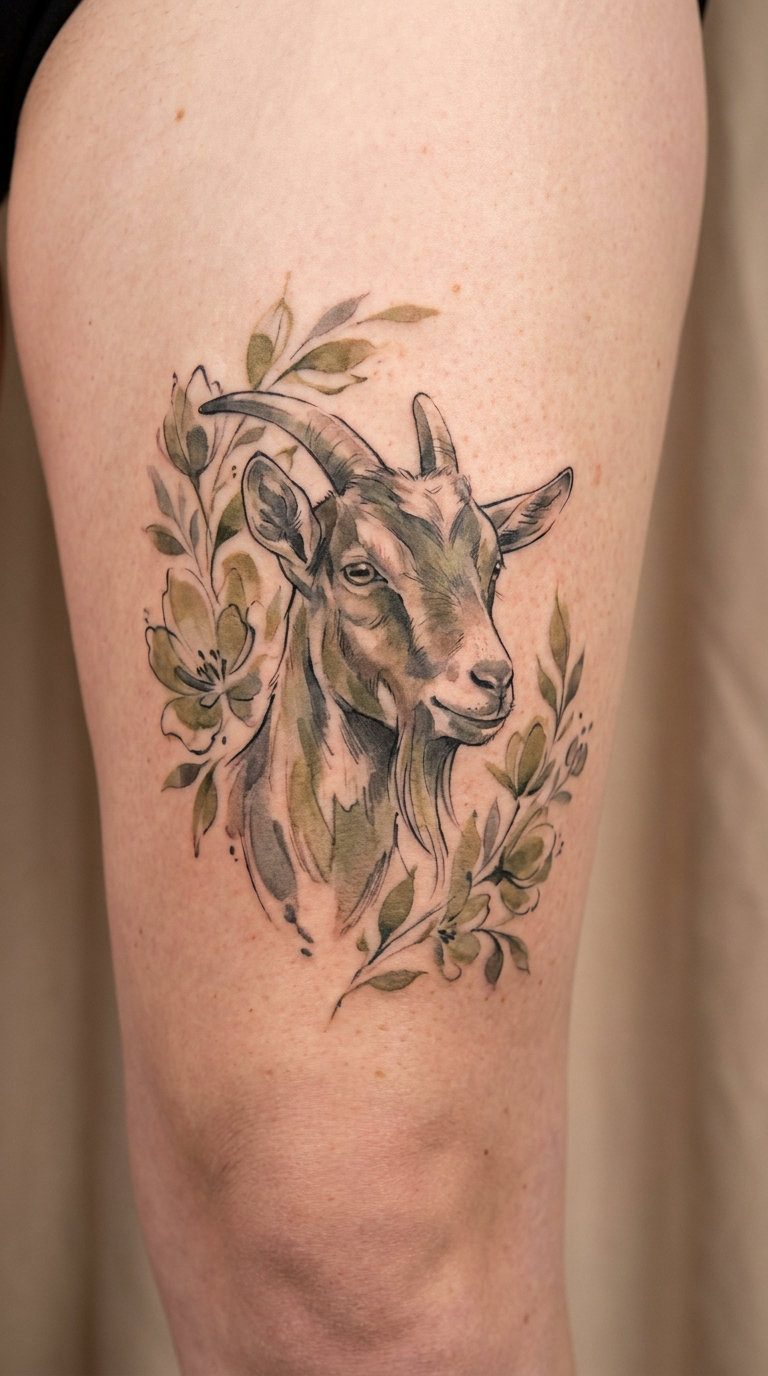
Loose washes in grey, warm brown and muted green, with pigment blooming outside the lines and flowers that never fully close. The goat’s face is the most controlled part; everything around it deliberately loosens so the design feels painted rather than drawn.
Floral framing softens a horned animal into something decorative, which is a useful shift if you like the symbolism without the aggressive read.
Placement: upper thigh, shoulder, or the back of the forearm where the skin is broad and flat. Size: 3.5-4.5 inches (9-11.5 cm) tall. Style: watercolor with soft shading. Pain: medium, mostly prickling from the wash work. Colour tattoos on the thigh take slightly longer to heal than line work on an arm, so plan for a full two weeks before covering up.
Make it yours: pick two flowers with a real meaning for you and name them in the brief, so the frame carries its own story rather than being decoration.
8. Charging Ram Tattoo
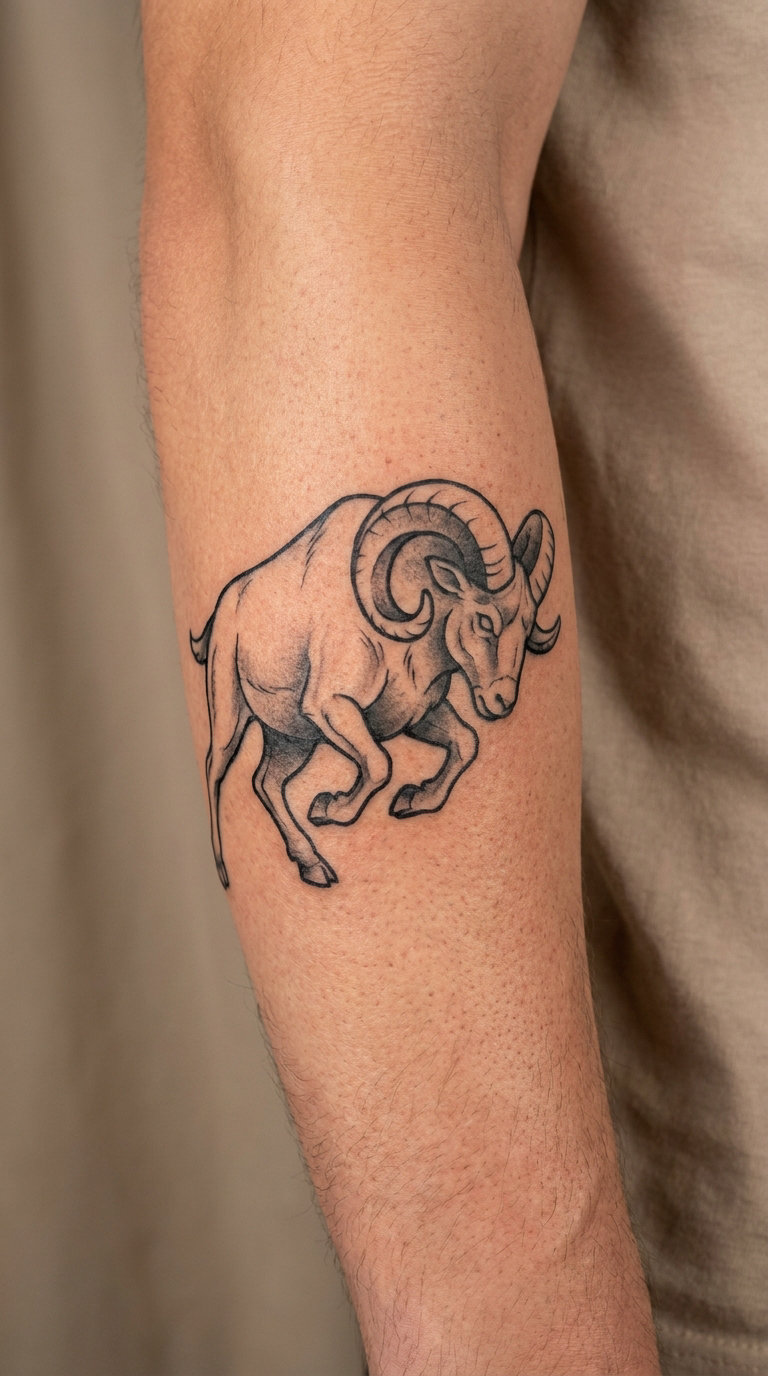
A full-body ram in motion, head down, front legs forward, spine arched and dust implied behind the back legs. Strong black contour lines carry the muscle, with grey shading only where it helps: the shadowed flank, the underside of the neck, the horn ridges. The composition is wider than it is tall because movement reads horizontally.
A charging animal is a forward-motion piece, more energy than portraiture. It suits someone who would rather have a scene than a face.
Placement: outer forearm, calf, or across the shoulder blades. Size: 6-8 inches (15-20 cm) wide. Style: black and grey illustrative with heavy contour. Pain: high. This is a long sitting, commonly three to five hours, and the forearm position is awkward by the end of hour two. Worth it for the composition, less worth it as a first piece.
Make it yours: ask for the background kept as a single hard horizon line, which makes the charge look faster without adding a single extra element.
9. Dotwork Goat and Moon
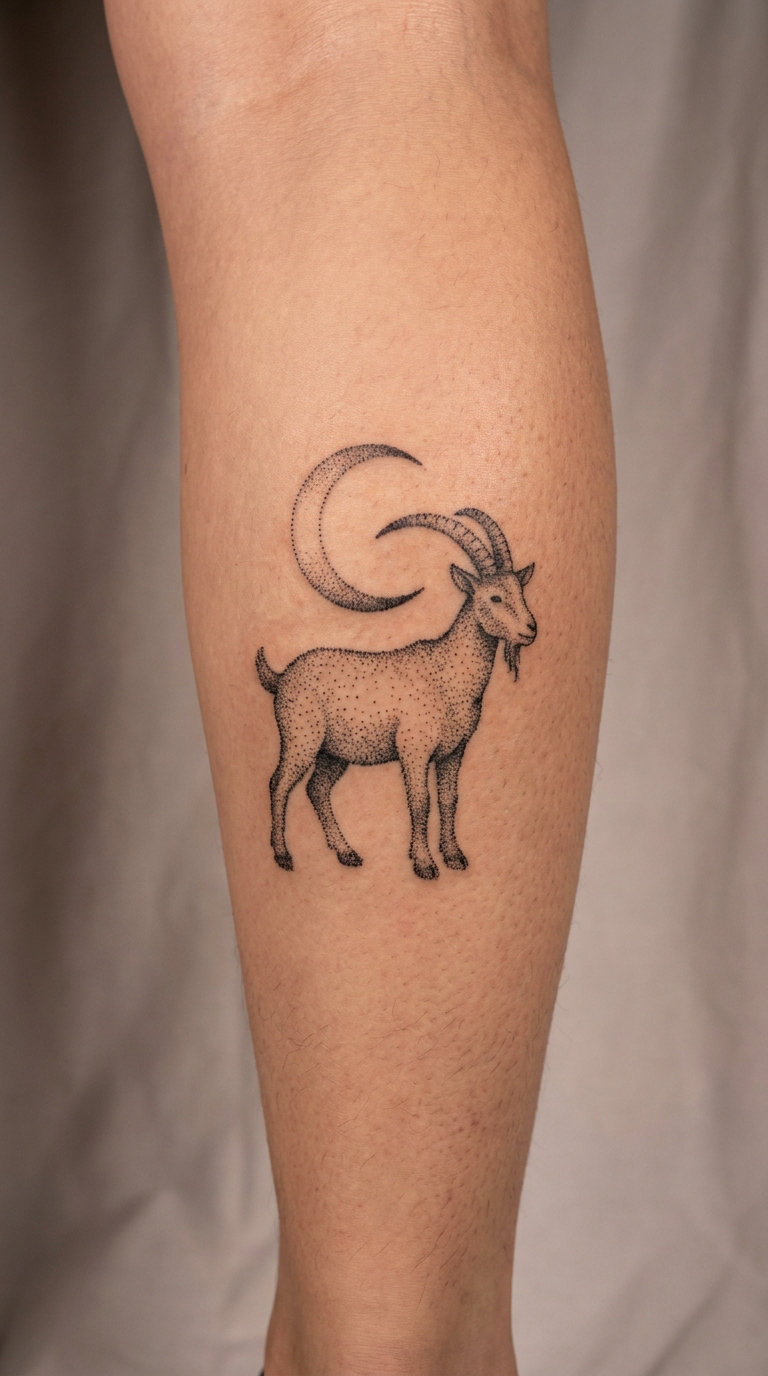
Every tone built from dots, graded from sparse to dense, with a crescent moon above the goat and a few stars placed by hand. The animal stands side-on on an implied ground line, head slightly raised toward the moon. Dot density does all the work that shading would in another style.
Moon work reads as cycles and patience, which sits well with the goat’s stubbornness. The pairing softens an animal that can otherwise look confrontational.
Placement: calf, forearm, or the back of the upper arm. Size: 3-4 inches (7.5-10 cm) tall. Style: dotwork and stippling. Pain: medium. Dots are quick individually but there are a lot of them, so the session stretches longer than the size suggests. Ageing note: dot work is the first style to lose definition as dots spread under the skin, so plan a refresh after a few years if crispness matters to you.
Make it yours: have the star placement follow a real date, three stars for three people or events, so the pattern is only readable by you.
10. Micro Goat on the Collarbone
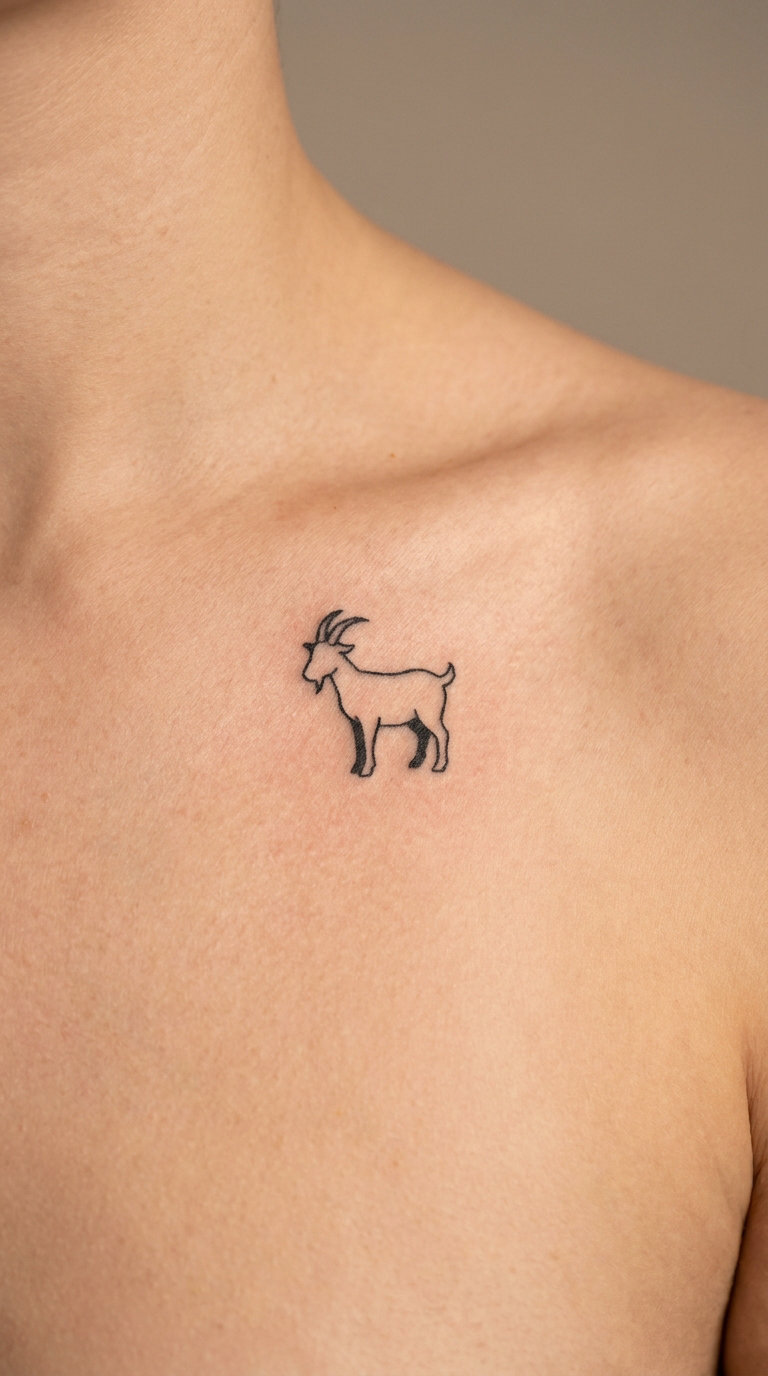
A silhouette rather than a portrait. Two clean horn curves, a small triangular head, and a suggestion of a back leg, all inside roughly one inch. There is no interior detail to lose, which is exactly the point at this scale.
Silhouettes survive small sizes better than line work because there is nothing to blur. If you want a goat you can barely see, this is the version to ask for.
Placement: just below the collarbone, along the ribs, or behind the ear. Size: 0.75-1.25 inches (2-3 cm). Style: micro fine line, solid silhouette. Pain: medium. The collarbone is sensitive skin over bone, and the sensation is sharp rather than dull, but the whole thing takes minutes. Honest warning: anything under an inch will soften and lose the horn tips within a handful of years.
Make it yours: place it along the curve of one collarbone so the horns follow the bone line instead of sitting square to it.
11. Goat Skull in Black and Grey
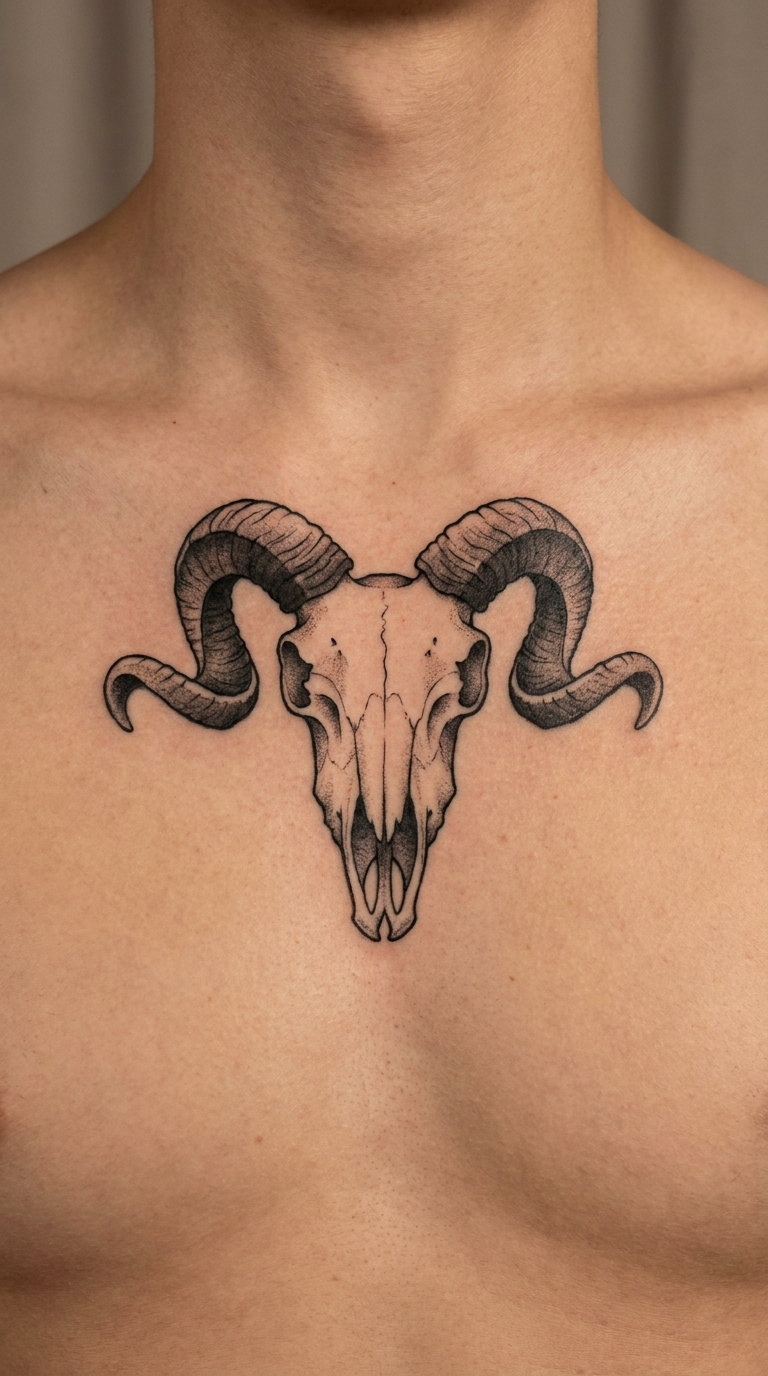
Bone rendered as bone: hollow nasal cavity, visible suture lines, a real eye socket with proper depth, and horns curling back with growth rings shaded in. No gore, no skin, no teeth bared theatrically. Just anatomy, done well.
Skull work is often chosen as a memento mori piece, an honest reminder that things end. It is also the most sculptural goat tattoo you can get, and it shows an artist’s shading more than any other design in this list.
Placement: chest, upper back, or the outer thigh. Size: 4-6 inches (10-15 cm) wide. Style: black and grey realism. Pain: high. The chest is fleshy and the ribs make it uncomfortable after an hour, and the fine shading adds time on top. Two to four hours is normal. Grey gradients on bone hold up remarkably well, so this is one of the more durable realistic goat styles.
Make it yours: have the artist sketch your own goat’s head for reference before the session so the horn thickness and curl match a real animal you know.
12. Folk-Art Goat with Curved Horns
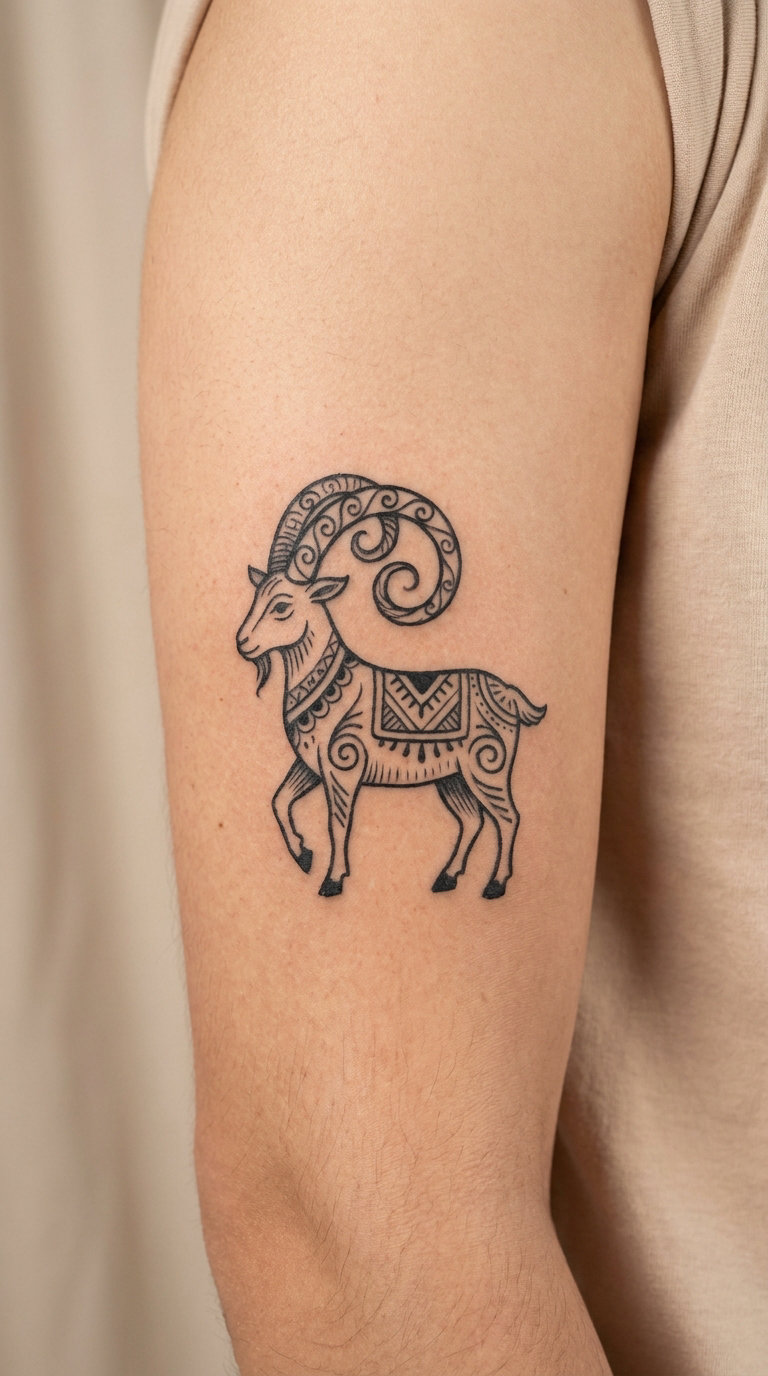
Borderline decorative and playful. The body is filled with repeating folk patterns, the horns curl into ornamental spirals with notches along the edge, and the whole animal sits inside a simple shape rather than floating free. Line weight is even throughout, which is what gives folk work its printed, storybook quality.
This is the goat tattoo that comes from a craft fair poster rather than a flash sheet. It suits people who like pattern and ornament more than realism.
Placement: back of the upper arm, upper back, or the outside of the forearm. Size: 4-5 inches (10-12.5 cm) tall. Style: folk art, ornamental line. Pain: low. Even single-needle line work over a flat area is one of the more comfortable sessions going. Keep internal pattern lines a little heavier than feels necessary and the design will still look clean in ten years.
Make it yours: change the body pattern to something from where you grew up, a weaving motif, a quilting block, a tile pattern.
13. Baby Goat and Clover Tattoo
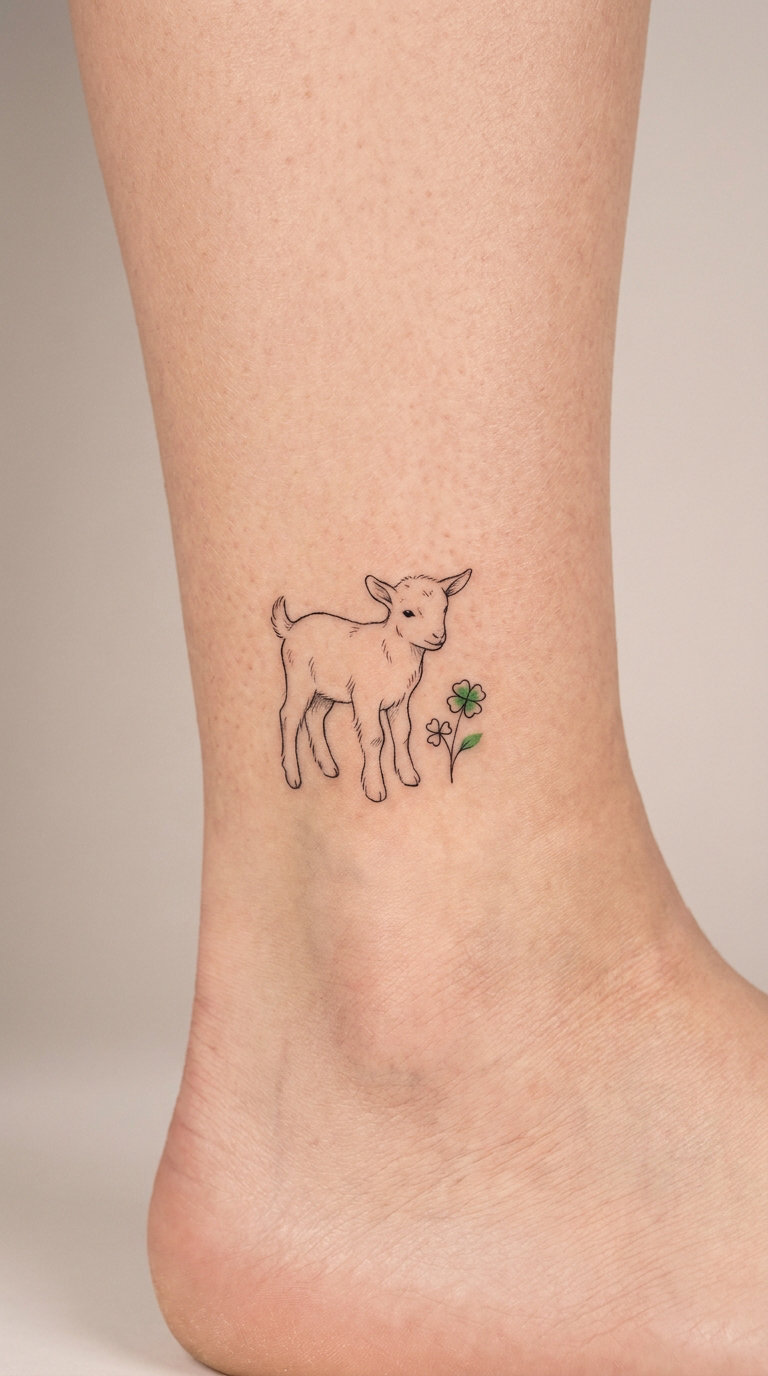
A young goat standing with its head up, small straight ears, tiny horn nubs, and a clover beside the front hooves drawn in fine line with a single green wash. The proportions are deliberately soft: shorter muzzle, rounder head, no heavy neck.
Kids and pygmy goats turn up constantly in the design conversations, and a lot of those are people who actually raised one. A baby goat works as a real memorial piece, not just a cute one.
Placement: ankle, wrist, or the inside of the calf. Size: 2-3 inches (5-7.5 cm) wide. Style: fine line with a small colour accent. Pain: medium. Ankles have very little soft tissue, so the needle hits close to bone and the fine line takes an exacting hand. The green accent needs a full skin tone, so add healing time to that visit.
Make it yours: include the animal’s real name in small script underneath, which turns a cute piece into the kind of memorial tattoo people keep for life.
14. Goat Silhouette Mountain Scene
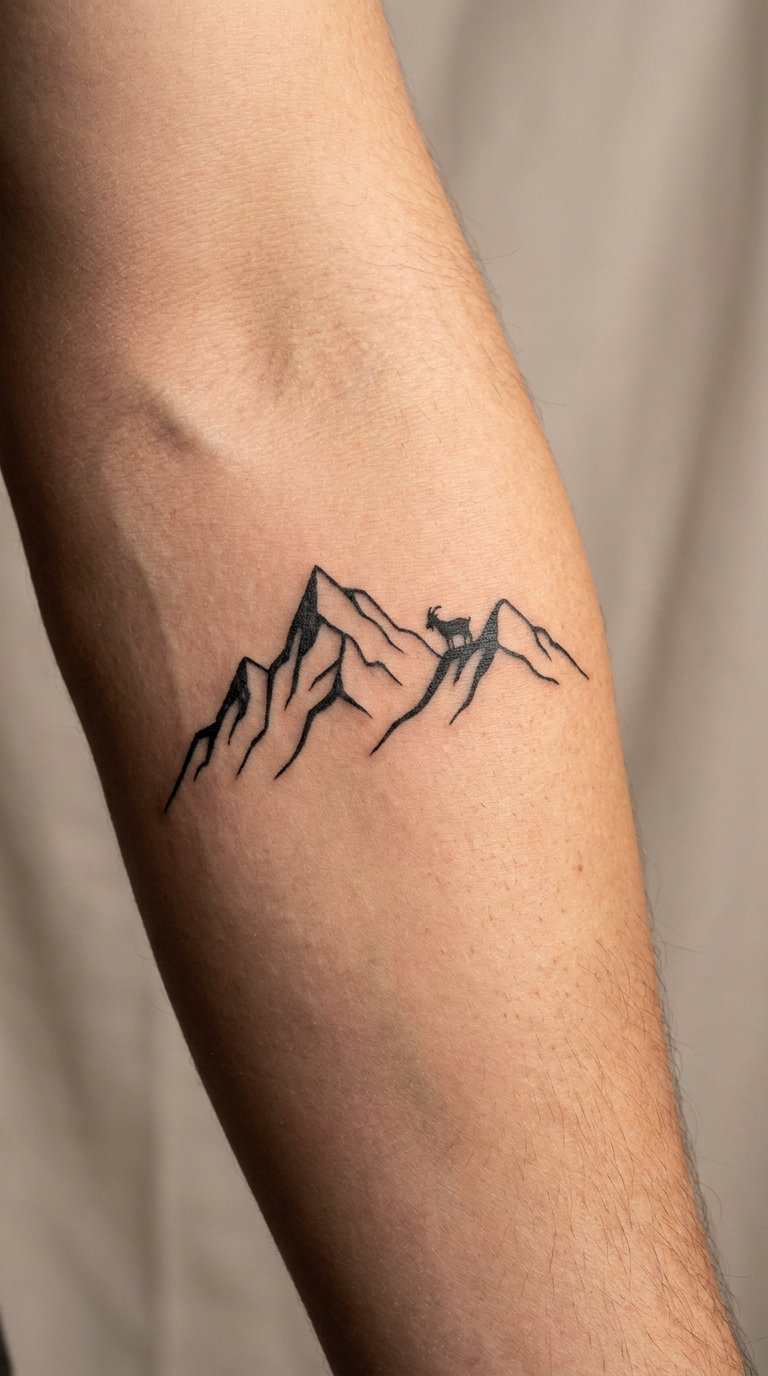
A single solid black goat, small in the frame, standing on a ridge line. Behind it, two or three overlapping mountain shapes in flat black at decreasing density, with the sky left as bare skin. No shading at all, just solid shapes and empty space.
A goat perched above everything else is the most direct version of the climbing symbolism, and the empty sky does the emotional work so the animal does not have to.
Placement: inner or outer forearm, calf, or the back of the shoulder. Size: 3.5-4.5 inches (9-11.5 cm) wide. Style: silhouette and flat black. Pain: low. Solid shapes go in quickly, and you are looking at an hour or so of work. Silhouettes and flat black are among the most durable tattoo treatments there are, so this ages well.
Make it yours: point the goat uphill rather than level, so the composition keeps moving even when the body holding it is still.
15. Neo-Traditional Goat with Floral Accents
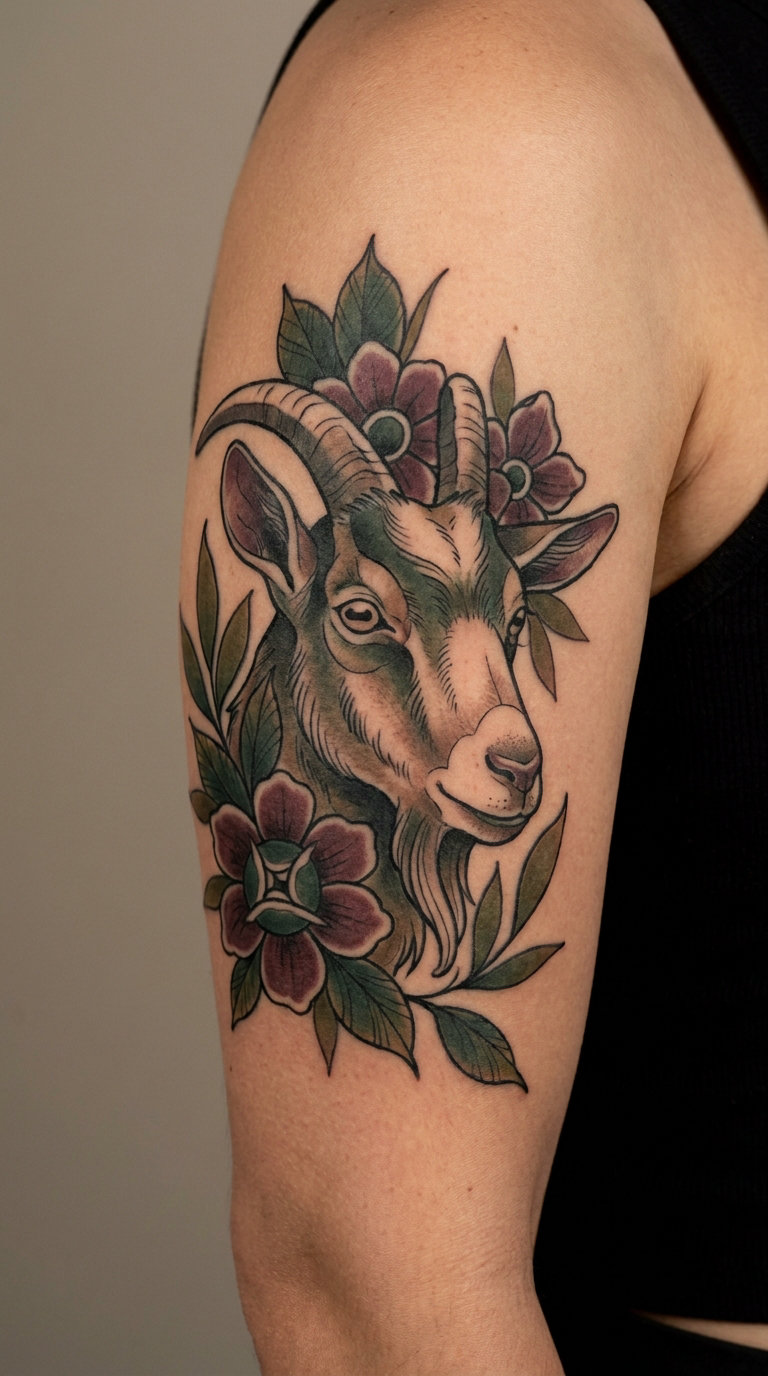
Dimensional shading, saturated colour, and a proper three-part composition done properly: a goat head in profile as the main subject, a peony or rose cluster as the accent, and a banner or clouded horizon as the background layer. Colour is blended rather than blocked, which is where this style separates itself from old-school.
Neo-traditional is what people mean when they want a colourful tattoo that still respects the craft. It suits an existing piece that can hold company with bold colour nearby.
Placement: upper arm, shoulder, or the outer thigh. Size: 4.5-5.5 inches (11-14 cm) tall. Style: neo-traditional, full colour. Pain: medium. Colour packing and blending is long but shallow, so it is uncomfortable rather than sharp. Expect a two to three hour sitting. Rich colour does fade more than line work, so a colour refresh every few years is a fair expectation.
Make it yours: choose the accent flowers to match an existing tattoo, so the piece reads as part of one collection rather than a standalone job.
16. Minimalist Goat Horn Line Art
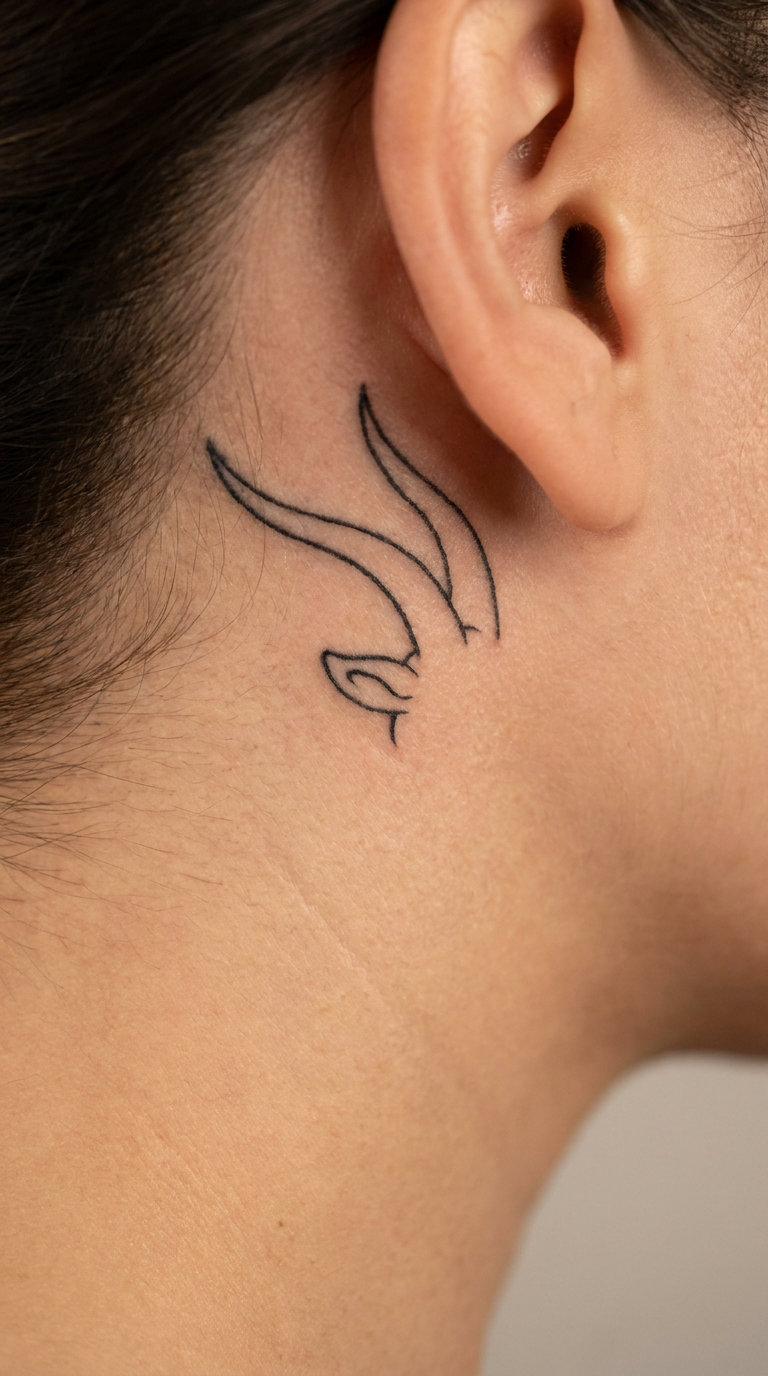
No animal at all. Just the horn curve, a small ear, and a line for the top of the head, drawn in one continuous line that closes back on itself. It is the most abstract goat tattoo on this list and the easiest to place quietly.
Horns on their own work as a symbol of stubbornness and forward momentum, and plenty of people choose this one when the full head feels like too much statement.
Placement: behind the ear, along the side of the neck, on the ribs, or at the inside of the elbow. Size: 1.5-2.5 inches (4-6 cm) wide. Style: minimalist line art. Pain: low, and quick. Behind the ear curves around a bony ridge, so the line shifts with the anatomy and a good artist will follow that rather than fight it. One caution: hairline single-needle work behind the ear fades faster than almost anywhere, so a slightly heavier line is worth asking for.
Make it yours: have the open end of the line finish in a small solid dot, so the piece has one deliberate terminal point rather than two loose ends.
17. Goat and Laurel Wreath Tattoo
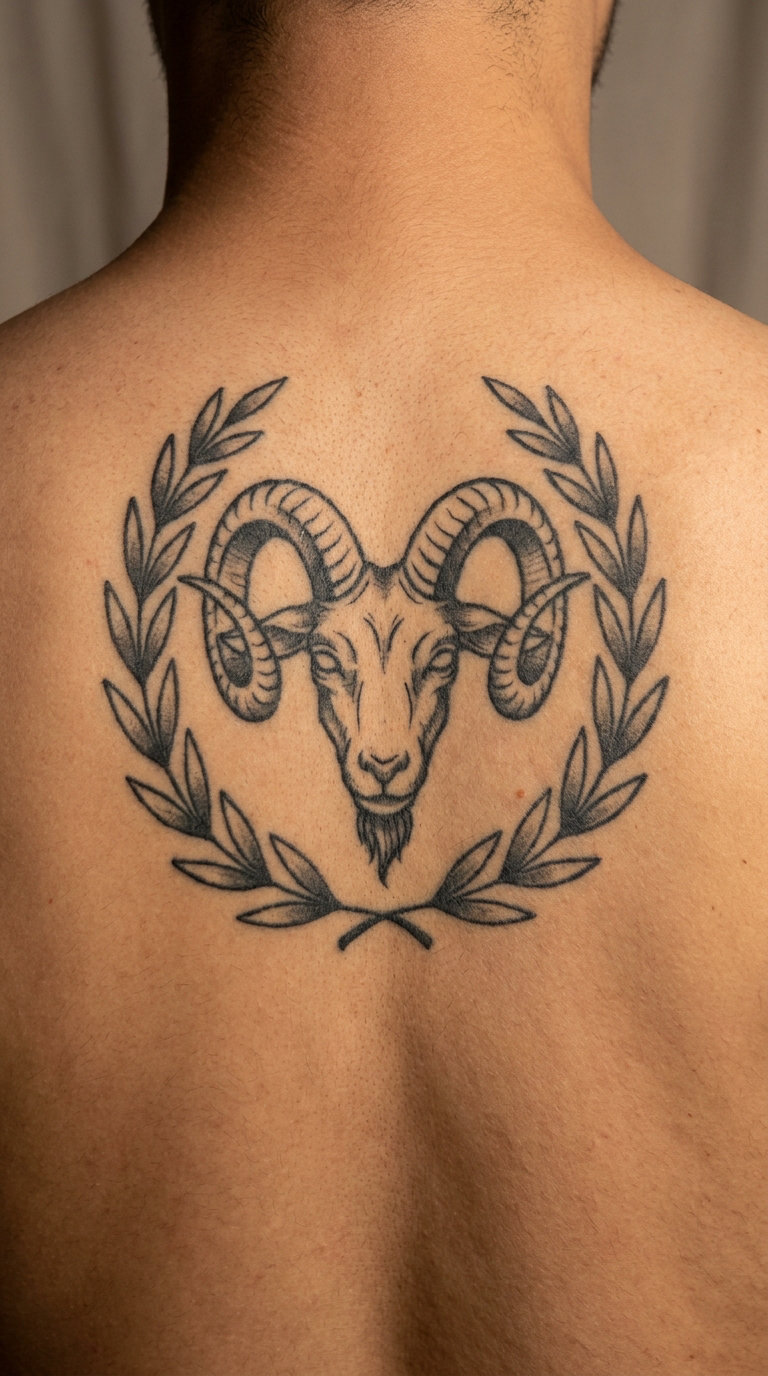
An emblem layout. A forward-facing goat head centred inside a symmetrical laurel wreath, leaves evenly spaced on both sides, tied at the base with a small bow or a short banner. Equal spacing on left and right, no gap where one side runs out of leaves.
Laurel is a victory symbol that has been borrowed from classical imagery for a couple of thousand years, and it is one of the most common tattoo framing devices. It reads formal and finished, which is why it suits a memorial or a matching piece.
Placement: upper back between the shoulder blades, chest, or the outer forearm. Size: 4-5 inches (10-12.5 cm) tall. Style: ornamental line, symmetrical. Pain: low. A steady line design with no shading is one of the more relaxing sittings, though the back is awkward to reach. Ageing note: the leaves are the weak point, so ask for slightly thickened tips so individual leaves stay readable.
Make it yours: swap the laurel for a branch of something native to where you live, keeping the same symmetrical layout.
18. Western Goat Illustration
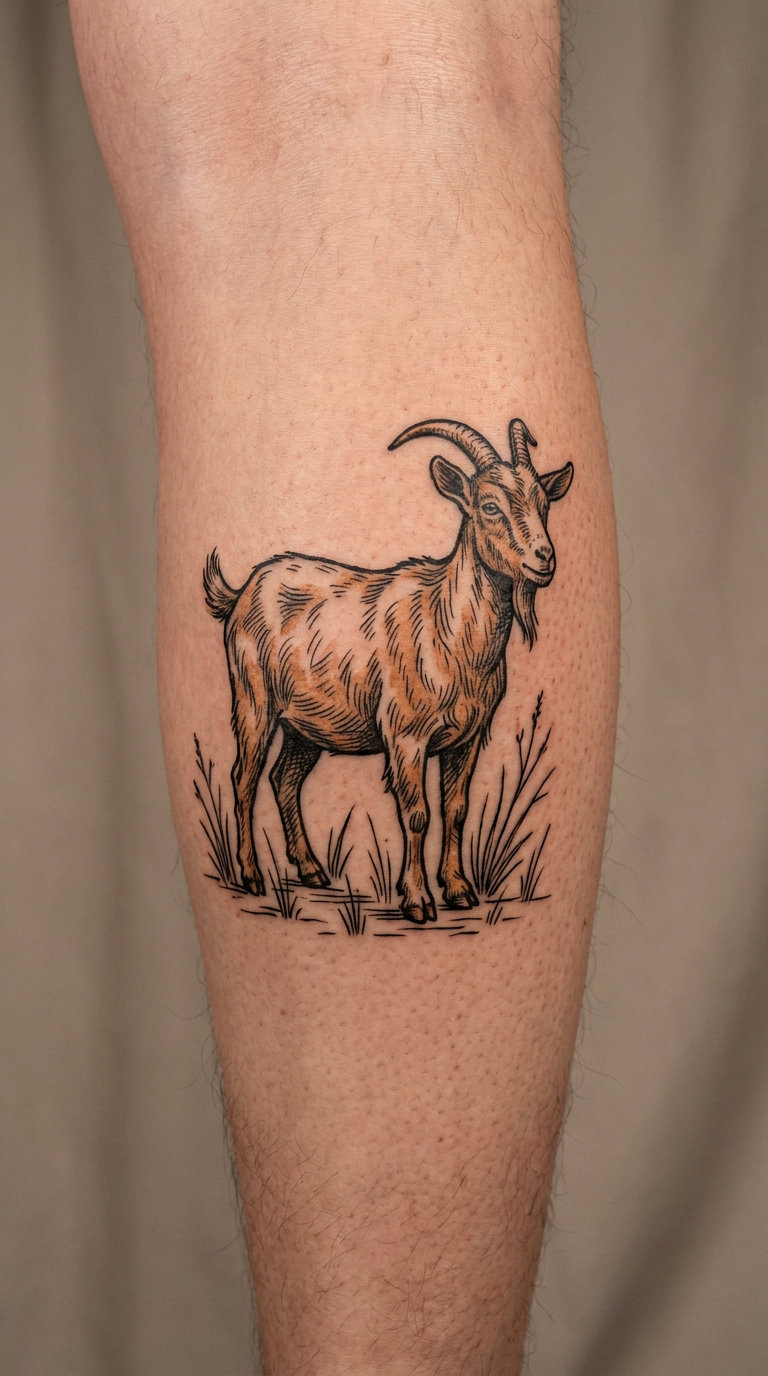
Full-body goat standing square to the viewer, coat texture suggested with short directional strokes, warm brown added over the black to suggest hair, and sparse grass tufts along the base. Wide-brim hat optional, saddle optional, and a weathered palette that leans into the ranch look rather than cartoon cowboy territory.
The western treatment is about the animal, not the mythology, so it stays grounded and readable. It works well for anyone who grew up around ranching or farm life.
Placement: calf, outer thigh, or the outer forearm. Size: 5-7 inches (13-18 cm) tall. Style: western illustrative, black with colour wash. Pain: high from duration, with a real sitting running two and a half to four hours. Calf work is steadier than the ribs because the leg stops moving. The brown wash needs longer healing and more care in the sun than pure black.
Make it yours: keep the background to open sky and a low horizon so the goat stays the subject, and have the coat colour matched to a real breed you like.
19. Goat Head with Starburst Background
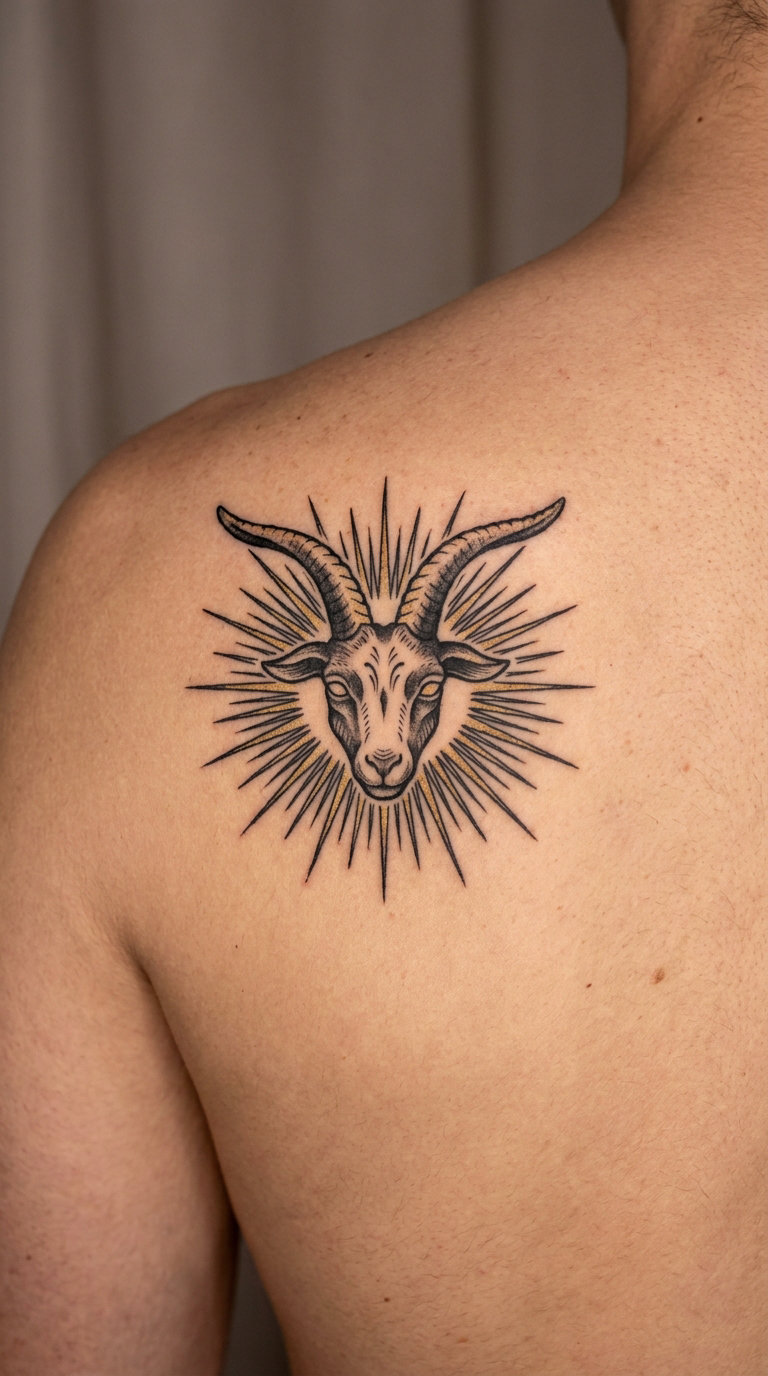
A simple forward-facing head in black line, ringed by short tapered rays radiating outward in gold. The rays stop at a defined edge so the whole thing reads as one contained object rather than a sunburst that eats the canvas.
Starbursts push energy outward, and combined with the goat’s stare it makes a small portrait feel louder than its size would suggest. It is a good piece for a shoulder blade where you want movement.
Placement: shoulder blade, upper back, or the outer shoulder. Size: 3.5-4.5 inches (9-11.5 cm) wide. Style: graphic line with a single colour. Pain: medium. The line work is quick; the gold rays are many separate small fills, which adds time and a full skin tone to heal. Gold lightens and shifts over the years, so pick a yellow-leaning gold if you want it to stay warm.
Make it yours: vary the ray lengths so the burst reads as directional, and point the longest rays toward an area of the body you want to draw attention to.
20. Full Goat in a Minimal Scene
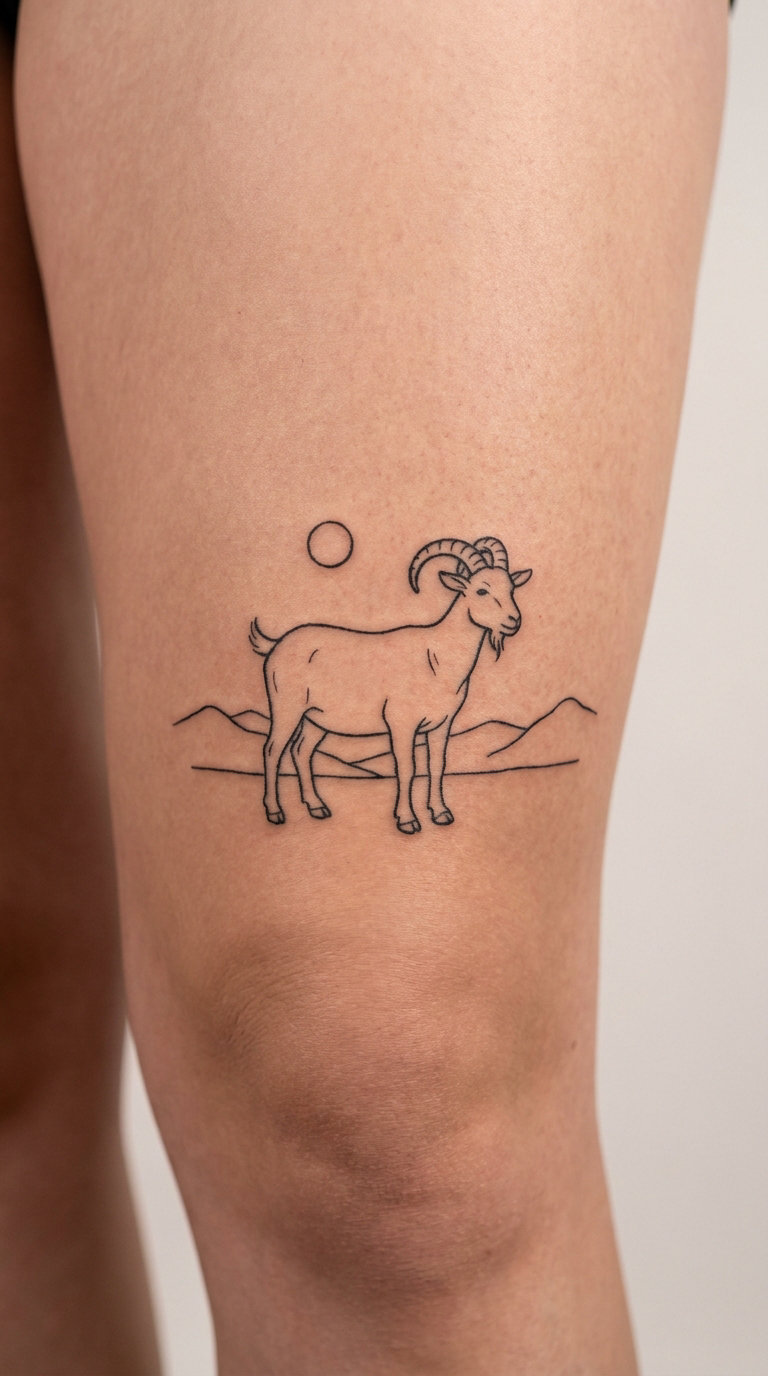
The widest composition in the set. The whole goat, head to hoof, in clean line, standing on low rolling hills with one small sun and nothing else. The hills and sky are kept deliberately plain, because the moment you add clouds, grass detail and a horizon texture, the animal stops being the subject.
Nothing here states a meaning more than any other goat tattoo. It is a design about the animal itself, and it is the one most likely to be recognised from across a room.
Placement: outer thigh, calf, or across the back. Size: 6-8 inches (15-20 cm) wide. Style: clean illustrative line with a light wash. Pain: high, mostly because of length. This is commonly a two session piece depending on your artist’s pace, and a thigh sitting runs long. Keep the line weight even rather than thin, and the goat will still read clearly in five years.
Make it yours: leave a bare patch of skin in the scene for a second small piece later, a moon or a matching goat that fills in once the first one has settled.
How to Choose the Right Design
Most people pick the design first and then discover the canvas is wrong for it. Reverse that. Start with the space you actually have, because a horn curve needs width more than it needs length, and a narrow forearm will flatten a wide portrait into something you did not ask for.
- Decide your honest minimum size first. If you can only comfortably work with 2 inches, the fine-line side profile, the mini head, the geometric version and the micro silhouette are your shortlist. Everything else will lose its detail.
- Pick the style before the subject. Bold outlines and flat black age best on arms and shoulders. Soft grey shading and colour need a spot with some flesh under them and a life where you can keep them out of the sun.
- Check the horn curve before you commit. Ask the artist to draw the horns alone at the size you are booking. If the curve reads clearly on its own, the rest of the goat will follow.
- Think about what you want it to say. A mountain goat on a peak says something different from a baby goat and clover, and both are the same animal. Decide whether you are going for grit, softness or plain stubbornness.
- Consider whether a first piece should be small. Most people who regret a tattoo regret the placement or the size, not the subject. A 2 inch forearm piece is a far easier first step than a 7 inch thigh scene.
- Look for a portfolio that proves the work. An artist who has tattooed goats before will have photographed one healed, not just fresh. Fresh work looks good on everyone. Healed work is the honest sample.
A note on the occult misread that shows up in almost every online discussion: a front-facing horned head reads as ceremonial to some viewers. A profile, a full-body goat, a mountain goat or a juvenile animal sidesteps that entirely, and the symbolism barely changes.
Cost and Session Time
Tattoo pricing in the US is almost always hourly rather than per design, and shop minimums apply even to small work. A single needle hour runs roughly 80 to 200 dollars depending on the city and the artist. Anything that takes under an hour still gets billed at the shop minimum, which in many studios is 100 to 150 dollars. So a small goat tattoo still costs a shop minimum, which is a short session rather than a cheap hour.
For sizing: a 1 to 2 inch single-line piece is a one sitting, usually under an hour. A 3 to 4 inch portrait with shading is a two to three hour sitting. Anything 5 inches and up, or a full composition with hills and sky behind it, is commonly split across two sessions of three hours each, with a heal in between. A 6 to 8 inch full-body piece is realistically a half day or more of work.
Two things move the price more than the subject does. Realism and heavy colour add hours, and a design that has to be redrawn to fit a small spot adds a design fee on top. Bold black line work is faster to tattoo and usually cheaper as a result, which is a legitimate reason to lean that way if you are working around a budget.
Ask for the total estimated hours and the hourly rate before you start, and ask what the shop minimum is. Both answers should come before the first line goes in.
Aftercare Basics
Always start from your artist’s aftercare instructions, because they will know how deep the work went and what they used. Everything below is general guidance on top of that.
- Follow your artist’s aftercare instructions first. Wash times and product choices vary with skin depth and ink type, and their guidance overrides anything general you have read.
- Wash gently, twice a day, for the first week or two. Lukewarm water, a fragrance-free wash, patted dry with a clean towel rather than scrubbed. The flaking stage is not supposed to itch badly, so ring the studio if it does.
- Moisturise thinly. A thin layer of unscented lotion a few times a day keeps the skin from tightening and cracking. If it looks shiny and wet, that is too much.
- Keep it out of the sun. UV fades both the black and any colour, and a calf or forearm design gets sun all year. Once healed, sunscreen on the area is the cheapest long-term protection there is.
- Wear loose clothing for the first two to three days. Tight fabric rubs against a fresh tattoo while it is still settling, especially on a thigh, calf or rib piece.
- Know the signs to contact the studio. Spreading redness, heat, swelling, warmth that builds, yellow-green discharge, or a fever. A hot spot and a dull ache that gets worse instead of better are both worth a call, and it costs nothing to ask.
- Do not soak, steam, or pick. No baths, hot tubs, swimming pools or saunas while the skin is still open, and leave any flaking skin alone. It comes off on its own in about a week.
Frequently Asked Questions
Do goat tattoos have a specific meaning?
A goat tattoo usually stands for resilience, determination, independence and stubborn persistence, because goats climb places nothing else can and refuse to move once they have settled. The style changes the tone: a mountain goat on a peak reads as ambition, a skull reads as memento mori, and a baby goat is usually a memorial. The meaning is a common reading, not a fixed rule, so the design does not have to carry it.
What is the smallest practical goat tattoo size?
Around 1.5 inches for a readable goat head, and about 1 inch if you go for a solid silhouette rather than line work. Below that, the horn tips are the first thing to blur and the whole animal turns into a smudge within a few years. If you want it smaller, ask for a silhouette or a horn-only design, which hold their shape at tiny sizes. Never squeeze a detailed portrait into a small spot.
Are goat tattoos painful on the wrist or ribs?
The inner wrist ranks as one of the more sensitive spots, because the skin is thin over bone and you will feel every pass. The ribs hurt more through duration than intensity, because the breathing makes the area move and the skin is stretched. Collarbone and ankle work is sharp but brief. A forearm, upper arm, calf or thigh sitting is the comfortable option, and pain drops off sharply after the first ten minutes.
Which goat tattoo style lasts the best?
Bold black linework and flat black last the longest, which is why traditional and blackwork goat heads still look sharp decades later. Silhouettes and geometric shapes with thickened lines are close behind. Styles that age sooner include hairline fine line on the inner arm, dotwork, and grey shading on high-exposure spots like the calf. Whichever style you pick, ask the artist not to go thinner than the detail really needs.
Can a goat tattoo be personalized without adding too much detail?
Yes, and the small additions are usually the ones that matter. A date in a banner, a name in script underneath, one flower with a specific meaning, a colour accent on the eye, or a single star in a pattern that only you can read will carry a whole story without crowding the animal. The rule is to add one personal element, not three, and to keep the horn silhouette and eye clear so the goat still reads first.
For a first tattoo, the mini goat head on the inner wrist or the fine-line side profile on the forearm are the two that get the most repeat requests. Both are small, both finish inside a single sitting, and both leave enough room to add something bigger later. If you already have line work and want the goat to carry more, the charging ram or the skull in black and grey give you a piece with real presence, at the cost of a long sitting and a much bigger commitment. Pick the size you can live with, and take the horn curve to your artist as a drawing request rather than a finished design, so they can set it for your placement.