
22 Comet Tattoo Ideas (October 2026): Best Small and Bold
These 22 comet tattoo ideas cover everything from a fine-line mark behind the ear to a full colour piece across the back, and each one comes with a realistic size, placement and pain note so you know what you are actually booking. A comet is more specific than a shooting star: it has a bright head, a soft glow and a tail that streams behind it, which is why it reads as a moving thing rather than a falling star.
What makes a comet motif work on skin is the direction of travel. A long diagonal tail gives a flat area movement, a compact head with a short tail fills awkward negative space, and a shaded head with scattered stardust holds up when the design is small. Below I break the list down by style and placement, then cover how to choose one, what a session looks like and how to care for it. Last updated October 2026.
22 Comet Tattoo Ideas: Quick Guide
| Idea | Style | Best placement | Size | Pain |
|---|---|---|---|---|
| 1. Fine-Line Shooting Comet Behind the Ear | Fine line | Behind the ear | 1.5 to 2.5 inch | Low to medium |
| 2. Minimal Black Comet on the Wrist | Minimal linework | Inner wrist | 1.5 to 2 inch | Medium |
| 3. Gradient Comet with a Starry Trail | Black and grey wash | Inner forearm | 3 to 5 inch | Medium |
| 4. Traditional Flame Comet | Traditional colour | Upper arm | 3 to 4 inch | Medium |
| 5. Watercolor Rainbow Comet | Watercolour | Shoulder cap | 3 to 5 inch | Medium |
| 6. Dotwork Comet and Orbit | Dotwork | Upper back | 4 to 6 inch | Low |
| 7. Blackwork Comet with a Long Tail | Blackwork | Outer forearm | 4 to 7 inch | Medium |
| 8. Micro-Realism Comet with a Crescent Moon | Micro-realism | Inner arm | 2 to 3 inch | Medium |
| 9. Neon Comet’s Tail | Bright colour | Upper arm | 3 to 5 inch | Medium |
| 10. Comet Shooting Across the Collarbone | Fine line | Collarbone | 3 to 4 inch | Medium to high |
| 11. Small Comet Behind the Finger | Micro fine line | Side of finger | 0.75 to 1 inch | High |
| 12. Comet with a Botanical Flame Tail | Illustrative colour | Forearm | 3 to 5 inch | Medium |
| 13. Celestial Comet and Constellation | Fine line | Upper arm | 3 to 5 inch | Medium |
| 14. Retro Atomic Comet | Mid-century graphic | Calf | 2.5 to 4 inch | Medium |
| 15. Black Comet with Negative-Space Stars | Blackwork | Upper arm | 3 to 5 inch | Medium |
| 16. Fine-Line Comet on the Rib | Fine line | Ribcage | 2 to 3 inch | High |
| 17. Painterly Comet with a Galaxy Tail | Painterly colour | Thigh | 5 to 8 inch | Medium |
| 18. Minimal Comet with Two Tails | Minimal linework | Ankle | 1.5 to 2.5 inch | Medium |
| 19. Ornate Comet with a Celestial Frame | Ornate illustrative | Upper back | 5 to 7 inch | Medium |
| 20. Small Red Comet Accent | Minimal with colour | Inner arm | 1.5 to 2 inch | Medium |
| 21. Geometric Comet Made from Lines | Geometric | Forearm | 3 to 4 inch | Medium |
| 22. Large Colour Comet on the Back | Large colour | Upper back | 8 to 12 inch | Medium |
1. Fine-Line Shooting Comet Behind the Ear
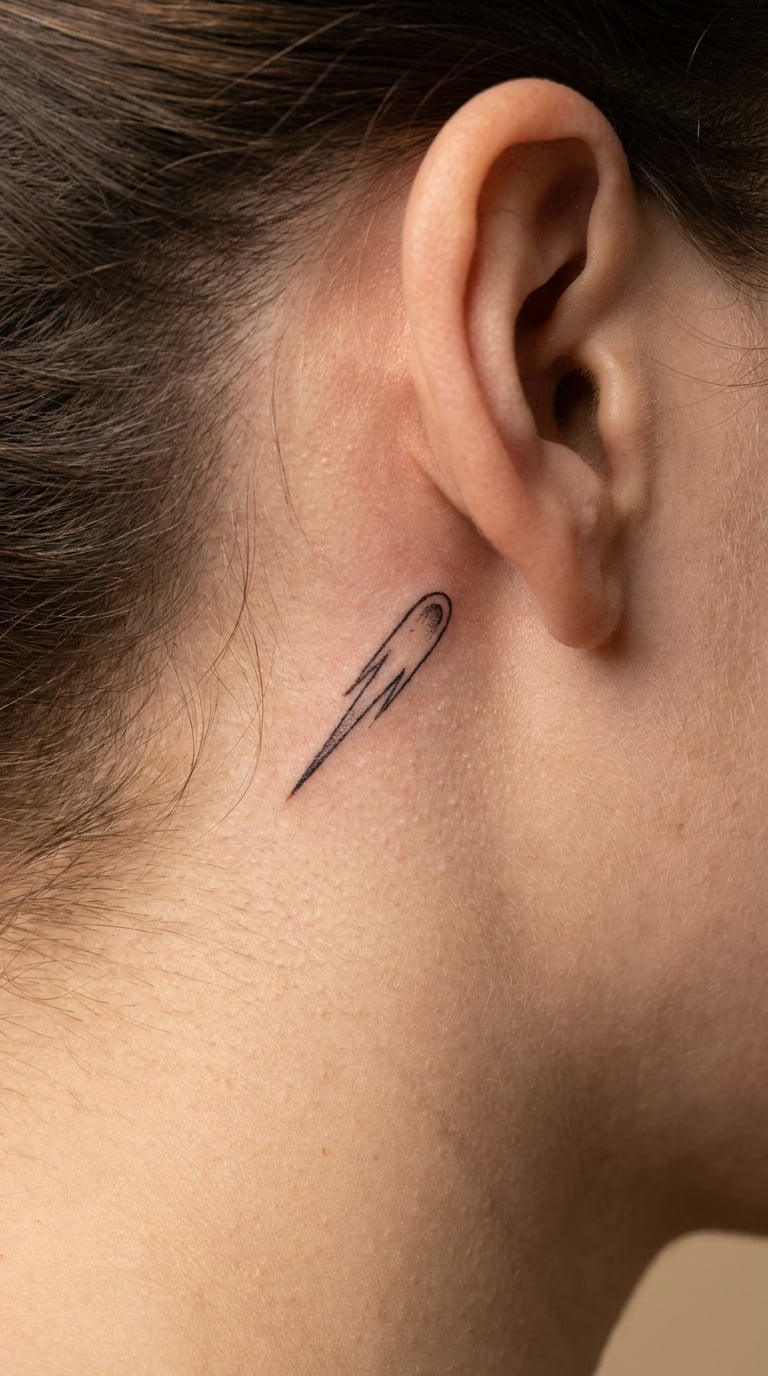
A fine-line comet sits well behind the ear because the tail has somewhere to run: down the neck, or up toward the hairline if you angle it the other way. The head is a small filled circle with a soft linework halo, and the tail is a pair of single-needle lines that taper to nothing, with two or three motion strokes beside it.
People pick this version when they want a space tattoo that only close friends notice. It carries the same reading as any comet: something that passed through, and the wish to mark it.
Placement: Behind the ear, neck, or high on the shoulder. Size: 1.5 to 2.5 inch (4 to 6 cm) across. Style: fine line. Pain: low to medium, though skin here feels thin and the tail can drag if it creeps toward the neck.
Make it yours: Angle the tail away from the ear and add a single tiny star where it ends, so the two elements read as one shape.
2. Minimal Black Comet on the Wrist
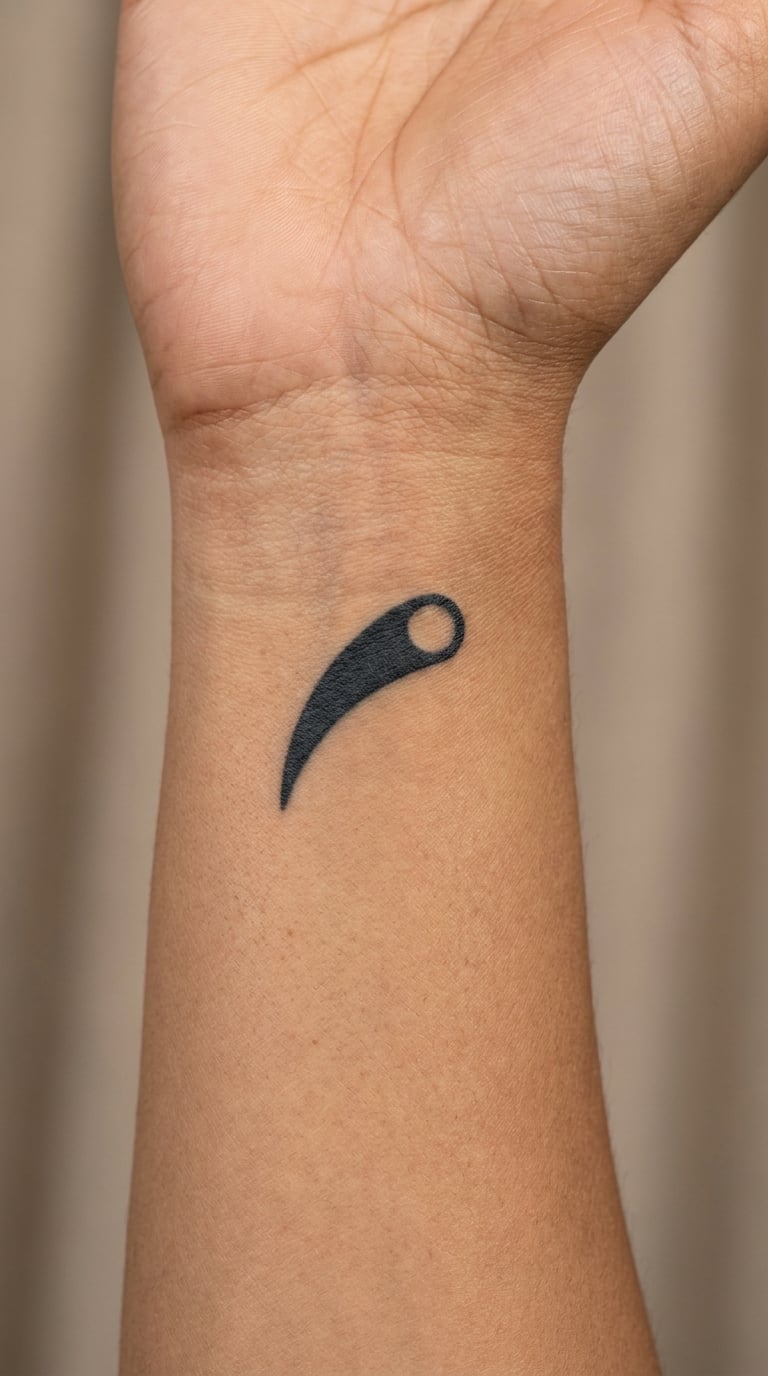
This is the version most people picture when they say small comet tattoo. One solid black head, a short curved tail of two strokes, no shading at all. Because the head is filled rather than outlined, it stays crisp for years, which is exactly what an outline-only head does not do.
It suits a first tattoo well: quick to draw, quick to heal, and it holds a bold shape at a small scale. A wrist comet reads as deliberate rather than decorative.
Placement: Inner wrist, above the wrist crease. Size: 1.5 to 2 inch (4 to 5 cm). Style: minimal linework with solid fill. Pain: medium, mostly from the wrist bone and the inner arm nerves. Expect a bruised look for a week or two.
Make it yours: Use a date in tiny numerals hidden inside the curve of the tail, or make it a matching piece with the second comet pointing the other way.
3. Gradient Comet with a Starry Trail
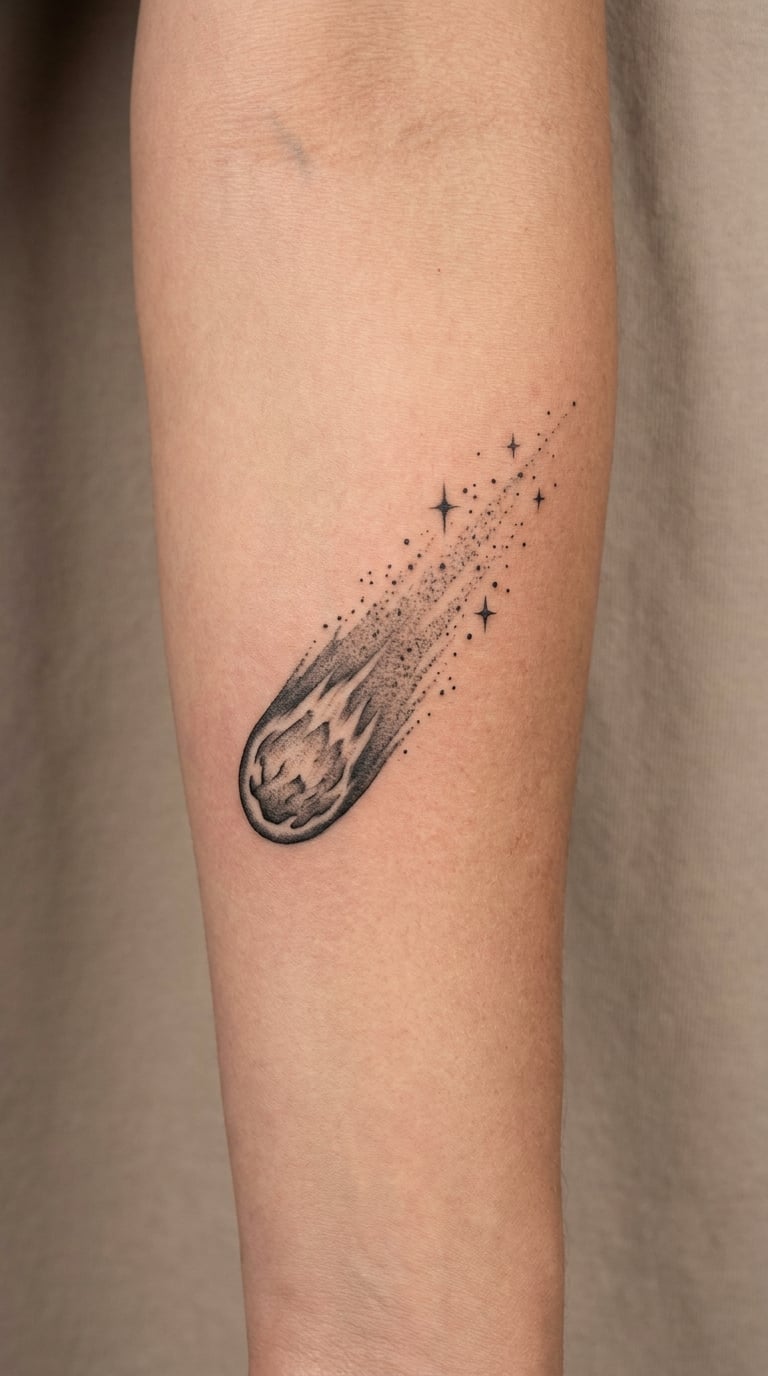
Here the head is shaded from a dark core into a pale halo, and the tail dissolves from solid grey into loose grey powder that ends in a scatter of small stars. The fading is what sells it: a tail that stays equally dark from end to end looks like a paint stroke, not like something evaporating.
People choose the gradient version when they want depth without full colour. It also handles a medium-large canvas better than linework, because the shading does the visual work on its own.
Placement: Inner forearm, calf, or along the shoulder blade. Size: 3 to 5 inch (8 to 13 cm). Style: black and grey wash with fine star scatter. Pain: medium and even across the area.
Make it yours: Ask for the stars to sit thinner at one end, so the density gradient quietly records a date, a name, or the year a comet was visible.
4. Traditional Flame Comet
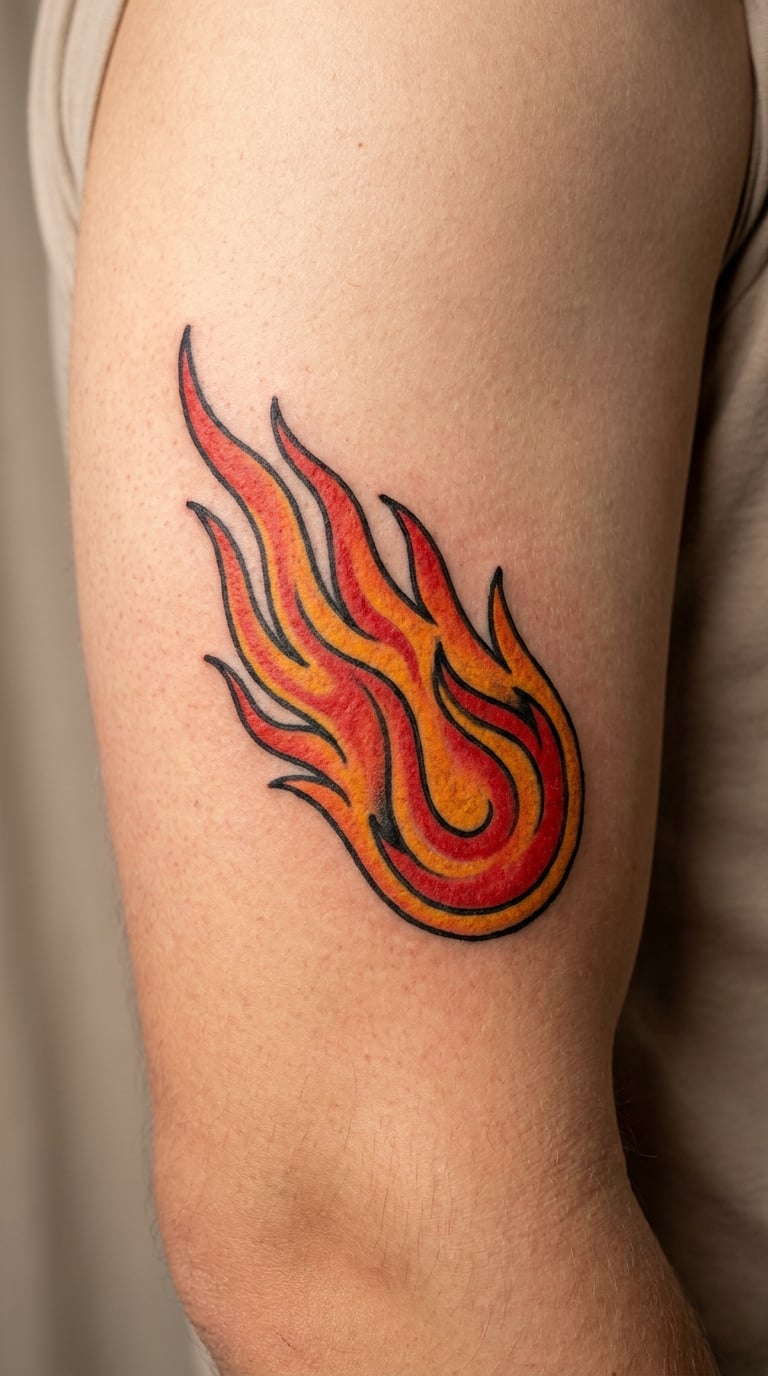
Traditional comet tattoos go back to the old sailor and carnival tradition of comets as the symbol for speed. This version is a bright yellow-white head, a tail of red and orange flame with heavy black outlines, and a few licks of colour breaking loose behind the main shape.
It is a loud, cheerful design that reads instantly from across a room. If you already have bold work, this fits the same language rather than fighting it.
Placement: Upper arm, forearm, chest. Size: 3 to 4 inch (8 to 10 cm) for the head and flame alone. Style: traditional colour. Pain: medium. Colour packing on the head is the stingy part.
Make it yours: Tuck a small banner of script under the flame with a year or a short word, the way traditional pieces often carry.
5. Watercolor Rainbow Comet
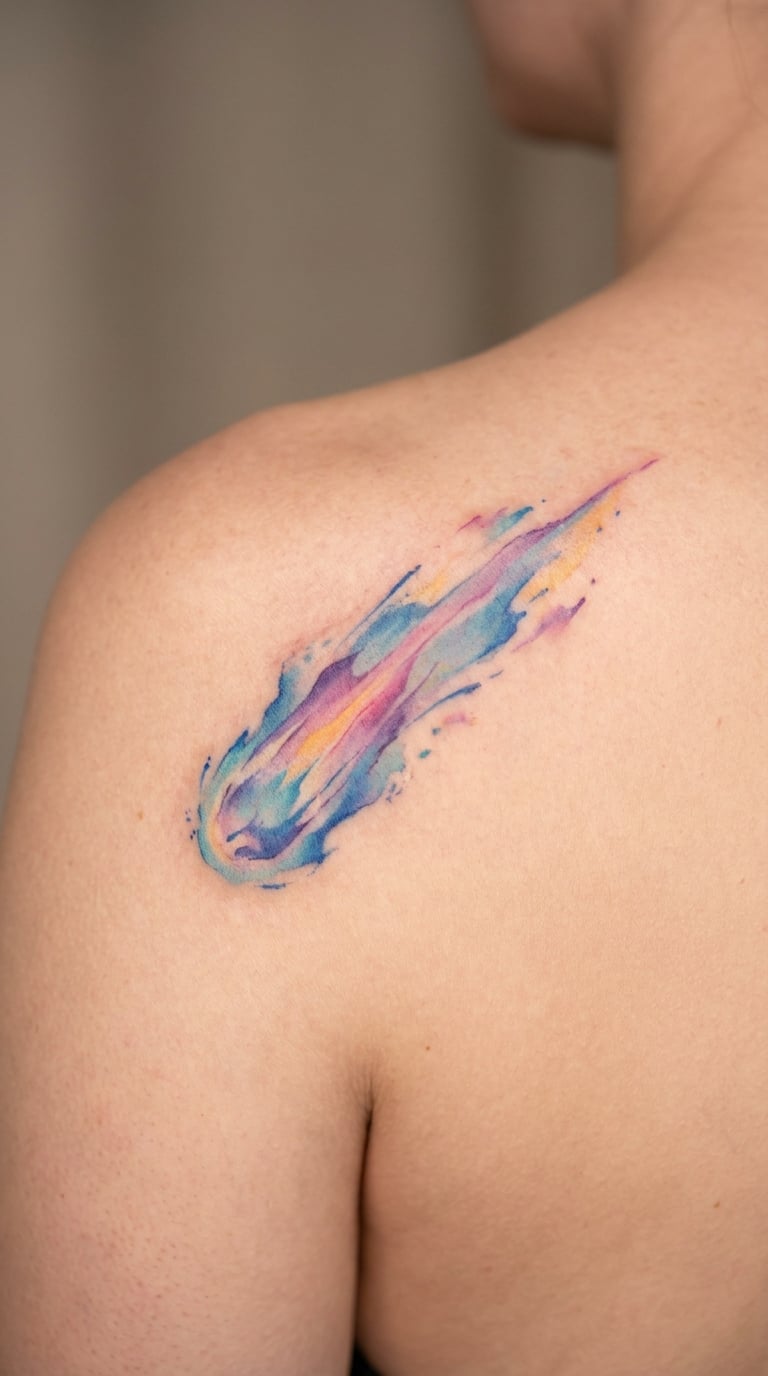
Watercolour comets are built from a saturated head with colour bleeding outward into a translucent tail, and the edges are deliberately unfinished so the ink looks like it settled on wet paper. Some artists add hard black linework for the head so the design has one sharp anchor inside all that softness.
The appeal is expression rather than precision. It suits people who want colour work and do not mind that the design is a loose impression of a comet rather than a study of one.
Placement: Shoulder cap, upper arm, ribcage. Size: 3 to 5 inch (8 to 13 cm). Style: watercolour. Pain: medium. Expect a longer session because the colour is layered in passes.
Make it yours: Choose your own colour order in the tail, or pick a palette that matches another piece you already have so the two read as a pair.
6. Dotwork Comet and Orbit
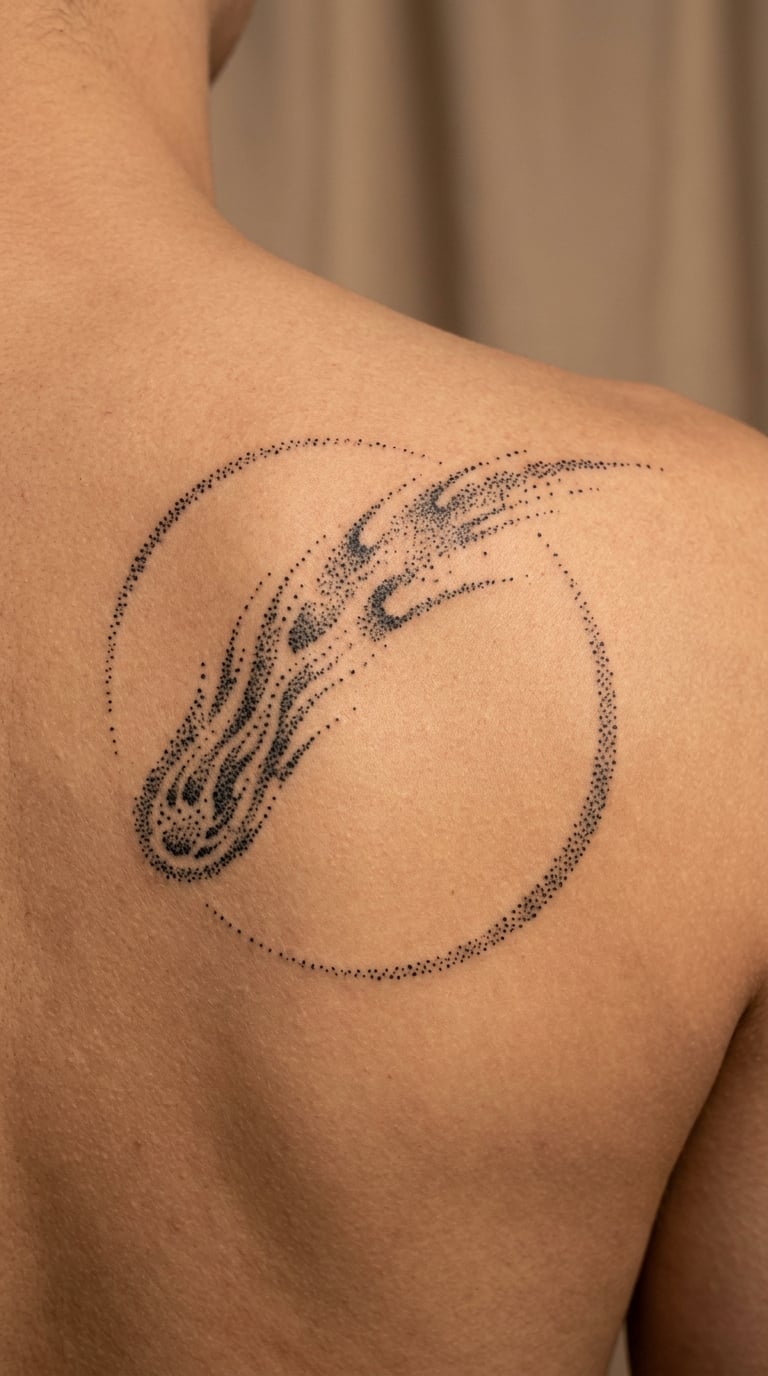
Dotwork gives a comet texture without colour: the head is a cluster of tight dots that thins out, and the tail becomes a dotted path rather than a solid streak. Wrapping the whole thing in a partial orbit ring gives the composition a structure that a lone comet usually lacks.
This is a good pick for a large flat area like the upper back, where a single gradient comet can look thin and unfinished. The ring fills the empty half of the design.
Placement: Upper back, sternum, thigh. Size: 4 to 6 inch (10 to 15 cm) including the ring. Style: dotwork and stippling. Pain: low on the back, and the dotted shading actually feels less intense than solid black.
Make it yours: Make the orbit ring an ellipse rather than a circle, and place your birth sign’s stars along it.
7. Blackwork Comet with a Long Tail
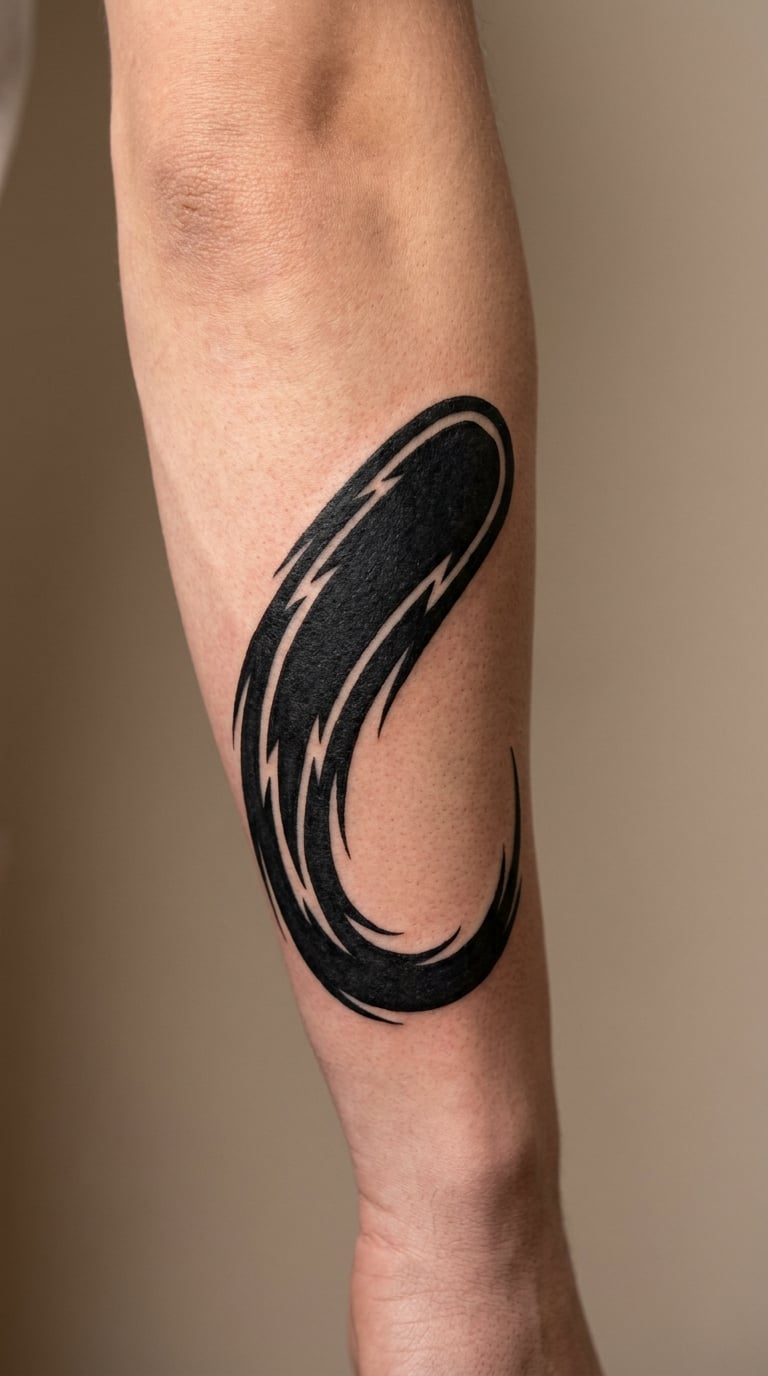
This one is a solid black mass with a tail that sweeps a long way across the arm, cut by a few sharp uninked lines that separate the stream into ribbons. The negative space is doing the work: those white slivers are what stop a big black shape from turning into a blob.
It is the boldest comet on this list and the one that holds up best at a large size. If you want people to see it from a distance, this is the version.
Placement: Outer forearm, calf, shoulder. Size: 4 to 7 inch (10 to 18 cm). Style: bold blackwork. Pain: medium, longer session, and the solid areas take a while.
Make it yours: Let the tail run past the wrist or down past the elbow so it follows the limb instead of ending in the middle of it.
8. Micro-Realism Comet with a Crescent Moon
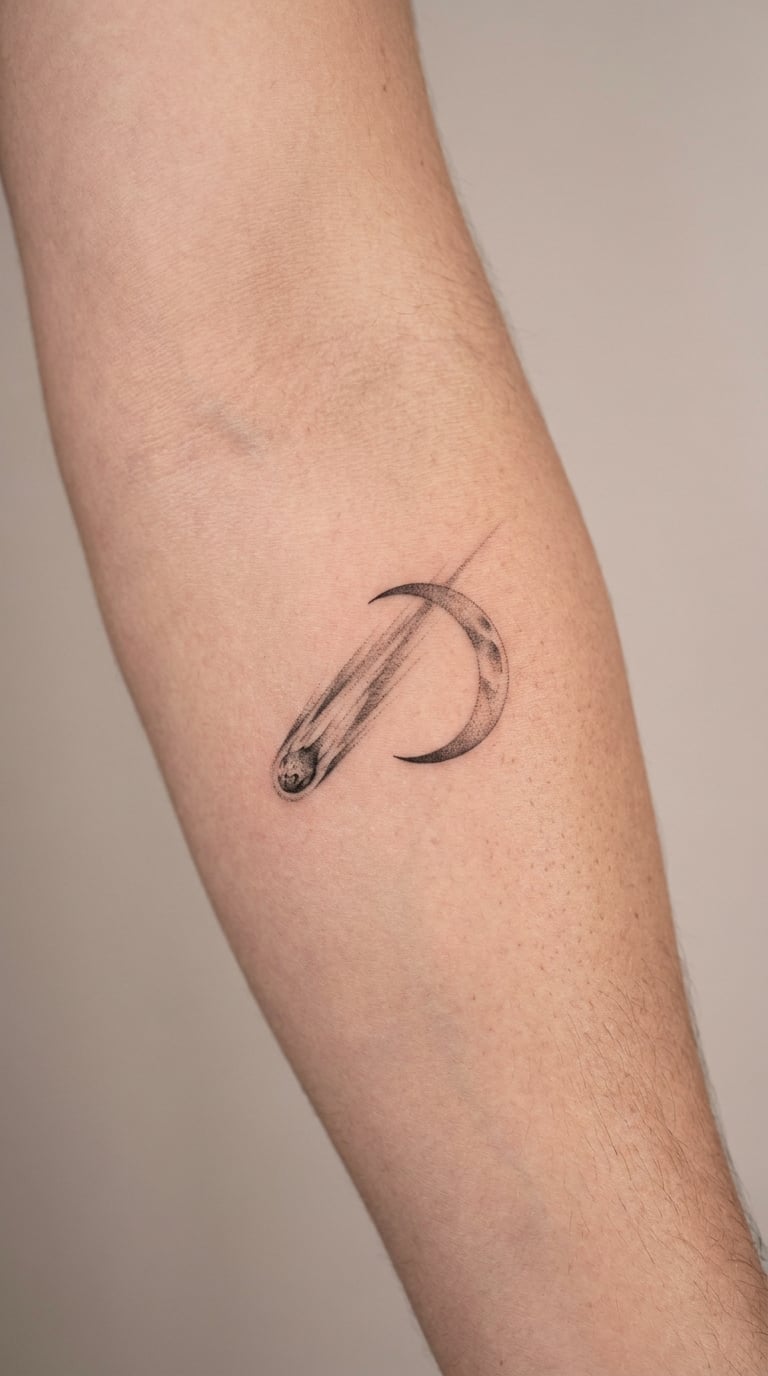
A micro-realism comet is drawn with soft grey shading, a rounded head, and a plume of dust that looks sprayed rather than drawn. Pairing it with a crescent moon gives the piece a second focal point and a reason for the comet to be in frame.
Two celestial bodies in one small design is how people mark a relationship, a parent, or a period of their life. It is the version to pick if you want the design to carry a story rather than a mood.
Placement: Inner arm, ribcage, behind the ear. Size: 2 to 3 inch (5 to 8 cm) for both elements. Style: micro-realism, black and grey. Pain: medium.
Make it yours: Add a faint star field behind both bodies, kept sparse, so the moon and comet stay the only two things you notice.
9. Neon Comet’s Tail
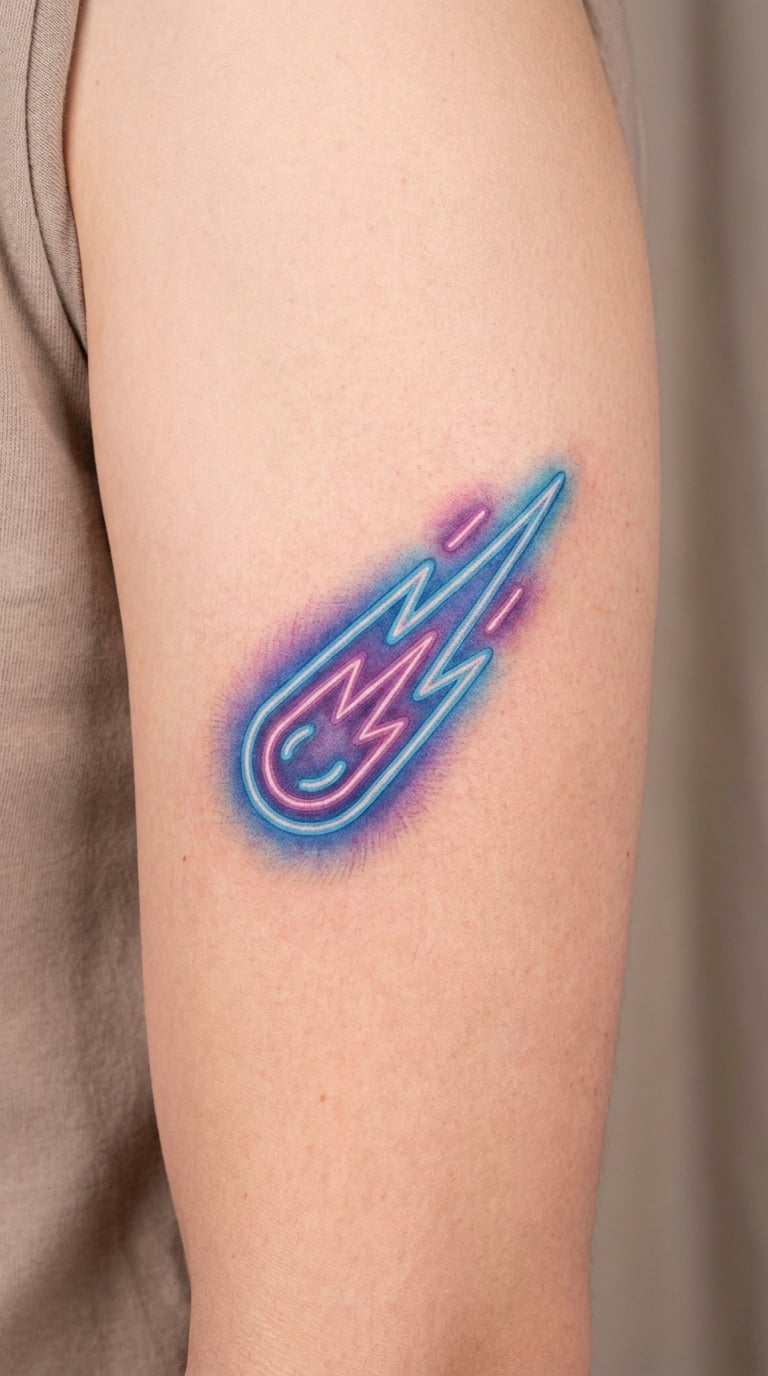
The neon comet is a recent direction: a bright core with an electric blue, violet and pink halo and a saturated tail that looks like it is emitting light. Artists usually build it with a soft white or pale yellow core, then layers of bright colour pushed outward with a low-tension pass.
It is a genuinely colourful piece without the weight of a full traditional design, which is why it works well as the one bright tattoo in an otherwise blackwork-heavy body of work.
Placement: Upper arm, thigh, back. Size: 3 to 5 inch (8 to 13 cm). Style: bright illustrative colour. Pain: medium, and bright light pigments need more passes so the session runs longer.
Make it yours: Keep the core pale and let the colour do the work, then repeat one of the three hues somewhere else on your body so the eye connects them.
10. Comet Shooting Across the Collarbone
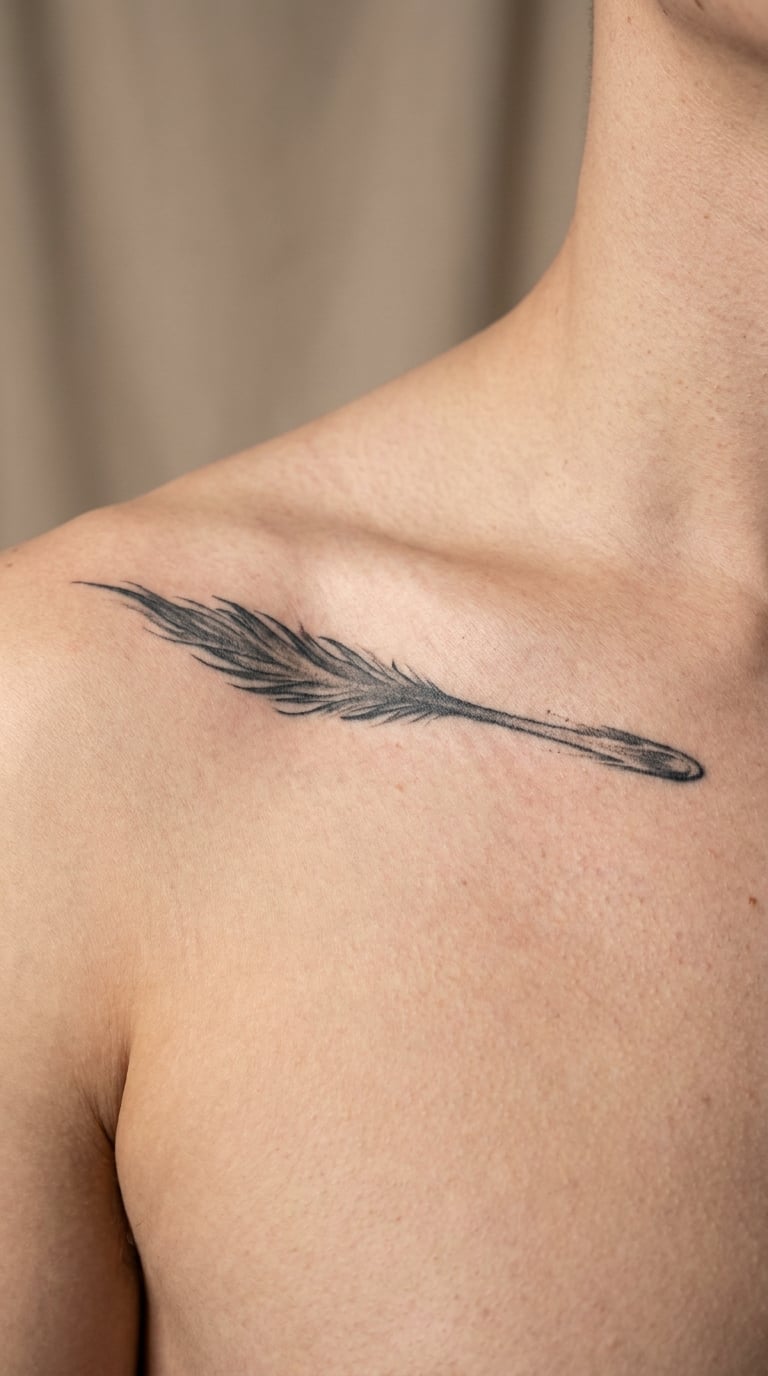
A collarbone comet is drawn horizontally so the tail runs parallel to the bone, and the artist uses the slope of the collarbone to make the comet look like it is travelling across it. Keep the line thin here; anything heavier crowds the bone and looks cramped.
Collarbone pieces are chosen for visibility as much as size, so this is a design that shows in ordinary clothes. It reads as movement, which suits people who want motion in a design rather than a static symbol.
Placement: Collarbone, sternum, shoulder line. Size: 3 to 4 inch (8 to 10 cm) along the bone. Style: fine line, black and grey. Pain: medium to high. The collarbone is a bony spot and people feel this one more than the arm.
Make it yours: Add a matching comet on the other collarbone, angled toward the first, so the two travel toward each other.
11. Small Comet Behind the Finger
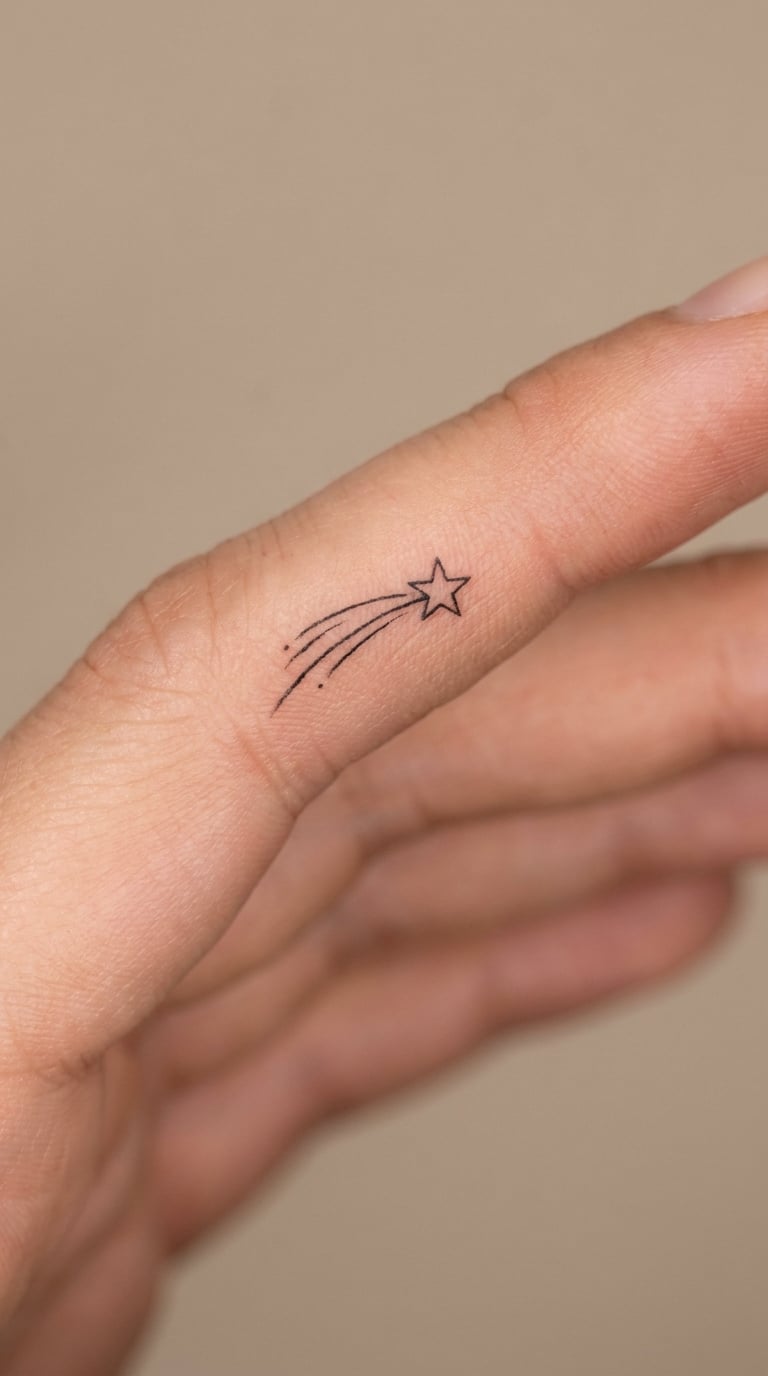
The smallest comet on the list is a tiny filled head with a two-stroke tail running along the side of a finger, usually no larger than a fingernail. It works because the hand already has lines and angles that a comet tail can follow.
People choose it for the subtlety and for the fact that a small first tattoo on the hand is hard to regret. Be honest about the trade-off before you commit: hands age faster than almost anywhere else, and a design this small will soften over the years.
Placement: Side of the finger, knuckle, web of the thumb. Size: 0.75 to 1 inch (2 to 2.5 cm). Style: micro fine line with a solid head. Pain: high. Fingers have a lot of nerve and bone in very little space.
Make it yours: Let the tail follow the natural curve of the finger toward the knuckle, and add a matching micro comet on a sibling or a partner’s hand.
12. Comet with a Botanical Flame Tail
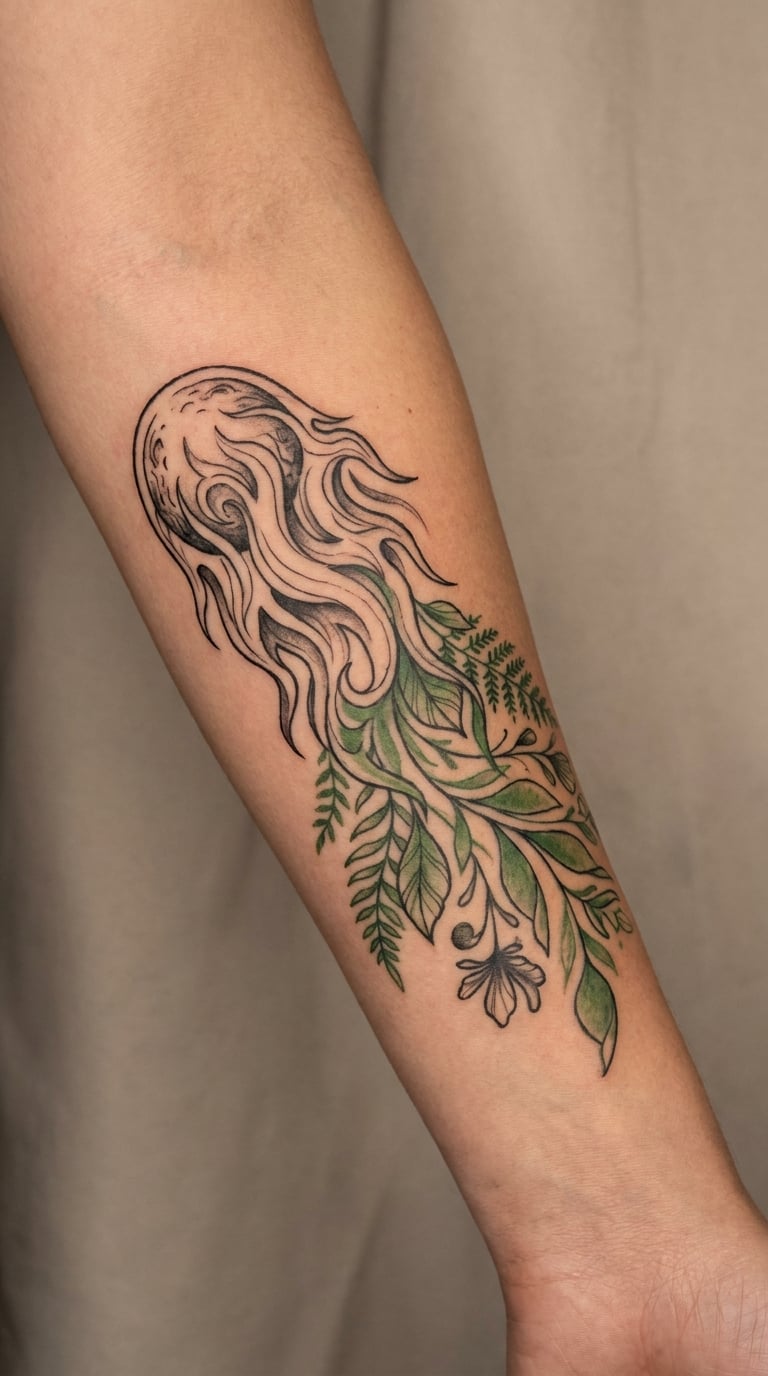
This design treats the tail as both flame and plant: the head is a black-ink comet, and behind it the flame breaks into leaves, stems and small petal shapes in muted green and orange. The transition is the whole point, so ask for the two textures to overlap rather than sit in separate zones.
It is a design for people who want a space tattoo that does not read as pure space. The botanical half usually carries the personal meaning, often a plant tied to a place or a person.
Placement: Forearm, calf, shoulder. Size: 3 to 5 inch (8 to 13 cm). Style: illustrative with fine colour. Pain: medium, and the fine stem work in the tail takes patience in one session.
Make it yours: Use a plant that means something to you, a specific branch or leaf shape, so the tail is not just decoration.
13. Celestial Comet and Constellation
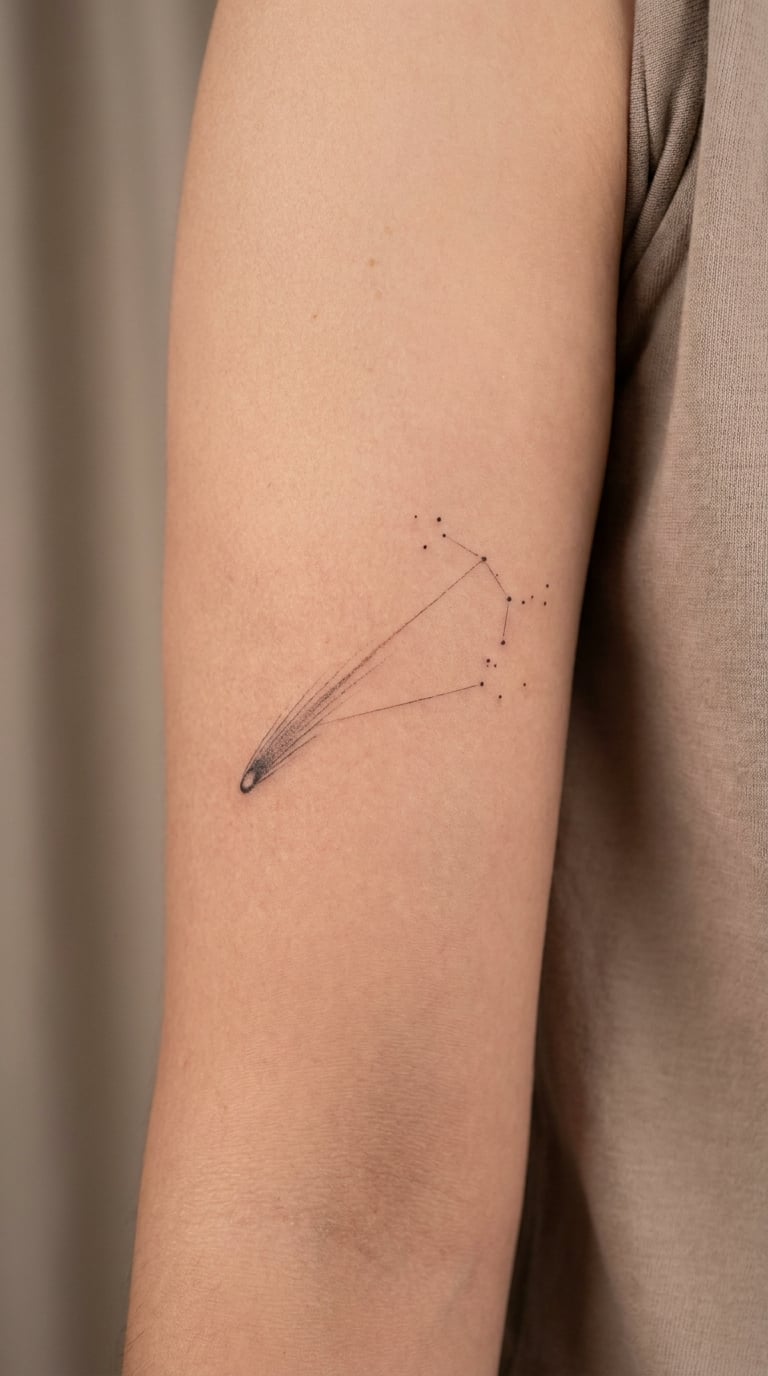
A constellation comet links the head and tail to a small set of stars with hairline connecting lines, so the design reads as a map rather than a doodle. The stars are dots joined by thin lines in the traditional stick-figure style, placed close enough that the eye follows the path from comet to constellation.
This is the version people choose for a birth year, a birth place’s night sky, or the constellation that mattered to someone they are marking. The meaning comes entirely from which stars you pick.
Placement: Upper arm, back, thigh. Size: 3 to 5 inch (8 to 13 cm) for the whole composition. Style: fine line, single needle. Pain: medium.
Make it yours: Pick a constellation with a reason behind it, and ask the artist to keep the connecting lines slightly uneven so it looks hand-drawn rather than printed.
14. Retro Atomic Comet
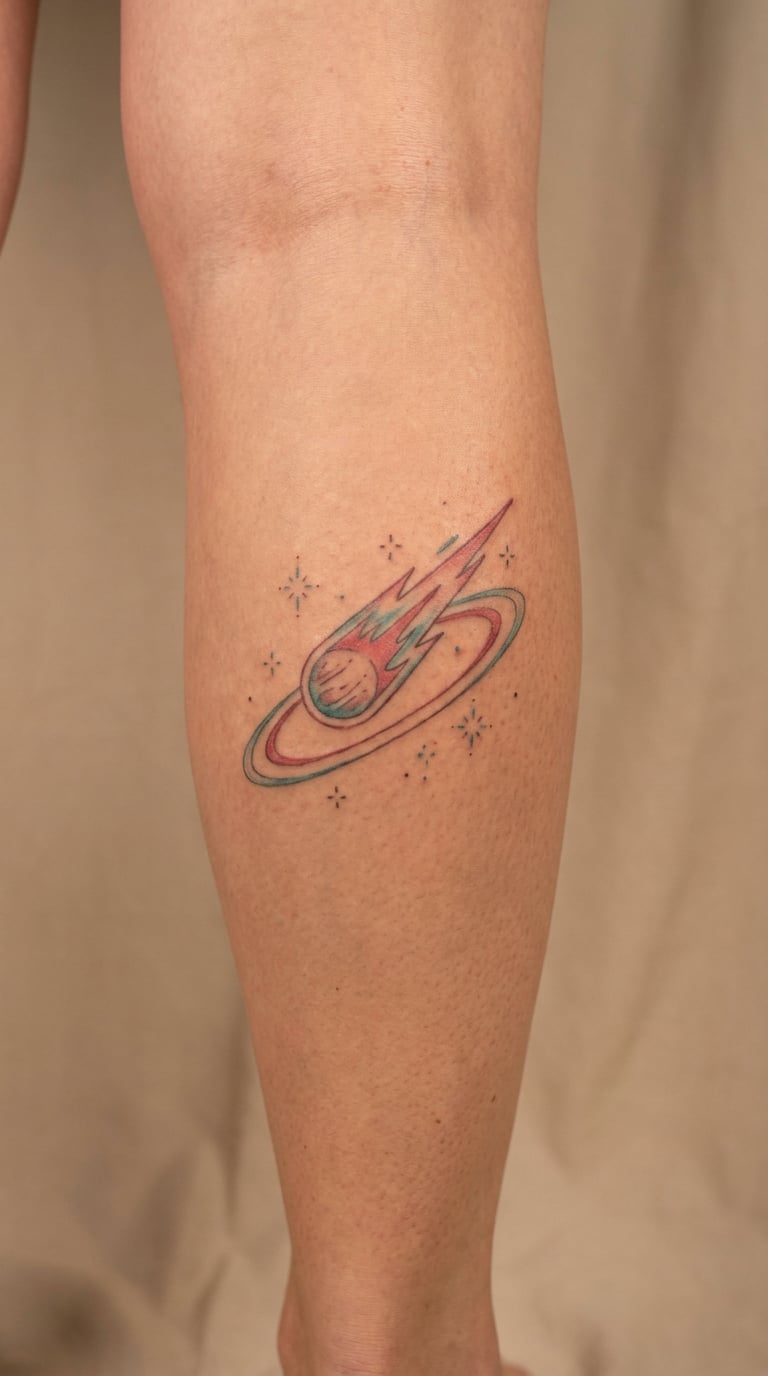
The retro comet borrows mid-century science illustration: a clean comet shape ringed by one or two thin orbit ellipses, with small starbursts and a limited two-colour palette of red and teal on a cream or unpainted background. Nothing is shaded. Everything is a clean shape with a hairline outline.
It suits people who like vintage graphics, and it works nicely as a matching pair because each side can carry a different element of the same scene. The style also ages well, since flat colour with no gradients loses very little definition.
Placement: Calf, forearm, upper arm. Size: 2.5 to 4 inch (6 to 10 cm). Style: mid-century graphic. Pain: medium.
Make it yours: Lock it to two colours you already own elsewhere in your tattoos so the piece looks like part of one collection.
15. Black Comet with Negative-Space Stars
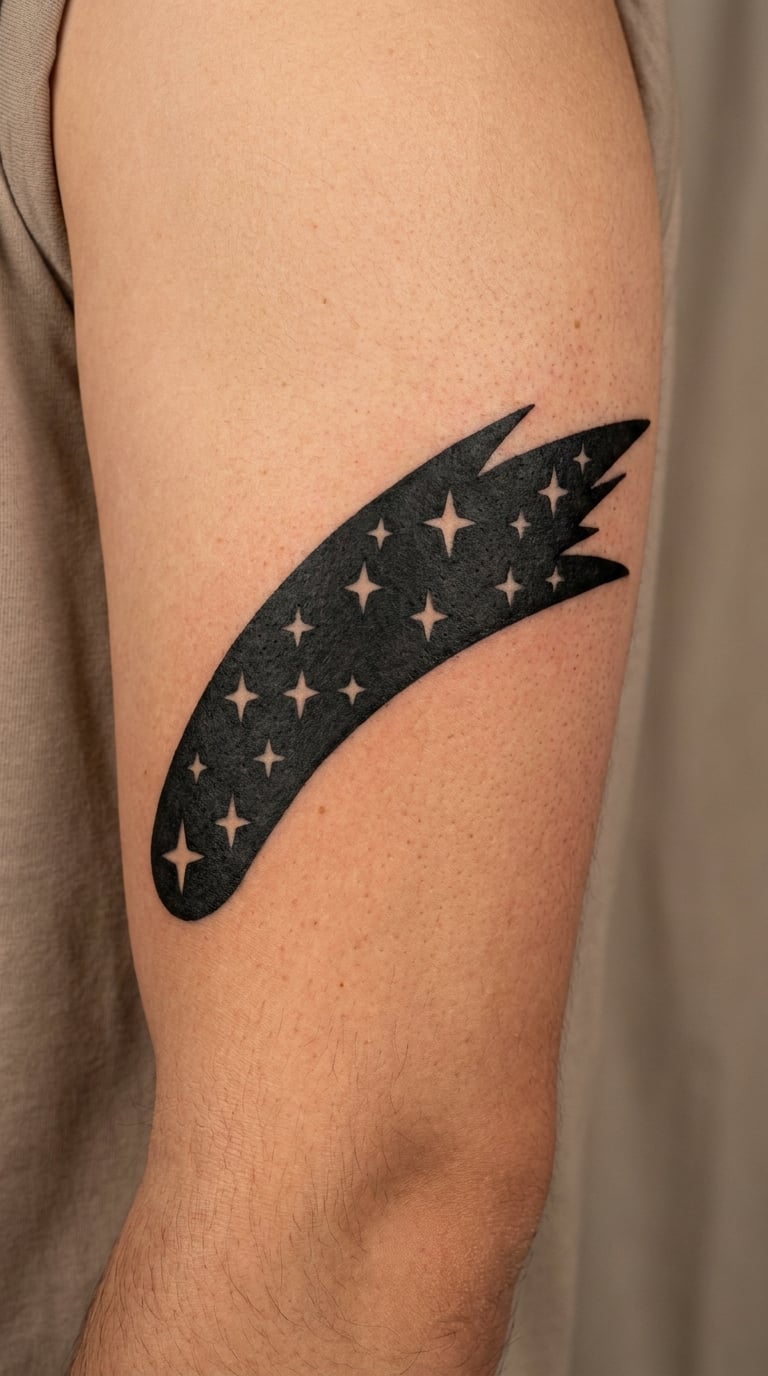
Here the comet head and tail are a solid black shape, and the stars are left as bare skin cut into it. Nothing is drawn inside the stars; they are holes in the ink. That single decision gives a flat black design more internal detail than most coloured versions.
People choose it when they want a bold design that is technically simple but does not look empty. The star shapes can be scattered along the tail or stacked at the wide end.
Placement: Upper arm, chest, outer thigh. Size: 3 to 5 inch (8 to 13 cm). Style: blackwork with negative space. Pain: medium.
Make it yours: Vary the star sizes so the biggest ones sit at the head and the smallest fade out along the tail, which keeps the design moving.
16. Fine-Line Comet on the Rib
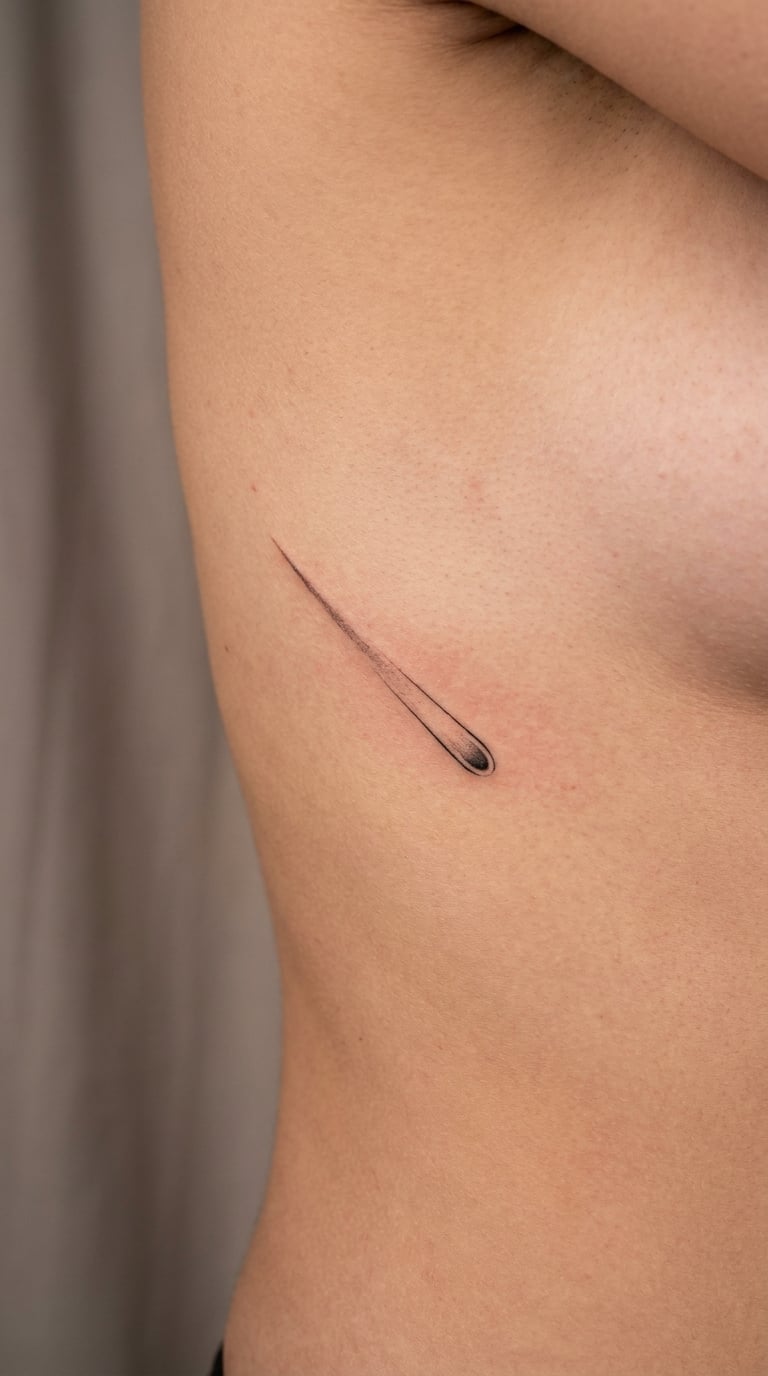
A rib comet is drawn on a diagonal so the tail follows the curve of the ribs rather than fighting them. The design stays small and delicate, with a single-line tail that fades out, and the head no larger than a pencil eraser.
Side placements get chosen for the way they look on the body, not just the meaning. A diagonal comet reads as movement and it fills the narrow wedge of space that runs down the side.
Placement: Side ribs, under the breast, along the flank. Size: 2 to 3 inch (5 to 8 cm). Style: fine line. Pain: high. The ribs are bony, the skin is thin, and breathing makes the surface move under the needle.
Make it yours: Angle it to follow your natural rib line rather than sitting horizontally, and add two or three stars at the tail end for balance.
17. Painterly Comet with a Galaxy Tail
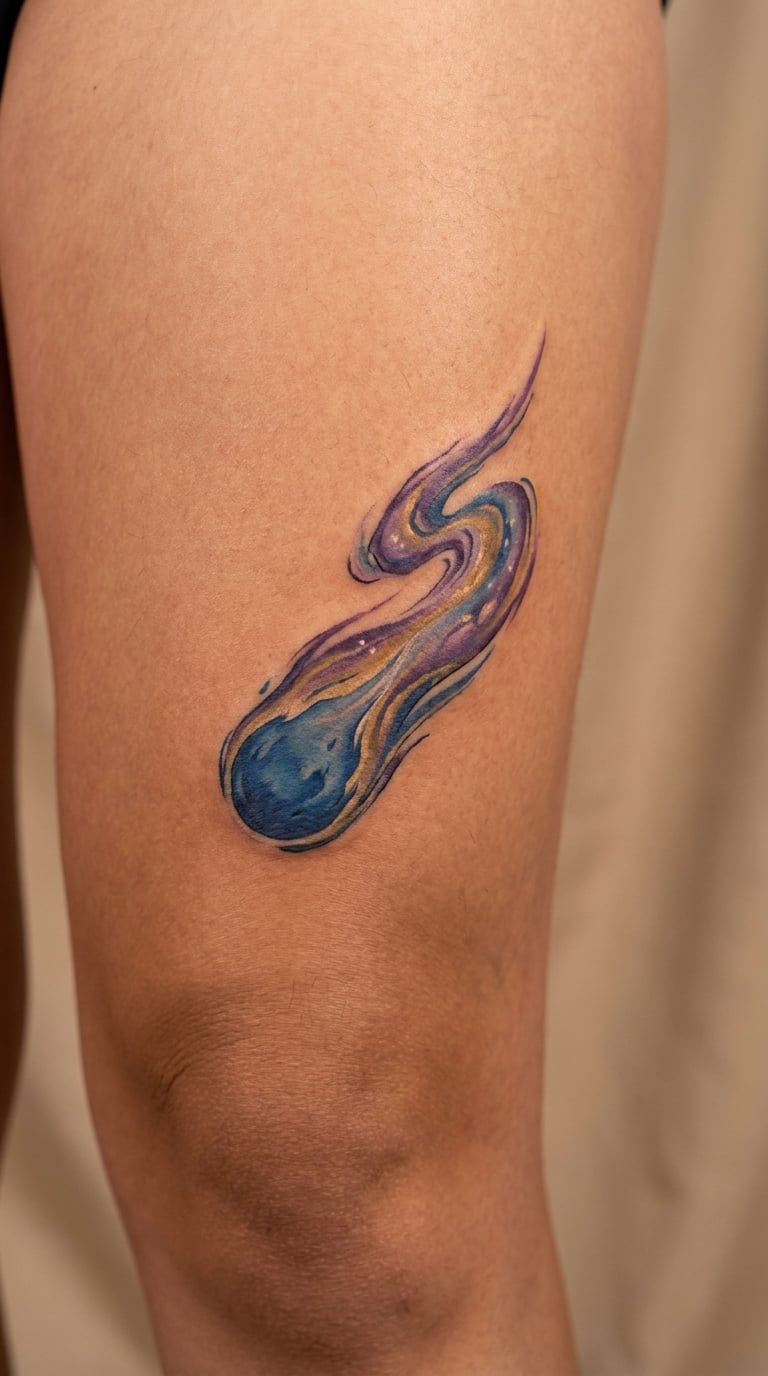
A painterly comet has a deep blue head, a soft corona, and a tail that opens into purple, gold and blue clouds rather than streaming lines. It behaves more like a landscape than a diagram, with colour moving across the skin in broad soft strokes.
This is a statement piece for a large flat area. It suits a thigh or an upper back, where there is room for the colour to travel, and it works well as the centre of a larger composition rather than a lone element.
Placement: Thigh, upper back, hip. Size: 5 to 8 inch (13 to 20 cm). Style: painterly colour. Pain: medium, but plan on a long session and possibly a second one.
Make it yours: Anchor it with one sharp element, such as a solid black nucleus or a clean orbit line, so the soft colour has something to sit against.
18. Minimal Comet with Two Tails
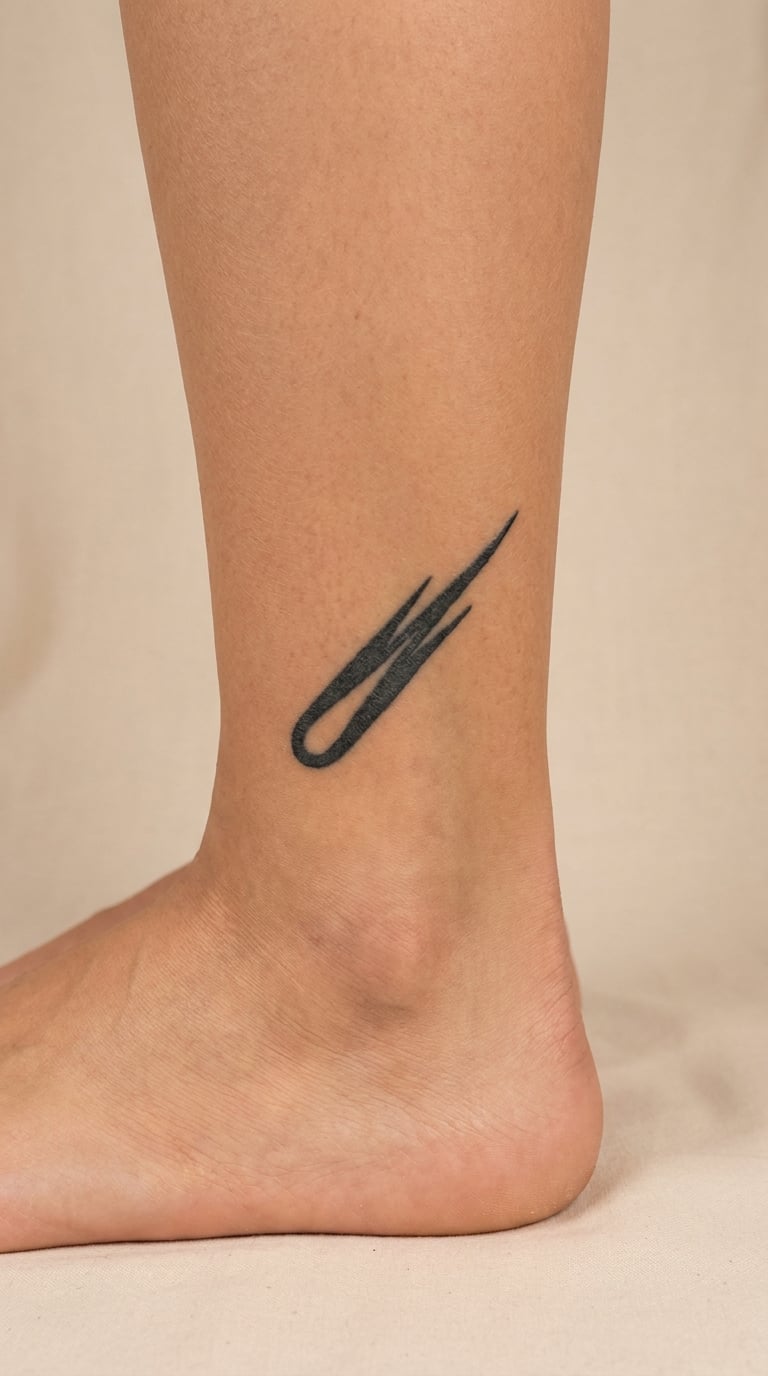
Two tails is the detail that makes a comet astronomically distinct. The dust tail curves and the ion tail runs straight, so a minimal version with one straight tail and one curved tail reads as a real comet rather than a generic streak. Both are drawn with a few clean lines and nothing else.
It is simple enough for a first tattoo and distinct enough to hold its own in a collection. On the ankle, the two tails also follow the bone line naturally.
Placement: Ankle, inner arm, behind the ear. Size: 1.5 to 2.5 inch (4 to 6 cm). Style: minimal linework. Pain: medium on the ankle, and the bone there is close to the surface.
Make it yours: Make the straight tail the colour one if you want a small accent, keeping the curved dust tail in plain black linework.
19. Ornate Comet with a Celestial Frame
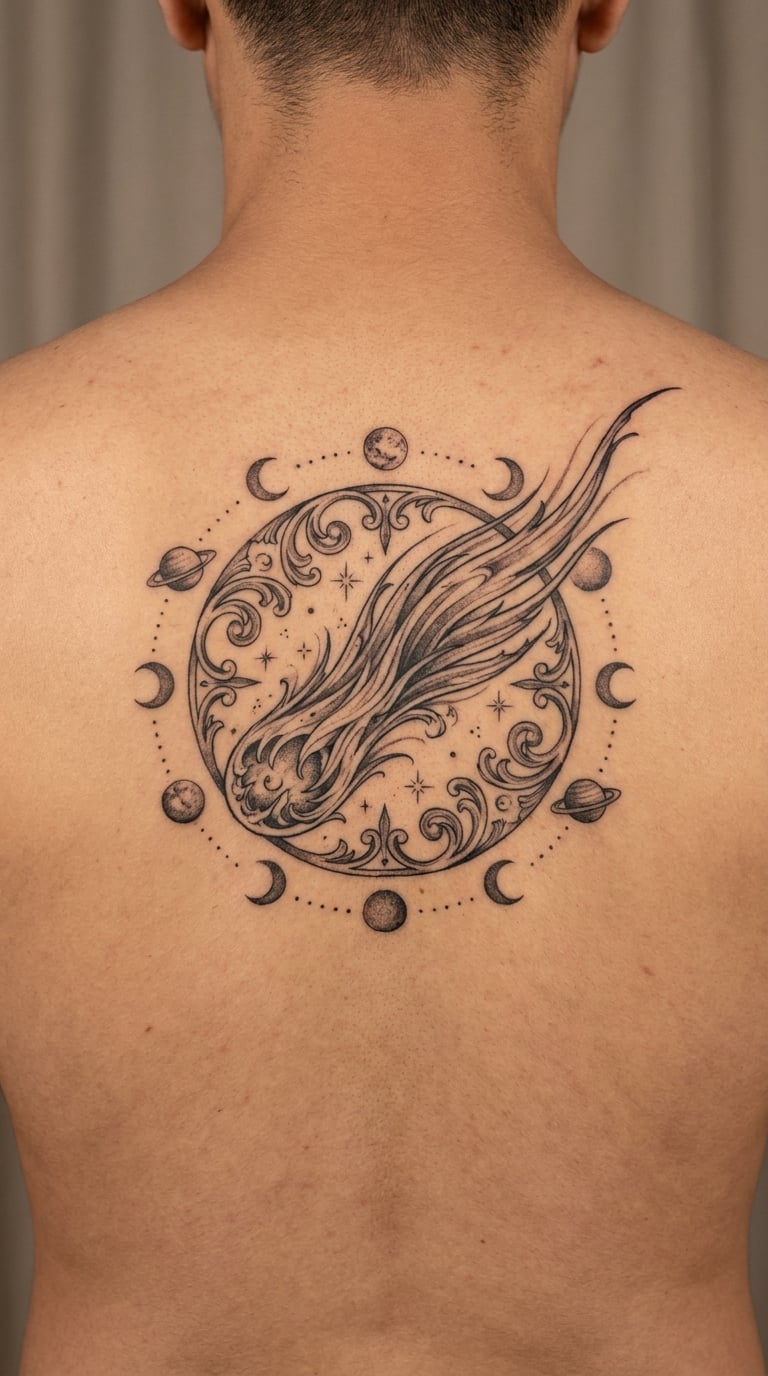
An ornate comet is a detailed black-and-grey design: a shaded nucleus, a long tail, fine scrollwork curling around the edges, and small stars tucked into the corners, often all contained inside a thin circular or arched frame. It is closer to engraved illustration than to linework.
That density needs a big flat surface, because the fine scroll detail disappears on a small canvas. On the upper back, the circular frame also gives the piece a finished edge instead of a fading outline.
Placement: Upper back, chest, thigh. Size: 5 to 7 inch (13 to 18 cm). Style: ornate illustrative, black and grey. Pain: medium.
Make it yours: Have the frame broken rather than closed, with the tail passing through the gap, so the comet looks like it is escaping the design.
20. Small Red Comet Accent
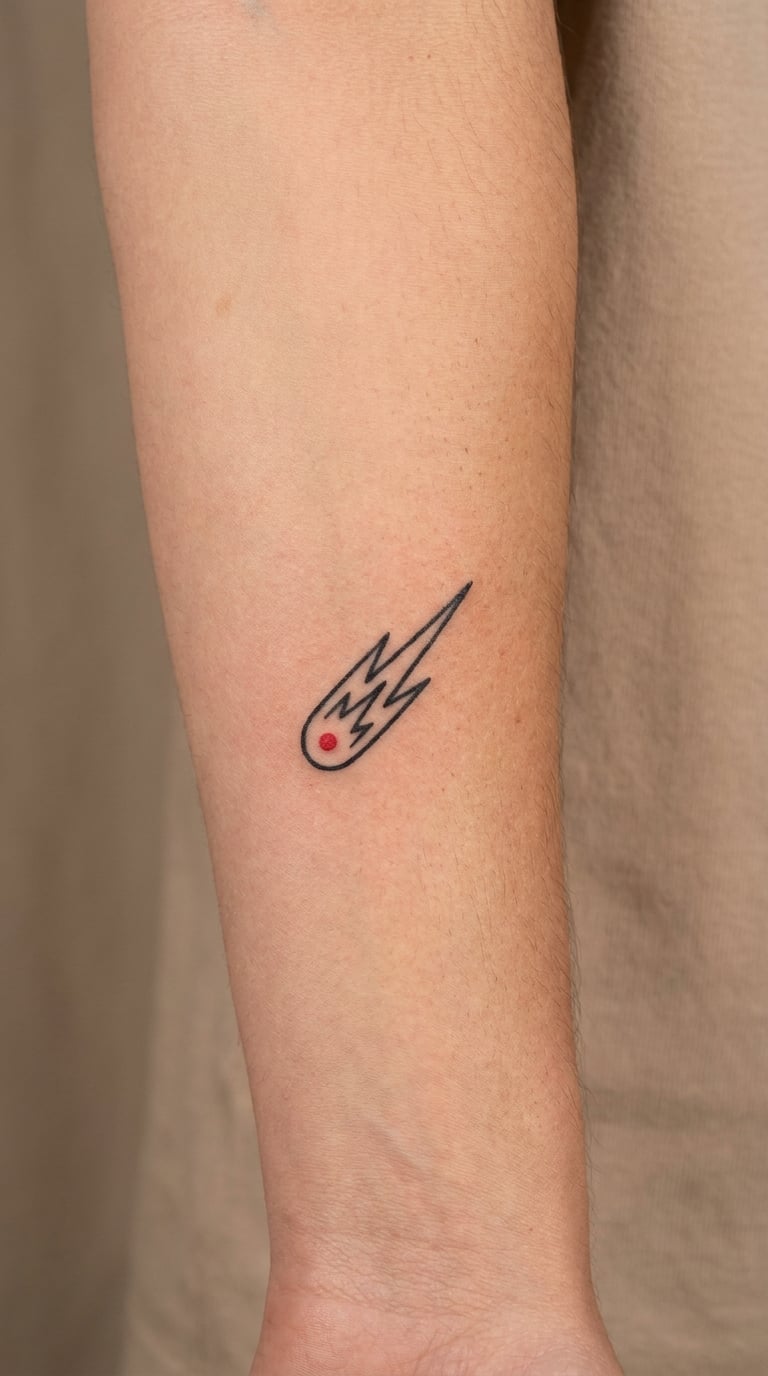
The smallest colour statement in the list: a black comet with a single spot of deep red in the nucleus, or a red slash at the leading edge of the head. One colour, one small area, and it still reads as a comet at a distance.
This is the compromise design for someone who wants colour but does not want a colourful arm. The red is small enough to be a deliberate accent rather than a commitment, and it works with almost any other blackwork piece.
Placement: Inner arm, wrist, behind the ear. Size: 1.5 to 2 inch (4 to 5 cm). Style: minimal with a colour accent. Pain: medium.
Make it yours: Repeat that exact red in one other small piece, maybe a dot or a small symbol, so the accent becomes a signature colour across your tattoos.
21. Geometric Comet Made from Lines
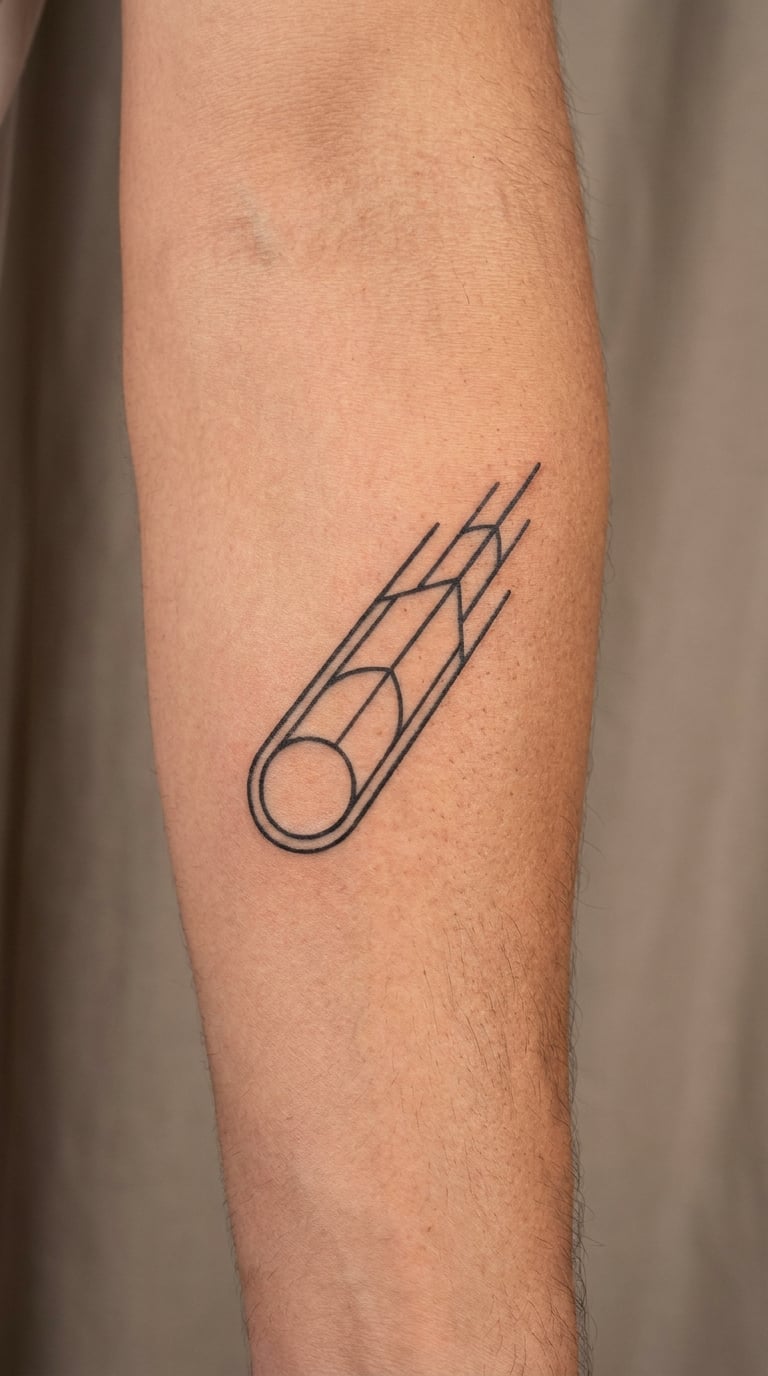
A geometric comet is assembled from straight and curved lines rather than shading: a head built from overlapping triangles, a tail made of parallel lines that shorten as they travel, and no gradient anywhere. The result is contemporary and abstract, and it reads clearly at a small size because it is all hard edges.
It suits people who like modern composition and want a space motif that does not look like a space illustration. It also sits comfortably next to geometric sleeve work.
Placement: Forearm, calf, upper arm. Size: 3 to 4 inch (8 to 10 cm). Style: geometric linework. Pain: medium.
Make it yours: Rotate the whole design so the head points toward your heart or your opposite hand, which changes how the piece sits without changing the drawing.
22. Large Colour Comet on the Back
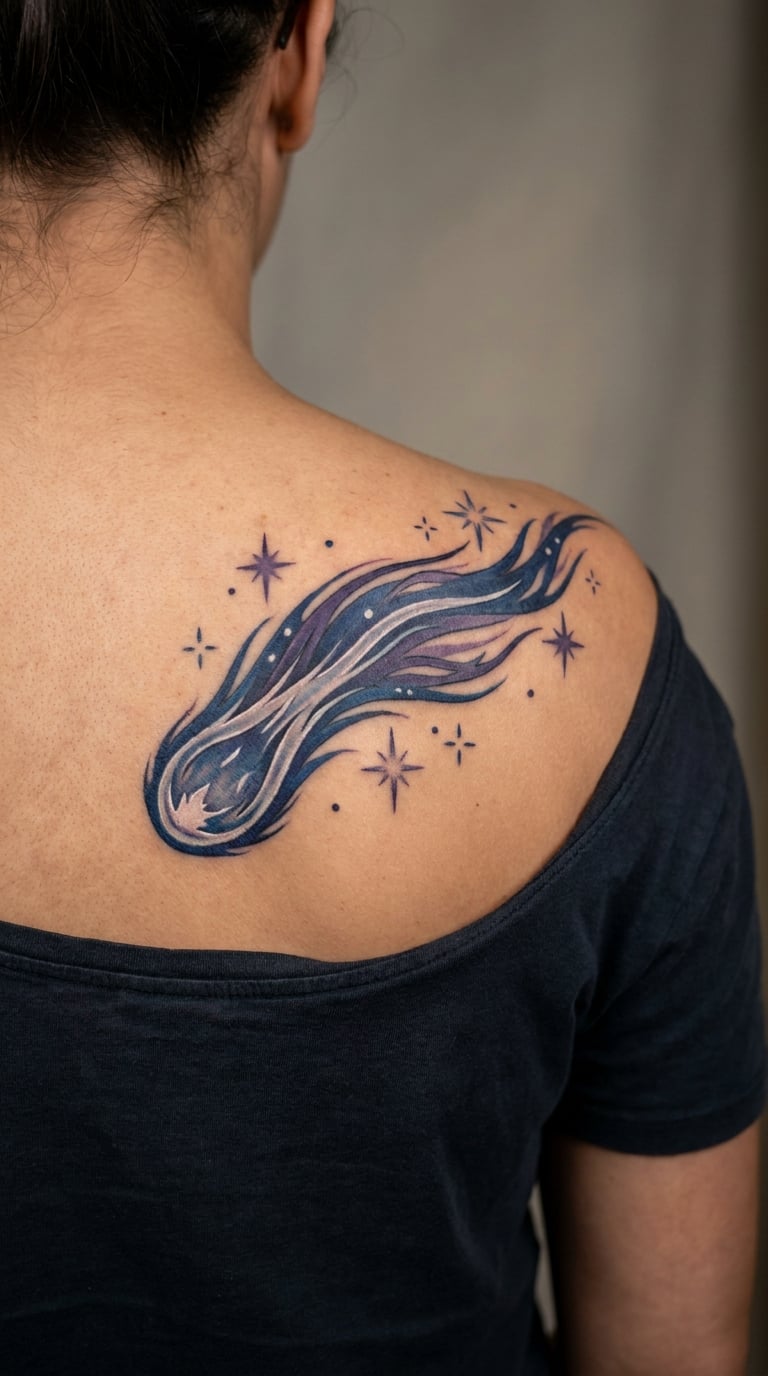
The last idea is the full statement piece: a bright head, a layered tail in blue, violet and white, and a scatter of stars spread across the back so the movement extends past the comet itself. The design is built to be read from a distance, and it needs the width of the upper back to do that.
A design at this size is a project rather than an appointment. It is the right choice for someone who wants a comet to be the main event on their body, and the wrong one for a first tattoo that should stay small.
Placement: Upper back, back of the calf. Size: 8 to 12 inch (20 to 30 cm) across. Style: large colour illustrative. Pain: medium over a long session; a piece this size is usually planned across two or more sessions.
Make it yours: Ask for the star field to be denser on one side than the other, so the design has a direction even when it is large and busy.
How to Choose the Right Design
Start from the space, not the picture. A comet is a directional design, so it wants a limb, a bone line or an open flat area rather than a small round spot you are trying to fill.
- Pick the style first. Fine line and minimal linework suit small placements and people who want discretion. Blackwork and geometric suit bold pieces and bold areas. Dotwork and painterly colour want the largest surfaces you can give them.
- Check the minimum size before you commit. Fine-line comets stop reading well under about 1.5 inch (4 cm) across. Realistic dust plumes and constellations need 3 inch (8 cm) or more, or the detail turns to grey mush after healing.
- Match the shape to the anatomy. Horizontal tails suit the collarbone and the shoulder line. Diagonal tails suit the ribs and the flank. Long sweeping tails suit the outer forearm and the calf. Small vertical comets fit the wrist and the ankle.
- Decide on colour before the drawing, not after. Bright colour needs more sessions and more touch-ups. Black and grey is easier to heal evenly and cheaper to fix later.
- Bring real references, not screenshots. Show the artist actual comet photographs or NASA imagery alongside the tattoo examples you like. Artists say the same thing constantly: a copied screenshot arrives as clip art, while a real reference gives them something to interpret.
- Ask to see healed work before you book. Fresh and healed tattoos look nothing alike. A portfolio that only shows work from the last few days is not telling you how that design will look in five years.
Two more things worth deciding early. Think about whether this is a one-off piece or the first of a set, because the tail direction should leave room for a second comet later. And if you are filling awkward negative space between existing tattoos, mention that at the consultation, since direction and scale both change when the design has neighbours.
If the motif itself is still open, it helps to look at a themed set before you settle on one image. Our 20 starfish tattoo ideas for simple, coastal looks run through a completely different set of shapes in the same idea-list format, and the 20 mountain and ocean tattoo ideas show how two subjects can share one composition without fighting each other.
Cost and Session Time
I would rather be vague here than have you walk in with a number in mind that a good shop will not match. What you pay is driven by hourly rate, and the same comet costs very different amounts in different cities and at different experience levels.
What you can plan around is time. A small minimal comet, 1 to 2 inch (2.5 to 5 cm), is usually well under an hour. A medium black and grey comet with a star trail, 3 to 5 inch (8 to 13 cm), often runs into a second session because the shading is layered. A large colour piece, 8 inch (20 cm) and up, is a multi-session project by design.
Ask three questions before you commit: what is the shop minimum, what is the hourly rate, and is the estimate for one session or the whole piece. Shops have a floor charge regardless of how small the work is, so a tiny comet may still be billed as a full appointment, and a big one may be quoted as a project total rather than a rate.
Message two or three studios with the same reference and the same size, and compare what you get back. A consultation is often free, and it is the cheapest way to find out whether the artist has drawn this motif before.
Aftercare Basics
- Follow your artist’s aftercare instructions first. They know what they did in your session. Everything below is general guidance, not a replacement for what you were told on the day.
- Wash it gently, twice a day, with plain lukewarm water and unscented soap. Pat it dry with a clean towel or paper towel, then follow the balm or ointment your artist recommended.
- Keep it out of water for the first couple of weeks. No baths, pools, hot tubs or ocean swimming. Short showers are fine once the initial bleeding has stopped.
- Do not pick, peel or scratch the flaking skin. That is the single most reliable way to pull ink out of a design and end up with patchy areas in the tail.
- Leave tight clothing alone for a few days. A collarbone or wrist comet tucked under a waistband or a watch band will rub constantly and can scar the linework.
- Protect it from sun once it has healed. Fine line and small star dots are the first things to fade, and a faded tail changes the design rather than just dulling it.
Most healing complaints turn out to be ordinary irritation. Spreading redness, heat, pus, a fever, or pain that gets worse after a few days is the point to stop asking strangers online and contact a doctor instead.
Frequently Asked Questions
What does a comet tattoo symbolize?
A comet tattoo usually stands for something temporary that still mattered: a person, a period of your life, or a moment you saw and never will see again. People also read it as hope after hardship, guidance while lost, a fresh start, and the beauty of something rare. Halley’s Comet, the best known, comes back roughly every 75 years, so it is often used to mark a once-in-a-lifetime event.
Are comet tattoos better in fine line or blackwork?
It depends on size and where it goes. Fine line is the better choice for small placements like the wrist, behind the ear or the side of a finger, and it suits designs that should stay discreet. Blackwork is better for larger, bold pieces where the comet needs to read from a distance. The important detail either way is a filled-in head, since thin outlined heads blur first.
Where is the best placement for a small comet tattoo?
The inner wrist, behind the ear and the collarbone are the three most popular spots for a small comet. Each gives the tail a natural line to follow. The ankle and the side of a finger also work well for a tiny design, though the hand and fingers age faster than almost anywhere else, so expect a fine-line comet there to soften over the years.
How much does a comet tattoo usually cost in the US?
There is no single price, because shops charge by the hour and rates vary a lot by city and by artist experience. A small minimal comet is usually a short appointment, while a large colour piece across the back is a multi-session project. Ask about the shop minimum, the hourly rate, and whether the quote covers the whole piece, then message two or three studios with the same reference.
Will a fine-line comet tattoo fade over time?
Yes, and the tail goes before the head does. Fine line loses definition faster than solid blackwork, and hairline star dots in a dust trail are the first elements to soften and merge. Placing it somewhere covered, avoiding sun on the area, and planning a touch-up every few years keeps it readable. Solid black heads and negative-space stars hold their shape much longer.
Can a comet tattoo be personalized with a birth date or constellation?
Easily, and it is one of the most common ways people make a comet their own. Options include a birth constellation linked to the comet by thin lines, a year hidden in the curve of the tail, a colour that matches something else you own, or a matching comet on someone close to you. Artists can also work around a birthmark or a mole, turning the irregular mark into part of the trail.
Which Comet Idea Should You Start With?
If this is your first tattoo, start with idea 2, the minimal black comet on the wrist, or idea 18, the two-tail version. Both are drawn with a handful of lines, both hold their shape at a small size, and neither commits you to a style you might outgrow.
If you are adding to an existing collection, pick something that works with what you have rather than something louder than it. A fine-line comet behind the ear sits well with delicate work, a solid black comet with negative-space stars fills space next to bold pieces, and the constellation or botanical variants give you room to build a themed set over time. For a different take on building a set around meaning rather than a single symbol, the 24 best tattoo ideas that symbolize freedom are worth a look.
Whichever one you choose, bring a real reference, ask to see healed work, and get the minimum size confirmed in the consultation rather than the day of the session. Those three steps prevent almost every disappointing comet tattoo I have seen discussed.