
24 Best Tattoo Ideas That Symbolize Freedom (September 2026)
Freedom tattoos come down to objects that move without restraint: birds, water, roads, open air. The most requested tattoo ideas that symbolize freedom use a chain that has been opened, a bird already outside the cage, or a road that keeps going past the last line of the drawing. What makes one of these designs work on skin is simple. Fewer elements, a clear silhouette, and enough empty space around it for the eye to breathe.
I have watched clients agonise over a single symbol for months, then land on the plainest one on the list. That is usually the right call. Below are 24 designs grouped by symbol, style, placement and pain level, so you can compare them before you sit down with an artist. If you want more options built around personal stories, these 40 beautiful freedom tattoo ideas that tell your story are worth a look too.
Tattoo Ideas That Symbolize Freedom: Quick Guide
Here is the full list at a glance. Pain ratings assume the placement named in the row, since the same design can feel very different on a rib and a calf.
| Idea | Style | Best placement | Size | Pain |
|---|---|---|---|---|
| 1. Paper plane in flight | Fine line | Inner forearm | 2 in (5 cm) | Low |
| 2. Open road and mountains | Black and grey | Outer forearm | 3 in (7.5 cm) | Low |
| 3. Sparrow past a dotted line | Micro fine line | Wrist | 1 in (2.5 cm) | Medium |
| 4. Open shackles and loose chain | Black line | Ankle | 2.5 in (6 cm) | Medium |
| 5. Compass rose | Fine line | Inner upper arm | 2 in (5 cm) | Low |
| 6. Mountain peak and rising sun | Fine line with colour | Forearm | 2.5 in (6 cm) | Low |
| 7. Sailboat on waves | Fine line | Outer upper arm | 2 in (5 cm) | Low |
| 8. Phoenix with loose feathers | Illustrative colour | Between shoulder blade and spine | 4 in (10 cm) | Medium |
| 9. Open wings | Blackwork | Upper back | 4 in (10 cm) | Medium |
| 10. Butterfly, one wing in colour | Watercolour | Behind the ear | 2.5 in (6 cm) | Medium |
| 11. Bird escaping an open cage | Fine line | Inner forearm | 2 in (5 cm) | Low |
| 12. Running wild horse | Line with light shading | Outer thigh | 3 in (7.5 cm) | Medium |
| 13. Waves wrapping an arm | Japanese-style | Forearm band | 5 in (13 cm) | Medium |
| 14. Hot-air balloon and birds | Fine line with colour | Shoulder | 2 in (5 cm) | Medium |
| 15. Map pin and coordinate grid | Fine line | Calf | 2.5 in (6 cm) | Medium |
| 16. Open lock with floating key | Blackwork | Inner upper arm | 2 in (5 cm) | Low |
| 17. Dandelion and faint fence | Fine line | Below collarbone | 2.5 in (6 cm) | Low |
| 18. Winged hourglass | Blackwork | Below sternum | 2 in (5 cm) | Medium |
| 19. Open book with a rising bird | Fine line | Ribs | 2.5 in (6 cm) | High |
| 20. Climber at the final peak | Micro silhouette | Inner forearm | 2 in (5 cm) | Low |
| 21. Shooting star, long trail | Fine line | Wrist | 2 in (5 cm) | Medium |
| 22. Hooves forming an infinity sign | Fine line | Ankle | 2 in (5 cm) | Medium |
| 23. Hummingbird over a ribbon | Illustrative colour | Behind the ear | 1.5 in (4 cm) | Medium |
| 24. Wide horizon, empty road, stars | Black and grey | Upper back | 5 in (13 cm) | Medium |
1. Fine-Line Paper Plane in Flight
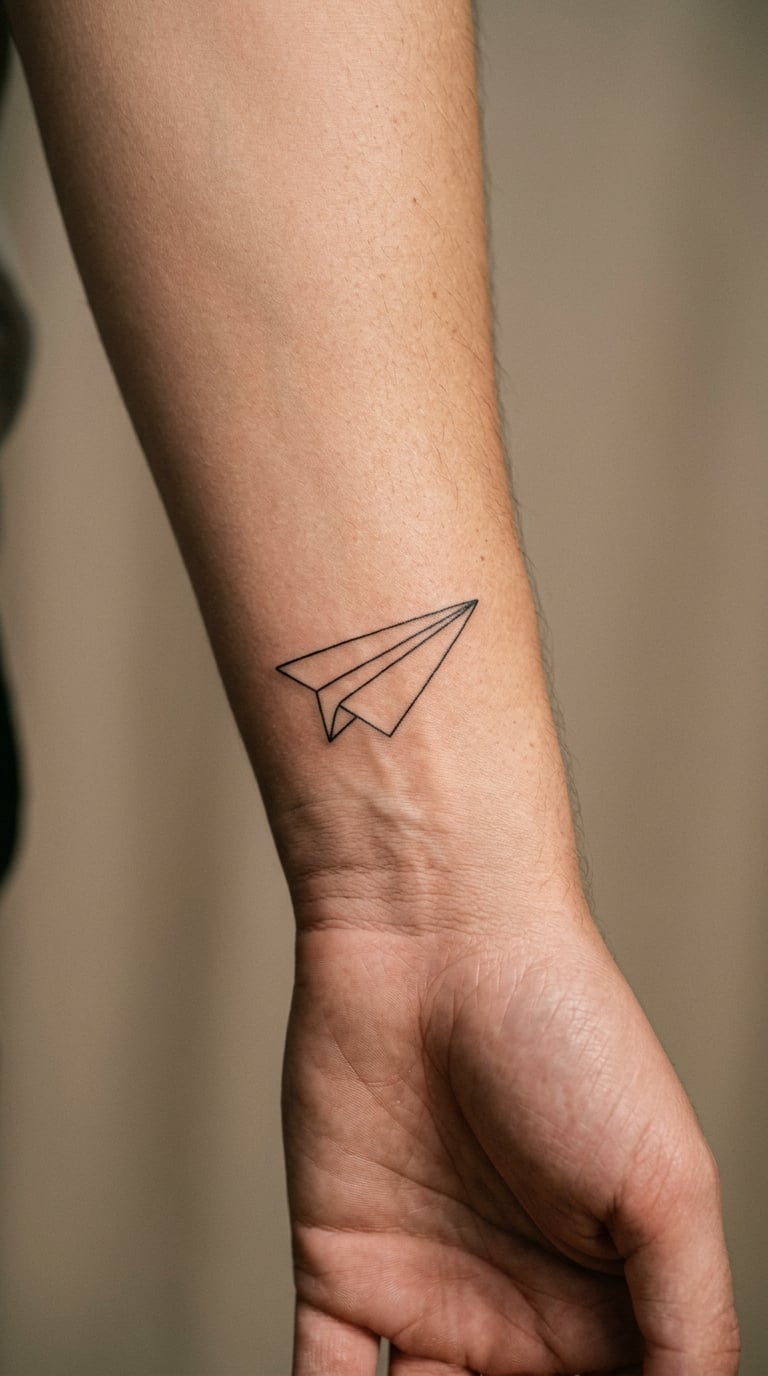
A paper plane is the least obvious freedom symbol on this list, and that is exactly why it works. The drawing is a handful of straight single-needle lines meeting at a point, with one crease line down the middle and a short dashed trail behind it. Almost no shading at all.
It reads as independence and forward motion, which is why people who are moving somewhere new, or moving on from something, keep coming back to it. The crease gives it just enough dimension to look considered rather than like a doodle.
Placement: inner forearm just above the wrist crease, where a bend of the arm will gently distort the trail. Size: 2 to 2.5 inches (5 to 6 cm) nose to tail. Style: fine line, single-needle. Pain: low, roughly a 3 out of 10 on the inner forearm. Note that fine line on the inner arm softens and spreads slightly within a few years, so keep the line weight above the thinnest end of the needle range.
Make it yours: trail it with the coordinates of a place that mattered to you, or a short route line drawn like a map.
2. Open Road Through Mountain Lines
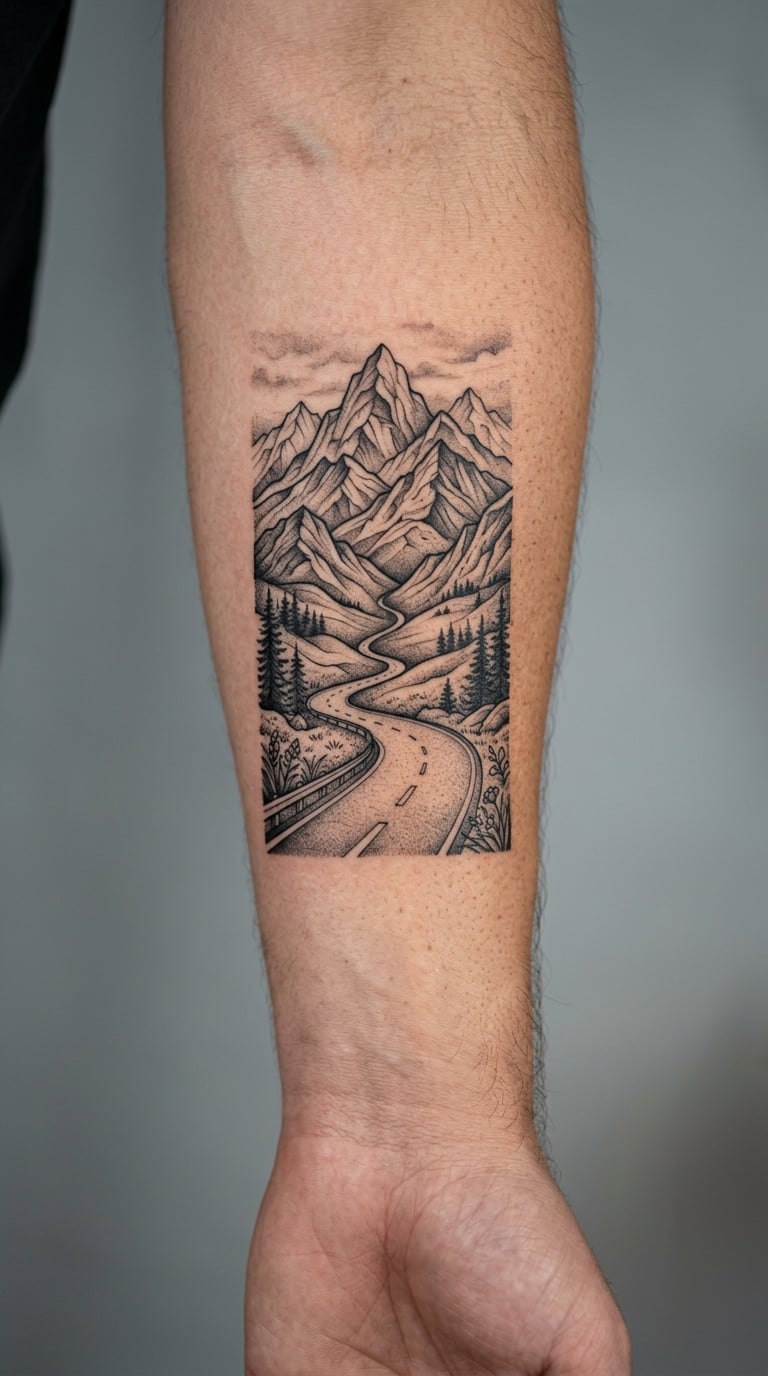
This one is a landscape drawing stripped to its working parts: a road that narrows as it climbs, two or three overlapping mountain silhouettes, and a low horizon line. The trick is keeping the mountains as flat black shapes rather than shaded realism, so the road stays the subject.
The meaning is straightforward and older than most tattoo symbolism. The road stands for a route you chose, and the peaks stand for what you had to climb to earn it.
Placement: outer forearm, laid along the bone from elbow toward wrist so the road follows the natural line of the limb. Size: 3 to 4 inches (7.5 to 10 cm) wide. Style: black and grey with solid silhouette layers. Pain: low, about 3 out of 10, since the outer forearm is mostly flat surface. Solid black fills take longer to heal than line work and often look lighter after the first few weeks, which is normal.
Make it yours: change the horizon to a coastline you grew up near, or add a single tree at the roadside.
3. Sparrow Breaking Beyond a Dotted Line
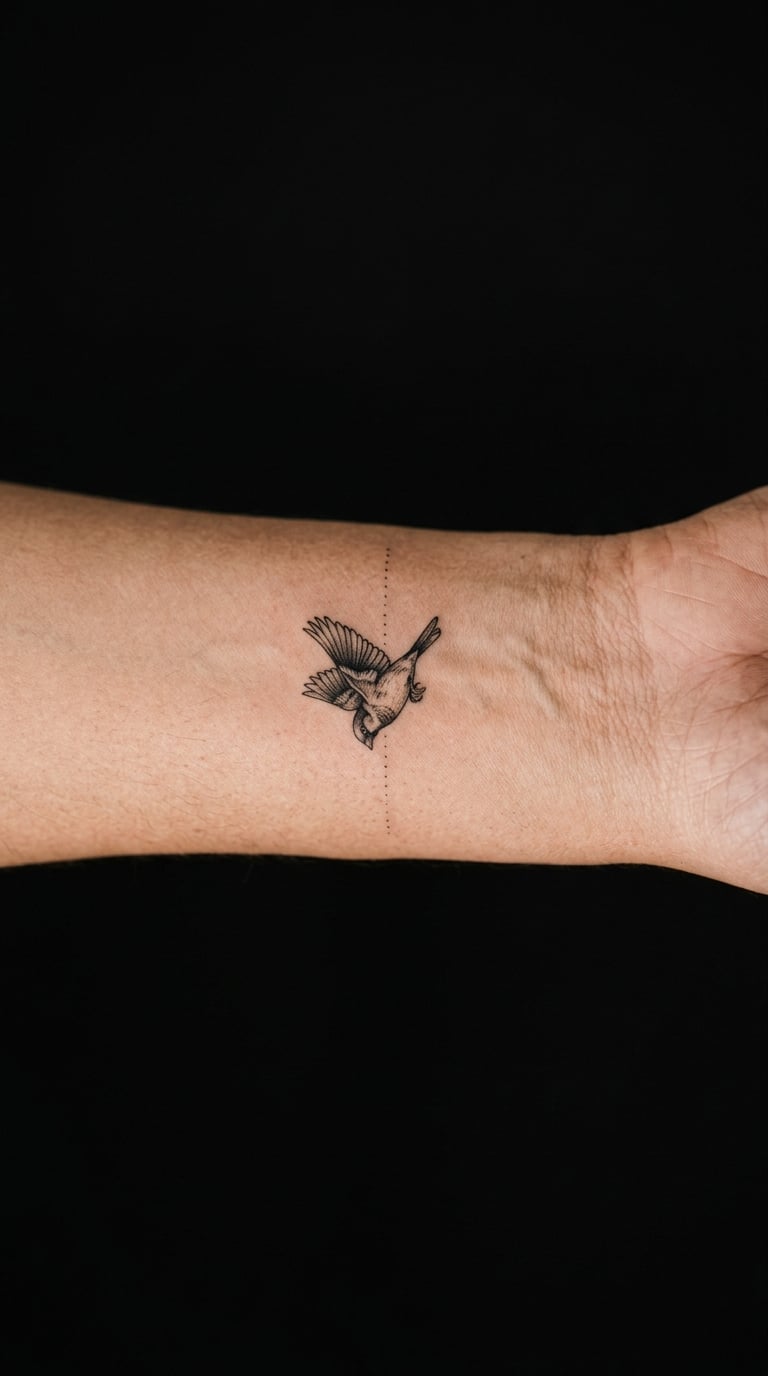
A sparrow in profile, wings half open, with a dotted line running behind it and stopping where the bird crosses. The dots matter more than the bird. A solid line is a boundary, and a dotted one is a boundary that has already come apart.
People choose this for independence and for leaving a boundary behind, whether that was a hometown, a family expectation or a particular person. The sparrow is a common songbird rather than a rare or dramatic animal, which keeps the drawing humble.
Placement: inner wrist, small, or the same design repeated at the ankle. Size: 1 to 1.5 inches (2.5 to 4 cm). Style: micro fine line. Pain: medium, closer to a 5 out of 10 on the wrist because the bone is close to the surface there. At this scale, a small blot of ink or one clumsy dot is the whole tattoo, so choose an artist who does micro work regularly. Expect the dot line to blur into a faint continuous line over time.
Make it yours: put the dots on one side only, so the bird is clearly leaving rather than merely crossing.
4. Minimal Open Shackles With a Loose Chain
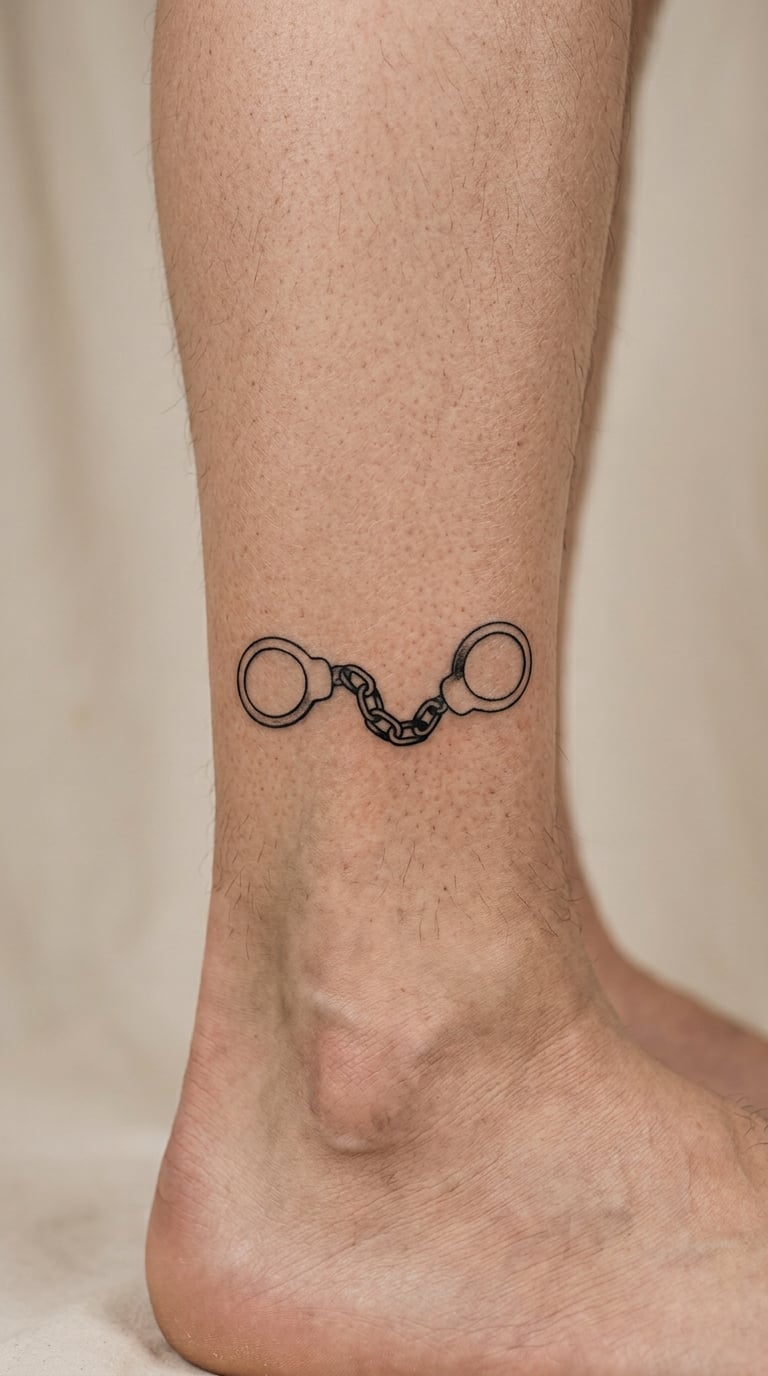
Two cuff shapes, unlinked, with a short length of chain hanging in a loose curve between them and one link visibly open. The chain is the piece that carries the reading. A closed chain is a problem; a chain with an open link is a problem you already solved.
This is the most direct statement on the whole list, and people choose it for very literal reasons. Ankle placement also suits the meaning, since shackles belong there and the reveal happens when you wear trousers or sandals.
Placement: above the ankle bone, or the inner upper arm. Size: 2.5 to 3 inches (6 to 7.5 cm) across. Style: bold black line, no shading. Pain: medium, about 4 out of 10 above the ankle bone, rising to 6 near the shin and side of the calf. Ankle skin is thin and bone is close, so the outline feels sharper there. Line weight is the ageing risk: keep the cuffs solid rather than relying on hairline strokes, which blur fastest.
Make it yours: have the last chain link drawn as a circle with no break, so the loop is permanent but the restraint is gone.
5. Fine-Line Compass Rose With Open Negative Space
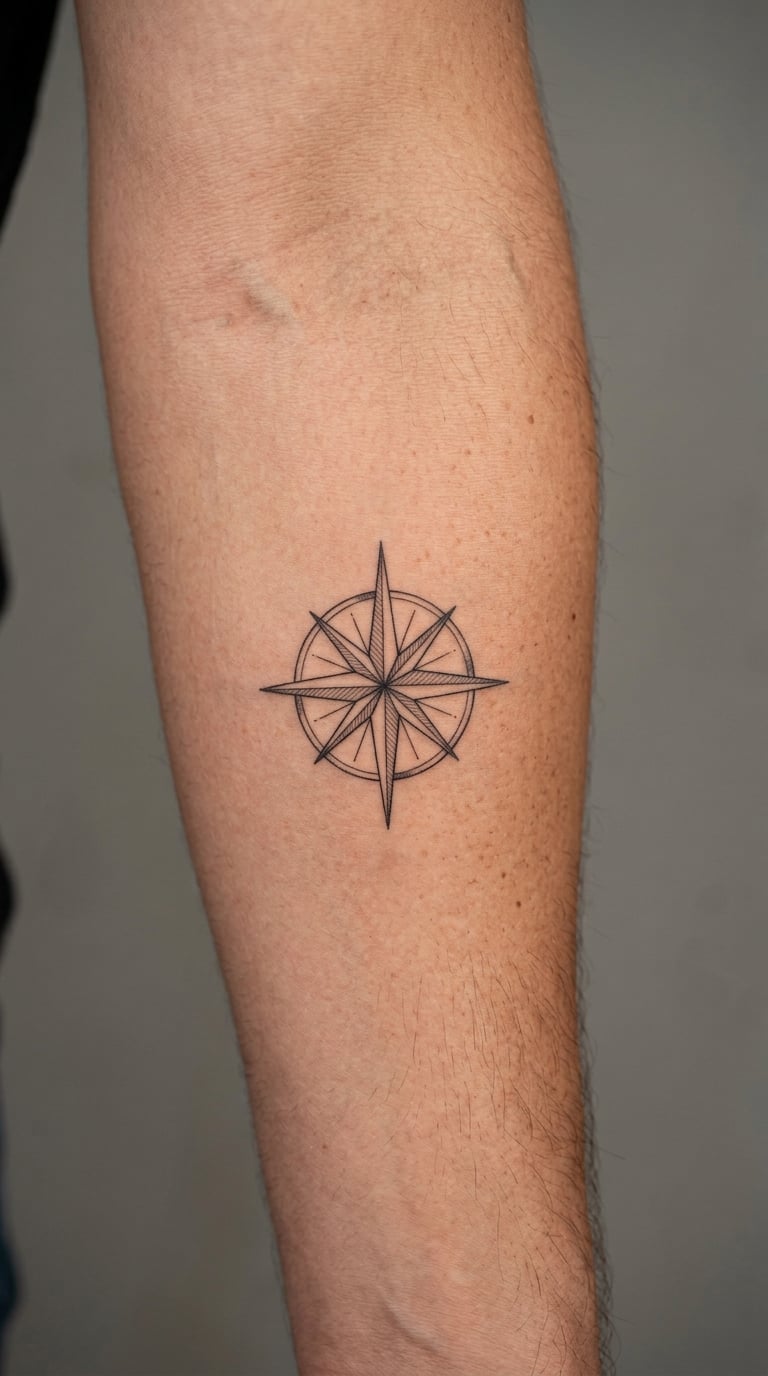
A compass rose drawn with eight thin points, one of them drawn in red or a warm accent, and nothing else. No circle around it, no map, no letters. The empty skin between the points is doing as much work as the drawing.
Freedom here means direction rather than release. People get one when they want a reminder to choose their own heading, not to escape something. It sits well next to the compass designs on this site if you want to see how the motif handles a fuller, more graphic treatment.
Placement: inner upper arm, or the top of the foot. Size: 2 to 2.5 inches (5 to 6 cm) tip to tip. Style: fine line, one accent colour optional. Pain: low, about 3 out of 10 on the inner arm. The eight points mean eight direction changes while the needle runs, so it is a slower piece than it looks. Let the line breathe; fine line needs room more than it needs detail.
Make it yours: rotate the rose so the marked point runs slightly off-vertical, toward your own chosen direction.
6. Mountain Peak and Rising Sun
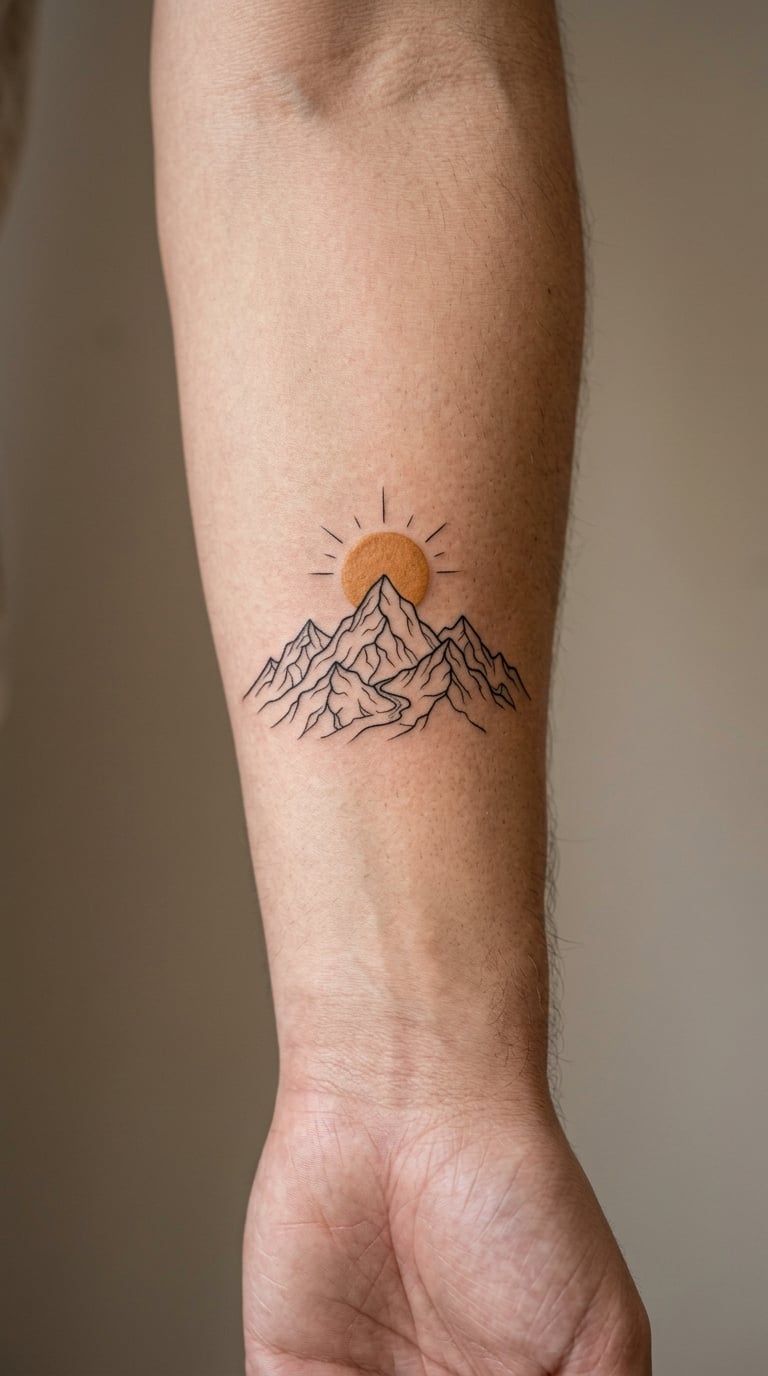
One summit drawn as two clean intersecting lines, with a half-circle sun behind it sitting low enough that only the top arc clears the ridge. The sun is usually the only colour in the design, a warm ochre or a muted orange that stays soft once healed.
This is achievement rather than escape. People tend to choose it after finishing something hard, or as a marker of the view they wanted for themselves. Drawing the sun partly hidden keeps the design from feeling like a stock sunrise logo.
Placement: centred forearm, or the calf with the peak running vertically. Size: 2.5 to 3 inches (6 to 7.5 cm) tall. Style: fine line with one colour accent. Pain: low, around 3 out of 10. Pale skin takes that ochre beautifully, but very fair skin can show the warmth more strongly than expected, so ask for a mix test before the fill. Over years the sun lightens more than the black peak, which usually looks intentional.
Make it yours: use the elevation of a specific summit you have actually stood on, and add the date underneath in small numerals.
7. Sailboat Crossing Simple Waves
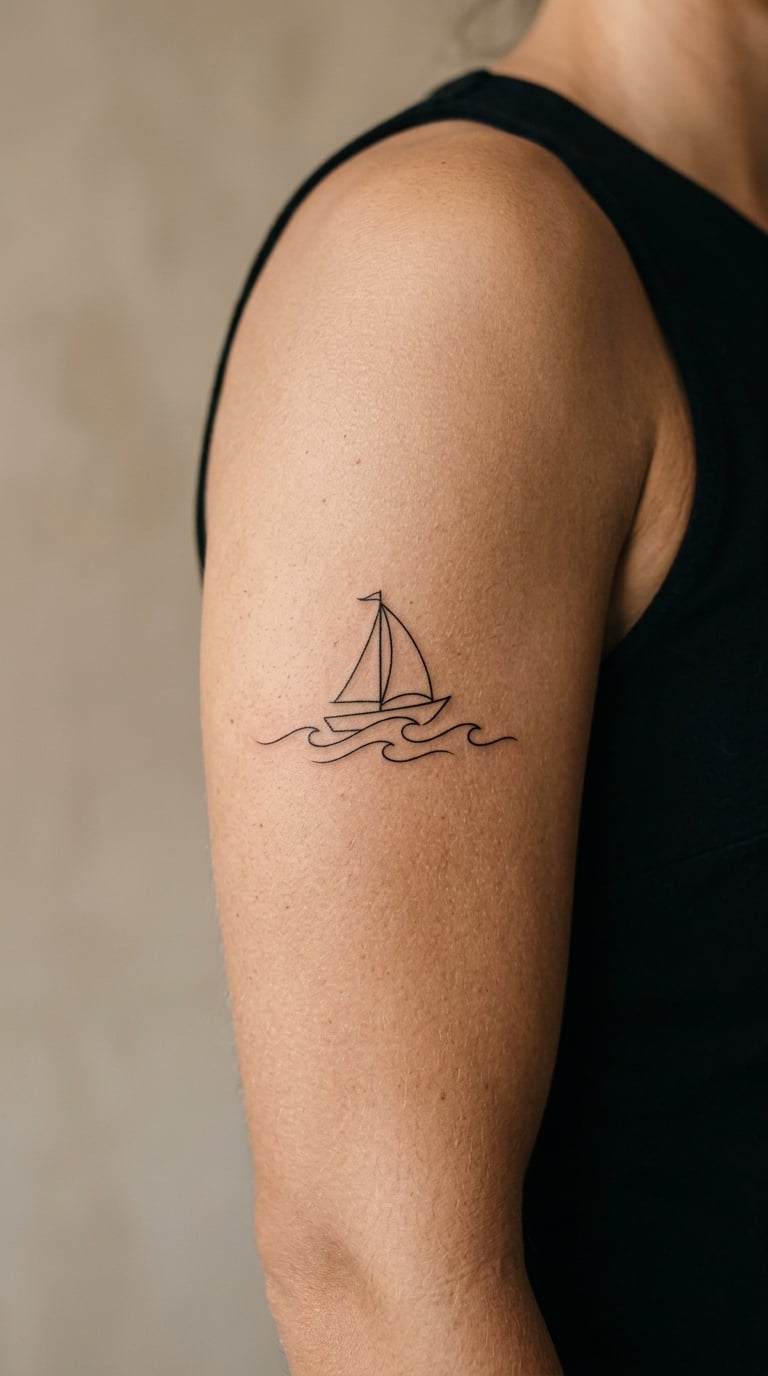
A small sailboat with one triangular sail, a short hull, and three wave lines beneath it. The sails are usually filled solid black while the hull stays as an outline, which gives the whole thing contrast without shading.
A boat choosing its own course across open water is one of the oldest freedom images going. People like that it carries the idea without the word, and that a small version still reads clearly at arm’s length. The three-wave limit is deliberate; more waves turn it into a nautical pattern.
Placement: outer upper arm below the shoulder, or the inner calf. Size: 2 to 2.5 inches (5 to 6 cm). Style: fine line with solid black sails. Pain: low, about 3 out of 10 on the upper arm. The solid sails are the only part that needs a second pass, and they are flat areas rather than gradients, so they age well. Boat lines are long and straight, which are the easiest strokes to keep clean.
Make it yours: have the sail carry a single-colour wash, or add a tiny lighthouse in the distance for a direction-of-travel cue.
8. Phoenix With Separated Feathers
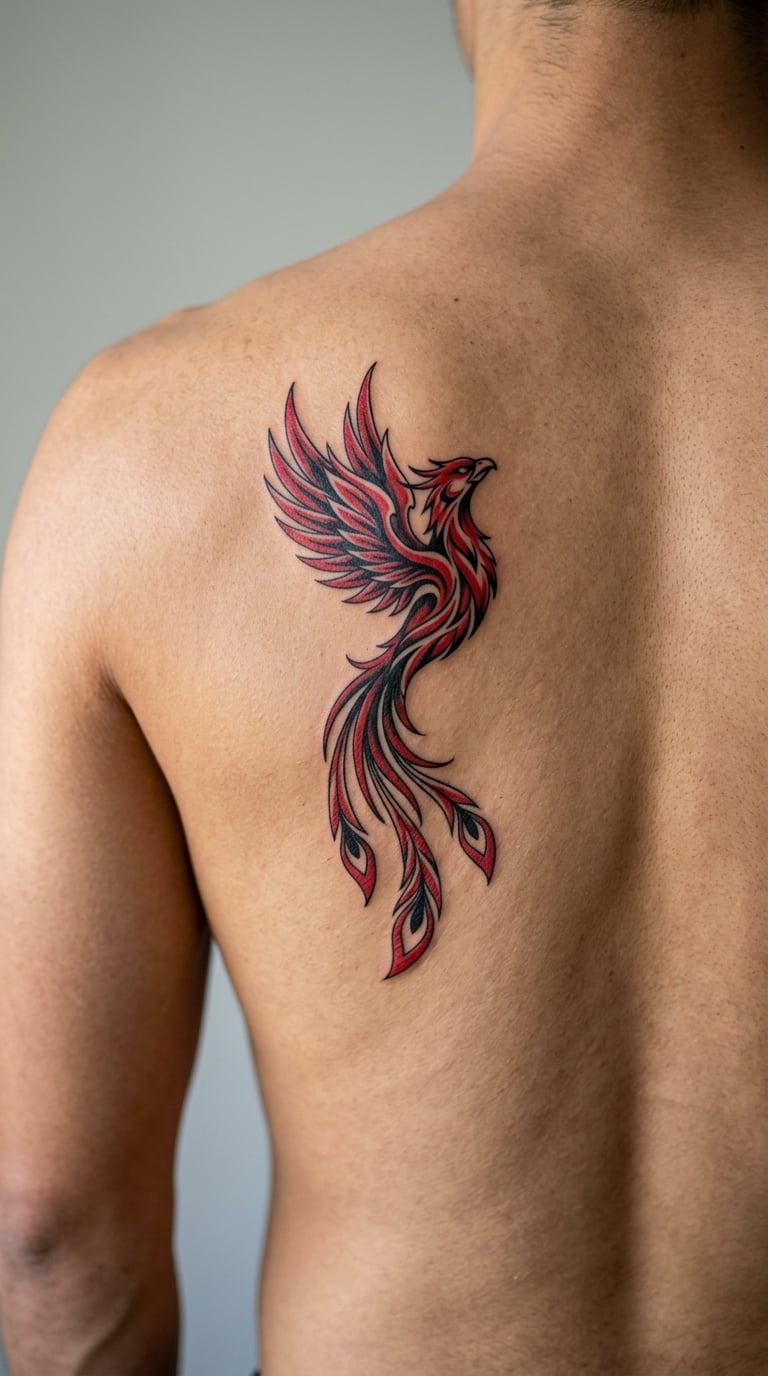
A stylised phoenix with a curved neck, a few flame-like body shapes and three detached feathers trailing behind it with clear gaps between each. The separated feathers are the part worth arguing for with your artist. Without the gaps it is just a bird on fire, and with them it reads as something rebuilding itself piece by piece.
Be clear about what you are asking for. The phoenix is most strongly associated with rebirth and transformation rather than freedom, and plenty of people get it confused with a freedom piece. If your reason is a fresh start rather than literal liberty, this is honest, and it holds up better than forcing a bird into a meaning it does not carry.
Placement: between the shoulder blade and the spine, or the outer thigh. Size: 4 to 5 inches (10 to 13 cm) tall. Style: illustrative colour or bold blackwork. Pain: medium, about 5 out of 10, and expect a long session. Colour saturation fades faster than solid black, so pick a red that still works half-strength. This is a piece that wants a second sitting rather than a rushed one.
Make it yours: have the three trailing feathers double as a matching set with someone, one feather each.
9. Open Wings in Blackwork
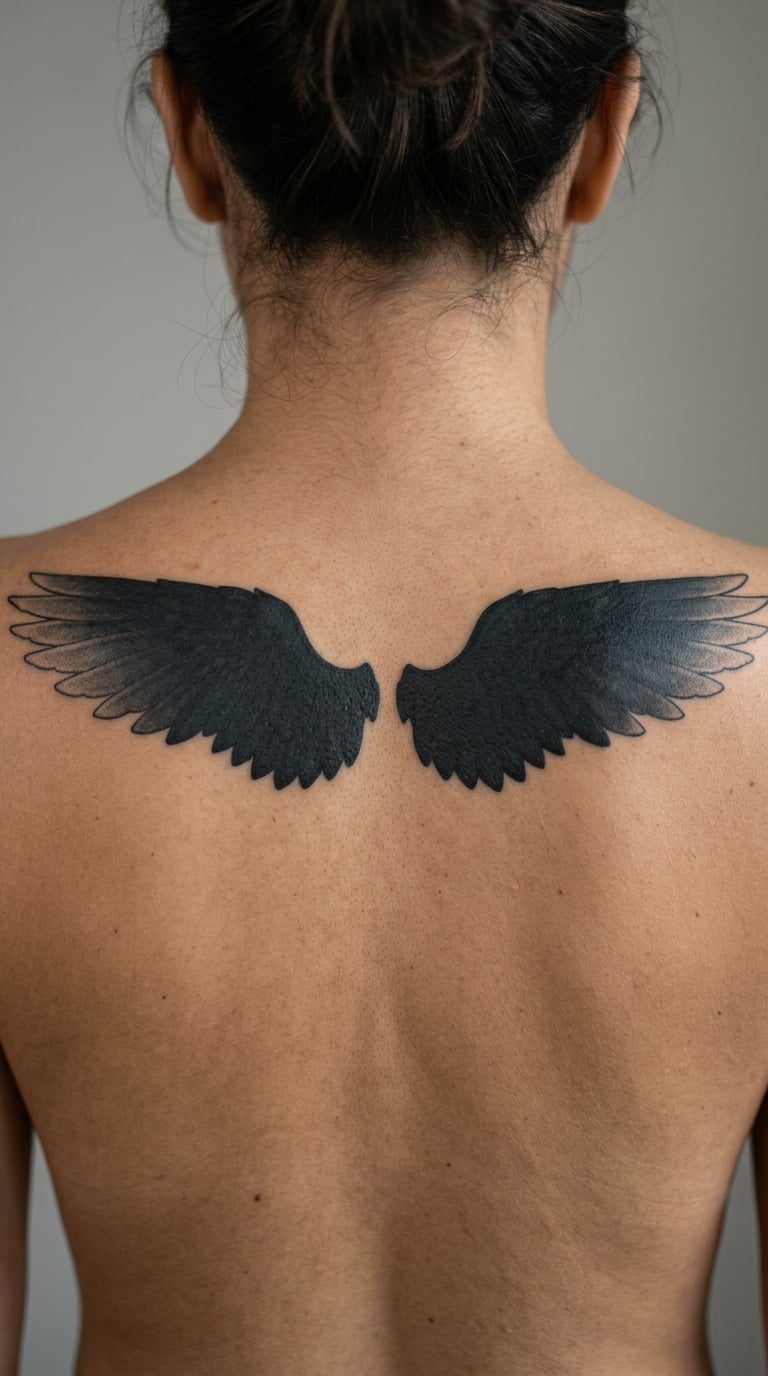
A symmetrical pair of wings, each built from three or four broad black shapes rather than individual feathers, spread upward and open. One outer edge on each wing carries a thin shaded band to keep them from looking like flat stickers.
Open wings cover two ideas at once: release, and shelter. Some people get them after a difficult period, others as a protective mark for the people they carry. Both readings are common and neither is wrong.
Placement: centred across the upper back between the shoulder blades, or a smaller version on the shoulder. Size: 4 to 6 inches (10 to 15 cm) across. Style: blackwork. Pain: medium, about 4 out of 10 on the back, though the shoulder blades and the base of the spine get tender after the first hour. Broad solid fills need patching during the session, and skin across a shoulder blade moves more than most people expect. Large solid black can push the edges inward as it heals, so plan for a touch-up in four to six weeks.
Make it yours: vary the two wings slightly, as real wings do, instead of making them mirror images.
10. Butterfly With One Wing in Watercolor
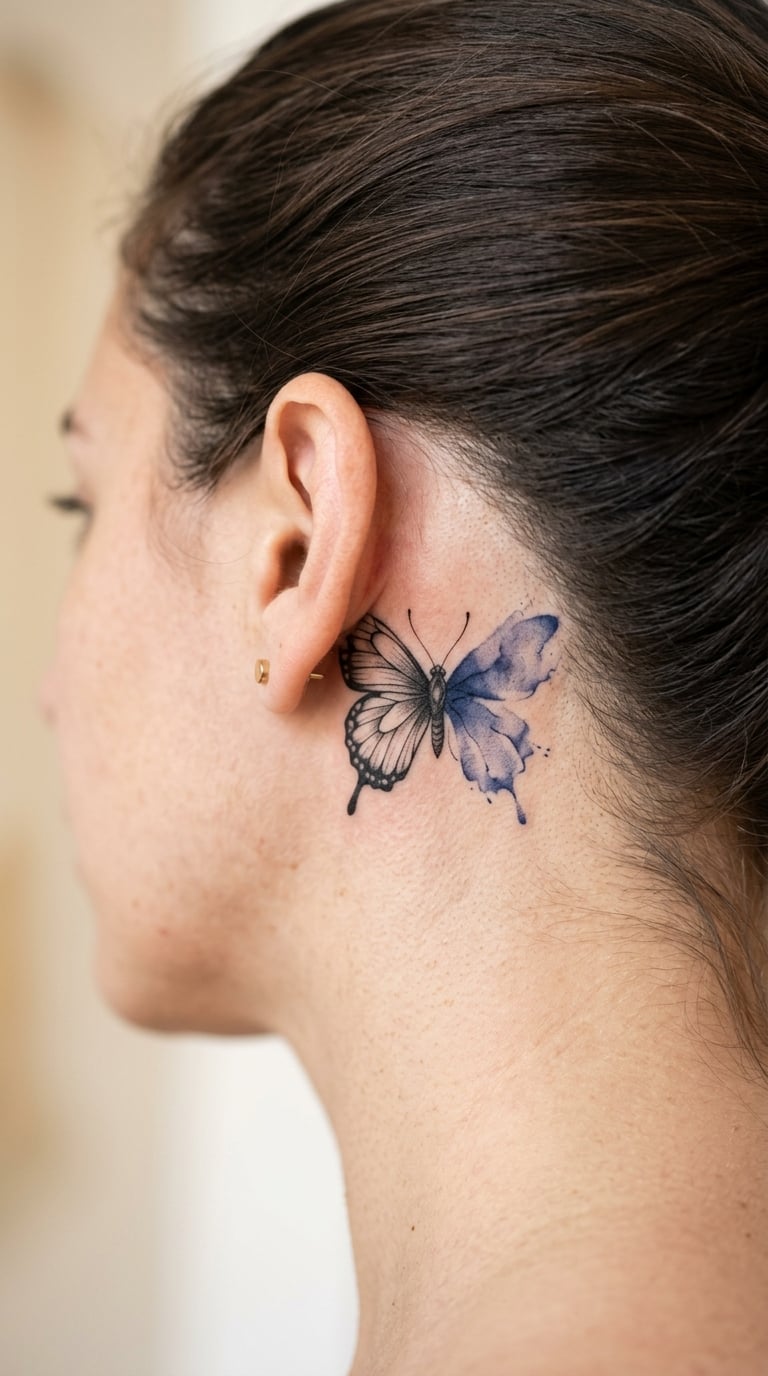
A butterfly with one side drawn as clean black linework and antennae, and the other side washed in soft indigo that bleeds slightly past the outline. The asymmetry is the whole design. Two matching wings would just be a butterfly.
Butterflies stand for transformation, and in practice they get chosen most often by people marking a change after a breakup, a recovery, or a move to a new city. It is one of the most requested symbols in butterfly-focused groups, usually for exactly that reason.
Placement: behind the ear, the collarbone, or the top of the foot. Size: 2 to 2.5 inches (5 to 6 cm) across. Style: watercolour with fine line. Pain: medium, about 4 out of 10, and the ear area is a real nerve cluster, so expect a sharp few minutes at the start. Watercolour is a technique, not a permanent colour: the wash fades within a few years while the black line stays, so expect a refresh or a re-outline later.
Make it yours: pick the colour from something that actually changed in your life rather than the colour you liked that week.
11. Bird Escaping an Open Cage
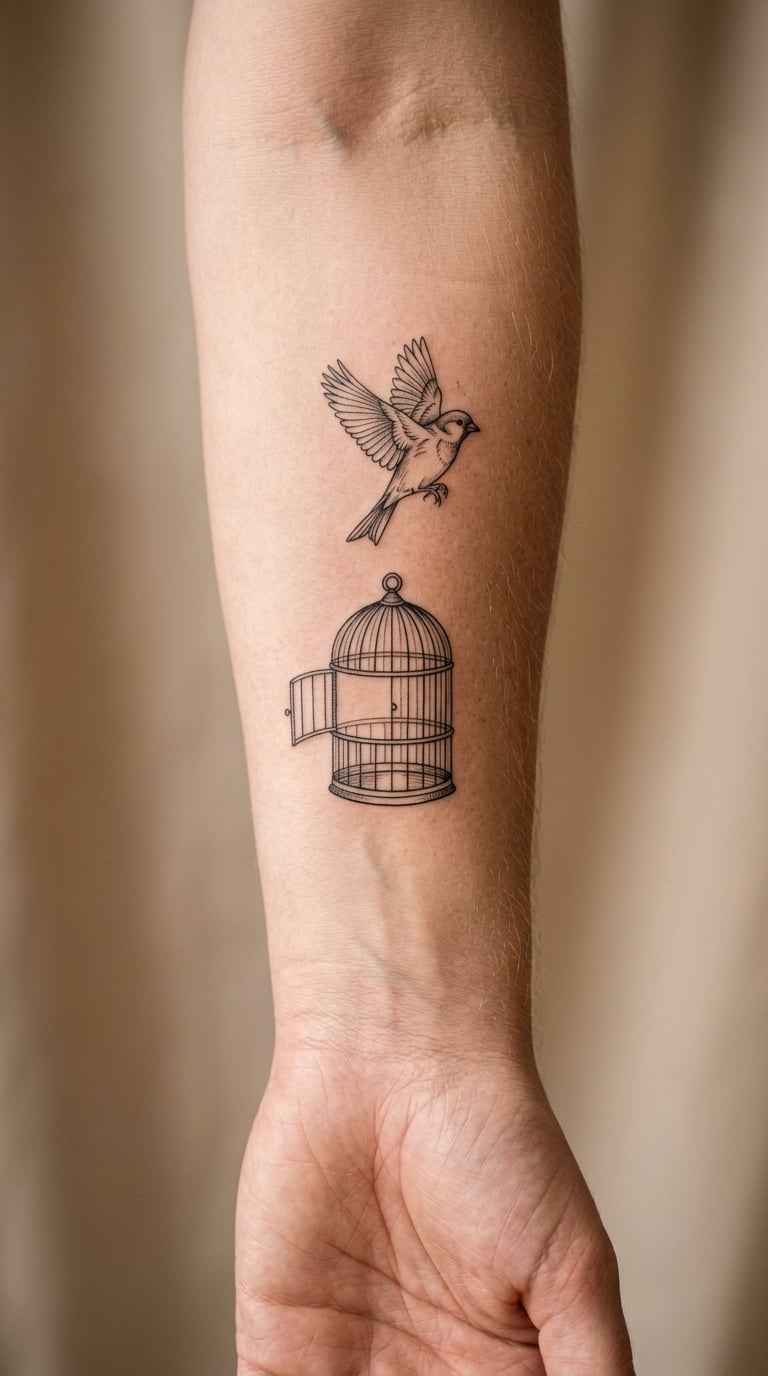
A small songbird in flight with wings angled up, positioned above a cage whose door hangs open and whose bars are drawn with two or three lines only. The gap between the bird and the cage should be at least a bird’s own height, otherwise it reads as trapped.
This is the oldest and most literal version of the idea, and it is also the one most people have seen, so if the cliche worry is part of your thinking, skip down a few. When people do choose it, it usually maps to a specific leave-behind, which makes the open door worth the obviousness.
Placement: inner forearm, or stacked with the cage on the calf. Size: 2 to 3 inches (5 to 7.5 cm) tall including the cage. Style: fine line. Pain: low to medium, about 3 to 4 out of 10. The cage bars are short separate strokes, which is the fiddly part rather than the painful part. A very small cage loses its door detail within a few years, so keep it above about half an inch tall.
Make it yours: have one bar left open on the far side of the cage, as if the door is swinging wide.
12. Wild Horse Running Across a Minimal Field
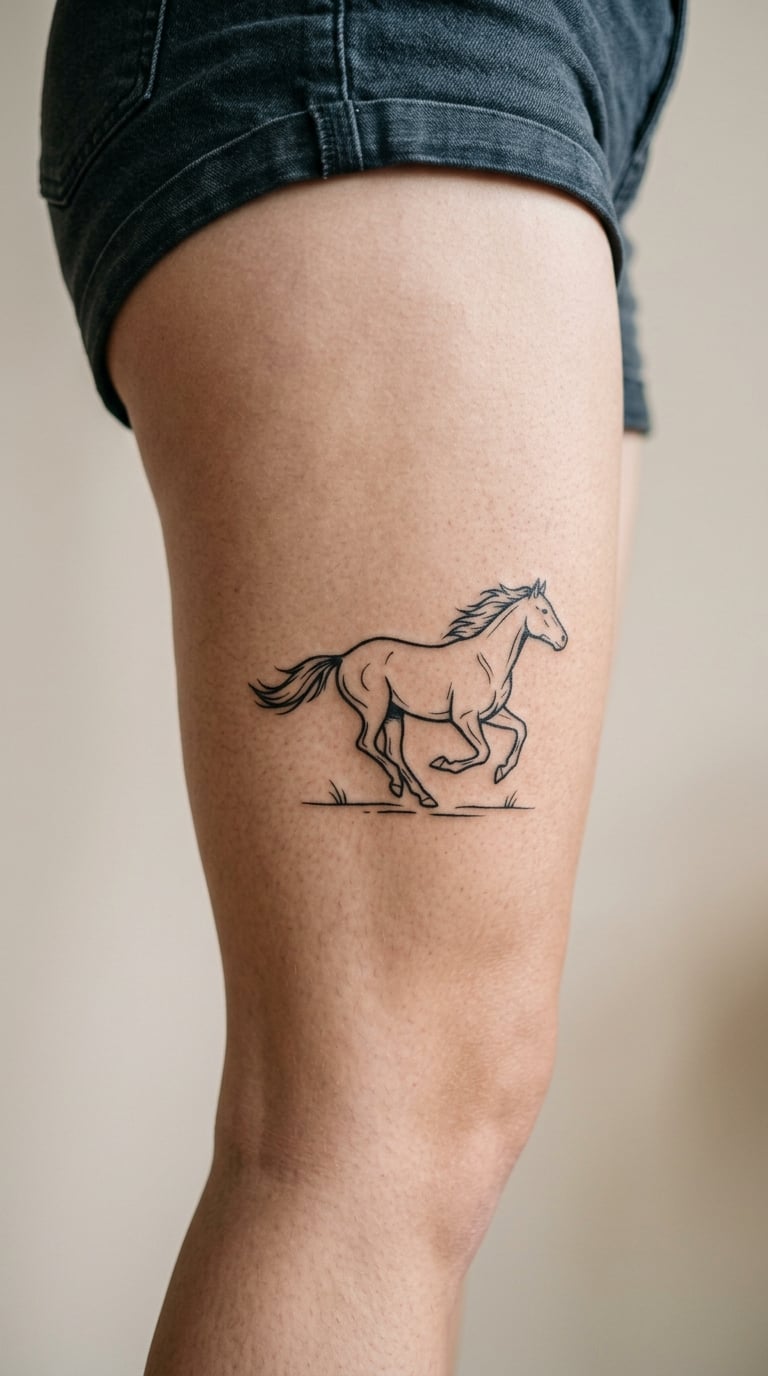
A galloping horse in outline, all four legs extended mid-stride, with just two short grass lines beneath it. The legs are the design’s whole quality; a horse with legs tucked under loses the sense of speed immediately.
Freedom, movement and untamed nature are the established readings here, and horse symbolism carries older layers too, including endurance and luck. Plenty of people who had no connection to any of that still get one because the animal itself does the work.
Placement: outer thigh, the calf, or the ribs. Size: 3 to 4 inches (7.5 to 10 cm) wide. Style: line work with light shading along the neck and barrel. Pain: medium, about 5 out of 10 on the outer thigh, and the inner thigh is a different story entirely at 7 or 8. Manoeuvring around a leg mid-gallop is slow, so this is a two-to-three-hour piece rather than a quick one.
Make it yours: add a small star or a single line of script along the shoulder where a harness strap would sit.
13. Ocean Waves Wrapping Around an Arm
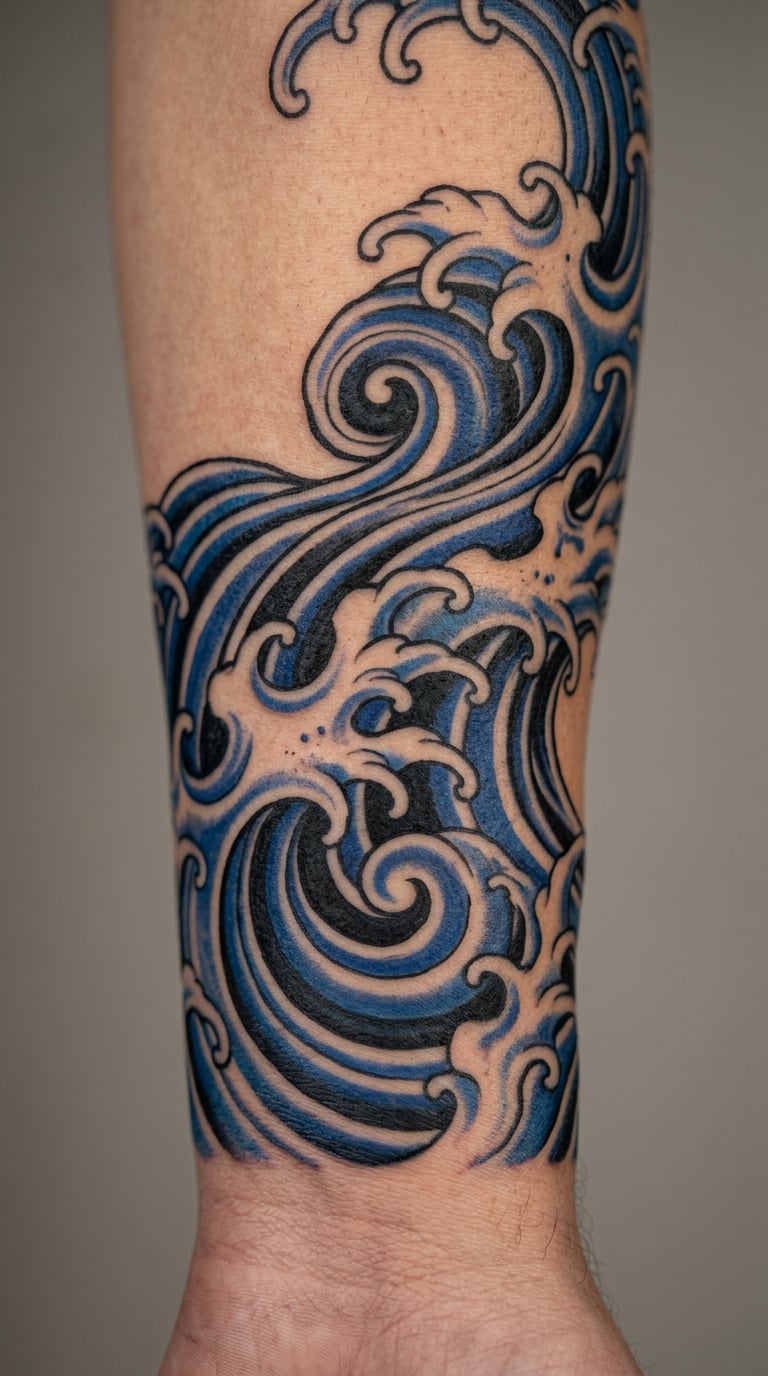
A single large wave curling over the arm, built with a dark outline, a mid-tone blue interior and white foam left as bare skin at the crest. The bare skin is what keeps it from looking muddy. Traditional wave work uses negative space for foam, and skipping it is the usual mistake with blue-filled versions.
Water that keeps moving and never stays in one shape is the freedom idea here, and it works as a band as much as a single image. Wrapped designs also age better than flat ones because the arm’s curve carries the drawing for you.
Placement: forearm band from wrist to mid-forearm, or the calf. Size: 5 to 6 inches (13 to 15 cm) of arm length. Style: Japanese-style wave with colour. Pain: medium, about 5 out of 10, and the inner forearm near the elbow is the sore zone. Blue is a hard colour to tattoo evenly because it shows every pass, so a good saturation does take time. It will lighten noticeably, often from a vivid blue to a softer grey-blue within a couple of years.
Make it yours: run a second smaller wave in the opposite direction halfway up the arm, so the two currents meet.
14. Hot-Air Balloon Above Tiny Birds
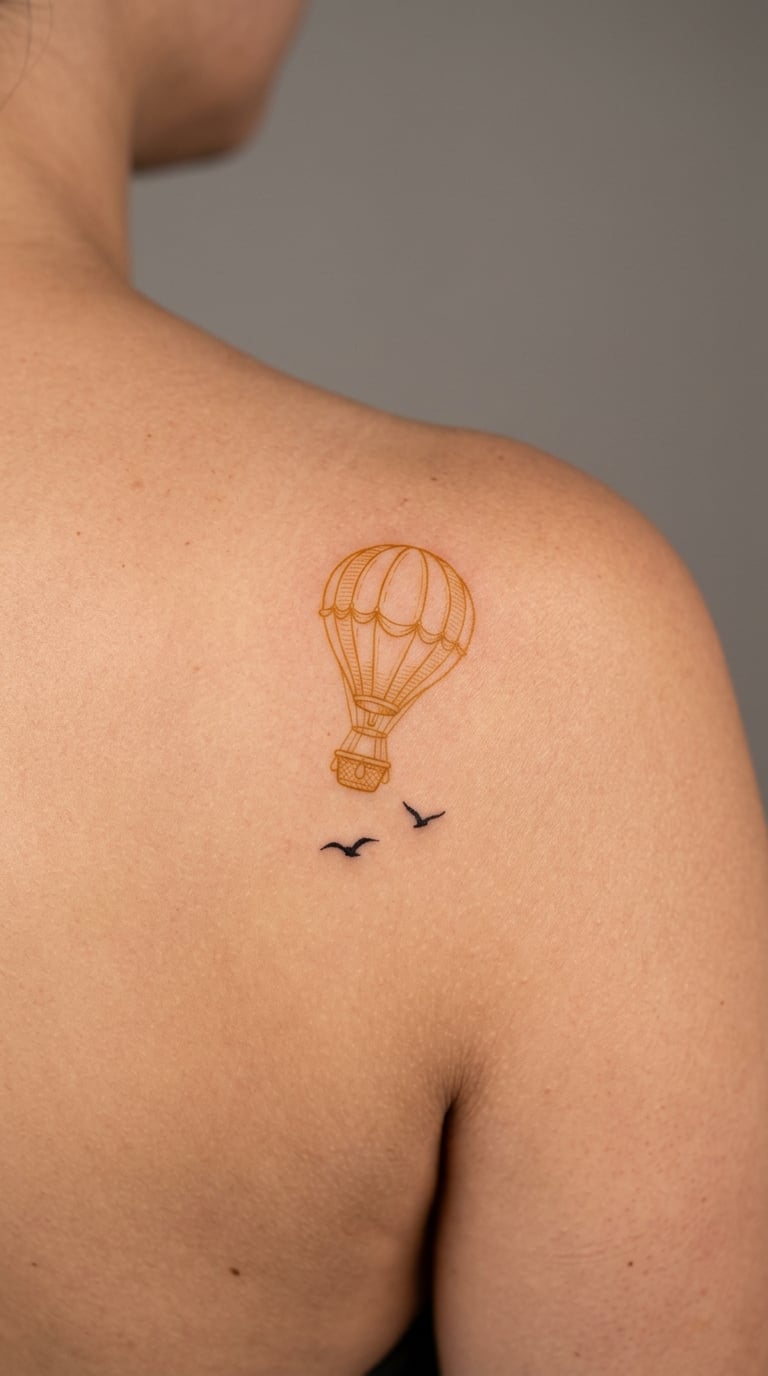
A balloon drawn in fine black outline with the envelope washed in warm ochre, and two small solid black birds beneath it. The scale contrast is the trick: tiny birds under a large balloon, with clear air between them.
Travel, height and a wider view are what this carries. People also read the rising balloon as leaving the ground behind, which suits anyone who has just changed jobs, moved country, or finished a season they had to get through.
Placement: the shoulder, upper back, or the outer calf. Size: 2 to 2.5 inches (5 to 6 cm) tall. Style: fine line with one colour wash. Pain: medium, about 5 out of 10 on the shoulder, where the skin is thin over the deltoid and the nerve endings are close. The shoulder also creases into the design every time you reach, so balloon proportions stretch with movement. Keep the wash light so it can be refreshed without a full rework.
Make it yours: add a small woven basket with a tiny flag carrying a year that marked the change.
15. Map Pin and Open Coordinate Grid
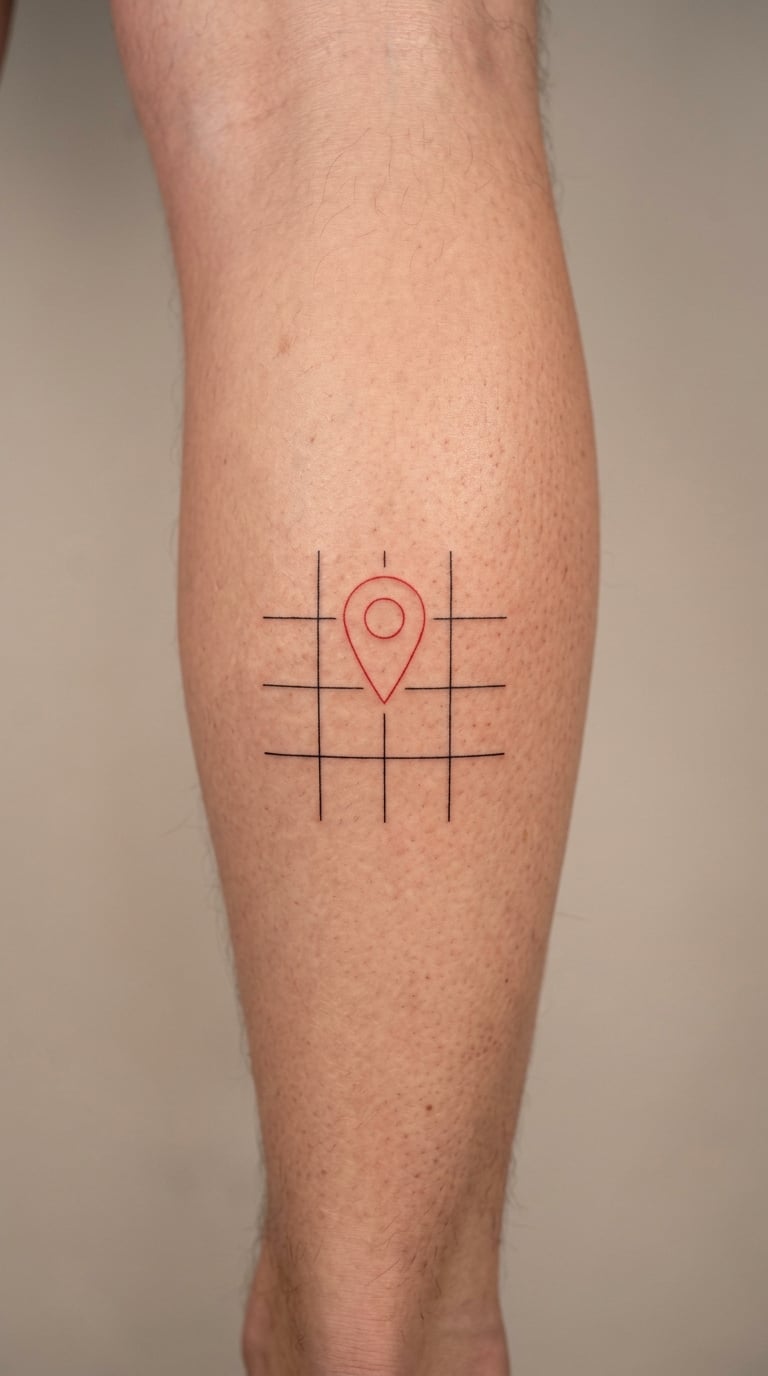
A solid or red map pin with a circular hole at its head, sitting over a light grid of lines that stops partway across instead of filling the whole area. The unfinished grid is important. A complete grid reads as a map of nowhere; a grid that trails off reads as a choice being made.
Direction and arrival are the meanings, and a specific coordinate is usually the reason behind it. A home, a meeting point, a place you have not been yet. This one suits people who want freedom to look planned rather than improvised.
Placement: the calf, inner forearm, or the back of the hand. Size: 2.5 to 3 inches (6 to 7.5 cm) tall. Style: fine line with one colour. Pain: medium, about 5 out of 10 on the calf, rising to 7 on the shin and the back of the hand where bone sits right under the skin. Small grid squares need line weight or they fill in solid as they heal, so ask the artist to space them wider than looks right in a drawing.
Make it yours: have the grid lines stop at the pin and fade out in the direction of the real coordinates.
16. Open Lock With a Floating Key
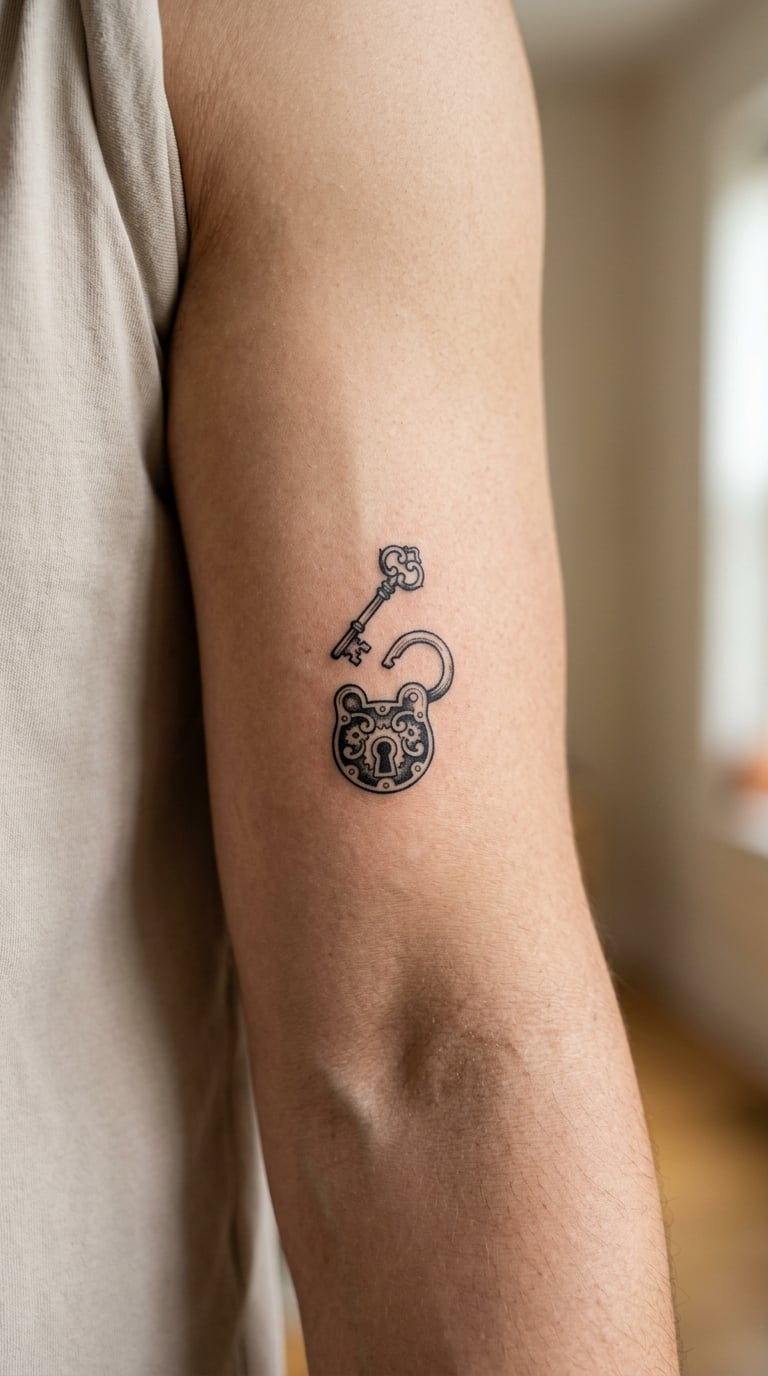
A padlock drawn in solid black with the shackle lifted clear of the body, and a key drawn separately above it with a small gap between the two. The gap is the whole message. A closed lock with a key beside it is a problem with a solution, not a solution.
Access, choice and self-directed movement are what this carries, and it is one of the less crowded symbols on the list. It also pairs naturally with a date or a single word, since the open space around it stays quiet.
Placement: inner upper arm, the back of the hand, or beside a matching piece. Size: 2 to 2.5 inches (5 to 6 cm) tall. Style: blackwork, solid fill with no gradients. Pain: low to medium, about 4 out of 10 on the inner upper arm and closer to 6 on the hand. Small key teeth are the fiddliest part; a slightly larger design lets the artist keep them clean. Solid black in a shape this small holds its edges better than a shaded version would.
Make it yours: have the key engraved with four small numerals for a year, kept to the width of the key shaft.
17. Dandelion Seeds Crossing a Faint Fence
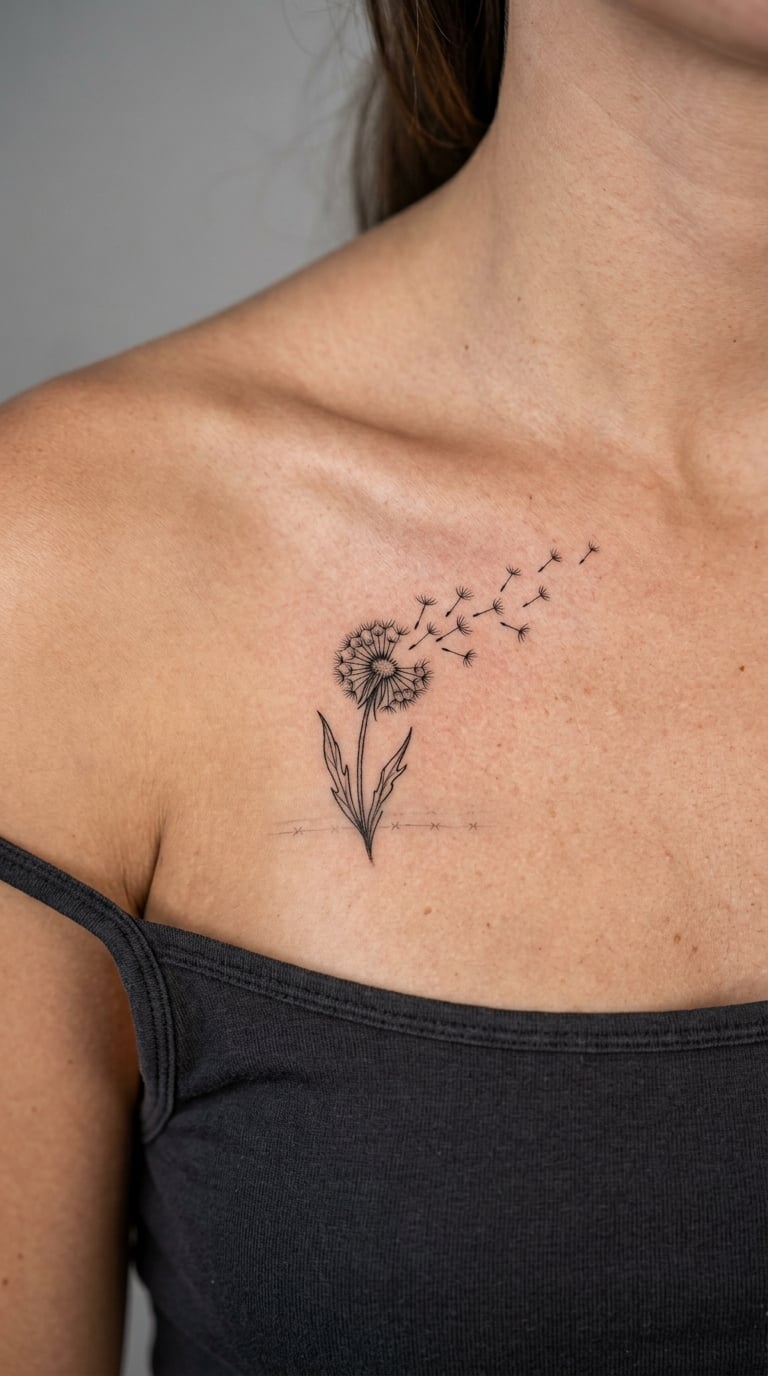
A dandelion head in fine line, three or four seeds drifting up and away from it, and a single light fence line low in the composition. The fence should be the faintest element in the design, or it starts to dominate.
Seeds going over a boundary is the meaning, and it is the gentle version of the same idea as a broken chain. People in recovery groups often describe this one in terms of letting go rather than escaping, which is a useful distinction to hold on to.
Placement: below the collarbone, the inner forearm, or the shoulder. Size: 2.5 to 3 inches (6 to 7.5 cm) wide. Style: fine line. Pain: low, about 3 out of 10 below the collarbone, though the breastbone area gets sharp when it is reached. Below the collarbone is one of the most requested first-tattoo spots for this style because it is visible but coverable by a shirt. The tiny seed stems blur first, so ask for slightly longer stalks than the drawing implies.
Make it yours: have three seeds carry a single word between them, small enough to read only up close.
18. Hourglass With Wings Instead of Sand
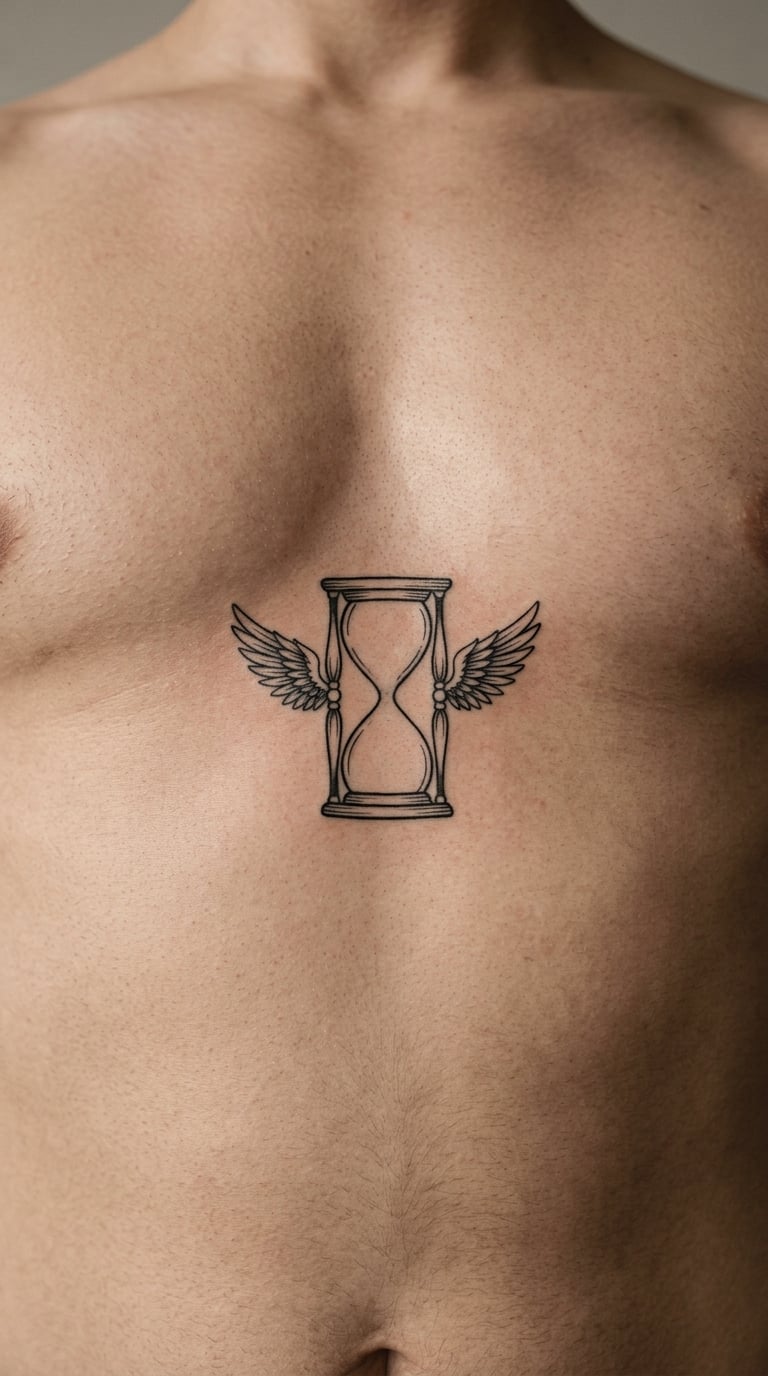
An hourglass drawn as a symmetrical blackwork shape, with small open wings attached to each side and the glass section left empty. No sand, no falling grains, no frame decoration. The empty glass is the idea, and filling it would undo it.
Time passing and release together, which makes it more layered than most freedom symbols. People tend to get one after a specific stretch of time is over: a decade sober, a childhood finished, a chapter closed on purpose.
Placement: centre of the chest below the sternum, or the outer upper arm. Size: 2 to 2.5 inches (5 to 6 cm) tall. Style: blackwork. Pain: medium, about 5 out of 10 on the sternum, and the chest is bony, so the work is uncomfortable in a specific, sharp way rather than a broad ache. Below the sternum sits in a natural dip, which helps. Wings add small shapes, so budget more time than the overall size suggests.
Make it yours: have the two wings point in opposite directions, so the design reads as leaving rather than hovering.
19. Open Book With a Bird Taking Flight
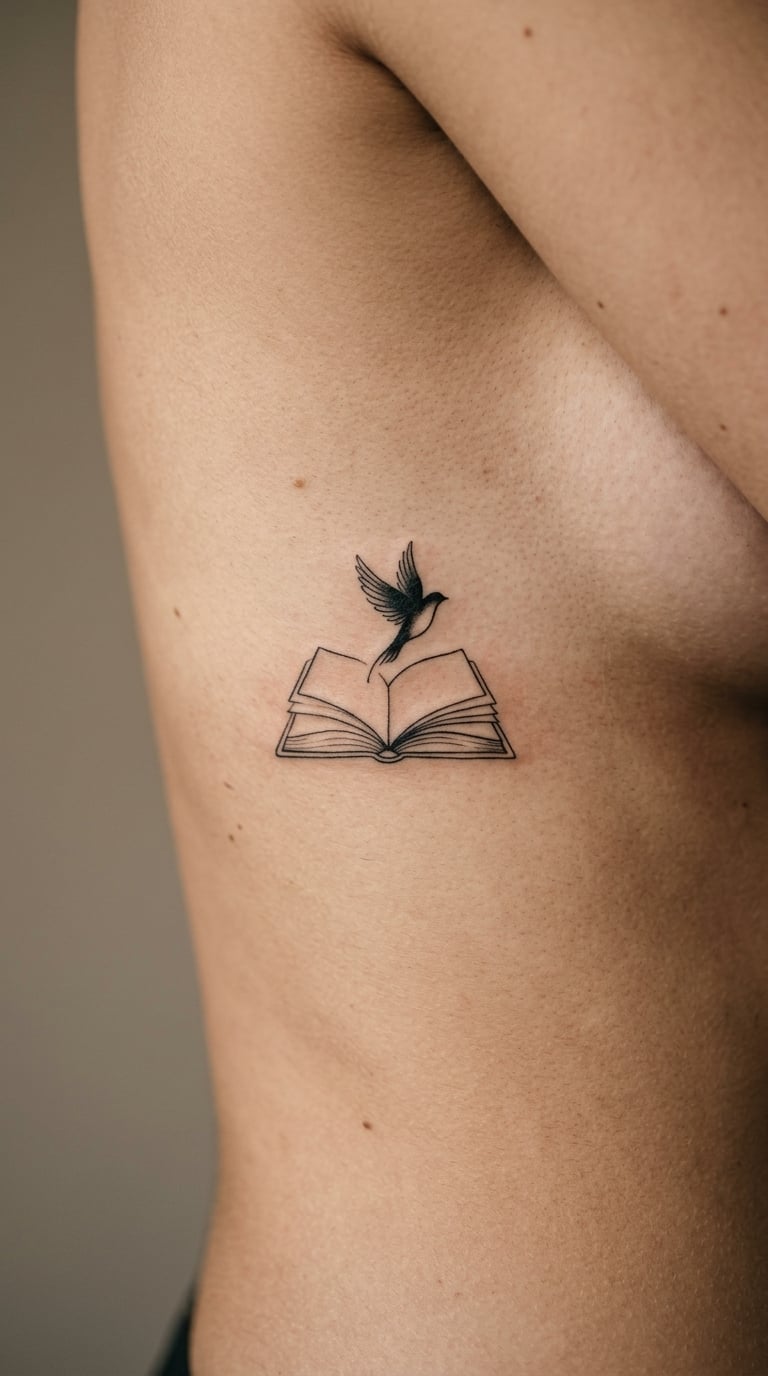
An open book drawn in fine line, two simple page shapes meeting at a spine, with a solid black bird rising out of the centre and clearing the top edge of the pages. If the bird overlaps the pages, it looks like it is stuck. Space between the two is what sells the movement.
Knowledge, imagination and moving past what you already know are the readings here. This one suits someone who finished something, changed careers, or wants freedom to mean thinking for yourself rather than leaving a place.
Placement: side of the ribs, the inner forearm, or the back of the hand. Size: 2.5 to 3 inches (6 to 7.5 cm) wide. Style: fine line with one solid shape. Pain: high, about 7 out of 10 on the ribs, and breathing makes it impossible to fully stop moving. The ribs are the worst-placed spot on this list for a first tattoo. Plenty of people move the same design to the inner forearm or the hand instead, where it reads the same and feels very different.
Make it yours: have the bird’s wing shape double as the page corner folding over, linking the two elements.
20. Mountain Climber Reaching the Final Peak
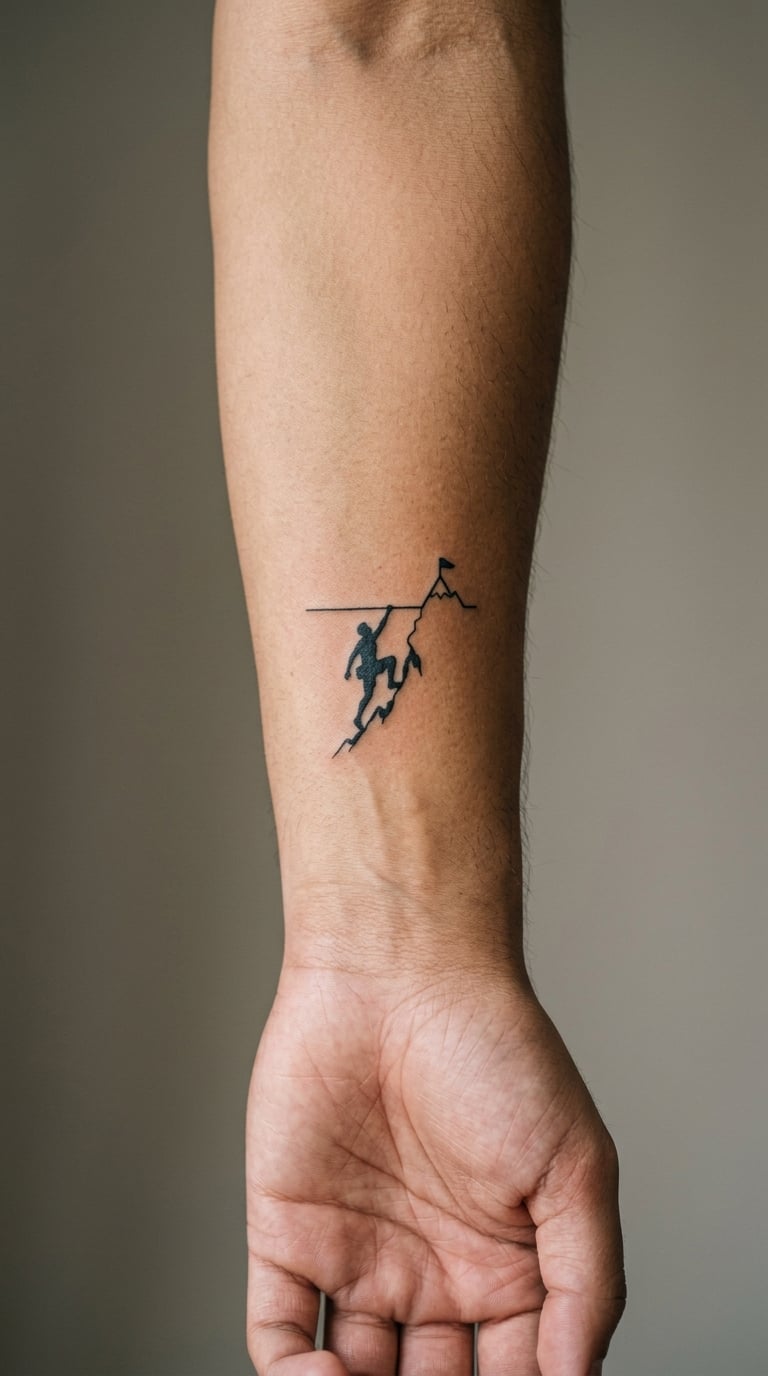
A solid black silhouette figure with one arm up, touching a single summit line drawn in one confident stroke. No rope, no flags, no base. Three elements, all of them load-bearing, which is why it stays readable at small sizes.
Ambition and earning a new viewpoint are the meanings, and a lot of people use it for a goal they finished rather than one they are chasing. It works particularly well for someone who does not want a bird, a chain, or anything already associated with this theme.
Placement: inner forearm, the calf, or beside a date. Size: 2 inches (5 cm) tall. Style: micro silhouette or fine line with solid fill. Pain: low, about 3 out of 10 on the inner forearm. A two-inch silhouette is a small tattoo with a high consequence, because the figure has to be recognisable in solid black with no interior detail. Look for healed work in the same size range rather than judging a portfolio of large pieces.
Make it yours: add a small date or initials at the base of the summit line, set as small as the artist can make it read.
21. Shooting Star With a Long Minimal Trail
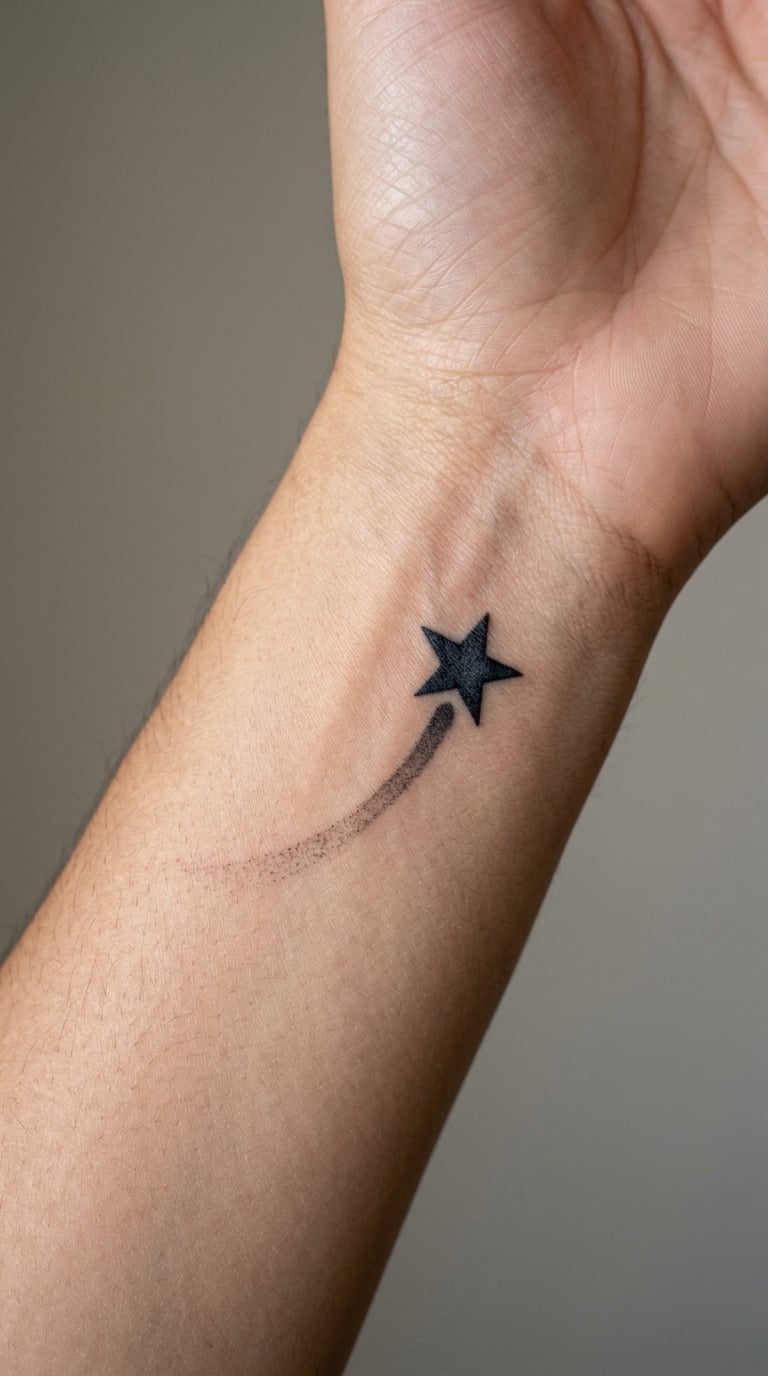
A five-point star filled solid black, trailing a single curved line that thins and breaks into three dots as it goes. The trail is what turns a shape into a direction. Straight down and it is a star; curved and fading and you have movement.
Possibility, momentum and a wish worth making are the established meanings. It is one of the more cheerful symbols on the list, and it works well for someone who does not want their freedom tattoo to read as escape or recovery.
Placement: inner wrist, along the diagonal of the forearm, or behind the ear. Size: 2 to 2.5 inches (5 to 6 cm) including the trail. Style: fine line with one solid shape. Pain: medium, about 5 out of 10 on the wrist. The three fading dots are the first thing to blur over a decade, so make the dots slightly larger than they look in the drawing. Solid black stars hold their shape well, which is why keeping the star and letting the trail go light is the safe version.
Make it yours: curve the trail along the forearm’s natural line so it appears to cross the wrist when you turn your hand.
22. Horse Hooves Forming an Infinity Sign
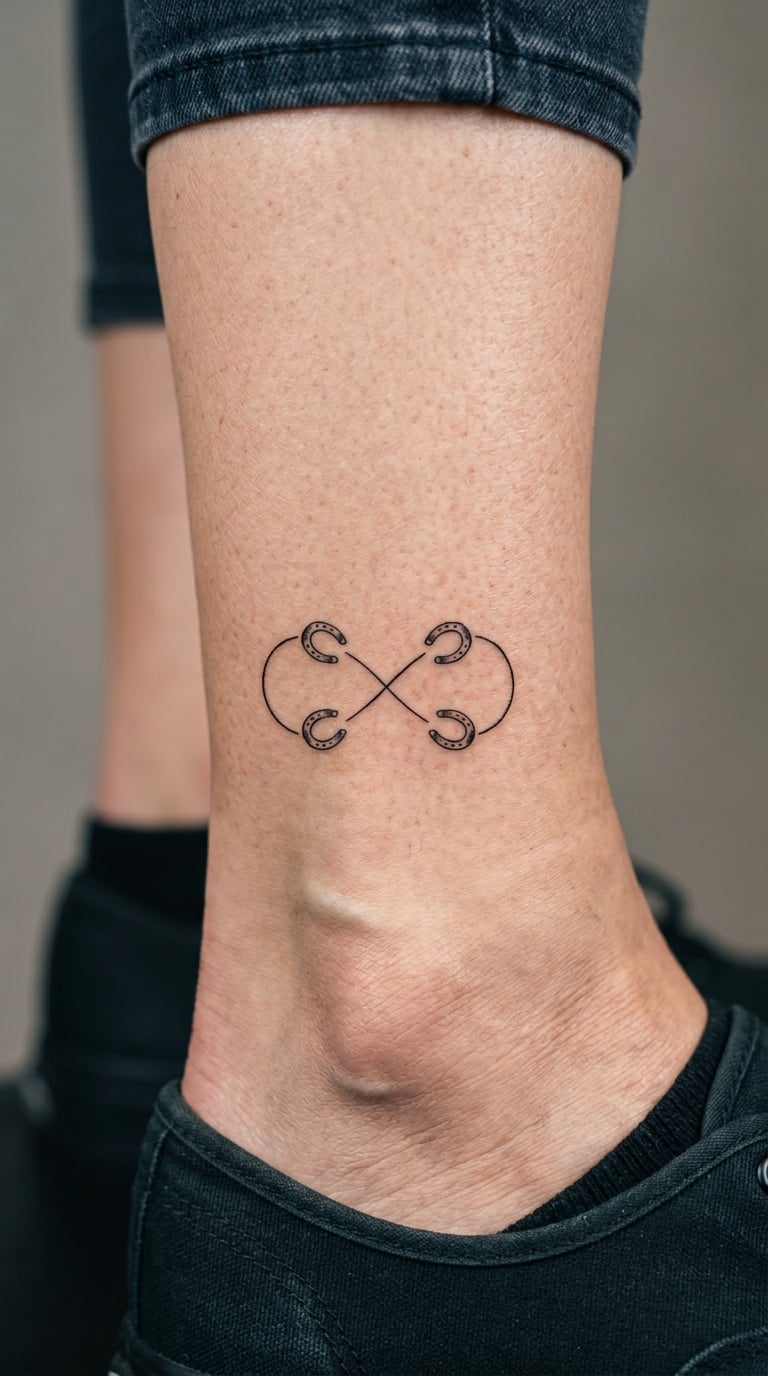
Four or five hoof prints arranged so the line of them draws a horizontal figure of eight, each print a small outlined or solid shape with a notch. Read one way it is an infinity sign, read the other way it is a path of prints. That double reading is the point.
Endurance and limitless possibility are the meanings, and hoof prints carry a road and a journey as well. It is a good pick for someone who rides, or for someone leaving a relationship and wants something with a steady rhythm built into it.
Placement: the ankle, the wrist, or along the outer forearm. Size: 2 to 2.5 inches (5 to 6 cm) wide. Style: fine line, solid or outlined prints. Pain: medium, about 5 out of 10 at the ankle, where the bone is close and the skin is thin. Each print is a separate small mark, so the session breaks into many short stretches, which some people find easier than one long pull. Outlined prints will soften noticeably over time; solid ones hold better.
Make it yours: use five prints instead of four, and let one of them sit slightly apart, like a print that stopped.
23. Hummingbird Hovering Over a Loose Ribbon
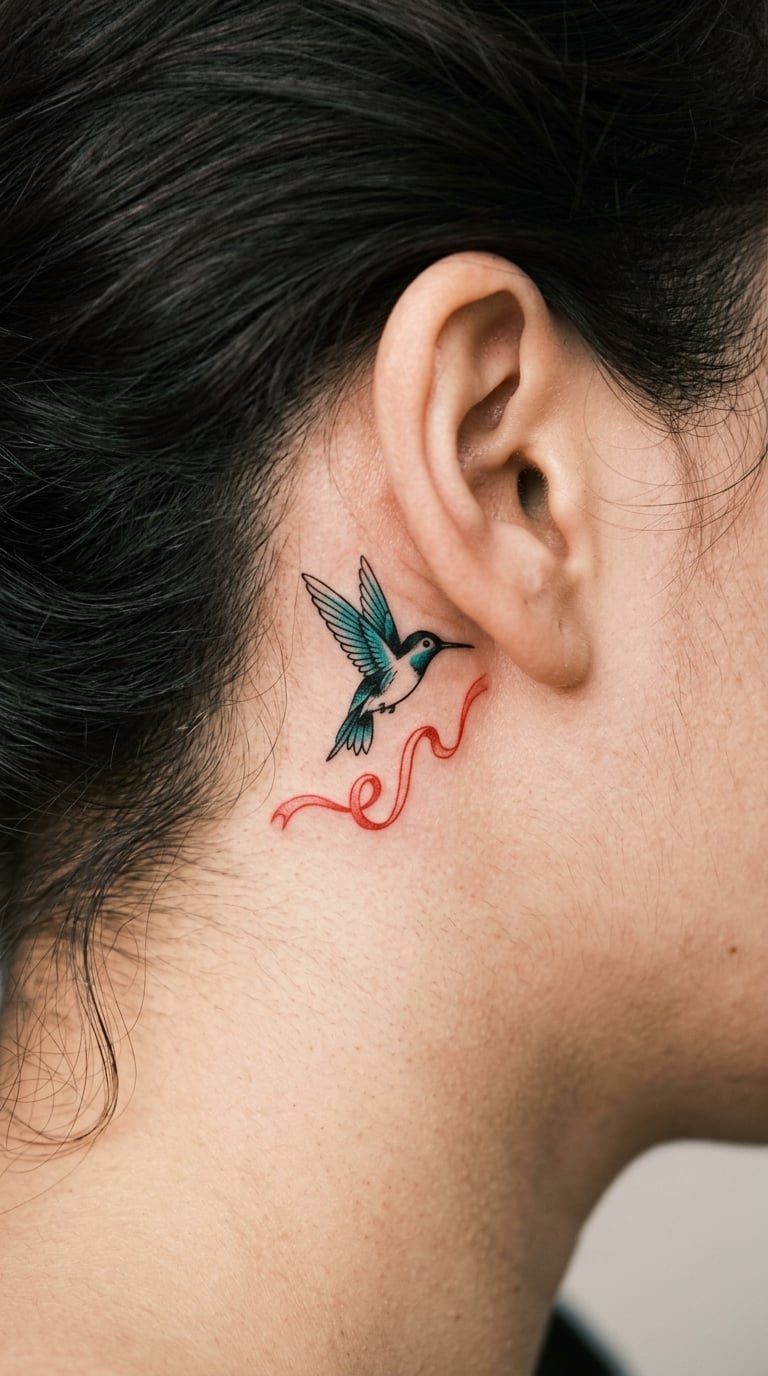
A hummingbird in fine line with a small teal wash on the throat, wings drawn as two short blurred strokes rather than feathers, hovering above one red ribbon curving away to one side. The ribbon has to look like it is moving, so the curve is asymmetric and it leaves the frame.
Lightness, speed and momentum are the meanings, and a hummingbird is chosen as often for joy as for freedom. This is a good design for someone whose story is a good year rather than a hard escape.
Placement: behind the ear, the collarbone, or the inner wrist. Size: 1.5 to 2 inches (4 to 5 cm) long. Style: illustrative fine line with two colour accents. Pain: medium, about 5 out of 10, and behind the ear is sharp for the first minute then settles. At this scale the two wing strokes have to suggest motion in very few marks, which is the hardest drawing job on this list. Two colours mean a longer session and more risk of the teal reading muddy against a warm ink.
Make it yours: have the ribbon run to the nearest edge of the placement so it looks like it continues past the skin.
24. Wide Horizon With an Empty Road and Stars
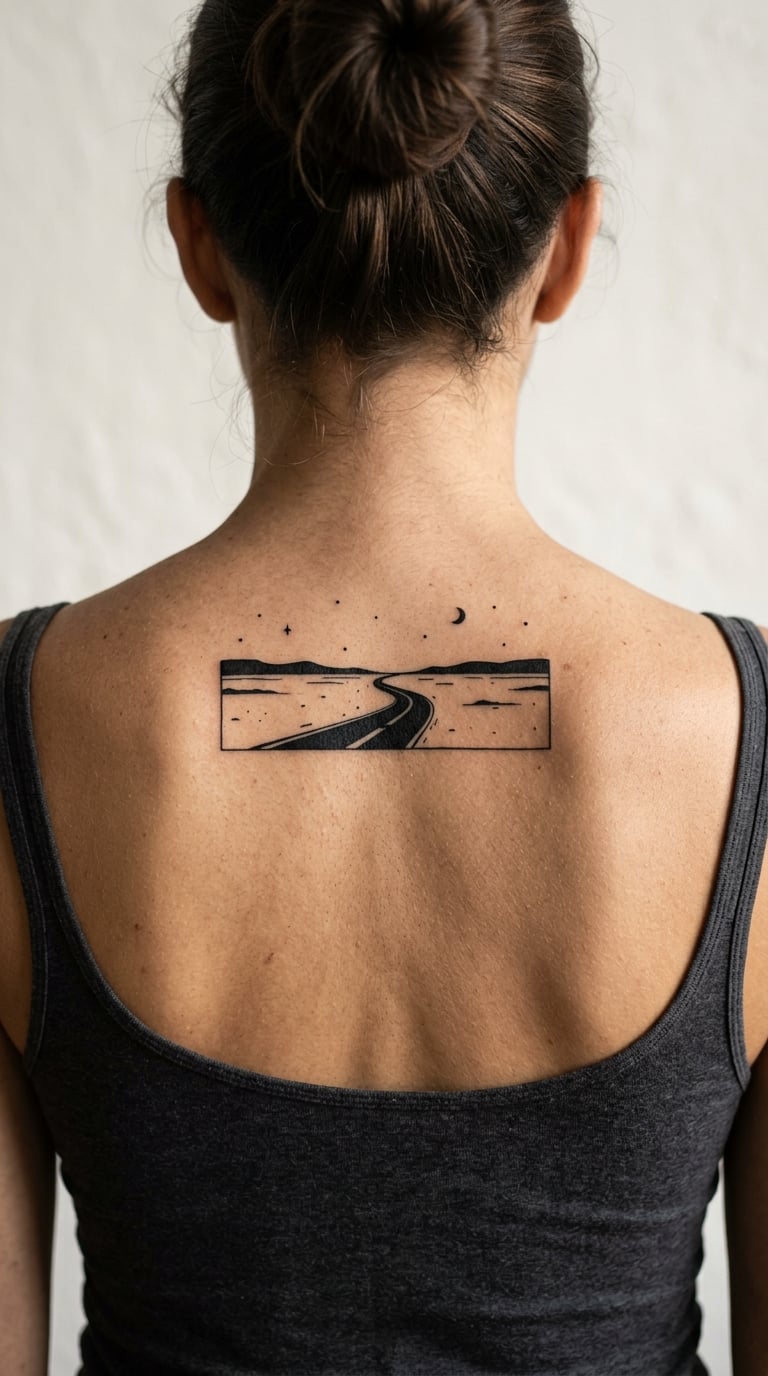
A wide composition built from a very low horizon line, a road narrowing from the bottom edge to nothing, three or four stars in the empty sky, and a pair of low hills. The empty sky does most of the work here. Everything below the horizon is dark, everything above it is bare skin.
Distance, possibility and self-direction are what it carries, and it is the most contemplative piece in the set. It works best somewhere the wearer cannot see it constantly, because the point is the long view rather than the close-up.
Placement: across the upper back, the chest, or a large panel on the thigh. Size: 5 to 7 inches (13 to 18 cm) wide. Style: black and grey with solid dark foreground. Pain: medium, about 4 out of 10 on the upper back, rising to 6 across the chest because of breathing movement. A wide format means the needle travels a long distance and the back cools down slowly, so breaks matter. Big dark areas are the main ageing risk: they can pull inward and lose their edges as the skin settles, so this one realistically needs a follow-up session.
Make it yours: leave the road unmarked, or add a single tyre-track pair that starts at the bottom edge and fades out before the horizon.
How to Choose the Right Design
Once you have narrowed the symbols down, five things decide whether a design works on your body rather than only on paper.
Match the line weight to the size
Fine line needs room and bold black needs distance. A two-inch design in heavy black reads as a solid blob, and a six-inch design in hairline strokes disappears. Ask your artist to show you healed work at the size you are planning, not fresh work, because fresh ink always looks sharper than it will be in two years.
Count the elements, not the detail
Every extra element in a small design is another thing to blur over a decade. The climber, the shackles, the open lock and the balloon are all strong partly because they only contain two or three things. A bird plus a cage plus a broken chain plus a date is four symbols competing for the same square inch.
Pick the placement for the movement, not the drawing
Curved placements stretch and distort. The arm, the ribs and the chest all move, and a design that looks balanced on paper will sit differently once it is on moving skin. Wrists, forearms and the outer thigh are the easiest flat canvases. Ribs and the sternum are the most expressive and the least comfortable.
Check what is already there
Skin that has been tattooed before holds colour differently, and old black lines can show through a lighter new design. If you already have work on the area, show your artist all of it before committing. Some freedom designs also happen to cover older pieces well, since a solid black panel or a dense horizon can absorb a lot of what was underneath.
Make sure the meaning is actually yours
Inherited symbolism is useful until it is not. A symbol that reads as release to you may read as something else to somebody else, and the way to handle that is to know what you are claiming before you claim it. Ask yourself what you are freeing yourself from, then choose the element that mirrors that specific thing. The bird and the mountain are different answers to different questions.
Plan for what the design looks like in ten years
Fine line on the hands, fingers and inner wrist softens fastest. Solid black and heavy outlines hold up best. Colour, especially blues and greens, fades toward grey unless it is refreshed. If you can live with a design that reads as a softer version of itself later, you have far more freedom on size and style than if you need it to stay razor-sharp.
Cost and Session Time
Tattoo cost tracks the artist’s hourly rate and how many hours a design takes, not how meaningful it is. Every idea on this list falls into one of four practical bands, and the band is set by area covered and by how much shading the style requires.
Micro designs are the paper plane, the sparrow, the climber and the hummingbird. At roughly one inch or less across, these usually sit at the studio’s minimum charge, because the setup and sterilising time is the same as for a much larger piece. If a studio’s minimum is higher than you expected, a micro piece done as part of a larger booking is often the better value.
Small designs run from one to three inches, covering the compass, the sailboat, the open lock, the shooting star and most of the fine line ideas here. These are commonly finished in a single session, though the line-heavy ones take longer than the measurement suggests because single-needle work is slow.
Medium pieces such as the open wings, the waves, the butterfly wash and the dandelion need either more time in one sitting or a second appointment. Colour fills and watercolour are the biggest time drivers, since saturation requires more passes than line work.
Large pieces like the phoenix and the wide horizon are multi-session by design. Nobody finishes an eight-inch composition in an afternoon, and an artist who offers to is either rushing the shading or changing what you asked for.
To put numbers on those bands in the US, expect roughly $60 to $120 for a micro design, $120 to $250 for a small two-to-three inch piece, $250 to $500 for a medium piece, and $600 upward for a large multi-session composition. Hourly rates commonly sit between $80 and $200, and they climb quickly in expensive coastal cities, which is where a booked studio and a walk-in counter differ most.
Two practical notes. Shop minimums are real and vary widely between a walk-in counter and a booked studio, so ask before you arrive. And custom drawing fees are common when a design has to be adapted to your placement, which most of the ideas here will need at some stage.
Aftercare Basics
Healing is mostly about restraint. Whatever your artist tells you on the day overrides everything below, so follow their aftercare instructions first.
- Follow your artist’s aftercare instructions. They know what they did, how much product went on and how the skin will respond. If their advice differs from anything you have read online, theirs wins.
- Wash gently and often. Clean water and a fragrance-free wash, patted dry with something disposable rather than a towel. Let the tattoo breathe rather than keeping it under a dressing for days.
- Protect it from sun. Fresh skin and healed skin both fade faster with sun exposure. Covered skin stays closer to the tone you chose, which matters most for the coloured designs on this list.
- Choose loose clothing. Tight fabric over a healing tattoo rubs and catches. Cotton over the area is the safest thing for the first week or two.
- Use only what the studio gave you. Balms and aftercare products that were not recommended for your tattoo introduce ingredients the artist has not accounted for. Skip scented lotions, perfumed soaps and unapproved creams.
- Contact the studio if something looks wrong. Spreading redness, heat, swelling, discharge or a fever are signs worth a call, and most studios would rather hear from you early. If it becomes urgent, your general practitioner or an urgent care clinic is the next step.
Frequently Asked Questions
What tattoo designs most clearly symbolize freedom?
Birds in flight, an open birdcage with the door swung wide, broken or open shackles, a compass rose and ocean waves read as freedom fastest, because each one shows something already released or moving without restraint. A road, a horizon or a sailing boat work just as well if you want the freedom to feel about direction rather than escape. The symbol carries the meaning, not the drawing style, so a small fine line bird says the same thing as a large blackwork one.
What is a good small freedom tattoo for a first tattoo?
A fine line paper plane, a two-inch compass rose or a tiny mountain climber at a summit are the easiest first tattoos in this theme, because each contains only two or three elements. Avoid anything with more than one colour, very fine detail or a spot that will be hidden for years. Ask to see healed work in the same size range, not a portfolio of large pieces, and remember that first tattoos on the forearm or upper arm are the easiest to revise later if you want something different.
Should I choose a fine-line or bold freedom tattoo?
Fine line suits small placements, hidden spots and a design you want to look delicate, but it softens and spreads within a few years, especially on the inner wrist and hands. Bold blackwork and solid fills hold their edges far longer and read clearly from across a room, but they need more space and usually a second session. If you are unsure, blackwork on the forearm or upper arm is the lower-risk option for something you want to keep readable for a long time.
Which freedom tattoo will age the best over time?
Solid black shapes and heavy outlines age best, because they hold an edge as skin settles and they can be refreshed without a full rework. Designs that rely on many hairline strokes, tiny dot grids or thin line shading blur first, and anything in blue or green fades toward grey within a few years. A wide solid black panel or a dense horizon line will stay readable longer than a detailed version of the same idea. Plan on a follow-up touch-up around four to six weeks after healing, whatever the style.
How much does a small freedom-symbol tattoo usually cost?
A small freedom-symbol tattoo is usually charged at the studio’s minimum rate or a short hourly session, and the price depends far more on the artist and the town than on the symbol itself. Fine line takes longer than the size suggests, so a one-inch design with several elements can cost the same as a two-inch design with fewer. Ask about the shop minimum and the hourly rate before booking, and expect a separate custom drawing fee if the design needs adapting to your placement.
Can I combine a freedom symbol with a meaningful date or word?
Yes, and it is the most common way these designs get personalised. The cleanest method is a symbol with quiet space around it, like the open lock, the compass or the balloon, and numerals set below it in a small plain typeface. Avoid layering fine line on fine line, since both blur. Check the wording with the person whose name or date it is before the appointment, and have the artist letter it freehand rather than tracing a font, which is where most legibility problems come from.
For a first tattoo, pick a design with three elements or fewer, on the forearm or the upper arm, in black. The paper plane, the compass or the climber will all hold up and can be changed later if your taste shifts. If you already have a sleeve or a spread of small tattoos, a freedom piece only works as part of that collection if the line weight and style match what is there, so bring photos of your existing work to the consultation. And whatever you choose, these tattoo ideas that symbolize freedom mean most when the symbol matches the specific thing you are leaving behind.