22 Rocket Tattoo Ideas for Space Lovers (October 2026)
garvit
September 30, 2026
Table Of Contents
These 22 rocket tattoo ideas cover everything from a single-line launch on your inner arm to a full blackwork scene across your upper arm. A rocket reads as liftoff before anyone asks what it means, so the design carries its symbolism without a word of text, which makes it one of the easier space motifs to wear for the rest of your life.
What makes a rocket work on skin is its direction. Point it up a forearm and it reads as ascent, point it along a calf and it reads as speed. Pick your style first, then your placement, then the line weight, because the same drawing turns to mud below about an inch and a half and turns gorgeous above three. Updated for 2026, and worth reading with a coffee while you sketch options in your phone notes.
If you are still deciding whether a rocket is the right motif at all, [24 tattoos that symbolize freedom](https://thewe.cc/tattoo-ideas-that-symbolize-freedom/) covers the broader meaning side, and [mountain and ocean tattoo ideas](https://thewe.cc/mountain-and-ocean-tattoo-ideas/) is a good look at a very different style of nature piece.
22 Rocket Tattoo Ideas: Quick Guide
Idea
Style
Best placement
Size
Pain
1. Minimal fine-line launch
Fine line
Inner forearm
2-3 in
Low
2. Retro rocket, curved exhaust
Traditional retro
Outer forearm
3-4 in
Low
3. Blackwork rocket through a star
Blackwork
Upper arm
4-5 in
Medium
4. Micro rocket behind the ear
Fine line micro
Behind the ear
0.75-1 in
Low to medium
5. Rocket with planet orbit
Illustrative
Inner bicep
2.5-3.5 in
Low
6. Watercolor nebula rocket
Watercolor
Shoulder
3-4 in
Medium
7. Traditional pin-up rocket
American traditional
Calf
3-4 in
Low to medium
8. Geometric rocket constellation
Geometric
Forearm
3-4 in
Low
9. Rocket and crescent moon
Fine line
Inner wrist
2-3 in
Medium
10. Realistic Saturn rocket
Micro-realism
Upper forearm
2-3 in
Medium
11. Dotwork rocket, dotted path
Dotwork
Outer arm
3-4 in
Medium
12. Rocket from a floral bouquet
Floral illustrative
Forearm near elbow
3-4 in
Medium
13. Grunge rocket, halftone burst
Grunge / punk
Outer bicep
3-5 in
Medium
14. Small red rocket, collarbone
Fine line colour
Collarbone
2-3 in
Medium
15. Rocket with mission numbers
Illustrative realism
Side of forearm
2.5-3.5 in
Medium
16. Double rocket matching pair
Fine line
Matching inner arms
1.5-2 in each
Low
17. Rocket inside a circular badge
Blackwork emblem
Upper arm
2-3 in
Low
18. Rocket shooting past a comet
Colour illustrative
Shoulder blade
4-5 in
Medium
19. Minimal black rocket on the spine
Minimal black
Upper back
4-6 in
Medium to high
20. Neon rocket with speed lines
Illustrative colour
Thigh
3-5 in
Medium
21. Antique rocket and star map
Antique engraving
Forearm
3-4 in
Medium
22. Large blackwork launch scene
Large blackwork
Outer upper arm
6-9 in
Medium
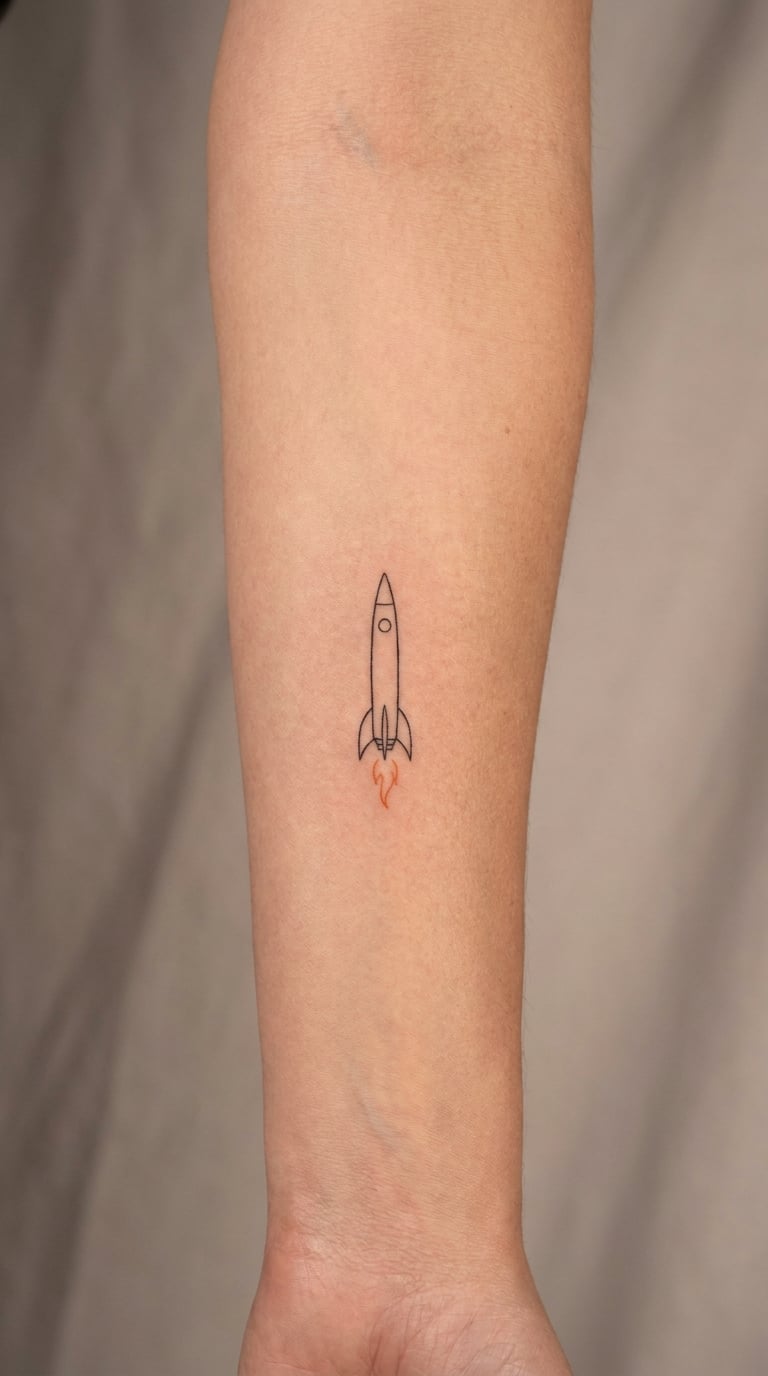
1. Minimal Fine-Line Rocket Launch
A single-needle rocket with one clean outline, two small fins and a short flame underneath. The proportions do all the work, so the drawing needs no shading at all. This is the design I would pick for someone who wants a rocket but is not ready to commit to a bold piece.
The meaning is straightforward: lift-off, new beginnings, the decision to go somewhere. People often pair it with a real date, the year they changed careers, or the year a child was born.
Placement: inner forearm, inner bicep, or the back of the hand. Size: 2-3 inches (5-7.5 cm) tall. Style: fine line, single needle. Pain: low on the inner arm, though the inner forearm is one of the more sensitive spots on the body. Ageing note: single-needle work fades faster than anything else you can get, so plan on a top-up every five to seven years.
Make it yours: add a small date beneath the flame in the same line weight.
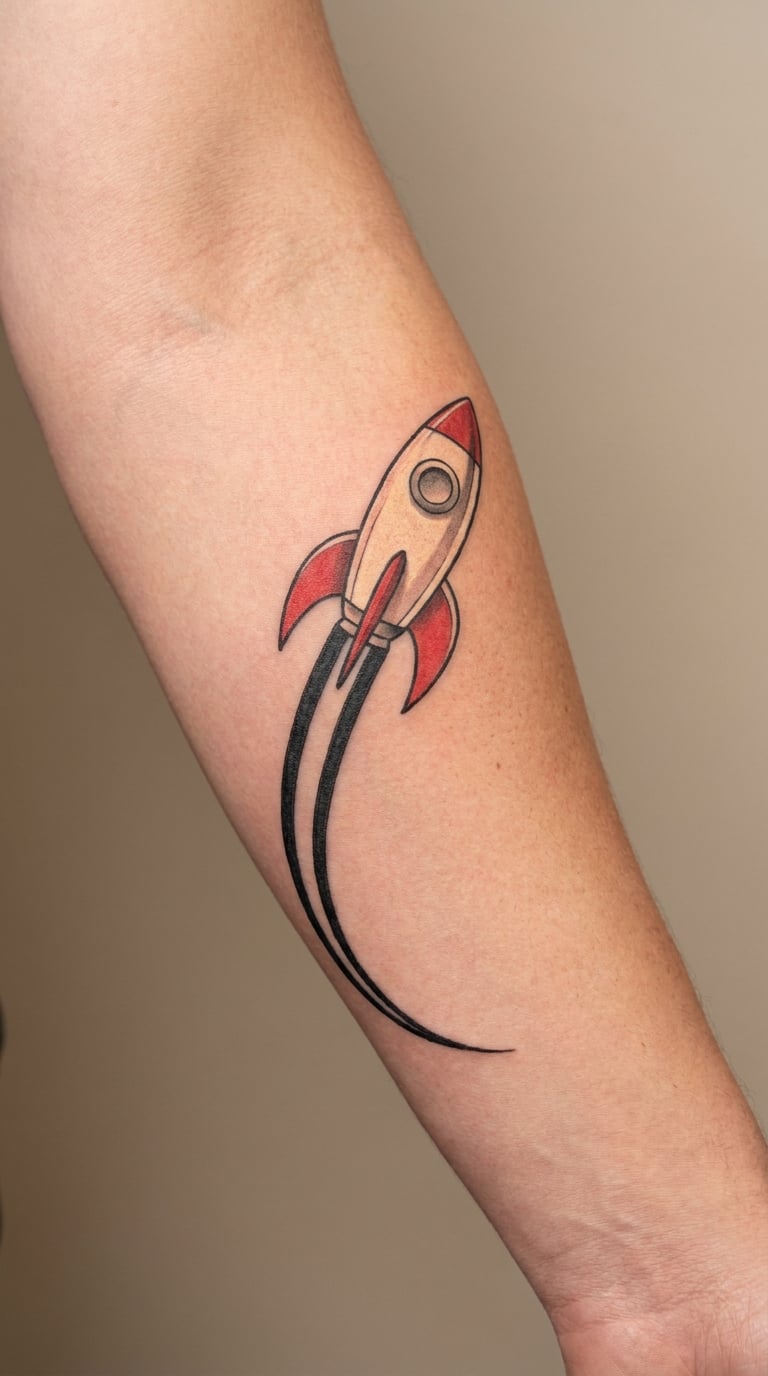
2. Retro Rocket with Curved Exhaust Trail
A 1960s-style rocket with a fat cream fuselage, red nose cone and a long exhaust trail that curves behind it. The trail does the compositional work, filling space and giving the piece motion. Straighten that curve and it looks like a clip-art sticker.
People choose this one for nostalgia, or because they grew up watching launch broadcasts. The sweeping trail also makes it forgiving on a curved limb, since it hugs the shape instead of fighting it.
Placement: outer forearm, calf, or outer bicep. Size: 3-4 inches (7.5-10 cm). Style: traditional retro, or neo-traditional with tighter linework. Pain: low, mostly a scratchy feeling on the outer arm. Ageing note: red on a sun-exposed forearm will fade toward orange first, so ask for a deeper red in the first place.
Make it yours: have the trail end in a small date, or add a tiny orbiting moon at the top of the curve.
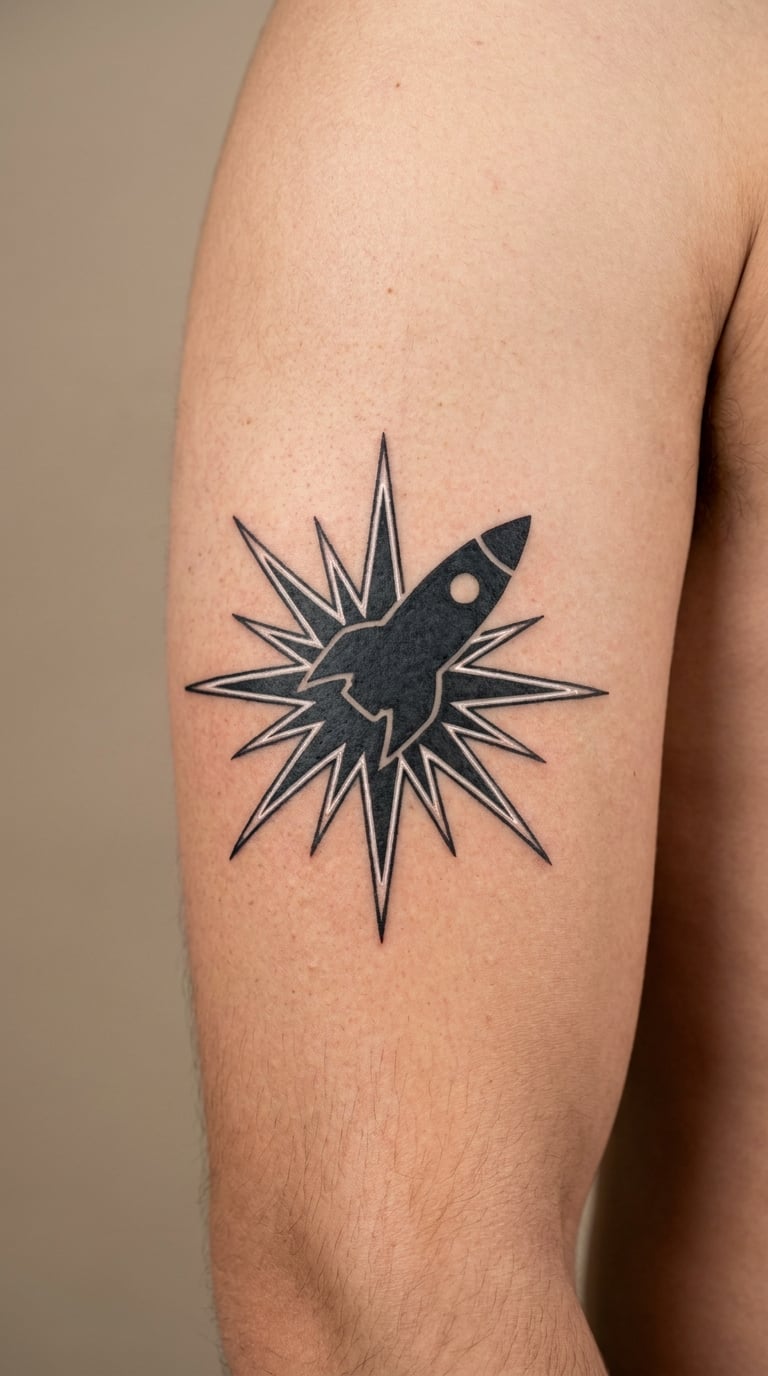
3. Blackwork Rocket Launching Through a Star
A solid black rocket silhouette breaking upward through a five-pointed star outline, the star left mostly as negative space with sharp triangular rays. Two flat shapes, no grey, no colour. The contrast does everything and it holds up at a distance.
The meaning reads as breakthrough, which is why a lot of people get this after a major life change, a new qualification or a recovery. It looks more like a statement than a symbol, so it suits people who would rather explain it than announce it.
Placement: upper arm, outer thigh, or chest. Size: 4-5 inches (10-12.5 cm). Style: blackwork. Pain: medium, since solid black means repeated passes over the same skin. Ageing note: heavy black stays crisp for years, one of the better ageing options in this list.
Make it yours: swap the star for a hexagon, a triangle, or a circle badge.
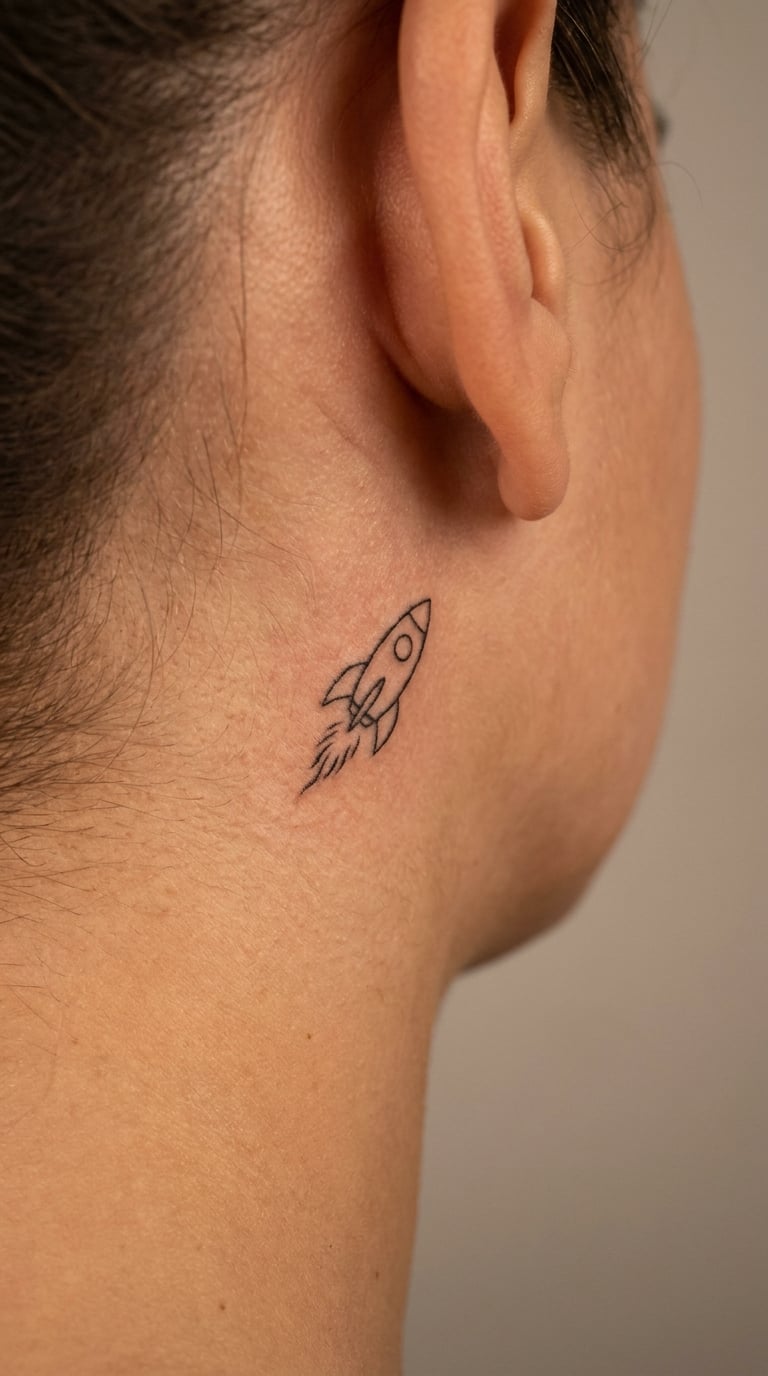
4. Micro Rocket Behind the Ear
A tiny simplified rocket, an inch tall at most, angled up toward the hairline with a two-line flame. No fins, no windows, no shading. At that scale anything more complicated becomes a smudge within a year.
This is a hidden-placement design. It reads as a private thing, visible when you push your hair back or wear a bun, invisible in a meeting.
Placement: behind the ear, or just under the jaw near the angle. Size: 0.75-1 inch (2-2.5 cm). Style: fine line micro. Pain: low to medium. Behind the ear feels thin and scratchy but it is not a sharp spot. Ageing note: this is the design most likely to need a refresh. Hair covering the area adds friction, and sun exposure is not an issue here, which is a small win.
Make it yours: place it at the same height as a stud piercing, or mirror an existing small tattoo on the other side of the neck.
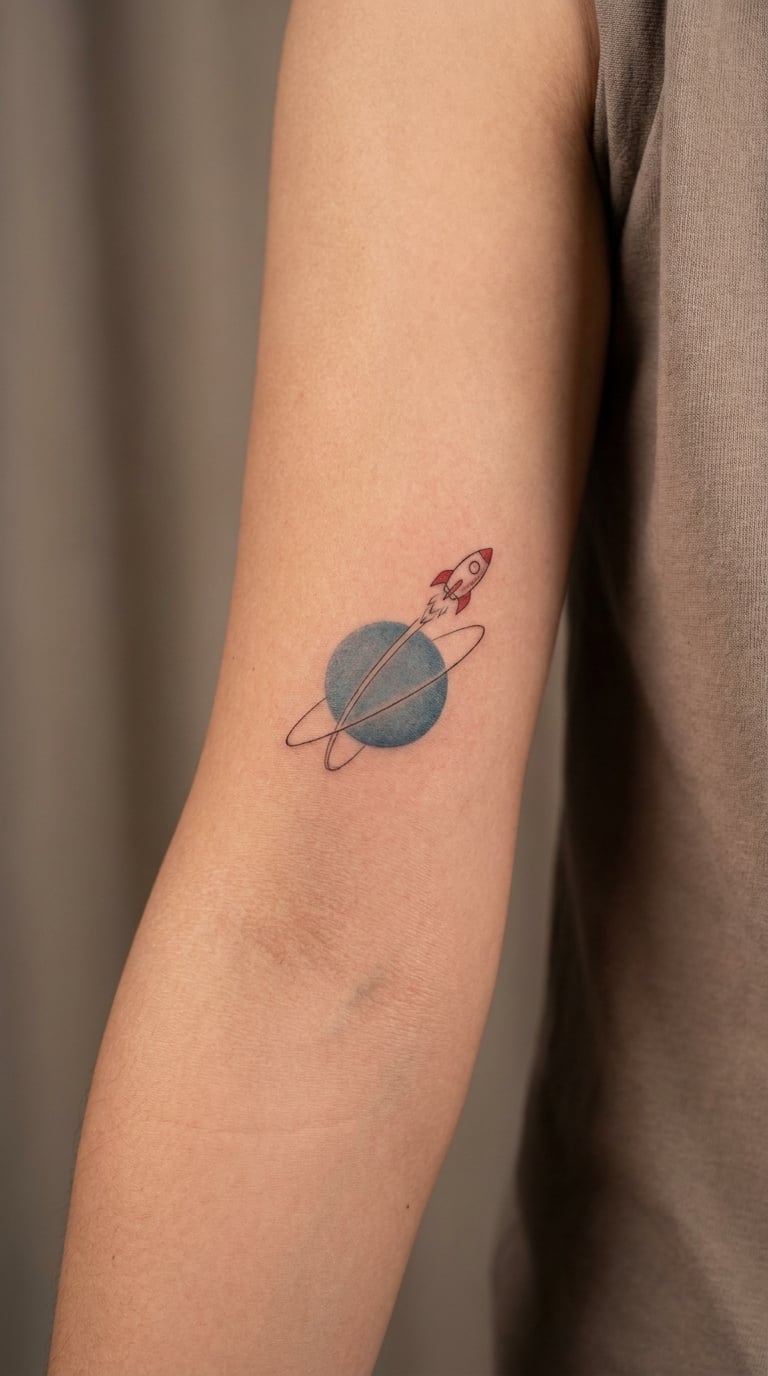
5. Rocket with a Planet Orbit
A small red rocket flying across a single elliptical orbit line, with one shaded planet sitting on the curve and maybe a couple of dot stars. The orbit line wraps around the whole composition, which gives it movement without needing a second object.
The reading is about staying in motion, orbiting something you are not ready to leave yet. It is a quieter metaphor than a rocket on its own, and people tend to describe it as circling back to something important.
Placement: inner bicep, upper forearm, or the back of the shoulder. Size: 2.5-3.5 inches (6-9 cm). Style: illustrative with fine line and one colour accent. Pain: low on the inner bicep. Ageing note: the orbit line needs a minimum line weight to survive, so tell your artist to keep it at a single-needle-plus rather than a hairline.
Make it yours: use a planet that means something, or add a small second moon on the opposite side of the ellipse.
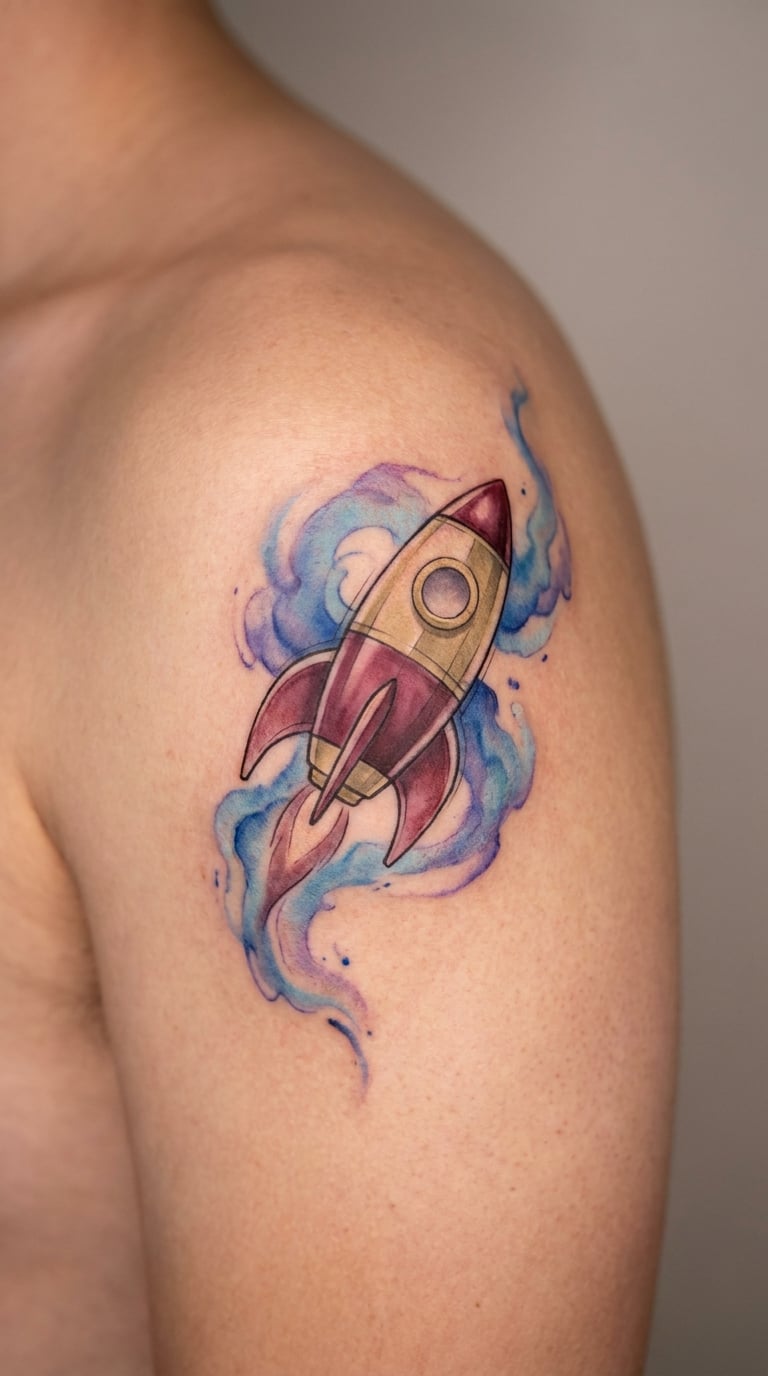
6. Watercolor Nebula Rocket
A loosely rendered rocket with a soft edge, sitting inside a wash of violet, blue and orange that bleeds past the outline in places. Watercolor tattoos have no hard border, so the rocket can half-disappear into the colour. That is the appeal.
People choose this when they want a space design that looks like a painting rather than a diagram. It is the softest option in this gallery and the least likely to read as aggressive.
Placement: shoulder, upper back, or outer thigh. Size: 3-4 inches (7.5-10 cm) for the rocket, with the wash extending wider. Style: watercolor. Pain: medium, since colour wash means many light passes. Ageing note: pale violets and oranges are the first colours to fade. Ask for higher saturation going in.
Make it yours: use your birth month colours for the wash, or ask for a hard black outline on the rocket against the soft background.
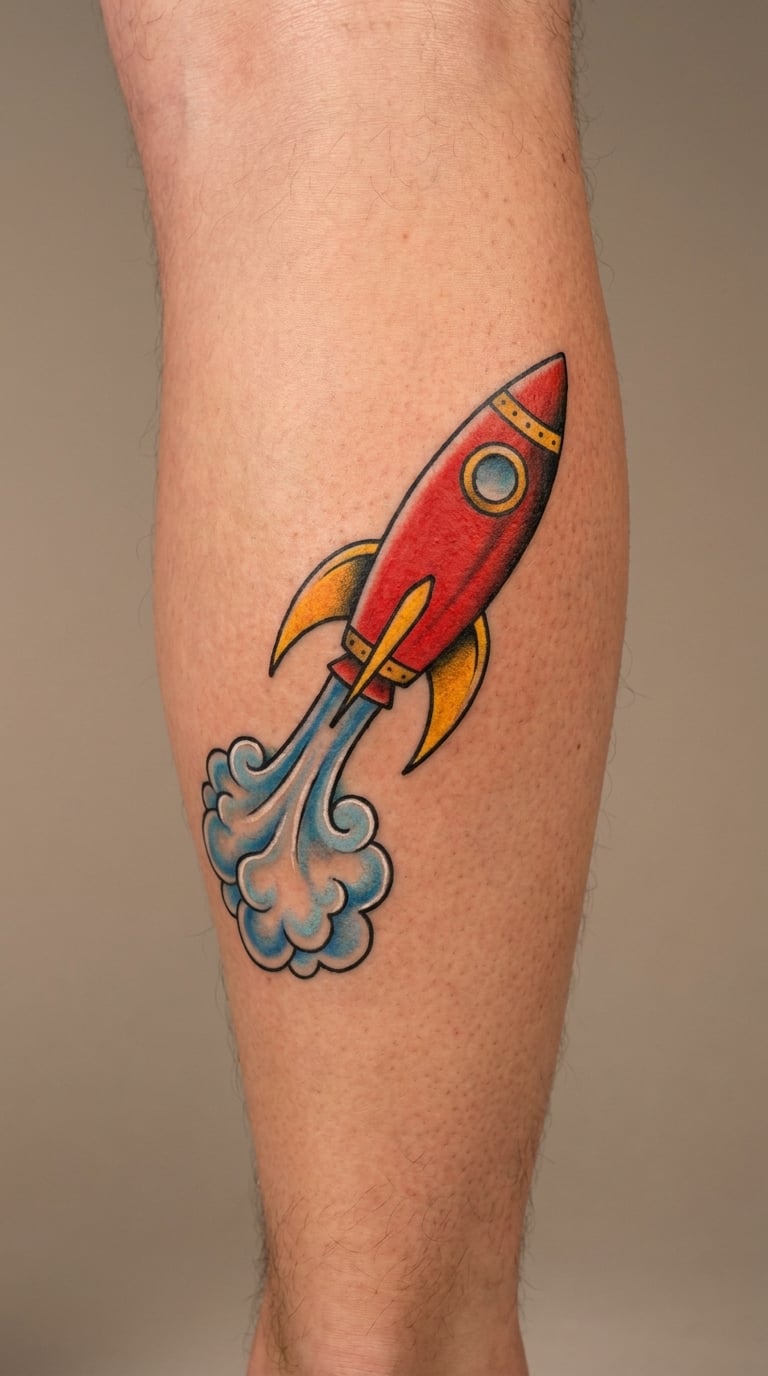
7. Traditional Pin-Up Rocket
A chunky rocket drawn the old American way: thick even outline, red and yellow body, black-outlined exhaust cloud with white highlights. Bold colours, no subtlety, and a slight tilt to the whole thing so it feels like it is moving.
This is the fun option. Traditional work also ages better than you would expect because the shapes are large and the linework is heavy. Plenty of people get one as their first colour piece.
Placement: calf, forearm, or upper arm. Size: 3-4 inches (7.5-10 cm). Style: American traditional. Pain: low to medium, a constant scratch rather than sharp pain. Ageing note: bold colour on a sun-exposed calf will need a colour refresh sooner than an inner-arm piece.
Make it yours: add a banner underneath with a name, a callsign or a launch year.
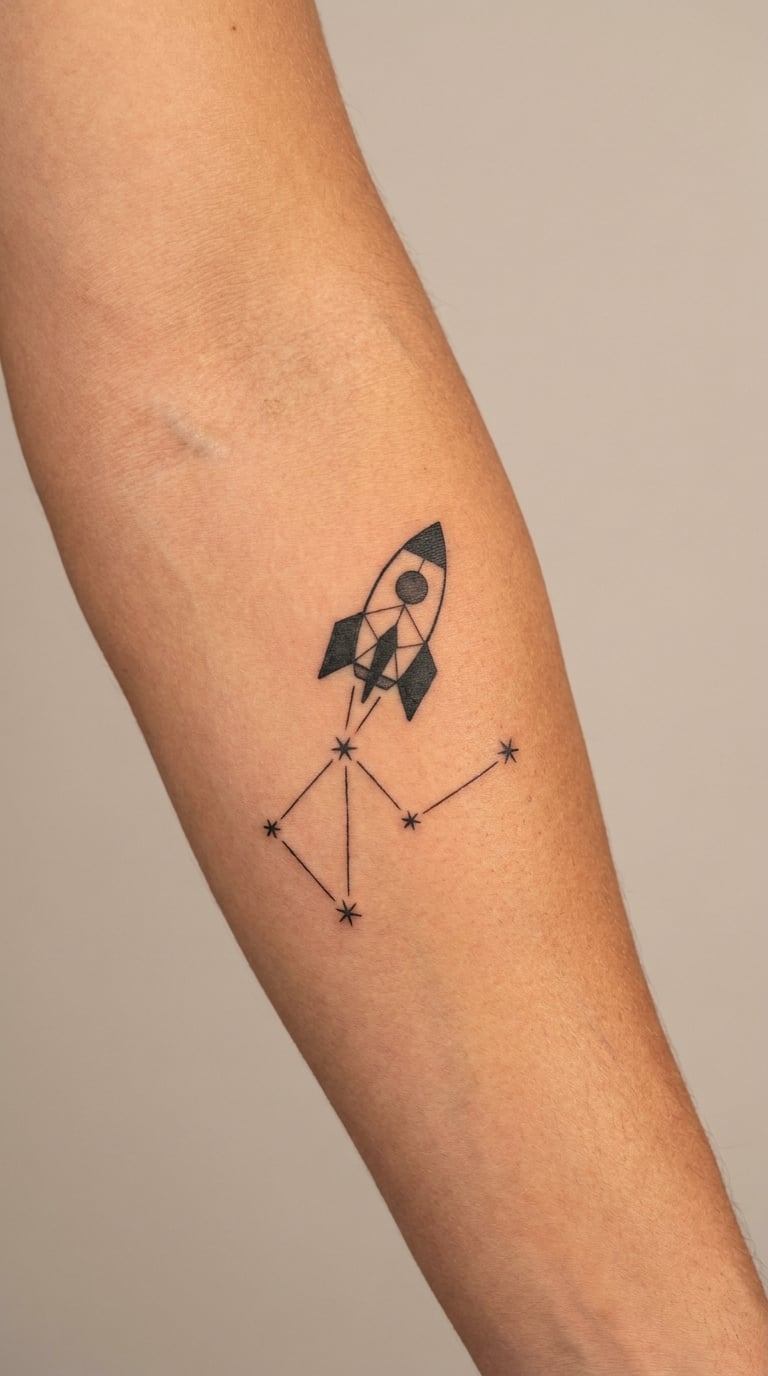
8. Geometric Rocket Constellation
A rocket built entirely from straight lines and triangles, then connected by thin lines to five stars arranged like a real constellation. Very little shading. The whole thing works as a diagram of something rather than a picture of it.
The meaning is usually about a pattern, a set of goals, or points that only connect once you step back far enough. Readers on the r/TattooDesigns forum often describe constellation pieces as a record of people or moments rather than a single symbol.
Placement: forearm, rib cage, or upper back. Size: 3-4 inches (7.5-10 cm) across. Style: geometric linework. Pain: low. Ageing note: hairline connecting lines are the weak point. Ask for them one weight heavier than looks right in the drawing.
Make it yours: use stars at the coordinates of somewhere that matters, or name the constellation after someone.
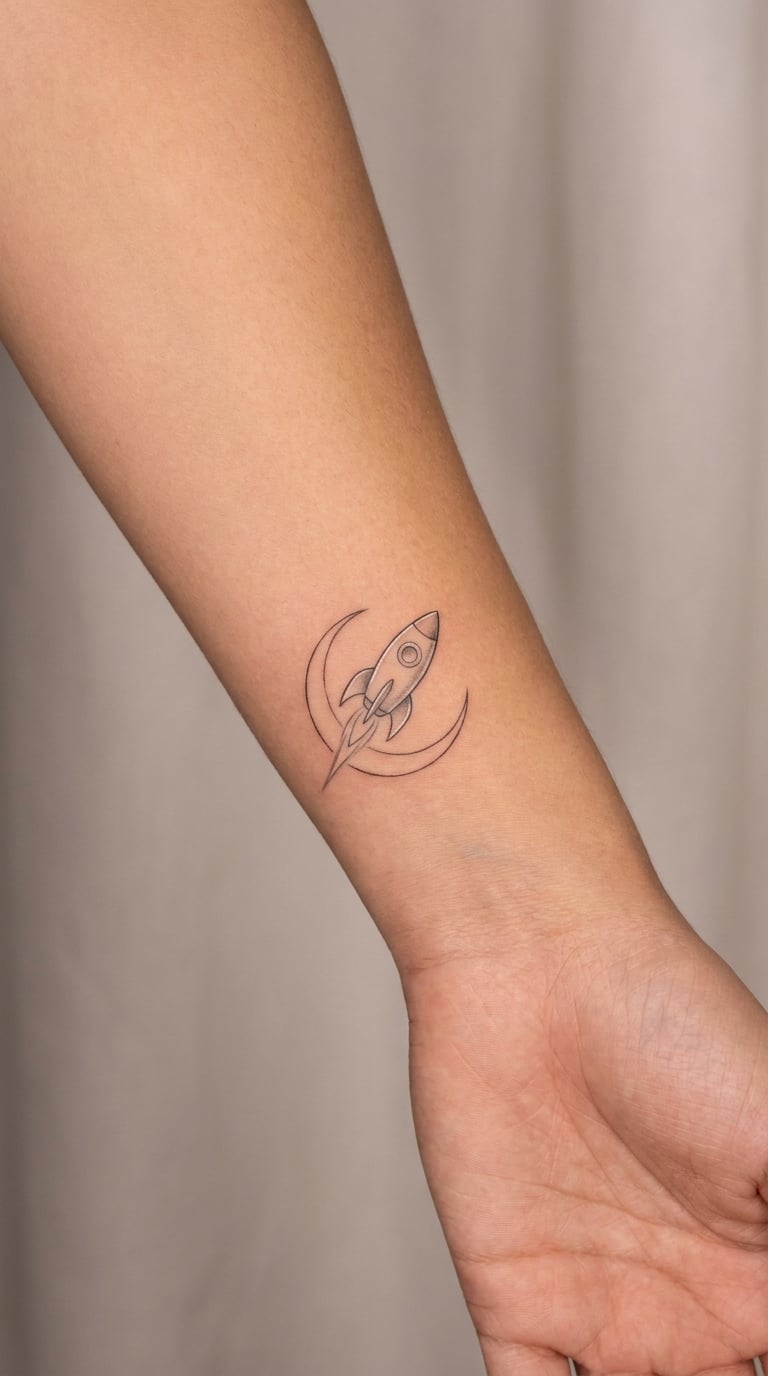
9. Rocket and Crescent Moon
A slim rocket passing just beside a thin crescent, both drawn in one confident line, with a handful of dots for stars. The two objects are kept apart so each stays readable, which is the whole trick with a two-element design.
The meaning is about direction and aspiration, reaching for something out of reach, or a person you have lost. People often add a small star where the moon’s point is to mark a date.
Placement: inner wrist, inner forearm, or behind the ear. Size: 2-3 inches (5-7.5 cm) total. Style: fine line. Pain: medium to high on the inner wrist, one of the more uncomfortable spots. Ageing note: the inner wrist flexes constantly, which softens fine lines faster than a flat forearm.
Make it yours: change the moon phase to the one from a date you want to keep.
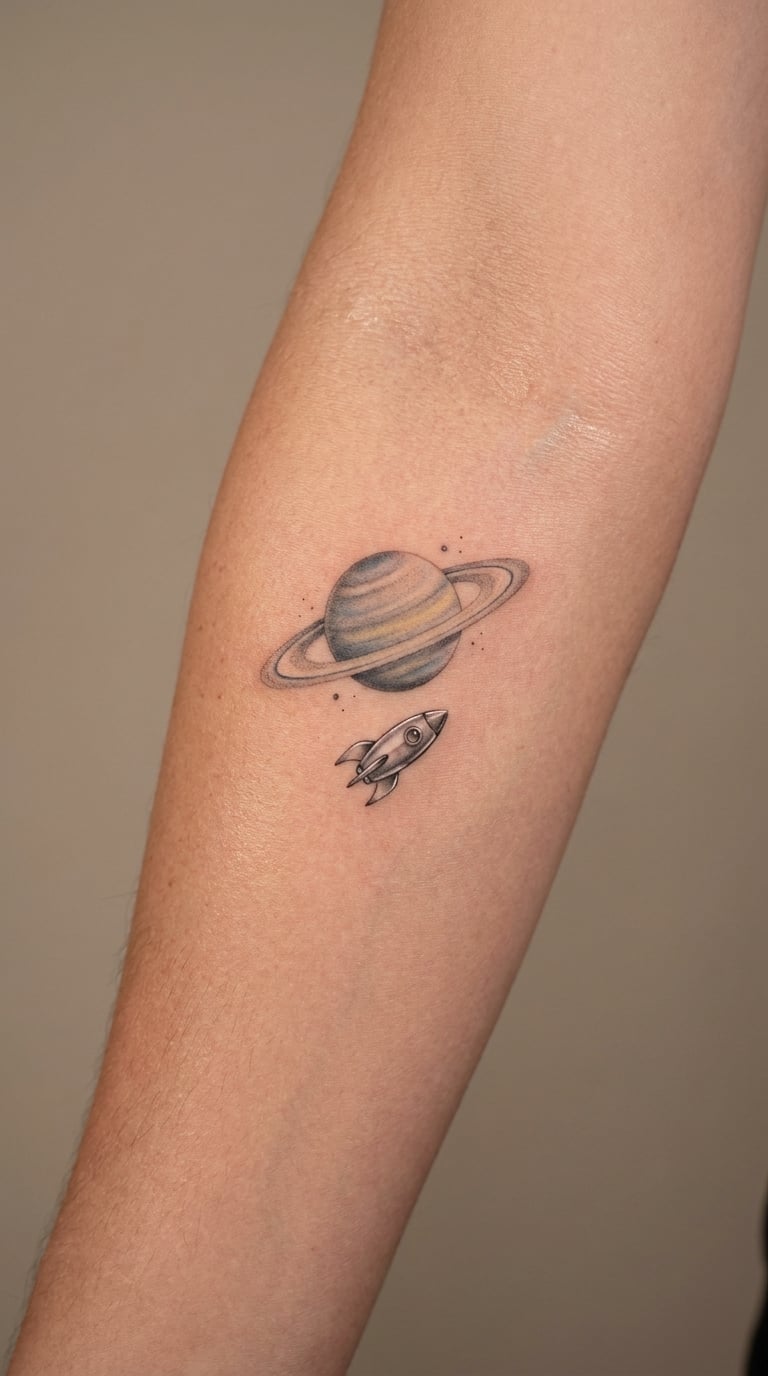
10. Realistic Saturn Rocket
A small rocket rendered with metallic grey shading and a single highlight along the fuselage, flying below a softly shaded Saturn with its ring rendered as a thin ellipse. The shading is smooth and the detail is tight, which needs an artist who works small.
The realism makes it feel like a photograph of a real vehicle rather than an illustration. People choose it when they want the technical look, and enthusiasts of the r/rocketry community tend to want the silhouette to be accurate, not cartoonish.
Placement: upper forearm, or the outer arm. Size: 2-3 inches (5-7.5 cm) for the rocket alone. Style: micro-realism, black and grey. Pain: medium, because smooth grey shading means going over the same spot many times. Ageing note: soft greys in tiny areas can blur. Larger pieces hold up better than micro versions of the same drawing.
Make it yours: model the rocket on a vehicle with a real history to you, or put your initials on the fuel tank in tiny black letters.
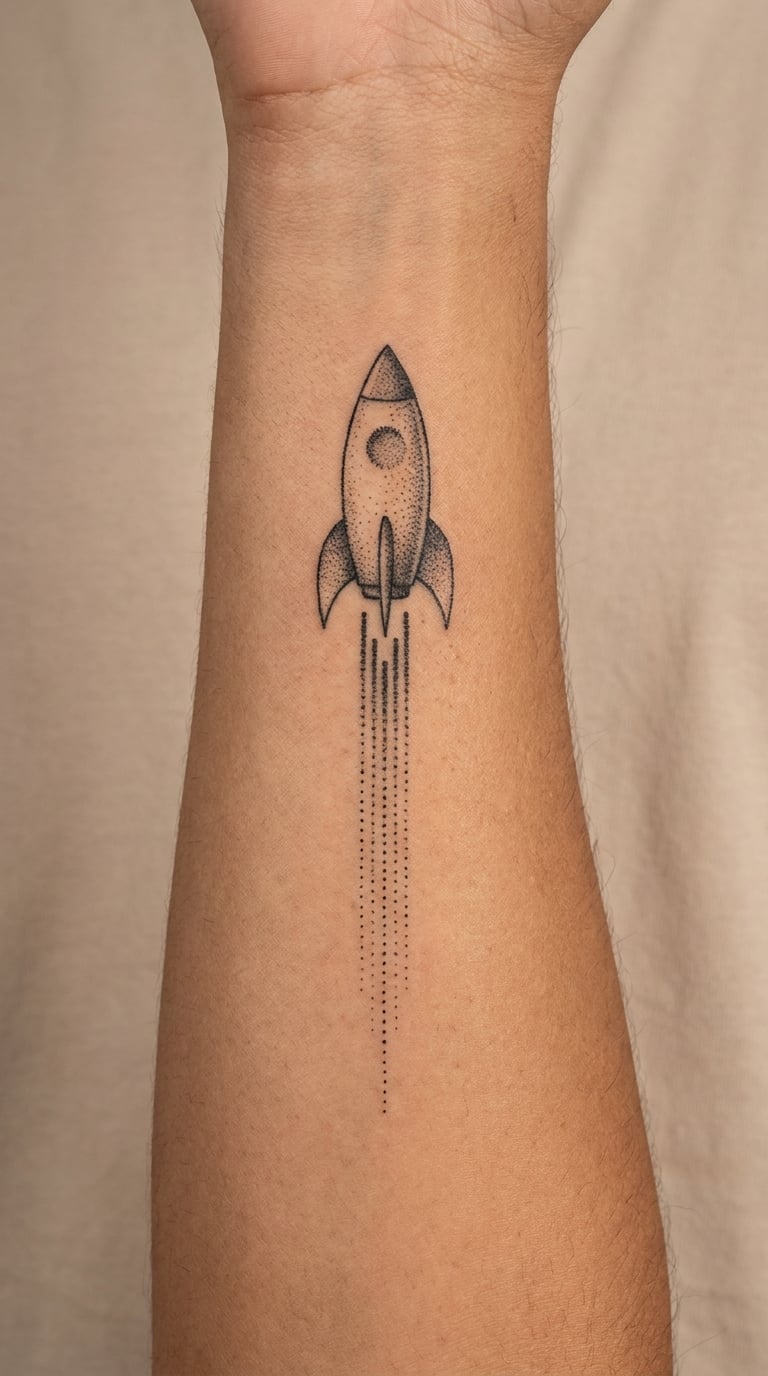
11. Dotwork Rocket with Launch Path
A symmetrical rocket built from graduated dot patterns, with a vertical dotted path rising below it like a flight trajectory. Two black dots for windows, a scatter of larger dots for flame. No outlines, or very thin ones.
Dotwork is a good choice if you find solid black too heavy. It reads as texture from across a room and as pattern up close, and it hides small imperfections because the dots do the blending.
Placement: outer arm, upper back, or the back of the calf. Size: 3-4 inches (7.5-10 cm) tall including the dotted path. Style: dotwork. Pain: medium, and a long session, because dot placement is slow work. Ageing note: dotwork holds surprisingly well. Individual dots spread slightly but the gradient still reads.
Make it yours: make the dotted path a specific number of dots, one for each year of something.
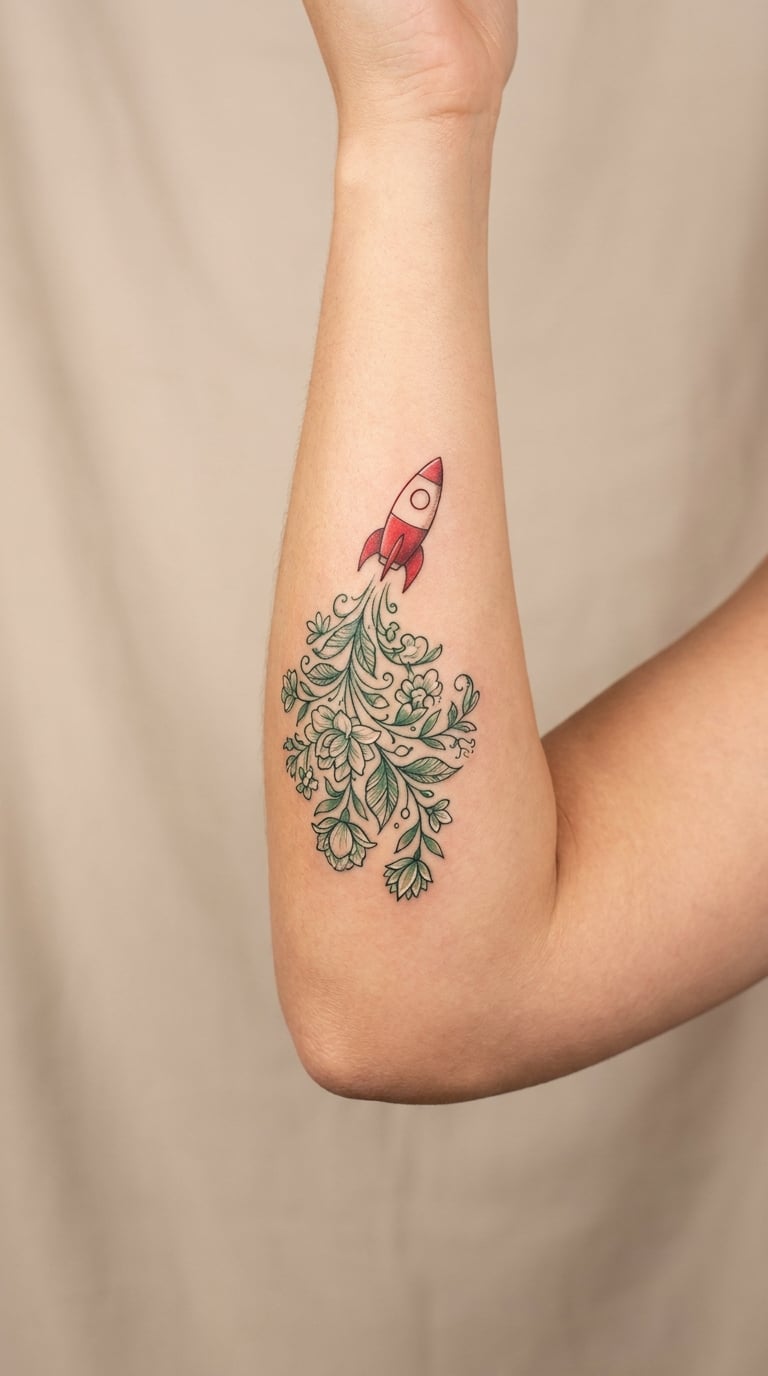
12. Rocket Emerging from a Floral Bouquet
A small red rocket lifting out of a dense arrangement of leaves and blooms, with the flowers rendered in fine botanical detail and the rocket in flat colour. Soft and detailed, and the opposite of the blackwork pieces in this list.
The combination usually means growth with direction, something blooming and going somewhere at the same time. It is a common choice for people who want a colourful design without committing to a full space scene.
Placement: forearm near the elbow, upper arm, or the thigh. Size: 3-4 inches (7.5-10 cm) across. Style: floral illustrative with a colour accent. Pain: medium, mainly because of the density of the shading in the leaves. Ageing note: detailed flowers blur more than large flat shapes. Expect the leaf detail to soften first.
Make it yours: use flowers tied to someone specific, or a bouquet from a wedding or a birthday you want to remember.
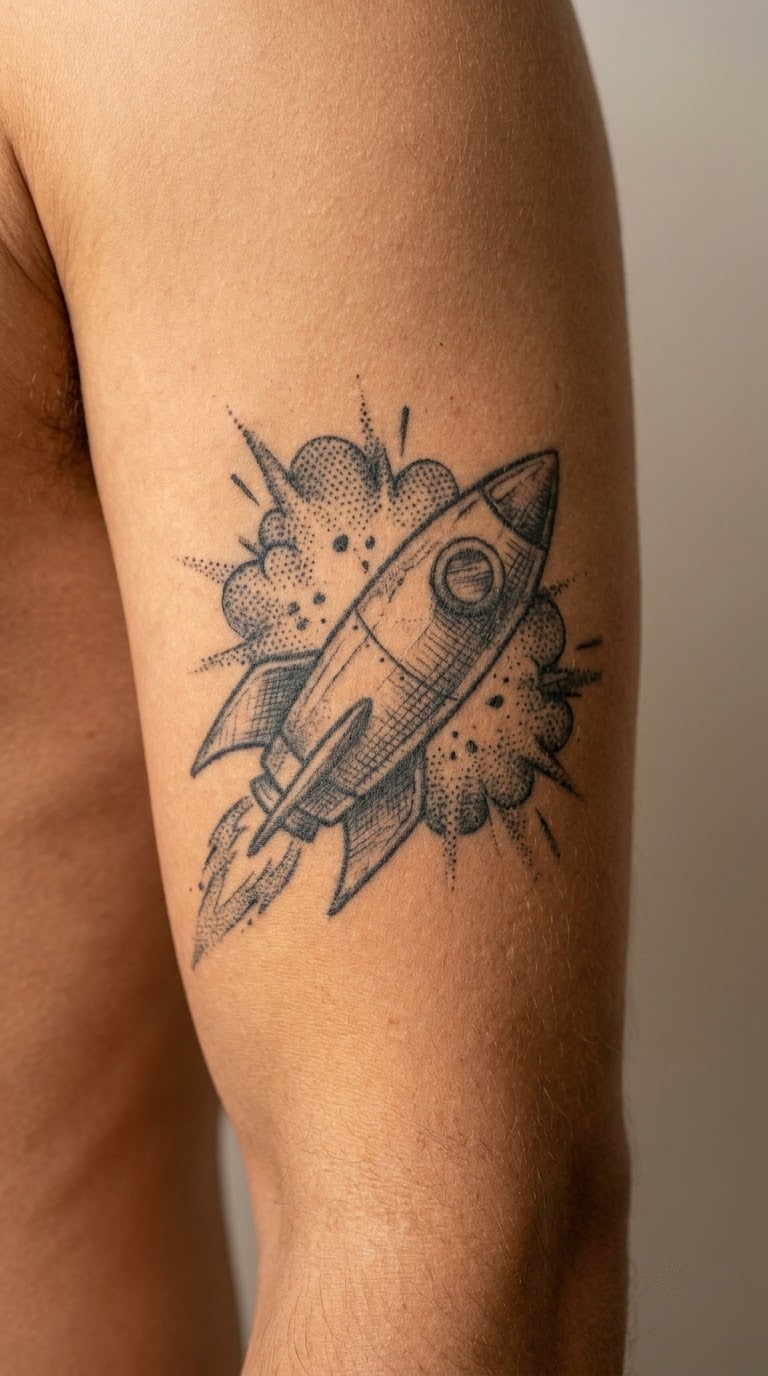
13. Grunge Rocket with Halftone Explosion
A rocket drawn with rough, broken linework, grey wash shading and gaps left in the black, bursting out of a halftone dot explosion. The dots get larger toward the edge, which fakes an old printed effect.
This is the design for people who like punk, metal, skate and streetwear visual language. The distress hides imperfect linework too, which makes it forgiving for a first larger piece.
Placement: outer bicep, upper arm, or the back of the shoulder. Size: 3-5 inches (7.5-12.5 cm). Style: grunge, black and grey. Pain: medium, with the shading areas taking the sting. Ageing note: the open, broken linework softens into an even softer wash over time, so choose it for a look you will still like in fifteen years.
Make it yours: add a small stencilled number or a band logo-style wordmark in the same distressed style.
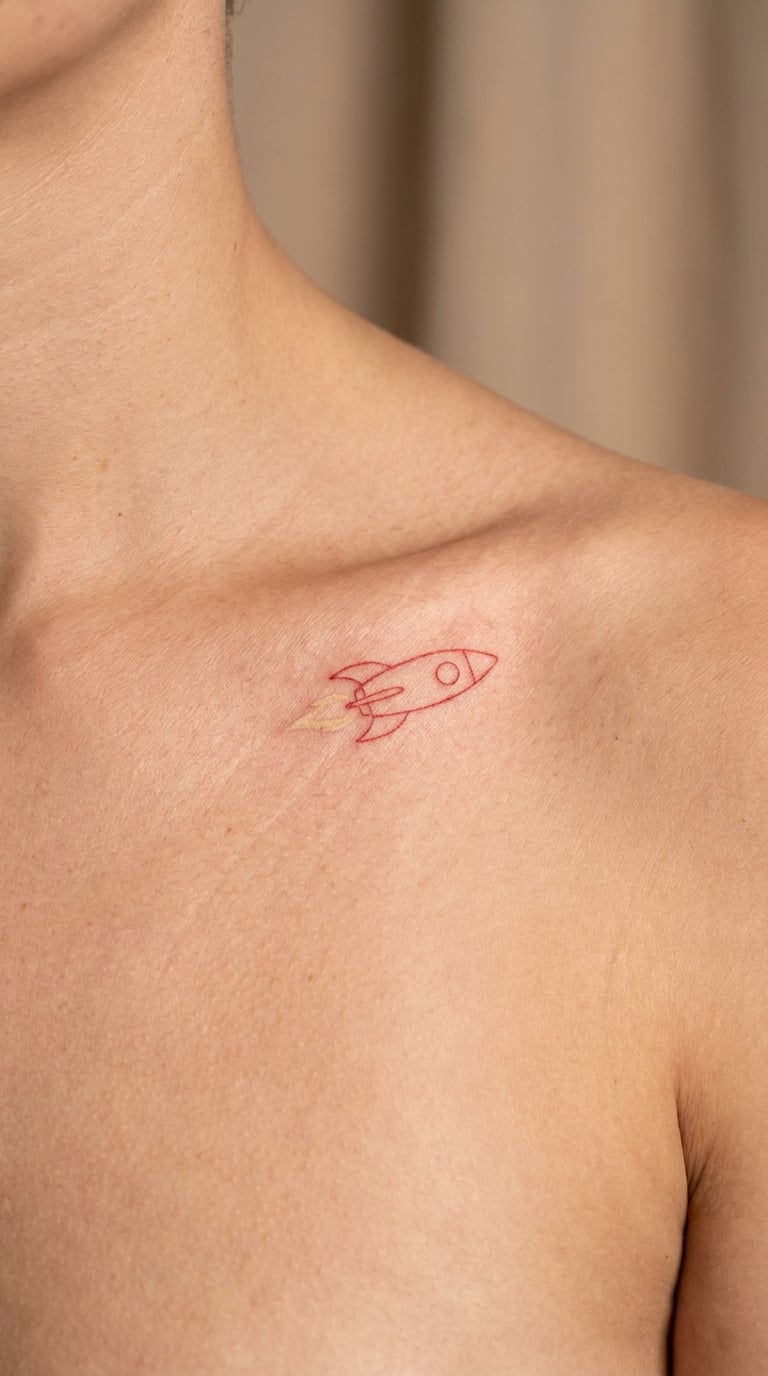
14. Small Red Rocket on the Collarbone
A small red rocket in fine line, laid horizontally along the collarbone with a pale yellow flame trailing behind it. The horizontal orientation is unusual for a rocket and stops it looking like a stock icon.
Collarbone pieces sit in a spot people touch and adjust, so there is a little more wear than on a shoulder. The visibility is high when you wear a tank top or an open collar, which is exactly why people pick it.
Placement: along the collarbone, or the sternum. Size: 2-3 inches (5-7.5 cm) long. Style: fine line with one colour. Pain: medium. The collarbone is bony, and skin over bone feels sharper. Ageing note: a horizontal piece on a line that moves with the arm will slowly tilt as the skin changes. Not a problem, just worth knowing.
Make it yours: match an existing small tattoo on the opposite side, or angle it slightly upward to follow the bone.
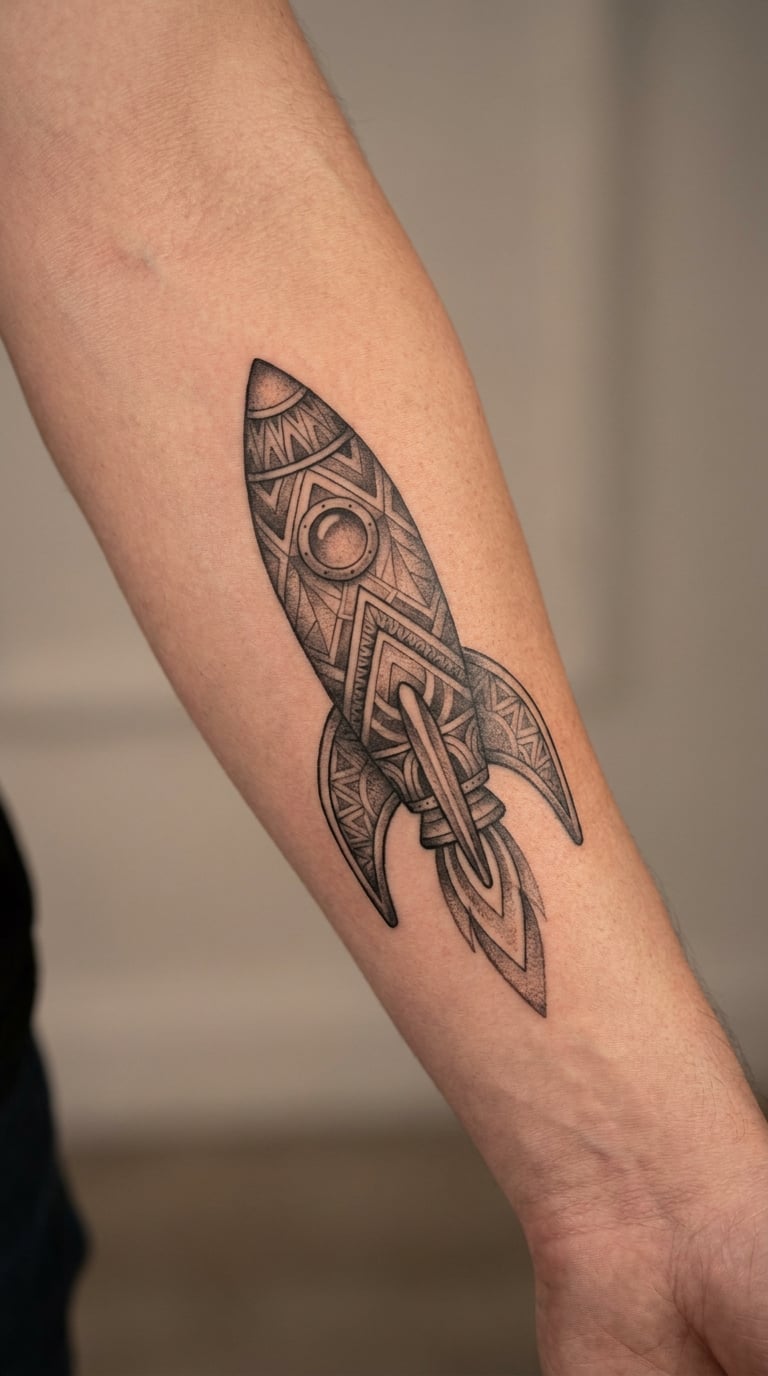
15. Rocket with Engraved Mission Numbers
A compact black and grey rocket with small technical markings around it: a mission number, a serial string, a small grid of panel lines, maybe a code on the fuel tank. Technical detail, laid out like a technical drawing.
The detail is what makes this work, and detail is the trade-off. Small lettering below about two inches turns into an unreadable grey block, so this design needs the upper end of the size range.
Placement: side of the forearm, or the upper arm. Size: 2.5-3.5 inches (6-9 cm) tall, and no smaller if you want the text legible. Style: illustrative realism, black and grey. Pain: medium to high. The side of the forearm is thin and the small lettering needs several passes. Ageing note: micro text fades first. Treat the numbers as a texture element rather than something you will still be able to read in a decade.
Make it yours: use a real launch or mission number, or your own initials and a date in the same technical style.
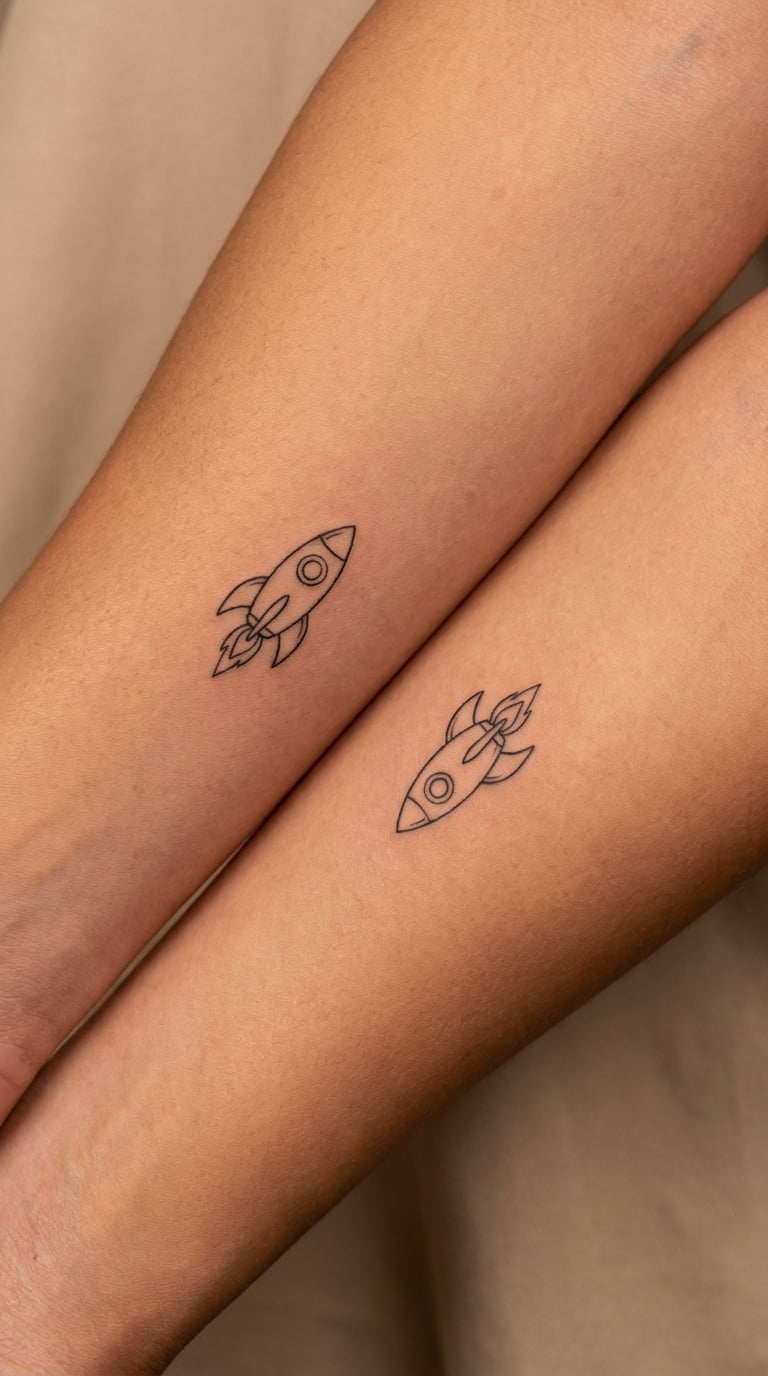
16. Double Rocket Matching Pair
Two small rockets, one each, drawn in the same style and angled in the same direction. Matching does not mean identical. Different forearms have different shapes, so the two pieces get scaled to fit rather than copied exactly.
This one shows up most for siblings, couples, and friends who got their first tattoos within months of each other. Placed on inner arms, the two designs sit together when you stand side by side.
Placement: inner forearms, or matching wrists. Size: 1.5-2 inches (4-5 cm) each. Style: fine line. Pain: low, and the small size means a short session. Ageing note: the smallest fine line pieces need the most touch-ups. Going slightly larger than feels necessary now is the better call.
Make it yours: point both rockets the same direction, or mirror them so they appear to launch away from each other.
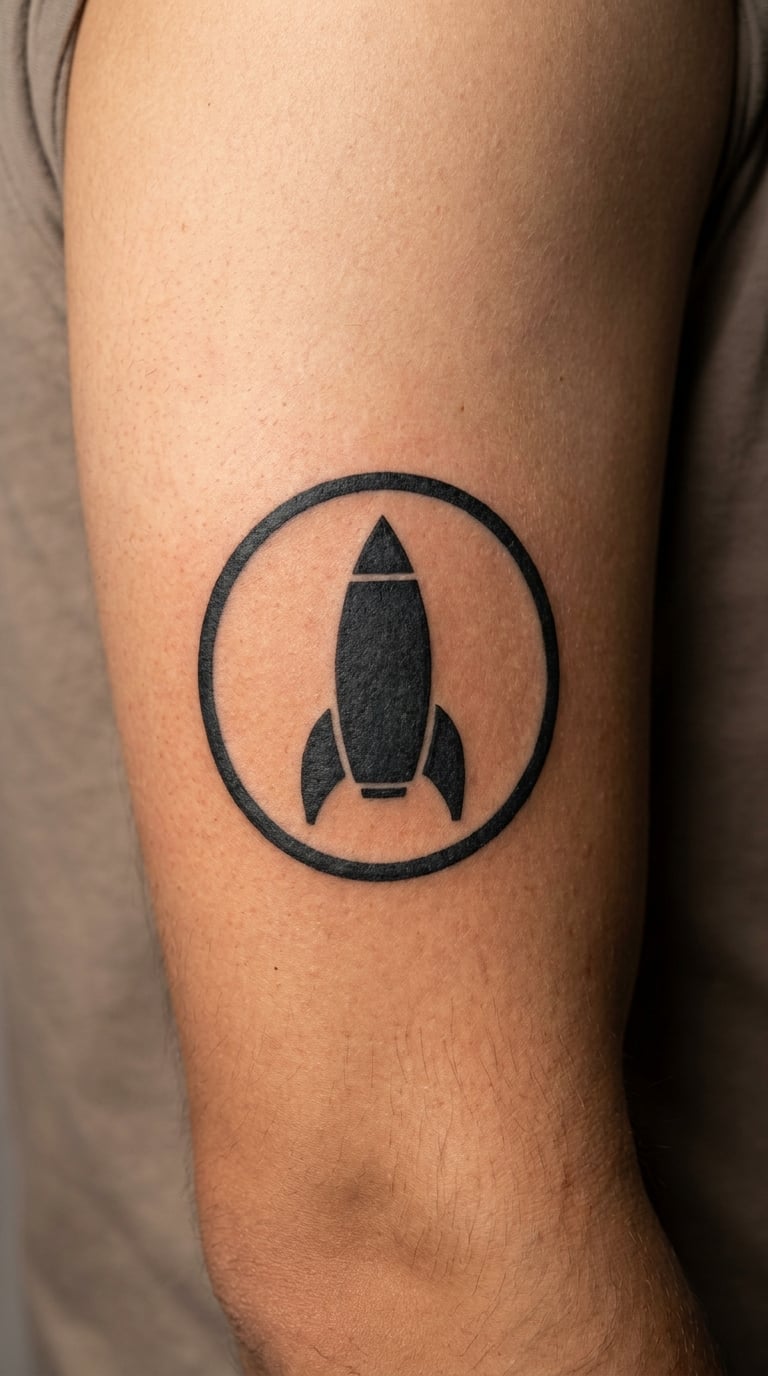
17. Rocket Silhouette Inside a Circular Badge
A single black rocket silhouette centred inside a clean double-ring circle, like a patch or an emblem. Two shapes and one border, no background, nothing else competing for attention.
The badge framing gives a small design the weight of a bigger one, which is why this works well as a first piece on a large flat area. It also suits anyone who likes the idea of a uniform patch but wants something personal.
Placement: upper arm, chest, or upper back. Size: 2-3 inches (5-7.5 cm) diameter. Style: blackwork emblem. Pain: low, because there is very little shading. Ageing note: the circle is the element to watch. A ring can bow slightly over time as the skin changes, so a thicker ring border holds its shape better.
Make it yours: add small text around the ring, a date, or a name in a simple sans serif.
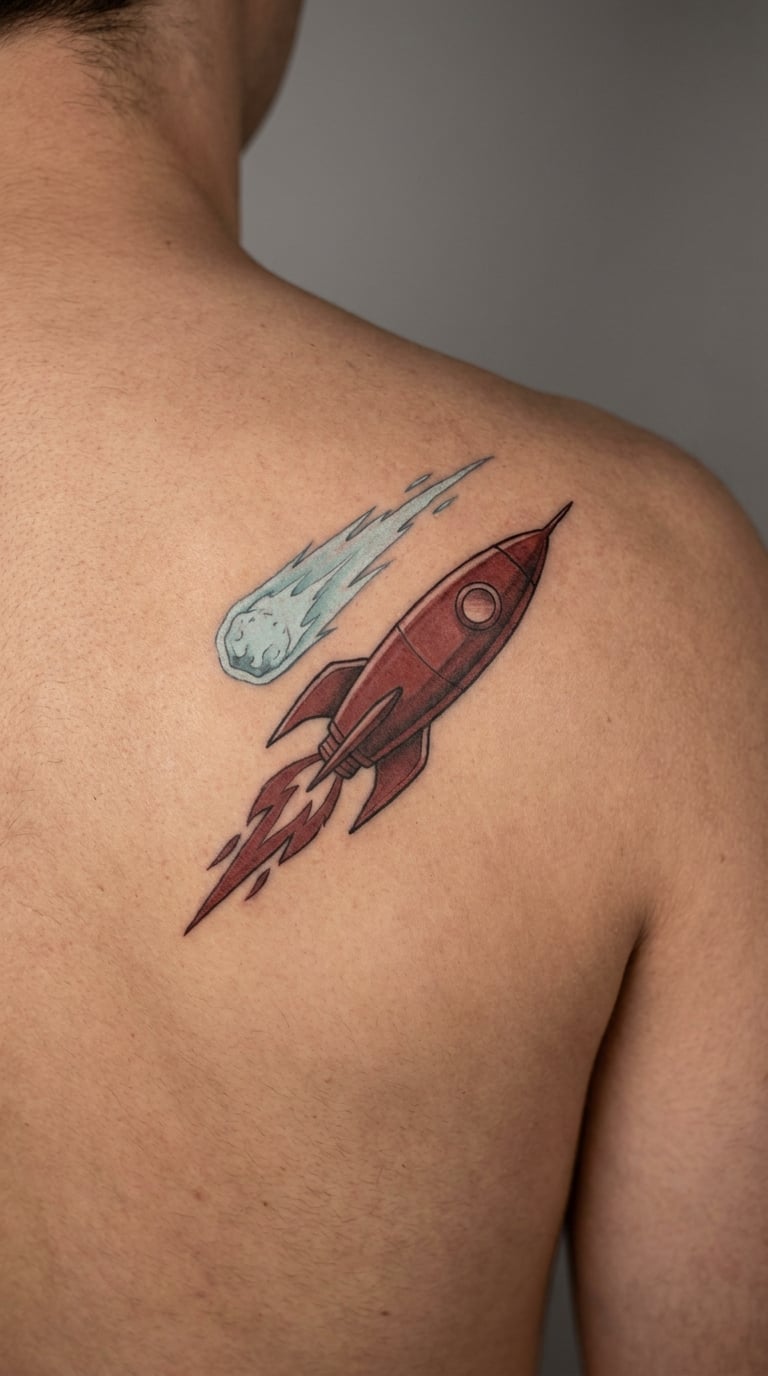
18. Rocket Shooting Through a Comet
A red rocket on a hard diagonal, passing a pale blue comet with a long soft tail. The two objects stay visually separate through colour and direction, so neither gets lost. The diagonal needs a wide, flat area to work.
It reads as momentum, or as one thing passing by while something else keeps going. Several people in online rocket communities describe this as the piece that finally made the tattoo feel like space rather than a cartoon.
Placement: shoulder blade, back, or across the shoulder. Size: 4-5 inches (10-12.5 cm) across. Style: colour illustrative. Pain: medium. The upper back is sensitive, though it is easier to sit still through than a rib or a wrist. Ageing note: two light colours next to each other can start to blend as both fade. A darker outline around the comet helps.
Make it yours: add a starfield behind, or put a name in the comet’s tail.
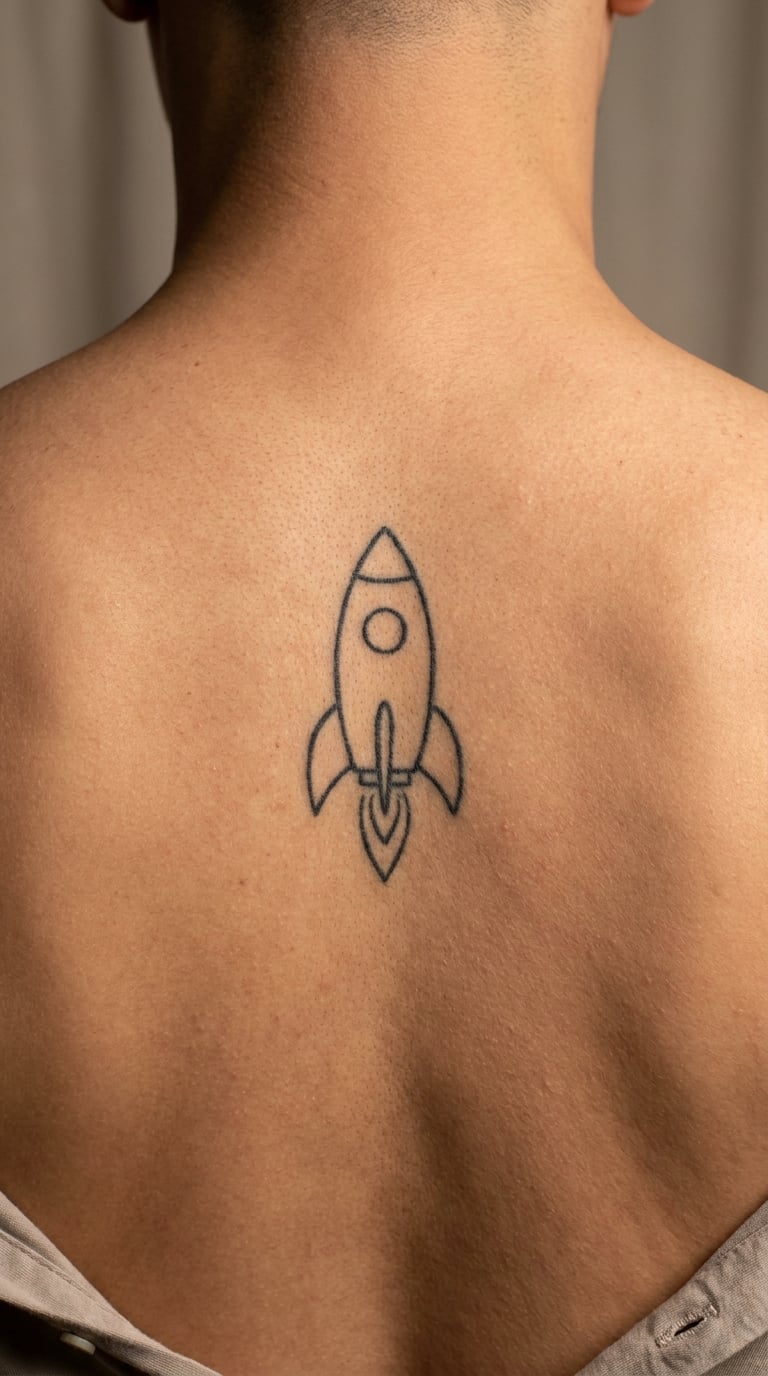
19. Minimal Black Rocket on the Spine
A minimal solid black rocket set on the exact centre line of the back, nose pointing up, with nothing else around it. Symmetry is the whole design, so the body has to be involved in the placement.
Centre-back pieces need a standing reference rather than a paper drawing, because the drawing has to sit on a curved, moving surface. Expect a stencil placement check before the artist starts.
Placement: upper to mid back, along the spine. Size: 4-6 inches (10-15 cm) tall. Style: minimal blackwork. Pain: medium to high. The spine is bony and sensitive, and you cannot watch most of it. Ageing note: centre-back tattoos are prone to stretching as the body changes. Heavy solid shapes like this one cope better than fine line.
Make it yours: add a small date at the base, or run a fine line of stars down the spine above it.
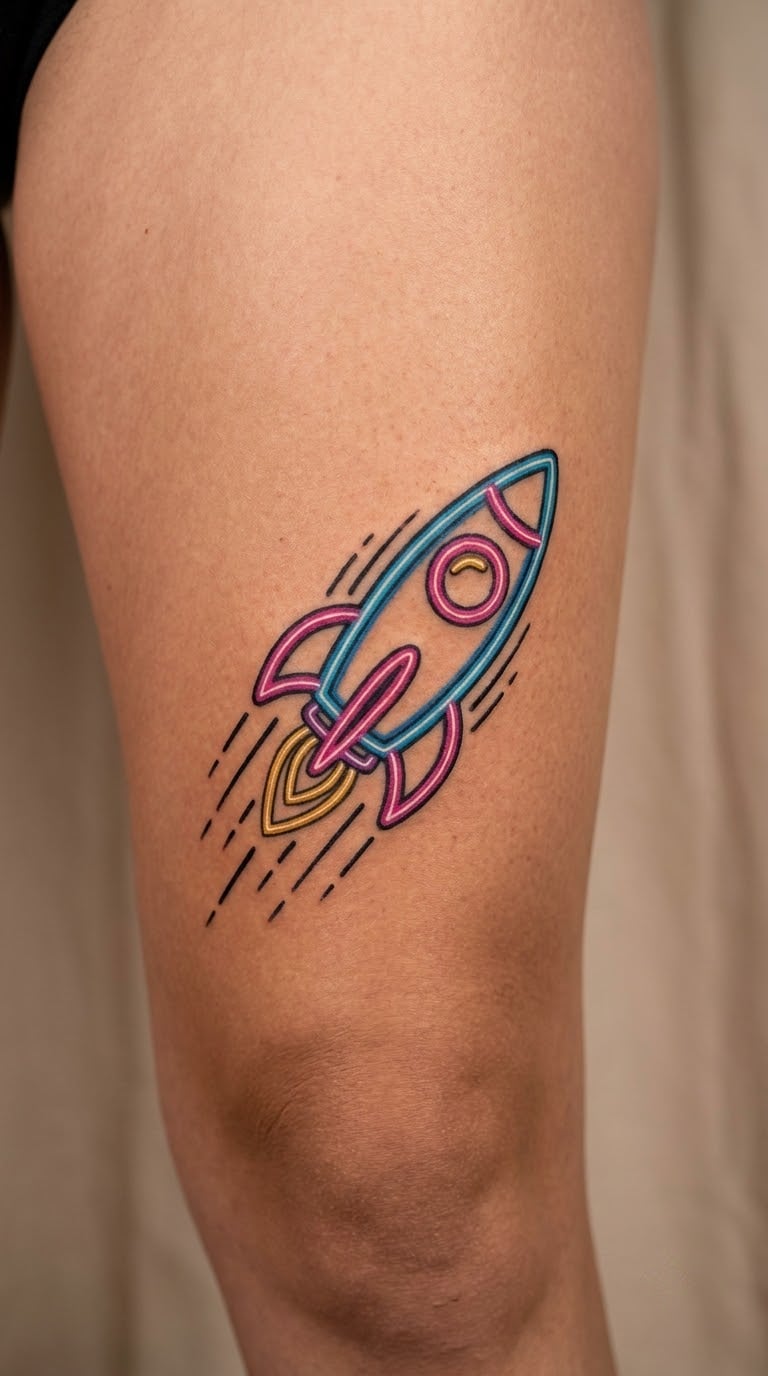
20. Neon Rocket with Speeding Lines
A rocket in electric blue, hot pink and yellow with bright white highlights and black speed lines trailing behind it, aimed upward at a sharp angle. It reads as neon signage, which is where the name comes from.
The high-contrast colour suits a large flat area like a thigh, where there is room for the speed lines to spread out. This is the most contemporary-looking design in the gallery.
Placement: outer or inner thigh, upper arm, or shoulder. Size: 3-5 inches (7.5-12.5 cm). Style: illustrative colour, high contrast. Pain: medium, mostly from the filled colour areas. Ageing note: bright pinks and yellows fade fastest of any palette. If you love the neon look, expect a colour refresh within about five years on a sun-exposed placement.
Make it yours: use two colours instead of four for a subtler version, or add a glow outline around the rocket.
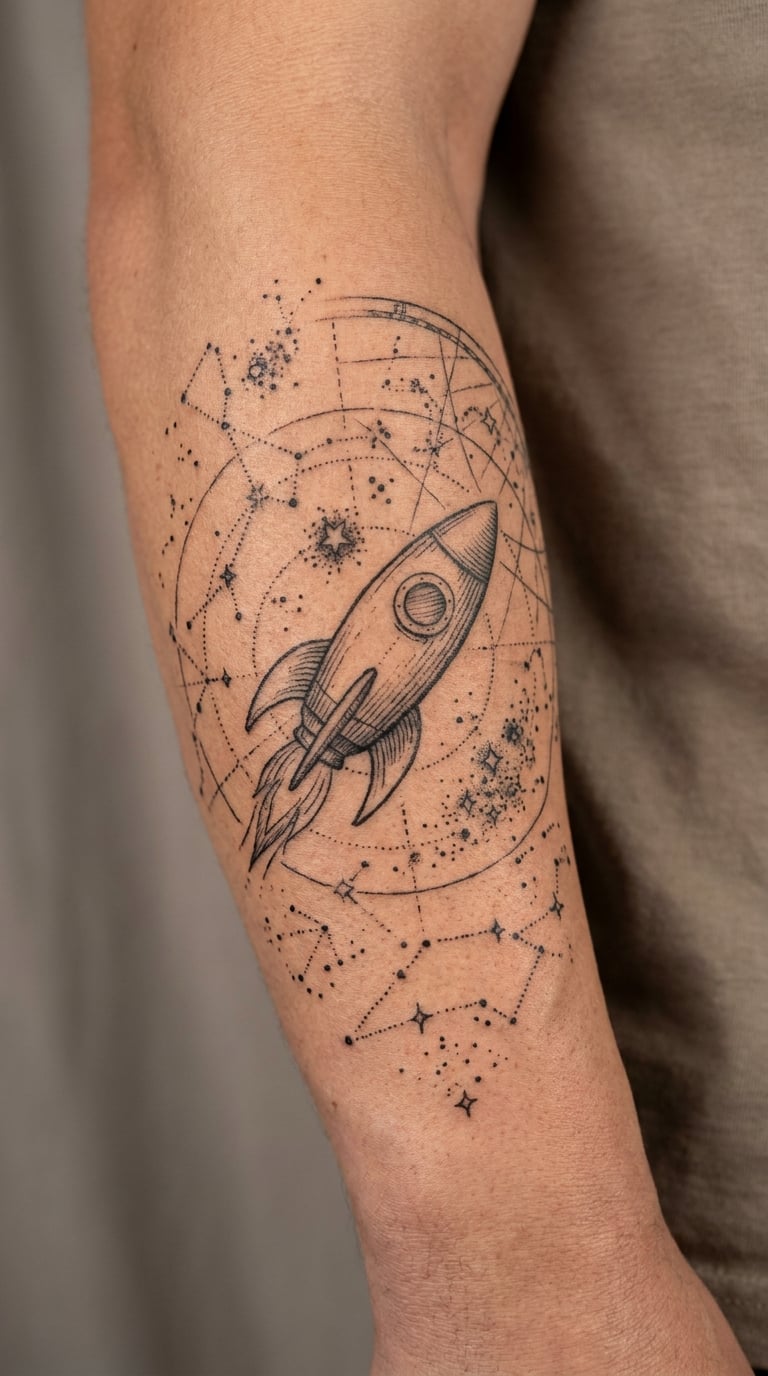
21. Ancient-Style Rocket and Star Map
A rocket drawn as if it belonged in a 19th-century engraved star atlas, with fine hatched shading, crossing a curved map grid with small constellations and latitude-style markings. All in one or two greys.
The style is the point. Instead of modern spaceflight, it looks like navigation and discovery, which suits people drawn to cartography, sailing or the history of exploration. A literal space shuttle would break the effect entirely.
Placement: forearm, upper arm, or calf. Size: 3-4 inches (7.5-10 cm) across. Style: antique engraving, black and grey. Pain: medium. The hatching is a lot of short line work and takes time. Ageing note: engraved hatching has a lot of fine detail, so it softens noticeably with sun exposure. An inner arm suits this one better than an outer forearm.
Make it yours: have the map grid use real coordinates, or add a compass rose in one corner.
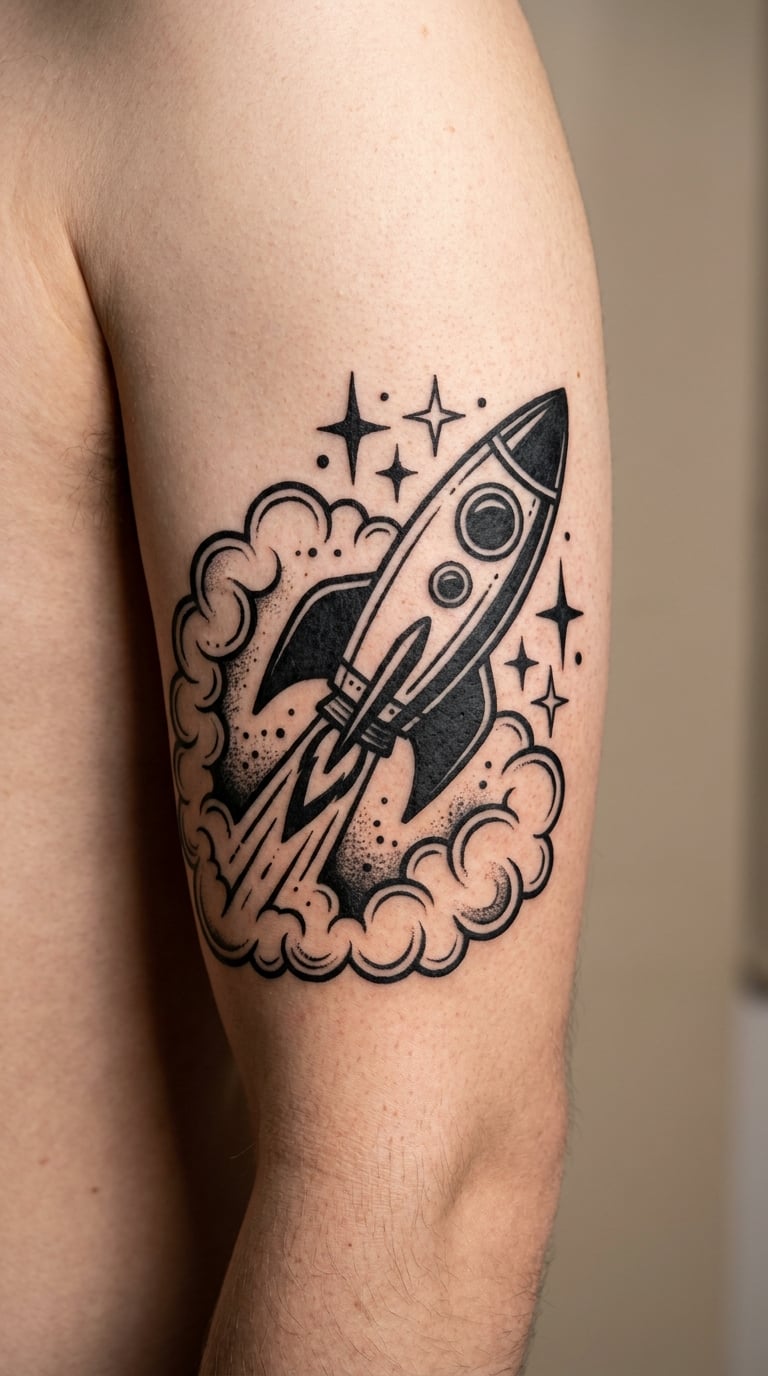
22. Large Blackwork Launch Scene
A full composition: a large black rocket climbing through a column of smoke and scattered stars, with a heavy black shape at the base and clean negative space in the sky. This is the piece that anchors a bigger collection.
It needs a clear focal point or the smoke swallows the rocket. A good artist will build the value structure so the rocket reads as the darkest, sharpest shape in the frame. Budget a full session, and sometimes two.
Placement: outer upper arm, thigh, or back. Size: 6-9 inches (15-23 cm). Style: large-scale blackwork. Pain: medium over a long session. The upper arm is one of the more manageable spots for a piece this size. Ageing note: the best ageing option here. Solid black and hard-edged negative space hold their shape for years.
Make it yours: start the black at the base with a personal shape, a set of initials or a skyline, and let the smoke rise out of it.
How to Choose the Right Design
Style comes first, because it determines everything else. Fine line suits small, quiet, symbolic pieces. Blackwork suits bold, high-contrast work that reads from across a room. Traditional and neo-traditional suit people who want colour and durability. Watercolor and grunge suit expressive, textured pieces.
Pick the size honestly. Below 1.5 inches, a rocket needs to be a simplified silhouette with no windows, no panel lines and no lettering. Above 4 inches, you can afford shading, colour and secondary elements.
Decide the orientation before the drawing. Nose pointing toward your head reads as liftoff. Nose pointing outward along the limb reads as speed and travel. This is the question people on tattoo forums ask most often, and the artist will ask you too.
Match the design to the body part. Straight lines and sharp angles are the signature of a rocket, and they warp on curved or bony places. Ankles, ribs and fingers need either a curved adaptation or a simplified version.
Set a line weight floor. Ask for a minimum line thickness, and treat anything thinner as a detail to drop. This is the single best way to keep a small rocket readable in five years.
Bring references, not a finished idea. Two or three saved images of the style you want, plus one image of the specific vehicle if realism matters to you, gives an artist far more to work with than a description.
Find the right artist. A generalist may decline sci-fi or mechanical work. Look for portfolios with detailed linework, and ask to see healed work rather than fresh photos.
Cost and Session Time
Rates vary widely by city, shop and artist, and most studios have a shop minimum that a small piece will not reach. These are the ranges most US clients see, and they are a starting point for a conversation, not a quote.
Size
Typical range
Session time
Tiny, under 1 inch
Around $80-150
15-30 minutes
Small, 1-3 inches
Around $150-300
45 minutes to 1.5 hours
Medium, 3-5 inches
Around $300-700
2-3 hours
Large or detailed, 6 inches and up
Around $700-1500 and up
Two or more sessions
The main cost drivers are size, how much shading and colour is involved, and whether the work is custom or picked from a flash sheet. Hourly rates mean a multi-session piece is billed repeatedly, so ask for the full estimate up front.
Aftercare Basics
Follow your artist’s aftercare instructions first. They know exactly what they did in your skin, and their advice overrides anything general you read online.
Wash the area gently with unscented soap and lukewarm water, then pat it dry with a clean towel. Pat, do not rub.
Keep it clean and dry for the first few days, and change or rinse out any clothing that sits against it.
Expect some redness, swelling and a tender feel in the first three to five days. Mild is normal.
Do not soak, swim, sauna or use hot tubs until the tattoo has fully healed and any scabs have shed, which is usually around two weeks.
Once healed, sunscreen on exposed placements is the easiest way to slow fading. That matters more for the colour designs in this list than for the blackwork ones.
Frequently Asked Questions
What does a rocket tattoo mean?
A rocket tattoo most often stands for ambition, exploration and the decision to move forward. Because the shape points upward, people read it as lift-off, new beginnings and leaving something behind. It also works as a memorial for a parent or partner who worked in aviation or spaceflight, and as a quiet marker for someone in science, engineering or a career built on curiosity. The meaning comes from you, and a design on its own says enough without any text.
Do rocket tattoos have a deeper meaning?
They can, and the depth usually comes from context rather than the rocket itself. A small rocket on an inner wrist reads as a private reminder. A large blackwork launch scene reads as a public statement. People often pair the motif with dates, mission numbers or a star map to anchor it to a specific memory, a move, a qualification or a loss. If it means something to you, that meaning survives long after the symbolism fades.
What do tiny rocket tattoos symbolize?
A tiny rocket keeps the same meaning as a large one. It points to ambition, movement and beginnings, and at small scale it usually stays personal because only a few people ever see it. Behind the ear, on the inner wrist and on the ankle are the usual hiding spots. The practical note is that very small rockets need simplified references, since window panels, rivets and lettering turn to a grey block below about an inch and a half.
What rocket tattoo style is most minimalistic?
Single-needle fine line is the most minimal option: one continuous outline, two fins, a short flame and no shading at all. Negative space is the second, where the ink forms the flame and trail and the rocket body is left as bare skin. Both work best between 1.5 and 3 inches, since they rely on proportion rather than detail. The trade-off is fading, because single-needle work needs a refresh more often than any other style.
Where is the least painful place to get a rocket tattoo?
The outer upper arm, the calf and the shoulder sit near the bottom of the list. The inner forearm, inner wrist, spine, ribs and the back of the hand rank noticeably higher, mostly because skin is thinner there or the area is bony. A rocket drawn on the inner arm is a common choice, so expect it to sting more than the same design on the outer arm. Longer sessions in one spot also build up more discomfort than a short small piece.
Which tattoo colours last longest on a rocket design?
Black and greys hold their shape longest because they are the densest inks. After that, dark and saturated colours such as deep red, navy and forest green tend to hold up better than pastels. Yellow, orange, pale violet and hot pink fade fastest, and they are the tones used in most neon and watercolor rocket designs here. Sun-exposed placements fade quicker, so ask for higher saturation in the first session and plan on a colour refresh on an outer arm or calf.
Choosing Your First Rocket Tattoo
For a first tattoo, go small and simple. The minimal fine-line launch or the rocket inside a circular badge will heal quickly, cost less, and still look intentional in ten years. Avoid micro lettering, hairline detail and anything under an inch for your first piece.
Adding to an existing collection is a different decision. If you already have blackwork, the launch scene or the star-and-star composition will sit well beside it. If your arm is mostly fine line, the crescent moon or the planet orbit keeps the collection consistent. Decide the size, the orientation and the line weight before the appointment, and bring references rather than a finished drawing.