
20 Best Tattoo Ideas for Surfers: Must-Try September 2026
A surf tattoo is any design inspired by waves, boards, marine life or the coastline itself, chosen to mark a real bond with the ocean. These tattoo ideas for surfers run from a one-line horizon on the wrist to a blackwork storm across the back, and each one below comes with the size, placement and pain level you would actually ask for in a consultation.
Surfers tend to pick designs that read well in motion and hold their shape after a decade of salt, sun and wetsuit friction, so line weight matters more than detail count. Book early if you want a piece done before the summer swell, since coastal shops fill their calendars weeks out. I have narrowed it to 20 designs, each one drawn precisely enough that an artist could sketch it from the description.
Tattoo Ideas for Surfers: Quick Guide
Here is every design in this list at a glance, with the style, the placement that suits it, a realistic size and how the session usually feels.
| Idea | Style | Best placement | Size | Pain |
|---|---|---|---|---|
| 1. Fine-Line Breaking Wave | Fine line | Inner forearm | 3-4 in | Low to medium |
| 2. Traditional Setting Sun | Traditional | Outer upper arm | 4-5 in | Low |
| 3. Blackwork Tidal Spiral | Blackwork | Upper shoulder | 3.5-4.5 in | Medium |
| 4. Surfer Silhouette Under a Palm | Minimalist line | Outer calf | 2.5-3 in | Medium |
| 5. Micro-Realism Surfboard | Micro-realism | Forearm | 3.5-4.5 in | Low |
| 6. Geometric Wave Triangle | Geometric blackwork | Inner bicep | 2.5-3.5 in | Low |
| 7. Watercolor Reef Scene | Watercolor | Upper arm | 5-6 in | Medium |
| 8. Minimalist Horizon Line | Minimalist | Wrist | 1.5-2 in | Medium |
| 9. Neo-Traditional Wave and Sun | Neo-traditional | Outer upper arm | 5-6 in | Medium |
| 10. Dotwork Ocean Swell | Dotwork | Shoulder blade | 4-5 in | High |
| 11. Hammerhead Shark in Blackwork | Blackwork | Forearm | 6-7 in | Medium |
| 12. Sea Turtle in Motion | Dotwork with colour | Outer thigh | 3.5-4.5 in | Low |
| 13. Compass Rose with a Wave | Traditional colour | Upper back | 4.5-5.5 in | Medium |
| 14. Surfboard with Tropical Flowers | Botanical colour | Calf | 6-7 in | Low |
| 15. Coastal Map with a Surf Route | Fine line map | Forearm | 7-8 in | High |
| 16. Geometric Wave Band | Geometric blackwork | Wrist or ribs | 1.5-2 in band | High on ribs |
| 17. Cliffside Coastal Linework | Fine line | Outer thigh | 4.5-5.5 in | Medium |
| 18. Storm Wave in Heavy Blackwork | Heavy blackwork | Upper back | 8-9 in | High |
| 19. Matching Wave Half Sleeve | Blackwork with blue | Elbow to upper arm | About 20 percent of the arm | High |
| 20. Micro-Realism Coastal Sunrise | Micro-realism | Inner forearm | 3.5-4.5 in | Low |
1. Fine-Line Breaking Wave
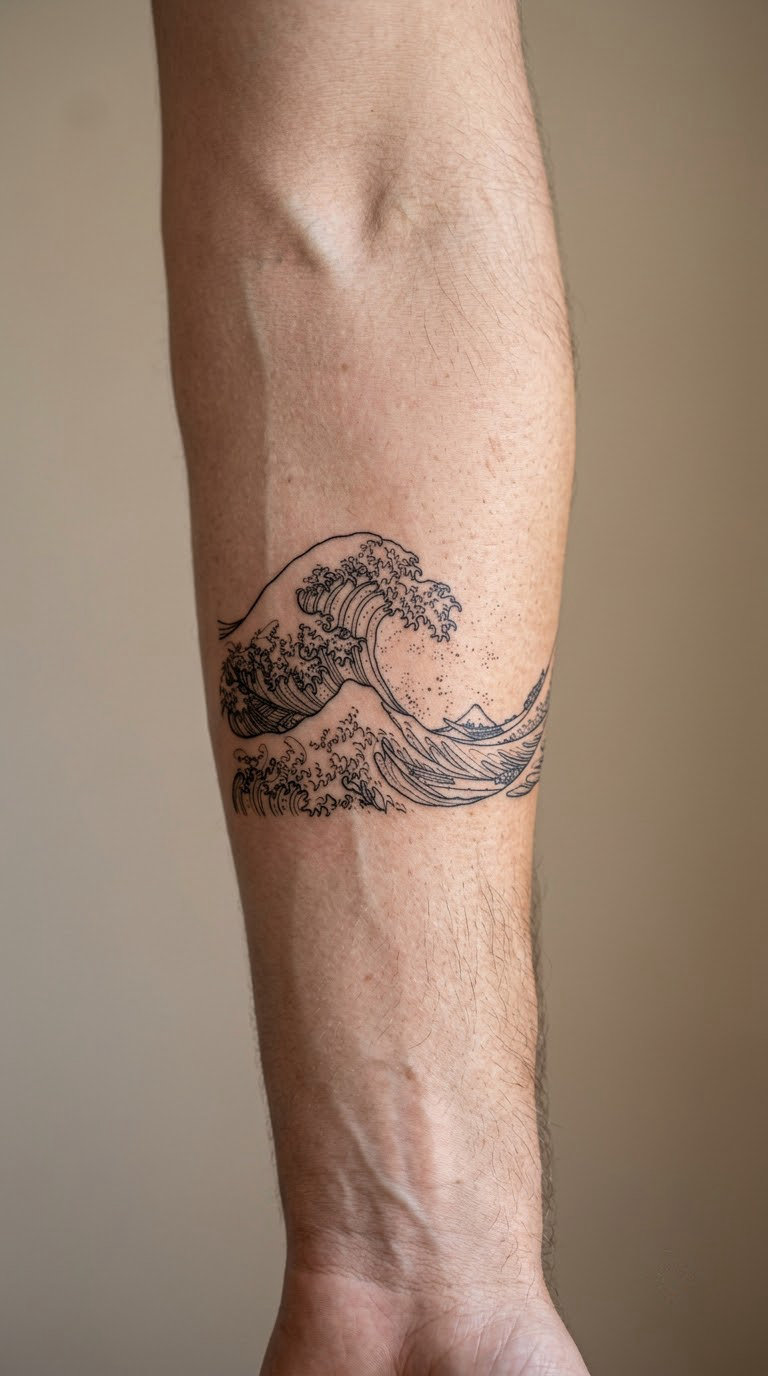
This tattoo idea for surfers starts with one continuous black line that rises, curls over and breaks into a few tapered ends. Most artists leave the inside of the wave unfilled, so the design reads as a drawing rather than a shape, and that keeps it light on a small piece of skin.
People choose it because a breaking wave is the closest thing surf culture has to a logo of the sport’s central moment: the instant the lip throws forward. There is no fixed meaning beyond that, which is part of the appeal.
Placement: inner forearm reads like a private note to the wearer and shows when you roll a sleeve. Size: 3-4 inches (7.5-10 cm) across. Style: fine line with a single unbroken weight.
Pain: low to medium on the inner forearm, more a constant scratch than a series of hits. Ageing note: hair regrowth over the lines softens them, and a line this light loses definition in the first few years if you never wear sunscreen.
Make it yours: have the artist work the break shape from a photo of a wave at your home spot rather than a generic swell.
2. Traditional Setting Sun
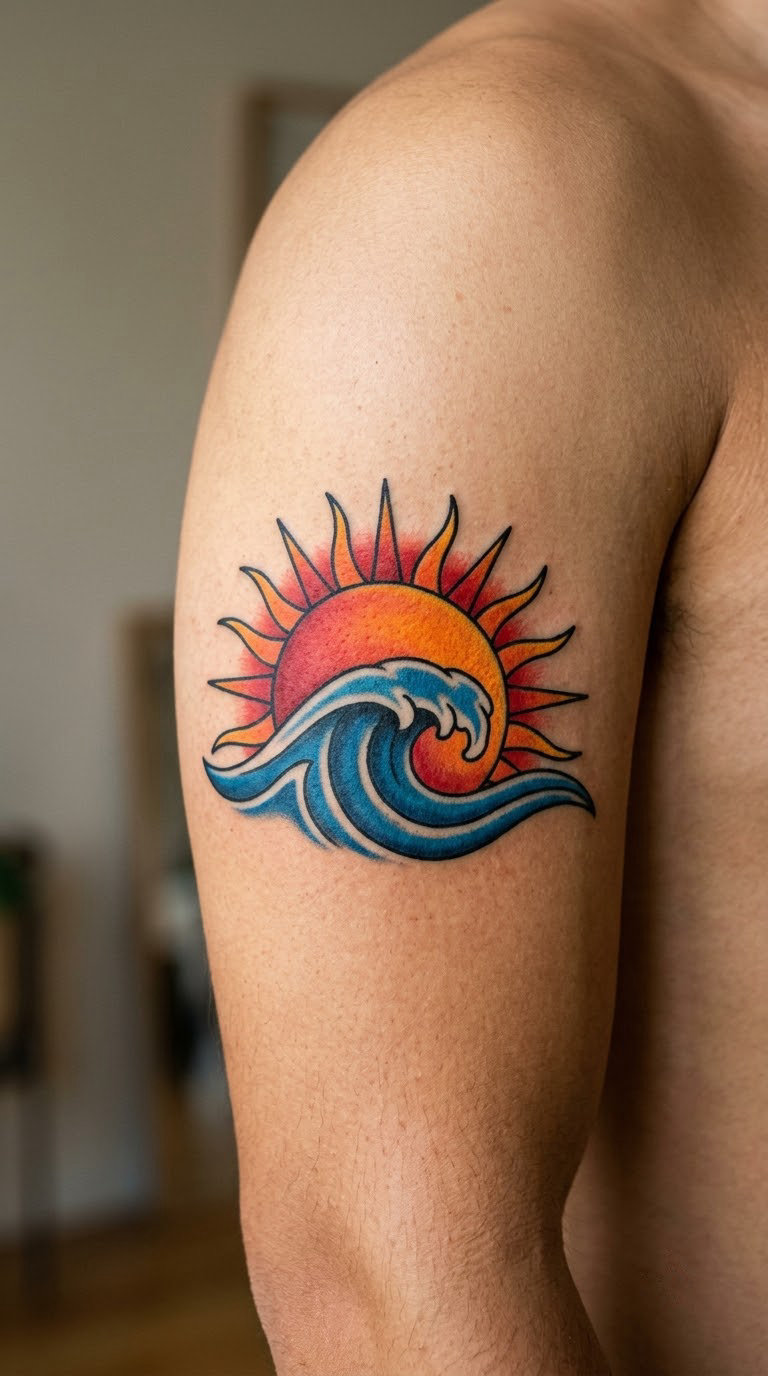
Bold black outlines, flat colour and a little traditional shading: a half sun sits above a single blue wave, the rays cut into straight segments rather than soft gradients. Traditional work is built for ageing, because the heavy outline holds the shape even when the yellow has softened toward cream.
It is a dawn-patrol design. Surfers often link it to the earliest session of the day, the quiet hour before the wind picks up, and it carries that feeling without needing a date or a name attached.
Placement: outer upper arm, where the design can sit at about a 45-degree angle so the sun tilts with the limb. Size: 4-5 inches (10-13 cm). Style: traditional with a two- or three-colour palette.
Pain: low. The upper arm is fleshy and the design is a fill rather than a dense detail job. Ageing note: red and yellow are the first pigments to shift, so expect a warmer, softer sun within a few summers.
Make it yours: swap the standard yellow for a muted orange so it reads differently from the shop’s flash sheet.
3. Blackwork Tidal Spiral
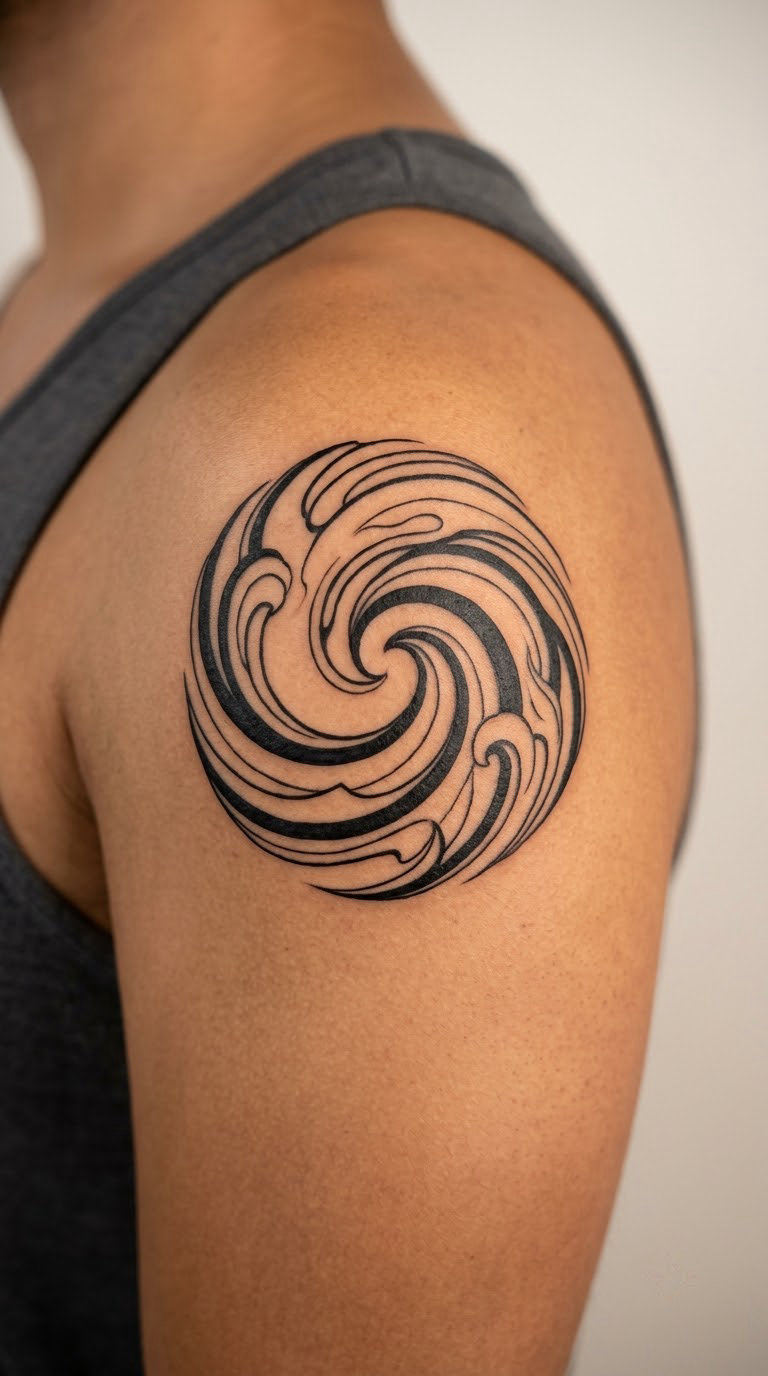
The wave is folded inward into a circle: solid black arcs alternate with tapered curves, and the white gaps between them do the actual drawing. Blackwork rewards contrast, so the artist blocks in dense areas and leaves clean negative space rather than shading everything.
A spiral reads as a tide turning rather than a wave breaking, which is why it suits people who surf cold-water breaks and think of the ocean in cycles. It also sits neatly in a round format, so it fills a shoulder without sprawling.
Placement: upper shoulder or the top of the shoulder blade. Size: 3.5-4.5 inches (9-11 cm) in diameter. Style: blackwork with a graphic, poster-like approach.
Pain: medium. Solid blacks need repeated passes over the same skin, and the shoulder is bony near the top. Ageing note: black holds its colour better than any tint, so this design ages more evenly than a coloured equivalent.
Make it yours: add a single small solid dot inside the spiral as the focal point, or break the circle slightly so it reads as a moving form.
4. Surfer Silhouette Under a Palm
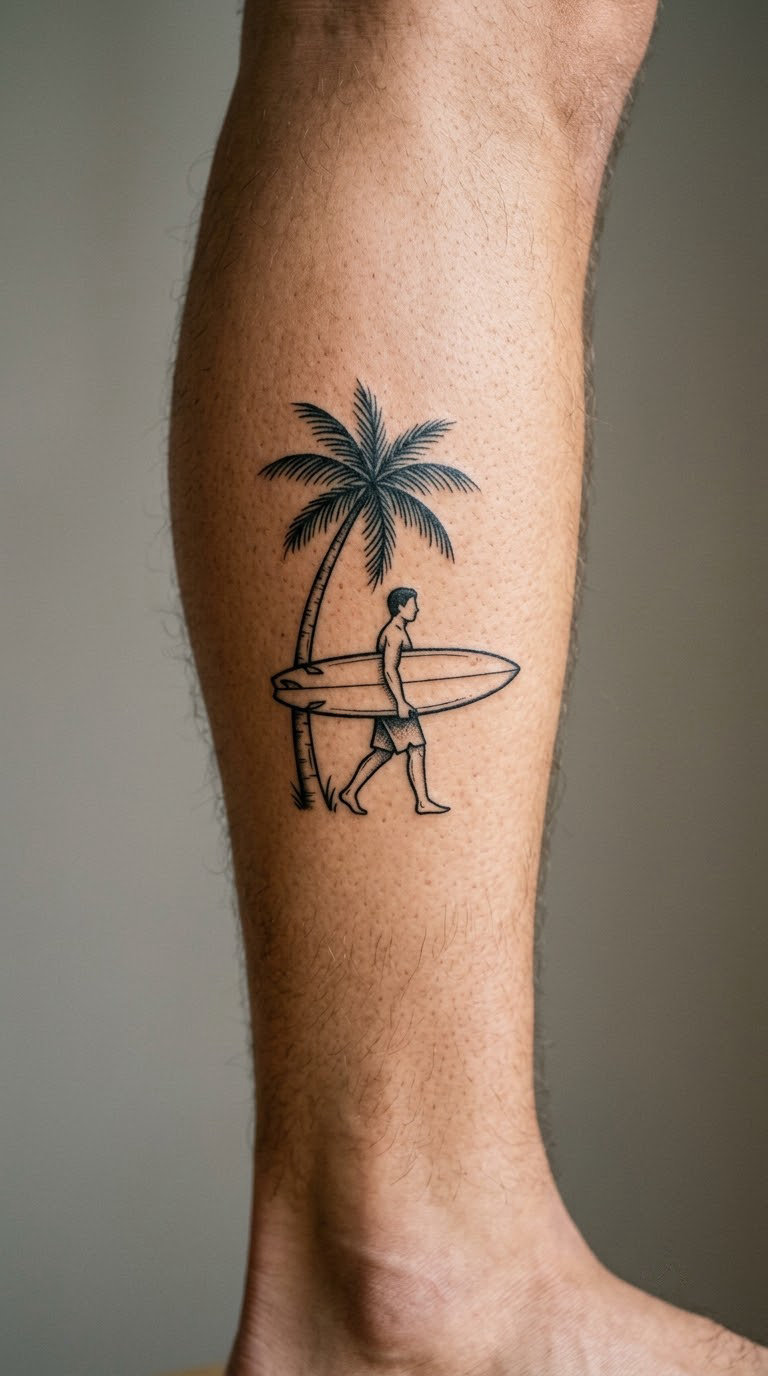
A simplified scene: one figure walking with a board under one arm, a slim palm trunk with four or five fronds, nothing else. The trick is keeping the silhouette chunky enough to stay readable once the lines are no longer hair-thin, which is why the artist works the body as a solid shape and the palm as open line work.
It is a travel-and-beach design rather than a performance one. The figure is carrying a board, not riding one, so it tends to point at a home beach or a stretch of coast you keep going back to.
Placement: outer calf, thigh or the inside of the upper arm. Size: 2.5-3 inches (6-8 cm) tall. Style: minimalist line with a solid silhouette figure.
Pain: medium. The calf is sensitive near the shin bone and the outer edge of the calf. Ageing note: small scenes lose their internal detail first, so expect the fronds to merge into a shape over time.
Make it yours: have the surfer wear a boardshort pattern in solid black, or add a single shaka hand raised instead of a second frond.
5. Micro-Realism Surfboard
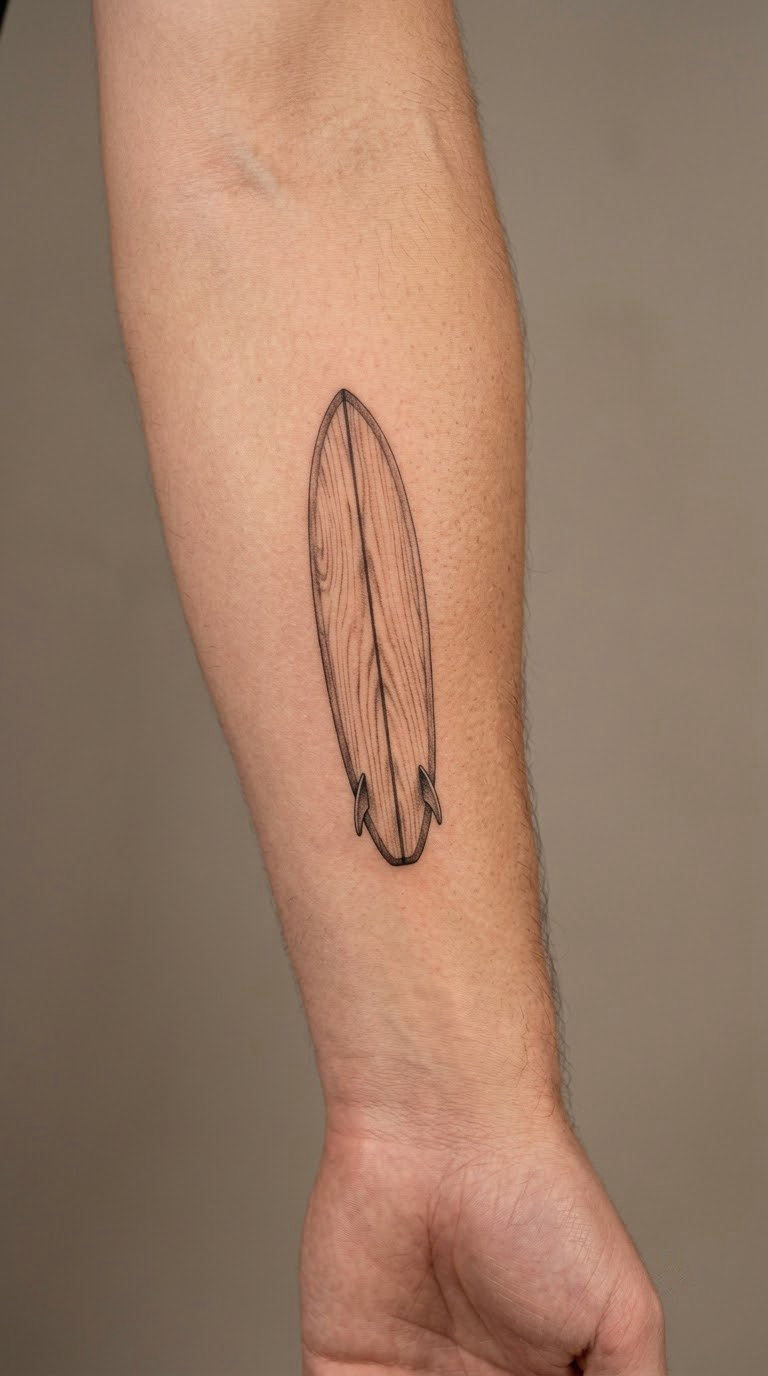
A single board rendered small: the grain runs in fine parallel lines, the two fins sit under the tail, and a soft shadow underneath lifts it off the skin. Micro-realism lives or dies on restraint, so the artist avoids adding a leash, wax or a wave around it.
Board shapes are personal documents. A fish, a gun, a shortboard or a longboard says something about how someone paddles, and surfers recognise their own board faster than any logo.
Placement: forearm, running lengthwise along the bone. Size: 3.5-4.5 inches (9-11 cm) long. Style: micro-realism, black and grey with a warm wood tone if you want colour.
Pain: low, since the forearm has a flat plane and little bouncing. Ageing note: individual grain lines are the first thing to blur, so the artist should run the grain heavier than feels necessary in the drawing.
Make it yours: bring a photo of the board you actually ride, including the rocker at the nose, and let the artist copy that outline exactly.
6. Geometric Wave Triangle
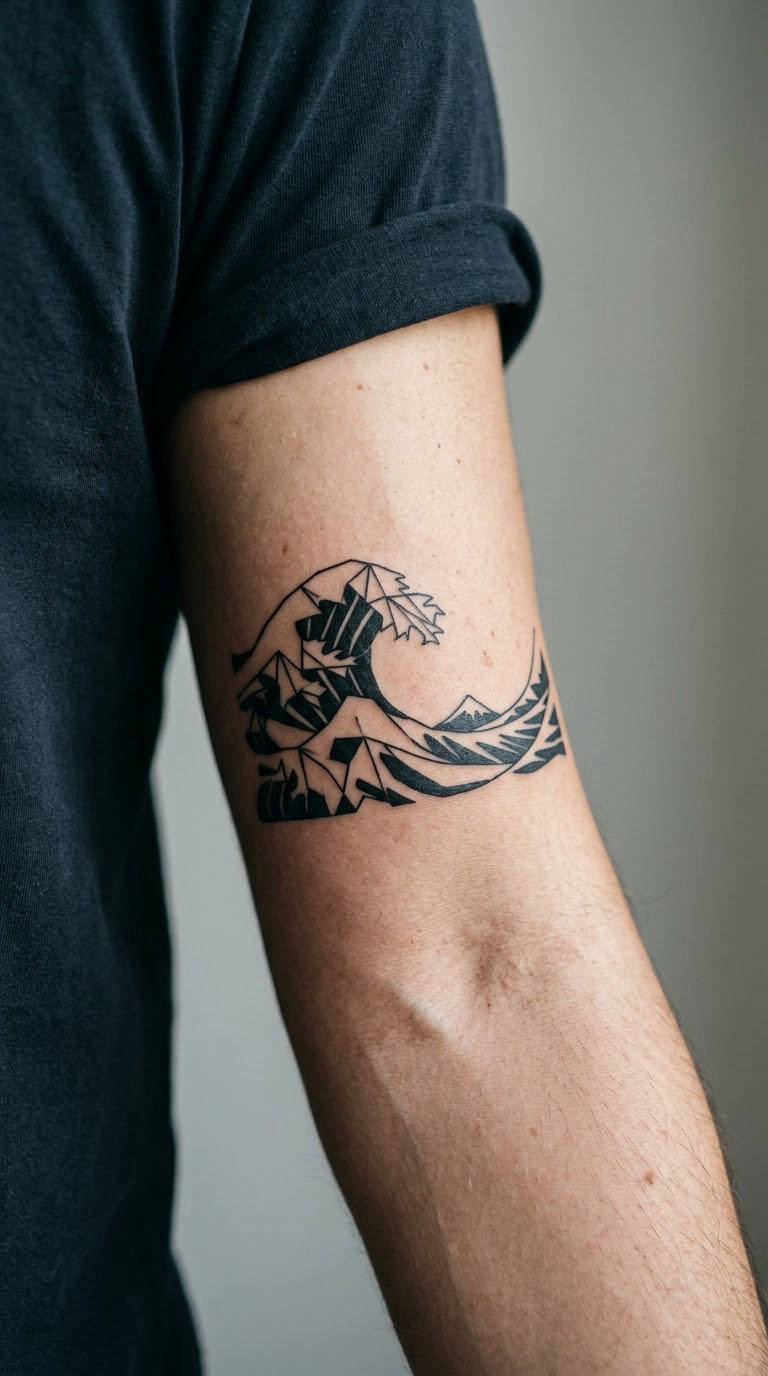
The wave is broken into a triangle, and inside that triangle the artist places solid black shapes that suggest foam and a falling lip. Nothing is curved by hand; the motion comes entirely from how the triangular planes step down the arm.
Geometry suits people who like the water but not a drawing of it. It is one of the easier surf motifs to commission, because the design is mathematical enough that a first-time client gets a result that looks deliberate.
Placement: inner bicep or the inner forearm. Size: 2.5-3.5 inches (6-9 cm) tall. Style: geometric blackwork.
Pain: low to medium. The inner bicep is close to bone in places and the arm moves a lot, so breaks matter. Ageing note: straight edges stay crisp longer than organic line work, which is the main argument for this style.
Make it yours: turn the largest triangle so its point aims along the bone instead of across it, which changes how the design reads when the arm bends.
7. Watercolor Reef Scene
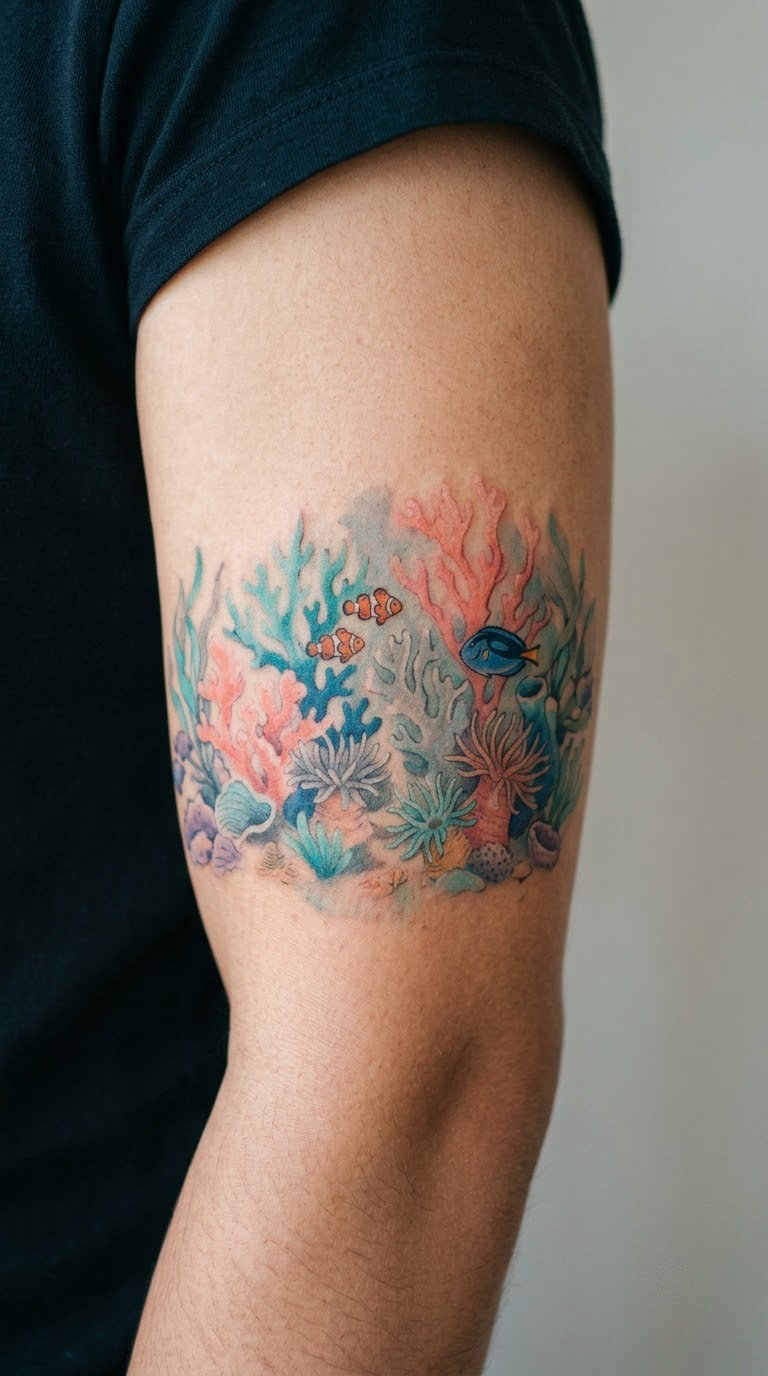
Loose washes of turquoise and deep blue with coral pink branching shapes and a few small fish in grey, edges left soft and bleeding rather than outlined. Watercolor patches blend, and the artist works the colour wetter in the middle and drier at the edges so the pigment does its own thing.
Reef scenes carry the travel half of surfing, the days spent snorkeling instead of surfing, and the reef itself is a living, shifting thing that suits an impressionistic hand.
Placement: upper arm, where there is a broad flat area for a wide scene. Size: 5-6 inches (13-15 cm) wide. Style: watercolor with soft, blended edges.
Pain: medium. Large colour fields mean more passes and a longer seated session. Ageing note: pale washes fade noticeably faster than solid black, so a sunscreen habit is worth more here than on a blackwork piece.
Make it yours: name the specific reef you have dived at and have the artist build the coral shapes around what is actually there.
8. Minimalist Horizon Line
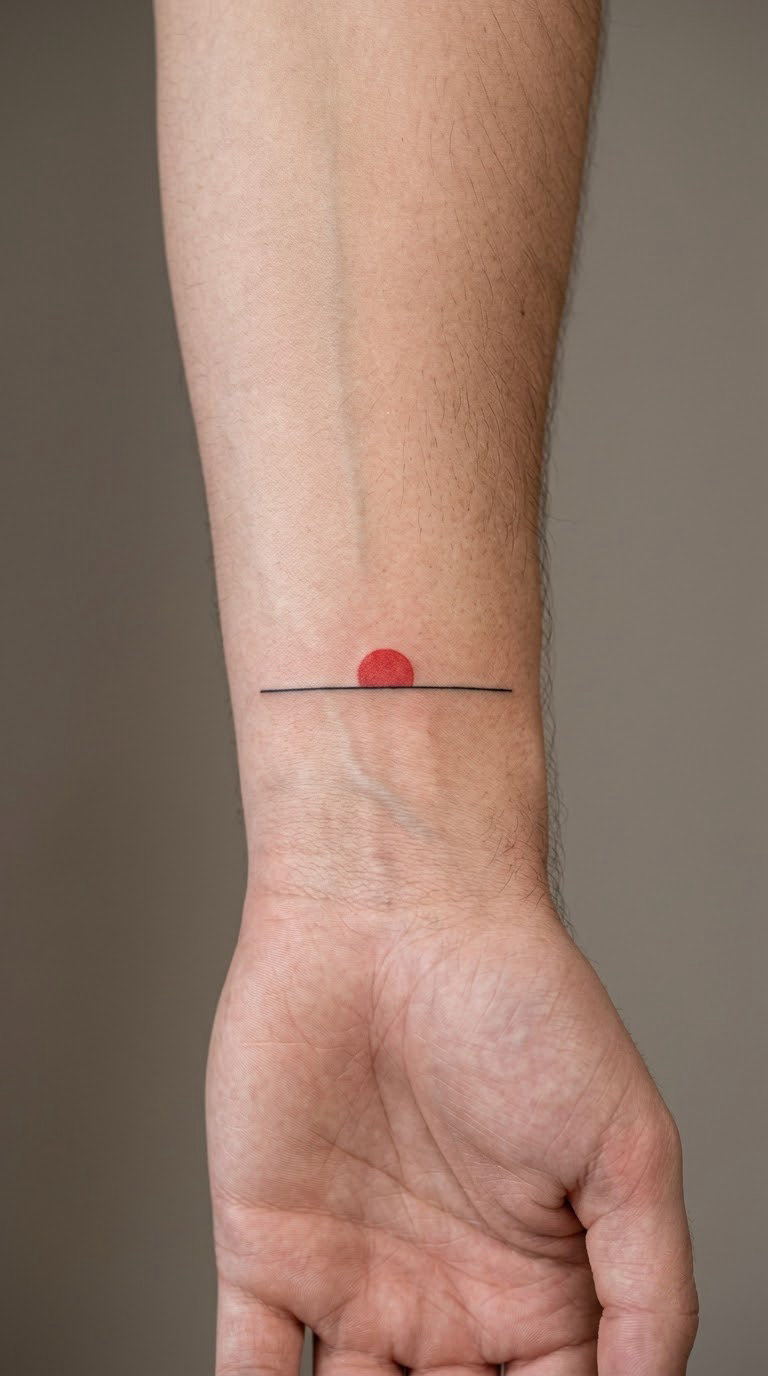
One thin black line runs horizontally, and a single small red sun sits a short distance above it. That is the whole design. Minimalism is not about being lazy with detail; it is about choosing one line thick enough to survive the skin it lands on.
It reads as looking out to sea from a low position, which is a more contemplative surf image than a breaking wave. It also works as a discreet piece that shows only when a sleeve is pushed back. If you want more small-format coastal work to browse, 20 Best Wrist Band Tattoo Ideas for Minimalist Looks (September 2026) covers what actually holds up on that part of the body.
Placement: inner wrist, above the wrist bone. Size: 1.5-2 inches (4-5 cm) wide. Style: minimalist with one colour accent.
Pain: medium, since the inner wrist has a thin skin layer over bone and lots of nerve endings. Ageing note: extremely fine lines on the wrist and fingers blur within a few years, so ask for the line weight to be pushed slightly heavier than the drawing suggests.
Make it yours: make the sun a filled half circle that touches the horizon line, or set the line at a slight tilt to match how you actually hold your arm when you check the time.
9. Neo-Traditional Wave and Sun
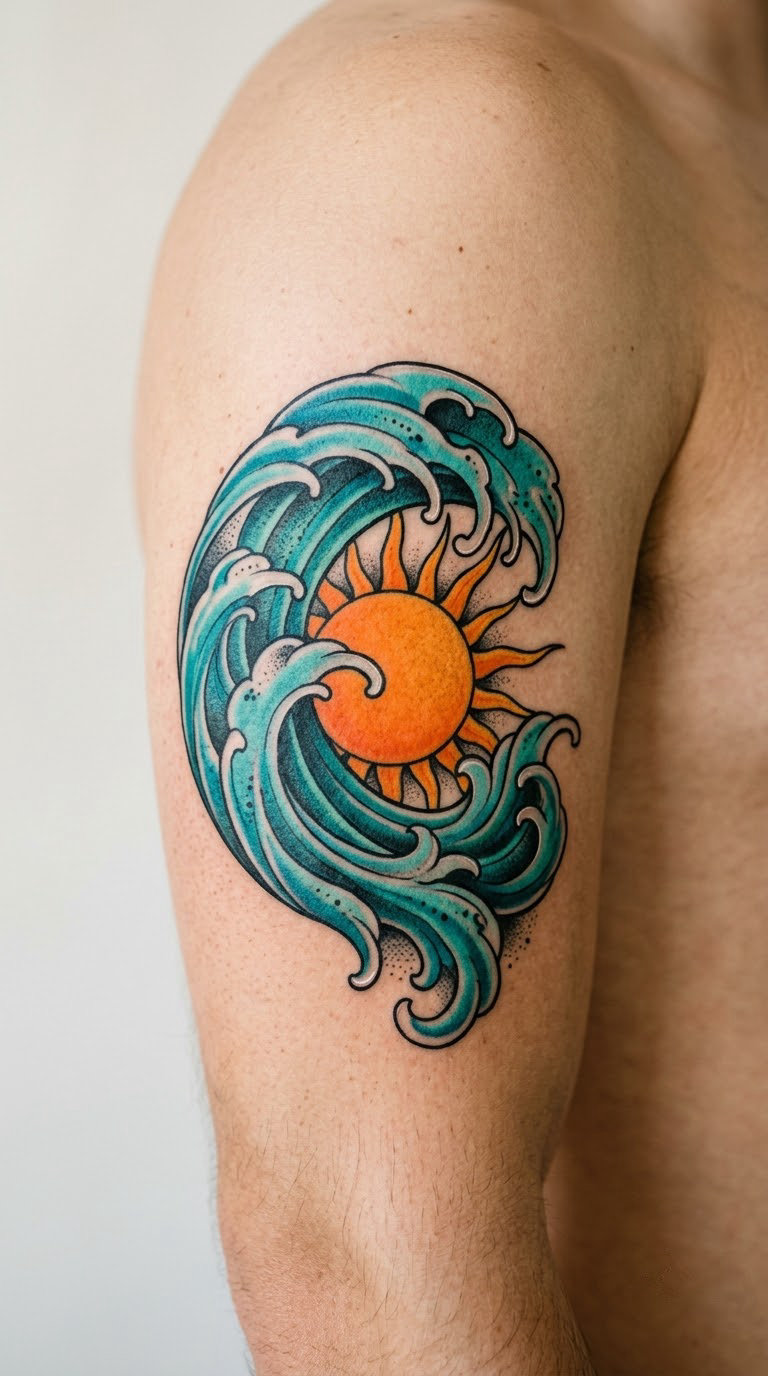
Saturated colour, heavy outlines, ornamental curls of spray and a curved composition that bends around the arm instead of sitting flat. Neo-traditional takes the old flash vocabulary and adds finer shading, deeper colour and decorative line work around the main forms.
The wave wrapping around a sun is a favourite because it reads as a badge: compact, symmetrical and legible from across a room. Collectors add the small ornamental bits, the foam curls and the dotted highlights, to mark the piece as their own.
Placement: outer upper arm or the shoulder cap. Size: 5-6 inches (13-15 cm) wide. Style: neo-traditional colour.
Pain: medium, spread across a curved area with plenty of soft tissue. Ageing note: bold fills hold up well, but the fine highlight dots on the spray are the elements that blur within a decade.
Make it yours: add a thin band of lettering along the lower edge with a break name and a date, done small enough to read as texture rather than a slogan.
10. Dotwork Ocean Swell
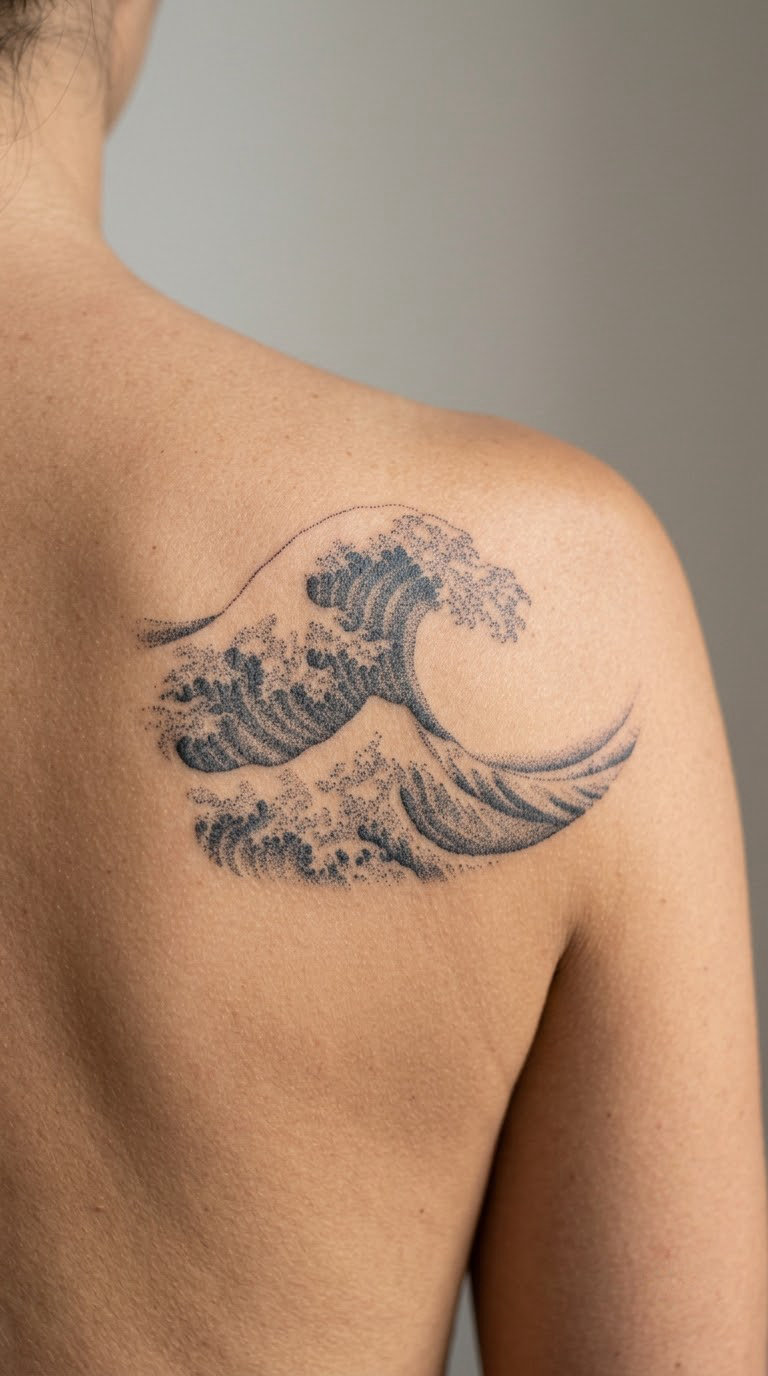
No outlines anywhere. The swell is built entirely from dots that grow larger and closer together in the shadowed troughs and thin out over the crest, so the eye reads a three-dimensional wave out of nothing but tone.
Dotwork is a good answer to people who want their ink to look like texture rather than a picture. It suits long sessions and people who plan to add to it, because dot fields can be extended later without a hard edge where the work stops.
Placement: shoulder blade or outer upper arm, anywhere flat and uninterrupted. Size: 4-5 inches (10-13 cm) wide. Style: dotwork, no line work.
Pain: high. Dots mean constant, repeated needle work over a wide area, and the shoulder blade is awkward to reach. Ageing note: fine dot spacing can spread over time, so ask for tighter spacing than looks right on paper.
Make it yours: grade the dots into a second direction so the swell reads as a horizon behind the water, or have the artist fade the outer edge into a soft cloud of dots.
11. Hammerhead Shark in Blackwork
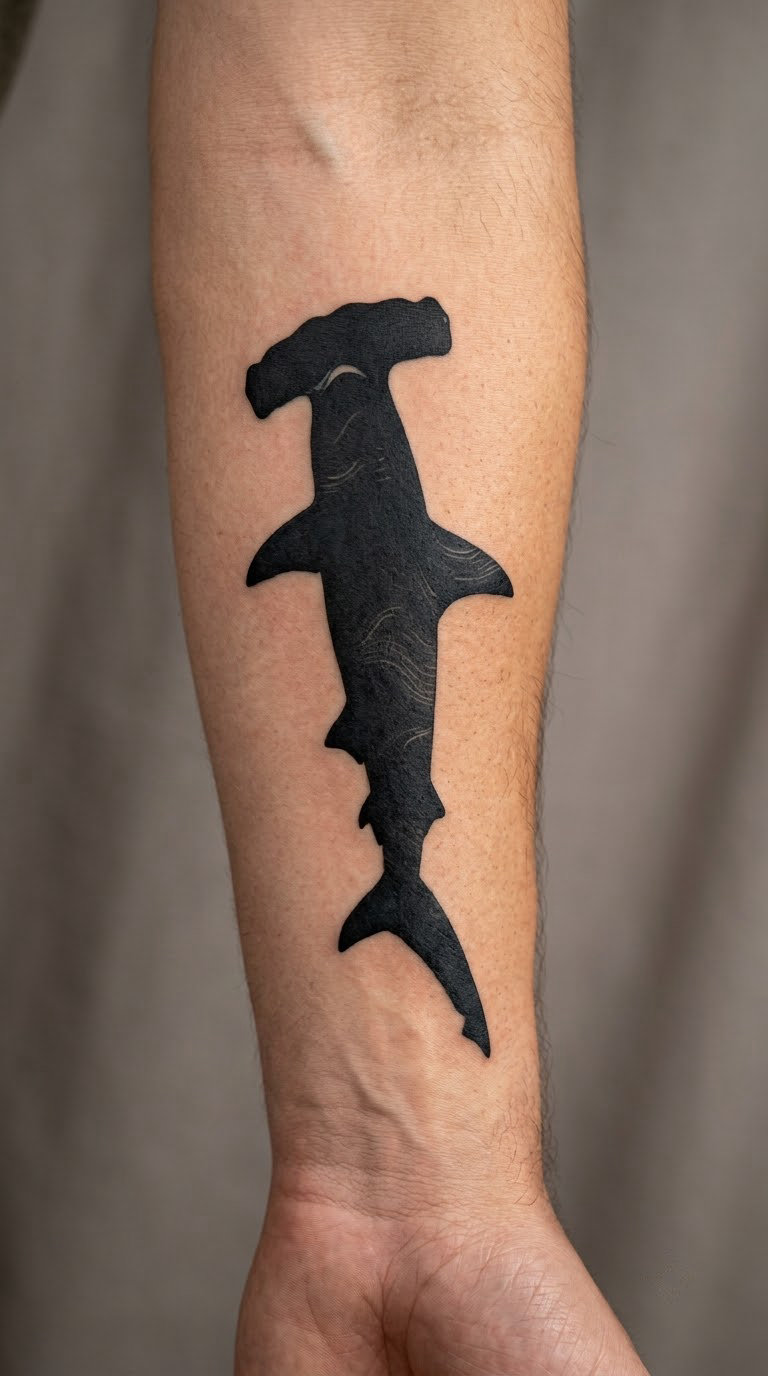
A solid black hammerhead silhouette with one eye left open, set over a few lines of wave hatching and nothing else. Sparse texture keeps the form readable, and the flat black gives the piece the weight of a single decisive shape.
Sharks turn up constantly in surf tattoos and the meaning shifts with the person. For some it is the animal that made everyone in the water a little more alert; for others it is the calm that comes from knowing what is out there.
Placement: forearm along the bone, or the outer calf. Size: 6-7 inches (15-18 cm) long. Style: blackwork with a solid silhouette.
Pain: medium, heavier on the ribs of the forearm than most designs of this size. Ageing note: solid black is the most durable ink there is, and any grey hatching around it will soften sooner.
Make it yours: have the hammerhead turned slightly toward the viewer instead of side-on, which gives the piece depth without adding detail.
12. Sea Turtle in Motion
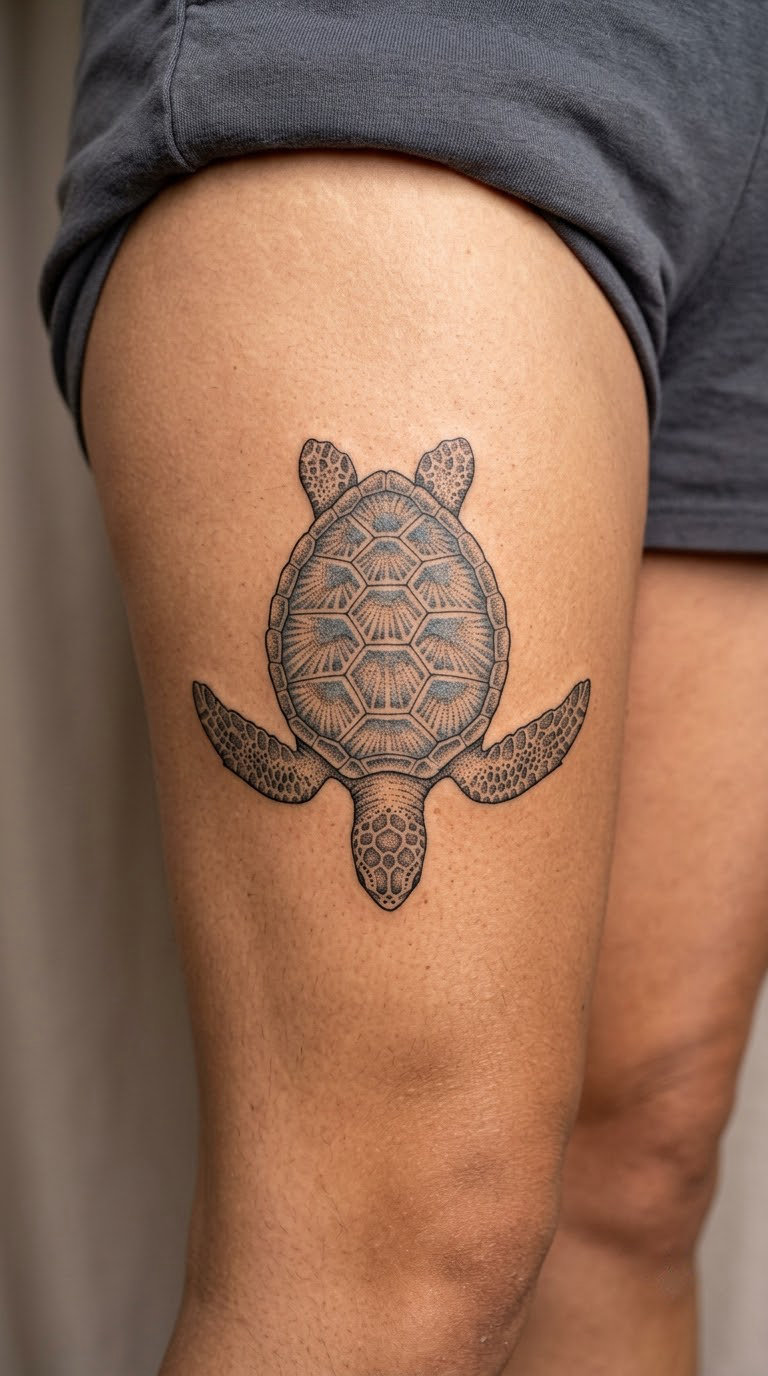
A streamlined turtle with two long front flippers, dotwork texture across the shell and a muted blue wash on the shell plates. The body is drawn with a few confident lines so the animal looks like it is moving rather than posed.
Turtles are the most popular marine animal in surf tattoos, usually because the animal is unhurried and long-lived, which is a strange contrast to the sport that surrounds it.
Placement: outer thigh, shoulder or the lower back. Size: 3.5-4.5 inches (9-11 cm) long. Style: dotwork with soft colour accents.
Pain: low, because the thigh and shoulder are forgiving and the design has no dense fills. Ageing note: dotwork on the thigh fades more evenly than on the shin, but the coloured shell plates will lighten with sun exposure.
Make it yours: have one flipper overlap a wave line so the animal looks caught mid-swim, or ask for the shell pattern to follow your own board’s colour scheme.
13. Compass Rose with a Wave
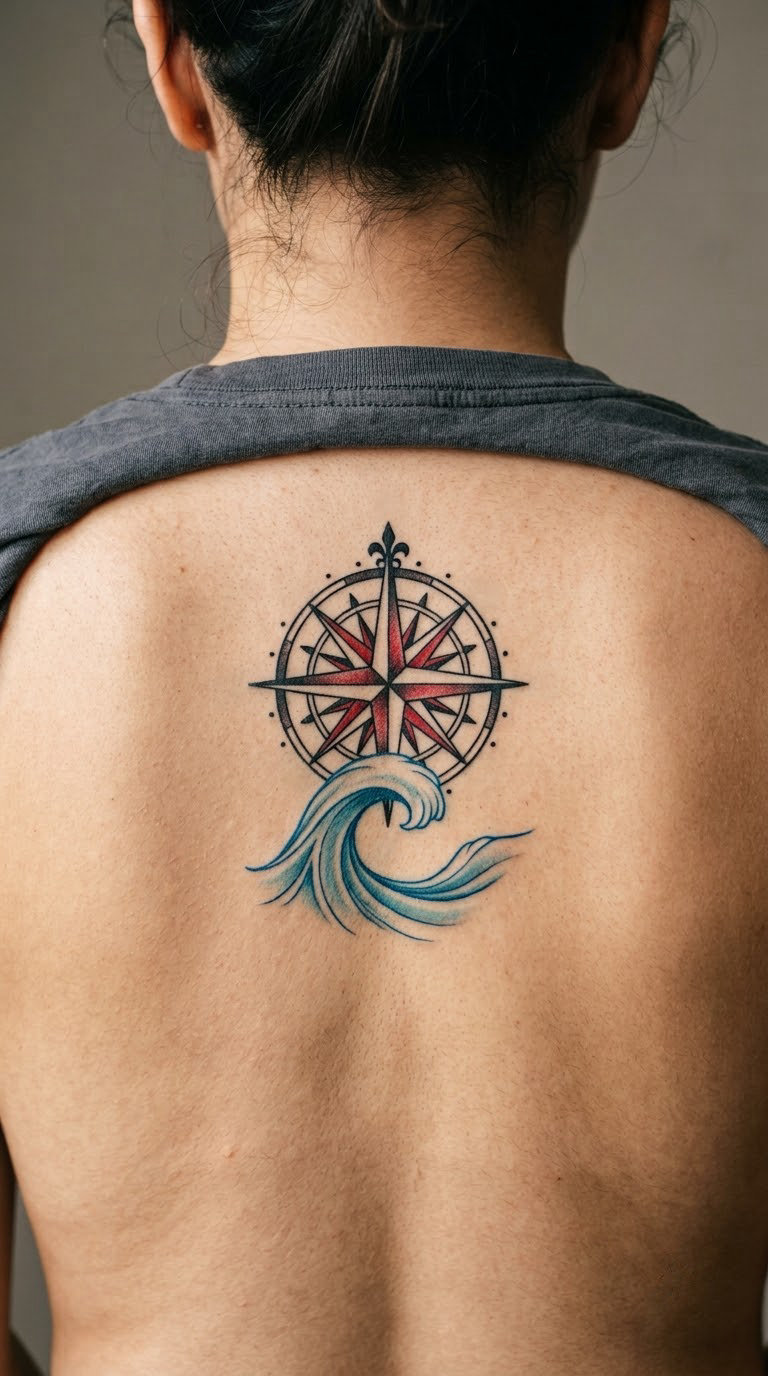
An eight-point compass rose with a red and black needle, rising straight out of a single blue wave. The design is symmetrical by nature, which makes it one of the easiest surf motifs to get right, because there is a built-in check on the artist’s work.
The compass is a travelling and wayfinding image. Surfers who move between breaks and countries tend to use it, sometimes with a specific heading instead of north, pointing toward a place that matters to them.
Placement: centred on the upper back between the shoulder blades, or on the chest. Size: 4.5-5.5 inches (11-14 cm) in diameter. Style: traditional colour with clean symmetry.
Pain: medium over the back, and you will feel the ribs under the lower points. Ageing note: the very fine tick marks between the compass points fade first, so it is worth asking for those to be cut slightly heavier.
Make it yours: change one point to mark a real bearing, or have the wave beneath it show a single barrel rather than a flat line of water.
14. Surfboard with Tropical Flowers
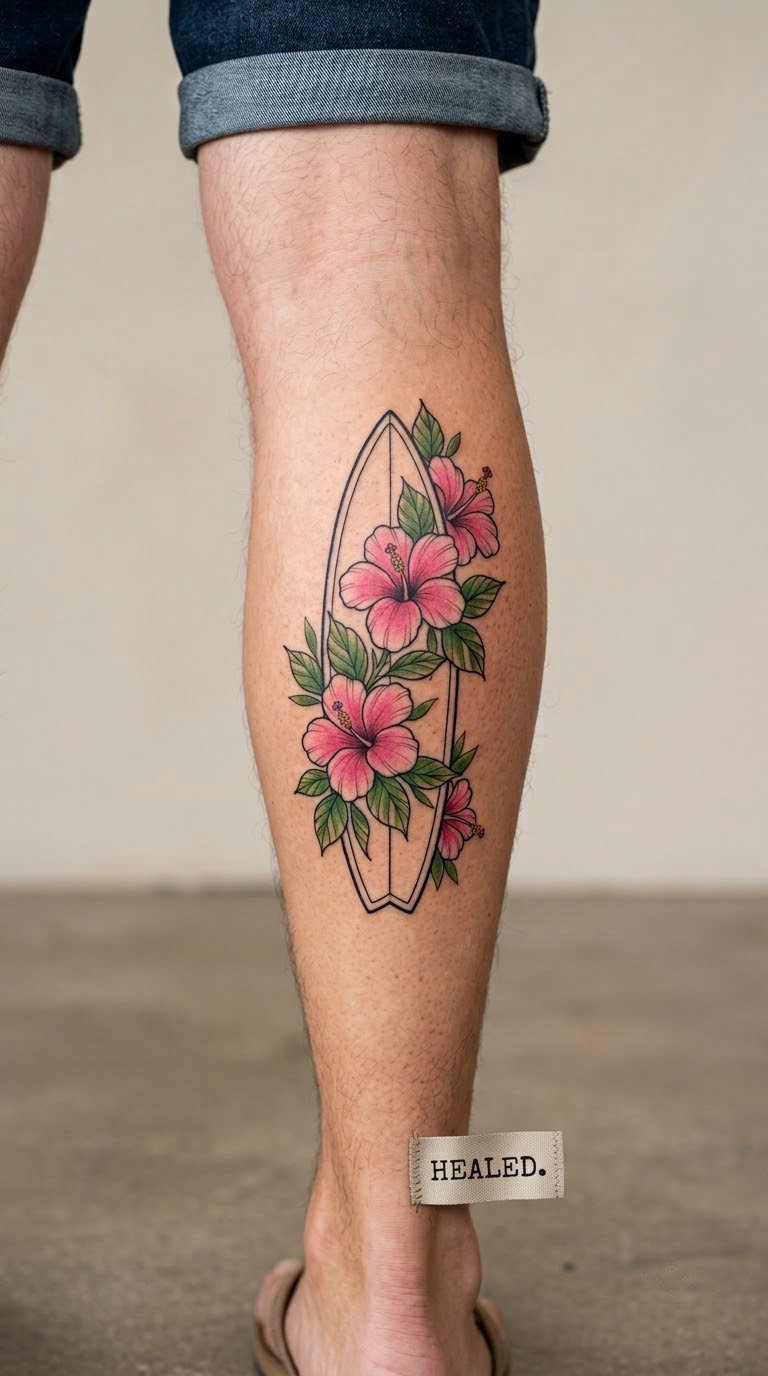
A tall vertical board drawn with a strong black outline, wrapped by hibiscus and plumeria with green leaves curling around the rails. The botanical work is done in flat colour with a little shading on the petals, which keeps the piece readable at a distance.
This is the holiday version of a surf tattoo: warm water, a rented board and flowers. It tends to get chosen by people whose surfing started on a beach somewhere tropical rather than on a local point break.
Placement: calf, outer arm or the lower back. Size: 6-7 inches (15-18 cm) long. Style: botanical colour with a traditional outline.
Pain: low to medium, since the calf is fleshy in the middle and the design has open colour areas. Ageing note: pinks and light greens are the first colours to fade, and the outline is what will still identify the piece in a decade.
Make it yours: have the flowers be the ones that grow near your home break, or add a small date along the board stringer in thin lettering.
15. Coastal Map with a Surf Route
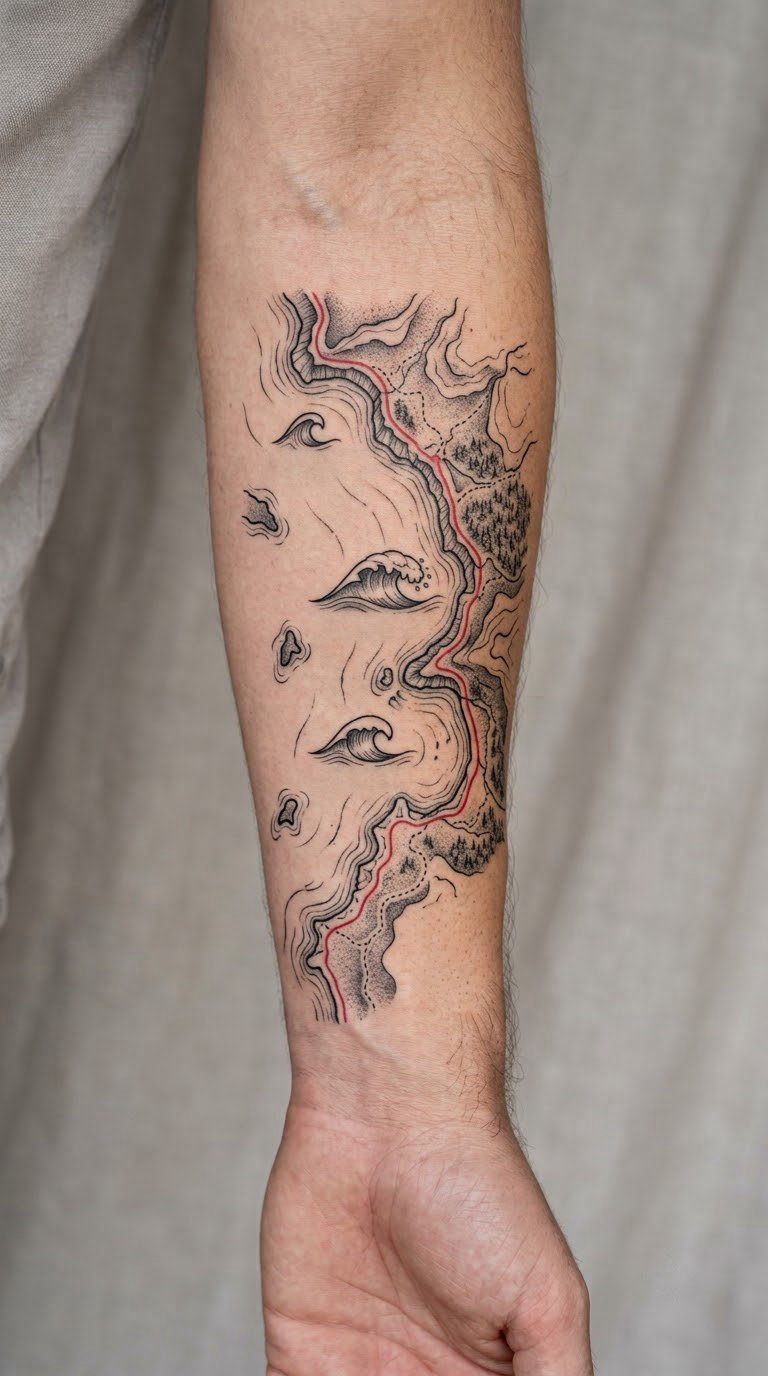
A fragment of coastline drawn in fine black line: the curve of the shore, three surf breaks marked with small symbols, contour lines inland and one route line in red running between them. It is closer to a cartographic drawing than to a picture of an ocean.
Map tattoos are tied to a place, and surfers tend to mark the coastline they actually know, sometimes with the road they drove to get there. This is the least generic design in the whole list, because there is no generic version of a specific break.
Placement: forearm, upper arm or the back of the calf. Size: 7-8 inches (18-20 cm) wide. Style: fine line cartography with one accent colour.
Pain: high. Fine hairlines over a wide flat area take the longest session of anything here, and the forearm numbs toward the end. Ageing note: hairline map detail is exactly the kind that blurs within five years, so a bolder, simplified line weight ages better.
Make it yours: bring your own coordinates and ask the artist to draw the actual shape of your home break, not a stylised coast.
16. Geometric Wave Band
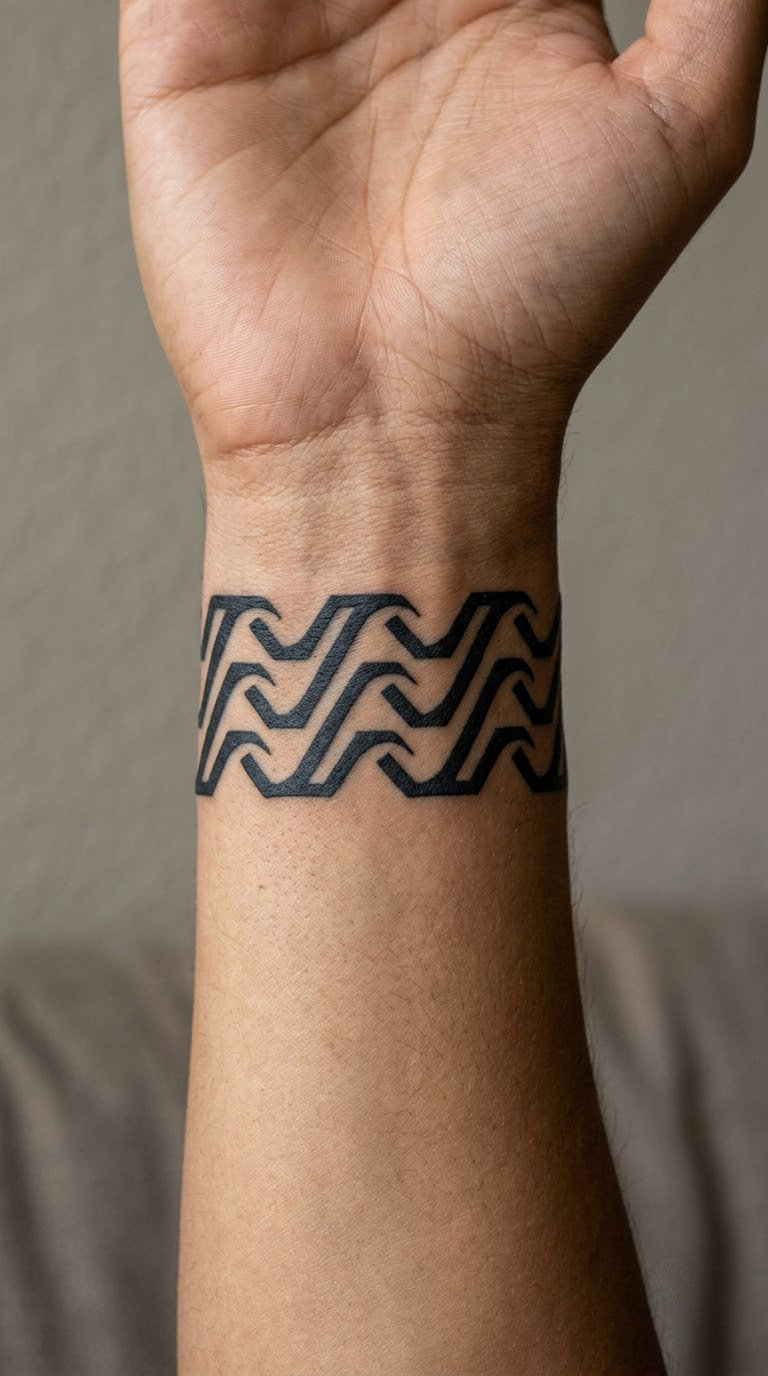
A repeating band of angular wave forms, each one a mirror of the last, running as a single strip of solid black with white gaps between the peaks. The whole thing is rhythm rather than picture, and consistent spacing is what makes it look like a band instead of a row of clip art.
Bands are the natural first piece for someone who wants surf imagery in a formal or visible spot, because a repeating strip can follow the curve of a wrist, a forearm or a ribcage without needing a big block of skin. 20 Forearm Band Tattoo Ideas for Men: Best Designs September 2026 has more of that geometry if you want to see how spacing changes with a full forearm.
Placement: wrist, forearm or the gap between the ribs. Size: 1.5-2 inches (4-5 cm) wide, as long as you want it to run. Style: geometric blackwork band.
Pain: low on the wrist, high on the ribs. Bony or bony-adjacent placements hurt more, and ribs move with every breath. Ageing note: solid black bands hold colour better than almost any other design, though the thin white gaps can narrow as skin changes.
Make it yours: have the peaks count to the number of breaks on your local point, or mirror the band so the two ends meet at the wrist like a clasp.
17. Cliffside Coastal Linework
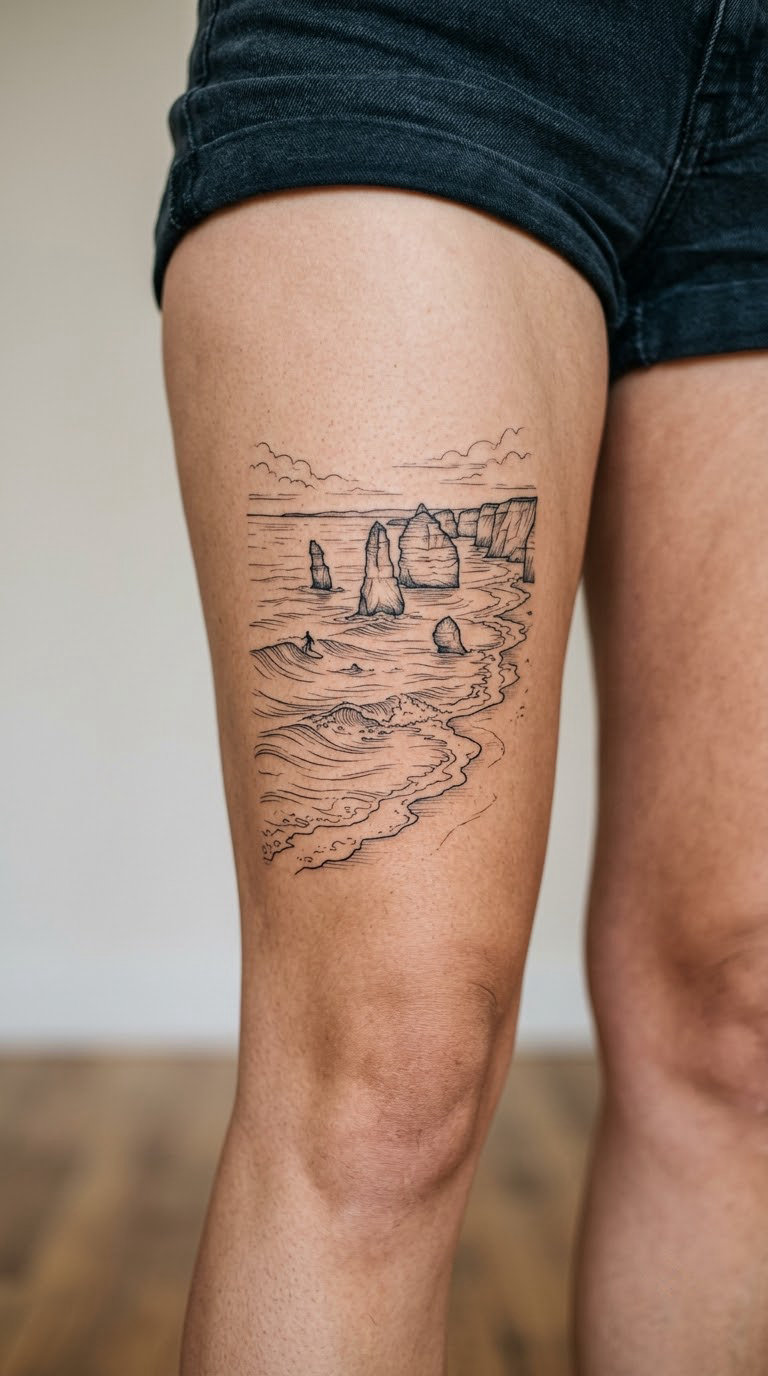
An airy scene in a single thin line: two or three sea stacks, rolling water drawn with long horizontal strokes, and one small surfer far out in the composition. There is no shading anywhere, and the emptiness around the shapes does most of the work.
Wide-scene tattoos usually point at a coastline rather than a sport, and the tiny figure in the distance gives the whole piece its scale, which is a nice trick on a large thigh.
Placement: outer thigh, hip or the upper back. Size: 4.5-5.5 inches (11-14 cm) wide. Style: fine line scenic work.
Pain: medium, spread out with fewer hard passes than a filled design. Ageing note: long unbroken horizontal water lines are the first elements to go soft, so a slightly heavier stroke pays off over time.
Make it yours: describe the coastline you grew up on in one sentence and let the artist pick the composition, then add the date you first surfed there.
18. Storm Wave in Heavy Blackwork
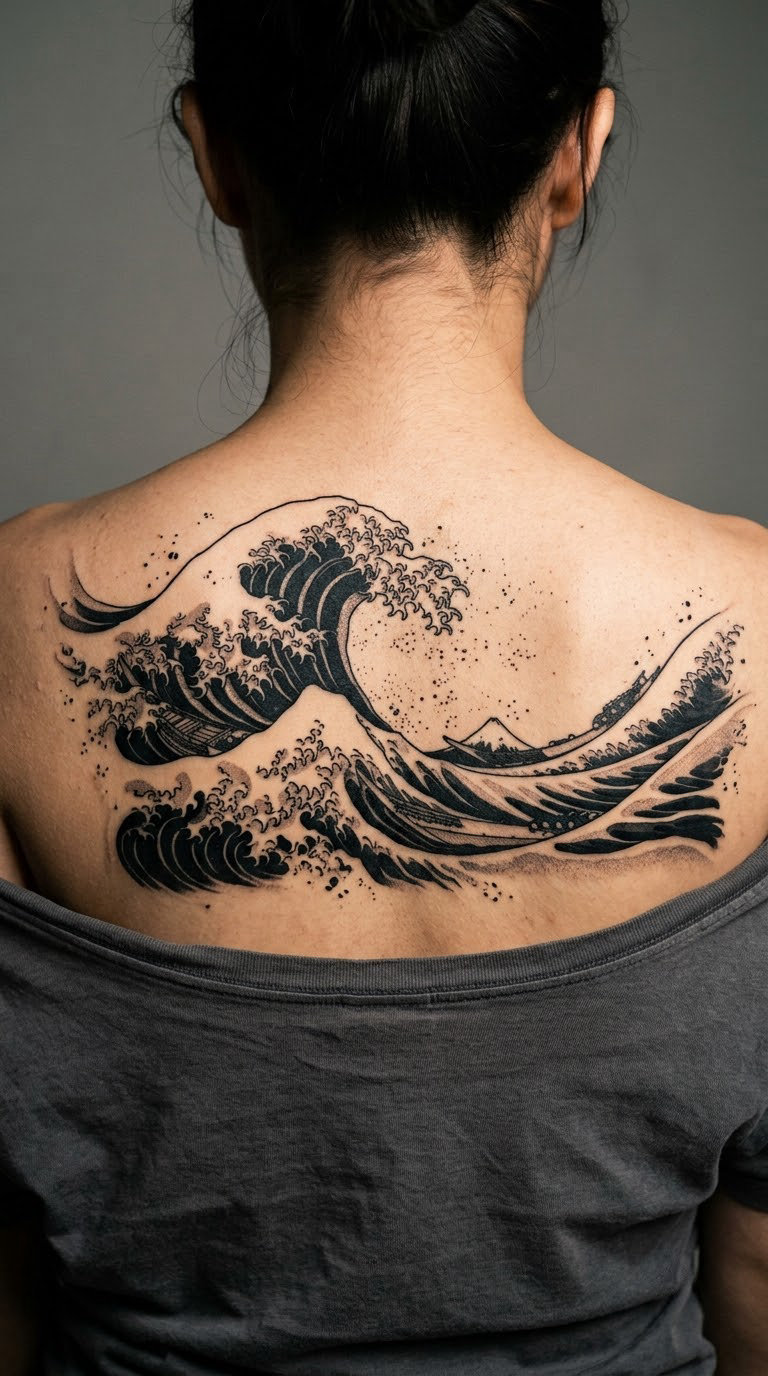
A large breaking wave built from heavy solid blacks, with the foam carved out in sharp white cutouts and a scatter of spray dots thrown past the crest. This is the loudest design in the list, and it needs a broad flat area to work at all.
A storm wave is a different statement from a calm breaking wave. It is usually chosen by people who surf big swell and want the piece to look like the water feels, not like a postcard.
Placement: across the upper back, the chest, or a thigh at full size. Size: 8-9 inches (20-23 cm) wide. Style: heavy blackwork with negative-space foam.
Pain: high. Filling large solid areas means repeated passes, and the upper back is a long session even when the work is simple. Ageing note: solid black is very durable, but the sharp foam cutouts can blur into soft edges as the years pass.
Make it yours: change the spray direction to match the wave rather than sitting symmetrically, or have a single light source built into the black so it reads as a storm sky.
19. Matching Wave Half Sleeve
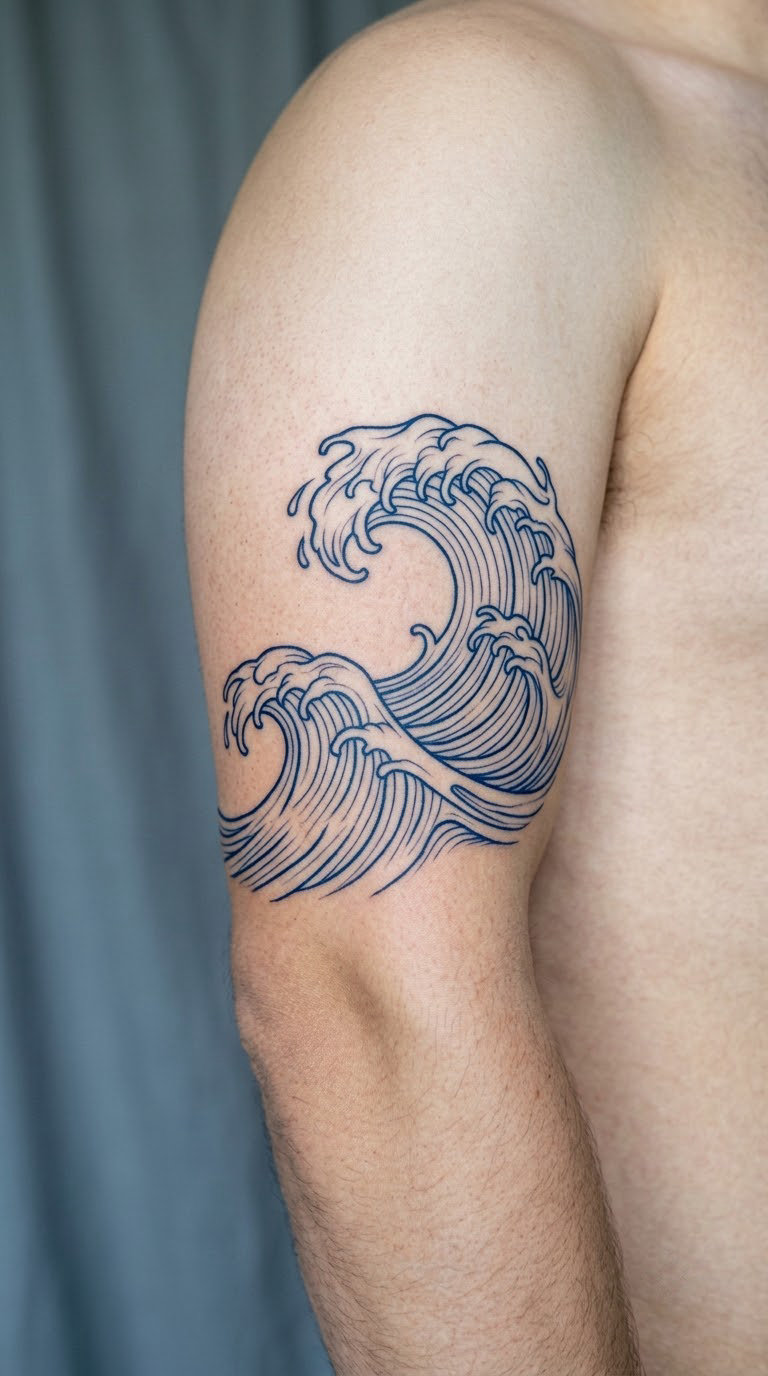
Two wave forms that connect rather than repeat: one rising from the elbow in black line and blue wash, the other swelling across the bicep and breaking back into it. The composition follows the muscle so the design looks placed rather than stuck on, and the two halves are related without being identical.
Sleeves get planned carefully because they are hard to change later. Most people start with a single element they could grow into, and the direction of the flow is decided before anything is tattooed.
Placement: elbow to mid-bicep on the upper arm. Size: roughly 20 percent of the arm in a first session, extendable over several. Style: blackwork with a blue wash.
Pain: high, and it runs long. Multi-session work means a healed first stage while the rest is still planned, so patience is part of the process. Ageing note: where two sessions meet, the later work usually reads slightly darker, so fading is less noticeable along a joint than along a flat plane.
Make it yours: have the artist map out the whole sleeve in stencil, including the parts you are not getting yet, so the finished extension has somewhere to go.
20. Micro-Realism Coastal Sunrise
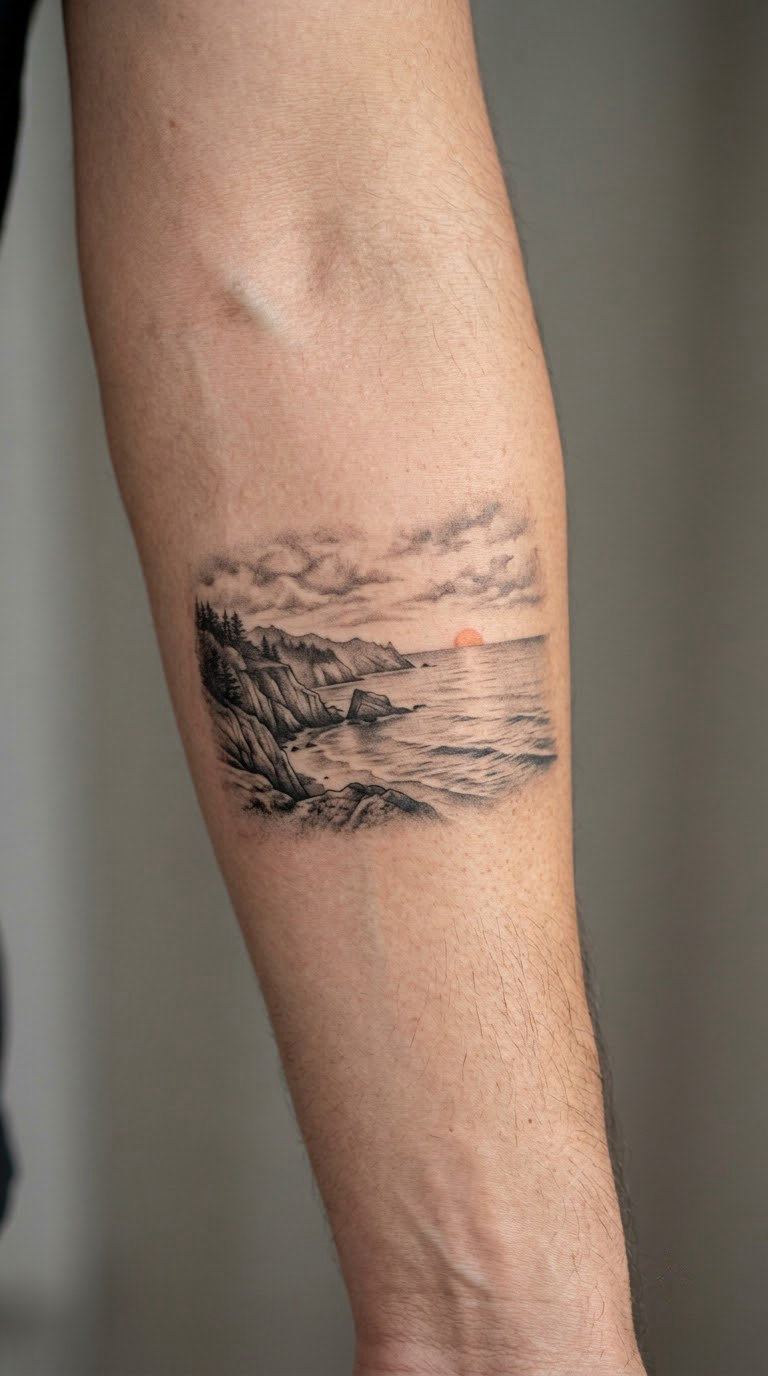
A low horizon rendered in soft tonal shading, a half sun in muted orange sitting on the waterline, and one small breaking wave in the foreground. The tone is built from fine grey gradients rather than lines, so it takes patience and it looks closer to a photograph than a drawing.
It is a quiet ending to the list. The mood is the early session, the flat light before the wind, and it works as a small piece or as the calm first element of a larger arm.
Placement: inner forearm or the bicep, where the skin is flat enough for tonal work. Size: 3.5-4.5 inches (9-11 cm) wide. Style: micro-realism in soft black and grey with one muted colour.
Pain: low, though it takes time because the artist builds the gradient in layers. Ageing note: soft grey shading is the hardest thing here to keep crisp, and it will lighten noticeably sooner than any black outline would.
Make it yours: bring a photo of the actual sunrise over your home break and match the angle of the sun to it, or name the colours of that morning sky for the artist to mix.
How to Choose the Right Design
Most of the disappointment comes from picking a picture first and forcing it onto a body that does not suit it. A few questions settle it before you book anything.
- Pick the ink before the picture. If you want something that still looks sharp in ten years, choose black and grey. Bright colour, especially pinks and light greens, is the first thing to fade on a sun-exposed placement.
- Match detail to the area you picked. Hairline work needs a broad flat patch, and a palm-sized composition on the inner wrist will blur. Small linework belongs on a forearm or a thigh, not on a finger.
- Think about the design over skin that moves. A wave that reads well on a flat upper back can collapse on a bicep that flexes. Ask the artist to place the stencil on the actual body part and check it in a mirror and in a bent position.
- Plan for what is already there. If you have a set, decide early whether this piece completes it or starts a new direction. Designs tied to a real break or a specific memory sit more comfortably in a collection than generic motifs, because you can explain where every part came from.
- Set a size you can keep. For a first surf tattoo, 3-4 inches (7.5-10 cm) is the sweet spot, big enough to show the design and small enough to sit in one session. If you want something quieter, a band style on the wrist reads well at a fraction of the size.
- Decide how visible it should be. Inner forearm and rib work stay mostly under a shirt, the outer upper arm and calf show in every photo of you surfing. If you are still figuring out how people will react to visible ink, start somewhere you can cover.
Bring the reference to the consultation in two forms if you can: a photo of the wave, board or coastline you have in mind, and a rough note about where on the body it should land. The artist will redraw the design to fit the skin, but nobody can guess what you meant by a generic ocean image.
Cost and Session Time
US pricing follows size, detail and session length rather than a fixed menu, and the single biggest driver is how many hours the artist is sitting with you. Most studios quote by the hour with a shop minimum, so a tiny piece still has a floor under it.
Micro and small pieces run from about 2-3 inches (5-8 cm) and take 30 minutes to an hour. In most US shops that lands somewhere around $80-200 all in, with the fine-line breaking wave and the minimalist horizon line both sitting in this band. Many studios set a shop minimum of roughly $100-150 that a small piece still has to meet.
Small to medium designs of 3-5 inches (8-13 cm) with shading or several colours take one to two hours, sometimes a second session if the detail is fine. Expect roughly $200-500 for this band. The turtle, the setting sun and the compass rose live here.
Medium to large pieces of 5-9 inches (13-23 cm) with dense fills take three to five hours, and a design like the storm wave or the coastal map may be split across two appointments so the artist is not working over the same skin for too long. That usually runs $500-1,500 for the piece as a whole, depending heavily on the hourly rate.
Half sleeves are priced by the day, commonly several hundred dollars per session, with the total depending on how many sessions the design needs. Travel, consultation fees and deposit rules vary between shops, and coastal towns in season are the worst time to assume a walk-in rate.
Ask for the hourly rate and the estimated hours in writing at the consultation, and ask whether a design change mid-session changes the quote.
Aftercare Basics
These are general notes, not a substitute for what your artist tells you on the day.
- Follow your artist’s aftercare instructions first. They know how deep the work went and how your skin reacted, and their advice overrides anything general you read online.
- Wash it gently. Clean with lukewarm water and a mild unscented soap, then pat dry with something clean. Most artists say to do this a couple of times a day while it is still fresh.
- Keep it moisturised and thin. A thin layer of a plain ointment or fragrance-free moisturiser helps the skin stay intact. Heavy creams and anything heavily fragranced tend to irritate.
- Protect it from the sun. Fresh tattoos and healed ones both fade faster in direct sun. Keep the area covered in the first fortnight and use sunscreen on exposed skin once the tattoo is fully healed.
- Give it time before the ocean. Most artists advise waiting until the skin is fully healed, typically several weeks, before soaking a new tattoo in salt water. Salt and chlorine sting an open tattoo and can wash pigment out of a fresh one. If a session lands right before a trip, the safer choice is to book after the trip instead.
- Plan sessions, not just tattoos. Multi-session work needs a healed first stage before the next sitting, and picking dates around travel or competition gives the skin the time it needs.
Frequently Asked Questions
Should surfer tattoos be colourful or black and grey?
It depends on how much sun your placement gets. Black and grey holds its shape longest, which is why most surfers with an outer arm or calf piece choose it. Colour works fine on a shoulder or rib, but pinks, light greens and yellows soften within a few summers. If you surf at dawn, assume the sun hits whatever you pick.
What is the best placement for a small surfer tattoo?
The inner forearm, the upper arm and the outer bicep are the easiest for a first small piece: flat skin, little bone, and a shape that reads from a few feet away. Ankle and rib placements look good but are more sensitive and more awkward to reach. Wrist works if you want it discreet, though fine lines there blur faster.
How can I personalize a surf-inspired tattoo without adding too much detail?
Add one thing, not five. A single accent colour inside a black design, a small date in thin lettering along a lower edge, or a wave drawn from a photo of your own break changes a piece without crowding it. Artists are usually happy to redraw a standard motif around one specific detail you care about.
Do tattoos on the wrist, fingers, or lower legs fade faster?
They do, for a few reasons. Wrists, hands and fingers are creased and constantly moving, and the lower legs are usually the most exposed to sun and salt. Fine line work suffers most there, while solid black on the calf holds up much better. If you want a fine line piece, the forearm or upper arm ages considerably more gracefully.
Can I combine a small wave with a marine animal in one design?
Yes, and it is a common brief, but the composition decides whether it works. Give the animal the larger share of the space and let the wave read as a base or a curve beneath it, rather than splitting the space evenly. Small sizes do not support two detailed subjects, so one has to be simplified into line or a silhouette.
How should I plan matching tattoos for two surfers?
Start with one shared shape that both of you will wear at the same scale, then let each version differ in style, colour or detail. Bring both artists the same reference image so the anchor shape matches, and decide early whether you want them identical or related. Related designs age better as a set because each person keeps some independence.
Conclusion
For a first tattoo, the fine-line breaking wave on the inner forearm is the easiest place to start: one continuous line, a flat area of skin, and a design that keeps working even after the definition softens a little. If you have already got a few pieces and want something with real weight, the storm wave in heavy blackwork is the stronger statement, and it needs a broad flat area and a longer session.
Whichever one you settle on, take the placement and size notes to a consultation with a professional artist before you commit. If you can describe the specific wave, break or coastline the design comes from, the result will be yours rather than off a flash sheet.