
What Does a Lion Tattoo Mean? Symbolism & Best Styles 2026
A lion tattoo mainly symbolizes strength, courage, leadership, protection and pride. That is the short answer, and it is the one almost every wearer is going for. The longer answer is more interesting: the design you choose, the spot you put it in and the culture the motif came from all change what it says.
Small thing worth clearing up before we go further. Lions do not live in jungles. They live in savannas, open grassland and dry scrub across Africa and a pocket of India, which is exactly why the animal reads as open, watchful and unhurried rather than hidden. People say king of the jungle anyway. The phrase is everywhere in tattoo culture and it is the wrong jungle.
Below is the full picture: what the core meanings are, how each design variant shifts them, where to place it, what size keeps the detail readable, and what it costs to get done well. If you are still choosing a look, the 70+ bold lion tattoo ideas gallery is a decent way to narrow your taste before you book a consultation.
What Does a Lion Tattoo Mean? Common Symbolism
A lion tattoo means courage, strength, authority and self-possession, read through whatever the specific design adds. Most wearers pick it for the one trait they have to fight for rather than the one they already have, which is usually why the design lands as confident instead of arrogant.
- Strength and authority: physical force, but just as often the power to hold a position and be obeyed.
- Courage and fearlessness: doing the thing anyway, which is why so many people get one after a hard year.
- Leadership: the lion is a pride animal. It is about others following you, not standing alone.
- Protection and guardianship: the classic reading of a lion watching over a family, especially paired with cubs or a coat of arms.
- Pride and self-respect: worth something, in the older sense of the word. A pride is also the lion’s family group.
- Royalty and nobility: a long heraldic history, carried over from royal banners and coats of arms.
- Family and loyalty: a lioness with cubs is the clearest version of this, and it is a very common father’s tattoo.
- Resilience: recovery, endurance, coming back harder. Less quoted, more worn.
One honest note. Because the lion is one of the most tattooed animals on earth, the meaning is never in doubt. The risk runs the other way: a stock lion head can read as a design you picked off a flash sheet. What makes it yours is the part you add, which we get to later.
What Does a Lion Tattoo Mean in Different Cultures?
The lion carries different weight depending on where the symbol came from, and none of it is one fixed translation. Modern Western tattoo symbolism leans on courage and authority. Christian iconography uses the lion for St. Mark the Evangelist, whose attribute is the winged lion, and the lion lying down with the lamb in Isaiah reads as peace winning over violence. Greek and Roman tradition treats the lion as courage and conquest, most famously the Nemean Lion, the first of Hercules’s labours. Ancient Egypt placed the lion among royal and solar imagery, and the sphinx is built on it.
East Asian use runs through the Chinese lion as a guardian figure associated with protection and warding off harm, which is a different job from the Western leader-of-the-pride image. South Asian and Persian traditions use the lion in heraldry as a symbol of valour. Leo, the zodiac sign running from late July to mid-August, is the other popular reason people land on a lion without thinking much about symbolism at all.
Where it gets delicate is when a design borrows directly from a religious or cultural tradition. If you want a winged lion, a Chinese guardian lion or anything pulled from a temple wall, ask the artist where the reference came from and read up on it before you commit. Wearing a symbol out of context is the fastest way to get a tattoo that reads as costume rather than meaning.
How Lion Tattoo Meanings Change With the Design
Same animal, different message. The pose and the accessories do most of the work, so it is worth deciding what you want the design to say before you pick the reference photo.
- Full-maned lion head: the balanced choice. Power without aggression, and the easiest version for a first piece.
- Crowned lion: sovereignty and earned status. It can tip into arrogance if the crown is heavy and the face is snarling, so check the expression.
- Roaring lion: the loudest option. It reads as dominance and defiance, which some people love and others find pointed.
- Walking or striding lion: movement and steady progress rather than confrontation. A good fit for a life you are steadily changing.
- Resting or lying lion: quiet authority. Calm, watchful, unhurried. Much less common than the roaring version and more interesting.
- Lioness with cubs: fierce motherhood, protection, family loyalty. By far the most chosen design for new parents.
- Lion eyes only: perception, vigilance, being seen. Discreet, and it holds up at small sizes better than a full face.
- Geometric or mandala lion: order, structure, discipline. The meaning comes from the pattern as much as the animal.
- Solid black lion: the strongest visual presence of any option. Hard to hide, impossible to ignore.
- Winged lion: almost always read as St. Mark first, faith second. Know that before you book it.
- Lion with a paw on a globe: guardianship with a wider reach. Popular in police and military-leaning imagery.
- Lion and lamb: the Christian peace image, from Isaiah. Also the design people get stopped to ask about in the supermarket.
None of these is more legitimate than the others. A roaring lion for a man and a lion eyes piece for a woman are both correct answers, and the design that gets you is the one you will still want in ten years.
Best Lion Tattoo Styles and Design Details
Style changes what survives the healing and what the design looks like in five years. This is the part people underweight, because they fall in love with a reference photo and never ask how the artist will build it.
Realism is the showpiece. Fur, whiskers, an iris with a real highlight. It rewards a large area and a good artist, and it blurs faster than people expect on a small piece because fine fur detail has nowhere to sit.
Fine line is the opposite trade. One-needle outlines, minimal shading, lots of empty skin. Beautiful, modern, and the first thing to soften on hands, fingers and anywhere with thin skin or sun exposure. Ask for slightly heavier line weight than looks right in a drawing.
Traditional uses bold outlines, flat saturated colour and a flash-sheet vocabulary. Very durable, reads from across a room, ages predictably. If you want a lion your grandfather would recognise, this is it.
Neo-traditional takes those outlines and adds finer detail and more colour blending. It holds up well but needs a bigger canvas, and it is the style most often designed to look impressive rather than to age cleanly.
Blackwork skips colour entirely and works in heavy black and negative space. High contrast, low maintenance over time, and one of the better choices if you want a large piece without a colour touch-up every few years.
Geometric builds the lion from triangles, arcs and repeating line work. Sharp and modern, and it scales down better than realism, though the smallest versions can turn into an unreadable lattice.
Watercolour and minimalist both have the same weakness: they depend on detail or on soft colour that fades. Minimalist line work ages best when it is genuinely minimal. A full realistic mane in a 2 inch space is the opposite.
Once you have picked a direction, browse the 70+ bold lion tattoo ideas for reference images you actually like, and bring three or four of them to the consultation rather than a single screenshot.
Where to Place a Lion Tattoo
Placement does three jobs: it decides how large the design can be, how much of it strangers see, and how much it will hurt. A lion needs more canvas than people expect, so this is where most first-tattoo regrets come from.
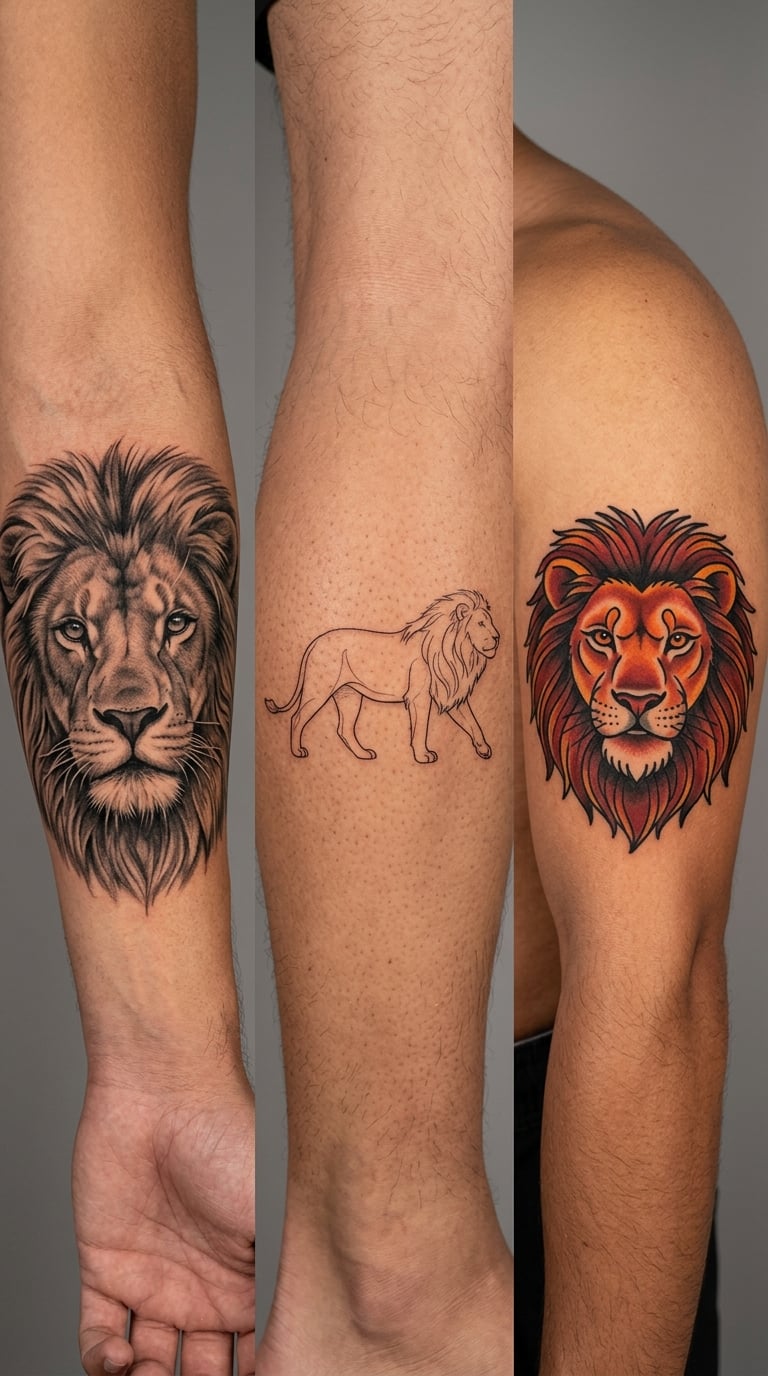
Forearm and inner forearm are the popular choice because the surface is flat and easy to read. A portrait that looks cramped on the outer forearm opens up beautifully on the inner, though the inner one hurts considerably more. Upper arm and shoulder give you the biggest canvas and the most room for mane detail, and they age well because the skin stays relatively stable. Chest is the courage placement, right over the heart, and it reads immediately to anyone who sees it. Back is the biggest area you have, the best canvas for a large realistic piece, and the easiest to keep hidden at work. Thigh and calf take a large design well, and the thigh is a good home for a lioness with cubs. Wrist, ankle and behind the ear only work for small, simplified versions, usually a simplified face, an eye, or a tiny walking lion.
One practical note. If you need it hidden under office clothes, a lion on the upper arm, thigh or back is a safer bet than a chest or forearm piece, and nobody at work has to read into it either way. Skin also moves and changes. A design that sits across a joint or where your body later changes shape will distort faster than one on a flat, stable area.
Lion Tattoo Size and Design Scaling
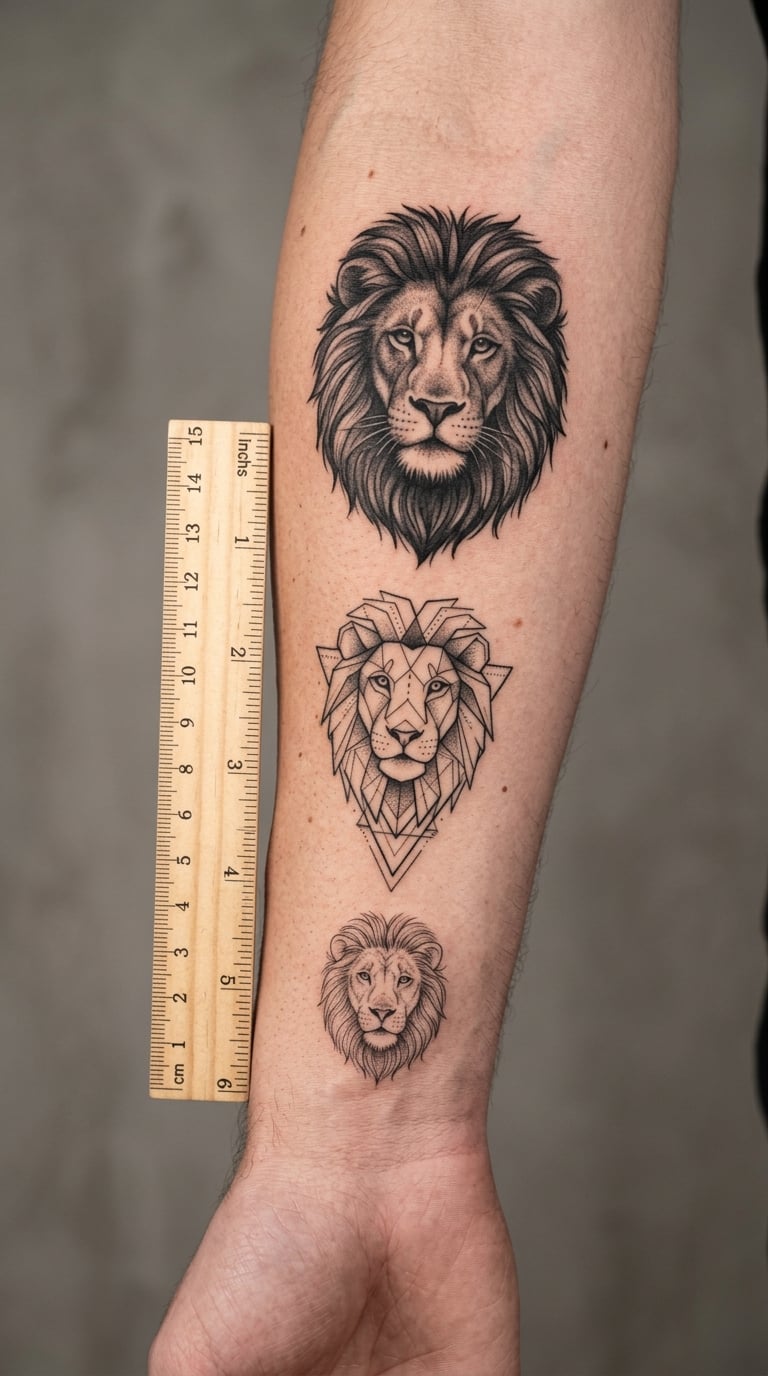
Size decides how much detail survives. This is the single most useful thing to know before you book, because the reference photo you saved is never the size you will end up with.
| Size | Rough dimensions | What works | What to drop |
|---|---|---|---|
| Tiny | Under 1.5 inch / 4 cm | Line-only face, an eye, a walking lion silhouette | Everything. No fur texture, no whiskers, no background |
| Small | 2 to 3 inch / 5 to 8 cm | Simplified face, geometric line work, bold traditional | Soft shading, fine whisker lines, subtle colour blends |
| Medium | 4 to 6 inch / 10 to 15 cm | Full face, small mane, black and grey portrait | Individual fur strands at the mane edge |
| Large | 7 to 10 inch / 18 to 25 cm | Realistic portrait, roaring head, full mane detail | Busy backgrounds that compete with the face |
| Statement | Over 10 inch / 25 cm | Half or full body, multi-session back or thigh work | Nothing, but plan it as a project with a touch-up |
The rule tattooers give most often: the smaller it is, the fewer elements you keep. Fine fur, individual whiskers and a highlight in the eye are the first things to disappear as the ink settles, usually within weeks. Ask your artist what they plan to remove so you find out now rather than after it is permanent. When a piece has been healing for a few months the softened mane and deeper blacks tend to look better than the fresh version, so do not judge it on day three.
How Painful Is a Lion Tattoo?
Pain tracks placement, size, shading and your own tolerance far more than the subject. A shaded realist lion on ribs is rough going; a bold outline lion on an upper arm is a long, dull session most people describe as manageable. You will also tire long before the pain becomes the problem, because a big piece is hours of sustained work.
| Placement | Typical discomfort | Why |
|---|---|---|
| Upper arm and shoulder | Low to medium | Thick muscle, forgiving surface, easy to hold still |
| Outer forearm | Medium | Bony and lean, but a comfortable position for both of you |
| Back | Medium | Often described as scratchy rather than sharp, and the position is relaxed |
| Calf and thigh | Medium | Sensitive skin on the inner thigh, calmer on the outer calf |
| Chest | Medium to high | Skin moves with breathing, so the needle keeps finding new angles |
| Inner forearm and wrist | High | Thin skin, lots of nerve endings, visible to everyone all day |
| Ribs and side | High | Bone right under a thin, stretchy area, and you cannot help bracing |
| Neck, spine, knee and elbow creases | High | Bony dips and joints where the skin is stretched tight |
Eat properly, sleep the night before, and skip the night out. It sounds like advice you have heard before because it is true. If you are on medication that thins the blood, or you have any condition that affects healing, tell your artist before the session rather than after.
How Much Does a Lion Tattoo Cost?
Price depends on size, detail, style and who is doing it, and the range is genuinely wide. A small, simple line piece at a lower-rate shop sits in the low hundreds of US dollars. A medium bold or geometric piece in the same style lands in the mid hundreds. Large realistic black-and-grey work, and anything custom drawn from a conversation rather than bought off a flash sheet, runs into the thousands, and full back or thigh projects with several sessions sit at the top of the range.
Hourly work is where the spread shows. Flash sheets are priced flat and are the cheapest way in, but you are choosing from what someone else drew. Custom work is billed by the hour, so a detailed mane in tiny needlework costs far more than the same subject in bold traditional lines. Location matters as much as the artist: a studio in a high-rent city charges more for the same hours, and a shop with a strong reputation will simply be booked out.
Four practical points. Ask about the shop minimum, because many studios will not start a small piece at all. Ask whether the quoted figure covers the whole design or one session, since large pieces are usually split. Ask about touch-ups and revisions, and whether they are included or billed separately. And if you are travelling to save money, factor in the trip: a second session to fix something that went wrong costs more than the saving did.
Lion Tattoo Healing Timeline by Week
Healing is a process, not an event, and following your artist’s aftercare instructions takes priority over anything written here. Every artist has slightly different instructions for their own work, particularly around washing, ointments and covering the piece.
| Stage | What it looks like | What to do |
|---|---|---|
| Days 1 to 3 | Red, swollen, tender, ink sitting on the surface | Follow your artist’s cleaning and covering instructions. Expect some weeping |
| Days 4 to 10 | Itching starts, a dark scab or flake forms, colour looks duller than day one | Do not scratch or pick. Moisturise only as instructed |
| Weeks 2 to 3 | Scabs fall away, the design looks cloudy and pale | Still treat it gently. This is the stage people panic at, and it is normal |
| Weeks 4 to 6 | Lines settle, deeper blacks come back, the skin flakes lightly | Return to normal routines, avoid prolonged sun on the area |
| Months 2 to 6 | Final colour and sharpness, fine detail visibly softer than the original drawing | Good time to book a free touch-up if your artist offers one |
| Year 1 onward | Slow softening of the fine detail, colour fading under sunlight | Sun protection matters more than any cream |
One last note on expectations. A healed tattoo is softer and lighter than the fresh paper or the fresh tattoo. Artists design for the healed result, so if something looks faint in week three, say something early, not in month six.
How to Personalise a Lion Tattoo
The lion is popular enough that a standard design will not carry much weight. A few additions turn it into yours without making it fussy.
- Coordinates: the place a person was born, met, or a first happened. Small, discreet, and it starts a conversation with the right people.
- Initials in the mane: hidden in the texture where only you will check. Works beautifully on a large piece, badly on a small one.
- An eye colour: amber, green, blue. One small spot of colour in a black-and-grey piece changes the whole mood.
- A motto or short word: usually along a banner, ribbon, or integrated into the border.
- A meaningful pose: a walking lion for progress, a resting lion for calm, a lioness with cubs for family.
- Matching pieces: a small eye or a repeated detail on the wrist pairs with a large chest or back piece later.
- Your pride: a crest, a family emblem, a date, or a location behind the mane.
Do not cram all of this into a small design. Two personal elements work. Five turns it into noise, and the face stops reading, which defeats the point of a lion in the first place.
Mistakes to Avoid
Picking the placement before the design. Choose the subject and size first, then bring a stencil-ready reference and let the artist advise where it will hold up.
Asking for a detailed micro lion. Fur texture, whiskers and iris highlights need room. Under 1.5 inch, ask for line work instead.
Borrowing cultural artwork you have not researched. A temple guardian lion or a St. Mark winged lion is a specific piece of someone’s tradition, not a shape to copy.
Assuming the lion means one thing to everyone. A roaring crowned lion is read as aggressive by some people and as protective by others, mostly depending on where they are from. If the reading matters, pick a design with less attitude in it.
Choosing because it is trending this year. You will be looking at this for a long time. Pick the style you actually like, not the one that is loud right now.
Budgeting the number on the first quote only. Leave room for a second session and a touch-up. If a piece is large, two appointments are normal, not a sign something went wrong.
Frequently Asked Questions
What does a lion tattoo symbolize?
Most wearers pick it for strength, courage, leadership, protection and pride. The design refines it: a crowned lion adds sovereignty, a lioness with cubs adds fierce family loyalty, a roaring lion adds defiance, and a resting lion reads as quiet authority. Placement matters too, since a lion on the chest is read as courage at the heart and one on the back as protection.
Is a lion tattoo suitable for a first tattoo?
It is a good first subject, because a simplified lion face with a full mane has a forgiving shape and reads well even when the line work is not perfect. The risk is going too big or too detailed. Ask for a bold outline or traditional style at 3 to 4 inches rather than a small realistic face, and plan on one or two sittings, not a single long one.
What is the best placement for a lion tattoo?
For most people the outer forearm, upper arm or chest works best, because each has enough flat surface for a face and mane. The back is the roomiest option for large realistic work, and the thigh suits a lioness with cubs. Wrist, ankle and behind the ear only work for simplified small versions. Placement also affects pain, with ribs and inner forearm the most sensitive.
Should a lion tattoo be realistic or stylized?
Realistic work shows off shading and detail and needs a large area and a good artist. Stylized approaches such as traditional, blackwork, geometric or fine line are more durable and hold their shape better over time, and they suit a smaller piece. Choose based on how much detail you want to see up close and how much upkeep you want, not on which looks more impressive in a photo.
How do I make a lion tattoo personal?
Add one or two specific elements rather than a pile of them. Coordinates of a meaningful place, initials hidden in the mane, a single amber or blue eye, a short motto on a banner, or a pose that matches what the tattoo is for. Two personal details read clearly. Five turn a strong face into clutter, especially at small sizes.
Do fine-line lion tattoos fade easily?
Thin single-needle lines are the first thing to soften, usually within a few years, and they fade fastest on hands, fingers, feet and anywhere with sun exposure or frequent movement. Fine line holds up reasonably on the inner forearm, upper arm and thigh. Ask your artist for slightly heavier line weight than the drawing suggests, and keep the healed piece out of prolonged sun.
Conclusion
A lion tattoo means courage, strength, pride and protection, and the design decides which of those it leans on hardest. Decide what you want it to say, choose a style that will still look good in ten years, and size it so the detail can survive healing.
Then bring a clear reference and a couple of questions to a qualified tattoo artist. The consultation is where the placement and the size actually get settled, and it costs you nothing but an hour.