
What Does a Spider Web Tattoo Mean? Symbols and Ideas 2026
A spider web tattoo most famously means time served in prison, but that is only one reading of a symbol that has carried several lives. People also choose it for patience, resilience, transformation, and the idea of weaving your own fate. Which meaning lands first depends on the design, the placement, and the person wearing it.
Most people asking what does a spider web tattoo mean want the honest version rather than a tidy one, because this is one of the few motifs where the most widely known meaning is not the one most wearers intend. This guide separates the history from the personal readings, then covers placement, style, pain, cost, and aftercare so you can decide whether the symbol is right for you.
One practical note before you start. If you are planning this, give it 30 to 45 days before the skin fully settles, and much longer for a large back or torso piece that gets built across several sessions.
What Does a Spider Web Tattoo Mean?
Meanings at a glance
These are the readings you will meet most often, grouped the way search results group them.
Historical and prison-associated readings
- Time served. A web that grew one line or ring at a time inside.
- Being trapped. A web as a picture of being stuck somewhere you cannot leave.
- Survival. Part of the oldest tattoo vocabulary people carried in and out of jailhouse settings.
- Crew or group affiliation. Elbow and knee webs have been linked to some prison groups, including ones with racist ideology, though the overwhelming majority of wearers have no connection to any of that.
Traditional and alternative readings
- Patience. A web takes hours to build and comes apart in a breath.
- Resilience. Something delicate that still holds its shape under pressure.
- Transformation. The spider tears the web down and rebuilds it every night.
- Creativity and craftsmanship. Weaving your own fate, strand by strand.
- Interconnectedness. The web of life, where everything holds everything else.
- Protection and mysticism. A web as a boundary, drawn from folklore and from Spider Woman traditions.
- Mortality. Spiders and webs sitting beside hourglasses, skulls and candles.
- Mourning. Paired with names, dates or flowers to mark someone who is gone.
None of these is the official meaning. A symbol only means what the person getting it decided it meant, and any honest answer has to start there.
What does a spider web tattoo mean in prison culture?
Inside the prison tattoo tradition, which people call jailhouse or prison tattoos, a web was usually drawn with a stick, a needle, or a sharpened bit of anything else on hand. The rule people repeat most often is that each line or ring stood for a stretch of time served, which is why a web with six radiating strands is often read as six years.
That convention is not a law. The number of lines only means something if the person adding them counted something, and plenty of wearers got a web for the look of it. On r/sticknpokes, people describe web designs as prison work and talk about adding a line for each year, which is a good illustration of the origin without pretending every web counts anything.
What does a spider web tattoo mean outside prison?
Most people choosing one today are not referencing incarceration at all. The popular readings are patience, resilience, creativity, transformation, and interconnectedness, and they fit a lot of reasons to get tattooed: getting clean, leaving a bad situation, finishing something hard, or simply liking how the lines look on skin.
Two cultural references come up often. Navajo Spider Woman, known in the Diné tradition as Na’ashjeii Asdzaa, is taught as the teacher of weaving and of the web of life, and people who connect to that story often pair a web with a spider rather than leaving it empty. Sailors have their own tradition of web tattoos as a sign of being away from home and waiting, drawn while they were at sea.
The association people ask about most
The web has been used by racist prison groups, and that history is the reason some people hesitate. The honest version is this: a web tattoo on its own is not a hate symbol, and there is no evidence connecting the vast majority of wearers to any of those groups. What changes the read is the company it keeps, so a web alongside specific hate symbols or group markings means something quite different from a web on its own.
Some traditional tattooers will tell you that combining tear drops, barbed wire and webs reads as a convict resume and can affect how people treat you. That is not a rule, it is a pattern people have noticed.
Gendered readings of a spider web tattoo on women
The meaning does not change because the wearer is a woman. What changes is the stereotype people project onto it. A web on a woman is often read as gothic, Halloween, or femme-fatale imagery first, often before anyone gets to the resilience reading the wearer intended.
On r/tattooadvice, wearers describe exactly that, being flattened into a gothic trope they never chose. If you want your intended meaning to be the one people read, softer pairings like flowers or butterflies and a placement off the elbow all help.
How Placement Changes the Meaning
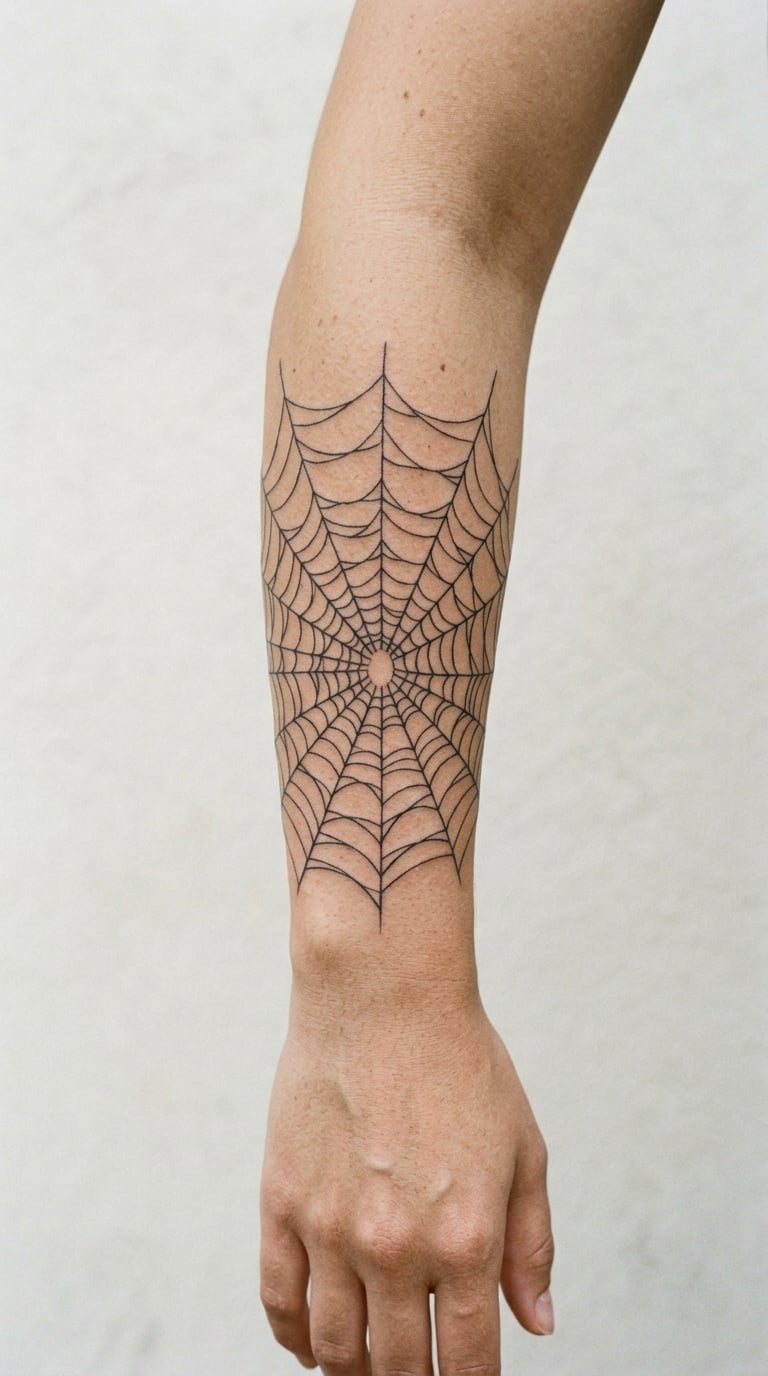
Placement does more work here than in almost any other motif, because the elbow and knee are the two spots the prison reading attaches to. Move the same design a few inches and the message changes.
| Placement | What it is usually read as | What to consider |
|---|---|---|
| Elbow | Time served, strongest of all placements | The crease wears the line down, and it is the first place people look |
| Knee | Same prison reading, also plain toughness | Kneeling wears the ink, so a web there fades unevenly |
| Neck | Bold, loyal, old-school toughness | Very visible; hard to hide at work |
| Shoulder | Classic American traditional placement | Flat enough for a full radial web |
| Forearm | Flexible, artistic, design-led | The best reclaiming spot away from elbow and knee |
| Abdomen or ribs | Personal and private, rarely assumed | Curved surface, expect a longer session |
| Wrist or hand | Dainty, small-scale, decorative | Fades fastest, hands and fingers change shape over years |
| Behind the ear | Mysterious, protective | Hidden, which suits a private meaning |
The practical reason to move off the elbow is wear, not symbolism. Elbows and knees bend thousands of times a day, and a web is mostly thin radiating lines, which is the first thing to soften in a crease.
Spider Web Tattoo Styles and Design Ideas
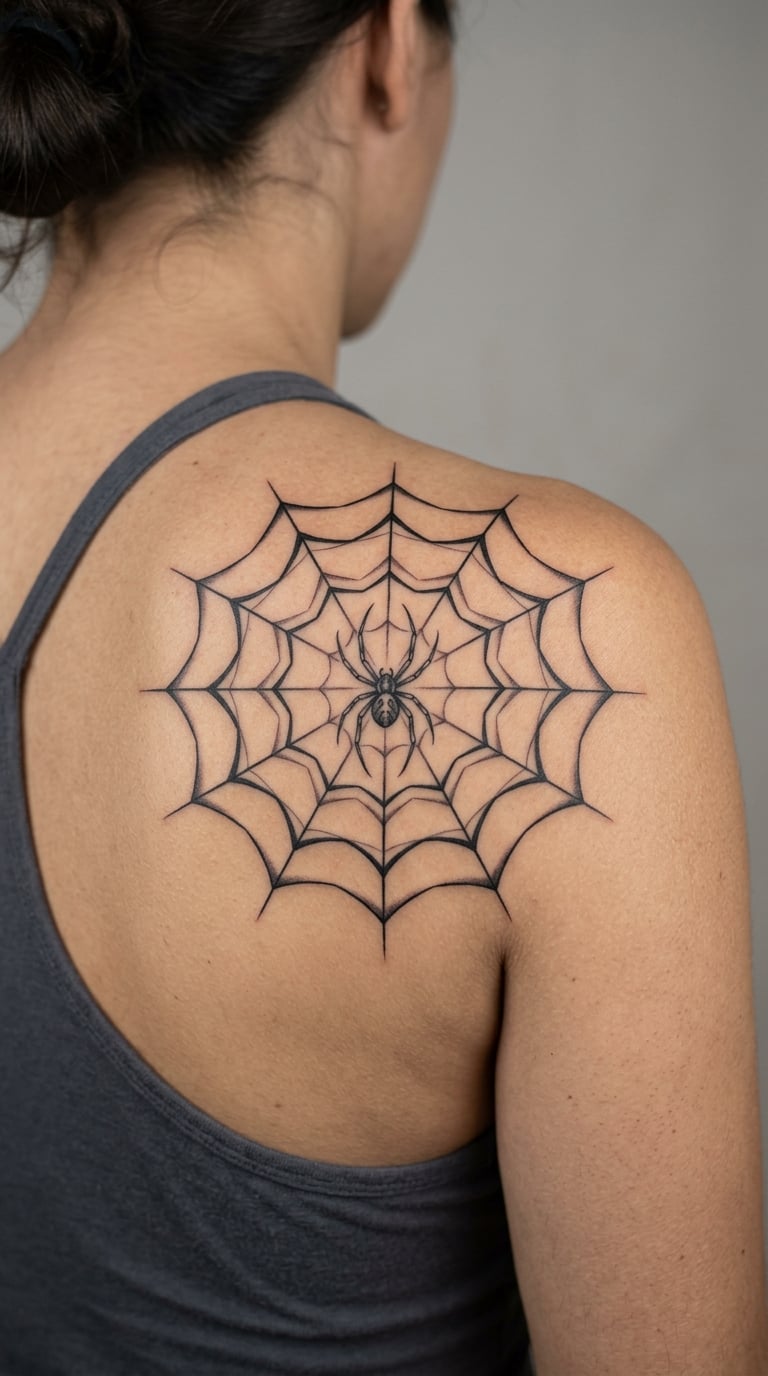
Ten directions worth talking through with an artist, and what each one tends to read as.
- Realistic suspended web. Dew drops, a sagging thread, shading in the silk. Reads as nature photography, and it asks for a bigger canvas and more sessions.
- Fine-line minimal web. One thread weight, no shading, lots of open skin. Beautiful and quiet, but the first thing that fades.
- Symmetrical geometric web. Radial lines from a center point, often with negative space. Reads as precision and balance, and it is the easiest version to scale to any size.
- Web with a spider. A small black widow or a jumping spider at the hub. Adds life, protection and a clear focal point.
- Blackwork web. Heavy lines, solid blacks, no grey. Reads as traditional American work and holds its shape longest.
- Watercolor web. Soft bleeds and colour wash. Reads as artistic and less prison-coded, but colour in fine lines fades first.
- Celestial web. A web built from stars, orbits and moons. Reads as fate and timing.
- Floral or botanical web. Webbing that grows into leaves, vines and blossoms. Reads as growth and softness, and it is the easiest way to move the symbol out of its old context.
- Torn or distressed web. Broken threads, frayed edges, missing segments. Reads as damage survived, which is a common recovery reading.
- Web built around an existing piece. A web that wraps a forearm sleeve, an animal, or a scar. Reads as belonging, and it takes planning across several sessions.
One more direction, if you want the meaning to be unmistakably yours: leave the web open with no center at all. An unfinished web reads as something still in progress, which suits a lot of people.
If spiders themselves are more your thing than webs, our [50 Cool Phantom Troupe Spider Tattoo Ideas You’ll Want Right Now](https://thewe.cc/unique-phantom-troupe-spider-tattoo-ideas-for-anime-lovers/) gallery covers a very different mood and a very different line weight.
Pain Levels by Placement
Comfort varies enormously between people and sessions, so treat this as a rough map rather than a promise. Two things change the feeling more than placement does: how long you sit still and how much detail the artist is building in one pass.
| Placement | Typical discomfort | Notes |
|---|---|---|
| Forearm | Low to medium | Flat and fleshy, easy to distract from |
| Upper arm | Low to medium | Good for long sessions |
| Shoulder | Medium | Sensitive near the collarbone |
| Back | Medium | Hard to watch, which some people like |
| Chest | Medium | Sensitive near the sternum |
| Ribs or abdomen | Medium to high | Very sensitive, often described as the hardest big placement |
| Wrist | Medium | Bones sit close to the skin |
| Hand or fingers | High | Thin skin over many small bones |
| Neck | High | Throbbing, and hard to hide afterwards |
| Behind the ear | Medium to high | Cartilage and scalp, an area most people do not expect |
| Elbow or knee crease | Medium to high | The crease itself is sensitive, and the design fights the bend |
The general pattern: bony and thin areas give sharp, sudden pain, while larger fleshy areas give a deeper ache that builds the longer the session runs. Eat properly, sleep, and follow whatever your artist asks for on the day.
How Much Does a Spider Web Tattoo Cost?
Tattoo pricing depends on the artist’s hourly rate, the shop minimum, and how many hours your design actually takes. A web with a shaded spider in the middle is a very different job from a clean geometric one, so treat these as US ranges to plan around, not quotes.
| Size and type | Usual size | Typical US range |
|---|---|---|
| Micro web | Under 2 inch (5 cm) | 80 to 200 dollars |
| Small standalone web | 2 to 4 inch (5 to 10 cm) | 150 to 400 dollars |
| Medium forearm or shoulder piece | 4 to 7 inch (10 to 18 cm) | 300 to 800 dollars |
| Large back or torso web | 8 inch (20 cm) and up | 800 to 2,500 dollars, usually over several sessions |
| Custom realistic web with a spider and shading | Varies | Often 400 to 1,500 dollars because the detail adds hours |
Most US shops bill by the hour, commonly somewhere between 100 and 250 dollars, and set a shop minimum of roughly 100 to 500 dollars that applies even to a tiny piece. Some shops take a consultation fee of 50 to 150 dollars, often credited against the final price. If you are travelling, add travel, parking and a tip on the final bill.
Ask for an hourly estimate at the consultation rather than a fixed total. It is the only way to compare two artists fairly.
What to Bring to Your Tattoo Consultation
A consultation is where a vague idea becomes a design that will still make sense on skin in ten years. Bring more than you think you need.
- Reference images. Three to five, saved on your phone, in the style you actually want. Pin the one line work you like rather than the whole composition.
- Your meaning in one sentence. Say it out loud. The artist can then advise on design choices that carry it.
- Placement and rough size. Measure roughly, in inches, and know whether it has to work in a sleeve or stand alone.
- Black and grey or colour. Say this early. Colour in fine lines fades first and changes the whole design.
- Healed tattoo examples. Photos of healed work, ideally from the same artist, tell you more than fresh photos do.
- Your questions. Line thickness, session count, touch-ups, and how the design will look at age.
One thing worth drawing out: a web built to wrap around an existing sleeve is a different design job from a web dropped onto a flat patch of skin. Bring that up in the first meeting, because it changes the drawing, the scale and the number of sessions.
How to Personalize Your Spider Web Tattoo
Once the base is a web, the customisation is where the personal part lives. These are starting points rather than rules.
- Add a spider you chose. A jumping spider for the person it is for, a widow for the symbolism, a tiny house spider for home.
- Work a date or initials into the web. A birth date hidden in the radial lines, or a name formed by the negative space between threads.
- Grow it into something else. Leaves, blossom, a moth, a compass, a wave. The web stays recognisable and the meaning gets specific.
- Add one colour accent. A single red or gold thread in a black web reads as intentional rather than accidental.
- Build it around a scar or a body line. A web that fills a scar turns damage into structure, and it is one of the strongest uses of this motif.
- Match it to another piece. A small web that echoes the line weight of a plant or constellation tattoo already on you ties the collection together.
- Leave it unfinished. No center, a broken ring, a thread that goes nowhere. It reads as still being made.
Line weight is where matching actually happens. Our [20 Best Heartbeat Tattoo Ideas With Meaning](https://thewe.cc/heartbeat-tattoo-ideas-with-meaning/) and [20 Sun Moon and Rising Sign Tattoo Ideas](https://thewe.cc/sun-moon-and-rising-sign-tattoo-ideas/) galleries are a good reference for the consistent weight a new web has to match if it is going to live beside older work.
Whatever you add, check it with your artist early. Details that are readable in a drawing can turn to mush in skin at 1.5 inch across.
How to Choose a Design That Ages Well
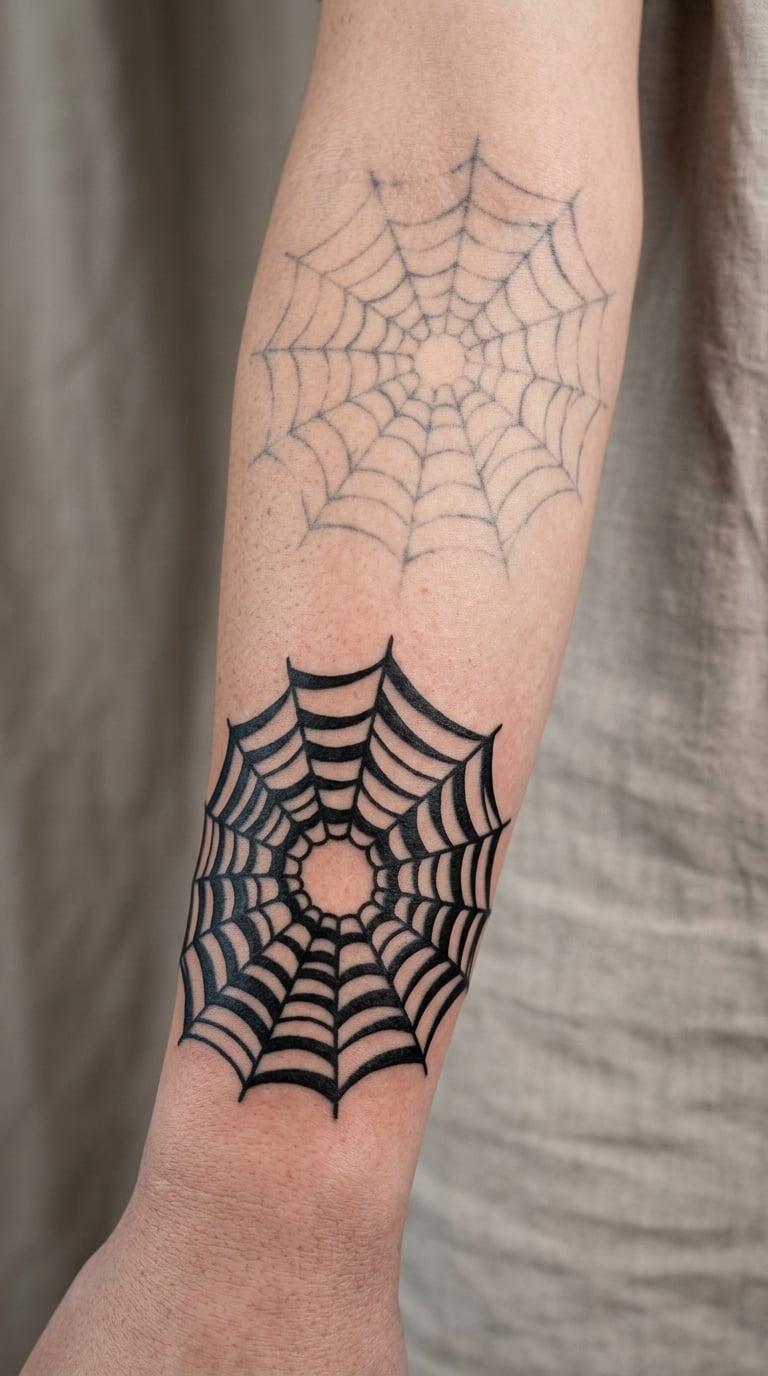
A tattoo you still like at forty is a design question, not a meaning question. A web is a risky shape for ageing because it is mostly thin radiating lines, which is exactly what fades first.
- Ask for line weight. Nothing under roughly 1.5 to 2 mm if you want it readable in a decade. A fine-line web is beautiful in year one and a ghost by year ten.
- Keep the spaces open. Webs that are too dense turn into a grey patch as the black softens. Space between threads is what keeps the shape readable.
- Use contrast. Solid black against bare skin ages better than grey wash or soft shading every time.
- Skip the tiny detail. Dew drops, dust, thread texture and very small spiders blur together within a few years.
- Think about hands and fingers. These change shape constantly, and fine line work there is on a countdown from day one.
- Pick a design that works in motion. A web that holds up when you bend the elbow is worth more than a perfect web on paper.
Ask the artist three things directly: what happens to this in ten years, what would you change if we did it bigger, and does this placement fight the ink. Tattooers who answer plainly are worth booking.
Aftercare Basics for a New Spider Web Tattoo
Follow your artist’s aftercare instructions first, every time, because advice varies by skin, ink and placement. The general shape of healing is straightforward.
| Time | What is happening | What to expect |
|---|---|---|
| Week 1 | Healing, ink settling in the dermis | Redness, warmth, mild swelling, tenderness, some flaking or scabbing |
| Week 2 | Top skin rebuilding | Flaking or peeling, the design looks duller and lighter than it will be |
| Weeks 3 to 4 | Surface healed, colour settling | Smooth skin, less pink, the real colour starts to show |
| Month 2 onward | Deep settling | Final colour, final line clarity, occasional fading worth discussing with your artist |
General basics: keep it clean the way your artist described, do not pick or scratch anything that flakes, avoid unnecessary friction and soaking, and keep it out of strong sun while it settles. Loose clothing over a fresh design beats tight sleeves.
Elbow and knee creases deserve extra attention. That skin moves constantly, and ink that is disturbed while it is healing is what turns a crisp web into a patchy one. If you are having it done there, ask your artist specifically how long to keep it covered and when to stop covering it.
Mistakes to Avoid
Copying a web too precisely
Trace-heavy designs from images lose their life on skin, and a straight copy of an artist’s composition is not going to sit well on your body anyway. Use references to point at a style, not at a finished picture.
Choosing more detail than the area can hold
A four inch patch of forearm cannot support the detail of a ten inch back piece. Everything shrinks, and the small elements are what disappear first. Bigger canvas or less detail, and pick one deliberately.
Putting a web over a high-friction area without thinking
Elbow, knee and rib creases bend, rub and fade. That is a wear decision before it is an artistic one, and it is the one people most often regret.
Assuming a spider makes it gothic
A black widow on its own reads as gothic or Halloween to most onlookers, no matter what you meant. It does not read as resilience to strangers. If the positive reading matters to you, leave the spider out or pair the web with something that softens the read.
Ignoring what the placement already says
An elbow web is doing a job before anyone reads a single line. If you want the meaning to be yours, choose the placement on purpose rather than by default.
Copying another artist’s signature composition
Established tattooers do not take kindly to being traced, and your tattoo will be attached to your body rather than to their reputation. Build from references and let the artist draw it for your shape.
Frequently Asked Questions
What does a spider web tattoo mean in prison?
In the prison tattoo tradition, a web most often stood for time served, with each line or ring added for a stretch of time behind bars. Elbow and knee webs are the placements most strongly tied to that reading. It is a convention rather than a rule, though, so the number of lines only counts for something if the person who added them counted something.
Is a spider web tattoo racist?
A spider web tattoo on its own is not a racist symbol. Webs have been used by racist prison groups, but there is no connection between the design and those groups for the vast majority of wearers. What changes the read is the company a web keeps: placed next to specific hate symbols or group markings, the same design carries a very different message.
What does it mean if a woman has a spider web tattoo?
The meaning does not change based on the wearer’s gender. What changes is the assumption people make first. Webs on women are often read as gothic or femme-fatale imagery before anyone considers resilience or patience, which is why wearers on r/tattooadvice talk about being flattened into a trope they never chose. Placement and pairings do most of the work in changing that first impression.
How many years does a spider web tattoo mean?
There is no fixed number, and the counting rule only applies to webs built with that rule in mind. A web with six radiating lines is often described as six years served, but plenty of webs were drawn as a design rather than a tally. If you want the number to mean something specific, make it count deliberately and tell your artist, or leave the count out entirely.
Which tattoo should you avoid?
The designs worth avoiding are the ones with legal, cultural or social consequences, such as hate symbols, group affiliation markings, imagery taken from a culture that holds it sacred without understanding, or anything tied to an ex you would rather forget. A spider web tattoo is not on that list. Its meaning is a convention you can redirect by changing the placement, the style or the pairings.
What to Do First
Decide which reading you actually want, then work backwards to placement. If you want resilience and creativity to be what people see, keep it off the elbow and off the knee, and add something that gives the web a warmer context.
Then bring three references to a consultation and ask the hard question early: what will this look like in ten years. The symbolism is up to you, and the design is what decides whether your meaning survives.