
20 Best Wrist Band Tattoo Ideas for Minimalist Looks (September 2026)
Wrist band tattoo ideas come down to one thing most people get wrong: scale. A design that looks calm in a photo can look cramped on an actual wrist, and the difference is usually the line weight and the band width, not the motif itself. This list breaks 20 options down so you can see each one clearly before you sit down with an artist.
Whether you are planning your first tattoo or adding a band to an existing set, book your session with enough lead time that you are not rushing into autumn. Wrist work is fiddly and fiddly work needs unhurried days.
Everything below covers what the design actually looks like, where it sits best, a realistic size in inches, how it feels, and one way to make it your own.
Quick Guide: 20 Wrist Band Tattoos at a Glance
Here is the short version. Each row matches the numbered design further down, in the same order, with the style, the placement that flatters it most, a realistic size and an honest read on pain.
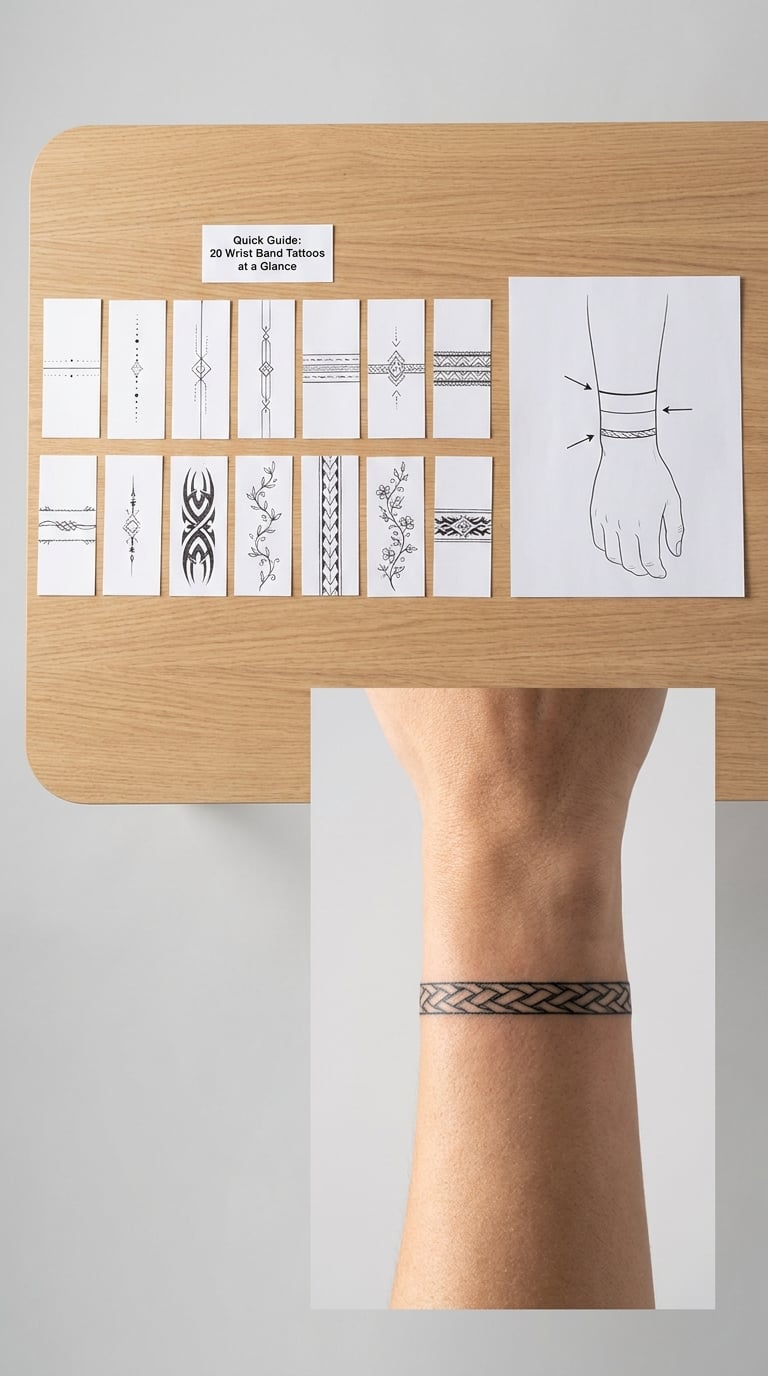
| Idea | Style | Best placement | Size | Pain |
|---|---|---|---|---|
| Paper plane | Fine line, unfilled | Inner wrist | 1.5-2 inch (4-5 cm) | Medium |
| Chain link | Minimal black and grey | Outer wrist, just above the bone | 2-3 inch (5-7.5 cm) | Medium |
| Dotwork mountains | Dotwork / black and grey | Inner wrist | 2-2.5 inch (5-6.5 cm) | Medium-high |
| Botanical stem | Fine line botanical | Inner wrist or forearm | 2.5-3.5 inch (6-9 cm) | Low-medium |
| Sun and moon | Fine line celestial | Inner wrist | 1.5-2 inch (4-5 cm) | Medium |
| Laurel leaves | Fine line classical | Outer wrist or forearm | 3-4 inch (7.5-10 cm) | Low-medium |
| Geometric triangles | Geometric linework | Outer wrist, wrapping slightly | 2-3 inch (5-7.5 cm) | Medium |
| Tiny rose | Fine line floral | Inner wrist | 1-1.5 inch (2.5-4 cm) | Medium |
| Wave and dot | Minimal single line | Inner wrist or forearm | 2.5-3 inch (6-7.5 cm) | Low-medium |
| Musical notes | Fine line symbol | Inner wrist | 1.5-2.5 inch (4-6.5 cm) | Medium |
| Infinity loop | Minimal outline | Inner wrist | 1.5-2 inch (4-5 cm) | Medium |
| Checked band | Blackwork | Forearm, above the wrist | 3-4 inch (7.5-10 cm) | Medium |
| Butterfly | Fine line / micro line | Inner wrist | 1.5-2.5 inch (4-6.5 cm) | Medium |
| Celestial dotwork | Dotwork | Inner wrist or forearm | 2.5-3.5 inch (6-9 cm) | Low-medium |
| Serpent | Fine line traditional | Outer wrist, wrapping | 2.5-3.5 inch (6-9 cm) | Medium |
| Floral vine | Delicate botanical | Forearm, above the wrist | 3-4 inch (7.5-10 cm) | Low-medium |
| Word and symbol | Fine line script | Inner wrist | 2-2.5 inch (5-6.5 cm) | Medium |
| Heartbeat line | Minimal single line | Inner wrist | 2-3 inch (5-7.5 cm) | Medium |
| Watercolor petal | Watercolor colour | Inner wrist | 1.5-2.5 inch (4-6.5 cm) | Medium |
| Traditional rose | Traditional colour | Forearm, above the wrist | 2.5-3.5 inch (6-9 cm) | Medium |
1. Fine-Line Paper Plane Wrist Band
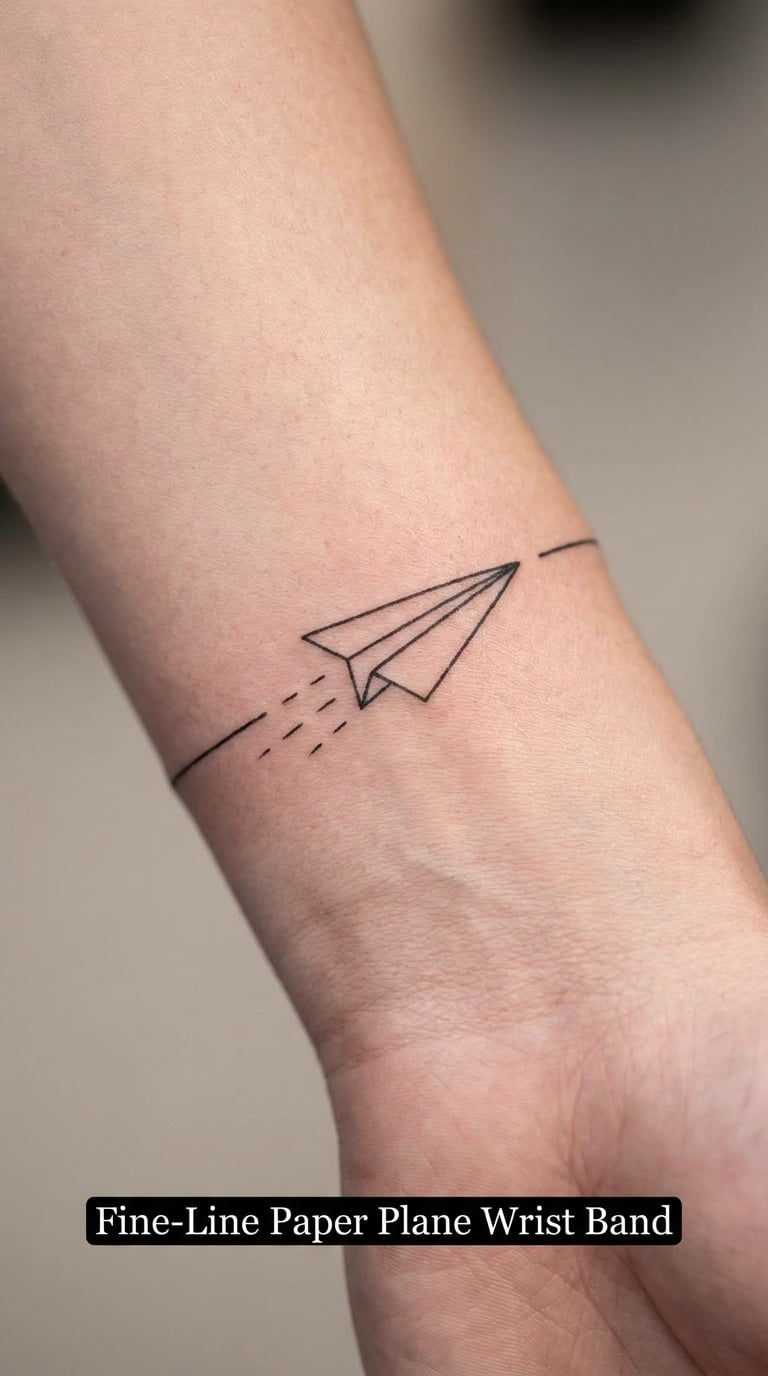
A paper plane wrist band is a single geometric outline drawn in thin black line, with no shading and no background fill. The trick is keeping the line closed and even, because a wobble in the fuselage reads instantly as a mistake at this size.
Most people choose it for the idea of something set in motion, or for a trip that mattered. Those are personal reasons, not fixed meanings, so do not expect a tattooist to assign a meaning you did not pick yourself.
Placement: Inner wrist, running horizontally across the centre of the inner forearm, or tilted slightly so it follows the natural angle of the vein line. Size: 1.5-2 inch (4-5 cm) across. Style: Fine line, single-needle, unfilled.
Pain: Medium. The inner wrist has thin skin and plenty of nerve endings, so expect a steady scratch rather than a sharp edge. Ageing note: fine line on the inner forearm softens and greys over roughly five to eight years, and a thin line fades a little faster than a thicker one.
Make it yours: Add two or three short trailing dashes behind the plane so it reads as if it is flying across the wrist, and turn those dashes into a date.
2. Minimal Chain-Link Wrist Band
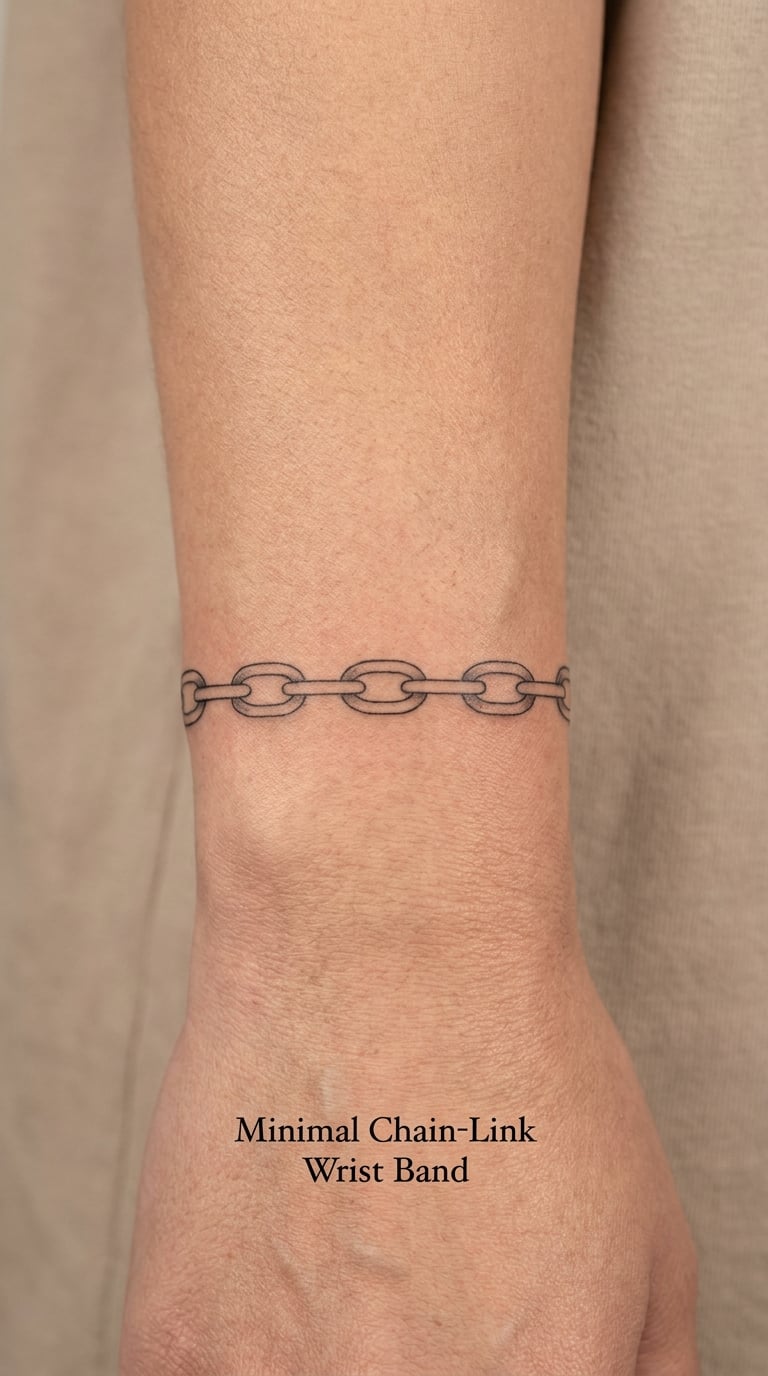
A minimal chain is drawn as a row of linked ovals with no shading inside the links, which is what keeps it looking clean. Some tattooists add a thin dark line along one edge of each link for a bit of dimension, and that small choice decides whether the band reads as jewellery or as pattern.
It is the most literal bracelet tattoo there is, and people tend to pick it for continuity, connection or a second chance. Chains also wear well because the shape is recognisable even when fine detail softens.
Placement: Outer wrist, just above the wrist bone, where a watch strap would sit. Size: 2-3 inch (5-7.5 cm) across. Style: Minimal black and grey with a single outline weight.
Pain: Medium. The outer wrist is bony but the skin is a little tougher than the inner side. Ageing note: the link corners are the first thing to round off, so a chain is more forgiving than a design with hairline interior details.
Make it yours: Vary the link size so the chain gets slightly larger toward the centre, and put a tiny date inside one link.
3. Dotwork Mountain Range
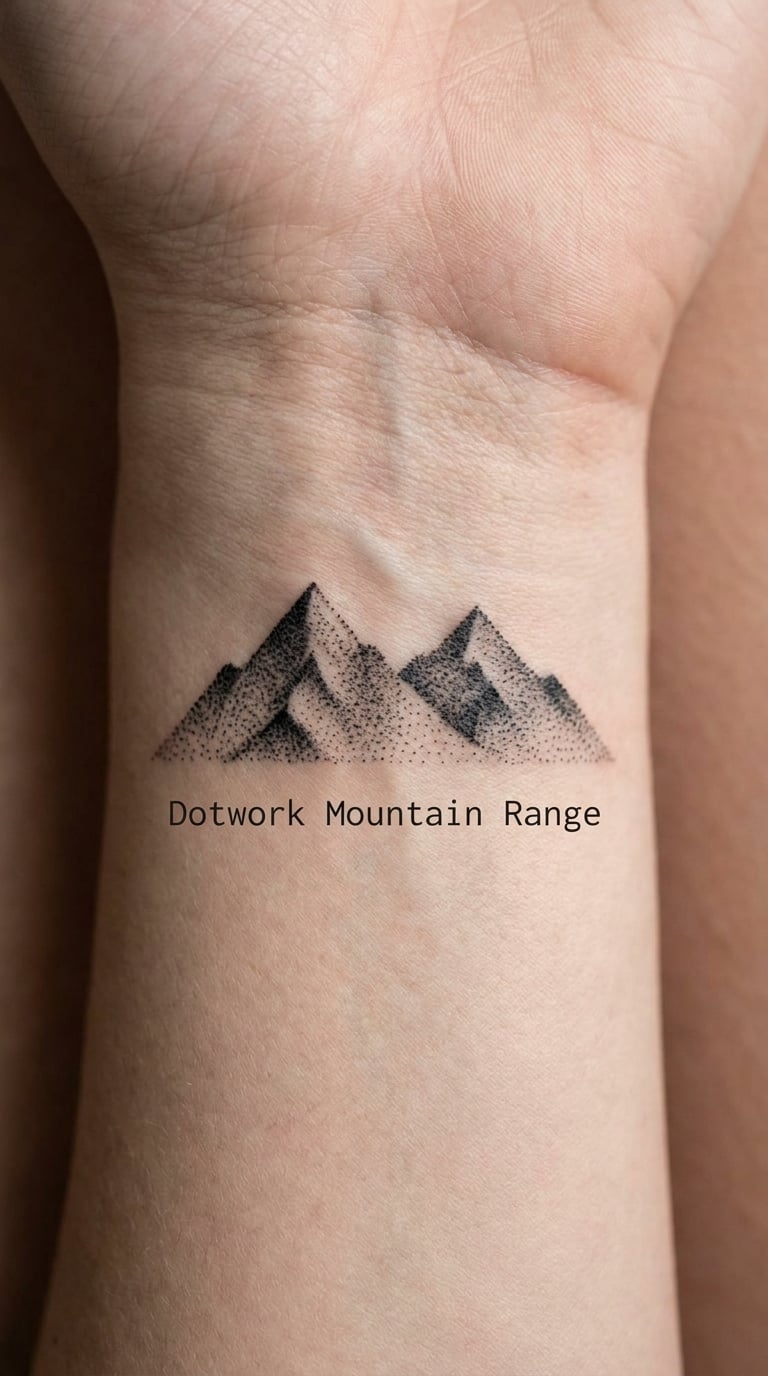
Dotwork mountains are built from thousands of tiny dots, spaced closer together to make dark shadow on one face of each peak and further apart on the lit side. Two peaks is usually plenty; three starts to crowd a wrist that is only a few inches tall.
People tend to choose a range that marks a place or a stretch of their life, often somewhere they have actually stood. The horizontal shape of a skyline suits a wrist better than most motifs because it follows the bone.
Placement: Inner wrist, set just above the wrist crease. Size: 2-2.5 inch (5-6.5 cm) across. Style: Dotwork, sometimes finished with a thin solid outline on the ridge line.
Pain: Medium to high. Dotwork means many short passes over the same area, and that is more uncomfortable than one solid line even if it looks quieter. Ageing note: stipple can look dusty if it is done too faintly, so a competent density gradient matters more than the number of dots.
Make it yours: Hide a small four-digit year inside the dark stippled face of the tallest peak, where the eye reads texture rather than detail.
4. Single Botanical Stem Band
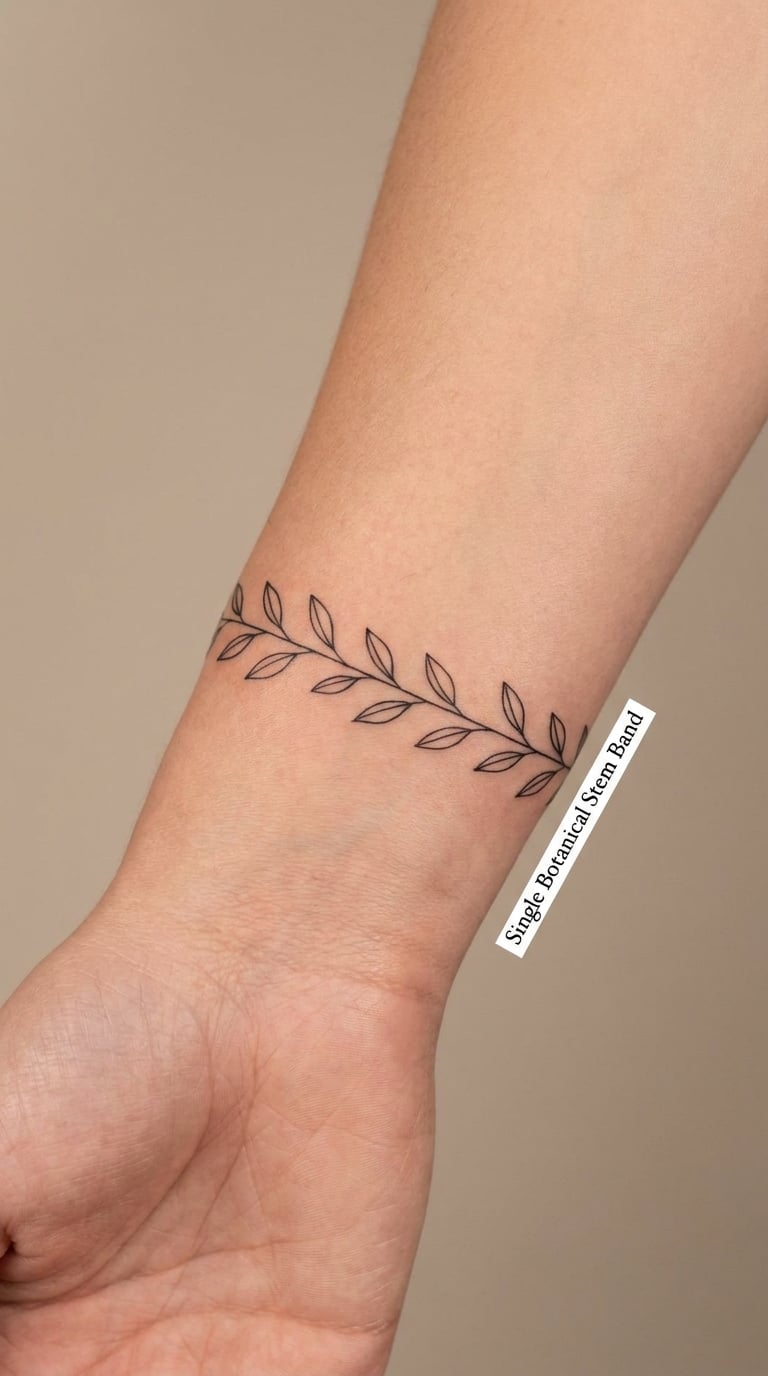
A single stem is one unbroken line with leaves branching off at regular intervals, drawn in a consistent fine weight. Leaving open white space between the leaves is what makes it read as elegant instead of busy, and spacing the leaves evenly matters more than drawing each one perfectly.
Plants carry a lot of borrowed meaning, so pick the one you actually like rather than the one that sounds impressive. Eucalyptus, lavender, olive and wild carrot are all common requests.
Placement: Inner wrist or lower forearm, running lengthwise so the stem follows the arm. Size: 2.5-3.5 inch (6-9 cm) long. Style: Fine line botanical, no shading.
Pain: Low to medium. A long thin line is quick work, and the sweet spot on the inner forearm sits above the wrist crease where there is a little more soft tissue. Ageing note: hairline leaf tips blur within a few years, so ask for slightly heavier lines than feel necessary at the consult.
Make it yours: Ask for the stem to end in a single bloom or a small bud on the underside, so the piece has a focal point rather than two identical ends.
5. Sun-and-Moon Contrast Band
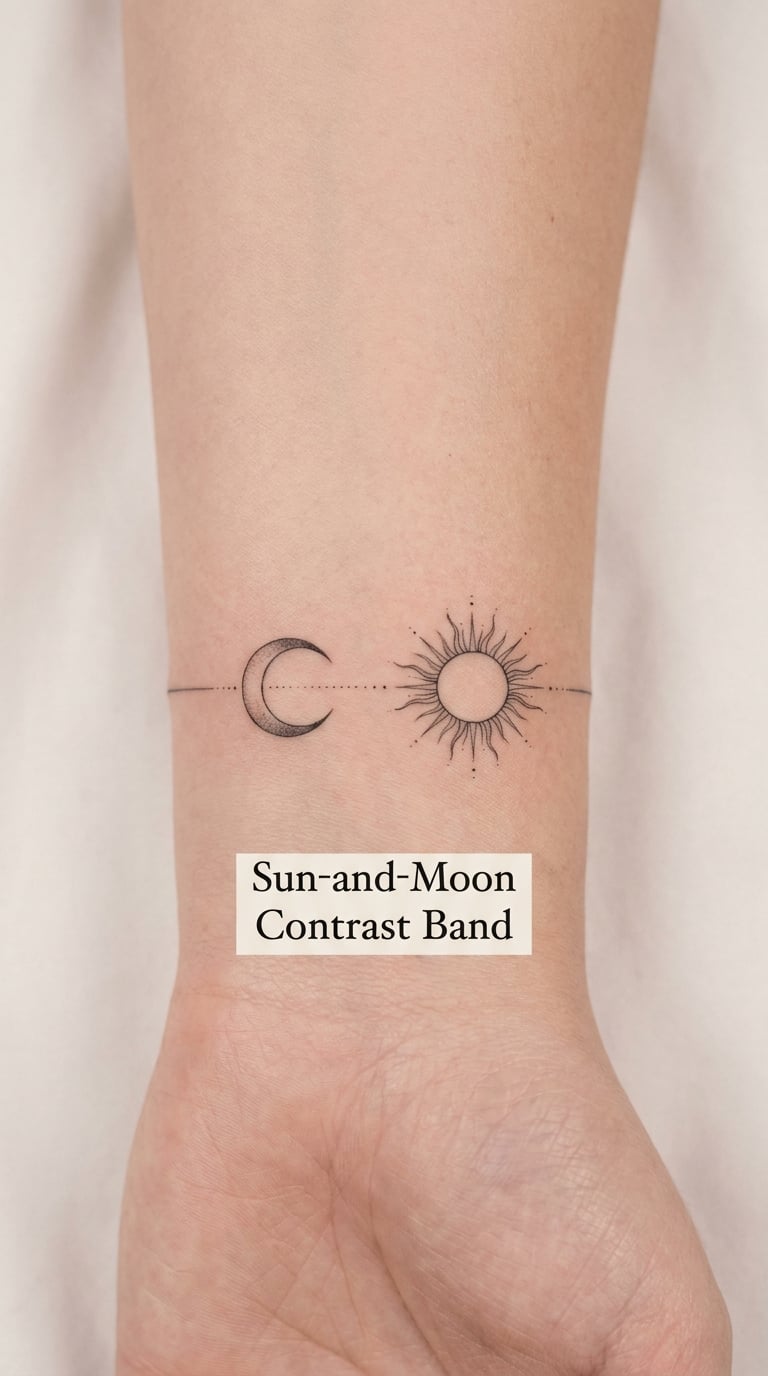
A sun-and-moon band sets a slim crescent beside a small sun disc with fine straight rays, spaced so the two shapes balance each other. The rays are the risky part: they turn scrappy if they vary in length, so ask for them evenly stepped.
The pairing is old and well understood as balance, two halves, night and day. People often wear it for a relationship, a birthdate, or a period of their life where both felt true.
Placement: Inner wrist, crescent at one end and sun at the other. Size: 1.5-2 inch (4-5 cm) across. Style: Fine line celestial with a light dot accent.
Pain: Medium. A filled sun disc is a solid pass of colour over skin that moves constantly. Ageing note: solid black on the inner wrist can stay slightly greyer than the same ink on the outer arm, because sun reaches it less through sleeves.
Make it yours: Make one ray longer than the rest and use it as a place to tuck a tiny initial, or add two small dots between the sun and moon as a private separator.
6. Laurel Leaf Wrist Tattoo
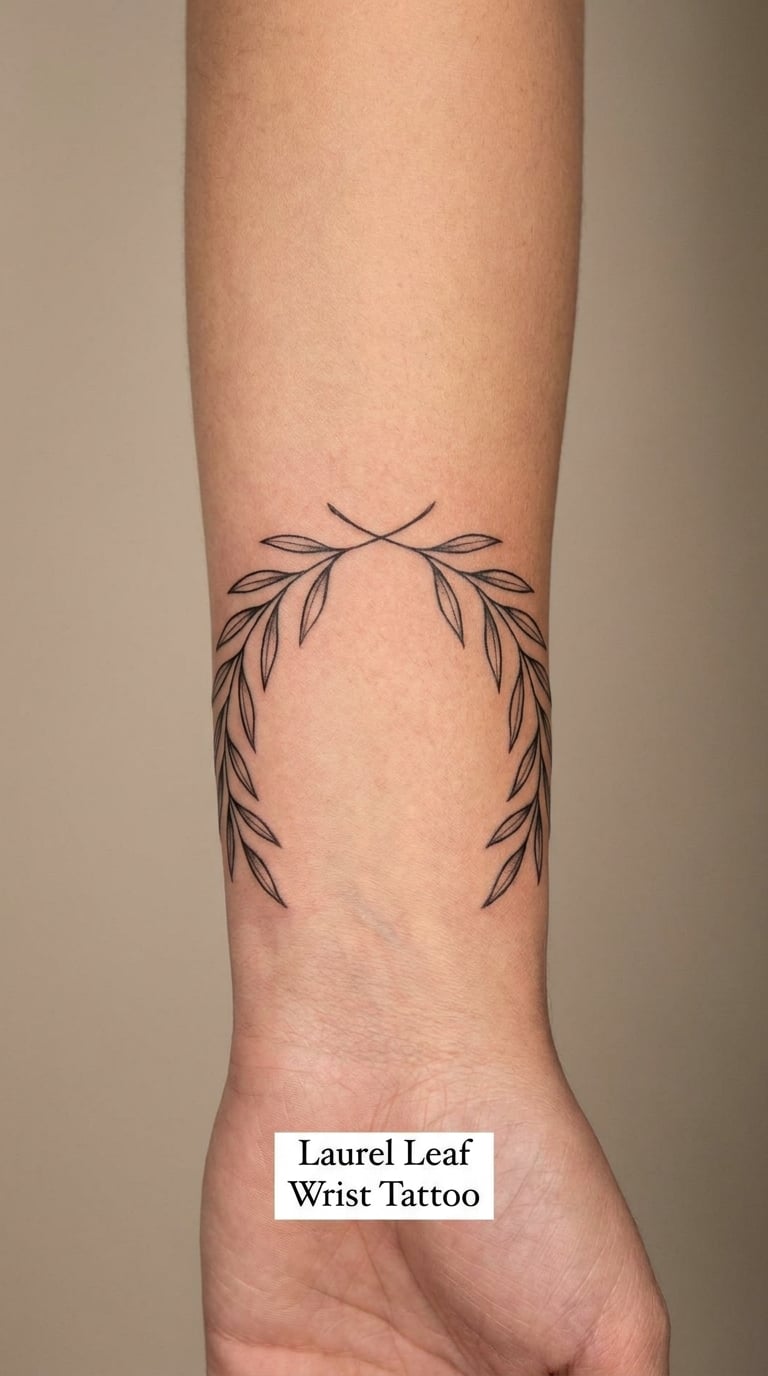
A laurel band is a curved stem with pointed leaves angled upward on both sides, wrapping far enough around the wrist that the two ends almost meet. Because the leaves sit on a curve, the artist has to change angle as the band travels around, and that variation is where a rushed version falls apart.
Laurel is traditionally tied to victory, achievement and longevity. It has a formal, classical look that works well if your wrist is narrow and your sleeve is usually short.
Placement: Outer wrist or lower forearm, wrapping about three quarters of the way round. Size: 3-4 inch (7.5-10 cm) around the arm. Style: Fine line classical, unfilled leaves.
Pain: Low to medium. The outer forearm is one of the easier places to work and the leaves are small separate passes. Ageing note: the fine stem line is the weak point, so a slightly heavier stem helps hold the shape together.
Make it yours: Turn the two end leaves into a small open book shape or add a tiny ribbon at the gap so the band reads as broken rather than closed.
7. Geometric Triangle Band
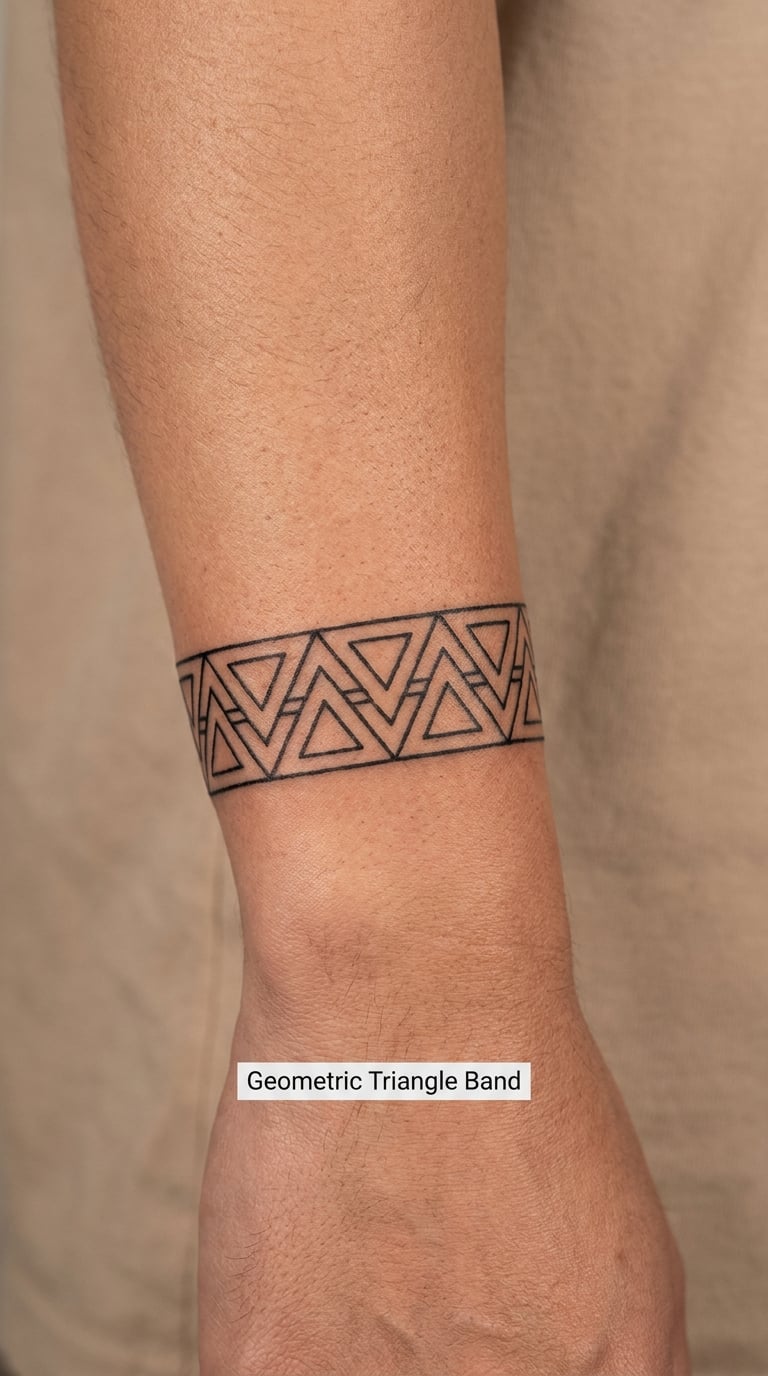
A triangle band is a row of outlined triangles, sometimes alternating up and down orientation, sometimes alternating size so the rhythm feels hand-drawn rather than machine-cut. Outlined reads softer; solid black reads much louder, so decide that before the stencil goes on.
Geometric bands are chosen for structure rather than meaning. People tend to like that the pattern carries on around the arm without needing a single focal image, which suits a first wrist tattoo.
Placement: Outer wrist, wrapping slightly so the triangles curve out of sight at the sides. Size: 2-3 inch (5-7.5 cm) around. Style: Geometric linework, outlined or solid.
Pain: Medium. Consistent geometric spacing across a curved surface takes patience, and long sessions on the wrist make the skin sore and stretchy. Ageing note: pointed triangle tips are the first corners to soften, so a moderate size holds better than tiny ones.
Make it yours: Use a row of small solid triangles as a gradient behind a single outline triangle, so the band has one quiet focal point.
8. Tiny Rose Linework Band
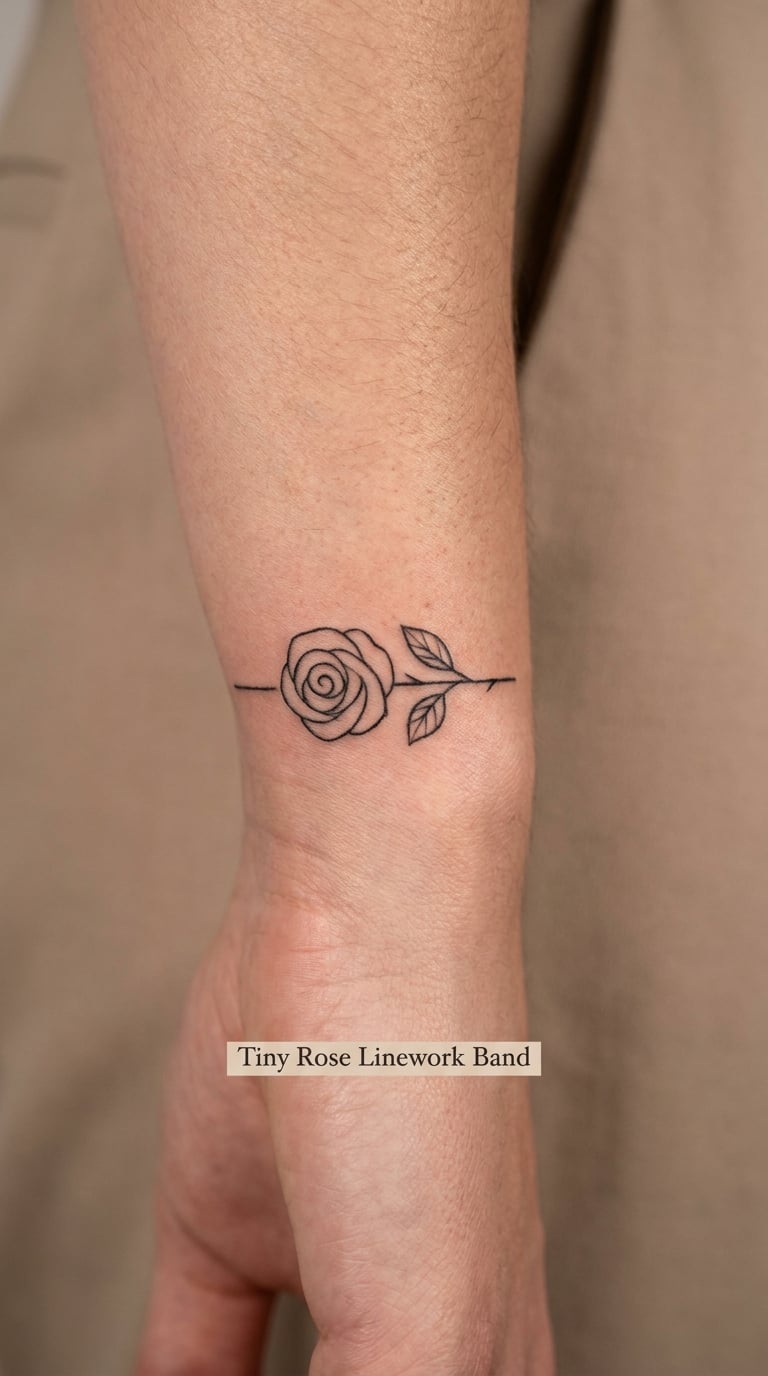
A linework rose is a spiral at the centre, three or four curved petals around it, and a stem with two small leaves, all in one line weight and no fill. At this size the spiral is the only detail that needs to be right; everything else can stay simple.
It reads as affection, a person, or a memory of somebody specific, which is why it is such a common first wrist piece. The shape sits nicely across the arm because it is compact and roughly symmetrical.
Placement: Inner wrist, slightly off-centre so the stem points toward the elbow. Size: 1-1.5 inch (2.5-4 cm) across. Style: Fine line floral, no shading.
Pain: Medium. Small means quick, and quick is kind, but the inner wrist is unforgiving about pressure. Ageing note: interior petal lines in a rose this small tend to blur together within a few years, so expect a soft flower rather than a crisp spiral.
Make it yours: Ask for three small dots trailing off the stem like a dotted line, and use them for a three-digit number.
9. Wave and Dot Wrist Band
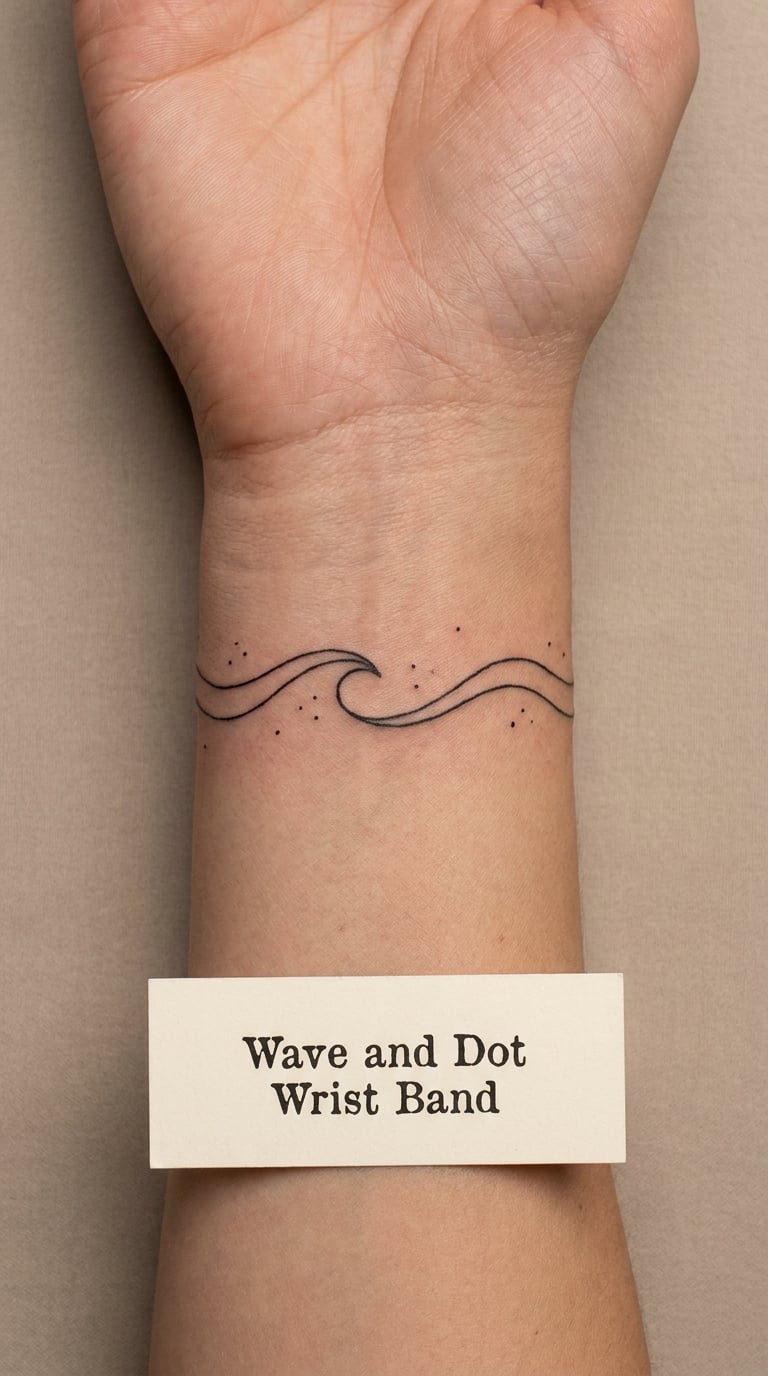
A wave band is two or three flowing horizontal lines that rise and fall in a smooth rhythm, with sparse dots above and below them suggesting spray. The line has to keep an even weight through every curve, and that consistency is the whole skill of the piece.
Waves usually mean the sea, a surf trip, or simply a preference for that clean horizontal energy. It is one of the least literal designs in this list and one of the easiest to wear daily.
Placement: Inner wrist or lower forearm, set lengthwise. Size: 2.5-3 inch (6-7.5 cm) long. Style: Minimal single-line with a few dots.
Pain: Low to medium. Long sweeping lines mean fewer passes over any one spot, which is exactly what you want on a joint. Ageing note: dots and thin crests fade first, so keep the spray minimal rather than dense.
Make it yours: Turn the dots into a row of small circles sized to a specific number, or leave the band open-ended so the lines run off toward the elbow.
10. Musical Notes Wrist Band
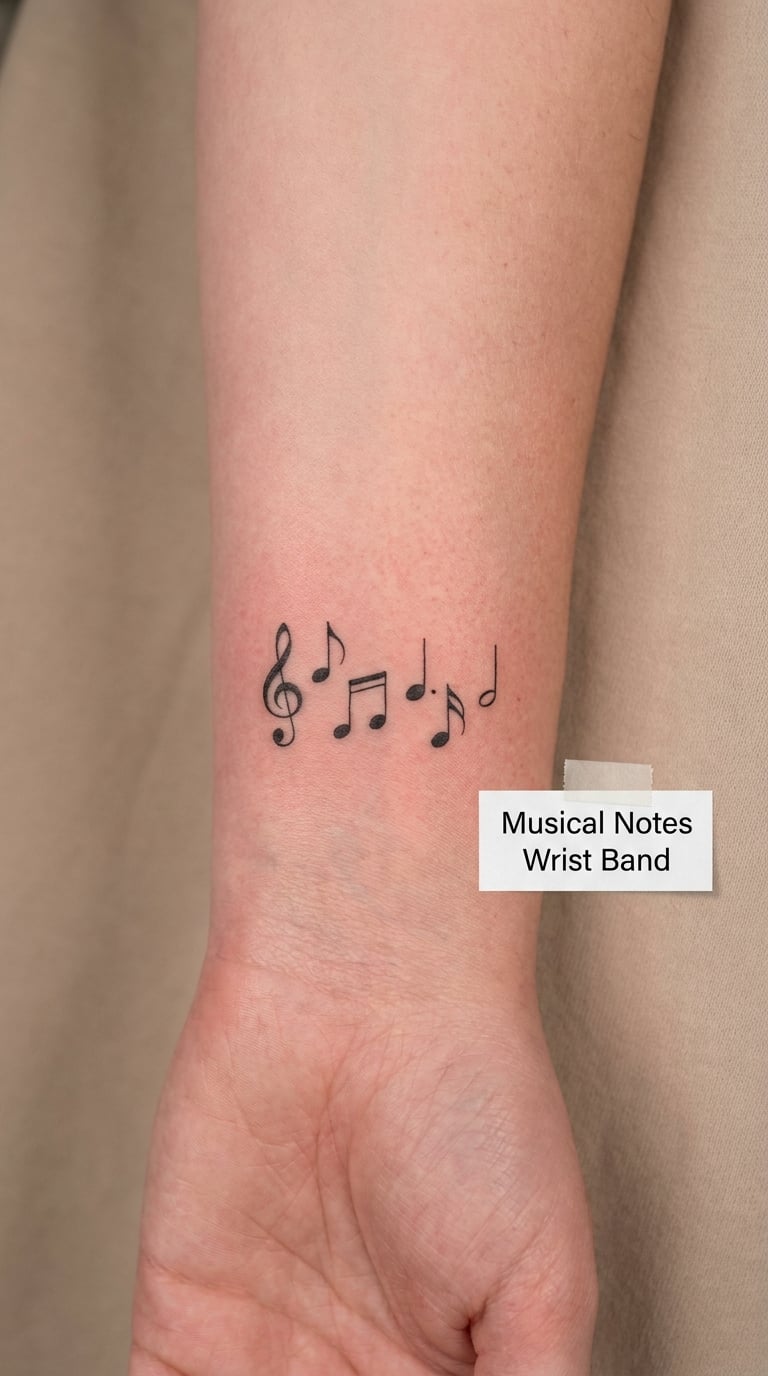
A notes band is a short phrase of three to five notes of different heights with their stems and flags drawn in a single line weight, arranged along a gentle arc. One small clef anchors the start, and leaving it out keeps the design cleaner.
People choose it for the instrument they played or the song that means something, and the phrase itself is often a private reference. Ask to work from a melody rather than from sheet music, since a tattooist can read a rhythm faster than notes.
Placement: Inner wrist, arcing slightly so it follows the forearm. Size: 1.5-2.5 inch (4-6.5 cm) long. Style: Fine line, unfilled note heads.
Pain: Medium. Note flags and stems are fiddly small marks in a narrow area, so the session takes longer than the design suggests. Ageing note: tiny flags and filled note heads lose definition; open note heads hold up noticeably longer.
Make it yours: Name the exact song and bar at the consult, or use the note heads as a count, one per person or one per year.
11. Infinity Loop Band
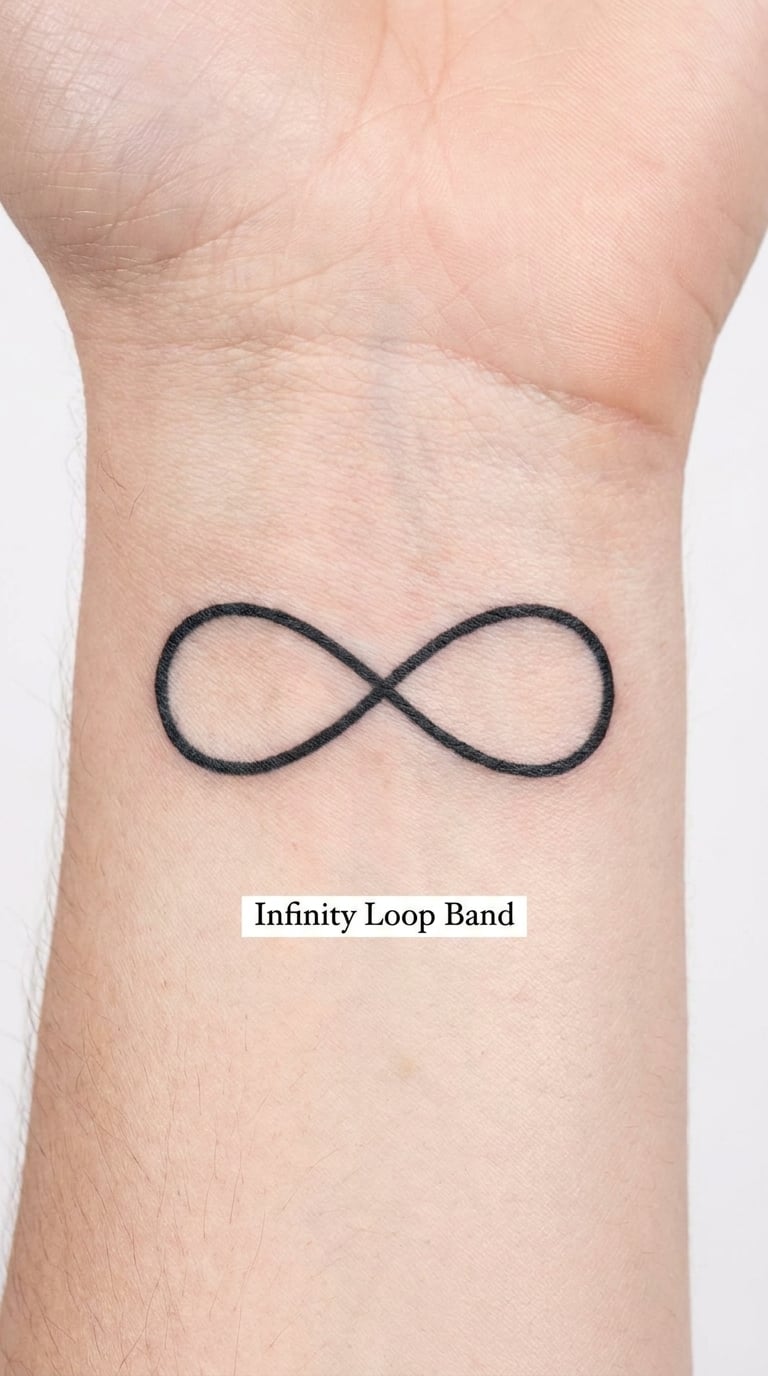
An infinity band is a single continuous line drawn as a sideways figure eight, with the crossover clean and both loops the same size. It is the simplest design in this list and the one most often drawn badly, because a lopsided loop looks wrong immediately.
It is widely associated with lasting commitment, endless cycles, or balance between two halves of something. Wearers usually mean it personally, so treat the interpretation as yours rather than the design’s.
Placement: Inner wrist, horizontal, sitting centred between the crease and the elbow side. Size: 1.5-2 inch (4-5 cm) across. Style: Minimal outline, single line weight.
Pain: Medium. The line is quick but the inner wrist amplifies every pass. Ageing note: a plain infinity has very little internal detail to lose, which makes it one of the longer-lasting fine line pieces, though the crossover point is where ink spreads first.
Make it yours: Make the two loops uneven on purpose, a larger loop and a smaller one, so the symbol has a shape of its own rather than being a stock drawing.
12. Blackwork Checked Wrist Band
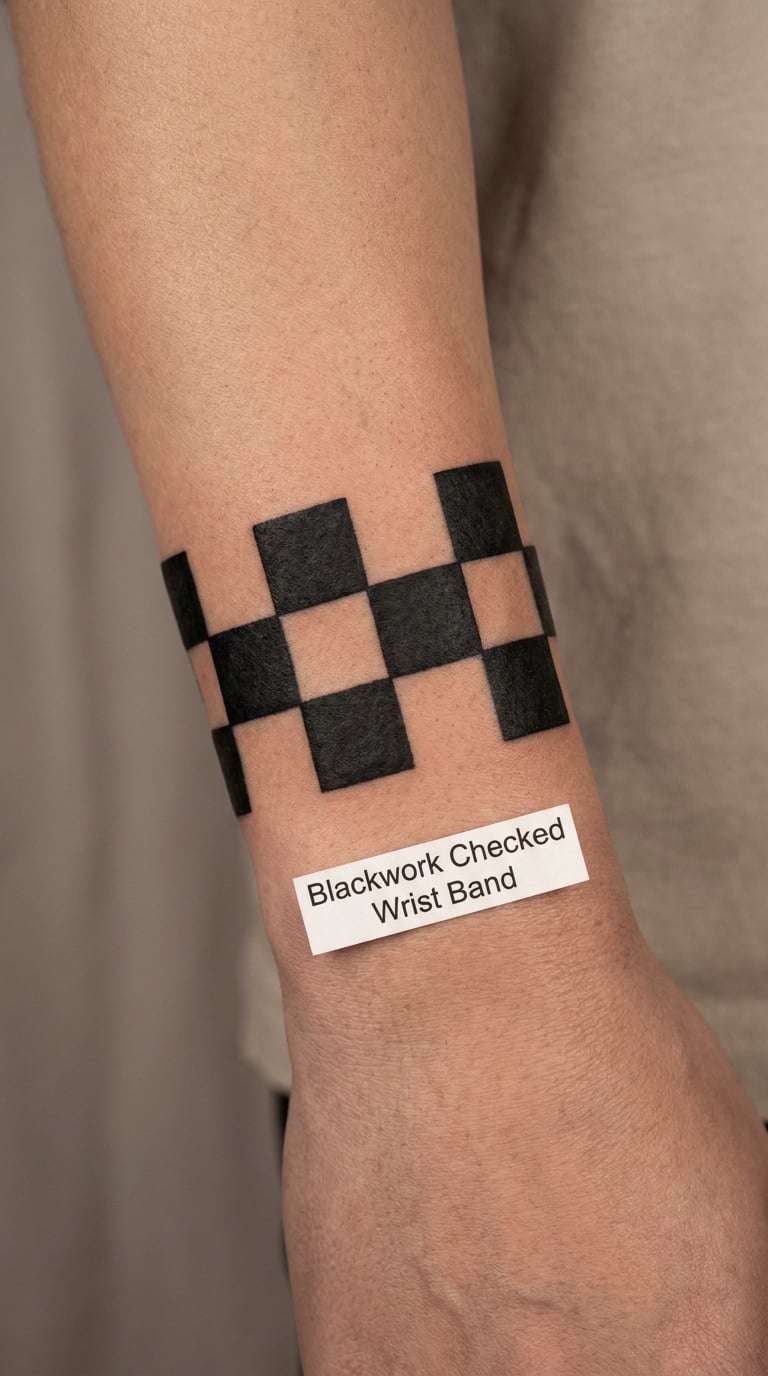
A checked band is a row of solid black squares separated by square gaps of bare skin, usually two or three rows tall. Because the black areas are large and even, the tattoo reads as a solid cuff the moment the gaps close up in your head. Say that out loud at the consult, because the design can feel much busier in real skin than in a photo.
It is chosen for weight and simplicity, and it sits in the opposite corner of the spectrum from fine line. The black holds its shape well, which makes it a good match for anyone who does not want to fuss over a delicate piece.
Placement: Forearm, sitting above the wrist rather than over the crease. Size: 3-4 inch (7.5-10 cm) around the arm, two rows of squares. Style: Blackwork, solid fill.
Pain: Medium. Solid black is more work per pass than a line, and the forearm above the wrist is a tight circumference for a wide band. Ageing note: filled black is one of the most durable inks and usually stays crisp for a very long time, though edges soften slightly with sun exposure over the years.
Make it yours: Leave one square deliberately empty inside the pattern, or fade the top row to nothing so the band dissolves from the outside in.
13. Small Butterfly Wrist Band
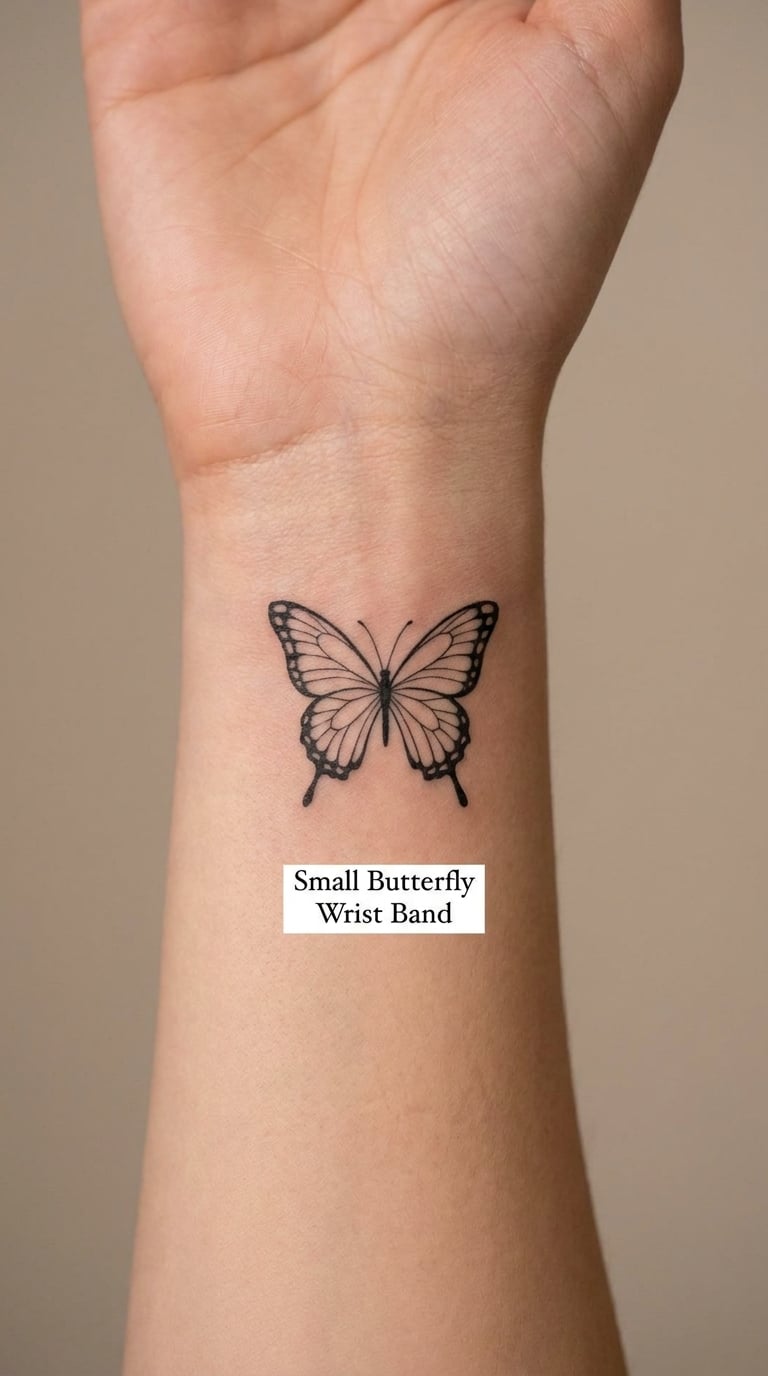
A butterfly band is a small symmetrical shape with two open wings, a slim body and very little interior detail, sometimes with a few short antenna lines. Symmetry on a curved wrist is harder than it looks, because the far side of the arm sits at a different angle to the needle.
Butterflies get chosen for change, growth, or a person who has changed how they live. If you want the design to be more graphic than decorative, ask for outlined wings with no fill at all.
Placement: Inner wrist, wings angled along the forearm so the body runs lengthwise. Size: 1.5-2.5 inch (4-6.5 cm) across the wings. Style: Fine line or micro line, unfilled.
Pain: Medium. The body and antennae are thin lines on the inner wrist, so expect the same steady discomfort as any inner wrist work. Ageing note: wing edges blur toward each other over time and the shape starts to read as a soft dark patch, so keep the wings open and separate.
Make it yours: Ask for the wing edges to be drawn in a single continuous line from tip to tip, and use the two antennae as the location for a tiny matching pair of stars or dates.
14. Dotwork Celestial Map
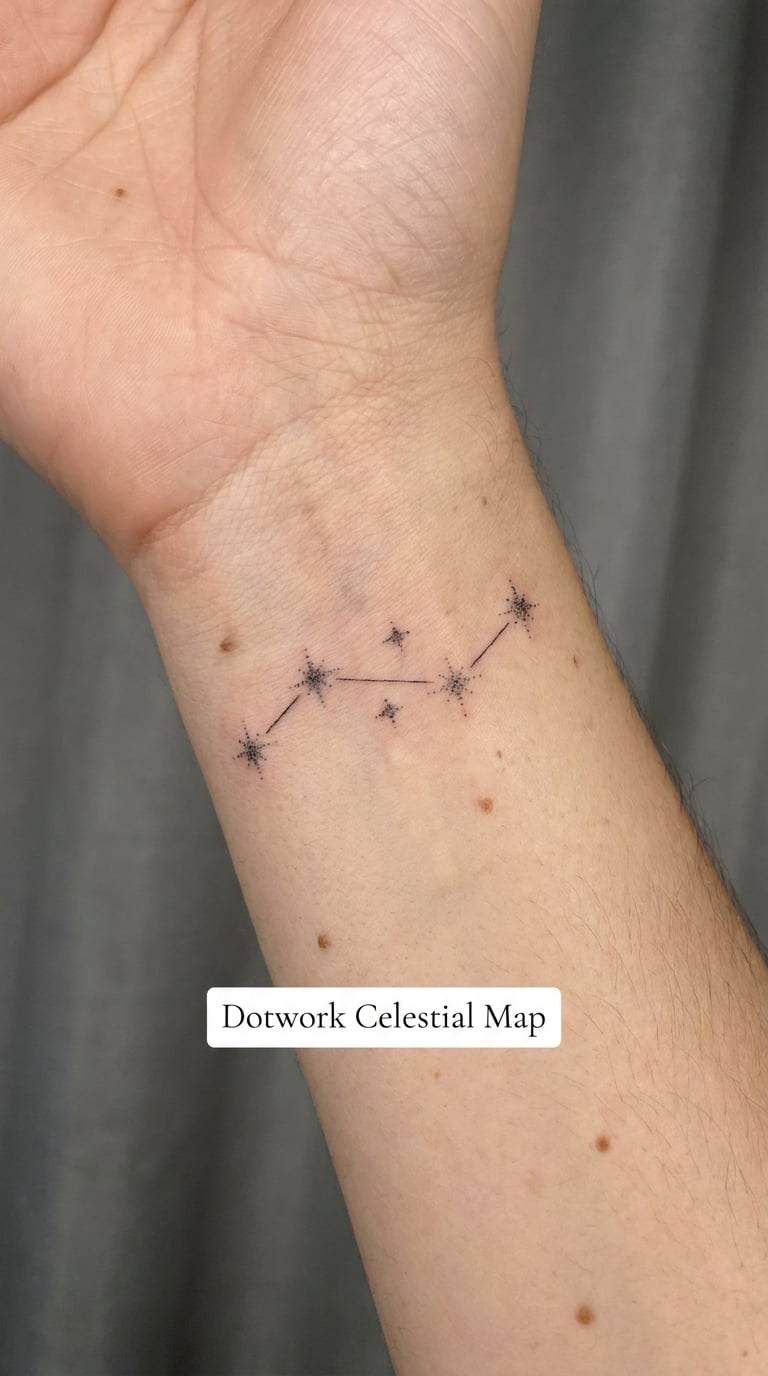
A celestial dotwork band is a handful of small star shapes, some solid and some outlined, linked by very thin connecting lines across the wrist. Keeping the connecting lines faint is the move that makes it read as a sky map rather than a chain.
Wearers usually build it around a real birth date, a place, or a moment they want mapped. The open spacing is what makes the piece feel calm at a glance from across a room.
Placement: Inner wrist or lower forearm, running lengthwise. Size: 2.5-3.5 inch (6-9 cm) long. Style: Dotwork with micro line connections.
Pain: Low to medium. Most of the design is negative space, so the needle is moving rather than working the same patch. Ageing note: hairline connections are the first thing to fade, and once they soften the stars stop reading as a connected pattern, so keep at least one line a touch heavier than feels right.
Make it yours: Plot an actual sky, such as the constellations visible from your birth town, and have the artist work from your own chart rather than a stock star pattern.
15. Mini Serpent Wrist Band
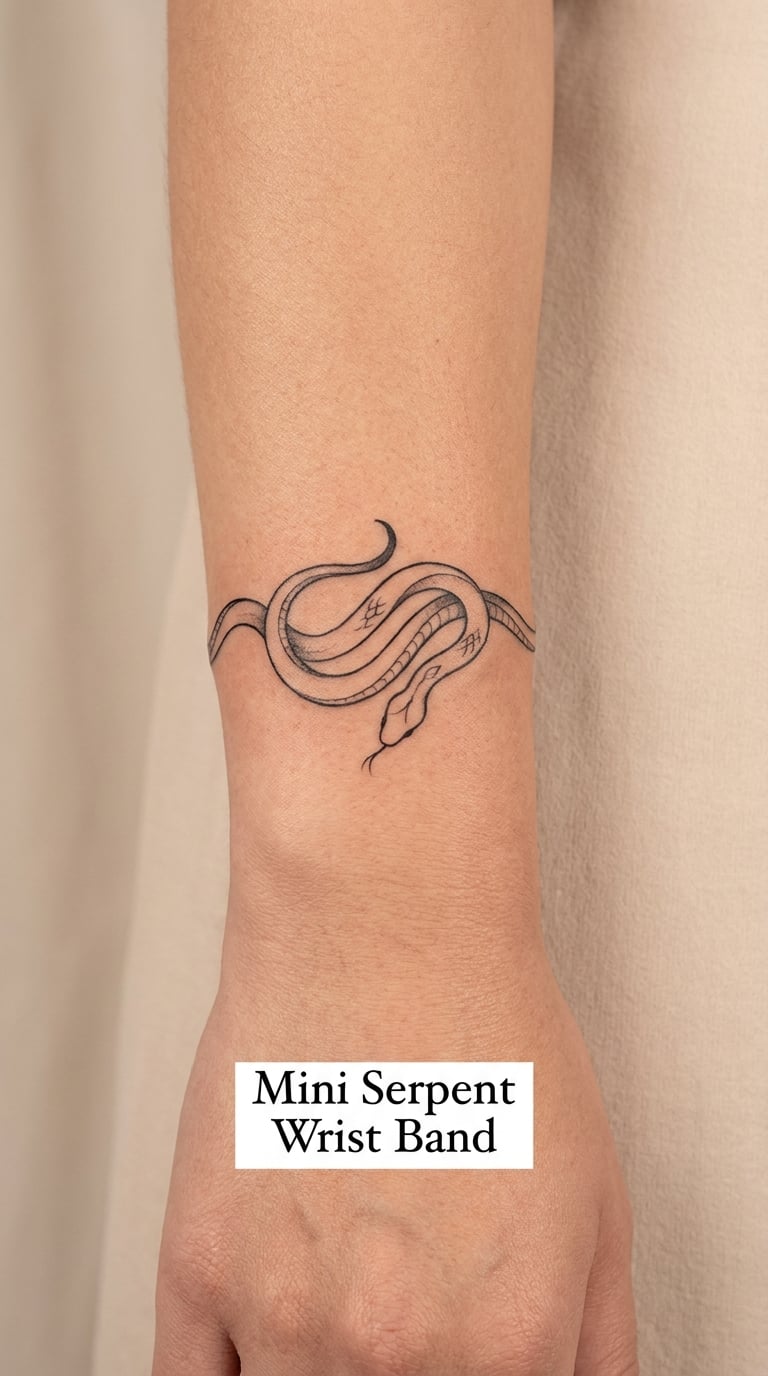
A mini serpent is a single sinuous body drawn in outline, curving across and around the wrist with a small head and a short forked tongue. Scales are suggested with a few short curved ticks rather than a full pattern, because anything more becomes a texture the eye cannot parse at wrist size.
Serpents have long carried associations with transformation, protection and rebirth, and the line-heavy black outline look sits in the traditional family of tattooing even when the drawing is simplified.
Placement: Outer wrist, wrapping around toward the inner side. Size: 2.5-3.5 inch (6-9 cm) around. Style: Fine line traditional, outline only.
Pain: Medium. The body crosses both the bony outer wrist and the softer inner edge, so the feel changes mid-session. Ageing note: the head and the small scale ticks soften first, while the long body outline holds surprisingly well.
Make it yours: Have the tail end in a small split or a drop rather than a clean taper, so the band has an exit point instead of looking unfinished.
16. Floral Vine Wrist Tattoo
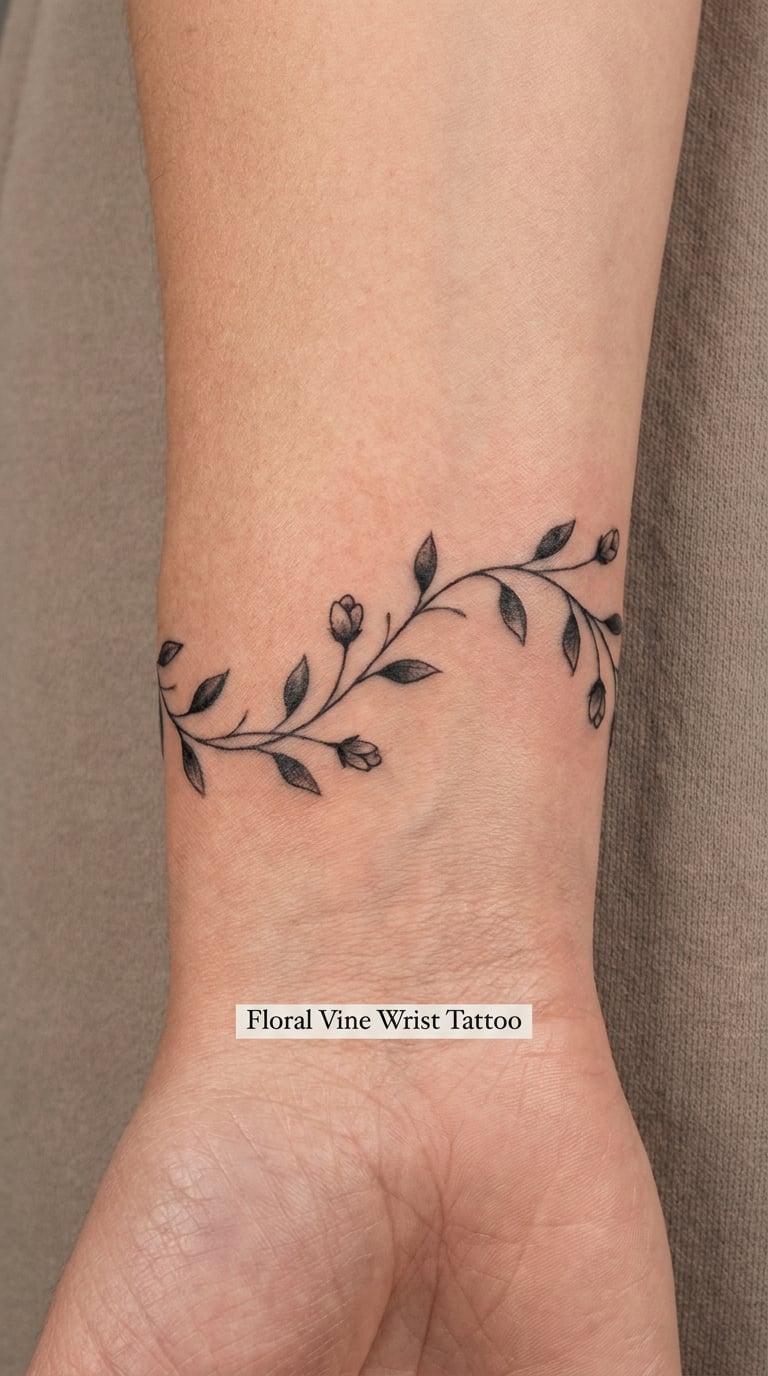
A vine is a thinner, longer and more winding relative of a single stem, with small leaves branching off a stem that curves as it travels. Line control is the entire challenge here, since a vine that wanders unevenly around the arm looks slack rather than organic.
Florals are usually personal, sometimes tied to a grandmother, a garden, or a particular bloom from a wedding bouquet. The wrapping version works well if you want a band with movement rather than a symmetrical emblem.
Placement: Forearm, above the wrist, wrapping about half the circumference. Size: 3-4 inch (7.5-10 cm) around. Style: Delicate botanical, unfilled leaves.
Pain: Low to medium. A wrapping band means the artist has to re-stencil sections, which extends the session but keeps each section short. Ageing note: fine leaf tips blur, so a slightly heavier stem line keeps the vine legible as a vine.
Make it yours: Add one bloom in a single colour while the rest stays black line, which gives the piece a focal point and keeps the overall look quiet.
17. Word and Symbol Wrist Band
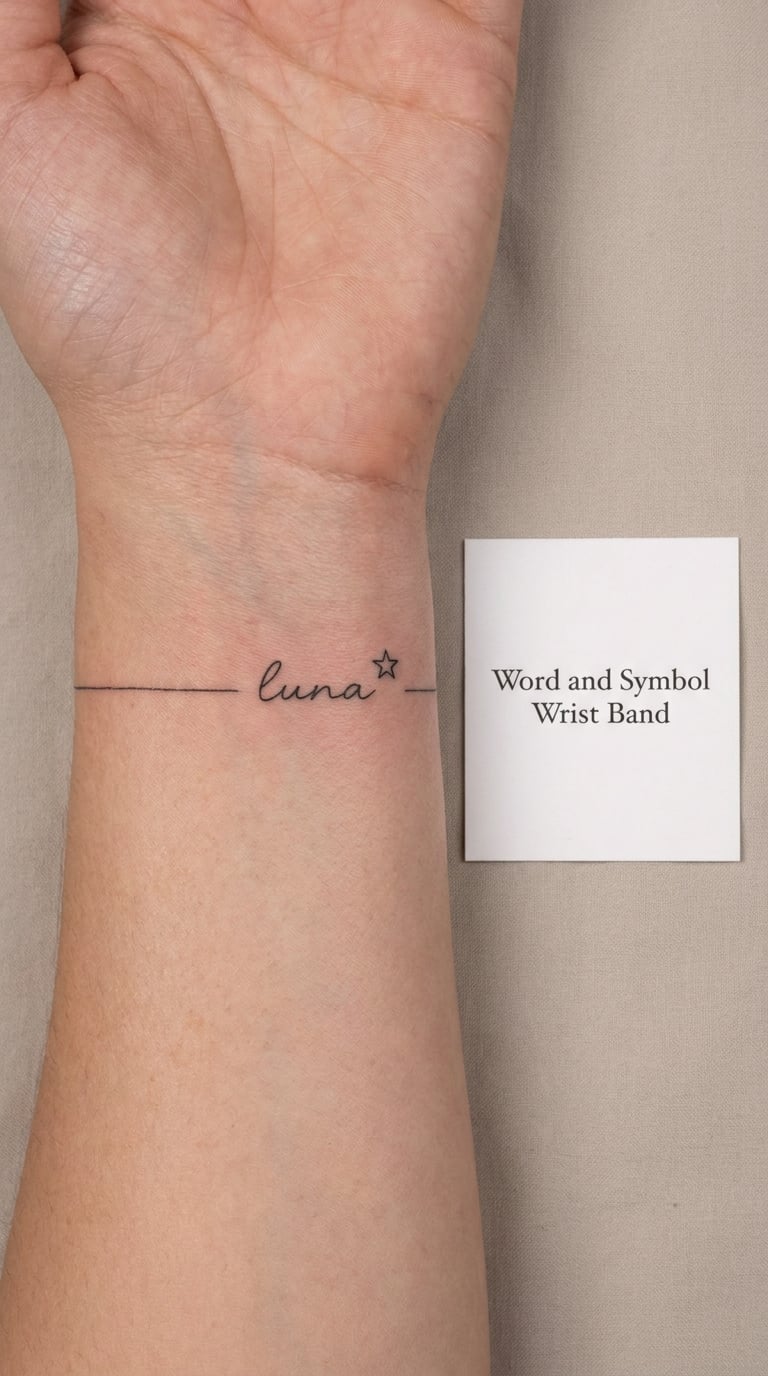
Pairing one short word with a small symbol works because the two elements sit on a single baseline and read as one composition rather than two tattoos. Lowercase thin lettering with generous spacing between letters is the safest version; narrow serif and script faces blur fastest.
The word is almost always something the wearer would not say out loud, and the symbol stands in for a person, a date or a place. That is what makes it read as one message instead of a random combination.
Placement: Inner wrist, horizontal, sitting just above the crease. Size: 2-2.5 inch (5-6.5 cm) across. Style: Fine line lettering, spaced lowercase.
Pain: Medium. Lettering means the artist cannot stop to stretch, and the inner wrist tightens during a long fine line session. Ageing note: hairline letterforms fill in and blur together over roughly five years, so wide spacing and slightly heavier strokes are worth asking for.
Make it yours: Skip the symbol entirely and let one short word carry the whole band, or put the symbol at the end of the word as a full stop in a different style.
18. Minimal Heartbeat Wrist Band
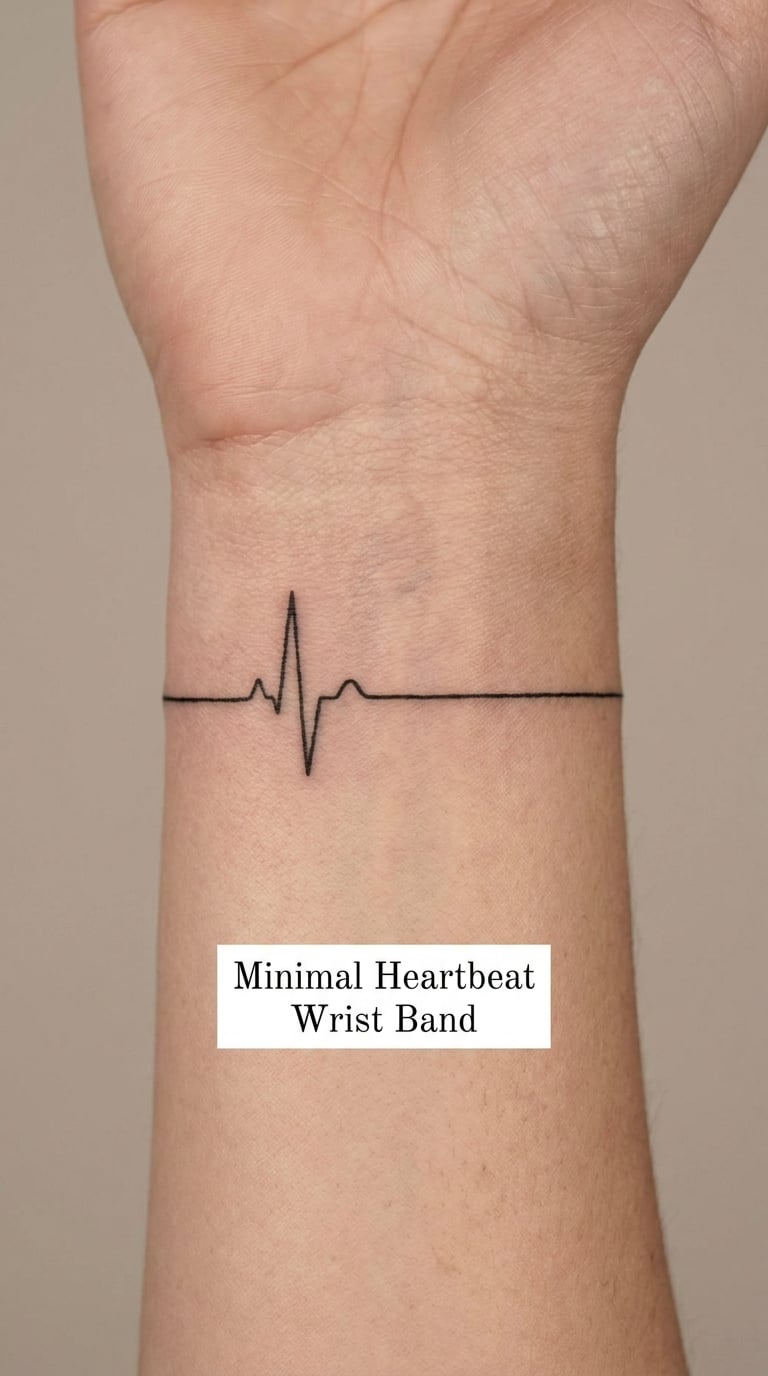
A pulse line is a single horizontal line interrupted by one sharp rise and fall, the spike-and-dip that everyone recognises from a heart monitor trace. Getting the spacing even is what stops it looking like a scribble, and the line should run the full width of the design so both ends are deliberate.
It is chosen for a person, a diagnosis, a recovery, or a birth. In that case the peak is often placed to land over the pulse in the wrist, which is a nice detail when the sleeve is down.
Placement: Inner wrist, horizontal, ideally with the peak over the vein. Size: 2-3 inch (5-7.5 cm) across. Style: Minimal single line, no fill.
Pain: Medium. One continuous line over a moving joint means the artist works around your wrist rather than through it, which lengthens the session. Ageing note: this is a single hairline stroke, so it will soften more than a filled design; a slightly heavier line extends its life.
Make it yours: Add a second, smaller beat after the main one, spaced differently, so the trace reads as something continuing rather than stopping.
19. Watercolor Petal Wrist Band
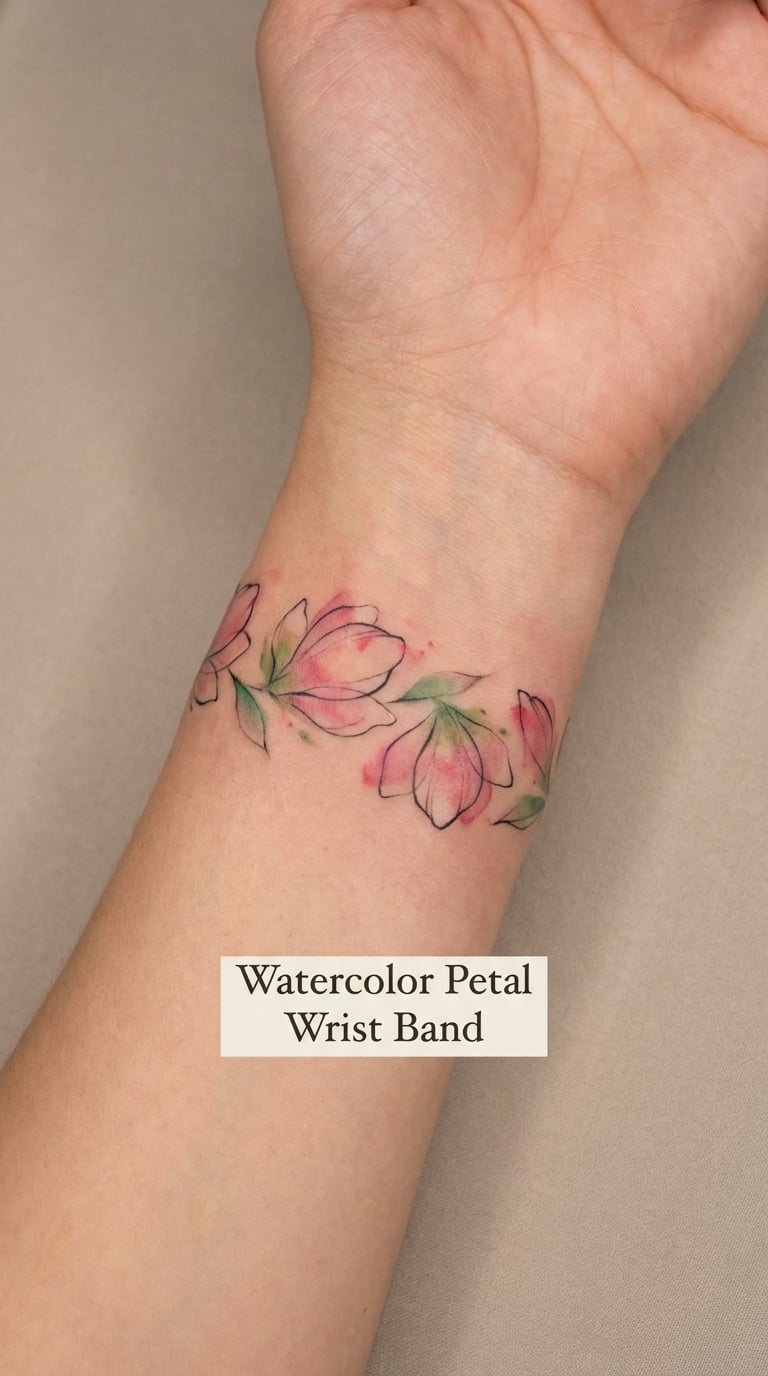
A watercolor petal is built from translucent washes rather than hard outlines, with colour feathering past the edge of the shape so nothing has a defined border. One petal with a faint green stem reads better than a bouquet, because the wrist is a small canvas.
It is the one colour option in this list that leans soft rather than bold, and it works when you want something that does not read as a heavy symbol. People often pair a small colour piece with a black fine line tattoo elsewhere.
Placement: Inner wrist, slightly off-centre. Size: 1.5-2.5 inch (4-6.5 cm) across. Style: Watercolour with soft pigment edges, light black detail only if needed.
Pain: Medium. Watercolour work is layered and passes over the same skin several times, which stings more than it feels sharp. Ageing note: pale washes fade faster than solid black or a packed-in red, and sun exposure pulls the pink toward the edge of the petal, so cover it and expect a touch-up on the colour.
Make it yours: Ask for the colour to bleed slightly beyond the outline on one side only, so the petal looks like it is opening out of the skin rather than sitting on it.
20. Traditional Rose Wrist Band
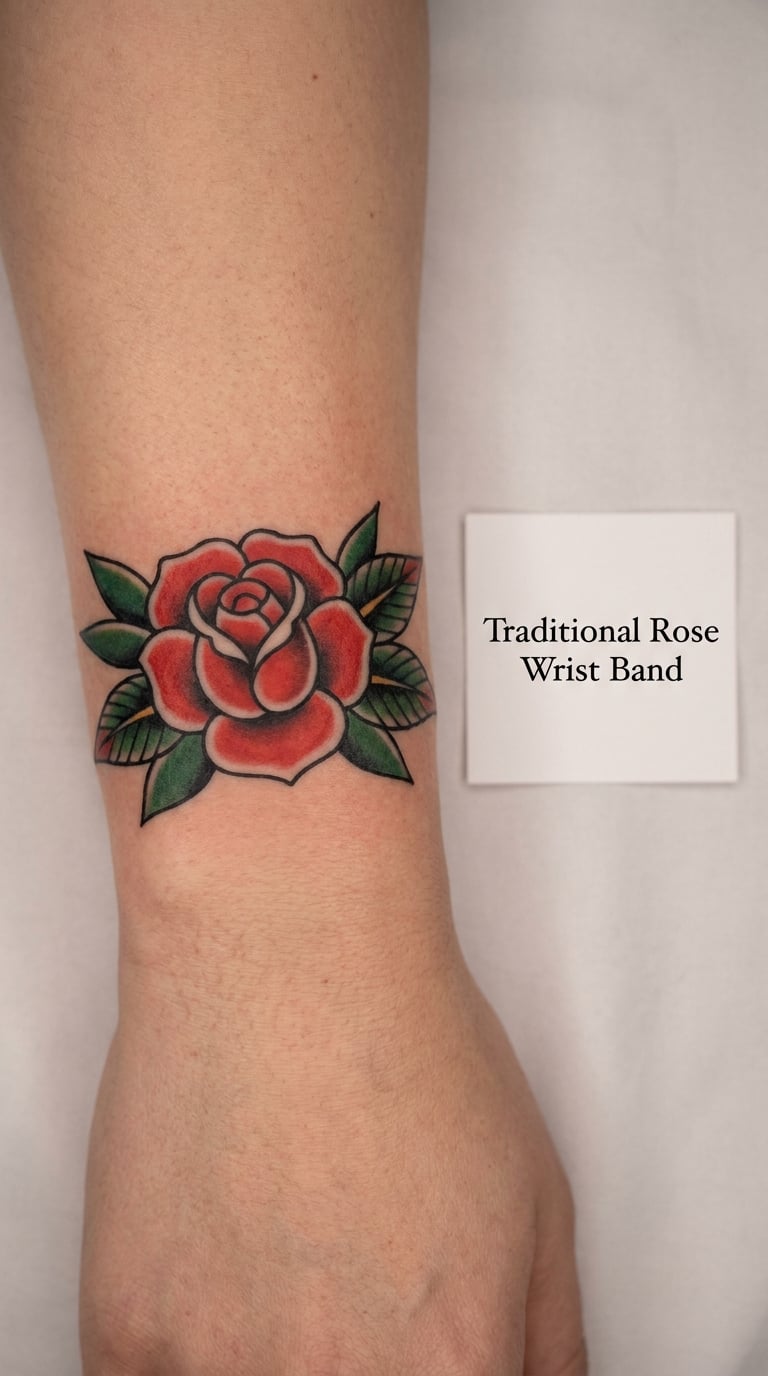
A traditional rose is a red flower with heavy black outlines, smooth green shading on the leaves, and yellow used sparingly in the highlight. Bold outlines and packed colour are what separate traditional from neo-traditional, where the detail gets finer and the shading more textured.
It has been a tattoo staple for a long time, and people choose it for the colour and the directness as much as for symbolism. Love is the reading most people give it, though that is a habit rather than a rule.
Placement: Forearm, above the wrist, where there is more flat surface than the inner side offers. Size: 2.5-3.5 inch (6-9 cm) across. Style: Traditional, bold outline, red and green.
Pain: Medium. Colour packing is the most demanding work on this list, and it takes real time, so book a long appointment or plan it as the first piece in a two-session piece. Ageing note: a saturated red holds well, but the green shading is usually the first to fade and the leaves read paler after a few summers of sun.
Make it yours: Add a small banner or ribbon beneath the bloom carrying a single word, and keep the banner outline bold so it stays readable as the colour changes.
How to Choose the Right Design
Most people who are disappointed with a wrist band made the same call: they picked the motif before the scale. Reverse it. Measure your wrist, look at the size, and only then decide what sits inside it.
Which wrist band tattoo style fits your wrist?
- Narrow wrists, delicate lines: fine line botanical, single stem, tiny rose, minimalist chain. Keep the band under about 2 inch (5 cm) tall.
- Average wrists, mixed styles: geometric triangles, wave and dot, sun and moon, infinity. These scale up cleanly without needing a heavy outline.
- Broader wrists, stronger looks: blackwork checked, traditional rose, serpent. If you are going large, the extra width keeps the detail readable rather than busy.
- Anyone starting out: single-line motifs such as a pulse line, a wave, or a short word. Quick sessions, easy placement, and a clear idea of how the wrist feels before you commit to something bigger.
How to check scale before you commit
Bring a photo of reference designs printed at roughly the size you want them, and ask your artist to draw the design at that scale on paper. Hold it against your wrist or measure it. A motif that looks generous in a photo on a laptop becomes tiny on a 6 inch (15 cm) forearm.
Ask about line weight too. A single needle on the inner forearm is nearly invisible in a few years; a slightly heavier line holds its shape and still looks restrained. If a design is going to be fine line, keep it above the wrist crease rather than on the crease itself.
How to sit a band next to a watch or bracelet
Decide before the stencil whether you will wear a watch over the tattoo, because that changes the placement. Most people set the band above the wrist bone on the outer arm so a watch sits below it, or set it on the inner arm and keep watches on the other wrist.
For physical bracelets, a solid or high-contrast band reads best, since a fine chain motif can disappear under a metal cuff. If your band is subtle, choose delicate jewellery. If it is bold, let it be the only thing on that wrist.
Cost and Session Time
Tattoo pricing varies more by shop minimum and hourly rate than by design. Most studios in the US charge by the hour, and a small wrist band is often under the shop’s minimum charge, so the artist’s minimum ends up setting the figure. Ask for the rate and the minimum in the same message when you book.
As a rough guide for planning, tiny work such as a small rose or a word band is a short session, often 20 to 40 minutes. A medium design such as a traditional rose, a wrapping vine, or a dotwork piece runs longer, commonly an hour to two. A checked or solid blackwork band needs the most time because each pass covers a lot of skin, and some shops split it across two sessions.
Higher hourly rates usually buy you a tattooist who works regularly at small scale on the wrist, which is exactly the skill that decides whether a fine line design holds together. If you are travelling, put a portion of the budget toward a touch-up visit rather than saving on the first session.
One practical note for anyone searching forearm band tattoo inspiration: if a design is going to wrap all the way around, expect the session to run longer than the reference photo suggests. Wrapping forces the artist to re-stencil each section, and re-stencilling takes time.
Aftercare Basics
Wrist skin moves all day, so a fresh tattoo there gets more friction than most. Follow your artist’s aftercare instructions first, since they know exactly what they did. Beyond that, a few habits cover most of it.
- Follow your artist’s aftercare instructions. They come first, and they should override anything generic you have read elsewhere.
- Wash gently and often. Clean the area with lukewarm water and a mild unscented soap, then pat it dry with a clean hand rather than a towel.
- Keep a thin film of moisturiser on it. A plain fragrance-free lotion a few times a day stops the area drying out and cracking as the skin tightens.
- Protect it from sun and friction. Sleeves, watch straps and bracelets rubbing on a fresh wrist tattoo are the main causes of early fading. Give it loose clothing for a week.
- Do not pick or scratch. The flaking skin in week one is normal, and pulling it takes ink with it.
- Plan touch-ups early for fine line. Fine line and pale colour on the inner wrist usually want a free or low-cost revisit once the skin has settled, usually within the first year.
Frequently Asked Questions
Where should a wrist band tattoo be placed?
Most wrist band tattoos sit on the inner wrist just above the crease, or on the outer wrist just above the wrist bone where a watch band would sit. The inner side shows more and hurts more. The outer side is easier to work and hides under long sleeves. Decide first whether you will wear a watch on that wrist, because it changes the answer.
Are wrist tattoos more painful than other tattoos?
Yes, usually. The wrist has thin skin over bone, a network of visible veins and a lot of nerve endings close to the surface, and it moves constantly during a session. Most people rate wrist work around seven to nine out of ten. A longer single line is usually easier to sit through than a heavily shaded block of colour.
How wide should a wrist band tattoo be?
On an average adult wrist, most bands land between 2 and 4 inches (5 to 10 cm) around the arm. Wider than that starts to read as a forearm band rather than a wrist band, and anything under roughly half an inch (1.5 cm) loses detail quickly. Bring a printed reference at the size you want so the artist can draw it to scale.
What should I avoid getting tattooed on the wrist?
Avoid anything that is very small and very thin at the same time, since both fade. Steer clear of placing a band exactly along the wrist crease, where skin folds and stretches. Heavy detail in a small area turns to blur, and a fully closed band shifts as the wrist flexes, so an open-ended design ages better.
Will a fine line wrist tattoo fade?
Fine line on the inner wrist softens and greys over roughly five to eight years, faster than a filled or traditional design. Slightly heavier lines, avoiding the wrist crease and covering the area from sun all help it hold. Plan a touch-up within the first year, and expect periodic line refreshes over the life of the piece.
How long does a wrist band tattoo take to heal?
A small wrist band usually looks healed to the eye in two to three weeks, but the deeper layers take four to six weeks to settle fully. Because the wrist flexes all day, expect a longer stretch of tenderness and tightness than on a forearm or upper arm. Avoid the sun and tight watches during that period.
Conclusion
If this is your first tattoo, start with something quiet: a wave and dot band, a pulse line, or a single botanical stem. They are quick to tattoo, easy to place and forgiving if the scale is slightly off.
If you are already building a collection, a checked blackwork band or a traditional rose gives you weight and colour that a fine line piece cannot. Either way, choose on placement, scale and meaning, and bring a printed reference to the consult. For more ideas, browse our 70+ small wrist tattoo ideas, our pick of 46 cross tattoos for your wrist, or 158 dragonfly tattoo ideas.