
20 Best Sunrise Tattoo Ideas With Meaning (September 2026)
A sunrise tattoo is a design of the sun coming up over a horizon, often paired with mountains, water, a doorway or a plant, and it symbolizes new beginnings, hope and the end of a hard stretch. People pick it after recovery, a move, a sobriety date, a breakup, or simply as a quiet reminder that dark nights end. These 20 sunrise tattoo ideas with meaning cover everything from a fine-line horizon you can read at arm’s length to a full back scene, with real placements, sizes and honest ageing notes for each one.
What makes a sunrise work on skin is the horizon line. That single straight edge tells the eye it is looking at dawn, so the design holds up even when the detail around it is simplified for a small area. Pick a motif you would happily look at in twenty years, check it at the size it will actually be, and bring references to a consultation rather than a screenshot to trace. Last updated in September 2026.
Sunrise Tattoo Ideas With Meaning: Quick Guide
| Idea | Style | Best placement | Size | Pain |
|---|---|---|---|---|
| 1. Fine-line over a mountain ridge | Fine line, black and grey | Inner forearm | 2.5-3.5 in (6-9 cm) | Low to medium |
| 2. Alternating rays | Minimalist line work | Outer upper arm | 2-2.5 in (5-6 cm) | Low |
| 3. Inside a half circle | Geometric, single needle | Inner wrist | 1.5-2 in (4-5 cm) | Medium |
| 4. Over ocean waves | Fine line with light wash | Lower forearm | 3.5-4 in (9-10 cm) | Medium |
| 5. Framed by two mountains | Blackwork with stipple | Centre chest | 4-5 in (10-13 cm) | High |
| 6. Lotus above the sun | Botanical line work | Shoulder blade | 3.5-4 in (9-10 cm) | Medium |
| 7. Phoenix rising with the sun | Blackwork | Upper back | 5.5-7 in (14-18 cm) | High |
| 8. Sunflower at sunrise | Botanical realism | Inner arm | 3-3.5 in (8-9 cm) | Medium |
| 9. Behind an open doorway | Fine line architectural | Side forearm | 2.5-3 in (6-8 cm) | Low to medium |
| 10. Through a broken chain | Bold blackwork | Outer forearm | 3-3.5 in (8-9 cm) | Medium |
| 11. Compass pointing to the sun | Fine line with accent | Outer wrist | 2-2.5 in (5-6 cm) | Medium |
| 12. Beside a crescent moon | Black and grey | Inner arm | 2.5-3 in (6-8 cm) | Low to medium |
| 13. Reflected in a water line | Minimalist | Calf | 3-3.5 in (8-9 cm) | Low |
| 14. Edge of a forest | Black and grey scenic | Upper back | 4.5-5.5 in (11-14 cm) | Medium |
| 15. Inside a torn circle | Fine line geometric | Ribs | 2.5-3 in (6-8 cm) | Medium |
| 16. Made from dotted light | Dot work | Shoulder | 2.5-3 in (6-8 cm) | Medium |
| 17. Traditional flash sunrise | Traditional American | Calf or forearm | 3.5-4.5 in (9-11 cm) | Medium |
| 18. Watercolour with ink edges | Watercolour | Outer thigh | 4.5-5.5 in (11-14 cm) | Low |
| 19. Micro dot design | Micro dot work | Inside forearm | 0.75-1 in (2-2.5 cm) | Low |
| 20. Held in an open hand | Fine line realism | Inner forearm | 4-4.5 in (10-11 cm) | Medium |
1. Fine-Line Sunrise Over a Mountain Ridge
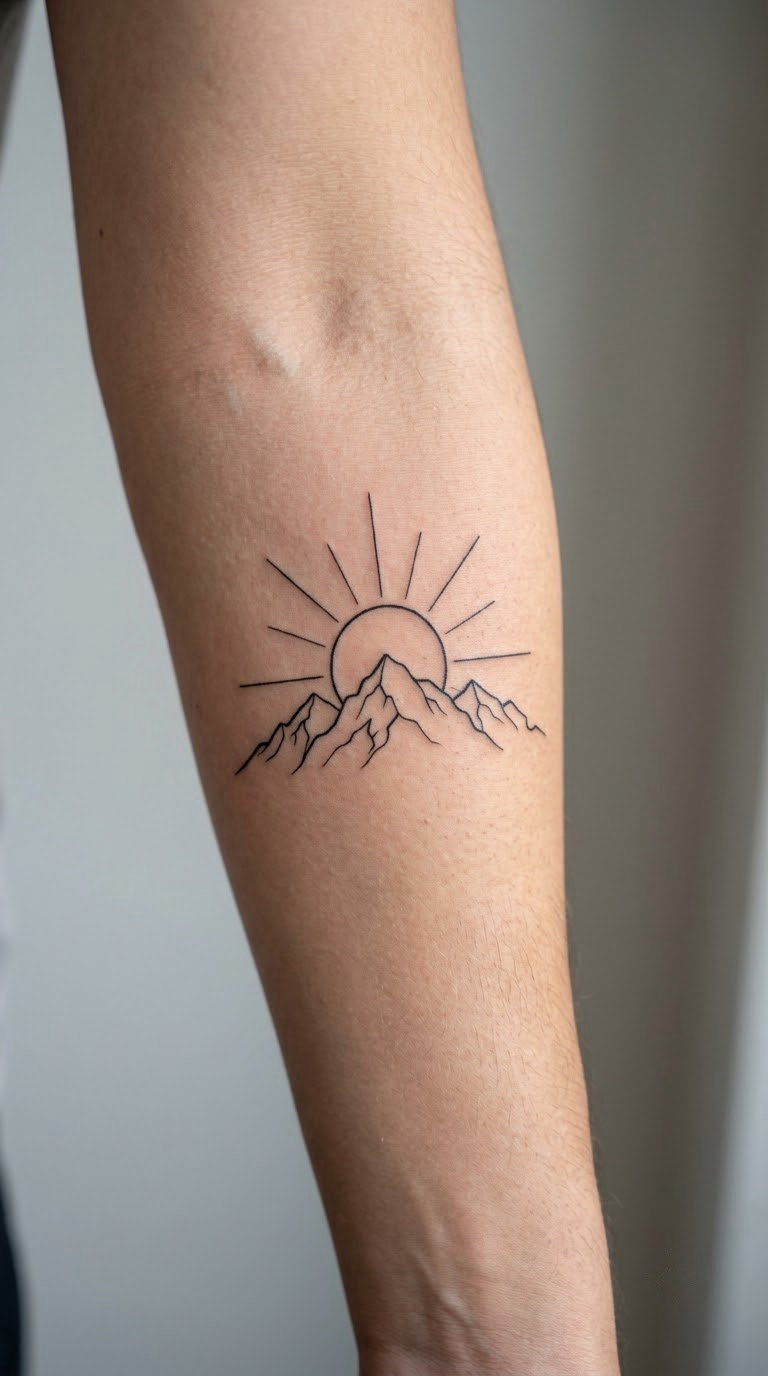
This is the one I send people to when they want their first meaningful tattoo and they are nervous. A thin single-needle horizon sits low, with one or two peaks behind it in soft black-and-grey, and the whole thing reads clearly at three inches across. The line weight matters more than anything else here: single-needle work is beautiful fresh and softer in five years, so ask for a slightly heavier line than the reference photo shows.
The meaning people attach is a fresh start after a climb, which is why it turns up after recovery, a career change or leaving a relationship. A private joke inside the ridge line, or the elevation of a place that mattered, makes it unmistakably yours.
Placement: inner forearm, outer forearm or the flat of the upper arm. Size: 2.5 to 3.5 in (6 to 9 cm) wide. Style: fine line, single-needle with light grey shading. Pain: low to medium on the inner forearm; bony wrists and the elbow crease hurt more. Make it yours: add a single line of coordinates or a date under the horizon.
2. Rising Sun With Alternating Rays
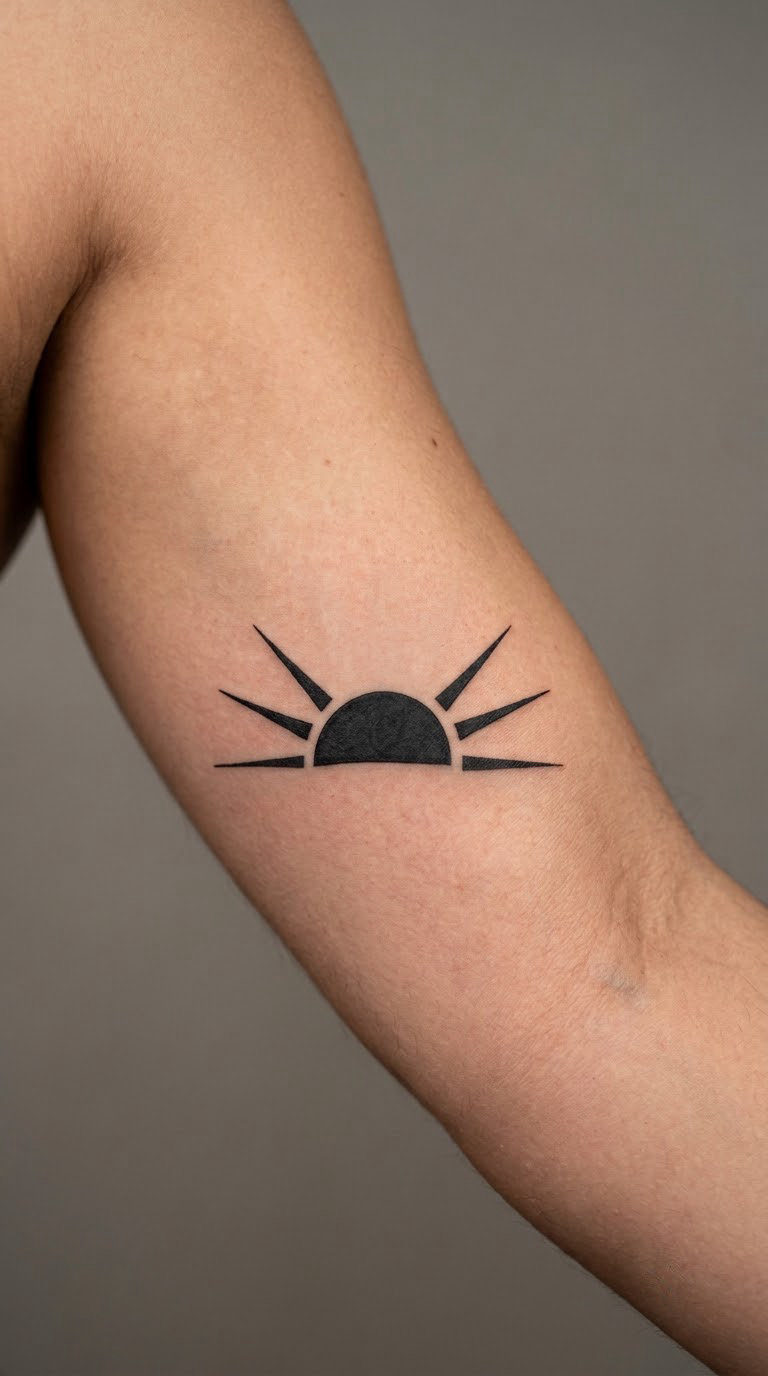
A clean half-circle with long rays of even length gives you a sunrise that looks designed rather than drawn, and the alternating thick-thin rhythm keeps it from feeling plain. Eight rays is the sweet spot: enough to read as light, few enough that the piece stays tidy at two and a half inches. No shading, no colour, one weight of line.
People usually choose it for momentum. The sun is already up and the rays are moving, so it reads as forward motion rather than a static picture, which suits anyone starting something new.
Placement: outer upper arm, shoulder cap, or the back of the forearm. Size: 2 to 2.5 in (5 to 6 cm). Style: minimalist line work. Pain: low, one of the gentlest spots on the body. Make it yours: change the number of rays to a date, or fill a single ray in gold for a quiet flash of warmth.
3. Sunrise Hidden Inside a Half Circle
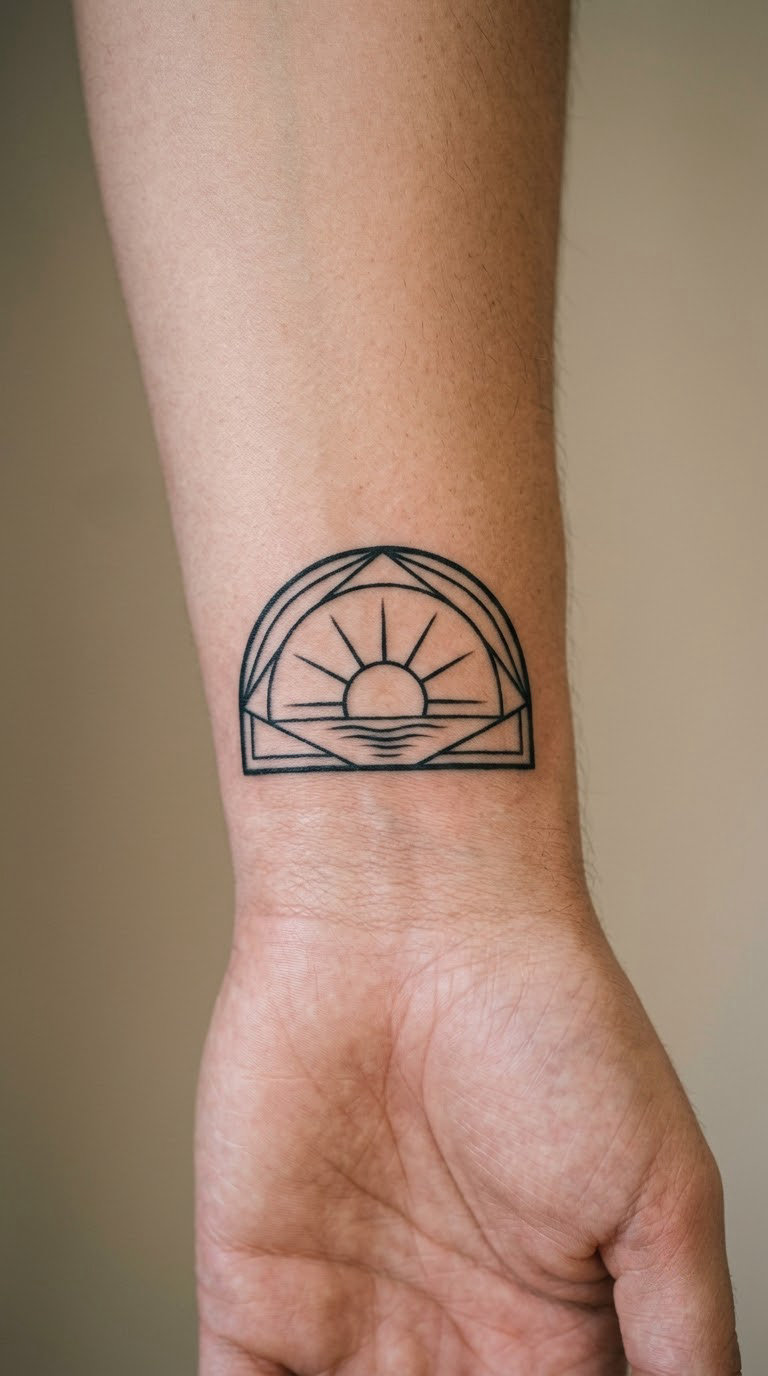
The trick with this one is containment. A thin semicircle outline holds a much smaller rising sun at its centre, so the design has an outer frame and an inner subject, and the eye reads the frame first. Everything stays geometric, which means the piece can be drawn cleanly at wrist size instead of shrinking into mush.
The half circle reads as potential, like something not finished yet, and plenty of people wear it for self-belief during a slow period. A matching partner can take the empty frame with a small sun in a different position, so the two pieces relate without being identical.
Placement: inner wrist, above the elbow, or behind the ear. Size: 1.5 to 2 in (4 to 5 cm). Style: geometric, single-needle. Pain: medium on the inner wrist, low behind the ear. Make it yours: engrave coordinates inside the arc underneath the sun.
4. Golden Sunrise Over Ocean Waves
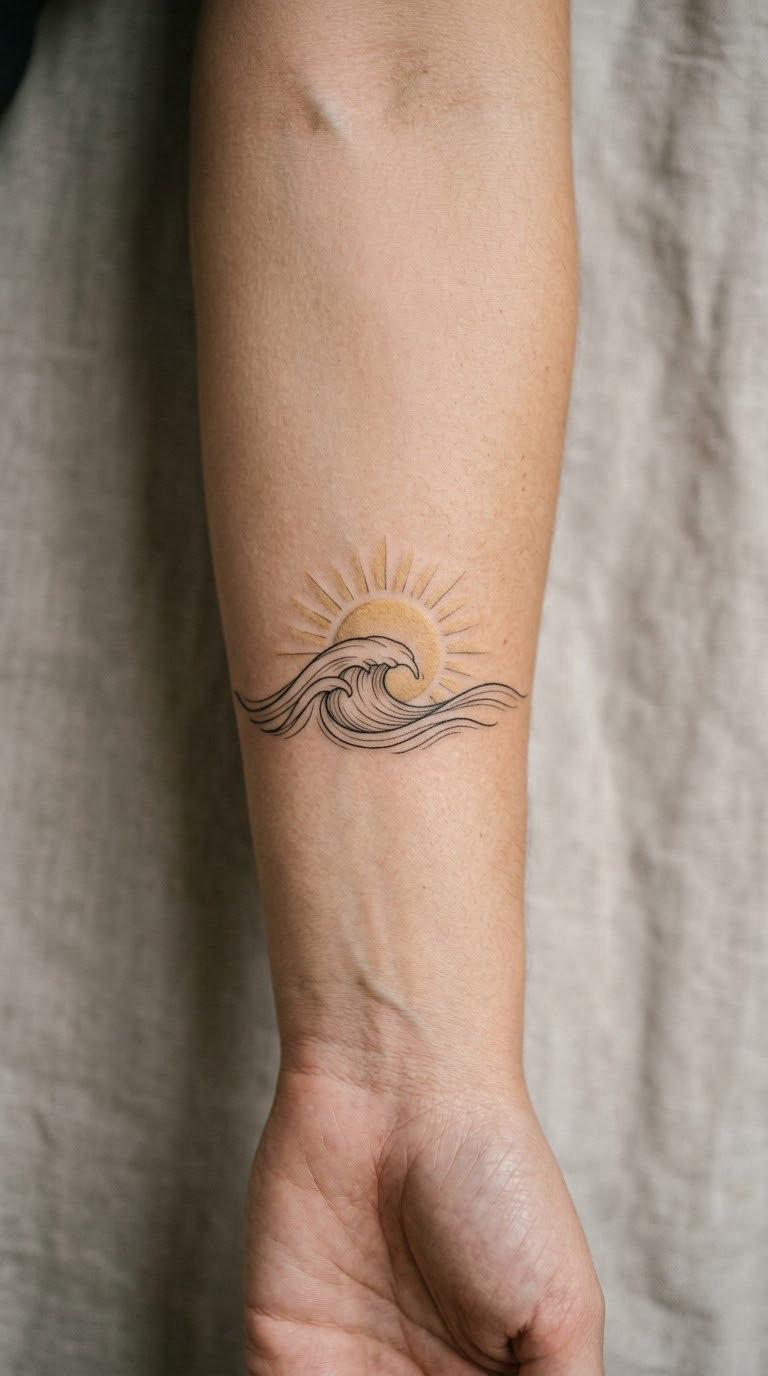
Layered wave lines stack under a low half sun, and a restrained yellow or ochre wash in the sun keeps it warm without turning into a full-colour piece. This is the design that separates itself from a generic wave tattoo, because the sun is the subject and the water is the stage. At four inches the wave detail still has room to breathe.
The reading is calm after turbulence, which is why it comes up around moving to a new city or finishing something that took years. The ocean adds release to the usual new-beginnings meaning, so the whole thing feels less like a fresh start and more like a settled one.
Placement: lower forearm, calf, or across the ribs. Size: 3.5 to 4 in (9 to 10 cm) wide. Style: fine line with a light colour wash. Pain: medium on the forearm, low on the calf. Make it yours: add a small date where the sun meets the water line.
5. Sunrise Framed by Two Mountains
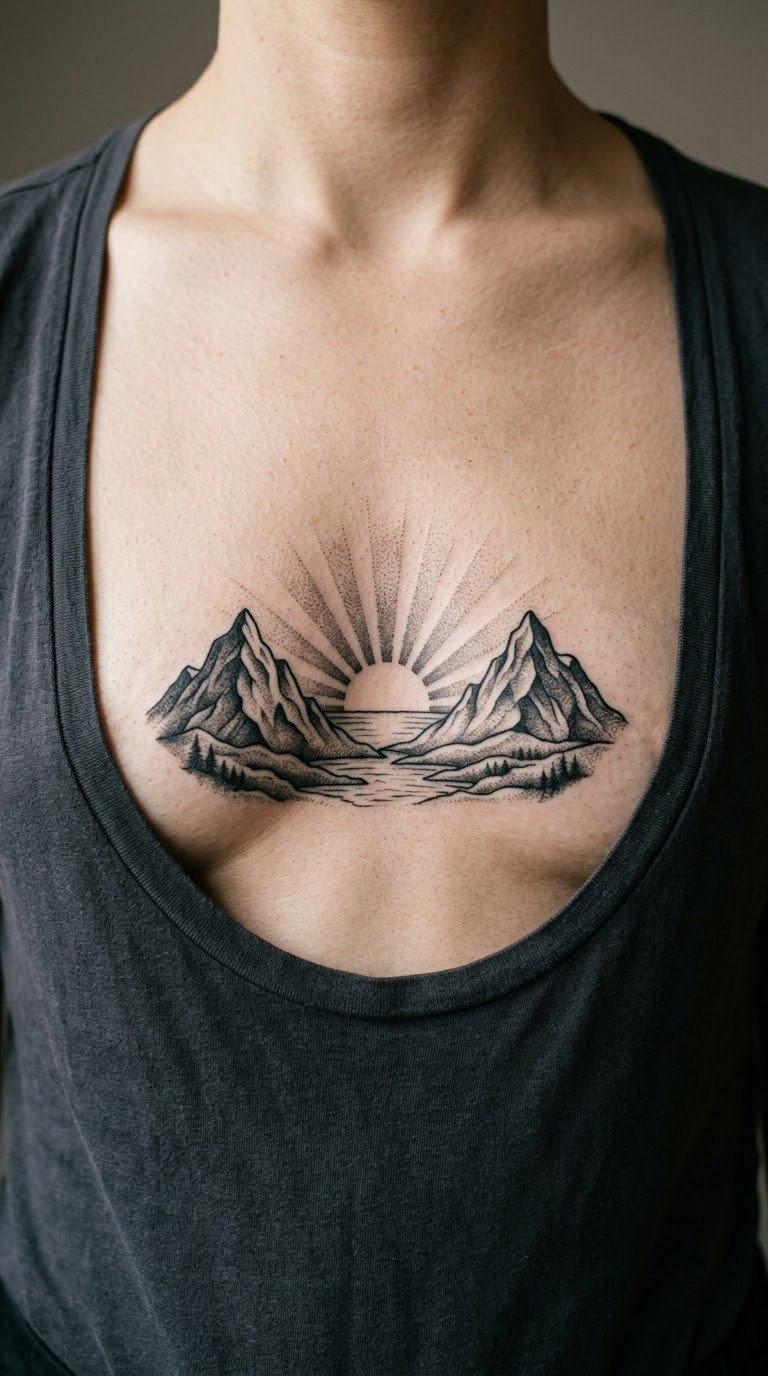
This is the panoramic version. Two mountain silhouettes lean inward, a glowing half sun sits between them, and stippled rays push outward behind the peaks. Symmetry is what carries it, so the two ranges need to mirror each other in weight and height or the composition looks accidental.
The meaning is hope held between two hard things, which fits anyone marking the end of a long illness or a difficult family stretch. Chest and upper back placements let you build the scene at a size where the mountains have real presence, and the extra space means a second session is rarely needed.
Placement: centre chest, sternum, upper back, or across the shoulder blades. Size: 4 to 5 in (10 to 13 cm) wide. Style: blackwork with stipple shading. Pain: high on the chest, medium on the upper back. Make it yours: name the two peaks after two people, or use the silhouette of a ridge you have actually walked.
6. Lotus Emerging From the Rising Sun
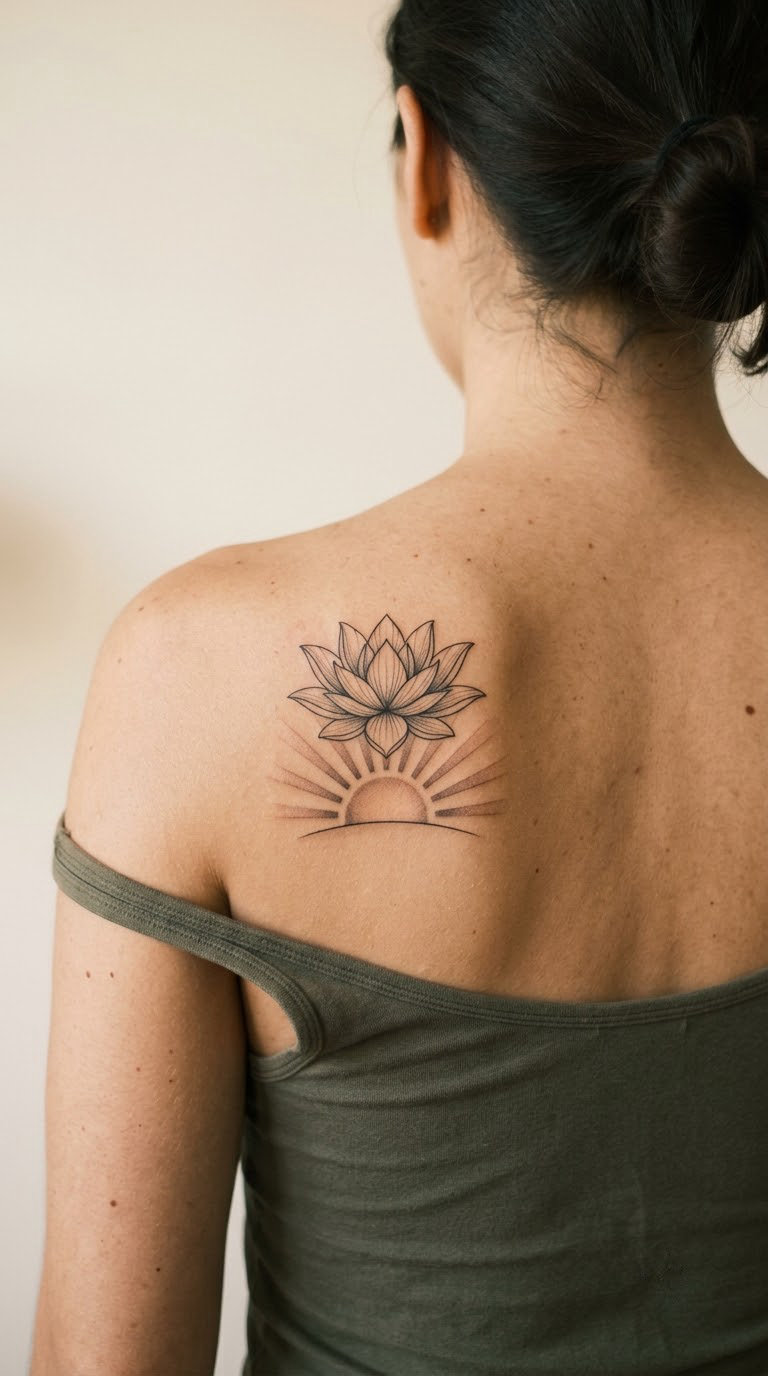
A lotus sits above a small half sun, petals drawn with clean single-needle outlines and one or two veins per petal, and the sun underneath gets a warm orange fill. The two elements stack rather than overlap, which keeps the flower readable when the piece curves around the shoulder blade. Delicate petal detail is what people ask for here, and it is worth the extra time.
Lotus imagery has long carried growth and renewal, and pairing it with a sunrise adds a sense of awakening to that. It is a shared symbol in a lot of traditions, so it sits well as a memorial piece as well as a personal marker. Nobody should tell you it has one fixed meaning, and you should decide for yourself what it marks.
Placement: shoulder blade, outer upper arm, lower back, or the back of the calf. Size: 3.5 to 4 in (9 to 10 cm) wide. Style: fine line botanical with light colour. Pain: medium, more on the ribs and lower back. Make it yours: use your birth flower for the lotus, or tint the sun in a colour tied to the person it marks.
7. Phoenix Rising With the Sun
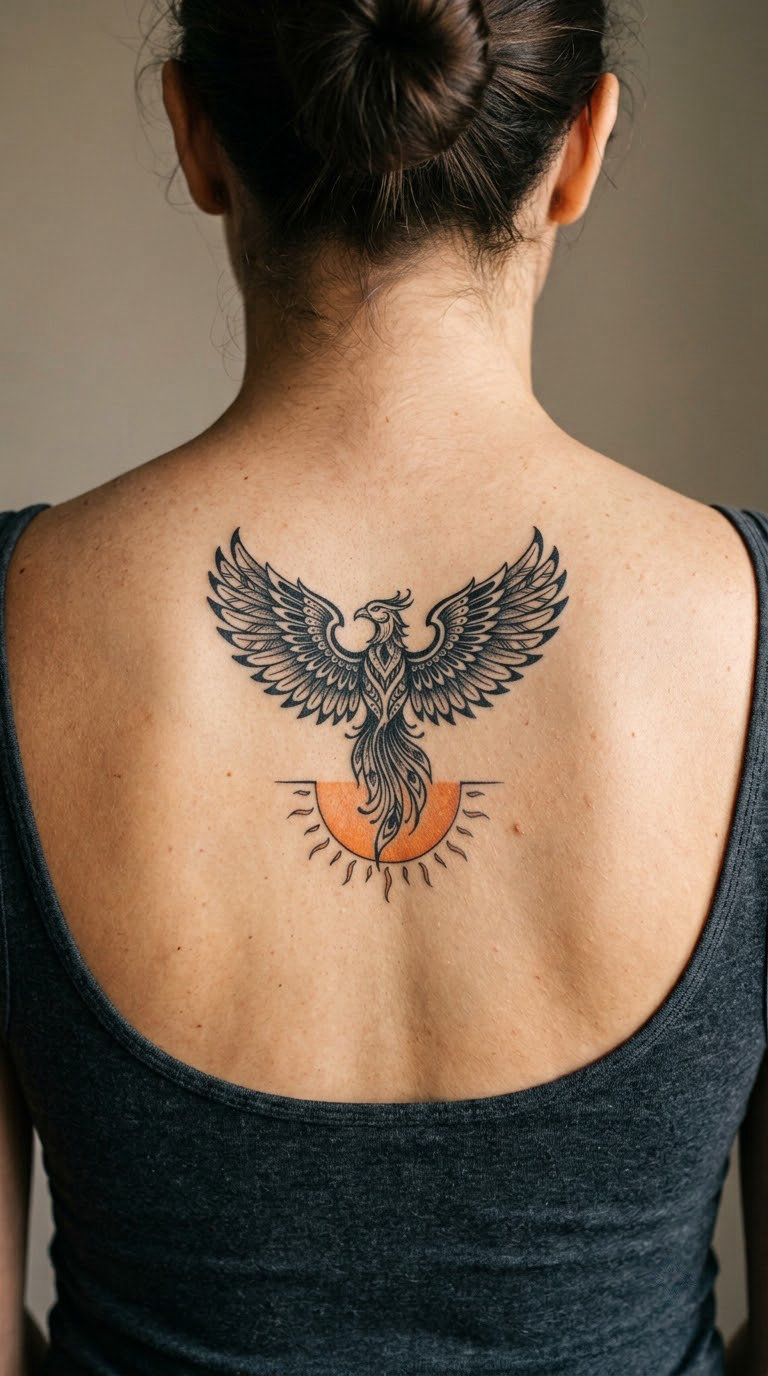
A compact phoenix silhouette lifts out of a semicircular sun, wings swept upward and tail feathers breaking into the open air above it. Broad black wing shapes give the piece its weight, and the sun underneath is the only place colour appears, which keeps a large design from turning muddy. Six inches is small for a back piece, so the composition has to stay graphic rather than detailed.
Rebirth and transformation are the established associations here, and the sunrise reinforces them rather than adding a new idea. It is the right choice for someone who wants a statement piece and does not mind a long sitting. If you want the phoenix without the sun, our guide to phoenix tattoo meaning and design ideas covers the other formats.
Placement: upper back, shoulder blade, or outer upper arm. Size: 5.5 to 7 in (14 to 18 cm) wide. Style: blackwork with one colour accent. Pain: high on the back, medium on the upper arm. Make it yours: have the tail feathers fade into dot work so the bird looks like it is dissolving into light.
8. Sunflower at Sunrise
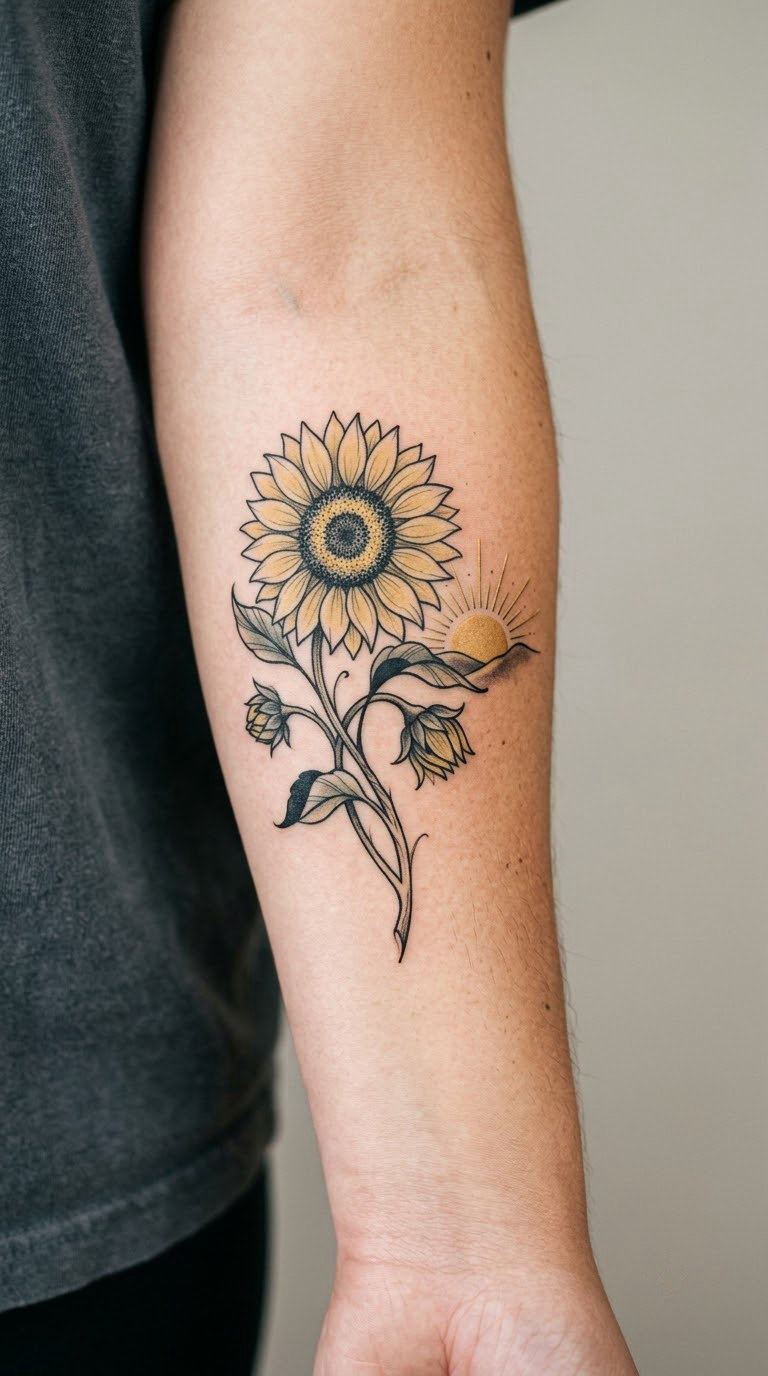
One large sunflower leans toward a small rising sun, the petals built in overlapping rows with muted yellow filling and black line work holding the edges. Botanical realism is the treatment that survives contact with skin, because the seed head gives the eye something solid to land on while the petals stay loose. Above three and a half inches the petal edges will always soften, so plan around that.
Sunflowers are widely read as warmth, loyalty and optimism, and setting one against a sunrise turns both motifs in the same direction. Our guide to sunflower tattoo meaning and design ideas goes deeper on the flower side of the pairing. It works well as a second piece beside an uncoloured horizon, since the colour sits in one place instead of spreading.
Placement: inner arm, outer forearm, shoulder, or the calf. Size: 3 to 3.5 in (8 to 9 cm) tall. Style: botanical realism. Pain: medium on the inner arm, low on the calf. Make it yours: put the number of petals to a date, or have the stem trail into a fine-line horizon line.
9. Sunrise Behind an Open Doorway
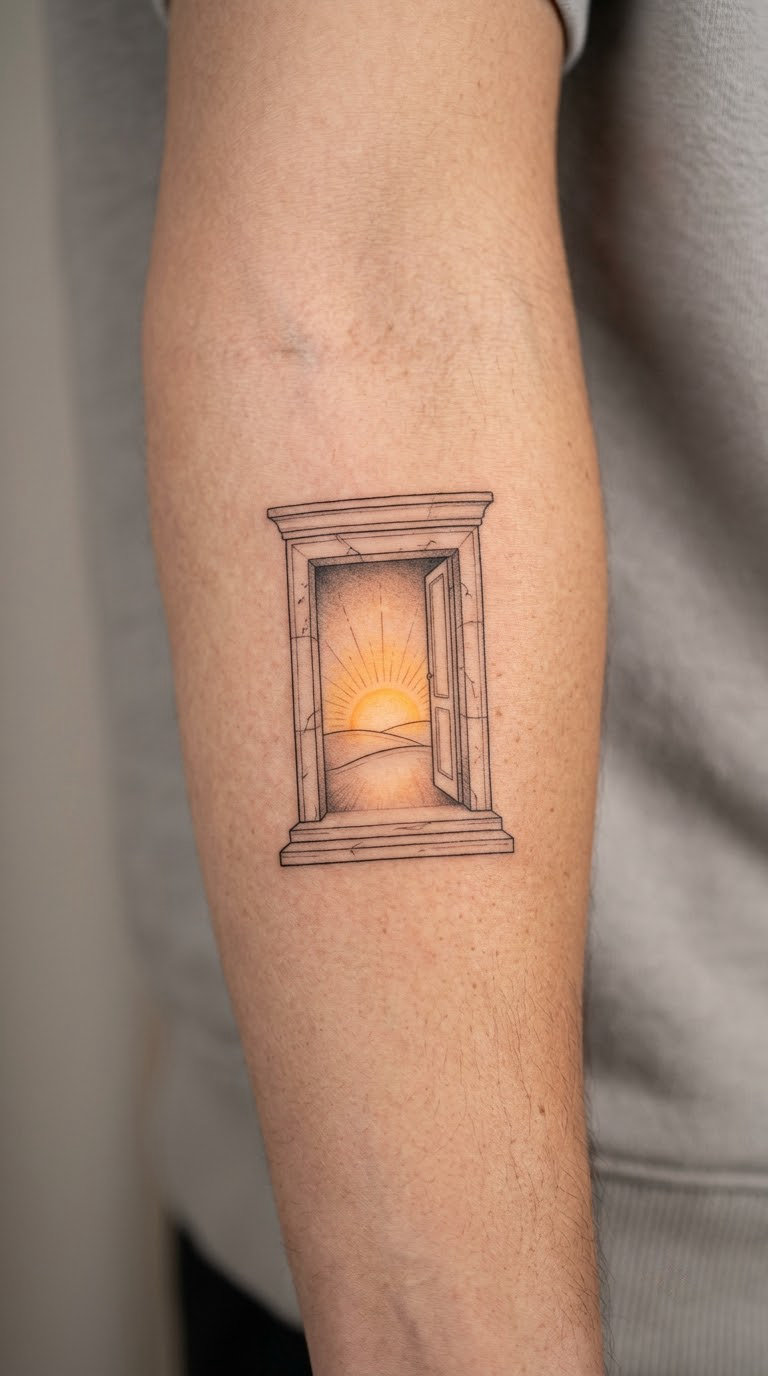
An arched doorway drawn in sparse single-needle lines stands open, and warm yellow light fills the opening with the suggestion of a sun just inside it. The trick is perspective: the artist needs a slight angle on the frame so it reads as depth rather than a flat rectangle, and the light has to stay uncluttered or the whole thing turns into a yellow block. Keeping the architecture simple is what makes it legible at three inches.
This one is about opportunity and transition, a door you have already walked through. It suits someone who has just left a job, a city or a habit, and it is a nice piece to pair with a first tattoo because the concept is easy to explain and hard to regret.
Placement: side forearm, outer arm, or the chest. Size: 2.5 to 3 in (6 to 8 cm) tall. Style: fine line architectural. Pain: low to medium. Make it yours: leave the doorway ajar with a small gap, or put a keyhole in the frame that holds a real date.
10. Sunrise Through a Broken Chain
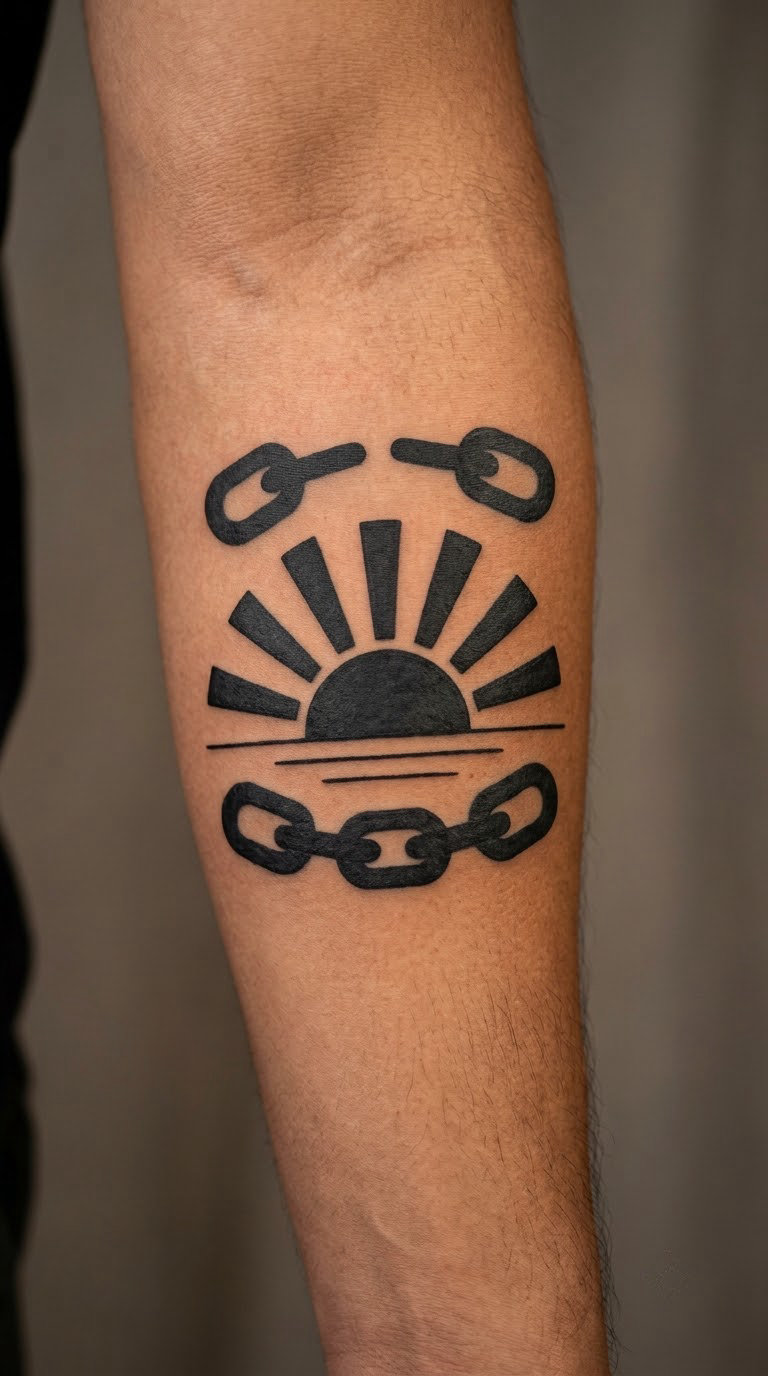
Two separated chain links frame a rising sun with solid rays, and the break is the whole point, so the artist should leave real air between the ends rather than a hairline gap. Bold link shapes are what carry the design; thin chain lines disappear within a few years and take the meaning with them. Blackout on the sun and the links keeps the piece reading at any size.
Freedom and release are the associations people describe, usually after a breakup, leaving a toxic friendship or finishing a rehab programme. Because the chain is still visible, the piece also acknowledges what was there rather than pretending it never happened, which is often the point.
Placement: outer forearm, upper arm, or around the bicep in a loose band. Size: 3 to 3.5 in (8 to 9 cm) wide. Style: bold blackwork. Pain: medium, higher on the inner bicep. Make it yours: have one link drawn in colour and the other left black, so the break is unmistakable.
11. Compass Pointing Toward Sunrise
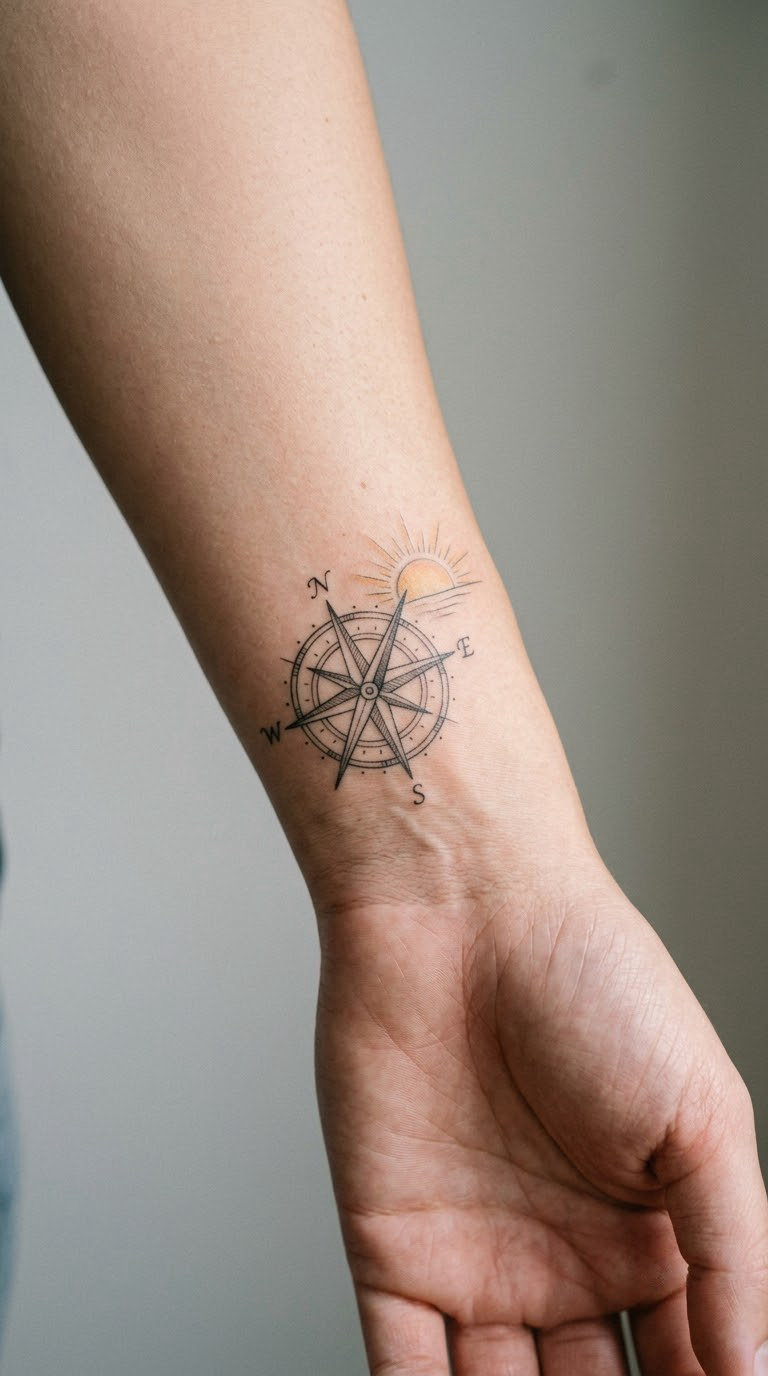
A minimal compass rose with a single needle aimed at a small rising sun does two jobs in one small design. Restrained line weight keeps the compass from competing with the sun, and a small amount of gold in the sun is enough colour. At two and a half inches the artist has to drop most of the cardinal points, which is a good simplification, since four points still look like a compass.
Direction and a personal journey are what people read into it, often tied to a move, a long trip or finishing a qualification. It is also a natural companion to other dated pieces, and a line-style concept like a heartbeat tattoo with meaning can sit on the opposite forearm if you want the two to relate without matching.
Placement: outer wrist, inner forearm, or the back of the hand. Size: 2 to 2.5 in (5 to 6 cm). Style: fine line with one colour accent. Pain: medium on the outer wrist, low on the hand. Make it yours: set the needle to a real bearing, or engrave the degrees the direction represents.
12. Sunrise Behind a Crescent Moon
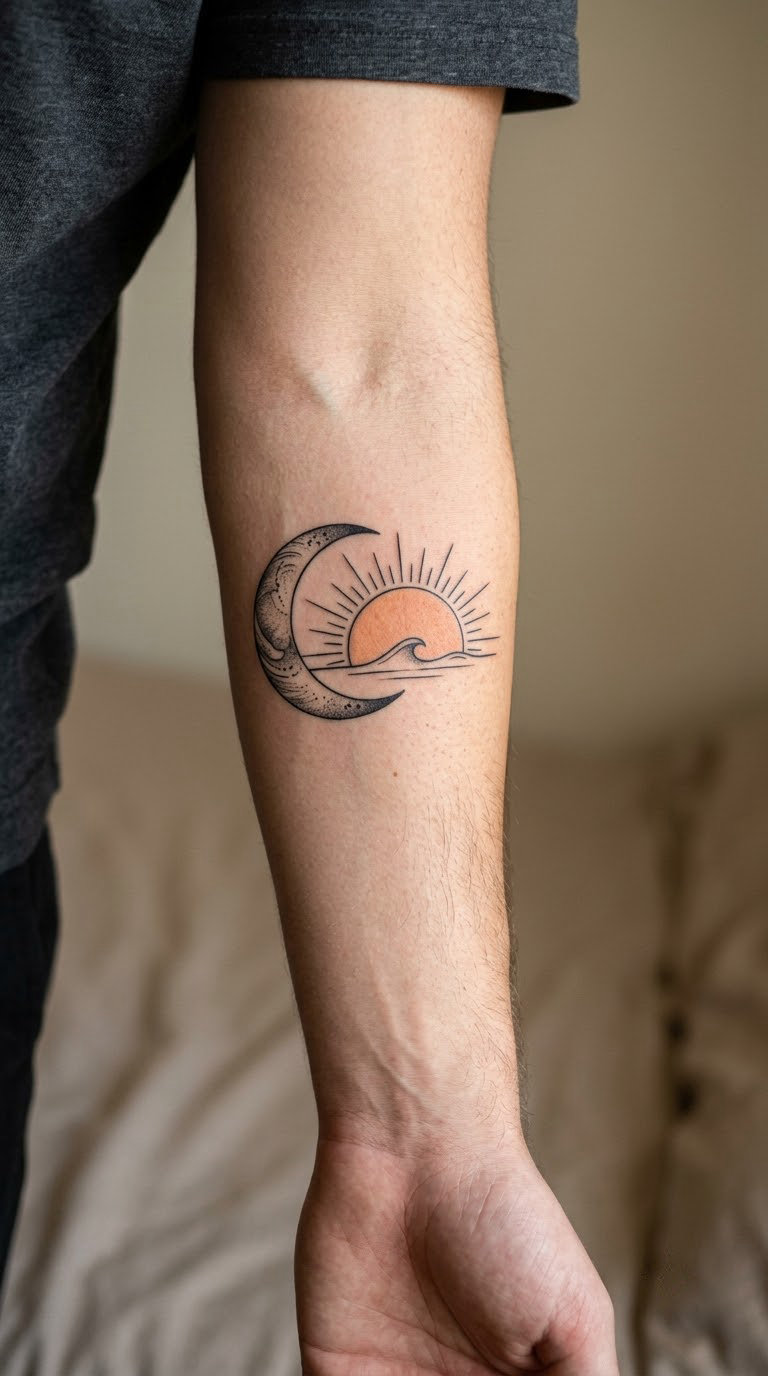
Pairing the two bodies instead of overlapping them is what keeps this design calm. A slender crescent sits to one side, a muted orange half sun to the other, and the space between them does the work. Generous negative space is essential here, because crowding the two shapes together turns a sunrise into a muddled blob within a couple of years.
Most people read the pairing as transition rather than conflict, a moon that is ending and a sun that is starting, which suits a change of season in life. It is a common choice for people who already have moon work and want the sun to sit comfortably next to it rather than argue.
Placement: inner arm, behind the ear, or the ankle. Size: 2.5 to 3 in (6 to 8 cm) wide. Style: black and grey with one warm accent. Pain: low to medium. Make it yours: set the moon and sun on a curved path, as if one is rising where the other set.
13. Sunrise Reflected in a Water Line
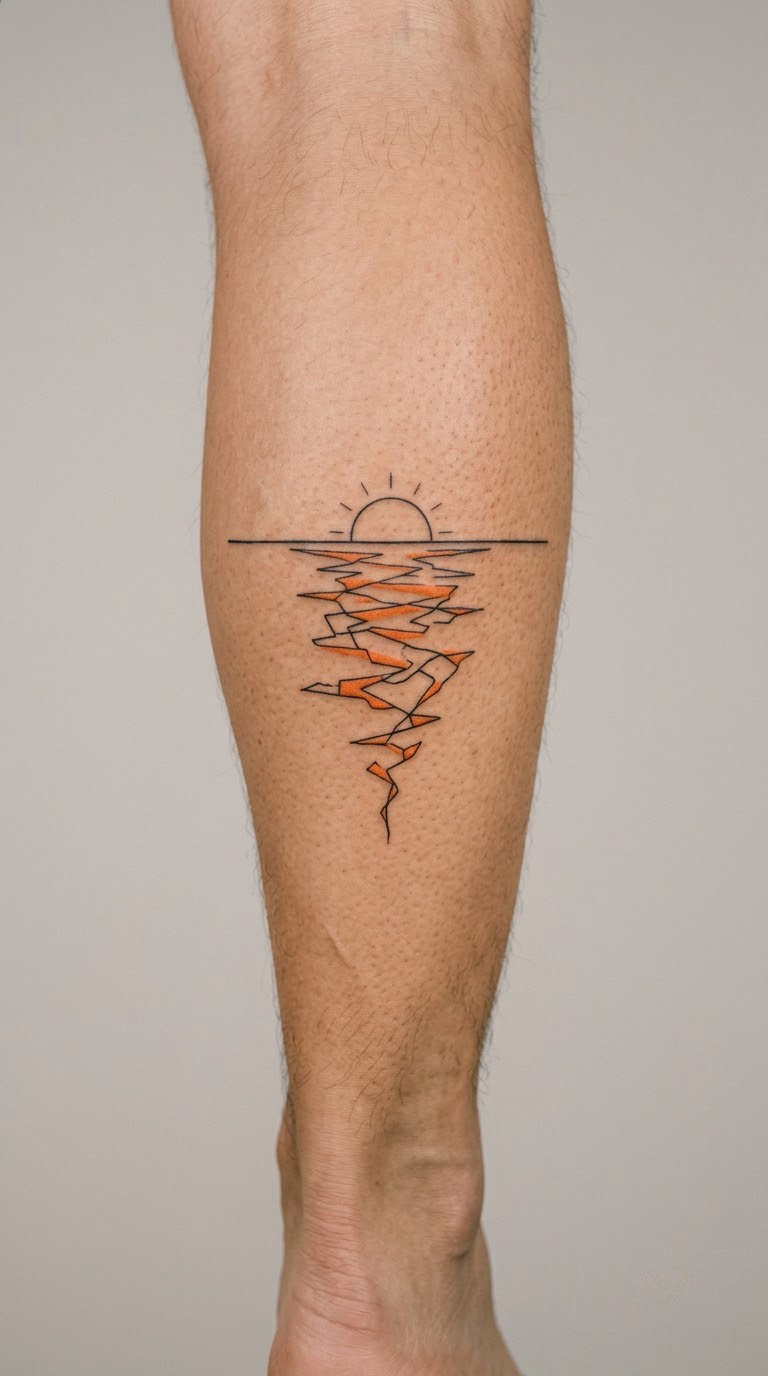
One straight horizon line splits the design, with the sun above and a broken, inverted reflection below in short horizontal dashes. The broken reflection is what separates this from a full wave scene: you get the idea of water in a handful of lines, which is far more durable at small sizes. Keep the dashes uneven and the whole thing looks like a reflection rather than a barcode.
Clarity and emotional change are the themes, and the doubled image works well for someone who wants the meaning visible twice in one piece. A quiet, very small version of this reads nicely just above the ankle bone.
Placement: calf, inner forearm, or the ribs. Size: 3 to 3.5 in (8 to 9 cm) wide. Style: minimalist with light colour. Pain: low on the calf, medium on the ribs. Make it yours: use two reflection lines, one for a person and one for a date.
14. Sunrise at the Edge of a Forest
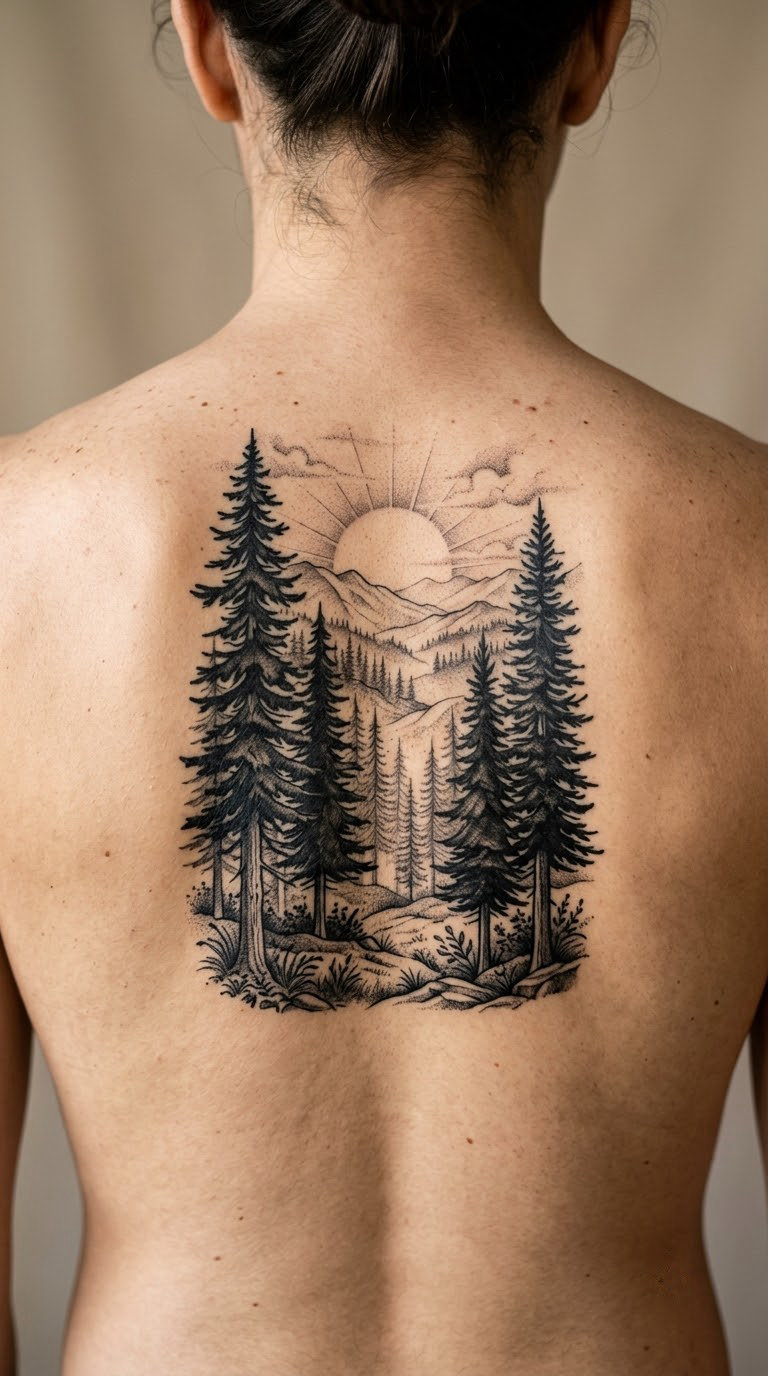
Layered pine silhouettes build a small stand of trees with the sun sitting low behind the front row, and the whole scene is built from depth rather than detail. Bold foreground trees, medium-weight midground trunks and fine background lines give the composition its scale, and the warm sun is the only colour. This is a realistic ageing note worth taking seriously: the faintest background lines will soften noticeably within five years, so keep the rear row simple or accept the fade as part of the look.
Nature imagery here reads as resilience and a fresh start, the sense that something grows back after fire or clearing. It works as a memorial piece for someone who spent time outdoors, and it builds well if you later want to add a second layer of trees without disturbing the sun.
Placement: upper back, shoulder blade, outer thigh. Size: 4.5 to 5.5 in (11 to 14 cm) wide. Style: black and grey scenic. Pain: medium. Make it yours: model the trees on a place you have actually walked, and put the trail you used at the bottom.
15. Sunrise in a Torn Circle
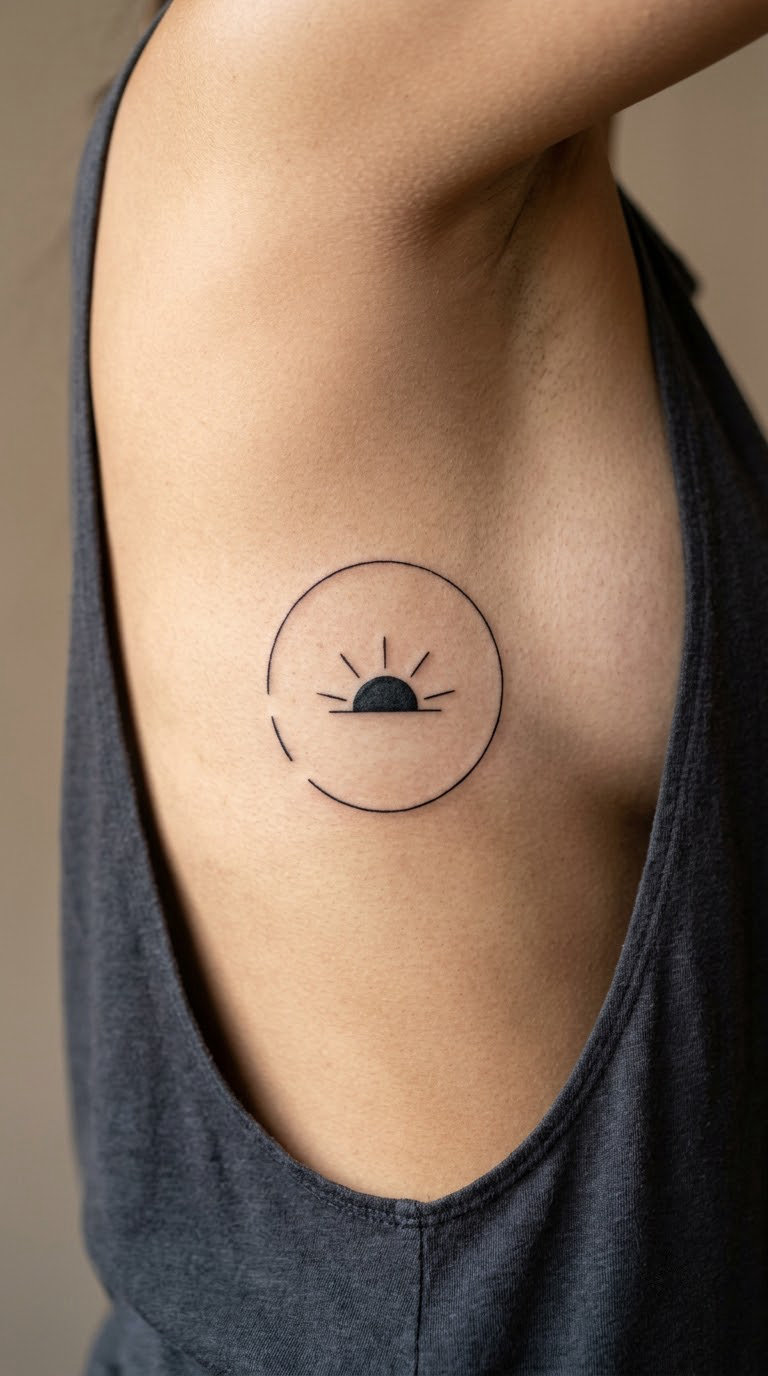
A thin circle is interrupted by a small rising sun, and the circle is not redrawn underneath it, so the sun breaks the boundary rather than sitting inside it. One clean interruption is all it takes. Artists who try to close the gap with tiny connecting lines usually end up with a smudge, and the effect of an open break is what makes the piece read.
The visual language is contemporary and a little architectural, and people usually mean change, finishing something, or leaving a chapter behind. Because the break faces outward, it can be oriented to point east, the direction a sunrise actually comes from, which is a nice detail nobody else will notice but you.
Placement: ribs, inner forearm, or the outer thigh. Size: 2.5 to 3 in (6 to 8 cm) wide. Style: fine line geometric. Pain: medium on the ribs, low to medium elsewhere. Make it yours: have the break sit at a specific clock time, or leave a second tiny break for a second chapter.
16. Sunrise Made From Dotted Light
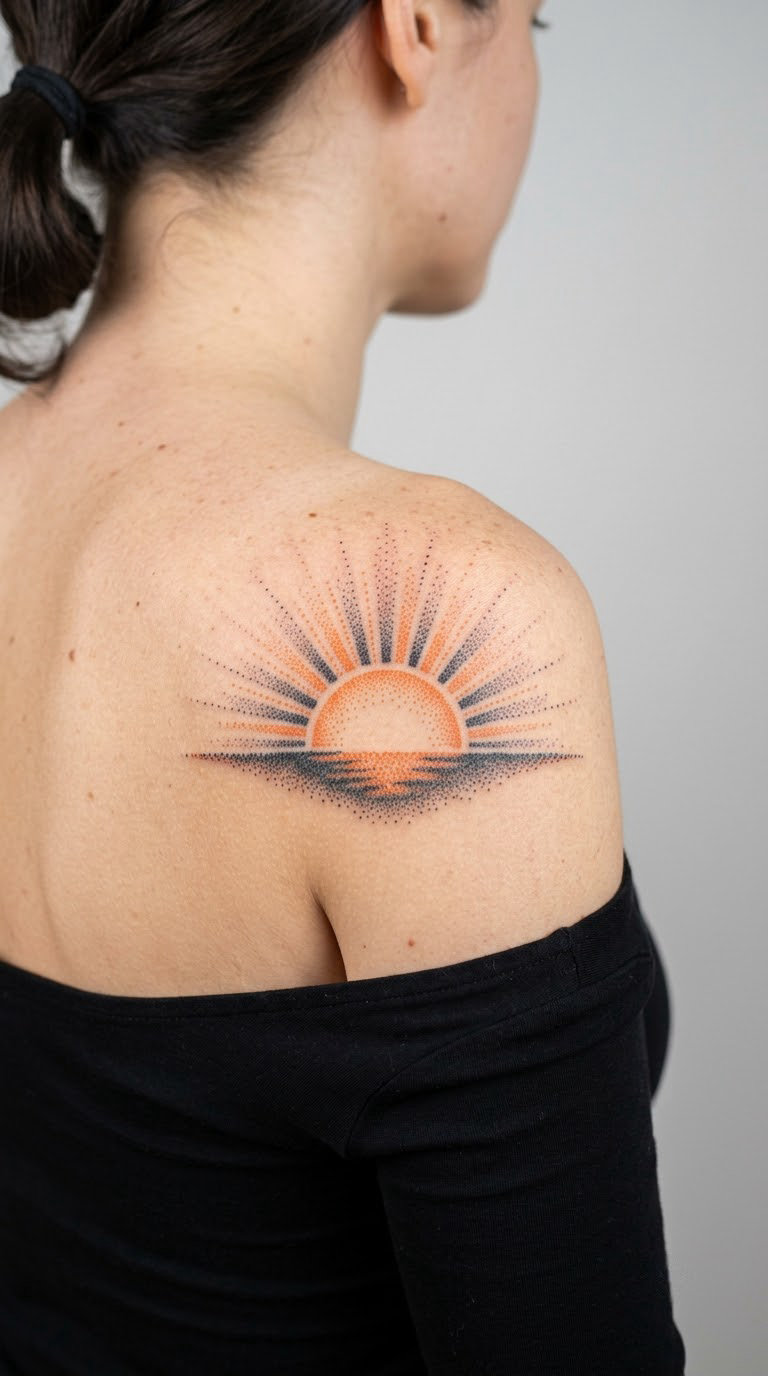
Dots do all the work: dense black at the horizon, orange and black graduating upward, and the rays implied rather than drawn. Density is the whole trick, so the piece has to be placed where skin is flat and even, and the artist will spend real time on it. Once healed, dot work in a warm colour is one of the more forgiving sunrise treatments, provided the black underlayer is solid.
Graduated dots read as warmth spreading, which is why people describe this version as growth rather than a snapshot. It suits a shoulder or upper arm where the curve lets the dot field fall away naturally, and it needs a clear area around it because the fade pattern is visible at the edges.
Placement: shoulder, upper arm, or the upper back. Size: 2.5 to 3 in (6 to 8 cm) wide. Style: dot work, black with one warm colour. Pain: medium, and the session is long. Make it yours: have the dot density follow a gradient from a colour you already carry in another piece.
17. Sunrise in a Traditional Flash Style
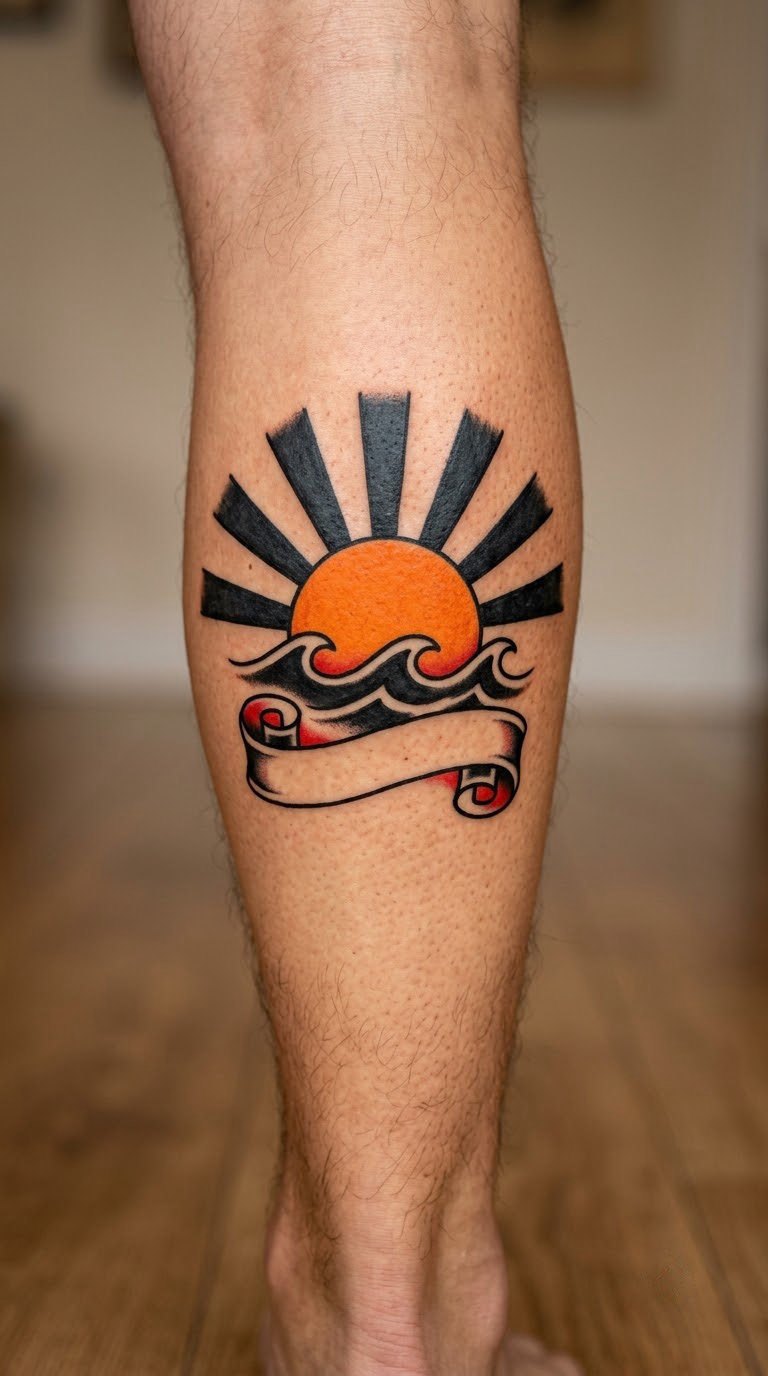
Traditional flash means a bold black outline, flat saturated colour and a semicircle with strong tapering rays, all built on heavy black line work. The clean horizon line and an optional banner underneath are what keep it from looking like a generic sun, because the composition has a base and a frame rather than floating shapes. Traditional line work holds its shape far better than fine line, which is the main argument for it.
Old American flash carries associations of endurance, alertness and working through the dark shift, so this version lands harder than its friendly colour scheme suggests. The blank lower banner can stay empty, which looks deliberate, or take a short word or a set of coordinates.
Placement: calf, outer forearm, or the shoulder. Size: 3.5 to 4.5 in (9 to 11 cm) wide. Style: traditional American flash. Pain: medium. Make it yours: put a word in the banner, or have the rays alternate two colours instead of one.
18. Watercolour Sunrise With Ink-Like Edges
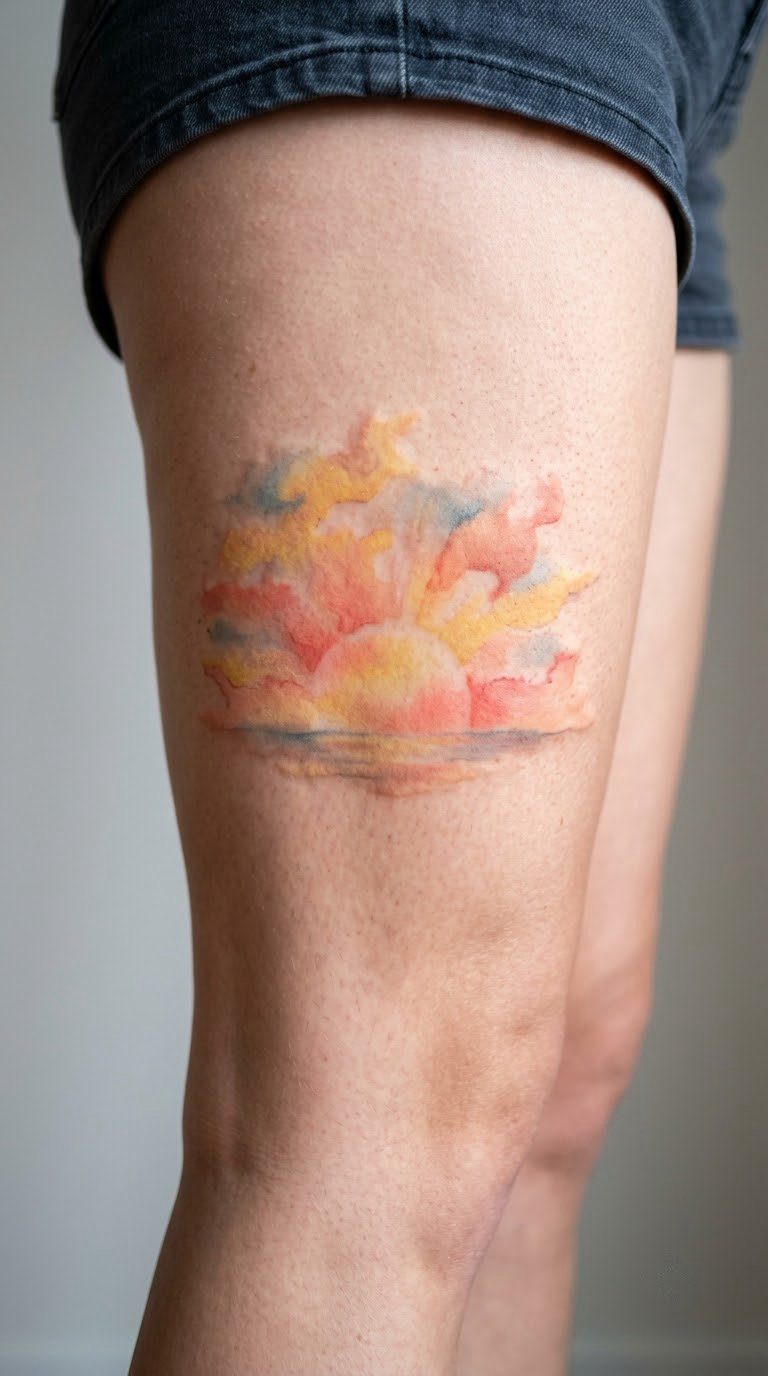
Loose washes of yellow, coral and muted orange bleed into each other with a horizon line that deliberately dissolves on one side. No black outline, which is exactly what gives watercolour its softness and also what makes it fade faster than outlined work, so choose it for a large area where there is room for it. A thigh or a back panel gives the washes somewhere to spread without them turning into a blur on day one.
Optimism and creative expression are the readings, and the unfinished horizon suits anyone who likes the idea of something still in progress. Plan on a touch-up in a few years if the colour matters to you, and keep it out of full sun if you can.
Placement: outer thigh, back panel, or the upper arm. Size: 4.5 to 5.5 in (11 to 14 cm) wide. Style: watercolour. Pain: low, mostly a long session rather than a painful one. Make it yours: have the palette sampled from a photograph of a real sky you remember.
19. Sunrise as a Micro Dot Design
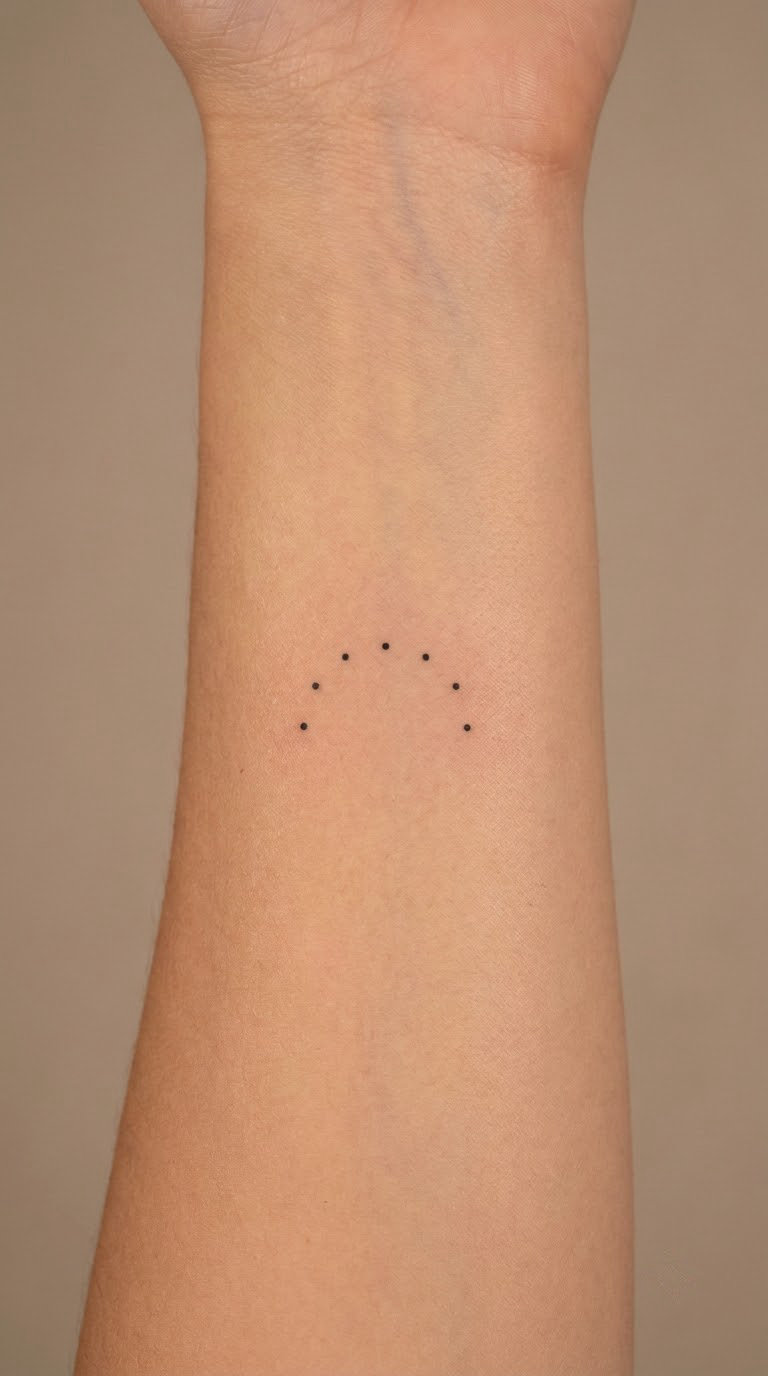
Eight small black dots arranged as a half sun with a single ray is about as small as a sunrise tattoo can get and still read. Anything more and you are back to a normal tiny design. I want to be straight about the limits: at an inch wide, the shape stays simple, the dots stay visible, and there is no room for a horizon line, a landscape or colour without the piece turning into a smudge.
The meaning is first light and quiet beginnings, which suits a subtle piece you do not want to explain to people. The dot pattern is also an easy shape to add to later, so a small sun on one wrist can grow into a set without a redesign.
Placement: inside forearm, behind the ear, or the wrist crease area. Size: 0.75 to 1 in (2 to 2.5 cm) wide. Style: micro dot work. Pain: low. Make it yours: use the number of dots for a date and let the top one be a slightly larger dot.
20. Sunrise Emerging From a Hand or Lotus
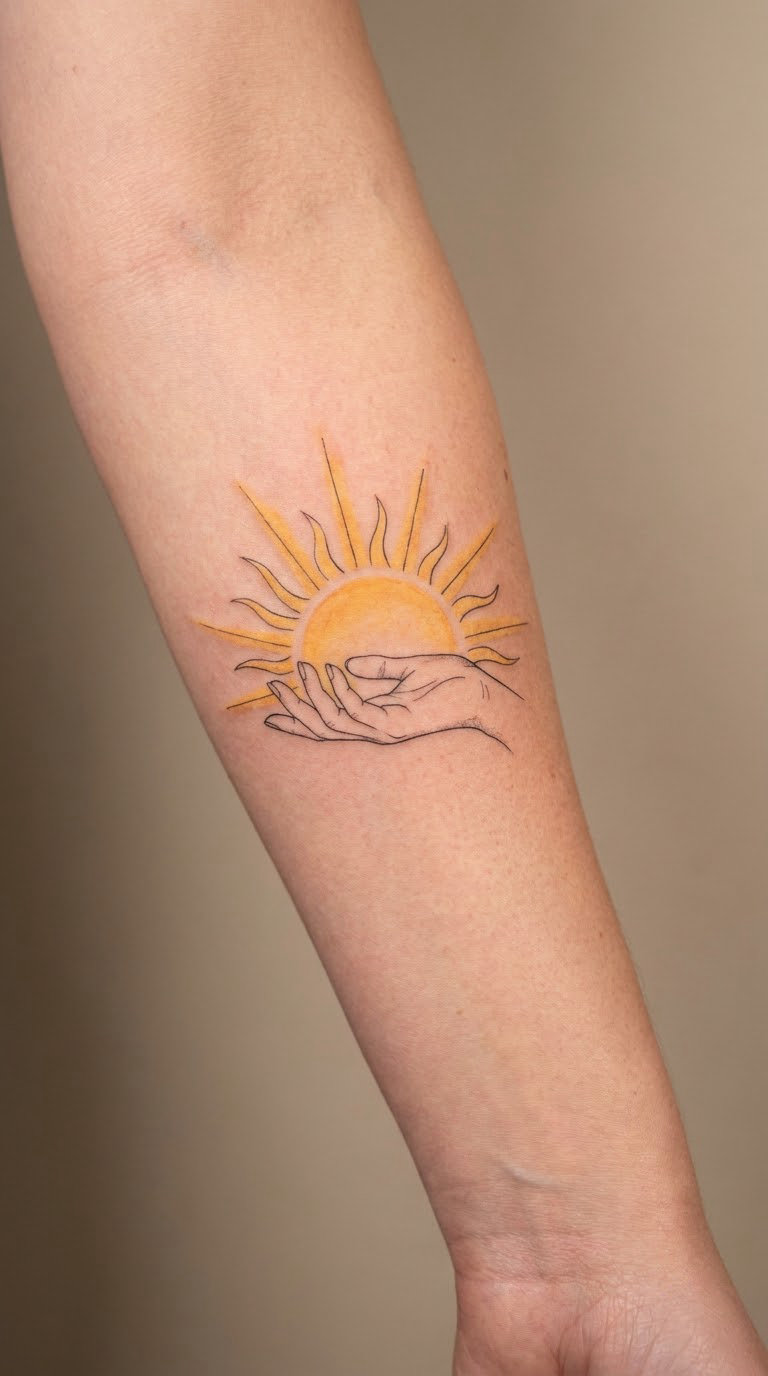
The largest single-motif composition in this list: an open hand, palm up, with a rising sun sitting above the palm and warm yellow rays lifting between the fingers. The anatomy has to be clean, and the fingers need enough space for the rays or the two fight each other. A lotus version of the same idea works identically, with petals instead of fingers, and both read as something being held rather than something being seen.
Support, awakening and renewal are the associations, and the cupped hand adds care or protection to the usual sunrise meaning. It is a strong piece for a parent, for a recovery, or for anyone who wants warmth in the design rather than sharpness. It needs clear skin around it, since the hand and the rays are competing for attention.
Placement: inner forearm, outer thigh, or the chest. Size: 4 to 4.5 in (10 to 11 cm) tall. Style: fine line realism with light colour. Pain: medium, more on the wrist end. Make it yours: have the rays echo a birthmark or scar shape on your own hand, placed in the negative space.
How to Choose the Right Design
Check that the meaning still works later
The most common regret in this theme is not the artwork, it is the story. Tattoo communities talk constantly about designs tied to one hard year that stopped being true later, and the advice they keep landing on is to pick something you would still want in twenty years. A sunrise about recovery is fine if you are at peace with it being about that forever. A sunrise that is really about one person is a different commitment.
Look at it at the size it will actually be
Most disappointment comes from shrinking. Ask the artist to draw your concept at 2 inches, at 3 inches and at 5 inches, then choose the version that still says sunrise. If the small version needs a landscape to work, the design is too detailed for the spot you have in mind. Simpler line work and fewer rays fix most size problems before they happen.
Decide how much fade you can live with
Colour fades first, and it fades fastest without a black outline. Blackwork and traditional line work hold their shape longest; watercolour and colour-only rays need a touch-up every few years; single-needle fine line softens noticeably within about five. Wrists, fingers, ankles and the elbow crease wear fastest, and fine line there is the most common thing people regret. This matters for planning, not for cancelling.
Match the style to the spot
Flat, high areas like the outer arm, thigh and upper back give fine line and watercolour the space they need. Curves such as the elbow, shoulder cap and ribs eat detail, so designs with rays or petal edges get lost there. A doorway or compass needs a flat plane, while a phoenix or a forest scene needs room for silhouettes to be big enough to read.
Bring the artist a conversation, not a screenshot
Artists are suspicious of traced references and much more interested in a reference folder plus a sentence about what you want. Tell them the size you have in mind, the placement, the line weight you like, and what the piece means. They will tell you what will not survive at that scale, and they are right most of the time. If you already have work nearby, mention it so the sizes and styles match.
Cost and Session Time
Most US shops charge by the hour, and a flat price gets you a flat piece only if the artist agrees the design is simple. For a sunrise tattoo, the ranges below are what you will usually hear for a single session, before any shop minimum.
- Tiny, under 1 inch: roughly 80 to 150 US dollars, 20 to 40 minutes.
- Small, 1 to 3 inches: roughly 150 to 300 US dollars, under an hour.
- Medium, 3 to 5 inches: roughly 300 to 700 US dollars, one to two hours.
- Detailed or large, over 5 inches: roughly 700 US dollars and up, two to four hours, sometimes split across two sessions.
Watercolour, dot work and large blackwork pieces usually need a second sitting because they are time-consuming rather than large. Shop minimums, city rates and artist experience move these numbers a lot, so treat them as a starting range and ask for an estimate before you commit to a design.
Aftercare Basics
- Follow your artist’s aftercare instructions first. They know what they did to your skin, and their advice outranks anything general.
- Wash the area gently twice a day with unscented soap and lukewarm water, then pat it dry rather than rubbing it.
- Keep it moisturised with a plain, fragrance-free ointment or lotion, and apply a thin layer rather than a thick one.
- Protect it from sun for the whole healing period and long after, since sunlight is the main cause of colour fade.
- Do not pick, scratch or peel the flaking skin. Let it come away on its own and the patchy stage will be over sooner.
- Give the tattoo room to breathe. Loose clothing over the area for the first few days prevents sticking and scuffing.
Frequently Asked Questions
What do sunrise tattoos usually symbolize?
A sunrise tattoo most often symbolizes new beginnings, hope, resilience and the end of a difficult period, because the sun rising after darkness is a fact rather than an abstract wish. People choose it after recovery, a sobriety date, a move, a breakup or a new job. The meaning shifts with what you add: mountains bring perseverance, an ocean horizon brings calm and release, a doorway brings opportunity, a lotus brings spiritual renewal, and a broken chain brings release from something that was holding you.
Where is the best placement for a small sunrise tattoo?
The inner or outer forearm is the easiest place to read a sunrise at small sizes, because the skin is flat and the piece sits where you can see it. Behind the ear and the inside forearm work well too, and they are quieter. Avoid the wrist crease, fingers and ankles for anything fine-lined, since those areas wear the fastest and a thin horizon will soften within a few years.
Do sunrise tattoos have to include colour?
No. Plenty of the strongest sunrise designs are pure black and grey, and black line work holds its shape longer than colour, which fades faster. If you want warmth, a single muted yellow or orange in the sun is usually enough, and it keeps the colour in one place so fading is easy to live with. Watercolour versions look best on larger areas such as a thigh or back panel.
How much do sunrise tattoos cost in the US?
In the US, a tiny sunrise under one inch usually runs 80 to 150 US dollars, a small piece of one to three inches around 150 to 300, a medium three-to-five-inch piece roughly 300 to 700, and large detailed work from 700 upwards. Most artists charge by the hour, and shop minimums, city rates and complexity all push the final number around. Ask for an estimate before the design is final.
Will a tiny sunrise tattoo stay clear over time?
A tiny sunrise stays clear if it stays simple. Eight or nine dots arranged as a half sun with one ray will still read in ten years, while a tiny version of a detailed landscape will blur into a smudge. The real risk is placement: wrists, fingers, ankles and the elbow crease wear out faster than arms and thighs, so keep fine line off those areas or accept a touch-up.
Conclusion
If this is your first meaningful tattoo, go with the fine-line sunrise over a mountain ridge on the inner forearm. It reads clearly at three inches, it is quick, and the horizon line carries the whole meaning on its own. The phoenix rising with the sun or the golden sunrise over ocean waves make more sense when you are already building a collection and want a piece with real presence on the back or the forearm.
Start by saving five or six references that mean something to you, note the size and placement you actually want, and take all of it to a consultation. The artist will tell you what will survive at that scale, and that conversation is the difference between a sunrise tattoo you still like in twenty years and one you regret.