
8 Phoenix Tattoo Meaning and Design Ideas (September 2026)
Phoenix tattoo meaning and design ideas is a search people arrive at with two questions running at once: what does this bird actually stand for, and which version of it should I get inked. The phoenix is the fire bird that burns down and rises from its own ashes, which makes it the most requested symbol of starting over in tattooing. Below is the meaning first, then eight designs specific enough to bring to a consultation.
Healing takes four to six weeks before you can judge the real colour, so plan ahead. Book now for something healed and settled by summer.
What Does a Phoenix Tattoo Symbolize?
A phoenix tattoo symbolizes rebirth and resurrection first: the bird burns to ash and comes back. Everything after that is secondary, and the meanings people build around it are hope, resilience, transformation, renewal and new beginnings. The detail that matters is that the ashes stay in the picture, so the symbol never promises a free win.
- Rebirth and resurrection — the core meaning, straight out of the Greek myth.
- Resilience — surviving something that had every reason to end you.
- Hope — specifically hope that arrives after the worst part, not before it.
- Transformation — becoming a different person rather than the old one restored.
- New beginnings — a new city, a new trade, a clean chapter after a collapse.
- Spiritual growth — renewal of the self, and in the older traditions, an immortal soul returning.
- Unrelenting spirit — the version that keeps burning and keeps coming back, however many cycles.
In practice the reason is almost always personal and specific. People get this bird to mark recovery from illness, a sobriety anniversary, surviving grief, leaving an abusive relationship, or the end of a career they had poured ten years into. Long-term owners tend to describe it as something that is theirs rather than a shared symbol, and that private reading is exactly what makes it hold meaning.
What does a phoenix symbolize spiritually?
On a spiritual level the phoenix stands for the soul surviving its own ending. In Greek tradition the cycle is literal and repeated; in the Persian Simurgh it becomes wisdom and healing; in the Egyptian Bennu it is tied to creation beginning again with each new era. The shared idea is that the fire is not the enemy of the self, it is the process that renews it. Christians often read the bird alongside resurrection imagery, and some Buddhists read it through cycles of death and rebirth rather than any single god.
Is a phoenix tattoo good or bad luck?
It is broadly a positive symbol and people rarely read it the other way. Some ancient writers described a young phoenix carrying a cask of its own ashes to be born again later, and that detail sometimes floats through as the bird burying its past, but even that version finishes in renewal. Community consensus treats the phoenix as one of the most auspicious symbols you can wear. The only caution worth having is about the artwork, not the meaning: a poorly drawn fire bird can look like a generic eagle with a tail.
What does a phoenix tattoo mean in the Bible?
Short answer: it is not in the Bible, and the resurrection link people sense is a typological parallel rather than a reference. It resembles promises such as Revelation 3:12, where a new name is given to those who endure, and the way John’s passion narrative reads Old Testament signs through details of the crucifixion. If you want a bibally grounded design, the phoenix is the wrong bird to lean on. Its actual roots are Greek and Egyptian, and it is honest to say so.
Where the Phoenix Symbol Comes From
The phoenix is not one bird with one story. It is a family of sacred fire birds that each culture built for itself, and confusing them is the most common mistake in phoenix tattoo content.
- Bennu (ancient Egypt) — a heron-like bird linked to Ra and to creation itself, returning with each new era. It marks beginnings rather than fire.
- The Greek phoenix — the version that burns and rises, associated with cycles, long life and renewal. This is the one nearly every phoenix tattoo is actually based on.
- Fenghuang (China) — harmony, virtue and the balance of yin and yang. It does not burn and it does not rise from ashes. If you are tattooing a Fenghuang, be clear that it is a different bird.
- Hou-ou (Japan) — a phoenix of the sun and of the ruler’s virtue, carried into Japan from the Chinese tradition. Again, no burning cycle.
- Simurgh (Persia) — ancient, wise, and associated with healing and good fortune. Its feathers carry cure.
- Thunderbird — in several Indigenous North American traditions, a powerful sky and storm being. Related in spirit, not the same creature.
Getting this right matters at the appointment, not just in conversation. Artists who work in Japanese or Chinese traditions will absolutely notice if you call a Fenghuang a burning phoenix, and the correction usually makes for a better tattoo.
8 Phoenix Tattoo Design Ideas to Save
Each of these is a distinct concept rather than the same bird redrawn, and each works at a different scale. The style, placement and ageing notes are there so you can talk to an artist with something more useful than a screenshot.
1. The Rising — watercolour wings on the forearm
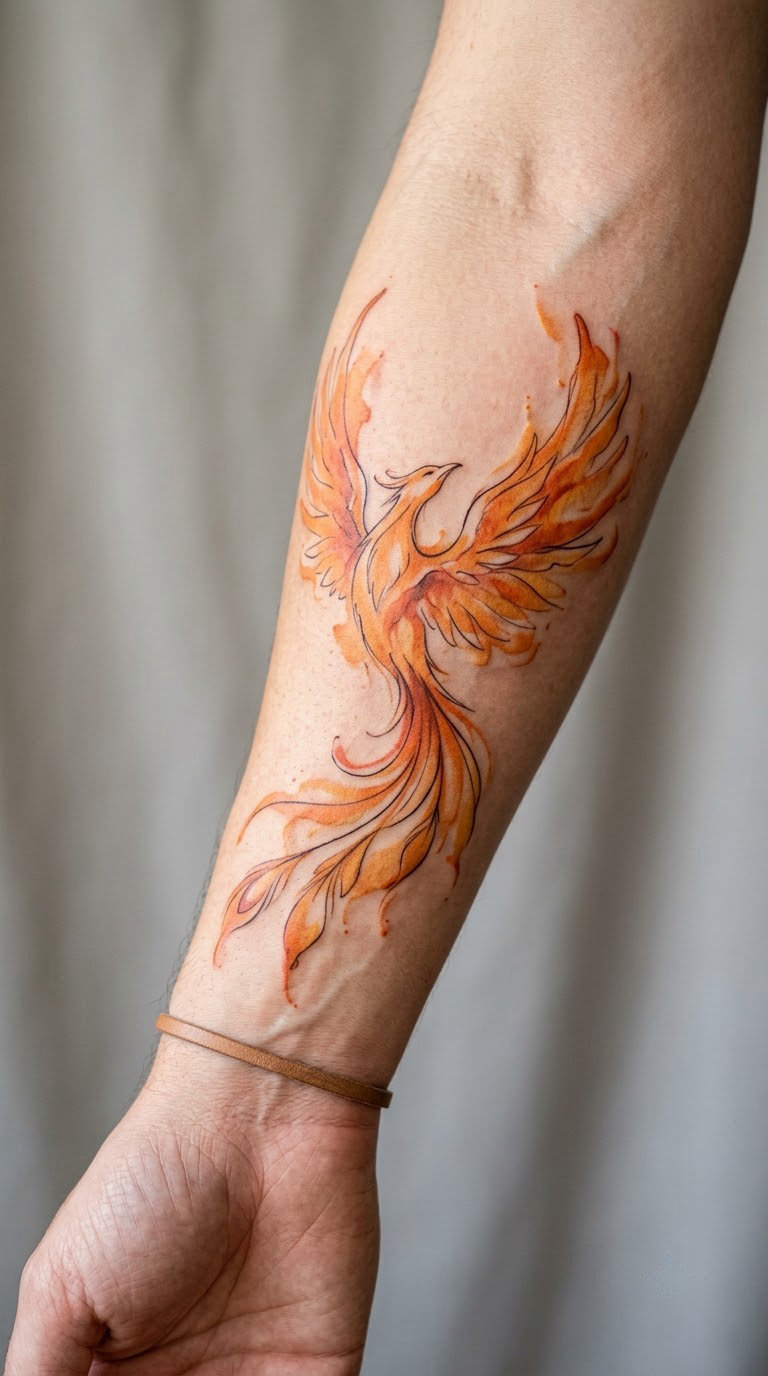
The Rising is a bird caught at the moment it clears the ground, one wing higher than the other, with colour bleeding off the feather tips like wet paint. It reads as movement rather than a portrait of a bird, and watercolour suits it because the pigment fades unevenly in a way that looks intentional. The wash is forgiving of the small line detail that traditional style cannot hold at this size.
Inner forearm or the front of the upper arm, roughly 15 to 20 centimetres tall, and it stays readable because the shape is a gesture rather than a detail. Expect the soft edges of the wash to soften further over about five years, which is usually the point. Pain and time: inner forearm sits around a 5 out of 10 and a piece this size is one session of two to three hours.
2. The Wrap — a phoenix curving around the forearm or thigh
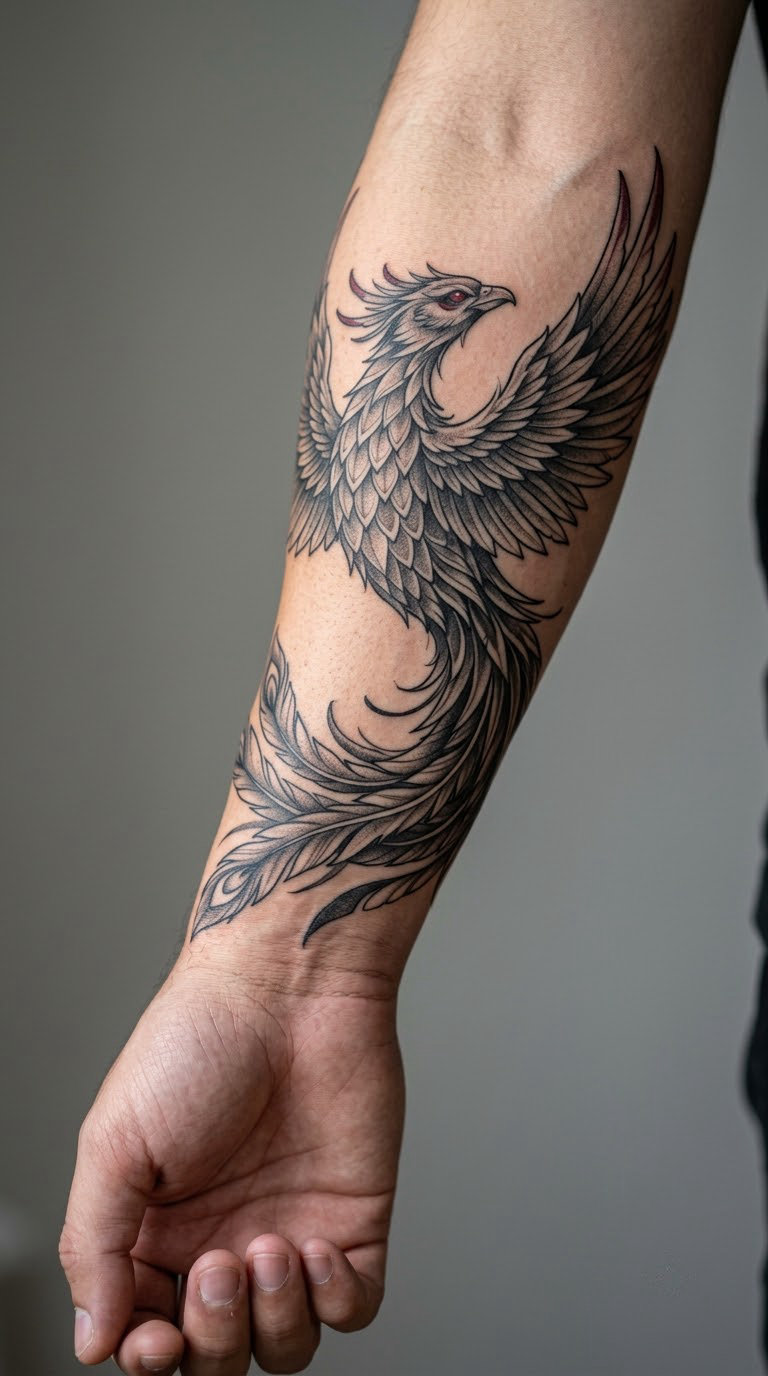
The Wrap treats the limb as the curve itself. Tail feathers follow the forearm around toward the wrist while the head and chest sit above the elbow, so the bird looks like it is circling the arm rather than perched on it. It is the version that reads most like armour, and it is a good answer to people who want a big piece on a small canvas.
Forearm, calf or thigh, and the design has to be drawn for the specific limb because the feathers stack and overlap to fake volume. Heavy black and grey shading holds up far better than saturated colour here, and the piece ages well. Pain and time: the arm is around a 5, the calf closer to 4, and this is usually a long sitting of three to four hours rather than a quick one.
3. The Ember Burst — a fine line bird for a small spot
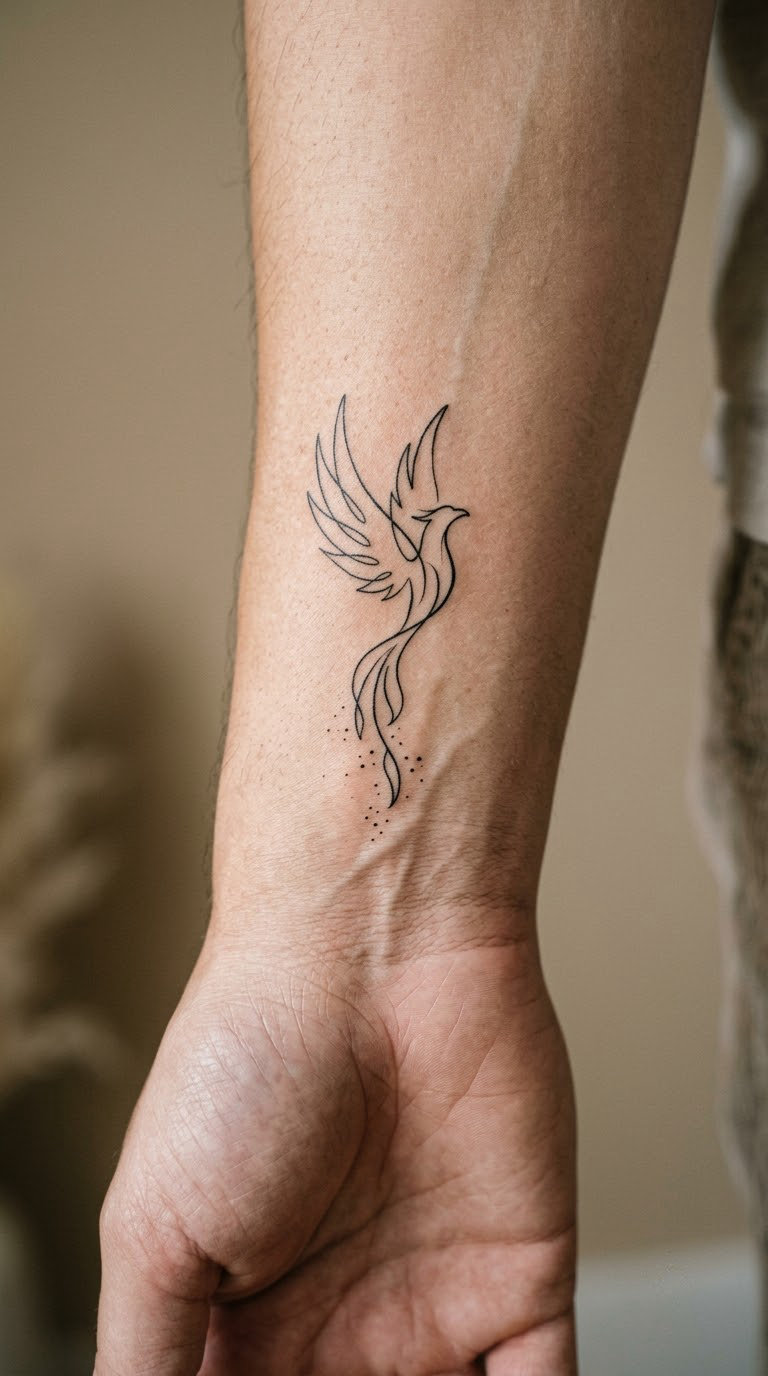
The Ember Burst reduces the phoenix to a single continuous line forming a bird mid-flap, with a scatter of small dots below it standing in for the ashes. Nothing about it is shaded, which means nothing about it fades dramatically. It is the version to choose when you want the meaning and you are not ready to wear a large piece for the rest of your life.
Inner wrist, behind the ear, the top of the foot, or a small spot on the collar bone, at 5 to 8 centimetres. Fine line needs a steady hand and a very light touch, so pick an artist who does it as a speciality rather than as an occasional flourish. Pain and time: wrist and ribs are a sharp 4, behind the ear is closer to 3, and a piece this small takes well under an hour.
4. The Flare — traditional flames for a large back piece
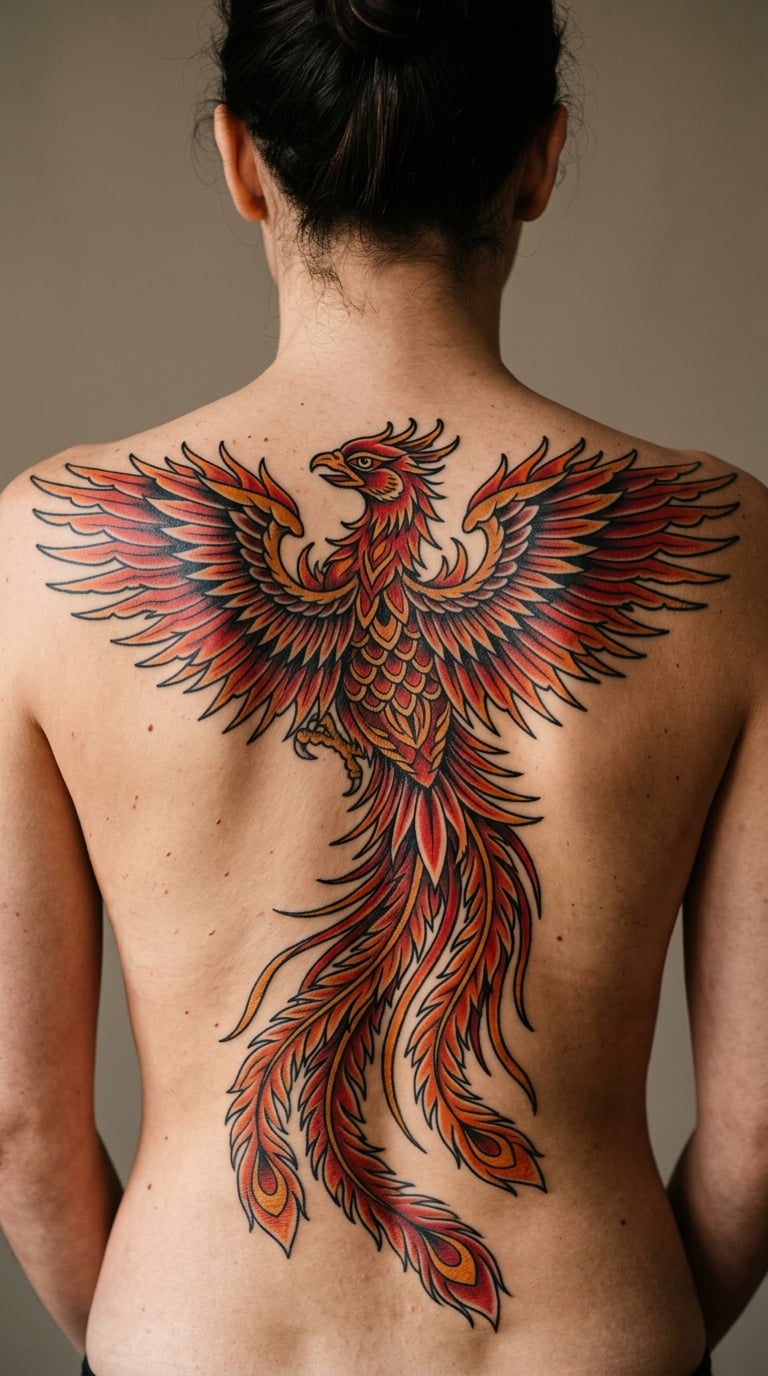
The Flare is the loudest option: bold black outlines, red and orange flame work, a fully feathered tail that fills the space behind the bird. Traditional American style suits it because the design wants line weight and flat colour rather than suggestion, and because a big back piece gives the tail somewhere to go. This is the version most tattooed in the world, so if you take it, make it yours.
Upper back and full back, 30 centimetres and up, and be honest that a piece this size is multiple sessions. The thick black outlines survive; the orange in the flame work is what goes first. Pain and time: the back is comparatively gentle at around a 3 because the skin moves, but expect three to six long sessions rather than one.
5. The Ashen Silhouette — a blackwork bird in negative space
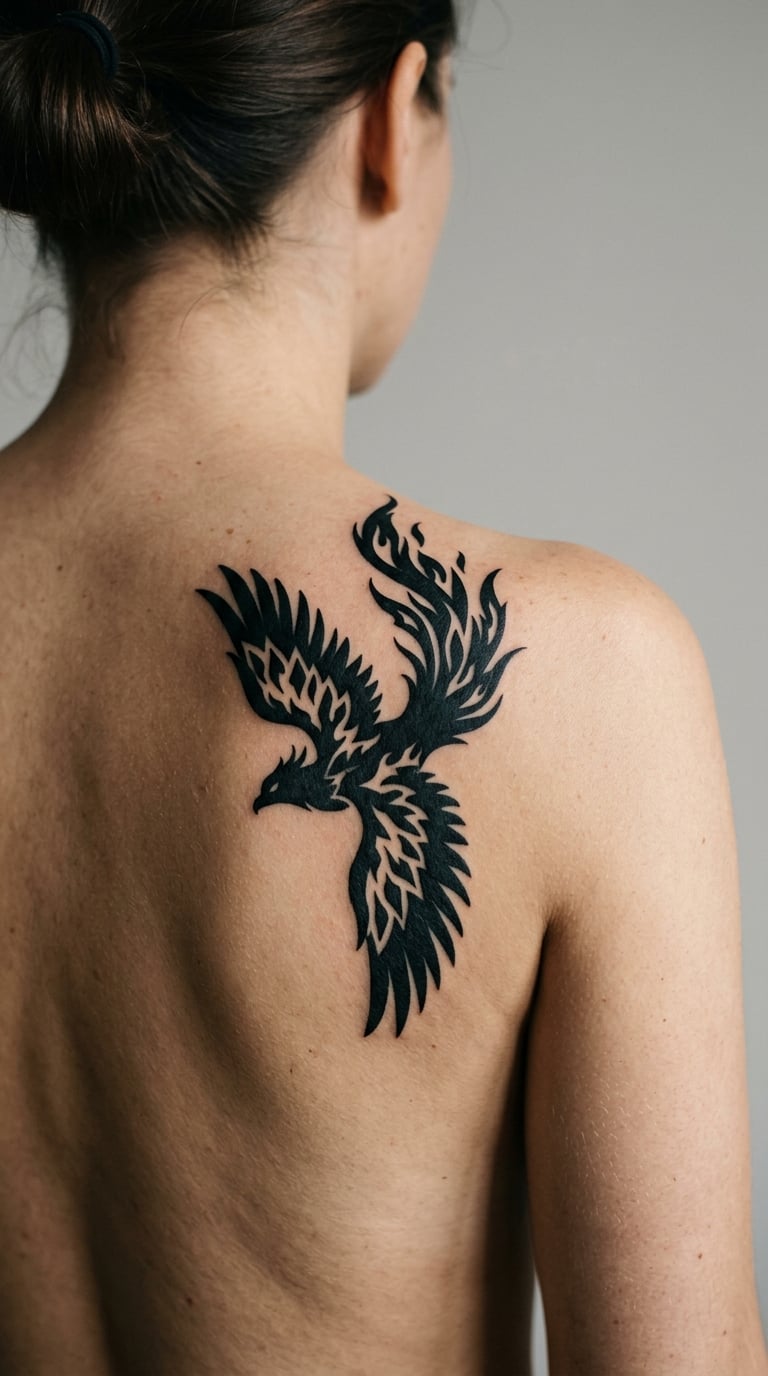
The Ashen Silhouette is the black phoenix, which is its own search with its own meaning. Where a colour bird is about the fire, a solid black bird in negative space is about the ash: the embers show through as uninked gaps inside the darkest shape on the skin. It is the most quietly dramatic version, and it holds up better over a decade than almost anything else in this list.
Works as a standalone piece on a shoulder blade, a thigh, or the outer arm, and it scales from 10 centimetres to half a sleeve. Blackwork needs solid packing and a healed black base, so ask to see healed work, not fresh line work. Pain and time: shoulder blade and outer arm run about a 4, and large pieces are still several sessions because packing takes time.
6. The Facing Pair — two phoenixes, one circle
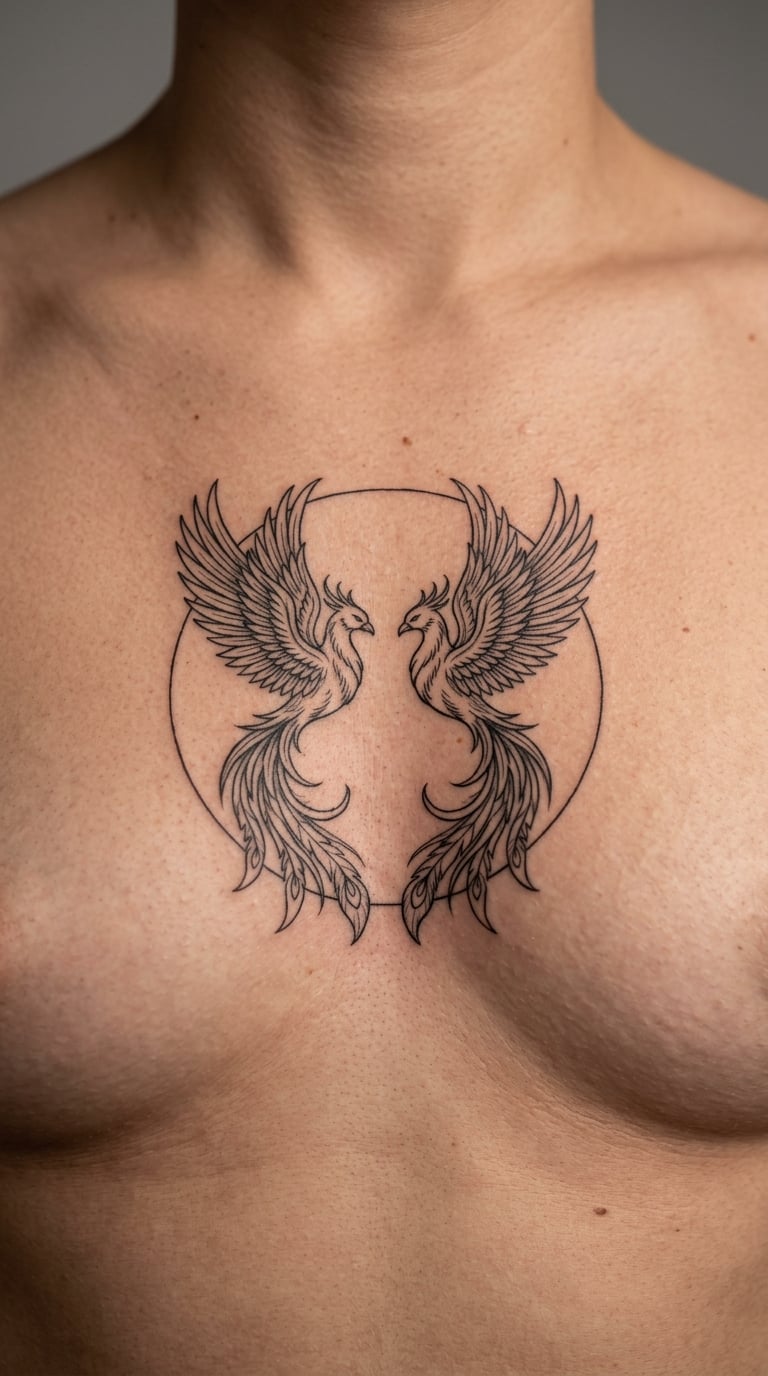
The Facing Pair sets two birds inside a circle, beaks toward each other, tails crossing below. It is the natural choice for a matching tattoo with someone close to you, and it is also how people mark a loss, where the second bird is a memorial for someone who was part of the reason for the change. Read alone it becomes a cycle rather than a rise.
Two sternums, two forearms, or one design across the chest and back if the artist is drawing it as a single circle. Keep the two birds identical in line weight or the matching will not hold. Pain and time: the sternum is a 6 because the skin is thin and the bone is close, and a two-bird piece is easily a three-hour sitting.
7. The Geometric Bird — sacred geometry in the wings
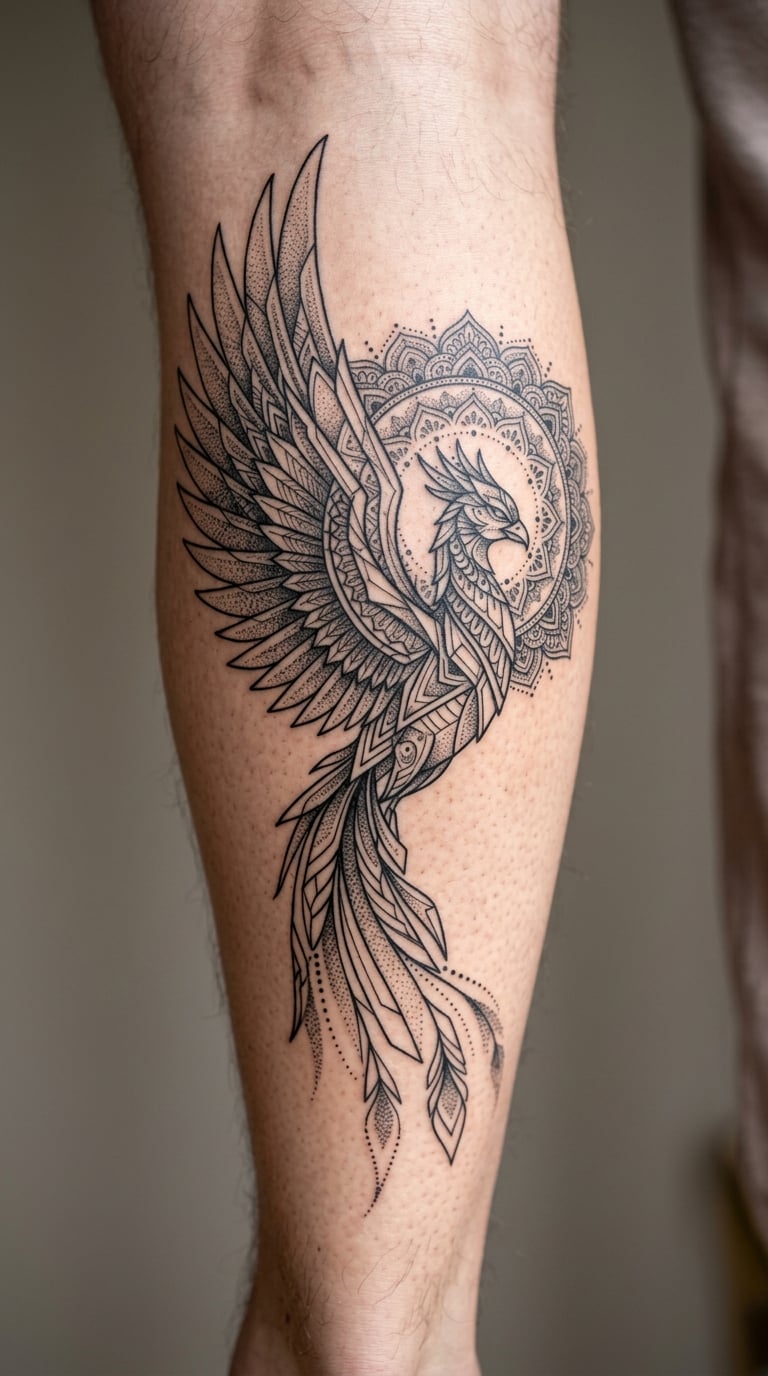
The Geometric Bird builds the wing from repeating line patterns and dotwork instead of drawn feathers, with a mandala or halo shape sitting behind the head. The meaning is a little more inward: the order imposed on the bird becomes a metaphor for putting structure back into your own life after chaos. It is also the most forgiving style for a small placement, because pattern fills space without needing realistic anatomy.
Calf, forearm, thigh or along the spine, at 15 centimetres or larger so the pattern has room to breathe. Dotwork and geometric line work grey out slightly as it heals, which flattens fine detail into tone. Pain and time: calf and forearm are around a 4 to 5, and a full leg or spine piece is a multi-session project.
8. The Hourglass Bird — time and mortality
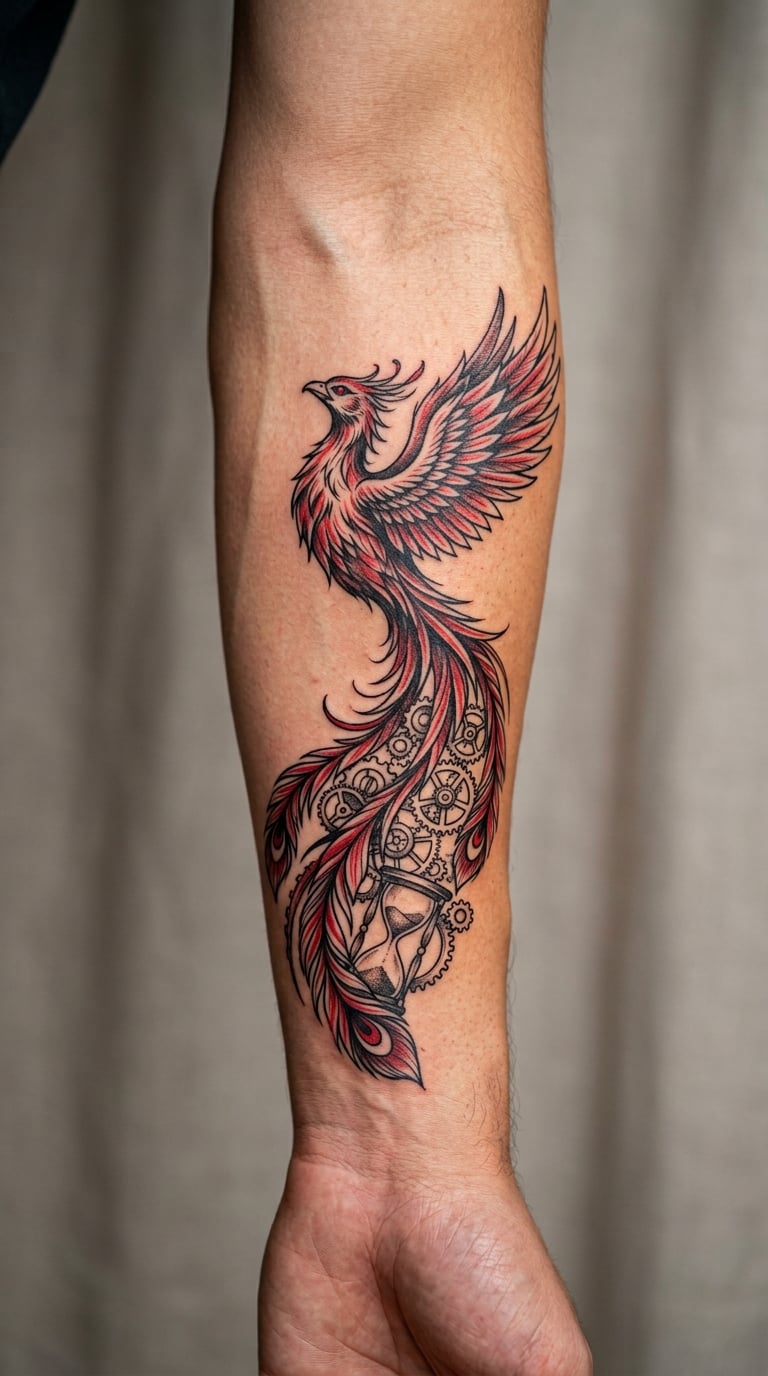
The Hourglass Bird works a clock face, a falling sand shape, or hourglass geometry into the tail so the bird is rising out of time running out. It shifts the meaning from general resilience toward a specific one: a chapter that ended, a person lost, a version of yourself that did not survive the change. It is the least common design on this list, which is the main argument for it.
Forearm, ribs or the outer arm, 12 to 18 centimetres, and the secondary shapes need to stay secondary or the bird disappears into a diagram. Pain and time: ribs are about a 5 and awkward to sit still through, so expect a broken session rather than one long push.
Phoenix Tattoo Styles and What Each One Signals
Style does as much work as the bird. A different rendering of the same phoenix reads differently to people, and it also ages differently in the sun.
| Style | Visual character | What it signals | Best placement |
|---|---|---|---|
| Traditional / neo-traditional | Bold outlines, flat saturated colour, heavy flame work | Bold, unqualified, life in your face | Upper back, full back, thigh |
| Fine line | Single-weight line, no shading, small detail | Restraint, discretion, a private meaning | Wrist, behind the ear, ribs |
| Watercolour | Soft bleeding washes, colour off the edges | Feeling over statement, movement | Forearm, upper arm, shoulder blade |
| Blackwork | Solid packed black, negative-space detail | Permanence, the ash rather than the fire | Shoulder blade, outer arm, thigh |
| Geometric / dotwork | Repeating line pattern, mandala halo | Order rebuilt after chaos | Calf, forearm, along the spine |
| Japanese Hou-ou | Flat colour, bold outline, wind and cloud elements | A different bird entirely: virtue and the sun | Sleeve, back panel, thigh |
| Minimalist silhouette | One shape, no interior detail | Endurance stated once, quietly | Anywhere small or large |
Where to Place a Phoenix Tattoo
The upper back is the most common choice because it gives the artist a wide flat canvas for both wings, and because it reads as something private that only you and people standing behind you see. The chest puts the bird over the heart, the forearm keeps it visible to you every day, and the ribs and thighs suit long vertical designs. Small placements work, but only with a design simplified for the space.
| Placement | Canvas available | What it suggests | Size guidance |
|---|---|---|---|
| Upper back | Wide and flat | Private, significant, yours | 30 cm and up |
| Full back | The whole torso | A statement piece, long-term commitment | 40 cm and up |
| Chest / sternum | Vertical, follows the bone | Over the heart, worn proudly | 20 to 30 cm |
| Forearm | Curved, long and narrow | A daily reminder, easy to hide at work | 15 to 25 cm |
| Full sleeve | Shoulder to wrist | One continuous story, often a narrative piece | Multi-session, years of work |
| Shoulder / upper arm | Rounded, forgiving | Strength, visible when you wear sleeves | 15 to 20 cm |
| Thigh | Large, well curved | Bold and low-key at the same time | 25 cm and up |
| Small spots | Wrist, behind ear, ankle | Discreet, easy to hide, easy to regret rushing | 5 to 10 cm, simplified design |
What a Phoenix Tattoo Means for Women and for Men
The bird is not gendered, but the way people read it still is, mostly because of scale and style rather than the symbol itself.
For women
It most often reads as quiet strength: coming out of illness, grief or a bad relationship with your identity intact. Fine line, watercolour and floral pairings are popular because they soften the fire without weakening the idea, though plenty of women choose a full back piece or a sternum bird that reads just as fierce. The meaning stays the same in every case. It is a symbol of surviving something and staying recognisable to yourself afterwards.
For men
Men pick it for the same reason, and larger back, chest and sleeve placements are the most common. A blackwork or traditional phoenix across the shoulder or spine reads as resilience without the flower associations, and it keeps the sense of an animal that outlasts the fire. What changes between presentations is the size and the amount of colour, not the idea.
Phoenix Tattoo Colours and What They Say
- Red and orange — the fire itself, the hottest and fastest-fading choice.
- Gold and yellow — warmth, dawn, the sun coming back, and a little optimism after the ash.
- Blue and teal — the calm after the storm, often used in watercolour pieces as a cool contrast.
- Black and grey — the ash rather than the flame, the longest-lasting palette there is.
- Full colour versus black and grey — colour says the fire is still burning; blackwork says it already happened and you are standing in what is left.
How a Phoenix Tattoo Ages and What Fades First
Almost every phoenix design is 70 to 90 percent saturated warm colour, and warm colour is the first thing to leave. Reds shift toward orange, oranges toward yellow, and heavily saturated flame work softens into something closer to a watercolour than the tattoo you chose. A discussion in r/tattoofade shows a saturated phoenix piece badly degraded at six years, and that is a common result rather than a mistake by the artist.
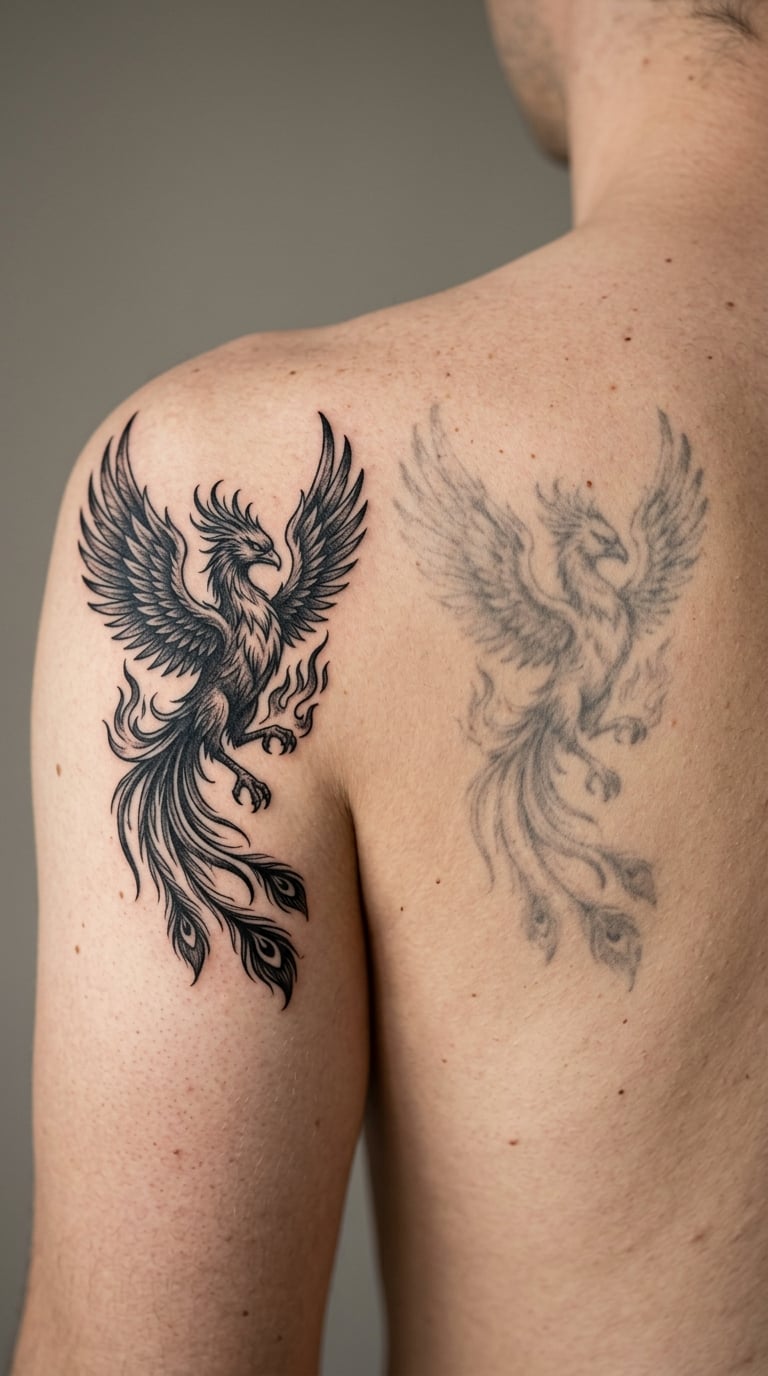
What slows it down: staying out of strong sun when you can, using a high-quality sunscreen on exposed placements, and asking for a design that carries weight in the black and grey so something survives even when the colour does not. A bold outline holds the shape long after the shading inside it has softened. People who are happy with a heavily faded phoenix usually say the meaning outlasted the artwork, which is the honest trade-off in advance rather than after.
One more thing worth knowing before you commit: a large flame-heavy back piece may need colour work later to keep it looking like the reference photo, so treat touch-ups as a likely future appointment, not an exception.
Things to Know Before You Book a Phoenix Tattoo
- Pick the artist for the style, not the bird. Ask to see healed phoenix work in the style you actually want. Fresh line work and healed line work are different animals, and healed work is the honest sample.
- Budget sessions, not one sitting. Anything over roughly 25 centimetres is a multi-session project, commonly three to six for a back or chest piece. Ask how they break it up.
- Get a quote before the first session and clarify the hourly rate. Custom large work is priced by time, and knowing that in advance avoids a surprise later.
- Protect it while it heals. Wash as your artist directs, keep it out of direct sun, and skip swimming pools and sea water until it has settled. Loose clothing over it for the first two weeks helps.
- Choose size for the next twenty years. Small and simplified ages better and hides better. A busy feather-and-flame design squeezed into a small spot loses the detail that makes it readable as a phoenix at all.
- Adding a second symbol is easy to get wrong. A sun, lotus, koi or hourglass can support the bird, but only one supporting element, and give it less visual weight than the phoenix.
For the consultation itself, bring three things: a small folder of references you like the line weight of, one image of a piece you have seen elsewhere that is close to what you want, and a sentence about what the tattoo marks. Artists work faster and produce better work when they know the emotional target as well as the visual one, and it stops them drawing a generic fire bird.
Frequently Asked Questions
What does a phoenix tattoo symbolize?
A phoenix tattoo symbolizes rebirth and resurrection: the bird burns to ash and rises again, so the design stands for what you survived and what you are becoming. Around that core it carries hope, resilience, transformation, renewal and new beginnings. Because the ashes stay in the picture, it also acknowledges the cost of the change, which is why people choose it after illness, grief, sobriety or the end of a relationship.
Where should I place a phoenix tattoo?
The upper back is the most popular spot because it gives the artist a wide, flat canvas for both wings and because the meaning reads as something private. Chest and sternum put the bird over the heart, the forearm keeps it visible to you daily, and ribs and thighs suit long vertical designs. Small placements such as the wrist or behind the ear need a design simplified for the space.
Is a phoenix tattoo good or bad luck?
It is broadly a positive symbol and people rarely read it the other way. Some ancient writers described a young phoenix carrying a cask of its own ashes to be born again later, which is where the idea of the bird burying its past comes from, but even that version ends in renewal rather than loss. Communities treat the phoenix as one of the most auspicious symbols in tattooing.
What does a phoenix tattoo mean for a woman?
For women it often reads as quiet strength: coming out of illness, grief or a bad relationship with your identity intact. Many pair the bird with florals, fine line work or a watercolour wash to soften the fire, though the meaning is personal rather than gendered. Plenty of women choose a full back or chest piece instead, and that reads just as strongly.
What does a phoenix tattoo mean in the Bible?
The phoenix does not appear in the Bible, and the resurrection parallel people feel is typological rather than a direct reference. It resembles promises like Revelation 3:12, where a new name is given to those who endure, and the way John’s passion narrative reads Old Testament signs through details of the crucifixion. The symbol itself comes from Greek and Egyptian tradition.
How painful is a phoenix tattoo?
Pain tracks the placement more than the design. A small wrist or rib piece feels like a constant scratch, roughly 4 out of 10. Inner forearm and calf sit around 5, collar bone and sternum reach 6, and a full back piece is closer to 3 because the skin keeps moving. Large pieces also take several long sessions, often two to five hours each.
Conclusion
The phoenix is a strong, common symbol, and the way past it feeling generic is specificity: one clear turning point, one style that suits how you actually dress, and one placement you can live with. Pick the concept above that matches your reason, take three references to the consultation, and ask to see healed work before you commit. Get the meaning right and the design almost chooses itself.