
How Small Can a Tattoo Be? Size, Placement, and Care (September 2026)
How small can a tattoo be? Smaller than most people expect. A tattoo can go down to about half an inch across, and a single letter, dot or simple symbol can be tattooed at roughly 3 to 4 mm. The catch is whether that design will still be readable in ten years.
Ink does not sit still in the skin. Over time it spreads outward, fine lines thicken, and the pale gaps between them close up. A design that fits neatly at 6 mm on day one can turn into a smudged blob by year five, so the useful answer to how small can a tattoo be is not a number alone, it is a number plus a design that survives spreading.
If you are still narrowing down what to get, start with a roundup of small tattoo ideas, then come back here to work out which of them can hold together at the size you have in mind.
How Small Can a Tattoo Be?
About 0.5 inches, or 1.3 cm, across is the practical floor for a whole tattoo that still looks deliberate, and the smallest reliably legible single element sits at roughly 3 to 4 mm. Whether your design can actually go that small depends on how much internal detail it has, and on where it goes, not on what the machine is technically capable of.
A good tattoo artist will happily work tiny, and will still tell you when a design needs to be bigger. That is not a refusal, it is the person protecting your work from turning into a blur. If you bring a detailed reference and ask for it at coin size, most artists will offer you two choices: go bigger, or go simpler. Pick one.
What Is the Smallest Practical Tattoo Size?
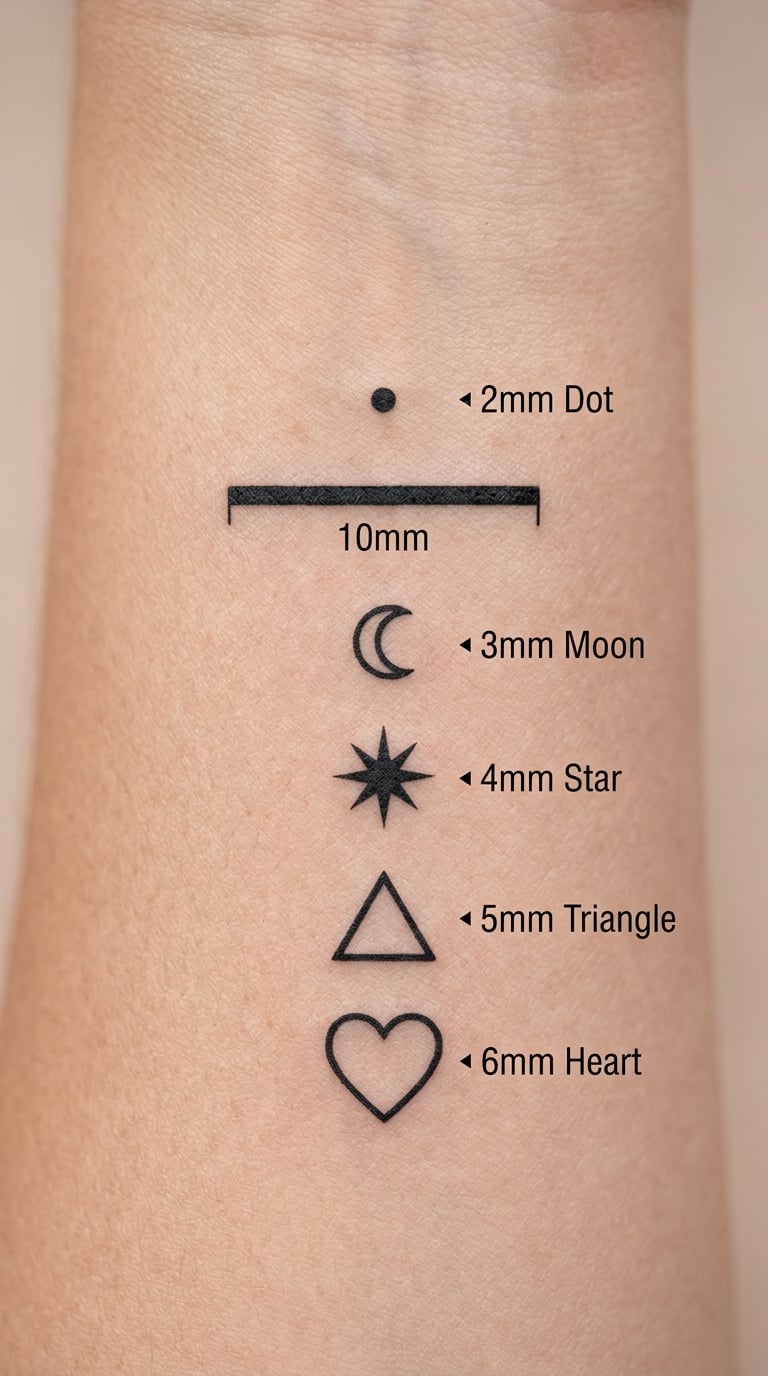
Most people use size words loosely, so here is the tier system that actually matters when you are booking a consult.
| Tier | Size range | Real-world comparable | What it suits |
|---|---|---|---|
| Micro / extra-small | Under 1 inch (under 2.5 cm) | Dime, fingertip, a single piano key | Initials, dots, tiny hearts, single-line symbols, one short word |
| Small | 1 to 3 inches (2.5 to 7.5 cm) | Matchbox, coaster, a credit card | Fine-line florals, butterflies, celtic knots, small dates, script |
| Medium | 3 to 6 inches (7.5 to 15 cm) | Postcard, paperback book | Portrait detail, micro realism, designs with shading |
Is a 2 inch tattoo considered small? Yes, comfortably. Most shops would call 2 inches a small tattoo and would have room to draw real detail into it, though not the kind of detail a portrait needs.
Below a quarter inch you are in dot territory. A single dot works. A dot with shading inside it does not, because there is no room for the shading to be anything other than a smudge.
What Size Tiny Tattoo Should You Choose?
Choose the size from the design’s complexity, not from the spot on your body you like. The same motif at two different sizes is two different tattoos, with two different levels of detail.
Simple shapes with solid black and no interior gaps can be pushed smallest. Single continuous lines that never cross themselves are close behind, because one unbroken line has no negative space to close up. Anything with an outline, an inner shape, or a gap between two lines needs noticeably more room, and micro realism portraits need the most of all.
Here is roughly what each common design needs before it starts losing clarity.
| Design | Smallest workable size | What to change to make it work |
|---|---|---|
| Single dot or period | 2 to 3 mm | Nothing, just pick a spot with enough skin |
| Single initial or letter | 4 to 6 mm tall | Use a plain block shape rather than a script letter |
| Two or three letters | 10 to 15 mm | Square off any cursive, keep letters evenly weighted |
| Tiny heart | 6 to 8 mm | Fill it solid rather than outlining it |
| Star, moon, simple symbol | 8 to 12 mm | Fewer points, thicker strokes between them |
| Single-line drawing | 15 to 25 mm | One unbroken stroke, no loops that trap skin |
| Word or short phrase | 40 to 60 mm | Use fewer letters, larger gaps, block lettering |
| Fine-line flower or sprig | 25 to 40 mm | Drop the petals into solid shapes, keep two or three leaves |
| Butterfly | 30 to 45 mm | Fill the wings, remove the vein detail |
| Celtic knot | 30 to 45 mm | Fewer repeats, much wider channels between the lines |
| Rose or layered flower | 40 to 60 mm | Drop the inner petals, keep the outer silhouette |
| Micro realism portrait | Under 1 inch rarely holds, 2 inches and up is safer | Pick a feature rather than a whole face |
The number that matters most inside those ranges is line spacing. When two lines sit closer than roughly 2 mm apart, they tend to fill the gap between them as the ink spreads, and the shape they were meant to define disappears. A design with generous open space inside it will outlive a denser version of the same design every time.
How Small Can a Tattoo Stay Readable? The 1/3 Rule
The 1/3 rule is a quick sizing test: your design should be at least three times wider than its thinnest line. If your finest line is 1 mm, the whole design wants to be 3 mm or larger, and that is the floor rather than the target.
Worked example. You want a tiny outline heart with a 0.8 mm line. Three times that is 2.4 mm, which is far too small, so the heart lands somewhere around 10 to 12 mm once you leave breathing room around the line. If you fill the heart solid, the internal line disappears entirely and the same design survives at half that size.
Two practical notes. Artists on the training forums point out that lines on synthetic or pig skin render fatter than on human skin, so practising size estimates on practice skin will make everything look chunkier than it will be. And if your artist quotes you a number near this floor, ask what they would change to give you another 20 percent of space.
Best Placements for Very Small Tattoos
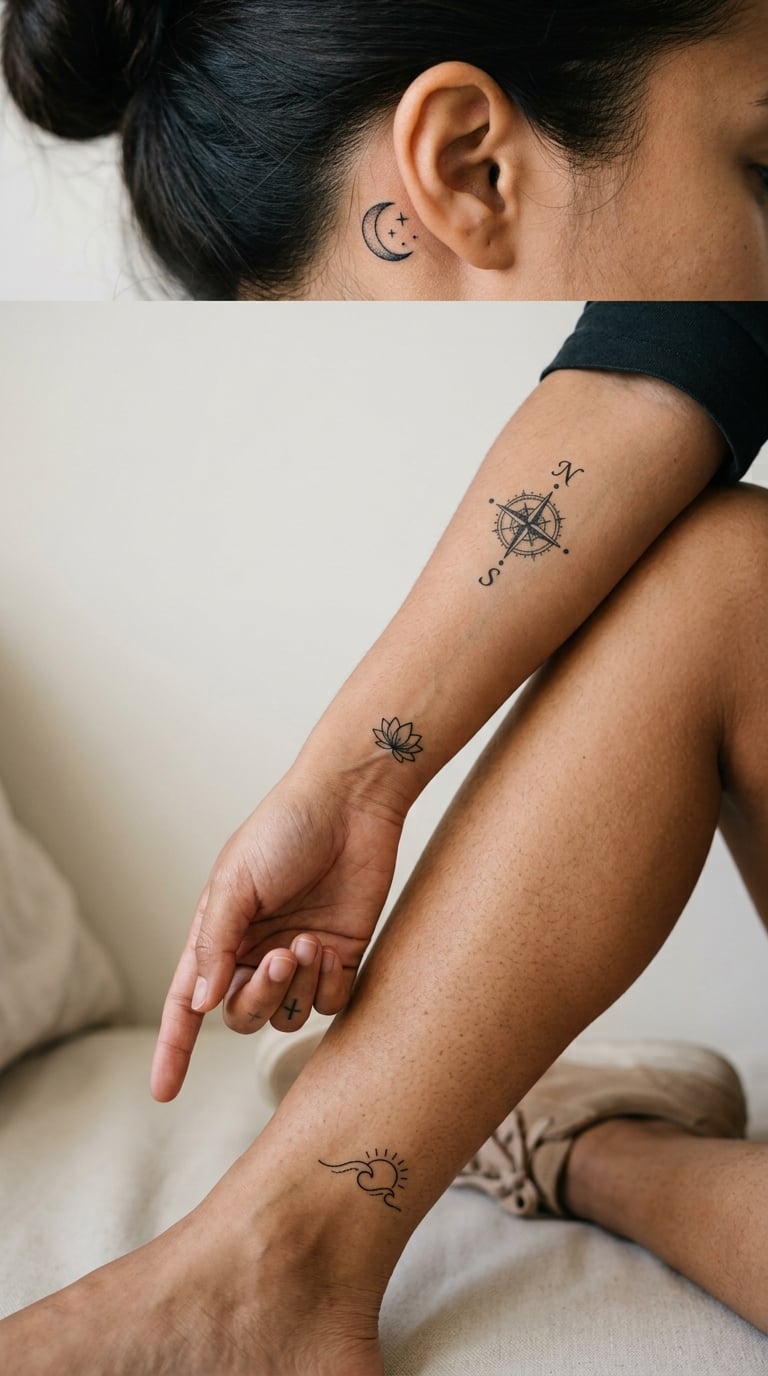
The best spots for a very small tattoo share three traits: not much skin movement, no rubbing against clothing or bags, and skin that stays out of strong sun. That shortlist is shorter than most galleries suggest, because size and placement fight each other in some spots.
| Placement | Good for | Wear and fade risk |
|---|---|---|
| Inner wrist | Initials, dates, tiny symbols | Constant movement, frequent washing, watch for fading |
| Behind the ear | Small stars, single-line leaves, tiny words | Hides from sun well, but fades faster than it looks |
| Fingers and knuckles | Single letters, dots, tiny hearts | Highest fade risk of any common placement |
| Inner forearm | Fine-line sprigs, short words, coordinates | Fairly stable, easy to cover, easy to show |
| Collarbone | Small script, tiny botanical pieces | Skin stretches and moves, sizing must be generous |
| Ankle | Symbols, small dot patterns | Shoe rub and ankle bone make placement tricky |
Wrist work is the most requested micro placement and the one most likely to soften first, because your wrist moves several thousand times a day and gets washed more than anywhere else on the arm. Inner forearm tends to be the calmest option if you want a small piece that still reads in a few years. If you are planning something on your hands, have a look through our small hand tattoo ideas before you settle on a size, because hand placement changes the sizing decision more than the design does.
Do Smaller Tattoos Hurt Less?
No, and the reverse is often true. A small tattoo is quick, but quick does not mean gentle. A single letter on a finger can be one of the more uncomfortable pieces you can get, because the skin there is thin, the bone sits right underneath, and the nerve endings are dense.
| Area | Typical feeling for a small piece |
|---|---|
| Fingers and knuckles | Sharp and intense, over quickly |
| Wrist inner side | Bright and stingy, sensitive for a few hours |
| Behind the ear | Constant low scratch, hard to scratch away |
| Collarbone and sternum | Deep aching, noticeable bone contact |
| Rib area | Among the most sensitive spots, even at tiny sizes |
| Inner upper arm and thigh | The easiest spots, size barely matters here |
What you feel tracks nerve density, skin thickness and how close bone sits, not how many centimetres wide the design is. If pain is the deciding factor, pick the placement first, then fit the design into whatever room you have there.
How Much Does a Small Tattoo Cost?
Small tattoos sit at the low end of most shops’ price ranges, but the floor matters more than the design. Nearly every studio has a shop minimum or an hourly floor of roughly a full hour of the artist’s rate, and a tiny piece takes fifteen minutes of actual tattooing. That gap is where first-timers get surprised.
Cost tends to follow design complexity rather than size. A solid single symbol is quick to draw and quick to tattoo. Custom lettering, a redrawn design built for micro execution, or a design an artist has to simplify on the spot takes longer before the needle even starts. A design that needs touch-ups adds a second appointment, and some studios build that into the original price while others charge again.
You will also see the same word mean different things across shops. A micro tattoo listed low may be a walk-in flash design picked from a book, while a custom tiny piece sits much higher because the drawing time is real. Ask whether the quote is a flat price or an hourly one, whether a touch-up is included, and what happens if the healed result needs one. Getting those three answers in writing before you pay a deposit saves arguments later.
What Happens During Healing and Touch-Ups?
Small tattoos heal on roughly the same schedule as larger ones, usually settling within a couple of weeks on the surface and taking a couple of months for the ink to fully settle into the dermis. The visible peeling, itching and fading you see in week one is normal and not a sign that the tattoo is falling apart.
| Time | What is happening |
|---|---|
| Days 1 to 3 | Redness, swelling and a tender feeling, similar to a fresh sunburn |
| Days 4 to 10 | Itching and flaking as the surface skin sheds, the design looks lighter and patchier |
| Weeks 2 to 4 | Skin returns to normal, ink settles and contrast comes back |
| Months 2 to 3 | Final appearance, this is when a touch-up decision makes sense |
Fine line and micro work is more likely to need a touch-up than a bold piece, simply because there is less ink holding the shape and thin lines lose a little width as the skin settles. Artists often look at healed work around the two to three month mark and suggest a free or reduced-price session. Follow your own artist’s aftercare instructions first, then general ones: keep it clean, keep it out of long hot water, do not soak it, and skip the sauna and the swimming pool for a couple of weeks.
Signs worth a call to the shop rather than a message to the internet include heat, swelling, a rash spreading beyond the tattoo, or discharge that keeps increasing after the first few days. Your artist can see it, a stranger cannot.
Mistakes to Avoid with Very Small Tattoos
Scaling a detailed design down instead of redrawing it is the most common error, and it is the one artists try hardest to talk clients out of. Shrunken detail is a drawing that no longer works at its new size, because the artist has kept the same number of lines in a smaller box.
Outlining a shape that should be filled is another. An outline is two lines with a gap between them, and that gap is exactly the negative space that closes as ink spreads. Solid black ages far better at small sizes than an outline does.
Then there is hairlining. One-needle lines that look elegant on a big piece will be the first thing to disappear, and the artist is not being difficult when they ask for a heavier line. Placing a symbol where the skin folds or stretches distorts it permanently, and choosing a wrist or finger for a piece you want to still read in a decade sets up disappointment. Finally, judging the result in week two is judging it before the ink has finished settling. Ask to see healed work from that artist if you can, and you will see what your piece will actually look like.
One more worth mentioning: you can always add to a small piece later. A tiny symbol that stays crisp for a decade is a much better foundation than a crowded design that muddles, because an artist can work around a clean shape far more easily than around a blur.
Frequently Asked Questions
What is the 1/3 rule tattoo?
The 1/3 rule is a sizing test tattoo artists use: your design should be at least three times wider than its thinnest line. If the finest line measures 1 mm, the whole design wants to be 3 mm across or more, and that is the floor rather than the target. Designs with thicker lines or solid fills can go smaller, because they have no narrow gaps to close up over time.
Can a 1 inch tattoo have detail?
Yes, but only a certain kind of detail. At 1 inch you can hold a fine-line sprig, a small butterfly, a simple knot or a short word. You cannot hold a portrait, dense shading or lettering that relies on thin strokes, because lines closer than about 2 mm tend to fill the gap between them as the ink spreads. Ask your artist what they would cut to fit that inch.
Is a 2 inch tattoo considered small?
Yes, 2 inches is comfortably a small tattoo, and most shops price it in the small range. It is also the point where real internal detail starts to work. Coin-sized designs look like symbols, while a 2 inch design can carry petals, lettering and layers. If your reference image has shading and overlapping shapes, 2 inches is closer to the honest minimum than half an inch.
Do tiny tattoos hurt more than bigger ones?
Sometimes, and the reason is not the size. Pain tracks nerve density, skin thickness and how close bone sits to the surface, so a single letter on a finger or behind the ear can sting sharply while a 3 inch piece on the upper arm feels like scratchy nothing. A tiny tattoo is also over sooner, which is a real advantage even when the sting is intense.
Will a small tattoo blur over time?
A well-sized micro tattoo can stay crisp for a decade, but small work fades faster than larger work as a rule. Ink spreads through the dermis over the years, so thin lines thicken and gaps between them narrow. Placement matters as much as size: fingers, knuckles and inner wrists get washed, rubbed and moved constantly. Solid black and single unbroken lines hold up far longer than outlines and hairlines.
What is the smallest tattoo you can get?
Around half an inch, or 1.3 cm, across is the practical floor for a tattoo that still reads as a deliberate shape, and a single legible element such as a letter or a dot can be as small as 3 to 4 mm. Below that, the artist is choosing a spot and a shape rather than drawing a design, and most will gently redirect you toward a slightly larger, simpler version.
Choose a Design That Stays Clear
Pick the simplest design that still means something to you, and let the size follow it. A solid symbol, a single line or one short word will hold at coin size for years. The moment your design needs internal detail, give it room, and take a look through our tiny wrist tattoo ideas to see which ones survive at small scale before you book.
Then bring two or three size references to your consult, ask what your artist would cut, and settle the placement before the drawing starts. Size, spot and design have to agree, and getting that agreement early is the whole game.