
24 Best Geometric Tattoo Ideas for Men (September 2026)
A geometric tattoo is built from mathematically defined shapes — straight lines, circles, triangles, cubes and repeating grids — rather than from shading or realistic rendering, so the design reads the same from any angle. These geometric tattoo ideas for men cover everything from a fine-line mountain ridge you can hide under a shirt cuff to a blackwork hexagon panel that needs a full sleeve’s worth of planning. Pick a few that catch your eye, then check the placement and sizing notes before you book.
Geometric work suits men who want something bold and clean without a figurative or traditional piece, and it rewards an artist with steady hands more than any other style. There is no shading to hide behind, so one wavering line is all it takes to make a careful design look careless. That is the thread running through all 24 ideas below: what it looks like, where it sits best, how big it should be, and how it will look in ten years.
Geometric Tattoo Ideas for Men: Quick Guide
| Idea | Style | Best placement | Realistic size | Pain |
|---|---|---|---|---|
| 1. Fine-Line Mountain Ridge | Fine-line blackwork | Outer forearm or calf | 3-4 in wide | Low |
| 2. Sacred Geometry Metatron’s Cube | Sacred geometry, fine line | Inner forearm, chest or back | 3.5-4.5 in wide | Low to medium |
| 3. Fractured Hexagon | Minimal blackwork | Outer forearm or calf | 2.5-3.5 in across | Medium |
| 4. Geometric Rose Compass | Geometric linework | Shoulder blade, upper arm or forearm | 4-5 in across | Medium |
| 5. Dotwork Constellation Map | Dotwork and fine line | Upper arm or back | 3-4 in wide | Medium |
| 6. Blackwork Overlapping Triangles | Blackwork | Outer upper arm | 4-5 in wide | High |
| 7. Minimal Wave Grid | Minimal linework | Forearm or calf | 3-4 in wide | Low |
| 8. Abstract Geometric Bull | Geometric blackwork | Chest, shoulder or thigh | 5-6 in across | High |
| 9. Isometric Cube Illusion | Geometric with tonal shading | Forearm, calf or upper arm | 2.5-3 in wide | Low |
| 10. Geometric Wolf Profile | Geometric low-poly | Outer forearm or calf | 4-5 in tall | Medium |
| 11. Radial Sunburst | Geometric linework | Upper arm, chest or forearm | 3-4 in across | Medium |
| 12. Sacred Geometry Lotus | Sacred geometry, fine line | Shoulder blade or back | 4-5 in across | Medium |
| 13. Architectural Linework | Fine-line illustrative | Forearm, calf or back | 3-4 in tall | Low to medium |
| 14. Mosaic Lion | Geometric polygon, black and grey | Outer upper arm or thigh | 5-6 in across | High |
| 15. Chevron Sleeve Panel | Bold geometric blackwork | Outer forearm | 5-7 in tall | Medium to high |
| 16. Minimal Triangle Cluster | Minimal fine line | Inner wrist, forearm or ankle | 1.5-2 in wide | Low |
| 17. Geometric Snake Coil | Geometric linework | Calf, forearm or ribs | 4-5 in long | Medium |
| 18. Blue Circuit Grid | Colour geometric | Outer forearm or upper arm | 3.5-4.5 in wide | Medium |
| 19. Geometric Eagle Head | Geometric blackwork | Chest or upper arm | 4-5 in wide | High |
| 20. Watercolor Polygon Peaks | Watercolor geometry | Forearm, calf or back | 4-5 in wide | Medium |
| 21. Interlocking Hexagon Sleeve | Geometric pattern, sleeve | Upper arm | 6 in and up | High |
| 22. Minimal Orbit Lines | Minimal fine line | Inner forearm | 2-2.5 in wide | Low |
| 23. Geometric Deer Antlers | Fine-line illustrative | Forearm or calf | 3-4 in tall | Low |
| 24. 3D-Style Pyramid | Geometric with soft shading | Outer calf, forearm or thigh | 3-4 in wide | Medium |
1. Fine-Line Mountain Ridge
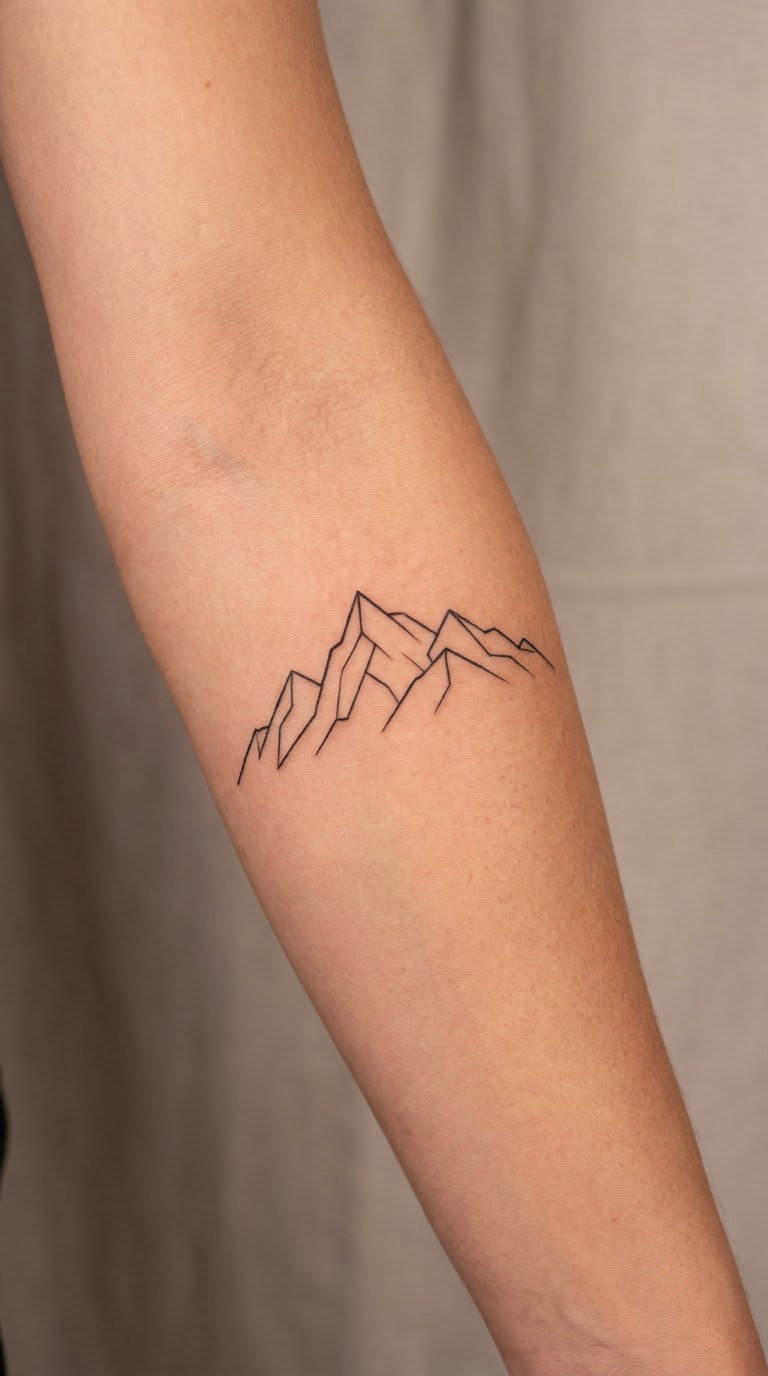
A fine-line mountain ridge is a minimalist geometric design for men: three or four peaks drawn with a single unbroken line, each face of the range reduced to a straight diagonal. Nothing is shaded, so the whole piece lives on the quality of those diagonals meeting at sharp apexes.
Men usually pick it because the shape reads as a personal reference — the range they grew up near, or the first trip that mattered — without turning into a literal landscape picture. It is one of the easiest geometric designs to keep quiet, and one of the few that suits an office.
Placement: outer forearm, inner forearm, or the calf · Size: 3-4 in (7.5-10 cm) wide, 1.5-2 in tall · Style: fine line, single-needle blackwork
Pain: low. Thin single-needle lines are quick, and the forearm has good bone support. The honest ageing note is that single-needle work on an exposed forearm softens noticeably within five or six years, so ask for a slightly heavier line than looks right fresh.
Make it yours: give the artist your actual peak names or coordinates and let them set the angles from that, rather than handing over a photo to copy.
2. Sacred Geometry Metatron’s Cube
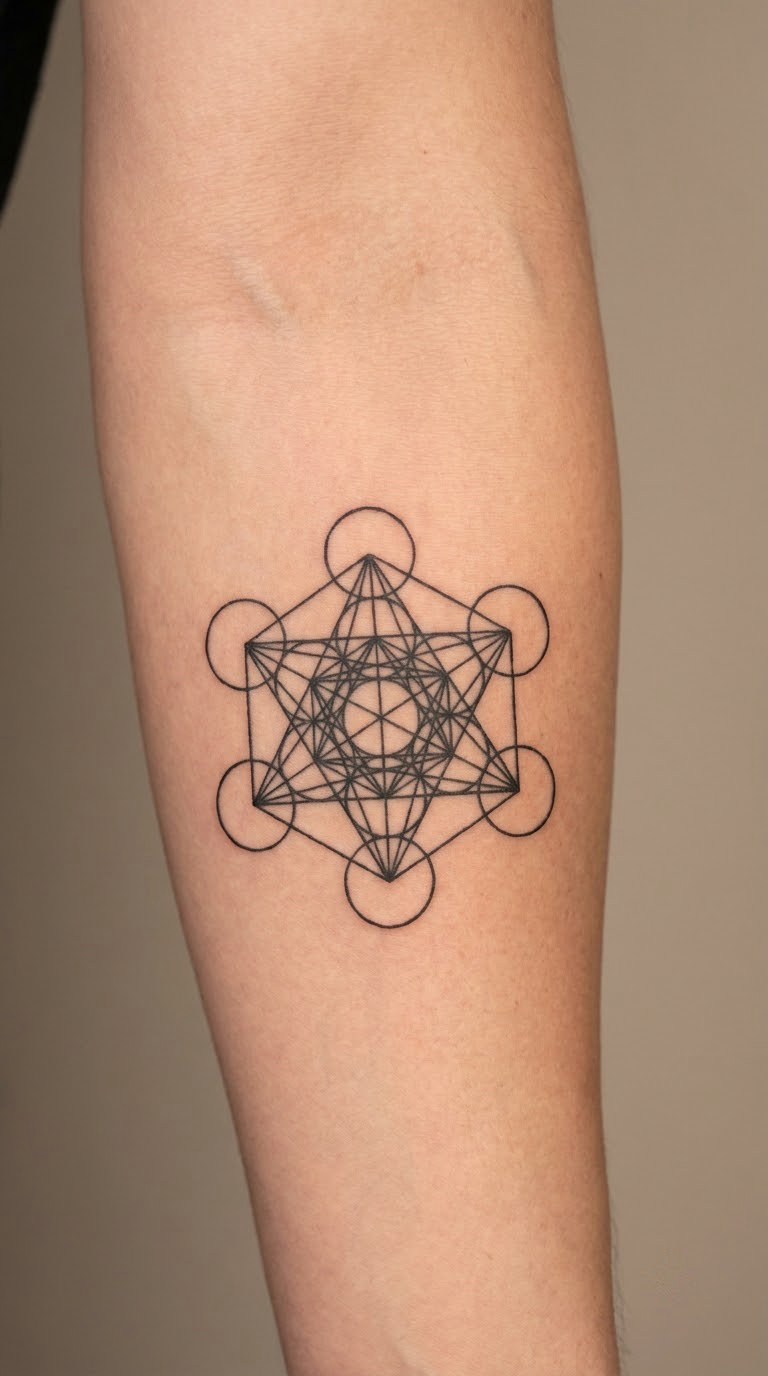
Metatron’s Cube is a sacred geometry design: a set of overlapping straight lines inside a circle, forming a dense lattice of small squares and hexagons that builds outward from a central point. Drawn well, the outer edge is a clean circle and the interior is perfectly even.
It belongs to the family of sacred geometry tattoos built on the idea that repeating mathematical forms describe the underlying order of things. Men choose it for the symmetry and the density, and plenty of them describe it as a private marker rather than a statement for other people to read.
Placement: inner forearm, centre chest, or the middle of the back · Size: 3.5-4.5 in (9-11.5 cm) wide · Style: sacred geometry, fine line
Pain: low to medium. The lines themselves are light; the time is the issue, because this is a lot of consistent small work. On ageing, the interior intersections are where line loss shows first, so an artist with a strong healed portfolio of this specific pattern matters more here than for almost anything else on the list.
Make it yours: keep the lattice intact and change what sits inside the centre point — a small solid triangle, an initial, or nothing at all.
3. Fractured Hexagon
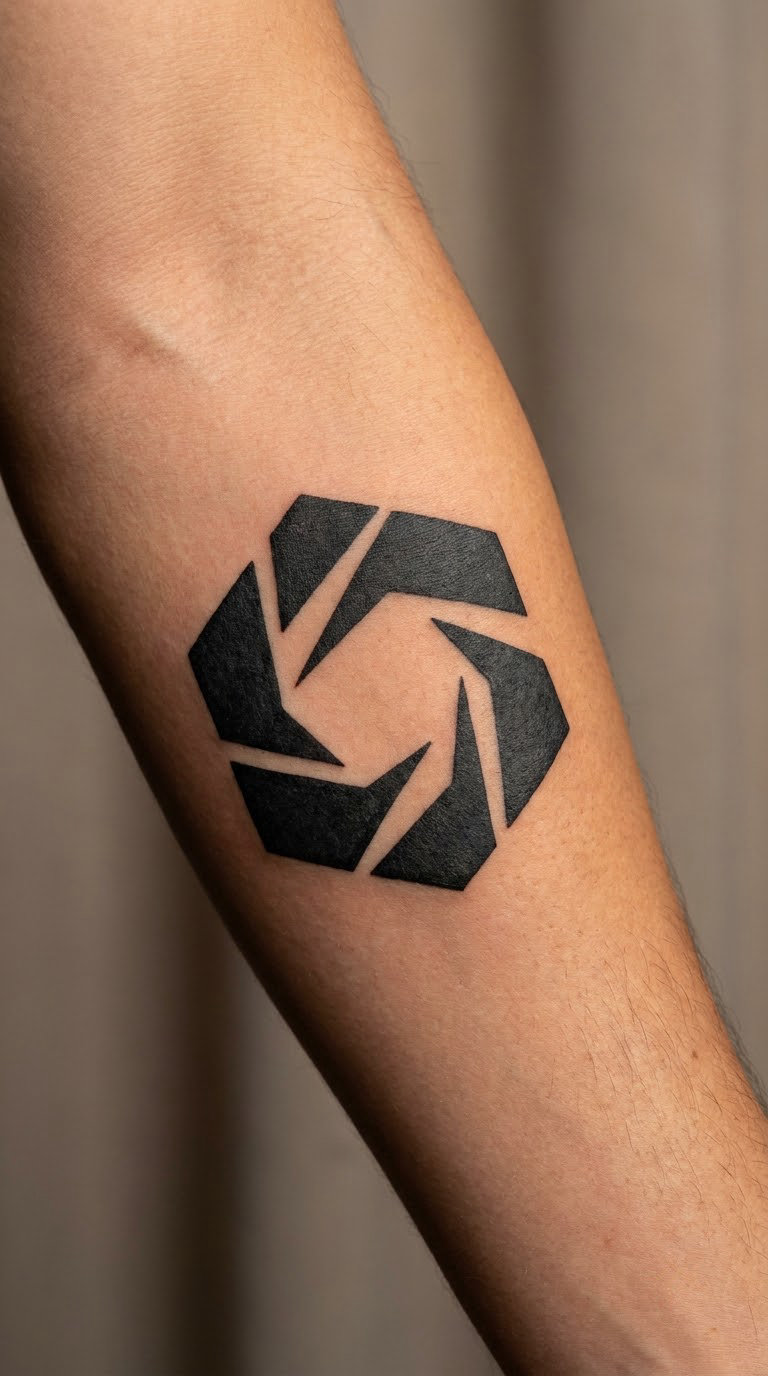
A fractured hexagon is a modern minimal piece: a six-sided form split into separate triangular fragments, each nudged slightly out of alignment so thin wedges of untouched skin break the shape apart. Read as a solid form from a distance, obviously broken up close.
It reads as structure under stress without saying anything specific, which is why it keeps turning up in galleries. It also works as a stand-alone piece that can later grow into something bigger, since a hexagon lattice nests neatly inside a larger pattern.
Placement: outer forearm, calf, or the inside of the upper arm · Size: 2.5-3.5 in (6-9 cm) across · Style: minimal blackwork with heavy negative space
Pain: medium. Large filled areas need more passes than line work, and the calf is more sensitive than people expect. On ageing, solid black at this size holds very well; the thin gap lines between fragments are the part to keep above a hair’s width.
Make it yours: hide a date in one of the offset wedges, or vary the direction each fragment breaks so it looks deliberate rather than damaged.
4. Geometric Rose Compass
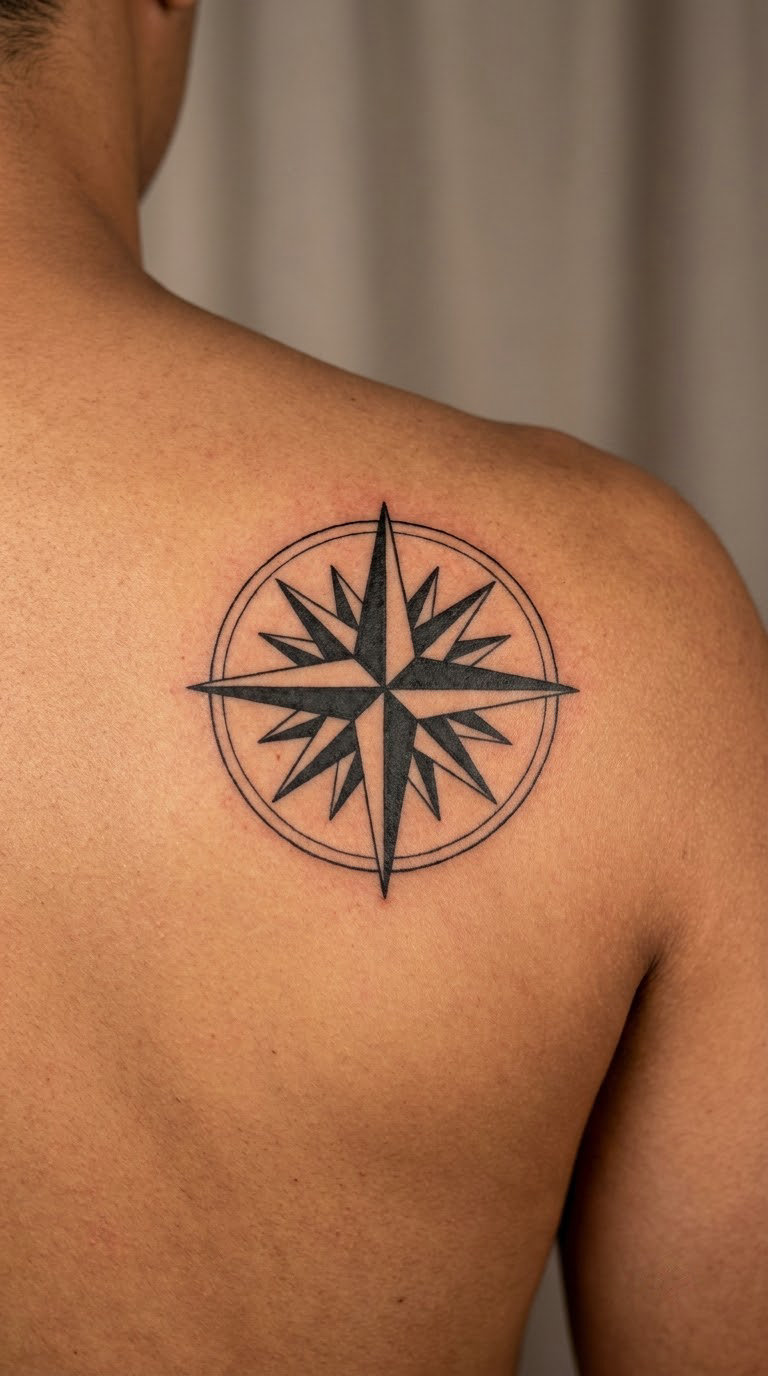
A geometric rose compass replaces the traditional eight-pointed star with triangular facets: a long north point, shorter secondary points, and a ring of fine radial lines closing the circle. The result is part navigation symbol, part low-poly ornament.
Compasses have long carried the idea of direction and guidance, and men tend to pick this one when they are moving somewhere new — a new city, a new job, a year of travel. Nothing about the design is fixed symbolism, so it is easy to make it about your own decision.
Placement: shoulder blade, upper arm, or forearm · Size: 4-5 in (10-12.5 cm) across · Style: geometric linework with selective fill
Pain: medium. The radial spokes mean repeated needle entry in a small area, and the shoulder blade is bony. On ageing, sleeve movement over the years can soften the outer ring on the shoulder blade, so keep the border simple rather than adding tiny cardinal letters.
Make it yours: set the north point along a real bearing, or fill four of the eight points solid and leave the rest as outline.
5. Dotwork Constellation Map
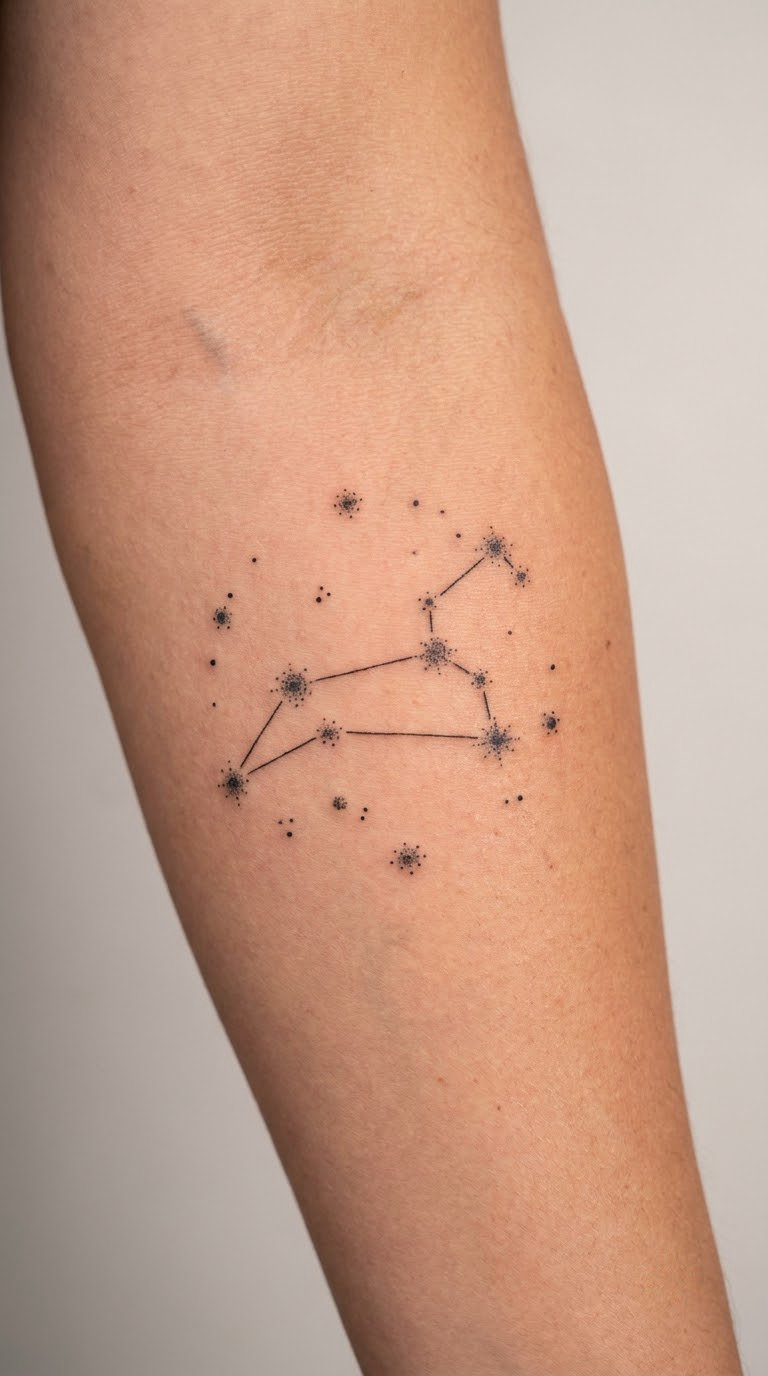
A dotwork constellation map takes a real patch of night sky and rebuilds it: stars as small dots of graduated size, faint connecting lines between the ones that matter, and a single larger star or a hairline circle for focus. The rest of the sky stays empty skin.
It is usually tied to a place or a date — the sky over a campsite, the constellations visible from a hometown — and it is the design here most likely to be entirely personal rather than symbolic. The empty space around it does real work, so resist the urge to fill it.
Placement: upper arm, back, or the flat of the calf · Size: 3-4 in (7.5-10 cm) wide · Style: dotwork and fine line
Pain: medium. Dot placement is repetitive, and a needle-up dotty session takes longer than it looks like it should. This is the design most vulnerable to time: tiny stars blur into faint smudges first, so ask the artist to drop a third of the smallest points before you start.
Make it yours: give the artist your birth date and sky location rather than a screenshot, so the star sizes follow real brightness instead of a photograph’s grain.
6. Blackwork Overlapping Triangles
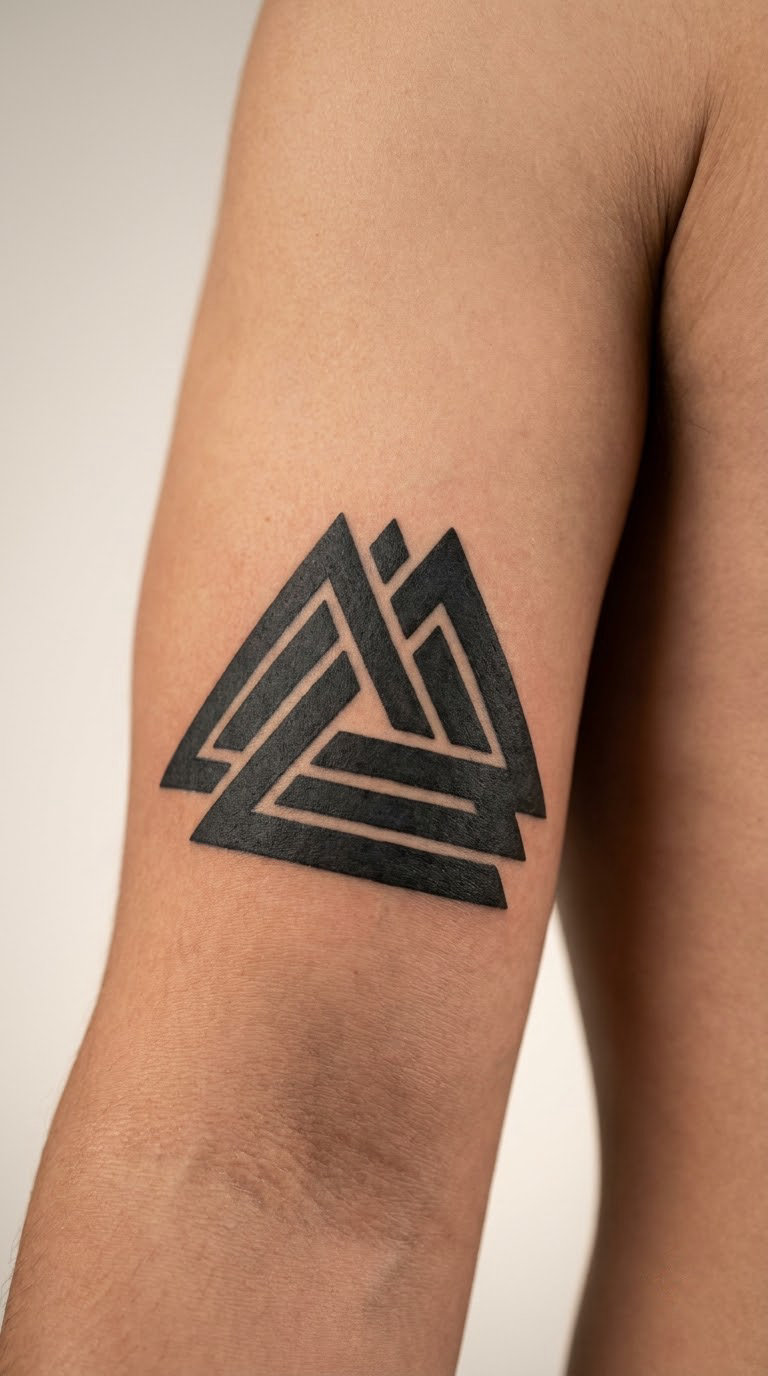
Overlapping triangles in solid blackwork use nests of identical shapes — three triangles, then three again rotated, then again — so the overlaps build dark cores and open the gaps between them into bright wedges. It is a high-contrast design that reads from across a room.
Nested triangle arrangements carry a long association with sacred geometry and layered structure, and that is generally why men land on it. It also works as filler around an existing figurative piece, which is how a lot of people use it.
Placement: outer upper arm, shoulder, or the back of the forearm · Size: 4-5 in (10-12.5 cm) wide · Style: bold blackwork
Pain: high. Solid black is repeated passes over the same spot, and a full panel of it is a long sit. On ageing, blackwork barely fades but it does spread very slightly as skin changes over the arm, so heavy saturation on the inner forearm ages softer than the same ink on the upper arm.
Make it yours: hide the birth-date coordinates of a specific place inside one of the open wedges, where the shape naturally reads as a triangle.
7. Minimal Wave Grid
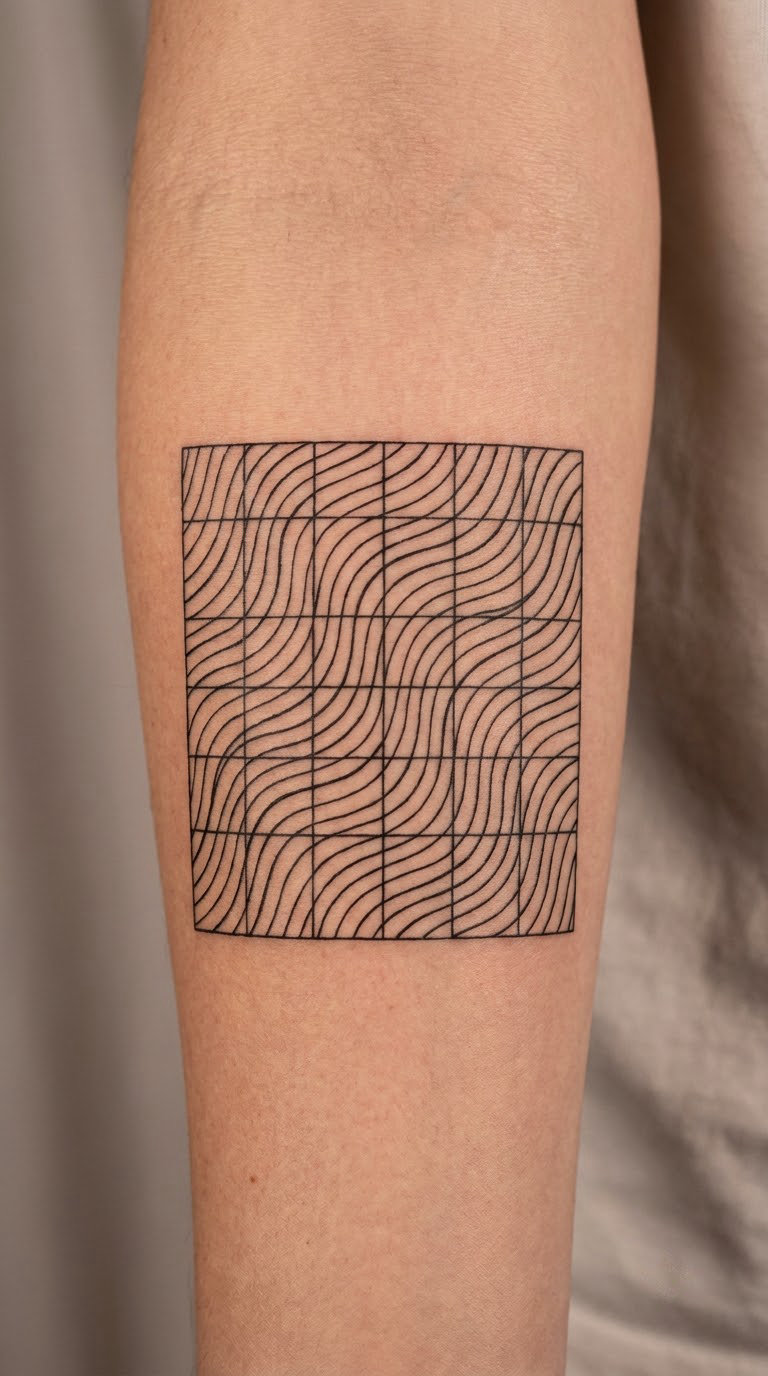
A minimal wave grid is a clean wave pattern: evenly spaced horizontal curves crossed by a straight square grid, with the curves thinning and thickening to suggest swell without a drop of shading. Very few strokes, all of them visible.
Ocean references are common here, and so is the simpler idea of a rhythm you keep returning to. Because it is a repeating pattern, it suits anyone who plans to build a sleeve later — the same grid language scales into a full arm panel without a style break.
Placement: forearm, calf, or wrapped around the upper arm · Size: 3-4 in (7.5-10 cm) wide for a single panel · Style: minimal linework
Pain: low. This is line work only, and forearm placement is a shallow surface. On ageing, the crossing points where grid and curve meet are the weak spots — ask for them as small deliberate joins rather than overlaps, which ages far better.
Make it yours: use wave counts from a real swell forecast at a place that matters, or run the grid vertically in a second matching piece.
8. Abstract Geometric Bull
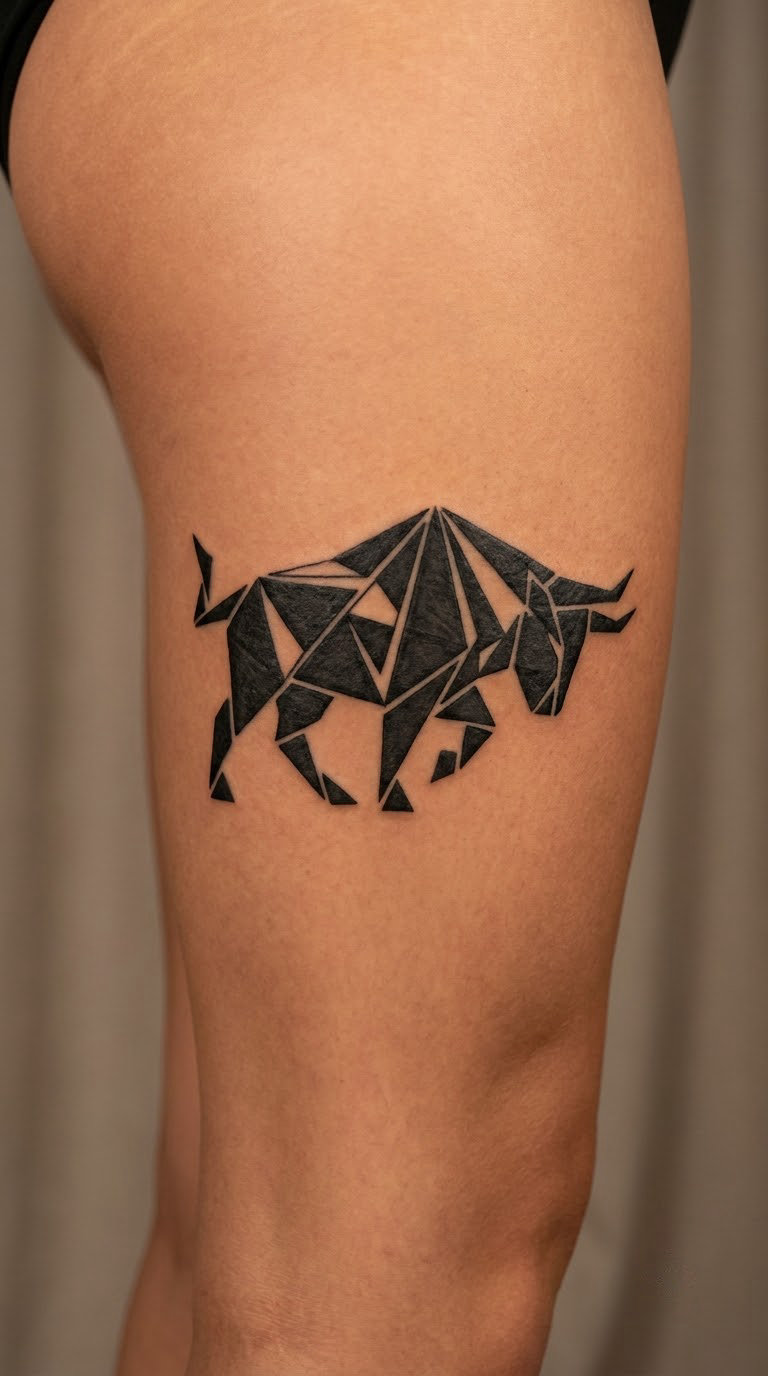
An abstract geometric bull is built from angular planes rather than an animal portrait: a heavy shoulder line, a low head, and a pair of horns suggested by two long intersecting diagonals. Interior detail is replaced with solid black and cut-out white.
Bull imagery shows up constantly in geometric work, usually carrying stubbornness, endurance or a zodiac sign — and men often will tell you it is Capricorn. It is one of the few figurative shapes that survives being stripped of all soft detail, because the silhouette does the work.
Placement: chest, shoulder cap, or outer thigh · Size: 5-6 in (12.5-15 cm) across · Style: geometric blackwork
Pain: high. Thigh and chest have thick flesh and a lot of area, and the filled planes are slow. On ageing, very large solid shapes on the thigh can flatten slightly as the skin changes over decades — a smaller version on the shoulder cap holds its edges better.
Make it yours: tilt the head down and make the horns long and thin for a different read, or have the artist mirror the plane layout on the opposite arm.
9. Isometric Cube Illusion
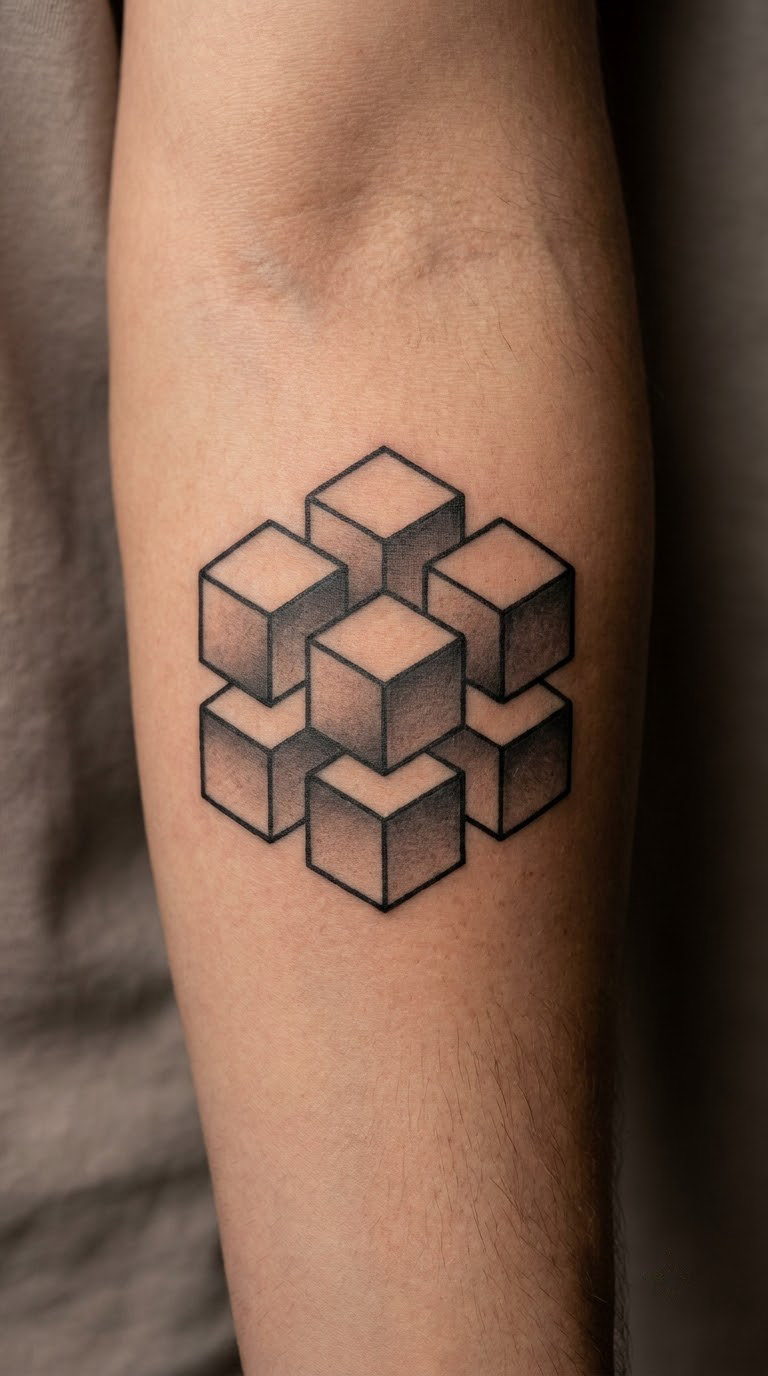
An isometric cube is a compact three-dimensional design drawn on a flat plane: three faces meeting at a single front corner, each face a parallelogram, with grey tonal blocks making one face lighter than another. Straight off the page, the cube rotates as your arm moves.
Cubes are usually chosen for the puzzle of it rather than for meaning. What matters is the accuracy of the parallel edges — a cube whose three axes do not sit at thirty-degree intervals stops reading as three-dimensional almost immediately, and no amount of shading will rescue it.
Placement: forearm, calf, or upper arm · Size: 2.5-3 in (6-7.5 cm) wide · Style: geometric with flat grey shading
Pain: low. Small and almost entirely straight lines, so the session is short. On ageing, the two hard diagonal axes carry the whole illusion, and thin diagonal line work softens noticeably on the forearm, so a slightly heavier axis weight is worth asking for.
Make it yours: build a second cube and connect it to the first with faint guide lines so they read as one stacked structure.
10. Geometric Wolf Profile
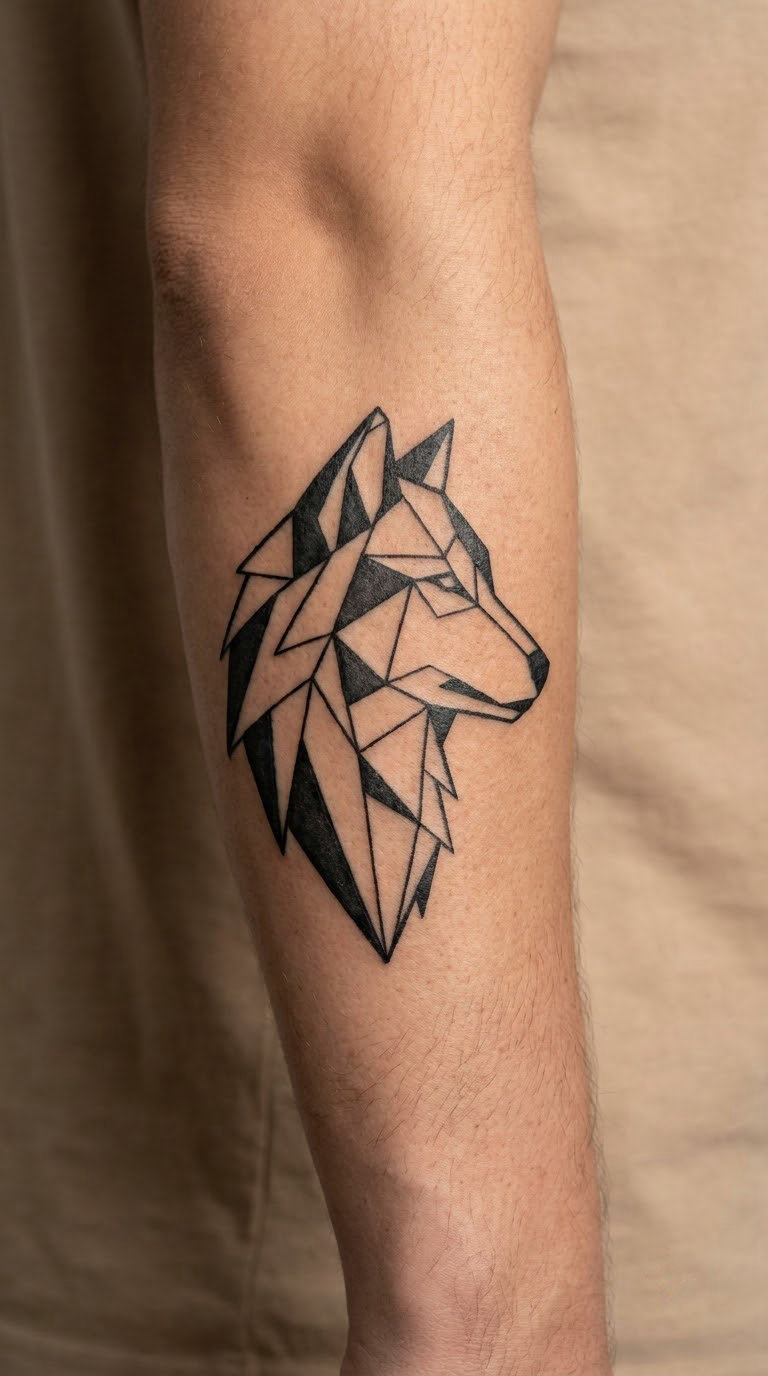
A geometric wolf profile is a wolf head broken into triangles and sliced planes, with the ear, muzzle and cheek defined by the gaps between those shapes rather than by outline detail. The eye is usually a single solid triangle.
Wolf tattoos carry a fairly consistent set of associations — loyalty, instinct, family, independence — and men pick this one for that established reading rather than inventing their own. The low-poly treatment is the modern version; the same silhouette as line art still gets requested constantly.
Placement: outer forearm, calf, or the upper arm · Size: 4-5 in (10-12.5 cm) tall · Style: geometric low-poly, black
Pain: medium. The planes are large and mostly single-pass, which keeps the time down. On ageing, the tiny gap lines between planes blur first, and the eye triangle disappears fastest. Anything smaller than 3.5 in will lose the face.
Make it yours: have the ear angle and head direction set to match a specific breed or a specific animal you knew, which shifts the character of the whole piece.
11. Radial Sunburst
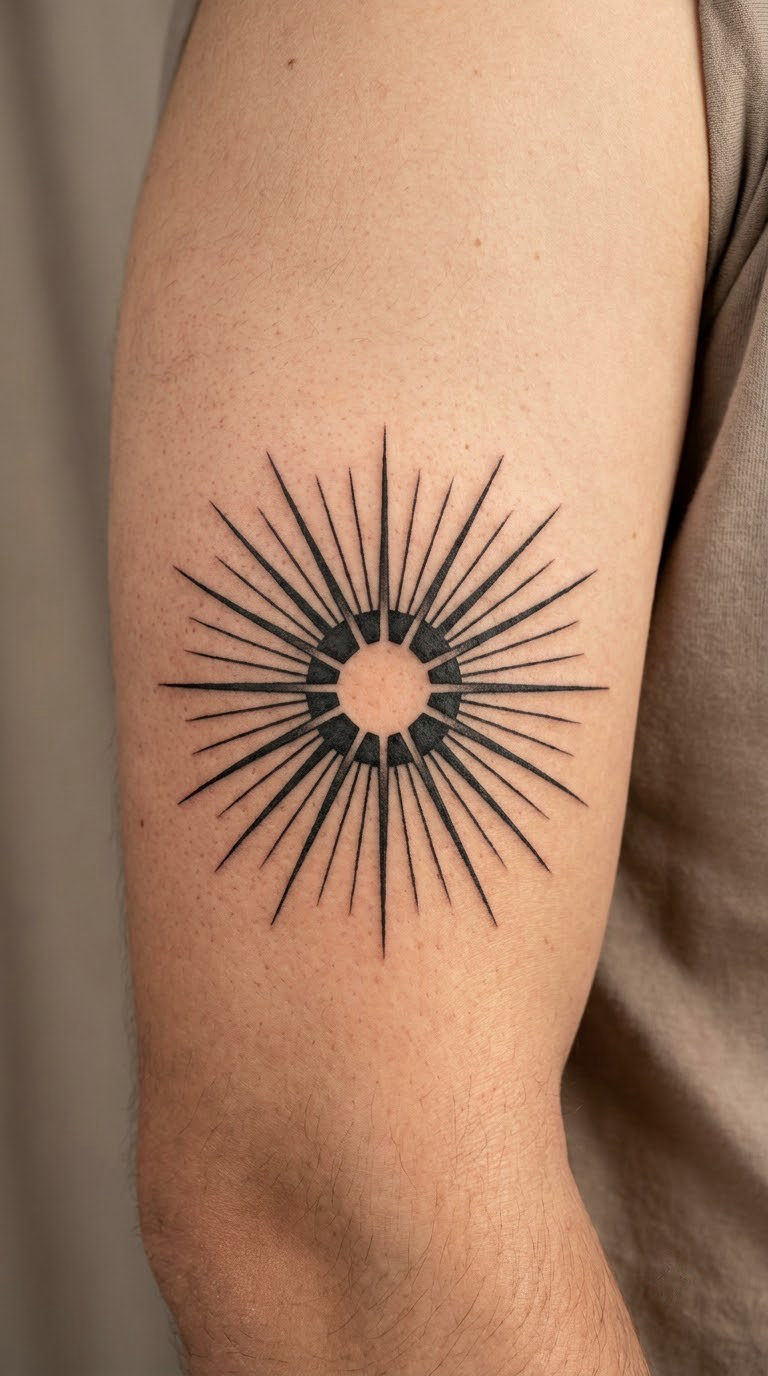
A radial sunburst puts a small polygon at the centre — a hexagon or octagon — and sends evenly spaced straight rays outward, alternating line weights so thick and thin spokes trade places. Some versions add a second, shorter ring of rays between the main ones.
Sunbursts are usually about energy and forward motion rather than a fixed religious reading, and the alternating weight is a genuinely older decorative idea. It works as a single mark or as a repeated element across a shoulder panel.
Placement: upper arm, chest, or forearm · Size: 3-4 in (7.5-10 cm) across · Style: geometric linework with alternating weights
Pain: medium. Radial layouts are hard work because symmetry has to hold, and the artist is constantly checking around the circle. On ageing, the rays on the outer curve of a rounded upper arm compress over time — a design on a flatter surface like the outer chest or the calf holds its spacing better.
Make it yours: set the ray count to a meaningful number, or start the rays at an uneven inner radius so the centre looks like it is expanding.
12. Sacred Geometry Lotus
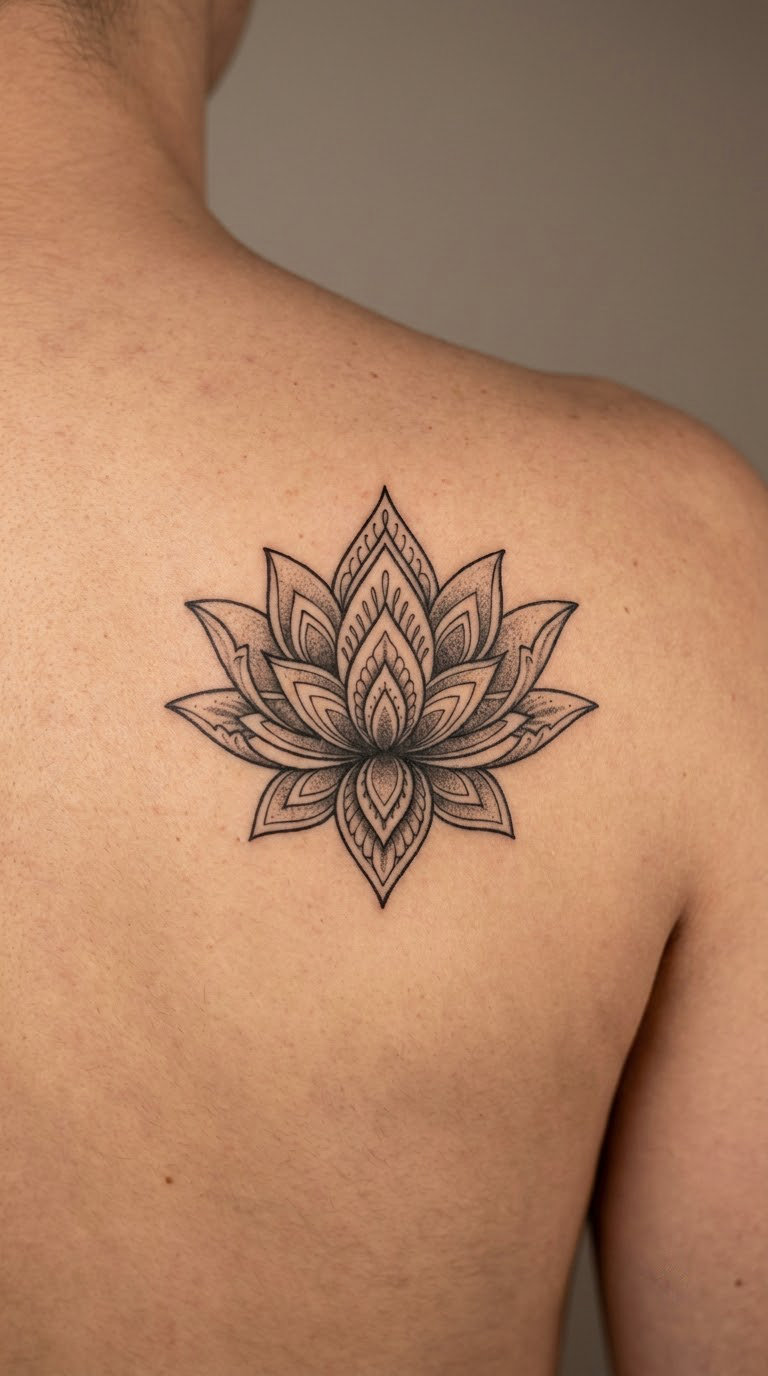
A sacred geometry lotus takes the lotus petal arrangement and rebuilds it from symmetrical pointed shapes, each petal holding its own fine internal geometry — a smaller rotated triangle, a seed of dots, a nested outline. The whole flower is constructed, not drawn freehand.
The lotus itself carries long-established associations with renewal and awakening, and pairing it with sacred geometry simply formalises the shape. Men tend to choose it for the symmetry as much as the flower, and the back is where the full radial layout actually fits.
Placement: shoulder blade, mid-back, or upper thigh · Size: 4-5 in (10-12.5 cm) across · Style: sacred geometry, fine line
Pain: medium. Long fine-line session with lots of small internal detail. On ageing, the internal petal detail is where this softens first. A version with fewer internal elements per petal will look sharper in five years than a fully detailed one.
Make it yours: have the number of petals match something that counts — a year, a number of children, a distance — instead of the default eight.
13. Architectural Linework
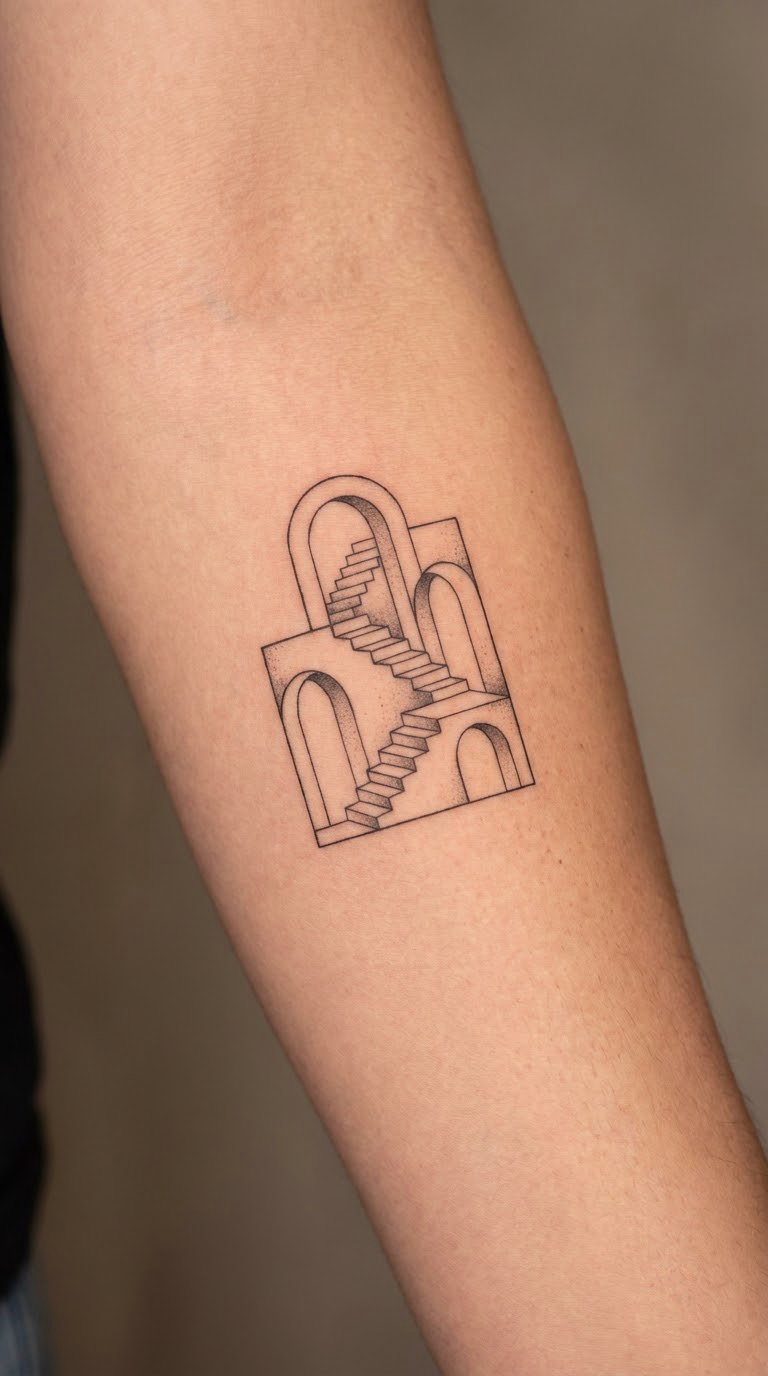
Architectural linework reduces real buildings to geometry: repeated arches stacked in a column, a stairway drawn as a run of right angles, a bridge truss that reads as a row of triangles. All outline, almost no fill, and every edge the same weight.
It is nearly always a specific place — a building you grew up under, a city you spent a year in, an archway you photographed. That makes it one of the easiest designs here to make genuinely personal without adding a single date.
Placement: forearm, calf, or the back · Size: 3-4 in (7.5-10 cm) tall for a single motif · Style: fine-line illustrative geometry
Pain: low to medium. Straight single-needle outlines are quick, though an arch train means a lot of line length for the area. On ageing, fine outlines on the inside of the forearm and on the hand are the first geometric line work to go soft — plan on a touch-up every few years, or start slightly heavier.
Make it yours: sketch the actual building from memory or from a photo, and ask the artist to simplify it to the three or four shapes that identify it.
14. Mosaic Lion
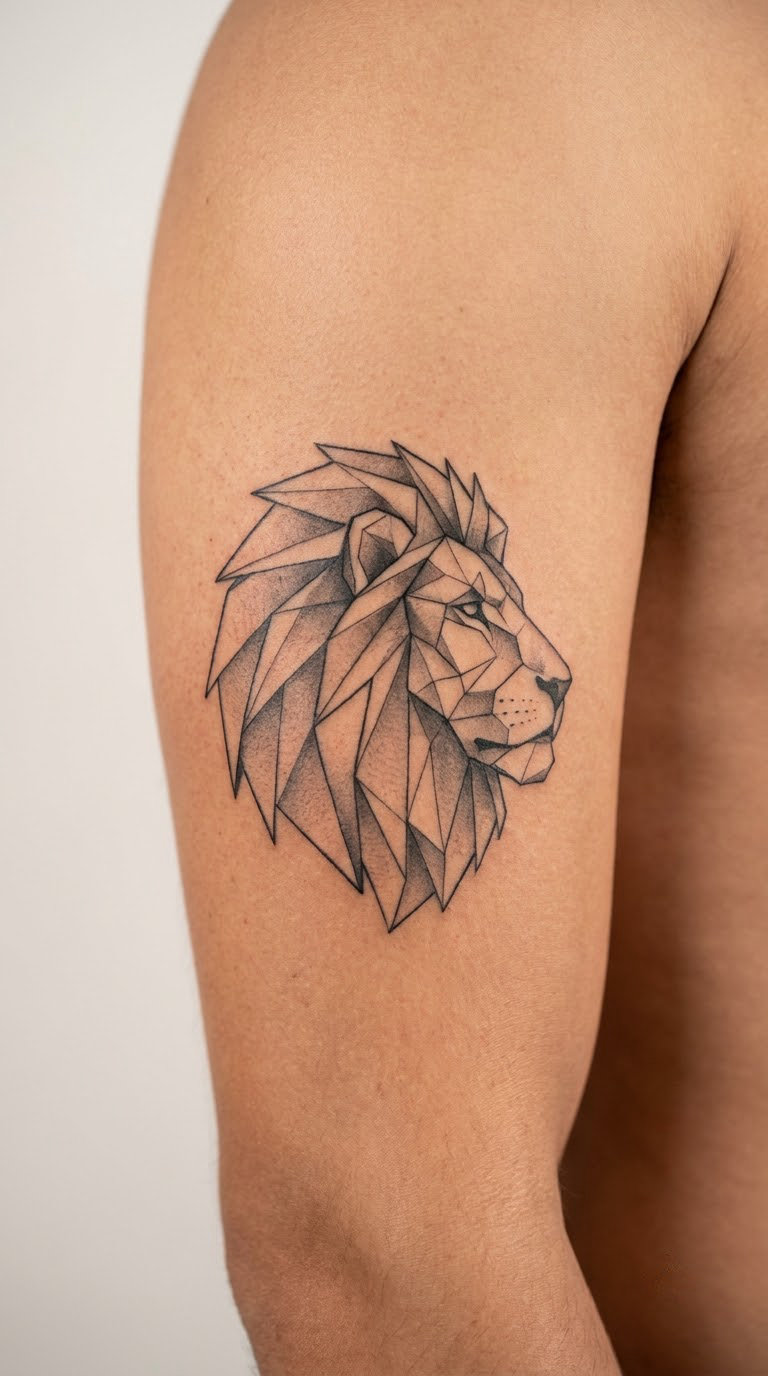
A mosaic lion builds the profile of a head from irregular polygonal facets that interlock like broken tile, with a light facet next to a dark one so the form turns three-dimensional. Unlike a traditional lion portrait there is no fur, no eye detail, no whiskers — just the angle of the face and the mass of the mane.
It is one of the most requested images in geometric tattoo galleries for men, and the usual reasons are courage, leadership and steadiness. At this size the facets are large enough to survive skin movement, which is the whole point of the mosaic approach.
Placement: outer upper arm or outer thigh · Size: 5-6 in (12.5-15 cm) across · Style: geometric polygon work, black and grey
Pain: high. This is a large area of repeated grey fills, and grey is more work per square inch than line work. On ageing, small facets are where this softens, so agree the minimum facet size in the consult. Below about a quarter inch they blur into a soft grey mass within a few years.
Make it yours: have the facets break along the mane’s outer edge only, leaving the face smooth — a contrast that reads well and is much easier to re-touch later.
15. Chevron Sleeve Panel
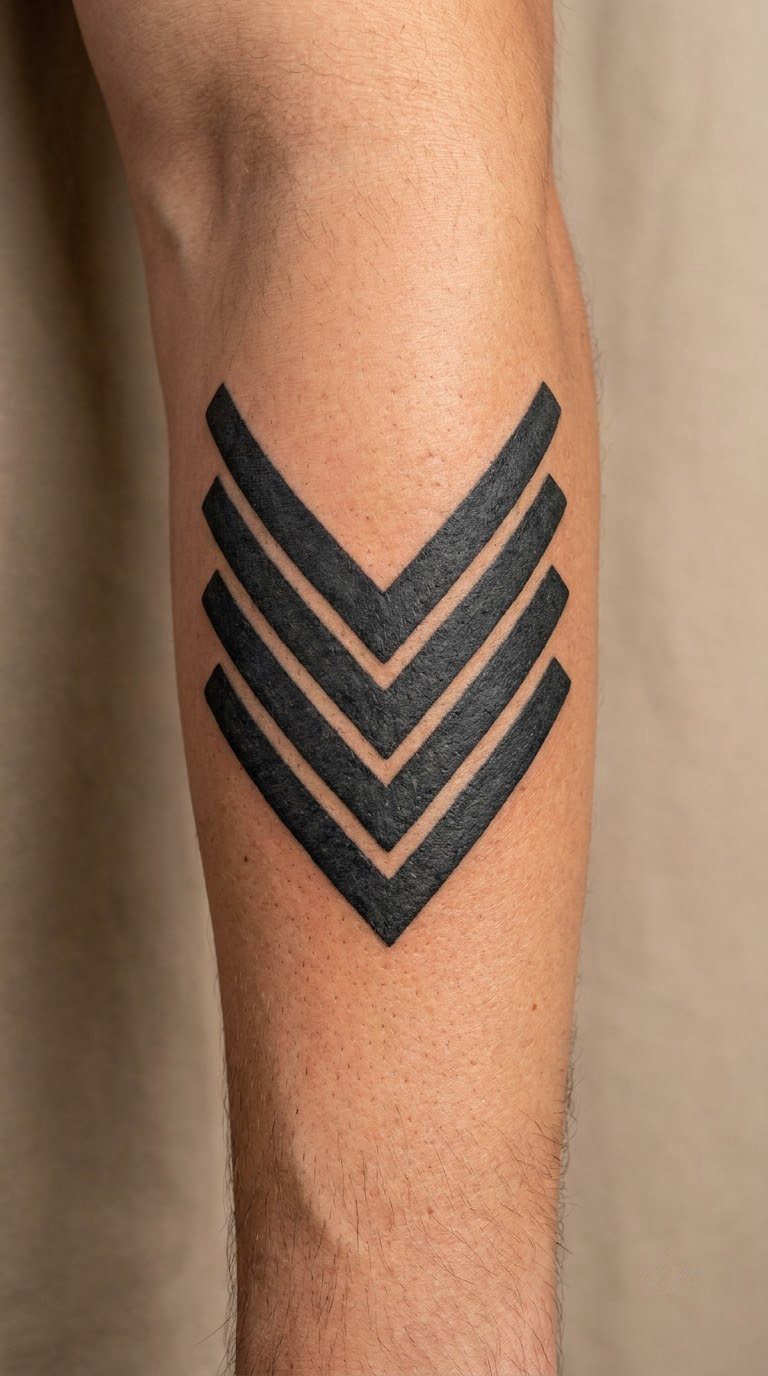
A chevron panel stacks V-shaped bands down the arm, each band offset slightly and each V cut from a solid black shape, so the pattern reads as a wide stripe of repeating arrows. Solid and outline bands alternate, which keeps it from turning into a heavy black slab.
It works as a single stand-alone piece on the outer forearm, and it also scales straight into a sleeve: keep the same band height and you can run the pattern from wrist to shoulder later, adding a figurative centrepiece without changing the visual language.
Placement: outer forearm for a panel, upper arm for the start of a sleeve · Size: 5-7 in (12.5-18 cm) tall for a stand-alone panel · Style: bold geometric blackwork
Pain: medium to high. The solid bands take repeated passes and the forearm is a large canvas for a single sitting. On ageing, heavy chevrons are stable; the risk is forearm movement stretching the bands unevenly over time, so a slightly narrower V pitch ages more evenly than a very wide one.
Make it yours: vary the band widths so each V is a different thickness, or reverse the direction on a matching forearm. If you like stacked bands, our forearm band tattoo ideas for men cover the other patterns that stack this well.
16. Minimal Triangle Cluster
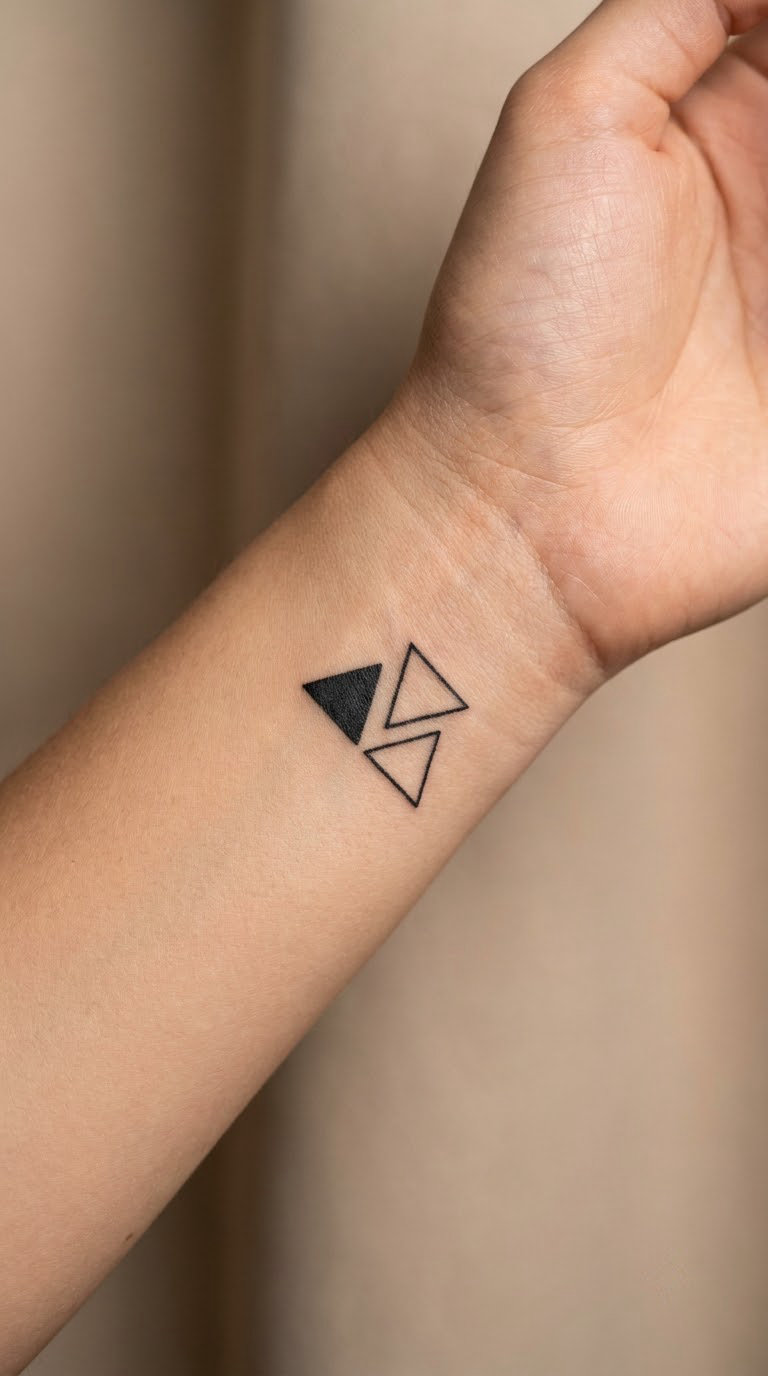
A minimal triangle cluster is three triangles in a loose group: one solid, one outlined, one intersected by a single line. That is the entire design. It is the smallest idea on this list and the one most often recommended as a first geometric tattoo.
There is no symbolism to defend and very little to regret, which is exactly why it suits people who are not sure yet whether they want a tattoo. Plenty of men start here and end up planning something far larger a year later, having discovered they like having ink on them.
Placement: inner wrist, forearm, or ankle · Size: 1.5-2 in (4-5 cm) wide · Style: minimal fine line
Pain: low, and short. The inner wrist stings more than people expect for such a small mark, so take breaks if you need them. On ageing, wrist and ankle are high-wear areas and a cluster this small softens noticeably within a few years. Accept that as the cost of a low-stakes first piece.
Make it yours: set the three triangle sizes to the years something important happened, or have the intersecting line cut at an angle that matches a real roofline.
17. Geometric Snake Coil
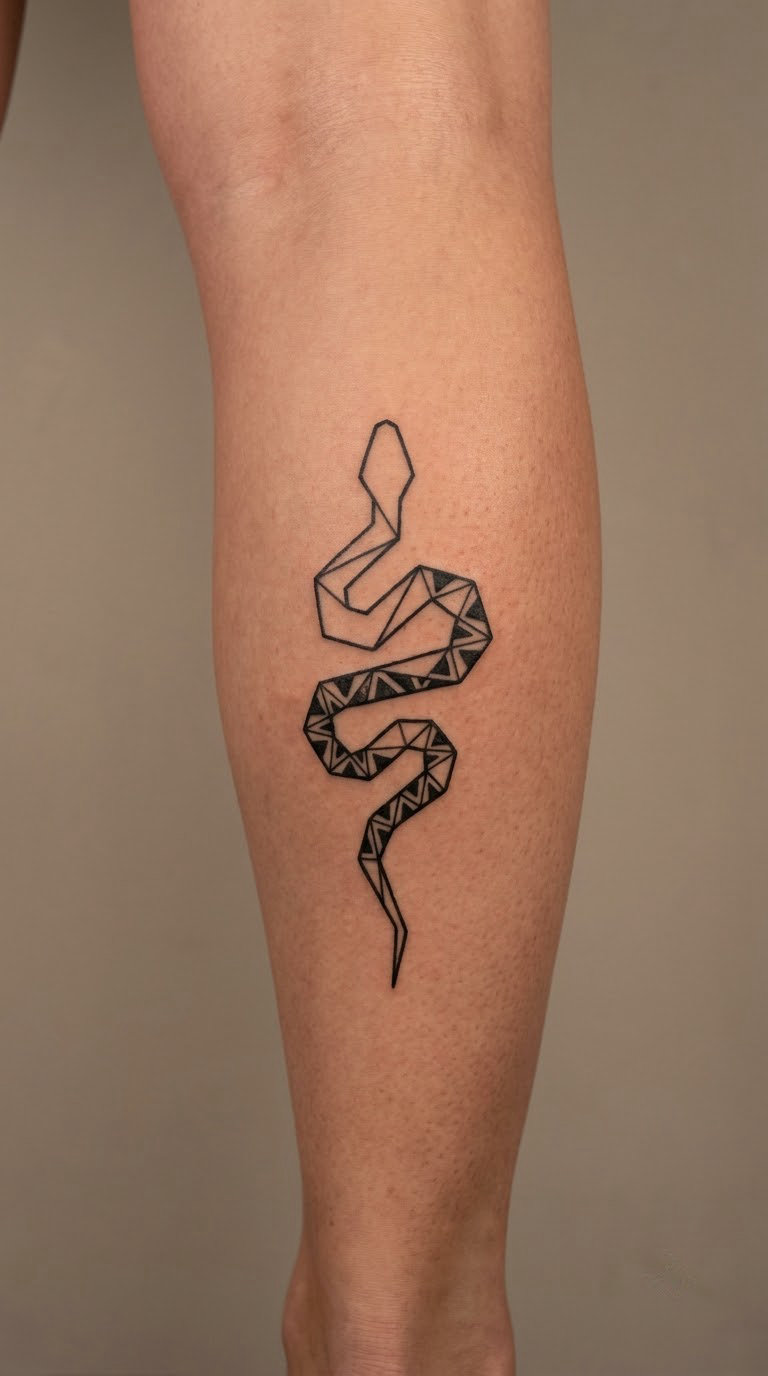
A geometric snake coil runs one continuous angular line in a loose spiral, with triangular markings dropped along the body at regular intervals. No scales, no head detail beyond a simple wedge — the shape of the coil does the work.
Snakes have a long-standing set of associations with transformation, renewal and rebirth, largely because they shed their skin. Men who pick the geometric version tend to be after the coiled, self-contained shape rather than the reptile, so the simplified line work is usually a deliberate choice rather than a rushed one.
Placement: calf, forearm, or along the ribs · Size: 4-5 in (10-12.5 cm) long · Style: geometric linework
Pain: medium on the forearm, higher along the ribs. On ageing, keep the triangle markings chunky. A continuous fine line that loops four or more times is the part most likely to drift out of alignment as it heals, because any wobble repeats around the spiral.
Make it yours: add a single line of colour to the triangles only, or match a small coil on the opposite forearm at the same scale.
18. Blue Circuit Grid
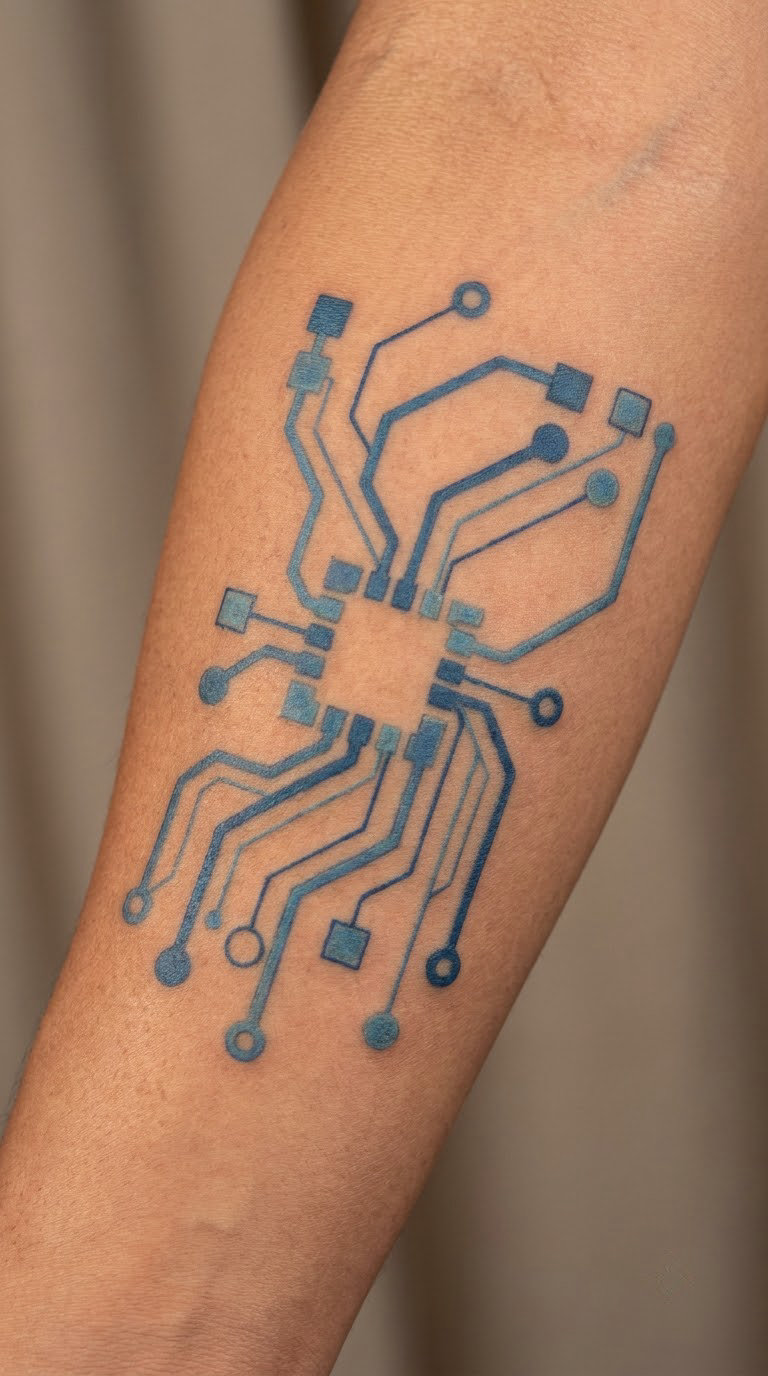
A circuit grid is geometric work with a blue palette: right-angled pathways running across the skin, small circular nodes at the junctions, and a handful of short branching stubs. The blue is usually a single mid-tone rather than a gradient, with black outlines holding the shapes.
It borrows from the language of engineering rather than sacred geometry, and men tend to describe it in terms of systems, networks and structure. Restraint matters here — the best versions use one blue and let the negative space carry the design.
Placement: outer forearm, upper arm, or calf · Size: 3.5-4.5 in (9-11.5 cm) wide · Style: colour geometric with black line work
Pain: medium. The black line work is light; the coloured fills add time. On ageing, blue on an exposed forearm fades toward grey faster than black does, particularly in summer sun. Ask for a saturated mid-blue rather than a pale one, and expect a colour refresh every few years.
Make it yours: route the pathways to trace an actual route you drive or run, or add one node in a second colour as the starting point.
19. Geometric Eagle Head
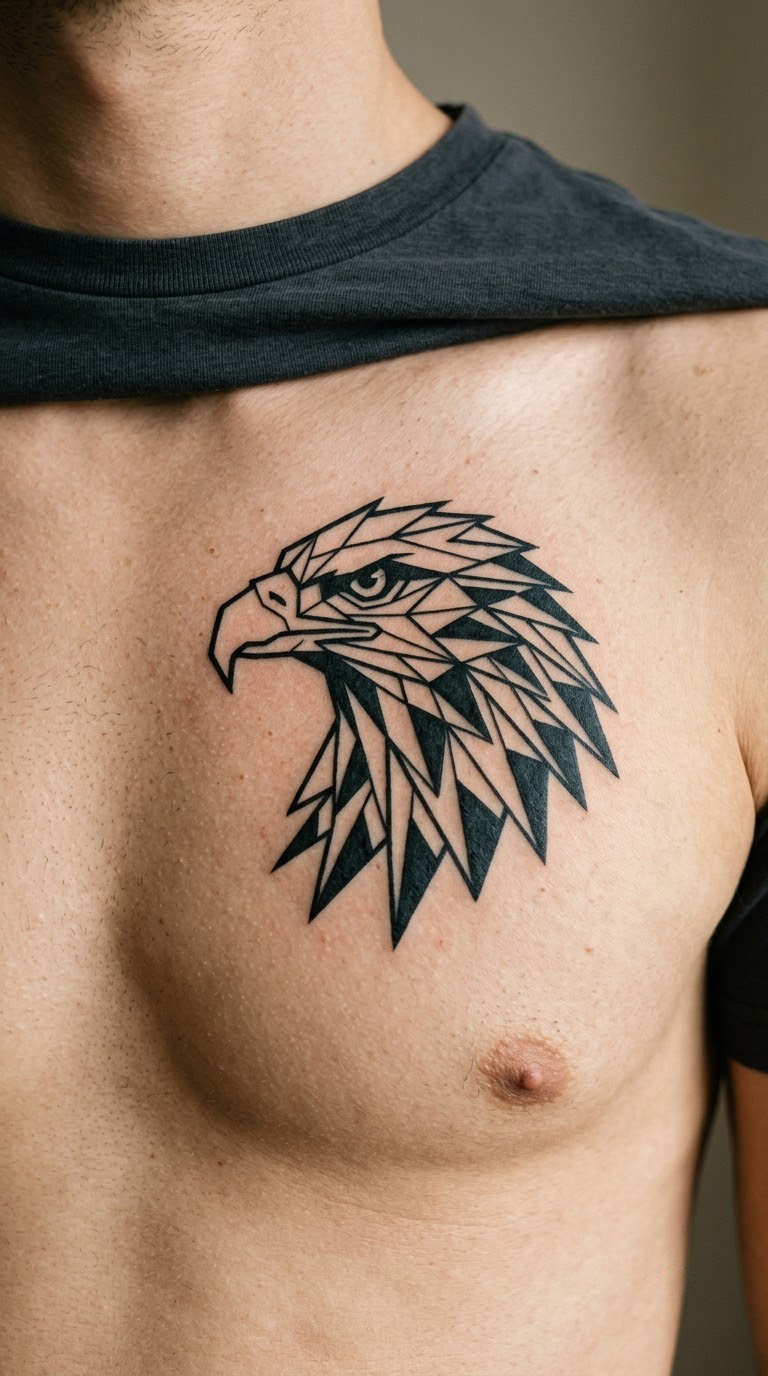
A geometric eagle head is built from sharp triangular sections that stand in for feather layers, with a hooked beak drawn as two straight planes and a solid black eye. The angles all lean one way, which is what makes it look aggressive rather than decorative.
Eagles are widely read as focus, vision and perspective — seeing the situation from above. It is an established reading rather than an invented one, and it is why this design keeps appearing on chests and shoulders rather than arms.
Placement: upper chest, shoulder, or outer arm · Size: 4-5 in (10-12.5 cm) wide · Style: geometric blackwork
Pain: high. The upper chest is a sensitive bony area and the feather planes are solid. On ageing, black edges on the chest stay sharp for years, but a design placed right on the sternum will shift as skin and chest hair change — sitting it slightly off-centre holds better.
Make it yours: have the feather triangles count back from a significant number, or mirror the head on the opposite shoulder so the two point outward from the body.
20. Watercolor Polygon Peaks
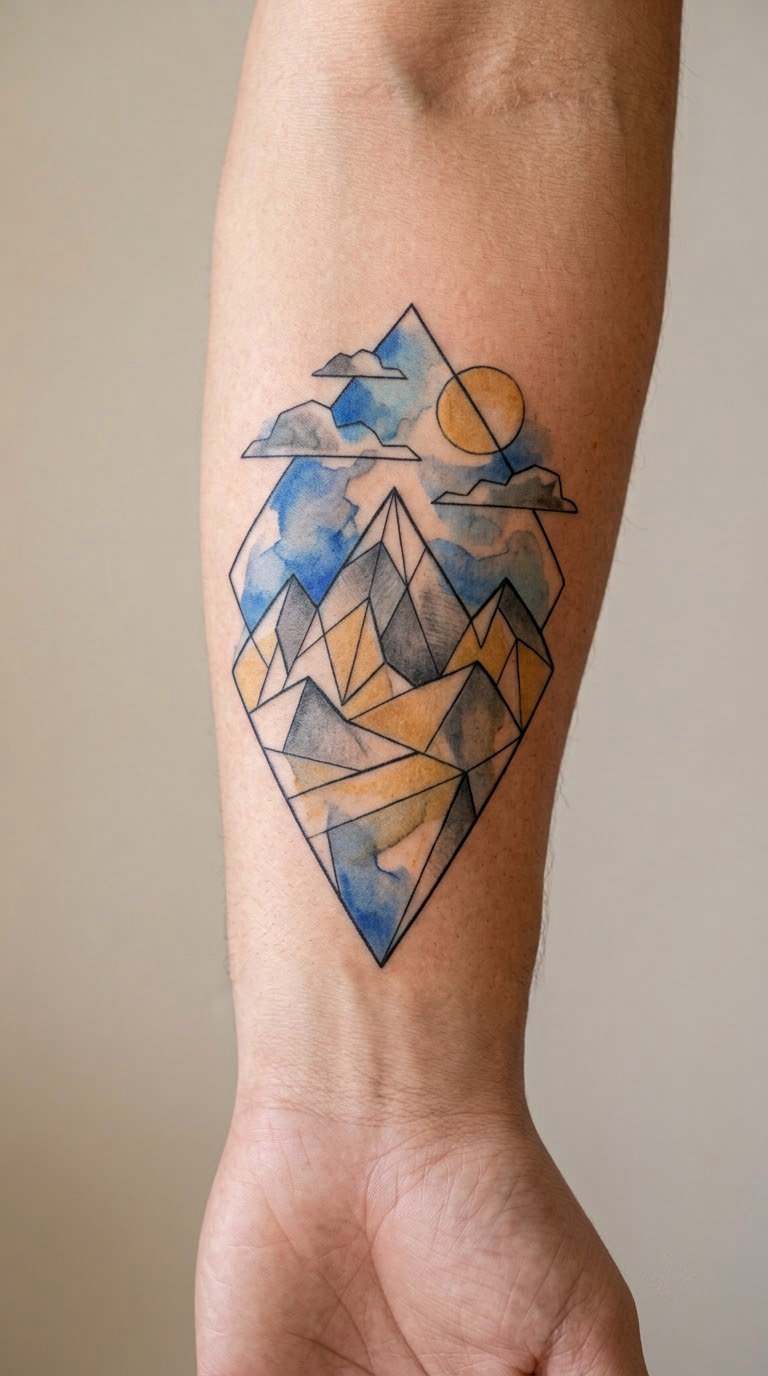
Watercolor polygon peaks combine hard-edged geometric mountains with soft transparent washes: a crisp line drawing of a range with blue, grey or ochre pigment bleeding just past the outlines. The contrast between the two textures is the whole point.
The motif borrows from a distant view without becoming a scene, and the colour is chosen for mood rather than description. It suits men who find solid blackwork too severe but still want a defined edge to the design.
Placement: forearm, calf, or across the upper back · Size: 4-5 in (10-12.5 cm) wide · Style: watercolor geometry with black line work
Pain: medium. The line work is light but the washes need care and drying time. On ageing, the transparent colour settles a shade deeper as it heals, so expect the first version to look softer than the reference. Pale yellows and light blues drop out fastest over the years.
Make it yours: have the wash colours pulled from a photograph of a real sky you wanted to keep, and keep the line drawing simplified to three or four peaks.
21. Interlocking Hexagon Sleeve
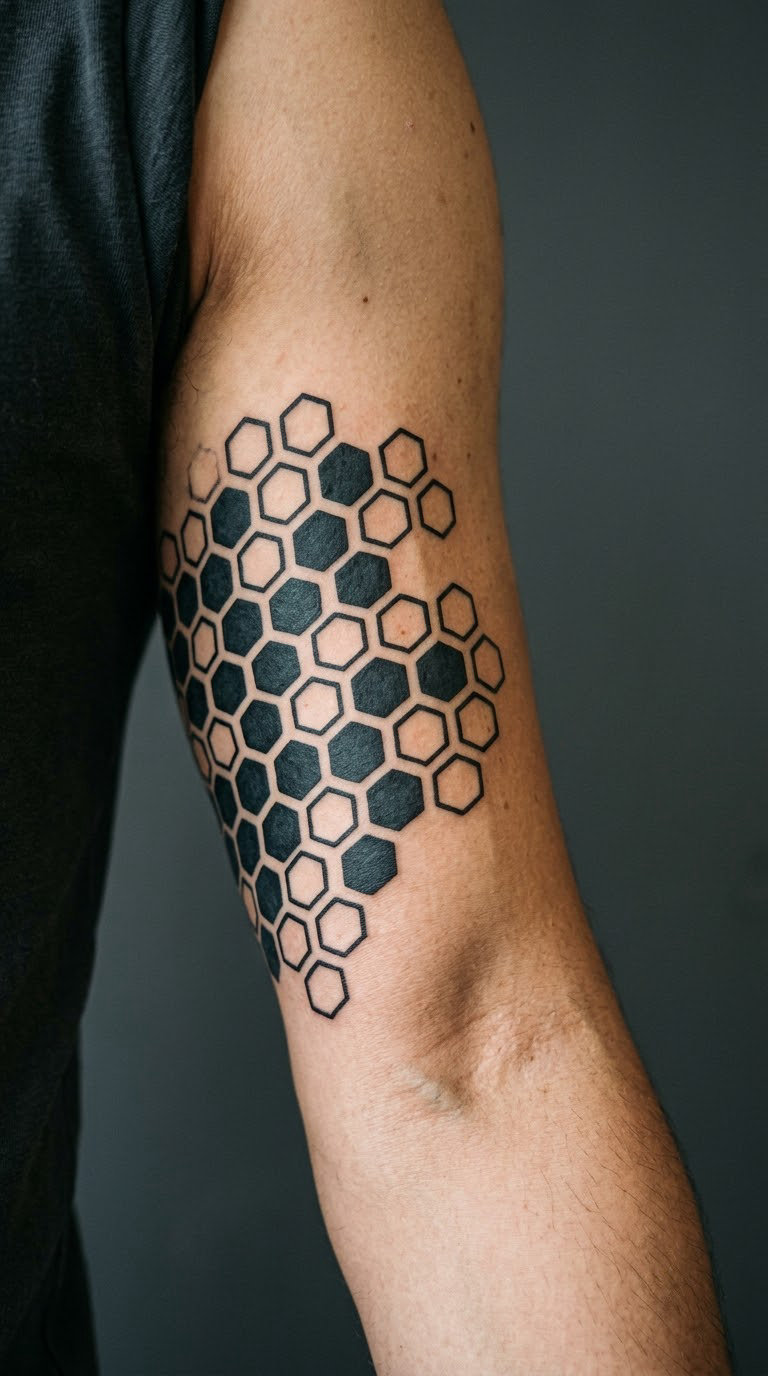
An interlocking hexagon sleeve is a dense field of hexagons where the cells alternate between solid black, outline only, and a cross-hatched fill, so the pattern has depth and rhythm instead of reading as a flat honeycomb. It is built as a panel with no central image.
This is the one on the list that cannot really be done as a small piece. Each hexagon needs to be big enough to hold its fill, and the pattern only earns its name at panel or sleeve scale, which means planning the whole arm before the first sitting.
Placement: upper arm as a panel, or the full arm as a sleeve · Size: 6 in (15 cm) and up · Style: geometric pattern, blackwork
Pain: high, and it takes more than one session. A full sleeve is a series of appointments over weeks. On ageing, this is among the most durable geometric work — solid and outline cells are large and hold well, so the question is arm shape over decades rather than line softness.
Make it yours: map out the full arm first with the artist, then place one larger solid hexagon in the middle of the grid as a focal anchor.
22. Minimal Orbit Lines
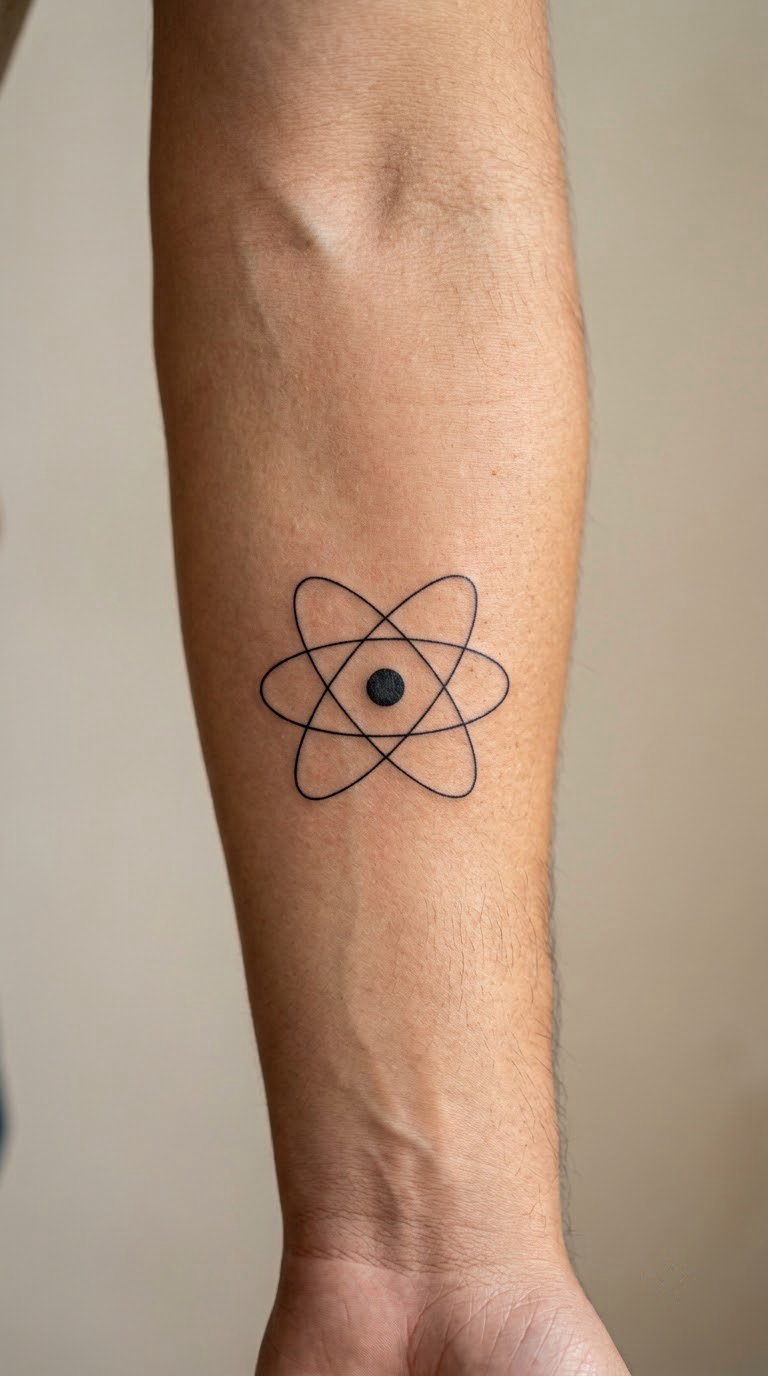
Minimal orbit lines are two or three ellipses at different tilts crossing around a small solid circle, with nothing else in the frame. The appeal is entirely in the geometry: the same circle seen from several angles, and the way the lines cross without ever touching.
It is usually read as focus, direction or a thought expanding outward, though it is a modern invention rather than a traditional symbol. The small scale means it tucks under a watch strap or a cuff without being hidden.
Placement: inner forearm, wrist, or behind the ear · Size: 2-2.5 in (5-6.5 cm) wide · Style: minimal fine line
Pain: low and brief. On ageing, the ellipses are long uninterrupted curves, and a curve is the hardest thing for a tattoo line to keep. Ask the artist to keep them a single pass at a consistent weight, and expect a refresh in three or four years on the inner forearm.
Make it yours: set the centre circle as a solid dot sized to a meaningful date, or angle the ellipses to match the orbit of a planet from a chart.
23. Geometric Deer Antlers
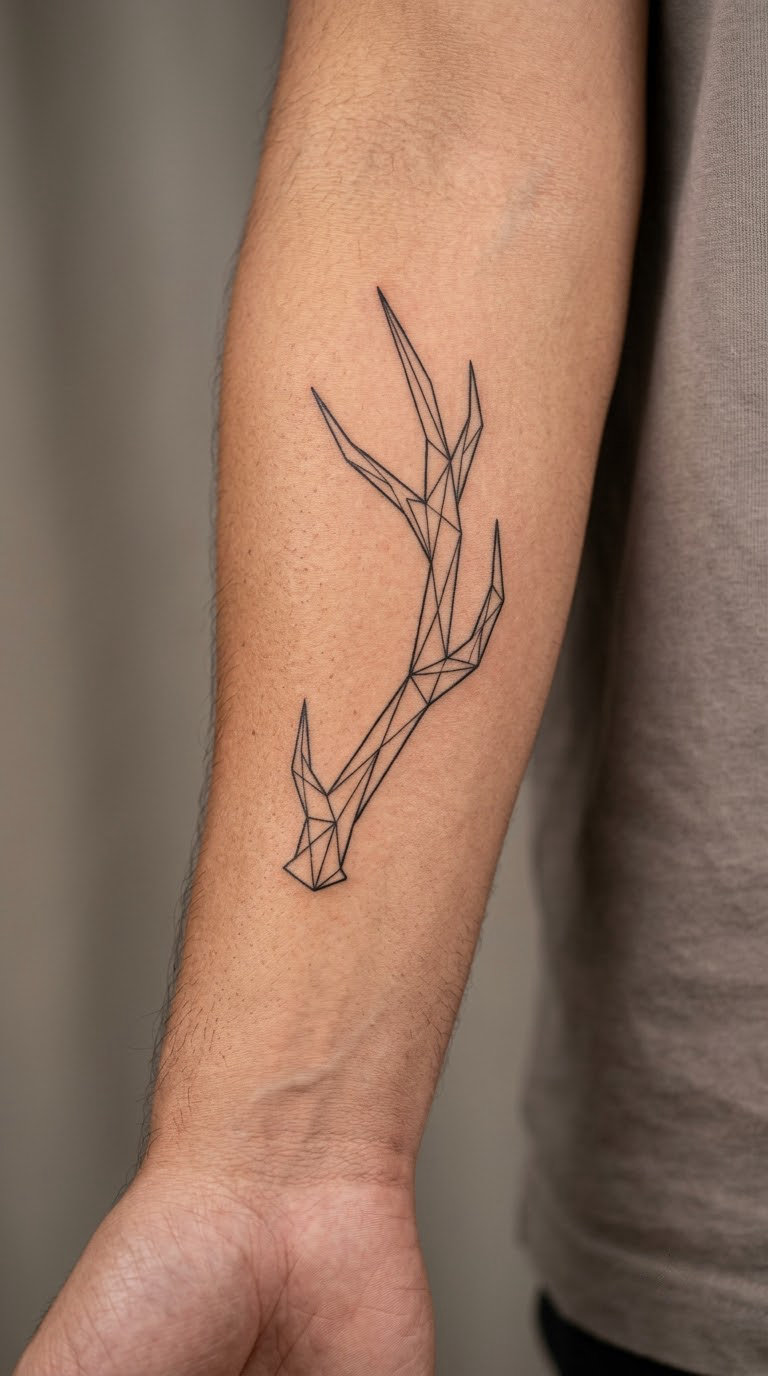
Geometric deer antlers grow upward in repeating angular segments — each branch a short run of straight lines meeting at a sharp fork, thickening slightly as it rises. There is no deer head and no skull, just the branching structure on its own.
Strength, connection to nature and growth are the readings people give it, and the branching shape suits a piece that will later join others at the elbow or shoulder. Antlers on the hand are popular too, and they are the version most likely to need re-touching.
Placement: forearm, calf, or the back of the hand · Size: 3-4 in (7.5-10 cm) tall · Style: fine-line illustrative geometry
Pain: low. Mostly single-needle outlines with no fill. On ageing, hands and fingers wear away faster than any other area, and the fine fork tips are exactly the detail that disappears. On the forearm this holds very well; on the hand, plan for a top-up every two years or so.
Make it yours: make the fork count on one side match a year, or have the antlers grow around an existing tattoo to fill in a forearm.
24. 3D-Style Pyramid
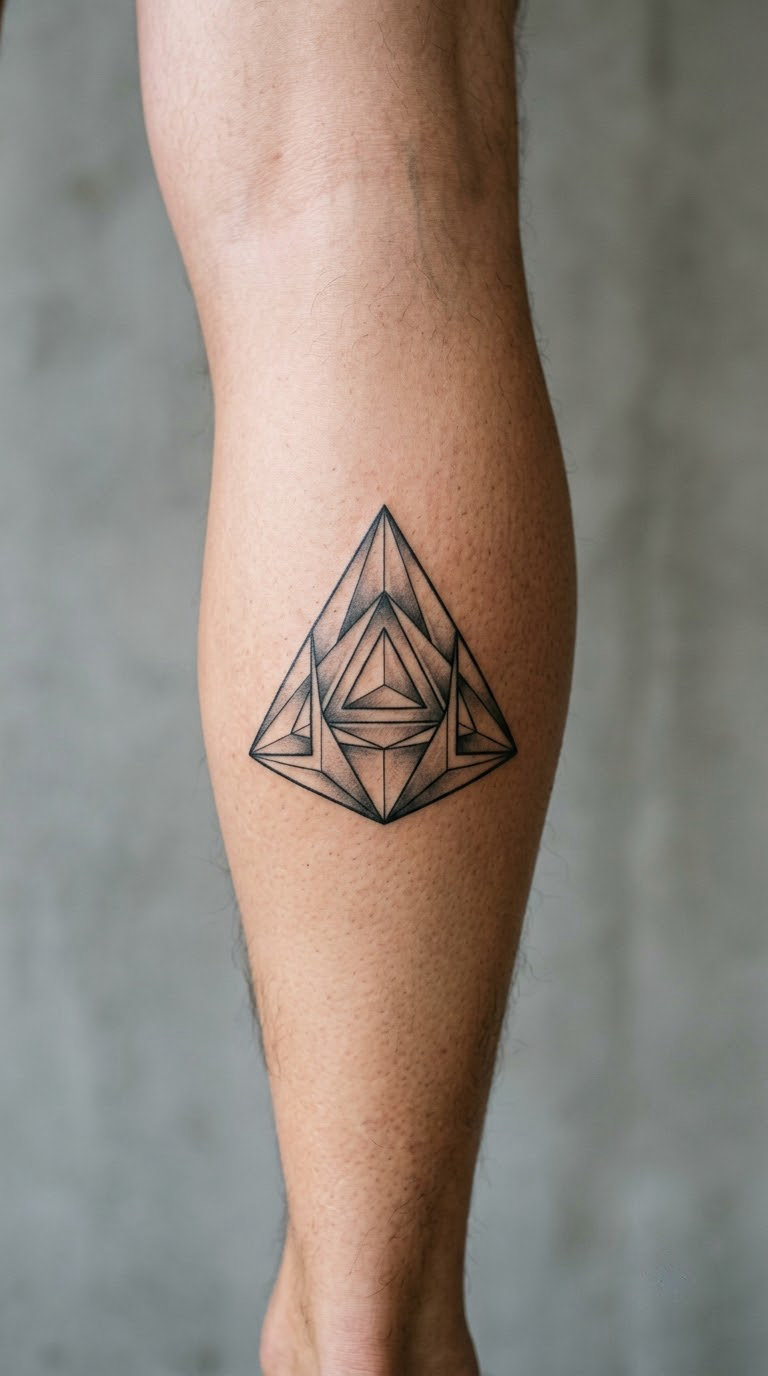
A 3D-style pyramid is a single triangle split into nested planes, each inner triangle shaded a little darker than the one around it so the whole form appears to recede into the page. Two faces meet at a hard central ridge and the base sits on a straight line.
There is no settled meaning attached to it, which leaves the design wide open for personal content — coordinates, a year, a name set in the smallest plane. The shading is what sells the depth, so control of even grey tone matters more here than line precision.
Placement: outer calf, forearm, or thigh · Size: 3-4 in (7.5-10 cm) wide · Style: geometric with soft grey shading
Pain: medium. The nested planes are small filled areas worked close together. On ageing, the innermost planes are the smallest and soften first, so ask for a minimum of three visible tones rather than six, and expect a touch-up on the centre after a few summers.
Make it yours: set the coordinates of what the design represents in the middle plane, and leave the deepest interior plane solid black so the inscription stays readable.
How to Choose the Right Design
Style first. If you want one bold statement, start with the blackwork options — overlapping triangles, the mosaic lion or the abstract geometric bull. If you want something quiet enough for work, the fine-line and minimal options — fine-line mountain ridge, minimal triangle cluster, minimal orbit lines — age better and suit most jobs.
Scale second, and let the canvas decide. A flat area like the outer chest, upper back or outer calf holds a symmetrical radial design far better than the curve of a bicep, where a compass rose or a sunburst compresses on one side. If you like the inner bicep tattoo ideas for men here, check first how a design sits on a rounded muscle before committing.
- Line visibility: count the thinnest line in the design and picture it in eight years. Anything under about a millimetre on a forearm will not be there.
- Existing tattoos: a geometric panel is one of the most useful filler styles there is, because hexagons, triangles and grids can be laid around a figurative piece instead of trying to hide it.
- Distance and detail count: more intersecting lines means a longer session. Metatron’s Cube at 3.5 inches can take as long as a much larger design with fewer elements.
- Ask the consult questions: how long will this take, what line weight are you using, and can I see healed work in this exact style. An artist who answers all three plainly is the one worth booking.
- Check healed portfolios, not fresh ones: fresh work always looks sharper. Ask to see pieces two years healed — that is the honest version of the work.
Cost and Session Time
Geometric work is priced on the same things as any tattoo — size, detail, placement, the artist’s rate and the shop minimum — but the detail count is unusually high in this style, so a small piece can run longer than a larger, simpler one. Session length is the most useful number to ask for at a consult, because it tells you how many appointments you are committing to before the first one starts.
Rough session expectations, assuming an experienced artist and a straightforward placement:
- Micro, 1-2 in: under an hour. Minimal triangle cluster, minimal orbit lines.
- Small, 2.5-4 in: 1.5 to 3 hours. Most of the fine-line and minimal designs, though Metatron’s Cube runs longer because of the lattice.
- Medium, 4-6 in: 3 to 5 hours. Compass roses, mosaic lion, constellation maps, the abstract bull.
- Large panel, 6 in and up: split across two or more appointments. Chevron panels and interlocking hexagon work.
Shop minimums mean a tiny design still counts as a full booking, and it is worth asking whether the studio charges per hour or per piece. The most common money mistake in this style is not the artist — it is scaling a detailed design up to fill a bigger space, which turns a two-hour job into a five-hour one and still looks better at the smaller size.
Aftercare Basics
- Follow your artist’s aftercare instructions first. They know what they did, and generic advice from the internet does not know whether your artist used a single needle or a shader.
- Wash gently with unscented soap and lukewarm water, then pat dry with something clean and lint-free. No scrubbing, and no long soaking in the shower.
- Keep it covered per your artist’s instructions, and change any bandage or wrap if it gets wet or lifts at the edges.
- Wear loose clothing over it for the first couple of weeks. Friction and trapped sweat do more early damage than anything else.
- Keep it out of direct sun and out of swimming pools, hot tubs and the sea while it heals, then treat sun exposure as a long-term habit rather than a short-term one.
- Do not pick scabs. A geometric line tattoo scabs along its own lines, and picking them off is the fastest route to patchy blackwork.
Frequently Asked Questions
What size should a first geometric tattoo be?
For a first geometric piece, most artists suggest somewhere between 2 and 3.5 inches across. That range gives the line work enough surface to stay straight without committing you to a large piece. Below 1.5 inches, detail and line weight both suffer. If you already know you want a bigger geometric tattoo eventually, start with a standalone design that shares the style language of the future one.
Do geometric tattoos hurt more than other styles?
Not inherently. Pain tracks placement, needle depth and session length more than style. Fine-line geometric work on a forearm is often among the more comfortable tattoos, because single-needle passes are shallow and quick. Solid blackwork panels hurt more because the area is repeatedly covered, and chest, ribs and inner bicep hurt noticeably more than an arm regardless of design.
Will fine line geometric work fade?
Yes, more than solid blackwork. Fine lines in exposed places like the forearm, hand and fingers soften first, usually visibly within five to six years. Curves drift before straight lines, and small details such as dotwork stars blur before large shapes do. Ask for a slightly heavier line than looks right fresh, and treat a touch-up every few years as part of the design rather than a failure.
How do I find an artist who can do straight geometric lines?
Ask to see healed work, not fresh work, and look for consistent straight lines across a curved surface such as a forearm, with minimal scarring and even shading. A portfolio showing the exact style at the size you want matters more than one showpiece. Artists who describe line weight and how a design will age are showing experience, and if they skip that conversation, move on.
Can I get a geometric design as my first tattoo?
A geometric design is a good first tattoo if you pick a minimal option such as a triangle cluster or a fine-line mountain ridge. They are small, quick to heal and easy to place somewhere discreet. Avoid a detailed design like a Metatron’s Cube or a hexagon sleeve as a first piece: the long session and the precision required are a lot to ask for before you know how you handle sitting still.
Conclusion
For a first geometric tattoo, the minimal triangle cluster is the practical pick. It is small, quick, sits anywhere discreet and teaches you how you handle a session without committing you to a large piece you might not want.
If you are already building a collection, the mosaic lion and the chevron sleeve panel are the stronger picks. Both scale up, both hold their edges for decades, and both give a later figurative piece a style to sit inside. Whichever you choose, agree the line weight, the minimum detail size and the healed look with the artist before the first sitting — placement decided alone is where most geometric designs go wrong.