
24 Full Leg Tattoo Ideas for Women: Stunning (September 2026)
A full leg tattoo is one continuous design that travels from the upper thigh down to the ankle, built around the leg’s curve rather than placed on top of it. That single idea is what separates a piece that still looks right in ten years from one that never quite worked. Below are 24 full leg tattoo ideas for women, each with the linework, placement, sizing and pain you can actually plan around.
Most people planning this kind of tattoo sit somewhere between curious and committed, and September is a good month to start thinking about it: sessions booked now finish healed before the busiest stretch of the year. Whatever the reason you’re here, browse the gallery, mark the two or three you keep coming back to, then bring those to a consultation. A good artist will redraw your favourite in the shape of your leg before a single line goes down.
Full Leg Tattoo Ideas for Women: Quick Guide
| Idea | Style | Best placement | Size | Pain |
|---|---|---|---|---|
| Fine-line wildflower vine | Fine line | Outer ankle to upper thigh | Full leg, 16-22 in tall | Low to medium |
| Japanese peony and wave | Blackwork | Anterior thigh to ankle | Full leg, 18-24 in | Medium to high |
| Watercolour butterflies | Watercolour | Front of leg, vertical | 14-20 in, spaced | Low |
| Rose and dagger | American Traditional | Outer thigh to lower calf | 16-20 in | Medium |
| Single-line sun and horizon | Minimalist | Outer calf | 8-12 in | Low |
| Moth and moon | Fine line | Ankle to thigh | 15-19 in | Low to medium |
| Serpent and botanicals | Neo-traditional | Foot to upper thigh | 18-24 in | Medium to high |
| Realistic rose wrap | Realism | Calf, wrapping | 10-14 in | Medium |
| Celestial dotwork map | Dotwork | Outer leg | 15-20 in | Low to medium |
| Koi and blossom flow | Watercolour | Thigh to ankle | 16-22 in | Low to medium |
| Gothic filigree panel | Blackwork | Outer thigh, calf, ankle | Full leg, 18-24 in | High |
| Cherry blossom branch | Fine line with colour | Diagonal, thigh to calf | 14-18 in | Low to medium |
| Botanical herbarium grid | Linework | Full leg, vertical | 20-26 in | Low |
| Mountain and pine range | Black and grey | Wrapping the leg | Full leg, 20-26 in | Medium |
| Dragonfly and lotus | Micro-realism | Ankle to hamstring | 12-18 in | Low to medium |
| Geometric symmetry | Geometric | Wrapping, front and back | 18-24 in | Medium to high |
| Hummingbirds and leaves | Colour realism | Full leg | 16-22 in | Medium |
| Blue Celtic knot | Celtic | Thigh to ankle | 20-28 in | Medium |
| Feathers, moons and stars | Fine line | Ankle to upper thigh | 15-20 in | Low to medium |
| Art Nouveau lily frame | Fine line ornamental | Outer leg | 14-18 in | Low |
| Floral lace stocking | Lace linework | Thigh to foot | Full leg, 20-26 in | Medium |
| Red ink snake | Red ink | Full leg curve | 16-20 in | Low to medium |
| Star map matching piece | Fine line | Ankle to hamstring | 12-18 in | Low |
| Vintage flash patchwork | Traditional flash | Full leg, panel | 16-24 in | Medium |
1. Fine-Line Wildflower Vine from Ankle to Thigh
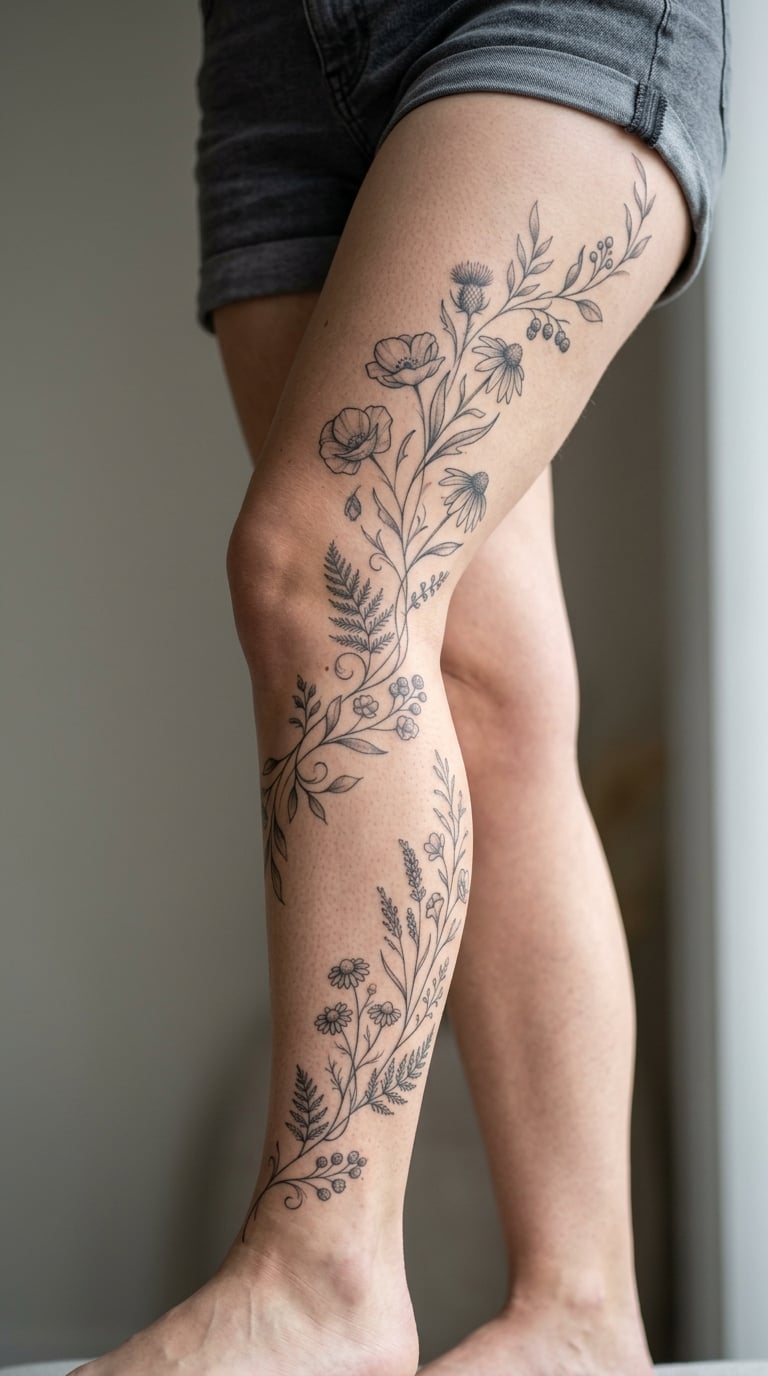
A fine-line wildflower vine is one unbroken stem that starts at the outer ankle, curls behind the calf and climbs to the upper thigh, with small five-petal blooms spaced along it. Each flower gets a slightly different angle and petal count, which is what stops the piece reading as wallpaper. Line weight stays hair-thin throughout, with no shading and no colour.
People choose this because it marks growth without stating it out loud. It suits a first large tattoo better than almost anything else here, since there is no dense colour to blot and the artist’s work is a series of small confident marks.
Placement: outer leg, so the vine disappears behind the calf and knee. Size: 16-22 in (40-56 cm) of travel from ankle to thigh. Style: fine line. Pain: low to medium, rising briefly at the knee.
Ageing note: thin lines soften noticeably in the ankle’s constant flexing, so expect a touch-up every few years.
Make it yours: have the artist include one bloom the size of a thumbnail carrying a date or initial in its centre.
How Full Leg Tattoo Ideas for Women Fit the Leg
A leg is not a flat sheet. The calf swells and narrows, the knee juts, and the thigh curves away from view when you sit, so any design drawn on paper has to be redrawn on skin. Good artists map the design directly onto the leg with a marker and check the placement twice: once standing, once sitting. A stencil that looks neat on a standing thigh can end up stretched and oval the moment you take a seat, which is the single most common placement complaint people bring to a second session.
Flow matters more than coverage. The strongest compositions read as one motion from foot to hip, with the busy passages sitting over the thigh and calf where there is muscle and skin to work with, and quieter passages at the ankle. Leave deliberate gaps. Negative space is what lets a full leg piece breathe once it is wrapped around a real leg in daylight, and it keeps the door open for adding an ankle accent or a foot flash in two years’ time.
2. Japanese Peony and Wave Blackwork Panel
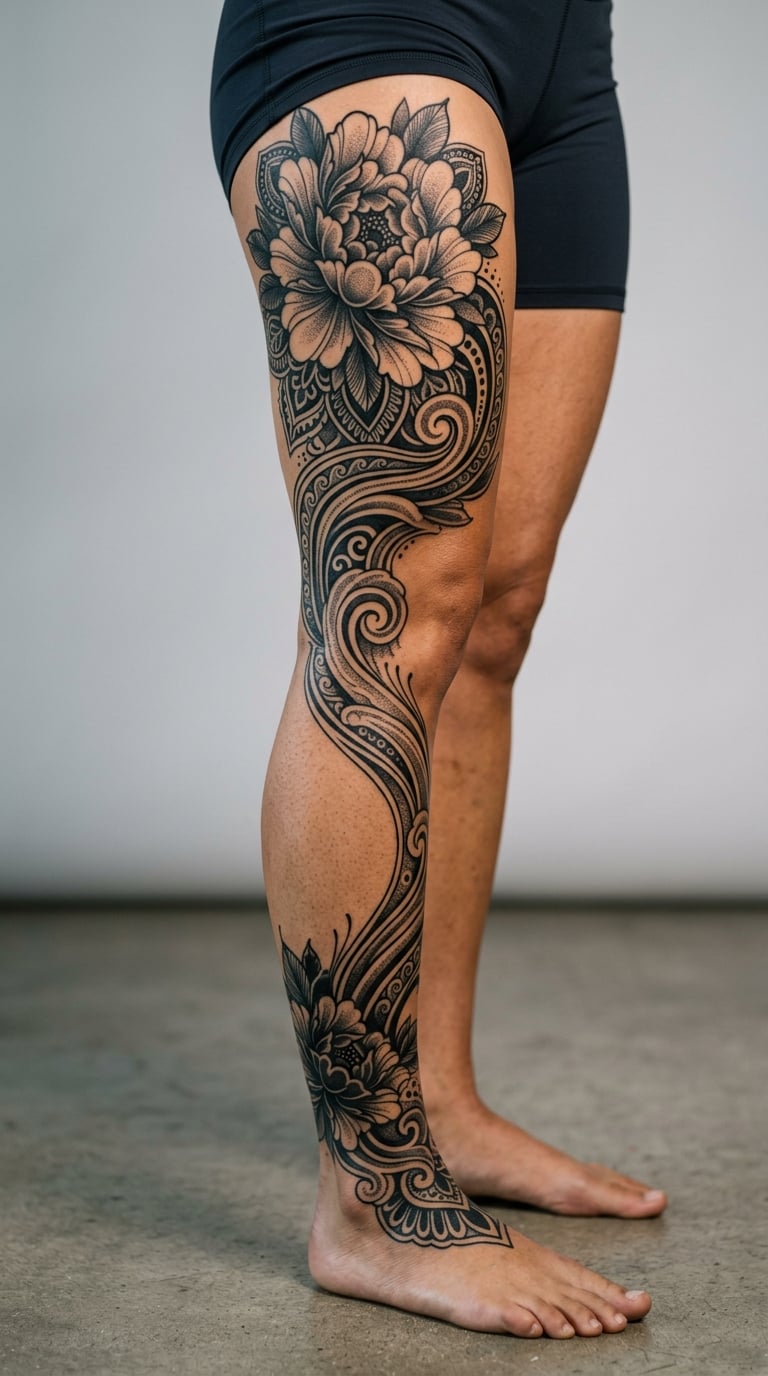
This is a blackwork panel: two large peonies in near-solid black, a band of stylised water beneath them, and wind lines curling through the empty space so the skin itself reads as air. The peony petals are the anchor, drawn with hard edges and no grey, and the wave is simplified into clean crests rather than realistic foam. Nothing is outlined twice and nothing is outlined lightly.
Peonies and waves are borrowed from Japanese composition habits, so it’s worth knowing that the motifs carry weight there. Most people here pick the piece for how heavy it looks against a bare leg rather than for a specific reference, which is a perfectly good reason.
Placement: front of the leg, thigh to ankle, with the largest peony over the quadriceps. Size: 18-24 in (46-61 cm). Style: blackwork. Pain: medium to high, with the inner thigh and shin the sharpest parts.
Ageing note: solid black is the most durable ink on a leg, but the small wind lines blur if the design is packed too tightly.
Make it yours: swap one peony for a plant native to where you grew up and keep the water band as the link.
3. Watercolor Butterfly Migration Scene
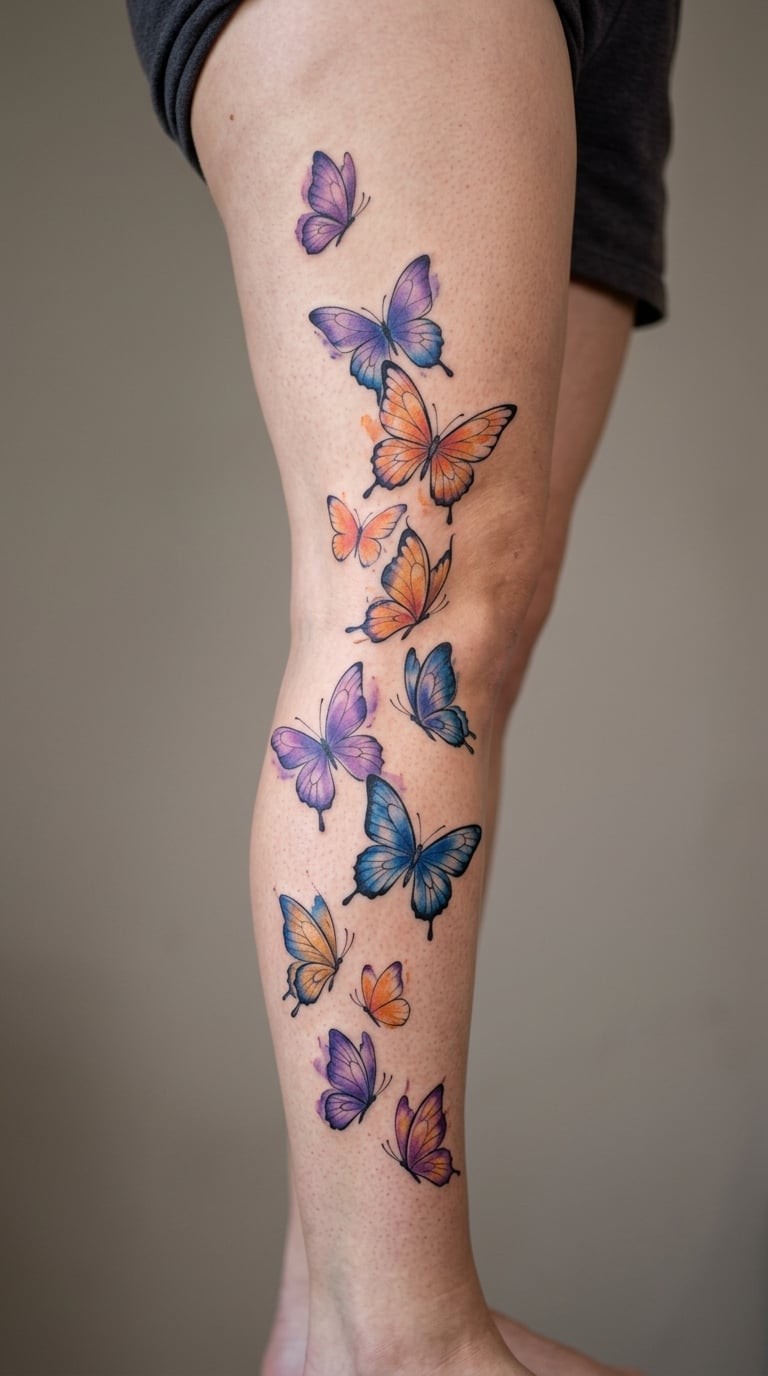
A watercolour butterfly migration is a loose sequence of butterflies in increasing size and decreasing spacing, painted straight onto the skin with no stencil and no hard outline. Colour pools at the wing edges and fades to nothing in the middle, so the leg shows through the centre of every butterfly. Pigment bleeds slightly past the line in the way wet-in-wet work always does.
Butterflies get chosen when something has changed and the wearer wants something that says so without being literal. The upward movement also flatters the leg, since the eye follows the smallest butterfly at the ankle up to the largest at the thigh.
Placement: front of the leg, vertical, largest element at the top. Size: 14-20 in (36-51 cm) total, individual butterflies 1-4 in. Style: watercolour. Pain: low, because coverage is light and scattered.
Ageing note: watercolour is a light layer of ink, so it fades noticeably faster than saturated colour. Sun protection makes a real difference here.
Make it yours: add one hand-painted butterfly in the exact colour of a wedding band, a school team or a favourite flower.
4. Traditional Rose and Dagger Thigh-to-Calf Sleeve
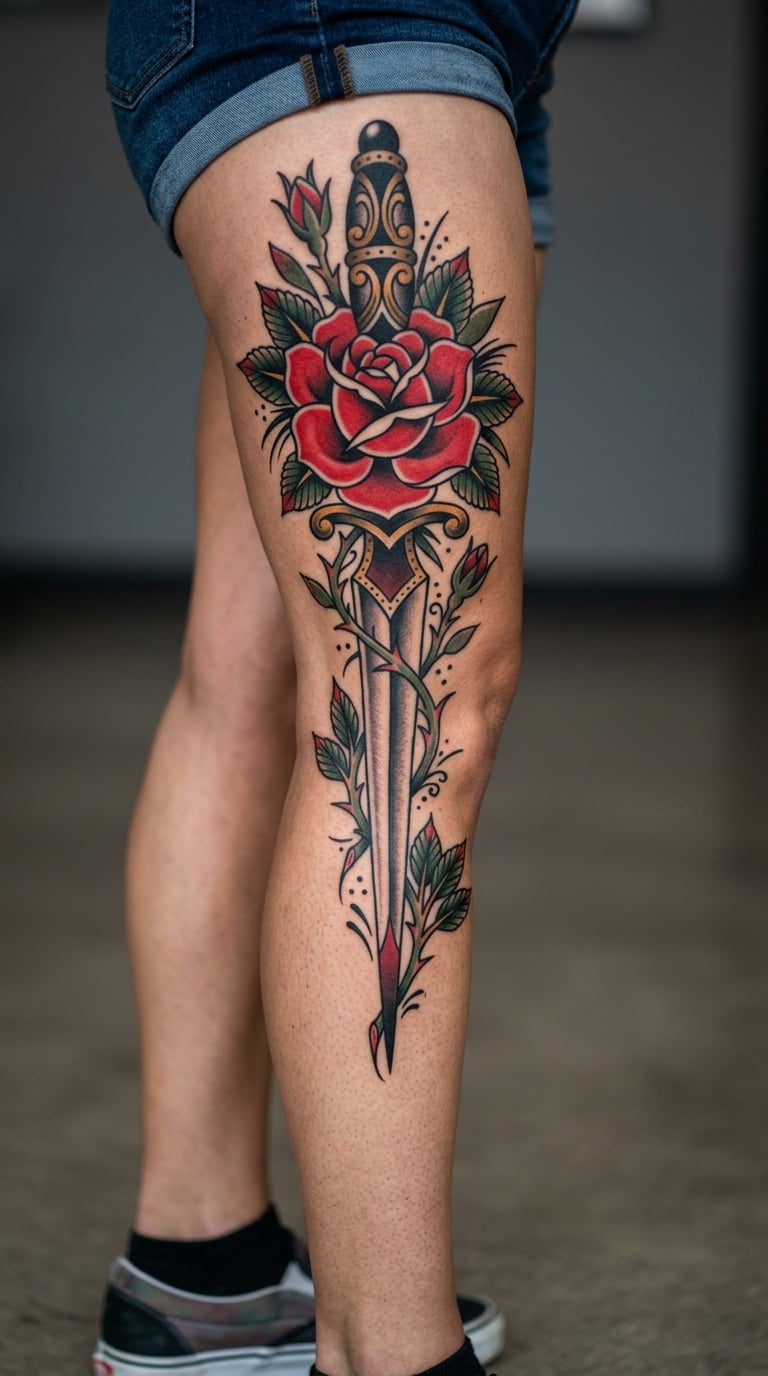
A traditional rose and dagger is built on thick black outlines with a small amount of black wash for shadow, then filled with a high-saturation red and a warm green. The rose sits at the top with petals shaded a step darker towards the centre, the dagger runs below it with a highlight down the blade, and the leaves fill the gap so the eye travels without a break.
This is the classic old-school vocabulary, and the dagger is often described as balance rather than aggression. If the red is important to you, say so at the consultation, because traditional red is one of the first pigments to shift toward orange on a sun-exposed limb.
Placement: outer thigh down the outside of the leg to the lower calf. Size: 16-20 in (41-51 cm) of placement. Style: American Traditional. Pain: medium across the thigh and calf.
Ageing note: bold outlines hold their shape for decades; the red and green drift warm over time on an exposed leg.
Make it yours: add a banner of curved text under the rose with a name or a place, in the same heavy black style.
5. Minimalist Single-Line Sun and Horizon
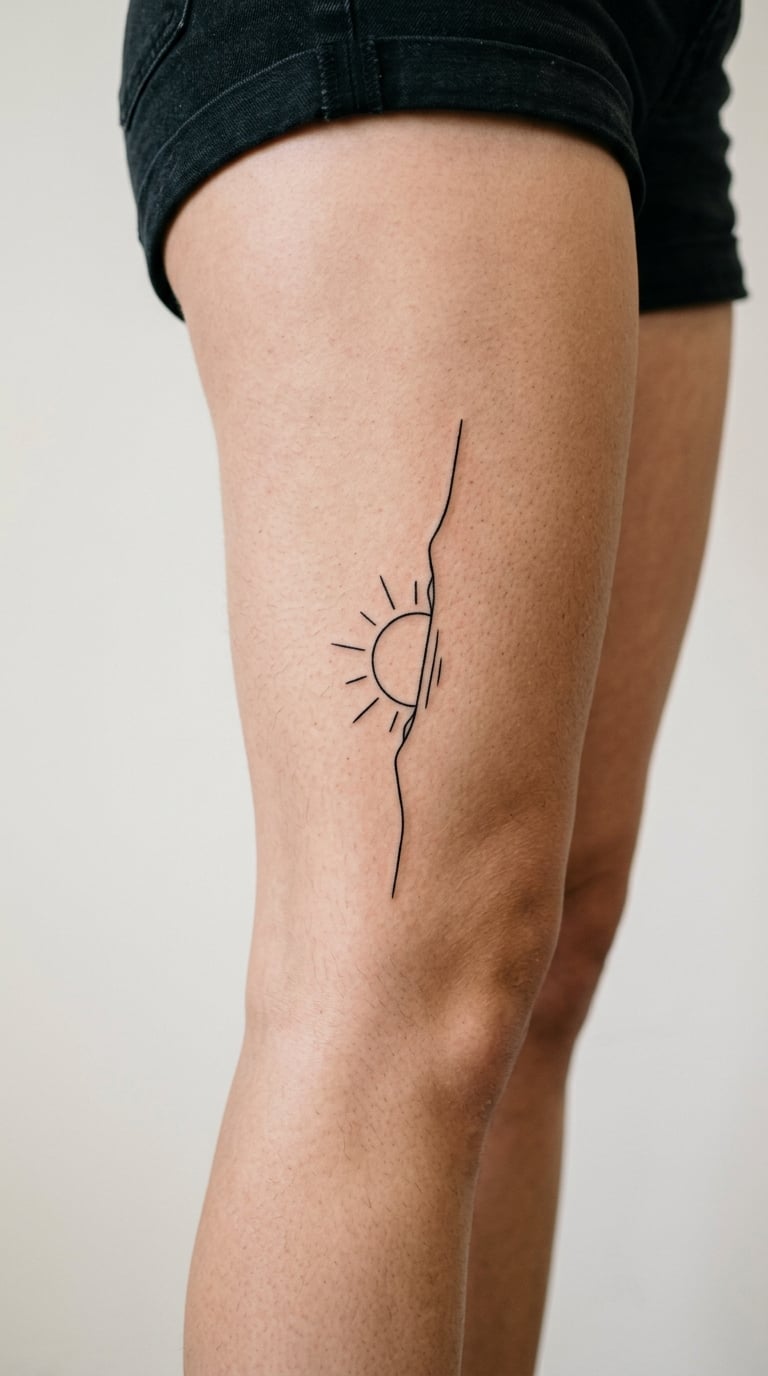
A single-line sun is drawn in one continuous unbroken stroke: a low semicircle, a straight horizon, and a handful of rays fanning up at uneven angles. There is no fill and no shading anywhere, so the whole design is the width of a pen line. The irregular ray spacing is deliberate, since machine-even spacing is what makes single-line work look stiff.
It reads as calm and unhurried, which is the reason it keeps getting chosen. It also works well as the first piece in a set, because a future artist can extend the horizon line into a bigger landscape later without fighting it.
Placement: outer calf or the flats of the outer thigh. Size: 8-12 in (20-30 cm). Style: minimalist, single-line. Pain: low. The calf and outer thigh are among the more forgiving areas on a leg.
Ageing note: any single-line piece on a moving leg loses definition; five years is a fair estimate before the rays look soft.
Make it yours: have the horizon double as a coordinate line, with the rays turning into a small compass rose.
6. Moth and Moon Fine-Line Composition
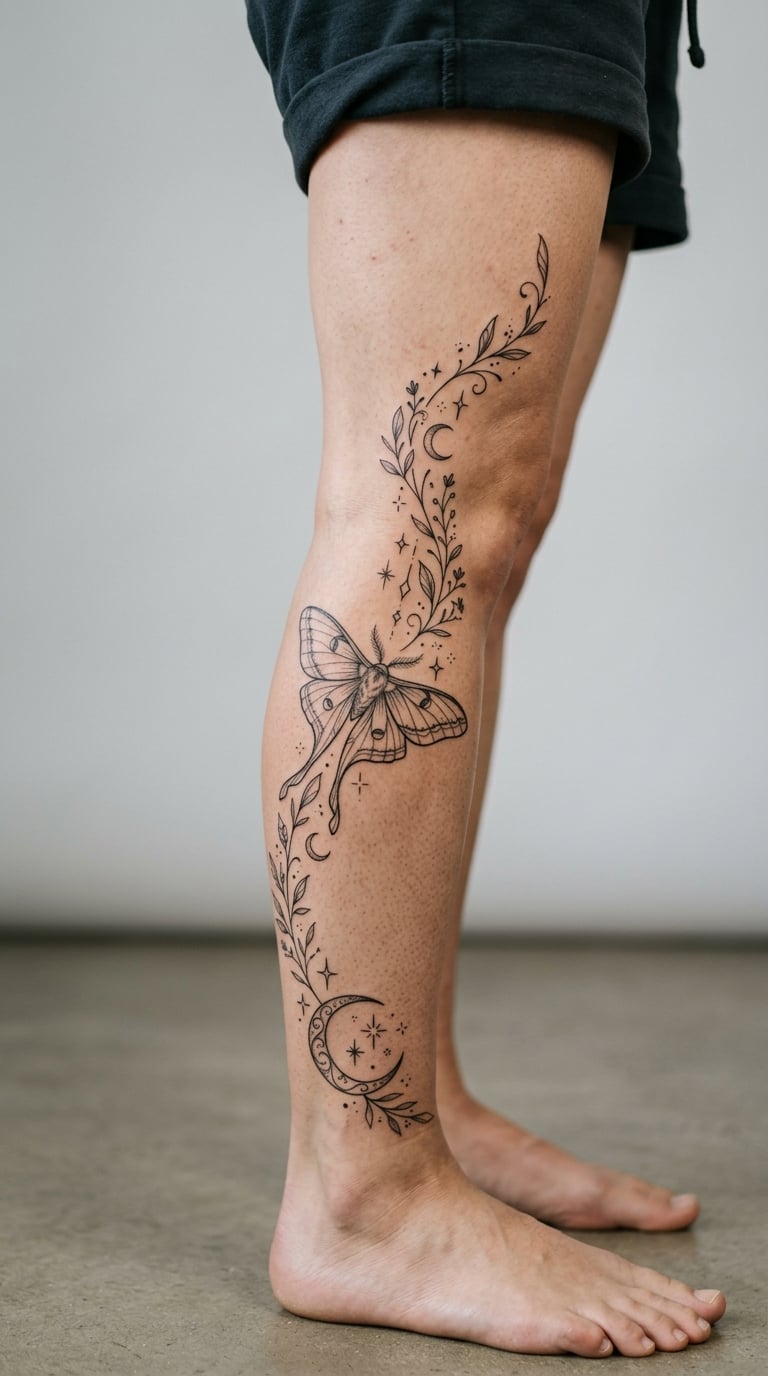
A fine-line moth composition places one large moth at the calf, framed by a crescent moon at the thigh and a scatter of small four-point stars between. The moth’s wings are drawn with a light line and scalloped edges, and the body is the only solid black part, which makes the whole insect read at a distance. The moons are drawn as outlines, never filled.
Moths carry associations with transformation and with being drawn to light rather than staying hidden. Plenty of people simply like the shape, which is reason enough.
Placement: any leg that will be seen, but this works best on the inner or front calf. Size: 15-19 in (38-48 cm) of placement. Style: fine line. Pain: low to medium, most noticeable at the ankle bone.
Ageing note: the small stars are the first detail to soften. A touch-up in year three or four keeps them crisp.
Make it yours: have the moons track the actual phases for a specific month, or a year that mattered.
7. Neo-Traditional Serpent and Botanicals
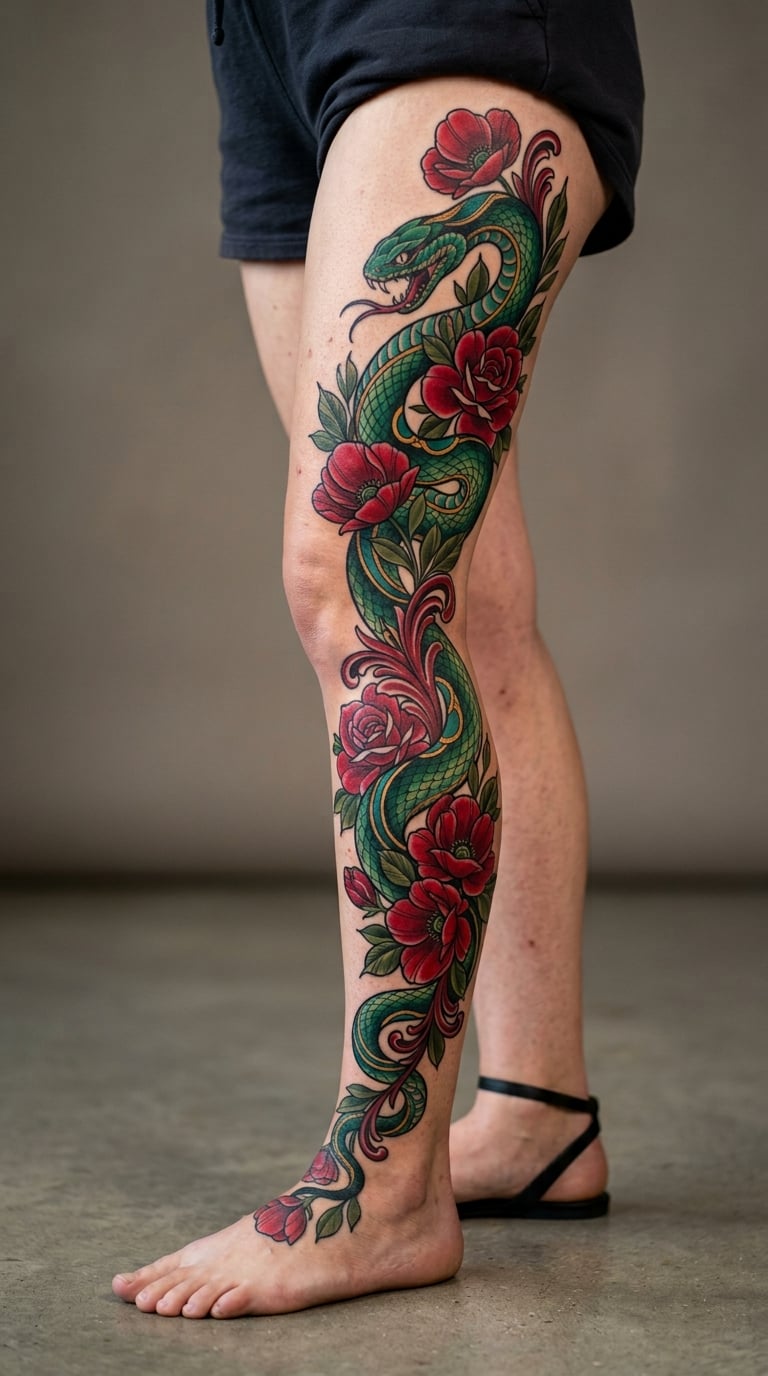
A neo-traditional serpent is drawn with heavy, confident outlines, saturated colour and smooth gradient shading inside each scale row, with a black drop shadow separating the body from the background flowers. The body coils in a loose S from the foot to the upper thigh, and every bend is planned so the leg’s own curve supplies part of the spiral. Red poppies or deep blue hydrangeas fill the gaps.
Serpents get chosen for the visual movement more than for meaning, though renewal is the reading people usually reach for first. The gradient shading is what separates this from older traditional work, and it is the reason the piece needs an artist who does colour smoothly.
Placement: the leg in profile or semi-profile so the body of the serpent follows the silhouette. Size: 18-24 in (46-61 cm). Style: neo-traditional. Pain: medium to high, since saturated colour packing is a longer pass over the skin.
Ageing note: dense colour holds better than thin lines but still fades faster on the outer calf than anywhere else on the leg.
Make it yours: change the flower species to one that only grows in your home region and keep the snake plain.
8. Realistic Rose Garment Tattoo
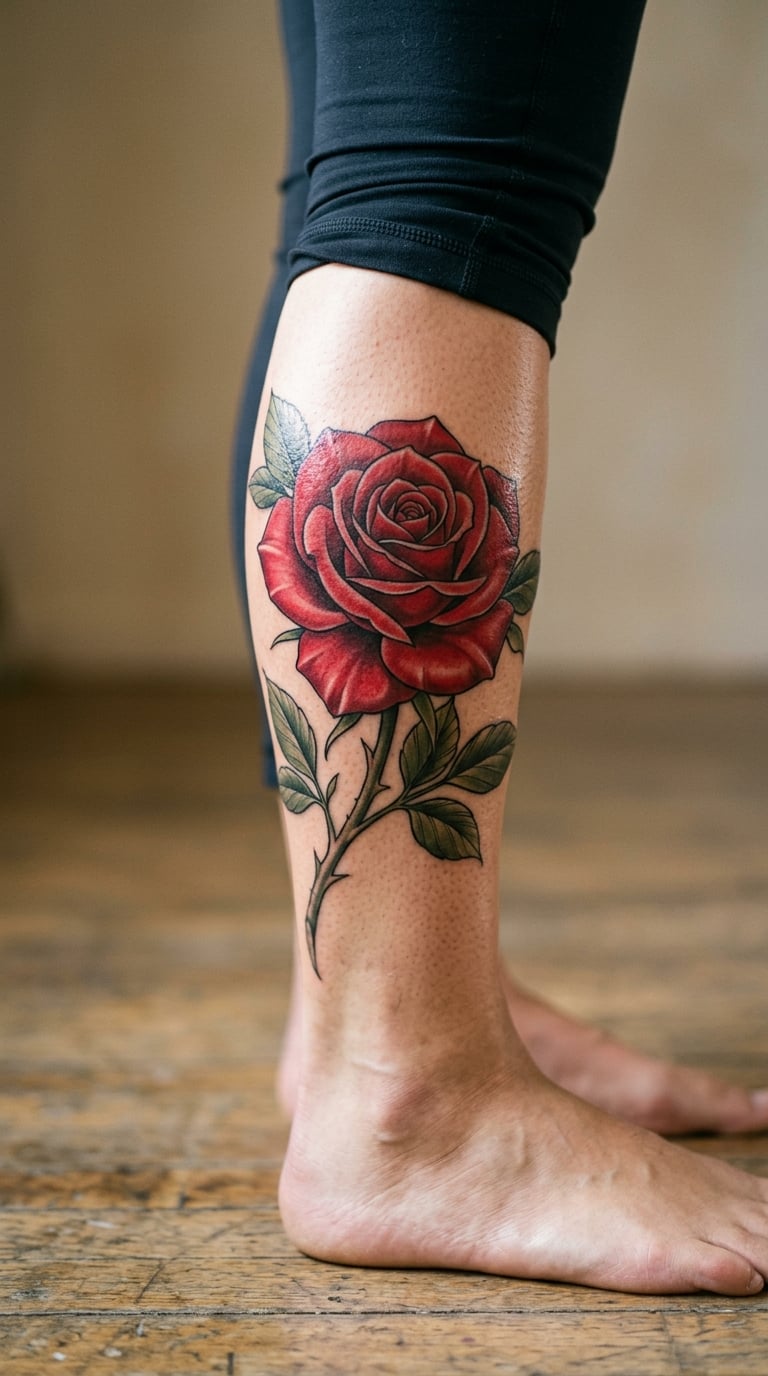
A realistic rose garment tattoo is one photorealistic rose positioned so the petals disappear around the curve of the calf, with the edges of the flower fading into skin at the far side. The artist builds depth with a full grey wash under the petals, then layers a deep red through the centre and a lighter red at the open edges. There is no outline anywhere; the form is carried entirely by shading.
The effect is of a flower printed on skin rather than drawn on it, which is the whole appeal. It is also the style that rewards a healed photo over a fresh one, since fresh realism always looks crisper than it will in five years.
Placement: calf or lower thigh, where the leg’s roundness sells the wrap. Size: 10-14 in (25-36 cm). Style: realism. Pain: medium across the calf.
Ageing note: the soft grey underpainting migrates gently as the skin ages, which is normal for this style and not a mistake.
Make it yours: make the rose the same variety that grew in a family garden and add a small date in the shadow under the lowest petal.
9. Celestial Map in Dotwork
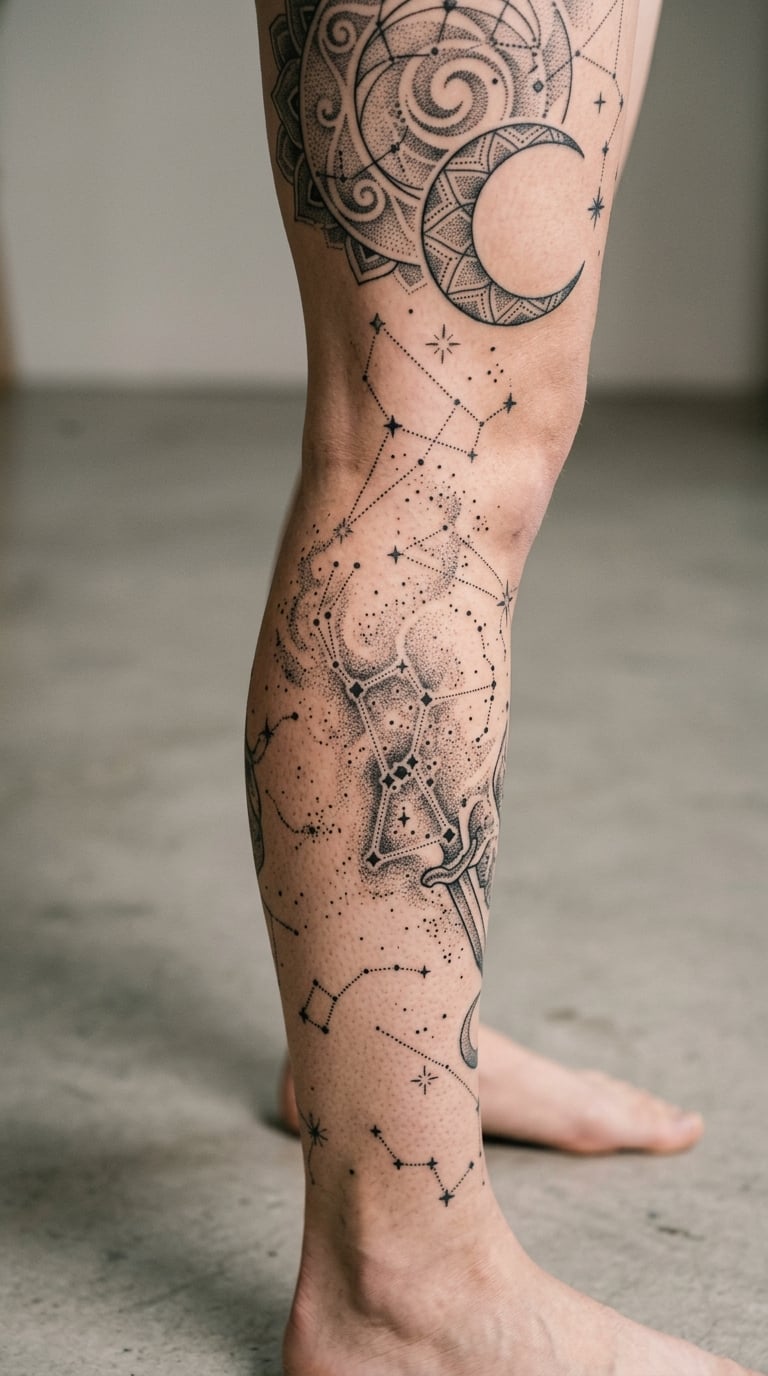
A dotwork celestial map is thousands of individual dots laid in clusters of varying density, forming star fields, orbital curves and a handful of recognisable constellations. The dots get finer toward the outside of each shape, so the clusters have a soft edge rather than a drawn one. One or two constellations are picked out in solid line so there is something to actually recognise.
It suits people who want the leg to look like a slice of sky without going for anything dramatic. The balance comes from spacing the densest dot clusters at the thigh and the sparsest at the ankle, following the eye upward.
Placement: outer leg, which stays flat through most body shapes. Size: 15-20 in (38-51 cm). Style: dotwork. Pain: low to medium, with a long session because the work is slow.
Ageing note: fine dots blur together over time into a grey wash, which many wearers end up preferring.
Make it yours: map the real constellations visible from the place you were born and label nothing.
10. Koi Fish and Watercolour Blossom Flow
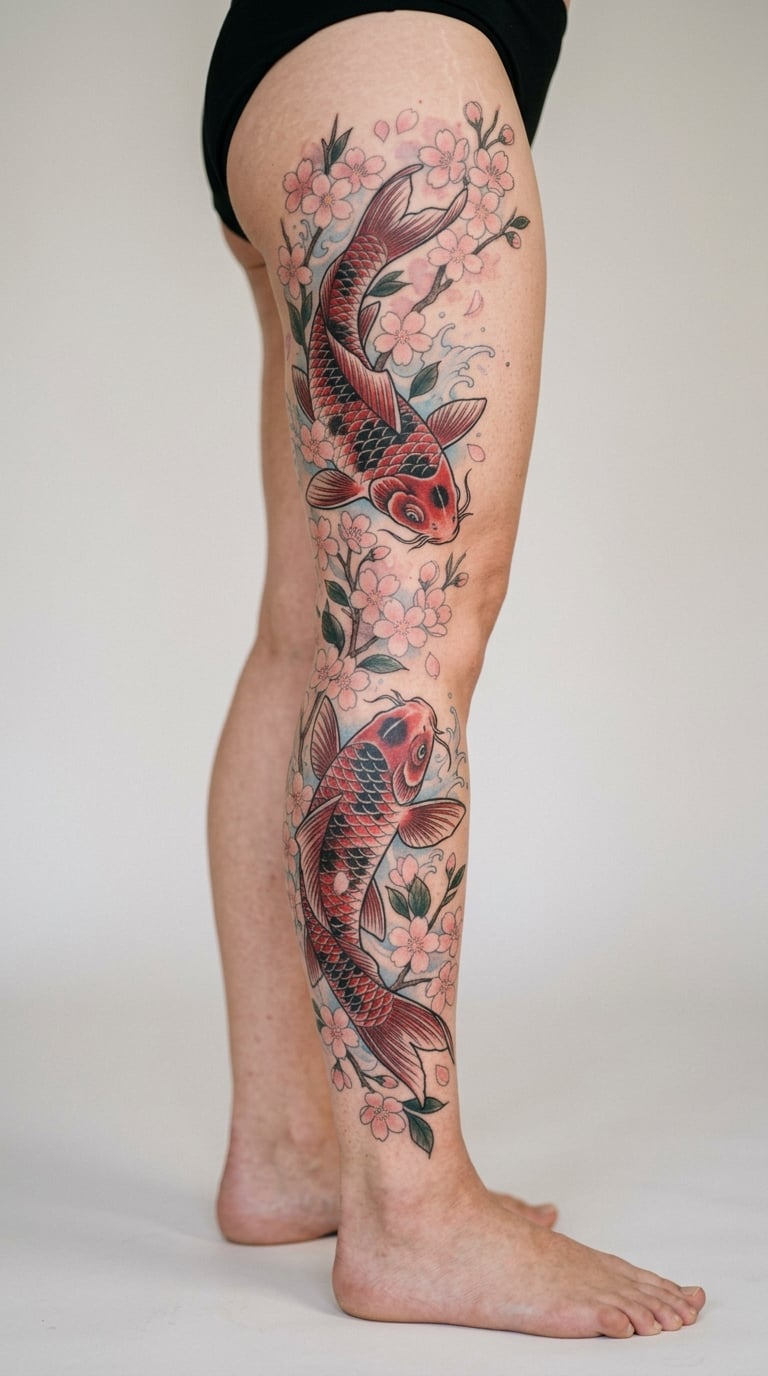
Koi and blossom flow puts two koi swimming in opposite directions with pale pink blossoms and soft water wash between them, so the composition never breaks into two separate halves. The koi are outlined, then shaded in grey and red with a few loose scales left white. The water is a pale blue wash with no hard edge, and the blossoms are four or five strokes each.
The two-fish arrangement is often described as partnership or balance, and it reads as movement in either direction, which suits a leg that changes position constantly. It works as a companion piece to a matching design on the other leg, mirrored rather than identical.
Placement: thigh to ankle on the front or outer leg. Size: 16-22 in (41-56 cm). Style: watercolour with outlined koi. Pain: low to medium.
Ageing note: the pale wash drops out first, leaving the koi reading strongly and the water faint. Many people like that outcome.
Make it yours: pick the koi colours to match an existing small tattoo elsewhere on your body, or swap the wash for your birthstone colour.
11. Blackwork Gothic Filigree Panel
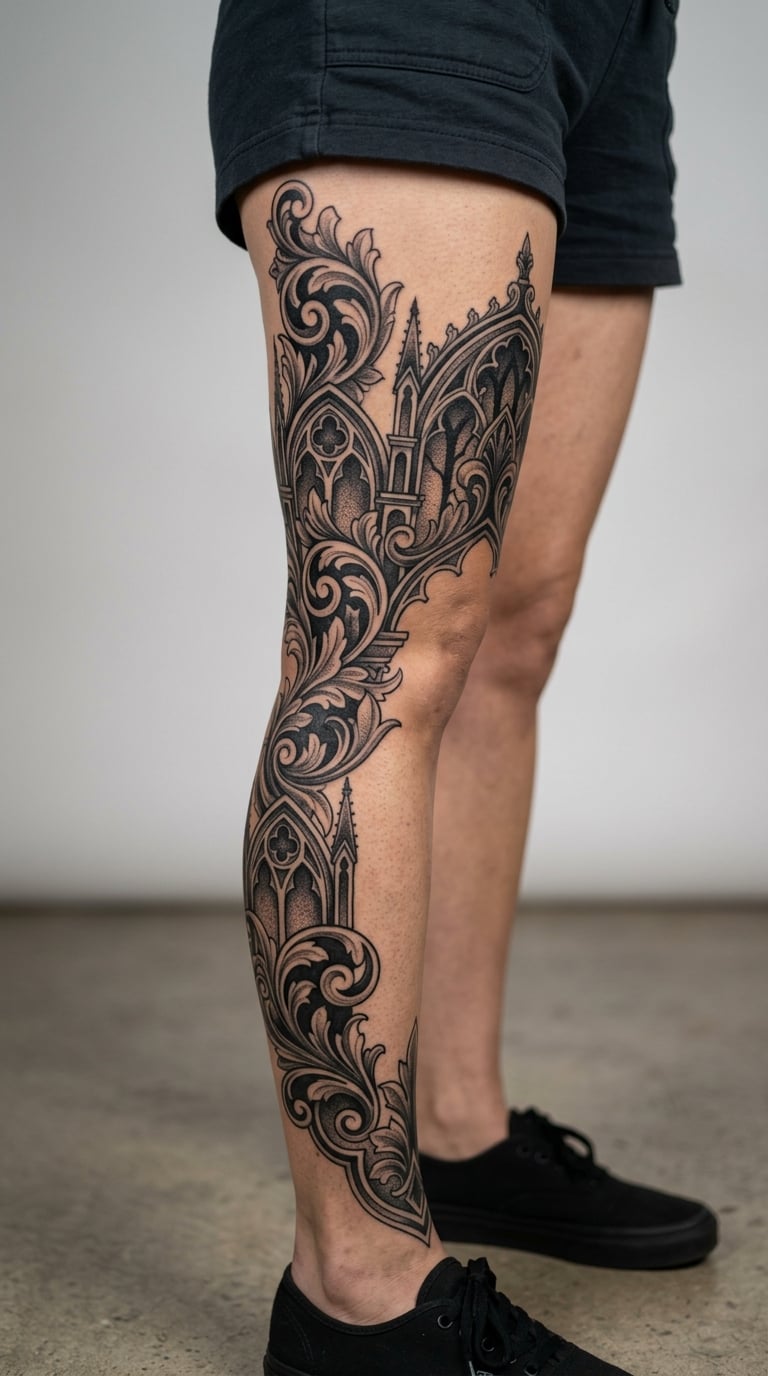
A gothic filigree panel is architectural: pointed arches, lace-like scrollwork and leaf shapes built from solid black bands with thin skin left between them. Three panels sit at the thigh, calf and ankle, linked by a narrow vertical column, and the ornament is drawn symmetrically so the left and right halves mirror each other. The negative space does as much work as the black.
Ornament like this is chosen when the wearer wants the leg to read as a dressed surface rather than a decorated one. It is the densest option on this list, so it is also the one that hides existing ink best if you have an old piece to work around.
Placement: outer thigh, calf and ankle, wrapping at each end. Size: 18-24 in (46-61 cm). Style: blackwork with ornamental linework. Pain: high, because solid black means repeated passes over the same skin.
Ageing note: solid black ages best of anything on this list, but the thin lace lines between the arches need a touch-up more often.
Make it yours: set a real initial into the column between the calf and ankle panels, small enough to read as part of the pattern.
12. Cherry Blossom Branch in Motion
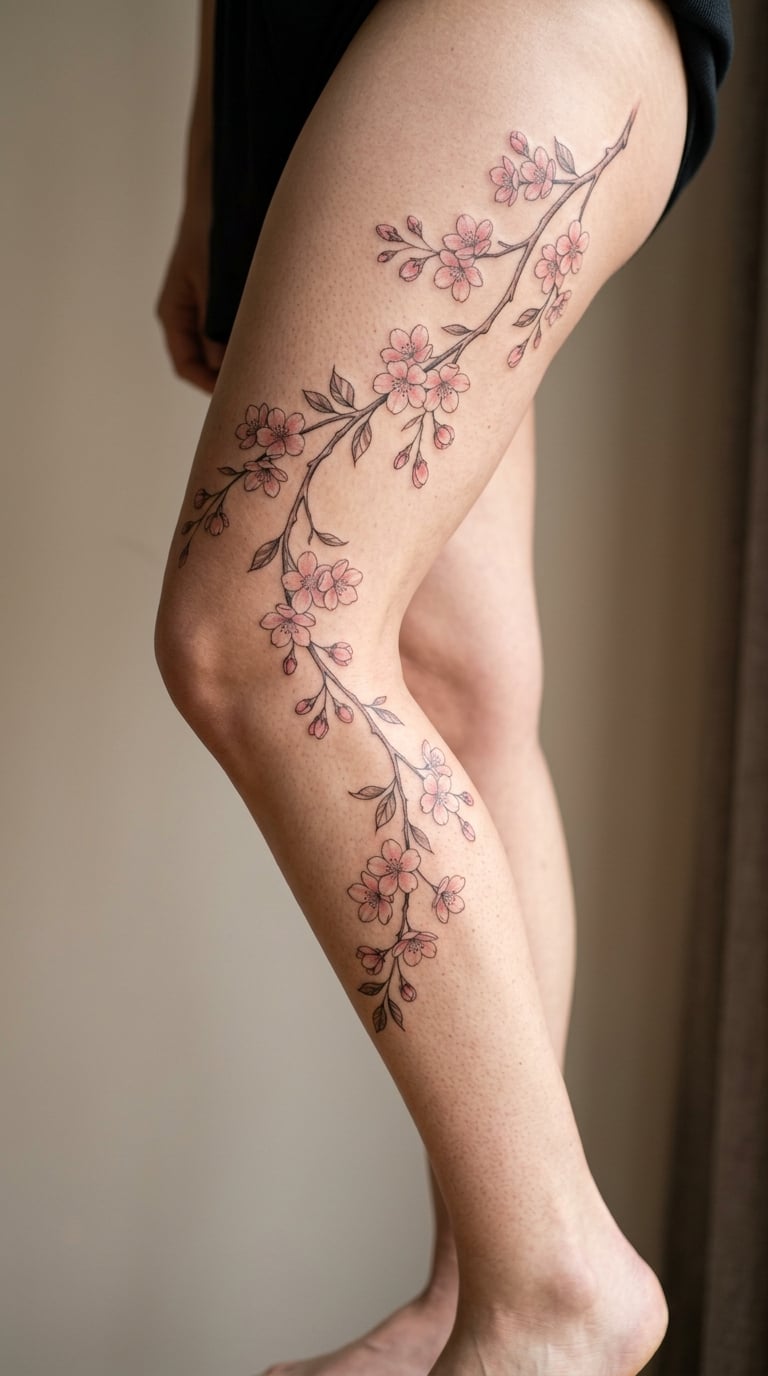
A cherry blossom branch in motion is one long branch sweeping diagonally across the leg, with flowers in different stages from closed bud to full open, and most petals left as outlines with only a soft pink wash inside. A few petals break away from the branch and drift into empty skin, which is what makes it look windblown rather than arranged. Black linework does the structure; pink is an accent, not the subject.
Blossom branches are often tied to a season or a place rather than to a person. Diagonal placement across the thigh and calf is the classic arrangement, since it uses the leg’s length without forcing a strict vertical.
Placement: diagonal, entering at the outer thigh and exiting below the knee. Size: 14-18 in (36-46 cm). Style: fine line with selective colour. Pain: low to medium.
Ageing note: outlined petals lose their edges where the leg flexes most, so the drifting petals tend to blur before the branch does.
Make it yours: have the number of open flowers match the year something happened, and leave the rest as buds.
13. Botanical Herbarium Grid
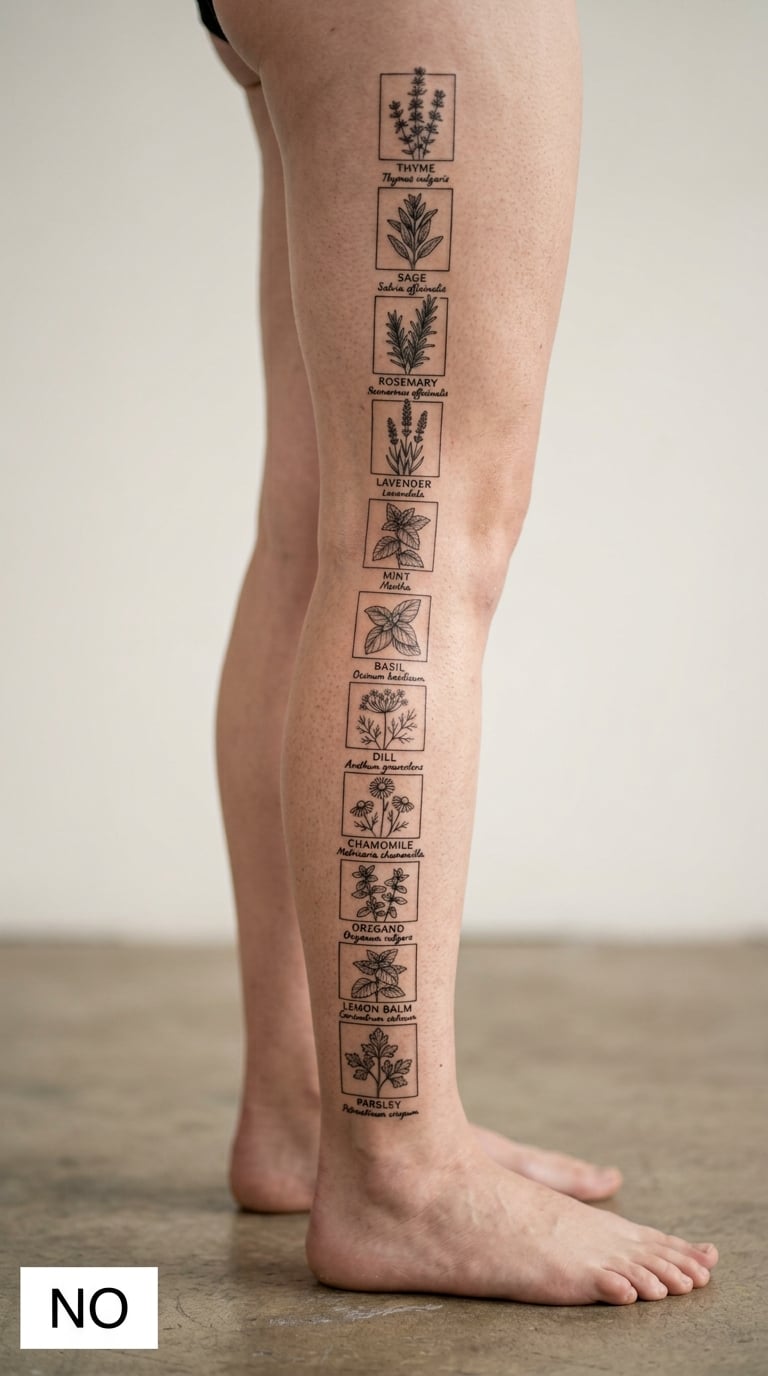
A herbarium grid is a structured layout: each plant drawn as a specimen on its own, with a thin ruled line between rows and a small italic label beneath. The plants are rendered in flat ink rather than shaded, so each one reads like a page from a botanical book. The grid follows the leg in two or three vertical columns, which fills the surface without any one motif dominating.
Botanical references get chosen by people who like the idea of a leg that reads as a record rather than an image. The grid format is also the easiest option here to extend later with a new row of plants.
Placement: full length of the leg in vertical columns, kept clear of the knee itself. Size: 20-26 in (51-66 cm) overall, each specimen 3-5 in. Style: linework with hand-lettered labels. Pain: low, since coverage is even and light.
Ageing note: tiny hand-lettered labels blur first, so have them re-struck at the first touch-up rather than leaving them.
Make it yours: use plants you can actually find within a mile of your home, and put a date at the bottom of the last row.
14. Blackwork Mountain and Pine Range
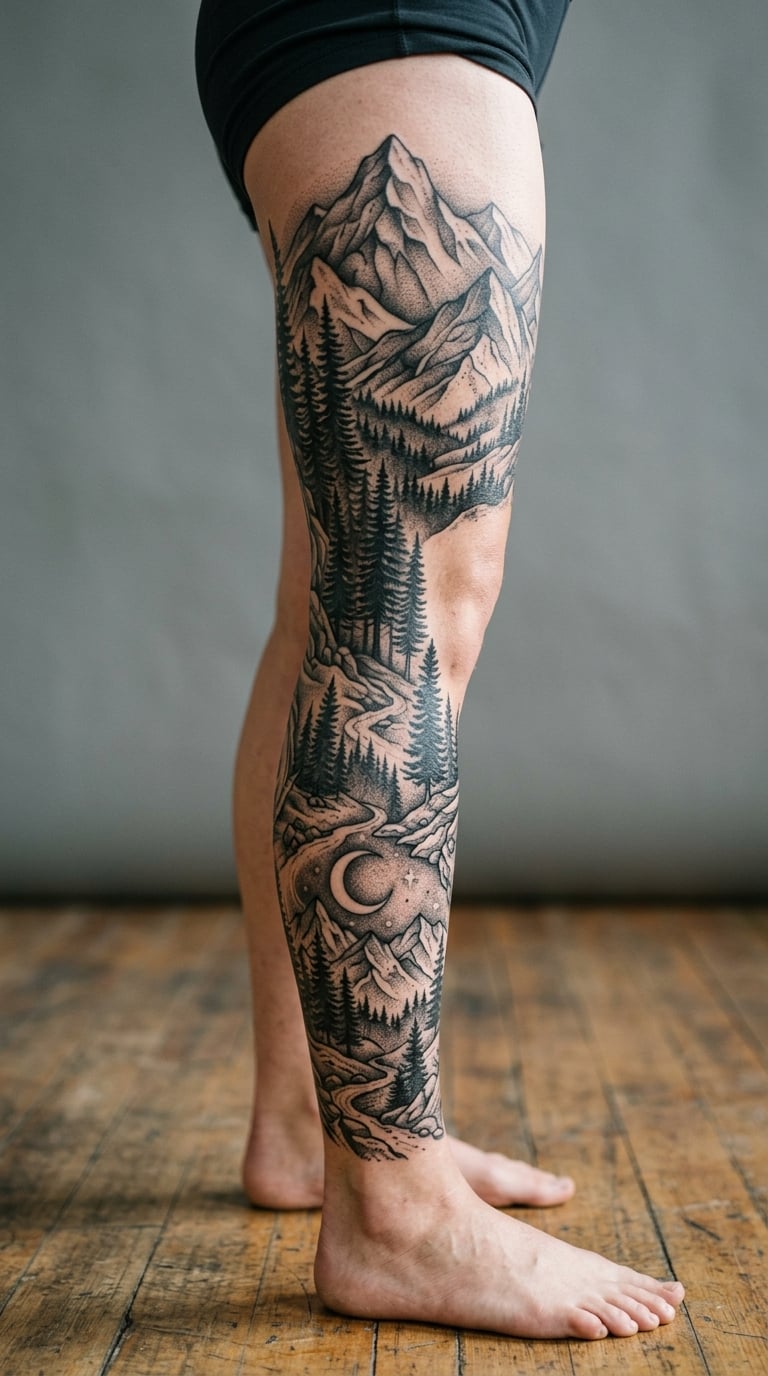
A blackwork mountain range wraps a single horizon around the whole leg: high peaks and a moon at the thigh, a dense pine band across the calf, and water or low ground at the ankle. The range is built from solid black silhouettes with a soft grey wash behind the peaks for distance, so the layers read clearly. Pine trees are drawn as simple stacked triangles, not detailed needles.
Landscape work on a leg is usually personal in a specific way, often a place someone grew up or a trip that mattered, and the leg’s circumference makes it a good format for a continuous horizon. Nothing about it is symbolic so much as documentary.
Placement: wrapping the full circumference, so it reads as a horizon from every angle. Size: 20-26 in (51-66 cm). Style: black and grey realism with blackwork silhouettes. Pain: medium, with the wash needing steady, even passes.
Ageing note: a grey wash on the shin shows sun damage faster than black anywhere else, because that skin is usually exposed.
Make it yours: draw the actual ridgeline from a photograph of your favourite view and use the real treeline.
15. Dragonfly and Lotus Micro-Realism Sleeve
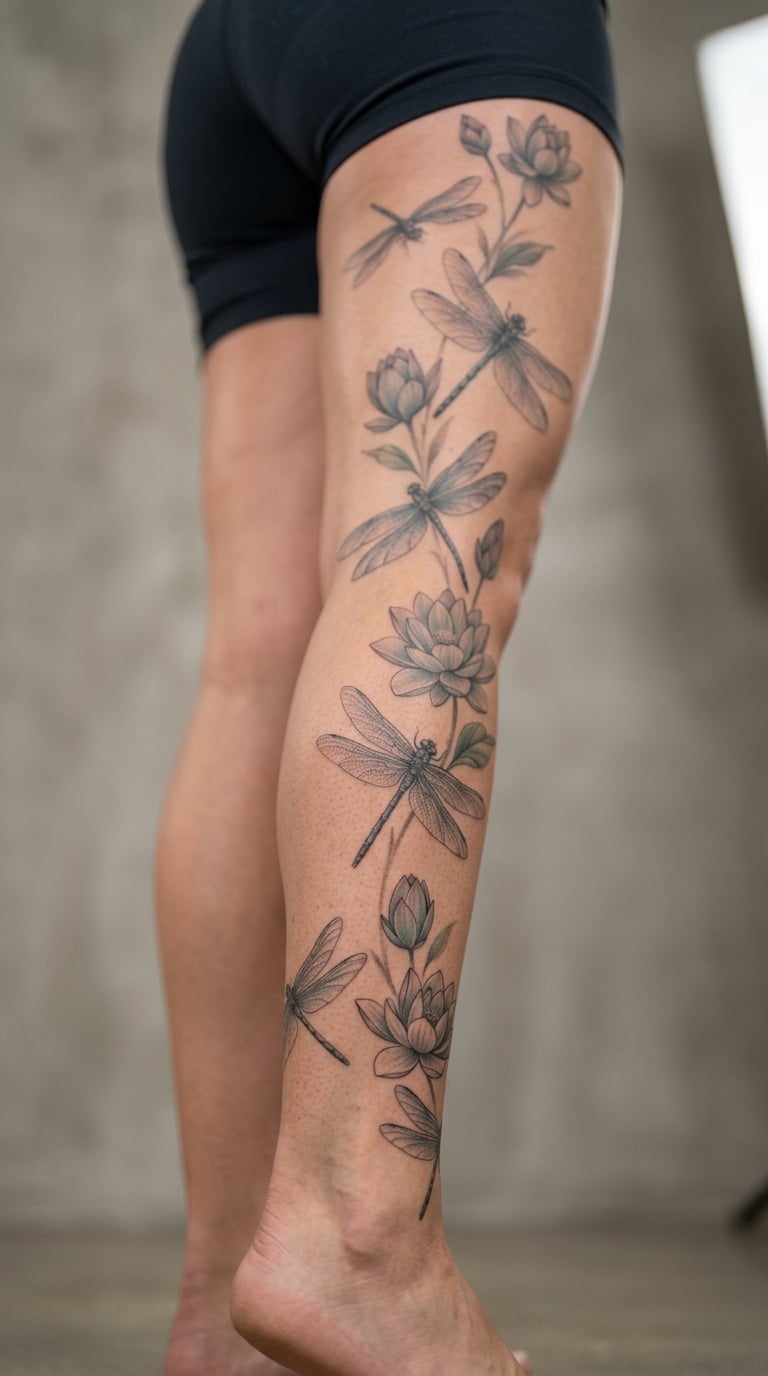
Dragonfly and lotus micro-realism is a restrained sequence: three dragonflies and two lotus flowers, each rendered with believable wing veining and petal translucency, spaced far enough apart that skin shows between every element. Colour is muted, with a soft pink lotus and a dusty blue-grey wing, so the piece never turns busy. The back of the leg is often chosen because the composition is viewed at rest.
Micro-realism is a calmer aesthetic than bold colour and it is a common choice for someone who wants a large project that still reads as delicate. It also happens to be one of the more difficult styles to keep sharp over time, which is the trade-off.
Placement: ankle to the back of the thigh, or the front of the shin. Size: 12-18 in (30-46 cm) of placement. Style: micro-realism. Pain: low to medium.
Ageing note: wing veins and petal edges are the first things to soften. Plan on a refining session around year four.
Make it yours: keep the dragonfly count at the number of years you have been together, or of a habit you kept.
16. Geometric Full-Leg Symmetry
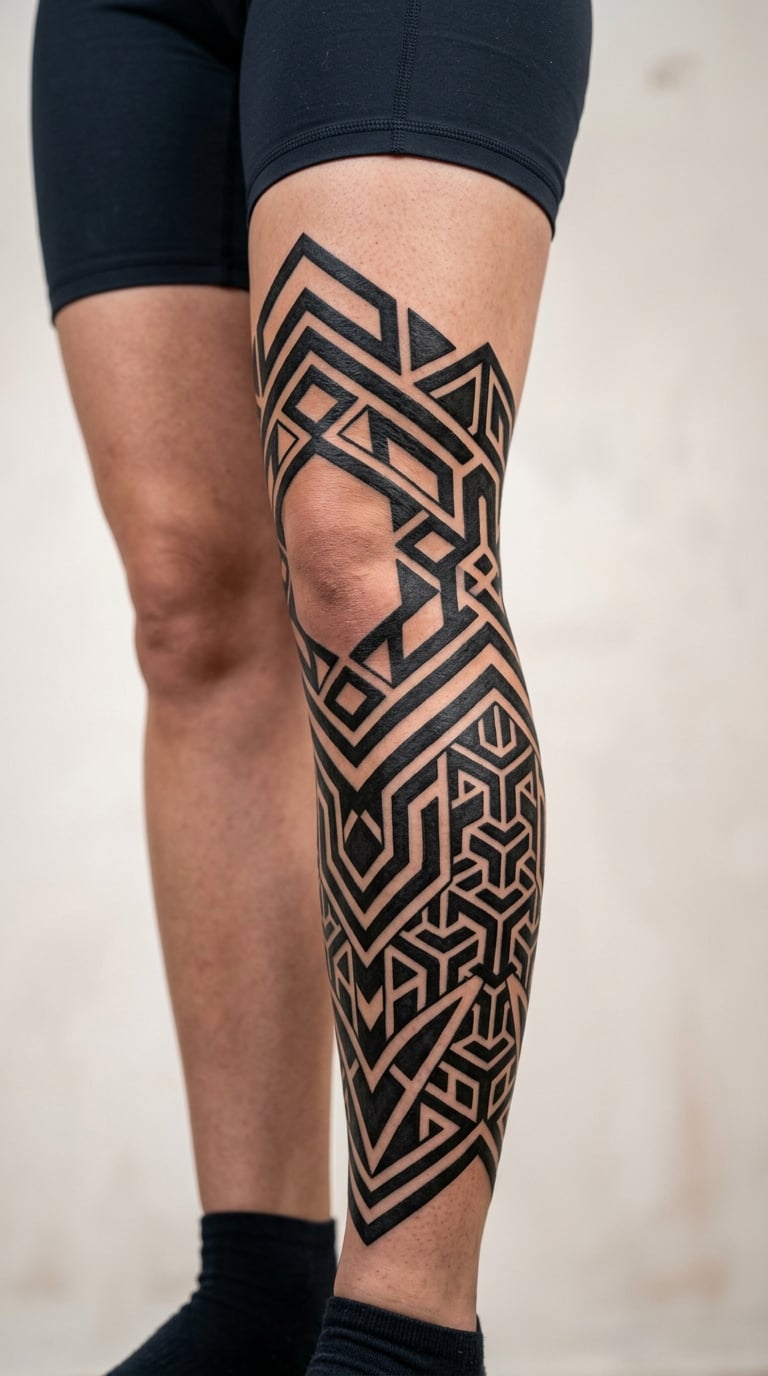
A geometric full-leg design is built from interlocking angular forms that mirror across the leg’s vertical axis: nested triangles, stepped hexagons and long lines that meet at a single point over the calf. The form is mirrored front to back, and the negative space between the shapes is left completely empty. Line weight is heavy and even, with no gradients.
Geometry suits a long limb because the eye reads the vertical repetition as length. It is the least forgiving style on this list if your weight changes noticeably, since straight lines are the first thing to bow when the leg’s contour changes.
Placement: wrapping the leg, with the pattern centred over the calf. Size: 18-24 in (46-61 cm). Style: geometric. Pain: medium to high on the inner thigh, moderate elsewhere.
Ageing note: long straight lines pick up gentle waviness over a decade, particularly across the knee.
Make it yours: have the innermost shape be a set of initials reduced to one repeated line weight, or the outline of a shape only you would recognise.
17. Hummingbirds and Tropical Leaves
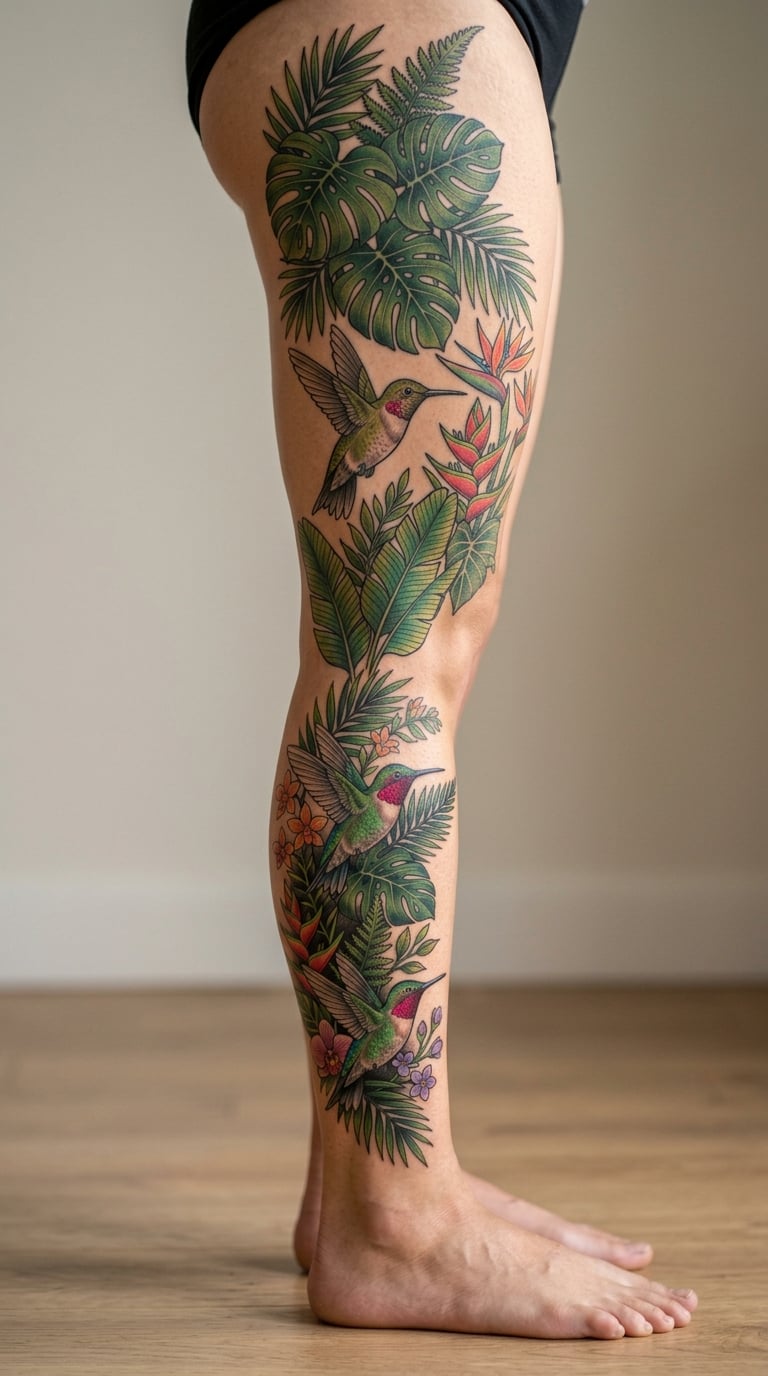
Hummingbirds and tropical leaves is a layered composition: two hummingbirds with ruby throats and green bodies, set among monstera, banana and fern leaves in four or five greens from yellow-green to deep forest. The leaves sit behind the birds in the darkest tone and in front in the lightest, which creates depth without any shading on the birds themselves. Wing positions are different so the pair reads as a pair.
Vitality and movement are the readings people give this, and it is often a birthday or a move to a warmer place. Dense colour like this needs a longer session, so plan on splitting the leg in two.
Placement: full leg, usually the front, with the larger bird at the thigh. Size: 16-22 in (41-56 cm). Style: colour realism with illustrative leaves. Pain: medium, and the colour passes are long.
Ageing note: several greens next to each other blend toward one over time, so keep at least one leaf a distinctly different hue.
Make it yours: use the leaves of a plant that actually grows where you live rather than a generic tropical set.
18. Blue Celtic Knotwork Band
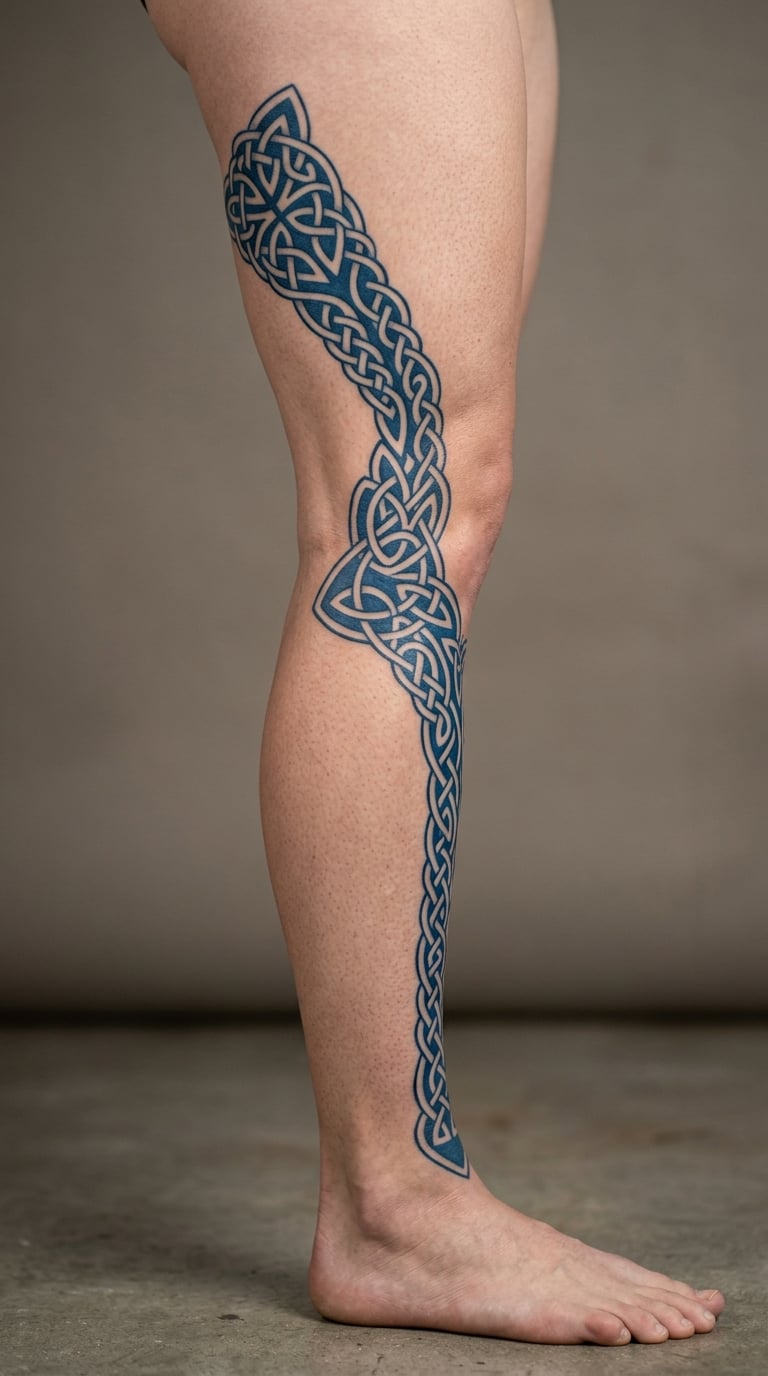
A blue Celtic band is one continuous line woven over and under itself, expanding into wide panels over the thigh, narrowing to a single strand at the ankle, then expanding again at the foot. The blue is a deep saturated cobalt with a lighter highlight strand, and the crossings are drawn so the over strand is unbroken and the under strand is interrupted, which is what creates the illusion of depth.
Knotwork is usually chosen for heritage or family reasons, and the continuous line carries the sense of something unbroken. If that is your reason too, ask the artist to include a clan or knot pattern from your own background rather than a generic one.
Placement: a full-length band running down the side of the leg. Size: 20-28 in (51-71 cm). Style: Celtic interlace with colour. Pain: medium, and precision linework takes patience.
Ageing note: the thin highlight strand on the narrower sections fades before the main blue line does.
Make it yours: have the knot expand in three points along the leg, each at a place that matters, and let the pattern open out there.
19. Feathers, Moon Phases and Stars
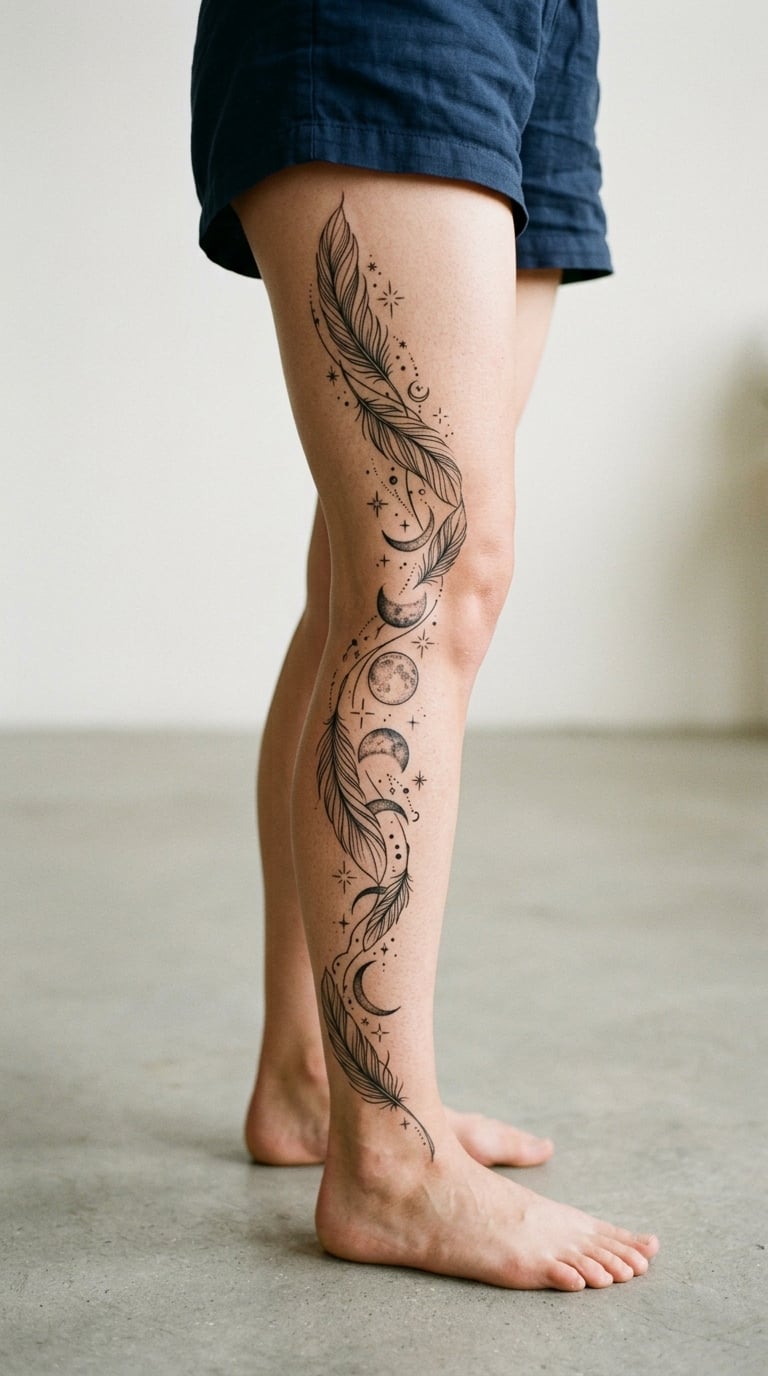
Feathers, moon phases and stars is a balanced vertical composition with alternating elements: a long detailed feather at the thigh, a row of eight moon phases at the upper calf, a second feather below, and small four-point stars scattered through the gaps. The feather’s barbs are drawn as separate fine lines with an empty spine, and the moons are outlined rather than filled, so the whole piece stays in a single weight of black.
The full set of moon phases is the part people personalise, usually for a specific year or a relationship. Composition-wise, the alternating rhythm is what keeps it from feeling like three separate ideas stacked on a leg.
Placement: vertical, ankle to upper thigh, on the leg that gets seen most. Size: 15-20 in (38-51 cm). Style: fine line. Pain: low to medium.
Ageing note: the smallest stars soften within a few years, while the feather barbs hold better because they are longer strokes.
Make it yours: have the moon phases show the real cycle of one specific month that you want to remember.
20. Art Nouveau Lily and Frame
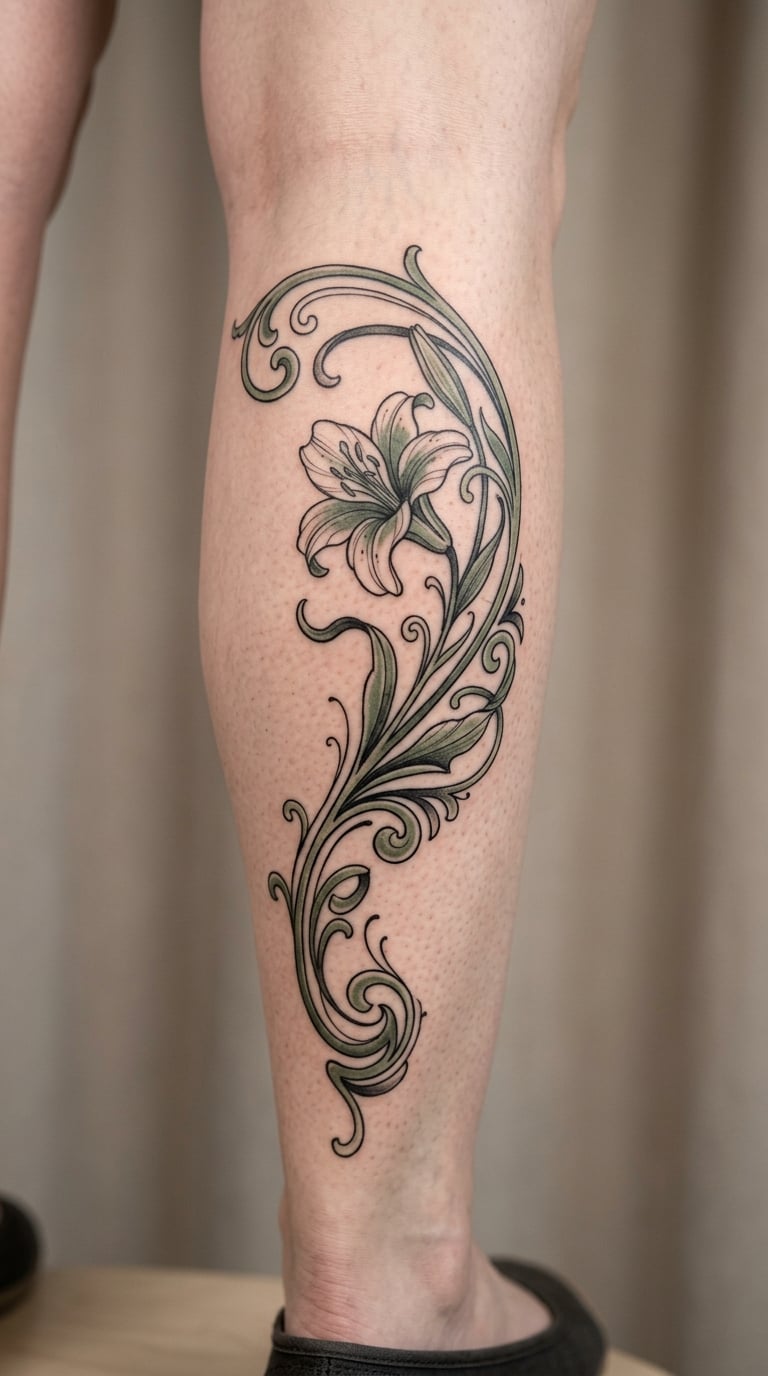
An Art Nouveau lily is drawn with long S-curved stems, a stylised bell-shaped flower and a border of whiplash lines that arc around it the way the style’s posters do. The line weight varies deliberately, thick on the outer curves and fine on the inner detail, which is what separates this from plain linework. A muted sage or deep green fill in the flower keeps it from being only black.
The style suits long limbs because the curves echo the leg’s own line and the border can be repeated at intervals to fill length. It also sits well beside fine line work, so it is an easy match with a smaller existing tattoo.
Placement: outer leg, with the border repeated to follow length. Size: 14-18 in (36-46 cm). Style: ornamental linework. Pain: low.
Ageing note: variable line weight is stable, but the tiny interior detail where the stem crosses the border can thin out.
Make it yours: have an initial set in the border itself in the style of a monogram, or use your birth flower instead of the lily.
21. Floral Lace-Stocking Design
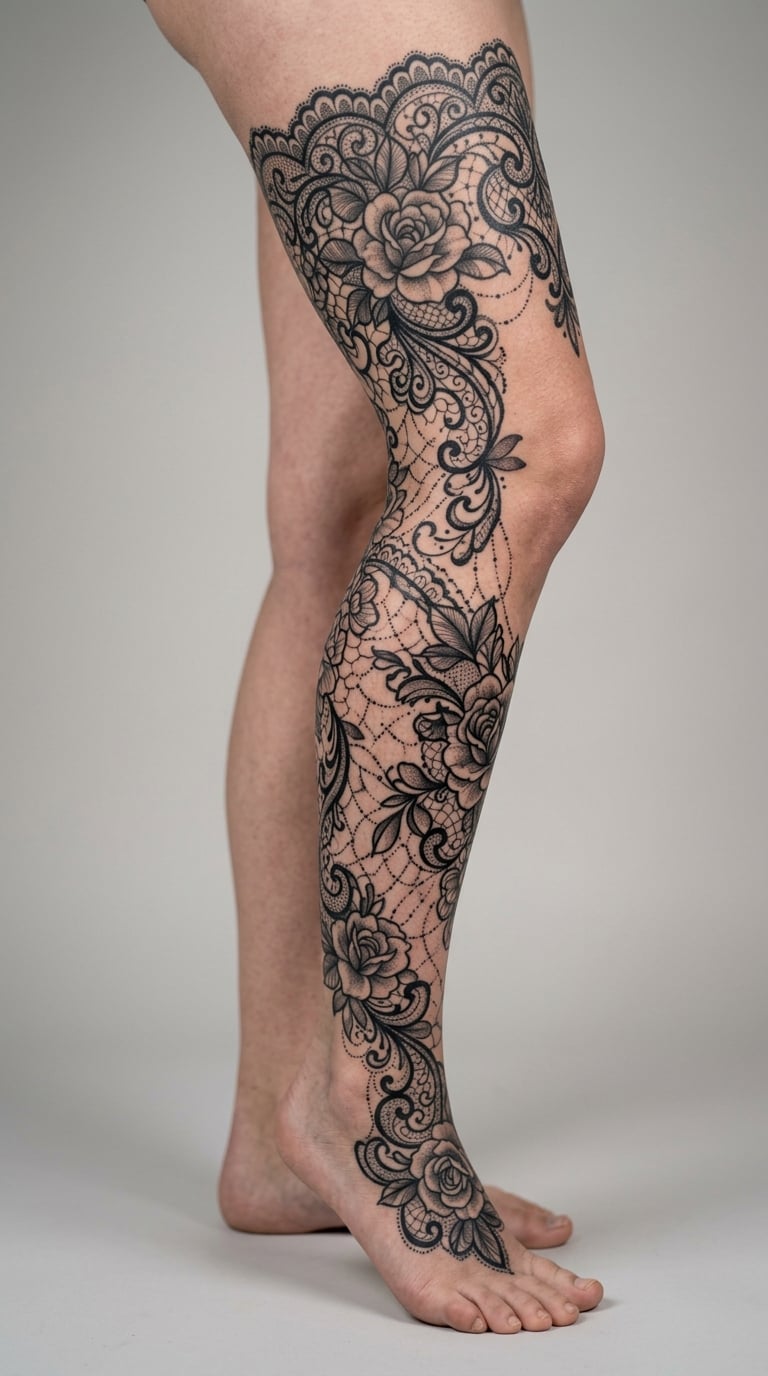
A floral lace design builds an actual lace pattern on the leg: a mesh of fine netting overlaid with flowers, leaves and a defined top band at the thigh with a scalloped edge at the foot. The net is drawn as crossed hairlines rather than dots, and the flowers are denser than the mesh so the pattern reads at a distance. The effect depends entirely on the top band being a clean, unbroken line.
It is a fashion-referencing idea that works best on legs that are seen often, since the illusion depends on the eye reading a garment rather than skin. It is also one of the most useful options for covering an old piece, because the dense mesh disguises a great deal.
Placement: thigh down to the foot, front or outer. Size: 20-26 in (51-66 cm). Style: lace linework, black only. Pain: medium, and expect a long session for the netting.
Ageing note: the hairline net loses definition first; the flowers and the top band stay crisp for years.
Make it yours: put a small solid shape in the lace, like a bird or a key, so the pattern holds a secret.
22. Red Ink Snake Coiling Down the Leg
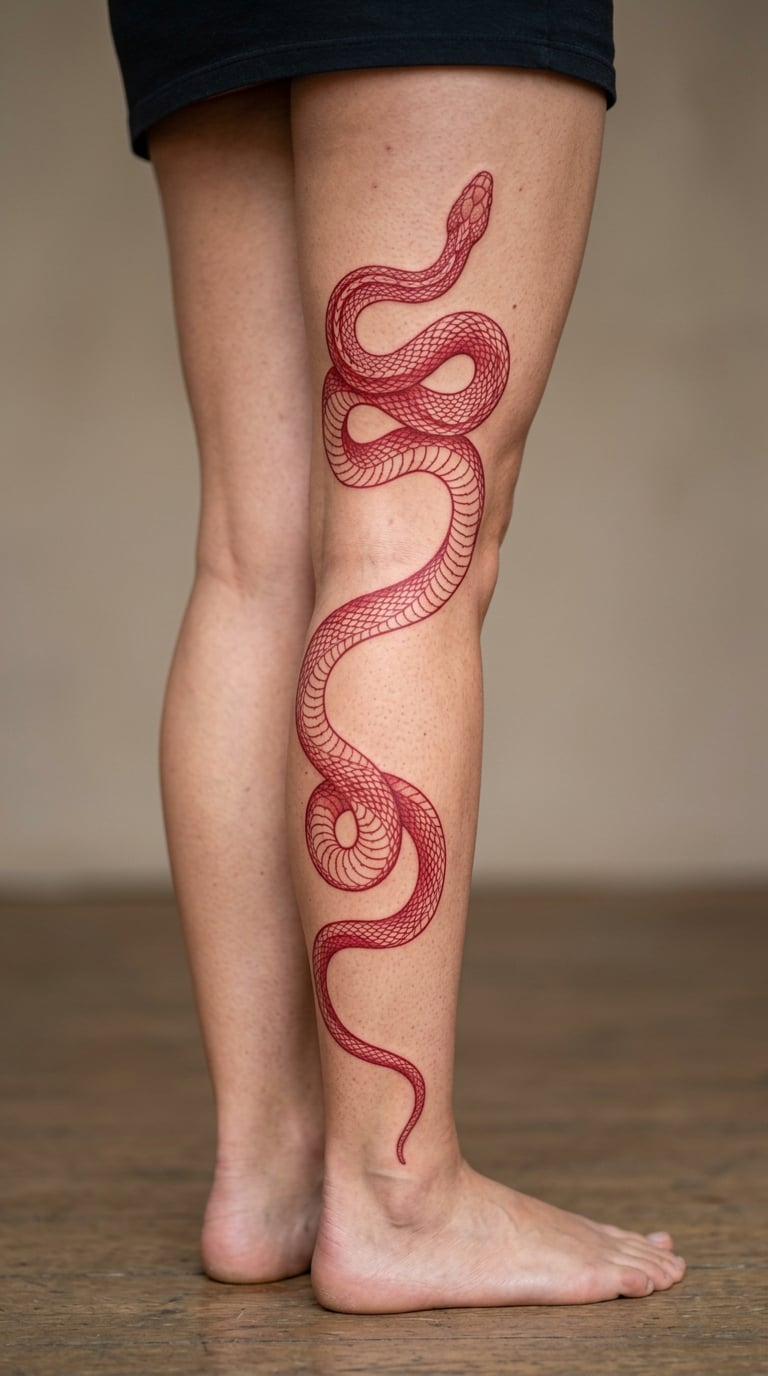
A single red snake follows the leg’s natural curve in one long S, drawn in a deep red with a darker red for the shadowed underside and a black outline kept thin and even. The scales are suggested with short curved strokes rather than individually drawn, and the tongue and eyes are the only black details. Most of the leg stays bare, so the shape of the limb does the work instead of the design.
Red ink on its own is a specific choice: it fades noticeably faster than a black outline, so it needs more sun discipline than most pieces here. People still choose it because a single red shape on a full leg is a strong, uncomplicated look.
Placement: anywhere the leg’s curve helps, most often the outer leg. Size: 16-20 in (41-51 cm) of snake, with wide gaps. Style: red ink illustrative. Pain: low to medium.
Ageing note: red pigment lifts out of the skin faster than black and shifts toward orange. Plan on a colour refresh every three to four years.
Make it yours: have the scales change subtly along the body, from fine near the head to broader toward the tail.
23. Star Map Matching Design
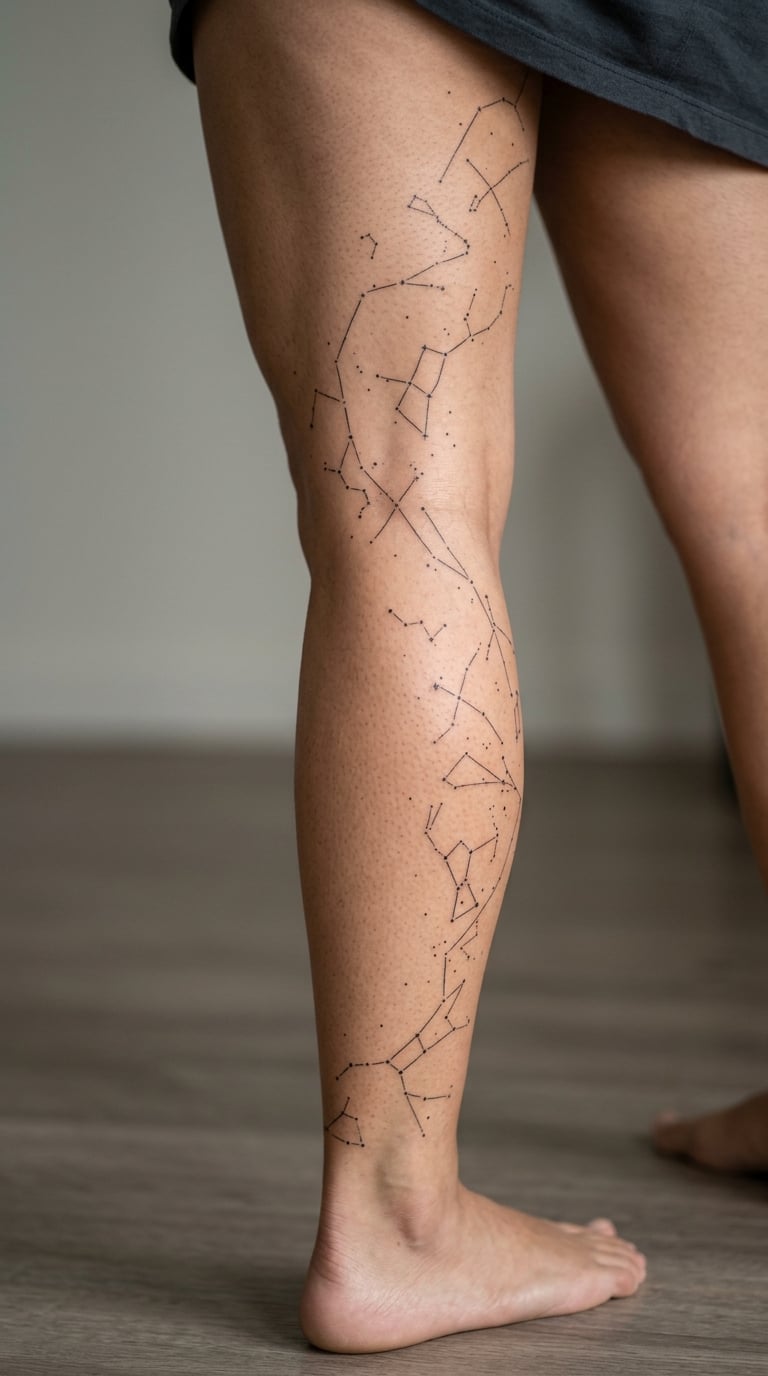
A star map is your actual sky, translated: a scatter of small stars in correct relative positions, joined by thin lines, with the date and one or two coordinates set discreetly at the top. Stars are drawn in three sizes so the brightest ones read correctly, and the constellation lines are lighter than the star points. The whole thing is a map, not a decorative scatter.
This is the most personal design on the list. It gets chosen for a shared location, a wedding date or the night something happened, and it works best as a matching piece where two people carry the same sky on opposite legs in the same orientation.
Placement: ankle up the back of the leg, or the front of the shin. Size: 12-18 in (30-46 cm). Style: fine line. Pain: low.
Ageing note: the smallest star points and the coordinate text soften fastest, so ask for a heavier star weight at the consultation.
Make it yours: send your artist the exact date, time and location, then check the chart before the stencil goes on.
24. Patchwork-Style Vintage Flash
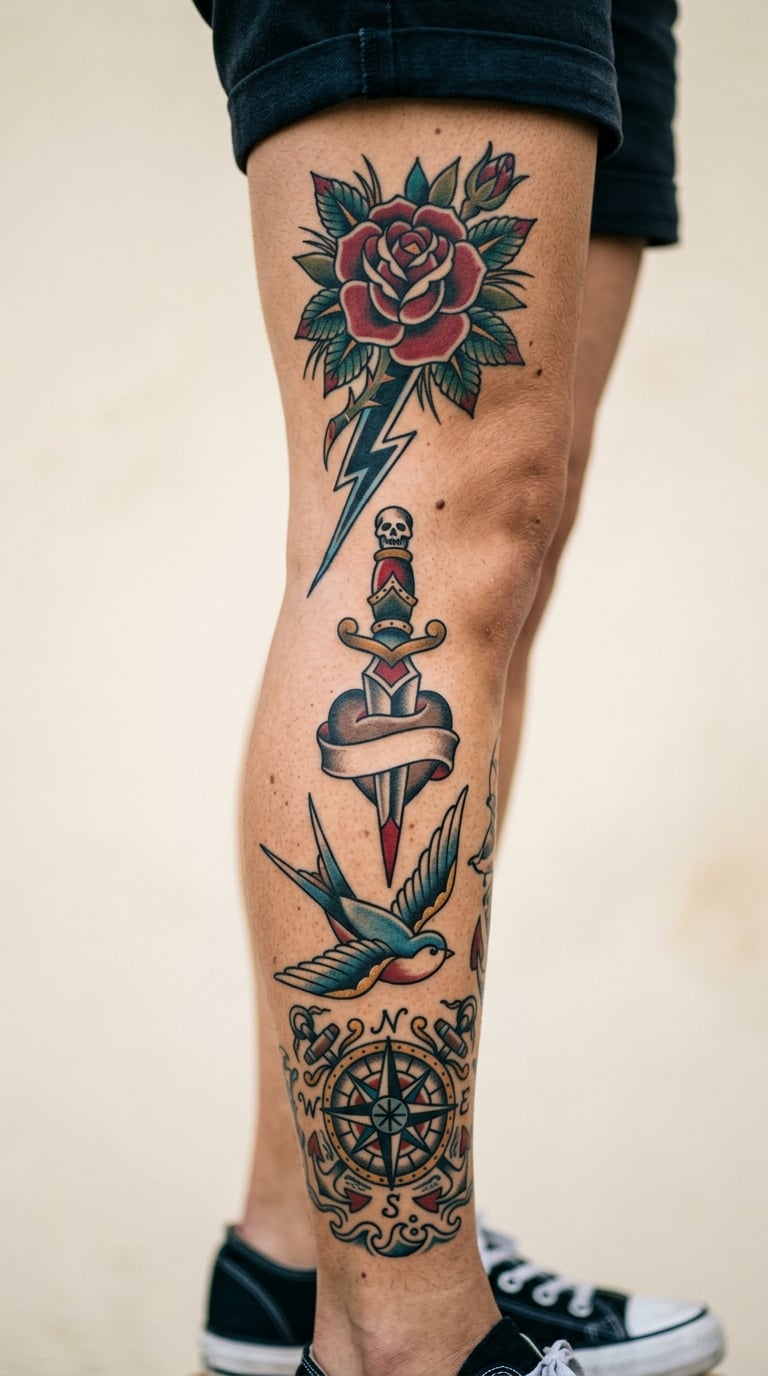
A vintage flash patchwork is a set of original motifs drawn in the bold, flat style of old flash sheets: a rose, a lightning bolt, a swallow, a dagger and a small navigation wheel, each in its own space with a visible gap around it. The unifying trick is consistency. Same weight outline, same two or three colours throughout, same gap between every element, and the pieces distributed so the leg never looks top-heavy.
Flash is chosen by people who like the look of traditional sheets and want motifs with a long graphic history, without committing to one theme. The gap is what makes it work over a full leg, and it is also what leaves room for a future piece between the existing ones.
Placement: distributed down the leg, one motif per zone. Size: 16-24 in (41-61 cm) overall, each motif 2-4 in. Style: traditional flash. Pain: medium.
Ageing note: heavy outlines hold well, but the smaller motifs on the lower leg fade first because that skin flexes most.
Make it yours: pick motifs for what they mean to you rather than for a theme, and keep all of them original artwork rather than copied flash.
How to Choose the Right Design
Most people pick the design first and regret it later, because the drawing is the fun part. Work through these five instead, in this order, and the right design usually becomes obvious.
- Start with your body shape, not the picture. Ask the artist to mark the design on your leg while you stand and sit. Florals and foliage stretch well with a changing contour; strict geometry and long straight lines show every change.
- Match the style to how much patience you have. Fine line and watercolour are quickest and heal fastest. Blackwork, colour realism and large lace need more sessions and more touch-ups.
- Plan for the parts you will show. Full legs are visible most in summer, and colour fades faster on the outer calf and shin than anywhere else. If you want colour to last, expect sun protection on that leg for the rest of your life.
- Leave negative space on purpose. Ask for breathing room between elements, especially at the ankle and around the knee. It looks calmer now and leaves somewhere to add later.
- Check the artist against the style, not the photo. A portfolio full of healed fine line work tells you more than any single fresh piece. Bring references of the healed result you want, not just the fresh version.
Cost and Session Time
In the United States, most full leg tattoos are priced by the hour rather than as a single figure, and the total for a piece running from thigh to ankle usually falls somewhere between 2,500 and 9,000 US dollars for a mid-range artist. That range is wide because hourly rates vary more than people expect, from roughly 80 dollars an hour in a smaller town to 250 dollars or more in a major city for an artist who works in a requested style.
Sessions matter as much as rates. A full leg project typically runs three to six appointments of three to five hours, which is a lot of sitting. Detailed work takes more sessions; a soft watercolour piece takes fewer. Shop minimums, travel, and artists who charge for the full day rather than by the hour can all move the total, so treat any number you find online as a starting point and ask for a written estimate at the consultation.
One useful rule of thumb: an hour of fine line covers a lot of leg, while an hour of dense blackwork covers very little. If your design is mostly solid black, expect the hours to add up quickly.
Aftercare Basics
Follow your artist’s aftercare instructions first, since they will reflect the specific ink, skin and technique used on your piece. Everything below is general care that applies to most tattooed legs.
- Follow your artist’s aftercare instructions above everything else, including any product they tell you to use and anything they tell you to avoid.
- Keep the area clean and let it be washed gently, then pat dry rather than rubbing.
- Wear loose clothing for the first one to two weeks, and expect the leg to swell noticeably for two to three days after a long session. Elevating it when you can helps with the swelling.
- Keep the new tattoo out of direct sun, and use sunscreen on the leg once healed, since colour fades fastest on exposed limbs.
- Skip the gym, swimming pools and hot tubs until the piece is fully healed, and keep pets off the leg while the skin is settling.
Frequently Asked Questions
What does a full leg tattoo mean?
A full leg tattoo does not have one fixed meaning. It may reflect a personal milestone, a chosen theme, a connection to a place, or simply the wearer’s preference for a larger composition. People describe the leg as a canvas that carries a whole story, so the meaning comes from the motifs you choose and the dates or places you build in. Ask your artist to leave space for additions if you might want to add later.
Can a full leg tattoo be changed later?
Yes, but additions, cover-ups and major rebalancing are more complex on a large existing piece. If you may want more artwork later, ask the artist to preserve negative space and avoid filling every area. Florals and foliage are easy to extend into. Hard-edged geometry and fine line are harder, because new work has to match an aged original rather than a fresh one.
How painful is a full leg tattoo?
Pain varies by placement. The outer thigh and upper calf are often more manageable, while the inner thigh, knee, shin and ankle can feel sharper or more intense. A full leg also requires multiple sessions, so the endurance matters more than any single spot. Eat, hydrate, sleep, and take the breaks your artist offers rather than pushing through the end of a long session.
Should I get a full leg tattoo at once?
Most full leg projects are completed over several sessions because of the area, detail and time required. Artists often begin with an outline or major lower-leg section before adding colour, shading or detail on a later visit. Let each area settle before the next session starts, and plan the spacing with your artist so the whole project fits comfortably into your year.
How long does a full leg tattoo take to heal?
Surface healing takes about two to three weeks, with the leg swelling for up to 72 hours after a long session. The ink itself keeps settling for several months as pigment settles into the deeper layers of skin, and colour looks its most accurate around six months. Sun protection matters from the start if you want the colour to stay true over the years.
Conclusion: Where to Start
If this is your first large piece, the fine-line wildflower vine is the kinder place to begin. It heals quickly, it hides small imperfections, and it teaches you what you can sit through without committing your leg to a single heavy style you might grow out of.
If you already have leg work and you are building a collection, the geometric symmetry option gives you something that reads well next to almost anything else. Just have the artist check how it sits on your leg while you are both standing and sitting.
Whichever one you choose, check healed references in that exact style, get the placement marked on your body before you commit, know your session and budget plan, and pick an artist whose finished work you actually want to live with. Then book the consultation. That is the only step that cannot be undone later.