
20 Tattoo Ideas That Symbolize Love for Family: Best September 2026
Tattoo ideas that symbolize love for family all lean on the same handful of images: a name in someone’s real handwriting, a hand held in a smaller hand, a birth moon, coordinates, a set of matching hearts. The symbol carries the meaning, which is why these designs stay readable to a stranger and still mean one specific thing to you.
I’ve watched people pick the prettiest design in a gallery and then get stuck at the counter, unable to explain why it mattered. The designs below each come with a reason, a real size, a placement that suits the linework, and an honest note about how it ages. If your family is blended, adopted, or chosen rather than biological, several of these work just as well without any explanation at all.
Tattoo Ideas That Symbolize Love for Family: Quick Guide
| Idea | Style | Best placement | Size | Pain |
|---|---|---|---|---|
| Matching family initials | Fine line script | Inner forearm | 2 to 3 in | Low |
| Parent and child holding hands | Black fine line | Inner wrist | 2.5 in | Low |
| Family tree with branches | Blackwork linework | Inner upper arm | 3 to 4 in | Low |
| Matching birth moons | Micro fine line | Inner wrist | Under 0.25 in each | Low |
| Heart with handprint | Black and grey | Forearm | 2 in | Medium |
| Family home coordinates | Fine line with lettering | Inner forearm | 2.5 in | Medium |
| Botanical sprig with four leaves | Botanical with color | Shoulder | 3 in | Medium |
| Two birds on a branch | Traditional | Collarbone | 2 in | Medium |
| DNA helix in a heart | Fine line | Forearm | 2 in | Low |
| Rose with two clasped hands | Black and grey realism | Upper forearm | 3 in | Medium |
| Four heart outlines | Simple line and color | Inner wrist | 0.5 in each | Low |
| Matching compass rose | Minimal blackwork | Outer forearm | 2 in | Low |
| Micro-realism portrait | Micro-realism | Inner upper arm | 2 in | Medium |
| Family date in Roman numerals | Elegant fine line | Forearm | 2 in | Low |
| Elephant and calf | Fine line contour | Calf | 3 in | Medium |
| House inside a heart | Fine line icon | Wrist | 1.5 in | Low |
| Interlocking band-style lines | Continuous line | Ring finger | 1 in | Medium |
| Minimal family crest | Blackwork crest | Upper arm | 3 in | Medium |
| Four-petal flower set | Botanical color | Ankle | 1.5 in | Low |
| Laurel branches forming a heart | Traditional | Chest | 3 in | Medium |
1. Matching Family Initials in Fine Line
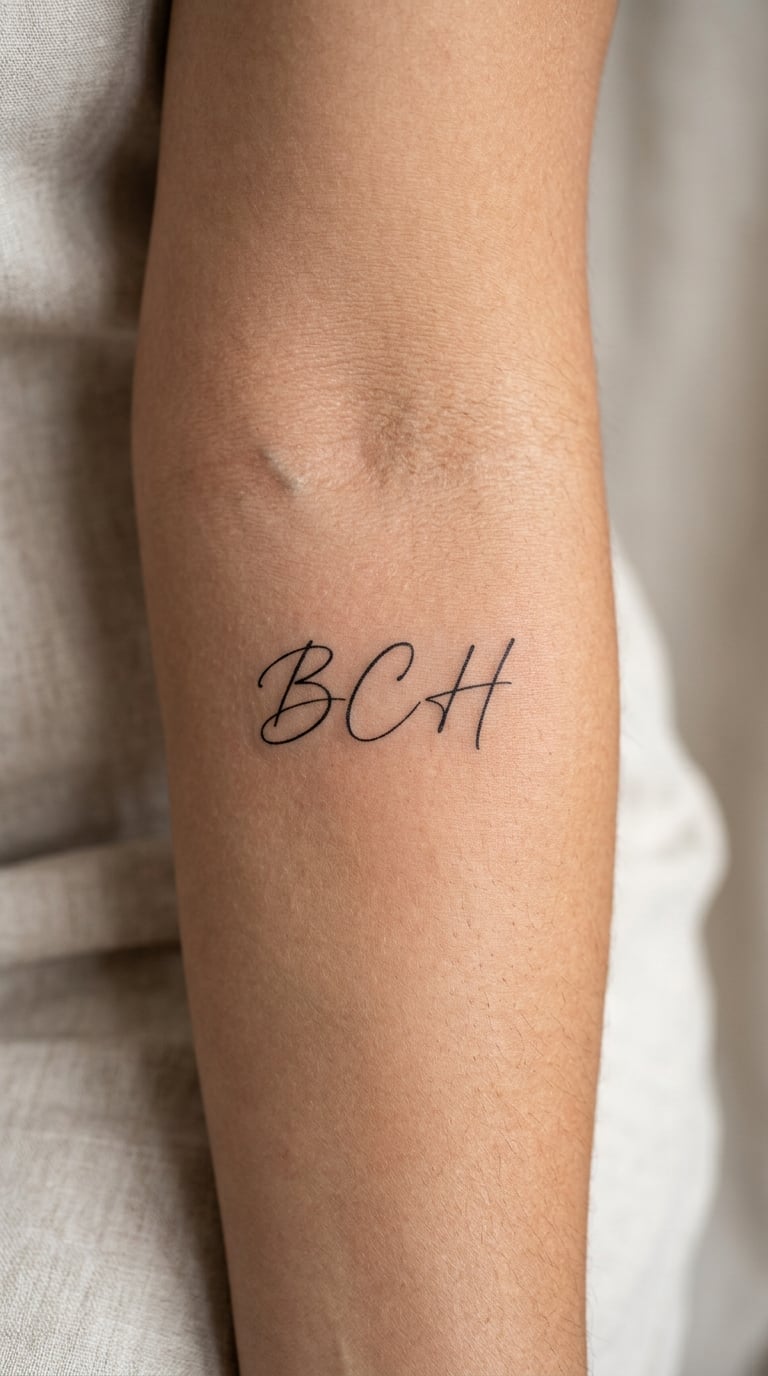
Matching family initials in fine line are the most requested design in this category, usually a surname, a set of first initials, or a monogram where one letter sits inside another. The work here is lettering, not drawing, and a good artist will build the strokes at an even weight rather than a thin single pass that spreads in the skin within a few years.
People choose it because initials belong to one specific household. A shared surname on two forearms reads as a pair to anyone who knows your family, and it is far easier to explain than an abstract symbol.
Placement: Inner forearm, wrist crease, or behind the ear for a smaller set. Size: 2 to 3 inches wide for a surname, about 1 inch for a monogram. Style: Fine line script or clean serif lettering. Pain: Low on the inner arm, and thin single-needle script on the hands or fingers fades fastest, so keep it on the forearm if you want it crisp in fifteen years. Make it yours: Use your real family’s handwriting rather than a font, and add nothing else underneath.
Before you commit, check whether the same surname is already tattooed on someone else in the family, and look through the initial tattoo ideas that show your love so you can see how the lettering reads at different sizes.
2. Parent and Child Handholding Silhouette
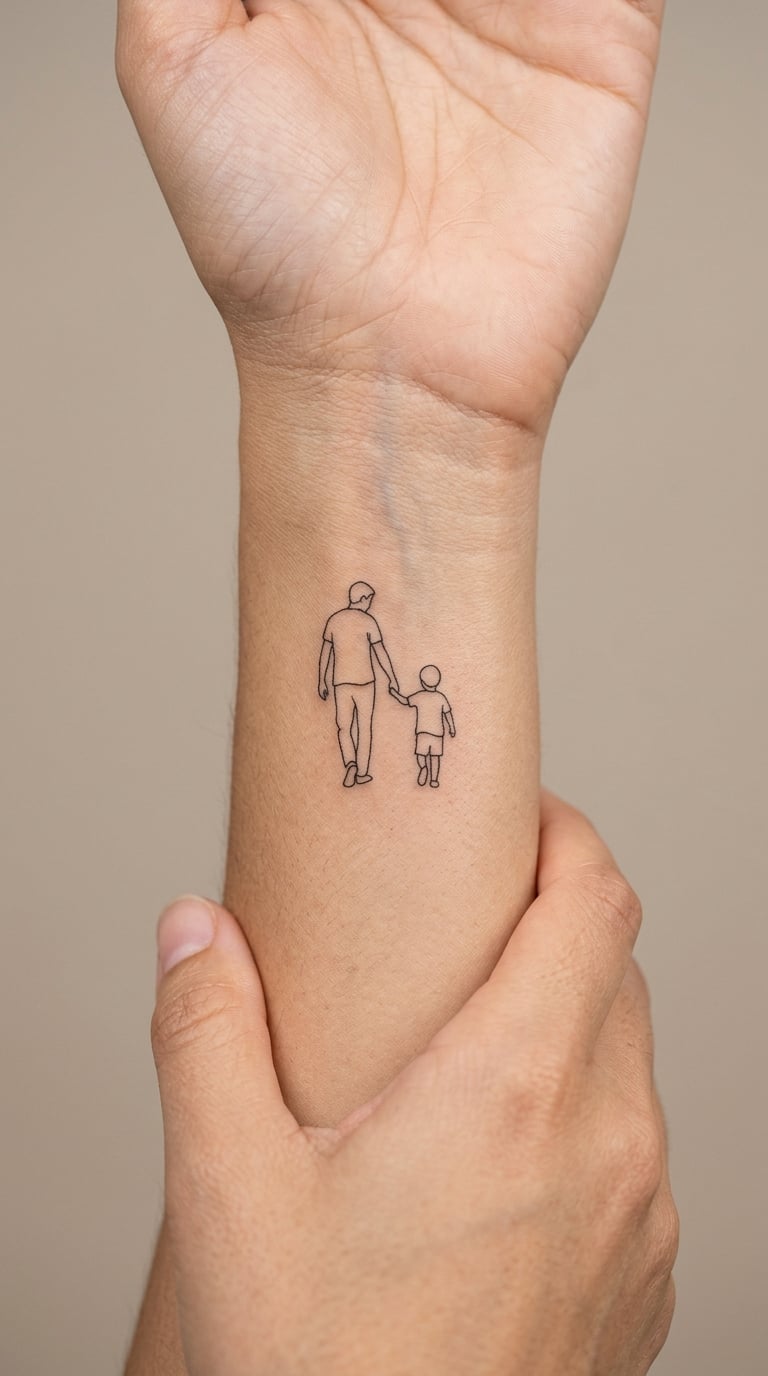
A parent and child handholding silhouette is two figures reduced to outline and solid black, with no faces and no background. Fingers are the hard part: an artist will simplify them to two or three clean lines each so the hands read as hands at a small size instead of dissolving into a smudge.
It is the version of a family tattoo that captures a single moment rather than a symbol, usually a walk to school or a hand held crossing a road. A cropped composition, say just the hands and a sliver of sleeve, survives better than a full body.
Placement: Inner wrist, inner forearm, or the calf. Size: 2.5 to 3 inches long. Style: Black fine line or solid black silhouette. Pain: Low on the inner wrist, medium on the calf. Detail blurs over the years, so keep fingers minimal from the start. Make it yours: Match the cuff of the sleeve in the drawing to a real jacket or school uniform your child actually wore.
3. Family Tree with Branched Linework
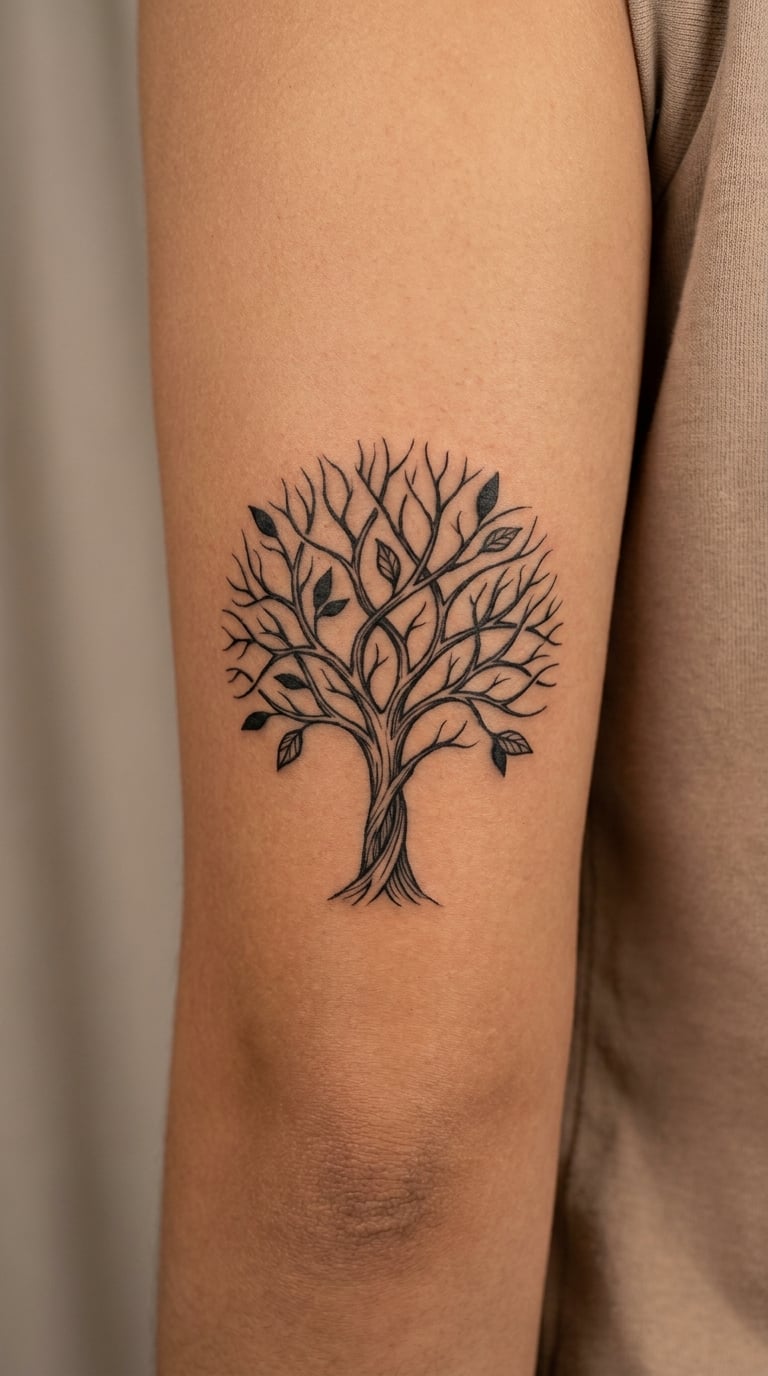
A family tree with branched linework is a trunk with a few limbs and a handful of leaves rather than a full genealogy chart. Grandparents sit high, parents in the middle, kids low, and the branching does the storytelling so you barely need names.
It is one of the older symbols of lineage and belonging, and it works well when the family is large because the number of leaves can expand without redrawing anything.
Placement: Inner upper arm, back of the shoulder, or a forearm panel. Size: 3 to 4 inches tall for a readable version. Style: Blackwork linework or dotwork leaves. Pain: Low to medium. Multi-generation trees drawn at full scale on a back tend to turn into an unreadable blob, which is the single most common complaint from people who got one anyway. Make it yours: Give each generation a different leaf shape, and skip names entirely if the size is under four inches.
4. Tiny Matching Birth-Moon Phases
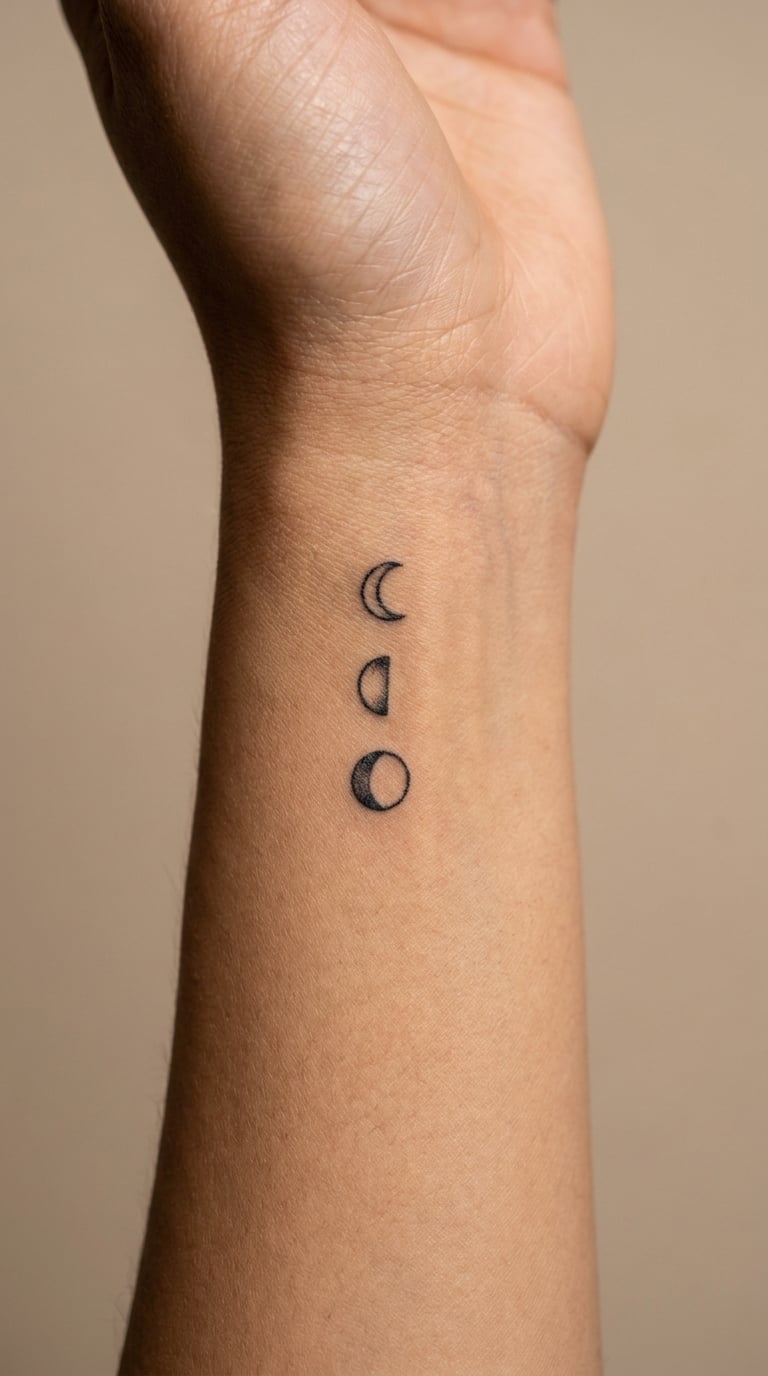
Tiny matching birth-moon phases are the smallest reliable design in this list. Each person’s moon on the night they were born is worked out as a curve and filled or left empty, then arranged as a row, a circle, or a short vertical line.
Moons track a life cycle, so people use them for a birth, a death, or both without spelling anything out. It is also the easiest family design to make genuinely matching, because everyone gets the same style and only the shape of the moon changes.
Placement: Inner wrist in a vertical line, or across the collarbone. Size: Each moon under a quarter inch, three to five moons in a row. Style: Micro fine line. Pain: Low, and quick. A tattoo this small can look underworked on purpose, so agree on the size with the artist before it starts. Make it yours: Use each person’s actual lunar phase, not a decorative crescent repeated four times.
5. Heart Containing a Family Handprint
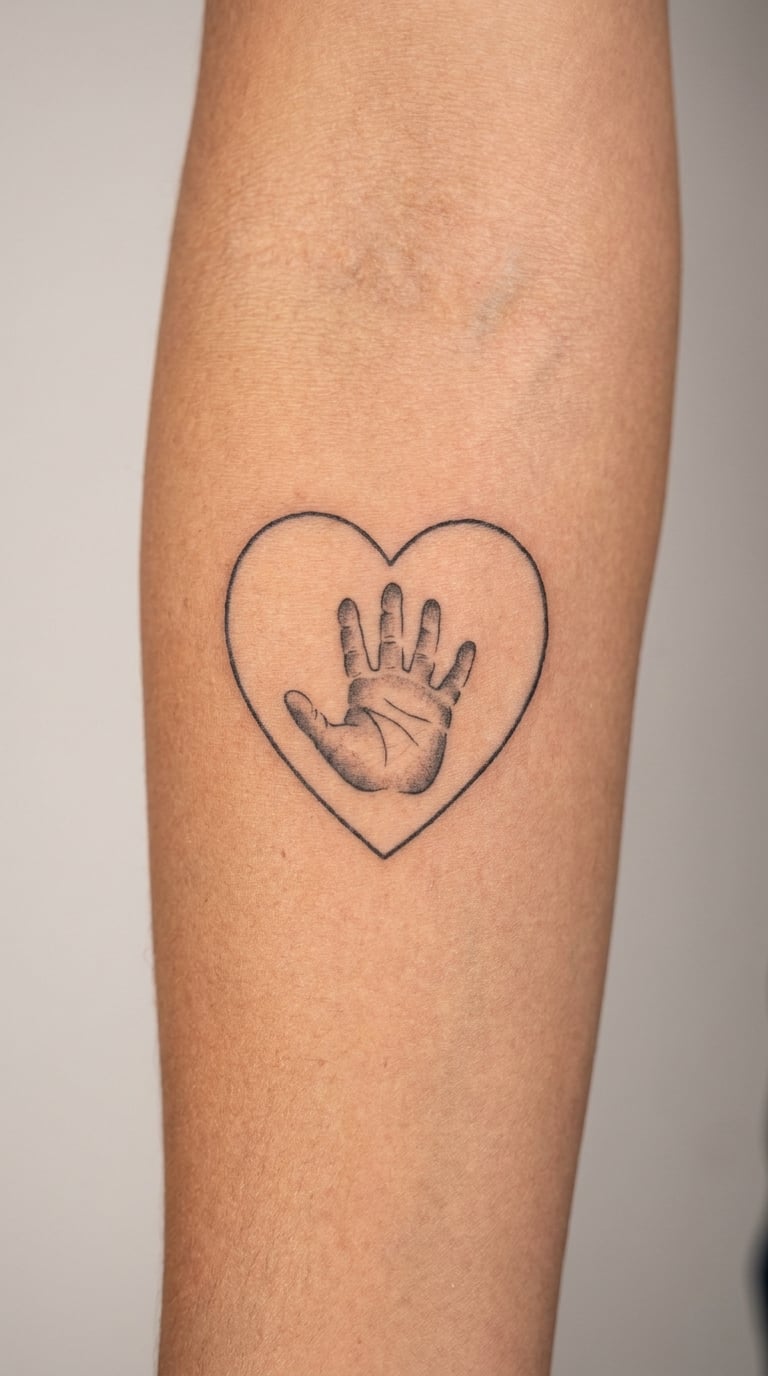
A heart containing a family handprint starts with an inked or photographed handprint, then reduces the palm lines until they read as tattoo linework rather than a photocopy. The heart outline around it should be a simple single-weight line with plenty of empty space inside, otherwise the print has nowhere to go.
This is a favorite for new parents and for grandparents, since a child’s hand changes fast and nobody wants to lose the size. A smaller hand inside a larger one reads as protection rather than romance.
Placement: Forearm, upper arm, or the back of the hand for a small print. Size: 2 inches across for the whole piece. Style: Black and grey with soft shading. Pain: Medium, and it takes longer than the size suggests because the linework is dense. Make it yours: Take the print from a real hand on real paper, photograph it flat, and let the artist simplify rather than tracing every crease.
6. Coordinates of a Family Home
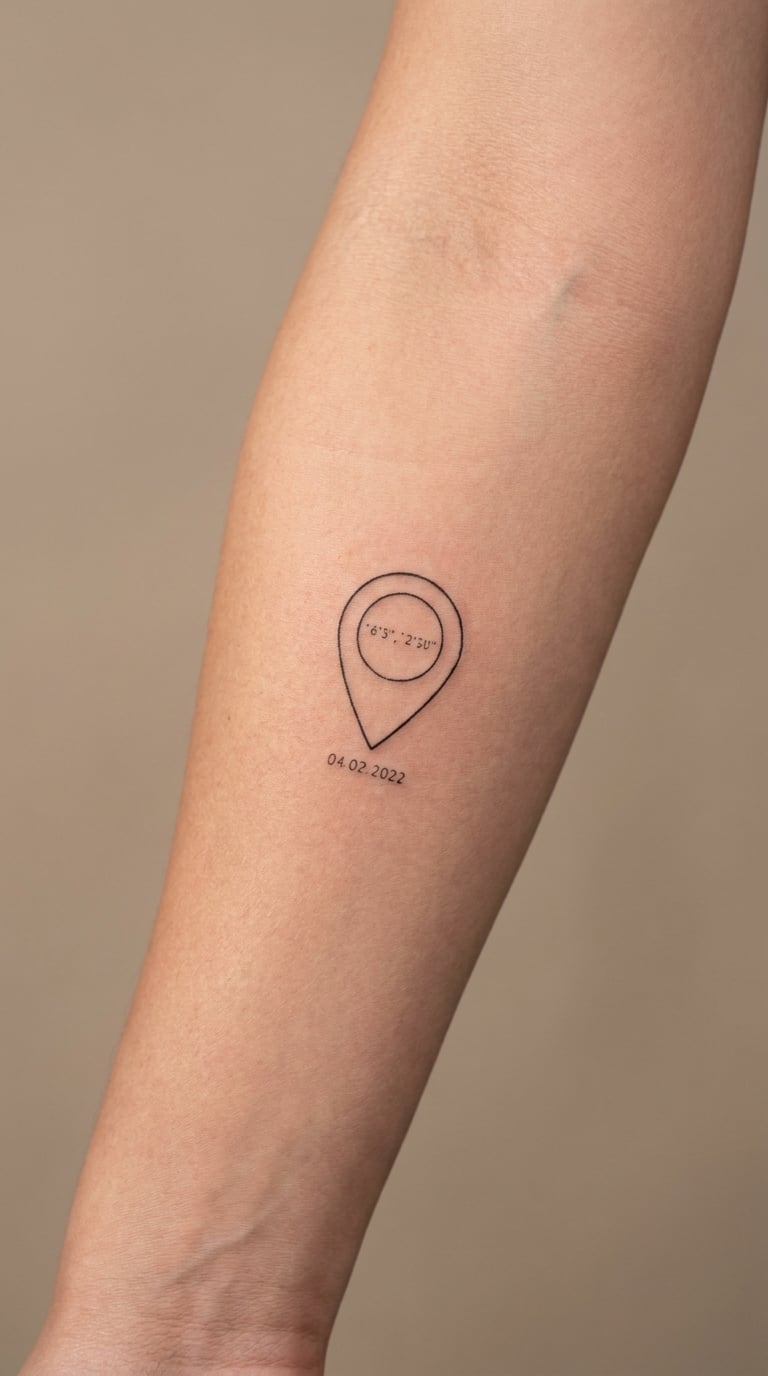
Coordinates of a family home are latitude and longitude in a thin clean serif, usually with a small map pin and sometimes a single date underneath. The number of digits is fixed, which makes the design easy to size precisely.
A home is the most concrete symbol of family there is. People use the address of a house where everyone lived, a holiday house, or the spot where a family started over.
Placement: Inner forearm or outer forearm. Size: 2.5 inches long, or under 2 inches for a smaller set of digits. Style: Fine line with small serif numerals. Pain: Medium, because numerals are many small close-set strokes. Keep it off the hands and fingers, where small text spreads fastest. Make it yours: Pair one coordinate set with one date rather than two, and check the digits twice before the stencil goes on.
7. Botanical Family Motif With Four Leaves
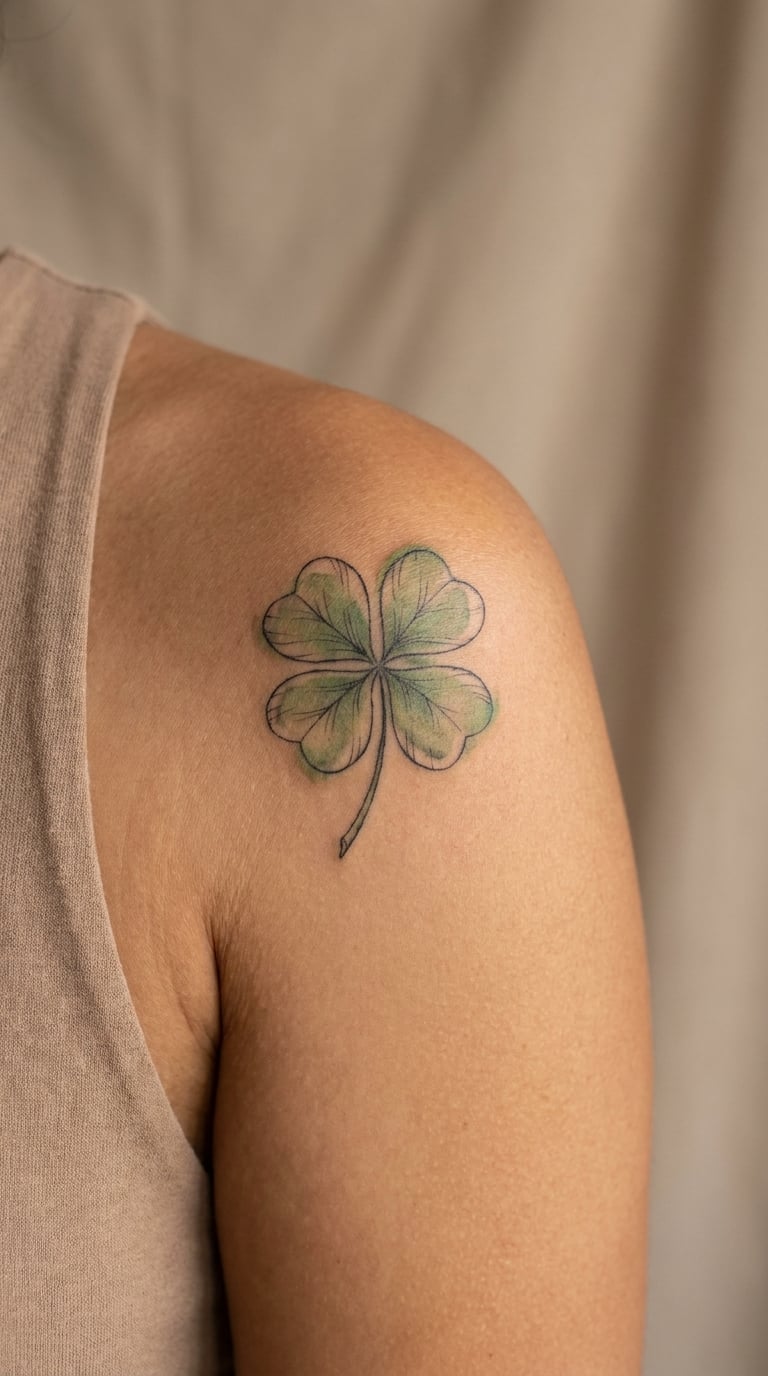
A botanical family motif with four leaves runs a single stem with four leaves, or a small branching sprig, drawn with real botanical proportions. Each leaf can stand for one person, and the branch growing outward is the part that does the emotional work.
Plants mean growth and continuity, so it lands with families who are in the middle of a season rather than looking back at one.
Placement: Shoulder, outer upper arm, or along the collarbone. Size: 3 inches long. Style: Realistic botanical, dotwork, or simplified line art. Pain: Medium on the shoulder. Make it yours: Use the birth flower of each family member as the leaves, which gives you a matching set with a different shape in every position.
More on the four-petal version in idea 19 below, and the birth-flower angle is worth a look if you are planning a matching set across generations.
8. Two Birds Sharing a Branch
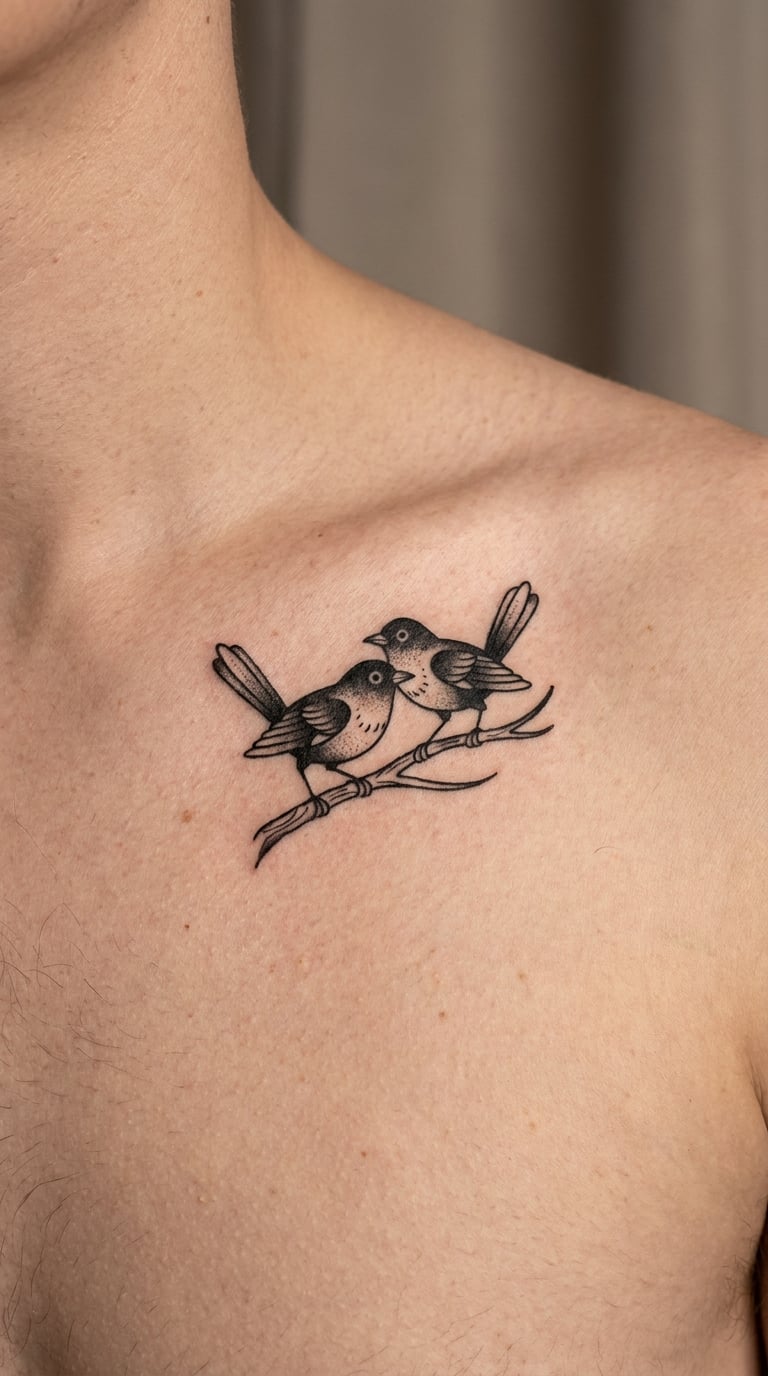
Two birds sharing a branch is one of the most tattooed family symbols around, drawn as two birds close together on a single length of branch, sometimes a parent bird feeding a smaller one. Traditional style suits it best, with a clean outline and light black shading in the wing.
It stands for company and protection rather than romance, which is why it works between a parent and an adult child, or between two siblings who are far apart.
Placement: Collarbone, upper arm, or behind the ear as two separate single birds. Size: 2 inches wide for the pair. Style: Traditional or neo-traditional. Pain: Medium on the collarbone because the skin is thin over bone. Make it yours: Make it a matching set where each person takes one bird and the branch is drawn on only one of them, so the pair only makes sense together.
9. Family DNA Helix Motif
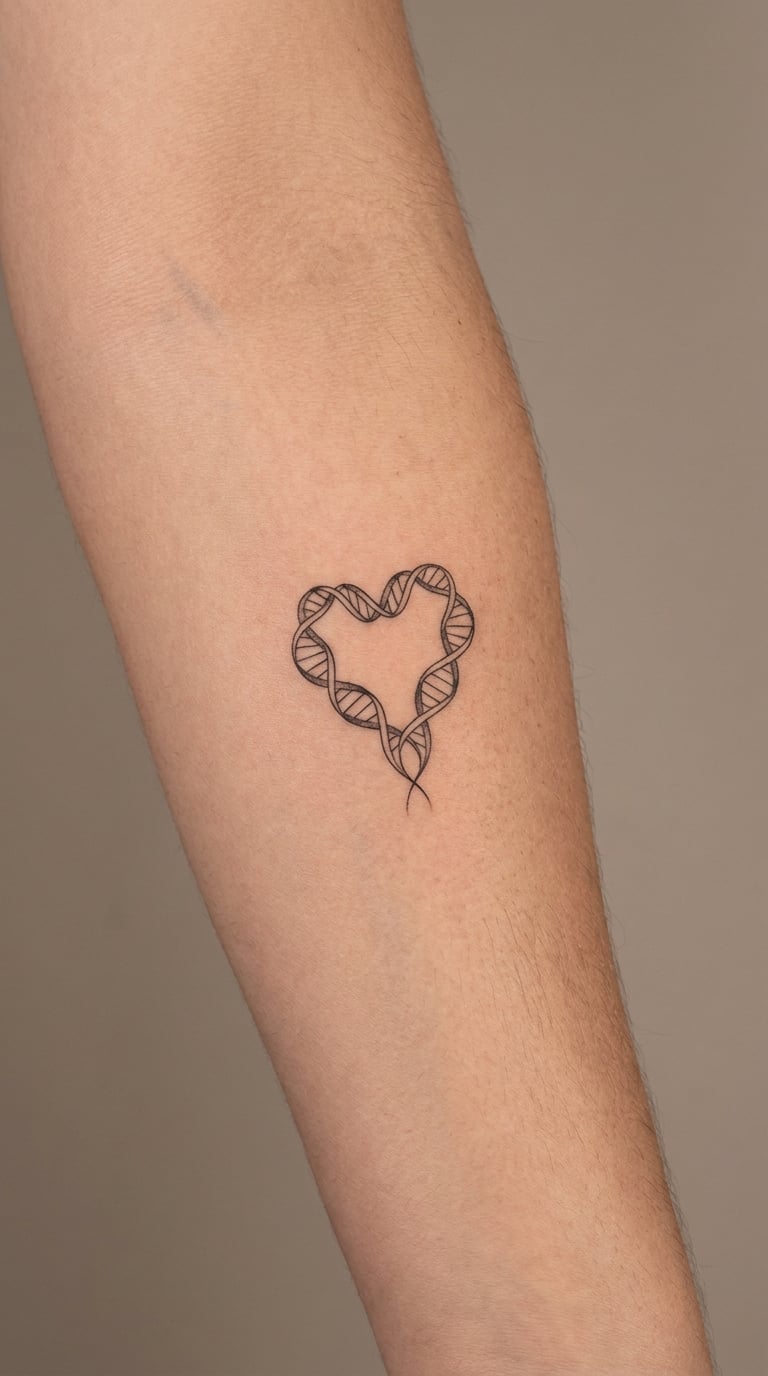
A family DNA helix motif is a double helix, or sometimes a single strand, curved into a heart outline. The version that reads best is one thin continuous line that loops into the helix and returns to close the heart, rather than two heavy twisted rails.
It is the most modern option here, chosen by people who find trees and laurel a bit old-fashioned but still want something about shared identity.
Placement: Forearm, rib area for a longer curve, or the back of the hand. Size: 2 inches tall. Style: Fine line, or a bold single-needle version. Pain: Low on the forearm, medium on the ribs. Make it yours: Add a base-pair letter code or a tiny initial in the negative space between the curves, kept small so it does not turn to mush.
10. Rose and Two Interlocking Hands
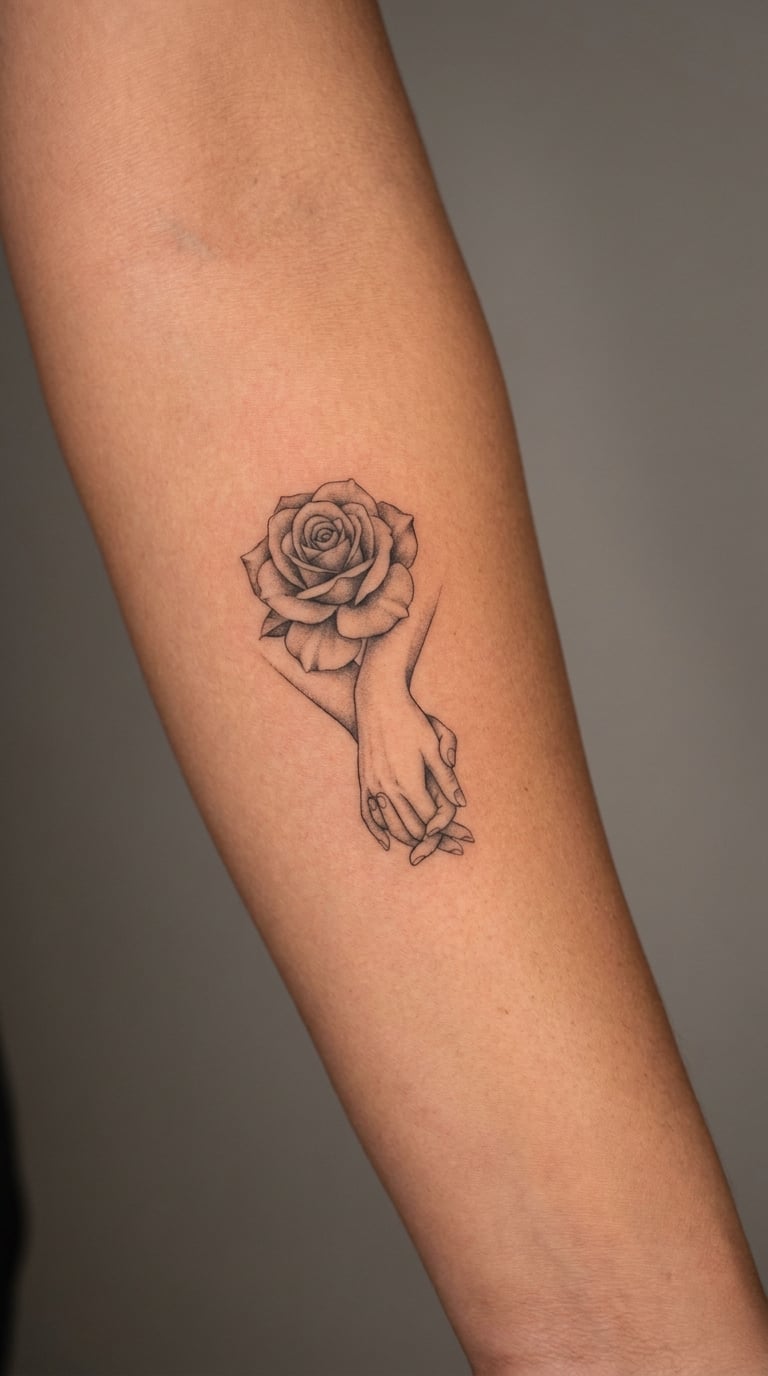
A rose with two interlocking hands is the busiest design on this list and the one most worth planning carefully. The rose gives it warmth and a classic black-and-grey treatment, and the hands sit inside or wrap around the stem so the two elements share one outline instead of fighting for space.
Family crest tattoos from the last century often used a rose to signal love held under protection, and this is a modern, smaller take on that idea.
Placement: Upper forearm, thigh, or ribs for a larger version. Size: 3 inches long, and give it more if the hands need to show fingers. Style: Black and grey realism. Pain: Medium and long, easily two sessions if you go past three inches. Shading in the rose is what makes it work; thin outlines alone look unfinished. Make it yours: Give the rose a real stem with two small leaves, and skip the banner or scrollwork that turns a rose design into a generic one.
11. Four Small Heart Outlines
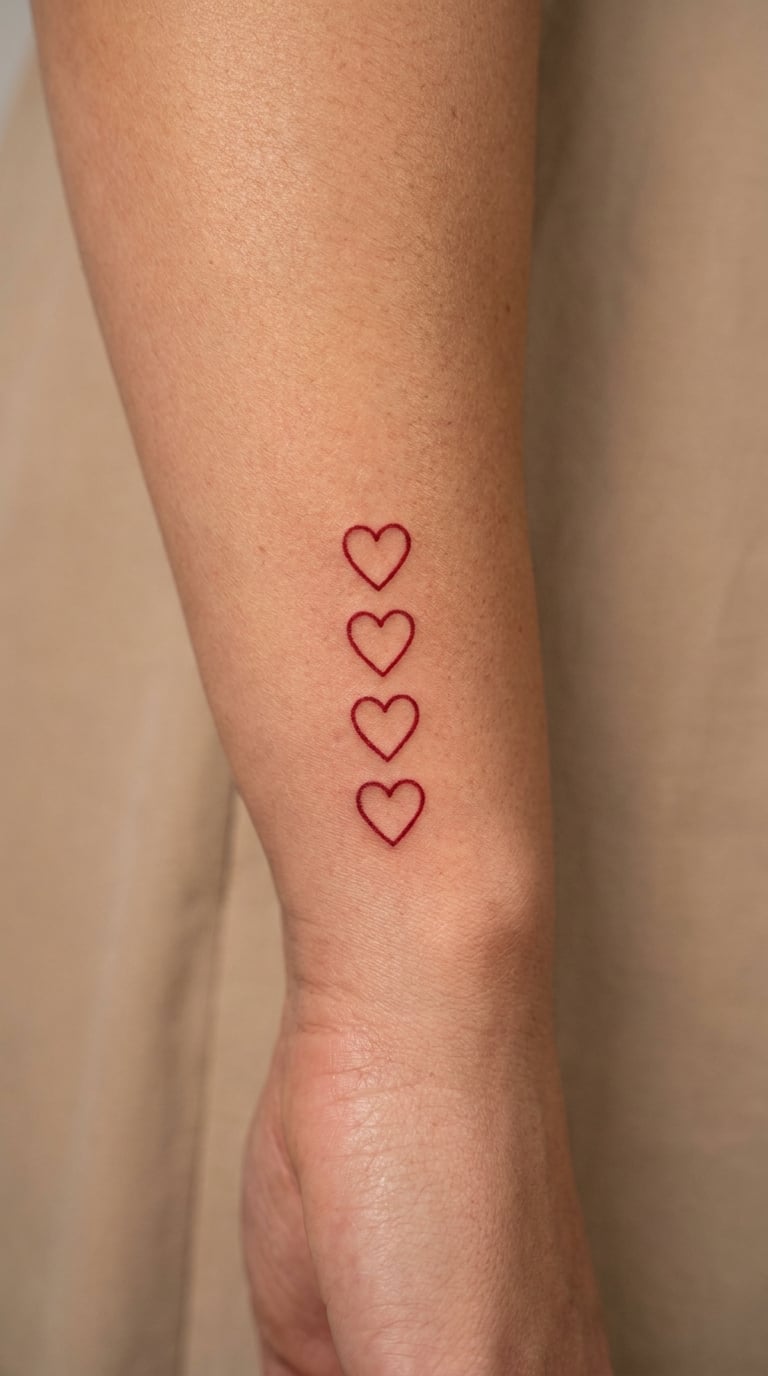
Four small heart outlines is the simplest design here and one of the most requested for a first tattoo. Four hearts stack in a column, sit in a row, or form a square, one for each person in a parent-plus-two-children or sibling group.
It is a count rather than a scene, so the meaning comes from knowing which heart is which.
Placement: Inner wrist, forearm, or behind the ear. Size: Half an inch tall each, two inches for the column. Style: Simple line, filled black, or one color. Pain: Low and fast. Make it yours: Give one heart a small difference, a filled center or a slightly thicker line, so the set reads as a group rather than a repeat.
12. Sibling Matching Compass
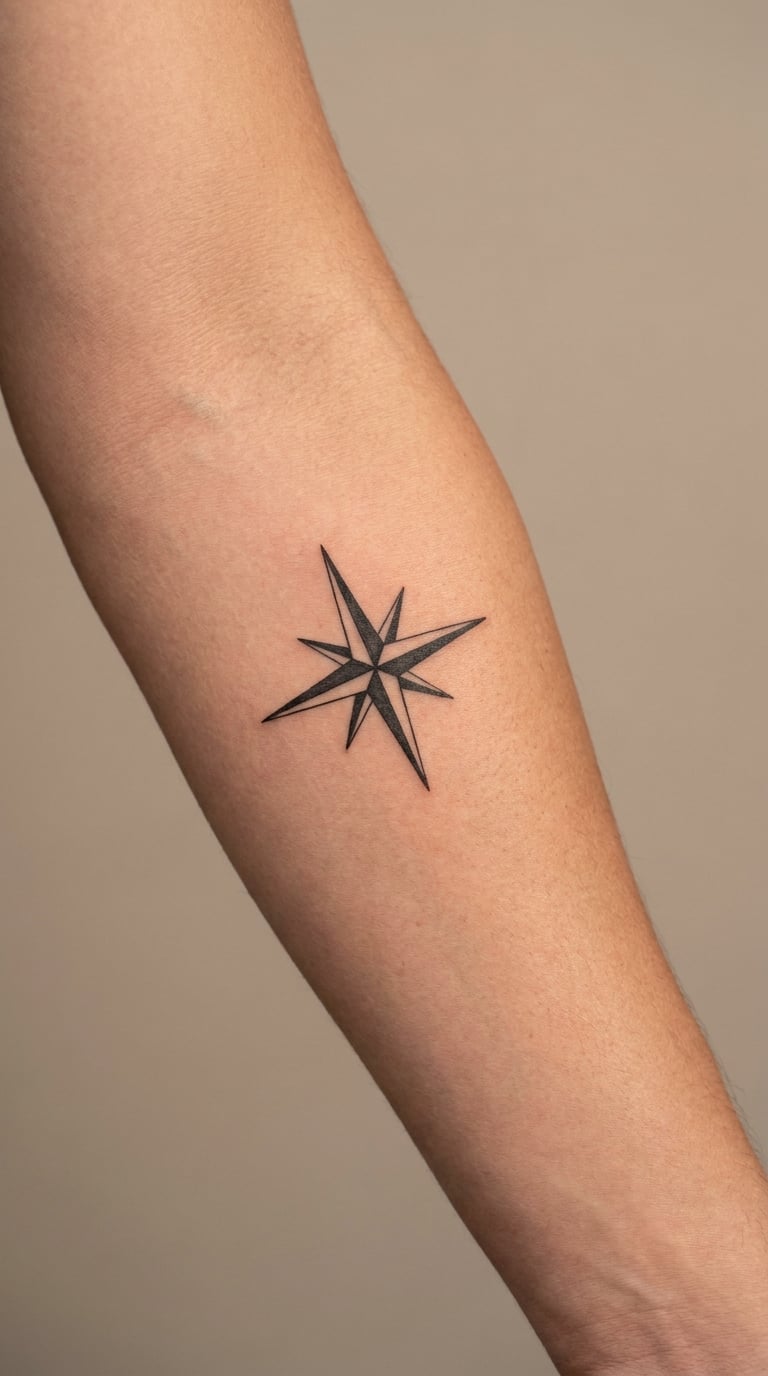
A sibling matching compass is a compass rose with four points, or sometimes a single fine-line arrow, used as a shorthand for guidance. People usually get the same compass on the same spot, which makes it one of the easiest matching tattoos to agree on.
Direction and always coming home are the meanings people attach to it, and it works for siblings who live in different cities or different countries.
Placement: Outer forearm, wrist, or the same spot on both people. Size: 2 inches wide. Style: Minimal blackwork or geometric linework. Pain: Low. Make it yours: Set the needle to a bearing that means something to you both, and skip the ring of text around the edge, which is the first thing to blur.
13. Family Photo-Inspired Micro-Portrait
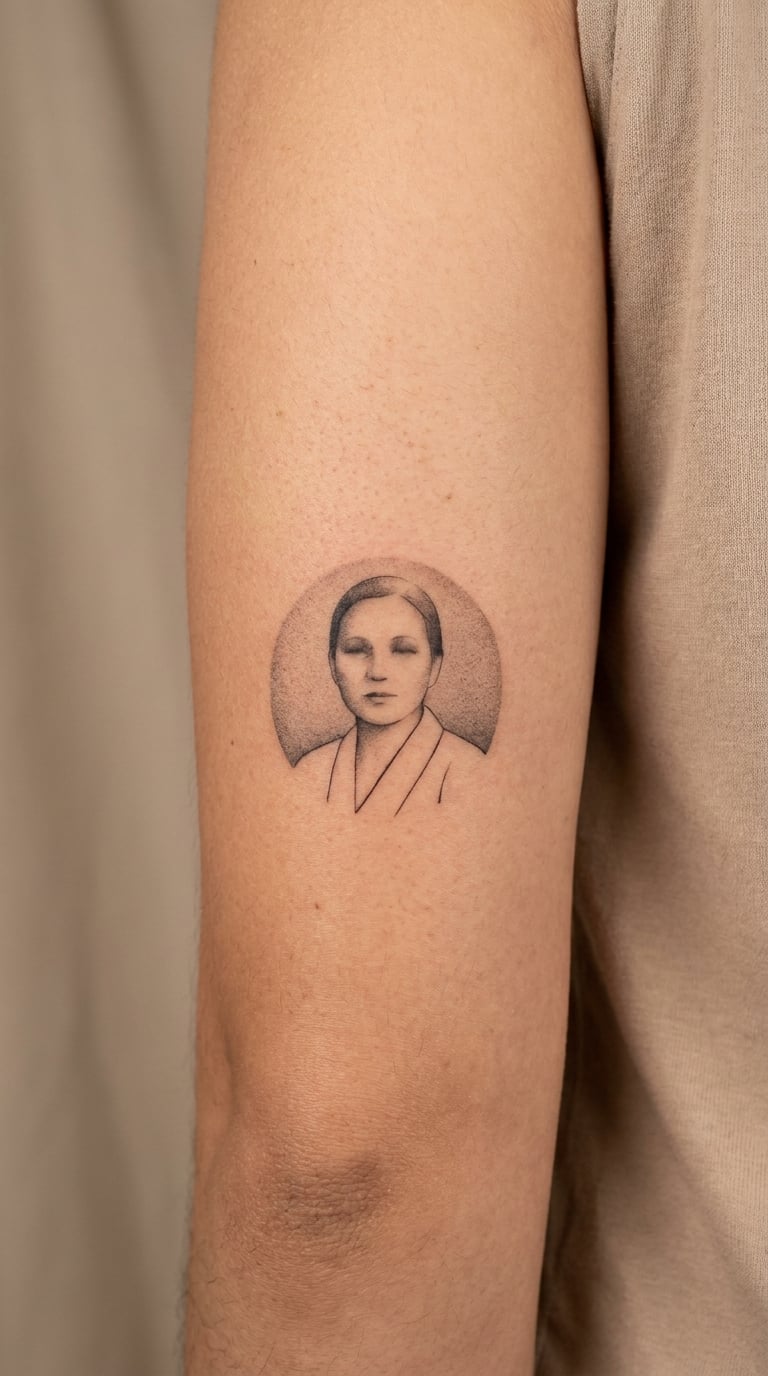
A family photo-inspired micro-portrait is a small black-and-grey portrait built from a photograph you supply, usually one face at two inches tall. Eyes carry the whole piece, so most of the artist’s time goes into the eye shading and the rest is simplified into a suggestion of hair and collar.
This is the design people come for when a family member has died and they want a face rather than a symbol. Working from your own photo, and only the part you have the right to use, keeps it personal and legal at the same time.
Placement: Inner upper arm, forearm, or behind the ear for a very small profile. Size: 2 inches tall. Style: Micro-realism or fine line portrait. Pain: Medium. Tiny shading fills blur faster than bold linework, so expect some softening of the eyes over the years. Make it yours: Send a high-resolution, evenly lit photo, and add a small date or initial on a separate line nearby rather than crowding the portrait.
Anyone weighing a memorial piece will find more on the father and son tattoo ideas that show deep love worth reading before the consultation.
14. Meaningful Family Date in Roman Numerals
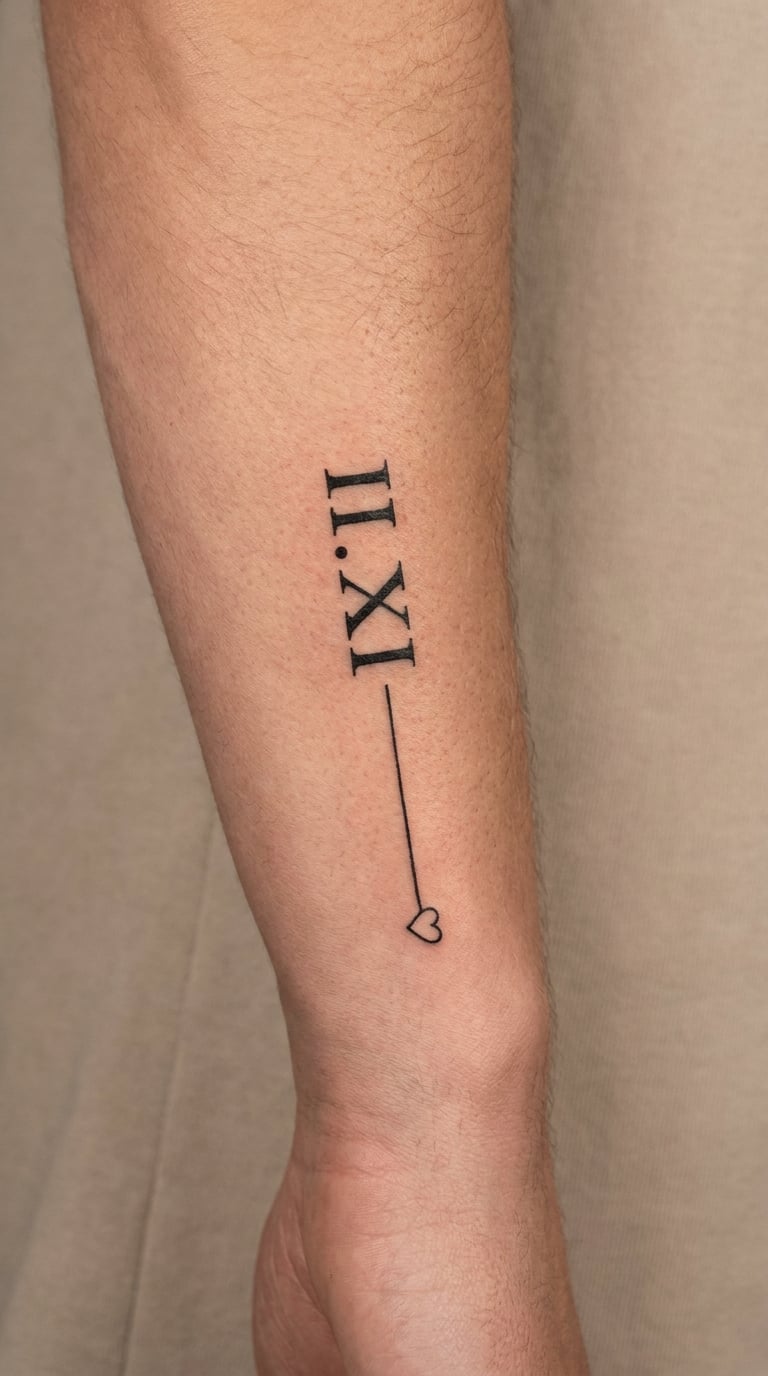
A meaningful family date in Roman numerals is a single date written in Roman numerals, set in a light serif with generous spacing between the characters. Pick the date that actually matters: a birth, a wedding, an adoption, or the day a family tradition started.
Dates are the most common family tattoo and the one people most often get wrong, because they pick a year instead of a day that means something to them.
Placement: Forearm, rib, or along the collarbone as a horizontal band. Size: 2 inches long. Style: Elegant fine line. Pain: Low, though Roman numerals mean more characters packed into a short run, so expect a longer session than the size suggests. Make it yours: Add a single dot or a small mark between two numerals to break the line up, and check the count of the letters before the stencil goes on.
15. Elephant and Calf Line Art
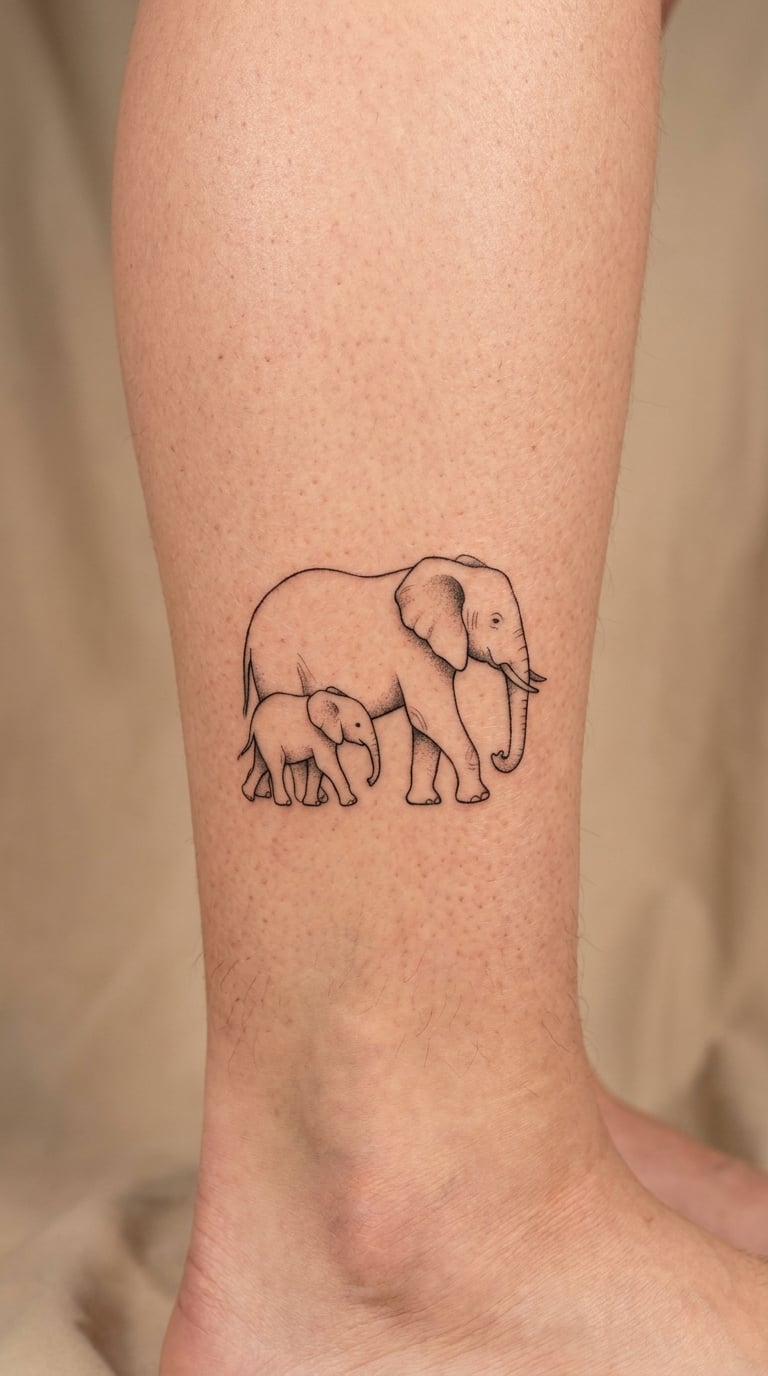
An elephant and calf line art shows an adult elephant walking beside a smaller one, drawn in simple contour lines with a little black accent on the ear and the eye. Keeping the tusks and trunk to single unbroken lines is what makes the piece readable at three inches.
Elephants are widely read as protection, care, and family loyalty, and they are also a good design to give to someone who does not want a heart anywhere near their skin.
Placement: Calf, outer forearm, or upper arm. Size: 3 inches long. Style: Fine line contour, blackwork, or simplified traditional. Pain: Medium on the calf. Make it yours: Have the calf walk slightly behind the adult rather than level with it, which reads as a small child following a parent and gives the composition movement.
16. Home and Heart Outline
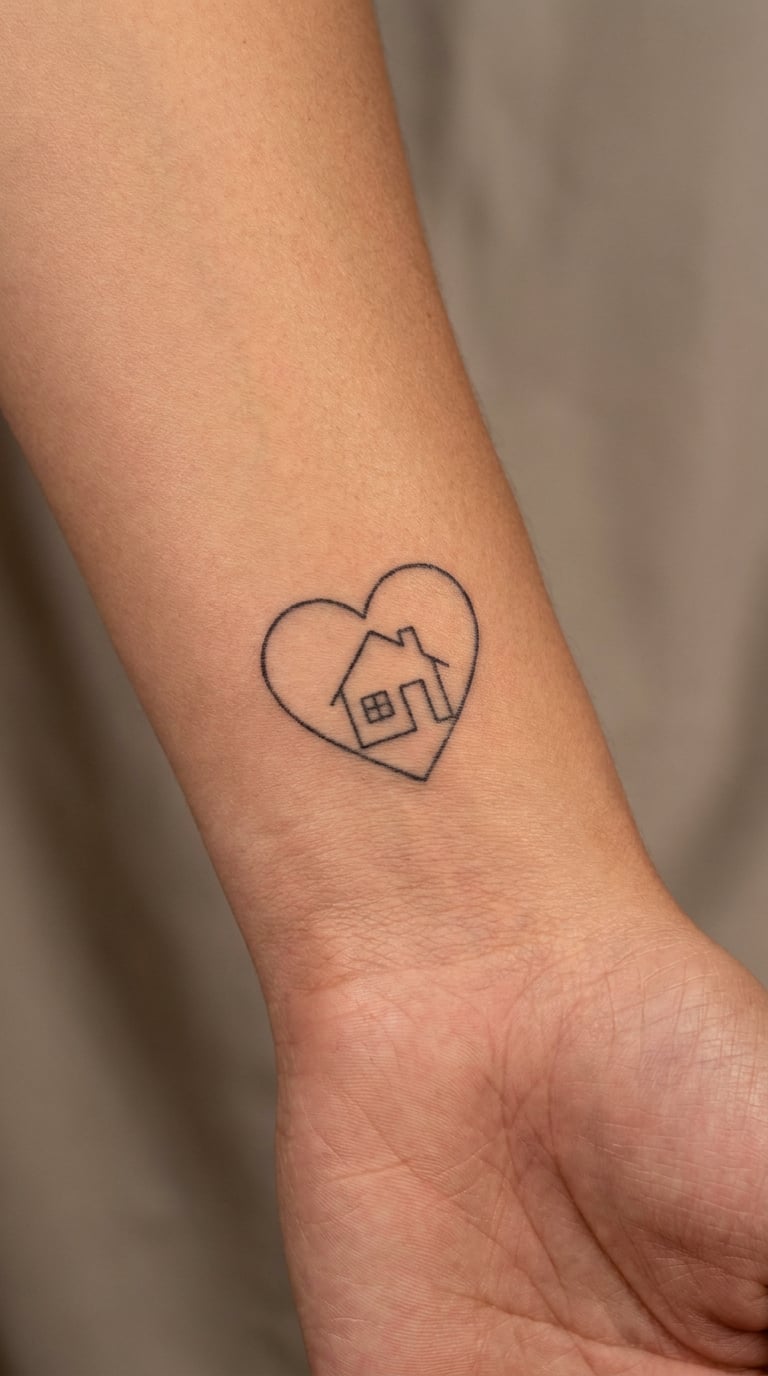
A home and heart outline is a house drawn inside a heart, or a house whose roofline doubles as the top of the heart. One window, one door, a clean ridge line. That is the entire design, and any more detail turns it into a drawing of a specific building rather than a symbol of one.
Home is where the family was, and this is the version that fits on a wrist for someone who wants the idea rather than the architecture.
Placement: Wrist, inner forearm, or behind the ear. Size: 1.5 inches wide. Style: Fine line icon. Pain: Low. Make it yours: Match the roof pitch and window shape to your actual house, and leave out the address, which will blur first.
17. Two Interlocking Band-Style Lines
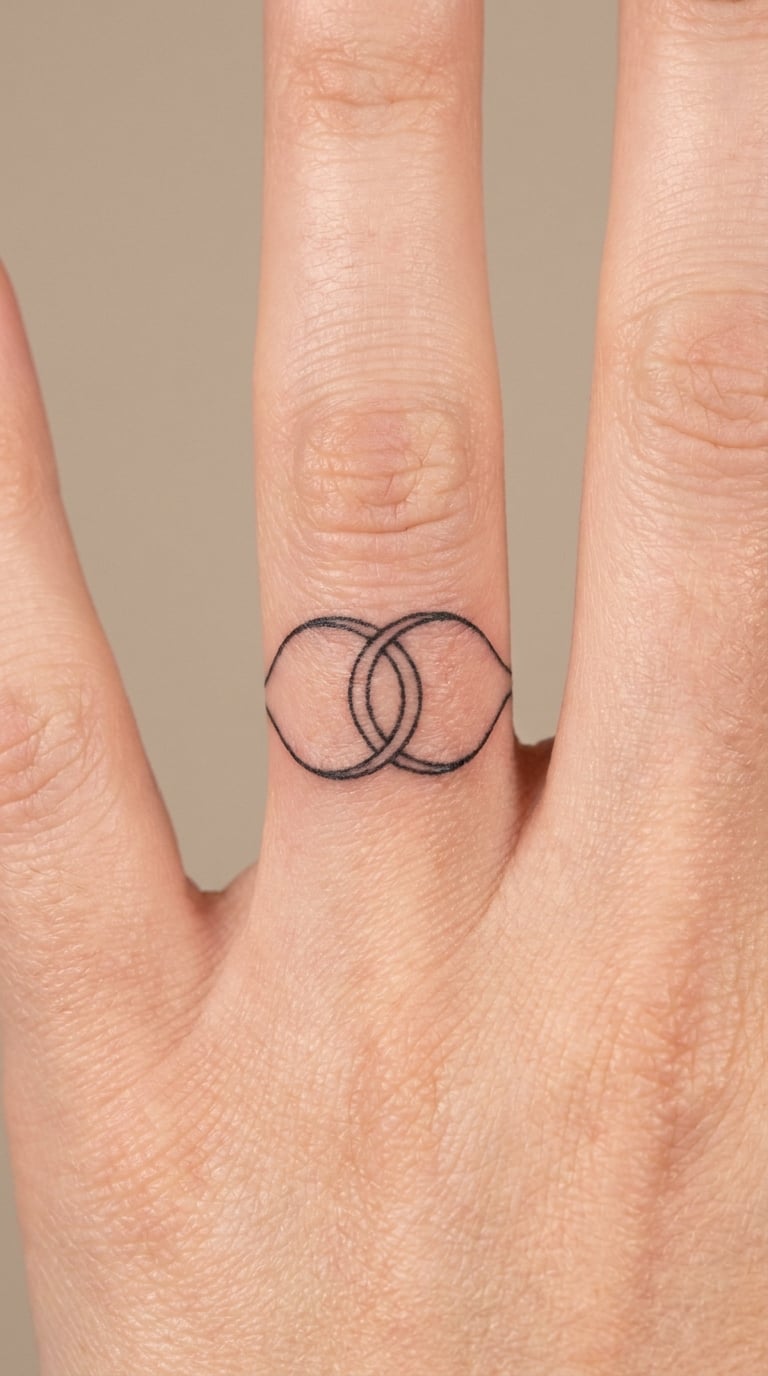
Two interlocking band-style lines adapt the wedding-ring idea to family by using two continuous lines that loop through each other, with tiny initials and a date tucked into the crossing point. It is the smallest design here, which makes it a strong choice for a ring finger or an index knuckle.
Two strands that cannot be pulled apart is an old and readable shorthand for a bond, and it works for a couple, a parent and child, or two siblings.
Placement: Ring finger, index knuckle, or the wrist. Size: About 1 inch wide. Style: Continuous line, fine line. Pain: Medium, and finger skin is tight, so a fine single-needle line can soften noticeably within a few years. Make it yours: Set the initials in the negative space at the crossing rather than beside the lines, where they would need a separate legibility plan.
18. Family Crest With Minimal Symbols
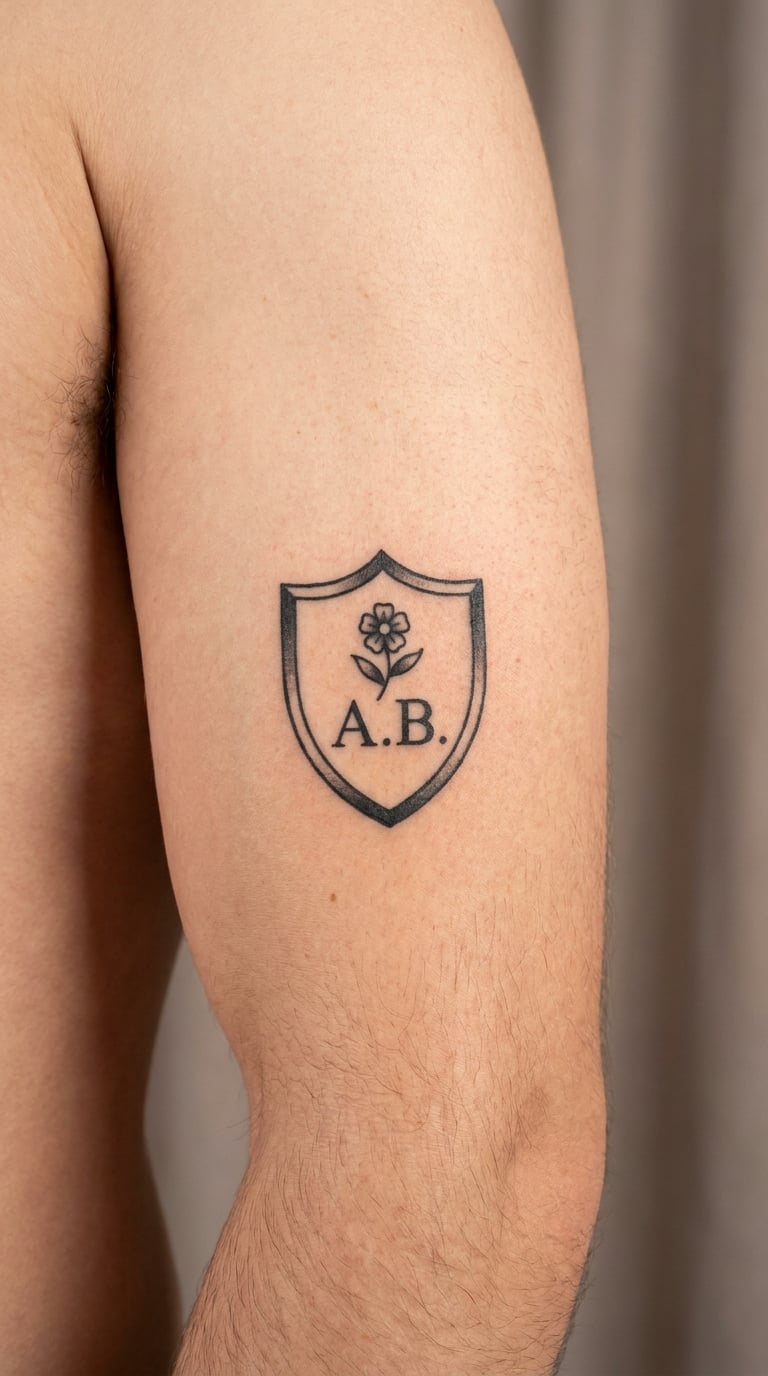
A family crest with minimal symbols is a shield outline carrying a small set of marks: one or two initials, a birth flower, a house shape, or a dog silhouette. Real heraldry would fill a shield with a helmet, mantling, and a motto scroll, and all of that is cut here because it turns to grey at three inches.
Crests say lineage and inheritance, and plenty of people are honoring a family that never had an actual crest, which is why the modern version is usually invented rather than reproduced.
Placement: Upper arm, chest, or calf. Size: 3 inches tall. Style: Blackwork crest or traditional. Pain: Medium. Make it yours: Limit the shield to three symbols, and pick shapes that stay distinct in silhouette so they do not merge as the ink softens.
If the crest idea leans more toward letters than shield, the initial tattoo ideas that show your love roundup covers the lettering side in more detail.
19. Four-Petal Flower Matching Set
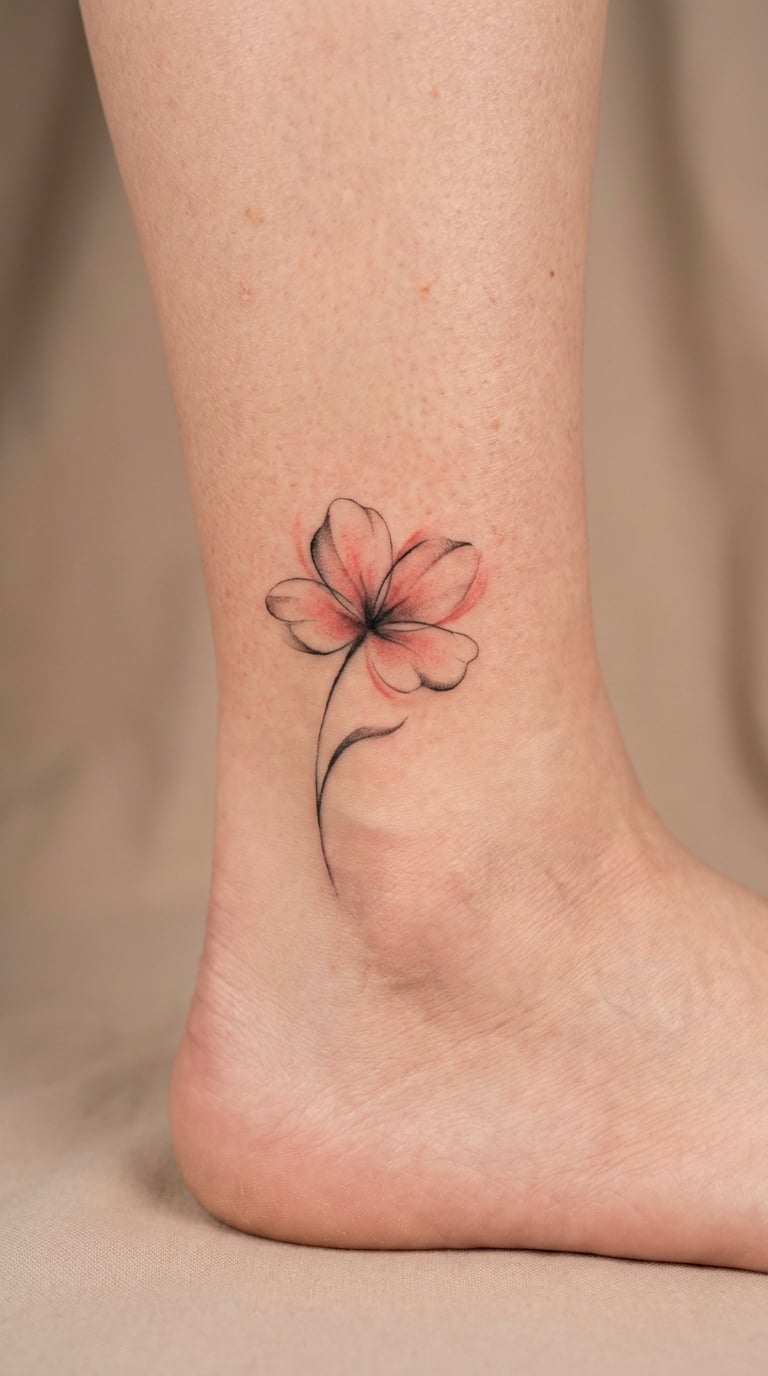
A four-petal flower matching set uses one flower shape across the family, with a different color on each person’s version or a different petal arrangement for each. It is the version of the birth-flower idea that scales down, and it works for a large group because the shape stays constant while the color changes.
Flowers tied to a birth month carry a specific, private meaning, and the four-petal shape keeps the design small enough for an ankle or a wrist.
Placement: Ankle, wrist, inner arm, or the same spot on everyone. Size: 1.5 inches across. Style: Botanical with color, dotwork center, or fine line outline. Pain: Low, except on the ankle, which is bony. Make it yours: Use each person’s actual birth flower instead of four copies of the same one, and set the matching link through petal count instead of shape.
20. Laurel Branches Forming a Heart
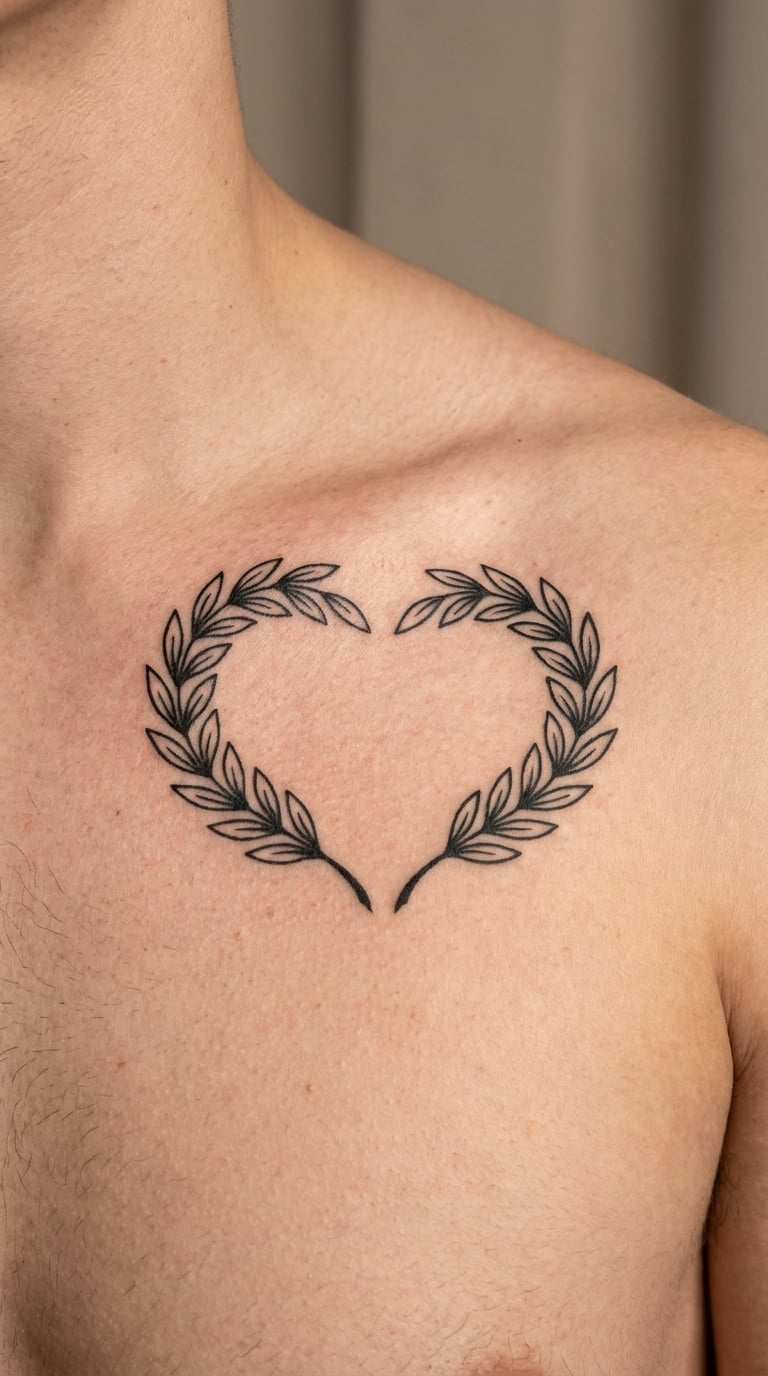
Laurel branches forming a heart closes the list with the most classic design of the twenty. Two symmetrical branches curve up and meet at the top, leaves set in pairs along each stem, tips meeting to close the shape. Symmetry is what sells it, so both branches need the same number of leaves at the same angles.
Laurel is traditionally victory and honor, and a mother who has carried three children through anything will tell you the heart is the part that matters to her.
Placement: Chest near the collarbone, center back, or the outer arm. Size: 3 inches wide. Style: Traditional outline with restrained black. Pain: Medium on the chest because the sternum area is sensitive. Make it yours: Add a small initial at the point where the branches meet, and keep the leaf spacing even so one half does not read heavier than the other.
How to Choose the Right Design
Five questions narrow twenty options down to one. Ask them in this order and the decision usually makes itself.
- Can you finish the sentence? If you cannot say who the design is for and why in one breath, it will read as decorative rather than meaningful. Reviewers on r/TattooDesigns and r/Symbology consistently reject designs they could not explain.
- Does it read at your intended size? A family tree at two inches is a smudge. Sketch it at actual size on paper and step back a foot before you commit.
- Where will it sit? Flesh moves differently everywhere, and the inner arm is flat while the outer shoulder and the calf are not. Pick the placement first, then the design.
- Who else is involved? A single subject, a pair, a parent with children, or a full multi-generation group each need a different level of simplification. Five siblings converge on Roman numerals or one initial per person, because identical small motifs are the only realistic way to include everyone.
- Will it age the way you want? Bold black linework holds. Hairline single-needle script, small numerals, and hands or fingers fade fastest. That matters more for lettering and portraits than for anything else on the list.
Small-scale rules for tattoo ideas that symbolize love for family
Under two inches, only two things survive reliably: a single solid shape, or lettering with a thick enough stroke to still read in ten years. Everything else on this list is worth doing at three inches or more. If your heart is set on a two-inch design, cut the elements rather than shrinking the whole composition.
For anyone narrowing the field around a specific relationship, brother tattoo ideas that show deep family love and father and son designs both go deeper on those pairings.
Cost and Session Time
Rates vary by city, shop minimum, and artist, but a US range by size is a reasonable starting point for budgeting. Shop minimums matter as much as the hourly rate, because a tiny design still has to cover the chair time.
- Tiny, under 1.5 inches roughly USD 80 to 200, 20 to 45 minutes.
- Small, 1.5 to 3 inches roughly USD 150 to 400, 45 minutes to 2 hours.
- Medium, 3 to 5 inches roughly USD 300 to 900, 1.5 to 4 hours or two sessions.
- Detailed realism or heavy black-and-grey roughly USD 700 to 2500 and up, booked across multiple sessions.
Session length is driven by detail density, not by finished size. A three-inch rose with shaded petals takes far longer than a three-inch compass, and portraits take longest of all. Come to the consultation with a flexible plan, and ask the artist to break a piece into two sessions rather than rushing shading on day one.
Aftercare Basics
Start with your artist’s aftercare instructions, because healing times and products vary by skin and by ink depth. The general checklist after that is short.
- Follow your artist’s aftercare instructions first, over anything general you read online.
- Wash gently with clean water and a mild unscented soap, then pat dry rather than rubbing.
- Protect it from sun while it settles, and skip tanning on that area for the rest of the session.
- Wear loose clothing over the tattoo for the first few days, since friction irritates fresh ink.
- Leave it alone. No soaking, no scratching, no picking flakes, no covering it airtight.
- Once fully healed, a high-quality sunscreen on exposed areas makes a real difference to how long fine line and color hold.
Fine line and lettering are the two styles on this list that fade fastest, so a daily sunscreen habit is the cheapest way to keep a name readable.
Frequently Asked Questions
What is the most common tattoo that symbolizes family love?
The most requested design is a set of matching family initials or a parent and child holding hands, usually done in fine line. Both are small, both read clearly at two to three inches, and both carry a specific story rather than a general idea of love.
Can matching family tattoos work if we are not identical people?
Yes, and it is the version most people prefer. Give each person the same motif in a different size, on a different part of the body, or in a different color, so the set is clearly connected without looking like a copy-paste. Matching a motif plus a shared date, or one person taking a bird while the other takes the branch, works well.
Do small family tattoos stay readable as they age?
Solid shapes and bold linework hold up best. Hairline single-needle script, small numerals, micro-shading in portraits, and anything on the hands or fingers soften fastest. If legibility matters to you, keep the design at three inches or more, thicken the strokes, and use daily sunscreen on exposed skin once it is healed.
What is a good family tattoo for a first piece?
A small single-subject design with no lettering and low detail, such as four heart outlines, matching birth moons, or a compass, is the safest first choice. It finishes fast, costs less, and gives you a real sense of how you handle the process before committing to a large piece you cannot undo.
How do I personalise a family design without copying someone else’s tattoo?
Bring your own inputs: a photo of the real handprint, your family handwriting, your own birth moon phases, or coordinates for the house you actually lived in. Artists work from source material rather than a gallery reference, so an honest, personal reference gets you a one-off piece instead of a design you have seen on someone else.
What should I bring to a tattoo consultation for a family piece?
Bring every reference image, any handwriting or photographs you want reproduced, the exact date or coordinates in written form, and a clear sense of the size and body location you have in mind. Say out loud what the design means and where you want it, because that story is what tells the artist which details to keep and which to simplify.
Conclusion
Pick from these tattoo ideas that symbolize love for family by starting with the story, not the drawing. For a first tattoo, start small and choose something you can explain: four heart outlines, a row of birth moons, or a two-inch compass. None of them costs much, all of them finish in under an hour, and you learn how you handle the process before you commit to anything permanent and large.
For someone already building a collection, the laurel heart, the handholding silhouette, and the family tree are the pieces that hold a whole composition together. Laurel is the most enduring symbol here, and the family tree is the one that keeps expanding as the family does.
Whichever you choose, bring a real story to the consultation. The designs that still mean something to you in twenty years are the ones that were specific from the start.