
Does a Wrist Tattoo Hurt? Pain Levels Guide (October 2026)
Does a wrist tattoo hurt? Yes, usually somewhere in the middle of the scale rather than at either end. Most first-timers rate it around 4 to 6 out of 10: a sharp cat-scratch sting that turns into a buzzing, sunburn-tight burn, closer to a rubber band snapping against the inside of your arm than to anything that stops you breathing. How it feels to you will depend on your own pain tolerance, which side of the wrist gets inked and how long you sit for.
That middle rating surprises people who assumed the wrist would be the worst spot on the body. It is not, though it is far from the armpit. What makes a wrist tattoo interesting is the way a few centimetres of skin can change the experience, from a calm forearm to a patch right over a nerve bundle.
Whether you are weighing a wrist band design, browsing 20 best wrist band tattoo ideas for minimalist looks, or stuck on the 70+ small wrist tattoo ideas women love, the pain question tends to decide it. Here is what the honest answer looks like, placement by placement.
Does a Wrist Tattoo Hurt? What to Expect
Most people describe wrist tattoo pain as a constant low burn with sharp edges, and about a third of them call it spicy within the first ten minutes. A practitioner with twenty years behind the needle put it plainly: the inside of the wrist stings quite a bit, but not anywhere near as badly as other places.
The sting is the needle breaking the skin. The burn is the skin reacting as it goes over the same patch again and again, and the vibration is the machine buzzing through bone with almost no soft tissue in between. Those three sensations stack, so a spot that would be unremarkable on the thigh becomes noticeably loud on the wrist.
Most small wrist tattoos sit somewhere around 4 to 6 out of 10. A large piece along the inner forearm can push higher, especially in the last stretch of a long sitting. Very few people describe wrist ink as the worst pain they have ever had, and plenty describe the opposite.
What Wrist Tattoo Pain Actually Feels Like
Translate it into sensations you already know and the fear drops sharply. A practitioner sampling 100 wrist tattoos put the average at 5 out of 10, and community members regularly call the wrist one of the easiest spots they have had inked.
- Sharp cat scratch in the first pass, the entry sting of the needle as it opens the skin.
- Rubber band snap against the inner arm, the same bright quick bite that repeats every few millimetres.
- Bone-ringing vibration on the top of the wrist, more jolt than cut, transmitted straight through two thin bones.
- Sunburn-tight heat that builds in the final fifteen minutes as the skin repeats the same movement and starts to feel hot and tight.
- Raw tenderness afterwards, dull rather than sharp, strongest if the piece sits near the wrist crease.
The first mark is usually the worst moment of surprise. After that your brain stops treating each pass as a new event, and plenty of clients report settling into something they would describe as annoying rather than agonising.
How Wrist Tattoo Pain Compares With Other Placements
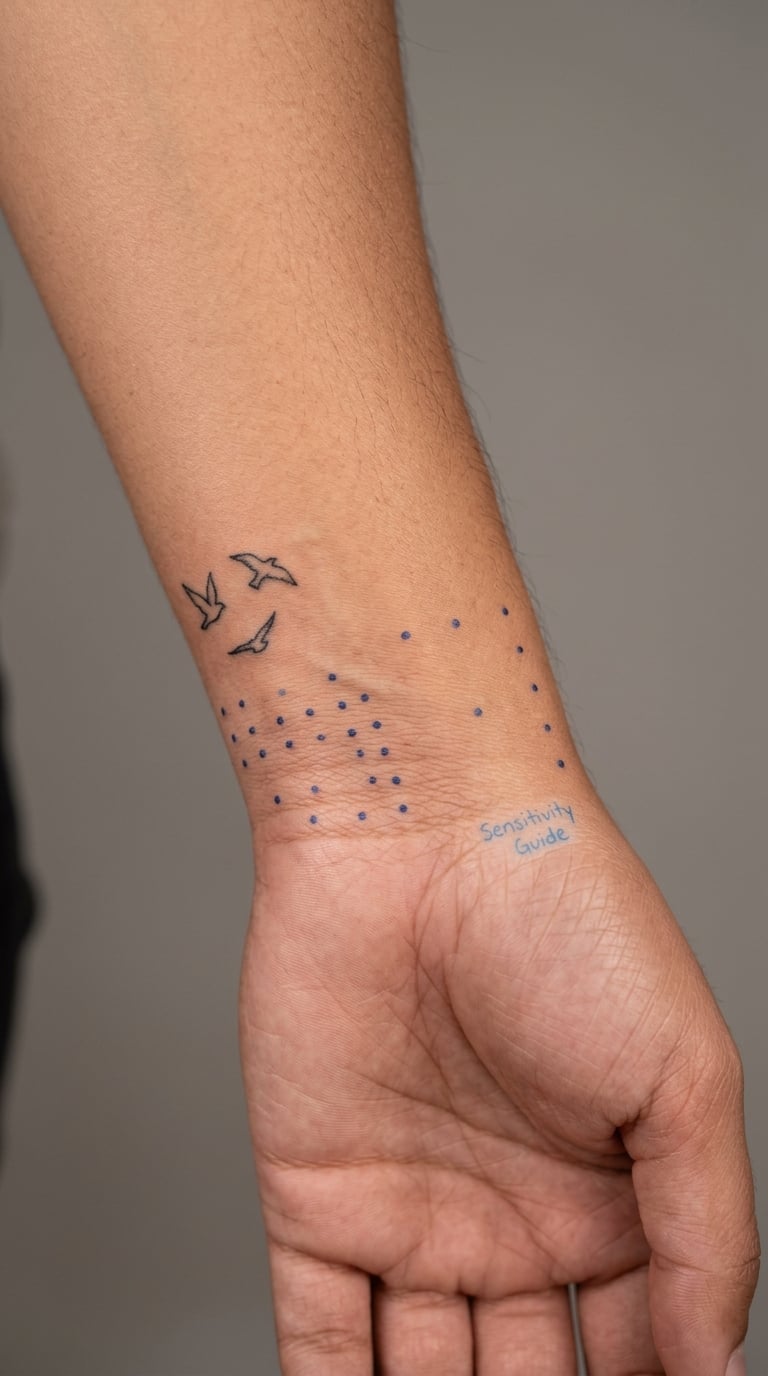
The wrist sits in the middle of the pain spectrum, above the fleshy upper arm and below the bony landmarks that people dread. Here is a rough ladder, built from practitioner ratings and client reports rather than any clinical scale.
| Placement | Typical rating | What it feels like | What makes it worse |
|---|---|---|---|
| Upper arm | 2-3/10 | Soft scratch, easy to distract from | Long sessions, ticklish skin |
| Outer forearm | 3-4/10 | Persistent scratch, mild vibration | Long sleeves, sun-thinned skin |
| Wrist, top side | 4-5/10 | Buzzing over the two wrist bones | Shading, colour packing, repeated passes |
| Wrist crease, palm side | 5-6/10 | Bright sting, burning, strongest nerve hit | Any movement, small detail, sweat |
| Inner forearm near elbow | 5-6/10 | Deep aching sting near the tendon | Skin near the inner elbow crease |
| Elbow, outer point | 6-7/10 | Deep bone ache, hard to sit through | Long sittings, large pieces |
| Knuckles and finger joints | 6-7/10 | Sharp jabs, quick transitions | Bone directly under thin skin |
| Collarbone | 6-7/10 | Sting on the edge, vibration along the bone | Sun exposure, movement |
| Ribs | 7-8/10 | Deep, dragging sting that lingers | Breathing, shading, long sessions |
| Sternum | 8-9/10 | Sharp, bone-close sting people brace for | Every pass, tight skin, anxiety |
Does a Wrist Tattoo Hurt More Than the Forearm or Upper Arm?
Yes, by roughly two points on the scale, and one of the more useful client accounts describes it from inside a single sitting: an inner forearm piece from elbow to wrist felt normal until the needle reached the wrist, then it changed character entirely.
On the upper arm the needle has fat and muscle to travel through, so the sensation stays shallow and diffuse. By the time it reaches the wrist the tissue layer is thin and the signal is more concentrated, so the same machine setting reads as a sharper, more localised bite.
Both wrists feel the same to most people. Nobody reports a meaningful pain difference between sides, so pick the side for visibility, fading and daily contact rather than for comfort.
What Changes How Much a Wrist Tattoo Hurts?
Why Wrist Tattoos Hurt: Thin Skin, Bone and Nerves
Three things stack together on the wrist, and they explain almost every wrist story you will read.
- Thin skin with almost no fat padding. The forearm is covered in soft tissue that absorbs the movement. The wrist has very little, so the needle has a shorter distance to travel and far less to cushion it.
- Bone and tendon right underneath. The radius and ulna sit close to the surface, and tendons run across the wrist constantly. Pressure transmits straight into them, which is where the buzzing, ringing sensation comes from.
- A dense cluster of surface nerves. The inner forearm carries one of the highest concentrations of sensory nerve receptors on the body. This is worth correcting clearly, because the common myth is that the artery is the problem. It is not. The artery is not what you feel, and artists work on inner forearms every day. The nerve density is.
Beyond anatomy, the practical variables are the ones you can actually influence: how long the sitting runs, how many times the artist covers a patch, how sore your skin already is, and how hydrated and tense you are sitting when it starts.
- Session length. A two-hour piece is more demanding than the same design done in two shorter sittings, even at identical depth.
- Repeated passes. Shading and colour packing go over the same skin many times, and skin that has been worked once already reacts harder the second time.
- Sun exposure. Skin that has been browned or burned gives a sharper, earlier signal. A fresh tan is a bad idea before a sitting.
- Tension and fatigue. People who clench their jaw, hold their breath or have slept badly describe everything as worse.
- Recent ink in the area. Working near or over a tattoo that has not settled can hurt noticeably more.
- Placement. The palm-side crease and the bony bump on the little-finger side sit in the stingy end of the range. The top of the wrist, slightly further down, sits in the middle.
Does a Wrist Tattoo Hurt Worse Over Bone or in the Crease?
Both sting for different reasons, and the crease usually wins. Over bone you get more vibration and a hollow, ringing quality, like tapping a hard surface with a small hammer. In the crease you get a brighter, more localised sting because the nerve density is concentrated there.
The top of the wrist, just below the bony knuckle, is the version most first-timers pick without realising it. There is more soft tissue there, less nerve traffic, and the piece sits well when the hand is relaxed.
A brief sting that comes and goes as the needle passes is the normal pattern. Wrist tattoos feel spicier the longer a sitting runs because the skin keeps getting worked and starts to feel hot and tight, exactly like a sunburn forming. If the sensation is escalating steadily, sharpening sharply, or spreading beyond where the artist is working, say so in the moment. Your artist would rather hear it than guess.
Does Wrist Tattoo Size and Style Affect Pain?
Style changes how a session feels more than it changes whether it hurts. Here is the honest split.
| Style | How it feels | Session length | Watch for |
|---|---|---|---|
| Fine line, single stroke | Light, sharp, easy to sit through | Short, often under 45 minutes | Fine lines blur faster on the wrist |
| Bold linework, moderate width | Steadier, more vibration, less surface area | Short to medium | Placement precision matters more |
| Blackwork, solid fills | Prolonged hammering over one spot | Long, often over an hour | Skin gets hot and tight near the end |
| Colour, light shading | More passes than the design looks like | Medium to long | Repeated passes raise the sting |
| Colour, packed or saturated | Heaviest wrist sessions in general | Long, often split into two sittings | Ask about splitting the work |
| Lettering or script | Constant repositioning of the wrist | Medium | Stability matters more than pain |
| Large wrist piece | Mixed, with the last stretch the hardest | Long, possibly multiple sittings | Plan breaks before you start |
| Letter or number, small | Quick, sharp, over before you settle | Very short | Nothing to worry about here |
A longer session can feel more demanding even when the design is not objectively more painful. That is a duration effect, not a depth effect, and it is the single thing most people underestimate about wrist pieces.
How Long Does a Wrist Tattoo Session Last?
A tiny wrist symbol or letter usually takes 20 to 45 minutes. A small design with any shading or colour generally runs 60 to 90 minutes. A larger piece that follows the wrist onto the forearm often needs two sittings, and a full blackwork block can run well past two hours in one go.
Wrist sittings get broken up more often than other placements for two reasons. Your hand moves constantly, so the artist stops to let you reposition and stretch, and you can see the work, which makes many people want to check on it. Both are normal.
Ask before you start whether the design can be completed in one sitting or needs a follow-up. A split session is not a failure of planning, it is often the better call for a dense wrist piece, and you get a much easier second sitting on partly healed skin. For how sittings are scheduled on bigger work, our guide to how long a sleeve tattoo takes covers the same maths on a larger scale.
How Much Does a Wrist Tattoo Cost?
Rates move shop to shop and city to city, so treat the numbers below as a benchmark for comparing quotes rather than a promise. What matters is seeing what a quote is made of, so you compare two artists on equal terms instead of on the headline hourly rate alone.
| Cost driver | Typical US range | What changes it | Questions to ask |
|---|---|---|---|
| Shop minimum | About $50 to $150 per session | Most studios charge a floor for any booking, however small | What is your minimum, and does a small piece still hit it? |
| Hourly rate | About $80 to $250 an hour | Experience, city, shop tier, whether it is a walk-in or an appointment | What do you charge per hour, and is the estimate capped? |
| Design preparation | Free to a few hundred dollars | Custom work versus choosing from flash | Is design time billed separately? |
| Linework only, small | About $100 to $300 | Fewest passes over the skin, shortest sitting | Is this linework only, with no shading? |
| Shading, medium size | About $250 to $600 | Repeated passes, longer session | How many sittings will the shading need? |
| Colour, packed or saturated | About $400 to $900 | Saturation drives the number of passes more than size does | Can the colour be split across two sittings? |
| Large custom wrist piece | About $900 to well over $3,000 | Time, intricacy, placement planning on a curved surface | Can we see a rough plan for the wrist curve? |
| Touch-ups | Often included, sometimes $50 to $150 | Most studios include one on healed work | Is a touch-up included, and when is it due? |
| Travel | Varies, not an artist fee | Time off, travel, parking if you go out of town | Not an artist fee, but it belongs in your real total |
Two honest additions. The wrist is a curved, visible surface, so a design that would be simple on a flat upper arm may need reshaping or extra planning, and that shows up in design time. And wrist ink fades and softens faster than ink on a covered upper arm, which is one more reason to think about touch-ups before you commit.
What Does the Wrist Tattoo Healing Timeline Look Like?
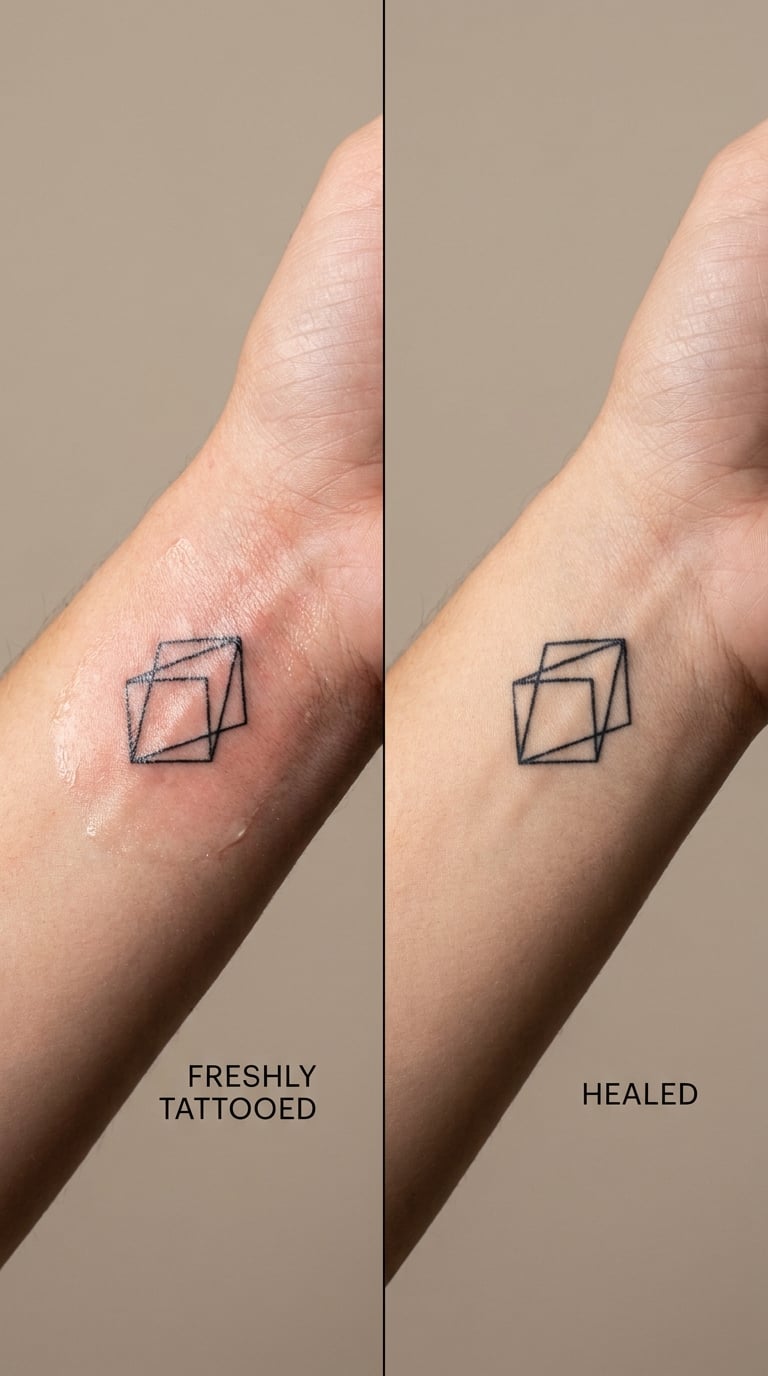
The wrist heals in a normal timeframe, but it is a harder surface than most people expect. It bends, rubs against sleeves and watch straps, sweats, and gets washed more times a day than any other part of your arm. Follow your artist’s aftercare instructions, whatever they are for your piece.
| Stage | What you will notice | Wrist-specific points |
|---|---|---|
| Day 0 | Redness, warmth, mild swelling, tender to the touch | Wrist swelling is more visible and more annoying than on the upper arm |
| Days 1-3 | Peak tenderness, a tight feeling across the skin | Washing your hands constantly keeps it clean and keeps it damp |
| Days 4-7 | Itching starts, flaking begins, swelling drops | Watch straps and cuffs catch the flakes and tug the skin |
| Weeks 2-3 | Surface healed, design looks matte and slightly raised | Rough patches along the crease are common and not a bad sign |
| Weeks 3-4 | Lines settle, colour looks truer, skin returns to normal | Avoid sun on the wrist for weeks, since it is rarely covered |
| Month 1 and beyond | Final settle-down can take a few more weeks | Wrist ink softens sooner, so plan a check-in with your artist |
Nobody’s skin follows a fixed timetable, and asking the artist rather than a stranger is always the right call when something looks different to you.
How to Prepare and Manage Discomfort
Most of what you can do about wrist tattoo pain happens before you sit down, and none of it involves medication decisions, which should stay with you and your doctor.
Before the Session
- Sleep normally the night before. Tired people consistently report a worse sitting.
- Eat a proper meal beforehand. You are sitting still for an hour with your hand out, and an empty stomach makes everything harder.
- Stay hydrated. Water, not a big coffee on an empty stomach.
- Skip alcohol the day before and the day of. It thins you up and ruins sleep.
- Leave your nails short and skip hand cream on the day. Nails that catch on a stencil or a glove are a real annoyance.
- Wear loose sleeves. You will not want a cuff rolling against fresh ink.
- Tell the artist about anything relevant, including a low pain tolerance, previous tattoos in the area or sensitivity to adhesives. Artists adjust better when they know.
During the Session
- Ask for a break before you need one. Two minutes of rest mid-line costs almost nothing. Clients who ask early get them easily; clients who wait until they cannot cope do not.
- Ask about a topical anesthetic. It exists and is used before wrist work, though some artists prefer not to use it because it thickens the skin and can affect how a line sits. Ask rather than assume.
- Watch your breathing. The most reliable thing anyone tells me. Long slow exhale through a long needle pass is a real technique, not a slogan.
- Keep the hand relaxed. Tensing the forearm makes the wrist harder to hold still and harder to work on.
- Bring someone if it helps. Having a person there and having them hold your hand is not a weakness, and plenty of people use it.
- Say something early. A quick word that it is getting spicy gives the artist room to lighten up, change angle or take five. A wobble you say nothing about gives them no chance.
There is one thing no preparation fixes. If you are anxious, the fear of the unknown is usually the larger half of what you feel, and telling your artist that plainly is the single best thing you can do about it. Most of them have seen it a hundred times and have their own routine for nervous first-timers.
Mistakes to Avoid
- Testing colour on the wrist without thinking it through. A patch test or a small colour swatch is a good idea on a covered spot. On the wrist it is a permanent, highly visible commitment.
- Choosing a placement without considering daily contact. Sleeves, watch straps, laptop wrists, gym gear and sleep positions all rub. Look at where you already wear things before you pick a spot.
- Underestimating the time. Colour looks like one pass. It is several, and the wrist takes that longer than you think. Ask for the realistic number before booking, not the optimistic one.
- Ignoring the artist’s break suggestions. Wrist sittings get paused constantly and it is routine. Pushing through a break because it feels slow is the most common way people have a bad experience.
- Planning around visible irritation. A swollen, flaky wrist is obvious, and it lasts longer than a day or two. Do not book a wrist tattoo the week before a wedding or a photo shoot.
- Judging your pain against someone else’s story. People with a high tolerance genuinely feel less, and people who were terrified genuinely feel more. Neither is the standard you should be measuring against.
- Forgetting that wrists fade faster. Thin skin, frequent sun and constant movement mean wrist ink softens sooner. Decide whether you would still want it in ten years before you commit.
Frequently Asked Questions
Is a wrist tattoo more painful than an arm tattoo?
Yes, by roughly two points on a 1-10 scale. An upper arm usually sits around 2-3 out of 10 because there is muscle and fat cushioning the needle, while the wrist sits closer to 4-6. The wrist has thinner skin, less padding and two bones close to the surface, so the same machine reads as a sharper, more localised bite. Individual tolerance still matters far more than these averages.
Why does the inner wrist feel more sensitive?
Because the inner forearm carries one of the highest concentrations of sensory nerve receptors on the body. It is common to believe the wrist artery is what makes the area painful, but that is a myth. The artery is not what you feel when you are being tattooed. The dense nerve cluster is the reason the palm-side wrist gives a brighter, sharper sting than the top of the wrist.
Are small wrist tattoos less painful than large ones?
A small wrist tattoo is usually shorter rather than less painful. The same needle depth and the same nerve density apply either way, so a small design may still be a 5 out of 10 experience. What changes is duration. A 30-minute piece is easier to sit through than a two-hour dense blackwork block, which is the version that pushes the rating higher.
Does getting a wrist tattoo on bone cause more pain?
Bone adds vibration rather than a sharper cut. Over the wrist bones you notice a hollow, ringing quality, like tapping a hard surface with a small hammer, and the sensation travels along the bone. The palm-side crease tends to sting more because of nerve density, while the top of the wrist transmits more jolt. Neither is dangerous, both are uncomfortable.
Can I take a break during a wrist tattoo?
Yes, and you should ask early rather than waiting until you cannot cope. Most artists pause wrist work every few minutes anyway, because the hand moves and the artist can see the progress. A two-minute rest mid-line costs almost nothing, and stopping while you are still managing is far easier than stopping after you have already been struggling.
How Wrist Tattoo Pain Varies
If the pain question was the only thing holding you back, the honest answer to does a wrist tattoo hurt is that most people rate it in the middle of the scale, as annoying rather than agonising, and lower than they expected before the sitting.
Pick a design and placement that match what you actually care about. If the design matters more, choose placement and style first and book a long enough session with breaks built in. If comfort matters more, a small piece on the top of the wrist with the artist in a calm room is a gentler first tattoo than anything dense along the inner forearm.
Then ask the artist, face to face, for an honest read on how that specific design will feel on your specific wrist. They have held hundreds of them. Nobody is pressuring you into a decision today.