
How Long Does a Sleeve Tattoo Take? 2026 Timing Guide
How long does a sleeve tattoo take? A full sleeve needs roughly 20 to 60 hours in the chair, spread across 5 to 12 appointments over about 3 to 6 months. A half sleeve lands closer to 6 to 20 hours, and a quarter sleeve can be done in 3 to 8. Nobody tattoos a full arm in one sitting, and anyone who quotes you a single number without looking at the design is guessing.
Most people start planning in winter or early spring, so the arm has settled before summer. If that is you, the timelines below should tell you exactly how many sittings to block off and how much recovery you need between them.
How Long Does a Sleeve Tattoo Take?
A full sleeve tattoo typically takes 20 to 60 hours of actual tattooing time, spread across 5 to 12 sessions that span 3 to 6 months from the first appointment to the final one. A half sleeve usually needs 6 to 20 hours over 2 to 4 sessions, and a quarter sleeve takes about 3 to 8 hours, often in a single visit.
Those three numbers answer different questions. Chair hours are what the machine is actually doing, session count is how many times you sit down, and calendar months include the healing breaks in between. Someone quoting you “ten hours” has given you the smallest of the three figures, and it is rarely the one that matters.
| Sleeve type | What it covers | Chair hours | Sessions | Calendar time |
|---|---|---|---|---|
| Quarter sleeve | Shoulder to mid-bicep | 3 to 8 | 1 | 1 visit |
| Half sleeve | Shoulder to elbow, or elbow to wrist | 6 to 20 | 2 to 4 | 1 to 2 months |
| Three-quarter sleeve | Shoulder to wrist, gaps left open | 15 to 35 | 3 to 6 | 2 to 4 months |
| Full sleeve | Shoulder to wrist, no gaps | 20 to 60, sometimes 80+ | 5 to 12 | 3 to 6 months |
Those ranges are the average, not a promise. A bold blackwork sleeve can finish at the fast end, and a full-colour sleeve with a photorealistic portrait can double the upper figure without warning.
What Determines the Time Needed for a Sleeve Tattoo?
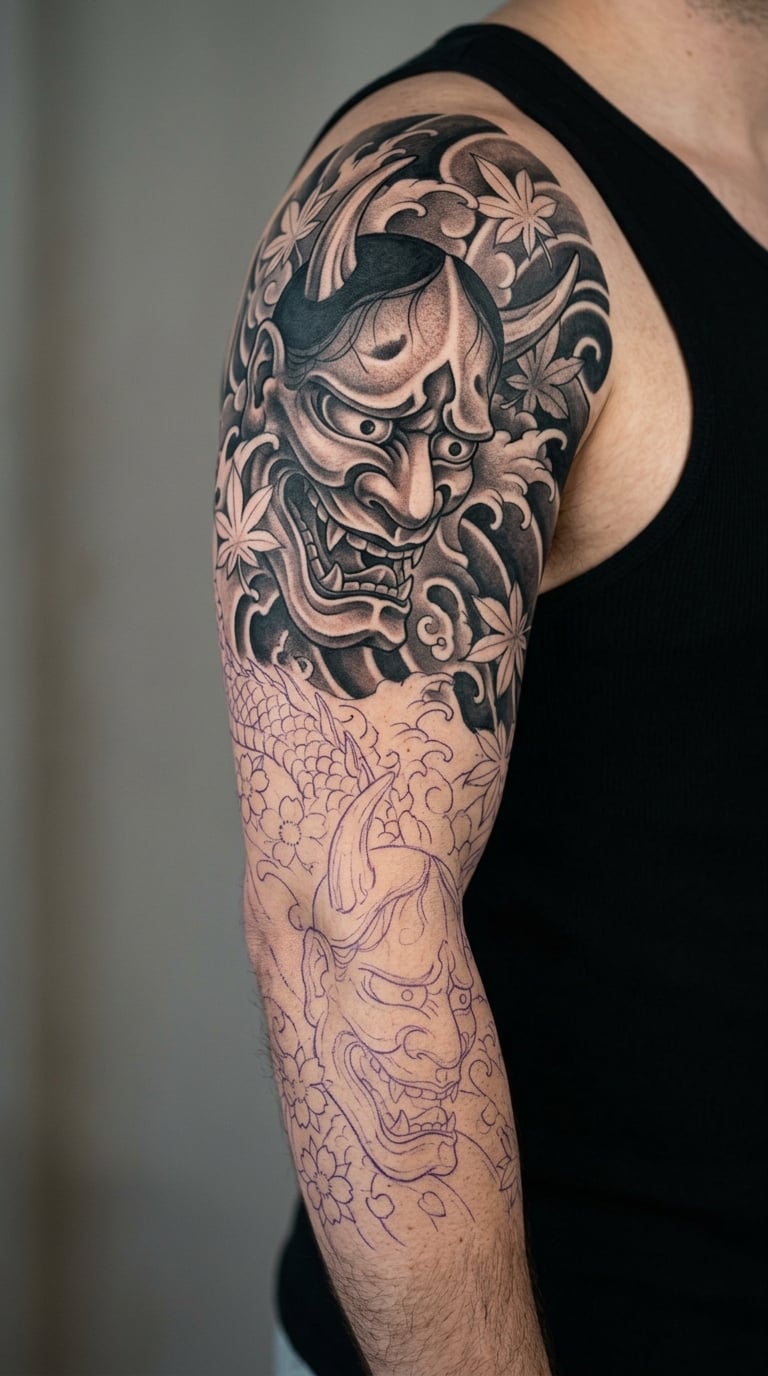
Two sleeves with the same surface area can differ by thirty hours. Here is what actually moves the number.
How Design Complexity Changes the Hours
A sleeve built from bold shapes and clean negative space is fast, because the machine is laying broad areas of ink. The same arm covered in small background elements, script, fur texture or facial features takes far longer, because the artist is making thousands of small decisions instead of a few hundred.
Line weight matters too. A sleeve that has to go through several build-up passes to reach solid black will always beat one that lands in a single pass.
Colour, Blackwork and Realistic Detail
Colour adds time. Packing a saturated background, blending a gradient or filling a large area of flat colour all take more passes than shading in black and grey. Shop estimates commonly add 10 to 20 hours to a sleeve when full colour is involved, and the difference shows up mostly in the background and the blending, not the outlines.
It helps to browse a gallery before you commit. Collections like these 100 bold sleeve tattoo ideas show the heavy blackwork end, while sleeve tattoo ideas women love lean on florals and fine detail, which sit at the slower end of the scale. Style is the biggest single factor in the estimate.
Placement, Skin Condition and the Artist’s Pace
Placement changes the work more than people expect. The upper arm and shoulder are broad, flat and easy to reach. The inner elbow, the inside of the forearm and the wrist are contoured, thinner and awkward to hold steady, so the artist works more slowly and repositions often.
Skin on the day matters too. Freshly sunburnt skin is tender and needs gentler passes, and dry or flaking skin has to be dealt with before lining. Out-of-towners should also count travel and recovery time into their plan, because a jet lag sore shoulder is not getting the best version of the work.
Breaks, Reference Detail and Client Comfort
Good artists build breaks into a long sitting. That is not wasted time, it is what keeps the linework steady through hour five. Tell your artist early if you hit a wall, and agree in advance on a break schedule rather than negotiating it while the stencil is already on the skin.
How Many Sessions Should You Plan?
A sleeve that fits into one long visit exists, but it is a specific kind of design. Bold blackwork with large negative space, no colour and no fine detail can be tattooed across a single 6 to 8 hour day. Anything denser usually cannot, because skin has to be worked fresh, not repeatedly, and because concentration drops long before the work does.
For a first full sleeve, plan on four to eight appointments of four to six hours each. That is the sweet spot most artists work to, and it is worth understanding why. Past about five hours, line quality starts to suffer, breaks get skipped by both of you, and the risk of a mistake goes up. Two solid five-hour appointments usually beat one exhausting nine-hour marathon.
So the count works out roughly like this. A simple half sleeve is often 2 to 4 sessions. A standard full sleeve is 5 to 12. A dense or photorealistic one can stretch past that, and artists will tell you early rather than let it creep.
When you read an artist’s quote, ask two questions: how many hours in total, and what is the plan if the healed result needs rework. Clients in r/irezumi and r/tattooadvice threads report the same pattern repeatedly, with finished sleeves landing anywhere from about 15 hours across 4 sessions to roughly 30 hours across 5, and one sleeve plus chest piece at 6 sessions of 6 hours. Real-world spread is enormous, and that is normal.
One more thing worth knowing: people consistently underestimate project time by around double. If your plan has no slack in it, the schedule will slip, and it is the healing that decides when.
How Long Does a Full-Sleeve Tattoo Take?
A full sleeve, defined as continuous coverage from the shoulder to the wrist, is the largest single project most people commission. Expect 20 to 60 hours, occasionally more, across 5 to 12 sessions and 3 to 6 months of calendar time.
Style sets where you land inside that range.
| Style | Typical total hours | Session length | What slows it |
|---|---|---|---|
| American traditional | 15 to 30 | 4 to 6 hours | Little. Broad shapes and bold outlines go on fast |
| Blackwork sleeve | 18 to 35 | 4 to 6 hours | Solid black needs multiple passes |
| Irezumi or Japanese | 30 to 60 | 4 to 8 hours | Dense background, wind bars, colour packing |
| Full colour sleeve | 30 to 65 | 4 to 6 hours | Packing, blending, gradient fills |
| Black and grey realism | 35 to 70+ | 4 to 6 hours | Fine shading, soft transitions, portrait detail |
| Fine line sleeve | 20 to 40 | 3 to 5 hours | Many hairlines; slower per line |
| Illustrative or patchwork | 20 to 40 | 3 to 5 hours | Each element redrawn to fit the arm |
Botanical and floral work, the kind collected in these botanical sleeve tattoo ideas, sits somewhere in the middle. Stems are quick, but leaf detail and soft shading add up across a whole arm.
The fastest sleeves are not the best sleeves. If an artist offers a full colour realism portrait in three eight-hour days, that is a pace the skin and the artist both have to pay for later.
How Long Does a Half-Sleeve Tattoo Take?
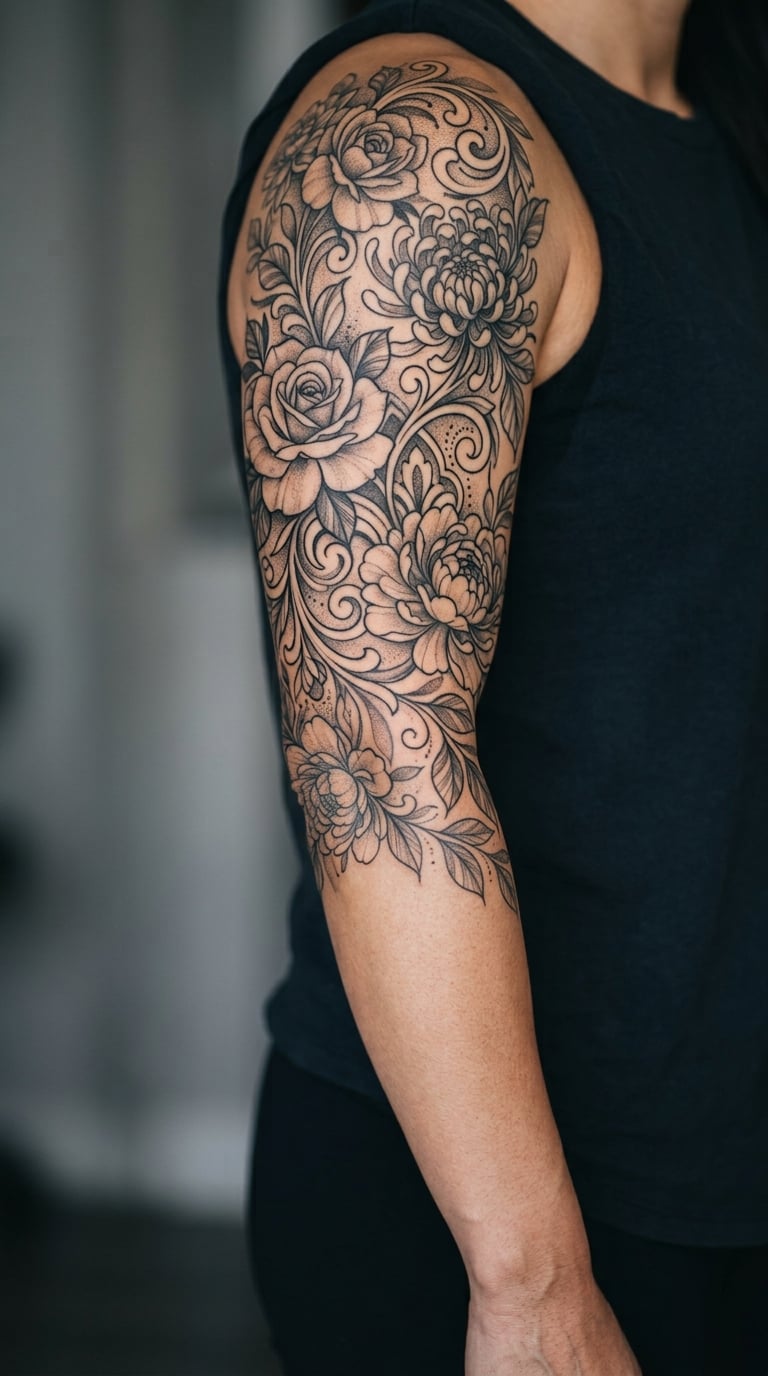
A half sleeve needs 6 to 20 hours, usually across 2 to 4 sessions, and it is the most common starting point for a first large piece. It gives you the scale to learn how a big piece ages without committing to a whole arm.
Which half matters more than people expect. An upper-arm half from shoulder to elbow is broad and relatively quick, because the artist has a large flat surface and no sharp contour to fight. A forearm half from elbow to wrist is slower for the opposite reason, working around the elbow ditch and the change in angle at the wrist. A shoulder-to-wrist half with open gaps at the elbow lands in between.
Half sleeves are also the easiest place to pause. You can stop after the upper arm, live with it for a season, and decide later whether you want the forearm. Plenty of people do exactly that.
Pain Levels by Sleeve Tattoo Placement
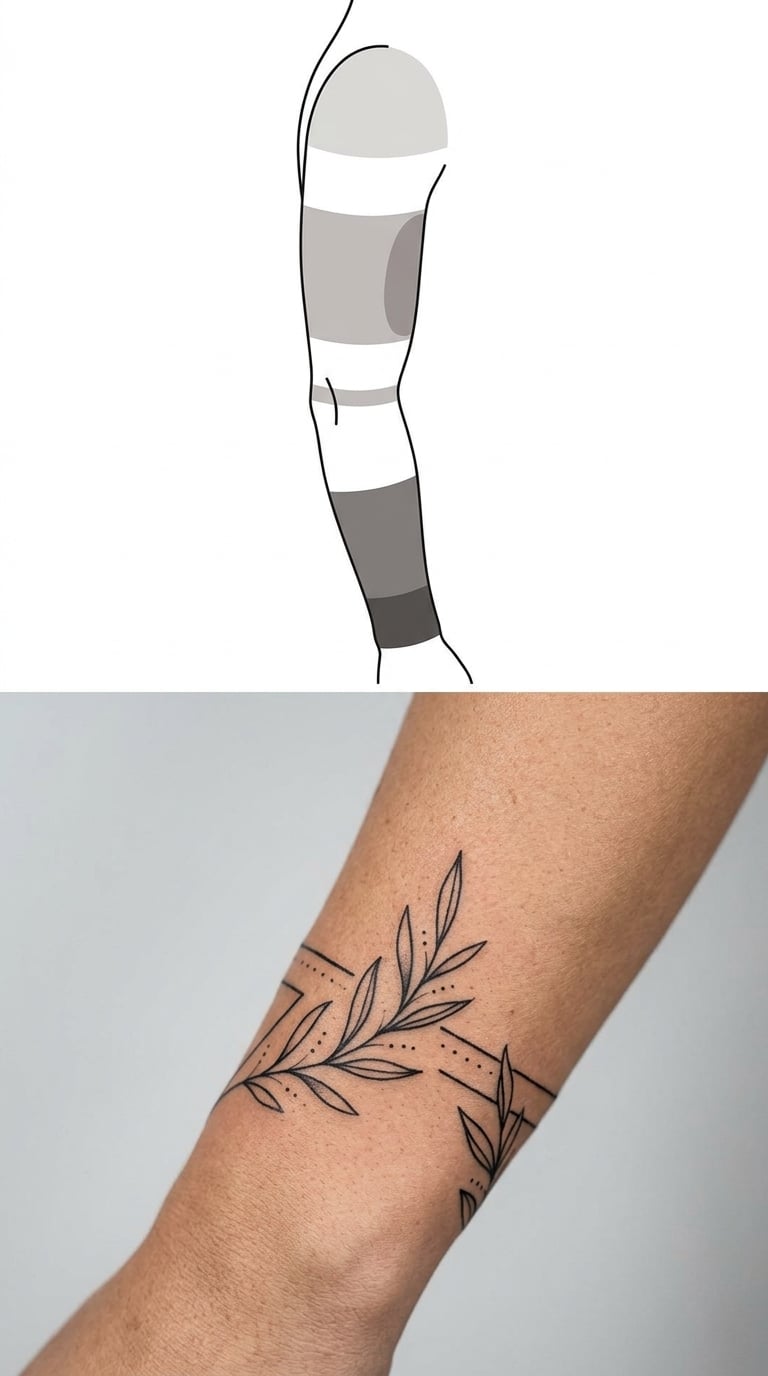
Pain on an arm is not evenly distributed, and almost everyone is surprised by one area. The numbers below are a common 1 to 10 scale, and they are only a guide. Your own tolerance, the time of day, how hydrated and fed you are, and the artist’s pressure all move the reading.
| Area | Typical level | What it feels like | Planning note |
|---|---|---|---|
| Outer upper arm | 2 to 3 | Persistent scratch, easy to sit through | Good place to start; save it for early in the day |
| Shoulder cap | 4 to 5 | Rises quickly near the top of the arm | Awkward angle, artist repositions often |
| Inner bicep | 5 to 6 | Throbbing, sensitive to clothing | Wear loose sleeves afterwards |
| Elbow ditch | 8 to 9 | The roughest spot on the whole arm | Ask for a short break or numbing before starting |
| Inner forearm | 6 to 7 | Deep ache, radiates up the arm | Shorter sittings often planned around it |
| Inner wrist | 5 to 6 | Very thin skin over bone and tendon | Commonly saved for a separate visit |
Topical numbing is something to raise at the consultation, not at hour four. Ask what your artist uses, how long before the session to apply it, and whether it affects the line. The elbow ditch is where clients and artists agree it helps most, and where the discussion is most worth having.
How Much Does a Sleeve Tattoo Cost?
Tattoo pricing is built on hours, so the cost of a sleeve is mostly the cost of the chair time described above. Three pricing models cover most of it. An hourly rate charges for every hour on the skin. A day rate covers a fixed session block, usually four, five or eight hours, and is common for long sittings. A project rate quotes the whole sleeve in one figure, which suits clients who want the total fixed in advance.
Hourly is the easiest to reason about because you already have an hour count. Day rates usually work out cheaper per hour on long sessions, which is why artists ask you to commit to a full block. Project rates give certainty but leave no room if the design turns out to be denser than the sketch suggested, so agree in writing what is included and what triggers a change.
| Sleeve size | Billable hours | Common model | What pushes the total up |
|---|---|---|---|
| Quarter sleeve | 3 to 8 | Hourly or single day rate | Colour, custom design fee, touch-ups |
| Half sleeve | 6 to 20 | Hourly, or two day rates | Style, density, elbow work |
| Three-quarter sleeve | 15 to 35 | Project rate or hourly | Wraparound composition, colour packing |
| Full sleeve | 20 to 60+ | Project rate | Realism, colour, extra sessions, cover-up work |
Budget past the quote. A deposit, the tip, aftercare products and later touch-ups all sit on top, and people in tattoo forums regularly report the final figure landing noticeably higher than the number they first agreed to. Ask what the artist expects to earn per hour, then multiply. If the result makes you wince, negotiate the number of sessions or the hourly rate now, before you are halfway down the arm.
What Happens During a Multi-Session Sleeve Tattoo?
The consultation comes first. The artist looks at your existing work, measures the arm, asks about healed tattoos and any plans for the other side, and talks through placement. This is also where the session estimate and the price are settled, and it is the cheapest moment to change your mind about anything.
Then the mapping, usually a stencil transfer or a freehand drawn guide. Where the design sits gets locked in here, including how it wraps the arm, and adjusting placement at this stage is cheap. Adjusting it after three sessions is not.
The tattooing itself runs in stages. Linework and anchor shapes first, so the composition is locked and you can see the whole thing. Shading, grey work and background next, usually in later sessions once the lines have settled. Colour packing, texture and final contrast last, sometimes across a separate visit. Each stage needs the previous one healed, which is where the three to six week gap comes from.
Between sessions, the artist may want a photo of how the work settled, and occasionally a free touch-up session for lines that healed heavier than intended. Two people post in r/tattooadvice about being booked for four consecutive days of eight-hour sessions, and commenters mostly warn that consecutive days on the same area is the aggressive version of this schedule, not the relaxed one.
How Long Does a Sleeve Tattoo Take to Heal?
A sleeve surface heals in two to four weeks, but the project is not finished when the surface looks done. Fresh ink goes through a milky, slightly raised phase in the first week that is entirely normal and not a mistake.
| Time | What is normal | What to do | What to watch |
|---|---|---|---|
| Days 1 to 3 | Redness, warmth, swelling, tenderness | Follow your artist’s aftercare exactly, including any wrap timing | Spreading redness, dull feverish feeling |
| Days 4 to 10 | Dark ink, itching, light flaking, milky skin | Wash gently, moisturise thinly, pat dry not rub | Heavy scabbing, ink coming off in patches |
| Weeks 2 to 4 | Flaking finishes, skin flattens, colour settles | Return to normal washing, keep sunscreen on the arm | Colour staying flat after week four |
| Weeks 4 to 6 | Looks healed to you, still settling underneath | Safe time for the next session on the same area, if your artist agrees | Itching in one spot that does not resolve |
| Months 2 to 12 | Final softening of the line, full colour depth | Book the healed check-in and any agreed touch-up | Anything that looks like a blowout or a line gap |
Sun exposure is the quiet one. An arm that gets regular sun without protection fades noticeably faster in the areas that show most. Sunscreen on the sleeve is not optional for the first few months if you want the work to hold.
All of this stays general. Your artist’s aftercare instructions come first, always, and they differ between styles and skin types.
Mistakes to Avoid
Choosing a dense design for a short visit. This is the most common planning error. If the artwork needs 40 hours, booking three 5-hour sessions does not create 15 hours, it creates rushed work in a sleeve that is only a third done.
Skipping the consultation. You lose the placement conversation, the honest hour estimate, and the chance to hear whether this artist works in the style you have saved. It is the cheapest appointment in the whole process.
Scheduling back-to-back days on the same area. Skin that is still healing is harder to work, so the second session runs slow or gets pushed, and the schedule slips anyway. Three to six weeks on one area is the normal gap.
Ignoring a placement that does not fit the arm. A design drawn flat on paper rarely sits correctly across a shoulder, an elbow and a wrist. Trust the artist who argues with you at the consult. They are describing what your skin will actually do, and a design that has to be redrawn mid-sleeve costs you more time, not less.
Accepting a single undefined number. Ask for the total hours, the session count, the gap between sessions, and what happens if the healed work needs a touch-up. A quote without those is a guess, and clients who pressure for a faster pace usually end up on the schedule longer.
Planning a cover-up without saying so. Tell the artist at the first consult if you are covering older work. That work affects the hours, the approach and often the design, and finding out at session three is expensive.
Frequently Asked Questions
Can a full sleeve be tattooed in one day?
Some simple, low-detail sleeves are completed in one long day, usually six to eight hours of bold blackwork with plenty of open skin. Many artists prefer to split the work across several appointments, because line quality drops late in a long sitting and the skin has to heal between passes. Ask your artist directly whether your design suits a single sitting, and accept the answer either way.
How long should I wait between sleeve tattoo sessions?
Most artists ask for three to six weeks before working the same area again, so the skin settles and you can see how the ink healed. Longer gaps suit larger panels and heavier black. Booking sooner is sometimes fine for small finishing touches, but working a still-healing area is harder on the skin and often pushes the schedule further out.
Does a sleeve tattoo take longer than a half sleeve?
Usually, yes. A full sleeve covers the whole arm from shoulder to wrist, so it needs roughly 20 to 60 hours, while a half sleeve usually takes 6 to 20. The difference shows up in the session count too, typically five to twelve for a full sleeve against two to four for a half. An upper-arm half is faster than a forearm half because the surface is flatter.
Why do some sleeve tattoos require touch-ups?
Skin movement, line depth, shading and individual healing all affect how a tattoo looks once it settles. Some lines heal heavier than the artist intended and lose their original weight, and shaded areas can drop more contrast than planned. Follow your artist’s guidance about when a free touch-up window opens, and get it done while the whole sleeve is still fresh enough to match.
Can I sleep or exercise after a sleeve tattoo?
Your artist’s aftercare instructions come first. In general, expect the new tattoo to feel warm, swollen and tender for several days, avoid rubbing or sleeping on it, skip soaking, swimming and heavy sweat for a couple of weeks, and keep it out of direct sun. If the area is still tender, tight or flaking heavily, give it longer rather than pushing back into your routine.
Is it a bad sign if my artist wants to finish my sleeve in consecutive days?
Not automatically. Plenty of artists do offer back-to-back day blocks, and for a simple high-contrast design it can work. But several days of work on the same area in a row is the aggressive version of the schedule, so ask what happens if the skin fights you on day three, whether the price covers the whole block, and what the fallback is if a session has to be cut short. If the artist cannot answer those, slow it down.
Conclusion: Plan the First Appointment Before the Full Sleeve
How long does a sleeve tattoo take is really four questions, and you want all four answered before you pay a deposit: total chair hours, how many sessions, how far apart, and what the price covers if the design grows.
Start with a consultation and bring references, including a few you saved from sleeves like the ones in this bold sleeve tattoo round-up. Talk through placement on your actual arm, get a written session plan, and treat a quote that sounds too fast as a question rather than a bargain. The arm is a big surface and a long commitment. Plan it once, properly, and the rest is just turning up.