
Do Fine Line Tattoos Fade Faster? Causes, Timelines & Care 2026
Do fine line tattoos fade faster? Usually yes, and the reason is mechanical rather than mysterious. A single thin needle leaves less pigment in the dermis, so there is less ink holding the edge. How fast that happens to you still comes down to depth, placement, sun and aftercare.
If you are planning a first tattoo, or you already own a thin line piece that has started to look tired, the useful part is knowing which of your choices actually move the needle. There is a lot of soft, vague advice out there, and some of it is flatly wrong. The rest is right for somebody else’s skin, not yours.
Style sets the ceiling on detail and contrast, so it is worth browsing fine line minimalist trends first and then worrying about longevity second.
Do Fine Line Tattoos Fade Faster? The Short Answer
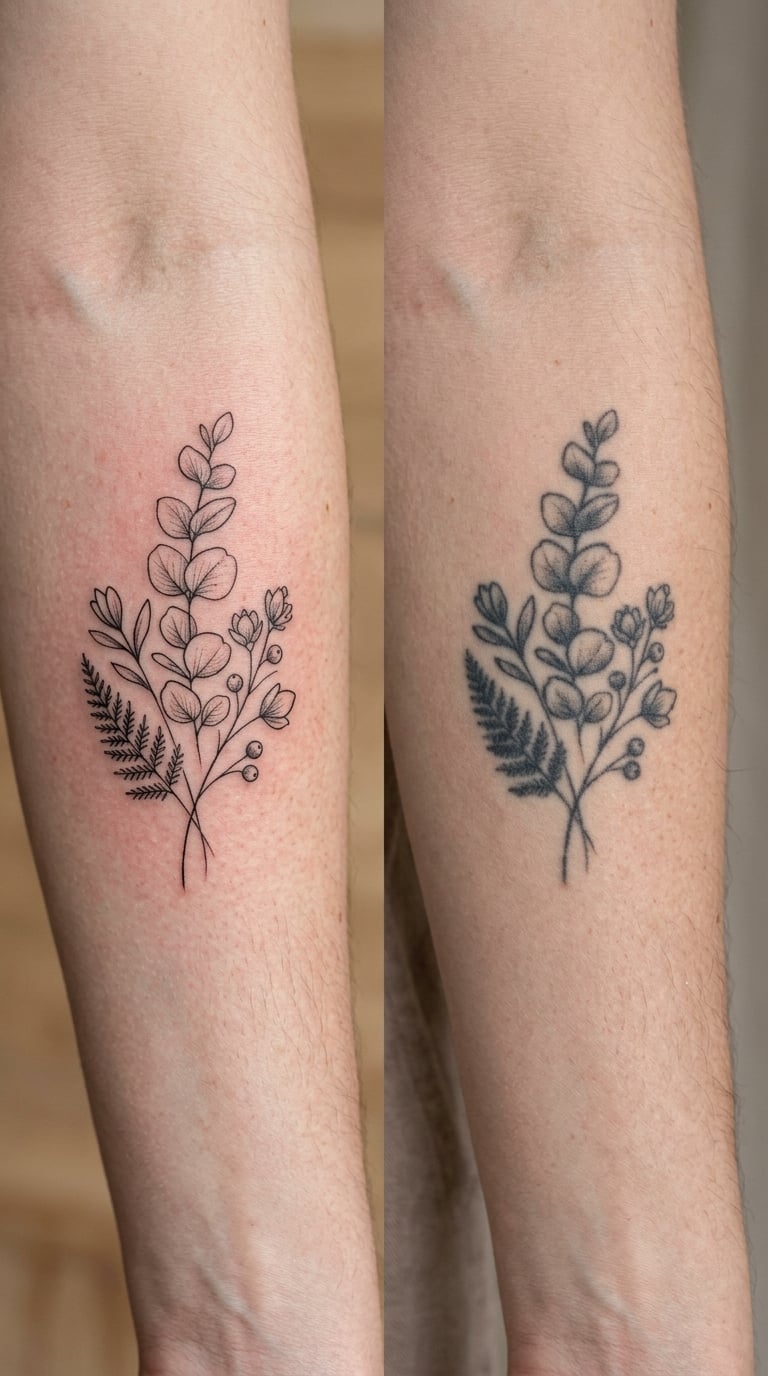
Thin linework has a smaller safety margin than bold work. When a chunky line loses a little pigment it still reads as a line. When a one-needle line loses a little pigment, the edge blurs and the shape starts to close up.
That is the whole honest answer. Fine line tattoos are more sensitive to fading because they hold less pigment and sit closer to the surface, but a fine line tattoo done at a correct depth in a sheltered spot can stay readable for a very long time. Some of them are still crisp decades on.
Two different problems get confused here constantly. Fading is ink leaving. A blowout is ink spreading sideways and turning a sharp line into a soft grey smudge. The fixes are opposite: fading responds to protecting the tattoo, blowouts are caused by work that went too deep and need revision. More on that below.
Why Fine Line Tattoos Lose Definition
There is no single cause. It is a stack of small effects, and usually several of them land on the same piece at once.
Why do fine line tattoos fade faster than bold linework?
Less pigment to lose. A single needle deposits a narrow ribbon of ink. A bold line is several times wider, so when a little of that pigment clears, the line still has body left. The thin version does not have that margin.
Shallower placement. Fine line work is often placed closer to the surface, where skin replacement is fastest. Deep pigment is more stable simply because the skin turnover happening around it is slower.
Slow ink spread. Over the first months, pigment that sat in one neat line settles into a slightly wider, softer edge. On a thin line that shift eats a large percentage of the original width. That is often what people mean when they say their tattoo is getting blurry, and it happens to heavy work too, just less visibly.
Skin movement and stretching. Areas that bend, stretch and crease constantly distort a line as it heals and keep disturbing it afterwards. Elbows, knees, fingers and the inner wrist are the usual suspects.
Friction and washing. Hands, fingers and feet meet keys, pockets, towels and shoes all day. Fine line is mostly black or grey, so every bit of mechanical wear shows as lightening.
UV exposure. Pigment exposed to sunlight fades faster than pigment that is covered. This is the one factor people can genuinely control, and it is the one most often skipped after year one.
Dry skin and flaking. Fine line sits close enough to the surface that a dry, cracking patch of skin can scab and lift part of a line with it, especially in winter.
Overworked skin. A tattooed area that has been repeatedly retouched can end up with scar tissue and pigment that never settled properly. The line looks tired from the start and never fully sharpens.
Ink and skin type. Oily skin pushes pigment back toward the surface over time and shows shine over the line, which makes fine work look softer sooner. Very dry skin behaves differently but has its own peeling problems. A good artist will tell you honestly how your skin tends to hold work.
One more thing worth separating: a line that looks weak in week two has not faded. It has not finished healing. Give it the full healing window before you judge anything.
Which Style Fades More, Fine Line or Bold Tattoos
Bold work wins on longevity, and it is not close. But bold is not a strategy, it is a tradeoff.
| Factor | Fine line | Bold / traditional | Blackwork |
|---|---|---|---|
| Ink density | Very low, one narrow line | High, wide packed lines | High, solid filled areas |
| Typical depth | Shallower on average | Deeper and more consistent | Medium to deep |
| Contrast when new | Low, delicate | High, reads at a distance | Very high |
| Effect of partial fade | Edges blur, detail closes up | Line lightens but stays readable | Patchy grey before line loss |
| How it ages | Soften noticeably, often 3 to 5 years | Still clear after 10+ years | Holds longest of the three |
| Touch-up need | Common, often every 4 to 8 years | Rare | Rare |
| Small design viable? | Yes, this is its home ground | Harder, needs space | No, needs area |
The design that stays readable longest is usually a simple shape with a slightly heavier line weight than you are used to seeing in portfolios. Fresh single-needle lines always look thinner than they will once healed, because swelling hides the line for the first days. If you want a delicate look with more staying power, ask for fine line in the drawing and a hairline-plus weight on the needle.
Which Placements Make Fine Line Tattoos Fade Fastest?
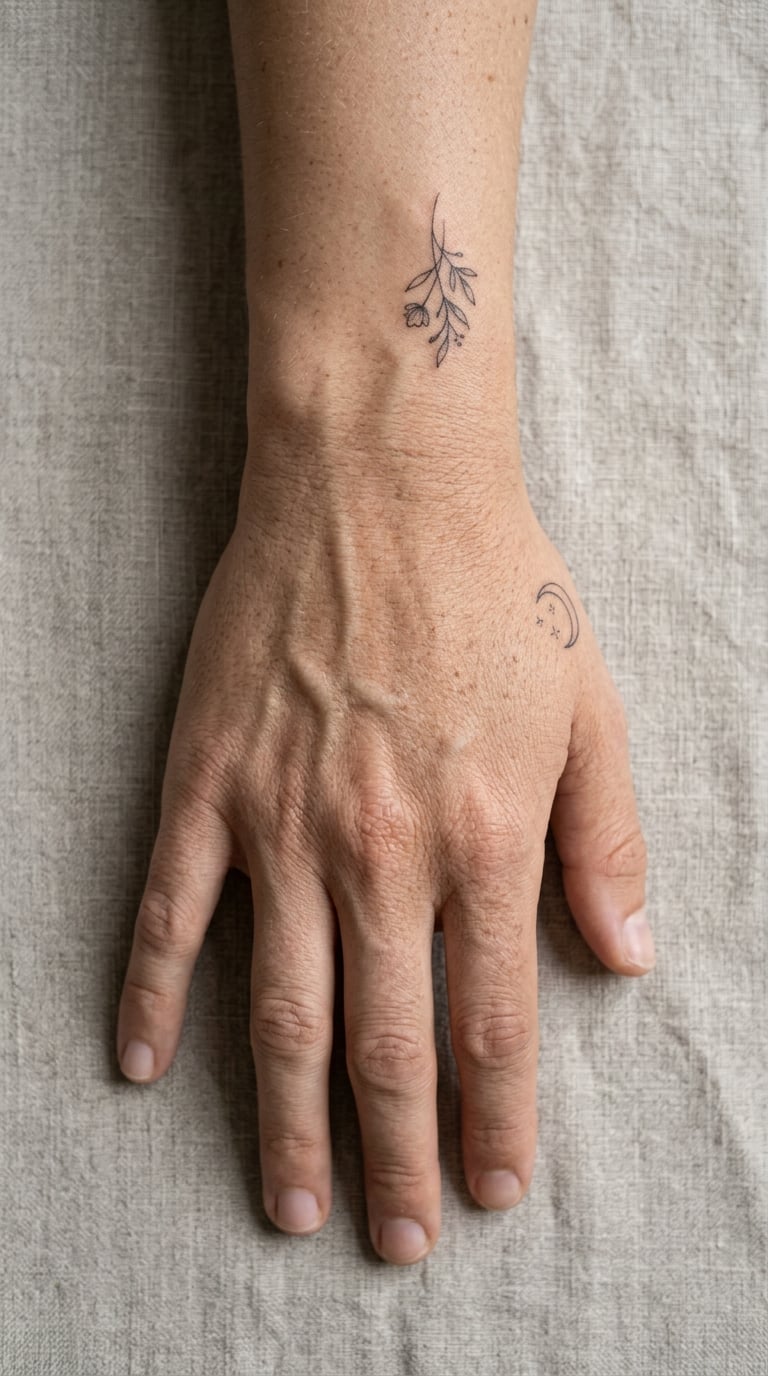
Placement is the single biggest variable, and it is bigger than style. In tattoo communities the consensus is blunt about it: a spot like the wrist will fade much faster than the same design on an upper arm. Ranked from fastest wear to longest hold:
| Placement | Likely wear | Why |
|---|---|---|
| Fingers and knuckles | Fastest | Constant washing, friction, sun exposure and daily contact |
| Hands and back of the wrist | Very fast | Bones sit near the surface, skin is thin, sun hits it daily |
| Inner wrist and inner elbow | Fast | Stretching skin, frequent movement, soap and water contact |
| Feet, ankles, toes | Fast | Shoes, walking pressure, swelling, constant moisture |
| Neck and throat | Fast | Sun, shaving and neckwear rubbing against the lines |
| Collarbones | Moderate to fast | Bone prominence, skin movement, high sun exposure |
| Knees and elbows | Moderate | Repeated bending and creasing distorts the line shape |
| Forearm and calf | Moderate | Reasonably covered, moves a lot but does not crease constantly |
| Upper arm and outer thigh | Slower | More cover, less movement, softer skin |
| Ribcage, ribs | Slower | Covered by clothing, stable skin, though bone movement matters |
| Upper back, shoulder blades | Longest hold | Most cover, least daily friction, usually kept out of the sun |
If you want thin lines to last, you cannot talk your way out of physics. What you can do is pick a sheltered spot, keep the design simple enough to survive partial fade, and accept that a wrist piece will need touch-ups while a rib piece probably will not.
Our fine line tattoo ideas for women gallery is sorted by placement, so you can see which motifs already work on the areas that hold up best before you commit to anything.
How Long Do Fine Line Tattoos Stay Sharp?
There is no fixed date, because fading is gradual rather than a single event. These are the ranges most clients land in, and they are honest averages rather than promises.
| Time | What most people see |
|---|---|
| Week 1 | Ink looks dark, bold and slightly swollen, with redness around the lines |
| Weeks 2 to 4 | Peeling and flaking, lines look patchy and lighter than expected, then sharpen again |
| Month 2 to 3 | True healed state, the line you were actually given, at maximum crispness |
| Year 1 | No visible change on a well-placed piece, slight softening on hands and wrists |
| Year 3 | First lightening on exposed placements, fine inner detail starts to close up |
| Year 5 | Noticeable softening on fingers, hands and feet, still clearly readable on arms, ribs and back |
| Year 10 | Thin work is a soft grey ghost of itself in high-wear spots, bold work barely changed |
Most people need a touch-up somewhere in the four to eight year window, earlier on hands and fingers and rarely on the back. If a design is going to be visible for a decade, design for a decade. That means fewer tiny elements than the reference photo has.
Pain Levels by Placement for Fine Line Tattoos
Fine line is slow work, and slow work is often more uncomfortable per minute than a fast bold pass, because the needle keeps moving. The sting is more of a constant scratch-burn than a series of sharp hits.
| Placement | Pain level | Notes |
|---|---|---|
| Ribcage, upper arm, thigh | Low | Meaty, stable areas, the easiest places to sit still |
| Forearm, calf, shoulder blade | Low to medium | Bones come into play on the forearm and shin side of the calf |
| Upper back | Low to medium | Hard to reach, so the artist works around your movement |
| Collarbone, sternum, neck | Medium | Thin skin over bone, and you will feel every pass |
| Inner wrist, inner elbow | Medium | Sensitive skin, and the wrist shifts under the needle |
| Hands, fingers, knuckles | Medium to high | Bony and dense, plus fingers throb after a long session |
| Feet, ankles, toes | High | Foot tattoos are genuinely uncomfortable and often need breaks |
| Elbows, knees, kneecaps | Medium to high | Bone directly under skin and constant involuntary movement |
Break the session into chunks on long pieces, eat beforehand, and take the breaks your artist offers. If you want anything more specific than a general guide like this, ask a professional tattoo artist about your own placement and skin.
Fine Line Tattoo Cost by Size
Fine line is priced by the hour, not by the design, because a small detailed piece can take longer than a large simple one. In the US, single-needle work usually falls in the range of 120 to 250 dollars an hour depending on the city and the artist.
| Size | Typical detail | Common US range | Session length |
|---|---|---|---|
| Small | Single word, tiny symbol, one small motif | 80 to 200 dollars | Under an hour |
| Medium | Botanical sprig, small branch, mini script line | 200 to 500 dollars | 1 to 3 hours |
| Large | Full branch, detailed script, micro-realism piece | 400 to 1200 dollars | 3 to 6 hours, possibly two sessions |
Three things move the number around. A shop minimum covers the first thirty minutes or hour no matter how small the tattoo is, so five tiny fine line pieces from the same shop can cost more than one medium piece. Travel to a respected low-volume artist adds another cost that is worth it for line work. And touch-ups are usually free for a period after the session, then priced at a reduced rate afterwards.
Healing Timeline: What Looks Normal by Week
The first month is the part that panics people, because fine line looks worse before it looks better.
| Period | What is normal | What to do |
|---|---|---|
| Days 1 to 3 | Redness, swelling, lines look thick and glossy, mild warmth and tenderness | Follow your artist’s aftercare instructions, wash gently, keep it dry otherwise |
| Days 4 to 7 | Itching starts, flaking begins, ink appears to come away in flakes | Do not pick or scratch, moisturise thinly with whatever your artist recommends |
| Week 2 | Lines look patchy, faded or broken up, colour drops out of the surface | Keep going, this is normal, change the sheets on anything that touches it |
| Weeks 3 to 4 | Peeling ends, skin settles, lines come back sharper and more even | Return to normal routines, still protect from sun |
| Months 2 to 3 | Final settle, this is the true healed look | Judge the tattoo here, not at day four |
Contact your tattooist if redness and swelling get worse after the first few days, if the area feels hot or increasingly painful, if the redness spreads beyond the tattoo, or if there is discharge that is not clear and serous. If anything feels wrong, a quick message to the artist who did it is always the right move, and a doctor if you have fever or spreading redness.
How to Slow Fading and Protect Fine Linework
Start with your artist’s aftercare instructions, because they know what they did in your skin. Everything below is general guidance that sits on top of that.
1. Protect it from sun every single day. This is the highest-return habit by a wide margin. Broad spectrum SPF 50 or higher on exposed placements, reapplied, not just on beach days. A tattooed forearm in a summer of sun will show it within two years.
2. Wash gently and keep it clean. Lukewarm water and a mild unscented cleanser, patted dry rather than scrubbed. No loofahs, no abrasive gloves on a tattooed hand.
3. Moisturise with an unscented product. Thin layers of a plain, fragrance-free lotion keep the skin from drying and cracking, which is what lifts thin lines.
4. Never pick or scratch a flaking line. That is the single most common way people damage their own fine line in week two. Let flakes come off on their own.
5. Avoid friction where you can. Long sleeves on high-UV days, a laptop sleeve if the piece sits near a desk edge, gloves for heavy manual work on hands and fingers.
6. Choose a sheltered placement when you can. No amount of aftercare beats not putting a two-centimeter line on a knuckle.
7. Book touch-ups before the detail is gone. Early, while the original line shape still exists, a touch-up is easy and predictable. Waiting until there is nothing left means rebuilding a design from scratch.
8. Judge the artist on healed work, not fresh photos. Ask to see fine line they did two to five years ago. Fresh line work looks great even when the depth is wrong, so healed photos are the only honest reference. If an artist has none, keep looking.
Mistakes to Avoid
Picking an artist on price alone. The cheapest fine line work is usually the work that will need a rebuild, and a low hourly rate with a small queue is not a bargain over ten years.
Scaling a reference design one-to-one from a screenshot. A tiny design on a high-wear area is a bad bet, and small size compounds the risk because there is less line left to lose.
Hitting the beach or the pool in the first two weeks. Chlorine, salt and sun during healing is how people undo good work in week one.
Changing aftercare advice every day. Follow the artist first, ignore the well-meaning comment from a stranger with a different result, and stop researching halfway through healing.
Assuming a touch-up restores everything. If the original went too shallow and the line has largely disappeared, a touch-up is a redraw. That costs more and takes longer than the first session did.
Ignoring the healed portfolio. Healed fine line photographs, and an honest conversation about revisions the artist has had to do, tell you far more than a spotless social feed.
Frequently Asked Questions
Do fine line tattoos fade faster than regular tattoos?
They usually lose definition sooner than bold work, because a single needle deposits far less pigment and often sits closer to the surface. That said, the rate is driven by depth, placement, sun exposure and aftercare. A fine line tattoo on an upper arm or back can stay crisp for a decade, while the same design on a finger will not. Style matters less than most online advice suggests.
Why are my fine line tattoos fading after only a few months?
At two to four months your tattoo is probably still settling, not fading. Skin peels and flakes through the first few weeks, which makes lines look patchy and thin, and they often look sharp again around month three. Judge the work at that point. If the lines still look weak and blurred after three months of healing, the cause is more likely shallow placement or low ink density rather than a speed problem.
What is the least noticeable place to get a fine line tattoo?
The upper back and shoulder blades hold detail longest and are covered most of the time, but they are hard to see in a mirror. If you want discreet and easy to reach, the upper arm and outer thigh are the practical picks. The upper arm, ribs and thigh are also low-friction areas, which means less fading than wrists, fingers, feet or the neck.
Can a faded fine line tattoo be touched up?
Usually, yes. A touch-up re-traces the existing line and adds pigment where it has softened, and most artists include one free of charge for a period after the session. If the line has mostly disappeared because it was placed too shallow, a touch-up becomes a redraw of the design. Get it done while the original shape is still readable, and ask the same artist to do it.
Does sunscreen help prevent fine line tattoos from fading?
It does. UV exposure is one of the few causes of fading you can actually control, and daily broad spectrum SPF 50 or higher on exposed placements makes a real difference over years. Think of it as maintenance rather than a one-off holiday measure. A tattoo that gets sunscreen every day will age very differently from an identical one that only sees the sun at the beach.
Is it normal for fine line work to look blurry while healing?
Yes, it is the normal part of healing most people do not expect. Swelling hides the line for the first few days, then the skin peels and flakes, and the ink looks patchy and broken up for around two weeks. Between weeks three and four the skin settles and the lines come back sharper. Contact your artist if redness spreads, pain increases after the first few days, or the area feels hot.
Final Advice for Longer-Lasting Fine Line Tattoos
Do fine line tattoos fade faster? They do, by degree rather than by rule. The decision that matters most comes before the session, not after it: pick a design that still reads when the lines are soft, put it somewhere covered and low-friction, and choose an artist who can show you healed fine line from a few years ago.
After that it is maintenance. Sunscreen daily, gentle cleansing, unscented moisturiser, no picking, and a touch-up every four to eight years if it is in a wear-prone spot. A few hours of that attention now beats any product on the shelf later.