
20 Best Black Sleeve Tattoo Ideas for Men (September 2026)
Black sleeve tattoo ideas work best when the whole arm is treated as one canvas rather than a stack of separate pictures. Every design below is planned in pure black ink, mapped to the shape of the arm, and written with the numbers a real sleeve needs: finished size in inches, best placement, honest pain level, and how the detail holds up after a decade of sun and laundry. Pick the two or three that feel like you and start there.
These are the concepts that come up most often when someone wants a bold, colour-free piece that still carries real detail. Most of them suit an outer forearm or shoulder sleeve on a man who wants the design to read from across a room, and they pair well with existing work in a mixed collection. Studios usually book three to six weeks out, so if you want a piece finished before next summer, the reference gathering and consultations start now. For more breadth, the 100 bold sleeve tattoo ideas that will make you look amazing list covers colour and illustrative sleeves too.
Black Sleeve Tattoo Ideas: Quick Guide
| Idea | Style | Best placement | Size | Pain |
|---|---|---|---|---|
| 1. Rose wrap | Black and grey realism | Outer forearm, shoulder to wrist | 18-22 in (46-56 cm) | Medium |
| 2. Koi and waves | Illustrative blackwork | Outer forearm | 14-20 in (36-51 cm) | Medium-high |
| 3. Geometric interlace | Dense blackwork | Shoulder and upper arm | 10-16 in (25-41 cm) | Medium |
| 4. Raven and moon | Micro-realism | Upper arm and bicep | 8-12 in (20-30 cm) | Medium |
| 5. Celtic knotwork | Interlace linework | Upper arm graduating to elbow | 9-15 in (23-38 cm) | Medium |
| 6. Forest silhouettes | Black and grey illustrative | Forearm wrap | 12-18 in (30-46 cm) | Medium |
| 7. Coiling snake | Blackwork realism | Wrist to bicep | 15-20 in (38-51 cm) | Medium-high |
| 8. Clockwork and filigree | Ornamental blackwork | Outer forearm | 10-16 in (25-41 cm) | Medium |
| 9. Eagle portrait | Black and grey realism | Shoulder cap | 8-11 in (20-28 cm) | Medium-high |
| 10. Cathedral window | Illustrative blackwork | Forearm wrap | 12-16 in (30-41 cm) | Medium |
| 11. Smoke and geometry | Abstract blackwork | Inner forearm | 10-15 in (25-38 cm) | High |
| 12. Rose, compass, laurel | Traditional | Outer forearm to elbow | 12-18 in (30-46 cm) | Medium |
| 13. Wolf head | Blackwork illustrative | Shoulder and deltoid | 6-9 in (15-23 cm) | Medium |
| 14. Anchor and rope | Nautical blackwork | Forearm wrap | 12-18 in (30-46 cm) | Medium |
| 15. Lion portrait | Black and grey realism | Upper arm | 8-12 in (20-30 cm) | Medium-high |
| 16. Botanical stippling | Dotwork | Forearm, graduated | 10-16 in (25-41 cm) | Medium |
| 17. Storm and lighthouse | Black and grey realism | Shoulder to elbow | 10-15 in (25-38 cm) | Medium |
| 18. Armband extension | Tapered geometric | Bicep | 3-5 in (8-13 cm) | Low |
| 19. Dragon and mountains | Blackwork illustrative | Full outer arm | 18-22 in (46-56 cm) | Medium-high |
| 20. Skull and rose | Gothic black and grey | Forearm or shoulder | 9-14 in (23-36 cm) | Medium |
1. Black-and-Grey Rose Wrap Sleeve
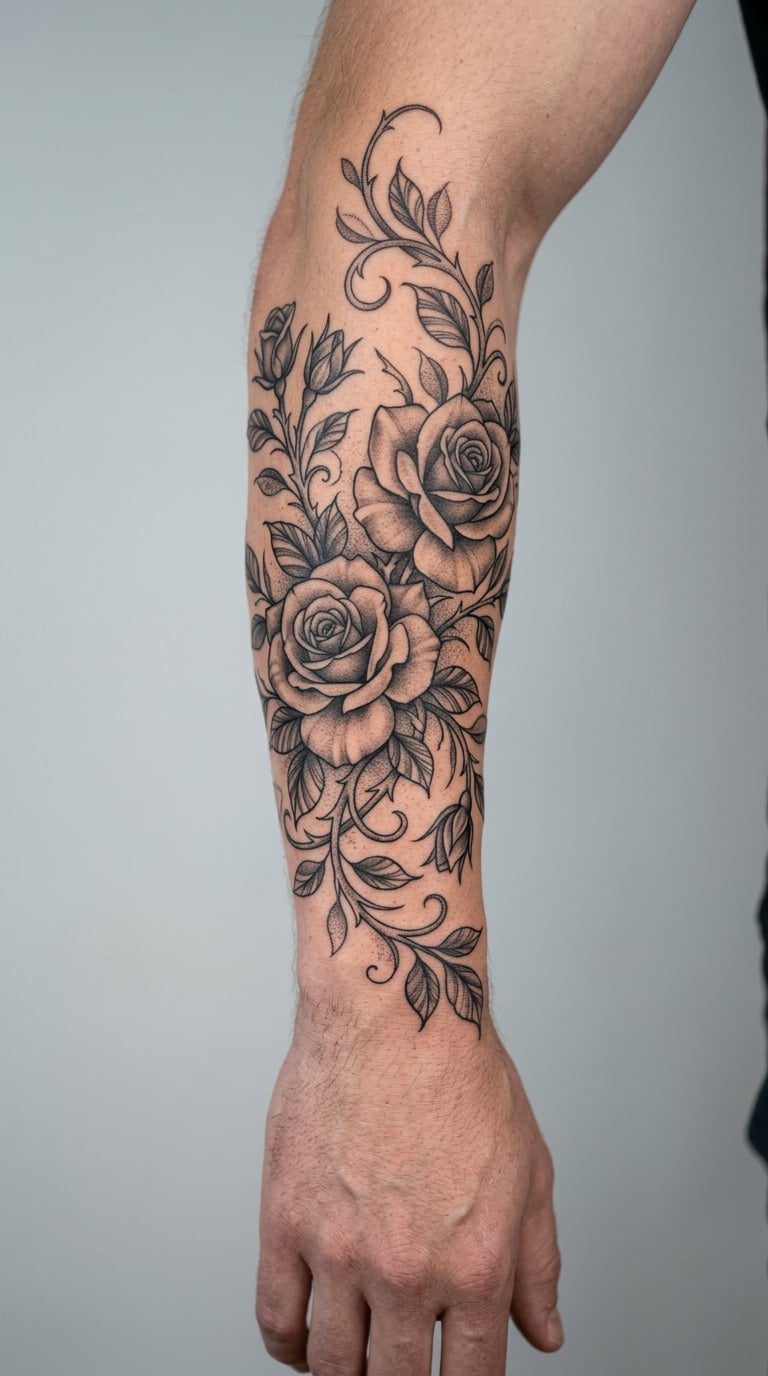
Blossoms are built in layered grey wash with dark concentrated shadows at the petal edges, and thin thorned vines wind between them so the design never reads as a row of separate stickers. The wrap starts at the deltoid with a half-open bud and ends at the wrist with a smaller bloom and trailing leaf.
People choose this one for relationships, family or a specific memory, though the meaning stays personal rather than fixed. Leaves and thorns can be added or left out freely.
Placement: Outer forearm, shoulder to wrist, or split across the deltoid and forearm. Size: 18-22 in (46-56 cm) for a full wrap, 6-9 in (15-23 cm) for a forearm-only version. Style: Black and grey realism with bold traditional outlines.
Pain: Medium, higher over the elbow crease and inner wrist. Ageing: dark outlines hold, but soft grey inside petals flattens into a mid-tone after years, so ask for deeper contrast in the shadows. Make it yours: name the exact rose variety to your artist, since petal counts and leaf shape change the drawing.
2. Japanese-Style Koi and Wave Sleeve
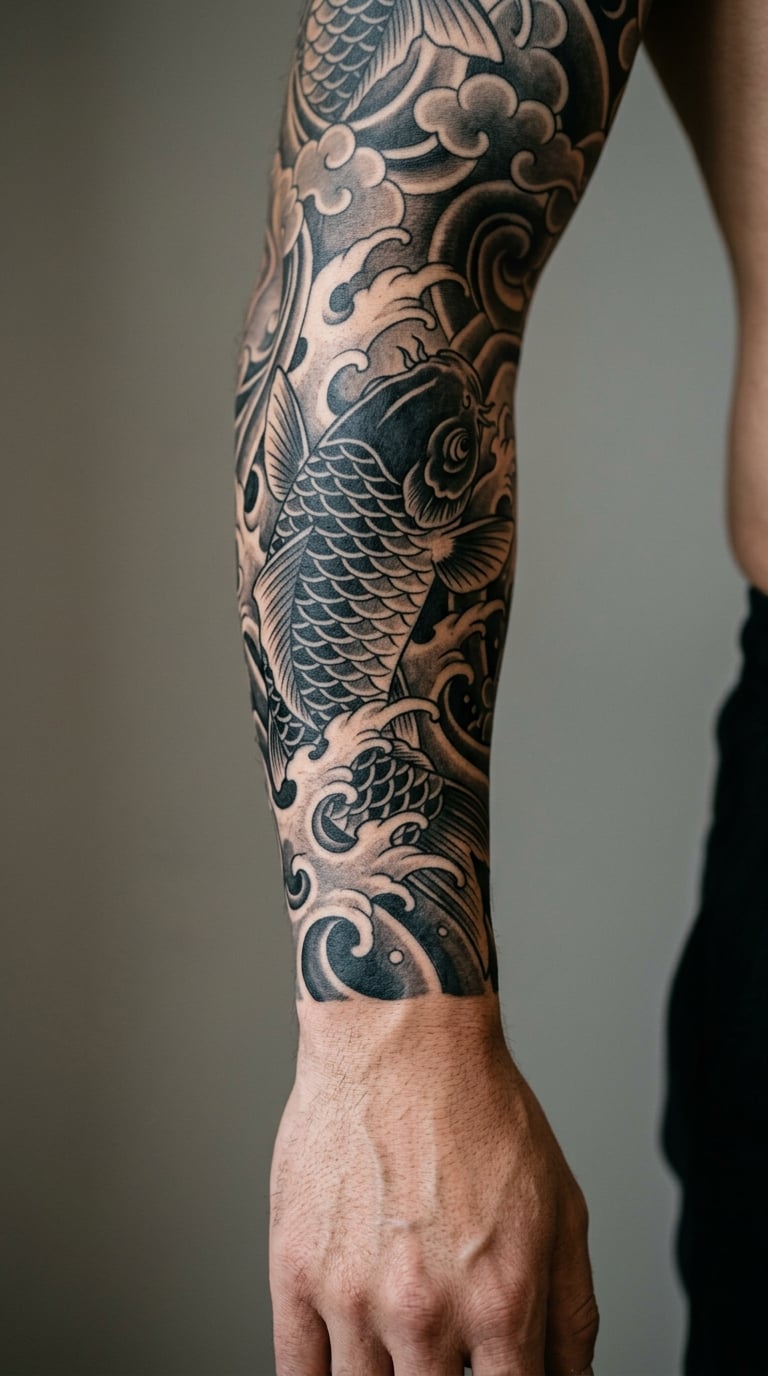
A single koi is drawn with clean scale rows, barbels and a swept tail, then pushed through bands of solid black water with a few reserved white gaps for foam. Cloud forms sit behind the fish so the composition has a back layer, a middle layer and open water in front.
This direction comes out of Japanese composition traditions, so the flow of the water and the balance of empty space do most of the work rather than any fixed symbol list. The water is what gives it movement.
Placement: Outer forearm reads best because the tail follows the ulna line. Size: 14-20 in (36-51 cm) for a three-quarter sleeve, 22 in (56 cm) and up for a full wrap. Style: Illustrative blackwork with solid fills and grey wash.
Pain: Medium-high; the elbow inside and the inner forearm below it are the rough zones. Ageing: individual scale rows soften first, so keep scales bold and let the water carry the detail. Make it yours: ask for a carp instead of a koi, or have the waves mirror a coastline you actually swim or fish.
3. Dense Blackwork Geometric Interlace
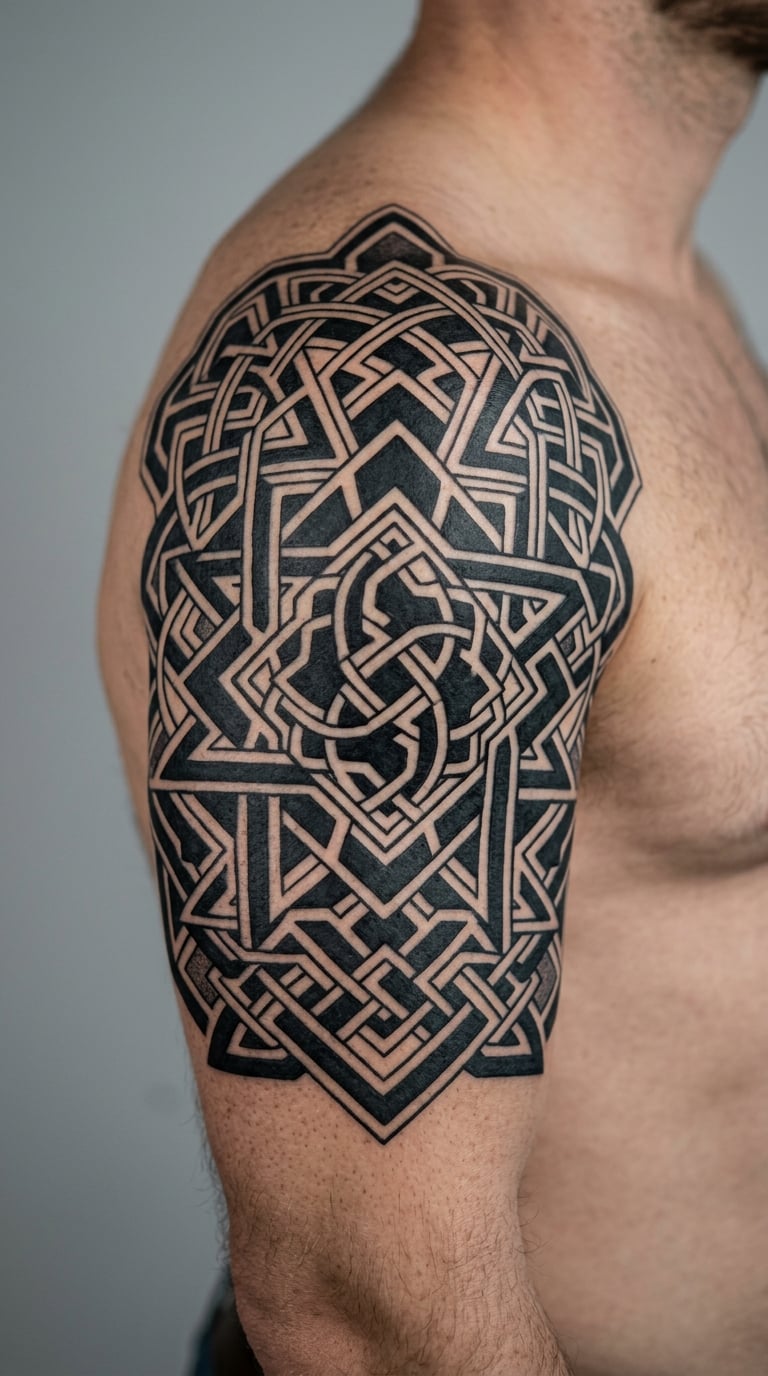
Interlocking bands, triangles and hexagons run across the deltoid with solid black masses between narrow negative-space channels. Where the pattern meets bare skin, the contrast does the drawing, so nothing depends on grey.
It is the least narrative option here and the most flexible one. A dense sleeve like this also sits well under or beside other pieces later.
Placement: Shoulder cap and upper arm, wrapping slightly toward the back. Size: 10-16 in (25-41 cm) covers most of the bicep and deltoid without crowding the elbow. Style: Geometric blackwork with packed solid fills.
Pain: Medium, since packed black is pressure work rather than fine detail. Ageing: solid black stays strong; the hairline negative-space channels can close up, so keep them wider than the drawing’s smallest gap. Make it yours: pick the repeating unit yourself, a triangle grid reads very differently from a hexagonal one on the same arm.
4. Realistic Raven and Moon Sleeve
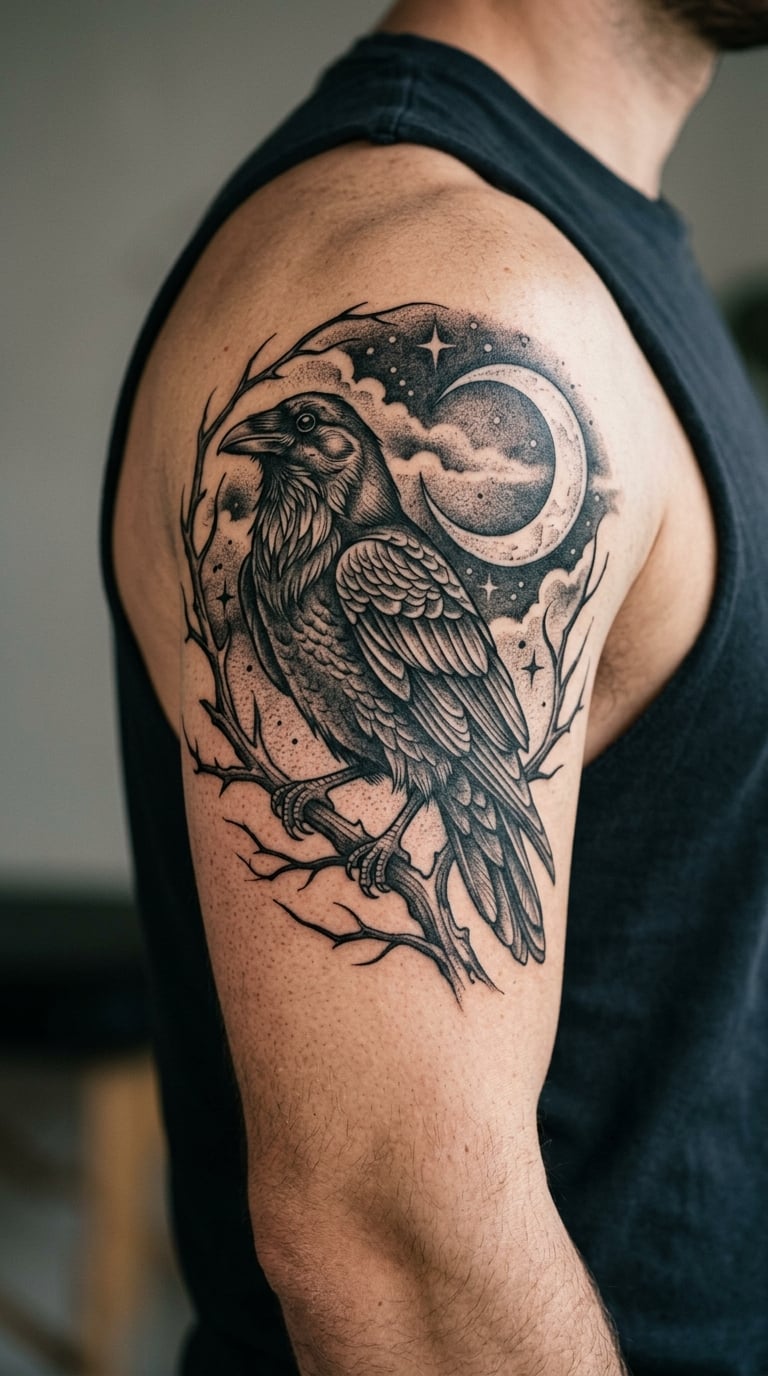
A raven sits in three-quarter profile with layered feather groups built from small tapered strokes, beside a thin crescent moon and a soft gradient sky. The wing spreads across the bicep so the feather rows follow the muscle curve instead of fighting it.
Corvids carry intelligence and memory in a lot of traditions, and a moon usually reads as cycles or change. Plenty of people just like birds, and that is a fine reason too.
Placement: Upper arm and bicep, with the moon higher on the outer deltoid. Size: 8-12 in (20-30 cm); going under 6 in (15 cm) turns the feather groups into grey mud. Style: Micro-realism with soft grey wash.
Pain: Medium, and slow going, because each feather group is worked in small passes. Ageing: this is the one to plan carefully. Tiny feather detail is the first thing to blur, so ask for grouped feathers with hard edges rather than single strands. Make it yours: choose the pose, a perched bird reads calm, a mid-flap bird reads aggressive.
5. Celtic Knotwork Arm Band to Sleeve
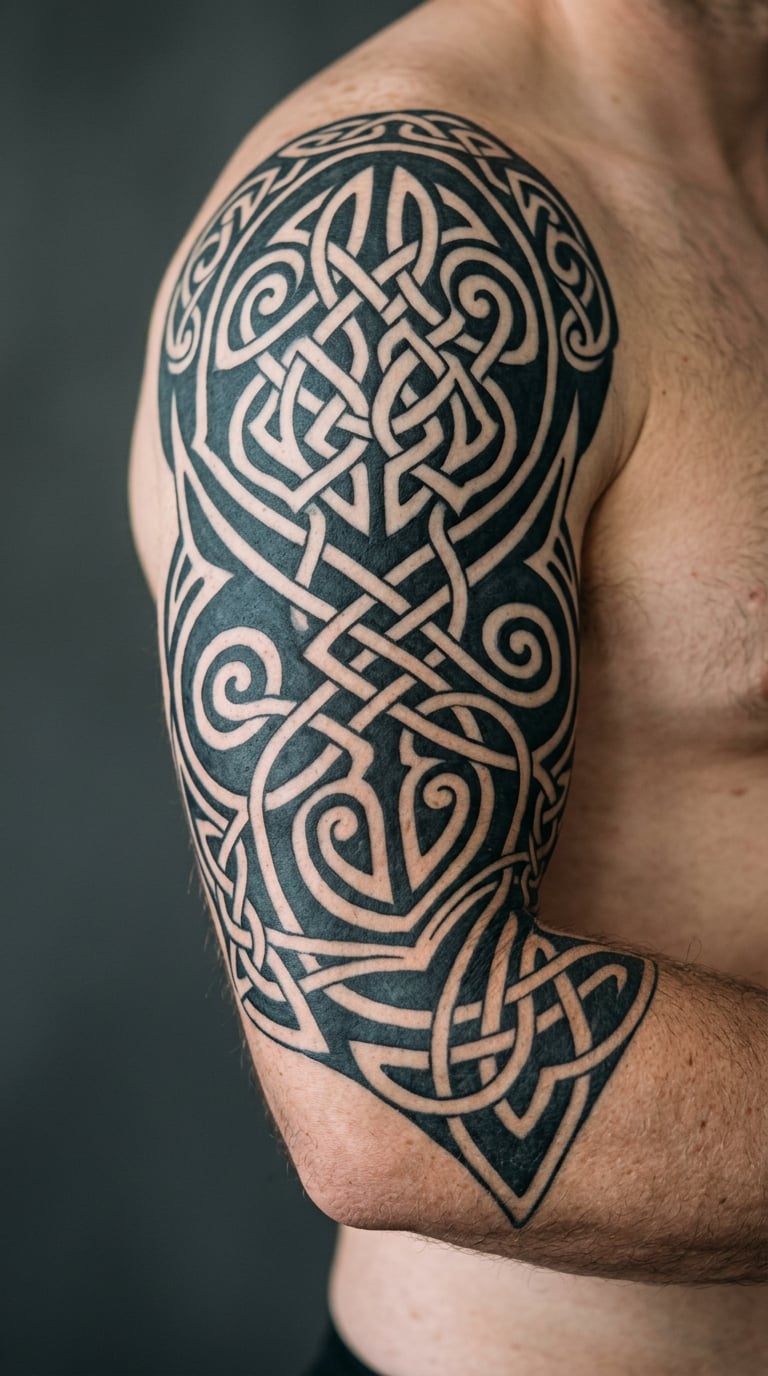
The pattern starts narrow at the bicep as a woven band of interlacing lines, then widens past the elbow into broader knot panels with braided borders. Line weight stays identical across the whole run, which is the hard part of this style.
Knotwork belongs to Celtic and Insular art traditions, so it is best described as inspired by that work rather than borrowed as a family crest. Plenty of men connect it to heritage without claiming a specific clan.
Placement: Upper arm graduating toward the elbow, or a full wrap if the panels grow. Size: 9-15 in (23-38 cm) for the graduating version. Style: Interlace linework with solid ribbon borders.
Pain: Medium, moderate over the bony outside of the forearm. Ageing: consistent thick lines age best, so avoid hairline strands that fade into grey. Make it yours: have the narrowest braid repeat a specific pattern, a knot you both recognise is a quiet private reference.
6. Forest Silhouette Story Sleeve
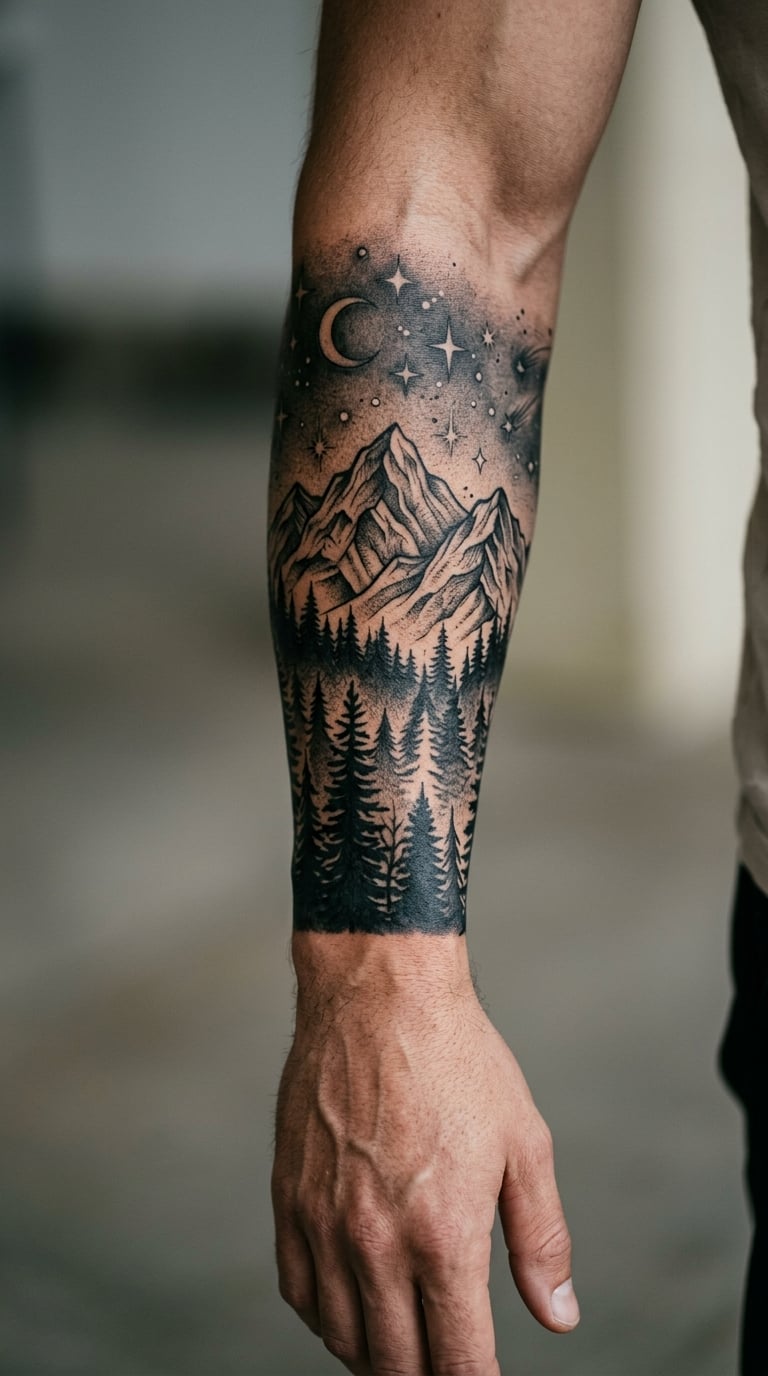
Three depth layers stack the scene: solid fir silhouettes in front, mid-tone hills and a low moon behind, and a soft grey misty gradient at the back. Each layer is a different ink value, so the trees stay readable instead of merging.
Outdoor and memorial sleeves often land in this shape, and the layered approach also hides older work surprisingly well when grey is placed deliberately.
Placement: Forearm wrap with the tallest trees at the elbow end. Size: 12-18 in (30-46 cm). Style: Black and grey illustrative with solid silhouette shapes.
Pain: Medium; the gradient background needs more passes than the solid trees. Ageing: the black tree edges last, and the misty grey is the part that softens, which actually suits a foggy look. Make it yours: name the tree species from where you grew up, spruce and birch silhouettes are easy to tell apart once drawn properly.
7. Snake Coiling Blackwork Sleeve
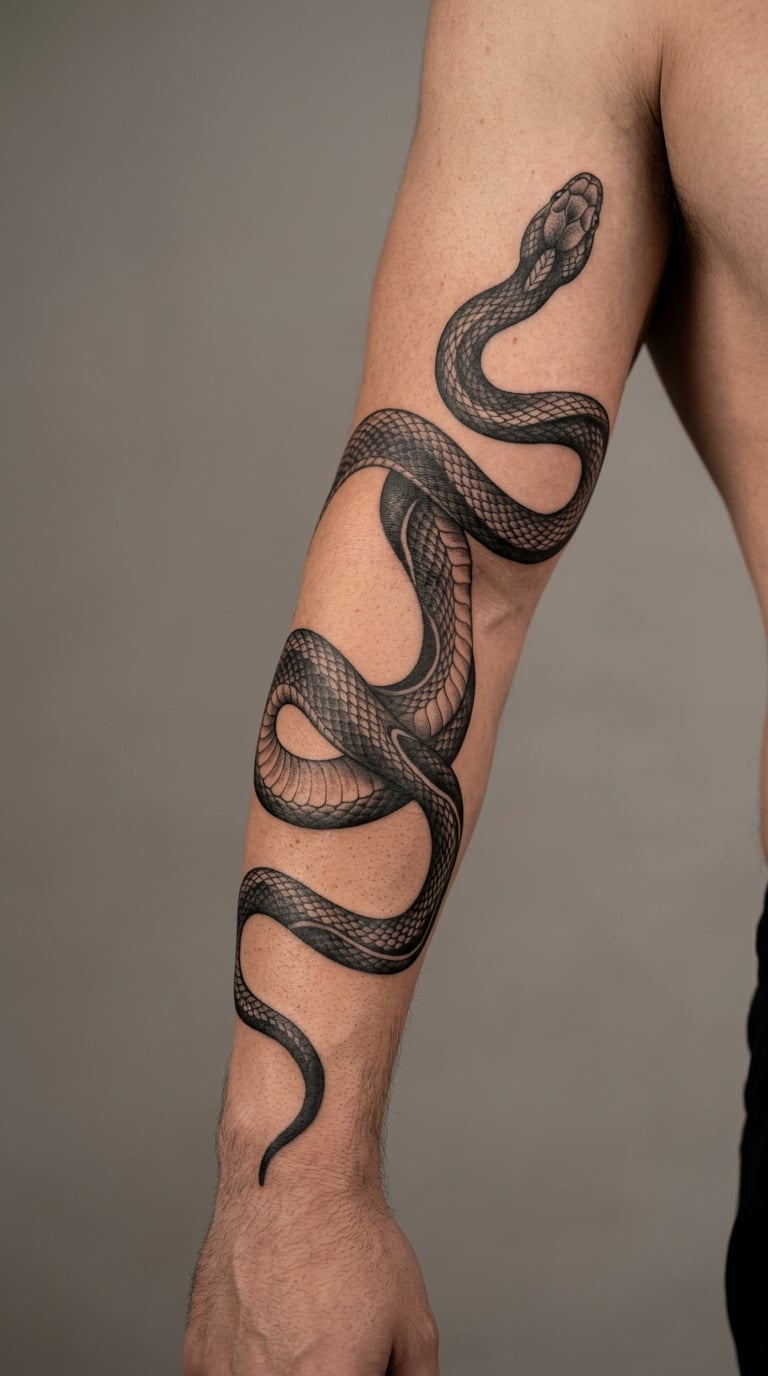
One serpent is drawn in a long S-curve with alternating solid-black and pale scale groups, a shaded belly and a clear head with a defined eye. The body crosses the arm twice, so parts of the design read front-facing and parts disappear around the side.
Sheds and renewal are the usual reasons people pick snakes, and a single coiled animal is a common choice for a first large piece because it needs no lettering and no backstory.
Placement: Wrist to bicep, crossing the elbow on a full sleeve. Size: 15-20 in (38-51 cm) so the scale groups stay large enough to hold ink. Style: Blackwork realism with grey belly shading.
Pain: Medium-high, worse where the body passes over the elbow crease. Ageing: fine scale texture is the first casualty, so strong group contrast beats tiny detail. Make it yours: choose the species honestly, a coral snake pattern and a viper silhouette cannot be drawn the same way.
8. Clockwork and Ornamental Sleeve
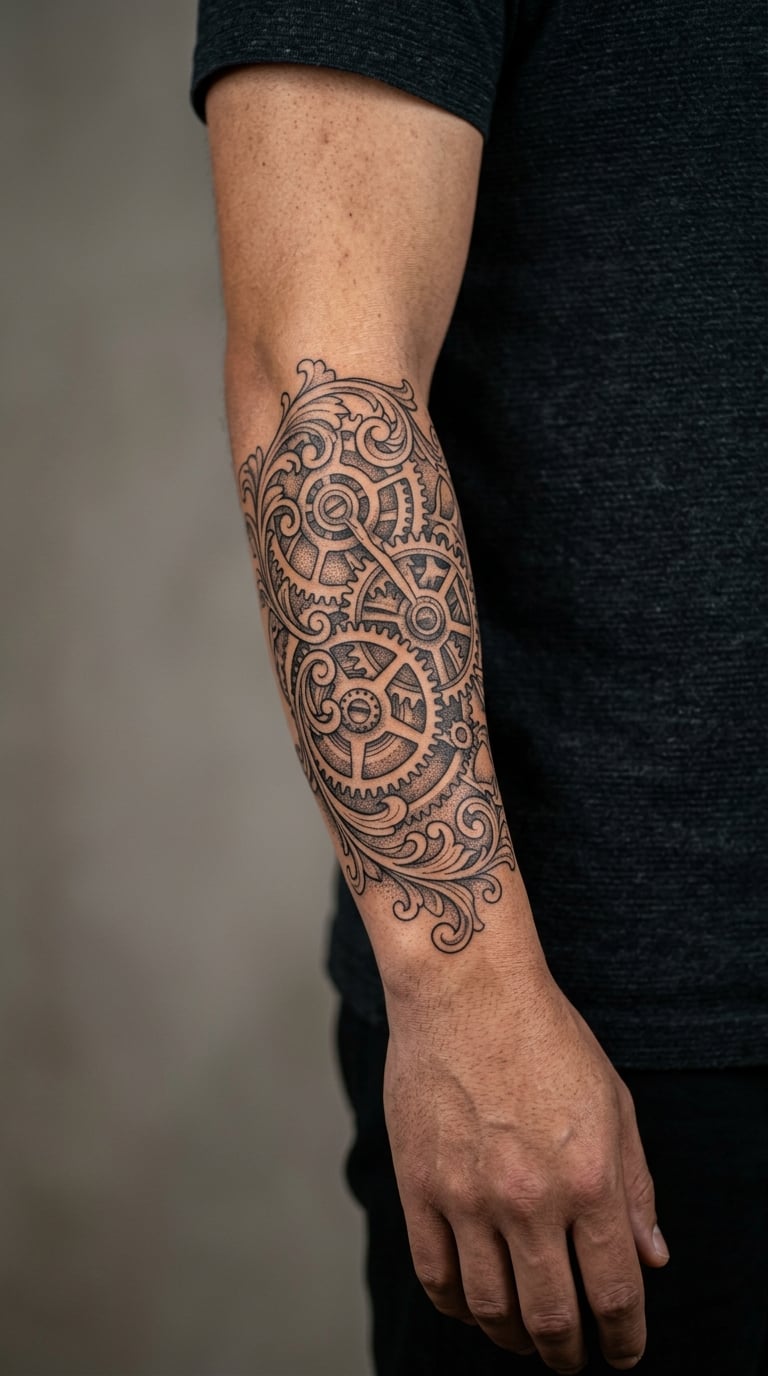
Interlocking gears of different diameters sit in the main band, with filigree scrollwork and restrained dotwork shading filling the gaps around them. Teeth are drawn as clean rectangular notches rather than sketched curves so the machinery still reads mechanically.
Time, craft and inheritance are the usual reasons people go this way. A lot of men have it done to mark a trade, a family workshop or a date.
Placement: Outer forearm, where the flat muscle surface suits circular forms. Size: 10-16 in (25-41 cm). Style: Ornamental blackwork with dotwork shading.
Pain: Medium; dotwork is a long, steady session rather than a sharp one. Ageing: stippling greys out first, so keep the darkest dots for shadow and let the rest stay open. Make it yours: bring a photo of a watch movement or a machine you actually value and have the gear layout built from it.
9. Black-Illusory Eagle Portrait Sleeve
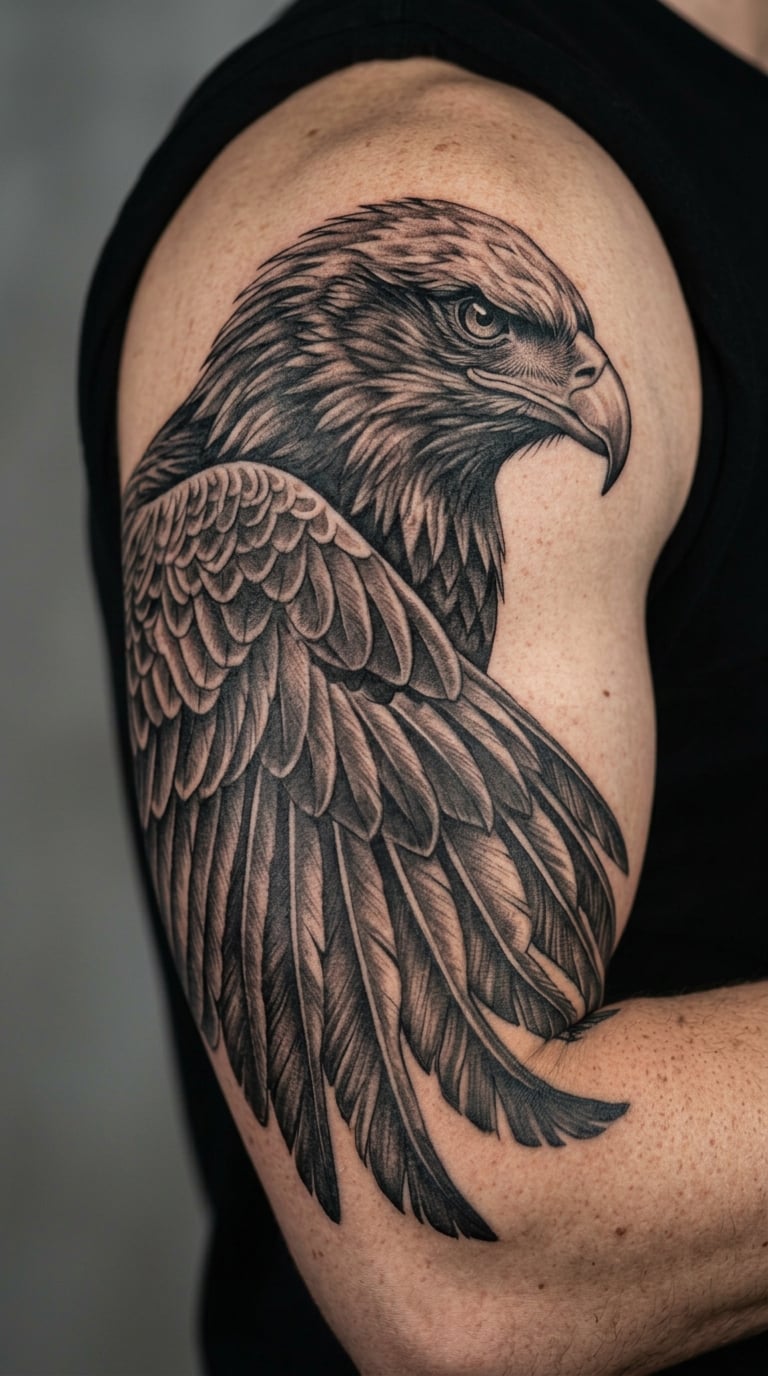
The bird is built almost entirely from black shadow shapes with the highlights left as bare skin, so the head reads three-dimensional without a single drop of colour. Feather layers fan back over the deltoid with each row darker than the one above it.
Eagles turn up for freedom, courage and service, but plenty of people simply want a strong portrait piece and stop there. The technique is often called black illusionism.
Placement: Shoulder cap, wrapping from the front deltoid over the top. Size: 8-11 in (20-28 cm); this one genuinely needs space, under 6 in (15 cm) and the illusion collapses. Style: Black and grey realism using negative space.
Pain: Medium-high, it is long needle passes over a curved area. Ageing: the solid black feathers hold well but the bare-skin highlights can look flat, so the artist should blend edges rather than leave hard gaps. Make it yours: pick the talons and what they hold, a branch, a stone or nothing at all.
10. Gothic Cathedral Window Sleeve
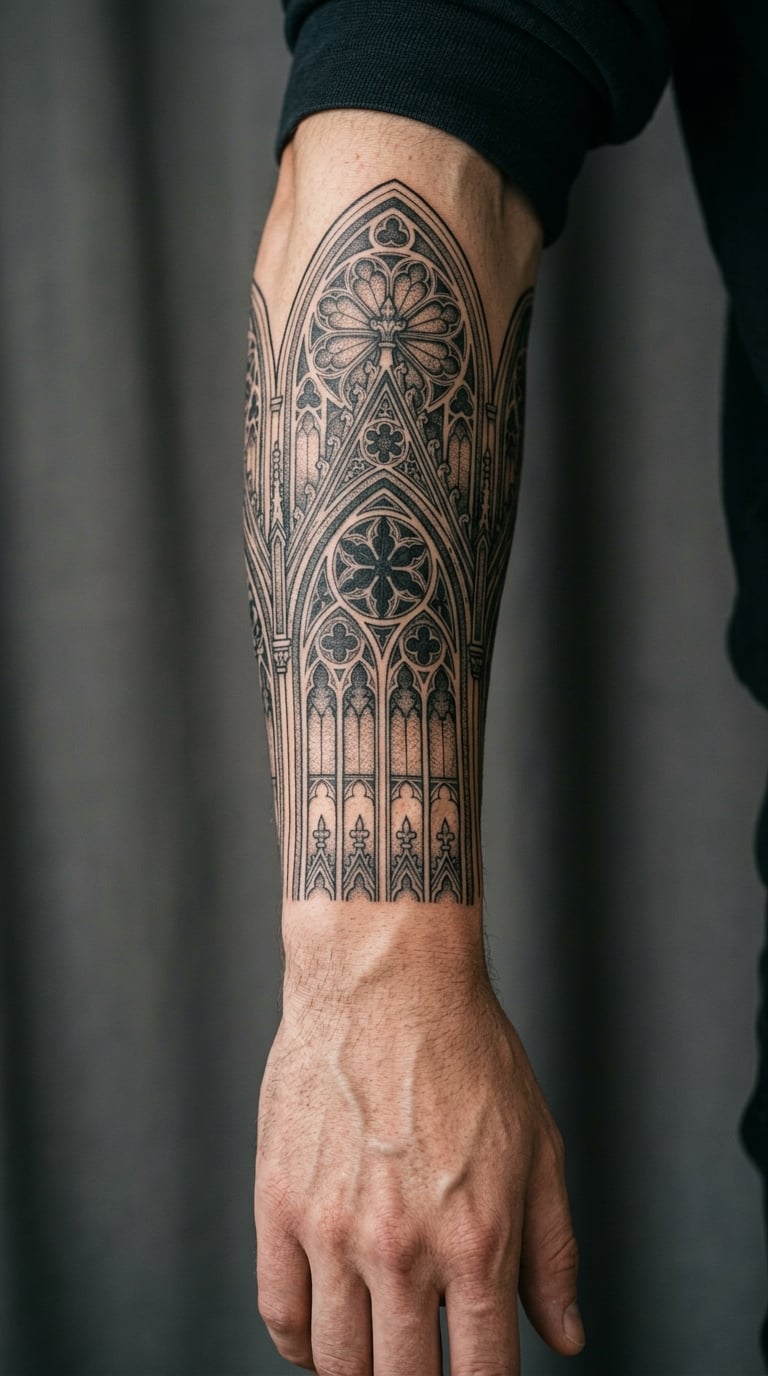
Pointed arches, stone tracery and leaded window bars are drawn in clean black line, with the glass panes left as bare skin and the stonework carrying a light grey wash. A row of arches repeated down the forearm creates the rhythm of a real window wall.
Any religious or cultural element in this work belongs to the artist and the design, not to a fixed meaning attached to the image. Ask your artist directly what they are drawing from.
Placement: Forearm wrap, with the largest arch at the elbow side. Size: 12-16 in (30-41 cm). Style: Illustrative blackwork with architectural linework.
Pain: Medium, though long line sessions get uncomfortable on the inner forearm. Ageing: stone linework is stable, but the pale grey wash softens noticeably, so keep stone texture line-based. Make it yours: pick a real building and a year, an architect’s window copied from a photo you bring beats a generic arch set every time.
11. Abstract Smoke and Sharp Geometry Sleeve
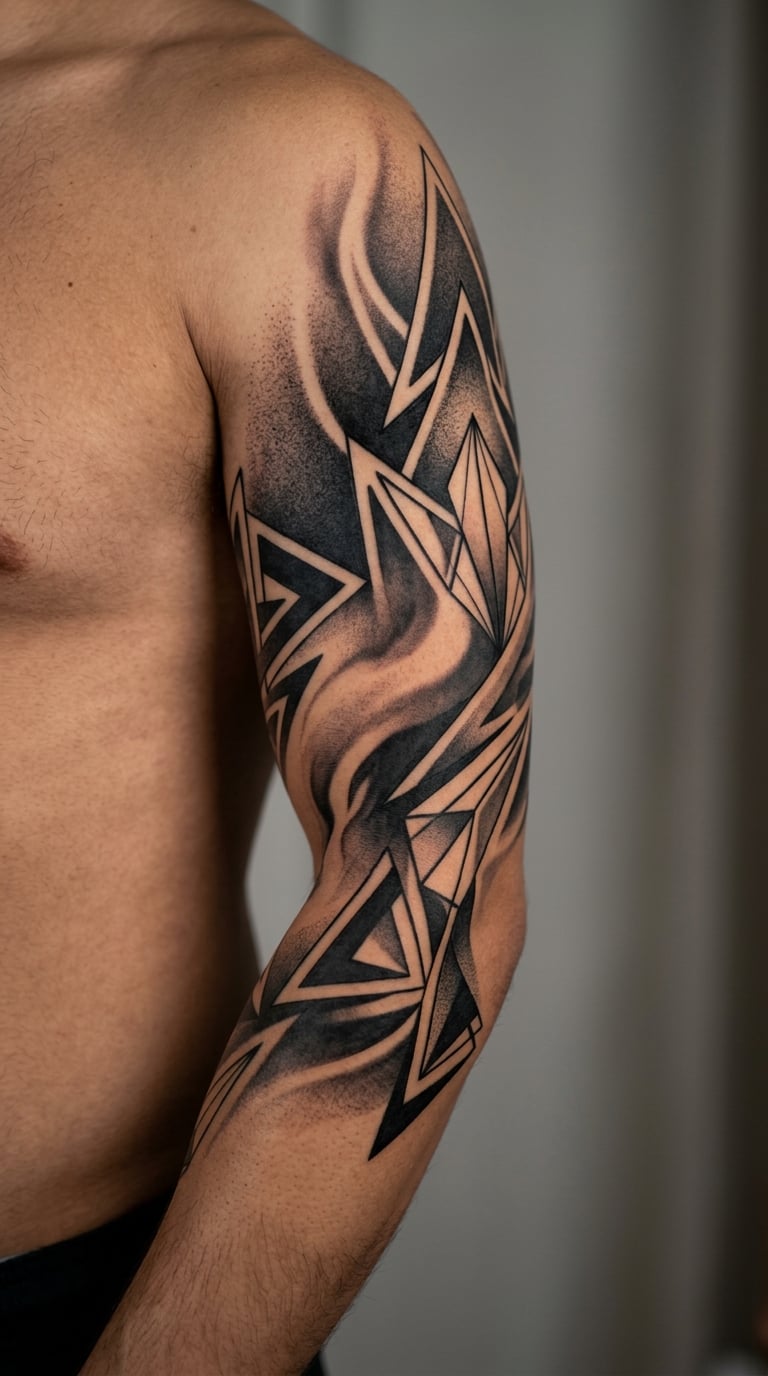
Soft grey smoke banks curl through a field of hard-edged black triangles and bars, with the contrast between blur and straight line doing all the work. A few open skin gaps keep the smoke from turning into a grey wash across the whole arm.
There is no story attached, which is exactly why some men prefer it. It suits a sleeve that has to sit beside other, more symbolic work without competing.
Placement: Inner forearm, the least decorated surface on most arms. Size: 10-15 in (25-38 cm). Style: Abstract blackwork mixing grey wash and solid geometry.
Pain: High, the inner forearm is thin skin over bone and everyone notices. Ageing: smoke gradients soften the most of any style on this list, so a good artist builds the smoke from defined edges, not pure blur. Make it yours: hide a date in the negative space, or repeat your own waveform as the bar pattern.
12. Traditional Rose, Compass, and Laurel Sleeve
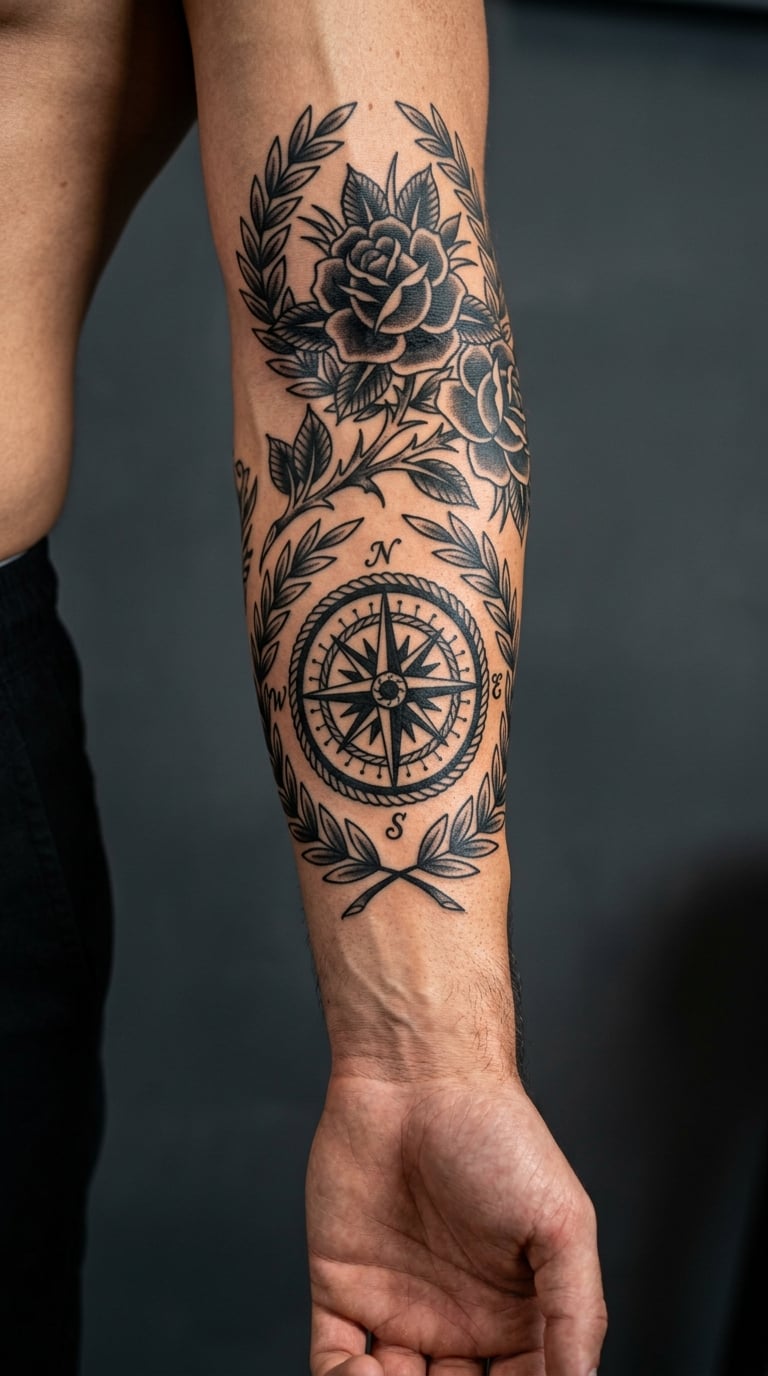
A compass sits as the central anchor with a rose above it and laurel branches wrapping underneath, all drawn with heavy black outlines and only a small amount of shading inside the petals. It is a composition that has survived a century for a reason.
Directions, safe travel and endurance are the readings people attach to compasses and laurels. If you have a real bearing or a real trip, this is the design to hang it on.
Placement: Outer forearm running to the elbow. Size: 12-18 in (30-46 cm). Style: Traditional with restrained black shading.
Pain: Medium, mostly steady line work. Ageing: this is the most durable entry here, thick outlines and limited grey keep the design readable for decades. Make it yours: use your actual home coordinates or the bearing of a place that matters, written into the compass face.
13. Wolf Head with Geometric Background
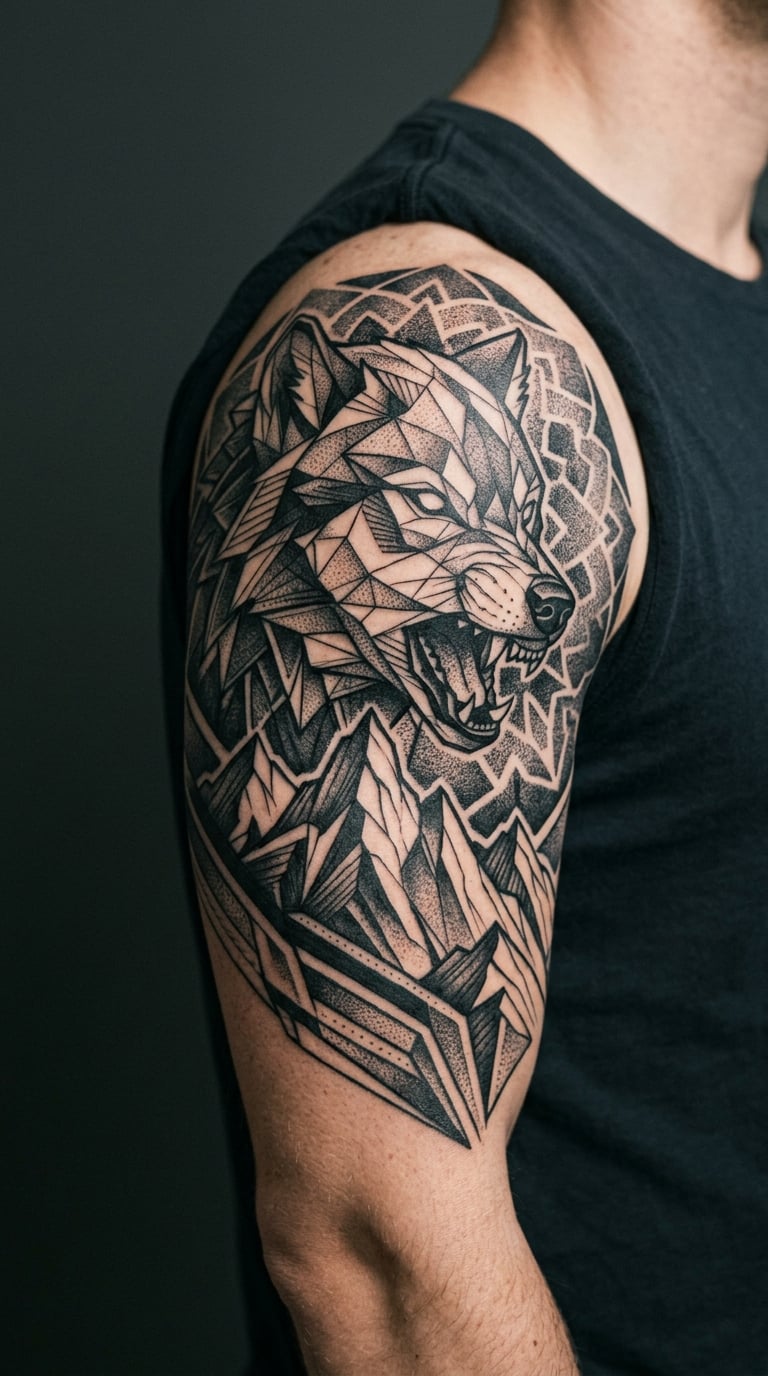
The head is drawn in a semi-illustrative mode, angular planes on the muzzle and ears rather than fur-by-fur rendering, with a solid black background broken by triangular mountain lines and a few reserved gaps around the eyes.
Family, loyalty and independence are the meanings people usually bring to wolves. The geometric background is there to stop the portrait from floating in a plain black block.
Placement: Shoulder and deltoid, angled so the snout points down the arm. Size: 6-9 in (15-23 cm) for the head, 12 in (30 cm) and up once the background is added. Style: Blackwork illustrative with geometric background.
Pain: Medium over the deltoid, but the solid background pushes a full session. Ageing: the angular head lines hold, background triangles can lose their crisp corners and want a touch-up. Make it yours: base the mountain lines on a range you have actually stood in.
14. Nautical Blackwork Anchor Sleeve
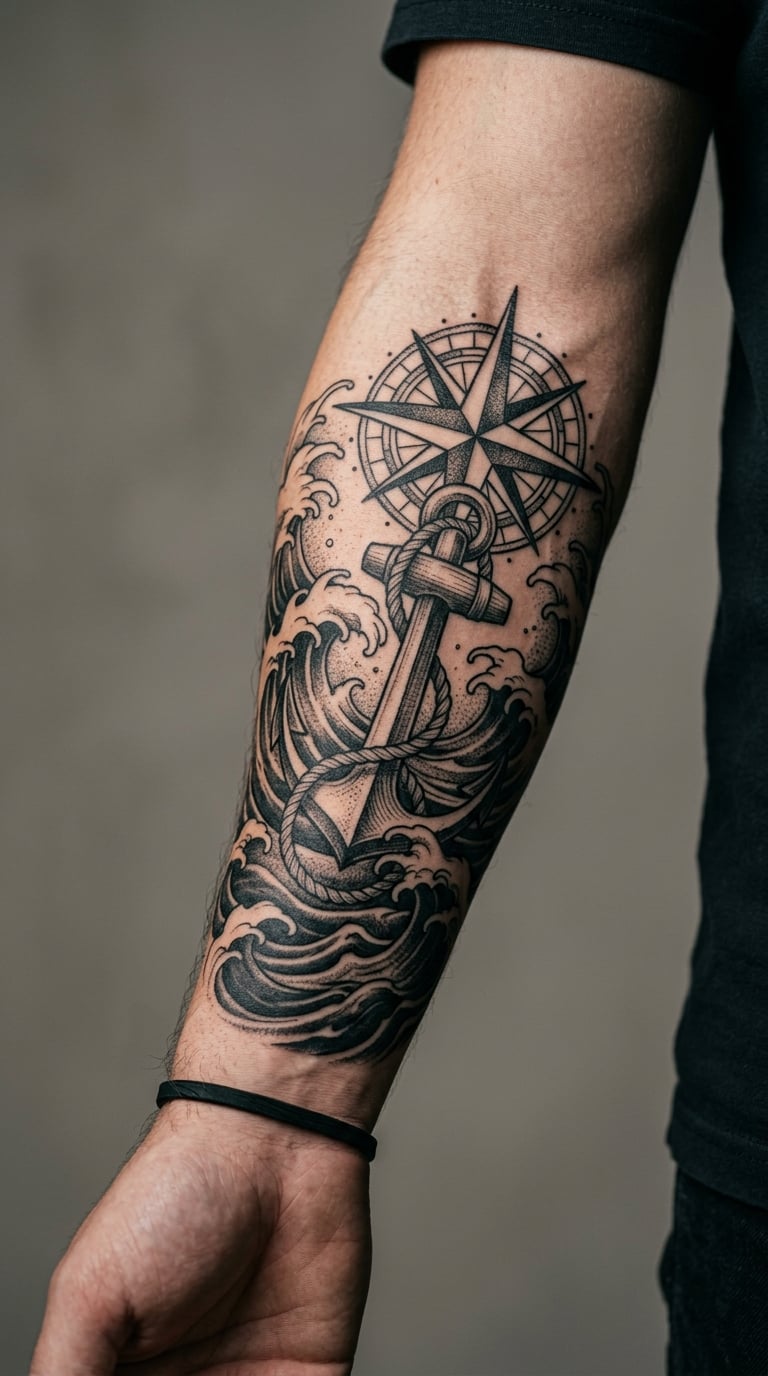
A fluked anchor rendered in shaded black sits in a band of rope, with a compass star and rolling wave lines filling the run of the forearm. The rope is drawn as a real twisted cord with alternating light and dark strands so it wraps believably around the forms.
Decide early whether this is symbolic, a service or a grounding image, or purely nautical, because that changes the whole composition. Navy and merchant crews often want ships, coordinates and dates rather than a decorative anchor.
Placement: Forearm wrap, anchor at the elbow end. Size: 12-18 in (30-46 cm). Style: Nautical blackwork with grey shading.
Pain: Medium, and rope texture is slow, repetitive work. Ageing: rope strands blur into a single line, so use rope where the viewer is not meant to count strands. Make it yours: put a real port, a voyage date or a set of coordinates on the compass star.
15. Lion Portrait Blackwork Sleeve
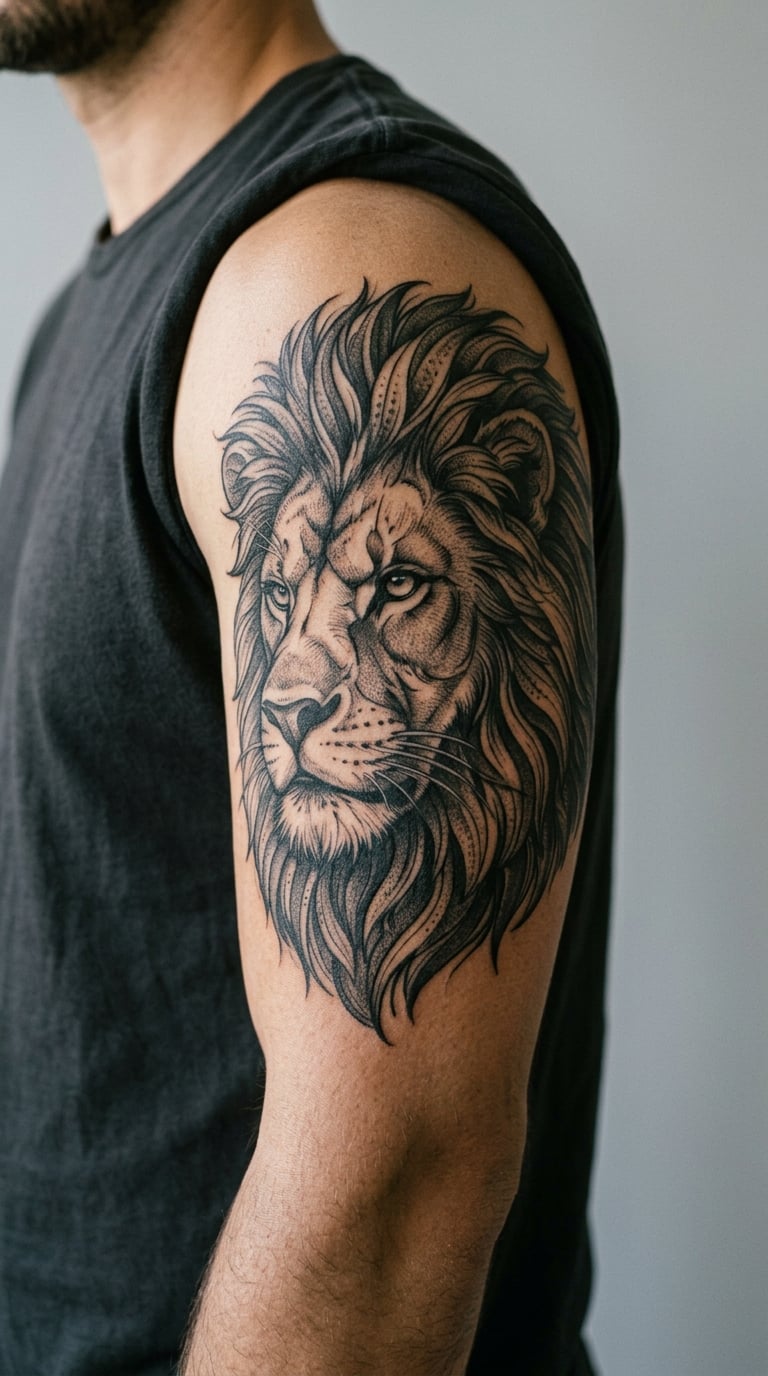
The mane is the whole piece: overlapping locks built in solid black and hard-edged grey groups radiating outward from a fully shaded face. The background is packed solid black, which makes the light in the eyes and muzzle read sharply.
Courage and leadership are the usual meanings, and a lion portrait is one of the few blackwork pieces that stays readable from a distance better than any floral or script sleeve.
Placement: Upper arm, mane spreading toward the shoulder. Size: 8-12 in (20-30 cm), and this one punishes anyone who goes smaller. Style: Black and grey realism on solid black.
Pain: Medium-high, long solid packing plus detailed face work. Ageing: solid background and solid mane both last; the risk is the face greying unevenly, so ask for strong black in the eye sockets. Make it yours: have the mane locks become filigree or geometric shapes near the edge of the arm, a nice change of texture as the design wraps.
16. Botanical Stippling Sleeve
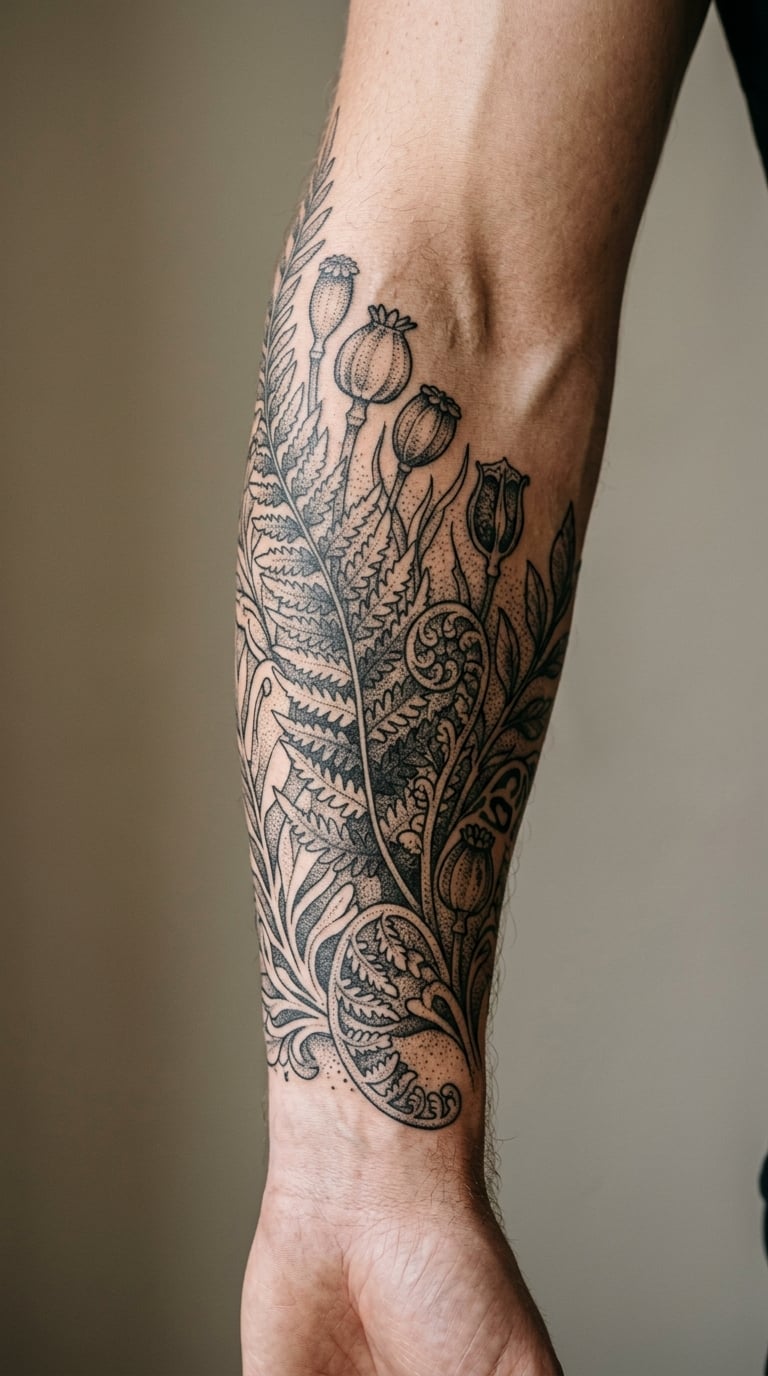
Fern fronds, seed pods and broad leaves are built entirely from dots, with density doing all the shading: tight clusters for shadow, single spaced dots for the lightest edges. The pattern starts light near the wrist and deepens toward the elbow.
Botanical black and grey sleeves get praised constantly for carrying meaning without colour, and dotwork is the quietest, most textural version of that. It also fills an arm without shouting.
Placement: Forearm, graduated from wrist to elbow. Size: 10-16 in (25-41 cm). Style: Dotwork stippling.
Pain: Medium and slow. Stippling is a long needle session, so budget breaks. Ageing: this is the design most likely to need a refresh, light dot areas turn to grey haze over time. Make it yours: ask for a specific fern or seed pod from a path you walk, a correct leaf shape is instantly recognisable to the people who know.
17. Maritime Storm and Lighthouse Sleeve
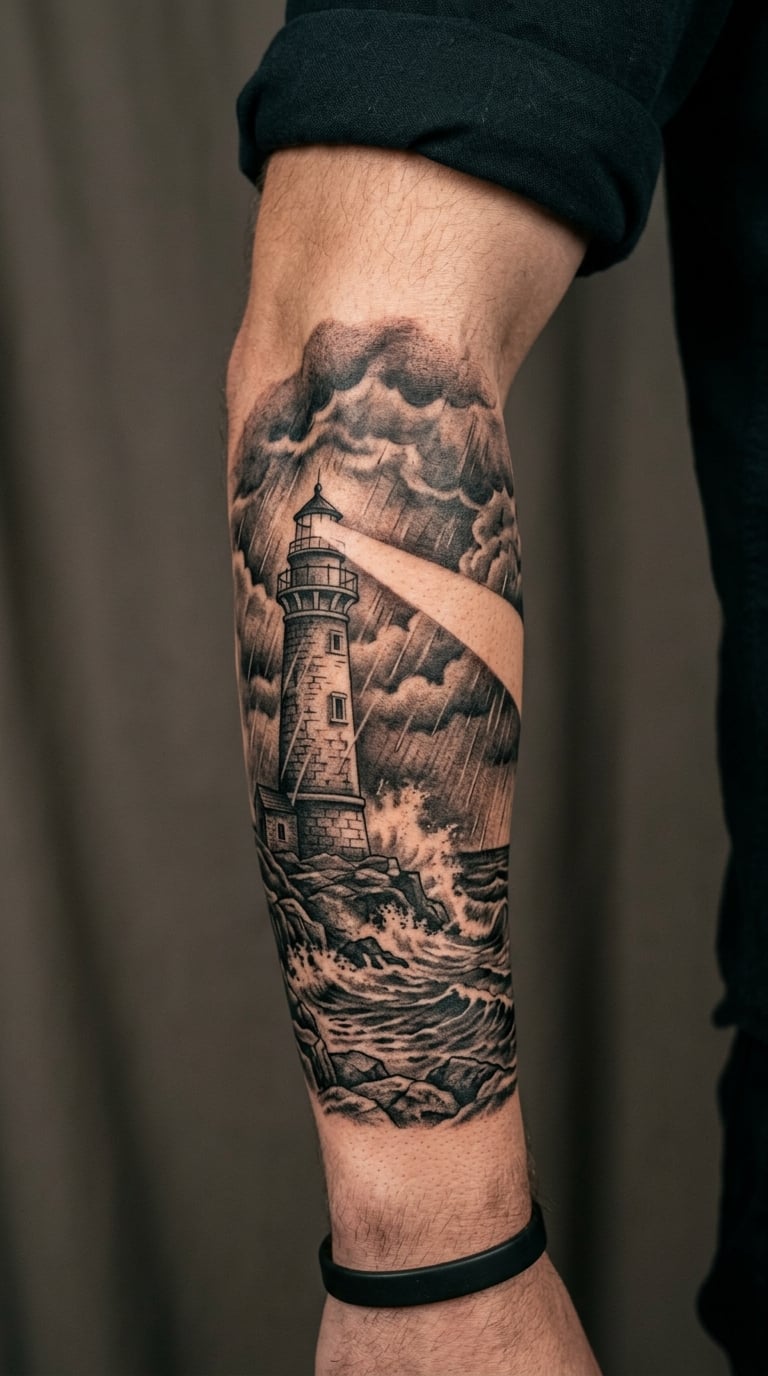
A lighthouse stands on a black rock outcrop with one clear beam cut as bare skin through layered grey cloud, and fine diagonal rain lines falling across the whole composition. Rough water is suggested with a few reserved white crests rather than shading every wave.
Coastal and seafaring memories drive most of these, and a specific lighthouse carries the meaning better than a generic tower. Guides and harbour crews often have a real one in mind.
Placement: Shoulder to elbow, beam angled down the arm. Size: 10-15 in (25-38 cm). Style: Black and grey realism with negative-space highlights.
Pain: Medium, the cloud wash takes time. Ageing: fine rain lines fade fastest here, so a good artist varies the line thickness and keeps the strongest rain nearest the focal point. Make it yours: name the lighthouse and the storm, an artist who knows the coastline will draw the actual silhouette.
18. Tribal-Style Armband Extension
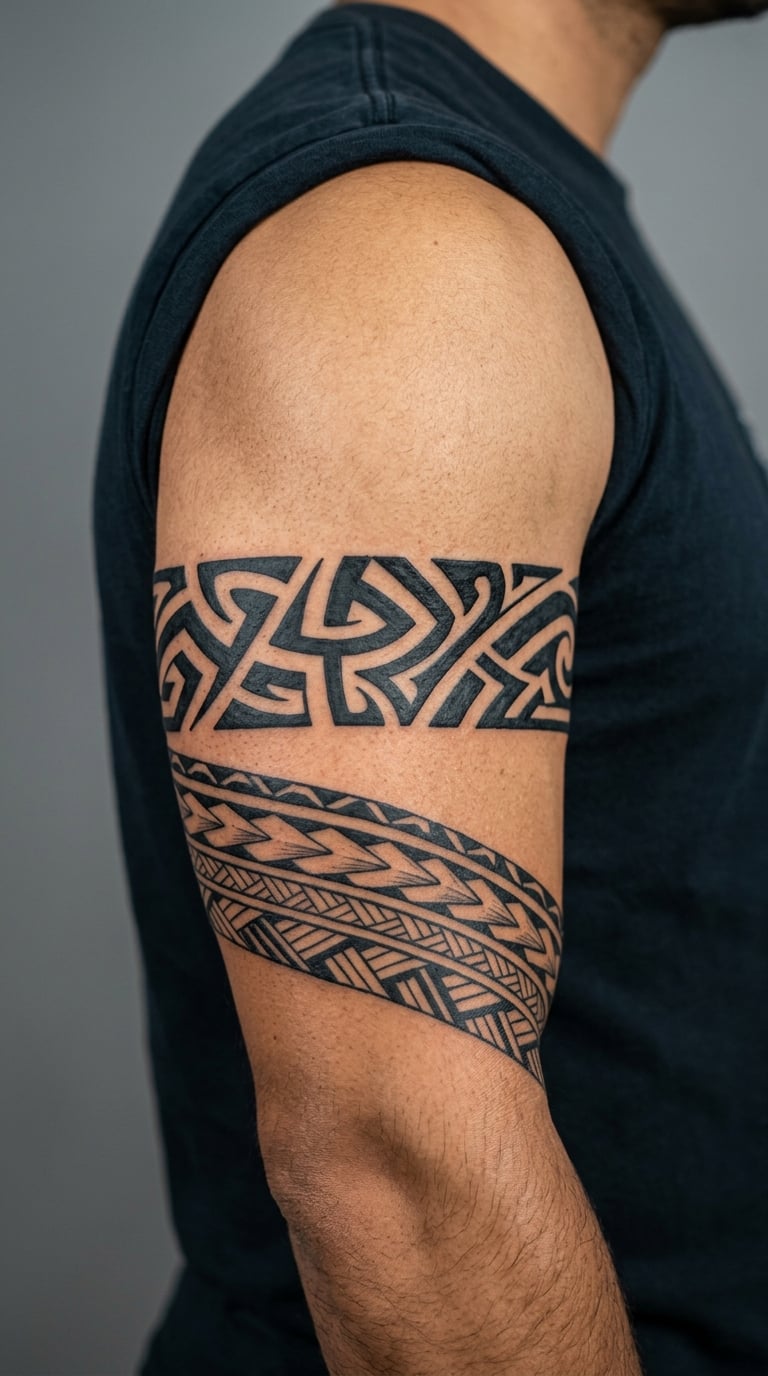
A wide armband of repeated black geometric forms sits above the elbow and tapers into narrower bands down the bicep, with negative space cutting the pattern into readable segments. It is a modern geometric look that borrows the weight and rhythm of older decorative work without copying a specific person’s pattern.
Older patterned traditions such as Polynesian, Samoan or Maori work carry real cultural weight, and those designs belong to those communities. Geometric bands like this are best described as contemporary armband work, not as a tribal crest.
Placement: Bicep, above the elbow. Size: 3-5 in (8-13 cm) wide, 8-10 in (20-25 cm) around the arm. Style: Tapered geometric blackwork.
Pain: Low to medium, this is the least demanding entry on the list. Ageing: solid bands hold very well and small internal gaps need a touch-up sooner. Make it yours: vary band width on purpose, a wide bicep band tapering to two narrow forearm bands looks more designed than three identical ones.
19. Blackwork Dragon and Mountain Sleeve
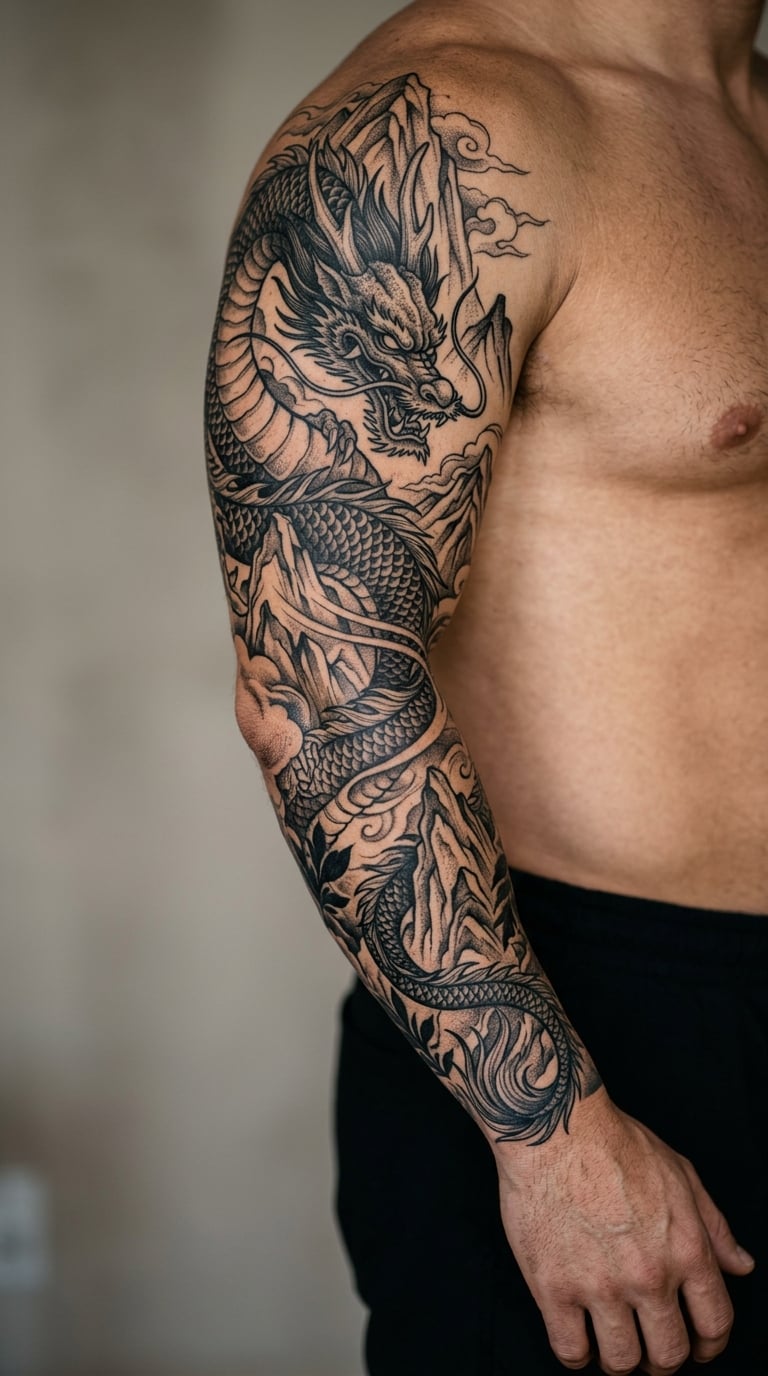
A serpentine dragon with a scaled body, clawed limbs and a long whiskered head winds between solid black mountain masses, with grey mist filling the valleys behind it. Line weight changes deliberately, thick for the body and thin for whiskers, claws and ridge spines.
Dragons usually get chosen for character rather than a single agreed meaning, protection and stubbornness come up a lot. Keep the design original, borrowed franchise designs are not yours to wear.
Placement: Full outer arm, head near the shoulder. Size: 18-22 in (46-56 cm). Style: Illustrative blackwork with grey mist.
Pain: Medium-high across the elbow and outer upper arm. Ageing: whisker and claw lines blur, so put the fine work near a large solid mass where it still reads. Make it yours: commission an original dragon drawn for your arm, and base the mountains on a range you know.
20. Gothic Skull with Rose Filigree Sleeve
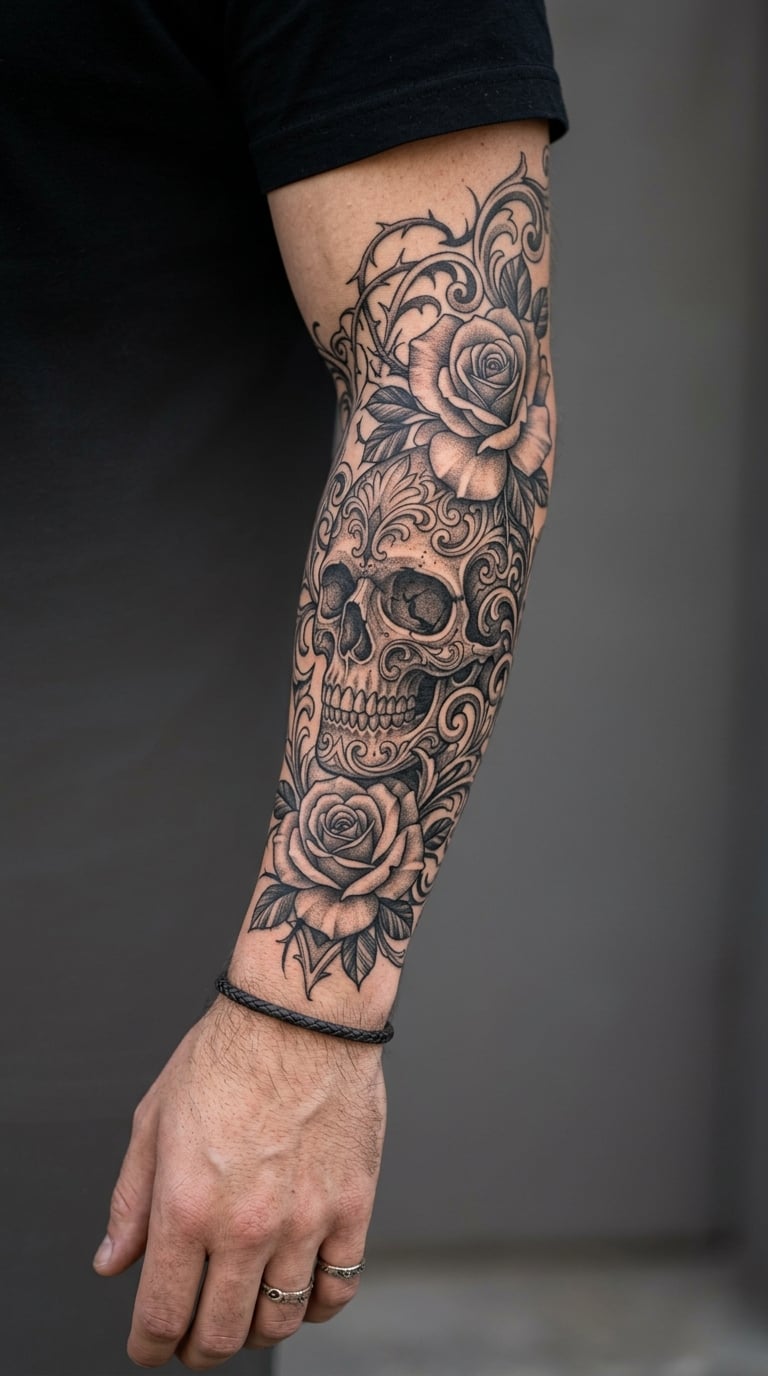
The skull is drawn without cartoon styling, using real bone structure, grey wash in the eye sockets and nasal cavity, and teeth separated by thin dark gaps. Roses wind through and under it, with fine filigree scrollwork filling the spaces the flowers leave.
Mortality is the plain reading, and people add what they want to it, a person, a date, a lost parent. A soft grey background behind the skull keeps it from looking harsh.
Placement: Forearm, or over the shoulder cap if the piece is large. Size: 9-14 in (23-36 cm). Style: Gothic black and grey with ornamental filigree.
Pain: Medium, mostly shading passes. Ageing: teeth and filigree are the weak points, so ask for slightly heavier lines there than the reference drawing shows. Make it yours: have a symbol of mortality that means something to you sit in the filigree, a moth, a key, a pocket watch.
How to Choose the Right Design
Which black sleeve tattoo ideas suit your arm?
Start at the placement and work backwards to the design, not the other way round. An idea that looks good flat on a screen often fails on a cylindrical arm, and the artist needs to know which zones you are willing to cover before anything is drawn.
- Match style to placement. Geometric and interlace work suits the flat outer forearm, portraits suit the rounded deltoid and bicep, and linework reads best where the arm is not sharply curved.
- Pick forearm or upper arm, not both. A full outer arm and a shoulder cap are different projects with different flow. Decide which reading you want before the consultation.
- Check the size against the detail. A raven, a lion and a dragon all need 8 in (20 cm) or more to keep their detail. Below that, choose bolder shapes and fewer of them.
- Look for contrast and negative space. A solid arm reads as one flat shape from a distance. Open skin between elements is what keeps a black sleeve looking designed instead of blobby.
- Account for tattoos you already have. Grey wash and black line can be worked over older, faded colour. Dense solid black over an old dense piece usually cannot.
- View healed work, not fresh posts. Ask to see a full sleeve from the same artist after two years of healing and sun. Fresh Instagram work tells you very little.
If flowers are the direction you keep coming back to, the botanical tattoo sleeve ideas list goes deeper on leaves, stems and dotwork shading than this page does.
Cost and Session Time
A full black sleeve is one of the larger projects in tattooing, and it is usually priced per hour or per session rather than as a single flat fee. Black and grey work with lots of grey wash runs longer and costs more than clean linework, and fully solid blackout areas are slower again because the ink has to be layered to reach opacity.
| Project | Typical size | Sessions | Typical US range |
|---|---|---|---|
| Single motif, no sleeve | under 3 in (under 8 cm) | 1 | 150-400 US dollars |
| Forearm piece | 6-10 in (15-25 cm) | 1-2 | 500-1,500 US dollars |
| Half sleeve, shoulder to elbow | 10-15 in (25-38 cm) | 2-3 | 1,200-3,000 US dollars |
| Full sleeve, shoulder to wrist | 18-22 in (46-56 cm) | 3-5 | 2,500-6,000+ US dollars |
Hourly rates for blackwork artists commonly run 150-350 US dollars depending on the city and the artist, and many shops set a minimum charge per session that a short appointment will not cover. Sessions on the same arm are usually spaced three to six months apart, so a full sleeve is a project you plan across a year rather than a single appointment. Ask for a written total before the first sitting, and confirm whether touch-ups are included.
Aftercare Basics
- Follow your artist’s aftercare instructions first. They know what they did in your skin, and their advice overrides anything generic.
- Wash gently, twice or three times a day. Lukewarm water and unscented soap, then pat the area dry with a clean towel or paper.
- Moisturise thinly. A light layer of a tattoo-safe ointment or unscented lotion, applied clean-handed. Thick layers trap heat and slow things down.
- Wear loose clothing for the first days. Tight cuffs and straps rub a fresh sleeve, and a sleeve that crosses the elbow crease is especially easy to irritate.
- Keep it out of the sun and out of the water. No swimming, hot tubs or saunas while the area is healing, and cover the arm for weeks afterwards. UV is what fades black ink fastest.
- Contact the artist or a qualified clinician if something changes. Spreading redness, increasing heat, swelling, pus, a bad smell or a fever are all reasons to ask for medical advice rather than waiting it out.
Frequently Asked Questions
Are full black sleeve tattoos more painful than colored sleeves?
Colour makes very little difference to how much a tattoo hurts. What changes the pain level is placement, needle depth, session length and how hydrated and rested you are. Solid black packing across a large area is sustained work, so it feels like endurance rather than sharpness. The elbow crease and inner forearm rate highest on most arm-zone charts.
How many sessions does a black sleeve tattoo need?
A full sleeve usually takes three to five sessions, and solid blackout coverage can take more because opacity is built up in layers. Half sleeves tend to take two or three. Artists generally space sessions on the same arm three to six months apart so the skin can recover, which makes a full sleeve a project spread across most of a year.
Should a black sleeve tattoo include any color?
It does not need any. That is the point of a black sleeve, and monochrome work has a real advantage because there are no colour-fade decisions to make. A single small accent can help one element pop against grey wash, but if the design already has strong black and grey contrast, adding colour usually weakens the graphic quality.
Which arm is better for a large black sleeve tattoo?
Whichever one you are less self-conscious about, and whichever side you sleep on tells you more than any rule. The outer forearm and shoulder read most boldly and hide under a short sleeve more easily than the inner arm. Compare both arms in a mirror, pick the one you want people to see, and design for that side rather than copying a reference from the other.
Will fine black details on a sleeve fade over time?
Yes, at different rates. Thick solid black and heavy outlines hold for decades, while hairline strands, tiny stipple dots and soft grey gradients soften first. Ask your artist to build detail in grouped shapes with strong contrast rather than single fine lines, and plan one or two touch-ups over the first few years. Sunscreen on the arm matters more than anything else you can do afterwards.
Bottom Line
For a first large piece, these black sleeve tattoo ideas are the safest bets: the rose wrap, or the traditional compass and laurel composition. Both use bold outlines, need less grey shading than the realistic options, and forgive the small planning mistakes a first project usually has.
If you already have tattoos and you know what you like, go harder. A dragon, a lion or a gothic skull gives you something with real weight on the arm, and getting the size and the flow right matters far more than the motif. Either way, find healed work from the artist, agree the full session plan before the first sitting, and bring the sizes on this page to the consultation.
Want the opposite take on colour and placement? The sleeve tattoo ideas women love list shows how a black sleeve reads next to something softer.