
20 Microphone Tattoo Ideas: Best October 2026 Designs
If you have spent any time near a stage, a recording booth or a podcast desk, the microphone already means something to you. That is why 20 microphone tattoo ideas keep circulating. The motif reads instantly, survives being scaled down to something tiny, and holds a personal story without spelling it out for everyone else who sees it.
What makes a good mic design on skin is simple. The body of a microphone has a lot of small detail, grille mesh, switches, stands. Artists who know this work simplify it, keep the silhouette, and let one element carry the meaning. The 20 designs below are written the way I would brief an artist: what the linework looks like, where it sits, how big it works, and how much it will hurt. Pick one, or use them as a starting point and build your own.
20 Microphone Tattoo Ideas: Quick Guide
| Idea | Style | Best placement | Size | Pain |
|---|---|---|---|---|
| 1. Fine-line vintage studio mic | Fine line, black and grey | Inner forearm | 2 in (5 cm) | Low |
| 2. Retro ribbon mic in red | Traditional, red and black | Outer upper arm | 2.5 in (6 cm) | Medium |
| 3. Minimal handheld outline | Minimalist line art | Wrist, inner arm | 1.5 in (4 cm) | Low |
| 4. Dynamic mic in blackwork | Bold blackwork | Outer forearm, calf | 3 in (8 cm) | Medium |
| 5. Ornate condenser mic | Neo-traditional | Upper arm, chest | 3 in (8 cm) | Medium |
| 6. Mic wrapped in a sound ribbon | Black and grey illustrative | Forearm, diagonal | 2.75 in (7 cm) | Medium |
| 7. Watercolor singing mic | Watercolor | Shoulder, calf | 2.25 in (6 cm) | Low to medium |
| 8. Mic built from musical notes | Fine line, dotwork | Inner arm, rib | 2 in (5 cm) | Low |
| 9. Matching mic pair | Mixed line and solid | Both inner forearms | 1.25 in (3 cm) each | Low |
| 10. Mic inside headphones | Continuous fine line | Outer forearm, upper back | 2.5 in (6 cm) | Low to medium |
| 11. Forearm soundwave mic | Blackwork and line | Forearm, horizontal | 5 in (13 cm) | Medium |
| 12. Mic with a floral grille | Micro-realism, botanical | Upper arm, thigh | 2.5 in (6 cm) | Medium |
| 13. Gold mic, blackwork shadows | Colour and blackwork | Chest, shoulder, forearm | 2.75 in (7 cm) | Medium |
| 14. Mic with equalizer bars | Flat graphic | Wrist, inner forearm | 2 in (5 cm) | Low |
| 15. Mic made of sheet music | Fine line notation | Inner arm, rib | 2.5 in (6 cm) | Low to medium |
| 16. Karaoke mic with two notes | Playful fine line | Outer wrist | 1.5 in (4 cm) | Low |
| 17. Vintage broadcast badge | Traditional, muted red | Upper arm, chest | 3 in (8 cm) | Medium |
| 18. Mic from an open sound case | Black and grey graphic | Forearm, calf | 2.75 in (7 cm) | Medium |
| 19. Geometric mic from triangles | Geometric blackwork | Forearm, calf, upper arm | 2.5 in (6 cm) | Medium |
| 20. Mic with a handwritten phrase | Fine line plus text | Inner forearm, rib | 3 in (8 cm) | Low to medium |
1. Fine-Line Vintage Studio Microphone
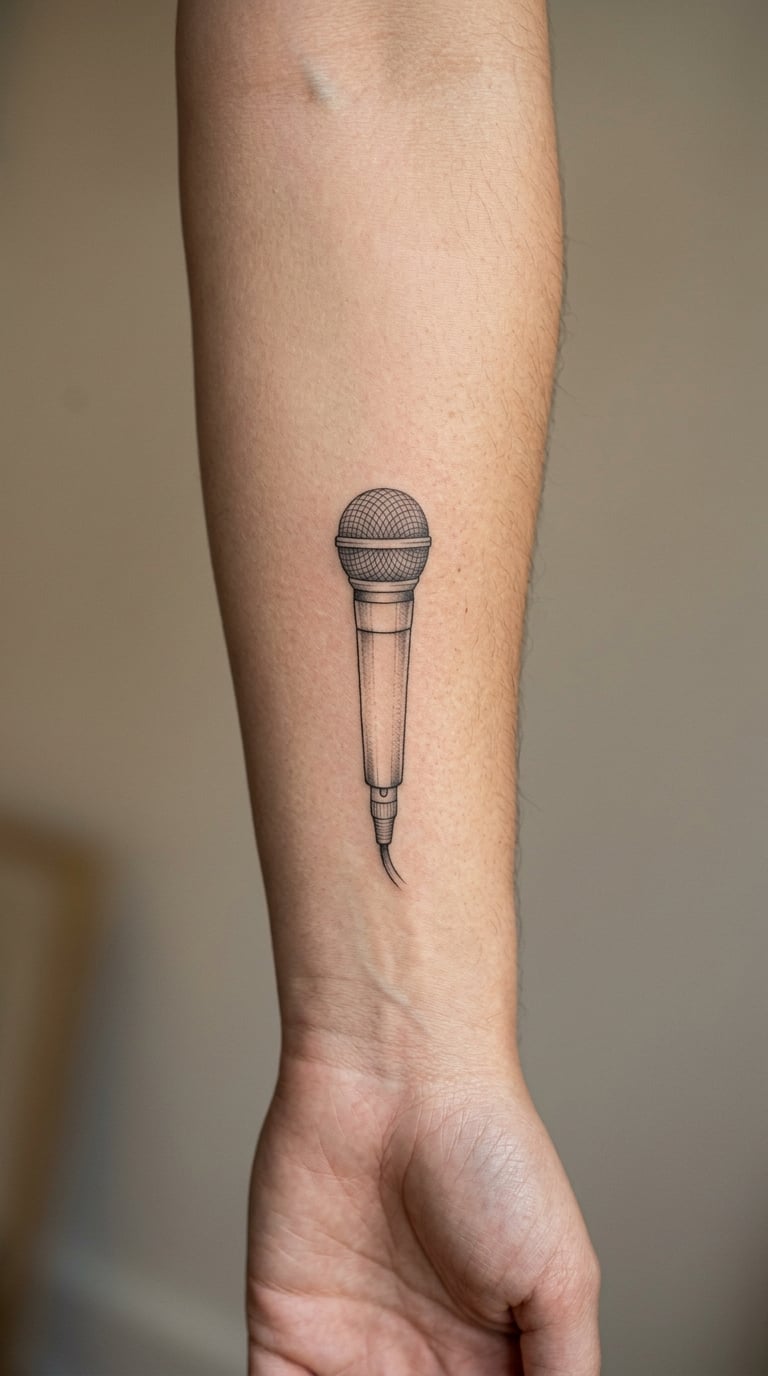
A fine-line vintage studio microphone is drawn as an open outline: the rounded head, the yoke, a short stand, and just enough grey shading under the body to give it weight. Nothing is filled solid, so the piece stays airy. That restraint is exactly what makes it age well, because there is no large black area to soften into a blob over the years.
People choose this one because it points at recording culture rather than a single stage moment. A vocalist, an engineer or anyone who spends time in a booth recognises it instantly.
Placement: inner forearm, wrist, or the soft area below the collarbone. Size: 2 inches (5 cm) tall works, 3 inches (8 cm) if you want the stand to breathe. Style: fine line with light black and grey shading. Pain: low on the inner arm, and fine lines soften over time, so keep the grille lines simple. Make it yours: add a small band initial on the stand base.
2. Retro Ribbon Microphone in Red Ink
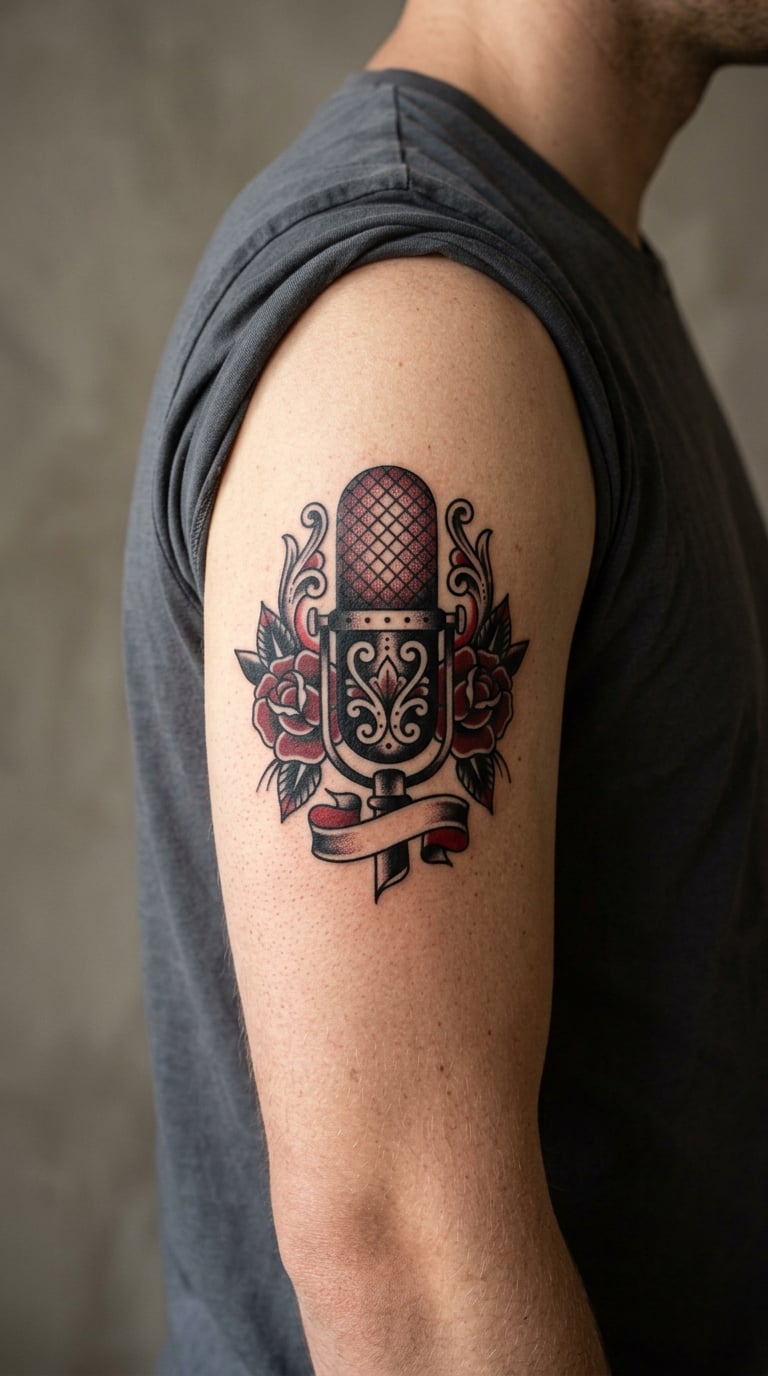
A retro ribbon microphone in red ink is the old chrome-style stage mic, drawn with a heavy black outline and a flat red fill inside the grille ribs. Traditional shading stays minimal, usually a darker red at the bottom of the head. It is the loudest-looking mic on this list without going full blackwork.
It reads as performance and creative work, and it is a good pick if you want a tattoo that is visible in a short sleeve but not enormous.
Placement: outer upper arm, collarbone, or the top of the shoulder where there is flat space. Size: 2.5 inches (6 cm) is the sweet spot. Style: traditional, red and black. Pain: medium, and the flat colour patches take some patience. Make it yours: change the red to a deeper oxblood, or tuck a small initial into the yoke.
3. Minimal Handheld Microphone Outline
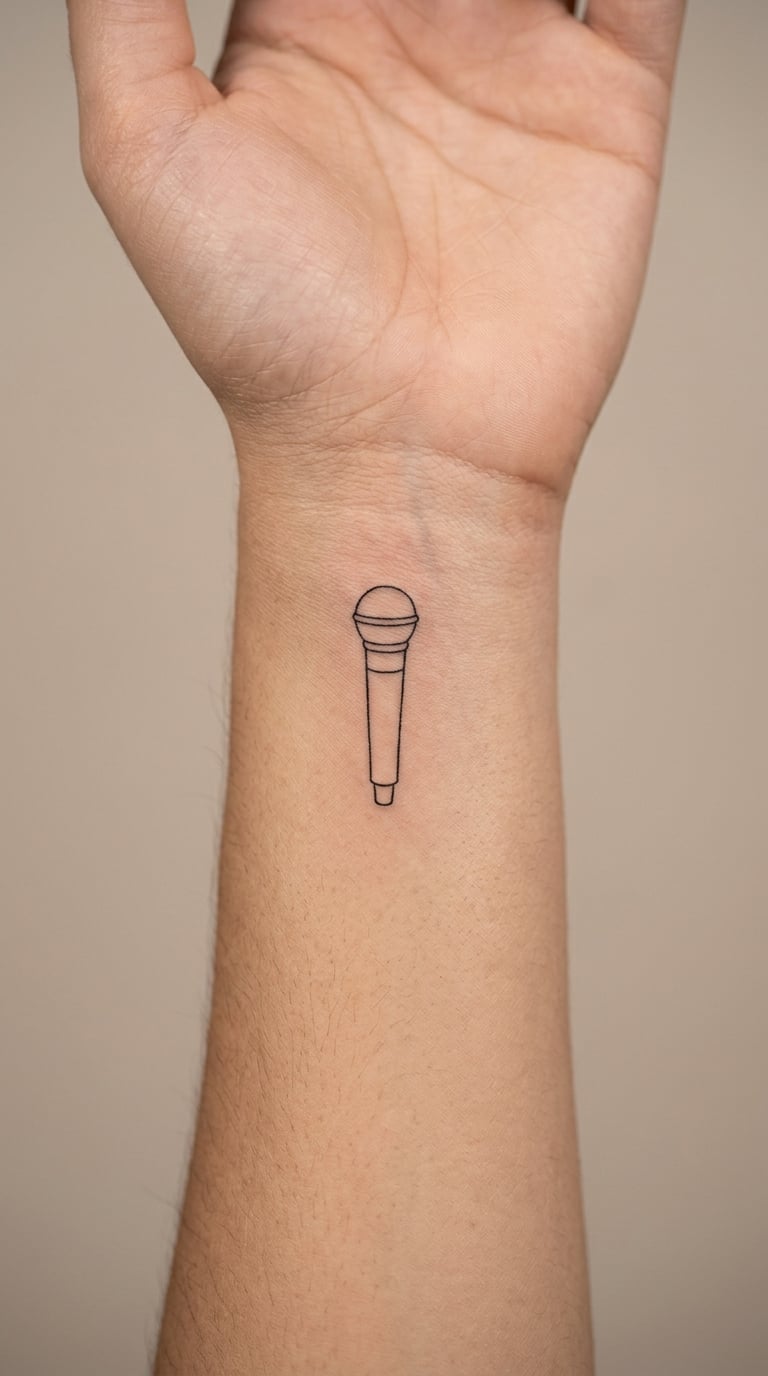
The minimal handheld microphone outline is a single unpainted silhouette: tapered handle, narrow neck, rounded grille, one continuous line. No stand, no shadow, no extra marks. It is the design I point at first when someone says they want a small mic tattoo and is nervous about getting something busy.
A plain mic can look generic, so most people add one small detail. That is usually enough.
Placement: wrist, inner forearm, behind the ear, or the hand. Size: 1.5 inches (4 cm) tall, and it stays legible well below that. Style: minimalist line art. Pain: low, one of the quicker pieces to sit through. Make it yours: draw two or three tiny grille lines, or leave the grille as a plain circle for a graphic look.
4. Dynamic Microphone With Bold Blackwork
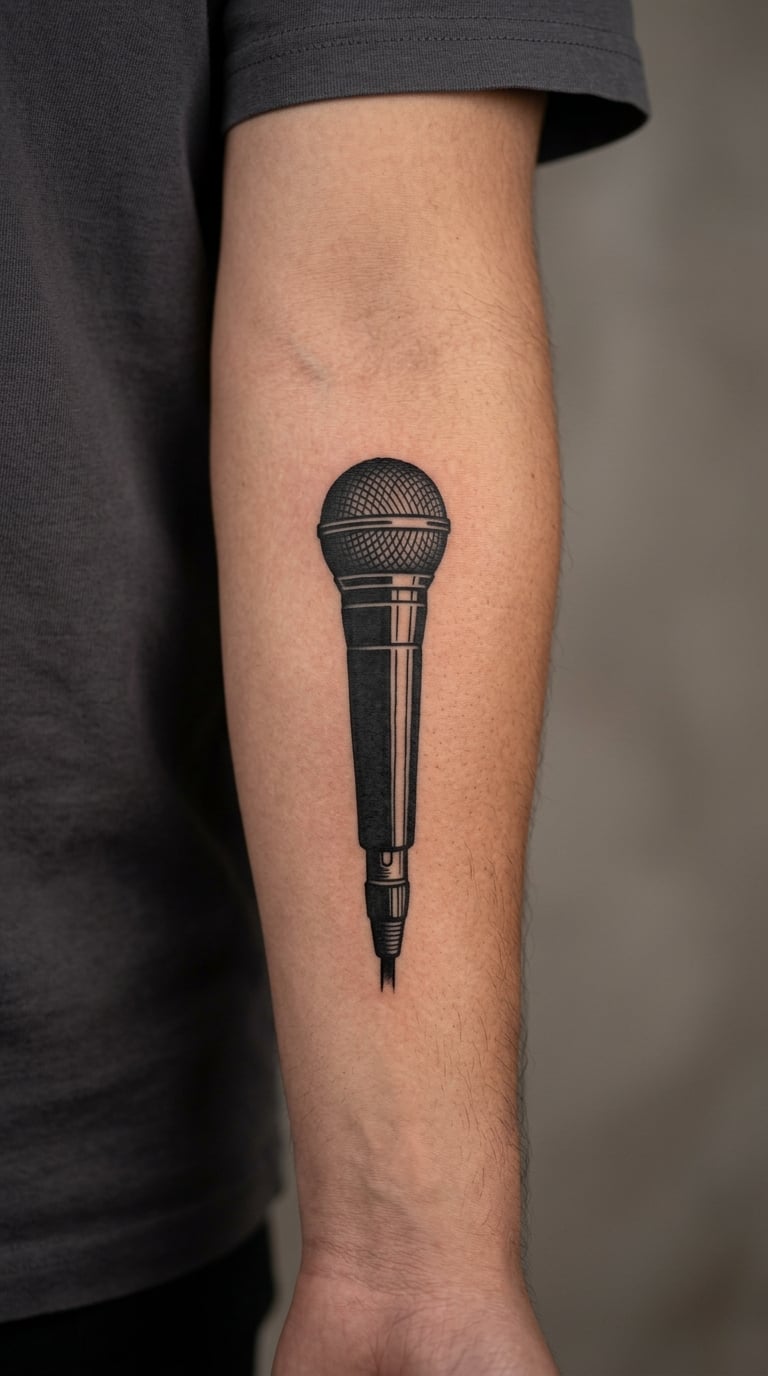
A dynamic microphone in bold blackwork is solid fill, no gradient. The body is a black mass, the grille openings are carved out with clean white lines, and the stand is a thick straight block. Done well, it looks like a poster from the era of heavy touring.
It is a loud, graphic design, and the people who pick it usually want something that reads from across a room.
Placement: outer forearm, calf, or the back of the upper arm. Size: 3 inches (8 cm) or larger, because the shape needs room to breathe. Style: blackwork. Pain: medium, more on the calf than the arm. Solid fills stay sharp for years if the shapes are broad. Make it yours: angle the stand, or wrap a plain cable line around the base.
5. Condenser Microphone With Ornate Frame
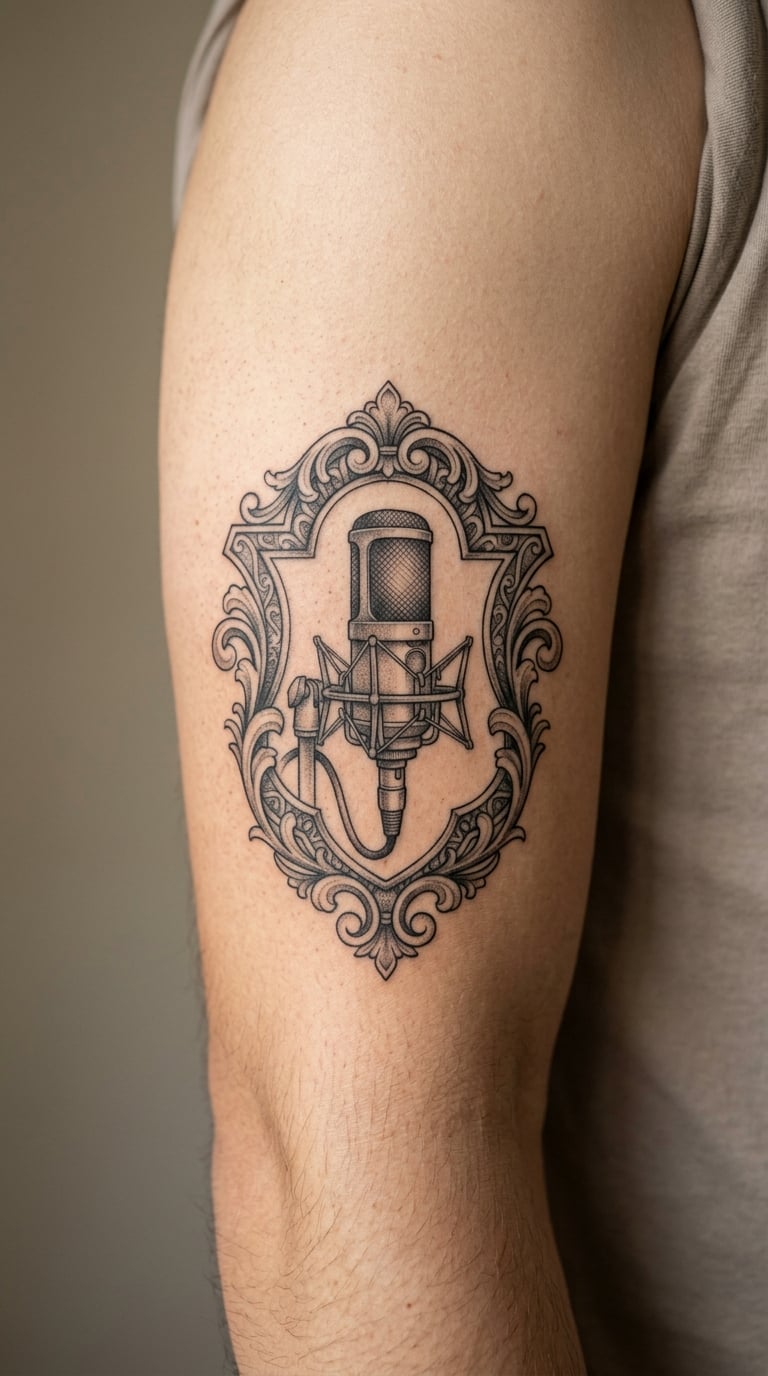
A condenser microphone with an ornate frame puts a large-diaphragm studio mic at the centre of a thin decorative border: scrollwork, a few small leaves, maybe a tight line of hatching behind the body. The ornament stays restrained, so the mic is still the subject and not one object in a crowded scene.
This is the studio version of the motif, and it suits people who work in or simply love recording spaces.
Placement: outer upper arm, chest, or the upper back. Size: 3 inches (8 cm) to give the frame room. Style: neo-traditional or illustrative black and grey. Pain: medium over a large area, lower if it is on the upper arm. Make it yours: put your studio name or a city inside the border at the base.
6. Microphone Wrapped in a Sound Ribbon
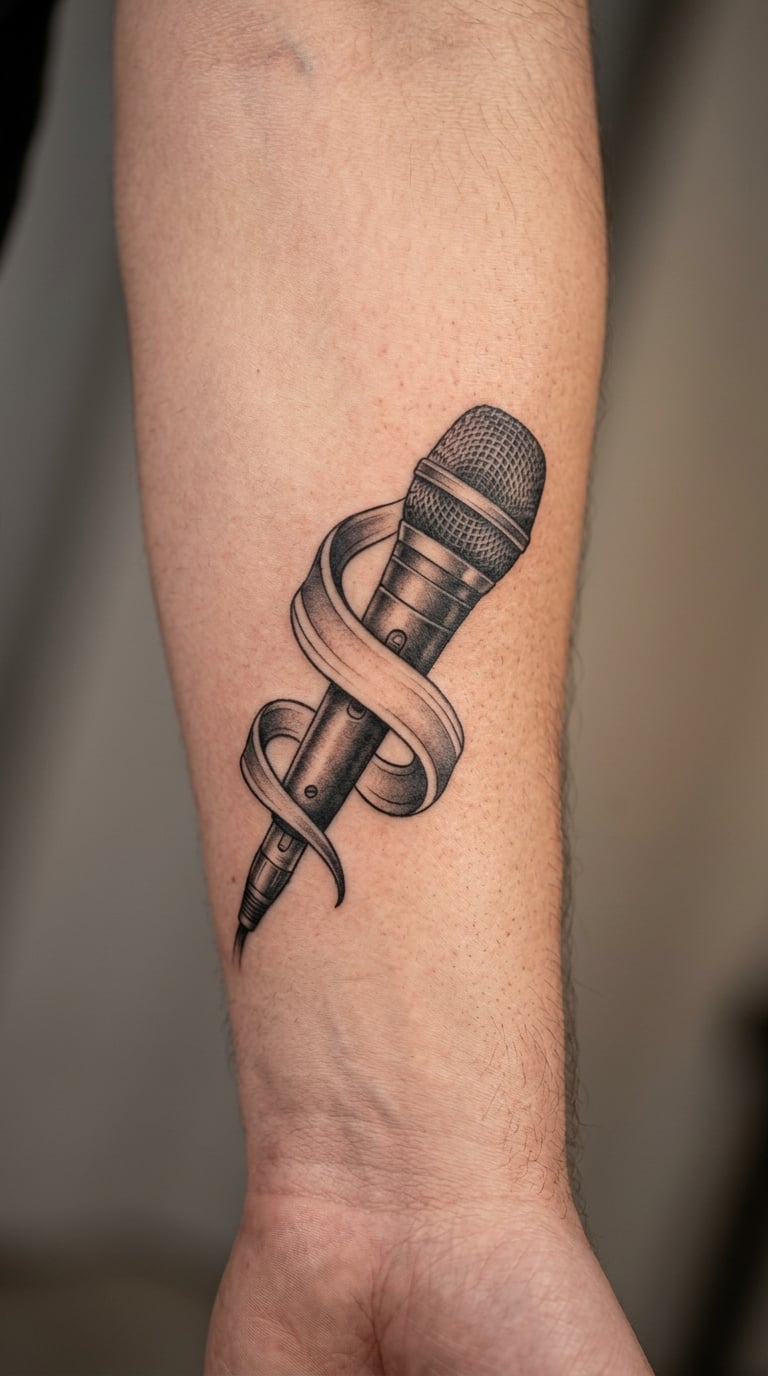
A microphone wrapped in a sound ribbon is drawn with one broad band of ink that loops around the body and trails off as two tapered ends, the way an audio wave rises and falls. The mic itself stays clean and black, and the ribbon is where the movement comes from. It is one continuous gesture rather than a still life.
The ribbon suggests motion and expression without copying any logo, which is what people like about it. Designers on forums keep warning against lifting band marks, and a wave or ribbon gives you the same energy without the trouble.
Placement: forearm, running diagonally so the ribbon follows the muscle. Size: 2.75 inches (7 cm) across. Style: black and grey illustrative. Pain: medium, the long ribbon line takes time. Make it yours: run the ribbon in deep blue or gold instead of black.
7. Watercolor Singing Microphone
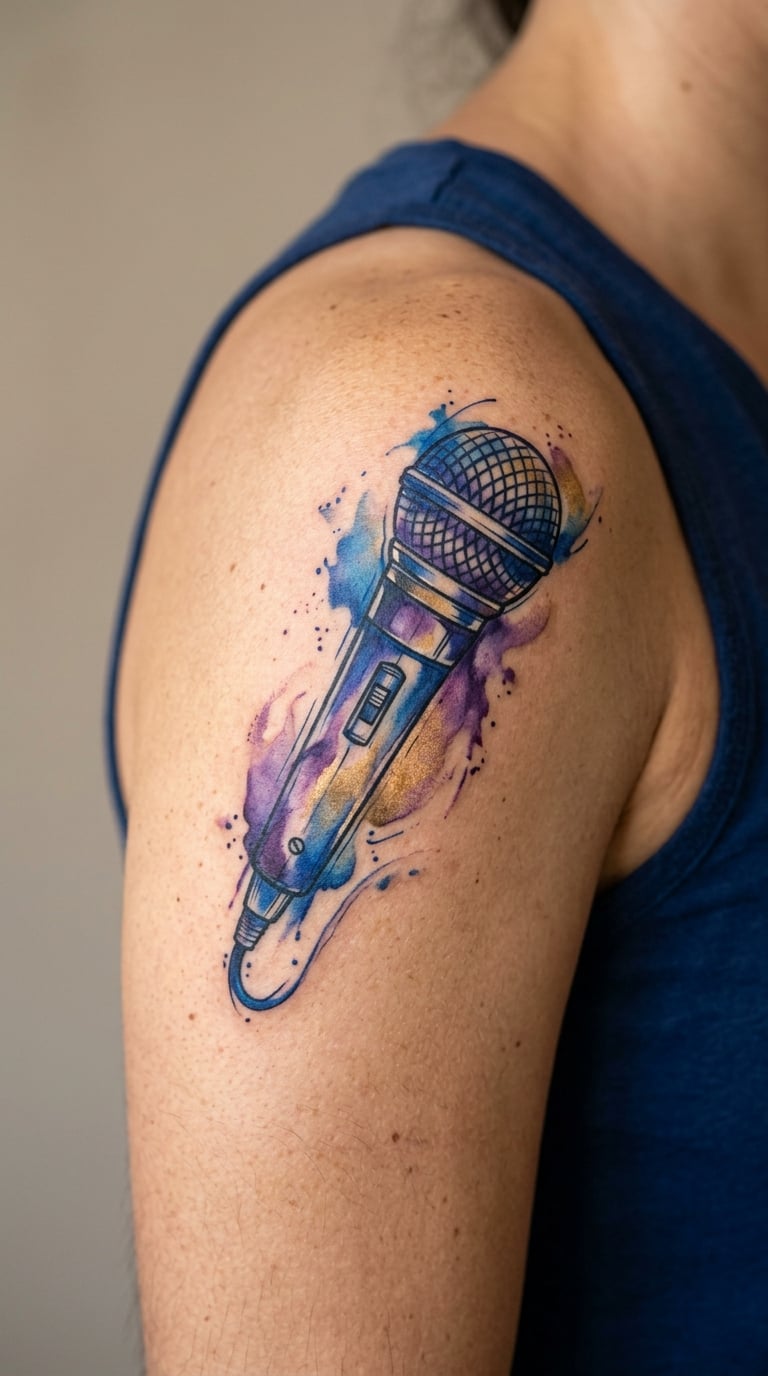
A watercolor singing microphone keeps a loose black line drawing of a handheld mic, then lets the ink bleed outwards in soft blue, violet and gold washes. Colour pools around the grille and fades into nothing, so the piece has soft edges instead of a hard outline. Nothing about it is geometric.
It suits expressive, less formal music tattoos, and it is a forgiving style because the artist is painting rather than filling.
Placement: shoulder, calf, upper arm, anywhere with a soft edge to fade into. Size: 2.25 inches (6 cm) works, and larger washes need more space. Style: watercolor. Pain: low to medium, most of it is surface work. Make it yours: pick colours from a song you love, or use the colours of your favourite album sleeve.
8. Microphone Formed From Musical Notes
A microphone formed from musical notes is built instead of drawn. The grille is a scatter of eighth notes, dots and short curved marks, and the handle is a clean solid line. The stand, if there is one, stays completely plain so the eye still reads a microphone first and a musical joke second.
It is the playful option, and it tends to be chosen by songwriters and session players rather than anyone chasing a solemn look.
Placement: inner arm, rib, or the inside of a wrist. Size: 2 inches (5 cm) or the note detail will close up. Style: fine line and light dotwork. Pain: low, though many separate small marks take more time than one bold line. Make it yours: use the first three notes of a song that means something to you.
9. Matching Microphone Pair for Couples
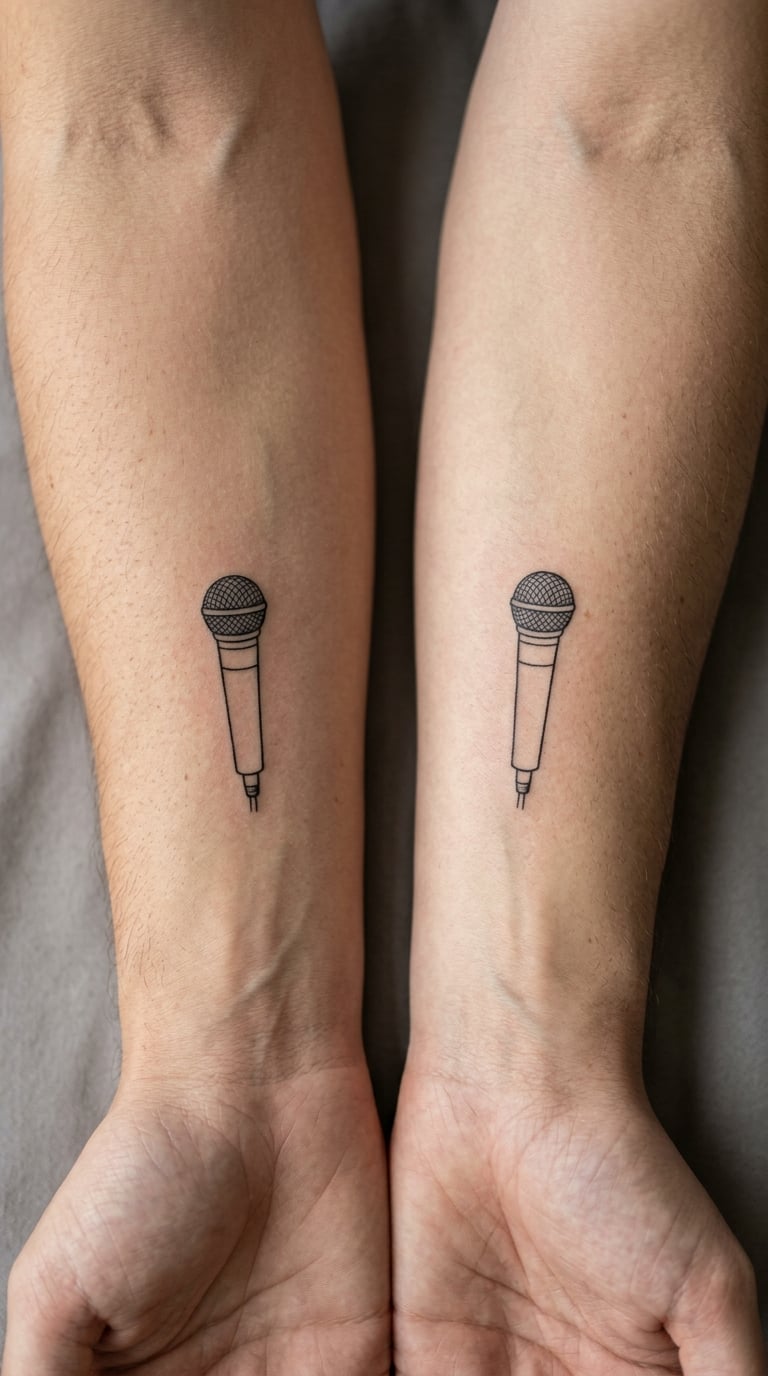
A matching microphone pair is two simplified handheld mics that answer each other. One is drawn in clean outline, the other is filled solid black, so they clearly belong together without being identical copies. The contrast also means each person wears a slightly different piece.
The meaning comes from the pair itself, whatever the two of you decide it stands for. That is usually the point of a matching design. If you are working with a larger group rather than two people, our guide to matching tattoo ideas for a group of five covers how artists keep several small motifs visually consistent instead of looking like unrelated stamps.
Placement: opposite inner arms, or matching collarbones. Size: 1.25 inches (3 cm) each. Style: minimalist line art with one solid piece. Pain: low, and the outline version can be done in one pass. Make it yours: add a small shared detail, such as a date on one wrist and a single initial on the other, and plan any future additions together. If a date is the detail you land on, the 20 best anniversary tattoo ideas for couples cover sensible sizing for lettering that has to stay readable.
10. Microphone Inside a Headphone Outline
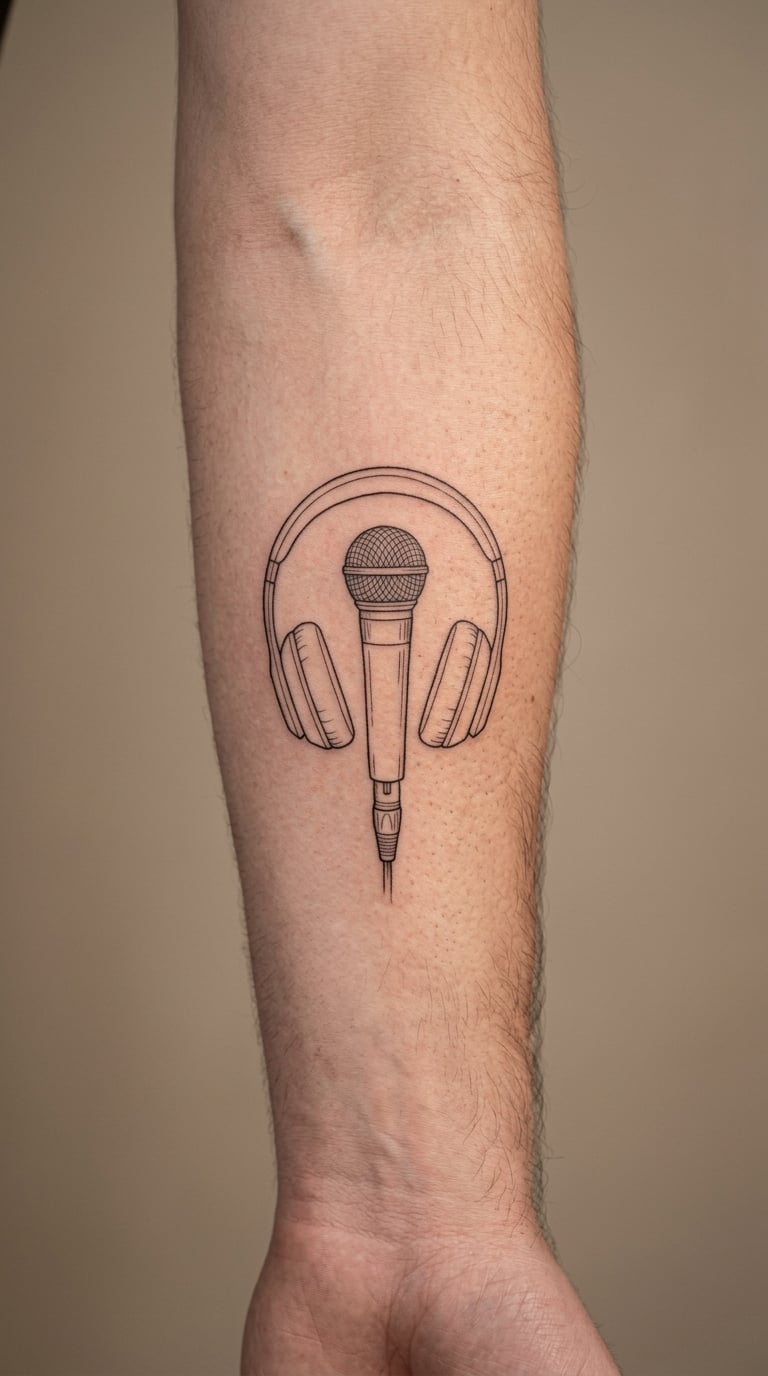
A microphone inside a headphone outline nests a simple handheld mic within a pair of large over-ear headphones. The headband arcs around the top and the ear cups close at the sides, all in one continuous thin line, with no brand marks anywhere. It is a listening tattoo as much as a recording one.
It covers a broad audience, from people who make audio to people who just have headphones on most of the day.
Placement: outer forearm, upper back, or the back of the shoulder. Size: 2.5 inches (6 cm) so the headphone shape stays recognisable. Style: continuous fine line. Pain: low to medium, depending on the site. Make it yours: have the cable end in a small plug shape or a single coil at the base.
11. Microphone Soundwave Across the Forearm
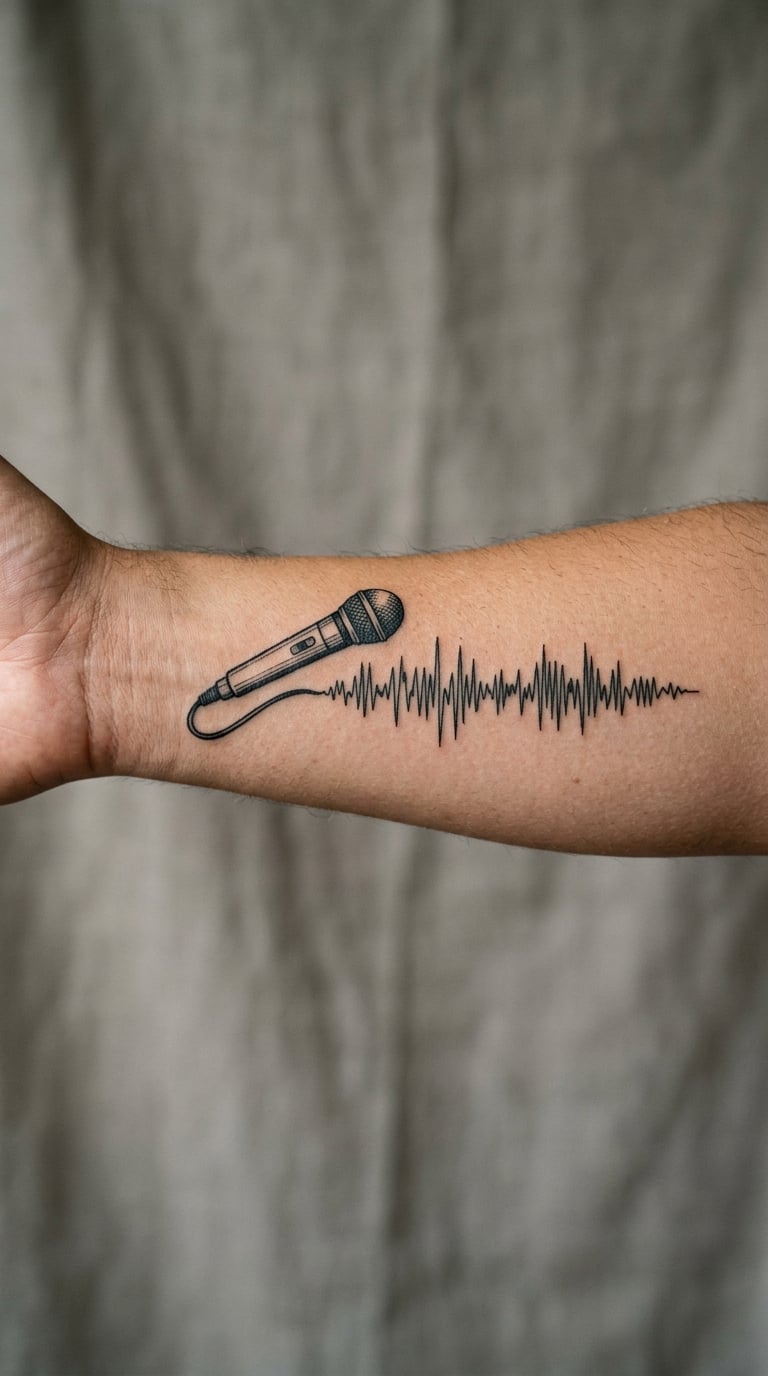
A microphone soundwave runs a solid mic at one end and a real waveform at the other, the peaks and dips taken from an actual recording. The wave is a single line that gets taller and shorter along the arm, which is what makes it recognisable. This is the most personal design on the list and the least forgiving of bad planning.
Only use audio you have permission to convert, and expect the artist to redraw the wave rather than trace a phone screen. A hand-tuned line ages far better than a pasted image.
Placement: forearm, laid horizontally. Size: 5 inches (13 cm) is realistic for a readable wave. Style: blackwork mic with a clean line wave. Pain: medium, it is a long session. Make it yours: add a short date or two initials under the mic at the starting point of the wave.
12. Microphone With Floral Grille
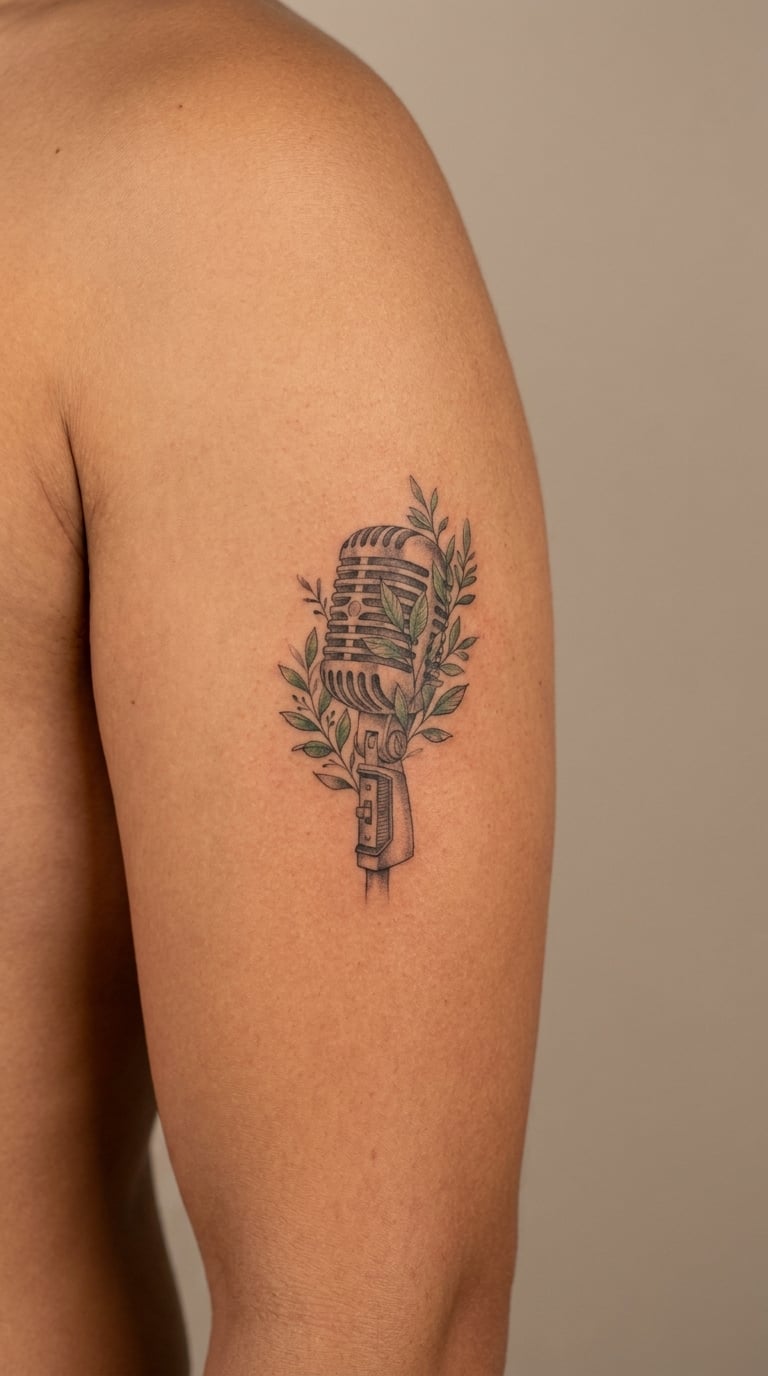
A microphone with a floral grille is drawn realistically, with a proper mesh surface and metal body, then framed by small leaves or flowers curling around the head rather than laid on top of it. The contrast between the hard metal and the soft botanicals is the whole point of the design.
It suits people who want a music tattoo that does not look like a music tattoo, because the flowers pull the eye first.
Placement: upper arm, thigh, or the back of the shoulder. Size: 2.5 inches (6 cm) minimum for the mesh to survive healing. Style: micro-realism with botanical line work. Pain: medium, and micro-realism shading takes patience. Make it yours: choose a plant that already means something, then keep the leaves to three or four so the mic stays readable.
13. Gold Microphone With Blackwork Shadows
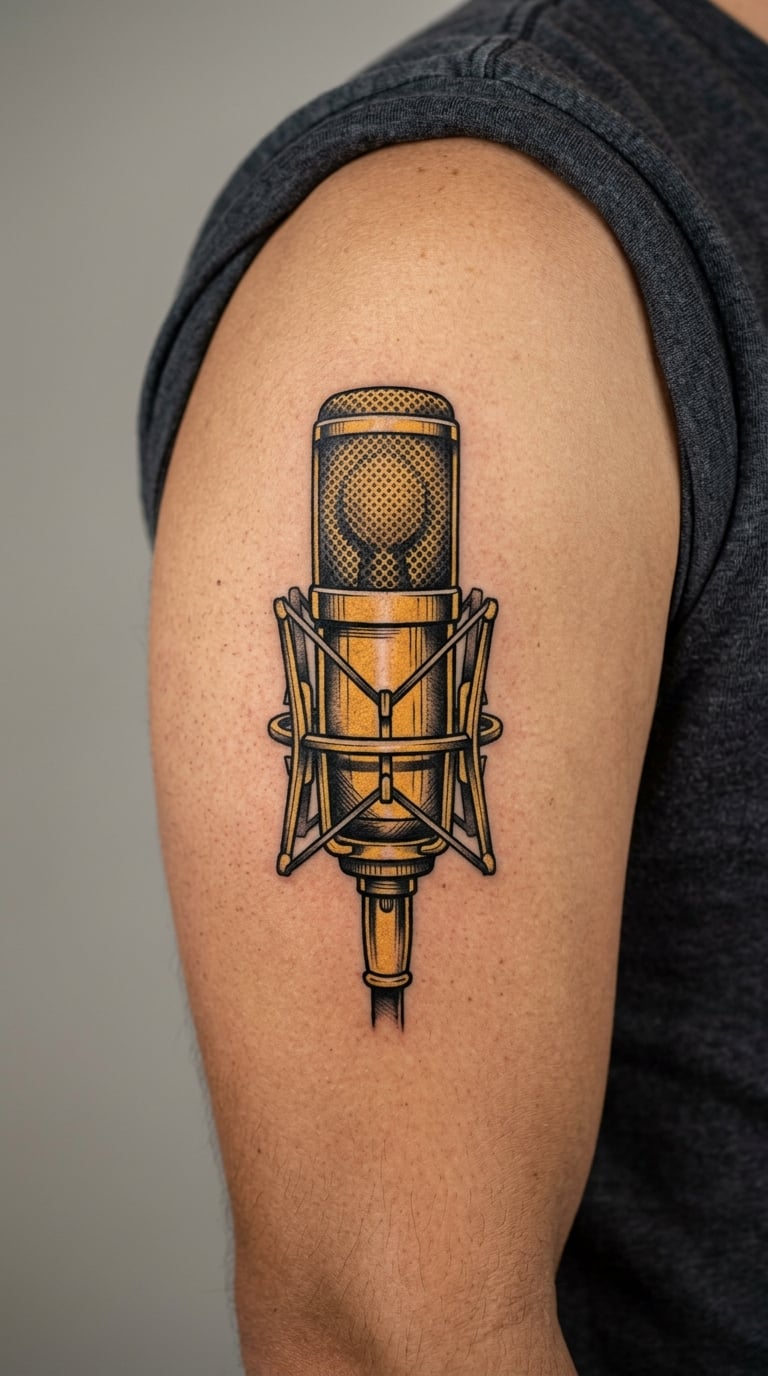
A gold microphone with blackwork shadows is a warm yellow condenser mic body set against dense black shadow shapes underneath and behind it. The gold sits in the lit areas, the black takes everything in shadow, and the result has real contrast rather than a flat colour fill. It photographs well and reads clearly at a distance.
Colour plus black is a bigger session than a line piece, so budget your time and expect a touch-up visit.
Placement: chest, shoulder, or forearm, where there is enough flat area for the shadow shapes. Size: 2.75 inches (7 cm) tall. Style: colour realism with blackwork shadows. Pain: medium. Very fine gold detailing can soften between visits, so ask your artist about a free or discounted touch-up. Make it yours: shift the gold to a deeper amber to match something you own.
14. Microphone Equalizer Bar Design
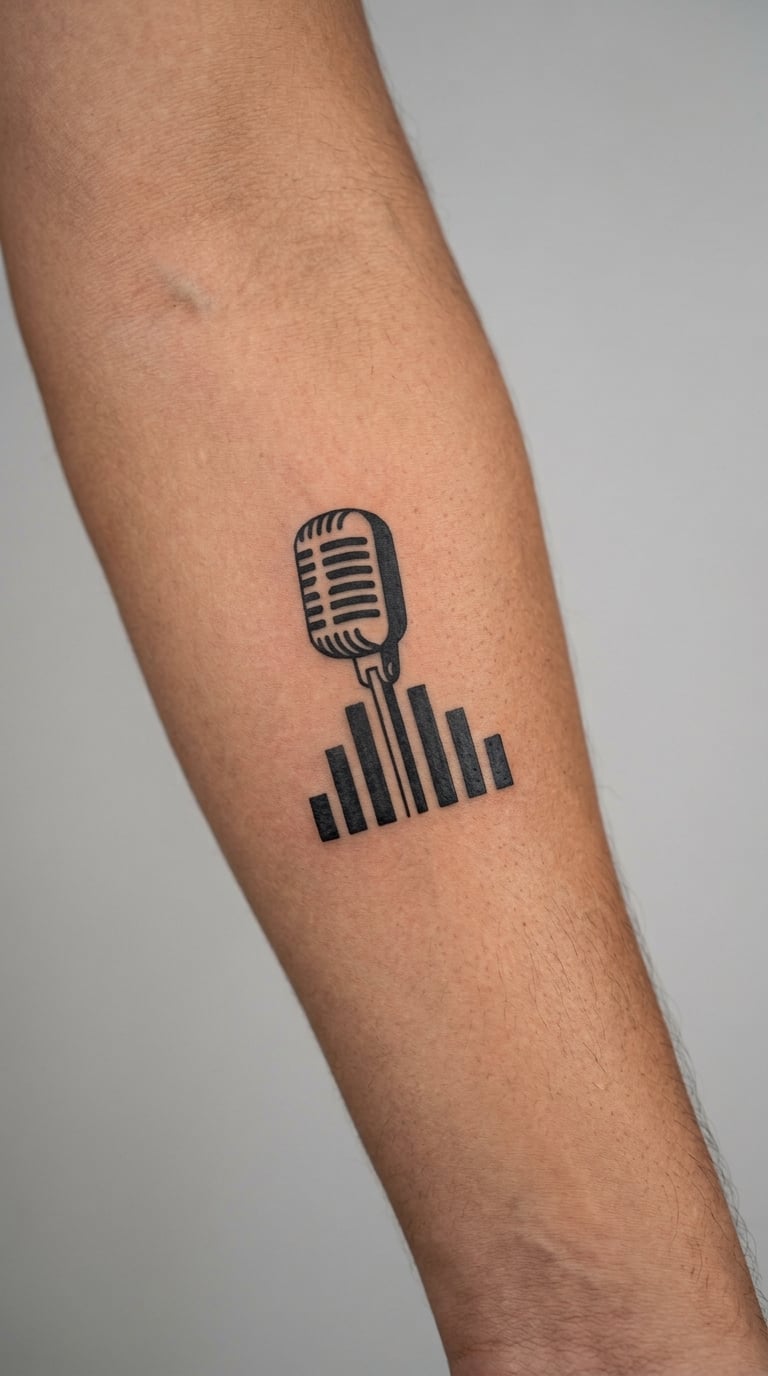
A microphone equalizer design joins a compact mic to five vertical bars of different heights, like a level meter frozen mid-song. Everything is flat black with squared-off tops and generous white space between the bars. Nothing here depends on text, which is exactly why it holds together at small sizes.
It is a music tattoo that stays graphic and modern rather than nostalgic, and it works as a starting point for a larger sleeve later.
Placement: wrist, inner forearm, or the ankle. Size: 2 inches (5 cm) wide for the whole group. Style: flat graphic, minimal. Pain: low, because the shapes are broad and simple. Make it yours: add a matching waveform running under the bars, or set the bar heights to match a favourite song.
15. Microphone Made of Sheet-Music Lines
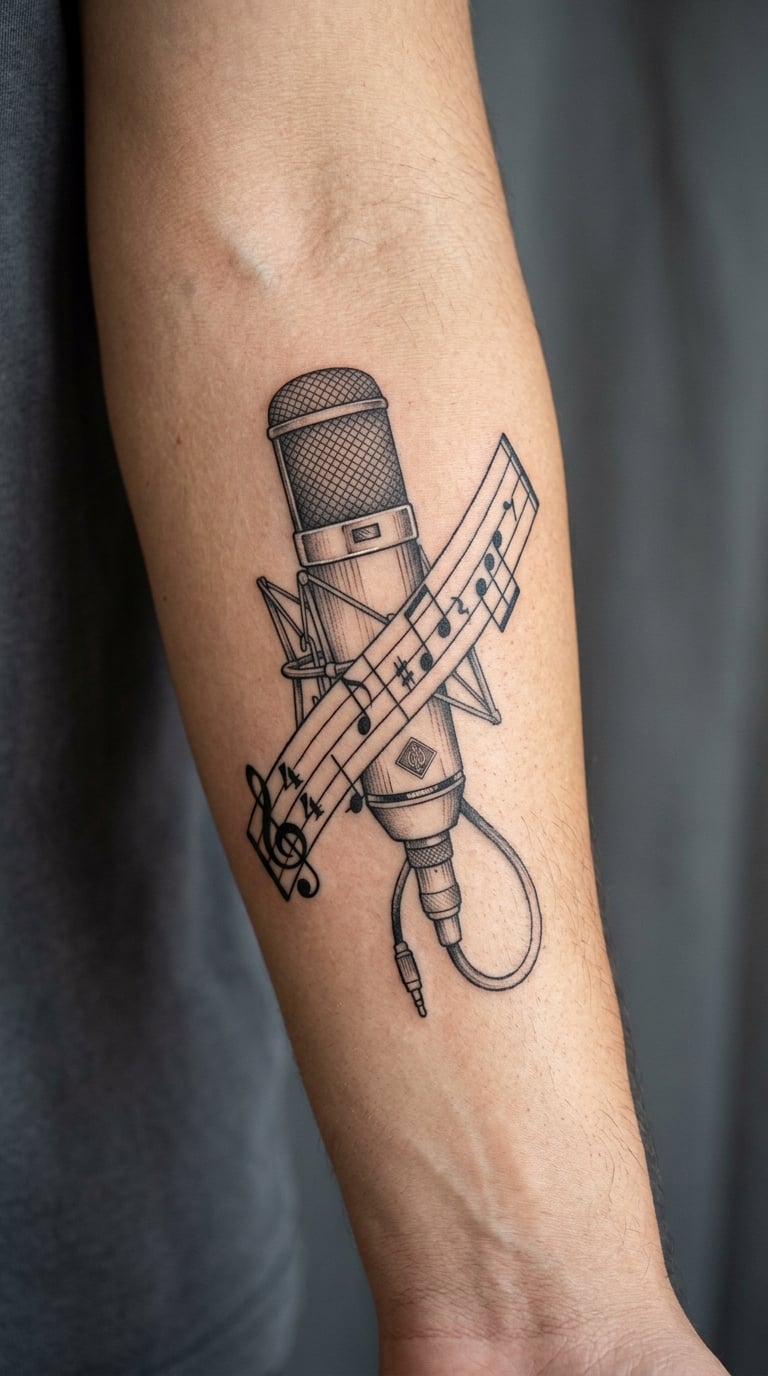
A microphone made of sheet music is built from accurate musical staves and notes, the lines running across the body while the outline of the mic stays clear and readable. It works because the eye gets the silhouette first and the notation second, and because real music on a mic is unexpected.
Have the notation written fresh for you. Copying a full copyrighted score is a problem, but your own arrangement, or the public-domain first lines of an old piece, is a clean way in.
Placement: inner arm, rib, or the inside of the upper arm. Size: 2.5 inches (6 cm) is the floor for readable notation. Style: fine line. Pain: low to medium, and the staff lines will soften over time, so the artist should keep spacing generous. Make it yours: build the body in the key of a song you play, so you can read your own key on your own arm.
16. Karaoke Microphone With Two Notes
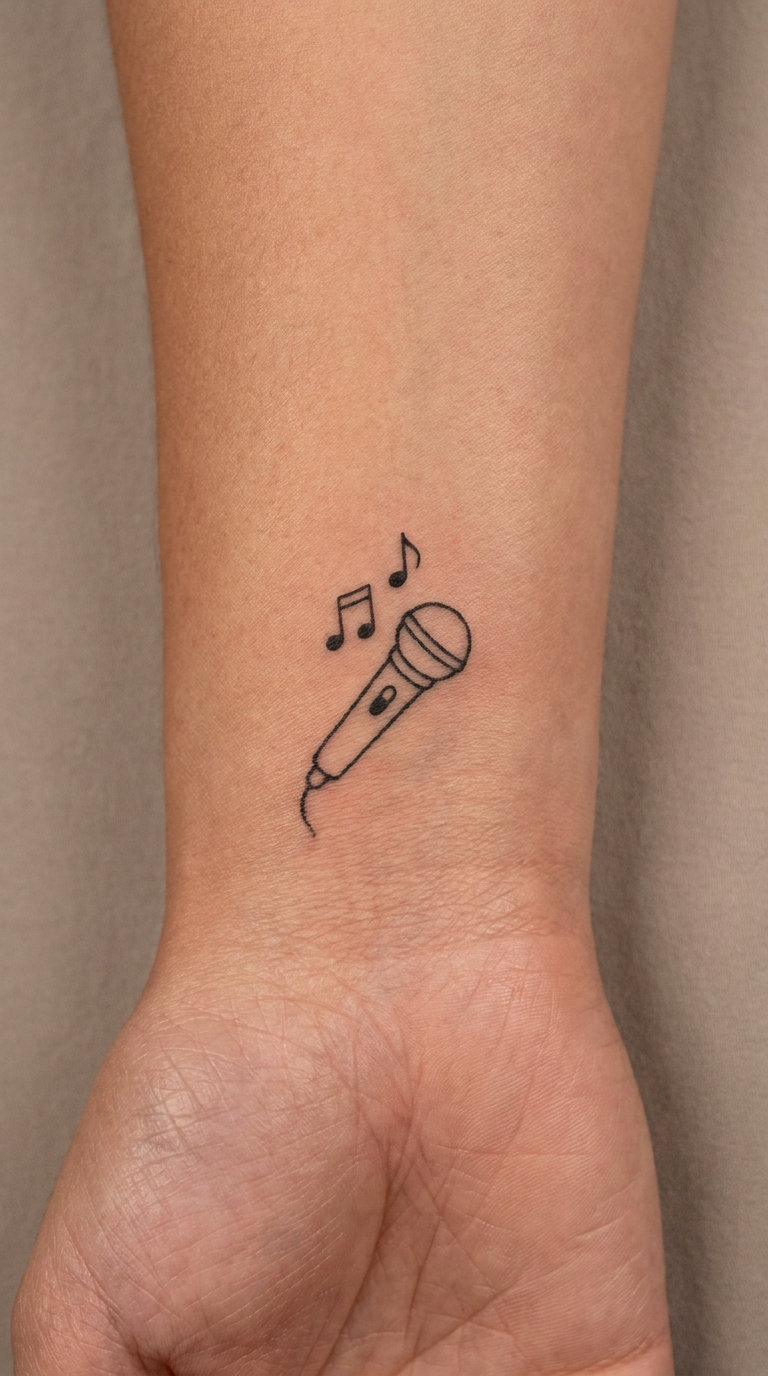
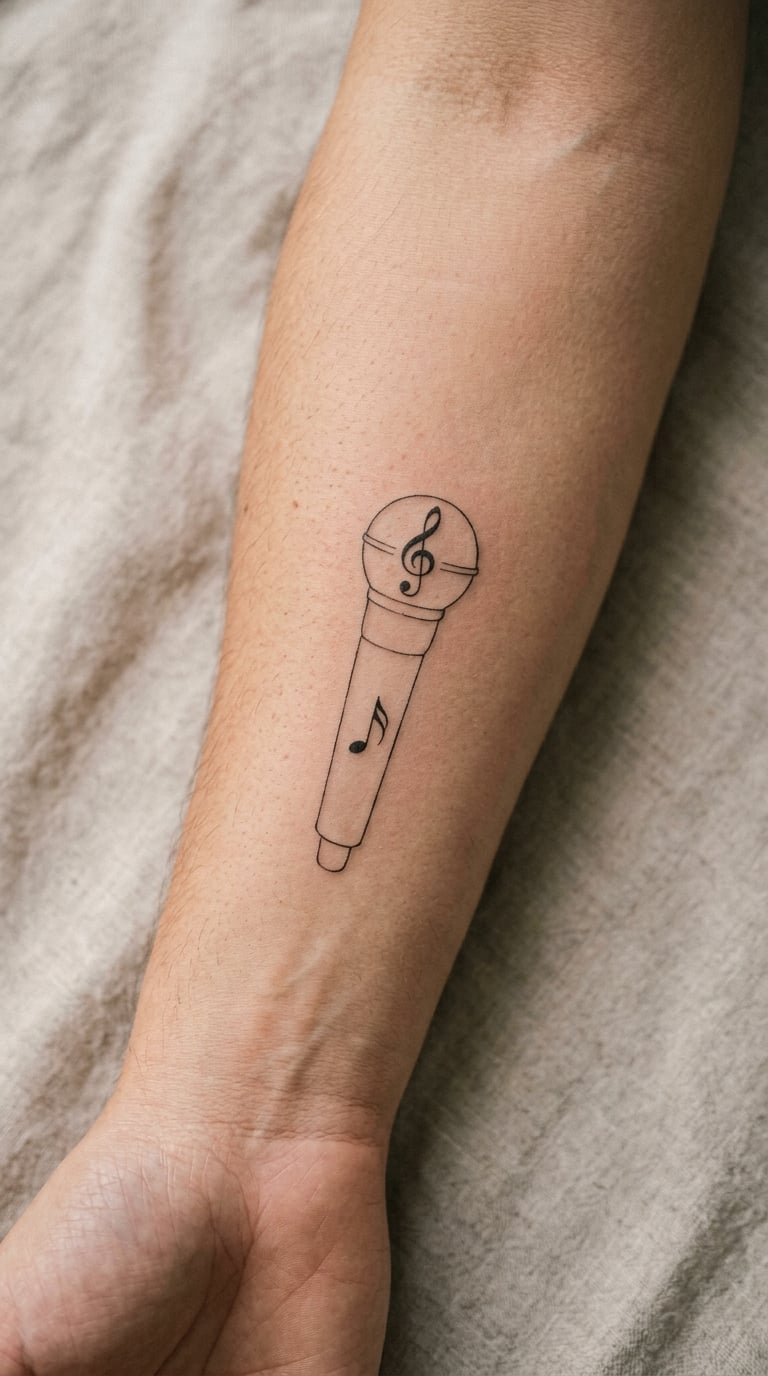
A karaoke microphone with two notes is a small, cheerful piece: a handheld mic in thin black line with one or two precisely drawn notes floating above it. Two notes is the number to hold on to. More than that and the wrist starts to look busy, and tiny note heads fill in quickly once the skin is healed.
It is a good choice for people who sing socially rather than professionally, and for anyone who wants a fun piece that still sits quietly.
Placement: outer wrist, inner arm, or behind the ear. Size: 1.5 inches (4 cm) including the notes. Style: playful fine line. Pain: low. Wrist and finger work fades fastest of any placement, so expect this one to need a refresh in a few years. Make it yours: set the two notes to the opening of a song you always sing badly and happily.
17. Microphone in a Vintage Broadcast Badge
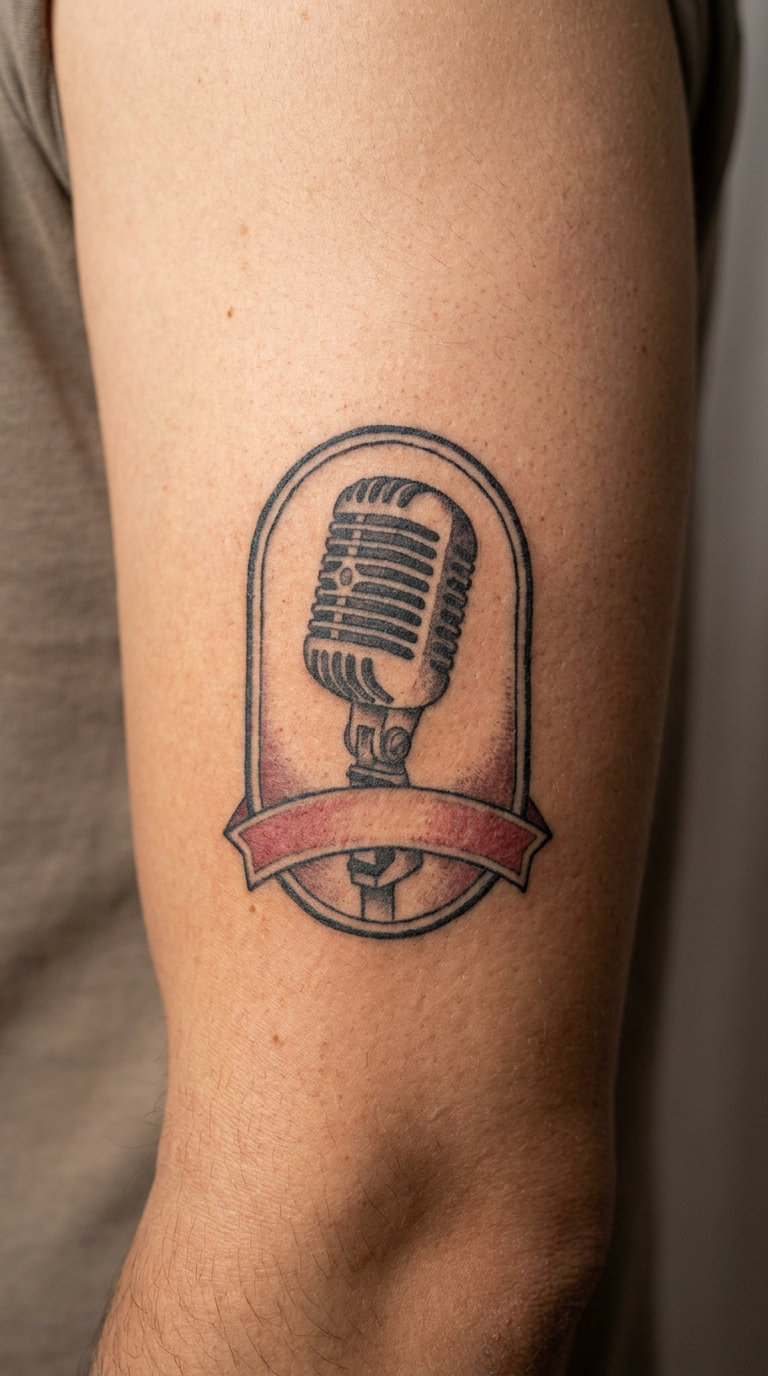
A microphone in a vintage broadcast badge sits inside a simple arched frame, like an emblem on a piece of old radio equipment. The mic is drawn in black and grey with one muted red accent, usually a small band across the middle or a single line in the arch. The frame is the restraint that makes it feel considered.
It has a retro performance feel, and the badge shape gives an artist a natural place to add one detail without crowding the mic.
Placement: outer upper arm, chest, or the upper back where the arch has room. Size: 3 inches (8 cm) tall including the arch. Style: traditional with a muted red accent. Pain: medium. Make it yours: put a station number, call sign or initial in the flat space at the top of the arch.
18. Microphone Emerging From an Open Sound Box
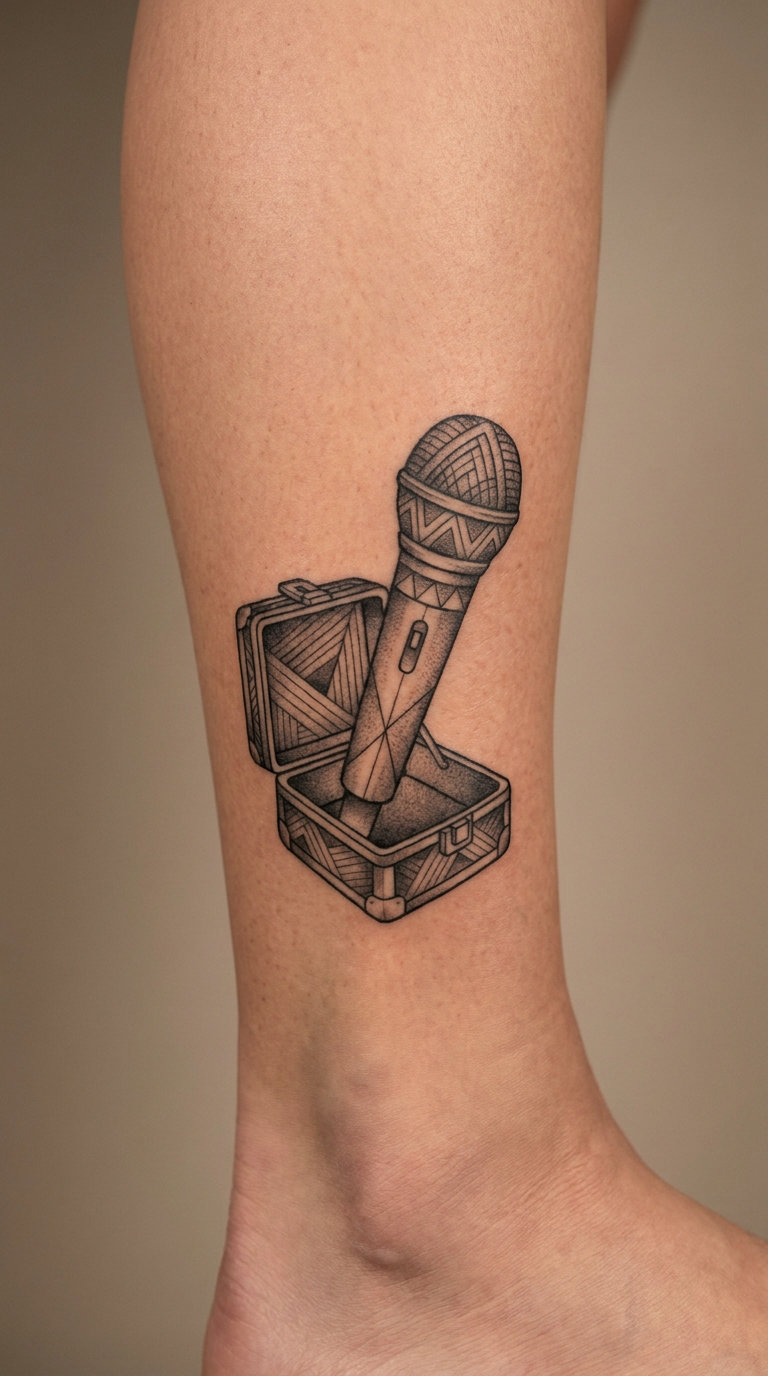
A microphone emerging from an open sound box is a mic rising out of a small equipment case with the lid flipped back, drawn with flat geometric shapes and a few clean lines for latches and hinges. The case gives the design a base, which is unusual for a mic tattoo and makes it feel grounded rather than floating.
It suits anyone who has actually carried gear, and it is a natural fit for a band or a touring musician.
Placement: forearm, calf, or the outer thigh where the box has a flat base. Size: 2.75 inches (7 cm) tall. Style: black and grey graphic, restrained detail. Pain: medium, and the lower leg is a common sore spot, so plan a long sitting session. Make it yours: change the case latch to a small symbol, or paint the interior a single colour in a later session.
19. Geometric Microphone Built From Triangles
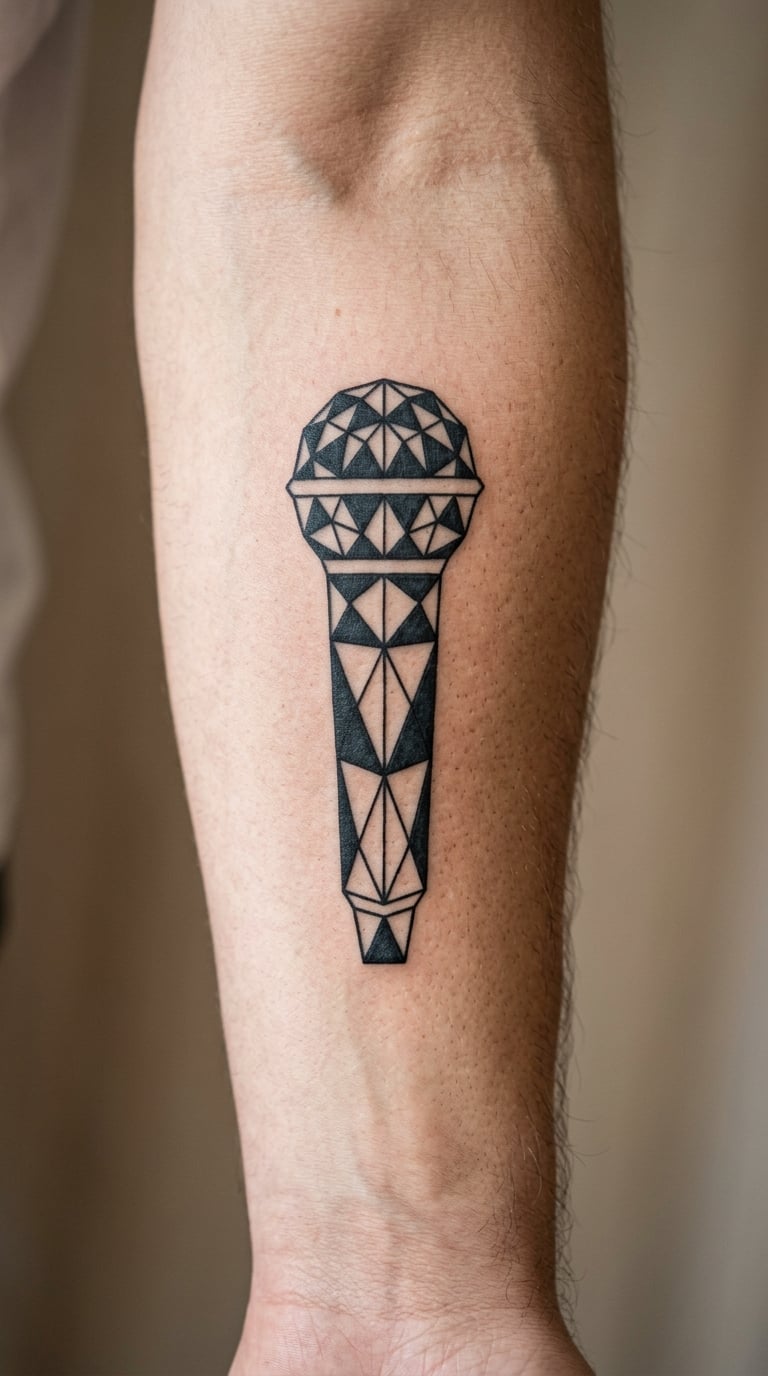
A geometric microphone is constructed from triangular and polygonal facets that meet down the centre line, with solid black facets alternating against white ones. Symmetry is what sells it. The head becomes a low-poly sphere and the stand becomes a stack of clean geometric blocks.
It has a modern, engineered quality, and the flat shapes hold their edges much better than a rendered photograph would.
Placement: forearm, calf, or upper arm. Size: 2.5 inches (6 cm), and go larger if you want a background of facets behind it. Style: geometric blackwork. Pain: medium. Be wary of asking for dozens of tiny facets, because small triangles blur together as the skin settles. Make it yours: extend the facets into a low-poly background, or mirror the mic on the other arm.
20. Microphone With Handwritten Lyric
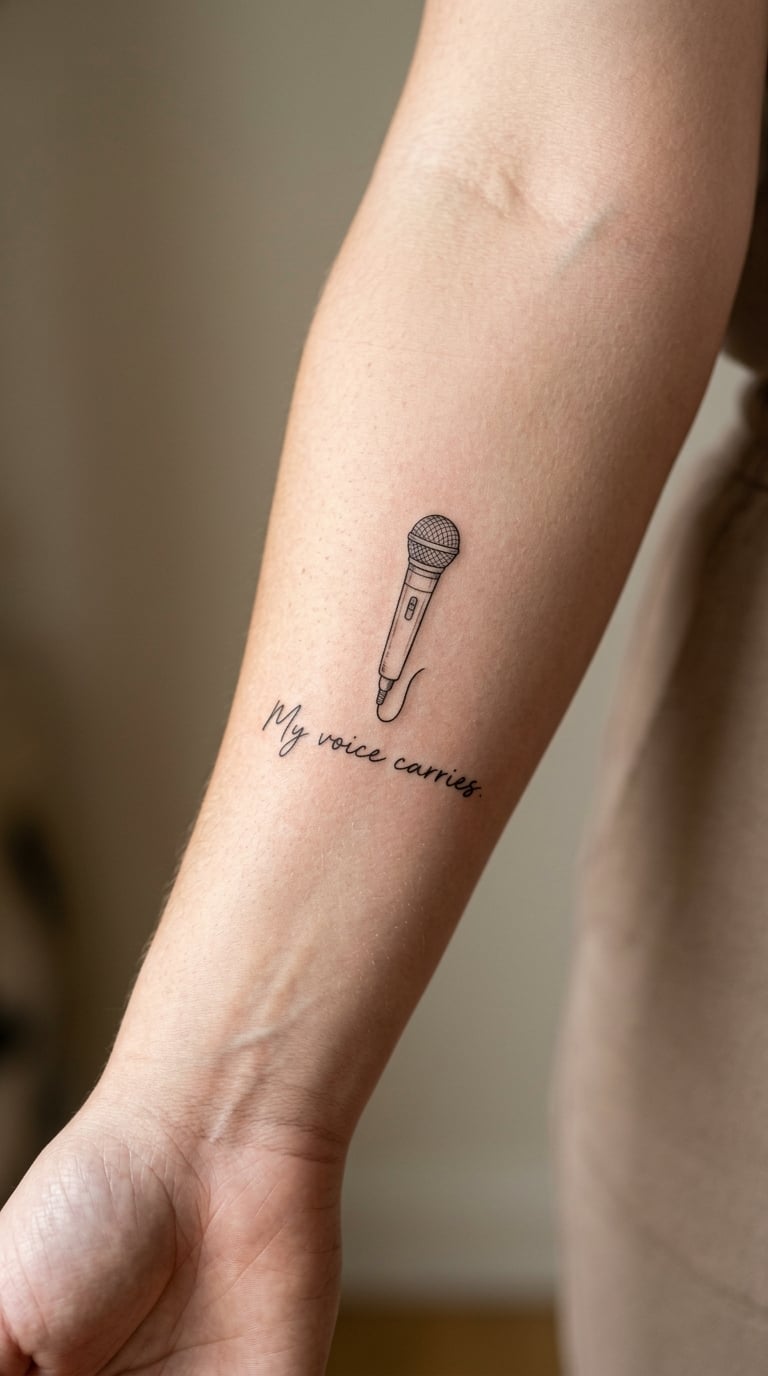
A microphone with a handwritten lyric pairs a small fine-line mic with one short phrase in the wearer’s own words, set in a hand-drawn script that sits just above or below it. Keep it to four or five words. The script is the part that softens first, and long lines of small lettering are what turn a good idea into a blurry one after a few years.
Song lyrics are copyrighted, so use your own words, a line you have permission for, or something from the public domain. Your own handwriting style is the more meaningful route anyway.
Placement: inner forearm, rib, or the underside of the upper arm, where there is flat skin for text. Size: 3 inches (8 cm) for the whole composition. Style: fine line plus lettering. Pain: low to medium, and lettering takes patience to render cleanly. Make it yours: if the words are too personal to wear, use a date in the same handwriting instead.
How to Choose the Right Design
- Match the line weight to the size. A design that looks crisp on a phone screen turns to mud at 1.5 inches. Ask your artist to print the design at the size you actually want and hold it at arm’s length.
- Pick a style before a motif. Fine line suits small and quiet pieces, blackwork suits bold and graphic ones, traditional and neo-traditional suit colour, watercolor suits soft and expressive work. Deciding the style first makes the mic shape easier to draw.
- Check the placement against joints and hair. Wrist and ankle designs disappear as skin moves, and rib pieces shift as you breathe. Forearms and upper arms hold a shape more consistently.
- Look at your existing tattoos first. A line-art mic next to a heavily shaded piece will look borrowed. Match the ink density of what you already have.
- Scale the details, not the outline. Grille mesh, tiny switches and small note heads are the first things to go. Ask which details can be dropped before the piece is tattooed.
- Add one personal detail, not five. People who answer, in forum threads, that a music tattoo feels generic are almost always describing an untouched motif. A date, a lyric, a waveform or a chosen flower fixes that quickly.
If what you actually want is a quieter, lower-energy piece rather than a loud studio object, the tattoo ideas for anxiety and calm roundup is worth a look for how thin, quiet line work holds up at small scale.
20 Microphone Tattoo Ideas by Placement and Size
Where you put the piece decides how much detail it can hold. Fingers and the outer wrist take about 1.25 to 1.5 inches (3 to 4 cm) before the design starts to blur, so anything with fine grille work belongs somewhere else. The inner forearm is the most forgiving spot, handling up to 3 inches (8 cm) with room for a stand and a small detail underneath. The outer forearm takes a wider piece, around 5 inches (13 cm) if you want the soundwave design running lengthwise.
The upper arm and shoulder offer the flattest canvas for anything framed or coloured, so the ornate condenser, the broadcast badge and the watercolor versions all sit well there. Ribs work for designs with a diagonal lean, but the surface moves and curves, so keep it to about 2.5 inches (6 cm) and avoid text. The lower leg has a large area but is a longer sit, so a bigger piece such as the blackwork dynamic mic is reasonable there. And the back of the upper arm is the least busy canvas most people have, which makes it the easiest place to add to a collection over time.
Cost and Session Time
Shops price tattooing in one of two ways, and it is worth knowing which before you book. A flat minimum covers small pieces and simpler designs, and anything larger is charged by the hour. Hourly rates vary widely by city, by shop and by how much work your artist has booked, so the same microphone outline can cost very different amounts in two towns a few hours apart.
What moves a microphone design up the range is predictable. Fine detail such as mesh, small notation and script lettering takes much longer than a bold silhouette. Colour adds a full extra pass and usually a second session for any refining. A large framed or soundwave composition is measured by the hour rather than as a single small piece, because the area alone determines how long you will be sitting.
Custom linework also counts. A converted waveform, a handwritten phrase and an ornamental border all take planning time before the tattoo even starts, and some artists include that in the price while others quote it separately. Ask what the shop minimum is, what the hourly rate is, and whether your design needs a custom drawing fee. Getting those three answers upfront saves an awkward conversation at the counter.
Aftercare Basics
- Follow your artist’s aftercare instructions first. Every artist has a protocol they trust, and it should override any general advice you have read online, including this list.
- Wash gently, then pat dry. Clean water and a mild unscented soap, then pat the area dry with clean paper rather than rubbing it with a towel.
- Wear loose, protective clothing. Cotton shirts over a fresh forearm piece, and clean sheets on the night you sleep. Friction is what breaks a scab early.
- Keep it out of water. No swimming, no soaking in a bath, and no hot tubs until the tattoo is fully healed and no longer sensitive. Brief showers are fine once your artist clears you.
- Avoid prolonged sun exposure. Fresh ink and healed fine line both fade faster in direct sun, so cover it or use sunscreen once healed.
- Watch it, and ask when unsure. Some redness, swelling and tenderness early on is normal. If something looks or feels wrong to you, message your artist or a licensed clinician rather than searching it online.
Frequently Asked Questions
Where is the best placement for a microphone tattoo?
The inner forearm is the most forgiving spot because the skin is flat and still enough for a small stand and fine grille lines. The outer forearm suits wider pieces like a soundwave, the upper arm and shoulder take framed or coloured designs, and the lower leg has room but means a longer sit. Wrist and finger placements stay under 1.5 inches and fade fastest.
What size should a small microphone tattoo be?
For a minimal handheld outline, 1.5 inches (4 cm) tall is a reliable size that stays readable. A vintage studio mic with a short stand wants 2 inches (5 cm), a traditional ribbon mic around 2.5 inches (6 cm), and a framed or soundwave composition needs 3 inches (8 cm) or more. Anything with mesh detail or lettering should not go much smaller than 2.5 inches.
Can I turn a song or voice note into a soundwave tattoo?
Yes, and it is one of the most personal versions of the design. Use audio you own or have permission to convert, then have your artist redraw the waveform as clean single-line geometry rather than pasting a phone screenshot. Plan for about 5 inches (13 cm) along the forearm so the peaks stay readable, and expect a longer session than a simple mic outline.
Will fine-line microphone details stay readable over time?
Fine lines soften in the first year or so, and details thinner than about a line in width tend to fade noticeably. Mesh, tiny switches and small note heads are the first things to disappear. Your artist can help by simplifying the grille, widening the line weight and spacing out small elements. Wrist and finger placements fade fastest of all, so refresh those sooner than arm pieces.
Can a microphone tattoo include lyrics or a song title?
It can, with care. Song lyrics and titles are copyrighted, so use your own words, a line you have permission for, or something from the public domain. Keep it to four or five words in a simple script, and allow about 3 inches (8 cm) for the lettering so it stays legible after healing. A date in the same handwriting works well if the words feel too exposed.
Conclusion
If this is your first tattoo, the minimal handheld outline is the one to start with. It is small, quick, and hard to get wrong, and it leaves room for a larger mic piece later if you decide you want one. If you are adding to an existing collection, the personalised waveform gives you something nobody else will have, and it is the design most worth planning carefully in advance.
Whichever way you go, save three or four real tattoo photos rather than illustrations, note the size in inches you actually want, and take them to a consultation. An artist who redraws the grille for your scale is the one who will get you a microphone that still reads in ten years.