
24 Golf Tattoo Ideas: Small, Bold and Fine-Line 2026
These 24 golf tattoo ideas cover everything from a one-inch fine-line ball to a full blackwork course composition. Most golfers who come to a first appointment with a saved idea and a real placement in mind walk out happy. The rest end up with a clipart flag they regret.
What makes a golf tattoo work is restraint plus one personal detail. A plain ball is readable in a single line, and a date or course name turns it into yours. I’ll walk through size, placement, pain and personalisation for each idea so you can bring something specific to your artist.
Start with the mountain and ocean tattoo ideas if you like landscape work, since several golf designs here sit in that same family.
24 Golf Tattoo Ideas: Quick Guide
The table below gives you the short version of all 24 designs. Scroll to any row, then read the full section underneath for the detail that matters.
| Idea | Style | Best placement | Size | Pain |
|---|---|---|---|---|
| 1. Fine-line golf ball and divot | Fine line | Inner forearm | 1.5-2 in | Low |
| 2. Minimal golf ball with number | Minimalist | Outer wrist | 1-1.5 in | Low |
| 3. Golf flag in a triangle | Geometric fine line | Ankle or upper arm | 2-2.5 in | Low |
| 4. Club-and-ball composition | Traditional linework | Forearm | 2.5-3.5 in | Medium |
| 5. Golf hole and flag blackwork | Blackwork | Upper arm | 3-4 in | Medium |
| 6. Watercolour golf course | Watercolour | Shoulder or thigh | 4-6 in | Medium |
| 7. Vintage golf pennant | Traditional | Upper arm | 2.5-3.5 in | Medium |
| 8. Golf swing in motion | Fine line | Outer forearm | 3.5-5 in | Medium |
| 9. Golf ball with floral divot | Micro-realism | Forearm | 1.5-2.5 in | Low |
| 10. Nine-iron mountain range | Fine line landscape | Inner forearm | 3-4 in | Low |
| 11. Golf tee and ball micro-tattoo | Micro fine line | Wrist or rib | Under 1 in | Low |
| 12. Green with numbered flag | Illustrative colour | Calf or upper arm | 2-3 in | Low |
| 13. Golf bag with crossed clubs | Traditional bold line | Forearm or calf | 3-4 in | Medium |
| 14. Golf course map view | Cartographic line | Thigh or ribs | 4-6 in | Medium |
| 15. Glowing golf ball | Black and grey realism | Collarbone or forearm | 1.5-2.5 in | Medium |
| 16. Golf divot as a heart | Fine line | Behind ear | 1-1.5 in | Low |
| 17. Traditional golf trophy | Traditional colour | Upper arm | 3-4 in | Medium |
| 18. Golf birdie path | Fine line illustrative | Outer arm | 3.5-5 in | Medium |
| 19. Blackwork golf course arch | Blackwork | Forearm | 4-5 in | Medium |
| 20. Golf ball as a constellation | Fine line dotwork | Upper arm | 2-3 in | Low |
| 21. Miniature golf scene | Illustrative colour | Calf or forearm | 2.5-3.5 in | Low |
| 22. Golf driver with sunburst | Graphic linework | Shoulder | 3-4 in | Medium |
| 23. Handwritten golf wordmark | Hand lettering | Wrist or ribs | 1.5-2.5 in | Low |
| 24. Matching golf ball pair | Fine line | Inner wrists | 1.5 in each | Low |
24 Golf Tattoo Ideas by Style and Placement
These 24 designs cluster into four visual families. Fine line and minimalist pieces (1, 2, 3, 11, 16, 20, 23) stay readable at small sizes and fade faster, so they suit a first tattoo and a discreet spot. Blackwork pieces (5, 19) hold their shape for decades and suit someone already collecting.
Traditional and illustrative work (4, 7, 12, 13, 17, 21) gives you colour and shading, which carries better through sun and age. Watercolour and realism (6, 9, 15) sit between the two: soft, detailed, and best placed somewhere the skin stays flat.
1. Fine-Line Golf Ball and Divot
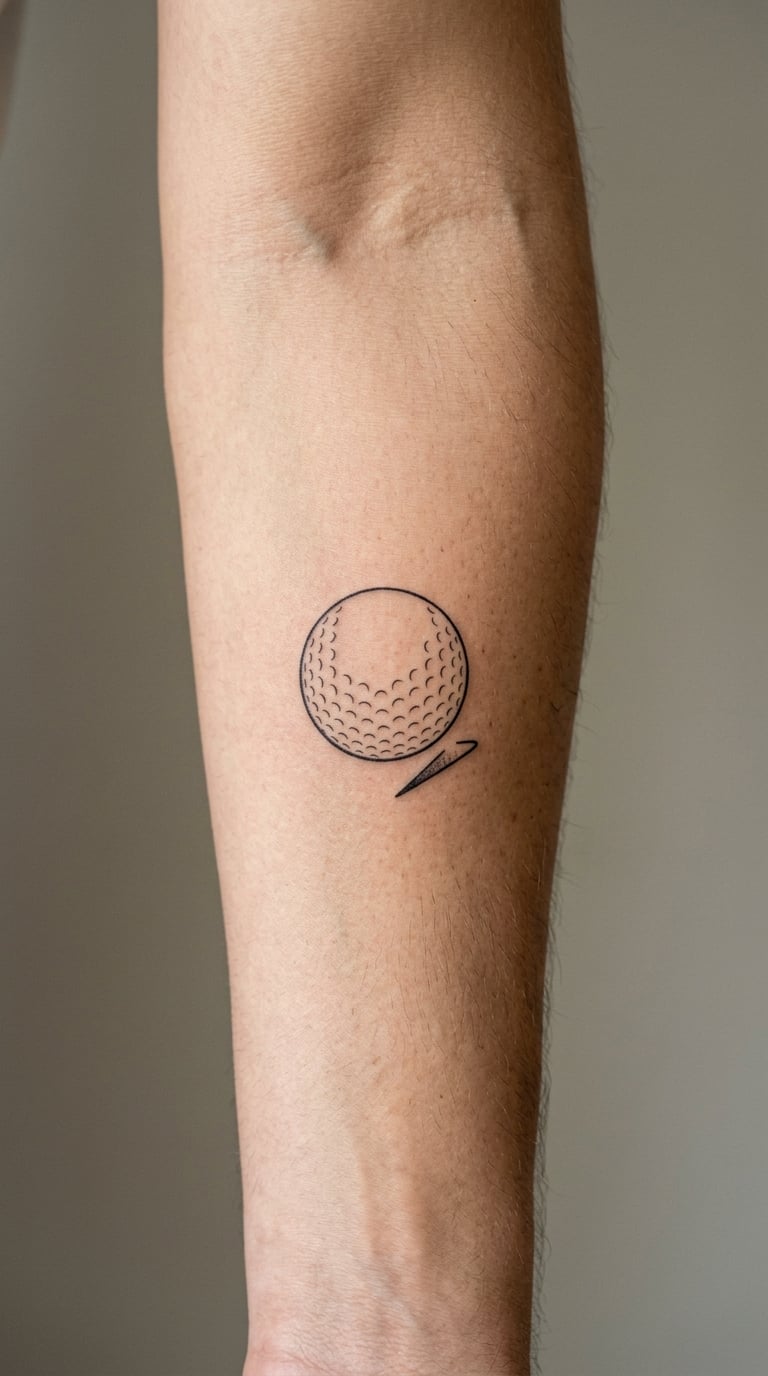
This golf tattoo idea is a clean circle with a small angled slice cut out of one edge, exactly like a ball sitting in a divot. One weight of black line does all the work, and the negative space inside the cut does the rest.
The circle reads as a ball instantly, and the divot turns it into something with a story attached. Most people choose it for a specific bad shot they still think about, or for the sport itself in its simplest form.
Placement: inner forearm, wrist crease, or behind the ear. Size: 1.5 to 2 inches wide. Style: fine line.
Pain: low on the inner forearm, moderate over the wrist crease. Thin single-needle lines on the inner arm soften and blur within five or six years, so expect a refresh rather than a permanent crisp edge.
Make it yours: have the divot angled slightly rather than straight, which reads more like a real bad shot and less like a clipart wedge.
2. Minimal Golf Ball with Number
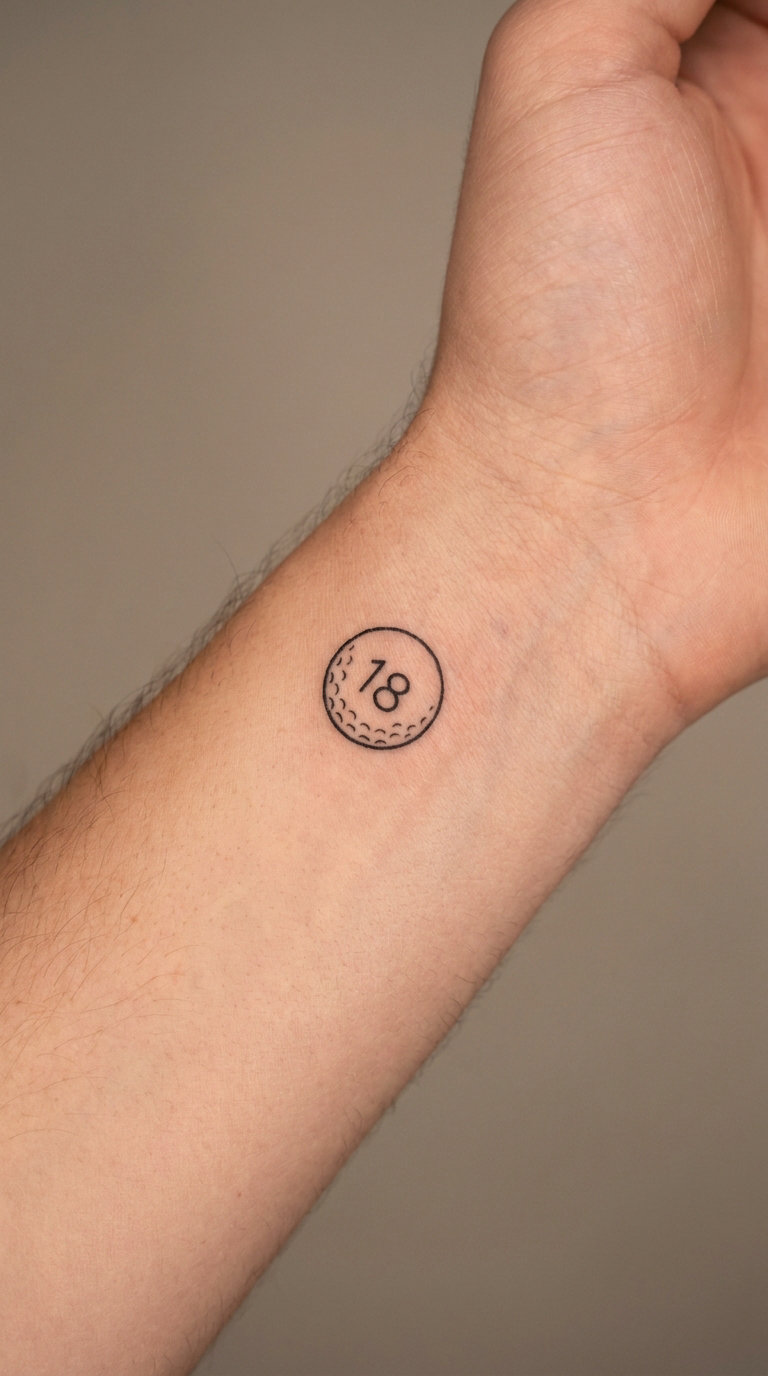
A single-line circle with one number inside it. That is the whole design, and it is the kind of restraint that reads as confident rather than empty.
Players usually pick the number that means something specific: a hole they always ace, the house they played growing up, or the date of a round that mattered. It is a golf tattoo with meaning built into the smallest possible footprint.
Placement: outer wrist, inner arm, or ankle. Size: 1 to 1.5 inches across. Style: minimalist line art.
Pain: low almost everywhere. At an inch and a half, the number needs a slightly heavier weight than the surrounding circle so it survives, and your artist will set that deliberately.
Make it yours: put the number at the centre rather than below the ball, which turns it into a medallion instead of a label.
3. Golf Flag in a Triangle
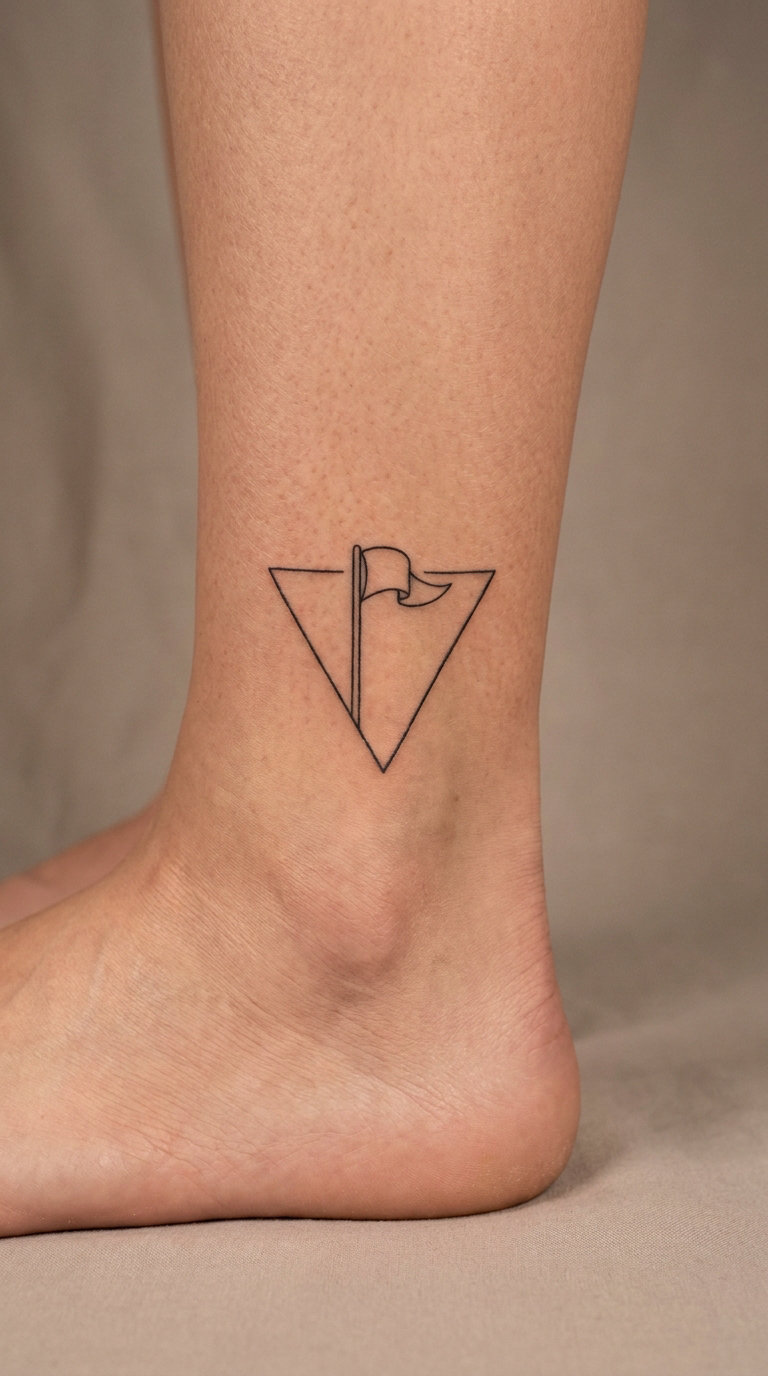
One triangle, one straight pole, one gently curved flag. The triangle does the heavy lifting, giving the composition a border that keeps it tidy on small areas of skin.
A flag usually marks a destination, so golfers attach this one to the course they play most, the one a relative introduced them to, or a trip they still talk about.
Placement: ankle, upper arm, or along the ribs. Size: 2 to 2.5 inches tall. Style: geometric fine line.
Pain: low on the upper arm, a noticeable sting on the ankle because the bone sits close to the surface. The flag’s curve is the only line that may blur over time; the triangle holds.
Make it yours: have the flag curving to match the direction of your dominant swing rather than the wind.
4. Club-and-Ball Composition
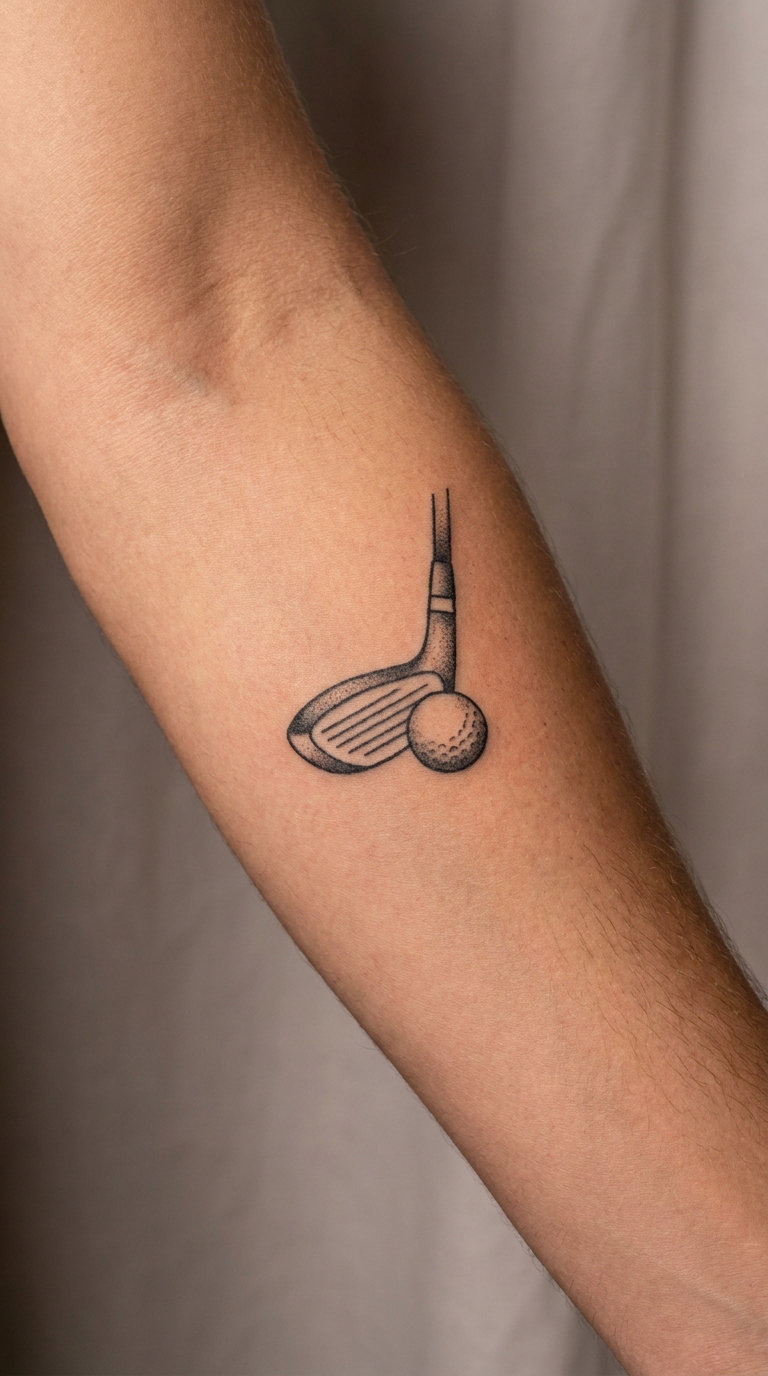
A club laid at an angle beside a shaded ball, drawn in the traditional illustrative manner with a defined outline and soft grey shading. It is a compact version of the motif you have seen on a lot of golf graphics.
Golfers pick it because it needs no explanation. Parents get it for a child who just took up the game, and players use it to mark the year they got serious.
Placement: forearm, upper arm, or calf. Size: 2.5 to 3.5 inches long. Style: traditional linework with grey shading.
Pain: medium on the forearm, mostly from shading passes over the same spot. The outline ages well; the grey wash inside the ball softens first, which is normal for this style.
Make it yours: swap in a specific club shape, such as a wedge rather than a driver, so the design says something about how you actually play.
5. Golf Hole and Flag Blackwork
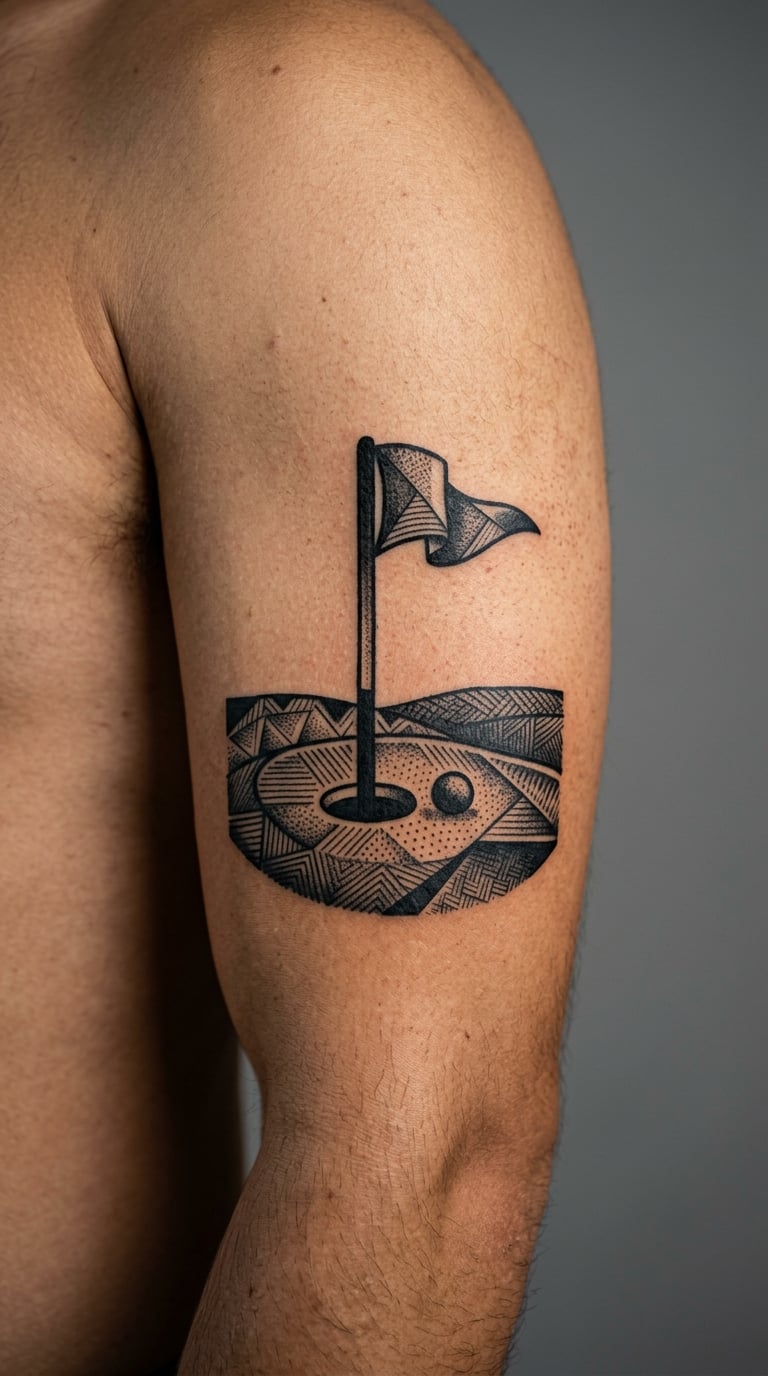
A dark cup shape, a solid flag, and a ball set beside it, all built from heavy filled black. The contrast does the describing, so there is barely any fine detail to lose.
The hole and flag are the most fixed point on a course, which is why this design reads as constancy. It works for someone who plays the same courses year after year.
Placement: upper arm, forearm, or calf. Size: 3 to 4 inches wide. Style: blackwork with negative space.
Pain: medium. Solid black fills take longer to heal than line work, and the upper arm tends to itch more during the first week. In exchange, this is one of the most durable golf tattoo ideas here.
Make it yours: let the artist leave the cup as pure negative space rather than filling it, which makes the shape punch harder at a small size.
6. Watercolour Golf Course
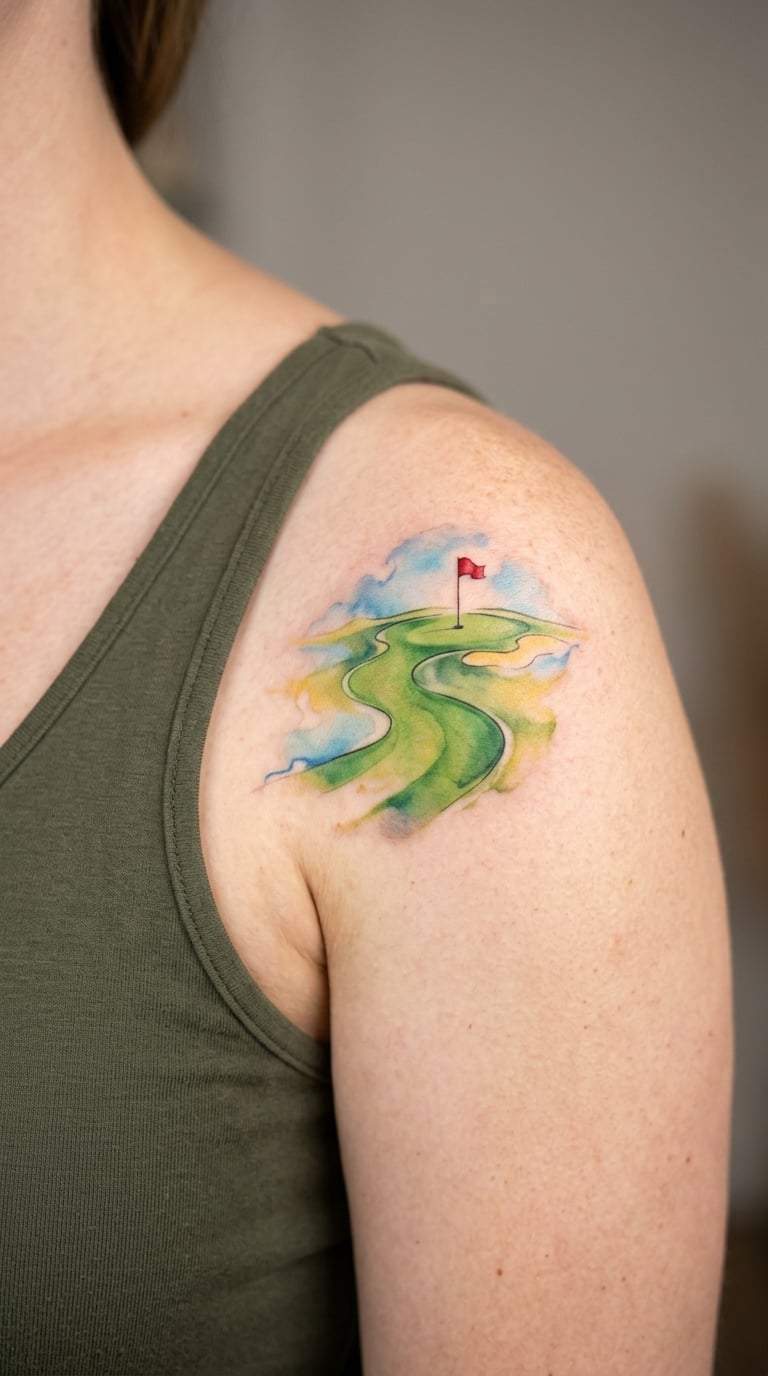
A loose fairway sweeping toward a flag, with translucent green and blue washes bleeding past the edges of the line work. Nothing is outlined tightly. The colour carries the image.
It suits people who remember a course by feel rather than by name. The washes suggest distance and weather, so it often works as a memorial for a place more than a person.
Placement: shoulder, thigh, or along the ribs. Size: 4 to 6 inches wide. Style: watercolour.
Pain: medium. Colour passes mean more needle work over the same area than a single-needle design. Watercolour shading sits lighter over time, so the composition softens but stays readable.
Make it yours: request the exact green of a clubhouse or the specific blue of a water hazard you remember.
7. Vintage Golf Pennant
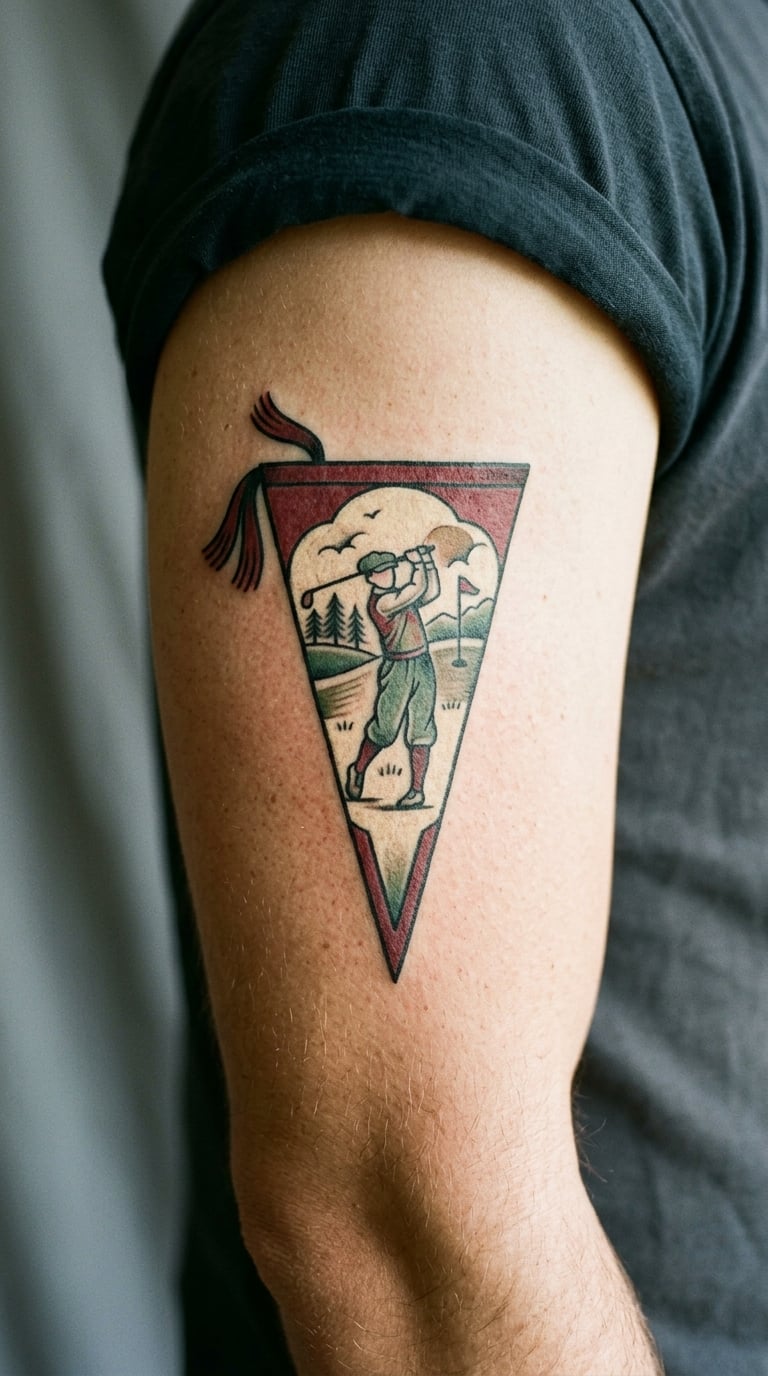
A triangular pennant in faded traditional colours with a heavy outline and slightly softened saturation, the way an old souvenir banner would look after thirty summers.
It reads as nostalgia rather than sport. Golfers who grew up on the course with a parent or grandparent often use this one to point at that specific childhood.
Placement: upper arm, chest, or shoulder. Size: 2.5 to 3.5 inches tall. Style: traditional with muted colour.
Pain: medium on the upper arm and chest. The bold outline holds its shape well; the cream and muted red are the first colours to fade, which usually suits the vintage effect anyway.
Make it yours: use the colours of a real pennant from your home course rather than generic red and white.
8. Golf Swing in Motion
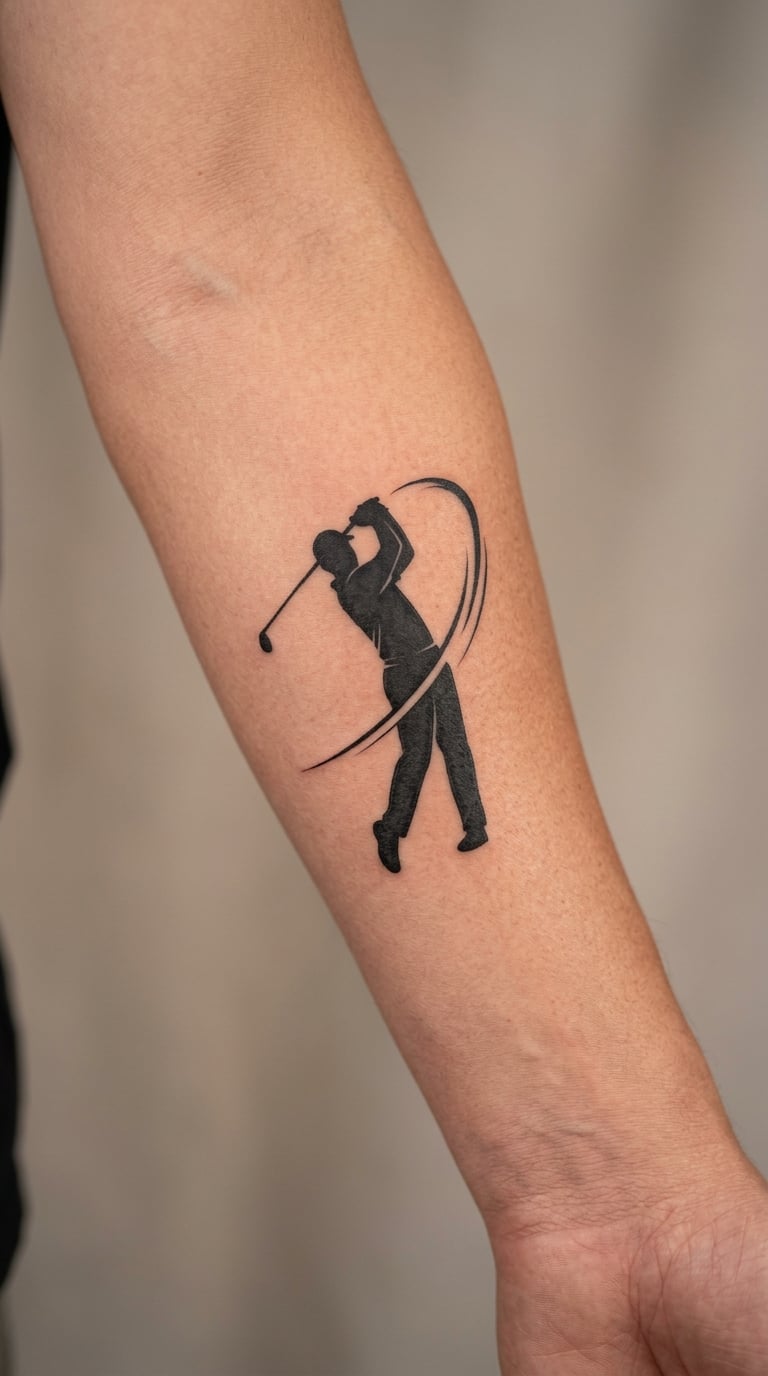
A single-line figure caught at the top of the backswing with a long arc sweeping down and forward through the frame. No facial features, no background, just the body and the path of the club.
It reads as commitment and repetition rather than victory. The arc gives the design direction, which is why it sits well on a curved part of the body.
Placement: outer forearm, upper arm, or calf. Size: 3.5 to 5 inches long. Style: fine line with motion linework.
Pain: medium, higher over the rib edge of the forearm. Long fine lines across a joint fade where the skin folds repeatedly, so ask for a slightly heavier weight on the arc.
Make it yours: have the arc drawn as your actual swing path, taken from a video of your own backswing.
9. Golf Ball with Floral Divot
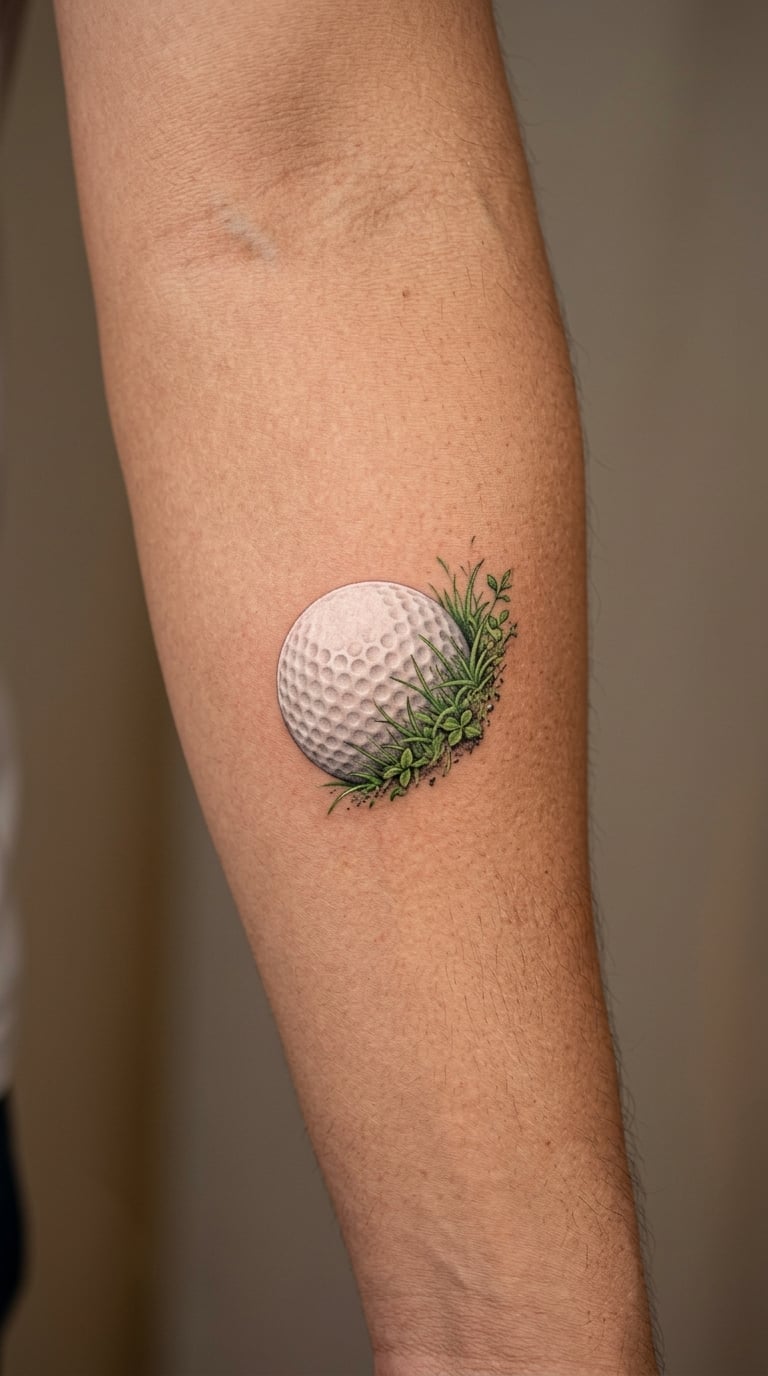
A realistically shaded white ball with a small tuft of grass or a single botanical stem rising out of the divot mark. Realistic shading on the ball, illustrative treatment on the plant.
The grass makes it a landscape rather than an object, so it works well for someone who plays as much for the walking as the scorecard.
Placement: forearm, thigh, or shoulder. Size: 1.5 to 2.5 inches wide. Style: micro-realism with a botanical accent.
Pain: low to medium. White space needs light shading rather than heavy fills, which keeps the session short. The fine plant stems are the first detail to soften after several years.
Make it yours: use a single local species rather than generic grass, which reads as a specific place.
10. Nine-Iron Mountain Range
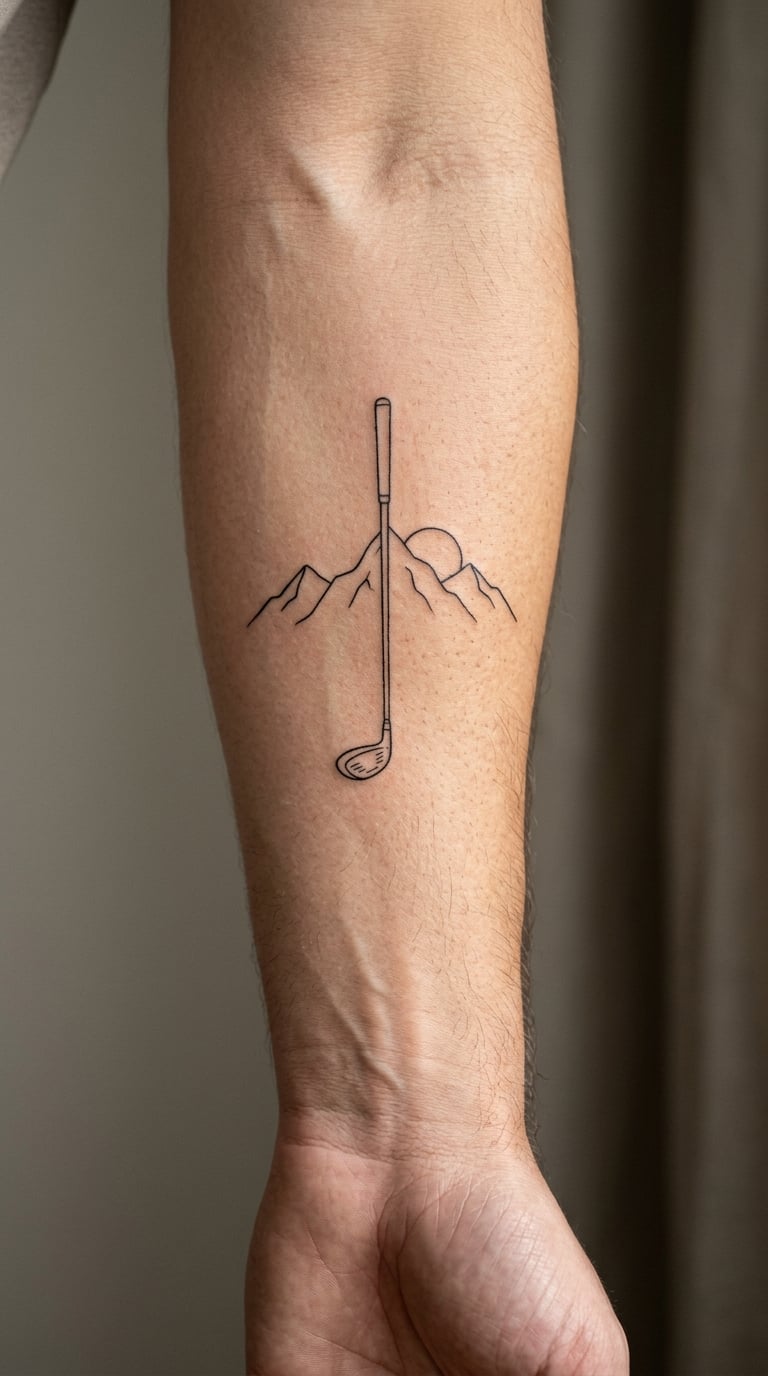
A club silhouette set in front of a simple range of peaks, all in black line with the mountains built from a few confident strokes. Two subjects, one line weight, no shading.
It holds two things at once: the game and a place. Golfers who grew up playing somewhere with mountains behind it use it to mark home.
Placement: inner forearm, upper arm, or ribs. Size: 3 to 4 inches wide. Style: fine line landscape.
Pain: low on the inner arm, medium over ribs. The peaks sit in the direction that fades fastest, so keep them simple and let the club hold the composition.
Make it yours: give the artist the actual skyline from your home course so the piece is a real place rather than generic mountains.
11. Golf Tee and Ball Micro-Tattoo
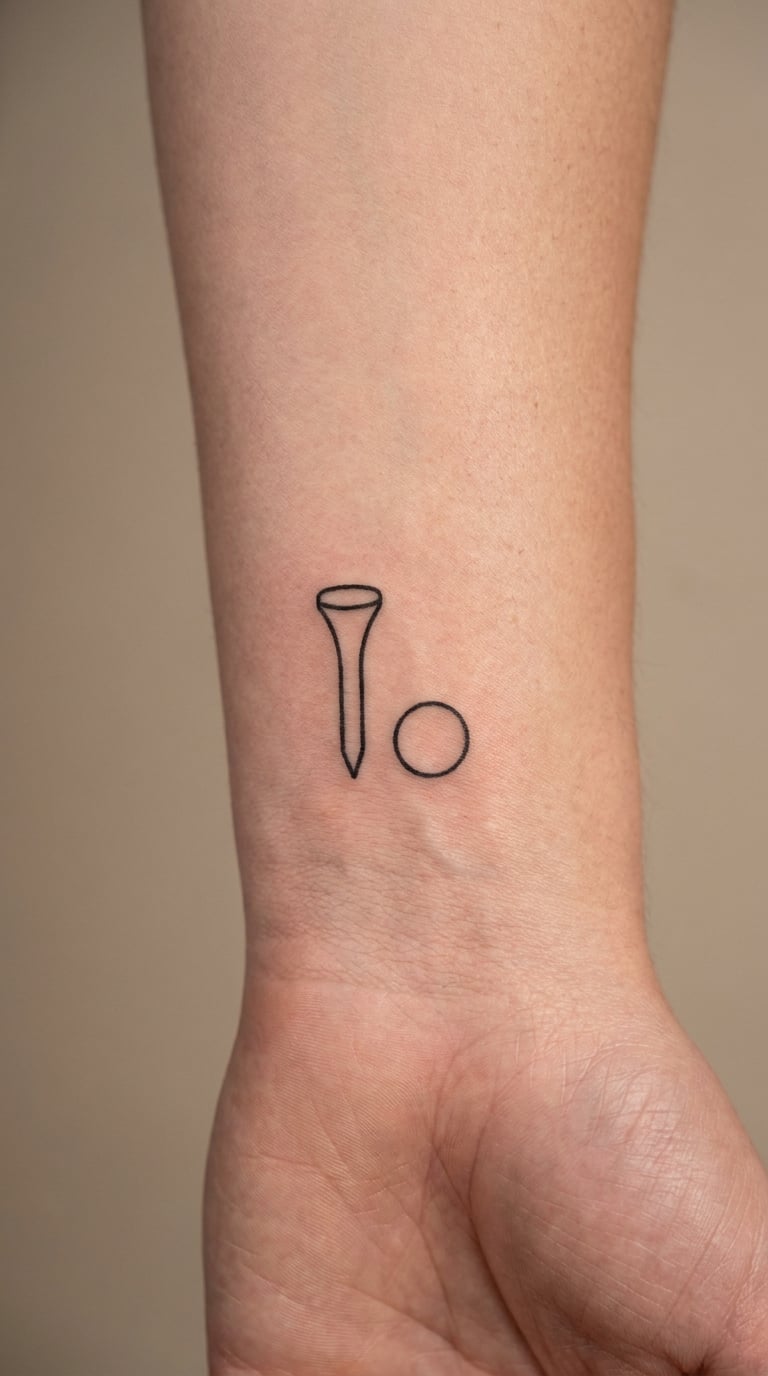
A small tee and a ball beside it, drawn in a few single lines with no shading. It is about as small as a golf tattoo can get and still read as golf.
Players use it for a partner, a child, or a round they played alone that they want to remember. The tiny scale is the point.
Placement: inner wrist, rib, or behind the ear. Size: under 1 inch wide. Style: micro fine line.
Pain: low. At this size you are talking about a short session, but be honest with yourself about how much you care once it softens over the years, because detail this small blurs fastest.
Make it yours: have the tee tilted as though the ball was just struck, which adds motion without adding detail.
12. Green with Numbered Flag
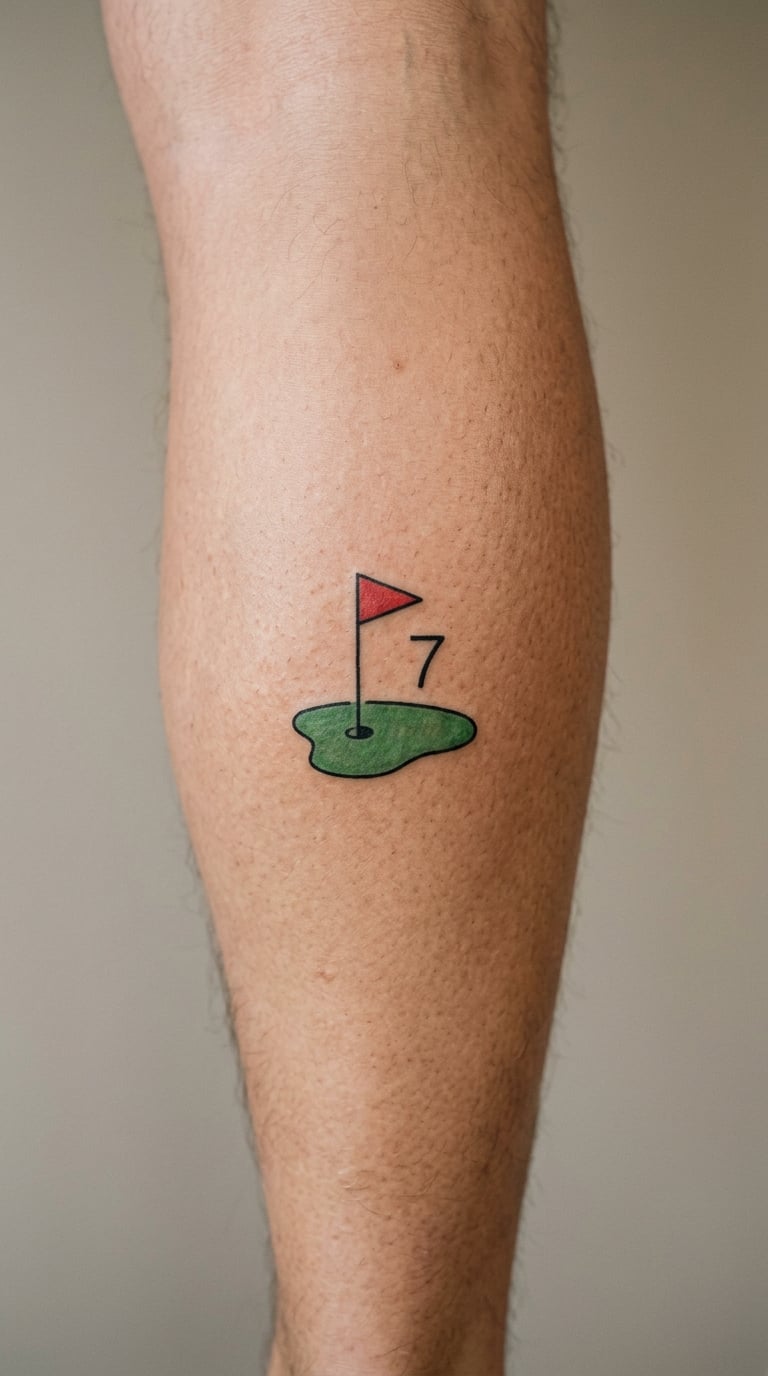
A patch of putting green with a red triangular flag, outlined in black, and a small number set beside the pole. The colour is limited to two or three tones.
The number is where the meaning lives. Players use the hole they always birdie, the hole they once aced, or the par they never beat.
Placement: calf, upper arm, or shoulder. Size: 2 to 3 inches wide. Style: illustrative colour with clean outlines.
Pain: low. The calf bruises a little but heals quickly. Red and green separate fine at this scale, so ask for slightly bolder outlines between the two.
Make it yours: put the number on a second pass in a different value than the rest, which keeps it legible as it ages.
13. Golf Bag with Crossed Clubs
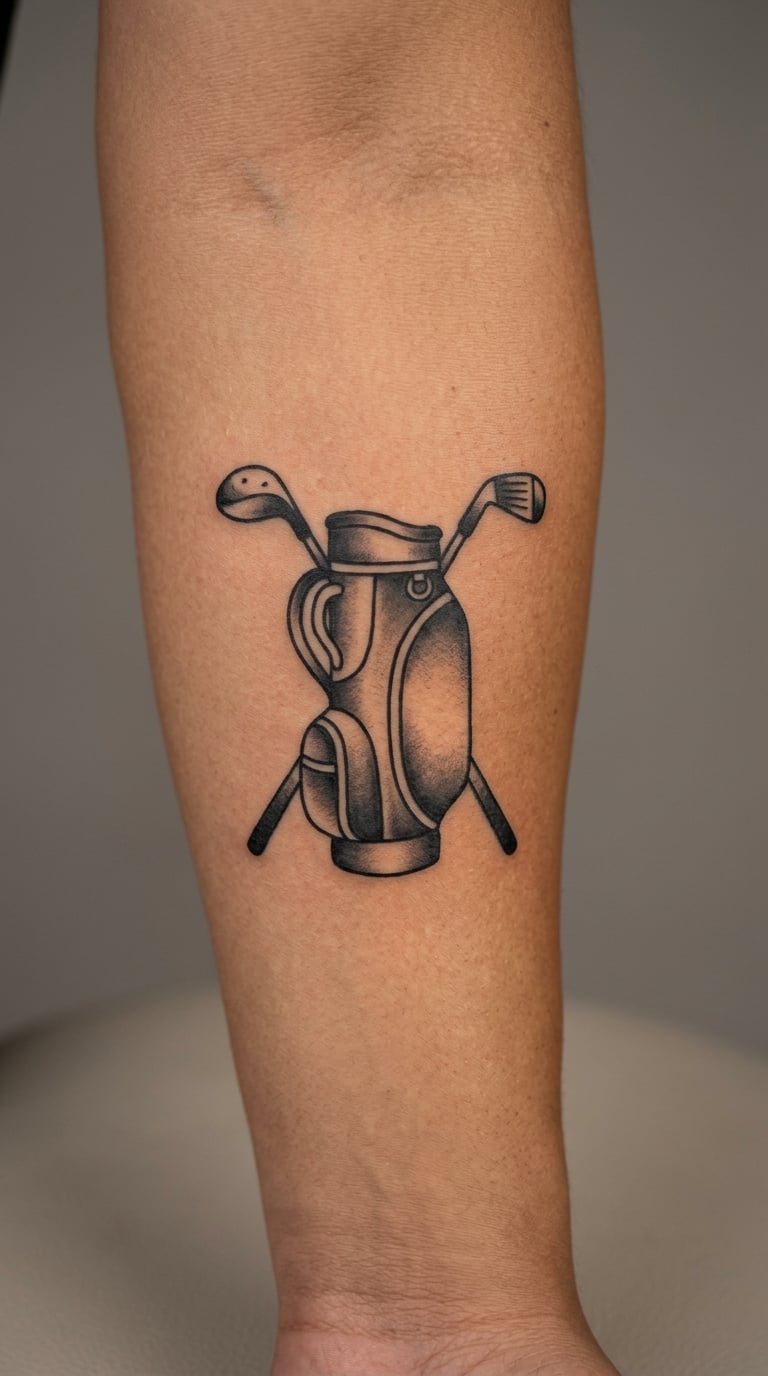
A standing golf bag with two clubs crossed behind it, drawn with bold traditional outlines and a grey wash for depth. No lettering, no brand marks.
The bag represents carrying the game with you rather than leaving it at the clubhouse. It reads well at a size where small objects would turn to mush.
Placement: forearm, calf, or upper arm. Size: 3 to 4 inches tall. Style: traditional bold line with grey shading.
Pain: medium, mostly from the length of the outline work. Bold outlines hold up well; the grey wash inside the bag fades first, which is a normal trade.
Make it yours: set the crossed clubs to the two you actually carry, a wedge and a putter for most players, rather than the driver and iron everyone defaults to.
14. Golf Course Map View
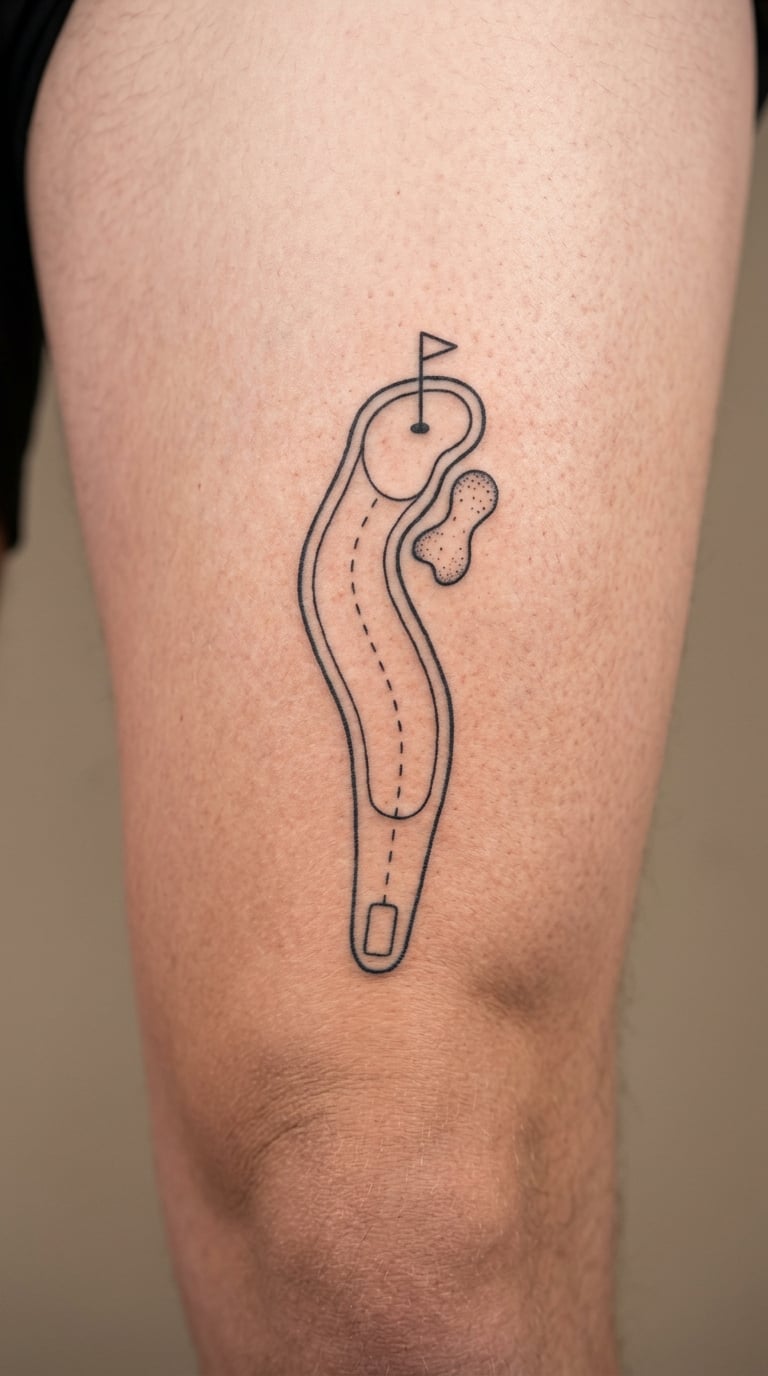
An overhead layout with a fairway, a bunker, a green, and a flag, reduced to a simple line drawing. It looks like a course diagram, which is exactly what it is.
Players get it for the course they play every summer or the one where a family tradition started. It is one of the least generic golf tattoo ideas on this list.
Placement: thigh, ribs, or along the forearm. Size: 4 to 6 inches long. Style: cartographic linework.
Pain: medium, and it takes a longer session because it is mostly outline. The thin property lines are the vulnerable part, so have the artist simplify anything under about an inch across.
Make it yours: mark your favourite hole with a small dot or a second flag so the map has a destination rather than being pure geography.
15. Glowing Golf Ball
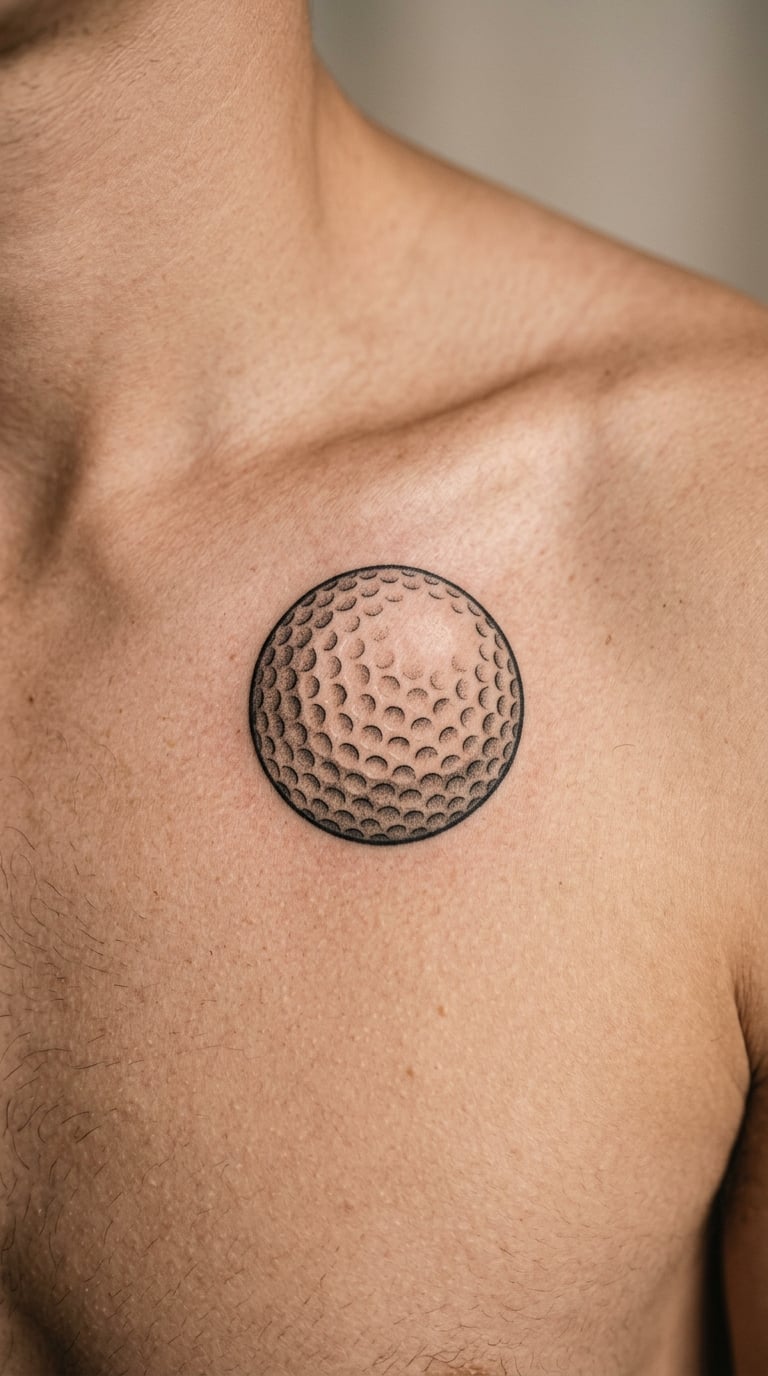
A ball rendered in smooth black-and-grey gradient shading with a single bright highlight left untouched, so the highlight reads as light coming off the surface.
It looks like the ball is lit from above at the moment before impact. The effect depends entirely on smooth gradient work, which is a specific skill worth asking for by name.
Placement: collarbone, forearm, or upper arm. Size: 1.5 to 2.5 inches wide. Style: black-and-grey realism.
Pain: medium, because grey shading means several passes over a small area. Grey ball tattoos fade toward a softer grey over time, which still reads as a ball.
Make it yours: keep one fully untouched highlight rather than several, since extra highlights blur together as the shading settles.
16. Golf Divot as a Heart
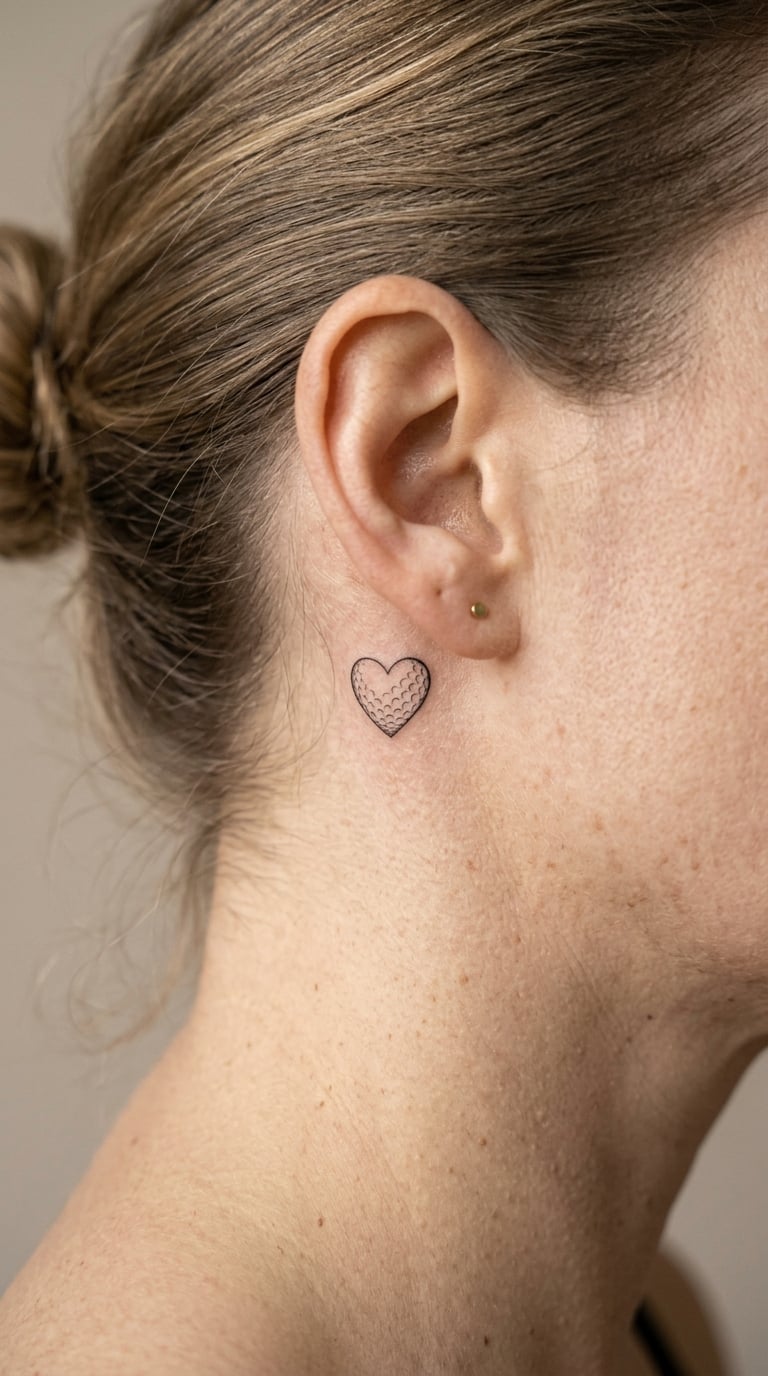
A small heart whose left lobe is shaped like the angled cut of a divot. The reference is subtle, visible only if you know what you are looking at.
It works for couples who golf together and for people who lost a playing partner. Golfers describe it as the one design in this list that only other golfers will spot.
Placement: behind the ear, inner wrist, or rib. Size: 1 to 1.5 inches wide. Style: fine line with negative space.
Pain: low. Behind the ear hurts more than it should for the size of the design, and skin there moves constantly, so ask for a slightly heavier line weight.
Make it yours: have the divot edge on the lower right rather than the upper left, which changes the tilt and keeps it from looking like a stock heart.
17. Traditional Golf Trophy
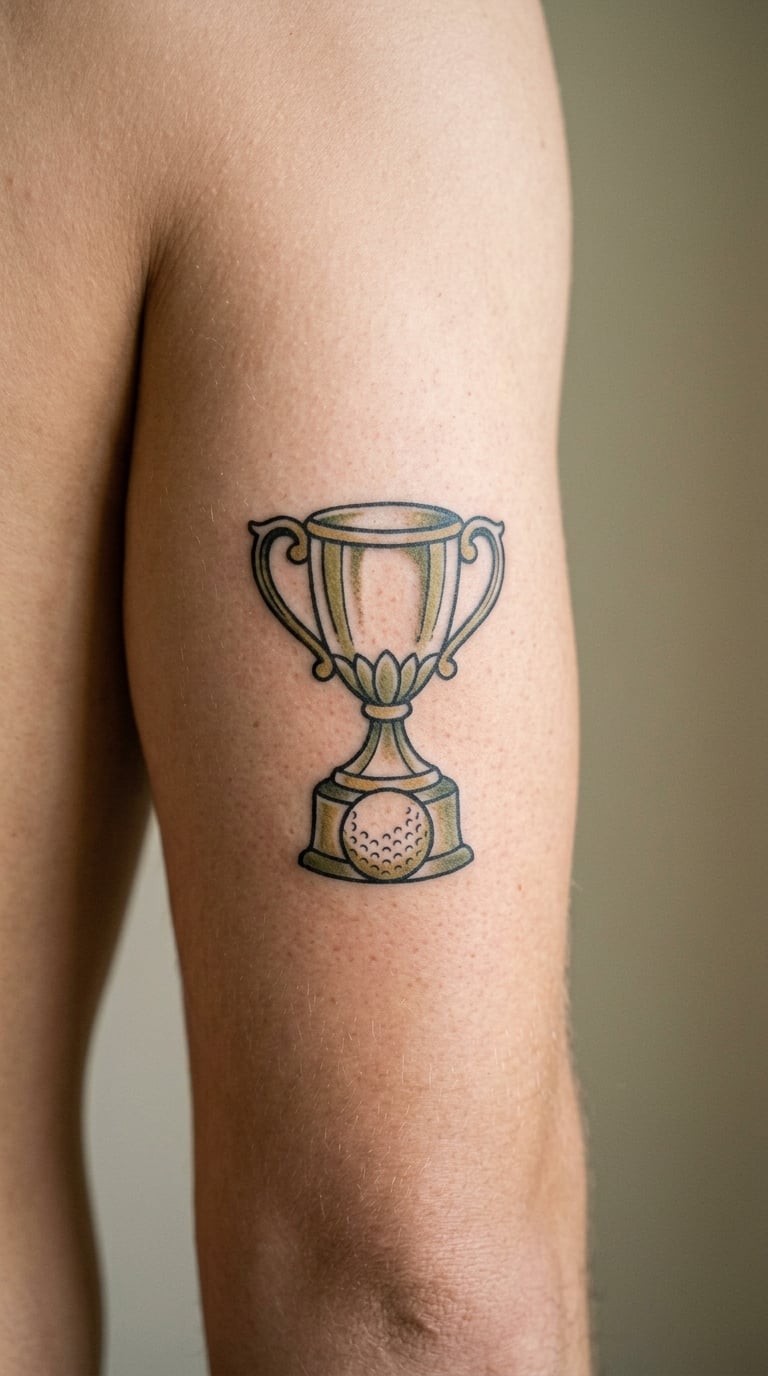
A cup-style trophy with a golf ball resting at its base, drawn with bold traditional outlines and restrained gold and green accents. Old-school Americana rather than modern realism.
It stands for the parts of the game that get remembered, including the tournament win at a company event. Golfer humour is usually the reason it gets chosen.
Placement: upper arm, chest, or back. Size: 3 to 4 inches tall. Style: traditional colour.
Pain: medium. Gold and green fills extend the session, and the upper arm itches during healing more than you would expect.
Make it yours: have the year added in small numerals on the trophy base rather than a banner underneath, which keeps the design compact.
18. Golf Birdie Path
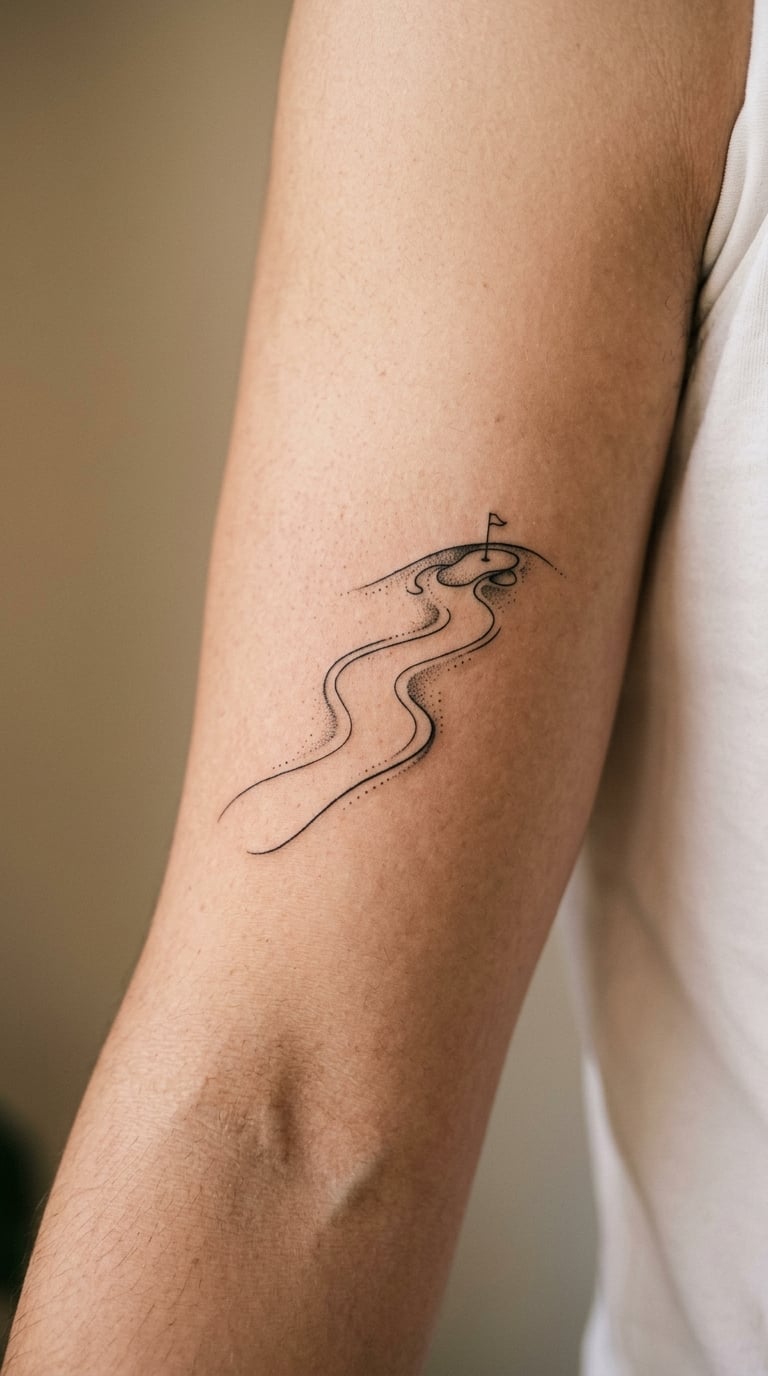
A fairway that curves through the design toward a small green and flag, with a scatter of fine dotwork suggesting texture along the edges. No golfers, no landscape.
It follows the arc of a shot, which is why it feels like the game rather than a picture of it. The curve also suits a placement where the body already has a natural line to follow.
Placement: outer arm, outer calf, or along the shoulder. Size: 3.5 to 5 inches long. Style: fine line with light dotwork.
Pain: medium. Dotwork is many small taps rather than strokes, so it is tedious rather than painful, and the outer arm takes it well.
Make it yours: curve the fairway to follow your stance line, which makes the design sit naturally on the body instead of floating on it.
19. Blackwork Golf Course Arch
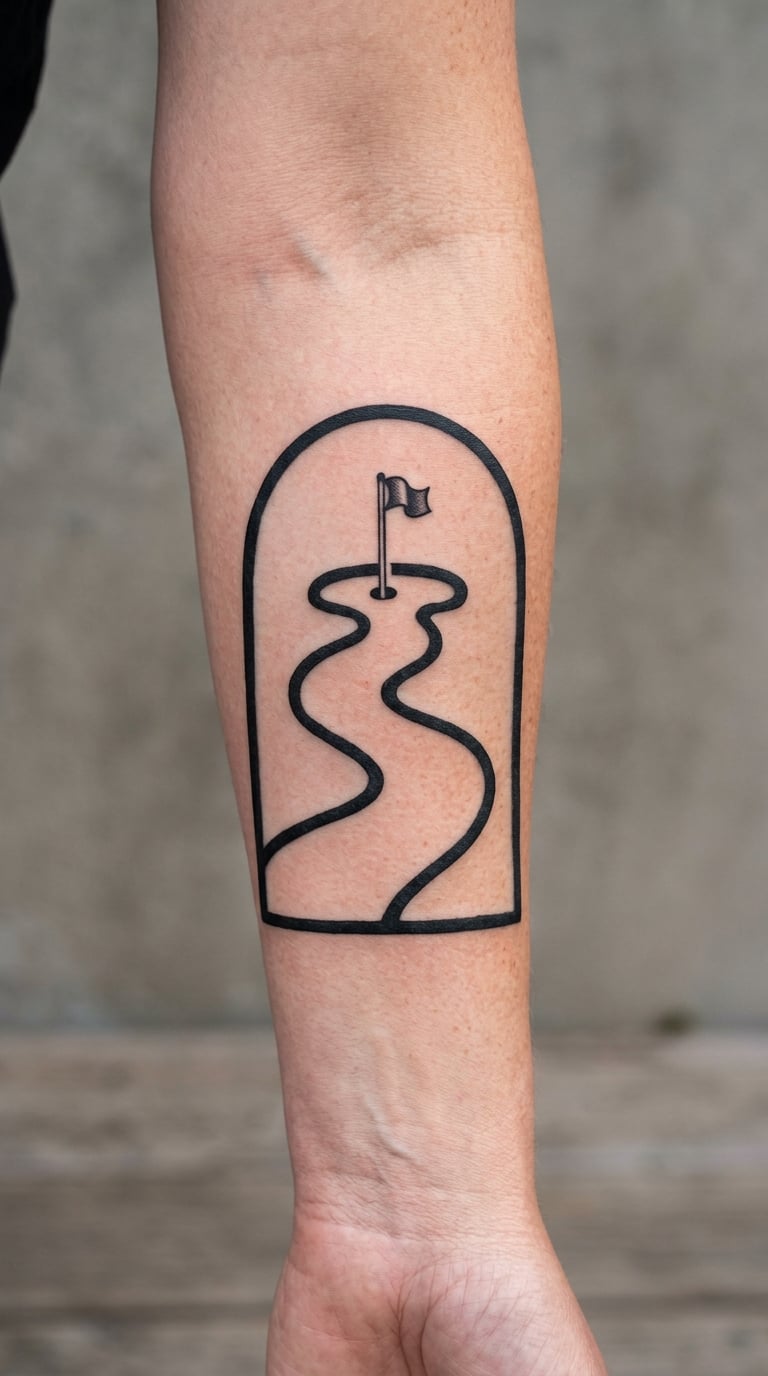
A bold arch of solid black forming the shape of a course, with the fairway left as negative space running up to a small flag. No sky, no trees, no background.
It is the heaviest design here and the one that changes the most over decades. Good blackwork holds its edge for a very long time, which makes it a sensible choice for a first piece that has to last.
Placement: forearm, upper arm, or calf. Size: 4 to 5 inches wide. Style: blackwork with negative space.
Pain: medium to high, mostly from the solid fills. Solid areas run hot for the first few days, so plan a few quiet days afterwards.
Make it yours: have the arch follow the curve of your forearm or calf rather than sitting as a straight block, which hides the geometry in the body.
20. Golf Ball as a Constellation
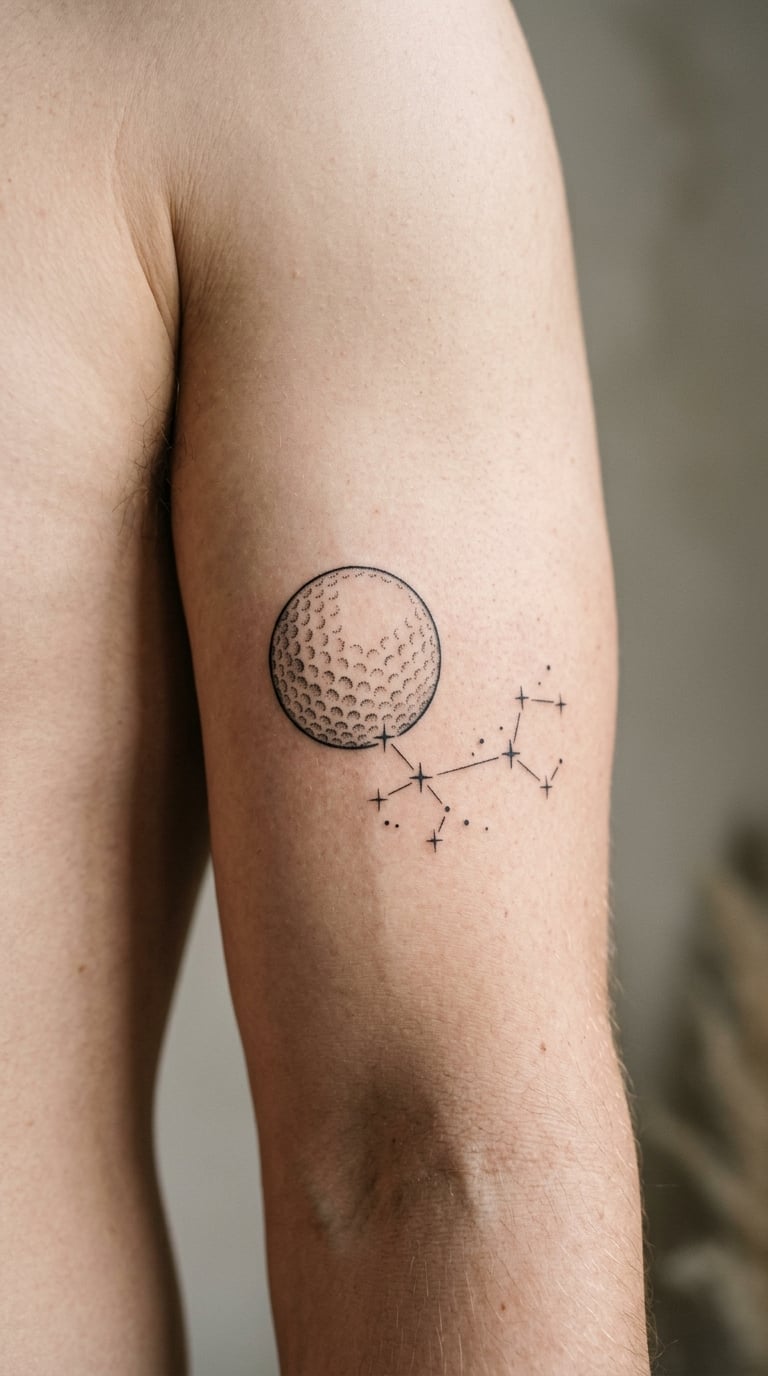
A golf ball circle drawn in thin lines, with a small set of stars connected by fine line segments beside or above it. Delicate dot accents sit between the stars.
Stars are the other thing people are born under, so this design puts two kinds of destiny side by side. It reads as quiet rather than loud, which is what makes it work for a first tattoo.
Placement: upper arm, back, or thigh. Size: 2 to 3 inches wide. Style: fine line with dotwork accents.
Pain: low to medium. The thinnest connecting lines are the first to fade, so ask the artist to skip any line that would be thinner than a pencil stroke at final size.
Make it yours: use the real arrangement for your birth month and the constellation of someone you are getting it for.
21. Miniature Golf Scene
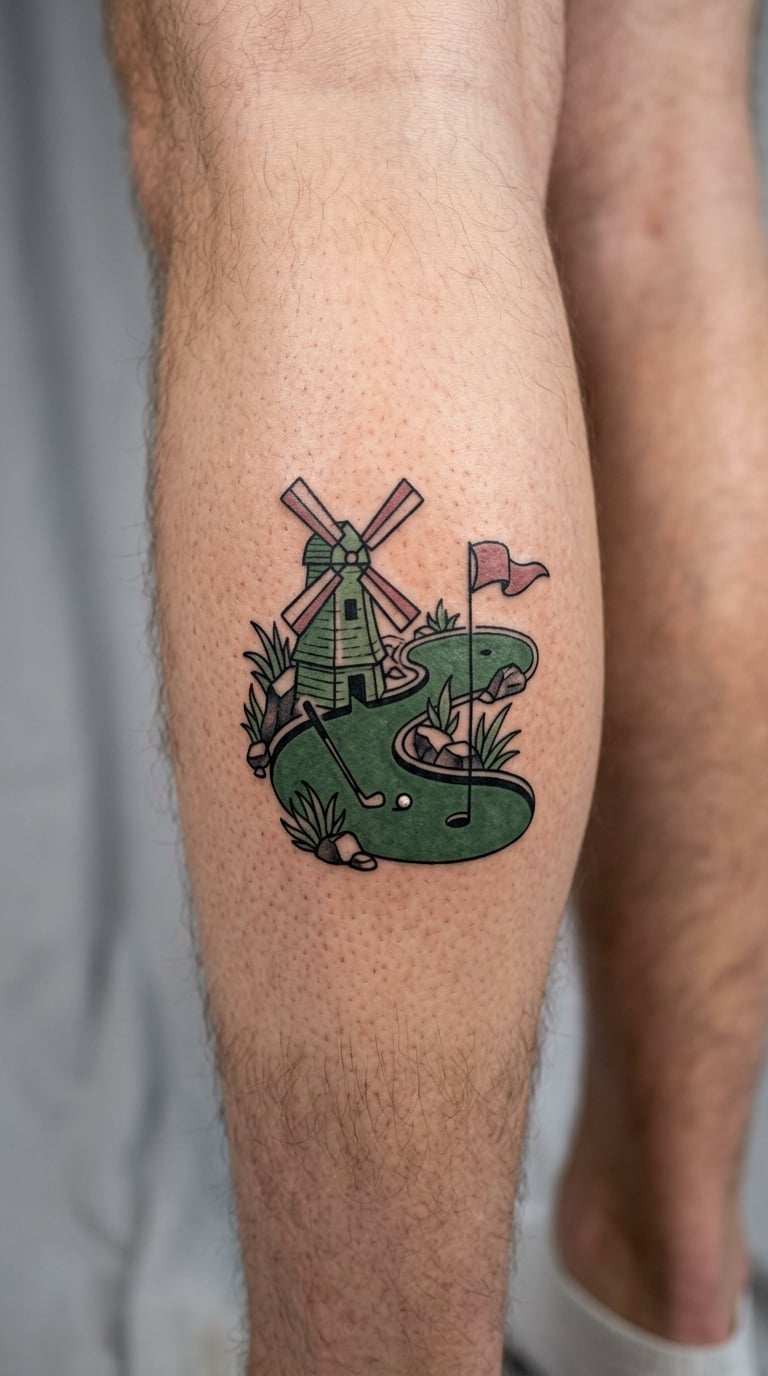
A playful small scene with a putting surface, one obstacle, a ball, and a red flag, drawn with limited colour and a slightly cartoonish hand. It is meant to be fun rather than reverent.
It suits families, kids’ rooms, and golfers who started on a putting green. Plenty of adults get it with a child and add the child’s scorecard on a second session.
Placement: calf, forearm, or shoulder. Size: 2.5 to 3.5 inches wide. Style: illustrative colour with cartoon linework.
Pain: low. Small scale and short session. Muted colours hold better than pastels here, and thin white highlights inside the obstacle tend to disappear within a few years.
Make it yours: include the specific obstacle your kids always beat you on, whether it is a windmill or a ramp.
22. Golf Driver with Sunburst
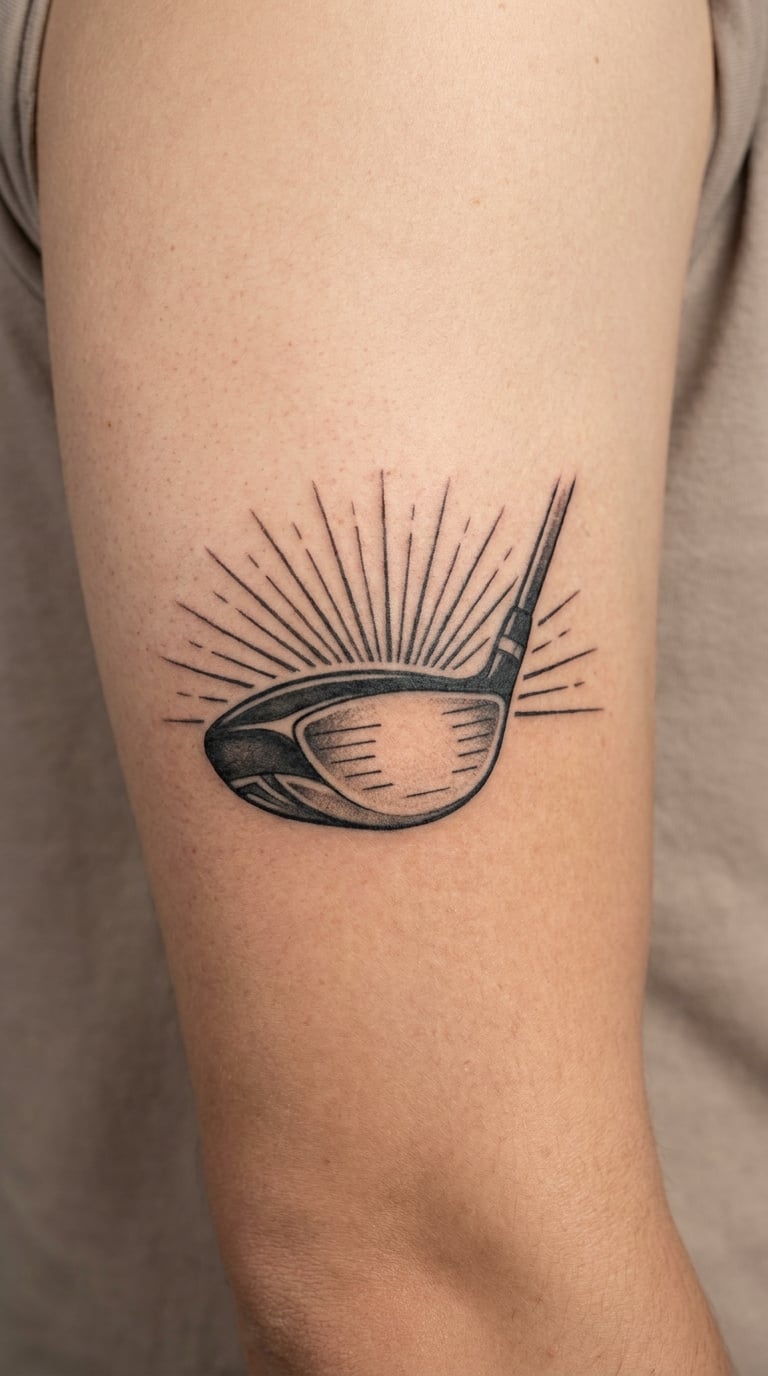
A graphic driver head with thin sunburst lines radiating out behind it, kept restrained so the rays stay a texture rather than taking over. Black line, no colour unless you ask.
The burst reads as the moment of strike, which is the part of golf most players remember. It suits someone who plays for the swing as much as the card.
Placement: shoulder, upper chest, or upper arm. Size: 3 to 4 inches long. Style: graphic linework.
Pain: medium. The shoulder takes colour and shading well, though near the collarbone the skin is thinner and more sensitive.
Make it yours: set the number of rays to something specific rather than a standard count, which removes the pattern feel from the design.
23. Handwritten Golf Wordmark
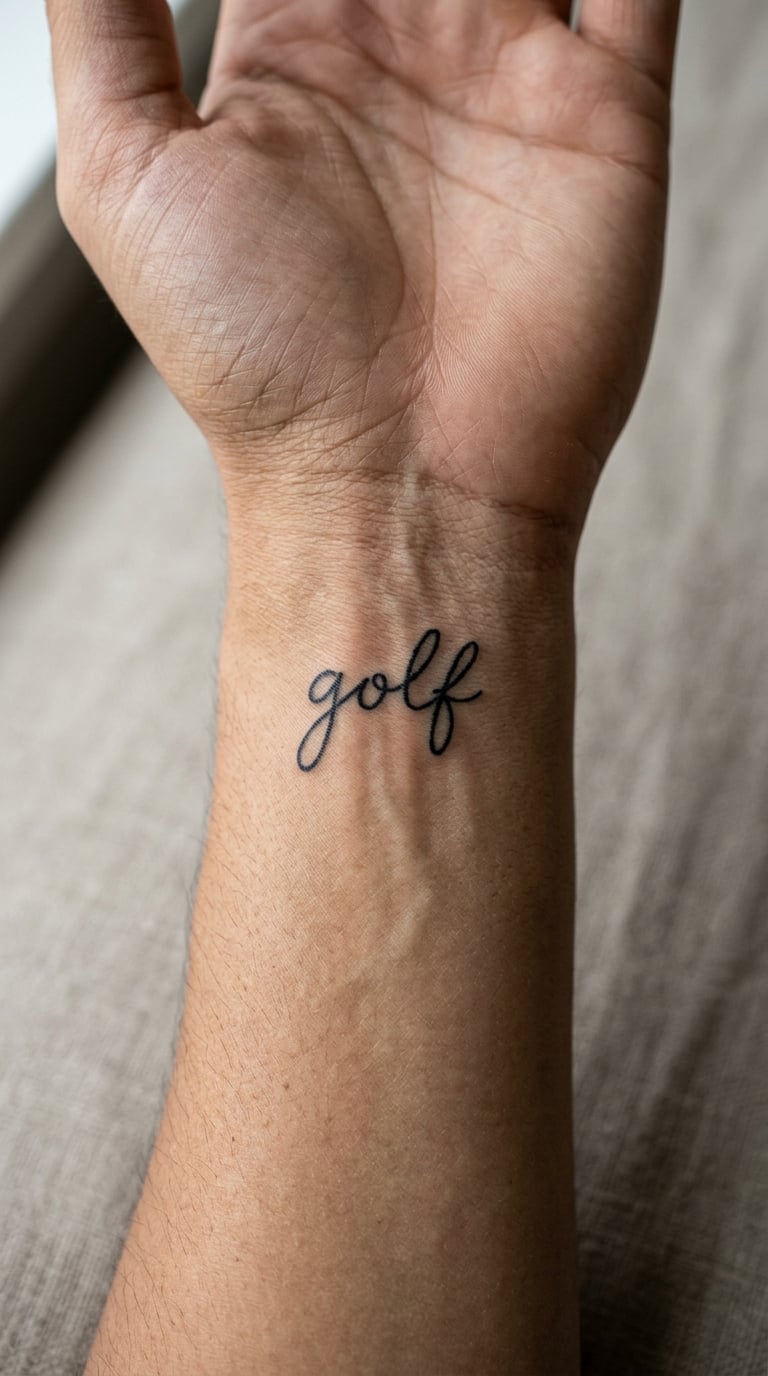
A single word written in loose hand lettering rather than a copied logo. The point is that the lettering is original, drawn for you, not traced from a brand.
One word in script carries a different weight to a golf ball or a flag. It works when you want the sport without the equipment, and it pairs well with a matching piece elsewhere.
Placement: wrist, ribs, or behind the ear. Size: 1.5 to 2.5 inches wide. Style: hand lettering and script.
Pain: low. Script is the biggest fading risk in this entire guide, because thin connecting strokes fill in as the skin repairs. Ask for a script style with slightly heavier downstrokes.
Make it yours: have the word written in a hand that resembles your own handwriting rather than a generic tattoo script.
24. Matching Golf Ball Pair
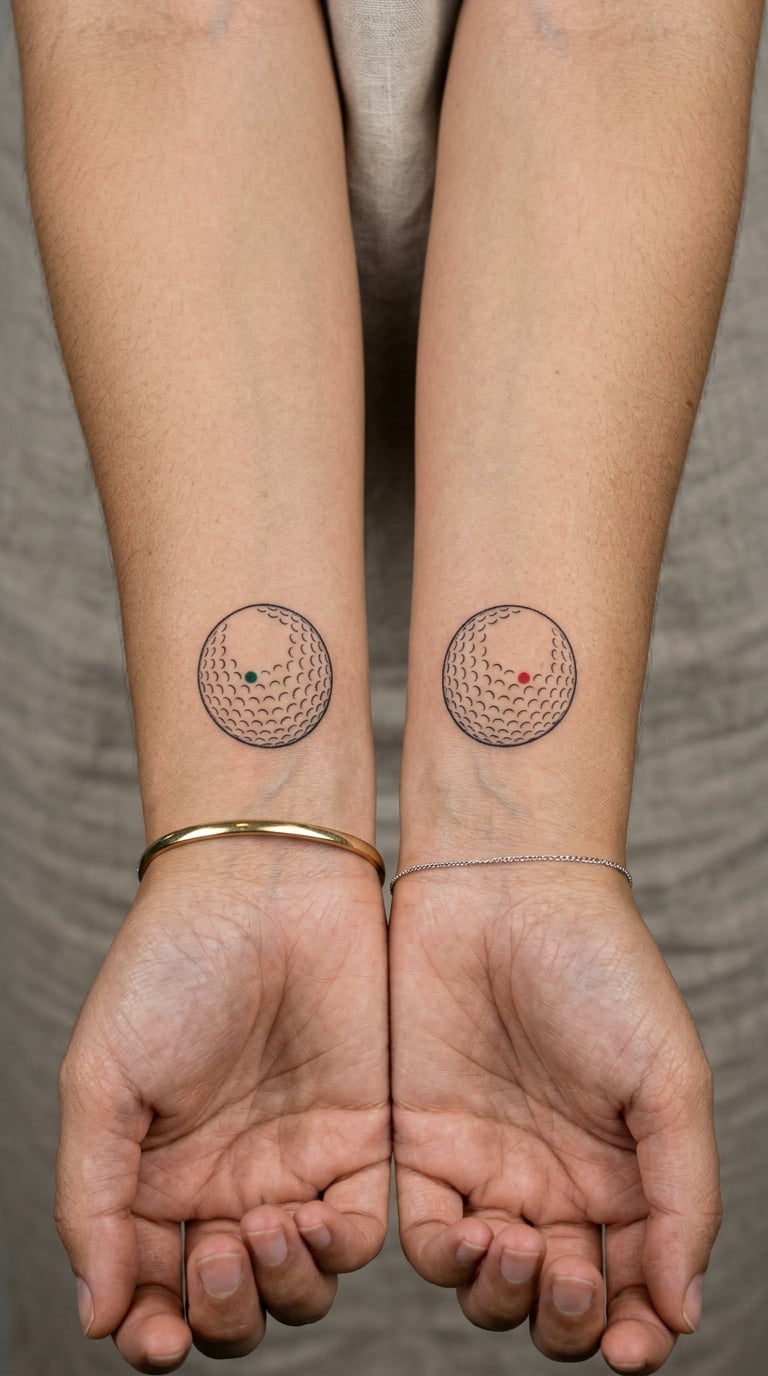
Two matching fine-line balls on opposite inner wrists, each with one small distinguishing detail. Same design, one accent changed, so the pair reads as connected without being identical.
Matching ink has become a ritual in golf, and this version works for couples, friends, or a parent and child who learned the game together. Golfing dads and their sons have been pairing balls for years now.
Placement: inner wrists, or matching positions on both forearms. Size: about 1.5 inches each. Style: fine line.
Pain: low, though the inner wrist is sensitive and the skin there stretches constantly. Two small appointments are usually easier than trying to sit through both wrists at once.
Make it yours: if you want something similar for a friend rather than a partner, the matching tattoo ideas for roommates round out a few other pair formats.
How to Choose the Right Design
Six questions narrow this list down fast. Most people pick a design that looks good on a screen and then discover it fights the placement, so work through these before you book.
1. Match the style to your experience. Fine line and minimalist pieces suit a first tattoo and a quiet spot. Traditional and blackwork suit someone already collecting ink. If you have nothing yet, ideas 1, 2, 11 or 16 are the low-commitment entry points.
2. Pick a realistic size. Anything with internal detail smaller than about an inch will blur. Tiny designs are lovely at first and vague in fifteen years, so either go bigger than you think or drop the detail.
3. Let the placement decide the shape. A design that is 4 inches long on a flat forearm becomes a different piece on a curved calf. Have your artist draw it in the shape of the area it will live in.
4. Decide how visible it should be. Inner wrist and behind the ear hide under a shirt or a watch. Outer forearm, calf and shoulder are visible year-round, which matters if you work in a conservative environment or play in a club setting with formal dress codes.
5. Add one personal detail. A number, a date, a course name, a set of coordinates. This is what separates a tattoo from clipart, and it costs nothing in size.
6. Book an artist, not just a design. Send the reference to an artist who works in the style you want and ask to see healed work, not just fresh photos. Fine line, blackwork and script are all specialities, and generalists are rarely strong at all three.
Related reads if you are still narrowing things down: tattoo ideas for cyclists covers similar landscape and equipment compositions, and it is a useful comparison if you are deciding between a golf piece and an endurance sport piece.
Cost and Session Time
Golf tattoo prices in the US run on size and detail more than on the theme. Nothing about a ball is more expensive than a rose. These are realistic ranges for a single piece.
- Tiny, under 1 inch, single colour: roughly $80 to $150, usually under an hour.
- Small, 1 to 2.5 inches: roughly $150 to $300, one to two hours.
- Medium, 3 to 4 inches with shading: roughly $300 to $600, two to four hours.
- Larger or colour-heavy, 4 inches and up: roughly $600 to $1,500 or more, split across sessions.
Colour adds time and therefore cost. Shading and blackwork do the same, because solid fills take many more passes than a single-needle outline. Placement matters too: ribs, collarbone and the inner arm tend to be priced higher than the outer forearm.
Most shops set a shop minimum that covers a short session, so a tiny design can still land at that floor. Rates vary a lot by city and by artist, and the cheapest work in any city is rarely the deal it appears to be.
Aftercare Basics
Start with your artist’s aftercare instructions, since they know exactly what they did in your skin. Beyond that, the standard advice is short.
1. Follow your artist’s aftercare instructions first. Anything below is general, and their guidance takes priority over it.
2. Keep it clean. Wash gently with unscented soap and lukewarm water, then pat dry with a clean hand rather than a towel.
3. Leave the film alone. Let it dry naturally and peel on its own. Picking or scratching pulls ink out of the new skin.
4. Skip the gym and the sun for a few days. Sweating, swimming and heavy sun on a fresh piece both slow the settle.
5. Skip the lotions. Heavy creams and oils on a healing tattoo trap moisture against it.
6. Sleep on clean sheets. Change the pillowcase or towel if the area is on the shoulder or back.
Once healed, the main enemy of a golf tattoo is sunlight. Fine line and colour both fade faster on exposed arms than under a sleeve, so cover up when the forecast is harsh.
Frequently Asked Questions
What does a golf tattoo usually mean?
Usually it means the game matters to you, and how. A ball or flag often marks a person, a course, or a round that stuck with you. A club or swing silhouette points to the commitment side of golf. A golf ball with a date or a set of coordinates is nearly always a memorial or an anniversary piece. Ask the wearer if you want the real story.
Are golf tattoos suitable for beginners?
Yes, and several on this list are built for first tattoos. A fine-line golf ball, a minimal ball with a number, or a tiny tee-and-ball piece are all small, fast to heal, and low commitment. The main caution is scale: tiny detail blurs over the years, so keep it simple rather than cramming in dimples, shadows and lettering at once.
What is the best placement for a small golf tattoo?
The inner forearm and the outer wrist are the easiest and least painful for small designs, and both hide under a long sleeve. Behind the ear and the inner wrist are the most discreet options. If you want it visible when you play, the outer forearm, calf or shoulder reads well in a short sleeve. Avoid putting fine line across a joint like the wrist crease, where it fades fastest.
How much does a golf tattoo cost in the US?
Roughly $80 to $150 for a tiny single-colour piece, $150 to $300 for a small design around two inches, $300 to $600 for a medium piece with shading, and $600 and up for larger or colour-heavy work. Shop minimums apply, and city rates vary widely. Cost tracks size, detail and session length rather than the golf theme itself.
Will a fine-line golf ball tattoo fade quickly?
Faster than most, yes. Fine line is single-needle work with little colour to hold the shape, and thin lines fill in as skin repairs over the years. Ask for a slightly heavier line weight than looks right in a photo, keep it off the inner wrist crease, and cover it from strong sun. Expect a touch-up every five to eight years on a small ball.
Can I personalise a golf tattoo for a partner or golfing memory?
Easily. A number inside the ball, a date on the pennant, a set of course coordinates, or initials on a flag all turn a generic design into one specific to you. For matching work, two balls with one detail changed each is easier to read than two identical tattoos. Bring your reference plus the specific detail and your artist can merge them.
Conclusion
For a first tattoo, a fine-line golf ball with a divot or a minimal ball with a meaningful number is the easiest place to start. Small, low commitment, and it still reads as golf a decade from now.
For someone adding to an existing collection, a blackwork golf course arch is the stronger pick. It has the weight to hold a spot on the arm and the durability to outlast the trends that come and go.
Whichever you pick, take your time on the placement and pick an artist who works in the style you want. Those two decisions matter more than the design itself.