
20 Pelican Tattoo Ideas: Best Coastal Designs (October 2026)
Choosing between 20 pelican tattoo ideas comes down to two things: how much room you have, and how much line detail will survive healing. A pelican is instantly recognisable because of the pouch under its beak, so a design only works if that pouch is still there five years in. Every idea below is written with a real size, a real placement and an honest note on how it ages.
These suit people who are coastal, boaty, saltmarsh-influenced, or simply drawn to a bird most tattoo compilations skip. Some carry the old Christian reading of the pelican feeding her young at the cost of her own body, so treat that as a possibility rather than an assumption. If you are planning a few months out, book the consultation now, because good bird artists fill up before the season turns. Pair a bird piece with beach tattoo ideas for women if you are building a coastal set.
20 Pelican Tattoo Ideas: Quick Guide</
| Idea | Style | Best placement | Size | Pain |
|---|---|---|---|---|
| 1. Fine-line in flight | Fine line | Outer forearm | 4 in wide | Medium |
| 2. Realistic portrait | Micro-realism | Upper arm | 3 in tall | Medium |
| 3. Pelican and pouch | Black and grey | Outer upper arm | 5 in wide | Medium |
| 4. Minimal line art | Continuous line | Inner wrist | 2.5 in long | Low to medium |
| 5. Tropical traditional | Neo-traditional | Outer forearm | 6 in wide | Medium |
| 6. Diving into blue water | Watercolour | Calf | 5 in wide | Medium |
| 7. Pelican and fish mark | Blackwork | Side of wrist | 2 in tall | Low to medium |
| 8. Floral sleeve detail | Illustrative | Outer thigh | 7 in wide | Medium to high |
| 9. Blackwork head | Blackwork | Forearm near elbow | 3 in tall | Medium |
| 10. Watercolour shoulder | Watercolour | Outer shoulder | 5 in wide | Medium |
| 11. Beak turned ribbon | Fine line | Side of neck | 4 in long | Medium |
| 12. Feeding a chick | Black and grey | Upper arm | 6 in wide | Medium |
| 13. Resting on driftwood | Realistic | Outer forearm | 5 in wide | Medium |
| 14. Geometric | Geometric | Sternum | 4 in tall | High |
| 15. Facing pair | Fine line or blackwork | Both upper arms | 4 in each | Medium |
| 16. Sunset behind | Silhouette with colour | Behind the ear | 3.5 in tall | Low |
| 17. Tiny perched bird | Fine line | Behind the ear | 1.5 in long | Low |
| 18. Rope border | Bold black and grey | Upper arm | 5 in tall | Medium |
| 19. Engraving style | Etching and hatching | Outer forearm | 4 in wide | Medium |
| 20. Full-colour portrait | Colour realism | Calf | 5 in tall | Medium to high |
1. Fine-Line Pelican in Flight
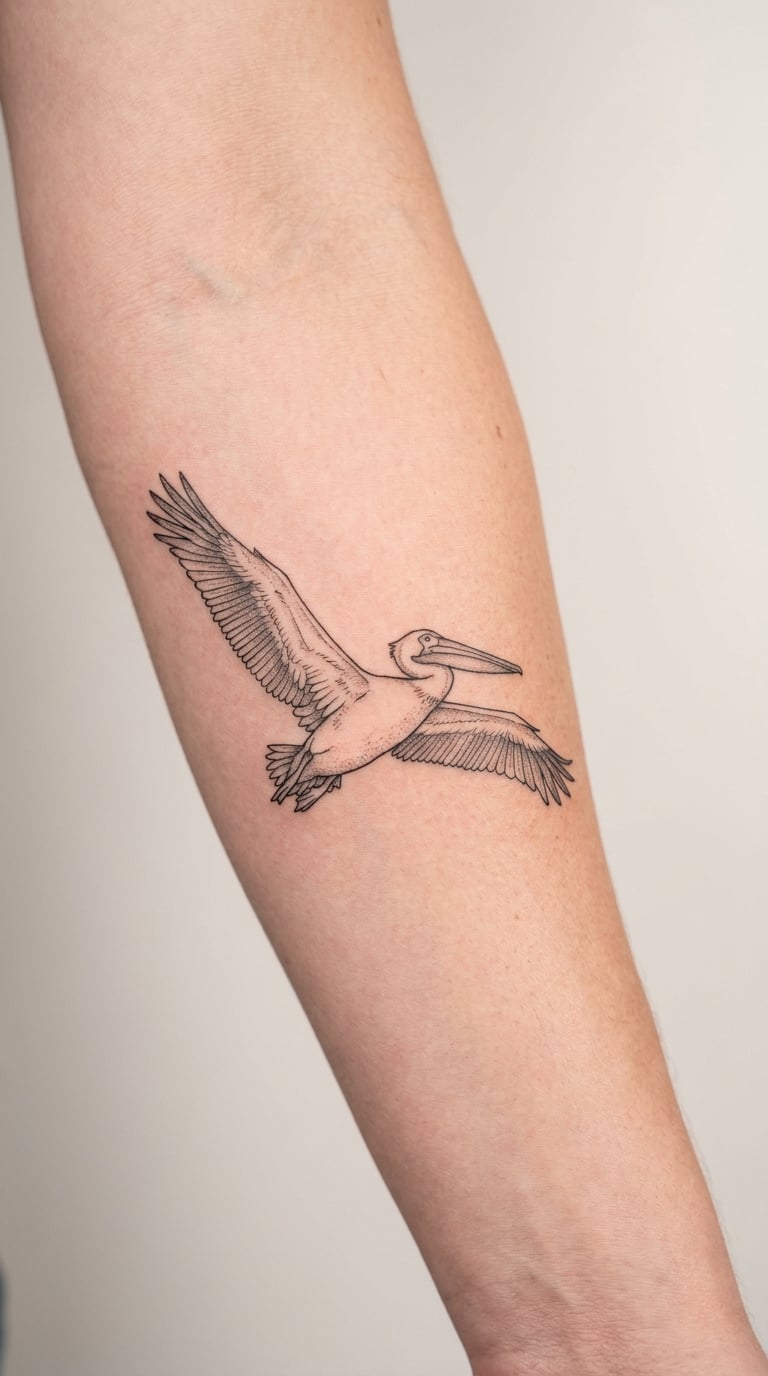
A pelican in flight, drawn in a single-weight outline with the wings stretched wide and the long beak pointing forward, is the cleanest pelican design there is. Nothing competes for attention: one line for the upper wing, one for the trailing feathers, one closed curve for the pouch.
People pick it for the motion. A bird mid-glide reads as freedom and forward movement without needing a slogan underneath it.
Placement: outer forearm, or the upper arm for a longer line. Size: 3-5 in (7-13 cm) wide. Style: fine line, single needle. Pain: medium, and the forearm bruises visibly for a week. Fine line on the inside of the wrist fades first, so keep it on the outer arm or shoulder if you want it crisp long term.
Make it yours: add three or four short dotted lines trailing behind the wings to suggest a wake.
2. Realistic Pelican Portrait
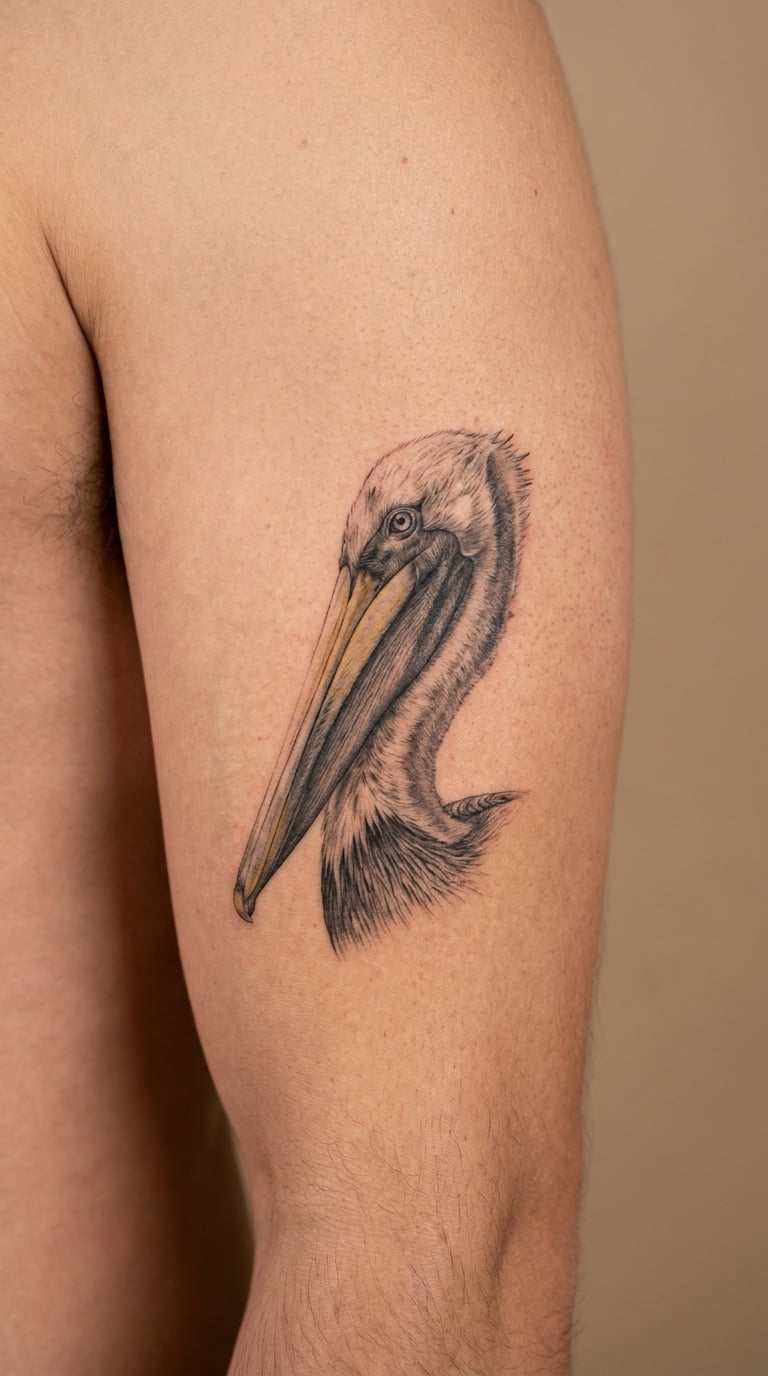
A micro-realistic portrait is built in layers: soft grey feather texture over the crown, a warmer buff along the throat, and one muted yellow beak that carries all the colour in the piece. Keep the eye small and dark, or the bird looks alert in a slightly odd way.
This is the version people choose when the pelican is someone, not something. A portrait of a brown pelican reads as a specific animal rather than a symbol, which suits a memorial piece.
Placement: upper arm or the flat of the calf. Size: 2.5-4 in (6-10 cm) tall. Style: micro-realism with light shading. Pain: medium. Feather texture is dense, so expect a longer session than the size suggests, and expect the lightest greys to soften into a general tone over about five years.
Make it yours: bring a photo of the exact pelican you want copied, ideally one you took yourself.
3. Pelican and Pouch
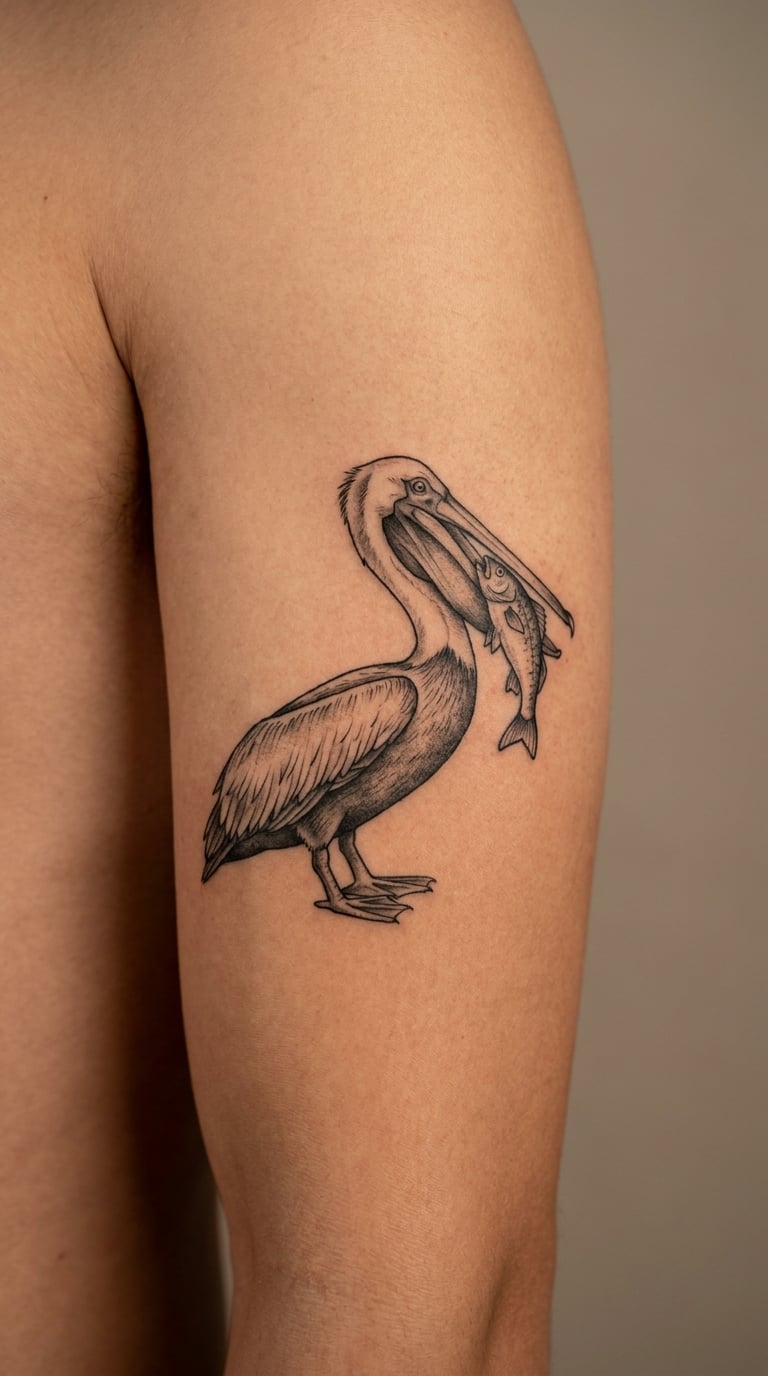
This design puts the defining feature first: a pelican in profile with the throat pouch dropped low and heavy, holding a single fish. The pouch is the whole point, and getting its shape right separates this from a heron or a cormorant at a glance.
Fishing birds mean provision and patience, which is why this reads well as a working-life or new-parent piece.
Placement: outer upper arm, or the thigh if you want it larger. Size: 4-6 in (10-15 cm) wide. Style: black and grey with soft shading in the pouch. Pain: medium. The pouch outline and the fish both need a steady hand, and small line details inside the fish do blur first, so keep the fish simple.
Make it yours: have two fish in the pouch instead of one, angled so the tail sits above the beak line.
4. Minimal Pelican Line Art
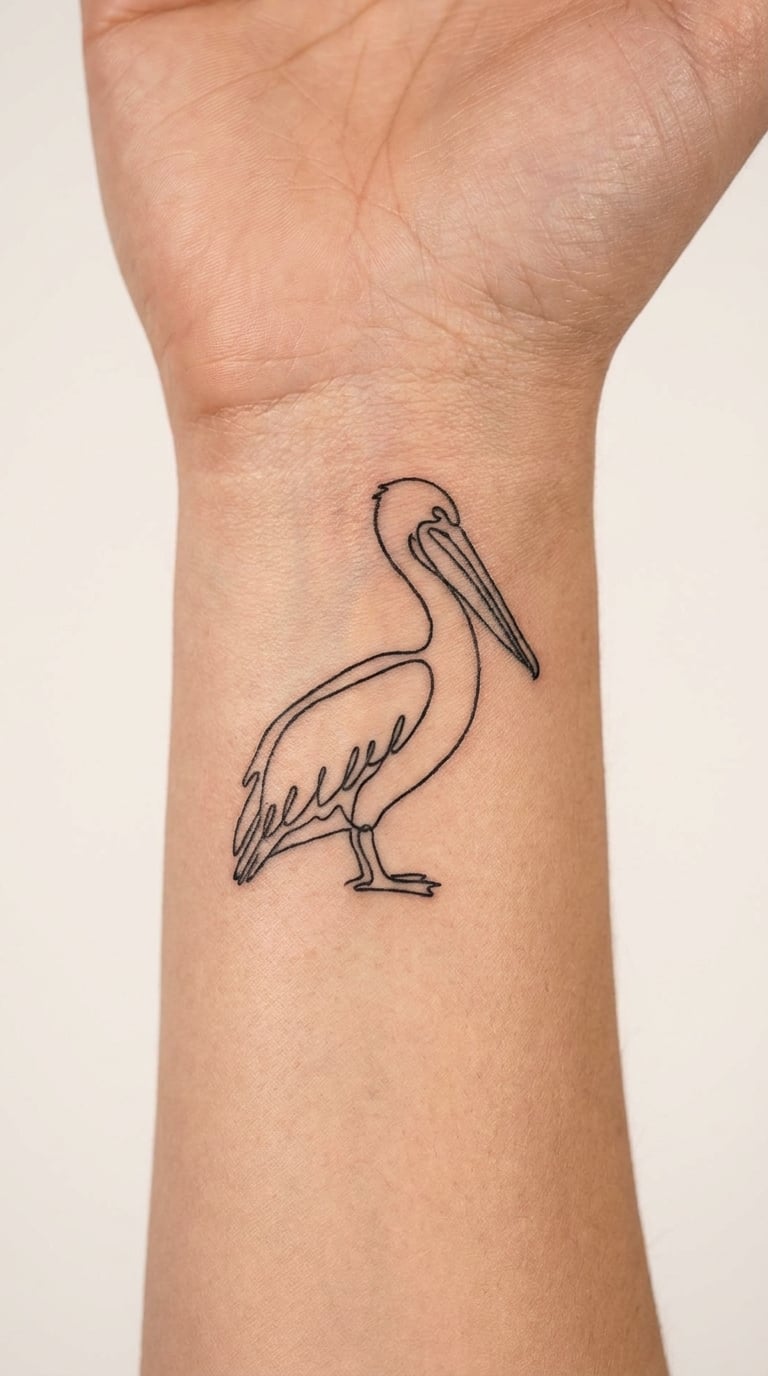
One continuous line, lifted and restarted a few times, draws a perched pelican with a long beak and folded wing. The economy is the appeal: there is no shading to fade badly and no feather texture to blur.
It suits people who like minimal tattoos and want something visible without a full sleeve. A perched bird reads as settled rather than restless, which is its own kind of message.
Placement: inner wrist, ankle or behind the ear. Size: 2-3 in (5-8 cm) long. Style: continuous line art. Pain: low to medium. Wrist and ankle work are thinner, so this stings more than the size suggests. Single-needle line on the inner wrist is the first place to show wear, usually by year five or six.
Make it yours: have the line finish as a loose wave under the feet so the bird is standing on water.
5. Traditional Pelican with Tropical Flowers
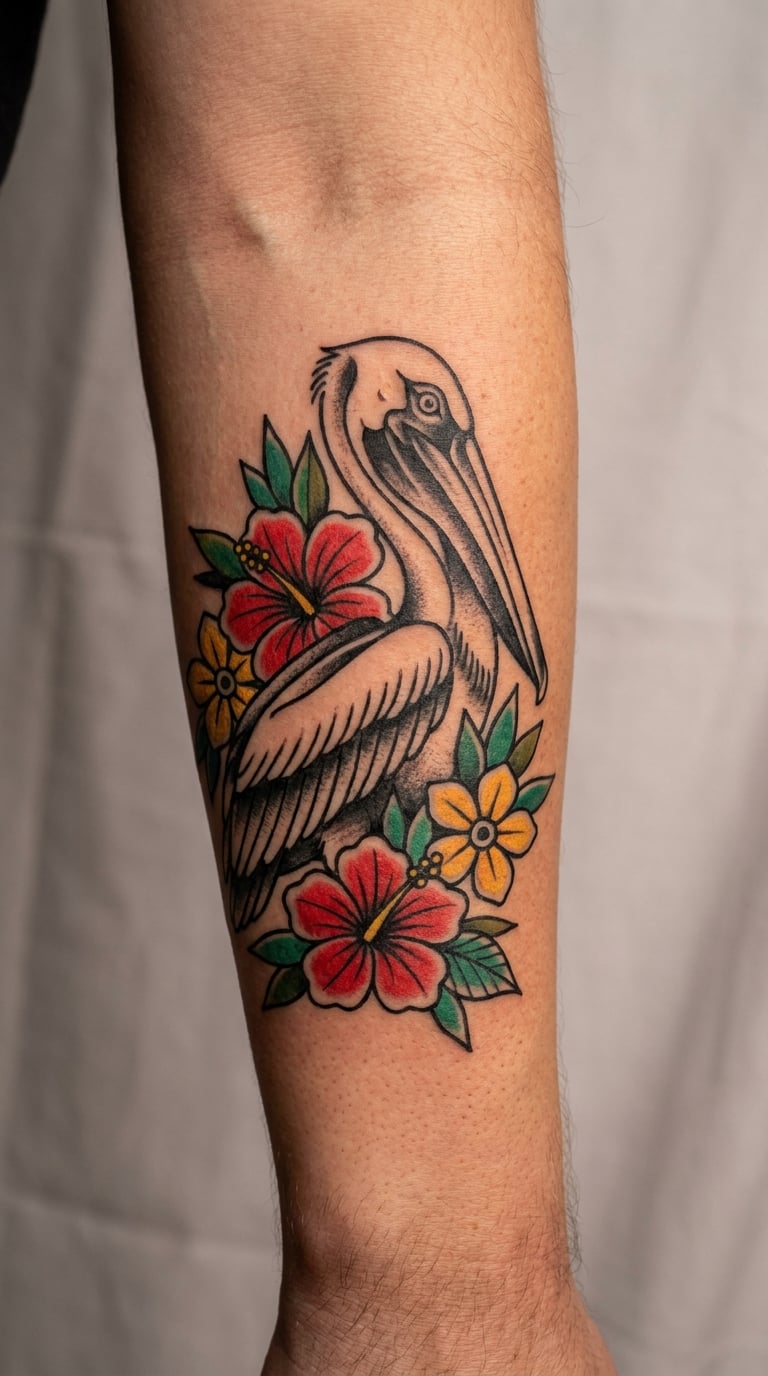
Neo-traditional means a thick even outline, a flat yellow beak, a red or green background wash, and flowers in the gaps: hibiscus, plumeria, frangipani. The pelican’s neck gives the composition a natural S-curve to hang flowers off.
It is the most decorative option here and the one that reads best from across a room, which is why it keeps showing up as a holiday piece.
Placement: outer forearm or shoulder. Size: 5-7 in (13-18 cm) wide. Style: neo-traditional American flash. Pain: medium, higher on the ribs and spine. Solid colour blocks hold up far better than shading, so this style ages well; reds and yellows can warm slightly, so a cool-down session is worth it later.
Make it yours: swap the flowers for a different set while keeping the same background wash and outline weight.
6. Pelican Diving into Blue Water
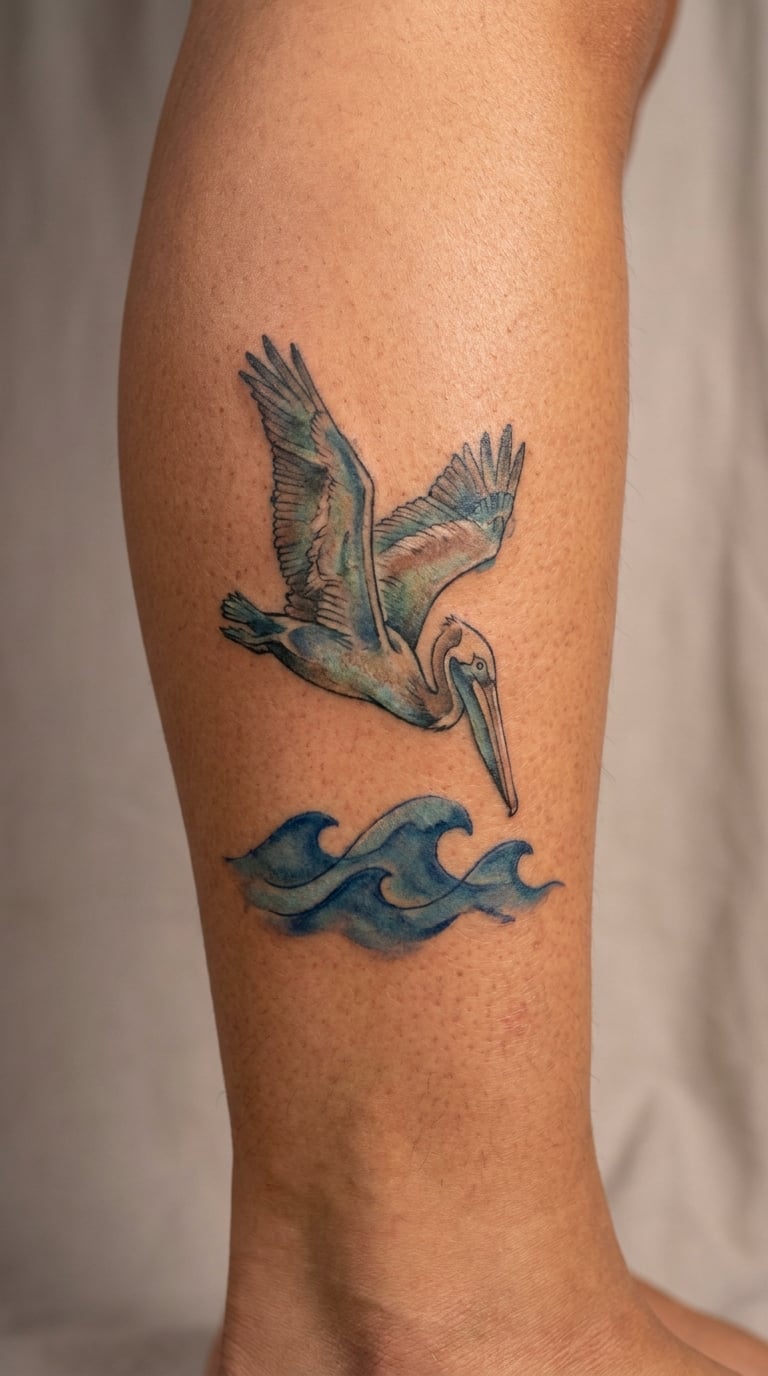
A pelican folded into a dive, beak first, over three or four loose watercolour waves. The bird itself can stay fairly simple because the wash does the work: a bleed of teal and indigo that pools unevenly along the bottom edge.
It suits people who like colour that looks hand-made rather than printed. The dive is also a less literal pelican pose, so it reads more like movement and instinct than decoration.
Placement: calf, thigh or across the shoulder blades. Size: 4-6 in (10-15 cm) wide. Style: watercolour with soft edges. Pain: medium, and the calf gets sore in a deep way. Watercolour fades unevenly, with the palest blues going first, so expect a touch-up every few years if you want the wash bright.
Make it yours: add a single white splash line where the beak meets the top wave.
7. Pelican and Fish Mark
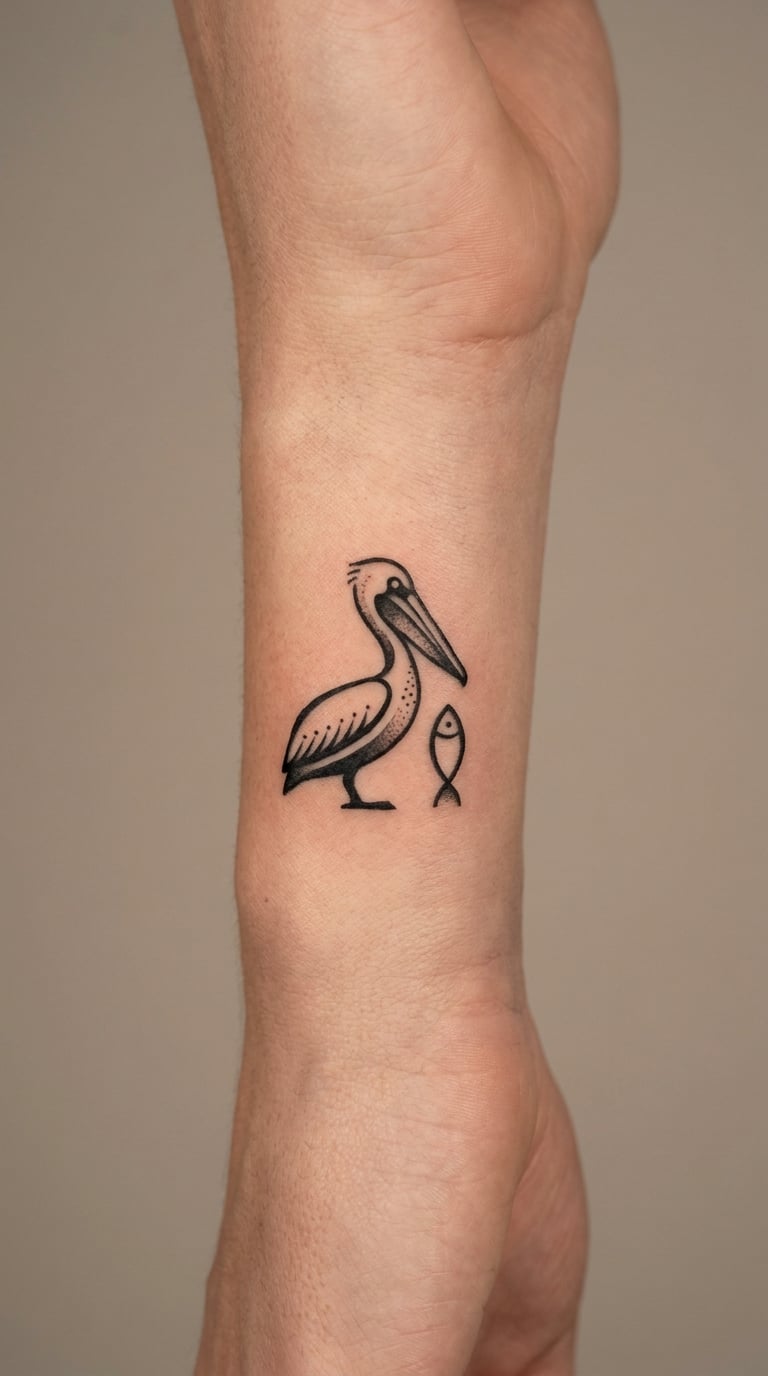
A small solid-black pelican paired with a simplified fish mark, set side by side like a maker’s stamp. At two inches there is no room for feather detail, so the artist works with two shapes and a beak line, and the fish is reduced to a triangle body with a notched tail.
Small marks like this usually come from a place, a nickname, or a person who fished. It is a discreet option for people who do not want a bird everyone comments on.
Placement: side of the wrist, inner arm, or behind the ear. Size: 1.5-2.5 in (4-6 cm) tall. Style: blackwork with solid fills. Pain: low to medium. Solid black is much more durable than outline work, so this is one of the small designs that still reads clearly after a decade, though the internal white gaps can shrink slightly as the skin relaxes.
Make it yours: have the fish filled solid rather than outlined, so the two shapes carry equal weight.
8. Floral Pelican Sleeve Detail
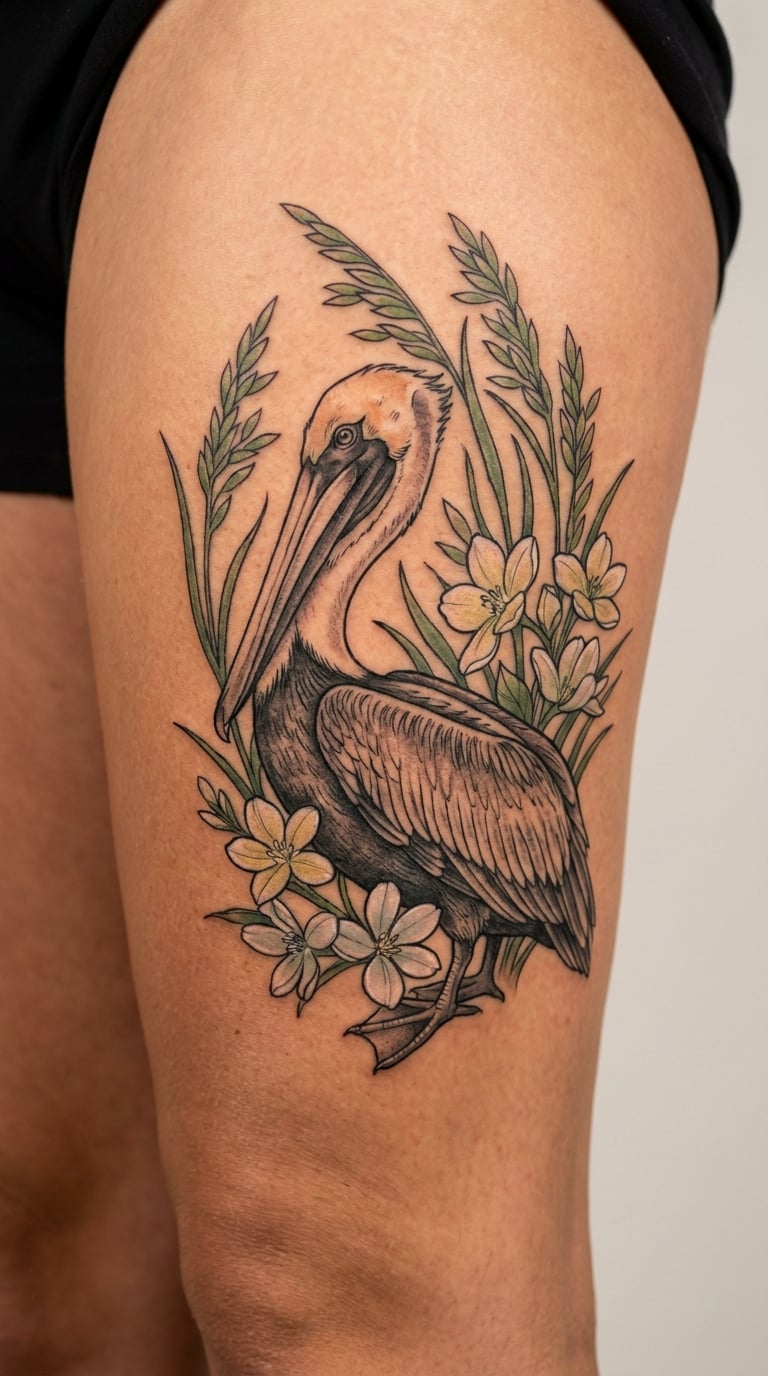
A pelican woven into coastal botanicals: sea oats, plumeria, a few fronds, everything overlapping so the bird sits inside the growth rather than on top of it. This is a serious piece, more of a standalone thigh or lower-leg design than a filler, though it works as a mid-sleeve panel.
Botanical work is usually chosen for a connection to a place, and coastal planting narrows that to a specific shoreline.
Placement: outer thigh, or as a central panel in a sleeve. Size: 6-8 in (15-20 cm) wide. Style: illustrative realism with fine line. Pain: medium to high, and a piece this size is usually split across two sessions. The thinnest stems are what fade first, so expect the pale flowers to soften before the bird does.
Make it yours: name a real plant from your coastline and have the artist draw that species rather than a generic frond.
9. Blackwork Pelican Head
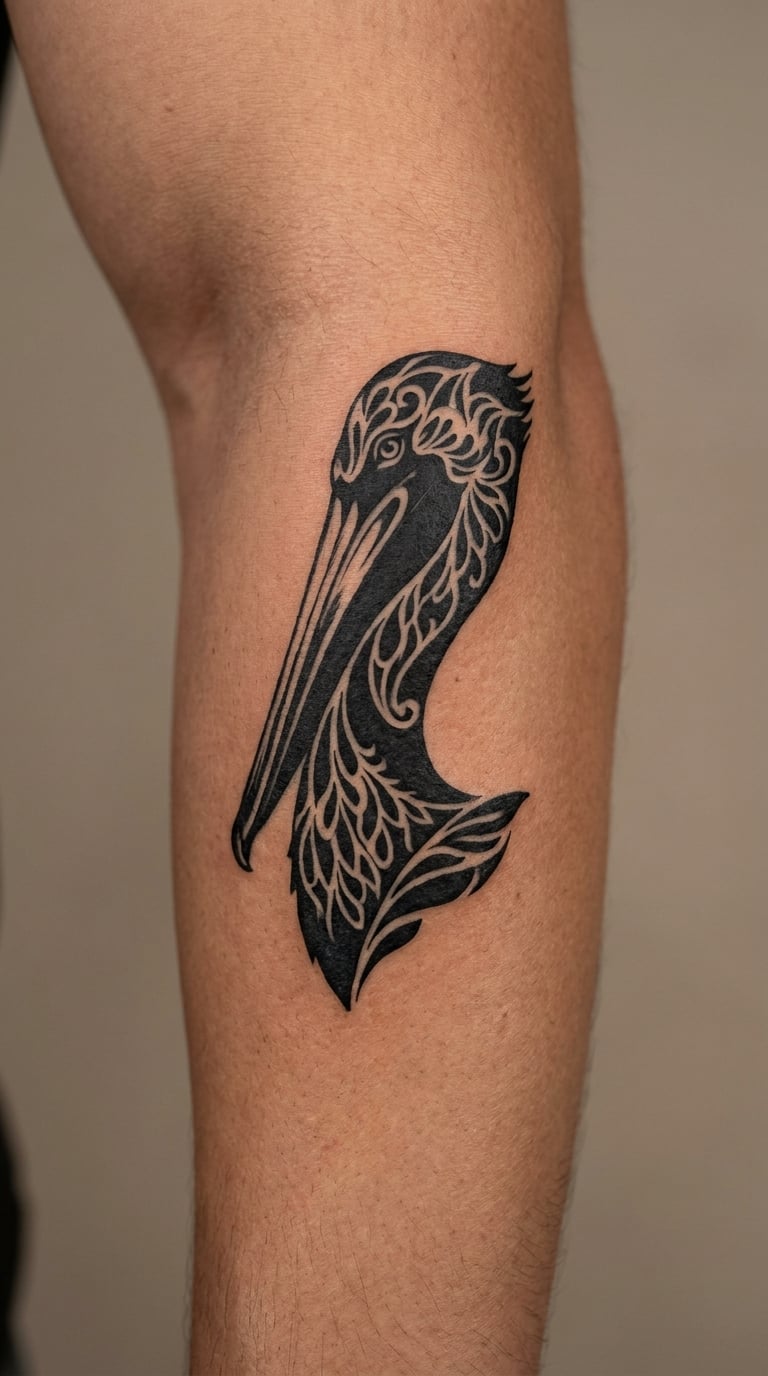
A pelican head in dense black, with the feather edges cut out as thin white lines inside the solid. The eye is a single small negative-space dot, and the pouch is one bold drop shape against the neck.
Blackwork reads as strength and restraint, so it gets chosen when someone wants a bird with weight to it rather than a delicate one. It also photographs better than any other style here.
Placement: forearm near the elbow, upper arm or calf. Size: 2.5-4 in (6-10 cm) tall. Style: blackwork. Pain: medium, and solid black areas feel heavier than they look. This style ages better than almost anything else in the list; only the cutout lines soften, and the mass stays solid.
Make it yours: have the pouch tip in a thin line running off the bottom of the design and continuing as a small wave.
10. Watercolour Pelican on the Shoulder
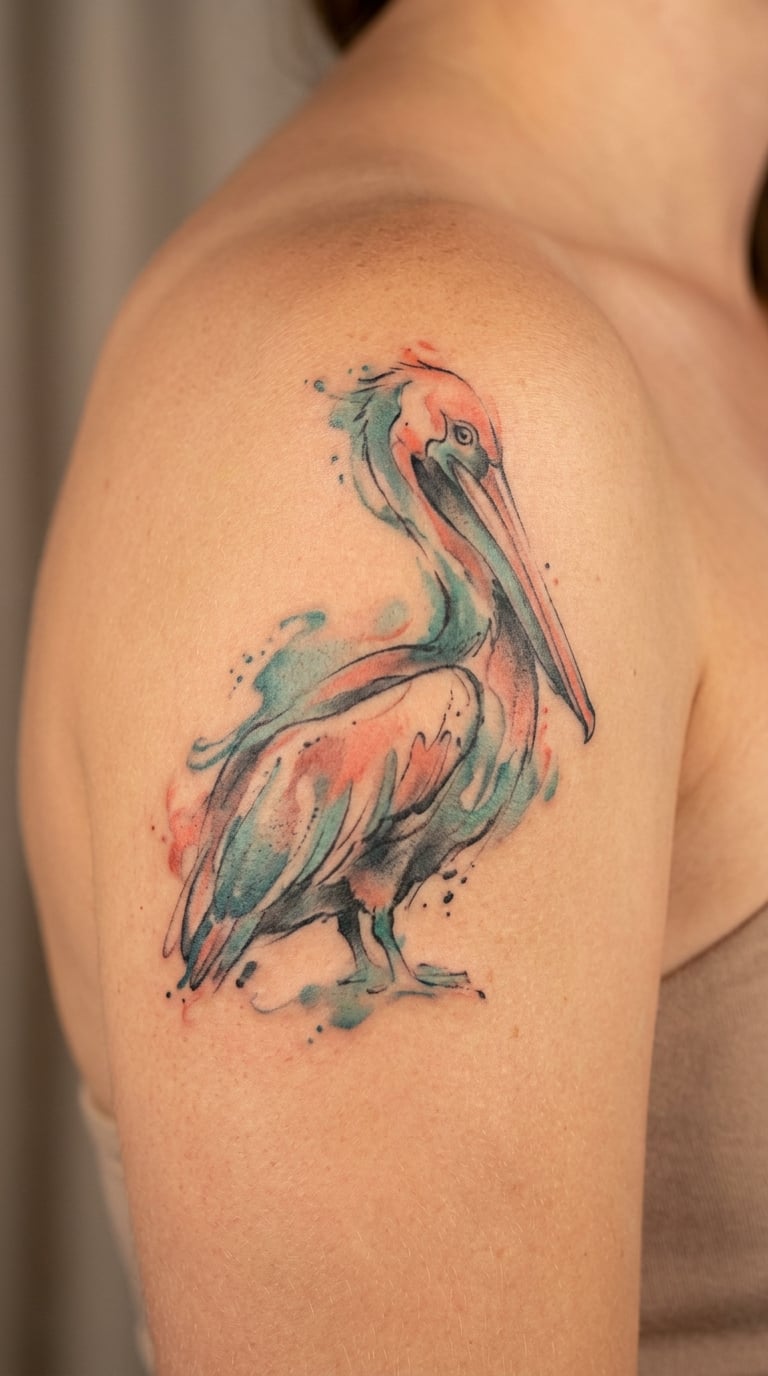
Loose watercolour, no hard outline: a pelican in soft charcoal with teal and coral bleeding out from the wing and pouch. The edges stay unfinished, and one or two strokes run off into bare skin so it does not sit in a tidy rectangle.
It suits people who find hard-edged blackwork too heavy but still want a piece with size to it. Shoulder skin takes the colour well and has enough flat area to let the bleeds breathe.
Placement: outer shoulder, or the top of a foot. Size: 4-6 in (10-15 cm) wide. Style: watercolour with no outline. Pain: medium; the shoulder cap is bony and the work goes deep. Without outlines to anchor it, the coral tones fade first and the whole piece can lose contrast within a few years if you do not maintain it.
Make it yours: pick two colours that already mean something to you and let the artist drop every other shade.
11. Pelican with a Flowing Beak Ribbon
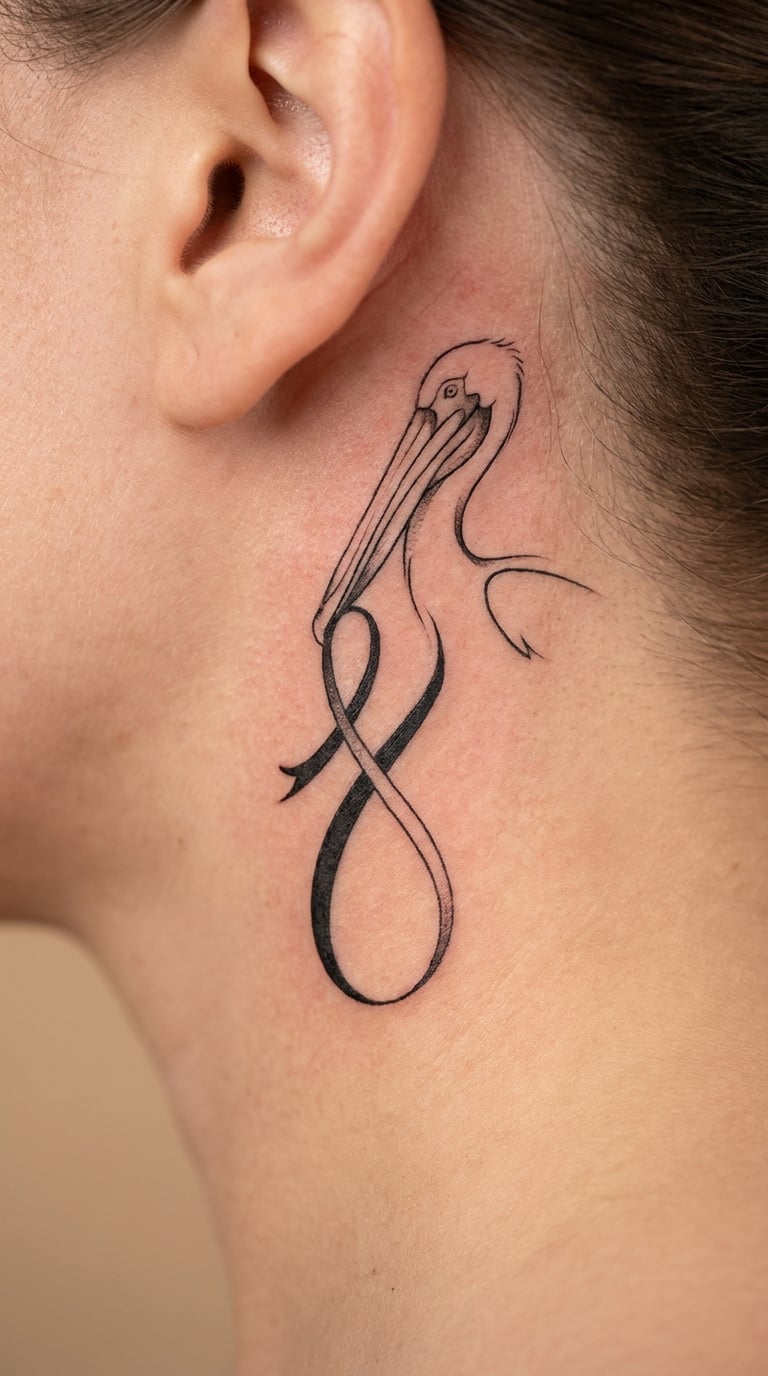
The pelican is drawn in fine line, and the beak does not stop at the face. It runs on past the head and turns into a looping ribbon that circles the bird and trails off into a couple of tapering strokes.
Turning a bird’s most distinctive feature into ornament is what gives this design its flow. It is a common trick in custom line work and it makes a plain bird feel designed.
Placement: side of the neck, behind the ear for a shorter version, or along the collarbone. Size: 3-4 in (8-10 cm) long. Style: fine line with ornamental flourish. Pain: medium, and the neck is a sensitive spot that stays tender longer than most. Ribbon loops that cross the skin frequently lose definition, so keep the loops wide rather than tight.
Make it yours: let the ribbon finish in a small hook rather than a straight tail, which reads less like a stray line.
12. Feeding Pelican and Chicks
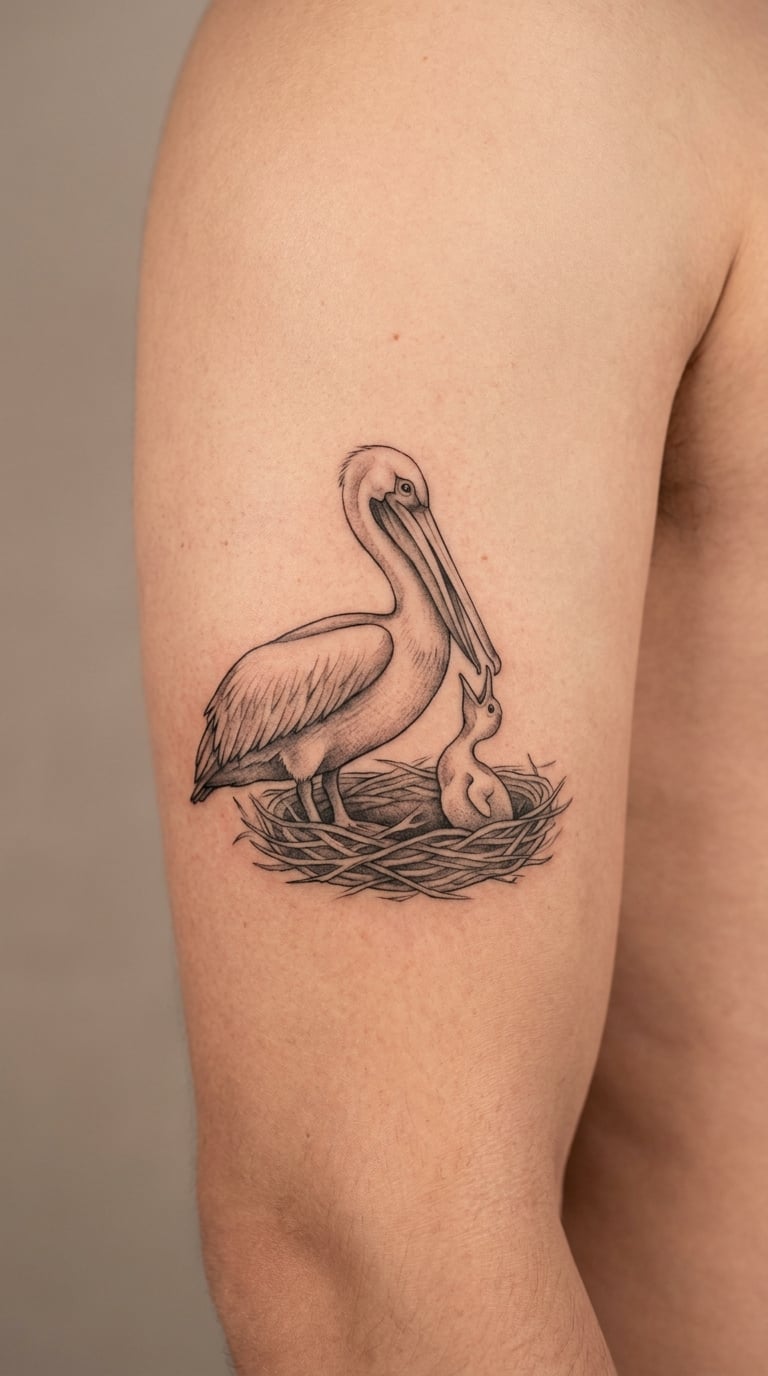
A parent pelican bent over a nestling, beak lowered, the pouch angled down toward the chick. The interaction is the design, so both birds stay simplified: a rounded body for the adult, a small fluff ball for the chick with a few lines for down.
This is the most directly meaningful of the set. The Christian tradition of the pelican feeding her young from her own body is called the pelican in her piety, and this pose is the image that tradition is built on. Plenty of people choose it as a parent or memorial piece without any religious intent.
Placement: upper arm or chest. Size: 5-6 in (13-15 cm) wide. Style: black and grey, soft edges. Pain: medium. Two heads in a small area is the hard part, so the chick’s eye is a single dot and everything around it stays open.
Make it yours: have the chick’s beak open, which adds a small flash of movement without extra detail.
13. Pelican Resting on Driftwood
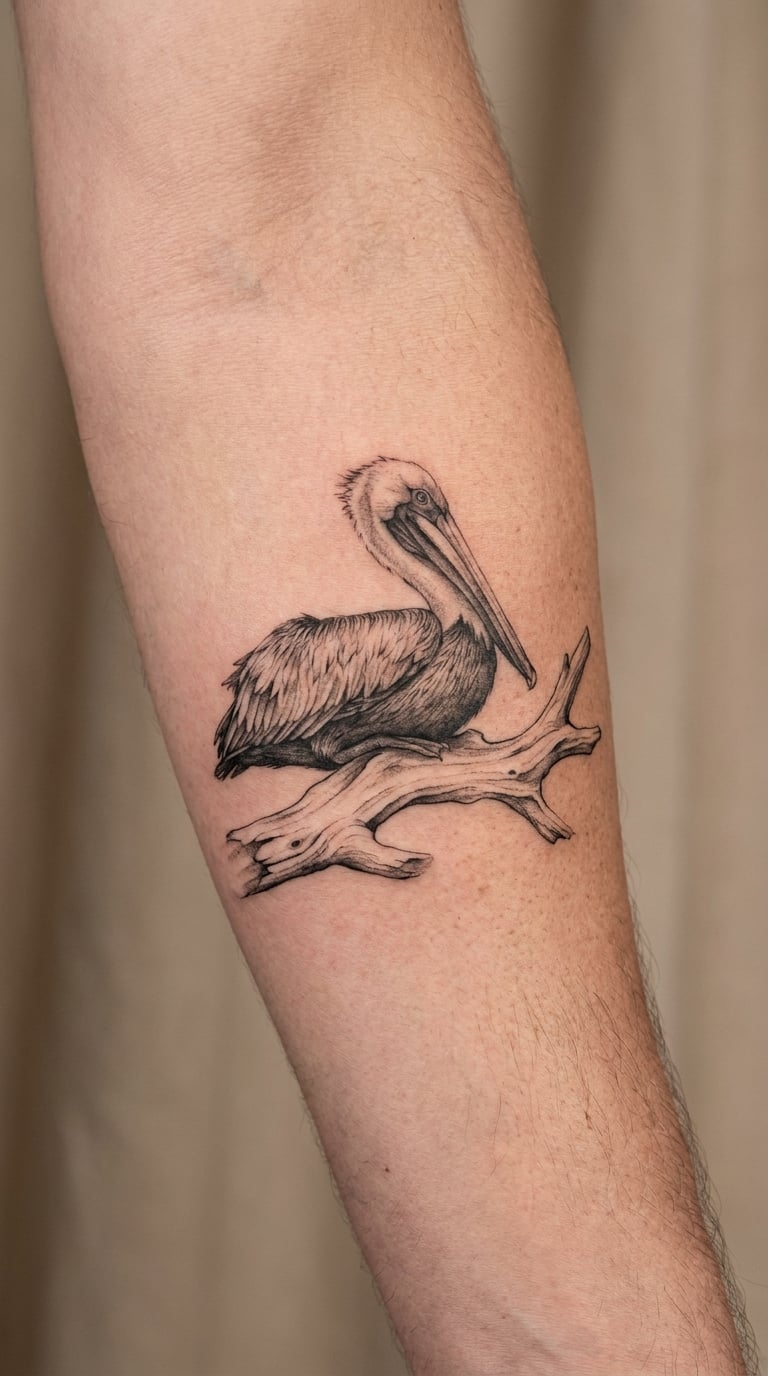
A pelican settled on pale driftwood, wings folded, beak resting on its own chest. The wood is drawn with a few long grain lines rather than full texture, which keeps the piece from turning into a tree study.
It is a calm, settled bird, and that quiet quality is the reason it works as a piece for someone who does not want a tattoo that announces itself.
Placement: outer forearm, or flat across the calf. Size: 4-5 in (10-13 cm) wide. Style: realism with restrained shading. Pain: medium. The driftwood lines are the fragile part and they will blur with sun exposure, so a garment that covers the forearm protects it better than any sunscreen.
Make it yours: have the grain of the wood curve with the forearm, following the line of the muscle rather than sitting flat.
14. Geometric Pelican Design
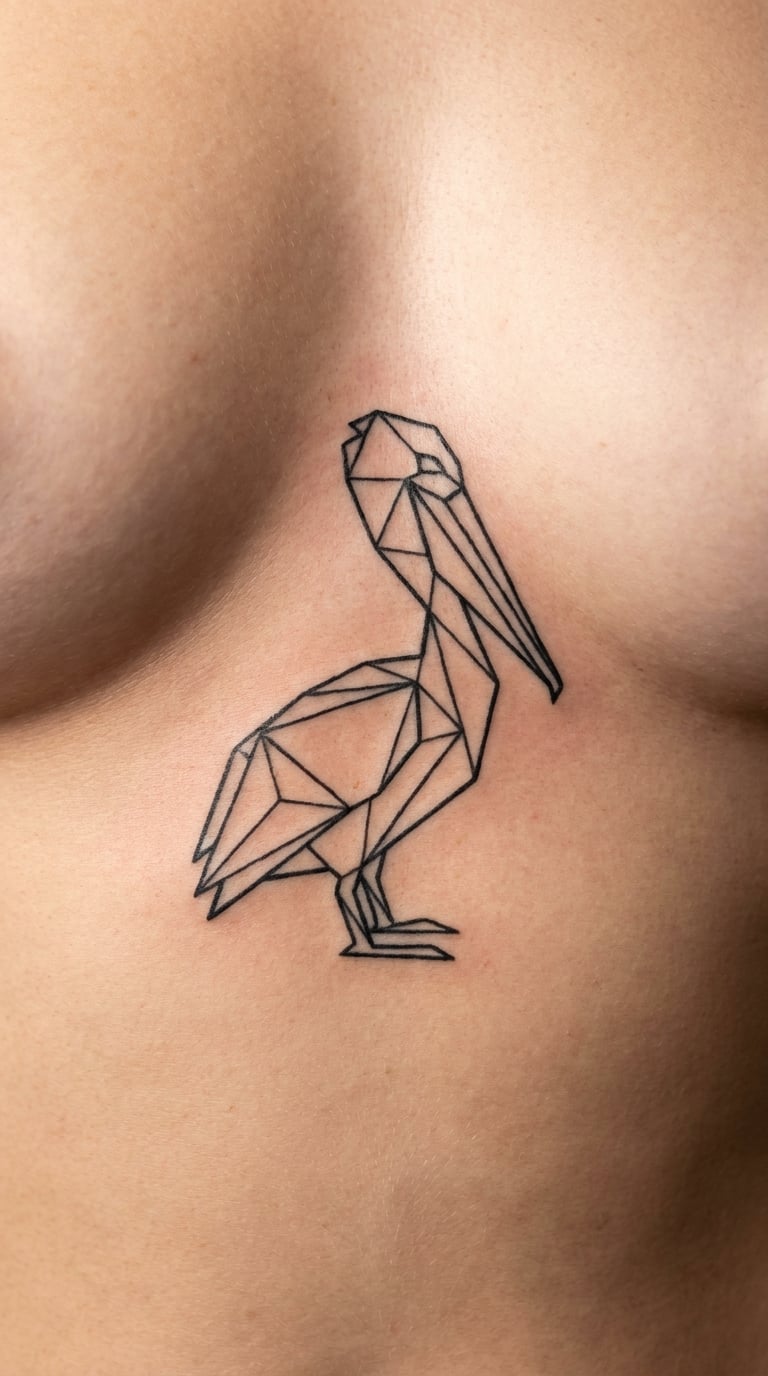
The pelican rebuilt from angular planes: sharp triangles for the wing, a long straight beak, and measured negative space doing as much work as the black. Symmetry is the whole discipline here, because one unbalanced triangle throws the bird off.
Geometric bird work tends to be chosen for how it looks rather than what it means, and it suits people who like hard-edged design and hate soft shading.
Placement: sternum, ribs, or the centre of the chest. Size: 3-5 in (8-13 cm) tall. Style: geometric black. Pain: high, and the sternum and ribs are the two spots most people rate worst. Fine interior lines in a geometric design are the first casualty of healing, so ask the artist to keep them at a consistent, heavier weight.
Make it yours: mirror the wing planes so the bird sits on a vertical axis, which flatters most chest shapes.
15. Two Pelicans Facing Each Other
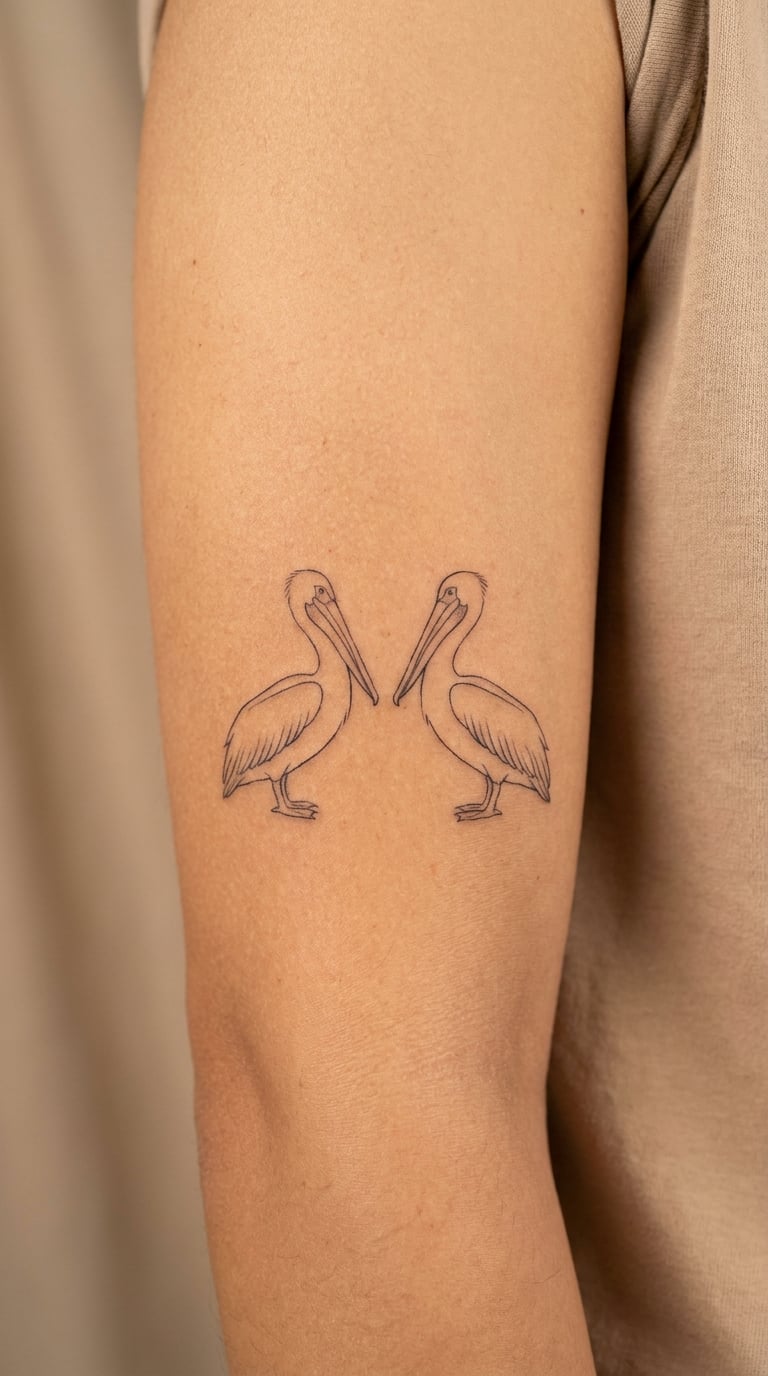
Two pelicans in profile, beaks angled toward each other, drawn in matching fine line or matching blackwork. Done as a pair, one on each upper arm, the two birds form a closed shape when the arms rest at your sides, which is the whole appeal.
Pairs like this are most often chosen for a partner, a sibling or a friend, and the mirrored placement makes it obvious it is a set.
Placement: both upper arms, mirrored, or one on each calf. Size: 3-5 in (8-13 cm) each. Style: fine line or solid blackwork.
Pain: medium, and you will sit through it twice. Keep the two designs identical rather than mirrored so they still match if one arm takes the sun more than the other.
Make it yours: have them hold a small shared element between the beaks, like a wave or a single line of dots.
16. Pelican with Sunset Behind
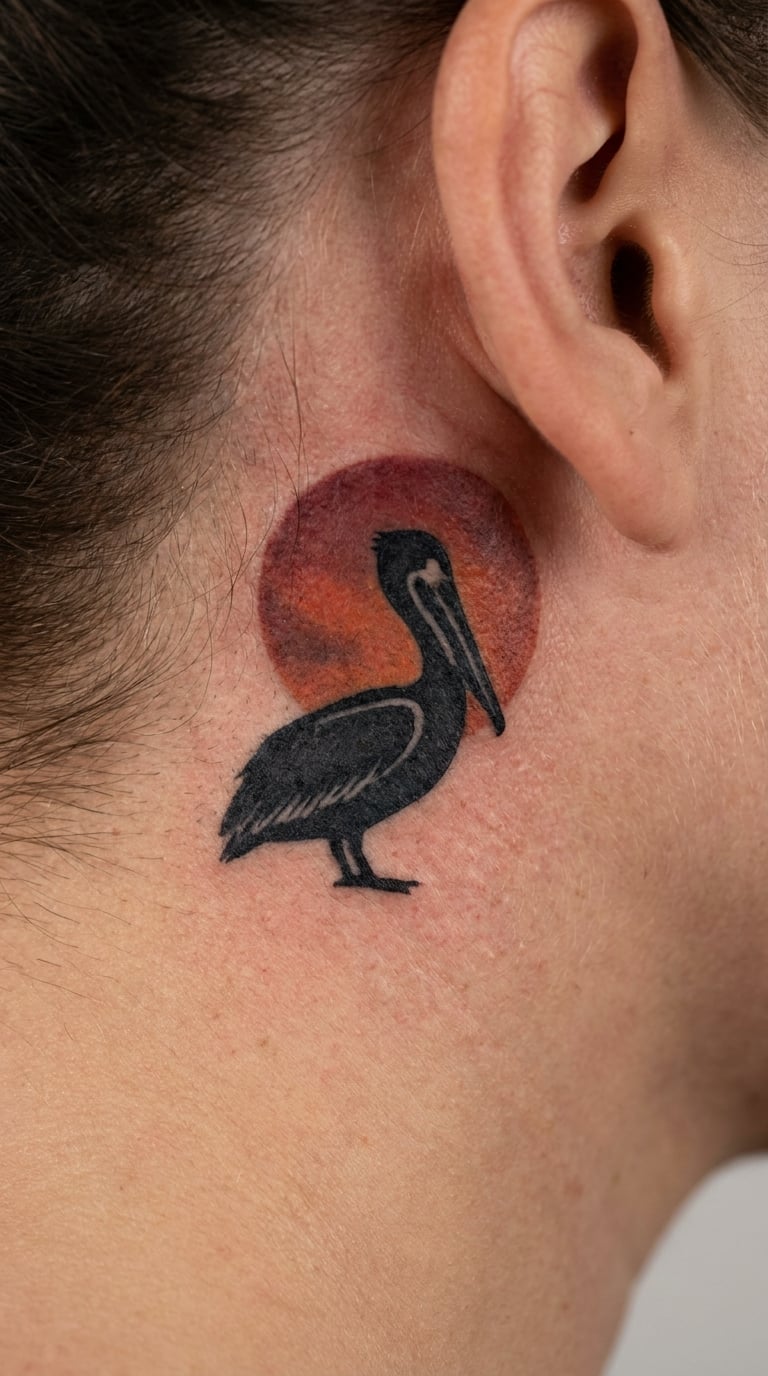
A solid black pelican silhouette set in front of a small circular sun in muted red and orange, with one or two flat clouds crossing the lower edge. The bird carries no internal detail at all, which is what makes the circle behind it work.
Sunset pairings are usually about a place or a time of year, and a bird in front of one reads as a horizon without needing a beach scene.
Placement: behind the ear, or the outer arm. Size: 3-4 in (8-10 cm) tall. Style: silhouette with a single colour accent. Pain: low, and behind the ear is one of the easier spots to sit through. The solid black stays solid, but the warm gradient inside the circle is the element that fades first, so expect to deepen it after a few summers.
Make it yours: add a coordinate, a date or a short word along the bottom edge of the circle in the same warm tone.
17. Tiny Pelican Behind the Ear
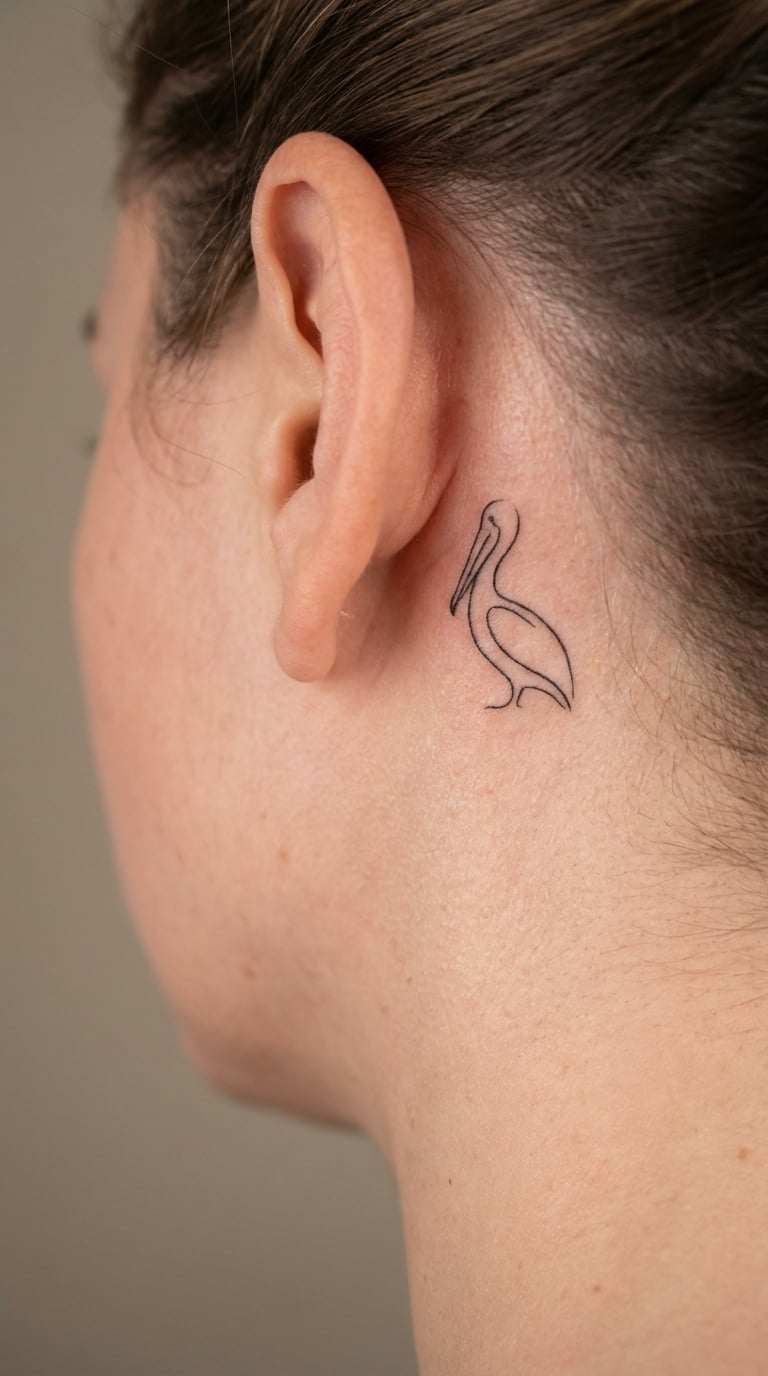
A perched pelican at one and a half inches: head, curved neck, folded wing, beak, pouch line, two feet on a short perch. Anything more than that and the artist is drawing into a space the skin does not offer.
Small birds behind the ear are usually a quiet first piece or a subtle addition to an existing set, and this one still reads as a pelican rather than a generic seabird because of the pouch.
Placement: just behind the ear, or the inner wrist. Size: 1-1.5 in (2.5-4 cm) long. Style: fine line, minimal detail. Pain: low, and it is over quickly. Be honest about the trade-off: single-needle line this small softens noticeably within about five years, and the beak is the first feature to go. Solid black fills hold far better if longevity matters more than delicacy.
Make it yours: have the beak angle down toward the neck so the line follows the tendon instead of sitting across it.
18. Pelican with Nautical Rope Border
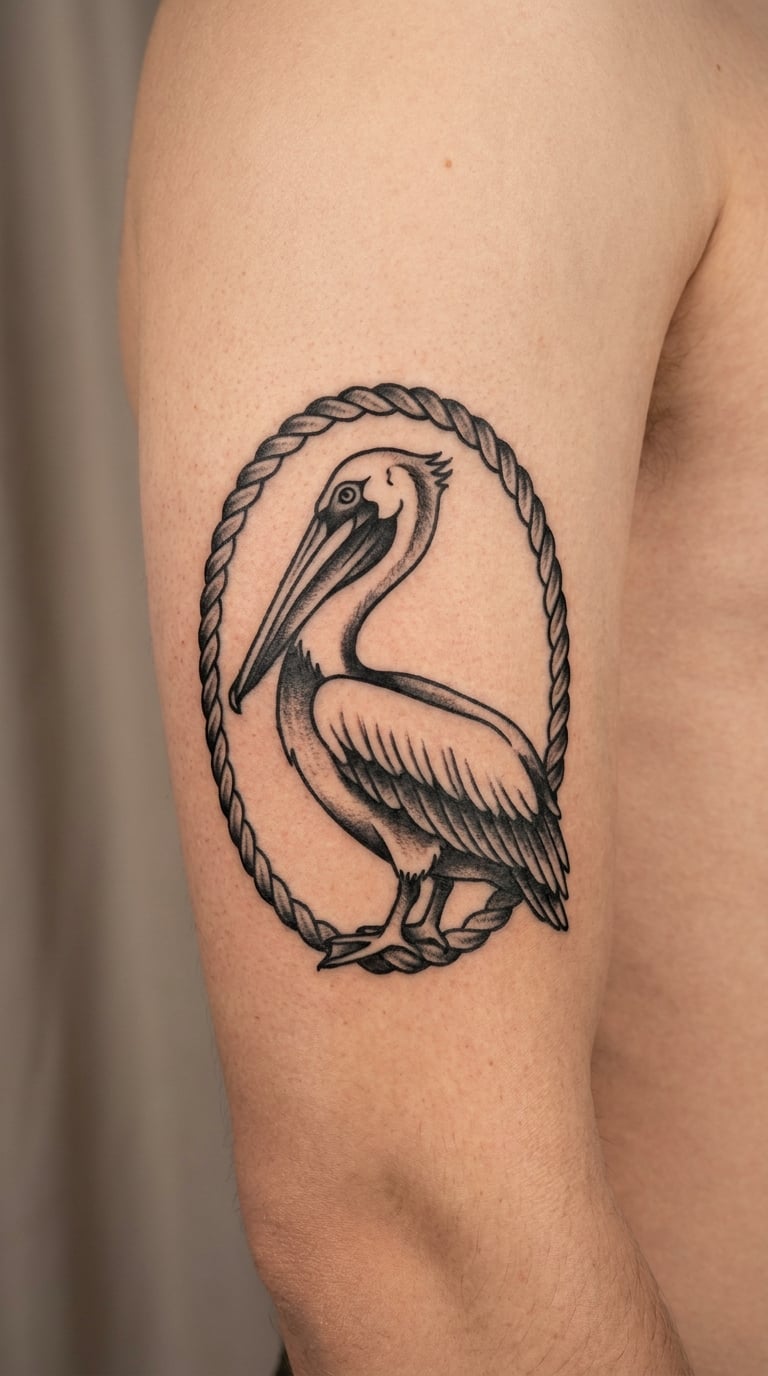
A sturdy pelican in profile, drawn with heavier lines than a fine-line piece, enclosed by one simple rope border with a twist that repeats around the edge. The border does the decorative work so the bird itself can stay readable.
Rope framing is the most direct maritime signal available, and it suits people who want a coastal piece that reads clearly rather than something subtle.
Placement: upper arm, calf or shoulder. Size: 4-6 in (10-15 cm) tall. Style: bold black and grey with a line border. Pain: medium. Rope twist needs a consistent line weight throughout, and any wobble in that repeating pattern is obvious. Ageing is good as long as the border was done with a heavier needle than the bird’s interior lines.
Make it yours: have the rope end in a loose tail rather than closing the loop, so the border feels tied rather than stamped.
19. Engraving-Style Pelican
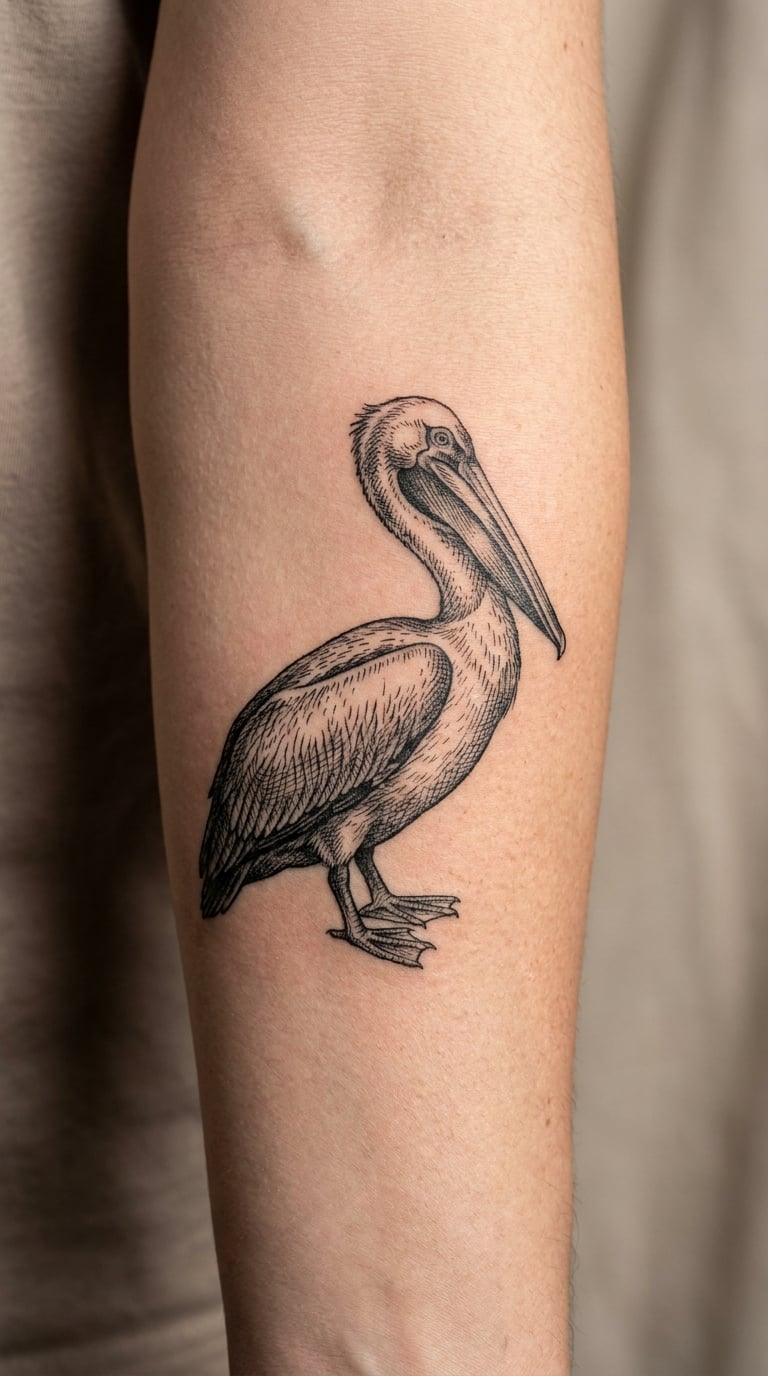
A pelican drawn the way a nineteenth-century natural-history plate would have drawn it: fine crosshatching for the body, short parallel strokes for the wing feathers, almost no solid black anywhere. The beak and pouch are described entirely with line density.
It is an unusual direction for a bird tattoo and it reads as learned rather than decorative, which is usually the reason it gets chosen.
Placement: outer forearm or calf. Size: 3.5-5 in (9-13 cm) wide. Style: engraving and hatching. Pain: medium, and hatching is slower than it looks because the needle changes direction constantly. This is the least durable style in the list: hatch lines merge over time, so ask for a slightly heavier line than feels comfortable, and expect a refresh in five to seven years.
Make it yours: have the plate number and a Latin name set under the bird in a small serif line, as on an old specimen sheet.
20. Colorful Pelican Portrait on the Leg
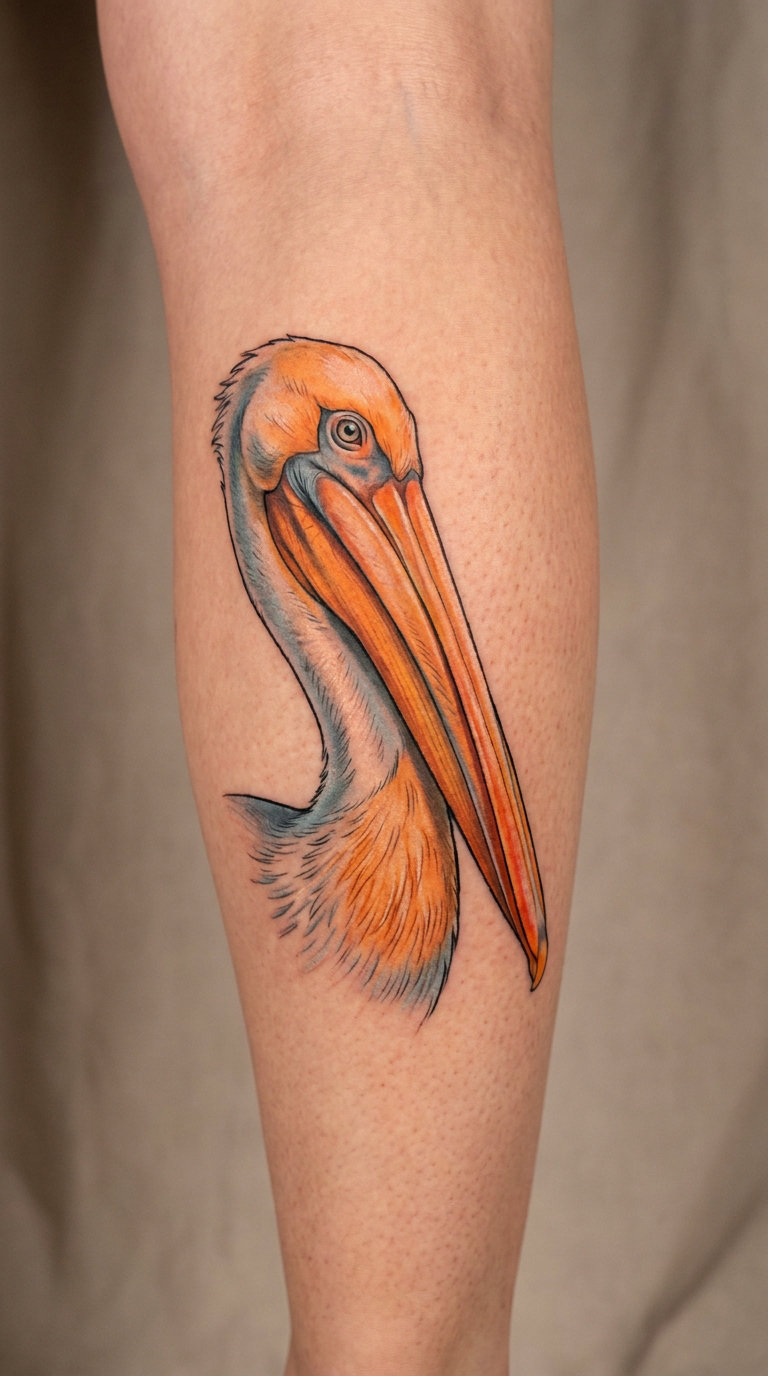
Full colour at its most literal: a yellow-orange beak, white plumage with blue-grey shadow underneath the wing, a pinkish throat and a dark eye. The bird is turned slightly toward the viewer so both the pouch and the face are visible at once.
Colour portraits are the most personal option in the set. They are usually a specific pelican from a specific place, and the extra hours are the trade for having that bird rather than a generic one.
Placement: calf, thigh or forearm. Size: 4-6 in (10-15 cm) tall. Style: colour realism. Pain: medium to high, and calf work stays tender for several days. Full colour on a bird means reds and yellows in the beak, and those shift warm over time; a cool-down touch-up every few years keeps the beak from going orange.
Make it yours: send a photograph of a pelican you have actually watched, and ask for that specific bird’s colouring.
How to Choose the Right Design
Match the line weight to the space you actually have
Before anything else, measure the flat area you can spare, then pick a style that reads at that size. A four-inch area suits a single-line bird or a blackwork head. It does not suit a seven-inch botanical scene, and no artist worth booking will pretend otherwise.
- Under two inches: solid black or filled shapes only. Outline work this small has nowhere to go.
- Two to four inches: fine line and blackwork are both workable. Pouch and beak stay legible.
- Four to seven inches: the range where feather texture, flowers and watercolour all become possible.
- Above seven inches: budget a second session, and treat it as a standalone piece rather than an extra.
- Check the body shape: curves like the calf and shoulder suit a bird with open wings, while flatter areas like the outer forearm suit a perched bird in profile.
- Plan the rest of the set: if the pelican is the first of several, leave the surrounding skin clear rather than boxing it in with a border.
Bring your 20 pelican tattoo ideas to the consultation
Arrive with three or four references, not twenty. A tattoo artist will tell you in a few minutes which two are workable, and having a shortlist makes that conversation useful rather than vague. If you are building a larger coastal set, it is worth looking through ocean sleeve tattoo ideas at the same time so the pelican fits the surrounding work.
Check it is actually a pelican
Retail listings for this bird constantly mix in puffins, herons and cormorants, and the giveaway is always the pouch. If the reference has a short triangular bill and no gular pouch, it is not a pelican. A brown pelican also has a very particular long bill and a hunched resting posture, which is worth naming when you book. If you like the reef look rather than the bird, coral reef tattoo ideas cover the same coastal register without the identification problem.
Cost and Session Time
Most US shops price by the hour, and a pelican is an average-complexity bird: the pouch and beak are simple shapes, the difficulty is in the feathers and the shading. A rough guide in US dollars for a single custom pelican piece:
- Tiny, under two inches: 60-150 dollars, 30-60 minutes. Many shops have a minimum, so it is rarely a standalone booking.
- Medium, three to five inches: 200-500 dollars, two to three hours.
- Large, six inches and up, or full colour: 600-1200 dollars, split across two sessions of four to five hours.
Colour adds time rather than size, and so does a busy background. Placement does too: ribs, sternum and the inner thigh all cost more per hour because the artist is working slowly on a difficult surface. Shop minimums, artist rates and travel costs vary widely by city, and a full-colour realism piece is the one most worth getting a specific quote for before you commit.
Aftercare Basics
- Follow your artist’s aftercare instructions first, since they will know what they put in your skin.
- Wash the area twice a day with clean lukewarm water and a fragrance-free soap, then pat it dry rather than rubbing.
- Keep it clean and dry for the first few days, and change out of anything that rubs or sticks to it.
- Leave films and scabs alone. Picking at a healing line is the fastest way to lose detail permanently.
- Once healed, use sunscreen on exposed skin, because sun is what fades fine feather line and pale watercolour first.
- Photograph the healed piece after a month. Those photos are your reference if you ever want a touch-up or a cover-up later.
Frequently Asked Questions
What is the best placement for a pelican tattoo?
The outer forearm and upper arm are the most forgiving spots, because both are flat, well muscled and easy to cover or show. The calf and outer shoulder work well for larger birds in flight, where the open shape follows the curve of the muscle. Small pieces suit the inner wrist or behind the ear, though single-needle line on the inner wrist fades fastest. Avoid the ribs and sternum for anything detailed unless you are prepared for a rough session.
Can a pelican tattoo work as a very small design?
Yes, down to about one inch, as long as the design is simplified to solid shapes. At that size the artist keeps the pouch, the curved neck and the beak, and drops feather texture entirely. Single-needle outline work this small softens noticeably within a few years, so ask for filled black shapes if you want the bird to stay legible long term. It is a good first piece or a quiet addition to an existing set.
Should I choose a realistic or fine-line pelican tattoo?
Choose fine line if you want something small, light and quick to heal, and accept that hairlines will soften over the years. Choose realism if the pelican represents a specific bird or a specific place, and you are prepared for a longer session and touch-ups. Blackwork sits between the two and ages best of all, because solid fills stay solid while fine lines do not. Your decision is really about how much you want it to look like one individual bird.
Do fine-line pelican tattoos fade quickly?
Faster than most people expect. Single-needle line on the inner wrist, behind the ear and on the hand shows wear within five years, with the thin beak line going first. On the outer forearm or upper arm, and protected from sun, fine line holds up considerably longer. A tattoo that is never exposed to sunlight ages far better than one on an uncovered arm, and a touch-up of the beak and pouch outline every few years is a normal part of owning one.
How much does a pelican tattoo cost in the US?
Most US shops charge by the hour, typically between 80 and 200 dollars depending on the artist and the city. A tiny piece under two inches may be 60-150 dollars once the shop minimum is applied. A medium three to five inch design usually lands between 200 and 500 dollars, and full-colour realism at six inches or more can run 600-1200 dollars across two sessions. Ribs, sternum and the inner thigh cost more per hour because the work is slower.
Can a pelican tattoo be customized with a fish or tropical flowers?
Most designs on this list started as a custom request of exactly that kind. A fish in the pouch is a common addition, and hibiscus or plumeria is the natural floral pairing for a pelican because both belong to the same coastline. Adding either element increases the size, so build it into the original composition rather than squeezing it into a small design afterwards. A short-stemmed or single bloom keeps the added space from competing with the bird.
Conclusion
If this is your first tattoo, the fine-line pelican in flight is the safest place to start: a small, flat placement, a forgiving style and nothing in it that will blur into a grey smudge. If you already have a few pieces and want a pelican that holds its own, the realistic portrait or the blackwork head is the stronger addition, since both keep their shape as the years pass. Either way, take three references to a consultation and ask the artist to confirm the pouch reads clearly at the size you want. That one check is what separates a pelican from a heron.