
22 Woodcut Tattoo Ideas: Bold and Timeless (October 2026)
These 22 woodcut tattoo ideas take the look of a carved printing block and put it on skin: hard black contours, white skin doing the work of light, and tone built from hatch marks instead of grey wash. It suits anyone who likes old illustration, folklore and graphic blackwork, and it holds its shape better than hairline work once it has healed and sun-touched.
A woodcut tattoo imitates medieval and Renaissance woodblock printing, so the ink looks carved into wood or pressed from a stamped block. The artist builds depth with cross-hatching and stippling rather than soft shading, which is why these pieces stay black, high contrast and almost entirely uncoloured. September is a good month to book: studios are quieter, and a late-autumn appointment leaves healing time before winter sleeves and long sleeves take over.
What follows is the whole set, with honest placement, size and pain notes for each one. Nothing here is a traced print. These are directions you take to an artist and discuss, and every design below is described closely enough to sketch from.
22 Woodcut Tattoo Ideas: Quick Guide
Same order as the details below, so you can scan for a motif and jump straight to it.
| Idea | Style | Best placement | Size | Pain |
|---|---|---|---|---|
| 1. Wolf in a timber frame | Bold blackwork | Centre of forearm | 4-6 in (10-15 cm) | Medium |
| 2. Mountain range under a radiant sun | Graphic blackwork | Outer forearm | 5-7 in (13-18 cm) | Medium |
| 3. Oak tree with interlocking roots | Illustrative blackwork | Outer calf | 7-10 in (18-25 cm) | Medium to high |
| 4. Engraved rose and thorned stem | Traditional blackwork | Wrist or inner arm | 3-5 in (8-13 cm) | Low to medium |
| 5. Full moon over pine silhouettes | Minimal blackwork | Upper arm | 3-4 in (8-10 cm) | Medium |
| 6. Ship sailing through rough waves | Traditional blackwork | Forearm or calf | 5-8 in (13-20 cm) | Medium |
| 7. Raven in profile | Fine blackwork | Upper forearm | 3-4 in (8-10 cm) | Low to medium |
| 8. Forest of birch trees | Wood engraving style | Inner forearm | 6-9 in (15-23 cm) | Low |
| 9. Lion with a radiant mane | Bold blackwork | Chest | 7-9 in (18-23 cm) | High |
| 10. Snake coiled around a dagger | Blackwork traditional | Outer forearm | 5-7 in (13-18 cm) | Medium to high |
| 11. Crescent moon filled with feathers | Fine blackwork | Inner arm | 3-5 in (8-13 cm) | Low |
| 12. Oak seedling in a buried pot | Illustrative blackwork | Inner wrist | 2-3 in (5-8 cm) | Medium to high |
| 13. Thundercloud with geometric lightning | Graphic blackwork | Shoulder | 4-6 in (10-15 cm) | Medium |
| 14. Fish swimming through reeds | Naturalist engraving style | Outer calf | 6-9 in (15-23 cm) | Medium |
| 15. Traditional key with oak leaves | Traditional blackwork | Inner forearm | 4-6 in (10-15 cm) | Low to medium |
| 16. Elk stag with geometric antlers | Stylised blackwork | Outer thigh | 6-8 in (15-20 cm) | Medium |
| 17. House among rolling hills | Nostalgic blackwork | Forearm | 4-6 in (10-15 cm) | Medium |
| 18. Crescent enclosing a hand with flame | Bold blackwork | Upper back | 7-10 in (18-25 cm) | High |
| 19. Moth with symmetrical wing cuts | Blackwork | Between the shoulder blades | 6-9 in (15-23 cm) | Medium to high |
| 20. Sea turtle over curved waves | Illustrative blackwork | Shoulder cap | 6-8 in (15-20 cm) | Medium |
| 21. Crescent rabbit in a woodland frame | Storybook blackwork | Outer arm | 4-6 in (10-15 cm) | Medium |
| 22. Hourglass releasing feathers | Symbolic blackwork | Inner forearm | 4-5 in (10-13 cm) | Low to medium |
1. Bold Wolf in a Timber Frame
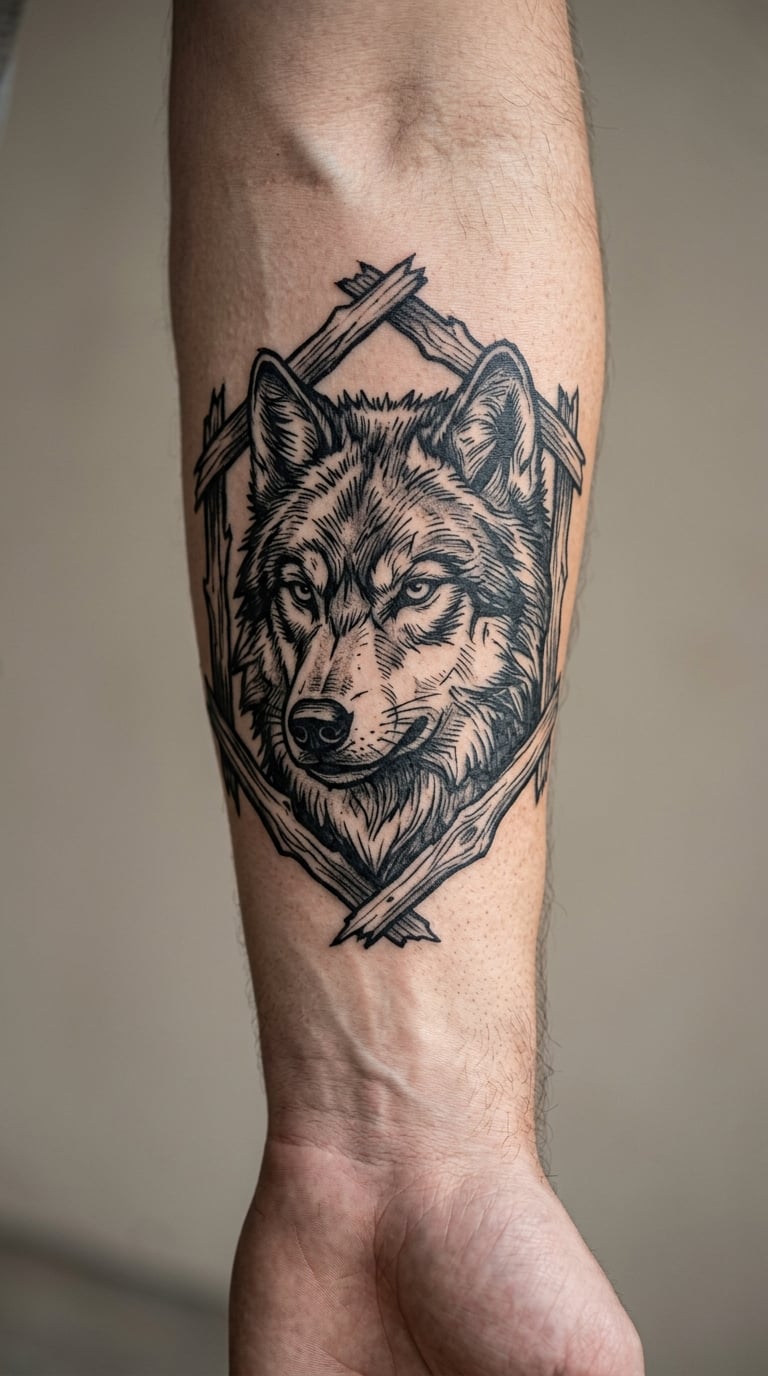
The wolf is drawn head-on, built from heavy black contours that vary in weight like a gouge stroke, with hatch marks angled across the muzzle and chest to suggest fur. Two rough timber lines cross behind the head to form a loose frame, and the artist leaves the whites of the eyes and the gaps between fur strokes as bare skin.
People choose it for weight and watchfulness rather than a fixed meaning. The frame is what turns an animal portrait into a woodcut piece instead of a plain blackwork portrait.
Placement: centre of the forearm, or the inside of the upper arm. Size: 4-6 in (10-15 cm) tall. Style: bold blackwork with engraving-style hatching. Pain: medium, more on the bony inner forearm near the wrist. Solid outline work holds up far better than fine shading, and the frame lines give the piece a border that survives sun exposure. Make it yours: put a year, a set of coordinates or a child’s handprint inside the timber frame.
2. Mountain Range Beneath a Radiant Sun
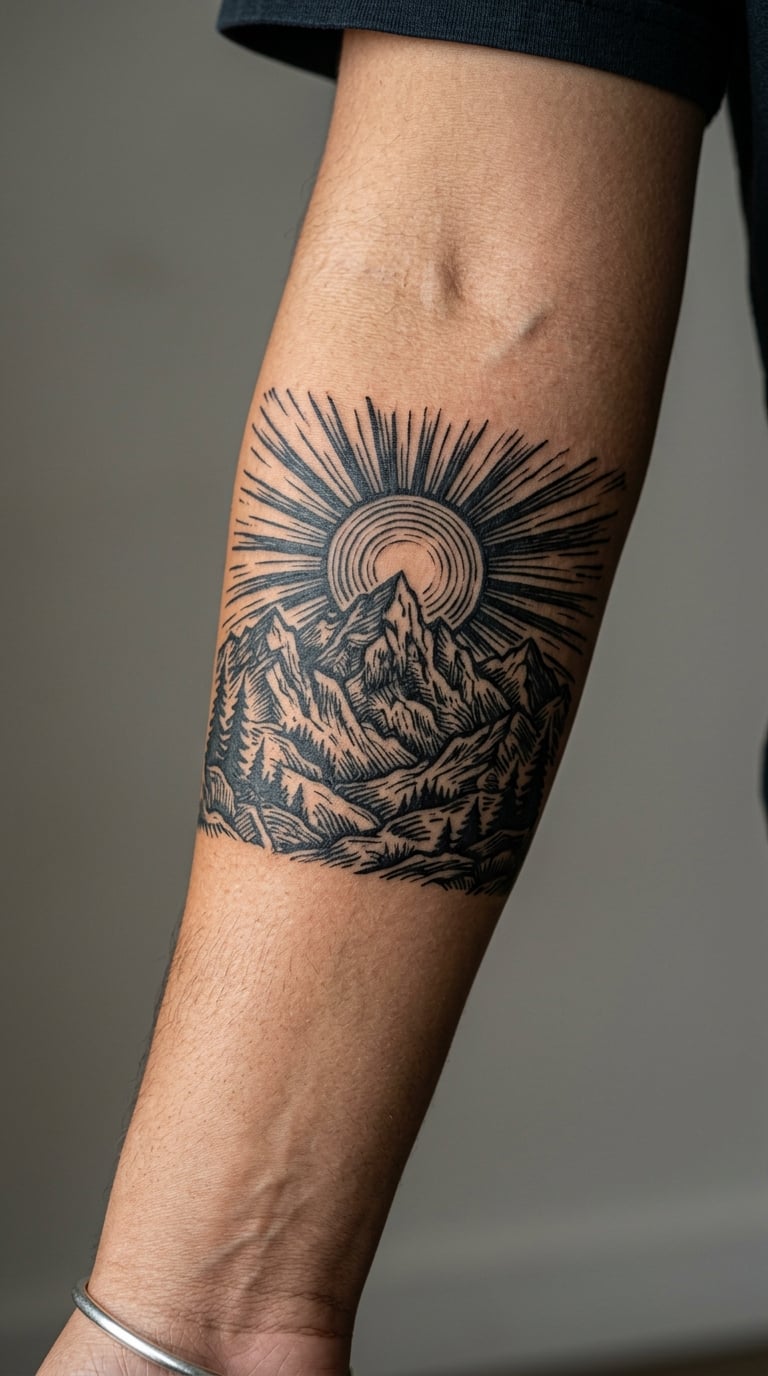
Angular peaks overlap in layers, each range darker than the one in front, and a low sun sits behind the tallest summit with straight rays fanning out in even spacing. The snow caps are the bare skin; the shaded faces are dense parallel hatching. Nothing is grey and nothing is soft.
This is the one people book after a hike, a move to somewhere with a view, or a year that felt like a climb. That personal reason matters more than any standard reading of mountains.
Placement: outer forearm reads as a wide banner, though the calf and the upper arm work too. Size: 5-7 in (13-18 cm) across. Style: graphic blackwork. Pain: medium on the arm, higher on the shin where bone sits close. The sun rays are the ageing risk: thin rays blur with time, so ask for a few fat ones instead of twenty hairlines. Make it yours: name the range, or shift the sun so the piece points a direction that means something to you.
3. Oak Tree with Interlocking Roots
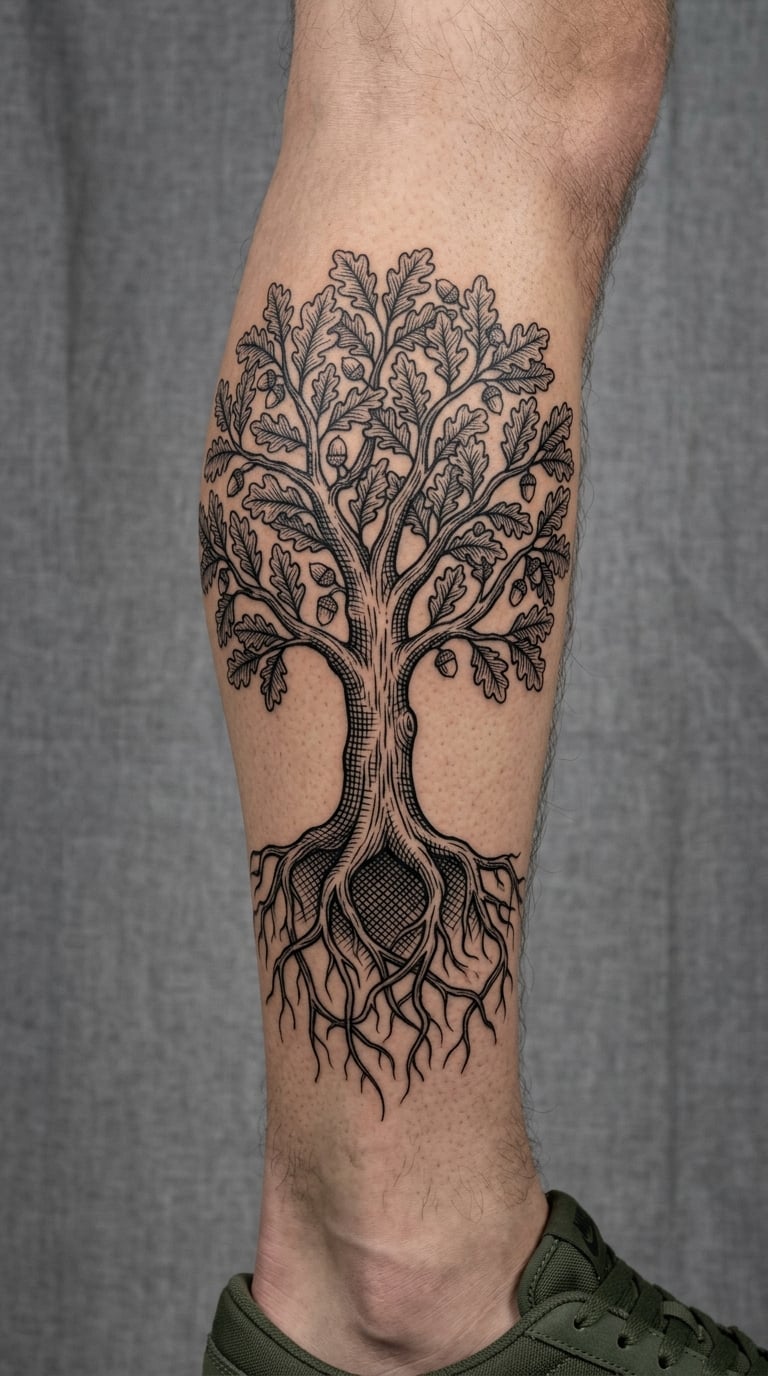
A single oak fills the space, trunk built from broken vertical strokes, branches tapering hard until they are two lines wide, and roots below that interlock and cross over each other. Leaves are clusters of small carved marks rather than individual outlined leaves, which keeps the canopy readable at a distance.
Oaks get chosen for endurance and family line. The crossing roots usually point at something the wearer carries with them, whether that is a place or a person.
Placement: outer calf gives the vertical room a tree needs. Size: 7-10 in (18-25 cm). Style: illustrative blackwork. Pain: medium to high, since the calf and inner shin are sensitive and the outline passes over bone. Fine twig lines are the first thing to soften, so keep branches heavy. Make it yours: add a small carved bird, initials in the negative space of the trunk, or acorns at the root line.
4. Engraved Rose and Thorned Stem
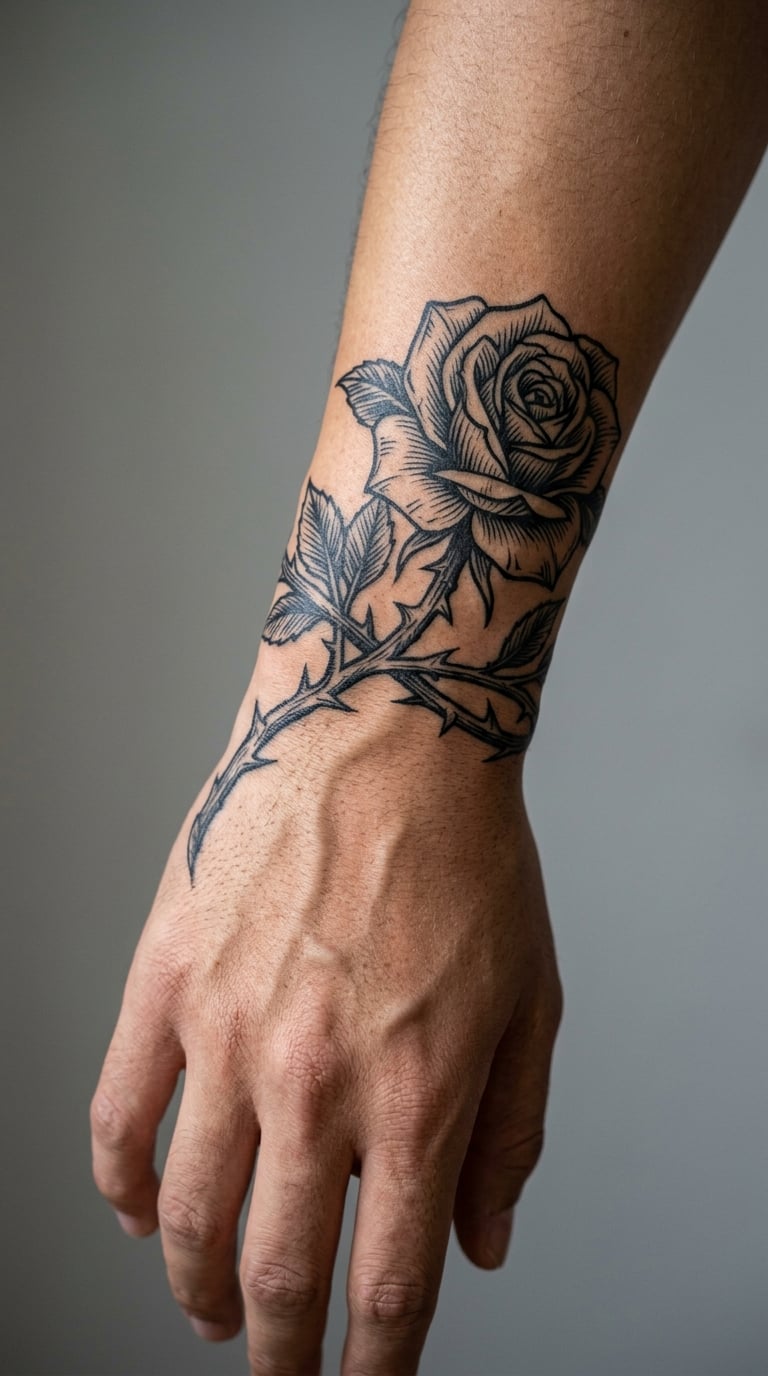
A traditional bloom with a tight spiral centre, petals built from curved hatch shading that fades to bare skin at the edges, and a stem that curves around the wrist with three or four thorns. A couple of leaves are scratched back with white lines through solid black, the way a printmaker lifts ink with a blade.
It is chosen for the flower rather than for a claim about what roses mean. If you want a floral piece with a lighter hand, our 20 Wisteria Tattoo Ideas: Floral Tattoo Designs covers the opposite mood, hanging and soft, where this one is upright and armed.
Placement: inner wrist or inner arm, following the stem around the forearm. Size: 3-5 in (8-13 cm). Style: traditional blackwork. Pain: low to medium, though inner wrists throb and veins show through, which shows pale in the white gaps. Hand and finger roses fade fastest of all, so keep it above the knuckles. Make it yours: add a ribbon tied to the stem, a date on the underside, or a second smaller bud on the opposite arm.
5. Full Moon Over Pine Silhouettes
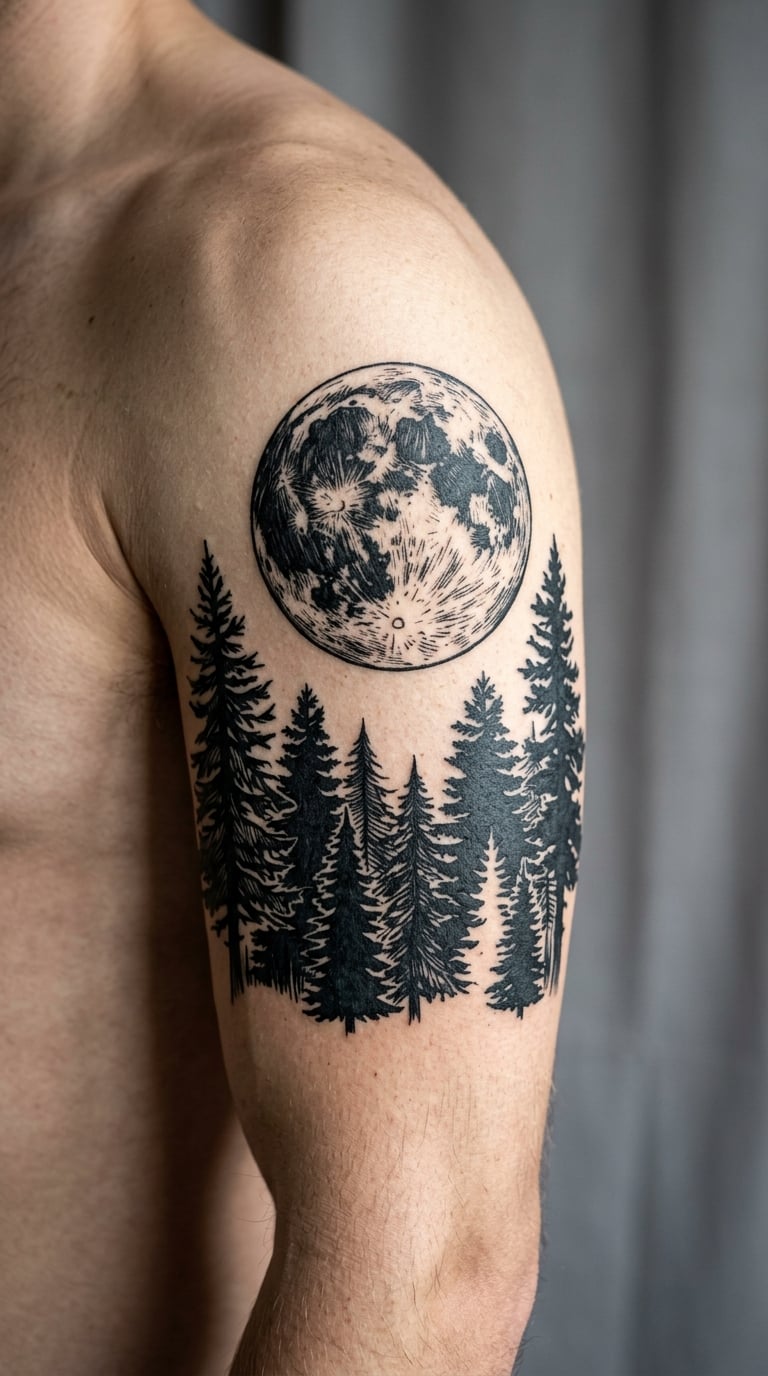
A hard white circle sits in a black sky with a few cut rays around its edge, and below it a row of pine silhouettes overlaps in black with a single row of short white ticks to break up the tree line. The moon is the only shape with no hatch texture at all, which makes it read instantly.
Camp country and night drives are the usual reason. The design is graphic rather than illustrative, so it works as a first piece for someone who wants black tattooing without a crowded design.
Placement: upper arm or the flat of the shoulder. Size: 3-4 in (8-10 cm). Style: minimal blackwork. Pain: medium on the upper arm, and the shoulder cap stings when the artist reaches the deltoid. The small tree ticks are the first details to blur, so keep the trees as solid shapes. Make it yours: put a date under the tree line, or set the moon half-hidden behind the tallest pine.
6. Ship Sailing Through Rough Waves
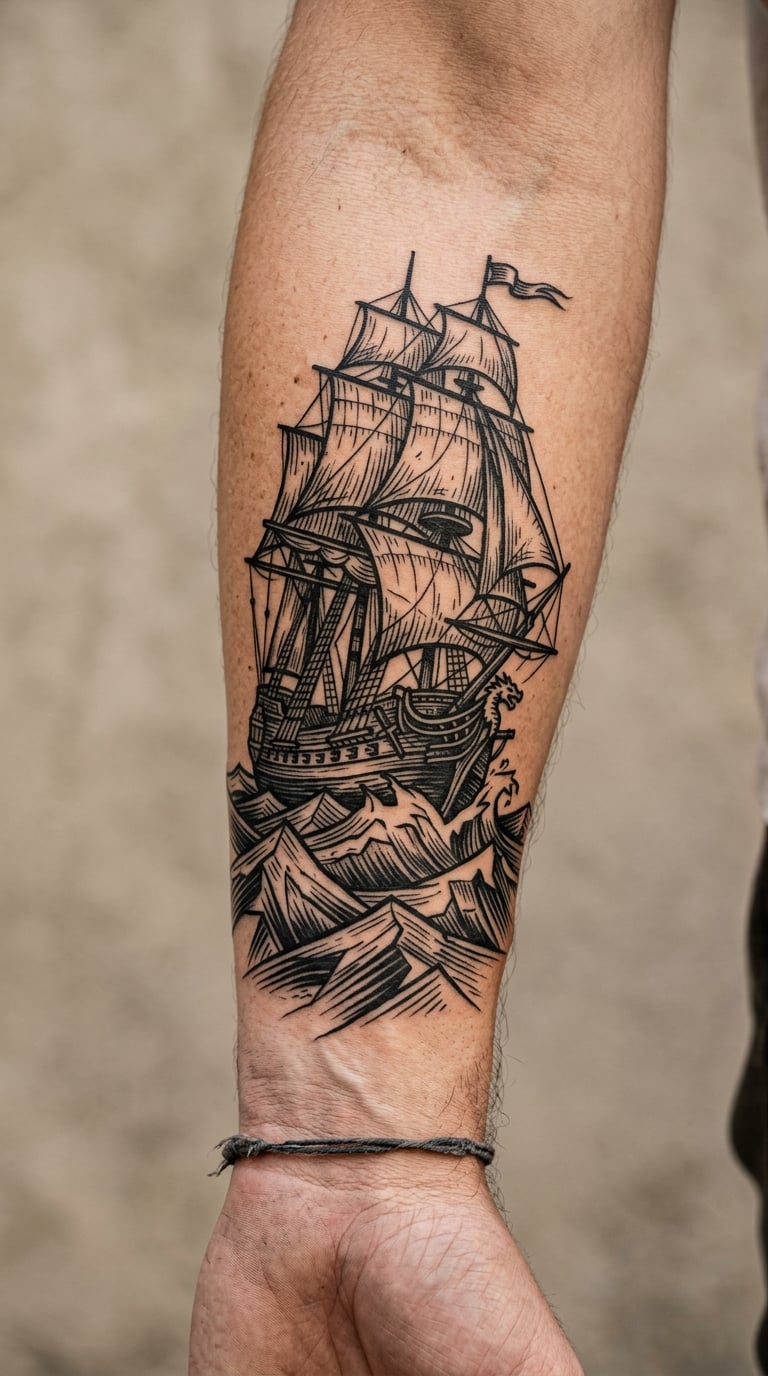
A three-masted ship with sails built from tight parallel hatch, rigging drawn as fine scratched lines, and a hull outlined in heavy black. Beneath it, waves are carved into repeating angular scallops, each crest left white and each trough filled solid, so the whole thing looks pressed rather than painted.
Sailors, merchant marine families and people who grew up near a port pick this one. It is the most traditional piece in the set and ages very well if the rigging is not too fine.
Placement: forearm or calf, along the bone line. Size: 5-8 in (13-20 cm). Style: traditional blackwork. Pain: medium, with the collarbone and shin the sore spots. Fine rigging fades within about five years, so many wearers accept simplified ropes or leave that space as skin. Make it yours: add a name in the wave troughs, a compass rose behind the mast, or a second hull below for a partner.
7. Blackwork Raven in Profile
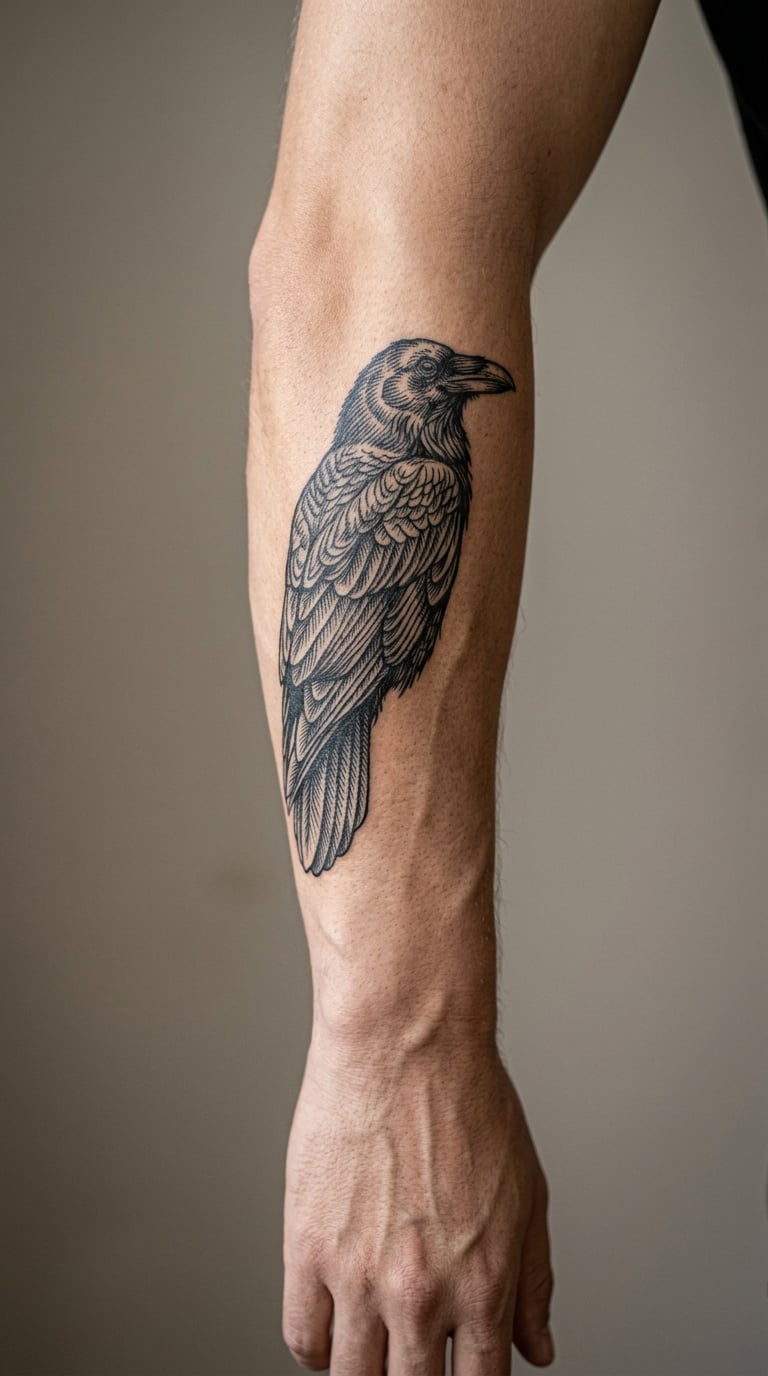
One bird, beak open, head in clean profile. The body is a set of overlapping feather shapes, each filled with short strokes at a slightly different angle, and the background is left empty so the silhouette holds from across a room. The eye is a single untouched dot of skin inside a black patch.
It is the compact option on this list. People who want a woodcut piece but have a small flat area, such as the inside of an upper arm, usually land here.
Placement: upper forearm, or the front of the biceps. Size: 3-4 in (8-10 cm). Style: fine blackwork. Pain: low to medium. Feather strokes need real gaps between them or they fill in as the skin settles, and a small piece goes grey fastest. Make it yours: have the beak rest on a short branch, or mirror a second bird on the opposite arm so they face each other.
8. Forest of Birch Trees
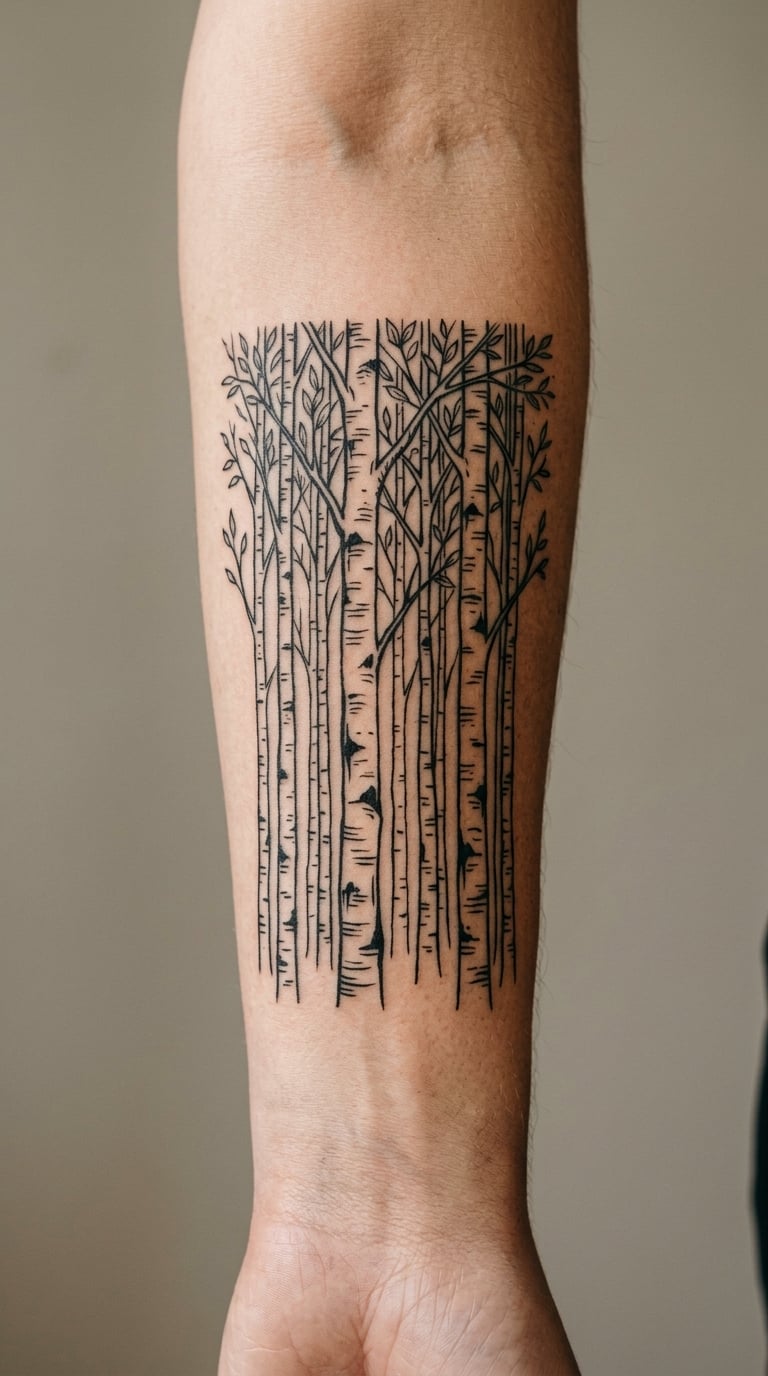
Four or five slim trunks run the length of the piece, mostly white with short black dashes and horizontal scars where the bark peels. The ground is a single band of hatch marks, and the canopy is suggested by a few cut gaps at the top rather than drawn leaves. It reads like a wood engraving because nothing is filled solid.
This is the quietest design here. It suits people who like winter and quiet places, and it works as a first tattoo because there is very little solid black to regret.
Placement: inner forearm, running lengthwise. Size: 6-9 in (15-23 cm). Style: wood engraving style, minimal blackwork. Pain: low. The inner forearm is thin and bleeds more than most areas, so a careful artist keeps pressure light here. Small bark dashes blur over a decade, so ask for them slightly larger than looks right. Make it yours: carve your own initials into one trunk, or hide a tiny animal at the forest floor.
9. Lion with a Radiant Mane
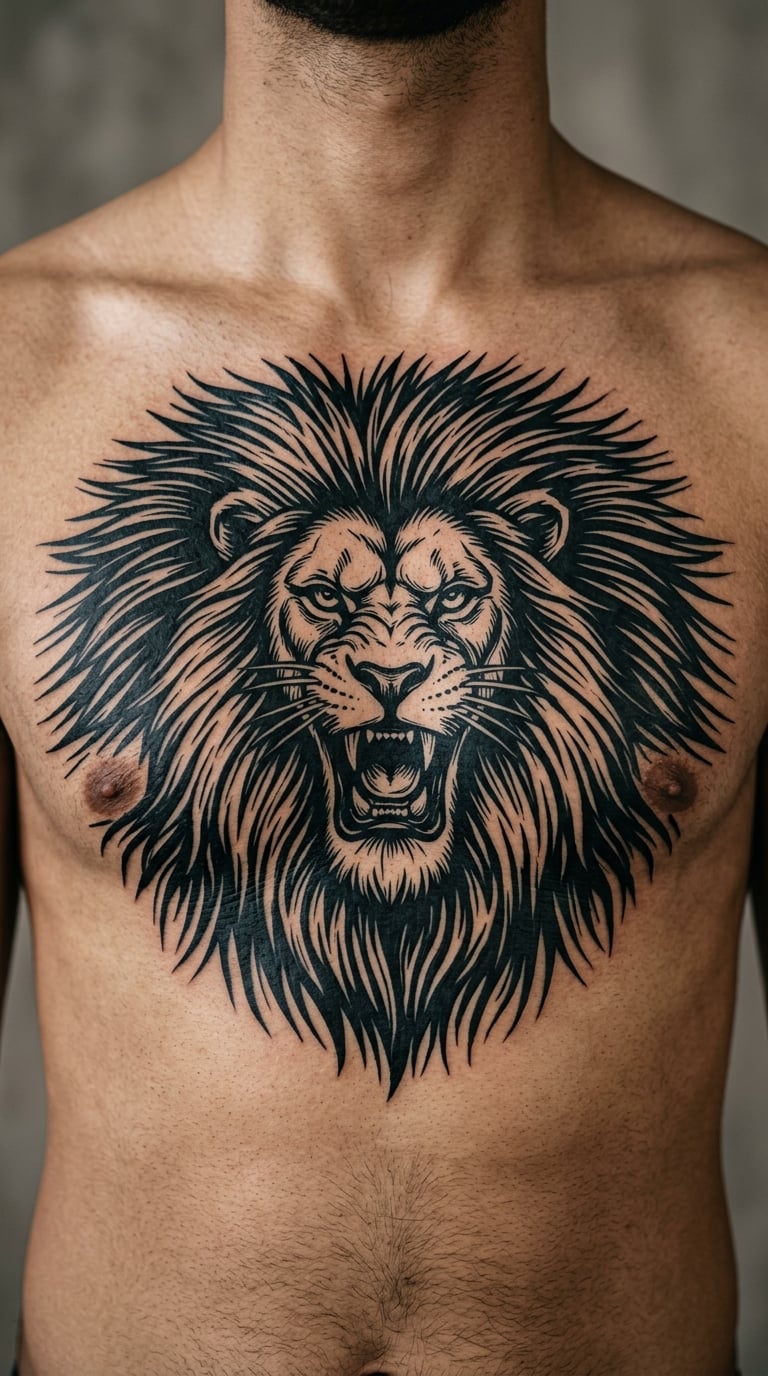
A frontal lion, muzzle squared off and eyes level, with a mane built from long straight cuts radiating outward in every direction. The face itself is mostly white skin with a few short marks for the nose and mouth, so the head reads against the busy mane. The chest is left blank to stop the piece crowding.
Strength and nerve is the usual reason people ask for it. It is a loud design, and it works best on a torso with room to breathe.
Placement: centre of the chest or upper back, between the shoulder blades. Size: 7-9 in (18-23 cm) across. Style: bold blackwork. Pain: high, because the sternum and collarbone are among the worst spots on the body and a piece this size covers both. Make it yours: let the mane run into existing chest hair, or break the mane into a half circle with a name in the gap.
10. Snake Coiled Around a Dagger
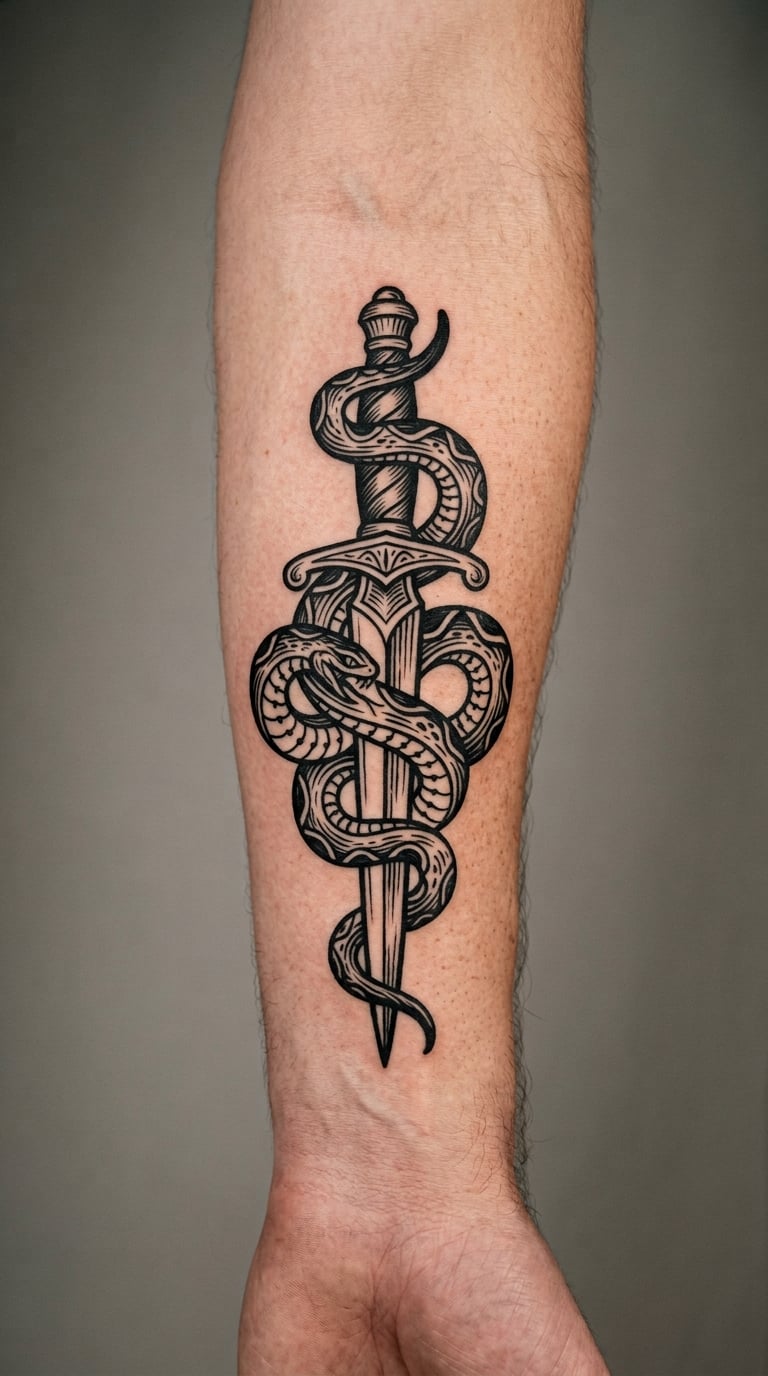
A dagger points down the arm, blade a clean white wedge with a heavy black outline, and the snake wraps it in two clear loops. The snake’s scales are small carved arcs, its body solid black, its eye a pale dot. Between the two coils the artist leaves a strip of bare skin, which is the whole trick to keeping it legible.
It sits in the old overlap of danger, protection and transformation without committing to any one reading. The composition is unusually balanced for a two-object design, which is why it keeps working on skin.
Placement: outer forearm or the front of the thigh. Size: 5-7 in (13-18 cm). Style: blackwork traditional. Pain: medium to high on the outer arm near the elbow. Scale marks below about an eighth of an inch will close up, so ask for fewer, larger ones. Make it yours: have the snake head bite the dagger’s grip instead of the blade, or wrap a thin vine around both objects.
11. Crescent Moon Filled with Feathers
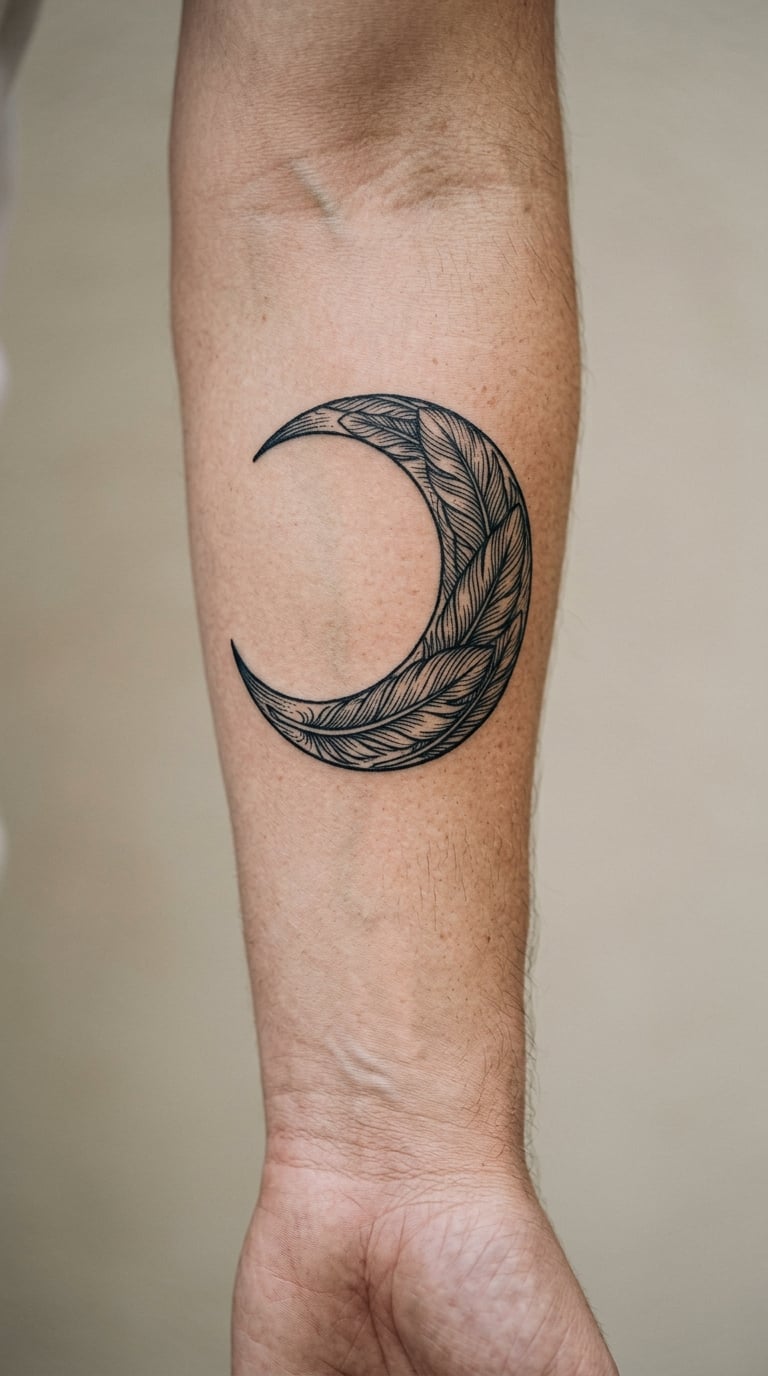
A bold crescent outline, thick at the base and tapering to points, with individually drawn feathers packed inside it. Each feather has a central shaft and a few barbs, tilted at a different angle so the shape stays active. The empty skin inside the crescent’s curve is left completely untouched, and that white gap is what keeps the piece from turning into a blob.
Night birds, seasonal change and simple jewellery you can wear every day are common reasons. It reads small on the body even when the design is detailed.
Placement: inner arm, or the hollow just above the ankle bone. Size: 3-5 in (8-13 cm). Style: fine blackwork. Pain: low. Feather barbs are fine-line work, so treat this one as a two-decade design at most and expect softening. Make it yours: use feathers from a bird you have a connection to, or leave two or three feathers falling out of the crescent.
12. Oak Seedling in a Buried Pot
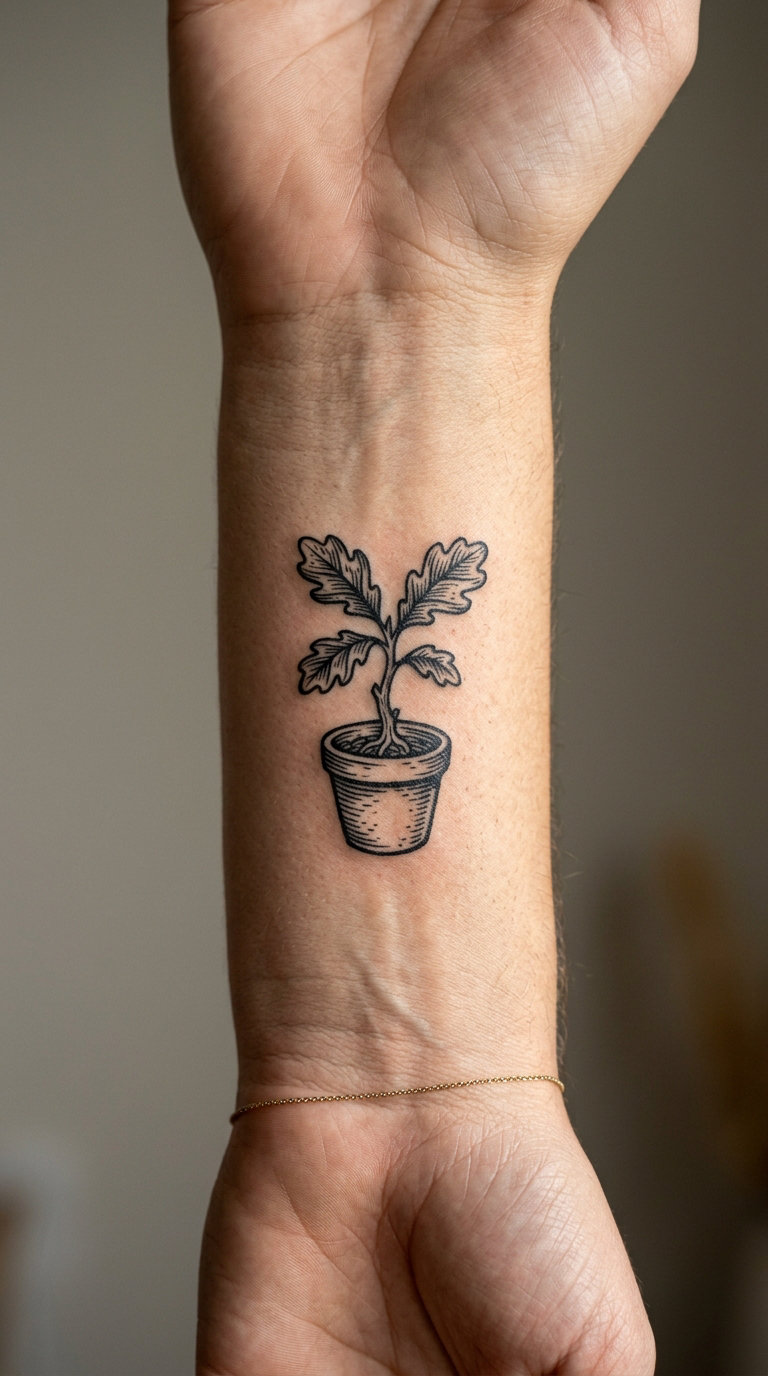
An unconventional still life. A small oak seedling with two true leaves rises from a half-buried vessel, exposed roots curling down the side of the pot, and the soil line is a band of cross-hatched earth. Everything is drawn at one small scale, the way a still life is reproduced in an old botanical plate, with no background.
It is the most personal design on the list, and it tends to be chosen for a beginning of some kind rather than for a symbol. It works as a small piece, which is unusual for this style.
Placement: inner wrist or the back of the hand. Size: 2-3 in (5-8 cm). Style: illustrative blackwork. Pain: medium to high, because the inner wrist is full of nerve endings and the wrist bone sits right under the linework. Below three inches this loses the root detail, so simplify rather than shrink. Make it yours: have the roots wrap around a small initial, or carve the number of years something took to grow.
13. Thundercloud with Geometric Lightning
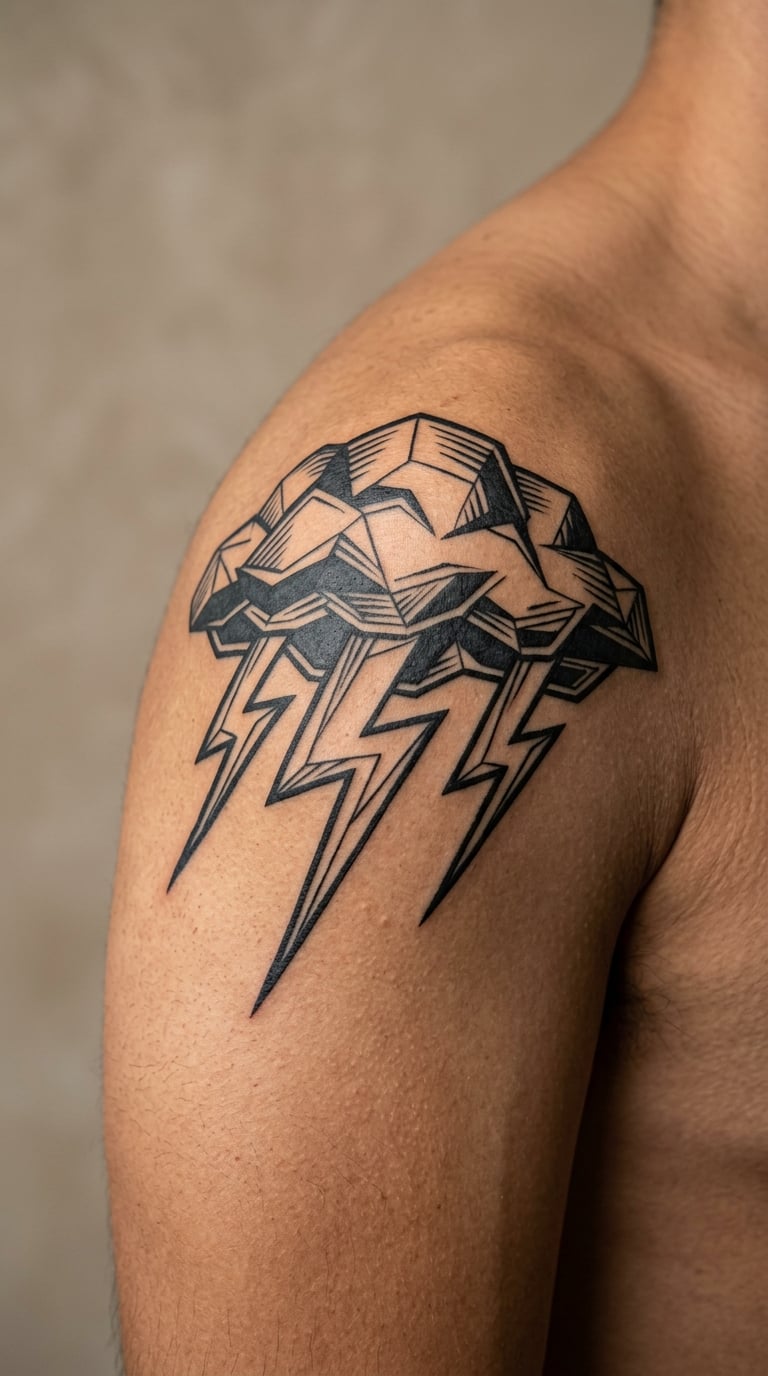
A stylised storm cloud built from flat geometric segments, each face a different hatch direction, with three angular lightning bolts dropping out of the base in sharp zigzags. The bolts are pure black shapes with clean edges, and a short row of diagonal rain marks underneath stops the composition.
It reads more graphic than illustrative, which makes it an easy match for someone who likes hard-edged blackwork but not dense naturalist detail. People also pair it with a matching bolt on the other shoulder or arm.
Placement: shoulder, upper arm, or the flat of the calf. Size: 4-6 in (10-15 cm). Style: graphic blackwork. Pain: medium, and the top of the shoulder curves, so long straight edges will follow the body. Ask for hatching that follows the round of the limb or the effect flattens out. Make it yours: add a small sun breaking under the cloud, or a set of coordinates in the rain marks.
14. Fish Swimming Through Reeds
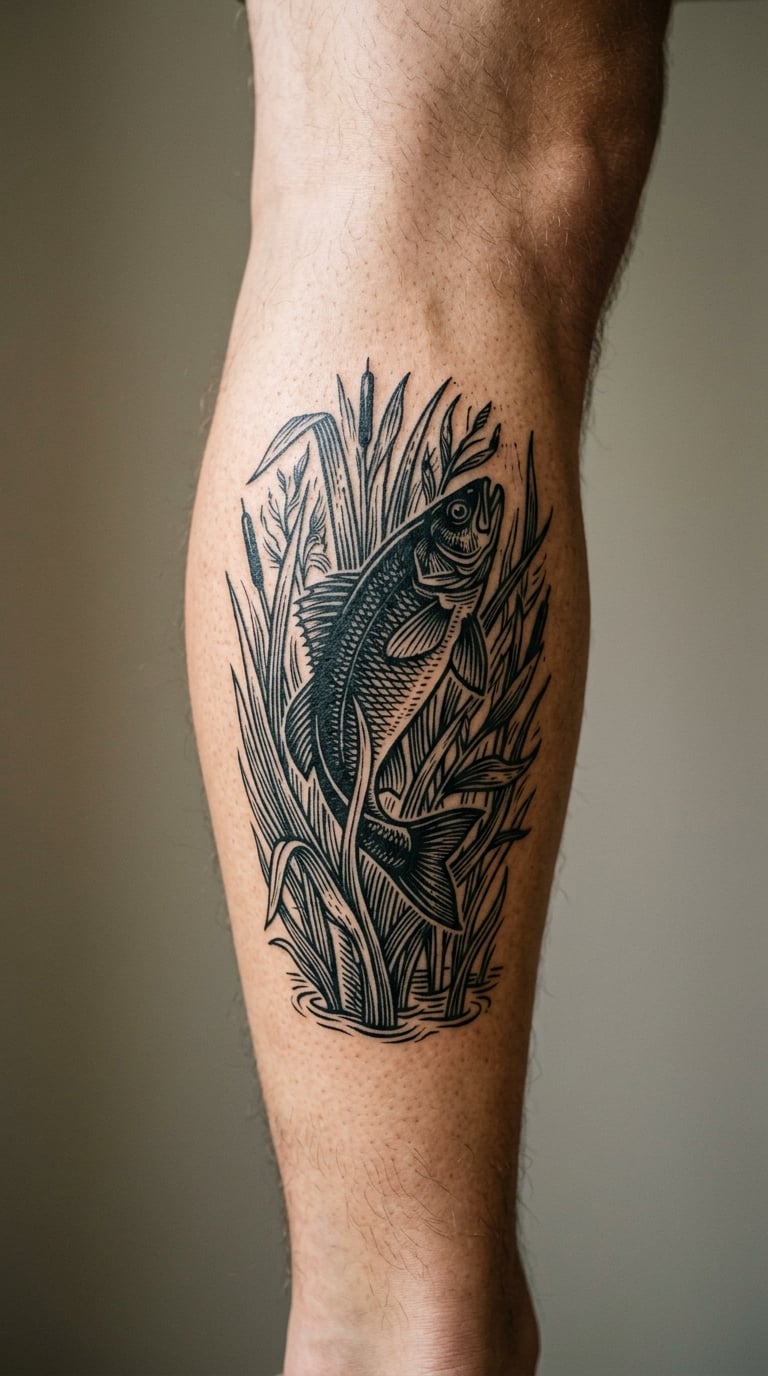
A freshwater fish in side view, body built from overlapping scale shapes and fins drawn as long scratched lines, moving through a stand of reeds that curve across the composition. Two or three horizontal water lines run behind everything to set the fish in space, and the reeds are left as outlines with hatch marks on one side only.
Angling, river country and aquarium work are the usual reasons. It is the nature option that is not a tree, which makes it a good change of pace from oak and pine designs.
Placement: outer calf or along the ribs on the torso side. Size: 6-9 in (15-23 cm). Style: naturalist engraving style. Pain: medium, and the inner calf is tender. Scale work blurs first, so keep scales as a small number of clean arcs rather than a fine mesh. Make it yours: name the species and the water it came from, or turn the reeds into a run of tall grasses for a specific spot.
15. Traditional Key with Oak Leaves
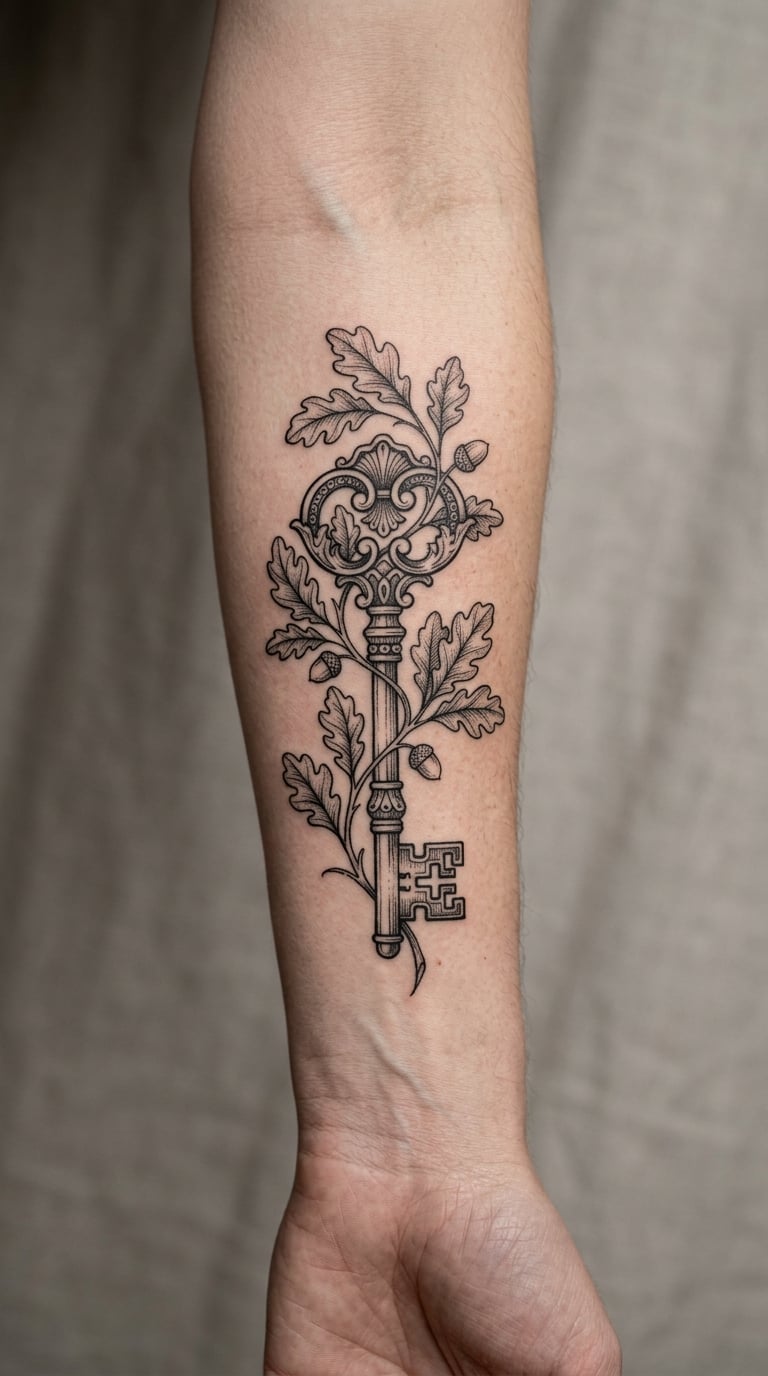
An old-fashioned key with a large oval bow, a long shank and three distinct bit teeth at the end, drawn with heavy outlines and only light hatch shading so the metal reads as flat black. A pair of oak leaves and two acorns curl around the shank without crowding it, and there is a ring of white space around the whole key.
Keys usually mean access, a house, a first home or a person who gave you one. The leaves are there to keep the object out of the badge-and-banner register and into the woodcut register.
Placement: inner forearm or the side of a rib. Size: 4-6 in (10-15 cm). Style: traditional blackwork. Pain: low to medium, and a thin inner forearm means some line spread. Keep the teeth on the key chunky, because fine teeth disappear within a few years. Make it yours: engrave a street address on the shank, or add a ribbon threaded through the bow.
16. Elk Stag with Geometric Antlers
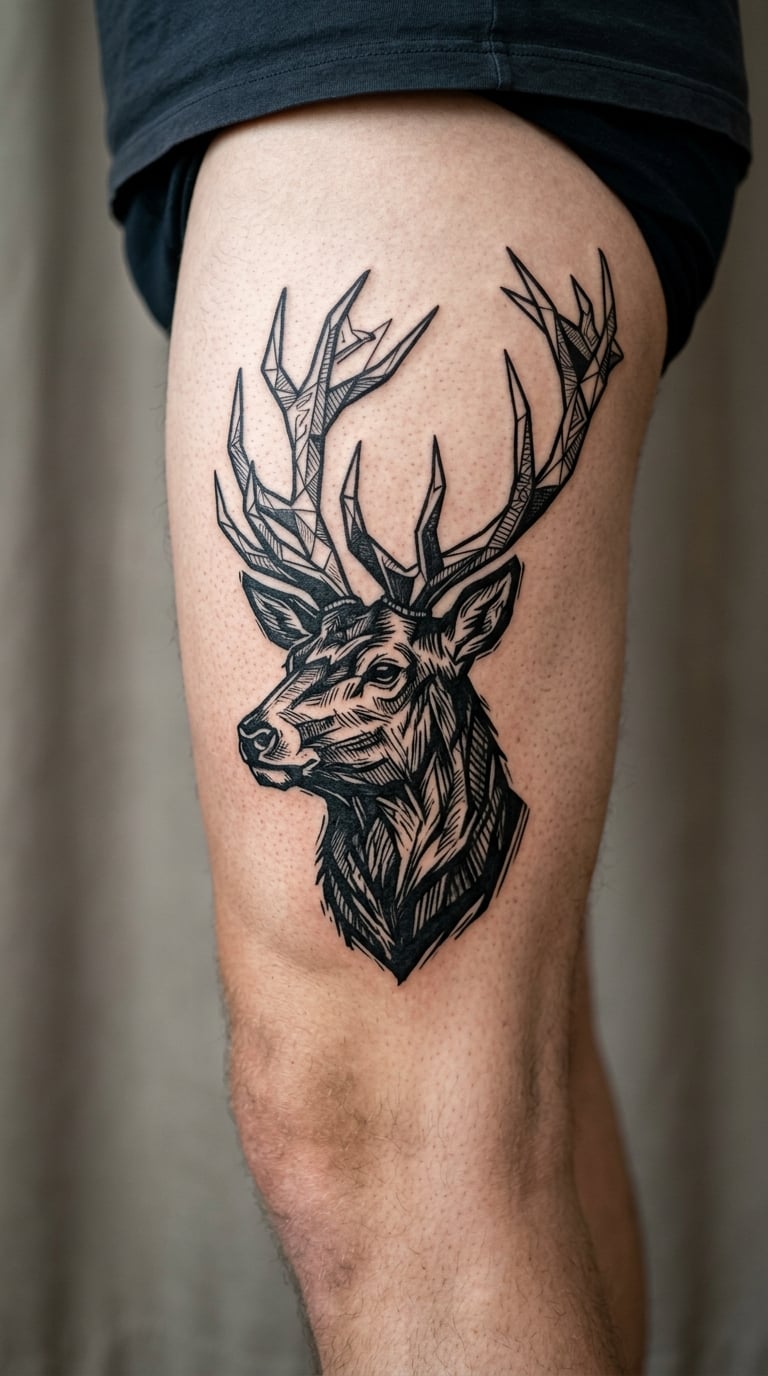
A stylised stag in three-quarter view, with antlers divided into flat geometric planes instead of natural branching, and the fur built from solid black masses separated by white gaps. The eye is left as bare skin inside a black patch, and the neck fades into loose hatch marks rather than a hard outline so the piece has an edge to run off into.
It is one of the more contemporary pieces in the set, closer to screen-printed poster art than to a Victorian plate. Hunters, mountain towns and long-distance runners tend to land on it.
Placement: outer thigh, upper arm, or the calf. Size: 6-8 in (15-20 cm). Style: stylised blackwork. Pain: medium on the thigh, higher on the outer calf near the fibula. Geometric antler edges should be thick; thin inside corners trap ink and heal patchy. Make it yours: split the antlers into two halves with a gap and put a date in the space, or simplify them to a single beam per side.
17. House Among Rolling Hills
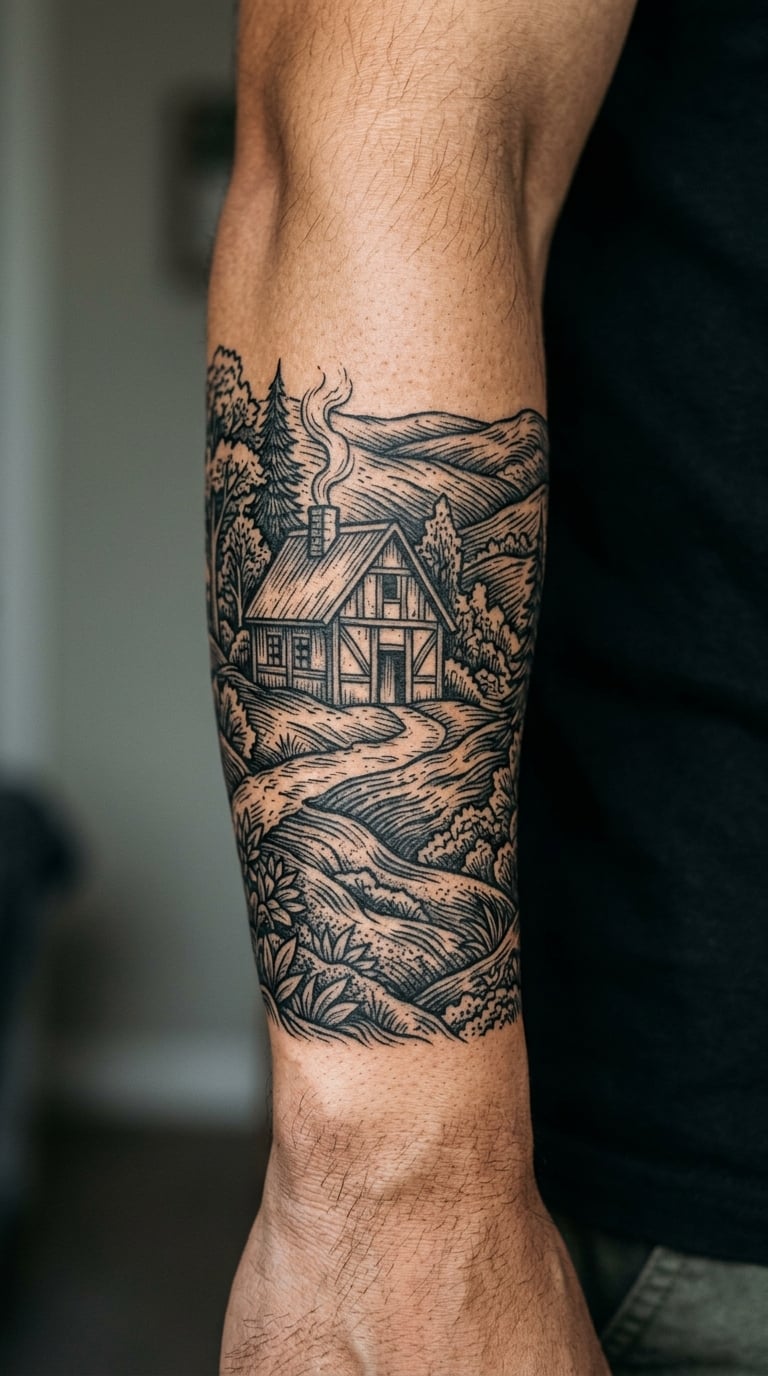
A small house with a pitched roof, one lit window left as bare skin, and a chimney with a thin column of hatched smoke. Layered hills roll behind it in bands of different hatch density, and the sky is a set of long parallel engraved lines. The whole thing is deliberately understated, closer to a book illustration than to a portrait.
It is usually a particular house rather than houses in general, and it is one of the few designs here that carries a place name honestly. The window is the detail people point at afterwards.
Placement: forearm, or the flat of the upper arm. Size: 4-6 in (10-15 cm). Style: nostalgic blackwork. Pain: medium. A small building loses its door and window at anything under three inches, so if you want the house readable, size the piece, not the detail. Make it yours: have the hills match the real terrain around the house, or put a small figure at the door.
18. Crescent Enclosing a Hand with Flame
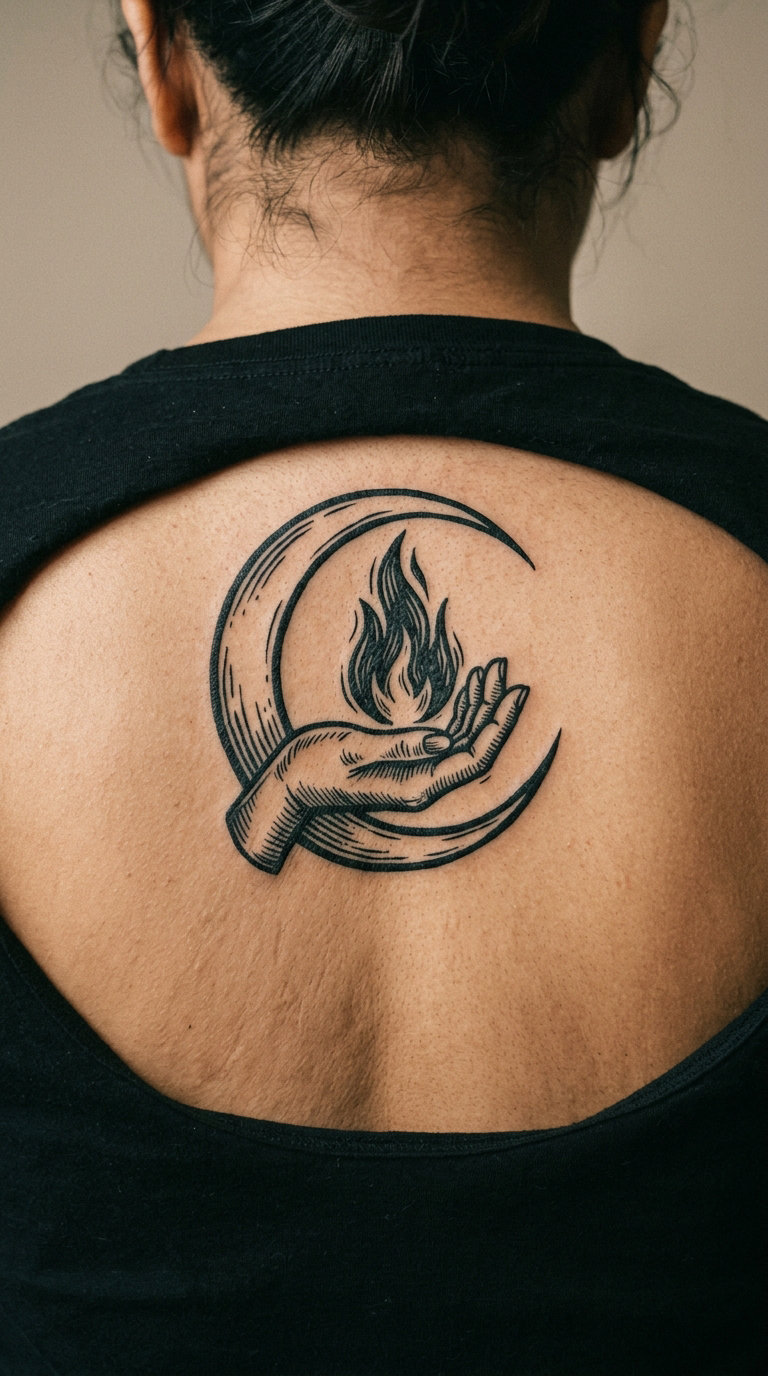
A hand in silhouette, fingers open, held inside a heavy crescent that curves around it. Between the palm and the crescent sits a flame built from carved teardrop shapes, each one solid black with a white core. The visual language is deliberately neutral, so it borrows from several traditions without claiming any of them.
It reads as holding something rather than giving something, which is why it suits people who describe themselves as protective. This is the largest single design in the set, so plan the session properly.
Placement: upper back, centred between the shoulder blades. Size: 7-10 in (18-25 cm). Style: bold blackwork. Pain: high, and a back piece of this size runs well past a single sitting. Finger separations are the difficult bit; below about two inches the fingers merge into a mitten. Make it yours: have the flame spell out a letterform, or set the crescent open toward the shoulder rather than the spine.
19. Moth with Symmetrical Wing Cuts
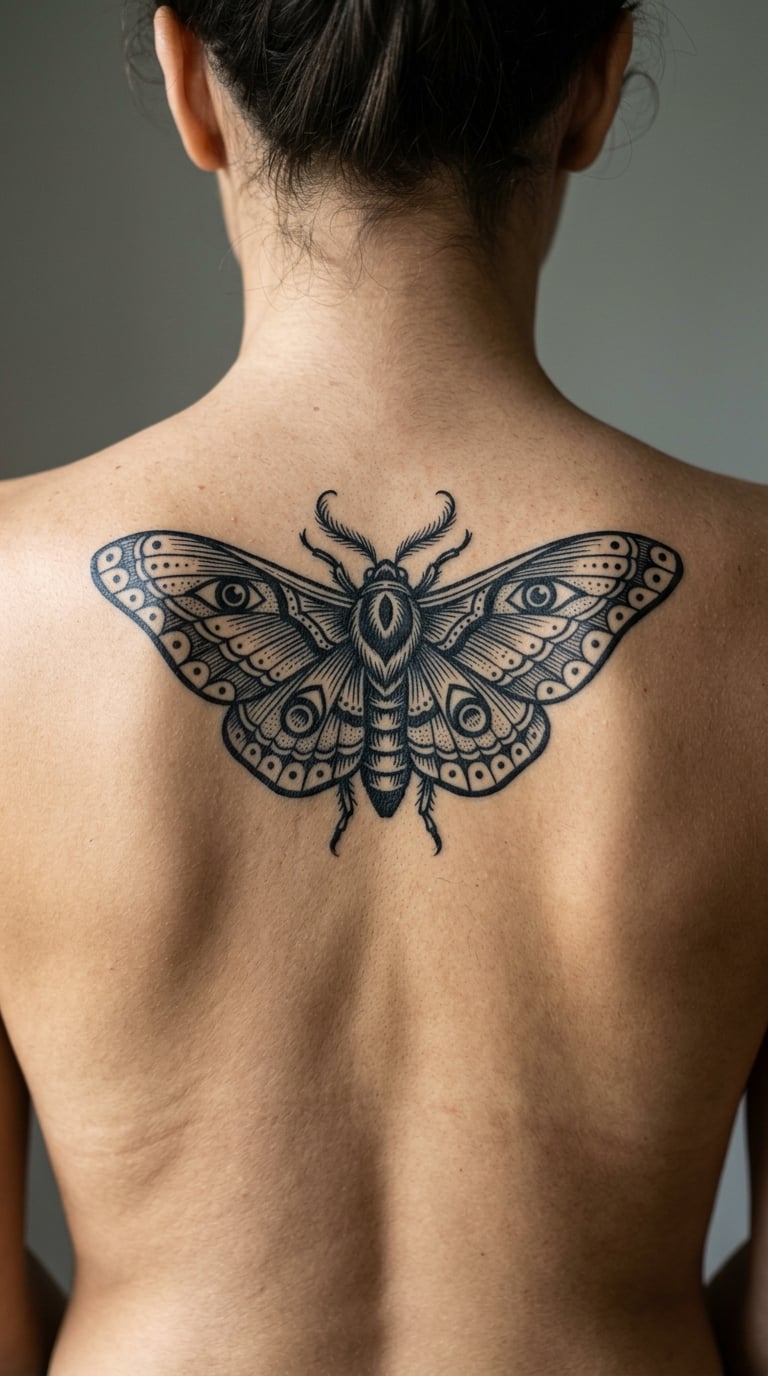
A moth with broad wings held flat, both sides identical, wing panels filled with etched patterns of dots, short bars and one large eyespot each. The body is segmented with clean horizontal cuts, and the antennae are two thin curved lines. The symmetry does the work that shading would normally do, so no grey appears anywhere.
Moths came into tattoo work through the natural history plates of the nineteenth century, and they read as drawn from observation rather than decoration. It is a large, quiet piece that people tend to keep forever.
Placement: between the shoulder blades, or across the chest. Size: 6-9 in (15-23 cm) wingspan. Style: blackwork. Pain: medium to high, and the spine area stays tender for days. The dot patterns are the ageing risk, so ask for a coarser stipple than the reference image. Make it yours: use a species from where you grew up, or add a small crescent above the wings as a companion piece.
20. Sea Turtle Over Curved Waves
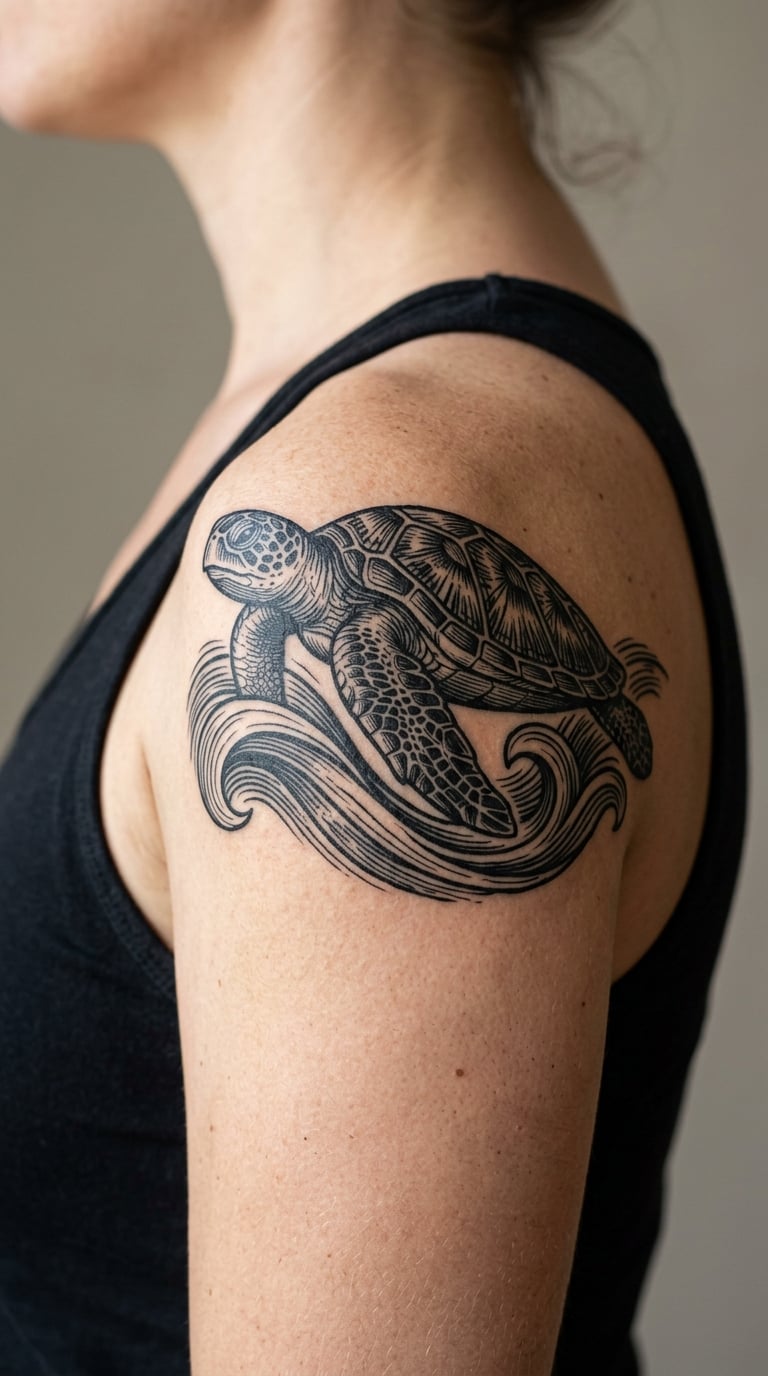
A sea turtle seen from above, shell divided into a central row and two flanking rows of scutes, each with a small carved highlight left as skin. The flippers are drawn with long scratched lines, and beneath the turtle three sweeping wave cuts curve across the shoulder in solid black separated by white gaps.
It works as a coastal piece without tipping into the nautical territory that ship designs occupy, so the two can sit on the same arm without fighting. Divers, swimmers and people from port towns choose it most often.
Placement: shoulder cap or the outer calf. Size: 6-8 in (15-20 cm). Style: illustrative blackwork. Pain: medium, and the shoulder cap curves sharply, so the shell will foreshorten unless it is drawn slightly larger than life. Scute lines need real gaps or the shell turns into a black oval over time. Make it yours: have one flipper reach for a diver’s line, or add bubbles scratched back through the black.
21. Crescent Rabbit in a Woodland Frame
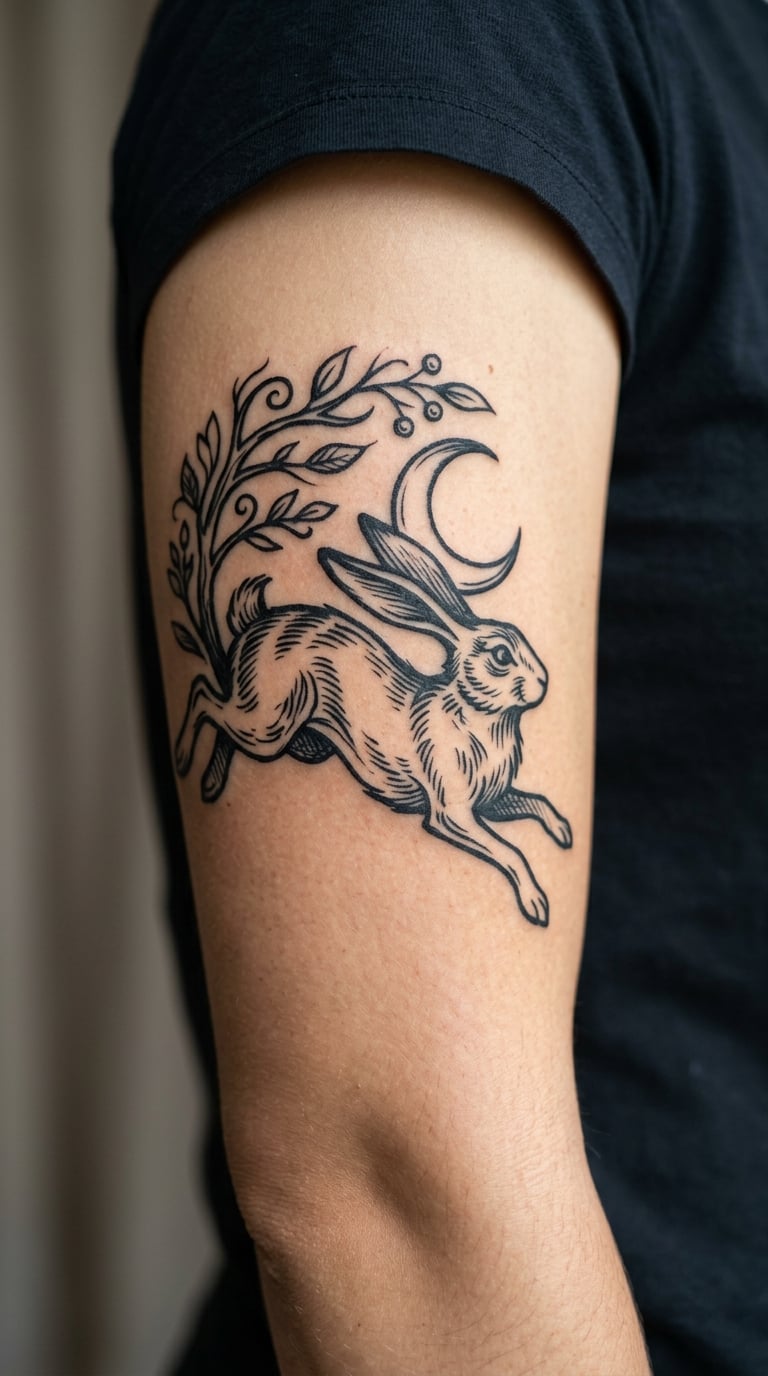
A rabbit mid-leap, body a clean black shape with the eye and the back of the thigh left white, set under a crescent moon and framed by sparse branches entering from two corners. The composition is a storybook plate rather than a naturalistic study, and the negative space around the animal is a deliberate part of the design.
It is compact but layered, which is a nice trick if you want something that looks busy in a small area. A matching version with a different animal, mirrored on the other arm, is a common pair.
Placement: outer arm, or the inside of the calf. Size: 4-6 in (10-15 cm). Style: storybook blackwork. Pain: medium. The rabbit’s eye is the smallest element; at four inches it needs to be at least the size of a grain of rice or it will fill in. Make it yours: put a date in the moon’s curve, or swap the rabbit for a hare in the same pose.
22. Hourglass Filled with Falling Feathers
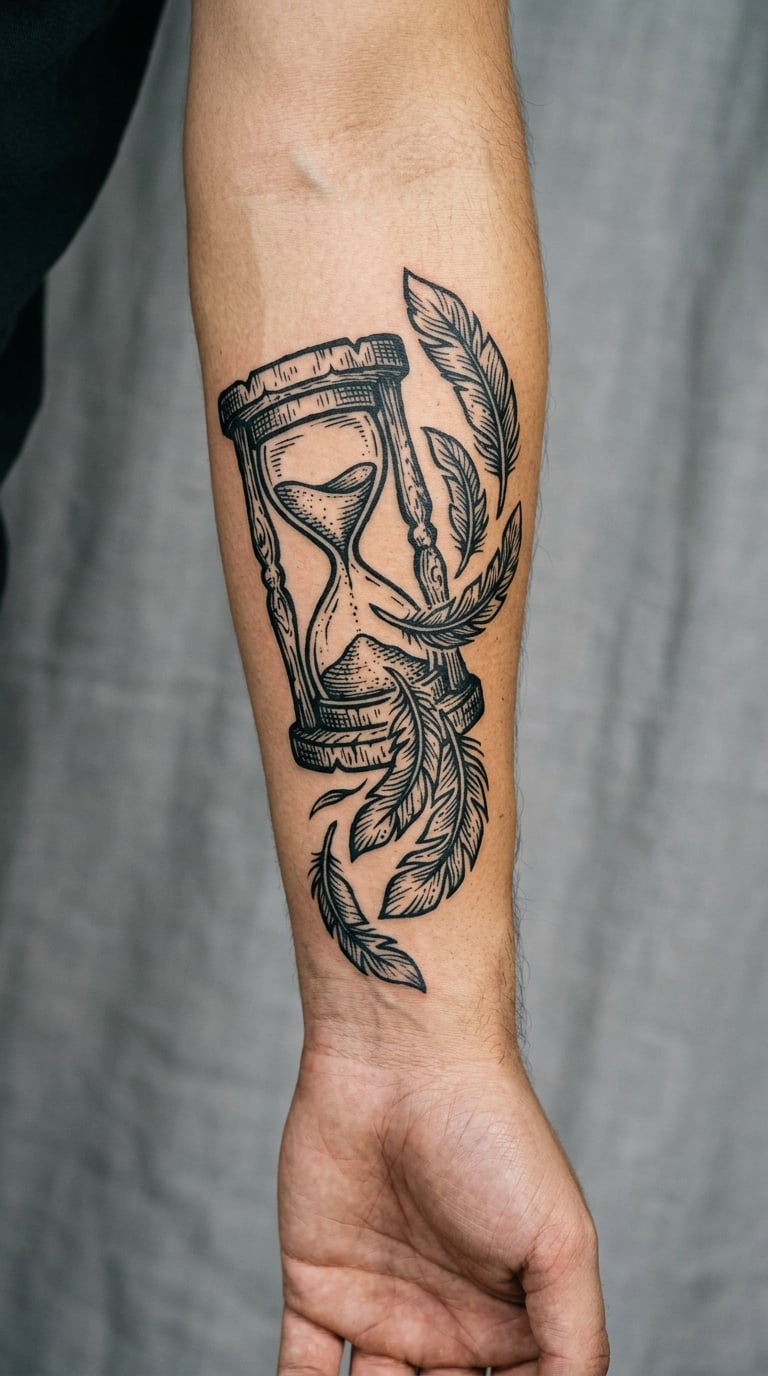
An hourglass drawn with heavy wooden end-caps and a clear glass frame, with feathers instead of sand. Some feathers are stacked in the top chamber, three are caught mid-fall in the open space, and one has landed below. The pieces are symbolic-looking without carrying a fixed reading, and the eye reads time passing before it reads anything else.
It is often a memorial piece, and it suits people who want the idea of time without a name or a date cut into the skin. The glass frame is where the design gets fiddly, so simplify it at small sizes.
Placement: inner forearm or the inner upper arm. Size: 4-5 in (10-13 cm). Style: symbolic blackwork. Pain: low to medium. Falling feathers need clear gaps between them, and three feathers will always read better than seven. Make it yours: carve a date into the wooden cap, or let a single feather land on an open palm below the glass.
How to Choose the Right Design
Line weight decides whether a woodcut tattoo works, more than the motif does. A rule worth borrowing is to match the line to the size: a bold line about the width of a grain of rice holds at three inches, while the same line on a seven-inch piece looks thin and lost. Ask to see healed work in that exact line weight, not a fresh piece on the studio wall.
What to check before you commit
- Line clarity. Look for work with a strong outer contour and visible white space inside the line groups, not a solid black mass. Hatching with real gaps between strokes ages well; packed hatching fills in.
- A size that matches the detail. Anything with finger separations, scale patterns or fine rigging needs at least the larger end of the range given above. Below that, ask for fewer elements rather than a smaller drawing.
- Placement against the body’s shape. Flat areas such as the outer forearm and the calf carry straight-edged designs best. Curved areas like the shoulder cap and the ribs need hatching that follows the round of the limb.
- Contrast against existing tattoos. Solid black next to a fine line sleeve looks like two different pieces. If you already have work, bring photos so the artist can match weight and density.
- Style fit with your collection. A single bold motif works alone. Several small motifs from this list stack well, but mixing a naturalistic fish with a geometric thundercloud in one row usually looks unresolved.
- Long-term behaviour. Filled black survives sun better than line work. If a piece will sit on a forearm in daylight for the next twenty years, favour designs with more solid black and less fine detail.
Artists who work in this style often use the words etching, engraving and linocut for the same look, so search all four terms. If you want a piece with a graphic, illustrated feel rather than blackwork, our 20 Archery Tattoo Ideas: Small and Bold is a useful comparison for how much detail a small placement can carry.
Cost and Session Time
Tattoo pricing in the US is driven by size, detail and the artist’s hourly rate, so ranges are given as bands rather than fixed numbers. Shop minimums apply even to small pieces, and a detailed piece quoted low by one artist may be quoted far higher by the next. Treat any range you see online as a starting point for a conversation, not a quote.
| Piece size | Typical US range | Session length |
|---|---|---|
| Micro, under 1.5 in (4 cm) | Low hundreds at most studios | Under an hour |
| Small, 2-3 in (5-8 cm) | Low to mid hundreds | 1-2 hours |
| Medium, 4-6 in (10-15 cm) | Mid hundreds to low thousands | 2-4 hours |
| Large, 7-10 in (18-25 cm) | Low thousands upward | 4 hours, often split |
| Half sleeve | Mid thousands | Multiple sessions |
| Full sleeve or back piece | Several thousand upward | Several sessions |
Dense hatching takes longer than a large block of solid black even when the outline is the same size, which is why two designs of identical dimensions can price very differently. A woodcut linework piece has been priced publicly by some artists in the small-piece range, so a well-detailed design that feels expensive is normal. Ask whether the artist has tattooed this motif before, and see healed examples of their hatching rather than only fresh line work.
How to Brief a Woodcut Tattoo Artist
Finding an artist who genuinely works in woodcut, etching and engraving is the part most people find hardest, and it is hardest outside big cities. Community recommendation threads fill up with the same request, and the useful answer is always the same: look at portfolios, not Instagram tags.
- Search all four terms. Woodcut, etching, engraving and linocut artists post under all of them, and often the same artist appears in each set.
- Ask for healed work from two to five years ago. A fresh piece hides exactly the problem you care about, which is whether the hatching has blurred.
- Look for line variation. In a true woodcut the line weight changes within a single stroke, the way a gouge does. Uniform machine-thin linework means blackwork, not woodcut, and it will age differently.
- Reference printmakers, not Pinterest images. Naming an Albrecht Dürer woodcut or a Victorian natural history plate gives the artist a technical target, the way a photograph gives you composition but not line behaviour.
- Describe what you want in print terms. Say “cross-hatched with visible white gaps” or “solid black with a rough chipped edge” rather than “make it look old”. That language is what an artist in this style already thinks in.
- Ask what they would cut out. A good woodcut artist will tell you which elements have to go at your chosen size. That conversation saves a redesign later.
On the copying question: bringing a reference is normal and asking for a traced copy is not. The middle ground is to bring two or three print references for line character, describe your subject in your own words, and let the artist redraw the composition. Artists working in this style are used to that brief, and 22 Skateboard Tattoo Ideas: Best Designs for Skaters is a good example of a subject list that gets reworked rather than copied.
Aftercare Basics
- Start with your artist’s instructions. Every studio has its own film, ointment or wash routine, and theirs outranks anything written here.
- Clean gently, twice a day, briefly. Lukewarm water and unscented soap, then pat dry. Long showers and hot water swell fresh line work and are the main cause of early fill-in.
- Moisturise a thin layer once healed. Once the skin has closed, a plain fragrance-free lotion keeps the area supple and stops the flaking that makes people scratch and pull at scabs.
- Give it loose clothing. Cotton over the piece, nothing tight or synthetic against it for the first couple of weeks. Bedsheets get washed more often than anything else you own.
- Treat sun as the real enemy. Solid black stays black; sun-faded blackwork goes grey-brown. Daily sunscreen on an exposed forearm or calf is the single thing that most protects this style over decades.
- Contact the studio if anything changes. Spreading redness, heat, swelling beyond the first few days, or a dull patch in the middle of the black are all reasons to call your artist, and any artist will want to hear about them.
Frequently Asked Questions
What is a woodcut-style tattoo?
A woodcut-style tattoo imitates medieval and Renaissance woodblock printing, so the ink looks carved into a block and pressed onto skin. Depth comes from cross-hatching and stippling rather than grey wash, and the palette is almost always pure black with white negative space. Tattooers also use the terms etching, engraving and linocut for the same look, so all four are worth searching.
Should a woodcut tattoo be black and white?
Almost always, yes. The style depends on the contrast between solid black and untouched skin, and a grey wash or soft gradient flattens the carved effect the whole look is built on. If you want more, ask for one spot colour only, used flat inside a small area such as an eye or a rose centre. A fully coloured piece stops reading as woodcut.
What size should a woodcut tattoo be?
Most of these designs need at least 3 to 4 inches (8 to 10 cm) to hold their line work, and the ones with finger separations, scale patterns or fine rigging need 6 inches (15 cm) or more. Below about 2 inches, hatching closes up and small details fill in within a few years. If you only have a small flat area, pick a design with fewer elements rather than a shrunken version of a detailed one.
Are detailed woodcut tattoos more painful?
Pain comes more from placement than detail. Line work is quick, so a dense design hurts less per minute than a long session of shading, but it lasts longer. Forearms, outer arms and upper backs are moderate. Inner wrists, ribs, the sternum, the spine and the inner calf run noticeably worse. Expect a tender area for several days on bony spots, and ask your artist to take breaks.
Where is the best placement for a woodcut design?
Flat, broad areas carry this style best: the outer forearm, the outer calf, the upper arm and the thigh. Curved placements such as the shoulder cap and the ribs work, but the hatching has to follow the round of the body or the design looks like a sticker. Bones under the skin, including the shin, sternum and collarbone, are the most painful and the first to show line spread.
How do I find an artist skilled in woodcut tattoos?
Search woodcut, etching, engraving and linocut separately, because the same artists post under all four. Ask the studio for healed work from two to five years ago, and check whether line weight changes within single strokes the way a gouge does. Uniform thin linework means blackwork rather than woodcut. Bring references to real printmakers such as Dürer rather than asking anyone to trace an image you found online.
Conclusion
Start with the idea that fits the space you actually have, not the one you like most. A small flat placement suits the raven, the birch forest or the crescent of feathers, where a large torso or limb takes the lion, the moon over pines or the moth between the shoulder blades. If you are adding to an existing collection, the oak tree, the stag and the house among hills give you pieces with enough solid black to sit beside heavy existing work without looking thin.
Whichever you pick, take print references to the consultation and ask the artist what they would cut. The conversation is the part that decides whether the piece still looks carved in ten years.