
20 Scorpion Tattoo Ideas (October 2026) Blackwork and Fine-Line
Scorpion tattoos are one of those designs that either grabs you immediately or leaves you cold. A scorpion is drawn in profile with the tail arched over the body and the pincers open, and that curled silhouette is what keeps it readable at two inches. Here are 20 scorpion tattoo ideas running from a single-line mark behind the ear to a nine-inch realism piece across the back, with real sizes, real placements and honest notes on how each one ages.
Most people book these in autumn, oddly enough, when the zodiac sign starts trending. A lot of Scorpio birthday pieces get booked then, so if you are working around a date, tell your artist early and aim for the consultation six weeks out. Everything below is a starting point for a conversation, not a design to order on the spot.
20 Scorpion Tattoo Ideas: Quick Guide
Twenty concepts, ordered from the smallest and calmest to the largest and loudest. Style, placement, realistic size and expected pain for each, so you can narrow it to two or three before booking anything.
| Idea | Style | Best placement | Size | Pain |
|---|---|---|---|---|
| 1. Fine-line curved scorpion | Fine line | Inner forearm | 2.5-4 in | Low to medium |
| 2. Blackwork coiled-tail scorpion | Blackwork | Outer forearm | 3-5 in | Medium |
| 3. Traditional red and black scorpion | Traditional American | Upper arm | 3-4 in | Medium |
| 4. Micro-realism sand scorpion | Micro-realism | Inner wrist | 2-3 in | Low |
| 5. Neo-traditional emerald scorpion | Neo-traditional | Outer calf | 4-6 in | Medium |
| 6. Geometric line scorpion | Geometric | Forearm or thigh | 3-5 in | Medium |
| 7. One-line scorpion behind the ear | Minimalist | Behind the ear | 1-2 in | Low |
| 8. Watercolor scorpion on the shoulder | Watercolor | Shoulder blade | 5-7 in | Medium |
| 9. Blackwork desert scorpion on the ribs | Black and grey | Ribs | 5-7 in | Medium to high |
| 10. Dotwork scorpion on the finger | Dotwork | Finger | Under 1 in | High |
| 11. Japanese-style scorpion | Japanese-style | Outer thigh | 6-8 in | Medium |
| 12. Origami scorpion | Graphic origami | Forearm | 4-6 in | Medium |
| 13. Fused metal scorpion | Industrial realism | Outer upper arm | 5-7 in | Medium |
| 14. Outlined scorpion on the ankle | Line art | Ankle | 2-3 in | Medium |
| 15. Realistic emperor scorpion | Realism | Upper back | 6-9 in | Medium to high |
| 16. Scorpion and crescent moon | Blackwork | Forearm or calf | 4-6 in | Medium |
| 17. Stained-glass scorpion | Stained glass | Sternum or chest | 5-7 in | Medium |
| 18. White-iris scorpion on the neck | Black with white ink | Side of neck | 3-5 in | Medium to high |
| 19. Tribal scorpion band | Tribal band | Outer calf | 6-9 in | Medium |
| 20. Celestial scorpion on the collarbone | Constellation | Collarbone | 2-4 in | Low to medium |
1. Fine-Line Curved Scorpion on the Inner Forearm
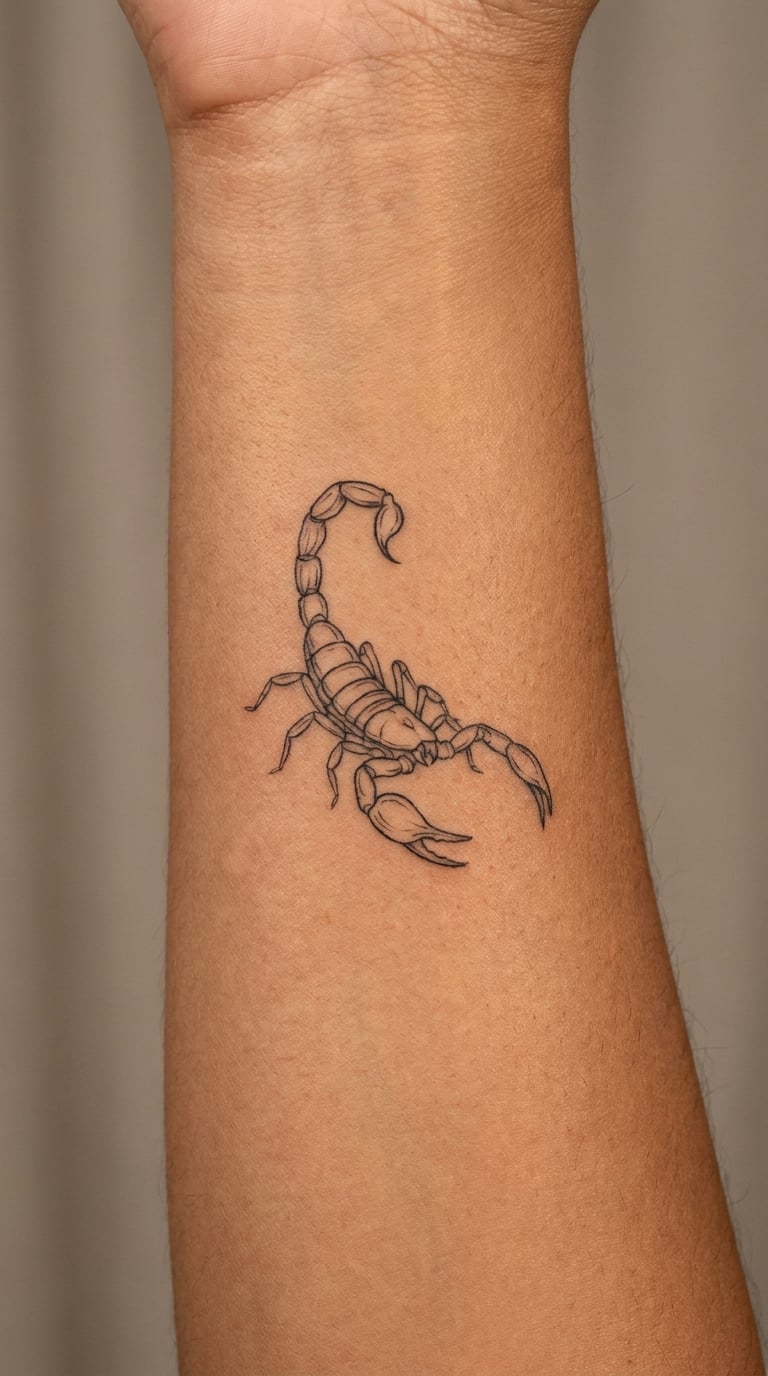
A fine-line scorpion tattoo is drawn with one weight of line the whole way: a shallow crescent for the body, five or six notches for the segmented tail, two open claws. No fill, no shading, nothing to blur later. It is the version people pick when they like the shape of the animal and nothing more, which is a perfectly good reason to get inked. The curve is the appeal, because it follows the forearm and reads as intentional from either side.
Placement: inner forearm, wrist crease to mid-forearm · Size: 2.5 to 4 inches (6 to 10 cm) · Style: fine line, single weight
Pain: low to medium, a constant scratchy sting. Fine line softens noticeably within a few years, and a healer can add weight to bring the edges back.
Make it yours: shift the tail curl to match your forearm line, or add three dots along the tail for a birthstone.
2. Blackwork Scorpion with a Coiled Tail
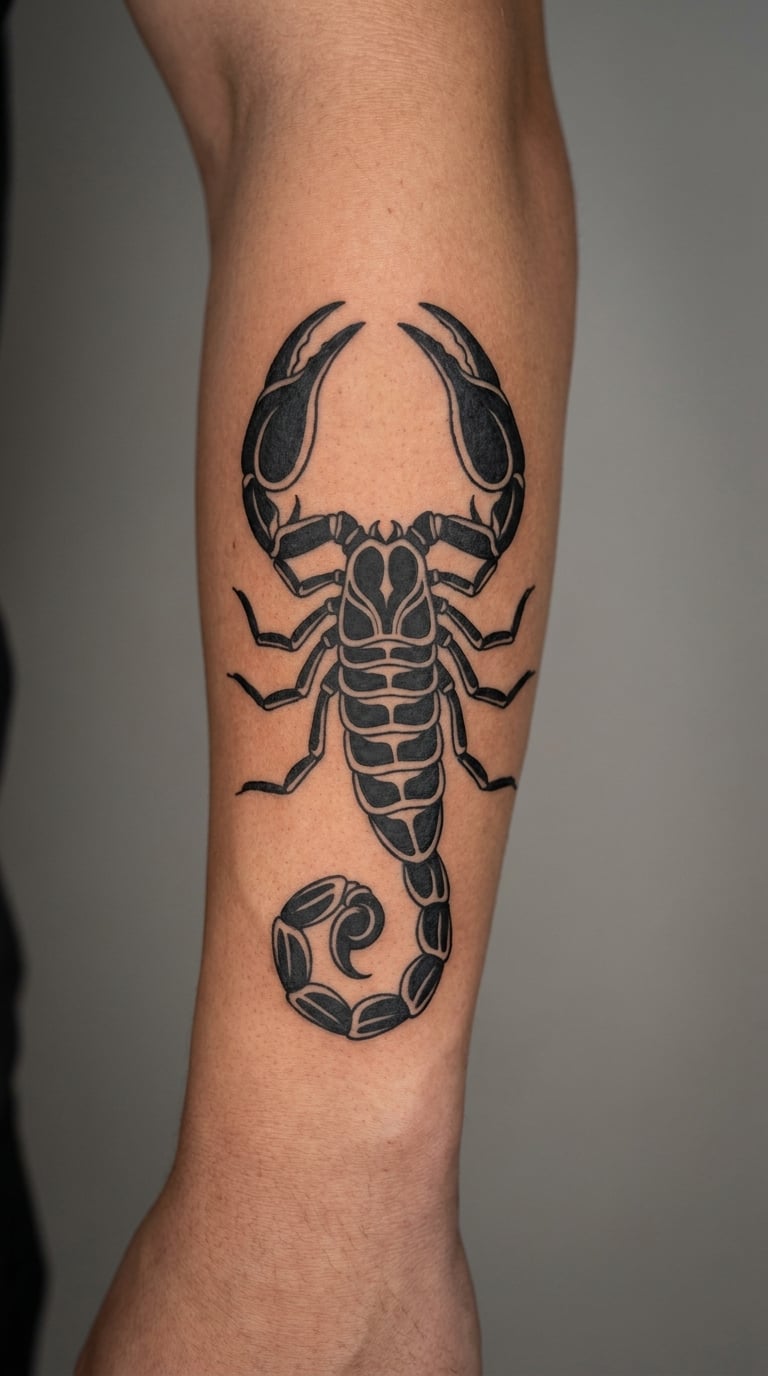
A solid black silhouette does the heavy lifting here. Body and claws filled in completely, the tail coiled tight over the back, with two or three thin white gaps cut through the black to keep the segments separate. That negative space is what stops it reading as a blob. People pick this version because it stays readable from across a room, and it fills a forearm without needing a full sleeve.
Placement: outer forearm or outer calf, vertical along the muscle · Size: 3 to 5 inches (7.5 to 13 cm) · Style: blackwork with negative space
Pain: medium. Solid fills run past the point where discomfort settles into a familiar rhythm, though the colour ages far more evenly than thin detail.
Make it yours: have the tail curl tighter or looser to follow your arm, or set a small birthstone in the negative space near the claws.
3. Traditional Scorpion in Red and Black
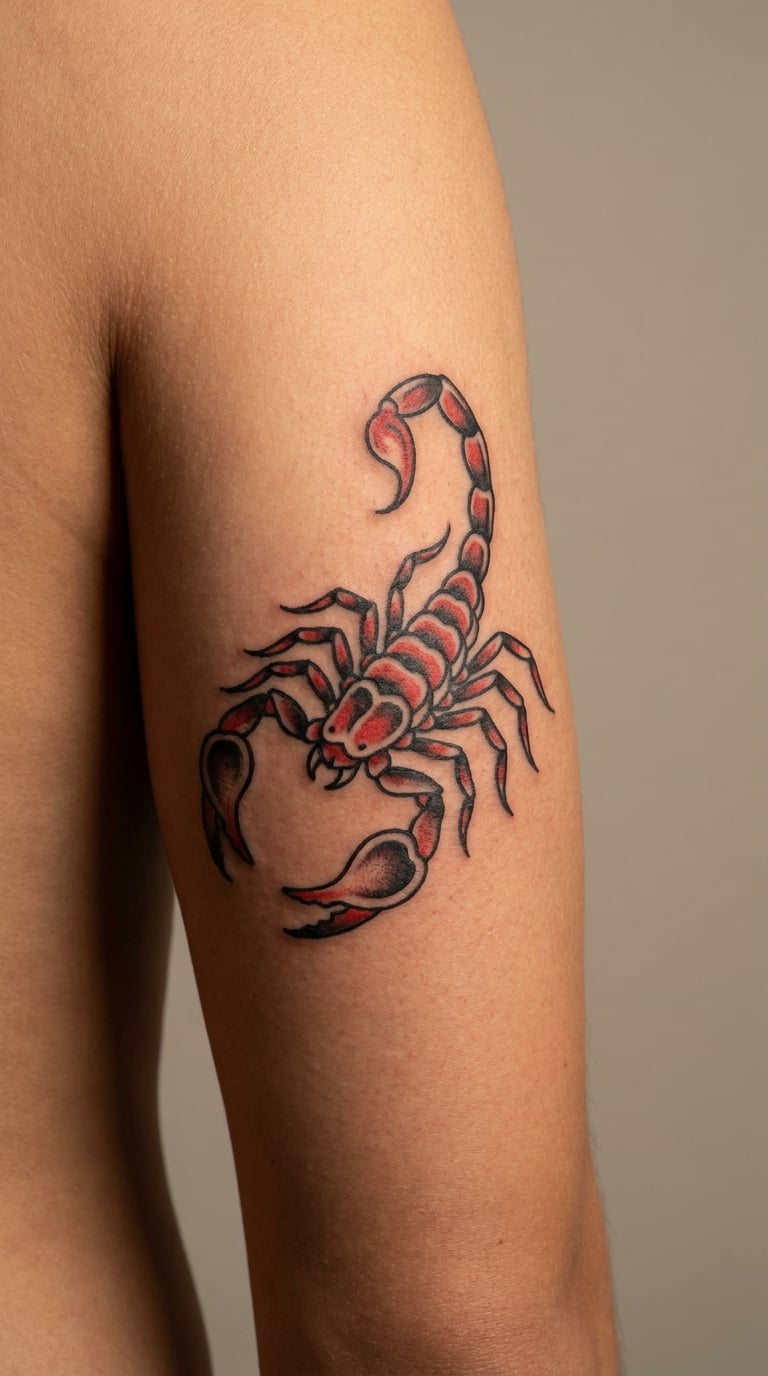
The classic American traditional scorpion: bold black outlines, a red body, black claw shading, maybe a green or purple accent dot. The tail is raised high in the curled pose old flash sheets always showed. Red has always been the colour scorpion flash was drawn in, so the design sits naturally in this style instead of fighting it, and it announces itself through a T-shirt sleeve.
Placement: upper arm, outer bicep, horizontal or diagonal · Size: 3 to 4 inches (7.5 to 10 cm) · Style: traditional American, red and black
Pain: medium. Bright red takes extra passes. Bold fills hold up well, but red shifts toward orange over a decade, so patch the colour rather than reworking the piece.
Make it yours: add a small banner of lettering below the claws, or swap the red for your birthstone colour as a spot colour.
4. Micro-Realism Sand Scorpion on the Wrist
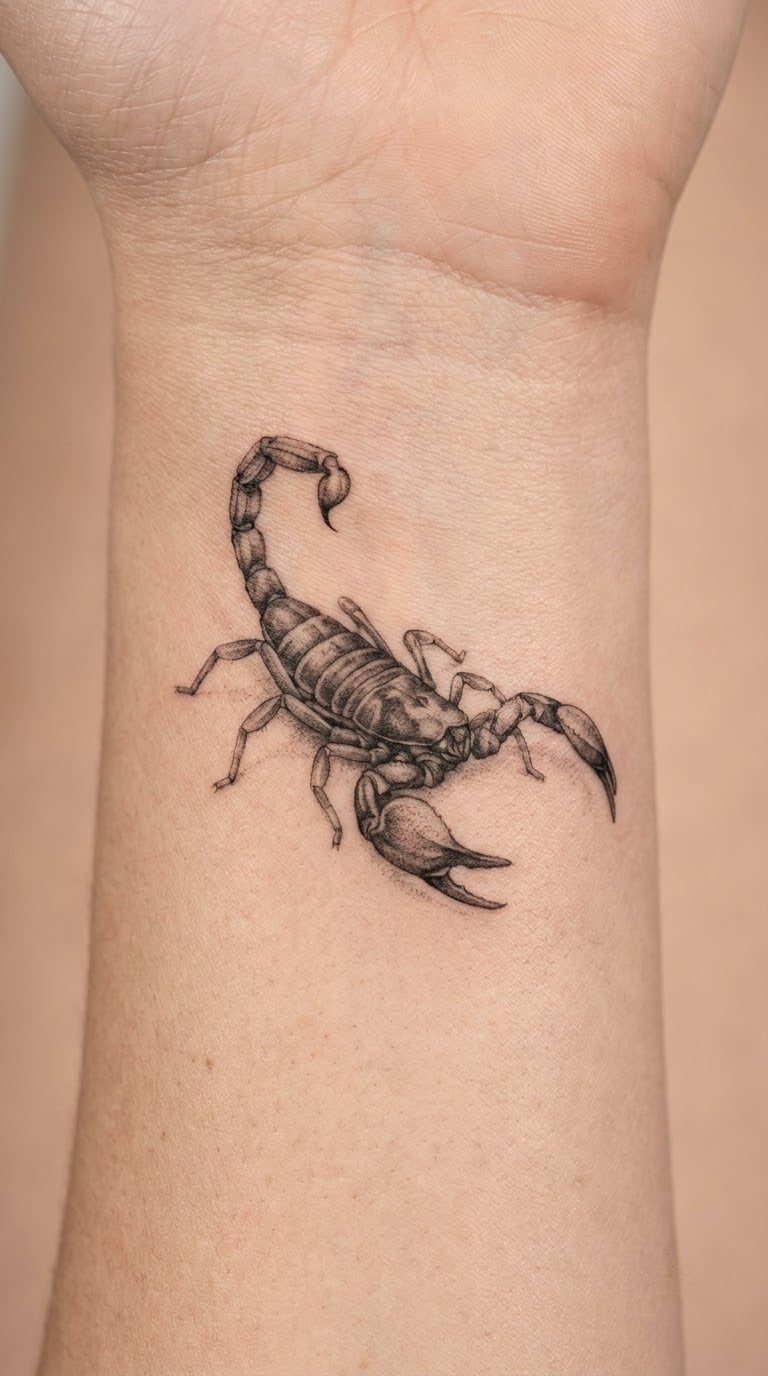
At wrist size, micro-realism is mostly about restraint. A sand scorpion is rendered in muted black and grey with slightly translucent claws, sitting low and flat like it is walking rather than rearing up. The low stance is the trick: a rearing scorpion at two inches collapses into a smudge, while a horizontal one keeps its silhouette. It reads as something you found in a desert rather than something drawn for a flash sheet.
Placement: inner wrist, or the flat of the forearm near it · Size: 2 to 3 inches (5 to 7.5 cm) · Style: micro-realism, black and grey
Pain: low to medium in a short session. Fine shading blurs as skin texture changes, so a touch-up every few years keeps the claw edges honest.
Make it yours: match the scorpion to a real species from a place that matters to you, or add grain-of-sand texture beneath it.
5. Neo-Traditional Emerald Scorpion on the Calf
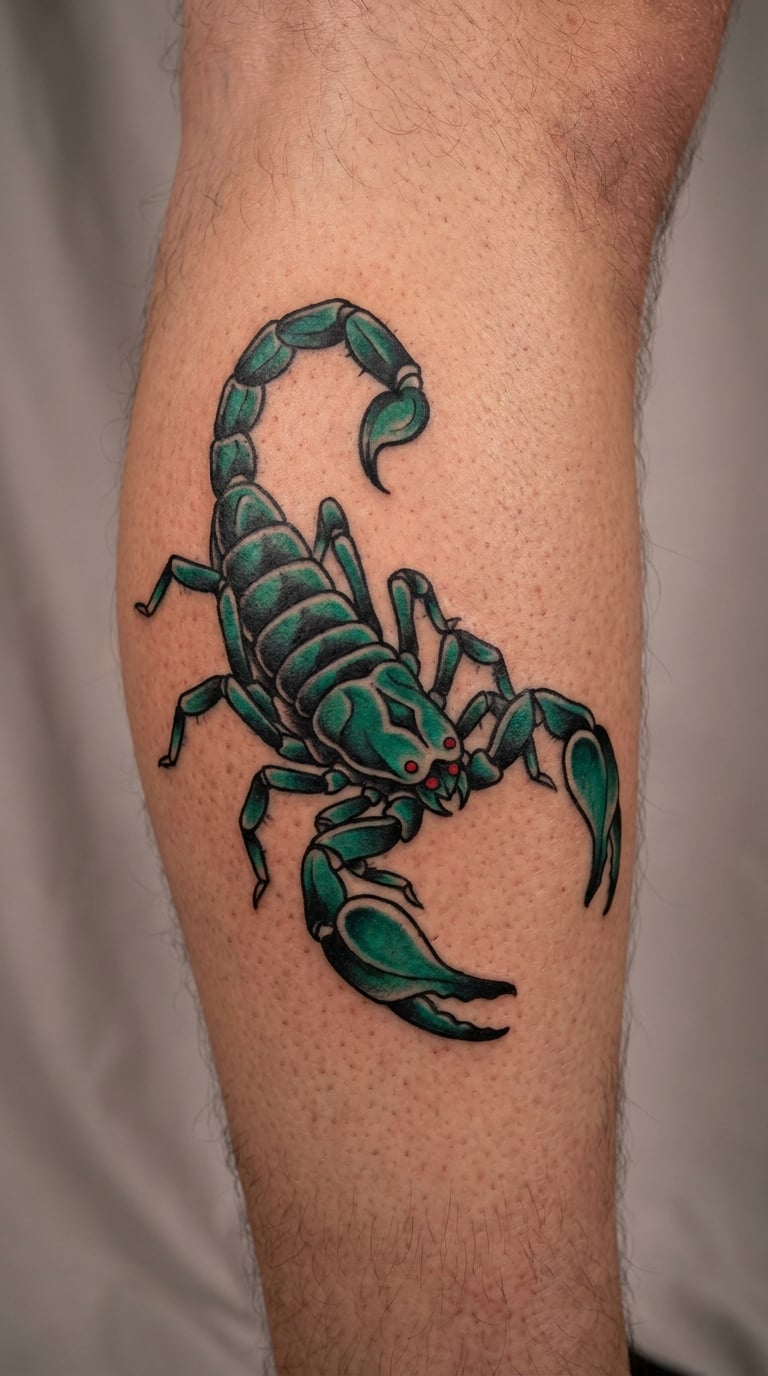
Neo-traditional is heavier and more dimensional than traditional, and green gives the artist room. The emerald scorpion here is layered greens with black shadow under each segment and two small red eyes, tail sweeping up and across the calf in one long line. Colour that saturated is a commitment, and it reads as a finished piece rather than a sketch. On a leg with room to spare, it has the space to be that bold.
Placement: outer calf, diagonal from below the knee toward the ankle · Size: 4 to 6 inches (10 to 15 cm) · Style: neo-traditional, full colour
Pain: medium, more on the bony outer edge than the muscle. Bold colour softens noticeably, so pick a green that will still look right to you in five years.
Make it yours: run a desert flower or thorn branch along the tail, or hide a birth year in the segment count.
6. Geometric Scorpion Made from Straight Lines
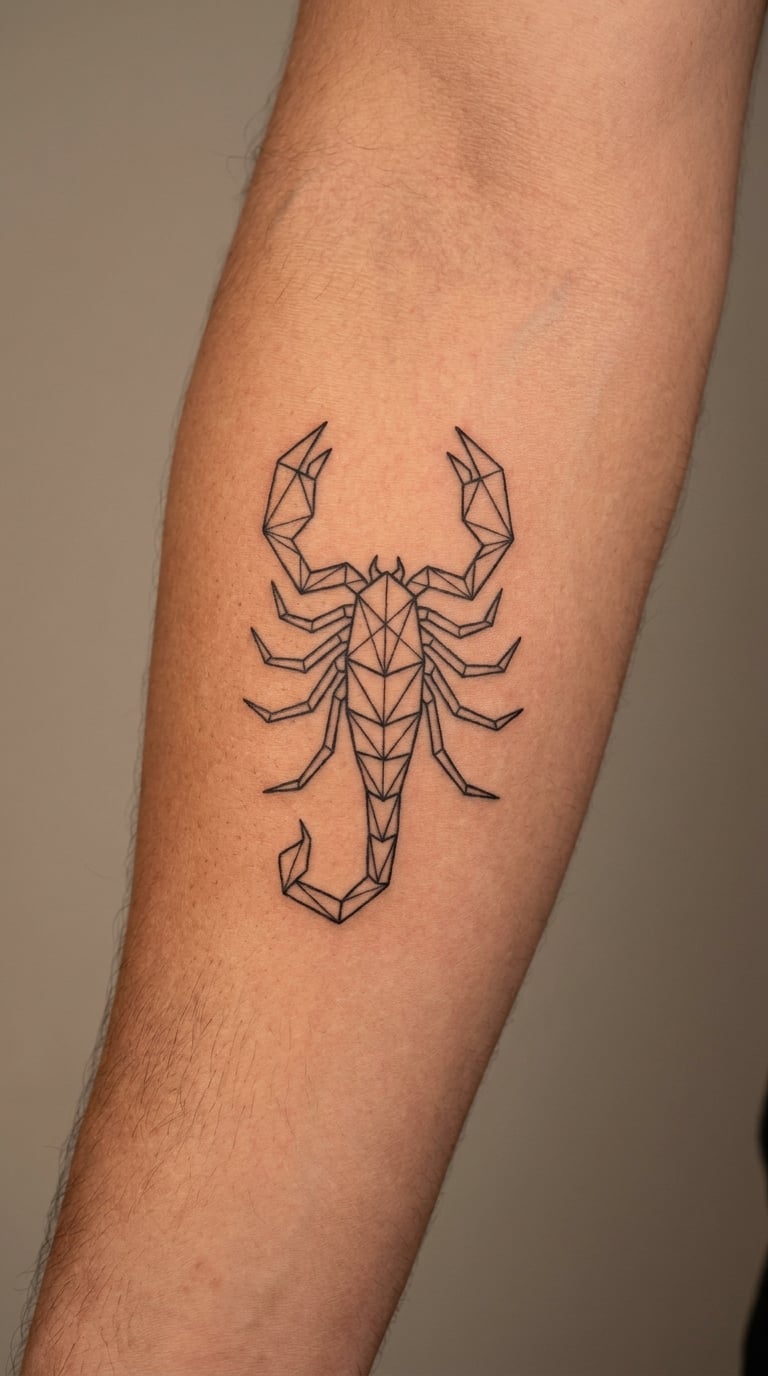
The scorpion is built from straight segments only: triangles for the body, a zig-zag for the tail, two angular claws that look like folded paper. Symmetry is the main event, each half mirroring the other down a central line. It appeals to people who like math more than naturalism, and once the animal is reduced to angles it looks architectural, sitting well next to other geometric work.
Placement: outer forearm, upper arm or outer thigh · Size: 3 to 5 inches (7.5 to 13 cm) · Style: geometric linework, black
Pain: medium, and the linework is relentless rather than deep. Repeated thin lines have to be spaced far enough apart that healed skin keeps them separate.
Make it yours: carry a background pattern of the same geometry into the surrounding skin, or build the body from a shape you already have tattooed.
7. Minimal One-Line Scorpion Behind the Ear
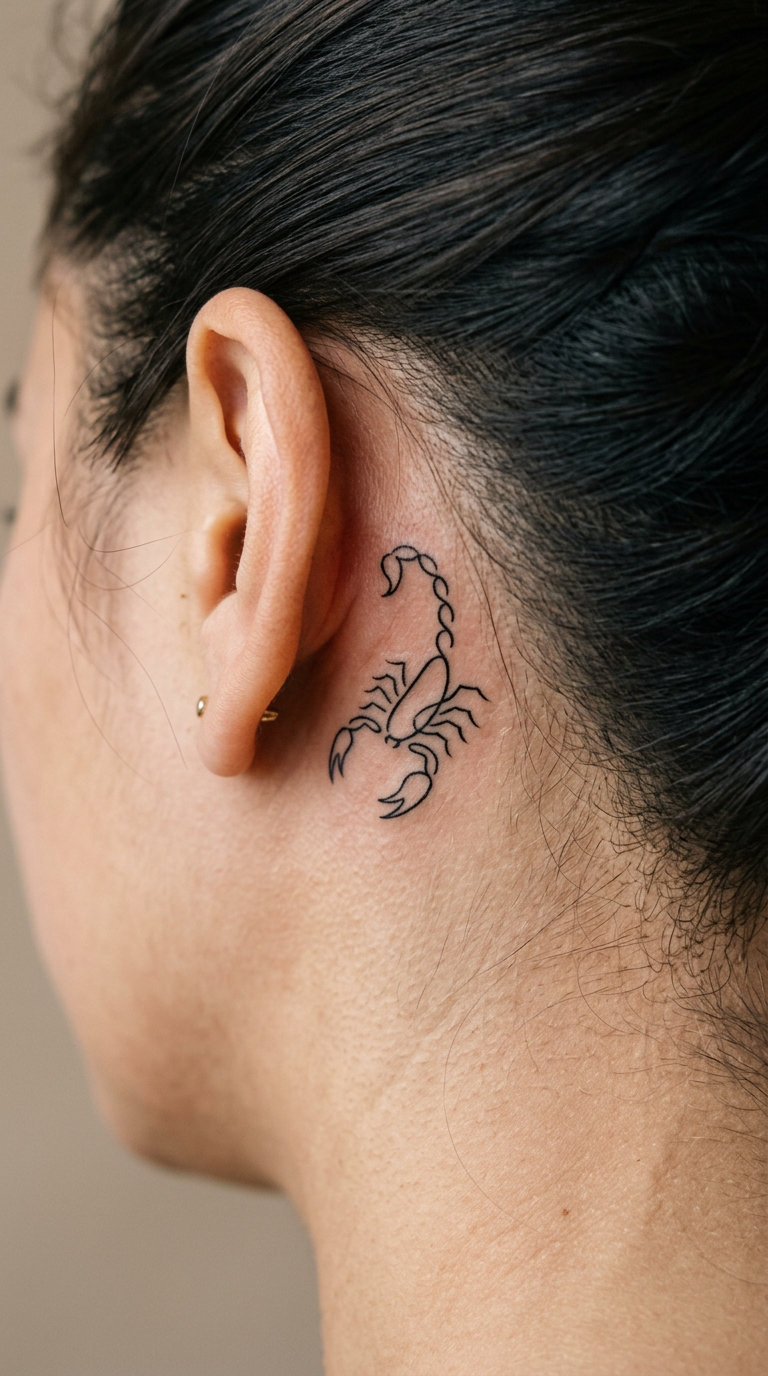
One line means a single unbroken stroke: it starts at a claw, curves under the body, rises into the tail and hooks back down. No shading, no segments, the bare minimum that still reads as a scorpion from arm’s length. Behind the ear is discreet, and discreet is usually the point, since it is visible with your hair up and hidden when it is down.
Placement: just behind the ear, following the curve of the cartilage · Size: 1 to 2 inches (2.5 to 5 cm) · Style: minimalist, single continuous line
Pain: low, and quick. That spot catches sun and takes friction from pillows and collars, so the line fades faster than it would on an arm. Plan a top-up every few years.
Make it yours: change the tail hook to match the line of your jaw, or mirror the mark on the other side.
8. Watercolor Scorpion Across the Shoulder
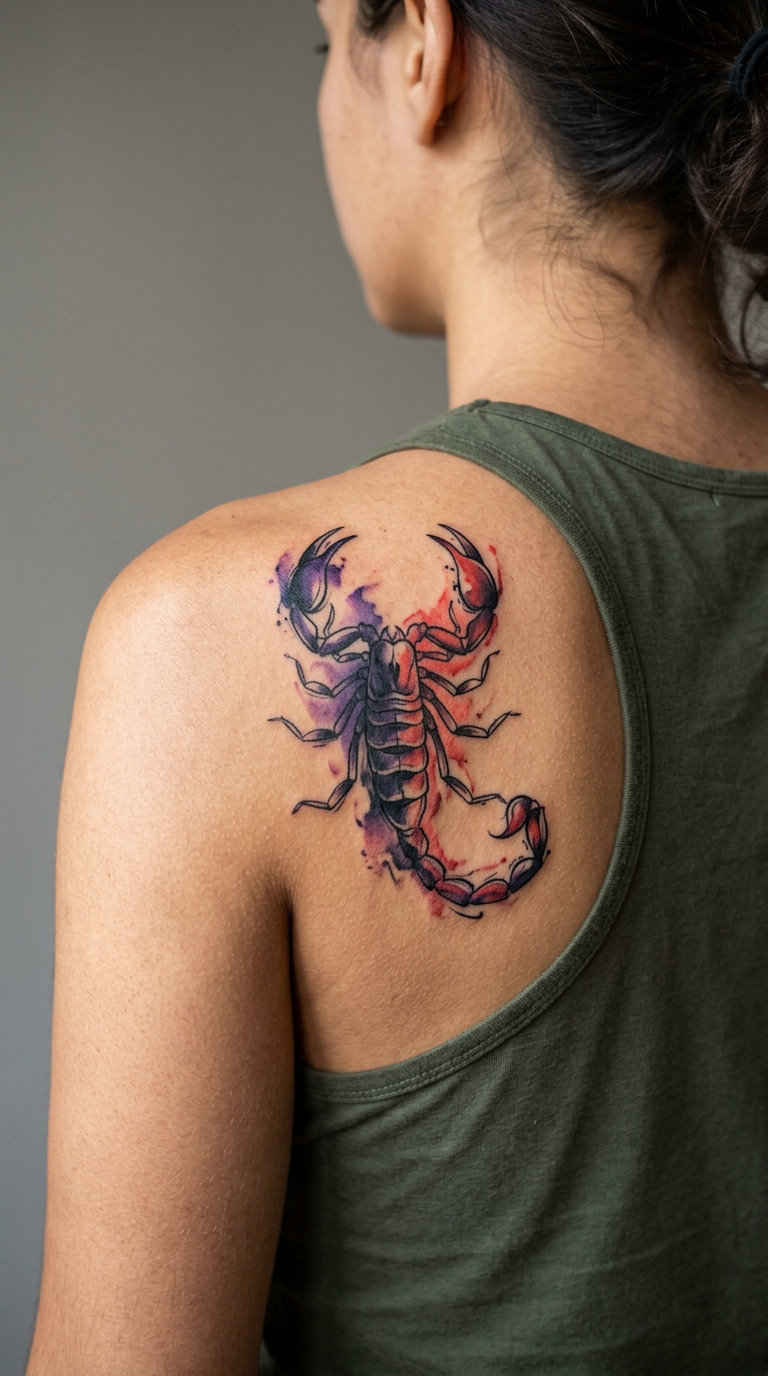
A watercolor scorpion is drawn loosely: translucent washes of black, violet and red bleeding past the linework, with the claws and tail picked out in slightly sharper ink. The paint looks like it ran on purpose, and the piece keeps an unpainted margin around the drips. It is the right choice when the colour is the point rather than the animal, and the shoulder gives a flat canvas for the wash to spread without fighting a joint.
Placement: across the shoulder blade or the top of the shoulder · Size: 5 to 7 inches (13 to 18 cm) · Style: watercolor with illustrative linework
Pain: medium, and washes can need a second session. Watercolour is a lighter deposit, so it fades faster than solid black and looks best in the first few years.
Make it yours: use two colours tied to people or places rather than the usual palette, and let the drips run toward your arm or back.
9. Blackwork Desert Scorpion on the Ribs
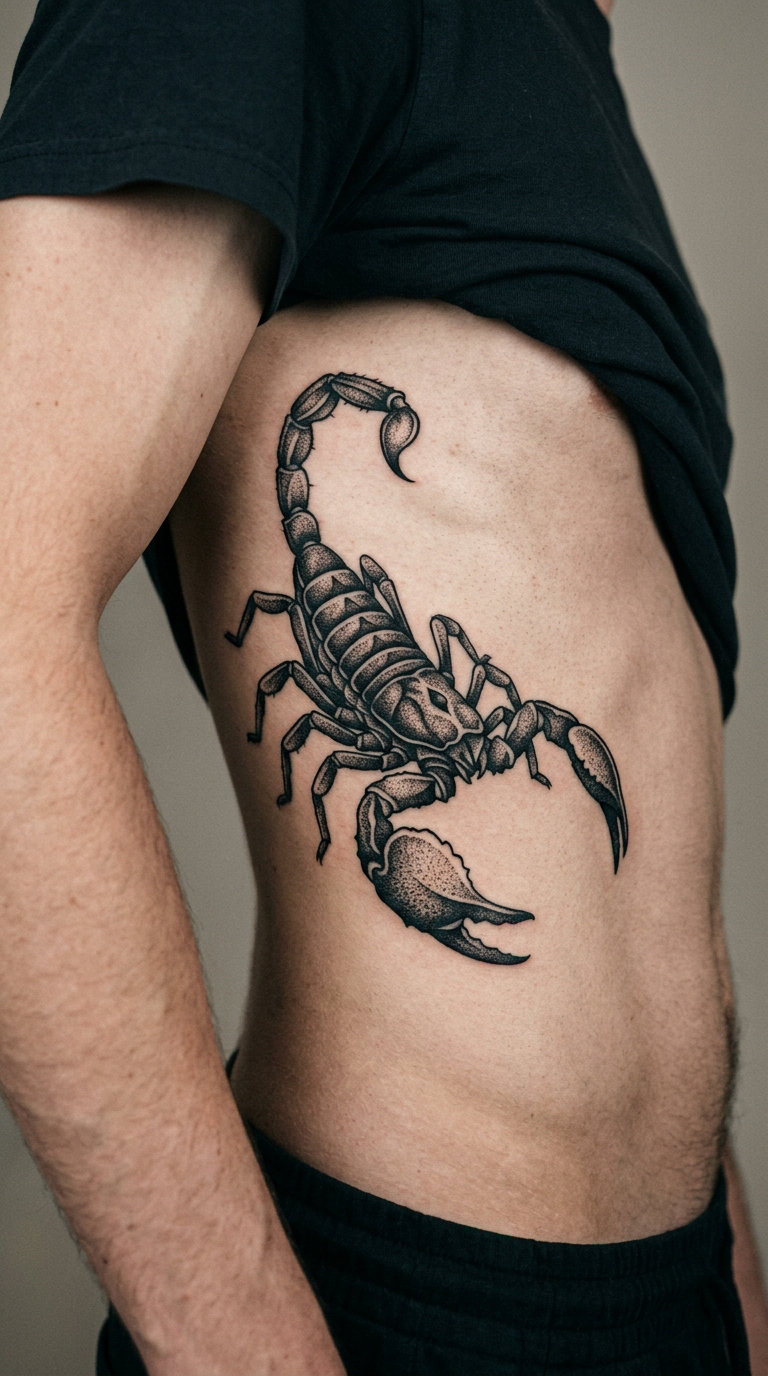
A desert scorpion is longer and flatter than the movie version, with dusty stipple around it suggesting sand and heat haze. The claws are heavy and solid, the body shaded in patches rather than outlined all the way round, and the whole thing looks weathered rather than polished. It has a rugged, lived-in quality that suits the placement, because ribs give a curved surface and a natural frame.
Placement: along the ribs, following the curve, usually the side you do not sleep on · Size: 5 to 7 inches (13 to 18 cm) · Style: blackwork and grey, stippled
Pain: medium to high. Bony areas with thin skin make people tense, and ribs are no exception. Ribs also move and stretch, so expect the design to distort a little over time.
Make it yours: work a desert plant, a scrubbed date or coordinates from a dry place into the negative space.
10. Small Dotwork Scorpion on the Finger
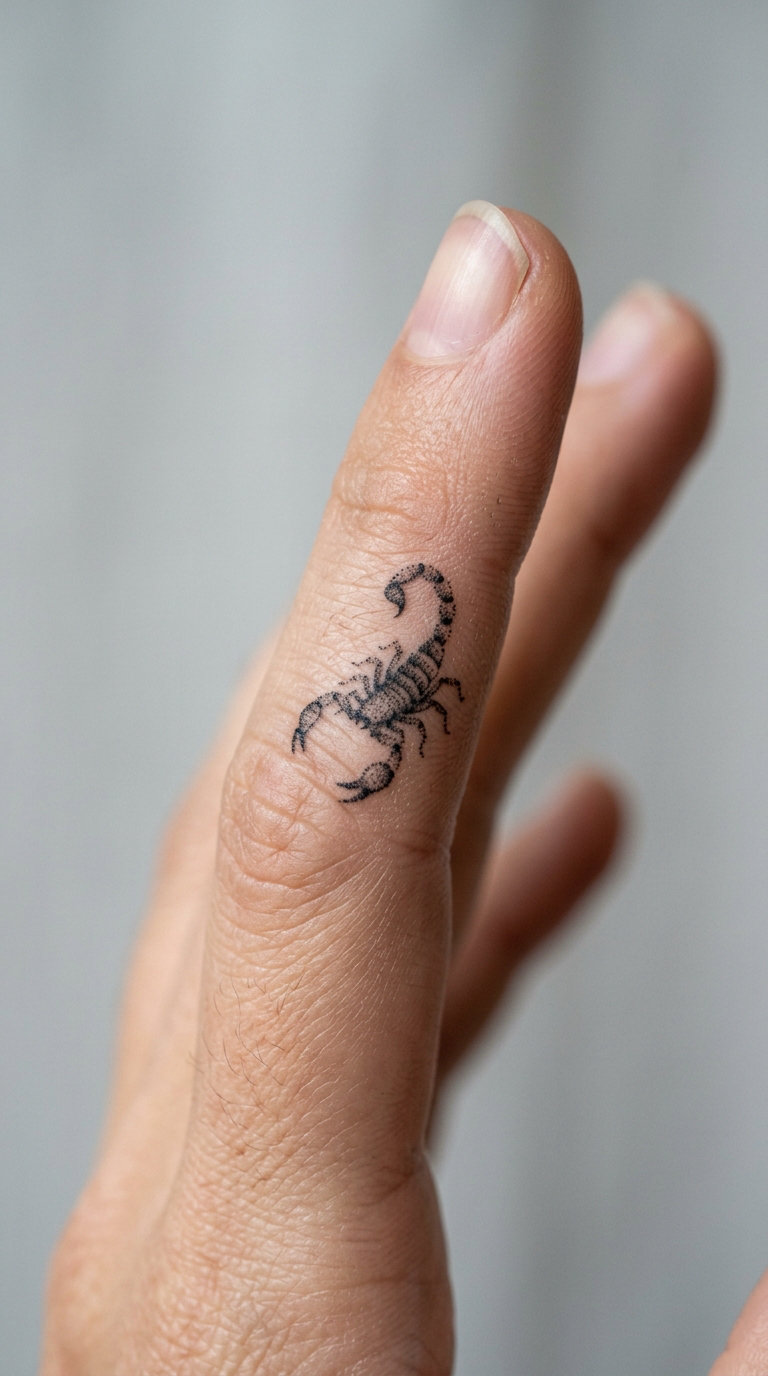
Dotwork builds the body and segmented tail entirely from spaced dots, denser clusters forming the claws and the tail joint, lighter fields fading into skin. At this size the shading does all the work. It is a discreet hand piece that nobody will notice from across a room, and it reads well with a ring on the same hand.
Placement: along the side of an index or ring finger, wrapped slightly around the curve · Size: under 1 inch (2.5 cm) · Style: dotwork, black
Pain: high, because fingers are full of nerves against bone. The real concern is durability, though: hand tattoos wear through from contact and washing, and single dots blur or vanish within a few years.
Make it yours: add one dot in your birthstone colour as the only colour in the design, or mirror it smaller on the other hand.
11. Japanese-Style Scorpion on the Thigh
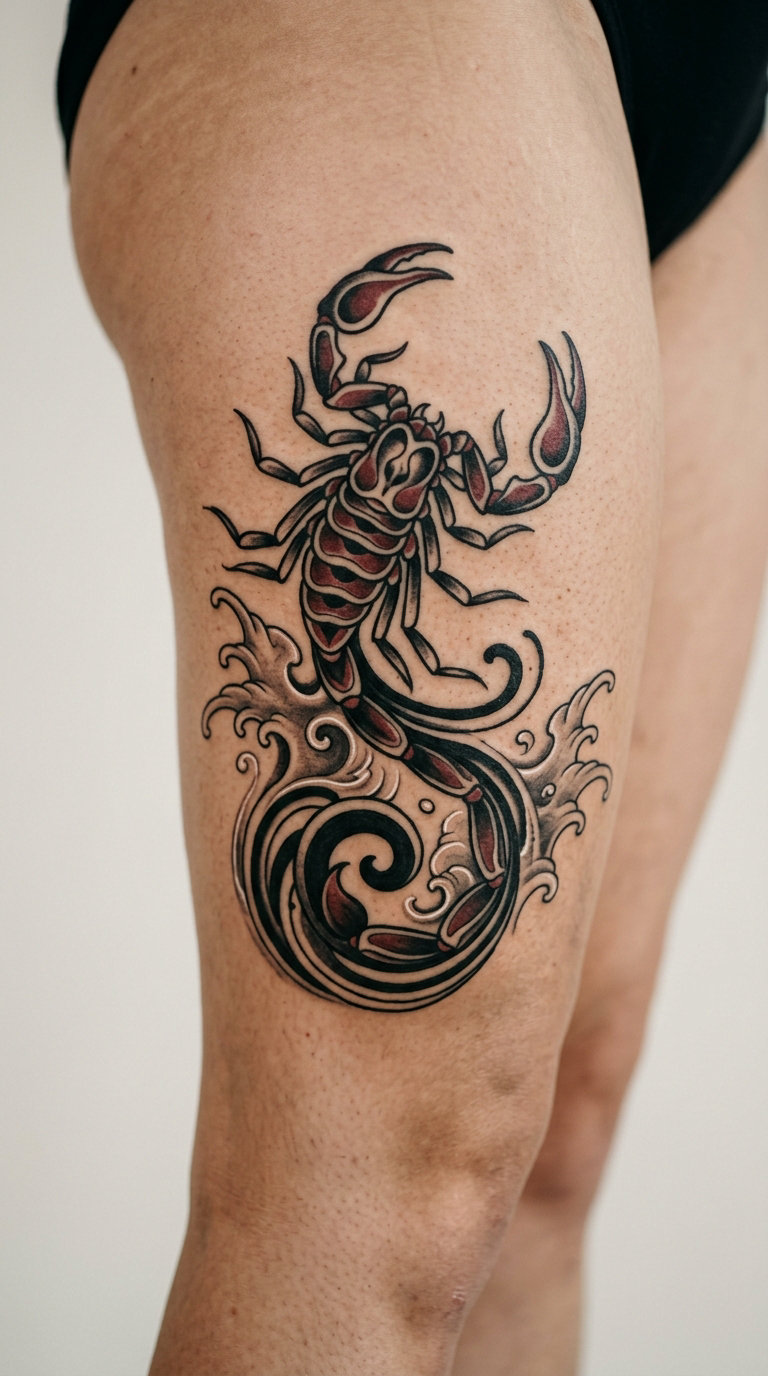
Japanese-style scorpion work is about movement. The tail does not simply curl, it flows in a long S across the composition, the body is drawn with controlled lines, and muted red accents sit at the claws or the eyes, with a wave or cloud form underneath for balance. Large compositions need room to breathe, and the outer thigh is one of the flattest areas available.
Placement: outer thigh, vertical · Size: 6 to 8 inches (15 to 20 cm) · Style: Japanese-style, muted red accent
Pain: medium, and the thigh is one of the more forgiving spots. A flowing tail in thin outline loses its edge faster than a solid shape, so line weight matters here.
Make it yours: add a short column of vertical lettering alongside the tail, or bring in a personal wave pattern from an existing piece.
12. Origami Scorpion on the Forearm
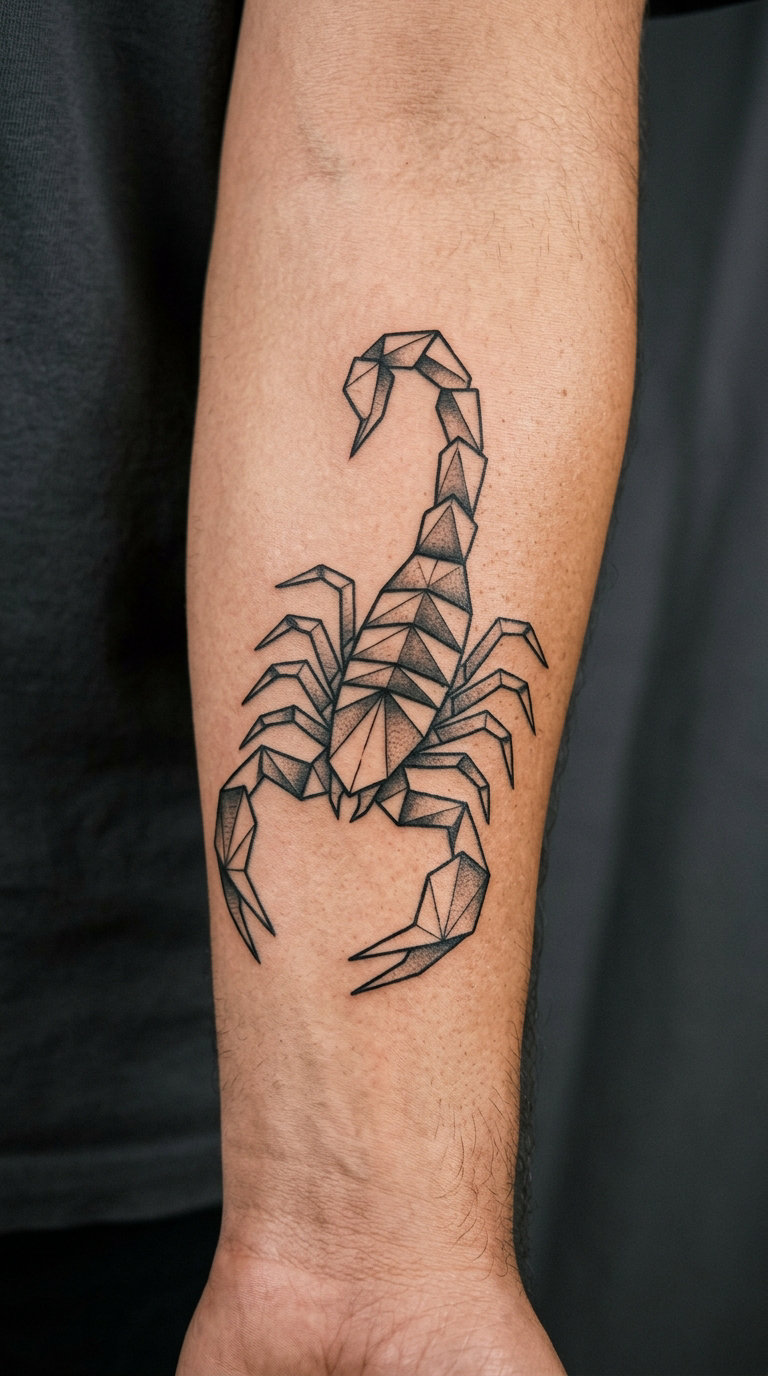
Origami means the scorpion looks folded. The body is built from angular planes like paper facets, each outlined in crisp black and filled either solid or left uninked so light and shadow alternate across the insect. There is no organic curve anywhere. It is a graphic design that happens to be an animal, which is why it photographs well and holds up next to other black and grey work.
Placement: inner or outer forearm, running lengthwise · Size: 4 to 6 inches (10 to 15 cm) · Style: graphic origami, black and white
Pain: medium. Long straight lines across a thin-skinned forearm are more uncomfortable than curves. Solid facets age better than fine edges, which is why this outlasts a thin outline version.
Make it yours: repeat the fold pattern into a background band, or leave one fold in white ink as a deliberate highlight.
13. Fused Metal Scorpion on the Upper Arm
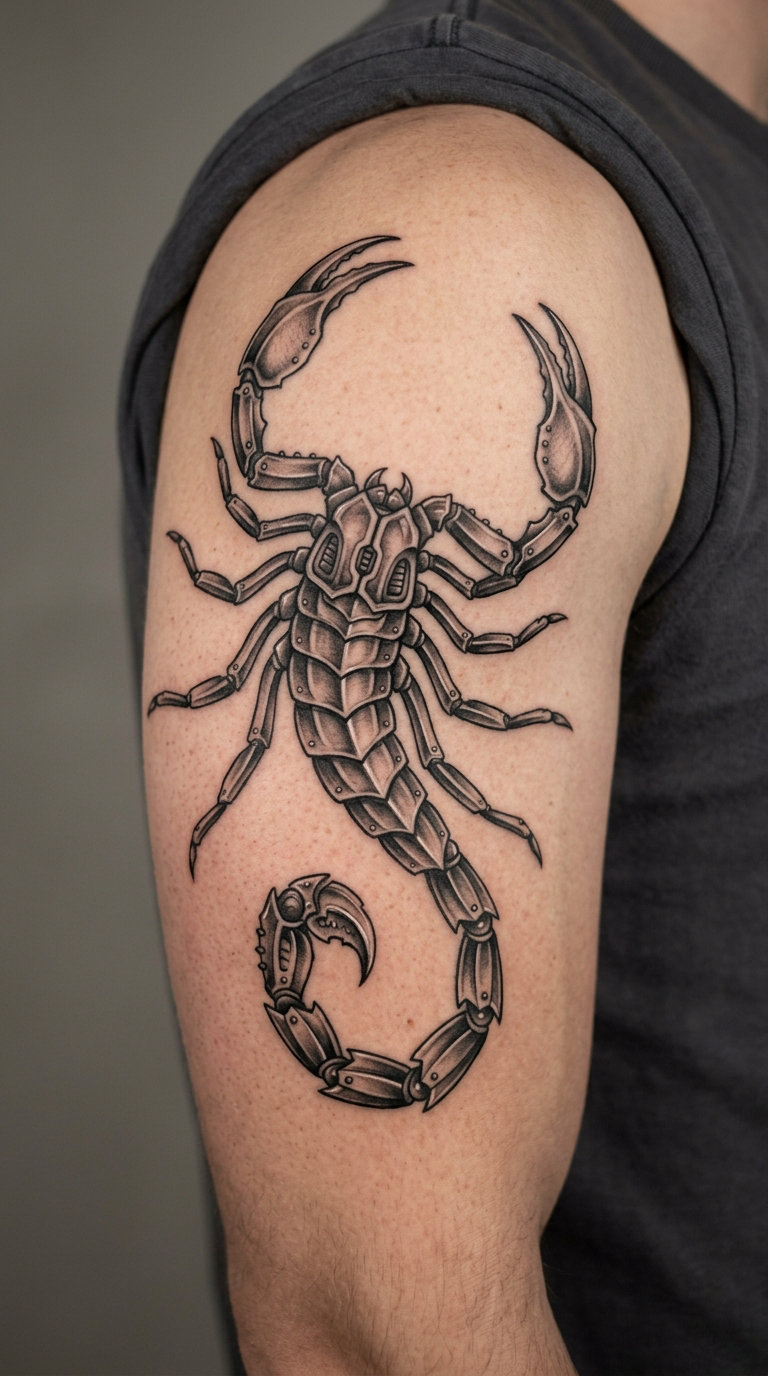
The scorpion is treated as a machine. Segments look like overlapping armour plates, small rivets dot the joints, and the shading runs from bright highlights to deep shadow in a way that suggests brushed steel, sometimes with a welded look at the seams. A metal scorpion reads as built rather than born, and plenty of people find that suits a tattoo about toughness.
Placement: outer upper arm or outer bicep, vertical · Size: 5 to 7 inches (13 to 18 cm) · Style: industrial realism, black and grey with metallic shading
Pain: medium, and grey wash shading takes longer than line work. Grey flattens over time, so it wants a refresh sooner than solid black does.
Make it yours: pick the metal, since it changes the whole read. Steel reads cold and industrial, bronze warmer and older, weathered iron battle-worn.
14. Simple Outlined Scorpion on the Ankle
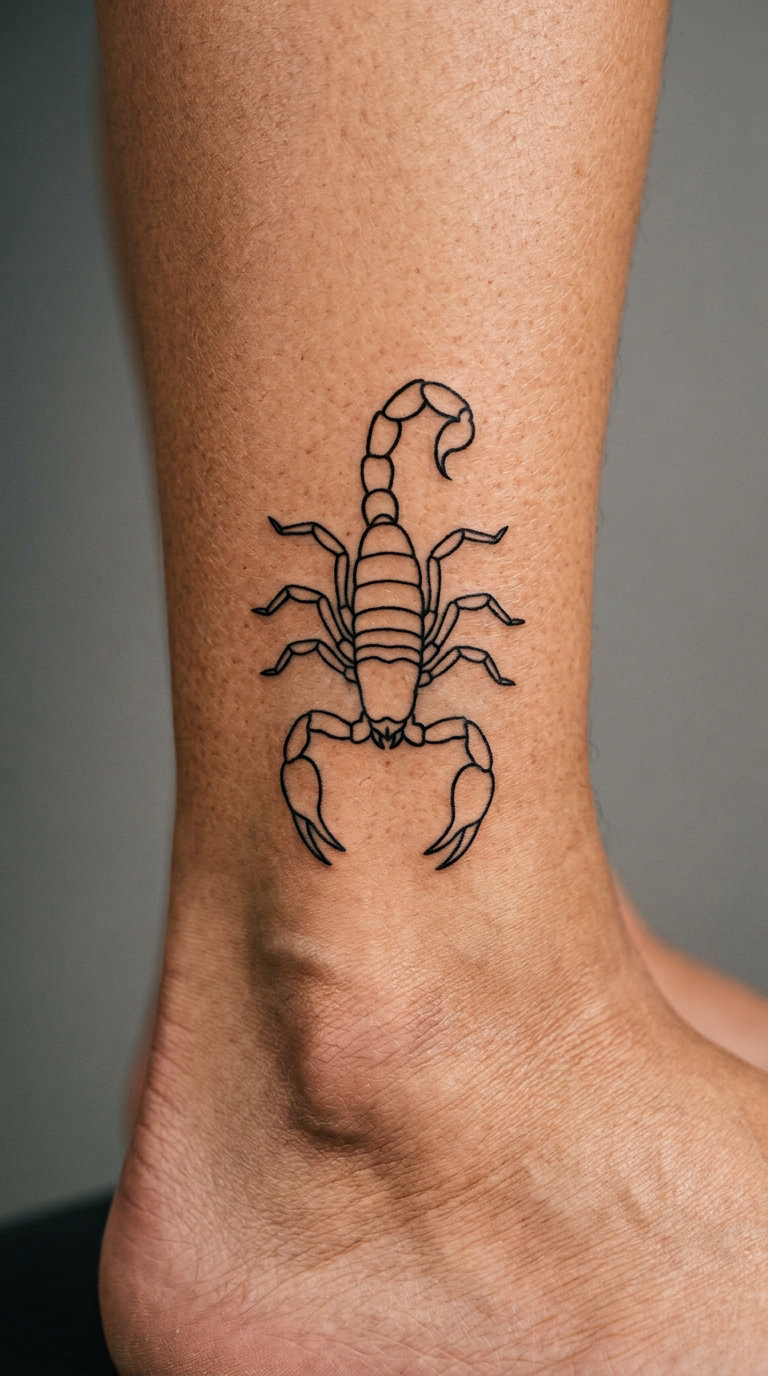
Outlined means the animal is drawn as a shape with a black line around it and nothing inside. Open claws, a segmented tail, a bit of empty space where the body would be, still reading clearly at a couple of inches. A design built on open space rather than shading works much better on the ankle’s curved, awkward surface, and it sits neatly above a shoe line.
Placement: above the ankle bone, inner or outer ankle · Size: 2 to 3 inches (5 to 7.5 cm) · Style: clean line art, black outline
Pain: medium, since the ankle is bony and thin-skinned. It is also one of the first places to show wear from footwear, so outlines soften there faster than on an arm.
Make it yours: tuck a small initial into the tail curl, or add a single dot for a meaningful coordinate or date.
15. Realistic Emperor Scorpion on the Back
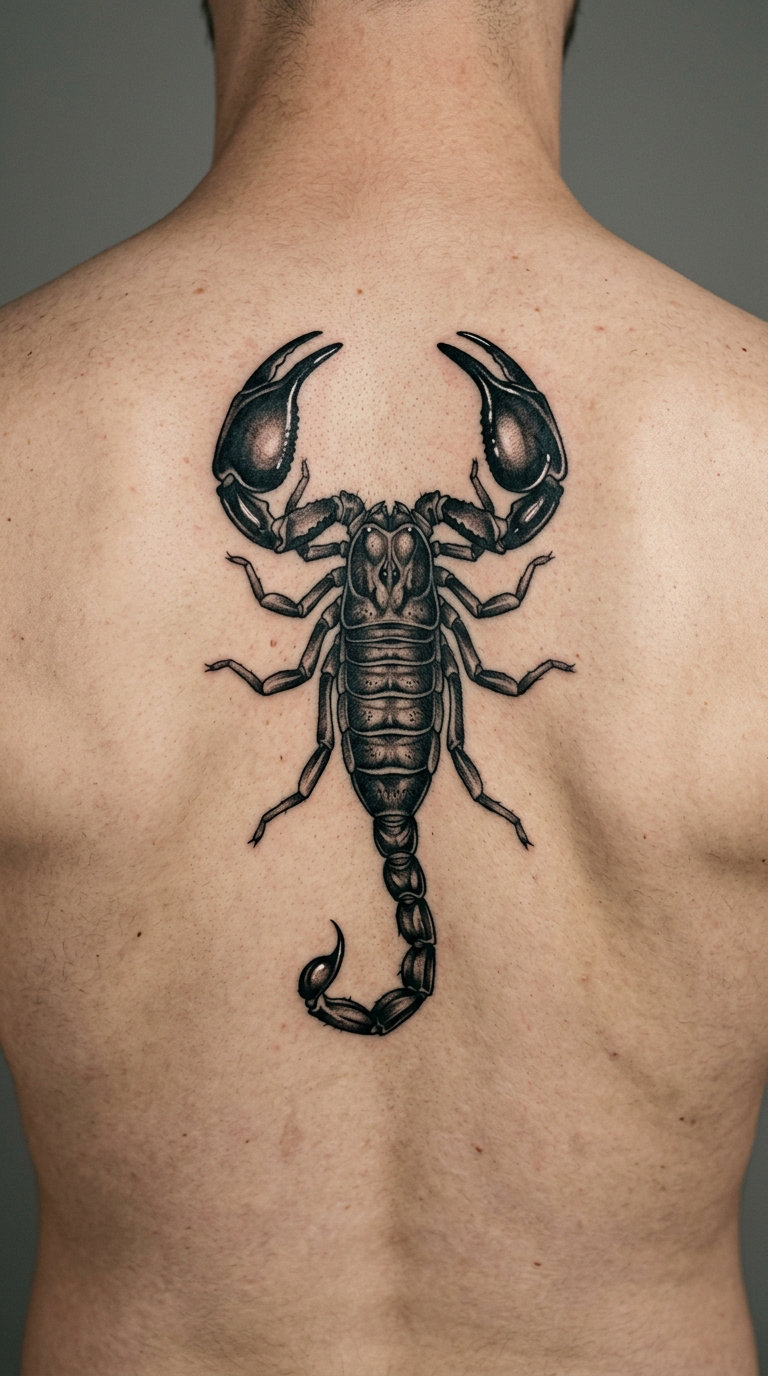
Full realism means the emperor scorpion is rendered the way a photograph would show it: dark glossy claws, subtle texture across the exoskeleton, restrained highlights on the carapace and legs, heavy segmented tail dragging behind. The shading does the work instead of the outlines. This one is for someone who wants anatomy on the skin, and at seven inches there is room for the real proportions of the animal.
Placement: between the shoulder blades, or across one shoulder blade · Size: 6 to 9 inches (15 to 23 cm) · Style: realism, black and grey
Pain: medium to high, and expect two sessions. Fine texture and gloss highlights need repeated passes, and the back is a place people tense up in. Realism fades gradually rather than sharply.
Make it yours: name the species you actually want with a reference photo, and pair it later with another insect in the same realistic style.
16. Blackwork Scorpion with a Crescent Moon
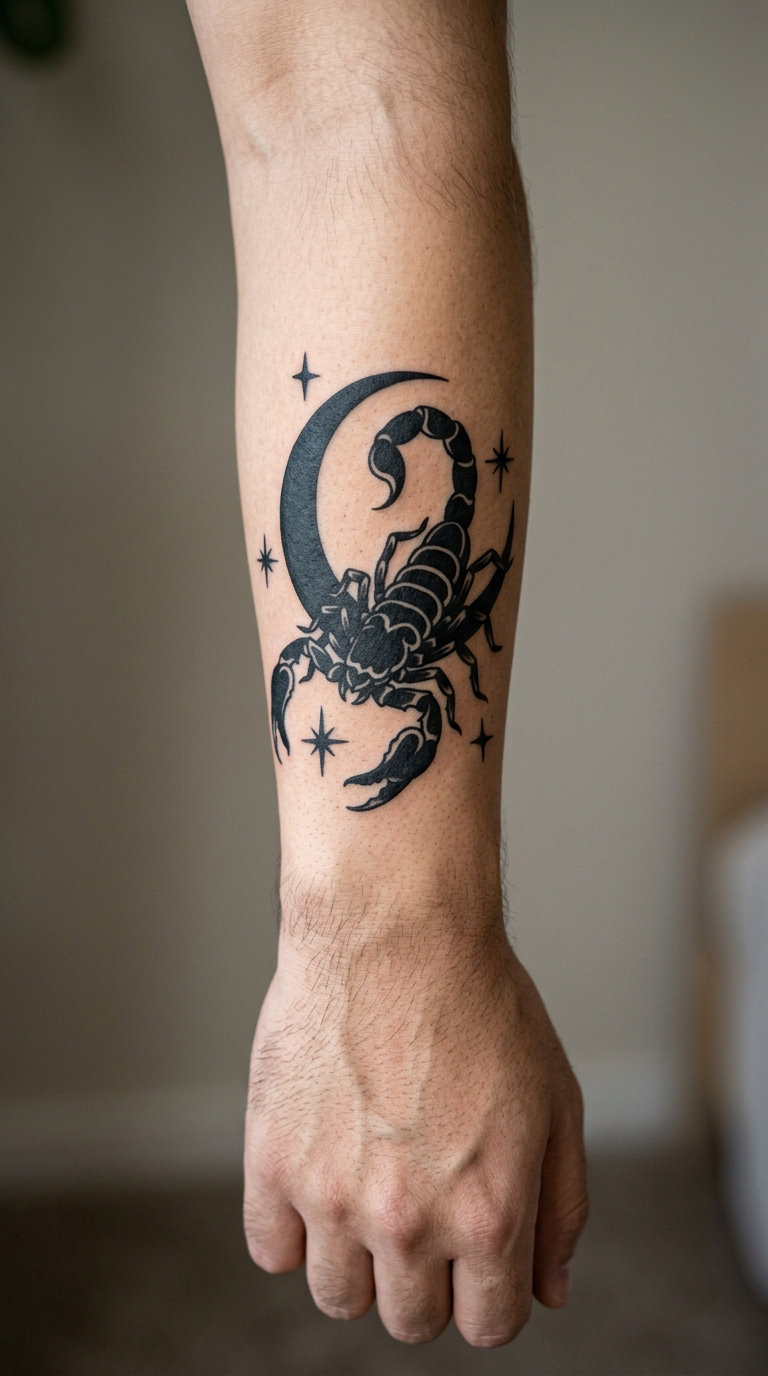
The scorpion wraps around a crescent moon, claws hooked over one edge, tail following the curve, a few small stars scattered into the open space. Heavy black shapes sit next to clean negative space, and that contrast keeps the composition from turning into a solid block. It is a night-themed piece with a romantic edge, and the moon does the softening work so the design feels less confrontational.
Placement: outer forearm, outer calf or upper arm · Size: 4 to 6 inches (10 to 15 cm) · Style: blackwork with negative space
Pain: medium, with the solid areas being the slow part. Keep the stars heavier than they look in the drawing, because fine dot stars disappear first.
Make it yours: use a real moon phase from a date that matters, or mirror the crescent so it opens away from your arm.
17. Stained-Glass Scorpion on the Chest
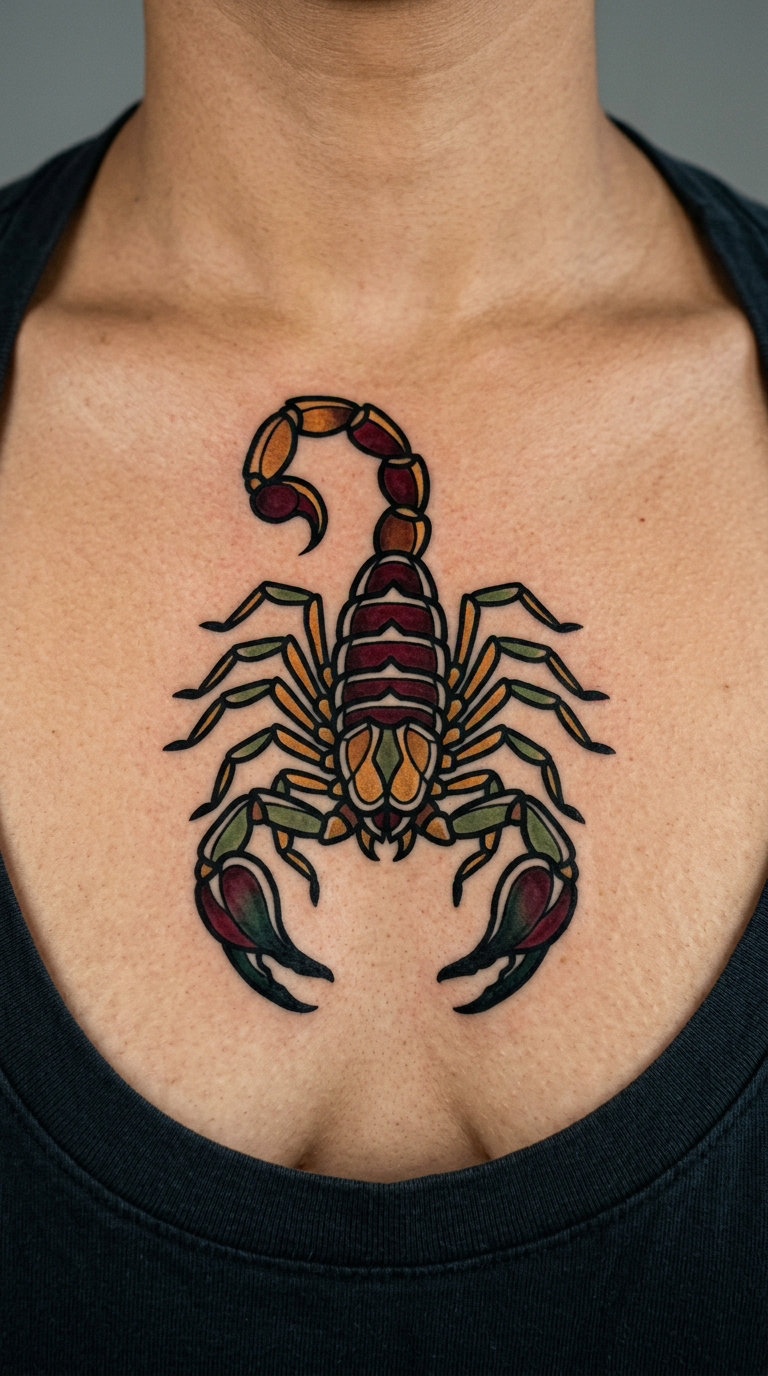
Stained glass divides the scorpion into flat sections with heavy black lines, then fills each one dense: deep red through the body, amber in the tail, muted green in the claws. Nothing blends. Every section is one colour with a hard edge, the way a leaded window looks. It is a full-colour statement piece that wants a big flat area, and the chest and sternum give you one.
Placement: sternum, upper chest or between the pecs · Size: 5 to 7 inches (13 to 18 cm) · Style: stained glass, saturated colour with black dividers
Pain: medium over a long session, since filling each section flat takes patience. Bold red and amber shift noticeably, so touch up colour inside the same dividers rather than reworking.
Make it yours: choose the palette first and let it drive everything, such as a club colour, a birthstone set, or the colours of a flag that means something to you.
18. White-Iris Scorpion on the Neck
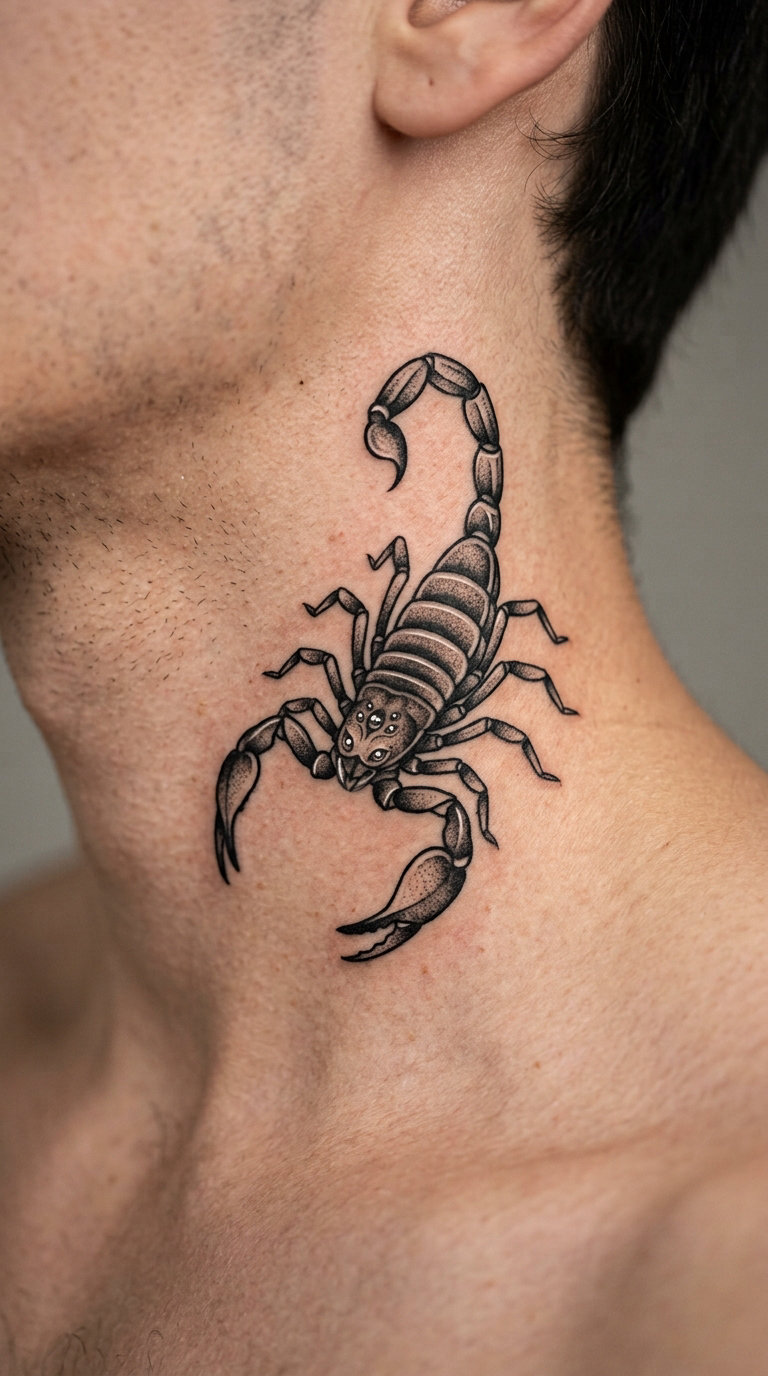
The white ink does the work. The scorpion is black, and the artist uses white to carve highlights into the claws and the eye, with a little dot shading beneath the body to lift it off the skin. Side-of-neck placement is genuinely visible, since hair covers it and a low collar does not, which changes how people read you at work or at a family gathering. Worth thinking about before the stencil goes on.
Placement: side of the neck, above the collarbone · Size: 3 to 5 inches (7.5 to 13 cm) · Style: black and grey with white ink accents
Pain: medium to high, thin skin over sensitive nerves. White ink does not stain as deeply, so it sits slightly lighter and takes a top-up in a year to keep the highlights bright.
Make it yours: use a birthstone colour in place of the white, or work a short date into the tail segments in matching white.
19. Tribal Scorpion Spiraling Around the Calf
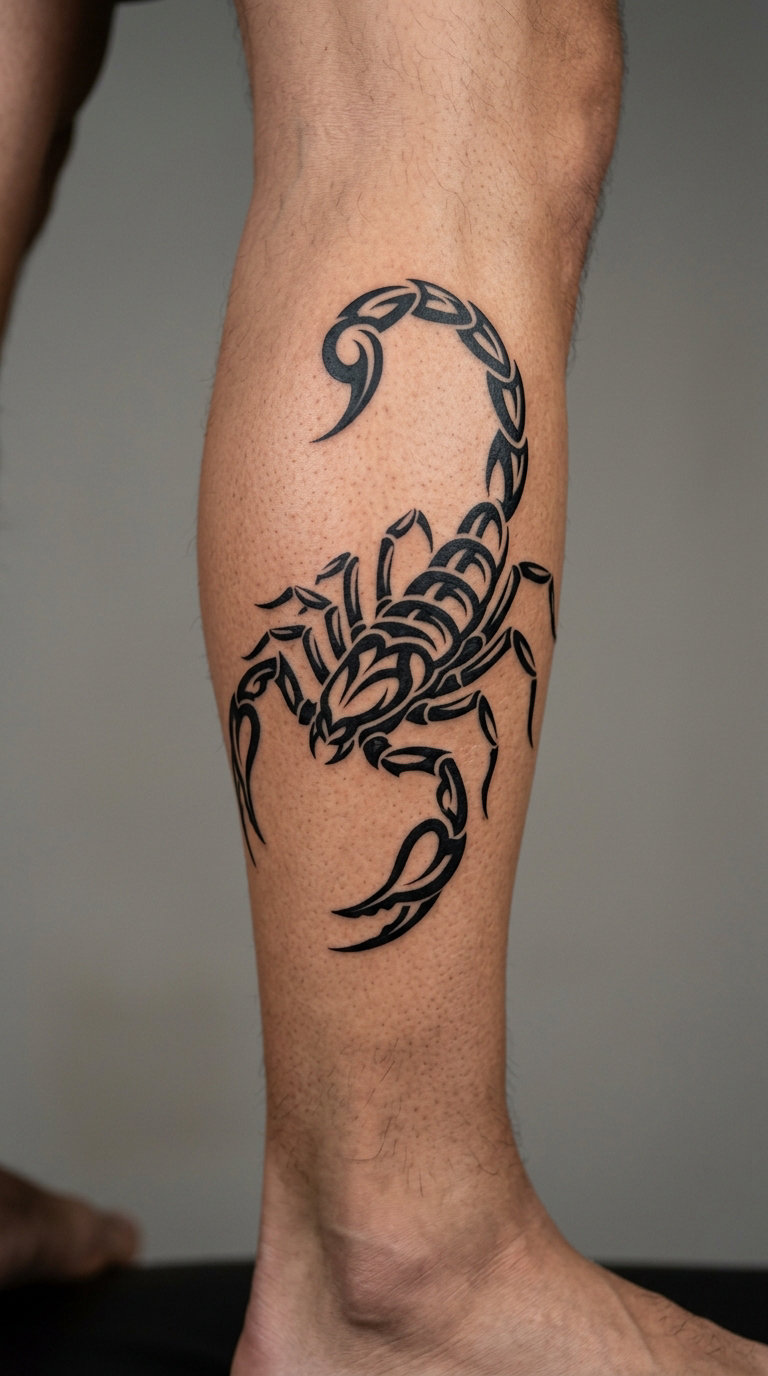
The scorpion is adapted into a band. Bold angular black forms follow the curve of the calf, the tail stretches into a long tapering sweep, and the claws become heavy wedges that lock into the pattern. It is built to wrap rather than sit flat. A band shape also works when a leg is already partly tattooed, since it can join an existing piece without demanding a full rework.
Placement: outer calf, wrapping around the leg · Size: 6 to 9 inches (15 to 23 cm) · Style: tribal band, solid black
Pain: medium, and the calf curve means the artist works in shorter passes. Calf skin stretches with weight and training, so the band will slowly distort. If the motif looks traditional or sacred to you, ask the artist about the pattern’s source first.
Make it yours: change the direction the band travels, or work your own pattern into the wedges instead of using a stock design. If the wrapping composition needs a second motif above it, our list of tattoo ideas that symbolize freedom has some shapes that sit well in that space.
20. Tiny Celestial Scorpion on the Collarbone
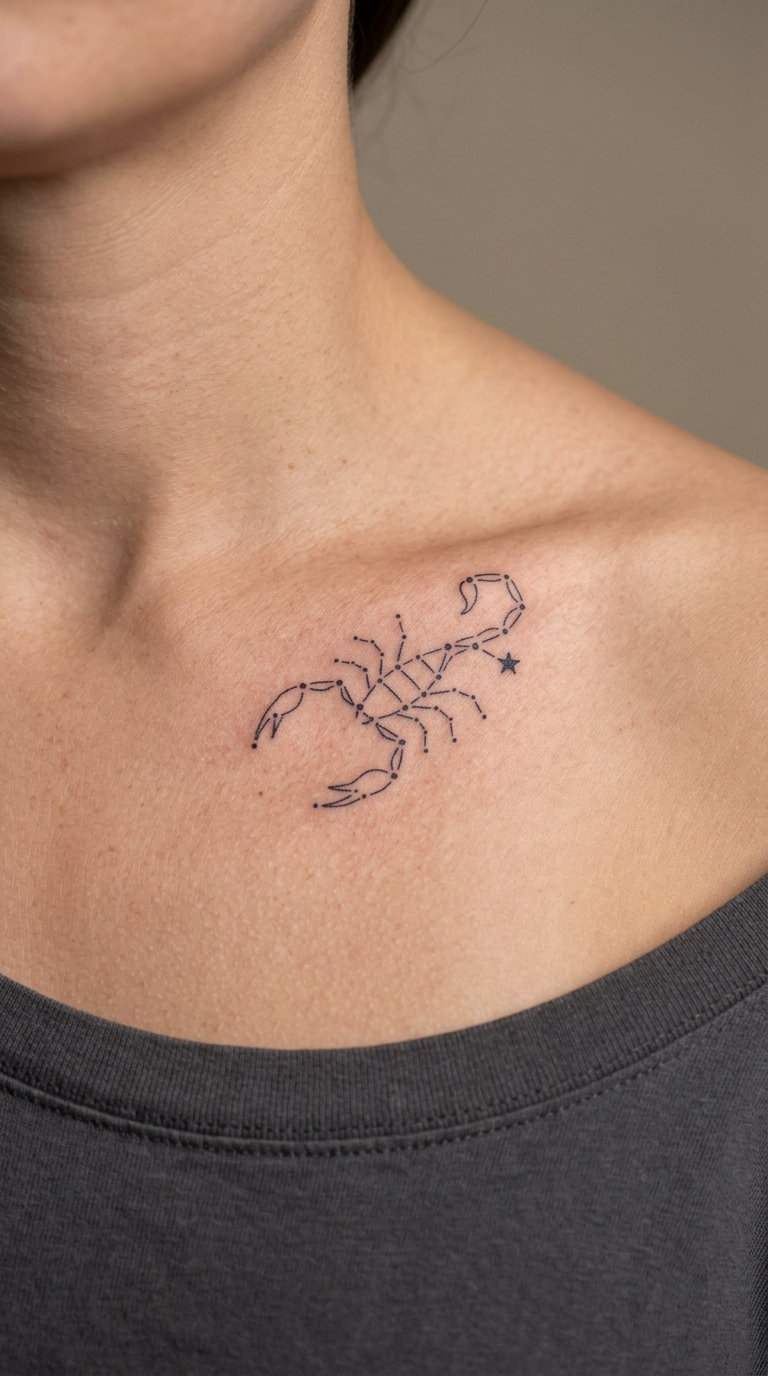
A constellation scorpion is a scorpion made of stars: small dots connected by hairlines, arranged so the shape still reads, ending in one slightly larger star at the sting. The dots vary in size, which is what gives it depth instead of looking like a dotted line. It has the quietest effect of the twenty here, which suits someone who wants a scorpion that is unmistakably there without announcing itself.
Placement: above the collarbone, or on the upper chest between them · Size: 2 to 4 inches (5 to 10 cm) · Style: constellation, dot and hairline
Pain: low to medium. Collarbone bone is sensitive in short bursts, then settles. Dots blur into faint smudges over the years and hairlines wear from sun and clothing, so this wants a refresh sooner than a solid piece.
Make it yours: map the dots to a real star pattern from a date, or end it with a single star in your birthstone colour.
How to Choose the Right Design
Start with the size, not the drawing
Every design above works, but not at every size. Pick the size first, then find a reference that holds up there. A nine-inch realism scorpion and a two-inch line scorpion are different animals, and shrinking a large piece onto a small spot is where designs fall apart.
Match line weight to the area
Fine line suits flat, sheltered skin like the inner forearm. Thicker outlines and solid fills hold up better on the ribs, calf, fingers and collarbone, where skin is thinner, boney or constantly moving. Want fine detail? Pick an inner-arm or upper-arm placement.
Think about visibility, and how others will read it
Neck, hand and finger pieces are seen. A scorpion reads as a warning, and in some places and subcultures that same design is read as tied to organised crime and drug culture. You will never control how every stranger takes it, but you can choose a placement and style that fit the life you actually live. Tattoo forums say the same thing constantly: the motif is respected, and the awkwardness almost always comes down to execution and placement. If a guarding meaning matters more to you than a warning, we covered a different set of motifs in our guide to tattoo ideas that symbolize protection.
Bring real references
Collect three to five images in one style for the consultation. Artists work much faster from a coherent set than from ten unrelated examples. And be honest if you chose the scorpion because you like the animal and nothing else. That is a legitimate reason, and it makes the design easier to place.
| Style | Best for | Detail that survives small |
|---|---|---|
| Fine line | First tattoo, discreet pieces, flat skin | Body curve and tail arc |
| Minimalist one line | Behind the ear, wrist, ankle | Silhouette alone |
| Blackwork | Bold pieces, matching existing blackwork | Solid shape and negative space |
| Traditional | Colour lovers, upper arm pieces | Outline plus one flat fill |
| Neo-traditional | Larger pieces with real room | Two-tone shading, not gradients |
| Realism, micro-realism | Anatomy-focused work | Claw shape and proportions |
| Geometric, origami | Graphic, math-based designs | The fold or facet pattern |
| Dotwork, constellation | Subtle pieces, meaningful dot counts | Overall density, not single dots |
If you are new to tattoos, start small. Plenty of people who now have large collections say their first scorpion was a three-inch forearm piece, and a small first version lets you learn what you actually want. If the scorpion is going to be one element in a larger arm plan rather than a standalone, have a look at our black sleeve tattoo ideas for men to see how the negative space around it can be planned.
Cost and Session Time
US prices vary a lot by city and artist, so treat these as a realistic range rather than a quote. Shop minimums commonly run 100 to 150 USD, and that minimum is what you pay on a small piece even when the drawing suggests less.
- Micro work, under 2 inches: roughly 100 to 200 USD, about 30 to 60 minutes.
- Small designs, 2 to 4 inches: roughly 150 to 300 USD, one to two hours.
- Medium pieces, 4 to 6 inches: roughly 300 to 600 USD, two to four hours or two shorter sessions.
- Larger designs, above 6 inches: roughly 600 to 1500 USD and up, three to six hours over two or three sessions.
Realism, saturated colour and grey wash shading all take longer than line work, and most artists will quote a second session for those rather than rushing the first one. Shop minimums, city, artist experience and private studio versus walk-in shop all move the final number, so get the quote at the consultation.
Aftercare Basics
Whatever the design, the healing instructions come from the person doing the work. Everything below is general and sits underneath your artist’s aftercare instructions.
- Follow your artist’s aftercare instructions first, since that guidance is specific to your design, your skin and how deep the work went.
- Wash gently with unscented soap and lukewarm water, then pat dry with something clean. A mild fragrance-free moisturiser keeps skin from drying and flaking.
- Protect fresh work from direct sun for the first couple of weeks, and skip the gym, sauna and pool while the skin heals.
- Avoid sealing the tattoo under a tight bandage for more than the first few hours, since breathable beats covered. Loose clothing over the area is fine once initial bleeding stops.
- Choose clothing carefully while it heals, because rough seams and tight waistbands rub straight onto new ink. This matters most on the collarbone, ribs, ankle and fingers.
- Contact the artist, or a qualified clinician, about spreading redness, heat, swelling, thick scabbing or discharge that keeps getting worse. Artists would much rather hear from you early.
Frequently Asked Questions
Can a scorpion tattoo work as a small minimalist design?
Yes, and a two-to-three-inch scorpion is one of the most popular versions. Artists simplify the body into a curve, the tail into a segmented arc and the claws into two open lines. The curled tail is what keeps the shape readable at small sizes, so ask for the tail to be the strongest part of the drawing.
Should I choose a realistic or stylized scorpion tattoo?
Go realistic if you want an anatomy-focused piece and have a flat area with room, like the back or the outer thigh. Go stylized if you want it bold, readable and long-lasting, especially at smaller sizes. Fine detail fades more quietly than solid shapes, so a realistic scorpion asks for more care and more top-ups over the years.
Can I get a scorpion tattoo on my hand or fingers?
Artists do them there, and a dotwork scorpion under an inch on the side of a finger looks great. The catch is durability, not permission. Hand and finger tattoos wear through from washing, work and daily contact, fine dots blur within a few years, and the area is one of the most sensitive places to get tattooed. Go in knowing it will need refreshing.
What colors work best for a scorpion tattoo?
Black and grey give the most detail and the longest life, since solid black holds its edge longest. Red has always been the traditional scorpion colour and reads clearly, though it shifts toward orange over time. For stained glass or neo-traditional work, pick two or three colours and commit to them, because soft pastel washes fade out of stained-glass style designs first.
How do I prepare scorpion tattoo references for an artist?
Collect three to five images in one style rather than ten in different ones, and bring them to the consultation on a phone or printed. Note the size you want and the placement you are considering, and point out which elements you actually want, such as the claw shape or the tail curl. Artists work much faster from a coherent set than from a mixed inspiration folder.
Conclusion
If this is your first tattoo, the fine-line curved scorpion on the inner forearm is the one I would point at first. It is small, it heals quickly, it sits flat, and it costs less than the coloured and realistic pieces further down the list. If you are already building a collection and want the scorpion to anchor something larger, the blackwork coiled-tail piece, the neo-traditional emerald version or the realistic emperor scorpion on the back will hold their own next to other work.
Decide the placement, the scale and the detail level before you book anything, then take that decision into the consultation. The artist will tell you honestly whether your skin and that spot will hold the design you have in mind.