
22 Skateboard Tattoo Ideas: Best Designs for Skaters 2026
A skateboard tattoo usually stands for freedom, risk and a stubborn refusal to quit, and it works because the board is a shape everyone in the culture recognizes without a label. These 22 skateboard tattoo ideas cover the range skaters actually ask about, from a one-inch line drawing to a full-color back piece, and every entry tells you where it sits best, how big it should be and how long it takes to heal into something clean.
What makes a skate design work on skin is the same thing that makes a deck graphic work on a board: readable silhouette, honest line weight, and one idea rather than five. Pick the version below that you would still want in ten years, then take a photo of it to your consultation.
22 Skateboard Tattoo Ideas: Quick Guide
Here is the whole list at a glance, so you can narrow it down before you talk to an artist.
| Idea | Style | Best placement | Size | Pain |
|---|---|---|---|---|
| 1. Minimalist deck outline | Fine line | Inner forearm | 2-3 inch (5-7.5 cm) | Low |
| 2. Deck with lightning bolts | Black and gray | Outer upper arm | 3-4 inch (7.5-10 cm) | Medium |
| 3. Tiny wheel behind the ear | Micro minimalist | Behind the ear | 0.5 inch (1.2 cm) | Low |
| 4. Skateboard and rolling hills | Illustrative | Calf | 2.5-3 inch (6.5-7.5 cm) | Medium |
| 5. Traditional skull and skateboard | Old school traditional | Upper arm | 4-5 inch (10-12.5 cm) | Medium |
| 6. Blackwork skateboard in motion | Blackwork | Forearm | 3-4 inch (7.5-10 cm) | Medium |
| 7. Watercolor rainbow skateboard | Watercolor | Shoulder | 2.5-3 inch (6.5-7.5 cm) | Low |
| 8. Wrist wrap design | Line work | Inner wrist | 1.5-2 inch (4-5 cm) | Medium |
| 9. Geometric half-pipe | Geometric | Forearm | 3-4 inch (7.5-10 cm) | Medium |
| 10. Micro-realism deck on the hand | Micro realism | Side of the hand | 2 inch (5 cm) | High |
| 11. Old-school banner | Traditional banner | Upper arm | 4-5 inch (10-12.5 cm) | Medium |
| 12. Two decks crossing | Fine line | Upper chest | 2.5-3 inch (6.5-7.5 cm) | Medium |
| 13. Deck with a flame trail | Blackwork with color | Outer forearm | 2.5-3 inch (6.5-7.5 cm) | Medium |
| 14. Dotwork wheel pattern | Dotwork | Upper arm | 2 inch (5 cm) | Medium |
| 15. Four-wheel tribute | Minimalist | Ankle | 1 inch (2.5 cm) | Low |
| 16. Deck with a city skyline | Illustrative | Upper arm | 3-4 inch (7.5-10 cm) | Medium |
| 17. Rose and skateboard | Neo-traditional | Forearm | 3.5-4 inch (9-10 cm) | Medium |
| 18. Broken deck pencil sketch | Fine line | Inner arm | 2.5-3 inch (6.5-7.5 cm) | Low |
| 19. Checkerboard deck | Graphic blackwork | Upper arm | 3-3.5 inch (7.5-9 cm) | Medium |
| 20. Deck with a crown | Bold line | Chest | 2 inch (5 cm) | Medium |
| 21. Skateboard map pin | Minimalist | Wrist | 1.5 inch (4 cm) | Medium |
| 22. Full-color deck with lightning | Illustrative color | Upper arm | 4-6 inch (10-15 cm) | High |
1. Minimalist Skateboard Deck Outline
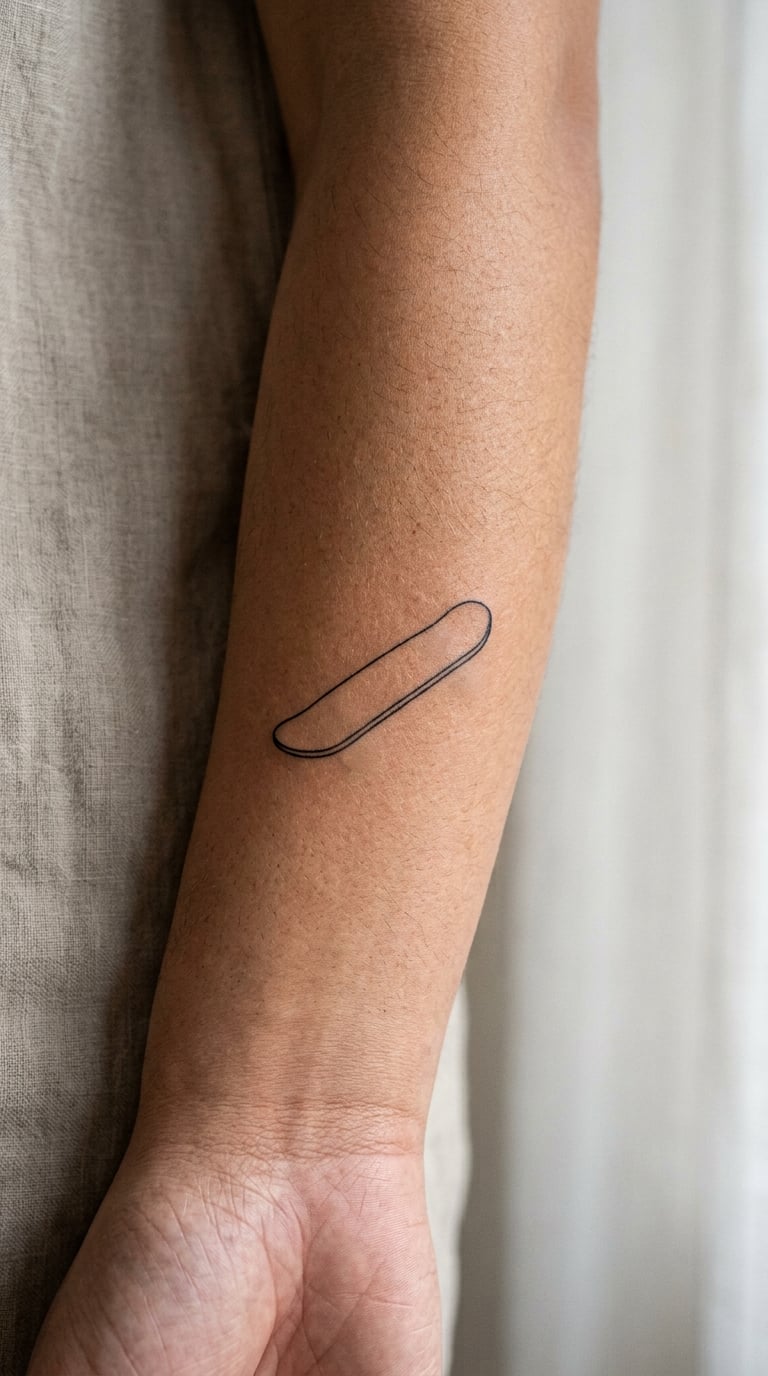
This is a single clean contour of a deck, nose and tail slightly kicked up, with two thin trucks and four plain wheels drawn in the same weight of line. No shading, no color, no grip texture, which is exactly why it stays readable when it is small.
People choose it because it says the thing without shouting, and it is a genuinely forgiving first tattoo. It is the version a lot of skaters end up getting at eighteen and still like at forty.
Placement: Inner forearm, wrist area or the soft part of the upper arm. Size: 2-3 inch (5-7.5 cm) along the forearm. Style: Fine line. Pain: Low on the inner arm, though the wrist bone itself stings more than the rest. One honest note: fine line work on the inner forearm catches sun and wrist movement, so ask for a line weight with a little extra weight to it and expect some softening over the years.
Make it yours: Add the year you started skating in a small line of text underneath, or put your first board’s actual color in as a single thin color band along the deck edge.
2. Skateboard Deck with Lightning Bolts
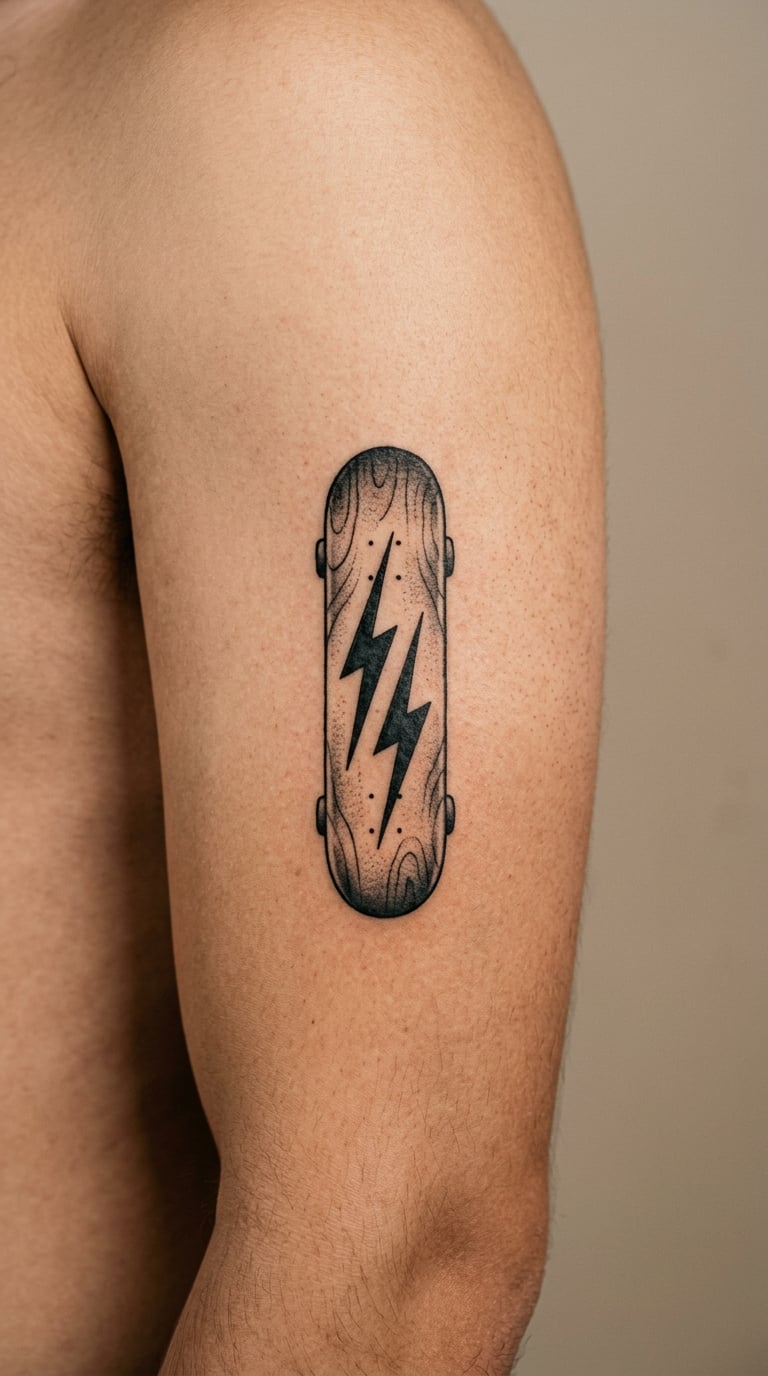
A deck drawn in solid black with two sharp bolts cutting across or behind it, the whole thing built from hard shapes rather than thin outlines. The bolts usually run diagonally so the piece fills a shoulder or upper arm instead of floating.
It reads as speed and charge, and it is the version people get when they want the skate reference to look aggressive rather than sentimental. Two bolts look better than one, because a single bolt reads like a logo.
Placement: Outer upper arm or the deltoid, angled so the bolts point down toward the elbow. Size: 3-4 inch (7.5-10 cm). Style: Black and gray with solid black fill. Pain: Medium, and the inner edge of the upper arm is one of the more sensitive spots on the body.
Make it yours: Make the bolts a color rather than black, red works well, or shape them into the outline of a specific ramp you skate.
3. Tiny Skateboard Wheel Behind the Ear
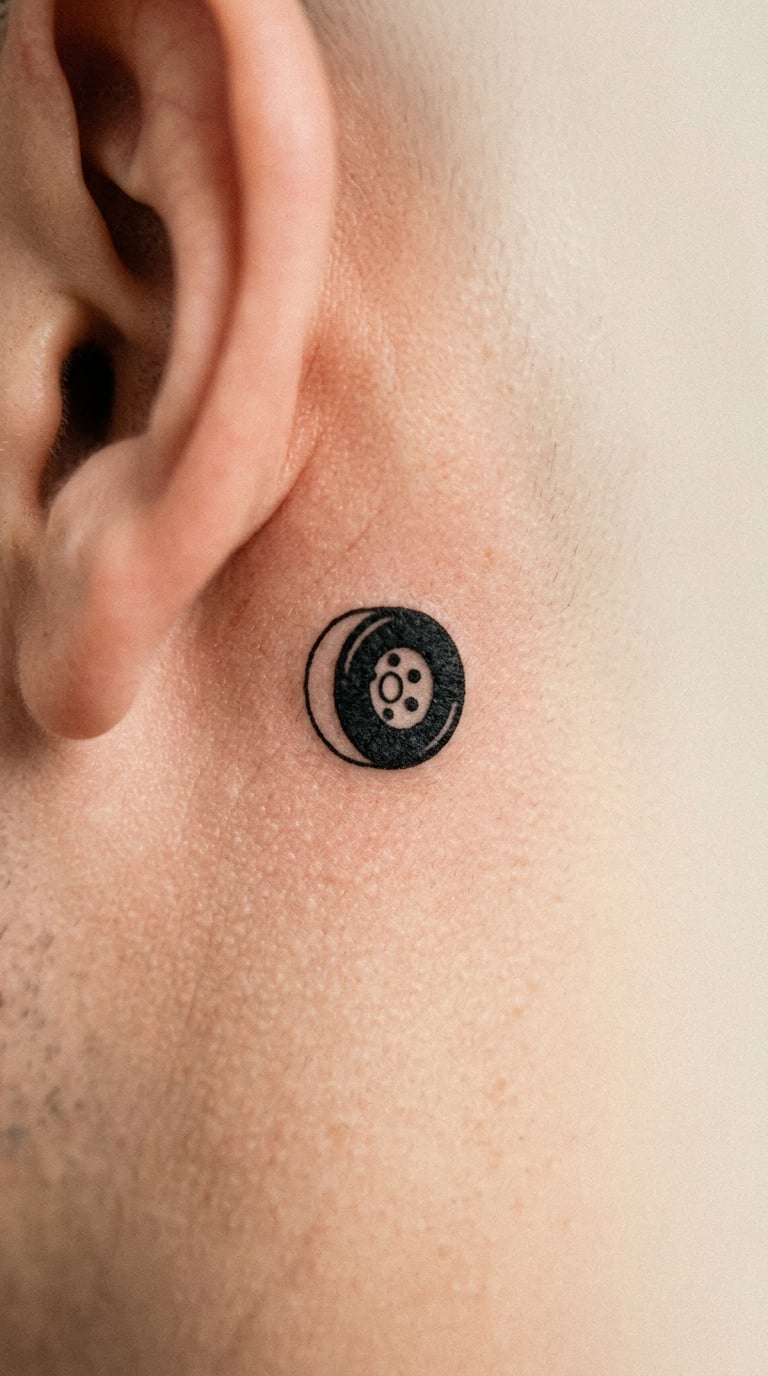
A single wheel, half an inch across, drawn as a circle with four holes and a tiny axle mark in the center. That is the entire design, and it is the one people stop asking about ten years later, in the best way.
It works for skaters who want the tribute without announcing it. Only close people know what it is, which is part of the appeal.
Placement: Behind the ear, or on the neck just under the jaw. Size: 0.5 inch (1.2 cm). Style: Micro minimalist, single needle grouping. Pain: Low, though behind the ear is twitchy rather than painful. Aging note: at half an inch, any interior detail fills in with scar tissue within a few years, so keep the holes large and the line bold.
Make it yours: Put the wheel color of the board you ride most, or add a matching dot behind the other ear.
4. Skateboard and Rolling Hills
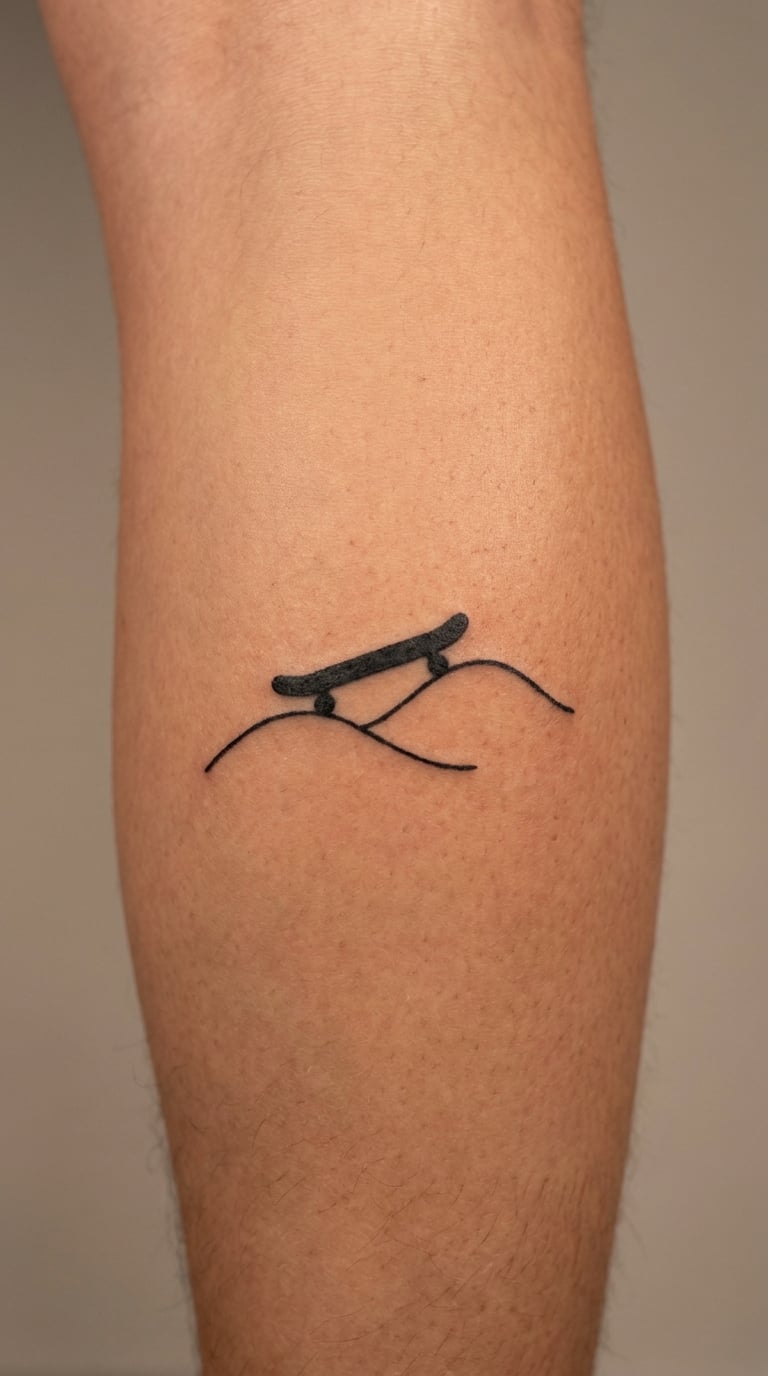
A tiny deck rolling along two or three simple curved hills, drawn in black line work with a bit of hatching under the curves for shadow. There is no skater in the frame, which keeps the piece calm and a little bit wistful.
The hills usually stand for the open road, the freedom of skating, or a particular summer that mattered. It is the design skaters pick when the board represents a feeling rather than a trick. If scenery is more your thing, our 20 Mountain and Ocean Tattoo Ideas: Best Pairings guide covers the landscape styles that sit well next to a board.
Placement: Outer calf, or the inside of the upper arm. Size: 2.5-3 inch (6.5-7.5 cm) wide. Style: Illustrative line work. Pain: Medium on the calf, more on the shin side. Watch the outline over the calf muscle, it distorts as the leg moves unless the artist sizes it with the muscle in mind.
Make it yours: Add a low sun on the horizon line, or turn the hills into the outline of the hills behind your home skate spot.
5. Traditional Skull and Skateboard
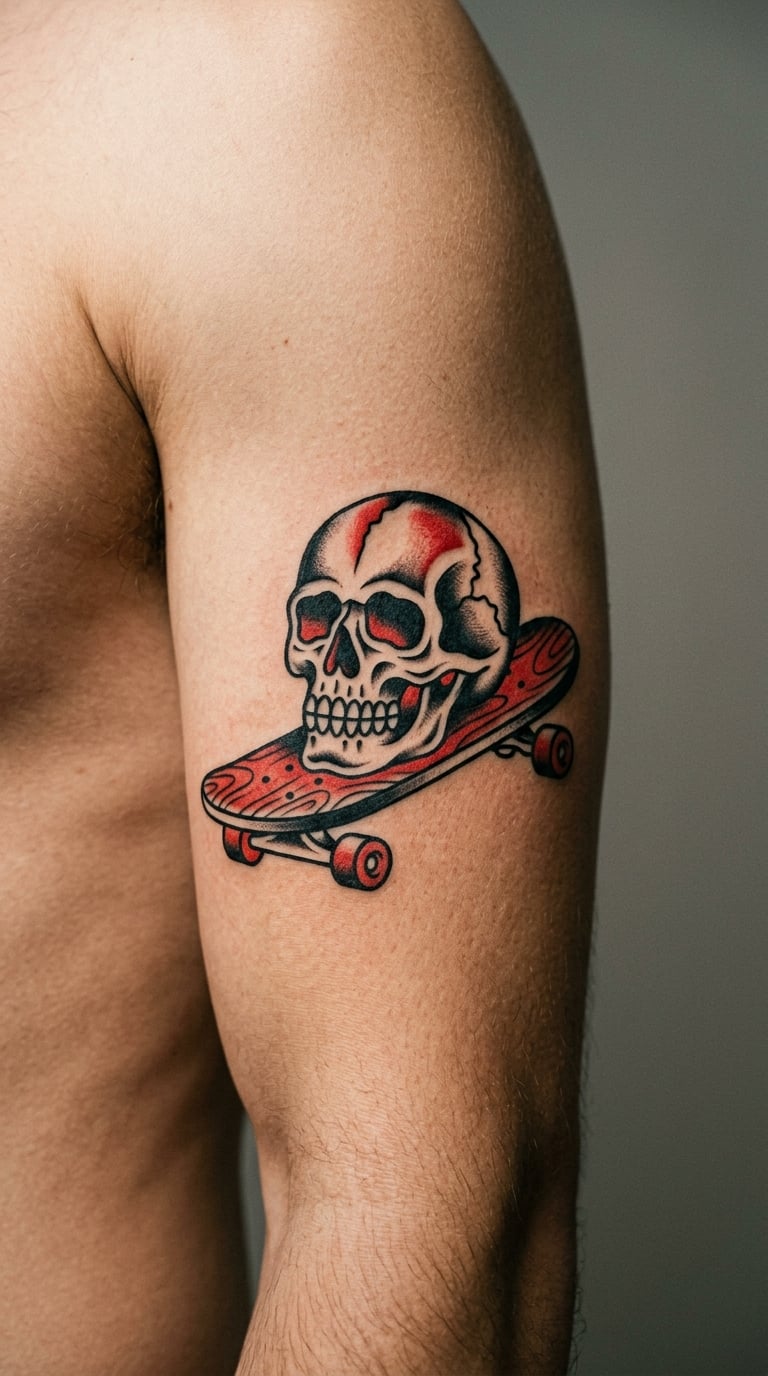
A traditional-style skull resting on a deck, heavy black line outlines, red shadow blocks, and a small highlight left open in the bone. Old school tattoo artists draw this one well, since the skull and the board both come straight out of that flash vocabulary.
Skulls say risk, mortality and doing the thing anyway, and pairing that with a board makes it a fairly clear statement about living fast. It is the boldest option on this list and the one that reads best from across a skate park.
Placement: Upper arm, shoulder cap or the outer thigh. Size: 4-5 inch (10-12.5 cm), and this is one design that should not be shrunk much. Style: Old school traditional. Pain: Medium, with the ribs and collarbone areas rating higher.
Make it yours: Put a backward cap on the skull, or swap the plain deck for one with your own graphic underneath.
6. Blackwork Skateboard in Motion
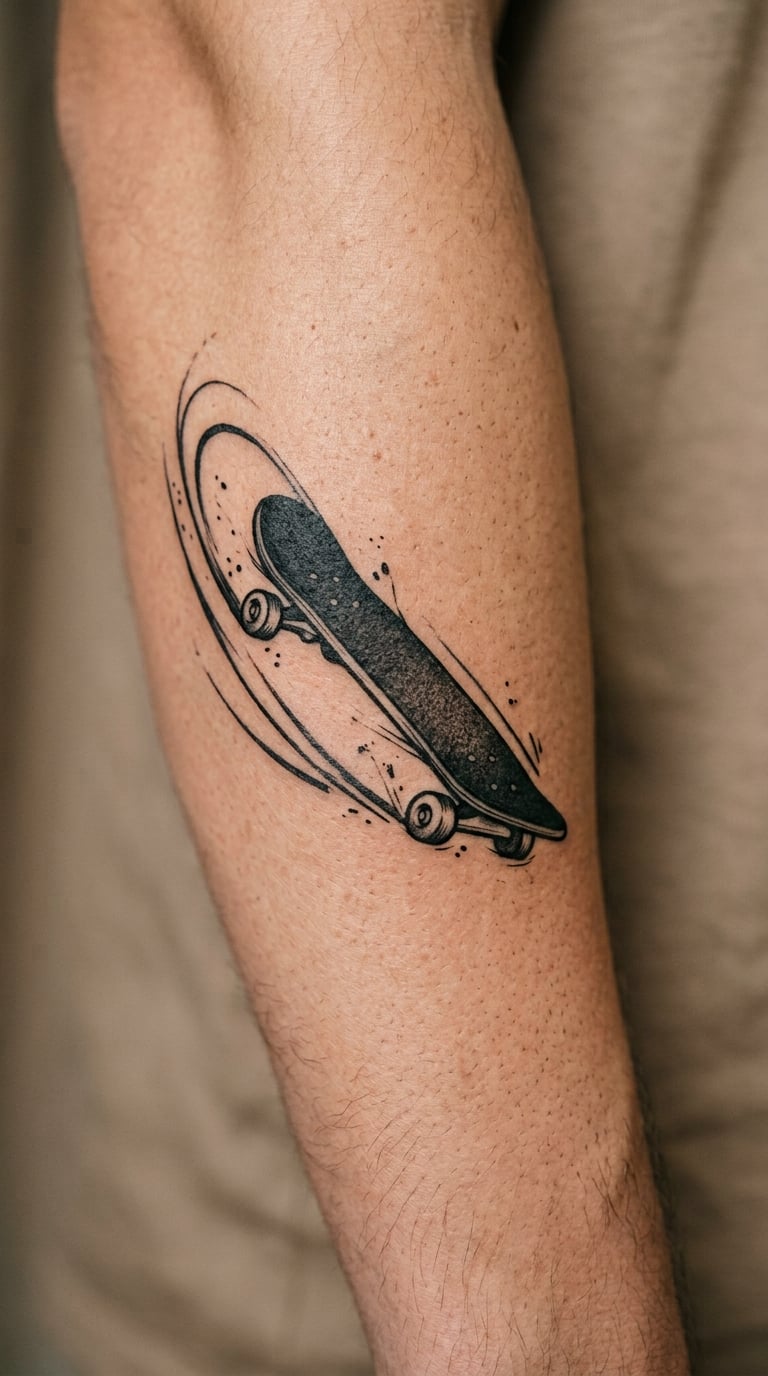
A deck tilted on an angle, filled in solid black, with curved speed lines sweeping behind it and a few dust specks kicked up at the tail. The tilt is what sells it, a horizontal board reads like an object, a tilted one reads like speed.
People choose this when the skating is about push, pace and repetition rather than any single trick. It is also a good filler for a forearm that is already half built out.
Placement: Forearm, or across the shoulder. Size: 3-4 inch (7.5-10 cm). Style: Blackwork. Pain: Medium. Blackwork needs more passes over the same area, so the session runs longer than the size suggests.
Make it yours: Have the speed lines turn into a banner with a word in it, or have the dust specks replaced by a scatter of small stars.
7. Watercolor Rainbow Skateboard
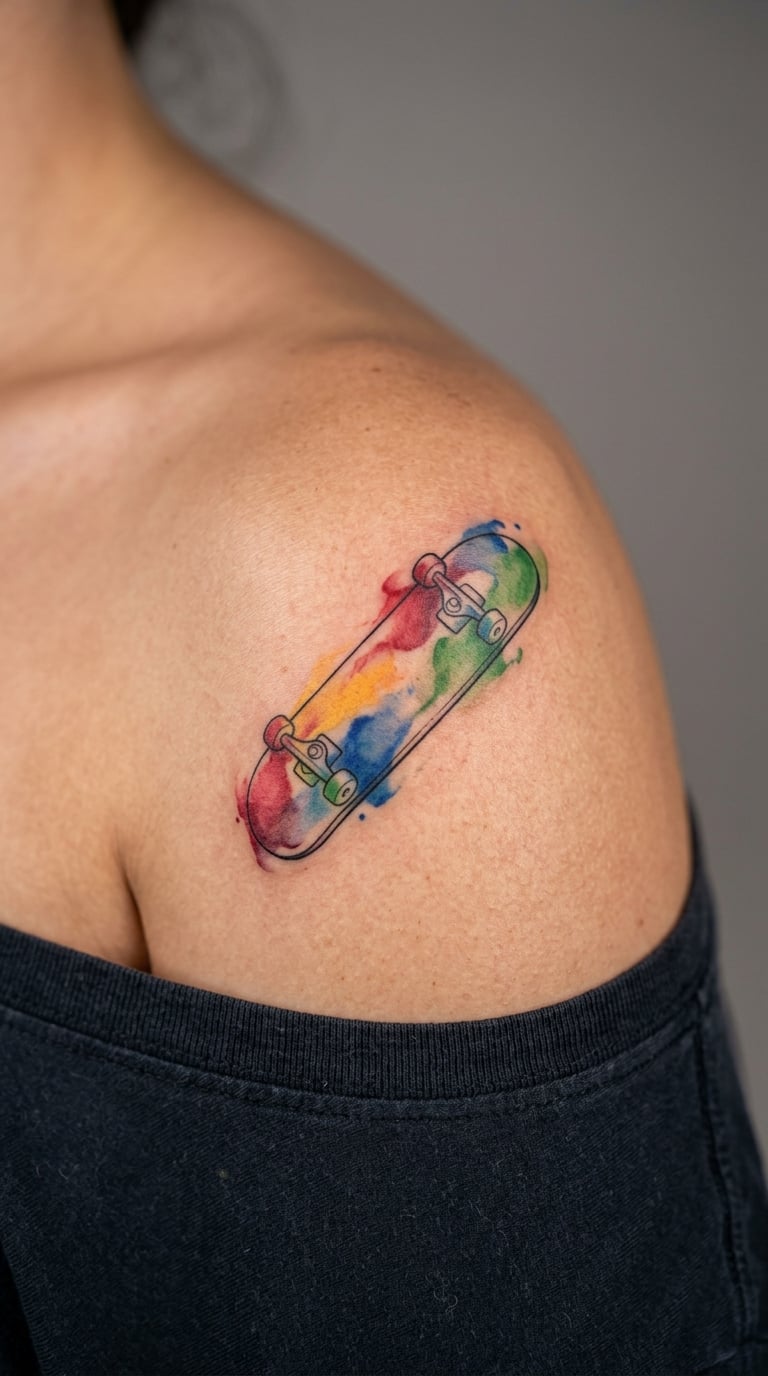
A deck painted in loose watercolor, red bleeding into yellow, blue and green, with soft edges where the pigment runs and no hard outline at all. A few drips running off the bottom edge are usually part of the look.
It is the option for skaters who find heavy traditional line work too much, and it carries the same meaning as a bold piece without the visual weight. On a shoulder it looks like a small painting rather than a symbol. If you want a color piece that runs warmer, our 20 Best Sunset Tattoo Ideas With Color roundup has the softer palette options.
Placement: Shoulder, upper back, or the outer arm. Size: 2.5-3 inch (6.5-7.5 cm). Style: Watercolor. Pain: Low to medium. Aging note: watercolor is the style that fades first, so plan on a color refresh every few years rather than expecting it to hold like black work.
Make it yours: Use the exact colors of a deck you own, or make the drips spell something short.
8. Skateboard Wrist Wrap Design
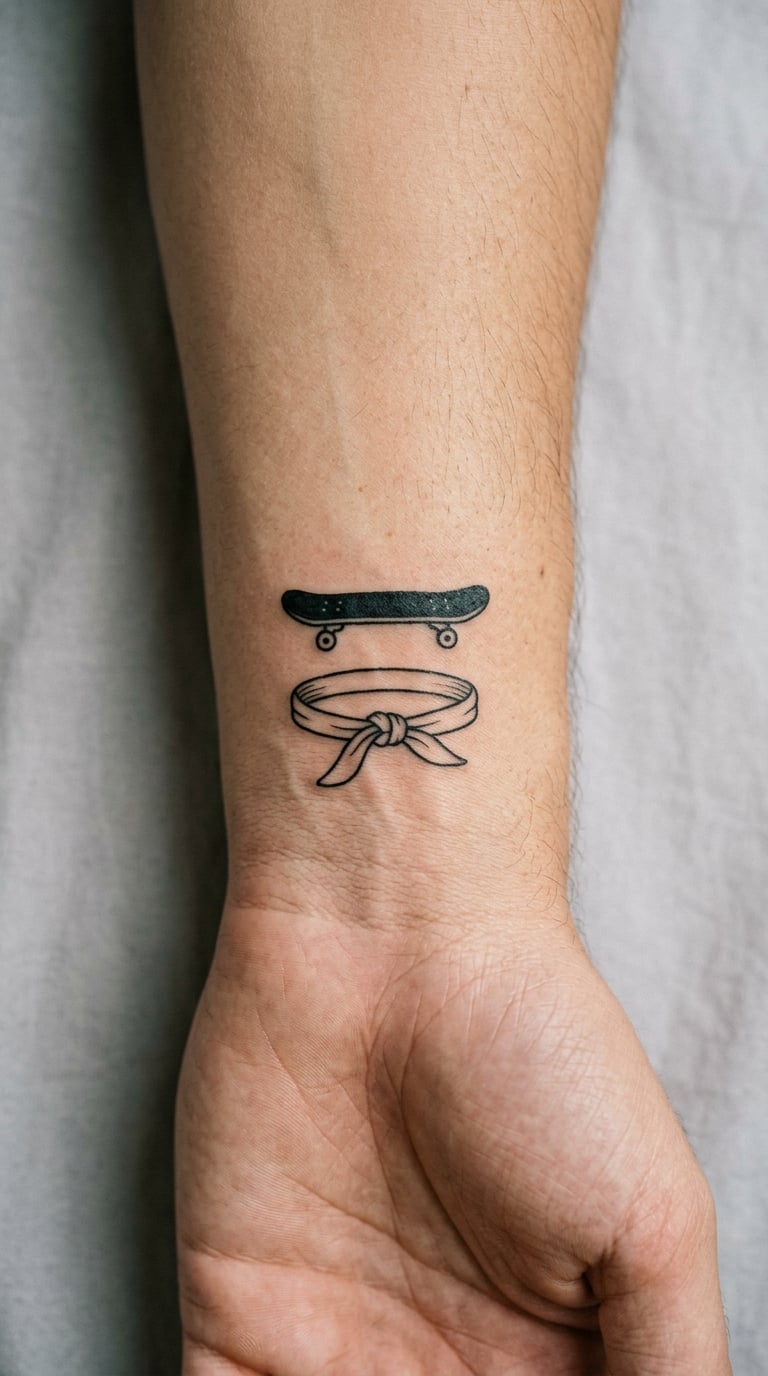
A small deck with a simple tied wristband beneath it, both in thin black line, arranged so the pair sits tight against the inside of the wrist. It is a compact composition, so every line has to earn its place.
Usually it marks a skate trip, a crew, or a stretch of years when everything mattered. On the wrist it stays visible in a way an ankle piece never will. Riders who ink both sports tend to run the same layout, and our 20 Best Tattoo Ideas for Cyclists: Road and Gravel guide has that set.
Placement: Inner wrist, slightly above the wrist crease so the design does not distort when you bend. Size: 1.5-2 inch (4-5 cm). Style: Line work, fine and confident. Pain: Medium, the inner wrist is sensitive and the veins are close to the surface.
Make it yours: Tie the wristband around the deck’s trucks, or have the band color match a photo from the trip it represents.
9. Geometric Half-Pipe Tattoo
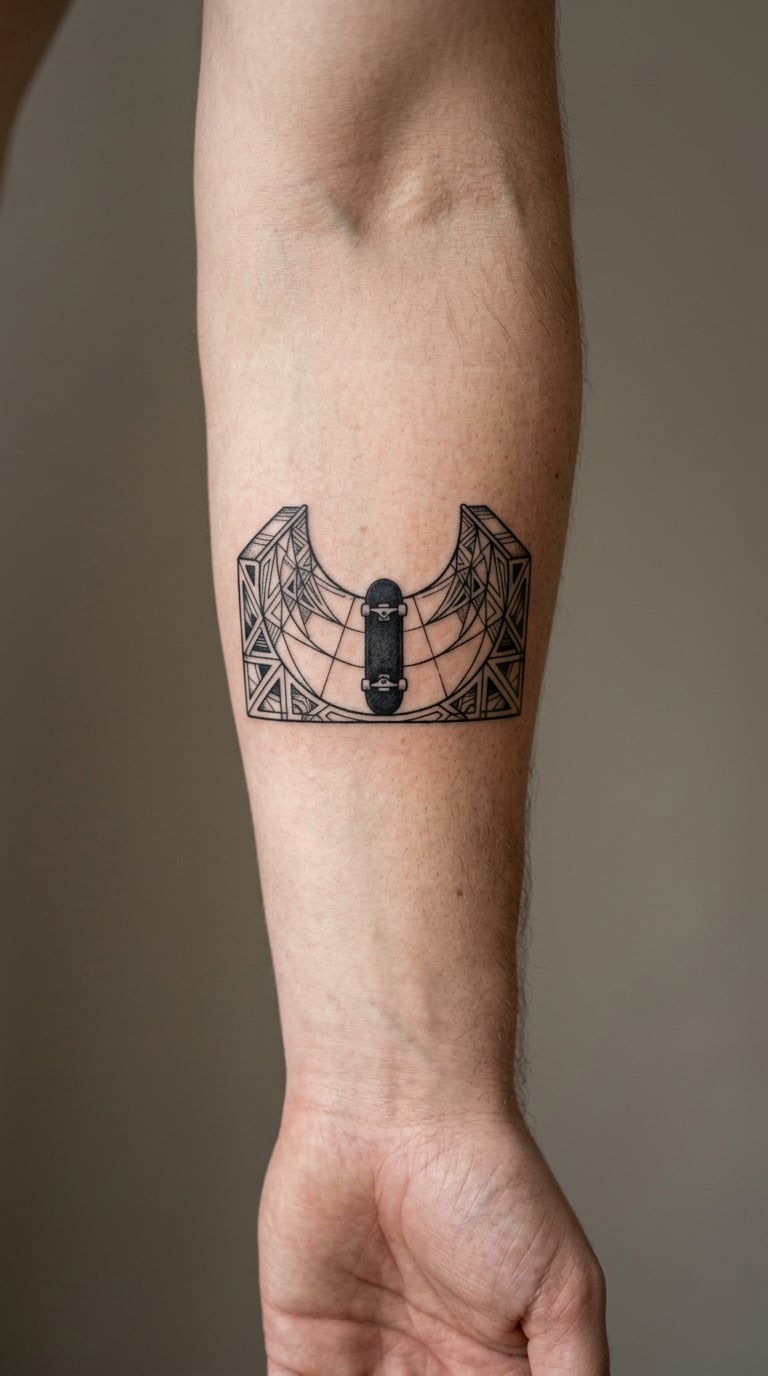
A half-pipe built entirely from straight lines, a symmetrical U shape in thin black geometric line work, with a small board at the transition point. The appeal is the architecture, the coping curve and the symmetry rather than any skater figure.
It is usually a love letter to a specific park, or to the geometry skaters see every time they drop in. Artists who draw technical illustration work tend to enjoy this one.
Placement: Forearm, upper arm or the outer calf. Size: 3-4 inch (7.5-10 cm) wide. Style: Geometric line work. Pain: Medium, fairly even across the whole area. Thin geometric lines are the first thing to blur, so agree the line weight with the artist before the stencil goes on.
Make it yours: Use the exact dimensions of your favorite ramp, or put your initials into the coping curve.
10. Micro-Realism Skateboard on a Hand
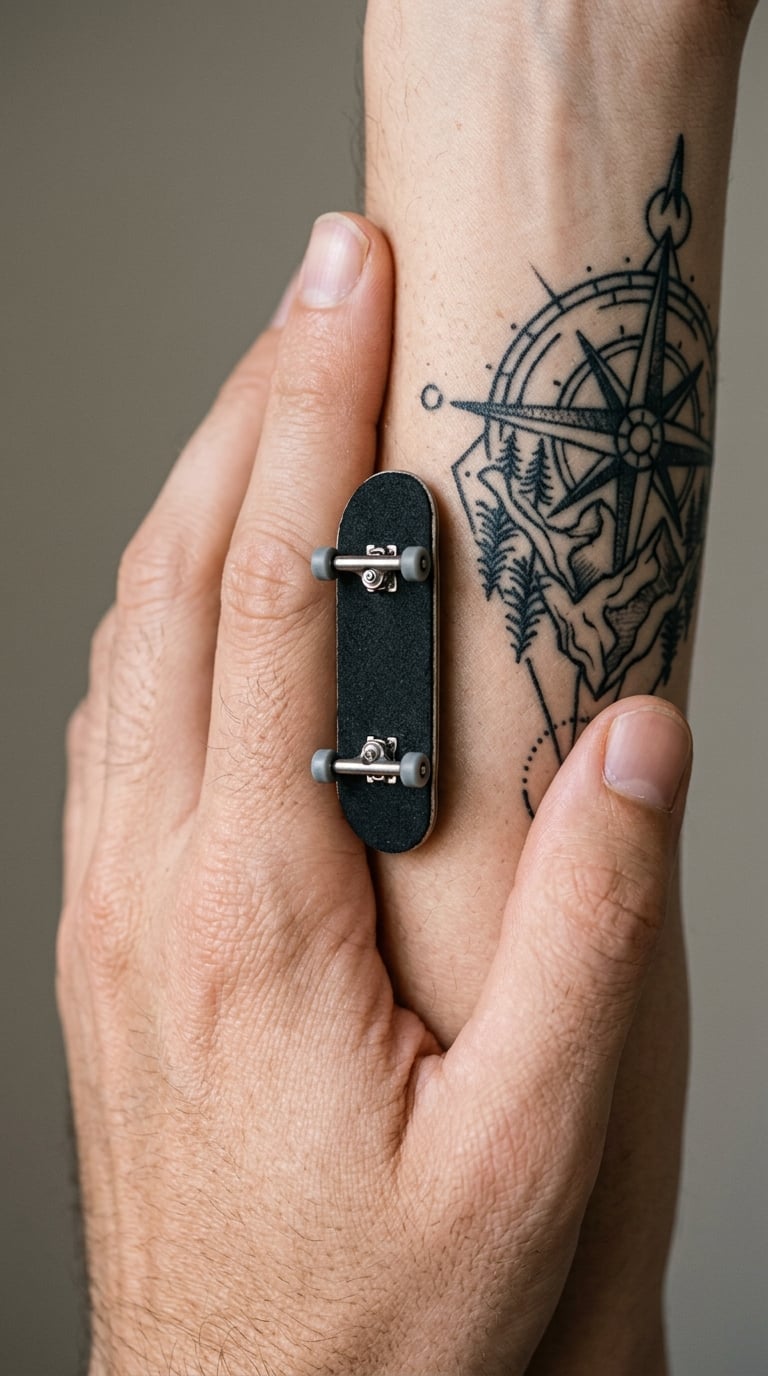
A realistically rendered deck at two inches, with visible trucks, bolt heads, wheel bearings and a hint of grip texture, shaded in black and gray rather than reduced to an outline. It takes a patient artist to get right at that scale.
It is the version for someone who treats the board as an object worth rendering properly, and it doubles as a conversation piece since almost nobody expects detail that small. Hands show scars, and that is part of the trade.
Placement: Side of the hand, near the thumb joint. Size: 2 inch (5 cm), and going smaller ruins the shading. Style: Micro realism. Pain: High. The hand is bony, the skin is thin and moving the fingers mid-session is part of the job. Aging note: hand tattoos wear through from daily contact with the world, so expect touch-ups sooner than on an arm.
Make it yours: Render the actual board you ride, complete with the chip out of the tail that never got repaired.
11. Old-School Skateboard Banner
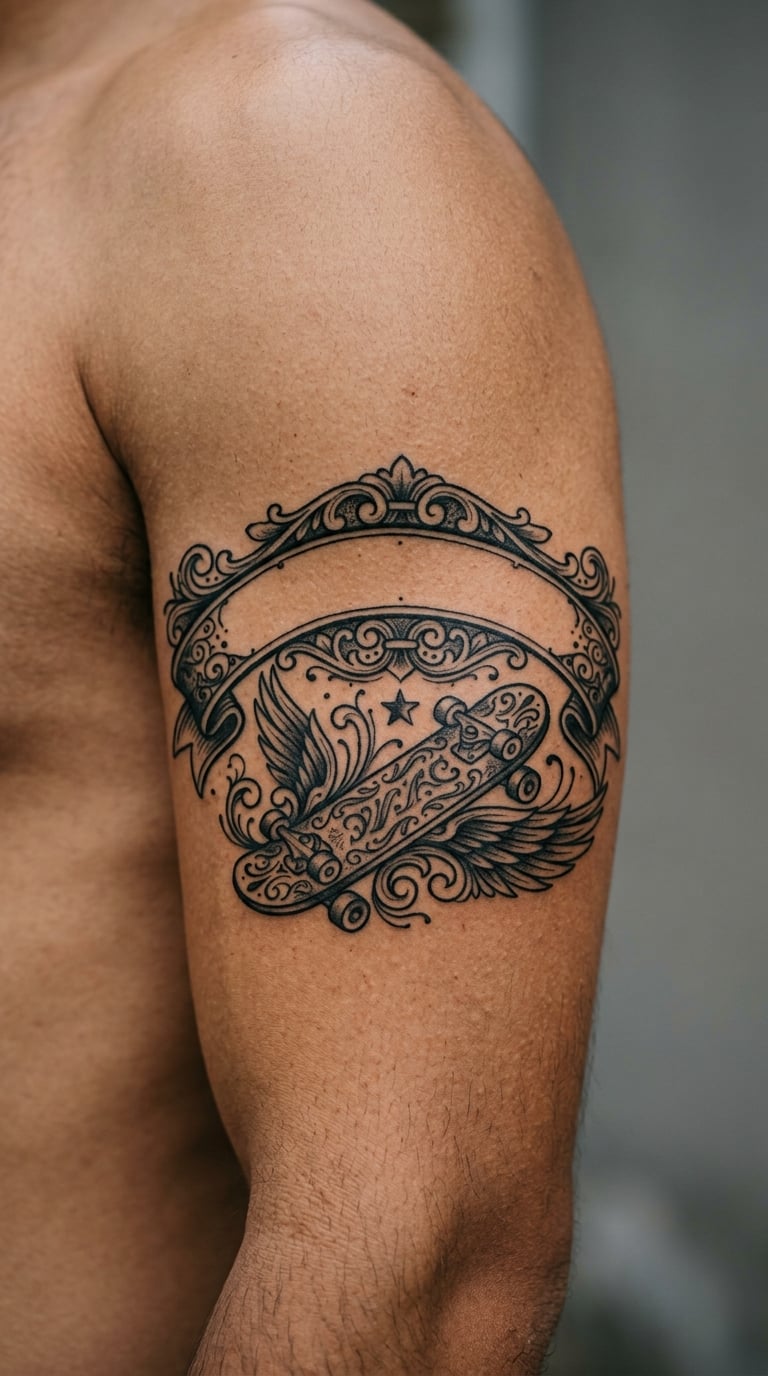
A curved traditional banner, the classic swallow-tail shape with rolled ends, a board sitting inside it and lettering arcing underneath. The style is straight out of sailor and pin-up tattooing, which is where old school skate flash comes from.
Banners usually carry a place, a year or a crew name, so this one tends to be the most personal design on the list. It is also the easiest to make into a matching piece later.
Placement: Across the upper arm, wrapping slightly, or across the chest. Size: 4-5 inch (10-12.5 cm) wide. Style: Traditional banner with bold outlines. Pain: Medium, higher over the rib area if you go for the chest.
Make it yours: Put your city and the year you started in the banner, and check the lettering for readability at your chosen size before you commit.
12. Two Skateboards Crossing
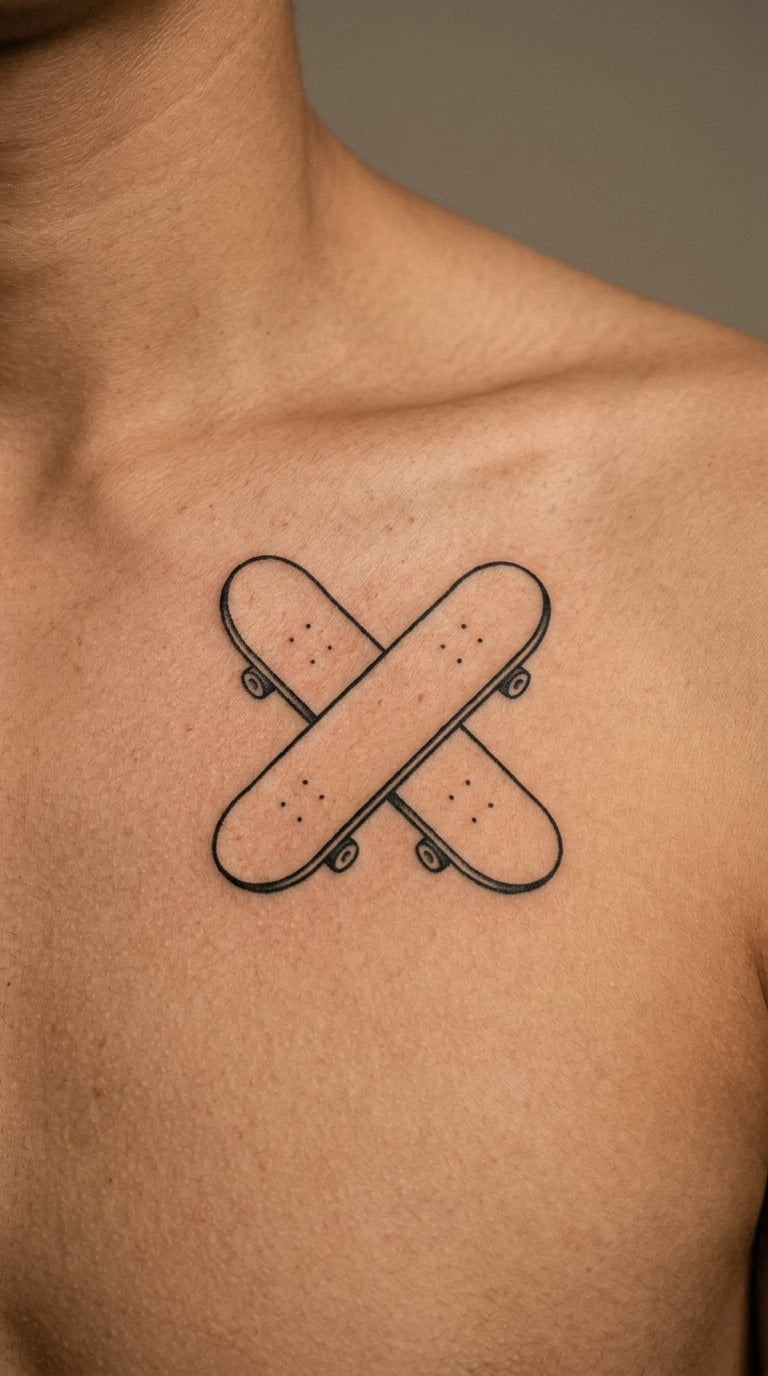
Two decks crossed into an X, drawn in clean black line with equal weight on each board so neither looks like the supporting act. Keep the crossing point simple, the piece works because the X holds the composition together.
Two boards usually means two people, two eras, or a friend who got you skating in the first place. It is the most common matching tattoo in this whole category, done at matching size and height on both people.
Placement: Upper chest near the collarbone, one on each side of the sternum, or on matching forearms. Size: 2.5-3 inch (6.5-7.5 cm). Style: Fine line. Pain: Medium over the collarbone, one of the sharper areas for most people.
Make it yours: Draw each board slightly different, one as it looks now and one as it looked when you were kids.
13. Skateboard with a Flame Trail
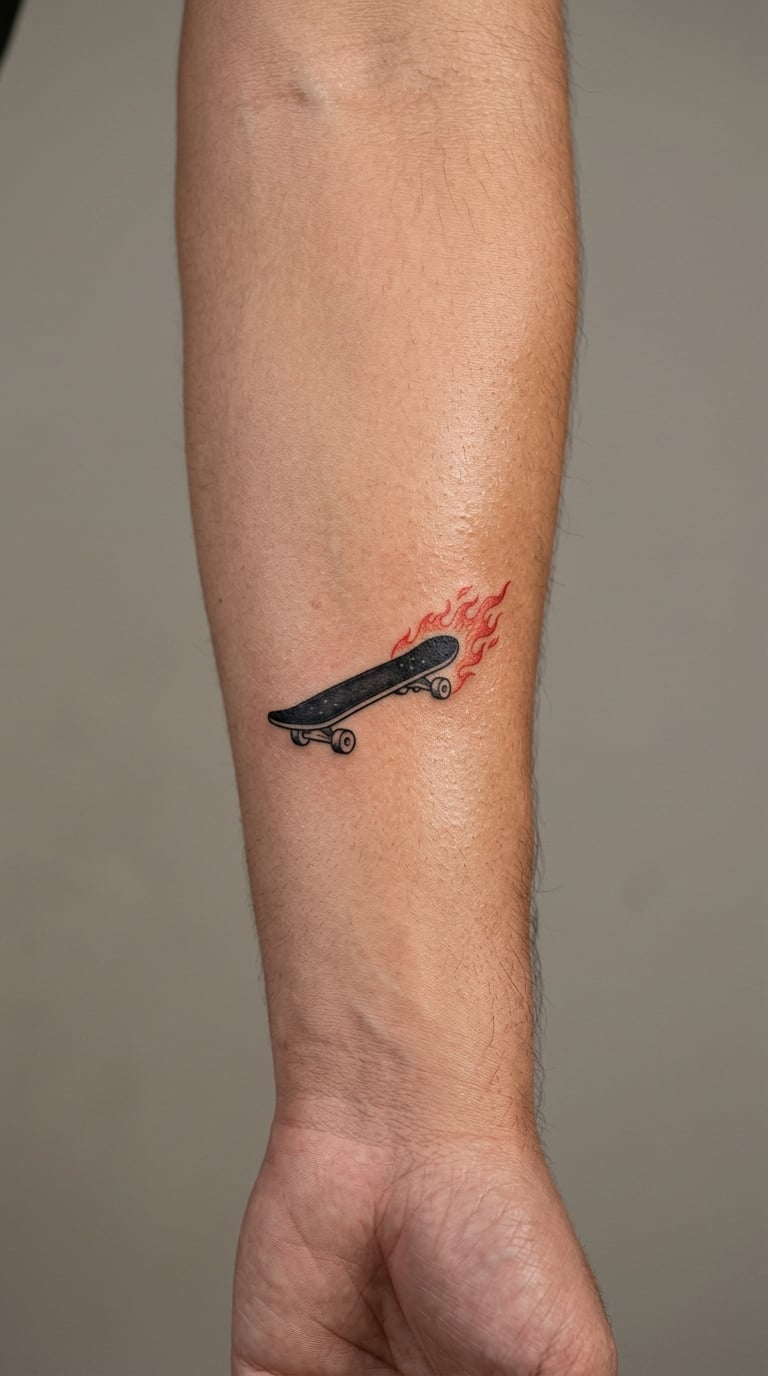
A solid black deck with a short flame trail streaming off the tail, the flames built from a few clean tongues of red and orange rather than a full fire effect. Short is the key, a two-inch trail reads as motion, a five-inch one reads as a fire.
It carries the same energy as the lightning design in a warmer palette, and skaters pick it when the board is about speed rather than a place. It works as a first piece because it is bold but small.
Placement: Outer forearm, or along the shoulder blade. Size: 2.5-3 inch (6.5-7.5 cm) including the trail. Style: Blackwork with color accent. Pain: Medium. Color on a small area means a second needle pass, so the redness lasts a few days longer than a plain black piece.
Make it yours: Turn the flames into a smoke trail instead, or hide a date in the shape of one flame tongue.
14. Dotwork Skateboard Wheel Pattern
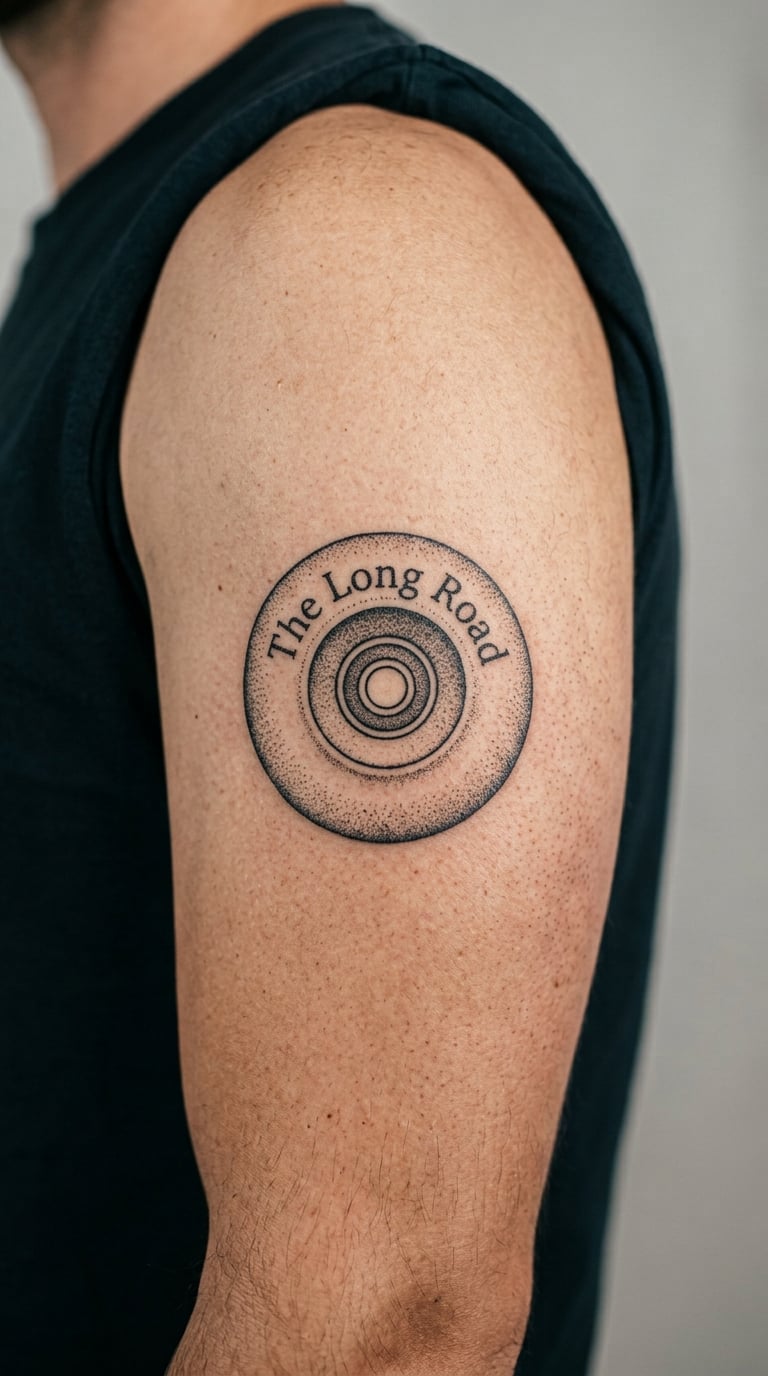
A wheel rendered entirely in dots, the outer ring made of spaced dots that get denser toward the edge, with four small hole clusters at the center. Density does the shading here instead of gray wash, which gives it depth without any solid black.
Dotwork reads as patience and precision, and it is the design skaters choose when they want detail but not a heavy arm. It slots neatly into a geometric or mandala sleeve.
Placement: Upper arm, shoulder, or the outer thigh. Size: 2 inch (5 cm) is enough room for the pattern to breathe. Style: Dotwork. Pain: Medium, and long. Dotwork is a lot of individual needle dots, so expect a two to three hour session and a lot of short breaks. Fine dot detail also softens with sun exposure, so cover it.
Make it yours: Build the density pattern from a skate photo, using the shadow areas to place the dots.
15. Minimalist Four-Wheel Tribute
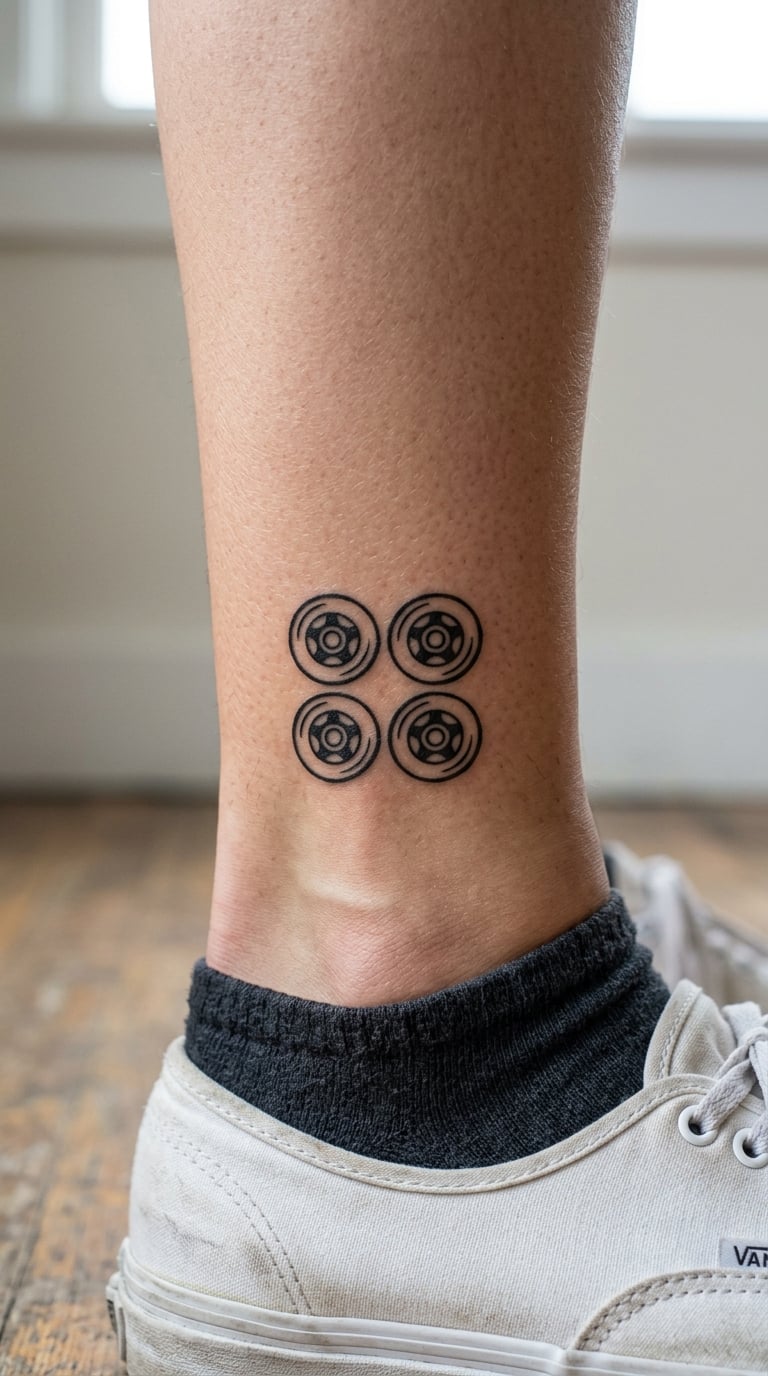
Four small wheels in a precise square, no deck, no trucks, nothing else. It is abstract enough to double as a geometric mark and specific enough that anyone who skates will read it correctly.
The reduction is the point. People choose it when a full deck would be too literal, and an ankle is the one place a tiny design actually stays visible in daily life, above a sock line.
Placement: Ankle, above the bone, or behind the ear beside a matching dot. Size: 1 inch (2.5 cm) square. Style: Minimalist. Pain: Low on the outer ankle, higher over the ankle bone itself. Ankle designs distort as the foot flexes, so keep it above the joint and ask the artist to place it with movement in mind.
Make it yours: Arrange the four wheels in a diamond instead of a square, or fill each one with a different color from a deck you owned as a kid.
16. Skateboard with a City Skyline
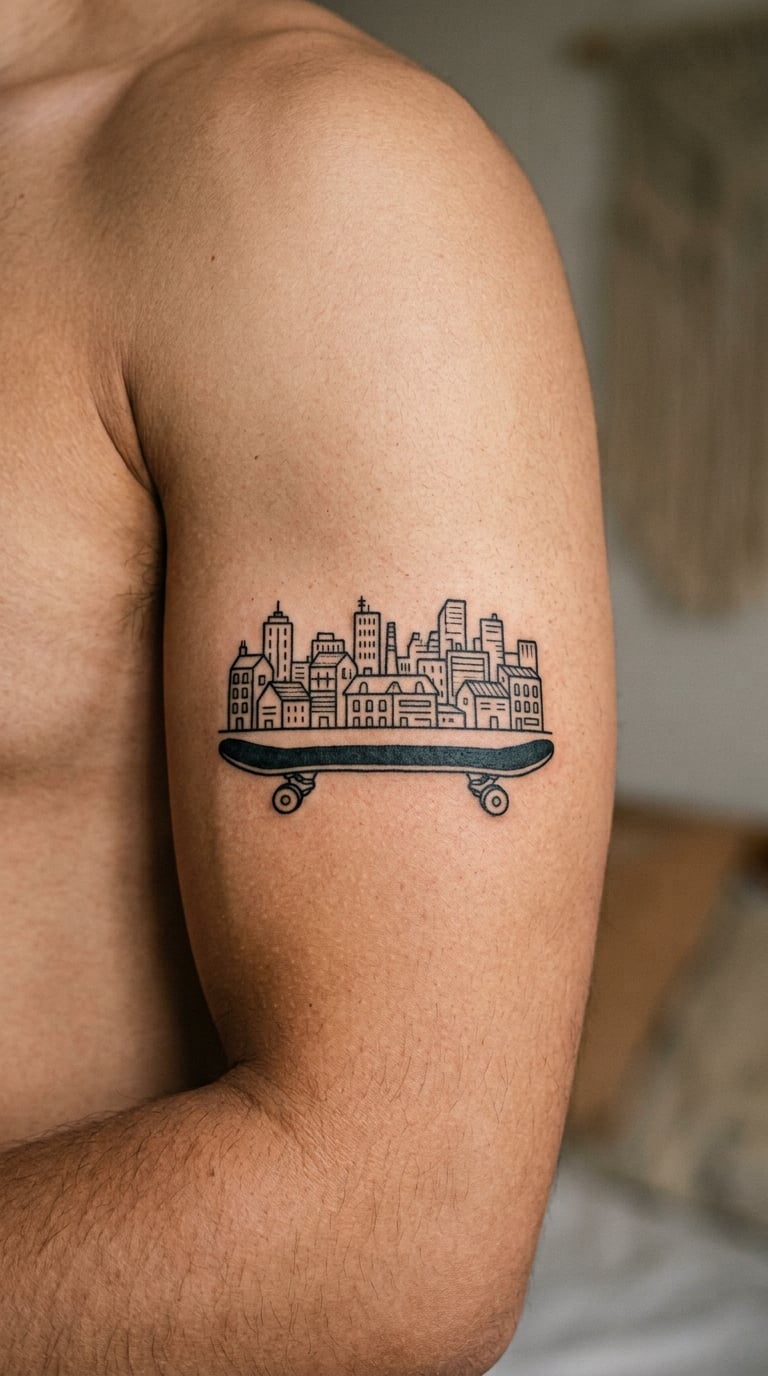
A simple black deck sitting under a compact skyline of flat-topped buildings, all in solid black silhouette with one or two windows left open as white gaps. The skyline should be recognizable, three to five buildings rather than a whole panorama.
This one is almost always a home city or a favorite skate spot, and the flat silhouette style keeps the architecture legible at a small size. It works as a memorial piece too, marking the city a skater was part of.
Placement: Upper arm, forearm or across the chest. Size: 3-4 inch (7.5-10 cm) wide. Style: Illustrative silhouette. Pain: Medium, steady across the forearm.
Make it yours: Use the three buildings closest to your first skate park, and add the parking rail or ledge that spot is known for underneath the deck.
17. Neo-Traditional Rose and Skateboard
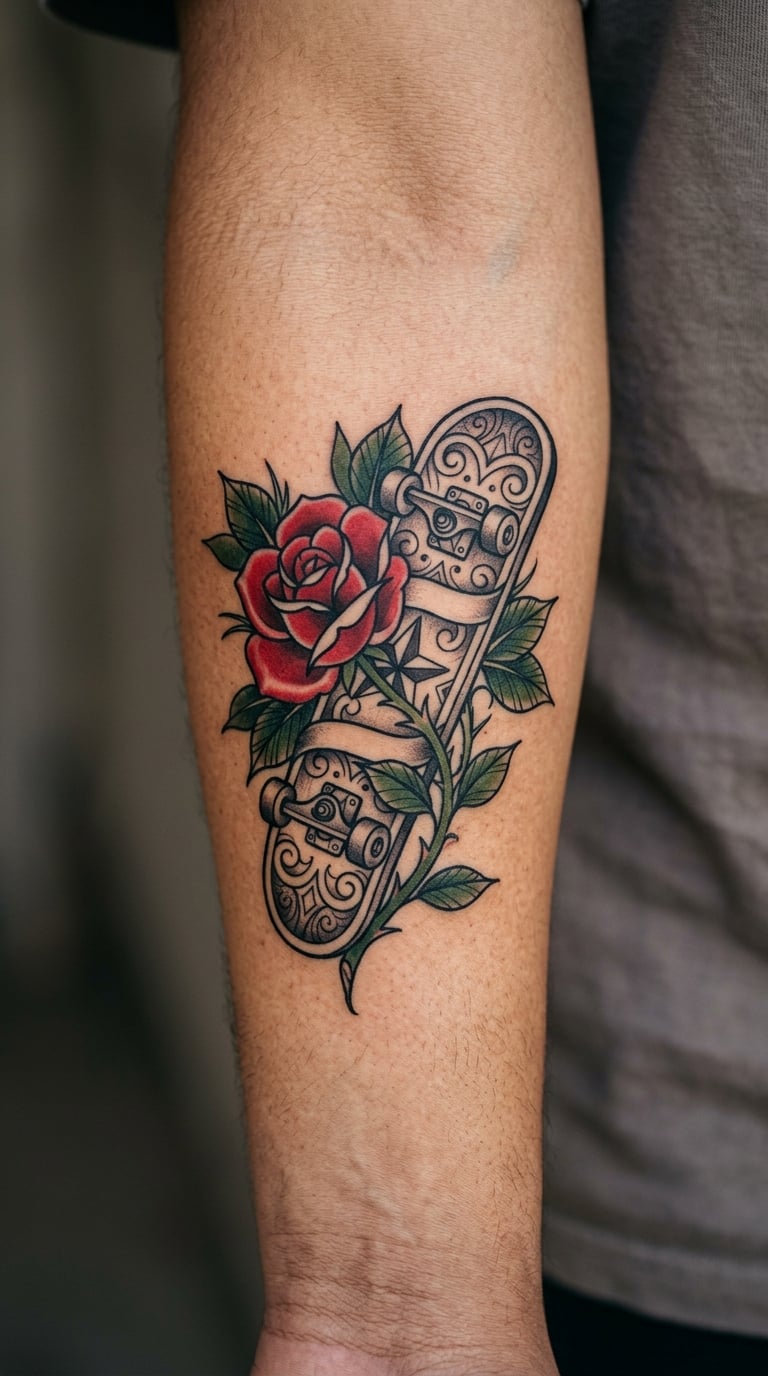
A deck wrapped by a rose, the flower in saturated red with green leaves and a black outline that thins and thickens the way neo-traditional work does. Wrapping the board rather than setting it beside the flower gives the piece movement.
Roses mean love or respect, and pairing that with a board usually points at a person, a crew or a chapter rather than at skateboarding itself. It is the warmest design on the list.
Placement: Forearm, upper arm or the thigh. Size: 3.5-4 inch (9-10 cm). Style: Neo-traditional. Pain: Medium, higher on the ribs or the inner arm. Color saturation means a longer session and more skin redness than a black piece.
Make it yours: Put a date on the deck graphic underneath the rose, or choose a rose color that has never appeared on any board you owned.
18. Broken Skateboard Pencil Sketch
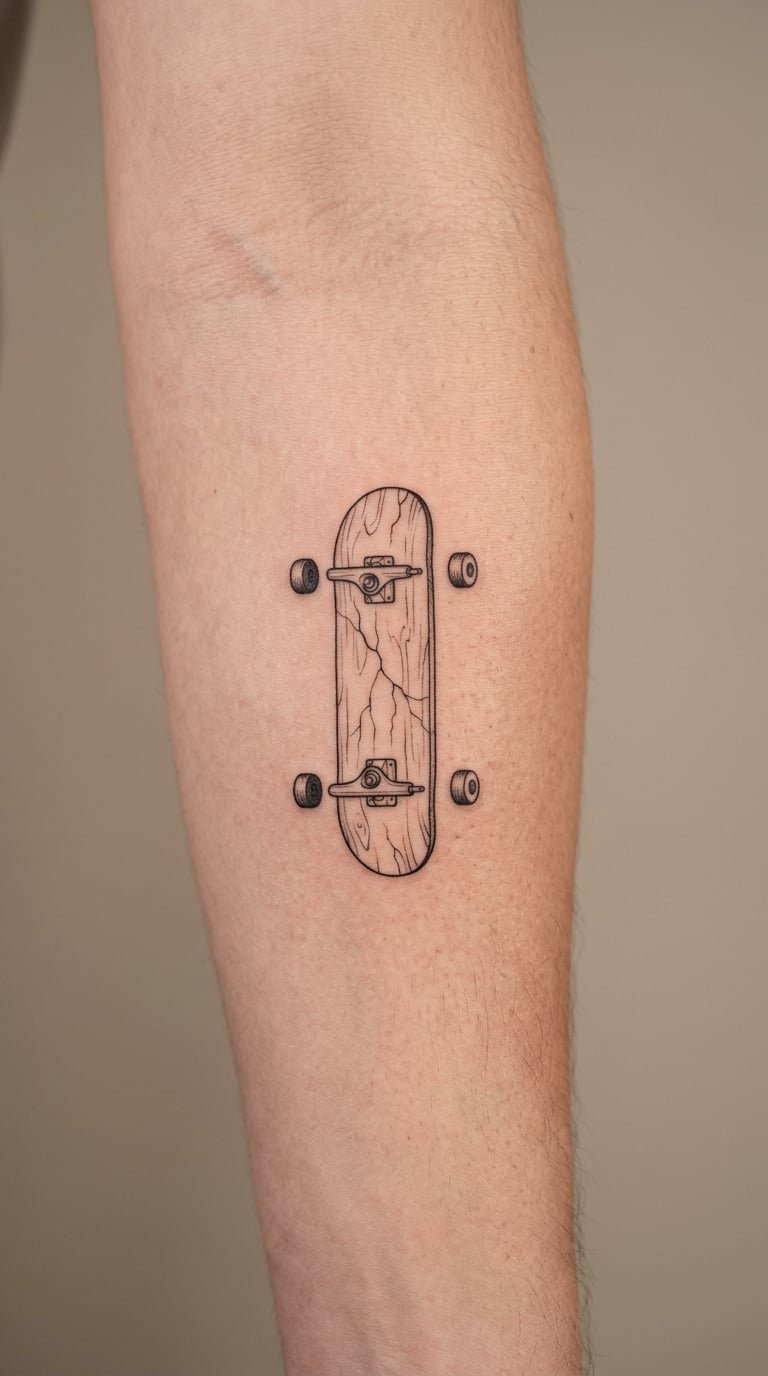
A fine-line drawing of a deck snapped across the middle, trucks still attached, the four wheels separated and floating slightly away from the board. The lines are pencil-thin and slightly sketchy, as though the drawing was never inked properly.
A broken board is almost always a memorial or a turning point, a skater who is gone or a version of yourself that got left behind. It is a heavy design to wear, and people tend to keep it for life.
Placement: Inner arm, ribs or the inner thigh. Size: 2.5-3 inch (6.5-7.5 cm). Style: Fine line, sketch style. Pain: Low to medium, though the rib area is sensitive. Aging note: this is the design on the list that most needs a bolder line than your instincts suggest, because thin sketch lines blur faster than anything else here.
Make it yours: Add the initials or the dates of the person or era it represents, kept as small as the wheels.
19. Checkerboard Skateboard Sleeve Element
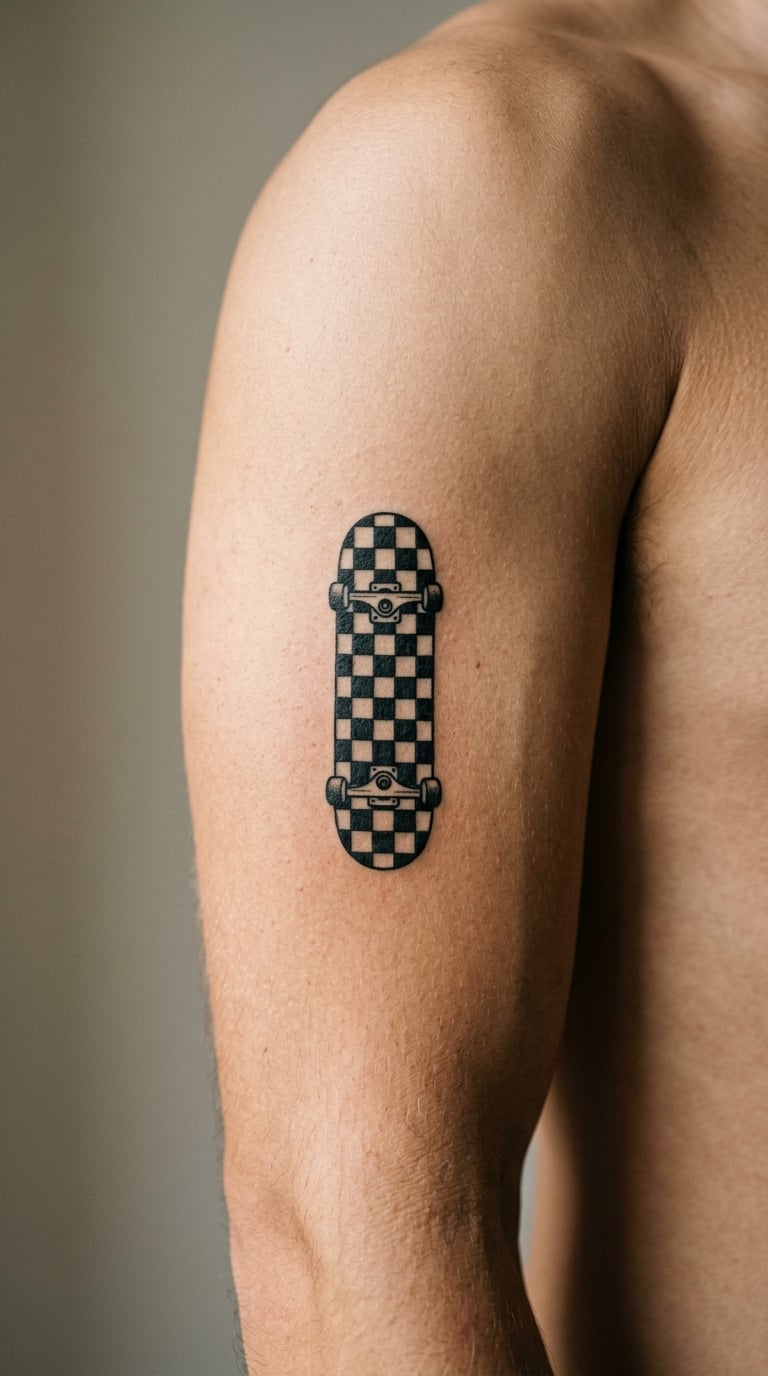
A deck filled with a bold black and white checkerboard, a heavy shape with no interior detail, built to sit inside a larger graphic composition. The checks need to be a decent size or the pattern turns to gray as the tattoo ages.
The checkerboard is streetwear and skate-shop graphics rather than a story in itself, so this one works best as a component in a sleeve alongside other elements. On its own it reads as bold and graphic.
Placement: Upper arm, shoulder, or as filler between two existing pieces. Size: 3-3.5 inch (7.5-9 cm). Style: Graphic blackwork. Pain: Medium, solid black areas take more passes and build heat quickly.
Make it yours: Set the checks at an angle instead of square, which makes the same simple pattern look more designed, or add one color check as the accent.
20. Skateboard with a Crown
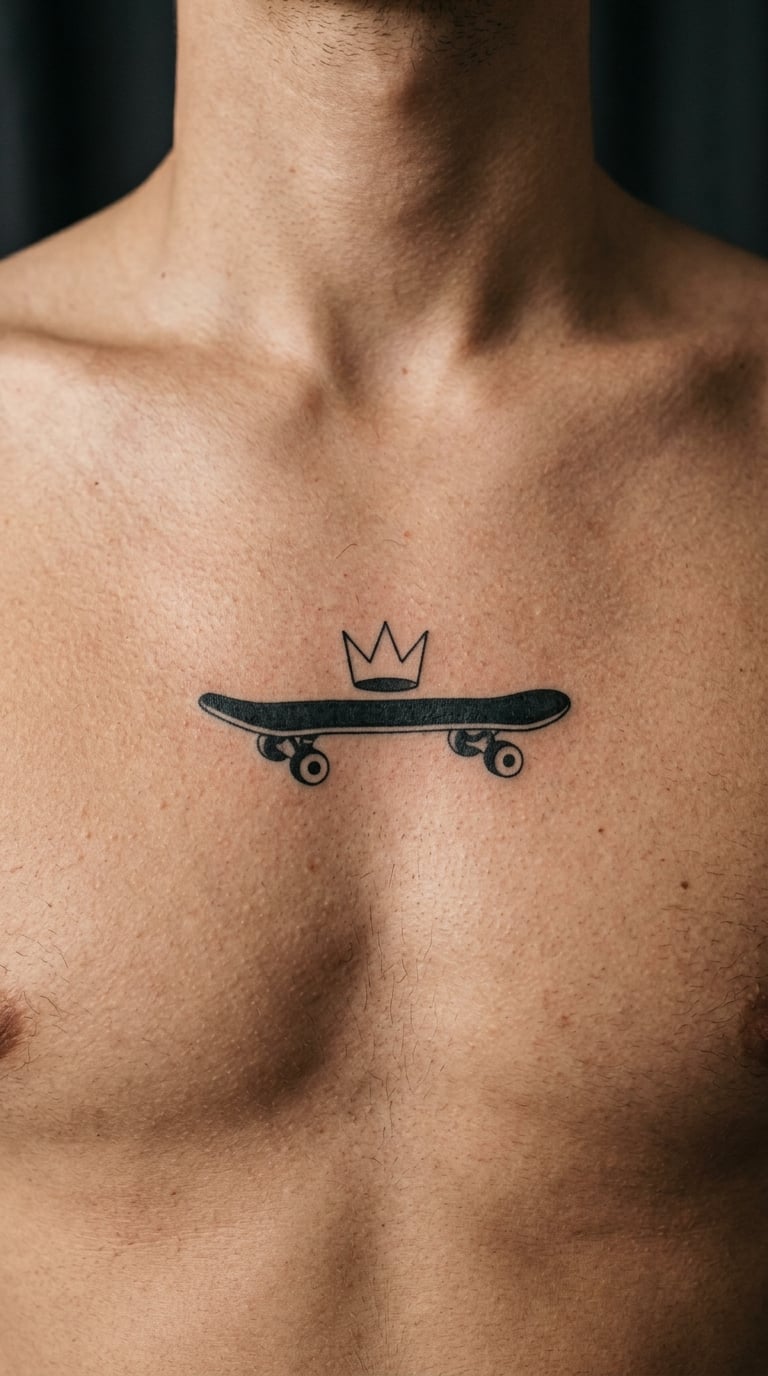
A bold black deck with a small three-point crown resting on top of it, drawn with the same heavy line as the board so the two read as one mark. A small banner or three dots underneath finish the composition if you want it fuller.
A crown is playful confidence rather than royalty, and most people wearing this one chose it because it is funny without being a joke. It works well as a small chest piece with a friend.
Placement: Chest between the pecs, or the upper arm. Size: 2 inch (5 cm). Style: Bold line work. Pain: Medium on the chest, which is sensitive and moves a lot with breathing. Aging note: solid black crowns are stable, but any internal shading inside the points will soften, so keep the points clean.
Make it yours: Sketch a crown shape based on a skate logo you liked rather than settling for a generic one, or add dots for a simplified laurel.
21. Skateboard Map Pin
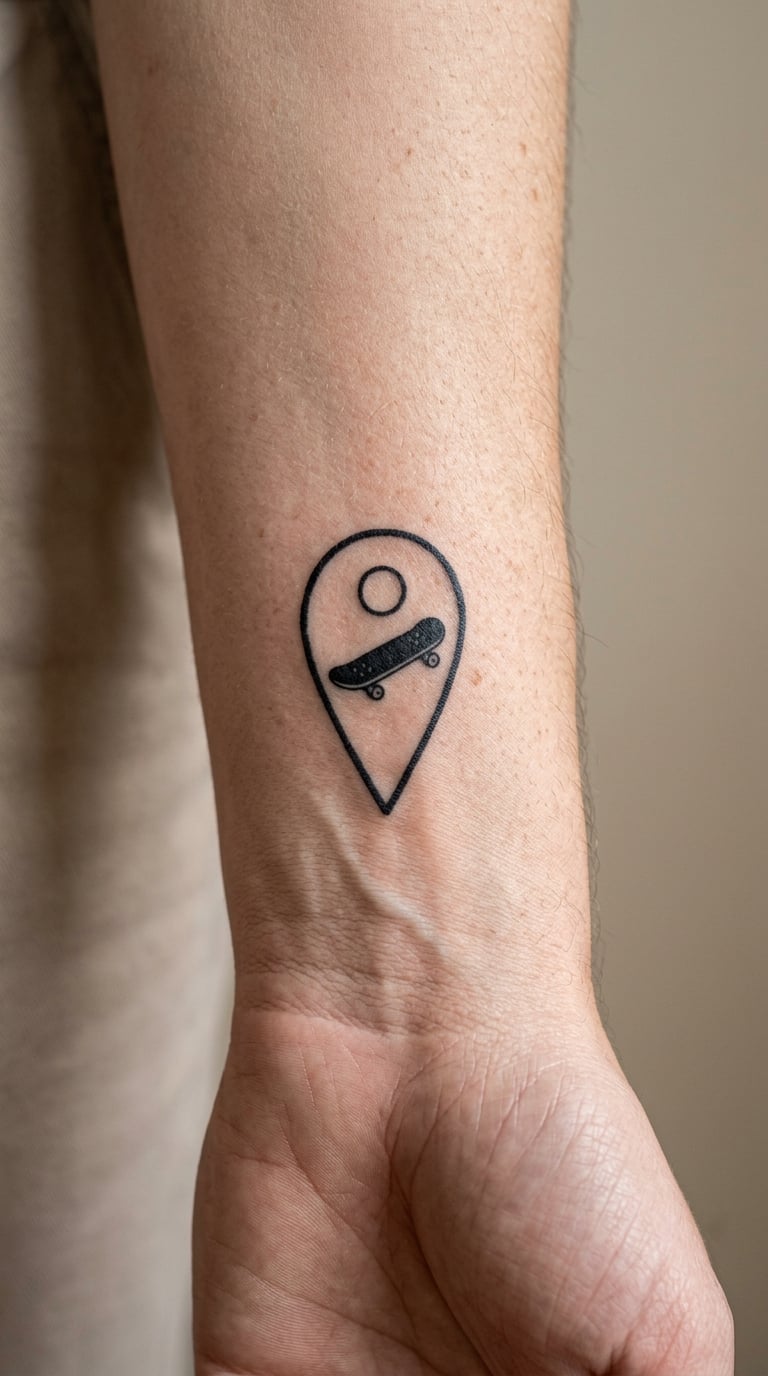
A map pin shape with a small board inside it, black line work with the pin’s tip pointing down and the board sitting in the round top. A few tiny contour lines or a road under the pin can add context without crowding it.
The pin means a location, a home city, or the spot where a group of friends met every weekend. It is the most quietly personal of the small designs here.
Placement: Wrist, inner arm or behind the ear. Size: 1.5 inch (4 cm) tall. Style: Minimalist. Pain: Medium on the wrist, low behind the ear. At this size, keep the inner circle of the pin simple, because a detailed board inside a small pin turns to a smudge within a few years.
Make it yours: Have the pin tip point at a hand-drawn map of the spot, or add the city’s outline in negative space inside the circle.
22. Full-Color Skateboard with Lightning Background
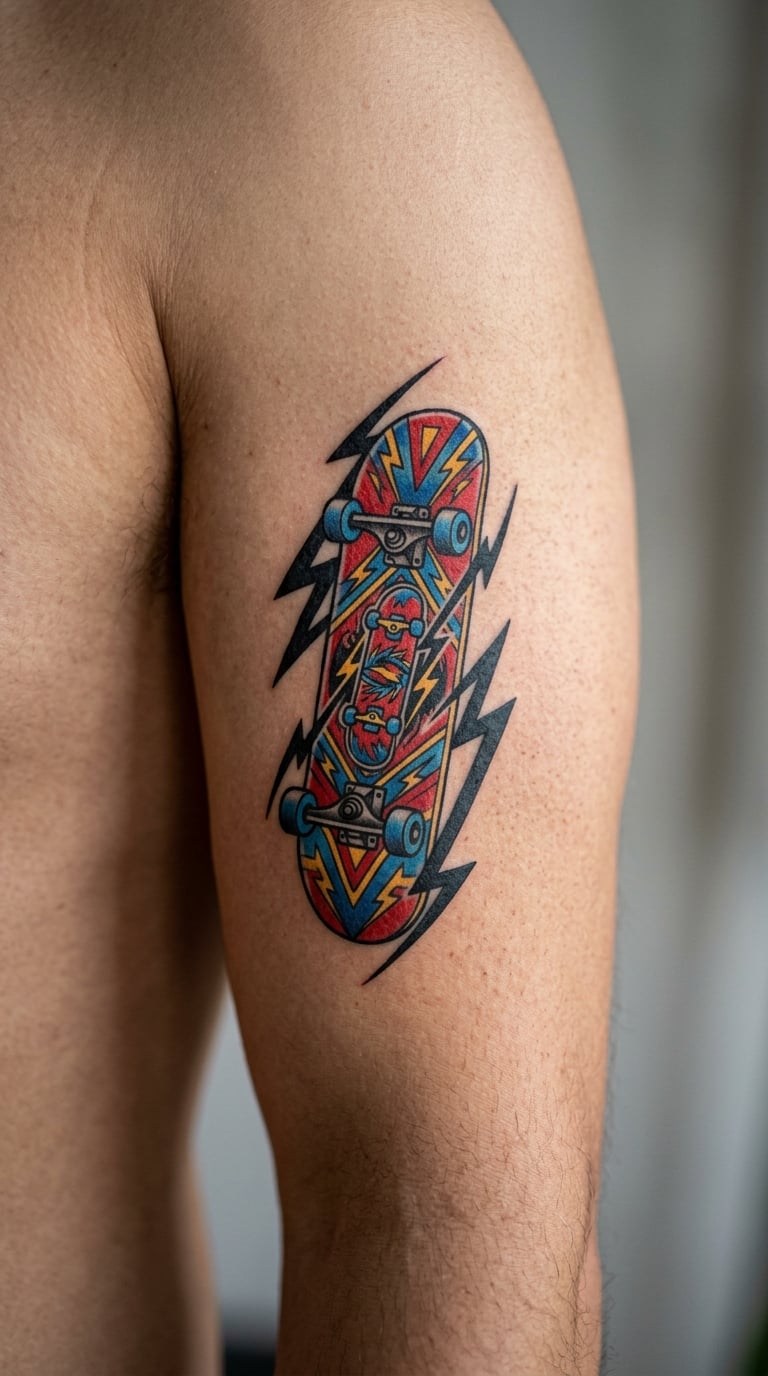
A fully rendered board, red, blue and yellow, with modeled trucks, wheel highlights and grip texture, set against black lightning bolts radiating behind it. This is the biggest and most technical design on the list, and it needs an illustrator rather than a flash artist.
People who go this size usually want skateboarding to be a major visual theme, not a footnote. Budget two sessions and be honest with the artist about how much detail you actually want kept.
Placement: Upper arm, shoulder or across the chest. Size: 4-6 inch (10-15 cm). Style: Illustrative color with blackwork background. Pain: High, this is a long session over a large area and the elbow side of the upper arm is where most people start counting minutes. Aging note: large color work softens faster than black line work, so plan on a touch-up every three to five years.
Make it yours: Have the bolts carry the colors of your board’s graphic, or reduce the deck to a single color and let the background do the work.
How to Choose the Right Design
Almost every disappointing skate tattoo fails for the same reason: the design was chosen before the placement and the size were settled. Work through those two first and the rest gets easy.
First-timer? Start small with a skateboard tattoo idea
For a first piece, pick something with a strong silhouette and no interior detail. Ideas 1, 3, 15 and 21 all qualify, since they stay legible at small sizes and heal predictably. Save the detailed realism and the dotwork for later.
Match the size to the detail you want to keep
The rule of thumb skaters use: at two inches, you get a shape. At four inches, you get trucks and wheels. Anything smaller than that is symbolism, not a drawing. If you want a full deck with visible hardware, plan on four inches or more, and if you want it under two inches, take the detail out on purpose rather than letting an artist squeeze it in.
A few more things worth settling at the consultation:
- Pick the memory, not just the object. A worn deck from a specific year, a crew, a spot or a person will still mean something in twenty years. A generic board graphic probably will not.
- Bring a reference or a stencil. Skaters ask about this constantly in the groups I have read, and the answer is simple. Either bring a clear photo and let the artist redraw it into workable line weight, or bring a printed stencil. Hand an artist a generated image and expect a rough result, because those images contain shading that no stencil can hold.
- Check the line weight against the size. The single most useful conversation you can have is asking the artist to thicken the lines for the size you picked.
- Look at the whole limb. An existing sleeve, wrist piece or ankle work changes the answer more than taste does. Show the artist what is already there.
- Use the style that matches the detail. Fine line for thin, small, graphic designs. Blackwork for solid shapes and speed. Traditional and neo-traditional for roses, skulls and banners. Watercolor for something soft that fades gracefully.
- Sort out the placement with movement in mind. Wrist, ankle and hand designs distort when you bend, so they have to be drawn around the joint, not across it.
Cost and Session Time
Tattoo pricing in the US is driven by hourly rate and shop minimum rather than by the subject, so a skateboard deck costs what any small piece of illustration costs at that shop.
Roughly speaking, a tiny design of 1 inch or under falls in the 50 to 100 dollar range if the shop has a low minimum, and a small line-work piece between 1 and 3 inches typically runs 80 to 200 dollars. Medium work in the 3 to 5 inch range, which covers most of the designs in this list, lands somewhere around 150 to 350 dollars. Full-color illustrative pieces at 5 inches and above, like idea 22, commonly run 300 to 800 dollars or more depending on how many sittings the artist needs.
Session length follows the same scale. A small fine-line piece is usually a single sitting of one to two hours. A blackwork or traditional piece at four inches takes two to three hours, sometimes more. Dotwork and large color work get split across two or three appointments so the artist is not working on the same skin for five hours straight.
Two things move the number more than size does: how much detail you insist on keeping at a small scale, and whether the shop charges a minimum that a tiny piece cannot cover. Bring a clear idea of the size you want, and ask for the total including the session fee before you start, not after.
Aftercare Basics
Follow your artist’s aftercare instructions first, because they know exactly what they did. If you have not seen a tattoo artist in person, ask for written instructions before you leave the chair. In general:
- Wash the area gently with lukewarm water and unscented soap once or twice a day for the first few days, then pat dry with clean hands or a paper towel. A fragrance-free moisturizer keeps the skin from drying out and flaking.
- Leave the fresh tattoo alone while it heals. That means no picking at scabs, no scratching, and keeping hands off it during the first days when you cannot stop thinking about it.
- Keep it out of direct sun while it heals, and cover it loosely if it has to sit in daylight. Sun hits arms, calves and shoulders more than most people expect.
- Stay away from swimming pools, hot tubs and ocean water until the tattoo has healed properly, since salt and chlorine pull color out of new ink.
- Skip the friction. If you skate, expect a board edge or a knee pad rubbing straight across a fresh piece to hurt and to wear the ink. Loose clothing over the area for the first few weeks is the easy fix.
- Let a healed tattoo sit and settle before changing anything about it. Most touch-up decisions are better made after a few months of normal sun, sweat and wear than in the first week.
Frequently Asked Questions
What does a skateboard tattoo mean?
A skateboard tattoo usually stands for freedom, risk and persistence, and it carries those meanings because skating was formative for the person wearing it. Common readings include independence, spending time outdoors, a group of friends, or nostalgia for a specific era, skate spot or worn board. The meaning comes from your story, so it is worth deciding which memory the design points at before the artist draws it.
How big should a skateboard tattoo be?
Two inches gives you a clean deck silhouette with trucks and plain wheels. Four inches is where you can render trucks, bolts, bearings and grip texture and still have it read from across a room. Under an inch, the design is a symbol rather than a drawing, and any interior detail fills in with scar tissue within a few years. If you want realism, plan for four inches or more.
Will a tiny skateboard tattoo fade or blur?
Yes, sooner than most people expect. Fine line work softens fastest, especially on the inner forearm, the wrist, the hand and anywhere that gets sun or friction, and hands in particular wear through from daily contact. Ask your artist to use a slightly heavier line than feels necessary, avoid sun on the area once it heals, and plan on a touch-up every few years for anything under two inches.
Which tattoo style suits a skateboard design best?
It depends on the design, not the subject. Fine line suits outlines, crossed decks and map pins because it stays clean at small sizes. Blackwork suits solid shapes, motion and checkerboards. Old school traditional and neo-traditional suit skulls, roses and banners, since that flash vocabulary is where the imagery came from. Watercolor works when you want color without a heavy outline, but it fades first and needs refreshing.
Where should a small skateboard tattoo go?
The inner forearm and the outer upper arm are the easiest and least painful, and both are big enough for a two to three inch piece. The wrist and ankle suit tiny designs but distort as you move, so ask the artist to place them above the joint. Hands read as serious, cost more to heal, and wear fastest. Behind the ear is the easiest place to hide a micro design, though it is twitchy rather than painful.
Can I skateboard with a fresh tattoo?
You can, but plan around it for the first few weeks. Board edges, grip tape, shoe leather and knee pads all rub, and friction across healing skin hurts and wears ink unevenly. Wear loose clothing over the area, keep the area clean and moisturized, and if the design sits where a shoe or pad lands, ask your artist how long they want you to keep friction off it. The tattoo is not the problem, the pressure is.
Which Skateboard Tattoo Idea Should You Pick?
If this is your first tattoo, start with idea 1, the minimalist deck outline at two to three inches on the inner forearm. It is the least painful placement on the list, it heals predictably, and it leaves you plenty of room to add skate pieces later without a crowded arm.
If you are adding to a collection, go bigger and pick something with a scene in it. Ideas 5, 6, 16 and 22 all carry enough detail to hold on their own next to existing work, and idea 18 is the one to choose if there is a specific person or a specific loss behind the design. Bring a photo of the board or the spot that started it, and let the artist redraw it into line weight that will still be readable in fifteen years.