
24 Constellation Tattoo Ideas for Women (October 2026)
These 24 constellation tattoo ideas for women cover everything from a two-inch hairline star map to a five-inch watercolor piece between the shoulder blades. Each entry gives you the design, the real meaning, the placement that flatters it, an honest pain score and one way to make it yours.
Constellations are the most personal zodiac style there is. Your sign, or the sky over a date that mattered, is a pattern nobody else can claim by accident. If you are planning ahead, allow four to six weeks so the design is settled before you book.
24 Constellation Tattoo Ideas for Women: Quick Guide
| Idea | Style | Best placement | Size | Pain |
|---|---|---|---|---|
| 1. Fine-Line Cassiopeia | Fine line | Collarbone | 2.5-3 in (6-7.5 cm) | 4/10 |
| 2. Virgo with Botanical Halo | Fine line | Inner forearm | 2 in (5 cm) | 3/10 |
| 3. Leo in Blackwork | Blackwork | Outer shoulder | 4 in (10 cm) | 5/10 |
| 4. Sagittarius Arrow and Stars | Minimal black line | Inner forearm | 3 in (7.5 cm) | 3/10 |
| 5. Cancer with Pearl Detail | Fine line | Behind the ear | 2 in (5 cm) | 5/10 |
| 6. Scorpio in Red Ink | Colour fine line | Inner wrist | 2 in (5 cm) | 5/10 |
| 7. Gemini Twin Stars | Fine line | Upper chest | 2.5 in (6 cm) | 5/10 |
| 8. Taurus with Crescent Moon | Fine line | Sternum, vertical | 3 in (7.5 cm) | 6/10 |
| 9. Libra in Watercolor | Watercolour | Between shoulder blades | 5 in (12.5 cm) | 5/10 |
| 10. Aries with Sweeping Flame | Graphic fine line | Outer upper arm | 3 in tall (7.5 cm) | 4/10 |
| 11. Pisces with Two Flowing Fish | Fine line | Side thigh | 3 in (7.5 cm) | 5/10 |
| 12. Aquarius in Geometric Line Art | Geometric line art | Forearm | 2.5 in (6 cm) | 4/10 |
| 13. Capricorn with Mountain Peaks | Fine line | Outer calf | 3 in (7.5 cm) | 5/10 |
| 14. Taurus and Virgo Matching Set | Fine line | Matching inner forearms | 2 in each (5 cm) | 3/10 |
| 15. Southern Cross Behind the Ear | Fine line | Behind the ear | 1 in (2.5 cm) | 5/10 |
| 16. Orion Nebula on the Rib | Watercolour | Side rib | 4 in tall (10 cm) | 7/10 |
| 17. Big Dipper Back Piece | Minimal black line | Upper back | 6 in (15 cm) | 4/10 |
| 18. Northern Crown on the Hand | Fine line | Back of hand | 2 in (5 cm) | 7/10 |
| 19. Andromeda Micro-Realism | Micro-realism, black and grey | Outer thigh | 3 in (7.5 cm) | 4/10 |
| 20. Lyra with a Small Harp | Fine line | Inner arm | 2.5 in tall (6 cm) | 3/10 |
| 21. Cancer Season Moon Phases | Fine line | Ankle | 2 in (5 cm) | 6/10 |
| 22. Zodiac Wheel, Traditional | Traditional blackwork | Upper back | 5 in (12.5 cm) | 5/10 |
| 23. Personal Star Map on the Rib | Fine line | Side rib, vertical | 5 in tall (12.5 cm) | 7/10 |
| 24. North Star with Coordinates | Minimal fine line | Inner wrist | 2 in tall (5 cm) | 4/10 |
Pain scores are a general guide, not a promise. Bony areas, thin skin and the ribcage run hotter than the fleshy inner arm, and everyone has a different day.
1. Fine-Line Cassiopeia Constellation on the Collarbone
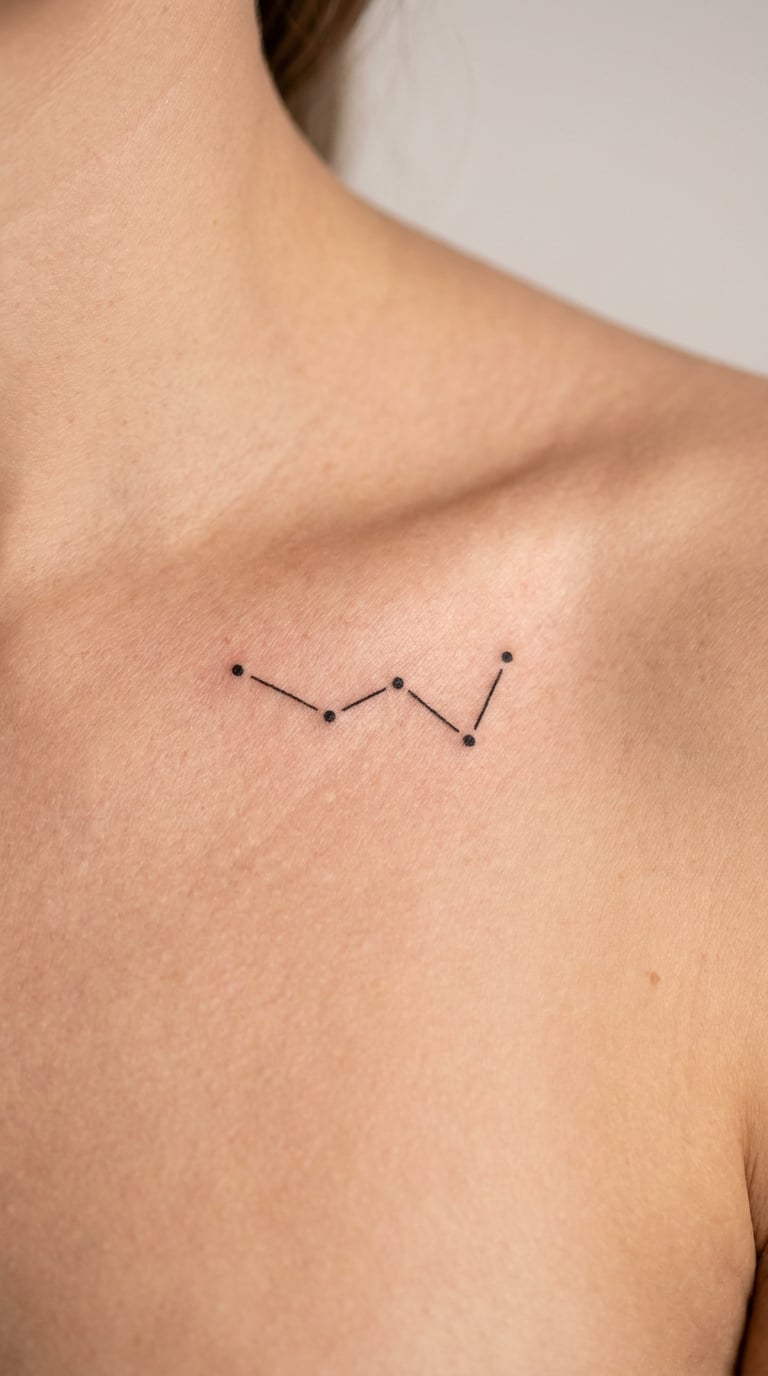
A Cassiopeia constellation tattoo is a single thread of black line joining five star points in the W shape, laid flat across the collarbone. The line stays one weight from end to end, which is what makes it read as delicate rather than busy.
People choose it because the shape is instantly recognisable from a distance, which is rare for a fine-line design. It also sits close to the neck, so it frames the face without crowding it.
Placement: inner collarbone, centred a finger’s width above the bone. Size: 2.5-3 inches (6-7.5 cm) wide. Style: fine line, one-needle work. Pain: 4/10. The collarbone is bony but the skin over it is thin and forgiving.
One ageing note that matters here: hairlines on the collarbone fade faster than on the upper arm, so ask for a line weight with a little more body than you think looks elegant in a photo. Make it yours: add the date you met your partner in tiny lettering underneath, or a single line of connected stars for a child.
2. Virgo Constellation with a Botanical Halo
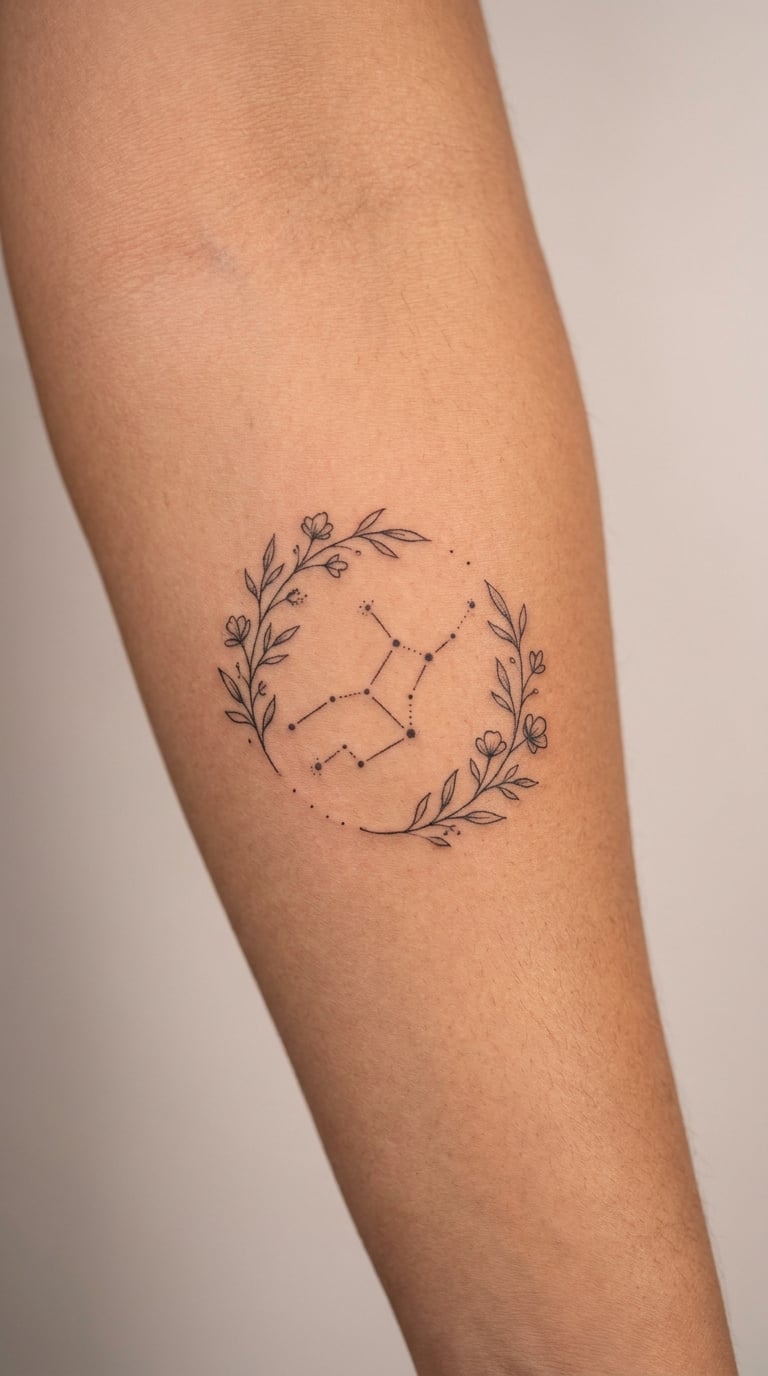
This Virgo design keeps the constellation itself to plain dots and hairlines, then rings it with a few thin leaf strokes that stop before they close. The gap in the ring is what stops it looking like a badge.
The botanical frame softens the geometry, which is why it works well for people who like the sign but not the sharpness of a pure diagram. If Virgo is your sign, you will also find our Virgo tattoo ideas for women worth a look for other directions on the same glyph.
Placement: inner forearm, a few inches above the wrist crease. Size: 2 inches (5 cm) across. Style: fine line with a sparse botanical element. Pain: 3/10, one of the gentlest spots on this list.
Fine line on the inner forearm is soft skin that rubs and warms easily, so the halo leaves may soften within a few years while the stars hold. Make it yours: swap the generic leaf for one specific stem, like a sprig of the flower tied to your birth month.
3. Leo Constellation in Blackwork on the Shoulder
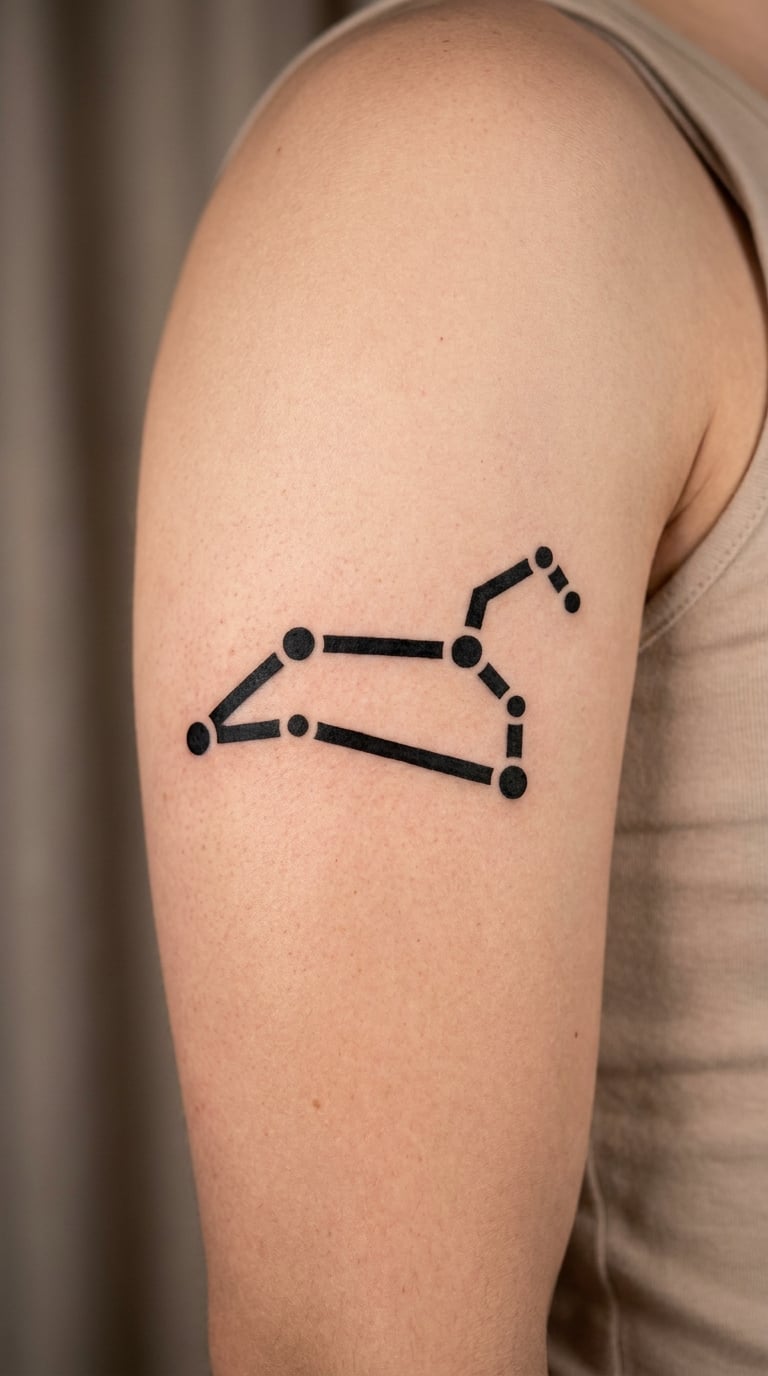
Solid black stars connected by tapered lines, with generous empty space between them, make up this Leo composition. It is the opposite of the hairline approach: the design reads as a shape first and a diagram second.
Leo is one of the few zodiac constellations whose actual star pattern is scattered enough that the artist has real freedom in how the lines land. That makes it a good pick if you want a sign tattoo that does not look like a sticker.
Placement: outer shoulder, running front to back. Size: 4 inches (10 cm) wide. Style: blackwork with negative space. Pain: 5/10. The shoulder has good muscle cover, but the collar area near it is sensitive.
Blackwork holds its shape better than fine line, which is a real advantage over decades. Make it yours: use the actual brightest stars of Leo as filled dots and the rest as small outlines, so the weight varies within one design.
4. Sagittarius Arrow and Stars on the Forearm
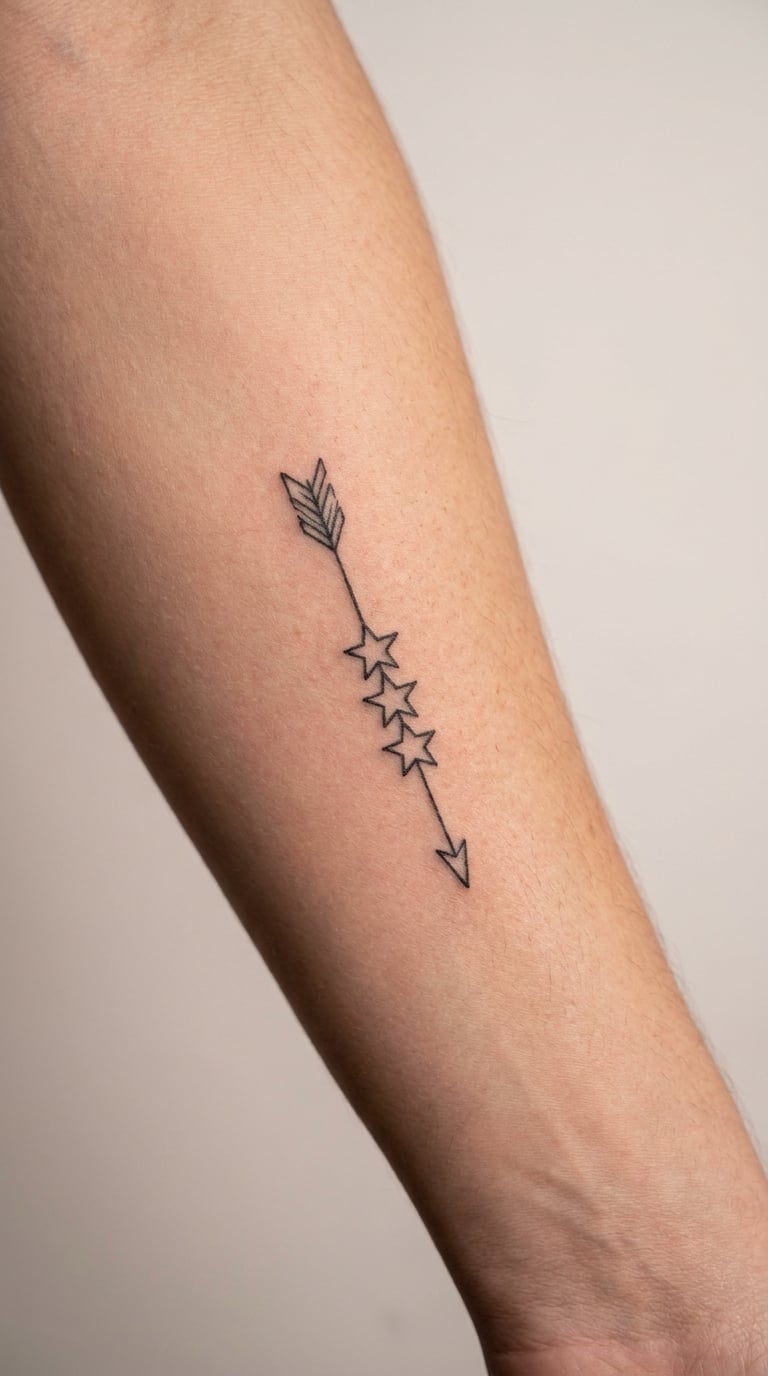
A single straight arrow shaft runs through four connected stars here, with a small fletching detail at one end. It is one of the simplest constellations in the zodiac, so the design stays readable at a small size.
The arrow is usually a bonus rather than the main subject. Sagittarius is famously the archer, so including the arrow gives you the sign without needing the glyph.
Placement: inner or outer forearm, following the bone line. Size: 3 inches (7.5 cm) long. Style: minimal black line. Pain: 3/10.
At three inches the linework is still safely above the width that blurs, but keep it off the wrist crease where skin folds constantly. Make it yours: have the arrow point toward your hand, or reverse it to point back toward the elbow.
5. Cancer Constellation with a Pearl Detail
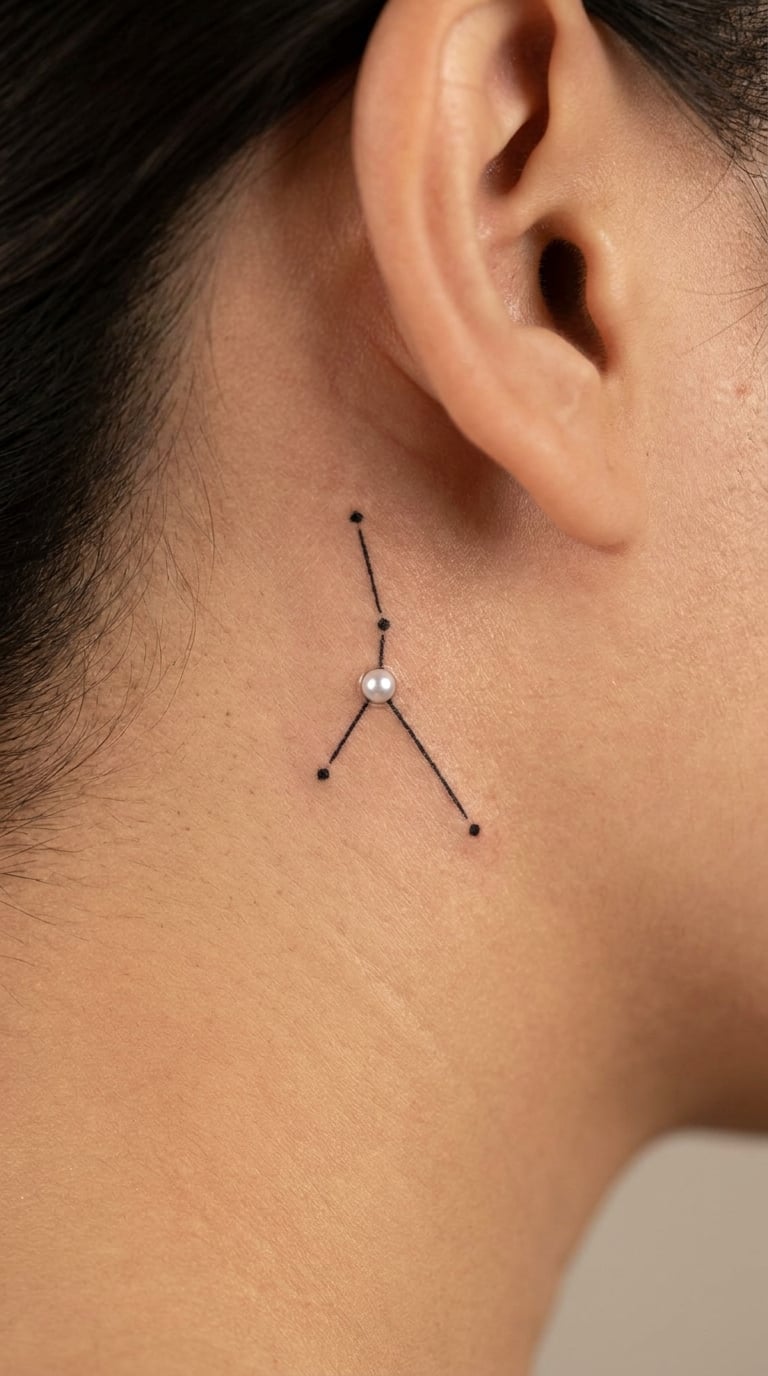
The Cancer constellation is a faint scatter of mid-sized stars, which makes it a poor candidate for a hairline diagram and a good one for a design that leans on a single accent. This version places one unshaded white pearl-style dot at the centre of the star field.
Because the sign’s pattern is subtle, the pearl does the emotional work. People usually describe it as the quietest piece in their collection rather than a statement.
Placement: behind the ear, centred on the flat patch of skin behind the lobe. Size: 2 inches (5 cm) across. Style: fine line with a single solid accent. Pain: 5/10. Behind the ear is thin skin over bone and it flinches.
Tiny work in this spot needs a steady hand and a break-rest-break rhythm, or the star points creep. Make it yours: put a real pearl in the piercing nearest the design so the accent reads deliberately when your hair is up.
6. Scorpio Constellation in Red Ink on the Wrist
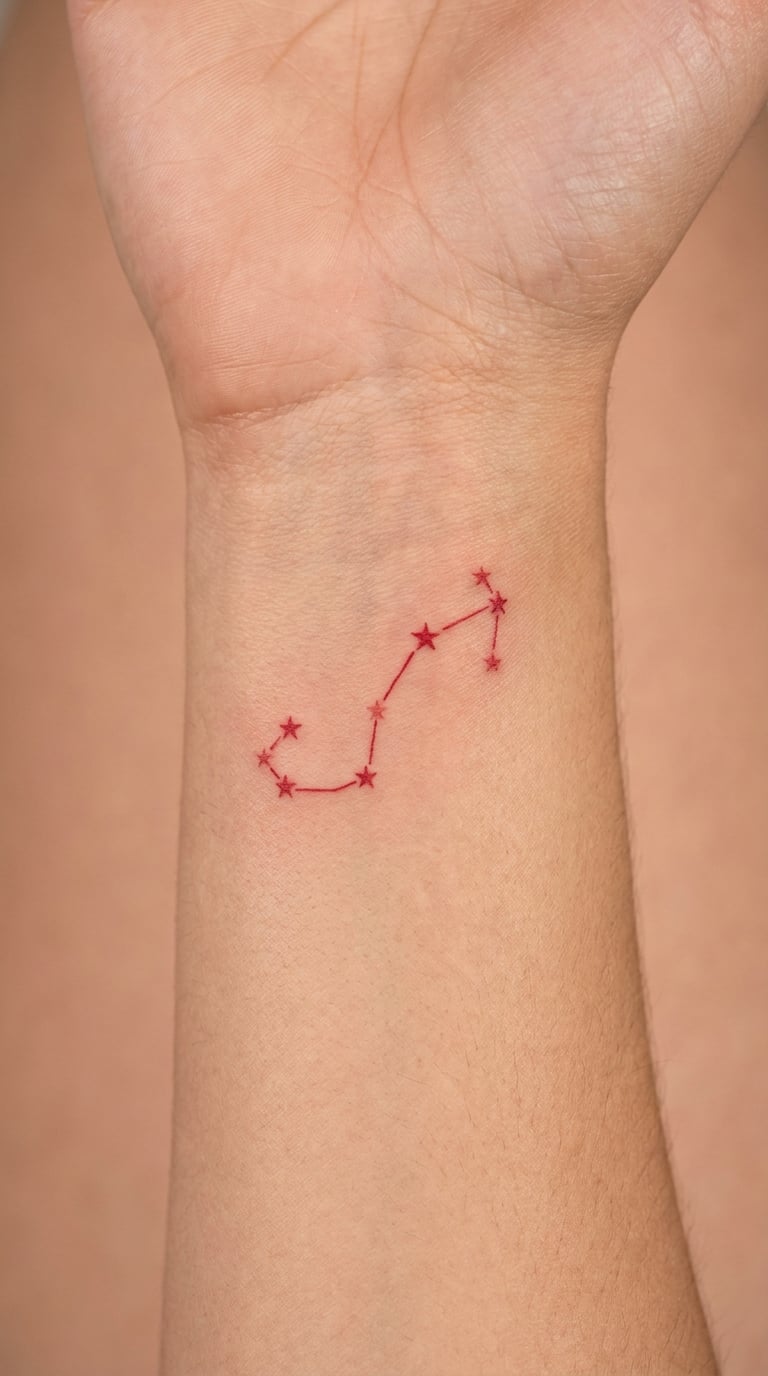
Scorpio in red is a small, dense run of stars with short hairlines between them, done entirely in a single red tone. There is no black in it at all, which is what separates it from every other wrist piece you own.
Red reads warmer and closer to the skin than black does, and it suits people who want a visible tattoo that still looks like part of the arm.
Placement: inner wrist, set slightly toward the elbow so it clears the pulse point. Size: 2 inches (5 cm) across. Style: colour fine line. Pain: 5/10. The inner wrist is thin and veiny, and the wrist bone itself is a tough spot.
The honest ageing note: red on the wrist fades noticeably faster than black, and it can shift warm over time, so expect a touch-up in a few years. Make it yours: pair the five stars with a single hairline curve suggesting a tail, drawn in a different red.
7. Gemini Constellation as Matching Twin Stars
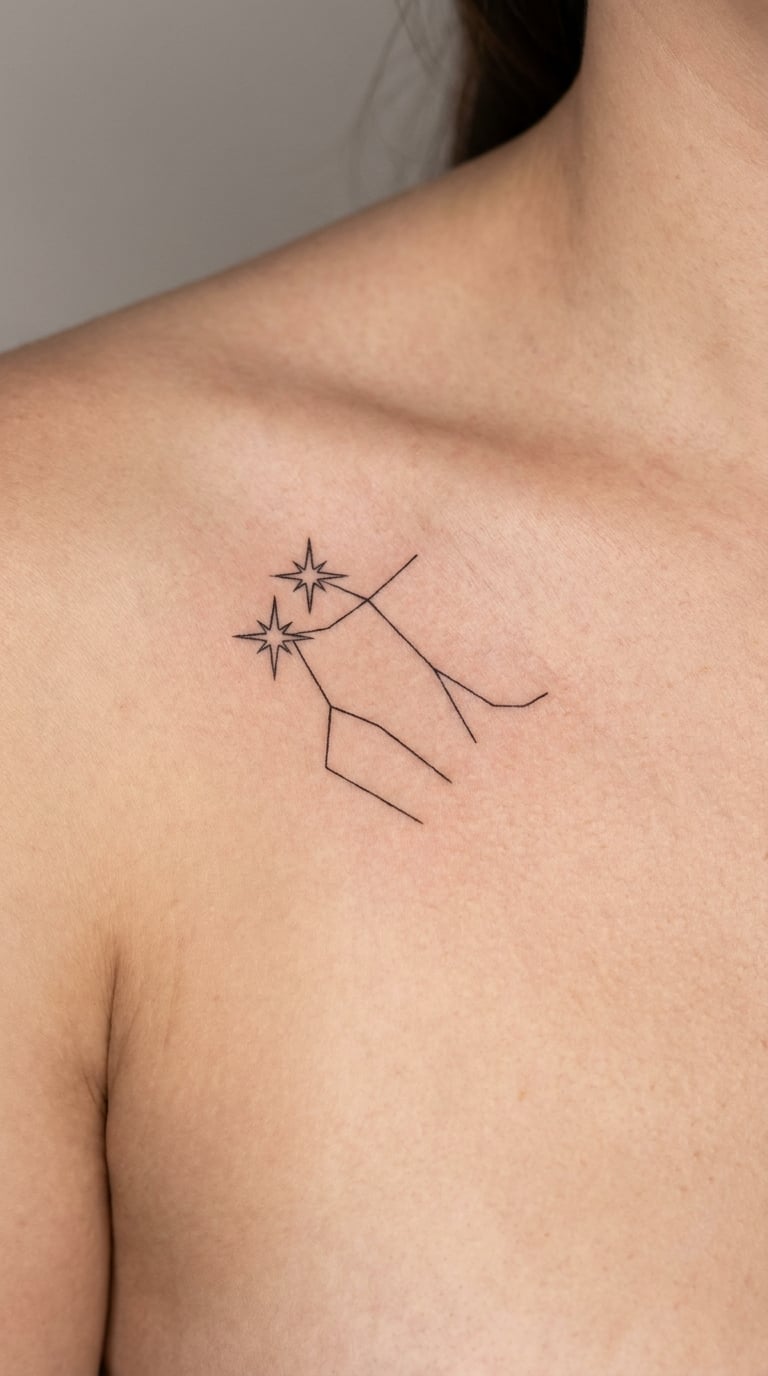
Two mirrored stars sit on either side of the Gemini constellation, the same size, angled away from each other. The mirrored pair borrows the sign’s twin motif without illustrating it literally.
It works because the symmetry is a device you can see from across a room but barely register up close, which is a good balance for a chest piece. Our Gemini tattoo ideas for women covers the glyph and motif versions of the same sign.
Placement: upper chest, between the collarbones, centred. Size: 2.5 inches (6 cm) wide. Style: fine line, symmetrical layout. Pain: 5/10. The sternum area bruises visibly and is sensitive bone.
Skin movement under the collarbone is minimal, so the fine lines here hold better than the same design on a wrist. Make it yours: have the two stars carry a small engraved initial each, one letter apiece.
8. Taurus Constellation with a Crescent Moon
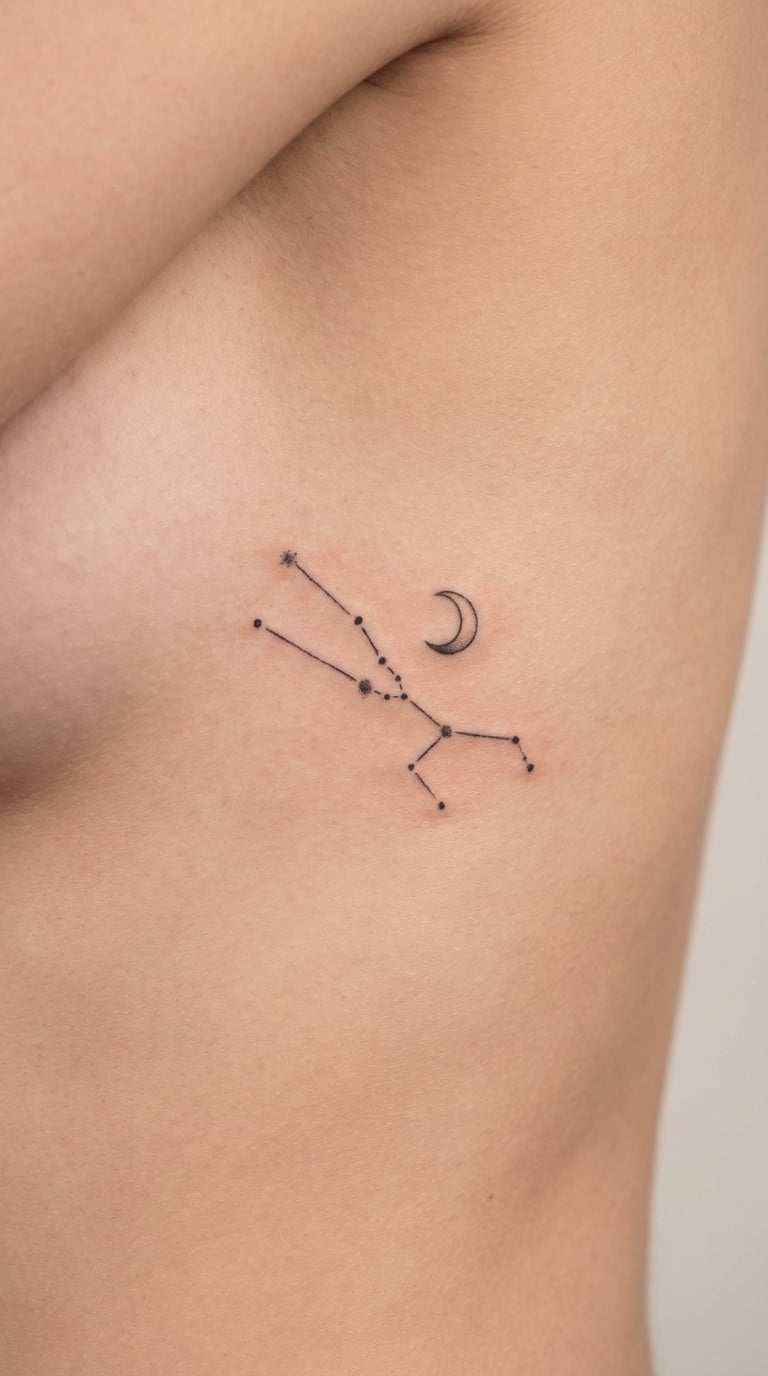
The Taurus pattern here is drawn with a few soft connecting lines, and a small crescent moon sits just off the top star, almost touching it. The moon is the same line weight as the constellation, so nothing feels pasted on.
People usually add a moon because it turns a sign tattoo into something that reads at a distance as celestial rather than astrological. Both readings suit most people who pick Taurus.
Placement: beside the sternum, running vertically, or across the upper chest. Size: 3 inches (7.5 cm) tall. Style: fine line. Pain: 6/10. Sternal skin is thin and the bone underneath is unforgiving.
Vertical designs on the sternum can lengthen visually, but they also show movement when you breathe and stretch, so the artist should leave breathing room around the moon. Make it yours: add a birth date in a small arc beneath the lowest star.
9. Libra Constellation in Watercolor on the Back
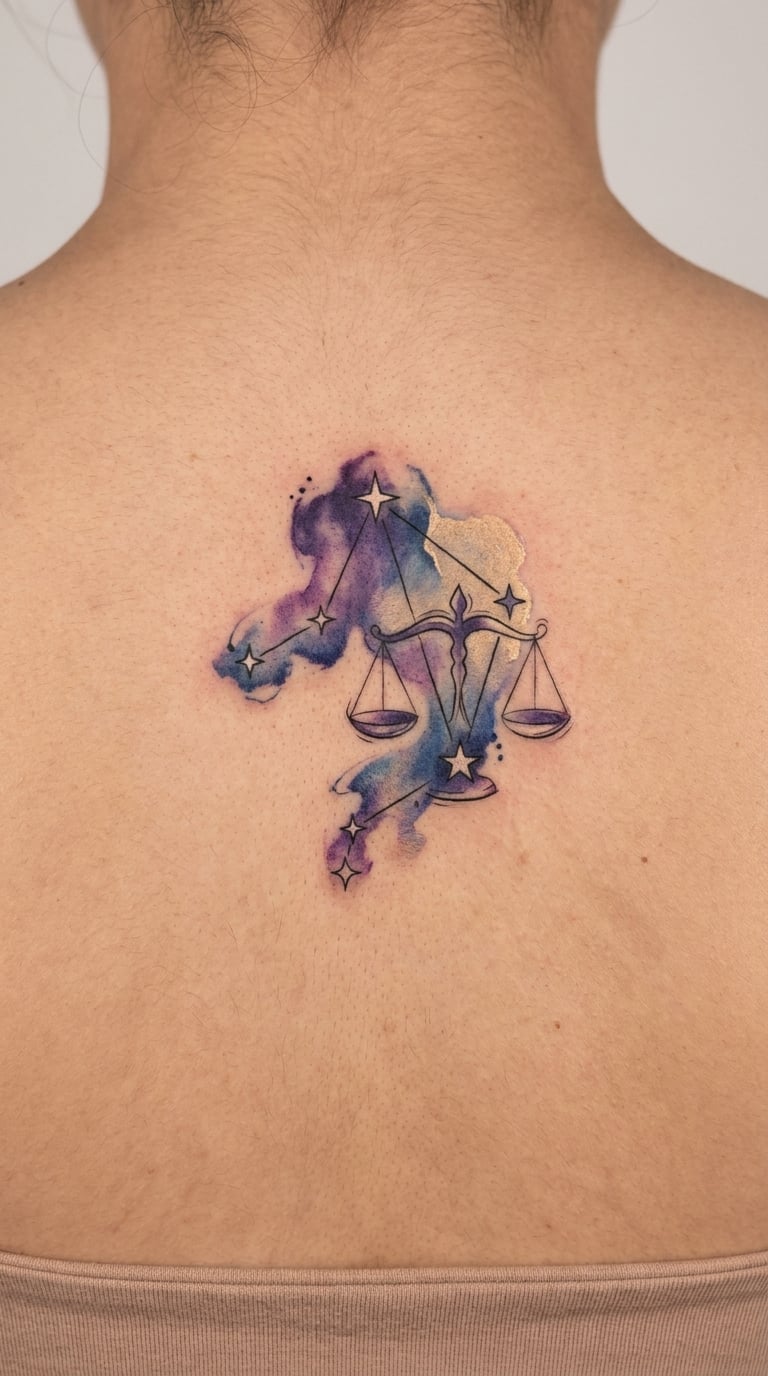
A restrained Libra constellation sits in the middle of a soft colour wash that bleeds outward in violet, blue and pale gold. The stars stay black and crisp, which is what stops the wash swallowing the design.
Watercolour is the style most people in this list are looking for without knowing the word for it. It reads as art rather than as a symbol, and it does not compete with clothing the way heavy blackwork does.
Placement: between the shoulder blades. Size: 5 inches (12.5 cm) wide. Style: watercolour with fine black line stars. Pain: 5/10. The back is sensitive in shallow areas but the muscle over the shoulder blades helps.
Colour softens and lightens over time, so treat the wash as something that will get paler and plan for a saturation refresh rather than expecting the first-day colour to last. Make it yours: ask for a two-colour wash using only shades you actually wear.
10. Aries Constellation with a Sweeping Flame
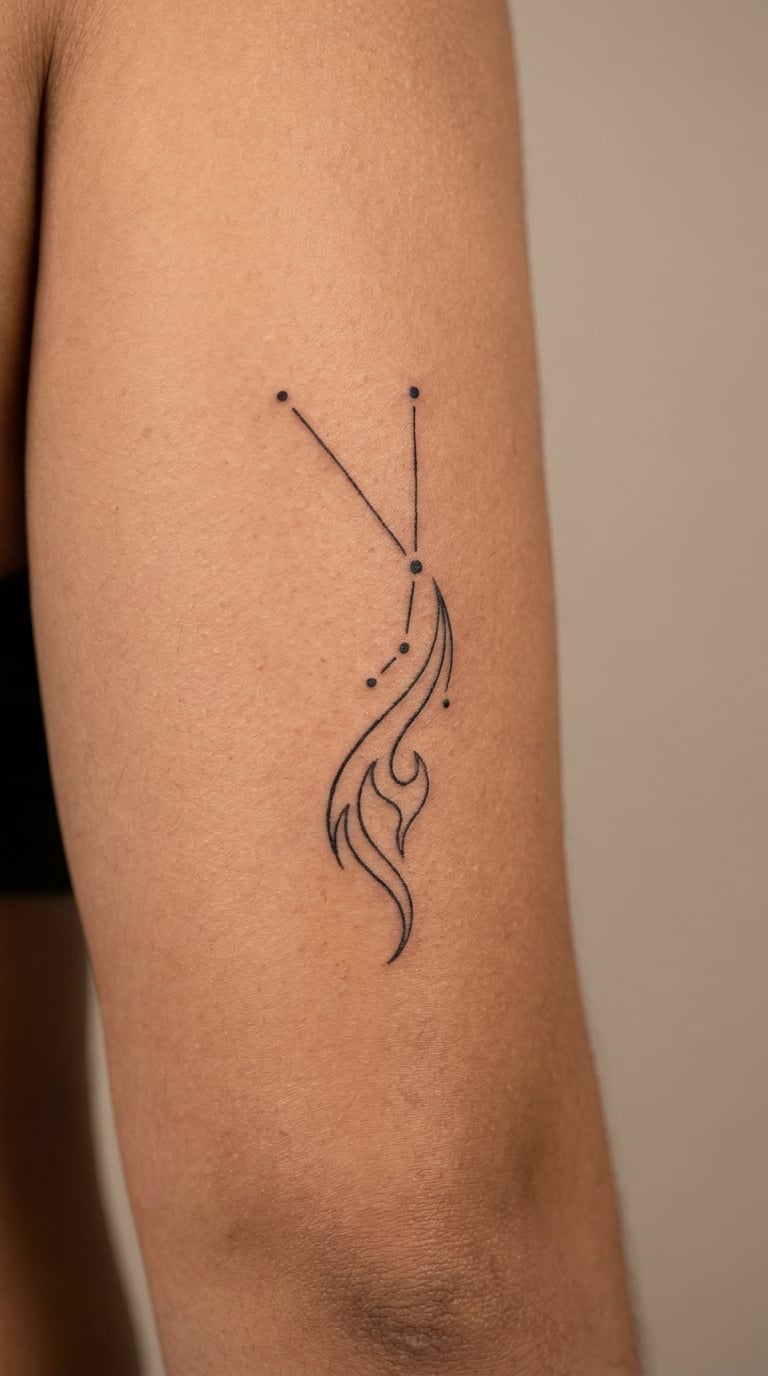
The Aries star points are drawn normally, then the last connecting line extends past them into one long tapering flame. It is still black line throughout, but the single sweep gives the design movement.
Aries is the sign most often described in plain, forward terms, and a flame says that without adding a second symbol. Plenty of wearers just like the shape.
Placement: outer upper arm, above the elbow. Size: 3 inches (7.5 cm) tall. Style: graphic fine line. Pain: 4/10. The outer upper arm is one of the easier placements on any list.
Flame linework depends on long unbroken strokes, so this is a design where the artist’s line control matters more than the design’s detail count. Make it yours: have the flame taper into a single thin line that points at a second, smaller piece years later.
11. Pisces Constellation with Two Flowing Fish
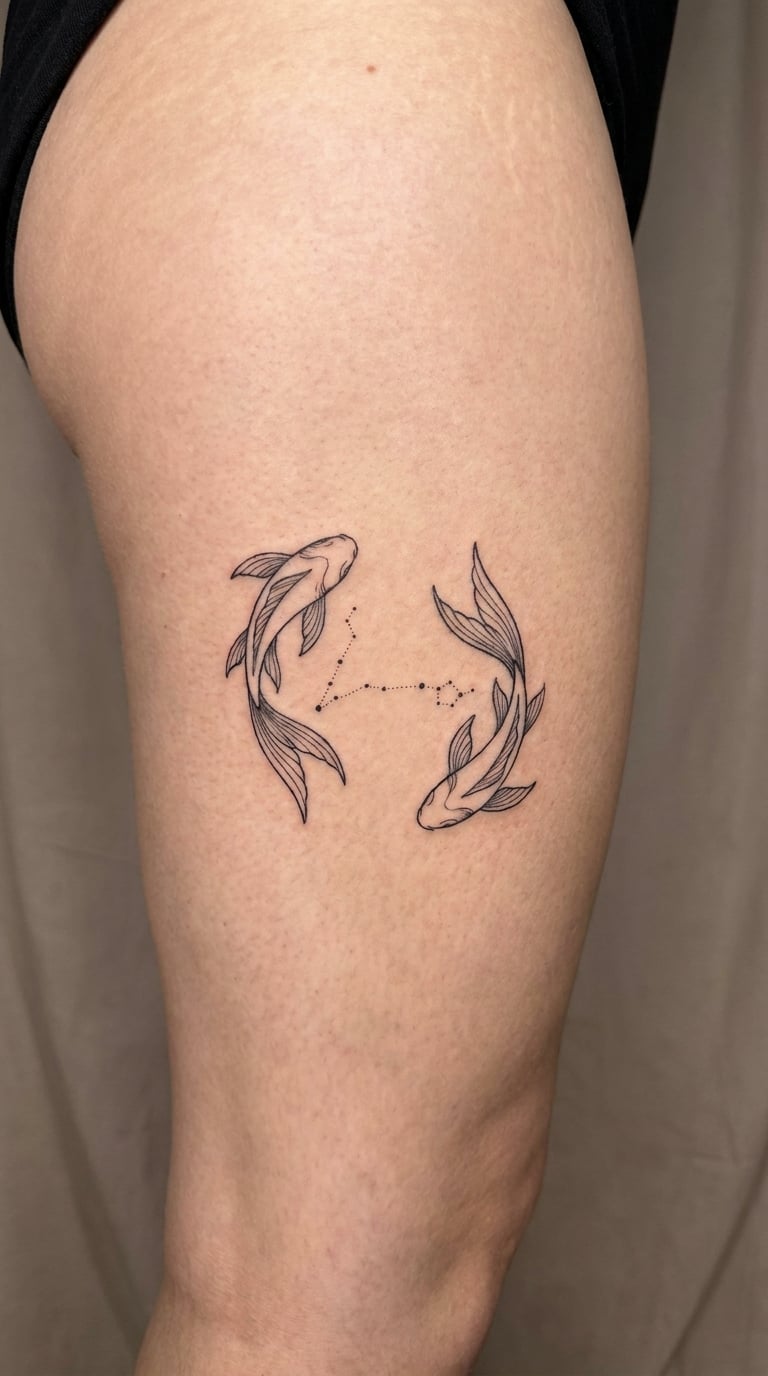
Two simple fish curve away from each other in outline, with the Pisces constellation sitting small and central between them. The constellation stays the accurate part; the fish are stylised on purpose.
Getting the star pattern right is what separates this from the countless two-fish zodiac tattoos that read as a generic symbol. If the stars are accurate, the whole piece feels specific.
Placement: side thigh, or the outer calf if you prefer it lower. Size: 3 inches (7.5 cm) wide. Style: fine line with light outline work. Pain: 5/10. The thigh is fleshy and easier than it looks, but the outer edge near the hip is tender.
Thigh skin has good blood flow and stays smooth, though the design will stretch a little as the body changes. Make it yours: have the two fish face each other across the constellation, forming a loose circle that frames the stars.
12. Aquarius Constellation in Geometric Line Art
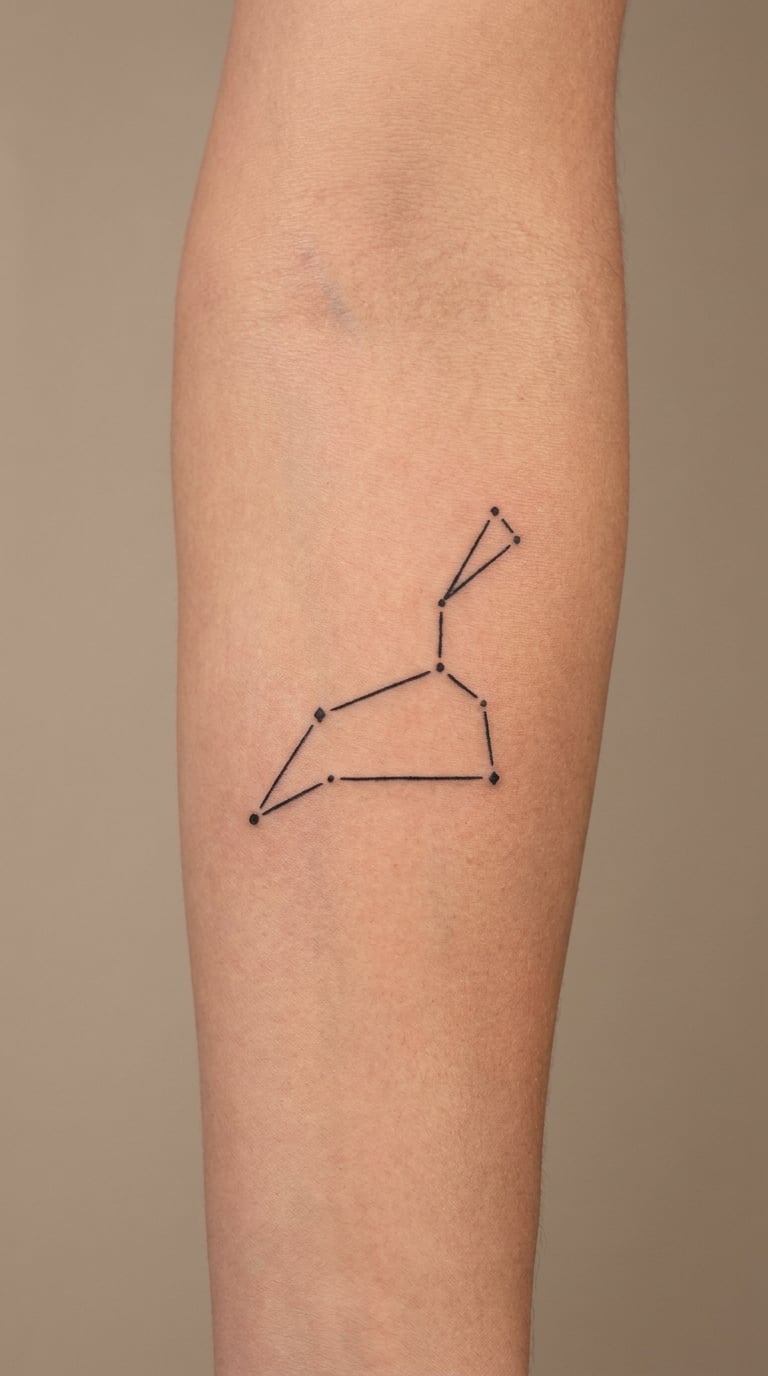
Aquarius here is built from angles: straight segments meeting at hard corners, dots at the real star positions, and no curves anywhere in the design. It looks like architecture, which is a change of pace from the round, flowing zodiac styles.
Geometric treatment suits people who like the star map for what it is, a diagram of a real patch of sky, rather than as a symbol with a story attached.
Placement: forearm, running along the bone. Size: 2.5 inches (6 cm) wide. Style: geometric line art. Pain: 4/10.
Angular joins are where ink can pool and spread, so a healed photo from the artist is worth asking for. Make it yours: have the geometry drawn to your actual birth constellation’s real coordinates rather than the generic Aquarius flash shape.
13. Capricorn Constellation with Mountain Peaks
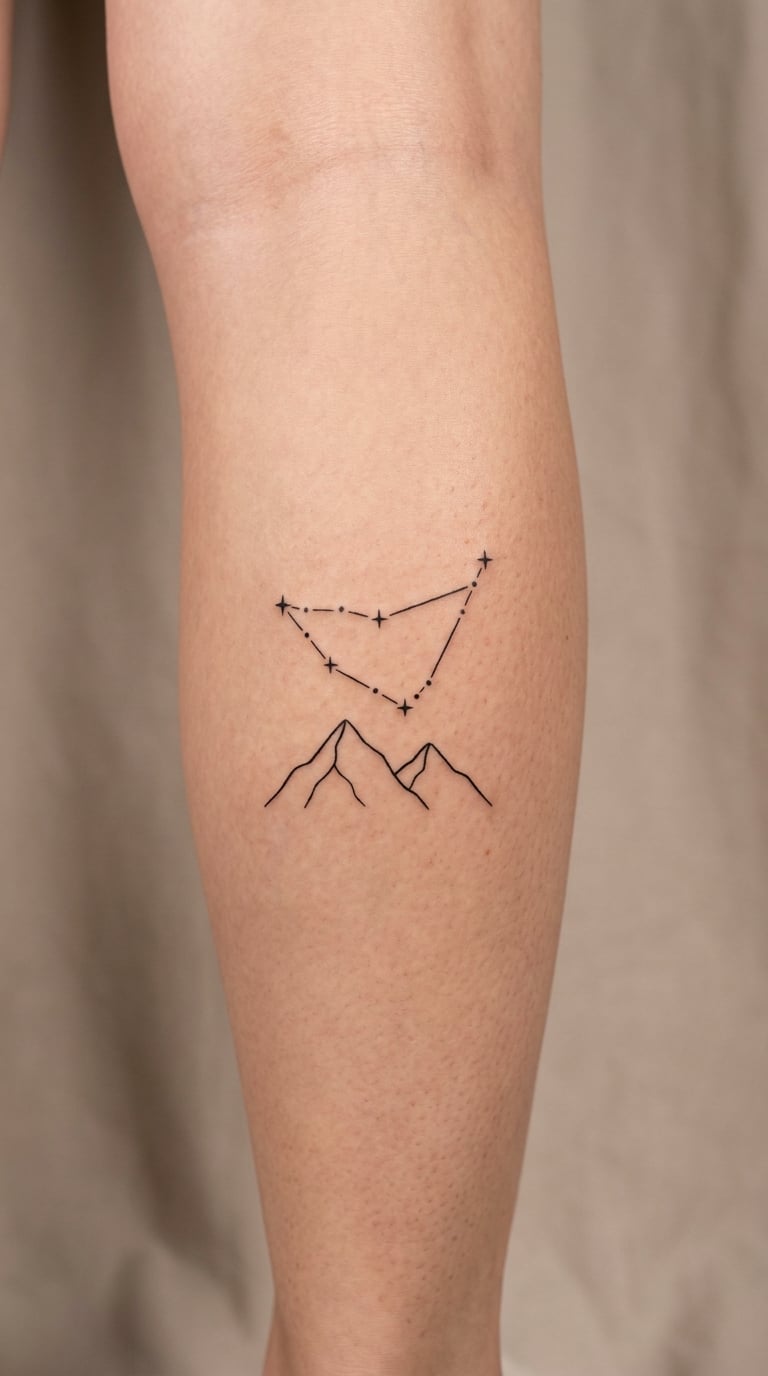
Two minimal peaks sit underneath the Capricorn star points, drawn with a few decisive lines and no texture. The mountains are smaller than the constellation, so the stars stay the subject.
Capricorn is often described in climbing and endurance terms, and the peaks make that reading obvious without a mountain range sprawling across the design.
Placement: outer calf, or the inside of the upper arm. Size: 3 inches (7.5 cm) tall. Style: fine line. Pain: 5/10. The outer calf has a large muscle but the skin is thin over it.
Calves change shape with activity and weight, and horizontal designs on the calf are the first to show it, so keep the piece narrow. Make it yours: have the peaks reduced to your home range, or to a mountain you have actually stood on.
14. Taurus and Virgo Matching Constellations
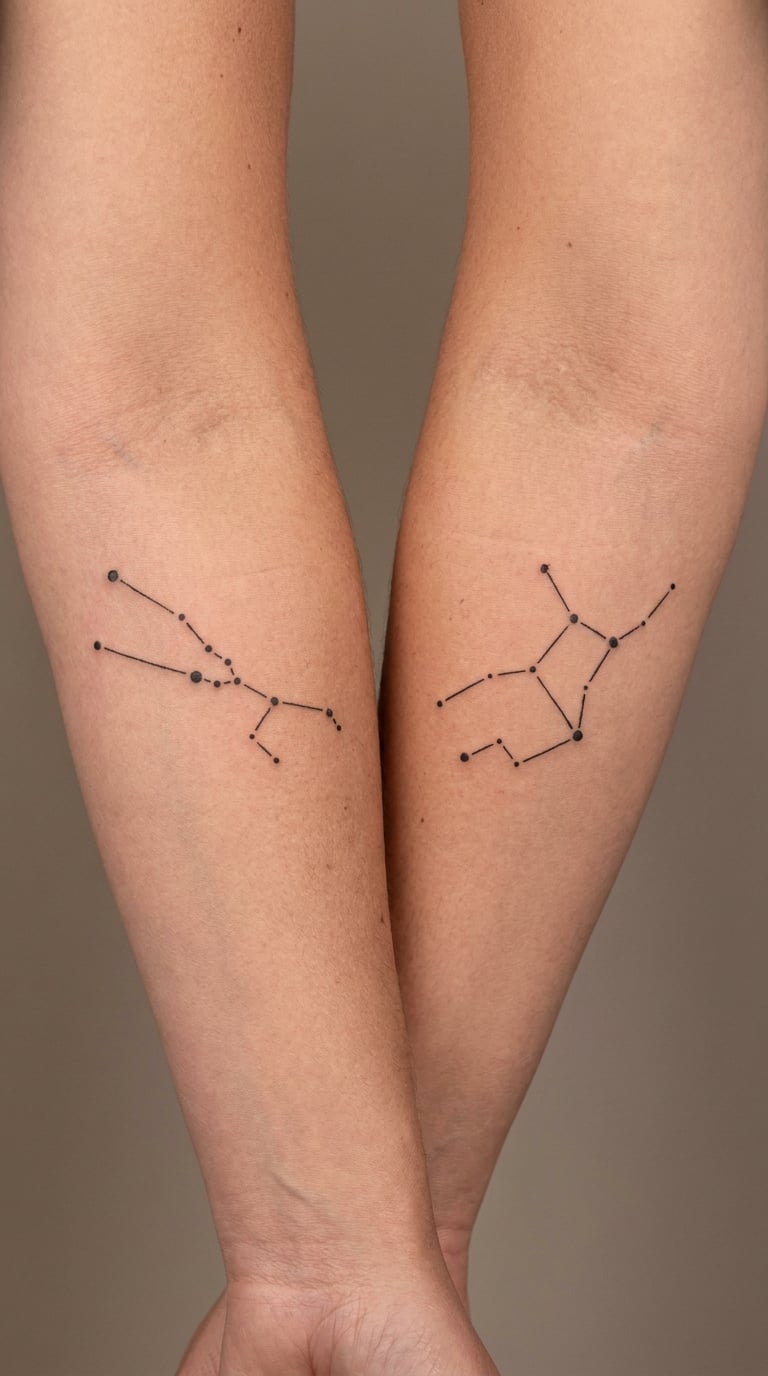
Two separate constellation tattoos, designed as a pair but tattooed on two different people. The stars differ, the line weight and dot size are identical, and the two sit at the same distance from the wrist so the arms read as matched.
Friends, partners, siblings and mothers with daughters all ask about this format. The hard part is layout rather than drawing: a family series needs a fixed size and line weight across every piece, or the arms end up looking scattered instead of matched.
Placement: inner forearms, same height on both people. Size: 2 inches (5 cm) each. Style: fine line, matched. Pain: 3/10.
On the inner forearm these two will fade at different rates depending on which arm each person uses more, so expect the designs to drift apart slightly over the years. Make it yours: choose signs that mean something to the pair rather than the easiest two to draw.
15. Southern Cross Constellation Behind the Ear
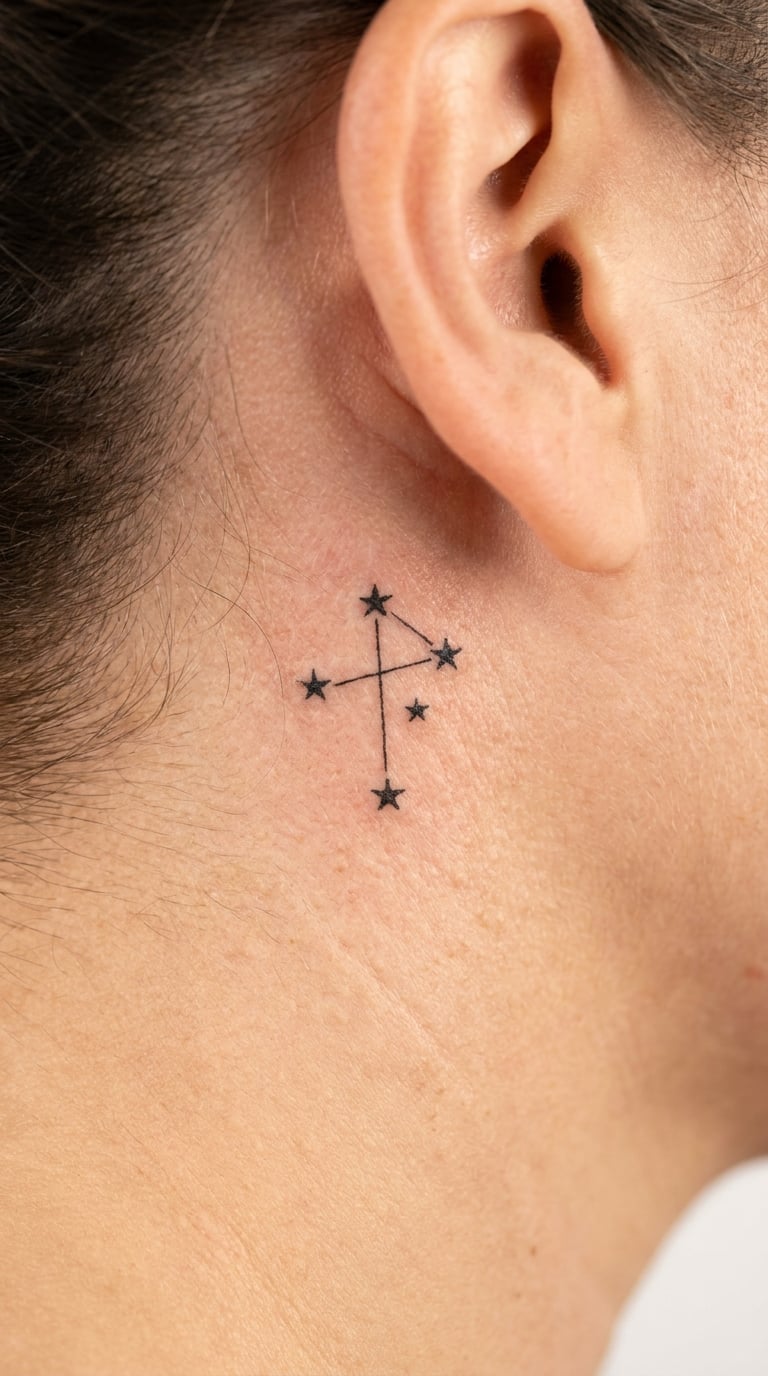
Four stars and one small fifth make the Southern Cross at one inch across, drawn with dots and the shortest hairlines possible. It is genuinely small, which is the entire point: it is a design that stays private unless someone is standing behind you.
For a woman who wants the sky on her body but not on her public profile, this is the most discreet option in the list.
Placement: behind the ear, tucked into the crease. Size: 1 inch (2.5 cm) across. Style: fine line, dotwork-leaning. Pain: 5/10, and the detail level means the artist may pause repeatedly.
Honest warning: at one inch, this is the design most likely to soften into an unreadable smudge over time, because the dots are barely above a hairline width. If longevity matters to you, go to 1.5 inches. Make it yours: add the Southern Cross plus a single dot for a star you cannot see from home.
16. Orion Nebula in Watercolor on the Rib
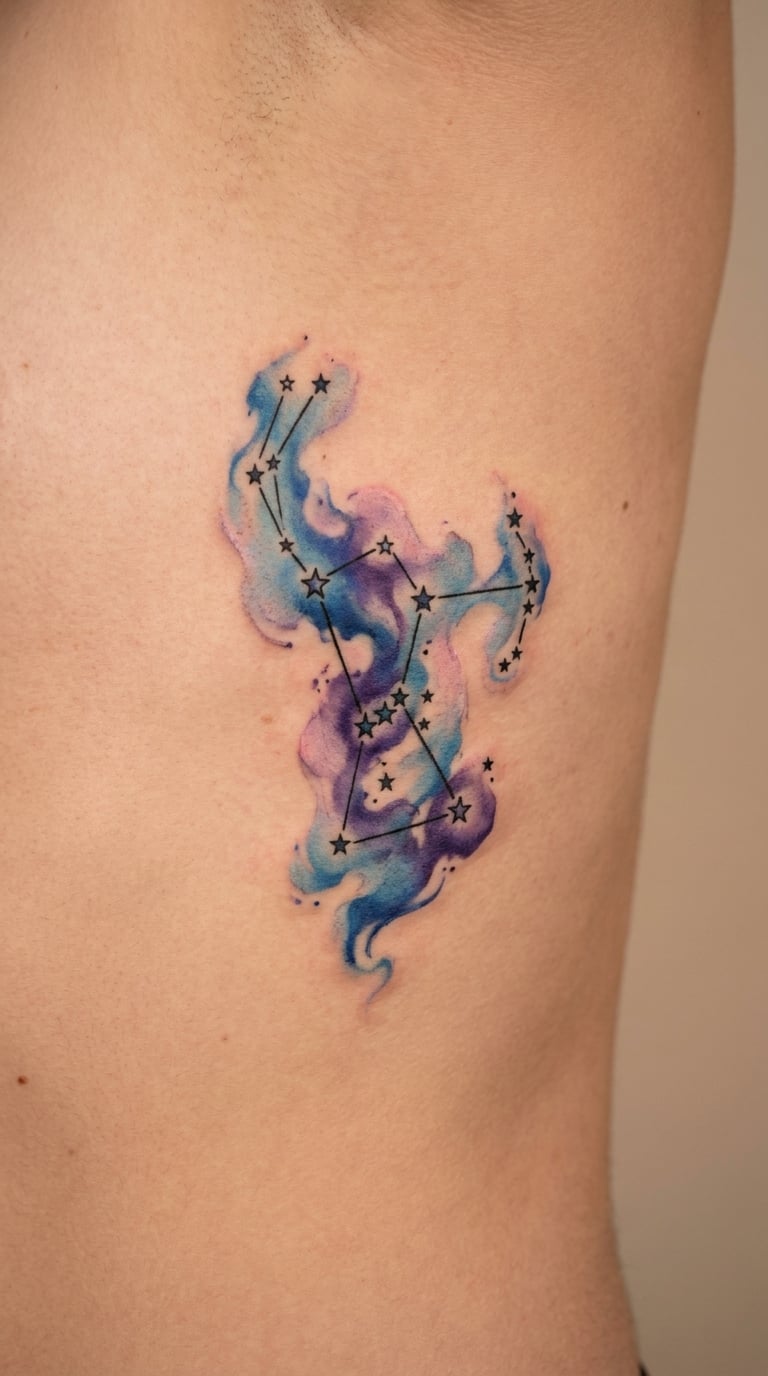
Orion’s three belt stars are the anchor, drawn in sharp black, with a soft nebula wash bleeding out behind them in blue, violet and pale pink. The belt is what makes the design identifiable once the colour settles.
What people like about an Orion piece is that it stays simple and instantly recognisable, and that is the brief here. Keep the wash loose and the stars exact.
Placement: side rib, following the curve of the bone. Size: 4 inches (10 cm) tall. Style: watercolour with black fine line. Pain: 7/10. Ribs sit right under the sharpest end of the scale, with the inner elbow close behind.
This is the first design here I would not suggest as a first tattoo, mostly because the pain and the colour mean a longer session on a difficult canvas. Make it yours: have the wash use the exact colours of a nebula photo you bring, printed and in hand.
17. Big Dipper Constellation as a Minimal Back Piece
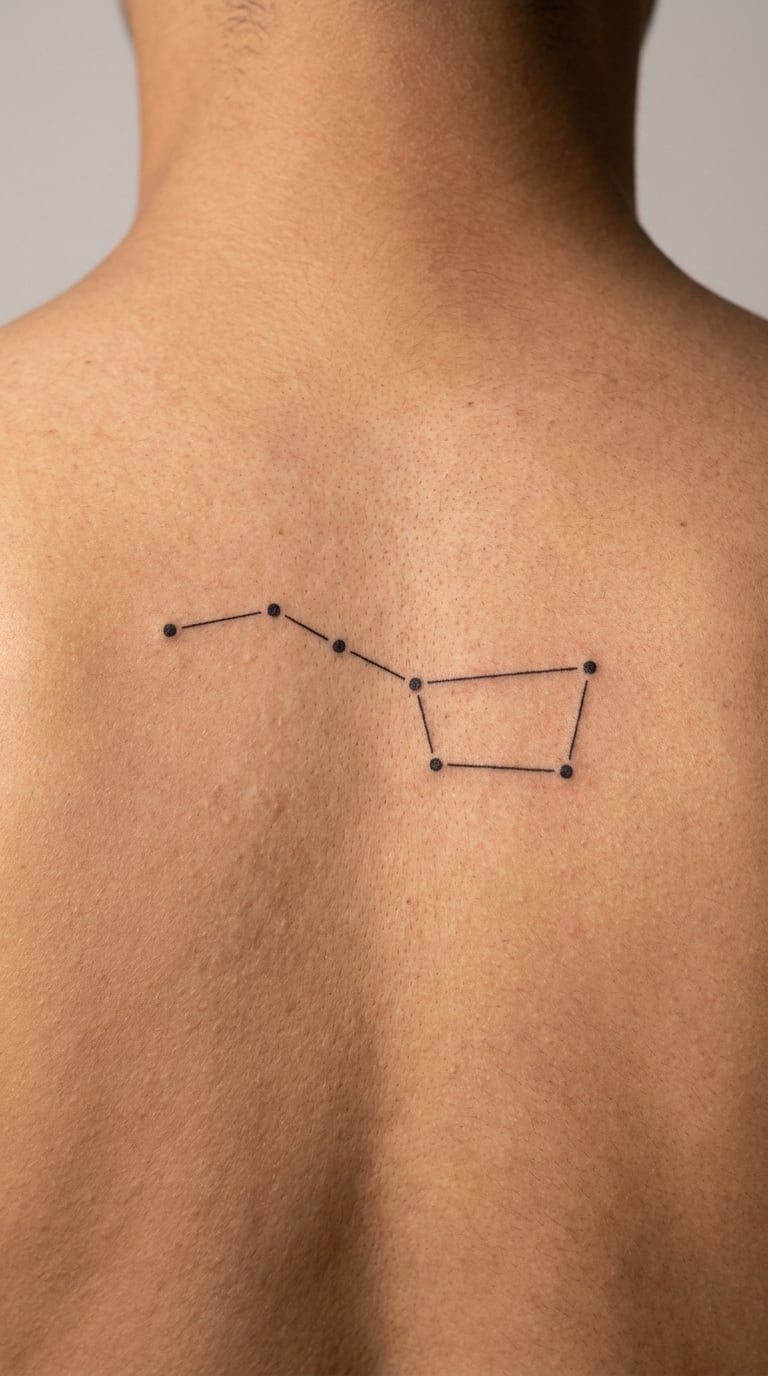
Seven Big Dipper stars at six inches wide, with long unbroken hairlines and a lot of empty skin between them. Large scale is the whole idea: at three inches the Big Dipper is a small line drawing, at six it becomes architecture.
The upper back gives you the most room to work with and it is easy to hide under a shirt, which makes a larger piece far more practical than it sounds.
Placement: upper back between the shoulder blades, or spanning the shoulder blades. Size: 6 inches (15 cm) wide. Style: minimal black line. Pain: 4/10. The back is easier than most people expect for a large piece.
Fine line across a wide area can develop a faint “outline” look as the interior lines fade faster than the long runs, so ask the artist to vary the line weight slightly. Make it yours: add a single line of small stars underneath, a slice of the sky where the Dipper sits in relation to your birth constellation.
18. Northern Crown in Fine Line on the Hand
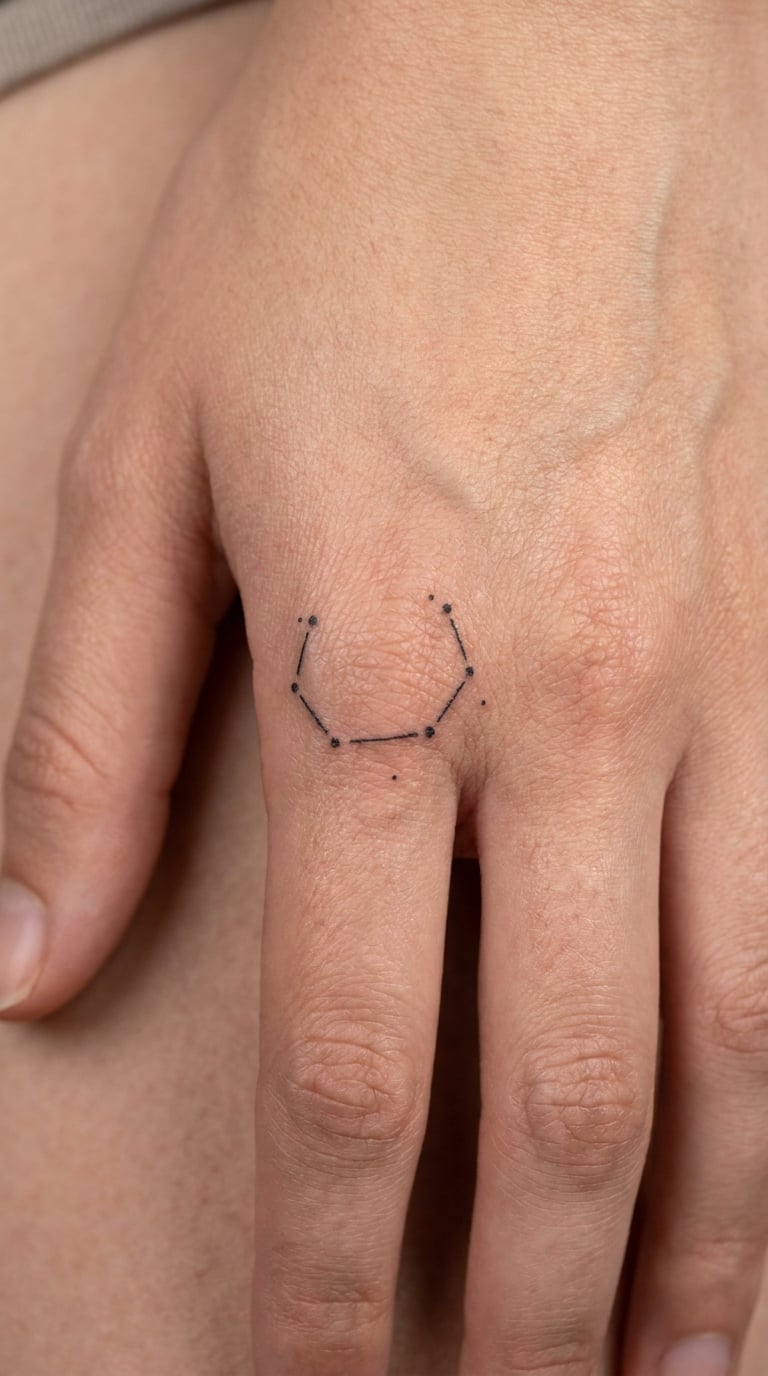
The Northern Crown, also called Corona Borealis, is an arc of seven small stars that looks like a shallow curve. At two inches across the back of the hand, the arc sits naturally between the knuckles and the wrist.
Hands are the placement people ask about most and regret fastest. Daily use, sun, washing and knuckle movement all work on the design.
Placement: back of the hand, parallel to and just above the knuckle line. Size: 2 inches (5 cm) wide. Style: fine line. Pain: 7/10, because you feel every line in a hand.
Be honest with yourself about this one. Fine-line star dots on the back of the hand blur faster than anywhere else, and many hand pieces need rework within five years. If you want the hand, our small hand tattoo ideas for women that age well has placements that hold up better. Make it yours: mirror the arc across the other hand, which balances the wear on both.
19. Andromeda Galaxy in Micro-Realism on the Thigh
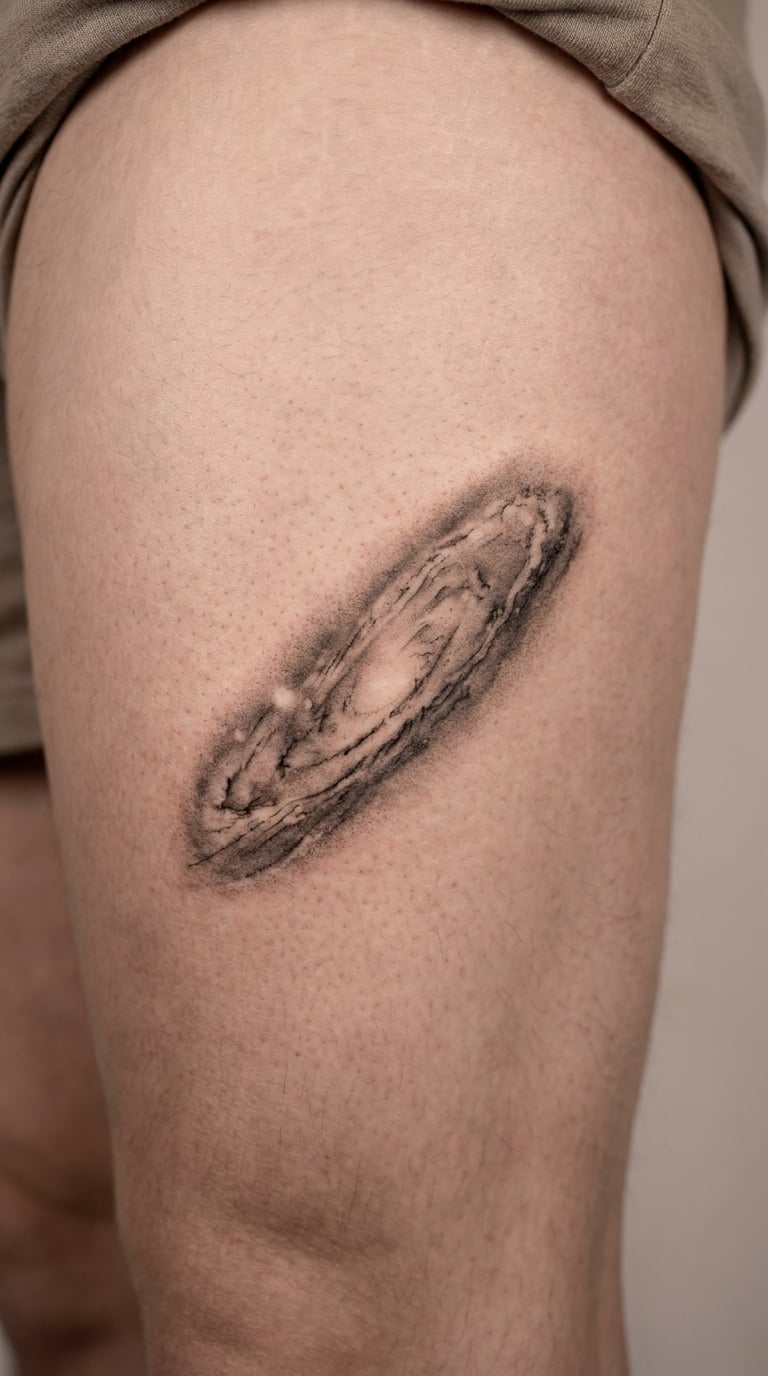
Not the line pattern, the galaxy itself: a dense core of soft grey shading, dust lanes built from scattered micro-dots, and no hard outlines anywhere. This is the most technically demanding idea on the list, and the one that rewards patience most.
Pairing a shaded galaxy with a simple line constellation is a request artists get often, and the pairing works because the shading carries the shape while the lines carry the accuracy.
Placement: outer thigh. Size: 3 inches (7.5 cm) across. Style: micro-realism, black and grey. Pain: 4/10.
Shading work needs more time under the needle than a line piece of the same size, so expect a longer sitting. Make it yours: bring a photograph of a specific galaxy rather than a name, since the artist will need the tonal reference.
20. Lyra Constellation with a Small Harp
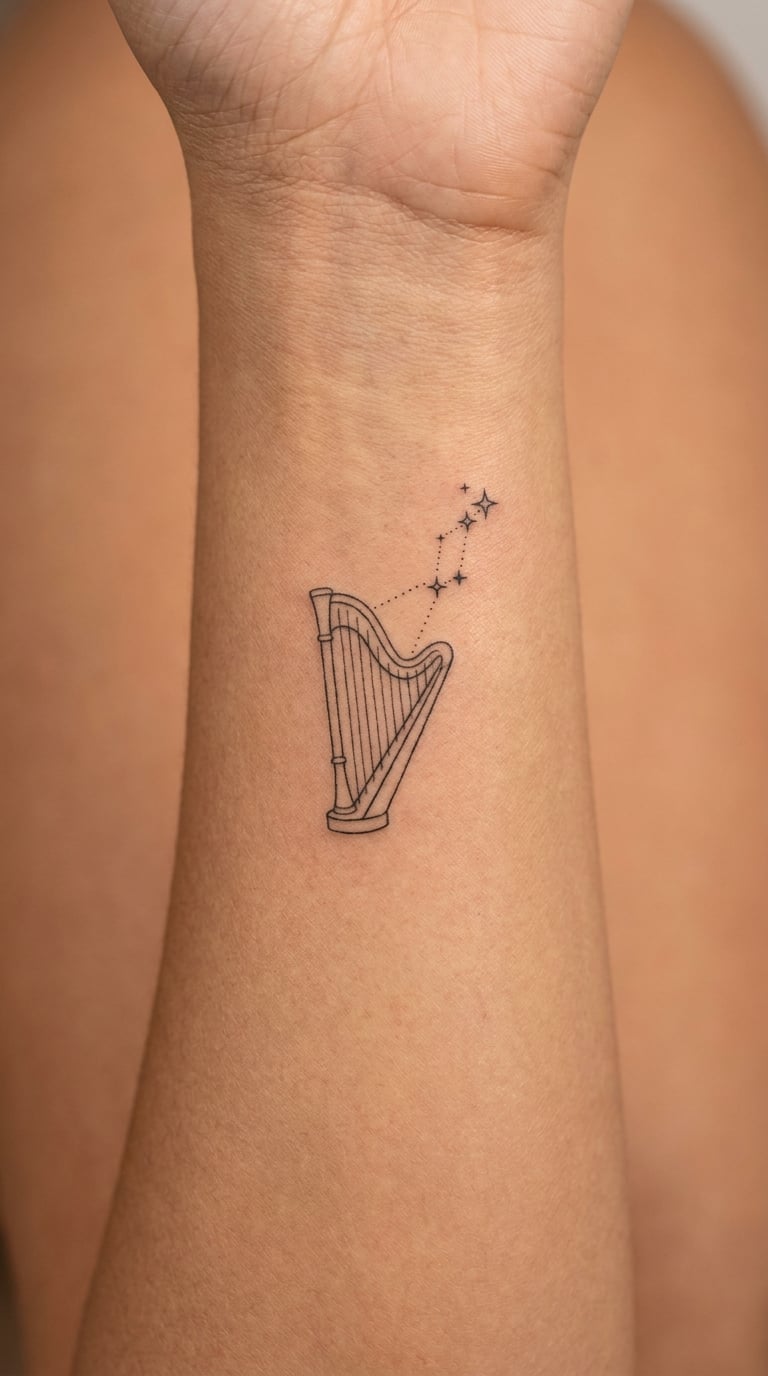
The Lyra constellation connects directly to a small outline harp, sharing one line so the two read as a single drawing. The harp is simplified to a curved frame and a few strings, nothing ornamental.
Lyra is the constellation associated with music in its cultural background, so the instrument is the obvious companion. This one feels less like a zodiac sign and more like a personal mark, which is usually the reason it gets chosen.
Placement: inner arm or the soft area above the elbow crease. Size: 2.5 inches (6 cm) tall. Style: fine line. Pain: 3/10.
The inner arm is warm and well supplied, so ink settles there differently than on the wrist. Ask for a break if the skin flushes, since warmth makes fine lines look heavier than you intended. Make it yours: add your actual instrument, or the shape of one, instead of the generic harp.
21. Cancer Season Moon-Phase Constellation
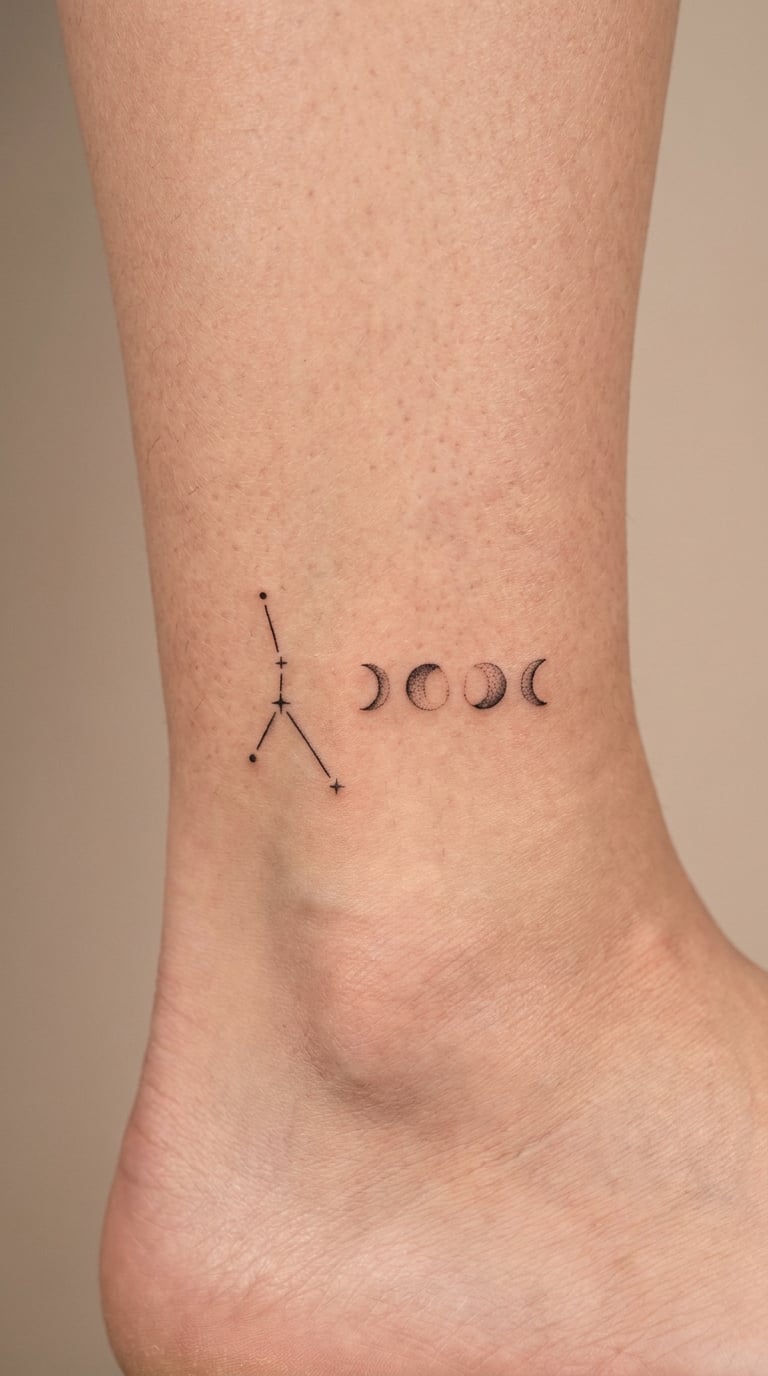
Four moon phases in a row, evenly spaced, with the Cancer constellation sitting beside them at the same visual weight. The phases are the repeating element and the constellation is the anchor.
The moon row is the most commonly added secondary element across every style on this list, because it gives a small design a sense of sequence without adding detail.
Placement: ankle, just above the bone on the inner side. Size: 2 inches (5 cm) across. Style: fine line, repeating motif. Pain: 6/10. Ankles are bony and the skin there is thin and mobile.
Ankle fine line wears through faster than almost anywhere, partly from shoe contact and partly from sun exposure. Make it yours: use the moon phases from a specific year so the sequence is quietly personal and nobody else can tell.
22. Zodiac Wheel Constellation in Traditional Style
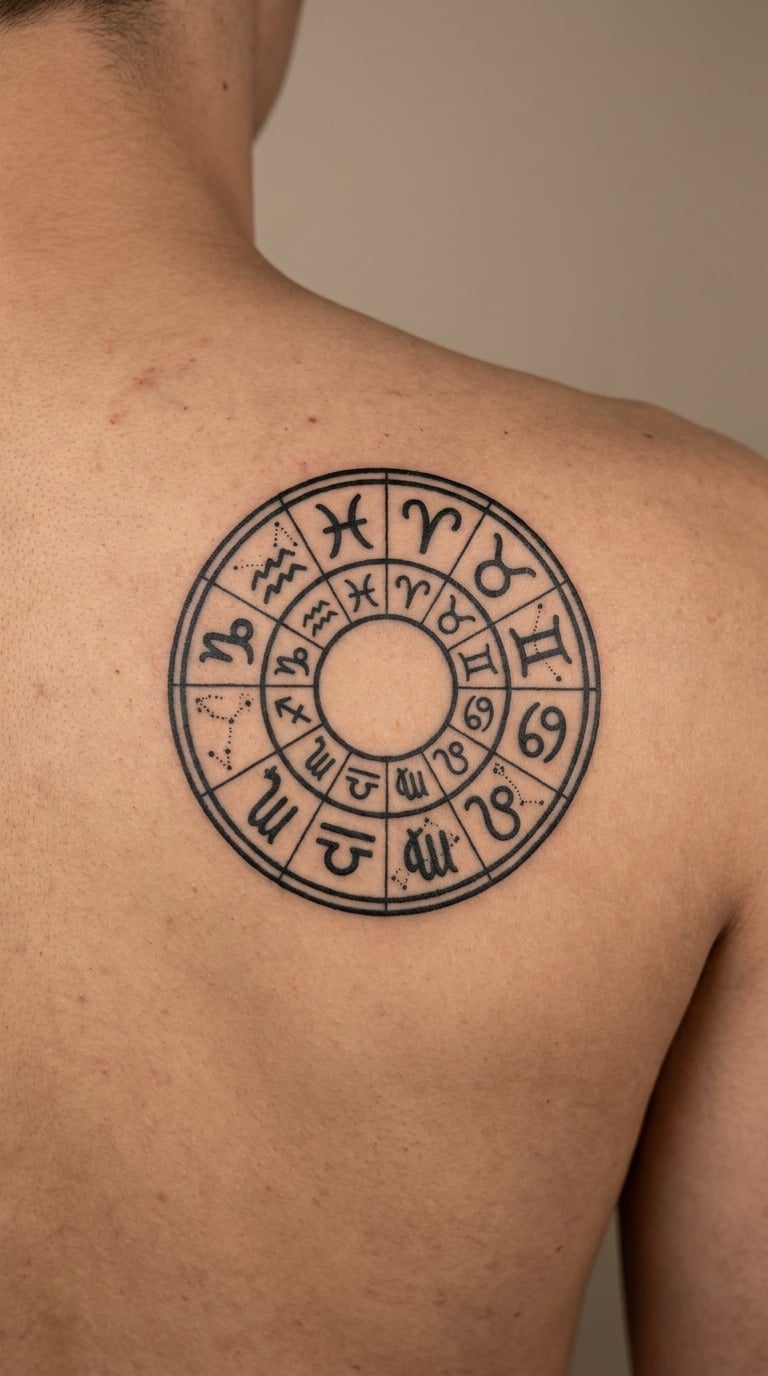
A full circular zodiac wheel in bold black outline, with the twelve signs spaced around the ring and the constellations added as star clusters inside the relevant segments. Heavy line, solid blacks, no shading.
This is the most committed design in the list, and it is the one to choose if you already collect tattoos or want a single piece that carries all twelve signs rather than one.
Placement: upper back or outer thigh. Size: 5 inches (12.5 cm) across. Style: traditional blackwork. Pain: 5/10, and the long sitting is what makes it medium rather than low.
Traditional blackwork settles into itself and softens with a worn-in look rather than a faded one, which is the most durable treatment here. Make it yours: have your own sign’s constellation given more detail than the other eleven.
23. Favorite Star Map on the Side of the Rib
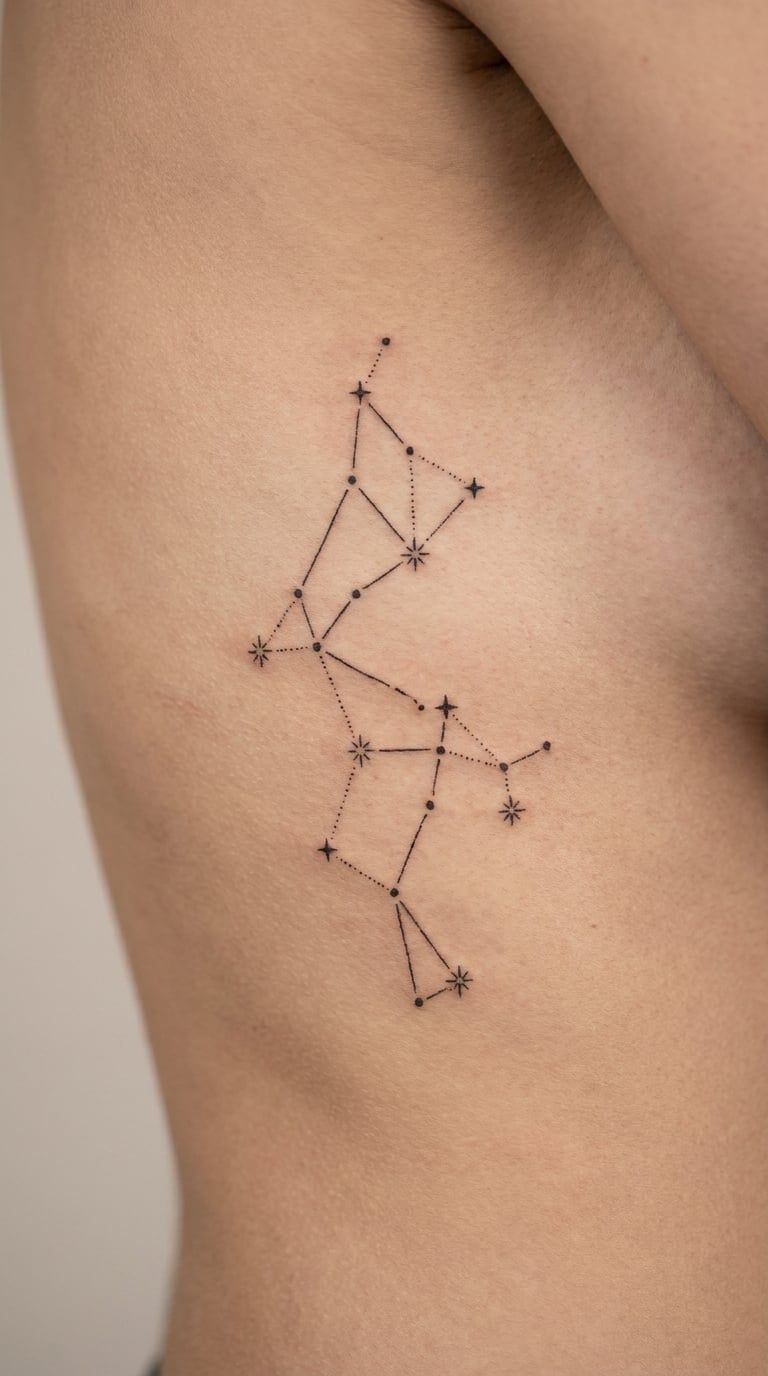
A real star map of a specific night, plotted accurately, with a dozen or so stars scattered across five inches and a few short lines joining the brightest. Nothing decorative is added, because the pattern itself is the meaning.
This is the most personal option here. The usual source is the sky over a place or date that mattered, and the emotional weight is exactly that of the date.
Placement: side rib, running vertically along the curve of the bone. Size: 5 inches (12.5 cm) tall. Style: fine line, accurate. Pain: 7/10.
Rib skin stretches when you twist and breathe, and that movement is what eventually softens vertical fine line. Make it yours: print the star chart at the exact date, time and location, and give it to the artist, because accuracy is what separates this from a random scatter of dots.
24. Minimal North Star with Personal Coordinates
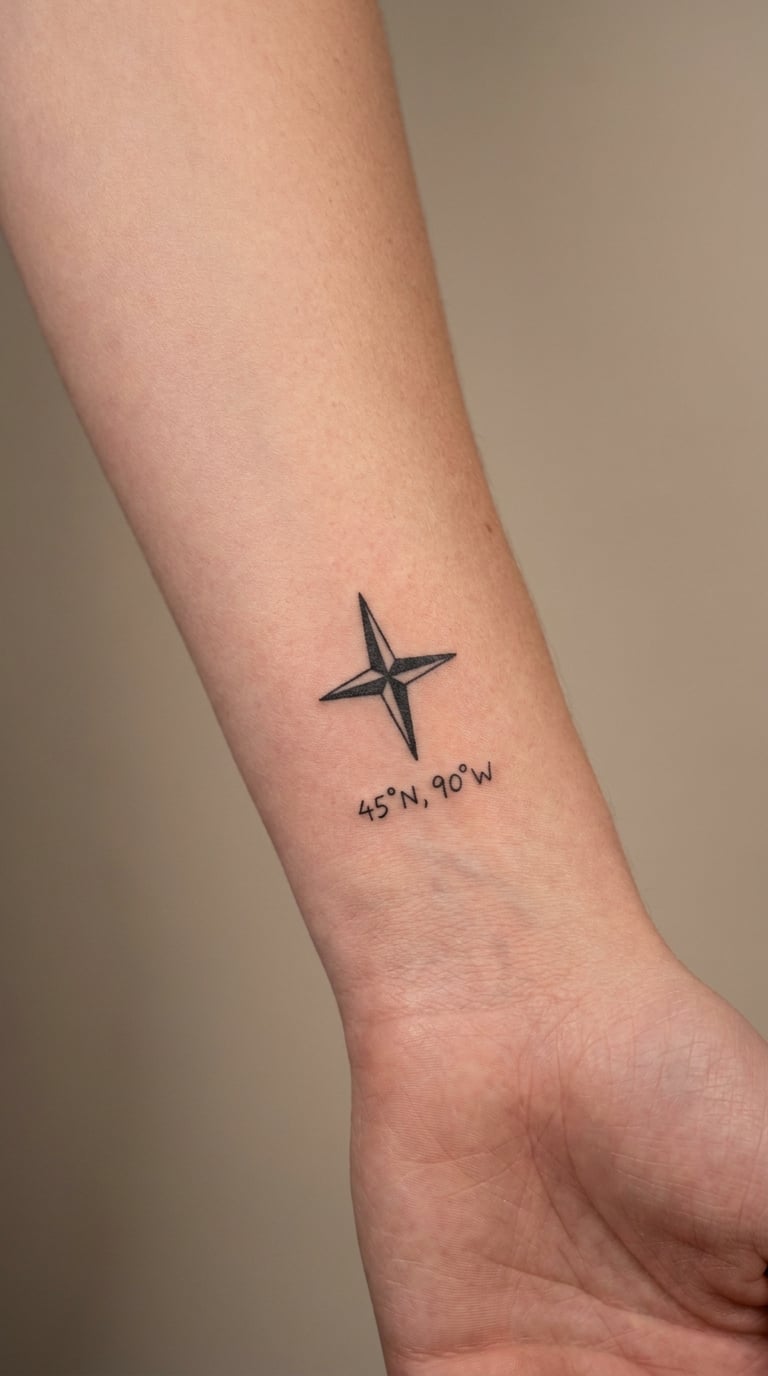
One four-pointed star, drawn with two long and two short lines, with a line of small lettering beneath it holding a latitude and longitude. Almost nothing, and it works because there is no second element competing.
Coordinates usually point to somewhere that matters, a birthplace, a place you met someone, a place you intend to live. Small lettering is a choice with a cost, though: it needs a steady hand and it will need a rework.
Placement: inner wrist, above the pulse point. Size: 2 inches (5 cm) tall. Style: minimal fine line with micro lettering. Pain: 4/10, though the lettering slows the session down.
The star is the durable part and the coordinates are the fragile part, so ask about a session plan and where you would want any touch-up to go. Make it yours: put the coordinates under the star and the date it refers to inside the star, where only you know it is there.
How to Choose the Right Constellation Design
Six things decide whether a constellation tattoo still looks like itself in fifteen years. Go through them before you book, not after.
1. Get the star pattern right. Bring a printed chart or a clear photo of the exact constellation. An artist working from memory produces a pattern that does not match the real thing, and inaccurate star positions are the most common complaint about these tattoos.
2. Check the line weight against the size. Small designs need proportionally heavier lines. Ask the artist what line weight they plan to use, because a hairline constellation at one inch will not survive the decade.
3. Match scale to placement. Wrist and hand pieces read at small scale but wear fast. Back and thigh pieces can be large and stay hidden. Decide the placement first, then let it set the size.
4. Pick a style you will still like in ten years. Fine line and dotwork fade softly. Blackwork and traditional wear in. Watercolour lightens. There is no wrong answer here, but there is a mismatch that people regret.
5. Count the detail honestly. A twelve-star zodiac sign and a five-star Orion cannot both render legibly at three centimetres. More stars means a bigger piece, not a finer line.
6. Look at healed work, not fresh photos. Ask the artist for healed photos of fine-line celestial pieces specifically. Fresh ink lies about how a design will look, and healed photos lie less.
One thing worth saying plainly: the meaning comes from the constellation, not from the body location. A wrist placement does not carry a different message than a shoulder placement, and that myth is persistent enough that you will hear it from people who do not know any better.
Cost and Session Time
Constellation tattoos are priced by time, and time is driven by detail. Here is how the bands usually work in the US.
- Tiny pieces, one to two inches: one to five stars, minimal linework. Often the fastest thing on a sheet, but many shops have a minimum charge that applies.
- Medium pieces, two to three inches: a full zodiac sign, a matching set item, or a design with a small accent such as a moon or a harp. This is the most common size band.
- Detailed pieces, three to five inches: star maps, geometric line art, anything needing accurate plotting or a real chart.
- Large pieces, five inches and up: back pieces, the zodiac wheel, full star maps. Expect these to be scheduled as a longer sitting or split across two sessions.
- Colour pieces: watercolour nebula and star map work takes noticeably longer than the line equivalent because the wash needs planning and drying time.
Artist hourly rates, city, shop minimum and the artist’s own demand all move the number more than the design does. The most useful thing you can do is email two or three artists the same reference image and the same size and compare what they tell you.
On session time, fine-line work on the inner arm and outer shoulder is usually a single sitting. Ribs, hands and anything with heavy detail often run longer, and a good artist will tell you upfront if your idea will not finish in one session rather than rushing the last stars.
Aftercare Basics
Start with your artist’s aftercare instructions, because they know how deep the ink went and what their wash does. The general version looks like this.
- Follow your artist’s aftercare sheet first. Everything below assumes they have not given you different directions.
- Wash gently. Lukewarm water, a fragrance-free wash, and clean hands. Pat the area dry with something soft rather than rubbing it.
- Moisturise thinly. A thin layer of a plain ointment keeps the skin from tightening and scabbing. Heavy creams trap heat and dull fresh colour.
- Protect it. Loose clothing over the area while it settles, and keep hands off it. No scrubbing, no picking at flakes, no testing the ink.
- Skip the irritants while it heals. Swimming pools, hot tubs, saunas, tanning and strong sun on the area can all affect fresh fine line. Give it the full healing time your artist specifies before exposing it.
- Photograph it healed. A photo at six weeks and again at six months is how you spot a line that needs attention, and it is the photo any future touch-up artist will want to see.
Red and watercolour pieces need more care conversation than black line, because pigment sitting in the skin behaves differently. Ask specifically about the colour ones.
Frequently Asked Questions
What is the smallest constellation tattoo I can get?
One inch across is about the practical floor, and that only works for patterns of four or five stars such as the Southern Cross. Below that, dots and hairlines start to merge once the ink settles. Most artists will ask you to go to 1.5 inches, and that is still a small, discreet piece. If you want a design with a zodiac sign’s full star count, two inches is the more realistic starting point.
Are constellation tattoos painful, and which placements hurt most?
Constellations vary mostly by placement, not by design. The inner arm, outer upper arm and upper back run around 3 to 4 out of 10. The inner wrist, behind the ear and sternum sit around 5 to 6. Ribs, the inner elbow and the back of the hand are the sharpest at 6 to 7, mostly because of bone proximity and thin skin. Bring food and take the break your artist offers.
What size should a constellation tattoo be on the wrist or forearm?
Two to three inches is the useful range on the wrist and forearm. That keeps each star point large enough to hold a readable line while fitting the width of the area. Under two inches on a wrist, the line weight has to get heavier to stay visible, and the design starts to read as random dots. Clear the wrist crease entirely, since skin folds there constantly.
Do constellation tattoos have meaning beyond the zodiac sign?
Yes, and most wearers who go beyond a birth sign mean something specific by it. Common choices are a loved one’s sign, the sky over a wedding or birth date, a star map of a meaningful place, or a constellation that carries a family or cultural association. The stars themselves carry the meaning, not the body placement, so where you put it is an aesthetic decision.
How long does a detailed constellation tattoo take to heal?
A fine-line constellation usually looks settled at four to six weeks, though the skin keeps refining for a few months. A watercolour or micro-realism piece takes longer because the shading sits differently in the skin. Give fine line a full six weeks before sunbathing, swimming or wearing anything that rubs. If redness or raised lines linger past that, go back to the artist rather than waiting it out.
Can I turn the night sky from a meaningful date into a star-map tattoo?
Yes, and it is one of the most requested constellation formats. Plot the exact sky for that date, time and location, print the chart, and hand it to the artist so the star positions are accurate rather than decorative. Expect it to need three to five inches to stay legible, which usually means a rib, back or thigh placement. Sit down with the artist at a consultation before committing to the layout.
Conclusion: Choose Your First or Signature Constellation
For a first tattoo, the fine-line Cassiopeia on the collarbone is the safest good-looking choice: one sitting, a well-cushioned spot, and a pattern people recognise. It also leaves room to add to it later without the first piece looking thin next to what comes after.
If you already have tattoos and want one piece that carries the whole sky, the Big Dipper back piece at six inches is the more satisfying option, and the traditional zodiac wheel is the boldest of the lot.
Before you book, settle three things: which constellation, which placement, and what size. Then find an artist whose healed work looks like the design you want, not their fresh work, and bring them a real star chart. Those three decisions do most of the work before the needle does.