
20 Bow Tattoo Ideas for Women: Best Picks (October 2026)
A bow is a small, symmetrical shape that flatters almost any patch of skin, and it holds a lot of meaning without shouting about it. This gallery breaks down 20 bow tattoo ideas for women, from hairline forearm ribbons to blackwork behind the ear, with placement, sizing, pain level and an honest note on how each one ages.
Spring and summer booking slots fill about six to eight weeks out, so if you are planning a warm-weather piece, that is the window. What makes a bow work on skin is the same thing that makes it hard to draw: the knot has to sit at the natural centre of gravity, and the two loops have to mirror each other. Get that right and even a simple single-line version reads as considered rather than clip-art.
20 Bow Tattoo Ideas for Women: Quick Guide
The 20 designs below cover a wide range of styles, sizes and placements, from a dainty fine-line bow to a bold blackwork piece on the back of the arm. Each entry gives you the look, the best spot, a realistic size, an honest pain estimate and one way to make it personal. The table is a fast comparison; the sections under it explain what each design actually looks like on skin.
| Idea | Style | Best placement | Size | Pain |
|---|---|---|---|---|
| Fine-line ribbon bow | Fine line | Inner or outer forearm | 2-3 inches (5-8 cm) | Low to medium |
| Blackwork bow | Blackwork | Behind the ear or upper nape | 1.5-2.5 inches (4-6 cm) | Medium |
| Lace bow | Fine line with dotwork | Collarbone or upper chest | 2-3 inches (5-8 cm) | Low to medium |
| Watercolor bow | Watercolor | Side rib under the armpit | 3-4 inches (8-10 cm) | Medium |
| Infinity bow | Fine line or minimal dotwork | Inner wrist | 1.5-2 inches (4-5 cm) | Medium |
| Botanical ribbon bow | Fine line with light colour | Upper hip or hipbone | 3-4 inches (8-10 cm) | Low to medium |
| Bridal bow | Illustrative fine line | Outer ankle | 2-3 inches (5-8 cm) | Medium |
| Rose bow | Micro-realism | Side of a finger | 0.75-1.25 inches (2-3 cm) | High |
| Red ink bow | Loose brushwork | Back of the neck above the hairline | 2-3 inches (5-8 cm) | Medium |
| Geometric bow | Geometric blackwork | Outer forearm | 2.5-3.5 inches (6-9 cm) | Low to medium |
| Celestial bow | Fine line with selective colour | Upper shoulder or shoulder cap | 3-4 inches (8-10 cm) | Low to medium |
| Vintage banner bow | Neo-traditional | Outer upper arm | 3-4 inches (8-10 cm) | Medium |
| Butterfly-wing bow | Fine line or illustrative realism | Shoulder blade, upper back or calf | 3-4 inches (8-10 cm) | Low to medium |
| Knotless bow | Minimal fine line | Sternum | 2-3 inches (5-8 cm) | Medium to high |
| Marbled bow | Illustrative black and grey | Outer or upper thigh | 4-5 inches (10-13 cm) | Low to medium |
| Dotwork bow | Dotwork | Outer or inner calf | 3-4 inches (8-10 cm) | Low to medium |
| Embroidered bow | Illustrative realism | Inner or outer biceps | 3-4 inches (8-10 cm) | Medium |
| Gothic lace bow | Blackwork with illustrative detail | Triceps or upper back | 3-4 inches (8-10 cm) | Medium |
| Minimal line bow | Minimalist fine line | Outer eye or temple | 1-1.5 inches (3-4 cm) | High |
| Layered ribbon bow | Illustrative blackwork | Back of the hand | 2-3 inches (5-8 cm) | Medium |
1. Fine-Line Ribbon Bow on the Forearm
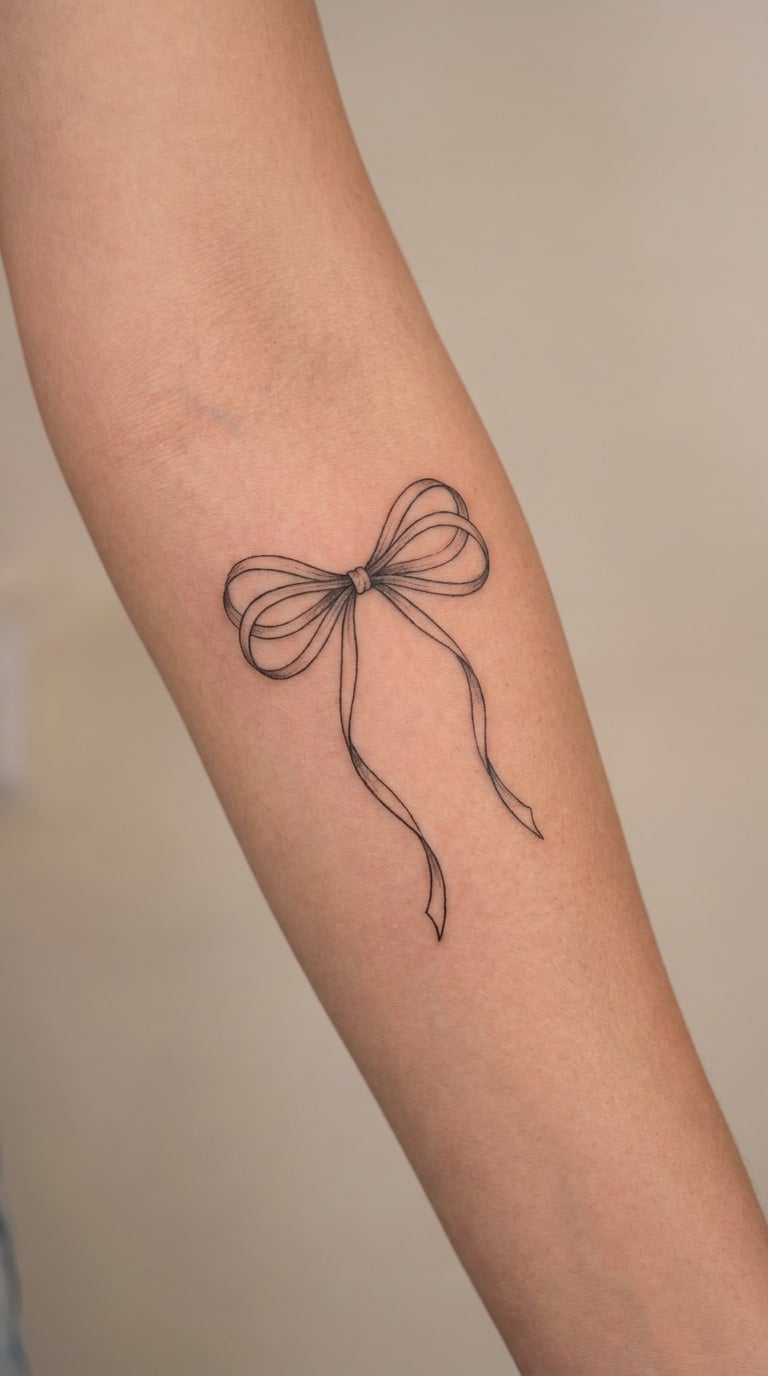
A fine-line ribbon bow is one continuous knot with two mirrored loops and two tails that fall at slightly different angles, drawn in clean black hairline strokes. Most people choose it because it looks like a piece of fashion rather than a body illustration, and there is no fixed meaning attached to it.
Placement: the inner or outer forearm, where the skin is flat enough to hold a clean line. Size: 2-3 inches (5-8 cm). Style: fine line. Pain: low to medium, and the forearm is one of the calmer spots for a first sitting.
Fine forearm lines do soften with sun exposure and ageing, so plan for a touch-up in a year or two rather than being surprised by it. Make it yours: colour one tail in a single wash, or coordinate it with a date tattoo elsewhere so the two read as a pair. If you like line work, our line art tattoo ideas for women gallery has more shapes that share this weight.
2. Blackwork Bow Behind the Ear
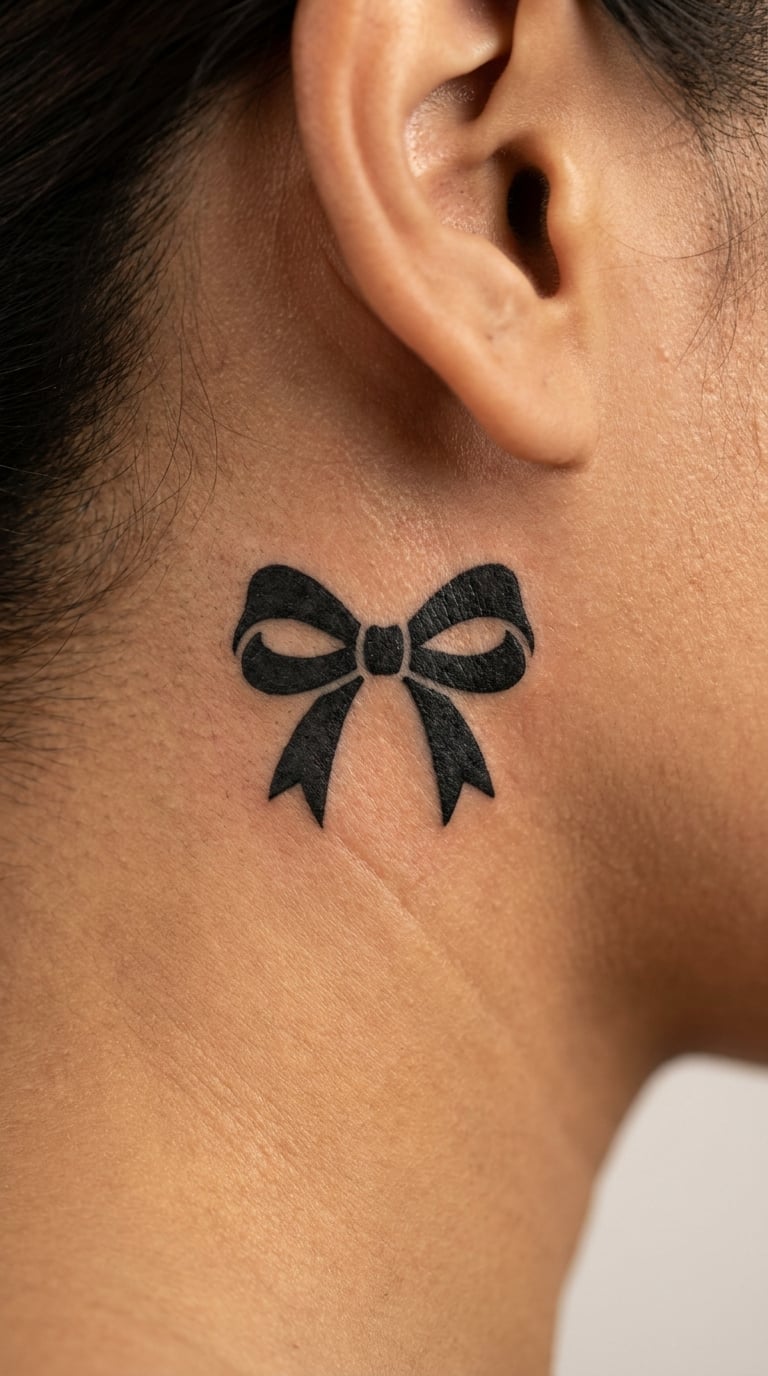
This version fills both loops with solid black, leaving thin ribbons of untouched skin to define the folds. The tails are short and blunt, and the whole shape sits compact rather than trailing. It is the answer for someone who wants a bold motif in a discreet spot that disappears under hair.
Placement: behind the ear or on the upper nape. Size: 1.5-2.5 inches (4-6 cm). Style: blackwork. Pain: medium, since skin this close to the skull feels thin and the artist works around cartilage.
Be honest with yourself about hair. A close crop or an undercut gradually exposes the placement, and some people love that, some do not. Make it yours: have the tails finished with a short code, a set of coordinates or one small colour accent so it stays yours when the hair comes down.
3. Lace Bow on the Collarbone
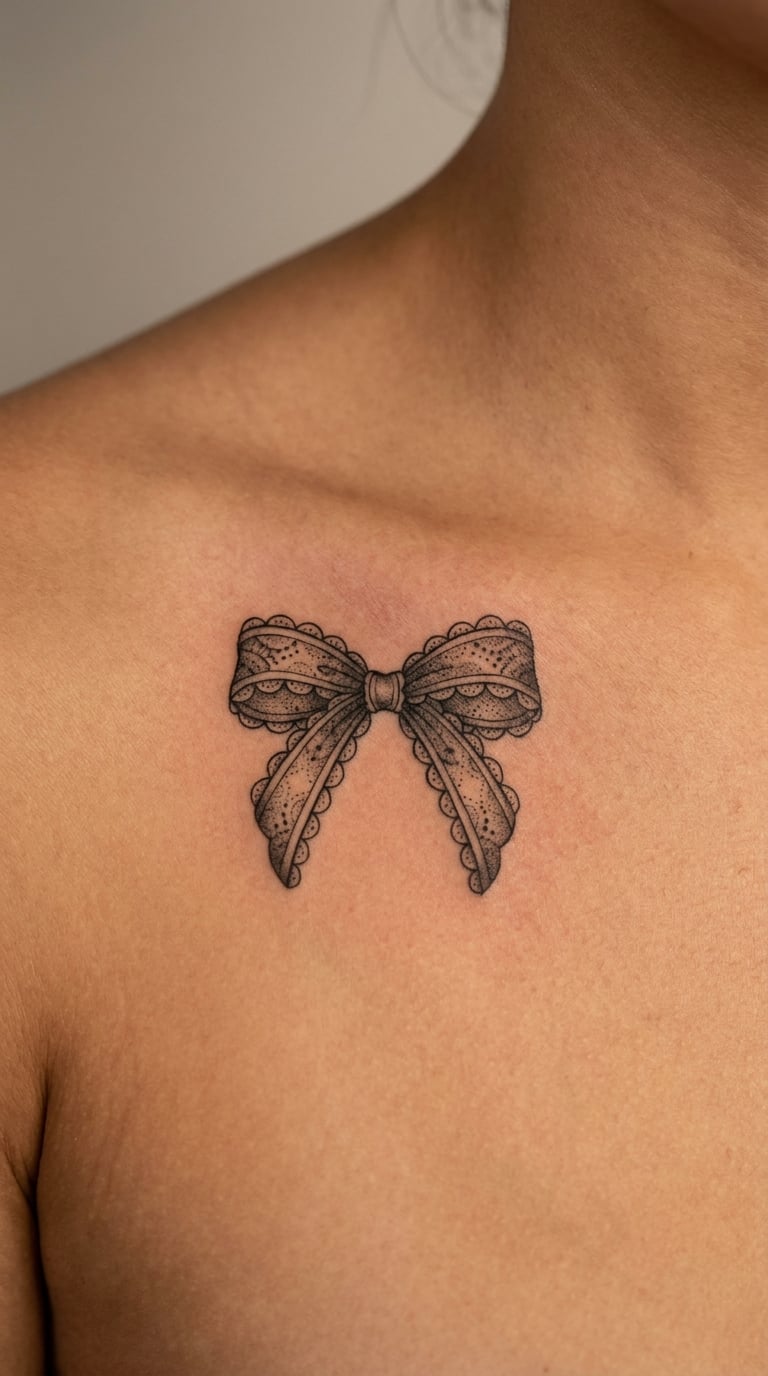
A lace bow takes the basic knot and gives the ribbon edges a scalloped, doily-like trim, with tiny dotwork holes punched along the band and light grey shading under each fold. It reads as decorative and feminine without anyone assigning it a meaning, which is exactly why so many people like it.
Placement: the collarbone or upper chest, following the line of the bone. Size: 2-3 inches (5-8 cm). Style: fine line with dotwork. Pain: low to medium, and the collarbone area is bone-close but the skin there is not thin.
One warning: very small lace details are the first thing to blur as skin changes over the years, so a lace bow will always be more delicate than a solid one. Make it yours: pick the colour of your birth flower and let it run through one ribbon, or set initials into the band in a script small enough to read only up close. Tiny work on the hands is covered in our small hand tattoo ideas for women that age well guide.
4. Watercolor Bow on the Side Rib
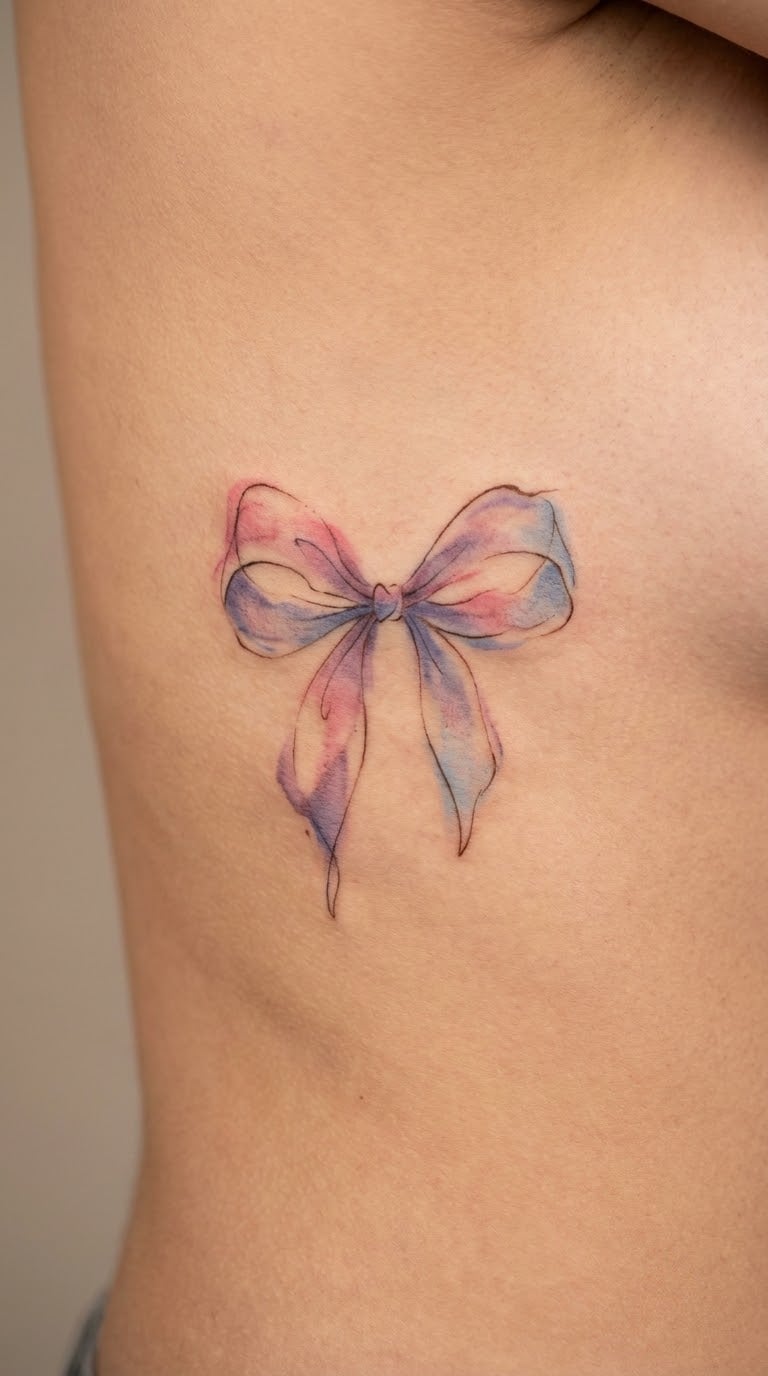
A watercolor bow is built from translucent washes rather than outline: soft pink at the knot, violet and blue bleeding outward, and only enough contour line to hold the shape together. The edges are meant to look slightly unfinished. It suits anyone who wants a soft, artistic piece with a much wider colour range than a black outline can offer.
Placement: the side rib, just beneath the armpit, where the curve gives a bow natural flow. Size: 3-4 inches (8-10 cm). Style: watercolor. Pain: medium, since ribs are a longer, more sensitive session.
Colour fades faster than black, and sun exposure pulls it faster still, so treat this as a piece that changes. Make it yours: choose the two washes that already mean something to you, or float one translucent flower inside the loop. If you want more of that soft wash style, see our 24 best watercolor tattoo ideas for women.
5. Infinity Bow on the Wrist
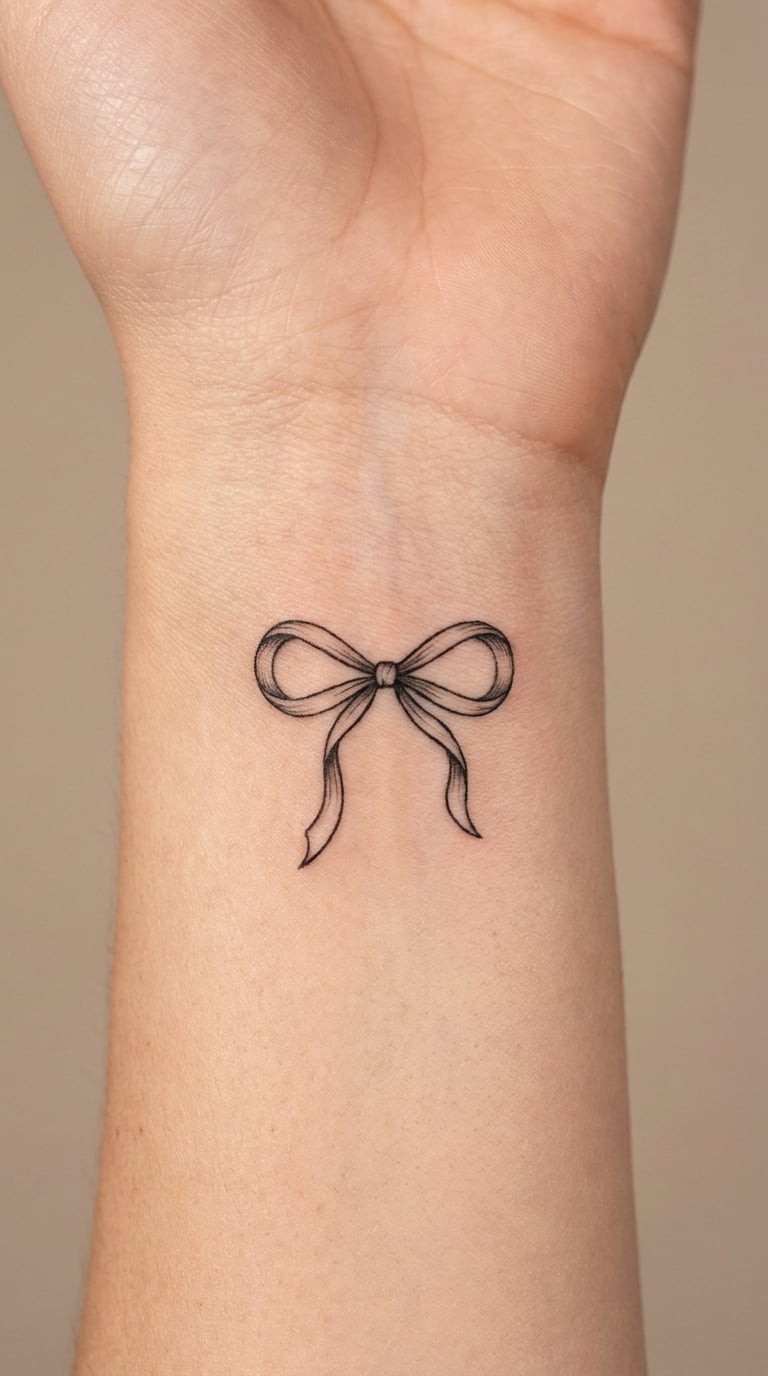
Here the two ribbon loops flow into one another and close back on themselves, turning the bow into an infinity shape. Drawn at a balanced single weight it looks calm and symmetrical; done in fine dotwork it gains a little texture. The appeal is visual balance and continuity rather than any one fixed reading.
Placement: the inner wrist, which is the most requested bow spot and the one most likely to be seen. Size: 1.5-2 inches (4-5 cm). Style: fine line or minimal dotwork. Pain: medium, and the inner wrist feels more than the pictures suggest because the skin is thin and the veins are close.
Wrist ink fades and spreads a little faster than ink on the upper arm, so keep the design simple enough to still read when the line thickens. Make it yours: set a real date, a small stone or a single initial inside the loops where the eye goes first.
6. Botanical Ribbon Bow on the Hip
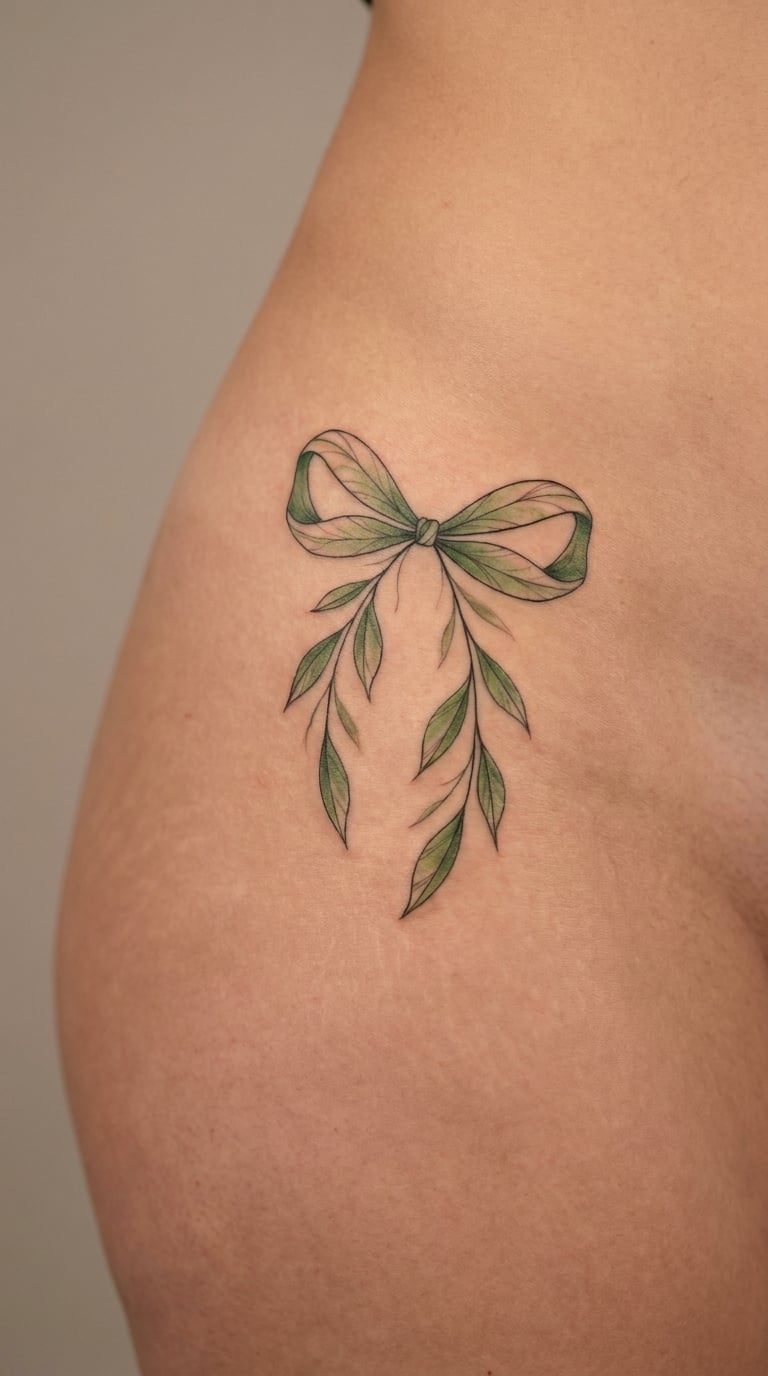
The knot stays a bow, but the two tails run on into leafy stems with fine central veins and a little restrained green shading. You get an accessory and a plant in one composition, balanced so the leaves do not outgrow the ribbon. It is a good choice for someone who likes detail without a crowded design.
Placement: the upper hip or over the hipbone, which is flat, curved and rarely crowded with other work. Size: 3-4 inches (8-10 cm). Style: fine line with light colour. Pain: low to medium, and the hip is a forgiving spot for a longer sitting.
Small leaf details soften with ageing faster than the ribbon, which is normal and not a sign of a bad tattoo. Make it yours: name the plant in the reference image and sketch it from life, or use a muted green you actually wear rather than a bright one.
7. Bridal Bow on the Ankle
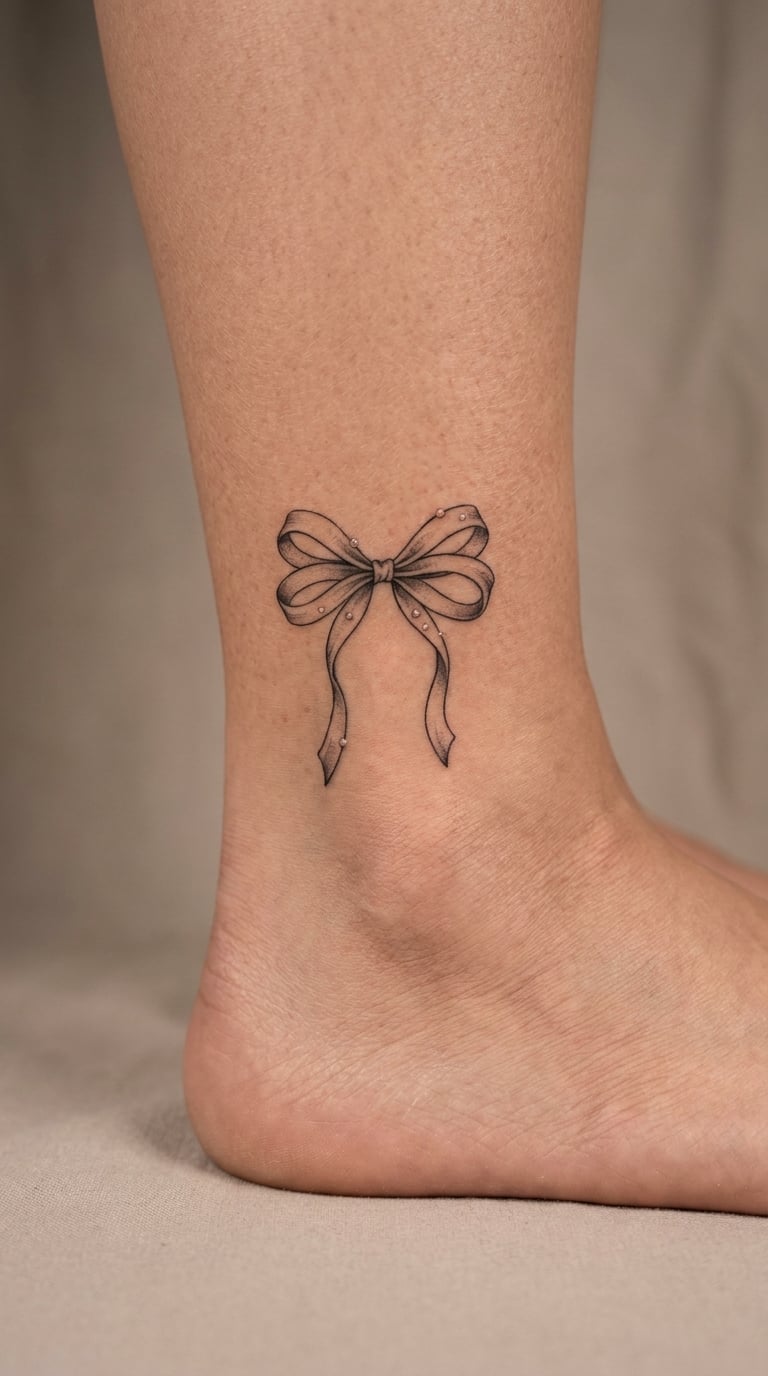
A bridal bow is drawn like satin: soft parallel folds inside the loop, a tight centre knot, tiny pearl-like dots along one edge and one long ribbon tail falling away. It is elegant with a wedding-adjacent palette and nothing more, which means you do not have to be a bride to wear it.
Placement: the outer ankle, above the bone. Size: 2-3 inches (5-8 cm). Style: illustrative fine line. Pain: medium, and ankles are bony and reactive to the needle.
Fine ankle lines can blur, and shoe collars and straps can alter the shape while it is still fresh or while it is healing. Make it yours: add a lace-like scalloped edge, use a wedding palette if that is the reason you are choosing it, or mirror it with a small ankle-chain motif on the other leg.
8. Rose Bow on the Side of a Finger
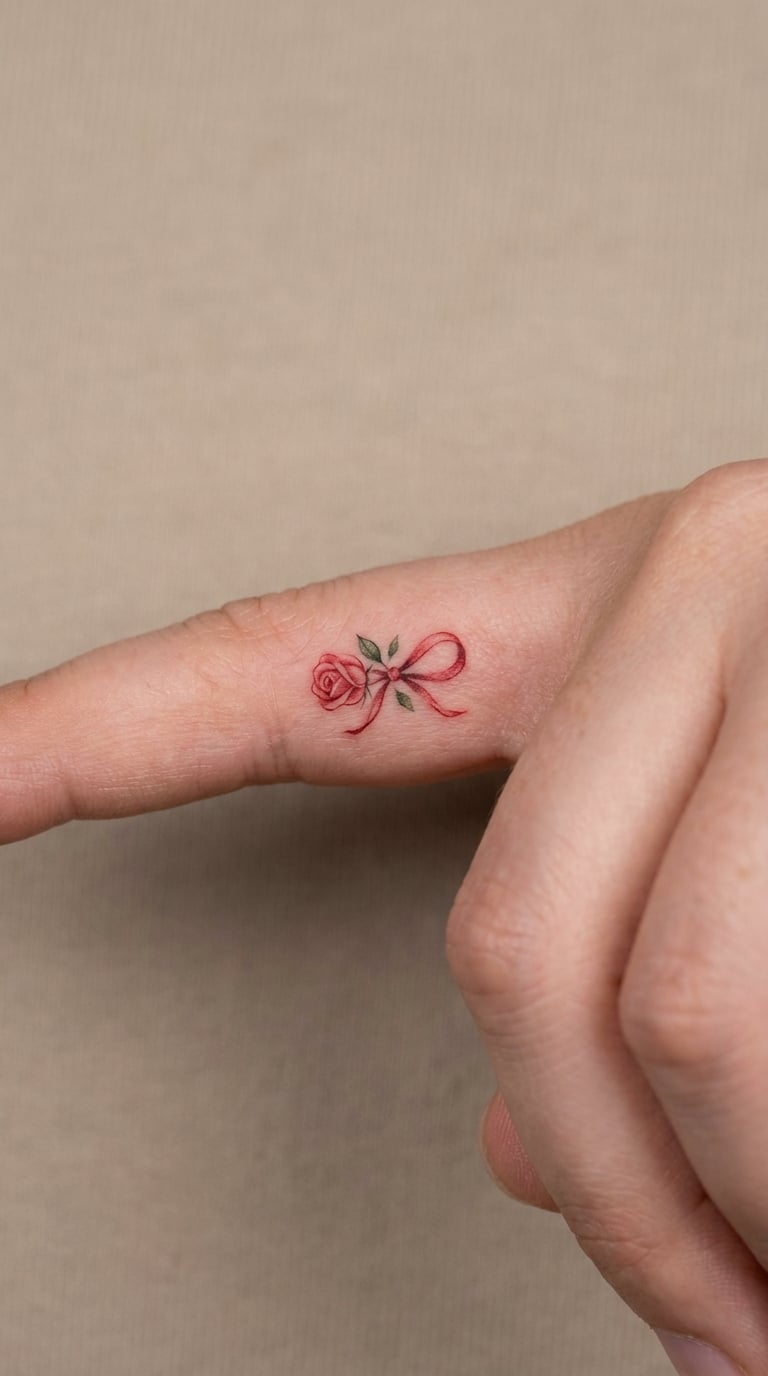
Two folded rose forms curve outward to make the loops, warm red shading sits in the folds, and two small green leaves tuck under the knot. It is a classic accessory merged with romantic floral work, and at this scale it reads as one clever image rather than two objects.
Placement: the side of a finger, along the length of the bone. Size: 0.75-1.25 inches (2-3 cm). Style: micro-fine line or micro-realism. Pain: high, and fingers are among the most sensitive spots on the body.
Tiny finger and hand details fade faster than anything else in this gallery and blur into each other over the years. Expect a touch-up. Make it yours: use your birth flower instead of a rose, match an existing rose piece, or add a single meaningful colour accent so it is not just red.
9. Red Ink Bow at the Back of the Neck
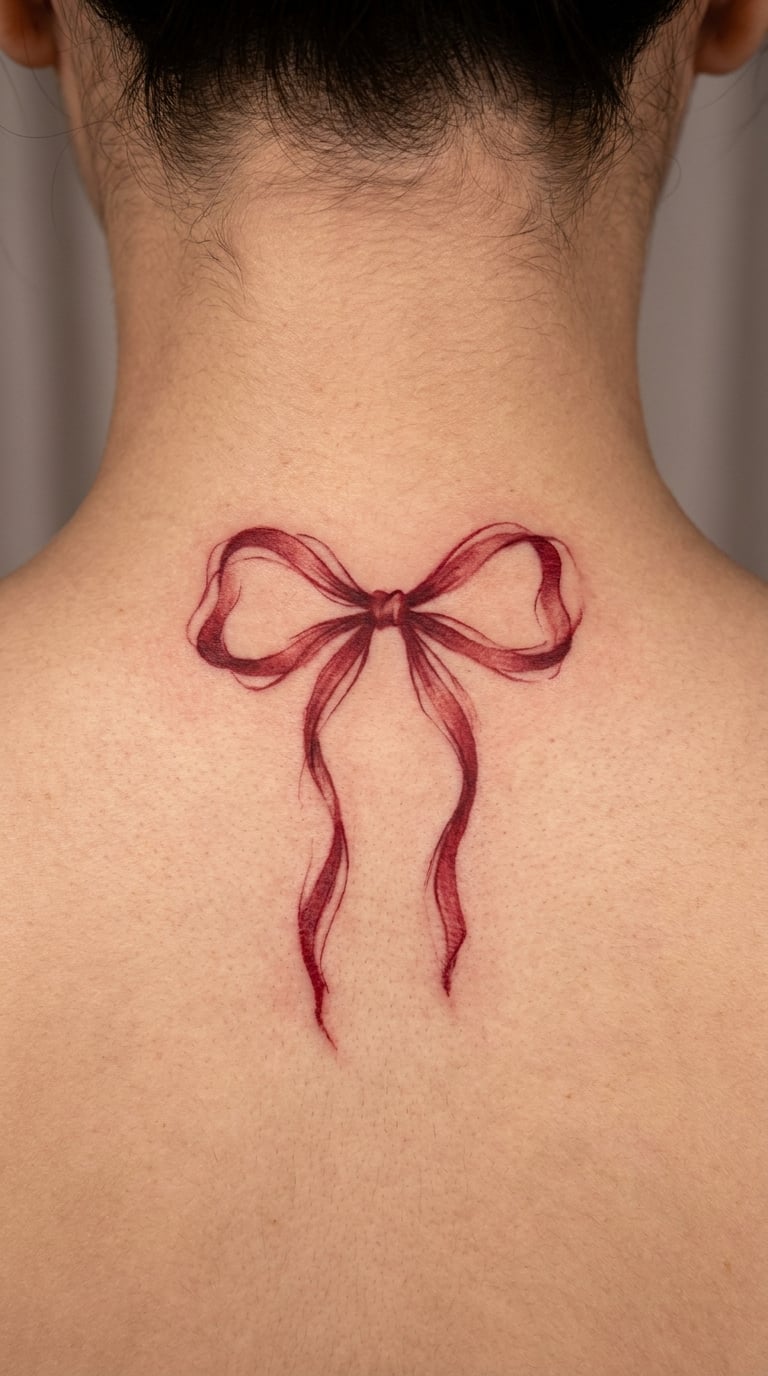
Drawn entirely in deep red ink with loose, expressive brush lines and edges that thin out to nothing, this bow looks like a single confident stroke rather than a careful diagram. It gives you one focal point with real impact and no large block of colour, which is a good trade if you want bold without heavy.
Placement: the back of the neck, just above the hairline. Size: 2-3 inches (5-8 cm). Style: loose illustrative brushwork. Pain: medium, and you will feel every pass on the neck.
Collar friction and sun exposure both pull the vibrancy out of red ink, so this is a colour you will likely refresh. Make it yours: hide a small initial inside one tail, or add a thin differently coloured inner line to the knot so the red has something to sit against.
10. Geometric Bow on the Outer Forearm
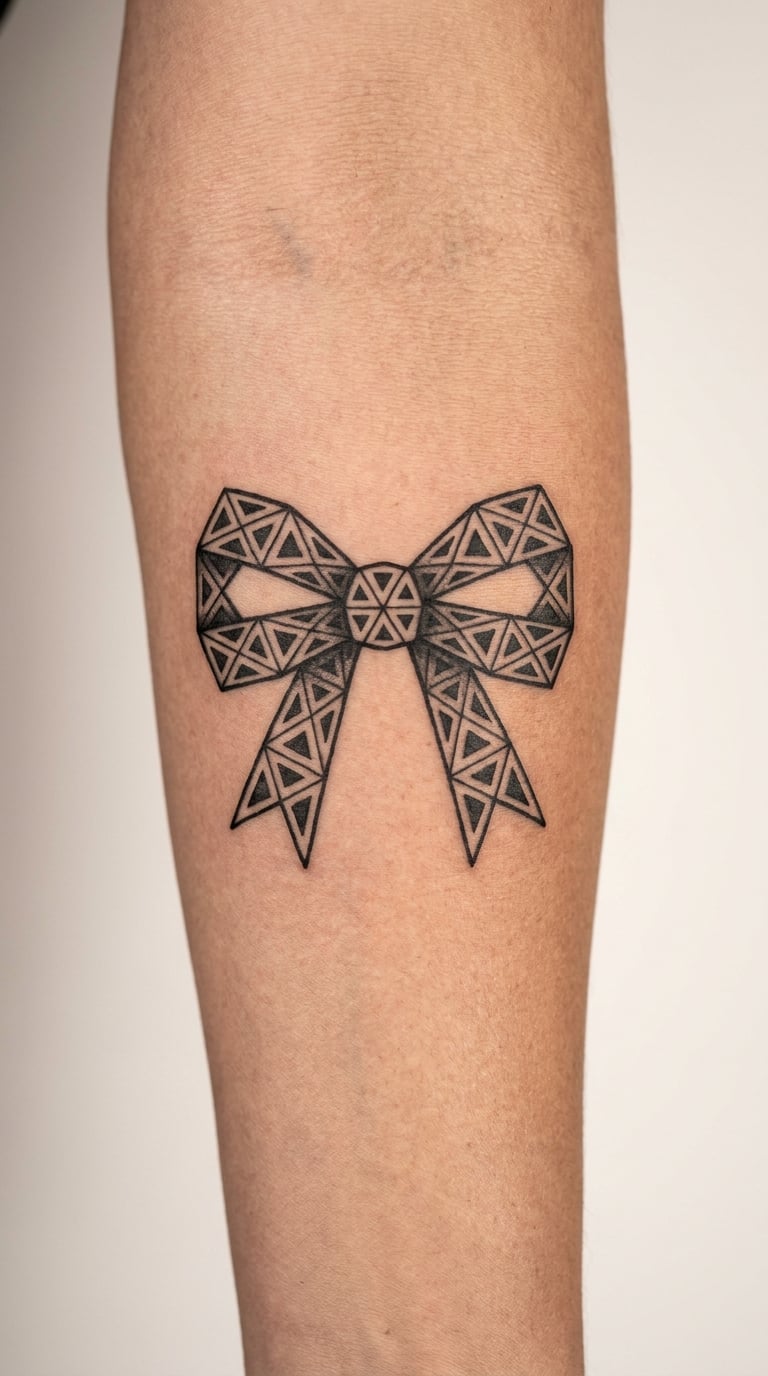
This bow is assembled from symmetrical triangles: sharp facets for the loops, a diamond for the knot, and clean triangular gaps where the background stays bare. The palette is limited to black and skin. If you prefer structure to softness, this is the version of the motif that reads as architecture.
Placement: the outer forearm, flat and easy to see. Size: 2.5-3.5 inches (6-9 cm). Style: geometric blackwork. Pain: low to medium.
Broad filled areas generally age more reliably than hairline detail, so this style is a sensible long-term choice. Make it yours: use a real measured date in the lower facet, or set a birthstone colour in exactly one triangle so the geometry stays clean.
11. Celestial Bow on the Shoulder
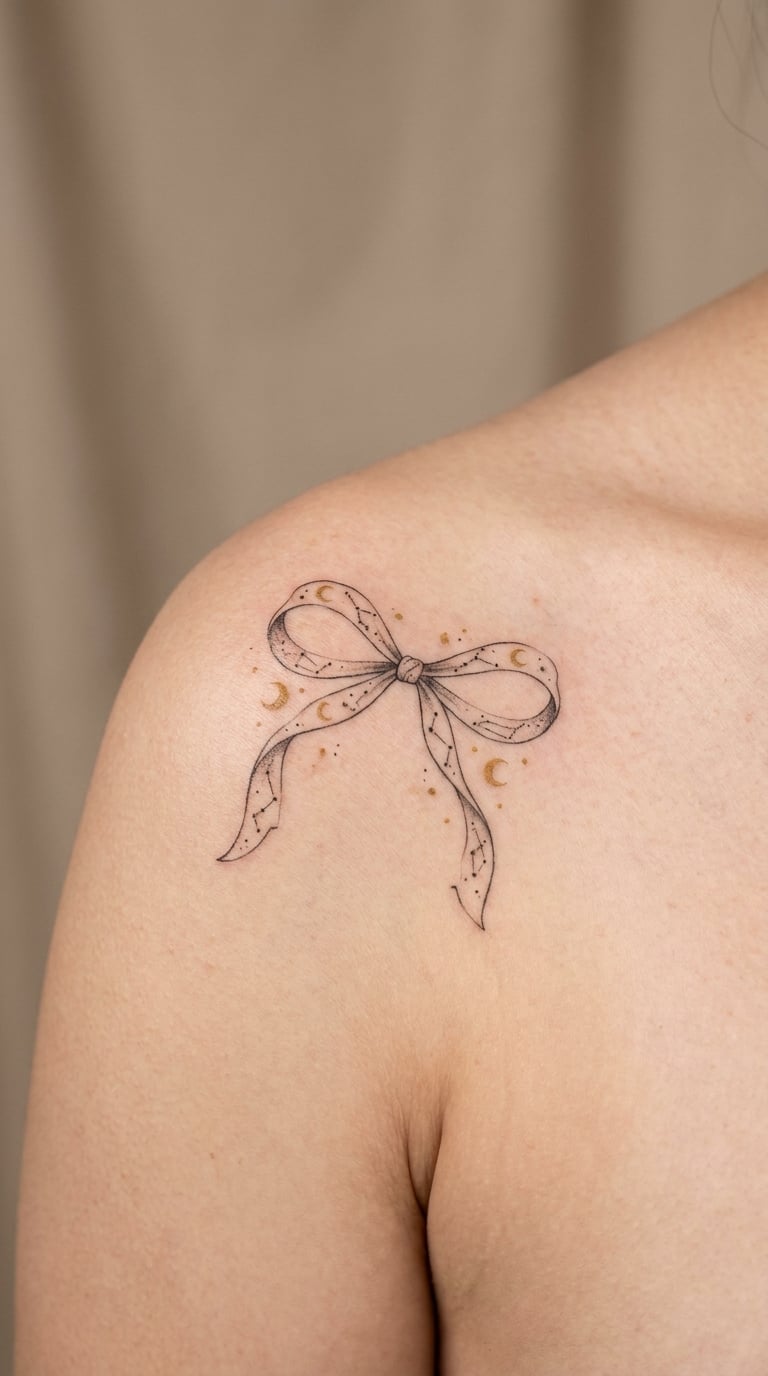
The bow is drawn with flowing black lines and a trailing ribbon, then surrounded by a small crescent, a scatter of fine stars and one or two restrained gold or pale blue accents. The added details make it dreamy without forcing a meaning onto it.
Placement: the upper shoulder or shoulder cap, curved along the bone so the tails follow its line. Size: 3-4 inches (8-10 cm). Style: fine line with selective colour. Pain: low to medium.
Tiny stars blur before the bow does, so do not stack more than a handful close to the loops. Make it yours: add your real zodiac sign in place of one star, or use the birth date in a line of tiny numerals along the trailing ribbon.
12. Vintage Banner Bow on the Upper Arm
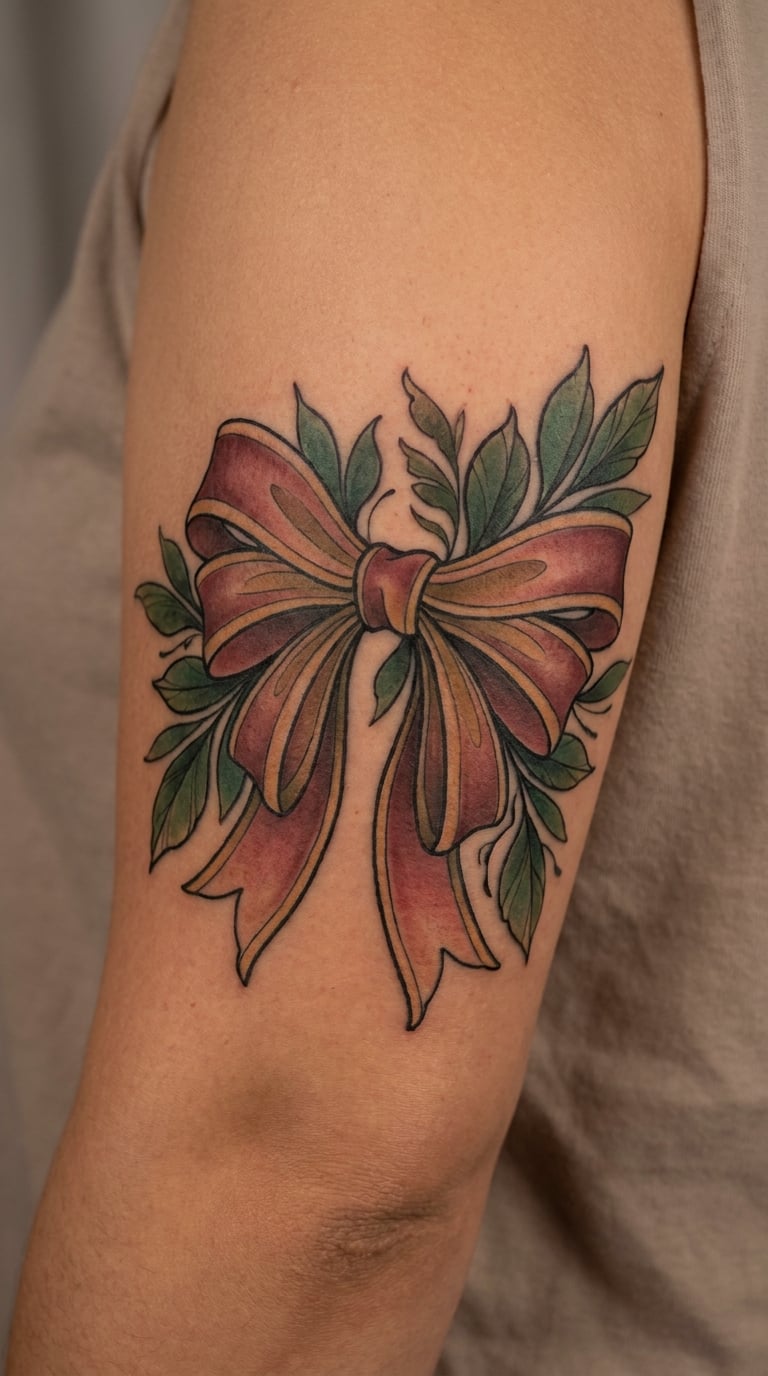
Wide folded ribbons, a chunky central knot, and small banner-style accents drawn with thick outlines and saturated but muted colour. This is the version of the bow that belongs to old tattoo culture rather than a fashion trend, and it is designed to stand alone as a piece.
Placement: the outer upper arm. Size: 3-4 inches (8-10 cm). Style: neo-traditional. Pain: medium, and the upper arm gives the artist a large flat surface to work on.
Bold line weight is the friend of this style, so ask for thick outlines and skip any decorative detail smaller than a pencil line. Make it yours: set a real date inside the banner, or use a muted red and deep green pair pulled from something you own.
13. Butterfly Wings Formed Into a Bow
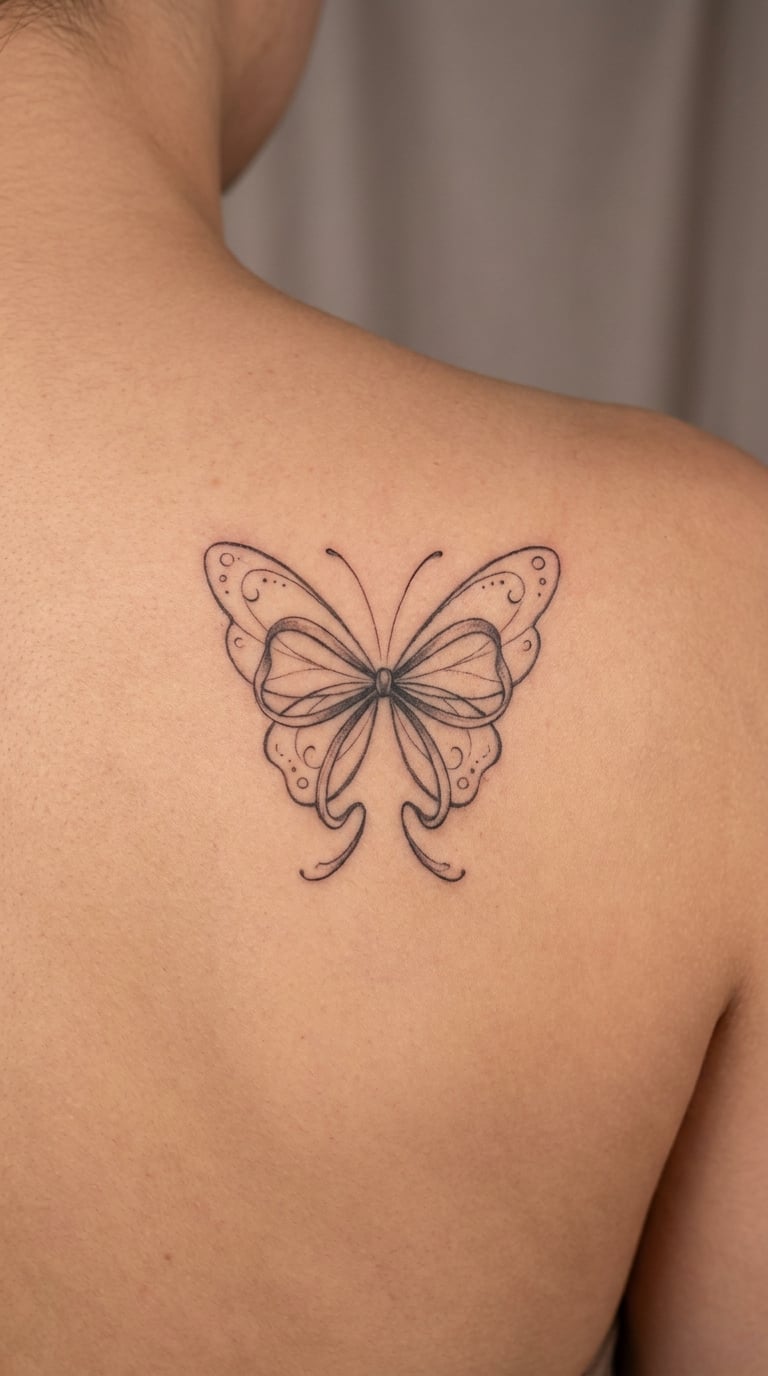
Paired butterfly wings curve outward to form the two loops, fine antennae rise from where the knot would be, and restrained spots mark the upper edges. It is a hybrid design that gives a familiar motif a second half, and it reads as one symmetrical shape rather than a butterfly with a bow stuck on top.
Placement: the shoulder blade, upper back or the calf. Size: 3-4 inches (8-10 cm). Style: fine line or illustrative realism. Pain: low to medium.
Very small wing markings can merge into a grey smudge over time, so keep the spots few and slightly larger than you think. Make it yours: use a real butterfly species from your region, colour the wing veins in two tones, or match a second piece on the other shoulder blade.
14. Knotless Bow on the Sternum
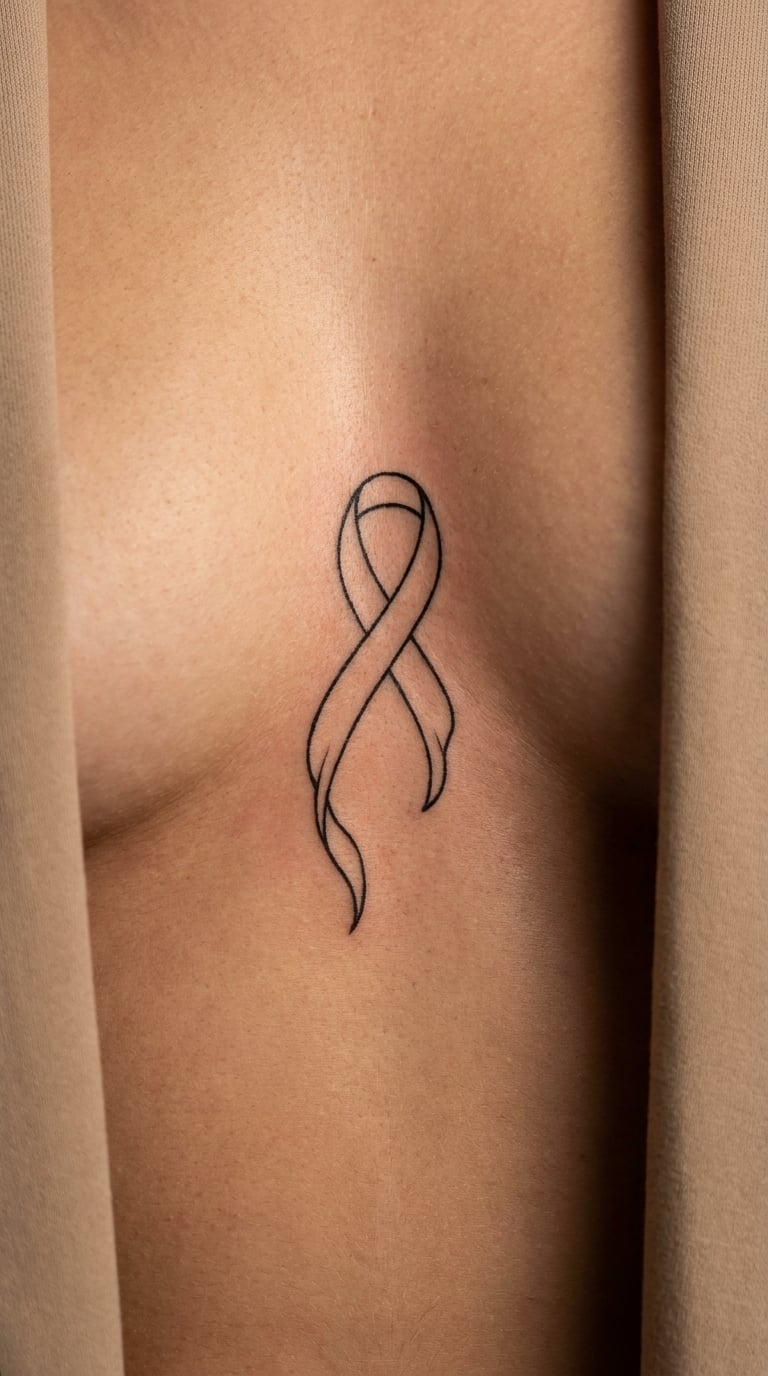
A knotless bow has no filled centre. One open loop sits beneath the throat with two tails flowing down, drawn in the lightest possible line weight, and the whole thing runs vertically. The airy structure creates interest without a heavy block of ink in the middle of your chest.
Placement: the sternum, arranged vertically. Size: 2-3 inches (5-8 cm). Style: minimal fine line. Pain: medium to high, because it is a bony area with very little soft tissue under the needle.
The sternum is a prominent, movement-prone placement, and everyone in a room will see it. That is the appeal and the warning in one. Make it yours: drop a small discreet symbol into the open loop, wash a single colour behind it, or coordinate with a fine-line necklace so it reads as part of an outfit.
15. Marbled Bow on the Thigh
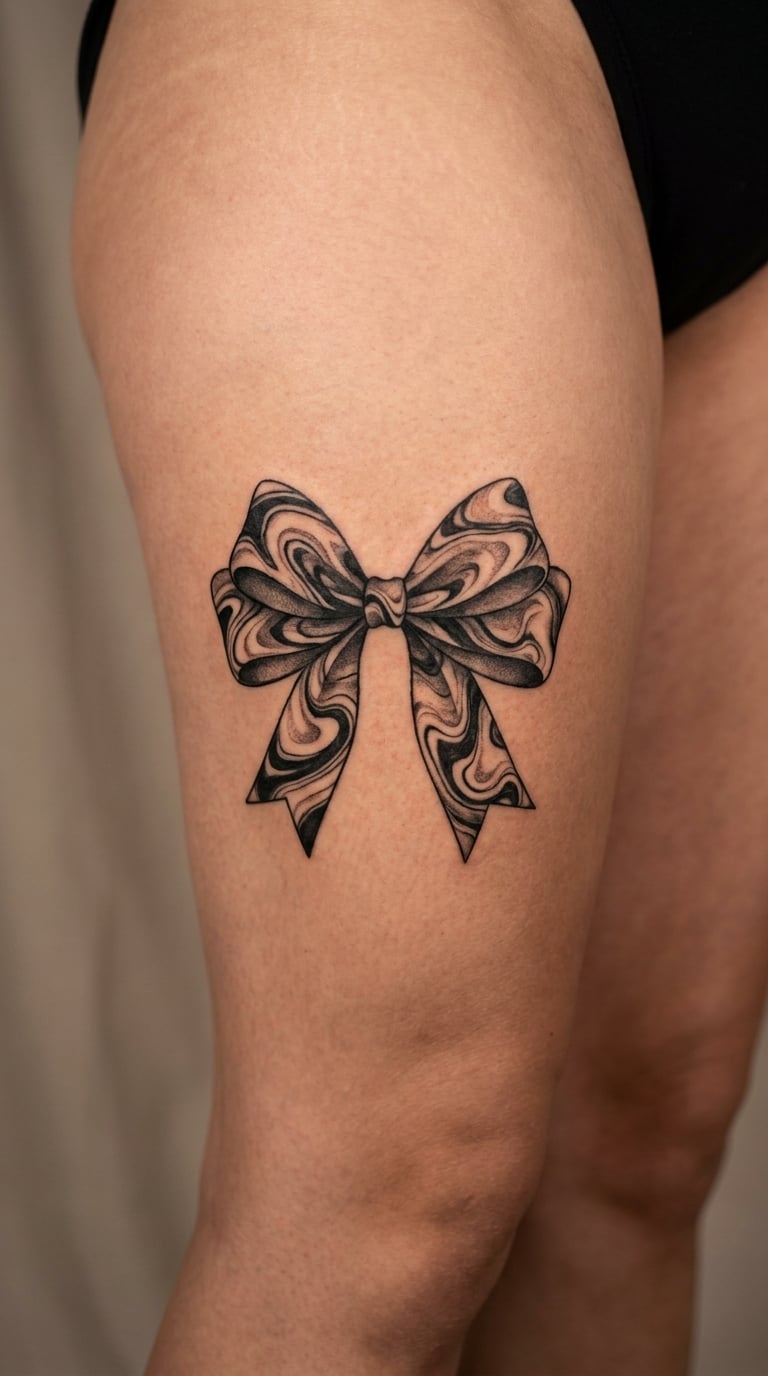
The loops of this bow are filled with a marbled black, grey and white pattern, and a clean contour keeps the outside edge crisp against the busy interior. It is a fashion-inspired design with real visual weight, and it works well as the centre of a larger thigh piece if you want it to grow later.
Placement: the outer or upper thigh. Size: 4-5 inches (10-13 cm). Style: illustrative black and grey. Pain: low to medium, and the thigh is one of the more forgiving areas for a long sitting.
A larger area gives the artist room for detail, but it will take longer in the chair, so budget time as well as money. Make it yours: use a stone-inspired pattern, pick one signature colour and let it run through the grey, or have it placed as the first piece of a planned thigh composition.
16. Dotwork Bow on the Calf
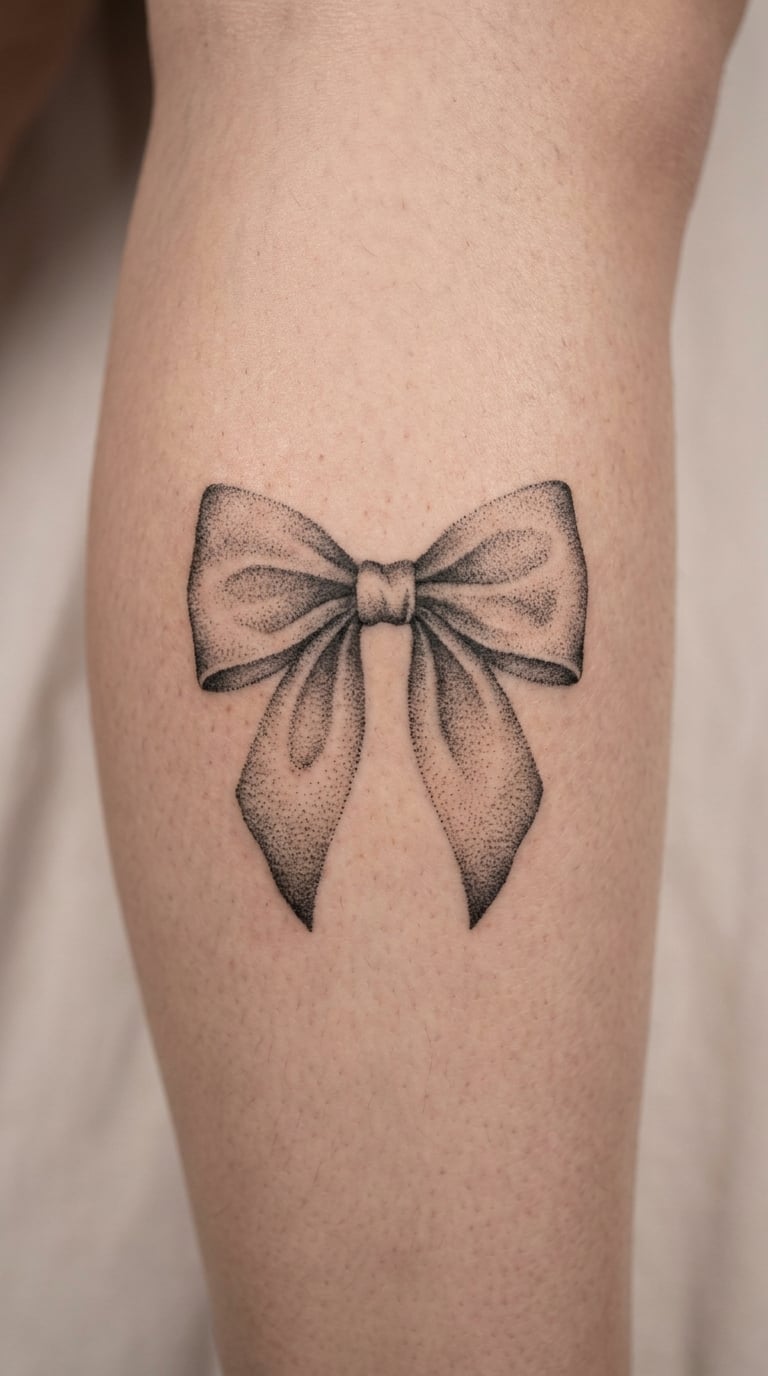
No outlines at all. The bow is built entirely from carefully spaced black dots, and the density shifts from tight clusters in the knot to loose scattered points at the tips of the tails, so the tonal structure creates the folds. It has depth and air at the same time.
Placement: the outer or inner calf, where a vertical design falls naturally. Size: 3-4 inches (8-10 cm). Style: dotwork. Pain: low to medium, though dotwork takes longer than the final look suggests.
Individually spaced dots soften and blur over time, so spacing is a real decision here, not decoration. Make it yours: work your actual coordinates into the dot pattern, add one small solid knot for contrast, or build the density around another dotwork piece you already have.
17. Embroidered Bow on the Biceps
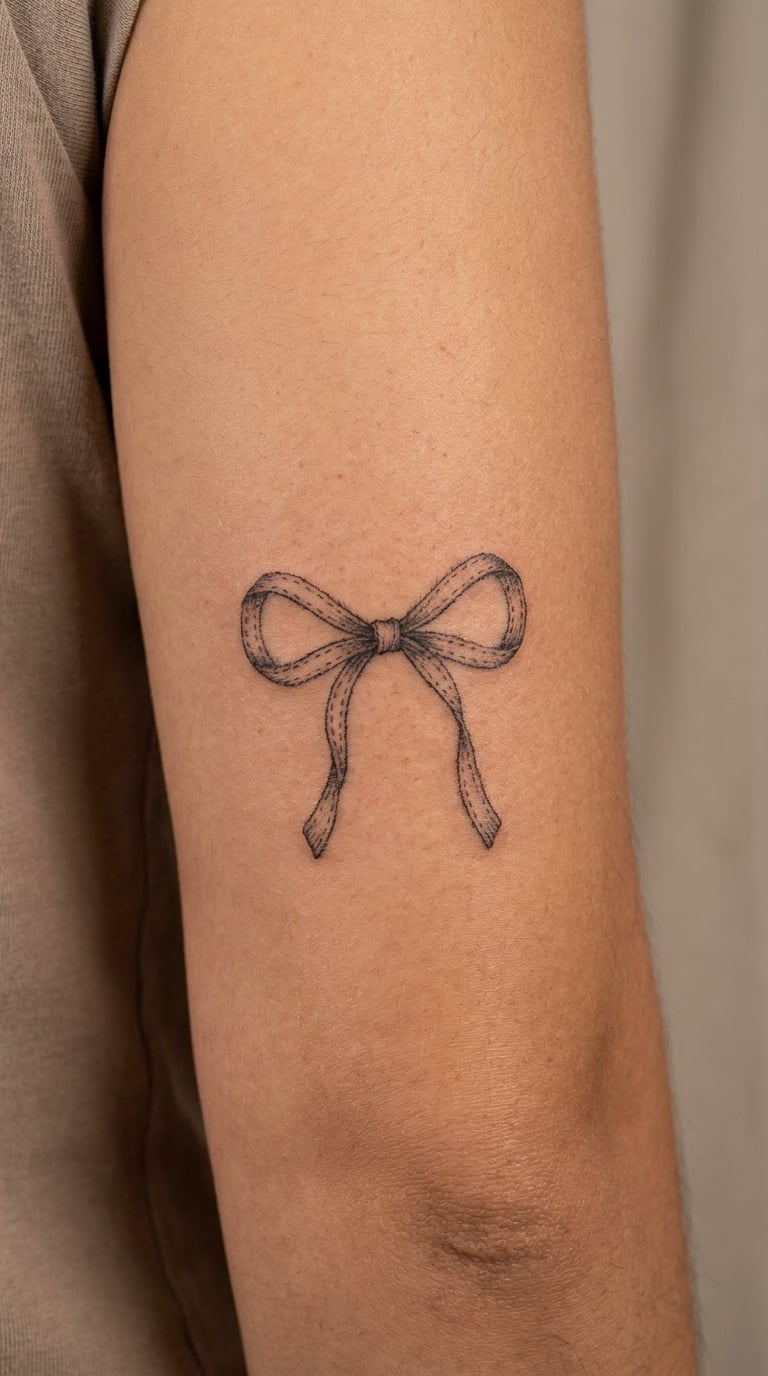
This bow imitates raised thread. Short directional marks run along the length of each ribbon as if it were stitched fabric, the edges are shaded so they look lifted off the skin, and the central knot is rendered with real dimension. It is the design for someone who wants a tattoo that looks like a piece of handcraft.
Placement: the inner or outer biceps, which has enough surface and enough shape to show the dimension. Size: 3-4 inches (8-10 cm). Style: illustrative realism. Pain: medium.
The biceps moves constantly, so long parallel thread lines can shift a little as the muscle flexes and relax. Make it yours: add a real monogram stitched into one ribbon, use the colour of a specific fabric you care about, or ask for a simple stitched border around the whole bow.
18. Gothic Lace Bow on the Back of the Arm
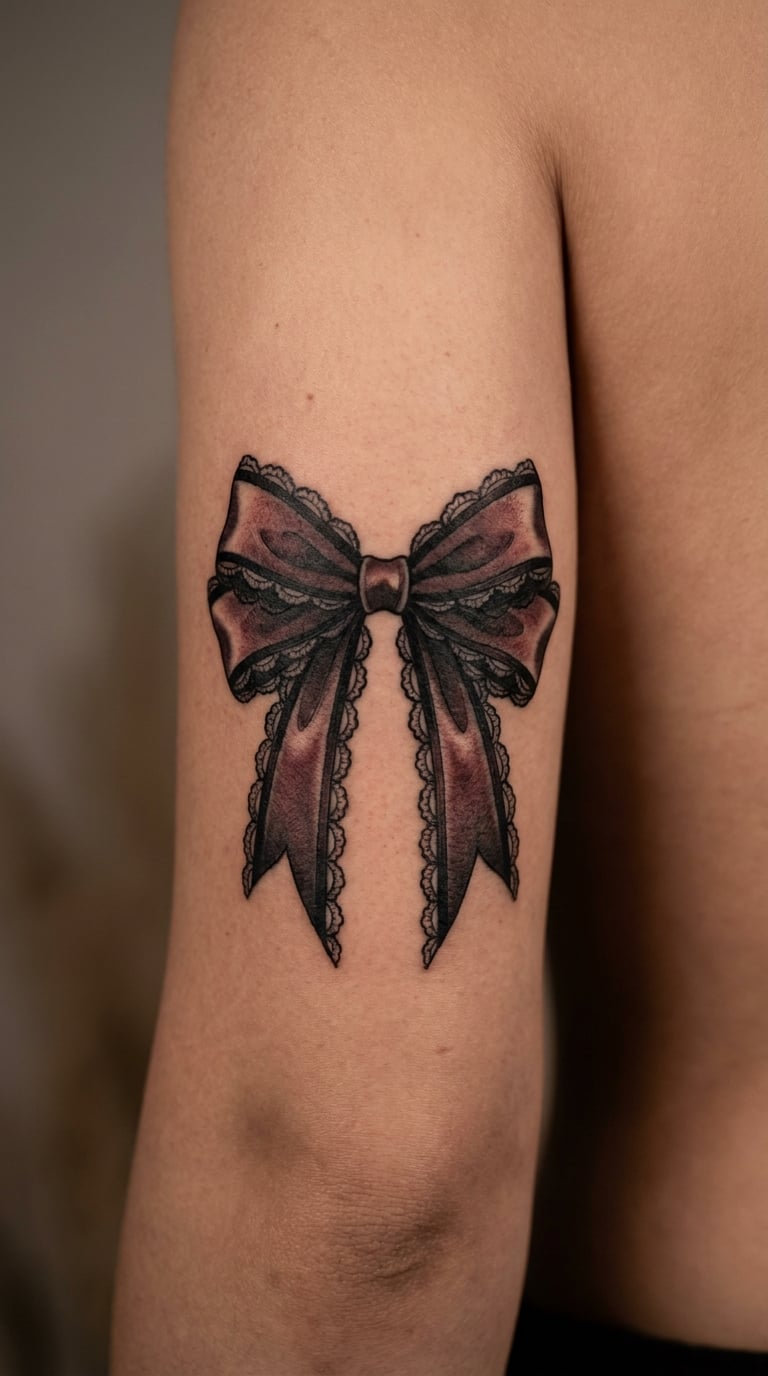
Heavy shaded ribbon folds, a lace-like scalloped edge worked in black and grey, and only a little dark red in the deepest crease so the piece is not entirely monochrome. It is dramatic and romantic in a Gothic register, without carrying any occult or relationship meaning that you did not put there.
Placement: the triceps or the upper back. Size: 3-4 inches (8-10 cm). Style: blackwork with illustrative detail. Pain: medium.
Tiny lace patterns blur, and the back of the arm is a spot people cross their arms over, so expect to show it to someone eventually. Make it yours: set a significant initial in the knot, choose one deep personal colour for the red accent, or match it with a blackwork border on another body piece.
19. Minimal Line Bow Beside the Eye
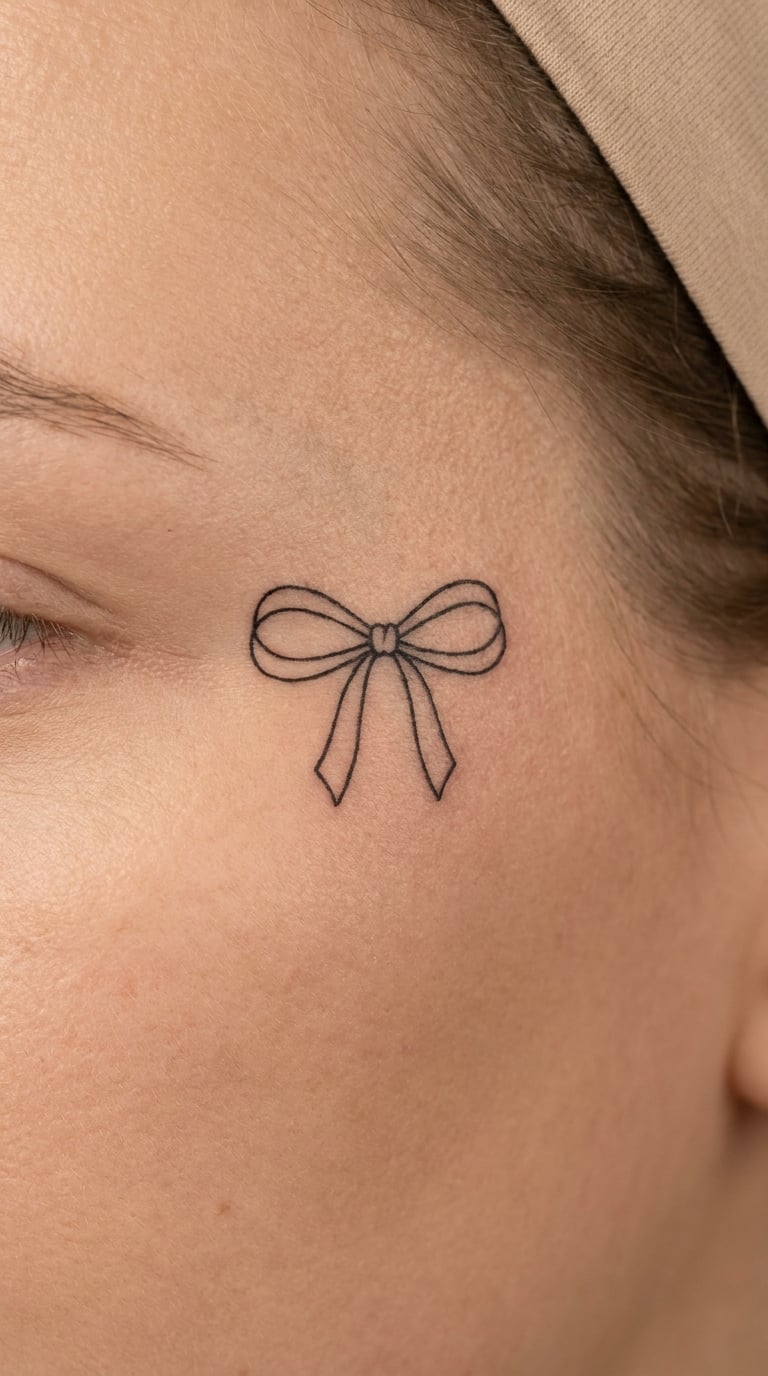
One continuous line draws a small bow with two loops and a single tail, placed beyond the outer corner of the eye with plenty of clear skin around it and no contact with the eyelid. The restraint is the whole point. It is a subtle facial option for someone who already knows why they want it.
Placement: the outer eye area or the temple. Size: 1-1.5 inches (3-4 cm). Style: minimalist fine line. Pain: high, and the face is thin-skinned and very reactive.
I will be straight with you: facial fine lines can blur, spread a little, or change with normal skin movement and expression over the years. Make it yours: add a single colour accent to the tail, choose a slightly thicker line weight for durability, or add one tiny star beside the knot so the shape is clearly decorative.
20. Layered Ribbon Bow on the Back of the Hand
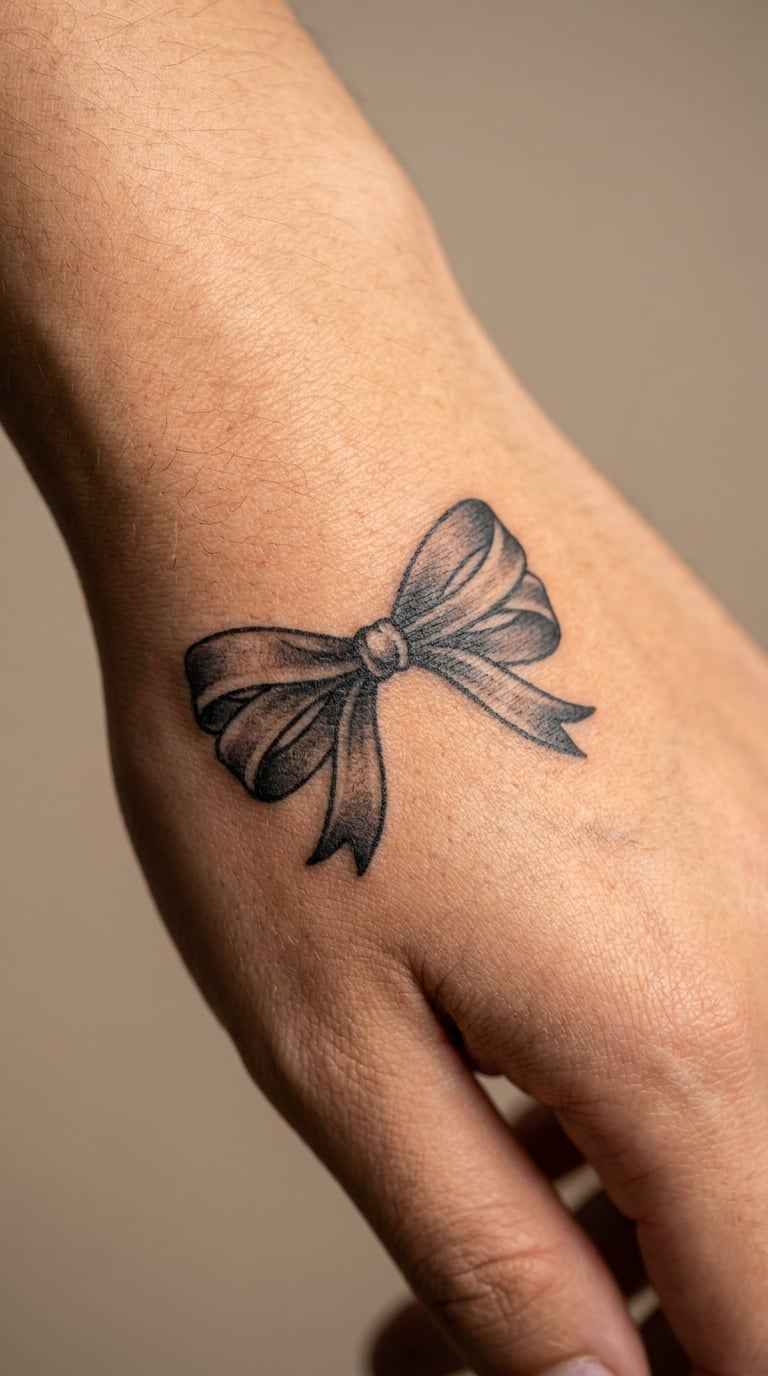
Overlapping black ribbon bands cross and layer over one another, the knot is shaded so it sits on top, and two dimensional tails drop away from the centre. The composition is scaled to fit the narrower surface between the wrist and the knuckles. Layering is what gives this small accessory motif its depth.
Placement: the back of the hand, centred between the wrist and the knuckles. Size: 2-3 inches (5-8 cm). Style: illustrative blackwork. Pain: medium, and the back of the hand is more sensitive than most people expect.
Hand tattoos fade faster than arm tattoos, and the tiny shading inside the knot can blur first. Make it yours: use a real birth date along one band, add a single coloured line through the layers, or test the placement with a temporary sticker first so you know exactly how it sits before you commit.
How to Choose the Right Design
The best bow is the one that suits the placement you have in mind, not the one that looks best on a screen. Weight, durability and body contour decide most of it before taste even enters the conversation.
- Minimal and fine line: the lightest visual weight, the most forgiving on small or bony areas, and the first thing to blur. Choose it if the placement is discreet and you like a quiet piece.
- Blackwork: solid black ages the most reliably, reads clearly at any size, and works behind the ear or on the back of the arm. It is the safest long-term bet.
- Traditional and neo-traditional: bold outlines and saturated colour, built to stand alone as a full piece rather than as an accent.
- Illustrative and embroidered: shaded dimension that rewards a larger area and a longer sitting, and gives the motif a handcraft feel.
- Dotwork and watercolor: tonal and soft respectively. Dotwork holds up well at calf scale; watercolor changes the most over time but in a pleasant way.
- Placement fit: the placement decides the style more often than the other way around. A 4-inch bow has nowhere to sit on a finger, and a 1-inch bow on a thigh reads as an accident.
Best Bow Tattoo Ideas for Women by Size and Placement
Size and location work together more than most galleries admit. Under 2 inches, a design has to be almost icon-level to stay legible, so keep it to one knot, two loops and no interior detail. Between 2 and 4 inches is the sweet spot: enough surface for folds, shading or a small accent, and still small enough to suit most body contours. Larger statement bows need genuinely uninterrupted skin, usually a thigh, upper arm or back, and they are the version that reads as a tattoo from across a room. When you compare the 20 entries in this gallery, match the size column against the placement column rather than picking a design first. If you are still torn, bring two or three reference photos to the consultation and ask your artist which one fits the skin you actually have.
Cost and Session Time
Tattoo pricing in the US is usually quoted as a shop minimum plus an hourly rate, and a small design may not fill the minimum. Shop minimums commonly sit between 100 and 200 dollars, and hourly rates for a competent artist often run from 80 to 200 dollars depending on the city and how busy the book is.
As a rough guide in 2026: tiny simple designs usually land between 150 and 400 dollars, detailed small-to-medium work runs about 250 to 650 dollars, and large, colourful or multi-session pieces can reach 500 dollars up to 1,200 and beyond.
Time works the same way. A small fine-line bow is often a single sitting of 30 to 90 minutes. A large or colourful bow can take two to five hours, which is why a designer may split it across two appointments. Touch-ups are common on fine-line and finger work, and most artists will re-check a small piece once the healing settles, often included in the original fee.
Regional variation is real, and shop minimums can push a small piece up. Ask the shop for a total estimate before you start, and mention your reference images and placement at the consultation so the price you agree on matches the design you actually want.
Aftercare Basics
Always start with your artist’s own aftercare instructions, because they know exactly what they did in your skin.
- Follow your artist’s aftercare instructions first, and ask for them in writing before you leave the chair.
- Wash gently with warm water and a fragrance-free cleanser, then pat the area dry rather than rubbing it.
- Use only the ointment or aftercare product your artist supplied, in thin layers, for as long as they recommend.
- Keep the area clean and dry in the sense your artist means: no soaking, no swimming, no long hot baths, and no covering it under tight clothing or a bandage.
- Avoid friction and sun exposure while it heals, and skip swimming pools and sea water until the skin is fully closed.
- Do not pick, scratch or peel flakes. If the area stays red, raised or weeping after the normal healing window, contact your artist or a healthcare professional.
Frequently Asked Questions
What is the best small bow tattoo for a first tattoo?
A single fine-line ribbon bow at 2-3 inches on the inner forearm is the easiest first tattoo in this gallery. One knot, two mirrored loops and two tails is a simple shape to execute, the forearm is forgiving to tattoo, and the design still reads clearly years later.
Do bow tattoos fade easily, and which placements age best?
Fine-line and single-needle work softens fastest, especially on the hands, fingers and anywhere exposed to sun. Broad blackwork and traditional line weight hold their edges far longer. Inner forearm, upper arm, thigh and calf tend to age well, while knuckles, wrist creases and the outer eye area show the most change.
Are bow tattoos better in fine line or blackwork?
It depends on where it goes and how visible you want it. Fine line suits discreet placements and a quiet, feminine look but needs a touch-up eventually. Blackwork reads from a distance, keeps its edges for decades and works best in compact spots like behind the ear or the back of the hand.
Where should a woman place a bow tattoo?
The inner wrist, collarbone, behind the ear, upper nape and back of the hand are the most requested spots, and each suits a different weight of design. Pick the spot before the style, because a 3-inch bow and a 1-inch bow cannot share the same skin. If visibility is not the goal, the rib, hip and upper arm give you more room.
How much does a bow tattoo cost in the US?
In 2026, a tiny simple bow usually runs about 150 to 400 dollars, a detailed small-to-medium design about 250 to 650 dollars, and a large or colourful piece 500 dollars and up. Shop minimums, hourly rates and regional variation all affect the total, so ask for a written estimate before the session starts.
Conclusion
If this is your first tattoo, the fine-line ribbon bow on the forearm is the strongest starting point: simple to draw, forgiving to heal and easy to place where you can see it while you learn how skin behaves. If you are adding to an existing collection and want more dimension, the layered ribbon bow on the back of the hand gives you overlapping bands and a shaded knot in a small footprint.
Choose your placement first, then your style, then the personal detail. Bring two or three references to a consultation, ask what will age well on your skin, and book from there. These 20 bow tattoo ideas for women are a starting point, not a decision, and the artist in front of you will see things on your body that no gallery can show.