
20 Best Gemini Tattoo Ideas for Women (September 2026)
Gemini tattoo ideas for women fall into a few families: the twin glyph, twin figures, the constellation, a birth-date or coordinate, and a seasonal badge. This list covers all of them, with the placement, realistic size, style and honest pain expectation for every design, so you can walk into a consultation knowing what you actually want.
Most of the ideas below work as a first piece, because a glyph or a small constellation is simple enough to heal cleanly and small enough to hide under a sleeve when you need it to. A few are built for a large flat area, like the zodiac wheel in number 20. The list is current for September 2026, and if you are planning around Gemini season, or any season, book early: shops fill their calendars a few months out and the best fine-line artists book the longest.
Quick Guide: 20 Gemini Tattoo Ideas for Women Compared
| Idea | Style | Best placement | Size | Pain |
|---|---|---|---|---|
| 1. Fine-line constellation | Fine line | Inner forearm | 2.5-3.5 in (6-9 cm) | Medium |
| 2. Twin glyph pair | Minimalist | Collarbone | 1 in each (2.5 cm) | Medium |
| 3. Twin profiles | Fine line | Upper arm | 2-2.5 in (5-6 cm) | Medium |
| 4. Roman numeral date | Lettering | Inner wrist | 1.5-2 in (4-5 cm) | Low to medium |
| 5. Constellation behind ear | Fine line | Behind the ear | 1.5-2.5 in (4-6 cm) | Medium to high |
| 6. Watercolor symbols | Watercolor | Shoulder cap | 2.5-3.5 in (6-9 cm) | Medium |
| 7. Blackwork twins | Blackwork | Outer upper arm | 3.5-5 in (9-13 cm) | Medium |
| 8. Glyph with branches | Fine line | Rib side | 2.5-3.5 in (6-9 cm) | High |
| 9. Moon and stars | Fine line | Above ankle bone | 1.5-2 in (4-5 cm) | Medium |
| 10. Script wordmark | Script | Side of neck | 2-2.5 in (5-6 cm) | High |
| 11. Dotwork constellation | Dotwork | Between shoulder blades | 4-6 in (10-15 cm) | Medium |
| 12. Sun and moon frame | Fine line | Forearm or chest | 2.5-3.5 in (6-9 cm) | Medium |
| 13. Glyph on the finger | Micro fine line | Side of index finger | 0.5 in (1.3 cm) | High |
| 14. Celestial composition | Fine line | Outer thigh | 3.5-5 in (9-13 cm) | Medium to high |
| 15. Geometric constellation | Geometric | Outer calf | 3.5-4.5 in (9-11 cm) | Medium |
| 16. Gemini and rose | Botanical | Upper hip | 2.5-3.5 in (6-9 cm) | High |
| 17. Sternum starburst | Fine line | Upper sternum | 1.5-2 in (4-5 cm) | Medium |
| 18. Traditional badge | Traditional | Forearm | 3.5-4.5 in (9-11 cm) | Medium to high |
| 19. Coordinate | Micro lettering | Inner wrist | 1.5-2 in (4-5 cm) | Low to medium |
| 20. Zodiac wheel | Black and grey | Upper back | 5-7 in (13-18 cm) | Medium |
1. Fine-Line Gemini Constellation on the Forearm
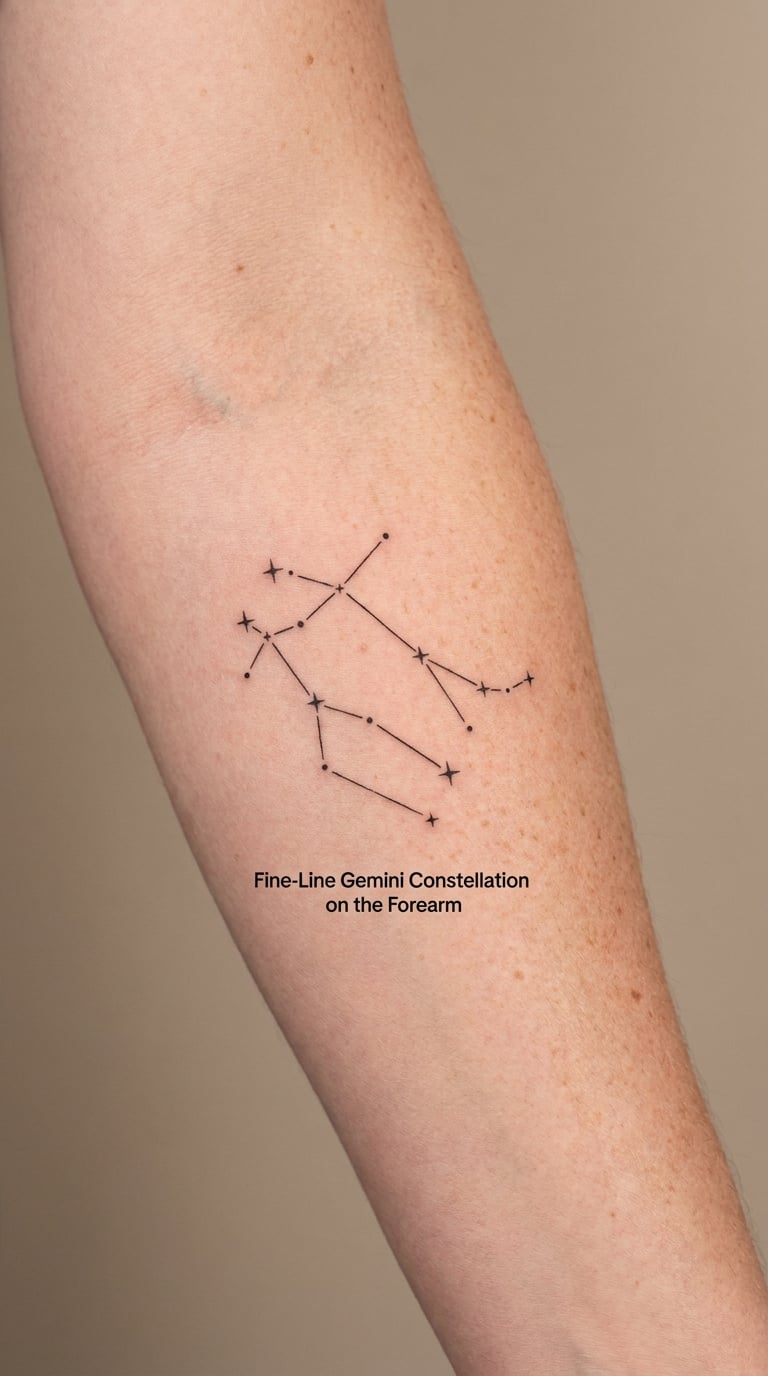
Six or seven small stars connected by hairlines, nothing else. The Gemini constellation has the tightest star field of the zodiac, so it packs into a forearm-sized space without crowding. Artists draw the lines last, after the dots have settled, which keeps the line weight even.
It is the version most people pick for a first zodiac piece, because the meaning is written into the design: two figures, held together, always in motion.
Placement: inner forearm, ribs of the elbow to mid-forearm. Size: 2.5-3.5 in (6-9 cm). Style: fine line, single needle. Pain: medium, a long scratchy stretch over a bony stretch of arm. Make it yours: add the date the stars mean something to you in two numerals underneath. Single-needle stars start to soften around year five, so ask for a slightly heavier line than feels right in the chair.
2. Twin Gemini Symbols on the Collarbone
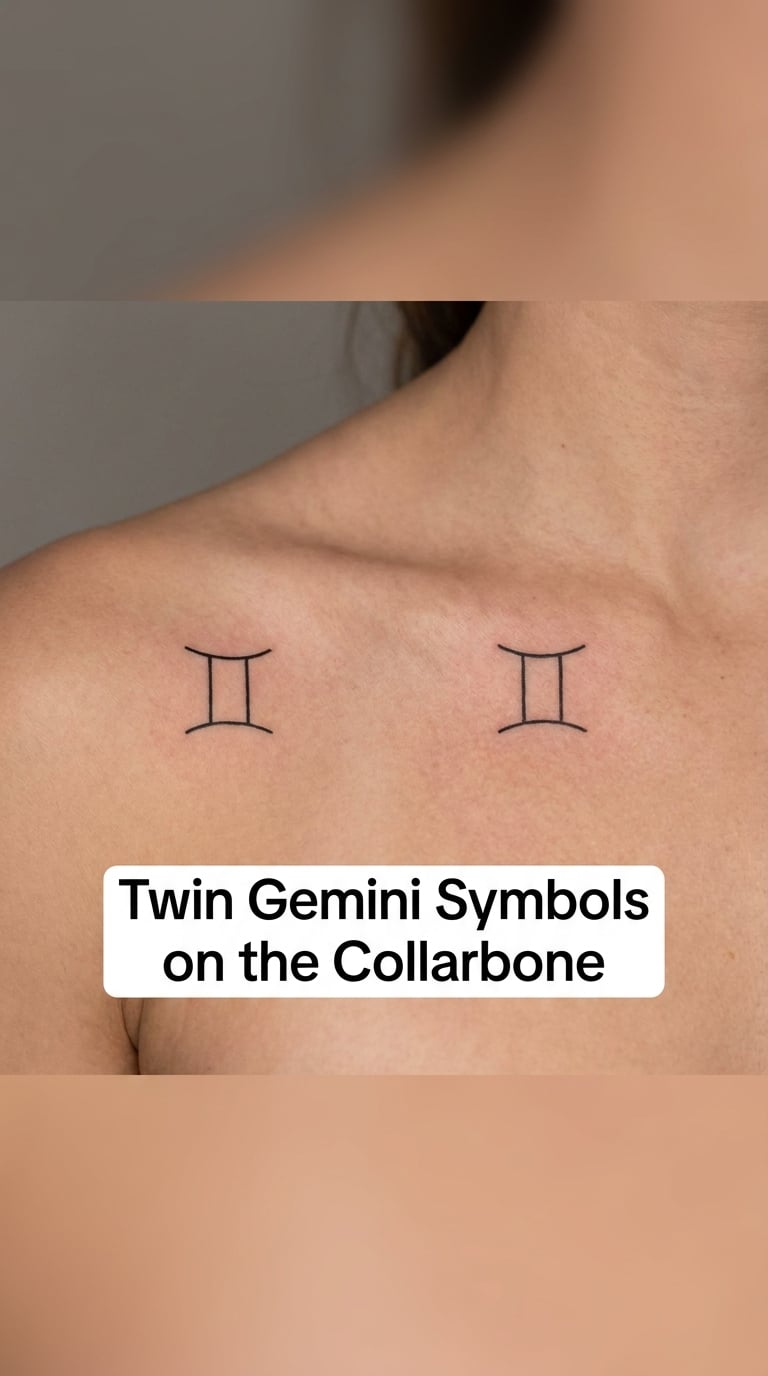
Two glyphs, one on each collarbone, set about an inch apart. Separate pieces read as a pair from across a room, and they photograph well from the front without looking symmetrical in a stiff way. The gap does the work; keep it consistent on both sides.
Pairing is where a lot of Gemini symbolism lives, and a matched set is the most common way people get it onto skin. What it means to you is personal, so wear it as a description of your own version of two-at-once. If you want more options for this spot, our roundup of collar bone tattoos women love is worth a scroll before you book.
Placement: just above each collarbone, along the bone. Size: about 1 in (2.5 cm) tall each. Style: minimalist, solid black. Pain: medium; collarbones ache, and the skin over bone is thin. Make it yours: have one glyph face up and one flipped, so the two read as reflections rather than copies.
3. Gemini Twins in Minimalist Line Art
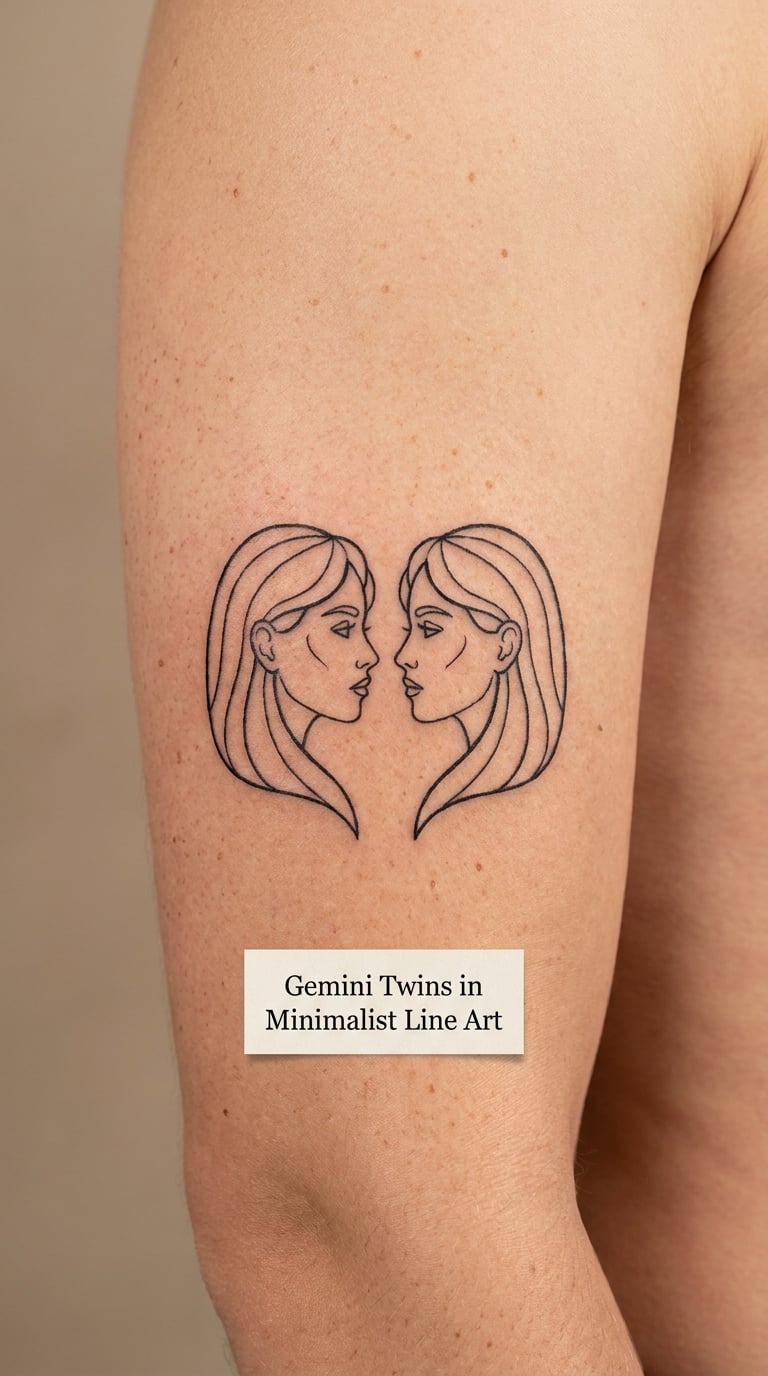
Two faces in profile, turned toward each other, drawn in a single continuous line. Faces give a zodiac piece something a glyph cannot: an expression. Keep the features to a nose, a lip and a brow, or the line work gets busy at two inches.
The twin motif is the oldest visual shorthand for Gemini, and the mirrored framing gives you a design that reads as a relationship without naming anyone.
Placement: outer upper arm, deltoid area. Size: 2-2.5 in (5-6 cm). Style: continuous line, fine line. Pain: medium, and the upper arm bleeds more than you expect. Make it yours: sketch your own two profiles from a photo and let the artist redraw the line properly. Minimal faces are the first thing to blur, so plan for a bolder contour than a paper sketch.
4. Roman Numeral Gemini Date on the Wrist
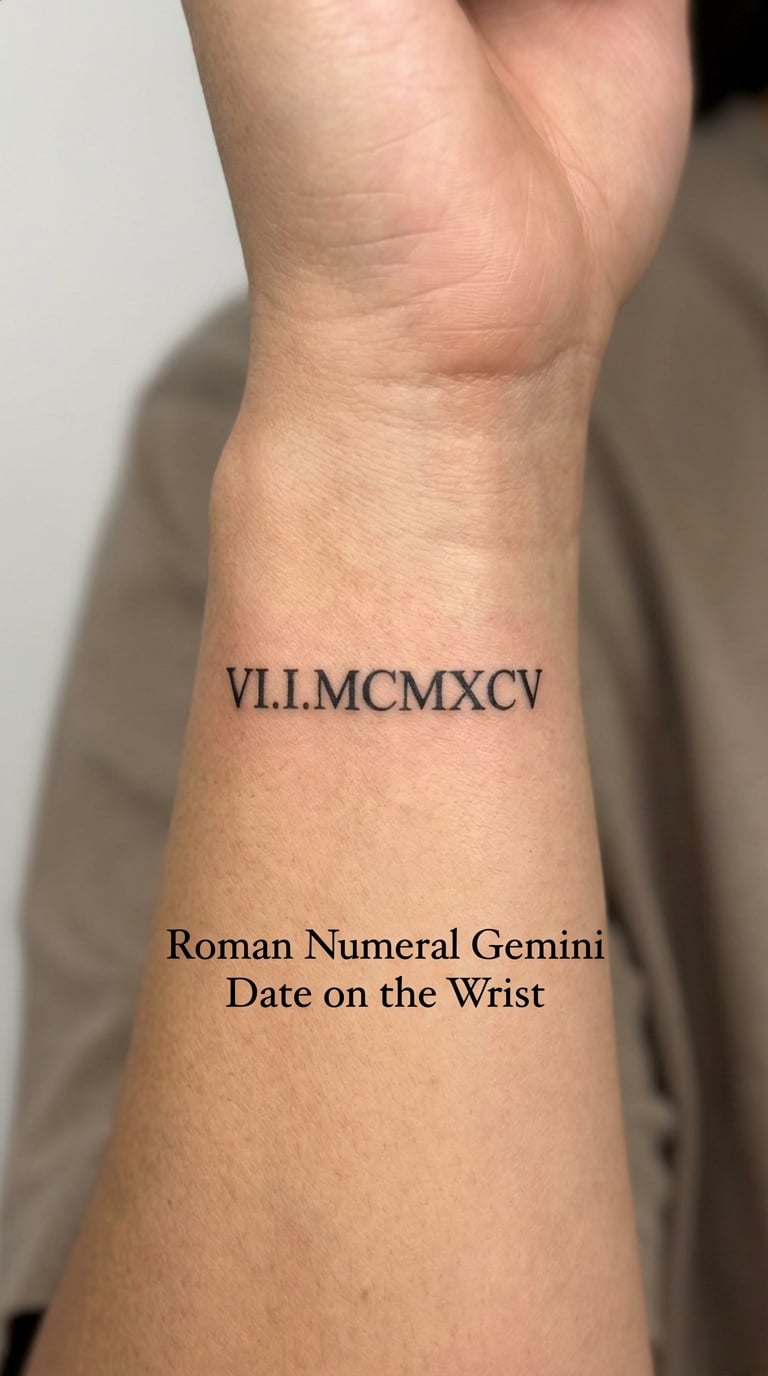
A birth date in Roman numerals, or a single pair of initials under a tiny glyph, is the most discreet way to wear Gemini. The numerals do the symbolic work quietly, which is why so many women pick this instead of the twins.
Placement: inner wrist, or just above it where the skin is flatter. Size: 1.5-2 in (4-5 cm) across. Style: lettering, clean serif or thin sans. Pain: low to medium, unless you have low pain tolerance; the wrist pulses. Make it yours: use the birth date, or the date you met the person the piece commemorates, and add one small star dot to mark the Gemini connection. Glyph lettering size is the part people get wrong, so ask to see healed examples at two inches before you settle. We collected more small wrist tattoo ideas for women that work at this scale.
5. Gemini Constellation Behind the Ear
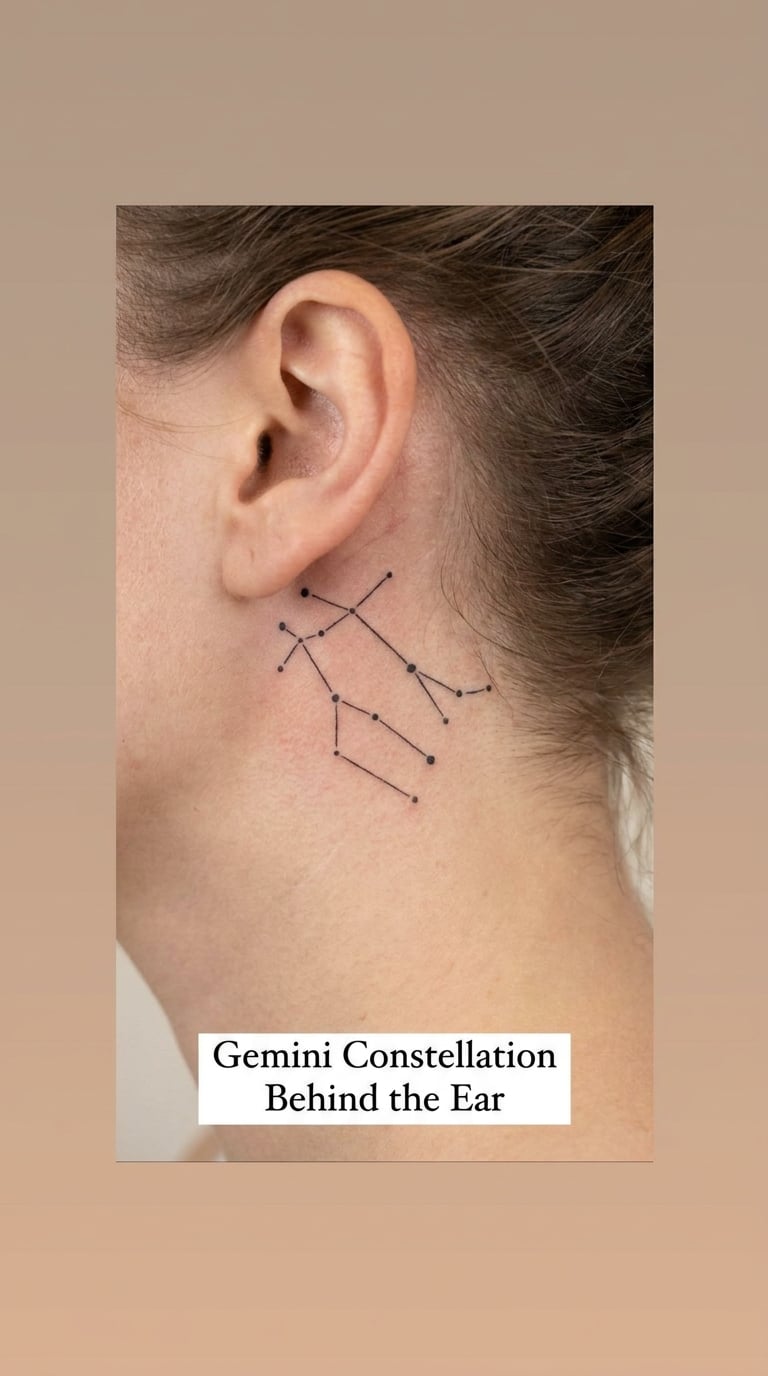
Behind the ear is where a zodiac piece becomes private without being hidden. The canvas is small and curved, so the design works best as five or six stars with a short trail of line running toward the neck, letting the body supply the rest of the curve.
Hair covers it on one day and shows it on the next, which is part of the appeal for people who like a design that reveals itself slowly.
Placement: behind the ear, trailing down the neck. Size: 1.5-2.5 in (4-6 cm). Style: fine line. Pain: medium to high, the closest thing to a scalp tattoo that is not on your scalp. Make it yours: add one hairline star in a different spot later as a companion piece. Tiny stars here blur with sun exposure more than anywhere else, so keep each mark at a minimum of about 2 mm.
6. Watercolor Gemini Symbols on the Shoulder
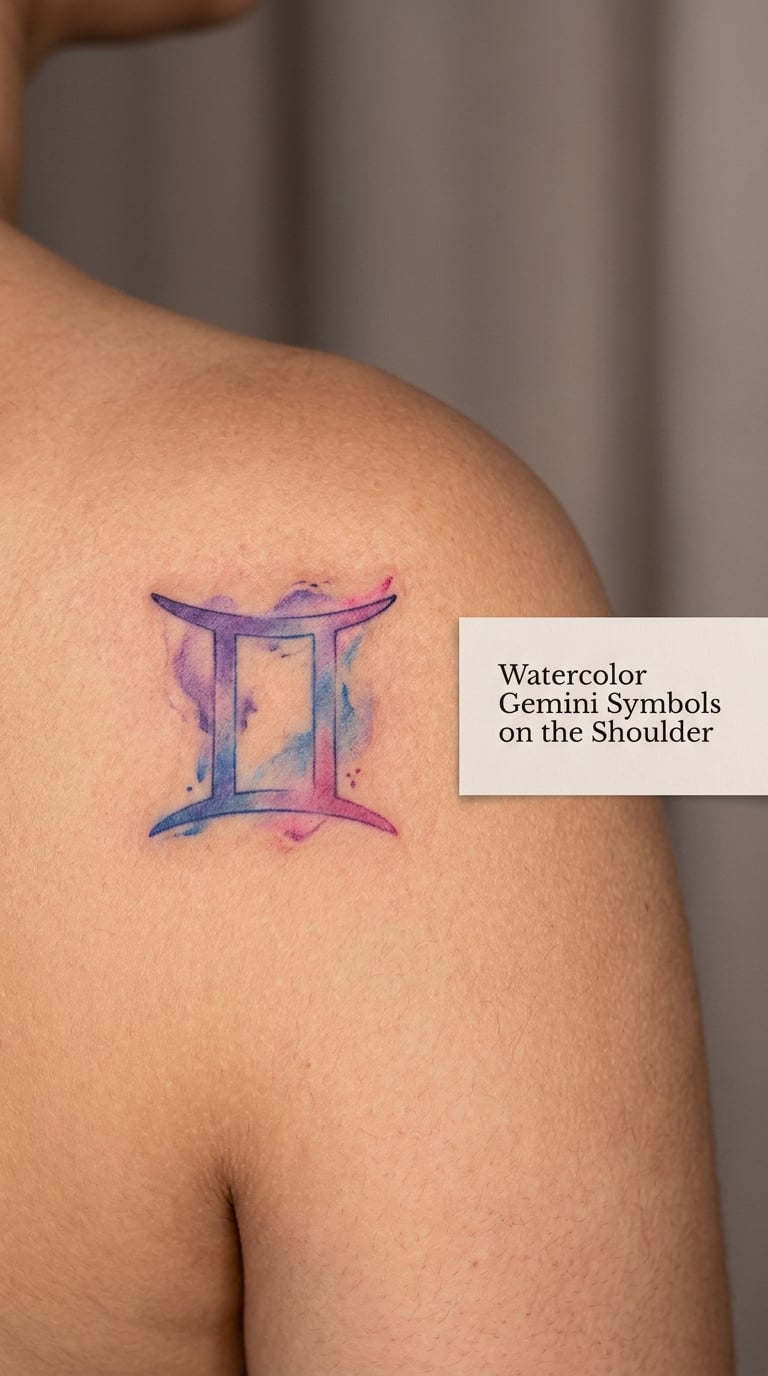
Watercolor is the one style that can be loud without going traditional. Washes of violet, blue or rose bleeding past the line of a glyph or two mirrored figures give a zodiac piece movement that fine line cannot fake.
It suits people who like colour but not a heavy design, and the shoulder cap takes the soft edges well because the skin there is broad and relatively flat.
Placement: shoulder cap, front or back. Size: 2.5-3.5 in (6-9 cm) tall. Style: watercolor with a light line base. Pain: medium; the shoulder cap curves, so expect the needle to catch at the edges. Make it yours: pick two colours that already mean something to you rather than the usual zodiac purple, and ask the artist to keep the wash inside or just past the line.
7. Blackwork Gemini Twins on the Upper Arm
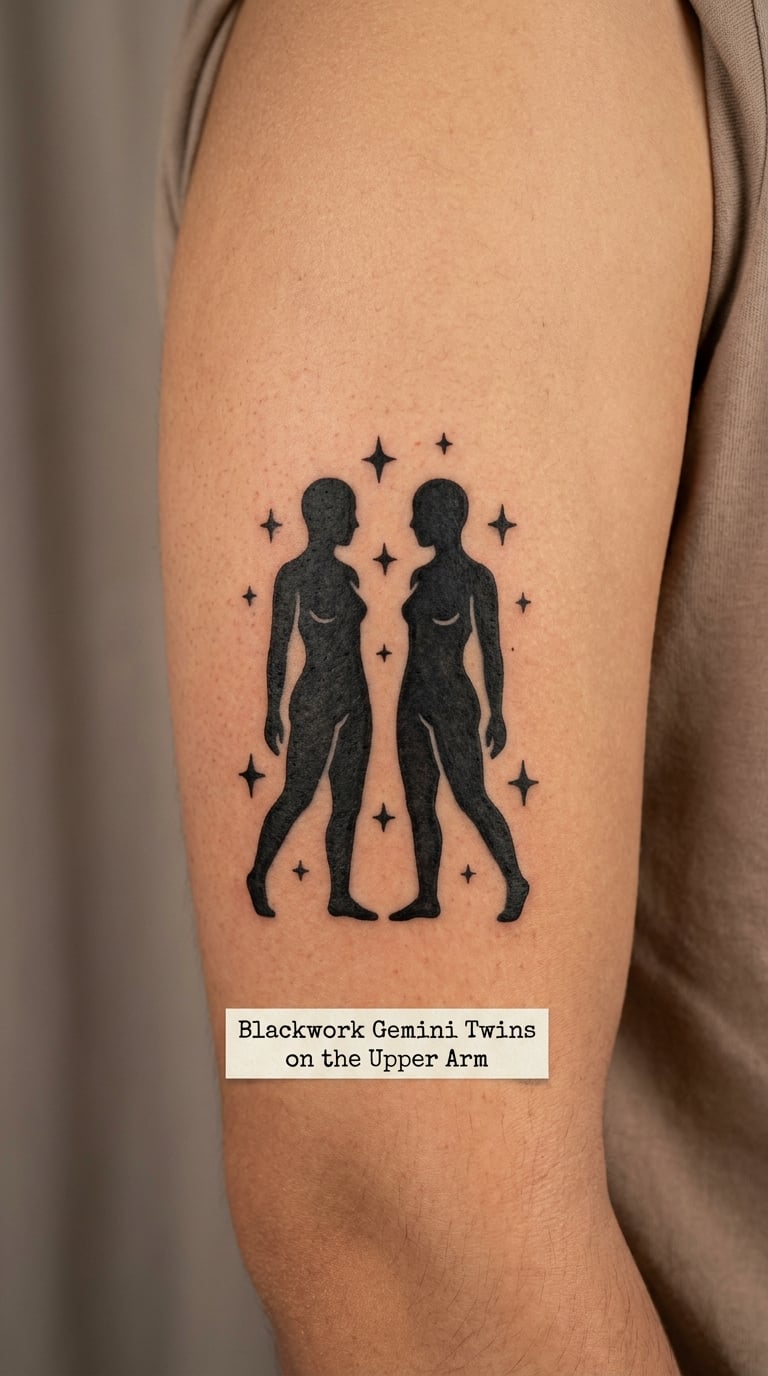
Solid black, heavy contour, two mirrored silhouettes filled in. Blackwork hides small imperfections and stays readable at a distance, which makes it the practical choice if you want the twins to actually be seen from across the street.
It is also the version that photographs most clearly in a healed photo, and healed photos are what you should be looking at when you choose an artist.
Placement: outer upper arm, deltoid to mid-bicep. Size: 3.5-5 in (9-13 cm) tall. Style: blackwork, solid fill. Pain: medium over a large fleshy area, with an edgy stretch near the shoulder. Make it yours: reverse one figure, or fill the gap between the twins with a solid black bar so the duality reads as one shape.
8. Gemini Glyph with Floral Branches on the Side
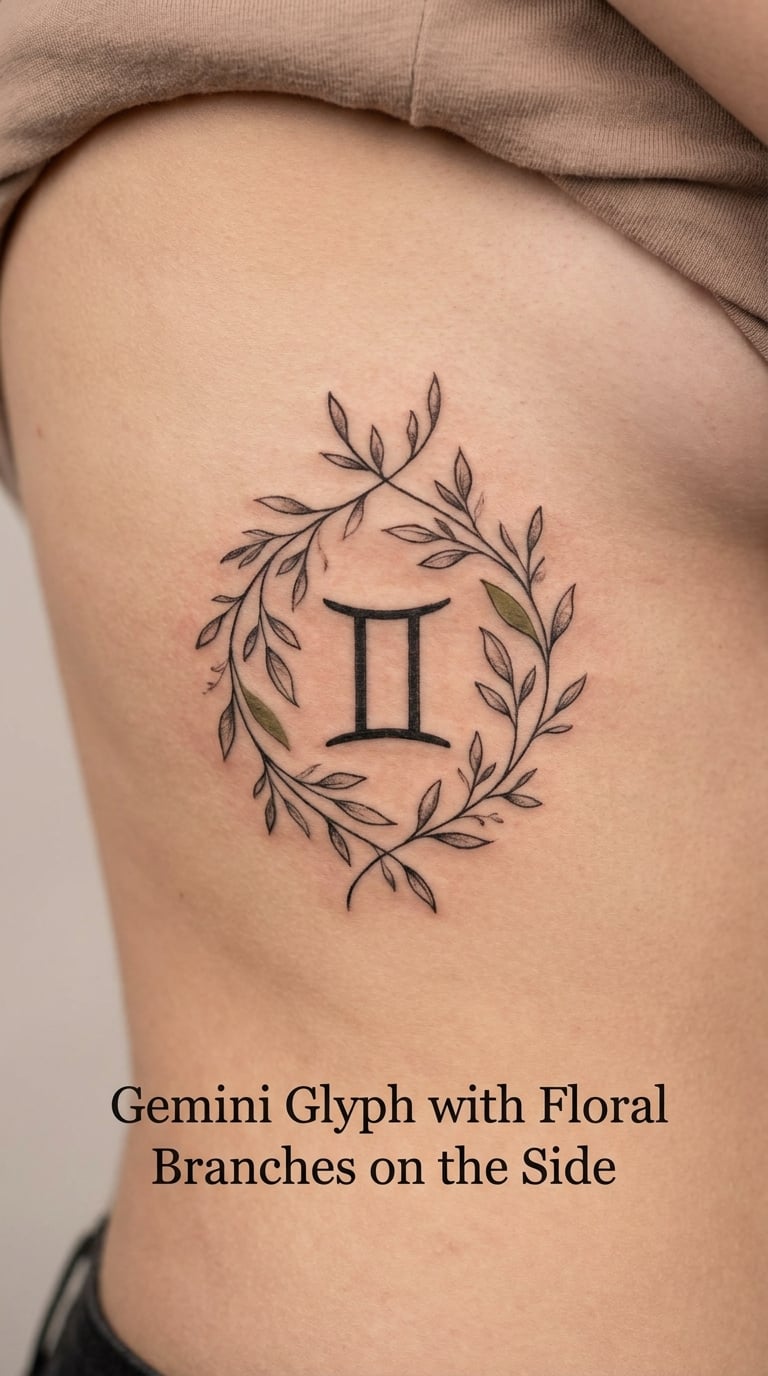
A glyph framed by two thin botanical branches, with lavender or lily of the valley as the flower. Those are the traditional birth flowers of the sign, and they are the easiest route to a zodiac tattoo that does not read as a generic symbol sheet.
Botanical linework plus a hard geometric symbol can clash if the weights do not match, so ask for one line gauge throughout. Rib placements need planning, because a branch design that looks flat on paper curves away from the body on the side of the rib.
Placement: rib side, between the ribs and above the hip. Size: 2.5-3.5 in (6-9 cm) tall. Style: fine line botanical, optional muted green. Pain: high, ribs are the placement people remember. Make it yours: use the birth flower from your own birth month rather than the Gemini one, or have the two branches grow in opposite directions to echo the twins.
9. Small Gemini Moon and Stars on the Ankle
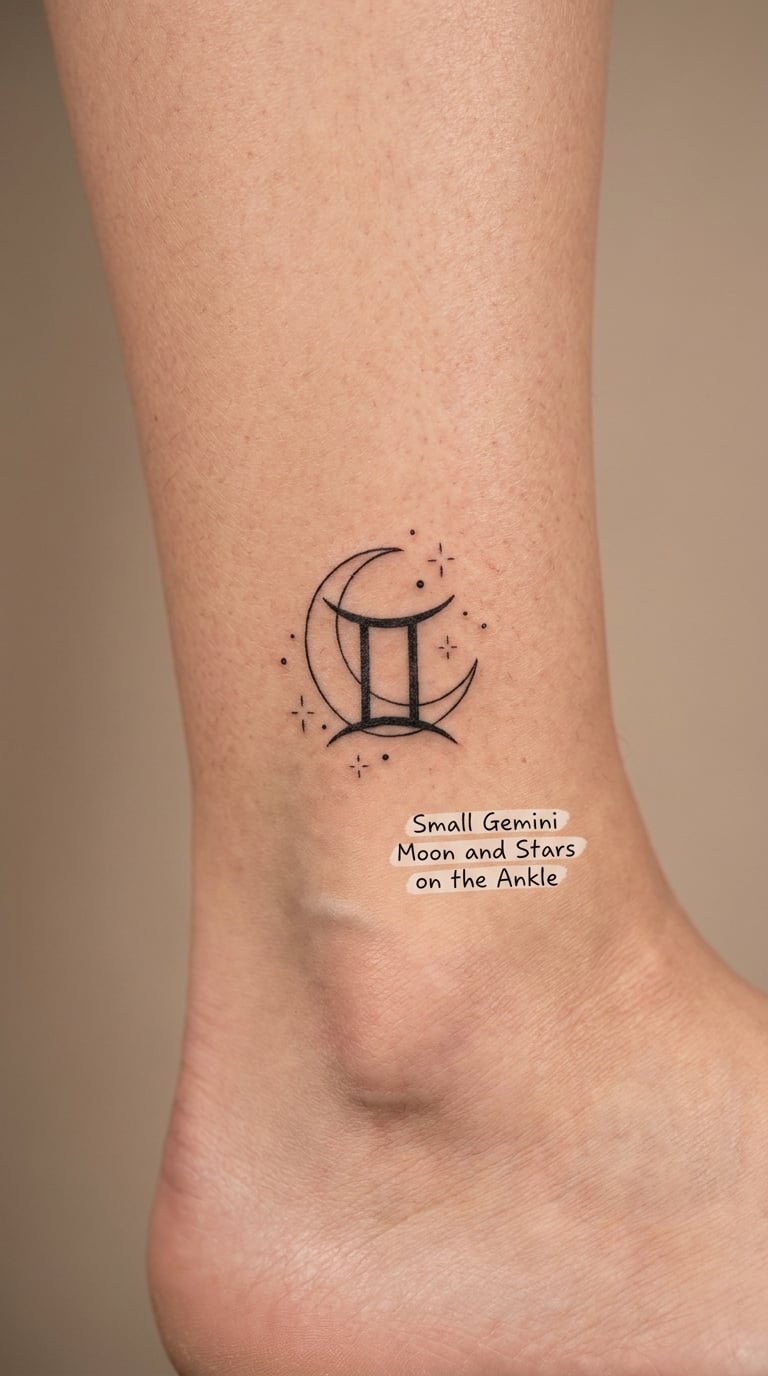
A small glyph with a crescent and two or three stars, clustered above the ankle bone where the skin is still flat. Ankles show in summer, in sandals, and under a cropped trouser, which makes this a seasonal piece by nature.
Scale matters more here than anywhere else on this list. The design has to sit above the bone, not over it, or it distorts within a year.
Placement: above the ankle bone, outer or inner side. Size: 1.5-2 in (4-5 cm) wide. Style: fine line. Pain: medium, tender near the bone and slow to heal on the lower leg. Make it yours: add a second matching cluster on the other ankle, or set the stars in a graduated size so the design has depth. Ankle ink fades faster than arm ink because of sock friction and sun exposure.
10. Gemini Script Wordmark on the Side of the Neck
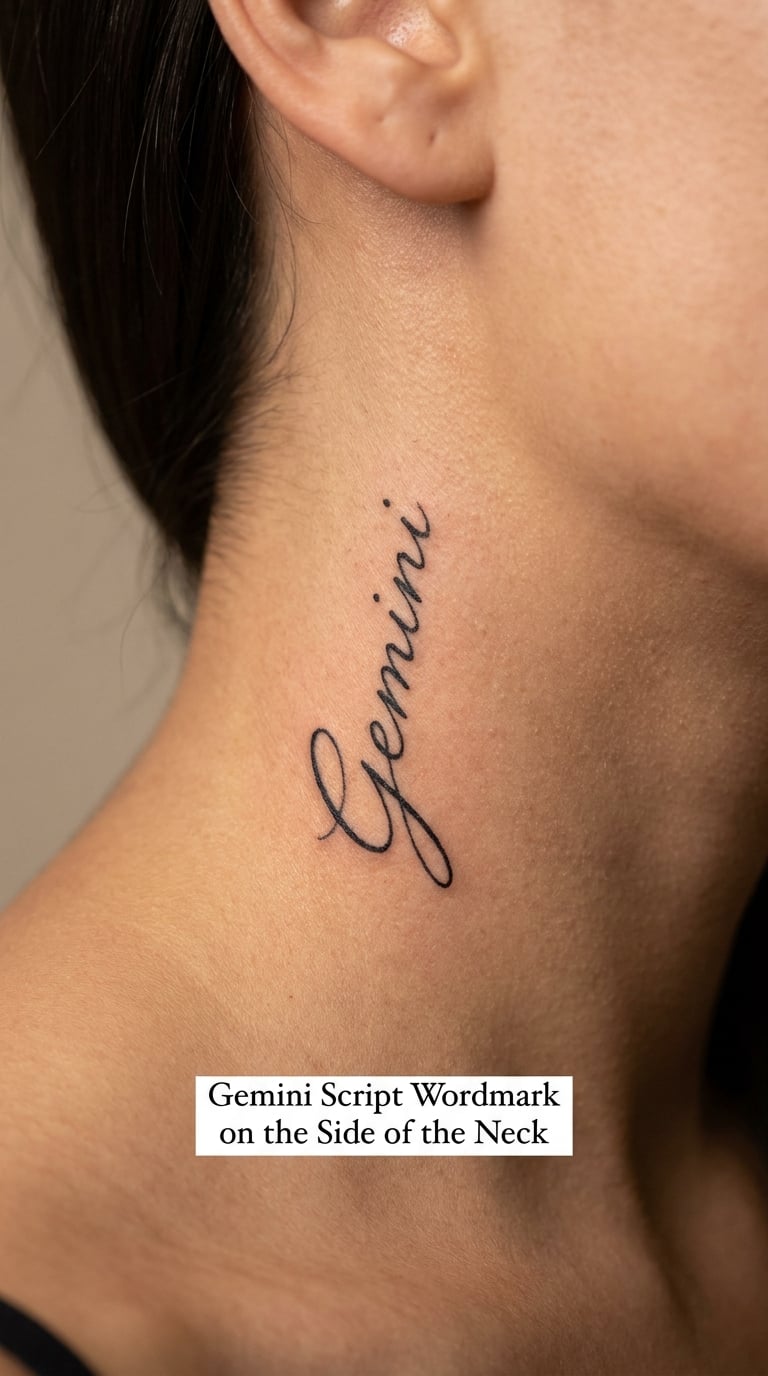
The word Gemini in a handwritten script, or a single word like a nickname, tucked below the ear and following the line of the jaw. Lettering is the hardest thing to age well, so the font has to be thick enough to read in a photograph ten years from now.
It is a visible placement, and that is a real consideration at the office. The design is small enough to read as delicate rather than loud. Our picks for classy neck tattoos for women cover the sizing questions that come up most at this spot.
Placement: side of the neck, below the ear, above the collarbone. Size: 2-2.5 in (5-6 cm) wide. Style: script lettering, not too thin. Pain: high, thin skin over a sensitive nerve area. Make it yours: write the word by hand first, scan it, and let the artist redraw it heavier, or pair it with two small stars at the start and end of the word. If you are still deciding between a word and a symbol, put both on paper at the same size and see which one you stop looking at.
11. Dotwork Gemini Constellation on the Back
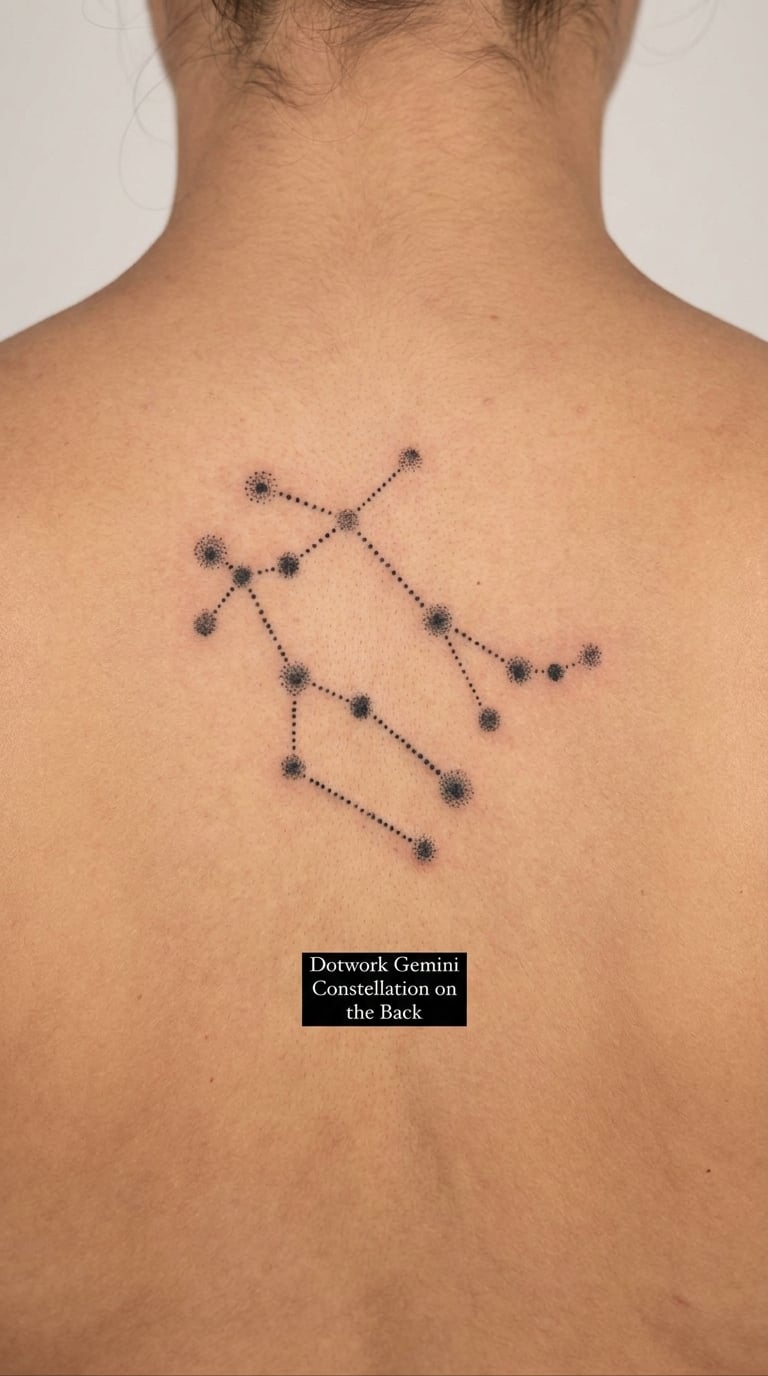
Graduated dots instead of lines. Each star is a cluster of tiny dots with a heavier centre, and the joining lines are single-file dot runs. The result is soft and textured, and it needs more time in the chair than a line piece of the same size.
Dotwork suits a wide back because the composition fills space without a hard border, and it hides in a photo taken from a distance.
Placement: between the shoulder blades, or one shoulder blade on its own. Size: 4-6 in (10-15 cm) wide. Style: dotwork, black only. Pain: medium, a long session on a large area. Make it yours: ask the artist to place your birth stars as the two largest clusters and let the rest follow the real constellation, which is a small detail only you will know about.
12. Gemini Symbol in a Fine-Line Sun and Moon Design
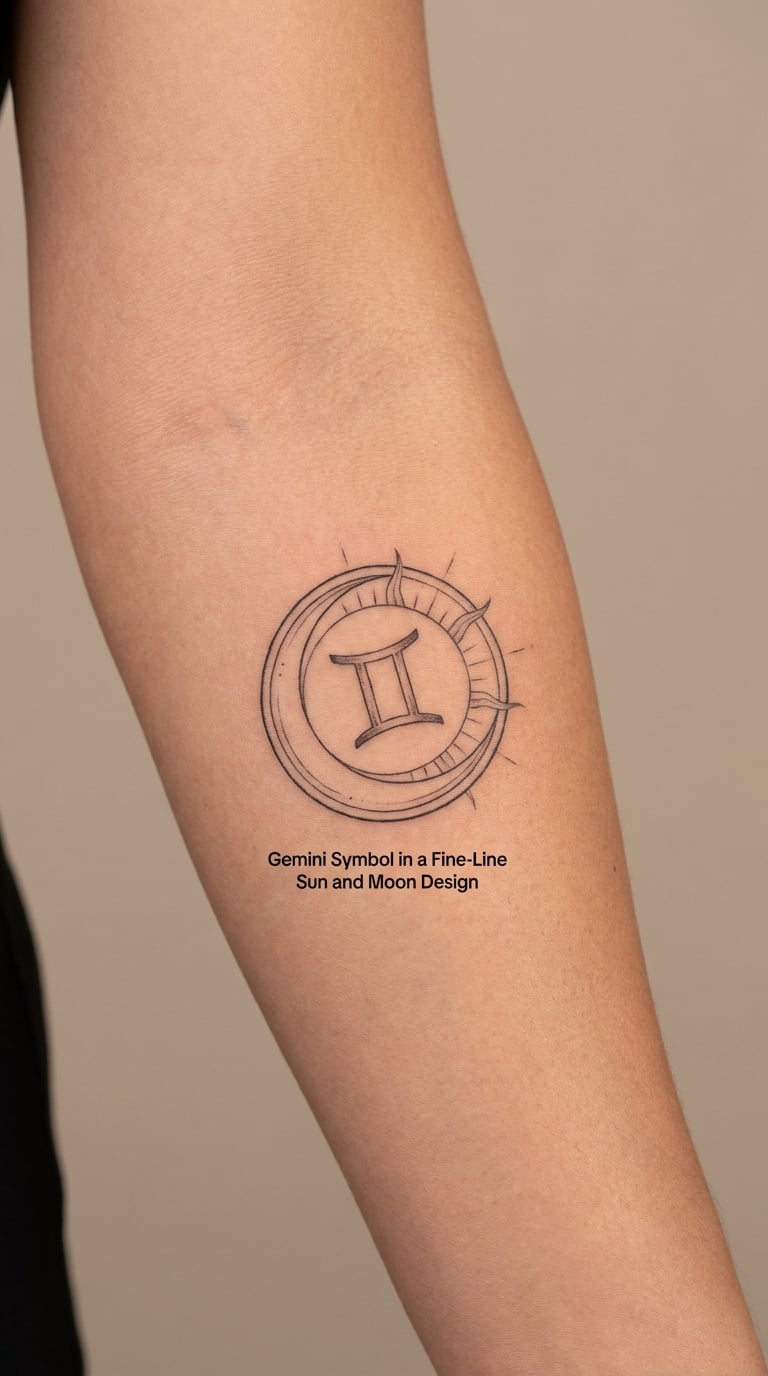
A circle containing a glyph in the centre, a sun arc on one side and a moon arc on the other, with small rays or dots filling the gaps. The circular frame gives the design a finished edge, which is what makes a first-time piece feel intentional rather than unfinished.
The sun-and-moon pairing is not Gemini-specific, so plenty of people keep a small glyph inside a piece built around a different personal symbol.
Placement: forearm, upper chest, or the flat area below the collarbone. Size: 2.5-3.5 in (6-9 cm) across. Style: fine line, geometric framing. Pain: medium, mostly the curved edge over a bony spot. Make it yours: engrave the date of a solstice or equinox near the border, or leave the circle open at the top so the design feels unfinished on purpose.
13. Minimalist Gemini Glyph on the Finger
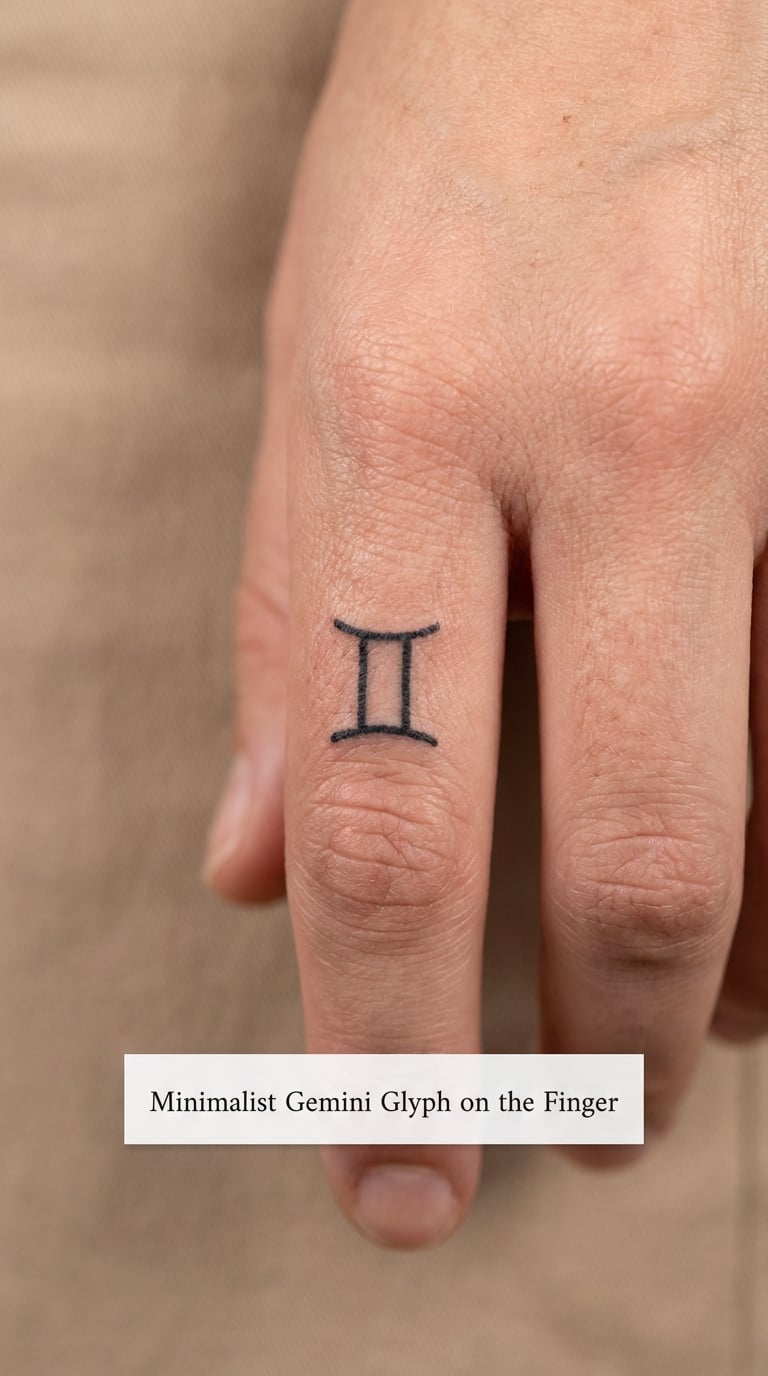
Half an inch of black line, four strokes, no shading. The smallest idea on this list and the one most likely to blur, because hands get washed, sunburned and exposed all day, and the skin moves constantly.
Ask to see healed photos of the exact glyph you want, not fresh work. A two-year-old piece is the only honest reference.
Placement: side of the index finger, or inside the thumb near the knuckle. Size: 0.5 in (1.3 cm) tall. Style: micro fine line. Pain: high, the hand is one of the most sensitive spots on the body. Make it yours: keep it to the glyph alone with no added stars, since every extra mark on a finger has less room than you think. Hand and finger ink fades noticeably within five years and often needs a touch-up.
14. Celestial Gemini Design on the Thigh
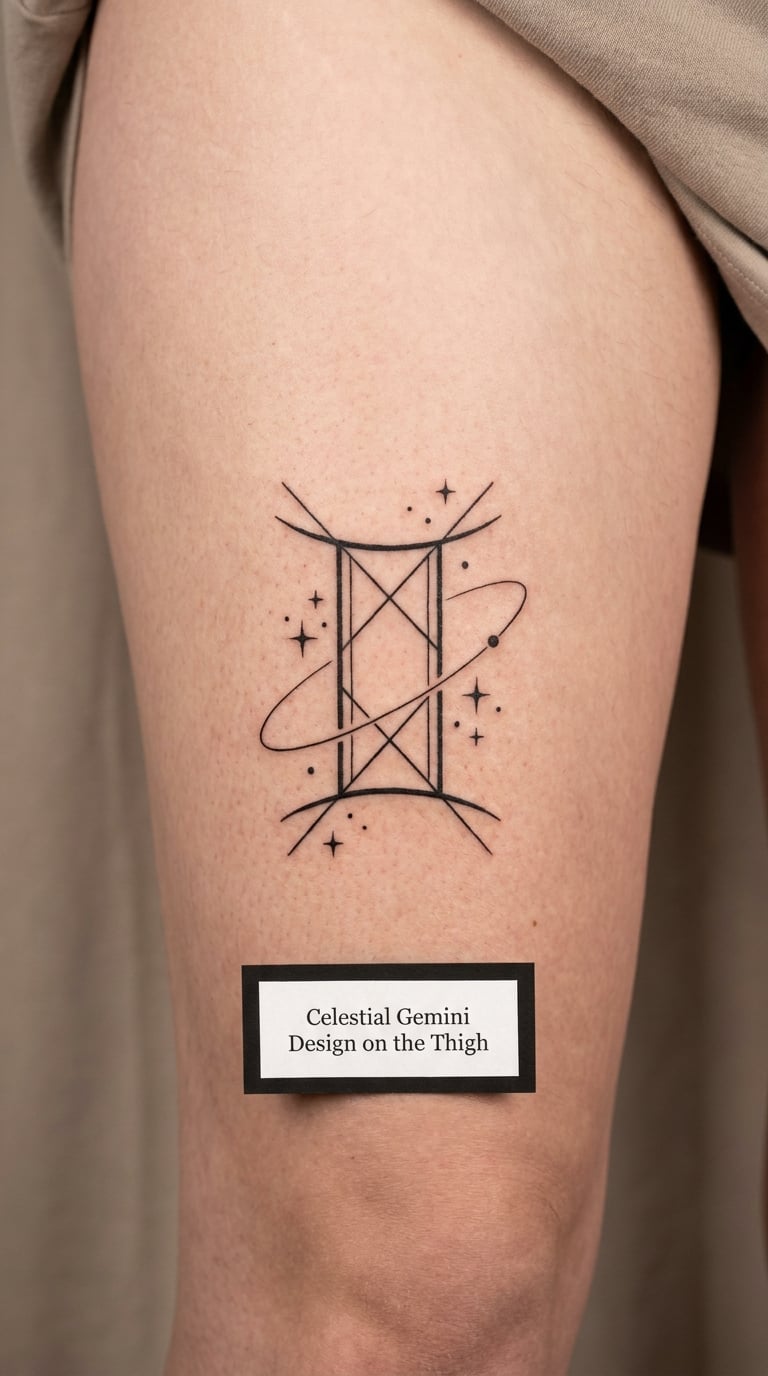
A larger composition: the glyph at the centre, a scatter of stars, and one thin elliptical orbit line sweeping around the whole thing. The thigh has the flat surface and the room to do this properly, and the orbital line gives the design a direction the other pieces lack.
It reads as a design, not as a stamp, which is what a larger composition needs to avoid looking empty.
Placement: outer thigh, or the upper front of the thigh. Size: 3.5-5 in (9-13 cm) tall. Style: fine line blackwork. Pain: medium to high, thigh skin is sensitive and sessions run long. Make it yours: have the orbit line broken where your birth month sits, so the gap is a calendar rather than a gap, or add a single small solid star as the anchor point.
15. Geometric Gemini Constellation on the Calf
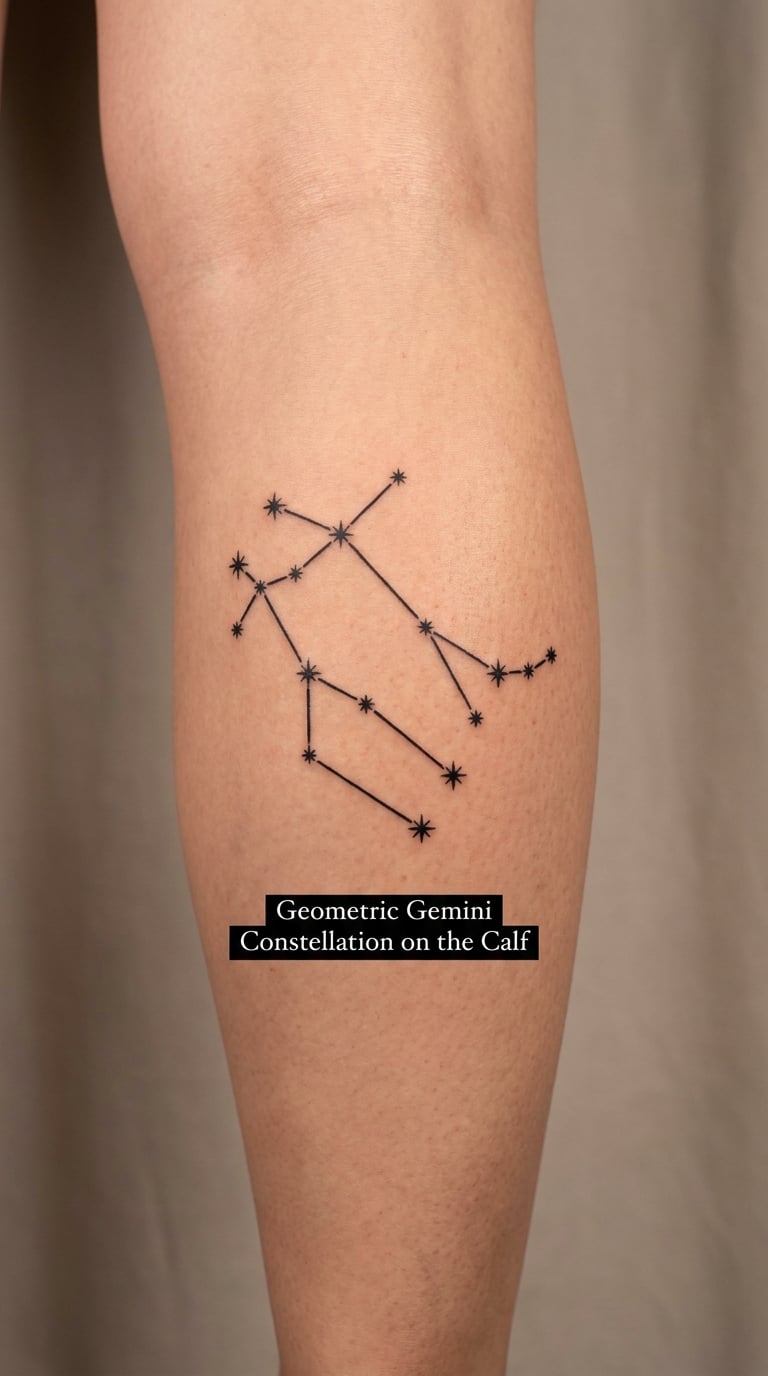
Angular lines, small solid stars and deliberate symmetry turn the constellation into a geometry exercise. It is not an accurate star map, and that is the point: the design trades realism for rhythm.
A calf is a good canvas for it because the muscle is substantial and the ink sits on a broad, mostly flat surface when the leg is relaxed.
Placement: outer calf, mid-way between knee and ankle. Size: 3.5-4.5 in (9-11 cm) wide. Style: geometric, black linework. Pain: medium, with a sensitive spot behind the knee. Make it yours: mirror the star pattern so each pair of stars sits at the same height, or set the connecting lines at a set angle so the whole piece tilts the same way.
16. Gemini Rose Tattoo on the Hip
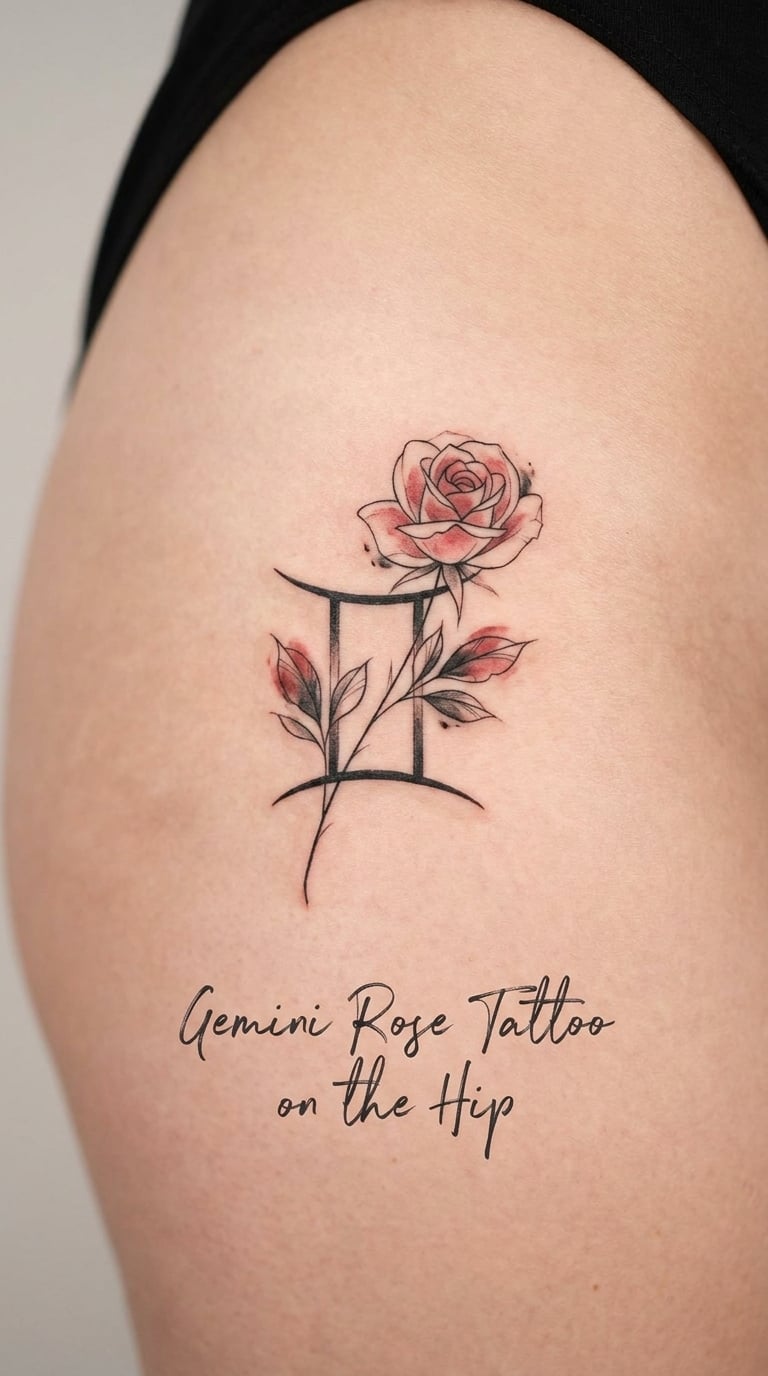
One glyph, one rose, nothing else. A single flower is easier to execute well than a bouquet, and it keeps the composition from looking like a sticker you bought at a market.
The hip gives the design a soft, angled surface, and the curve of the bone means the rose sits naturally at the top of the piece.
Placement: upper hip, on the curve just above the bone. Size: 2.5-3.5 in (6-9 cm) tall. Style: botanical fine line with soft colour in the petals. Pain: high, the hip is close to the bone and hurts more than its reputation suggests. Make it yours: use the birth flower of the sign that means most to you rather than a generic rose, or pick the ink tone first and let the artist match the colour to it.
17. Small Gemini Starburst on the Sternum
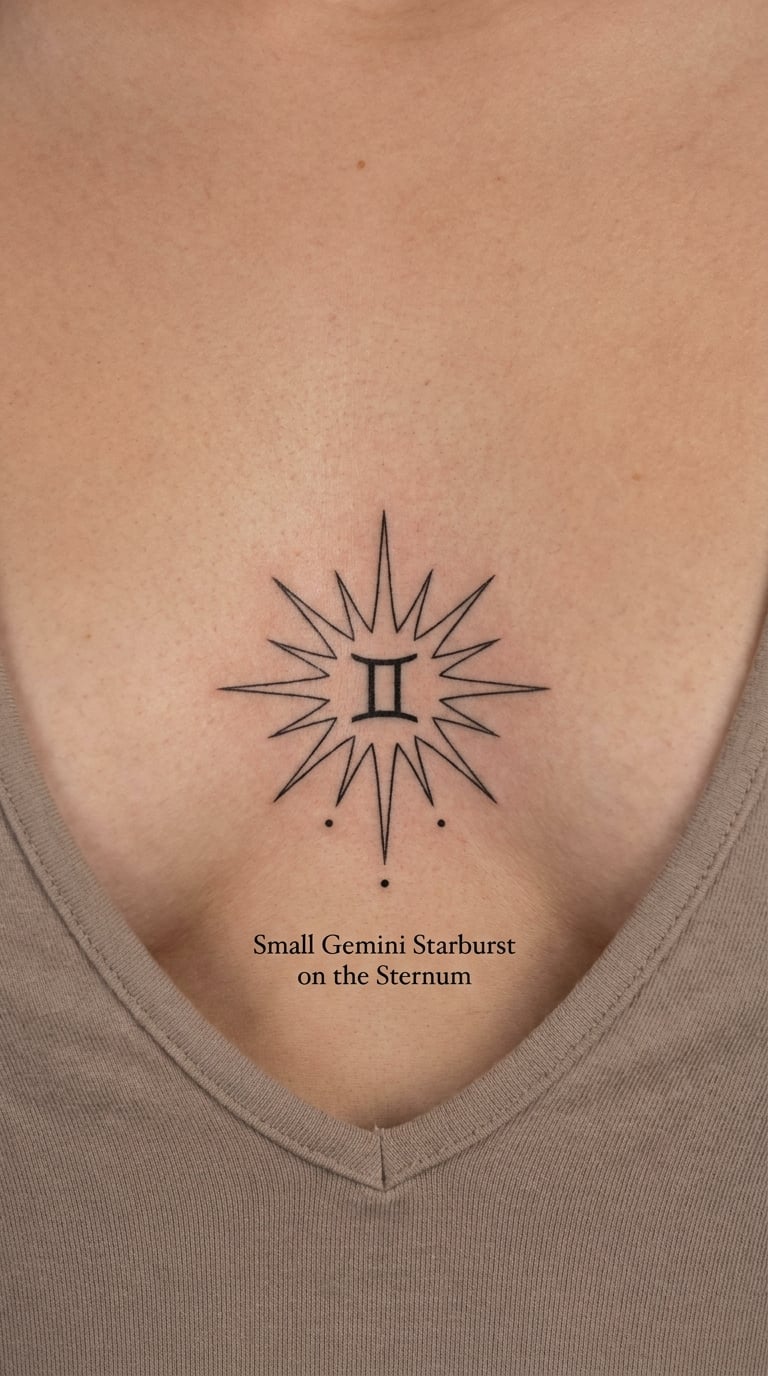
A small starburst centred between the collarbones, with two dots beneath it standing in for the twins. The whole design is about two inches wide, which keeps it in fine-line territory and keeps it easy to cover if you ever need to.
Sternum work shows under a low neckline, so decide now whether you want that attention. I would rather you decide now than after.
Placement: upper sternum, centred, between the collarbones. Size: 1.5-2 in (4-5 cm) wide. Style: fine line, symmetrical. Pain: medium, the bone here is close to the surface. Make it yours: place the two dots at the exact distance apart that matches the twin glyph proportions, or add a small crescent under the starburst for a second element without adding much size.
18. Traditional Gemini Badge on the Forearm
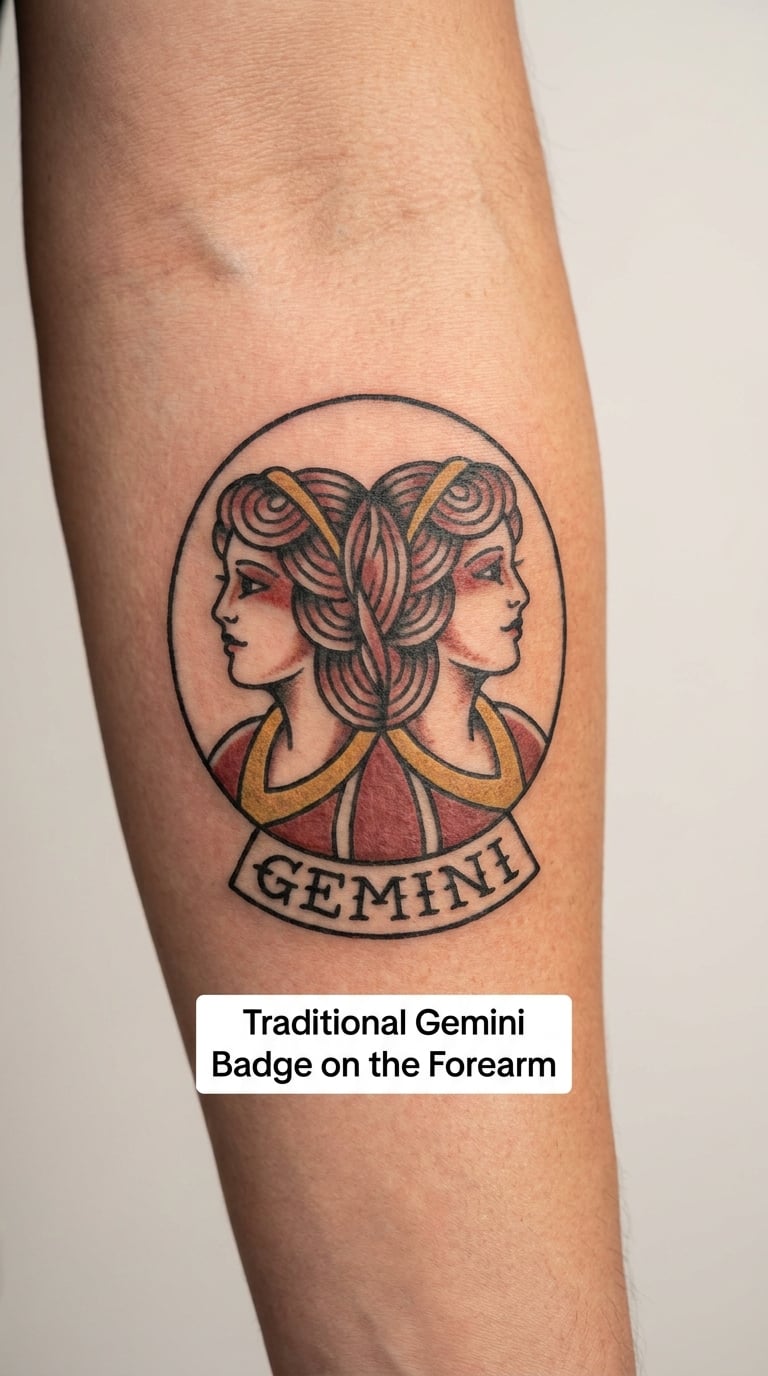
Bold black outlines, flat colour, twin figures facing each other with a banner underneath carrying a word or a date. Traditional work has more going on than anything else on this list, and it rewards a bigger area and a longer session.
It suits people who like colour and want the piece to read as a badge rather than a symbol. Ask for a lighter fill if you want it to fade more gently.
Placement: outer forearm, between wrist and elbow. Size: 3.5-4.5 in (9-11 cm) wide. Style: traditional or neo-traditional. Pain: medium to high over a long session on the forearm. Make it yours: put your birth month on the banner, or the year you were born, and let the artist hand-draw the banner shape to fit the words.
19. Minimal Gemini Coordinate on the Wrist
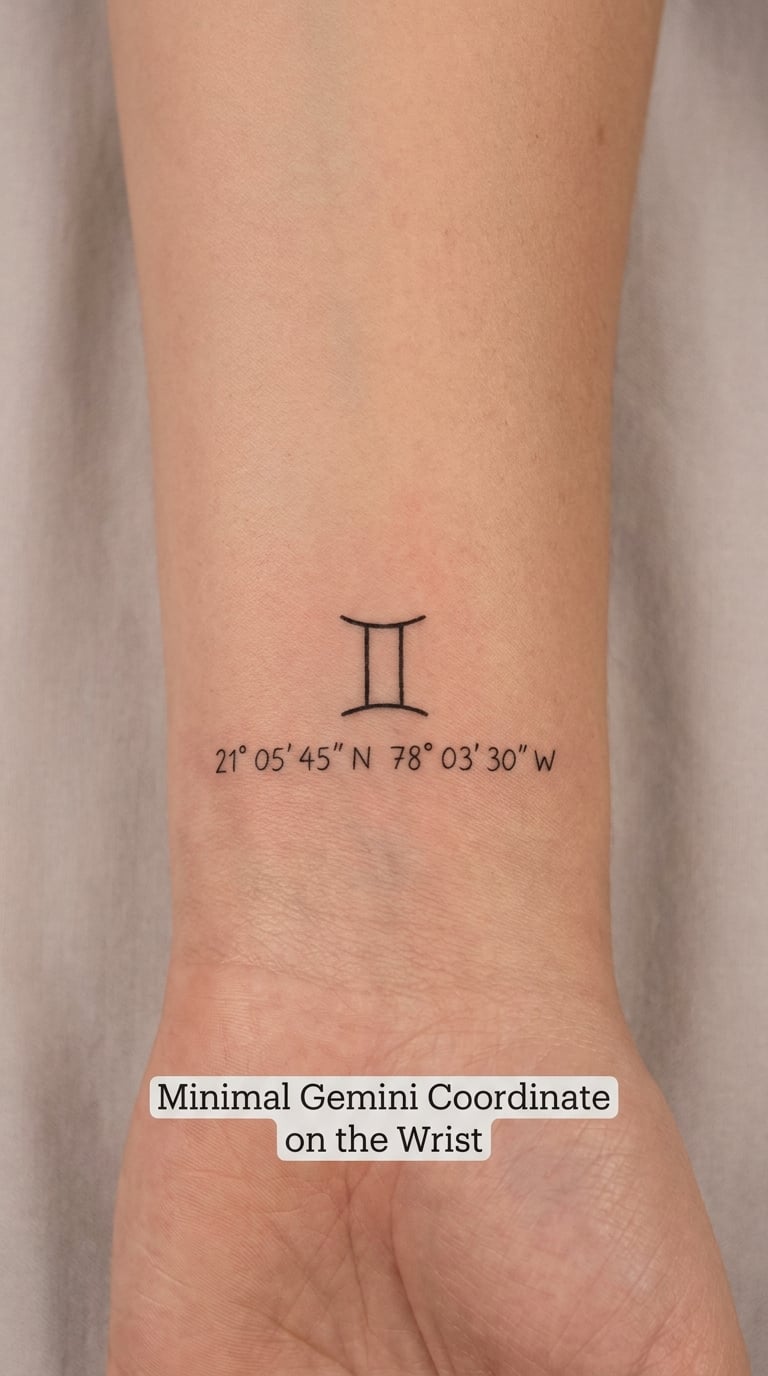
Latitude and longitude of your birthplace, set in tiny numerals, with a small glyph above them. It looks like a data stamp, which is a nice change from the flowers and ribbons most zodiac pieces lean on.
Coordinates are the most private of the designs here. Nobody recognises the numbers, and it only means something to you.
Placement: inner wrist, below the forearm crease. Size: 1.5-2 in (4-5 cm) wide. Style: micro lettering, fine line. Pain: low to medium. Make it yours: use the coordinates of somewhere that matters instead of your birth hospital, and set them in a monospaced font for a cleaner look. Numbers under two inches of width blur at the decimal points, so keep the digits at a readable size rather than as small as possible.
20. Large Zodiac Wheel with Gemini Highlighted
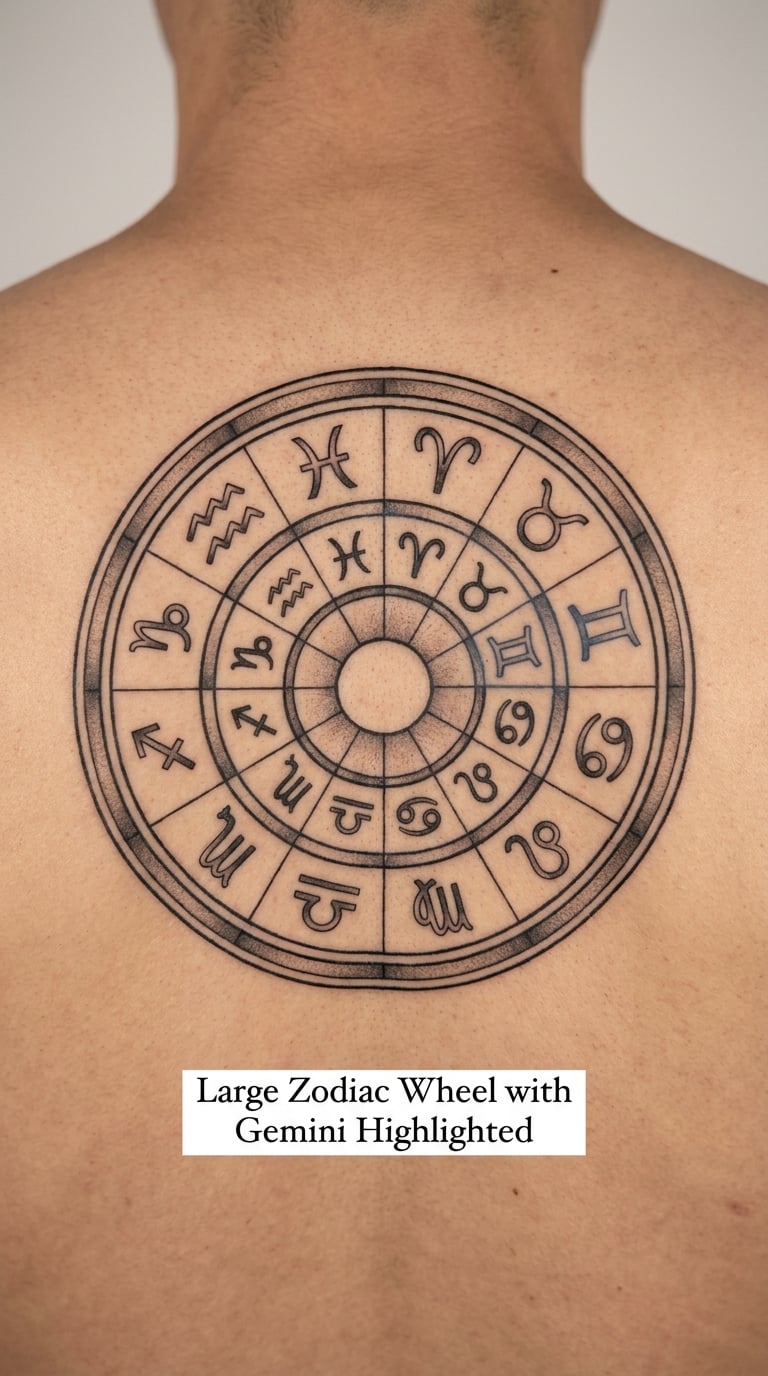
The full wheel, all twelve sections, with Gemini picked out so the eye lands on it first. Either a single line of colour across the Gemini segment or a full colour block does the job. This is the biggest piece on the list and the one most worth planning as a project.
Do it once, properly, with an artist who draws circles freehand. The ring has to close.
Placement: across the upper back between the shoulder blades, or centred on the chest. Size: 5-7 in (13-18 cm) across. Style: black and grey with one colour accent. Pain: medium on the back over a long session, often split into two. Make it yours: add tiny glyphs of the signs you actually care about around the rim, or leave the rest of the wheel in grey so Gemini is the only part with colour.
How to Choose the Right Design
Six checks, in the order I would run them.
Match the detail level to the spot you picked
Detail needs area. A three-inch dotwork constellation on a finger is a blur within two years, and the same design between the shoulder blades has room to breathe. If you have already decided on a placement, work backwards to a size the skin there can actually hold.
Style, size and placement are a set of three decisions, not one. Two of them can be flexible, but the third usually cannot, and it is the one that decides the design.
- Style first: fine line if you want it discreet and delicate, blackwork or traditional if you want it readable from a distance, dotwork or watercolor if you want texture or colour.
- Size second: under two inches means a symbol or a word. Two to four inches means a composition. Over four inches means a project, and it needs an artist who draws that scale confidently.
- Placement third: forearm, collarbone, inner wrist and behind the ear are the easy ones. Ribs, neck, hip, thigh and sternum all hurt more and all hide better.
- Ageing reality: fine line on hands and fingers fades in about five years. Ask for a heavier gauge than the sketch looks like it needs, and look at healed work from at least a year before you commit.
- Personal meaning: a date, coordinates, birth flowers or a real star map make the piece yours. A downloaded glyph someone else drew does not, and people tend to notice that difference a few years in.
- Future coverability: a design in a flat, hairless, sun-protected area is much easier to cover or fade later. If you are young and undecided, weight that heavily.
Cost and Session Time
Most US shops charge by the hour, and a small fine-line piece usually takes an hour or less. Expect to pay roughly 80 to 250 dollars for a small glyph, numeral or coordinate, 200 to 600 dollars for a mid-size composition such as the constellation, rose or sun and moon designs, and 600 to 2000 dollars or more for a large piece like the zodiac wheel in number 20, which is often split across two sessions.
What moves the number: hourly rate versus flat price per piece, city versus small town, how much freehand drawing the design needs, colour passes, and the shop minimum. A shop minimum of 150 or 200 dollars is common, so a two-hour session priced as three still gets billed at the minimum.
Fine line is not cheaper by the hour. Single-needle work is slow, so a small design with delicate lines can cost as much as a bolder piece of the same size.
Aftercare Basics
- Follow your artist’s aftercare instructions first. They know what they did in your session, and their advice outranks anything general you read, including this list.
- Wash gently, twice a day, with lukewarm water and unscented soap, then pat dry with a clean towel. No scrubbing, no long showers over the fresh ink.
- Keep it moisturised, with a plain ointment or fragrance-free lotion, several times a day while the skin is tight. Do not let a scab form.
- Cover it in the sun, and cover it in loose clothing. UV light is the fastest way to fade fine line and pale colour, and a fresh piece is the most vulnerable for its first few weeks.
- Do not pick, scratch or itch it. If it itches, pat it or press a cool cloth against it. The moment you pull a scab off is the moment you take pigment with it.
- Skip baths, pools, hot tubs and the gym for the first two weeks, until the new skin layer has closed over. Then take it easy for another few weeks before anything rubbing.
Frequently Asked Questions
What does a Gemini tattoo symbolize?
A Gemini tattoo marks the third sign of the zodiac, which runs May 21 to June 20, and is usually built from the twin glyph, twin figures, the constellation, or the sign’s birth flowers, lavender and lily of the valley. Most wearers read it as duality: curiosity, adaptability, quick wit, and the sense of holding two identities in one person. What the piece means to you comes from the detail you choose.
What is the best placement for a small Gemini tattoo?
The inner forearm, collarbone, behind the ear, and just above the ankle bone are the easiest places for a small Gemini design, because the skin is flat and the area heals without much movement. The inner wrist works for numerals and coordinates. Avoid fingers and hands if you want the piece sharp for years, since ink there fades fastest of anywhere on the body.
Is a Gemini tattoo a good choice for a first tattoo?
Usually yes. A single glyph, a birth date, or a small constellation is quick to tattoo, easy to cover with clothing, and simple enough that a healed result needs no cover-up. Pick a flat spot like the forearm or the outer upper arm, and ask your artist to see healed work at that size before you commit to anything larger or more detailed.
What are the Gemini birth flower tattoos?
The two birth flowers associated with Gemini are lavender and lily of the valley. A single lavender stem, or a small cluster of bell-shaped lily of the valley, is usually drawn in fine line with a light touch of colour, and pairs well with the glyph in the middle. If you want the piece to mean more than the sign itself, add the birth flower of the month you were actually born in.
How do I make a Gemini tattoo feel personal?
Add one detail nobody else would have: your birth date in numerals, the coordinates of somewhere that matters, the real constellation with your birth stars made larger, or the flower from your birth month instead of the Gemini one. A mismatched pair worn on both sides also works, and costs the same. Custom lettering goes through the same process.
Do fine line Gemini tattoos fade quickly?
Fine line fades faster than bold work, mostly from sun exposure, rubbing and the natural turnover of skin cells. On the forearm and collarbone, expect noticeable softening after five to seven years. On fingers, ankles and the neck, treat it as closer to three to five, and plan for a touch-up rather than assuming a single needle line will stay crisp forever.
Conclusion
For a first Gemini tattoo, the fine-line constellation on the forearm in number 1 or the small glyph pair on the collarbone in number 2 are the two I would pick. Both are quick, both sit in easy-healing spots, and both are the kind of design you still like in ten years rather than one you quietly cover up.
If you are already collecting zodiac or constellation work, the zodiac wheel in number 20 is the piece to plan properly, and number 11 is the halfway point that lets you start it without going straight to the full composition. Whatever you pick, take a reference to a tattoo artist, show them healed work in the style you want, and let them adjust the size for your skin before anything goes on.