
20 Best Hiking Tattoo Ideas With Meaning (October 2026)
Hiking tattoo ideas with meaning work best when the design carries a real detail from your own trail life, not a stock mountain clip. The symbols hikers reach for are a small set: mountain silhouettes, compass roses, topographic contour lines, trail blazes, boots, tents, coordinates, mile markers. The meaning is shared, and one specific number, place, or date inside it makes the piece yours.
Most of these designs are small linework pieces that heal in two weeks and settle into something quieter within a year. A few lines of text below cover the twenty that come up most, plus what each one means, where it sits, how big to ask for, and how it holds up under sun, sweat, and a pack strap. If you are planning a trip in the next month or two, read the timing notes near the end first. Fresh ink and a long season on the trail do not mix well.
Hiking Tattoo Ideas With Meaning: Quick Guide
| Idea | Style | Best placement | Size | Pain |
|---|---|---|---|---|
| 1. Fine-line mountain range | Fine line | Inner forearm | 2.5-3.5 in | Low |
| 2. Topographic map | Black and grey linework | Upper shoulder | 4-5 in | Medium |
| 3. Compass rose | Minimal blackwork | Inner forearm | 2-3 in | Low |
| 4. Trail coordinates | Fine line | Below the elbow | 1.5-2 in | Low |
| 5. Peak with sunrise | Black and grey with one accent | Outer upper arm | 3-4 in | Medium |
| 6. Hiking boot with route line | Blackwork | Outer calf | 3 in tall | Medium |
| 7. National park silhouette | Fine line | Upper back | 6-7 in | Medium |
| 8. Mountain in a circle | Micro fine line | Inner wrist | 1-1.5 in | Low |
| 9. Elevation-line range | Graphic blackwork | Outer forearm | 6 in | Medium |
| 10. Tent under stars | Fine line | Upper arm | 2.5-3 in | Low |
| 11. Trail marker sign | Blackwork | Outer forearm | 2-2.5 in | Low |
| 12. Watercolour mountain wash | Watercolour | Shoulder blade | 3-4 in | Medium |
| 13. Route as a minimal map | Fine line | Forearm | 3 in long | Low |
| 14. Ridge and crescent moon | Fine line | Inner arm or behind ear | 2 in | Medium |
| 15. Four-peak family symbol | Fine line | Wrist | 2 in | Low |
| 16. Backpack in blackwork | Blackwork | Forearm | 3 in tall | Medium |
| 17. Summit dots and contours | Abstract black linework | Calf | 2.5 in | Low |
| 18. Pine trees and reflection | Fine line | Inner arm | 4 in | Low |
| 19. Micro realism mountain patch | Black and grey realism | Forearm | 1.5-2 in tall | Medium |
| 20. Hand-drawn route sketch | Freehand linework | Outer forearm | 3 in long | Low |
Hiking Tattoo Ideas by Style and Placement
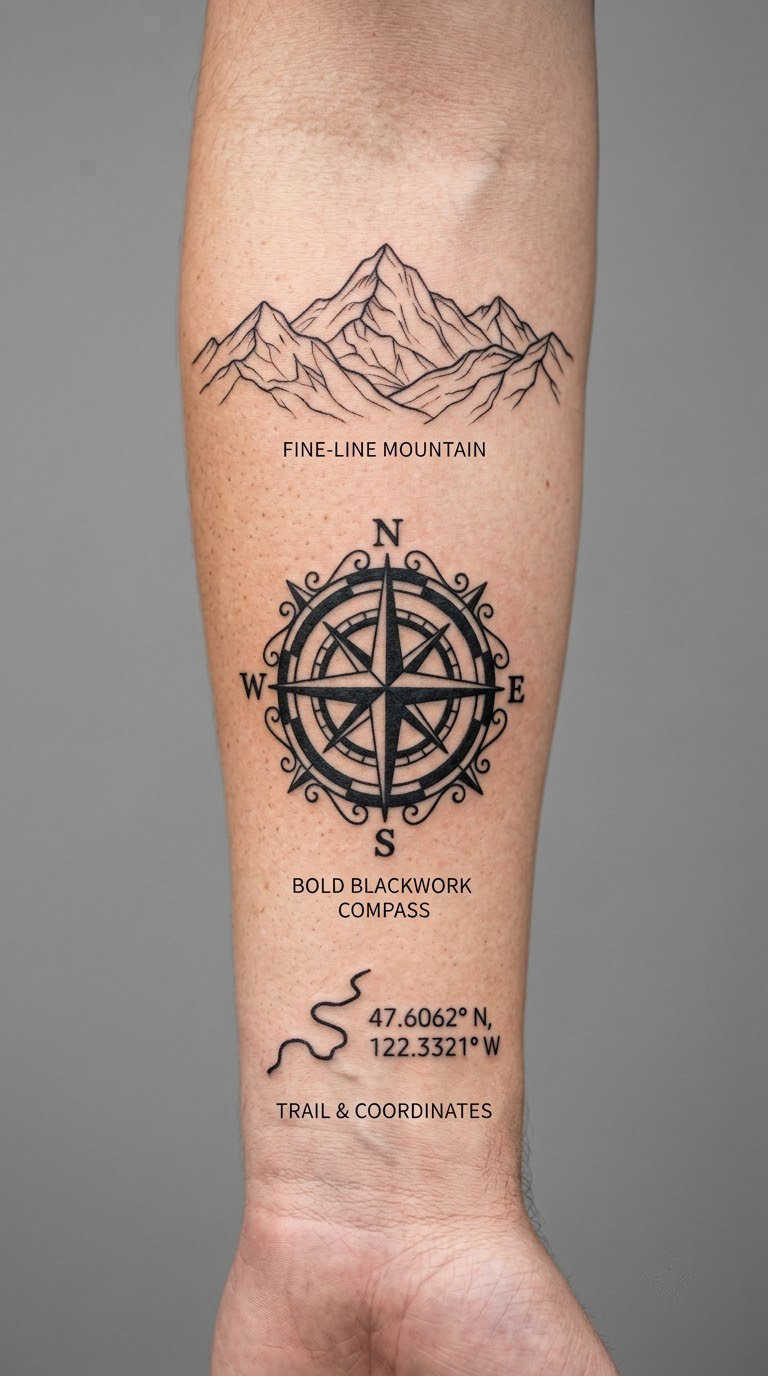
Four things decide whether a hiking motif still reads clearly in fifteen years: line weight, contrast, scale, and where it sits. Fine line work looks perfect on day one and softens fastest, so anything thinner than about 1/16 inch on a sun-exposed forearm will need a touch-up. Solid black linework holds its edge far better than grey wash.
Scale matters just as much. Contour lines packed closer together than a few millimetres merge into a grey block as the skin ages, while bold black bands lose their inner texture first. And placement is the biggest practical factor of all, because a forearm gets sleeve friction and daily sun, a shoulder gets pack-strap rub, and the inner wrist is the one spot where a small design disappears entirely under a watch band.
1. Fine-Line Mountain Range on the Forearm
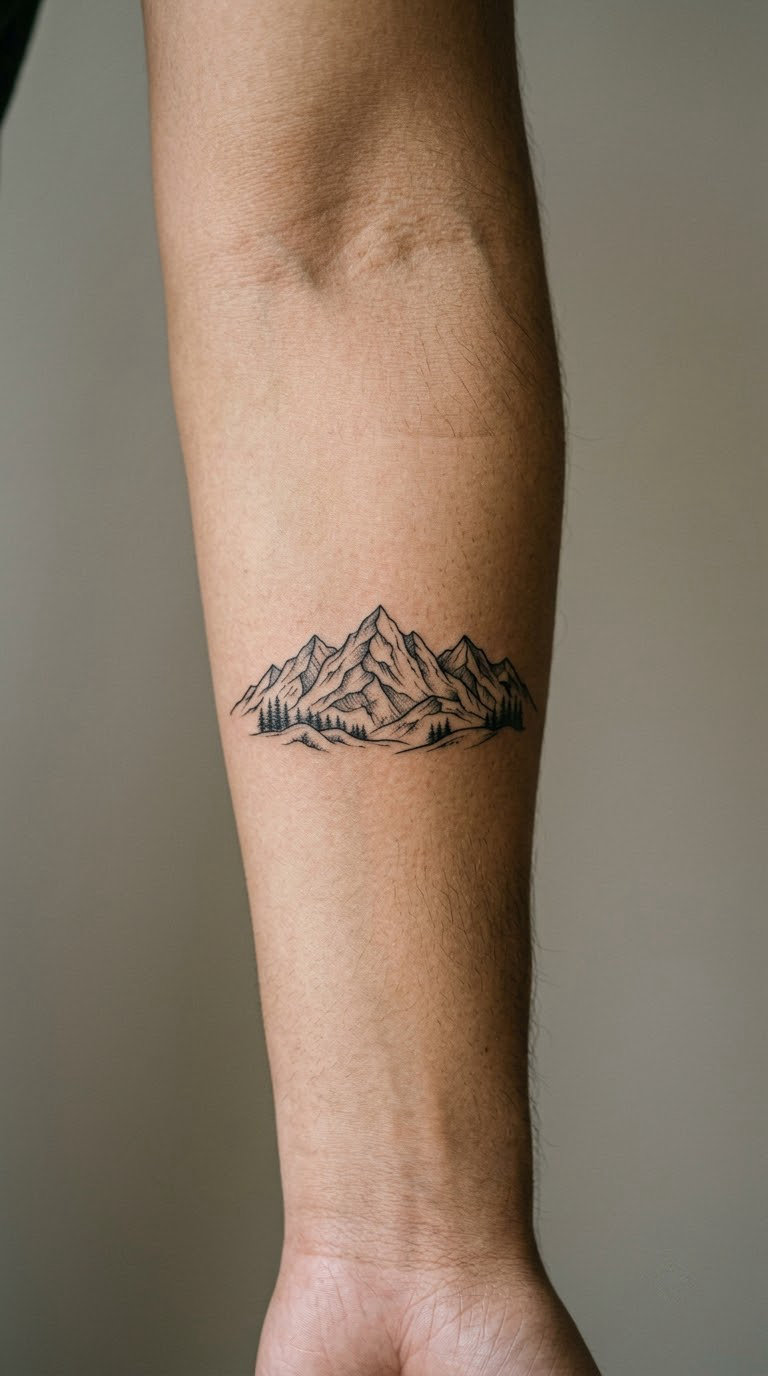
A ridge line drawn as one continuous black line, maybe two to three peaks of uneven height, with nothing behind it. The best version has a slightly heavier base stroke and a hairline summit, so the shape still reads when the fine detail has softened.
Mountains carry the obvious meaning in this whole category: challenge, distance, the thing you had to work for. A ridge profile from a range you actually walked makes that personal without needing a single word of text.
Placement: inner forearm, running along the tendon line · Size: 2.5-3.5 in (6-9 cm) wide · Style: fine line · Pain: low, mostly a scratchy feeling · Make it yours: trace the real skyline of your favourite range from a photo instead of a generic template.
One honest note: fine line on a forearm fades faster than anywhere else on the body because that skin sees sun all year. Ask your artist for a slightly heavier line than feels right in the chair.
2. Topographic Map on the Shoulder
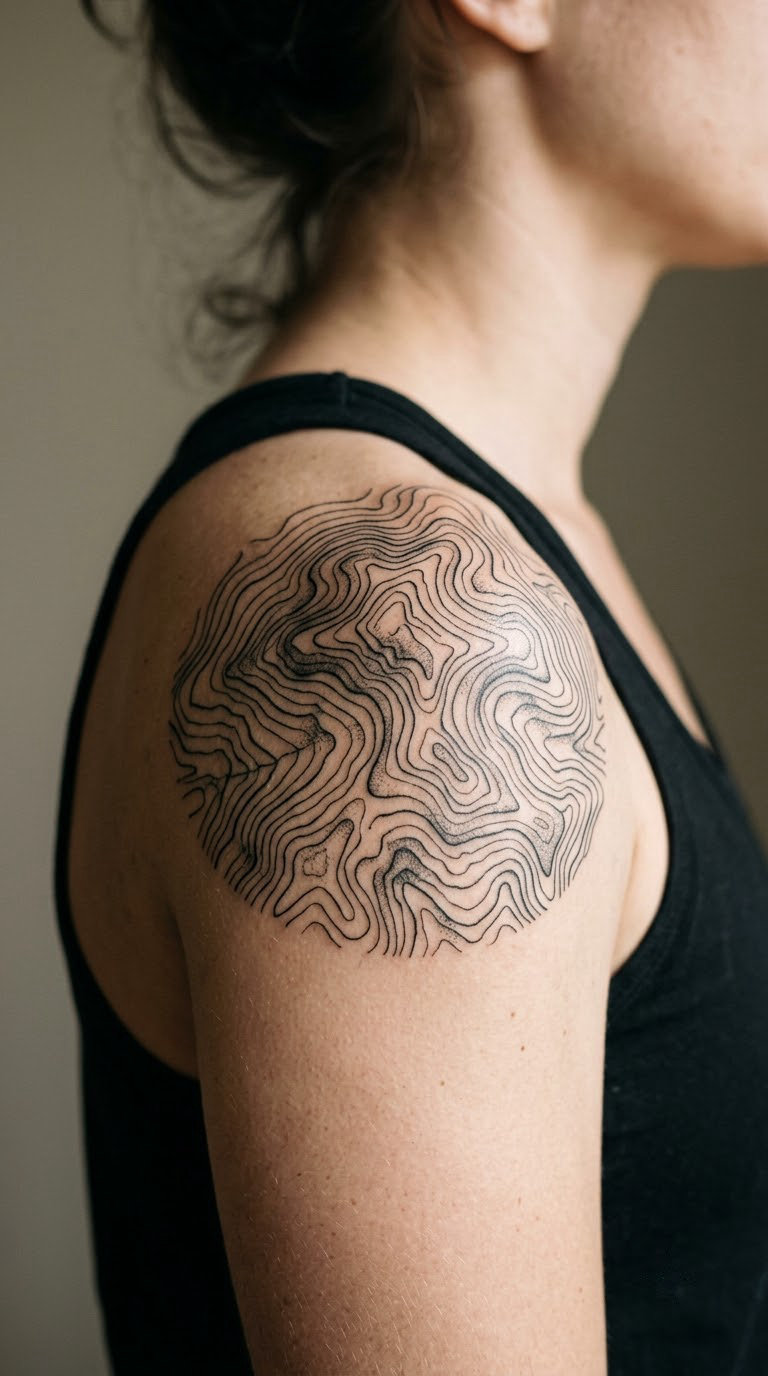
A square or rectangular patch of contour lines with no other detail, a few index contours running heavier through the middle and the short perpendicular tick marks on the uphill side. No labels, no border text.
A topo patch means one specific piece of ground rather than nature in general, so it is the strongest answer for a hiker with no signature trail. Someone in a Pennsylvania forum thread asked exactly this, whether they could get something meaningful without having one favourite route, and a contour extract from a map they walk every month solved it.
Placement: deltoid or upper shoulder, wrapped slightly around the arm · Size: 4-5 in (10-13 cm) square · Style: black and grey linework · Pain: medium, the shoulder is bony in places · Make it yours: bring a printout of your local map at a large enough scale that the contours stay apart.
Watch the spacing. Contours closer together than a few millimetres fill in with grey as they heal and lose all their detail.
3. Minimalist Compass Rose on the Forearm
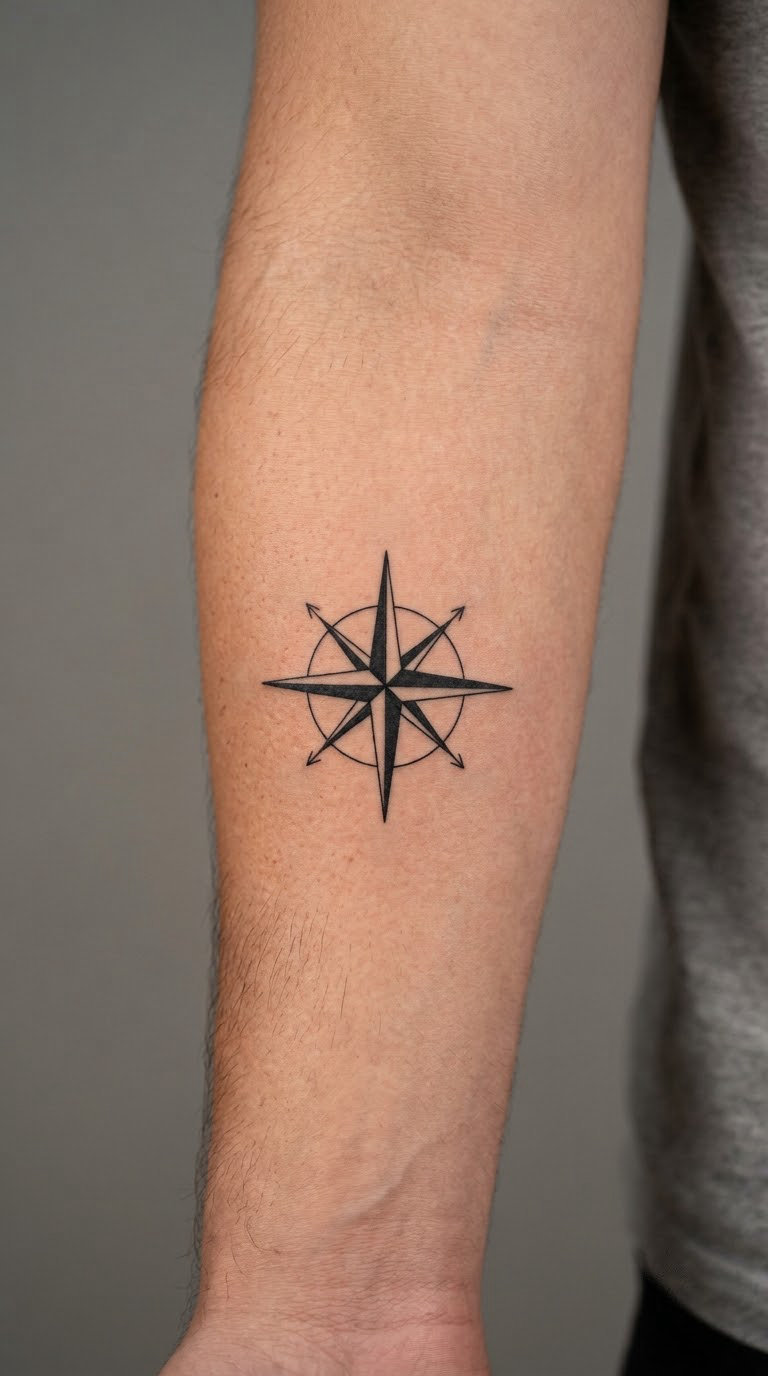
Four long points on the axes, four short points between them, a small hollow circle at the centre, and a north needle drawn solid so it stays visible when everything else thins out. No degree markings, no letters.
The compass is about direction and knowing which way is home, which is why it shows up more than any other hiking symbol in requests. It is also the design that most often gets done badly, with eight thin identical points that turn to mush.
Placement: inner forearm or the flat of the forearm below the elbow · Size: 2-3 in (5-7.5 cm) across · Style: minimal blackwork · Pain: low · Make it yours: rotate the needle away from straight up so it points at a direction that means something, a home town, a trailhead, a finish line.
4. Trail Coordinates in Fine Line
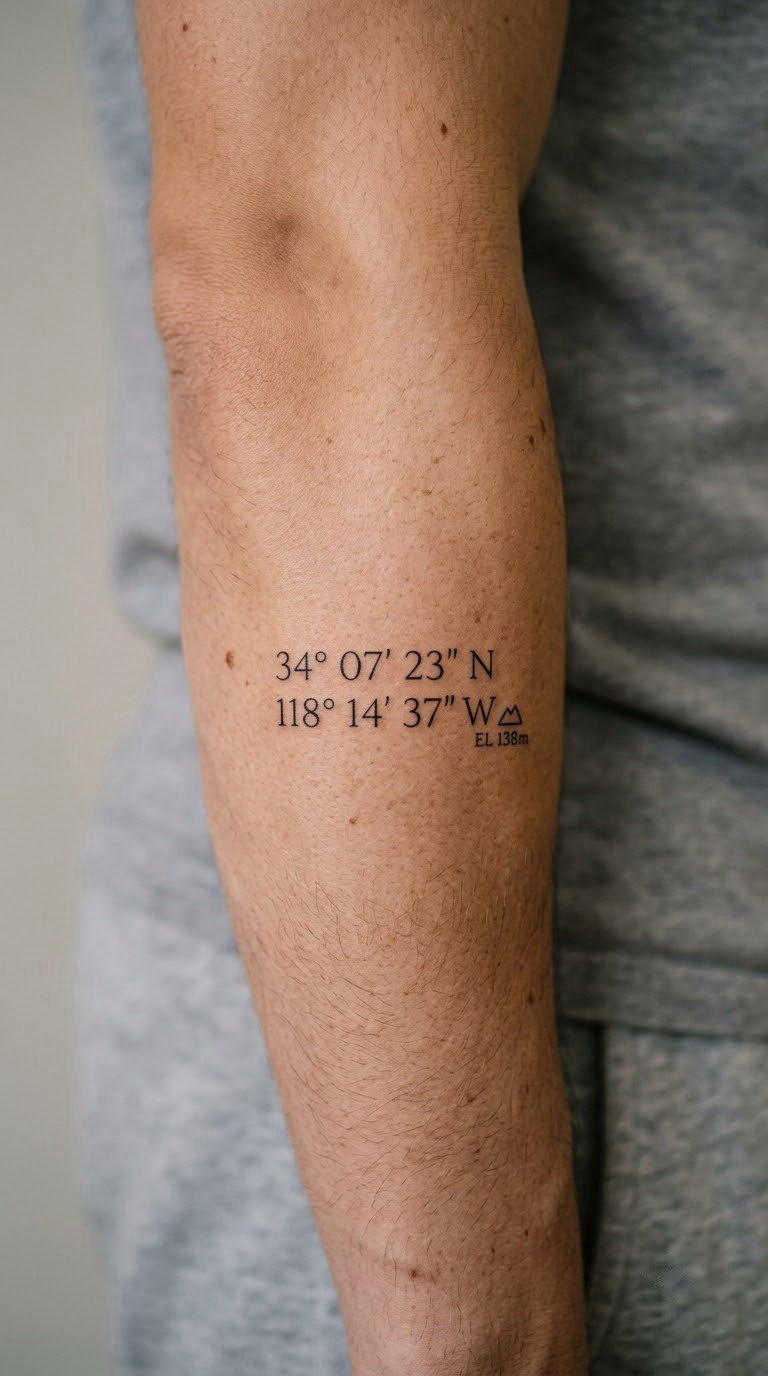
One line of latitude and longitude in a plain narrow font, maybe with a small summit triangle above it or an elevation figure in feet below. Handwritten numerals in a lot of portfolios, which look more personal and hide irregular spacing better.
It is the least showy design here and the one that most reliably starts conversations, because anyone who recognises the numbers knows the place. Coordinates also make a good memorial piece for a spot that mattered.
Placement: two inches below the elbow on the inner arm, or the inside of the upper arm · Size: 1.5-2 in (4-5 cm) wide · Style: fine line · Pain: low · Make it yours: use a trailhead or a summit rather than anything tied to your house, both for privacy and for the story.
Small type softens. Ask for numerals at least a quarter inch tall and a font with open counters, not a thin script.
5. Mountain Peak with a Sunrise
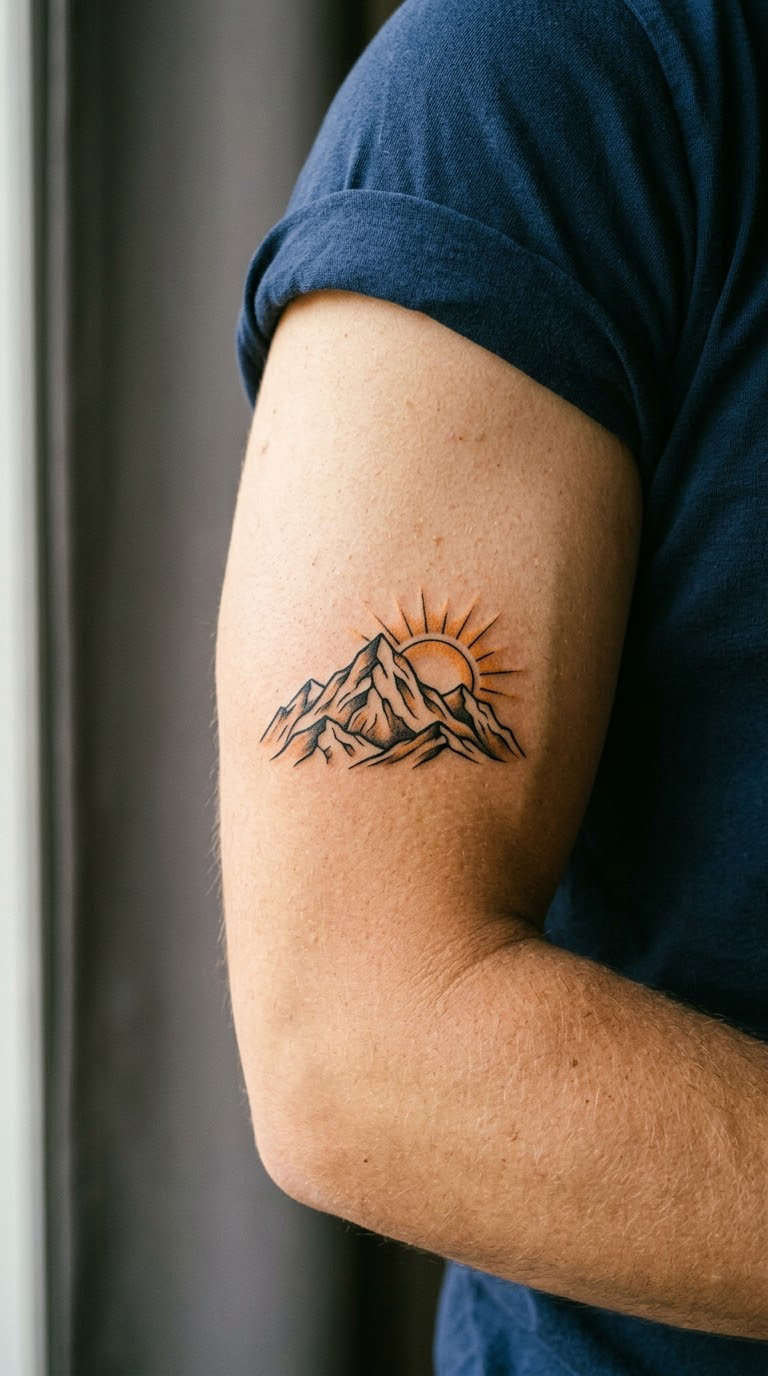
A single peak in solid black or grey wash with half a sun sitting behind it, a few straight rays fanning upward. One colour only, usually amber, ochre, or a dusty red, kept to the sun and nothing else.
Sunrise is the piece people pick for the hike that reset something, the 4 a.m. start where the weather turned or the year turned with it. It reads as a beginning rather than an achievement, which is a different note from the rest of this list.
Placement: outer upper arm, or the inner calf where the piece stays visible in shorts · Size: 3-4 in (7.5-10 cm) wide · Style: black and grey with a single colour accent · Pain: medium on the upper arm · Make it yours: mix the accent to the colour of the sky you remember, not the colour you think looks good in a gallery photo.
6. Hiking Boot with a Route Line
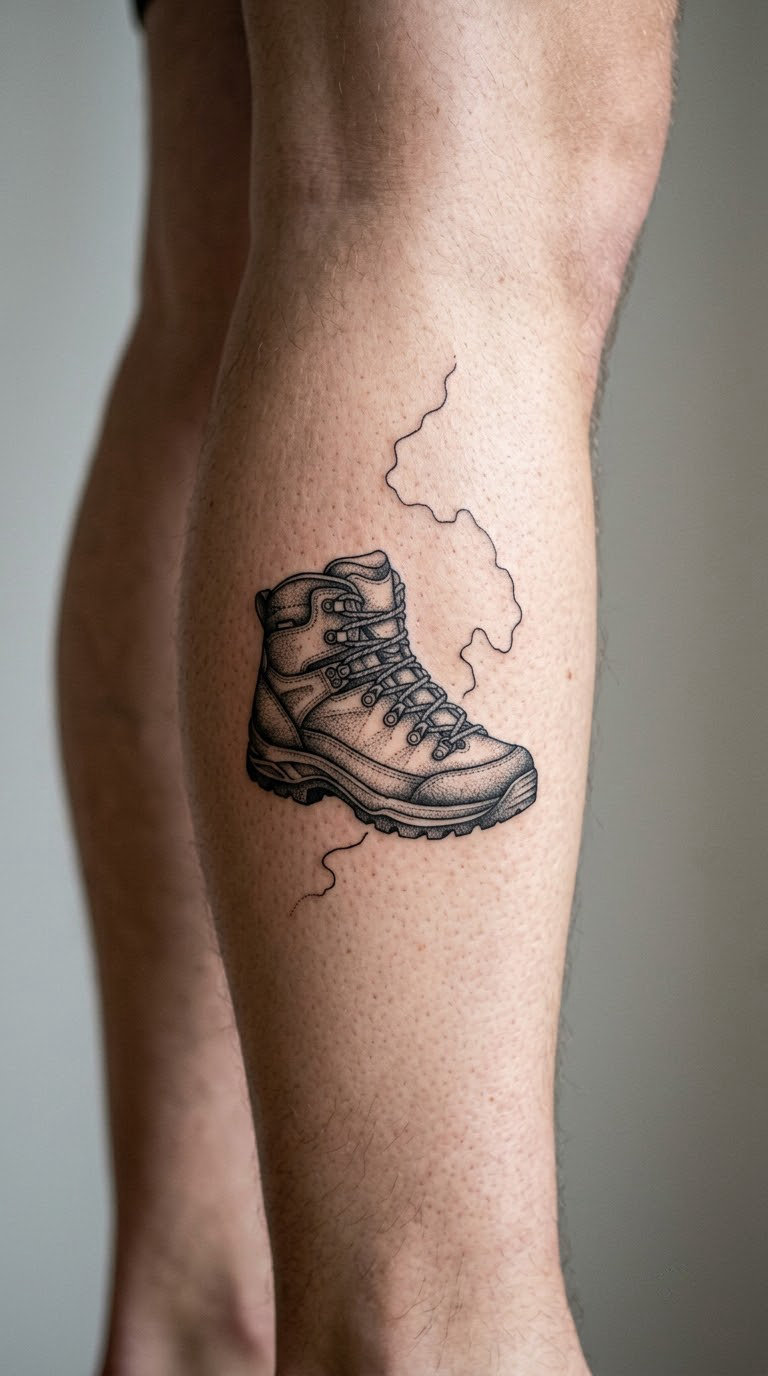
A single boot in side profile, black laces and a defined sole, with a thin line leaving the toe and curving away like a trail leaving a foot. The line should be visibly finer than the boot so the two elements stay separate as they age.
A boot is practical rather than poetic, which is part of its appeal. It tends to get chosen by people who like gear and by thru-hikers marking the footwear that carried the whole distance.
Placement: outer calf above the ankle bone, or the forearm for a more graphic look · Size: 3 in (7.5 cm) tall · Style: blackwork · Pain: medium, the calf is muscle over bone · Make it yours: sketch your own boot’s tread pattern and lace pattern, both of which are instantly individual.
Calf designs rub against boot cuffs. A boot piece on the lower calf will be abraded by every pair of hiking boots you own.
7. National Park Silhouette
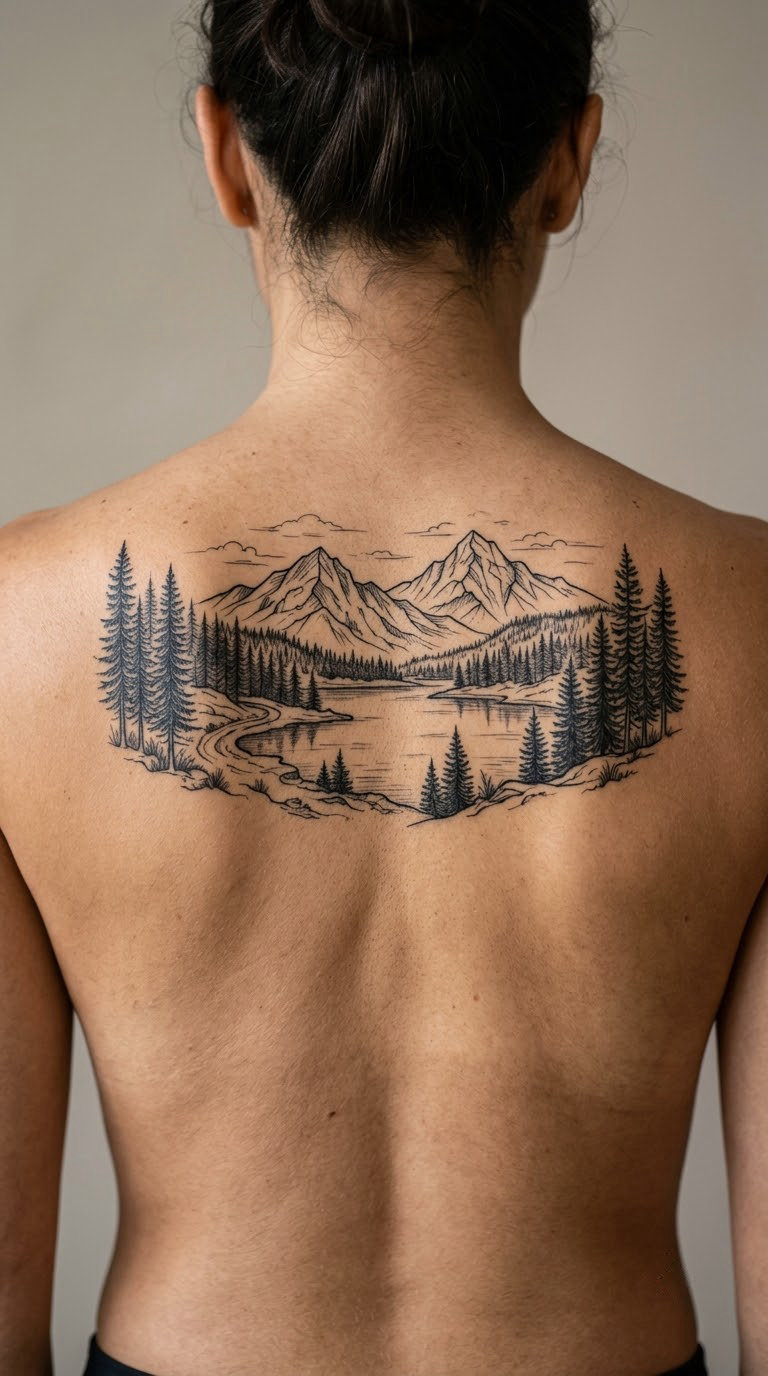
A wide scene rather than a symbol: a treeline of different heights along the bottom, water below it, and two or three peaks behind. Fine black outline throughout with no fill, so it reads as one continuous horizon.
This is the piece that marks a place you went once and still think about. Adirondack hikers discussing tattoos for peak-bagging lists kept landing on the same instinct, using the local terrain and the local animals instead of a generic mountain.
Placement: upper back between the shoulder blades, or across the shoulder blades as a wider piece · Size: 6-7 in (15-18 cm) wide · Style: fine line · Pain: medium, the back is a long session · Make it yours: use the terrain you know. Reproducing a park’s official arrowhead or protected logo is a bad idea, and an artist will tell you the same thing.
8. Small Mountain Inside a Circle
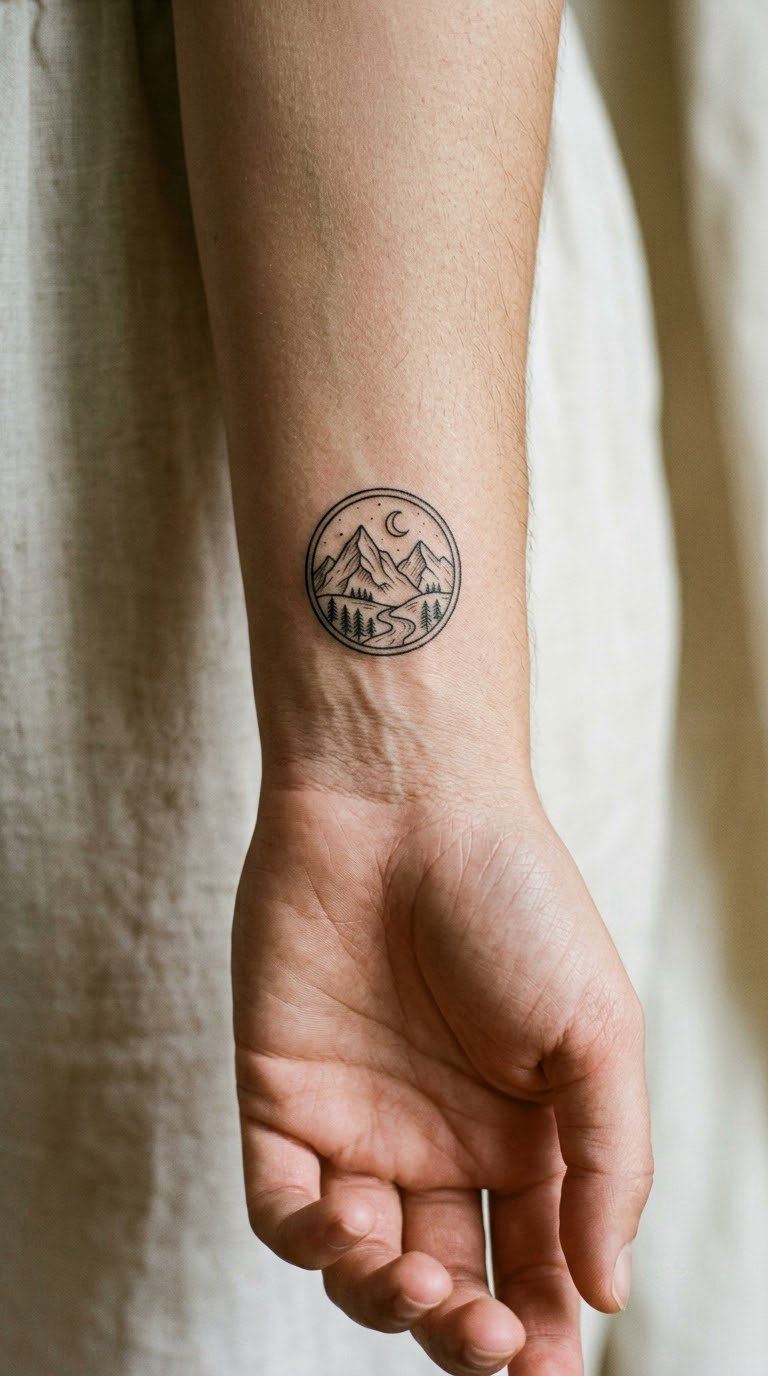
A thin circle, a two-peak mountain sitting on the line at the bottom, and nothing else. The circle can be broken at the top to let the ridge break the frame, which makes it look drawn rather than stamped.
Small emblems are what people get for a first tattoo, and a mountain in a circle works as a quiet goal or destination marker. It also suits anyone who wants the hiking idea without announcing it.
Placement: inner wrist, inner arm, or behind the ear · Size: 1-1.5 in (2.5-4 cm) across · Style: micro fine line · Pain: low, wrist bones are sensitive but shallow · Make it yours: put a small date or a single letter inside the circle under the ridge.
At one inch, this is the design most likely to need a touch-up. Plan on a free or cheap session a year in. If you want more options at this scale, 16 tiny mountain tattoo ideas and where to place each one covers the same ground in more detail.
9. Elevation-Line Mountain Sleeve
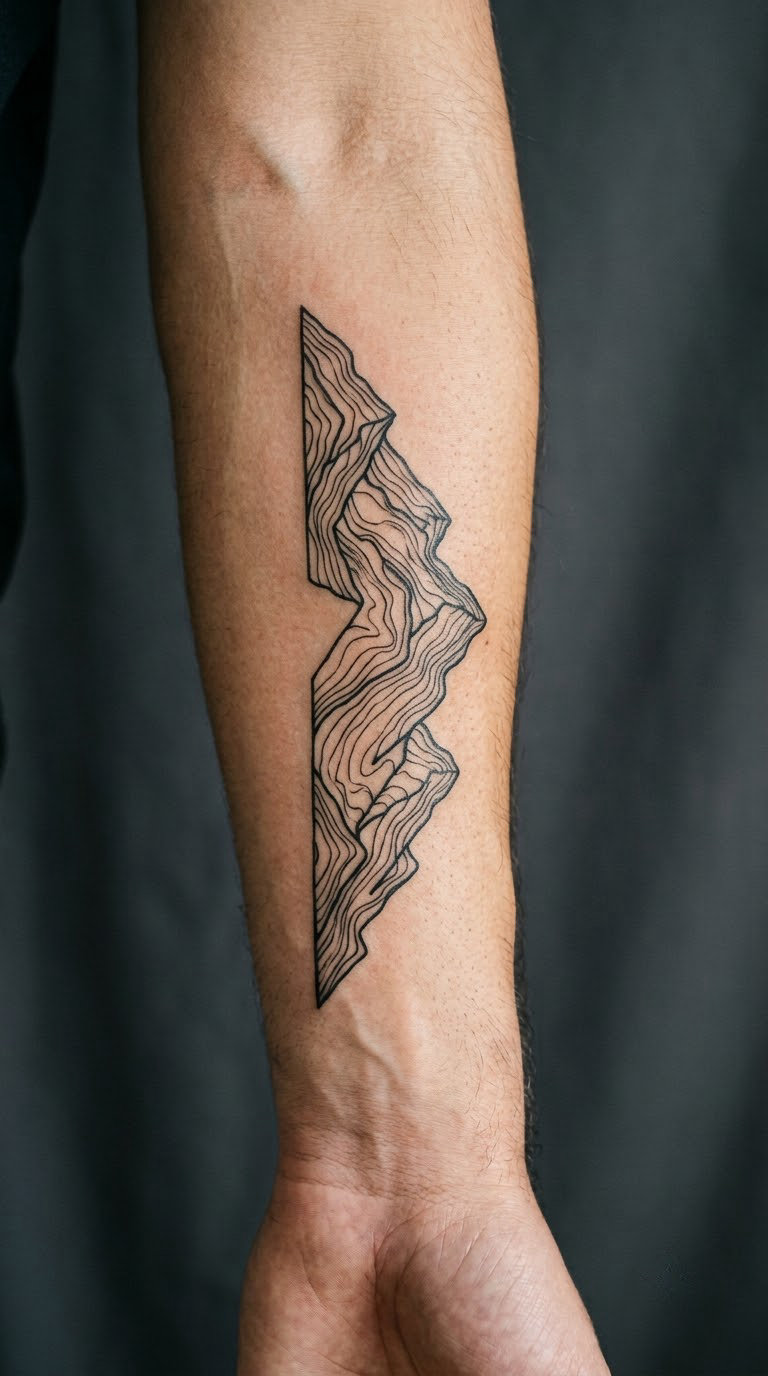
Stacked horizontal bands of varying thickness that rise and fall into peaks, like an elevation profile drawn as solid black shapes. The bands are close enough to read as one graphic mass and far enough apart to stay separate.
The look is contemporary rather than scenic, closer to a poster than a view. It suits someone who likes the data side of hiking, the profiles and numbers, more than the postcard version.
Placement: outer forearm, roughly elbow to wrist · Size: 6 in (15 cm) long · Style: graphic blackwork · Pain: medium · Make it yours: hand the artist your recorded elevation profile from a trip and let it set the band heights.
This is the design to talk to an artist about before booking. A six-inch solid black block is a much bigger commitment than six inches of outline.
10. Tent Under the Stars
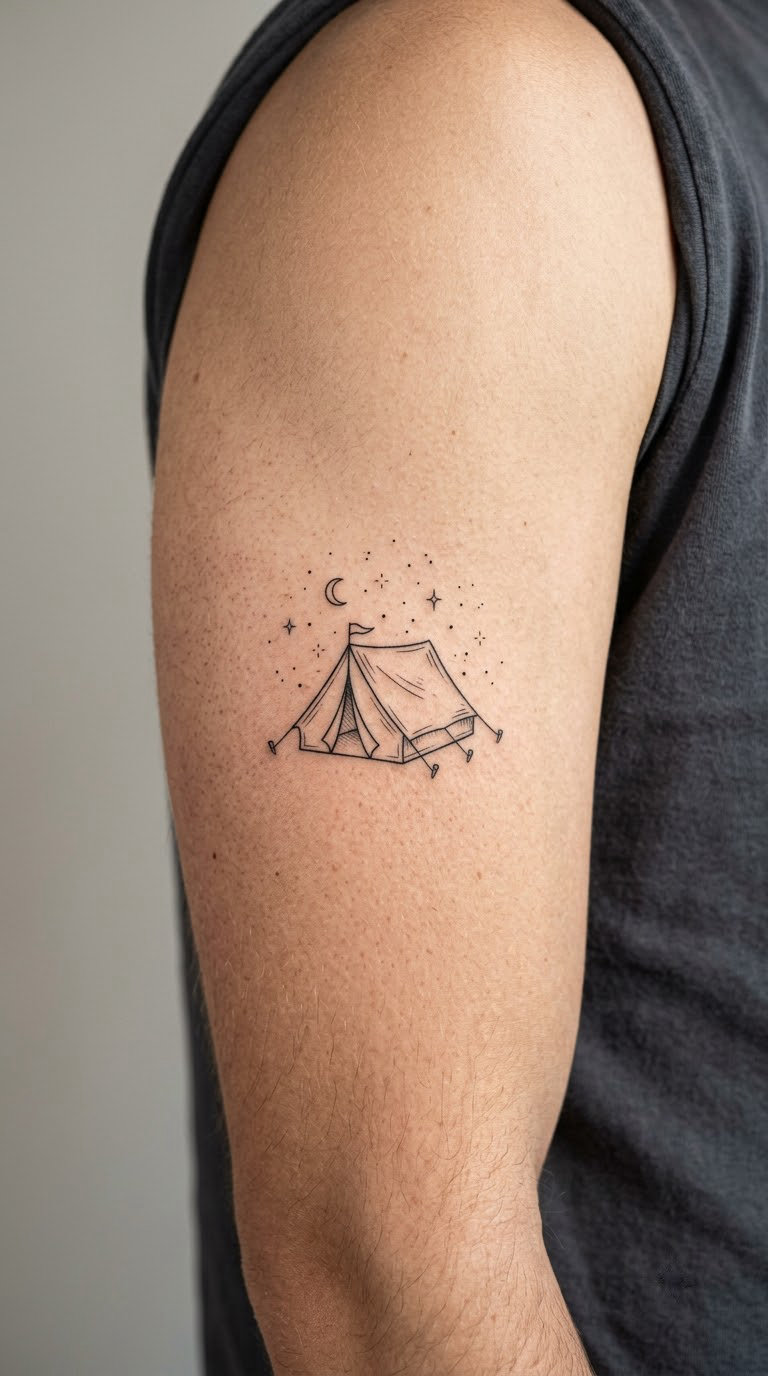
A small A-frame or dome tent in thin black outline, a couple of ground lines beneath it, and a scatter of small stars above with nothing connecting them. Skip the campfire, two elements is already a lot for this size.
Camps are the part of hiking people miss most, so the tent ends up standing in for companionship, solitude, or a night that changed the trip. Night hikers and repeat backpackers reach for it constantly.
Placement: outer upper arm, or the back of the shoulder · Size: 2.5-3 in (6-7.5 cm) wide · Style: fine line · Pain: low · Make it yours: draw your own tent shape, dome or A-frame, since it will be the only one that looks like it belongs on your kit.
Small stars are the first thing to disappear. Ask for star points at least a sixteenth of an inch across and expect to touch them up.
11. Trail Marker Sign
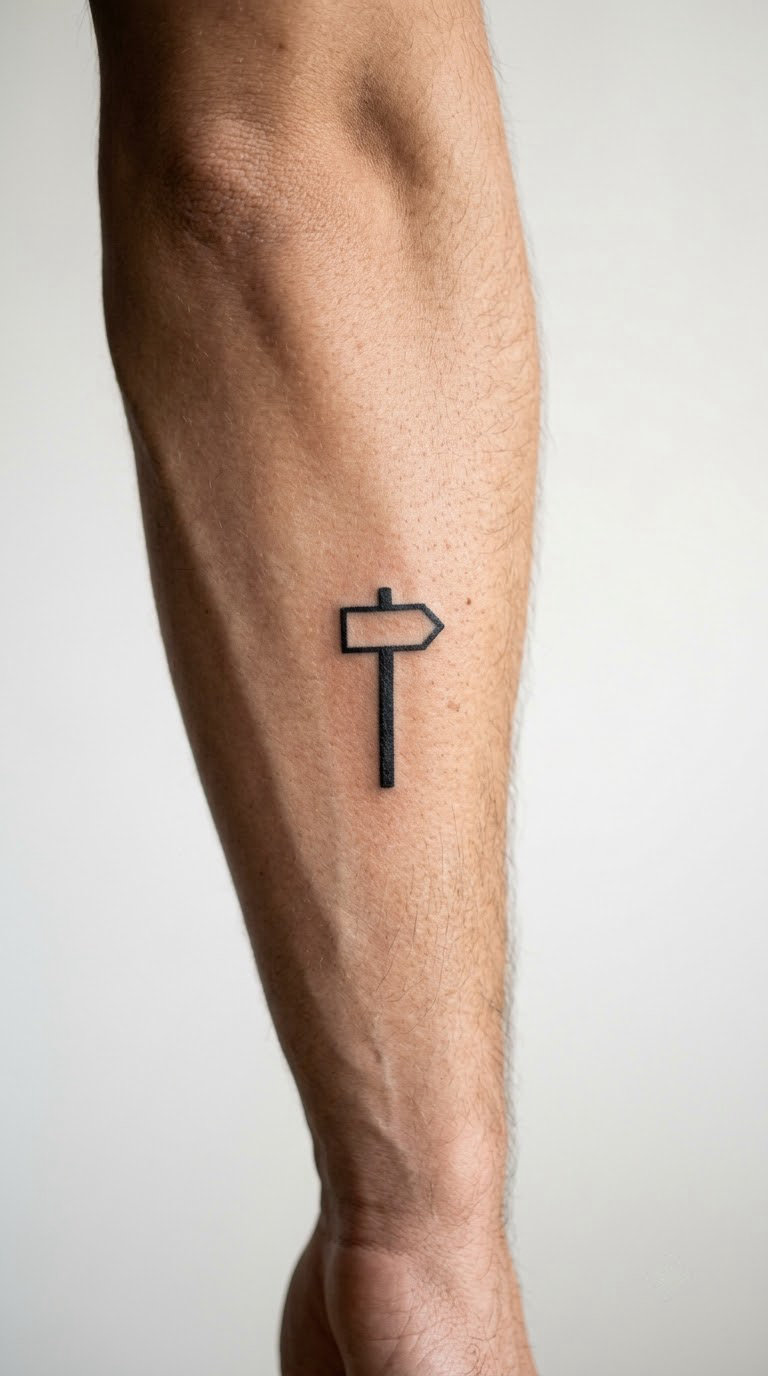
A post with a small rectangular blaze on it and a triangular arrow marker, drawn in thick black outline with the arrow solid. It can stand alone or sit on a short baseline with a small summit triangle.
Trail markers are milestone language. Thru-hikers treat them as the natural symbol for finishing something long, a blaze at the end of a route rather than a mountain in the middle of it.
Placement: outer forearm or the back of the upper arm · Size: 2-2.5 in (5-6 cm) tall · Style: blackwork · Pain: low · Make it yours: add your mile number, a state abbreviation, or a terminus symbol under the post.
Keep it generic. Reproducing a specific trail’s official sign or branded waymarking is not worth the argument you will have with the artist and the trail organisation.
12. Watercolour Mountain Wash
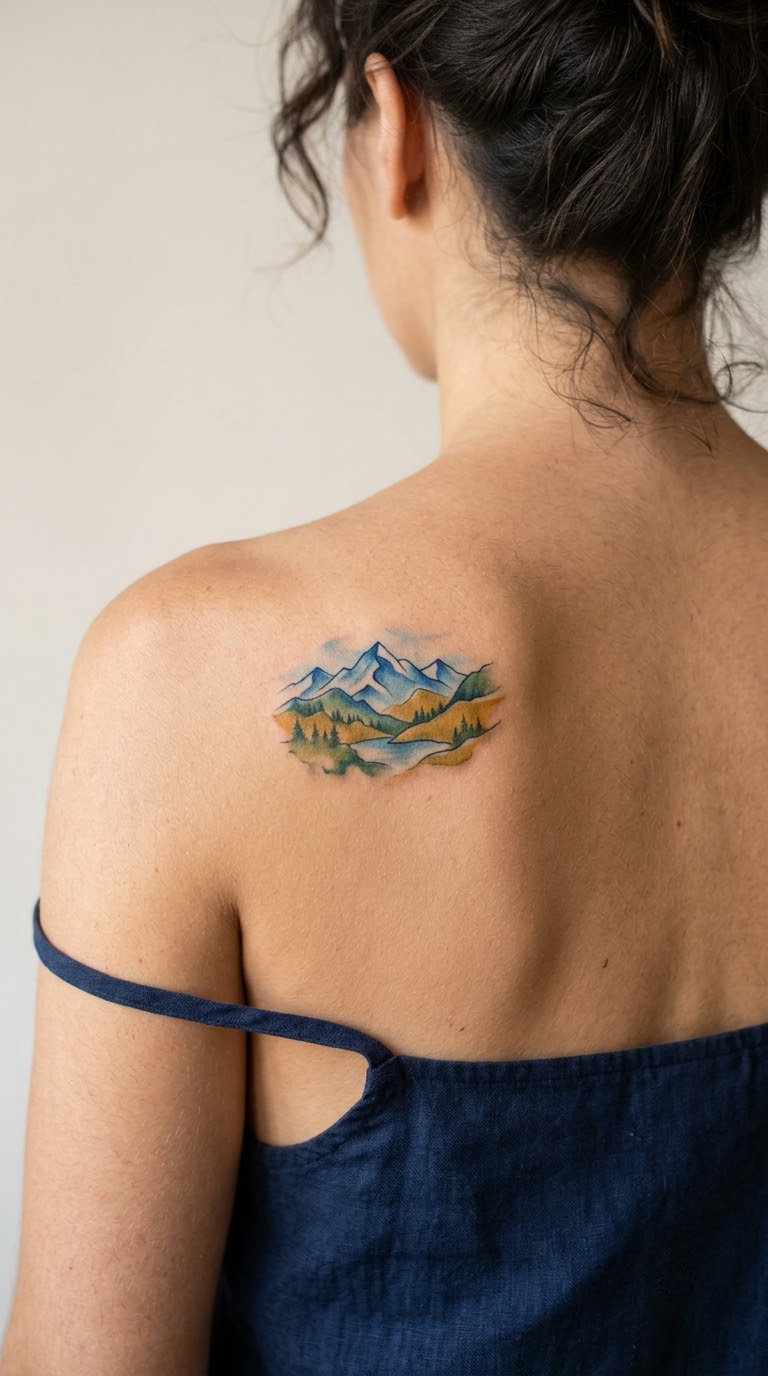
Two or three soft ridges bleeding into each other, with colour pooling at the base of the wash and no hard outline anywhere. A little pigment left loose at the edges is the point, not a mistake.
A wash is the right call if grey linework feels too rigid for you. It tends to end up softer and more atmospheric over time, which suits a piece about distance and quiet.
Placement: shoulder blade, upper back, or the outer thigh · Size: 3-4 in (7.5-10 cm) wide · Style: watercolour · Pain: medium, the shoulder blade edge is bony · Make it yours: bring a swatch of the two or three pigments you want, and expect the healed result to be paler than the fresh one.
Colour fades faster than black. Yellows and pale greens go first, and any watercolour piece should assume a colour session every few years if you want it to stay saturated.
13. Hiker Route as a Minimal Map
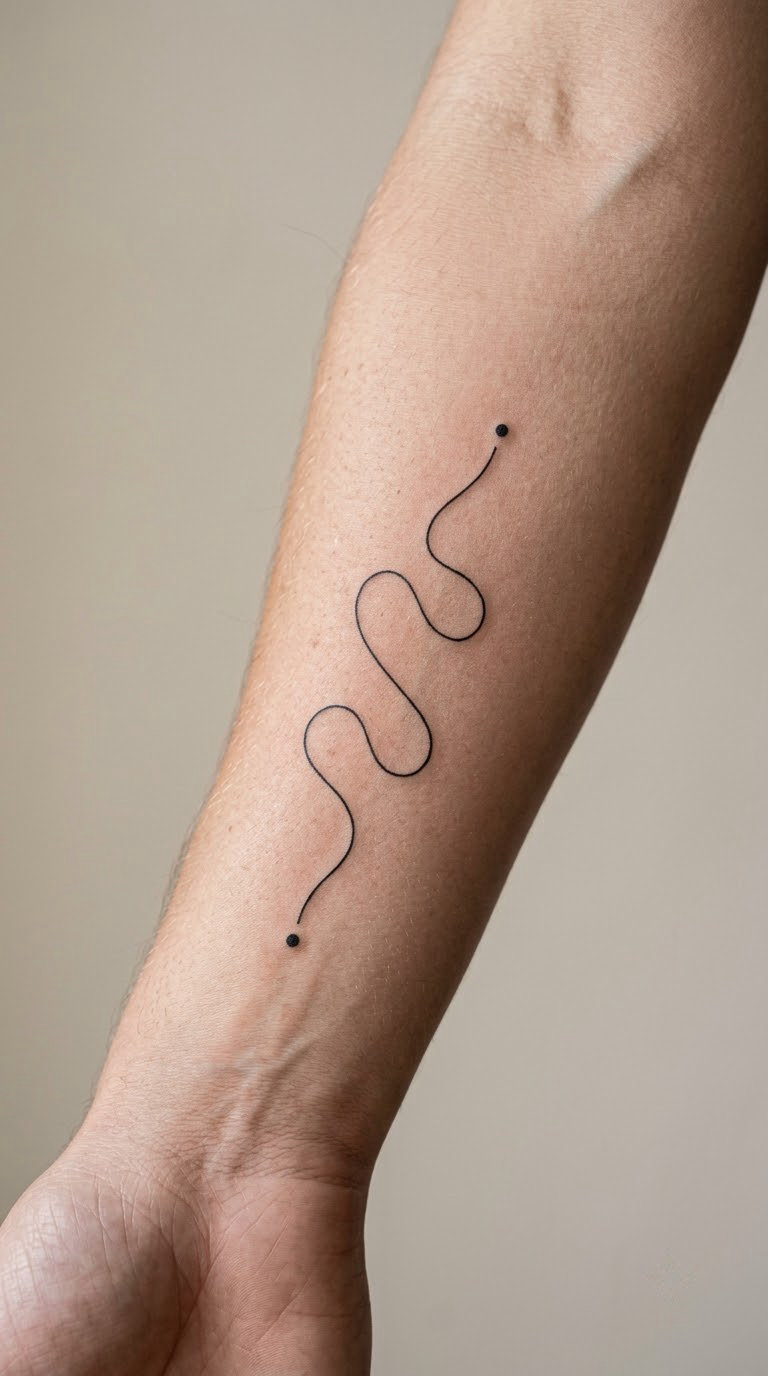
One continuous wandering line that doubles back on itself the way a real track does, ending in a small filled dot at one end and a small open circle at the other. A tiny number or date can sit under the line.
A route line is about the walking rather than the destination, which makes it a good fit for recovery, a career change, or any period where the point was getting through something. People in hiking forums describe it as the piece that never reads as a stock design.
Placement: forearm, running lengthwise · Size: 3 in (7.5 cm) long · Style: fine line · Pain: low · Make it yours: trace the actual shape of the path from a map or a phone screenshot, then let the endpoints mean something, one for the trailhead and one for the summit.
If the map angle goes further than one wandering line, 18 travel map tattoo ideas with meaning goes into the cartography side in more detail.
14. Mountain and Crescent Moon
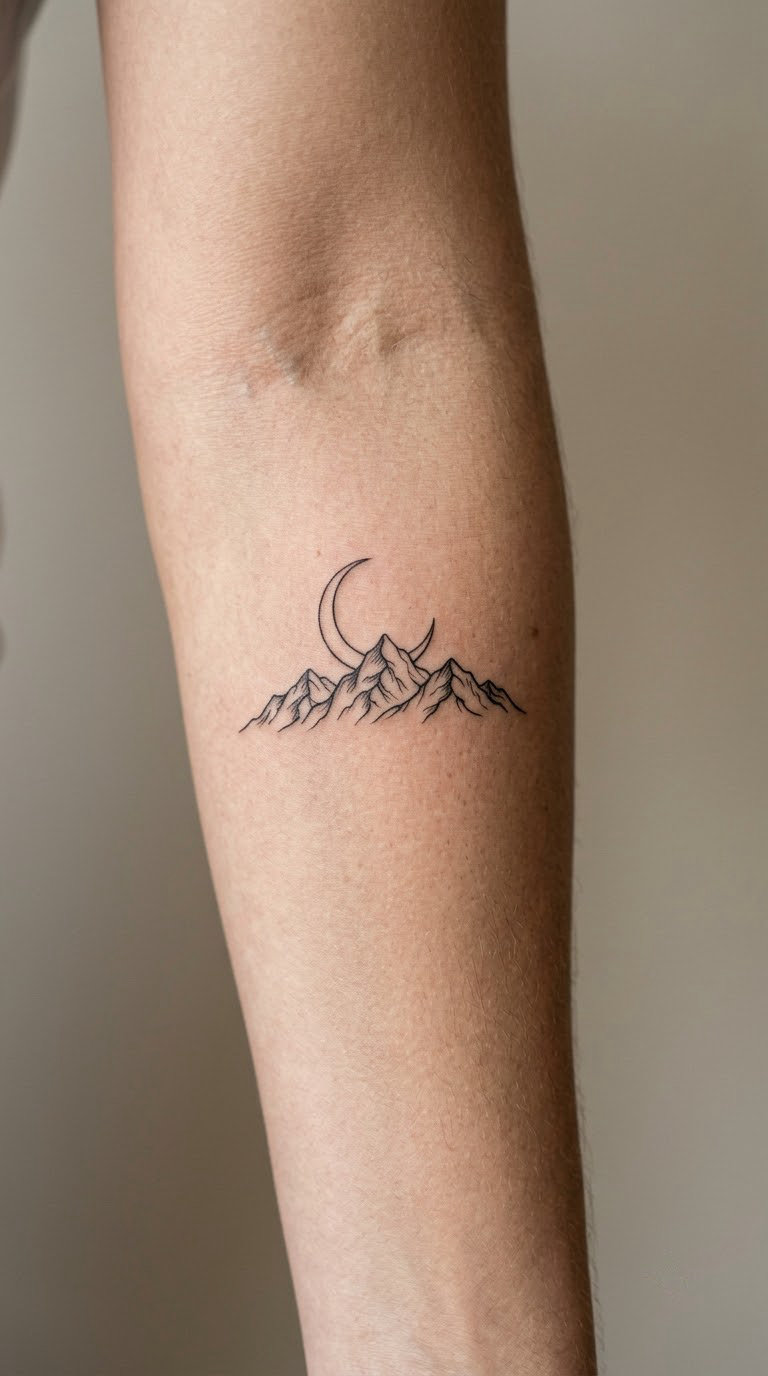
A low ridge of two or three peaks in thin black line with a single crescent above it, turned slightly so it does not sit at a perfect angle. The crescent is the only curve in an otherwise straight-lined design.
Moon plus ridge is the night-camp version of a mountain piece, and it is the one hikers pick when the trips they care about happened after dark or under a new moon.
Placement: behind the ear, inner arm, or the hip where a shirt rides up · Size: 2 in (5 cm) wide · Style: fine line · Pain: medium behind the ear, low on the arm · Make it yours: put in the moon phase from a specific night, drawn as a small circle with a shadow across it.
15. Four-Peak Family Hiking Symbol
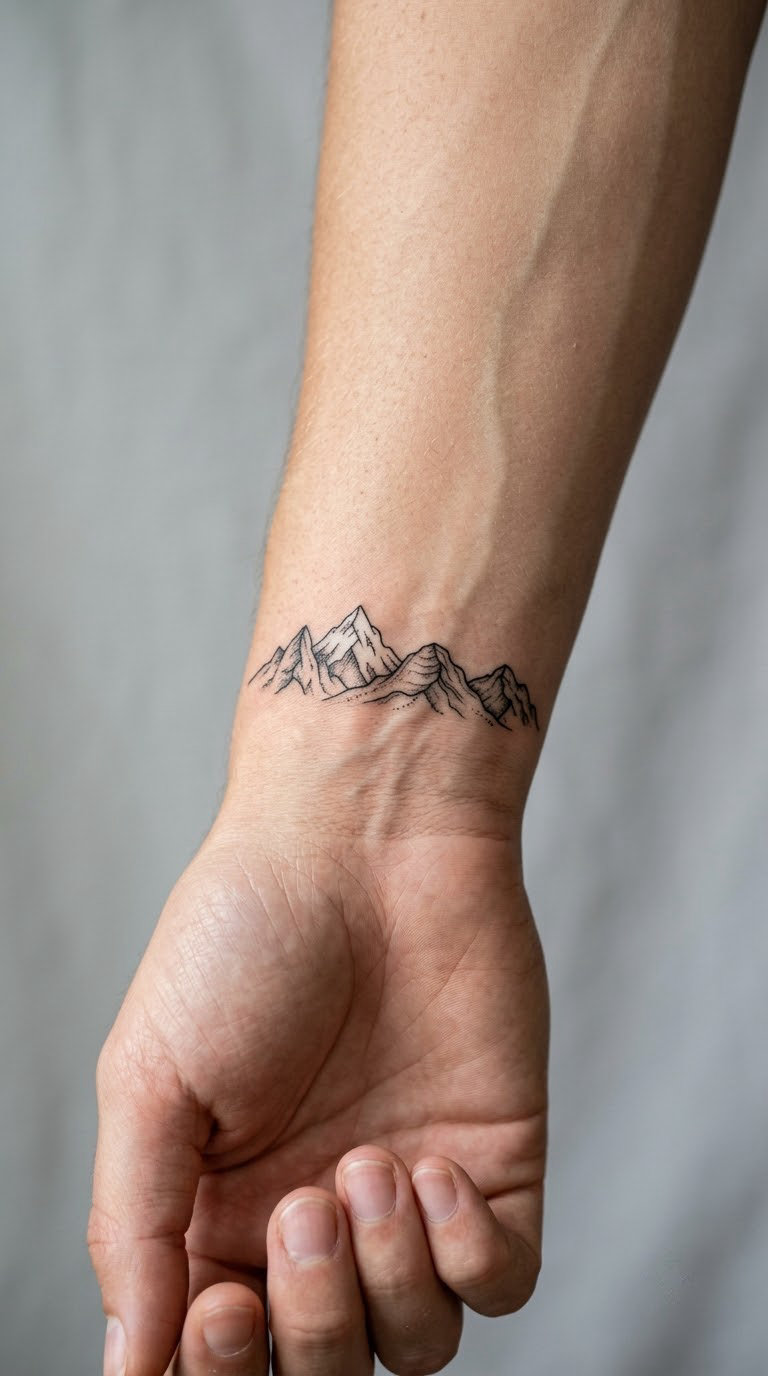
Four peaks in a row, each a different height and each with a slightly different shape, sitting on one shared baseline. The variation is the whole point, so four identical triangles defeats it.
It is a family design for people who would not call themselves family-hiking-squad members, and it also works as a milestone set, one peak per person or per year of something.
Placement: wrist, inner arm, or in a line across the collarbone area · Size: 2 in (5 cm) wide · Style: fine line · Pain: low · Make it yours: set each peak’s height to a real number, an age, a year on the trail, an elevation you each climbed.
Four small peaks means four times as much fine detail as one, so ask for a line weight that will still read at that scale.
16. Backpack in Blackwork
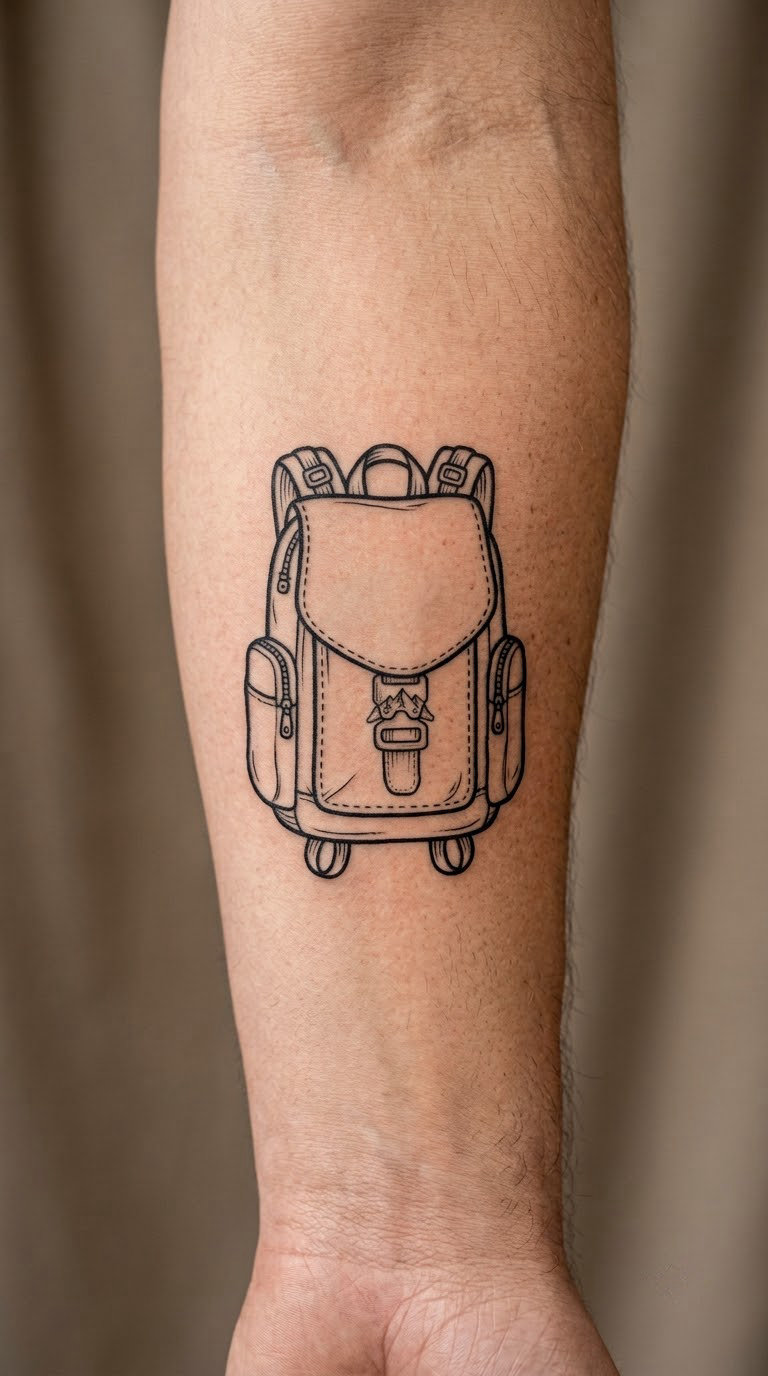
A pack drawn straight on in heavy black shapes, side pockets in solid black, a rolled sleeping mat lashed to the top, and thin line detail only for the straps and buckles. The contrast between solid and thin line is what makes it look drawn rather than flat.
A pack is about carrying, and people use it for the gear, the miles, or the version of themselves that managed the weight. It is the least obvious of the hiking designs here and blends into an existing blackwork collection easily.
Placement: forearm, or the back of the upper arm · Size: 3 in (7.5 cm) tall · Style: blackwork · Pain: medium · Make it yours: put your real pocket layout into it, including the one you always reach for first.
17. Summit Dots and Contour Lines
Scatter of filled dots on the top curve of a set of concentric contour lines, like a map with peak markers added. Almost no straight lines anywhere in the piece.
It is the most abstract design on this list and it works for people who like map language more than scenery. Peak-baggers and list-keepers tend to land on this one because a dot is a completed thing.
Placement: outer calf, or the inside of the upper arm · Size: 2.5 in (6 cm) wide · Style: abstract black linework · Pain: low · Make it yours: one dot for every peak on your list, scaled so the whole set still fits the space.
Keep the contour rings further apart than they look in a drawing. Rings under a few millimetres apart fill in. If the lower leg is your chosen spot, 18 shin tattoo ideas for men with meaning works through the placement trade-offs in more detail.
18. Pine Trees and Mountain Reflection
A row of five to seven evergreens of decreasing height, a horizontal waterline, and the peak from idea 1 flipped below it and drawn slightly broken up to read as a reflection. Black outline, no fill.
The reflection is the part that carries the meaning, the place you kept thinking about, seen twice. It works well as a memorial piece for a lake or tarn that mattered to someone you hiked with.
Placement: inner arm running lengthwise, or the calf · Size: 4 in (10 cm) wide · Style: fine line · Pain: low · Make it yours: use the trees that actually grow where you walk, so the silhouettes match your own home range.
Twelve small tree peaks in one piece is a lot of linework at four inches. Push for a heavier line or fewer trees.
19. Micro Realism Mountain Patch
A small rectangular window onto a scene, with tonal shading for the rock faces, a hint of texture in the foreground, and soft grey for the sky. Depth comes from the grey work rather than from extra line.
Realism suits someone who wants a real scene without committing to a full piece. At this scale it reads as a photograph of a place rather than an icon of hiking.
Placement: forearm, inner arm, or the back of the calf · Size: 1.5-2 in (4-5 cm) tall · Style: black and grey micro realism · Pain: medium, shading means a longer needle session · Make it yours: bring a photo from your own camera roll, since reference makes the difference at this size.
Ask to see healed examples of the artist’s grey work. Fresh micro realism flatters itself, and soft grey shading is exactly what fades first.
20. Hand-Drawn Hiking Route Sketch
One loose line that looks drawn in a notebook rather than drafted, with a small arrowhead partway along, a filled dot at the top, and a date underneath in a hand that is slightly uneven. Slight wobble is the feature.
This is the most personal design on the list and the hardest to copy, because it is meant to look like your own handwriting. It works for someone whose hiking memory is a scribbled route in a paper notebook rather than a summit photograph.
Placement: outer forearm · Size: 3 in (7.5 cm) long · Style: freehand linework · Pain: low · Make it yours: write the date in your own handwriting and send the artist a photo of it, so the numerals are genuinely yours.
How to Choose the Right Hiking Tattoo Design
Start with the meaning, not the picture. If the reason behind your hiking tattoo is a specific place, a finished route, or a person, any of the twenty designs above can carry it. If you cannot name the story yet, a generic mountain range will not fix that, and it is the one design people most often regret.
Then check the four physical questions. Is the line weight heavy enough for the skin it is going on? Will the smallest element, such as a star point or a contour ring, still read at the size you want? Does the placement take a beating, and does the spot see sun? How long will you still like this design in ten years, which for a hiking person usually means long after the current season is over.
For hikers with no favourite trail, the mechanics are more useful than the symbols. Export the GPS track from a hike you already love and hand it to an artist as a single wandering line. Take a topographic map and trace the contour lines around a spot you know well. Write the coordinates of a trailhead in a plain narrow font. Or take a bar number from a route you finished, since that is the version of a milestone only a few people share.
Two categories are worth avoiding for practical reasons rather than taste. Ultra-thin micro line on a sun-exposed forearm or calf will look blurred within a few summers, and a boot-height piece on the lower calf will be worn away by the cuff of every hiking boot you own. Designs borrowed from a park’s official logo, a trail organisation’s signage, or a brand are worth skipping, both for legal reasons and because a stolen mark carries none of the meaning you were after.
On timing, allow a full ten days of healing before anything touches it, and count on six to eight weeks before heavy pack straps, long days, or a season where it will sit in the sun every day. If your main season starts in a month, book now for something quieter, or wait until the season is over.
Cost and Session Time
Most studios price by the hour, so size and detail drive everything. In the US expect roughly $80 to $180 an hour depending on the city and the artist, and expect a shop minimum of around $150 to $250 for any piece, however small, which is why a sub-one-inch emblem and a two-inch ridge can cost about the same at the counter.
A small emblem or a single line of coordinates is often a short job of less than an hour. A contour map patch, a boot, or a backpack runs two to three hours, so expect the middle of that range for a five-inch square. A six-inch elevation-line piece or a national park scene is a half-day job that some artists split into two sessions.
Solid blackwork takes longer than it looks like it should because the artist fills rather than outlines. Watercolour and micro realism also run long, since shading is many small passes rather than one line. Shop minimums and hourly rates vary widely by city and by artist, so the same design can cost very different amounts in two towns. Ask for the hourly rate and the deposit before you commit, and be suspicious of anyone quoting a flat price on a detailed landscape without seeing the reference.
Aftercare Basics
Start with your artist’s aftercare instructions, since they will know how deep your particular linework went. Everything below is general and follows what most tattooers recommend.
- Wash the area gently with lukewarm water and unscented soap, then pat it dry. Clean hands matter more than any product.
- Keep it covered and out of direct sun while it heals, and wear a long sleeve over a forearm piece rather than leaving it open.
- Use a plain, fragrance-free moisturiser a few times a day while the skin flakes. Do not pick flakes, and do not soak the tattoo.
- Skip swimming, hot tubs, and long soaks until the piece is fully healed, usually at least two weeks.
- Once healed, put sunscreen on exposed pieces before a long day out. UV fade is the main reason a fine line forearm tattoo softens early.
- Let a heavy pack or a boot cuff rest on fresh ink until your artist says the healing is done, and expect a touch-up on fine detail around a year.
Frequently Asked Questions
What do mountain tattoos symbolize?
Mountain tattoos usually stand for challenge, distance, endurance, and the harder thing you got through. In a hiking context they are most meaningful when the ridge is a real range you have walked, or a single peak marking a first summit. A generic mountain silhouette carries the general idea but not a specific story, which is why people often add a date, a coordinate, or a contour line from their own map.
What does a compass rose tattoo mean?
A compass rose represents direction, inner guidance, and finding your way, which is why it is the most requested hiking symbol. In the hiking world it usually means keeping a bearing when the trail, the weather, or the year is unclear. Designers often rotate the needle away from straight up so it points at a real place, such as a home town or a trailhead, instead of reading as decoration.
Do hiking tattoos fade faster than other tattoos?
They can, and it comes down to placement rather than the design itself. Forearms, calves, and ankles see more sun than most skin, and a lower calf piece takes abrasion from boot cuffs. Bold black linework fades slowly, while fine line softens noticeably in a few summers. Cover the area with sunscreen, add a long sleeve on exposed days, and plan a touch-up on small detail around the one-year mark.
Can I get a tattoo of a specific trail or park?
Yes, as long as the design is your own drawing of the terrain and not a copy of protected imagery. Do not reproduce a park’s official logo, a trail blaze design, or branded waymarking, since those belong to the managing organisation. Bring a map or a photo and let the artist draw the ridgeline, the contours, or the treeline from it. That version also means more than the borrowed mark would have.
What is a good first hiking tattoo?
Something small, simple, and in a solid line weight is the safest first choice, and a compass rose or a single ridge line at two inches fits that brief. You want a design with no tiny detail to lose and a placement you can cover while it heals. Skip micro realism and thin coordinate work as a first piece, since both depend on line weight holding up and there is no second piece to compensate yet.
How long should I wait after a tattoo before hiking?
Allow at least ten days of healing before anything touches the area, and expect six to eight weeks before heavy pack straps, long days, or a stretch of days in the sun. Fresh ink under a shoulder strap or a boot cuff is the common mistake, and it leaves patchy colour that needs fixing. If your season starts soon, book a quiet month instead, or wait until the season ends.
Conclusion
For a first tattoo, the compass rose or the fine-line ridge at two inches is the lowest-risk way in, because both are simple shapes in a solid enough line. If you already have ink and want a piece that sits with it, the topographic shoulder patch and the elevation-line forearm piece have the room and the weight to look intentional next to existing work.
Whichever one you pick, sort out the meaning before you book the consultation, not after. Bring the map, the coordinate, the mile number, or the date, and the design stops being one of twenty ideas and starts being the only one that could be yours.