
20 Best Shin Tattoo Ideas for Men With Meaning (September 2026)
A shin tattoo is ink placed on the front or outer lower leg, between the knee and the ankle, on the tibia. That bone gives you one of the flattest, hardest canvases on the body, which is exactly why these shin tattoo ideas for men lean bold: blackwork wolves, traditional daggers, Japanese dragon wraps and heavy black fill all hold up on a surface most people underuse.
Men pick this spot because the shin is visible whenever you wear shorts or rolled trousers, and because a design running vertically lengthens the leg instead of cutting it. What makes a piece work here is the same thing that makes it hard: the skin is thin, the surface is nearly flat, and there is very little curve for a design to hide on.
Below are 20 designs with the placement, size, style and pain notes for each, plus an honest note on healing. Every one of them works better with thicker line weight and darker fill than delicate work, because fine detail on the shin fades faster than almost anywhere else on the leg.
Quick Guide: 20 Men’s Shin Tattoos at a Glance
| Idea | Style | Best placement | Size | Pain |
|---|---|---|---|---|
| Blackwork wolf head | Blackwork | Front shin, below the knee | 6-9 in (15-23 cm) | High |
| Dagger through a rose | American traditional | Front shin, mid-shin | 5-8 in (13-20 cm) | High |
| Japanese dragon wrap | Irezumi | Full lower leg, wrapping | 12-18 in (30-45 cm) | High |
| Tribal geometric band | Tribal | Outer shin | 3-4 in wide, full length | Medium-high |
| Storm waves | Japanese | Outer shin, vertical | 7-10 in (18-25 cm) | Medium-high |
| Vertical kanji column | Traditional | Front shin, centred | 4-6 in (10-15 cm) | High |
| Coiling blackwork snake | Blackwork | Front shin to ankle | 9-12 in (23-30 cm) | High |
| Biomechanical leg panel | Biomechanical | Full shin wrap | 14-18 in (35-45 cm) | High |
| Lion portrait | Illustrative realism | Upper shin below the knee | 6-8 in (15-20 cm) | High |
| Bow and arrow | Old Western | Outer shin | 6-7 in (15-18 cm) | Medium-high |
| Blackwork phoenix | Blackwork | Front shin, vertical | 8-11 in (20-28 cm) | High |
| Lighthouse in black and grey | Realism | Lower shin near the ankle | 5-7 in (13-18 cm) | Medium-high |
| Hexagon circuit panel | Geometric | Outer shin | 4-6 in (10-15 cm) | Medium |
| Celtic interlace | Celtic | Outer shin or calf | 5-7 in (13-18 cm) | Medium |
| Skull and laurel | Old school | Mid-shin, front | 5-6 in (13-15 cm) | High |
| Honey bee | American traditional | Upper shin | 2.5-3.5 in (6-9 cm) | Medium-high |
| Stag head in pines | Illustrative realism | Full front shin | 7-10 in (18-25 cm) | High |
| Bull head | Solid blackwork | Front shin, mid | 6-8 in (15-20 cm) | High |
| Compass rose | Minimalist | Lower shin above the ankle | 2-3 in (5-8 cm) | Medium |
| Chevron and arrow linework | Minimalist | Outer shin | 3-5 in (8-13 cm) | Medium |
1. Blackwork Wolf Head on the Front Shin
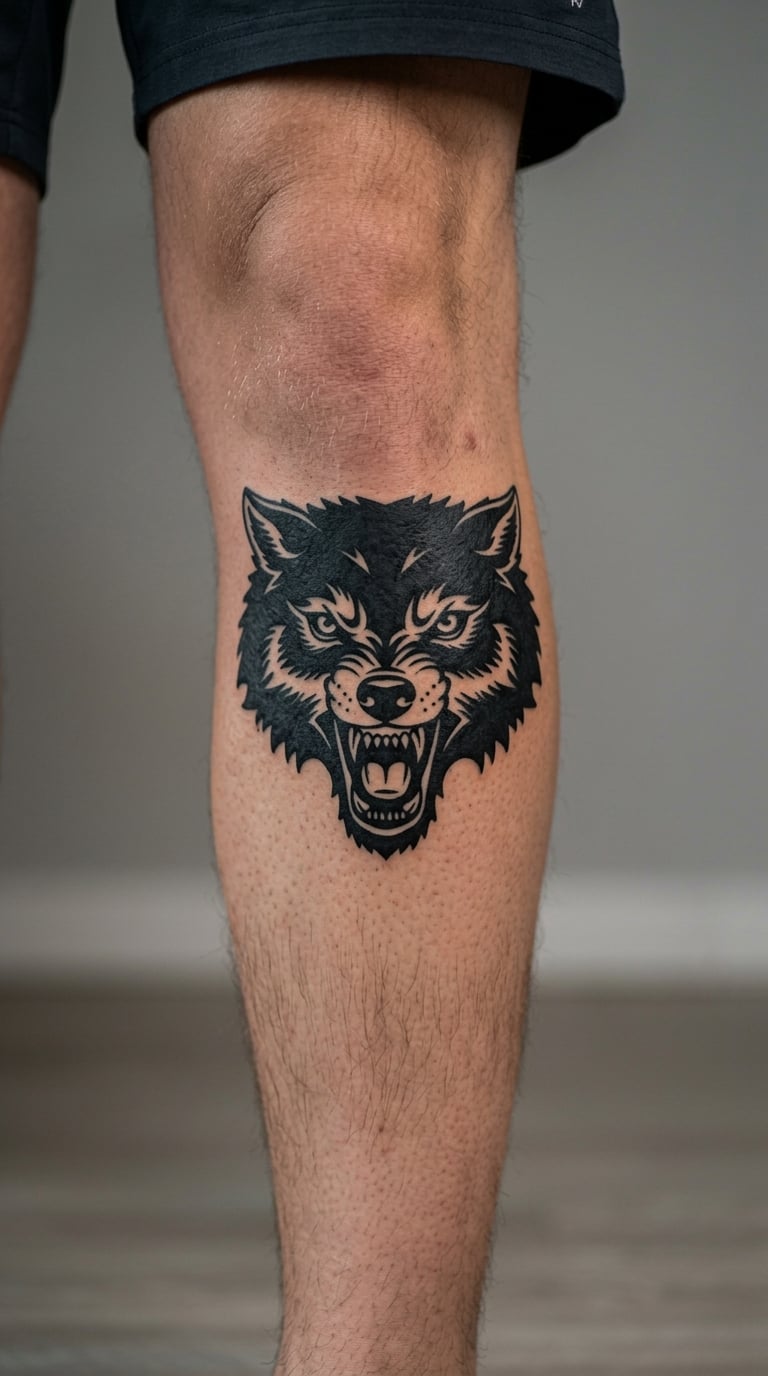
A wolf head in solid blackwork uses almost no grey. The artist lays down packed black for the fur masses, then cuts the eyes, muzzle and ear edges out as negative skin, so the shape reads from across a room.
Men usually choose the wolf for loyalty, family instinct and quiet toughness rather than aggression. It is one of the most requested motifs for a man’s shin tattoo because the head sits so cleanly on the bone without needing a background.
Placement: front shin, 2-3 in (5-8 cm) below the knee, head pointing down. Size: 6-9 in (15-23 cm) tall. Style: blackwork. Pain: high, and a solid fill like this is a long needle pass. Filled black on the lower leg can soften with sun exposure over the years, so plan for a refresh every five or six years. Make it yours: have the eye left blank white, or add a small date in the empty space beneath the jaw.
2. Dagger Through a Rose in American Traditional
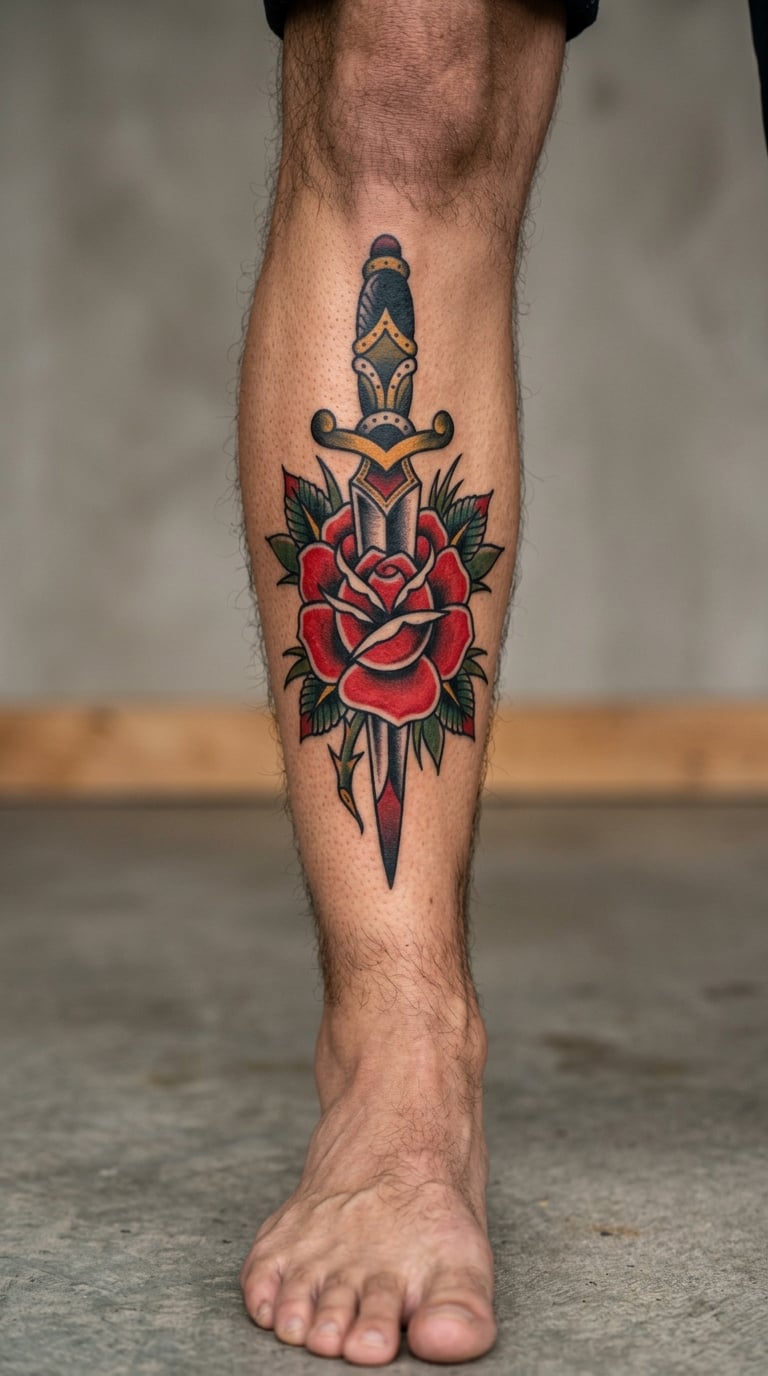
The classic pairing: a dagger point-first through a rose, drawn in bold black outline with two or three colours of shading and a red bloom. Traditional work is built from thick lines and flat colour, which is the right language for a flat bone.
The meaning is the old tattoo-shop one of a balanced character, beauty held by something sharp, and a willingness to act. Plenty of men wear it simply because it reads clearly at a distance.
Placement: mid front shin, handle up, tip down. Size: 5-8 in (13-20 cm). Style: American traditional. Pain: high, and the red fill in the rose is the worst of it. Colour on the shin needs a touch-up sooner than black. Make it yours: swap the rose for a thistle, a poppy or a carnation tied to something real to you, and add a banner ribbon underneath with a short word.
3. Japanese Dragon Wrapping the Full Lower Leg
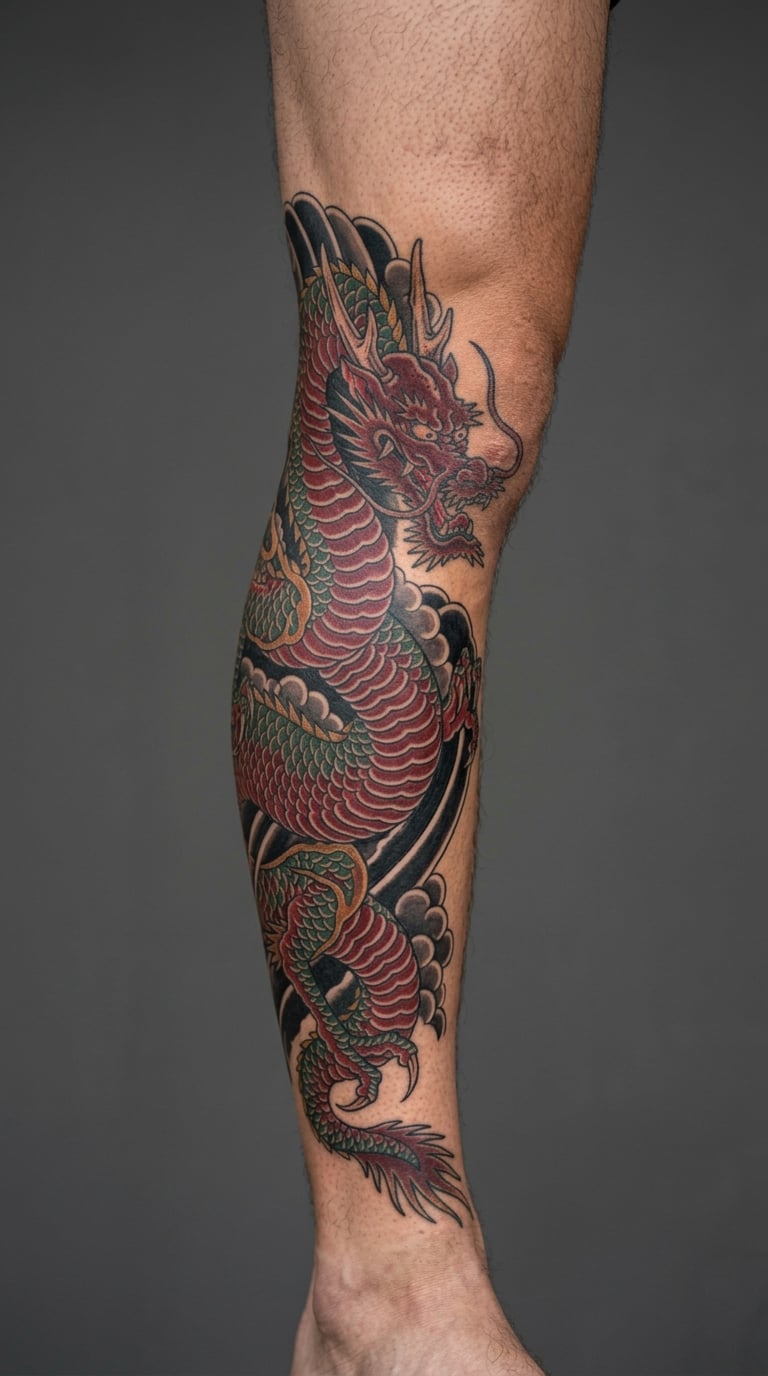
A dragon wrap is the big one. The body coils down the front shin, turns behind the calf and reappears, usually with clouds, wind lines and a second head near the ankle. Irezumi is designed around the idea of a horizon line, so nothing floats awkwardly on a flat surface.
Dragons in Japanese tradition carry protection, water, good fortune and a kind of watchful power. Clients tend to describe this one as armour they wear rather than a picture of a creature.
Placement: full lower leg, front and calf, wrapping. Size: 12-18 in (30-45 cm) of the leg. Style: Japanese irezumi. Pain: high across the whole session, and this is never a one-sitting job. Expect four to six sessions, and a long healing on each. Make it yours: give the dragon a peony background, or make it white and red only, like a winter piece.
4. Tribal Geometric Band Running the Outer Shin
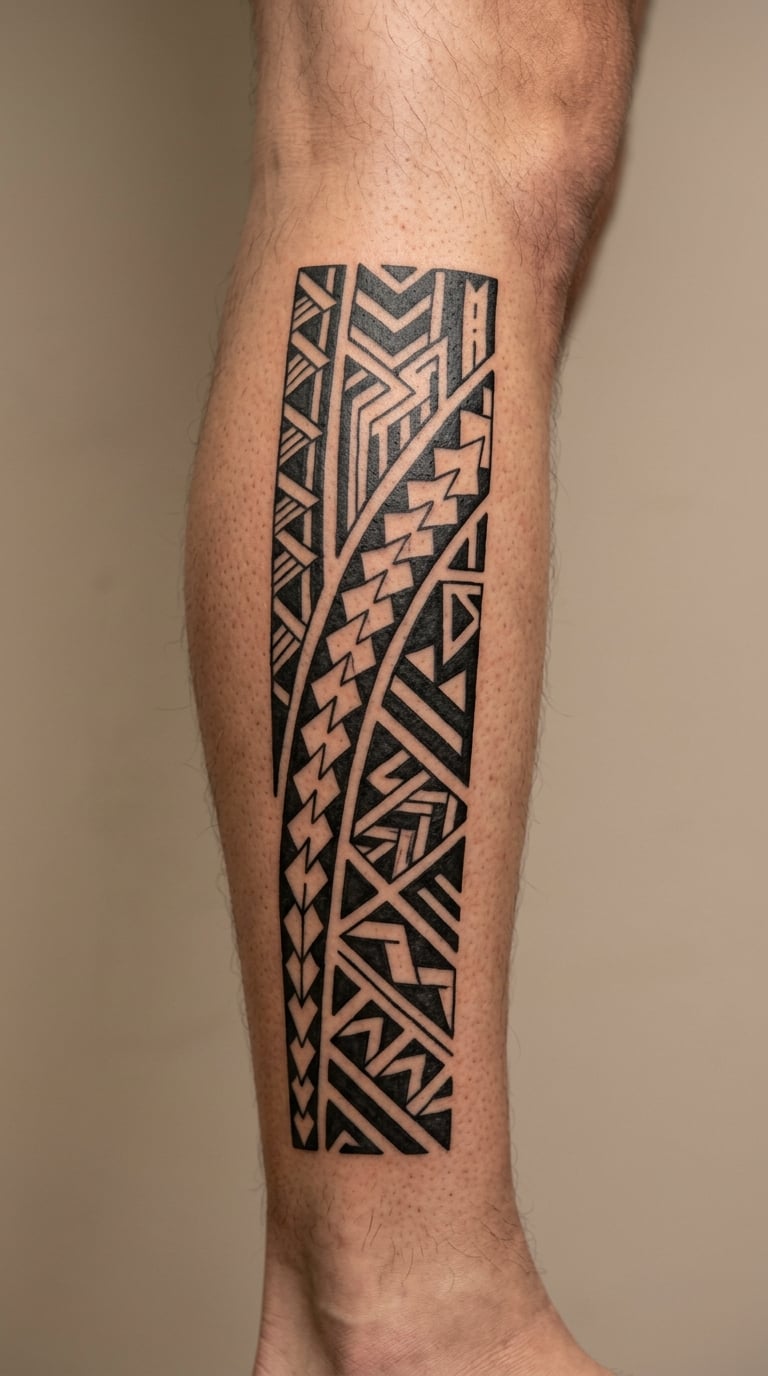
A tribal piece is built from heavy angular shapes, chevrons and curved hooks in solid black, stacked so the negative spaces between them do as much work as the ink. Done well it reads as one continuous panel rather than a row of separate symbols.
Modern tribal is usually about structure, ancestry and strength rather than a fixed dictionary of symbols, so pick a style you find balanced and leave the reading to you.
Placement: outer shin, calf or both, 2-3 in (5-8 cm) wide, running the length of the leg. Size: 3-4 in (8-10 cm) wide. Style: tribal. Pain: medium-high, mostly from the long reach down the shin. Bands that circle the leg distort as the calf flexes, so ask your artist to sketch the pattern against a bent leg. Make it yours: have the band taper at both ends so it looks like a continuous line rather than a stripe.
5. Storm Waves in Japanese Style
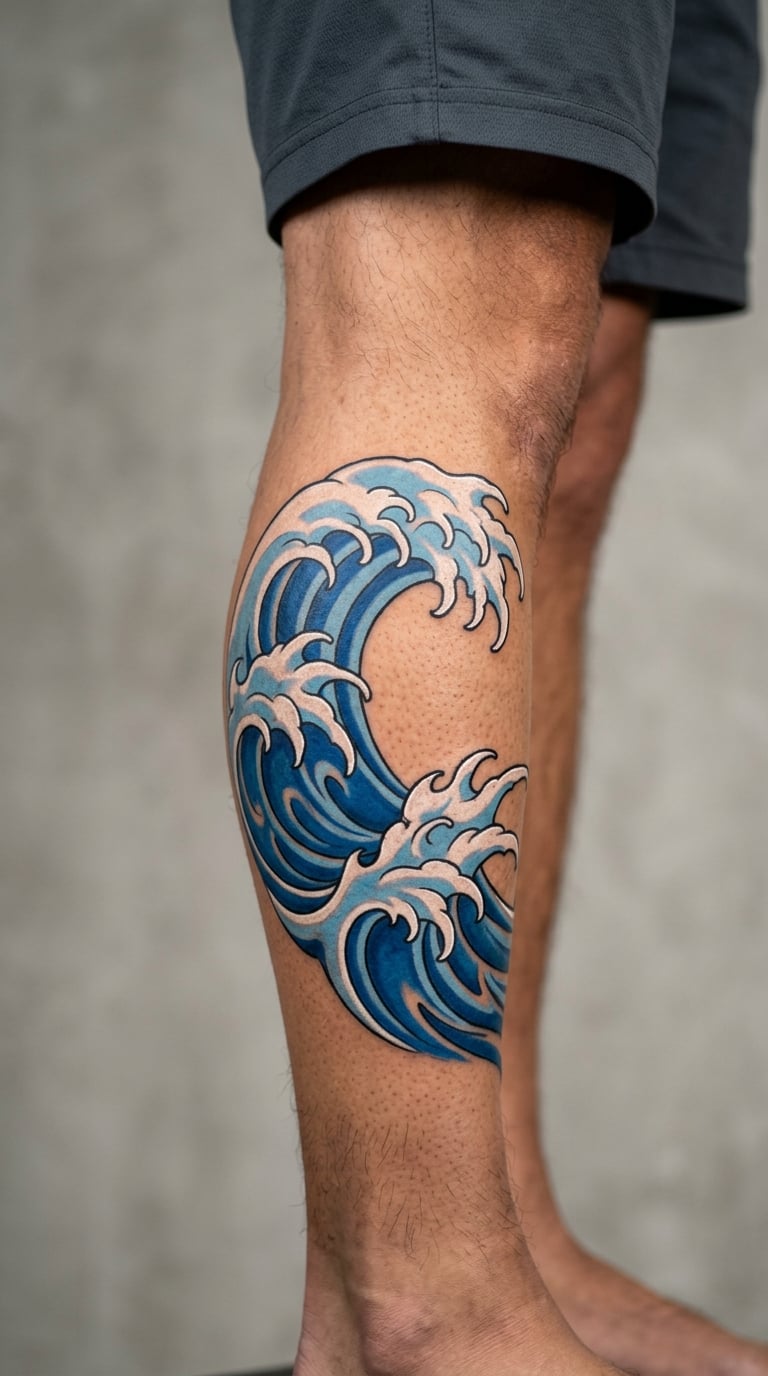
Waves sit well on a leg because their natural motion follows the limb. The artist draws a breaking crest with clawed foam at the top, layered water below, and often a spiral of smaller waves filling the gaps toward the ankle.
Water in Japanese work stands for change, resilience and going through something difficult and coming out the other side. It is one of the more useful meanings on this list, because a lot of men who get waves say exactly that.
Placement: outer shin running vertically, or wrapping from the front shin around to the calf. Size: 7-10 in (18-25 cm). Style: Japanese traditional. Pain: medium-high, and lighter than a solid black piece. Make it yours: add a small dated wave crest at the ankle to mark a surf trip or a recovery, and keep the foam pattern wrapping behind the leg.
6. Vertical Kanji Column Down the Front Shin
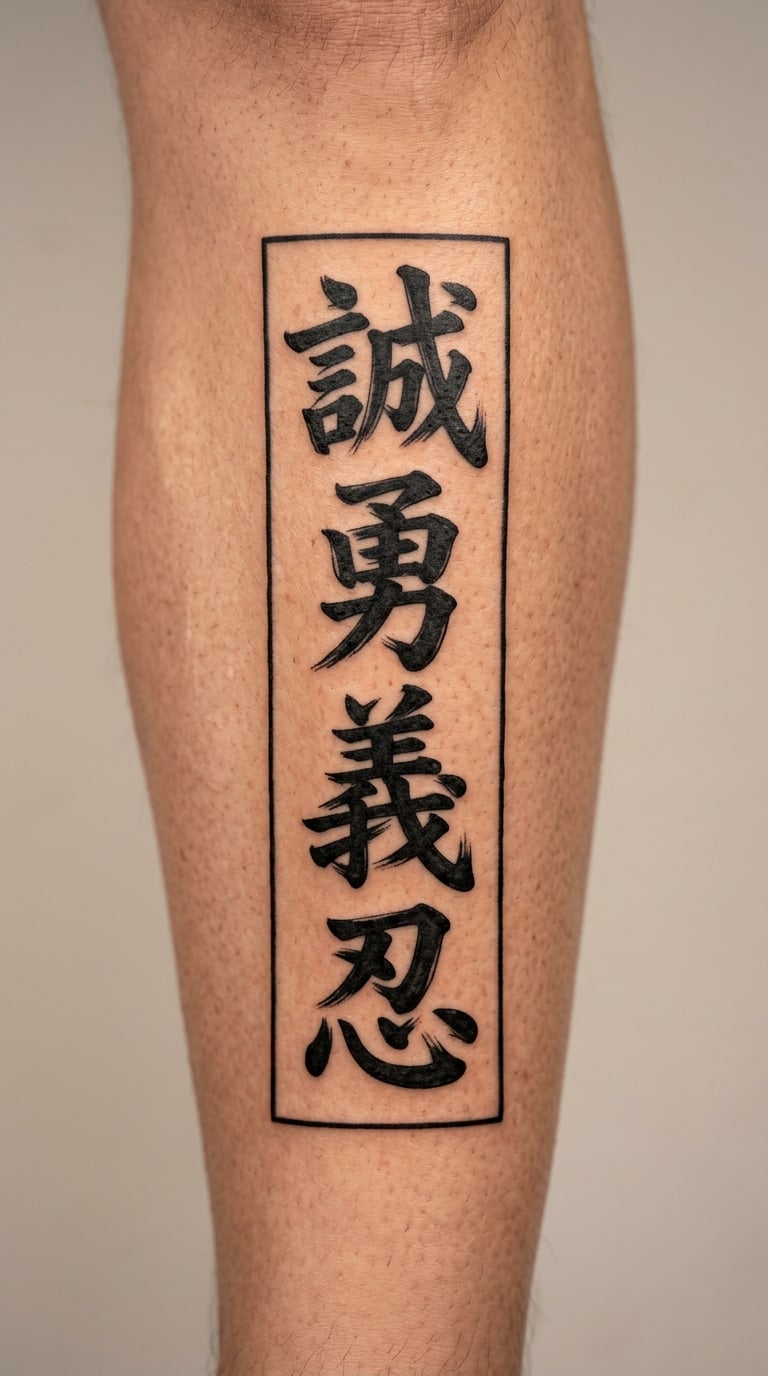
A kanji column is one character under another, running down the shin inside a light border or straight with no frame at all. Thick brush-style strokes work best here, because hairline detail on this part of the leg disappears within a few years.
The characters have to be right. Ask your artist to show you the translation, and check the stroke order and any second or third meanings before you commit, since a wrong character is the one mistake that cannot be quietly fixed.
Placement: front shin, centred, characters stacked head to toe. Size: 4-6 in (10-15 cm) tall. Style: traditional brushwork. Pain: high, the front edge of the tibia is the least forgiving part of the leg. Make it yours: add a small red hanko-style stamp beside the bottom character with your initials.
7. Blackwork Snake Coiling Up the Shin
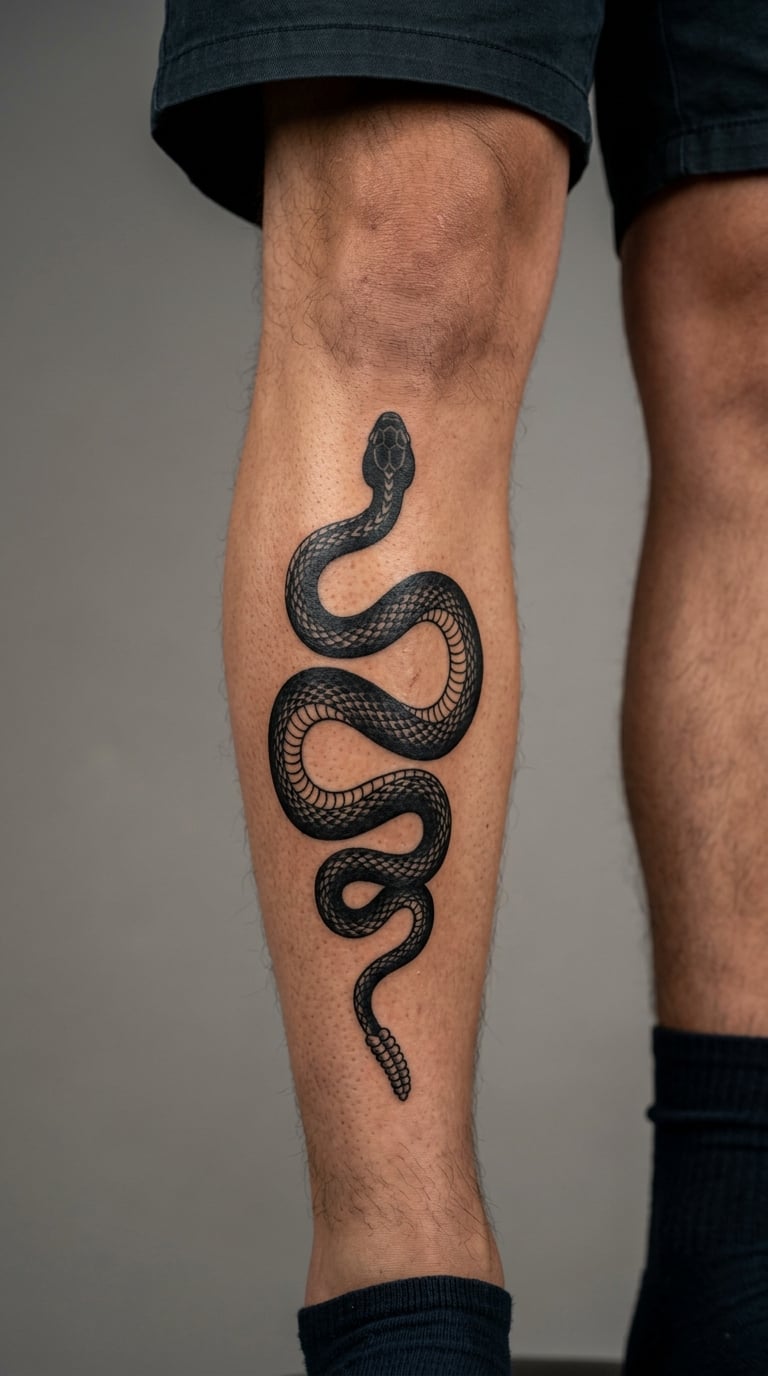
A snake rendered in blackwork is mostly scale texture, which gives the artist plenty of black to lay down and very little hairlining to lose. The body loops in a loose S down the shin and the head rests near the top, looking out.
Snake work usually points at transformation, healing and shedding what is finished. That reading is old and widely repeated, so treat it as tradition rather than a promise.
Placement: front shin from just above the ankle to below the knee. Size: 9-12 in (23-30 cm). Style: blackwork. Pain: high. Scale texture means short needle dabs, which hurts more per square inch than long lines. Make it yours: have the snake bite its own tail to close the loop, and add a small sprig of ivy at the head end.
8. Biomechanical Panel From Knee to Ankle
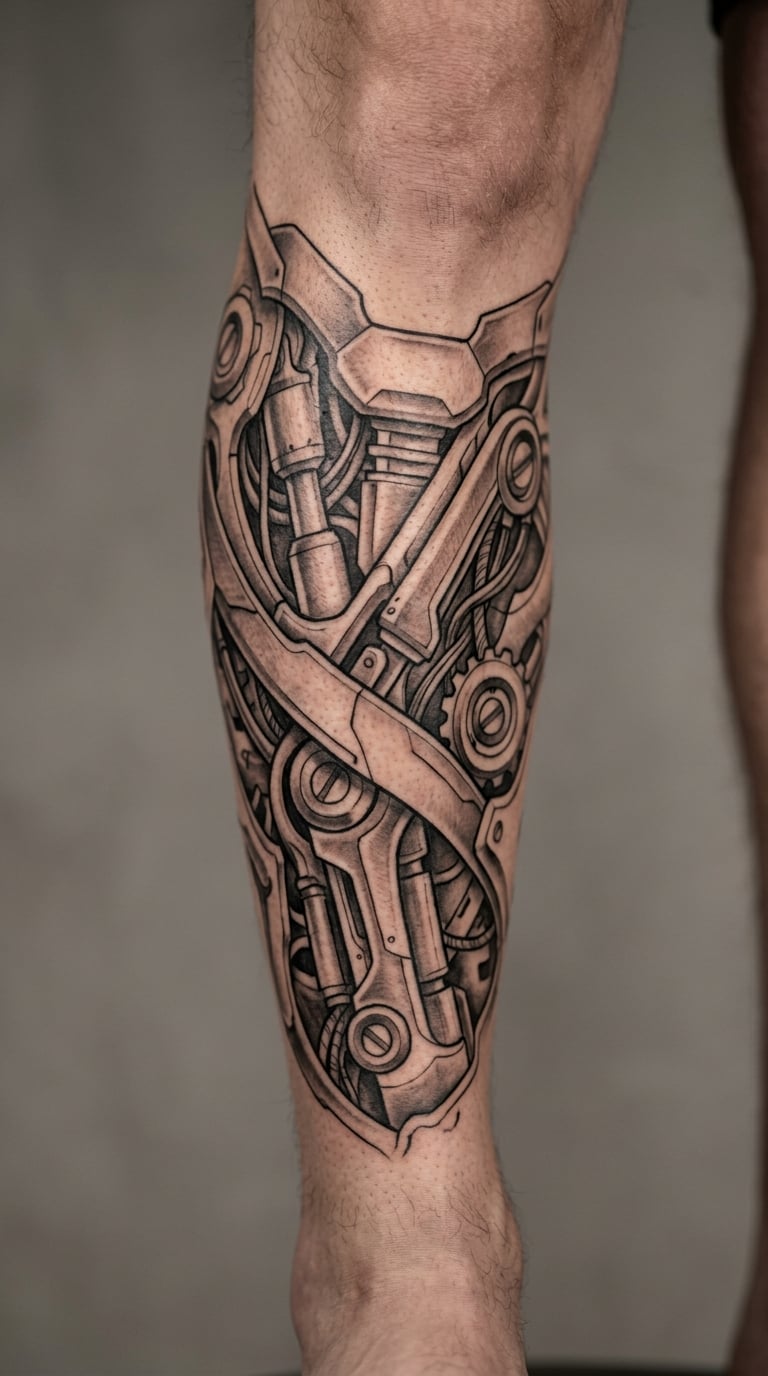
Biomechanical work strips a leg back to machine parts: bone rendered as metal struts, cables where tendons should be, gears in the knee. The palette is black, grey and a little silver-white, with almost no colour, and the shapes are mechanical curves rather than organic ones.
The appeal is a controlled, engineered look, a way of presenting the body as a machine that works. It suits men who want something large that still reads as graphic rather than illustrative.
Placement: full shin, front to calf, wrapping. Size: 14-18 in (35-45 cm). Style: biomechanical. Pain: high, and shading grey gradients on bone is slow going. Plan on several sessions. Make it yours: hide a small serial number or plate code inside the machinery, where only you will ever see it.
9. Lion Portrait in Illustrative Realism
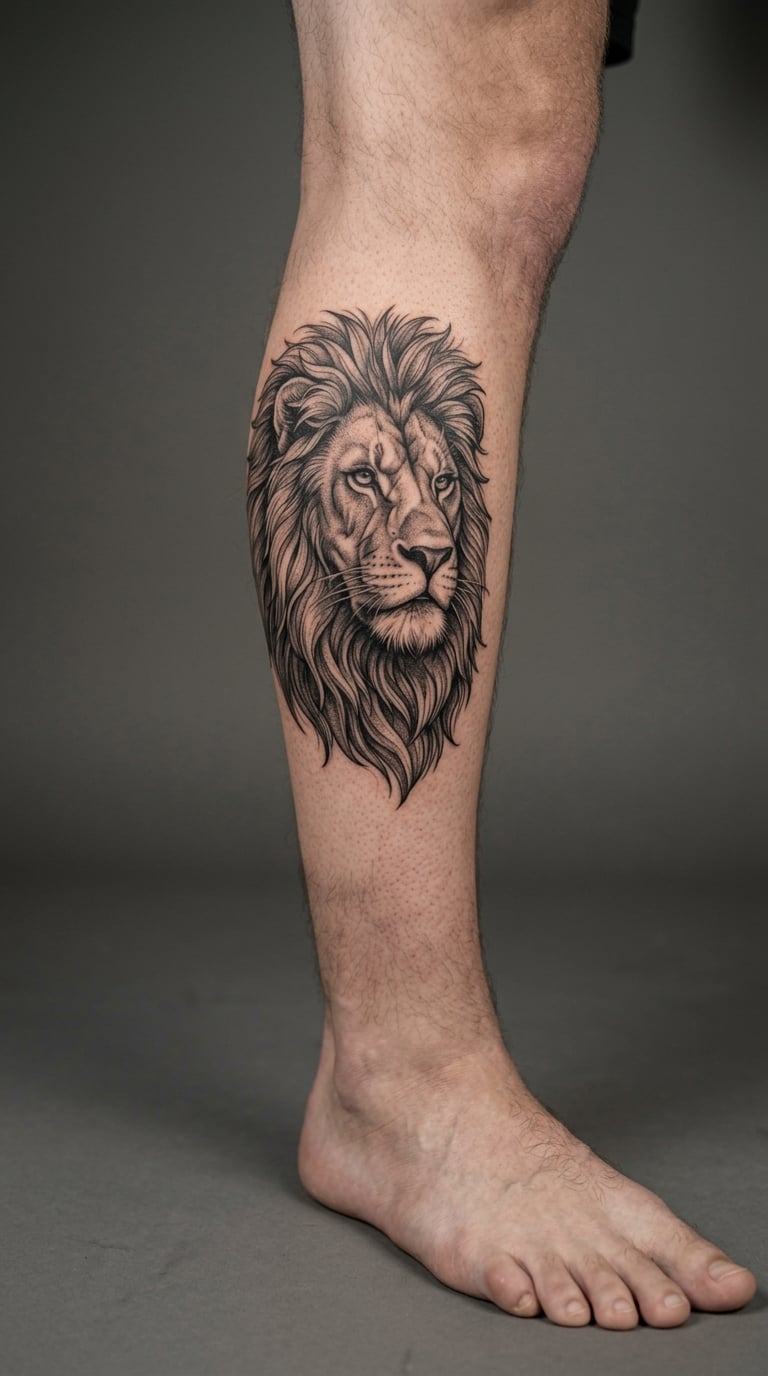
A lion portrait in illustrative realism is black and grey shading rather than pure blackwork: the mane is built from soft directional strokes and the face is left bright. The style keeps detail in soft greys, which is more forgiving than hairline on the leg.
Lion designs are about courage and command, the version of strength that comes with holding yourself steady. Most men pick it because the face reads well from a distance even in shorts.
Placement: upper shin, 2-4 in (5-10 cm) below the knee, mane following the knee’s curve. Size: 6-8 in (15-20 cm). Style: illustrative realism. Pain: high, and grey shading on a flat bone takes patience from both of you. Make it yours: have a thorn branch run under the chin, and add a colour accent, one amber eye, so the portrait has a focal point.
10. Bow and Arrow in Old Western Style
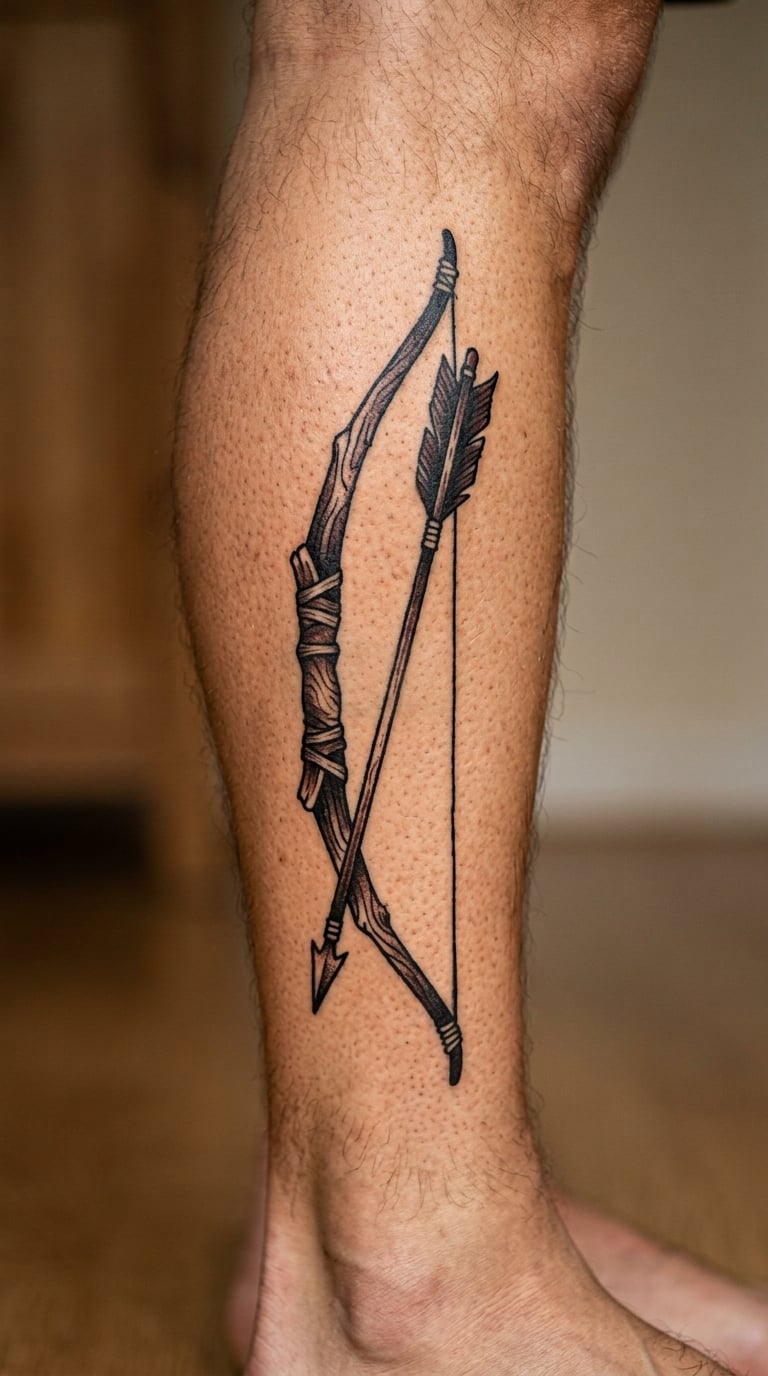
Old Western tattooing came out of sailors and miners, and its signature is a forked outline, spade-shaped shading and a limited brown and green palette. A bow with a nocked arrow fits that tradition exactly, and the curved limb of the bow fills the straight line of the shin nicely.
It reads as focus, aim and steady hands, a quieter claim than a skull and a lot easier to wear to work.
Placement: outer shin, bow curved along the leg, arrow pointing up toward the knee. Size: 6-7 in (15-18 cm). Style: Old Western. Pain: medium-high. Make it yours: have the fletching spell out a set of initials in the feathers, which is traditional on old school pieces, and keep the palette to two colours.
11. Blackwork Phoenix Rising Along the Shin
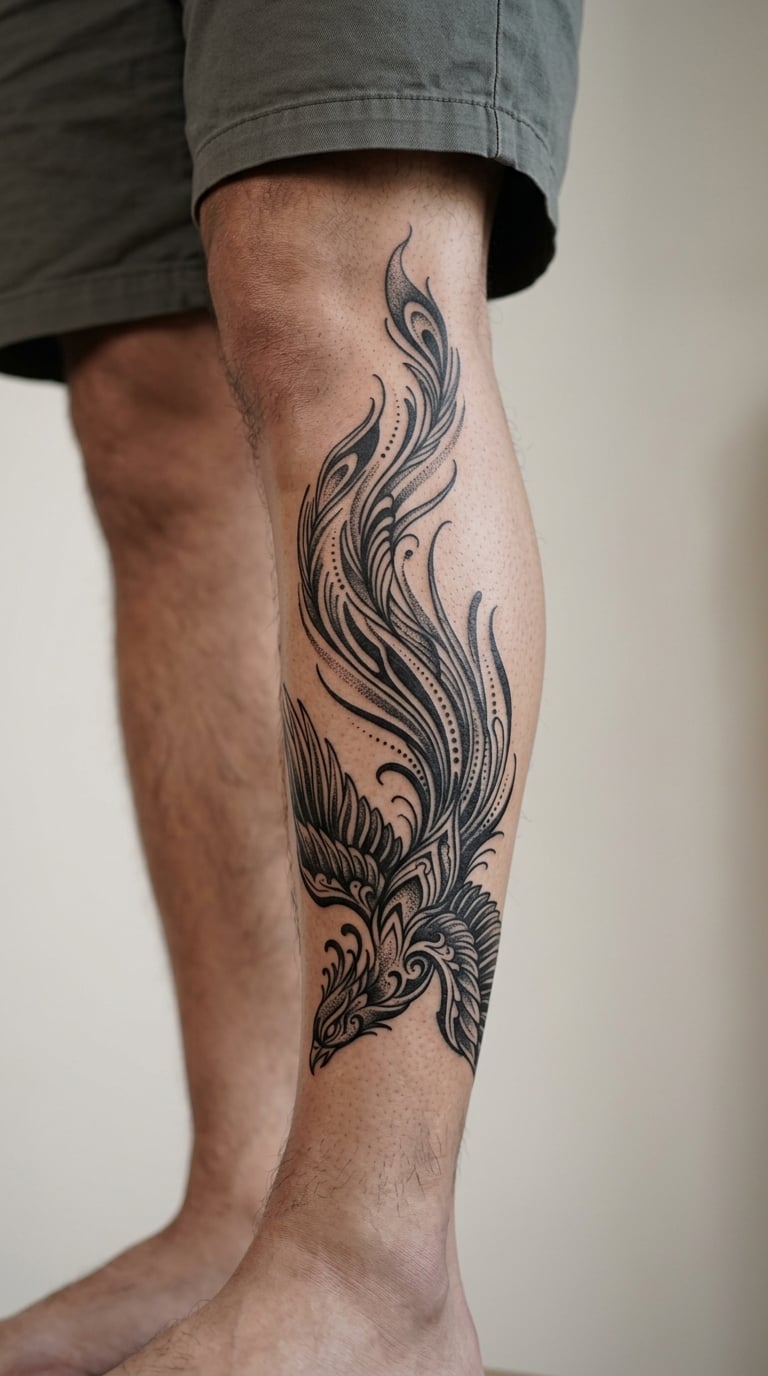
A phoenix is usually drawn head up, body compressed in the middle, tail streaming down toward the ankle. In blackwork the tail feathers become long tapering shapes and the wings get feather edges cut out of the black, so the whole thing stays bold.
Rebirth after something hard is the meaning almost everyone attaches to a phoenix. It is a hopeful design that still looks hard on the leg, which is not a bad balance.
Placement: front shin, vertical, tail ending above the ankle bone. Size: 8-11 in (20-28 cm). Style: blackwork. Pain: high. Solid black over a large area is a long stretch of sitting still. Make it yours: have the tail feathers break into a few wisps that fade out near the ankle, so the piece looks like it is disappearing as you walk.
12. Lighthouse in Black and Grey
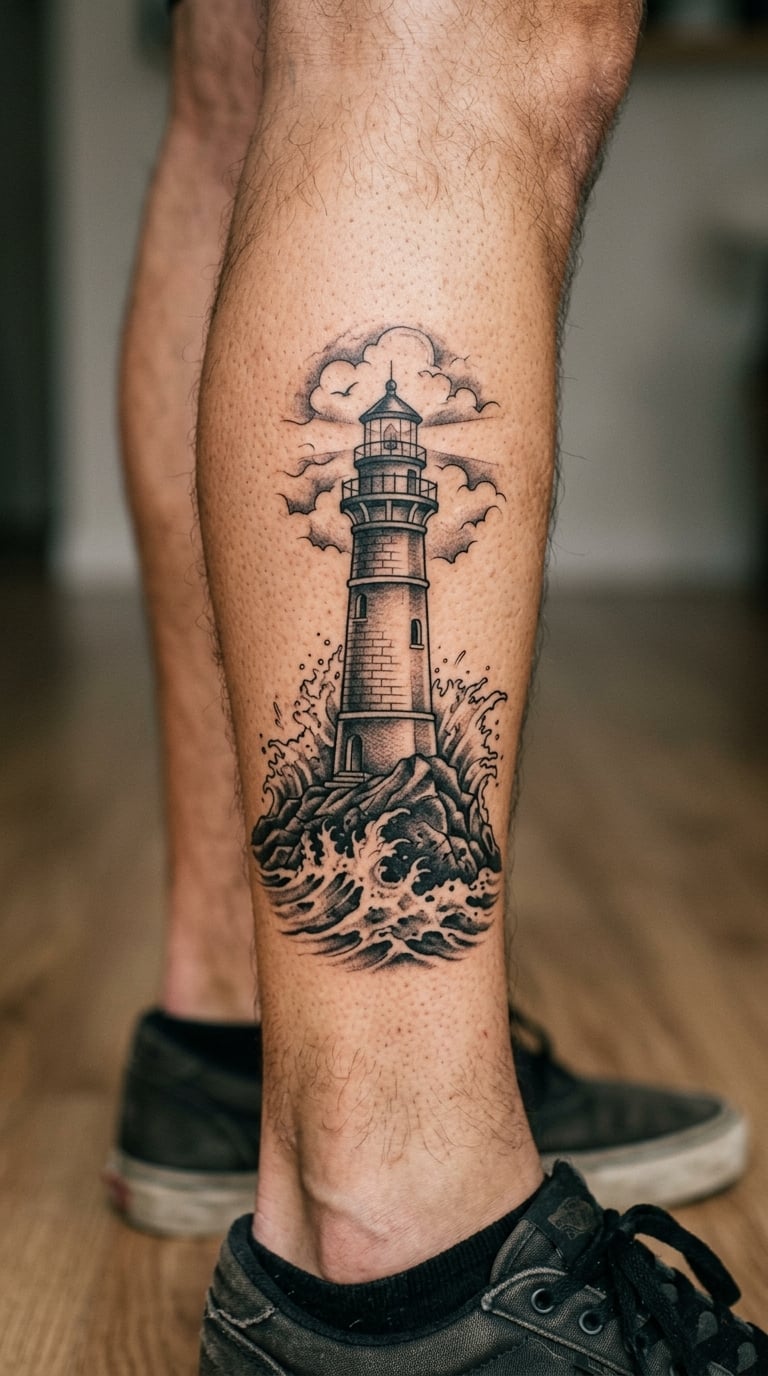
A lighthouse is a small subject with a lot of vertical room. The artist draws the tower in tapered black and grey, a lit lamp room as the brightest point, and enough sea and rock below to fill the space down to the ankle.
Guiding, steadiness and getting through rough water are the readings people bring to it. Several men mention it as a tribute to a family member who kept watch over the coast.
Placement: lower shin, 3-5 in (8-13 cm) above the ankle bone, where the leg narrows. Size: 5-7 in (13-18 cm). Style: black and grey realism. Pain: medium-high, less area than a full shin piece. Make it yours: put a real coastal name or a latitude line in the band under the lamp, and add a single beam of light reaching toward the front of the leg.
13. Geometric Hexagon Circuit Panel
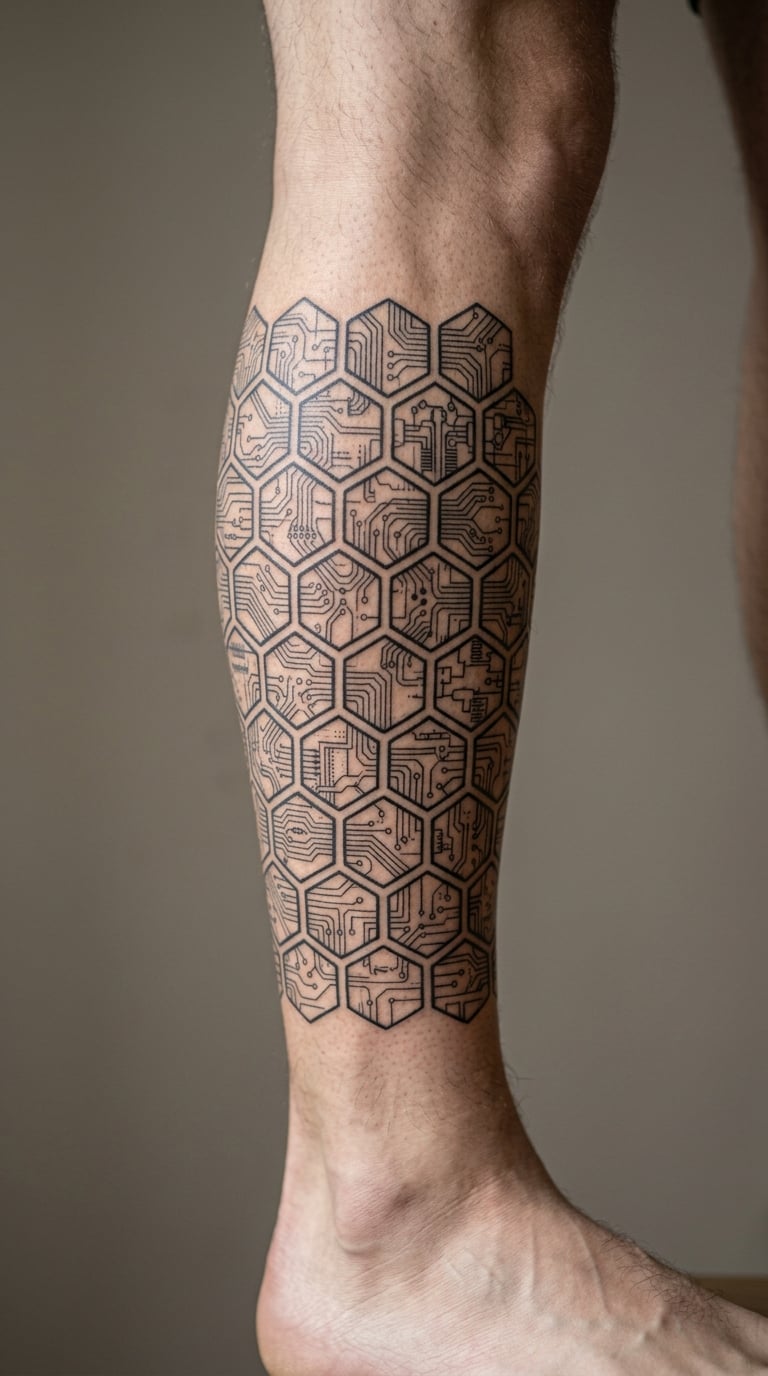
This is the graphic end of the list: a hexagon grid drawn in clean black outlines, with parts of the cells filled and thin circuit-like lines running through the empty ones. Nothing shaded, nothing curved, all of it on geometry.
It suits a man who wants a design that looks designed rather than drawn, and because every line is structural it holds its shape as the calf moves underneath it.
Placement: outer shin, in a rectangular block or following the leg in a column. Size: 4-6 in (10-15 cm). Style: geometric. Pain: medium, and the least painful of the bold designs here. Make it yours: leave three hexagons empty as negatives, or fill them with a solid block of black, so the grid has a rhythm instead of uniform texture.
14. Celtic Interlace Panel on the Outer Shin
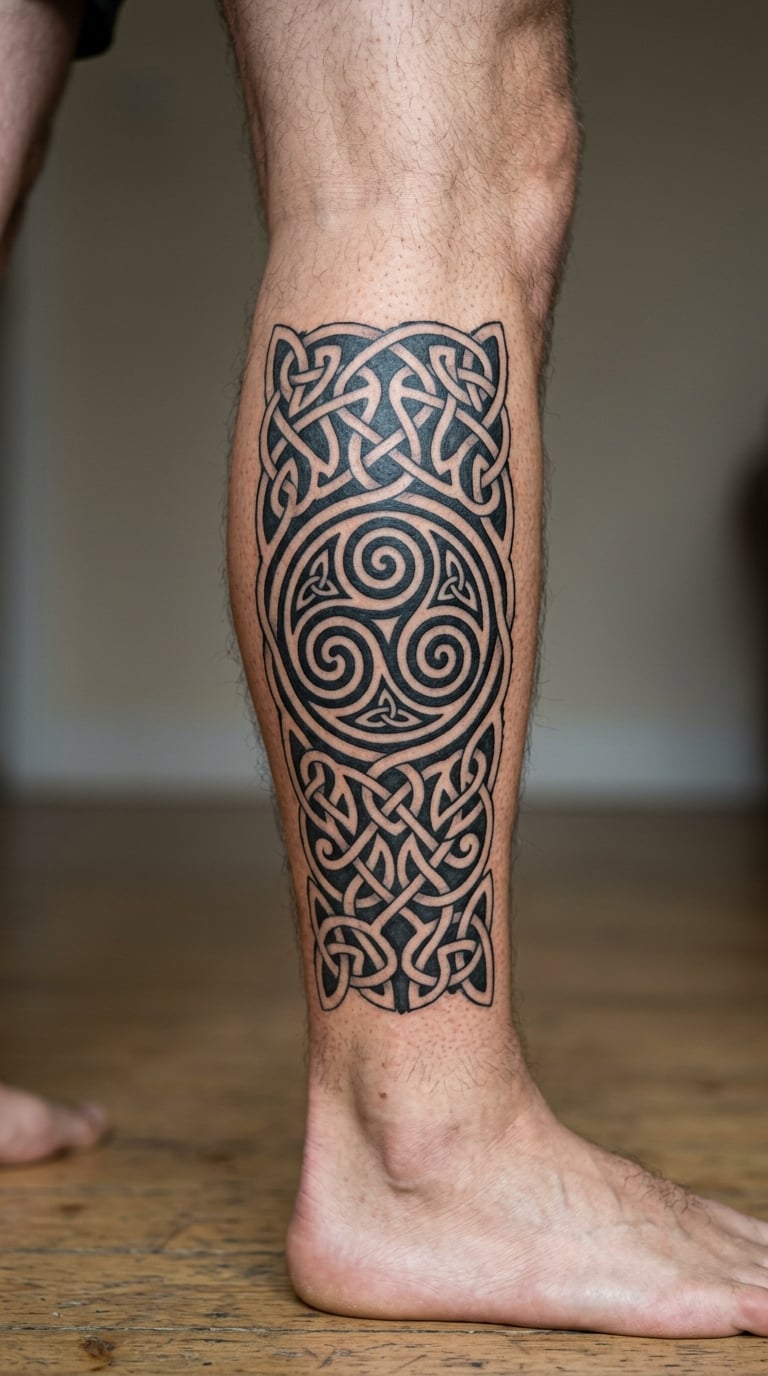
Celtic work is one continuous ribbon looping over and under itself, and it is drawn in black with no shading at all. On a leg, the ribbon gains a natural curve, so an interlace panel follows the calf instead of sitting flat on it.
Knots, spirals and triskeles are old symbols of unbroken connection and the turns of fate. Most men choose the piece for the pattern, and the meaning is a bonus rather than the reason.
Placement: outer shin or upper calf, a square or rectangular panel. Size: 5-7 in (13-18 cm). Style: Celtic. Pain: medium on the outer leg, and the overlap crossings take a little patience. Make it yours: change the centre knot to a clan crest or a triskele with three names, and keep every line the same weight so the pattern stays even.
15. Skull and Laurel in Old School Style
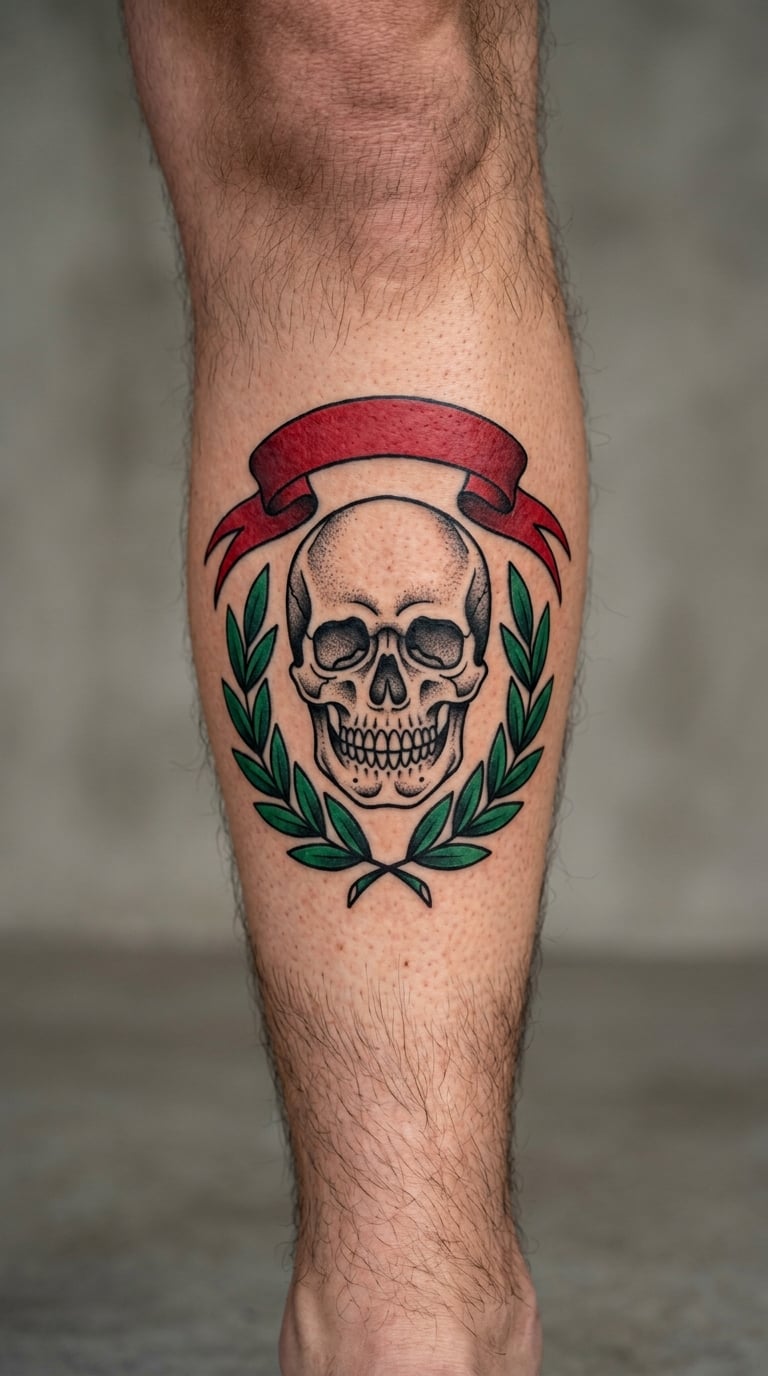
An old school skull is not photorealistic. The jaw is a simple curve, the eye sockets are two black shapes, the nose is a small triangle, and the whole thing sits in a circular badge of red and green with a banner underneath. That flatness is exactly why it works on a leg.
Skull and laurel together is an old sailor and biker shorthand for mortality and honour in the same breath, a reminder that a life is short and you still hold to your own code.
Placement: mid front shin, badge centred. Size: 5-6 in (13-15 cm). Style: old school. Pain: high, the front shin again. Make it yours: put a date in the banner, the year something ended or someone was born, and ask for the palette trimmed to red, green and black only.
16. Honey Bee as a Small Upper Shin Piece
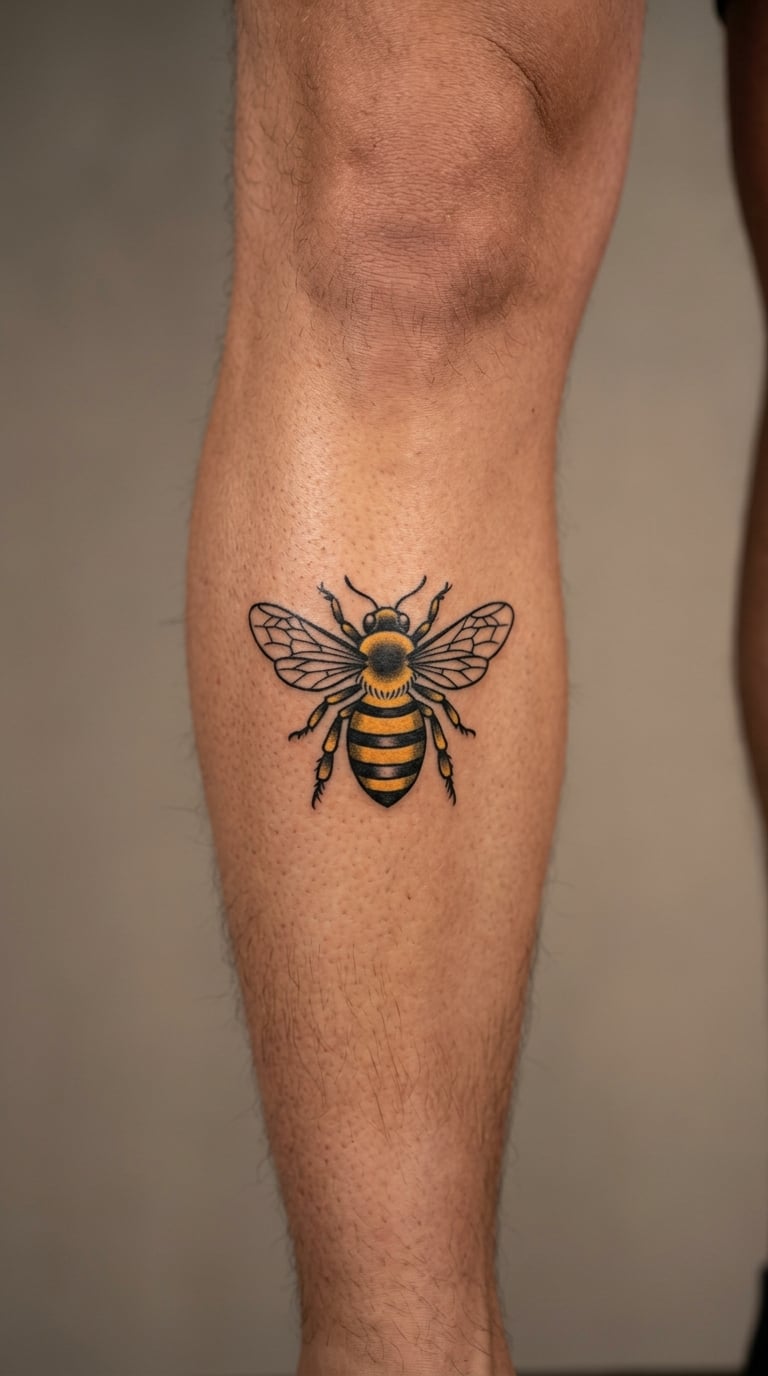
A bee in traditional style is one of the easiest strong motifs to fit on a shin: fat yellow and black abdomen, two small wings, a short stinger. Simple shapes, strong contrast, no fine detail to lose, which makes it a good pick for a first leg piece.
Hard work, loyalty and community are the meanings attached to bees, and it is one of the few shin designs that reads well at three inches.
Placement: upper shin or lower calf, with room left around it to add later. Size: 2.5-3.5 in (6-9 cm). Style: American traditional. Pain: medium-high, quick because it is small. Make it yours: have a small hexagon or a short word tucked into the negative space beside the bee, so a bigger piece can grow around it later.
17. Stag Head in a Pine Forest
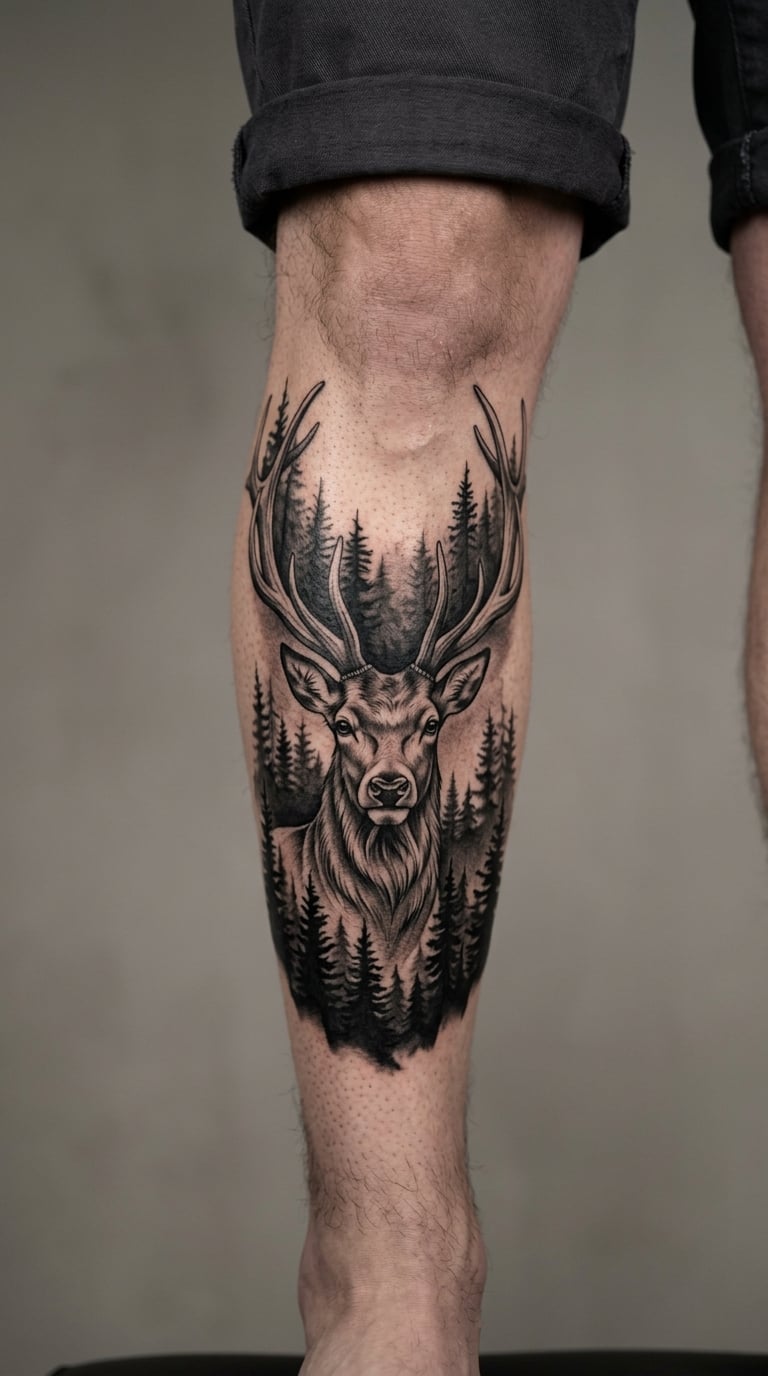
The stag runs the length of the front shin, antlers branching up toward the knee, with a few pine trees in silhouette and soft grey fog behind. Using the trees as background layers means the composition has depth without turning into a mural.
Stag designs are about instinct, patience and staying steady in a hard place, and the antlers give the piece a natural shape that fills the leg’s vertical line.
Placement: full front shin, antlers pointing up toward the knee. Size: 7-10 in (18-25 cm). Style: illustrative realism. Pain: high, and the antlers mean a lot of separate needle work. Make it yours: have a mountain ridgeline run behind the head, and add one warm brown tone in the eyes so the face holds attention.
18. Bull Head in Solid Blackwork
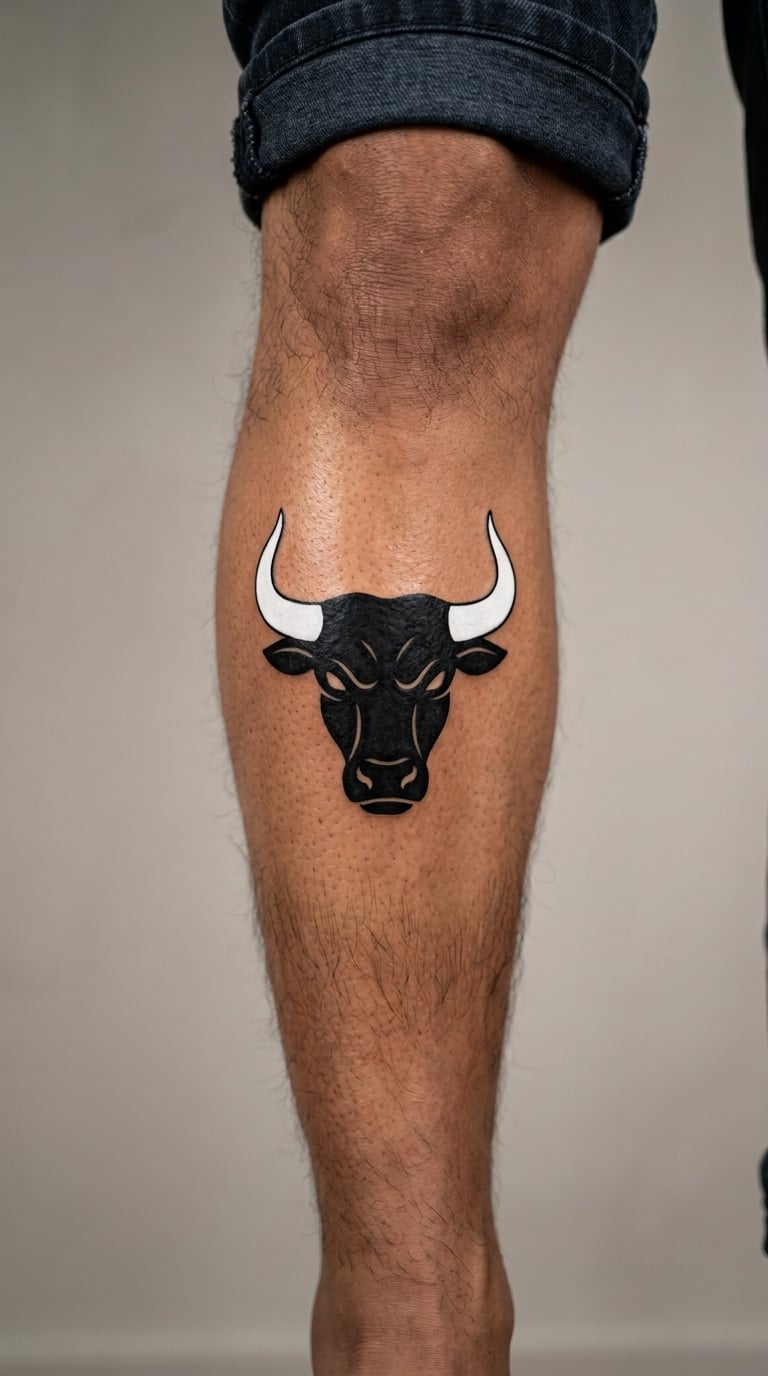
The bull in solid black is a mass of black with the horns and eyes cut out as white skin. There is barely any shading to lose, which makes it one of the most durable designs on the leg and one of the fastest to heal.
Strength, stubbornness and getting through work that does not bend you are the usual reading. It is a heavier, quieter option than a skull, and it photographs well in a plain pair of trousers.
Placement: mid front shin, horns angled up. Size: 6-8 in (15-20 cm). Style: solid blackwork. Pain: high, but a smaller patch of skin than a dragon wrap. Make it yours: angle the horns to follow the knee’s curve, and have a small brand mark tucked under one horn if you want a detail only you can see.
19. Small Compass Rose Above the Ankle
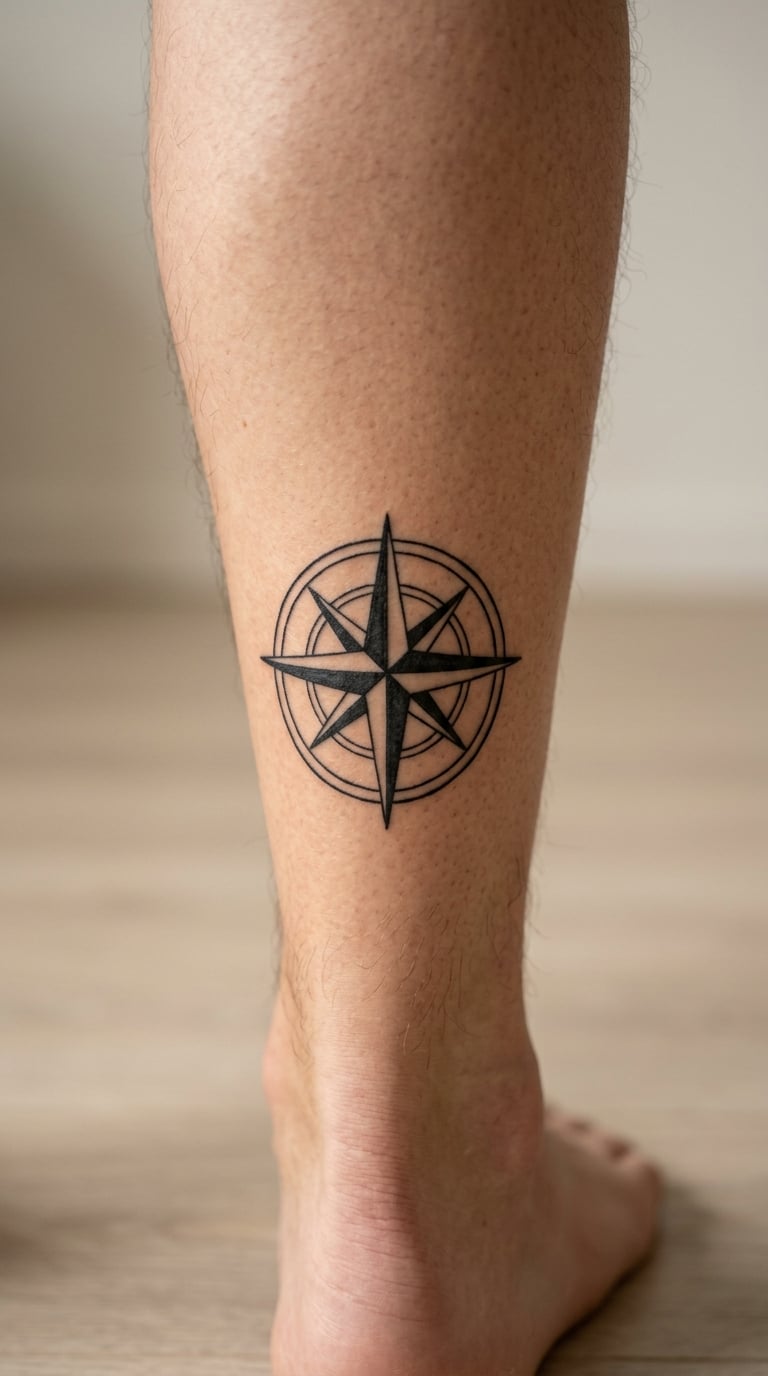
A compass rose is a small design with a lot going on, so it needs bold shapes: a fat four-point star, two shorter diagonal points, a circle, and a needle. Drawn with even line weight it holds together at a small size better than almost anything else.
Direction, purpose and a home point are the meanings people read into it. It is the right first shin tattoo for a man who wants one piece and does not want a leg project.
Placement: lower shin, 2-3 in (5-8 cm) above the ankle bone, or the inner calf. Size: 2-3 in (5-8 cm) across. Style: minimalist linework. Pain: medium, and short if you keep it simple. A compass this size can fade, so ask for a heavier line than feels necessary. Make it yours: have the needle point to a real place, a town where you were born or a spot you want to reach.
20. Minimalist Chevron and Arrow Linework
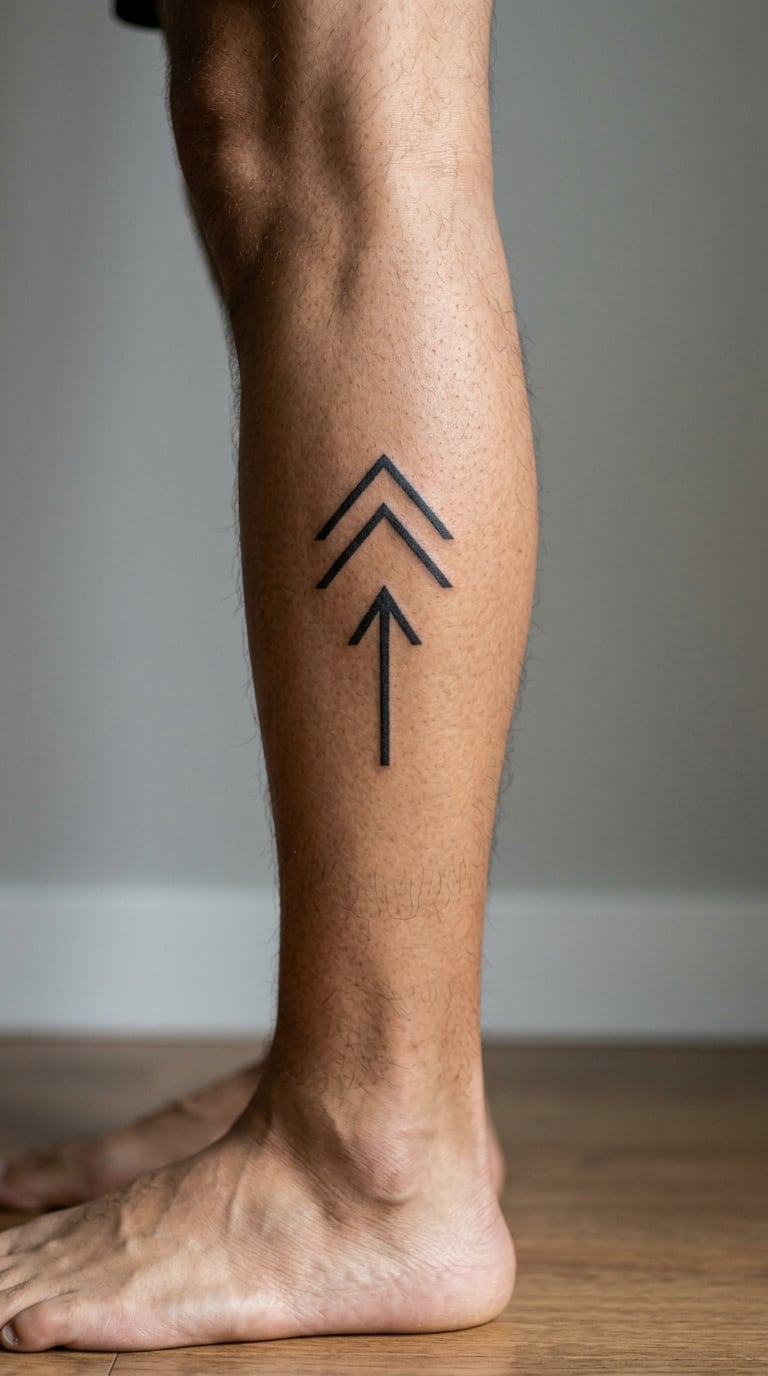
This is the quiet option: two or three stacked chevrons, or a single arrow, drawn in one weight of black line. Nothing more. It works because it is honest to the shape of the leg, and because restraint reads better at work than a full wrap.
Forward motion, direction or a unit patch turns into a personal mark. Plenty of men choose a plain geometric piece when they already have tattoos elsewhere and want the leg to stay quiet.
Placement: outer shin or ankle, anywhere with clear skin around it. Size: 3-5 in (8-13 cm). Style: minimalist. Pain: medium, the least demanding session on this list. Make it yours: stack the chevrons in ink colours that mean something, or set the number of them to a year that counts, and leave the skin beside it open for a second piece later.
How to Choose the Right Shin Tattoo
Start with line weight, not the picture. Anything you want on the shin needs outlines thick enough to read across a room, and solid black areas that will not thin out in five years. If a design only works as fine line, pick a different one or a bigger version of it.
Then decide flat or wrapping. A design on the flat front surface reads clearly in shorts and photographs well, while a wrap-around piece gets more dramatic from the side and fills the whole leg. Do not try to mix a small flat piece and a full wrap on the same leg without planning the gap first.
Size matters more here than anywhere else. A small design on a big shin looks unfinished, and a full-shin piece on a first tattoo is a five-session commitment. If you have other tattoos already, a small piece that leaves three inches of skin around it gives you room to add to the leg later.
Ask how it wears. Chinos, shorts and work boots all frame the lower leg differently, and a design that looks right rolled to the calf may vanish under a long hem. Bring a photo of how you dress to the consultation.
If you already have a shin tattoo you dislike, cover-up and redesign is normal work, and an experienced artist can usually rework an old piece by using it as the foundation of a new design. Go to someone who does cover-ups regularly rather than asking the original artist for a quick fix.
Cost and Session Time
Artists charge by the hour, and the total depends on size, detail, colour count and how far the design wraps around the leg. A small piece like the honey bee or the compass rose is usually a single short sitting. A full-shin wrap is a series of appointments, often four to six, and each one needs its own healing time.
Detail drives the clock more than size does. A solid blackwork piece moves faster than a grey-shaded portrait, and a wrap that disappears around the calf takes longer than the same drawing on the flat front. Rates differ a lot by city, by shop and by artist reputation, and many studios set a shop minimum, so a piece that sounds small can still have a floor to it.
Walk in with a budget you have already discussed rather than a number you hoped for. A good artist will tell you honestly whether your design is going to take two hours or eight, and that conversation is worth more than any quoted price online.
Aftercare Basics
- Follow your artist’s aftercare instructions first. They know how deep your lines went and what healing product suits the ink.
- Wash morning and night with unscented soap and lukewarm water, then pat dry with something clean and lint-free. No scented products near fresh ink.
- Wear loose clothing for two weeks. Socks, boot shafts and tight pant legs rubbing across a fresh shin are the single most common complaint on this placement.
- Sleep on the other side for the first two weeks, or cover the shin with a clean loose wrap if you roll onto it.
- Keep it out of direct sun. The shin is exposed whenever you wear shorts, and sun on healed black ink is what fades fastest.
- No swimming, hot tubs, saunas or heavy sweating for about two weeks, and no picking at flaking skin, however tempting it looks.
Surface skin settles within two to three weeks, and the deeper layers of a new tattoo keep settling for four to six months. That is when the piece looks most true to how it will stay for the rest of your life, so give it time before deciding anything about a touch-up.
Frequently Asked Questions
Is the shin painful to get tattooed?
The shin is one of the more painful places to be tattooed. The tibia runs directly under thin skin with almost no muscle or fat cushioning it, so the needle feels close to bone. Most people rate the front shin around six to seven out of ten, and the hard outer edge of the bone is the worst of it. The inner side of the shin is slightly more forgiving.
What styles of tattoos look best on shins?
Bold styles suit the shin because the surface is flat and unforgiving. Blackwork, American traditional, Japanese irezumi, tribal, Old Western, geometric linework, Celtic interlace and biomechanical panels all hold up well, since they rely on thick outlines and solid fill. Fine line and small delicate work is the thing to avoid here, because it fades and blurs faster on the shin than anywhere else on the leg.
How long does a shin tattoo take to heal?
The surface of a shin tattoo heals in two to three weeks, and full healing underneath takes four to six months. The shin needs more care than most placements because socks, boot shafts and pant legs rub against it constantly, and it sees sun whenever you wear shorts. Loose clothing, gentle washing and no swimming or sweating for the first fortnight keep the finish clean.
How do you sleep with a shin tattoo?
Sleep on your other side for the first two weeks. If you roll onto the fresh side anyway, lay a clean loose wrap over the shin so fabric does not drag across the linework. Keep the room cool and change the wrap daily, because a fresh tattoo needs airflow to settle. Most discomfort overnight is pressure and friction rather than the ink itself.
Will a small shin tattoo fade?
Small pieces fade faster on the shin than on an arm or a thigh, especially fine line work. The skin here is thin, it stretches when you walk, and the lower leg is usually the part of you that gets the most sun. If you go small, ask for line weight heavier than looks right, fill colour rather than outline only, and expect a refresh every few years.
Can a shin tattoo be covered up or redesigned?
Yes, and it is common work. An artist who does cover-ups regularly can rework an older shin piece by absorbing it into a larger design, or by using the old ink as shading and outlines. Dark black linework and saturated colour are the easiest to cover. Faded small pieces are harder, so bring a healed photo to the consultation and expect a redesign rather than a simple patch.
If this is your first leg piece, start with the honey bee or the compass rose. Both are small, quick to heal and leave skin around them for later. If you are building a leg out properly, the blackwork wolf on the front shin or the Japanese dragon wrap is where I would put the effort, since both suit the shape of the bone and both get better with time.