
22 Mechanic Tattoo Ideas: Best Automotive Designs (October 2026)
These 22 mechanic tattoo ideas cover the whole range of the trade: single tools drawn small and quiet, single components rendered with real mechanical accuracy, and big multi-part work across an arm. A wrench or hex nut is the choice when you want the job readable to other mechanics and invisible to everyone else. An engine blueprint sleeve is the choice when you would rather announce it.
What makes an automotive design hold up on skin is proportion and line weight. A piston drawn at the wrong scale, or a gear shift missing its H-pattern, reads as clip art within a second. Good mechanic tattoo ideas keep the component technically correct and give it enough open space around it to stay legible at arm’s length.
Most people start small, find out how their skin takes fine detail, and add a larger piece years later. That is a sensible route, and it also means you get to build a collection rather than make one decision. The designs below are ordered roughly from smallest to largest, so read from the top if you are planning a first tattoo.
22 Mechanic Tattoo Ideas: Quick Guide
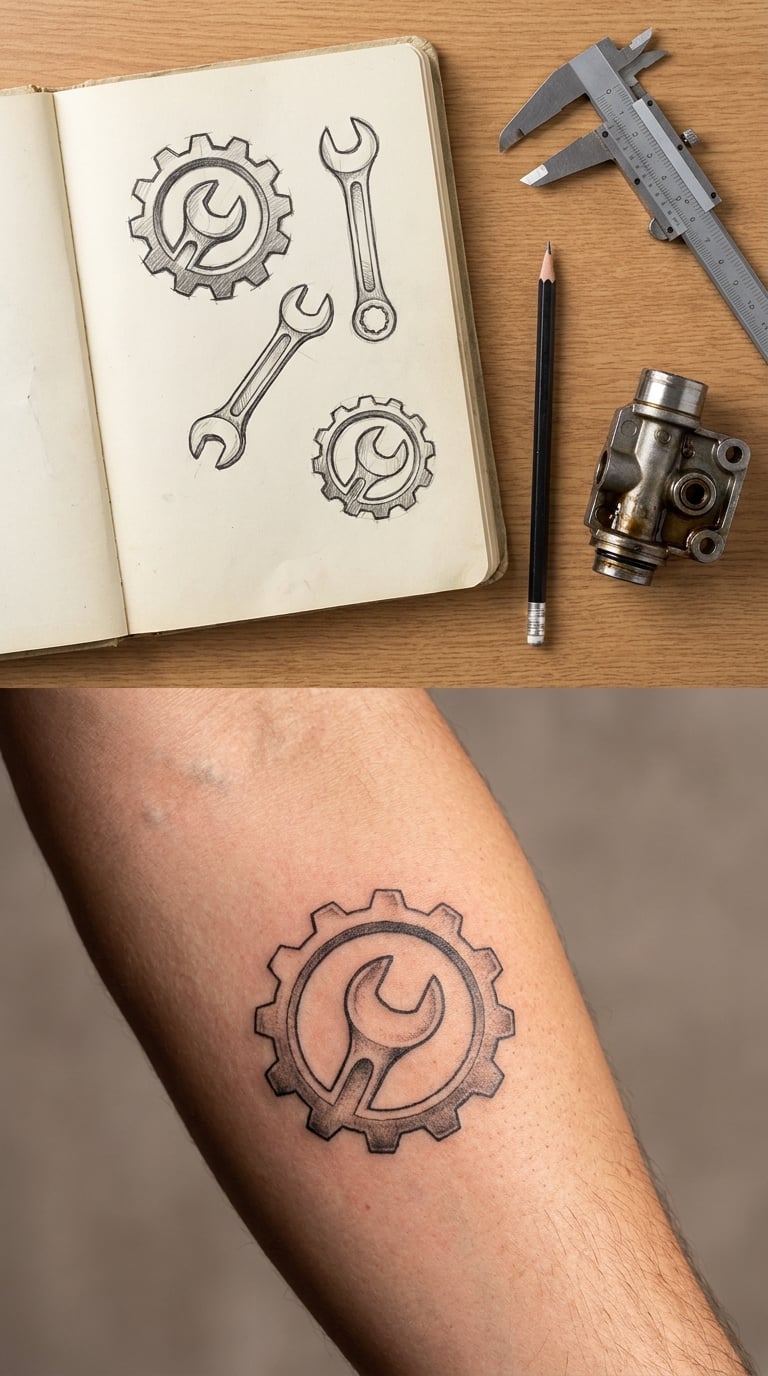
Every design below has its best placement, typical size, style and a rough pain read. Size is given as the finished height or length of the design on skin, not the stencil size.
| Idea | Style | Best placement | Size | Pain |
|---|---|---|---|---|
| 1. Fine-line open-end wrench | Fine line | Inner forearm | 2.5-3.5 in | Low to medium |
| 2. Traditional spark plug | Traditional American | Outer forearm | 3-4 in | Medium |
| 3. Micro-realism piston | Micro-realism | Inside wrist | 2-2.5 in | Medium |
| 4. Blackwork car engine | Blackwork | Upper forearm | 5-6 in | Medium to high |
| 5. Minimalist hex nut | Minimalist | Wrist or knuckle | 0.75-1 in | Low |
| 6. Watercolor oil can | Watercolor | Outer upper arm | 2.5-3 in | Low |
| 7. Neo-traditional fuel pump | Neo-traditional | Forearm | 3.5-4.5 in | Medium |
| 8. Dotwork timing belt | Dotwork | Upper arm | 3-4 in | Medium |
| 9. Realistic carburetor | Black-and-grey realism | Inner forearm | 3-4 in | Medium |
| 10. Vintage steering wheel | Traditional / blackwork | Chest or upper arm | 4-5 in | Medium |
| 11. Fine-line tire tread | Fine line | Forearm, calf or ribs | 4 in wide band | Medium |
| 12. Route 66 road sign | Traditional American | Outer forearm | 3-4 in | Medium |
| 13. Watercolor motorcycle engine | Watercolor | Upper arm | 3-4 in | Low to medium |
| 14. Minimalist lug wrench | Minimalist | Inner bicep | 2.5-3 in | Low |
| 15. Blackwork engine block | Blackwork | Outer forearm | 4-5 in | Medium to high |
| 16. Micro-realism ratchet wrench | Micro-realism | Side of forearm | 2.5-3 in | Medium |
| 17. Old-school gas can | Traditional American | Calf or upper arm | 3-4 in | Low to medium |
| 18. Fine-line T-bone wrench | Fine line | Forearm | 2.5-3 in | Low to medium |
| 19. Dotwork gear ratio | Dotwork | Upper arm | 2.5-3.5 in | Medium |
| 20. Traditional greaser character | Traditional American | Upper arm or calf | 5-6 in | Medium to high |
| 21. Neo-traditional checkered flag | Neo-traditional | Shoulder or calf | 3-4 in | Medium |
| 22. Forearm engine blueprint | Illustrative / blackwork | Forearm, wrist to elbow | 8-10 in | High |
1. Fine-Line Open-End Wrench
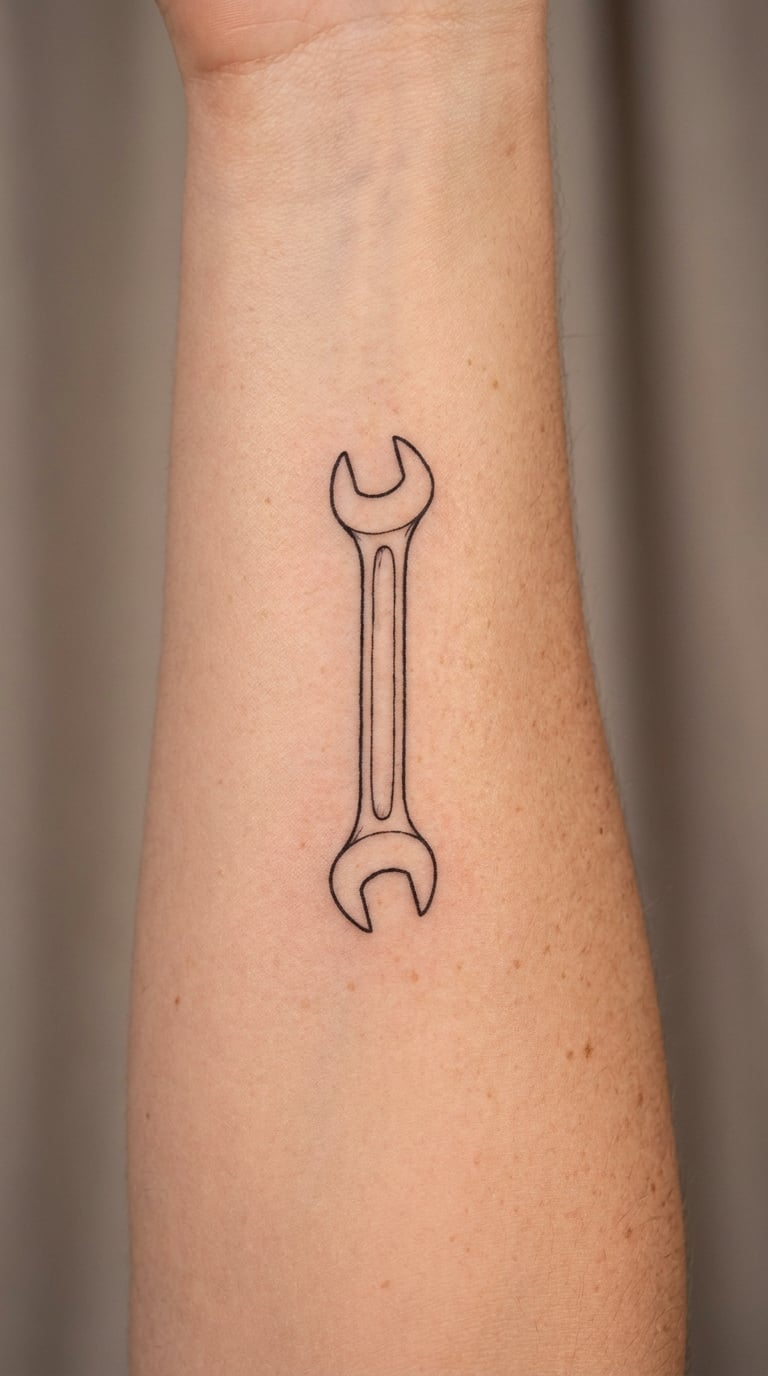
This mechanic tattoo idea is one open-end wrench drawn in a single consistent line weight, with the jaw opening at the top and the ring end below it. No shading, no gradient, no background. The whole point is that a one-line drawing of a tool people use daily still reads instantly as automotive work.
People choose it because it says the job without a slogan attached to it. It is the quietest honest version of a trade tattoo.
Placement: inner forearm running lengthwise, or the inside of the upper arm.
Size: 2.5-3.5 inches (6-9 cm) long.
Style: fine line, single weight, black ink only.
Pain: low to medium. The inner forearm is thin-skinned and sensitive, but a line design needs only a few passes.
Make it yours: add a small year in the same line weight underneath, or place a matching socket on the opposite arm.
2. Traditional Spark Plug
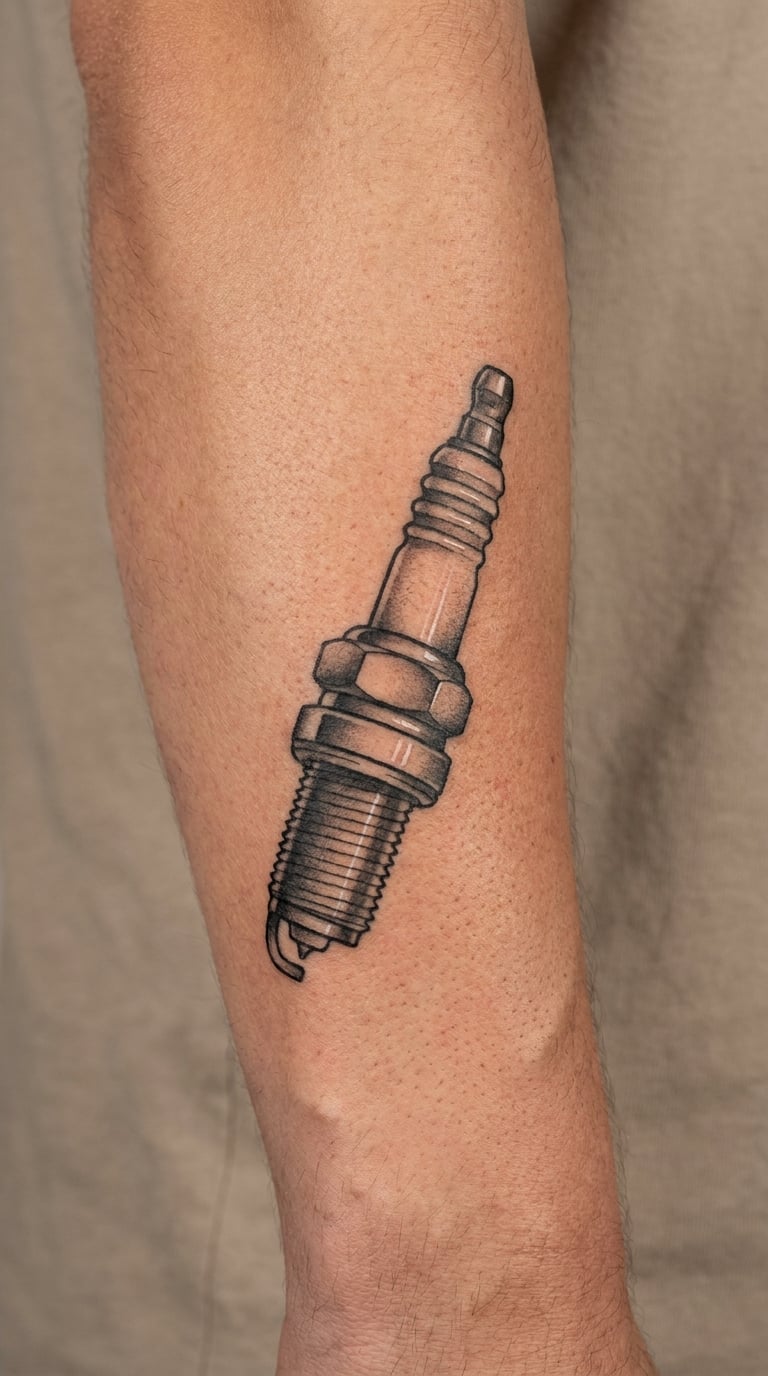
A spark plug in traditional American style has a hard black outline, a white or cream ceramic body, and grey shading down the metal threads. Drawn straight and upright at roughly three times life size, it holds its shape well and is one of the easiest components for an artist to render convincingly.
It is a small, cheap-to-live-with symbol of the daily grind, and it works as a first piece for anyone who wants something with real weight but a limited footprint.
Placement: outer forearm, or the outside of the upper arm.
Size: 3-4 inches (8-10 cm) long.
Style: traditional American, black with grey shading and one spot of colour on the ceramic.
Pain: medium. The outer forearm bruises visibly for a couple of days afterward.
Make it yours: colour the ceramic in the same hue as a car you have owned, or engrave a small engine size across the metal hex.
3. Micro-Realism Piston
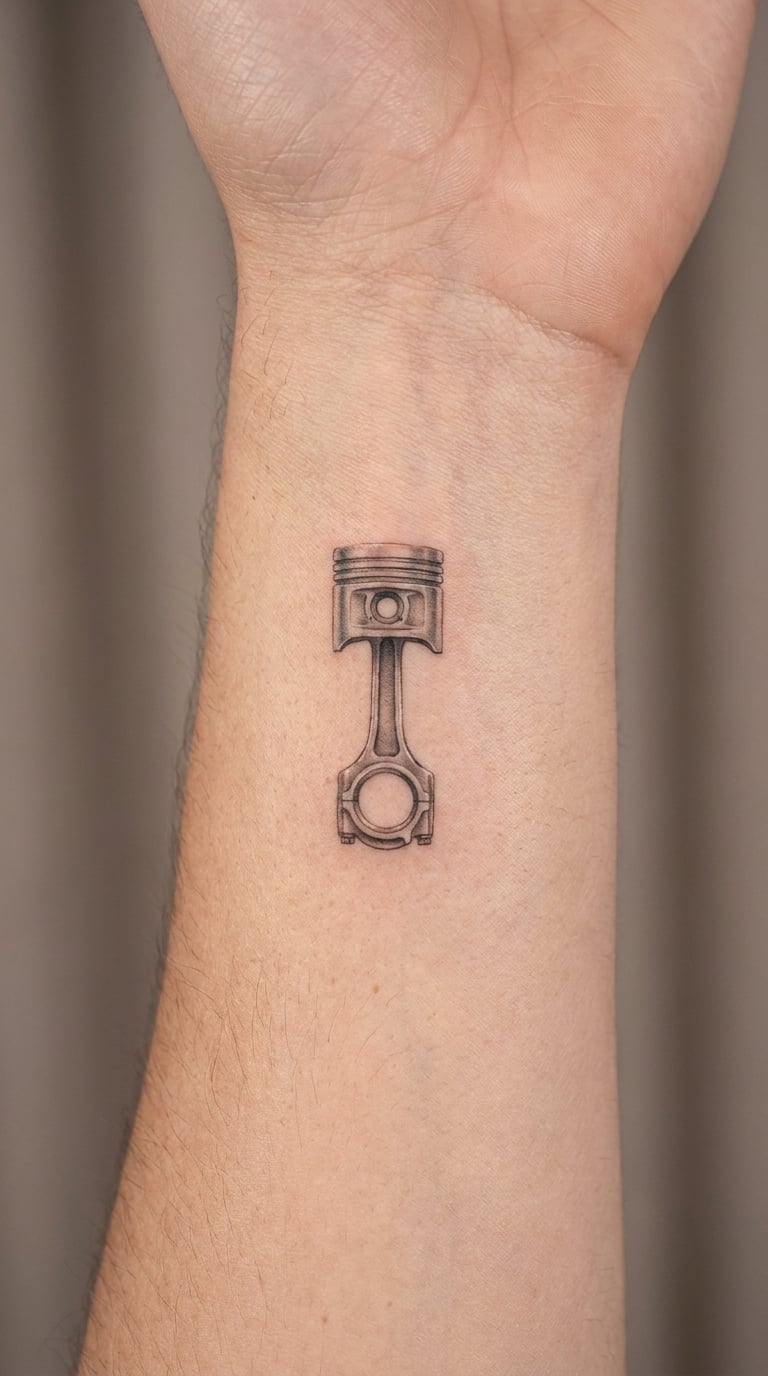
A piston, connecting rod and one wrist pin compressed into a two-inch drawing is a hard piece of illustration, and that is the appeal. The artist uses grey wash shading rather than outline to build the cylinder wall, crown and ring grooves, so the whole thing reads as a small metal object sitting under skin.
It is the right design if you want the trade legible to someone who knows cars and invisible to someone who does not.
Placement: inside wrist, inner elbow crease, or forearm.
Size: 2-2.5 inches (5-6 cm).
Style: micro-realism, black-and-grey wash.
Pain: medium. The inner wrist is close to bone and the shading means longer passes.
Make it yours: specify your engine’s actual bore so the ring grooves land in the right proportion.
4. Blackwork Car Engine
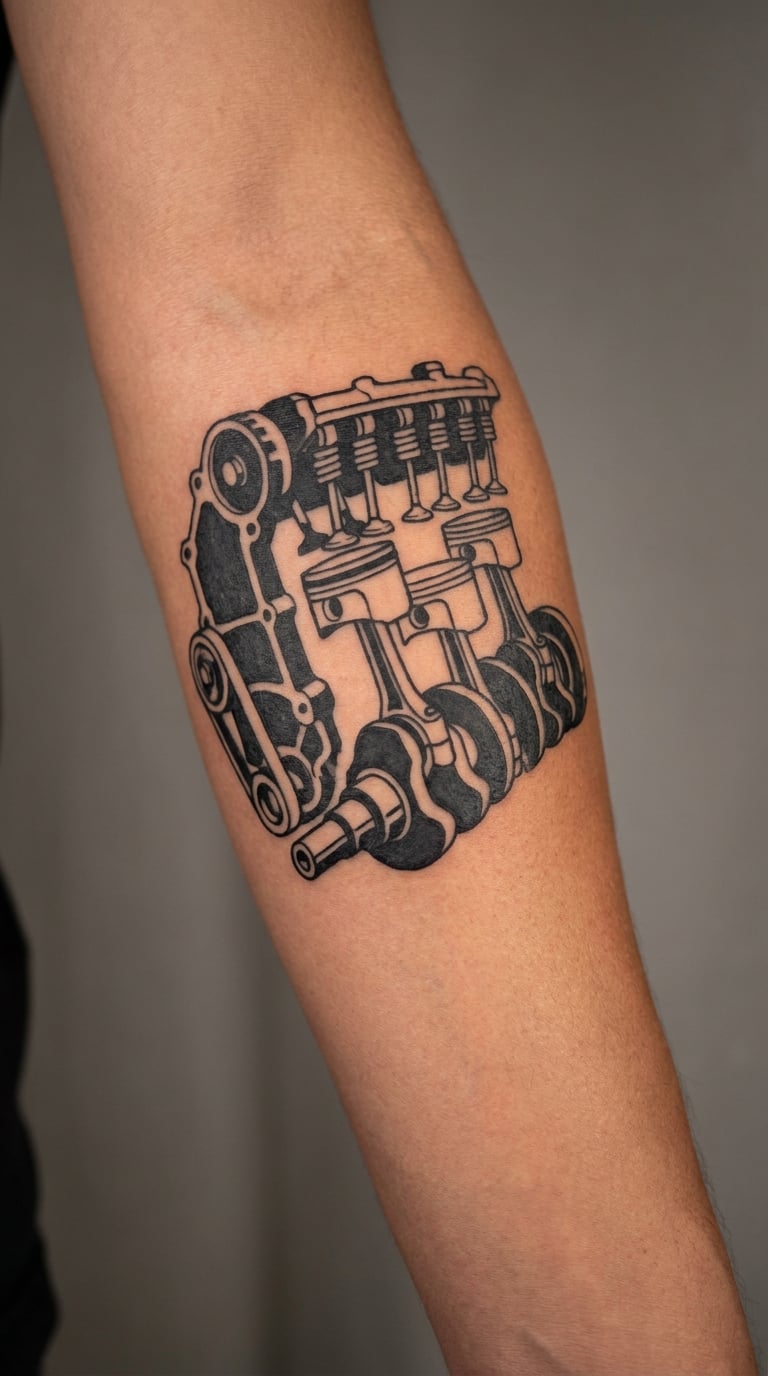
Solid black fills define the block, heads and manifolds, while narrow white channels cut between them so the parts do not merge into a single mass. Done well, the negative space is what makes the engine readable at six inches away.
It suits people who want a statement piece without committing to a full sleeve, and it is a natural lead-in to heavier work later. If you like dense black coverage, our black sleeve tattoo ideas roundup covers where the same approach scales up.
Placement: upper forearm, outer calf, or the shoulder cap.
Size: 5-6 inches (13-15 cm) across.
Style: blackwork with negative space.
Pain: medium to high. Solid black over a large area means a long session and a bruised look for several days.
Make it yours: use a cutaway of an engine you have actually worked on rather than a generic V8.
5. Minimalist Hex Nut
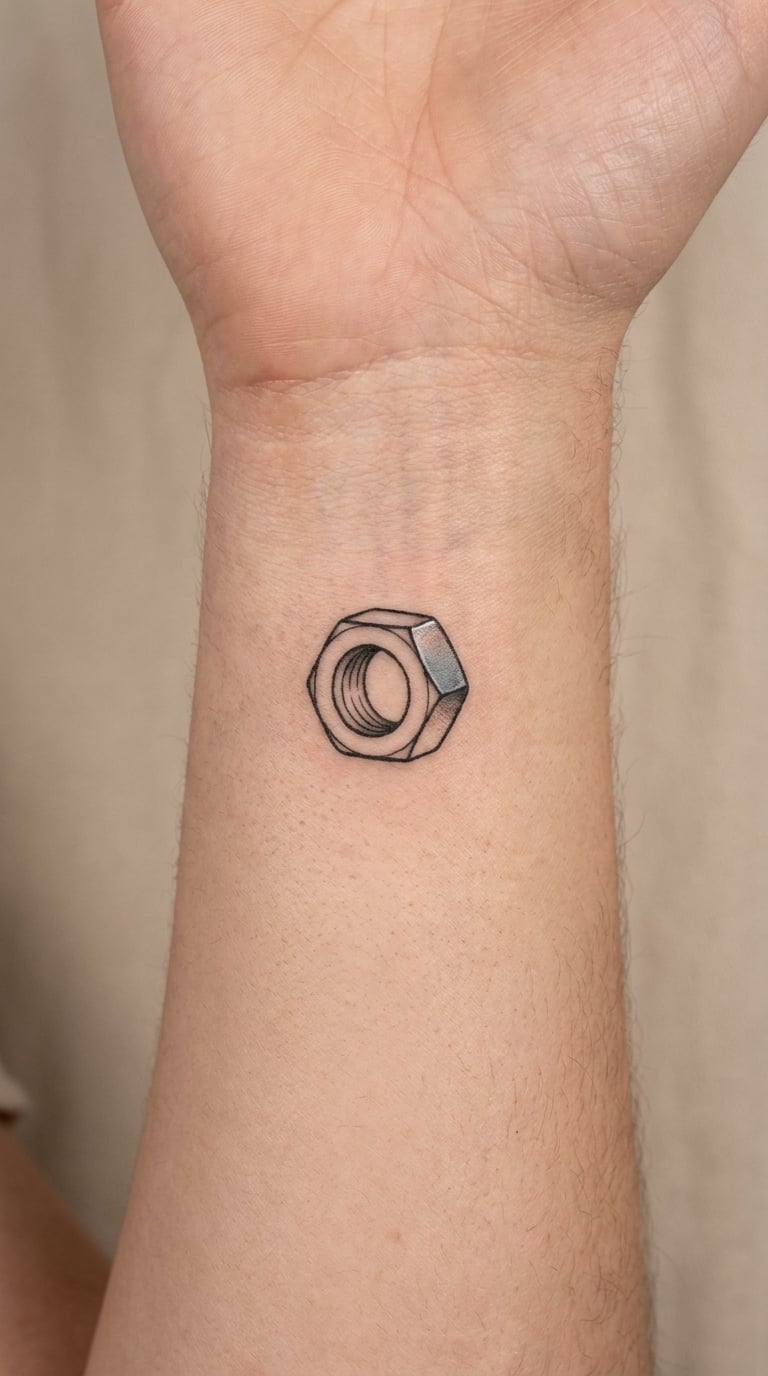
One hex nut, one centimeter across, drawn in black line with a single grey wash on two faces so the form turns. There is no thread detail and no context. It is the smallest credible trade tattoo there is, and it works well for a first piece or for anyone who does not want a sleeve now and might want one later.
It reads as competence rather than branding, which is exactly what most people chasing this theme want.
Placement: wrist, knuckle, inner bicep, or behind the ear.
Size: 0.75-1 inch (2-2.5 cm).
Style: minimalist line with light grey shading.
Pain: low. It is over in a few minutes.
Make it yours: use the size of the nut that actually fits your most-used socket, and note it in the design brief.
6. Watercolor Oil Can
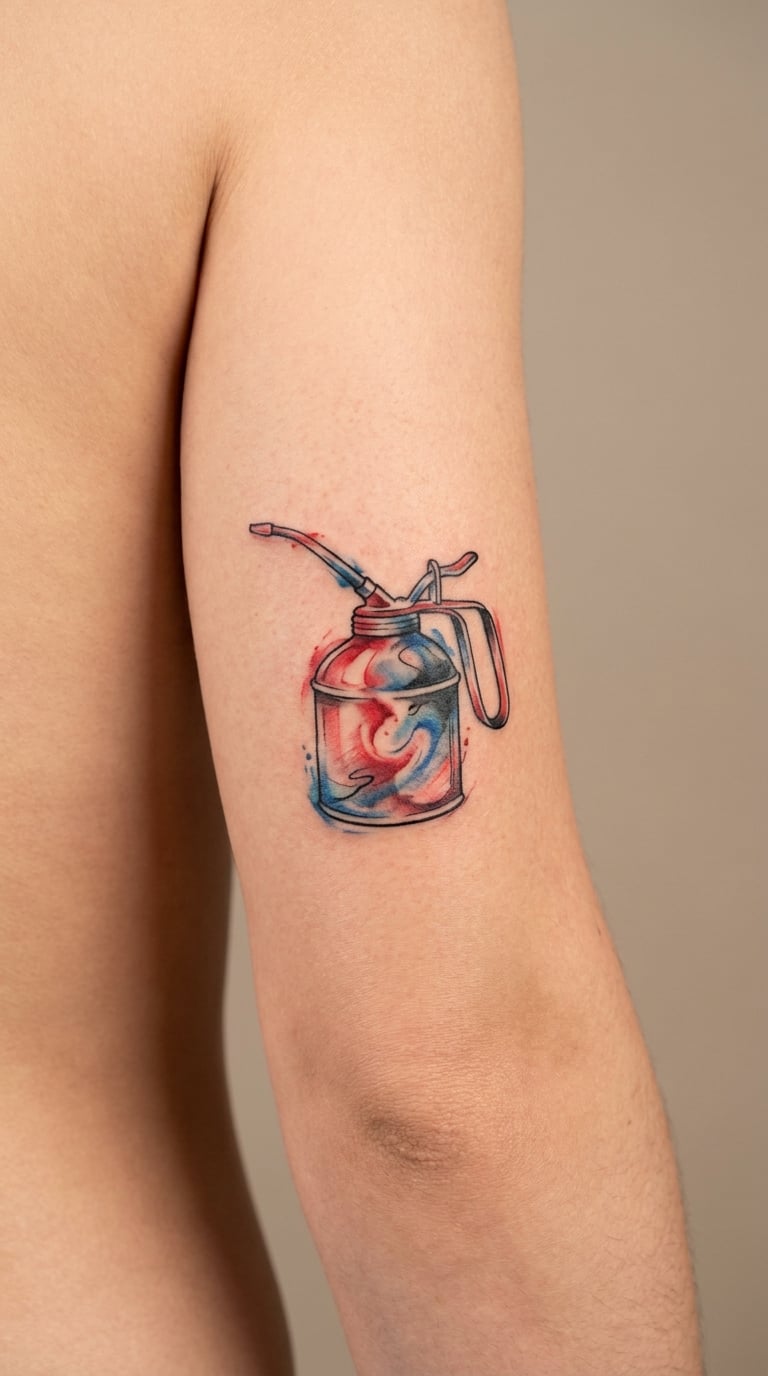
A vintage-style oil can with a long curved spout, painted in loose red and blue washes that bleed slightly past the outline, is the one design on this list that leaves blackwork entirely behind. The paper is white, the shading is transparent, and the edges stay soft.
It is a good fit for someone whose wardrobe is mostly workwear and who still wants one tattoo with colour in it. Nostalgic rather than technical, and easy to place on a large flat area.
Placement: outer upper arm, shoulder, or hip.
Size: 2.5-3 inches (6-8 cm).
Style: watercolor with light black linework.
Pain: low. Washes need fewer passes than solid black.
Make it yours: paint the can in the colours of a racing team or a workshop sign you grew up around.
7. Neo-Traditional Fuel Pump
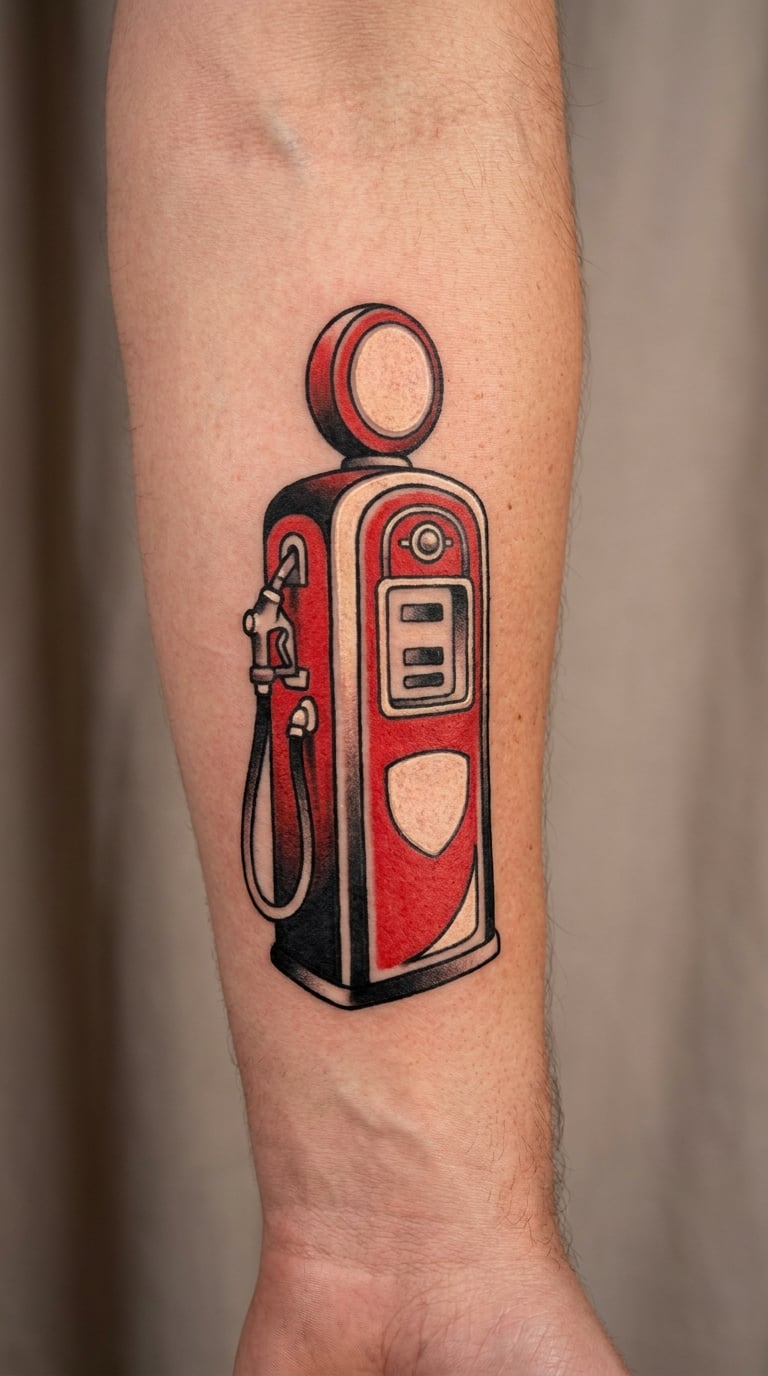
Neo-traditional fuel pump tattoos put a strong black line around a rounded pump body, fill the display window with a warm red or deep green, and add a cream highlight down one side so the shape has volume. A small globe or lightning mark on the face of the dial keeps it from feeling bare.
It points at roadside and service-station history rather than the workshop bench, which makes it a good companion to a quieter tool piece.
Placement: forearm, upper arm, or calf.
Size: 3.5-4.5 inches (9-11 cm).
Style: neo-traditional, bold outline, two-colour saturation.
Pain: medium.
Make it yours: put your first year of driving in the price window instead of a number that looks decorative.
8. Dotwork Timing Belt
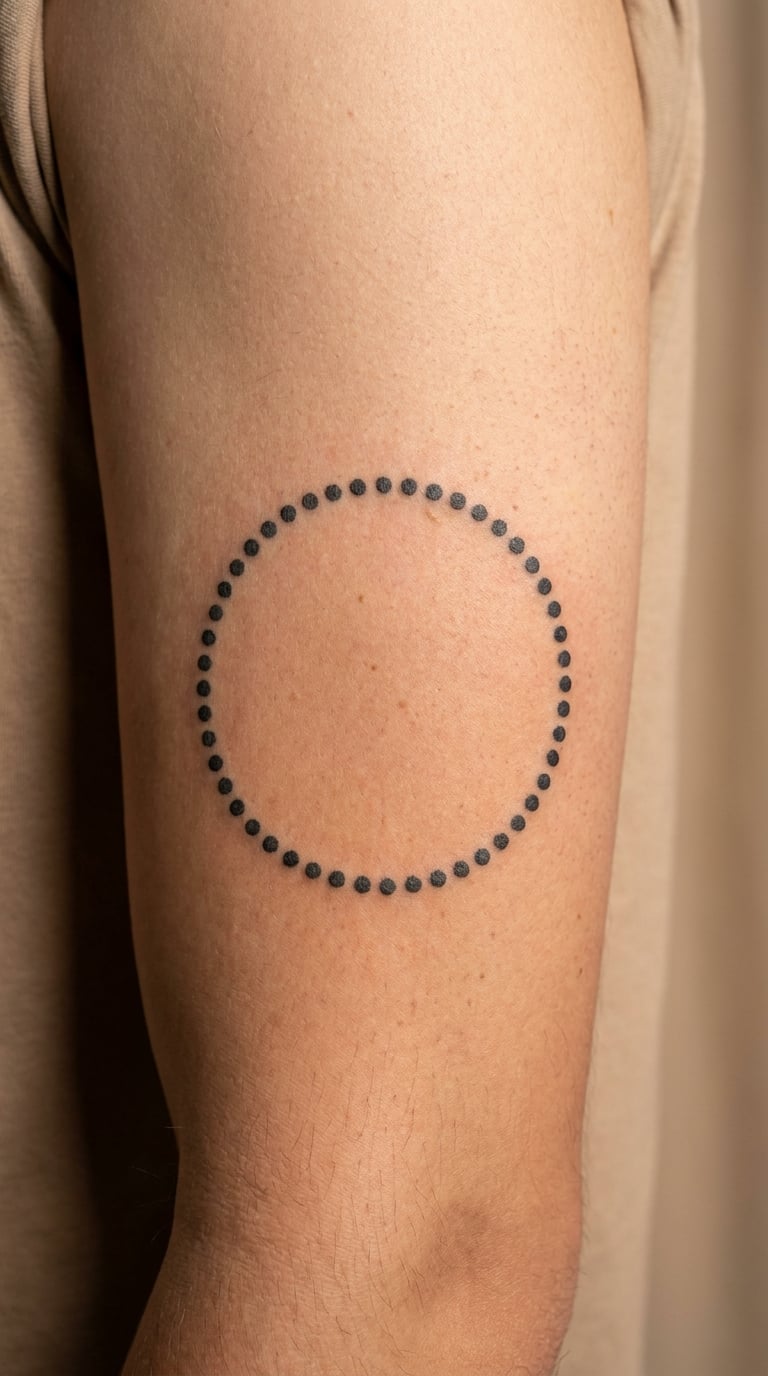
The belt loop closes on itself the way it does around two pulleys, and the teeth are suggested with a single even line of dots rather than drawn as individual blocks. Dot size gradates slightly around the loop so the circle has depth without a hard outline.
It is a good design for someone who likes pattern work, and the loop shape handles awkward body contours well.
Placement: upper arm, forearm, or the back of the shoulder.
Size: 3-4 inches (8-10 cm) diameter.
Style: dotwork, black only.
Pain: medium. Dots are many small taps rather than long strokes.
Make it yours: add the tooth count of a real belt in the design so the pattern matches an engine you know.
9. Realistic Carburetor
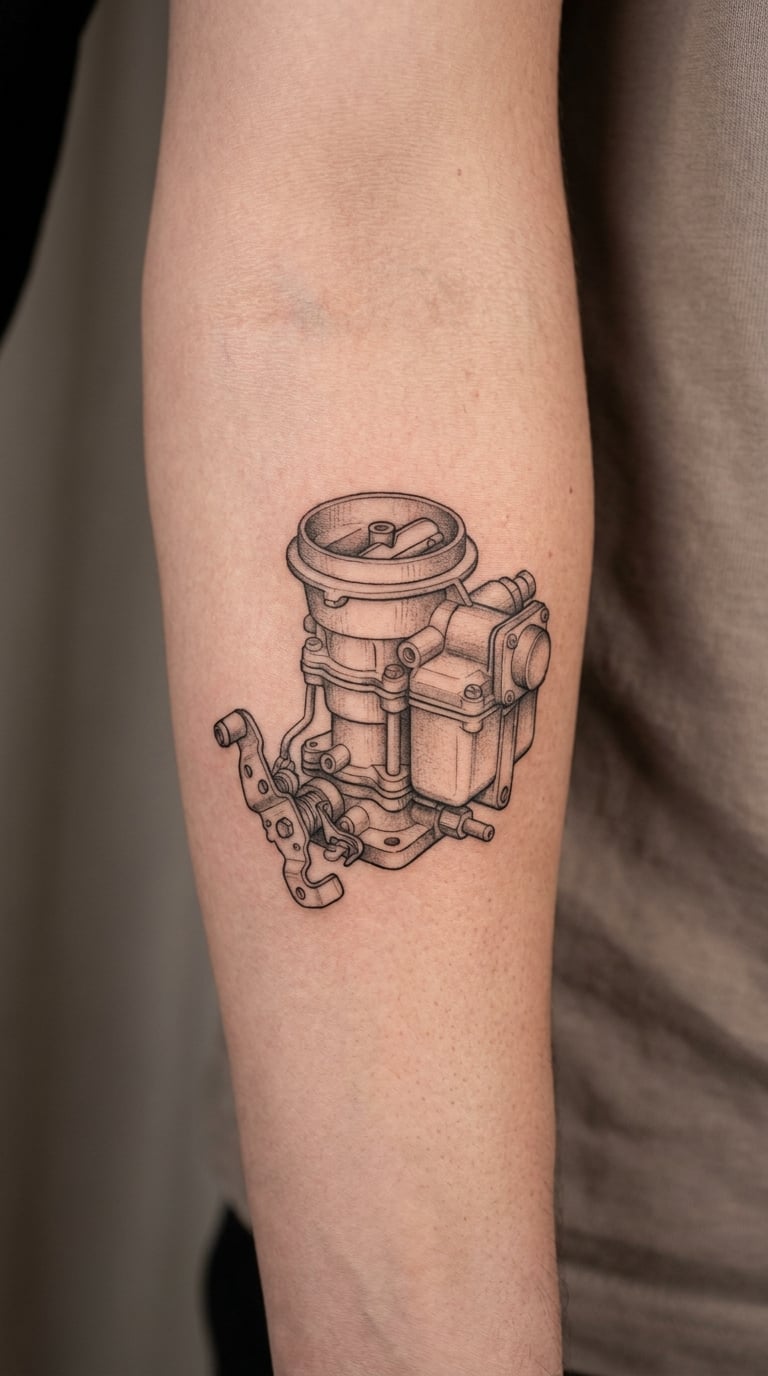
A carburetor gives an artist more to work with than almost any other single automotive part: an air horn, a body casting, float bowl, fuel line and linkage, all in one compact object. Drawn in black-and-grey with tight contour shading, it stays informative at three inches and rewards anyone who looks longer.
It is the design for a mechanic who does not want a generic car and wants something a fuel-system person would recognise immediately.
Placement: inner forearm, upper arm, or calf.
Size: 3-4 inches (8-10 cm).
Style: black-and-grey realism with soft wash.
Pain: medium, mostly from the length of the session.
Make it yours: hand the artist reference photos of the specific carburetor off your own bench.
10. Vintage Steering Wheel
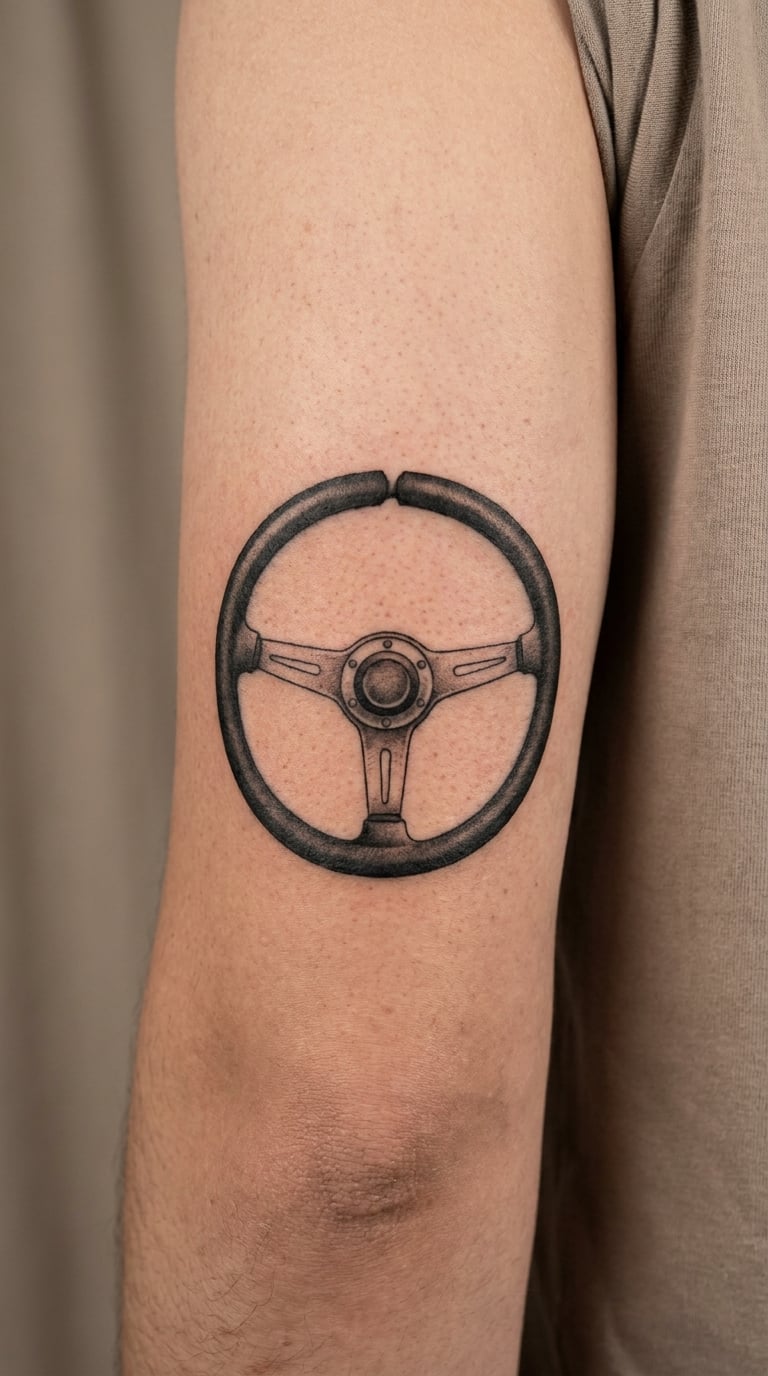
A three-spoke wheel with a wide rim, drawn slightly worn with thin highlight lines on the upper curve and a darkened grip section, reads as an object with history rather than a car logo. Leaving the centre hub blank keeps it original and easy to personalise later.
It suits people who think of driving rather than wrenching, and the circular shape sits well on the chest and upper arm.
Placement: chest, upper arm, or the outer forearm.
Size: 4-5 inches (10-13 cm) diameter.
Style: blackwork or traditional with grey shading.
Pain: medium.
Make it yours: engrave your initials in the blank hub, small enough that the wheel still reads as a wheel.
11. Fine-Line Tire Tread
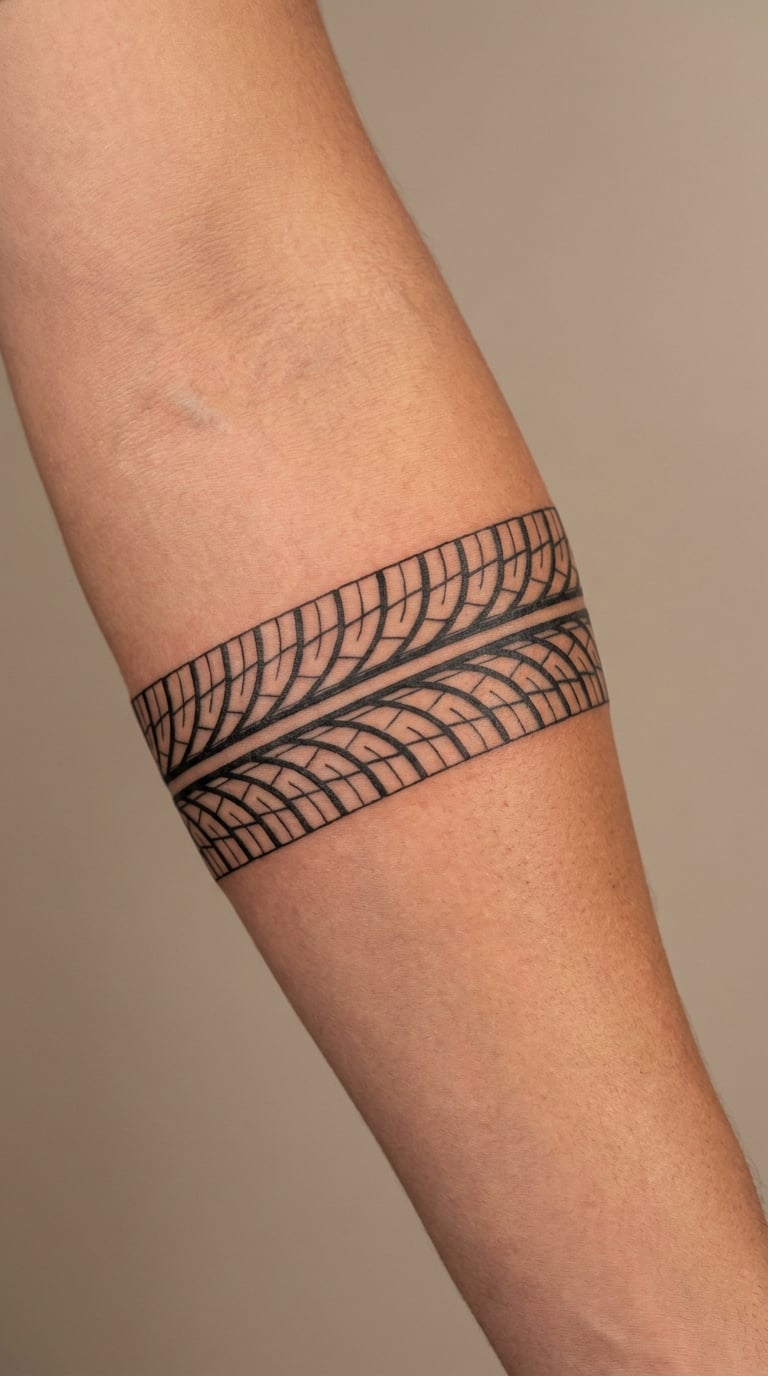
A curved strip of tread pattern, drawn as a bold zig-zag or chevron band with generous white gaps between the blocks, is a graphic design rather than an illustration. It follows the natural curve of a limb, so a forearm, calf or rib band all sit flat without the work being redrawn around a contour.
It is the design for someone who wants a mechanic tattoo that reads as a pattern to a stranger and as a tire to everyone else.
Placement: forearm band, calf, or along the ribs.
Size: 1.5-2 inches tall, 4-5 inches long (4-6 by 10-13 cm).
Style: bold fine line, black only.
Pain: medium. Ribs and the inner forearm are more sensitive than the outer arm.
Make it yours: use the actual block pattern of the tire you run on, and add the size marking as a small text band.
12. Traditional Route 66 Road Sign
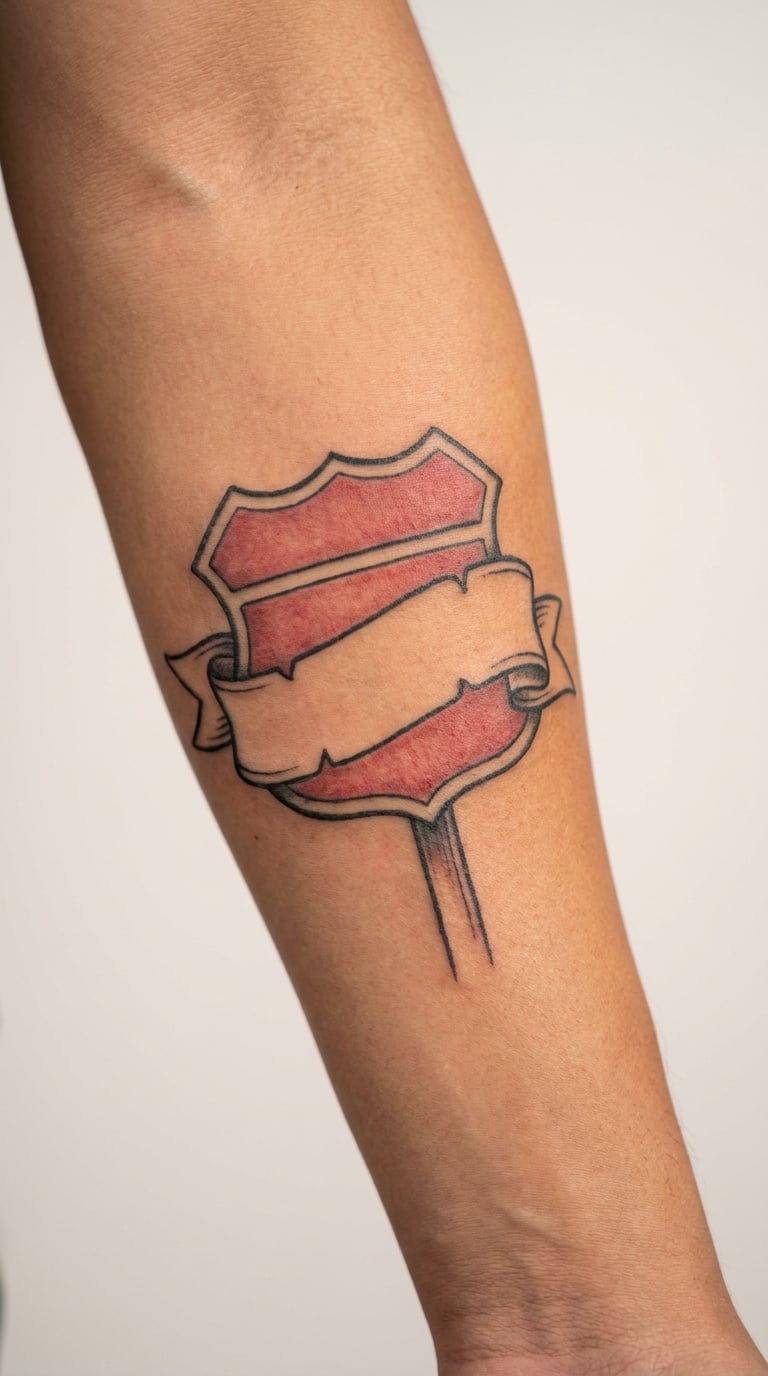
Road-sign mechanic tattoo ideas use a heavy black border, a red or cream field and a condensed letterform, which is the closest a tattoo gets to mid-century signage without copying an actual shield. A small banner of the road name underneath keeps it from looking like a logo.
It suits mechanics who see the trade as part of a longer road story rather than a job, and it pairs well with travel-themed work. If the road angle is really what you are after, our tattoo ideas for cyclists collection covers the same territory from a different sport.
Placement: outer forearm, calf, or the shoulder.
Size: 3-4 inches (8-10 cm) tall.
Style: traditional American signwork, bold outline, two colours.
Pain: medium.
Make it yours: swap the road number for the number of the car, the shop, or the town you learned the trade in.
13. Watercolor Motorcycle Engine
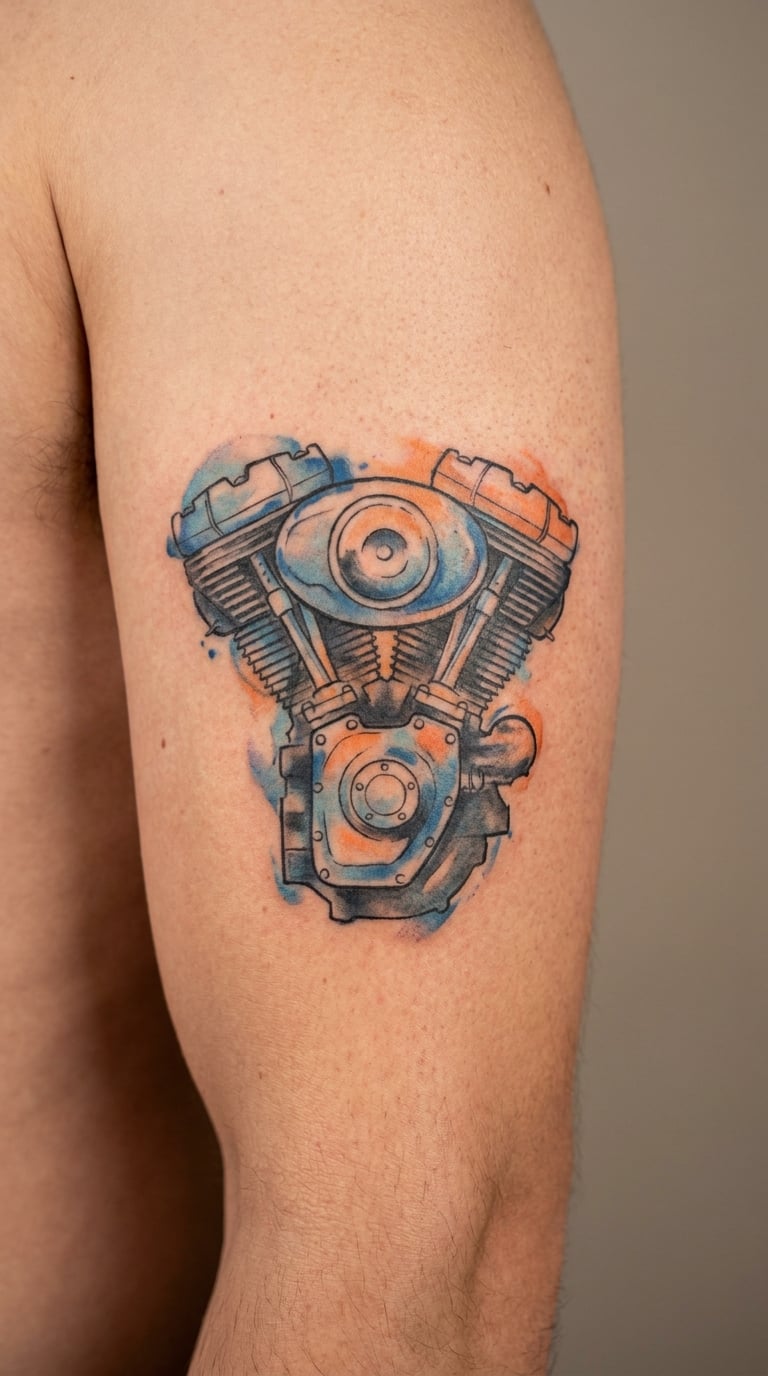
A parallel twin or a V-twin rendered in loose washes, with the cases in charcoal, the cylinders in orange and a blue-grey shadow under the whole mass, keeps the recognisable silhouette of a motorcycle engine while staying painterly. The edges bleed rather than outline, so it needs a flat area of skin.
It is a rare mechanic tattoo idea that reads colourful in daylight and does not turn into a dark block over time, because there is no heavy black anywhere in it.
Placement: upper arm, shoulder, or thigh.
Size: 3-4 inches (8-10 cm).
Style: watercolor, minimal linework.
Pain: low to medium.
Make it yours: use the engine from the bike you actually ride, and sign the lower edge with its year.
14. Minimalist Lug Wrench
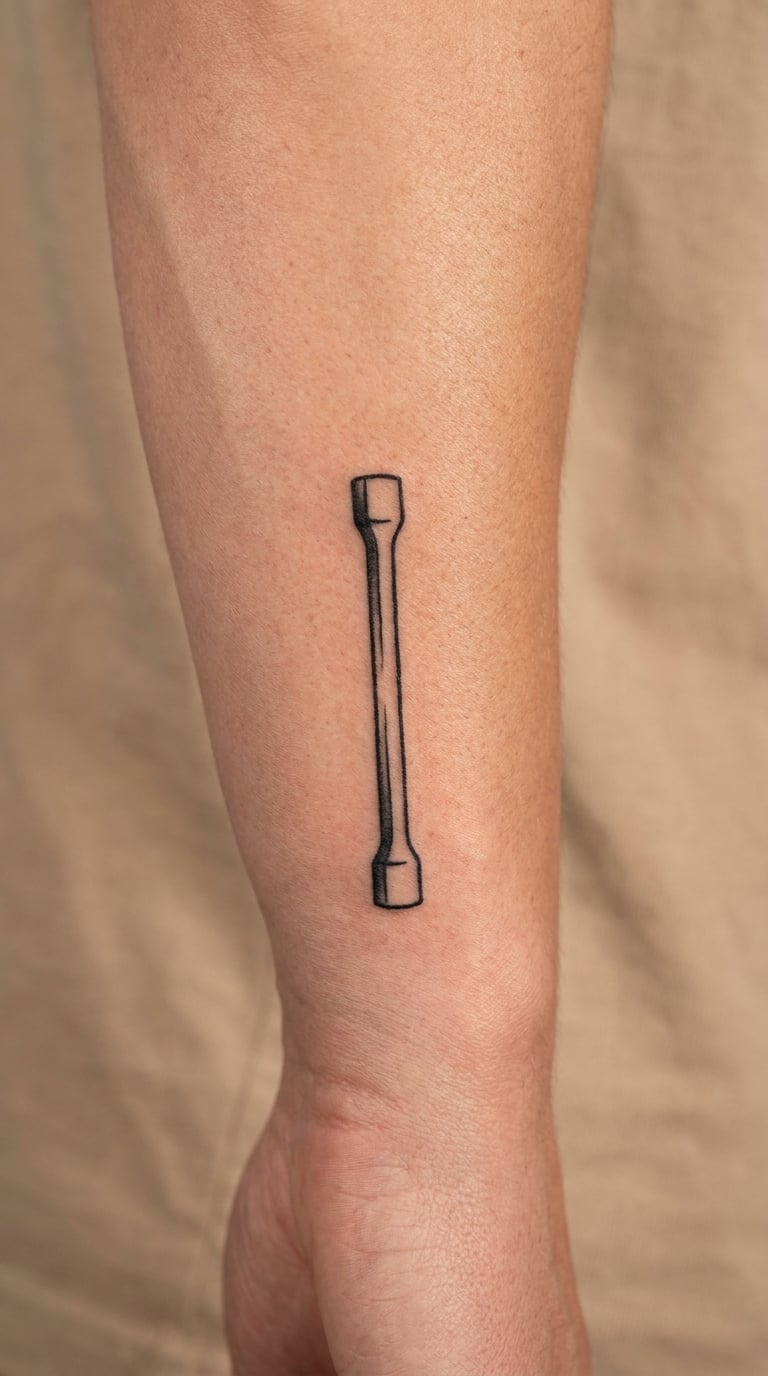
A four-way lug wrench reduced to a solid black silhouette, with the two open ends and two box ends kept in correct proportion and nothing else added, is the cleanest statement in this whole list. No shadow, no texture, no wrench hanging from a chain.
It is a first-tattoo design for people who work with their hands every day and want something they will still like in twenty years.
Placement: inner bicep, forearm, or calf.
Size: 2.5-3 inches (6-8 cm).
Style: minimalist solid black.
Pain: low.
Make it yours: pair it with a matching socket on the other arm at the same scale, so the two pieces read as a set from a distance.
15. Blackwork Motorcycle Engine Block
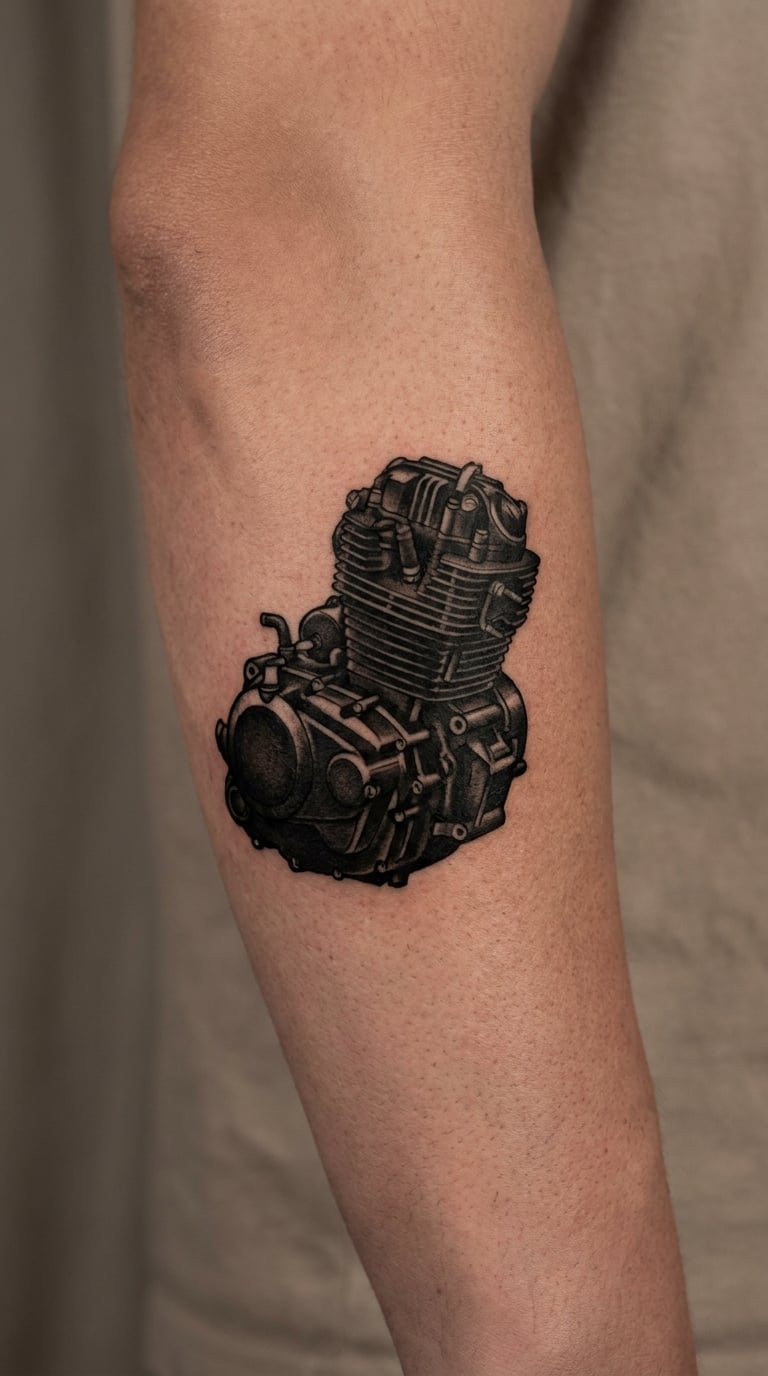
Dense blackwork engine block tattoos fill the crankcase and cylinder mass with solid ink, then cut the two or three edges that tell you it is a motorcycle engine: the finned barrel, the round clutch cover, the exposed cam chain. Everything else stays in shadow, which is what makes the shape pop at small scale.
It is a heavier piece than a tool tattoo but smaller than a sleeve, and it fills a flat patch of forearm without needing a full arm.
Placement: outer forearm, upper arm, or shoulder.
Size: 4-5 inches (10-13 cm).
Style: blackwork, high solid-to-negative ratio.
Pain: medium to high, and the forearm will stay tender for a few days.
Make it yours: give the artist a photograph of the engine and specify which edges stay lit, so the piece is a portrait of a machine rather than a generic block.
16. Micro-Realism Ratchet Wrench
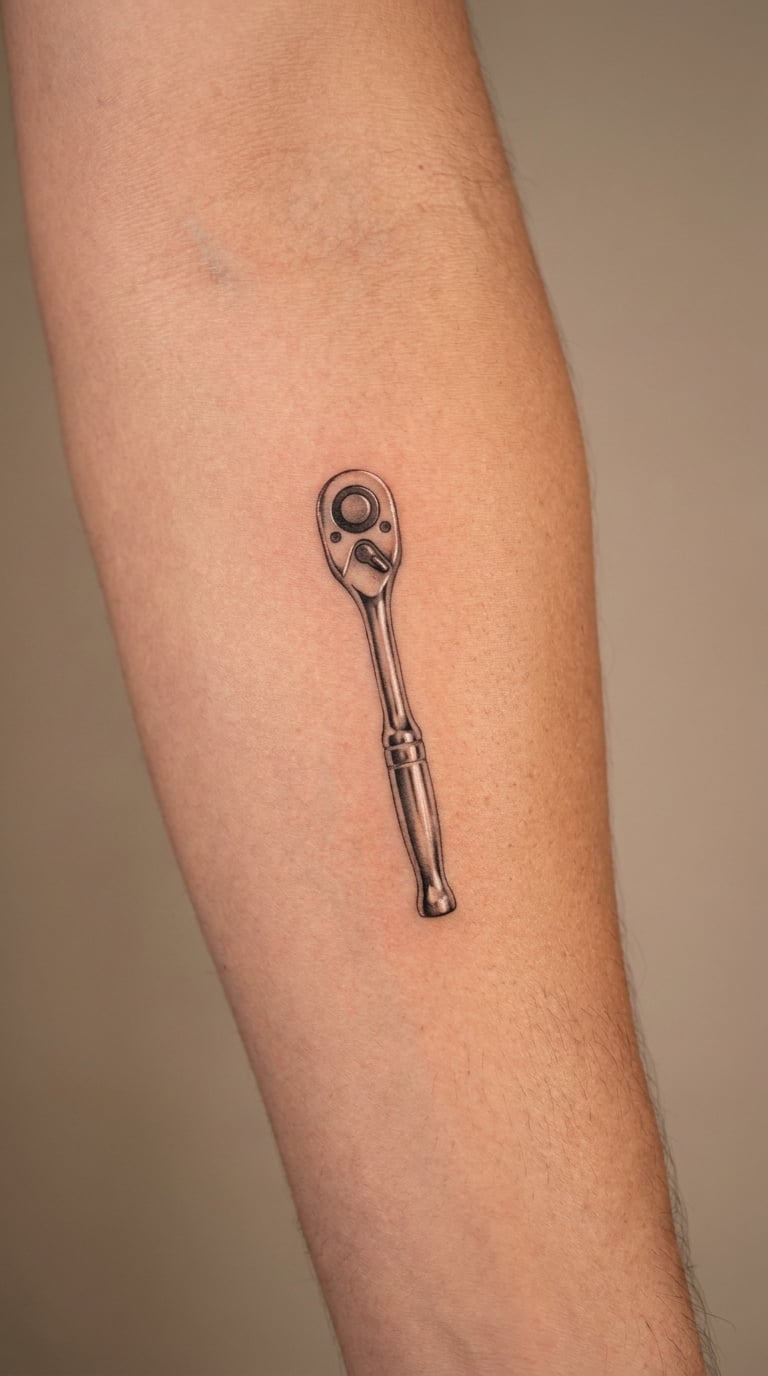
A ratchet and one socket drawn at two and a half inches, with a soft white highlight running down the handle and a darker gradient in the head, produces a convincing polished-metal look without any colour. Keeping the detail to the ratchet head and the knurled ring means the shading has somewhere to go.
It is the version of this design that works for people who want their trade shown as precision rather than as toughness.
Placement: side of the forearm, inner arm, or the back of the hand.
Size: 2.5-3 inches (6-8 cm).
Style: micro-realism, black-and-grey with white highlight.
Pain: medium. Hand placements hold detail poorly over time, so forearm is the safer spot.
Make it yours: add the drive size stamped on the head, and a small date in the handle once you have a reason to pick one.
17. Old-School Gas Can
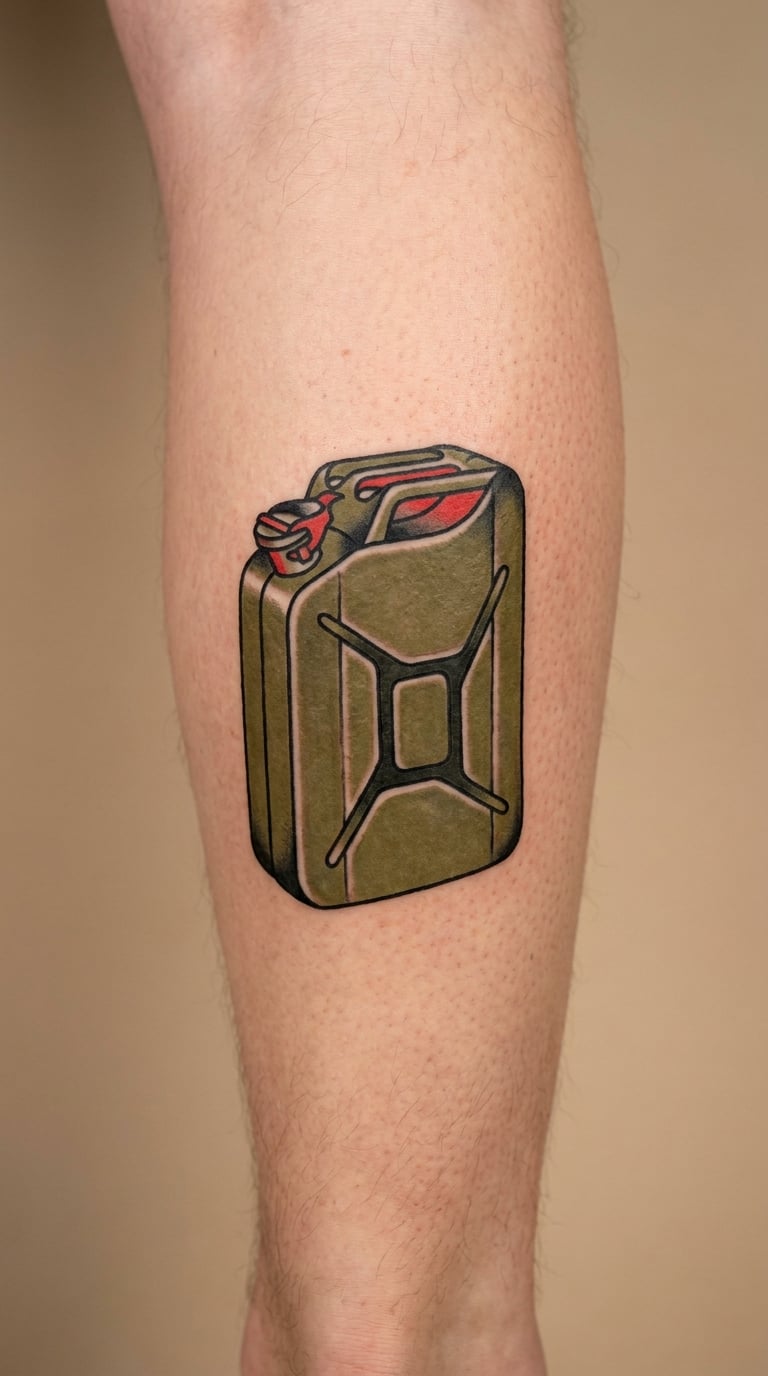
The old fuel can, drawn with a heavy black outline, an olive or military green body, a red spout cap and a simple handle cutout, is one of the most enduring images in traditional tattooing and it suits a trade tattoo without any explanation. Slight scuffs in the paint keep it from looking new.
It is a warm, nostalgic piece that fills a calf or a shoulder nicely and photographs well against short sleeves.
Placement: calf, upper arm, or thigh.
Size: 3-4 inches (8-10 cm).
Style: traditional American, bold outline, limited palette.
Pain: low to medium.
Make it yours: paint it in the colours of a fuel brand that existed while you were growing up, used generically rather than as a logo.
18. Fine-Line T-Bone Wrench
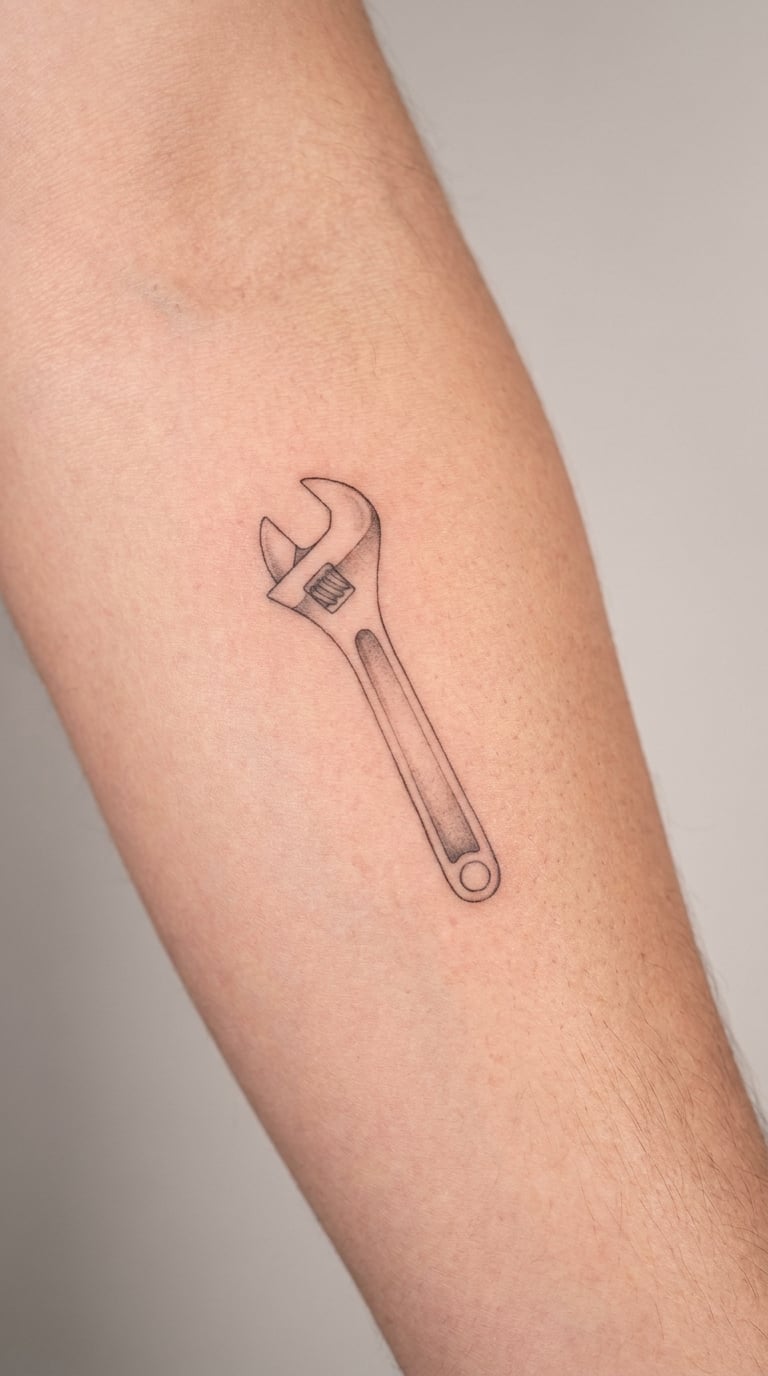
The T-bone is the easiest tool to draw and the hardest to make interesting, because it is basically a straight shaft and a cross. Fine-line versions solve that with a light grey wash down one side of the shaft, a small open box end, and a horizontal orientation so the shaft follows the forearm rather than fighting it.
It is a clean alternative to engine-heavy designs and one of the better choices if you want the trade on your arm without an engine in sight.
Placement: forearm running horizontally, inner arm, or the rib area.
Size: 2.5-3 inches (6-8 cm) long.
Style: fine line with light grey wash.
Pain: low to medium.
Make it yours: mirror it on both forearms at the same height and scale for a deliberate paired look.
19. Dotwork Gear Ratio
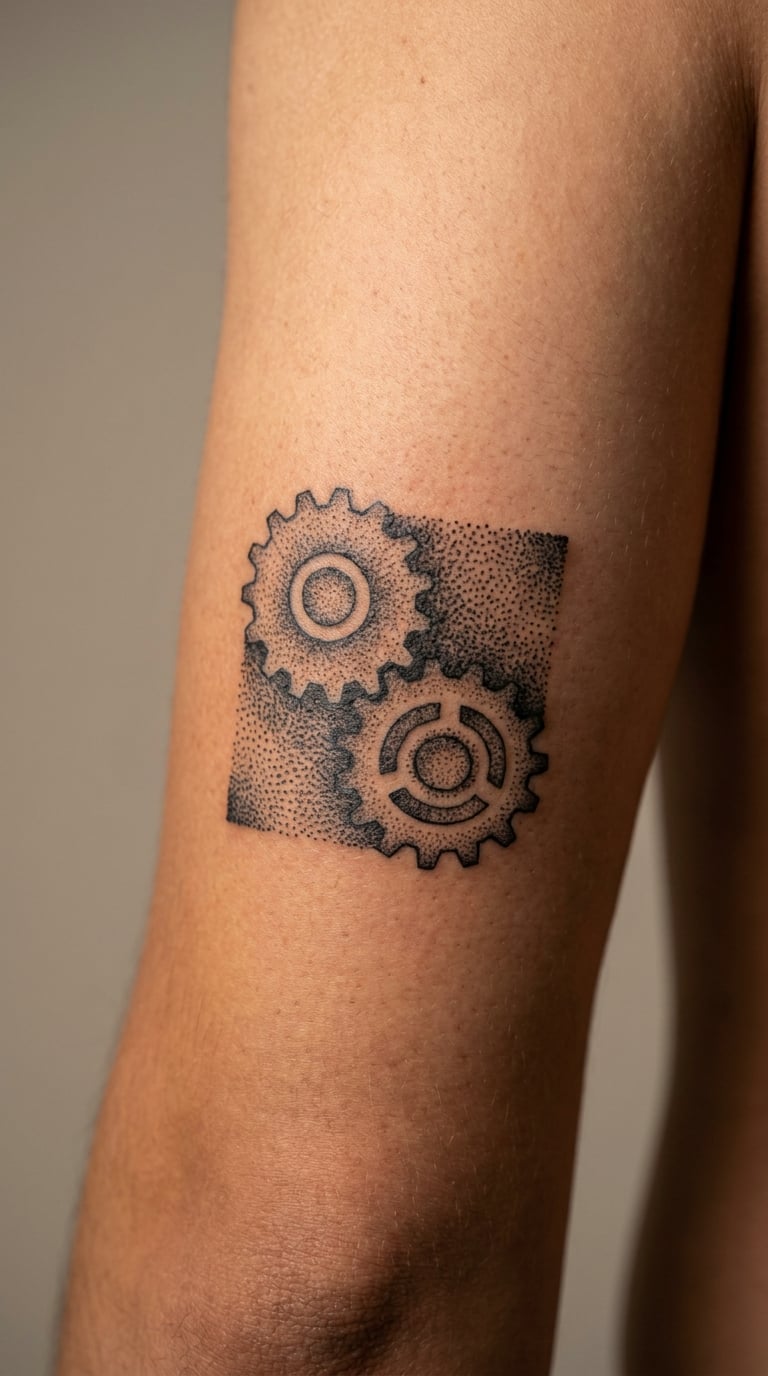
Two gears meshing at a true pitch circle, rendered in dotwork with radiating dot gradients for the teeth and a small solid black centre for each hub, is a design that looks organised and holds together at a distance. The maths of the ratio is what makes it work, so the gear sizes are not arbitrary.
It is a good choice when you want a mechanic tattoo with an engineering reference rather than a car reference, and it also carries a general idea of parts working as a system.
Placement: upper arm, forearm, or calf.
Size: 2.5-3.5 inches (6-9 cm) across both gears.
Style: dotwork with solid black hubs.
Pain: medium.
Make it yours: have the gear sizes match the first-gear ratio of a transmission you know, and keep a third small gear outside the frame as a later addition.
20. Traditional Greaser Character
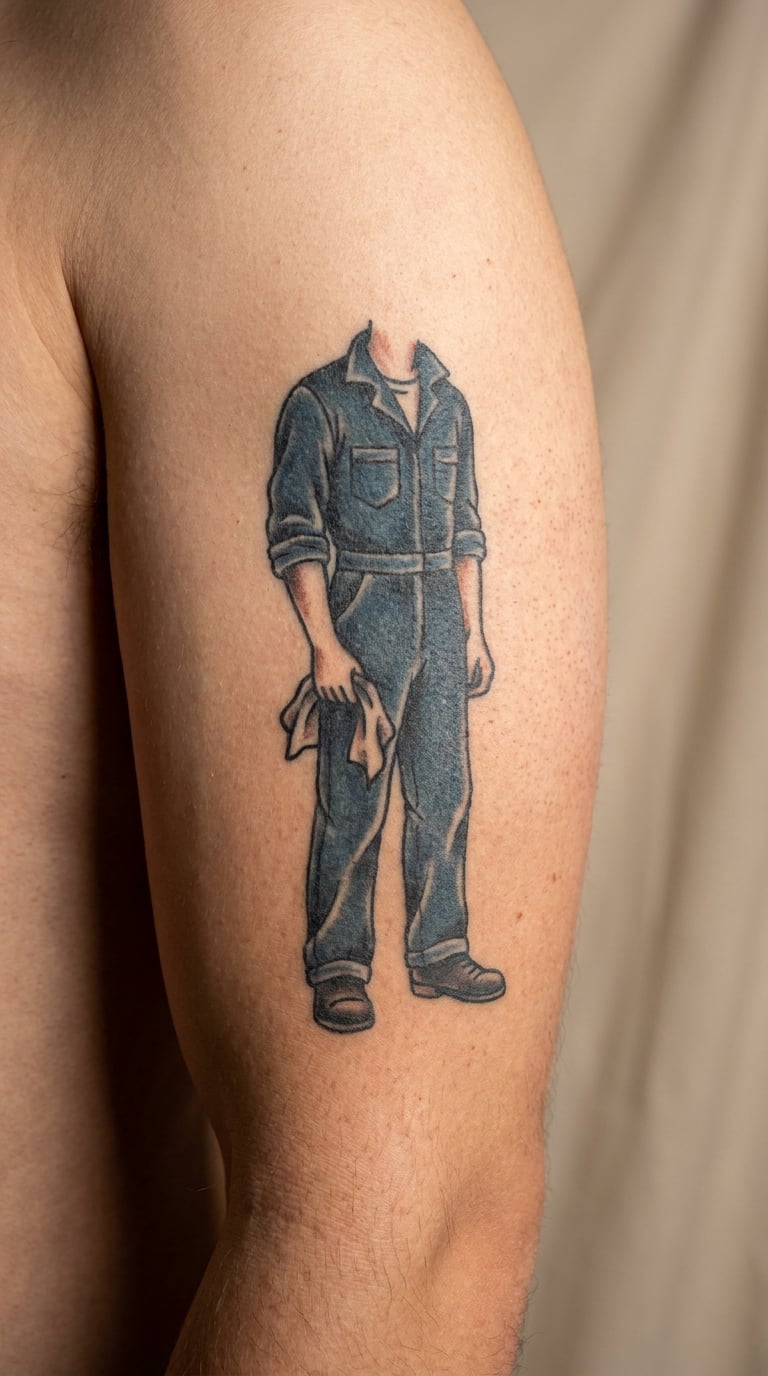
An original greaser figure in blue coveralls, drawn with the heavy black outline and flat colour of traditional American work, holding a rag in one hand with a wrench tucked through the belt loop, is the character option in this list. The face is simple, the hands are simplified, and nothing is borrowed from an existing brand or comic.
Character work needs real size to survive, and this is the design to commit to when you want people to read a person rather than an object.
Placement: upper arm, calf, or the outer thigh.
Size: 5-6 inches (13-15 cm) tall.
Style: traditional American, bold outline, three to four colours.
Pain: medium to high, and expect a multi-hour session.
Make it yours: specify the coverall colour, the tool in the belt loop and the rag, so the character is built from your own bench rather than a generic one.
21. Neo-Traditional Checkered Flag
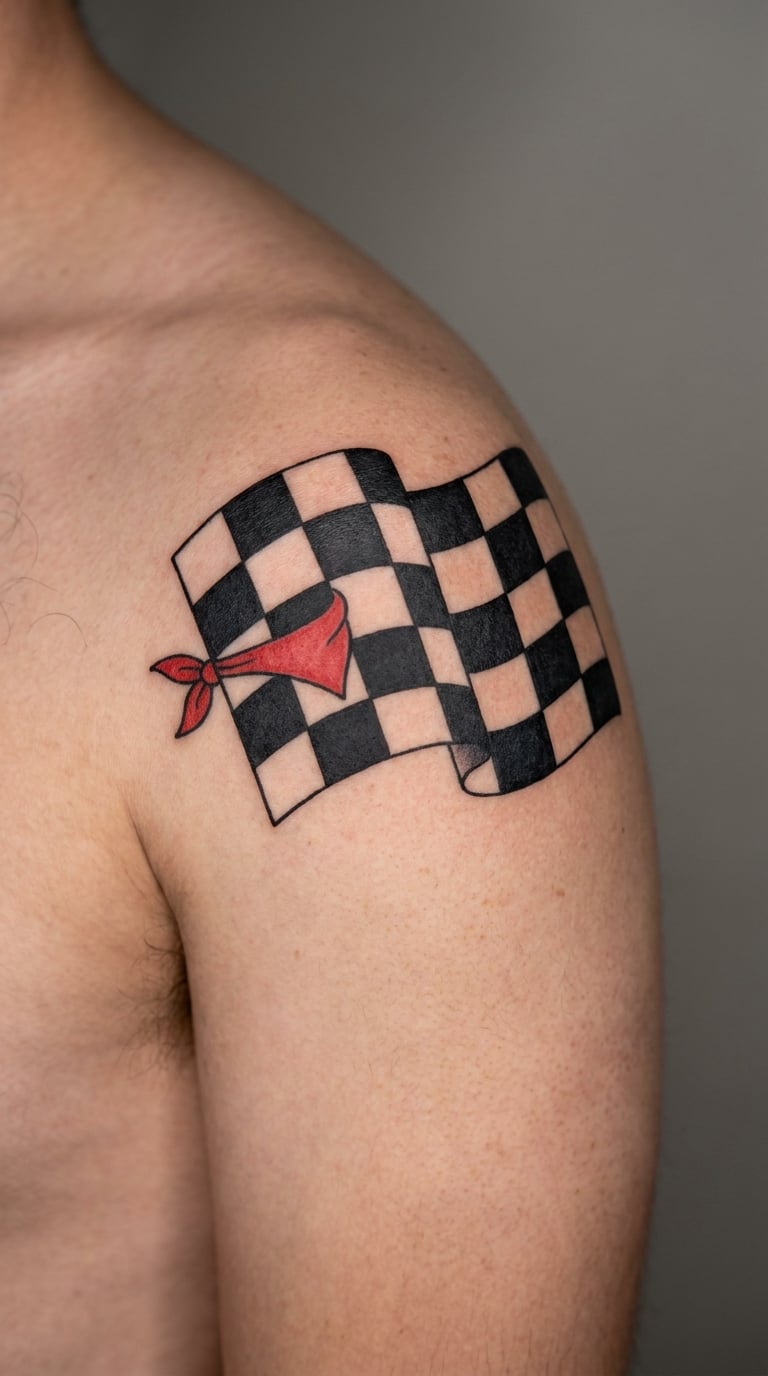
A clean checkered pattern with a single red row running through the centre, drawn with thick black tile edges and slightly irregular squares so it does not look machine-printed, is the racing-adjacent option. Kept free of numbers and sponsor text, it stays an original design.
It is a good second or third piece, because the pattern fills a gap between existing work without demanding a full sleeve.
Placement: shoulder cap, calf, or the back of the upper arm.
Size: 3-4 inches (8-10 cm) square.
Style: neo-traditional, bold outline, one colour accent.
Pain: medium.
Make it yours: add the checkered corner of a flag from a race you attended, drawn generically rather than as a national emblem.
22. Full Forearm Engine Blueprint
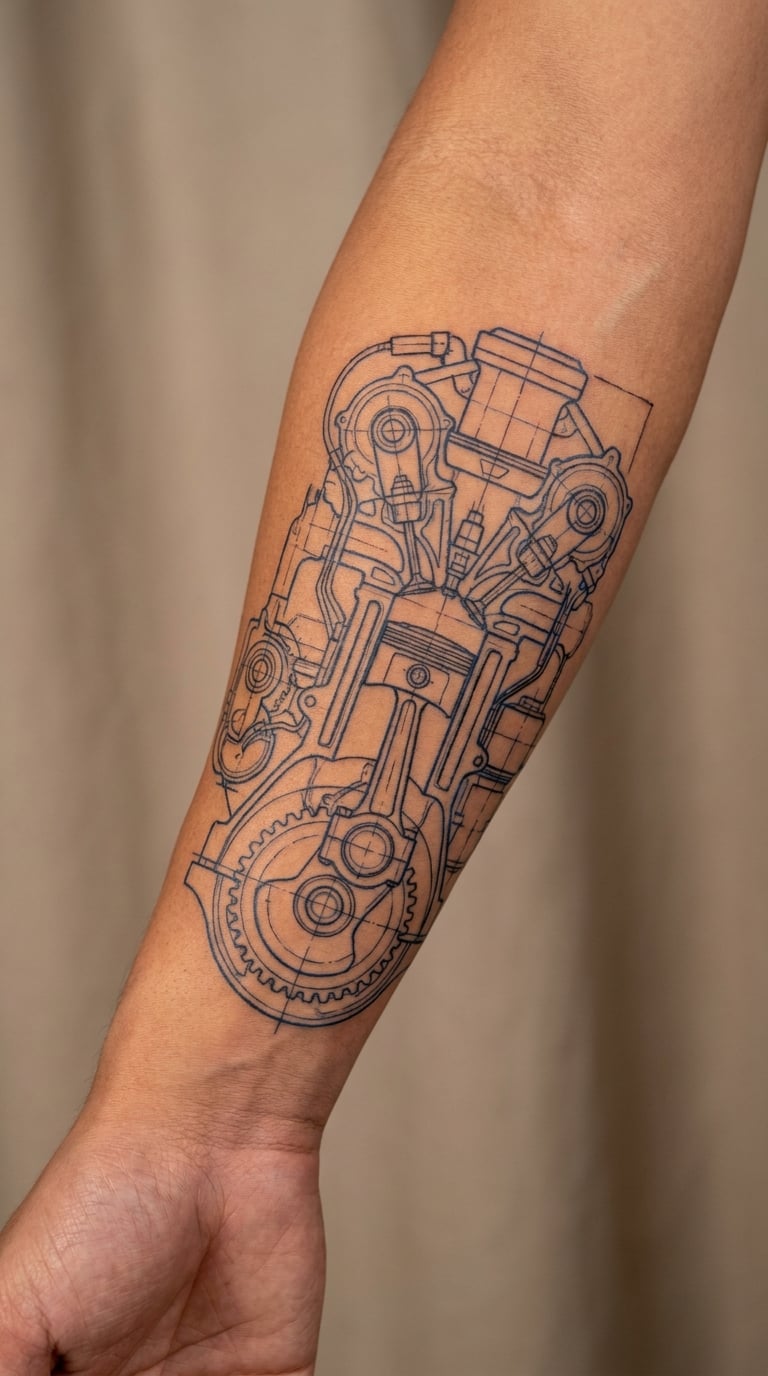
The largest design here stacks an engine cutaway, dimension lines with arrow ends and a few handwritten-style part numbers into a composition that fills the forearm from wrist toward elbow. Blueprint work lives on thin lines and a restrained blue, with heavier black reserved for the sectioned metal so the drawing has a centre of gravity.
It is the one to build a collection around, and it is much easier to plan as a first major piece if you already know you will want more.
Placement: forearm from wrist to elbow, or the upper arm.
Size: 8-10 inches (20-25 cm) long.
Style: illustrative blueprint with black accents.
Pain: high. Long session, long healing, and thin lines need a steady hand and a rested one.
Make it yours: use the real dimensions of an engine you have measured, so the drawing is a technical document rather than decoration.
How to Choose the Right Mechanic Tattoo Design
Six questions narrow 22 mechanic tattoo ideas down to one or two worth a consultation. Ask them in order, because each one rules something out cheaply.
Is the component technically correct?
An H-pattern gear shift has a specific shape, a piston has a specific relationship between crown and pin, and a carburetor has more than one chamber. Bring reference photographs of the part you want. If an artist draws it accurately on paper before touching your skin, you are in the right chair. If the drawing looks like generic car clip art, walk away.
How much detail can this placement hold?
Match detail to area, not ambition. A forearm carries a four-inch drawing well. A finger carries a hex nut and nothing more. If you want micro-realism, keep it off hands and fingers, where ink softens fastest from washing and wear.
Does the design leave room for later work?
Plenty of people start with a single tool and end with a sleeve two or three pieces later. Small designs on the inner bicep or above the elbow keep the outer forearm and upper arm free. If you are unsure, place the first piece where a larger one can eventually surround it.
Is the style one you can live with in thirty years?
Fine line and dotwork look delicate now and softer later. Bold blackwork and traditional pieces hold their shape better but are harder to cover if you change your mind. Readers looking at tattoo ideas that symbolize protection face the same trade-off, and pick permanent linework for the same reason.
Can the artist actually do mechanical work?
This is the hardest filter in the list. Mechanical illustration is a specific skill, and plenty of good generalists cannot do it. Look for a portfolio that contains at least two pieces of machinery, not one, and ask to see healed work rather than fresh Instagram photos. Tattoos of gears and engines are a well-known specialty, and you should be able to see that in someone’s healed portfolio before you commit.
Where a personal detail fits in the design
Plenty of people in this community want a relative’s initials folded into the design rather than a generic object. Put the initials in the design brief from the start. Adding them afterwards to a finished piece is much harder and usually means a cover-up, which is a bigger job than the original tattoo.
Cost and Session Time
Tattoo cost follows size, detail and time in the chair far more than it follows any single list price. Since rates change constantly and vary widely by city and by artist, check current pricing with the shop directly rather than relying on a published number.
As a rough guide to scale: a tiny design the size of a hex nut is a short job, usually well under an hour. A small design around three inches takes closer to an hour, sometimes more if it is micro-realism with soft shading. A medium piece at five or six inches of blackwork or a detailed component runs into a longer single session. A large composition like the forearm blueprint will not sit in one sitting comfortably, and most artists will split it into two or three sessions with healing in between.
Two other things move the number. Shop minimums mean a very small design still costs a base amount, and hourly rates in major cities sit well above small-town rates. Blackwork is charged by area covered, while a shaded realism piece is charged by time, so the same design can land in two different price brackets depending on the artist.
Ask for a written estimate that separates the design fee from the hourly work, and confirm how many sessions the design needs before you book. A sleeve planned as four short sessions is a different commitment to one booked as a single day, and the healing matters more than the day.
Aftercare Basics
Start with your artist’s aftercare instructions, because they know what they did in your skin. Everything below is general and common practice, not a substitute for that.
- Keep the fresh tattoo clean and wash it gently with unscented soap and lukewarm water, then pat it dry rather than rubbing.
- Wash your hands before touching it, and change a covering on the skin if one was applied in the shop.
- Leave any scabs or flaking skin alone. Picking at them is the main cause of patchy results.
- Moisturise thinly with a plain fragrance-free product once it has healed enough to stop weeping.
- Keep it out of strong sun while it is fresh and during the first months, since new ink fades and greys faster than healed skin.
- For hands specifically, this matters more than most: constant washing, solvents and grime are the fastest route to a tattoo that looks tired after two years. Gloves help more than any product.
Frequently Asked Questions
What is the best placement for a small mechanic tattoo?
The inner forearm and the inner bicep are the most forgiving spots for small tool designs, because both are flat, easy to see, and hold fine linework. The wrist works well for a single small object but sits over bone and curves sharply, so keep the design under about two inches there. Fingers and knuckles take only the simplest shapes, usually a nut or a bolt, because anything detailed blurs within a few years.
Are mechanic tattoos usually painful?
Pain follows the body part more than the subject matter. Forearms, outer upper arms and calves are moderate, wrists and inner arms are more sensitive, and ribs, the back of the hand and the elbow crease are the worst. A fine-line wrench is a few minutes of low-to-medium discomfort. A solid blackwork engine across the forearm is a long session and stays tender for days. Most people describe it as a constant scratchy burn rather than sharp pain.
Should I choose a fine-line or bold mechanic tattoo?
Pick from the 22 mechanic tattoo ideas above based on how visible you want the trade to stay. Choose fine line if you want it readable to other mechanics and quiet to everyone else, and accept that the line softens over ten to fifteen years. Choose bold blackwork or traditional if you want the design to still read at fifty, and accept that it is harder to change later. A bold outline with a light grey interior sits in a useful middle ground.
Can I personalize a mechanic tattoo with my vehicle or tools?
Yes, and it is the step most people skip. The reliable methods are an accurate drawing of your actual engine or carburetor, real dimensions in a blueprint-style piece, your name in the hub of a steering wheel, or the tooth count of a timing belt worked into a dotwork pattern. Bring photographs to the consultation. Inventing details after the tattoo is finished is what leads to cover-ups.
How do small mechanical tattoos age?
Small mechanical tattoos age according to line weight and placement. A single-weight line at two inches or larger holds well on a forearm or upper arm. Anything under half an inch, and anything on hands, fingers or the wrist crease, loses definition fastest because skin moves there constantly. Dotwork softens the most, since the dots blend over time. Regular washing matters more than any cream, especially for people who work with their hands.
What should I ask my tattoo artist before booking a mechanic design?
Ask whether they have done machinery work before and to see healed examples, not just fresh photographs. Ask them to sketch your specific component on paper so you can confirm the proportions are right before anything is permanent. Confirm the finished size, the number of sessions, and the aftercare they want you to follow. If the design needs real dimensioning or a blueprint, ask whether they can do technical linework or want to refer you on.
If you are still narrowing the 22 mechanic tattoo ideas down, start with the small ones. The fine-line open-end wrench, the minimalist hex nut and the minimalist lug wrench are forgiving first pieces, quick to heal and easy to live with while you find out what your skin does with fine detail.
Then build outward. Once you know how you handle blackwork and how much you want on your arm, the spark plug, the dotwork gear pair and the checkered flag fill gaps without forcing a sleeve decision. The full forearm blueprint is worth planning for, but it is worth it as the fifth piece, not the first.