
25 Construction Tattoo Ideas for Men: Best Bold Designs (2026)
These 25 construction tattoo ideas for men fall into five families: head gear and hard hats, hand and power tools, heavy machinery, blueprint and engineering marks, and crew or trade lettering. Pick one recognisable object from a worksite, build it with confident linework, and place it where the skin stays fairly still. That is the whole formula, and every design below runs through a variation of it.
Most of this list suits carpenters, ironworkers, concrete finishers, welders, roofers and heavy-equipment operators, but it works just as well for anyone who grew up around the trades. Autumn and winter are the booking window I would aim for, since forearm and hand pieces heal best when you are not hauling lumber or pouring in July heat. Give yourself a full four weeks before heavy work resumes. If nothing here feels finished, the 24 tattoo ideas that symbolize growth for first timers roundup covers a gentler starting point.
25 Construction Tattoo Ideas for Men: Quick Guide
| Idea | Style | Best placement | Size | Pain |
|---|---|---|---|---|
| 1. Tower crane | Blackwork | Outer forearm | 4-6 in | Medium |
| 2. Hard hat minimalist | Minimalist line | Upper arm | 2-3 in | Low |
| 3. Blueprint forearm | Technical line | Inner forearm | 5-7 in | Medium |
| 4. Geometric I-beam | Geometric blackwork | Center chest | 5-7 in | High |
| 5. Fine-line hard hat behind ear | Fine line | Behind the ear | 1.5 in | Medium |
| 6. Excavator | Black and grey | Outer forearm | 4-5 in | Medium |
| 7. Tape measure wrap | Line with dotwork | Mid forearm | Circumference | Medium |
| 8. Carpenter’s level | Minimalist line | Inner wrist | 2-2.5 in | Medium |
| 9. Gear and wrench | Blackwork | Outer upper arm | 3-4 in | Low |
| 10. Worker portrait | Realism | Upper arm | 3-4 in | Medium |
| 11. Traditional bulldozer | Traditional American | Deltoid | 3-4 in | Medium |
| 12. Steel frame forearm | Technical line | Inner forearm | 6-8 in | Medium |
| 13. Crossed hard hat and tools | Illustrative | Center chest | 4-5 in | High |
| 14. Riveted steel dotwork | Dotwork | Forearm | 3-5 in | Medium |
| 15. Brickwork blackwork | Blackwork | Outer calf | 4-6 in | Medium |
| 16. Drafting compass | Fine line | Inner forearm | 3-4 in | Medium |
| 17. Welding sparks | Fine line | Upper shoulder | 3-4 in | High |
| 18. Traffic cone watercolor | Watercolor | Outer ankle | 2 in | Medium |
| 19. Tool belt western | Realistic western | Mid forearm | 4-5 in | Medium |
| 20. Building floor plan | Technical line | Inner forearm | 3-4 in | Medium |
| 21. Skyscraper framework | Architectural line | Center chest | 7-9 in | High |
| 22. Concrete mixer | Neo-traditional | Outer thigh | 4-5 in | Medium |
| 23. Blueprint grid hand | Fine line technical | Back of hand | 3 in | High |
| 24. House under construction | Minimalist line | Inner bicep | 3-4 in | Low |
| 25. Wrecking ball | Blackwork | Upper back | 6-8 in | Medium |
1. Tower Crane Blackwork Tattoo
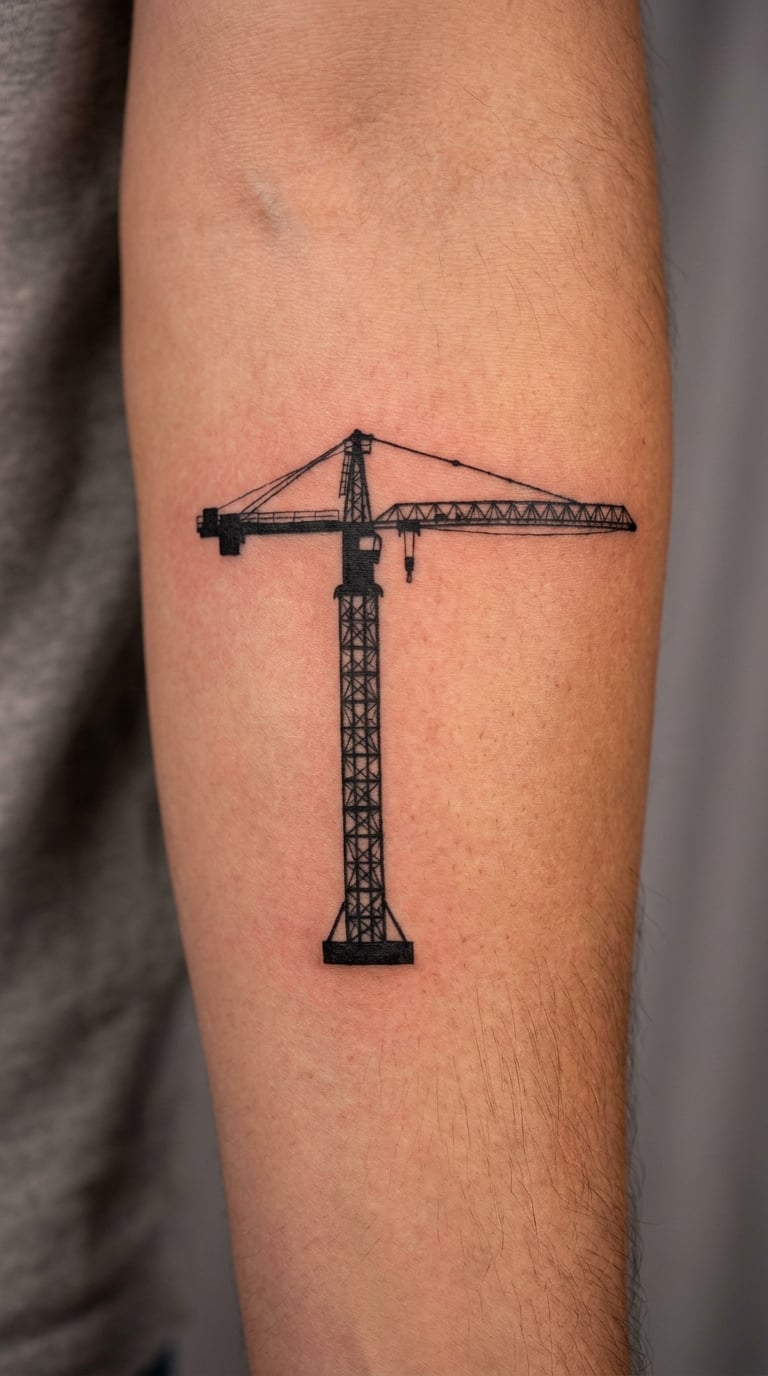
The tower crane is the most recognisable silhouette in the trade, and blackwork is where it belongs. A vertical lattice mast built from repeated cross-bracing, a long horizontal jib, a counter-jib with a small block of ballast, and a hook line dropping from the trolley give you plenty of geometry to work with. Dense, even line weight is what makes the bracing read as steel rather than scribble.
Plenty of ironworkers and crane crews choose it as a marker of the work itself. There is no fixed dictionary meaning, so treat it as trade pride rather than symbolism you have to explain.
Placement: outer forearm, running lengthwise so the mast follows the bone line. Size: 4-6 inches (10-15 cm). Style: blackwork with solid shadow under the counterweight.
Pain: medium, mostly the forearm’s outer edge and wrist end. Make it yours: add your company colour to the hoist block, or the lift height in metres as a small number on the jib.
2. Hard Hat Minimalist Tattoo
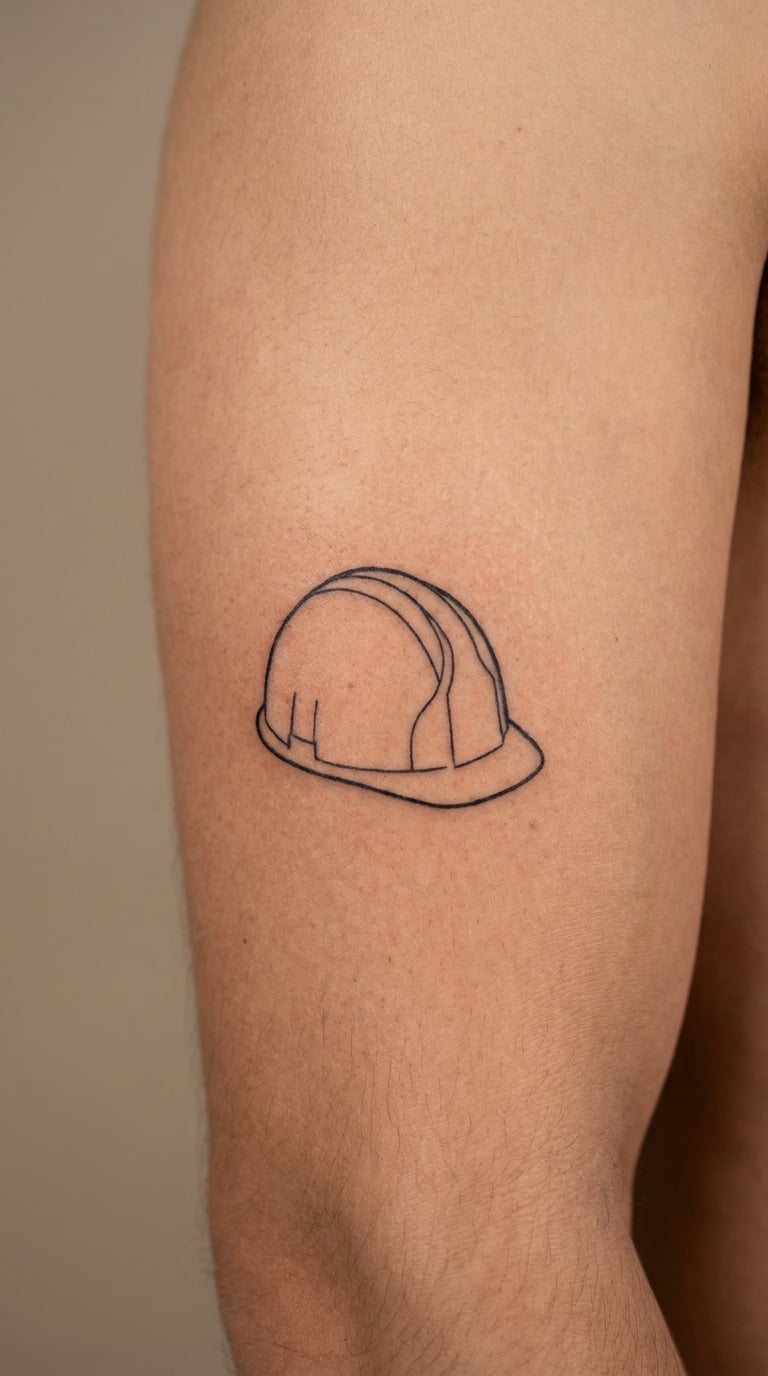
One hard hat, drawn in a single colour with no shading, is the design I point first-timers toward. Get the dome curve right and the ridge line crisp, keep the brim a clean shallow arc, and add the two short vent slots at the crown. That is the whole drawing, and restraint is what makes it work at small size.
It reads as head gear rather than an object, which keeps it quiet. Plenty of people wear it for the trade; plenty more wear it simply because it is a clean shape. No universal meaning either way.
Placement: outer or upper arm where there is flat muscle. Size: 2-3 inches (5-7.5 cm) wide. Style: minimalist single-weight line.
Pain: low, one of the more forgiving spots on the arm. Make it yours: tint it with your hard hat colour, since those follow a real code: white for supervisors, red for apprentices, yellow for the trades, blue for visitors.
3. Blueprint-Style Forearm Tattoo
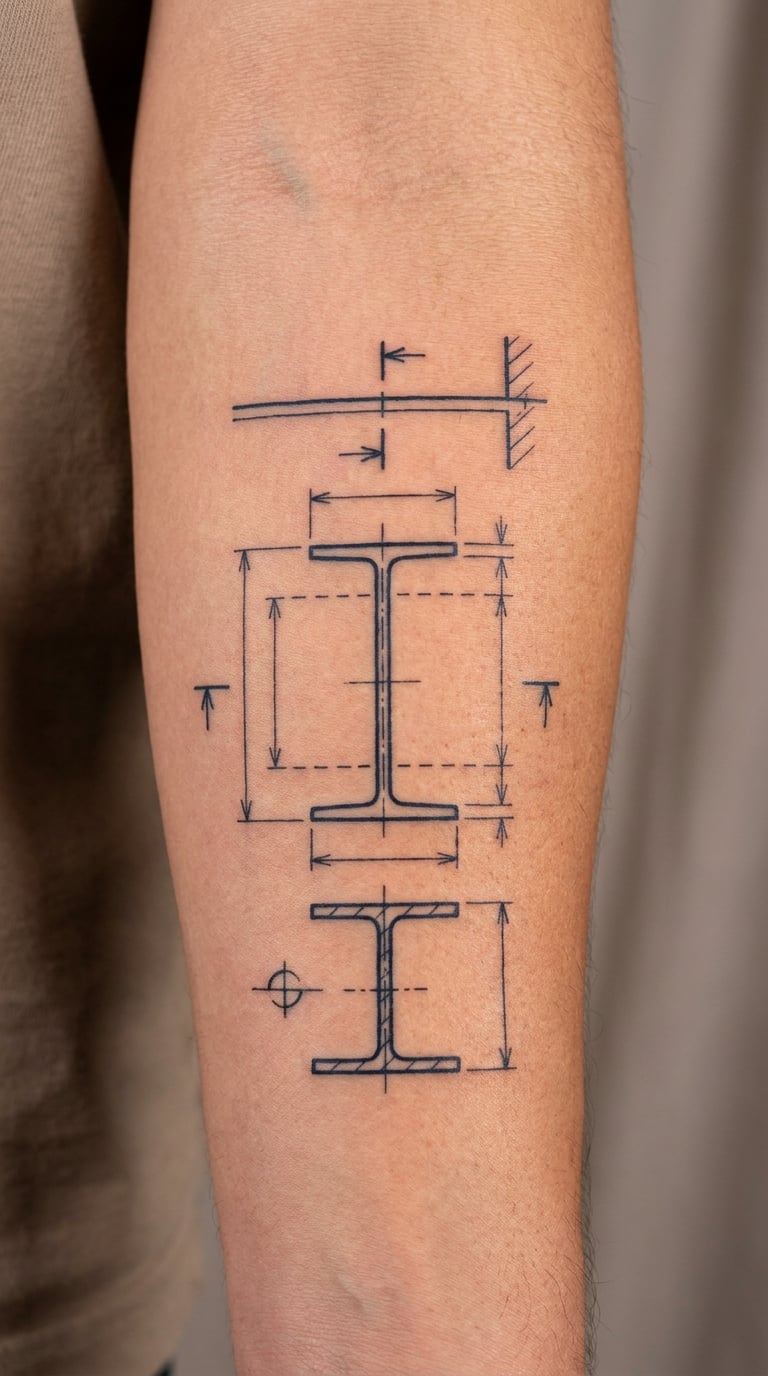
This one is built like a technical drawing. A structural beam in section, or a building elevation with dimension lines and arrows, drawn in thin blue-black line with small numerals beside each measurement. Artists who specialise in technical or geometric work will nail the drafting language; a generalist may need you to bring reference drawings.
It suits engineers, estimators and site managers who actually work off drawings. That specificity is the point.
Placement: inner forearm, lengthwise, so the dimension text stays readable. Size: 5-7 inches (13-18 cm). Style: technical line with hairline strokes.
Pain: medium, worse along the inner forearm near the wrist where skin is thin. Make it yours: use the plan of a building you actually worked on, which turns the piece into a record. Hairline strokes spread with age, so ask for a slightly heavier line than looks right in a drawing.
4. Geometric I-Beam Chest Tattoo
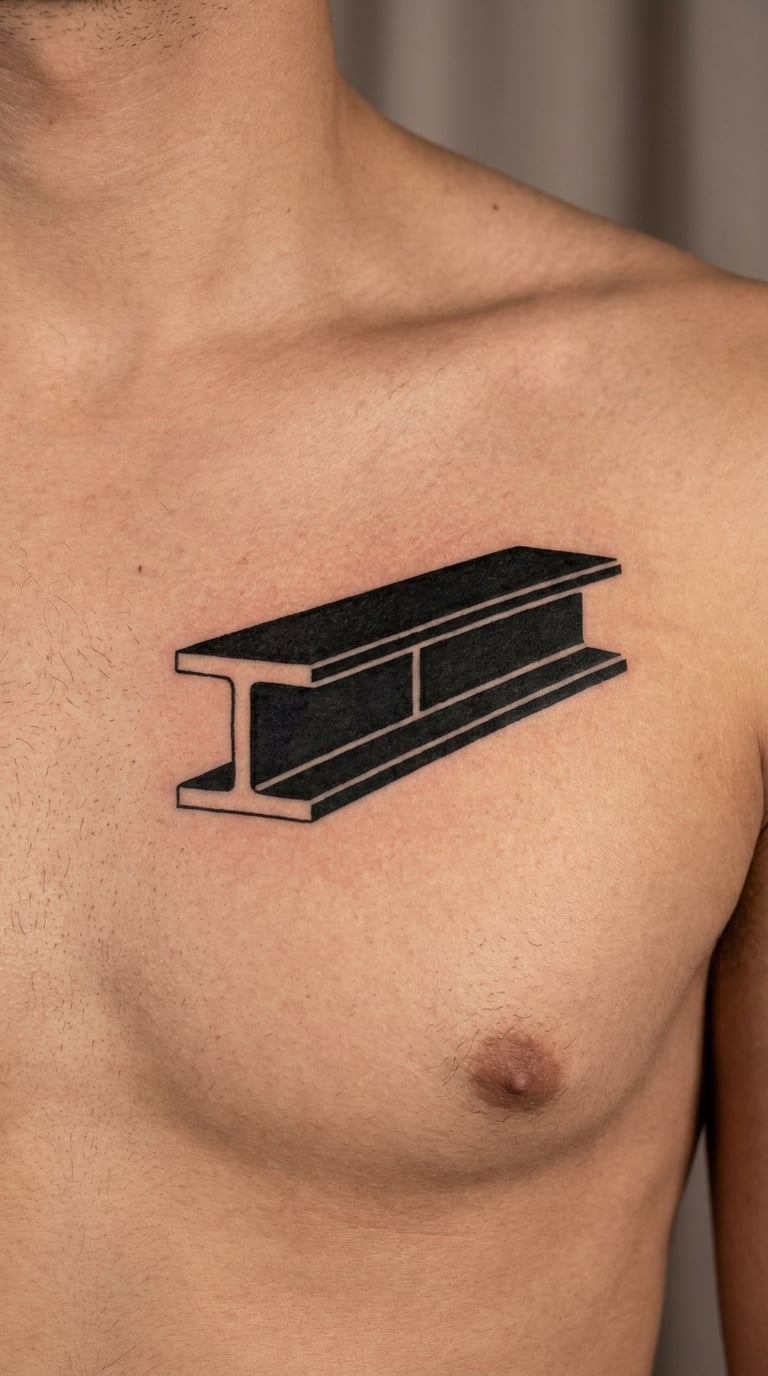
An I-beam is a shape that already contains its own negative space, which is why it converts so well into geometric blackwork. Solid black fills the flanges, the web stays open or is hatched, and the whole thing reads as a single symmetrical block. Aligned down the sternum it looks like a spine made of structural steel.
Ironworkers and steel erectors get the most out of it. It is as close to a straightforward emblem of load-bearing strength as this theme gets.
Placement: center chest, vertical, 1-2 inches below the sternum notch. Size: 5-7 inches (13-18 cm) tall. Style: geometric blackwork, hard edges, symmetrical halves.
Pain: high, and the sternum is bone-close, so bring breaks. Make it yours: mirror two beams with a gap between them for a pair, or set a small rivet detail at each flange.
5. Fine-Line Hard Hat Behind the Ear
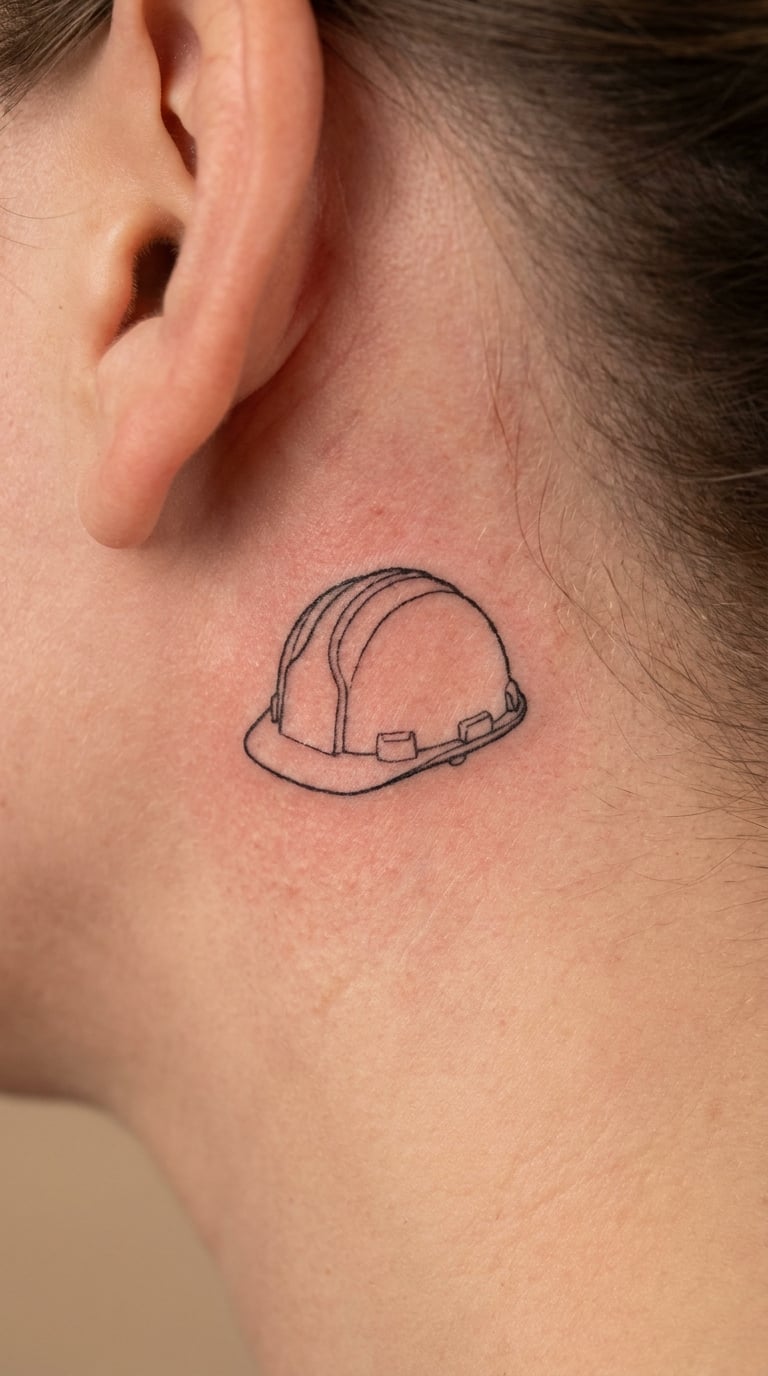
Same object as number two, opposite decision. Here it is a hairline outline at roughly 1.5 inches, tucked into the hollow behind the ear where the skin is quiet. The line stays unbroken, no vents, no shading, and the brim tapers to a point at the ends so it disappears into the jaw line.
It is discreet enough for a site with a dress code and still says something to anyone who knows what it is. Expect people to ask about it constantly, which is the trade-off with that spot.
Placement: behind the ear, or the upper side of the neck. Size: 1.5-2 inches (4-5 cm). Style: fine line, single weight.
Pain: medium, the cartilage area is thin and bony. Make it yours: put a small compass needle inside the dome. Know that fine line here fades noticeably faster than an arm piece, and plan on a touch-up every few years.
6. Excavator Machine Forearm Tattoo
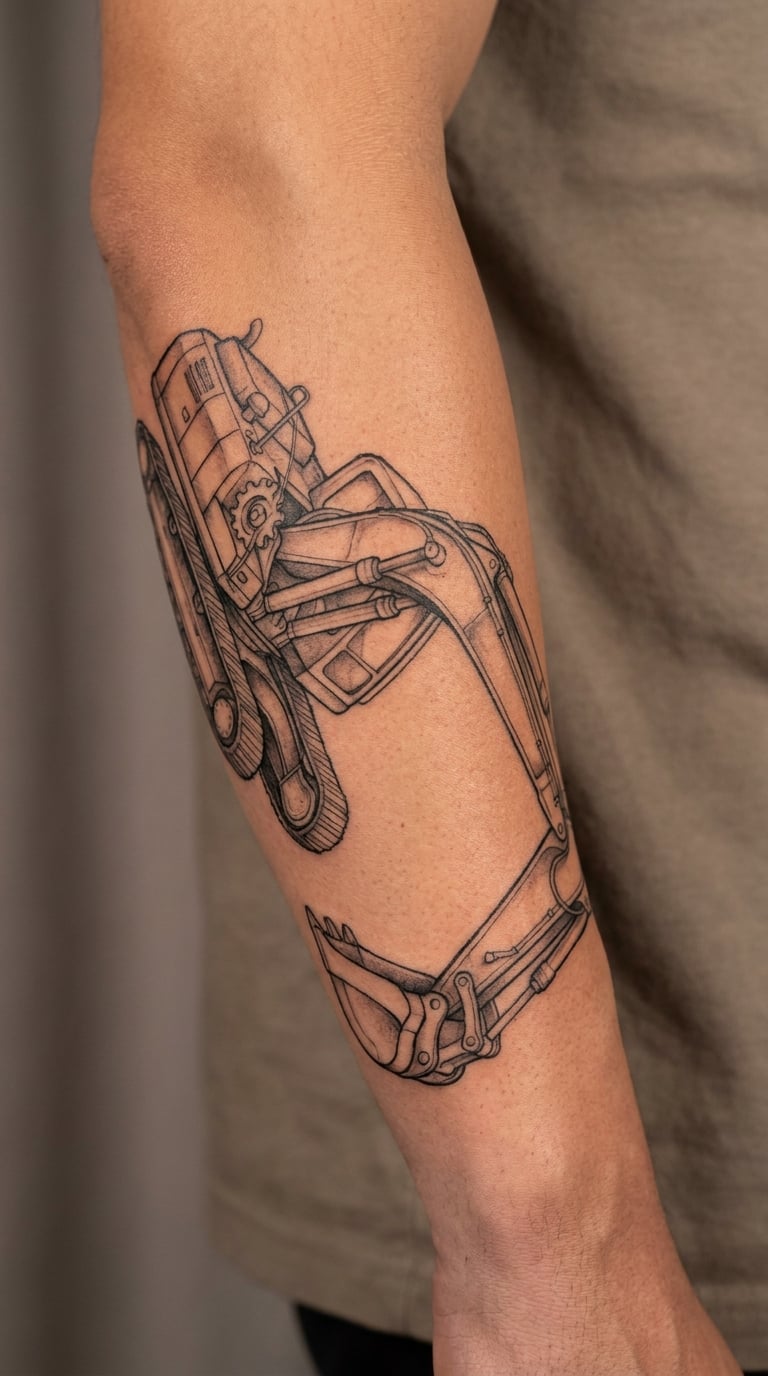
The excavator gives an artist more to work with than almost any other machine: tracks, cab, boom, stick, bucket, and hydraulic lines running the length of the arm. Rendered in black and grey, the hydraulic cylinders read best, because soft grey shading sells metal in a way flat line cannot.
Operators and groundworkers usually pick this one because it is the machine they spent years in. If you want a companion piece later, a dozer or a loader above it builds a natural sleeve.
Placement: outer forearm, wrapping slightly toward the elbow. Size: 4-5 inches (10-13 cm). Style: black and grey realism with restrained shading.
Pain: medium, the tracks across a flatter area are easier than the boom near the elbow. Make it yours: put your machine’s number on the cab door, or add a single spot of safety orange to the boom. Keep detail heavier on the near side and let the far end fade out, so the piece curves with the arm instead of fighting it.
7. Tape Measure Wrap Tattoo
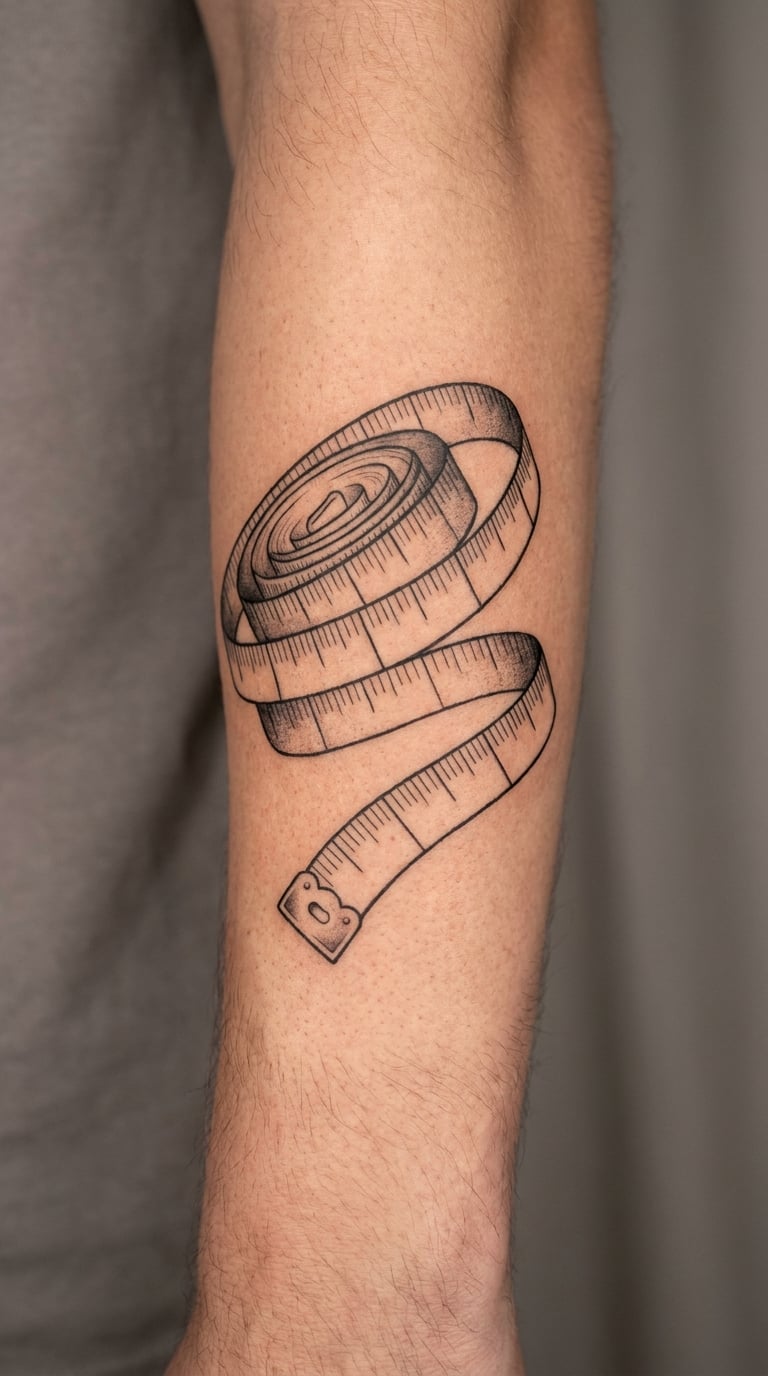
A tape measure is the least dramatic tool on this list and one of the most personal. Artists draw it as a band that curves with the limb, tick marks at regular intervals, a slight twist where the tape runs out of flat width, and a small tab at the end.
No fixed meaning, and that is a feature. Carpenters, finishers and site managers use it as trade shorthand, and the shape stays legible even when the detail is minimal.
Placement: mid forearm, wrapping fully around, or a half-wrap on the outer arm. Size: band width 0.5 inch (1.3 cm), length follows the arm. Style: clean line with optional dotwork ticks.
Pain: medium, and the full circumference takes longer to sit through. Make it yours: have the tick spacing spell something, or ink only up to a specific measurement. It pairs well with the level in number eight.
8. Carpenter’s Level Wrist Tattoo
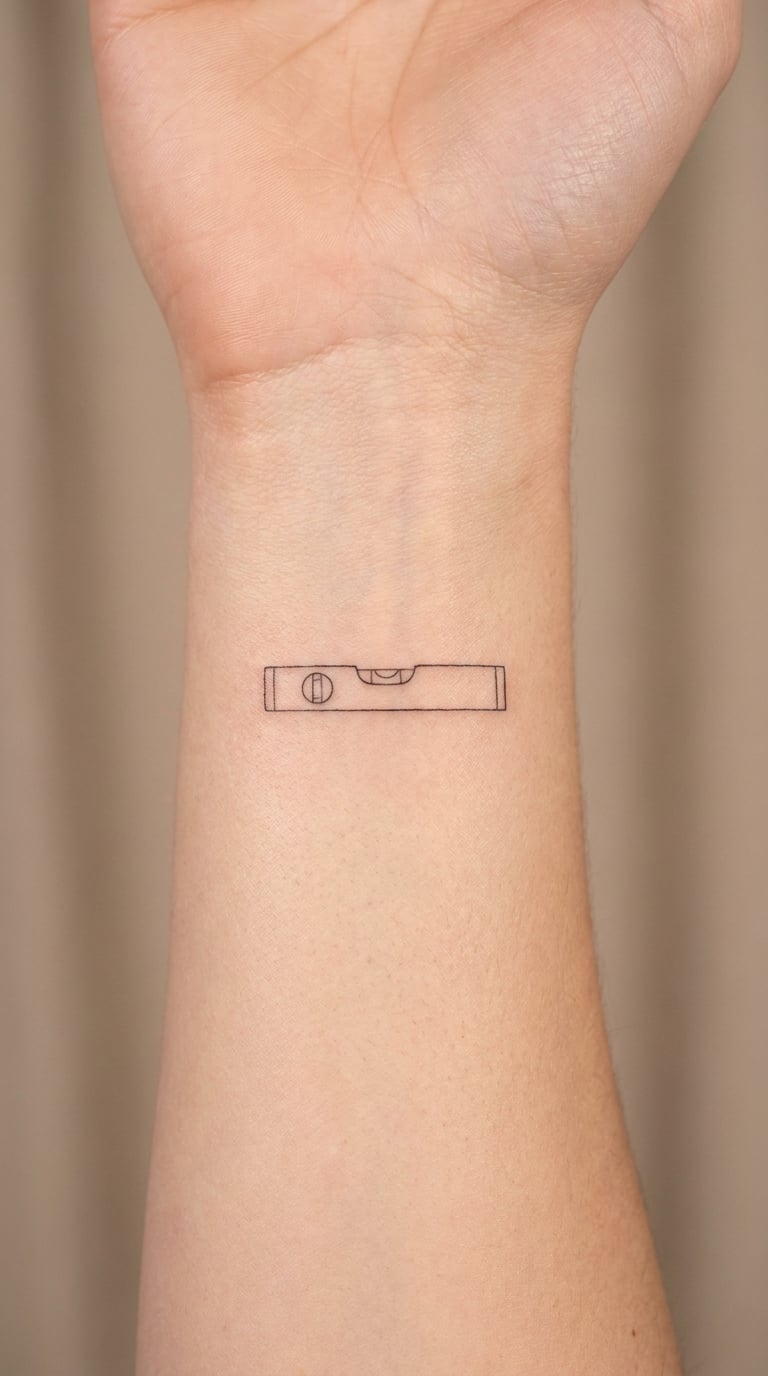
A spirit level, in thin black line, roughly 2 inches long: rectangular body, three bubble vials, and a short hexagonal outline. The shape is so geometric that it needs almost no shading to look right, which makes it a good match for a wrist that already has a lot going on.
It means accuracy and getting it true, and finishers in particular like the reading. Hand and wrist work wears fast, so plan the placement before you commit.
Placement: inner wrist, aligned with the bone rather than across it. Size: 2-2.5 inches (5-6 cm). Style: minimalist line, no fill.
Pain: medium, and the wrist flexes constantly during healing. Make it yours: add the vial colour, or a faint level bubble filled in red so the level looks set. Expect the fine edges to soften within a few years on a working hand.
9. Gear and Wrench Blackwork Tattoo
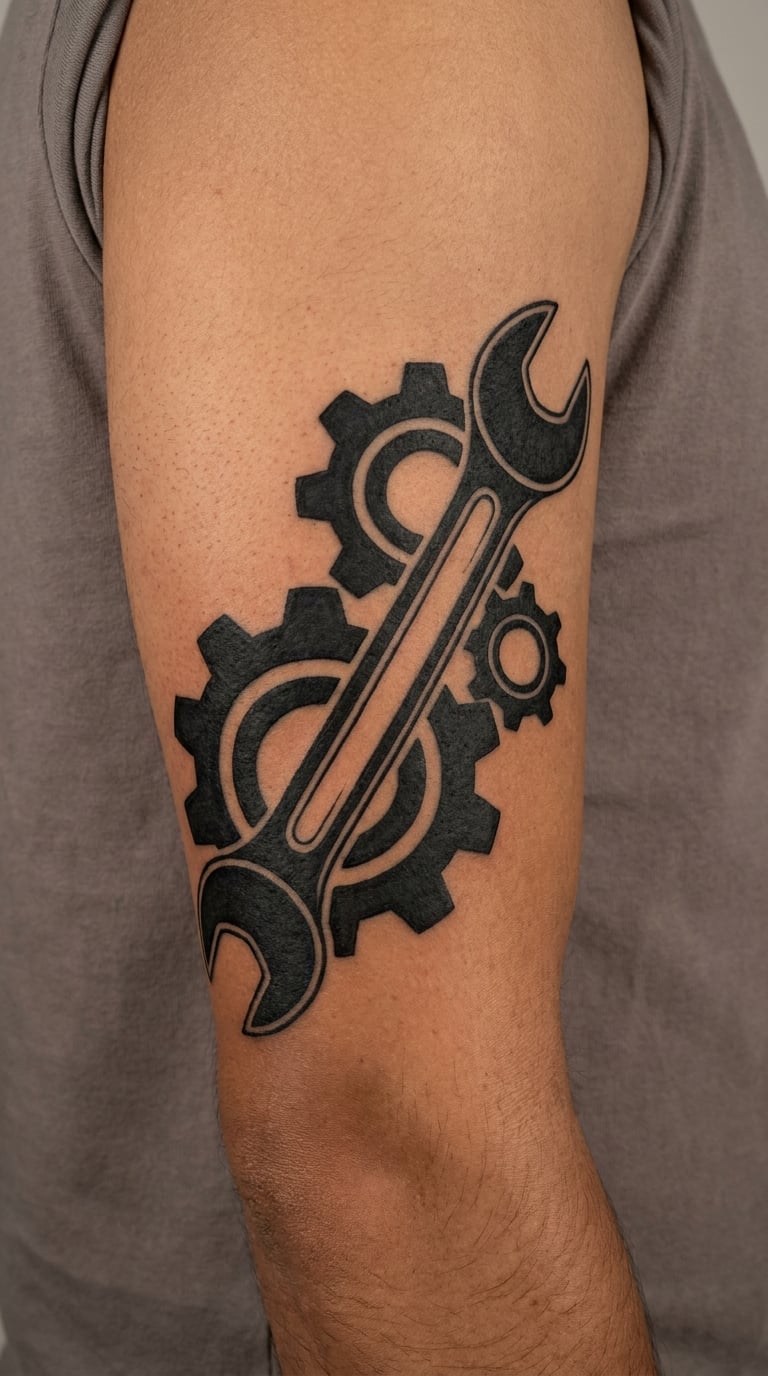
A cog meshed with an open-end wrench is a solid, symmetrical blackwork composition. The teeth on the cog give the artist rhythm, the wrench gives it direction, and the two together balance without either one dominating. Solid black shadows under the gear face do most of the work.
Mechanics, maintenance crews and fitters gravitate here, and the design fills a big flat area better than it fills a narrow one.
Placement: outer upper arm or deltoid. Size: 3-4 inches (7.5-10 cm) across. Style: blackwork, heavy shadow blocks.
Pain: low, the upper arm is a good first-tattoo location. Make it yours: use the tooth count of a real gear, or match a second tool piece later to build a mechanical sleeve. The 20 best black sleeve tattoo ideas for men list is worth reading if you are planning one.
10. Construction Worker Portrait Tattoo
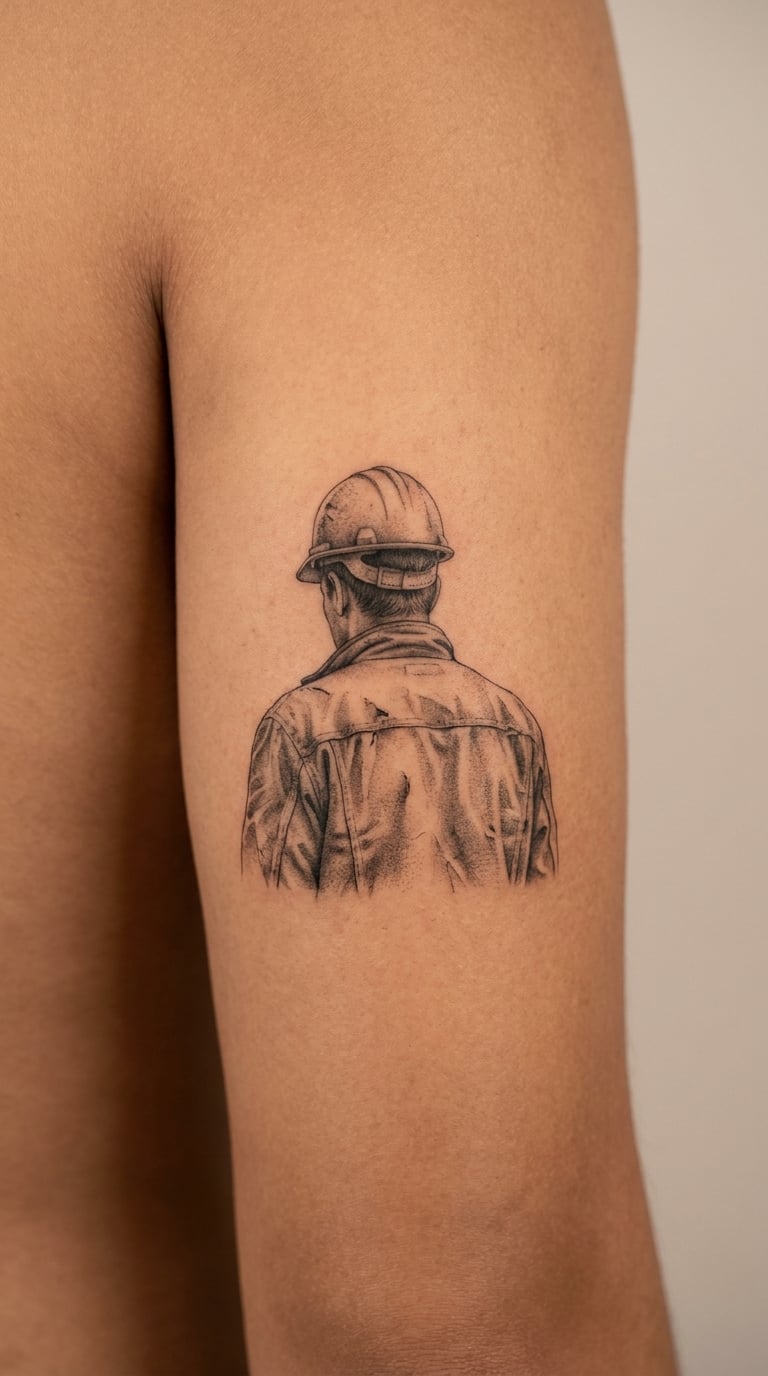
A portrait in black and grey, head and shoulders, hard hat on, hi-vis collar catching the light. The realism depends almost entirely on the face, so reference photographs matter more here than for any other design on this list. You are asking an artist to render a specific person, not a generic worker.
These usually work as tribute pieces: a father, a grandfather, a crew member who did not make it. Getting that right is a conversation, not a stencil.
Placement: outer upper arm, or the upper chest for more scale. Size: 3-4 inches (7.5-10 cm) tall. Style: black and grey realism.
Pain: medium, unless it goes large. Make it yours: give the artist several photos of the real person, plus the name of the company or crew if you want it lettered underneath. Fine facial shading softens with age, so a touch-up in five years keeps the eyes defined.
11. Traditional Bulldozer Shoulder Tattoo
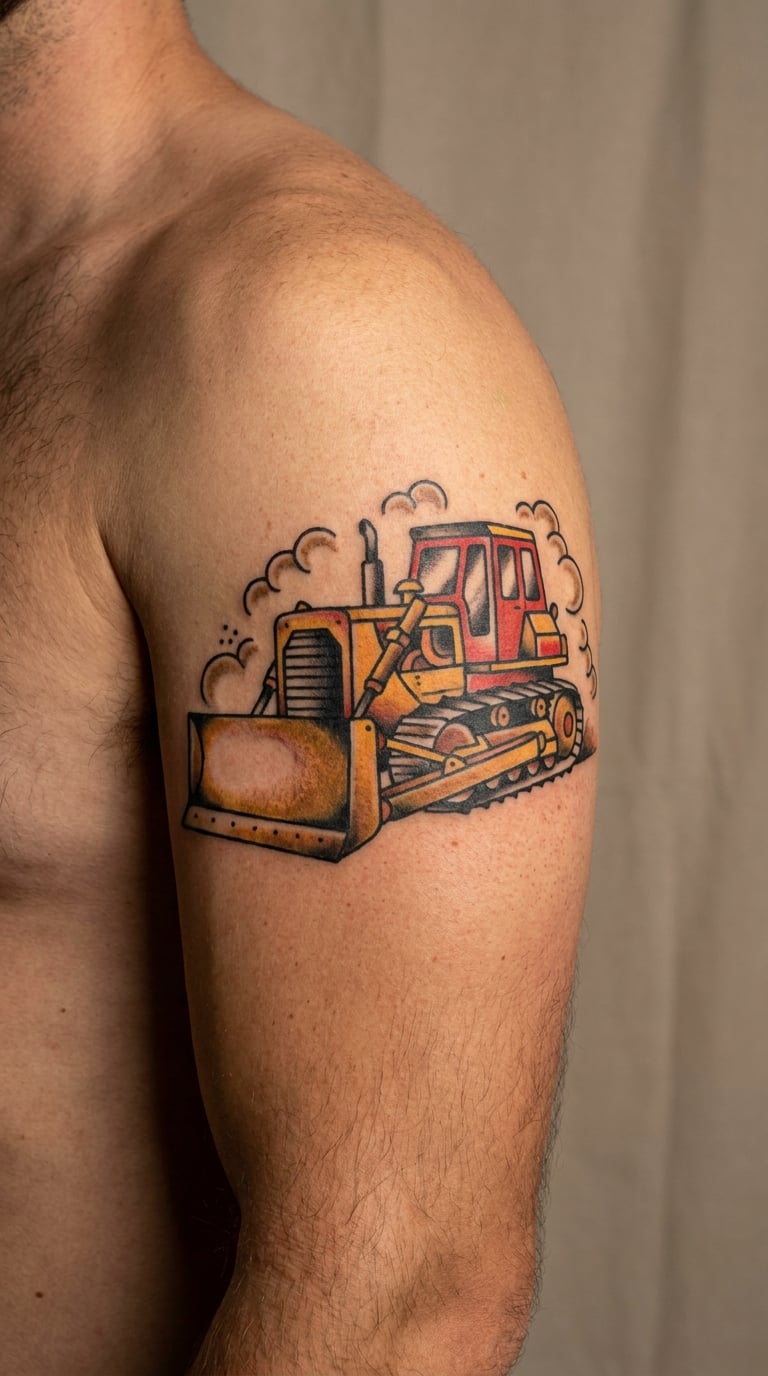
Traditional American tattooing suits a bulldozer well. Heavy black outlines, flat colour inside them, warm reds and ochres on the machine, and shading kept inside the outline the way old flash sheets do it. The blade and track read clearly at a distance, which is exactly what traditional style is built for.
It is a celebratory piece rather than a quiet one. Earthmoving crews and site supervisors often take it as a reference to the machine they are known for.
Placement: deltoid, slightly angled down toward the bicep. Size: 3-4 inches (7.5-10 cm). Style: traditional American, bold outline, red and ochre.
Pain: medium, the deltoid curves more than it looks like it should. Make it yours: put the blade number across the front, or add a small scroll banner with the model year. If the piece needs to hold its own next to a sleeve later, keep the background empty.
12. Steel Frame Architectural Forearm Tattoo
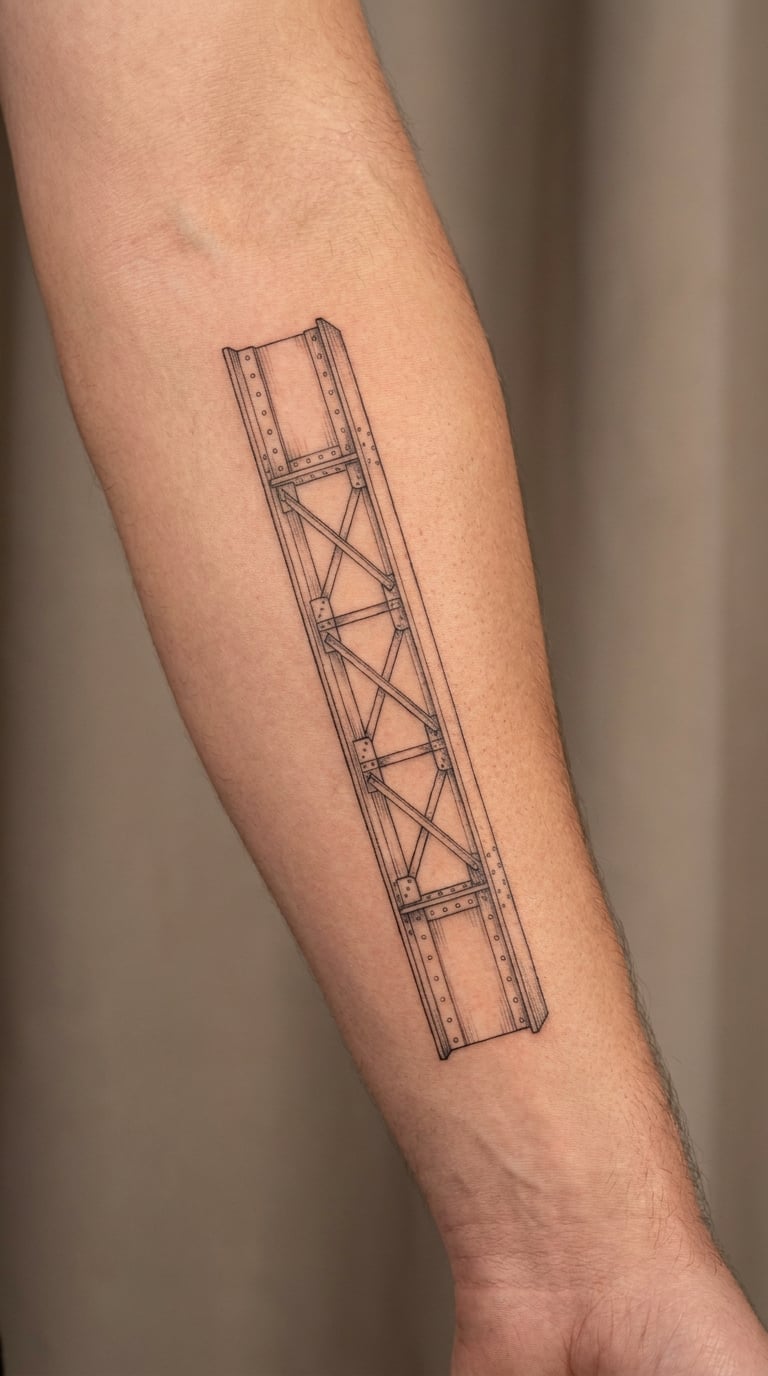
A steel frame elevation, drawn lengthwise along the forearm: columns, beams, bracing, and a small set of connection nodes. Drawn in fine black technical line, it turns a piece of skin into a shop drawing. Column lines follow the forearm’s length and the cross-beams land on natural intervals along the limb.
It is a designer’s view of the trade rather than a labourer’s, which makes it a good match for steel detailers and draughtsmen.
Placement: inner forearm, base of the wrist to mid-forearm. Size: 6-8 inches (15-20 cm). Style: technical line, consistent weight, minimal shading.
Pain: medium across the forearm, sharper near the wrist. Make it yours: name a real connection type, like a gusset plate or a moment connection, so the detail is accurate rather than decorative. One accent colour, safety yellow on a single beam, stops it looking like a diagram.
13. Crossed Hard Hat and Tools Tattoo
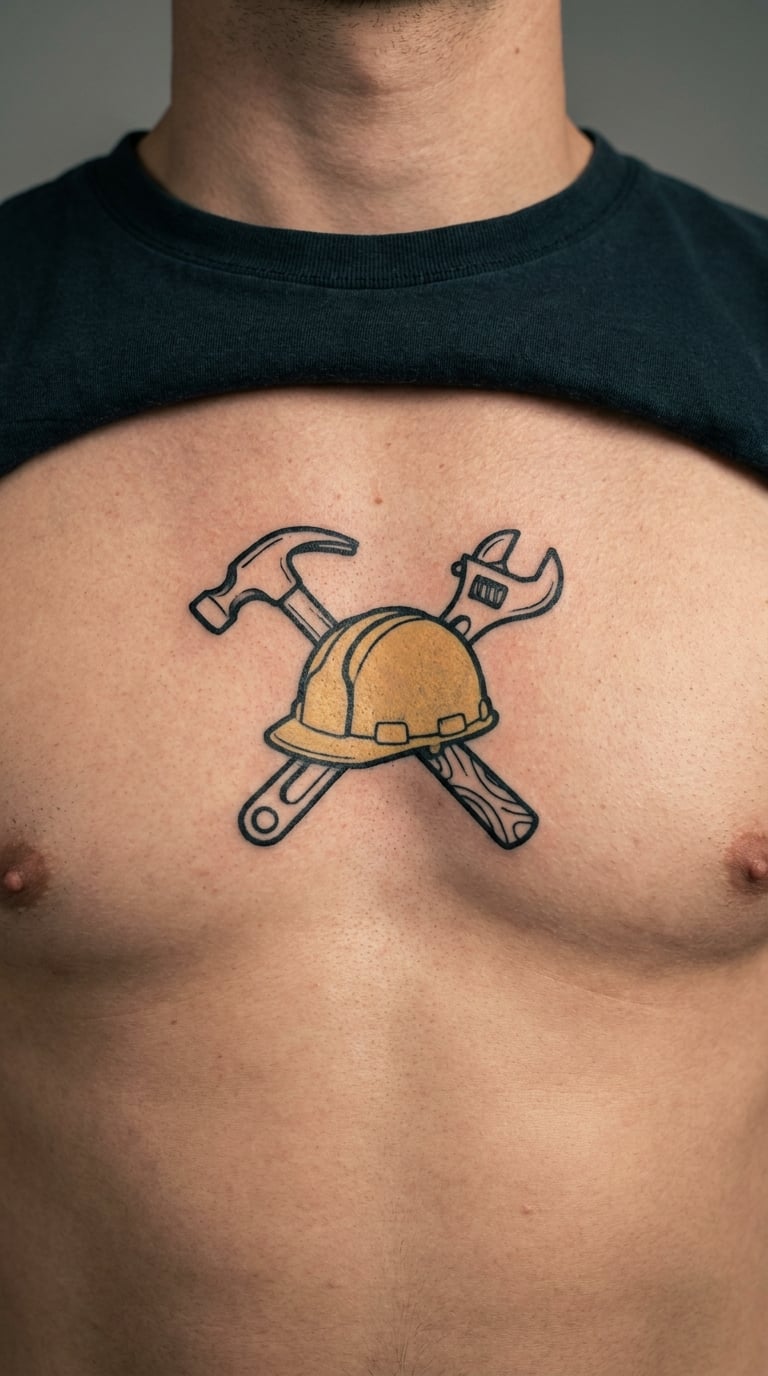
A badge-style arrangement: a claw hammer and a wrench crossed behind a hard hat, tied with a short band or rope. It has the visual grammar of a crest, which is why it works so well centred on the chest. Bold outline, restrained interior shading, and one muted colour for the hat.
General contractors and crew leads like the emblem quality. It is less of a single-trade signal than the individual tool pieces, which makes it a good option if you have moved between trades.
Placement: center chest, or high on the sternum. Size: 4-5 inches (10-13 cm) across. Style: illustrative with bold line, or traditional outline.
Pain: high, chest and collarbone are bony. Make it yours: swap the wrench for a trowel or a framing square to name your actual trade, or add your crew name in a banner underneath. Keep the cross-hatched ends of the tools clear of the collarbone or they will distort.
14. Riveted Steel Dotwork Tattoo
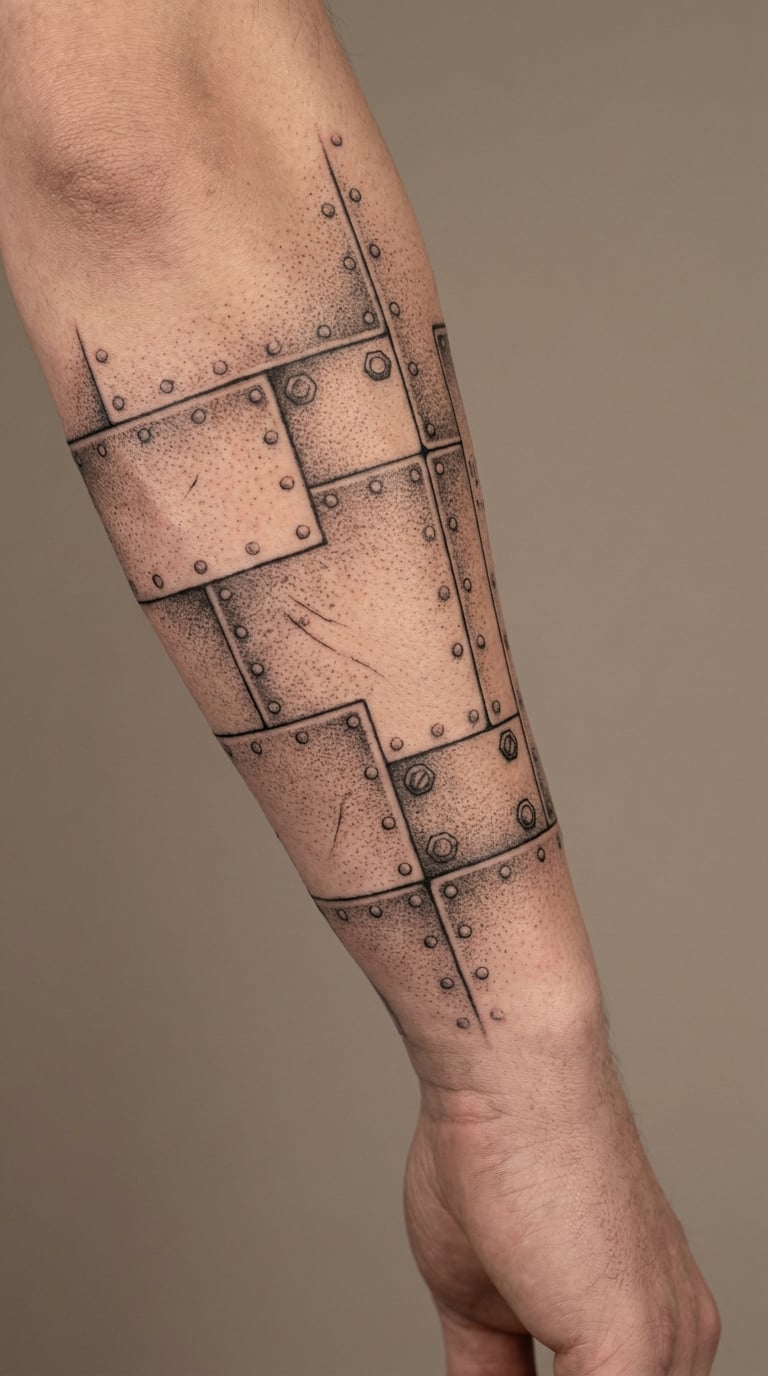
Dotwork is the right home for rivets. Rows of shaded dots form steel plates, evenly spaced rivet heads sit at the joints, and the gradation gives the flat a suggestion of depth without heavy black. A repeating panel scale up the arm, or a single band across the calf.
It is the quietest way to wear a heavy-industry motif, and the pattern scales well for anyone who wants coverage they can grow into.
Placement: forearm, calf or along the spine. Size: 3-5 inches (7.5-13 cm) per panel, repeatable. Style: dotwork with light black shading.
Pain: medium, dotwork takes longer because of the needle changes. Make it yours: vary dot density instead of adding fine line detail, since graduated shading holds its shape far better than thin outlines. Ask for a minimum dot size larger than you think you need.
15. Brickwork Blackwork Calf Tattoo
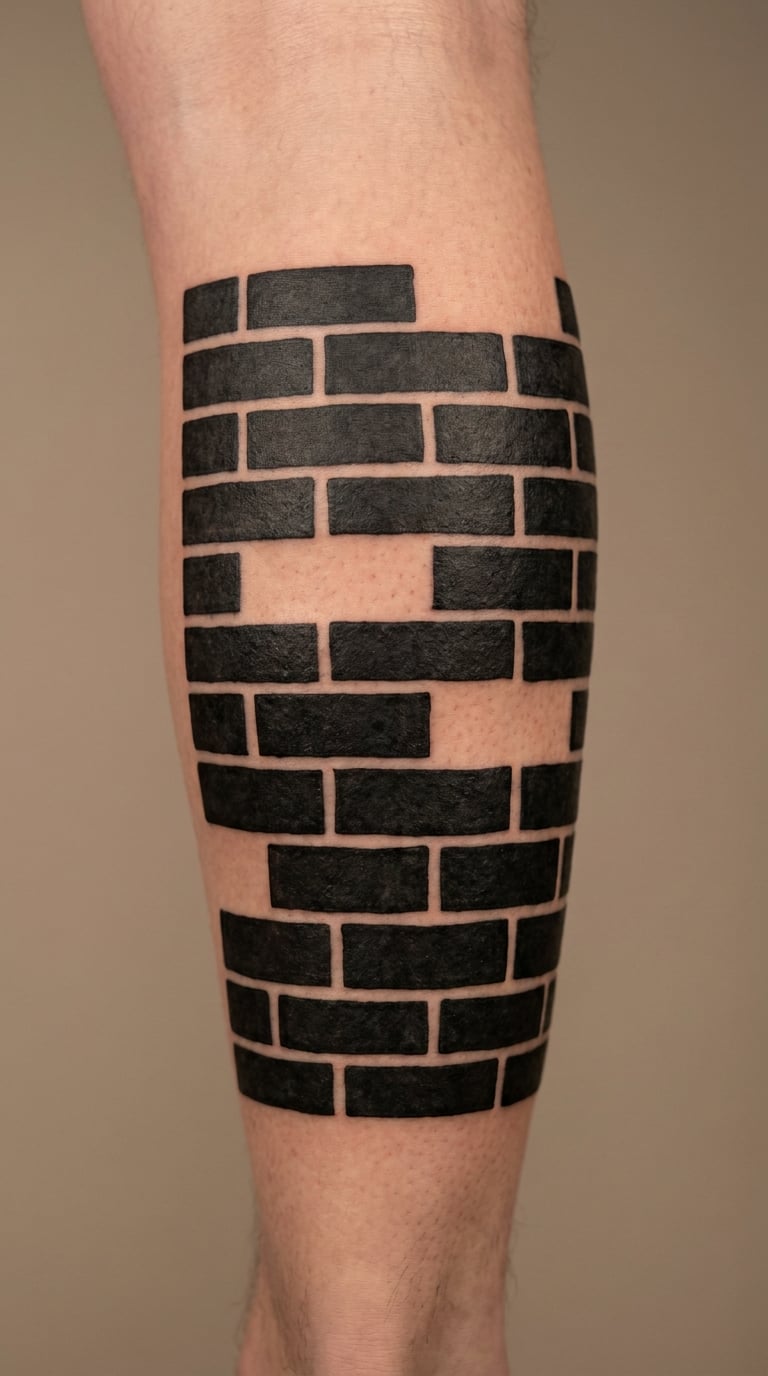
A brick pattern in heavy black with irregular negative-space gaps between courses. The trick is breaking the running bond so the wall looks laid by hand rather than stamped, and letting a few bricks fall out entirely. Masonry, concrete and finishers all read this instantly.
It represents the trade as much as any single tool, and it is one of the easiest designs to extend: another panel, a scaffold, a trowel sitting in the mortar.
Placement: outer calf or lower leg, wrapping slightly. Size: 4-6 inches (10-15 cm) tall. Style: blackwork with negative space.
Pain: medium, the shin edge and ankle are the tender parts. Make it yours: set one brick apart in a lighter tone for a memorial, or write your crew name inside the mortar line. Bold fills hold up better on a lower leg than fine line does.
16. Architectural Drafting Compass Tattoo
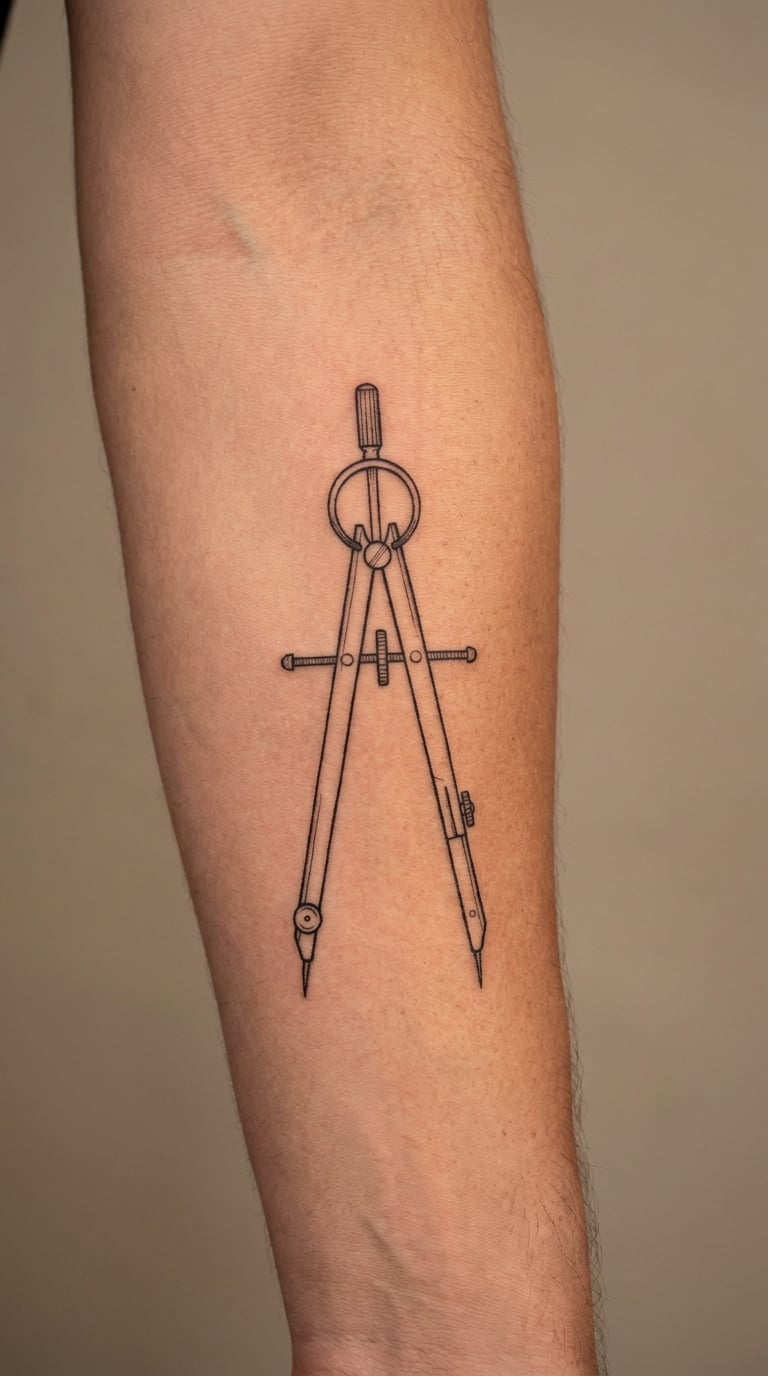
A drafting compass in precise black line, vertical on the inner forearm: two straight legs hinged at the top, a small adjustment screw, and pencil and point ends. There is no shading and no ornament, and the accuracy of the geometry is the design.
It points to planning and measurement rather than labour, so it reads well for estimators, engineers and detailers.
Placement: inner forearm, running lengthwise. Size: 3-4 inches (7.5-10 cm). Style: fine line or single-weight technical line.
Pain: medium on the inner forearm. Make it yours: set the legs to a specific angle that means something, or engrave a measured length along one leg. Hairline work on the inner arm softens faster than the same work on an upper arm, so ask for a deliberate line weight.
17. Welding Sparks Fine-Line Tattoo
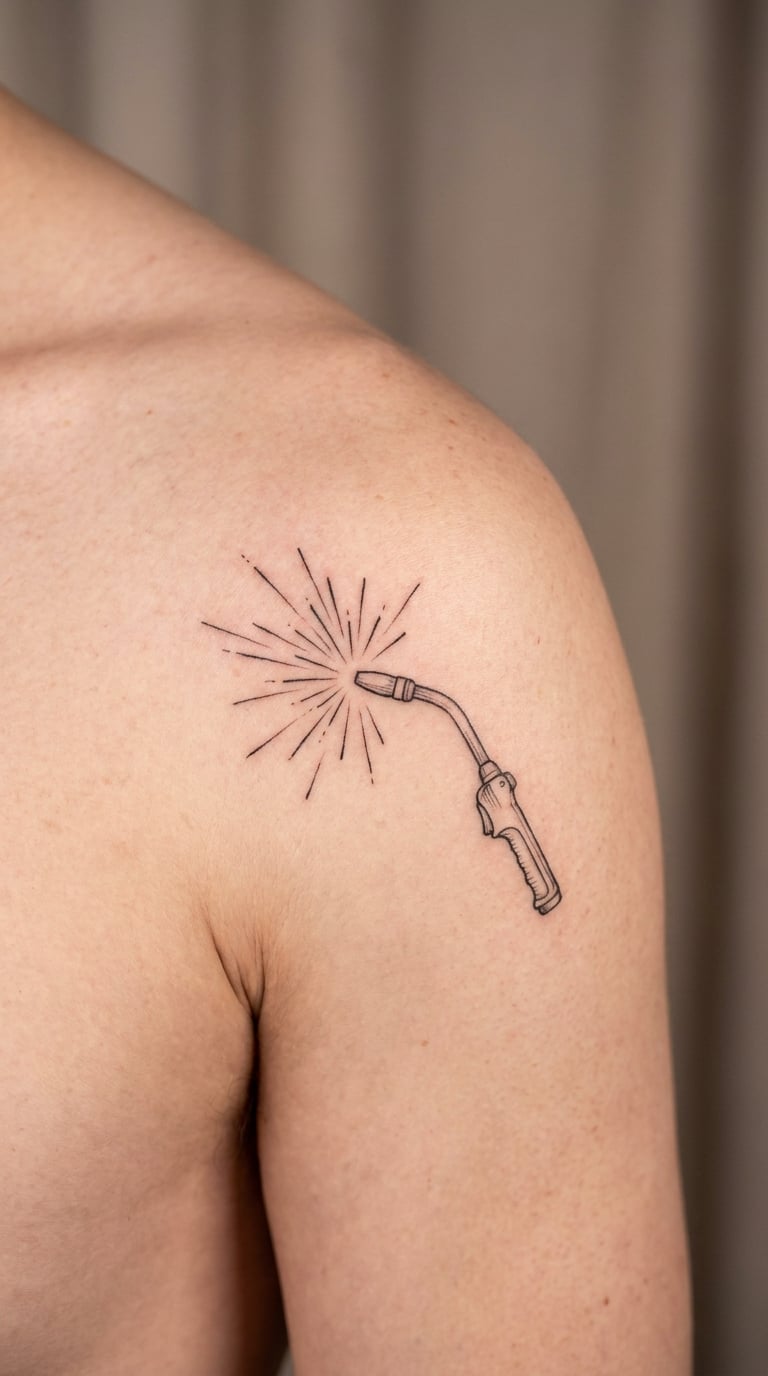
Welding sparks are built from radiating lines, which makes them one of the few motifs that wants fine line naturally. A small torch or electrode holder at the base, then arcs of short strokes fanning upward and outward, denser near the source and sparser at the tips. A little grey wash under the arc keeps it from floating.
Welders tend to pick this because it is the trade’s signature image and almost nobody gets it right, so the work shows. It also fills the shoulder curve better than it fills a flat area.
Placement: upper shoulder and deltoid. Size: 3-4 inches (7.5-10 cm). Style: fine line with light grey shading.
Pain: high, the deltoid and collarbone area sting badly. Make it yours: add a single orange spark at the arc point and nowhere else. The thinnest spark lines are the first thing to fade, so keep them short and confident rather than long and delicate.
18. Traffic Cone Watercolor Tattoo
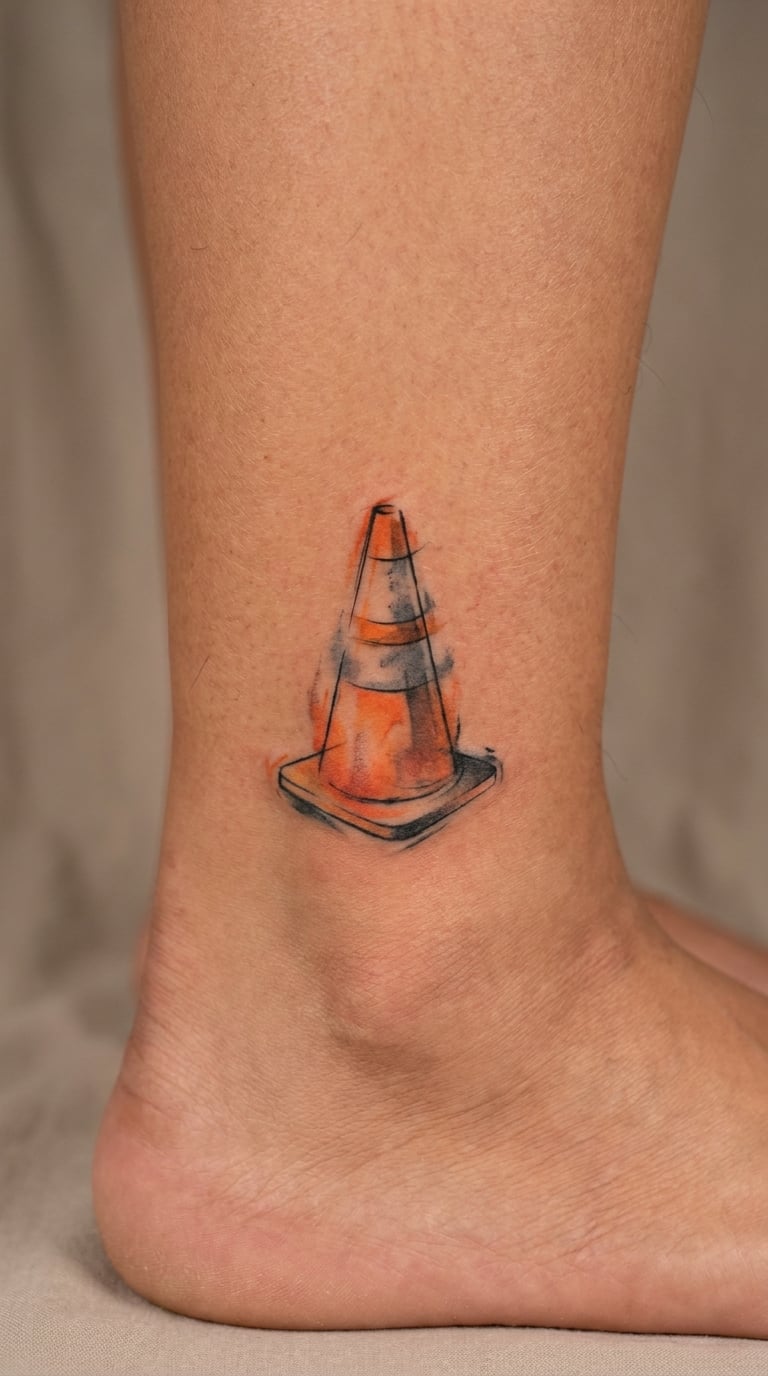
A traffic cone in loose watercolor: orange bleeding at the edges, a hard black base line where the ink pools, grey shadow underneath, and white skin left as the highlight stripe. The style does the work, so the drawing itself can stay simple.
It is a joke that reads as affection. The cone is the most photographed object on any site, and the design usually carries an inside meaning for the crew that made it worth having.
Placement: outer ankle, lower calf or outer forearm. Size: 2-2.5 inches (5-6 cm) tall. Style: watercolor with a black graphic base.
Pain: medium, the ankle bone is the sharp bit. Make it yours: use your actual site paint colours, or put a small crew number on the cone’s band. Watercolour sits differently on skin than on paper, so find an artist who works in the style rather than one who only draws traditional flash.
19. Tool Belt Western Tattoo
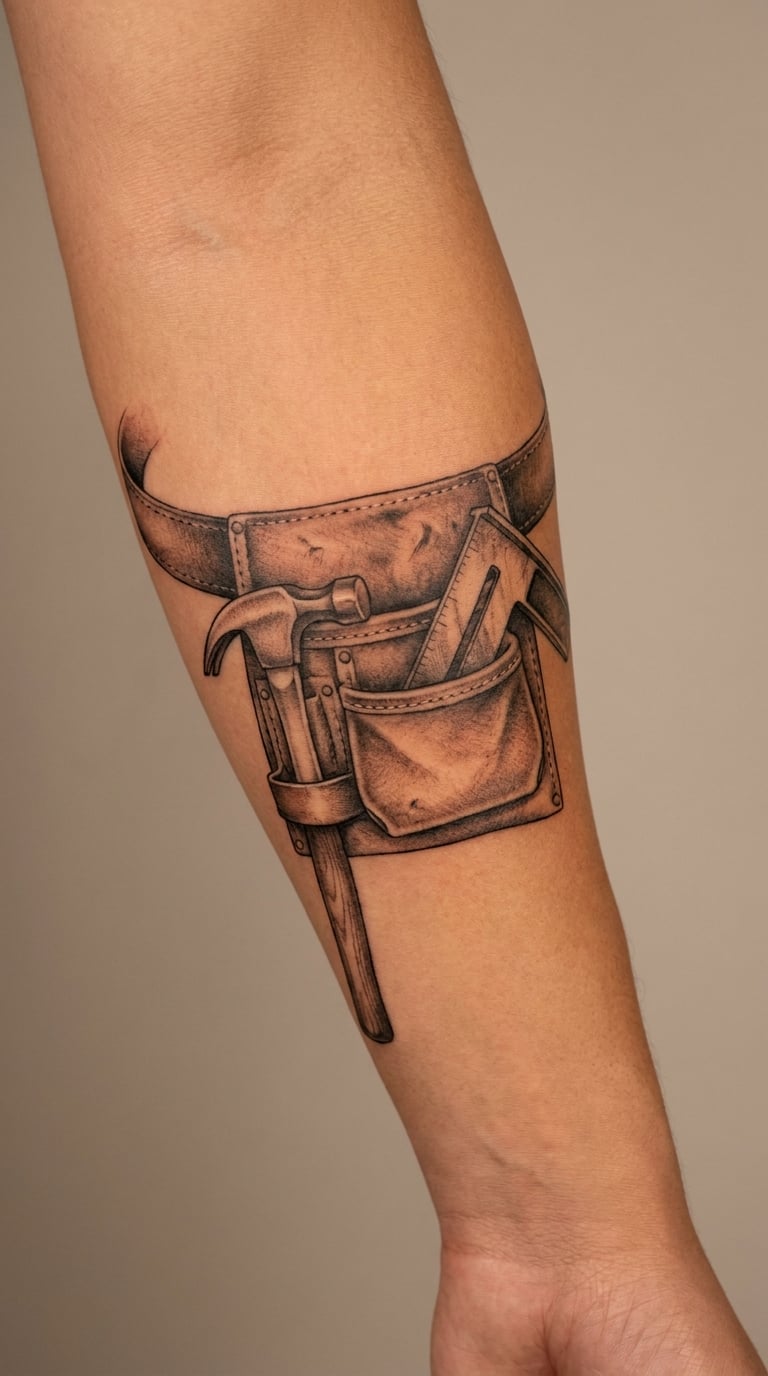
A tool belt in realistic western style, curved around the arm: worn leather, a hammer hanging from one loop, a framing square on the other, and a pouch breaking the line. The leather takes warm browns and heavy black shading, and the curve follows the limb so it looks worn rather than stuck on.
Framing and finish carpentry, mostly, and it is often a father-to-son piece. The framing square is named here because plenty of people ask for “a square” and get a speed square instead, which is a different tool entirely.
Placement: mid forearm or around the bicep. Size: 4-5 inches (10-13 cm) across. Style: realistic western with colour.
Pain: medium, the belt line crosses a lot of moving skin. Make it yours: put your father’s or crew’s initials on the pouch, or the year you started. Browns sit in skin better than most colours, and they need less touch-up than yellow.
20. Building Floor-Plan Tattoo
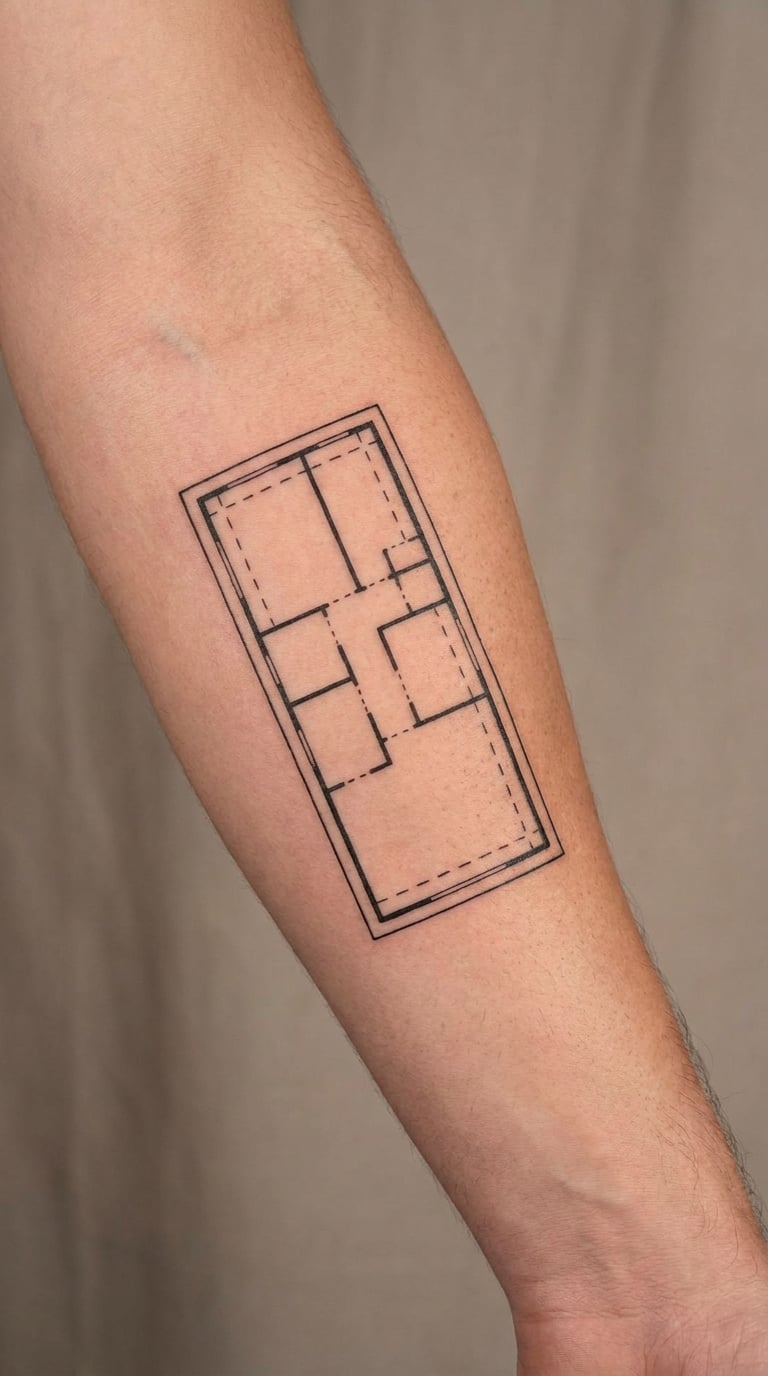
A floor plan fitted to the inside of the arm: room lines, a door swing, a wall break, thin dimension marks. It looks like an architect’s drawing shrunk to body scale, and the forearm becomes the sheet it is drawn on.
It is a design decision rather than a trade emblem, so it suits project managers and anyone who has worked on a building they can picture precisely. A plan of your own house or first project carries more weight than a generic one.
Placement: inner forearm. Size: 3-4 inches (7.5-10 cm). Style: thin technical line.
Pain: medium, sharper near the wrist. Make it yours: label one room, or add the date the project topped out. The smallest dimension numerals are the first detail to disappear, so drop them or enlarge them rather than shrinking them.
21. Skyscraper Framework Chest Tattoo
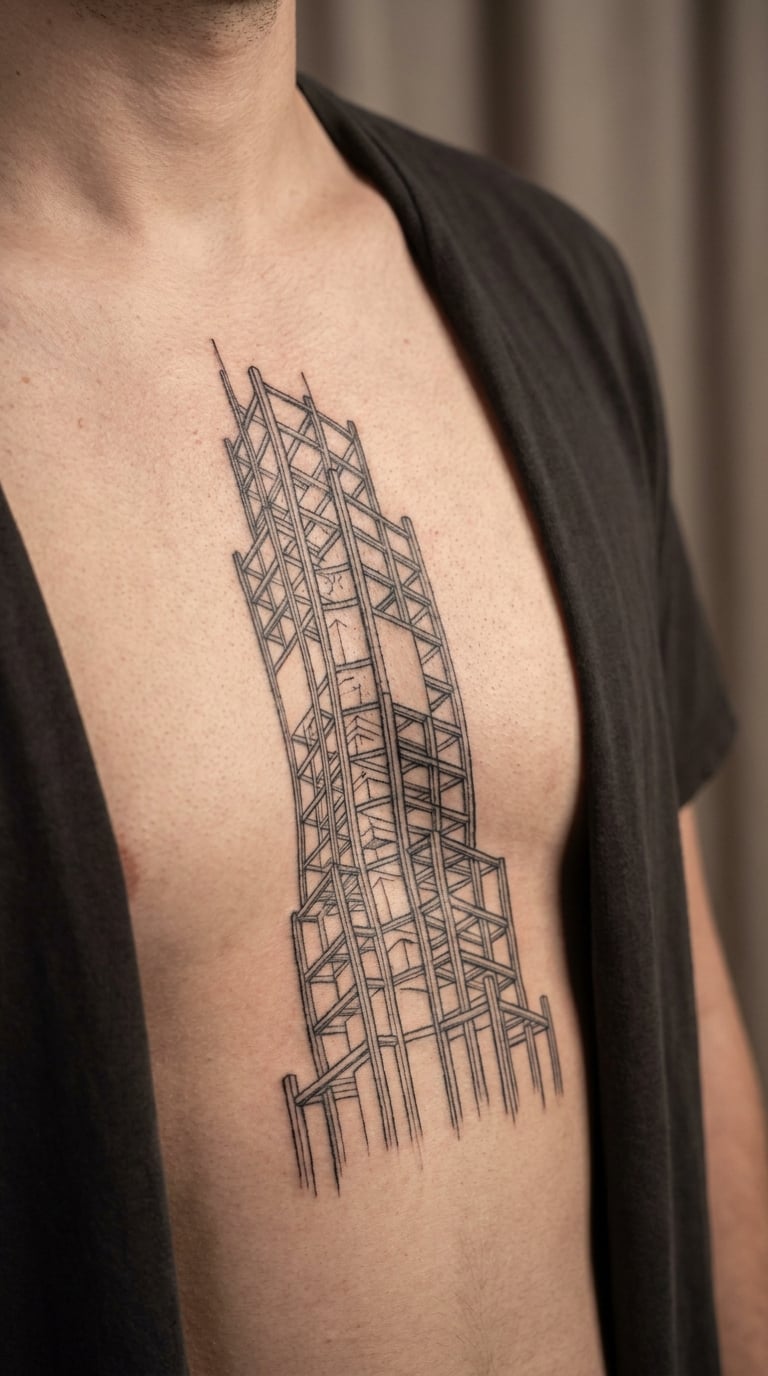
A tall steel skeleton, columns and beams rising from sternum to collarbone, with plenty of empty skin left inside the frame. The negative space is the point: an open frame reads as architecture, while a fully shaded block just reads as a heavy chest piece. Add floors as horizontal lines and the building starts to climb.
High-rise steel and ironwork crews tend to take it, and it is a strong statement piece for anyone already carrying a large arm.
Placement: center chest, vertical, sternum to just below the collarbone. Size: 7-9 inches (18-23 cm) tall. Style: architectural line with negative space.
Pain: high, and a long session over the sternum. Make it yours: model the actual floor count of a building you worked on, or add a second, shorter frame for a skyline. Keep the line medium-weight, because hairlines across a large area show every fade.
22. Concrete Mixer Neo-Traditional Tattoo
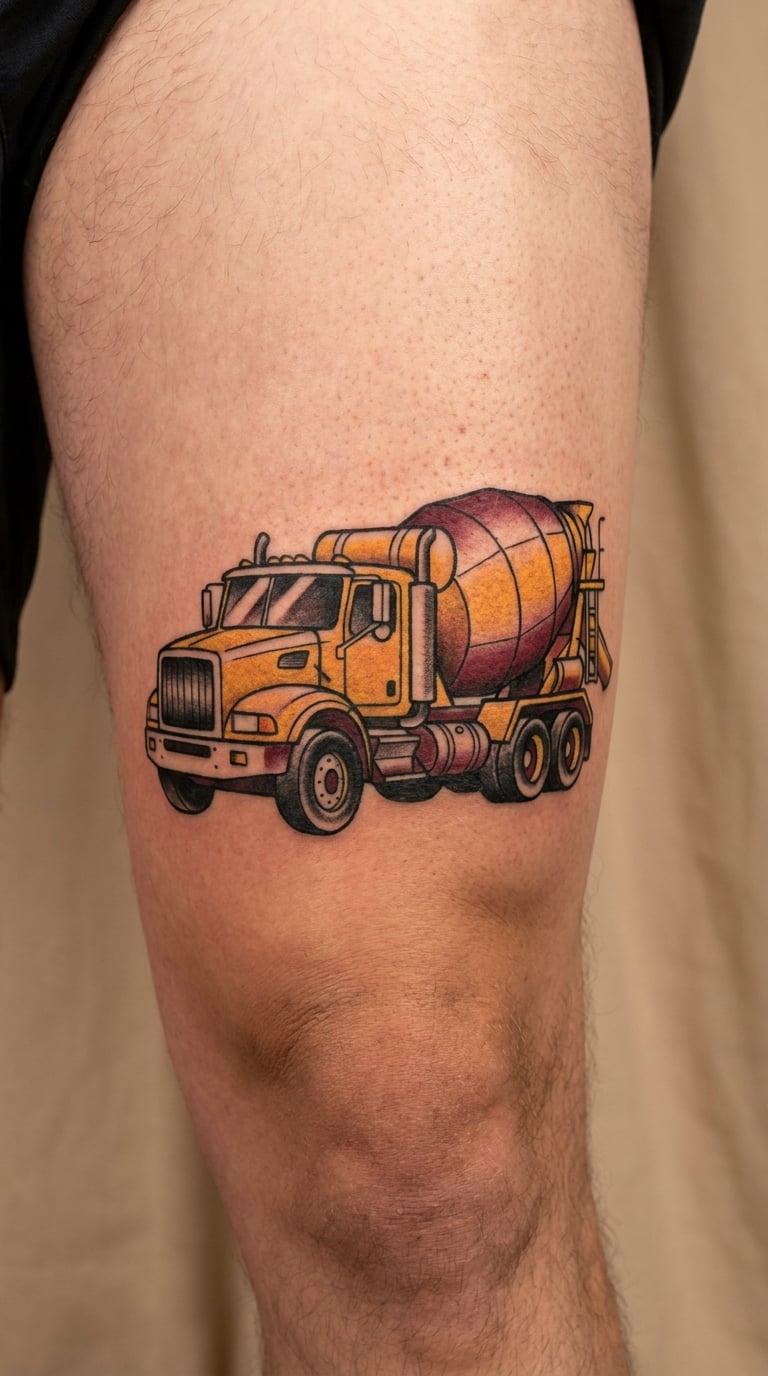
A concrete mixer drum rendered neo-traditional: bold black outlines, saturated yellow machine body, red chute, and controlled white highlights inside the colour instead of flat fill. The drum’s tilt angle gives the design its movement, and a short trail of wash coming out of the chute keeps the composition from sitting still.
Concrete finishers and pump operators take this one. It is loud on purpose, and it holds up at a size where most line work would start to blur.
Placement: outer thigh or upper calf, both big enough for the drum to turn. Size: 4-5 inches (10-13 cm). Style: neo-traditional, heavy colour.
Pain: medium, the thigh is easier than most locations. Make it yours: use your company’s yellow, or ink the drum with your pour number. The thigh is easier to cover with clothing than a forearm, which matters if you move between office and site.
23. Blueprint Grid Hand Tattoo
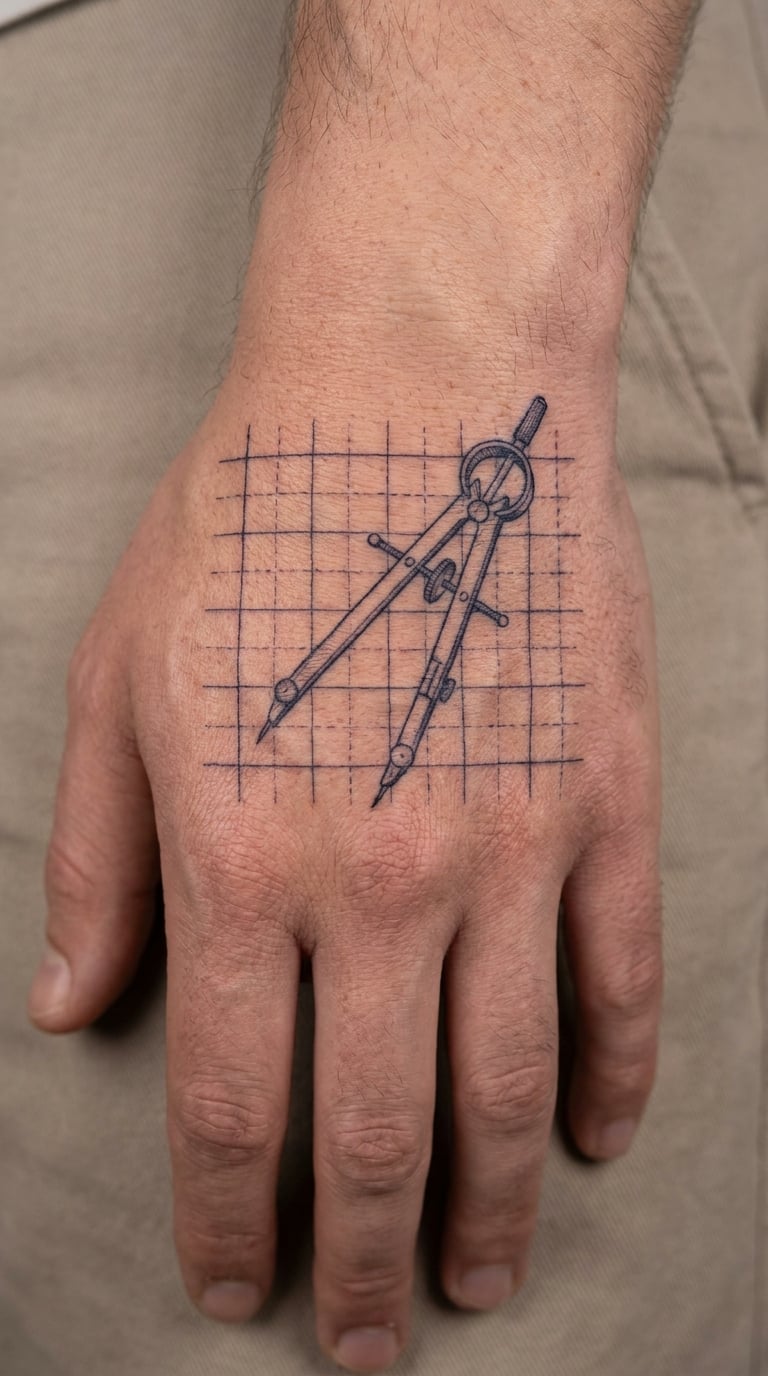
A blueprint grid across the back of the hand with a small drafting compass resting on it, drawn in thin blue-black line, the grid fading out at the edges so it merges with the skin. The grid gives the hand structure it does not usually have, and the compass gives it a subject.
It works as a standalone piece or as the anchor for a sleeve that starts at the wrist. Be realistic about it: hands take an enormous amount of abrasion, sun and movement.
Placement: back of the hand, between the knuckles and the wrist. Size: 3 inches (7.5 cm) across. Style: fine line technical.
Pain: high, and the hand is the most movement-heavy area on the body. Make it yours: keep the compass and drop the grid, which loses the least and ages the best. Fine line here fades faster than on almost any other placement, so expect a refresh every few years, and avoid getting this one in summer.
24. House Under Construction Tattoo
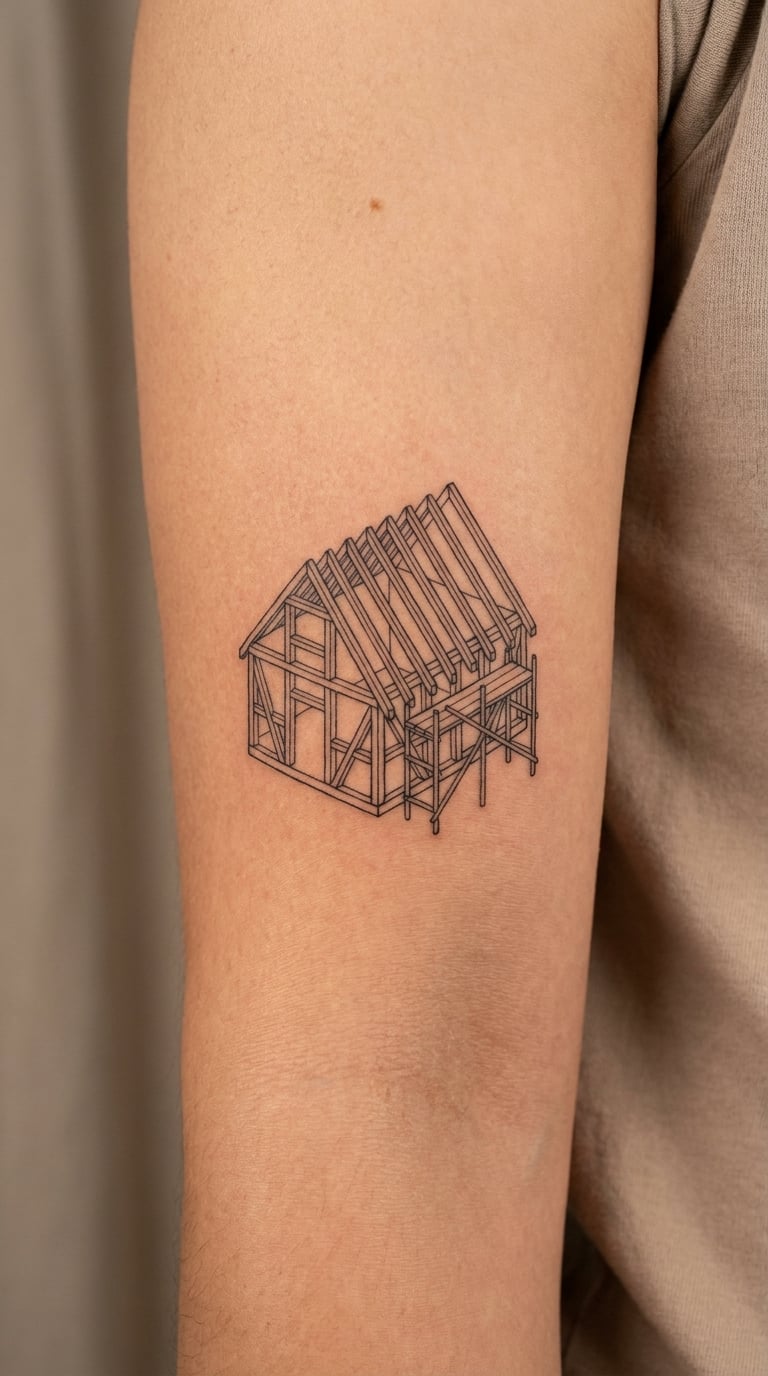
A half-built house: floor and wall framing standing with a roof line not yet covered, a short scaffold on one side, and open sky above. Drawn in single-weight black line with no fill, it is quiet and slightly unfinished on purpose, which is the whole charm of it.
It reads as building and progress rather than any one trade, and there is no fixed meaning attached. That makes it a good choice for someone in the industry who is not in a specific craft.
Placement: inner bicep, where a long vertical drawing sits well. Size: 3-4 inches (7.5-10 cm). Style: minimalist line.
Pain: low, the inner bicep is forgiving. Make it yours: use the framing detail of a real project, or leave the roofline unfinished on purpose and have the artist add the roof years later. Loose single-weight lines fade first, so keep the frame lines firm.
25. Wrecking Ball Blackwork Tattoo
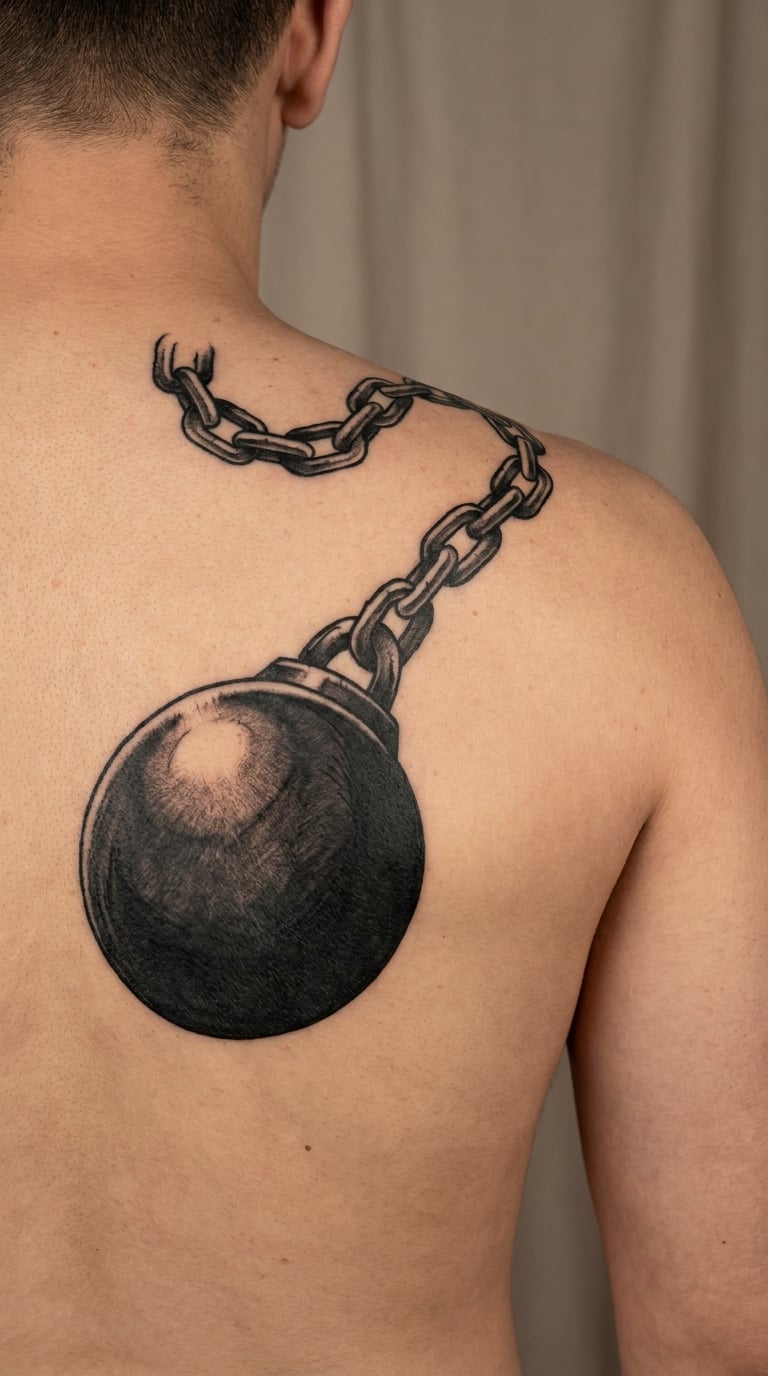
A wrecking ball on its chain, rendered in dense blackwork: solid black mass on the ball, chain links shaded individually, hard contrast against the skin. The heavy form suits blackwork better than any other style because there is so much dark area to hold together the composition.
Demonstration, demolition and rigging crews get the reference. There is no universal meaning, so treat it as the work it comes from rather than a statement with a hidden layer.
Placement: upper back, centred between the shoulder blades, or across one shoulder blade. Size: 6-8 inches (15-20 cm). Style: blackwork with solid shading.
Pain: medium, though the scapula area is awkward to work across. Make it yours: angle the chain as if it is mid-swing, or add a second, smaller ball to show motion. Dense black hides a lot of sun fade, which makes it one of the better choices for a large exposed piece.
How to Choose the Right Design
Six questions settle most of it before you talk to an artist. Ask them in order and the design writes itself.
- How much detail do you want to maintain? Fine blueprint lines, dotwork rivets and hairline dimensions blur within a few years on exposed skin. Solid black shapes, bold traditional colour and filled brickwork hold up with far less intervention.
- Does the motif name your actual trade? A framing square, a claw hammer, a brick trowel, an I-beam and rebar each point at a different craft. If you cannot name your tool precisely, the artist will guess, and the guess usually lands wrong.
- Where does the skin stay still? Forearms, upper arms, chests, calves and upper backs sit still and heal evenly. Wrists, inner elbows, hands, knuckles and ankles flex all day, which is why carpenters and ironworkers in online tattoo communities talk about scheduling around it.
- What size are you actually committing to? The difference between a 2-inch hard hat and a 7-inch steel frame is not scale, it is hours. Both look fine at the same price band, but only one of them is a two-session job.
- Will it survive the job? Hands, knuckles and forearms get glove friction, sawdust, sun and washing. Chest, back and upper arm pieces are easier to cover with clothing and take far less abuse.
- Is it a first piece or an addition? Most trade collections start small and grow into a sleeve. If you already have arm work, plan the flow before choosing, not after. The 20 best ocean sleeve tattoo ideas for stunning arms list shows how spacing works when a full sleeve is the goal.
25 Construction Tattoo Ideas for Men by Style and Placement
Style and placement should be chosen together, not separately. A design that looks correct on a flash sheet can fail completely on the shape it is given.
Bold blackwork — tower cranes, wrecking balls, gear and wrench, brickwork — wants a large flat area: upper back, chest, outer upper arm, outer calf. Blackwork is unforgiving of awkward curves, and it is the most forgiving style when a design has been on skin for fifteen years.
Fine line and technical work — blueprint forearms, drafting compasses, welding sparks, floor plans, house frames — needs a flatter, more protected surface and a line weight that has been pushed heavier than looks right on paper. The inner forearm works, the back of the hand does not.
Traditional and neo-traditional colour — bulldozers, concrete mixers, crossed tool badges — is built for curves. Shoulders, deltoids, thighs and calves are the natural homes because the machine itself follows a curve.
Realism and portraits — worker portraits, tool belts — is about the face or the material, so scale and reference quality decide the result. Bigger is not automatically better here; a well-drawn 3-inch portrait beats a soft 6-inch one every time.
Cost and Session Time
US pricing depends far more on size, detail and how long the artist needs than on the subject matter. A construction tattoo and a portrait of a stranger cost the same at the same size. Rates vary by city, and shop minimums apply.
- Micro, under 1 inch: roughly 80 to 200 dollars, 15 to 30 minutes. Fine for a single tool or a knuckle mark.
- Small, 1-3 inches: roughly 150 to 450 dollars, 45 minutes to an hour and a half. The hard hat minimalist lives here.
- Medium, 3-6 inches: roughly 400 to 1,200 dollars, two to four hours. Most machines and tool compositions sit in this band, and they often need two sessions.
- Large, 6-10 inches: roughly 1,000 to 2,500 dollars, four to seven hours. Steel frames, wrecking balls and chest frameworks. A piece at the 2,000 mark is typically a large single-session job, not a small one.
- Sleeve scale, 12 inches and up: roughly 2,500 to 8,000 dollars and multiple sessions, usually three to five. Bring a clear plan, because reworking a half-finished sleeve costs more than finishing it on schedule.
Hourly rates usually run from about 80 to 200 dollars in the US, and some shops set a minimum charge of 100 to 300 dollars regardless of size. Travel, deposits and touch-ups at no charge within a set period are worth asking about up front.
Aftercare Basics
Always start with your artist’s aftercare instructions, since they know exactly what they did in your skin. Beyond that:
- Keep the area clean and follow the washing and moisturising routine your artist gives you, then leave it alone. No picking, no scrubbing, no soaking.
- Plan around the job. Sweat, drywall dust, sawdust and PPE rubbing a fresh forearm piece are the real risk on a site, not sun exposure alone. Loose long sleeves help more than anything else, and wash the fabric between wears.
- Avoid the sun while it heals, and think twice before taking a hand or forearm piece in late spring or summer. The same applies year-round for work outdoors.
- Watch high-movement areas closely. Wrists, elbows, knuckles and ankles swell and flex during healing, and those are the placements that scar or heal unevenly.
- Book the free touch-up your artist includes, usually within a window of several months. Line weight and shading always shift as a piece settles, and one visit fixes what two years of daylight cannot.
- If you notice spreading redness, heat or a rash that keeps climbing past the tattoo, stop and contact your artist or a healthcare professional rather than treating it yourself.
Frequently Asked Questions
What is the best construction tattoo for a first tattoo?
The hard hat minimalist tattoo on the upper arm is the safest first piece in this theme. It is one simple object, one colour, and it needs around two or three inches of flat space, so it finishes in a single sitting without a long session on a difficult spot. Avoid hands, knuckles and inner forearms for a first tattoo, since those areas flex constantly while they heal.
Do construction tattoos hurt more than other designs?
The subject matters far less than the placement. A bold blackwork wrecking ball across the upper back and a tiny fine-line hard hat behind the ear can feel completely different, and the small one can hurt more because the spot is thin and bony. Choose an upper arm or bicep for a gentler first session, and expect ribs, collarbone, sternum, knuckles and ankles to be the toughest areas.
How small can a construction tattoo be?
Around one inch is realistic for a single symbol such as a hard hat, a framing square or a rivet, and anything with interior detail needs closer to two inches to stay readable. Below three quarters of an inch, fine line softens quickly and small numerals stop being legible within a few years. If the design has more than three elements, scale it up rather than thinning the lines.
Should I choose a tattoo artist who specializes in industrial designs?
A portfolio matters more than a stated speciality, but machinery is a recognisable genre and a shop that works in technical line or traditional flash will already understand mechanical shapes. Look for healed work rather than fresh photos, check the artist handles detail at the size you want, and bring reference photographs of the real machine or tool. Avoid clipart and stencil transfers unless you want a tattoo that looks like everyone else’s.
Which construction tattoo details age the best?
Solid black shapes, bold traditional colour and filled brickwork age best, because there is little fine line to lose. Blueprint linework, dotwork rivets and hairline dimension marks are the most vulnerable, especially on hands, forearms and knuckles that take sun, glove friction and washing. If a design matters to you, ask the artist to build it with heavier line weight and thicker dot sizes than the reference suggests.
Conclusion
If this is your first tattoo, go with the hard hat minimalist design. It is quick, quiet and forgiving, and you will still be able to add a tool piece or a full sleeve to that arm in ten years without anyone thinking the two do not belong together.
If you have already got arm work and want something with weight, the excavator forearm tattoo or a blackwork sleeve built around the wrecking ball is the stronger pick. Either way, the first move is simple: find an artist, look only at healed work in their portfolio, and bring a photograph of the real tool or machine rather than a tattoo you found online.