24 Basketball Tattoo Ideas for Players: Best 2026 Designs
Vini
September 29, 2026
Table Of Contents
Basketball tattoos fall into two camps: the loud ones that announce your team from across a bar, and the quiet ones only you will ever read properly. This list covers 24 basketball tattoo ideas across both, from a two-inch outline on the wrist to a six-inch winged ball across the upper back. Every entry gives you the design, a realistic size, the placement that suits it, an honest pain note, and one way to make it yours.
If you have never been tattooed, you probably recognise the feeling behind half of these ideas. You have liked forty images and committed to none, mostly because a permanent design feels like a bigger decision than picking a game for a Saturday. It helps to know that most of the pieces below work at a small scale, that a ball with a hoop means as much as a full sleeve, and that a decent artist will redraw any reference onto your own skin before the first line goes in.
24 Basketball Tattoo Ideas: Quick Guide
Idea
Style
Best placement
Size
Pain
1. Fine-line ball and shooting star
Fine line
Inner forearm
2.5-3 in
Low
2. Minimal ball outline
Minimalist
Outer wrist
1.5-2 in
Low
3. Traditional ball with jersey number
Traditional
Upper arm
3.5-4.5 in
Medium
4. Watercolor basketball splash
Watercolor
Shoulder
4-5 in
Medium
5. Jump-shot silhouette
Blackwork
Forearm
4-4.5 in
Medium
6. Hoop and court line
Fine line
Ankle or collarbone
2.5-3 in
Low
7. Ball in an open hand
Black and grey realism
Inner upper arm
3-3.5 in
Medium
8. Dribbling sneaker
Black and grey realism
Calf
4.5-5.5 in
Medium
9. Retro sunburst ball
Traditional retro
Upper arm
3.5-4 in
Medium
10. Micro-realism net
Micro-realism
Side of forearm
2-2.5 in
Medium
11. Dribble motion lines
Blackwork
Lower leg
3-3.5 in
Medium
12. Hoop with mountain horizon
Fine line
Forearm
3.5-4 in
Low
13. Crossed ball and seam
Bold graphic
Upper arm
3-3.5 in
Medium
14. Dunk in dotwork
Dotwork
Shoulder
4.5-5.5 in
High
15. Number with nameplate
Traditional
Upper arm
3.5-4 in
Medium
16. Court inside a heart
Fine line
Upper chest
2.5-3 in
Low
17. Vintage ball badge
Blackwork badge
Outer upper arm
2.5-3 in
Medium
18. Ball and laurel wreath
Traditional
Forearm
3.5-4 in
Medium
19. Micro-realism dribbling foot
Micro-realism
Shin
3.5-4.5 in
Medium
20. Winged basketball
Black and grey
Upper back
5.5-6 in
Medium
21. One-line ball and hoop
One-line
Behind the ear
1.5-2 in
Low
22. Neo-traditional player
Neo-traditional
Upper arm
4.5-5.5 in
High
23. Homecoming ball and house
Fine line
Chest or ribs
3.5-4 in
Low
24. Fingerprint basketball
Fine line abstract
Forearm
2.5-3 in
Low
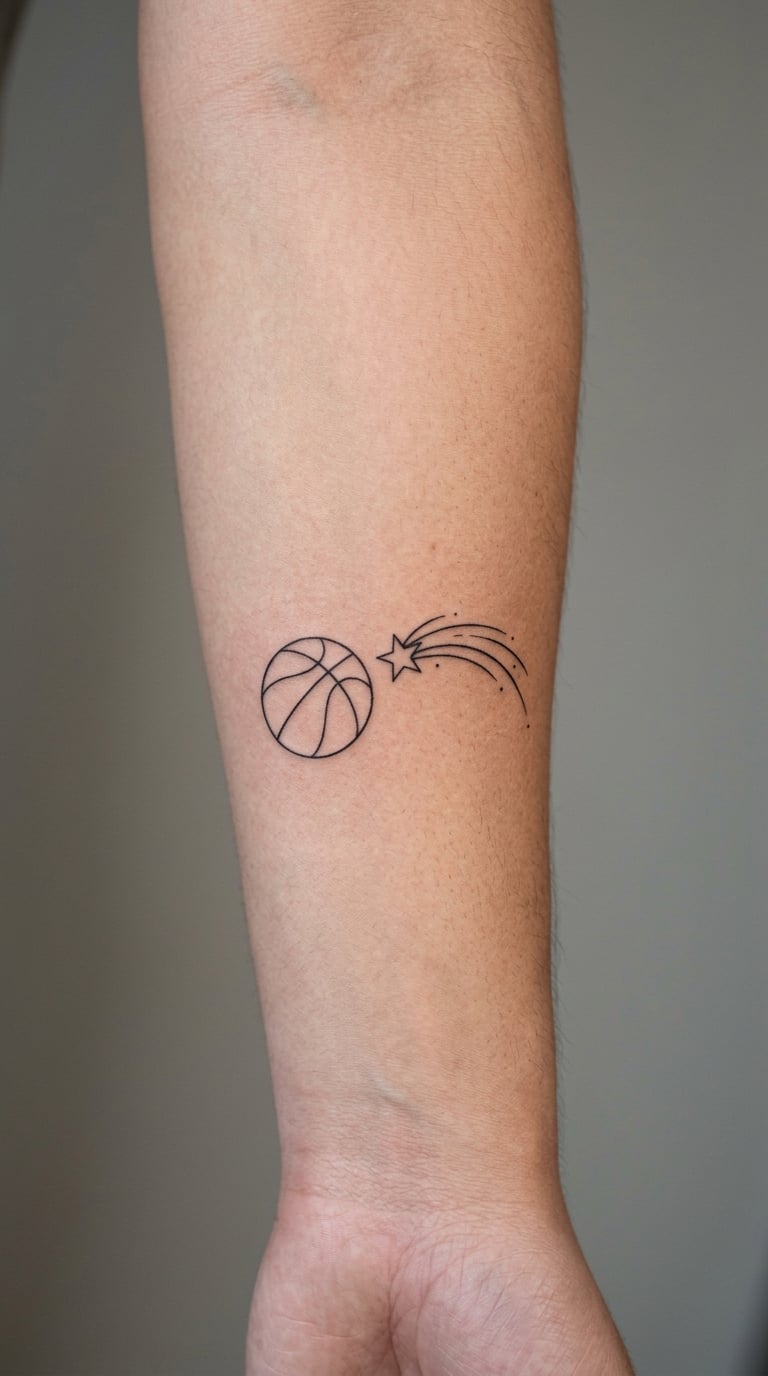
1. Fine-Line Basketball and Shooting Star
One single-needle ball, two curved seam lines, and a small star with a short trail trailing off it. The whole thing is drawn in one pass, which is why it looks light even though the ball sits over a fairly dense area of forearm. The star can be a five-point outline or a filled solid, depending on how much contrast you want.
Players choose this one because the shooting star adds motion without adding size. It says ambition and a bit of luck, and it keeps a first tattoo from feeling like a commitment to a style you may outgrow.
Placement: inner forearm, wrist crease to mid-forearm, or the flat of the upper chest near the collarbone. Size: 2.5 to 3 inches wide. Style: fine line. Pain: low on the inner forearm, though the wrist crease stings a little. Make it yours: add the year you started playing, or a second star for a second child.
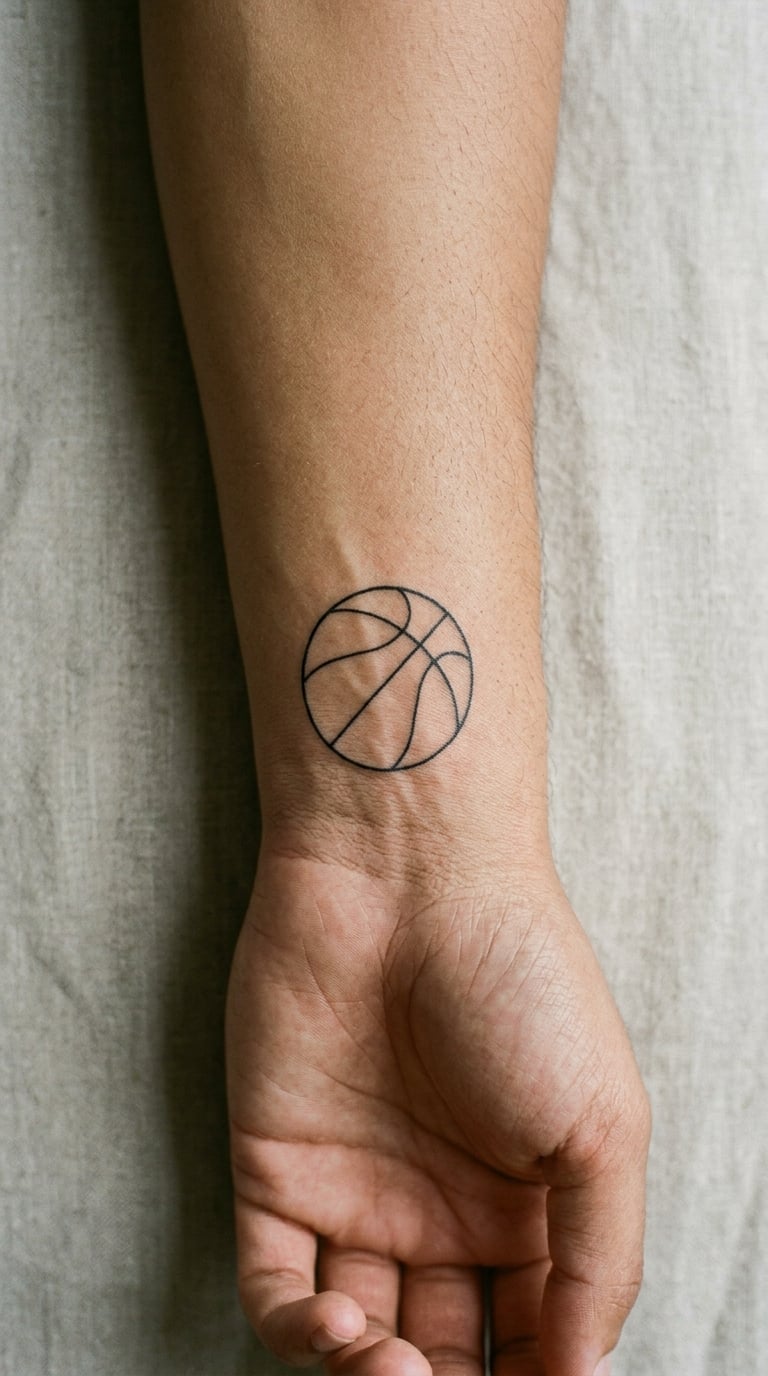
2. Minimal Basketball Outline on the Wrist
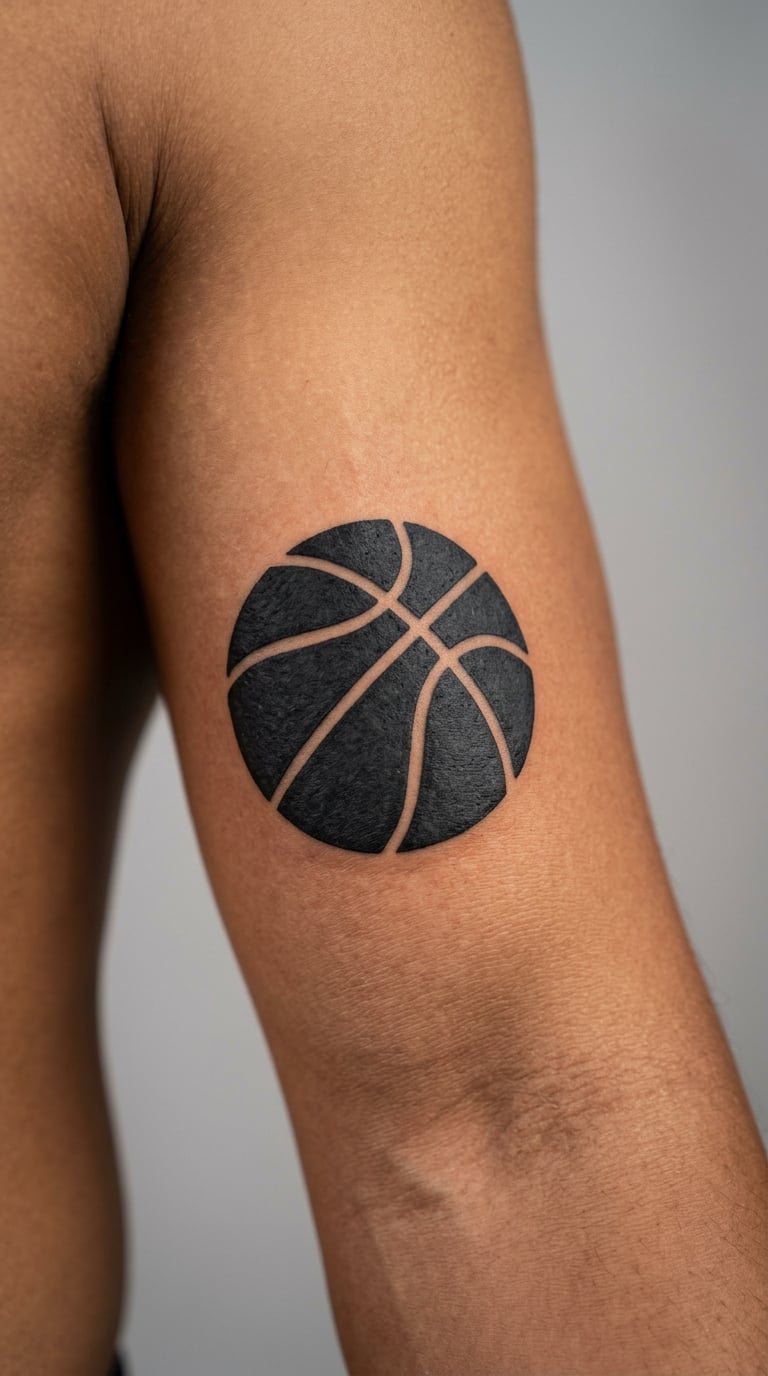
This is the whole design: a circle, two arcs, one vertical line. No shading, no color, no fill. Done in a single weight of line, it reads as a piece of clean geometry rather than a sports logo, which is exactly why it ages well and hides completely under a dress shirt cuff.
It suits anyone who plays or watches but does not want a tattoo that announces itself in a meeting. The risk is over-detailing: a one-inch version with eight seam segments turns into a smudge, so keep the line count low and let the shape do the work.
Placement: outer wrist, inside the wrist crease, or behind the ear. Size: 1.5 to 2 inches wide. Style: minimalist line work. Pain: low to medium, since wrist bone sits close to the surface. Make it yours: use your birth month number as one of the seam curves, or go black-and-grey instead of pure line work.
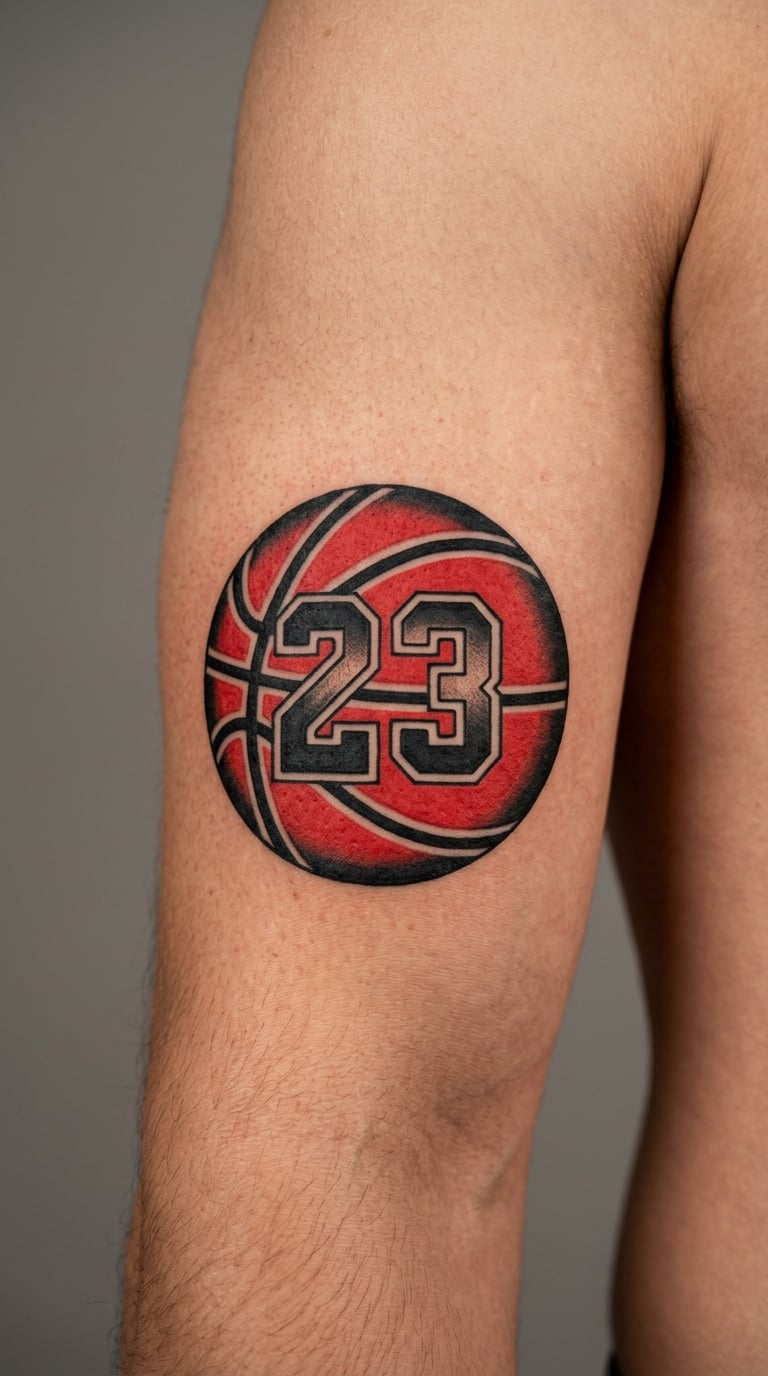
3. Traditional Basketball with a Jersey Number
Old-school black outlines, a warm orange ball, and a block number tucked into the lower third of the design. Traditional ball tattoos have a slightly chunky, confident line weight that survives years better than hairline detail, and the number gives the composition a second focal point instead of letting the ball float alone.
The number usually means something specific: a youth jersey, a college season, a grandparent’s number, or a number a player wore in high school. That specificity is the point. A generic ball is decoration, a ball with a number is a record.
Placement: outer upper arm, or chest on the off side of the sternum. Size: 3.5 to 4.5 inches wide. Style: traditional. Pain: medium on the upper arm, medium-high over the bicep curve. Make it yours: add the year in small numerals under the seam, or the city you played in.
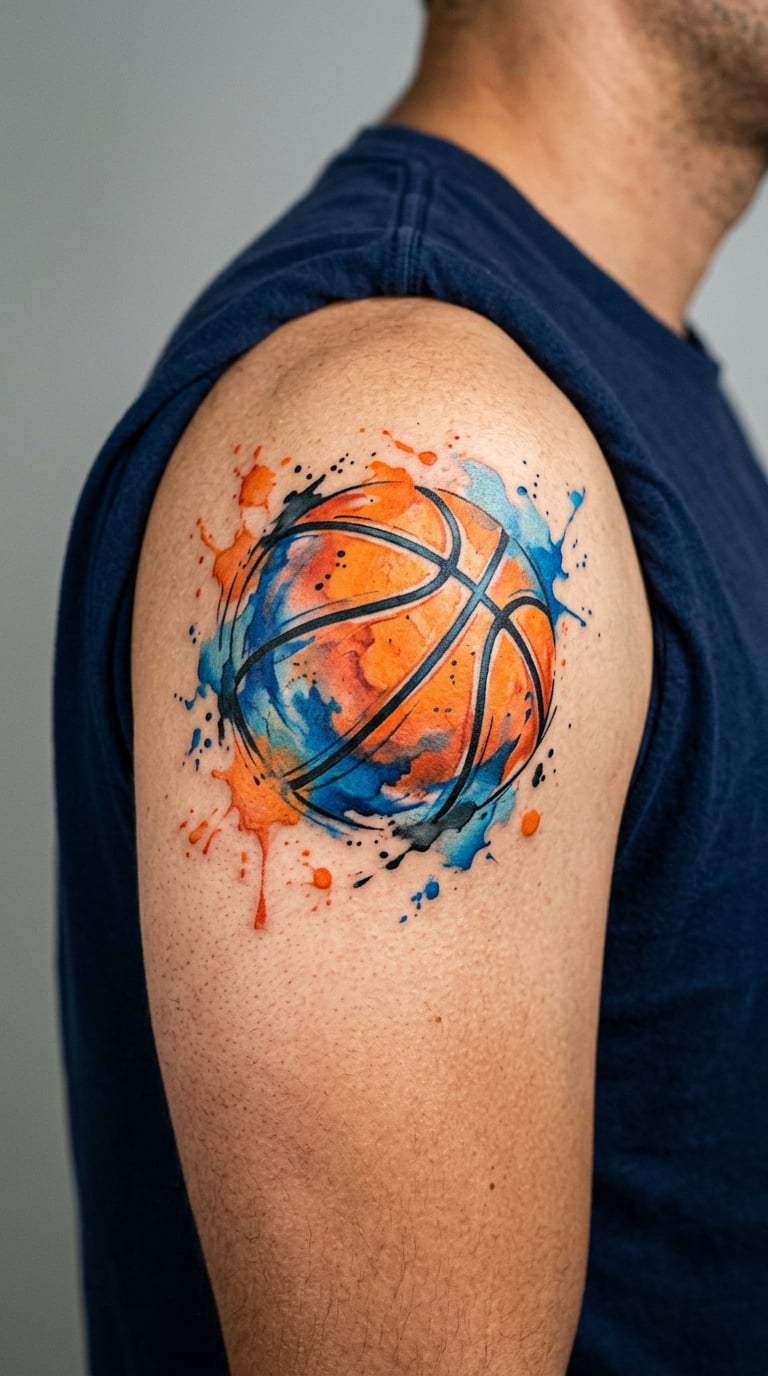
4. Watercolor Basketball Splash
Soft bleeding edges, a ball rendered in loose orange and blue washes, and paint flicking outward in four or five directions. Watercolor tattoos have no hard outline, so the design fades outward into the skin rather than stopping dead. That makes them forgiving of a slightly awkward body shape and surprisingly hard to copy badly.
They are the opposite of idea 2 in temperament. If the minimal outline says I do not need to explain it, the watercolor says I do not mind explaining it. Good for a shoulder or a calf where there is flat space for the color to breathe.
Placement: shoulder cap, outer upper arm, or calf. Size: 4 to 5 inches wide. Style: watercolor. Pain: medium, and longer sessions because color needs rebuilding in layers. Make it yours: pick two colors from your team palette and let the splashes carry them.
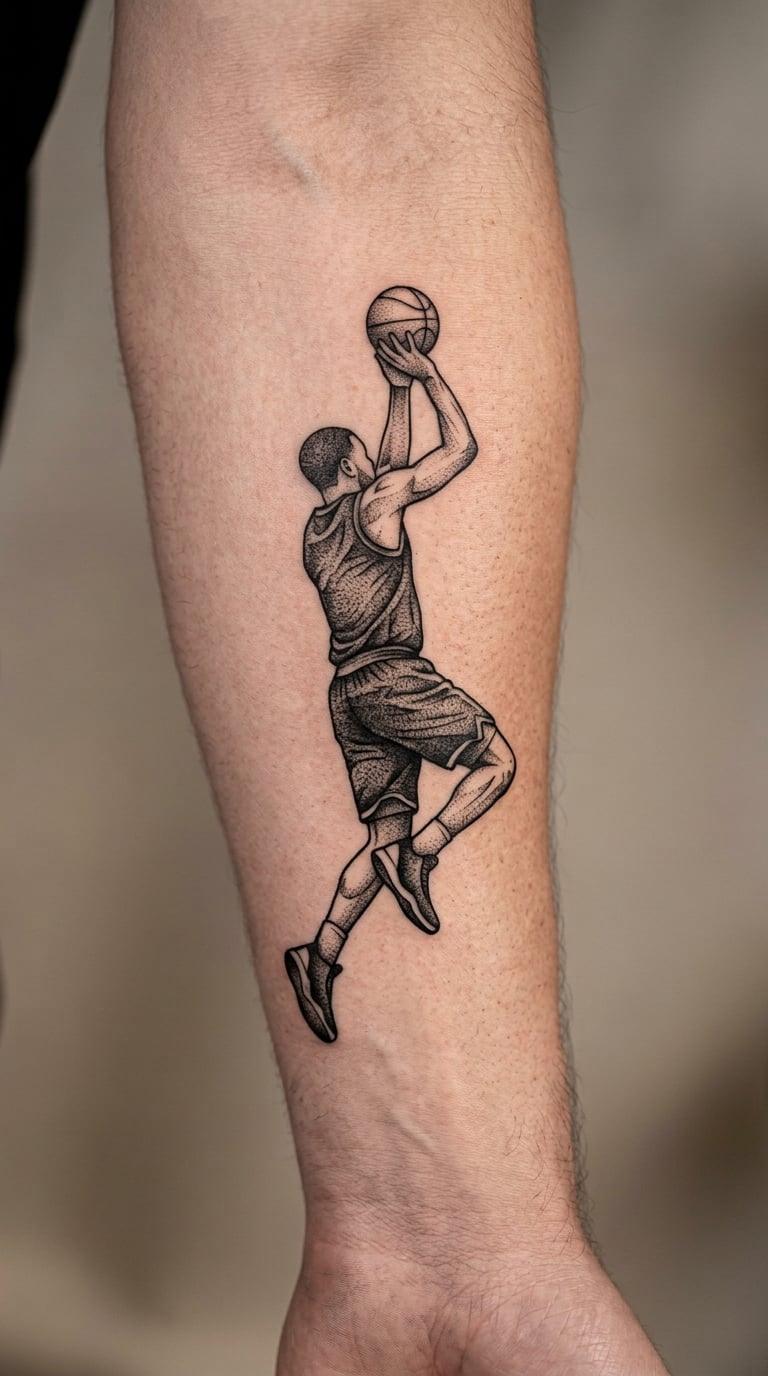
5. Jump-Shot Silhouette in Blackwork
A solid black figure, no facial features, weight on the back foot, shooting arm extended with the ball above the head. Silhouettes remove the hard part of figurative work, because there is no expression to get wrong and no anatomy to argue about. What is left is a shape that reads instantly as basketball from across a room.
The pose is the message. People pick the jump shot over the dunk because the jumper looks like technique and practice rather than spectacle, which usually maps to how they played or how they see themselves.
Placement: inner or outer forearm, or the calf with the ball pointing up. Size: 4 to 4.5 inches tall. Style: blackwork. Pain: medium, worse where the solid fill crosses the forearm bone. Make it yours: add a thin halo of motion lines behind the ball, or mirror it on the opposite arm.
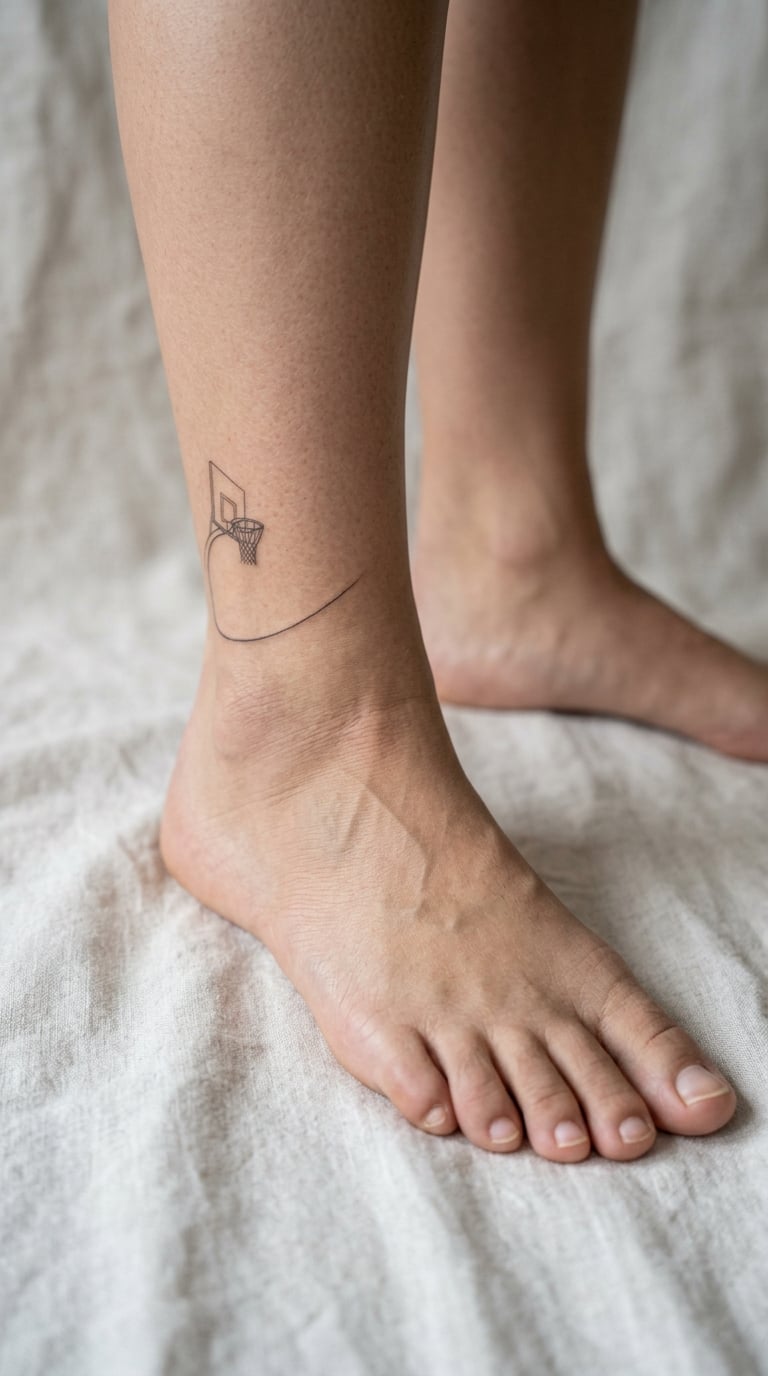
6. Dainty Hoop and Court-Line Tattoo
A rim seen head-on, a net suggested with a few crossing lines, and one long curve underneath that reads as a court marking. Very little ink, a lot of air. The whole design can be described in three strokes, which makes it quick to tattoo and easy to place almost anywhere.
Fans pick the hoop over the ball because the basket is the game itself. The rim is the thing you actually aim at, and a small hoop on an ankle is a private signal that only shows in summer.
Placement: ankle bone, inner wrist, or just below the collarbone. Size: 2.5 to 3 inches. Style: fine line. Pain: low, though the ankle bone is a tender spot on some people. Make it yours: swap the court line for a specific longitude and latitude from a court that matters to you.
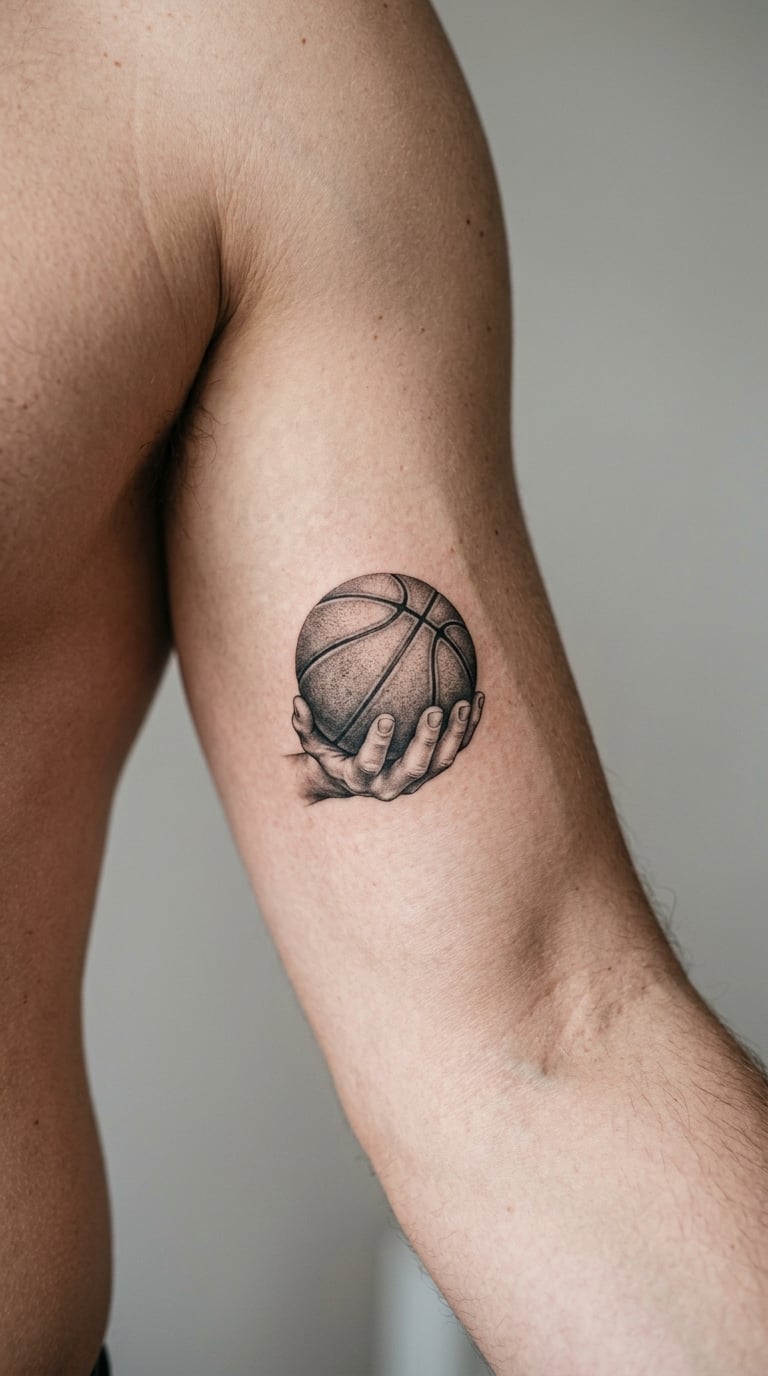
7. Basketball in a Player’s Hand
A hand cupped under a ball, fingers slightly spread, the ball resting on the palm with the seam lines running over the curve. The realism is in the shading, not the detail: soft grey under the fingers, a highlight on the top of the ball, and enough contrast that the hand reads as a hand in under an inch of space.
People choose it for what it implies. A ball sitting in an open palm is control, possession, the moment before the pass. It is a quieter design than a dunk and easier to live with.
Placement: inner upper arm, rib area, or the inside of a forearm. Size: 3 to 3.5 inches. Style: black-and-grey realism. Pain: medium, and a longer sitting because of the gradation work. Make it yours: mirror a second hand on the other arm, both palms up, so the balls face each other.
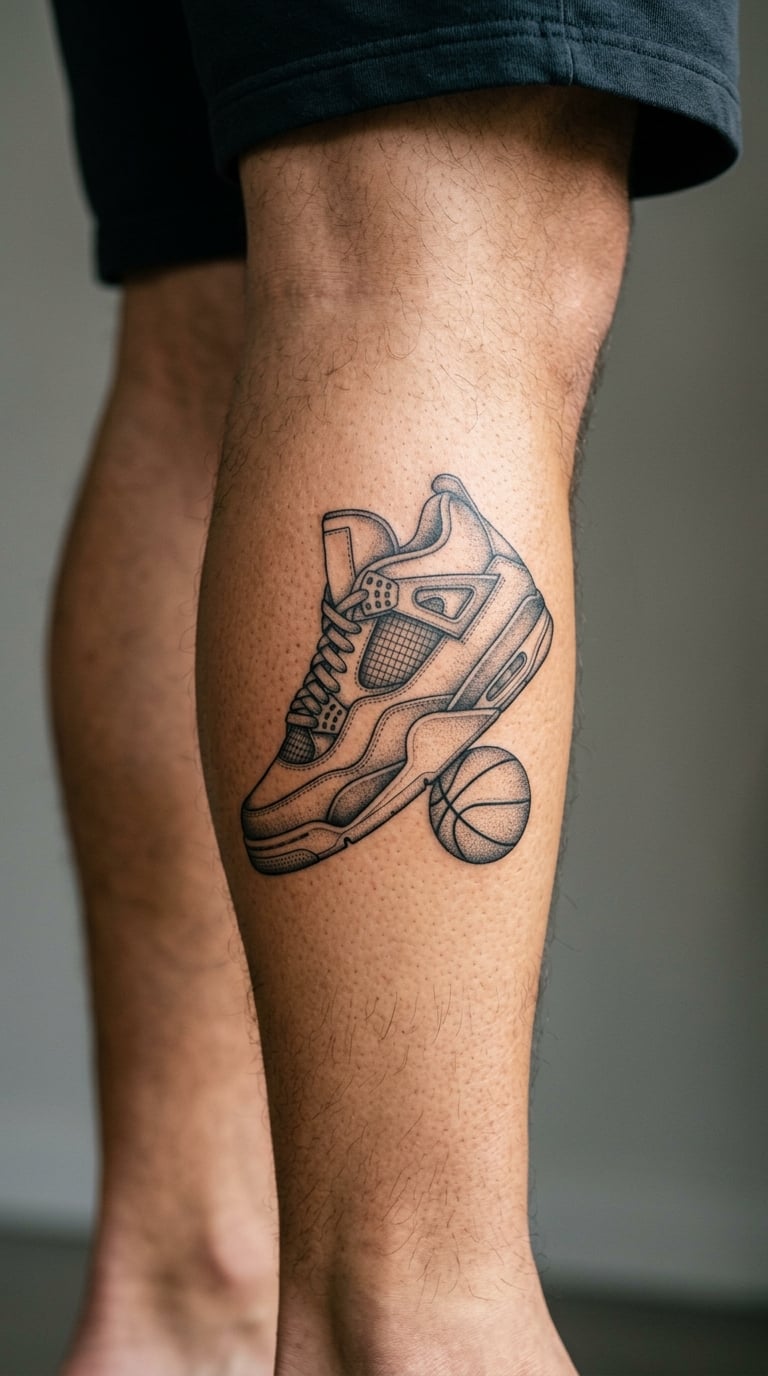
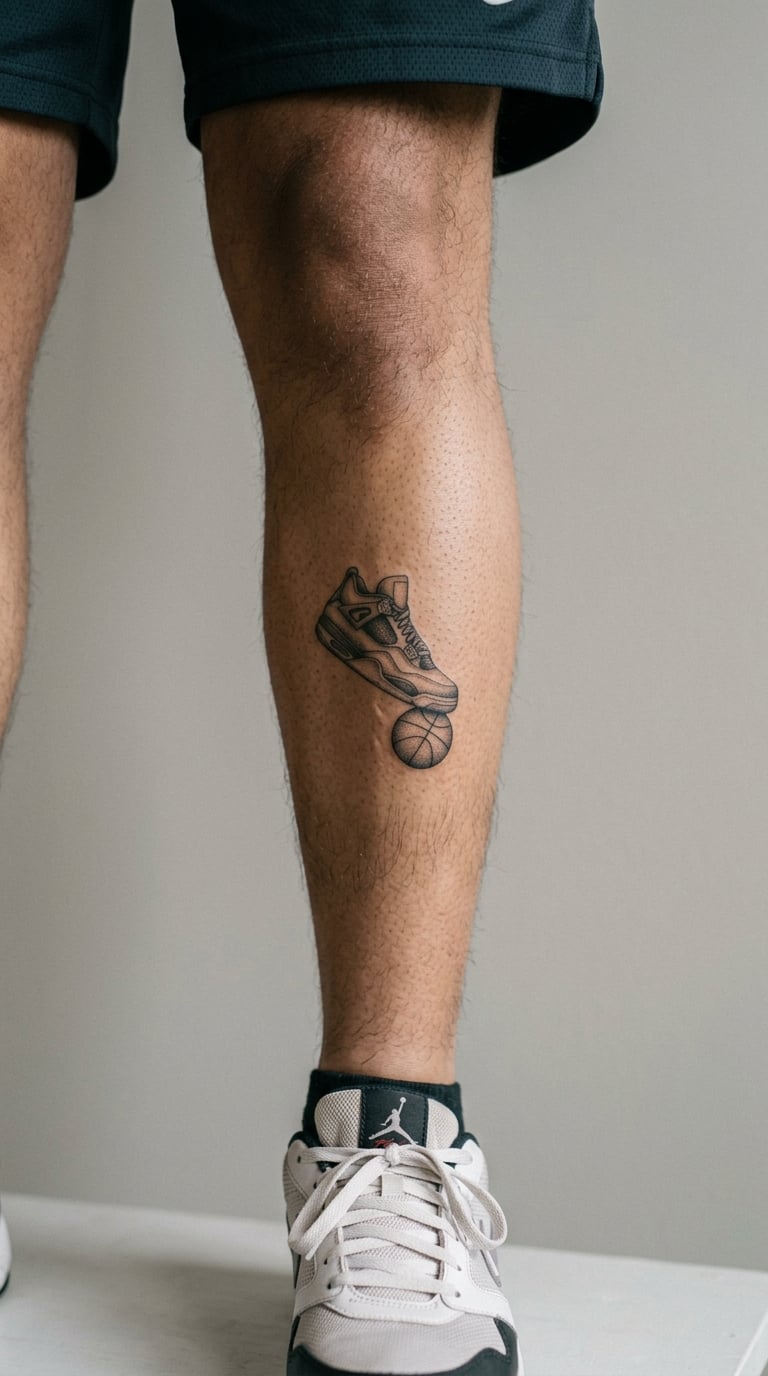
8. Dribbling Sneaker Tattoo
A high-top or mid-top shoe in profile with a small ball beside it and a couple of ground lines underneath. Ask for a generic silhouette, no laces logo, no side stripe, no brand marks. That request alone keeps you out of trademark trouble and usually gets you a cleaner piece anyway.
This is a design for anyone whose basketball life happens on the way to the gym rather than on a court. It is popular with players and with sneaker people who happen to play, and it holds up well on a calf because the calf is straight and the shoe is a horizontal shape.
Placement: outer or inner calf, or forearm with the shoe running lengthwise. Size: 4.5 to 5.5 inches long. Style: black-and-grey realism. Pain: medium on the calf, higher over the shin bone. Make it yours: specify the exact model of shoe you wore most, described rather than shown, so the artist can draw the shape without the logo.
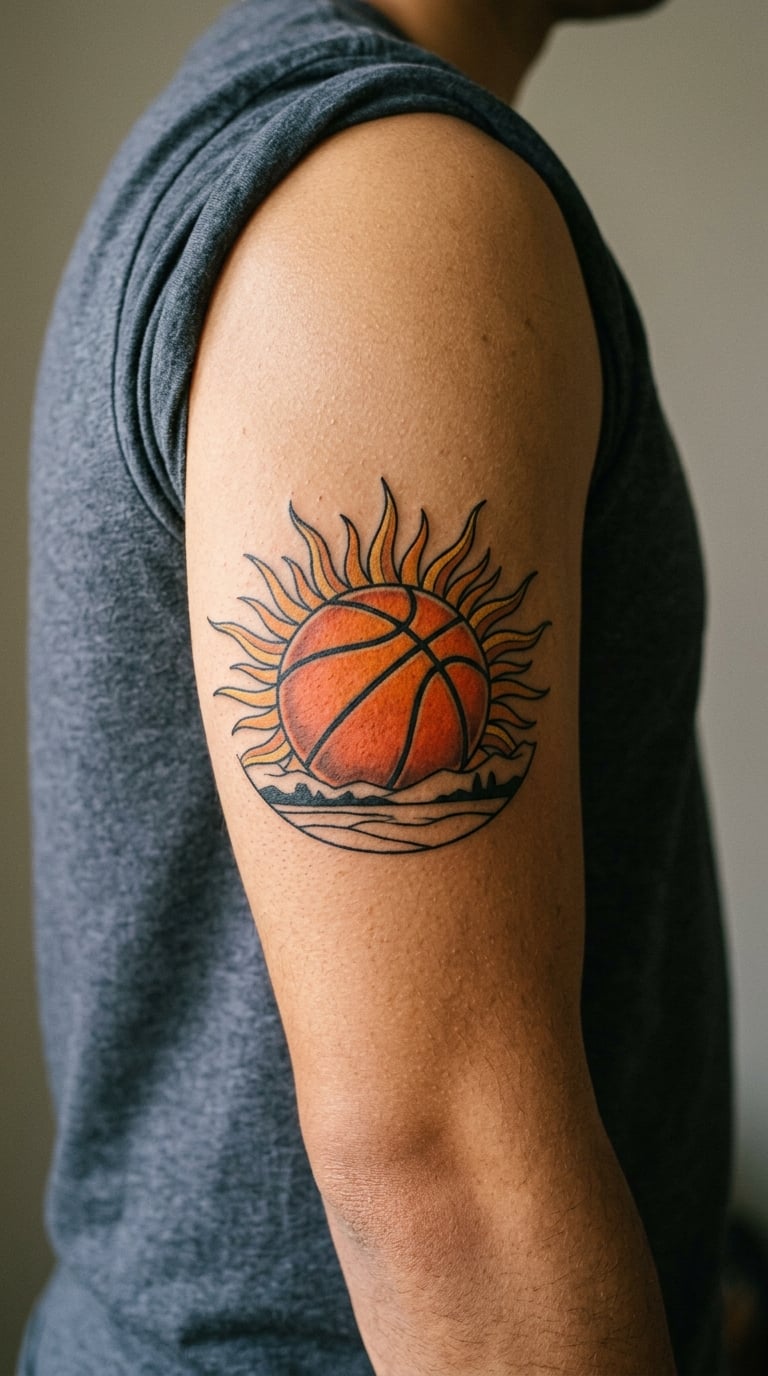
9. Retro Basketball Sunburst
An orange ball sitting in front of a low sun with straight rays radiating outward, the whole thing framed by a slight arc. It is printed-poster design rather than tattoo design, which is the appeal. Retro basketball art shows up on vintage yearbooks, gym signage and warm-up shirts, and this piece pulls that palette directly.
It suits people who remember watching the game on a smaller screen, or who want a tattoo with a warm color story rather than a black silhouette. The rays give it movement without needing a figure.
Placement: upper arm, or centered on the chest with the arc following the collarbone. Size: 3.5 to 4 inches wide. Style: traditional retro. Pain: medium; the inner upper arm is more sensitive than the outer. Make it yours: make the sun a specific color from your childhood team rather than plain orange.
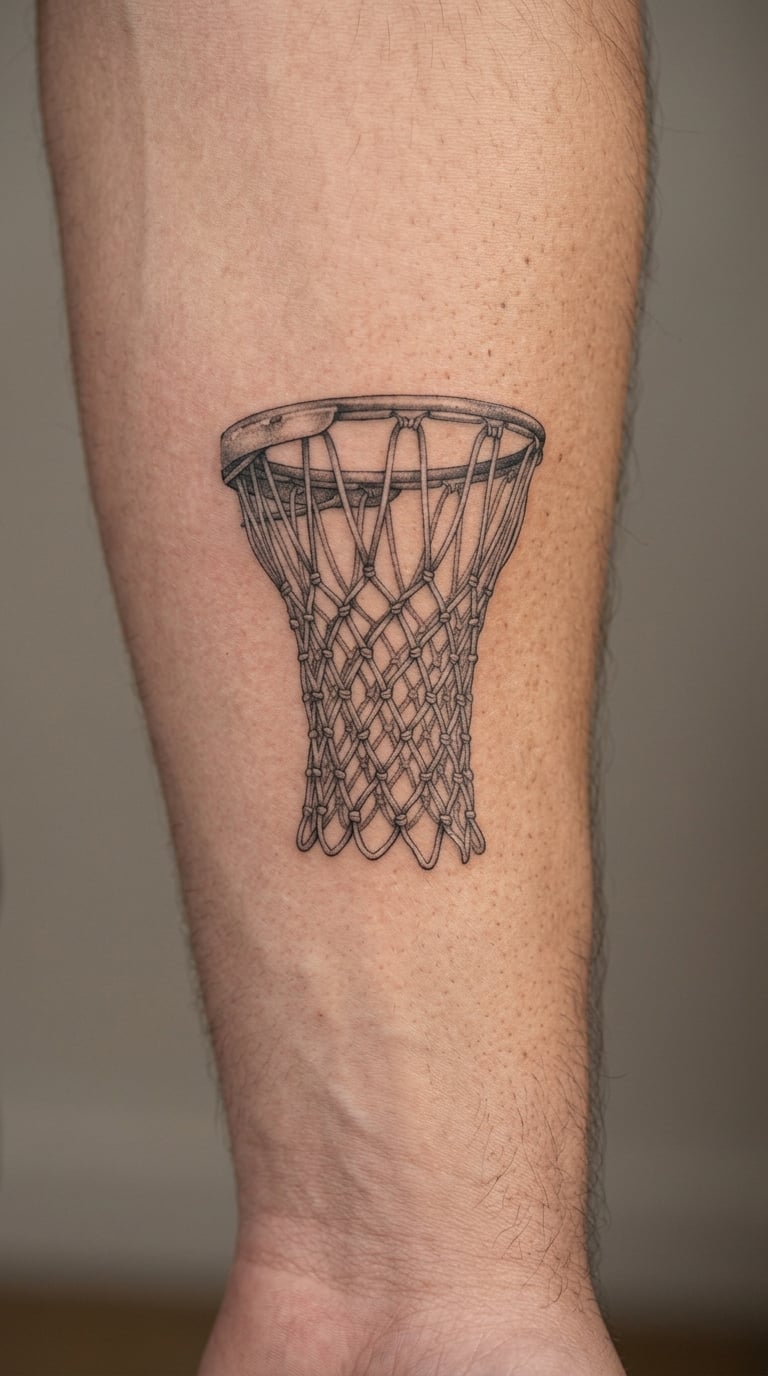
10. Micro-Realism Basketball Net
A fragment of rim at the top, with a net rendered as interlocking diamond mesh hanging below it, each crossing shaded so the pattern reads as woven rather than printed. The trick is the negative space: the gaps in the mesh stay skin, which is what makes it look airy at a small scale.
A net alone is a good standalone symbol. It represents the target, the result, the part that has to be finished. It also works as a filler or a companion piece for an existing hoop design.
Placement: side of the forearm, lower back, or the inside of a calf. Size: 2 to 2.5 inches. Style: micro-realism. Pain: medium, and detail-heavy work takes its time. Ageing note: the smallest mesh lines soften within a few years, so go slightly larger than you think. Make it yours: add a single ball passing through the net, moving in one direction.
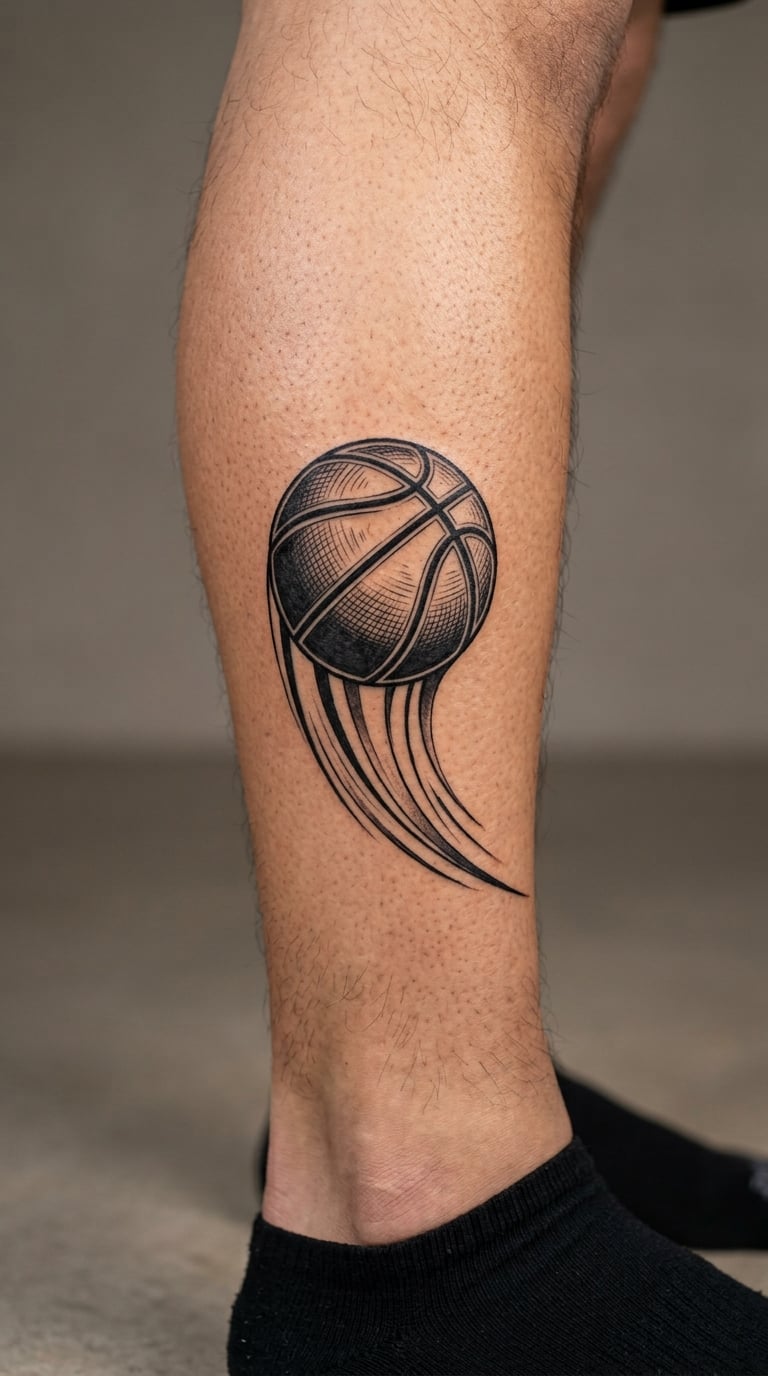
11. Basketball Dribble Motion Lines
A ball on its own, dropping, with three or four curved lines sweeping out beneath it to suggest the bounce. No hand, no figure, just the ball and the movement. Black fill on the ball against open skin for the lines makes the whole thing read at a distance, which is why it photographs well.
The meaning is rhythm. It is a small, graphic way of saying the game never stops, and it pairs well with a second piece on the other leg if you want symmetry without going full sleeve.
Placement: lower leg, forearm, or the calf with the lines wrapping the ankle. Size: 3 to 3.5 inches wide. Style: blackwork. Pain: medium on the calf, low on a soft inner forearm. Make it yours: use four lines for four years of playing, or a single line for a minimalist version.
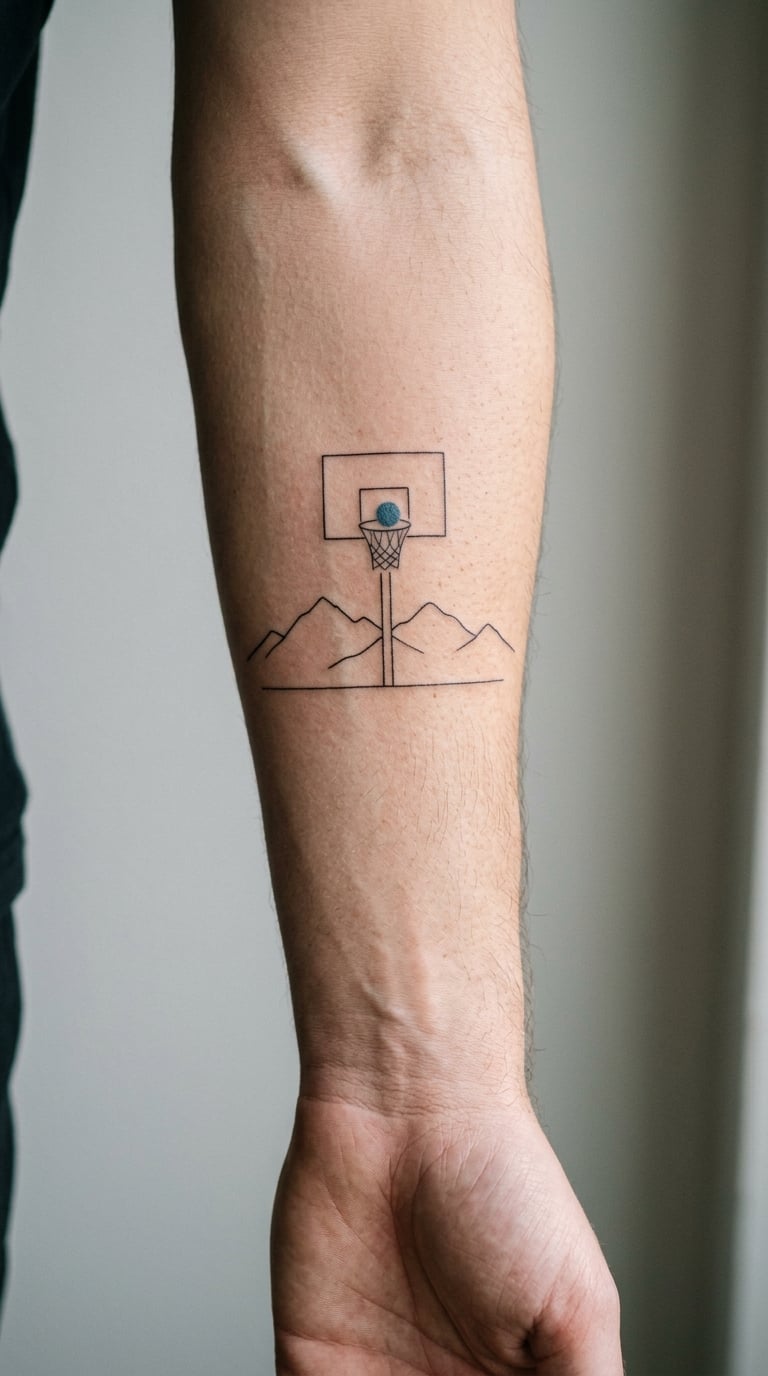
12. Basketball Hoop with Mountain View
A rim and backboard in thin line, and behind it a row of simple mountain peaks with one horizon line running underneath. One muted color, usually a dusty blue, fills only the sky band or one ridge. It is a travel-tattoo idea that happens to have a basketball in it.
The mountains usually mean a place: where you grew up, where you went to school, somewhere you wanted to be on court instead. Pairing it with a hoop keeps the sentiment from getting too heavy. I have seen this idea come up a lot with mountain and ocean tattoo ideas because the landscape element does the emotional work.
Placement: outer forearm, or the calf where the peaks run around the leg. Size: 3.5 to 4 inches wide. Style: fine line with light color. Pain: low to medium. Make it yours: draw the actual ridge line from a photograph of the place rather than a generic peak.
13. Crossed Basketball and Baseball Seam
A solid black basketball with two curved seam lines crossing over it at an angle, like a woven mark rather than a logo. The lines can belong to a baseball, a football, or simply be curved strokes that suggest another sport without naming one. It is a graphic piece, and it reads cleanly from across a room.
This is for the multi-sport household. Plenty of people who love basketball also spend weekends on a field or a court of another kind, and a single crossed motif is easier to wear than two separate tattoos that never quite match.
Placement: upper arm, or centered on the forearm with the lines running along the bone. Size: 3 to 3.5 inches wide. Style: bold graphic. Pain: medium over the upper arm. Make it yours: use the stitch pattern of a real ball seam. Similar geometric thinking shows up in tattoo ideas for cyclists for the same reason.
14. Basketball Player Dunk in Dotwork
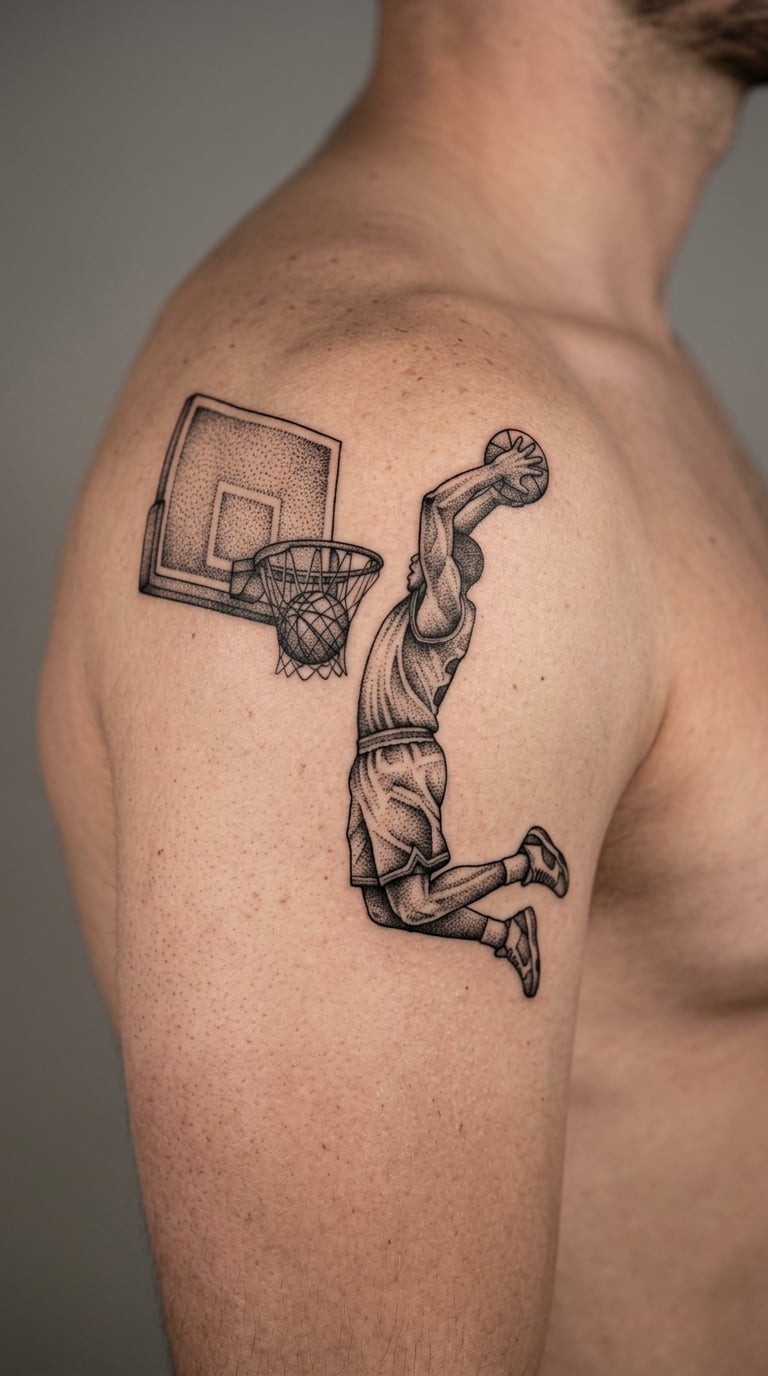
A figure stretched upward with one arm extended to the rim, built entirely from graduated dots. The density does the shading: tight black packing in the shadow side of the body, loose open dots in the lit side, and a fade at the edge so the figure emerges from the skin instead of sitting on it. The hoop is a simple arc with a partial net.
Dotwork rewards patience and it is unforgiving of impatience. This is not a design for a first appointment. It is the one to book when you have found an artist whose dot spacing you actually like.
Placement: shoulder cap, upper arm, or the outer back. Size: 4.5 to 5.5 inches tall. Style: dotwork. Pain: high, because the shoulder and upper arm are both bony and tender. Make it yours: reverse the dot gradient so the dunking arm is the light part, which reads very differently at a glance.
15. Number and Basketball Nameplate
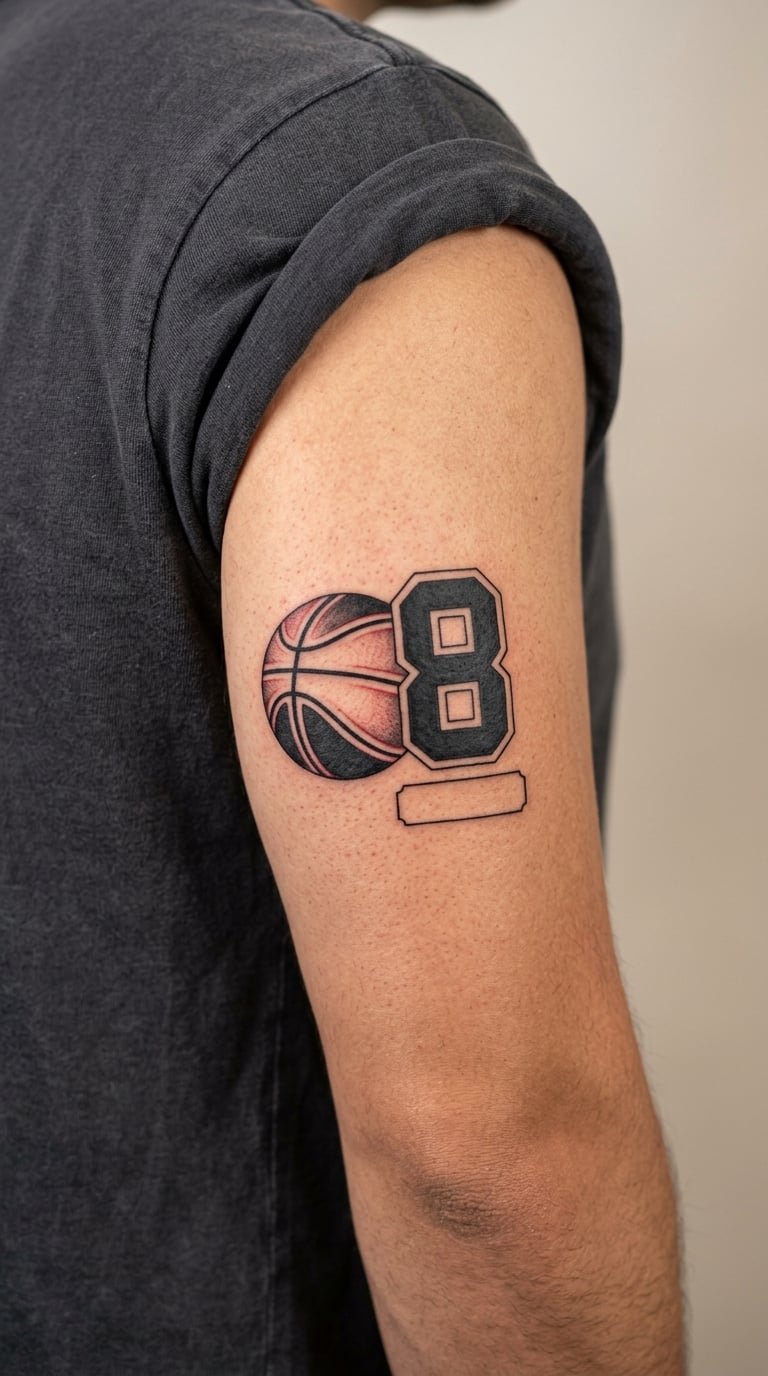
A ball in traditional shading, a block jersey number beside it, and a small banner underneath carrying a short word. The banner is the part that changes the design from sports art into something personal: a surname, a street name, a gym, or a single word like home or grind.
Numbers carry more regret risk than most tattoo decisions. Ask yourself whether you would keep a pro player’s number if that player were traded tomorrow. A number you wore yourself is a much safer bet, and it means more anyway.
Placement: upper arm, or on the calf with the number reading vertically. Size: 3.5 to 4 inches wide. Style: traditional. Pain: medium. Make it yours: set the word in the banner to something only a teammate would understand, and leave it unexplained in public.
16. Basketball Court Inside a Heart
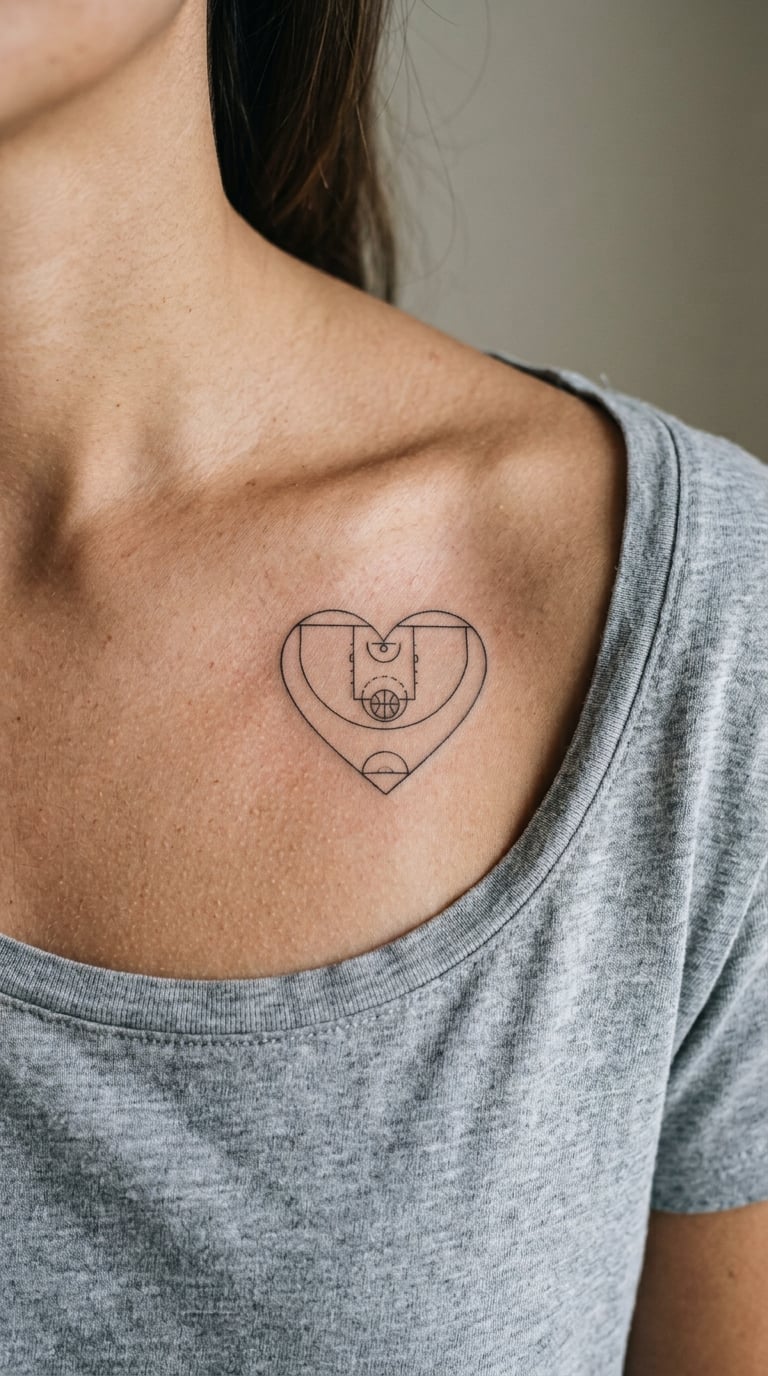
A simple heart outline with half-court markings inside it: the center circle, the free-throw arc, the baseline. One small ball sitting in the paint, no bigger than a fingertip. Nothing is filled, so the design stays light and the chest shows through the shape.
It is a sentimental design that still looks like a sports tattoo, which is the hard balance. People choose it for a family member, a teammate, a child, or a court that was theirs. Fine lines inside a heart tend to blur, so keep the court markings to two or three arcs.
Placement: upper chest near the collarbone, or inner forearm. Size: 2.5 to 3 inches tall. Style: fine line. Pain: low, though collarbone and sternum are noticeably sensitive. Make it yours: add one small date beneath the heart, at the same line weight as everything else.
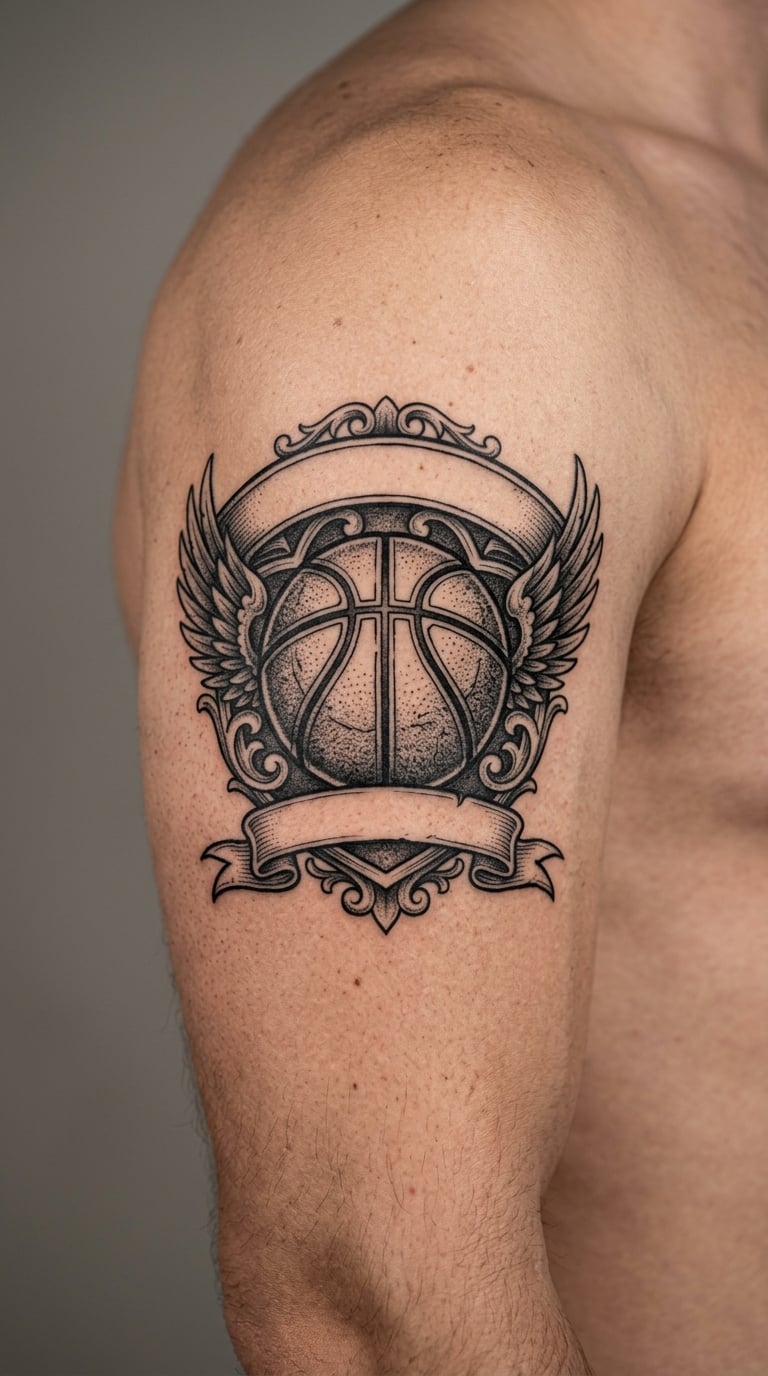
17. Vintage Blackwork Basketball Badge
A circular badge with a thick outer ring, a ball in the center, and an arched band following the top curve of the ring. Left blank or filled with your own words, this is the design for someone who wants a team crest without carrying a licensed one. Fraternity, school, city, or a gym name all work.
Badges are a good pick for a first tattoo because the shape is inherently tidy. It fills a space cleanly, it looks deliberate in a photo, and it hides under a sleeve without looking empty.
Placement: outer upper arm, or centered between the shoulder blades. Size: 2.5 to 3 inches wide. Style: blackwork badge. Pain: medium on the upper arm. Make it yours: use your hometown name arched across the top and the year you started under the ball, with no team mark anywhere.
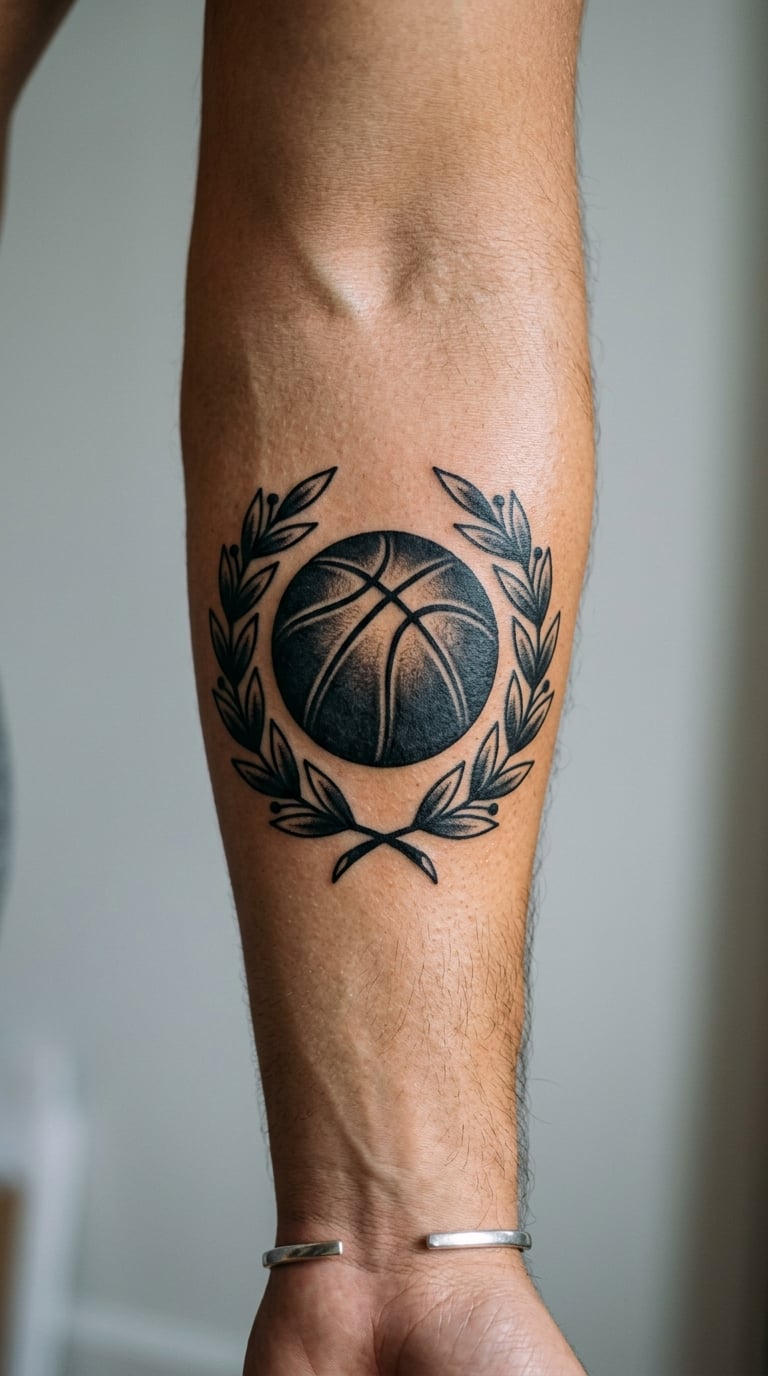
18. Basketball and Laurel Wreath
A ball in the middle with a laurel branch curving up on each side, leaves individually drawn, stems meeting at the base. Symmetry does most of the work here. The composition looks finished from any angle and gives a small central subject the visual weight of something much larger.
Laurel has meant victory in Western art for a long time, so it turns a plain ball into a commemorative mark. That makes it the right frame for a championship season, a final game, or a tribute, and a wrong frame if you just want a ball.
Placement: forearm, calf, or centered on the chest. Size: 3.5 to 4 inches wide. Style: traditional. Pain: medium, and the many small leaves mean a longer sitting. Make it yours: engrave two dates, one at each end of the stem base, instead of a single one.
19. Micro-Realism Dribbling Foot
A foot in a plain shoe, ankle angled, with a small ball trapped against the inside of the foot as if mid-crossover. The detail goes into the laces, the stitching and the soft shadow under the arch. No logos, no color, just grey gradation doing the describing.
It is a design about the part of the game nobody films. The crossover, the footwork, the half second of control. That tends to be what people miss most when they leave the game, and it makes a smaller piece than a full dunk scene while carrying more personal weight.
Placement: shin, inner calf, or the inside of a forearm rotated slightly. Size: 3.5 to 4.5 inches. Style: micro-realism. Pain: medium on the shin, high over the bone itself. Make it yours: describe the exact shoe and sock you wore in the game that mattered most.
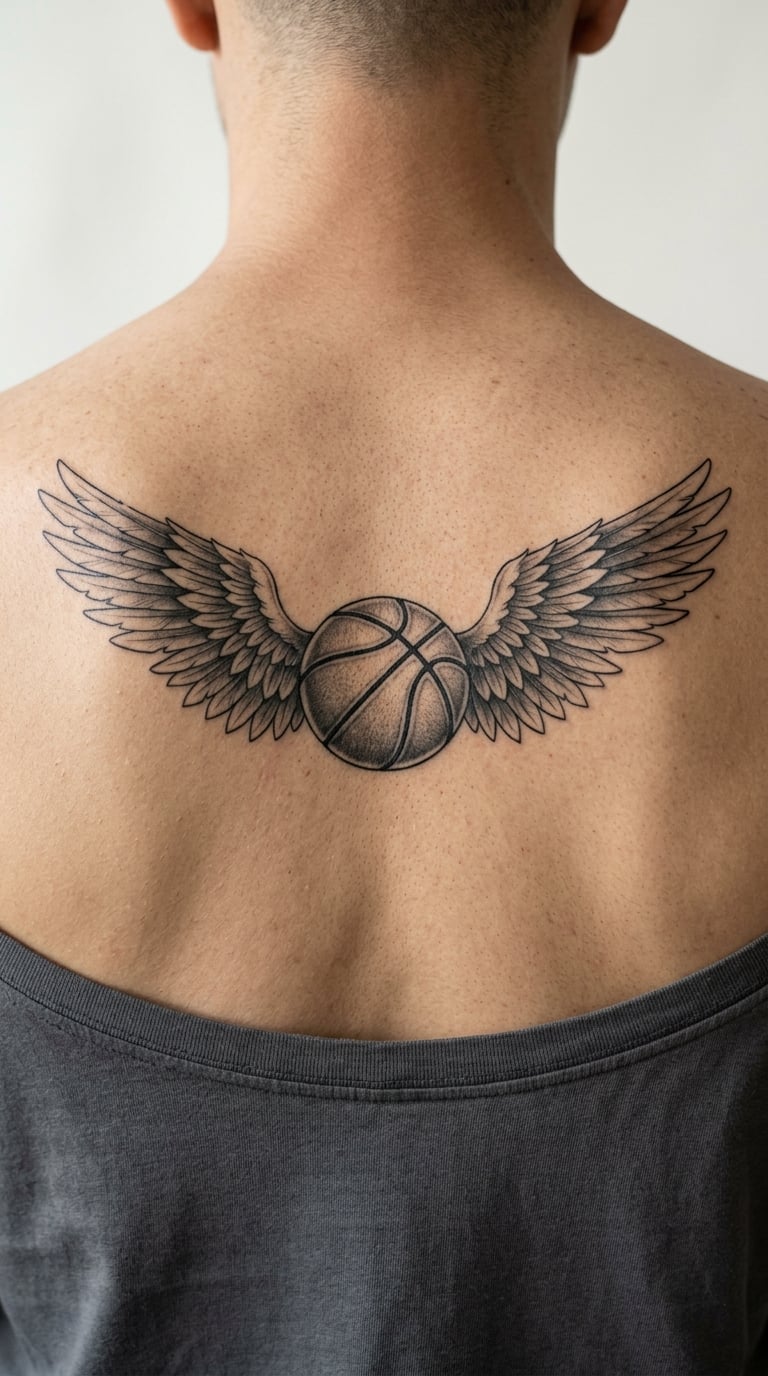
20. Basketball with Wings
A ball in the center with a feathered wing on each side, drawn with individual barbs rather than a smooth outline. Restraint matters here. Shaded wings at six inches look heavy and slightly gothic; half-outline wings look like flight, which is the point.
People take the wings as freedom, ambition, or leaving something behind, and the back placement keeps the idea private until someone sees your back. If freedom symbolism is more your thing than sport symbolism, the best tattoo ideas that symbolize freedom cover a lot of similar territory with less literal imagery.
Placement: upper back between the shoulder blades, or across the chest under the pecs. Size: 5.5 to 6 inches wide. Style: black and grey. Pain: medium, lower than expected on the upper back. Make it yours: angle the wings upward by about fifteen degrees so the piece lifts rather than spreads.
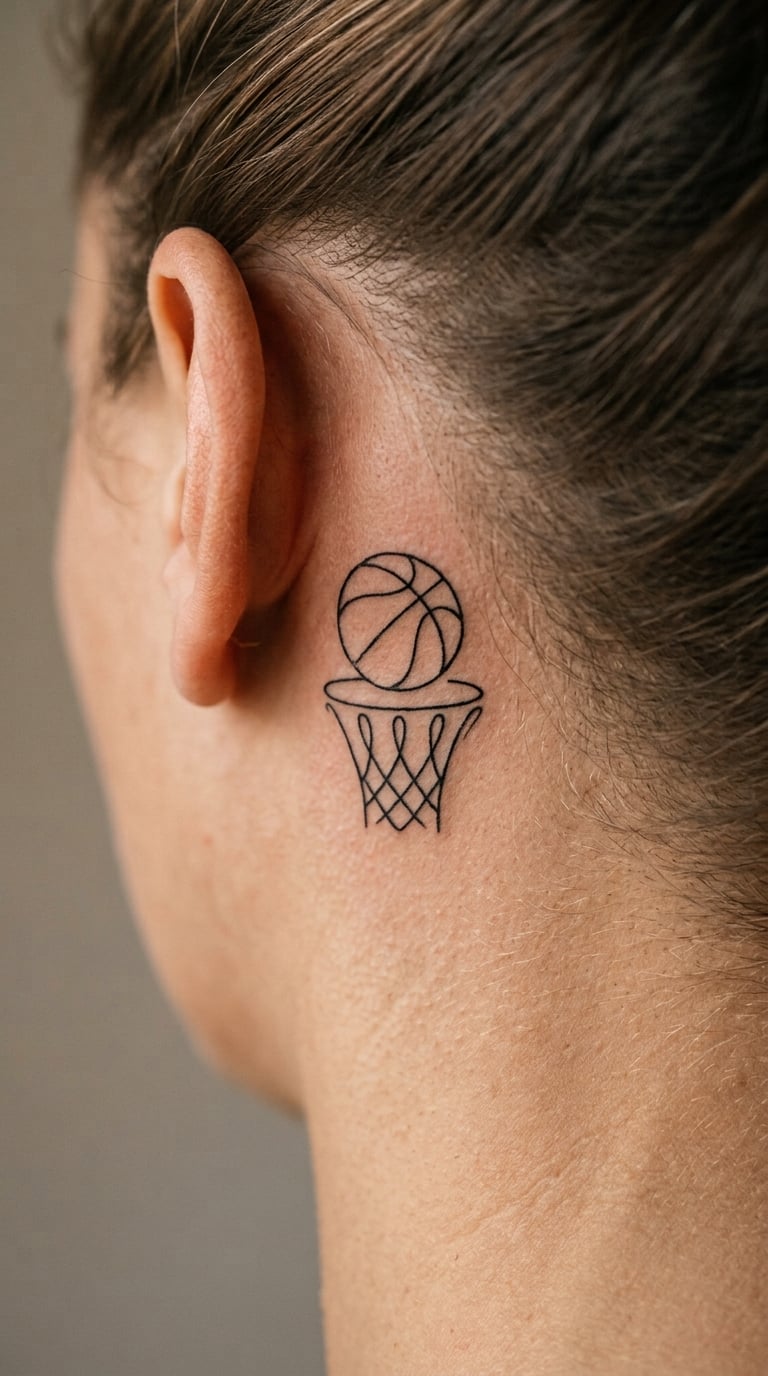
21. One-Line Basketball and Hoop
One unbroken line that draws the ball, travels up into a rim, and finishes as a small net. No fill anywhere, and no deliberate gaps either. The appeal is the constraint: a single stroke forces a very simple shape, and the whole piece can be read in about two seconds.
Small placements like this are the practical choice for anyone who plays with a job that expects covered arms. Behind the ear, on a finger, or at the ankle, it stays out of sight for most of the year and shows fully in a T-shirt season.
Placement: behind the ear, outer ankle, or the side of a finger. Size: 1.5 to 2 inches. Style: one-line. Pain: low, but behind the ear is a fiddly canvas and some people find the position uncomfortable. Ageing note: one-line work on hands and fingers softens fastest, so expect a lighter finish over time. Make it yours: have the line end in a small star rather than a stop.
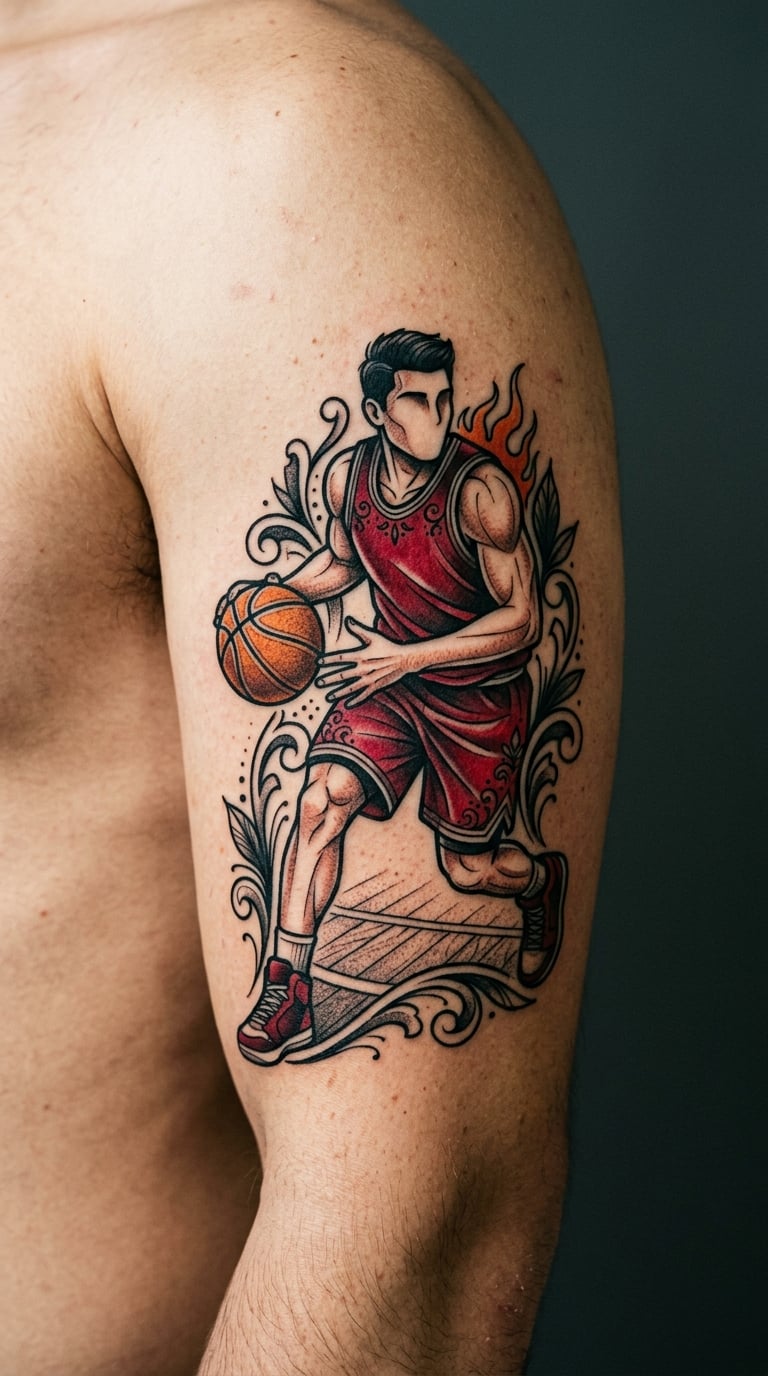
22. Neo-Traditional Basketball Player
A full figure in a strong pose with heavy black contour lines, a limited palette of two or three colors, and shading pushed into the shadow side of the body. Neo-traditional keeps the bold line weight of traditional work but cleans up the anatomy, so a player figure looks like a player rather than a mascot.
It is the most demanding design on this list, because a figure has to be right. A silhouette can be forgiving; a hand holding a ball cannot. Book an artist who does figurative work regularly and be prepared for a second session.
Placement: outer upper arm, or the start of a half sleeve. Size: 4.5 to 5.5 inches tall. Style: neo-traditional. Pain: high on the upper arm, and the session runs long. Make it yours: wear or send a photo of the jersey you actually played in, minus any number or logo, and let the artist color-match it.
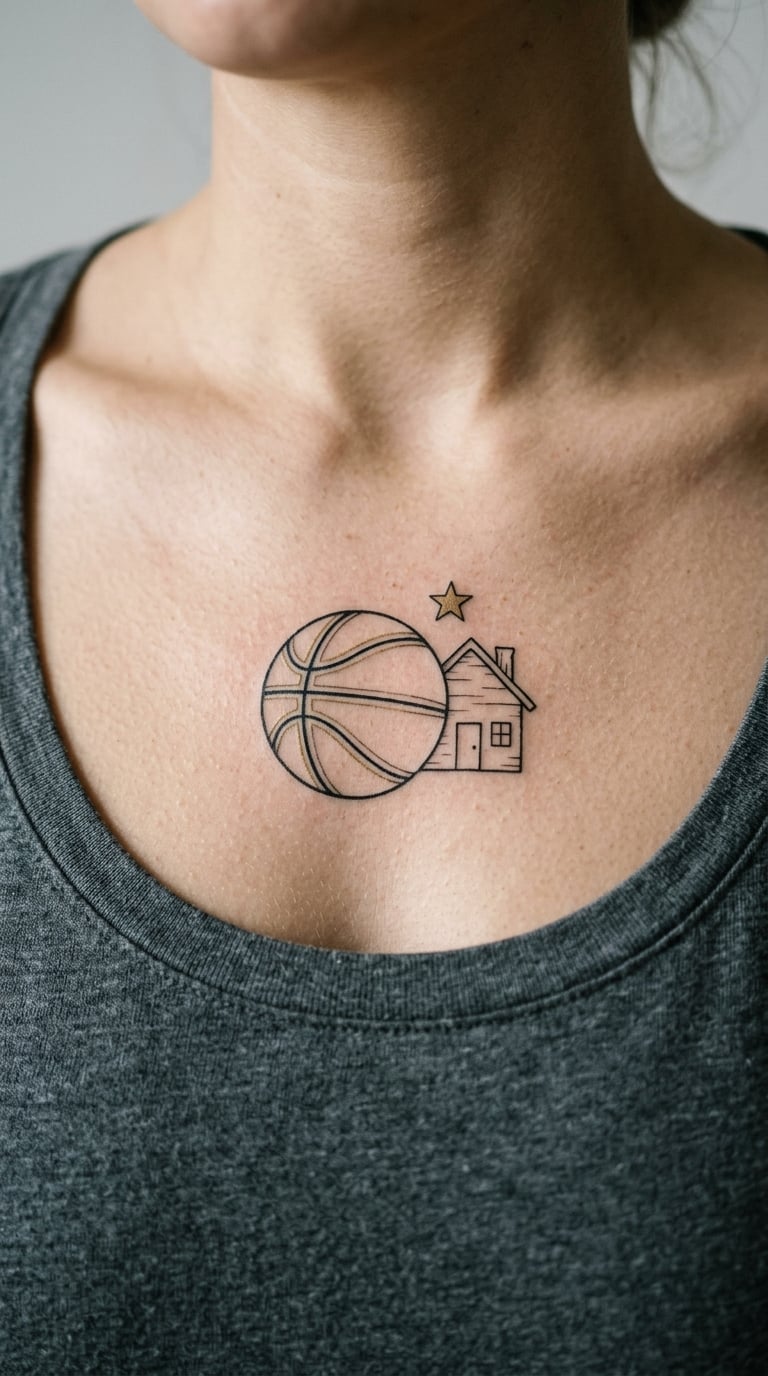
23. Basketball Homecoming Design
A fine-line ball, a small house with a pitched roof, a star above it, and a short date underneath. The house can be a drawing of the real place, which turns a generic sentimental idea into a specific one, and a single gold accent on the star is enough color.
This is the anniversary and milestone design. People use it for the first game, the last game of a career, the season that mattered, or a move back home after a few years away. It is a chapter marker, not a fan statement.
Placement: chest, along a rib, or the inner forearm. Size: 3.5 to 4 inches wide. Style: fine line with one accent. Pain: low to medium; ribs and the sternum are on the sensitive side. Make it yours: hand the artist a photograph of the actual house so the proportions are right, and set the date in the same hand as the rest of the piece.
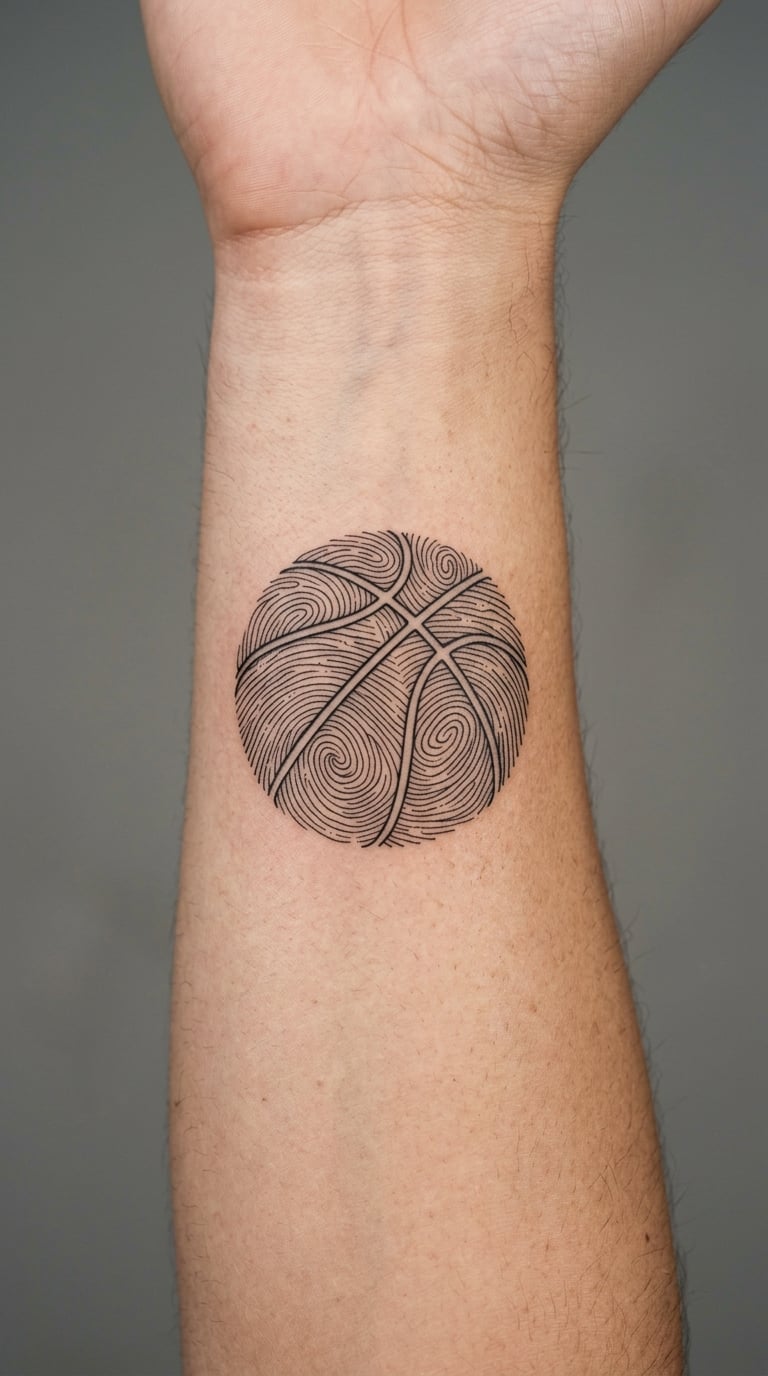
24. Basketball with Fingerprint Swirls
A circle filled with fingerprint ridges that curve and flow into the two seam lines of a ball. It takes a minute to see the ball first and the print second, which is a nice trick. The result is abstract enough to work as pure design and specific enough to still be basketball.
The meaning is identity, and that is usually the reason it gets chosen. A fingerprint is the most personal mark there is, and building the sport into it says the game is part of who you are rather than something you like.
Placement: outer forearm, inner arm, or the calf. Size: 2.5 to 3 inches wide. Style: fine line abstract. Pain: low, since it is a lot of short strokes rather than long ones. Make it yours: have the artist use your actual fingerprint, or a partner’s, scaled into the circle.
How to Choose the Right Basketball Tattoo Design
Start from the feeling, not the image. Almost every design on this list can be drawn well by a good artist, and almost every one of them is a bad match for somebody. The ball with a player’s number means something to one person and nothing at all to another, and that is the only filter that matters before you start comparing line weights.
Next, be honest about how much you want it to show. A behind-ear or ankle piece is a private tattoo. A forearm or calf design is visible most of the day. A back piece is invisible to the room and fully visible when you take your shirt off. Pick the visibility you actually want, then choose from designs at that scale.
Then match the detail to the size. A net needs about two inches before the mesh survives. A watercolor splash needs four before the color has room. A figure needs five before anatomy has anywhere to go. If a design only exists at six inches and you want three, it is the wrong design, not a small budget.
Check your existing work before you commit. Line weight, color density and how much empty skin you have left all change what will look right next to it. A fine-line outline can look thin and apologetic beside a solid black sleeve, and a bold traditional piece can overpower a quiet collection. Take a photo of the area healed, not fresh, and show the artist.
Bring references, but bring a shortlist. Ten screenshots make an artist guess. Three good ones plus a note about what you like about each saves a consultation hour. Ask to see healed work from the same design or a similar one; fresh photos flatter everybody, and healed photos show you how the line weight actually settles.
And give real thought to the player-name and player-number risk. Players get traded, retired, and disappoint. A number you wore yourself, a team from your childhood, or a name that means something to your family will still mean it in fifteen years. That is the safest permanent decision in this whole list.
Where to place a small basketball tattoo
Wrist and ankle take the smallest work because the surface is flat and mostly visible when uncovered. The inner forearm reads well at two to four inches and is easy to hide with a long sleeve. The upper arm takes larger pieces without much distortion, and the calf suits vertical designs because the leg gives you length. Behind the ear handles anything under two inches, and nothing larger will sit properly there.
Avoid placing a detailed design over a joint, a bony knob, or the inside of an elbow if you can. Those are the spots where skin moves most, so a design stretched across them in year three will not be the design you chose in year one.
Cost and Session Time
Tattoo pricing is built the same way nearly everywhere: a shop minimum, an hourly rate, and a charge tied to how big and how detailed the design is. The two biggest levers you control are size and detail count. A two-inch outline and a seven-inch dotwork dunk are not close to the same job, and any artist who quotes the same for both is not pricing the work, they are hoping you will not notice.
Small work of two to three inches usually lands somewhere around $150 to $300 in most US cities, and mid-size pieces from three to five inches commonly fall between $300 and $700 depending on the shop. Anything above five inches, or anything figurative like idea 14 or idea 22, tends to be quoted as a whole piece or by the day, so $700 and up is a fair expectation. Those are ranges, not quotes. Shop minimums and hourly rates vary enough that a rural studio and a big-city studio can differ by double for identical work.
A small design of two to three inches usually takes well under an hour once the stencil is placed. Mid-size work between three and five inches commonly runs one to two hours. A five-inch figurative piece or a detailed dotwork section is often split across two sessions, because most artists cap a sitting at three or four hours and rushing past that produces worse linework than stopping.
Shop minimums matter more than people expect. Plenty of studios charge a flat minimum that covers the setup, the stencil and the sterilisation, so a tiny design can cost about the same as a slightly larger one. A daily-rate setup for a full sleeve means you pay for a day rather than by the hour, which suits a large piece with a known finish date.
Ask three questions at the consultation and you will have a usable number: what is the total for the finished piece rather than the hourly rate, whether the design will need a second session, and what the touch-up situation is if something needs correcting while it is still new.
Aftercare Basics
Follow your artist’s aftercare instructions first. They took care of the tattoo and they know what they used.
Wash it gently with clean water and a mild unscented soap for the first couple of weeks, then pat dry with a clean towel rather than rubbing.
Protect it from sun for the healing period and for good afterwards. UV light is the fastest way to fade a basketball design, especially an orange one.
Keep it covered loosely when you need to, and skip lotions, heavy creams and fragrances on the area while the skin is still settling.
Expect flaking, itching and a pale look in the first two weeks. That is normal healing, not a mistake.
Book the follow-up before you leave the chair if the artist recommends one, and send a healed photo at the right time rather than a fresh one.
Frequently Asked Questions
What does a basketball tattoo symbolize?
Most basketball tattoos point to love of the game rather than loyalty to one pro team: discipline, teamwork, the grind, and the hours nobody sees. A hoop or a net leans toward the goal you are aiming at. A jersey number usually marks a real chapter, such as a season, a youth team, or a number someone in the family wore. Ask anyone what their own ball means before you assume a shared reading.
How small can a basketball tattoo be?
Two inches wide is a realistic floor for anything more detailed than a plain circle. A minimalist outline works at one and a half inches, and a one-line ball and hoop sits comfortably under two. Below that, seam lines start merging and the design reads as a smudge. If you need something very small, pick a design built for small scale rather than shrinking a large one.
Do basketball tattoos hurt, and how long do they take?
Most sit in the low to medium range. Forearms, outer arms and ankles are manageable, while ribs, collarbone, the inner elbow and the shin are the usual complaints. A two to three inch design generally takes under an hour, a four to five inch piece one to two hours, and detailed figurative or dotwork work is often split across two sessions so the artist is not rushing the linework.
Should I get a player’s name or number tattoo?
It is worth pausing on, because players get traded, retired and disappoint, and ink does not follow. Plenty of people regret a name they chose for a favourite. A number you wore yourself, a name from your family, or a word like home carries the same emotional weight and far less exposure. If you still want a specific player, treat it as a choice about the memory, not the future.
Can a basketball tattoo be done in black and grey only?
Yes, and most artists would say it is the safer default. Black and grey holds its line over time and photographs well, while heavy orange fills on a large area can look patchy once healed. If you want color, keep it to one accent rather than a full palette, and tell the artist you want the ball to stay readable in ten years, not just in a healed photo this month.
How do I bring a reference image to a tattoo artist?
Bring a shortlist, usually three to five images, and say what you like about each one: the line weight, the shading, the pose, the composition. Ask the artist whether they would redraw it in their own style, which is normal and usually gives you a better result than a straight copy. Ask to see healed work of a similar design, and confirm on the stencil where the design will actually sit before any lines go in.
Conclusion
For a first tattoo, the minimal ball outline from idea 2 or the hoop and court line from idea 6 are the two I would point at. Both are small, both hide easily, and neither commits you to a style you have to keep forever. If you have never been tattooed, start there and see how you feel in three months.
For someone already building a collection, the jump-shot silhouette from idea 5 or the ball and laurel from idea 18 give you something with weight and composition that will sit well beside existing work. Pick a piece with a real story behind it and find an artist who has done that style before, then book the consultation.