
25 Hunting Tattoo Ideas for Men: Best Tattoos (October 2026)
A hunting tattoo is body art that points to hunting culture: a game species like deer, moose, elk, boar or waterfowl, the gear used to get it, or the country it lives in. Men get these pieces to mark an identity, a family tradition, or a hunt that mattered, and the imagery is specific enough that anyone in the field reads it on sight.
These 25 hunting tattoo ideas for men are laid out with what each design looks like, what it usually means, where it fits best, how big it should be, and how much it hurts. Most fall into one of three camps: a single hero animal, a scene with a story in it, or a small symbol that grows with the wearer. Sizes below are the sizes that actually work on skin, not the sizes that look good on a screen.
Fall hunting season is when most of these get booked, and good artists fill up a month or two ahead. If you are planning ahead, look at the whole list first, then narrow to two or three, and bring reference photos and a story to the consult.
25 Hunting Tattoo Ideas for Men: Quick Guide
| Idea | Style | Best placement | Size | Pain |
|---|---|---|---|---|
| 1. Realistic Deer Head | Black and grey realism | Outer forearm | 5-7 in (13-18 cm) | Medium |
| 2. Mountain and Wildlife Silhouette | Fine line silhouette | Upper forearm | 4-5 in (10-13 cm) | Low to medium |
| 3. Traditional Elk Head | Traditional | Outer upper arm | 5-6 in (13-15 cm) | Medium |
| 4. Duck Hunter Lake Scene | Neo-traditional | Inner forearm | 4-6 in (10-15 cm) | Medium |
| 5. Minimalist Antler Tattoo | Fine line minimal | Wrist or lower forearm | 2-3 in (5-8 cm) | Low |
| 6. Blackwork Bear Tattoo | Blackwork | Shoulder | 6-9 in (15-23 cm) | High |
| 7. Fishing and Hunting Compass Tattoo | Illustrative line work | Inner forearm | 3-4 in (8-10 cm) | Low to medium |
| 8. North Star with Mountains | Minimal line work | Upper forearm or chest | 3-4 in (8-10 cm) | Low |
| 9. Turkey Hunt Tattoo | Black and grey realism | Upper arm | 6-8 in (15-20 cm) | Medium to high |
| 10. Deer Tracks and Pine Tree | Fine line | Forearm, vertical | 3-5 in (8-13 cm) | Low |
| 11. Vintage Bow and Arrow | Traditional vintage | Outer shoulder | 4-6 in (10-15 cm) | Medium |
| 12. Watercolor Elk Tattoo | Watercolor | Upper arm | 5-7 in (13-18 cm) | Low |
| 13. Hunting Cabin Tattoo | Atmospheric realism | Forearm | 3-4 in (8-10 cm) | Low to medium |
| 14. Monarch Butterfly and Antler | Fine line | Forearm or calf | 3-4 in (8-10 cm) | Low |
| 15. Deer Skull Blackwork | Blackwork | Chest or upper arm | 7-10 in (18-25 cm) | High |
| 16. Outdoor Map Coordinates | Fine line cartography | Forearm | 4-6 in (10-15 cm) | Low |
| 17. Moose Head Micro-Realism | Micro-realism | Inner forearm | 3-4 in (8-10 cm) | Low to medium |
| 18. Deer and Moon Wilderness | Fine line atmospheric | Calf | 5-7 in (13-18 cm) | Low |
| 19. Fish and Hunt Combination | Neo-traditional | Forearm | 5-7 in (13-18 cm) | Medium |
| 20. Antique Map Hunting Design | Illustrative, aged | Upper arm | 5-8 in (13-20 cm) | Low |
| 21. Fox in the Snow | Realism with white space | Shoulder or upper arm | 6-8 in (15-20 cm) | Medium |
| 22. Minimal Hunting Compass Rose | Minimal line work | Wrist or forearm | 2-3 in (5-8 cm) | Low |
| 23. Deer Portrait with Coordinate Date | Realism plus fine line | Forearm, vertical | 6-8 in (15-20 cm) | Medium |
| 24. Pine Forest Hunting Hide | Illustrative black and grey | Outer thigh or upper arm | 8-12 in (20-30 cm) | Medium to high |
| 25. Heritage Hunting Coat of Arms | Ornate illustrative | Chest or upper arm | 8-12 in (20-30 cm) | High |
1. Realistic Deer Head Tattoo
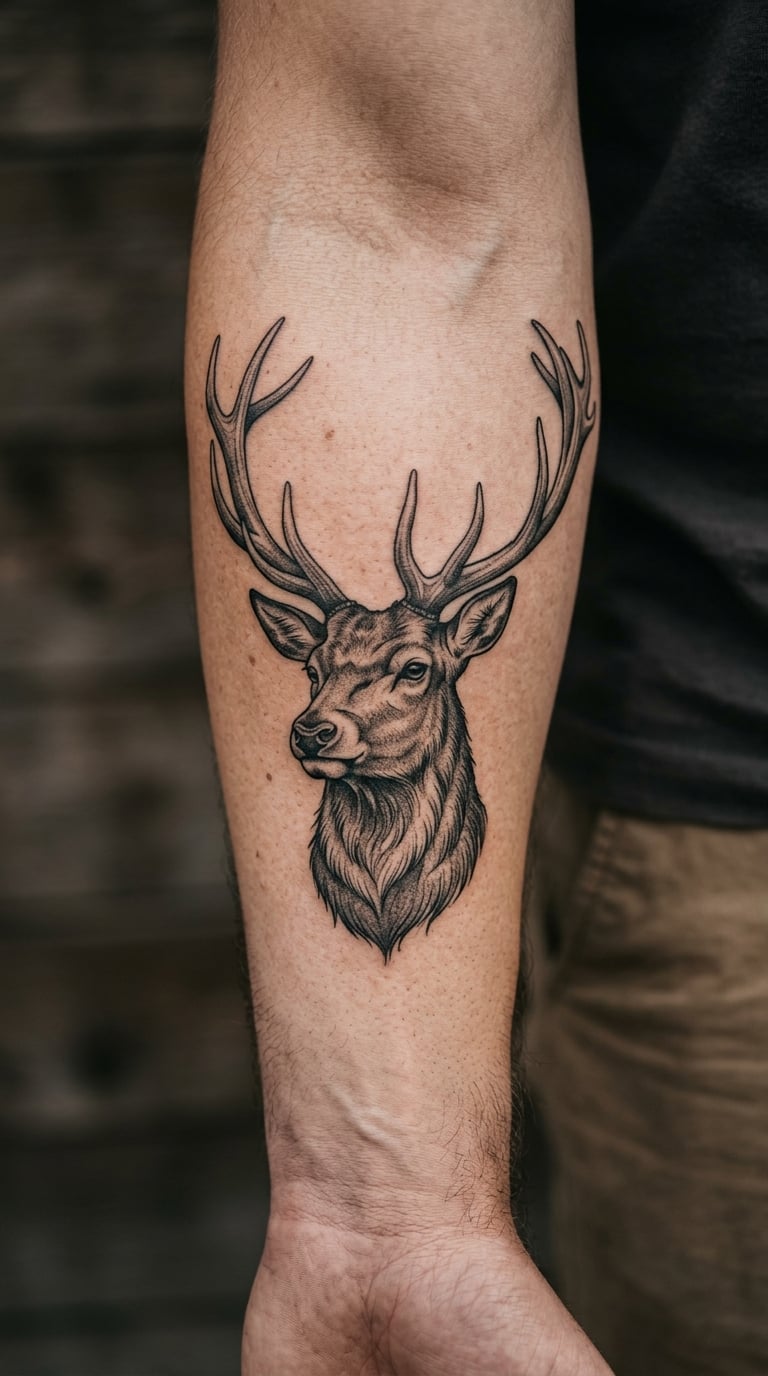
A realistic deer head tattoo is the most requested hunting design there is, and the reason it works is the antlers. A good artist spends the time on tine count and burr thickness, then keeps the eyes slightly softer than the antler tips so the eye lands first. Black and grey shading, no outline, and enough breathing room around the neck so the portrait does not smear into a blob at four inches tall.
It means the animal, the season, and the patience it takes. Most men who get one had a specific deer in mind.
Placement: outer forearm, upper arm, or calf. Size: 5-7 in (13-18 cm) tall. Style: black and grey realism. Pain: medium, and the antler shading across the wrist side stings more than the face. Make it yours: add the tine count of the buck you actually harvested.
2. Mountain and Wildlife Silhouette Tattoo
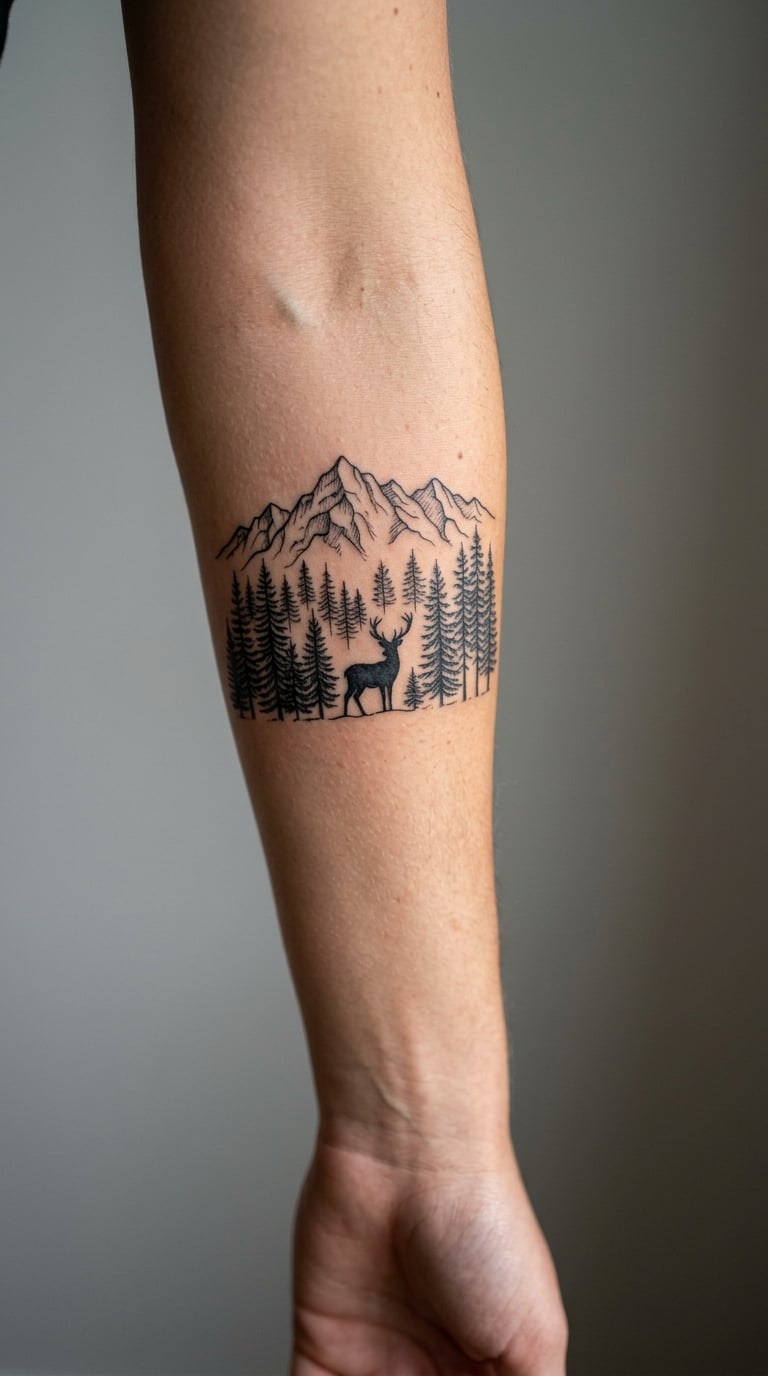
This one is a scene rather than a portrait: a single ridgeline of peaks, two or three pines, and a deer or elk standing below it, all in solid black silhouette with a thin margin of white between the shapes. Keeping the elements separated is what stops the design turning into a black patch once it is on skin. Read more pairings in our mountain and ocean tattoo ideas.
It points to where you hunt rather than what you take. A lot of men use it as a first hunting piece because nothing in it is graphic.
Placement: upper forearm or outer bicep. Size: 4-5 in (10-13 cm) wide. Style: fine line silhouette. Pain: low to medium. Ageing note: solid silhouette fills hold up better than hair-thin lines, which soften within a few years. Make it yours: use the actual ridgeline you hunt above.
3. Traditional Elk Head Tattoo
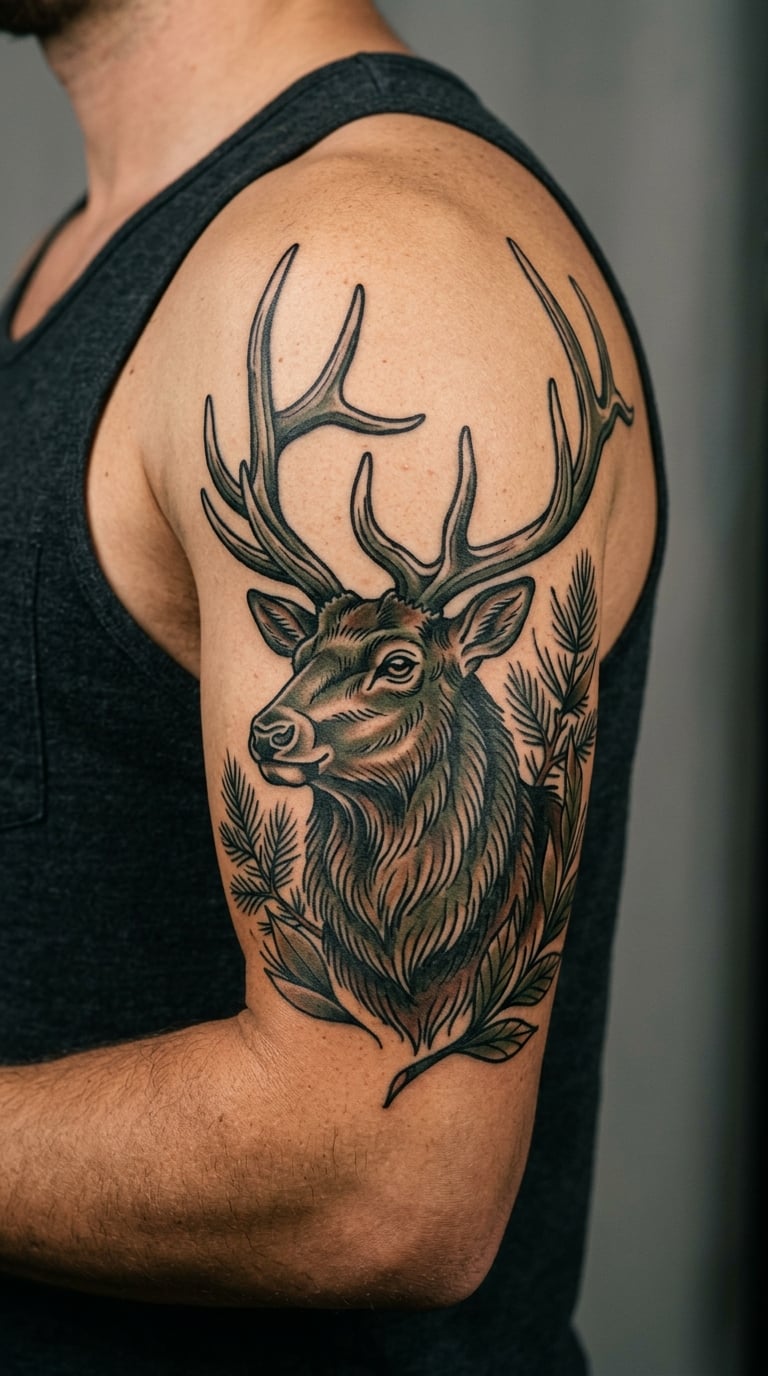
Traditional style means a heavy black outline, a limited palette, and shading that stays inside the line. An elk head in this style reads instantly at any distance, and the big palmate antlers give the artist a graphic shape to work with that a deer cannot. Olive green, brown, and a touch of cream in the base of the antlers keep it from looking flat.
Traditional pieces are a family of symbols, and the elk carries weight, size, and a little bit of stubbornness. It is a common choice for men who already have one tattoo and want something bolder than realism.
Placement: outer upper arm, shoulder, or calf. Size: 5-6 in (13-15 cm). Style: traditional. Pain: medium. Make it yours: match the ink to an existing traditional piece so the line weight lines up.
4. Duck Hunter Lake Scene Tattoo
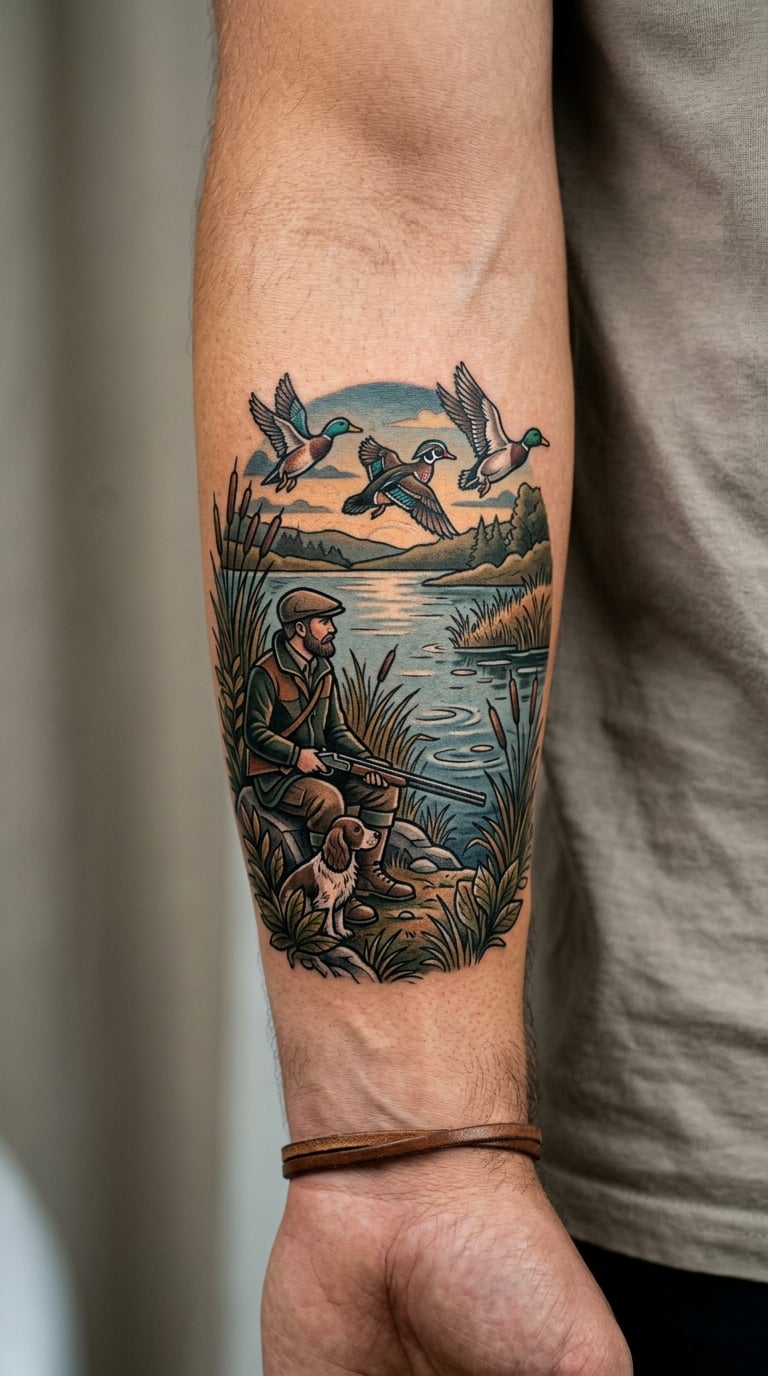
Waterfowl tattoos usually come down to a horizon line, a couple of reeds, and birds at different heights to give depth. A seated hunter in a boat or on a bank adds the human element, drawn small so the ducks stay the subject. Keep the sky as open skin rather than shading it, or the piece turns muddy on an inner forearm.
It means early mornings, cold water, and the patience of waiting instead of walking. Duck and goose hunters tend to get this one and then nothing else.
Placement: inner forearm, opposite side of a bow piece. Size: 4-6 in (10-15 cm). Style: neo-traditional. Pain: medium, worse on the inner wrist crease. Make it yours: put the number of ducks from one memorable morning in the design as a small numeral.
5. Minimalist Antler Tattoo
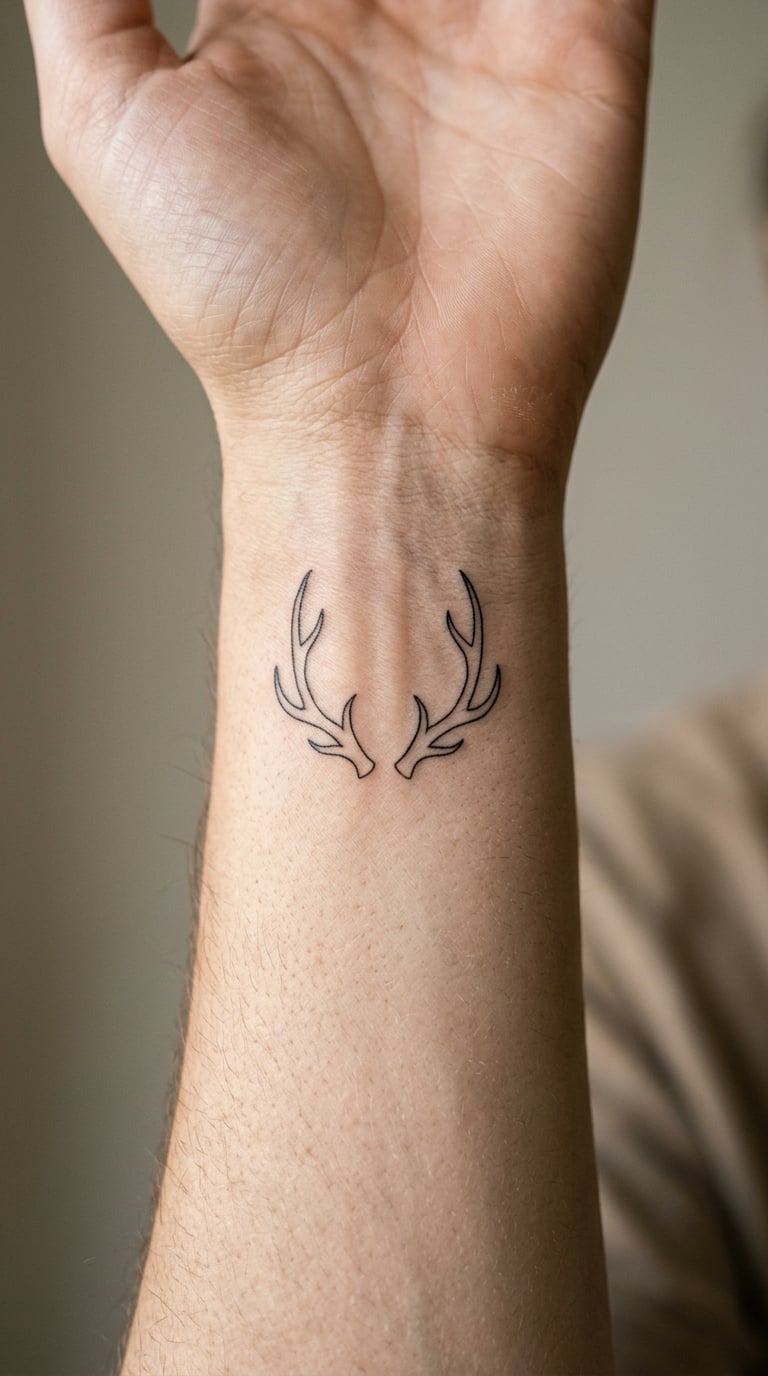
A pair of antlers in single-weight line with wide gaps between the tines is the most first-tattoo-friendly hunting design there is. The trick is restraint: a symmetrical pair, one weight of line, no shading, and a spread wider than it is tall so it sits correctly on a forearm. Drawn too small the tines merge, so ask for at least two inches.
Antlers stand for the hunt without spelling it out, and a lot of men use this one as a placeholder that later grows into a fuller arm piece.
Placement: inner wrist, lower forearm, or behind the ear. Size: 2-3 in (5-8 cm) across. Style: fine line minimal. Pain: low, though wrist and rib areas are more sensitive than the forearm. Ageing note: single-line work on hands and fingers fades fastest, so avoid it there if you want it crisp in ten years. Make it yours: use the tine count of a family member’s best buck.
6. Blackwork Bear Tattoo
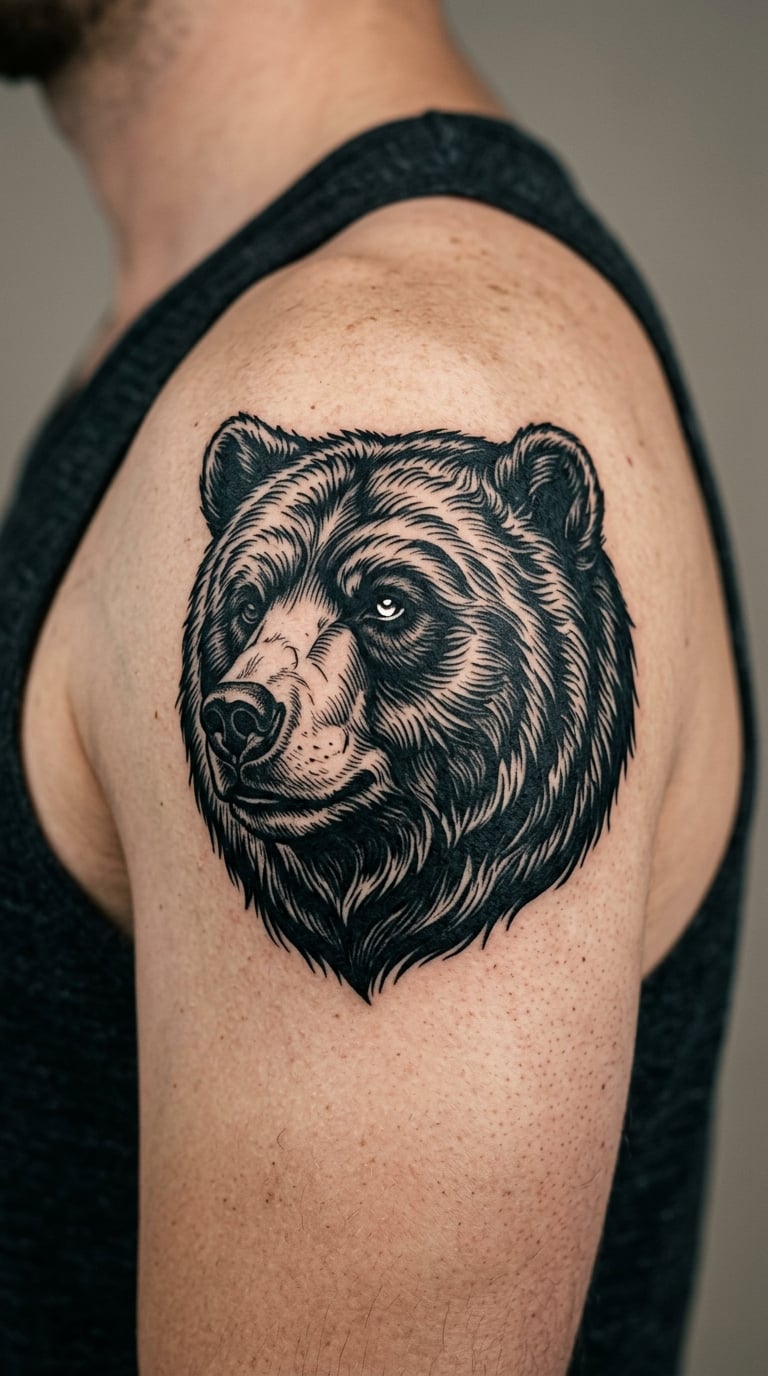
Blackwork bear tattoos use heavy fills and very few grey tones, with the shape described by the edge rather than by shading. A front-facing bear head with one carved-out white highlight in the eye is the version most men end up with. More of our dense ink references are in the black sleeve tattoo ideas roundup.
A bear means strength and a willingness to handle things most people avoid. In hunting country it also points to black bear country, whether you hunt them or not.
Placement: shoulder, upper arm, or back. Size: 6-9 in (15-23 cm). Style: blackwork. Pain: high. Large solid areas take repeated passes, and the shoulder blade is a rough spot. Make it yours: run the black of the fur into an existing solid piece so the edges meet.
7. Fishing and Hunting Compass Tattoo
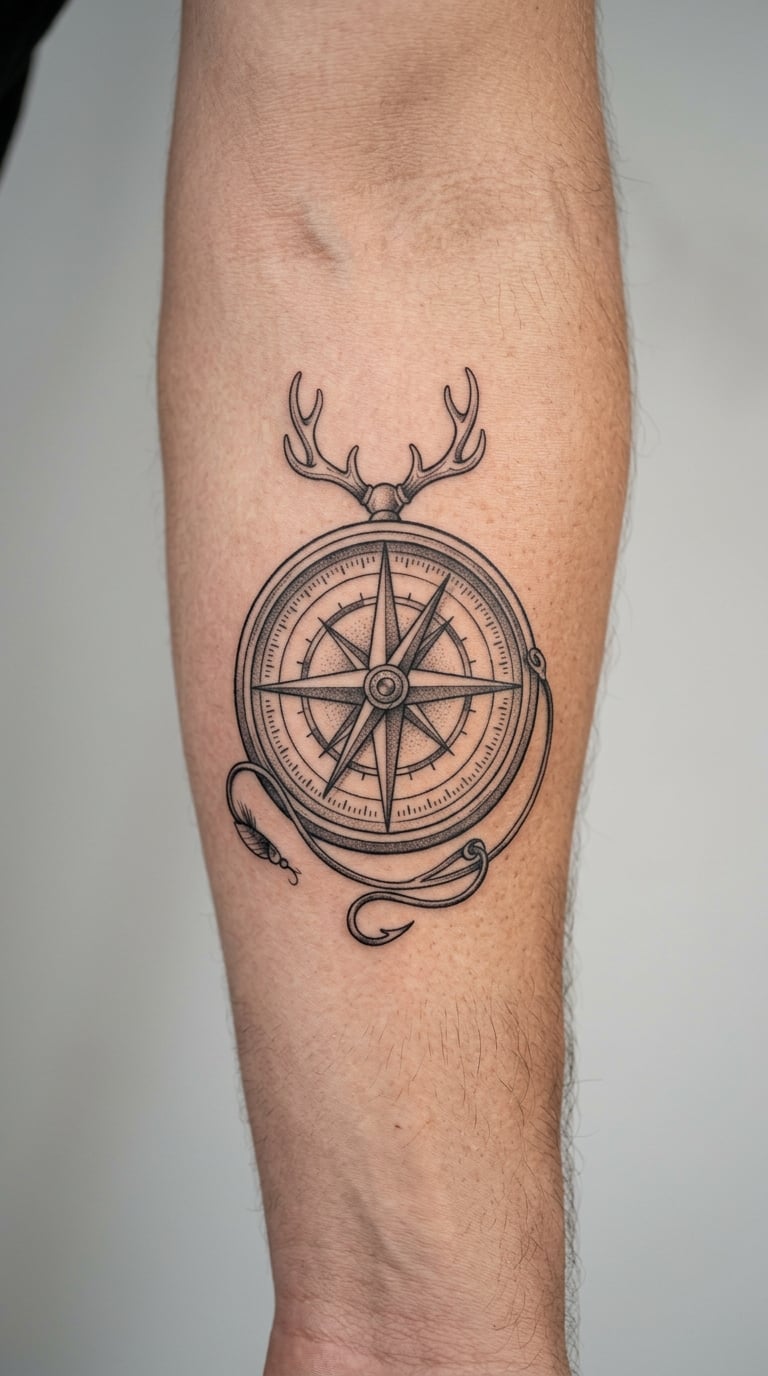
Splitting the seasons between hunting and fishing is common in the North, and this design names both without crowding. A compass dial drawn with an aged or hand-inked quality, small antlers on one side of the ring, a single fish hook on the other, and nothing else. Two or three extra marks like elevation lines keep it from looking like a stock logo.
Direction is the core of it: knowing where you are in the field, and knowing which months belong to which sport.
Placement: inner forearm or chest. Size: 3-4 in (8-10 cm) across. Style: illustrative line work. Pain: low to medium. Make it yours: set the needle to a bearing from a place that matters to you.
8. North Star with Mountains Tattoo
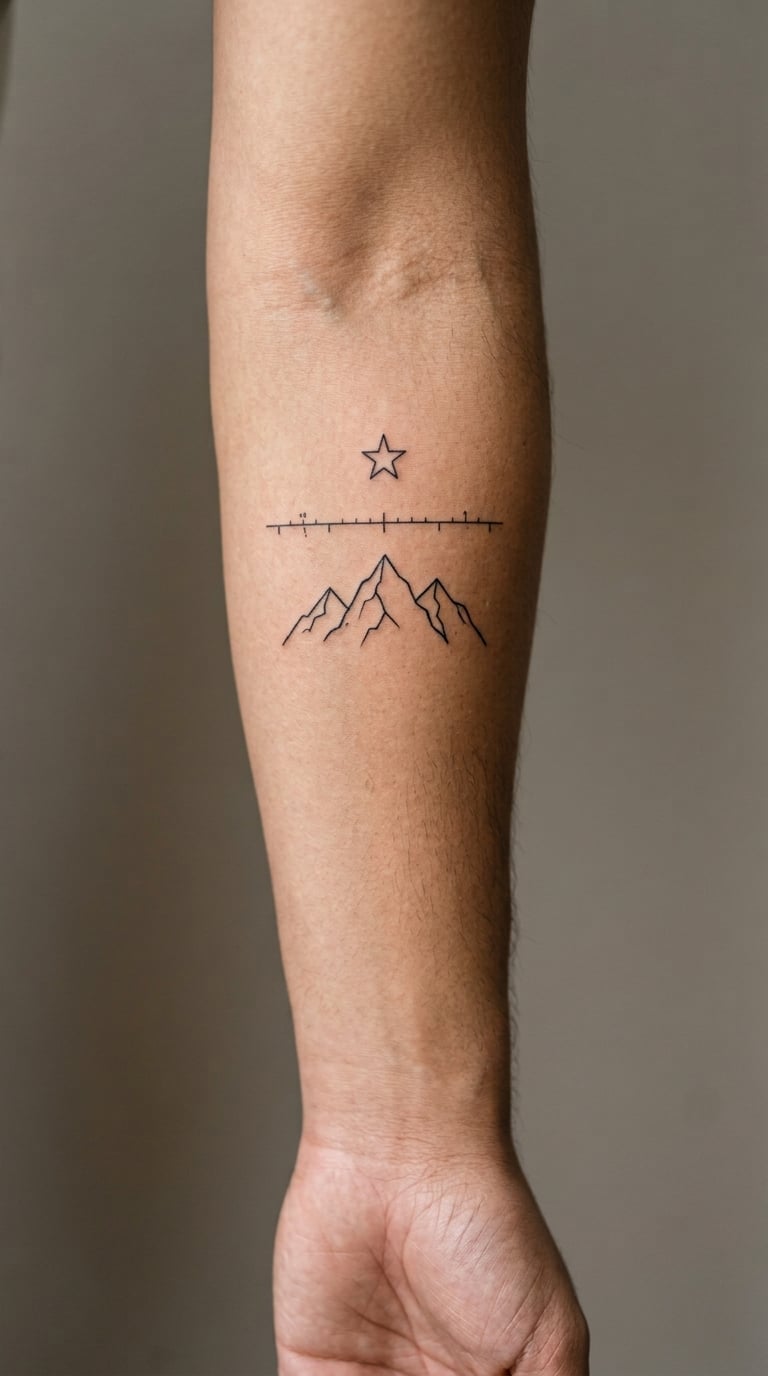
One star, a simple peak line, and a thin strip of coordinates underneath is an easy read and a hard design to get wrong. The peaks are drawn with two or three strokes rather than shaded faces, and the star gets four or eight points, never twelve. On the chest it sits well under the collarbone with a couple of inches of clear skin around it.
It means navigation, cold nights, and getting back to camp. Plenty of men choose it for a hunt that went sideways in weather nobody expected.
Placement: upper forearm, chest near the sternum, or upper back. Size: 3-4 in (8-10 cm). Style: minimal line work. Pain: low, with the chest and sternum noticeably more sensitive. Make it yours: use the latitude of the place you learned to navigate in.
9. Turkey Hunt Tattoo
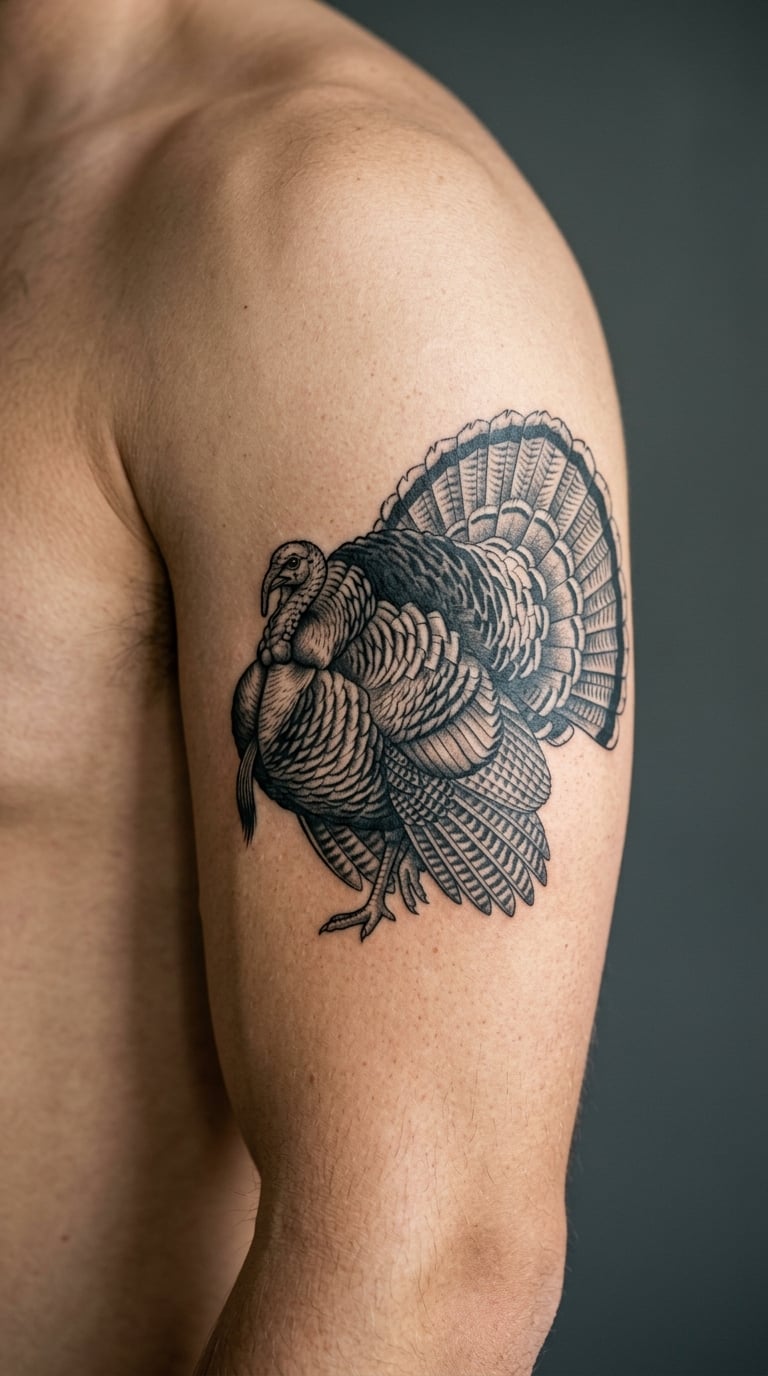
A turkey with a half-spread fan is a strong graphic shape, but the feathers need to be grouped in blocks rather than drawn one by one, or the whole thing turns to grey mush on the upper arm. A partially raised fan also works better than a full one because a full fan rarely fits a flat surface without distorting. The beard and the snood are where the detail budget should go.
It means spring mornings and the specific patience of waiting on a hen from a ground blind. Turkey season is when a lot of these get drawn.
Placement: upper arm, shoulder, or back. Size: 6-8 in (15-20 cm). Style: black and grey realism. Pain: medium to high. Ageing note: fine feather detail softens over time, so ask for slightly heavier blacks in the fan. Make it yours: use the real colour of the bird you hunted in the one accent area.
10. Deer Tracks and Pine Tree Tattoo
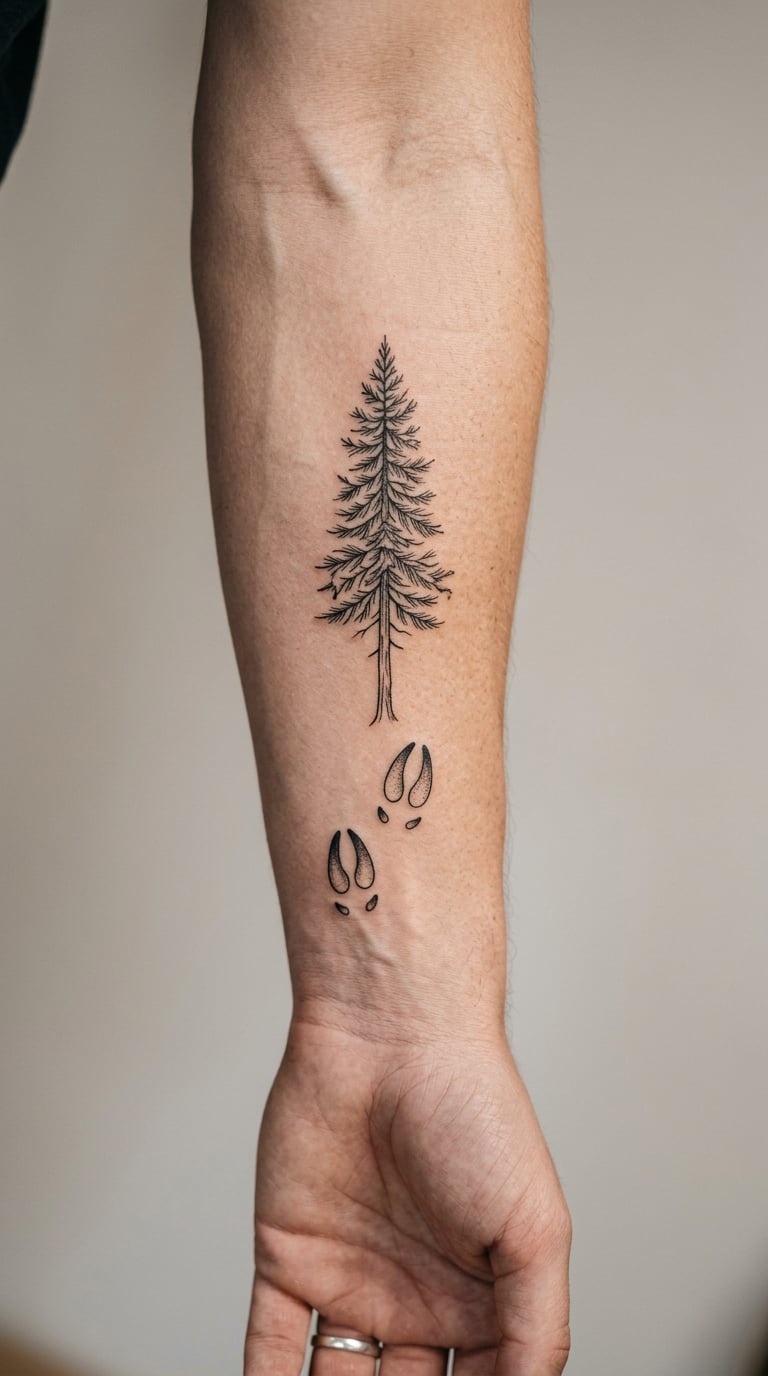
Two sets of cloven tracks running up the forearm into a single pine is simple, directional, and cheap to get right. Hooves are drawn as two small teardrop shapes with a gap between them, and the pine is built from a straight trunk and stacked chevrons. A vertical run on the inner forearm lets the tracks lead the eye along the arm. There is more of this style in our pine forest tattoo ideas for the forearm collection.
It means following sign, and having the patience to keep following it. Small and understated, which is exactly why it works as a first piece.
Placement: inner forearm, vertical. Size: 3-5 in (8-13 cm) long. Style: fine line. Pain: low. Make it yours: have the tracks cross a small river or a game trail marker at the halfway point.
11. Vintage Bow and Arrow Tattoo
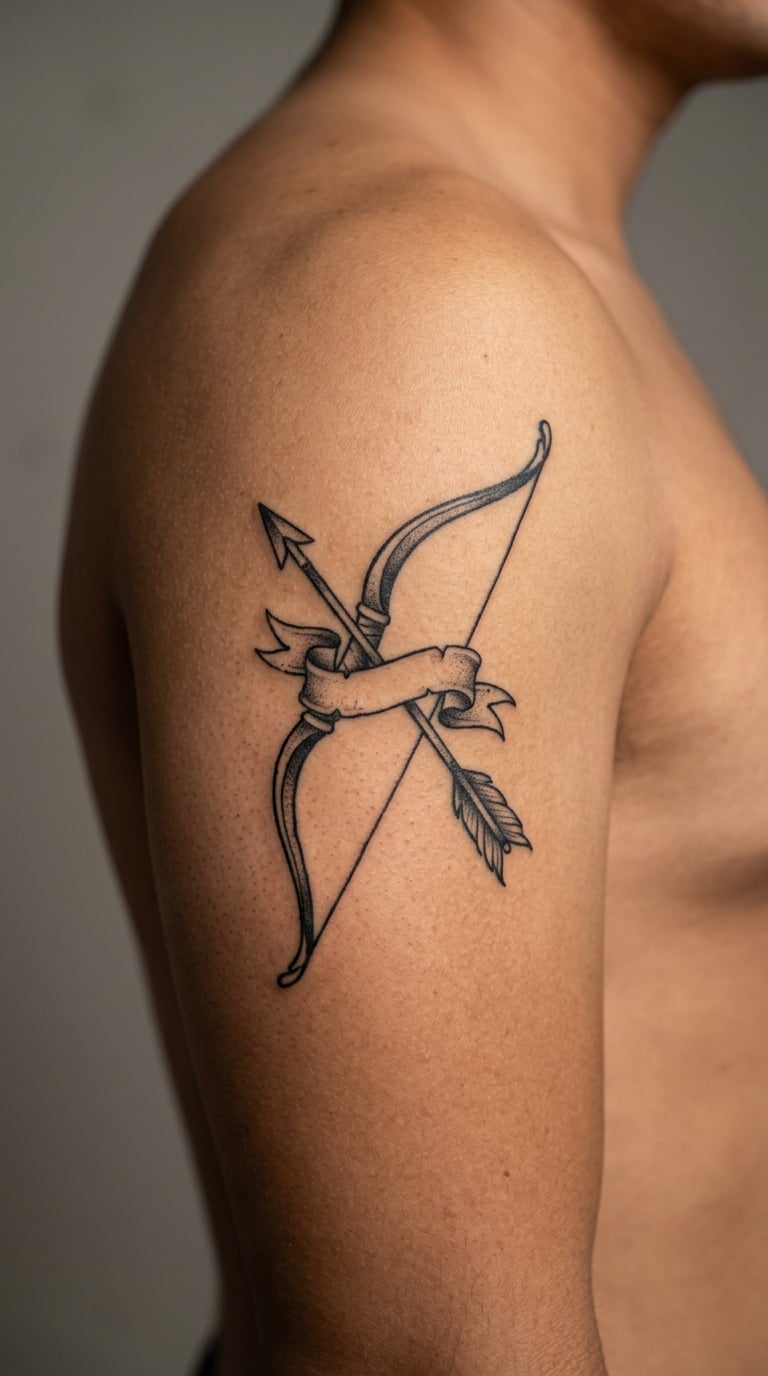
A longbow drawn in profile with a single nocked arrow says bowhunter without saying it in words. Vintage versions use a heavier outline, a small banner or a set of initials under the riser, and a limited palette of red and gold. The detail that sells it is the string tension and the arrow resting on the shelf rather than floating beside the bow.
It marks quiet discipline and a specific kind of hunt. Bowhunters tend to add the date of a first deer or a first elk with this one.
Placement: outer shoulder, upper arm, or outer forearm. Size: 4-6 in (10-15 cm) long. Style: traditional vintage. Pain: medium. Make it yours: engrave a first-harvest date along the arrow shaft.
12. Watercolor Elk Tattoo
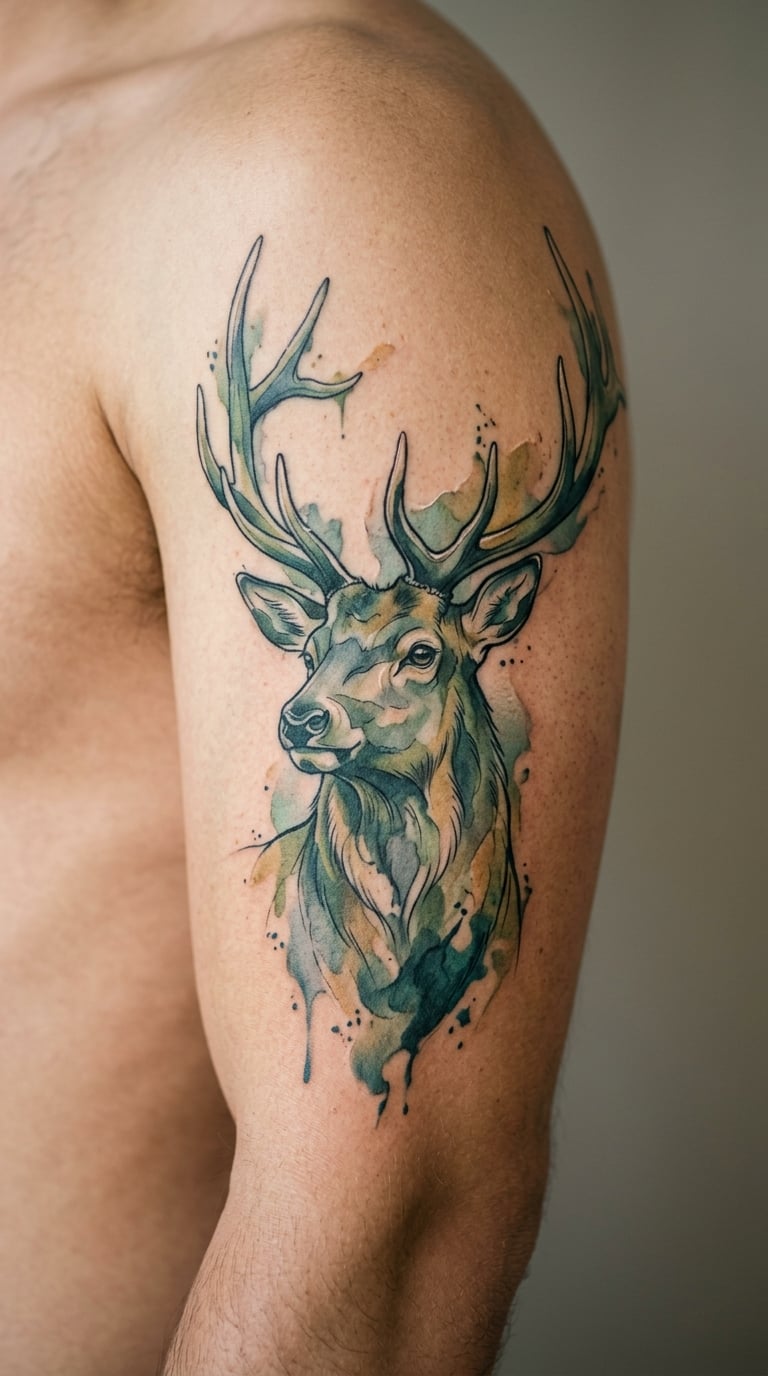
Watercolour style lets a hunting piece carry colour without looking like a portrait, which is the appeal for anyone who finds heavy black work too formal. Soft green, blue and ochre washes bleed past a loosely drawn elk head, with a few dry-brush edges suggesting fur texture. It needs an artist who is comfortable with loose work, since the piece depends on the edges being allowed to spread.
It reads as a hunter who is also a painter, or simply as someone who wants colour on the arm. Plenty of men book these as the piece that softens a tattoo sleeve.
Placement: upper arm, shoulder, or thigh. Size: 5-7 in (13-18 cm). Style: watercolor. Pain: low, because most of it is light shading. Make it yours: pick three colours from the country you hunt and ask the artist to work only in those.
13. Hunting Cabin Tattoo
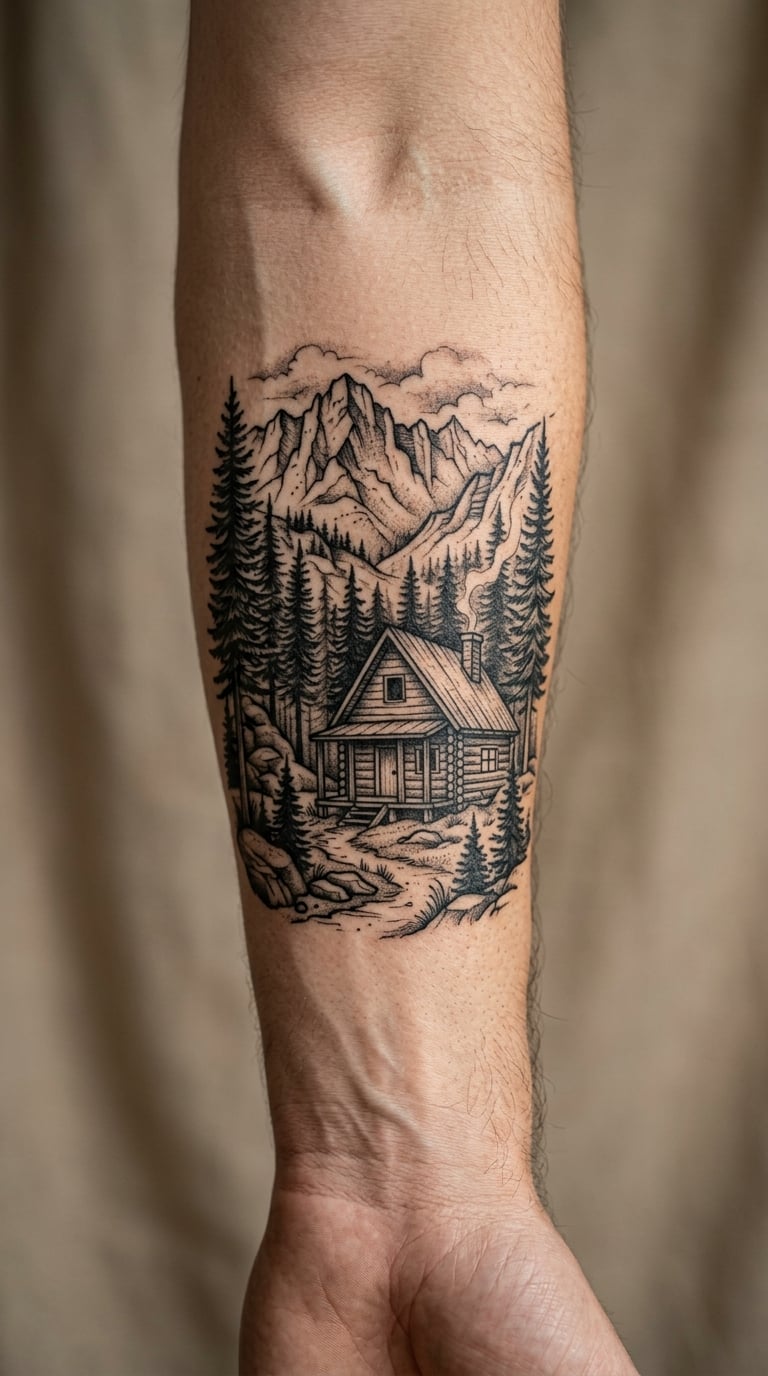
Small structure, small detail, big feeling. A cabin with one lit window, a stovepipe, two pines and a ridge line behind it does a lot in four inches. Atmospheric realism uses a soft grey wash in the sky and keeps the building edges sharper, which stops the scene from disappearing at arm’s length. Most men get this for a specific cabin rather than a generic one.
It means a base camp, a lease, or a property that belonged to somebody in the family. The window light is what people notice when they see it in person.
Placement: forearm, chest, or upper back. Size: 3-4 in (8-10 cm). Style: atmospheric realism. Pain: low to medium. Ageing note: light grey washes in small areas fade faster than solid blacks, so ask for a slightly deeper value. Make it yours: have the artist work the real roofline of the cabin.
14. Monarch Butterfly and Antler Tattoo
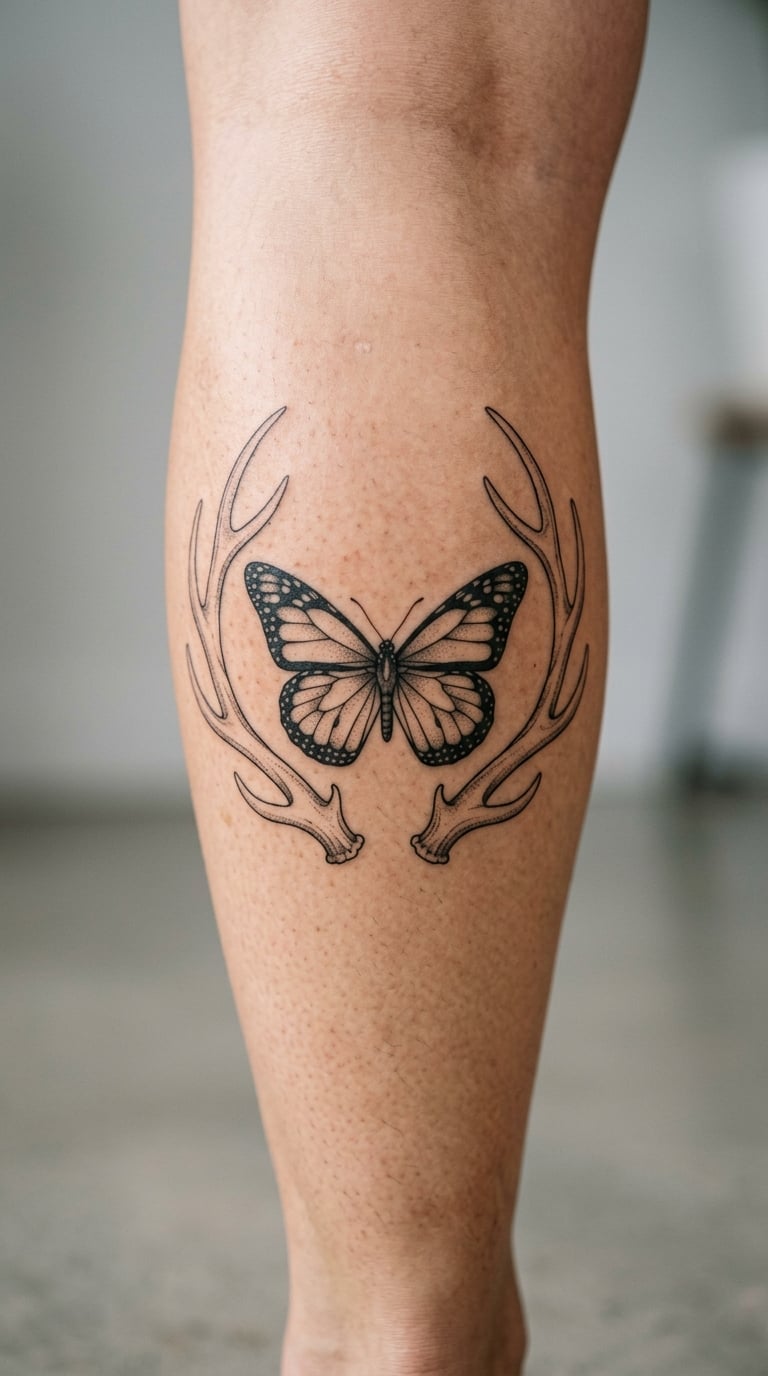
A monarch framed by two lightly shaded antlers is a softer take on hunting imagery and works well for men who do not want a wall of black. Butterfly wings are drawn in outline with the characteristic spot pattern in a small grid, and the antlers stay as open line with grey only in the bases. The two elements need different weights or they fight each other on skin.
It pairs migration and change with the hunt, which is why it turns up on people whose hunting life has shifted rather than stopped. It also reads well on a calf where a large portrait would not fit.
Placement: forearm, calf, or upper arm. Size: 3-4 in (8-10 cm). Style: fine line. Pain: low, with the shin and inner calf among the more sensitive spots. Make it yours: colour the wing spots in one accent shade from your national or state flag.
15. Deer Skull Blackwork Tattoo
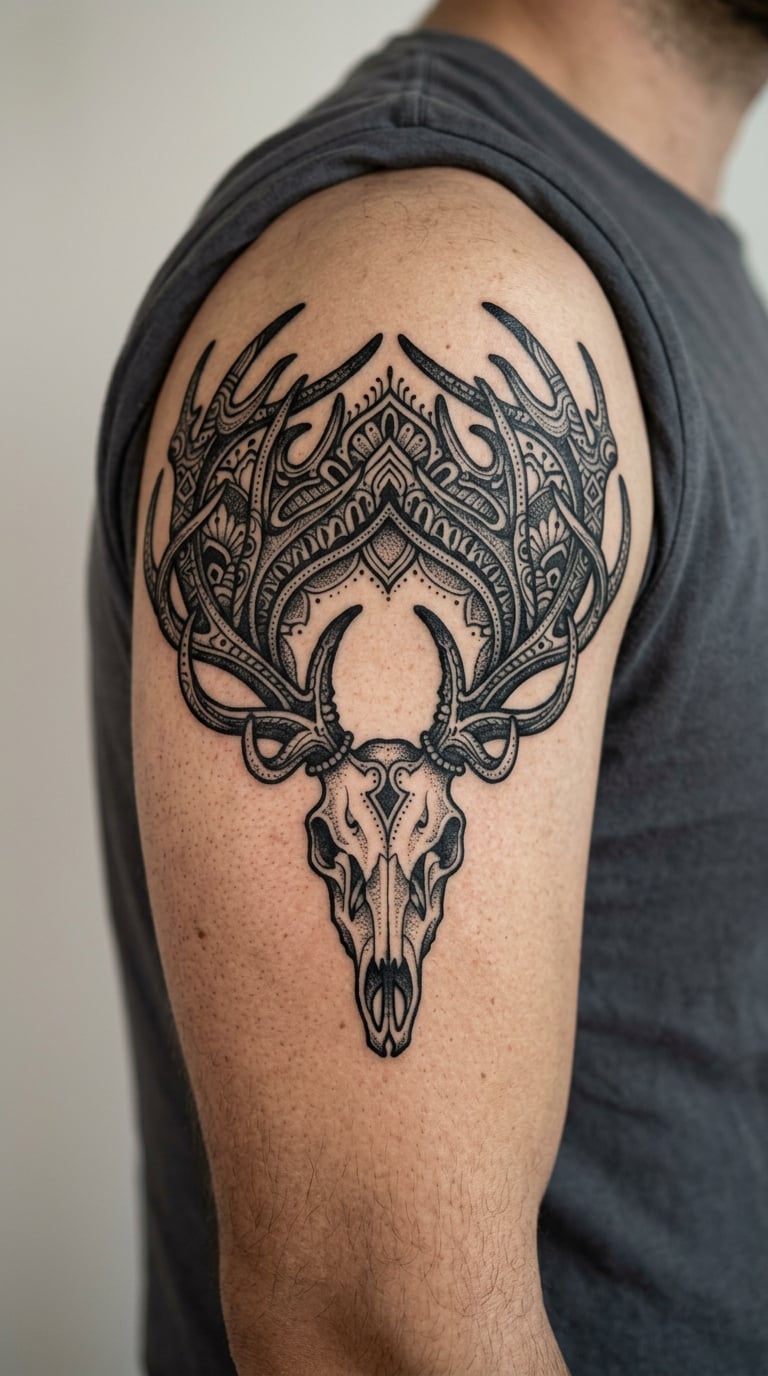
A symmetrical skull in blackwork uses dense fill in the antler mass and leaves the bone itself white, which is the whole trick. The socket cavities are the darkest areas and the nasal bone stays light, giving the piece its contrast. Across the chest, the skull is centred over the sternum so the antlers follow the collarbones rather than fighting them.
It means the taken animal, respect for it, and a reminder that the season ends. Skull designs also age well, which matters for something this size.
Placement: chest, upper arm, or thigh. Size: 7-10 in (18-25 cm) across. Style: blackwork. Pain: high. Chest, sternum and ribs are all sensitive areas and the piece needs deep black saturation. Make it yours: match the antler count to the trophy on your wall.
16. Outdoor Map Coordinates Tattoo
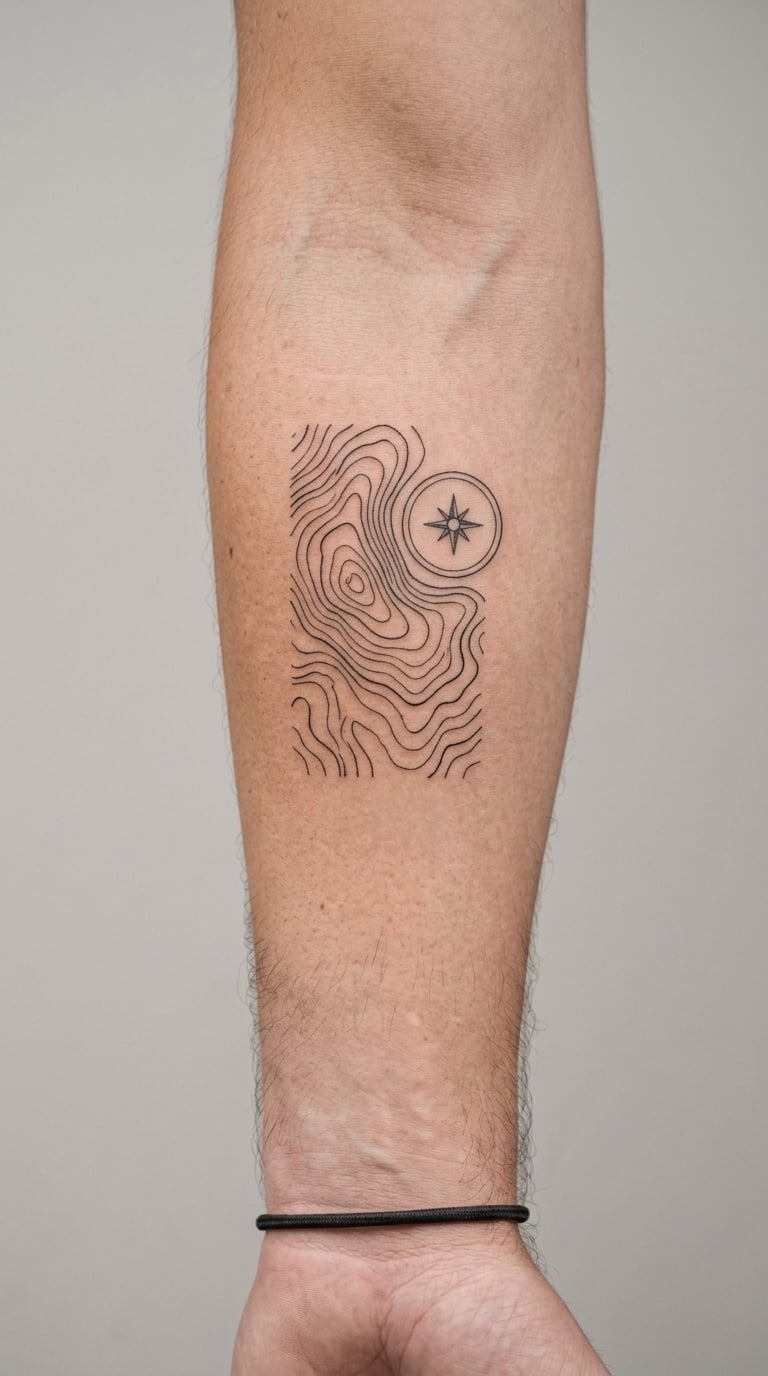
A topographic map tattoo works when it is a small, cropped panel rather than a whole county. Contour lines at even spacing, one small compass, and a coordinate line in a plain typeface underneath tell the story with very little ink. Keep the contour spacing regular, because uneven line weight is what makes map work look amateur on skin.
It means a place, usually one where something happened. This is the design men get when they do not want an animal on them but want the hunt to be visible.
Placement: forearm or calf. Size: 4-6 in (10-15 cm). Style: fine line cartography. Pain: low. Make it yours: have the coordinates printed in the order that reads as a real GPS line rather than being split across two rows.
17. Moose Head Micro-Realism Tattoo
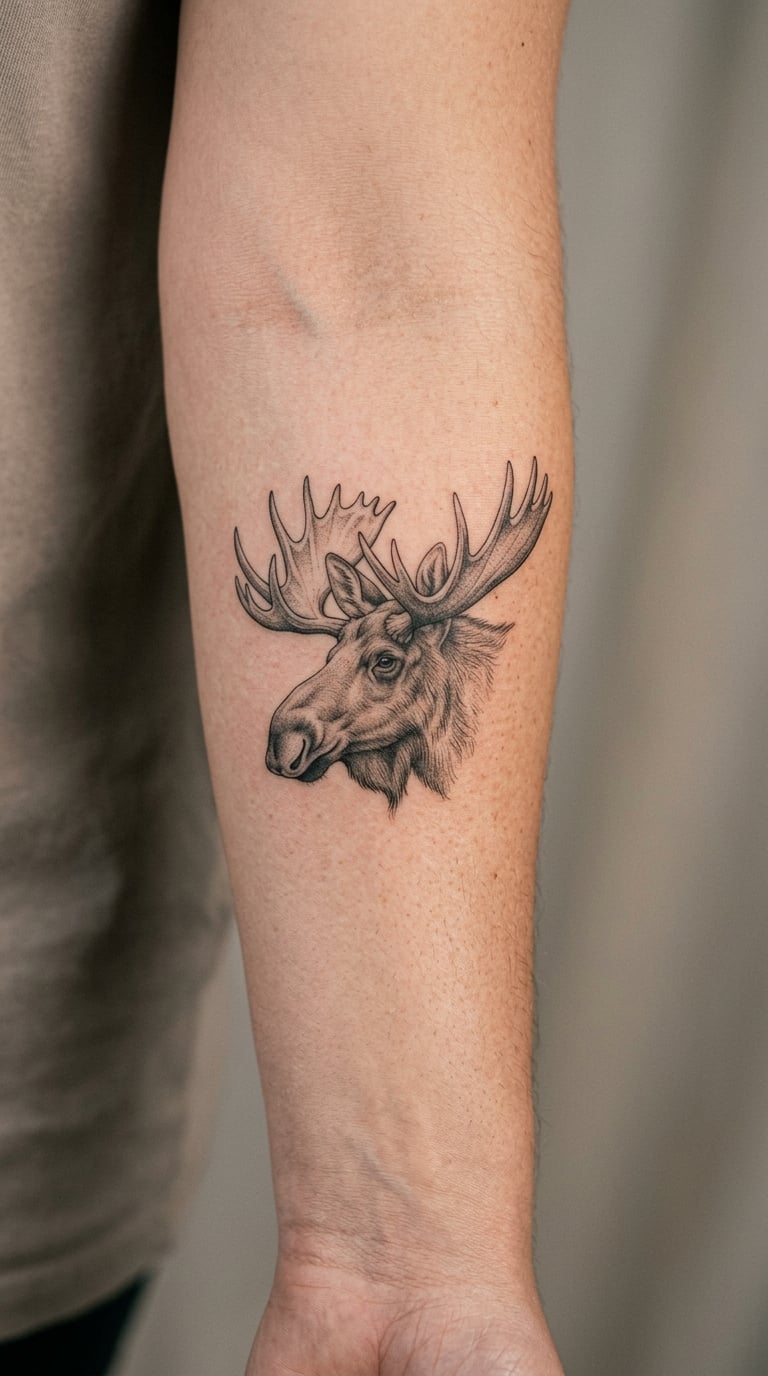
Micro-realism is a design built to stay readable at a scale where most portraits turn to mud. A moose head at three inches works because the artist limits the palette to about three greys, leaves the eye and the nose as the only detailed areas, and gives the antler palmettes a hard edge. Request a reference photo of the animal in flat light, since soft studio shading hides the form.
A moose is northern, huge and unwieldy, and men who hunt them tend to describe the animal in those terms. It is also one of the few hunting tattoos that reads as a portrait rather than a trophy.
Placement: inner forearm, upper arm, or calf. Size: 3-4 in (8-10 cm). Style: micro-realism. Pain: low to medium. Make it yours: add a single drop of colour in the eye, nothing else.
18. Deer and Moon Wilderness Tattoo
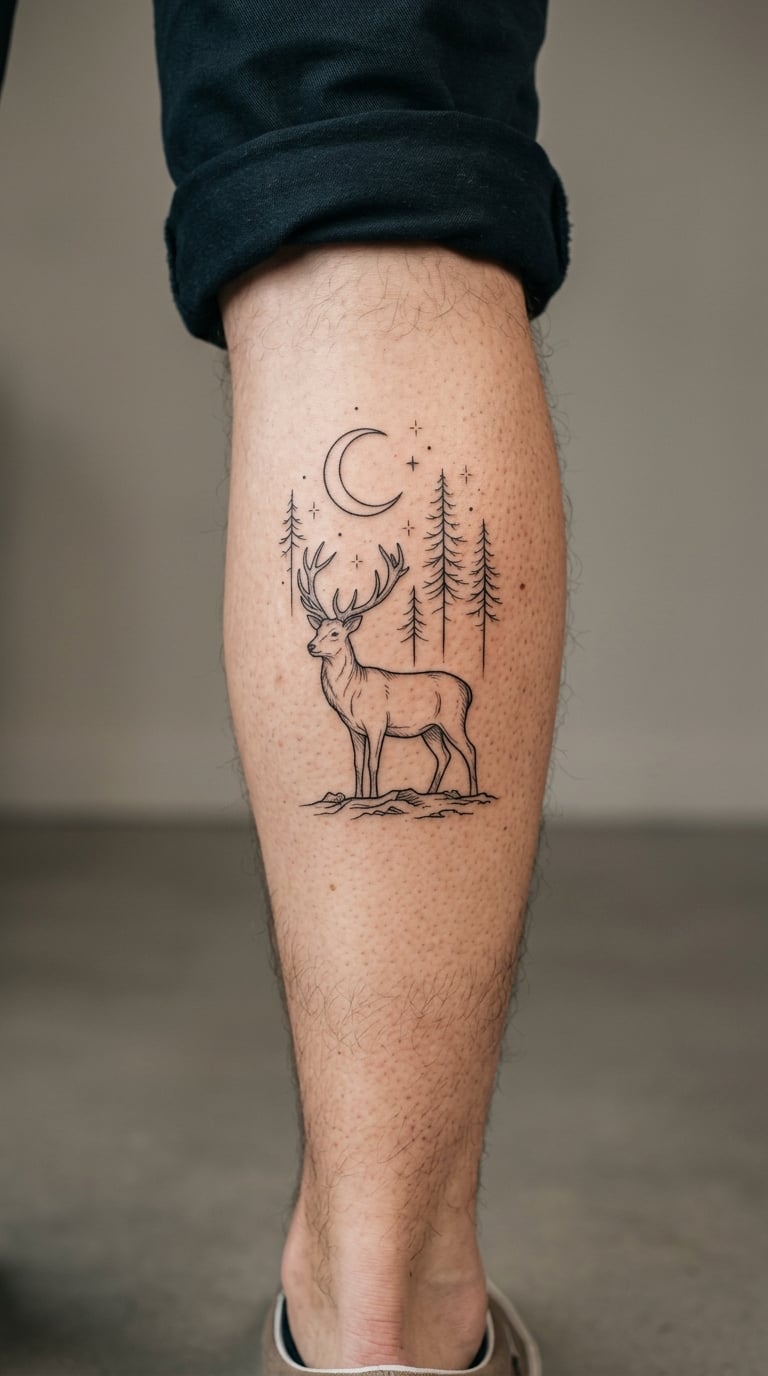
Quiet compositions suit people who hunt alone more than anyone else. A deer in profile with its head up, a crescent moon above, and two or three pines spaced far apart leave most of the field open, which is what keeps a fine-line piece from turning grey as it ages. A clear lower third, where most fine line goes fuzzy first, is the part to plan carefully.
It means the hours before first light, and a preference for the hunt over the harvest. On a calf it reads well at a distance without shouting.
Placement: outer calf, outer forearm, or ribs. Size: 5-7 in (13-18 cm) tall. Style: fine line atmospheric. Pain: low on the calf, higher on the ribs. Make it yours: set the moon phase to the month of a hunt you want remembered.
19. Traditional Fish and Hunt Combination Tattoo
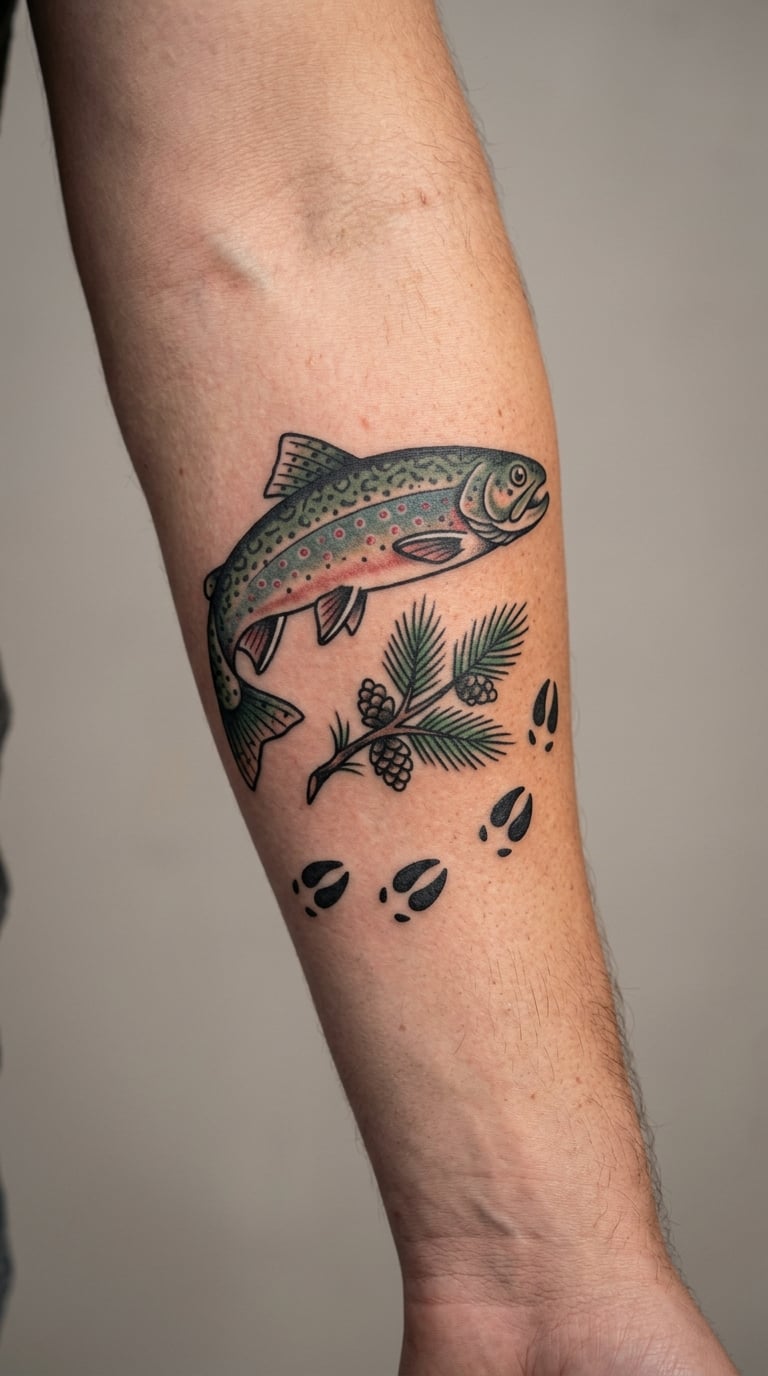
Men who split their outdoor time between the two sports usually want both named. A traditional trout in profile, with a small pine branch under it and a set of deer tracks beneath that, is a clean vertical composition for a forearm. The fish carries the detail and colour, the hunting elements stay as thin line underneath, and the whole thing stacks without fighting for space.
It means the year as a whole rather than one season of it. It is one of the few hunting designs that travels well outside the hunting crowd.
Placement: inner or outer forearm, stacked vertically. Size: 5-7 in (13-18 cm) tall. Style: neo-traditional. Pain: medium. Make it yours: match the fish to the colours of the water you actually fish, which is often more specific than it sounds.
20. Antique Map Hunting Design
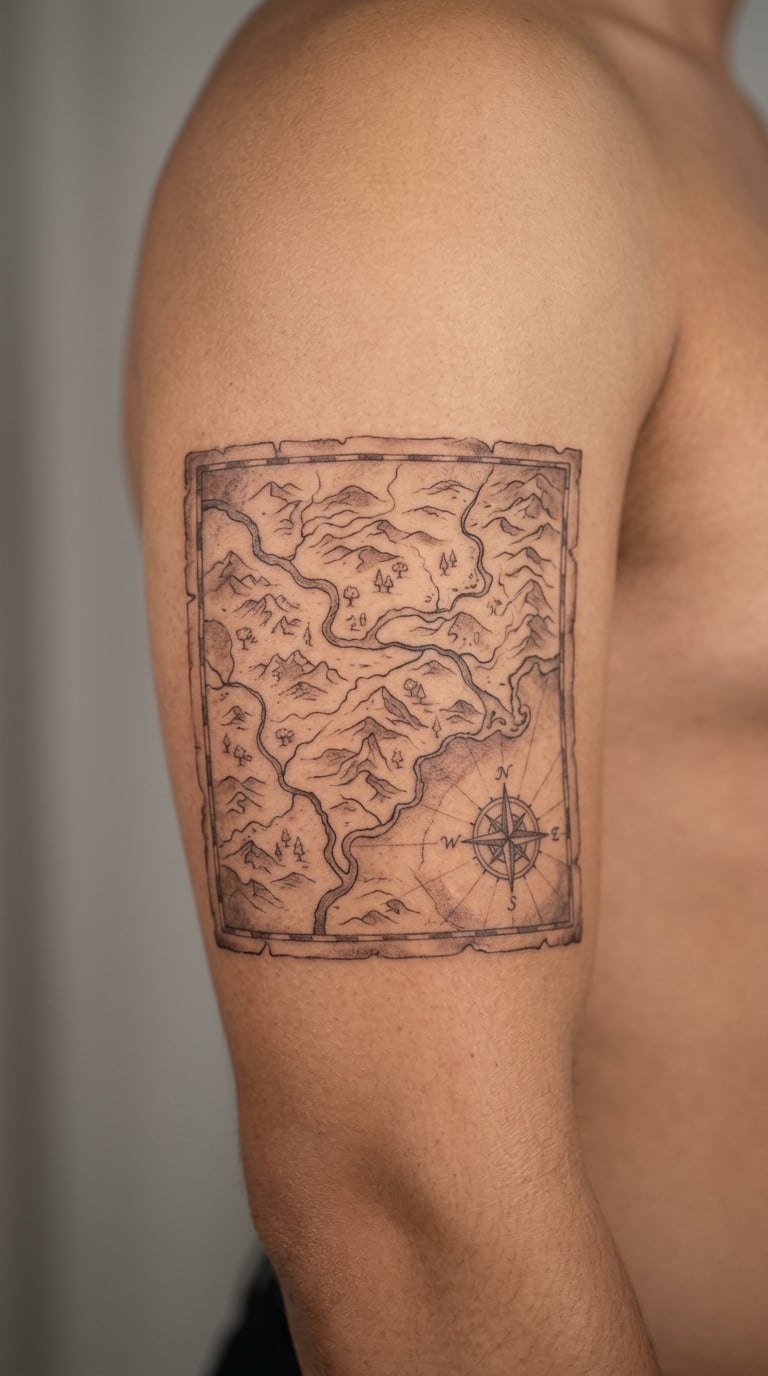
An aged map panel is a bigger, warmer cousin of the coordinates design. Sepia contour lines, a hand-drawn border, a small compass in one corner, and a few marks in a different ink for a route or a boundary. Fading is built into the style, so it is forgiving to tattoo, and the panel shape means it can be scaled to fill almost any flat space.
It points to travel, land, and history. A lot of men book this one to mark a property that has been in the family for generations.
Placement: upper arm, outer thigh, or across the back. Size: 5-8 in (13-20 cm). Style: illustrative, aged. Pain: low for line-heavy panels, rising if a large grey wash is added. Make it yours: trace the boundary of a real parcel or lease, which an artist can do from a plat map.
21. Fox in the Snow Tattoo
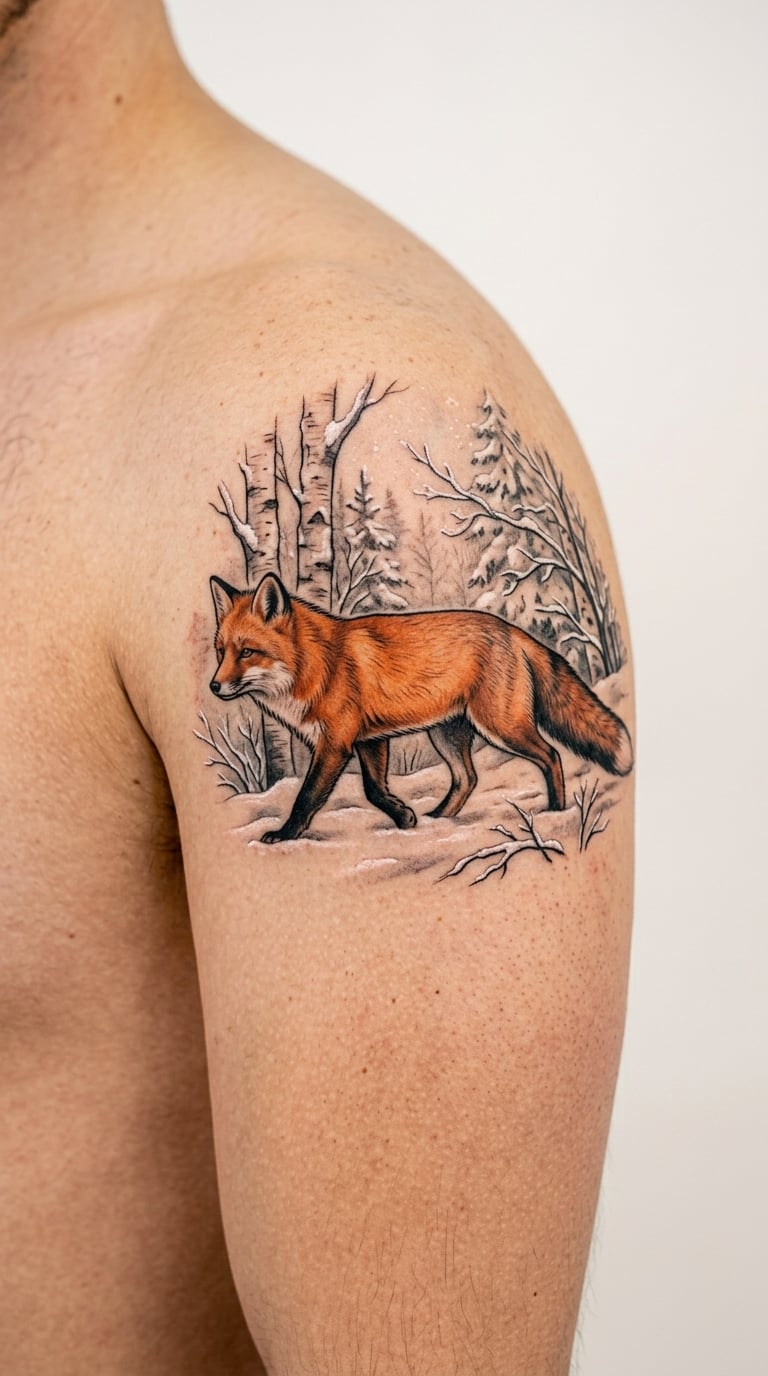
Winter hunting country produces a lot of fox work, and the strong version uses the snow. A red fox moving through sparse trunks with the background kept as bare skin reads better than a fully filled scene, because the white of the skin does the work of the snow. Fur texture comes from a few directional strokes rather than a grey wash over the whole body.
It points to winter, to coyote and fox seasons, and to hunting country in the cold months. It also works as a hunting-adjacent design for someone who hunts predators rather than game.
Placement: shoulder, upper arm, or outer thigh. Size: 6-8 in (15-20 cm). Style: realism with open white space. Pain: medium. Make it yours: have the fox shown in the pose it actually held when you saw one, which is more specific than it sounds and more convincing to anyone who has watched them.
22. Minimal Hunting Compass Rose Tattoo
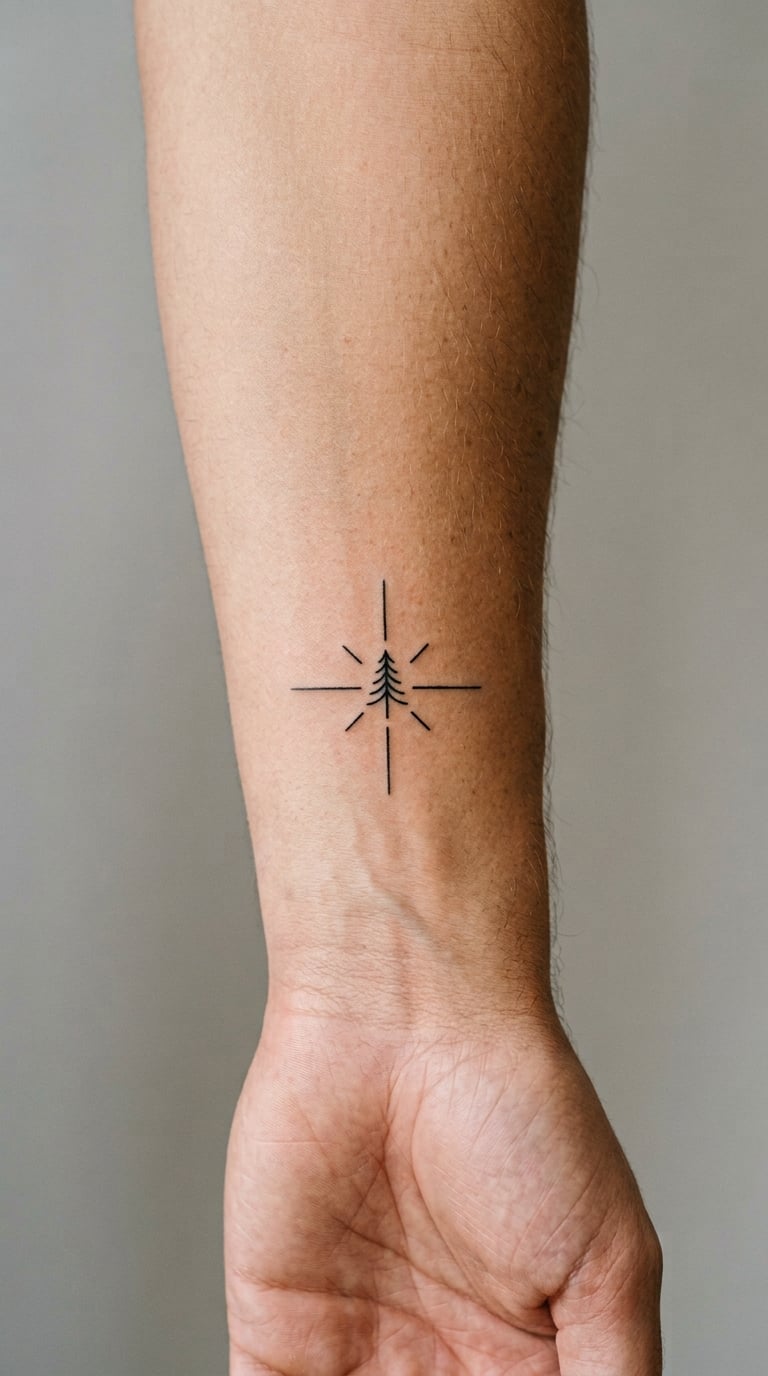
A compass rose is symmetrical, so it is easy to draw and hard to draw badly. Two inches across with four points, single-weight line, and one small hunting reference in the middle circle, usually a pine, an antler, or a north arrow. The lines have to be dead straight and the points even, or the symmetry that makes the design work falls apart.
It means knowing where you are, which is the least romantic and most repeated reason hunters give. It is the easiest of these designs to hide at work and the easiest to extend later.
Placement: inner wrist, forearm, or behind the ear. Size: 2-3 in (5-8 cm). Style: minimal line work. Pain: low, with the wrist more sensitive than the mid-forearm. Make it yours: rotate the rose so the long point sits on true north rather than straight up.
23. Deer Portrait with Coordinate Date Tattoo
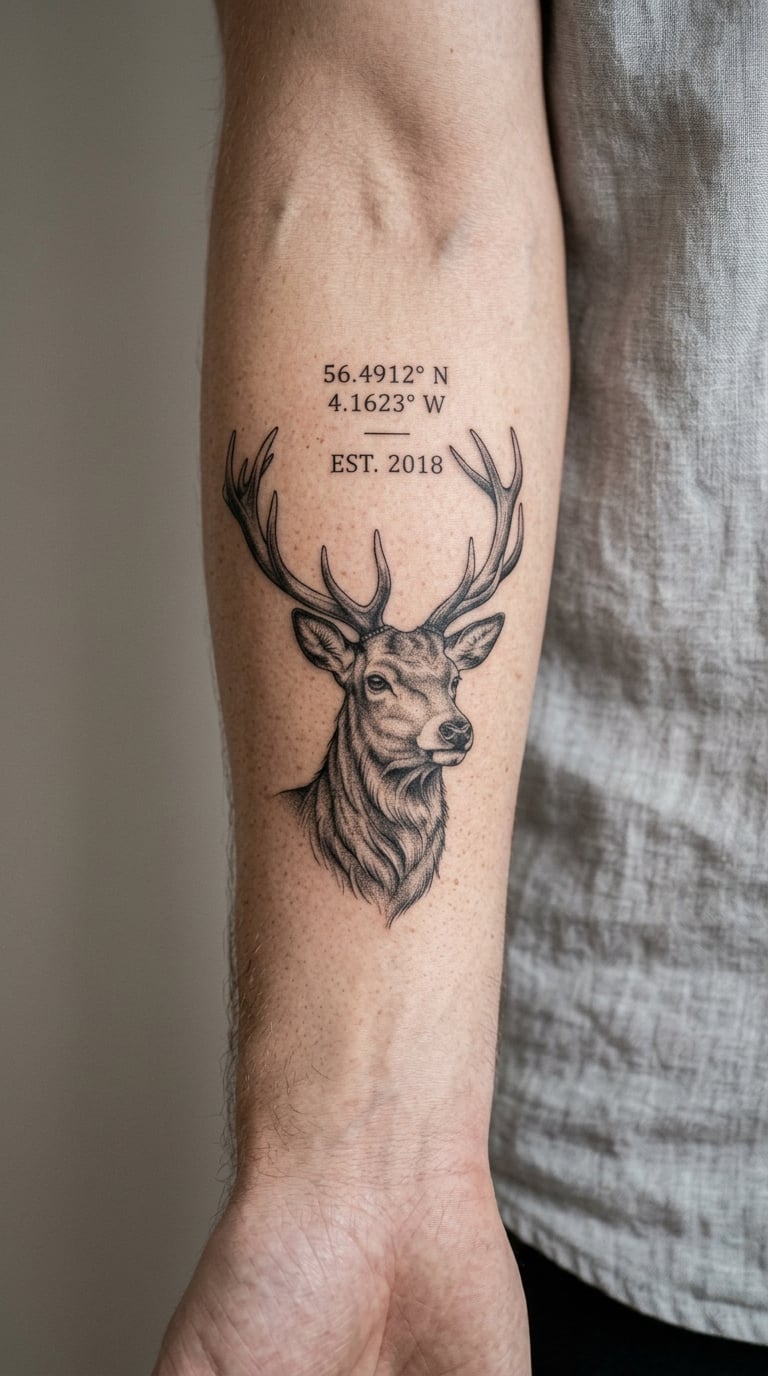
A two-part design: a shaded deer head on top, a strip of text or coordinates underneath, set in a plain typeface with generous spacing between the characters. Running it vertically along the forearm gives both parts room, and a thin rule between them keeps the portrait from floating. Text on skin has to be spaced wide or the letters fill in with age.
It marks a specific hunt rather than hunting in general, which makes it one of the more personal options in the list. Bring the coordinates from the GPS unit rather than typing them from memory.
Placement: inner or outer forearm, vertical. Size: 6-8 in (15-20 cm) tall. Style: realism plus fine line. Pain: medium. Make it yours: use the date and coordinates exactly as the unit recorded them, punctuation and all.
24. Pine Forest Hunting Hide Tattoo
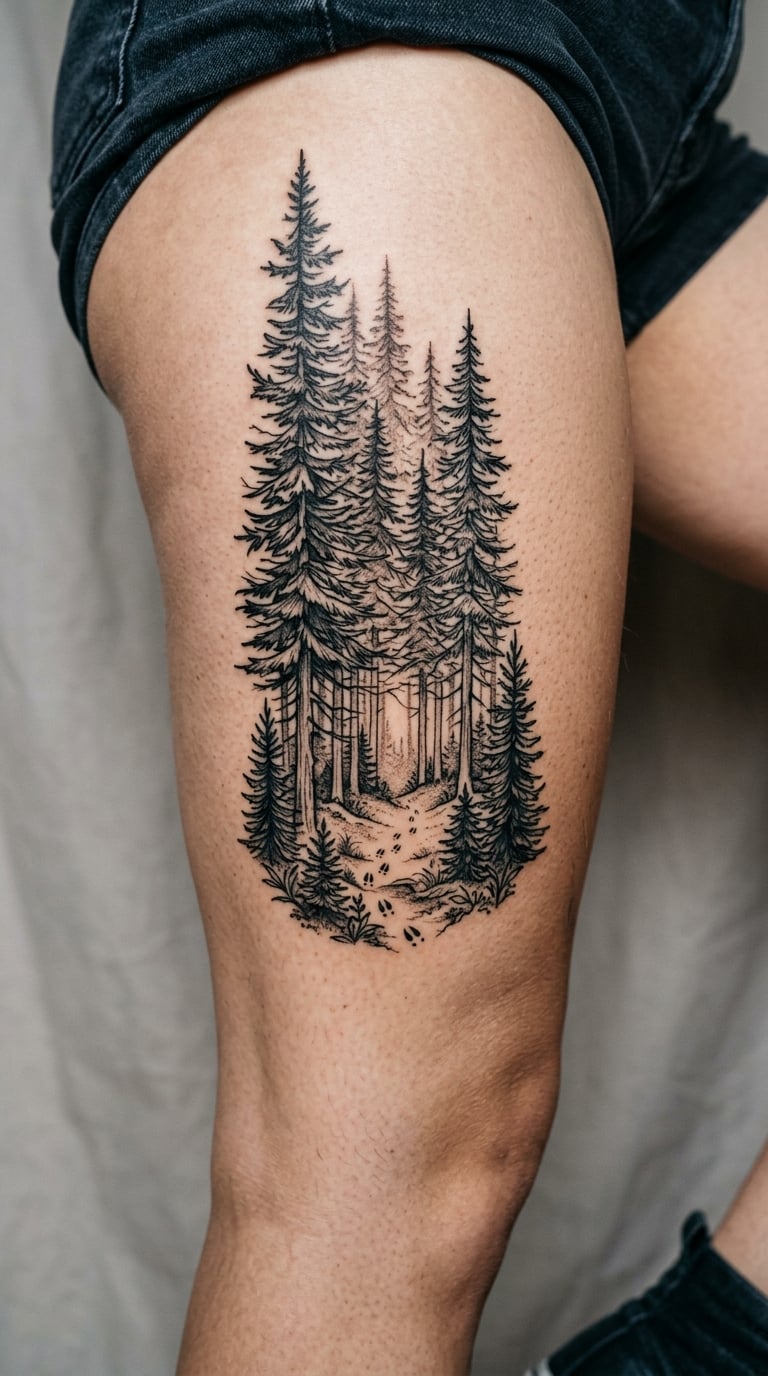
This is the sleeve-scale version of the outdoors: pines stacked in layers from foreground to background, a clearing in the middle distance, and tracks leading into it. Depth comes from value rather than outline, so the front trees are solid black and the back ones are grey. It needs a real flat surface, and the outer thigh or upper arm gives it more room than a forearm does. Related forest work is in our pine forest forearm gallery.
It means the place itself, and the quiet of it, rather than any individual animal. Best for someone already collecting or ready to add to an arm.
Placement: outer thigh, upper arm, or as a wrapping panel. Size: 8-12 in (20-30 cm). Style: illustrative black and grey. Pain: medium to high, and large grey areas are usually split across two sessions. Make it yours: put the clearing where the treeline actually opens up on ground you know.
25. Heritage Hunting Coat of Arms Tattoo
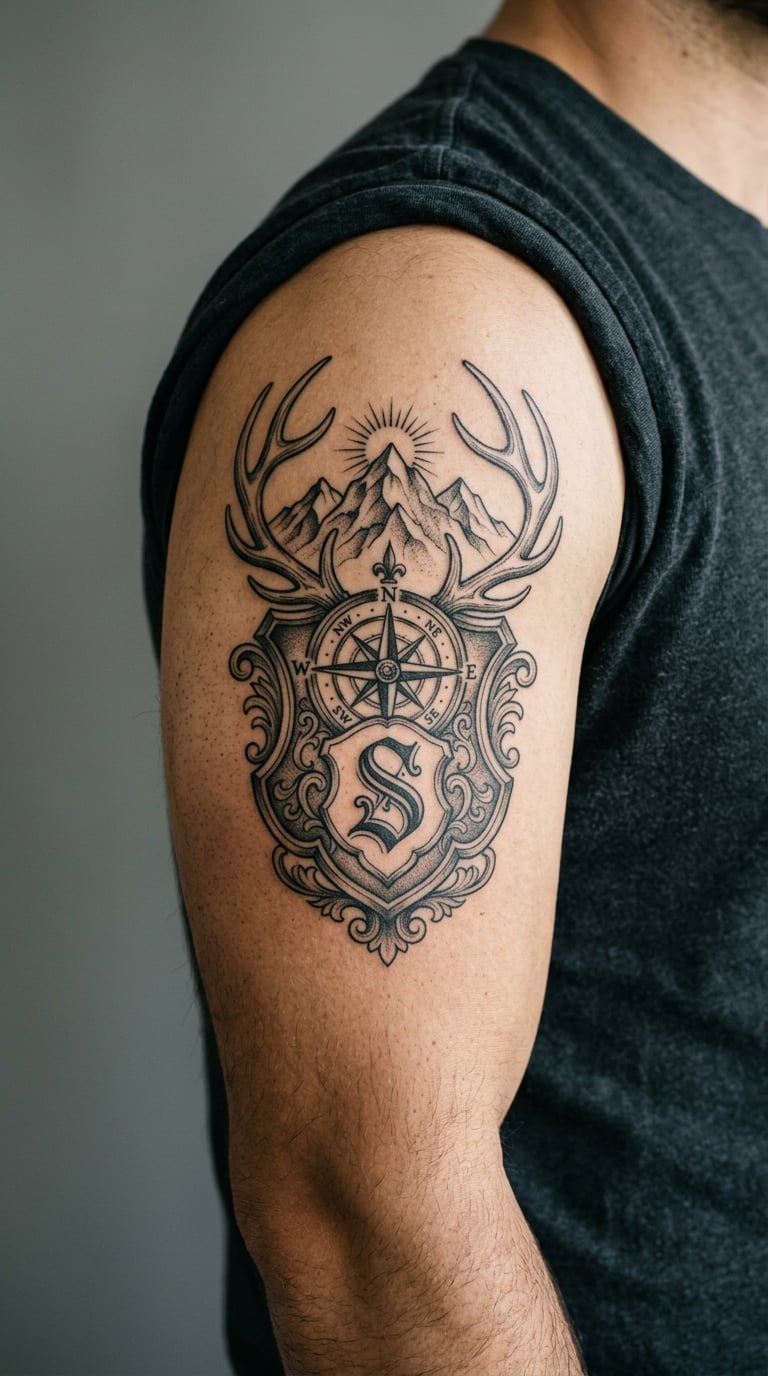
A crest built from original elements, not copied from any existing emblem: antlers framing a shield shape, mountains and a small compass inside, and one family initial in the centre. Ornate line work and a muted palette give it the weight of an old seal without going full colour. It works best when the artist keeps the interior simple enough that the whole thing still reads at six inches across.
It marks a family hunting tradition or a surname, and it is the one design on this list that tends to become a back piece. Build it from scratch with your artist rather than tracing an existing crest.
Placement: chest, upper back, or upper arm. Size: 8-12 in (20-30 cm). Style: ornate illustrative. Pain: high, and the chest is the reason most people plan this over two or three sittings. Make it yours: build it in a group session with a friend or relative, since half the pieces people keep involve a second person’s idea.
How to Choose the Right Design
Pick the design that matches the body area before you pick the one that matches your mood. A design that reads well on a flat thigh can collapse on the curve of a shoulder, and the same antler drawing works at eight inches on a forearm and not at three.
Simple hunting tattoo ideas for men versus full pieces
If this is your first tattoo, stay at small and minimal, the two to four inch range, and let the artist build out from there later. A minimalist antler, a compass rose, or a set of tracks can all be extended into a larger arm piece years afterwards, and a small piece is far easier to place well. A full sleeve is a commitment of dozens of hours and a decade of visible ink, and it does not suit a man who has never sat through a long session.
Style
Black and grey realism rewards a good artist and ages predictably. Blackwork gives the boldest result and holds line well. Traditional and neo-traditional suit people who want colour and graphic weight, though bold colour on the inner arm fades faster than the same ink on an outer arm. Fine line is the most delicate of the four and needs a placement that is not bent, rubbed by a watch strap, or exposed to hard sun all day.
Scale
Match the scale to the detail. Under two inches, an artist can render an eye and an antler tip and nothing else. At five to seven inches, a full portrait has room for shading. Past ten inches, the piece wants to be a scene, and a single head at that size will read as unfinished. Inking a big design small because a reference photo looked good is the most common way these pieces fail.
Placement and contrast
Outer forearm, upper arm, shoulder and outer thigh are the flattest surfaces and take detail best. The inner forearm bends with every movement, so a portrait will crease unless it is placed with the head toward the elbow. Chest and rib work is sensitive and distorts, but it is the most visible. If you work in a shirt and tie, check how a design reads from three feet before you commit.
Personal meaning
The strongest hunting tattoos in the shops I have visited are the ones assembled from specific small things, an antler and a shell and a mason jar from a particular hunt, rather than a stock animal portrait. If you can name what each element in the design refers to, the piece will still mean something to you in thirty years. Bring that list to the consult, and the artist can build a composition around it rather than drawing a template.
Cost and Session Time
Tattoo cost is driven by hourly rate and how many hours the design takes, not by how impressive the reference photo looks. Most shops charge by the hour with a minimum, and detail-heavy black and grey realism takes considerably longer than the same subject in line work.
| Scale | Typical size | Session time | Indicative US cost | Placements it suits |
|---|---|---|---|---|
| Small | Under 2 in (5 cm) | Under 1 hour | 100 to 250 dollars | Wrist, inner forearm, behind the ear |
| Small to medium | 2-4 in (5-10 cm) | 1 to 3 hours | 200 to 600 dollars | Forearm, upper arm, calf |
| Medium | 5-8 in (13-20 cm) | 3 to 6 hours | 500 to 1500 dollars | Outer forearm, shoulder, chest, thigh |
| Large | 9-14 in (23-35 cm) | 6 to 12 hours, often split | 1200 to 3000 dollars | Chest, back, upper arm, thigh |
| Sleeve scale | Full arm or leg | 20 to 40 hours across many sittings | 3000 to 10000 dollars and up | Full arm, full leg, back pieces |
Those ranges are honest national averages, not quotes. City, shop minimums, the artist’s rate and the number of sittings move the final number a long way, and a piece that needs three appointments is priced as three appointments. If a figure matters to you, ask the shop for the hourly rate and the estimated hours separately, then multiply them yourself.
Aftercare Basics
- Follow your artist’s aftercare instructions first. They know what they did in your skin on the day, and their advice overrides anything general, including this list.
- Wash it gently. Lukewarm water and unscented soap, twice a day for the first few days, then pat dry with clean hands or a paper towel rather than a terry towel.
- Moisturise thinly. A thin layer of a plain ointment or fragrance-free lotion a few times a day keeps the skin from drying and flaking. Thick layers trap heat and can irritate.
- Protect it from sun. Keep new work out of direct sun for the first couple of weeks, and use sunscreen on healed hunting tattoos for the rest of your life if you want the greys to stay grey.
- Leave the scabs alone. Picking or scratching pulls ink out of the healed skin and leaves patchy spots that are hard to fix later.
- Skip the gym for a few days. Heavy sweating, swimming pools with chlorine and saunas are all rough on fresh tattooing. Loose clothing over the area helps more than people expect.
Frequently Asked Questions
What does a hunting tattoo mean?
A hunting tattoo usually points to identity rather than a single message. A deer or stag speaks to patience and the pursuit, a bow or rifle names the kind of hunting you do, a scene with a cabin or a ridge line points to a place. The most common reason men get one is a memorial to a parent, grandparent or hunting partner, followed by marking a family tradition or a first hunt.
What does a male deer or buck tattoo symbolize?
A buck is the most common hunting subject because it reads as pursuit, patience and the season rather than as a kill. Antler count often carries a personal meaning, a family trophy, a first deer, or an animal someone in the family harvested. In short, the deer says the man spends time outdoors and values the chase and the craft that goes with it.
What is the best placement for a hunting tattoo?
Outer forearm, upper arm, shoulder and outer thigh are the flattest surfaces and take shading and detail best. The inner forearm bends constantly, so a portrait placed there creases unless the head points toward the elbow. Wrist and chest work is more painful and more visible. Choose the placement before the design, and check how the piece reads from a few feet away.
How big should a hunting tattoo be?
Match the size to the detail you want. Under two inches, an artist can render an eye, an antler tip and a nose. Five to seven inches is where a shaded portrait has room to work. Past ten inches, a single head starts to look unfinished and the design wants to be a scene. A small piece also leaves the option of extending it into a larger arm piece later.
Do hunting tattoos age well?
Blackwork and traditional styles hold up best, because solid fills and heavy outlines are less affected by sun and fading than fine detail. Black and grey realism ages predictably if the greys are not pushed too light. Fine line work is the most fragile, especially on hands, fingers and any area that flexes or catches sun. Whatever the style, a healed tattoo under daily sunscreen keeps its value for decades.
How much does a hunting tattoo cost?
Cost follows hourly rate and hours, and a realistic wildlife portrait takes far longer than line work. In the US, a small piece under two inches usually runs 100 to 250 dollars, a forearm-scale design of five to eight inches runs 500 to 1500 dollars, and a full sleeve runs into the thousands across many sittings. Shop minimums, city and artist rate move those numbers a wide distance.
Conclusion
For a first tattoo, the minimalist antler, the compass rose, or the deer tracks are the safest bets in this list of 25 hunting tattoo ideas for men. They are small, they are cheap, they sit well almost anywhere, and they leave room for a bigger piece down the road. The realistic stag portrait, the blackwork skull, and the heritage crest are the ones to save until you have sat through a long session and know what you want. Take your two favourites, find an artist who has done that exact style, and book the consult. Bring the story, not just the picture.