
20 Football Tattoo Ideas for Men: Best Ideas (October 2026)
A football tattoo is any permanent design that points at association football: the ball, the pitch, a goal, a trophy, a kit number, or one match you never forget. These 20 football tattoo ideas for men are built to be sketched, not just admired, so each one comes with a placement, a realistic size and a style note you can hand an artist.
Read the quick guide first if you want the whole list on one screen, then jump to the ideas that catch you. If you play competitively, check the pain column before you pick a placement, because ribs and collarbones are on the list. If you are adding to an existing sleeve, start with number 20. Updated for October 2026.
20 Football Tattoo Ideas for Men: Quick Guide
| Idea | Style | Best placement | Size | Pain |
|---|---|---|---|---|
| 1. Classic crest | Linework and traditional | Outer forearm | 7-9 cm | Medium |
| 2. Helmet | Blackwork | Outer upper arm | 8-10 cm | Medium-high |
| 3. Player silhouette | Black ink silhouette | Upper arm | 10-12 cm | Medium-high |
| 4. Jersey number and ball | Bold typography | Inner forearm | 6-8 cm | Low-medium |
| 5. Gloved hands | Black and grey realism | Forearm | 10-12 cm | Medium |
| 6. End zone | Blackwork | Forearm | 12-15 cm | Medium |
| 7. Line art ball | Fine line | Inner wrist | 3-4 cm | Low-medium |
| 8. Laurel wreath | Traditional American | Chest | 8-10 cm | High |
| 9. Geometric ball | Blackwork with dotwork | Calf | 8-10 cm | Medium |
| 10. Goalkeeper | Illustrative | Shoulder blade | 12-15 cm | High |
| 11. Trophy | Black and grey | Forearm | 8-10 cm | Medium |
| 12. Field map | Fine line | Forearm | 12-15 cm | Medium |
| 13. Quarter clock | Blackwork | Wrist | 3-5 cm | Low-medium |
| 14. Watercolor player | Watercolor | Forearm | 10-12 cm | Medium |
| 15. Rib realism | Micro-realism | Ribs | 4-5 cm | High |
| 16. Ball and rose | Neo-traditional | Forearm | 9-11 cm | Medium |
| 17. Stadium lights | Blackwork | Upper back | 15-20 cm | High |
| 18. Collarbone number | Fine line | Collarbone | 4-5 cm | High |
| 19. Position icons | Blackwork icons | Inner forearm | 2-3 cm each | Low-medium |
| 20. Action scene | Blackwork and grey wash | Outer upper arm | 15-20 cm | High |
1. Classic Football Crest on the Forearm
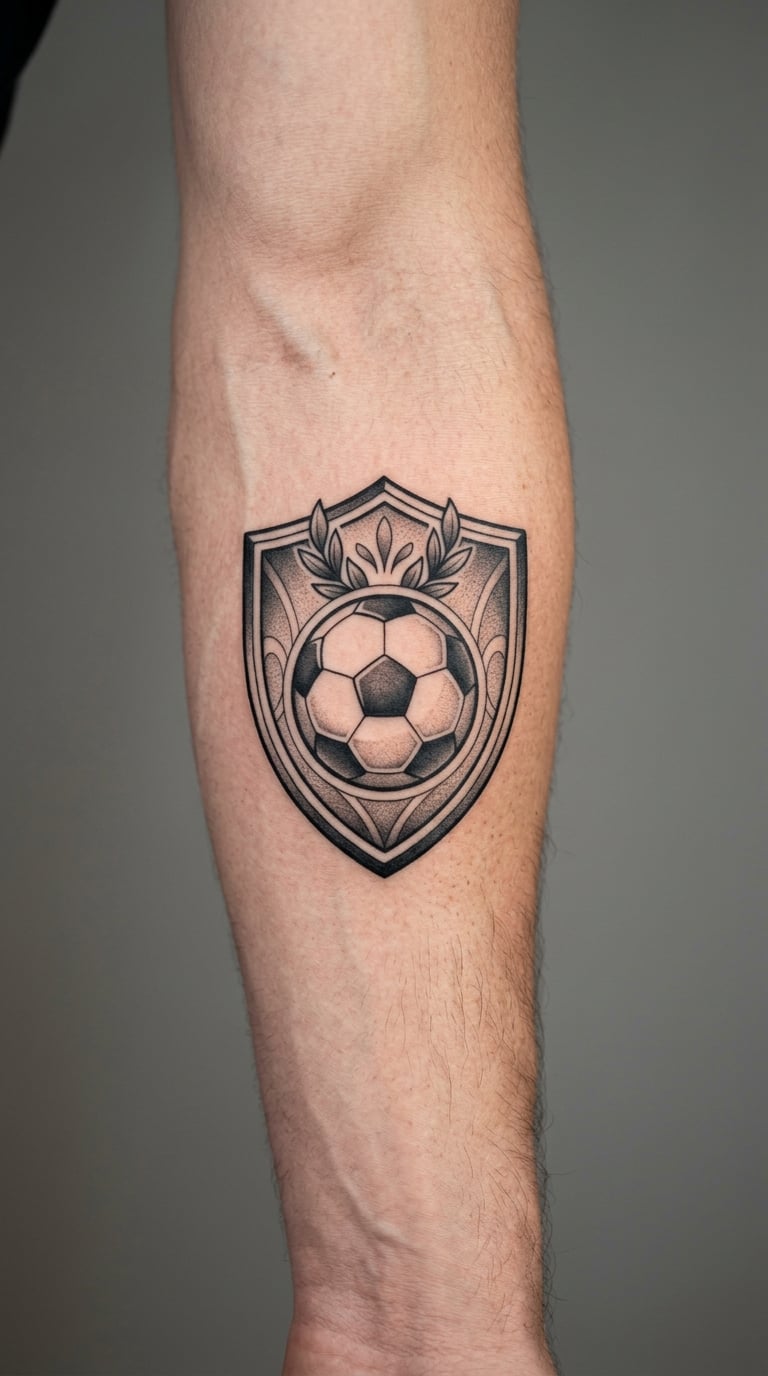
A crest tattoo works when it is reduced to its bones: a shield, a chevron or star, one simplified ball, and a band of lettering you can actually read. Heavy outlines and evenly packed black shading give it weight without turning it into a sticker.
Most men who get one are pointing at a club, a season, or a country. Fans keep saying the same thing in tattoo forums: a straight copy of a badge looks borrowed, while a rebuilt crest that keeps the shapes but drops the wordmark feels like yours.
Placement: outer forearm, 7-9 cm tall so the lettering survives. Style: traditional linework with restrained black packing. Pain: medium, and forearm ink holds line weight well for years.
Make it yours: use your actual founding year or the year of the season that mattered most, set in a narrow band under the shield.
2. American Football Helmet in Blackwork
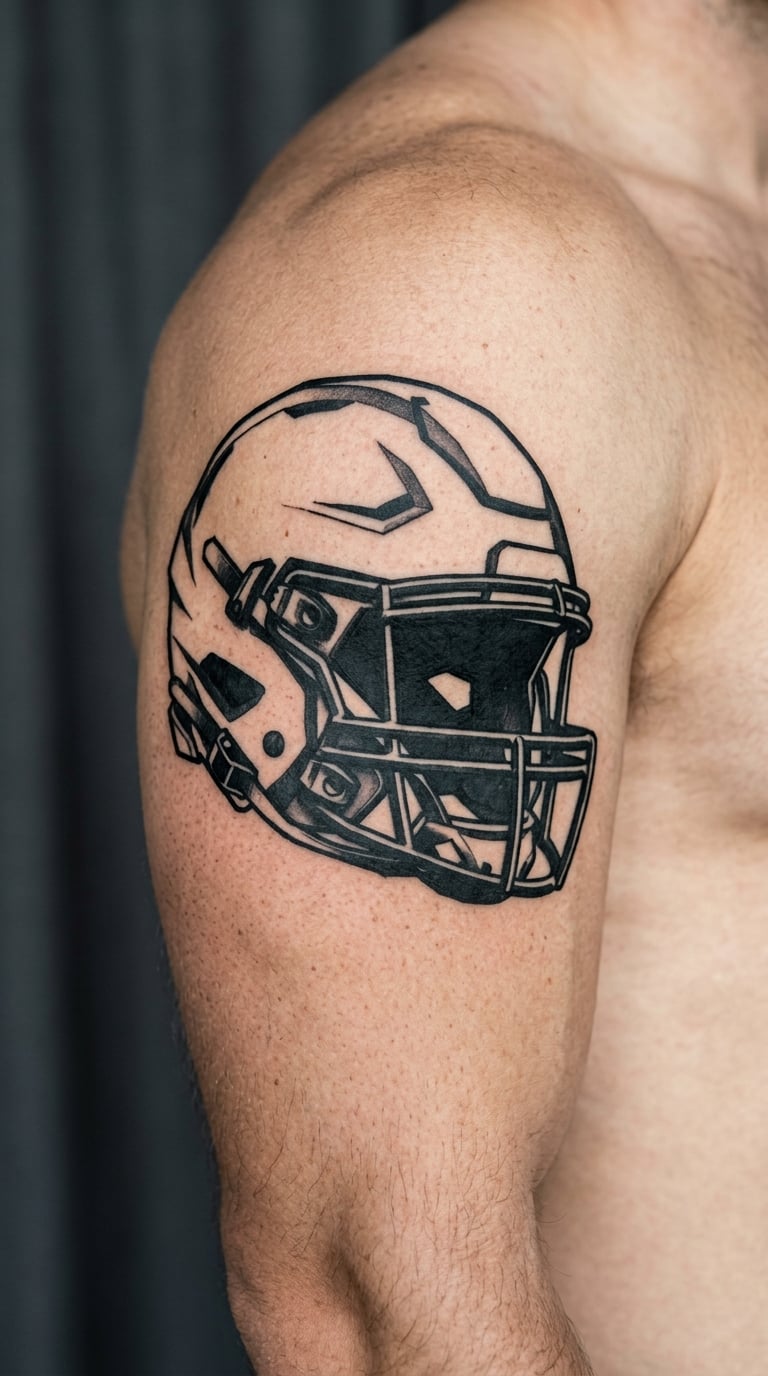
Side profile, hard facemask bars, no face inside the shell. Blackwork suits the shape because a helmet is already mostly flat planes and hard edges, which is exactly what solid black handles cleanly.
The helmet says protection and competition more than it says a specific team, which makes it the safe pick if you support more than one side or would rather not wear a badge. It also sits well next to a jersey number or a field map without competing.
Placement: outer upper arm or deltoid, 8-10 cm across. Style: blackwork with negative-space highlights on the shell. Pain: medium-high over the deltoid, and solid black spreads slightly as it ages, so plan on a lighter outline than looks right on day one.
Make it yours: add three small claw-like scratches across the shell, no color, purely graphic.
3. Football Player Silhouette on the Upper Arm
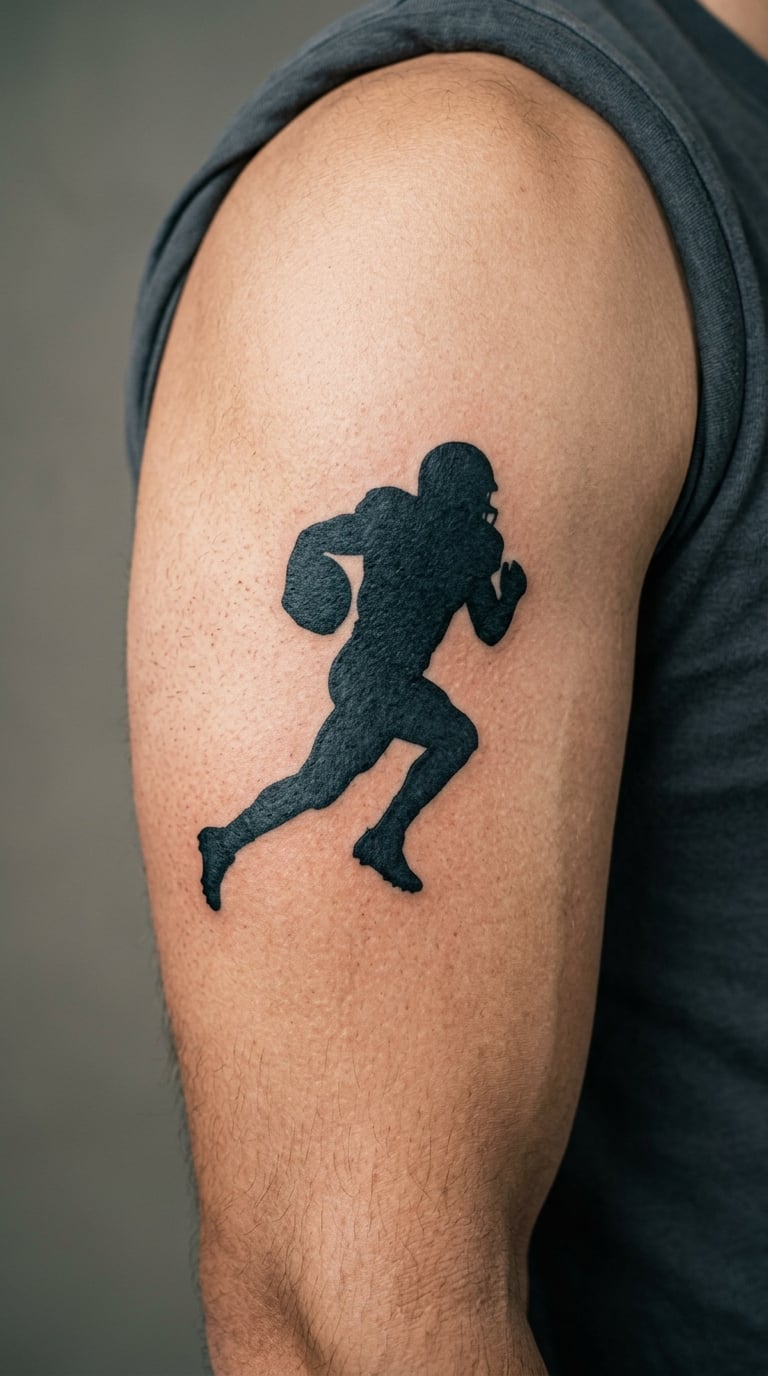
One figure, mid-stride, ball tucked in. Done as a silhouette rather than a portrait, it keeps the movement and drops the face, which sidesteps likeness issues entirely and stays sharp at a small size.
This is the tribute option for men who want a player in the design but not a copy of a photograph. The story behind it is nearly always a season, a first match watched live, or a player who changed how they watched the game.
Placement: outer upper arm, 10-12 cm tall, angled slightly forward to follow the arm. Style: black ink silhouette with a soft grey ground shadow. Pain: medium-high across the biceps, and the ground shadow is where a rushed job shows.
Make it yours: put your own kit number on the back of the shirt in simple block digits.
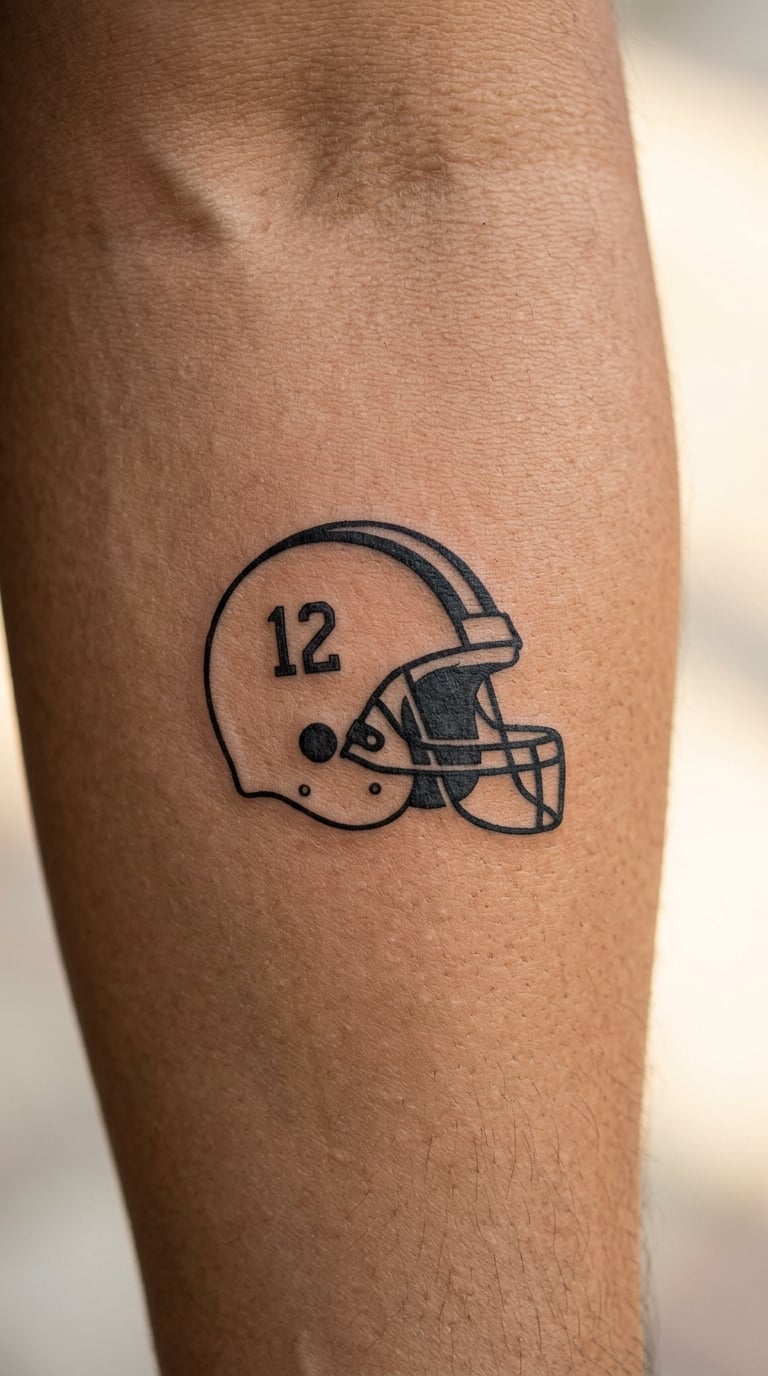
4. Quarterback Number with Football
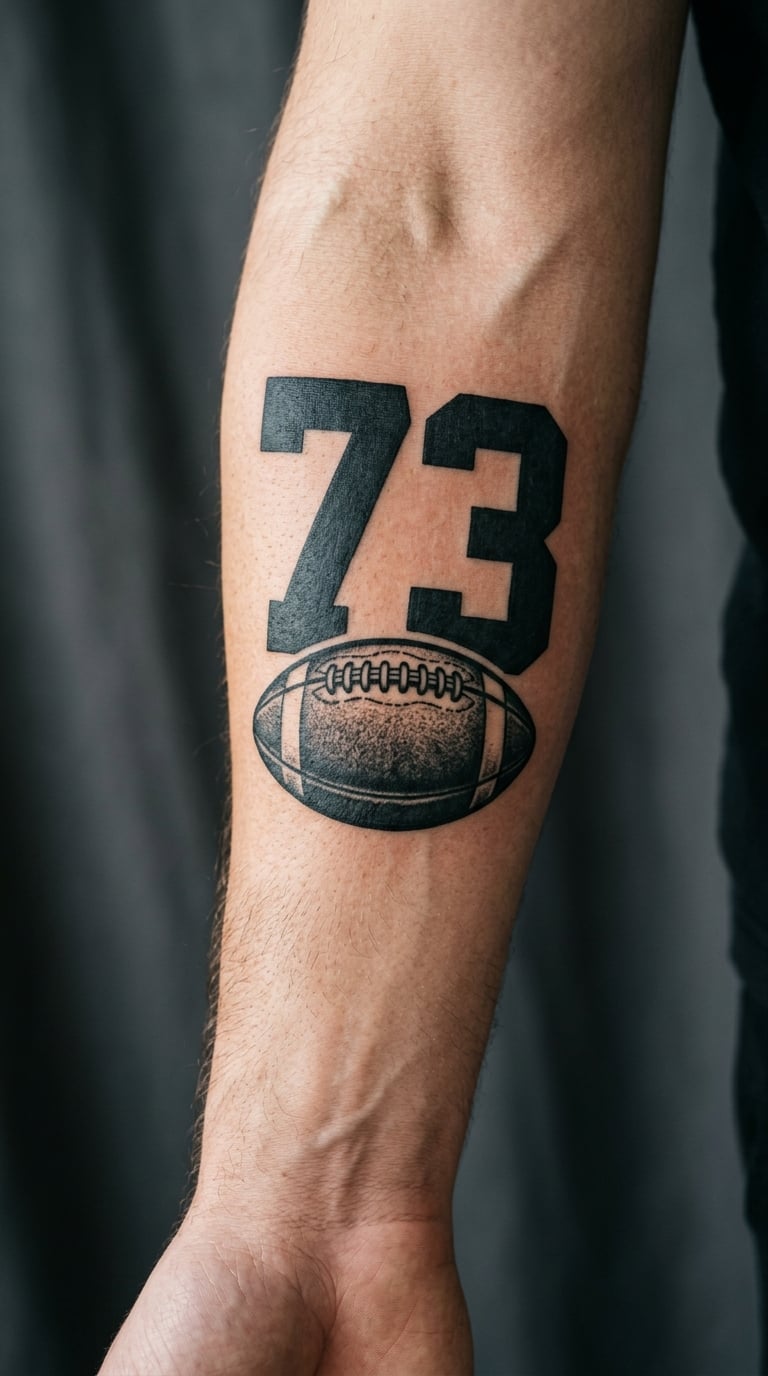
One number, big, athletic block lettering, with a football tucked under it or breaking out of the baseline. Typography does the heavy lifting here, and the number carries more meaning than any amount of imagery.
Your squad number is the part of the game that stays with people longest, especially for anyone who played rather than watched. It is also the easiest of these twenty to read from across a room, which matters if you want strangers to get it.
Placement: inner forearm, 6-8 cm, aligned along the tendon line. Style: bold typographic blackwork, no outline around the digits. Pain: low-medium on the inner arm, and a solid black number needs a touch-up sooner than outline work because the edges soften first.
Make it yours: use your grandfather’s or your dad’s number instead of your current one. It is the piece friends ask about every time.
5. Football Held in Gloved Hands
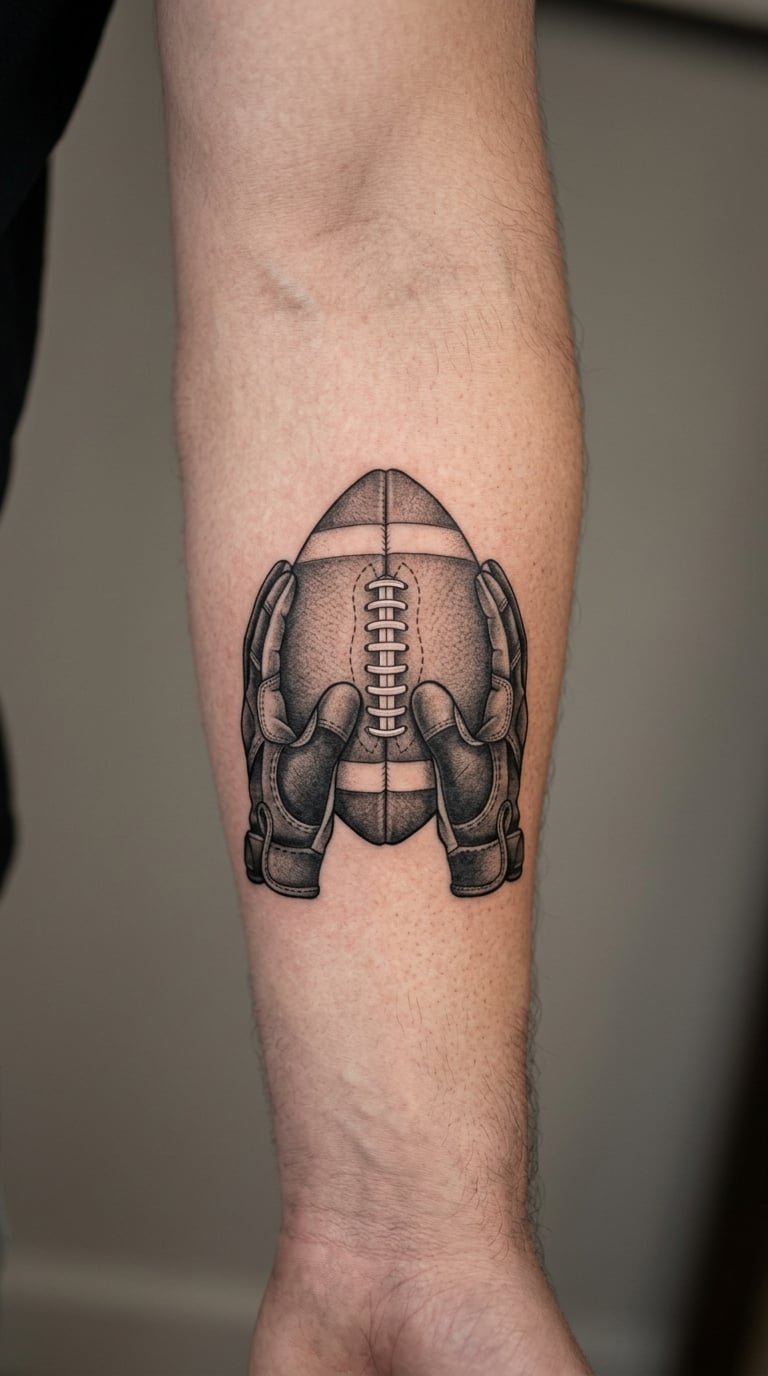
Two gloved hands cupping a ball, cropped at the wrist so it reads as a compact object rather than an arm study. The ball sits centre stage, with the shading doing the work on the fingers and seams.
It is the most emotional design on this list without being sentimental. Hands holding something usually means care, or offering, and football fans often describe it as the one that made their tattoo feel personal rather than decorative.
Placement: forearm, 10-12 cm, wrists cropped by the design edge. Style: black and grey realism with soft glove texture. Pain: medium, and fine glove stitching is the part that turns to grey mush if the design is scaled below about 9 cm.
Make it yours: swap the gloves for bare hands, or vice versa, depending on whether you actually play.
6. Goal-Line End Zone Design
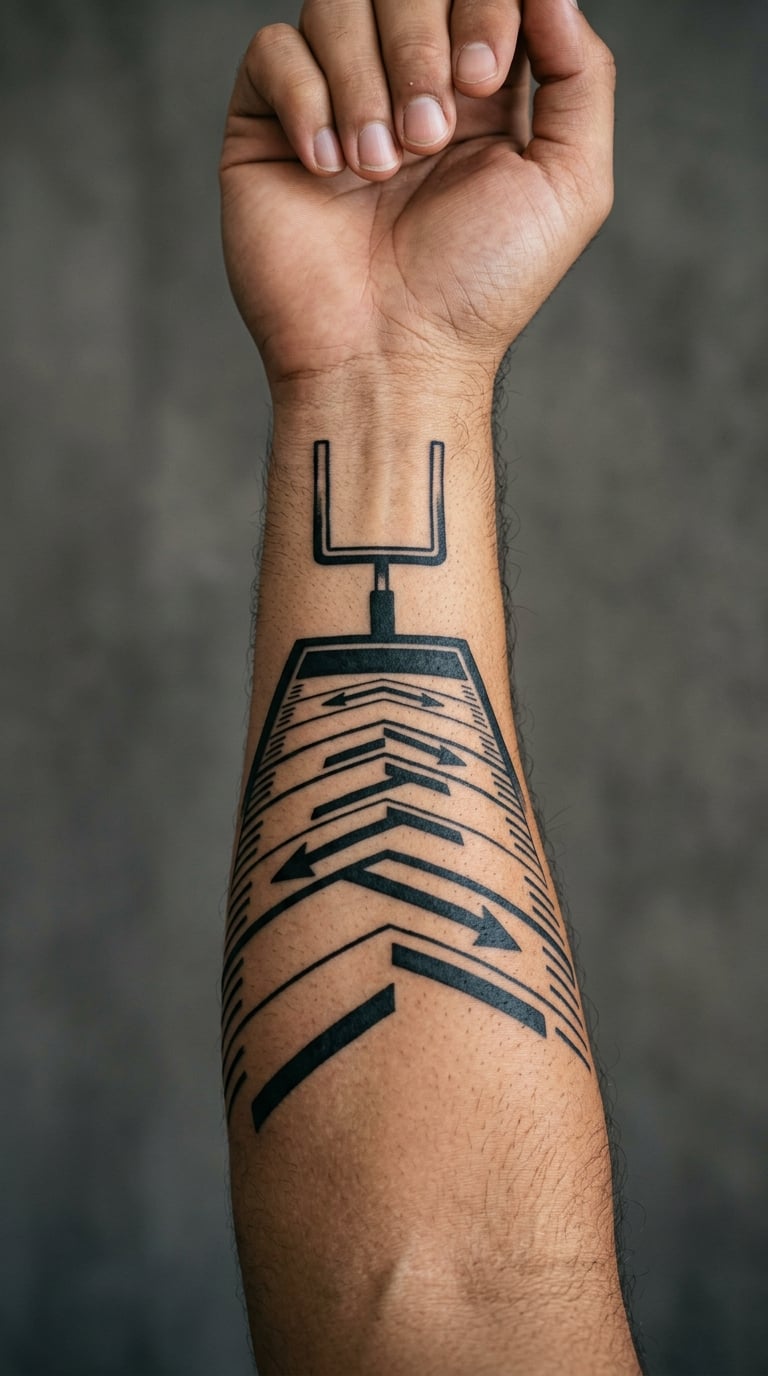
A goalpost seen from behind, angled yard lines running under it, and a couple of directional marks pushing the eye toward the end zone. The composition gets its energy from the diagonals, not from any single object.
Matchday, movement, the last drive. Fans describe it as the design that captures a stadium feeling without naming a ground, so it works whether your team plays in a 90,000-seat arena or a local park on a Sunday morning.
Placement: forearm or calf, 12-15 cm, with the diagonals following the limb. Style: blackwork linework, no grey wash so the lines stay crisp. Pain: medium on the forearm, higher over a rib, and hairlines crossing the yard lines need deliberate placement to avoid a muddy blur.
Make it yours: set the goalpost at the ten-yard mark instead of centred, so the reference is hidden in plain sight.
7. Minimal Football Line Art
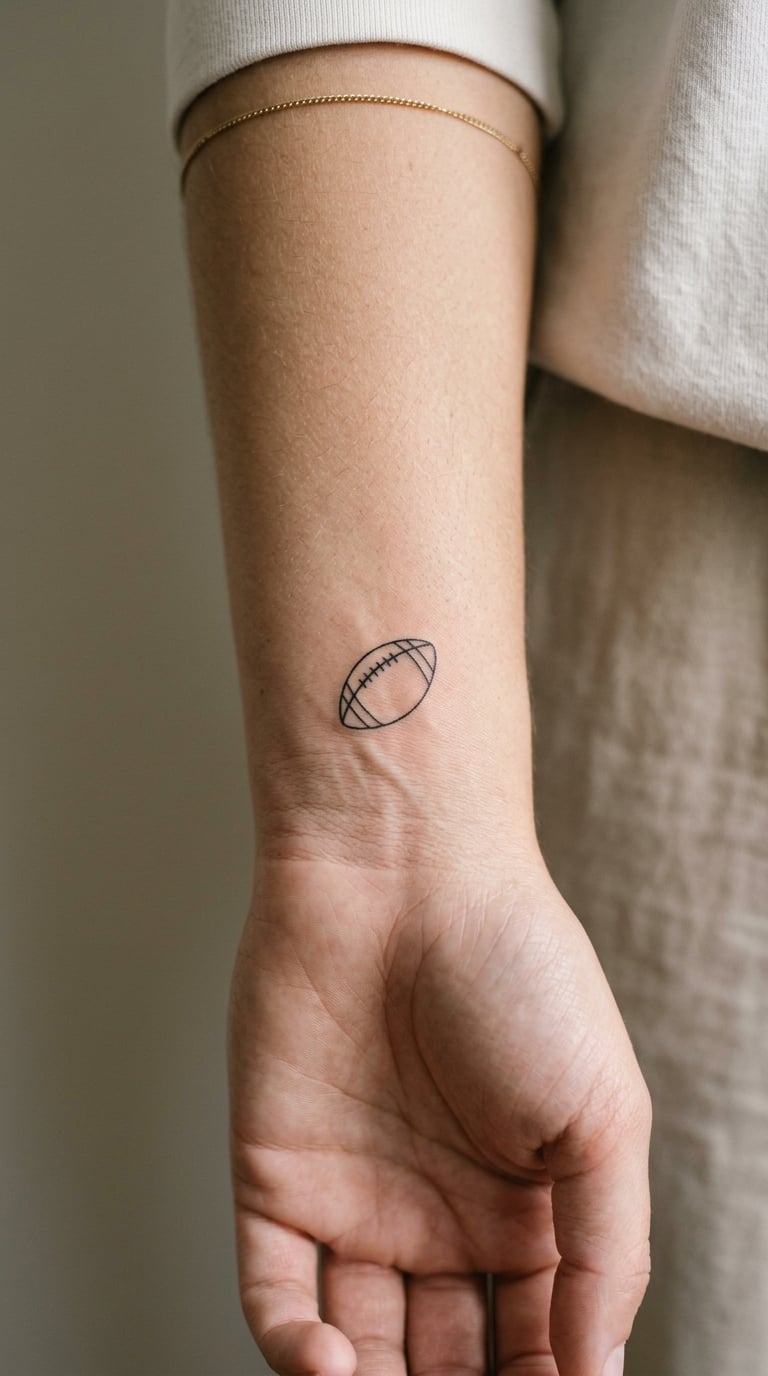
One clean ball outline, drawn with a single consistent line weight, no shading, no laces unless your artist insists on them. The restraint is the whole point: it reads as a considered choice rather than clip art.
Small, quiet, easy to hide under a shirt cuff. For a first tattoo, or for anyone who works somewhere visible, this is the one people most often say they should have started with.
Placement: inner wrist, 3-4 cm, or the inside of a forearm. Style: fine line, one pass only. Pain: low-medium, and be honest here: fine line on the wrist and hands fades fastest of anything on this list and can soften within a few years, often needing a redraw or a line-weight bump.
Make it yours: place a small matching outline on a partner’s wrist, in the same spot. See our 20 matching tattoo ideas for roommates for more paired options.
8. Traditional Football with Laurel Wreath
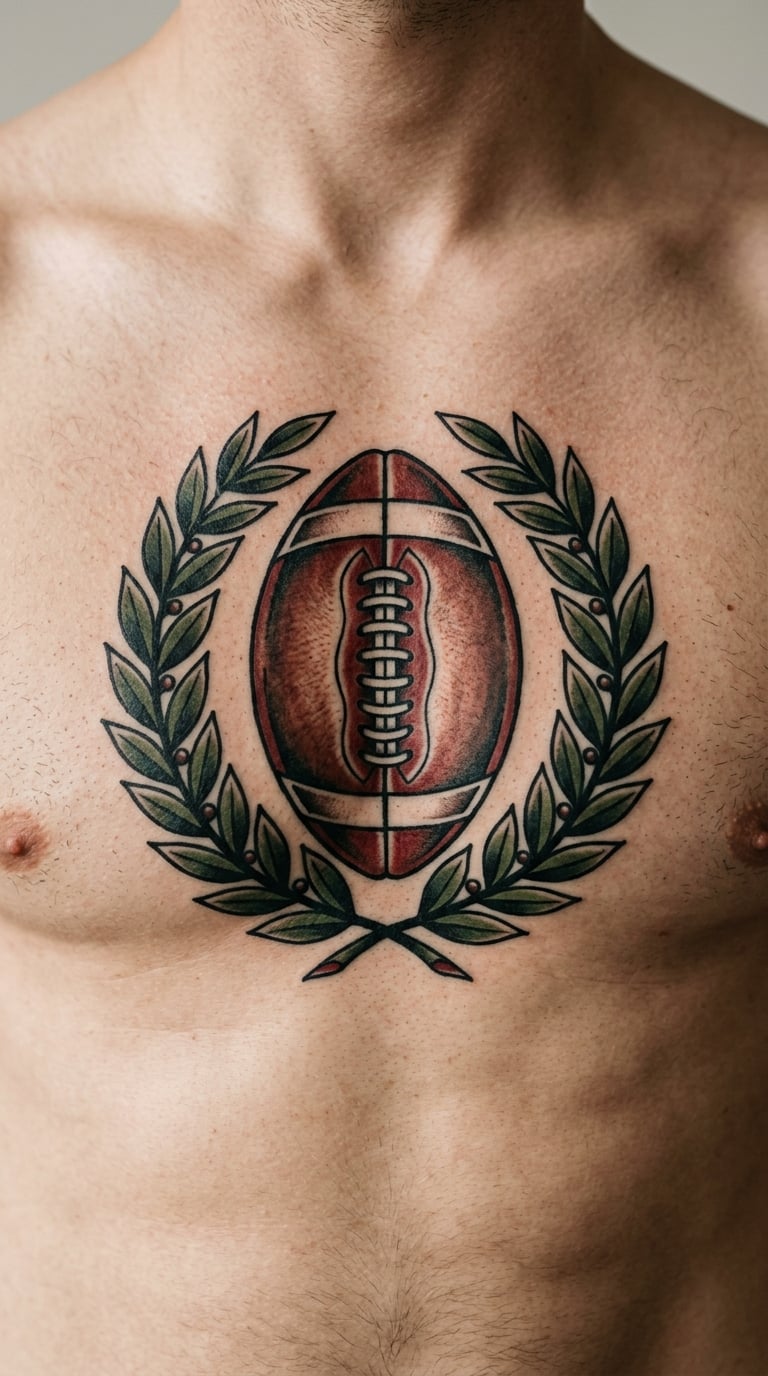
A proper old-school football, laced, tilted, wrapped in a symmetrical laurel wreath. Bold outlines, limited color, and shading in the traditional style rather than anything that tries to look photographic.
Laurel means achievement, so this usually marks something won: a league title, a promotion season, a first trophy as a kid. The wreath is a well-worn symbol, which is exactly why it works and exactly why you should give it something personal in the middle.
Placement: center chest, 8-10 cm, or the upper chest offset to one side. Style: traditional American with red accents. Pain: high on the sternum, and the chest is one of the placements where you will feel it in your breath, so eat beforehand and take the break your artist offers.
Make it yours: have the laces replaced with your date, stitched into the panel seams in the wreath’s ink color.
9. Soccer Ball Geometric Pattern
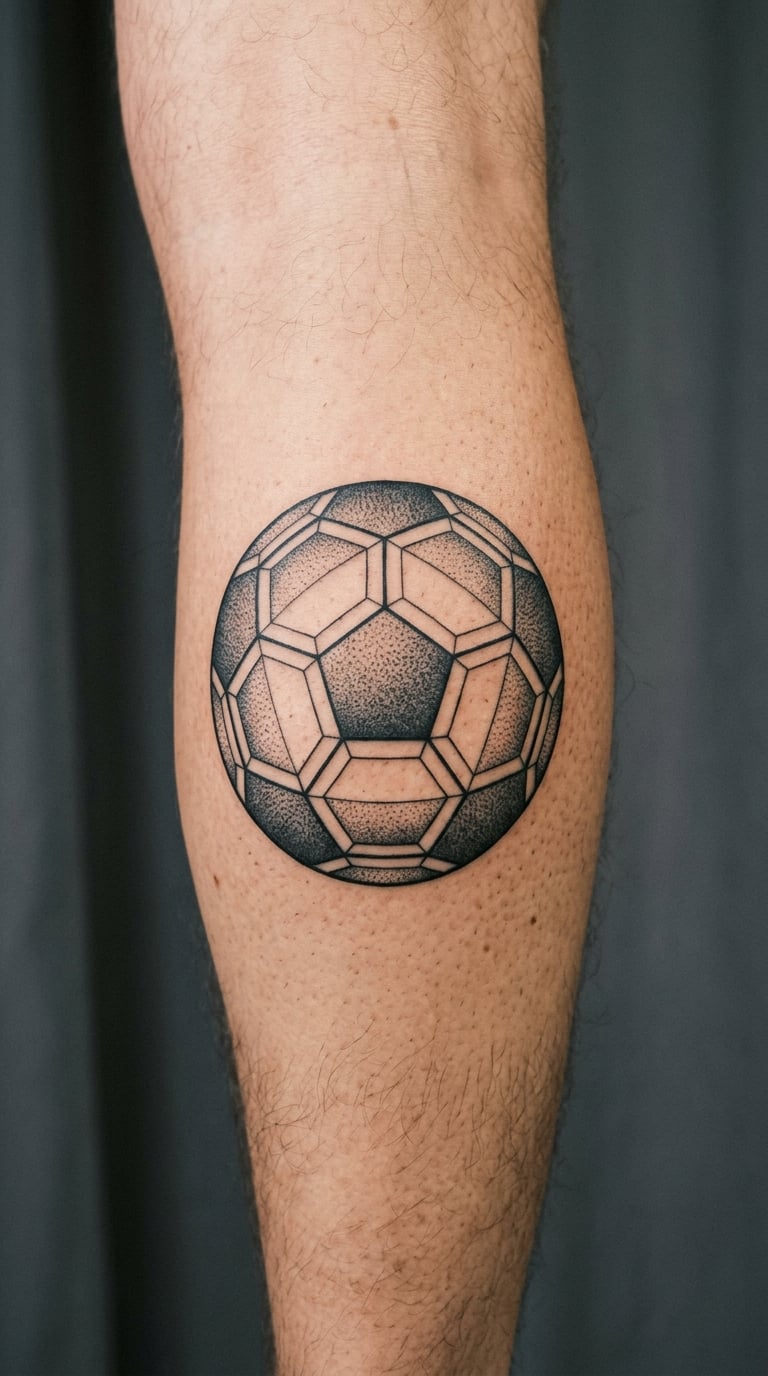
Interlocking panels, black linework, and a touch of dotwork in the negative space to stop the design going flat. Geometry is what makes this look current rather than like a logo on a kit bag.
It is deliberately unbranded, which is the point for a lot of men: no team, no league, no risk of waking up with a permanent badge for a side you have since fallen out with. It reads as a love of the game itself, which ages better than club loyalty does.
Placement: calf, 8-10 cm, or the outer forearm. Style: blackwork with dotwork infill. Pain: medium, and calf skin is firm so the design holds shape, but the panel lines need consistent weight or the geometry falls apart when healed.
Make it yours: build one panel out of a different shape, such as a pentagon replaced by a small compass rose.
10. Goalkeeper in Motion
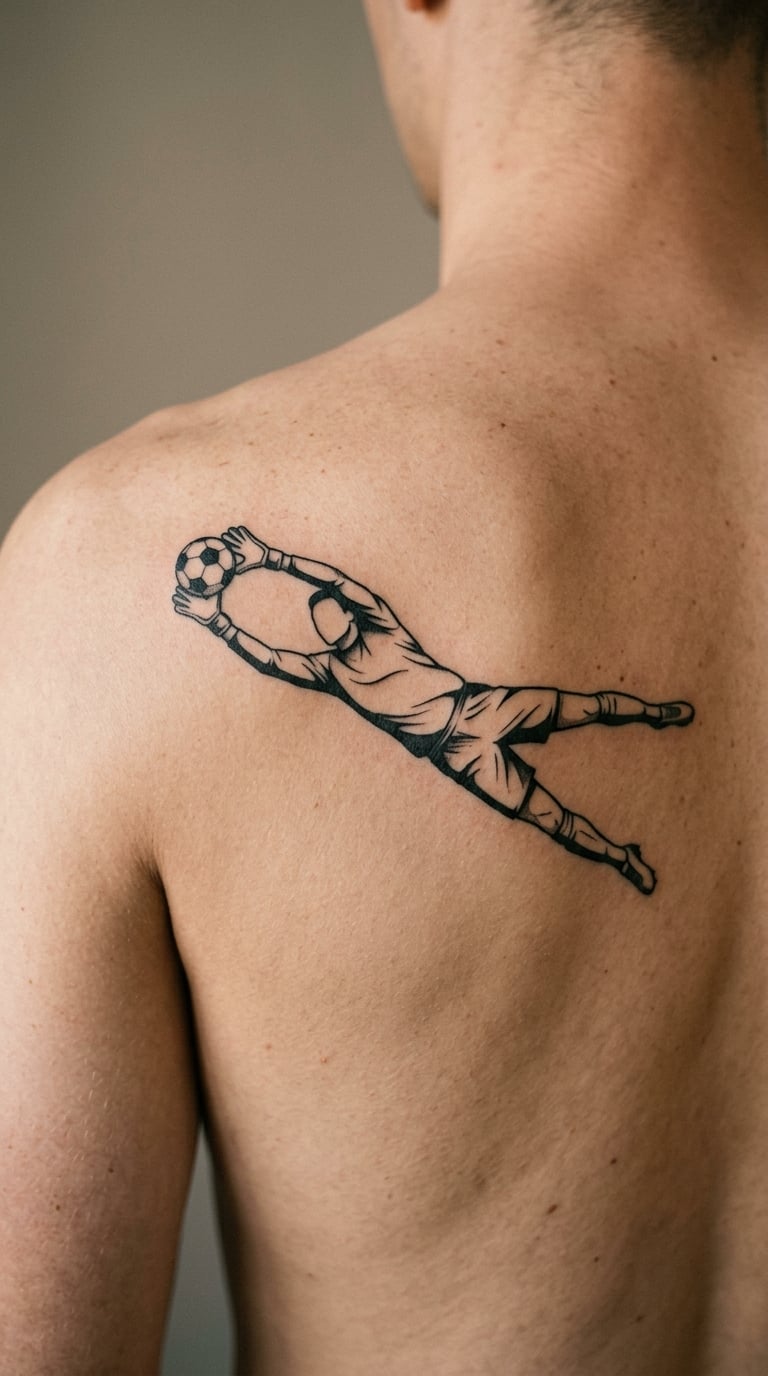
A figure caught at full stretch, ball just inside the fingertips, drawn with illustrative contour lines and selective shading on the gloves and shorts. The pose does the work, so the artist can keep detail low and still get a striking image.
Determination, late reflexes, doing the unglamorous job well. It is a quiet favourite with men who played out of goal or at the back, and it is one of the few action designs that reads clearly from a distance because the pose is so instantly recognisable.
Placement: shoulder blade, 12-15 cm, angled along the spine line. Style: illustrative with black contours. Pain: high, since the shoulder blade moves constantly and the nerve endings there are close to the surface; two shorter sessions beat one long sit.
Make it yours: angle the save diagonally across the back so it follows the line of the shoulder rather than sitting square.
11. Trophy with Football Details
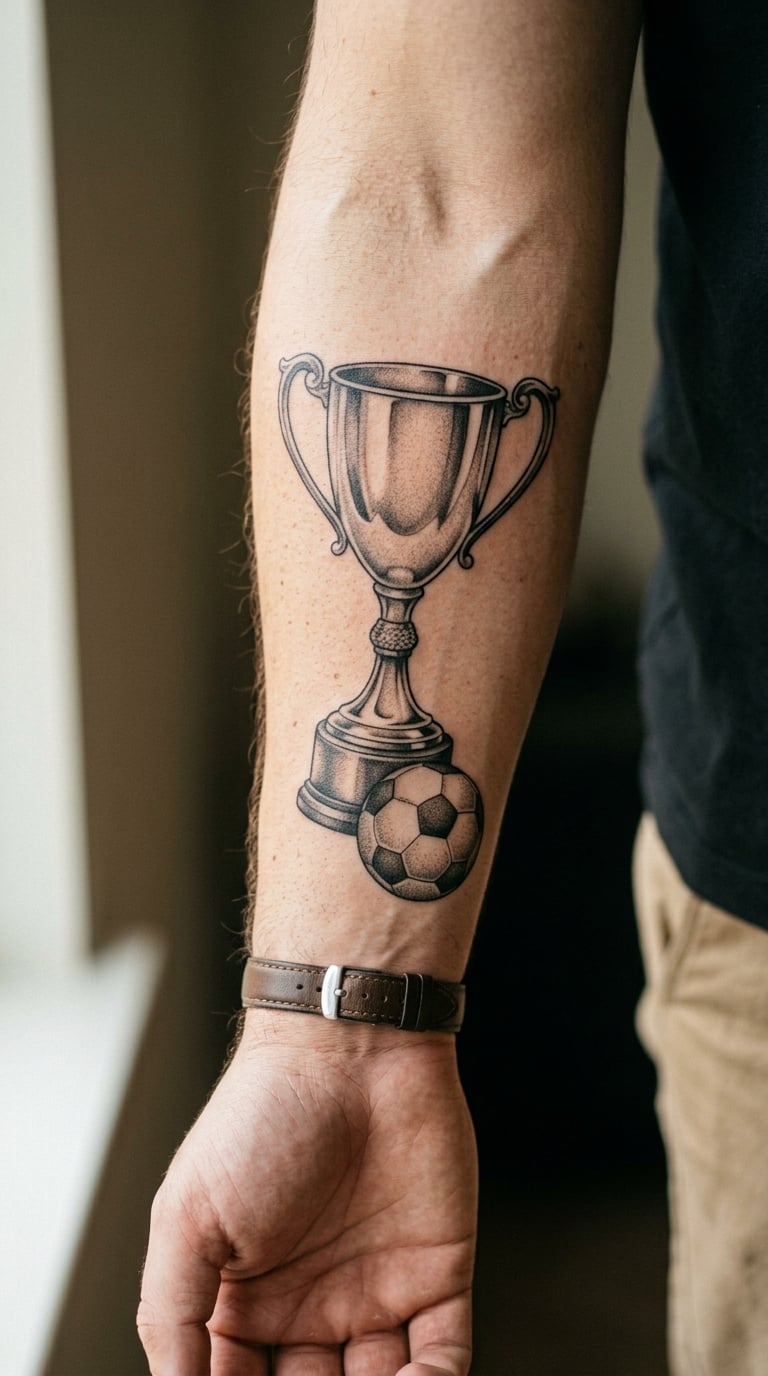
A cup with a football sitting in or on the base, and nothing else. Keep the highlights simple and the shading in two or three greys, because a trophy rendered as a shiny mirror is the version that heals patchy.
Commemorative ink, usually for a win, a final, or an achievement that never got a parade. Fans describe trophy tattoos as the ones that mean the most and get asked about the most at parties.
Placement: forearm, 8-10 cm, or the front of the upper arm. Style: black and grey with restrained realism. Pain: medium, and glossy-looking gradients soften faster than flat greys, so expect a possible touch-up inside the first two years.
Make it yours: etch a small year into the plinth base, or the score of the match it all came down to.
12. Football Field Map Tattoo
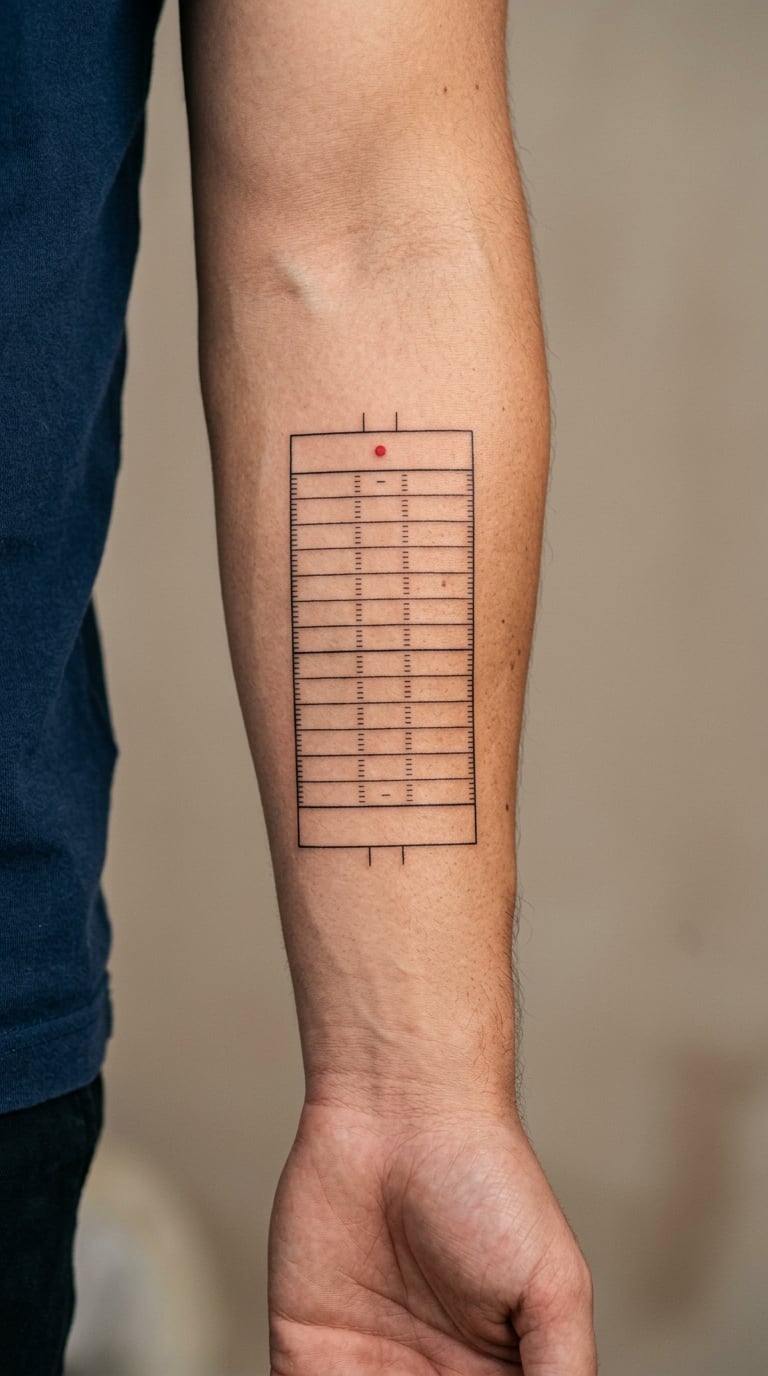
The pitch flattened into a diagram: end zones at each end, hash marks, yard lines, one small highlighted scoring area in red. Simplified rather than to scale, so it reads as a plan instead of a floor plan.
This is the tactical one, for men who love the shape of the game more than the result. It also carries a quiet nod to coaching, analysis or a family member who taught you to watch properly, which is more interesting than a badge.
Placement: forearm, 12-15 cm, laid out lengthwise. Style: fine line with a single color accent. Pain: medium, and fine-line geometry needs a patient artist: rushed yard lines turn into an unreadable grey band once healed.
Make it yours: mark the yard line where you were standing the first time you went to a match with your dad.
13. Four-Quarter Clock Motif
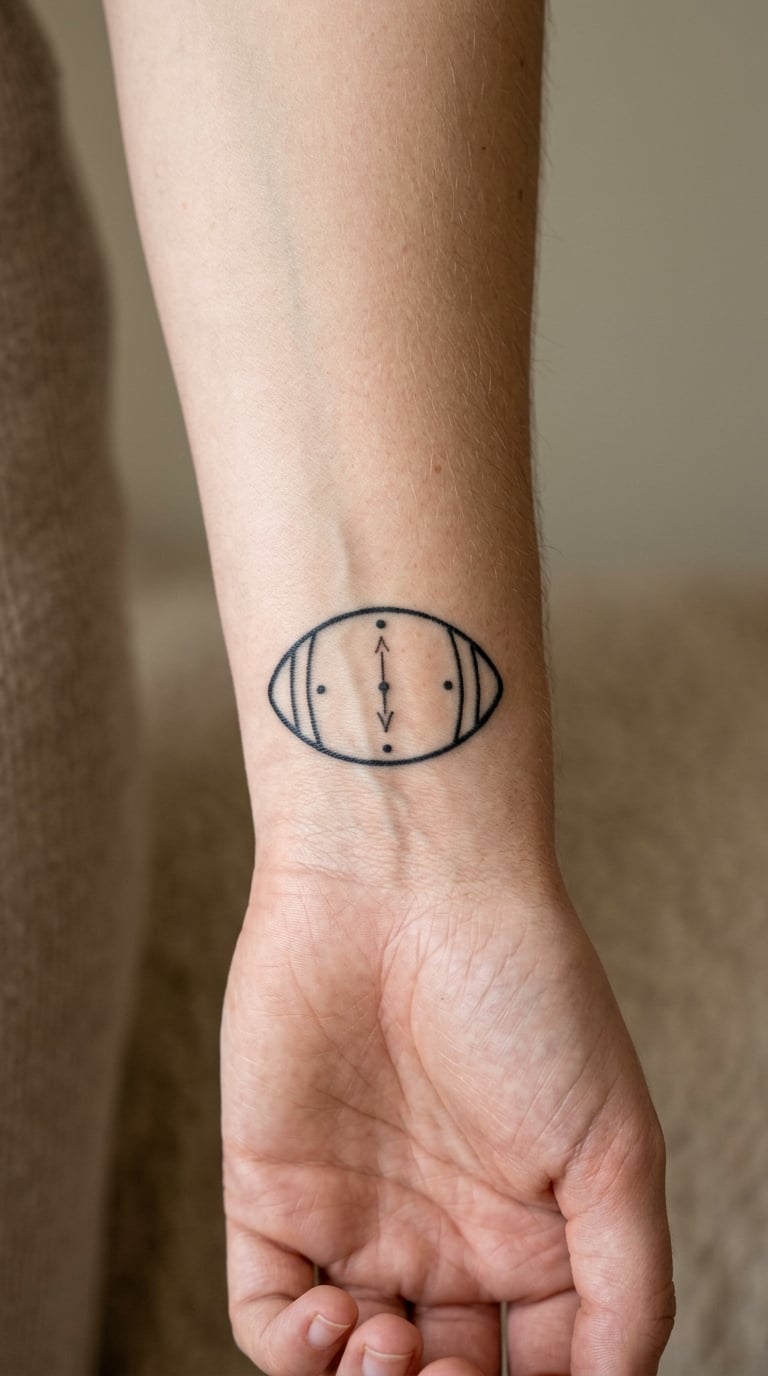
A ball outline doubling as a clock face, four quarter markers, hands set to a time that means something to you. Small, clever, and the kind of design people ask you to explain twice.
Time is the meaning here: a season, a decade of following a team, a match that ran long. Football has its own version of the clock, and a stoppage-time minute is as good a marker as any other.
Placement: wrist or inner forearm, 3-5 cm. Style: blackwork with thin hands, so keep them at the same weight as the markers. Pain: low-medium, and the hands are the first detail to disappear, so a second, heavier pass is worth asking for at the free touch-up.
Make it yours: set the hands to the minute of the goal you can still talk about after all these years.
14. Football Player in Watercolor
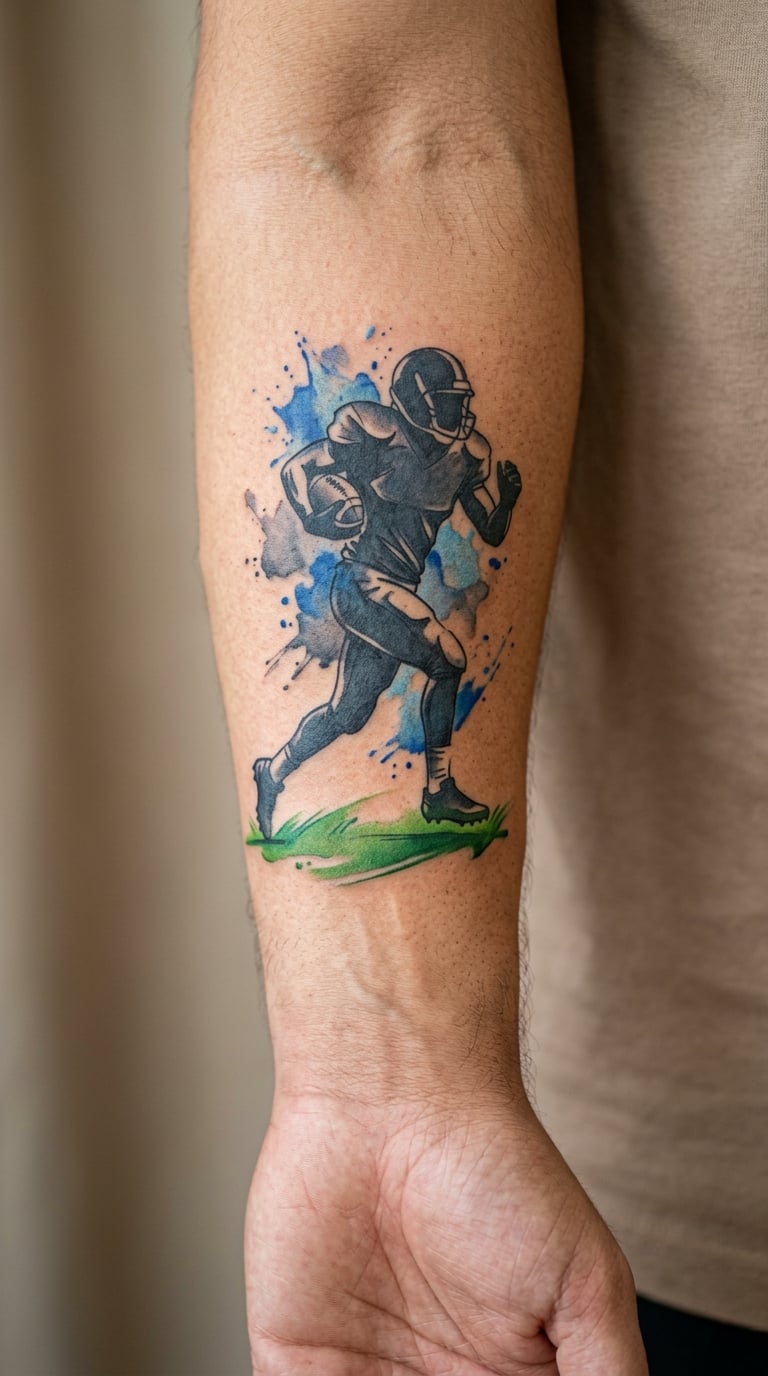
A running figure built from loose washes, blue and charcoal with a controlled edge of green, and hard contour lines only where the body needs to read. The silhouette does not need a face, which keeps the softness intact.
Speed and intensity rather than tribute. Watercolor suits people who want color without a solid block of ink, and it sits well with other pieces because the edges stay soft. Bring references, because this is one of the styles where artists interpret loosely.
Placement: forearm, 10-12 cm. Style: watercolor with light black accents. Pain: medium, and the inks that stay bright are the ones that need the most passes and often the longest heal.
Make it yours: use your club’s two colors as the wash palette without adding any badge or lettering.
15. Micro-Realism Football on the Rib
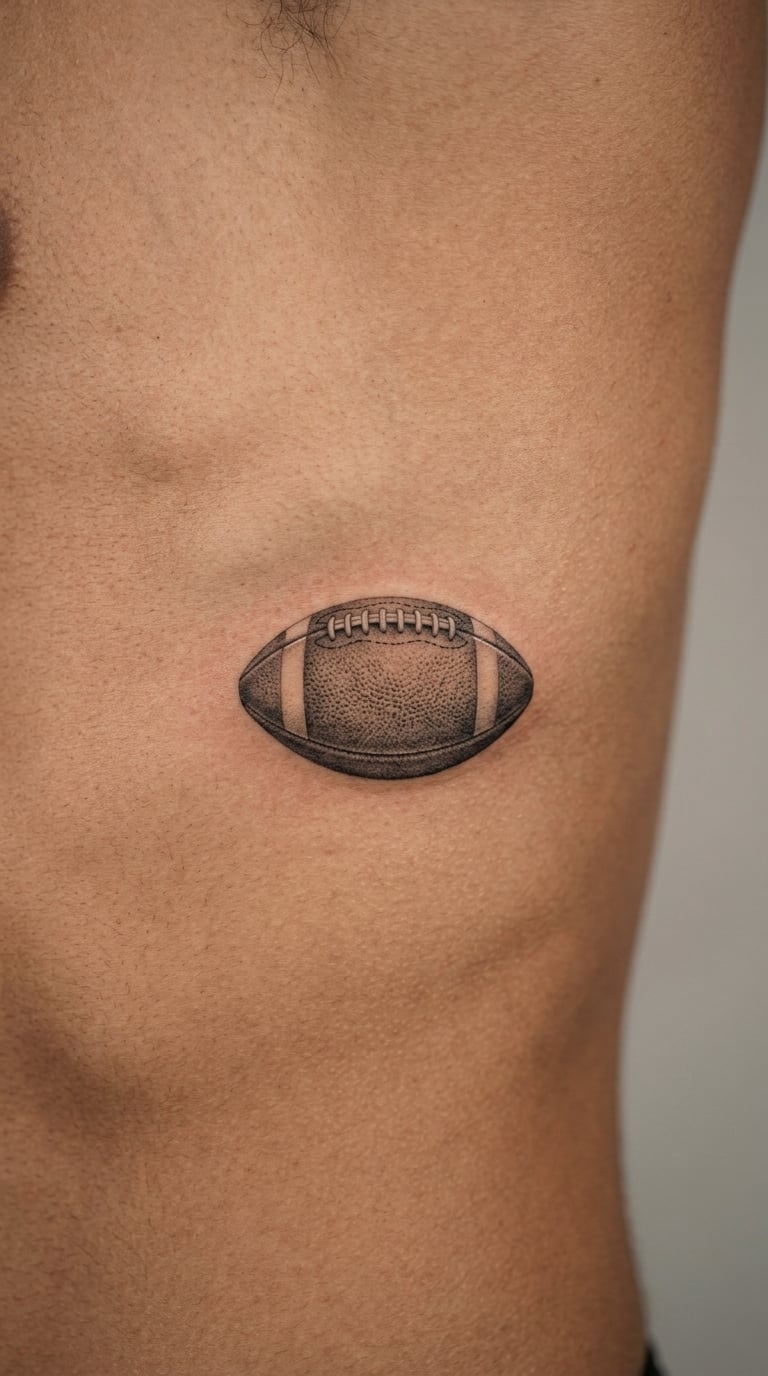
A single ball with textured leather grain, one controlled highlight, held horizontal between the ribs. At this size the realism is carried by texture rather than detail, which is exactly what survives a small scale.
A discreet piece with real weight to it. Ribs are the placement men ask about most and the one that most often derails a plan, so treat this as a piece you commit to properly, not a cheap add-on while you have spare time.
Placement: ribs, 4-5 cm, or one space between two ribs at the side. Style: micro-realism. Pain: high, sharp and close to the bone, and sun exposure on that area is relentless, so expect the grain to need a touch-up more than pieces on an arm.
Make it yours: add a single small hand-stitched number on the ball, no more detail than that.
16. Football and Rose Neo-Traditional
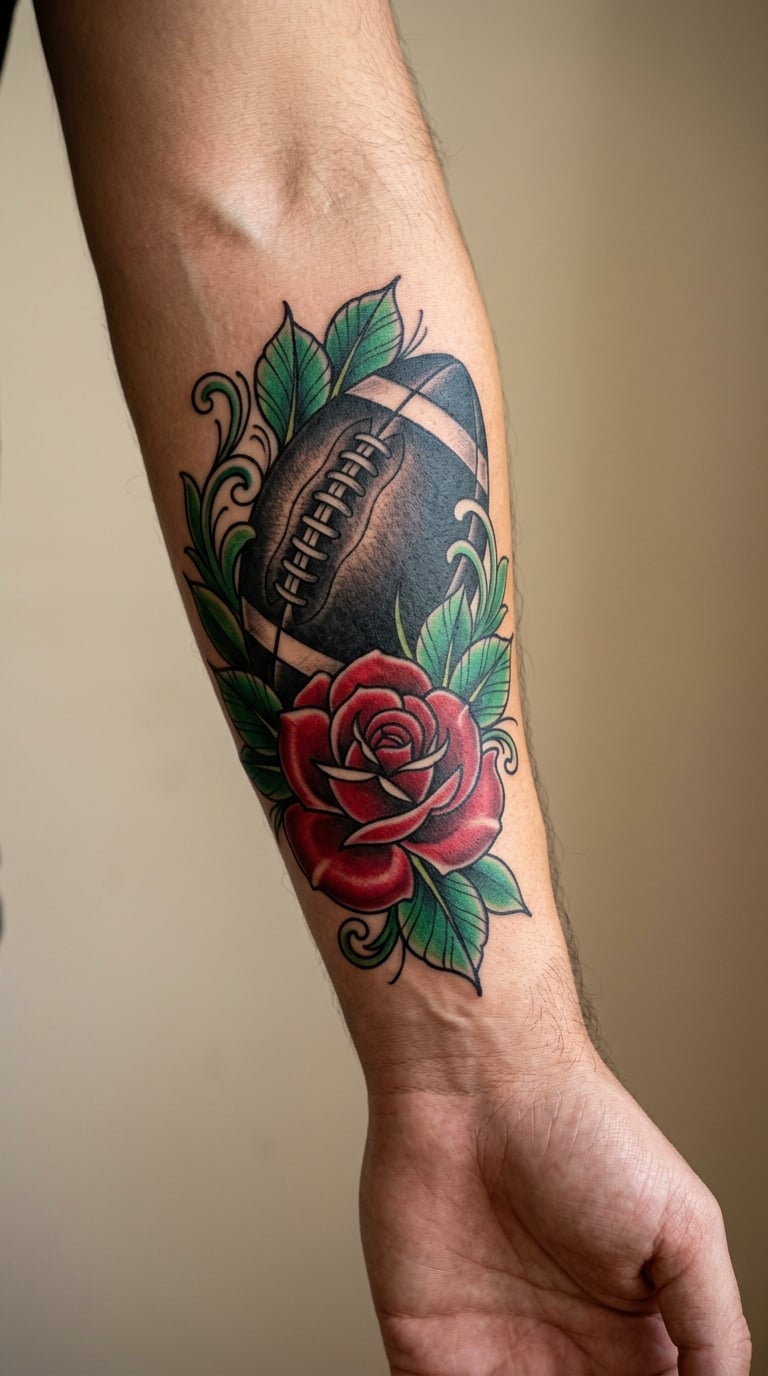
A laced football crossed with a blooming rose, thorned stem, green leaves, bold black outlines and smooth shaded contrast. Red, green and black, no gradients, and the line work does the separating.
Strength with an emotional reason attached. This is the design for a man who wants his football tattoo to say something beyond the sport, and the rose is the piece that gives people a story to ask about.
Placement: forearm, 9-11 cm, with the stem running down toward the wrist. Style: neo-traditional. Pain: medium, and the thorns are small high-contrast details that need to be tattooed with confidence, not lightly, or they fill in and blur.
Make it yours: have one thorn carry a tiny date, or a bud rather than a full bloom if you prefer something quieter.
17. Blackwork Stadium Lights
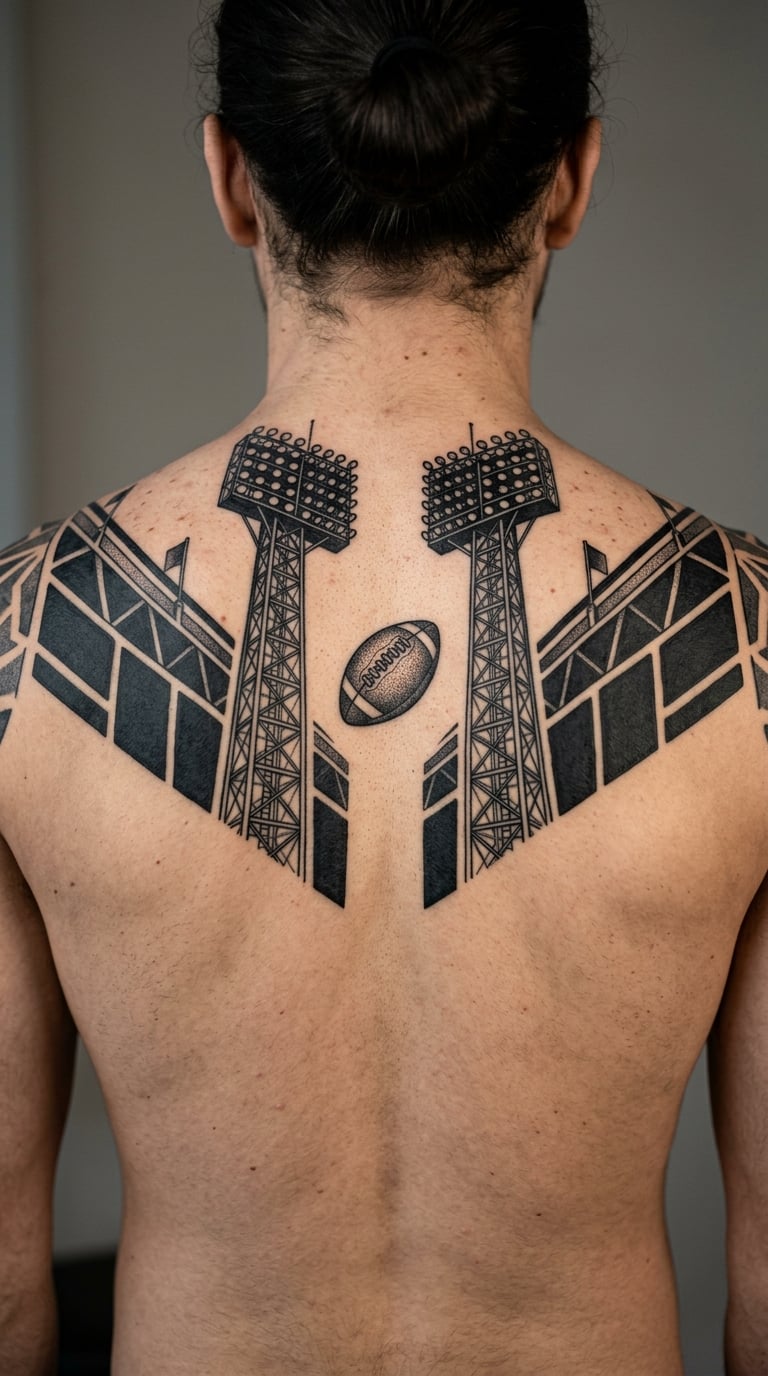
Two tall floodlights throwing beams down onto a small ball below. Heavy black, hard contrast, minimal grey, and enough empty space that the beams actually read as light rather than as shape.
Anticipation and match nights. It is one of the few designs that conveys a feeling rather than an object, and fans often pair it with a date or a line of lyric once the black work is finished.
Placement: upper back across the shoulder blades, 15-20 cm, or one floodlight on a shoulder. Style: blackwork with solid fills. Pain: high over the shoulder blades, and long sits on that area are rough, so plan the piece as two or three sessions with healing in between.
Make it yours: have one floodlight tilted slightly off-axis, which makes the composition feel photographed rather than symmetrical.
For the full-back version of something this size, our 20 best black sleeve tattoo ideas for men is worth a look before you book.
18. Jersey Collarbone Tattoo
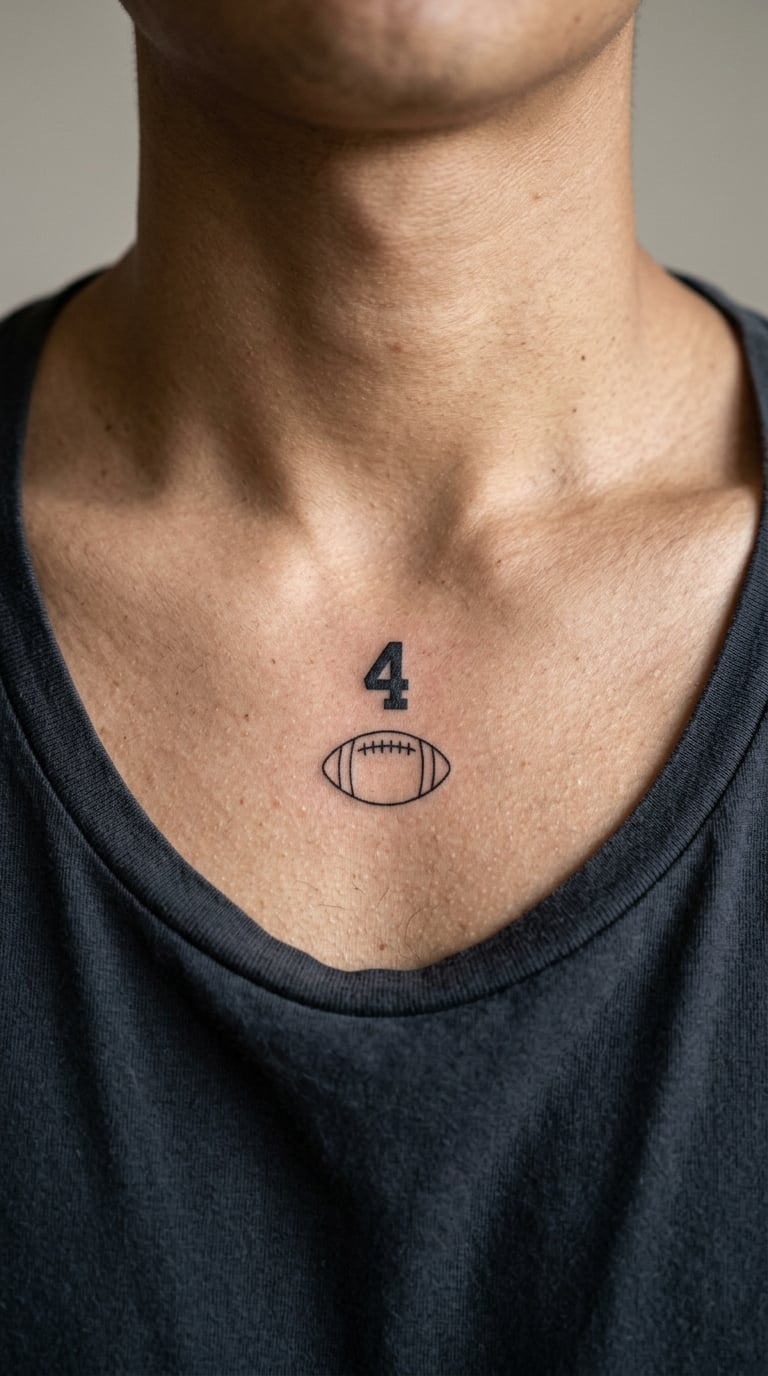
A small number with a tiny football beneath it, centered between the collarbones, with balanced spacing so it reads as a single composed mark rather than two floating objects.
Understated, and visible in exactly the places you want: an open collar, a scoop neck, a bare shoulder in summer. It is the one on this list that people ask for when they want a football tattoo that still looks deliberate at work.
Placement: centered below the collarbones, 4-5 cm, or offset along the collarbone line. Style: fine line or light blackwork. Pain: high, because the collarbone sits on thin skin over bone, and the area is used constantly through the day, so expect tenderness for a week or two.
Make it yours: swap the number for a short initial plus a tiny ball, keeping the same spacing.
19. Football Position Icon Set
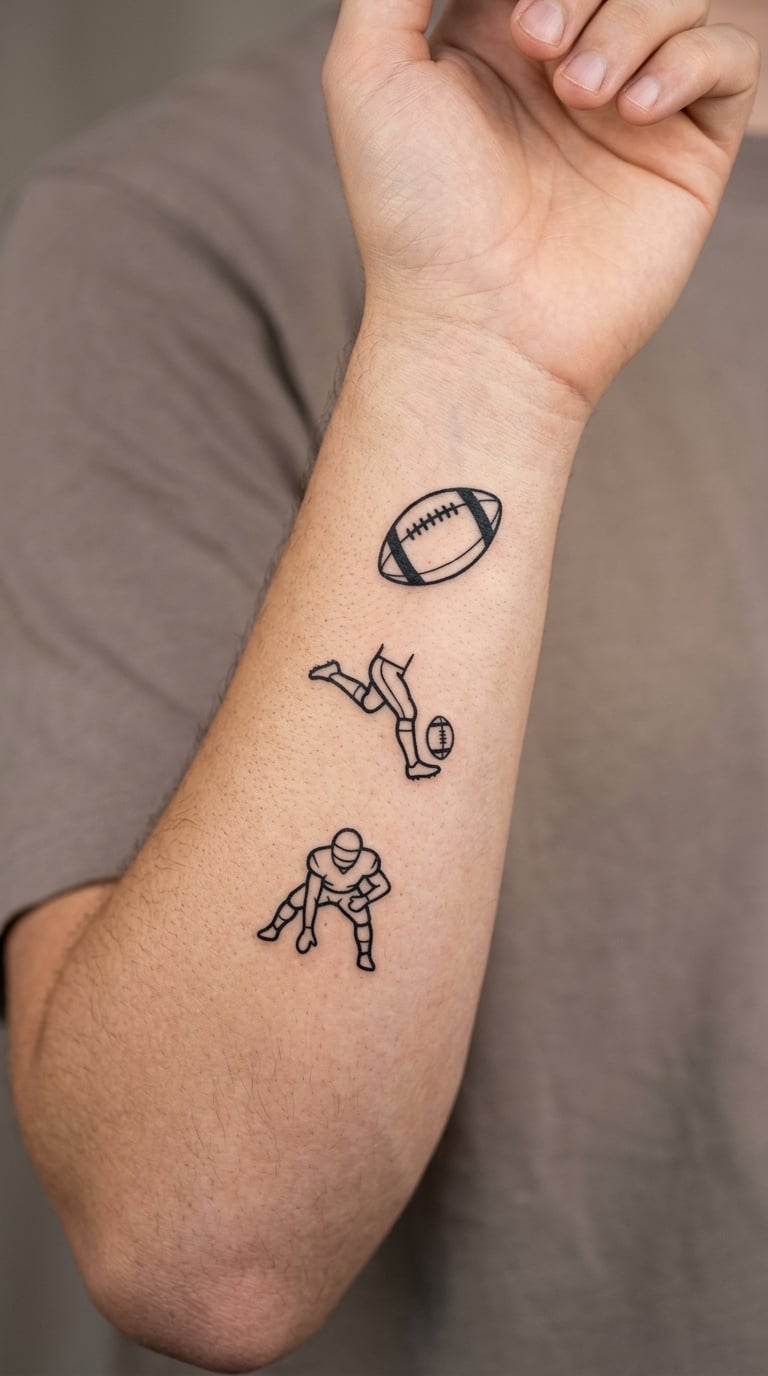
Three small icons in a matching line: a ball, a kicking leg, a defensive stance, each drawn with the same stroke weight so the set reads as one system. One icon works too, but a set of two or three looks deliberate.
A record of what you actually did, whether that was playing at a decent level or turning up every week for years. Fans with playing backgrounds tend to choose this because nobody else has the same combination.
Placement: inner forearm, spaced 3-4 cm apart, 2-3 cm each. Style: matching blackwork icons. Pain: low-medium, and small icons are quick, but putting three in one sitting means washing and re-dressing the area three times, so space them over separate appointments if you can.
Make it yours: design your own position icon with the artist, and keep the stroke weight identical across all of them.
20. Waterline Football Sleeve Detail
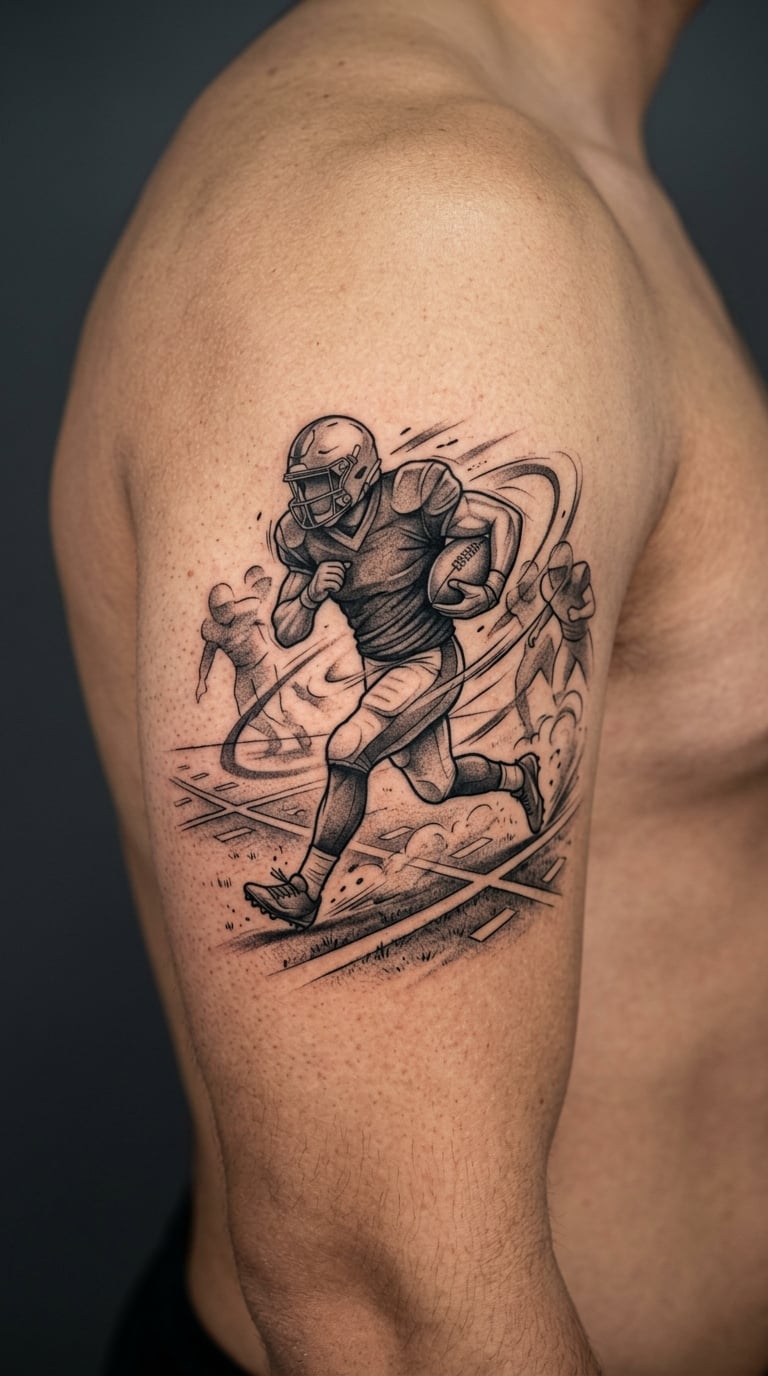
A compact scene rather than a full sleeve: a generic ball carrier, angled field lines running under him, motion marks in restrained grey, and enough negative space to keep it readable. Ball carrier, pitch, movement, all of it leaning diagonally with the arm.
This is the statement piece, and it is the one most worth planning properly. Forum readers are blunt about it: elaborate scene work is harder to commission and ages faster than a single element, so if you want the football to be the whole story, this is where that happens.
Placement: outer upper arm, 15-20 cm, or the first element of a wrapping sleeve. Style: blackwork with grey wash. Pain: high, and sessions of two hours or less heal better than one long sit, because fresh tattoos that are worked too long stay angry longer. Bold blacks thicken as they heal, so a slightly finer outline is the smart call.
Make it yours: fix the ball carrier’s number before the stencil goes on, and have the artist draw it as a plain digit rather than a branded shirt.
How to Choose the Right Design
Start with the meaning, then check the size. A design that does not survive at the size you want belongs to someone else.
- Does it still mean something in ten years? Fans who regret football tattoos usually regret the badge, not the ball. A crest ties you to a team; a moment, a number or a position usually does not expire.
- Is it IP-safe? Avoid copying a club crest, a league logo or a player’s face exactly. Some clubs actively object to their badge appearing in tattoos. Rebuilt shapes, your own kit number and position icons avoid the issue entirely.
- Can your artist read it at that size? Below about 5 cm, lettering, dates and small numbers fill in within a couple of years. If a design depends on text, either go larger or cut the text.
- Where will it be in three years? Forearm and calf show most, on the street and in photos. Ribs and collarbones show in summer. If you play competitively, check what is visible in a kit before you commit.
- Which style ages honestly? Bold black and grey soften and spread; fine line thins; saturated color holds longest. Choose the one that matches how much rework you are willing to book every few years.
- Will it fit a sleeve later? If you might add more, start on the outer upper arm or forearm and leave clear space. A rib or spine piece limits what can follow it.
Cost and Session Time
Tattoo pricing in the US usually runs by the hour, often with a shop minimum, and rates vary widely by city and by artist reputation. Treat the ranges below as a budgeting starting point rather than a quote.
| Piece | Typical size | Sessions | Rough hourly band |
|---|---|---|---|
| Small detail, wrist or collarbone | 3-5 cm | 1 | 80-150 |
| Medium single element, forearm | 8-12 cm | 1-2 | 100-180 |
| Large action scene | 15-20 cm | 2-3 | 120-220 |
| Full wrapping sleeve | Arm or leg | 4-8 | 120-250 |
Detail drives the time as much as size does. A micro-realism ball and a flat silhouette of the same dimensions are completely different jobs, and so is anything with shading gradients or a red accent, which usually needs more passes. Location counts too: ribs, collarbone and shoulder blades take longer per centimetre because the skin is thinner and harder to work.
Budget for a free touch-up six to eight weeks in on solid black, and think about whether you will want one every few years after that. If the answer is yes, the piece will cost more over its life than the session fee suggests.
Comparing against a full-arm piece? Our 20 best ocean sleeve tattoo ideas covers what sleeve-scale planning and session counts look like in practice.
Aftercare Basics
Follow your artist’s aftercare instructions first, always. Everything below is the general baseline most artists give, and yours will know your skin and your ink better than a web page does.
- Follow your artist’s aftercare instructions, including anything specific to the ink and placement you chose.
- Wash gently with unscented soap and lukewarm water, then pat dry with a clean towel rather than rubbing.
- Keep whatever protective covering your artist applied on for as long as they specified, especially on a forearm or rib piece that rubs against clothing.
- Wear loose clothing over the area for the first couple of weeks. Kit seams, bag straps and gym bags rubbing a fresh forearm is the most common way people ruin their own tattoo.
- Skip swimming pools, hot tubs and sea water while it heals, and keep the area out of strong sun. Chlorine and UV are both hard on fresh ink, and football training puts you in both.
- Do not pick, scratch or peel flaking skin. Let it come away on its own and moisturize with whatever thin layer your artist recommends.
Frequently Asked Questions
What does a football tattoo actually mean?
It usually means one of three things: loyalty to a club or country, a tribute to a player or a match, or simply a love of the game itself. A crest says which team. A number, a date or a position icon says something about you. A ball, a pitch or a goal stays neutral, which matters if you support more than one team or your loyalty has changed.
Does soccer allow tattoos?
Football itself has no blanket ban, but clubs set their own rules. Some organizations restrict visible ink for commercial or image reasons, and rules differ between leagues, competitions and age-group tournaments. If you are a registered player, check your club and competition before booking, and choose a placement that stays out of a match kit if that is the safest route.
Which football tattoo placement hurts least?
Outer forearm, upper arm, calf and thigh sit over thicker muscle and read as low to medium. Wrists and inner forearms sting more because the skin is thinner. Ribs, collarbone, spine and shoulder blades are consistently reported as the hardest, and the knuckles are painful for a different reason: almost no soft tissue at all. Start somewhere on the arm if this is your first.
How much does a football tattoo cost?
In the US, small pieces of 3-5 cm often run one short session, medium forearm work 8-12 cm takes one to two, and a 15-20 cm scene usually needs two to three. Most studios charge hourly with a shop minimum, and rates run roughly 80 to 250 depending on city, artist and detail. Saturated color and micro-realism cost more per centimetre than flat blackwork.
Do blackwork football tattoos fade over time?
Yes, and this is worth planning for. Solid black tattoos gradually thicken and soften at the edges, especially on sun-exposed arms and in the gym. Fine line thins and can blur instead, particularly on wrists and hands. Both are normal rather than a mistake, and both are touchable. Plan on one free touch-up, and decide up front whether you would want another every few years.
Is a small football ball a good first tattoo?
It is a genuinely good one, provided it is not tiny. A 3-4 cm fine-line ball on the inner forearm or wrist takes under an hour, sits on a forgiving placement, and is easy to cover at work. Below 2 cm the shape stops reading and the outline fills in within a few years. Tell your artist you want a shape that still works in a decade, and they will set the size for you.
Getting Started With Your Football Tattoo
If this is your first football tattoo, start at number 7 for a small fine-line ball, or number 4 if your number is the point. Both sit well, take an hour, and leave you room to add bigger work later without the small piece looking lost.
If you are building a collection, number 1 or number 11 gives you a solid anchor, and number 20 is the one to book carefully with a long conversation about scale. Either way, bring the size and style notes from this list to the consultation, and let the artist redraw it as your own design rather than a copy.