
22 Fishing Tattoo Ideas for Men: Small & Large (October 2026)
A fishing tattoo is any piece built around angling imagery: game fish like largemouth bass, brown trout, koi, pike or marlin; tackle like a hook, a hard lure, a rod or a fly; or the water itself, with boats, waves and river lines. What the design communicates depends far more on line weight, saturation and placement than on the subject. Get those three right and even a two-inch symbol reads solid.
These 22 fishing tattoo ideas for men run from discreet marks for conservative workplaces to full back pieces, and every entry gives you a real size in inches, a placement that suits it, and a style an artist can actually execute. Updated for 2026. Most anglers I talk to want one thing the same way: a piece that looks like their own water rather than clip art.
22 Fishing Tattoo Ideas for Men: Quick Guide
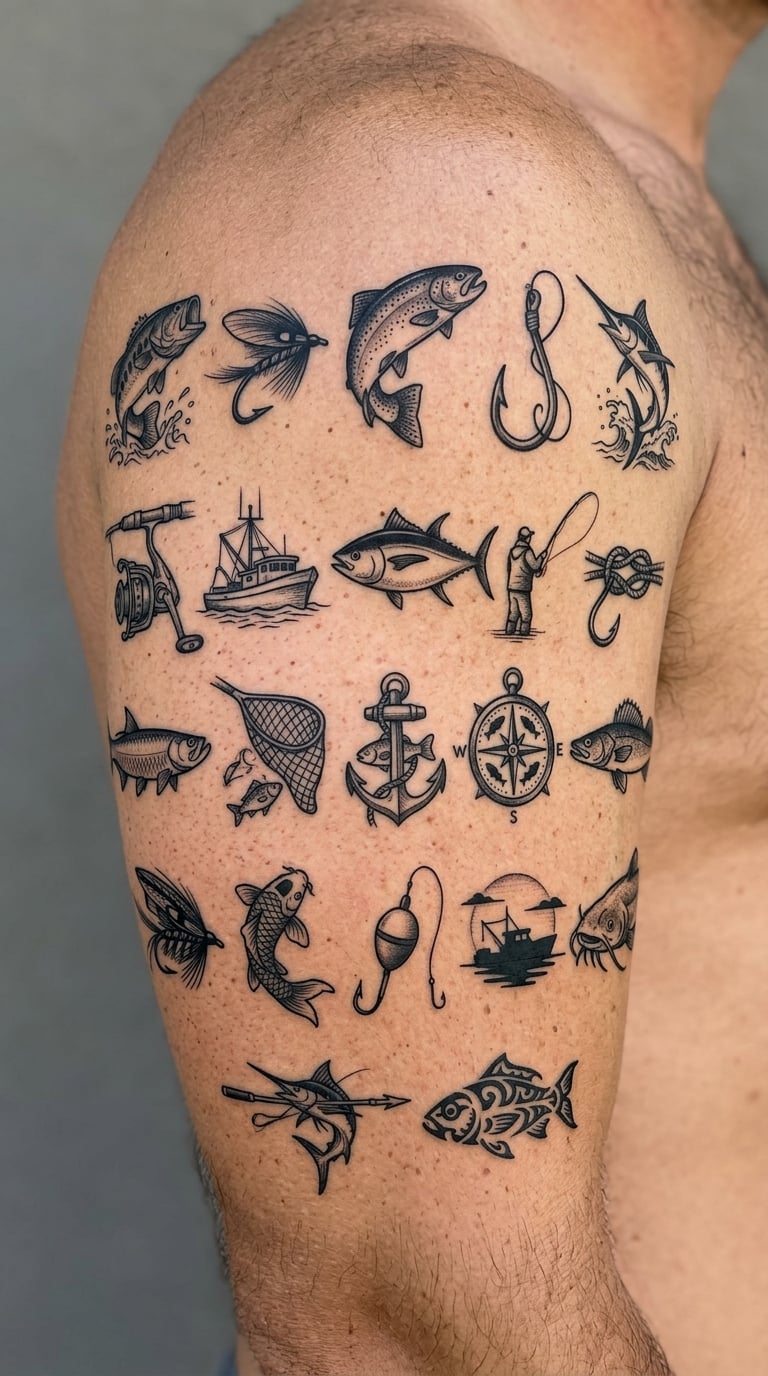
| Idea | Style | Best placement | Realistic size | Pain |
|---|---|---|---|---|
| 1. Fish spine | Fine line, single-needle | Inner forearm | 4-6 in (10-15 cm) | Low-medium |
| 2. Jumping trout | Blackwork | Outer forearm | 7-9 in (18-23 cm) | Medium |
| 3. Fish hook behind ear | Minimalist linework | Behind the ear | 0.5-1 in (1.5-2.5 cm) | Medium |
| 4. Bass and mountain lake | Black and grey realism | Upper arm | 8-12 in (20-30 cm) | Medium |
| 5. Fly and water line | Fine line | Inner arm | 3-5 in (8-13 cm) | Low |
| 6. Vintage lure and rod | Black and grey realism | Forearm | 6-8 in (15-20 cm) | Medium |
| 7. Koi sleeve panel | Black and grey, illustrative | Upper arm panel | 10-14 in (25-35 cm) | Medium-high |
| 8. Anglerfish micro-realism | Micro-realism | Forearm | 2.5-4 in (6-10 cm) | Medium |
| 9. Fishbone with coordinates | Fine line | Inner forearm | 4-5 in (10-13 cm) | Low-medium |
| 10. Pike head | Neo-traditional | Shoulder | 5-7 in (13-18 cm) | Medium-high |
| 11. Kayak and lake | Illustrative, black ink | Calf | 6-9 in (15-23 cm) | Medium |
| 12. Salmon wraparound | Black and grey realism | Forearm wrap | 14-18 in (35-45 cm) | High |
| 13. Knot and compass | Linework | Upper arm | 4-6 in (10-15 cm) | Medium |
| 14. Catfish with water accent | Illustrative, colour accent | Forearm | 5-8 in (13-20 cm) | Medium |
| 15. Minimal angler icon | Minimalist | Inner wrist | 1-2 in (2.5-5 cm) | Medium-high |
| 16. Marlin and wave | Black and grey realism | Upper arm | 10-14 in (25-35 cm) | Medium |
| 17. Vintage fishing badge | Traditional American | Upper arm | 3-4 in (8-10 cm) | Medium |
| 18. Carp and reeds | Illustrative with florals | Forearm | 6-9 in (15-23 cm) | Medium |
| 19. Rod line map | Minimalist fine line | Forearm | 4-7 in (10-18 cm) | Low-medium |
| 20. Golden dorado | Traditional American | Shoulder | 6-9 in (15-23 cm) | Medium-high |
| 21. Tiny fish ankle | Fine line | Outer ankle | 1.5-2.5 in (4-6 cm) | Medium-high |
| 22. Full fishing scene back piece | Black and grey realism | Upper back | 18-24 in (45-60 cm) | High |
1. Minimalist Fish Spine Forearm Tattoo
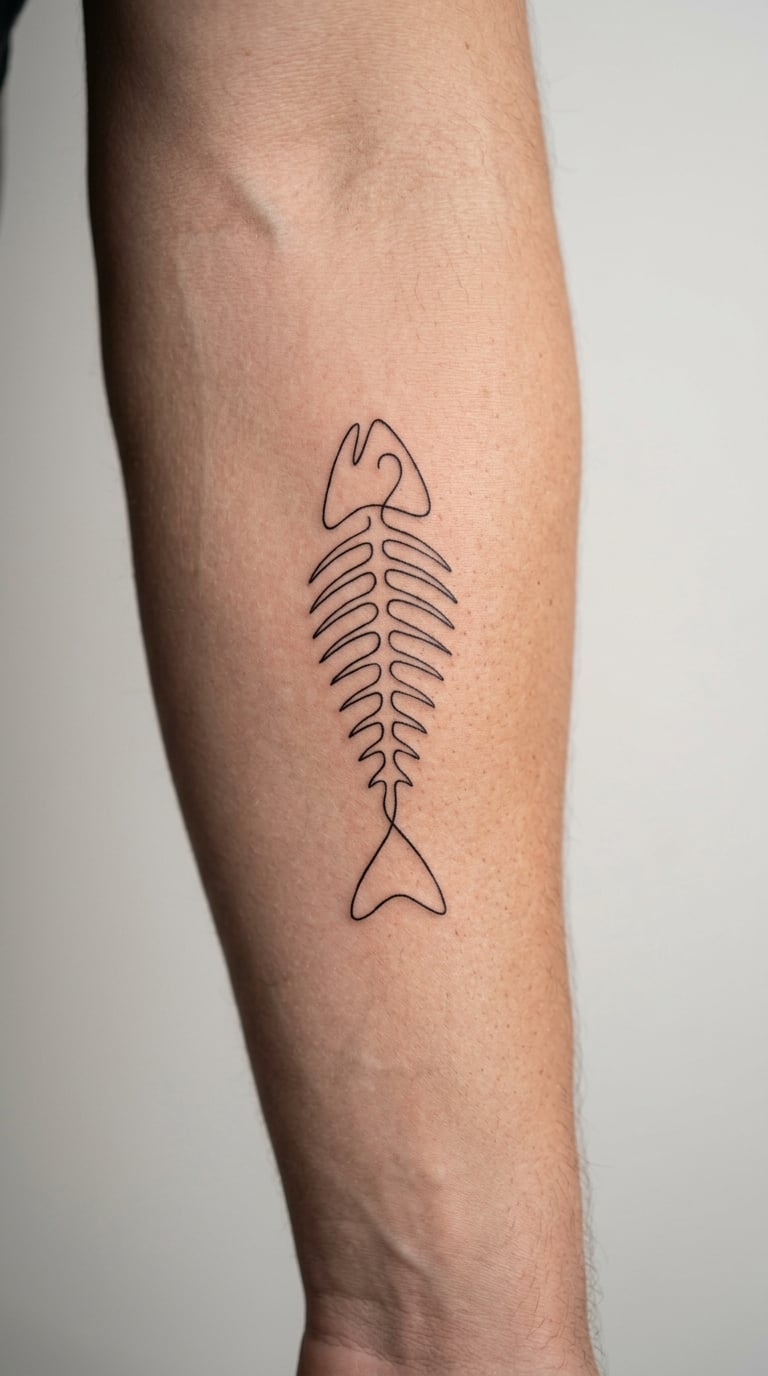
A fish spine drawn as one continuous black line, vertebra by vertebra, tapering into a tail. No fill, no shading, no colour. It is the quietest way to say you fish, and it disappears under a shirt cuff if you want it to.
People choose it because it reads as anatomy rather than decoration. It suits a first tattoo and it pairs well with a future fish piece further up the arm.
Placement: Inner forearm, running lengthwise toward the elbow crease. Size: 4-6 in (10-15 cm). Style: Fine line, single-needle. Pain: Low to medium, with the elbow crease stinging slightly as the line crosses it.
Make it yours: Add a hook shape where the tail bone ends, so the spine reads as tackle and not as a specimen.
2. Jumping Trout Blackwork Tattoo
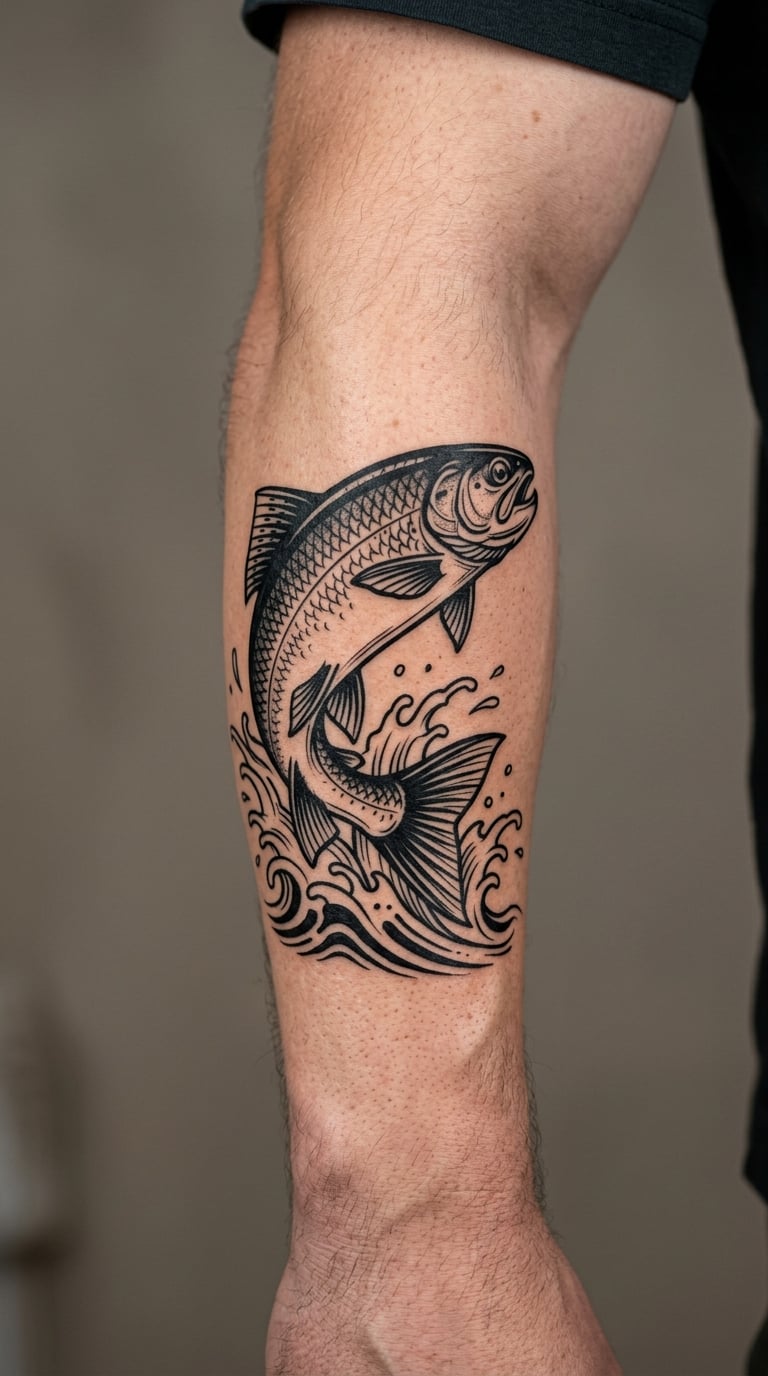
A trout mid-leap, arched out of a few short water lines, rendered in solid black with the fins and gill plate left as white negative space. Heavy outline, wide fin rays, almost no grey. Strong silhouette, reads from across a room.
Trout is the fly-fishing workhorse and the most requested fish in fly-fishing circles, so this one carries a clear subculture signal without a single word of text.
Placement: Outer forearm, angled so the fish points toward the elbow. Size: 7-9 in (18-23 cm). Style: Blackwork. Pain: Medium, heavier along the spine and lighter on the belly.
Fine spot work on the fins can soften and blur over the years. Make it yours: Use your home water’s trout species, brown or rainbow, and the proportions change noticeably between the two.
3. Small Fish Hook Behind the Ear Tattoo
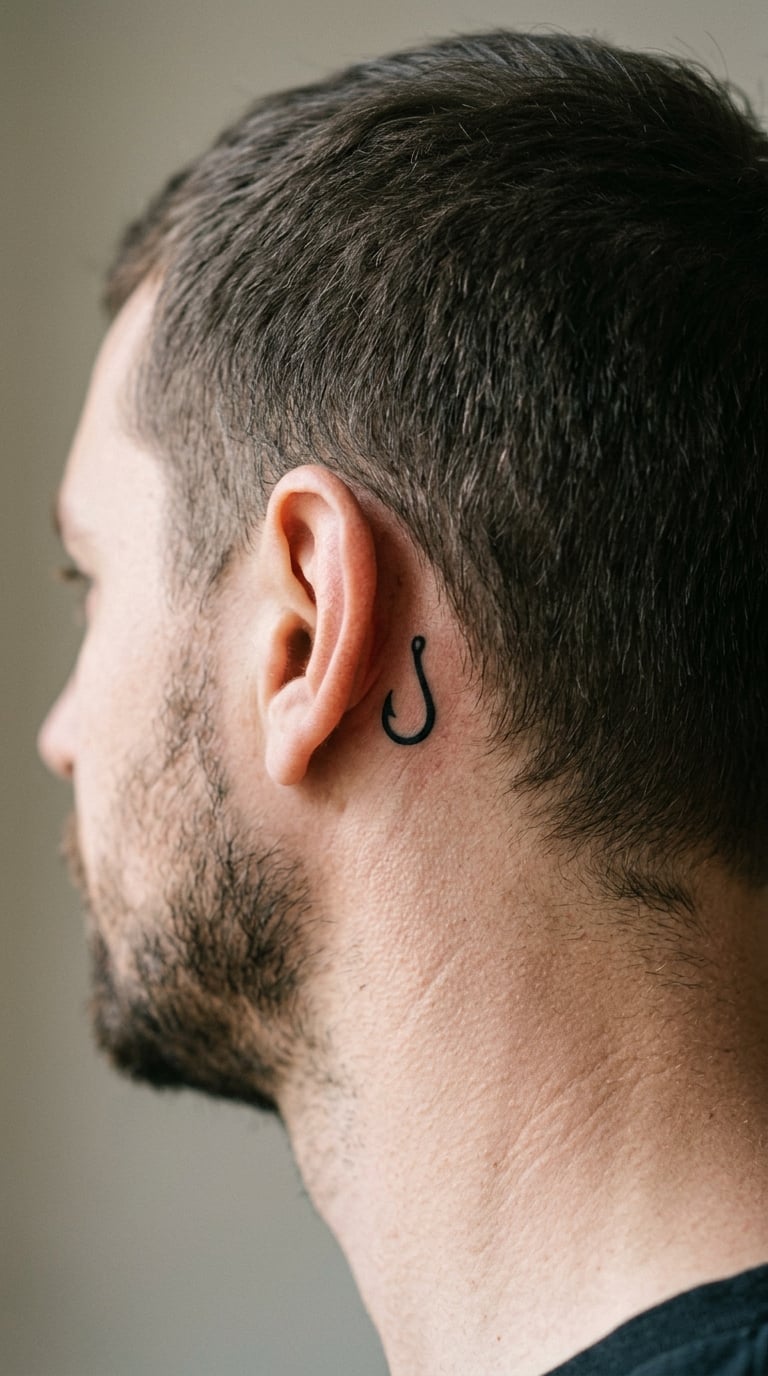
A single barbed hook, about half an inch tall, tucked into the hairline behind the ear where only you and people standing next to you can see it. One curve, one barb, clean and heavy enough to hold its shape.
It is the easiest fishing tattoo to hide at work and the easiest to regret never getting. It also costs the least and heals fastest of anything in this list.
Placement: Behind the ear, or on the inner wrist if you want to see it. Size: 0.5-1 in (1.5-2.5 cm). Style: Minimalist linework or solid black. Pain: Medium. The cartilage there is less painful than people expect; the nerve is the sting.
Hair regrowth over the design is the only real maintenance issue. Make it yours: Have the point of the hook angled so a fly ties onto it naturally.
4. Bass with Mountain Lake Scene
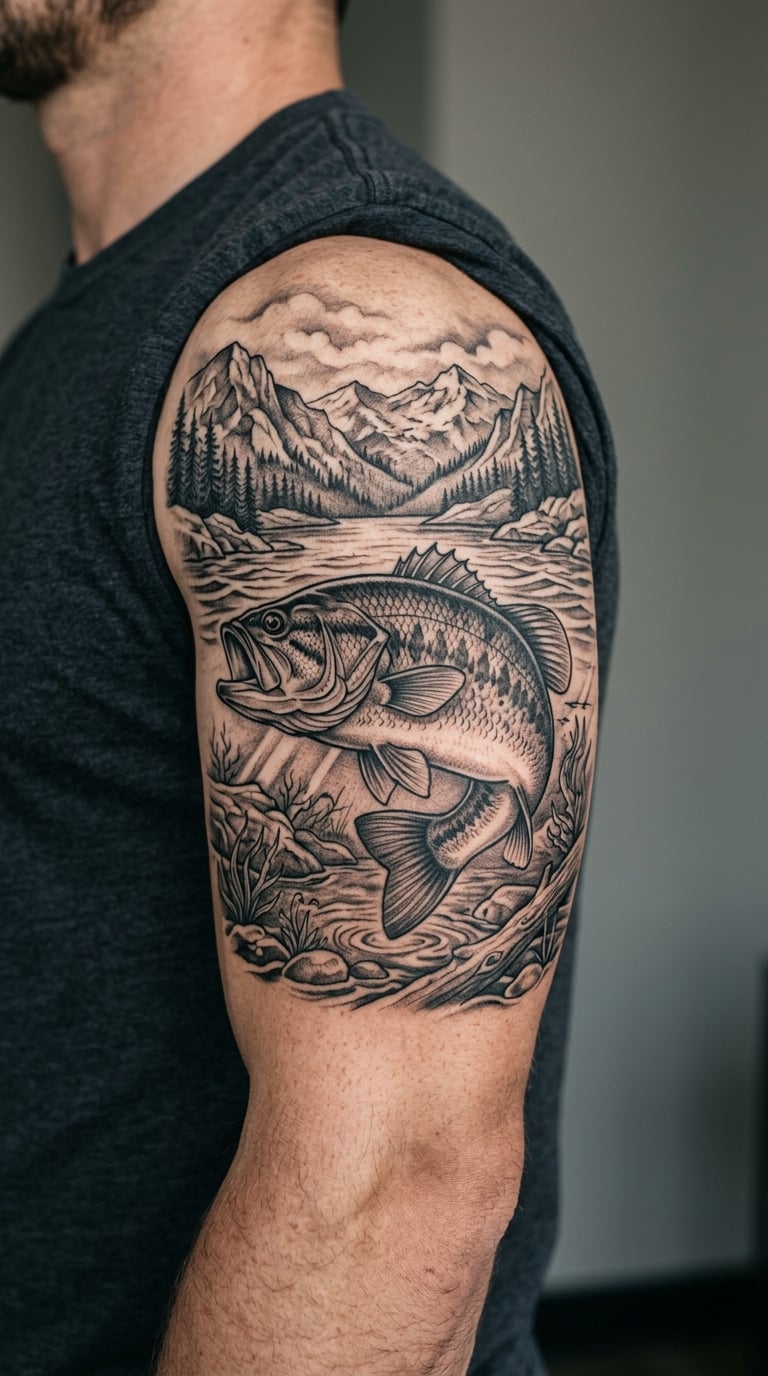
A largemouth bass in the foreground with a mountain lake, treeline and low clouds behind it, all in black and grey wash. The fish is the subject; the water around it is the reason the piece matters to you. A specific lake tattooed on your arm is not a generic fish, it is a place you actually stood.
Men who grew up fishing a specific body of water usually want the water in the piece, not just the species. If you have a mountain and ocean tattoo pairing in mind, this is the freshwater version of the same idea.
Placement: Outer upper arm or shoulder blade. Size: 8-12 in (20-30 cm). Style: Black and grey realism. Pain: Medium on the arm, higher if it creeps toward the spine-side of the shoulder.
Grey wash skies are the part that fades first. Make it yours: Give the artist the lake’s actual skyline from a photo taken at the same hour you fish it.
5. Fly-Fishing Fly and Water Line Tattoo
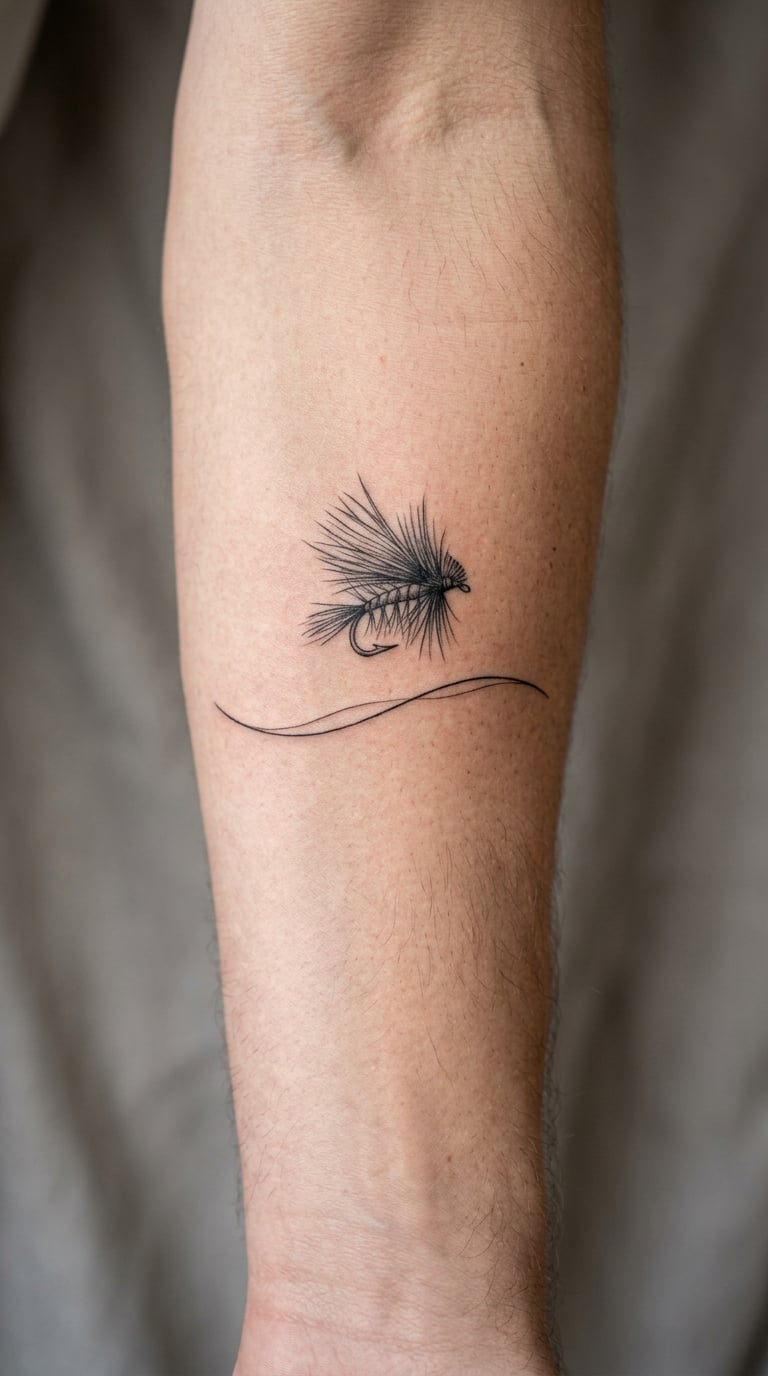
A single tied fly seen from the side, hanging above a single curved line that stands for the water surface. Two elements, no background, no fish. It looks like a diagram from a fly-tying book, which is exactly the appeal for people who tie their own.
Fly patterns carry their own history, and the pattern you pick can be tied to a hatch, a river or a specific trip. Fly-fishing forums are full of ink like this, and the community recognises it instantly.
Placement: Inner arm or inner forearm, parallel to the bone. Size: 3-5 in (8-13 cm). Style: Fine line. Pain: Low, one of the more comfortable spots on the body.
Very fine hair detail at this size will blur. Make it yours: Put the pattern name and the river below it in small caps, or tie the fly to a short length of leader line.
6. Vintage Lure and Fishing Rod Tattoo
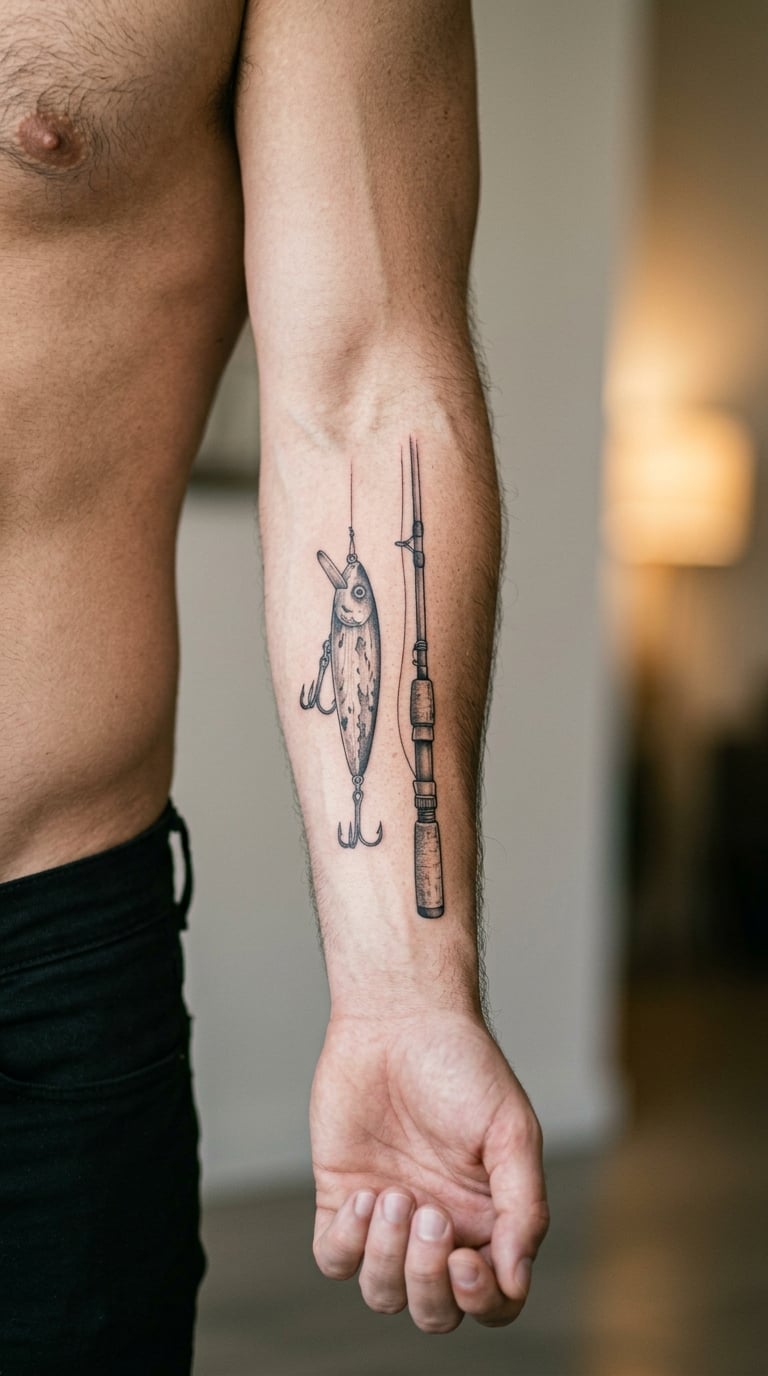
A classic hardbait lure with cupped lip and treble hooks, laid beside the lower section of a rod, both in careful black and grey shading. The look is antique tackle-shop rather than modern gear, and it rewards an artist who enjoys rendering wood grain and metal.
Lures are nostalgia in a way fish alone are not. Men who inherited a tackle box or watched an older relative fish often land here.
Placement: Forearm, set diagonally so the lure sits near the wrist. Size: 6-8 in (15-20 cm). Style: Black and grey realism. Pain: Medium, with the metal highlights taking longer to work.
Ask for simplified hook shapes; tiny treble points are the first thing to disappear. Make it yours: Tattoo the actual lure you fish with, from a photo taken on a bright surface so the shading reads.
7. Koi-Fish Sleeve Panel Tattoo
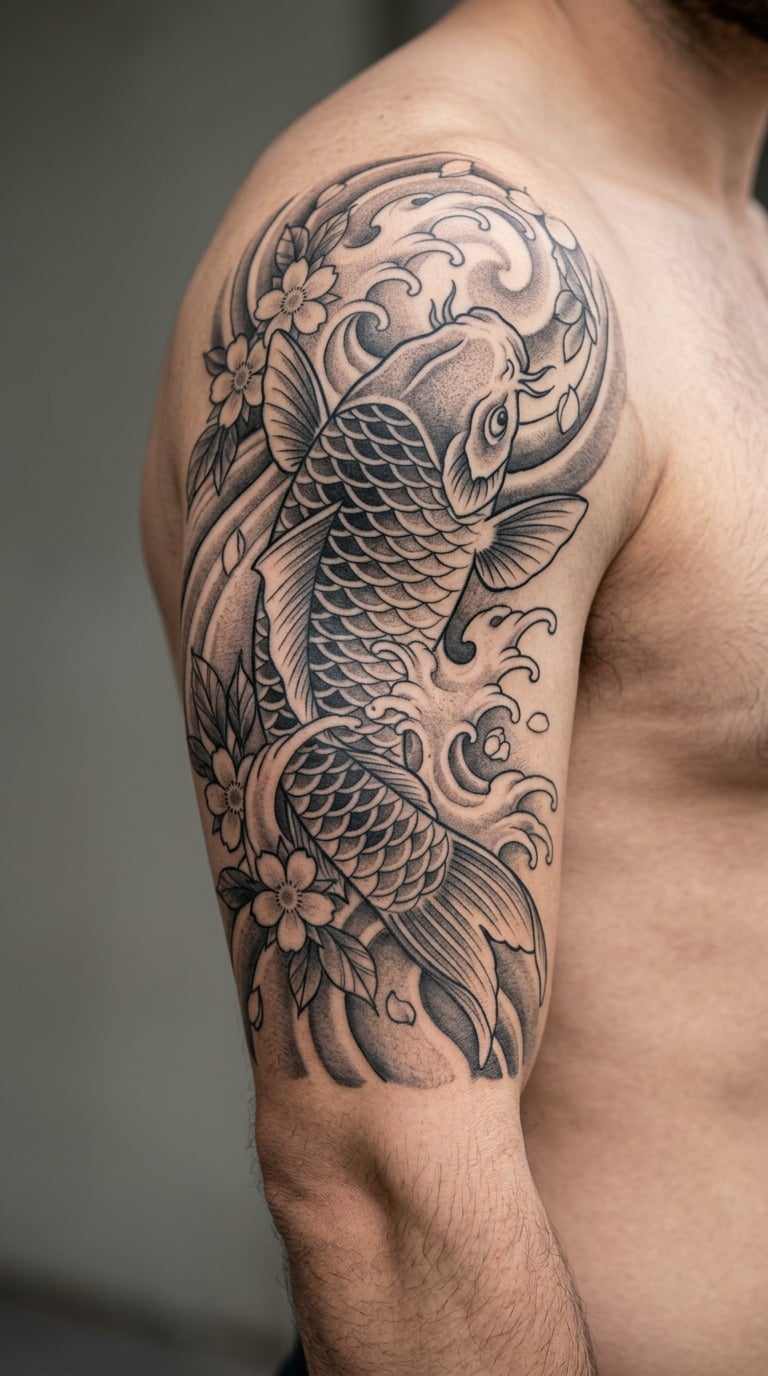
A single koi curving across the upper arm with soft wave shading behind it, in black and grey or muted orange. Koi is the most requested fish in tattoo circles by a wide margin, and it works in a flowing panel rather than a full sleeve if you want room to add later.
Koi are usually chosen for the fish itself rather than for a fixed symbolic claim. Ask people who have one and you will get a different answer every time, which is part of the appeal.
Placement: Upper arm panel, leaving the elbow and forearm free. Size: 10-14 in (25-35 cm). Style: Black and grey illustrative. Pain: Medium to high across the fleshy upper arm.
Red pigment in koi scales is the first to fade, so ask for a muted mix. Make it yours: Put the water flow so it wraps slightly out of view, hinting at a sleeve without committing to one.
8. Angler Fish Micro-Reality Tattoo
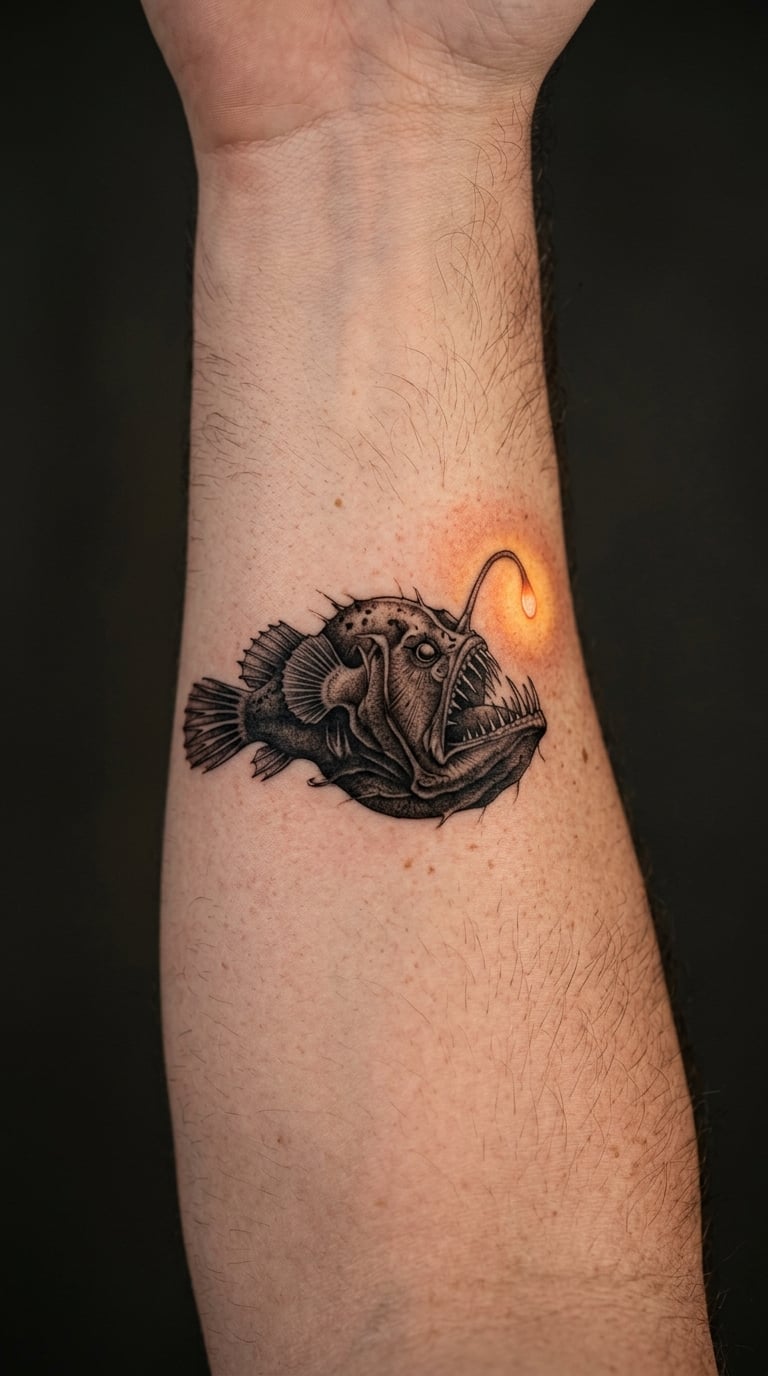
A deep-sea anglerfish rendered small, with a lit esca that reads as a pale highlight against dense black shading. It is a strange, unglamorous fish, and that is exactly why it works. Nobody else on your arm has the same idea.
This is the option for someone who wants a technically impressive piece without a huge commitment. It rewards an artist working in a small window, which is a specialist skill.
Placement: Forearm, wherever a clean oval of skin sits. Size: 2.5-4 in (6-10 cm). Style: Micro-realism. Pain: Medium, longer session for the shading density.
The teeth and lure glow need a steady hand, and a rushed version turns muddy. Make it yours: Ask for the esca left as untouched skin, so your own body makes the light.
9. Fishbone Spine with Latitude Coordinates
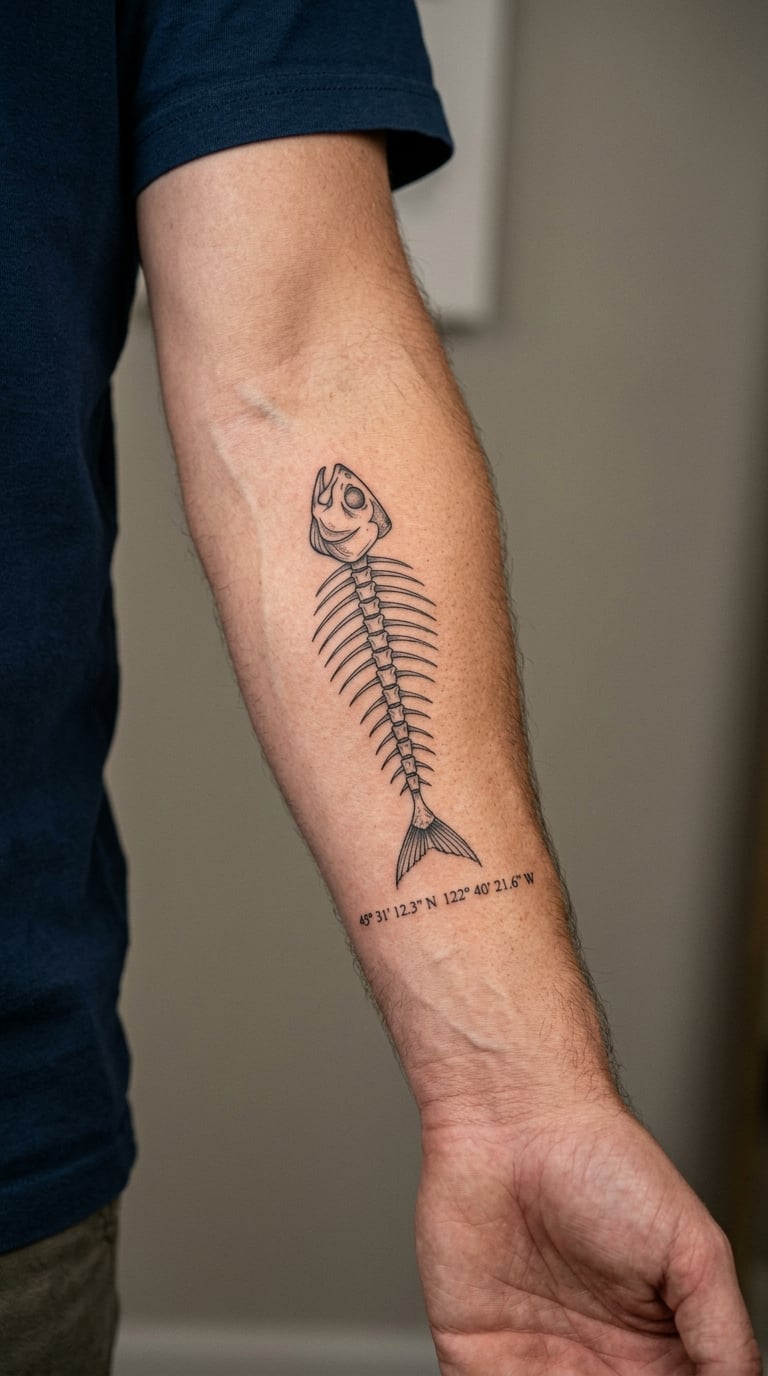
A fish skeleton laid horizontally, with a line of latitude and longitude coordinates set underneath in a small clean serif. The coordinates point at a lake, a boat launch or a river mouth. The design says where, not what.
Coordinate tattoos are personal in a way generic fish art cannot be, and a fishing trip gives you an exact number that means something only to you and whoever you tell.
Placement: Inner forearm, text running along the inner edge. Size: 4-5 in (10-13 cm). Style: Fine line. Pain: Low to medium.
Small lettering on the inner arm fades faster than on a forearm’s flatter outer face. Make it yours: Use the launch coordinates rather than the coordinates you sat on, since that is the number you will actually remember.
10. Pike Head Neo-Traditional Tattoo
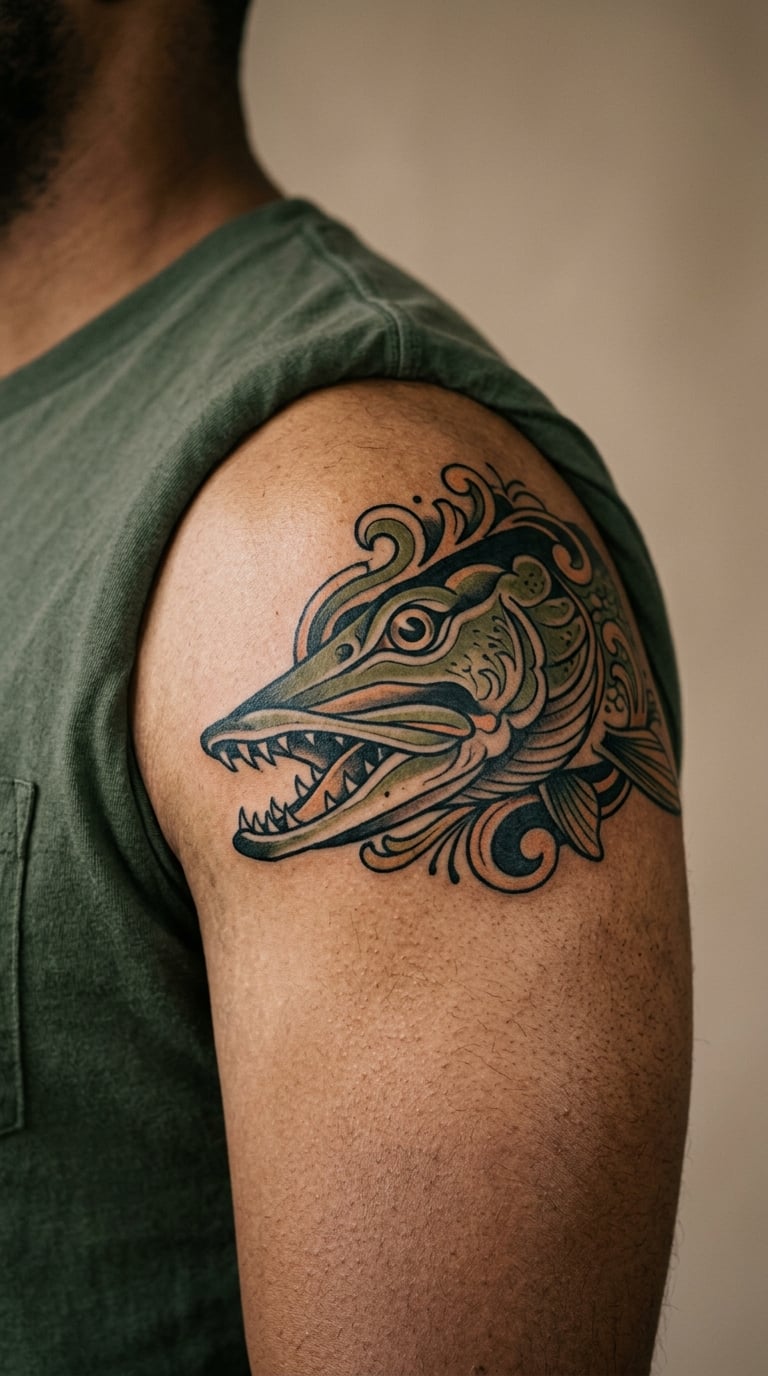
A northern pike in profile, thick black outline, olive green body with orange accents along the flank and white spots left as bare skin. It is a traditional flash subject done properly: heavy lines, limited palette, confident shading.
Pike are aggressive, long and unmistakably northern. Men who fish cold water lakes usually recognise the species instantly, which is half the appeal.
Placement: Shoulder or upper arm, where the flat deltoid takes the shape cleanly. Size: 5-7 in (13-18 cm). Style: Neo-traditional. Pain: Medium to high over the shoulder cap.
Small scale patterns are the part that will soften first. Make it yours: Have the eye angled up and out so the head looks like it is moving past you.
11. Kayak and Mountain Lake Tattoo
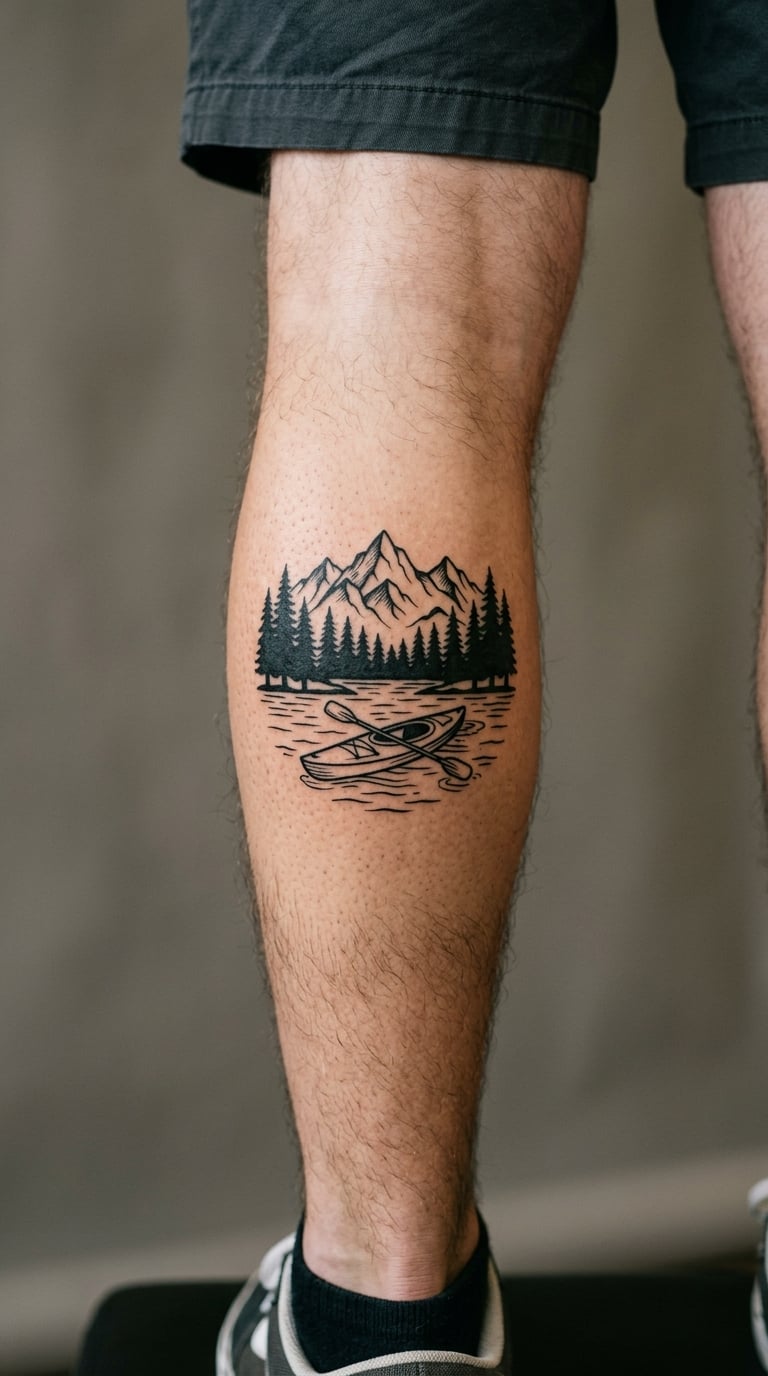
A sit-on-top kayak on flat water, a line of pine silhouettes and a mountain ridge behind it, all in solid black ink with no gradient. It is a scene, not a portrait, and it reads as quiet rather than action.
Men who fish from a paddle rather than a boat tend to want the boat in the piece. Calf placement follows the shape of the leg and the design sits better there than on the arm.
Placement: Outer calf or the inside of the forearm. Size: 6-9 in (15-23 cm). Style: Illustrative, black ink. Pain: Medium on the calf, with the shin bone feeling sharper than expected.
Blacks stay strong longest, which is why this one holds up well. Make it yours: Add a second, much smaller lake scene for a second water you fish, maybe on the other calf.
12. Salmon Wraparound Arm Tattoo
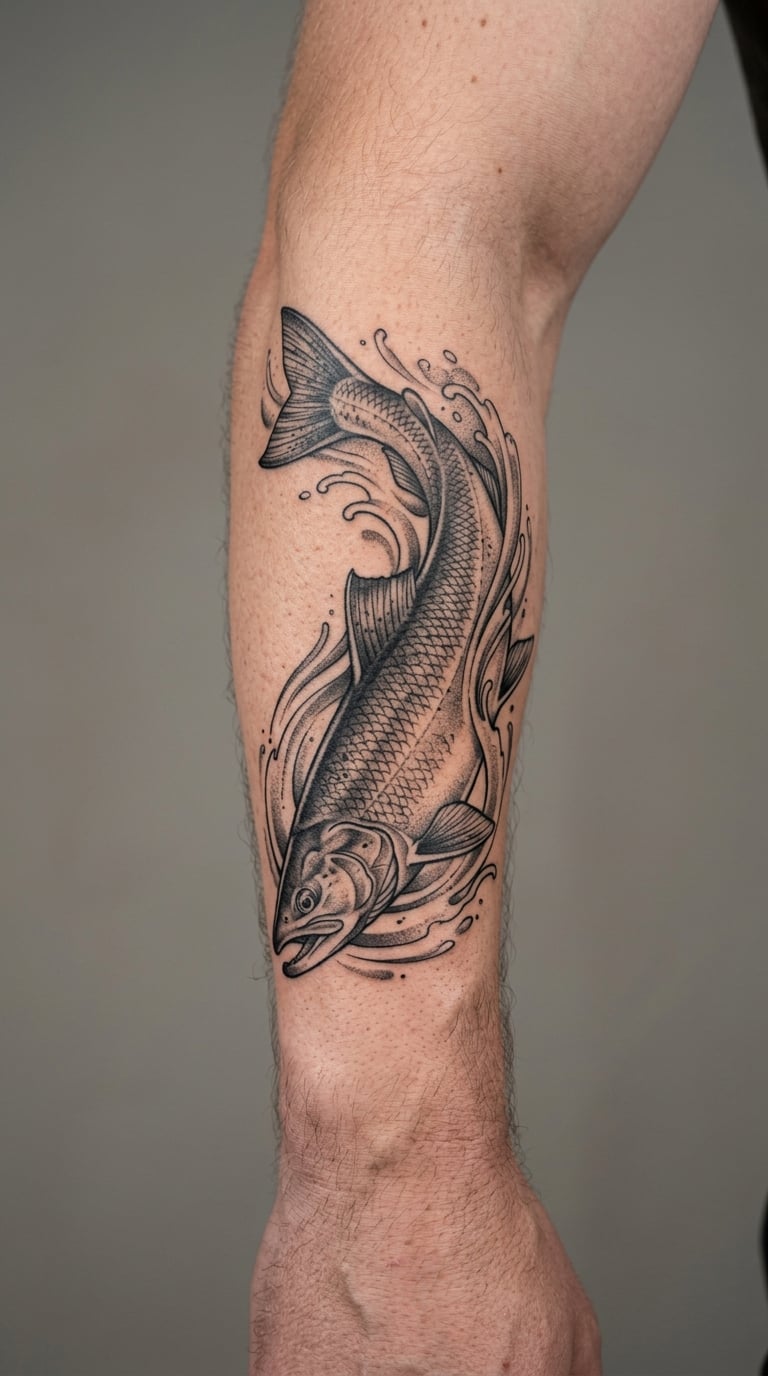
A salmon following the curve of the forearm, head near the elbow and tail disappearing past the wrist so the fish appears to swim around the arm. Black and grey shading, a defined lateral line and a few loose scales suggested rather than drawn individually.
A wrap is the commitment tier. It is a long session or several, and it is the version of this idea most men picture once they decide they want a real fishing tattoo. Pair it with the ocean sleeve tattoo ideas we cover separately if you plan a full arm later.
Placement: Forearm wrap, elbow to wrist. Size: 14-18 in (35-45 cm). Style: Black and grey realism. Pain: High, and the wrist and elbow ends are the rough stretches.
Grey fades need a touch-up within a few years. Make it yours: Have the tail fade to a single line at the wrist so a cuff hides the join.
13. Fishing Knot and Compass Tattoo
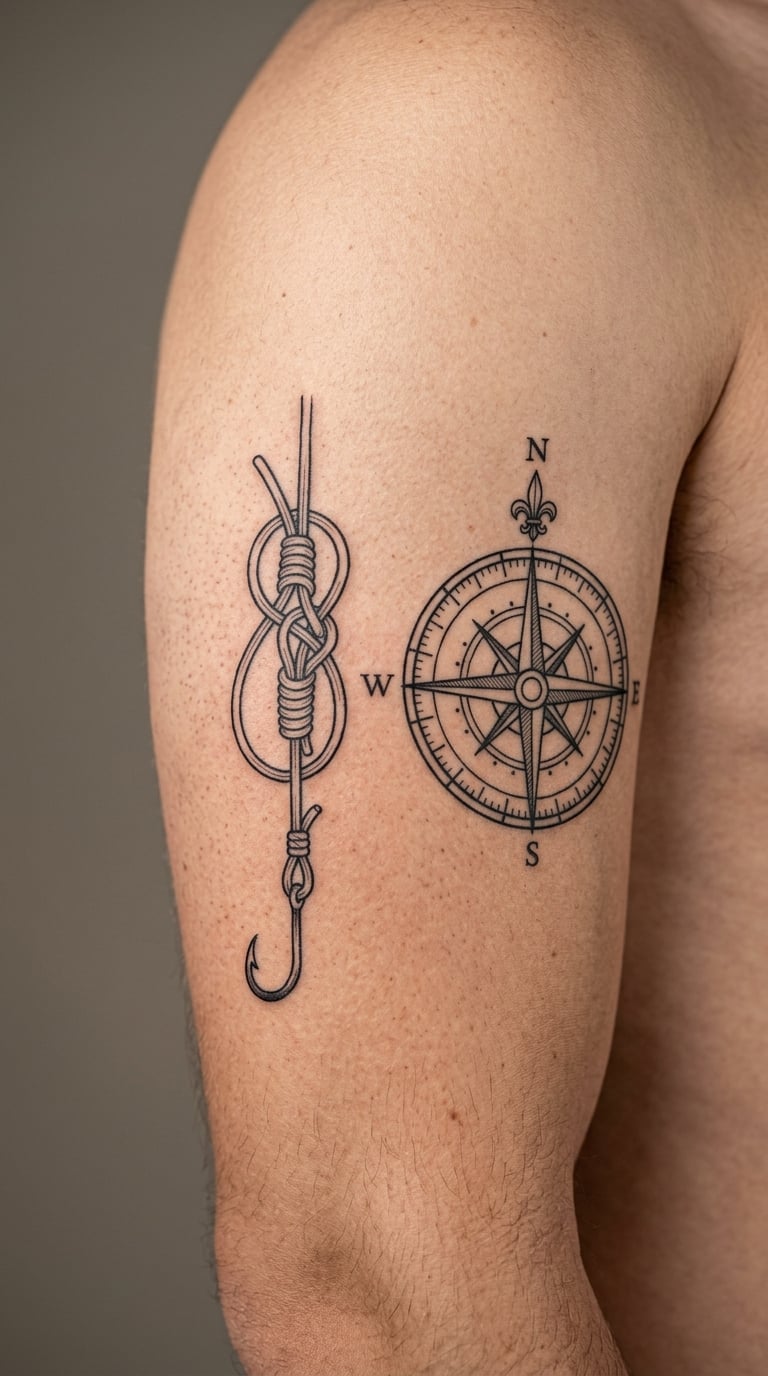
A single well-drawn knot, maybe a clinch knot or a blood loop, tied off cleanly, with a small compass rose offset to one side. Two objects, black linework, no shading. It is a diagram of two things you care about rather than a picture of a fish.
The knot is craft, the compass is direction. Men who travel to fish and take the craft seriously tend to land on this pairing over anything with a fish in it.
Placement: Upper arm or chest, where both elements can breathe. Size: 4-6 in (10-15 cm). Style: Linework. Pain: Medium.
The knot’s crossings blur fastest, so ask for slightly heavier line than looks right on paper. Make it yours: Use a knot you actually tie, and set the compass needle to the direction of home water.
14. Catfish Whiskers and Water Accent Tattoo
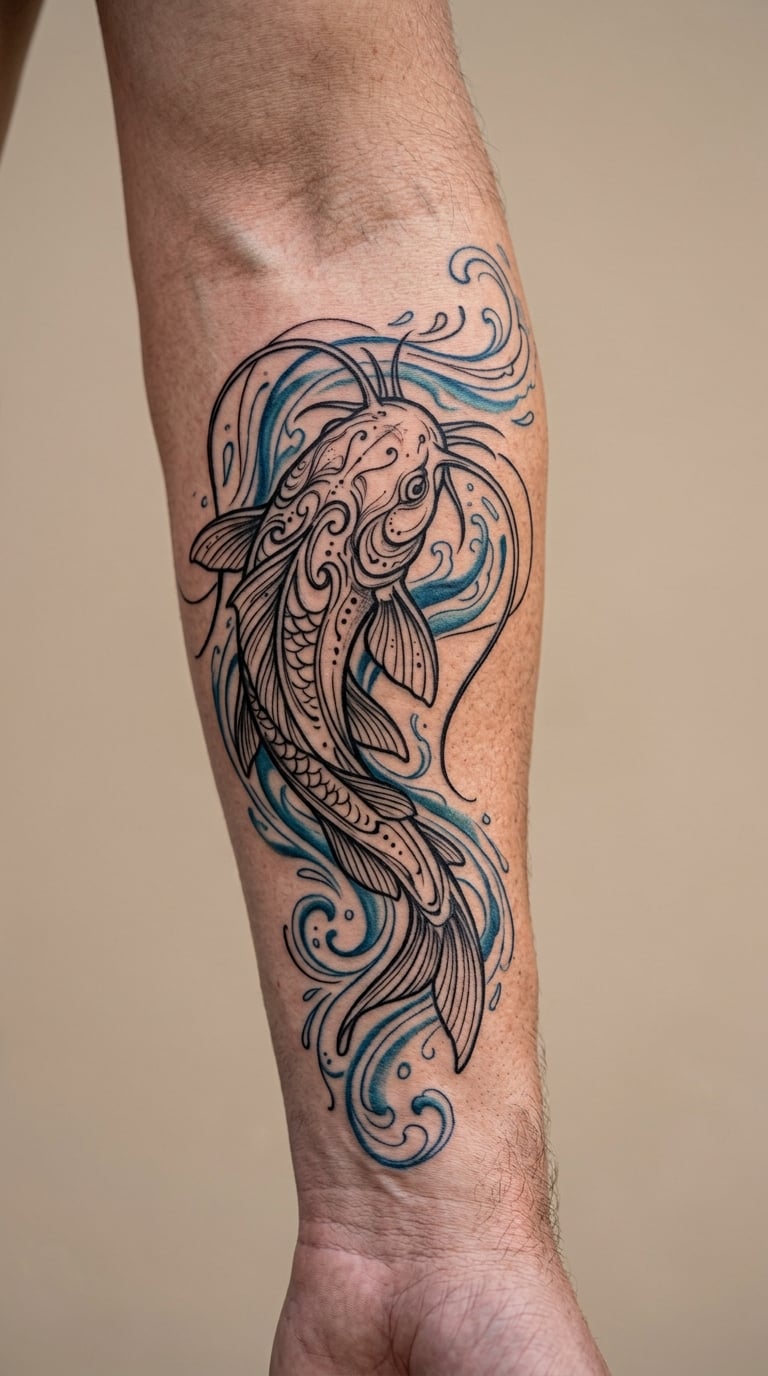
A catfish face front-on, barbels sweeping out and down in long black strokes, with one band of deep blue water behind it. Flat-inked body, one colour, strong graphic weight. Catfish are the most recognisable freshwater fish that almost nobody tattoos.
That is the appeal: everyone recognises the silhouette instantly, and nobody else on your arm has a catfish.
Placement: Forearm, letting the whiskers run lengthwise. Size: 5-8 in (13-20 cm). Style: Illustrative with a single colour accent. Pain: Medium.
That blue band will fade noticeably within a few summers of sun. Make it yours: Scale the head to the biggest fish you have actually landed and put the length in a line of text below it.
15. Minimal Angler Icon Tattoo
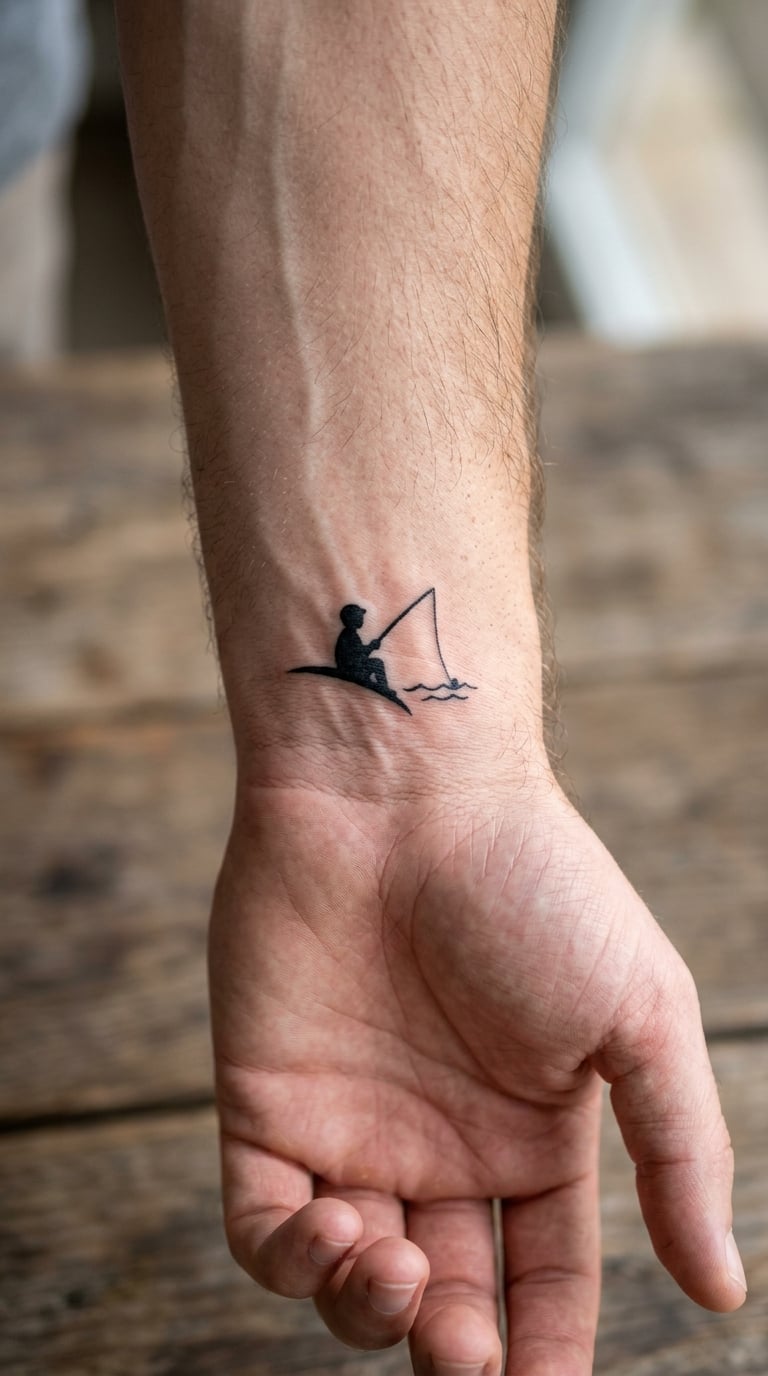
A standing figure with a rod, reduced to a few solid black shapes, roughly one to two inches tall. No face, no detail, no background. It is a pictogram of an angler, closer to a road sign than to an illustration.
Small silhouette pieces sit well in places a detailed fish would look cramped. It is a good second or third tattoo once the first one has healed and you know you will keep going.
Placement: Inner wrist or inner bicep. Size: 1-2 in (2.5-5 cm). Style: Minimalist. Pain: Medium to high, since the inner wrist has a dense nerve network and visible veins.
Keep the rod line thick or it will vanish in a year. Make it yours: Angle the rod so it points along the arm, which makes the small design feel longer than it is.
16. Marlin and Ocean Wave Tattoo
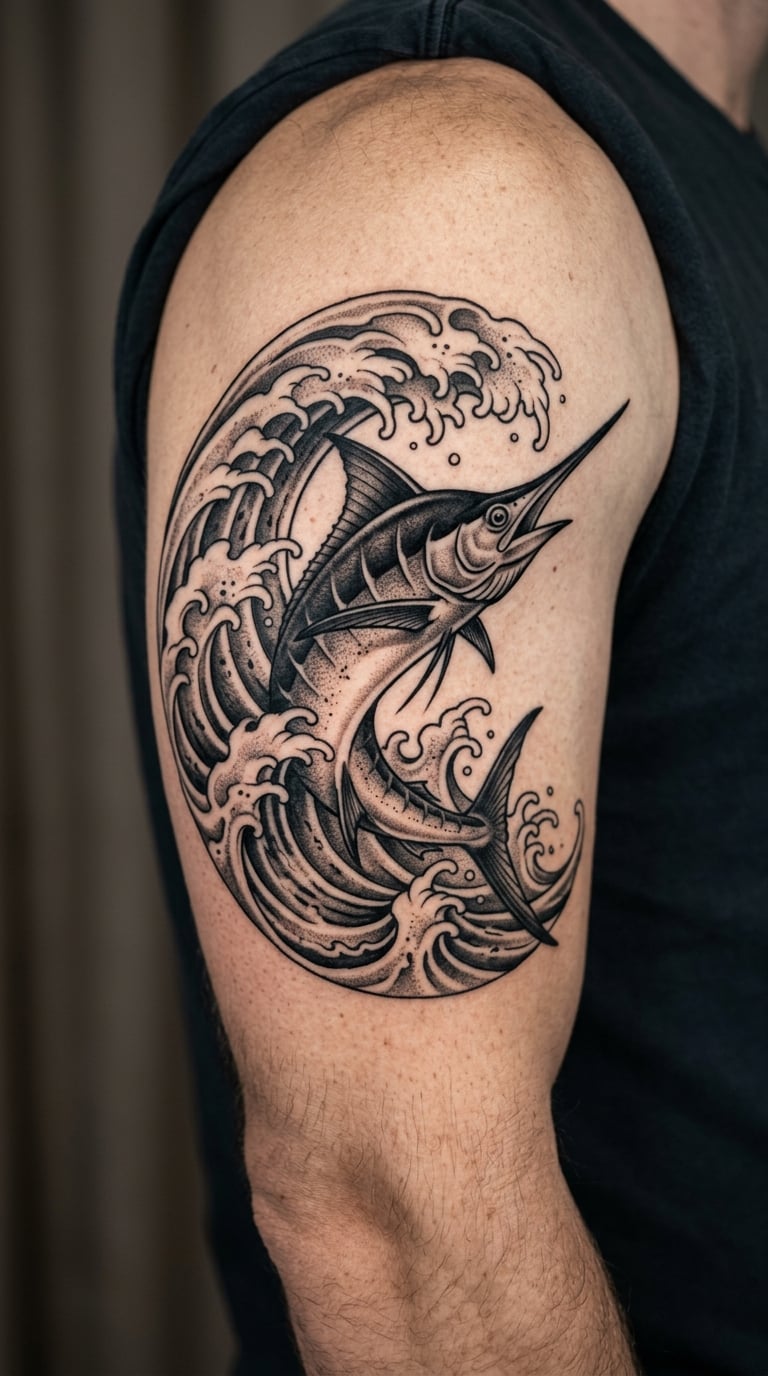
A billfish arcing out of a breaking wave, long bill forward, dorsal fin raised, with a curved wave line sweeping under it. Black and grey shading with a few white breaks left in the spray. It is the most dramatic design in this list at a size most men can still cover.
Saltwater anglers pick marlin because of the fight, and the design has plenty of movement built in. Offshore and flats fishermen use the same shape for sailfish and swordfish without changing the composition.
Placement: Upper arm, shoulder blade or lower back. Size: 10-14 in (25-35 cm). Style: Black and grey realism. Pain: Medium on the arm, high across the lower back ribs.
The bill is thin and fades early, so ask for a heavier line than the reference photo. Make it yours: Add a small tag line and date in the negative space of the wave.
17. Vintage Fishing Badge Tattoo
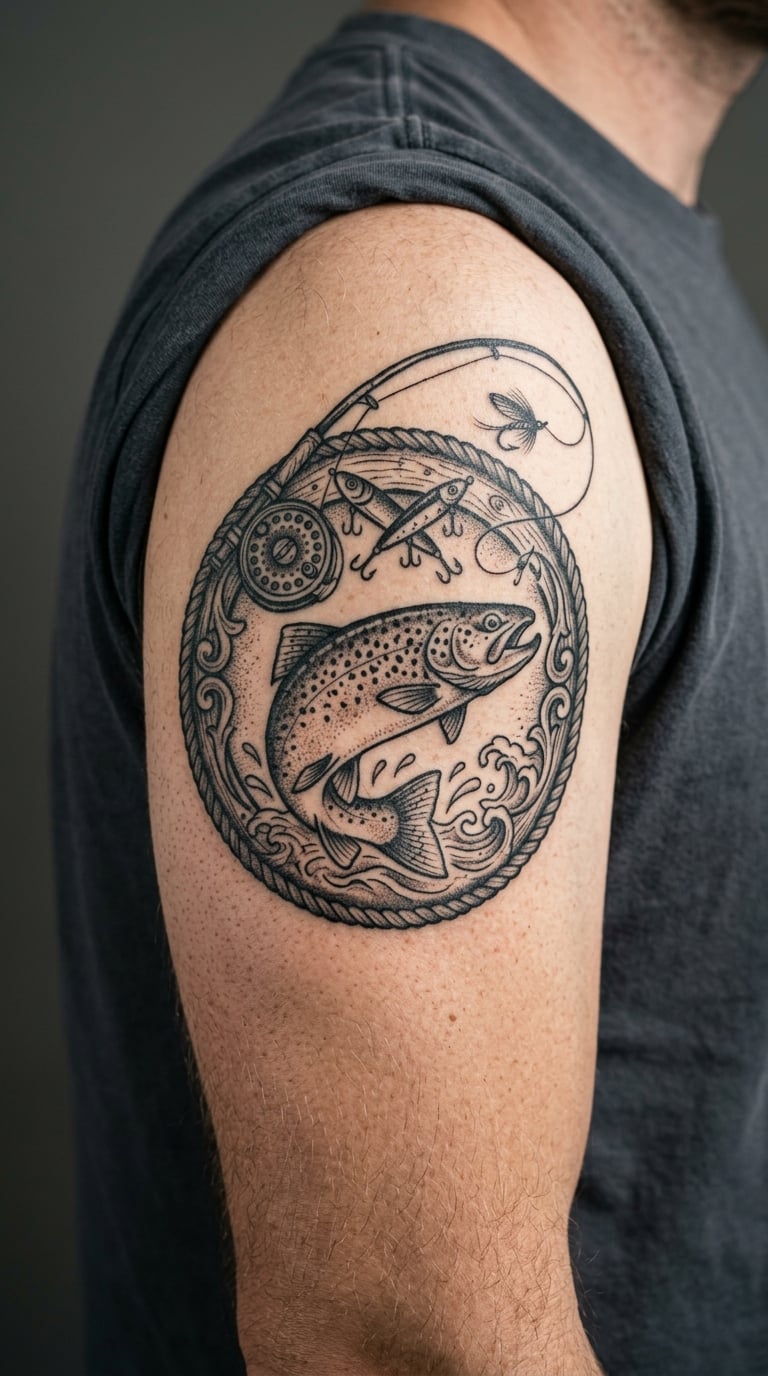
A circular badge: a fish in the centre, a rod and lure above, curved lettering around the ring, maybe an est year underneath. It borrows from lodge badges, tackle logos and old enamel signs.
Graphic, flat and symmetrical, it holds its shape at a modest size better than almost anything else here. If you want a design that still reads clearly in fifteen years, this is the safest bet on the list.
Placement: Upper arm or the flat of the shoulder. Size: 3-4 in (8-10 cm). Style: Traditional American. Pain: Medium.
Curved lettering is difficult; a hand-drawn style suits it better than machine-set text. Make it yours: Use your town or your lake name instead of a generic angling word, and set the year to a trip year.
18. Carp with Floral Water Tattoo
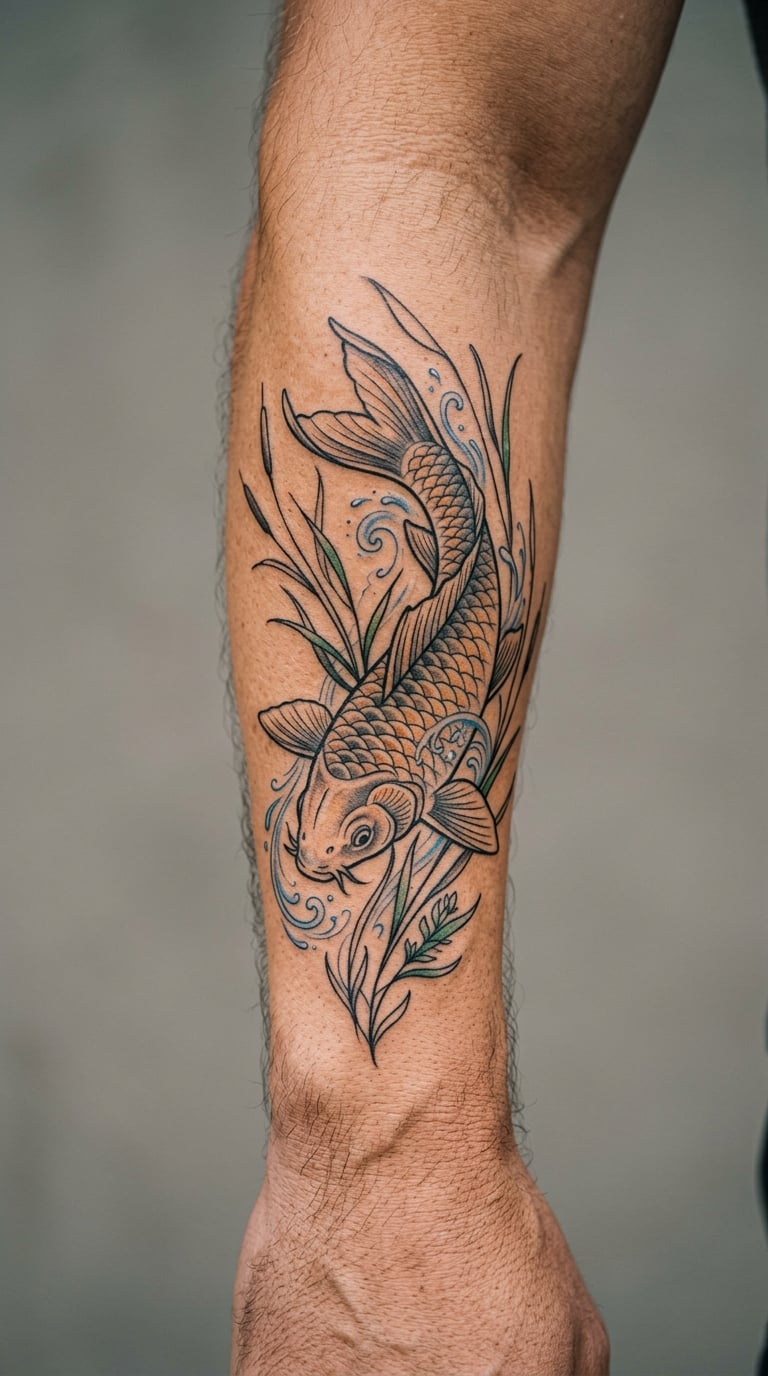
A carp or koi drawn in detailed scales, moving through a few sparse reeds with a soft blue band of water behind. The florals stay restrained, thin stems and a couple of blossoms, so the fish keeps the visual weight.
This is the design that softens a rugged subject without making it delicate. Done with heavy outlines on the fish and light work on the plants, it still reads as a solid arm piece.
Placement: Forearm, calf or the ribs. Size: 6-9 in (15-23 cm). Style: Illustrative with florals. Pain: Medium.
Scale work will soften, so keep individual scales bold rather than fine. Make it yours: Name the water plant that grows in your favourite lake and tattoo that one.
19. Fishing Rod Line Map Tattoo
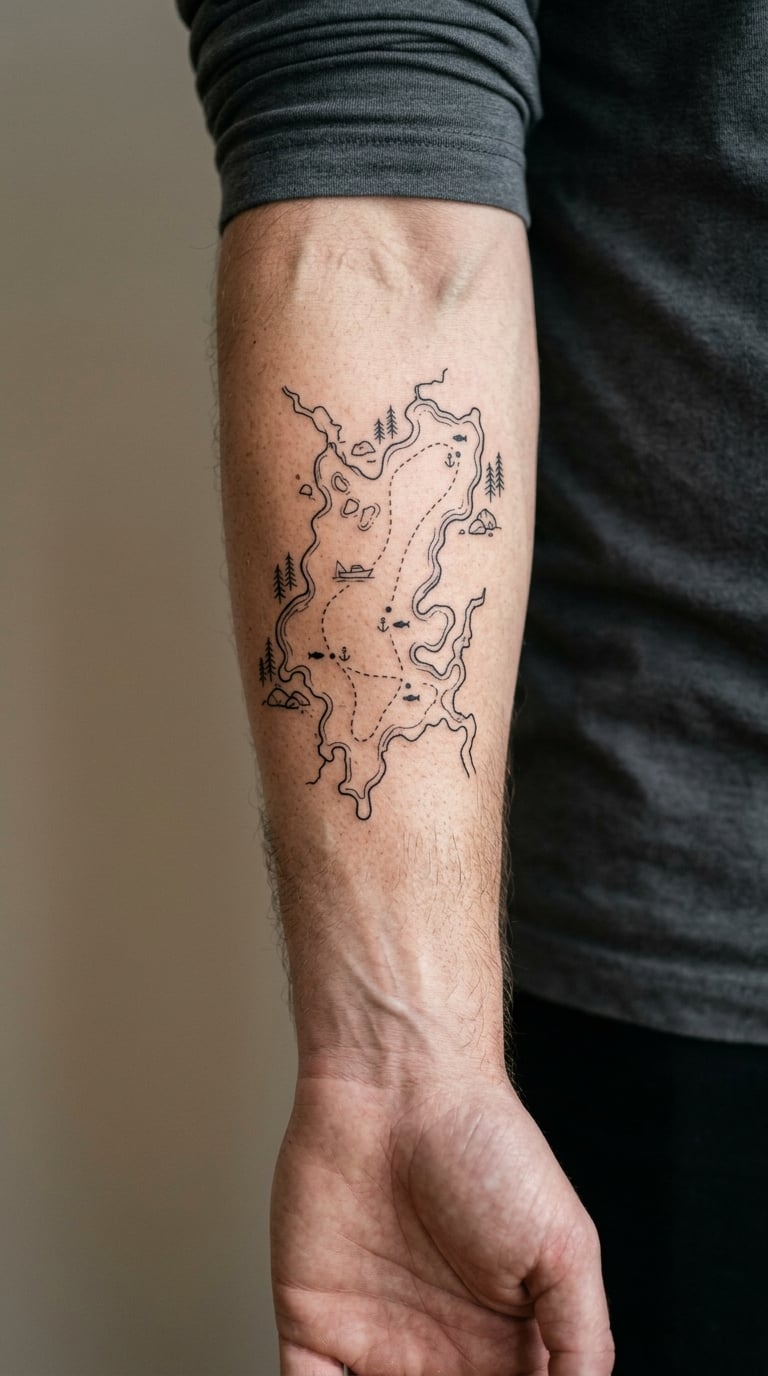
A simplified outline of a lake or coastline in thin black line, with a fine curved line running across it like a fishing line tracing a route. Dots mark a launch point and a spot on the far bank. Cartographic, quiet, personal.
It looks like a chart rather than a picture, and it is easy to miss until someone asks about it. That suits people who want the fishing to be recognisable only to other anglers.
Placement: Forearm, sized to the map’s natural proportions. Size: 4-7 in (10-18 cm). Style: Minimalist fine line. Pain: Low to medium.
Keep the coastline a single confident line, since repeated coastline detail reads as noise. Make it yours: Plot your actual route between the ramp and the fishing spot.
20. Golden Dorado Traditional Tattoo
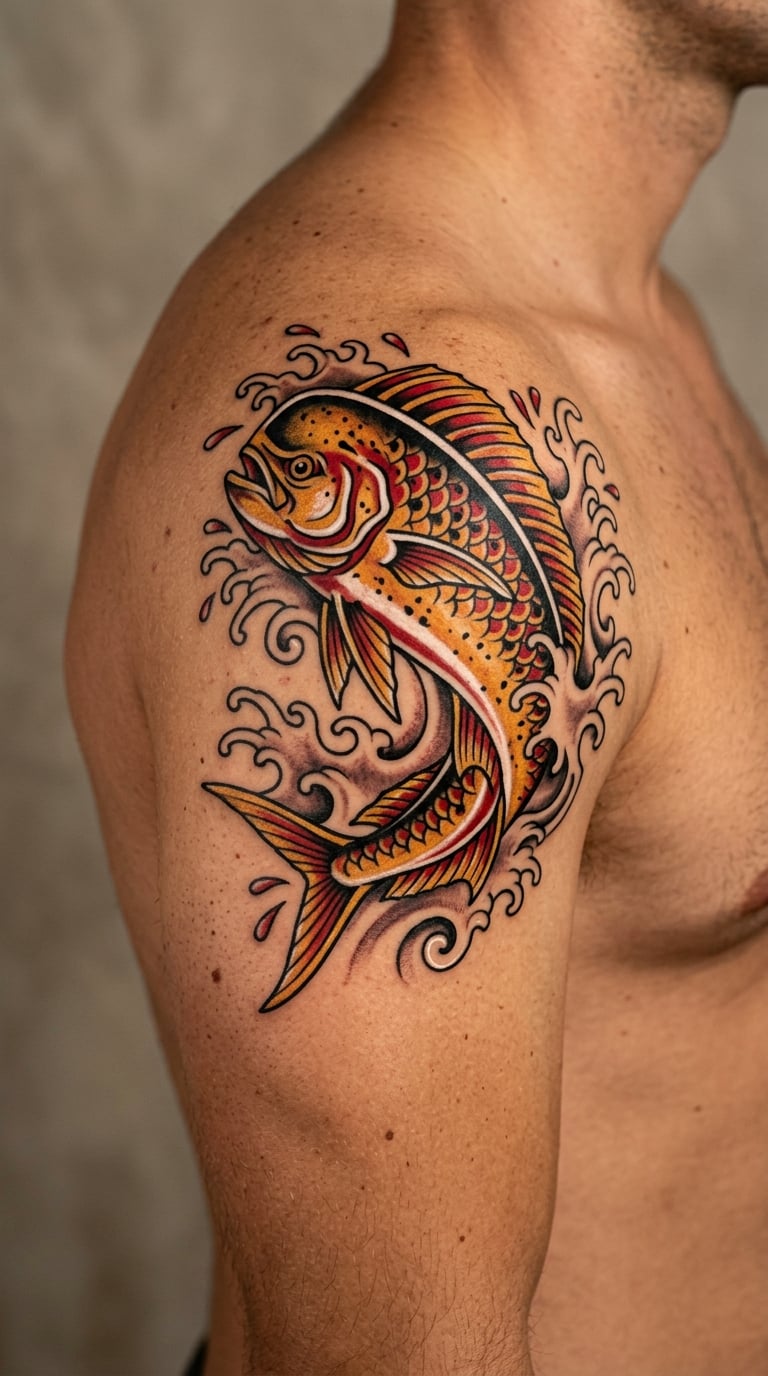
A golden dorado in heavy traditional colour: gold body, red dorsal and belly fin, thick black outline, white highlight lines. Old-school flash colours, nothing muted. It is loud on purpose and it does not apologise.
Few designs here carry as much visual weight. It is the right choice if your instinct is that a fishing tattoo should be obvious from across a room, and the gold and red are chosen to hold their saturation over time.
Placement: Shoulder or upper arm, high enough to look good in a sleeve gap. Size: 6-9 in (15-23 cm). Style: Traditional American. Pain: Medium to high, since full colour packing takes time.
Yellow ink is famously fragile in sunlight, so expect a touch-up. Make it yours: Swap the gold for a deep olive if you want the shape without the shine.
21. Tiny Fish Ankle Tattoo
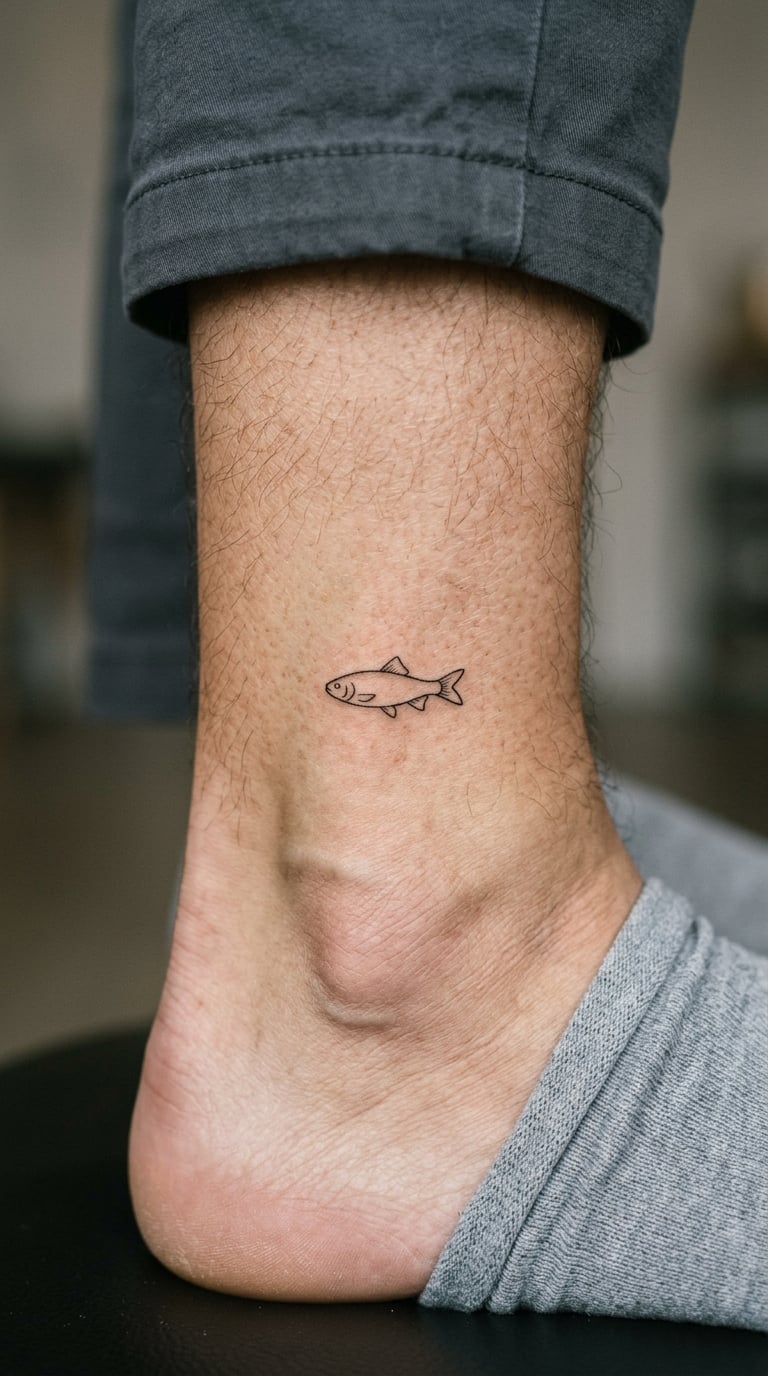
One small fish, a couple of inches long, outlined in a single fine black line with a few gill marks. Nothing else. It shows above a shoe and hides completely inside a boot, which makes it the most flexible placement on this list.
Small and simple is the safe first choice, and the ankle is a spot people rarely tattoo badly. The risk at this size is not execution but patience: some small linework needs a touch-up once it settles.
Placement: Outer ankle above the bone. Size: 1.5-2.5 in (4-6 cm). Style: Fine line. Pain: Medium to high; the ankle bone is close to the surface and the skin is thin.
Nothing thinner than about 1.5 mm holds up long term here. Make it yours: Tattoo the smallest fish you ever kept, which is usually a better story than the biggest one.
22. Full Fishing Scene Back Tattoo
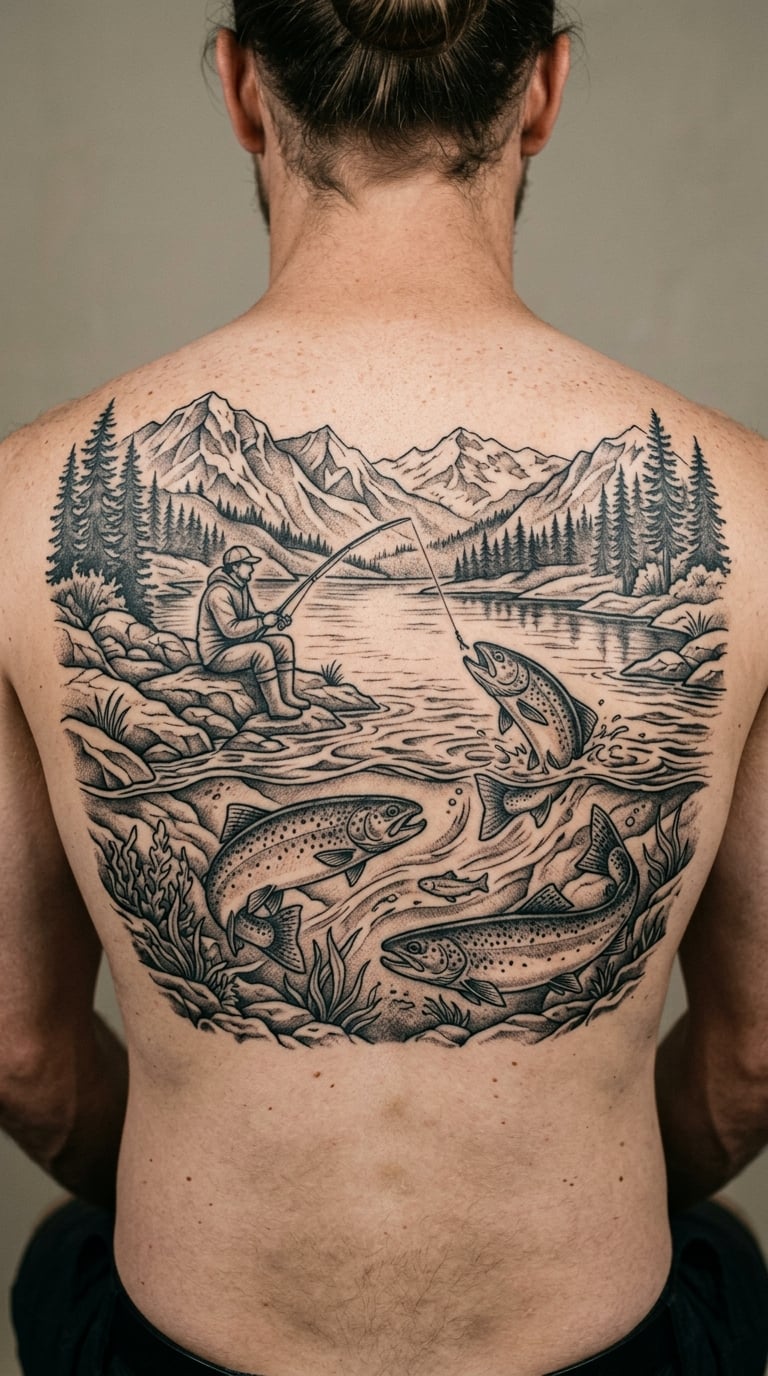
A seated angler on the bank with a rod bent over the water, a lake, a mountain ridge behind, and a fish held in the foreground. Black and grey wash, arranged in layers so the eye moves from the fish up to the mountains. This is the largest and most personal design here.
A back scene is how men who fish heavily usually mark it. It is also the piece that most often comes from a real location rather than a reference image, and the one that takes the longest.
Placement: Upper back between the shoulder blades, running down toward the spine. Size: 18-24 in (45-60 cm). Style: Black and grey realism. Pain: High, and the spine area is the roughest part of any session.
Realistic back work usually needs two or more sessions. Make it yours: Add a coordinate line at the bottom of the frame, and let the mountains match the real skyline you fish beneath.
How to Choose the Right Design
Style and scale are decided together, not separately. A photorealistic trout at three inches is a smudge in ten years, while a bold black silhouette at that size stays sharp.
- Start from the space, not the image. Measure the flat area you want to fill before you pick a design. The flat part of a forearm handles a long horizontal fish better than the curve of a bicep.
- Go bolder than feels right. Fine line at wrist and ankle size fades noticeably. A thicker outline reads stronger and forgives more.
- For a masculine read, use fewer colours. Blackwork, black and grey, or two colours maximum. High saturation and soft shading can drift toward a look that a lot of men are simply not after, and that is the concern that shows up most often in angling forums.
- Decide about coverability early. A sleeve can hide a shirt, but it cannot hide from a summer job. Men in conservative workplaces usually pick the forearm, bicep or wrist first.
- Bring references the artist can work from. Clear photos in good light beat a dark phone snap. Artists regularly turn down images that are too dark or too busy to translate into ink.
- Check the portfolio, not the style label. Ask to see healed work of the same subject at a similar size. Style names mean different things in different shops.
If you want a nature theme that sits next to a fishing piece rather than competing with it, the pine forest forearm tattoo ideas give you a clean companion for the same arm.
Cost and Session Time
Tattoos are usually priced by the hour, with a shop minimum that covers the shortest session. That means a tiny fish costs barely more than a hook behind the ear, while a back scene or a forearm wrap runs across many hours and is sometimes split into two visits.
- Under 2 in (5 cm): one short session, often the cheapest option available. A hook, a badge, a small silhouette.
- 2-5 in (5-13 cm): one session of a couple of hours. Most of the single fish designs on this list sit here.
- 5-9 in (13-23 cm): three to five hours, sometimes a full day with a break. Traditional colour and dense blackwork sit at the upper end.
- 9-18 in (23-45 cm): a full day or two. Wraparounds and quarter sleeves belong here.
- Over 18 in (45 cm): multi-session work, planned weeks apart. Full back scenes are priced this way almost everywhere.
Regional rates and individual artists vary widely, and travel costs more than the work usually does. Ask for the total estimate, the hourly rate and the deposit in writing before the first session, and confirm what happens if you need a break or a touch-up.
Aftercare Basics
- Follow your artist’s aftercare instructions first. They know what they put in your skin and how that specific piece will respond.
- Wash gently with clean water and unscented soap, then pat dry. Let it breathe and avoid tight clothing over the area for the first few days.
- Use a thin layer of whatever cream or ointment your artist recommends. Heavy products trap moisture and slow things down.
- Keep new ink out of direct sun. A hat or a shirt beats sunscreen on a fresh piece, and long-term sun exposure is what fades blues and greens on fish work first.
- Do not soak, swim, sauna or use a hot tub until the skin has fully closed, and skip picking at flaking areas even when they itch.
- Contact the studio, not a forum, if you see spreading redness, heat, swelling beyond the first day, or discharge. Early is easier to deal with.
Frequently Asked Questions
What does a fishing tattoo symbolize?
Most wearers read it as patience, perseverance and a bond with the outdoors. Anglers also use it to mark a specific lake, river or species, and often to remember a parent, grandfather or guide who taught them. There is no single fixed meaning, so the symbolism comes from what the fish or water means to the person wearing it.
Where is the best placement for a fishing tattoo on a man?
The outer forearm is the most popular spot because it has a flat, readable area and shows when you roll a sleeve. The upper arm and shoulder take larger scenic pieces, the inner wrist holds small symbol work, and the calf fits scenic views. If you work in a conservative environment, keep it to the forearm, bicep or wrist so a shirt can cover it.
How big should a fish tattoo be on a forearm?
For a single fish on a forearm, three to five inches is the realistic sweet spot. Below two inches there is not enough surface for gill, fin and scale detail to hold up once healed. Larger forearm pieces run seven to nine inches, and anything longer is usually a wrap that continues around the arm rather than a single design.
Are fish tattoos too feminine for men?
Style decides that, not the subject. A fine-lined pastel koi on a soft inner arm reads one way; a thick-outlined blackwork bass, a marlin or a traditional dorado reads quite differently. Most men who worry about this pick blackwork, black and grey, or two colours maximum, and heavier outlines generally settle the question.
What style of fish tattoo ages the best?
Bold blackwork and thick-line black and grey age best because they hold their edges longest. Small fine-line detail on hands, wrists and ankles fades and blurs fastest, and pale blues and greens lose saturation with sun exposure. Earth tones and heavy outlines hold up better than bright yellows and light turquoise over a ten-year window.
Should a first fishing tattoo be small or large?
Small, and choose a simple subject. A hook, a badge or a single outlined fish under two inches heals quickly, costs less, and is easy to cover if work or family makes you second-guess it. A large scene or wrap needs a clear commitment and a plan for two or more sessions, which suits people who already collect tattoos rather than a genuine beginner.
Conclusion
For a first fishing tattoo, stay small and simple: a hook behind the ear, a 3-inch outlined trout on the forearm, or a vintage badge. Those heal predictably, cover easily if you need them to, and give you a real read on whether you want a second piece.
If you are already building a collection, the fishing tattoo ideas for men on this list scale up well. A jumping blackwork trout, a koi panel or a salmon wrap around the forearm fills the arm without closing off the space around it, and a back scene is the version to plan for once you know you are committing.
Whichever you pick, bring photos the artist can actually work from, decide your size before you decide your style, and give the line weight one step heavier than the reference photo suggests.