
22 Morse Code Tattoo Ideas (October 2026) You Will Love
If you have ever wanted a tattoo that looks like a pattern to strangers and reads like a sentence to a handful of people, these 22 morse code tattoo ideas are built for exactly that. Every design below shows what the dots and dashes actually say, where it sits on the body, how big it should be, and how it will look in ten years.
Morse code works because it is linear, which happens to suit skin. Each letter is a fixed run of short marks and long marks, and the whole thing reads left to right along a line, so it follows an arm, a rib or a spine without fighting the body’s shape. Updated for October 2026, this guide mixes plain fine line pieces with illustrated versions for anyone adding to an existing collection.
22 Morse Code Tattoo Ideas: Quick Guide
Scan this table first, then jump to the design that fits your message and your placement.
| Idea | Style | Best placement | Size | Pain |
|---|---|---|---|---|
| 1. Minimal dots and dashes | Fine line, single row | Inner wrist | 2-3 in (5-7.5 cm) | Low to medium |
| 2. Name on the forearm | Fine line, two rows | Inner forearm | 2-4 in (5-10 cm) | Medium |
| 3. Hidden SOS | Micro fine line | Behind the ear | 0.4-0.8 in (1-2 cm) | Medium |
| 4. Phrase behind the ear | Fine line, vertical | Behind the ear | 1-2 in (2.5-5 cm) | Medium to high |
| 5. Date on the ankle | Fine line, single row | Above the ankle bone | 1.5-2.5 in (4-6 cm) | High |
| 6. Vertical along the spine | Fine line, long column | Spine, upper to mid back | 6-10 in (15-25 cm) | High |
| 7. Heart with initials | Fine line outline | Inner wrist | 1.5-2.5 in (4-6 cm) | Low to medium |
| 8. Ring finger band | Fine line band | Side of the ring finger | 0.3-0.5 in wide | High |
| 9. Coordinates on the calf | Fine line, vertical | Outer calf | 3-4 in (7.5-10 cm) | Medium |
| 10. Star map | Fine line illustration | Shoulder or upper back | 3-5 in (7.5-12.5 cm) | Medium |
| 11. Rose outline | Botanical fine line | Forearm or thigh | 2.5-4 in (6-10 cm) | Medium |
| 12. Anchor | Blackwork | Outer upper arm | 3-5 in (7.5-12.5 cm) | Medium to high |
| 13. Mountain silhouette | Minimal line illustration | Forearm or calf | 2.5-4 in (6-10 cm) | Low to medium |
| 14. Infinity symbol | Fine line, geometric | Wrist or ankle | 1.5-2 in (4-5 cm) | Low to medium |
| 15. Compass rose | Geometric linework | Upper arm or back | 3-4.5 in (7.5-11 cm) | Medium |
| 16. Laurel wreath | Botanical fine line | Outer thigh | 3-5 in (7.5-12.5 cm) | Medium |
| 17. Wave on the forearm | Illustrative fine line | Inner forearm | 3-5 in (7.5-12.5 cm) | Medium |
| 18. Lighthouse | Fine line illustration | Shoulder or upper arm | 2.5-3.5 in (6-9 cm) | High |
| 19. Butterfly on the wrist | Symmetrical fine line | Inner wrist | 2-3 in (5-7.5 cm) | Low to medium |
| 20. Arrow on the rib | Minimal line | Rib area, side of torso | 3-4.5 in (7.5-11 cm) | High |
| 21. Crescent moon on the neck | Fine line, small | Side of the neck | 1-2 in (2.5-5 cm) | High |
| 22. DNA double helix | Minimal line, geometry | Forearm or calf | 4-6 in (10-15 cm) | Medium |
1. Minimal Dots and Dashes Wrist Tattoo
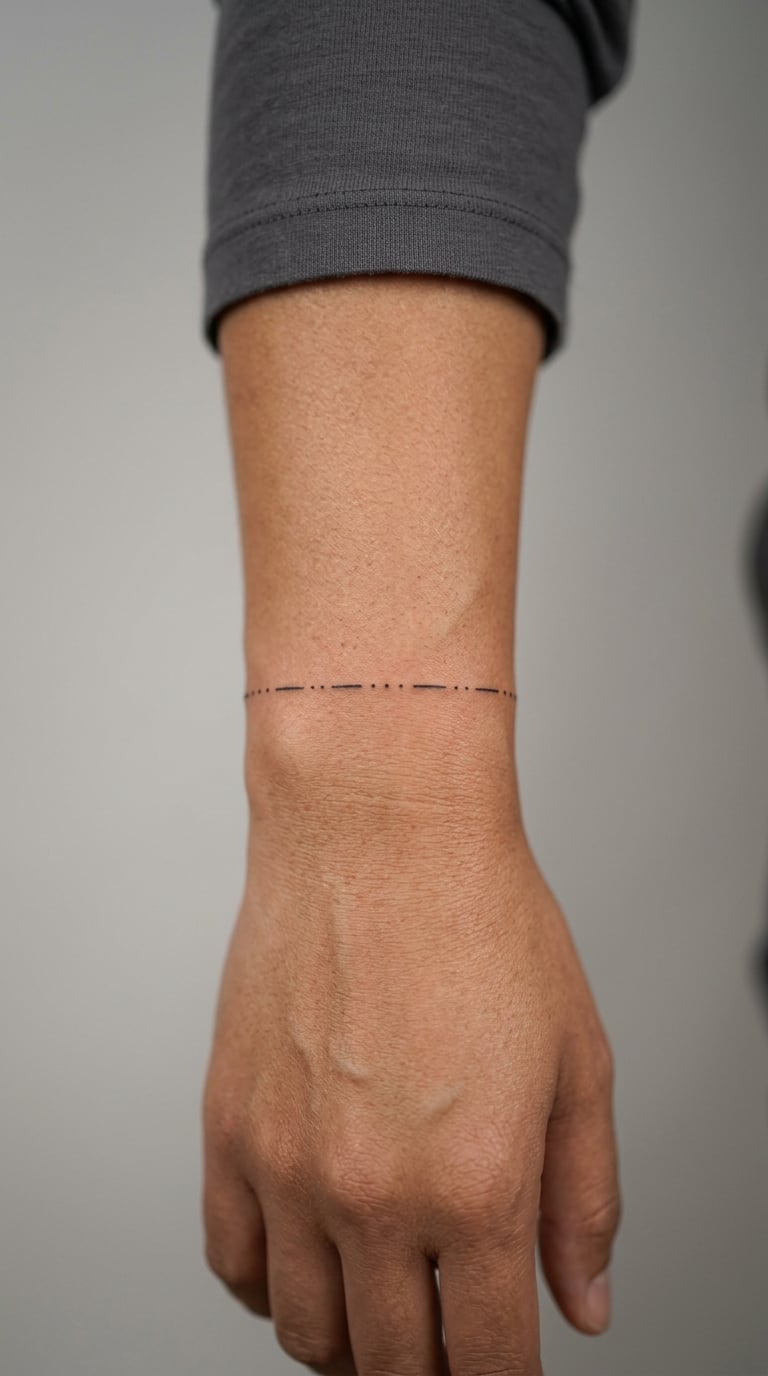
The simplest version of this list is one unbroken row of short marks and long marks across the inside of the wrist, with no frame around it at all. A four or five letter word fits comfortably, and the whole thing reads as a thin textured line until someone who knows the code looks closely.
Most people pick a single word here, a name or an initial, and the meaning stays between the wearer and whoever they choose to tell.
Placement: Inner wrist, parallel to the wrist crease, or the flat of the forearm just above it · Size: 2-3 inches (5-7.5 cm) across for four or five letters · Style: Fine line, single needle width, pure black.
Pain: Low to medium. The inner wrist pulses with veins and sits over thin tissue, so it stings more than the upper arm. Ink spread will soften a hairline dot within a few years, so keep gaps generous. Make it yours: Add a second row beneath it so two short words stack under each other.
2. Morse Code Name on the Forearm
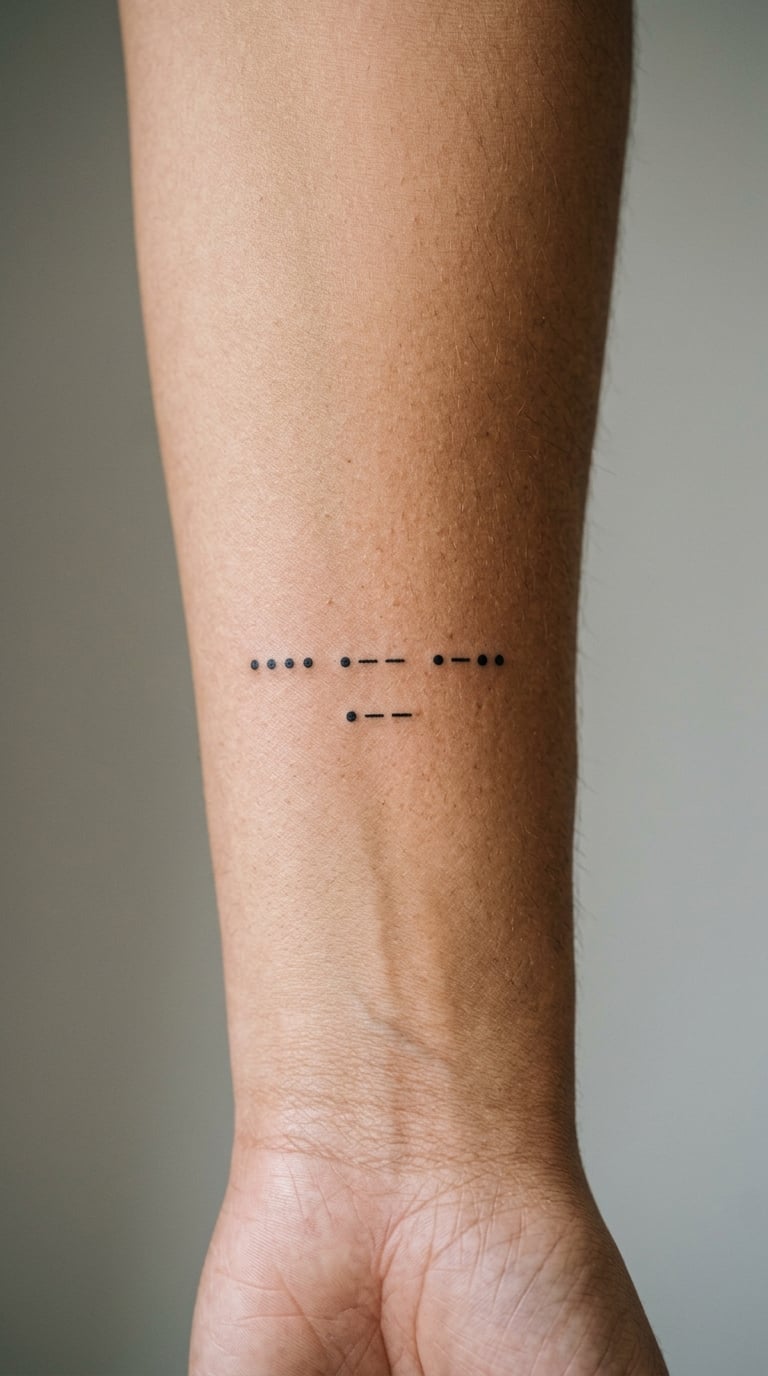
Translating a full first name is where most people start, and the forearm gives you the room to do it well. A name of five to eight letters usually runs long enough that it looks better in two stacked rows than in one stretched line.
Encoding a name is the version people describe as a secret code tattoo: legible to a radio operator, invisible to everyone else.
Placement: Inner forearm, running lengthwise from wrist toward the elbow · Size: 2-4 inches (5-10 cm) per row, two rows maximum · Style: Fine line with even mark lengths and square-cut dashes.
Pain: Medium, and the forearm curves, so the artist is working on a moving surface. Fine lettering on the inner arm dulls slightly over time but stays readable. Make it yours: Put the name on one forearm and a matching date on the other for a pair that only reads as one message together.
3. Hidden SOS Micro-Tattoo
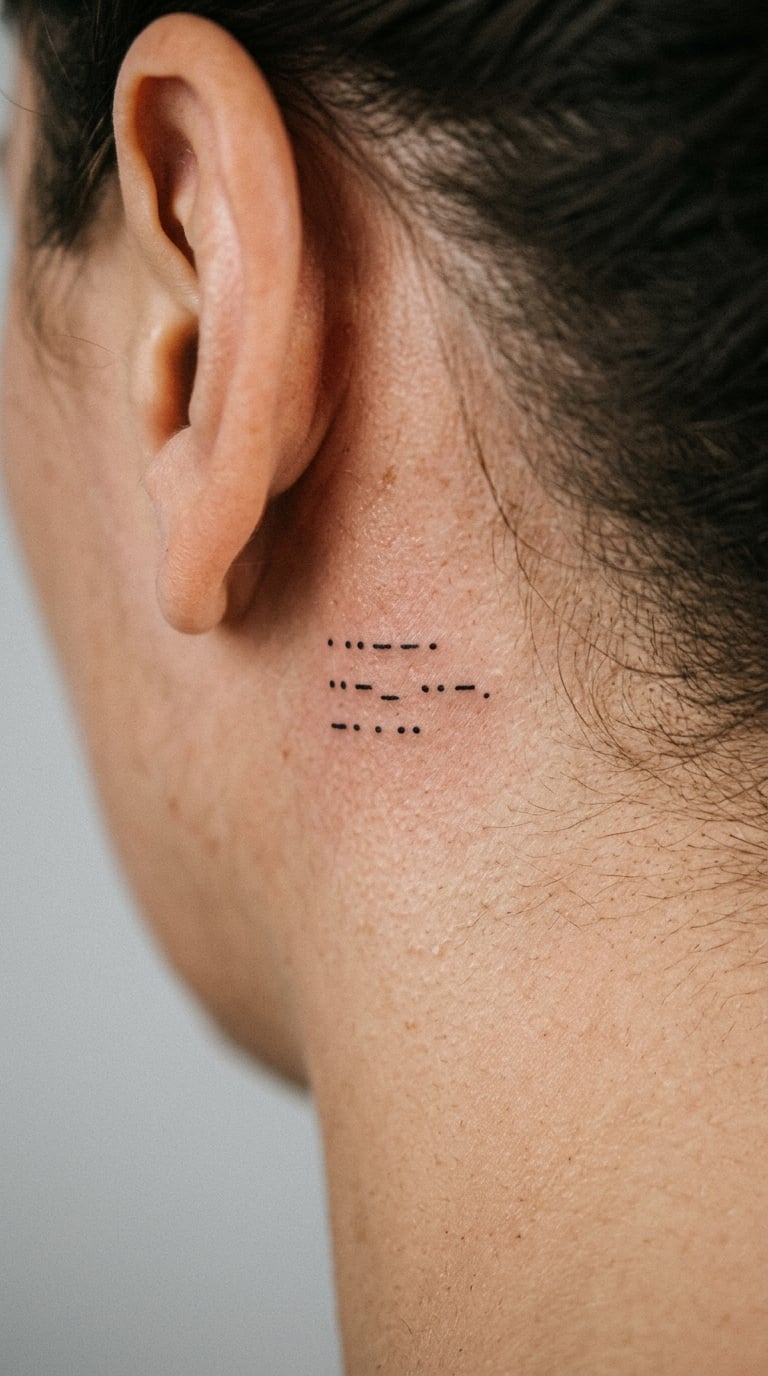
Three dots, three dashes, three dots. It is the most famous sequence in the code and one of the shortest, which makes it ideal for a micro tattoo somewhere nobody screens in good light.
People choose it for the old distress-signal reference, and plenty of wearers treat it as a private joke rather than a statement. Either way it is the smallest complete message you can get.
Placement: Behind the ear, or the inner crease where the thumb meets the wrist · Size: 0.4-0.8 inch (1-2 cm) total width · Style: Micro fine line, single pass, no outline.
Pain: Medium. Behind the ear is thin skin over bone with lots of nerve endings, so it feels sharper than it is deep. At this scale, an artist needs a magnifier and a very steady hand. Make it yours: Pair it with a real distress call, such as a ship or station name, tucked directly below.
4. Morse Code Phrase Behind the Ear
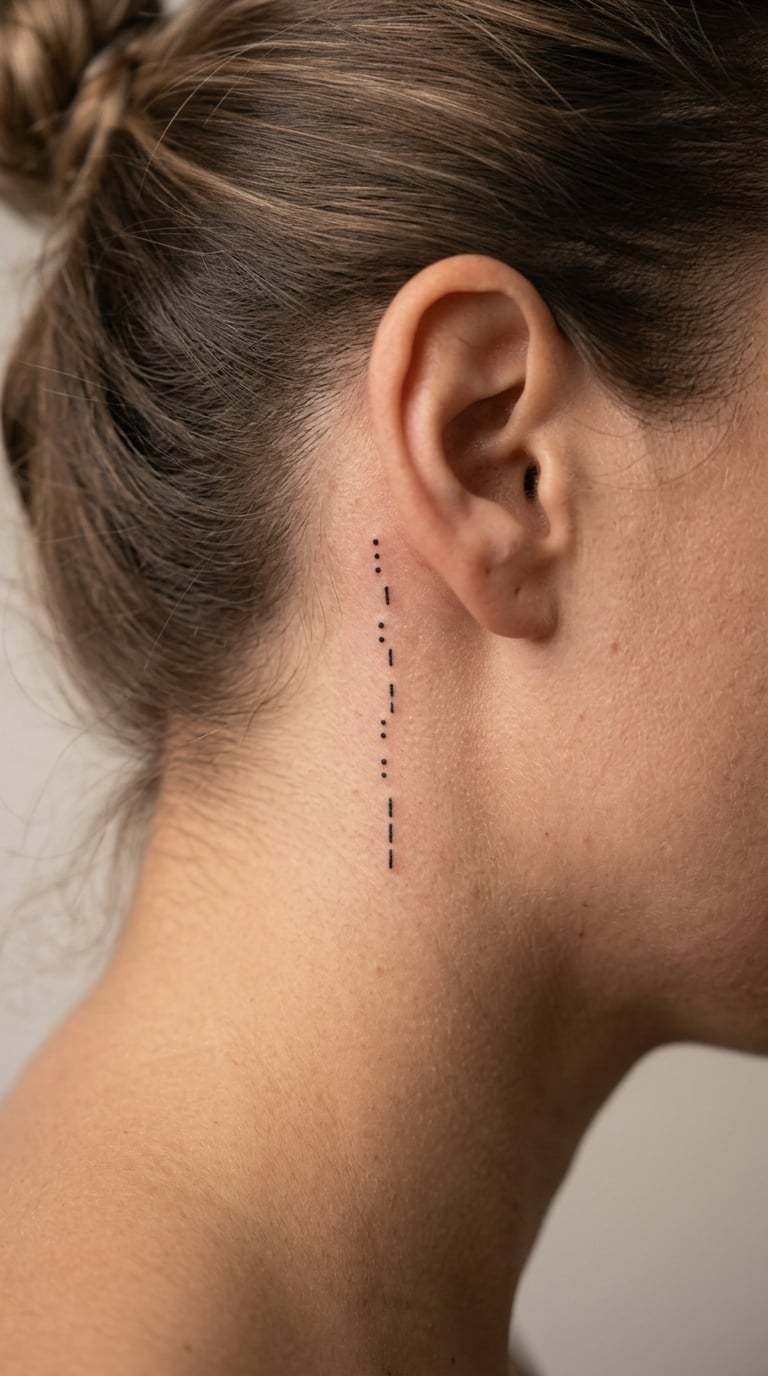
Once you accept the sting, the space behind the ear is the most private canvas on the body. A short phrase runs vertically along the curve of the ear, hidden by hair, and only shows when someone is standing behind you.
It works as a memorial or a love message precisely because the general public never sees it.
Placement: Behind the ear, running down toward the neck, or the nape of the neck · Size: 1-2 inches (2.5-5 cm) tall for a few words · Style: Fine line, unbolded, generous spacing between marks.
Pain: Medium to high, and it goes right on top of a nerve cluster. Expect a thin line of ink to soften noticeably faster here than on an arm because of how often the area is washed and stretched. Make it yours: Run the phrase down the nape instead, where you can add a small line of dates below it.
5. Morse Code Date on the Ankle
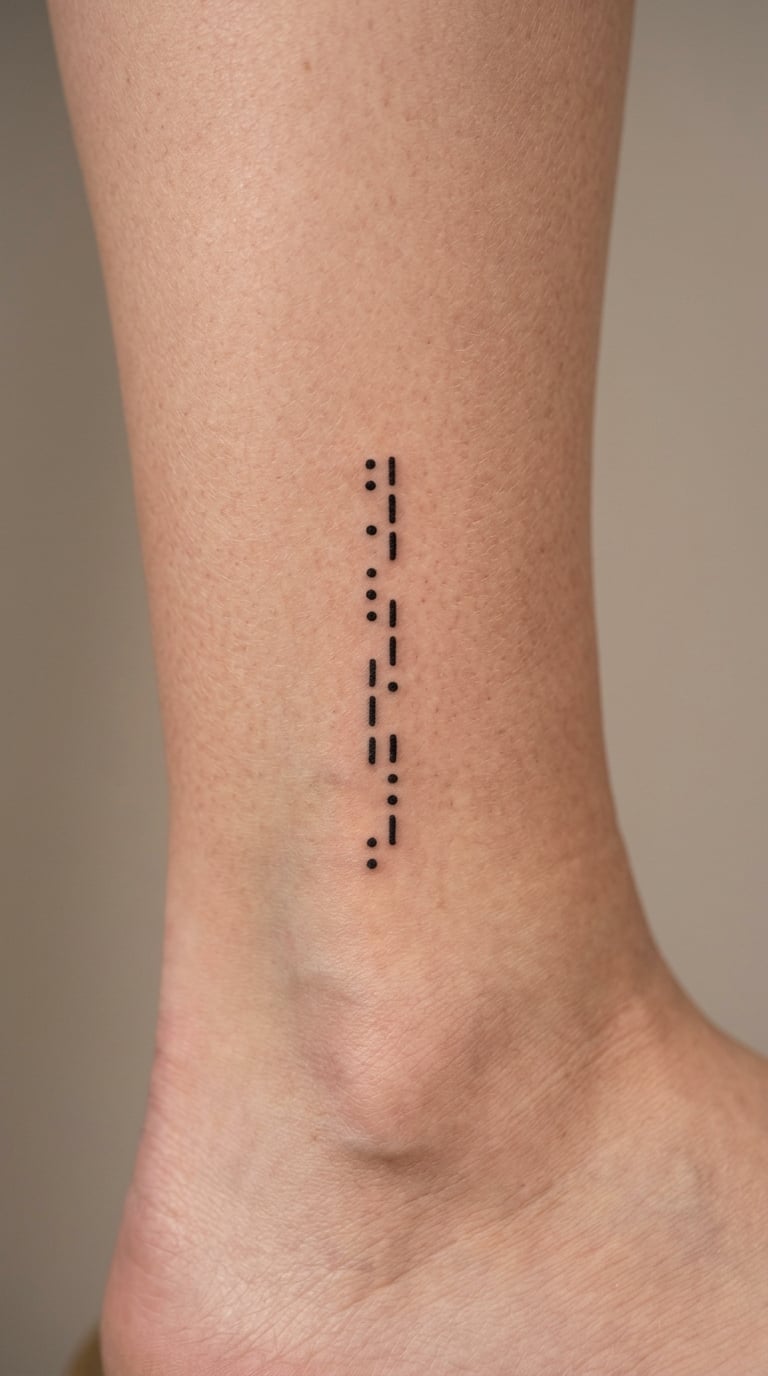
A date in code is one of the most requested messages, and the ankle gives you a clean, slightly curved strip of skin to run it along. Set it just above the bone so the code is not stretched over a joint.
Dates carry the reason: a wedding, a birthday, the day someone arrived, the day you lost them. The code is the privacy, not the sentiment.
Placement: Just above or below the inner ankle bone, or horizontally across the top of the foot · Size: 1.5-2.5 inches (4-6 cm) for a numeric date · Style: Fine line, numbers rather than spelled-out digits to keep the line short.
Pain: High. The ankle is bone-close with very little soft tissue, and the skin moves constantly when you walk. Fine marks on the ankle soften faster than on the forearm because of shoe friction and sun exposure. Make it yours: Add a small anchor or arrow below the date to say what the day was.
6. Vertical Morse Code Along the Spine
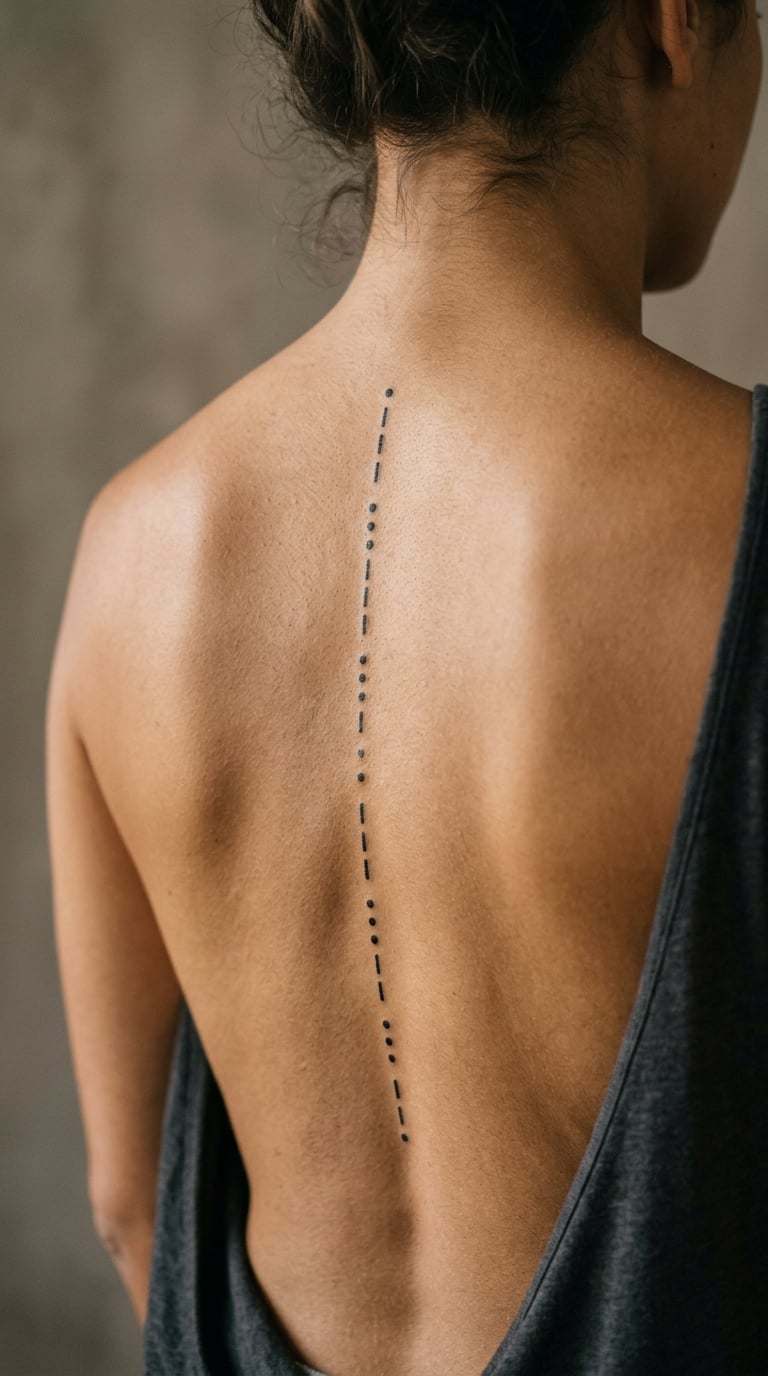
The spine is the natural home for a long message because the code is a single linear stream and the spine is a single linear path. Longer phrases, and sometimes a name broken into a vertical column, look at home here in a way they do not on a curve.
It reads as an elegant stripe of small marks from the side, and the meaning only appears if someone is directly behind you.
Placement: From the top of the back down to the mid spine, following the natural dip of the vertebrae · Size: 6-10 inches (15-25 cm) tall · Style: Fine line, single continuous column, or a mirrored double column that reads as a spine from behind.
Pain: High, and the lower back near the ribs is the worst part. Skin stretches when you bend, so the design has to be tattooed lying down and lived with carefully while it heals. Mark weight needs to be slightly heavier here or it will fade within a few years. Make it yours: Split a long message into two columns, one on each side of the spine.
7. Morse Code Heart with Initials
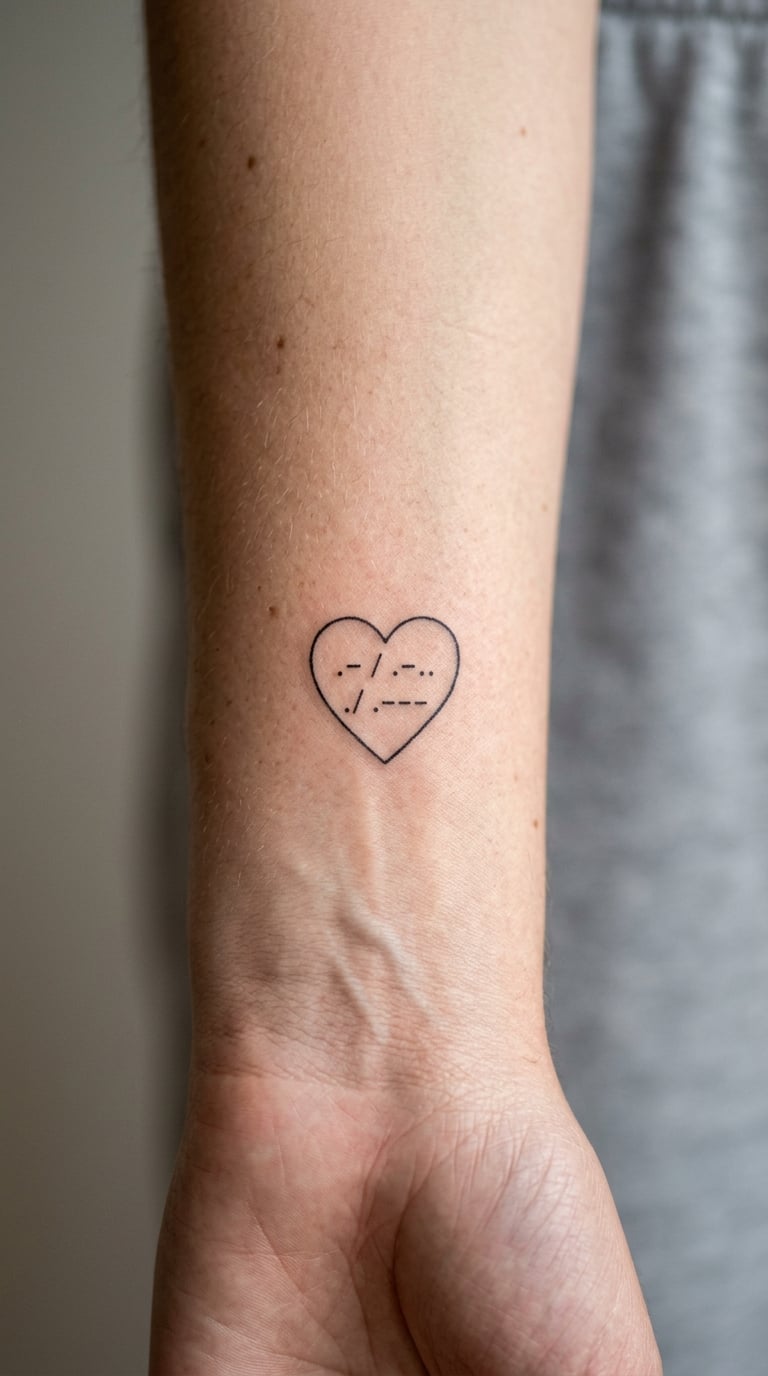
A simple single-line heart outline with a short coded message tucked inside the shape, or curved along the bottom point, is a softer take on the same code. The heart carries the emotional read for anyone who does not know the code at all.
It suits couples and family members, and the initials inside keep the piece personal rather than generic.
Placement: Inner wrist, inner arm, or the ankle bone · Size: 1.5-2.5 inches (4-6 cm) tall · Style: Fine line outline, no shading, one line weight throughout.
Pain: Low to medium on the inner arm, higher over the ankle. A thin heart outline will lose its crispness at the point over time, so ask for slightly heavier line at the bottom curve. Make it yours: Split the heart in half with a matching one on your partner, each carrying half the message.
8. Morse Code Ring Finger Band
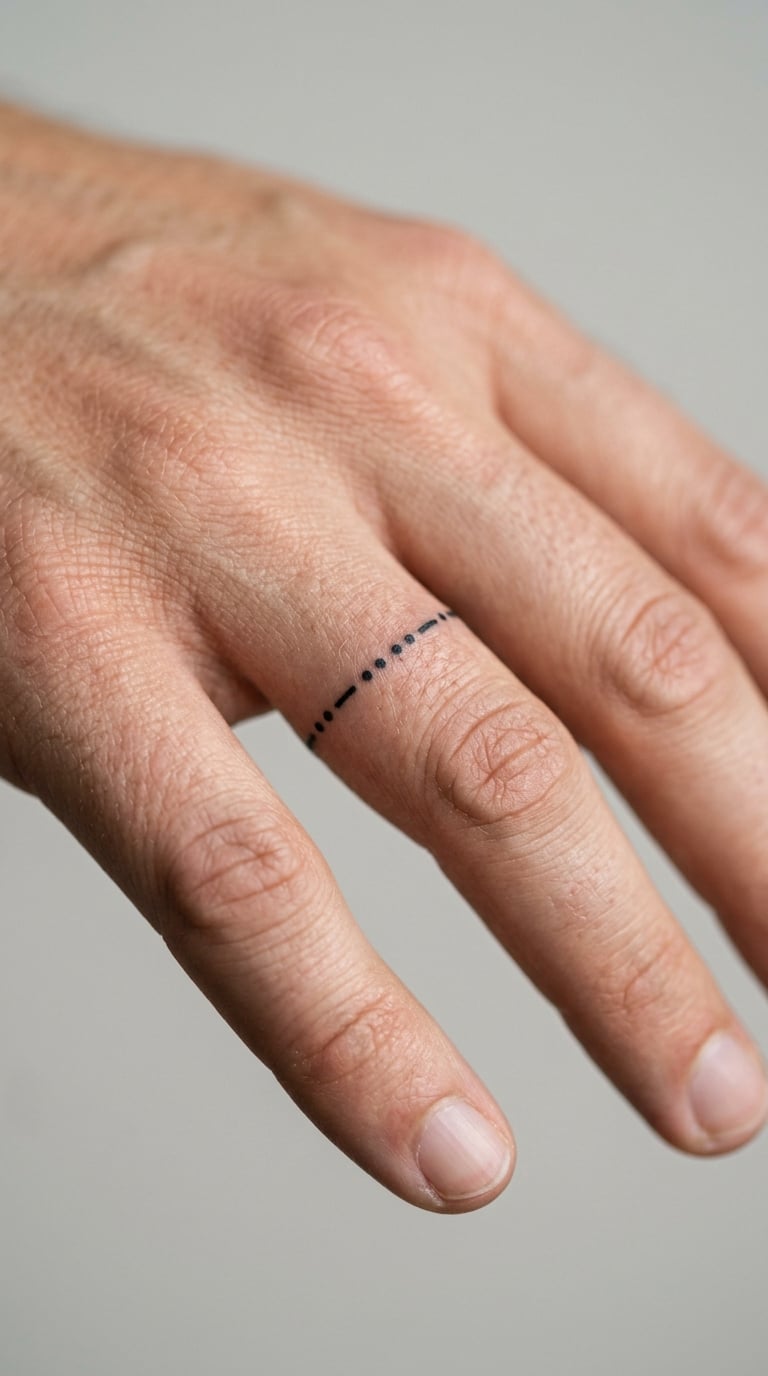
A narrow ring of repeating dots and dashes wrapped around the side of the ring finger, like a watch strap of code. It is one of the smallest placements on this list, which is exactly why it feels private.
It is a small commitment, often chosen as a first code tattoo, and it sits in a spot people touch constantly.
Placement: Side or inner edge of the ring finger, or the pinky where there is more room · Size: 0.3-0.5 inch (0.7-1.2 cm) wide band, 0.5 inch (1.2 cm) around · Style: Fine line, dots spaced to avoid merging into a solid line.
Pain: High, because fingers are all tendon and bone. Expect the detail to blur noticeably within five to eight years as ink spreads, so most wearers accept it as a mark of time rather than a permanent text record. Make it yours: Repeat the sequence twice around the finger so the message reads on both sides.
9. Morse Code Coordinates on the Calf
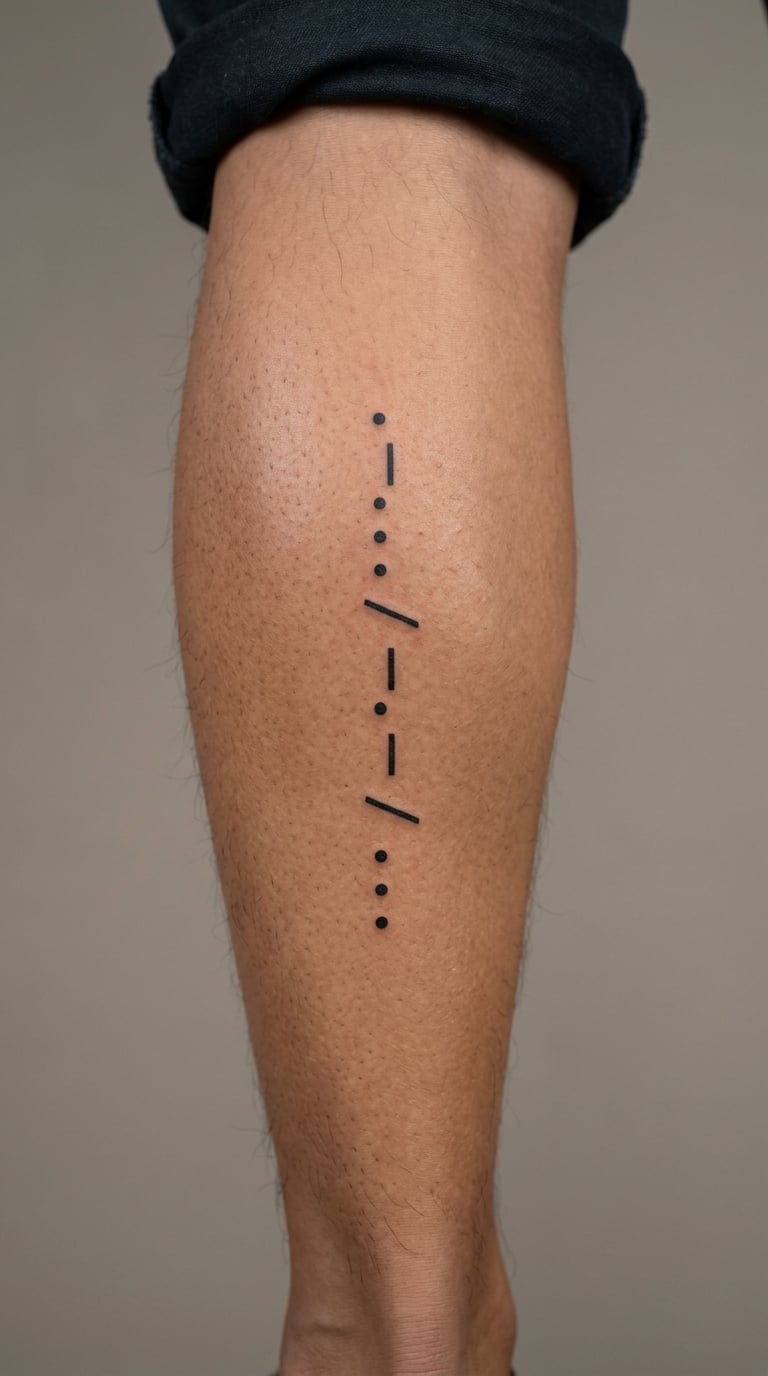
Latitude and longitude translate into a long, satisfying run of marks, which makes the calf one of the few places that can hold a full coordinate pair. A typical line pair runs 8-14 inches, so the calf’s vertical shape does the work for you.
People encode the place a child was born, where they met, or somewhere they were happy, and say nothing else about it.
Placement: Outer calf, running vertically, or the back of the calf · Size: 3-4 inches (7.5-10 cm) for a shortened pair · Style: Fine line, two columns, numbers only.
Pain: Medium on the calf’s fleshy inner side, higher over the outer muscle where the needle goes deeper. The calf is one of the better spots for fine code because it stays out of the sun and rarely gets rubbed. Make it yours: Add a single dot at the top of the line to mark the start of the code, the way a message begins on the air.
10. Morse Code Star Map
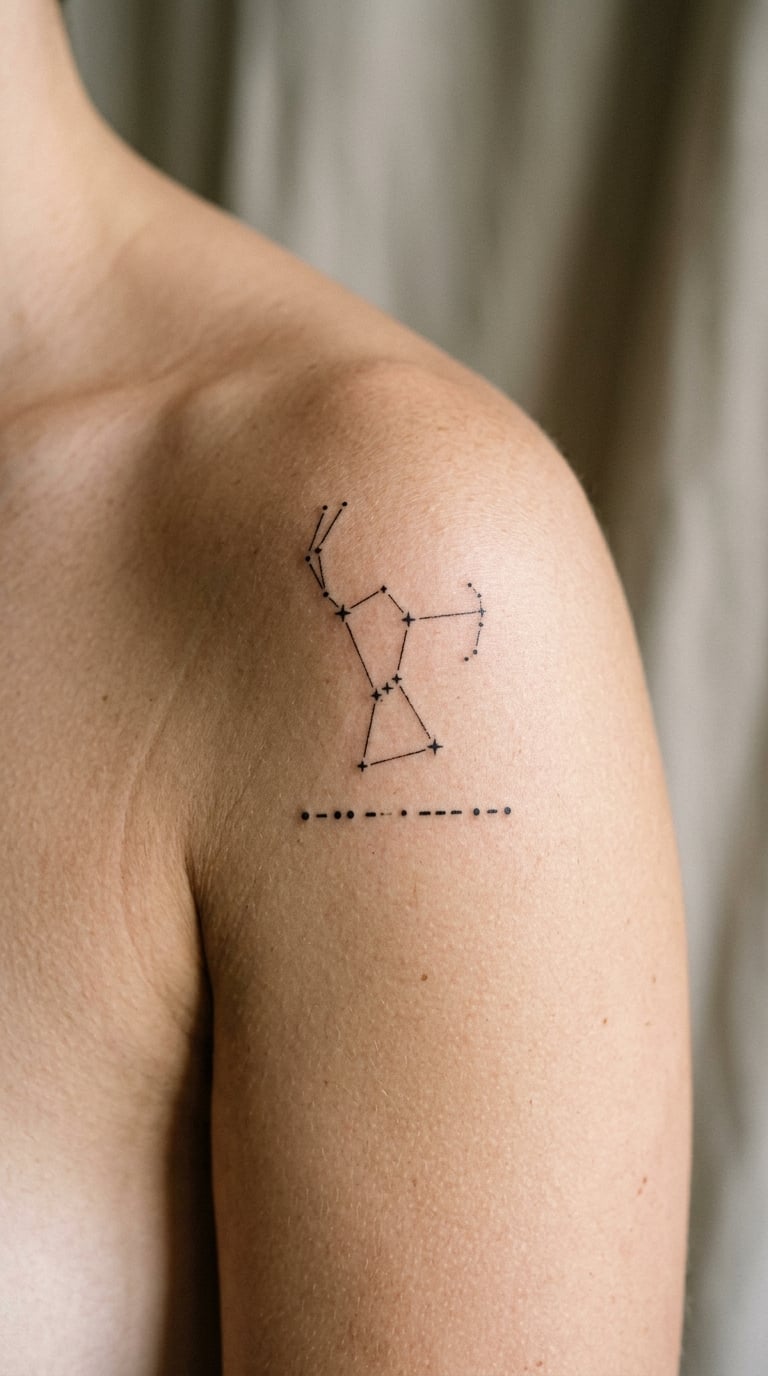
A loose constellation drawn in single lines, with a short coded line of text sitting under the stars, gives the code a sense of scale and distance. It looks like a chart, which is what it is.
It suits people who think in maps and signals, and it quietly references night sky navigation without explaining anything.
Placement: Shoulder, upper back, or the back of the arm · Size: 3-5 inches (7.5-12.5 cm) across · Style: Fine line illustration, sparse dots for stars, no colour.
Pain: Medium on the shoulder, higher near the spine. Star dots are the same problem as code dots: at hairline weight they fill in. Ask the artist to leave more space than looks right in the stencil. Make it yours: Plot the constellation of the night you were born rather than a random pattern.
11. Morse Code Rose Outline
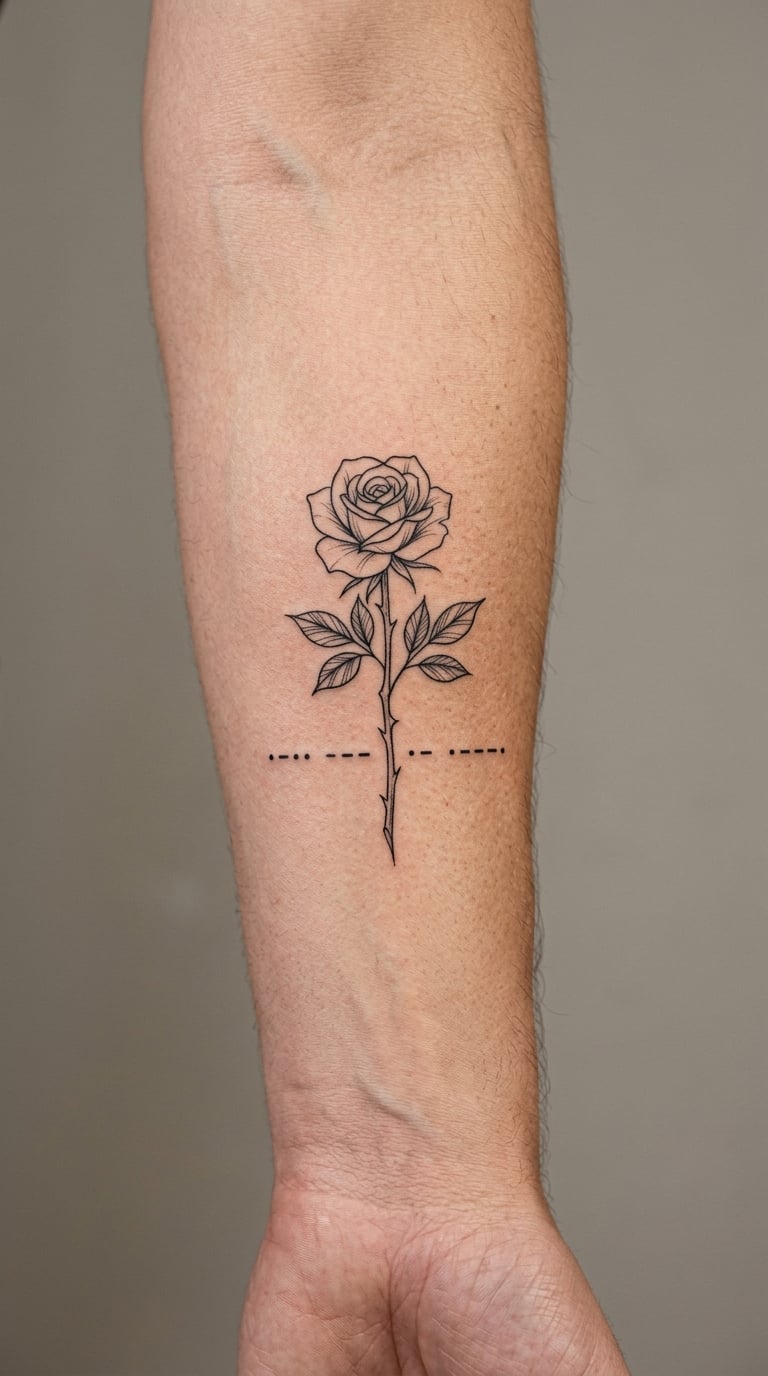
A single line rose, drawn with clean contour work and no shading, with a short coded phrase curved along the stem or tucked beneath the bloom. Botanical linework softens the technical feel of the code.
It is a good balance for people who want the tattoo to read as a flower to a passer-by and as a sentence to their own eyes.
Placement: Inner forearm, thigh, or along the rib area · Size: 2.5-4 inches (6-10 cm) · Style: Fine line botanical, black only, though a single red petal works for people who want one accent.
Pain: Medium. The forearm is forgiving, the rib area is not. Petal edges are thin linework that softens with age, so a slightly heavier contour keeps the flower legible. Make it yours: Curve the coded phrase along the stem so it reads as part of the plant rather than a caption.
12. Morse Code Anchor on the Upper Arm
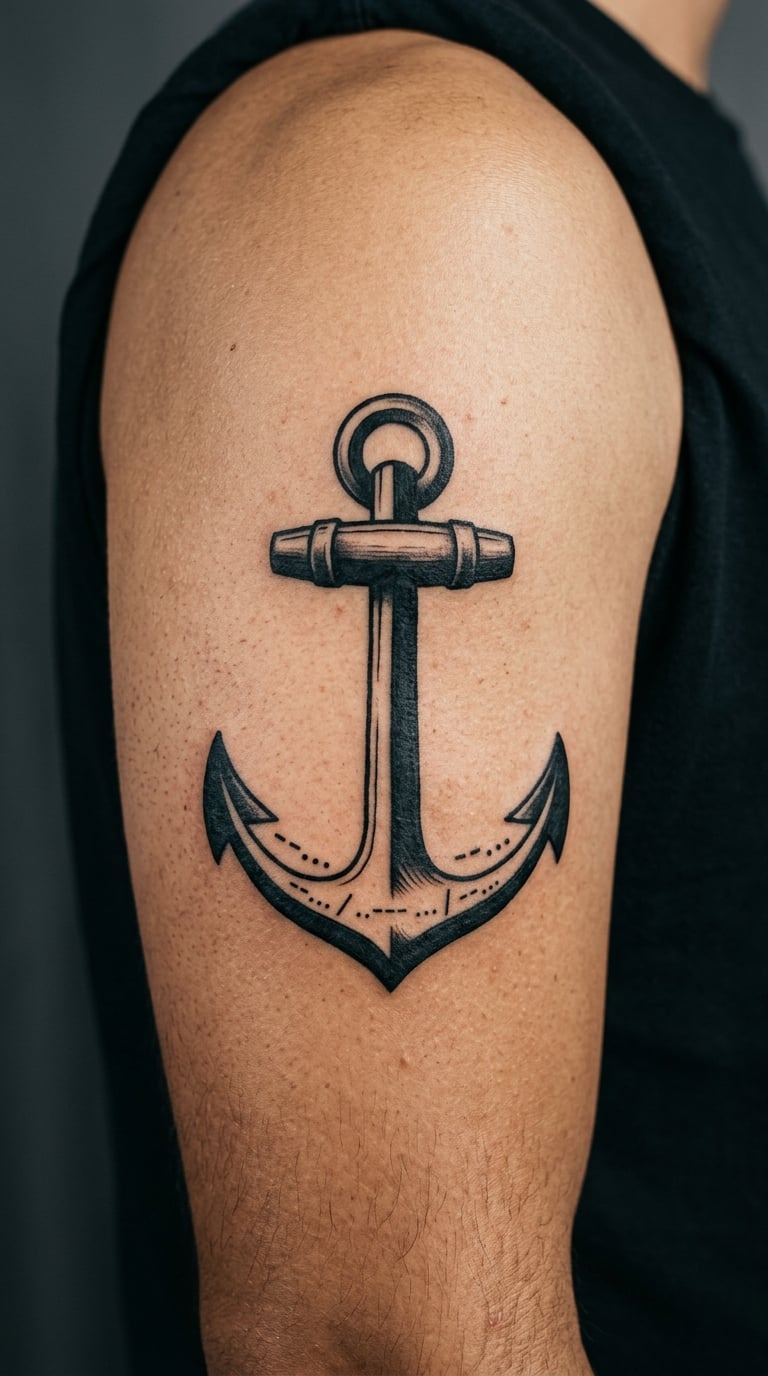
A solid blackwork anchor with a coded name or date set small underneath, or worked into the shackle. The weight of the traditional design gives the thin code something to sit against, which makes the code easier to see rather than harder.
It reads as a classic nautical tattoo to the public and as a specific private message underneath.
Placement: Outer upper arm, shoulder, or forearm · Size: 3-5 inches (7.5-12.5 cm) for the anchor, code line around 0.5 inch tall · Style: Blackwork, bold fills with fine line code as a contrast.
Pain: Medium to high, and the shaded areas take much longer than the outline suggests. Expect two hours or more for a full blackwork anchor. Bold fill holds up far better than hairline code over the long term, which is worth remembering when you plan the code element. Make it yours: Put the code in the anchor’s flukes so it reads as part of the image.
13. Morse Code Mountain Silhouette
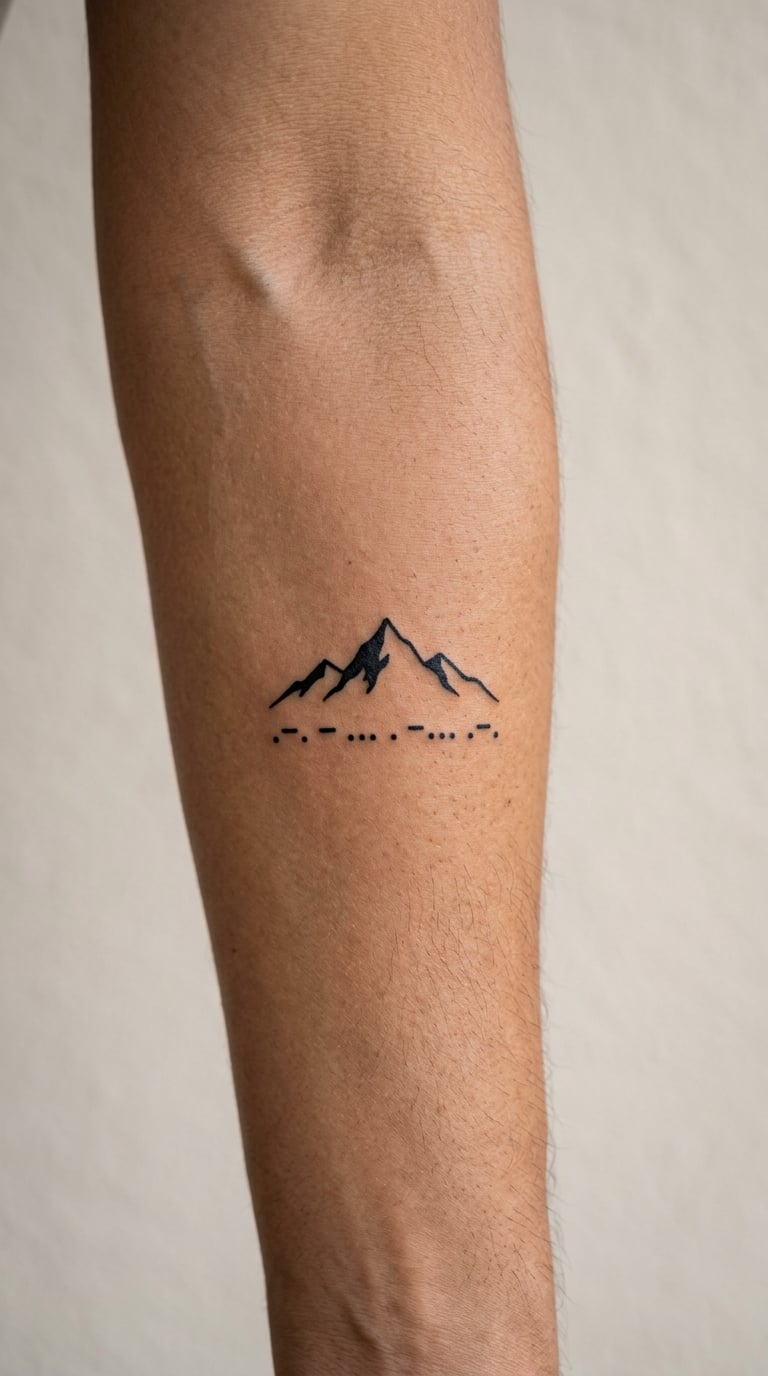
A simple black mountain range made of straight line peaks, with a short coded line beneath it naming the place or the date. It is the outdoor version of the coordinates idea, without the numbers.
People choose this for a hike, a first trip, a home range, or a place they go back to every year.
Placement: Forearm, calf, or across the shoulder blades · Size: 2.5-4 inches (6-10 cm) wide · Style: Minimal line illustration, solid black peaks, no gradient shading.
Pain: Low to medium on the arm, since it is mostly open skin with little bone. Solid peak fills stay sharp for decades, so the mountains keep their weight while the code line beneath gradually lightens. Make it yours: Set the code along the ridgeline itself so the peaks break the message into groups.
14. Morse Code Infinity Symbol
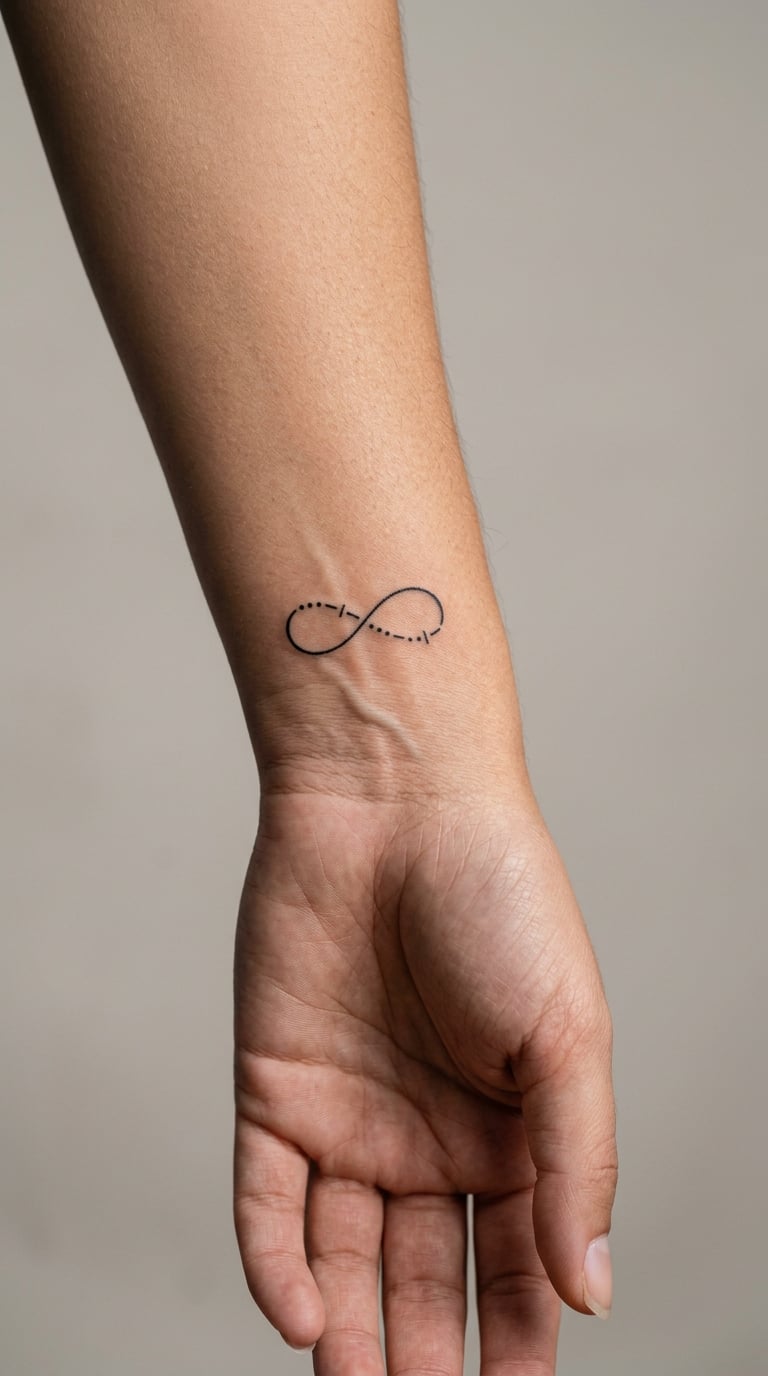
An infinity loop drawn in a single continuous line, with a short coded message centred inside the loop. The message sits in the visual quiet space the symbol creates, which is the whole point of the design.
It is a common choice for anniversaries, for a person or a pet, or for a promise made to yourself.
Placement: Inner wrist, wrist crease, or the ankle · Size: 1.5-2 inches (4-5 cm) across · Style: Fine line, single weight, no fill.
Pain: Low to medium. The crossing point of an infinity symbol is where the line doubles back on itself and fills in fastest, so ask the artist to keep the loop open there. Fine line on the wrist dulls with age, and the code inside will be the first thing to lose definition. Make it yours: Put a date at the bottom of the loop and a name inside it.
15. Morse Code Compass Rose
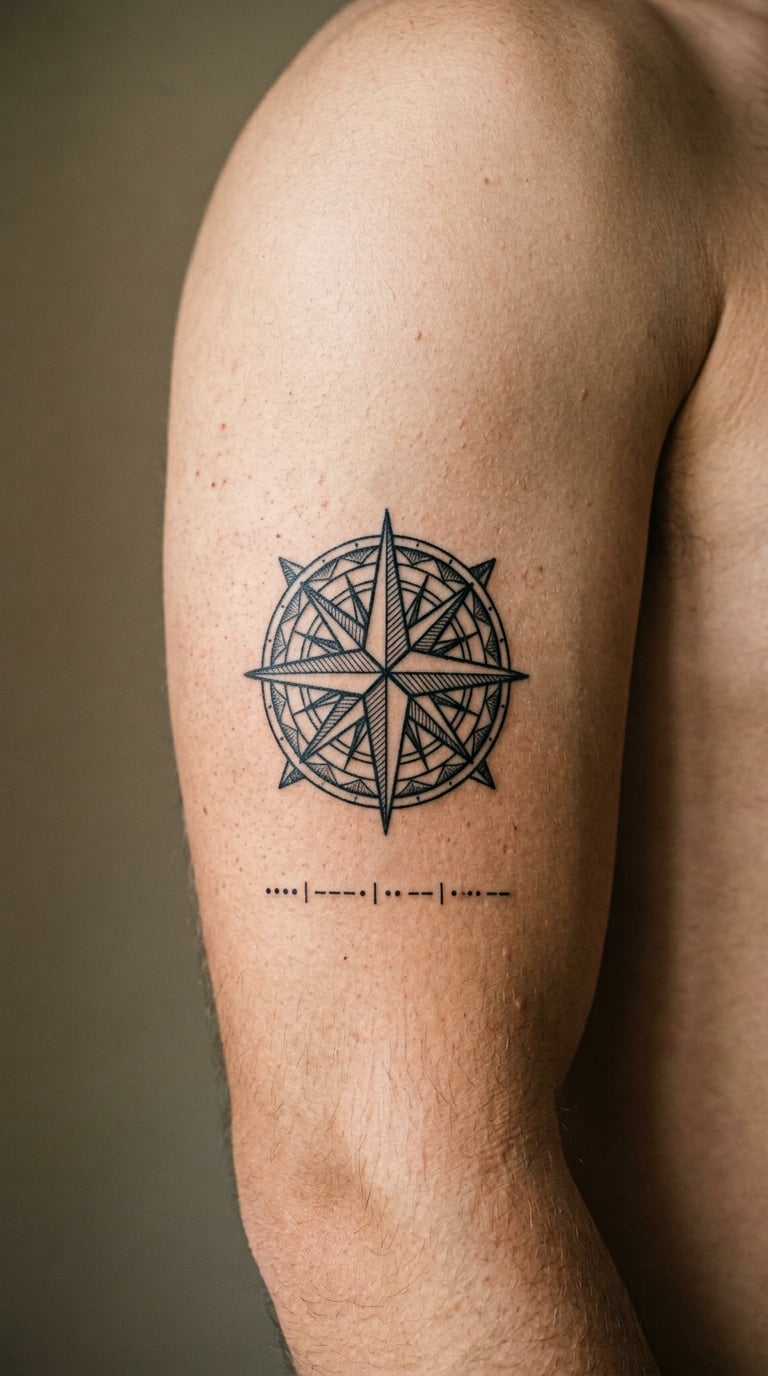
A compass rose built from straight geometric lines, four or eight points, with a short coded destination or bearing underneath. The geometry gives the piece structure that keeps a plain code line from looking unfinished.
It marks travel, arrival, or a place someone is always heading back to.
Placement: Upper arm, back of the shoulder, or the calf · Size: 3-4.5 inches (7.5-11 cm) across · Style: Geometric linework, thin strokes, no shading.
Pain: Medium. Compass linework crosses over itself at the centre, so that area takes more passes and more time than the outer points. The thin radiating lines blur faster than the outer ring, so keep the centre darker than feels natural. Make it yours: Point one spike at the real direction of the place you are encoding.
16. Morse Code Laurel Wreath
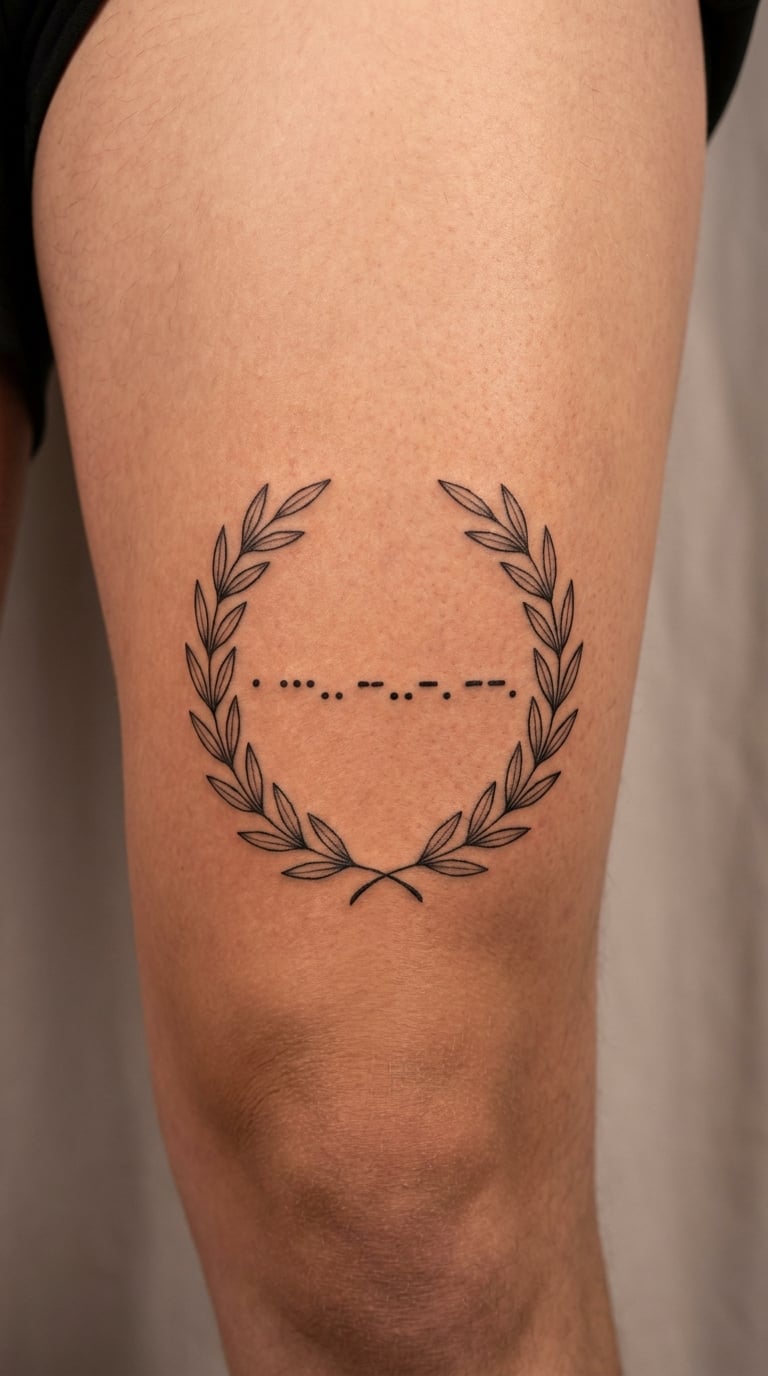
A pair of curved laurel branches meeting at the base, with a coded name or date in the open space at the centre. Laurel is a traditional victory and memorial motif, and the leaves give a lot of fine detail to frame a short message.
It works well as a memorial piece because the shape already implies remembrance without you having to say so.
Placement: Outer thigh, upper arm, or behind the shoulder · Size: 3-5 inches (7.5-12.5 cm) tall · Style: Fine line botanical, black only.
Pain: Medium, and the thigh tends to bleed a little during long sessions, which makes fine leaf detail harder. Each leaf point is a hairline feature that will soften noticeably over the years, so the wreath will need a touch-up more often than a solid design. Make it yours: Use a different plant on each side, one for each person.
17. Morse Code Wave on the Forearm
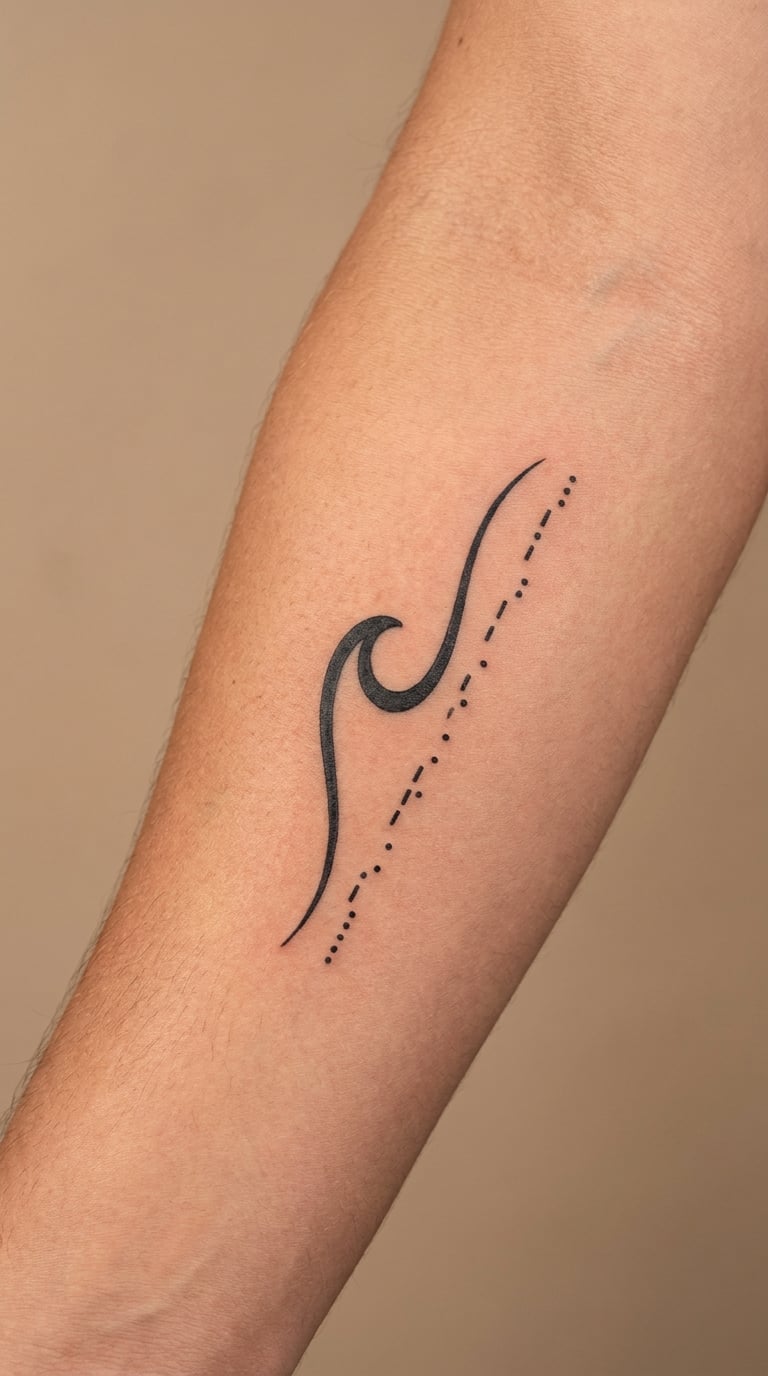
A single flowing wave drawn in one clean line, with a short coded phrase following the curve of the swell. The wave gives the linear code some movement, so it does not read as a ruler line.
It suits swimmers, surfers, and anyone tying a code to the sea or a favourite coastline.
Placement: Inner or outer forearm, running along the length of the arm · Size: 3-5 inches (7.5-12.5 cm) · Style: Illustrative fine line, no colour, one stroke weight.
Pain: Medium on the forearm, and a curved line is harder to keep straight than a straight one, so the session runs longer. The code riding a curve compresses the gaps, so ask for wider spacing between letters. Make it yours: Add a second, smaller wave below the first to make it a layered swell.
18. Morse Code Lighthouse on the Shoulder
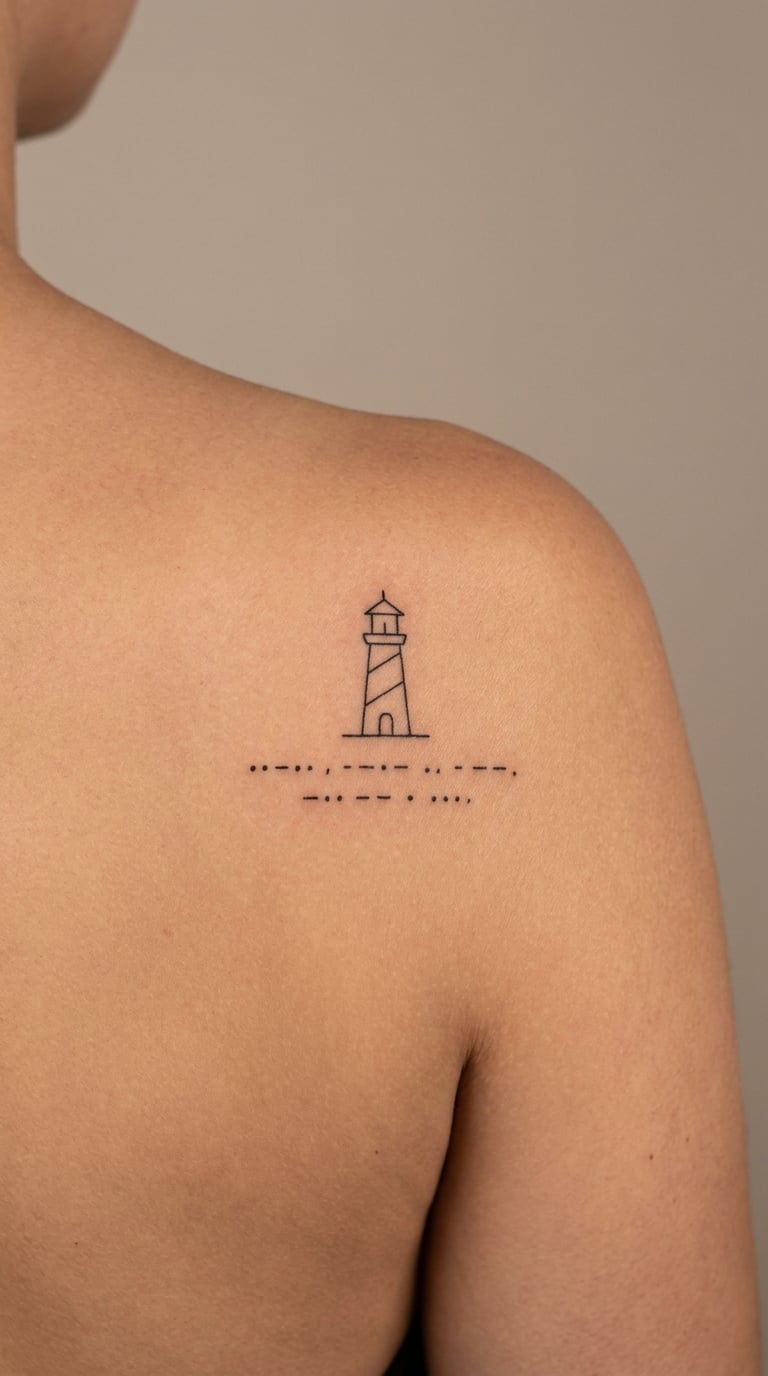
A small fine line lighthouse with its beam sketched in a few short strokes, and a coded message underneath. The lighthouse is a fitting pairing for code since it is one of the oldest signals-and-messages objects you could draw.
People link it to a coastal hometown, a family house near the sea, or a person who kept watch over you.
Placement: Shoulder, upper arm, or the back of the calf · Size: 2.5-3.5 inches (6-9 cm) tall · Style: Fine line illustration, black, light hatching for shading.
Pain: High. The shoulder has a thick muscle that shifts when you move the arm, and the top of the shoulder is bony. Hatching and beam lines are fine work in a moving area, so plan a break. Make it yours: Put a real call sign or station name in the code beneath it.
19. Morse Code Butterfly on the Wrist
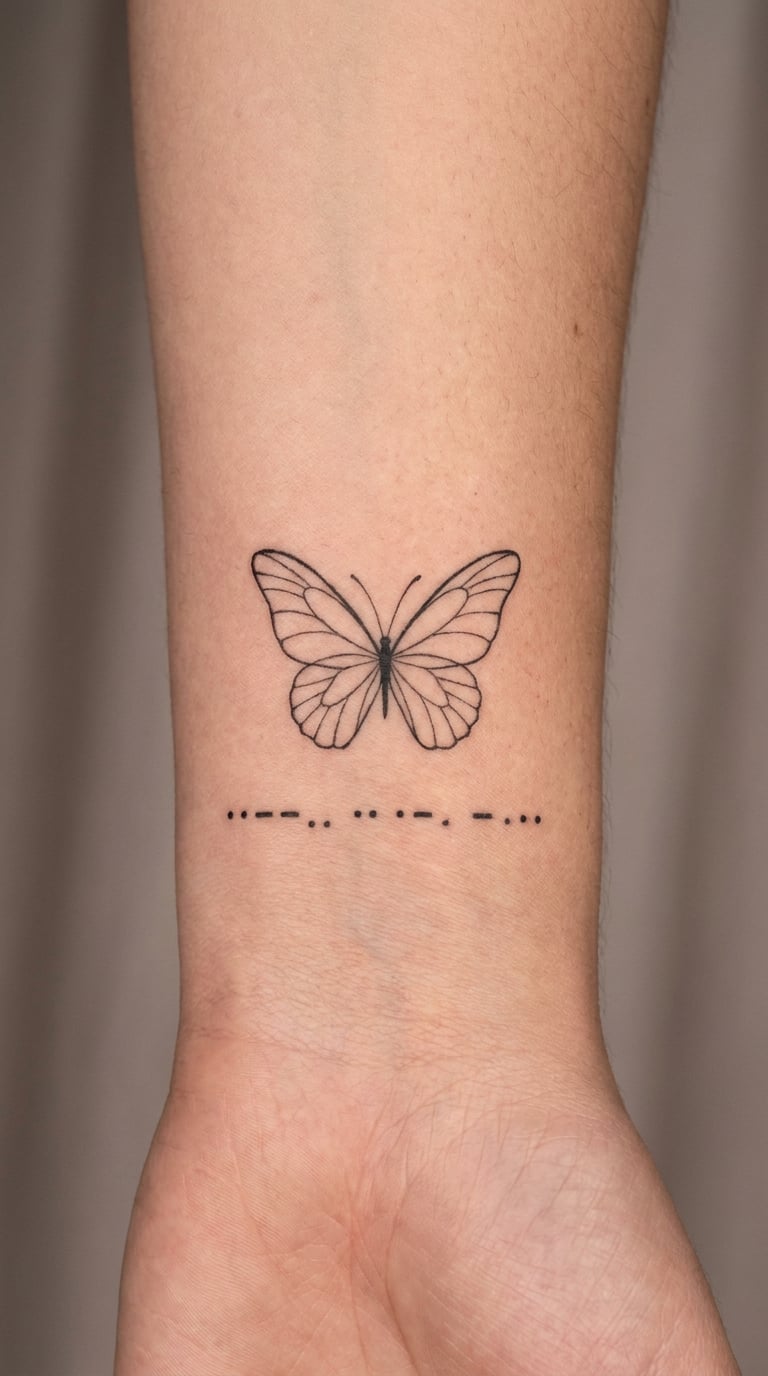
A symmetrical butterfly drawn in thin outline with simple veining in the wings, and a short coded line beneath it. The symmetry means the wings can carry matching halves of the message.
It is one of the more requested shapes in this theme, and it works for anyone who wants a recognisable design that still holds a private line of text.
Placement: Inner wrist, forearm, or behind the ear for a smaller version · Size: 2-3 inches (5-7.5 cm) wide · Style: Fine line, black, though a muted colour wash in the upper wings is a common choice.
Pain: Low to medium on the wrist, and the vein in the centre of the inner wrist usually makes itself known. Wing veins are hairline marks that fill in with age, so keep them open. Make it yours: Split the message, one half on each wing, so the whole thing only reads when the wings are level.
20. Morse Code Arrow on the Rib
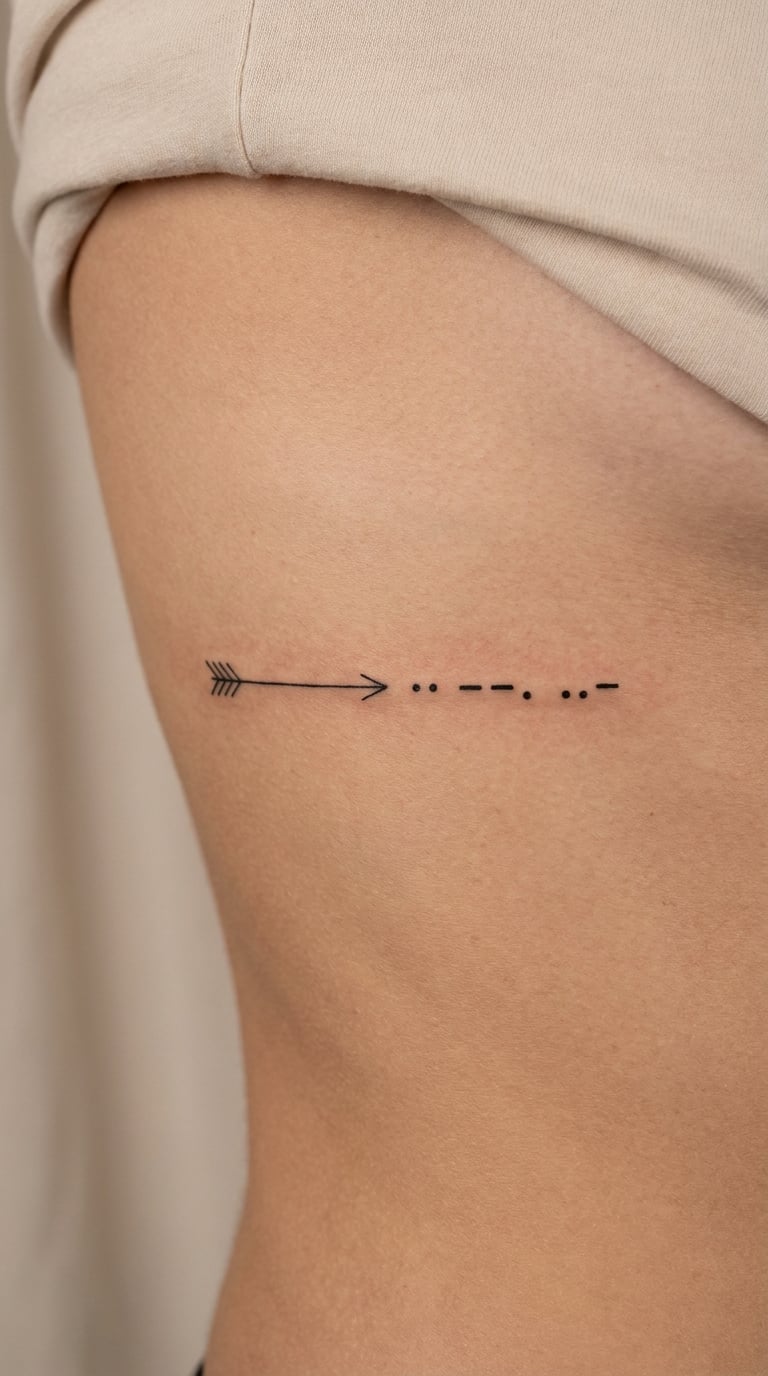
A single line arrow with a coded destination or date following the shaft, placed along the side of the torso. The direction of the arrow and the flat run of the rib line are a natural fit for a linear code.
It marks a journey, a move, or the place someone came from, and the arrow makes the intent readable even to someone who cannot decode it.
Placement: Side of the torso along the rib line, or the outer upper arm · Size: 3-4.5 inches (7.5-11 cm) long · Style: Minimal line, one weight, no fill.
Pain: High. Ribs are thin skin over bone, the area stretches when you twist and laughs, and breathing moves it constantly. This is a sit-down, breathe-through-it placement. Fine marks here soften faster than most because skin moves over them daily. Make it yours: Angle the arrow slightly so it points toward the place in your life the message describes.
21. Morse Code Crescent Moon on the Neck
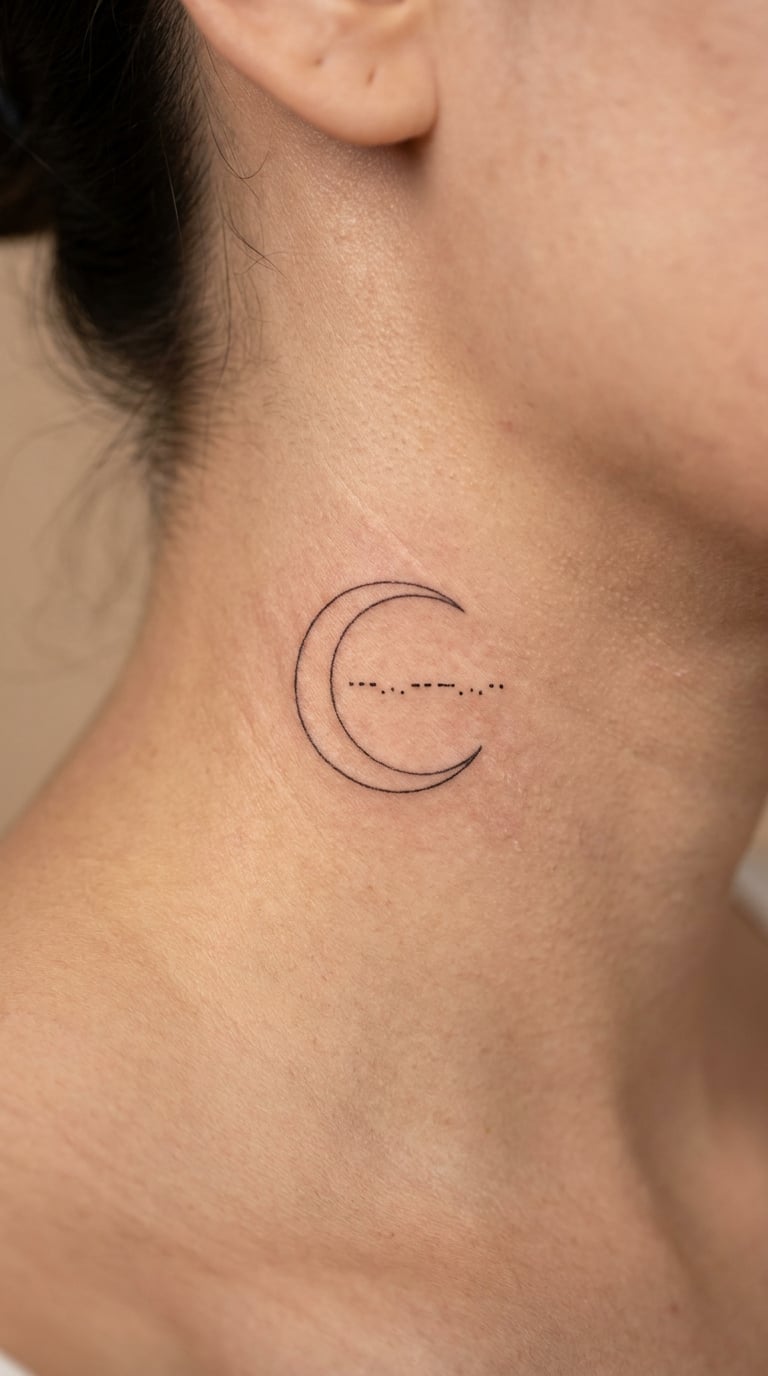
A small crescent moon drawn as a single clean curve, with a very short coded phrase fitted inside the crescent. The shape of the moon gives you a natural container for text that would otherwise look like a stray line.
It tends to go with late nights, a person you lost, or a period of your life you look back on.
Placement: Side of the neck below the ear, or behind the ear · Size: 1-2 inches (2.5-5 cm) · Style: Fine line, black, minimal detailing.
Pain: High. The side of the neck is thin skin over muscle and very sensitive, and the pulse there makes the area move under the needle. Keep the message to two or three letters, because anything longer needs more room and more session time than you want in this spot. Make it yours: Add a single dot above the crescent to mark the start of the message.
22. Morse Code DNA Double Helix
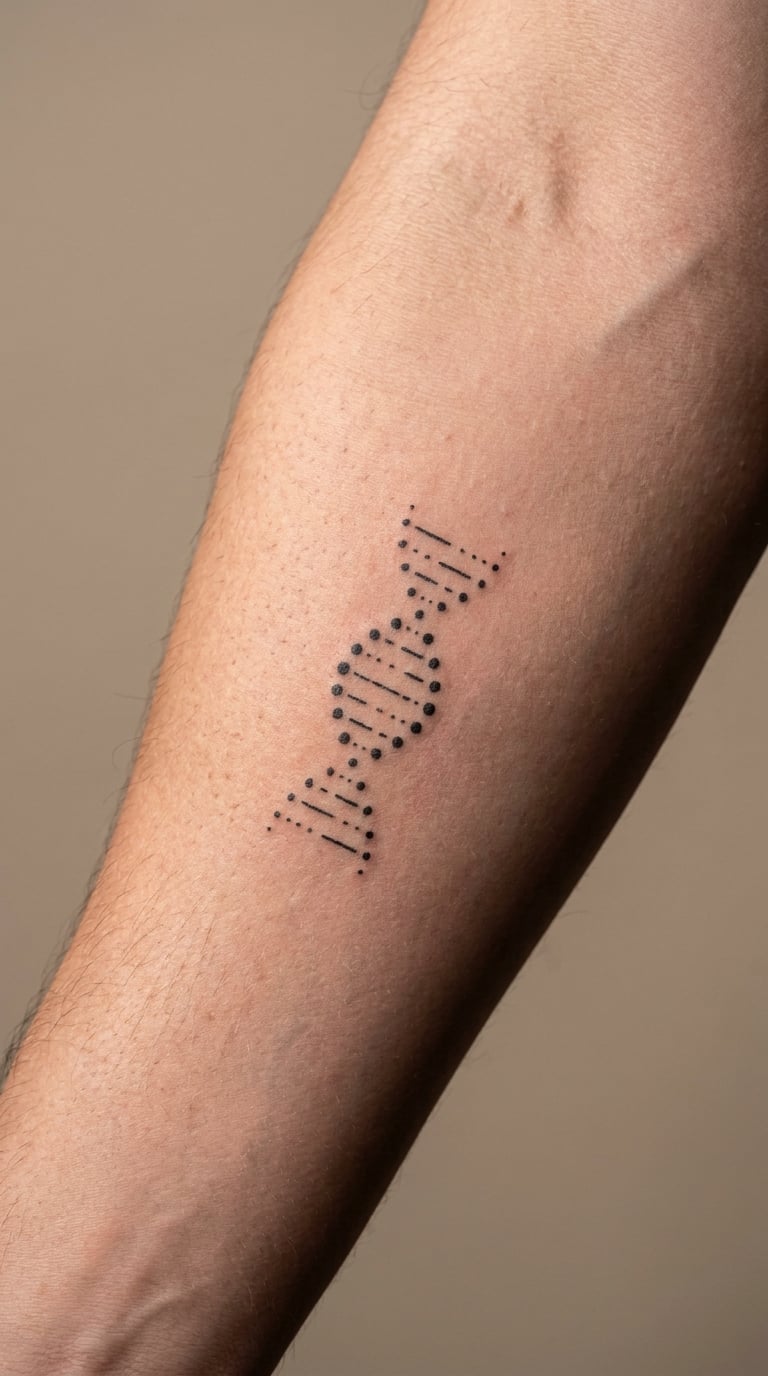
A double helix where the rungs between the two twisting strands are made from dots and dashes instead of plain bars. The code becomes the structure of the drawing rather than a caption under it, which makes it the most integrated design on this list.
It reads as science and as a message at once, so it works for anyone who wants a code tattoo that does not look like a code tattoo. Pair it with our guide to DNA tattoo ideas if you want to see the motif in other forms.
Placement: Inner forearm, calf, or along the spine · Size: 4-6 inches (10-15 cm) long · Style: Minimal line geometry, black, with slightly heavier line on the two outer strands.
Pain: Medium on the forearm, and the work takes time because each rung is a separate pass. Keep the outer strands heavier than the rungs, since the rungs are the part carrying the code and the first thing ink spread will close up. Make it yours: Run a longer phrase along one strand and the other strand along your forearm as a second design.
How to Choose the Right Design
Start with the length of the message
Most disappointing code tattoos are length problems, not style problems. A long message crammed into a small placement gets rushed, and rushed code loses its gaps and turns into a smear of marks. Count your characters first, then pick a placement that can hold them.
| Placement | Comfortable character count | Typical visual span |
|---|---|---|
| Finger band | 2-3 | 0.5 in (1.2 cm) around |
| Behind the ear | 3-6 | 0.5-1 in (1.2-2.5 cm) |
| Inner wrist | 4-8 | 2-3 in (5-7.5 cm) |
| Inner forearm | 6-14 | 2-4 in (5-10 cm) |
| Side of torso | 10-20 | 3-5 in (7.5-12.5 cm) |
| Spine | 20-60 | 6-10 in (15-25 cm) |
If your message does not fit the placement you want, split it into two lines rather than shrinking the dots.
Think about line weight and how long you want it legible
A dash should be roughly three times the length of a dot, and every gap between marks needs to be visible. Under about 0.06 inch of line, dots start filling in as ink spreads over the years. The forum worries are real: plenty of people ask whether fine code tattoos stay readable, and the honest answer is that hairlines fade, bold ones do not.
Our science tattoo ideas roundup has more on the technical linework if you want the drawing to carry a diagram look.
Check what the code actually says before you commit
Write the message in plain text, then translate it yourself with a reliable chart or generator, then read the dots and dashes back from the drawing. People on tattoo forums get this wrong surprisingly often, usually because they copied a reference image with no plaintext. A tattoo that is quietly misspelled is permanent, so it is worth ten minutes.
One more worry worth naming: strangers assume code tattoos carry ominous meanings. A date that reads like a number everyone has an opinion about is a common example. If that would bother you, pick a message that cannot be misread, or be ready to explain it once.
Match the design to what is already on your body
Fine line code works well next to other fine line work, and it disappears next to a bold blackwork piece unless it is given its own space. If you are adding to a collection, matching line weight and needle width matter more than matching the motif.
Bring the artist a clean printed reference with the exact spacing you want rather than a screenshot from your phone. Artists work far more accurately from a clear original, and it removes the argument about how wide the gaps should be.
Cost and Session Time
Most US studios charge by the hour, and code tattoos price closer to line work than to illustration because they are almost all line. Typical ranges run from 80 to 150 dollars for a micro piece, 150 to 400 dollars for a small to medium one, and 400 to 900 dollars or more for a long spine piece or a detailed blackwork combination.
Four factors move the number more than anything else: size, detail, artist rate, and shop minimum. A high-detail star map or helix with 30 or 40 separate rungs takes far longer than a single line of code at the same size. Shop minimums in expensive cities can sit above the whole tattoo you had in mind, so ask about the minimum when you book, not at the counter.
On time, expect 30 to 60 minutes for micro work, one to two hours for a small to medium fine line piece, and two to four hours for the larger illustrated or blackwork versions. Painful placements like ribs and the neck often get split across two shorter sessions, which is normal and usually a better plan than pushing through a long one.
Aftercare Basics
Start with your artist’s aftercare instructions, since they know how deep they went and what ink they used. Beyond that, the basics are simple and consistent.
- Wash gently with unscented soap and lukewarm water twice a day for the first few days, then pat dry with clean hands rather than a towel.
- Keep a thin film of a plain healing ointment or unscented lotion on it, and never soak the tattoo in a bath, pool, hot tub or lake for at least two weeks.
- Wear loose clothing over the area for the first few days, and change the shirt daily if the tattoo is on your arm or ribs.
- Keep it out of direct sun while it heals, and use sunscreen on it once it is fully healed, since ultraviolet exposure is what fades fine line fastest.
- Do not pick scabs or peel flakes. If the skin tightens, add another thin layer of ointment instead of pulling.
- Contact your artist if redness, swelling or a hot feeling lasts beyond a few days, or if the ink stays faded and patchy after healing. See a doctor for signs of infection.
Expect the surface to look flat and slightly faded for the first two weeks, then to settle into the skin over the following weeks. Judge the final result after it is fully healed, which takes around six to eight weeks.
Frequently Asked Questions
What does a Morse code tattoo mean?
A morse code tattoo encodes a word, name, date or short message into dots and dashes, so it is legible only to someone who knows the International Morse Code alphabet. The meaning is whatever you encoded, which is why the plaintext matters more than the pattern. It works as a private message that still looks like a design to the public.
Is a morse code tattoo ever seen as disrespectful?
Not in itself. A morse code tattoo is a design choice like any other, and the concern people raise online comes from assuming a code carries hidden or ominous meaning. A numeric date or a numeric-only string can be misread by a stranger, so if that would bother you, encode a word or add context such as a small anchor or rose beside it.
How long should a morse code message be for a small tattoo?
For a finger band, three characters is realistic. Behind the ear, six. The inner wrist handles four to eight comfortably, and an inner forearm takes up to about fourteen. A spine piece is the only placement that comfortably holds a long phrase. Splitting a long message into two rows is always better than shrinking the dots until they merge.
Will morse code dots blur together over time?
Hairline dots fill in as ink spreads, and fine line fades faster on hands, fingers, the rib area and anywhere with sun exposure. To slow it down, ask for a line weight of at least 0.06 inch, keep gaps generous, and protect the area from sun and friction. Bold and blackwork versions stay crisp for decades; expect to touch up the hairlines every few years.
How much does a small morse code tattoo cost and how long does it take?
In the US, micro pieces usually fall between 80 and 150 dollars and take 30 to 60 minutes. A small to medium fine line design runs roughly 150 to 400 dollars and one to two hours. Larger illustrated or blackwork combinations can reach 400 to 900 dollars over two to four hours. Artist rate, shop minimums, size and detail all move the final number, so ask about the minimum when booking.
For a first morse code tattoo, stay with something small and structural: the wrist line, the heart with initials, or the coordinates on the calf. They are quick, they sit in forgiving spots, and they read cleanly before you are ready for a spine or a rib. If you already collect fine line work, the helix, the compass rose or the lighthouse give you room to add something illustrated without a style clash. Whichever you pick, write the plaintext down first and check it twice, because nobody wants to decode their own tattoo.