
20 DNA Tattoo Ideas: Genetic-Inspired Designs (October 2026)
A DNA tattoo is a design built from the twisted ladder shape of deoxyribonucleic acid — two strands curling around each other, joined by horizontal rungs. People wear it because it is the most literal symbol of identity there is: you cannot read someone’s code from across a room, and yet the shape says something private about them.
Below are 20 DNA tattoo ideas, from a single fine-line helix to a full blackwork sleeve, each with a real placement, size, style and honest note on how it ages. If you are booking for a season rather than a weekend, most people start looking three to six weeks out. This list was refreshed for October 2026.
20 DNA Tattoo Ideas: Quick Guide
| Idea | Style | Best placement | Size | Pain |
|---|---|---|---|---|
| Fine-line double helix | Fine line | Inner forearm | 2.5-3.5 in | Low to medium |
| Minimal strand behind the ear | Micro fine line | Behind the ear | 0.8-1.2 in | Medium |
| Watercolor helix | Watercolor | Outer shoulder | 3.5-4.5 in | Medium |
| Vertical spine strand | Fine line, symmetrical | Upper back beside spine | 4.5-6 in | Medium to high |
| Geometric circle | Geometric line work | Outer ankle | 2-2.5 in | Medium |
| Helix sleeve | Blackwork | Full arm | Sleeve scale | High |
| Matching helix pair | Fine line | Both inner forearms | 1.5-2.5 in | Low to medium |
| Helix rose | Botanical fine line | Forearm, diagonal | 3.5-4.5 in | Low to medium |
| Finger micro helix | Micro fine line | Side of index finger | 0.7-1 in | High |
| Tree of life helix | Black and grey realism | Outer calf | 5-7 in | Medium |
| Red helix | Bold single colour | Outer bicep | 3-4 in | Low to medium |
| Dotwork ribbon | Dotwork | Sternum | 2 x 3 in | Medium to high |
| Helix butterfly | Fine line | Between shoulder blades | 3.5-4.5 in | Medium to high |
| Neon helix | Bright colour | Inner forearm | 2.5-3.5 in | Low to medium |
| Helix heart | Fine line | Inside wrist | 1.3-1.8 in | Medium |
| Realistic molecule | Micro realism | Outer upper arm | 2.5-3.5 in | Medium |
| Traditional helix | Traditional colour | Outer thigh | 5-6.5 in | Medium |
| Collarbone line | Fine line, minimal | Above collarbone | 2.5-3.5 in | Medium |
| Fractured helix | Geometric | Upper arm, diagonal | 3.5-4.5 in | Low to medium |
| Chromosome pair | Bold black with detail | Side ribs | Two at 1.5-2 in | High |
1. Fine-Line Double Helix on the Forearm
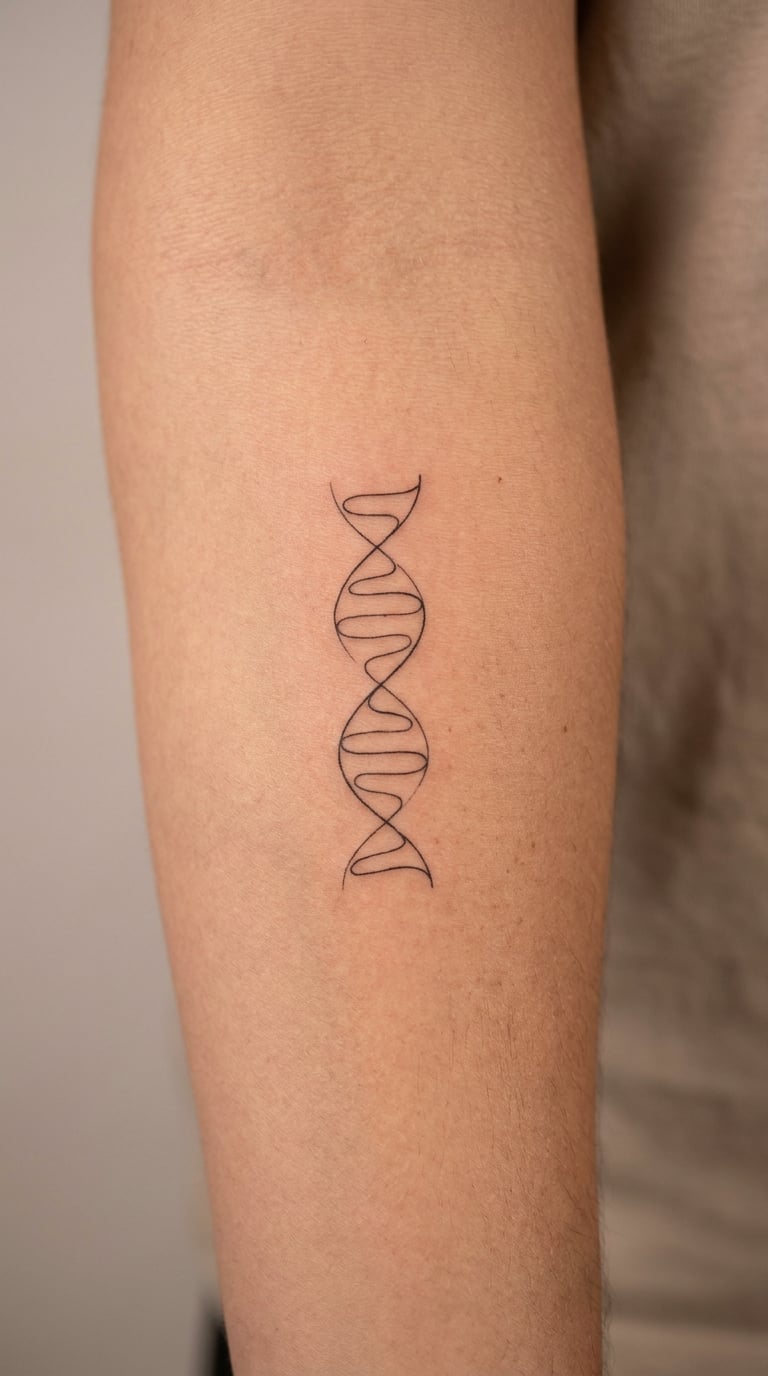
This is the version most people picture first: two clean black lines rotating around each other, crossed by evenly spaced rungs, no shading at all. Placed lengthwise on the inner forearm it reads like a piece of handwriting running from wrist toward elbow.
It suits anyone who wants a science reference that still looks delicate. The meaning is usually identity, health, or a biology or genetics background, and plenty of wearers add a date to make it theirs.
Placement: Inner forearm, running lengthwise; the outer forearm works too. Size: 2.5-3.5 in (6-9 cm). Style: Fine line, single-needle work. Pain: Low to medium. Ageing note: request a minimum line weight, because rungs thinner than about 1mm start filling in within a few years.
Make it yours: Add a birth date along one of the two strands in matching line work.
2. Minimal DNA Strand Behind the Ear
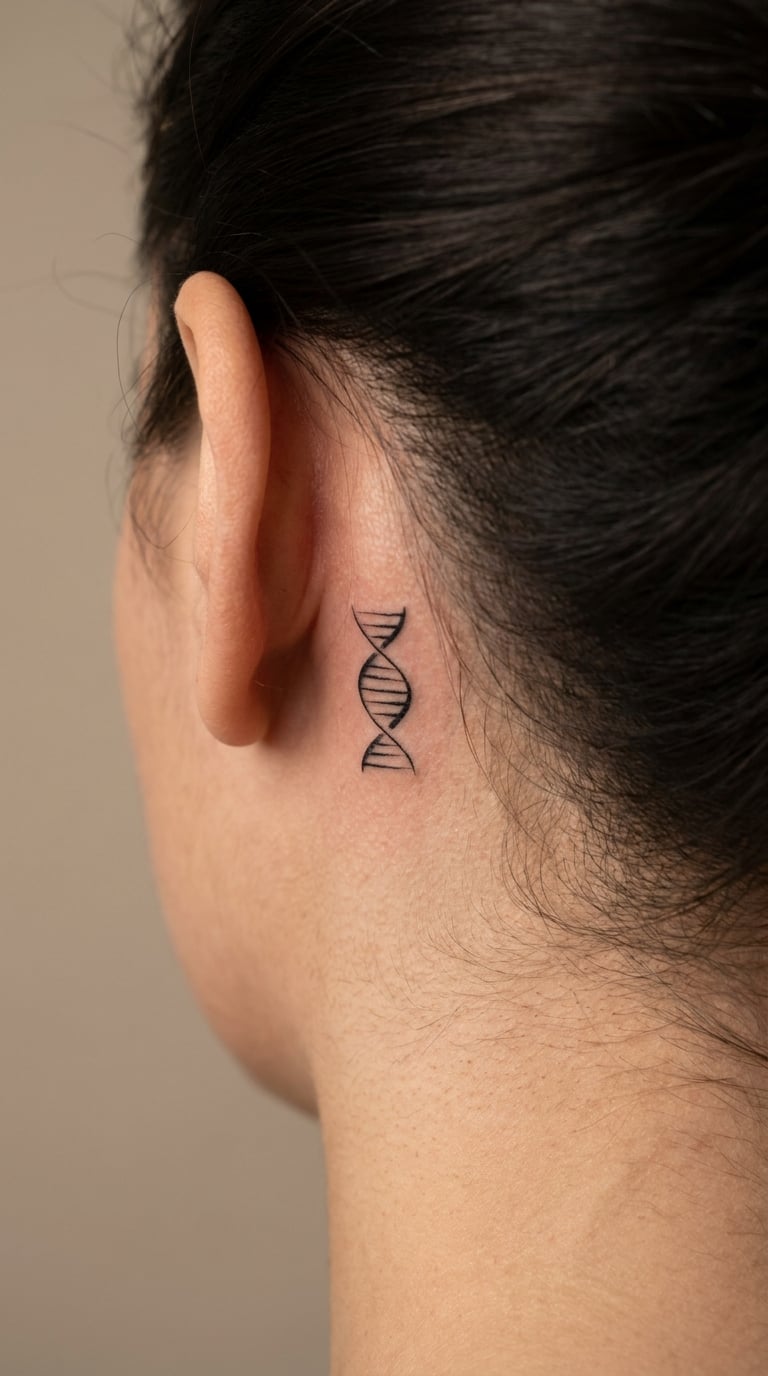
A single hairline helix that peeks out from behind the ear is the quietest option in this list. Keep it to three or four rungs and one clean rotation, because at this scale the shape has to be obvious without being busy.
People usually choose it for something specific rather than decorative — a genetic condition in the family, a career in genetics, or a private reminder only they know about.
Placement: Behind the ear, or the small hollow just in front of the ear. Size: 0.8-1.2 in (2-3 cm). Style: Micro fine line. Pain: Medium — the skin here is thin and the bone sits close underneath. Ageing note: fine line here fades faster than on the arm, often noticeably within five years, and the top rung usually goes first.
Make it yours: Tuck a small initial into one of the rungs, readable only at arm’s length.
3. Watercolor DNA Helix on the Shoulder
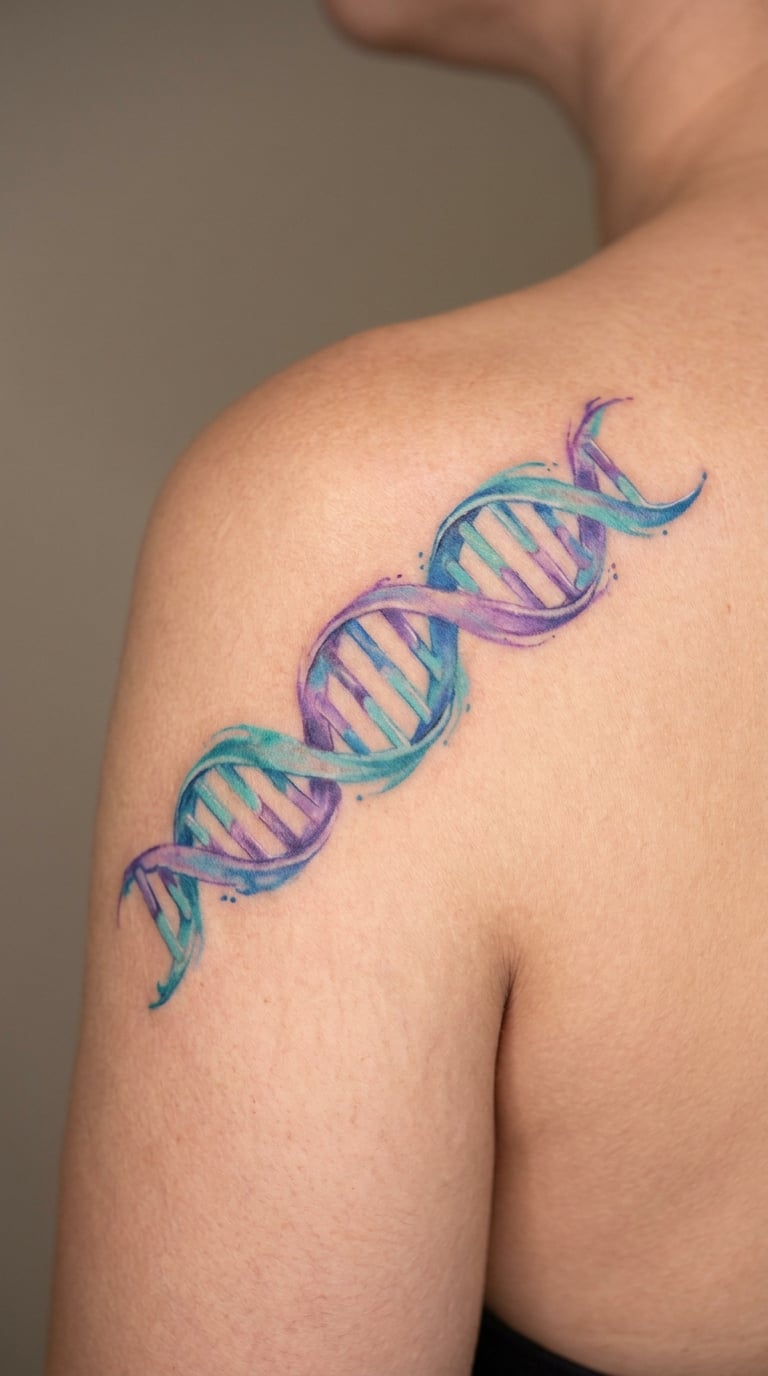
Here the two strands are drawn as translucent washes that bleed slightly past the line work, with colour pooling where the pigment is heavier. Turquoise into violet with a warm accent reads best, and the pigment spread is what softens the clinical structure.
It gets chosen by people who find a plain black helix too serious. There is usually no deep symbolism attached — more a love of colour and a softer look on a large flat-ish muscle.
Placement: Outer shoulder or upper back, angled along the deltoid. Size: 3.5-4.5 in (9-11 cm). Style: Watercolor with fine-line accents. Pain: Medium. Ageing note: colour sitting in skin fades in patches rather than evenly, so expect the lightest hues to need a touch-up first.
Make it yours: Match the palette to a birth flower or a favourite painting.
4. Vertical DNA Spine Design
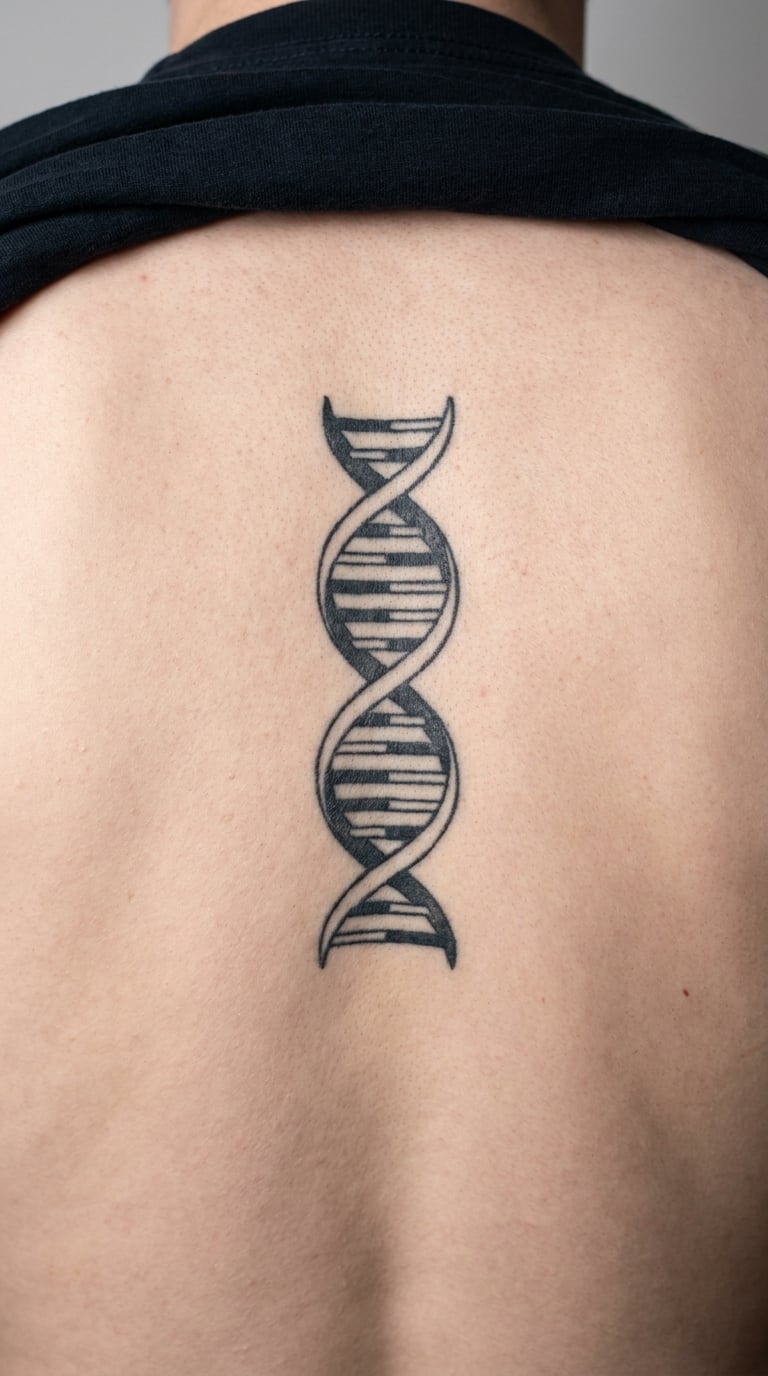
A slim helix mirrored on itself and aligned to the spine, with the rungs stopping short of the full length so it stays a back piece rather than a full-back project. Symmetry does the work — the two halves sit an inch either side of the line of the spine.
The meaning people attach is inheritance and continuity, which is why it often pairs with a family date. Bring the design in as a centre-line layout rather than a single squiggle, or the artist will draw it as one thick line.
Placement: Upper back, either side of the spine, from the shoulder blades down. Size: 4.5-6 in (11-15 cm) tall. Style: Fine line, symmetrical. Pain: Medium to high, and the spine area stays tender longer than most. Ageing note: thin rungs fade first in this spot because the skin moves constantly.
Make it yours: Turn the two halves into a family-tree shape, one strand branching per child.
5. Geometric DNA Circle on the Ankle
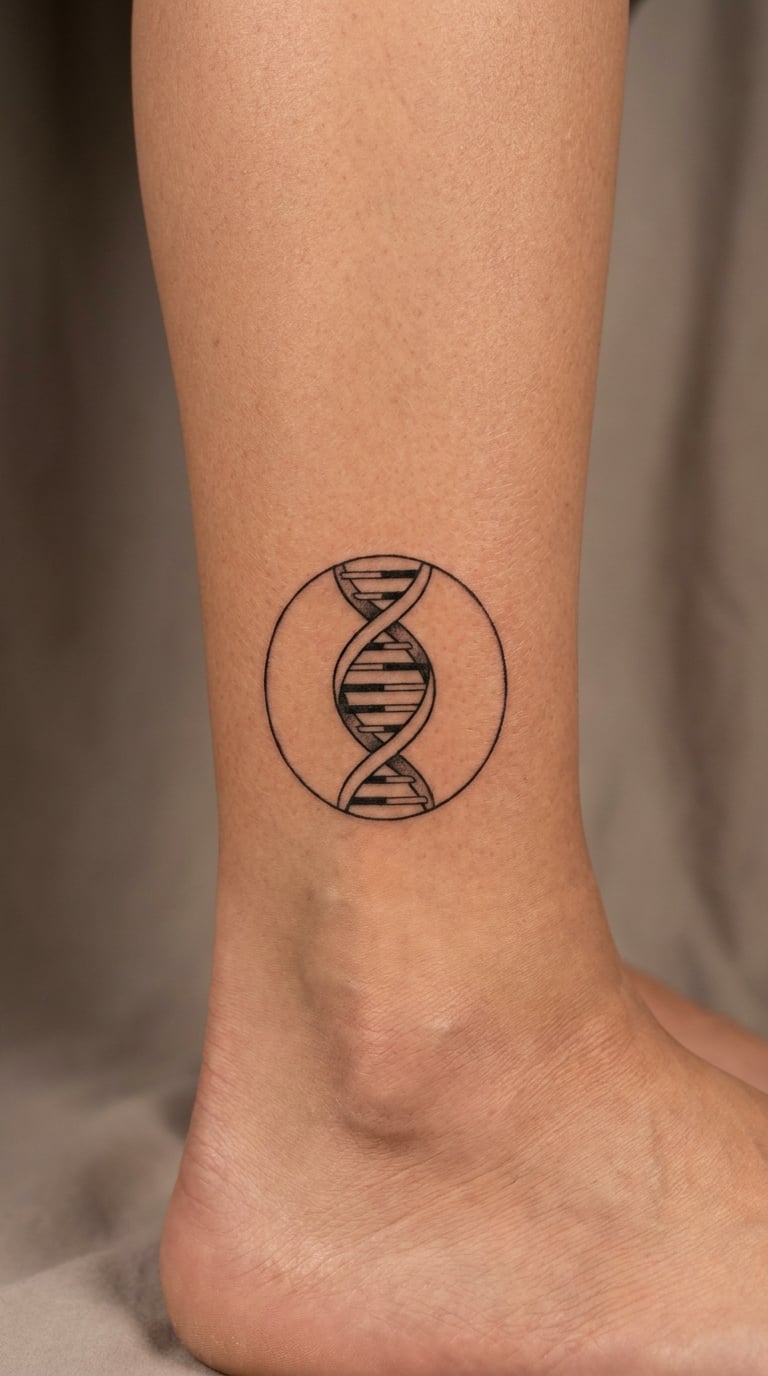
A helix drawn with straight and evenly angled segments instead of smooth curves, sealed inside a single thin circle. The circle does a lot of the visual work, because it turns a long vertical shape into something that reads as one compact mark.
It is a good first or second piece for someone who wants structure without a sleeve. Symbolism stays open — a lot of wearers treat the circle as a boundary or a whole, and add their own reason.
Placement: Outer ankle, calf or inner arm. Size: 2-2.5 in (5-6 cm) across. Style: Geometric line work. Pain: Medium, and the ankle bone hurts more than people expect. Ageing note: the circle’s lower curve crosses a joint and will soften over time, so a slightly heavier line there is worth asking for.
Make it yours: Break the circle once at the top, with a small date in the gap.
6. Blackwork DNA Helix Sleeve
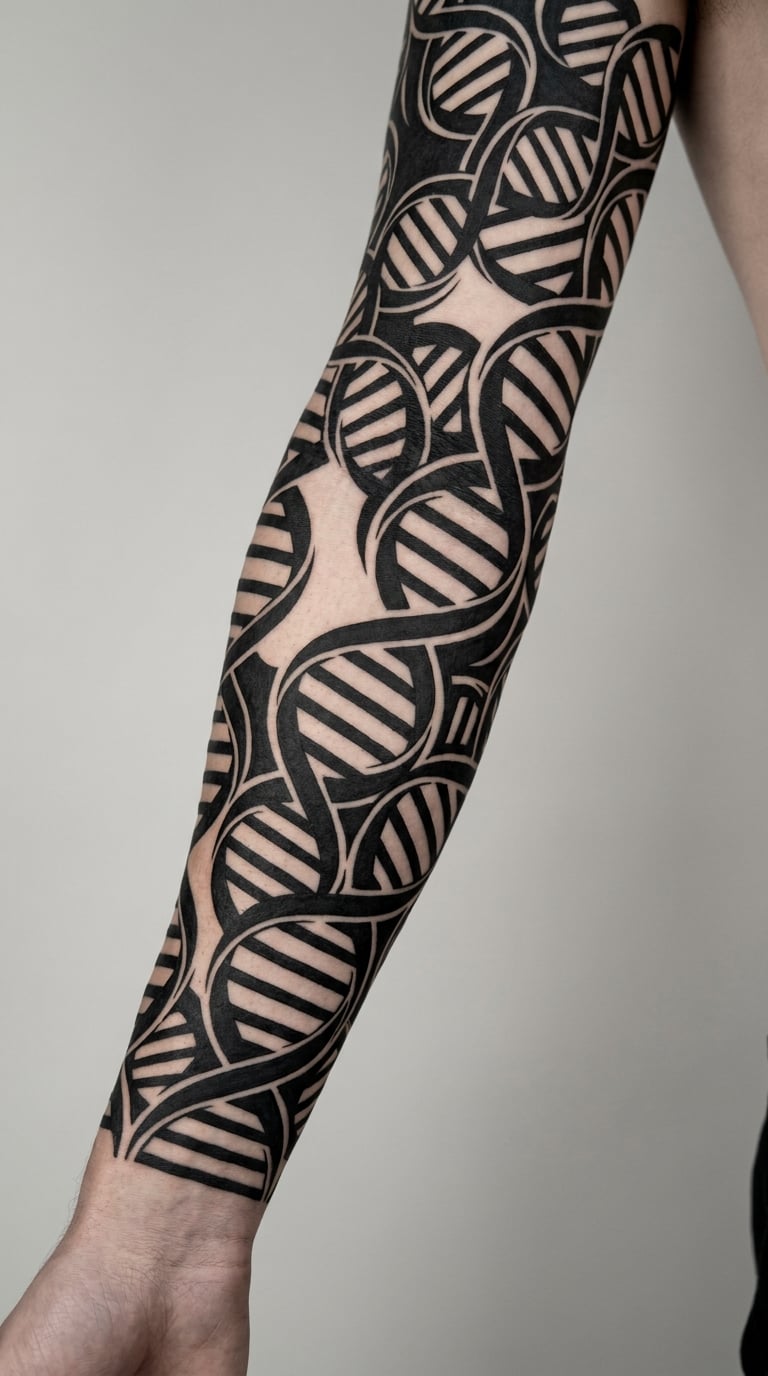
Repeated helices interlock along the arm with heavy black fills and hard-edged negative space cutting through them. The composition needs to read from two metres away, which means fewer, larger helices instead of small accurate ones.
This is the one to pick if DNA is a long-term theme and you already have pieces. The helix becomes structure and texture rather than a single symbol, so the meaning shifts from identity to something bigger — inheritance, weight, repetition.
Placement: Full arm or half sleeve, wrist to elbow or elbow to shoulder. Size: Sleeve scale, 6-10+ hours. Style: Blackwork. Pain: High, and a full arm is a multi-session commitment. Ageing note: blackwork holds line best of any DNA style, which is the main reason to choose it.
Make it yours: Leave a band of bare skin at the elbow so the arm still breathes between sessions.
7. DNA Helix Matching Pair
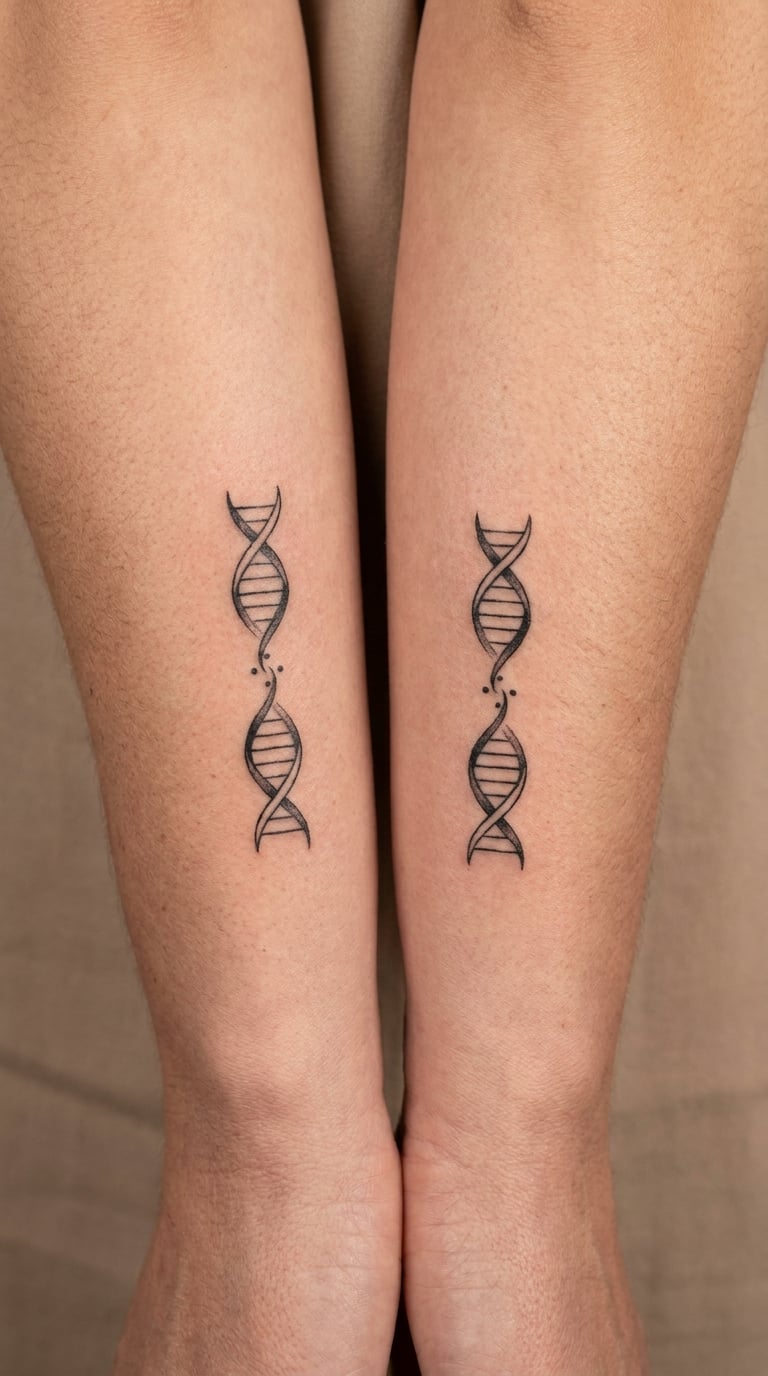
Two short helices that share the same rung spacing and the same small accent, but are not identical — one may be flipped so the design reads as a pair rather than a copy. Placed on opposite inner arms, they line up when the arms rest side by side.
Couples, siblings and parents with children get these most often. The shared visual is the point, not any grand claim, and the size keeps it a shared design without turning into a couple piece.
Placement: Inner forearms, or matching wrists and ankles. Size: 1.5-2.5 in (4-6 cm) each. Style: Fine line. Pain: Low to medium. Ageing note: match the line weight on both, or one will blur ahead of the other and the pair stops looking related.
Make it yours: Use the same number of rungs on each, one for every year together. See also our matching tattoo ideas for a mother and son if that is the pairing you have in mind.
8. DNA Rose on the Forearm
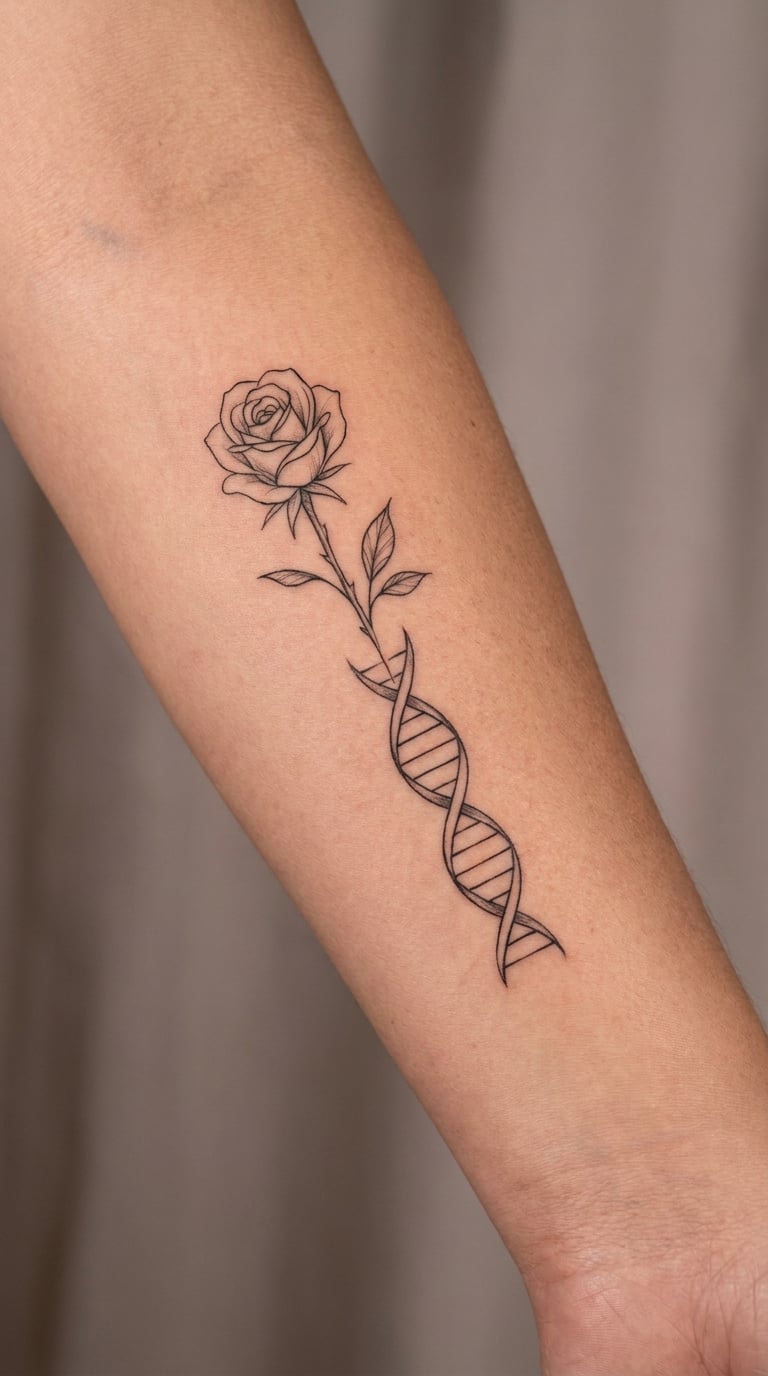
A rose where the stem turns into a double helix partway up, petals left fine and unshaded at the top. The transition is the whole design: if the petals and the helix read as two separate objects stuck together, it looks rushed.
This softens the motif for anyone who usually gravitates to botanical work. People pair it with a name, a birth flower, or a person, so the meaning is personal rather than scientific.
Placement: Forearm, angled diagonally, or the inner bicep. Size: 3.5-4.5 in (9-11 cm). Style: Botanical fine line. Pain: Low to medium. Ageing note: the shading inside the rose petals is what softens first, so ask for line-only petals if you want it to stay crisp.
Make it yours: Use the rose variety that matches a birth month flower, kept in the same fine-line style.
9. Micro DNA Helix on a Finger
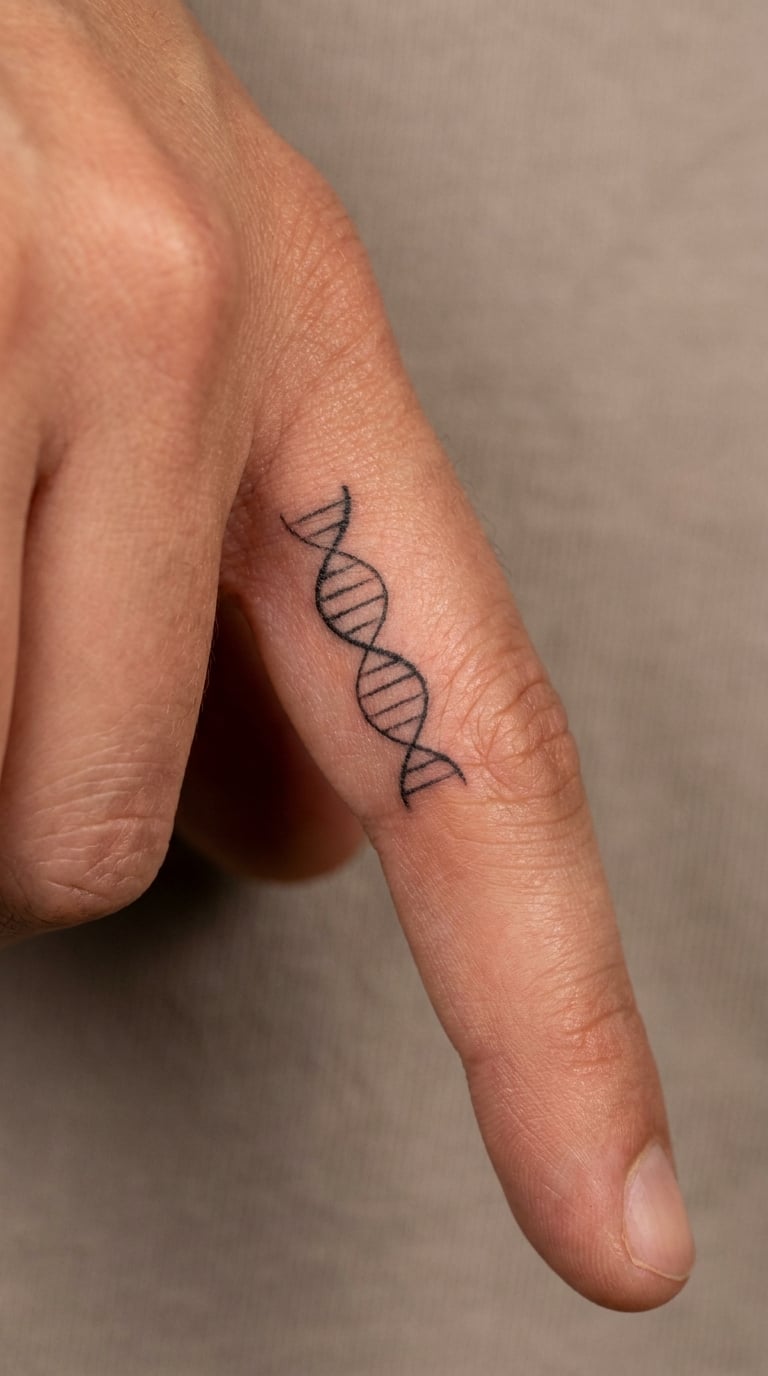
Two hairlines crossing three rungs, running along the outer side of the finger. At this scale the artist has room for almost nothing else, and that limitation is the design.
Wearers usually pair it with another small tattoo on the same hand rather than wearing it alone. It reads as a private mark unless someone sits next to you, which is part of why people choose it.
Placement: Outer side of the index or middle finger; the knuckle side is worse because skin creases there. Size: 0.7-1 in (1.8-2.5 cm). Style: Micro fine line. Pain: High — fingers sting and throb more than any other small placement. Ageing note: fingers wear through jeans, sleep on pillows and get washed fifty times a day; this one softens fastest of all twenty here.
Make it yours: Add a single dot below it, the same spot a matching piece would get.
10. DNA Tree of Life on the Calf
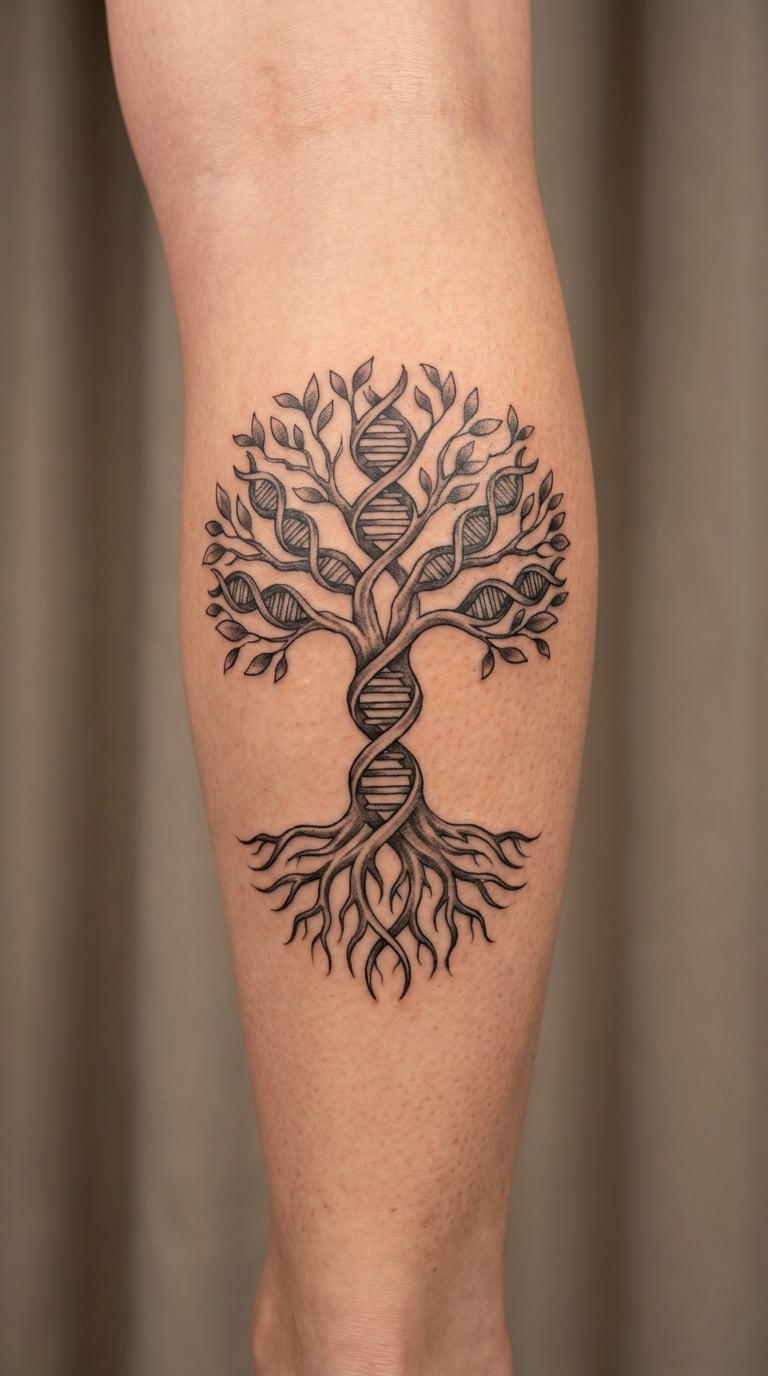
A tree with a trunk made of two twisting strands and roots that coil like a helix at the base, canopy spreading in fine black-and-grey shading above. On a calf the shape has room to breathe, which is why it works better there than anywhere smaller.
Ancestry and family line are the meanings people describe most often, and the form suits a memorial too. It is a detailed piece, so budget more time than a simple helix.
Placement: Outer calf, or upper arm. Size: 5-7 in (13-18 cm) tall. Style: Black and grey realism with fine line. Pain: Medium. Ageing note: the grey wash in the canopy is the part that fades, so keep contrast high between trunk and branches.
Make it yours: Put an initial inside the trunk so the two strands form a letterform.
11. Red DNA Helix on the Biceps
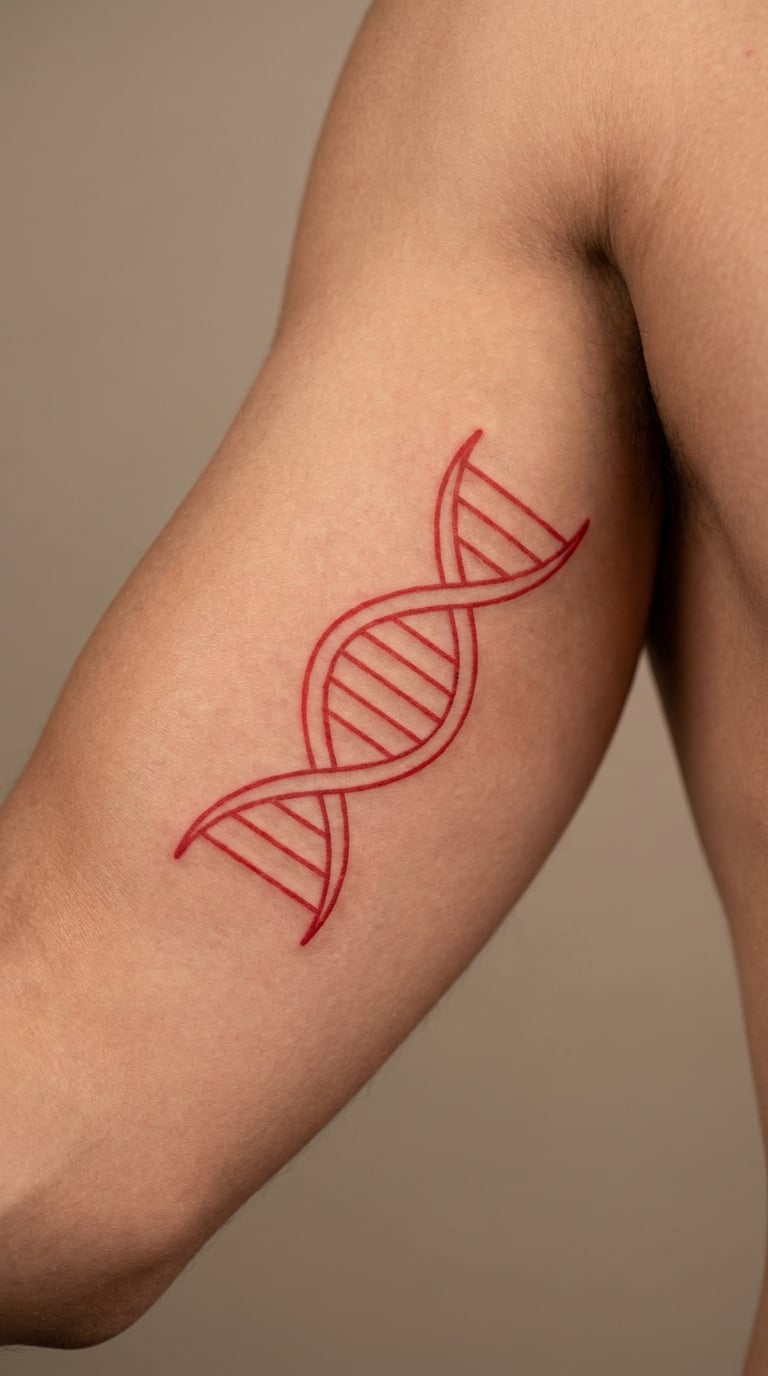
Two heavy red lines with clean rungs, no other colours, no shading. A single saturated colour reads bolder and simpler than a full colour piece, and it photographs well in black and white without turning muddy.
The reason behind it is usually personal rather than aesthetic — a blood relation, a diagnosis, a red-letter date. Placement across the bicep keeps the helix on a flat plane where the twist stays even.
Placement: Outer bicep or forearm. Size: 3-4 in (7.5-10 cm). Style: Bold line work in one colour. Pain: Low to medium. Ageing note: bright red fades to a warmer tone over a decade; ask your artist for a pigment that holds hue better than it appears in the bottle.
Make it yours: Change the colour per placement — a second version in blue on the other arm.
12. Dotwork DNA Ribbon on the Sternum
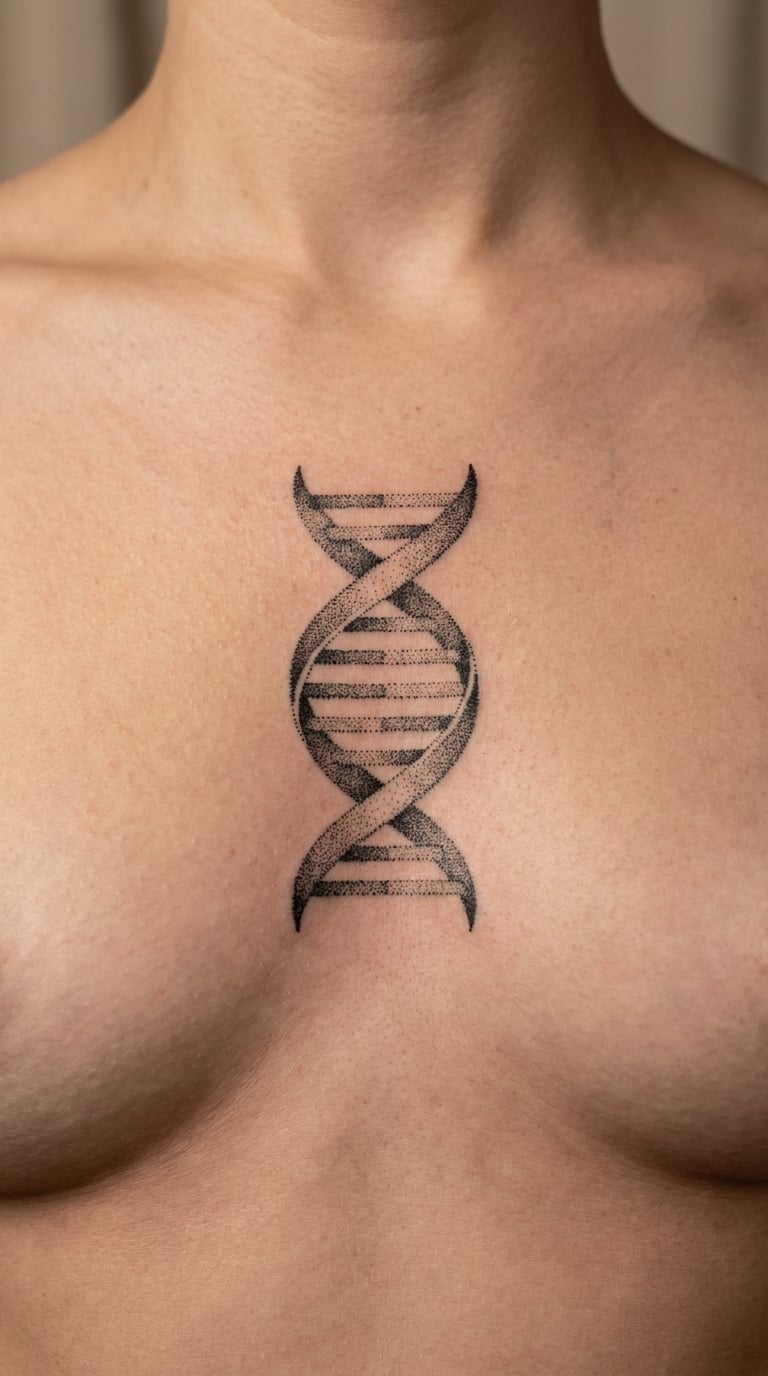
Two ribbons of graduated dots twisting into each other, mirrored left to right, with dot size increasing toward the centre and thinning out at the ends. Dotwork suits the sternum because the dots fill a narrow vertical space that line work would leave empty.
Symmetry is what makes it look deliberate, and getting it right is a conversation with the artist about the centre line before any ink goes down. Meaning is usually kept personal.
Placement: Sternum, between the collarbones, or lower along the breastbone. Size: 2 in wide by 3 in tall (5 x 7.5 cm). Style: Dotwork or stippling. Pain: Medium to high, and the bone is right under the skin. Ageing note: dots spread slightly as they heal, so spacing between them matters more than dot size.
Make it yours: Add two small solid dots above the ribbon, one for each child.
13. DNA Butterfly on the Shoulder Blade
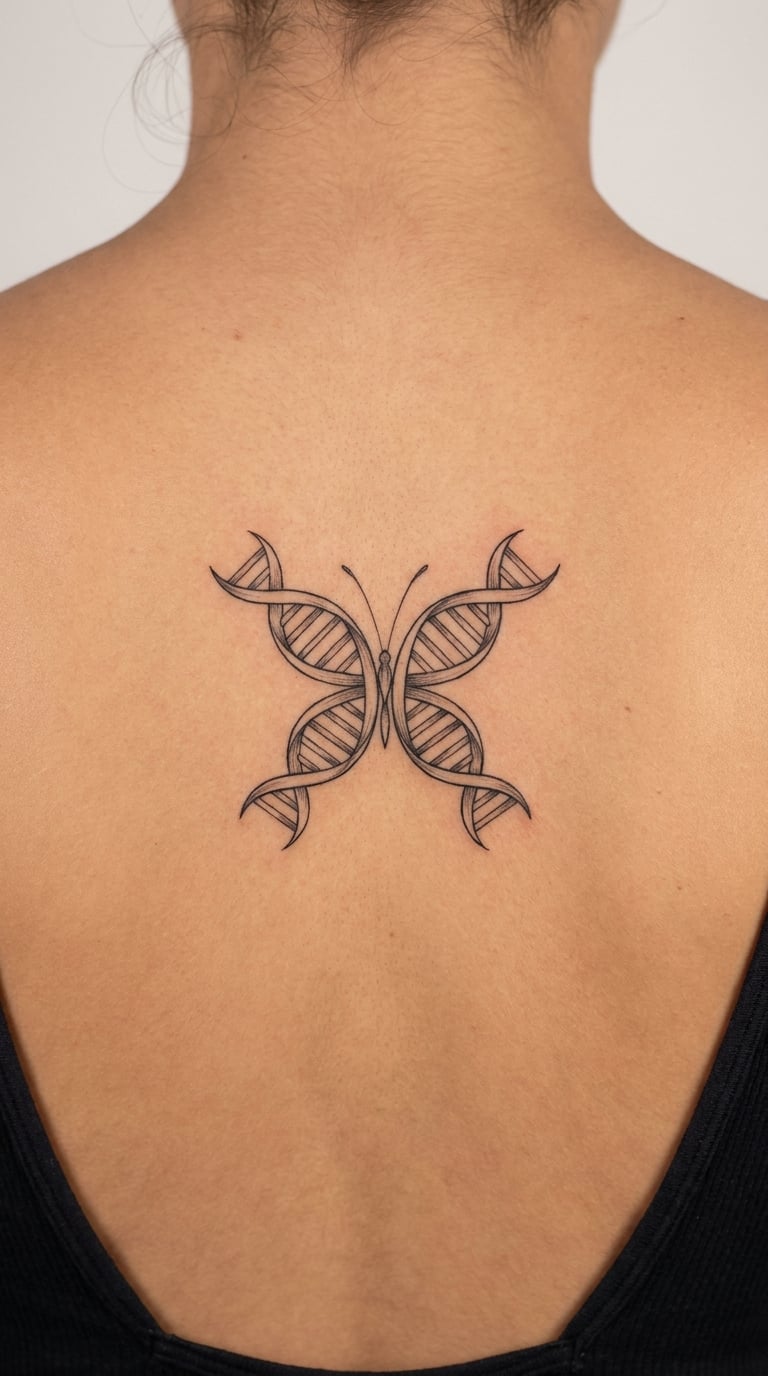
Wings drawn as two curving helix strands each, with the rungs becoming the vein structure of the wing. A slim body between them keeps it reading as a butterfly instead of two abstract shapes.
Transformation is the meaning people give this one, usually a change of direction in their own life. It is more work than it looks — the wings have to be mirrored or it looks lopsided from the side.
Placement: Between the shoulder blades, or one blade for a single-wing version. Size: 3.5-4.5 in (9-11 cm) across. Style: Fine line. Pain: Medium to high, and you will feel the shoulder blade move while it is being done. Ageing note: the inner wing near the spine stretches as you move, so ask for slightly heavier line there.
Make it yours: Let the lower wings trail into an unfinished helix, as though the shape is still forming.
14. Neon DNA Helix on the Forearm
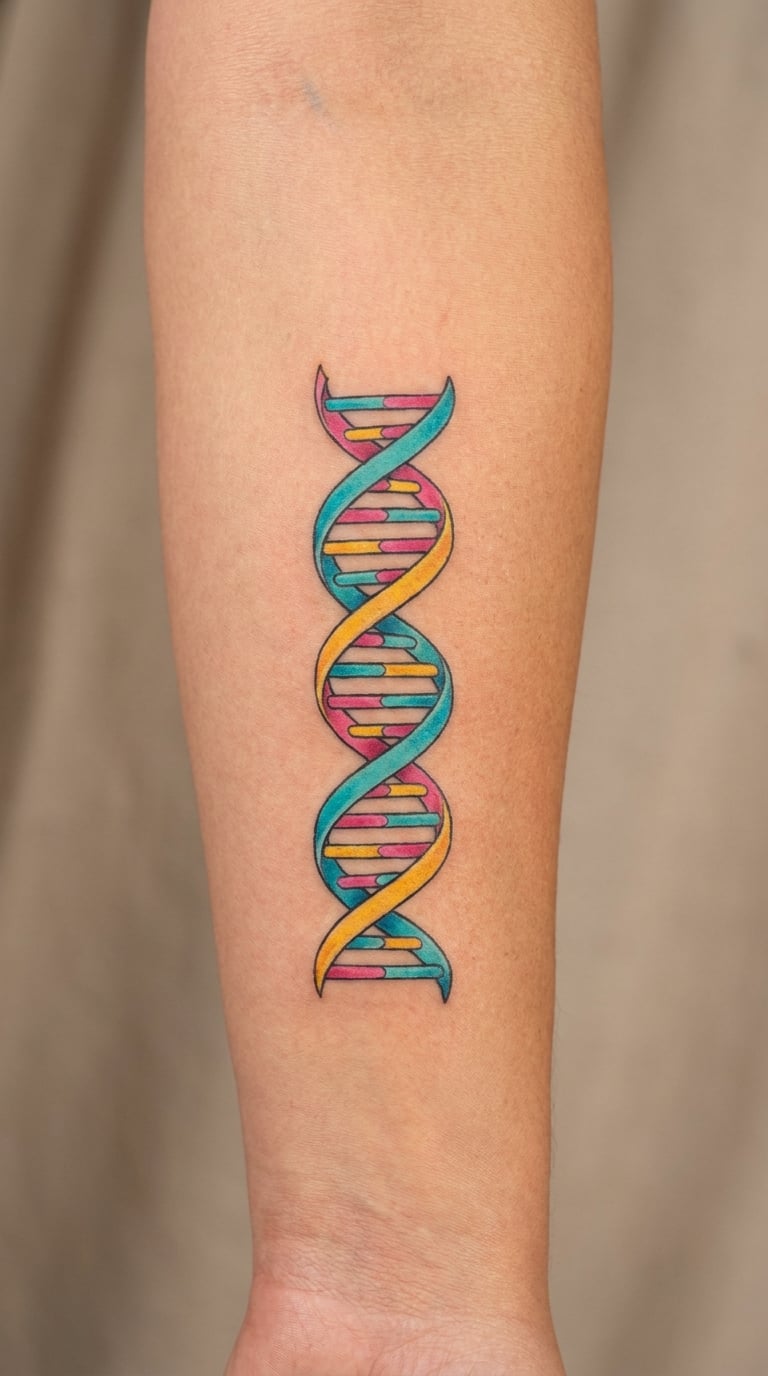
A bright helix in three saturated colours with clean separations between them, closer to signage than to a lab diagram. Turbulence and pink against yellow gives the most readable version at arm’s length.
It is a confident choice rather than a quiet one, and most wearers want colour on skin more than they want a specific story attached. Explain the palette clearly, because “neon” means something different to every artist.
Placement: Inner or outer forearm, lengthwise. Size: 2.5-3.5 in (6-9 cm). Style: Bright colour line work. Pain: Low to medium. Ageing note: three colours means three fading timelines; the yellow is usually first, and saturated pigment heals noticeably lighter than the sample.
Make it yours: Use two colours from a flag, a football club or a band you follow.
15. DNA Helix Heart on the Wrist
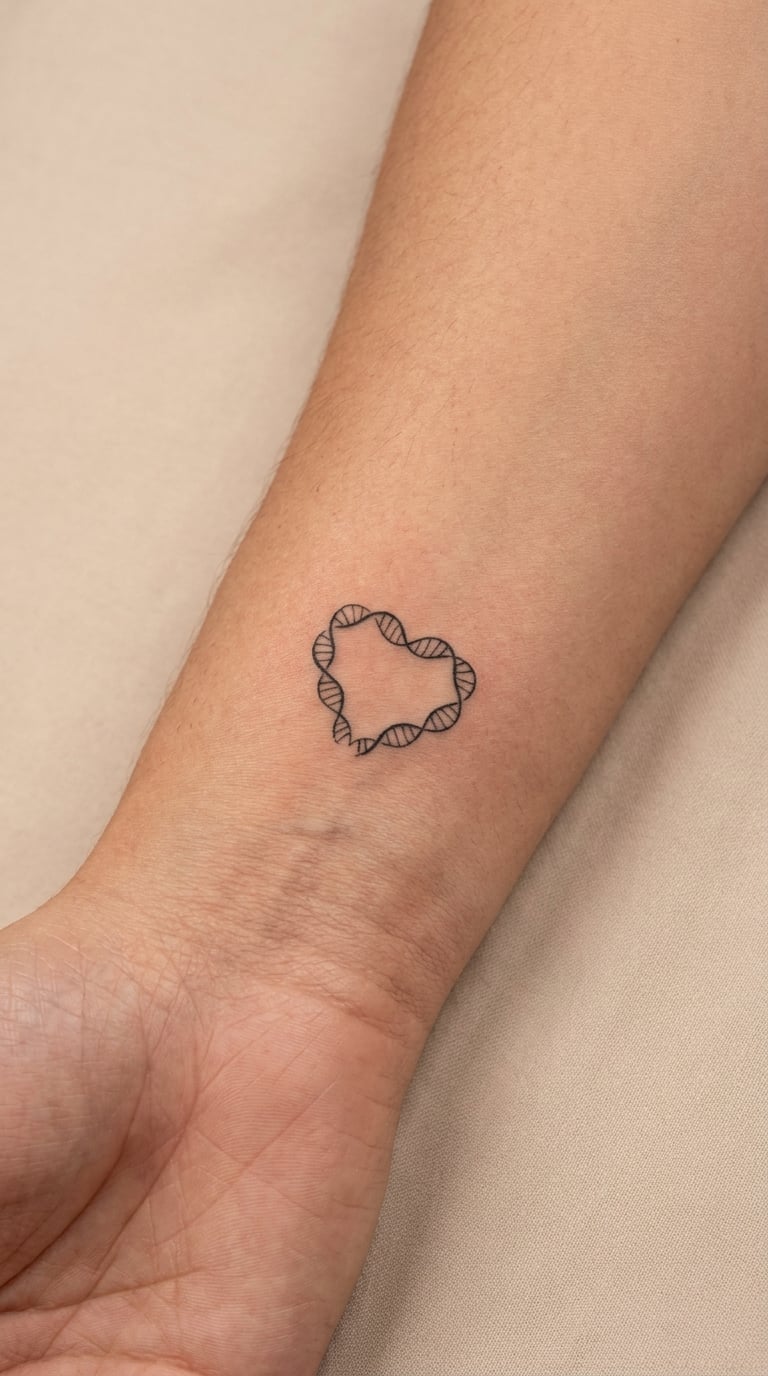
Two helix curves that lean together until they close into a heart shape, with the rungs turning into short horizontal bars inside the outline. The trick is stopping the strands before they meet, so the heart stays open at the top.
It is a compact wearable design, popular as a matching piece or as something to sit beside a date tattoo. The meaning stays soft — love, family, a person — and rarely needs explaining.
Placement: Inside wrist, or the inner forearm just above it. Size: 1.3-1.8 in (3.3-4.5 cm) wide. Style: Fine line. Pain: Medium; wrist skin is sensitive and the veins sit close. Ageing note: wrist tattoos catch sun and soap constantly, so a fill or touch-up at five years is normal.
Make it yours: Add a tiny initial inside the open top of the heart.
16. Realistic DNA Molecule on the Upper Arm
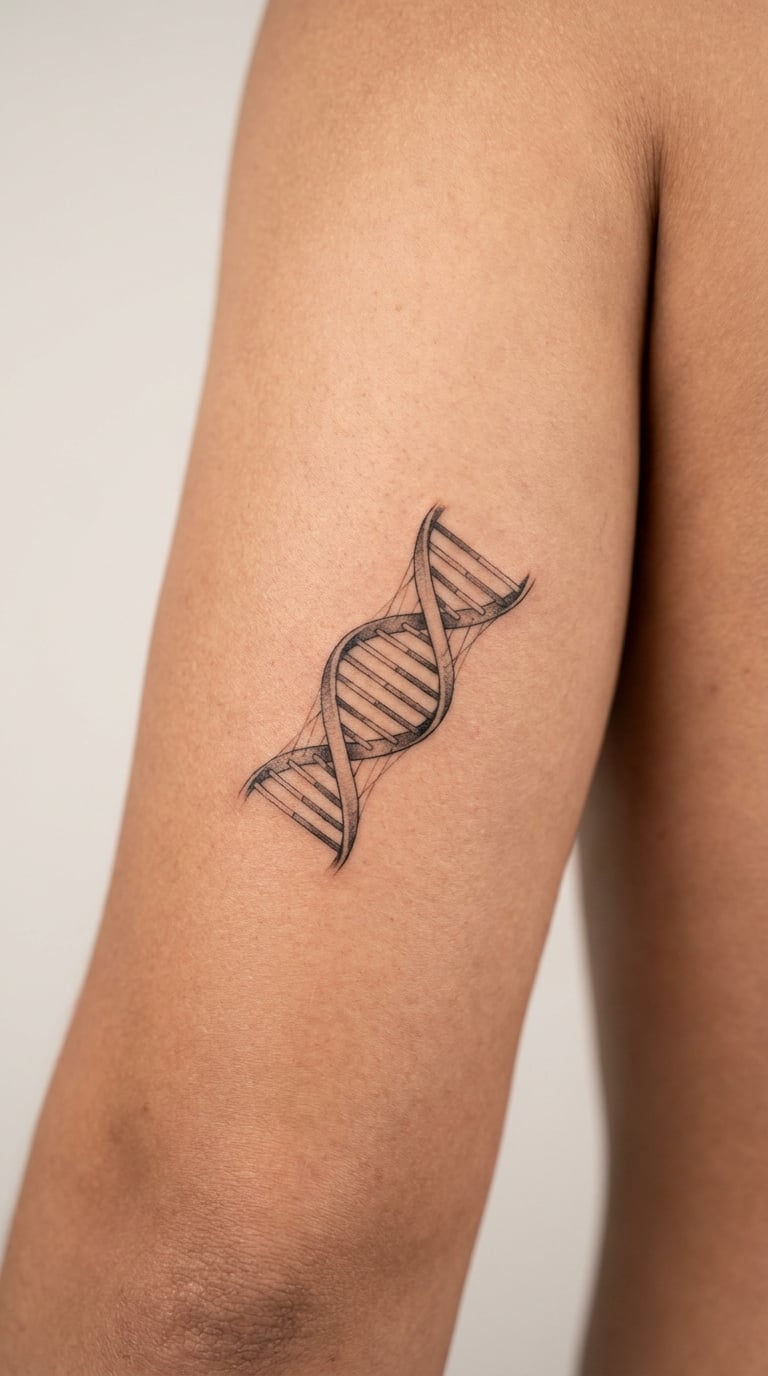
A scientific molecular structure rather than a cartoon ladder — fine connecting strands, small spheres at the joints, shallow grey shading giving it dimension. The accuracy is the appeal for anyone with a science background.
People who get this usually want it to be technically right, not decorative, and forum readers notice when the proportions are faked. Bring a real reference image rather than describing it in words.
Placement: Outer upper arm, or the shoulder. Size: 2.5-3.5 in (6-9 cm) across. Style: Micro realism with grey wash. Pain: Medium. Ageing note: fine connecting strands are the first thing to blur, so ask the artist to simplify any line that sits under 1mm.
Make it yours: Add the name of the scientist whose work you studied, set in the same grey.
17. Traditional DNA Helix on the Thigh
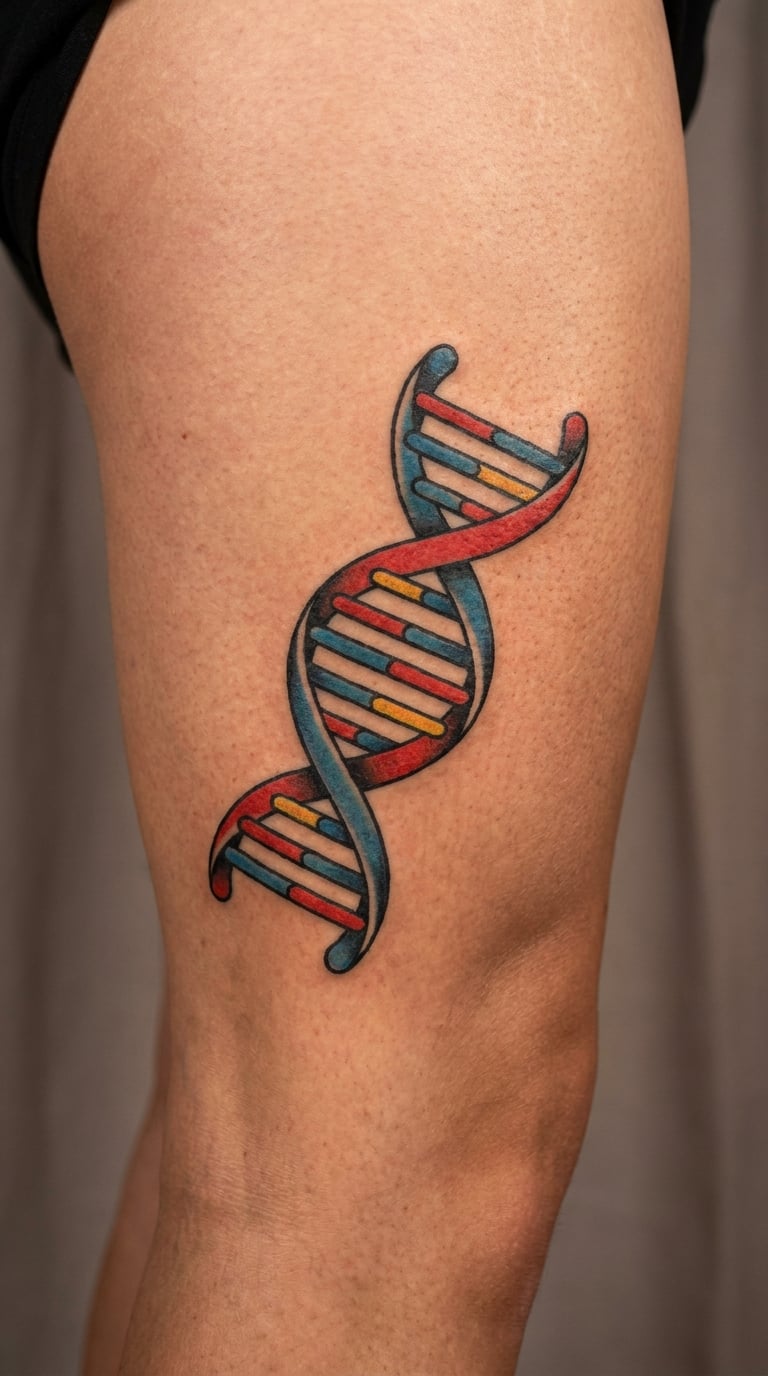
Heavy black outlines, flat saturated fills and a strong shadow edge, in the old-school tattoo style rather than anything modern or thin. The rungs alternate colour, which is what gives the twist its depth.
A thigh has enough room for a piece with real visual weight, and this is the one to choose when you want people to notice. The meaning is usually the same as a smaller helix, just louder.
Placement: Outer thigh, or the front of the thigh. Size: 5-6.5 in (13-16 cm) long. Style: Traditional. Pain: Medium — fleshy and easier than the forearm, though it is a big canvas. Ageing note: bold outlines hold up far better than fine line; solid colour on a thigh keeps its saturation longest.
Make it yours: Colour each strand differently, or add a banner with a word in the same style.
18. Minimal DNA Line on the Collarbone
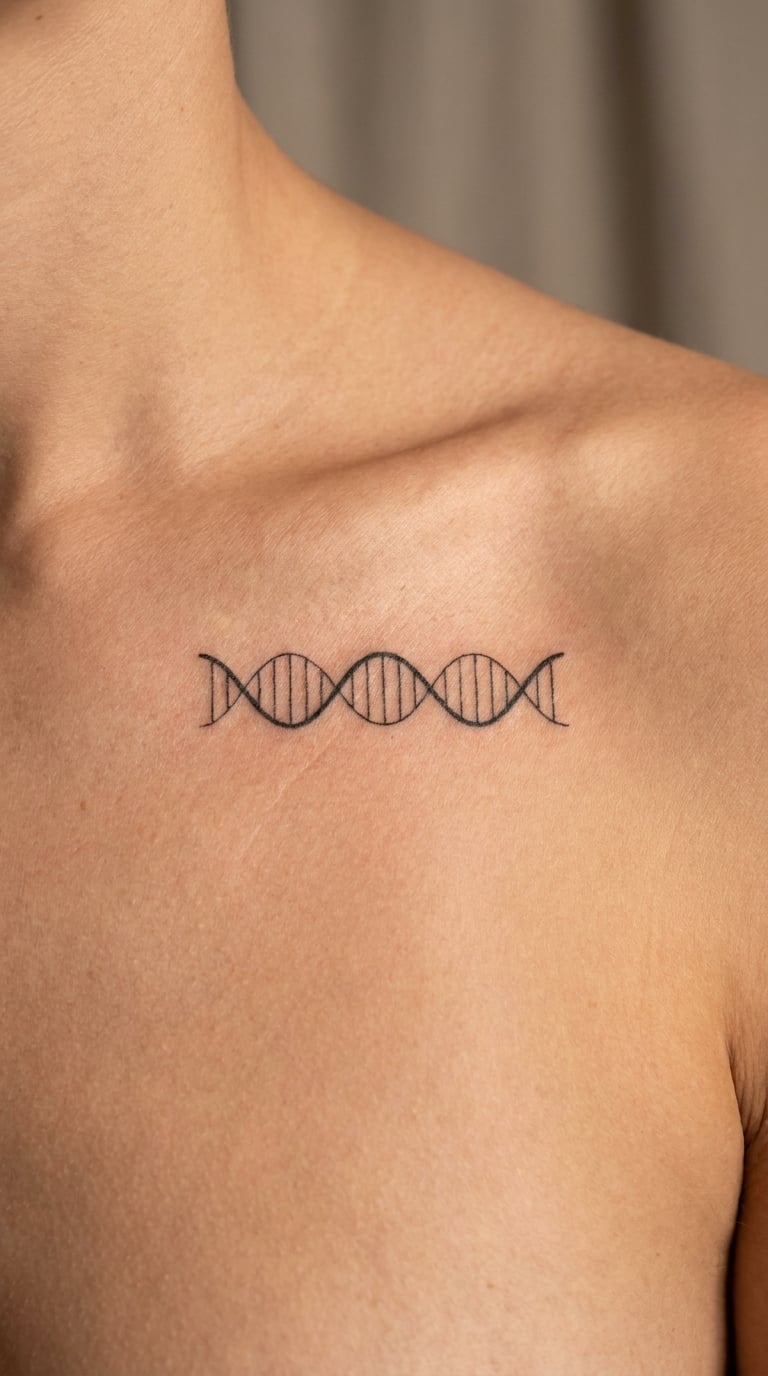
A single helix laid horizontally along the collarbone with even rung spacing and nothing else around it. The restraint is the whole point, and it works because the collarbone line gives the design a natural baseline.
Most wearers use this for a first tattoo or a discreet addition, often carrying a date or coordinates in tiny line work underneath. It reads as elegant rather than loud from a distance.
Placement: Just above the collarbone; a single spiral at the sternum notch is the smallest option. Size: 2.5-3.5 in (6-9 cm) wide. Style: Fine line, minimal. Pain: Medium, and the bone makes the first few passes sting. Ageing note: the skin over the collarbone stretches when you shrug, so a touch more line weight prevents the rungs from flattening out.
Make it yours: Tuck the coordinates of a place that matters under the helix in 6pt line work.
19. Fractured DNA Helix on the Upper Arm
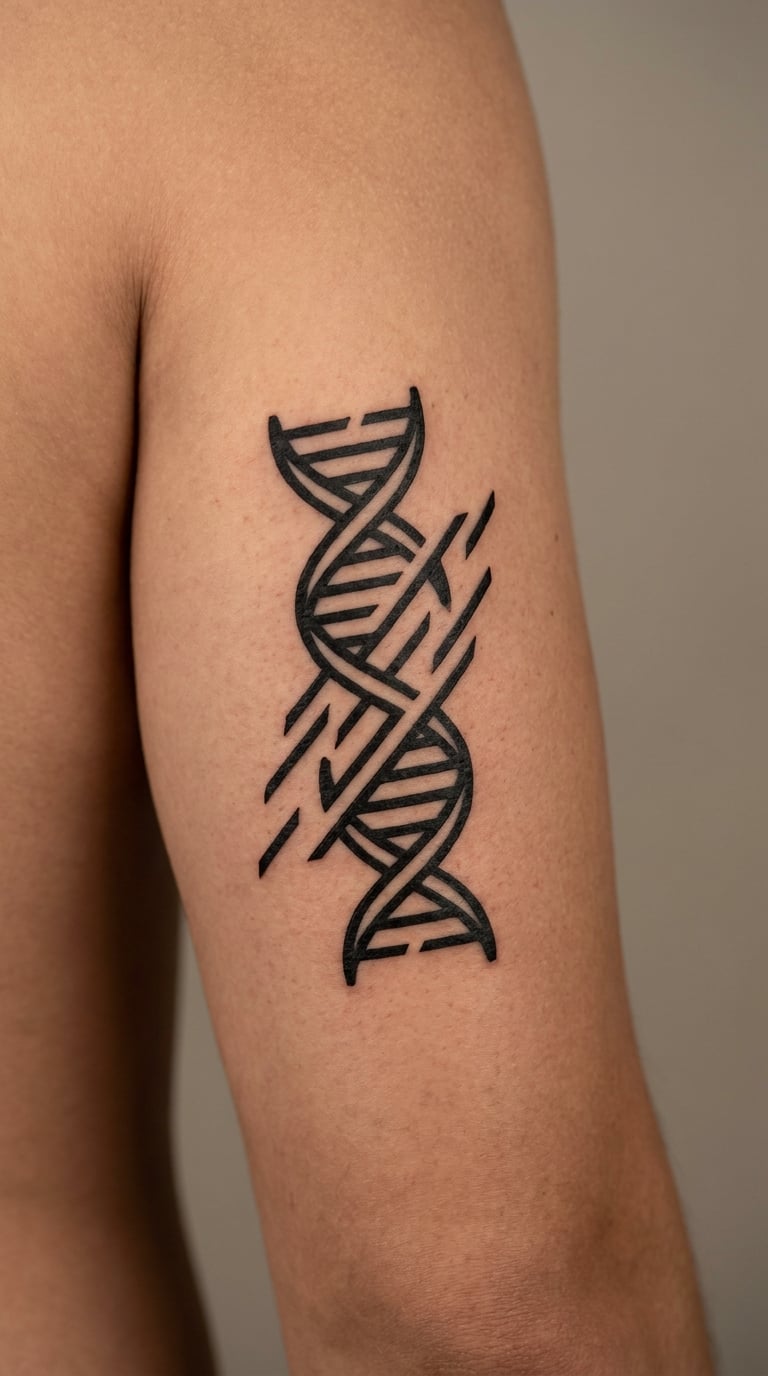
A helix that holds together for a third of its length and then breaks into separated segments with even gaps between them. Straight segment ends make it geometric; curves would make it feel softer.
People tend to describe it as reflecting a break, a distance, or a change, though what it means is entirely up to the wearer. It suits someone who wants a helix that does not read as the standard science-symbol version.
Placement: Outer upper arm, angled diagonally. Size: 3.5-4.5 in (9-11 cm) long. Style: Geometric line work. Pain: Low to medium. Ageing note: thin hairline gaps between segments soften within a few years; asking for a consistent gap width keeps the break-up effect longer.
Make it yours: Put a single word across the largest gap, in thin type.
20. Chromosome Pair on the Ribs
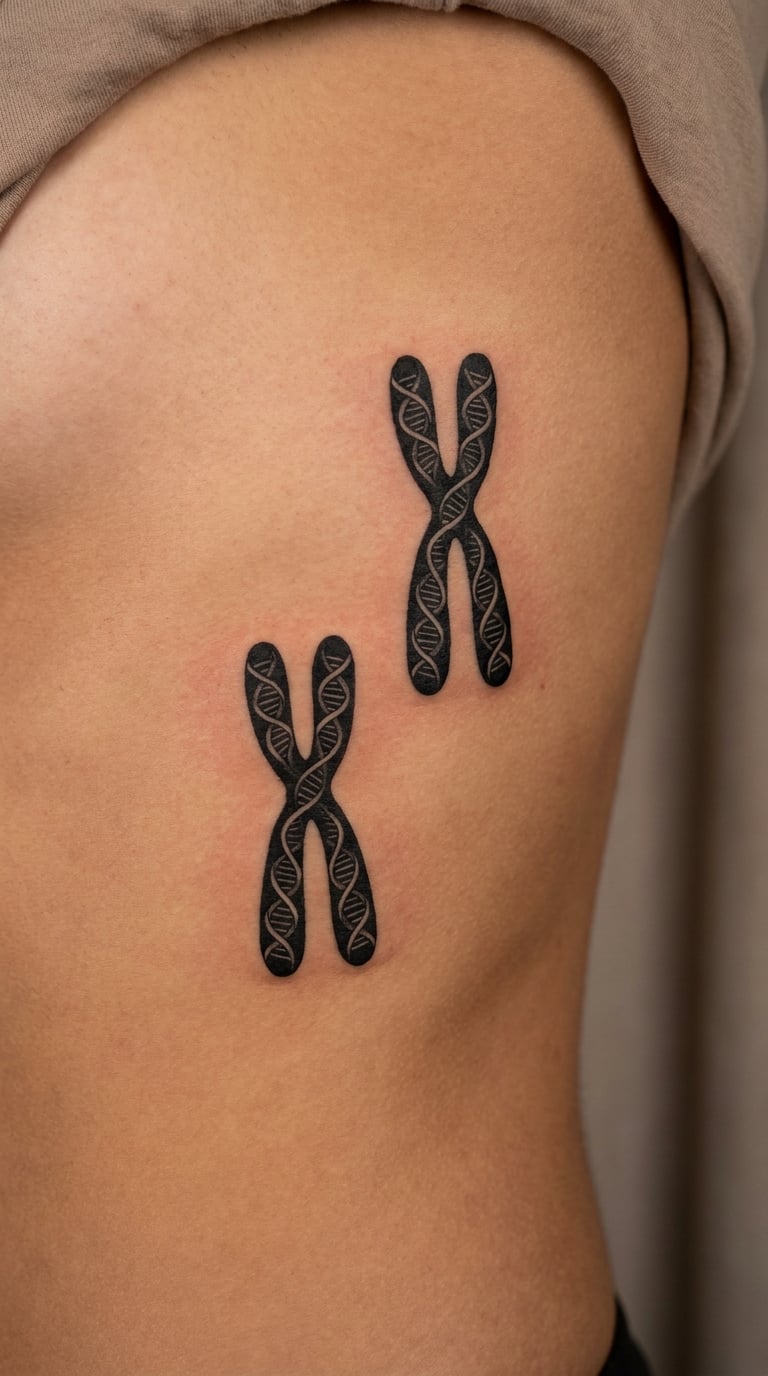
Two simplified chromosome forms, each with a narrow waist and fine coiled detailing, placed on separate ribs. Simplified rather than anatomically rendered is what keeps it readable at this scale.
People choose it when the chromosome imagery carries something specific — a diagnosis, a family history, a child. Ribs are a demanding placement, so a smaller size and thinner line weight are the sensible trade.
Placement: Side ribs, either two on one side or one on each side. Size: 1.5-2 in (4-5 cm) tall each. Style: Bold black with fine detail. Pain: High — ribs are thin, bony and the most reactive area in this list. Ageing note: skin here stretches with every breath and movement, so expect the fine coiled detail to soften first and plan for a touch-up.
Make it yours: Put the same small mark on each one, mirrored, so they read as a pair.
How to Choose the Right Design
The fastest way to narrow 20 DNA tattoo ideas down to one is to decide how much visual weight you want and how much time you have. Line weight matters as much as style — the thinner the line, the sooner it softens.
- Fine line and micro — best on the inner forearm, wrist, behind the ear and finger. Ask for a minimum line weight of about 1mm and expect to need a touch-up eventually.
- Blackwork — the most durable option and the best choice if you already have pieces. Needs the most time and the most sessions.
- Colour, traditional and watercolor — brighter and more forgiving of a curved surface, but the colours fade on their own schedule and unevenly.
- Geometric and dotwork — forgiving to wear and hard to tattoo well, because symmetry has to be right or it reads as a mistake.
- Matching the shape to the area — flat planes such as the forearm, outer bicep, calf and thigh suit large detailed work. Curved zones such as the wrist, ankle and collarbone distort a helix, so keep those designs smaller and simpler.
- Deciding between two designs — if you keep circling back to two, book a consultation and ask each artist to sketch yours. A drawing on paper settles in five minutes what a month of scrolling will not.
If you are still at the very start and want something small with a story behind it, our guide to tattoo ideas that symbolize growth is worth a look before you settle on a motif.
Cost and Session Time
The honest answer on cost is that it depends on size, detail and the artist you book, and there is no single number worth quoting. Micro pieces and simple fine line take under an hour, though most studios set a shop minimum that applies regardless of how long the work takes.
As a rough guide on session length: micro designs finish in one short sitting, forearm and calf pieces run two to four hours, a traditional thigh piece is a long afternoon, and a full blackwork sleeve is a multi-session project measured in dozens of hours. A sternum or rib design is booked as a long appointment even when the drawing is small, because the position is uncomfortable to hold.
What moves the total more than the motif is line count, colour count, and the hourly rate of the person doing it. Bring a finished reference rather than a loose sketch, and it costs less because there is less to solve on the day.
Aftercare Basics
- Follow your artist’s aftercare instructions first — they know what they did on your skin and their advice overrides anything generic.
- Wash the area gently with lukewarm water and unscented soap for the first few days, then pat dry rather than rubbing.
- Keep it clean and dry while it heals, and change or cover loose clothing that rubs against the line work.
- Use a plain, unscented moisturiser a couple of times a day once the surface has closed, and keep sun off a fresh tattoo.
- Do not soak, swim or use a sauna until it has healed properly, and leave any scabs alone.
- Book the touch-up your artist recommends, ideally within a few months, while the design is still fresh in their mind.
Frequently Asked Questions
What does a DNA tattoo symbolize?
A DNA tattoo usually stands for identity, heredity or the people you come from. Wearers also use it for a science career, a genetic condition in the family, or a memorial to someone. The double helix is the most literal symbol of inherited material there is, so the meaning is usually personal rather than fixed. Most people add a date, a name or a real gene sequence so the piece means something specific to them.
Where is the best placement for a DNA tattoo?
The inner forearm is the easiest and most popular spot because it is flat, visible and easy to sit with. The outer bicep, calf, thigh and upper back suit larger detailed work. Wrist, ankle and collarbone designs need to stay smaller, because skin movement there distorts the twist and fades the rungs faster. Ribs and sternum work for bold small pieces but are the most painful placements on the body.
Are DNA tattoos suitable for a first tattoo?
Yes, and a small fine-line helix on the inner forearm is one of the easier first designs. Pick something in the 2 to 3 inch range, avoid fingers, ribs and the collarbone, and ask your artist to bump the line weight up slightly. The one thing to watch is scale: a helix under an inch will blur together within a few years, so the rungs need room.
How much does a DNA tattoo cost?
Cost depends on size, detail, colour count, the artist and where you are, so it is worth asking a shop directly rather than trusting a fixed figure. Micro and fine-line pieces take under an hour, forearm and calf work runs several hours, and a sleeve is a multi-session project. Shop minimums apply even to tiny designs, and a good finished reference image usually costs less than a rough concept.
Do fine-line DNA tattoos fade quickly?
They do, faster than most motifs, because the design is nothing but thin lines and the rungs are the smallest element. Fingers, wrists and the collarbone wear fastest, since skin there is creased, washed and exposed to sun. Ask for a minimum line weight of about 1mm, avoid hands and fingers if you want it sharp for decades, and expect a fill or touch-up somewhere around the five-year mark.
Which Idea to Book First
If this is your first tattoo, start with idea 1 or idea 5 — both are small, flat-placed and forgiving if the line weight needs topping up later. Both read clearly in a photo too, which matters if you want a matching piece later, the way our matching tattoo ideas for a mother and son guide suggests.
If you already have ink and DNA is a longer theme, skip to idea 6 and think of the sleeve as a three-year project rather than an appointment. Bring two or three reference images to the consultation, mark the one element you care most about, and let the artist handle the rest.