
20 Weightlifting Tattoo Ideas: Stunning Gym-Inspired (2026)
These 20 weightlifting tattoo ideas run the whole range, from a single fine-line kettlebell on the inner forearm to a blackwork barbell that takes over an upper arm. Every entry gives you the design, what it usually means to a lifter, the placement that flatters it, a realistic size in inches, the pain to expect, and one way to make it yours.
One timing note before you pick. If you compete, book the session for a deload, never meet week. Most people schedule 30 to 45 days out so the piece is fully healed before heavy training, hot showers and sun exposure start working on fresh ink.
20 Weightlifting Tattoo Ideas: Quick Guide
| Idea | Style | Best placement | Size | Pain |
|---|---|---|---|---|
| Fine-line kettlebell | Fine line | Inner forearm | 2–3 in | Low to medium |
| One-rep max barbell | Bold blackwork | Outer forearm or upper arm | 3–5 in | Medium |
| Barbell and mountain line art | Continuous line | Outer forearm or calf | 3–4 in | Medium |
| Traditional barbell scroll | Traditional | Upper arm or thigh | 4–6 in | Medium |
| Micro-realist barbell plate | Micro-realism | Inner bicep or forearm | 1.5–2.5 in | Medium |
| Plate mosaic blackwork | Blackwork | Outer forearm, calf or upper arm | 4–7 in | Medium |
| Kettlebell and laurel wreath | Bold linework | Outer arm or calf | 3–5 in | Medium |
| Hex nut with barbell ends | Geometric | Inner forearm or calf | 2.5–4 in | Medium |
| Watercolor rising kettlebell | Watercolor | Shoulder, thigh or forearm | 3–4 in | Low to medium |
| Powerlifter silhouette | Silhouette | Shoulder, back or calf | 4–6 in | Medium |
| Deadlift bar and ground line | Minimalist | Inner forearm or calf | 3–4 in | Medium |
| Bench press icon | Icon, black and grey | Forearm, upper arm or ribs | 3–5 in | Medium |
| Squat rack geometry | Geometric blackwork | Forearm, calf or thigh | 3–6 in | Medium |
| Weight plate progress line | Fine line | Inner forearm | 3–5 in | Medium |
| Lifting belt and barbell | Realistic | Forearm or upper arm | 3–4 in | Medium |
| Wrist strap and hook | Black and grey realism | Inner forearm | 2–3 in | Medium |
| Barbell bell in blackwork | Blackwork | Upper arm, back or thigh | 4–6 in | Medium |
| Chalk-hand barbell outline | Fine line with texture | Forearm, thigh or shoulder | 3–5 in | Low to medium |
| Olympic bar at mid-cable | Black and grey realism | Shoulder, chest or forearm | 3–4 in | Medium |
| Minimal two-plate gym icon | Minimalist | Wrist, forearm or calf | 1.5–2.5 in | Low to medium |
1. Fine-Line Kettlebell on the Forearm
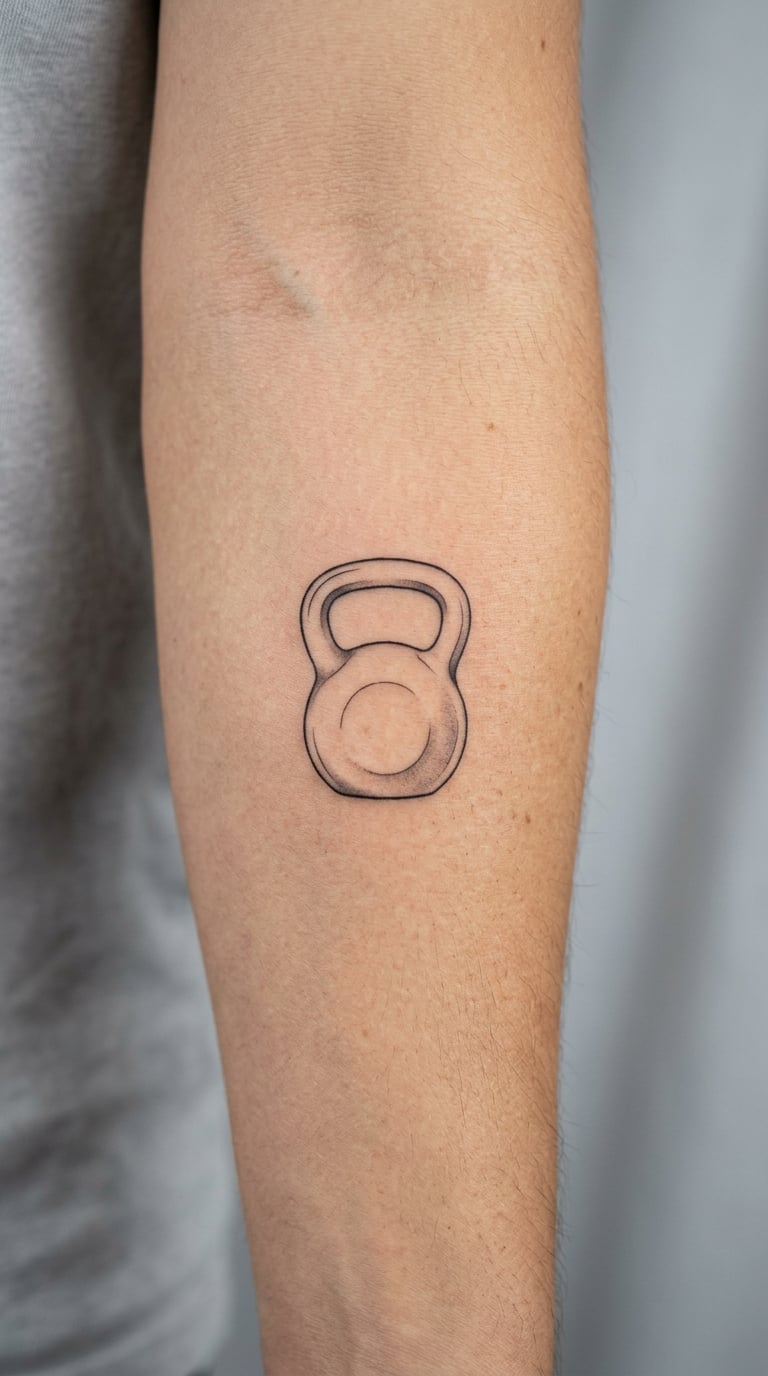
This weightlifting tattoo idea is a single kettlebell drawn in one continuous thin line, with a soft grey wash sitting in the lower third of the bell for weight. Nothing else in the frame, no rope, no background, just the shape and the skin it sits on.
It is the version most lifters start with, because a kettlebell is a strength symbol without needing a sentence around it. A bell in the hand says the training matters, and nothing more has to be explained.
Placement: inner forearm, a few inches above the wrist crease, or outer forearm if you want it visible when you grip a bar. Size: 2–3 inches (5–7.5 cm) tall. Style: fine line, black and grey shading.
Pain: low to medium, the forearm is thin skin over firm muscle. Fine line softens and spreads over the years, so ask for a slightly heavier line than feels right in the drawing.
Make it yours: add a small date under the handle, the day you started training or the day you hit the total you were chasing.
20 Weightlifting Tattoo Ideas Styling Notes
Line weight, negative space and placement decide whether a barbell design looks sharp or muddy long before the shading does. A thin outline reads clean at two inches and disappears at six, while a solid black shape holds its edges at any scale and hides small imperfections on the first session.
Negative space is the quiet one. A barbell drawn as a thick outline with clear air inside the sleeves looks deliberate, while the same shape filled in solid loses the collars and starts reading as a rectangle. Ask your artist to show you the design at the exact size it will be on skin, not blown up on a screen.
2. One-Rep Max Barbell Mark
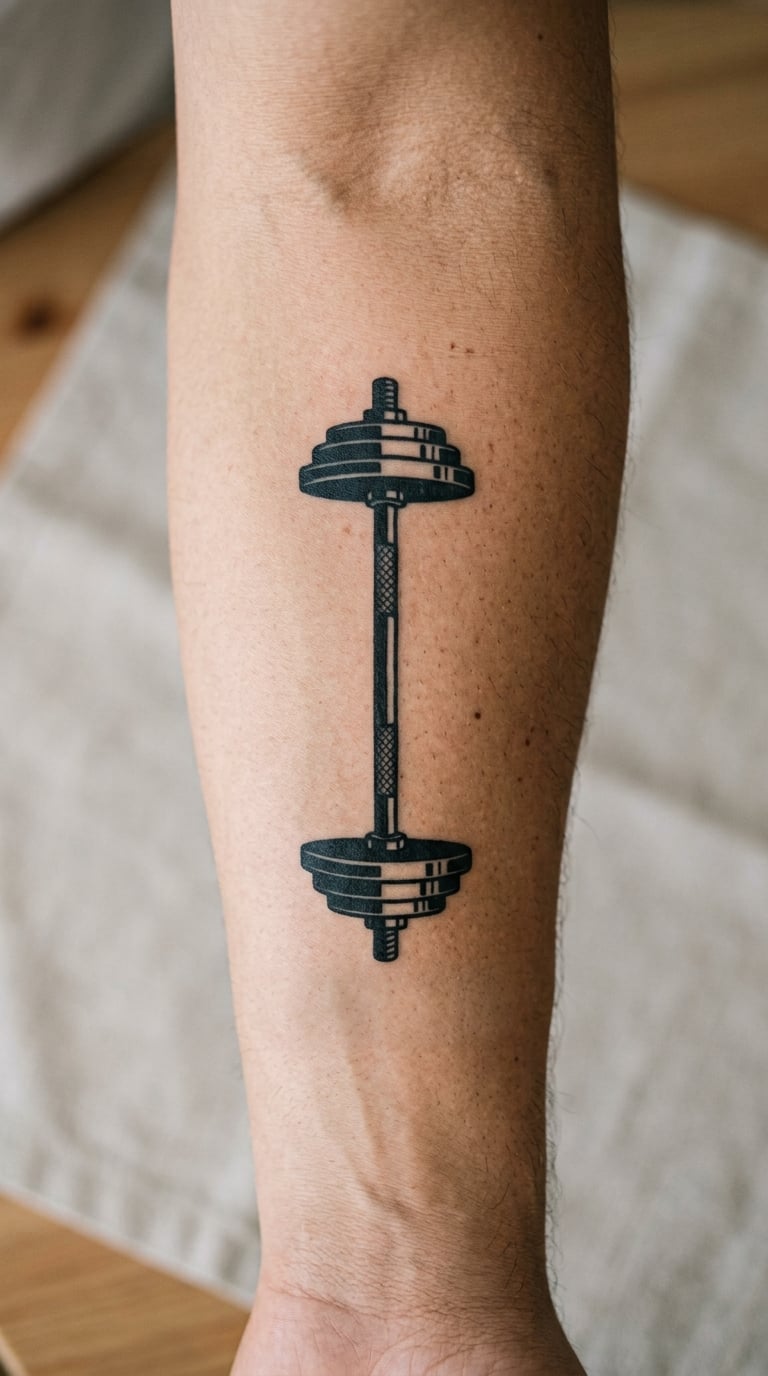
A barbell in solid black with a small line of block lettering tucked under it, sized no taller than the sleeve. The lettering is short on purpose, usually three characters or a date, so the whole design reads as one mark rather than a poster.
This is the one to get when a number matters more than an object. A single-rep max is a private record that nobody at the gym can verify, which is exactly why it works as ink.
Placement: outer forearm, running vertically, or the upper arm if you want the piece to scale with the muscle. Size: 3–5 inches (7.5–12.5 cm). Style: bold blackwork with clean sans-serif lettering.
Pain: medium. Solid black fills need more passes than line work, and the forearm is one of the more sensitive spots to ink.
Make it yours: set the lettering in your actual lift, the weight and the unit you train in, so it only means something to you.
3. Barbell and Mountain Line Art
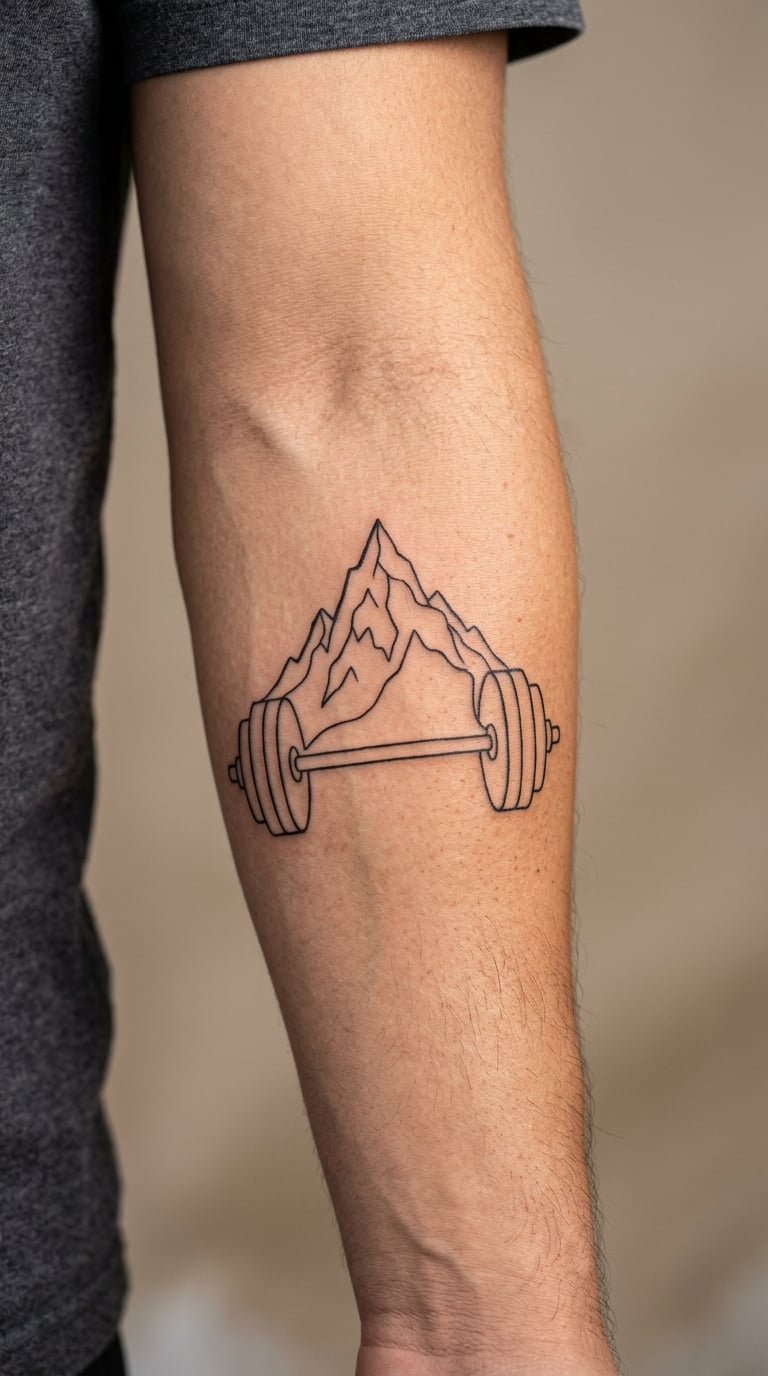
A loaded bar sits on one baseline and a mountain peak rises straight out of it in a single unbroken line, the two shapes sharing the same stroke. The line thins as the peak climbs, which keeps the composition light without needing colour.
It suits the lifter whose training runs alongside something else, a job, a sport, long days outdoors. The mountain is a second interest sitting inside a lifting tattoo, not a replacement for it. If the outdoors half of your training is the bike, the 20 best tattoo ideas for cyclists handles that same terrain angle.
Placement: outer forearm, or the calf where the vertical shape has room. Size: 3–4 inches (7.5–10 cm). Style: continuous line, fine line.
Pain: medium, and the calf is a deep spot because the muscle is dense. Single-line work softens fastest of any style, so expect a touch-up every few years if you want the peak sharp.
Make it yours: swap the peak for a summit you have actually stood on, a coastline, a city skyline from home.
4. Traditional Barbell Scroll
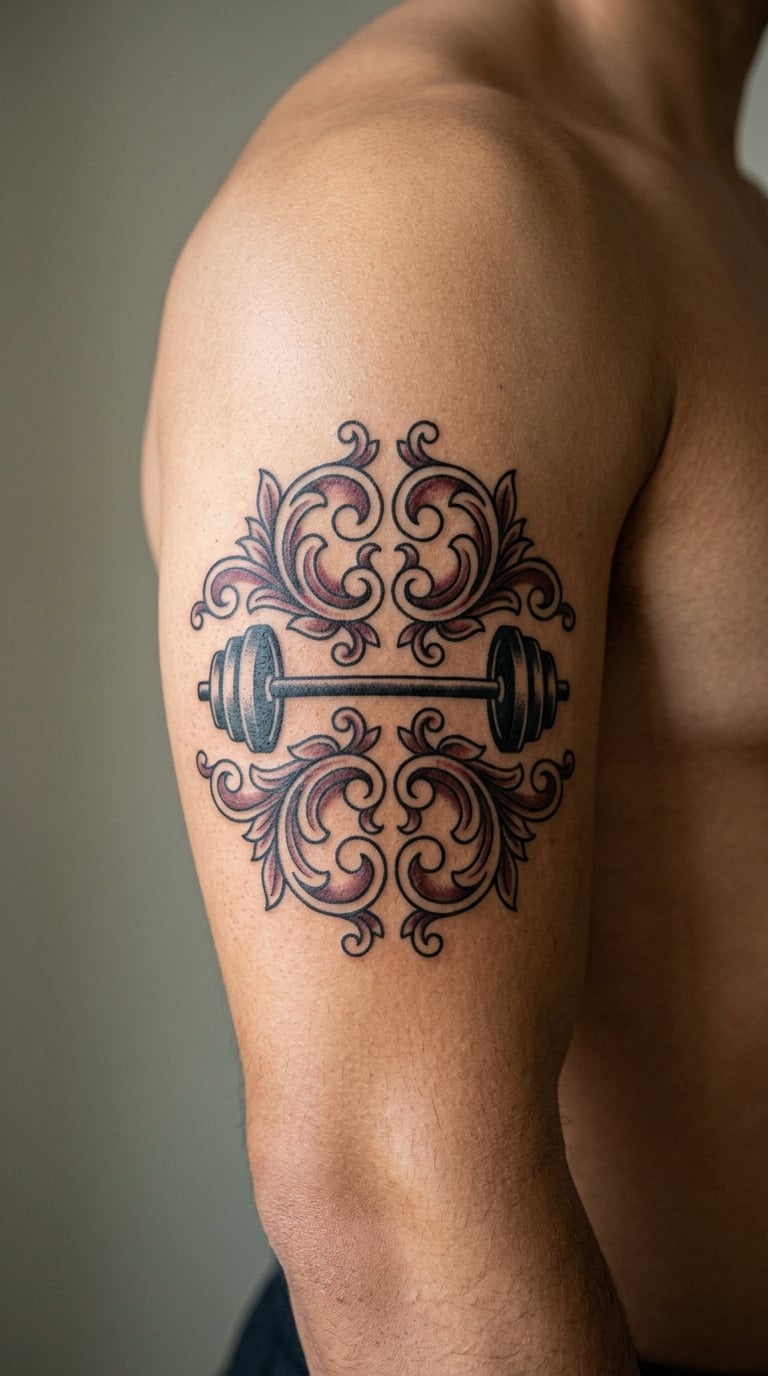
A barbell drawn in old school style, wrapped in symmetrical scrollwork with a few leaves turning out of the frame, and one restrained hit of red in the shading. Heavy outlines, visible stipple, nothing grey and wispy about it.
Traditional work is the opposite of the fine-line pieces, and that is the appeal if your training is a long family habit. It looks like it belongs on an arm that has been in a gym for twenty years.
Placement: outer upper arm or thigh, anywhere with a flat enough surface for the scrollwork to sit square. Size: 4–6 inches (10–15 cm). Style: traditional, bold outlines with red accents.
Pain: medium, and shaded traditional pieces take the longest session of anything on this list. The line work ages better than almost any other style, which is the trade for the time it takes.
Make it yours: have the red pulled from a colour you already wear, or tuck a date into the negative space between the scrolls.
5. Micro-Realist Barbell Plate
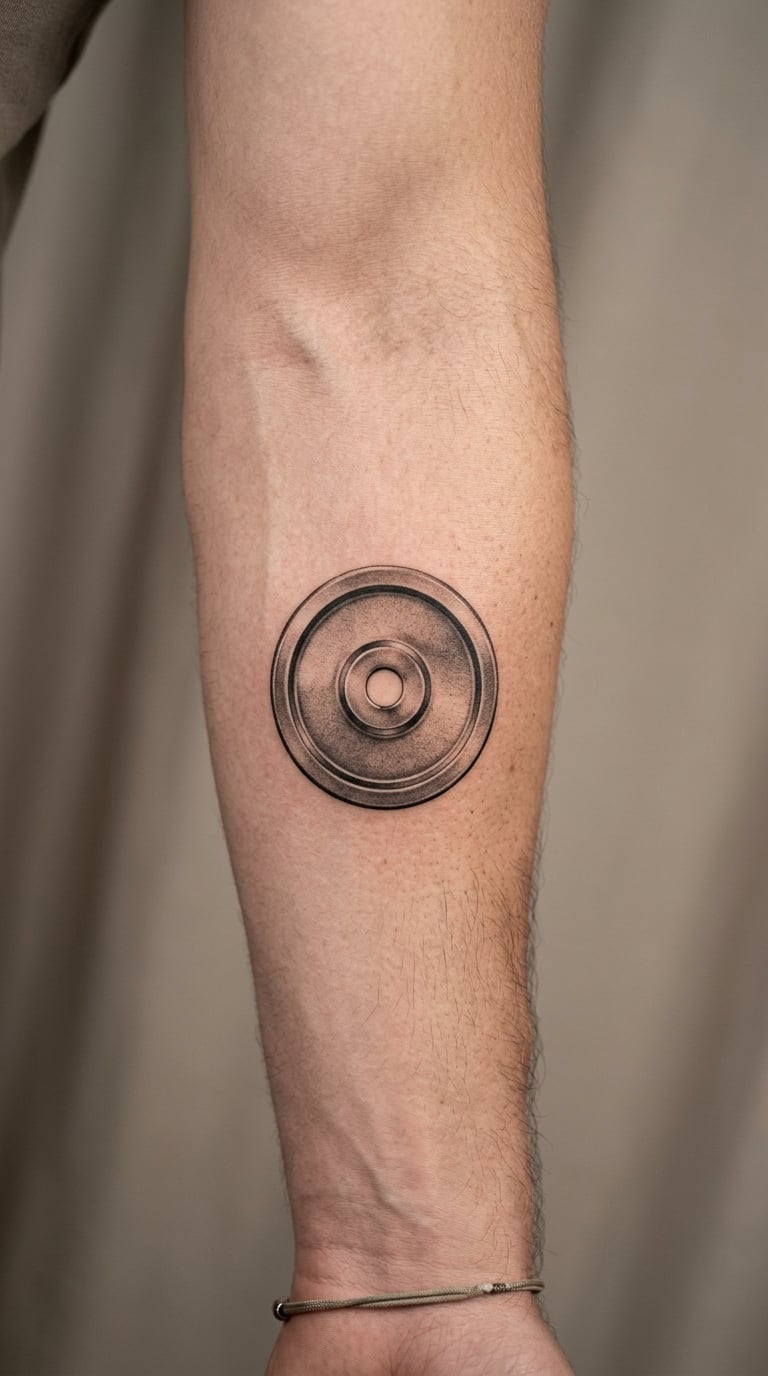
One Olympic plate shaded in black and grey, close enough to see the bevel of the collar hole and the slightly worn rim, with no brand name anywhere on it. The kind of detail that only reads at arm’s length, which is the point.
It is a quiet gym tattoo. Nobody across the room parses a plate, so it works for lifters who want the reference to be theirs rather than a public statement.
Placement: inner forearm or the inner bicep, flat areas where a circle can sit without distortion. Size: 1.5–2.5 inches (4–6 cm) across. Style: micro-realism, black and grey.
Pain: medium. Tiny shading detail blurs as it ages, so a designer who works in this size will build the highlights a little larger than the reference photo.
Make it yours: have the plate weight etched where the numbers would sit, using the load you actually train with.
6. Olympic Lifting Plate Mosaic
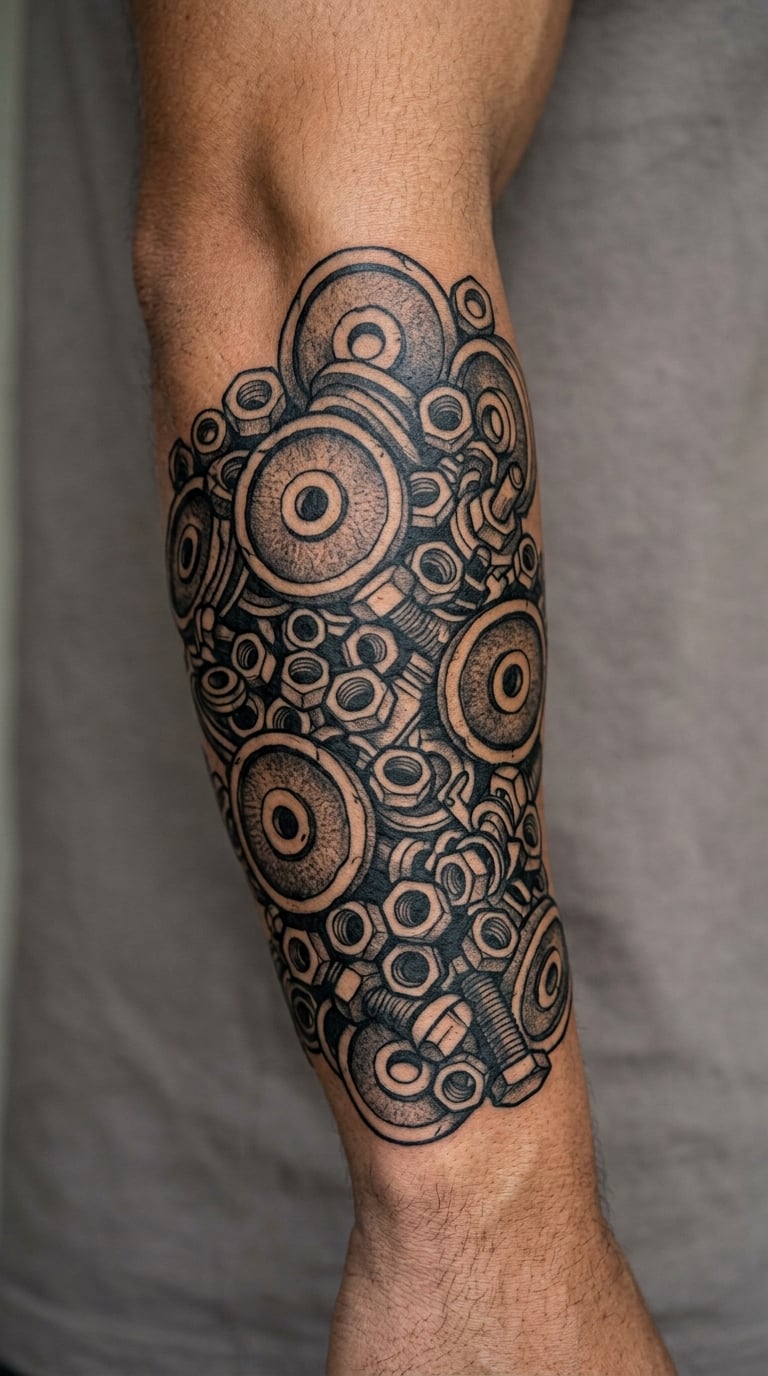
Simplified plates, hex nuts and bar holes tiled edge to edge with no gaps, all filled solid black with white lines separating each shape. It reads as texture from a distance and as gym hardware up close.
Graphic work like this suits someone who does not want a picture of a barbell so much as a pattern built out of the objects. It also hides well inside a larger sleeve project, and the 20 best black sleeve tattoo ideas for men covers how heavy black fills behave once a whole arm is in play.
Placement: outer forearm, calf or upper arm, and it wants a surface that can carry four inches of pattern without the shapes bending. Size: 4–7 inches (10–18 cm). Style: blackwork, geometric tessellation.
Pain: medium, and solid black over a wide area is a long sitting. Blackwork holds its edges better than any other style, so this is the most durable design in the roundup.
Make it yours: let one plate in the pattern sit in colour, a red or a deep blue, and it stops being a texture and becomes a signature.
7. Kettlebell and Laurel Wreath
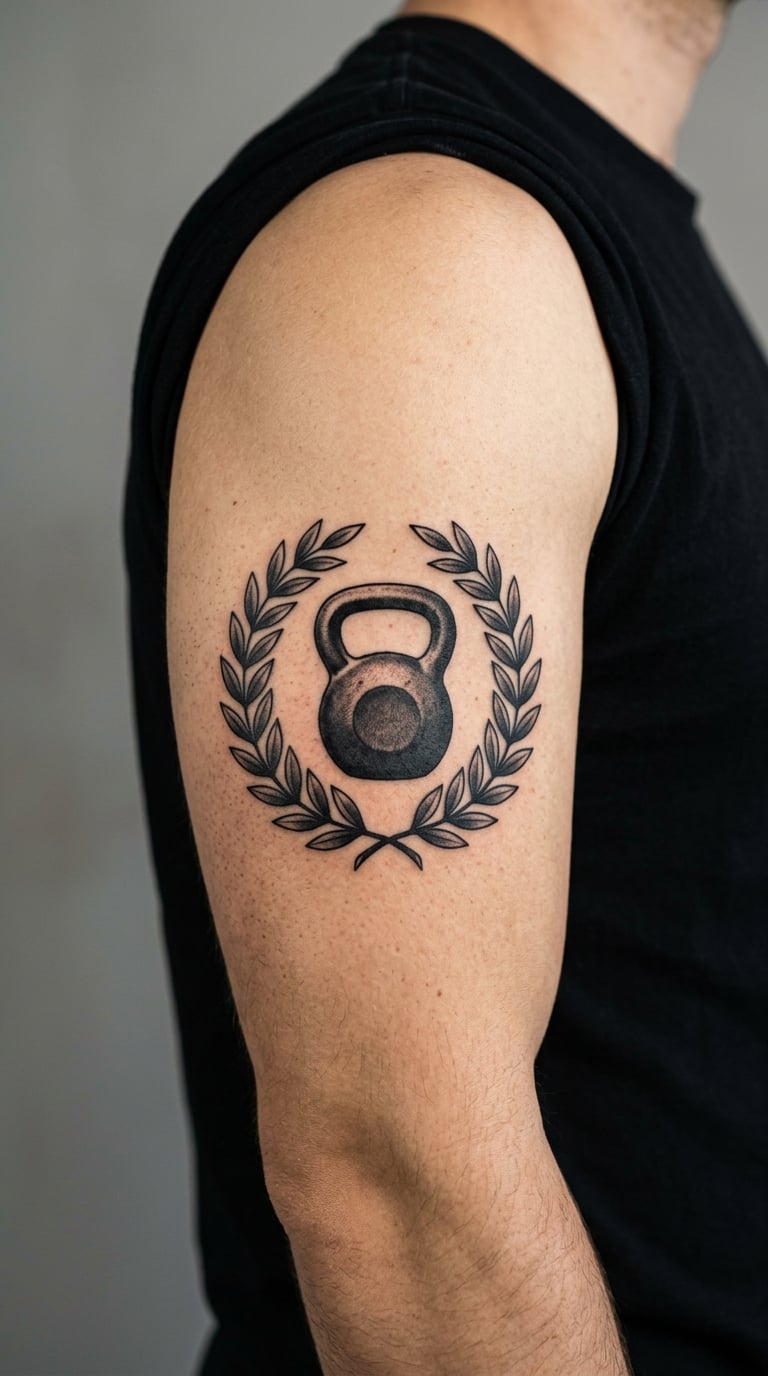
A kettlebell centred in a symmetrical laurel wreath, the bell drawn with a heavy outline and a soft grey gradient inside the handle, the leaves in solid black. It is the closest thing on this list to an old emblem.
Wreaths are a long-standing symbol of effort and standing, and pairing one with a bell turns the tattoo into a badge rather than a snapshot. It suits someone who likes symbols that age well.
Placement: outer upper arm or calf, vertical orientation, centred over the muscle. Size: 3–5 inches (7.5–12.5 cm) tall. Style: bold linework with restrained black and grey shading.
Pain: medium. The wreath symmetry means more line work than the kettlebell alone, and symmetry is what makes the session long.
Make it yours: engrave a single initial inside the bell, or a weight on the base of the wreath where a stem would sit.
8. Hex Nut with Barbell Ends
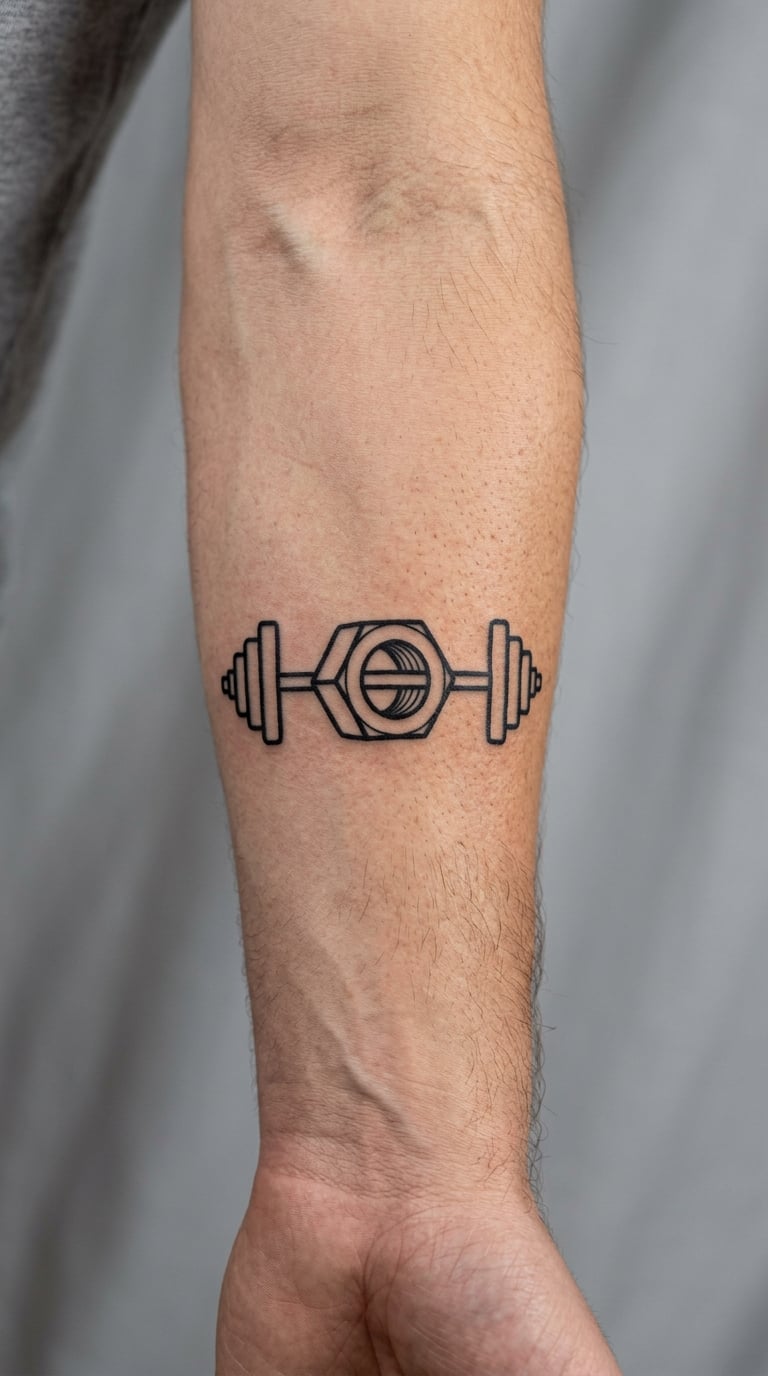
A single hex nut in the middle with simplified barbell ends growing out of either side, all in solid black with clean flat geometry. No gradients, no texture, just the three shapes locked together.
It is the mechanical, no-fuss take on a strength tattoo. The nut is the part of the gym nobody photographs, so it reads as insider rather than decoration.
Placement: inner forearm laid horizontally, or the calf. Size: 2.5–4 inches (6–10 cm) wide. Style: geometric, solid black.
Pain: medium. Flat shapes need fewer passes than shading, so it usually finishes inside one sitting even at the larger size.
Make it yours: have a small name or lift date engraved into the nut itself, where the threading detail usually goes.
9. Watercolor Rising Kettlebell
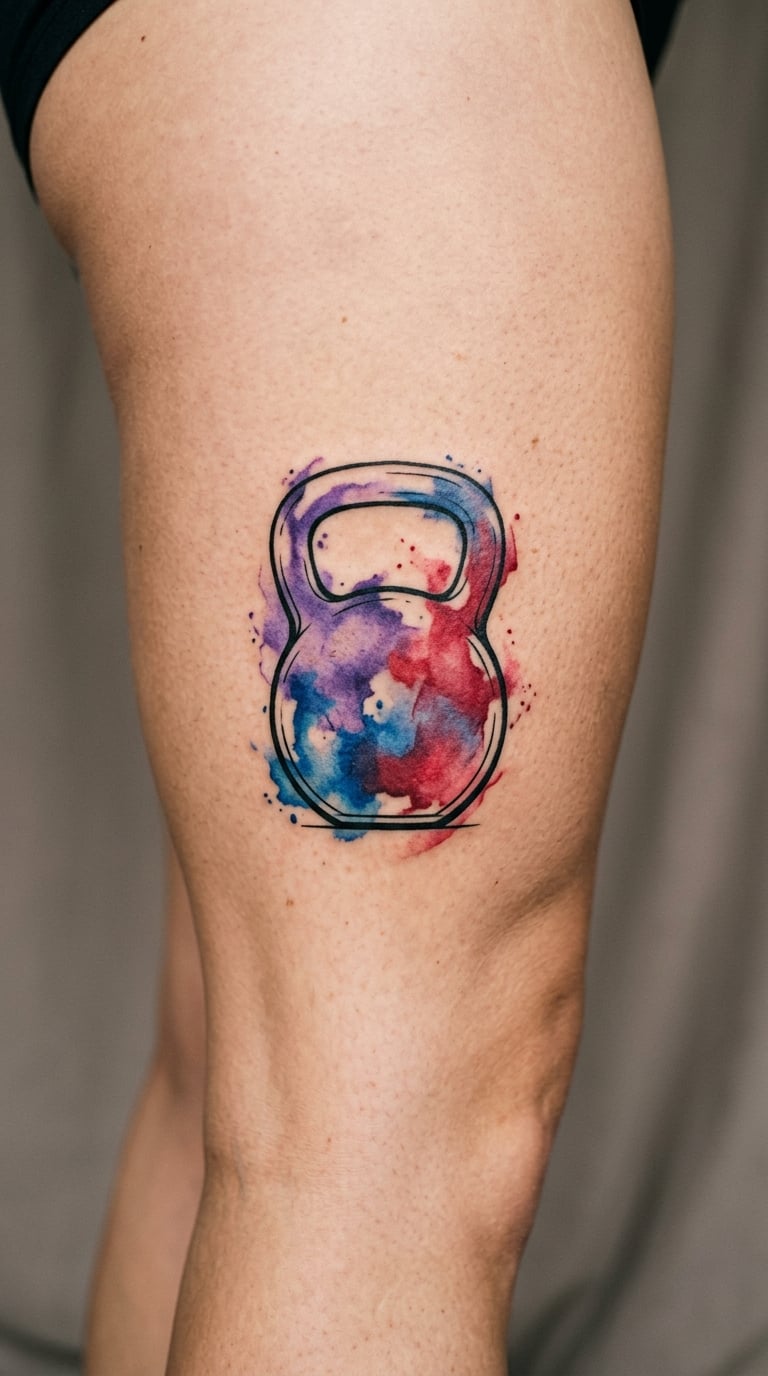
A kettlebell outlined in sharp black, with loose washes of violet, blue and red bleeding out from behind the shape. The colour stays outside the line, never filling the bell, which is what keeps the contrast readable.
Watercolor suits the lifter who trains seriously and does not want their arm to look like a gym logo. The loose pigment reads as movement, and it works as a standalone piece or as a bridge between two black and grey tattoos. If you are planning something larger on the leg, the 24 full leg tattoo ideas for women shows how scale reads across a whole limb.
Placement: outer shoulder, upper thigh or forearm, anywhere with flat skin for the wash to spread across. Size: 3–4 inches (7.5–10 cm) tall. Style: watercolor with black linework.
Pain: low to medium, colour fills go in quickly. Every colour bleeds that light will soften and grey over the first couple of years, so pick shades a step deeper than you want them to end up.
Make it yours: use the colours of a meet singlet, a flag, a team, or the gym where you hit your first total.
10. Powerlifter Silhouette
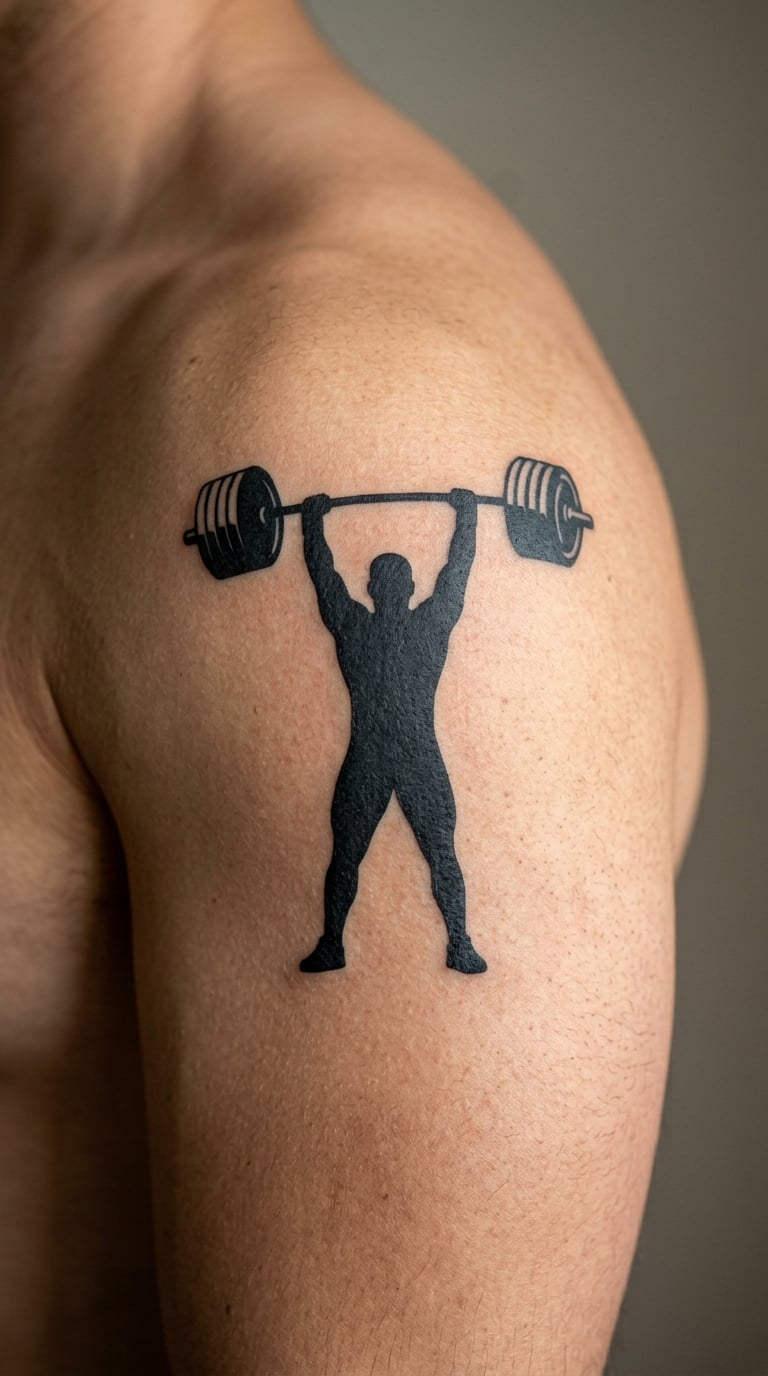
A side-profile lifter with a barbell locked overhead, filled solid black with no interior detail, the whole figure about five inches tall. Proportions follow a real lifter rather than an action-figure build, so it reads as strength instead of anatomy.
The squat, bench and deadlift are the three lifts behind the sport, and a figure under a bar is the most complete symbol available for that. It is the piece to choose when you want a person in the tattoo instead of equipment.
Placement: outer shoulder, upper back or calf. Size: 4–6 inches (10–15 cm) tall. Style: silhouette, solid black.
Pain: medium, and the shoulder is tender in a way the forearm is not. A solid silhouette has no interior detail to blur, so it is one of the few designs that looks identical in ten years.
Make it yours: place a small meet date under the figure, or the bodyweight class you competed in.
11. Deadlift Bar and Ground Line
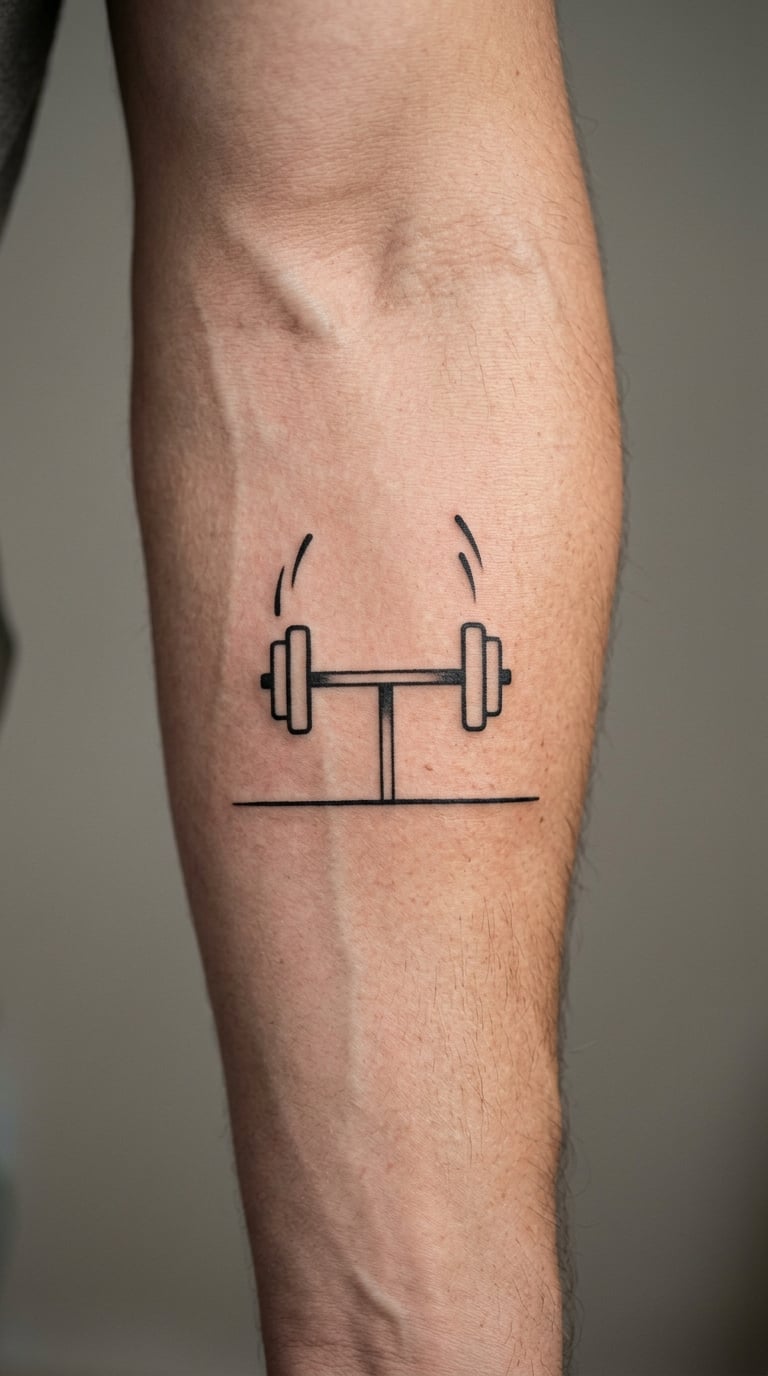
A barbell sitting on one unbroken horizontal line with two short motion marks trailing from the plates, nothing else in the composition. The line is the whole idea, the floor the bar is about to leave.
Of the three lifts, the deadlift usually gets the least ink, and this is the cleanest way to mark it. Minimal means the piece stays legible when the arm is covered by a sleeve or a long-sleeve shirt.
Placement: inner forearm or calf. Size: 3–4 inches (7.5–10 cm) wide. Style: minimalist, thin-to-medium line.
Pain: medium. Simple line work is quick, so the whole design is often under an hour, and the thinner strokes that age best are the ones you want here.
Make it yours: set the pull weight in small numerals beneath the line, or add the bar’s travel distance instead.
12. Bench Press Icon
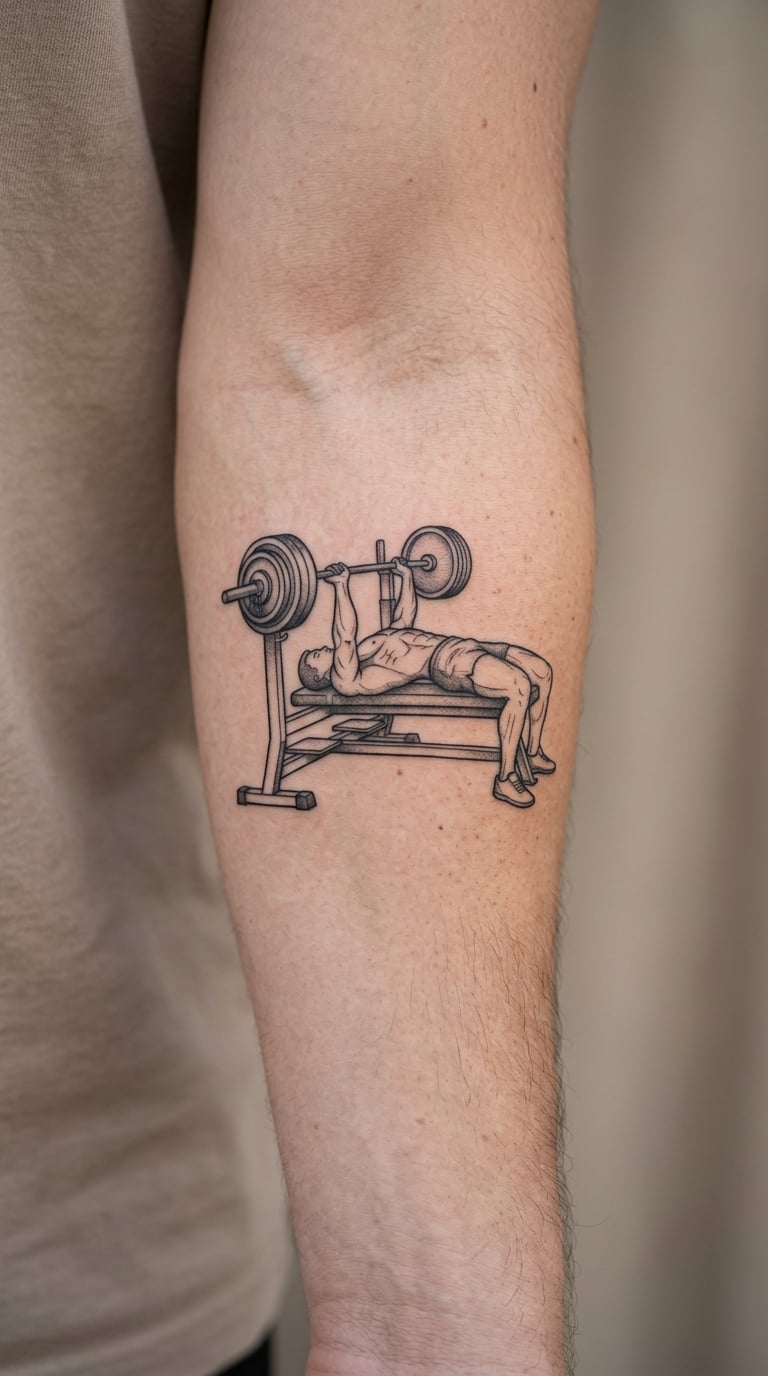
A side view of the press, a lifter lying on a flat bench with the bar above the chest, the rack uprights suggested by two straight lines. The lifter is a simple shape, not a rendered body, so the bench and the bar stay the focus.
Benches are personal. People talk about their squat, but almost everyone has one barbell path and one bench they care about, which makes this a good piece to attach a specific memory to.
Placement: outer forearm laid horizontally, upper arm, or the ribs. Size: 3–5 inches (7.5–12.5 cm) wide. Style: icon, black and grey.
Pain: medium, and ribs are noticeably more sensitive than an arm. A small lifter silhouette loses definition in a decade, so ask for thicker shapes than the reference suggests.
Make it yours: put the bench milestone under the icon, the weight, the reps, or the year you first hit the number.
13. Squat Rack Geometry
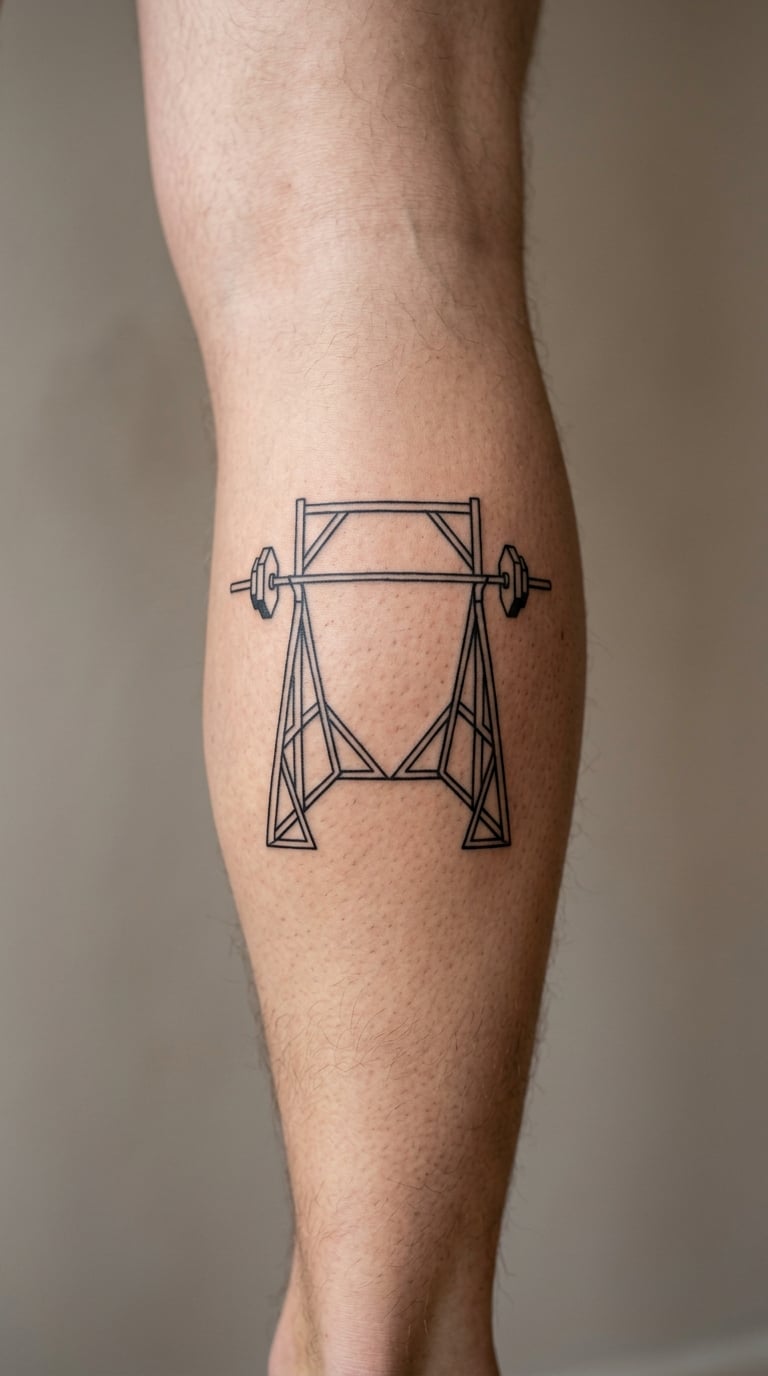
A squat rack reduced to its structure, two uprights, two triangular supports, the bar resting across, everything filled solid black with sharp straight edges. The shapes are simple enough to look designed rather than drawn.
It appeals to people who think of the rack as the piece of equipment that makes the sport possible, not the barbell. Geometric work is also the easiest style here to scale up later into a sleeve.
Placement: forearm, calf or thigh, all of which give you a straight vertical frame. Size: 3–6 inches (7.5–15 cm) wide. Style: geometric blackwork.
Pain: medium. Solid black shapes stay legible as the years pass, and the calf is a deep spot, so expect to sit still for it.
Make it yours: have one upright in a colour from your training gear, or add your squat number inside the triangle of the support.
14. Weight Plate Progress Line
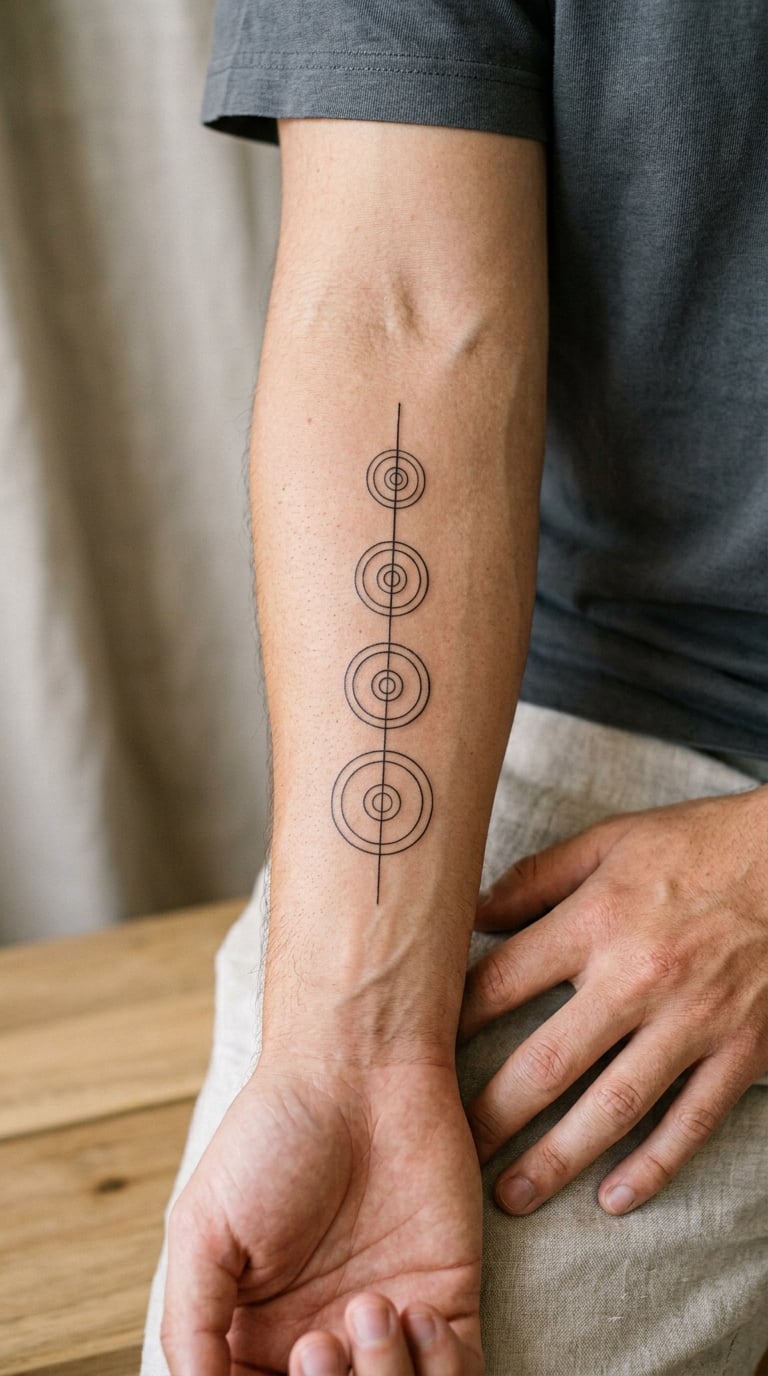
Five plate outlines in a row, each one slightly larger than the last, threaded onto a single line that runs through their centre holes. Thin outlines, no fill, the growth doing all the work.
It is a record of increasing load rather than a symbol with a fixed meaning, and that changes how it reads. What the smallest plate represents is entirely up to the lifter who wore it first.
Placement: inner forearm, where a horizontal row sits well along the bone. Size: 3–5 inches (7.5–12.5 cm) wide. Style: fine line, single-weight outline.
Pain: medium. The smallest plates are the weak point of the design, since outlines that thin tend to soften first, so keep them above a hairline.
Make it yours: have each plate match a real load, starting with the first weight you ever put on a bar and ending where you train now.
15. Lifting Belt and Barbell
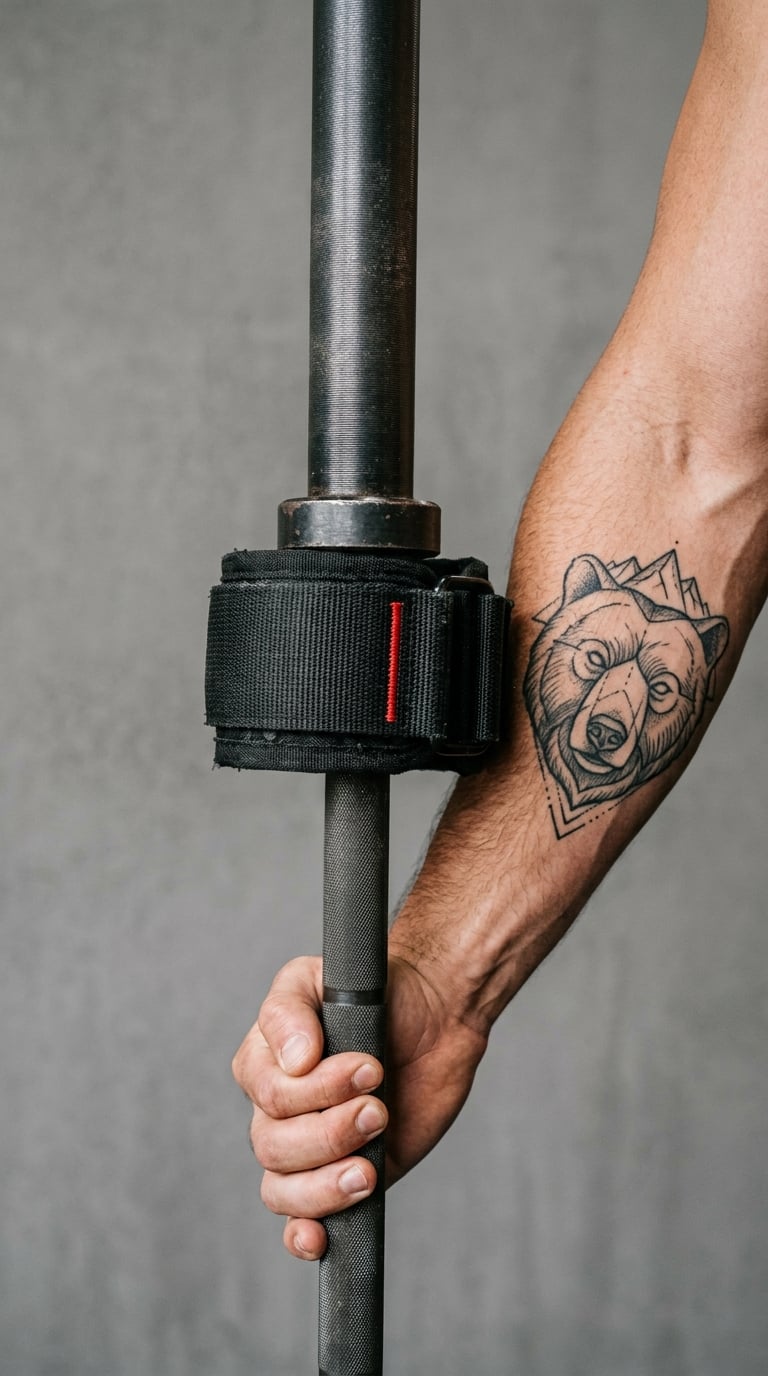
A leather lifting belt wrapped around a barbell sleeve, buckle fastened, the leather texture suggested with a few short lines rather than full shading. One run of stitching picks up a single colour so the eye has somewhere to land.
The belt is the object a lifter trusts more than anything else in the gym, which is a good reason to put it on skin. It is also a piece of equipment rather than a barbell, so it stands apart from the crowded barbell category.
Placement: forearm or upper arm, set diagonally so the belt reads as wrapping something. Size: 3–4 inches (7.5–10 cm) wide. Style: realistic with restrained black and grey shading.
Pain: medium. Leather texture needs controlled shading, and mixed line depth is harder to tattoo than a flat shape.
Make it yours: stitch in the colour of your actual belt, or reproduce the single hole you always use on the last inch of strap.
16. Wrist Strap and Hook
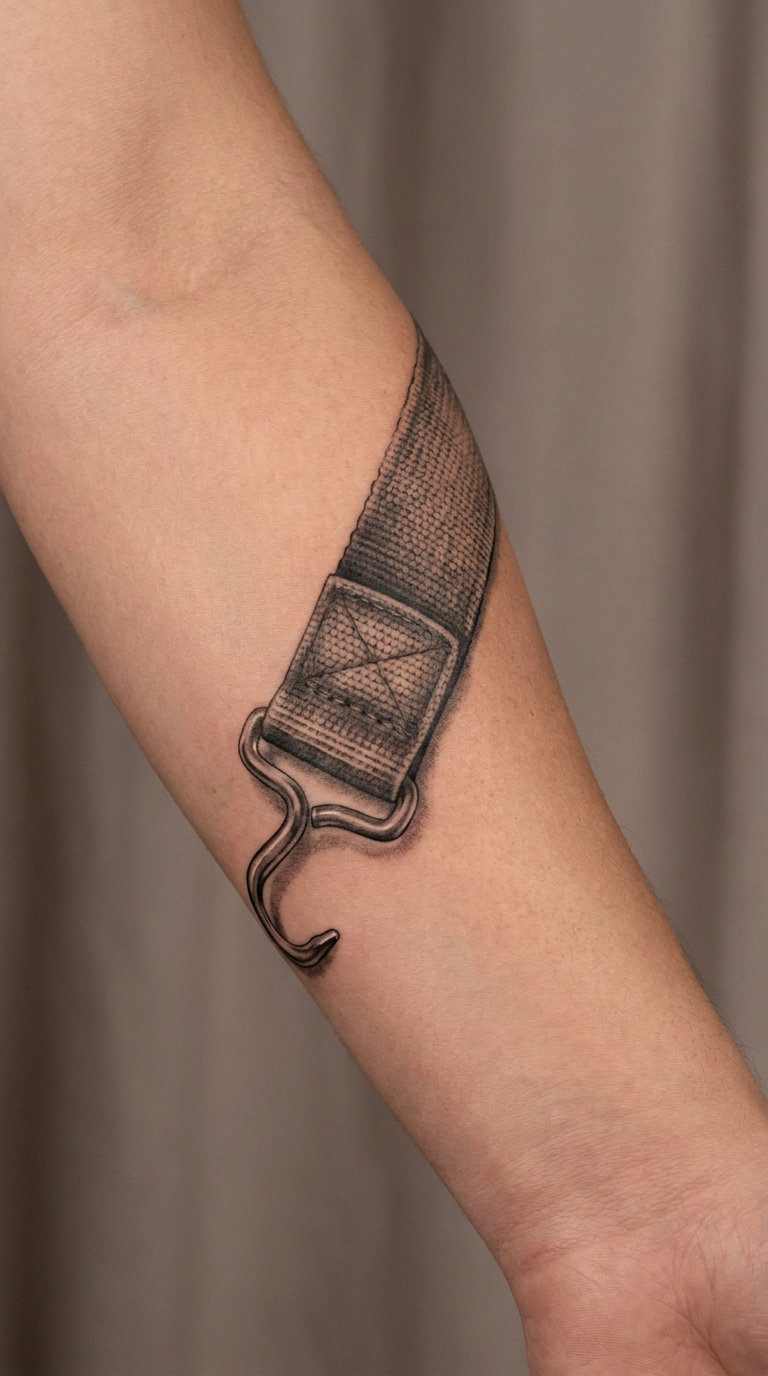
A wrist strap with its hook, rendered small and precise with the webbing texture and the metal hook shaded separately. Laid diagonally across the inner forearm so it follows the line of the tendon rather than fighting it.
This is the accessory most people only notice when someone pulls a heavy set, which makes it a good choice for a lifter who likes the unglamorous end of the sport.
Placement: inner forearm, diagonal, close to the wrist. Size: 2–3 inches (5–7.5 cm) wide. Style: black and grey realism.
Pain: medium, and the inner wrist is sensitive because the skin is thin and the nerve sits close to the surface. Fine texture is the first thing to blur, so a designer will simplify the webbing as the piece ages.
Make it yours: have a monogram or two letters worked into the strap end where the brand tag usually sits.
17. Barbell Bell in Blackwork
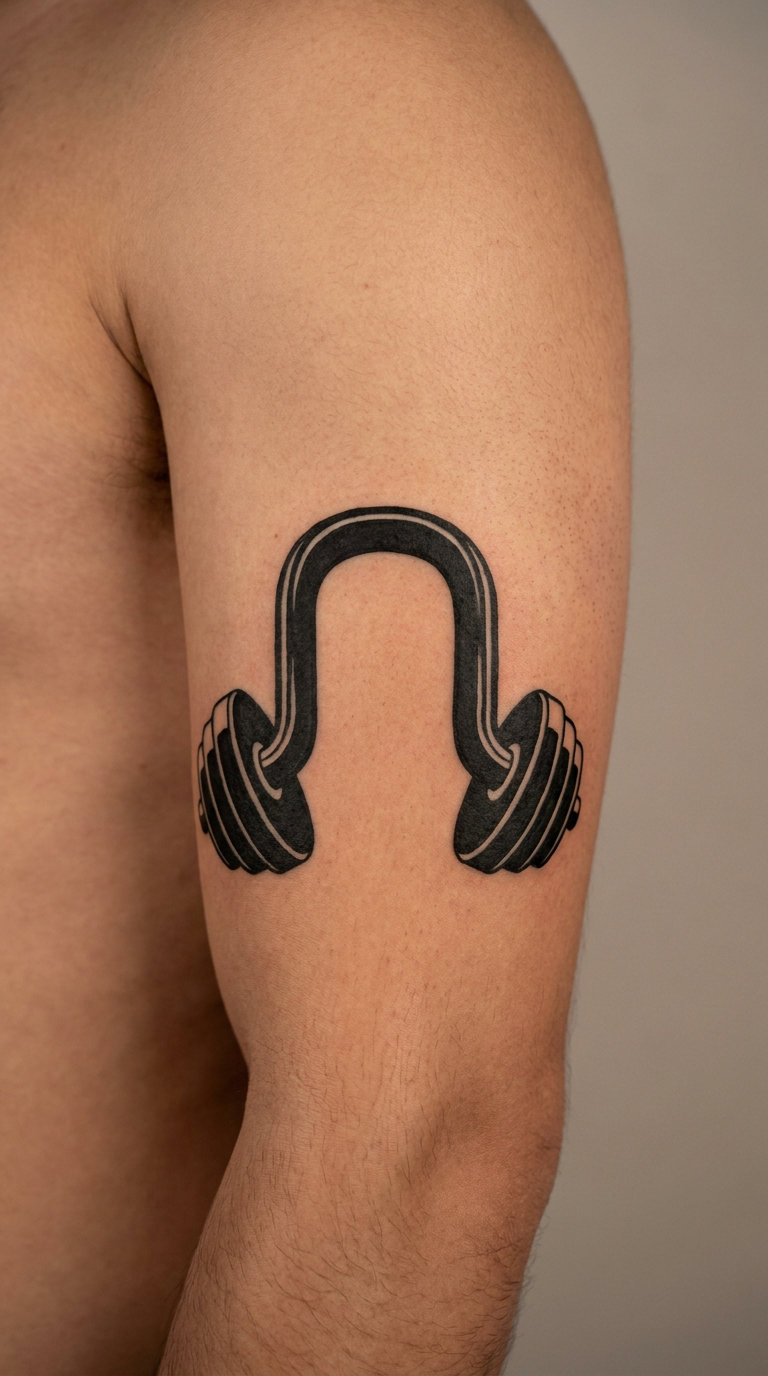
A loaded barbell whose plates flare outward until the whole shape reads as a bell, filled in solid black with a few carved white gaps to keep the plates separate. Nothing is shaded, the drama comes entirely from mass.
It works as a standalone statement piece for someone who wants an upper arm covered by one image rather than a collection. Heavy black at five inches also reads clearly from across a room.
Placement: outer upper arm, upper back or thigh, wherever there is room for the flare without crowding the joint. Size: 4–6 inches (10–15 cm) tall. Style: blackwork with negative space.
Pain: medium, and a solid fill this wide is a long session. Blackwork is the most durable finish you can pick, which is the reason to spend the hours.
Make it yours: carve white line detail into the bell, or leave one small red shape inside the black so the piece has a single point of colour.
18. Chalk-Hand Barbell Outline
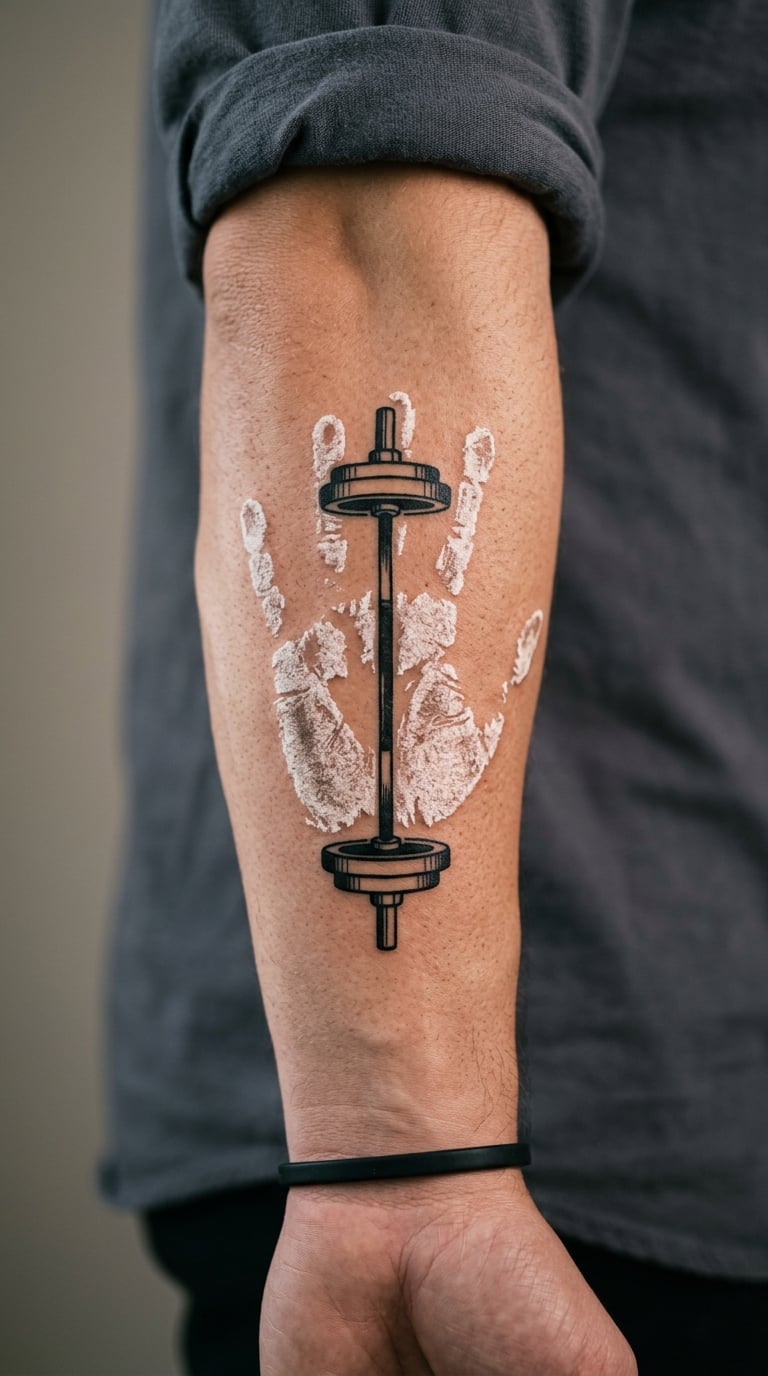
A barbell drawn in simple outline, ringed by the powdery broken edges of a chalked handprint. The chalk is done in negative space, left as bare skin with scattered speckled lines where the hand pressed hardest.
It is the most personal of the equipment designs, because chalk is a specific memory rather than a generic gym symbol. It also breaks up a plain forearm without adding much ink.
Placement: forearm, thigh or shoulder, set over an area with some hair texture to catch the powder effect. Size: 3–5 inches (7.5–12.5 cm) wide. Style: fine line with speckle texture.
Pain: low to medium, since a lot of the design is untouched skin. Speckled work softens visibly, so the powder edges will relax into a blur over time, which most wearers like.
Make it yours: trace your own hand before the session and bring a clear photo of the outline for the artist to work from.
19. Olympic Bar Clipped at Mid-Cable
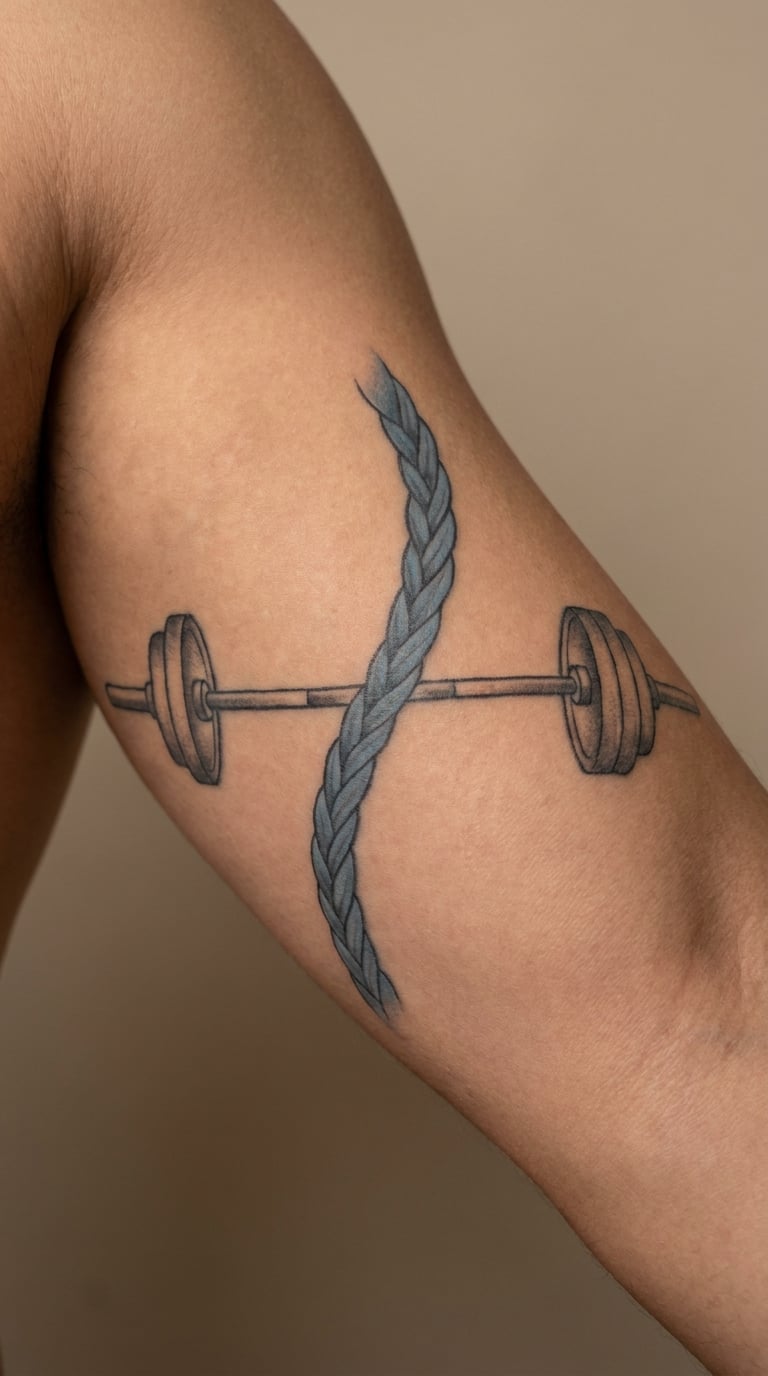
An Olympic bar seen from the side, one cable from a crossover machine passing straight through the middle of it. The bar is shaded in black and grey, the cable is a single coloured line, and nothing else is in the picture.
It suits the lifter who trains on machines as much as bars and does not think of them as lesser. The intersection is the design, so it only needs two objects to work.
Placement: outer shoulder, chest-side or forearm. Size: 3–4 inches (7.5–10 cm) wide. Style: black and grey realism with one colour accent.
Pain: medium. Dimensional shading softens faster than flat shapes, so expect the bar’s edges to relax a little, and the shoulder is a deep spot for a piece this size.
Make it yours: colour the cable, and put your home gym or your meet date in the sleeve area where the knurling pattern sits.
20. Minimal Two-Plate Gym Icon
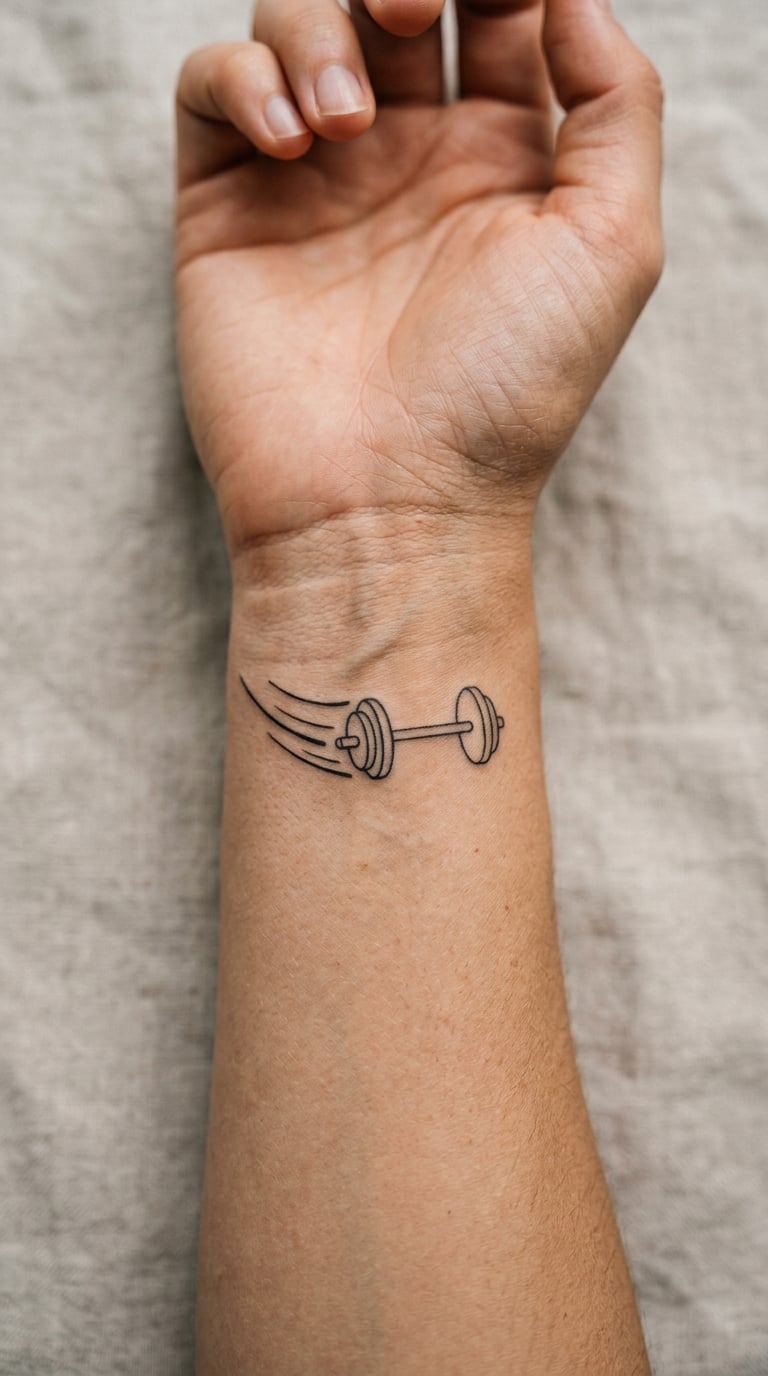
Two plates facing each other on a short bar, with three clean motion lines behind them and nothing else. Thin, even, consistent strokes, the whole thing about two inches across.
It is the most approachable first gym tattoo on the list, small enough to sit somewhere you can hide it and simple enough that almost any artist can execute it well. Start here if you are not sure how much ink you want yet.
Placement: inner wrist, forearm or calf. Size: 1.5–2.5 inches (4–6 cm) wide. Style: minimalist, thin black line.
Pain: low to medium. Small line work is quick, but the wrist and inner arm are sensitive, so expect the last fifteen minutes to be the loud ones.
Make it yours: fill one plate in a single colour that means something to you, or size the two plates to the loads you actually train.
How to Choose the Right Design
Start with your training identity, not the picture. A lift that matters to you, a meet you finished, a coach you still think about, that tells you more about the right design than any gallery ever will.
Then match the style to how the design ages. Fine line and continuous line soften fastest and need a touch-up every few years, blackwork and traditional line work hold their edges the longest, and micro-realism sits in between.
Place it where the body changes least if you want it to stay true. Forearms, calves and upper arms are reasonably stable, while pecs, stomachs and shoulders stretch the most during a bulk or a cut, which is the single most repeated worry in lifting tattoo discussions.
Size it honestly. A design sketched at six inches rarely works at two, and the reverse is just as true, so ask the artist to draw it at the exact size before you commit.
Think about what is already on you. A fine-line piece next to heavy blackwork reads as an accident, while two designs sharing a line weight read as a set you chose.
Finally, collect references. Save ten to twenty healed photos, note the ones that hold up after five years, and walk into a consultation with a portfolio and a clear statement of size and placement. Confirm the final drawing with a professional tattoo artist before any needle touches skin.
Cost and Session Time
Tattoo studios in the US usually charge by the hour, and most have a shop minimum that covers the shortest session. Rates vary enormously by city and by artist, and an artist with a full book will not move on price.
As a rough guide for planning, micro work around two inches or under often fits inside the shop minimum. A three to five inch single-colour design is typically a one-hour session, and a five to seven inch blackwork piece with grey shading is usually a half-day.
Anything that blends or wraps, a shoulder piece running into the chest or a pattern covering a forearm, is a multi-session job for nearly every artist. Complex custom illustration adds time on top of the size, because the artist is drawing as they go.
What drives the price is the artist’s hourly rate, the total hours, and how much detail the design carries. Two designs that look similar on a screen can differ by an hour of session time depending on the shading.
Aftercare Basics
- Follow your artist’s aftercare instructions first, every time, because healing advice changes with skin type, placement and ink.
- Wash gently with clean lukewarm water and a fragrance-free cleanser, then pat dry with something you have not used on the rest of your body.
- Protect the area from direct sun while it heals, since fresh ink fades fastest in the first weeks and the shoulder and upper arm catch more sun than most people expect.
- Wear loose, breathable clothing over the tattoo, and change out of anything that traps sweat against it during a training session.
- Keep swimming pools, hot tubs and open water off the area while the skin is still healing, and let chlorine and salt do their damage later.
- Do not rub, scratch or soak the piece, and skip abrasive exfoliation and tight clothing edges while the linework is still settling.
- Watch it rather than touching it, and message your artist or a licensed clinician if redness, swelling or discharge persists instead of settling down.
- Ask your artist directly when you can start training again, and ease back in, since heavy loading through a fresh tattoo can push ink out of the surrounding skin.
Frequently Asked Questions
Where should a weightlifting tattoo be placed?
Forearms, calves and upper arms are the easiest long-term spots because they change size less than a chest or stomach does during a bulk or cut. An inner forearm suits small barbell and kettlebell designs, a shoulder or upper back suits silhouettes and larger work, and ribs suit bench press icons. Pick the spot before the design, then size the drawing to that exact area.
What is the best small weightlifting tattoo for a beginner?
The minimal two-plate gym icon at number 20 is the safest first choice, at around two inches and made from a handful of thin lines. A fine-line kettlebell works equally well and is easier to hide at work. Both are quick sessions, easy to place, and simple enough that you will not regret the size while you are still figuring out what you want.
Are weightlifting tattoos better in fine line or bold blackwork?
Fine line looks delicate and modern, and it suits small designs, but it softens and spreads within a few years and usually needs touch-ups. Bold blackwork holds its shape for decades, hides small imperfections, and is easier to read from a distance. Pick fine line for subtlety and quick healing, and blackwork if you want the design to still look sharp in fifteen years.
Do weightlifting tattoos hurt more on the wrist, arm or leg?
The inner wrist and inner forearm sting the most, because the skin is thin and the nerve sits close to the surface. Arms and calves sit in the middle, and the calf is deep because the muscle is dense and the bone is near. Ribs and the inner bicep are the worst options. If you are new to tattoos, the outer forearm is the friendliest place to start.
How can I make a weightlifting tattoo personal without copying someone else?
Start from your own numbers rather than a design you found. Encode the load you hit, the meet total, the day you started training or the year you came back from injury, and let the artist build the composition around it. A one-rep max in your own unit, a plate marked with your working weight, or a chalk hand traced from your own palm all carry a meaning nobody else can claim.
Conclusion
Start with the minimal two-plate gym icon if this is your first tattoo and you would rather keep it small than regret it. If you are already building a collection, the blackwork barbell bell or the plate mosaic gives you a style that other pieces can sit next to without looking mismatched.
Either way, settle the placement and the size first, then bring healed references and your own numbers to a consultation. A professional tattoo artist can tell you in ten minutes which version of your idea will still look right in ten years.