
14 Wildflower Tattoo Ideas for the Spine (September 2026)
Wildflower tattoo ideas for the spine are the piece I get asked about most, usually by people who want something soft and personal that still reads clearly from across a room. A vertical run of meadow blooms down the vertebral column, from the nape at the back of your neck to the tailbone, hides under a shirt all week and turns an entire back into the canvas on the one night you wear something open.
If you are planning ahead, count backwards from the event. You want the piece fully healed and settled, not shiny and pink, so six to ten weeks is a realistic runway for a single sitting. Here are fourteen directions, each one sized and placed for a different stretch of spine.
What Is a Wildflower Spine Tattoo?
A wildflower spine tattoo is a vertical floral design placed down the line of the spine, from the nape to the lower back, built from meadow-style blooms such as daisies, poppies, cornflowers, chamomile and lavender. It is usually drawn as a single trailing stem, a stacked spray, or a loose vine that runs the length of the vertebral column and lets the body curve naturally through it.
The flowers are chosen for what they mean rather than for how formal they look. A wildflower meadow reads as freedom and untamed growth, which is why the style suits memorial pieces, birth flowers and anyone who wants a design that does not look like everyone else’s rose.
Why the Spine Works So Well for Wildflowers
The spine is a ready-made vertical axis. A stem that runs down it looks intentional from any angle, and the eye reads the line as lengthening rather than shortening, which is a genuine optical effect and not just a nice photograph. A client with a fuller shape in the lower back gets the same effect, because the design follows the longest uninterrupted line on the torso.
It is also the easiest dramatic placement to conceal at work and the easiest to reveal on purpose. That combination is unusual. A sleeve announces itself; a spine piece stays private until someone sees your back.
One honest warning before you fall for a reference photo. Organic, slightly asymmetric sprays are the right choice here, because they absorb natural spinal curvature and posture asymmetry. Rigid symmetrical designs, straight geometric columns and mandalas are the wrong ones, since they draw the eye straight to any curve that isn’t perfectly straight. If you have scoliosis, tell your artist on day one and ask them to break the design across the spine rather than split it cleanly down the middle.
The other thing to know is how the stencil gets on. A spine stencil must be applied while you are standing, because a design transferred while you are sitting or hunched warps the moment you stand up, and it stays crooked forever. Good artists will refuse to start until you are upright and have asked you to move through a few positions.
Where to Place It: From the Nape to the Tailbone
Not every design belongs on every segment. The spine is roughly five usable zones, and each one takes a different scale of flower comfortably.
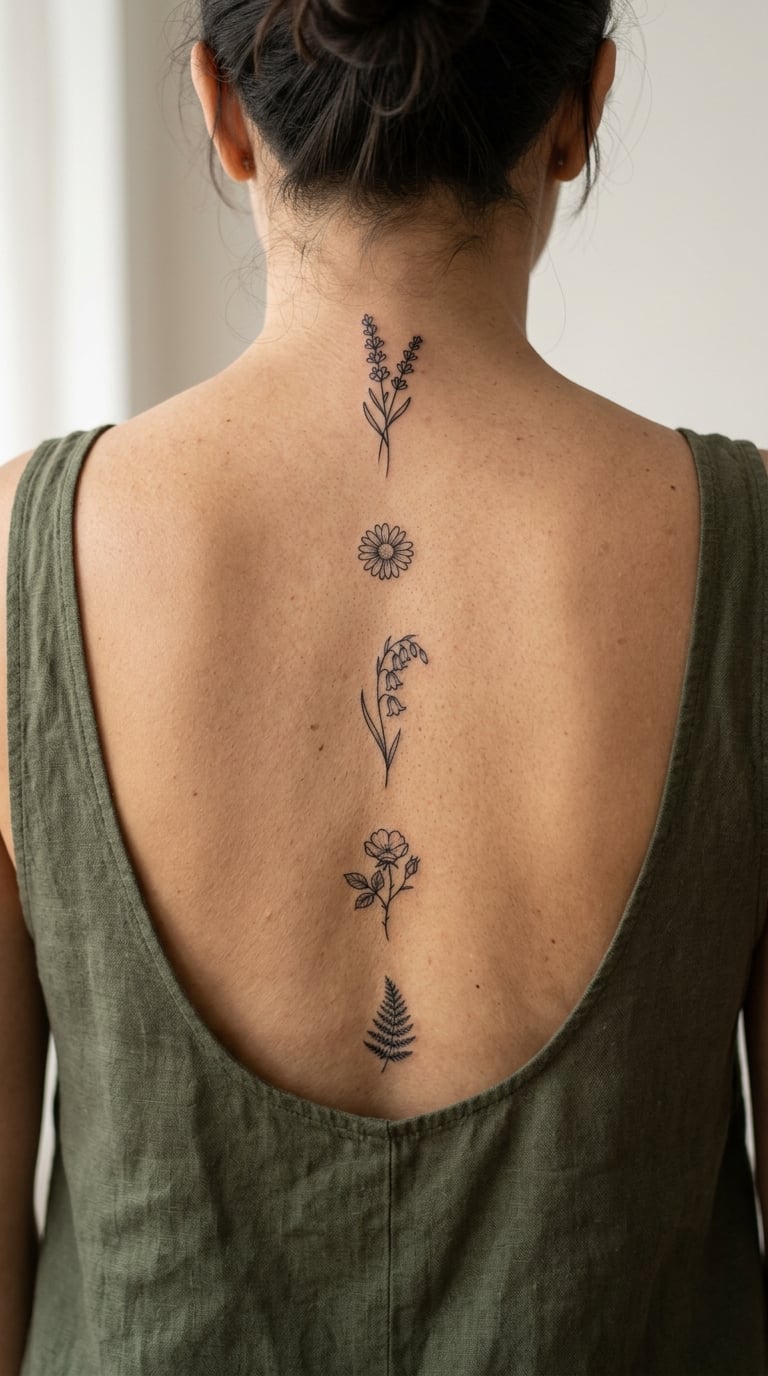
| Segment | What it looks like | Design scale that fits |
|---|---|---|
| Nape | Base of the skull, just above the hairline | One stem, three to five small blooms, roughly 10-15 cm tall |
| Upper thoracic | Between the shoulder blades | A single climbing vine or a wide horizontal spray, 20-30 cm across |
| Mid-back | Level with the bottom of the ribcage | A stacked spray or a loose bouquet, 15-20 cm |
| Lumbar | The small of the back, above the waistband line | A hanging bundle or trailing stems, 12-18 cm |
| Sacral and tailbone | The dimples above the tailbone | A single trailing stem or a small spray, 8-12 cm |
Most people start at the nape and grow the piece downward over a second session, which is far easier on the budget than booking one marathon sitting. Ask your artist to design the first segment so it can be extended later without redoing anything.
1. Single Fine-Line Daisy Stem Down the Spine
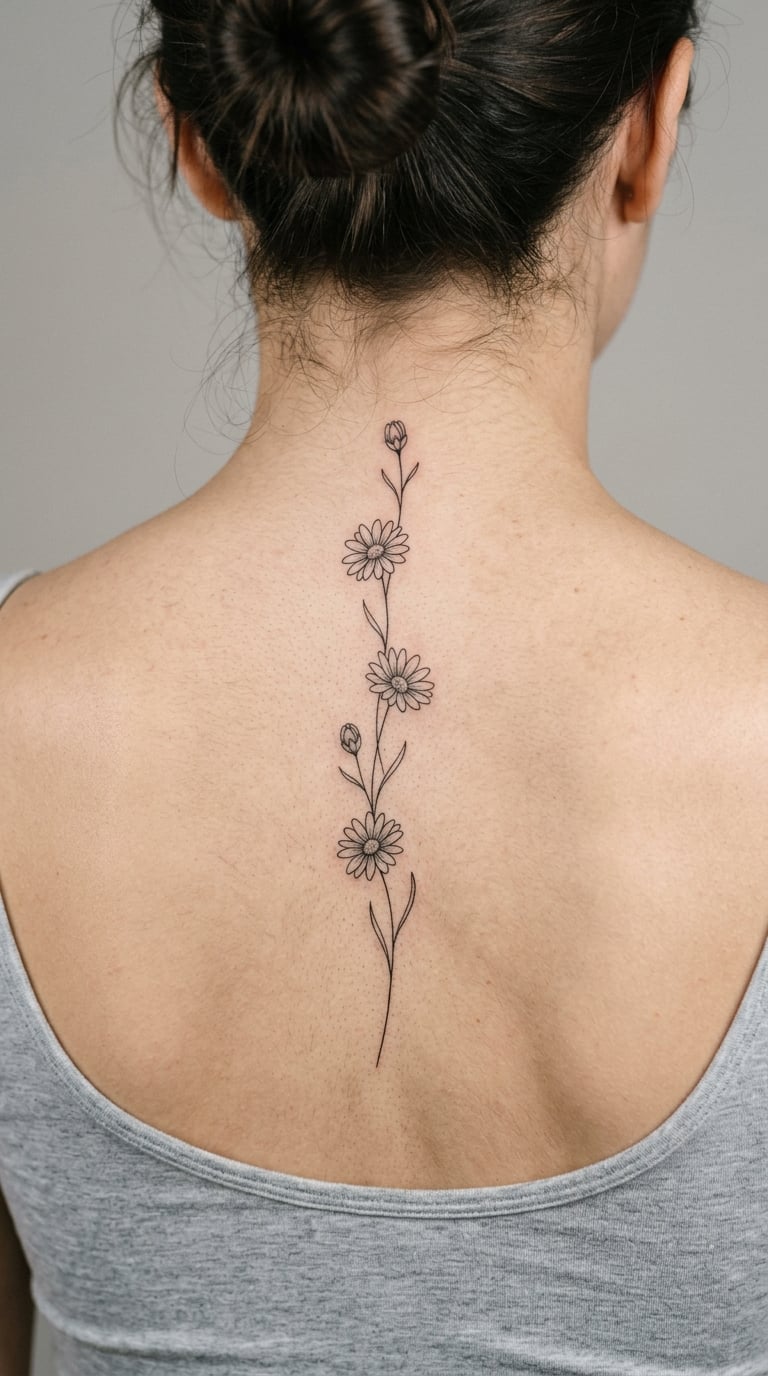
One stem, three daisies, two buds, nothing else. It is the most requested design in this whole category and the one I would suggest to anyone nervous about committing to a large back piece. A daisy reads as innocence and new beginnings without being twee, because the line work carries it rather than the flower.
Size it at 15 to 25 cm and run it from the nape to between the shoulder blades. Fine line, one-needle work, black ink only. The lines will soften and spread as it ages, so a daisy that looks crisp on day one turns slightly softer over five years, which is the charm of it. Keep the stem deliberately thin so there is room to add another flower later without it looking crowded.
Pain and time: the nape and upper spine run 7 to 8 out of 10 for most people, and a piece this size is usually a single sitting of two to three hours. You will be lying on your front or standing for part of it, depending on the artist’s setup.
2. Climbing Wildflower Vine from One Shoulder Blade
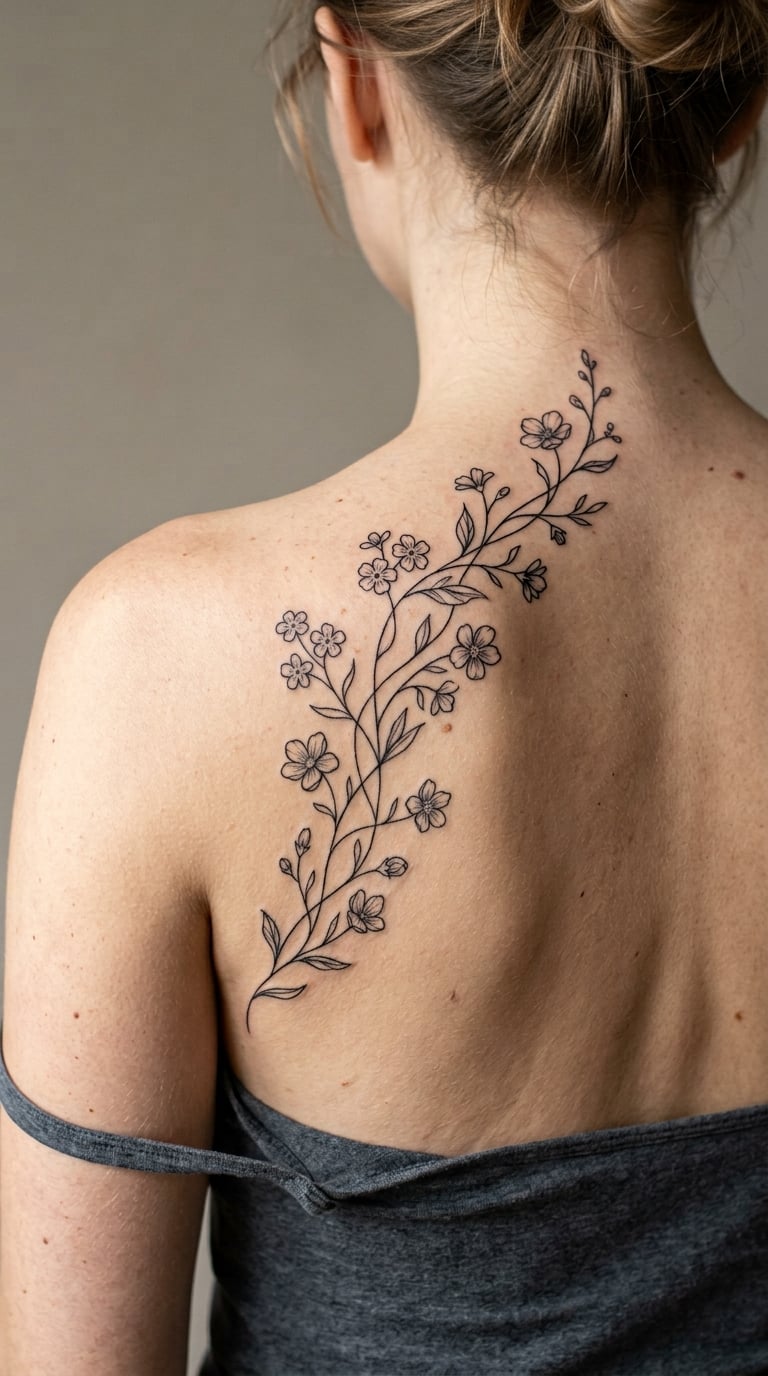
This one climbs rather than descends, which suits people who want a spine tattoo without a piece that reads as strictly symmetrical top to bottom. A vine enters from the lower edge of one shoulder blade, crosses toward the spine and breaks apart into smaller stems as it rises, so the design drifts off-axis in a controlled way.
Keep it to 20 to 30 cm across the upper back and let the stems thin out as they go. It ages well because a vine has natural gaps, and the empty space between stems is what keeps a fine-line piece from turning into a grey blur after a few summers. Pair it with small cosmos or cornflower shapes rather than larger daisy heads, which need more room than the gap allows.
Pain and time: the space between the shoulder blades is around 7 out of 10, and a vine of this length takes two to three hours, sometimes split into two shorter sittings if you want a break in the middle.
3. Poppy Spray Across the Mid-Back
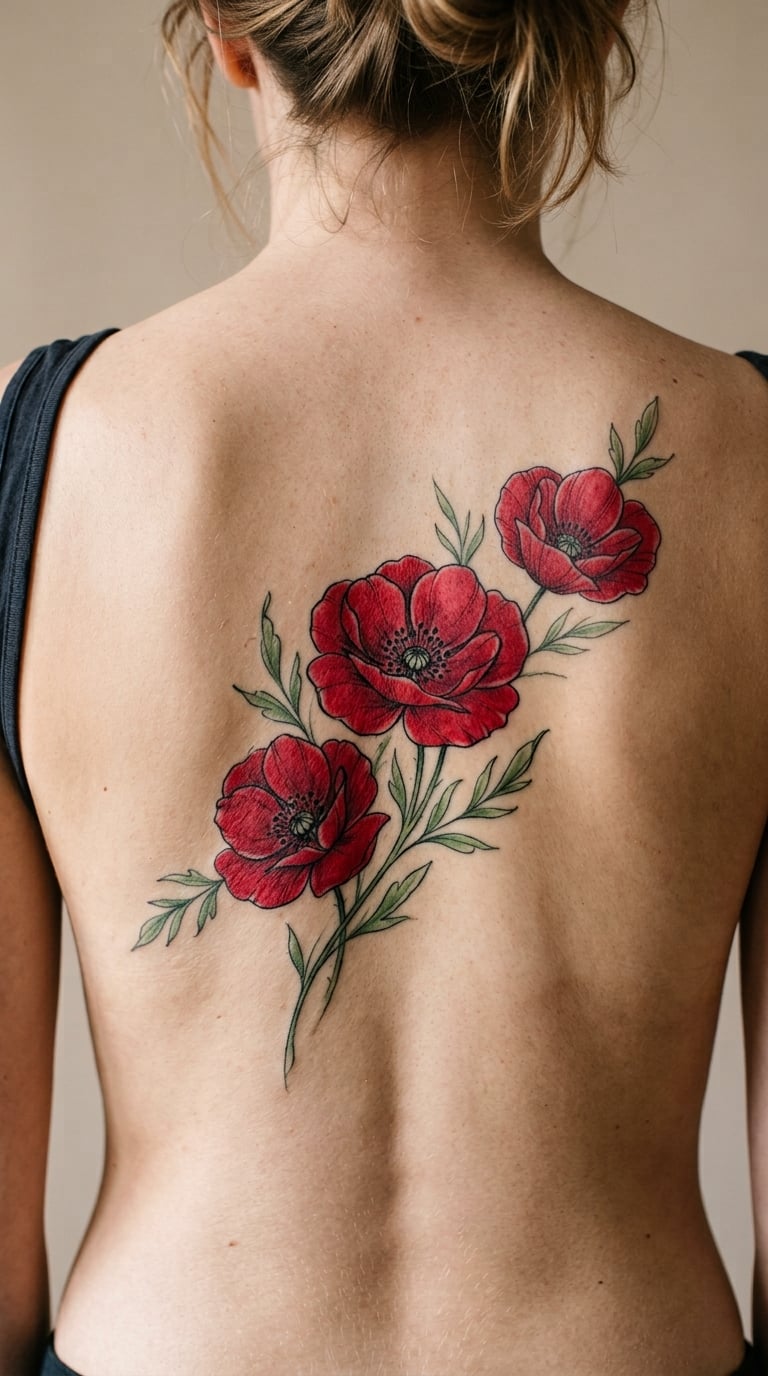
Poppies are the one meadow flower that justifies a bold colour on the spine. A spray of three across the mid-back, petals loose and slightly translucent, reads as a movement caught mid-air rather than a bouquet sitting still. Poppy traditionally means remembrance, so a lot of people land here without planning to.
Place it level with the bottom of the ribcage, about 20 cm across, and ask for a botanical style with visible stems rather than a traditional American style with heavy black outlines and yellow shadow. Colour poppies are hard to heal cleanly on the spine because the reds spread a little; a deeper red and a heavier deposit in the petal centres holds up better than a bright wash. Expect a touch-up on the colour at around six months.
Pain and time: mid-back is nearer 7 out of 10 than 8, but shaded colour takes longer to work, so budget three to four hours. Ask for a break halfway, because staying still on your front with colour being packed in is harder than the pain suggests.
4. Lavender and Chamomile Bundle at the Small of the Back
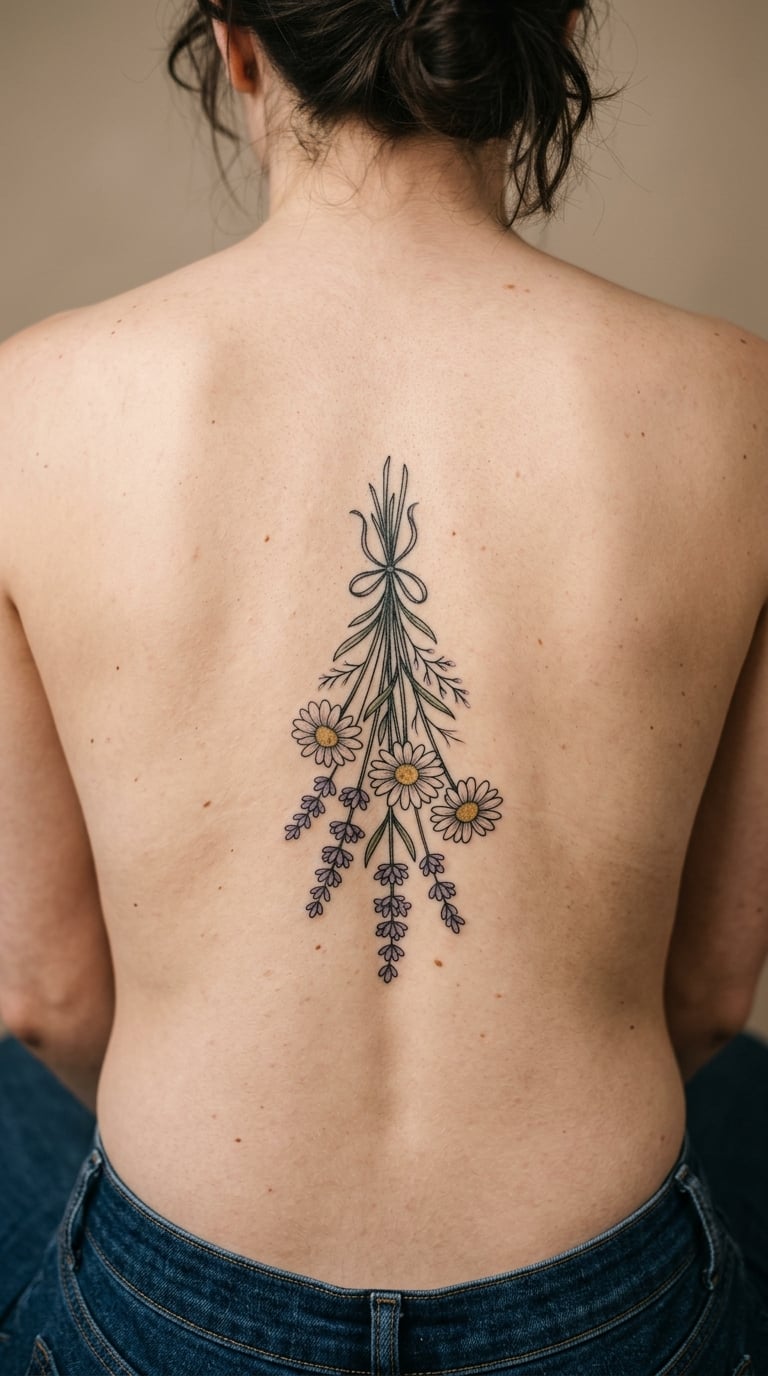
A bundle that hangs like a posy, tied at the top with a few trailing stems below. Lavender and chamomile are both useful herbs, which quietly reads as calm, healing and rest. That makes this a good pick for a first floral piece, because the meaning is gentle without being vague.
Keep it between 12 and 18 cm and hang it just above the waistband line, which is where the lumbar curve flattens the work out and shows it best. Muted purples and soft yellows sit more comfortably on the spine than bright tones, partly because the area catches strong sun through open tops. A black line base with a light colour wash over it heals more evenly than a full-colour piece.
Pain and time: the small of the back is a 6 to 7 for most people, one of the more forgiving spine spots. A bundle this size is two hours, maybe two and a half with the colour work.
5. Baby’s Breath and Cornflower Cloud Over the Shoulder Blades
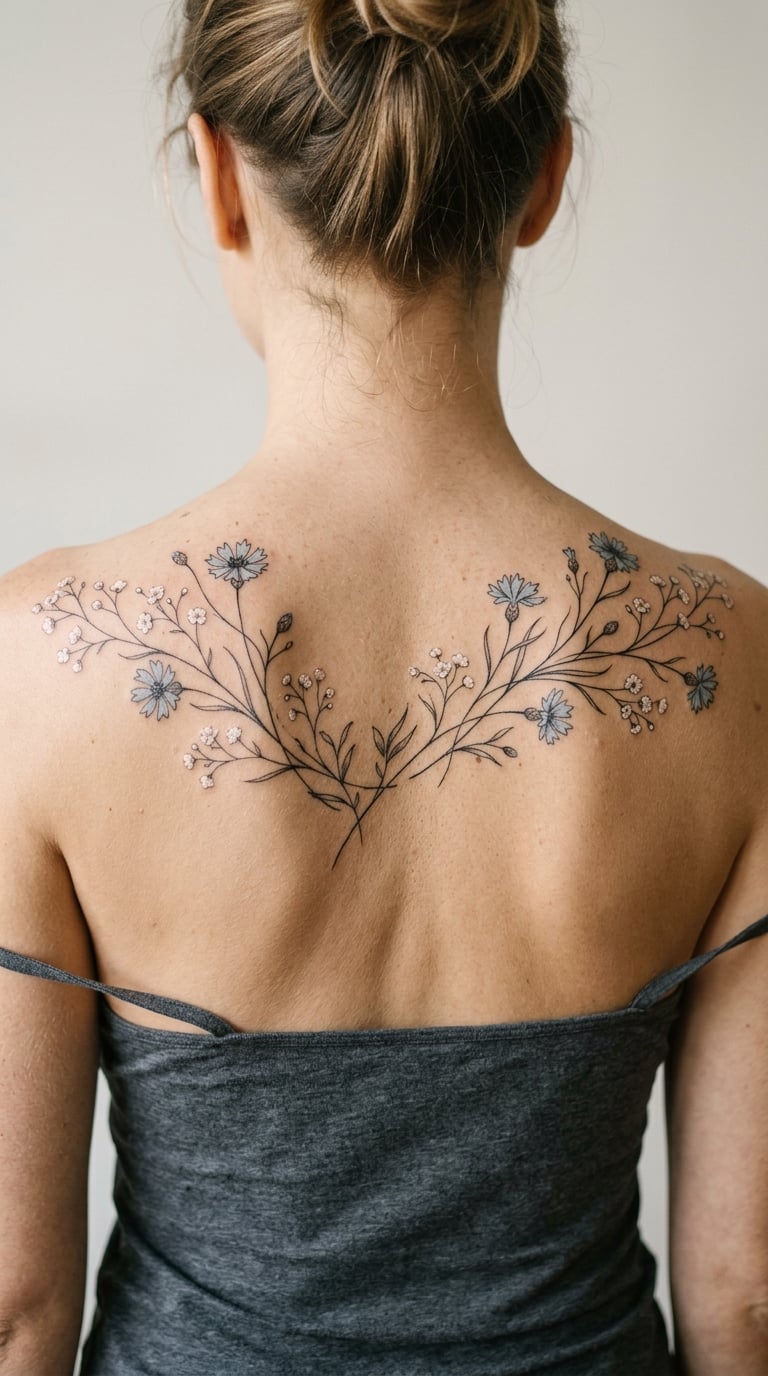
This is the widest design in the list and the one that most changes the shape of a back. Instead of running down the spine, it spreads horizontally across both shoulder blades, with the densest point just off-centre and the cloud thinning towards each shoulder. Cornflower is blue and associated with thoughtfulness and remembrance; baby’s breath is the filler that makes the whole thing look like air.
Allow 25 to 30 cm across, which is about the limit before the design starts to compete with shoulder movement. Keep every blossom under 2 cm, because at spine-adjacent scale anything bigger turns into a generic flower tattoo. The tails of the cloud should end unevenly, a few centimetres apart, or the piece will read as symmetrical and expose any curve in your posture.
Pain and time: both shoulder blades sit around 7 out of 10. Expect a long sitting of three to four hours, or plan two sessions, because there is a lot of surface area and the artist cannot rush small detail work without the lines thinning out.
6. Cosmos Stems Trailing Off the Tailbone
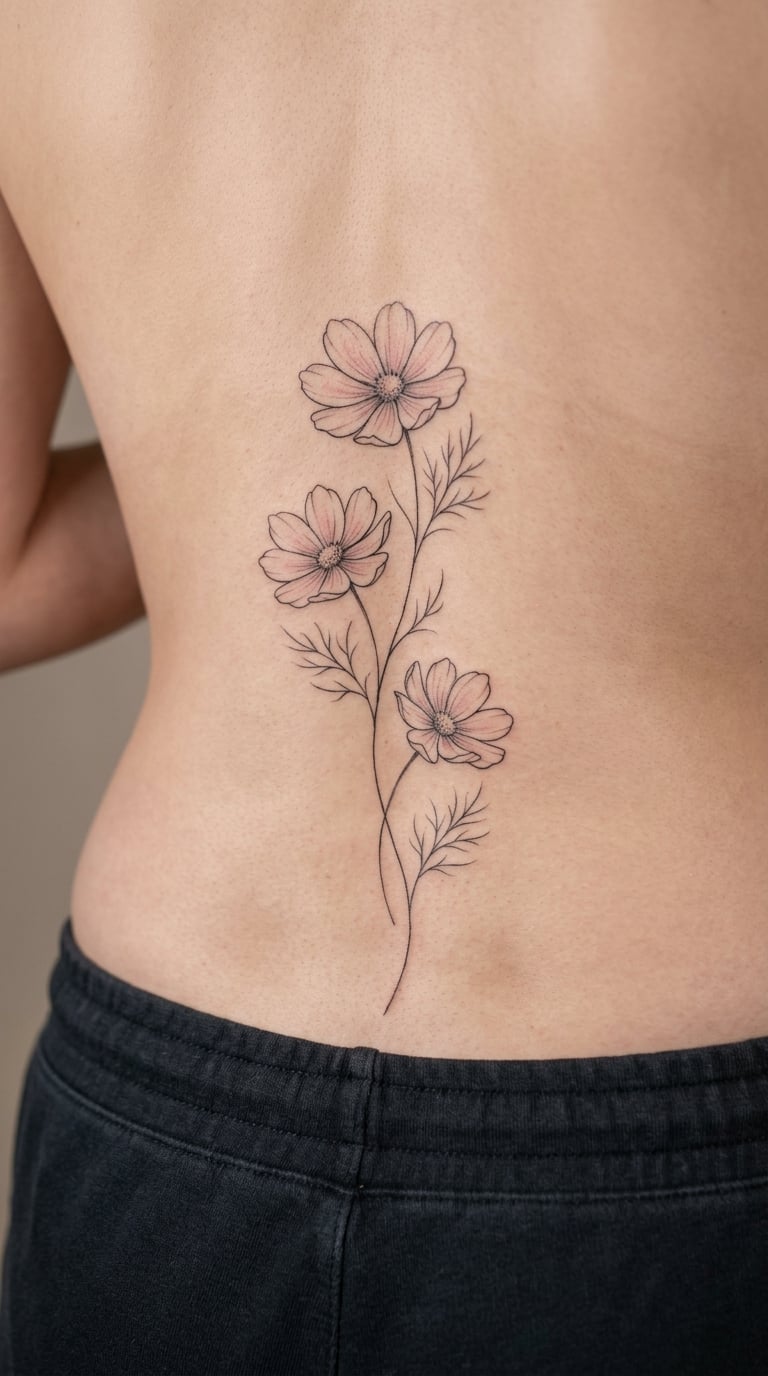
Three stems that start at the lower lumbar and trail down over the sacrum, ending just short of the tailbone. Cosmos flowers have long bare stems and a few open petals, which makes them the right flower for a downward trailing design. Symbolically they are about order and harmony in the wild, which people rarely expect and often like.
Keep the whole thing 10 to 15 cm and centred slightly to one side so the stems follow the curve instead of fighting it. This is the easiest design here to add to later, because the natural next step is a second spray beside it or a continuation onto the hip. Fine line with soft pink shading, and keep the shading on the petals rather than the stems, where it smudges.
Pain and time: the tailbone area is the sharpest spot on the spine at 8 to 9 out of 10, because there is almost no soft tissue over bone. Three small stems is about ninety minutes, and it is a good first session to test how you handle that.
7. Buttercup and Bluebell Chain in Solid Blackwork
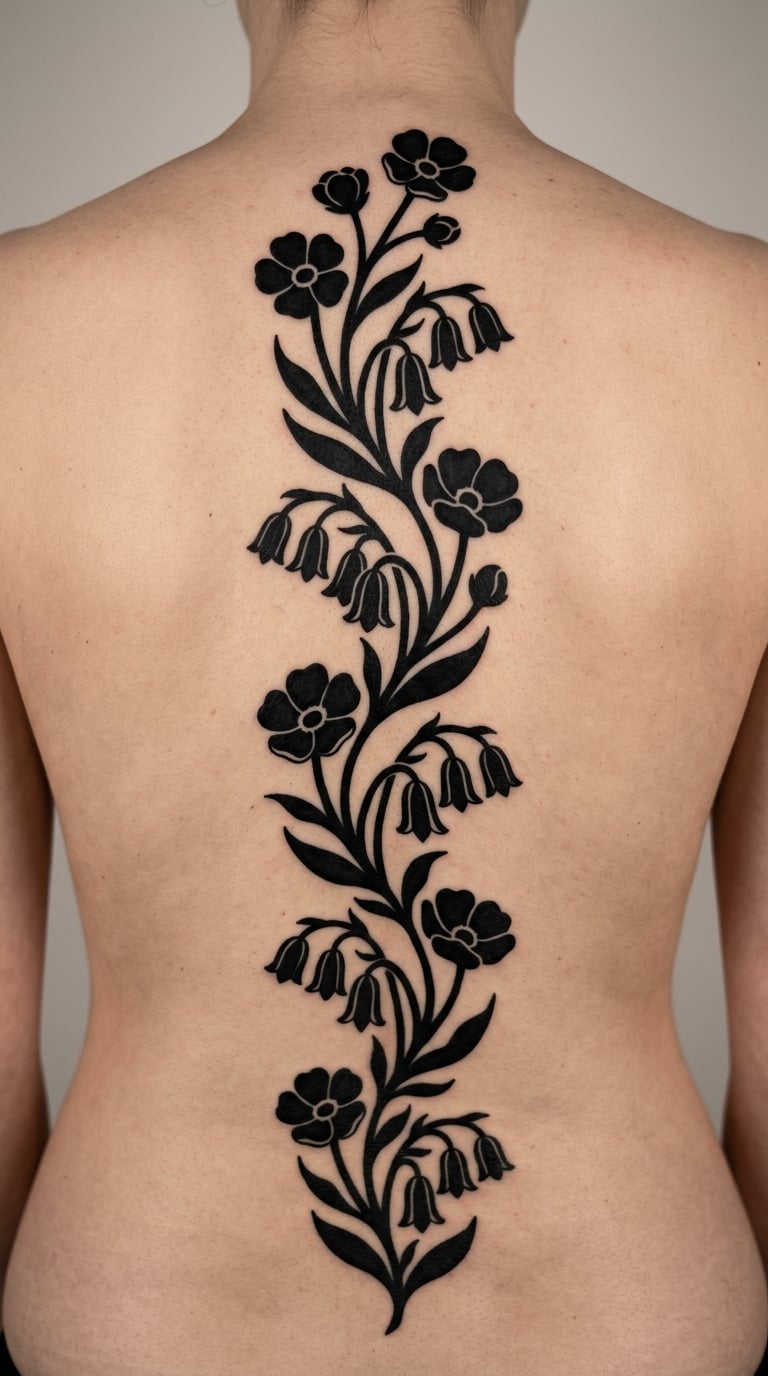
No colour at all, just heavy black shapes with open negative space inside the petals. Blackwork is the boldest option here and the one that hides a curved back best, because a solid shape reads as a mass rather than a measured line. Buttercups and bluebells both have simple five-petal forms that stay legible when they are filled in solid.
Each flower can be 4 to 6 cm, bigger than anything else in this list, and the chain runs from the nape to the mid-back. The trade-off is that the edges stay crisp for a decade but the small interior details either fill in or need a touch-up, and the piece cannot be extended downward into fine line later because the styles clash badly. Commit to a full length or keep it short, but do not plan to add a delicate stem under a black chain.
Pain and time: bold black on the spine hurts more than fine line because the needle is going deeper for full coverage. Expect 8 out of 10 and a two-and-a-half to three hour sitting.
8. Wildflower Meadow Spray in Watercolour
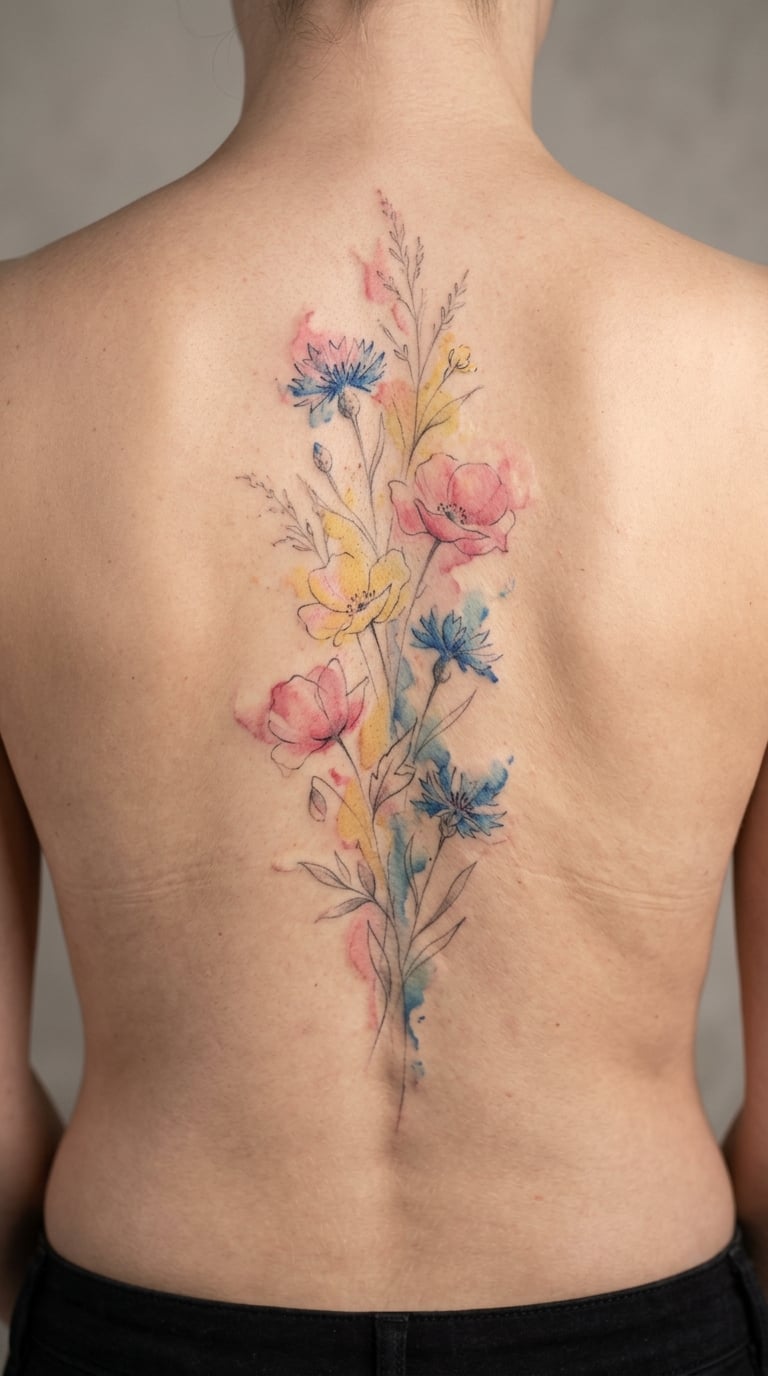
Watercolour florals look like a painting that missed the paper on purpose, with colour bleeding outside the lines. Down the spine they are risky and gorgeous. The idea is a loose vertical spray where the colour runs a little past the drawing, and the drawing itself is barely there.
Keep it 15 to 25 cm, mid-back to lumbar, and use three colours maximum. More than three and the washes muddy into each other where they overlap, which on the spine looks like a bruise rather than a meadow. Ask for heavy pigment on the petal edges only, and expect to say yes to a free colour pass on the second session, because this style rarely comes together in one visit.
Pain and time: around 7 out of 10 for the spine proper. Two sessions, two to three hours each, with a gap of several weeks so the healed colour can be judged before it is finished.
9. Poppy and Wheat Memorial Piece
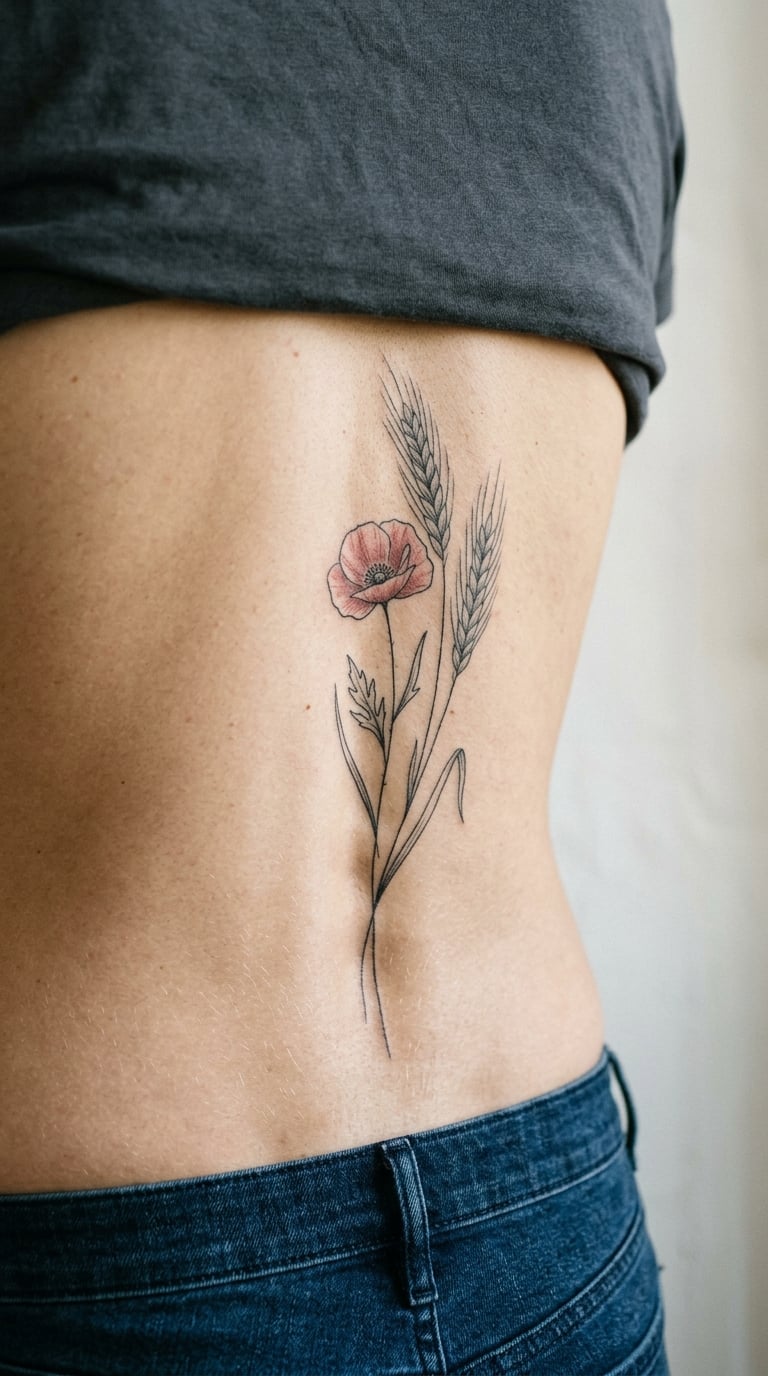
A poppy and two wheat stems, drawn plainly, nothing decorative. Memorial pieces tend to be the ones people ask artists to keep simple, and they are usually right. Poppies stand for remembrance and wheat for a harvest of years, so together they say someone lived, grew and was here. The meaning stays with the person wearing it, which is the point.
Keep it 12 to 18 cm at the lumbar or upper sacral area, or split it: poppy at the nape, wheat at the tailbone, with the space between them doing the emotional work. Line weight should be medium, heavier than fine line so the piece still reads at ten years, and colour is optional. Many people take poppy and wheat in black and grey only, which suits the tone and heals more predictably.
Pain and time: lumbar is a 6 to 7, and a two-stem piece of this size is under two hours. If you are splitting it into two placements, book them as separate appointments rather than one long session.
10. Birth Flower Trio Down the Upper Thoracic Spine
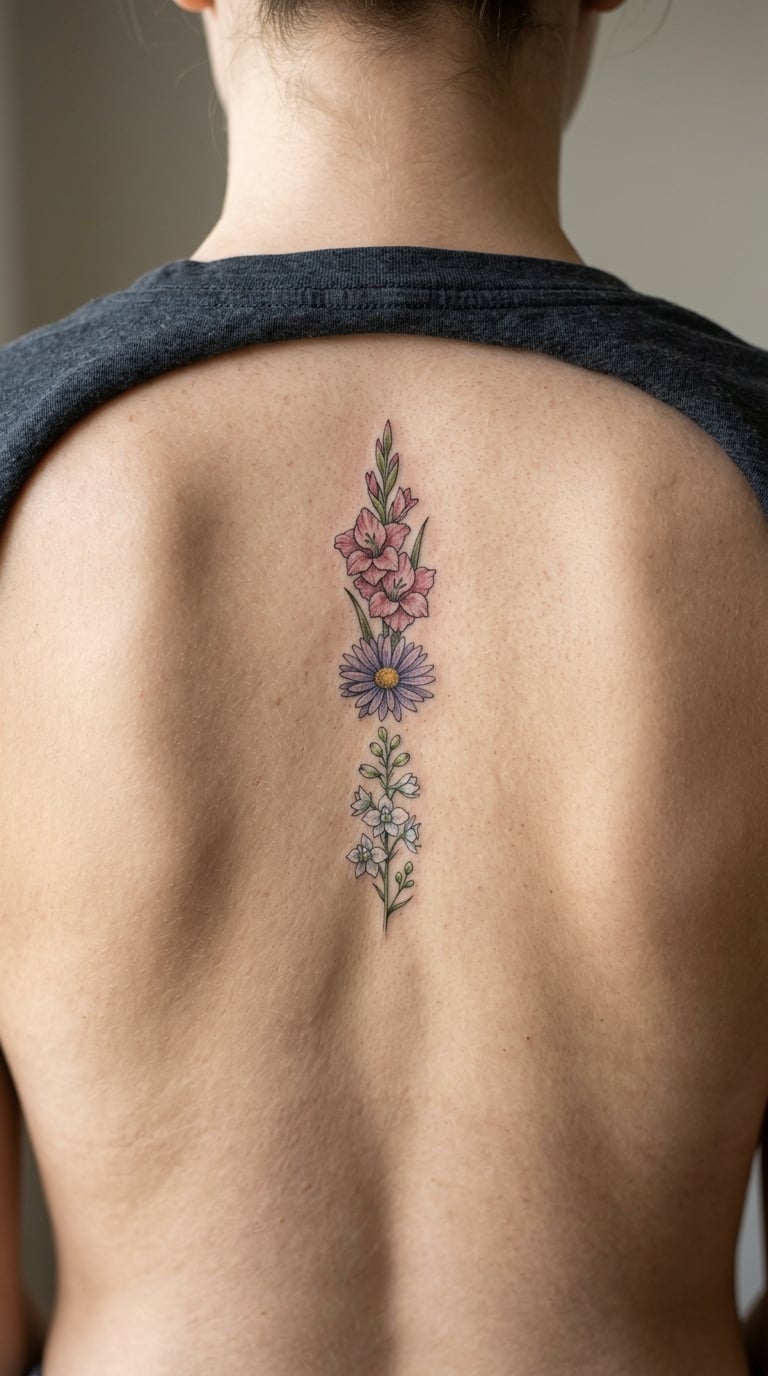
Three flowers, one for each birth month that matters in your family, stacked in a short vertical column between the shoulder blades. The birth flower tradition is well established, and a trio is the sweet spot: personal, but small enough to finish in one sitting and hidden by almost every top you own.
Keep each blossom 3 to 4 cm and the whole column under 15 cm. Flowers chosen for a birth month are often visually similar, so ask your artist to vary the scale and the leaf shape so the stack has rhythm. This is the design I most often see people add to two or three years later, so leave empty space at the bottom of the column on purpose.
Pain and time: the space between the shoulder blades is around 7 out of 10. A tight three-flower column is roughly two hours and is a realistic first spine sitting.
11. Sunflower Half-Sleeve Growing Down the Spine
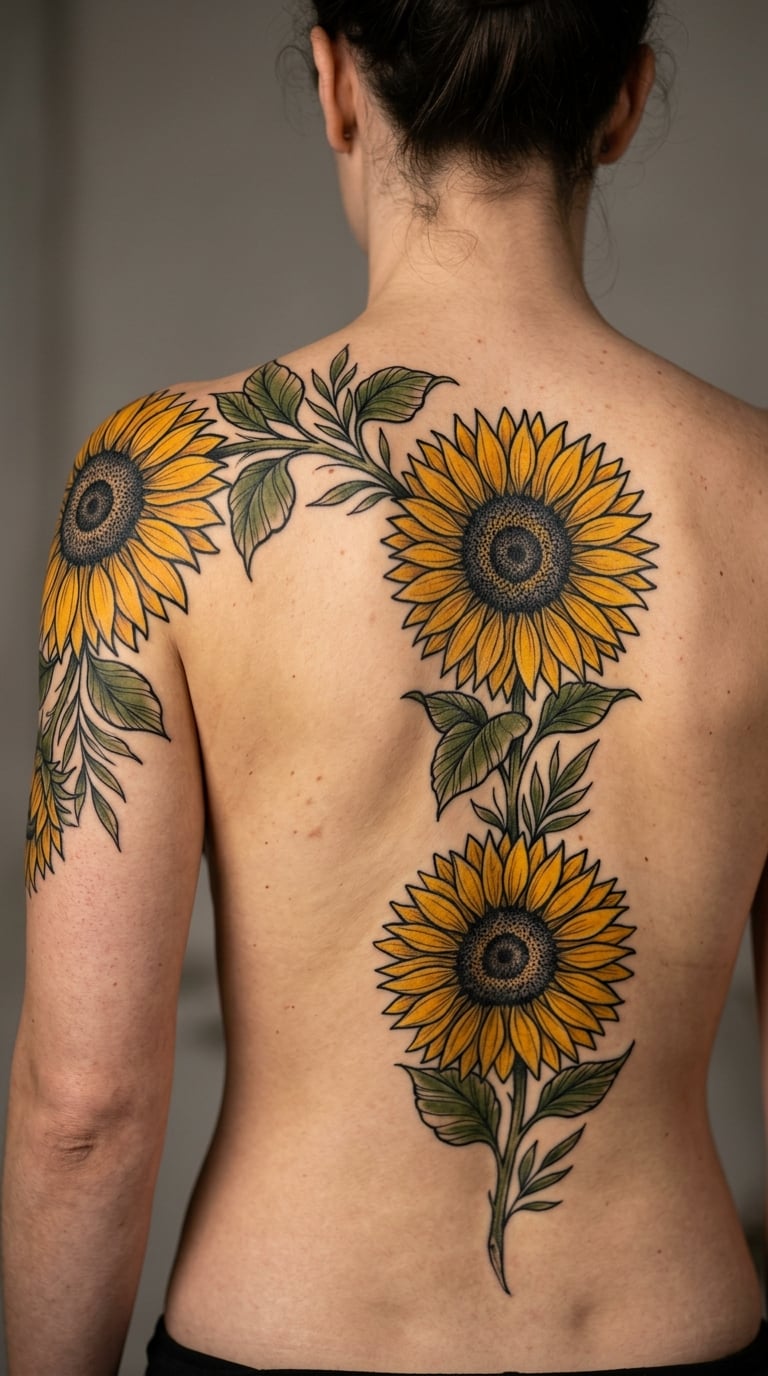
The bold end of the list. Two large sunflower heads with heavy black outlines and saturated yellow, one at the upper back and one lower, with leaves and stems running down the spine between them. Sunflowers mean loyalty, adoration and a lot of stubborn optimism, and this is the design for someone who wants their back tattoo to be the first thing anyone notices.
Plan it properly or not at all. A piece like this runs 30 to 40 cm and takes at least three sessions, usually more, because saturated yellow on the spine is a lot of packed colour. It is also the hardest design here to cover later, and the hardest to extend downward, since anything fine line underneath a bold sleeve looks like an afterthought. Book a consultation where you see healed work, not just the artist’s fresh photos, and ask what happens if your colour preference changes between sessions.
Pain and time: 7 to 8 out of 10 across a large back area, and three to four hours per session. Expect the whole project to run over several months.
12. Five Small Daisies and Nothing Else
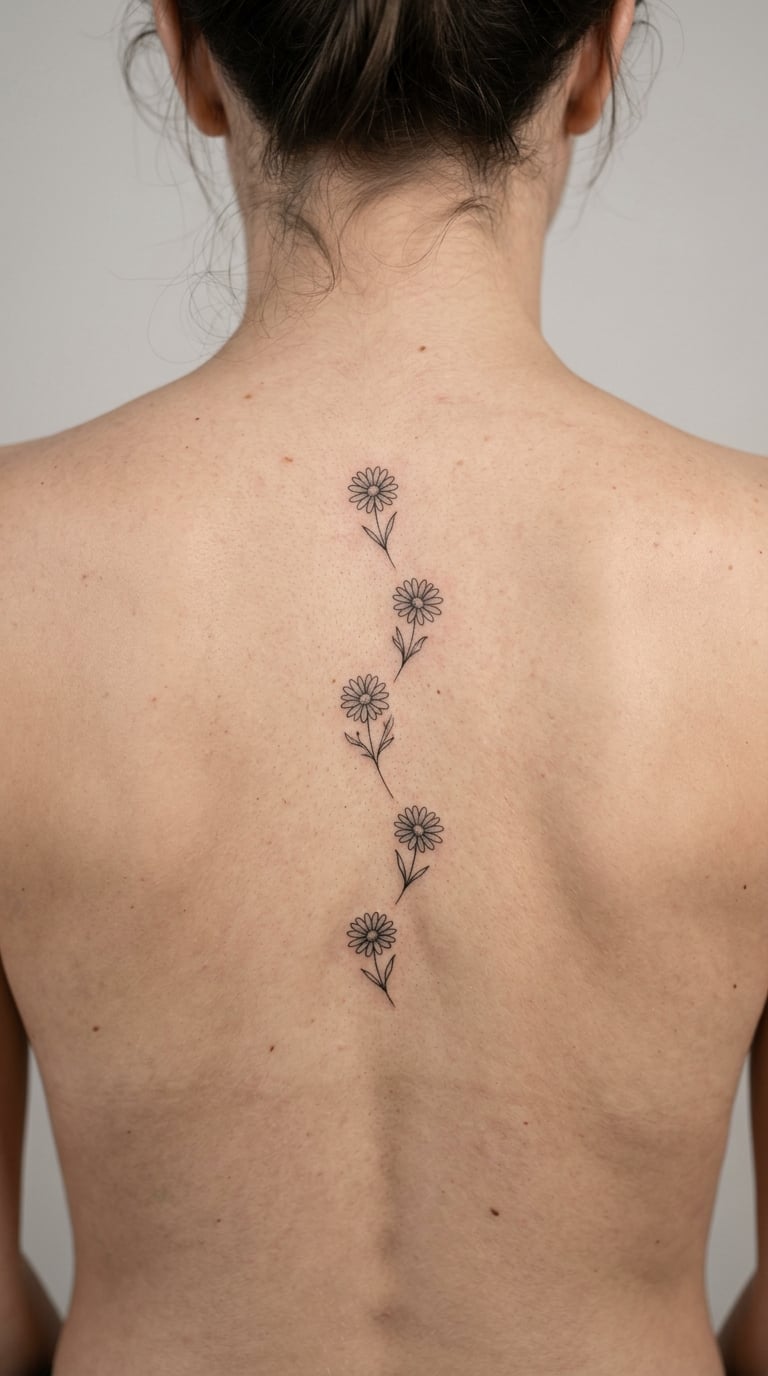
Five small daisies, each a centimetre or so, staggered down the mid spine with generous space between them. No stems, no leaves, no vine. If you have never been tattooed and your actual goal is a spine piece, this is the one to book, and I would rather you have a good first experience than a dramatic one you regret.
Five disconnected marks are also the only design here that can be adjusted later. Nothing depends on anything else, so each daisy can move, grow or be joined by a stem at a later date. The main thing to watch is line weight, because a 1 cm daisy drawn with a 3RL grouping will be a black smudge inside a month. Ask for the smallest needle grouping your artist has and accept that a tiny design takes patience rather than speed.
Pain and time: 7 out of 10 on the spine, and this one is about an hour and a half. It also heals quickly, since there is very little ink in the skin.
13. Custom Wildflower Tattoo Ideas for the Spine, Scaled to Your Back
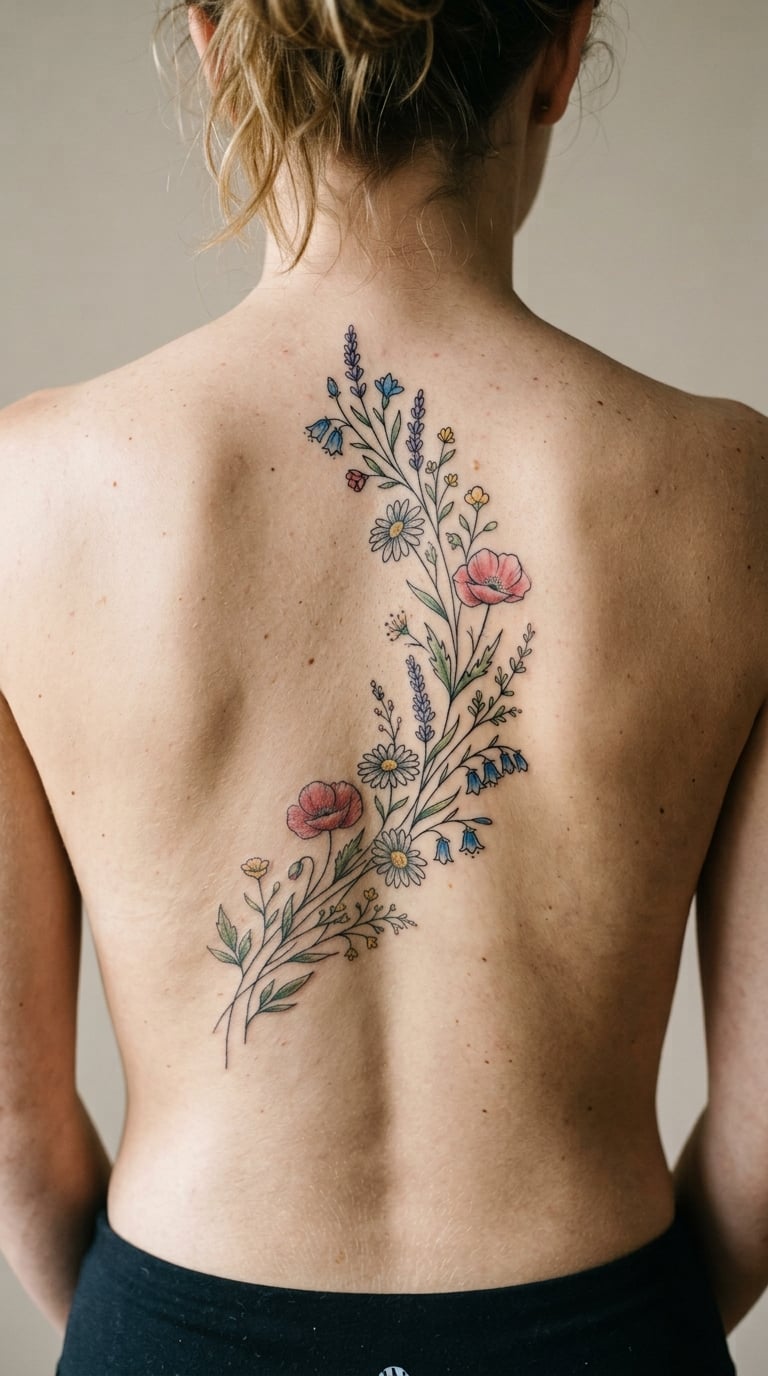
The one design nobody can copy from a reference photo, and honestly the one that usually ends up looking best. Take the idea you like from any of the designs above, then have it redrawn around your actual back rather than laid over it. If your spine curves, if one shoulder sits lower, if your lumbar dips, the flowers should follow that shape instead of pretending it is not there.
This is the approach to choose if you have scoliosis, if your posture changes noticeably through the day, or if you simply do not want a design that looks copied. It costs more in design time and it takes longer to draw, which is part of why custom spine work carries a specialist premium. Bring your references in person and let the artist mark your back standing up. Ask to see a body-mapped drawing at actual size before the day, so nothing is a surprise when the stencil goes on.
Pain and time: pain depends entirely on the segment, so treat 6 to 9 as the range across the spine. Two to four hours per session, and two to three sessions for most custom spine wildflower work.
14. Dried Bouquet in Blackwork and Grey Wash
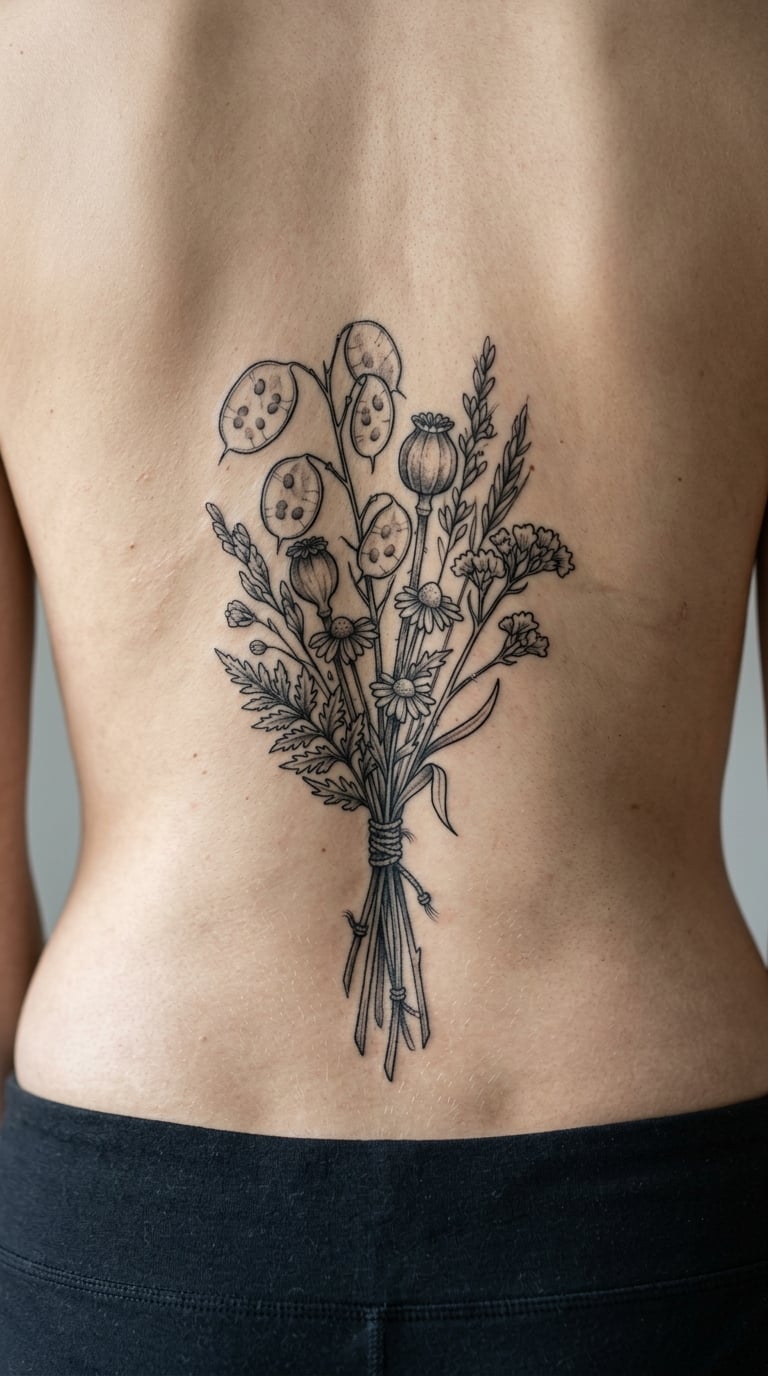
A bouquet of dried stems, bound and hanging at the lumbar area, drawn in blackwork outlines with grey wash shading instead of fresh petals. Daisies gone to seed, poppy pods, a few empty seed heads. It is the quietest design here, and it is the one that looks best five years in, because grey wash settles into the skin rather than fading out of it.
Keep it 15 to 20 cm, hung at the small of the back where the curve flattens the composition. Grey wash is the style to choose if your skin is deeper toned, since it reads with contrast without needing colour to carry the detail, and it is far easier to touch up than a coloured piece five years down the line. Dried stems also give your artist more room to fit real detail into a small design, since the shapes are angular instead of soft.
Pain and time: 6 to 7 out of 10 at the lumbar. Two to three hours, one sitting, plus a free touch-up on the grey wash six to eight weeks later.
Wildflower Species and Their Meanings
Flowers on a spine tattoo carry their traditional meanings, and wildflowers are less crowded than roses. Here is the short version: a poppy means remembrance, a daisy means new beginnings, cornflower means thoughtfulness, lavender means calm, chamomile means healing, and a wheat stalk stands for years well lived. Pick the two or three that mean something to you and leave the rest as filler, and the piece will still look deliberate.
| Species | Traditional meaning | Scale at spine size | Best segment |
|---|---|---|---|
| Daisy | Innocence, new beginnings | 1-3 cm, holds fine line well | Nape, mid-back |
| Poppy | Remembrance, resilience | 4-8 cm, needs colour to sing | Mid-back, lumbar |
| Cornflower | Thoughtfulness, remembrance | 2-4 cm, strong blue pigment | Upper thoracic |
| Buttercup | Joy, brightness | 3-5 cm, good in blackwork | Upper thoracic, mid-back |
| Bluebell | Constancy, humility | 2-4 cm, works as a stem cluster | Nape to mid-back |
| Chamomile | Healing, rest | 2-4 cm, soft yellow reads well | Lumbar |
| Lavender | Calm, devotion | 4-8 cm as a sprig | Lumbar, sacral |
| Cosmos | Order, harmony in nature | 2-4 cm, ideal for trailing stems | Lumbar, tailbone |
| Baby’s breath | Love, enduring affection | Under 2 cm, filler only | Shoulder blades |
| Sunflower | Loyalty, adoration | 8-12 cm, needs bold line work | Full length |
| Wheat | Harvest of years, abundance | 6-10 cm as a stalk | Lumbar, tailbone |
| Yarrow | Healing, warrior’s flower | 2-3 cm clusters | Mid-back |
Style Choices: Fine Line, Blackwork, Watercolour and Realism
Four styles cover almost everything people ask for, and the right one depends on how much attention you want the piece to get and how much patience you have for touch-ups.
| Style | Visual impact | Shows a curved back? | Healing notes |
|---|---|---|---|
| Fine-line botanical | Soft, subtle, elegant | Yes, asymmetric work hides curvature | Lightest load, heals fastest, needs a touch-up every 5-10 years |
| Blackwork | Bold and graphic | Best of the four, solid shapes read as mass | Harder on the needle, interior detail may fill in |
| Watercolour wash | Soft, painterly, forgiving | Reasonably well if the edges stay loose | Colour spreads; expect a free colour pass later |
| Botanical realism | Detailed, lifelike | No, precision exposes every curve | Most demanding on the artist, longest sessions |
If you are on a curve, fine line and blackwork both work. Realism is the one to leave alone at the spine unless you have a genuinely straight back, because that level of precision makes any asymmetry the main thing people see.
Pain, Healing and What to Expect
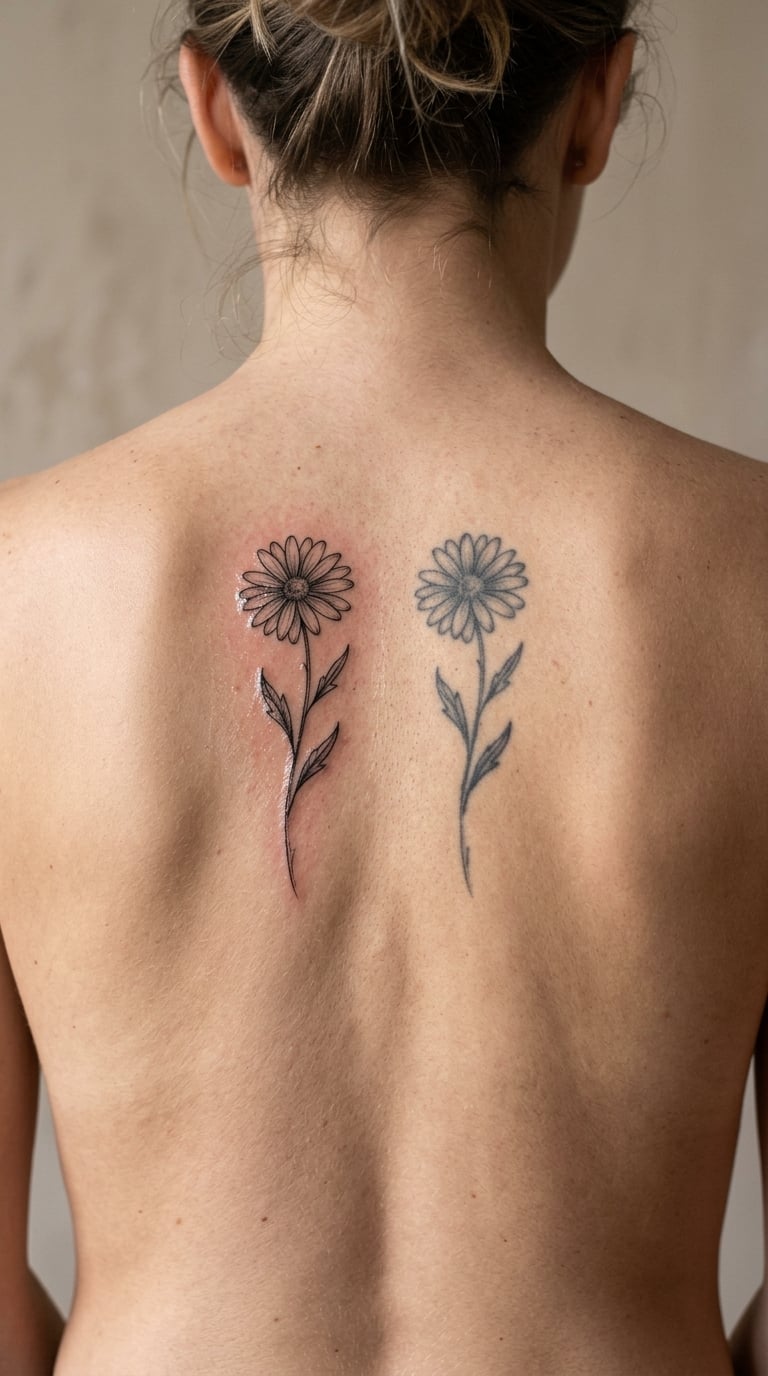
Spine work sits high on the pain scale. Published guides rate the spine itself around 7 to 8 out of 10 and the tailbone at 8 to 9, because there is very little soft tissue between the skin and bone and the vibration of the needle travels through the vertebrae. A lot of people describe it as a deep ache rather than a sharp scratch, and the honest truth is that it is more exhausting than agonising, which is worse in some ways because you cannot stop.
Session length depends on size, and the honest rule is that a back session runs two to four hours before quality drops. Artists stop rather than push, which is why most pieces over 25 cm are booked as two or three sittings. A small single-stem piece is one to two hours. A full-length piece is a project measured in months, and budgeting for all the sessions up front is the single best way to avoid the regret that comes from running out halfway.
Healing on the spine has its own specific irritants. Plan for these:
- No back-clasp bras for 7 to 10 days. The clasp sits exactly on fresh ink and rubs it. Wear front-fastening or bralette styles, or go without where that is realistic.
- Do not sleep on it for about a week. Side sleeping puts pressure on the tailbone work; back sleeping presses straight into it. Side sleepers find a pillow position that keeps weight off the area, and it is uncomfortable for the first few nights.
- Keep the second-skin film for 3 to 5 days. That layer of skin forms over the tattoo and sheds on its own. Do not pick it, and do not soak it away.
- Wash twice a day, pat dry, moisturise thinly. Thick ointment traps heat and dulls the line. A thin layer of a plain lotion is enough.
- No swimming, baths, hot tubs or saunas for two weeks. Sun exposure on a fresh spine is the fastest route to a faded piece. Once healed, use sunscreen on the back whenever it is uncovered, or the colour will go first.
- Fine line needs a touch-up every 5 to 10 years. A little grey is not a mistake, it is the natural softening of thin lines. Budget for a refresh session if you want the original crispness back.
The back is also the easiest place on the body to get a badly placed tattoo, because you cannot watch the work. Take photos at the end of each session and keep them, so a problem is visible early rather than a year later.
Things to Know Before You Book
Six things worth sorting out before you sit down, none of which take more than an hour:
- Choose on healed work. Ask every artist for photos of spine pieces two years healed, not the fresh version that fills an Instagram feed. Fresh florals look sharper than any of them will in five years.
- Insist on a standing stencil. This is the non-negotiable one. A stencil applied while seated or hunched warps permanently when you stand, and no amount of careful tattooing fixes it.
- Ask for the total project cost in writing. Get the full number for every session you expect, not just the first one. A large piece quoted per sitting always feels affordable at the start.
- Bring references, not instructions. Two or three images showing a style you like, plus one showing the size you want, beats a folder of forty.
- Book the season around healing. Backless tops, weddings, holidays and beach trips all land better two months after the last sitting than one month before.
- Set a date for a free touch-up. Most studios include one for a piece this size, but only if you use it within a few months, so put it in your calendar at the time of booking.
How to brief your artist in five steps
Arrive with the placement decided, not just the flower. Say which segment you want it in, how many centimetres tall, colour or black and grey, and what the piece means. Then let the artist draw, and do not ask them to copy a reference image exactly, because a photograph on a phone cannot show how a design sits across real vertebrae. Finally, agree the session count and the price for all of it before the first line goes in.
Common mistakes when planning wildflower tattoo ideas for the spine
The tattoos people regret are almost never the ugly ones. They are the ones that were copied at the wrong scale, split rigidly down the centre of a back that curves, chosen from a reference that was never resized, or started as one session and turned into a piece nobody budgeted for. A symmetrical mandala on a curved spine is the classic one to avoid. So is a colour piece planned for a spot that gets full sun every day, and so is a fine-line design scaled up from a small forearm reference, which turns into a grey smudge at spine size. A fourth mistake is leaving no room below, then resenting the piece for not extending further down later.
Frequently Asked Questions
What do flowers symbolize on a spine tattoo?
Flowers on a spine tattoo keep their traditional meanings, and the spine adds weight because the line of the back reads as a spine of its own. A poppy means remembrance, a daisy new beginnings, cornflower thoughtfulness, lavender calm, chamomile healing, and a wheat stalk years well lived. Wildflowers are the least crowded choice, since almost everyone already has a rose.
What does a wildflower tattoo symbolize?
Usually freedom, growth and the untamed rather than anything formal. A wildflower meadow reads as a life allowed to grow without being arranged, which is why people choose it for memorial pieces, for birth flowers and for leaving a difficult chapter behind. Add a specific species and the meaning gets more precise: a poppy narrows it to remembrance, lavender to calm and rest.
How long does it take to get a spine tattoo done?
A small single stem takes one to two hours. A mid-sized spray runs two to three, and anything over 25 cm is a multi-session project of three to four hours per sitting. Most artists stop at that point rather than push, because detail quality drops after three hours. A full-length spine piece usually takes two to three sittings spread over several months.
How painful is a spine tattoo?
The spine itself is usually rated 7 to 8 out of 10 and the tailbone 8 to 9, because there is very little soft tissue between skin and bone and the needle vibration carries through the vertebrae. Most people describe a deep ache rather than a sharp pain. It is more tiring than agonising, and you cannot stop, so pick a small first sitting if you are unsure.
Can you sleep on a spine tattoo while it heals?
Try not to for about a week. Back sleeping presses straight into fresh ink, and side sleeping puts pressure on the tailbone end of a spine piece. Side sleepers can usually find a pillow position that keeps the weight off the area, though it is uncomfortable for the first few nights. After the first week of healing it is generally fine, and the only real risk is rubbing the line work out in the first few days.
What are the best wildflower tattoo ideas for the spine for a first tattoo?
A single fine-line daisy stem from the nape, or five small disconnected daisies down the mid spine. Both are one sitting, both are an easy first session, and both are simple to adjust later because nothing depends on anything else. Avoid a full-length piece or a colour spray as a first tattoo, since the sitting is long and the healing is harder to manage than you expect.
Conclusion
Pick the one design above that matches the meaning you want to carry, then narrow it down to a segment and a real size before you talk to anyone. The difference between a spine tattoo that ages well and one you think about for the wrong reasons is almost always scale, and the difference between one that sits straight and one that sits crooked is whether the stencil went on while you were standing up.
If you are still torn, bring two references and a body-mapped drawing request to a consultation. Of all the wildflower tattoo ideas for the spine, the custom-scaled one is the most work up front and the one nobody ever regrets.