
16 Anchor Tattoo Meaning and Design Ideas (September 2026)
Anchor tattoo meaning and design ideas come down to one thing: a symbol that holds still while everything around it moves. The anchor has carried that idea for centuries, first as working equipment on a deck, then as ink on the arm of anyone who wanted a quiet reminder to stay grounded. Below are sixteen designs with the meaning behind each, where they sit well, and what to expect in the chair.
Anyone planning a first piece usually arrives with the same two questions: what does it mean, and will my body actually fit it. The first is quick to answer. The second is where most designs go wrong, so each idea here includes a realistic size and a realistic pain note.
What Does an Anchor Tattoo Mean?
An anchor tattoo symbolizes stability, hope, strength and loyalty, because an anchor is what stops a vessel from drifting. Rooted in maritime and sailor tradition, it is worn today as a promise to stay grounded, hold steady through change, and stay tied to family, faith or home. Add a name or a date and it becomes a memorial instead of a general sentiment.
Here is the short version, which covers most of what people are actually asking when they search anchor tattoo meaning and design ideas:
The anchor tattoo meaning, in ten lines
- Stability — holding your ground when life pulls in two directions.
- Hope — the calm promise that the rough part passes.
- Strength — force that does not need to be loud to be strong.
- Loyalty — a steady relationship, a partner, a crew.
- Protection — a talisman, especially for people who work at sea or on the water.
- Faith — the religious reading, drawn from Hebrews 6:19.
- Home and belonging — a port, a coastline, a family that lives by the ocean.
- Determination — the grind that keeps a ship moving when the water is against it.
- Memorial — a parent, a partner, a service member who is gone.
- Service — Navy and merchant mariner heritage, worn with pride or with complicated feeling.
That last one is worth expanding later, because a symbol that reads as heritage to one person can read as costume to another. Being honest about who is likely to read your tattoo and how is part of choosing it well.
The History Behind the Anchor Tattoo
Anchors are among the oldest tattoo motifs still in regular use. Sailors in the age of sail inked them on the forearms and backs of the hands, and the designs they chose were partly logbooks. A specific mark could tell you a rating, a voyage, or a crossing — tattoos were practical before they were decorative.
One detail from the old sailor tradition is worth repeating here: a stereotypically plain anchor tattoo was traditionally said to indicate that a sailor had crossed the Atlantic. People still ask whether that means anything today, and the honest answer is that it does not function as a passport any more. It is heritage read as a memory, not a credential.
Merchant mariners, fishing crews and Navy families kept the tradition going, which is why the anchor now sits comfortably beside names, dates and memorial details. The tribute-to-a-serving-parent version is the reading most people are reaching for today, rather than the crossed-ocean one.
What an Anchor Tattoo Means for Men and for Women
The symbol is not gendered, though the design language is. Bold traditional anchors with heavy black outlines and red or gold fill land as a masculine, sailor-coded piece, and plenty of women wear exactly that. The same anchor rendered as a fine-line single-needle design reads softer and more delicate without changing the meaning at all.
For men, the anchor usually carries service, grit or a steadiness that others rely on. For women, it turns up most often as memorial, family and loyalty, and it pairs more freely with florals, script and thin lines. If you want a piece that does not read as heavily maritime, the rope, the barbed stock and the rust are the parts to leave out.
The Biblical Anchor: Hope as an Anchor for the Soul
Hebrews 6:19 describes hope in the soul as an anchor, and that single line has kept the religious meaning alive for centuries. Christian wearers often add a cross, a verse, a halo of light, or scripture curved along the shank. Nothing about the symbol is exclusively religious, but the verse is where the hope reading comes from.
If faith is part of why you are choosing this, say so in the consultation. Artists who work in religious styles tend to build better pieces when they know whether you want a literal cross or an abstract, reverent shape.
Anchor Tattoo Meaning and Design Ideas by Style
Sixteen designs, each with a different reason to exist. The first five are the classics people search for most; the rest lean toward memorial, matching and geometry.
1. Classic Ring-and-Stock Anchor in Bold Black Linework
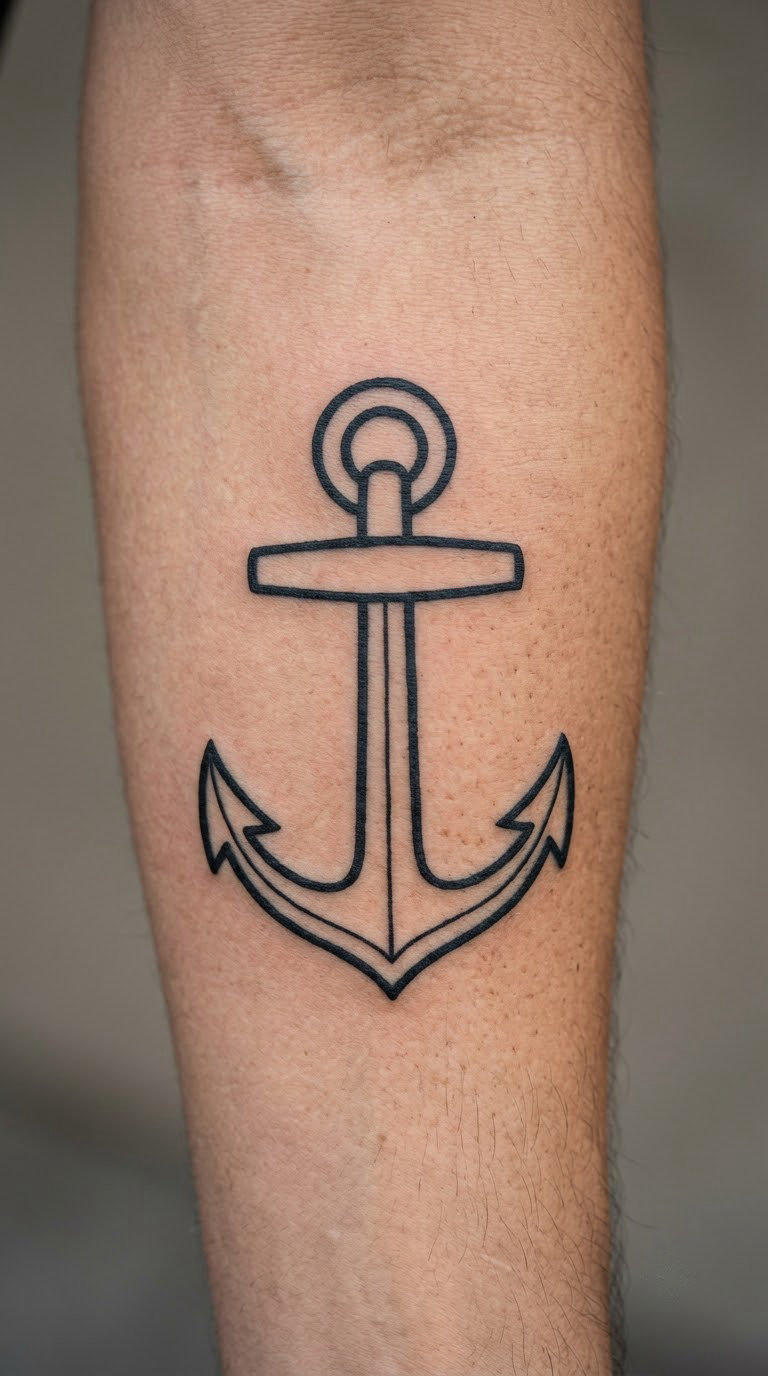
The plain old nautical anchor, drawn heavy and symmetrical, is the one that never dates. It says stability without explaining itself, and it is the easiest version to read at a distance.
Ask for consistent line weight, roughly the width of a coin edge, and generous negative space between the flukes. Solid black outline work softens very little over the years, so an outer forearm piece this size still looks sharp a decade on.
Pain and time: moderate on the forearm, because the skin there moves with your wrist. Four centimetres tall is the minimum; eight to ten centimetres is where a bold version looks its best. Usually a single sitting of one to two hours.
2. Fine-Line Anchor Drawn in One Continuous Needle
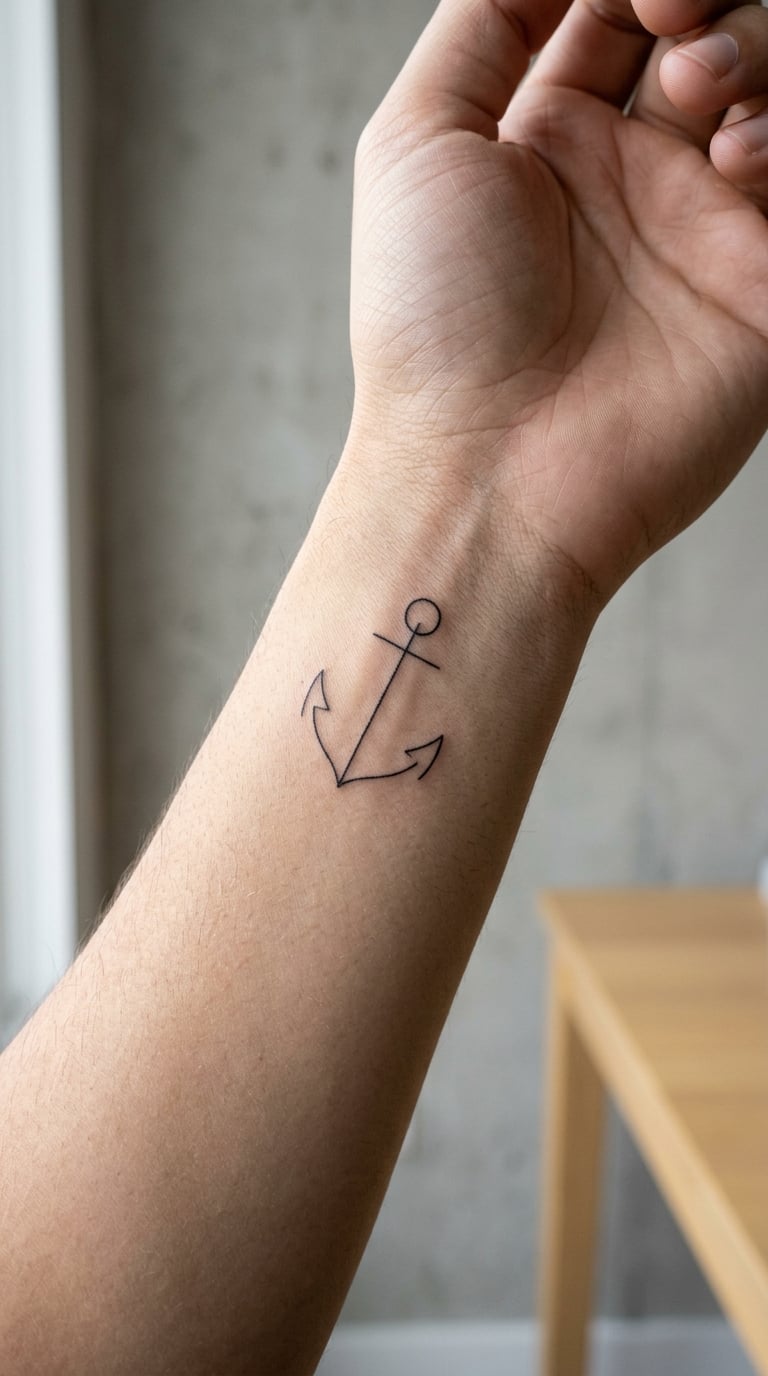
A single hairline anchor is the quietest way to carry the same idea. It reads as intentional restraint rather than as a nautical badge, and it works for people who want a first tattoo that nobody will comment on at work.
Fine line softens with age, so keep the design simple: one stroke weight, no shading inside the shank, and a small hook at each fluke. Anything under four centimetres will blur within a few years unless the artist deliberately varies line weight to keep the form readable.
Pain and time: mild to moderate, but the inner wrist is thin and close to bone, so it stings more than it hurts. About one hour, single sitting.
3. Blackwork Anchor Wrapped in a Heavy Chain
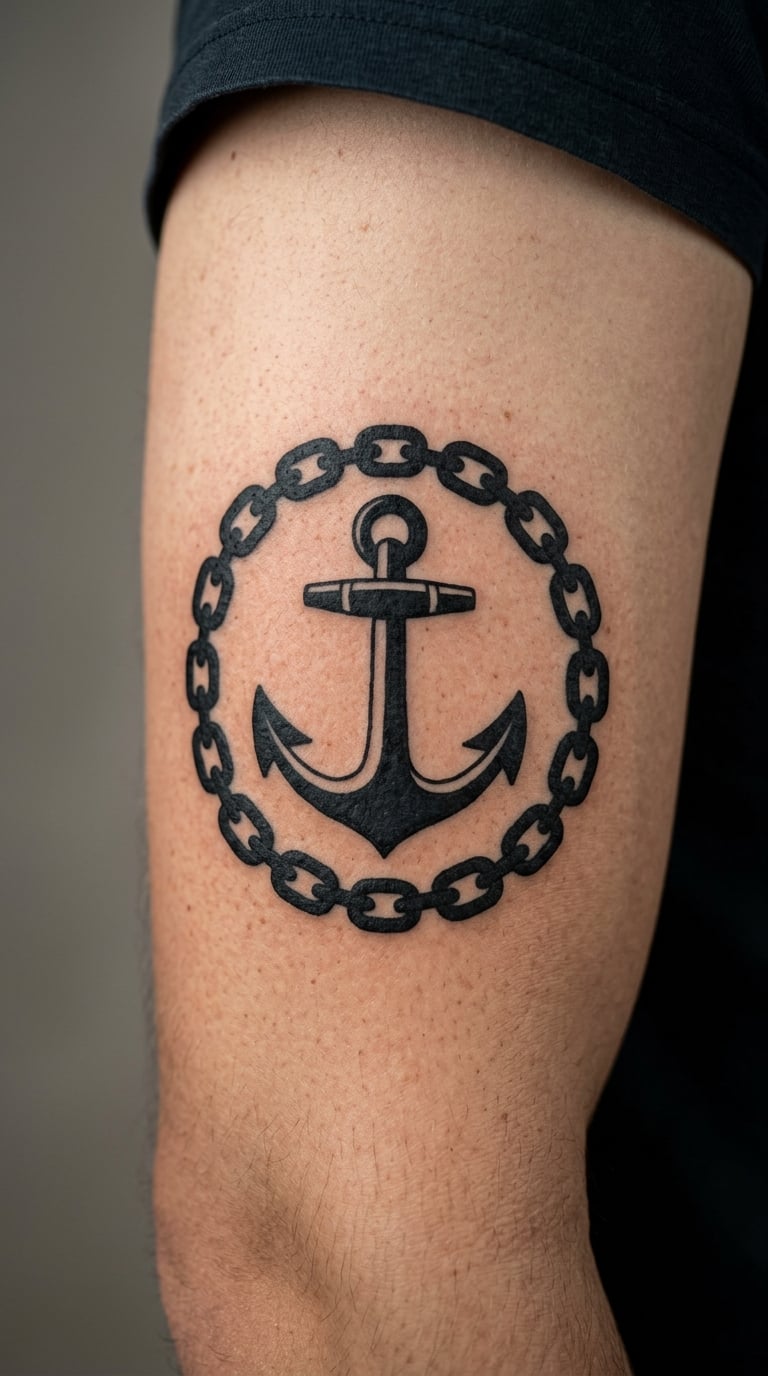
The chain is what turns an anchor from a symbol into a statement. It reads as bound and held, which suits memorial pieces, and it fills space that a bare anchor leaves awkward on a larger muscle.
Keep the links mechanical rather than decorative, and match the chain thickness to the anchor shank so the drawing holds together. Solid black fills stay sharp, but tight stipple shading between the links tends to blow out with sun exposure, so plan for a touch-up in a few years.
Pain and time: low to moderate on the upper arm, a fleshy area that barely registers. Twelve to fifteen centimetres across if the chain is part of it. Two to three hours, sometimes split across two sittings.
4. Old-School Traditional Anchor in Red and Gold
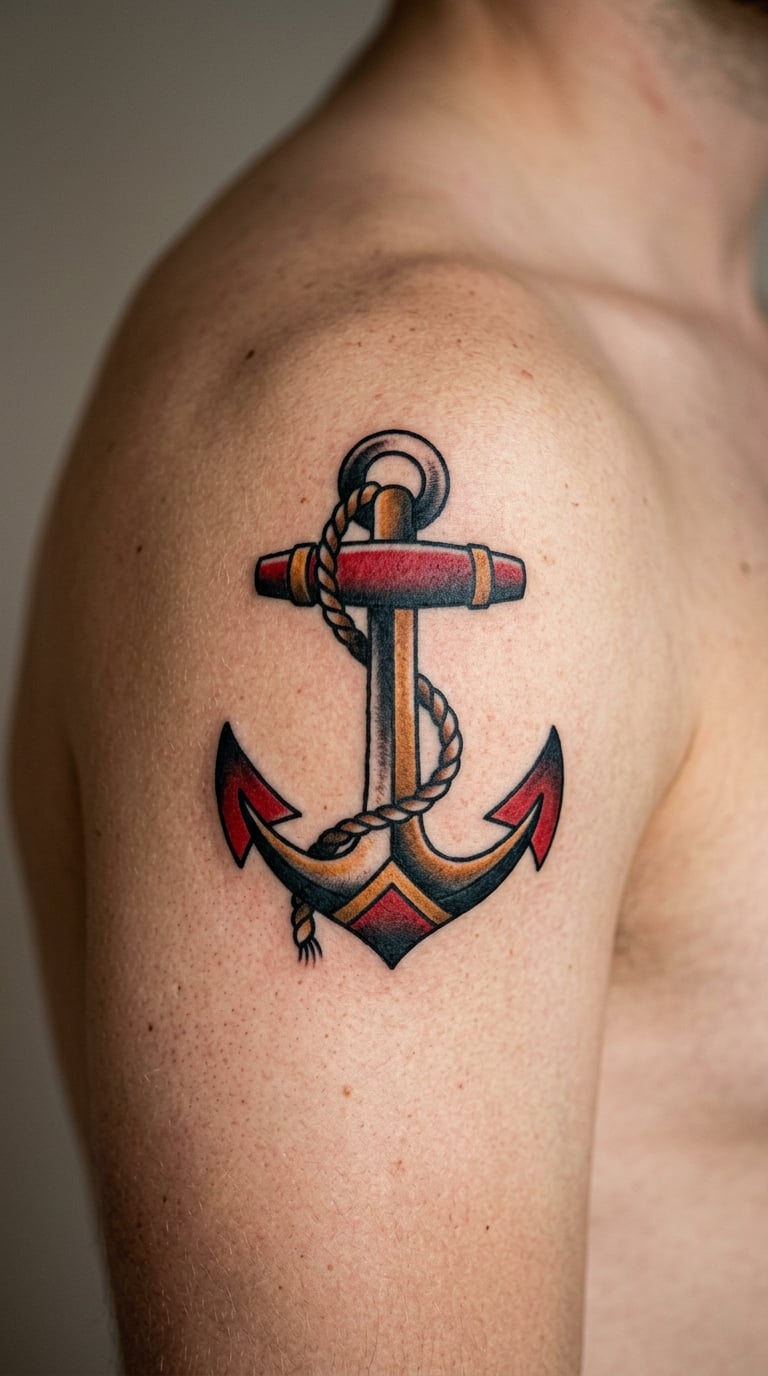
This is the classic sailor tattoo with its saturation turned up: black outline, red flash in the flukes, gold in the shank, and shading that gives the metal a rounded look. It is the most eye-catching option and the least subtle.
Traditional style rewards clean negative space and a confident drop shadow. The trade-off is fading, particularly the yellows, which shift towards orange within a few years outdoors. If you take this one, expect a colour refresh every three to five years unless you keep it covered.
Pain and time: moderate on the shoulder deltoid, more on the bone at the top of the shoulder. Ten to twelve centimetres is a good working size. Two to three hours.
5. Watercolour Anchor with Sea Spray Breaking Over the Flukes
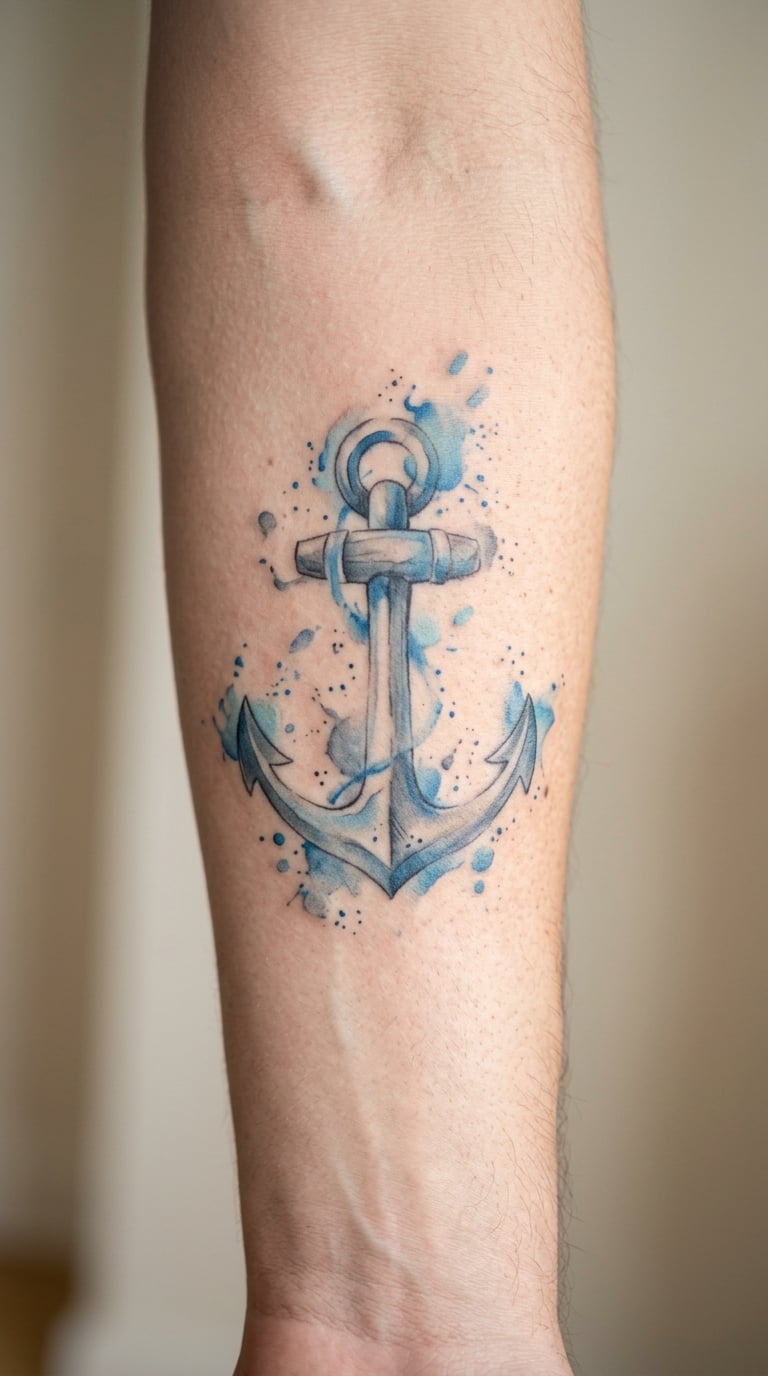
An anchor dissolving into spray is the most romantic version of the idea. The meaning reads as something that holds you through rough water, which makes it a natural choice for someone who came through a hard stretch and wants the mark to remember that.
Watercolour ages fast because the soft edges have no line to hold them. A hard black outline under the pigment helps a great deal, and a touch of deep blue or teal survives better than pale pink. Keep the spray droplets small and sparse, because each one is another edge to blur.
Pain and time: moderate to high, since watercolour shading means many passes over the same skin. Eight centimetres suits this style best. Two to three hours, and a second visit is common for the colour layers.
6. Small Anchor Tucked Behind the Ear
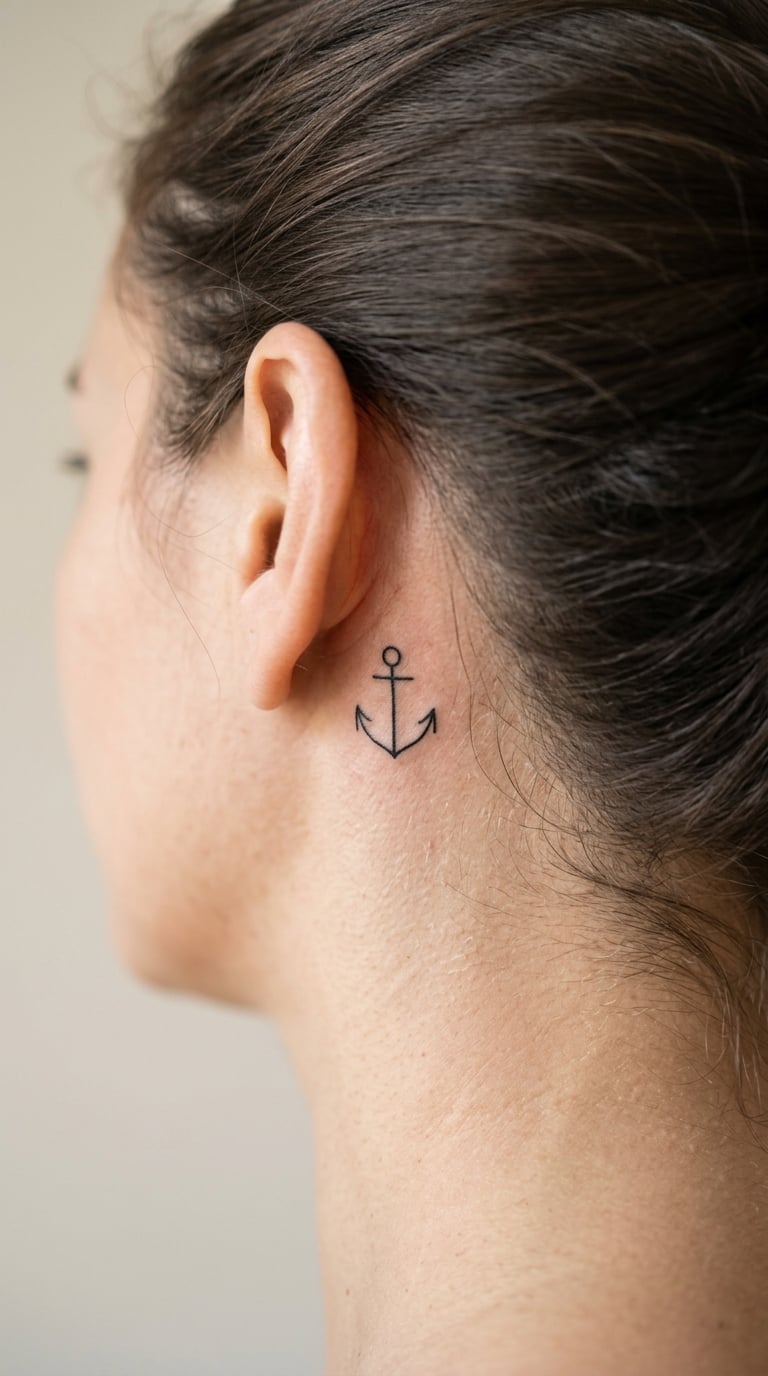
Behind the ear is the placement people think of when they want a symbol they control the visibility of. It appears in a mirror glance, in profile photos, and nowhere else. The design has to be tiny, which is exactly what makes it a challenge.
Three to four centimetres, one line weight, nothing finer than the skin can hold at that scale. A shank with a slight curve follows the neck better than a flat horizontal anchor, and the hairline hides the top edge when you want it hidden.
Pain and time: one of the more uncomfortable spots, because the skin is thin and the angle is awkward. Under an hour, and you will not want to fidget.
7. Anchor with Compass Rose and Coiled Rope on the Chest
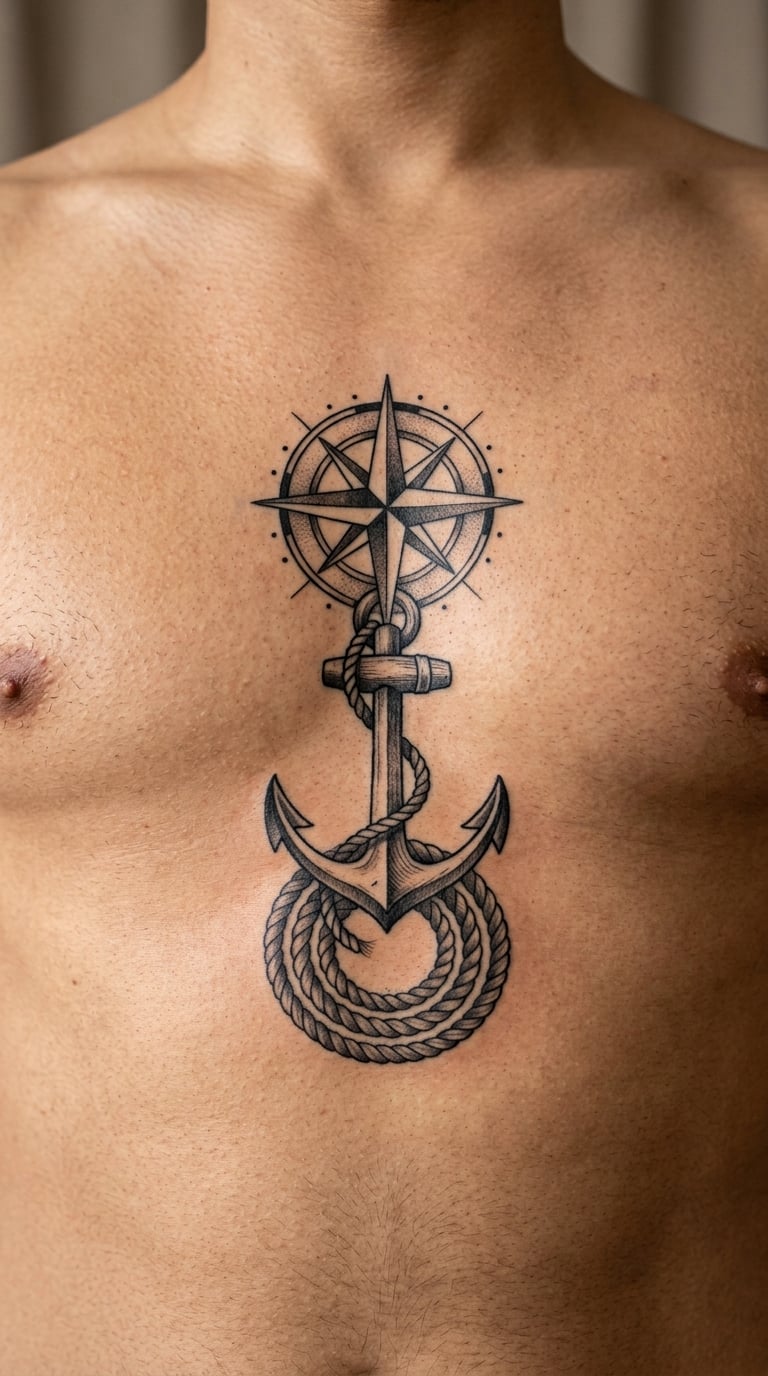
Putting a compass rose above an anchor and a rope below turns a symbol into a full nautical identity. It is a strong choice for someone whose whole life is tied to water, whether that is fishing, diving, shipping or a lifetime spent near the sea.
Stack the elements vertically so the anchor stays the hero, roughly two thirds of the total height. Sternum skin stretches and moves with breathing, so the artist will outline lightly first and check the fit before laying in the line work. Shading on the sternum fades noticeably, so keep it minimal.
Pain and time: moderate to high, one of the more sensitive chest placements. Fifteen to eighteen centimetres tall for the full composition. Two to three hours.
8. Realistic Rusted Anchor with Weathered Metal Texture
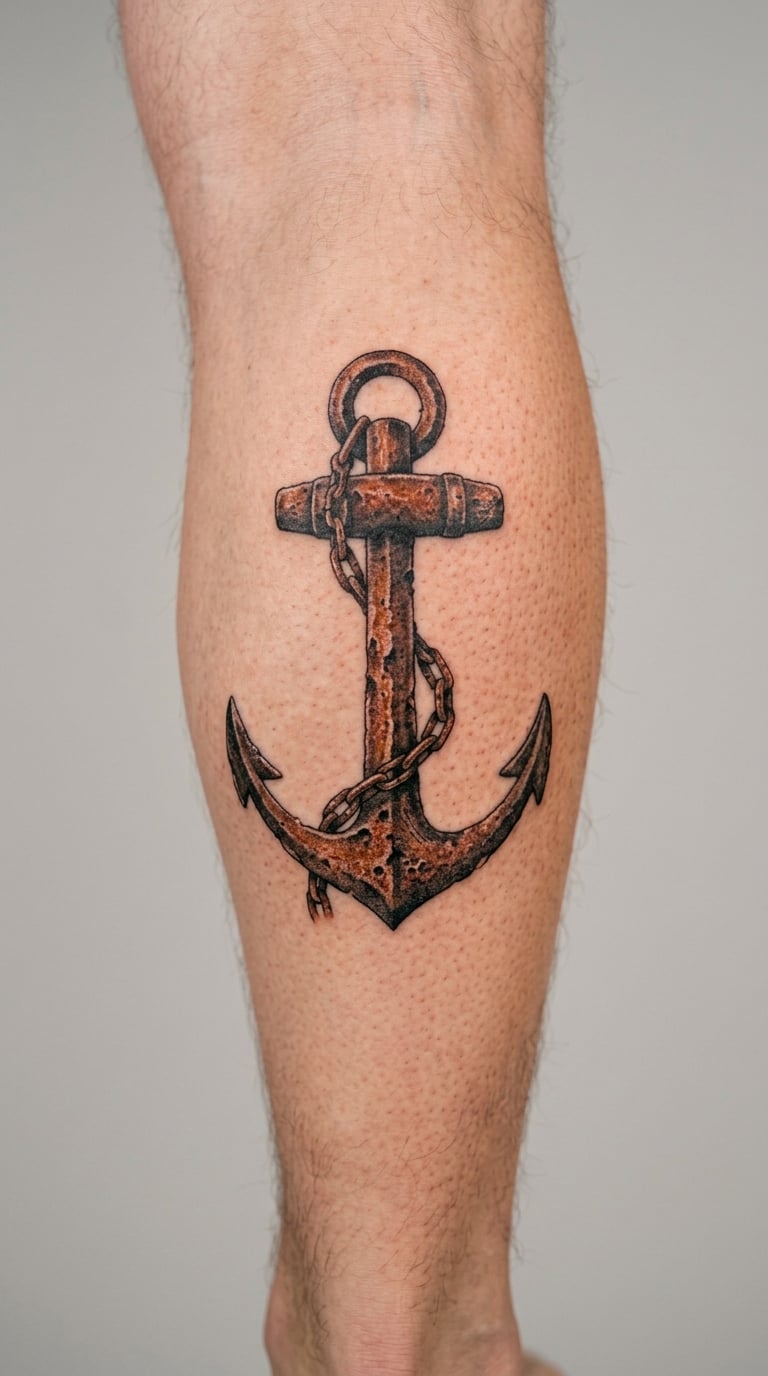
Rendered as a corroded object rather than a clean icon, the anchor becomes a portrait of something that has been out in weather and still holds. It suits people who like realism and who want something that looks like a found object instead of a flash design.
Realistic work needs more space than the drawing suggests. Ten centimetres minimum, and a thigh or calf gives the artist a flat-enough area to work with. Rust textures are built from soft grey gradients, which fade noticeably, so this is a piece that will change in tone over time rather than simply fading out.
Pain and time: moderate on the calf, which bruises visibly for a few days. Two to three hours, and grey wash work often needs a follow-up sitting.
9. Memorial Anchor with Dates Engraved on the Crossbar
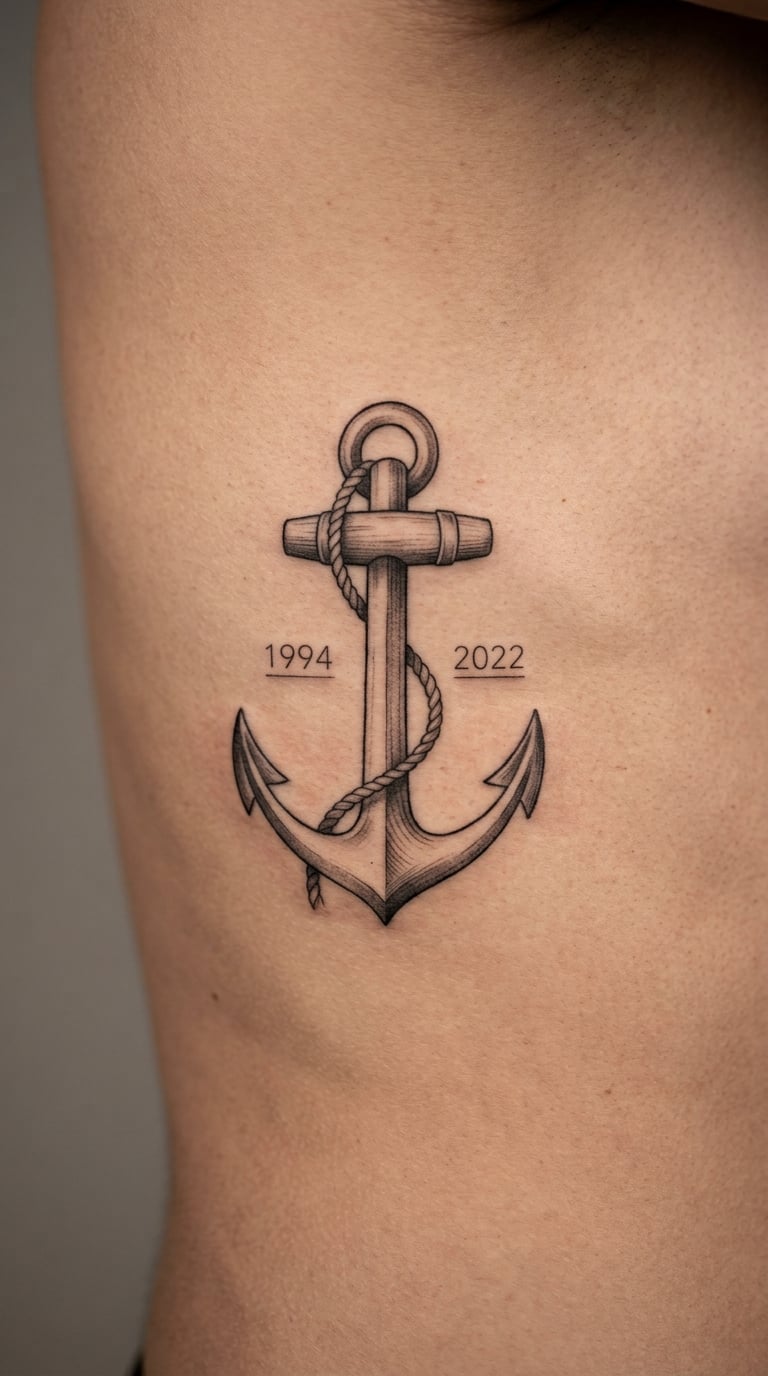
This is the version people come back to most often. The anchor carries the weight and the dates turn it into a specific person: a parent, a service member, a partner who is gone. Treating a bold traditional anchor as an homage to a father who served is the most common way this design gets used, and it is the right way to approach it.
Lettering on the crossbar only works if the bar is at least seven centimetres wide, so either enlarge the anchor or move the dates to the shank. Rib skin stretches when you breathe and twists with movement, so keep the type horizontal and away from the deepest curve. Fine print on ribs is the first thing that blurs.
Pain and time: high. The ribs are thin, bony and sensitive, and deep breathing through the session is genuinely uncomfortable. Two to three hours, often split.
10. Black and Grey Anchor with Two Swallows in Flight
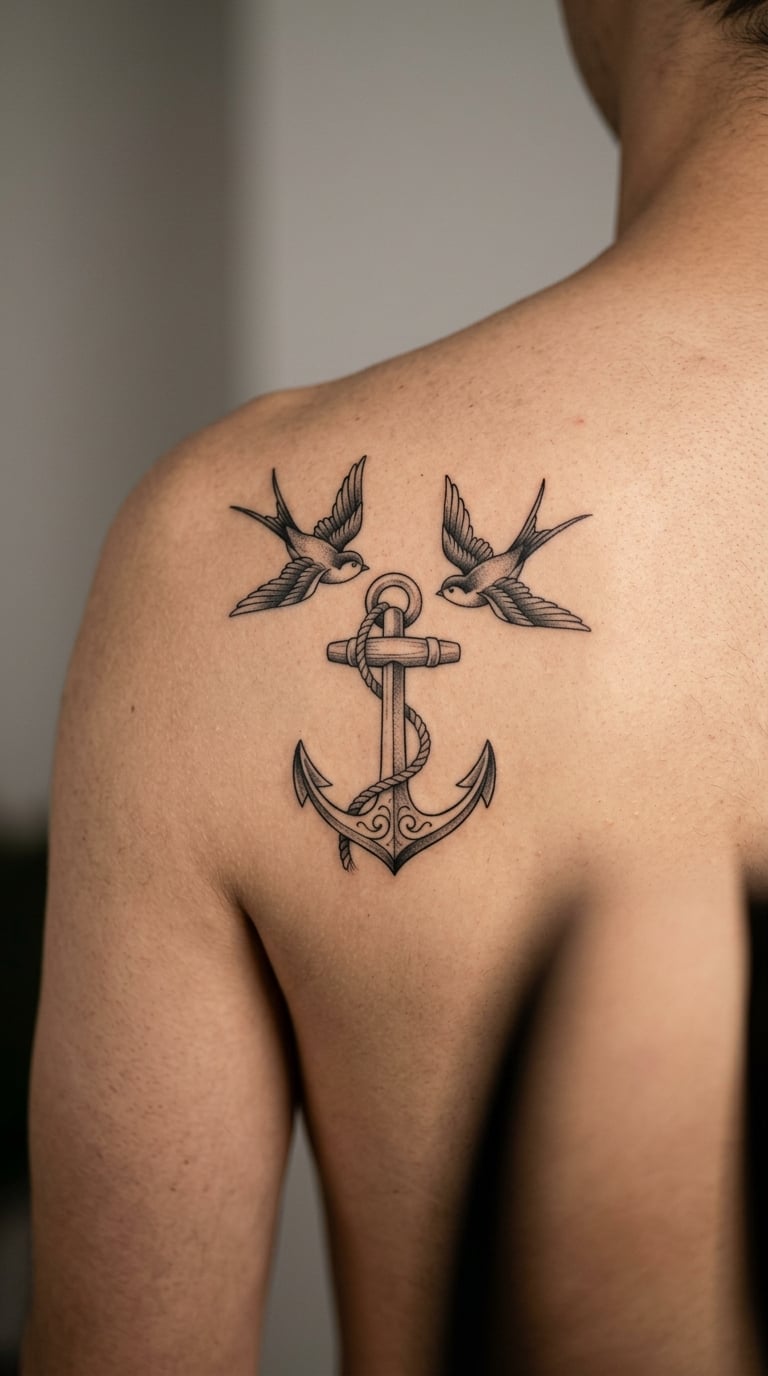
Swallows come in for migration, homecoming and long journeys, so pairing them with an anchor gives you a piece about arrival as well as holding. The birds also solve a practical problem: they fill the empty air around a narrow anchor without adding clutter.
Keep the birds small relative to the anchor, otherwise the composition tips toward a bird piece. On the back there is room to work, and the flat plane above the shoulder blade is one of the easier large canvases on the body. Grey shading on the birds will soften within a few years.
Pain and time: low to moderate on the upper back, though you cannot see it yourself. Fifteen centimetres wide fits comfortably. Two hours.
11. Geometric Low-Poly Anchor Built from Straight Lines
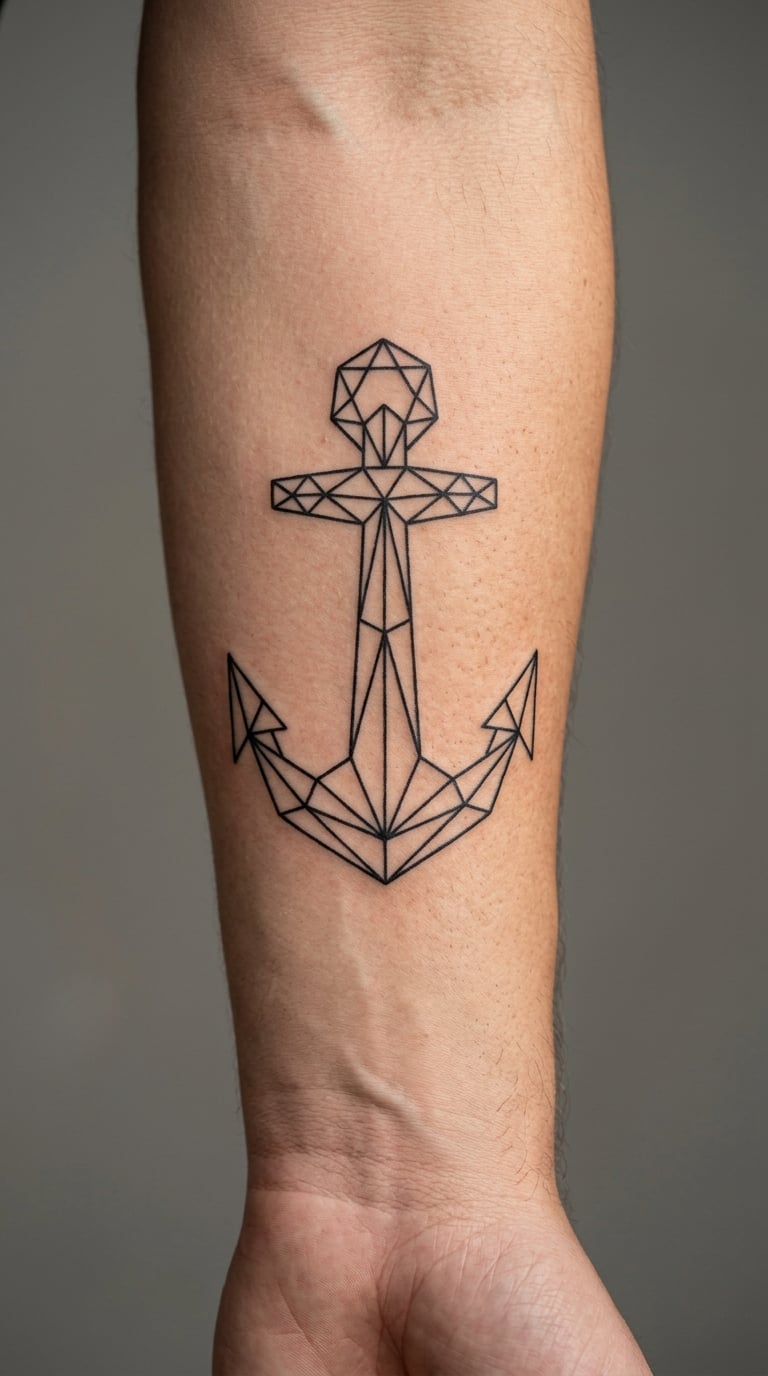
An anchor reduced to triangles and straight segments looks engineered rather than nautical, which shifts the meaning slightly toward structure and precision. It suits people who like geometry and who would not describe the traditional rope-and-fluke version as their style.
Ask for consistent triangle sizing so the facets read as deliberate instead of random. Fine geometric line work softens faster than bold line work, so the artist may vary stroke width across the design to hold the edges. This style works small, which makes it good on a forearm that cannot take a big piece.
Pain and time: moderate on the forearm, sharp lines on thinner skin catch the needle. Six to eight centimetres. One to two hours.
12. Tiny Anchor on the Hand or a Finger
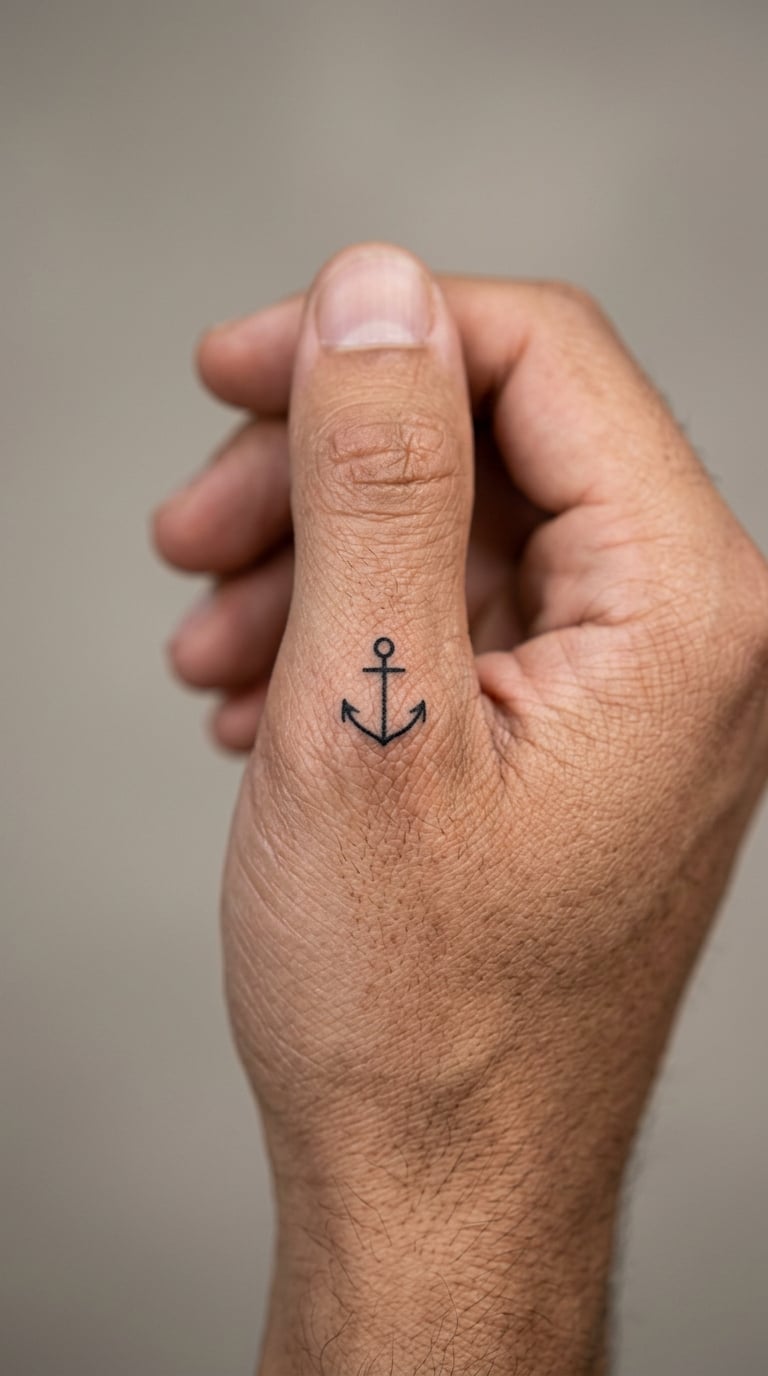
A hand anchor is a commitment piece. It is visible constantly, it ages visibly, and every small imperfection shows, which is either the appeal or the dealbreaker depending on the person.
Two to three centimetres, single needle width, no shading. Hands have soft knuckle skin that changes shape as you age, so a design with a lot of internal detail will distort sooner than one that is mostly line. Placement near the thumb knuckle holds up better than the fleshy pad.
Pain and time: moderate to high. There is little flesh between the skin and the bone across the hand, and fingers can throb for hours afterwards. Under an hour.
13. Anchor with a Chain Curving Around the Forearm
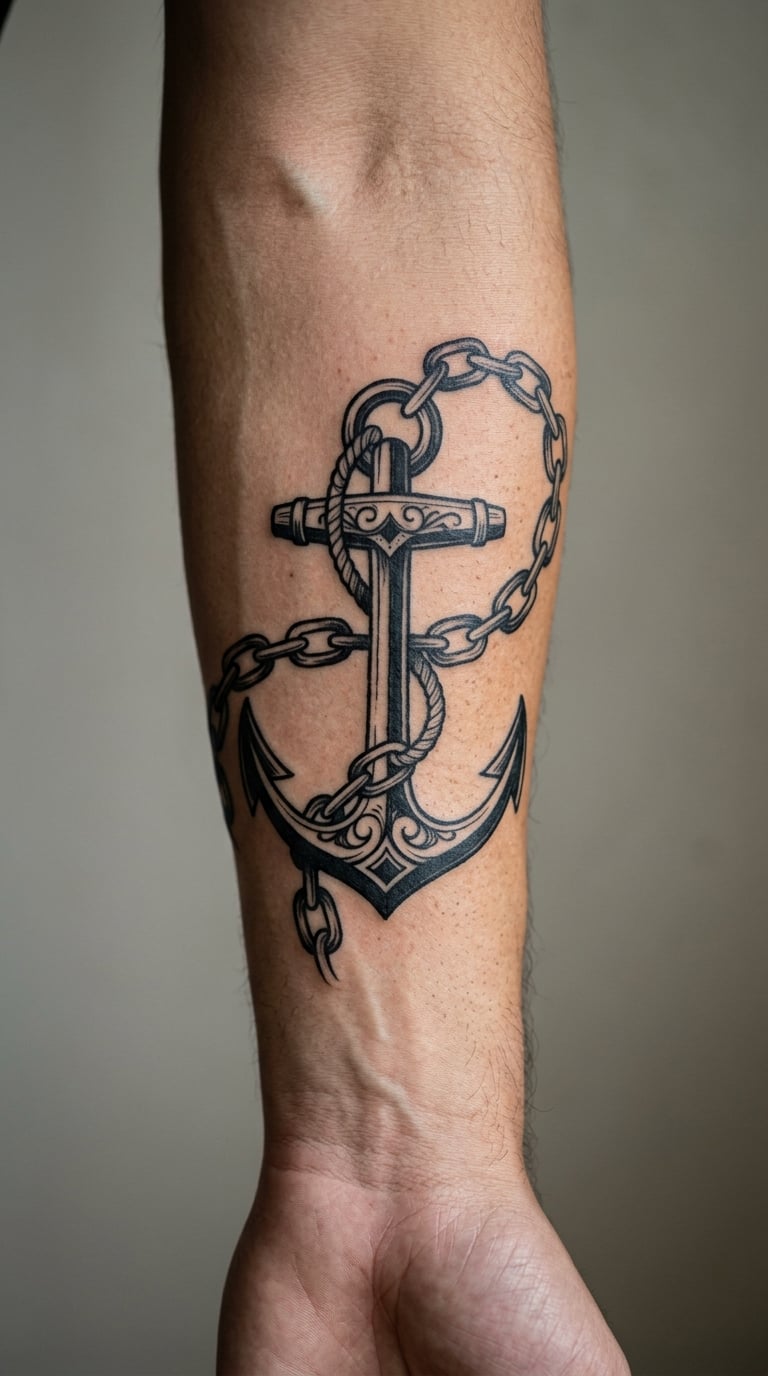
When the chain runs off one edge of the forearm and reappears on the other, the tattoo stops being a sticker and starts being a wrap. It reads as continuous, and it uses the shape of the limb instead of fighting it.
Plan the chain path with the artist before the session, because the links have to line up on the far side of the arm. Keep the anchor itself bold and uncomplicated so it survives the visual weight of the wrapping chain. This is the approach that grows into a partial sleeve if you want it to later.
Pain and time: moderate, rising sharply on the inner forearm near the elbow. Twenty centimetres or more for a wrap. Three hours, usually two sittings.
14. Neoclassical Laurel and Anchor in Black and Grey
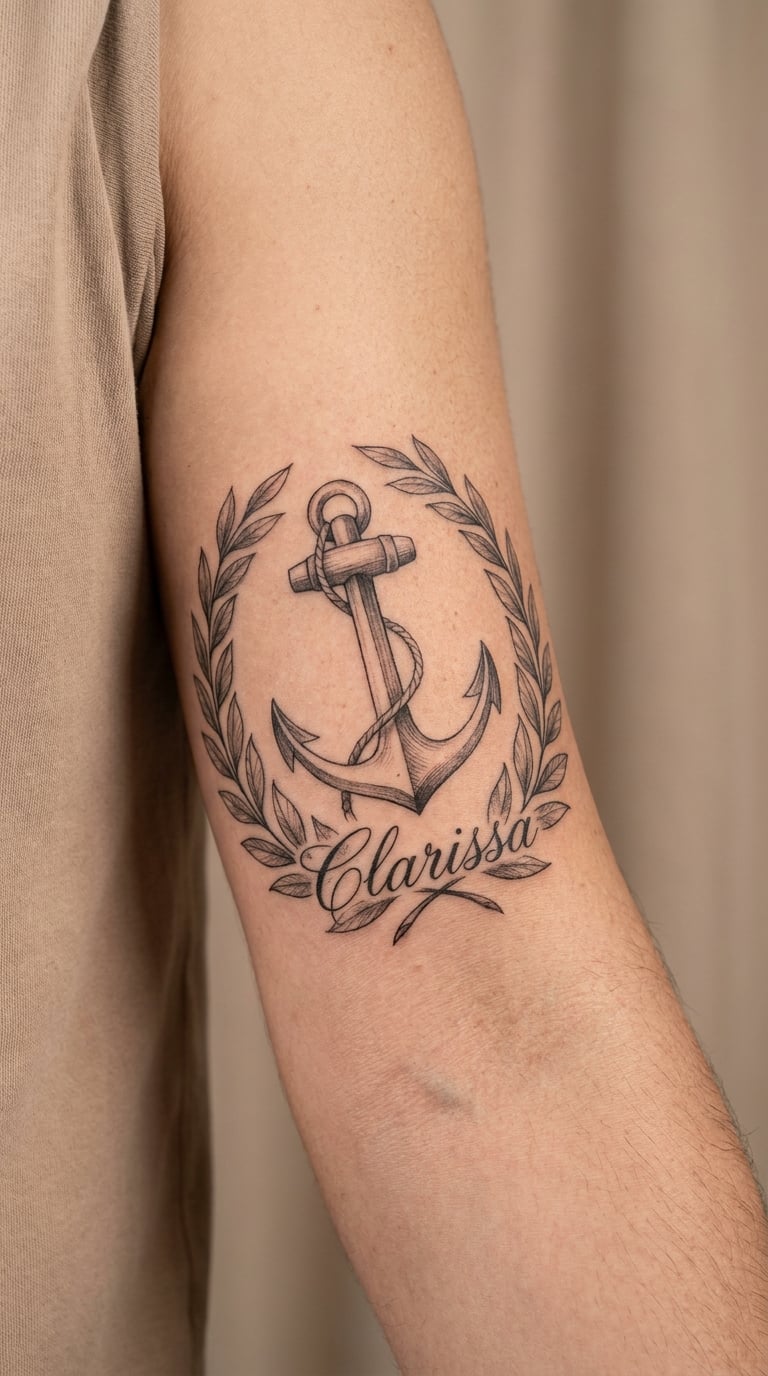
Laurel, script and soft grey shading pull the anchor into classical memorial portraiture. It reads quieter and more personal than the traditional version, and it is the shape most people choose when the anchor represents a person rather than a lifestyle.
Match the shading density to the laurel leaves rather than the anchor, or the leaves disappear. The inner upper arm is forgiving skin that stretches with movement, which suits curved script better than a rigid straight line. A dated piece needs a touch-up at three to five years as the name softens.
Pain and time: low to moderate, a comfortable area. Twelve to fourteen centimetres. Two to three hours.
15. One-Line Script Wordmark With a Small Anchor
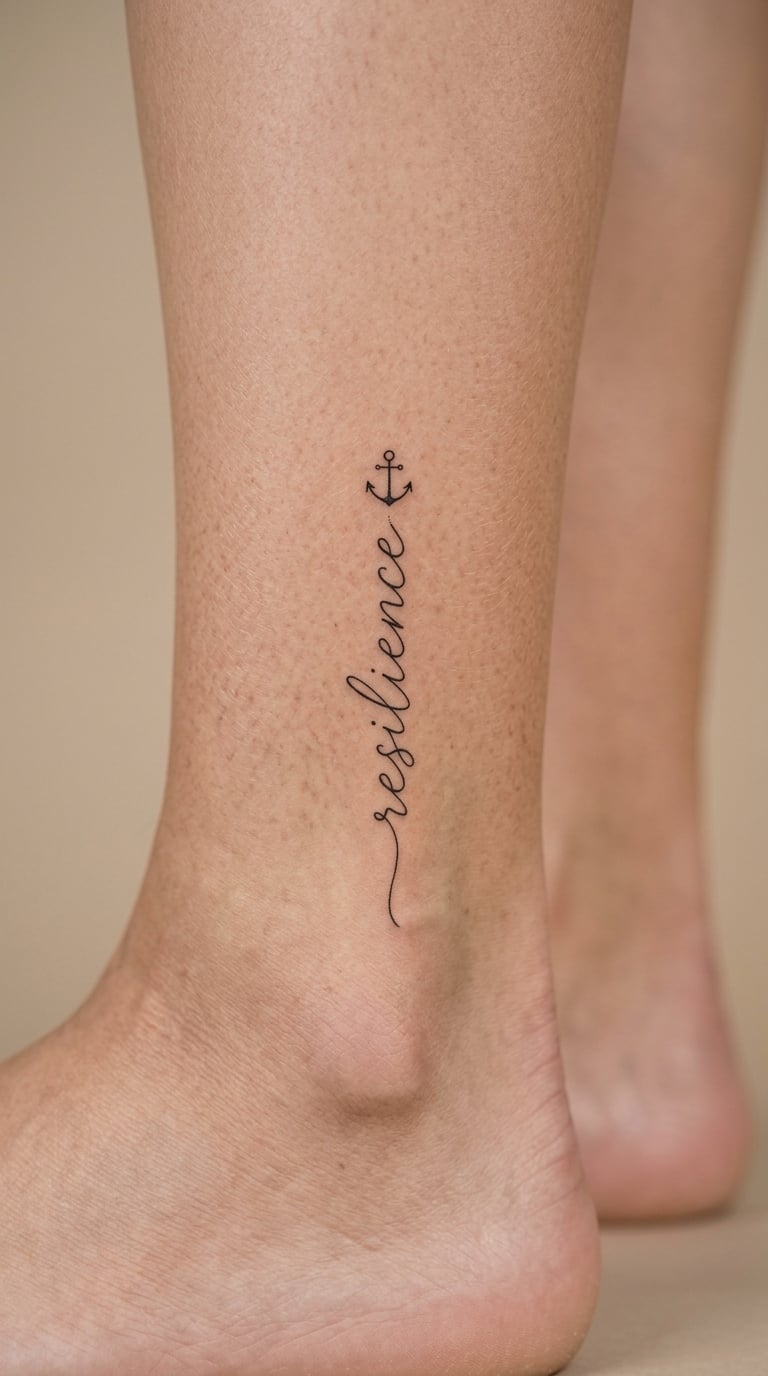
A single continuous line spelling a word, with a small anchor tucked into the design, is the most personal of the lot. It often carries a name or one word that means something to the wearer, and the anchor is a quiet signature rather than the subject.
Ankle skin is soft and wraps around bone, so keep the line fine but not hairline, and expect the script to need a redraw sooner than a symbol would. This is one of the more concealed placements, easy to cover with a sock and easy to forget about on a beach.
Pain and time: moderate. The ankle bone is sensitive and the nerve endings run close to the surface. Six to eight centimetres long. One hour.
16. Split Anchor Design to Share With Someone
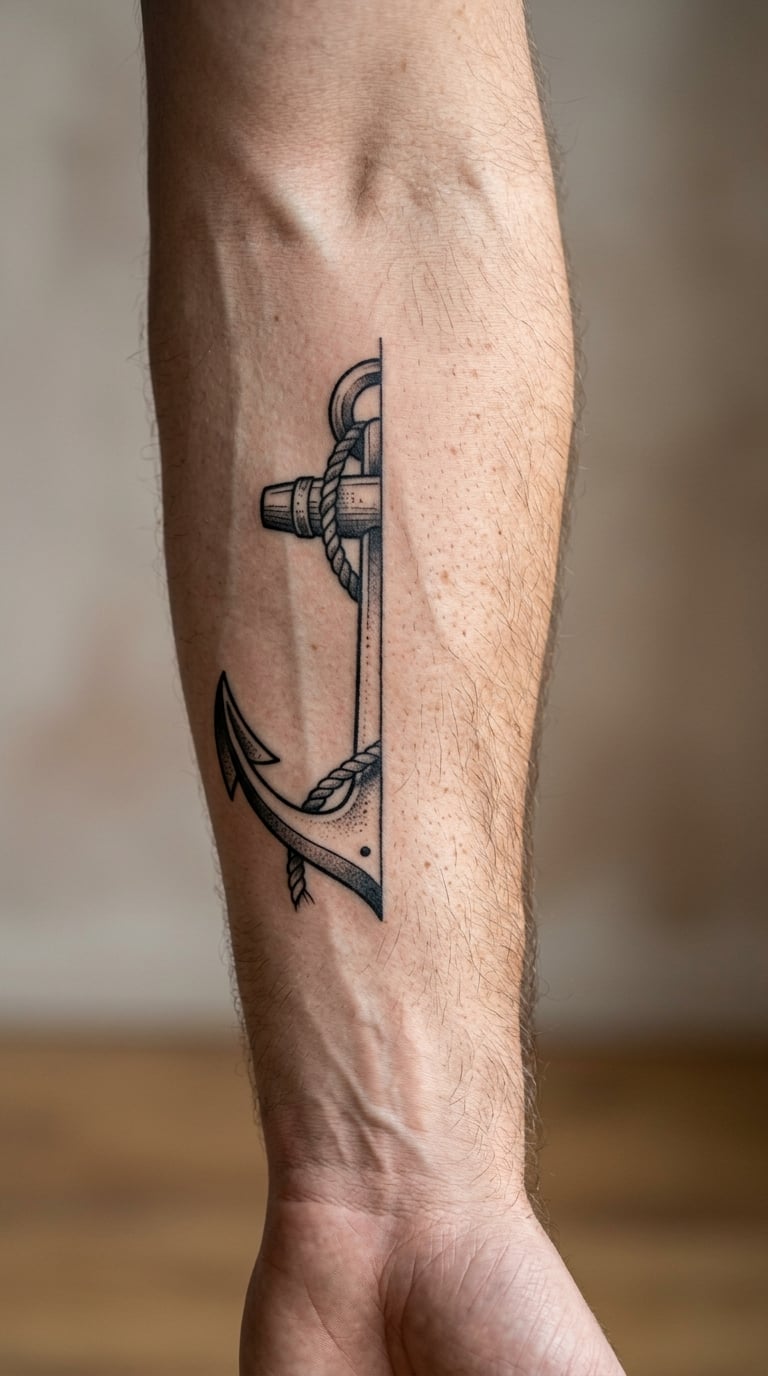
A split anchor is a matching design cut straight through the middle, with each person taking one half. Two partners, a parent and child, or two friends can carry pieces that only make sense side by side, and it quietly answers the question of what loyalty looks like.
The cut has to be a straight vertical line through the shank so both halves still read as an anchor. Draw one side in full and send a photograph of it to your artist as the reference for the other, so both halves match in line weight and size. Eight to ten centimetres per half is enough to keep the ring and one fluke recognisable.
Pain and time: moderate on the forearm. One to two hours for each half, and the two need not be done on the same day.
Where to Place an Anchor Tattoo
Placement decides how much detail the design can carry, and it changes what the piece reads as. An anchor on the forearm is a statement you meet daily, the same drawing on a rib is private, and on an ankle it is something only you know about.
- Grounded, steady, a daily reminder — outer or inner forearm, 8-10 cm tall.
- Service, heritage, crew — upper arm or shoulder, 12-15 cm.
- A private memorial — ribs, under the breast, or inner upper arm, 8-12 cm.
- Quiet and close to the body — inner wrist, behind the ear or ankle, 3-5 cm.
- Belonging to something bigger — sternum, upper back or calf, 15-18 cm.
- Life at sea or on the water — forearm wrap or full lower arm, 20 cm and up.
Per body area, in plain terms. The forearm takes the most detail and stays readable for years. The wrist and the ankle are small canvases, so anything beyond six centimetres turns muddy quickly. The upper arm is comfortable and rarely seen, which makes it the sensible home for a piece you want to keep private. The chest gives you the most vertical room, though sternum skin stretches with every breath. The back is the least painful large area and the one you will never see properly. The ribs carry the most meaning per square centimetre and the most pain, so keep the design there tight and readable.
One practical note on scale. The reference image you love will almost always be drawn larger than the space you have. An anchor that looks substantial in a photograph is usually ten centimetres, and ten centimetres is bigger than most first-timers expect. Measure your forearm against your hand before you commit.
What to Add Around an Anchor Tattoo
One question comes up more than any other: you want a clean, bold traditional anchor as an homage to your father, and you have no idea what to put in the space around it. It is the most common gap in anchor references, because most designs are drawn as a single centred object with empty air on both sides.
Options that genuinely work, roughly in order of how well they sit with the anchor:
- Chain — the obvious partner, and it reads as continuation rather than decoration.
- Compass rose — placed above the ring, it turns the piece into a navigational statement.
- Rope — coiled at the base, traditional, and it grounds a floating design.
- Roses or a laurel — the memorial route, and the most common choice for a parent.
- Names and dates — curved along the shank or set on the crossbar, and worth enlarging the anchor to fit.
- A swallow or two — small birds above the flukes fill air without crowding the anchor.
- Waves or a horizon line — a good fit for an ankle or calf piece, less so for a chest piece.
- A snake or a skull — the darker traditional choices, which change the tone completely rather than filling space politely.
What does not work is adding three of those at once. Two elements is usually the limit before the composition turns into a badge rather than a drawing.
Things to Know Before You Book an Anchor Tattoo
- Pick the anchor shape you actually want. The classic ring, shank, crossbar and fluke design reads as nautical heritage. The barbed and grim reaper style reads as something else entirely, closer to a biker or memorial skull motif. Decide which meaning you are signing up for before the consultation, because the two never get mistaken for one another.
- Find an artist who draws anchors well. It is a common motif, which makes it easy for a portfolio to include one without much thought behind it. Look for a piece where the line weight is consistent and the negative space between the flukes is deliberate. Copied reference art often fails to translate onto a real body, and that is where most disappointing anchors come from.
- Bring a reference board, not one image. Three or four anchors in the style you want, plus a photo of the placement, gets you a much better conversation than a single screenshot. Artists work from proportion, so tell them roughly how large you want it to end up.
- Scale it to the placement before the drawing. Tiny placements such as the wrist, the finger and behind the ear need a simplified design, not a shrunken copy of a large one. That conversation happens at the drawing stage and costs nothing to have early.
- Budget for sessions, not appointments. A small fine-line anchor is usually one sitting. A bold traditional piece with shading often needs two, and a forearm chain wrap is regularly a three-sitting job. The drivers are size, detail level, colour, and how much of the work is shading. Small designs are frequently priced by the piece, larger ones by the hour, so the number that matters most is the hourly rate.
- Plan the healing and the sun. Fresh tattoos on the forearm, ankle and chest sit in the open and fade fastest. Keep new ink out of strong sun for the first couple of weeks, then treat it like skin that has been there for years. Follow your aftercare advice closely, and expect a free touch-up window, which is when the piece gets to be checked by someone who sees it every day.
And one last thought on the fear that stops a lot of people: an anchor is a perfectly reasonable first tattoo. It is a recognisable shape, it works at small sizes, it is easy to place on a flat area, and unlike most novelty pieces it will still mean something to you in twenty years.
Frequently Asked Questions
What do anchor tattoos symbolize?
An anchor tattoo symbolizes stability, hope, strength and loyalty, because an anchor is what stops a vessel from drifting. It comes from maritime and sailor tradition, where it marked service and voyages, and today it is worn as a promise to stay grounded. Add a name or a date and it becomes a memorial piece for a specific person.
Where is the best placement for an anchor tattoo?
The forearm is the most popular spot because it is flat, easy to see and holds detail well. The upper arm is comfortable and private, the chest and back give the most room, and the wrist, ankle and behind the ear suit small designs only. Ribs carry the most meaning per centimetre but hurt the most, so keep those designs simple.
What does an anchor tattoo mean for a man?
Most commonly it signals stability, grit and loyalty, and it often connects to Navy or merchant mariner service, a parent who served, or a working life on the water. A bold traditional anchor with a chain reads as heritage, while a barbed or skull-and-anchor style reads as a darker memorial or biker motif instead.
What does an anchor tattoo mean for a woman?
Usually it points to family, memorial and loyalty, and it is often paired with florals, script names or dates. A fine-line version reads soft and delicate, while a bold traditional anchor is just as common and carries the same meaning. The symbol itself is not gendered; the style and the surrounding elements set the tone.
Do anchor tattoos have religious meaning?
Yes, for some wearers. Hebrews 6:19 describes hope in the soul as an anchor, which is the origin of the religious reading. Christian versions add a cross, a verse or a halo of light. If faith is part of your reason for choosing it, tell your artist so, since religious detail is a specialism.
Is an anchor tattoo a good first tattoo?
It is one of the easier options. The shape is recognisable, it reads well small, and it sits on flat areas like the forearm and upper arm where skin is forgiving. Two cautions: start small, around five to eight centimetres, and pick a placement you can sleep on without pressing your arm against it.
Conclusion
Start with the meaning, not the picture. Whether you are chasing stability, a parent who served, a year that changed you, or simply a symbol that holds still, the anchor tattoo carries all of that, and the design should match the reason you are getting it.
Then bring three or four references to a consultation, agree the real size against the placement, and check the healing and sun notes before you sit down. Anchor tattoo meaning and design ideas are easy to browse; the work is deciding which one is yours, and how big you are actually willing to go.